Q4 2026
French language connects communities
Supporting girls with powerful lessons
Strengthening childcare worker pipeline
Learning
Life
for
Educational programs help Granite Staters build confidence and skills for what’s next.
Megan Clark, RN, left, teaches LNA students how to take blood pressure and pulse at Manchester Community College in a program for English language learners.
There is no choice without access
Everyone deserves the freedom to make decisions about their bodies, healthcare, and future.
Live Free Autonomy Collective removes financial barriers for anyone receiving abortion care and gender-affirming care in or from New Hampshire through direct service funding and movement building guided by patient need. To get your abortion or gender-affirming care funded, call or text our helpline at: 603-395-9078 livefreeautonomy.org @LiveFreeAutonomy on instragram/facebook
The New Hampshire Charitable Foundation is proud to underwrite 603 Diversity and to devote this advertising space to promote nonprofit organizations working to advance diversity, equity, inclusion and belonging in New Hampshire.
FR OM THE EDI TOR
FROM PUBLISHER
Confidence and curiosity to learn and grow
T
he calendar might say
middle-school girls, not just to teach
January is the beginning
carpentry but to build confidence in
of a new year, but for me,
what they can do.
back-to-school in the fall
For a while, Cohl Capparelli felt
always brought more of
sidelined from opportunities by his
that fresh-start feeling.
spinal disability, but the chance to
There’s an excitement to learning,
become a hockey manager got him
with new subjects to delve into and
on the team and on a path to college.
projects to build.
Programs across the state are also
Now, I get to see the joy that
Sarah Pearson
EDITOR OF 603 DIVERSITY YANKEE PUBLISHING
helping immigrants learn English,
comes when my children master a
earn a driver’s license and gain career
new skill, whether that’s writing their
skills, particularly in fields facing
name for the first time or memorizing
workforce shortages. Others are
facts about dinosaurs. While they
helping incarcerated adults stay
may not end up being an author or
connected to their children through
paleontologist, I hope they keep
reading or keeping language heritage
that spirit of curiosity and growth —
vibrant through immersive classes
whether through formal classes, on
and casual clubs.
the field or court, in an extracurricular
Educational resources are not
program or as a personal pursuit.
equally accessible to everyone. But
The stories in this issue showcase the
throughout New Hampshire, people
difference access, encouragement
and organizations are working to create
and skill-building opportunities can
more equitable pathways to learn,
make.
participate and build a future. 603
To support the state’s littlest learners and their working parents, the Granite YMCA and ReGen Valley Tech Hub have launched a training program for early childhood educators and youth development professionals. Girls at Work puts power tools into the hands of elementary- and
603Diversity.com | Winter 2026 1
6 0 3 D I V E R S I T Y. C O M Contributing Writers Wil Arvelo Rony Camille Karen Jamrog Suzanne Laurent James McKim Crystal Ward Kent Tina Kim Philibotte Contributing Photographers Robert Ortiz CEO/President Ernesto Burden x5117 ernestob@yankeepub.com Editor, Custom Publishing Sarah Pearson x5128 sarahekp@yankeepub.com
Make a life-changing difference for a child. Become a CASA. Learn more at casanh.org
Managing Editor Mike Cote x5141 editors@603diversity.com Creative Director/Associate Publisher Jodie Hall x5122 jodieh@yankeepub.com Graphic Designer Christian Seyster x5126 christians@yankeepub.com Senior Production Artist Nicole Huot x5116 nicoleh@yankeepub.com
Explore NH like a local. NHPR is your guide for things to do, local news, and binge-worthy podcasts. Download the NHPR app today!
Sales Executive John Ryan x5120 johnr@yankeepub.com Director of Sales, Operations & Events Ren Chase x5114 renc@yankeepub.com Information Manager Gail Bleakley x113 gailb@yankeepub.com
NEW
HAMPSHIRE
GROUP
100% Employee-Owned
250 Commercial Street, Suite 4014 Manchester, NH 03101 (603) 624-1442 Email: editors@603diversity.com Advertising: sales@603diversity.com © 2026 Yankee Publishing, Inc.
89.1 FM Concord/Manchester| nhpr.org
2 603Diversity.com | Winter 2026
PRINTED IN NEW HAMPSHIRE
Contents COVER PHOTO: ROBERT ORTIZ
FEATURES 12 Teaching tomorrow's teachers
16
16 Woodworking builds life skills 20 Sports a gateway to career path 24 Reading builds connection 28 Different roots, common language 32 Immigrants train for workforce gaps UP FRONT & PROFILES
ESSAYS & MORE
1
From the editor
36 Essay: Democratization of higher education
6
Our contributors
38 Essay: The equity pop quiz
8
Rising changemakers
40 Essay: An open letter to New Hampshire educators
44 A season of celebration
12
42 Events that make a difference
32 20
A MISSION ON THE
To illustrate the mission of 603 Diversity, Seacoast artist Richard Haynes has provided one of his recent designs to accompany our motto “Live Free and Rise.” We are selling T-shirts and other merchandise featuring Haynes’ design, or a design created by art student Chloe Paradis, to benefit the Manchester Chapter of the NAACP. Visit 603Diversity.com to buy one today.
Underwriters ROCK! THANKS TO THE UNDERWRITER OF THIS ISSUE FOR ITS SUPPORT The 603 Diversity underwriters provide a significant financial foundation for our mission, enabling us to provide representation to diverse communities and for diverse writers and photographers, ensuring the quality of journalistic storytelling and underwriting BIPOC-owned and other diverse business advertising in the publication at a fraction of the typical cost. We’re grateful for our underwriters’ commitment to diversity, equity and inclusion in this magazine, their businesses and their communities. 4 603Diversity.com 603Diversity.com||Winter Winter2026 2026
HOMEOWNERSHIP HAPPENED TO US. WE’VE HELPED THOUSANDS BUY HOMES— YOU COULD BE NEXT. New Hampshire Housing has helped over 55,000 homebuyers achieve their dream of homeownership. NOW, IT’S YOUR TURN. Our $15,000 cash assistance program can help you get started. Plus, you don’t have to go at it alone! Build your team of trusted professionals to guide you through credit, budgeting, and the buying process.
Connect with homebuyer resources and explore upcoming education courses.
Find a mortgage that works for you at NHHousing.org.
603Diversity.com | Winter 2026 5
OU R CONTR I BU TORS
C O U R T ESY P H OTO S
James McKim James McKim, who was involved in the original planning of 603 Diversity and has written essays for past issues, serves as managing partner of Organizational Ignition. He is driven by an intense need to help organizations achieve their peak performance through the alignment of people, business processes and technology. He is recognized as a thought leader in organizational performance, the uses of neuroscience and program management.
Karen Jamrog Karen A. Jamrog is a longtime freelancer who covers a wide variety of topics. She is a frequent contributor to New Hampshire Magazine, where she focuses on healthcare stories.
Suzanne Laurent Raised in a diverse community in Boston, Massachusetts, Suzanne Laurent worked as a registered nurse for the Boston Head Start Program. She moved to Toronto, Ontario, in 1982, and unable to work as a nurse, Laurent pursued a career in photojournalism. She has been a resident of New Hampshire since 1987. She has an extensive award-winning background in journalism. She is also a juried photography member of the New Hampshire Art Association and a published poet.
Rony Camille A regular 603 Diversity contributor, Rony Camille is a freelance journalist and a native of Canada. He became a U.S. citizen in 2019 after being a U.S. permanent resident for nearly 25 years. Camille is currently the media program director for the Town of Tyngsborough, Massachusetts.
Crystal Ward Kent Crystal Ward Kent has written for many publications on a wide range of topics, including science, history, the arts and environmental issues. She especially enjoys telling people’s stories. Crystal lives in southern Maine.
6 603Diversity.com | Winter 2026
Tina Kim Philibotte Tina Kim Philibotte is an education justice advocate committed to nurturing liberating spaces for youth and community. Tina resigned from the Manchester School District in the fall of 2024 as the district’s first chief equity officer. She previously spent over 15 years teaching English and dance at the high school and university levels. Tina recently received the NAACP Manchester’s Excellence in Education award as well as the NH MLK Coalition’s Social Justice Warrior award. She was a 2019 NH State Teacher of the Year finalist and a two-time National Writing Project Fellow. Tina received both her bachelor’s and master’s degrees in education from Plymouth State University, and is currently a doctoral candidate in Boston University’s Educational Leadership & Policy Studies program.
Wil Arvelo
Robert Ortiz
Dr. Wildolfo Arvelo is president of Thrive Collective, consulting on nonprofit leadership and management, property development, board development and fundraising. Prior to that, Arvelo served as executive director of Cross Roads House and director of the Division of Economic Development for New Hampshire. From 2007-2017, he served as president of Great Bay Community College in Portsmouth. Arvelo has a doctorate in educational leadership from the University of Massachusetts/Boston.
Primary photographer for 603 Diversity is Robert Ortiz of Robert Ortiz Photography. Ortiz began his photographic career at 15, and has chronicled everything from local weddings and events to the lives of the native peoples of the Peruvian Amazon. He lives in Rochester with his wife and children.
Sarah Pearson Sarah Pearson is editor of custom publications for Yankee Publishing, which produces 603 Diversity and many other titles. She is a lifelong New Hampshire resident, editor and journalist, and a parent.
603Diversity.com | Winter 2026 7
Spotlight ON RISING CHANGEMAKERS Profiles of leaders who are lifting diverse voices 603 Diversity is continuing to share stories of our neighbors in our Rising Changemakers series with another person who is making a difference in diversity spaces of New Hampshire. Our editorial board members and contributors have shared the names of many remarkable people who have not been in this publication before. If you know of someone who deserves some spotlight, please email editor Sarah Pearson at sarahekp@yankeepub.com.
Quinci Worthey CITY: Manchester
Q
You’ve worked in youth development, homelessness services, workforce development, public education and now with the Black Heritage Trail of New Hampshire. What common thread connects those different chapters of your career? Worthey: I think the common thread that connects these chapters in my career is equity. Access to education, housing, employment, learning, business growth and support have all been focused on through an equitable lens. I’ve tried to meet people where they are at, with the hope to help however I can to get them to where they want to go. The mission of the Black Heritage Trail of New Hampshire is to work to bring New Hampshire’s African American history to light, through fostering understanding and appreciation that will inspire stronger, more inclusive communities today. I don’t believe inclusion is possible without equity tied into it.
Q
What brought you to New Hampshire, and what convinced you to stay?
Worthey: I moved to New Hampshire to participate in an AmeriCorps program after college. My original plan was to relocate for a year and then apply for the Peace Corps. I ended up enjoying my time and work in NH, which led to me building a strong community and sup-
8 603Diversity.com | Winter 2026
Changemakers port network. After 16 years, I still reside in New Hampshire and do not have plans to leave anytime soon.
Q
You’ve worked with young people in several very different settings, including schools and services for youth experiencing homelessness. What have those experiences taught you about what young people need in order to succeed in school and eventually in the workforce? Worthey: I am very grateful for how my career has unfolded over the years. It has been a privilege to have these experiences throughout the state. I believe that, in order for young people to succeed in general, there needs to be a focus on ensuring the social determinants of health are met throughout their lives. Those determinants are: education access and quality, neighborhood and built environment, social and community context, economic stability, and healthcare and quality. If those are met in society, people can not only survive, but can also have the potential to thrive.
Q
Before joining the Black Heritage Trail, you worked in both workforce development and K-12 education. Where do you see the strongest connections between a student’s educational experience and their ability to envision a future career? Worthey: I see two immediate connections between a student’s educational experience and their ability to envision a future career. First, I would say exposure, and it shows up in a few ways. One would be Extended Learning Opportunities (ELOs) for exploration, curiosity and connecting the classroom to the world. The second connection that comes to mind is diversity. The connections between diversity within academic spaces and positive outcomes in the workforce are proven. People are able to work collaboratively, respectfully and contribute a variety of perspectives towards shared goals.
Q
What drew you to the Black Heritage Trail of New Hampshire, and how does its work fit into your broader interests? Worthey: Ever since I was a kid, I have been fascinated with how things got to where they are. This has led me to seek out as much knowledge as I could get my hands on. I even remember reading encyclopedias quite regularly when I was younger. That thirst for information makes the Black Heritage Trail of New Hampshire feel like a familiar and safe space. I love that every day I can show up to work and learn a story I’ve never heard. I can dig deeper into already existing stories. The icing on the cake is that I then get to share what I gather with others. I was a sociology major in college, so the humanities are near and dear to me. At the Trail, the stories and people I’m learning about look like me, and that is powerful.
Q
What role can learning local Black history play in the education of New Hampshire students, particularly students who may not often see themselves or their communities reflected in what they study more regularly? Worthey: Learning Black history is beneficial for all students. It directly impacts students feeling as if they are included and belong. It also provides a more rounded historical perspective. In many ways, it can lead to a more accurate telling of historical events. We can’t learn from the past if we don’t learn about all of it. Empathy and connectedness are also gained through Black history for those who may not be Black. There is a diverse student population throughout the state, and everyone wins from learning about each other's history. At BHTNH, we believe our purpose is to educate, engage and inspire through storytelling, programs and memorials that preserve and share
New Hampshire’s African American heritage. Black history is filled with joys, successes, love, pride, resilience, genius and so much more that is often overlooked. There are names that everyone should know that aren’t taught. There are events that everyone should know that aren’t taught. I love that my job gives me an opportunity to share these names and stories with anyone who will listen.
Q
What other organizations are you involved with, and why are they important to you?
Worthey: I am involved with the Advisory Council for Endowment for Health and Health Strategies of NH, Of Color Collective, New Hampshire Education Coalition, and New Hampshire Educators of Color. I’m an alum of Leadership New Hampshire, Equity Leaders Fellowship and New Leaders Council. I’m also a board member for Black Lives Matter (BLM) New Hampshire and the American Civil Liberties Union (ACLU) of New Hampshire. These are all very important to me! Advocacy and service are longstanding traditions and values in my family. As a child, I had many examples throughout my life of what they look like in practice. I think that has led me to naturally gravitate towards organizations with like-minded alignment.
Q
Looking ahead, what would you most like to see change in New Hampshire so that more young people can see a future for themselves here? Worthey: Affordability is a serious barrier for young people in New Hampshire. We unfortunately have one of the highest averages of student loan debt in the country. It can be hard to see a future in New Hampshire when you also take into account the rise in housing, healthcare and childcare costs.
603Diversity.com | Winter 2026 9
and prejudice without doing something about it. Since that moment, I have dedicated my studies and career to advocacy and speaking up for myself and others.
Q
Saniyah Bolton CITY: Exeter
Passion areas: I major in justice and law and double minor in sociology and African American diaspora studies. I currently have a few jobs, but my main position is the human and civil rights intern for the National Education Association.
10 603Diversity.com | Winter 2026
Q
You became involved in advocacy at a young age. What first motivated you to speak up and get involved in the community? Bolton: I am originally from Reading, Pennsylvania, and moved to Exeter in 2017, as I was going into middle school. After arriving in New Hampshire, it was more than apparent to me that not only myself but my family were going to have to gather lots of strength to adapt to the new environment, especially considering the lack of diversity as a family of color. Not only had my younger brother, Dominik, gone through discrimination, but I struggled greatly. It wasn't until COVID-19 and the pandemic began that I took lots of time thinking about the state of my community and nation, especially after the death of George Floyd in 2020. I had always been passionate about Black history and diaspora-related studies but had never thought to put it into action. I could no longer sit in grievance and anger about the recurring violence
What is the youth division of Black Lives Matter New Hampshire?
Bolton: The BLMNH Youth Division is a branch of the nonprofit organization Black Lives Matter New Hampshire whose mission is to uplift and empower all youth through advocacy, education and community-focused social justice initiatives. The youth division works to ensure that young people have the skills and knowledge needed to advocate for themselves and their communities, driving change in the fight for equality and justice. They aim to create a supportive community where young people are equipped with the tools to challenge systemic inequalities, advocate for their rights, and lead the fight for a more just and equitable society.
Q
What do you think young people bring to the table, particularly for conversations about racial justice? Bolton: Advocacy can come in many ways. Many often view advocacy as protesting, public speaking and constant publicity surrounding whatever issues one may be passionate about. But advocacy is a flexible act, and can take the shape of anything surrounding change and support. A favorite quote of mine is, "Education is the passport to the future, for tomorrow belongs to those who prepare for it today," by Malcolm X. To me, education is one of the most powerful methods of self-advocacy. Seeking out resources and informing yourself and others about the happenings of the world as well as what we can do about it plays such a significant part in efficient advocacy. I wouldn't stand where I do today
Changemakers “ Education is a tool of success and driver of passion, a necessity in all communities and all lives.” without the knowledge I have consumed both inside and outside of school. Education is a tool of success and driver of passion, a necessity in all communities and all lives. It allows you to hold yourself accountable, guide your awareness, and provide you with the skills one would need to input themselves into larger roles within activism and support.
Q
You’re studying law at American University. What drew you to that field, and how has your advocacy work influenced what you hope to do professionally? Bolton: Since I was young, I had always been told that I should be a lawyer because of my confidence and argumentative skills. I never truly took the recommendation seriously until I started taking college-level classes surrounding law and government while attending Exeter High School. Such classes, in addition to my own research, made it apparent to me that the criminal justice system is not an equitable system, leaving many people of color lost and vulnerable. From violence to mass incarceration, it was clear to me that I wanted to be involved and begin to make a difference for as many as I could. My advocacy heightened this aspiration, as I had had opportunities to connect with law enforcement officials, politicians
and other leaders within this field. Such conversations and partnerships opened my eyes to the importance of legal representation for marginalized groups and the lack of governmental or political representation and equity, inspiring my goal of becoming a lawyer and being a resource that many may need.
Q
How do you stay connected to your efforts in New Hampshire while balancing being a student in D.C.? Bolton: I have taken up opportunities to stand as the senior organizing associate for the American Civil Liberties Union (ACLU) of NH as well as the executive programming assistant for Black Lives Matter NH — two internships I held this past summer as I returned home for the season. I currently work closely with Black Lives Matter NH and its team, supporting media and outreach efforts as best as I can. I have also worked within the development of our newest branch, titled the Justice and Advocacy Division, which is a legal-centered arm of Black Lives Matter New Hampshire focused on access to justice, legal education, rights protection and systemic legal reform.
Q
Are you involved with other organizations? If so, what drew you to them, or why are they important to you? Bolton: I previously worked as a tour guide for about three years and served as the summer 2025 social media coordination intern for Black Heritage Trail of New Hampshire. I was initially recognized by the organization in early high school, where I was chosen to introduce keynote speaker Ibram X. Kendi during the 2022 Black New England Conference. Later, after standing as a featured speaker for their Tea Talk series in 2023 entitled “Youth to Power: Black Female Activists,” I became close with executive director Jerri-
Anne Boggis, who soon after offered me the position.
Q
Was there a particular experience when you realized, “This is the work I want to keep doing”? Bolton: As I began my journey into advocacy, I was heavily involved in public speaking. Whether this be at a protest or community event, in conversation with diverse crowds across New Hampshire, many of whom responded well. Seeing the glimpse of joy and excitement on an individual’s face after truly recognizing their identities or even calling forth racial justice and bringing to light the hard truths a primarily white community in New Hampshire often has a hard time admitting, is the impact that I hope to bring to all. Allowing those in marginalized groups to be seen while opening doors and offering knowledge to others.
Q
How have mentors, teachers or other community leaders helped you develop as a leader? And how do you try to provide that same support to younger people? Bolton: My mom is one of the most influential individuals in my life when it comes to supporting my development. More than just a parent, she is my biggest mentor and inspiration for my dedication to advocacy and education for not only myself but my community. In addition, my family at Black Lives Matter NH presented me with resources and a support system; I was able to educate myself and others while promoting the ideals of justice and equality throughout our state. As they have shown me the kindness, accountability and leadership I needed to build my own self-efficacy and succeed, I try to follow the same qualities when working with youth and all those beginning their journey into advocacy and achievement.
603Diversity.com | Winter 2026 11
BY S U Z A N N E L AU R E N T
P H OTO S R O B E R T O R T I Z
A pathway
to the childcare workforce YMCA PROGRAM LOOKS TO ADDRESS COST OF CARE AND
ticipating in the New Hampshire Quality Rated Improvement System, a statewide program designed to assess and improve the quality-of-care services in early childhood education settings, has decreased 16%.
PROVIDE TRAINING
I
t’s a startling equation — the cost of childcare in the Granite State remains high, yet the number of providers has declined. According to a report by Dow Drucker, a senior policy analyst for the New Hampshire Fiscal Policy Institute, the price of childcare for a family with an infant and a 4-year-old seeking center-based care averaged about $30,000 in 2025, up from $22,500 in 2017, while the number of licensed center- and home-based childcare providers has declined by 120 since 2017. For many Granite State families, the cost of childcare tuition will represent their greatest annual expense, particularly for families with multiple children and those living in rural regions of the state, Drucker reported this June. Alongside the overall decline in childcare providers during this period, the number of center-based programs par-
12 603Diversity.com | Winter 2026
New Hampshire has lost 120 licensed center- and home-based childcare providers since 2017, even as childcare costs have risen. Recognizing the growing problem, the Granite YMCA, based in Londonderry, introduced its Empowered Futures Program, a childcare apprenticeship. “The program was created in partnership with the ReGen Valley Tech Hub initiative as a component project, as they hope to bring new residents to New Hampshire to work in the bio-
fabrication arena,” said Emily Goupil, director of workforce development at The Granite YMCA. “They want to be able to attract and retain these new employees, such as young adults and families, which will require access to affordable housing (another part of the initiative that we are not the main partner for) and reliable, affordable, high-quality childcare,” Goupil said. “While affordable and accessible housing and childcare may be priorities for ReGen, they are also a major priority for New Hampshire as a whole.” The Granite YMCA applied to be a component project to the ReGen Valley Tech Hub initiative and created this program to help bring more individuals into the field of childcare. This highly immersive 10-week program offers hands-on learning opportunities across various settings, providing participants with intentional training and courses, peer discussions and real-world application. They gain invaluable experience while working with children from infants as young as 12 weeks to school-aged youth. “Through the partnership with ReGen Valley and the grant that this initiative received through the U.S. Economic
ABOVE: Stephanie DeShiro, assistant director of workforce development, speaks to the summer cohort of the Empowered Futures Program. LEFT: Marissa Greenwood chats with students who attend daycare at the YMCA. BELOW: Latha Nandimandalam listens to class.
Courtesy
603Diversity.com | Winter 2026 13
Development Administration, we have been able to build a program we're proud of,” Goupil said. “The goal is to get apprentices as close to (if not completely) associate teacher qualified. This is why we have two college courses built into our program, state licensing–requirement trainings, and many other foundational training topics that cover early learning, school-age childcare, positive youth development, workforce readiness skills and beyond.” The first cohort of apprentices launched in June 2025. As of August 2026, the program graduated its sixth cohort for a total of 43 graduates in the first year of facilitation. Each cohort can take up to 14 participants. “Once they complete our program (as long as they opted in for the college credit), the vast majority of our apprentices are eligible to be hired as an associate teacher or group leader,” Goupil said. “We help them to secure full-time
employment either with The Granite Y or with one of our other incredible early-learning center partners in the Greater Manchester area.”
The Granite YMCA’s Empowered Futures Program graduated 43 childcare apprentices in its first year, across six cohorts. If they are not qualified as an associate by the end of the program (because they chose not to take the college course or do not have enough hours in
BELOW: Stephanie DeShiro RIGHT: Keara Bruno works with toddlers. NEXT PAGE, TOP: Carson Sleeper reads to the kids. NEXT PAGE, BELOW: Crisbel Romero Ynoa and Yaditza White listen. The cohort completes a worksheet.
14 603Diversity.com | Winter 2026
Courtesy
childcare), the YMCA works with them on a pathway moving forward, such as registering for an Early Childhood Education certificate with the Community College System of NH and taking the required courses, registering for a 4-year degree, or perhaps even a yearlong apprenticeship. Additionally, all graduates have the foundational state requirements met for them to be hired as an assistant teacher, such as fingerprinting, Prosolutions Health and Safety Certificate, CPR/First Aid certifications, etc., which can help lighten the load of the early learning centers, because they don't need to organize and pay for those certifications and requirements. The vast majority of graduated apprentices are hired in the Greater Manchester area, but also elsewhere across the state. “Of our current 43 graduates, 17 are currently employed in an early-learn-
ing or school-aged childcare program with The Granite YMCA, and another 10 are working with other wonderful early-learning or school-aged childcare programs in Greater Manchester (Easterseals NH and The Nest Family Center) or surrounding areas,” Goupil said. “Many of our apprentices are now associate teachers and looking to continue taking courses to gain the trainings and certifications required to become a lead teacher, which would be the next professional step,” Goupil said. “We also have had nine apprentices choose higher education as their path after the program, with many choosing to complete degrees in early/elementary education, child psychology or social work.” The winter cohort begins on Jan. 4, 2027. Email workforce@graniteymca. org or call 603-232-8683 for more information. 603
— Reda Shehabeldin Courtesy
Of our current 43 graduates, 27 are currently employed in an early-learning or school-aged childcare programs. — Emily Goupil 603Diversity.com | Winter 2026 15
BY S A R A H P E A R S O N
P H OTO S C O U R T ESY O F G I R LS AT W O R K
Building confidence Girls at Work uses tools and hands-on learning for girls to discover what they’re capable of.
T
he first day they enter Girls at Work, the girls are understandably nervous. Most have never seen a power tool before. Many don’t know anyone who’s used one. On the shop walls, hand-painted messages from past participants offer encouragement: “We can do hard things,” “Be scared and do it anyways,” “You are a force.” The words provide some early reassurance. Then, the girls pick up their first tool. “The first tool we teach them is the sander, because it's the safest tool,” says Kaylee Richard, Girls at Work’s marketing coordinator. “I turn the sander on, and it's kind of loud, so they get nervous. Then I tell them, ‘You can touch it. It only tickles.’ Then when they touch it, they're like, ‘Oh, I can do this all day,’ and then jump right into it. They have a change in confidence
16 603Diversity.com | Winter 2026
right when they get over that initial fear. “Having them use that sander is a good segue to ‘Wow, I can actually do this.’” While learning to use power tools and build things is how the program works, building the confidence of girls ages 8 to 14 is the heart of its mission. Girls at Work grew from a workshop contractor Elaine Hamel led at a summer camp in the early 1990s. Today, it offers after-school programs for all Title 1 Manchester public elementary and middle schools, as well as summer programs. The program aims to serve under-resourced girls, with about 95% meeting scholarship requirements and paying no tuition. Richard knows that transformation firsthand. “When I picked up a tool at the age of 8, I was like, ‘Wow, what?’ I didn't think I was allowed to do that. I didn't think anyone had enough trust to let me do something like that, and I didn't trust myself to do it,” she says. “It's really rewarding having an end result, but also learning that I am capable of doing something that I never thought I was.” Her first project was a bookshelf she still owns — even if she
"The first tool is a sander — a small step past the fear." now laughingly calls it “really ugly.” Many of the girls in the program only know the careers and circumstances around them. “A lot of the girls, they see their parents' lives or their grandparents' lives as their future,” Richard says. “It's just very important that we're giving them as many options as possible. When they're with us, we're not just talking about carpentry. I know that they're learning woodworking, but the goal of that is to teach them confidence for wherever they go.” The projects become ways to teach problem-solving, perseverance, safe risk-taking, confidence, hands-on learning and understanding when to push through difficulty and when to pause. The program also exposes them to carpentry, skilled trades and other career possibilities they may not have encountered before. “I had a girl who wanted to be an art teacher; she's learning how to walk with confidence in doing whatever she does in the woodworking area, and she can use that skill of confidence wherever she goes,” Richard says. “We want to show them as many opportunities as possible.” In addition to the woodworking program, Girls at Work has a STEAM lab for middle-school girls, which uses those same principles in projects that involve technology, design and engineering.
The lessons Girls at Work provides to elementary- and middle-school students are less about building a footstool or bookshelf and more about building self-confidence and awareness that they are capable of doing challenging things.
603Diversity.com | Winter 2026 17
AGES
8-14 As staff got to know participants and their families, they also began recognizing needs that extended beyond the workshop. What started with providing closed-toe shoes for girls who didn't have footwear appropriate for the shop expanded into today's Kindness Room, stocked with coats, toiletries, school supplies and groceries. Richard remembers a 9-year-old thanking staff for encouraging her to bring leftover food home and explaining that her family couldn't buy groceries until a tax refund arrived. Moments like that demonstrated how much support some families needed. “To empower a girl for life, you have to empower them in all aspects of life,” Richard says. “We're not just doing woodworking; we are making sure they're going home with groceries every day that they're with us.” Rather than relying on one-off workshops like Hamel offered in the early days, Girls at Work today emphasizes longer-term relationships. After-school programs run for
95%
MEET SCHOLARSHIP REQUIREMENTS
GIRLS INC. GIRLS INC . OF OF NEW NEW HAMPSHIRE HAMPSHIRE
Building a new generation of strong, smart, and bold leaders We’re the longest-running girls’ leadership program, evolving with girls to help them meet any challenge and seize every opportunity.
Serving girls around NH in our centers and in school classrooms with our evidence-based programming.
18 603Diversity.com | Winter 2026
Stand with girls. Your generosity shows girls you believe in their abilities, strengths, and potential.
www.girlsincnh.org
“ We want to show them as many opportunities as possible.” seven consecutive weeks, and participants may return year after year as they move from elementary to middle school. The organization works with Manchester schools and community partners to identify girls who could benefit most. “Having them in our space longer is just so beneficial to them and to us because, as staff, we can really get to know who these kids are,” Richard says. Girls at Work has also adjusted its project cycle so returning participants tackle new projects each session. And while they may go home with a birdhouse, bench or Adirondack chair, Richard hopes they leave with more confidence and self-awareness, too. “I hope that they walk away knowing that they are fully capable of doing anything and everything that they want to as an individual,” she says. 603
A Welcoming Workplace for All At NH Mutual Bancorp our values drive a culture of respect, inclusion, and belonging where we embrace the uniqueness that each individual brings forth to our organizations. Values are at the core of who we are; they drive innovation, foster collaboration and a respect for diverse thought and unique experiences. Ultimately, they ensure that individuals feel welcomed and empowered to succeed. We are committed to dedicating our efforts, including leadership focus and financial investment, to promoting equal opportunity across our work environments and within the communities we serve. Doing so makes us a stronger, more successful, and sustainable organization over the long term.
www.nhmutual.com/careers/ New Hampshire Mutual Bancorp and its affiliates are an Equal Opportunity Employer. This includes veterans and individuals with disabilities. 603Diversity.com | Winter 2026 19
BY K A R E N A . JA M R O G
P H OTO S C O U R T ESY N O R T H E A ST PA S S AG E
T HROUGH SPORTS, C OH L CAPPA R E L L I FOU N D A PL ACE TO EXCEL AND A DI R ECT ION FOR H I S FU TU R E
B
asketballs thump, weights clang and feet pound treadmills on a recent Sunday at the Exeter YMCA while Cohl Capparelli, 19, traverses the Y’s lobby, his wheelchair whisper-quiet. Born with spinal muscular atrophy, he has long been unable to move in ways that most of us take for granted. Growing up in Exeter, Cohl was acutely aware that he was different from his peers. He remembers trying to use his pants to hide his leg braces when he was 6, and “act like I was normal, because I knew I wasn’t normal.” It didn’t help that doctors were unable to diagnose him until he was 9. “I had all these kids asking me why I walked weird, why I had this bulge sticking out of my lower pant leg, why I couldn’t run like everyone else,” Cohl says, “and I was like, ‘I don’t know.’ That was one of the hardest parts of growing up — not knowing what was wrong with me.” His parents tried to help but weren’t sure what advice to give him, he says, because they’d never had to deal with a disability. Cohl says he’s “been called names and stuff” but hasn’t experienced much overt discrimination. Still, his frustration
20 603Diversity.com | Winter 2026
and emotional pain are palpable as he recalls encounters like the one that occurred when Cohl and his girlfriend visited Boston. A woman approached and told Cohl’s girlfriend she was “a saint” for being with Cohl despite the fact that “he is not a normal man.” (“I was right there, listening!” Cohl says, incredulous.) Even at the Y, where Cohl says he’s “met so many great people,” he’s noticed that when he exercises on the Y’s
“ I love when people recognize me as the athlete that I’ve put the time in to be.” — COHL CAPPARELLI
A dedicated multisport athlete with Northeast Passage, Cohl Capparelli has competed in wheelchair rugby, wheelchair lacrosse and sled hockey.
603Diversity.com | Winter 2026 21
basketball court, some people watch him through the lobby windows as if he’s a curiosity to observe rather than a fellow human being to interact with. They turn away as soon as Cohl heads their way to take a break. “They watch me like I’m an animal in a cage,” he says. “They won’t say anything to me.” Cohl believes people mean well and are afraid of offending him, but he doesn’t understand why talking about physical disabilities is considered taboo. “I want people to understand that they shouldn’t be afraid to talk to disabled people,” he says. “Disabilities are just part of who you are, like your hair color or your eye color.” In contrast to the difficult moments, Cohl finds joy in sports, as he always has. He played baseball when he was younger, with a runner serving as his stand-in on the field, and more recently participated in adaptive hockey, but he found that he didn’t have all of the physical function necessary to succeed in that sport. “I thought, ‘Where do I go from here? I want to compete.’” He sensed his time in sports was running out, but then an Exeter High School teacher suggested that Cohl look into being team manager for the school’s hockey team. Not only did Cohl clinch the job, he also excelled in it, using the sports statistics and strategy knowledge that he’d acquired as an ardent fan to provide valuable, detailed notes to the coaching staff.
He was an essential member of the team, says Paul DiMarino, EHS hockey coach, who admires not just Cohl’s hockey acumen, but also his competitiveness and self-assurance. “Cohl has a swagger and a confidence about himself. He’s not going to take crap from anyone. He’s remarkable,” DiMarino says. For Cohl, being team manager was “life-changing,” he says. “I didn’t think college was for me,” but being team manager for the EHS hockey team, and later the baseball team, made him realize he might be able to continue in sports as a career. Today, Cohl is midway through his sophomore year at Southern New Hampshire University as a sports management major. He commutes to SNHU to save money on room and board while also avoiding the difficulties that would come with living on campus with a disability. DiMarino has already offered Cohl a job as assistant coach of the EHS hockey team after graduation. Cohl remains focused on what he wants out of life. “I’m not gonna sit here and complain all the time, because I can’t change (my disability),” he says. He lights up like a scoreboard when he describes his latest passion: playing wheelchair rugby through UNH’s Northeast Passage, an organization that provides opportunities to participate in
While Cohl competes in adaptive sports, he's also found fulfilling work on the sidelines as a team manager.
22 603Diversity.com | Winter 2026
adaptive sports and recreational therapy. It’s a surprisingly rough game. Players intentionally slam their wheelchairs into each other to knock opponents off course or block their way. Cohl eats it up, enjoying the rush he gets from pushing hard, competing and winning as part of a team. Although he initially resisted trying rugby, he was hooked during his first team practice, when he got launched from his wheelchair during one of the deliberate collisions — a moment Cohl describes as “invigorating.” And, as it turns out, he’s really good at wheelchair rugby; so good that teams from Canada and Pennsylvania have tried to recruit him. To stay healthy and be his best as a competitor, Cohl rises in the pre-dawn hours to work out before going to school, his part-time jobs at the Y or a local convenience store, or whatever else he has going on that day. “I love when people recognize me as the athlete that I’ve put the time in to be,” Cohl says. His discipline and drive define him. “That’s what makes me special,” he says, “but all that most people see is the wheelchair, not who I am.” With a determination to succeed and a desire to challenge people’s perceptions, Cohl displays an attitude and grit that are nothing short of inspiring. “I’m not any different than the person next to me,” he says. “I’m no different than you. I’m just using wheels instead of my legs.” 603
603Diversity.com | Winter 2026 23
BY S U Z A N N E L AU R E N T
C O U R T ESY P H OTO S
Books build
BRIDGES behind bars CLIF C OACH ES
encourages the practice of reading together — at home and from afar.” One component of ChIA programINCA R CERAT ED A DU LTS ming is literacy seminars that emphaTHROUG H FA M I LY size the importance of reading with children and offer practical strategies R EADING P R O GRA M for sharing books and stories, even for adults who may not feel confident in eading to children deepens their own literacy skills. the emotional bond between "Two to three times a year, there is a parent and their child. a 45-minute presentation at each of But what if a parent is incarthe New Hampshire facilities,” CLiF’s cerated and physically separated Executive Director Laura Rice said. from their child? “It’s interactive, and the presenter will The Children's Literacy Foundation model storytelling.” (CLiF), a nonprofit organization serving The ChIA program also offers book New Hampshire and Vermont, is comgiveaways at each literacy semimitted to helping incarcerated adults nar, where incarcerated adults can maintain their bonds with the children choose new books to send home to in their lives through books and stories. their children, grandchildren, nieces Since 2004, CLiF's Children of Incarand nephews. During special family cerated Adults (ChIA) program has visitation events hosted by the FCC, partnered with the Family Connections ChIA periodically sponsors storytelling Center (FCC), a family resource center presentations and provides books for located in all three New Hampshire children to choose and keep. state prisons, to offer literacy program“In the past, we’ve done storytelling ming to inmates. and book giveaways at the summer “ChIA helps incarcerated adults barbecue held for families at some of maintain meaningful connections with the facilities," Brown said. "And we do their children through literacy,” said give away books at the winter holiday CLiF Program Manager Jana Brown. parties where children are visiting their “By building confidence around reading families for holiday gatherings, so kids and sharing stories, CLiF supports have a chance to personally select a families in staying emotionally conbook at those events.” nected despite physical separation and ChIA also supports the Storybook
R
24 603Diversity.com | Winter 2026
programs embedded within the Family Connections Center. This program offers incarcerated adults the opportunity to record themselves reading a book aloud. The FCC helps with the audio recordings and mails a copy of the book to the child, providing a powerful way for families to share moments of connection and routine, even across distances. Research shows that participation in storybook programs helps strengthen family bonds and is associated with improved reentry outcomes, including increased likelihood that parents remain at home following release. How the ChIA program began The ChIA program was the brainchild of CLiF Founder Duncan McDougall, who had a vision for an organization that would make the joys of reading and writing more accessible to under-resourced children in Vermont and New Hampshire. In 1998, CLiF opened its doors in Etna before later moving to its current headquarters in Waterbury Center, Vermont. “Its premise is simple: When children enjoy doing something, they do it more often,” McDougall said. “The more they do it, the better they get. CLiF helps kids build joyful connections with literacy from an early age, opening doors to lifelong learning and opportunity.”
CLiF Founder Duncan McDougall gives a presentation at the NH State Prison for Men in Concord.
Notes from the adults to the children. 603Diversity.com | Winter 2026 25
CLiF’s Children of Incarcerated Adults (ChIA) program currently partners with five correctional facilities in Vermont and New Hampshire, providing resources and support to help incarcerated men and women stay connected with their children through literacy. We receive many wonderful words of gratitude from the families impacted by this program, and were particularly touched by the generous and kind words shared in this recent letter from an incarcerated father.
“Let me start by saying ‘Thank you.’ I have been incarcerated since 2013, so I am very familiar with your program and all you have afforded to us, not only at the prison, but also throughout (Vermont and New Hampshire)! This letter goes out to all of you who make these seminars possible! My son absolutely loves receiving these books, as well as my nieces and nephews! I started off with the toddler books and have now moved all the way up to young adults. The wide variety that you provide is such a blessing! I truly can’t thank you enough, you’re all undoubtedly godsends! The fact that you can take time and money, and come into these facilities and institutes, completely unbiased, opinion free, and humanize us when so many others out there are quick to judge, label and even disregard us! You’ve enabled me to be a father who can stay active and relevant in my son’s life. I never really knew my father, so being able to read the books I send home with him allows us to make the moments together that are absolutely priceless. Without CLiF, none of this would have been possible, so again, thank you so much! My son used to struggle with his reading and his pronunciation, but since there is such a wide selection, I was able to find books that were suited to his needs, and now he is excelling in his reading. He’s at an 8th/9th grade level, even though he’s only in 6th grade! I owe that to your program, and all the donors who make that possible. Thank you so much! I hope this program continues on indefinitely for the sake of parents and children everywhere! The donations you give and work you do is quite literally invaluable. So thank you from the bottom of my heart for being part of the glue that helps keep families together!” G.G. March 27, 2025
In its first year, the organization served 500 children in six communities. Today, it reaches approximately 20,000 kids at hundreds of events each year across New Hampshire and Vermont. Having started his career in management consulting, McDougall also volunteered with a refugee nonprofit in Boston and with incarcerated adults, before realizing he "wanted to contribute the rest of (his) working life to the world at large.” Recognizing that low literacy skills are linked with higher rates of incarceration, McDougall launched the ChIA program in 2004 as a means of sharing the many benefits of literacy with incarcerated men and women, and 26 603Diversity.com | Winter 2026
modeling the importance of sharing books and stories with children. After 25 years as CLiF's founding executive director, McDougall retired from the role in 2023. He remains actively involved with the organization and continues to host literacy seminars for incarcerated men and women through the ChIA program. CLiF's impact on incarcerated adults and their families FCC Administrator Tiffani Arsenault said CLiF programming receives an enthusiastic reception within the facilities. “The collaboration with CLiF is eagerly anticipated by both the incarcerated adults and their children,” Arsenault said. “Often the inmates sign up for the event because of the opportunity to send home a book. Many of them do not have means or opportunity to let their child know they are thinking of them, but this allows them to do just that at no cost.” Often the incarcerated adult will add a note to the child that is mailed with the book. “What they come to realize is that the child not only appreciates the book,
Men choose books for the children in their lives at the Northern NH Correctional Facility in Berlin.
but it also serves as a conduit for conversation about what they are reading, and the child begins asking when the next book will come and puts their parent (or grandparent or uncle/aunt) on a mission to find a specific book in a series or genre,” Arsenault said. “Some of the incarcerated adults also choose to record books and send the audio recording home. When possible, they will find the book they already recorded at a CLiF event, or learn that their child enjoys a series and then they pursue recording something in that domain for the next creation.” Arsenault said she has observed a dad use the skills he learned about during a CLiF seminar during a video visit with his child. “This dad was not a confident reader, but during his virtual visit he used a book as a tool to connect, rather than feeling the need to read each word,” she said. “Afterwards, he said, ‘It does work,’ and smiled,” she said. "Those in the FCC program also attend a weekly support group. The CLiF program offers these parents a chance to talk about what their children enjoy reading, and they make suggestions to each other. CLiF is also incorporated into our parent-child events," Arsenault said. "Historically, we have had two versions. One: The books are on display, and the parents and children browse them together and then select books to take upon departure. Two: CLiF sends a professional storyteller who puts on a performance and engages with families. Both are enjoyed by all who attend." Rice said it is inspiring to witness the many positive impacts of the program. “I have heard from parents that their kids save the books with the notes to them long after they've outgrown them, which is really meaningful to hear," she said. 603
Trusted Legal Advisors Client by Client, Case by Case Corporate / Tax / Trusts & Estates / Litigation Education / Employment / Health Care Bankruptcy / Intellectual Property / Immigration Cybersecurity & Privacy / Artificial Intelligence Energy / Environment / Real Estate & Land Use Personal & Family Representation Government & Criminal Investigations Government Affairs & Regulation
McLane.com Manchester, NH / Concord, NH / Portsmouth, NH Woburn, MA / Boston, MA
Independent Lens: Flood by Katy Scoggin
YOUR NEXT GREAT WATCH IS ALREADY WAITING. Independent films. Revelatory documentaries. STREAM ANYTIME ON THE PBS APP More to explore with NHPBS Passport.
603Diversity.com | Winter 2026 27
ANDREWS O N Y CA MILLE BYBYRCAITLIN
C OCOURTESY U R T ESYPHOTO P H OTO S
Club Richelieu meets regularly at a Nashua bookstore cafe.
FRENCH:
O
A language that flows between many peoples
n a Tuesday at the Barnes and current events. At one point, the & Noble in Nashua, conversation drifts toward memories of members of L’éclectique learning cursive in school. Coterie, loosely translated No one was teaching a formal lesson. as “eclectic circle,” gathered around a The point was simpler: a place to gather table speaking French. and speak French. The group has met for roughly four decades. Lee Francine Davis-Campano reviews a map of Gaspesie, Robert Caron started it an island off the eastern Canadian shore. in the early 1980s. Caron died about two years ago, but the gatherings continued. Most around the table are older retirees. Over coffee, they trade stories about recent travels, people they had seen
28 603Diversity.com | Winter 2026
Today, people speak French around tables like this one and several other conversation groups across the state. Elementary school children are learning French in their Manchester classroom. And immigrants from the Democratic Republic of Congo are building communities where French exists alongside languages including Lingala and Swahili. French in New Hampshire is evolving. And today, the people speaking it come from far beyond the Quebec roots that inspire the “Bienvenue” Welcome
Drouart came to the to New Hampshire signs United States from that greet travelers crossFrance in the 1970s to ing the state line. study at the University For John Tousignant, of Massachusetts-Amexecutive director of the herst. Franco-American Center He later met his wife, in Manchester, the state's Vicky, whose Franconnection to French is co-American family is personal. from Claremont, New His grandparents came Loïs Numbi, center, secretary of the Congolese Community of New Hampshire, Hampshire. from Quebec and spoke said it's common for people in her community to move through languages, “We don't have any including French. French with one another, awareness of this Franbut encouraged their chilco-American community," Drouart dren to speak English, so his parents The Franco-American Center leads said. "We knew about Louisiana, the didn't speak French at home. He had Prêt-à-Parler French conversations and Cajuns. We know about Quebec, but to find his way back to the language summer camps such as Camp Bienwe don't know about this, you know, himself. venue, and held its inaugural Franco Fest immigration, French Canadians, most“I had to kind of re-seize my heriin Concord in August, Tousignant said. ly to New England. So, to me, it was tage by starting to learn French when New Hampshire's connection to like, wow,” he said. I was 14 in school,” Tousignant said. Quebec never entirely disappeared. Debates over whether someone Quebec and Canadian flags still Today, he sees people in their 30s speaks French from France, Quebec, fly alongside the American flag at and 40s confronting something similar. Haiti, Africa or somewhere else can establishments around the state. Still, "I think that there's that real sense miss the larger point. maintaining French doesn't necesamong people, maybe in their 30s, “It’s French. It is French,” he said. sarily mean preserving one particular even 40s now, that were kind of cut “It’s different than the French in version of Francophone culture. off," Tousignant said. "French wasn't Switzerland, in Belgium, in Africa. But Eric Drouart came to New Hampshared with them when they were it’s French.” shire from France and now leads Club growing up." He said that matters, because the Richelieu of Nashua, part of an organiHe said that parents today want to French-speaking population around zation that promotes French language find ways in which their children can them is changing. and culture. connect to the culture.
State Rep. Mary Ngwanda Georges and members of the Congolese community in NH celebrate Congolese Independence Day on June 30, 2026. During the program, Georges noted the fact that the official language of the Democratic Republic of the Congo is French has helped the Congolese population integrate into Manchester, Participants listenthetocity’s a presentation during BLM NH's doula training program. sharing a linguistic bond with traditionally large FrenchCanadian population. (Photo by Andrew Sylvia, Manchester Ink Link, via the Granite State News Collaborative)
603Diversity.com | Winter 2026 29
The descendants of their families. Quebec immigrants haven't Others have a disappeared. Some are heritage connection to actively trying to reclaim French but don't reguthe language. But they are larly speak it at home. increasingly sharing FrancoThat distinction phone New Hampshire with helped shape Manpeople whose connections chester's approach. to French begin somewhere Kindergarten students else entirely. in the French program The face of French in New begin with about George speaks during a French Conversation Club gathering at Concord Hampshire, he said, is chang- Public Library. 90% of their school ing and evolving, enriched day taught in French, by different communities of French including core academic subjects and Nassar Perron, who works with the speakers. early literacy. The amount of English district's multilingual programs, said That shift is already visible in Maninstruction increases each year until French Canadians recruited to work in chester classrooms. students reach a 50-50 split in fourth Manchester's mills once made French a The Manchester School District is in grade. common language across the city. Her its second year of a French dual-lanThis year, nearly 20 students are own grandparents were among those guage program. The district used a enrolled, and the district welcomed its who came from Quebec. state innovation grant to explore dufirst tuition-paying student from outside Today, the connection to French al-language education, first launching Manchester. looks different. a Spanish program before expanding The curriculum also deliberately The district serves Francophone into French, drawing on Manchester's reaches beyond France and Quebec. A families with roots in Haiti, Congo, Franco-American history and interest world map hangs in the classroom, PerBurundi, Côte d'Ivoire, Rwanda and from families. ron said, and students explore a differMorocco, Perron said. Some want to That history runs deep. Wendy ent Francophone country each month. maintain a language already spoken in
Ali Sekou, back center, a native of Niger, leads a bi-weekly French Conversation Club in Concord. 30 603Diversity.com | Winter 2026
Manchester School District offers language immersion programs for French and Spanish instruction. Community members have been invited to talk with students about their own language, heritage and culture. For Perron, French is far from disappearing. “There’s a big commitment to sort of keep French language and heritage alive,” she said. At the same time, students are arriving from a half-dozen countries where French remains part of their lives. “I think the interest is growing,” Perron said. In Concord, Niger native Ali Sekou has helped create a space for people who simply want an opportunity to speak French. Sekou, a city councilor and mayor pro tem, started a French conversation group at the Concord Public Library that meets twice a month. It draws students preparing to study abroad, teachers looking for a place to practice, retirees, Franco-Americans reconnecting with a language their parents spoke and others simply interested in French.
“I really wanted to continue maintaining the language,” Sekou said. “I love the French language.” For Sekou, French was the language of his education growing up in Niger. “When you go to school in Niger, you have to learn French,” he said. “So, for somebody who went to school, that was my language.” French-speaking immigrants from Africa are also adding to New Hampshire's Francophone communities. “We have to really create that space for all of us who care about the language,” Sekou said, “to continue having that space and practice it or elevate it.” Loïs Numbi, secretary of the Congolese Community of New Hampshire, described a community where moving between languages is ordinary. French is widely spoken alongside Lingala, Swahili and English, including within the state's 10 Congolese churches. But New Hampshire's Congolese community has had little interaction
with the Franco-American organizations that have traditionally represented French language and culture in the state. “No, not yet,” Numbi said, though she hopes that will change. Numbi said people have questioned whether she speaks French or “African French,” and some have been surprised to learn that she speaks the language at all. “They think that the language is associated with one people, but it’s not,” she said. For Numbi, French is also personal. “To me it means … my people,” she said. “That to me means identity.” Sekou’s conversation group and the community Numbi describes show how the language extends beyond New Hampshire’s traditional Franco-American roots. French is being preserved and, in some families, reclaimed. But it is also arriving with people for whom it never disappeared in the first place. 603 603Diversity.com | Winter 2026 31
BY C R YSTA L WA R D K E N T
P H OTO S BY R O B E R T O R T I Z /C O U R T ESY
Opening the Door to
Opportunity Classes and programs promise a new start
Students take a driver's education course with the International Institute of New England.
32 603Diversity.com | Winter 2026
During her LNA class at Manchester Community College, Lucilemny from Haiti, takes the pulse of a classmate.
M
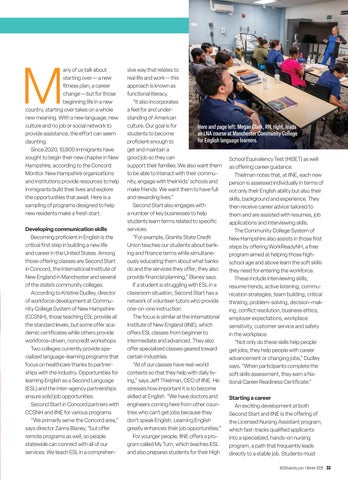
any of us talk about starting over — a new fitness plan, a career change — but for those beginning life in a new country, starting over takes on a whole new meaning. With a new language, new culture and no job or social network to provide assistance, the effort can seem daunting. Since 2020, 10,900 immigrants have sought to begin their new chapter in New Hampshire, according to the Concord Monitor. New Hampshire organizations and institutions provide resources to help immigrants build their lives and explore the opportunities that await. Here is a sampling of programs designed to help new residents make a fresh start. Developing communication skills Becoming proficient in English is the critical first step in building a new life and career in the United States. Among those offering classes are Second Start in Concord, the International Institute of New England in Manchester and several of the state’s community colleges. According to Kristine Dudley, director of workforce development at Community College System of New Hampshire (CCSNH), those teaching ESL provide all the standard levels, but some offer academic certificates while others provide workforce-driven, noncredit workshops. Two colleges currently provide specialized language-learning programs that focus on healthcare thanks to partnerships with the industry. Opportunities for learning English as a Second Language (ESL) and the inter-agency partnerships ensure solid job opportunities. Second Start in Concord partners with CCSNH and IINE for various programs. “We primarily serve the Concord area,” says director Zanna Blaney, “but offer remote programs as well, so people statewide can connect with all of our services. We teach ESL in a comprehen-
sive way that relates to real life and work — this approach is known as functional literacy. “It also incorporates a feel for and understanding of American culture. Our goal is for Here and page left: Megan Clark, RN, right, leads students to become an LNA course at Manchester Community College for English language learners. proficient enough to get and maintain a good job so they can School Equivalency Test (HiSET) as well support their families. We also want them as offering career guidance. to be able to interact with their commuThielman notes that, at IINE, each new nity, engage with their kids’ schools and person is assessed individually in terms of make friends. We want them to have full not only their English ability but also their and rewarding lives.” skills, background and experience. They Second Start also engages with then receive career advice tailored to a number of key businesses to help them and are assisted with resumes, job students learn terms related to specific applications and interviewing skills. services. The Community College System of “For example, Granite State Credit New Hampshire also assists in those first Union teaches our students about banksteps by offering WorkReadyNH, a free ing and finance terms while simultaneprogram aimed at helping those highously educating them about what banks school age and above learn the soft skills do and the services they offer; they also they need for entering the workforce. provide financial planning,” Blaney says. These include interviewing skills, If a student is struggling with ESL in a resume trends, active listening, commuclassroom situation, Second Start has a nication strategies, team building, critical network of volunteer tutors who provide thinking, problem-solving, decision-makone-on-one instruction. ing, conflict resolution, business ethics, The focus is similar at the International employer expectations, workplace Institute of New England (IINE), which sensitivity, customer service and safety offers ESL classes from beginner to in the workplace. intermediate and advanced. They also “Not only do these skills help people offer specialized classes geared toward get jobs, they help people with career certain industries. advancement or changing jobs,” Dudley “All of our classes have real-world says. “When participants complete the contexts so that they help with daily livsoft skills assessment, they earn a Naing,” says Jeff Thielman, CEO of IINE. He tional Career Readiness Certificate.” stresses how important it is to become skilled at English. “We have doctors and Starting a career engineers coming here from other counAn exciting development at both tries who can’t get jobs because they Second Start and IINE is the offering of don’t speak English. Learning English the Licensed Nursing Assistant program, greatly enhances their job opportunities.” which fast-tracks qualified applicants For younger people, IINE offers a prointo a specialized, hands-on nursing gram called My Turn, which teaches ESL program, a path that frequently leads and also prepares students for their High directly to a stable job. Students must 603Diversity.com | Winter 2026 33
already have a certain level of English proficiency to enter the LNA program, which only takes a small number of applicants each term. Once in the intensive program, they learn not only nursing skills but also medical terminology, taught by a qualified instructor with a science/medical background. “At Second Start, we partner with the NHTI for this program, so students get to be on a college campus,” Blaney says. “Just being on campus makes them proud and fuels their desire to learn more. They see the possibilities and some are inspired to go further and become RNs.” At IINE, the LNA program is offered through Manchester Community College and has a similar structure. “This program is a good opener for people who had medical careers in their home countries but cannot yet re-enter their field because of English limitations,” Thielman says. “After improving their English and learning medical terms, they can get LNA certified and start moving back into their profession.” Second Start is hoping that the LNA program will eventually become a “learn and earn” offering so that students can be paid for their work while they go to school. “Right now, students commit to four or five days per week of training for an entire semester,” Blaney says. “This can make it hard to also have a job, which many need in order to support themselves.” Graduates of both LNA programs have had excellent results in finding jobs, as most hospitals need LNAs, as do nursing homes and other care centers. Havenwood Heritage Heights, a large senior-living community in Concord, allows many Second Start LNAs to complete their clinical requirements there, giving them valuable hands-on experience. Apprenticeships are another excellent avenue for immigrants wishing 34 603Diversity.com | Winter 2026
to enter the workplace. Both Second Start and IINE work with the community colleges to help place students in apprenticeship programs. “There are opportunities in a range of fields from manufacturing to hospitality, the medical field and others,” Dudley says. “The employer oversees the hiring process, while the colleges provide the technical education component. Most of these programs require a certain level of English proficiency, which is where partners such as Second Start and IINE come in — providing that training, along with helping students learn the terminology required for the jobs.” “Companies also approach us, so that their employees can improve their language skills and advance,” Blaney adds. “Companies want to keep good employees and know that advancement is key. Improving their language skills helps an employee move off the production line and into management, for example.” Some industries are offering their own ESL efforts to attract and retain members of the immigrant workforce. Southern New Hampshire Health (SNHH) is one such company. According to Viktoriya Dribinskaya, director of workforce development, SNHH has partnered with EnGen for “anytime, anywhere” digital coursework, and works with the Nashua Adult Learning Center for in-person coaching. These efforts give their employees flexibility when it comes to learning, as well as personalized instruction. So far, 12 employees have passed through SNHH’s program. “We know that learning English helps members of our team develop their careers here, and advance in clinical and leadership roles,” Dribinskaya says. “It also builds confidence in the way they communicate with patients and peers, and directly enhances care quality and team dynamics.”
Programs at Second Start and IINE help immigrants learn English, take driving lessons and get workforce training.
Resources
Overcomers Refugee Services and Ascentria Care Alliance, both in Concord, can assist immigrants with housing and food resources. Visit overcomersnh.org and ascentria.org. Local churches and faith-based organizations are also good places to start. For ESL, HiSET and career assistance, visit Second Start at second-start.org. International Institute of New England iine.org Community College System of New Hampshire. New Hampshire has seven community colleges scattered throughout the state, in Portsmouth, Manchester, Nashua, Concord, Berlin, Laconia and Claremont, with academic centers also in Keene, Littleton and Lebanon. ccsnh.edu
The influx of immigrants has been good for New Hampshire, according to Thielman. “New Hampshire has many jobs that need filling and in diverse fields. If we did not have these new arrivals, many critical jobs would not get filled. There are opportunities for them and great benefits for the state.” “Anyone entering one of these agencies and taking that first step toward their new life deserves to be celebrated,” Blaney notes. “It takes courage to ask for help, to learn English — especially as an adult. “In many cultures, asking for help is not typical, but in the States, you need help to get ahead,” Blaney says. “For many, trusting us to assist them is stepping outside their comfort zone. It’s very brave to begin the journey to a new life. We’re all cheering them on.” 603
It takes more than love to care for a loved one.
Help is Here. Get the caregiving support you need when you need it. No one ever hopes to become a family caregiver. But it’s a role you and 168,000 others in New Hampshire play every day. No matter how much you love the person you’re caring for, being a caregiver can be a lot to manage. AARP Family Caregiving is here to help. We can make it easier for you to get answers, help you connect with and learn from other family caregivers and guide you to useful resources online and close to home. To learn more, visit aarp.org/caregiving. /aarpNH
@aarpNH
603Diversity.com | Winter 2026 35
603 ESSAY
Democratization of higher education Who is benefiting from the college system? COURTESY PHOTO
T BY WIL ARVELO
he American system of higher education has never worked for our poor or marginalized communities. This is an ethical dilemma that has plagued American society since its founding and has warped our economy in drastic ways that have defined whether we can lead a decent, stable life or not. It is a system that is designed not to create a level playing field but to create marginalized communities and an uneven economy. Now the system is beginning to fail under its own weight, blindness and hubris. For decades I have been arguing that the educational system, particularly college education, could not survive in its current model. My reasoning for this was as follows: Too many colleges — about 4,000, not counting nondegree-granting institutions, which make up another 1,900 or so — chasing too few students based on various questionable eligibility criteria that leave out millions of inner-city and poor kids out in the cold and with no place in the American capitalist economy. A race to the top where colleges overbuilt with fancy new dorms, labs and student activities facilities and took on huge debt. This arms race began as early as the 1970s and peaked between 2000-2015. Between 1974 and 2010, the space per student tripled, adding billions of dollars annually to campus debt. Unceasing tuition increases mean fewer families can afford or are willing to pay. These increases pay for all those new buildings and to attract the best faculty colleges can afford. Deferred maintenance issues continue to plague many campuses. Millions of potential students are waiting in the wings but are ignored, because they did not have the right pedigree.
•
•
• • •
36 603Diversity.com | Winter 2026
Already, many traditional degree-granting smaller campuses have closed or merged. Starting in the financial crisis of 2008, college campuses increased their rate of closure. A regulatory backlash closed many of the for-profit colleges between 2012-2019. These colleges gave our marginalized students and communities some hope at the cost of huge loans, which most could not pay back. More recently, we have seen about 50 colleges, mostly smaller liberal arts colleges, close annually. This trend will continue unless colleges revamp their education model. Admittedly, the model has held up well given that colleges and universities are slow to change, if they change at all — the ivory tower pickle that even community colleges can fall into. Now we have some new and interesting elements to add to the ones above. These will more rapidly determine the winners and losers in this sector of the economy, including: A demographic cliff that decreases the college-going population by 13% by 2041, according to the Western Interstate Commission on Higher Education. The continuing questioning of the value of a college education by college-going youth, their parents and businesses. The advent of AI. Ivy League colleges and universities and many state-supported institutions will survive for a variety of reasons, which include: Perceived value, which for the most part is very real. Loyalty of alumni/donors. Deep pockets to weather most crises. Best faculty money can buy. Corporate and government support. While the demographic cliff will take a while to work its way through the system, there is no denying that the most immediate impact will be felt by the onslaught of everything AI. We are all trying to make sense of it, including all college campuses, but the pace of change is just too quick at the moment, and this pace may not slow for a long time.
• • • • • • • •
Here is a question: If AI continues the democratization of knowledge and skills acquisition, what are colleges needed for? Here is another question: What does all this mean for poor and communities of color? Like with any major technological change, things will not stay the same. Significant change will occur throughout our society. Many of us will find our way through, and others will be left behind. With fewer colleges, there will be more competition for entry, possibly. But the optimist in me believes that, in the sphere of education, those traditionally left behind because society and college campuses deemed them to be not worthy or less than may have the last laugh. Colleges and universities may no longer be able to put off the changes needed to survive longer-term while doing a better job at leveling the playing field for those who are excluded from college education, because they are poor or do not have the right foundational education to begin with.
There is a huge shift coming. A society-defining shift that may mean real democratization of education, resulting in better education and a more level playing field that includes marginalized communities. But my guess is that poor and marginalized students may no longer need to pay those high tuition fees on those traditional campuses. If AI lives up to all the marketing hoopla, it will play a huge role in who gets
educated and at a small fraction of the cost of a traditional college education. There is a huge shift coming. A society-defining shift that may mean real democratization of education, resulting in better education and a more level playing field that includes marginalized communities in our economy in more meaningful and healthier ways. I suspect that the ivory tower will not survive in its current state of focus on time and butts-in-seats with faculty as performance artists to 18- to 22-year-olds. Learning now is too dispersed. If there is any hope, it is that a new model will emerge where faculty will serve more as mentors and facilitators to help us become better humans. In this way, the doors to higher education may open to those that it has cast aside at the cost of neglected communities not able to reach their full potential. And, who knows, maybe the small liberal arts college may survive. 603
LIVING WITH A DISABILITY? Get your independence back with help from Granite State Independent Living.
Snap the QR code, visit gsil.org or call 603-228-9680 to learn more about our PCSP program.
603Diversity.com | Winter 2026 37
603 ESSAY
The equity pop quiz
Building New Hampshire’s workforce without leaving people in the hallway
COURTESY PHOTO
N
BY JAMES MCKIM
ew Hampshire’s educationand-workforce system is a little like a group project. Everyone agrees it matters. Everyone has a different idea of what “done” looks like. Someone has misplaced the rubric. And the person who knows how to use the spreadsheet is home because childcare fell through. Education and workforce development begin before kindergarten and continue well past graduation. At every stage, equity asks one practical question: Who can get through the door, stay in the room, complete the program and benefit from the opportunity? Education and workforce go hand in hand For many families, workforce development begins before a child can spell “workforce development,” which is fortunate because that would be an alarming daycare assignment. Childcare is workforce infrastructure. Yet New Hampshire’s system is under pressure. From 2017 to 2025, licensed childcare programs declined 16%. Between 2023 and 2025, the workforce lost about 330 educators and staff. Average center-based prices for infant and four-year-old care rose 32% and 33%. That is less a market signal than a smoke alarm. Families with savings, flexible work, nearby relatives, reliable transportation and supervisors who respect school pickup have options. Others may lose hours, skip training, decline promotions or leave the labor force. More than 5,800 New Hampshire children were enrolled in the state’s Childcare Scholarship Program as of July 2026. That helps, but affordability is only one barrier. Families also need available providers able to serve children from different racial, cultural, linguistic and economic backgrounds. Those gaps continue in school. Students with dependable internet, tutoring, quiet
38 603Diversity.com | Winter 2026
study space, informed adults and enrichment opportunities accumulate advantages. Students facing housing instability, discrimination, limited broadband, disability barriers, caregiving responsibilities or schools that do not understand the experiences of students of color may do the same work with fewer supports. In our larger cities, this can be daunting for schools to handle. For example, students in Manchester speak more than 75 different languages. The arguments over equity have made practical support feel politically risky. I know this firsthand as a plaintiff in National Education Association-New Hampshire et al. v. New Hampshire Attorney General et al. and through helping New Hampshire school districts address these issues. A useful way to look at equity is: remove predictable barriers, measure results and fix the bottleneck. Several New Hampshire organizations are doing that work. The Early Childhood Equity Movement emphasizes language access, cultural inclusion and shared decision-making. Black Lives Matter New Hampshire’s Early Care & Education Division, NAACP Education Committees, the NH Center for Justice and Equity, and NH Educators of Color address disparities affecting children, families and educators, including access, representation, pay equity, anti-bias training and support for providers. Career day needs an upgrade Career Day once meant a firefighter, a veterinarian, a banker and somebody’s uncle explaining sales. Rarely do students of color see themselves in these presentations. In addition, today’s students need career exposure, paid work experience, mentors, transportation, credentials and visible routes from classroom to career. A student whose relatives work at a hospital, construction company, manufacturer or tech-
nology firm may hear about internships at dinner. Another may have equal talent but no connections to those professions. Students of color may have fewer opportunities to see people who look like them in certain professions, find mentors in those fields or gain access to informal professional networks. Intentional career exposure and mentoring can help counter those disparities. New Hampshire’s Career & Technical Education (CTE) system collects participation and performance data by race and ethnicity, gender, special-population status and program area. Unfortunately, I was unable to obtain current statewide demographic results before publication. Those numbers matter. Overall enrollment can conceal unequal access to high-wage programs, credentials, graduation and employment. If a pathway works only for people with cars, savings, flexible schedules and a parent who can decode financial aid forms, it is not a pathway. It is a private driveway. Earn while you learn, if you can New Hampshire has more than 3,200 registered apprentices. Apprenticeships can reduce debt while building skills, credentials, networks and earnings. But “earn while you learn” does not automatically mean everyone can participate. Training can conflict with childcare. Job sites may require a car. Tools, uniforms, licensing fees and lost work hours create barriers. Workplace culture creates “others” when people of color, women, immigrants, people with disabilities, LGBTQ+ people, older workers and returning citizens enter occupations where they have historically been underrepresented. Public updates emphasize apprenticeship growth rather than participant race and ethnicity. Without demographic information on enrollment, completion, placement and advance-
ment, it is difficult to know whether those opportunities are reaching New Hampshire residents equitably. Employers should ask who applies, completes, gets hired, advances and leaves early, then find out why. Mentoring, transportation and childcare support, language access, accommodations and anti-harassment protections are the difference between expanding a workforce pipeline and installing a decorative pipe on the side of the building. The second stage of life Young adults and adult learners face many of the same barriers. Tuition is only the most visible cost. Childcare, transportation, housing, food, broadband, predictable schedules, disability accommodations, advising and an understanding employer can determine whether someone completes a program. Race and income can compound those obstacles. People with less access to family wealth, professional networks, mentors or workplaces where people like them are represented may face barriers invisible to those designing the programs. That is why equity cannot stop at recruitment. Getting people through the door matters. What happens afterward matters more. Businesses can offer paid internships and apprenticeships, tuition assistance, predictable schedules, mentoring, skills-based hiring and promotion paths that do not depend on knowing someone from the golf league. They can examine who gets hired, who receives opportunities, who gets promoted and who leaves. For many Granite Staters, education and workforce development are one continuous experience: Can I learn? Can I afford it? Can I get there? Can I stay? Will I see people like me succeeding there? Will someone hire me afterward? Those are equity questions. They are also workforce questions. 603
THE GRANITE YMCA FIND YOUR Y & JOIN TODAY!
A COMMUNITY WHERE YOU
BELONG.
FIND YOUR Y The Granite YMCA | GraniteYMCA.org Manchester • Goffstown • Concord Portsmouth • Somersworth • Londonderry
603Diversity.com | Winter 2026 39
603 ESSAY
COURTESY PHOTO
An open letter to New Hampshire educators
BY TINA KIM PHILIBOTTE
40 603Diversity.com | Winter 2026
Dear New Hampshire educators, In the spring of 2021, we were on the tail end of COVID: desks 6 feet apart; random quarantines; hybrid classes; and a crash course in video editing, Google Classroom and a million technologies we didn't know existed. We did what needed doing, and then we did some more. Recall how all this unfolded against the backdrop of a “national racial reckoning,” as the murders of George Floyd and Breonna Taylor brought police brutality against Black lives into sharp focus. At the same time, anti-Asian hate crimes were on the rise, amid rhetoric from our own president referring to COVID-19 as the “China Virus.” Conversations about race and equity took on new urgency, opening the door for me to leave the classroom and become one of four inaugural diversity, equity and inclusion administrators for a public school district in New Hampshire. Five years later, all four of us are no longer in those positions. In many ways, our arrival and quick departure were the canaries in the coal mine for what was to come. And here we are. If you'd told me in June 2021 that today I'd be waxing poetic about missing the chaos of the classroom, I'm certain I would have rolled my eyes. But I have to admit that, especially this fall, I can’t help but feel nostalgic for the familiar frenzy of preparing to return to the classroom. Being a teacher is in my bones, and after five years of being out of the classroom, I’ve come to realize: I miss teaching. I miss students. I miss you, my teacher friends. Being a public school teacher and administrator has been one of the most rewarding, infuriating, gut-wrenching, complicated, intellectual, ridiculous, hilarious and joyful experiences of my life. This work gave me purpose. It gave me a pathway to be for someone else what some of my teachers had been for me, and what too many others had not. I grew up on Manchester's West Side, immersed in that old-school, gritty French Canadian
mindset. As a Korean adoptee, my relationship with that world was complicated. My parents, brothers, cousins, teachers and nearly all my classmates were white – looking back, I can finally name that constant ache for what it was: grief. Yet despite growing up as one of maybe 10 kids of color throughout grade-school years, it was in school that I discovered my love for reading, writing, research and learning. Public school was where my world got bigger. I remember my “Anne of Green Gables” shadow box and the time Mr. Duval complimented my dog poem. I remember my papier-mâché Bart Simpson mask in Mr. Hebert’s art class and Mrs. Cornell's kindness when I barely knew how to be kind to myself (in my defense, it was junior high). I remember reading “Siddhartha” in Mr. Mulvey's class and discussing how we don't need to define our lives by our mistakes. After my opening remarks in a mock trial, Mr. Lubelcyk caught me at the bell and quietly said, “Very, very well done.” And I remember when Dr. Petersen asked, “Have you ever considered being a teacher?” I became a public school educator in part because I was their student. They taught me that one kind word from one good teacher can change the whole trajectory of a kid's life. For 15 years, I was a classroom teacher. Maybe you're a high school teacher like me and my teacher friends were. During this season, we were bombarded by writing college recommendations, preparing for winter concerts, setting up labs after school or maybe … covertly rehearsing a top-secret teacher flash mob for Homecoming! Sure, it would be nice for the kids to recognize the weekends spent grading papers or gluing little pieces of paper to slightly larger pieces of paper for Open House. But their ecstatic joy at the sight of your rendition of “Single Ladies” might just win you the street cred you need to make it to Thanksgiving. All of that to say: I've been where you are. I'm on your side. I see you.
This letter reaches you when crisp November air carries the first whispers of winter and paper-thin ice. But I know you're walking a kind of paper-thin ice that is far more precarious. For the past five years, the chilling effect of decisions made by people who haven't set foot in a classroom since they were students themselves has crept onto your bookshelves, into your lesson plans and into the space between what you know your students need and what you now wonder whether or not you can teach. And in classic teacher fashion, you keep showing up, doing more with less and working your teacher magic. You do this because you're a professional, and being a teacher has never been just a job. Six months into the role as the first chief equity officer for the largest and most racially diverse city in the state, a fellow DEI director and I became plaintiffs in a lawsuit challenging one of New Hampshire's first classroom censorship laws. Entering the lawsuit in our own individual capacity as DEI practitioners, we were represented by ACLU-NH, GLAD Law and a team of New Hampshire attorneys. We won our case in federal district court in May 2024. The state appealed, and the case is now in the hands of the First Circuit Court of Appeals. Sadly, that law was only the beginning of a wave of classroom censorship legislation shaped by folks who have never worried on a Sunday night about what they had to teach on Monday morning. You know that old saying, “Those who can, do. Those who can't, teach”? Well, after 15 years in the classroom and five years watching people who never had a classroom of their own become remarkably confident about what should happen inside one, I've come to realize how truly backward that saying actually is. Those who “can” — they can obsess over books they've never read, cherry-pick whose history gets told, and rewrite said history to suit their own privileged narratives. Those who “can” seem to be working from an all-too-fa-
miliar playbook: Ban the books, censor the curriculum, intimidate intellectuals and do it all in the name of protecting kids. What “those who can” actually do is obsess over what is not happening in your classrooms. What they can't do is teach. The fact is, we have yet to fully see the impact this chill will have on our students and communities. And I get it. Public education is not perfect. Teachers are not perfect. I still look back and wish I'd done 5,000 things differently. And yet, I know I impacted my former students in the ways my own teachers impacted me. I know this because, during one of my more vulnerable, socially distanced COVID moments, I put a teacher-validation callout on social media, asking former students to share a memory from one of our classes. Their responses were overwhelming. They remembered moments I'd long forgotten, lessons that stayed with them and the ways I'd made them feel seen. It was a full-circle scene, as I realized how my students remembered me the way I remembered my own teachers. That's the teacher magic I'm talking about: seeing your students, meeting them where they are and helping them grow into the learners they want to become. It's knowing when to challenge them, when to encourage them and when they just need someone to notice that something is off. My magic was due in part to the legacy of those who came before me. And let's not pretend that's ordinary work. If everyone could do what teachers do, parents wouldn't be counting down the days until school starts each summer. What you do is the deeply complex, intellectual and profoundly human work of understanding how kids learn, who they are and what they need to discover what's possible for themselves. It's what makes you the teacher they'll remember long after they've left your classroom. I get that you sometimes feel helpless, especially when opportunities to give input on proposed legislation affecting your students and classrooms are scheduled
during school hours. But right now, people who haven't done their homework, who copied off someone else's and who definitely didn't use primary sources are telling your stories for you. And you know this because you ARE the primary source when it comes to your classrooms. Here's the thing: You don’t need permission to tell your good stories. I'm not saying that telling the truth about what it means to be a teacher today is easy. Believe me, I understand the consequences. And yet, I would do it all over again. My former students are now teachers themselves, and the thought of not going to bat for them, and for you, is far more chilling. The fact is, this moment will not pass if we allow others to control our stories. New Hampshire educators, you get to tell us about the work you do, the students who surprise you, and the learning you wish you could bring into your classrooms if you felt free to do so. Talk about the benefits of not having personal devices in the classroom (not all education “reform” is negatively impacting your classroom). Talk about the fun new vocabulary you learn from your students! Tell us why you show up every day for students, despite — perhaps in spite of — the chilling conditions you are currently enduring. Somewhere in your classroom is a kid who will remember you long after they've forgotten the lesson you taught today. They'll remember how you made them feel and how you believed in them. Maybe they'll become a teacher because of you. Maybe they'll spend their lives doing for others what you did for them. I was that kid. You were probably that kid, too. Together, ours is a steadfast commitment to students, our communities, and our collective hope for a joyful, empowering and liberating public education for all learners. To the educators showing up every day and doing the hard work of caring for kids: I see you. I’m on your side. Thank you for all you do. 603 603Diversity.com | Winter 2026 41
603 HAPPENI NGS
C O U R T ESY P H OTO S
that make a difference NOV. 15
DEC. 5
A More Perfect Union: The Legacy of African American Speechmaking – Nashua
Gender Blender Drag Show – Manchester
Part of the Black Heritage Trail of New Hampshire’s Traveling Tea Talks, this conversation explores the evolution of Black speechmaking, from Frederick Douglass and Sojourner Truth to W.E.B. Du Bois and Malcolm X, and its role as a force for resistance and social change. 1:30 p.m., Nashua Public Library, Nashua. blackheritagetrailnh.org
NOV. 15, DEC. 20
The Gender Blender is a free monthly Drag Show that happens the first Saturday of every month. 9 p.m. Hopknot, 1000 Elm St., Manchester. hopknotnh.com
DEC. 10
Scottish Genealogical Research Seminar Genealogist Ronald W. Collins leads this NHSCOT seminar designed to help participants begin uncovering their Scottish roots and learn more about genealogical research. 7-8 p.m., virtual. nhscot.org
Queer Elder Social Group – Manchester This peer-led social group gives queer elders an opportunity to meet, chat and build community. 3-5 p.m., Manchester True Collaborative, 72 Concord St., Manchester. manchestertrue.org
NOV. 18
LGBTQ+ Veterans’ Art Group – Manchester Manchester True Collaborative and Harbor Care offer LGBTQ+ military veterans a quiet, judgment-free and welcoming space to create arts and crafts together. 5-6:30 p.m., Manchester True Collaborative, 72 Concord St., Manchester. manchestertrue.org
ONGOING THURSDAYS
Cultural Crafts – Dover Children can make art, play a game or complete a craft inspired by cultures from around the world, with the featured culture changing each month. Included with museum admission and free for members. 10:30-11 a.m. and 2:30-3 p.m., Children’s Museum of New Hampshire, Dover. childrens-museum.org 42 603Diversity.com | Winter 2026
DEC. 10
The LeeVees – Concord The LeeVees, founded by Adam Gardner of Guster and Dave Schneider of The Zambonis, bring their humorous and energetic Hanukkah songs to Concord for a holiday concert. Tickets are $36-$54. 7 p.m., BNH Stage, 16 S. Main St., Concord; doors open at 6 p.m. ccanh.com
DEC. 12
Dan & Claudia Zanes Holiday Sing-A-Long – Concord Grammy Award–winner Dan Zanes and jazz vocalist and music therapist Claudia Zanes lead an all-ages celebration featuring seasonal music from Christmas, Hanukkah, Kwanzaa, Korean New Year, the Winter Solstice and traditions from around the world. Free. 11 a.m. and 2 p.m., BNH Stage, 16 S. Main St., Concord. ccanh.com
Take your genealogy research to the next level! INSIDE: EXPERT TIPS FOR FINDING RECORDS AT FAMILYSEARCH
familytreemagazine.com NOVEMBER/DECEMBER 2024
M A G
A
Z
I N
Best Ways to
Write Your Family Stories Easy Ways to Get Started 8 Tips for Writing a Page-Turner $9. 9 9 VA LU E BONUS GUIDE:
Census Records All About Sanborn Maps Q&A: DNA Tests and Privacy
SUBSCRIBE TODAY Enjoy Family Tree Magazine for the advice, tools, and resources to enhance your genealogy research
• Uncover the past
Search for your ancestors with confidence using practical tips, accessible how-to guides, and illustrated tutorials.
• Learn from experts
Leading genealogists share advice on a wide variety of topics: finding historical records; organizing family photos; studying ancestors from specific countries; telling family stories; and using the latest tools from Ancestry.com, DNA testing companies, and more.
• Build your own research library
Each issue includes two collectible guides to genealogy research in a US state, plus an eight-page pullout all about a key family history resource: censuses, immigration records, and more.
SPECIAL INTRODUCTORY RATE
START YOUR SUBSCRIPTION TODAY! <www.familytreemagazine.com>
ONLY $27
6 ISSUE P E R YE A S R
E
603 LO OK BACK
P H OTO S BY PA R T N E R S I N T H E G R A N I T E STAT E N E W S C O L L A B O R AT I V E
Season of
Celebration F
all seems to be festival season in New Hampshire. The lineup of fairs includes events that celebrate our differences and bring us together. They are opportunities to reflect, connect and learn as a community. Manchester saw its inaugural Latino Vibe Festival in early September, attracting hundreds to Veterans Park. Visitors enjoyed Latin American cuisine and a multi-artist program of music and dancing. “It really brings me so much joy,” Mariana Hernández told NHPR. “To see everyone here come together, it makes me feel like everything's becoming better.” Keene Pride has hosted a festival at the end of September for five years running, complete with live music, food and merchandise tents. On Sept. 20, the streets of Keene were once again overflowing with festival-goers and vendors, with some saying the turnout matched previous years. “It actually warms my heart being able to see this many people being part of the LGBTQ community and coming together despite the rain, despite other plans,” Jess Lewis told the Keene Sentinel. “It’s really heartening.” More than 70 cultures were highlighted at the Concord Multicultural Festival, also held on the rainy Sept. 20. “What I experienced here in America is, it doesn’t matter if it’s raining or it’s sunny or it’s snowing, when something is going on, people show up,” said Richard Facey, who came to the United States from Jamaica in 2022. BIPOC fest at Strawbery Banke in Portsmouth in October aimed to spark conversation and collective action on social justice through a celebration of dishes, art and music that highlight the rich and diverse histories that make up New England. 603
1 Multicultural Festival in Concord: Richard Facey started working as a chef in Jamaica and has continued to cook in Concord; Nikhil Karkare and Swechchha Tiwari get ready for their performance; Rivkah Fleurant celebrates her coach with her dance team as the coach dances. Photos by Geoff Forester, Concord Monitor 2 Keene Pride Festival: Ash Hardey, 12, has the transgender pride flag painted on his face on Sunday in downtown Keene; Katie Kossakoski records Miss Ginger Soulless performing Dolly Parton’s “9 to 5” on Sunday at Madame Sherri's in Keene. Photos by Bailey Stover, Keene Sentinel 3 Latino Vibe Festival: Manchester’s inaugural Latino Vibe festival brought vendors, food and music to Veterans Park. Photo: Lau Guzman, NHPR 44 603Diversity.com | Winter 2026
1
2
3