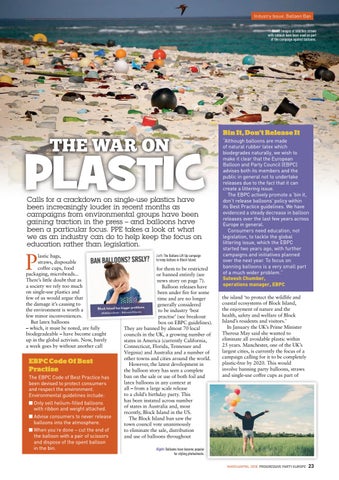
Industry Issue: Balloon Ban Inset: Images of beaches strewn with rubbish have been used as part of the campaign against balloons.
THE WAR ON
PLASTIC Calls for a crackdown on single-use plastics have been increasingly louder in recent months as campaigns from environmental groups have been gaining traction in the press – and balloons have been a particular focus. PPE takes a look at what we as an industry can do to help keep the focus on education rather than legislation.
P
lastic bags, straws, disposable coffee cups, food packaging, microbeads... There’s little doubt that as a society we rely too much on single-use plastics and few of us would argue that the damage it’s causing to the environment is worth a few minor inconveniences. But latex balloons – which, it must be noted, are fully biodegradeable – have become caught up in the global activism. Now, barely a week goes by without another call
EBPC Code Of Best Practise The EBPC Code of Best Practice has been devised to protect consumers and respect the environment. Environmental guidelines include: ■ Only sell helium-filled balloons with ribbon and weight attached. ■ Advise consumers to never release balloons into the atmosphere. ■ When you’re done – cut the end of the balloon with a pair of scissors and dispose of the spent balloon in the bin.
Left: The Ballons Lift Up campaign to keep ballons in Block Island.
for them to be restricted or banned entirely (see news story on page 7). Balloon releases have been under fire for some time and are no longer generally considered to be industry ‘best practise’ (see breakout box on EBPC guidelines). They are banned by almost 70 local councils in the UK, a growing number of states in America (currently California, Connecticut, Florida, Tennessee and Virginia) and Australia and a number of other towns and cities around the world. However, the latest development in the balloon story has seen a complete ban on the sale or use of both foil and latex balloons in any context at all – from a large scale release to a child’s birthday party. This has been instated across number of states in Australia and, most recently, Block Island in the US. The Block Island ban saw the town council vote unanimously to eliminate the sale, distribution and use of balloons throughout
Bin It, Don’t Release It “Although balloons are made of natural rubber latex which biodegrades naturally, we wish to make it clear that the European Balloon and Party Council (EBPC) advises both its members and the public in general not to undertake releases due to the fact that it can create a littering issue. The EBPC actively promote a ‘bin it, don’t release balloons’ policy within its Best Practice guidelines. We have evidenced a steady decrease in balloon releases over the last few years across Europe in general. Consumers need education, not legislation, to tackle the global littering issue, which the EBPC started two years ago, with further campaigns and initiatives planned over the next year. To focus on banning balloons is a very small part of a much wider problem.” Suteesh Chumber, operations manager, EBPC the island ‘to protect the wildlife and coastal ecosystems of Block Island, the enjoyment of nature and the health, safety and welfare of Block Island’s residents and visitors.’ In January the UK’s Prime Minister Theresa May said she wanted to eliminate all avoidable plastic within 25 years. Manchester, one of the UK’s largest cities, is currently the focus of a campaign calling for it to be completely plastic-free by 2020. This would involve banning party balloons, straws and single-use coffee cups as part of
Right: Balloons have become popular for styling photoshoots. MARCH/APRIL 2018 PROGRESSIVE PARTY EUROPE
23_25_Industry Issue.indd 23
23
06/04/2018 16:59