Dec 2020.pdf
1
02/11/2020
16:26
December 2020
C
M
Y
CM
MY
CY
CMY
K
Ranges Yule Love! FC_PPE_December 2020.indd 1
06/12/2020 17:31
G N I K &J WALLOONS INFLATED M WITH HELIU
BAL
STEGOSAURUS
E L B A T I M I N I THE UNICORN
FRENCH BULLDOG
N! O O S G N I M O SC N O O L L A B W NE DUCTS O R P L A IN IG R O UCTS D O R P L A IN IG R O AL PRODUCTS -
ORIGIN
18-19__PPE_Sept Oct 2020.indd 1
30/09/2020 10:24
D E T N I O J & S L A M I 4D
N A S N O O L L A B D E AIR INFLAT
EUROPEAN EXCLUSIVE DISTRIBUTOR
READY TO
MONKEY
E MBL E S AS
PTERODACTYLUS
T-REX PLESIOSAURUS
HUSKY
FAWN
CAMEL
PARASAUROLOPHUS RABBIT
TRICERATOPS SPINOSAURUS DALMATIAN DIPLODOCUS ANKYLOSAURUS
buy on www.bwstore.eu
TS
BWS - Balloons World Store srl via San Leonardo, 41- Località Squadra - 03034 Casalvieri (FR) Italy Tel. (0039) 0776 617197 - (0039) 0776 617283 - Fax (0039) 0776 617165
18-19__PPE_Sept Oct 2020.indd 2
watch the video of the jointed animals balloons info@bwstore.it www.bwstore.eu
30/09/2020 10:24
H A L L O W EEN P A R TYE X P O . C O M / P P E
A NEW EXPERIENCE JANUARY 19-21, 2021 Join us ONLINE from the comfort of your own home or office for North America's only event for all things Halloween, party, celebration and haunt. FEATURING: VIRTUAL EXHIBITOR SHOWROOMS - LIVE PRODUCT SHOWCASES & EVENTS - NETWORKING - VIDEO MEETINGS & MESSAGING
OWNED & MANAGED BY:
00_PPE_Nov Dec 2020.indd 1
VIRTUALLY TAKING PLACE WITH:
03/12/2020 13:27
WELCOME The home of market leading trade magazines
The home of market leading trade magazines max-publishing.co.uk The home of market leading trade magazines The home of market leading trade magazines March/April 2013
The home of exhibitions The home of exhibitions The home of exhibitions The home of exhibitions
The home of market leading trade awards The home of market leading trade awards The home of market leading trade awards The home of market leading trade awards
Max Publishing Ltd, United House, North Road, London N7 9DP T: 020 7700 6740 F: 020 7607 6411 www.max-publishing.co.uk hello@max-publishing.co.uk
ISSN 2058 797X
Welcome to the Party As a rule, Christmas in the PPE camp starts on 1 December and not a day before. But if there was ever a year to throw the rules completely out of the window, this is it. Despite the UK’s month-long lockdown and the various other restrictions still in place across Europe and further afield, the sparkle of a few Christmas baubles and familiarity of untangling the tree lights is proving to be a welcome distraction as people look to embrace the festive spirit earlier than ever before. Above: Progressive Party Europe’s Indeed, any balloon artist who offered the ‘elf balloon’ Rob Willis and Jacqui Parr. service can testify that – for this year at least – families are continuing to embrace the idea of making their scaled-down celebrations as special as possible. And so as the trees go up and the presents get wrapped we are also able to see a glimmer of light at the end of the tunnel, with various vaccines being discussed and tested and (hopefully) bought and sold. Whatever your personal situation is and whichever individual battles we have all fought over the last year, the idea that by Easter 2021 we may be able to return to the ‘old’ normal is hugely encouraging. Just imagine the parties! At this point in the year it is natural to look back at the past year and catalogue the highs and lows the party and costume industry has faced throughout 2020. But where to start? It’s been a hugely difficult time for everyone, but particular mention has to go to the fancy dress and costume specialists who have been unable to ‘make the best of a bad situation’ – primarily as there is simply nothing there to make the best of. Sadly, a number of long-standing party names have been lost during the past year, as Covid pushed those businesses just one step further than they could bear. We know from the conversations we have had over the past year that many of you have feared a similar fate. It is not an understatement to say that we have been in constant awe of your determination to stay positive in the face of such difficulties. And yes, we have also had conversations where you have also despaired and wondered if you can possibly continue, but the good humour and spirit of the party industry has endured. Even if much of the humour has been a touch darker this year! Talking of darkness, it would be remiss of us not to mention this year’s Halloween. Despite the challenging conditions and less-than-promising predictions, the postHalloween feedback from this year’s celebrations has been pleasantly surprising. While nowhere near as successful as a ‘normal’ Saturday would have been, it was clear as the big day approached that that this year would not be the disaster many predicted. According to feedback from both retailers and suppliers (see page 24) décor was the outright winner this season as the focus remained firmly on creating a family-friendly home-based celebration. It’s likely to be a similar story for Christmas and New Year’s Eve, with small family gatherings making the most of the time they have together. See our feature on page 31 for the latest product to help you make the most of the festive season. We’ve also taken a look forward to Valentine’s Day 2021 (page 36) – finally, a holiday that is designed to be celebrated in relative solitude! The other significant change happening over the next few months is the UK’s official exit from the European single market. What that will finally mean is yet to be seen – but hopefully our feature starting on page 26 will go someway to helping anyone who is unsure of the next steps to take. And so just like that, the year is over! It’s been a hugely memorable one, for reasons both good and not-so-good, but we’d like to thank you for sticking with us throughout everything and for sharing your highs, your lows, your rants and your worries. However you’ll be spending the festive season, let’s take the party industry into 2021 in style. See you on the other side!
@Prog_Party_Eu
DECEMBER 2020 PROGRESSIVE PARTY EUROPE
05_Leader.indd 3
05
04/12/2020 18:35
Sparkling Fizz Birthday Blue NEW Stunning Holographic Foil Range
We are the only British company that manufactures Foil Party Balloons and a leading supplier of coordinated range of products.
w: oaktreeuk.com 00_PPE_Nov Dec 2020.indd 1
e: sales@oaktreeuk.com
Proudly Made in the UK
t: +44 (0)1638 716655 03/12/2020 13:28
CONTENTS
What’s inside: DECEMBER 2020 09 NEWS
The latest happenings from the party trade.
LETTER FROM AMERICA
Ed Avis’ words of wisdom on the last few months.
MARKETING MATTERS
Babita says let’s move onto 2021, we cannot argue...
FEEDBACK: HALLOWEEN 2020
Score on the doors for the weird one.
INDUSTRY ISSUE
Just when you thought it couldn’t get harder to earn a living... Brexit.
CHRISTMAS 2020
A festive feast of new products and opportunity.
VALENTINE’S DAY
I love you the most. No I love you the most, pink products!
RETAIL IN NUMBERS
Party Palace gives PPE it’s scores on the doors.
21 23 24 26 31 36 39
24
31
36
DECEMBER 2020 PROGRESSIVE PARTY EUROPE
05_Contents.indd 7
07
05/12/2020 17:26
BalloonGaz
Ask for our competitive prices!
COMPRESSED
Products from stock
Quick delivery
MADE
IN NL
QUALITY
Produced in Holland
Compliant with EU regulation Extra safety cord on valve Quality assessment procedure
BENEFITS
Steel is the most easy material to recycle
Competitive pricing Easy to use
www.folat.eu
00_PPE_Nov Dec 2020.indd 1
|
export@folat.eu
alloons Inflate your b at & let them flo
|
+31 (0)23 511 2 511
27/11/2020 12:26
NEWS PAGE
NEWS UPDATE Halloween 2020: The Verdict Despite the challenging conditions and less-thanpromising predictions, the post-Halloween feedback from this year's celebrations has been pleasantly surprising. While nowhere near as successful as a 'normal' Saturday would have been, it was clear as the big day approached that suppliers, retailers and consumers alike were equally determined that this year would not be the disaster many predicted. With so many different Covid-19 restrictions in place (and constantly changing) – in the UK, at least – it had become almost impossible to predict exactly what consumers would be able to do, come 31 October. Just days before Halloween itself, a second lockdown was announced in the UK, beginning on Thursday 5 November. This gave many consumers the boost they needed to make the decision to celebrate Halloween after all – as a 'final fling' before four weeks of lockdown. As media outlets looked for different angles on the impending lockdown they turned to the party industry to find out how the sector was likely to be
affected. This culminated with Fran Hales – marketing manager for both Rubie’s UK and Bristol Novelty – appearing on BBC News, speaking about the the nation’s plans for Halloween and ultimately about what retailers and suppliers were expecting to see. In the end, Halloween definitely happened. Children celebrated with dress-up days at school, small house parties were enjoyed and safe trick-or-treating was embraced. Meanwhile, at the adult end of the spectrum, police were called to break up a number of Halloween parties which were ignoring all social-distancing rules – some with as many as 1,000 people in attendance.
But what did this all mean for the party industry? According to feedback from both retailers and suppliers, décor – including some particularly impressive balloon displays – was the outright winner this Halloween. Costumes, make-up and accessories still sold, albeit in smaller numbers, but the move to make the holiday a family-friendly home-based celebration saw the focus remaining firmly on decorations and other fun novelties. See page 24 for more indepth feedback from across the industry. Above: The news of an impending lockdown definitely helped last-minute Halloween sales.
Halloween in the USA With the American costume industry also suffering as a result of Covid-19 restrictions, the NCA’s executive director Ed Avis revealed that: “depending on who you talk to, Halloween 2020 was either fantastic or a complete bust.” An article published in the New York Times two days
2020 were ‘much worse than 2019', with 18% saying costume sales were actually better this year. Décor did slightly better: just 46% said 2020 sales were worse than 2019, with about 27% reporting that they were the same as last year and 15% reporting a growth.
before Halloween saw Scott Morris of Morris Costumes stating that: “We have sold more decorations, more animated props than we ever have in the history of our company.” According to an NCA survey, 70% of costume shop owners reported that costume sales in
Rubie’s sponsors Marvel Superheroes Series campaign Global costume and dress-up company Rubie’s has joined forces with the Superhero Series – a unique new sporting challenge – to sponsor the ‘At Home Winter Wonderwheels powered by Marvel’ campaign. The Superhero Series is the UK’s only massparticipation sports series dedicated to the nation’s 13.3m people with disabilities. Rubie’s is sponsoring the sporting challenge, which
For the latest news visit PartyWorldwide.net
News_PPE_Nov Dec 2020.indd 9
to be involved with this brilliant campaign,” says Rubie’s coo, Mike O’Connell. “Our mission is to help the Superheroes Series to continue inspiring participants by unlocking their inner superpower. Rubie’s cannot wait to bring all its iconic Super Hero characters to participants’ homes and neighbourhoods.” Find out more at superheroseries.co.uk
has been created to encourage superheroes and sidekicks to stay active, super-charged and connected. “We are absolutely thrilled
Left: Costumes will add colour to the Superhero Series, the UK’s only disability sports series.
UK party retailers and suppliers urged to take action Consumer goods companies – which includes party retailers and suppliers – are being urged to begin taking action as the UK counts down to its new trading relationship with the EU, which will begin on 1 January 2021. The UK officially left the EU earlier this year and will be leaving the single market and customs union at midnight on 31 December 2020. The end of this transition period will affect retailers and suppliers in a number of ways and businesses are being urged to prepare sooner rather than later. The Department for Business, Energy and Industrial Strategy (BEIS) is holding a new series of free webinars to help businesses understand the important actions they need to take to be ready by the end of the transition period. Visit workcast.com for more information. See feature starting on page 26 for more information.
Pioneer recognises product availability issues Chief operating officer of Pioneer Balloon Company, Dan Flynn, has issued a public statement and update regarding product availability, in which he issues an apology for recent stock shortages in the face of increased demand and outlines the company’s plans for improving access to the most popular lines. “I know many of you are frustrated by the current backorder situation, even more so because our customer service team can’t give you definitive times for fulfillment of out-of-stock items. I apologise for this and thank you for your patience and support... please be assured you have our total commitment to standard lead times as soon as possible.” Dan went on to say that he expected foil balloon availability to be close to ‘normal’ by late November, with latex and Bubble lead times more difficult to predict.
DECEMBER 2020 PROGRESSIVE PARTY EUROPE
09
04/12/2020 18:50
000_PPE_June 2020.indd 1
25/09/2020 16:28
PARTY NEWS
Spielwarenmesse 2021 summer dates announced Spielwarenmesse 2021 – originally scheduled to be taking place from 27 to 31 January 2021 – has been postponed until summer 2021 and will now be taking place next year from 20 – 24 July 2021 at the Exhibition Centre in Nuremberg. In the face of the persisting Covid-19 pandemic, organiser Spielwarenmesse eG decided to postpone the event for the first
the concept will differ from the winter event and will be tailored to the needs of both exhibitors and visitors.” The show will now be running from Tuesday to Saturday, including an extra weekday in response to the feedback from many retailers and buyers. In terms of content, the industry is supporting the organiser’s plan to present a relevant offering of information and product
time in its history, moving it from January until the summer months. The announcement comes as preparations for the Spielwarenmesse 2021 get under way. “My team and I are delighted to be organising a live event again, something the market is clearly longing for,” states Ernst Kick, ceo of Spielwarenmesse eG. “In light of the new dates,
Smiffys to partner with Manic Panic for new wig line Costume and party specialist Smiffys has launched a dazzling new range of licensed wigs in partnership with Manic Panic, the leaders in creative hair colour and cosmetics. Manic Panic, the outrageously wild brainchild of two New York City rock and roll sisters, Tish and Snooky Bellomo, launched in 1977 as America’s first Punk Boutique and has been setting trends and providing inspiration
Gemar’s Balloonista platform offers Christmas inspiration
to the beauty and fashion industries ever since. “We are so excited about our collaboration with Smiffys on the new line of Manic Panic wigs,” said owners and founders Tish and Snooky Bellomo. “It’s our dream come true!” Dominique Peckett, director at Smiffys, added: “The new range of wigs gives wearers an instant Manic Panic fix and is great for those wanting to create a bold new look. We’re extremely proud of the collaboration with Manic Panic and the products we have cocreated.”
NABAS announnes new heads of training NABAS – the National Association of Balloon Artists and Suppliers – has appointed Peggy Butland and John Preston from the Great British Balloon Company as joint head of training. With a combined 60 years in the industry, the dynamic pair have been in the balloon business together since 1996 and have provided training and development to balloon artists and companies from around the world ever since. As the new heads of training, Peggy and John will be exploring new ways of ensuring that courses reach all in the profession,
News_PPE_Nov Dec 2020.indd 11
BAPIA’s popular décor day for the annual Christmas parties at the Great Ormond Street Children’s Hospital will sadly not be taking place in 2020, due to the restrictions which are currently in place due to the Covid-19 pandemic. It is expected to return in 2021, if possible. “Despite the disappointing news, it hasn’t stopped BAPIA supporting the GOSH charity,” said chairman John Bowler. “We have organised for 2,000 mini foil balloons on sticks to be delivered to the children of the hospital in the lead up to Christmas as well as heliumfilled Christmas balloons to help bring some Christmas cheer to the children and staff at the hospital. Our thanks to Amscan, Qualatex,Premium Balloon Accessories and BOC.”
Disguise renews partnership with Microsoft
including the addition of online learning and retraining instructors to be able to deliver courses locally to all across the UK. “It’s important to have an association that is happy to train and share ideas,” said John. “It’s not just about providing prescribed courses, but encouraging attendees to think about the profit margins, the logistics and how the product can be adapted to meet different requirements. Most importantly, the quality and professionalism of the training is the priority.”
For the latest news visit PartyWorldwide.net
BAPIA’s GOSH event cancelled for 2020
With physical training proving impossible for much of 2020, Gemar’s Balloonista platform now has more than 50 instructional videos available online, with a focus on providing inspiration for the upcoming Christmas season. “We think of Balloonista as Gemar’s balloon talent community,” explained brand and sales director Gloria Veta. “We created it with the aim of sharing our passion for balloons and the art of décor using balloons, so we can share and inspire budding balloon artists around the world to create the extraordinary and lift the moment!” All videos and instructions are available in eight different languages. For more information, visit www.gemar.it
Left: Smiffys has created six styles in 15 colourways - all synthetic, vegan and fully heat styleable.
innovations, where the Christmas season plays as much a role as the outlook for the year ahead. Spielwarenmesse eG will announce further details of the new concept over the coming months. As an additional service, the website at www. spielwarenmesse.de and the Spielwarenmesse App will continue to expand its yearround offering of information for the toy industry.
Costume and Halloween dress-up company Disguise has renewed its ongoing partnership with Microsoft as costume partner for two leading global gaming brands, Halo and Minecraft. The deal will grant Disguise the worldwide rights to design, market, manufacture and distribute Halloween costumes and costume accessories for Halo (three years) and Minecraft (two years), commencing in 2021. “Fan engagement in video games continues to rise as gamers are exposed to these brands on a daily basis, versus tentpole films which have struggled this year with theaters being closed,” said Tara Hefter, evp and gm of Disguise. “We are proud to be the sole global costume partner for these Triple-A games from Microsoft.” Right: Minecraft and Halo continue to be top performing licences for Disguise.
DECEMBER 2020 PROGRESSIVE PARTY EUROPE
11
04/12/2020 18:50
00_PPE_Nov Dec 2020.indd 1
03/12/2020 21:09
PARTY NEWS
Party City reveals ‘better than expected’ Q3 October performance
Below: The total number of corporate Party City stores is 739, compared to 843 last year.
American party and costume retail chain Party City has announced its financial results for the third quarter ended 30 September 2020, revealing a ‘better than expected’ performance during the key Halloween and October period. With a net income of $239.7m and total revenue down just 1.2% (to $533.8m) over Q3, Party City has also defied expectations for the 2020 Halloween season, thanks to ‘strong results within décor and better-than-anticipated costume business sales of costumes, despite the challenges of a pandemicimpacted backdrop’. “We are very pleased with our better than expected third quarter performance, highlighted by the continued strength in our core business,” stated chief executive officer Brad Weston. The significant increase in brand comparable sales
the challenges of a pandemicimpacted backdrop,” Brad continued. “We are very proud of our entire Party City team who delivered an exceptional Halloween experience for our customers, despite the backdrop.” Party City had prepared for a smaller Halloween this year by reducing the number of its Halloween City pop-up stores; opening just 25 stores in 2020, compared to 256 in 2019.
has been credited to Party City’s strong core business, particularly in the balloon, birthday and entertaining categories. Digital sales were also strong, with an increase of 36% during Q3 and 30% during October – including click-and-collect, curbside pickup, and delivery. “Our Halloween results were ahead of our expectations, driven by strong results within décor and better than expected sales of costumes, despite
Smiffys partners with Magic Light Pictures Costume and party supplier Smiffys has announced a new licensing partnership with Magic Light Pictures for a raft of properties from the Julia Donaldson and Axel Scheffler publishing stable. The collaboration with Magic Light Pictures will include a range of dress-up costumes for some of the most popular characters, including The Gruffalo, The Highway
Rat, Stick Man, Zog and Room on the Broom. “We are delighted to be announcing this partnership; Julia and Axel’s work is renowned across the globe and has delighted children for nearly 30 years with her imaginative stories,” said director Dominque Peckett. The range will launch with the much-loved The Gruffalo, which will be available in time for World Book Day 2021. Left: This toddler costume is perfect for any little monster looking to bring The Gruffalo to life.
Spring Fair 2021 moves to a digital platform Spring Fair will not take place as a physical event in 2021, organiser Hyve Group has confirmed, with digital event Spring Fair @Home currently in progress. The decision was taken due to ongoing UK government restrictions on the reopening of business conferences and exhibition halls. The next planned home, gift and fashion retail event will be Autumn Fair, at the NEC Birmingham from 5 - 8 September, 2021. Spring Fair will return as an in-person event from 6 – 10 February, 2022. Hyve is currently working to deliver an ‘enhanced virtual forum’ with product features and exclusive seminar content, designed to educate and inform participants. “While it is regrettable that we won’t be able to meet in person at Spring Fair and Moda in February due to the new UK government rules, we are incredibly excited to host Spring Fair @Home,” said Julie Driscoll, md UK retail at Hyve Group. “Following the success of this year’s virtual forums, we’re looking forward to providing our clients and customers another touchpoint to be inspired and stay connected with the retail industry.” More information on Spring Fair @ Home will available shortly on the Spring Fair website at www.springfair.com.
For the latest news visit PartyWorldwide.net
News_PPE_Nov Dec 2020.indd 13
Balloons go viral for I’m A Celebrity Get Me Out Of Here Rhyl-based balloon artists Mike and Sara Harris (For Every Occasion) were the focus of a 24hr media storm after the balloon sculptures they supplied for Ant McPartlin’s 45th birthday went viral after being posted on the @antanddec Instagram account, which has 4.2million followers. The story was soon picked up by the media and – complete with pictures of the balloons – has now appeared in national outlets The Sun, The Daily Mail and The Mirror as well as a number of local and regional media, both in print and online. “It has been a complete media storm,” said Mike. “We have made the most of it going viral as it was such a valuable marketing opportunity. Everything else just had to stop, we were getting so much feedback! It was great fun and we definitely got the wow factor we were going for.” Right: Ant and Dec are currently filming I’m A Celebrity Get Me Out Of Here at Gwrych Castle in Abergele, Wales.
Balloon market to be worth $2.4bn by 2030 Recent research has revealed that the party balloon market is predicted to reach a value of $2.4 billion by 2030 and is estimated to grow by about 5% each year over the next decade. The report, which was undertaken by Transparency Market Research, investigated the increase in interest in the balloon market during the pandemic as consumers continue to look to create a party atmosphere at home. The report said that ‘birthday parties are getting a makeover amid the coronavirus pandemic‘, pointing out that consumers are transforming their homes and gardens using party props such as latex and foil balloons and paper garlands to make the most of their smaller, home-based celebrations. It went on to state that this boost in business has resulted in ‘a number of companies in the party balloon market increasing their production capacities to meet customer demands‘, with some increasing production by up to 14% in order to meet the growing market demand and to serve existing customers. The research also covered geographical trends, the importance of sustainability and the prevalence of social media influences.
DECEMBER 2020 PROGRESSIVE PARTY EUROPE
13
04/12/2020 18:50
00_PPE_Nov Dec 2020.indd 1
03/12/2020 21:08
PARTY NEWS
Pinterest to flag ‘culturally insensitive’ costume searches
Creative Party launches trade website Leading partyware supplier Creative Party has launched an easy-to-use B2B e-commerce website, giving its global customer base the ability to manage and place orders on demand. The brand new website – which can be seen at www. b2b.creativepartyltd.com – provides retailers with quick and convenient access to trend-led, high-quality party product, balloons and cake decorating products, across all the company’s leading brands. Highlights and features include full access to account details and a record of previous orders, live stock
levels and prices tailored to each account (including discounts), live basket totals and notification when minimum order or carriage paid values are met, as well as the ability to build an order gradually and save for later. “We always take customer feedback on board and we knew how important it was for us to bring online ordering to the list of ways to order from us,” said managing director Alan Clark. “Having listened to feedback and by working in tandem
with our customers on the development, we have been able to craft an innovative account management tool that provides the ultimate in hassle-free service. He added: “We are proud to offer retailers this new 24/7 ordering option, so they can conveniently shop both our Creative Party and Anniversary House products.” Above: The new website features all Everyday UK lines from across both brands.
Spirit Halloween launches Dunkin’ Donuts collection
BAPIA webinars to continue
US Halloween specialist Spirit Halloween added a new line of exclusive officially licensed Dunkin’ Donuts costumes in the run-up to this year’s Halloween celebrations. The new officially licensed collection – featuring a Dunkin’ coffee cup and a glazed donut costume – is the first ever to feature the brand, which is currently enjoying a social media moment , thanks to TikTok’s most followed star Charli D’Amelio who is now an official partner, driving millions of brand impressions in the company’s direction. The two new, limited-edition costumes are perfect for couples and friends looking to showcase their brand loyalty.
The popular BAPIA webinar programme – designed to help members to create some new and exciting designs for their customers – is continuing with its exciting line-up of leading industry instructors. Previous webinars – from instructors including Chris Adamo, Jackie Ochitwa, Melanie Allen and Sue Bowler – are still available online to view, while more webinars are being planned for the future. The webinars are exclusive to BAPIA members as one of the membership benefits.
Loftus International hires new chief strategy officer
Study reveals eco-glitter still damages wildlife A recent study has revealed that ‘biodegradable’ glitter causes the same ecological damage to rivers and lakes as the ordinary product, following a series of tests, conucted by the Anglia Ruskin University (ARU) in Cambridge, UK. The production of biodegradable glitter has increased in recent years, as suppliers, retailers and consumers have been embracing environmentally-friendly alternatives. Last year saw sixty UK festivals announce they would switch to biodegradable glitter by 2021. However, the research revealed that various ‘biodegradable’ glitters also affected rivers and lakes in a similar way to the conventional product. British supermarket chain Morrisons has removed glitter and plastic from all its own-brand ranges in the run-up to Christmas, removing more than 50 tonnes of plastic from its shelves over the festive period alone. Waitrose and John Lewis have also removed glitter from all Christmas lines, includding crackers, cards, wrapping paper and gift bags.
For the latest news visit PartyWorldwide.net
News_PPE_Nov Dec 2020.indd 15
Party and novelty business Loftus International – one of the leading novelty, magic and balloon distributors in the United States – has appointed Holly AdamonisZuller as its first chief strategy officer. Holly brings more than 25 years of sales experience to the role, with 13 of those directly related to the party and novelty business. In her new role she will focus on the development and execution of corporate strategic initiatives, with a major emphasis on new product development, improving customer relations and support and strategic sales plans.
Social media and image sharing platform Pinterest began flagging up any ‘culturally insensitive’ costume searches in the runup to this year’s Halloween celebrations. The website made users aware that some searches – such as ‘Day of the Dead costume’, ‘gypsy costume’, or ‘geisha costume’ – may be classed as cultural appropriation by some. When users search for costume inspiration, they will now be reminded that some people feel that certain costumes enforce stereotypes. Instead, the search results will include information on how to celebrate the holiday thoughtfully and respectfully. “As a place that’s used by hundreds of millions of people, we feel a responsibility at Pinterest to keep the platform inspiring and positive and bring awareness to the fact that cultures aren’t costumes,” stated Annie Ta, head of inclusive product at Pinterest.
Amscan launches new Decorator Book and updates online resources Balloon and party company Amscan has launched its latest version of the hugely popular Decorator Book for 2020, featuring and updated installment of fresh colours, sizes and decorator equipment as well as the most popular Anagram foil balloons. An extended portfolio offers a new selection of prints, colours, sizes and finishes, while Amscan’s online decorator resources have also had a makeover. Balloon artists will find a whole host of useful tools including how-to videos, step-by-step recipes, helium calculator, colour combinations and a double stuffing guide, all online and free to download.
DECEMBER 2020 PROGRESSIVE PARTY EUROPE
15
04/12/2020 18:52
00_PPE_Nov Dec 2020.indd 1
03/12/2020 13:27
PARTY NEWS
OppoSuits launches new B2B portal Novelty suit company OppoSuits has launched a brand new B2B portal for its European customers, allowing retailers to place orders at their own convenience. “For the past few months we have been working hard on creating a great online portal to make placing orders much easier and faster,” revealed head of sales Robin Breeman. “I’m proud to say that we’ve now launched a brand new portal for
Tributes roll in for industry legend Paul Pearce Tributes from across the balloon community have been rolling in following the sad news that Paul Pearce – one half of Balloons and Tunes, which he ran with his wife Pam – passed away on Wednesday 30 September 2020. Paul and Pam have been wellknown and loved throughout the balloon and party community for many years, dedicating much of their time to helping newcomers in the trade with invaluable tips and advice, while also running their own successful business alongside a packed calendar of training events and opportunities. “Paul bought smiles to the faces of young and old with his balloon models and many have stood in awe at the gift and sheer talent he had for this craft,” said Pam. “And this amazing man did it all with genuine grace, love, care, fun and a big sense of gratitude and love to the people around him. Your wings were ready Paul but our hearts were not.” A Just Giving page has been set up in memory of Paul, with the proceeds planned to go towards helping local causes close to Paul’s heart. www.justgiving.com/ crowdfunding/pam-pearce Below: Paul Pearce was a natural entertainer and loved working with balloons.
all our European customers!” The new portal – which can be seen at wholesale.opposuits. com – is ‘much faster, works a lot better and looks great’ and will replace the previous European system. It has been designed to allow customers to easily process their own orders at any time and is fully set up to be used on both smartphones and other mobile devices. OppoSuits hopes to launch an American version shortly.
Above left: The new portal will replace OppoSuits' previous European system.
Party City reveals: “It’s all about the balloons” Party City ceo Brad Weston spoke about this year’s Christmas celebrations being ‘all about the balloons’ in an online video interview with Yahoo! Finance Live, also revealing that Party City is planning on opening a number of new balloonfocused stores in 2021. The conversation focused initially on Party City’s better-than-expected Q3 and Halloween results, with Brad pointing out that consumers are changing how they celebrate. He went on to explain that balloons typically represent about 20% of Party City’s business and that sales have held up this year, despite the ongoing pandemic. “As you can imagine, in this period of time in a pandemic with consumers celebrating differently we have seen our core categories like balloons, birthday and entertaining really being some of our biggest growth drivers,” he said. “I have been pretty upfront that balloons are performing well,
and they are part of both our short-term and long-term strategy.” The interview went on to reveal that Party City is expected to open several new prototype stores in 2021 that will place a greater emphasis on balloons, placing them at the ‘epicentre’ of the store and in doing so offering a ‘next-generation’ shopping experience. Below: Brad was clear that balloons are a key focus for Party City's future plans.
Smiffys signs Masha and the Bear licence In a deal brokered with Lisle Licensing, fancy dress and party company Smiffys has acquired the popular preschool Masha and the Bear licence, to be used across both costume and tableware. Children will be able to bring the magic of Masha to life with a range of officially licensed costumes from Smiffys, set to launch at the start of 2021. Masha and the Bear tableware will also be coming soon, allowing children to have fully themed parties featuring their favourite cartoon characters. Smiffys' Masha and the Bear range will be available in the UK, Germany, Austria, Switzerland, Spain and Portugal.
Premium updates video resource Premium Balloon Accessories has recently updated the online instructional videos for its best-selling inflators. “We believe in supporting our customers and our products and we could see the need for these videos to help customers understand the different inflators when deciding which one to buy,” explained business
For the latest news visit PartyWorldwide.net
News_PPE_Nov Dec 2020.indd 17
“Of course all of our great Christmas suits and shirts are there for men, women and
kids – with plenty of Christmas designs as well,” added Robin. “We’ve just launched a few styles on there and are offering free shipment on all orders over €400, so it’s definitely worth checking out!” To access to the new system, please either apply for a trade access via wholesale.opposuits. com or email sales@opposuits. com.
development manager John Bowler. “They will also help users get the most out of their inflator.” The videos cover a comprehensive range of helium and air inflators, including some speciality machines such as the Foil Pro and Smart Twist and are available to watch on the Premium YouTube channel at www.youtube. com/user/PBAschannel
NABAS appoints regional ambassadors The Balloon and Party Professionals Association (NABAS) has appointed regional ambassadors to help champion the association’s work across the UK and provide support to local businesses. The regional ambassadors will act as the connection between NABAS and its members, providing local support with any development needs and acting as the voice of NABAS in their region. The role will be key in developing relationships with current and prospective members and is part of several ongoing drives to unite the balloon and party industry, providing support and unity across the country while reinforcing standards and best practice during a challenging period. NABAS Ambassadors will also champion the creative and marketing support available to members, helping to increase sales and futureproof businesses. Visit www.nabas.co.uk to find out more. DECEMBER 2020 PROGRESSIVE PARTY EUROPE
17
04/12/2020 18:53
Image by Bubblegum Balloons
®
NEW Spring & Summer Balloons 2021 View Online Now! Bring the Party to Life with Amscan’s collection of some of the world’s most loved and in demand licenses.
P B C O
Our ranges of party products, balloons and costumes create great excitement for all ages! ©Amscan 2020, ©Anagram 2020. All Rights Reserved.
00-00_PPE_Nov Dec 2020.indd 1
27/11/2020 12:28
Yule Find Plenty of Festive Party Ranges
to Love this Season
Head online to see all of our ranges!
Partyware Balloons Costumes Over 85 Licensed Properties ©Amscan 2020, ©Anagram 2020. All Rights Reserved.
00-00_PPE_Nov Dec 2020.indd 2
27/11/2020 12:28
00_PPE_Nov Dec 2020.indd 1
17/12/2020 14:19
COLUMNIST
Just as the party and costume industry is a global market, so Covid-19 has affected suppliers and retailers around the world, including America. In his debut column for PPE Ed Avis – the executive director of the National Costumers Association – shares some of the major events of the past three months.
Above: Ed Avis is the executive director of the National Costumers Association. Contact him at executivedirector@costumers.org.
Focus on a Bricksand-Mortar Future “H alloween 2020 is finally over. It has to have been one of the most angst-riddled holidays in the history of the costume industry. At first everyone in the industry was all excited that Halloween was falling on a full-moon Saturday… then Covid blasted the world and all that excitement turned to fear. Trade organisations, including the National Costumers Association, worked overtime trying to salvage Halloween from Covid’s deadly grip. The NCA’s Help Halloween Happen campaign included tips on motivating local communities to celebrate a safe Halloween, the Halloween & Costume Association sponsored a big campaign to encourage trick-or-treating and the National Confectioners Association promoted all sorts of ideas for celebrating the season. So how did we do? Well, it really depends whom you talk to. At the NCA we surveyed our members and the results were not particularly encouraging – the majority of our members reported ‘much worse’ sales this Halloween compared to last year. Those who said they used some elements of the Help Halloween Happen campaign reported slightly better results, but overall it was a tough Halloween for our members. On the other hand, costume manufacturers reported very different results. I haven’t seen definitive numbers, but anecdotally many said they had a solid year. There were no blockbuster movies to encourage the sales of superhero or other character costumes, but people were still buying costumes to dress up at home. Companies making décor hit a home run this year – everyone wanted to decorate. Candy makers had similar results – the National Confectioners Association said sales were up 13% through 6 September. Clearly, being locked up at home hasn’t diminished anyone’s capacity for eating sweets! So why did the manufacturers show
such positive results when the members of the National Costumers Association did not? My theory is that our members – who are owners of bricks-and-mortar costume businesses – didn’t share in the manufacturers’ success because so much Halloween-related commerce moved online this year. People were afraid to go shopping because of Covid, but they still wanted costumes, so they bought from the web. That’s fine for the manufacturers, but bad news for shop owners. What can we do to help the retailers now? I see two paths. First, as an
association, the NCA needs to help our members improve their online sales. We have held webinars over the past year on this topic, but we need to do more; not only in how to set up an e-commerce shop, but also how to promote it via social media. But second, and more important, we need to continue helping our members persuade their communities to shop local. The shop local concept is widely appreciated these days, but Covid delivered a painful blow to the movement. Once Covid’s grip on retail is broken – hopefully the vaccine will accomplish that – we need to rebuild the belief that shopping in local stores is important. We’ll have to do that by reminding shoppers how much life a vibrant retail scene brings to a community. Remember when you could walk downtown and visit a dozen stores? That’s way more enjoyable than browsing a dozen e-commerce websites. And every purchase made locally supports local workers and business owners, as well as the overall vibrancy of a community. How can we do that? It will require efforts on the national and local scale. My association can help on the local scale by providing information and resources to our members. But I hope the large associations in the industry – whose members are primarily manufacturers – will also join this fight. Their members might have done well this Halloween with online sales, but overall everyone will do better if bricks-and-mortar stores remain vital. The more potential sales outlets a manufacturer has, the better the sales. Next Halloween is on a Sunday. That’s not as good as a Saturday, but just imagine having two nights of Halloween parties leading up to the actual holiday? That could be a lot of costumes sold and rented. Let’s hope the majority of them are sold and rented by bricks-and-mortar stores.” Left: Bricks-and-mortar stores need support from the whole industry. Below: Costumes – especially for children – sold well online this Halloween.
DECEMBER 2020 PROGRESSIVE PARTY EUROPE
21_Column.indd 23
21
04/12/2020 18:36
Reap the rewards of NABAS membership Training
Protection Business Promotion
Supplier Discounts
Community Support
NABAS is the original and credible trade association for the balloon and party industry in the UK – representing balloon and event decorators, retailers and manufacturers. NABAS membership includes the industry’s most comprehensive liability insurance package with 24/7 legal advice helpline.
Join NABAS today for less than 50p a day
Visit www.nabas.co.uk/ nabas-membership for full details.
NABAS membership provides a host of other benefits designed to support and promote your business. NABAS is owned and run by its members and a voluntary committee who continue to raise the bar and champion best practices and excellence. All profits are reinvested back into the association.
000_PPE_June 2020.indd 1
Telephone: 01787 221026 Email: info@nabas.co.uk www.nabas.co.uk
Social icon
Circle Only use blue and/or white. For more details check out our Brand Guidelines.
24/09/2020 11:21
COLUMNIST
Above: Babita Devi, director of marketing company bStratgeic.
Moving on into 2021
“
The implications of Covid-19 have touched every area of our lives and will be long reaching. The important thing is to embrace the changes that are here to stay and make the most of them in our new future. Overnight, doctors started using telemedicine, in-person meetings became video calls and everyone bought everything online. There have been other changes too, a drop in impulse purchases made ‘on the go’ and an increase in learning – as we were all spending more time at home, with more time available to us. Some of the changes will be temporary, with shoppers looking forward to getting back to how things used to be as soon as they can. Other things are more likely to stay, especially where they are more convenient for consumers or when they speak to a new need. These are the new trends to look out for and make the most of in 2021. Customer’s new needs are an interesting area to explore. In 2019 products like hand sanitiser and video conferencing tools had far less significance than they do now, and the same can apply in the party world. People are now much more concerned about hygiene, so products that are individually packaged are attractive, especially food items, cutlery and goody bags. Another new trend is the move towards nesting and focusing on home life. This means customers might want to try making their own party decorations, learn to create a balloon sculpture or take a sugarcraft class.
They will be ready to buy the materials and equipment they need, along with books or online classes that teach the skills they need. Of course everybody will also be looking for new types of fun, both alternatives to the traditional party and ways to enjoy parties safely. Everything from zoom party kits to specially decorated facemasks and games that allow for social distancing could be interesting and profitable new areas. As customers continue to look for ways to shop safely, some will choose to stay at home and place orders online. If you don’t already have an online shop, or if it was hastily thrown
“
It’s no exaggeration to say that 2020 has changed everything. As the year draws to an end, marketing and party expert Babita Devi says it’s the perfect time for us all to come together, as communities both on and off line, and put the past behind us.
together when lockdown hit, the new year might be a good opportunity to remedy that. Customer experience is of vital importance so make sure that it’s easy for shoppers to find what they need and place their order. As a local business you can also offer click and collect, which means no delivery charges, especially for heavy or bulky orders. It also lets customers who are impatient for their orders avoid long delivery times! If you have a physical shop then you may want to review how your customers will visit you in the future. Of course safety is important and hand sanitiser and social distancing are a must. There is also a focus on planned purchases and fewer impulse or ‘on the go’ buys. For some businesses this might mean it makes sense to offer appointments and create a bespoke shopping experience for each client, minimising their exposure to other people. For others it might simply mean making use of marketing platforms like pinterest, which has long been a favourite for planners. Whatever 2021 looks like, and whatever changes it throws at us, one thing is certain. People will always want to celebrate, to come together, have fun and mark the special moments in life. That is human nature, unavoidable, and it’s that fact that makes the party industry so resilient. It’s not always easy, but we can support each other as we create our new normal. Left: Balloons will always be an important part of celebrations, wherever they are taking place. Below: Hand sanitiser – one of the stars of 2020.
DECEMBER 2020 PROGRESSIVE PARTY EUROPE
23_Marketing Column.indd 19
23
04/12/2020 18:40
FEEDBACK HALLOWEEN 2020: THE FEAR FACTOR
It was a long way from the Saturday Halloween the industry had been looking forward to at the start of the year, but according to reports it also seems that Halloween 2020 wasn’t the complete washout many feared it would be. With further Covid restrictions on the horizon, many consumers rushed to make the most of their last opportunity to celebrate for a while – here’s what those last-minute-sales meant to suppliers and retailers across the UK and America.
SERGIO BATTANER sales and marketing director, Palmer Agencies
“
STEVEN SILVERSTEIN, ceo AND LISA BARR, dvp of marketing and creative, Spirit Halloween Steven: The interesting thing about
“
Halloween is that it has this transformative quality which enables an escape that we really need at the moment. 2020 has been pretty scary and Halloween is the place that people are looking to for a little respite. Our sales are very robust in many categories. We opened 1,400 stores this year – which is the most we have ever opened – and were able to get better and more prominent real estate, which helped as well. It was very important from the get-go that we provide a safe and comfortable environment that’s inviting – both for our guests and our associates. Our priority this year was to create a very healthy environment for everyone.”
“
Lisa: People still celebrated this year. While many didn’t trick or treat, they certainly thought of creative ways to continue their traditions. Some set up treats on a table in their driveway, some decorated their lawns like a cemetery and left candy at the headstones. We even had people build 6’ long tubular ‘candy chutes’ so they could deliver candy while still social distancing! It was all great fun for the kids.”
24
Halloween performed according to our expectations. This was always going to be the most testing year in the trade and it has not disappointed. Overall, sales are very much down on last year and the aftertaste of a missed Saturday Halloween makes it a bit more difficult to digest. Many retailers did not order as much as they would’ve wanted but, in many cases, it has helped them clear quite a bit of the old Halloween stock they were carrying. Décor, children costumes and masks were our biggest sellers. In that order. If there is something positive to take, it is the fact that décor has now ‘exploded’ and the appetite for decorating homes will be around now for a few years to come. Retailers may have not sold as much as a Saturday Halloween would have originally indicated but, overall, their profit margins seem to have done better as they have sold stock that was bought in previous years. Playing it safe was always the key in the middle of the pandemic. 2020 is certainly a year not to forget, but to learn lessons from.”
JEN WILSON head of marketing and design and NICK HEARN, commercial analyst, Amscan
“
Our Halloween was really successful and despite the current climate was up year-on-year from 2019. We saw a significant uplift in partyware lines which echoes the nation in having more parties at home; however all four categories performed well for us, surpassing our expected projections for 2020. Children’s costumes performed well for us, with sales from our Warner Bros. portfolio such as Beetlejuice, The Joker
and Harley Quinn Birds of Prey all doing well. Our Peppa Pig Halloween line also performed well and so we will be expanding our portfolio of everyday Peppa styles for 2021. Our sustainable Halloween costumes were also received well and we will be introducing further eco-friendly styles in 2021. Decorations are always a key part of the Halloween season; even more so this year, with customers decorating the inside of their homes as well as outside. We saw lots of wonderful balloon and decoration creations celebrating the season in a less typical way! Our new Airloonz portfolio was hugely popular, thanks to the three Halloween designs of Witch, Pumpkin and of course the most popular Scary Tree design. The classic iridescent ghost – as seen on our 2020 Halloween catalogue cover – was super popular and featured in numerous installations.”
DECEMBER 2020 PROGRESSIVE PARTY EUROPE
24-25_Feedback.indd 24
04/12/2020 18:42
FEEDBACK HALLOWEEN 2020
FEEDBACK C O N T I N U E D KATE MOORE owner Jollyjesters, Derby
“
On the Friday and Saturday sales perked up and so Halloween 2020 ended up better than I’d feared. I was doing appointments only, booking each customer a 15-minute slot. Some needed less, but some over-ran, especially family groups. We had people waiting outside in the rain but they were goodhumoured about it. Four customers an hour wasn’t anything like a normal Halloween of course, but in the end, Saturday takings were about the same as a normal non-Halloween Tuesday. Without those last-minute sales it would have been dire. On the Wednesday I really did doubt whether it would be worth opening for the rest of the week, but luckily it picked up! The news of an impending lockdown definitely helped last-minute sales, there was a definite ‘let’s party’ vibe.”
MARK BRETT UK agent, Boland Party
Based on our pre-March sales projections Halloween “ was poor – but if the question is asked from a post-April
perspective, then we did a whole lot better than expected! The reality is I had no expectations as we could not make any judgement at that time. While there was obvious disappointment from most retailers that Halloween was not as it should have been, there was a sense of relief that it went ahead at all – albeit in a more restricted manner. Most customers – especially party bricks and mortar stores – did not buy big amounts and were able to move stock on from last year. The resilience, innovation and hard work executed by a number of our good party shops has been very impressive. Some of them have created channels of sale that will stand them in good stead going forward.”
SHIRLEE GIBBS manager, The Dressing Up Shop, Hampshire
JUSTIN HEAVEN owner, Fantasy World
“
I have mixed feelings about Halloween – we were majorly down on what we’d normally expect, but were very pleasantly surprised about what we took considering the circumstances! We were appalled by the attitude of some customers though – they found it acceptable to come into the store without masks, wearing their pyjamas, not understanding why they could not try on wigs or eye masks…”
“
We had a surprisingly good Halloween all things considered. We were only down by a few £thousand and have met all our stock bills which always worries me. I found people had lots of parties, just on a smaller scale and parents were making great efforts to give their children the best experience and do everything as they usually would.”
PETER HART Fun Fancy Dress, Dorset
From a purely “financial numbers
point of view, we were 40% down in sales over October last year. Most orders still came in over the last two week period of the month, which isn’t at all unusual. Festival season across Europe is the next big sales period for us, I’m very nervous about this not happening as it can be bigger than Halloween for us. With the virus and Brexit, there may be hard times ahead. Fingers crossed.”
BRAD WESTON ceo, Party City Our “Halloween
results were ahead of our expectations, driven by strong results within décor and better than expected sales of costumes, despite the challenges of a pandemic-impacted backdrop. We are very proud of our entire Party City team who delivered an exceptional Halloween experience for our customers, despite the backdrop.”
TONY LEWIS UK sales director, Disguise
“
Generally speaking I think Halloween was a bigger success than anticipated, with kids looking forward to the event and families wanting to celebrate in some form to lift the spirits and try to do something normal! Ingenuity and a positive attitude seems to have shone through with an emphasis on family fun. Sources say ‘sell-through’ has been
good despite the current situation, so perhaps families were looking to make it more of a home/ family celebration. Despite in-store discounts, there has been a shift towards online purchases for obvious reasons.”
JEAN HARPER owner, Masquerade, Watford
“
Halloween has been slow this year but overall I would say I took around 30% of last Halloween’s figures. Now on the build-up to Xmas I will have zero takings for November because of lockdown – but I will just have to manage, along with thousands of other small businesses!” DECEMBER 2020 PROGRESSIVE PARTY EUROPE
24-25_Feedback.indd 25
25
04/12/2020 18:42
INDUSTRY ISSUE: EU TRADE
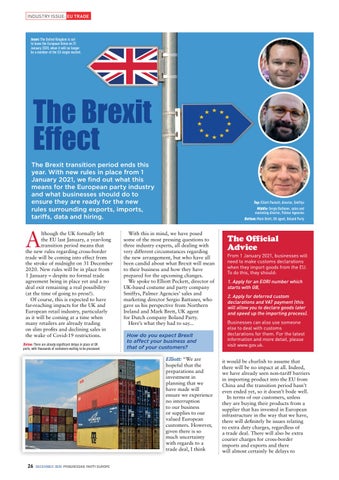
Inset: The United Kingdom is set to leave the European Union on 31 January 2020, when it will no longer be a member of the EU single market.
The Brexit Effect The Brexit transition period ends this year. With new rules in place from 1 January 2021, we find out what this means for the European party industry and what businesses should do to ensure they are ready for the new rules surrounding exports, imports, tariffs, data and hiring.
A
lthough the UK formally left the EU last January, a year-long transition period means that the new rules regarding cross-border trade will be coming into effect from the stroke of midnight on 31 December 2020. New rules will be in place from 1 January – despite no formal trade agreement being in place yet and a no deal exit remaining a real possibility (at the time of going to press!). Of course, this is expected to have far-reaching impacts for the UK and European retail industry, particularly as it will be coming at a time when many retailers are already trading on slim profits and declining sales in the wake of Covid-19 restrictions.
Below: There are already significant delays in place at UK ports, with thousands of containers waiting to be processed.
Top: Elliott Peckett, director, Smiffys Middle: Sergio Battaner, sales and marketing director, Palmer Agencies Bottom: Mark Brett, UK agent, Boland Party
With this in mind, we have posed some of the most pressing questions to three industry experts, all dealing with very different circumstances regarding the new arrangement, but who have all been candid about what Brexit will mean to their business and how they have prepared for the upcoming changes. We spoke to Elliott Peckett, director of UK-based costume and party company Smiffys, Palmer Agencies’ sales and marketing director Sergio Battaner, who gave us his perspective from Northern Ireland and Mark Brett, UK agent for Dutch company Boland Party. Here’s what they had to say... How do you expect Brexit to affect your business and that of your customers? Elliott: “We are hopeful that the preparations and investment in planning that we have made will ensure we experience no interruption to our business or supplies to our valued European customers. However, given there is so much uncertainty with regards to a trade deal, I think
26
The Official Advice From 1 January 2021, businesses will need to make customs declarations when they import goods from the EU. To do this, they should:
1. Apply for an EORI number which starts with GB, 2. Apply for deferred custom declarations and VAT payment (this will allow you to declare goods later and speed up the importing process). Businesses can also use someone else to deal with customs declarations for them. For the latest information and more detail, please visit www.gov.uk.
it would be churlish to assume that there will be no impact at all. Indeed, we have already seen non-tariff barriers in importing product into the EU from China and the transition period hasn’t even ended yet, so it doesn’t bode well. In terms of our customers, unless they are buying their products from a supplier that has invested in European infrastructure in the way that we have, there will definitely be issues relating to extra duty charges, regardless of a trade deal. There will also be extra courier charges for cross-border imports and exports and there will almost certainly be delays to
DECEMBER 2020 PROGRESSIVE PARTY EUROPE
26_27_29_Brexit.indd 26
04/12/2020 18:28
INDUSTRY ISSUE: EU TRADE
which is leaving it very late and then they are trying to couch it in simple terms but keep using acronyms that are disguising some very complex tasks. There is training available and there are grants to access this training but it is all very late, very detailed and very complex.” Are there difficulties you expect party suppliers and retailers will have to navigate in the coming months?
Above: Despite the best efforts from gov.uk, the new trade rules are complicated and can be confusing. Right: The government is keen to keep buinesses trading as freely as possible and has introduced the option of deferring customs declarations for six months.
cross-border imports and exports; that is already happening in Felixstowe.” Sergio: “We don’t expect any major disruption to our service. As we are based in Northern Ireland, we will be both in the EU customs territory and in the UK market. Our shipments within the EU will be as normal, with the possible exception of an extra day’s delay to Scandinavia as the goods will have to go through a different route. Our shipments to the UK will be just as they are now. NI remains a part of the UK and we have free access to the market.” Mark: “Yes, unequivocally. Regardless of whether there is a deal or no deal on 1 January, things will change big time. If you did not fully understand the words ‘free movement of goods’ before, you will then!” Has there been much guidance on how EU-UK trade agreements should proceed in the postBrexit trading environment? What preparations have you had to make so far? Elliott: “There has been little guidance that is of much use. In fact, when we contacted the Department for International Trade to answer our specifics questions regarding topics such as duty, origin of goods, they could not answer as they didn’t know themselves! This is not an isolated incident – the British Chambers of Commerce put its own list of 35 questions on what happens next to the Government in October and at the point of writing, the government had answered just nine. Consequently, we have spent an enormous amount of time and money since prior the 2016 referendum
planning for the worst case scenario and speaking to EU trade experts, some of whom have worked with Michelle Barnier, to advise us of our set up post-Brexit to ensure uninterrupted service to our European customers. This has resulted in us opening a Dutch BV, a Dutch showroom and office, a German warehouse and gaining Dutch Customs Certification for our duty calculation on imports into the EU from our Chinese warehouse. We have also had to re-label every item with our Dutch company name and address as, in the scenario of a no-deal, any product issues have to be directed to a locally based importer who holds possession of the stock.” Sergio: “Lastminute.com is probably too nice for the ‘guidance’ given by the UK government but, then again, there is no trade deal to talk about at the moment! We’ve been to a number of meetings and roadshows where they were very keen on talking about the ‘exceptions’ that would require special arrangements – sales of tobacco, alcohol, explosives, weapons…- Palmer Agencies does not deal in those markets… or probably 99% of businesses! Overall it is very difficult to prepare for a trade deal that is not agreed (yet?).” Mark: “Yes and no. I think HMRC is trying hard but most of the time they seem to have one arm tied behind their back. Moreover, their detailed information is only just coming out,
Elliott: “Without a doubt, there will be delays in goods entering the EU from the UK and vice versa – we can see this from the current delays at Felixstowe. We have also seen delays to our containers shipped from China directly into the Netherlands as the Dutch customs have been carrying out detailed checks given that we are a non-resident UK importer of record in the EU – all before the end of the transition agreement. These are the non-tariff barriers that we have been warned about for some time. The cost of freight when importing from the EU into the UK and NI, and vice versa, will also increase – we have already received notification from one of our couriers, UPS, that the UK will be regarded as a ‘Worldwide’ destination in the future, whether there is a trade deal or not. Other couriers will inevitably follow their lead, with similar cost increases. This means that the following approximate charges will become applicable per shipment– UK border fee @ £4.50; a disbursement fee @ £11.50 and an entry fee @ £5.60. Suppliers will either have to absorb this or pass it on to customers. Finally, unless they have a European company already established, the duty that UK exporters are charged when sending goods into Europe will change – regardless of a trade deal – resulting in duty being calculated on the selling price of the goods, rather than the cost of the goods. This is the enormous implication that many companies do not realise.”
Due Diligence “Retailers must ensure they know what rate of duty is due and who is liable for it as well as who will be paying for the increased cost of freight. Make sure you know who is liable in case of any issues and always factor delays into your lead time.” Elliott Peckett, director, Smiffys
DECEMBER 2020 PROGRESSIVE PARTY EUROPE
26_27_29_Brexit.indd 27
27
04/12/2020 18:28
EST. 1840
An
FDW
l[1 1H [
�
incharacter. c o s t u m e s
Request our catalogue
& place your order by contacting:
customer.services(@fancydresswarehouse.com / customer.services(@angels.co.uk +44 208 732 8871/ 79 I www.fancydresswarehouse.com *This offer is valid until 31.12.2019 on the Rasta lmposta, lnCharacter Costumes and T insley Transfers. Minimum spend £1000/ €1000 is re9uired.
28_PPE_December 2020.indd 1
05/12/2020 17:29
INDUSTRY ISSUE: EU TRADE
Left:Smiffys opened its European showroom in Amsterdam in 2018.
Exporters into the EU will have to find solutions to avoid these costly delays, duty and carriage charges very quickly if they haven’t already done so.” Sergio: “The UK party industry will be affected at large as it will require UK retailers to pay VAT on arrival for all purchases outside the UK. Until now, VAT payments were deferred. Also, payment of duties and other levies will make it a less palatable experience.” Mark: “Certainly in the short to medium term – the next six months or so – there will be enormous disruption, and I am not one to use hyperbole!” Is there any advice you would give to retailers who will be placing cross-border orders after 31 December 2020? Sergio: “There will be more red tape, paperwork (and costs) for anyone in the UK doing business with the EU and vice versa. Northern Ireland is the exception and we aim to supply our quality products with the same level of top-class service we are renowned for!” Mark: “There will be bucketloads of complications, both for importing and exporting. This will all be compounded by the fact that the UK ports are chocablock at the moment, and that the UK government has over 11,000 containers of stock waiting at Felixstowe...” Have you been able to put any cross-border plans into place so far? Do you expect these will be enough? Elliott: “Smiffys’ preparations have been in place for some time and we import our products directly into the EU from China, meaning they don’t have to go via the UK. This has several benefits, but the key is that our European retailers will continue to receive their orders from our German warehouse, as they have done for the past four years. We hope that this
Buy Some Time “There is a whole lot to consider, but if retailers can secure deferred declaration it will buy them some time. Without it, they will get absolutely nothing – and that includes deliveries! Even with a free trade deal, it is likely that declarations will have to be made and there is a cost to that.” Mark Brett, UK agent, Boland Party
will be enough, but the key issue is that nobody is 100% sure how the EU will regard imports from a UKowned business, particularly if we leave the EU with no trade deal under a cloud of blame and acrimony.” Sergio: “We’ve updated all our product info so we can include weights, dimensions, etc in our invoices. Commodity codes and other quirks of import and export is something we’re already used to.” Mark: “I am offering my customers the facility of compiling all the details required for deferred customs clearance on every shipment they receive before 1 July 2021. I have developed a template to record each and every transaction,which should hopefully go some way towards making things a little easier.” What implications would a no-deal Brexit have for your business and for the European party industry at large? Elliott: “On the back of a pandemic, a no-deal Brexit would be an enormous, self-inflicted own-goal for the UK and with it, the UK party industry at large. Tariffs could very well be increased and duty costs will absolutely increase once we leave the EU, regardless of a trade deal. The non-tariff barriers that we are already experiencing would likely increase too. The European party industry is largely self-sufficient and it is only through enormous hard-work that they choose to buy from Smiffys. They simply will not put up with delays or increased costs and would vote with their wallets.
Elliott: “Make sure you know what rate of duty is due and who is liable for the duty. Make sure you understand who will be paying for the increased cost of freight. Make sure you know who is liable in the instance that there is an issue with a product – if it hasn’t got the name and address of an EU importer, it could be the retailer is liable. Factor in delays in your lead time.”
Ups and Downs “Challenges and difficulties also bring opportunities. The UK party industry will see upsides and downsides to Brexit. The EU party industry will feel the loss of an important market but, overall there will be no major changes for them.” Sergio Battaner, sales and marketing director, Palmer Agencies
Sergio: “As things stand at the moment, we believe that Palmer Agencies will offer the smoothest transactions in the trade. Our privileged position in Northern Ireland gives us a vantage point to have unfettered access to both UK and EU markets. Everything will be different after 1 January, unless you’re already working with us!” Mark: “The most immediate action that retailers can all take is to make sure they apply for an EOIR number and apply for deferred declarations as soon as possible. The EORI is very quick and simple but the government is saying that deferred declarations may take 30 days to process, which could cause further problems.” DECEMBER 2020 PROGRESSIVE PARTY EUROPE
26_27_29_Brexit.indd 29
29
04/12/2020 18:28
Our Santas ALWAYS deliver... on quality, price & so much more!
Available in Standard, XL & XXL
sales@palmeragencies.com +44 (0) 28 9064 7119 facebook.com/PalmerAgencies
00_PPE_Nov Dec 2020.indd 1
@palmeragencies
palmeragencies.com
instagram.com/palmeragencies 03/12/2020 21:09
CHRISTMAS 2021
A Festive
Feast
With this year’s Christmas and New Year’s Eve celebrations likely to look a little different to usual, party and costume suppliers are in a strong position to make the most of consumers’ desire to keep the festive feeling as much as possible. With elaborate décor, elves on shelves and novelty family costumes, there’s every reason for the party industry to make this festive season a real celebration.
T
hough most consumers still don’t know under what circumstances they will be celebrating Christmas this year – or who they will be celebrating with – it’s already clear that many are embracing the festice season even earlier than usual. The unusual and difficult circumstances of the past year have seen many deciding that they are not waiting any longer to enjoy a little bit of Christmas sparkle. A spike in early present shopping may have been a response to the latest lockdown or other restrictions, but buying more decorations, lights, tableware and novelties is purely down to the consumer looking for ways to make the most of the season. “We expect this year to be a celebration of all things family, with consumers
Festive Facemasks “Christmas and New Year’s Eve parties will be held with family this year, perhaps with small groups of friends. However, most people are looking forward to leaving 2020 far, FAR behind them so I do think they will use this opportunity to dress up and have fun. Facemasks have been doing very well for us and of course we have our amazing collection of Christmas suits, blazers and shirts – something for everybody!” Robin Breeman, head of sales, OppoSuits
Left: Top-quality Santa suits from Palmer Agencies have been in high demand as consumer look to recreate some grotto magic of their own. Below left: The new Christmas-themed Airloonz from Amscan will set the scene for any festive event.
focusing on spreading cheer through fun and attractive decorations,” said Qualatex’s head of marketing Julie Dommett. “We expect the trend for the gifting of balloon bouquets to continue, through both deliveries and click-and-collect orders. Sales so far are showing cute balloon characters are much in demand.” She continued: “Consumers are looking for ways to celebrate after this challenging year, and retailers have a vital part to play in lifting the mood. We have already seen the trend for elves in stuffing balloons return for another year, with savvy retailers promoting and taking orders well in advance, in early November.” Julie expects to see personalised message balloons, character shapes and Christmas wreaths all doing well this year, with Northstar Balloon letters and numbers “being used to spell out ‘Goodbye 2020’ or similar phrases!” Pioneer has developed a suite of Qualatex social media marketing tools that all retailers can access for free online, to help them promote these seasonal ranges. Amscan also expects to see consumers celebrating this year, with consumers really making an effort to bring family and friends together, however that might be possible. “With this in mind we have released a whole host of new Christmas designs, perfect for setting the scene at home,” revealed Jen Wilson, head of marketing and design. “From Festive Friends – our new kid friendly range – through to more traditional designs, we have something for everyone’s tastes so that homes are looking suitably festive this year.” A number of New Year items will also allow consumers to welcome 2021 in style, with classic metallics which can be mixed and matched with room décor, balloon garlands and additional key pieces. Of course it’s not all about the elaborate décor and elves on shelves – there’s also a real space for novelty family costumes as consumers look to make this festive season different from the rest.
Balloon Inspiration “Balloons are a perfect way to celebrate, giving familiar Christmas decorations a new lease of life. We want to inspire our customers to use balloons to add an extra dimension to their festivities, no matter how big or small their gathering might be. Gemar Ambassadors, Partners and Stars worldwide are as busy as Santa’s elves as they get ready for the holiday season!” Clara Vaugelade-Tafani, marketing manager, Gemar
Above: Gemar is lifting the Christmas mood by playing with colour and seasonal décor to create unique seasonal settings.
“We have done really well on the Christmas décor side of the business with quite a few lines already sold out,” said Palmer Agencies’ director of sales and marketing Sergio Battaner. “Our quality Santa suits have started selling earlier than last year as well, while our continental Santas continue to offer that extra bit of top-quality styling that makes them – and Santa himself – extra special!” “Christmas Grottos may suffer this year,” he continued, “so we know that there are more people than ever are looking to recreate a bit of the Christmas magic at home for the younger members of the family.” When stocking up on your festive accessories and costumes, Sergio has some sage advice: while the Santa costumes should be in the better quality range, it’s also important to pay special attention to beards, wigs and other ‘add-ons’. “It would be quite disastrous to get the costume right and come home with a completely fake looking beard and wig,” he pointed out. “And the family with coordinated novelty glasses, Santa hats, or reindeer antlers, will look awesome when the video call to the rest of the family on the other side of the country takes place…” Below: New Qualatex Bubble Balloons are great for both retailers and recipients alike as they stay inflated for weeks.
Left: Christmas facemasks from OppoSuits work perfectly with the new Christmas suit designs.
DECEMBER 2020 PROGRESSIVE PARTY EUROPE
31_33_35_Christmas_NYE.indd 31
31
04/12/2020 18:29
UK: Freephone 0800 590 599 / sales@smiffys.com Export Sales: +44 1427 619 799 / export@smiffys.com
20-287A prog_party_xmas_ad_single_page.indd 1 00_PPE_Nov Dec 2020.indd 1
03/12/2020 10:47:56 03/12/2020 13:29
CHRISTMAS 2021
CHRISTMAS PRODUCTS You can’t beat a flashing Christmas hat and Mrs Santa dress, as Boland Party proves.
Cute new characters from Qualatex include this Red Nosed Reindeer head shape and co-ordinating 18” round foil, which have proved to be an instant hit.
Amscan is offering a traditional take on Christmas with colourful décor and the Falalalala partyware range.
This Festive Friends tableware range from Amscan is perfect for families this Christmas and includes colour-in placemats to keep children occupied.
These air-filled Christmas light balloons from Anagram are perfect for decking the halls and getting festive. Sparkling snowflakes and ice blue shades create an enchanting setting in Creative Party’s versatile Snowflake Splendour party range perfect for the winter months.
Classic snowflake confetti balloons from ITI (UK) are a smart choice, as is the Merry Christmas DIY balloon arch kit – ideal for customers lokoing to get creative at home.
Bake Off “People will be looking to counteract the past year with optimism, finding ways to make at-home festivities extra special and memorable. We’re expecting to see strong sales of our Christmas baking accessories as seasonal celebrators turn to at-home baking as a fun family activity and thoughtful gifting option.”
Shayna Bowles, marketing manager, Creative Party
GoDan’s customers are ordering more carefully, with the focus on classic products and decorations which will add a little Christmas cheer to proceedings, such as these Santa sacks, stockings and standard Santa costumes.
This ever-successful Nativity costume range from Amscan is perfect for schools looking to continue offering traditional activities and celebrations this year.
Grabo’s Special Delivery Christmas Tree is a creative alternative to classic Christmas trees and can even be hung on the wall.
This unique Christmas tree foam hat from Palmer Agenices will help bring out the festive spirit!
What child wouldn’t like to dress-up as the Elf on the Shelf, in this officially licensed costume from Smiffys – time for them to get their revenge!
A range of traditional or contemporary foils designs from Qualatex include Christmas Trees Red and the stylish Christmas Red & White Stripes, both ideal for Merry Christmas bouquets.
These parsnip and Christmas pudding costumes from Smiffys are fantastically creative takes on the traditional Christmas dress-up options!
DECEMBER 2020 PROGRESSIVE PARTY EUROPE
31_33_35_Christmas_NYE.indd 33
33
04/12/2020 18:30
DECK THE
HALLS! S H O P H O L I DAY 2 0 2 0
MEDFORD HOUSE, EAST COMMON LANE SCUNTHORPE NORTH LINCOLNSHIRE ENGLAND DN16 1DE FREEPHONE: 0800-052-4977 | TELEPHONE: 01724-281113 | FAX: 01724-281119 | OUTSIDE UK TELEPHONE: 0044-1724-281113 FAX: 0044-1724-281119 | E-MAIL: SALES@UNIQUEPART Y.CO.UK
FAVORS.COM/UK
34_PPE_December 2020.indd 1 2020 NovDec Progressive Party_FullPg_Xmas_R.indd 1
04/12/2020 18:13 11/19/20 10:47 AM
CHRISTMAS 2021
NYE PRODUCTS Add a bit of party atmosphere with themed string lights from Boland Party featuring colourful bells and sparkly disco balls. Consumers looking to embrace the Peaky Blinders theme can complete the look with Smiffys’ officially licensed Peaky Blinders masks, ideal for bringing the whole series to life.
These ‘Happy New Year’ LED string lights from Boland Party are perfect for brightening up the home on the big night.
Customers can channel their inner Gatsby with this luxurious range of foil partyware from Creative Party. The classic collection is ideal for New Year’s Eve celebrations and can be merchandised as a general range at other times of the year. With most people staying at home to celebrate in small groups or via online parties, GoDan predicts that small decorations and accessories will be most popular this year, with garlands, confetti, balloons, party glasses and headbands playing a key part in New Year’s Eve celebrations.
Roaring Good Time
New Year’s Eve celebrations are perfect for mixing and and matching Amscan’s key core party and balloon product, combining a handful of seasonal skus for maximum impact!
“We expect all our customers to be ‘bringing the party home’ this Christmas and New Year’s Eve. Continuing with the focus of homemade fun, accessories will play a major role in Christmas celebrations as they can create a touch of magic for all ages around the Christmas table while spreading the much-needed Christmas spirit. Similarly, New Year’s Eve always brings celebrations centred around 1920s parties and these costumes and accessories are best-sellers for us at this time of year.”
Focus on Fun “Christmas itself is not an especially important time for the average party shop, but that will change this year. Even in September some retailers said customers had been asking for Christmas stock! While there will be no big parties for New Year’s Eve, there will be more small gatherings, so that’s a good thing. Retailers should focus on product that will bring fun and laughter to consumers and put cash in their tills!”
The team at Qualatex expect to see a focus on home décor and creative Zoom backdrops – using balloons such as this ‘Pop Fizz Clink’ for those welcoming in the New Year.
Millie Addison, marketing, Smiffys
Mark Brett, UK Agent, Boland Party
The classy New Year Marble Rectangles from Qualatex is a popular choice for dramatic and stylish creations and works well for anyone saying goodbye to 2020!
The 20s is always a popular theme for New Year’s Eve and this collection of brand-new deluxe flapper costumes from Smiffys offer a stylish take on fancy dress.
This new officially licensed Peaky Blinders collection from Smiffys is perfect for all the socially-distanced 1920s-themed New Year’s Eve parties.
DECEMBER 2020 PROGRESSIVE PARTY EUROPE
31_33_35_Christmas_NYE.indd 35
35
04/12/2020 18:30
VALENTINE’S DAY 2021
In the Name of L ove
Traditionally more of a one-on-one occasion, making it perfect for social distancing and house-bound celebrations, Valentine’s Day is the perfect date for making sure those balloon and partyware orders stack up.
Above: Amscan’s newest addition to the air-filled Airloonz portfolio include this Love design, available in two different colourways. Right: The striking Pink Ombré range from Qualatex is sure to turn a few heads and includes a large 42” heart Microfoil shape and a co-ordinating 18” heart balloon.
P
arties and celebrations may have suffered over the past year, but it’s been a good time for balloon décor and deliveries as consumers look for safer, alternative ways to mark special occasions. With consumers expected to fully embrace the holiday with loved ones, family and friends, businesses selling balloons and partyware will also be making the most of the opportunity. “We are confident that for Valentine’s Day 2021, even more so than usual, consumers will be looking to express their love, gratitude and thanks to those who Below: These Linky Hearts from Grabo are an innovative and fun addition to any Valentine’s Day balloon collection.
Solo Celebrations “Valentine’s Day 2021 is going to be interesting. It is one of the only holidays that is not a mass event – so if restaurants are open then there will not be too many obstacles in the way. At ITI (UK) we have a cracking range of latex hearts which are perfect for this occasion.” Mark Brett, UK agent, ITI (UK)
36
have been important to them, especially over the last year,” said Amscan’s head of marketing and design Jen Wilson. The party company has launched a new range of balloons for the season, which is online now. The new range offers everything consumers could need, from traditional ‘Happy Valentine’s Day’ balloons, to Rainbows of love and thanks, ready for all celebration possibilities. “We don’t want to tie the celebration down to just the typical nearest and dearest,” Jen continued, “but are continuing the trend of celebrating everyone!” Statement pieces are also key for Amscan this Valentine’s Day, with the Airloonz ‘Love’ balloon making the perfect airfilled consumer product. “We also expect that Valentine’s stackers will be popular,” Jen added, “with air-filled deliveries likely to be a great opportunity to continue with for balloon decorators.” The concept of Valentine’s Day 2021 being open to a wider audience than usual is also high on Pioneer Europe’s agenda, as head of marketing Julie Dommett emphasises that this year it will not be restricted to lovers. “Whether it’s heartfelt love or just sending a cheery message, after 2020, we expect there will be high demand from consumers keen to send messages of affection this Valentine’s Day,” she said. Trends are expected to include stylish scripts, bold pink and gold themes and the continuation of the ombré trend. “We strongly recommend balloon retailers promote their click-and-collect and delivery services early in the New Year to help create those advance orders. Plan the designs you want to offer well in advance, order stock early and don’t forget to order consumables like weights, confetti and balloon boxes in January as well.” To help retailers promote their offering easily and cost-effectively, Qualatex will also be making a range of social media assets available. “There’s quite a few designs that can be created well in advance,” added Julie. “Promoting Bubble and
OK Cupid “Valentine’s Day is always a more intimate date in the party calendar and we can only assume that, until a vaccine is rolled out, it will be a private affair at home. But in that situation, dress-up has a chance to be a unique celebratory expression of what the day stands for!” Sergio Battaner, sales and marketing director, Palmer Agencies air-filled foil designs means bouquets can be delivered or collected earlier than the weekend and still look fresh on Sunday 14th – which will help to alleviate some of the inevitable last-minute rush!” The team at Gemar has also gone out of its way to ensure that balloon decorators and retailers will have plenty of options for consumers to choose from, thanks to its online Balloonista tutorials. Available on the Gemar website and Facebook platform, they will help balloon artists learn how to create a number of new stunning new sculptures, step-by-step. “No matter what else might be going on in the world, people will always fall in love,” said marketing manager Clara Vaugelade-Tafani. “It’s one of the few things that we can be truly certain of!” “Balloons offer the perfect solution,” she added. “They can be simple and sweet – a single heart shaped balloon makes a lovely statement. But they can also be used in sophisticated, elaborate sculptures or breathtaking displays. With colours to suit every taste and options for every budget, balloons may just be the new flowers!” Below: Gemar’s Balloonista tutorials are ideal for anyone looking for Valentine’s Day inspiration.
DECEMBER 2020 PROGRESSIVE PARTY EUROPE
36-37_Valentines.indd 36
04/12/2020 18:47
VALENTINE’S DAY 2021
VALENTINE’S DAY
Keeping on-trend is this Rainbow Love balloon from Angagram, which is sure to spread joy for Valentine’s Day 2021!
This cupid costume from Palmer Agencies is a classic for this celebration. The lace detail dress and layered tutu features matching wings on an elastic band and a padded heart sewn to the outfit as well as the all-important bow and arrows.
Valentine’s Day is increasingly being shared with younger children to celebrate love and friendship. Star Cutouts’ Valentine’s Day Peppa Pig range includes little brother George and will bring some fun into the home.
The most important Valentine’s Day items for GoDan are single balloons and balloon decorations. Next year will see a focus on new designs and the hope that people will continue to celebrate the occasion.
These giant red, pink or confetti-filled 29” hearts with tassels from ITI (UK) are perfect for making a statement, making them ideal for both displays and single deliveries.
If your customers are loking for cute or funny Valentine’s messages, then look no further than these new Dino and Bee ranges from Qualatex.
With the trend for stackers continuing, loved ones would be overwhelmed with this jumbo Valentine’s Day Stacker design from Amscan’s Jacob Megram and Chris Horne, which includes the lovely new Anagram Marblez Orbz.
Share the love on Valentine’s Day with Creative Party’s new Sprinkled Hearts collection. This vibrant and playful design is perfectly accented by coordinating and on-trend heart-shaped plates and shimmering gold table runner.
Pioneer Europe has added two brand new Bubble Balloons to its Qualatex Valentine’s day range – the very on–trend Valentine’s Day Paper Fan and the contemporary Valentine’s Day Black Stripes.
Classic Valentine’s Day messaging from Gemar keeps it classy, simple and effective.
Pastel colours feature highliy in Grabo’s offering, with a selection of heart shapes making for the perfect elegant bouquet.
The fashion for combining bold pink and red hues together is reflected in these two new heart shaped Microfoil balloons from Qualatex – the Valentine’s Day Arrow Stripes and the I Love you Gold Dots.
DECEMBER 2020 PROGRESSIVE PARTY EUROPE
36-37_Valentines.indd 37
37
04/12/2020 18:47
CELEBRATE
VALENTINE'S DAY WITH
QUALATEX
®
To see our full 2021 Valentine's Balloon Collection, go to www.qualatexeurope.com
Sign up to our January Valentine's webinar with Sue Bowler, cba, at www.qualatexeurope.com U.S. Patent No. 6,782,675 USA ©2020 PBC SB – PP2011006
00_PPE_Nov Dec 2020.indd 1
03/12/2020 21:10
Facts and Figures
THE TOP It’s all been about balloons and decorations this year. The top five products were: T P iñatas (best year for these ever) T A ir-filled ‘Happy Birthday’ banners T N umber helium balloons (Oaktree’s new numbers are totally brilliant!) T G lobes/Orbz T C andles
CUSTOMER SAFETY
a party palace: IN NUMBERS Based near Richmond in South West London, A Party Palace is a party, costume and balloon décor business which celebrated its 12th birthday earlier this year. In between navigating the latest lockdown restrictions, owner Adrienne D’Souza spoke to PPE to share the figures behind the store’s success.
“We have some awesome customers but our best spender was on behalf of a big corporate client for bonfire night. Lots of our customers are concerned that we may not be here at the end of this so they keep checking up on us which is making us feel appreciated!”
STORE STATS
“We do Facebook, Instagram and Twitter, but work particularly hard on Instagram. It’s been worth it as we get lots of engagement and receive lots of enquiries and orders through it. We’ve learnt to have a laugh. The more fun you have the more people love it!” @apartypalacesw14
ON THE WAY
CUSTOMER CARE
Above: Adrienne and the fabulous team at Halloween.
GETTING DIGITAL
“ Blush, eucalyptus/ earthy colours and gold.”
“ Pink and silver/blue and silver combinations. Move over silver, gold is the hot fave now!.”
“We have made so many changes! We have removed fixtures, changed our return policy on wearables purchased in-store, added sanitiser everywhere, introduced more staff training and cleaning, become as cash free as possible and risk assessed until I can’t see straight! Who ever imagined that this would be how 2020 would work out?!”
Above: Window displays thanked the NHS and keyworkers during the spring lockdown.
ON THE WAY
T A drienne is ‘very blessed’ to be running the shop with a team of six – one full-timer and a fabulous bunch of multi-skilled part-timers. T T he store used to be a car showroom so is around 1200sq ft – which means three shop windows! T A t least one of those windows gets changed every four to six weeks. T I t’s all changed in lockdown – Tuesdays and Wednesdays are now A Party Palace’s busiest days. “The world really has gone mad!” T T wo boxes came in on the last delivery – Adrienne is mainly using wholesalers at the moment to top up as needed. T A verage spend per transaction is between £1,500 - £3,000.
“A couple of years ago we started to photograph our own balloon bouqet designs. Over lockdown they have been so popular and we’re very happy with ourselves! We love an organic display but still get wowed by a big ol’ bunch of brightly coloured helium balloons. They just ooze fun.”
WORKING RELATIONSHIPS
HALLOWEEN HEROES “Props and decorations. We sold loads of skeletons (thanks to Palmer Agencies and Boland Party) and paper decorations (Party Deco and Boland). It was a very traditional year.”
BALLOON BOOST
Above: Doin’ it for the ‘gram.
“I have been working with Smiffys and trading with Mark Brett one way or another depending on where he’s hanging his hat for the last 12 years. We have just started working with Hootyballoo – wonderful designs, slightly quirky and really well priced. Love it!” DECEMBER 2020 PROGRESSIVE PARTY EUROPE
IBC_Retailer By Numbers.indd 55
39
04/12/2020 18:37
Officially licensed dress-up
AVAILABLE NOW
Role play weapons are not included
WWW.RUBIESUK.COM or email: customerservices@rubiesuk.com @Rubies_UK
000_PPE_June 2020.indd 1
@RubiesUK
@rubiesfamily_uk
@Rubies_EMEA
24/09/2020 11:26