www.trujetter.com
INTERESTING FACTS
The toco toucan’s multi-purpose beak can be used to collect and skin fruit, frighten predators, attract mates and defend territory.
The sword-billed hummingbird is known for its extraordinary long beak. It is adapted to feed on nectar from flowers that have long petals.
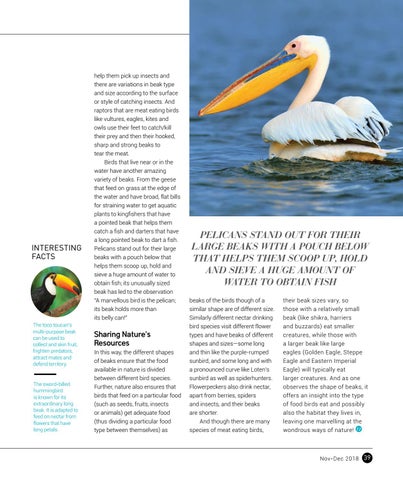
help them pick up insects and there are variations in beak type and size according to the surface or style of catching insects. And raptors that are meat eating birds like vultures, eagles, kites and owls use their feet to catch/kill their prey and then their hooked, sharp and strong beaks to tear the meat. Birds that live near or in the water have another amazing variety of beaks. From the geese that feed on grass at the edge of the water and have broad, flat bills for straining water to get aquatic plants to kingfishers that have a pointed beak that helps them catch a fish and darters that have a long pointed beak to dart a fish. Pelicans stand out for their large beaks with a pouch below that helps them scoop up, hold and sieve a huge amount of water to obtain fish; its unusually sized beak has led to the observation “A marvellous bird is the pelican; its beak holds more than its belly can!”
Sharing Nature’s Resources In this way, the different shapes of beaks ensure that the food available in nature is divided between different bird species. Further, nature also ensures that birds that feed on a particular food (such as seeds, fruits, insects or animals) get adequate food (thus dividing a particular food type between themselves) as
PELICANS STAND OUT FOR THEIR LARGE BEAKS WITH A POUCH BELOW THAT HELPS THEM SCOOP UP, HOLD AND SIEVE A HUGE AMOUNT OF WATER TO OBTAIN FISH beaks of the birds though of a similar shape are of different size. Similarly different nectar drinking bird species visit different flower types and have beaks of different shapes and sizes—some long and thin like the purple-rumped sunbird, and some long and with a pronounced curve like Loten’s sunbird as well as spiderhunters. Flowerpeckers also drink nectar, apart from berries, spiders and insects, and their beaks are shorter. And though there are many species of meat eating birds,
their beak sizes vary, so those with a relatively small beak (like shikra, harriers and buzzards) eat smaller creatures, while those with a larger beak like large eagles (Golden Eagle, Steppe Eagle and Eastern Imperial Eagle) will typically eat larger creatures. And as one observes the shape of beaks, it offers an insight into the type of food birds eat and possibly also the habitat they lives in, leaving one marvelling at the wondrous ways of nature!
Nov-Dec 2018
39