September 2017 Lighting Journal
Transport, highways and street lighting: railway lighting
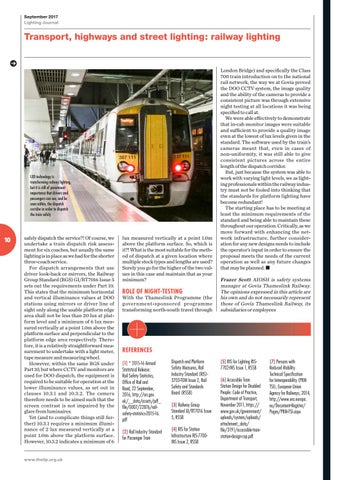
LED technology is transforming railway lighting, but it is still of paramount importance that drivers and passengers can see, and be seen within, the dispatch corridor in order to dispatch the train safely
10
safely dispatch the service?! Of course, we undertake a train dispatch risk assessment for six coaches, but usually the same lighting is in place as we had for the shorter three-coach service. For dispatch arrangements that use driver look-back or mirrors, the Railway Group Standard (RGS) GI/RT7016 Issue 5 sets out the requirements under Part 10. This states that the minimum horizontal and vertical illuminance values at DOO stations using mirrors or driver line of sight only along the usable platform edge area shall not be less than 20 lux at platform level and a minimum of 6 lux measured vertically at a point 1.0m above the platform surface and perpendicular to the platform edge area respectively. Therefore, it is a relatively straightforward measurement to undertake with a light meter, tape measure and measuring wheel. However, within the same RGS under Part 10, but where CCTV and monitors are used for DOO dispatch, the equipment is required to be suitable for operation at the lower illuminance values, as set out in clauses 10.3.1 and 10.3.2. The camera therefore needs to be aimed such that the screen contrast is not impaired by the glare from luminaires. Yet (and to complicate things still further) 10.3.1 requires a minimum illuminance of 2 lux measured vertically at a point 1.0m above the platform surface. However, 10.3.2 indicates a minimum of 6 www.theilp.org.uk
lux measured vertically at a point 1.0m above the platform surface. So, which is it?! What is the most suitable for the method of dispatch at a given location where multiple stock types and lengths are used? Surely you go for the higher of the two values in this case and maintain that as your minimum?
ROLE OF NIGHT-TESTING
With the Thameslink Programme (the government-sponsored programme transforming north-south travel through
London Bridge) and specifically the Class 700 train introduction on to the national rail network, the way we at Govia proved the DOO CCTV system, the image quality and the ability of the cameras to provide a consistent picture was through extensive night testing at all locations it was being specified to call at. We were able effectively to demonstrate that in-cab monitor images were suitable and sufficient to provide a quality image even at the lowest of lux levels given in the standard. The software used by the train’s cameras meant that, even in cases of non-uniformity, it was still able to give consistent pictures across the entire length of the dispatch corridor. But, just because the system was able to work with varying light levels, we as lighting professionals within the railway industry must not be fooled into thinking that the standards for platform lighting have become redundant! The starting place has to be meeting at least the minimum requirements of the standard and being able to maintain these throughout our operation. Critically, as we move forward with enhancing the network infrastructure, further consideration for any new designs needs to include the operator’s input in order to ensure the proposal meets the needs of the current operation as well as any future changes that may be planned. ¢
Frazer Scott AIOSH is safety systems manager at Govia Thameslink Railway. The opinions expressed in this article are his own and do not necessarily represent those of Govia Thameslink Railway, its subsidiaries or employees
REFERENCES [1] * 2015-16 Annual Statistical Release: Rail Safety Statistics, Office of Rail and Road, 22 September, 2016, http://orr.gov. uk/__data/assets/pdf_ file/0007/22876/railsafety-statistics-2015-16. pdf
Dispatch and Platform Safety Measures, Rail Industry Standard (RIS)3703-TOM Issue 2, Rail Safety and Standards Board (RSSB)
[2] Rail Industry Standard for Passenger Train
[4] RIS for Station Infrastructure RIS-7700INS Issue 2, RSSB
[3] Railway Group Standard GI/RT7016 Issue 5, RSSB
[5] RIS for Lighting RIS7702-INS Issue 1, RSSB [6] Accessible Train Station Design for Disabled People: Code of Practice, Department of Transport, November 2011, https:// www.gov.uk/government/ uploads/system/uploads/ attachment_data/ file/3191/accessible-trainstation-design-cop.pdf
[7] Persons with Reduced Mobility Technical Specification for Interoperability (PRM TSI), European Union Agency for Railways, 2014, http://www.era.europa. eu/Document-Register/ Pages/PRM-TSI.aspx