© Martin Browne Contemporary © All images copyright Freddie Timms This catalogue is copyright. Apart from any fair dealing for the purposes of private study, research, criticism or review as permitted under the Copyright Act, no part may be reproduced by any process without written permission. COMPILER: Masha Jayasiri PHOTOGRAPHER: Jenni Carter ARTIST PORTRAIT: Arnaud Morvan COLOUR SEPARATIONS: Spitting Image, Sydney ESSAY: Copyright of Arnaud Morvan and the Estate of Freddie Timms Front Cover Image: Jack Yard, 2003, pigments and acrylic binder on Belgium linen, 122 x 135 cm (detail)
FREDDIE TIMMS 3 - 27 February 2022 Presented in association with the Estate of Freddie Timms
MARTIN BROWNE CONTEMPORARY 15 HAMPDEN STREET PADDINGTON NSW 2021 TEL: 02 9331 7997 FAX: 02 9331 7050 info@martinbrownecontemporary.com www.martinbrownecontemporary.com GALLERY HOURS: TUESDAY - SUNDAY 10:30AM - 6PM
Freddie Timms painting in the new Jirrawun studio, Wyndham, 2008. Photo by Arnaud Morvan
Freddie Timms: Drawing The Line “Excessively sensitive, the seismograph begins to record frantically, waves upon waves, all at once, distant waves on top of recent waves. At the end, it chaotically intertwines with its exasperated style, the superimposed survivals of each phantom, of ‘each name in history.’ Then it breaks.”
G. Didi Huberman, The Surviving Image: Phantoms of Time and Time of Phantoms. Aby Warburg’s History of Art.1
Rhythm, motion and latency were essential elements to Freddie Timms’ conception of painting and being. I realized this in 2007 as Freddie and I were sitting together in the newly built Jirrawun studio in Wyndham, contemplating a recently finished monochromatic painting. My job back then was to record any elements of interest related to a five-day painting session. Having worked with him for the previous two years, I was familiar with silence as part of this process. On that day, after a long period spent looking at his painting, he finally began to speak, “I’ll call it Sally Bight… Sally Bight Country”. Then another long silence, “That’s Sally Bight Creek at the bottom. Burned Down Creek. Then Ord River.” Then, pointing to several black shapes on the canvas, “hills… hills,…hills. And that’s a knob, little knob there. That one… home station, old building, early days. Goowoomji (Paddy Bedford) was a young fella. This old white bloke (station owner) was a murderer. He killed blackfellas, or anybody he didn’t like. People from my family...”, silence. Pointing to a different place in the painting, “This side, it’s a flat land, spinifex country. Red soil. This one all spinifex, this side, all around a lot of spinifex. Rocky, a lot of rocks. We used to camp there, long time ago. Meet up there, in the little creek, Sally Bight Creek. There is a big waterfall, big waterhole, permanent water. People used to go hunting, get fish, crocs, turtles, water goannas, anything (…) this part of my wife’s country. Her family own that land”.2 As he stared at the painting, memories, good and bad, seemed to flow, following the white dotted lines meandering through the canvas. Their rhythm echoed this reminiscence of a time long passed. Many of Timms’ paintings present contrasting histories coexisting within the landscape, marking the horrors of the frontier alongside the beauty of Indigenous homelands. This juxtaposition of tragedy and good fortune accompanied Freddie Timms throughout most of his life, and also played a role in defining the art movement he contributed to building in the East Kimberley. 1
Georges Didi-Huberman, The Surviving Image. Phantoms of Time and Time of Phantoms: Aby Warburg’s History of Art, University Park: Pennsylvania State University Press, 2017 (2002). 2 Freddie Timms, conversation with the author, June 2007.
Freddie Timms Ngarrmaliny was born in 1944 at a place called Police Hole on the remote cattle station of Bedford Downs, around 200 kilometers south of Kununurra. The region was by then fully colonized and divided into grazing estates controlled by white settlers. These estates covered vast tracts of land enveloping Kija, Miriwoong and Jaru countries (to name but a few of the local language groups in the area). In the 1940s most Indigenous families in the region were working for station owners, or living near the estates for varying periods of time throughout the year, and returning to their homelands whenever possible. This was also the case for Freddie Timms’ family. The period of raw violence locally known as “the killing time” had come to an end in the 1930s, but tensions occasionally still came to a head. When Freddie was about ten years old, his father Harry Timms took his youngest children to hide in the hills around Bow River for three weeks following a conflict between the European managers at Bow River and Lissadell Stations, hoping to avoid possible repercussions. This episode reminded Freddie of several stories told by his grandmother about having to hide in similar circumstances to avoid colonial massacres a few decades earlier. Freddie’s family ended up leaving Bow River soon after this incident to work at the nearby Lissadell Station. Harry was later sent to the Derby leper colony where he died shortly after his arrival. In this chaotic world, Freddie grew up with the support of relatives from Bedford Downs, particularly his uncle Timmy Timms and brother-in-law Paddy Bedford, with whom he became close, and was taught the traditional ways to live in the bush. However Freddie refused to complete the full Kija initiation into traditional law, preferring to make his own way in life. The Lissadell homestead was his second family. He grew up alongside the Manager’s children, learning to speak English and becoming familiar with elements of European culture and life on the station. Soon, his knowledge of the country, ability to learn, and physical aptitude meant he became a respected worker at the station. He gained a reputation as a steady stockman, driving cattle from East Kimberley homesteads to the northern ports of Wyndham and Darwin. During this time, he collaborated with other Aboriginal station workers in the region, including a Kukadja man from the Canning Stock Route named Rover Thomas, a man who would soon become one of the most famous Indigenous artists in Australia. By the end of his career as a stockman, Freddie Timms was the last of the Kija to be working at Lissadell Station, and as head stockman, had several non-Indigenous workers under his responsibility, a rarity at the time.3 3
Biographical elements compiled from conversations with Freddie Timms, Tony Oliver and also from Frances Kofod, “Freddie Timms”, Artists’ Biographies, Jirrawun Aboriginal Art Corporation, unpublished document, 2003.
In the meantime, while most Indigenous families were being forced to leave private station-owned lands following the adoption of equal wages for Indigenous workers in 1968, a new art movement was emerging around a ceremony called Gurirr Gurirr in the recently established community of Warmun. Rover Thomas, Paddy Jaminji, Jack Britten, and others, created for the first time painted wooden boards on which were represented landscapes, events, and mythical characters, to be held by the dancers as part of this balga style ceremony. The semi-cryptic images, painted with natural ochres, revealed hidden knowledge concerning several significant sites in the region, and participated in a local cultural and political renaissance throughout the Kimberley in the 1970s and 1980s. Soon museums and collectors were buying paintings from Thomas and Jaminji and a new art form was taking shape. By this time, Freddie Timms had left Lissadell to settle in the small outstation of Frog Hollow, south of Warmun, with his wife Beryline Mung and their children. Timms began painting there in 1986, alongside Jack Britten, Rover Thomas and Hector Jandany. He soon adopted the planar perspective of Rover Thomas and, to a lesser extent, his father-in-law Georges Mung Mung. Some of his early works, like Violet Valley,1990 4, collected by the National Gallery of Victoria, already featured his unique linear style and minimalist composition. His paintings were included in several important exhibitions during the early 1990s, such as Images of Power (National Gallery of Victoria) and Aratjara, which toured major museums throughout Germany, Netherlands and England in 1993. Timms later accompanied Rover Thomas to Perth, Melbourne, Sydney and Tokyo, for various art residencies and openings. During this time Timms grew unsatisfied with the way Indigenous people were often treated as secondclass citizens within the Australian art world. It was during one of his work trips to Melbourne in 1996, after being given only 300 dollars for three weeks’ worth of paintings done in a private gallery studio, that Timms decided to take a stand. Shortly after this experience he met with Melbourne gallerist and curator Tony Oliver. Oliver introduced him to Frank Watters and Geoffrey Legge, the directors of Watters Gallery in Sydney, where his artworks would soon be exhibited under the same terms and conditions as a non-Indigenous artist. A few months later, Timms invited Oliver to the Kimberley where they subsequently set up the Jirrawun Aboriginal Art Corporation, an Indigenous owned art organisation aiming to market Indigenous artworks on a consignment basis to leading commercial art galleries. As Chairman, Freddie Timms invited his relatives from Bow River and other outstations to join him: Paddy Bedford, Hector Jandany, Rusty Peters, Churchill Cann, Goody Barrett, Phyllis Thomas and Peggy Patrick, later followed by Timmy Timms and Rammey Ramsey. 4 5
National Gallery of Victoria “Violet Valley”, https://www.ngv.vic.gov.au/explore/collection/work/2656/ Tony Oliver and Frances Kofod, Jirrrawun history draft, Jirrawun Aboriginal Art Corporation, unpublished document, 2004.
Jirrawun grew from this ‘two way’ encounter between Freddie Timms and Tony Oliver. “Two way”, a Kija Kriol expression meaning a collaboration and exchange of knowledge between two cultures, was the underlying principle for Jirrawun Arts from the beginning.5 Unlike many traditional Indigenous art centers, the creative process resulted in a collaboration between Oliver, acting as art director, and the artists with their own aesthetic backgrounds. They were constantly encouraged to experiment with new techniques, concepts and materials and to create their individual styles of painting. Reproductions of artworks and books on Picasso, Guston, Warhol, Basquiat, and others were passed around, opening new perspectives and possibilities.6 As one of the most experienced artists of the group, Freddie Timms did not introduce major changes to his style but experimented with color and scale. Oliver saw Timms’s talent for composition and the use of empty space and encouraged him to use multiple canvases to create panoramic landscapes. During this period, the two older members of the group, Paddy Bedford and Timmy Timms, began to remember the existence of an old joonba, a cycle of songs and dances revealing the presence of a colonial massacre that occurred in 1924 near Emu Gap at Bedford Downs. From that point on the group began to map out the locations of eleven Indigenous massacres, as well as various acts of local resistance that had occurred in the East Kimberley, passed down through oral history.7 2001-2002 saw the development of two joint projects based on Indigenous renderings of colonial history: the Blood On The Spinifex exhibition held at the Ian Potter Museum of Art in Melbourne, and the crosscultural performance Fire, Fire Burning Bright, based on the Bedford Downs massacre joonba and codirected by Peggy Patrick and Andrish Saint Clare which played at the Perth and Melbourne Festivals. These two events were major Indigenous contributions to the so called “History Wars” debate triggered by a group of revisionist historians in an attempt to undermine accounts of the existence of colonial violence in Australian history. Freddie Timms was a major force in the move to attain a better platform for Indigenous voices within Australian historical debates: “White people should know what they did to black people, shot them down. Some believe it, some don’t. Some people might understand what happened. I think that knowing this story will help Aboriginal people and white people to understand each other so that we will all come to be friends and look after things together. I hope that people will learn to respect our culture, not just walk past.”8 6
See also, Quentin Sprague, The Stranger Artist: Life at the edge of Kimberley painting, Melbourne, Hardie Grant Books, 2020. Nightly discussions about massacres and the idea of an exhibition began when Jirrawun was located at Bow River and before the Bedford Downs massacre joonba was revealed by Paddy Bedford and Timmy Timms during a residency at the art school at Charles Darwin University where they realised the first massacre paintings. 8 “From Freddie Timms”, Fire, Fire Burning Bright, Jirrawun Aboriginal Art Corporation, Kununurra, 2002, p.5
7
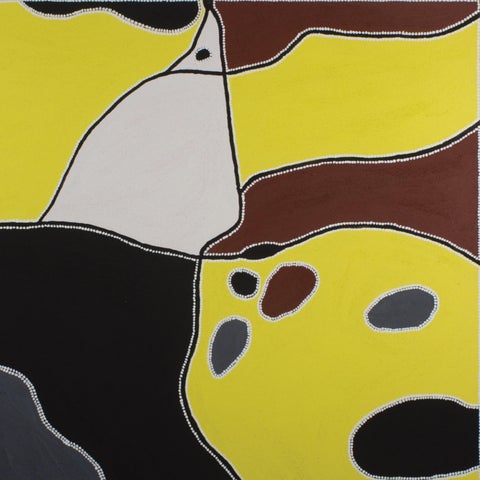
Important multi-panelled artworks were produced by Timms during this period, including a majestic version of Blackfella Creek, 2002 spanning six panels, part of the Blood On The Spinifex exhibition. This nine-metre-long monochromatic landscape presents voluptuous hill-shaped figures pressing in from the top and bottom of the canvasses, balancing empty slate-grey/purple spaces, snaked only with thin black and white forms representing rivers, creeks and roads. The painting depicts the story of a bushranger and local hero called Major who undertook guerrilla warfare against settlers in the region, killing several white farmers whilst hiding near Bow River and Lissadell in the early years of the 20th Century. Blackfella Creek suggests the presence of Major in the landscape, marking the places where his actions took place, the hills where he remained hidden, and the place where he was shot. The same site appeared the following year in the exhibition Beyond the Frontier held in Melbourne. Several of these artworks were acquired by national and international institutions including Jack Yard, 2004 acquired by the Art Gallery of New South Wales. By incorporating direct references to the Kimberleys’ colonial past in his artworks, Timms and the other Jirrawun artists made Indigenous art a part of the national debate on Australian history, introducing important counter-narratives. In doing so, Timms also moved away from traditionally oriented painting, focusing on land creation events connecting to the ngarrangany (dreaming), and establishing himself as a singular artist, creating innovative memorial-type landscapes in a dialogue with Western abstract art. Timms adoption of a planar perspective and large panoramic views allows the viewer to embrace the temporality of the landscape in one gaze, while zooming in and out to detect traces of events as imprints on the land. The process and performative nature of Timms’ paintings is crucial to understanding their deeper significance. The canvas would usually be set up horizontally on a large table. Sometimes two or more canvases would be placed side by side, creating a larger surface to work on. Timms would stand at one edge, looking down with a brush in one hand and a jar of pigments in the other. First, he would paint black lines onto the white background. These lines manifest the delimitations of topographic features: hills, rocky outcrops, monoliths and ranges, plateaus and rolling valleys. Then more black lines. These describe rivers, creeks and roads, often running through the central space and balancing the topographical marks. Like undulations in a moving land, these gentle waves form the inner structure of a mental map. The brush sliding along the canvas with almost no interruption, a gesture evoking the calligraphic traditions. There is no preparatory drawing as everything is engraved in Timms’ mind. The rhythm of the land echoes the memory of the artist in a single movement.
“I paint landscapes, it’s like a map. I got it all in my mind, what place, what country, what area. I know what paints to get, I do my painting. I never forget.” (..) I remember what the place looks like; I picture it in my mind: where to go…where to camp, where are the waterholes, all that place. I follow the lines.”9 Once the foundation was laid out, specific places could be marked, often as circles or rounded shapes within or next to the black lines. These are places of special significance, human inscriptions, or natural places such as water holes, bores, cattle yards, burial grounds, sacred places, or massacres sites. Timms’ lifetime memories are often encapsulated in discreet marks within his paintings. They are locations of childhood swimming holes and fishing spots, of camping places, muster grounds, and corroboree locations, but also of darker places where his relatives were hunted down, wounded or killed, places still haunted by ghosts of the past. After the main elements are inscribed, Timms fills the remaining empty spaces with colour. The paint is made of natural pigments and binder mixed with water and grit, adding an element of texture. Different colours sometimes signal a difference in the type of terrain (grass, dirt, rock, swamps) but with no naturalistic reference. The main colours (often black, white, grey or red) usually delimit the general background on which smaller landscape elements emerge. The result is globally matt and textured, rendered more irregular due to inconsistencies in the ochre medium. Timms’ studio practice introduced a technique that involved first laying a dark grey ground often verging on black. Once dry, a lighter grey wash would be applied. These thin layers of paint applied over the top of the base colour would manifest a shimmering field, adding another layer of movement to the artwork. The first stages of the painting process happen quite rapidly. The third and final stage, called “dotting”, is a much slower and meditative process. Once the canvas is filled with colour, dots are applied to underline and illuminate the main elements of the painting. This technique goes back to the ritual origins of Kija body painting and the painting of ritual objects such as ceremonial wooden boards. In ritual paintings (from joonba or balga ceremonies) figures are underlined with white dots, providing a shiny aura by the light of the ritual fire - particularly effective given that these ceremonies are usually held at night. The dots make the black lines look like white veins running through the canvas. Timms would sit for hours next to his paintings, slowly applying the dots one by one, sometimes using his left arm to support his right. 9
Freddie Timms, interview with the author, May 2007.
While Timms described his paintings as maps, they are not and do not claim to be topographical. Distances, directions, and land masses are only indicative. The landscape is to be experienced more than simply observed. By using a two dimensional or (seemingly) flattened perspective10 with no vanishing point, the landscape can be explored without constraint. The eyes are free to roam and get lost following the interconnected lines, shapes, and forms. In these moments of contemplation, the painting can provide an experience of being “in” a landscape, not merely observing it from the outside. In an essay written for Blood On The Spinifex, Marcia Langton talked about the presence of a “landscape behind the landscape” as she noted “the artists’ ability to bring the vast landscapes of the East Kimberley into our imagination, extending the idea of their geography (…) to an architecture of the history of place”.11 If Western classic art defines the notion of landscape as a literary depiction of a piece of land embraced by sight, the Kijas’ version of the concept is closer to transfiguration, a transformative process that reshapes the elements depicted. There is no strict separation between the artist and their paintings, which are perceived as an extension of the artist’s mind and body. East Kimberley painters often insert their personal connections to the land into their paintings, instilling life, movement, and memories into the artworks. In this sense, East Kimberley art is closer to the Chinese and Japanese traditions of landscape painting, more a manifestation of a place than a reappearance. A manifestation of the multiplicity of time within a place. The movement of memory and space in the landscape became, throughout the years, the main subject of Timms’ paintings. During the course of his thirty year art career, Freddie Timms moved away from Kija traditions to create a unique visual language, breaking glass ceilings for Indigenous artists all along the way. He has left an indelible mark on the Kimberley landscape and on the history of Australian art. Arnaud Morvan, 31 December 2021 Arnaud Morvan is a writer, curator, and researcher based in France, working in the fields of contemporary art, environmental humanities and ethnography. He is an Honorary Senior Fellow at the University of Melbourne.
10
While being two dimensional, some of Timms’ artworks display a certain depth, using lighter paints that seem to open the ground in some areas and produce a third dimension, creating a type of vertical perspective. This is more apparent in the works of Paddy Bedford and Rammey Ramsey through their use of the wet-on-wet technique. 11 Marcia Langton, “Hungry ghosts: landscape and memory”, in T. Oliver, Blood on the Spinifex, 2002, p.14
Freddie Timms spreading the Jirrawun message at the Jirrawun in the House: A contemporary vision from the East Kimberley exhibition, Parliament House, Canberra. From left to right, Natasha Stott Despoja, Freddie Timms, Rusty Peters, Tony Oliver and William Mora, 2005. Photo by Giancarlo Mazzella
LIST OF WORKS Stoney Creek, Sally Malay Mine, 2003, pigments and acrylic binder on Belgian linen, 150 x 160 cm Jessie Creek, 2007, pigments and acrylic binder on Belgian linen, 95 x 180 cm Maud Creek, 2003, pigments and acrylic binder on Belgian linen, 130 x 130 cm Top Fish Hole, 2007, pigments and acrylic binder on Belgian linen, 122 x 135 cm Untitled, 2007, pigments and acrylic binder on Belgian linen, 122 x 135 cm Prospect No 1 Camp, 2003, pigments and acrylic binder on Belgian linen, 122 x 135 cm Jack Yard, 2003, pigments and acrylic binder on Belgian linen, 122 x 135 cm Brumby Yard, 2003, pigments and acrylic binder on Belgian linen, 80 x 100 cm Pipe Creek Plain, 2003, pigments and acrylic binder on Belgian linen, 80 x 100 cm Frog Hollow, 2013, pigments and acrylic binder on Belgian linen, 130 x 130 cm Lissadell Home Station, 2013, ochres and acrylic binder on paper, 57 x 57 cm Brumby Yard, 2013, ochres and acrylic binder on paper, 57 x 57 cm Untitled, 2013, ochres and acrylic binder on paper, 57 x 57 cm Bow River Country, 2013, ochres and acrylic binder on paper, 57 x 57 cm
Stoney Creek, Sally Malay Mine, 2003 pigments and acrylic binder on Belgian linen 150 x 360 cm
Jessie Creek, 2007 pigments and acrylic binder on Belgian linen 95 x 180 cm
Maud Creek, 2003, pigments and acrylic binder on Belgian linen, 130 x 130 cm
Top Fish Hole, 2007, pigments and acrylic binder on Belgian linen, 122 x 135 cm
Untitled, 2007, pigments and acrylic binder on Belgian linen, 122 x 135 cm
Prospect No 1 Camp, 2003, pigments and acrylic binder on Belgian linen,122 x 135 cm
Jack Yard, 2003, pigments and acrylic binder on Belgian linen, 122 x 135 cm
Brumby Yard, 2003, pigments and acrylic binder on Belgian linen, 80 x 100 cm
Pipe Creek Plain, 2003, pigments and acrylic binder on Belgian linen, 80 x 100 cm
Frog Hollow, 2013, pigments and acrylic binder on Belgian linen, 130 x 130 cm Hassall Collection, Warrang/Sydney
Lissadell Home Station, 2013, ochres and acrylic binder on paper, 57 x 57 cm
Brumby Yard, 2013, ochres and acrylic binder on paper, 57 x 57 cm
Untitled, 2013, ochres and acrylic binder on paper, 57 x 57 cm Private Collection, Warrang/Sydney
Bow River Country, 2013, ochres and acrylic binder on paper, 57 x 57 cm
FREDDIE TIMMS (1946 - 2017) SOLO EXHIBITIONS 2022 Freddie Timms, Martin Browne Contemporary, Sydney 2018 Mr Timms, Raft Artspace, Sydney 2004 Freddie Timms, Melbourne Art Fair (Gould Galleries) 2003 Freddie Timms, Gould Galleries, Sydney 2002 Freddie Timms, Gould Galleries, Melbourne 2000 Freddie Timms - Recent Paintings, Gow Langford Gallery, Auckland, NZ 1999 Freddie Timms - Recent Paintings, Watters Gallery, Sydney 1999 My Country, William Mora Gallery, Melbourne 1997 Recent Paintings, Watters Gallery, Sydney
SELECTED GROUP EXHIBITIONS 2021 Voyage across Aboriginal Australia - Founders’ Favourites, Fondation Burkhardt-Felder Arts et Culture, Moitiers, Switzerland 2019 Earthworks, JGM Gallery, London 2017 JGM Gallery, London 2008 Jirrawun Colour: Rammey Ramsey & Freddie Timms, Raft Artspace, Darwin 2008 Last Tango at Wyndham, Raft Artspace, Darwin 2007 New Legend: Recent works from the Kimberley, William Mora Galleries, Melbourne 2006 Prism: Contemporary Aust. Art, Bridgestone Museum of Art, Tokyo, Japan 2006 Great Masters, Aboriginal Art Museum, Utrecht, The Netherlands 2005 Interesting Times, Museum of Contemporary Art, Sydney 2005 Jirrawun in the House: a contemporary vision of the East Kimberley. Parliament House, Canberra 2005 Beyond the Frontier, Sherman Galleries, Sydney 2004 Terra Alterius: Land of Another, Ivan Dougherty Gallery, University of NSW College of Fine Arts, Sydney 2003 True Stories: Art of the East Kimberley, Art Gallery of NSW, Sydney 2003 Kelly Culture: Reconstructing Ned Kelly, State Library of Victoria, Melbourne 2003 Jirrawun Jazz, Raft Artspace, Darwin 2002 Blood on the Spinifex, The Ian Potter Museum of Art, Melbourne 2002 Rhapsodies in Country, GrantPirrie at Art Miami, FL, USA 2002 Jirrawun Artists, William Mora Galleries, Melbourne 2002 My Country, William Mora Galleries, Melbourne 2001 Four Men, Four Paintings, Raft Space, Darwin 2001 A Century of Collecting 1901-2001, Ivan Dougherty Gallery, College of Fine Arts, University of NSW, Sydney 2000 Landmark: Mirror Mark, Mal Nairn Auditorium, Northern Territory University, Darwin; Columbus State University, Georgia, USA; The Kluge-Ruhe Aboriginal Art Collection, University of Virginia, Charlottesville, USA ANU Drill Hall Gallery, Canberra 2000 Opening 2000, William Mora Galleries, Melbourne
1999 Painting Country, William Mora Galleries, Melbourne 1999 My Country, Northern Territory University Gallery, Darwin 1998 Thousand Journeys: Aboriginal Art from North WA, touring galleries in Tamworth, Newcastle, Albury, Mornington Peninsula, Ballarat, Mildura 1998 The Laverty Collection, Museum of Contemporary Art, Sydney 1998 Freddie Timms, Ken Whisson, Watters Gallery, Sydney 1998 Jirrawun Aboriginal Artists, Martin Browne Fine Art, Sydney 1998 Jirrawun Artists from Crocodile Hole, Jemma Stowe, Perth 1998 Summer Exhibitions No 13, Watters Gallery, Sydney 1997 Summer Exhibition, Watters Gallery, Sydney 1997 Pallingjang-Saltwater, Wollogong City Gallery, Wollongong 1996 Art Chicago, Chicago, IL, USA 1996 Galerie Baudoin Lebon, Paris FIAC, Paris, France 1996 Utopia Art, Sydney 1995 Turkey Creek Artists, William Mora Galleries, Melbourne 1993 Images of Power: Aboriginal Art of the Kimberley, National Gallery of Victoria, Melbourne 1993 ARATJARRA: Art of the first Australians, Kunstsammlung Nordrhein-Westfalen, Koeln-Duesseldorf, Germany; Hayward Gallery, London, UK; Louisiana Museum; Humlebaek, Denmark 1991 Hogarth Galleries, Sydney 1991 Lindsay Street Gallery, Darwin 1990 Dreamtime Gallery, Perth 1989 Turkey Creek Recent Work, Deutscher, Melbourne