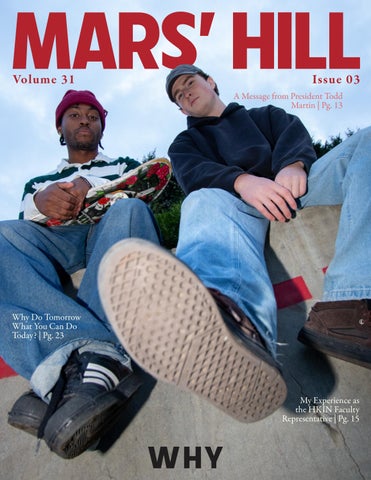
MARS’ HILL Volume 31
Issue 03
A Message from President Todd Martin | Pg. 13
Why Do Tomorrow What You Can Do Today? | Pg. 23
My Experience as the HKIN Faculty Representative | Pg. 15
W HY
TH E
2
TE A M
Emma Helgason Editor-in-Chief
Eva Agbonkhese Managing Editor
Anika Idreou Chief Copy Editor
Geneva Schut Visual Editor
Sebastian Roque Marketing Manager
Shiya Liu Layout Editor
Trinity Kirchtag Arts & Culture Editor
Gnana Damarla News Editor
Hamdan Sadiq Chaudhry Sports Editor
Owen Born Opinions Editor
George Wilson Humour Editor
Sofia Carter Cruz Illustrator
Isabella Gibbons Photographer
Tanya Aggarwal Web Editor
Solee Lee Staff Writer
Mars’ Hill
TH E E D ITO R
From Dear Reader,
!ere have been opportunities I nearly passed up because I did not think I was capable of them. When I tried it anyway, I sometimes ended up with something more spectacular than I had ever imagined. !ose experiences have taught me that we are all able to achieve way more than we think. !at is where this issue’s theme, “WHY,” became “WHY NOT?” for me. I want to challenge you, dear reader, to take something you want seriously enough to explore it. Perhaps there is a program you want to apply for, a place you want to go to or something you have wanted to learn. !ere may be real obstacles, and some will take more than determination to overcome. However, before you decide that something is out of reach, you should "rst "nd out what it would take.
!e Mars’ Hill team brought their own questions to these pages. Owen Born uses Kafka’s The Metamorphosis to examine why we tie human worth to productivity, while Trinity Kirchtag explores how unconventional "lmmaking can challenge the way we see a documentary’s subject. Genevieve Taylor, a contributor to Mars’ Hill, returns to the woods of her childhood. In her feature Walking Back, she explores memory, loss and why the things we can no longer hold onto can remain such an important part of who we are. !is issue also includes an important contribution from President Todd Martin addressing the university’s "nances. As you take in these pages, I hope you "nd something that makes you reconsider an answer you thought was settled. For me, that means remembering how often I have been wrong about my own limits. For you, it might mean giving an idea you have dismissed another look. What if something you have been saying “I can’t” to deserves a “why not?” instead?
It is easier to laugh off your goal than admit how much it matters to you. But I do not want any of us to become so used to dismissing what we want that we stop questioning our reasons. After all, where you are now does not have to be where you stay.
WHY
3
declassifieds JUSTIN BIEBER
Whose house?
hear me out or hold me back
I have a crush on T
Is banana bread for guys the same as 'owers for girls?
is there anyone here from Nunavut?
No pasa nada
Get back my man <3 the best spider-man is andrew gar"eld
OH WENDY!!!!!
How you know?
God’s got your back :)
is the swamp guppy a local legend or what?
Sales at my store Spread more positivity wow i love the visual editor for Mars' Hill Why Bro
who calls hoodies bunny-hugs?
How you doin'
IT'S CLOBBERING TIME!!!
Hear me out… Tow Mater is FAR MORE superior than Lightning Mc&ueen
3/3 people in the room right now like matcha and don’t post about it… IT’S NOT PERFORMATIVE HA
Where is Geneva Who is Geneva Why is Geneva
I love Mars’ Hill!!!
I love the visual editor :))
i love pippa so much she is such a cutie patootie
Woow
(visual editor's note: this is what happens when you tell your friends to submit declassi"eds...)
Mars’ Hill reserves the right to edit or reject submissions based on content and/or length. A printed submission does not re'ect an endorsement of any kind, nor does it re'ect the opinions of Mars’ Hill or its staff, the student association, or Trinity Western University.
Too scared to ask out that hot girl from RELS class? Have a thought you’re dying to share? Did a professor say something strange or funny? Do you have some information that you want to get out to the student body? Whatever it is, the declassi"eds are here for you. Submit yours at www.marshillmagazine.com
4
Mars’ Hill
arts &
culture
01 SK8ER BOI AVRIL LAVIGNE 02 FREE TONGUE TIED THROW 03 THE FACE DOWN RED JUMPSUIT APPARATUS 04 THE MR.KILLERS BRIGHTSIDE 05 FOO EVERLONG FIGHTERS 06 BLUR SONG 2 - 2012 REMASTER 07 BLINK"182 ALL THE SMALL THINGS 08 PARAMORE AIN’T IT FUN 09 DOMINIC WHY FIKE 10 THE YOUSTROKES ONLY LIVE ONCE 11 WESTCOAST COLLECTIVE DOMINIC FIKE 12 AAA THEY MIGHT BE GIANTS 13 FIGURE IN THE BACKGROUND SNAKE POOL
6
Mars’ Hill
a curated playlist
WHY NOT REDEFINE
THE DOCUMENTARY? Most notably, the whole movie was shot in a 4:3 aspect ratio. With a wider frame, the house’s details pull attention away from people; whereas, this boxy frame allows the shot to focus on the one thing the "lm investigates: the human face. As Oppenheim has said, “the face is the ultimate landscape,” and this ratio sure leaves no room to look away from it. !e viewer is made to study the pauses and micro-expressions that a conventional interview would have cut away from. !is is what has bred that uncomfortable and uncanny feeling one experiences whilst watching the "lm, and also viewing the promotional photos and teaser videos. CNN reporter David Mack summarized the effect perfectly: “You Can See Everything is somehow visually gorgeous and yet profoundly ugly.”
Trinity Kirchtag You Can See Everything released on October 16th to outstanding reviews. Within two weeks it has become the highest grossing non-musical documentary at the box office since Michael Moore’s Fahrenheit 9/11 in 2004. The film, directed by Nathan Fielder and Lance Oppenheim, follows Theranos founder Elizabeth Holmes in the 34 days leading up to her imprisonment. However, beyond new insight into this notorious character, perhaps the most revolutionary part of this film is its cinematography. Mimicking a surveillance camera rather than a traditional "lm set-up, Fielder and Oppenheim took a 'y-on-the-wall approach. Fielder mentioned in a recent Variety interview that “the crew was comprised of just seven people, and only four of them would be inside Holmes’ house at any time.” !ey covered the home in 25mm to 250mm lenses allowing for wide shots, but also uncomfortably tight close-ups. In the same interview Oppenheim noted that they would shoot for 16 hours a day, so Holmes and her husband would never really know what they were interested in. !at uncertainty is key. A subject who cannot tell when the camera is rolling, or on whom, eventually stops performing for it, or at least the performance becomes harder to sustain.
!is brings me to the question underneath this whole project: Why? Why shoot a documentary in this way?
The "lm argues that a documentary’s form can be in itself a way of asking why. By staking the whole project on risky choices—the long lenses, the tight frames, the director in the shot—the "lm argues that a documentary’s form can be in itself a way of asking why. Most traditional documentaries seek to retell what has happened; they resolve questions with narration or a tidy thesis. !is one resolves nothing and that is the point. It watches as the motives, performances and the "lmmaker’s own presence come into focus and out again. It shows what it takes to honestly look at a character who believes she did nothing wrong. You Can See Everything is truly genre-breaking. Its experimental cinematography was a gamble, but it is because of those risks that I believe the "lm will reshape how documentaries are made. After all, nothing has ever cemented itself by st aying within the boundaries. Audiences have shown they are ready for something bolder, so why not rede"ne the documentary?
WHY
7
Artist Spotlight:
CHIARA GONZALES
CG: Totally! More than simply singing, I think it is to help the congregation understand and be in awe of the beauty of God. MH: What goes into planning a set? Not just musically, but also spiritually? CG: Obviously aside from vocal warm-ups, preparation is about understanding who you are serving. Not necessarily conforming to their wants, but meeting their needs. Most importantly, it is being in tune with what the Spirit is trying to say. !at is the art of worship leading. For me, that requires spending at least a couple of hours in silence and devotion, and talking with other members of the congregation. !en, I see which songs match well with both the sermon, the Holy Spirit’s message and what the people need. So it is more than just singing a couple of songs. MH: !at leads perfectly into my next question. How do you distinguish between leading worship and performing music?
Trinity Kirchtag Chiara Gonzales is a second-year Pre-Nursing student, yet her calling extends well beyond the classroom. For the past three years she has led worship at Village Church, not just on Sundays, but also for youth nights, young adult services, women’s events and more. What began in 2023 as a nudge from the Lord has grown into a vocation rooted in preparation, prayer and authenticity. For Chiara, worship leading is far more than singing: it is helping people stand in awe of God’s beauty.
CG: !e key difference is who you are trying to please. When performing, you are worrying about hitting the correct notes, perfectly executing the set or seeing if the congregation responds well. With worship leading, it is not about pleasing anyone in the room; it is about an audience of One.
MH: Do you mind introducing yourself ? CG: My name is Chiara Gonzales, I’m a second-year Pre-Nursing student, and lead worship at Village Church. MH: Awesome. How long have you been leading and why did you start? CG: I have been a worship leader for about three years now. I started in 2023 because I felt this urge from the Lord to simply try it. I was very discouraged at "rst, but a mentor of mine pushed me to audition, and here we are. MH: !at is beautiful. !is issue is called Why, which I think is such a "tting word when talking about the purpose or heart behind something. So, why do you worship lead? What is your goal when you step on stage?
8
Mars’ Hill
MH: How do you handle leading a room when you are not at your best? CG: I want to make sure I am not coming from a place where I am so drained that I am serving just to serve. So, I talk to my mentors. Some advice they have given me is to lead where you are at. !ere have been many times where I have led whilst going through the lowest points of my life. I have genuinely thought, “Wow I have nothing to give the Lord right now.” Yet it has been in those vulnerable moments of worship where the words I am singing have had the most impact. My role as a worship leader is to be a vessel for the Holy Spirit, and it is through being authentic that I am best able to do that. It is also encouraging for a congregation to see that their leaders are not perfect. To see that it is okay to be vulnerable. To see that even in your struggles you can still bring all the glory back to Him. Because at the end of the day, I would not be on this stage if it were not for the grace of God. MH: Do you ever feel anxiety, pressure or comparison around being a leader in the church at such a young age? CG: Yes, I have totally struggled with comparing myself to other worship leaders. I have often felt less quali"ed or experienced due to my age. However, I have recently been very encouraged whilst reading the book of Jeremiah. !e "rst chapter talks about him thinking he is just a child, that he does not know much. But the Lord responds by basically saying, “Exactly, you are just a child; you are just you.” It is a call to embrace your youth and know it is okay to not have all the answers. My role constantly humbles me in that way. MH: I will leave you with this question then: “What is a piece of advice you have for not just young worship leaders, but young church leaders? CG: Do not shy away from being vulnerable. During worship I cannot help but cry in the presence of the Lord, of someone so amazing and beautiful. !us, I have received many comments about how I am always crying on stage or even exhorting too often. At "rst I saw that as a weakness, but in reality it is such a strength. I think the Lord can use vulnerability not just to connect people, but also show them that this is a space where you can be yourself, where you can be comfortable. It is a gift to be in tune with your emotions. Why try and hide that?
WHY
9
GAME DEVELOPMENT
PROGRAM
Solee Lee MH: How can I get involved in the program? AG: Students can get involved by visiting our booth during TWU's Preview Day(s), by attending our various Game Jams, attending our events hosted by TWU and SAMC and by joining our program and courses at TWU. Can you think of anyone who has never played a game? Probably not. Games bring so much more than entertainment, such as community, happiness, betrayal, competitiveness, anger and critical thinking. Marshall, Mars’ Hill’s mascot, got a chance to talk to Andrey Goncharov, an instructor in the Game Development program at TWU. After learning about the program, he is thinking of taking some classes. MH: What is the Game Development program? AG: !e Game Dev program at TWU is a multi-disciplinary program of students studying and practicing the art of game development. Students learn both theory and practice when it comes to designing and making games. It is a 4 year Major program with concentrations in Game Design, Programming, Art and Sound & Music Design. We also offer Game Dev Minors.
10
MH: If I want to get more information, who should I talk to? AG: People can talk to either our Dean and Program Chair, Kevin Schut, kevin. schut@twu.ca or can contact me instead, Andrey.Goncharov@twu.ca MH: What makes the game development program unique? AG: We are a Christ-centred program that looks at and practices game development from a Christian lens. We are very hands on and group project oriented. We focus particularly on Indie Development, where we practice and teach our students to work in small teams, be entrepreneurs and to be self-su(cient. It is a place where anyone from any interest can contribute. Artists can make visual assets for games. Programmers or technically oriented people can help code the game. Detail and design oriented people help design and balance the game. People
Mars’ Hill
with a passion for sound and music can create the sound track and soundscape for a game. Even business and entrepreneurial people can help market and plan the business side of a game for release. !ere's a place for everyone here. MH: Are there any events this program has that I can look forward to? AG: !ere is the Fraser Valley Game Jam happening November 20-22nd for recruiting future TWU students. TWU's Preview Day on the 27th of November. We will also have our game dev showcase sometime in early April 2027 (TBD). We would also love people to join our TWU Student Game Jam on the second weekend of next semester ( January 15-17). MH: Is there anything else you would like to add? AG: !e Game Dev program doesn't require any experience from the students and those interested. All you need is a passion and love for games. You can try out our GAME 140 Introduction to Game Design course in the spring: it has no prerequisites, and because it is based on board and card games, you don’t need any programming skills. Marshall signed up. You should too!
culture corner: PAKISTAN Destination: Pakistan
Language: Urdu
Contributor: Hamdan Sadiq Chaudhry
Next stop: Dubai with Gnana Damarla
WELCOME TO PAKISTAN:
KHUSHAMDEED TO URDU
Where do I start with Pakistan? !ere's so much to cover but here are some interesting facts about its culture, tradition and people. Pakistan is a country full of history, beautiful landscapes, delicious food and incredible hospitality. From the snowy mountains in the north to the busy streets of Lahore and Karachi, there is so much more to Pakistan than what you might see on the news!
Pakistan's national language is Urdu. Although many other languages, including Punjabi, Pashto, Sindhi and Balochi, are spoken throughout the country.
•
•
•
•
Pakistan is home to the world’s second highest mountain, the K-2. It stands at 8,611 metres tall, it is incredibly challenging to climb, hence earning the name “Killer Mountain.” We love our truck art. Yes, you heard that right. Pakistani trucks are decorated with bright colours, 'owers, poetry and creative designs. Some are so decorated that they look like moving art galleries! Pakistanis take their tea very seriously! Chai, the Urdu word for tea is more than just a drink. Whether you are visiting someone's home, meeting friends or taking a break from work, there is a good chance someone will offer you a cup of chai. And saying no won’t always stop them from offering again! Pakistan is also home to some of the world’s most famous music and poetry with the likes of Ustaad Nusrat Fateh Ali Khan as a musician and Allama Iqbal as our poet. Music and poetry are deeply rooted in our culture to express art!
Urdu
Pronunciation
Translation
Assalam-o-Alaikum السالم علیکم
Ah-sah-LAH-moo ah-LAY-kum
Peace be upon you
Shukriya شکریہ
Shook-REE-yah
!ank you
Khushamdeed خوش آمدید
Khush-AMD-eed
Welcome (to)
Ji Haan جی ہاں
Jee HAHN
Yes (politely)
Khuda Ha"z خدا حافظ
Khoo-DAH HAH-fiz
Goodbye
Yaar یار
Yaar
Friend
FROM SOMEONE WHO KNOWS PAKISTAN "Is it true that Pakistanis are always inviting people over for food?" Well, this one is actually pretty accurate! Hospitality is a huge part of Pakistani culture. If you visit a Pakistani household, don't expect to leave without eating something. Even if you say, "No, thank you, I already ate," there is a good chance someone will still bring out tea, biscuits, fruit and possibly an entire meal. And here's something you should know: Pakistani mothers and aunties do not always take "I'm full" for an answer. You could have just "nished eating three plates of biryani, and someone will still ask, "Why aren't you eating? You barely touched your food!" !at is all you need to know about Pakistan! Now all you have to do is learn a few Urdu words, try some biryani and prepare yourself to be offered chai at least "ve times before you leave someone's house!
WHY
11
news
& community living
A MESSAGE FROM PRESIDENT TODD MARTIN Dear Students, Following a helpful conversation with TWUSA President Sena Tese, I reached out to Mars’ Hill editor Emma Helgason regarding writing directly to students about the "nancial state of Trinity Western University. I appreciated that conversation because I know there are questions circulating about the university’s "nances, and when we do not have all the information, it is easy to imagine the worst. So let me begin with what I most want you to know: Trinity Western University remains in solid "nancial condition. !at does not mean we are unaffected by what is happening in Canadian higher education. Like many universities across the country, TWU is navigating a period of signi"cant change, particularly because of the decline in international student enrolment. At Trinity Western, much of that decline has been concentrated in two large graduate programs that historically enrolled signi"cant numbers of international students. !is has resulted in lower revenues and requires us to make adjustments. I realize that when students hear words like “budget reductions,” “lower enrolment” or “"nancial pressures,” it can raise very personal questions: Is my university okay? Will my program be here? Will the value of my degree be affected? What does this mean for my experience at TWU? !ose are understandable questions, and you deserve a clear answer. TWU has significant financial strengths. All of our buildings and property are fully paid for and we have no debt. Our core undergraduate enrolment remains strong and continues to grow.
We have a strong cash position, and we are managing our resources carefully and responsibly. These strengths give us a solid foundation as we adjust to the changing realities of graduate and international enrolment. At the same time, we are not pretending that nothing has changed. We are aligning our expenses with our current enrolment and revenue while being thoughtful about where reductions are made. We will continue investing in the people, academic programs, facilities and services that are central to the student experience. We are also pursuing new programs, partnerships and opportunities for missionally aligned growth. Responsible leadership requires strong stewardship, particularly when unexpected circumstances come your way. Our responsibility is to make them carefully, transparently and with the long-term health of the university in mind. Most importantly, student success remains our number one priority. You chose Trinity Western because you wanted more than a credential. You came here to learn, grow, build relationships, prepare for your calling and be part of a Christ-centred university community. Our responsibility is to steward this institution so that you can continue to do those things with con"dence. I am deeply grateful that you are part of TWU. I hope this provides some helpful context and reassurance. We are facing challenges, but we are facing them from a position of strength, and we are making thoughtful decisions today so that Trinity Western can continue serving students faithfully for generations to come. Todd Martin President
WHY
13
IS THE QUESTION
OR
WHY NOT?
?
MY EXPERIENCE AS THE HKIN FACULTY REPRESENTATIVE
Yasas Sritharan Stepping into the role of Faculty Representative for Human Kinetics through TWUSA has been one of the most rewarding decisions of my university journey so far. As a student who loves the "eld of HKIN, I had hoped to give something back to the faculty that have shaped my learning, but I didn't expect how much the role would give back to me. One of the "rst highlights was meeting the team that runs the campus. Before this position, I saw the university as a large, somewhat distant institution. Sitting in meetings with the people who make daily operations happen changed that. I learned how decisions are made, how many moving parts have to align to support students and how much thought goes into planning events, services and resources. Seeing that behind-thescenes work gave me a new appreciation for our campus and the people who keep it running. Equally valuable has been the opportunity to discuss student-related matters and concerns directly with deans and professors. As a representative, I'm not just another voice in the crowd. I am a bridge between my peers and the people who can act on their feedback. Whether the topic is course workload, access to resources or ways to improve the student experience, these conversations are taken seriously. It has been em-
powering to bring forward real concerns from my classmates and see them heard with openness and respect. It has also taught me to communicate clearly, listen carefully and advocate in a way that is constructive rather than confrontational. Beyond the meetings, this role has taught me a lot about building community on campus. HKIN students are passionate, active and driven, yet it is easy to stay inside our own circles of classes and friends. Being a representative has pushed me to connect with students across year levels and interests, support events that bring people together, and ensure everyone feels they belong in our faculty. A strong community makes university more than a place to attend lectures. It becomes a place where people support one another, share advice and celebrate one another's wins. Networking has been another unexpected gift. I've met student leaders, faculty members, staff and peers from other faculties who have become mentors, collaborators, and friends. !ese relationships have opened my eyes to career paths, volunteer opportunities and perspectives I might never have encountered otherwise. In a "eld like Human Kinetics, where collaboration and connection are central, building a professional network early feels invaluable. I have loved how much I'm learning along the way. Leadership has strengthened my public speaking, time management, teamwork and problem-solving. I've learned to prepare for meetings, balance responsibilities alongside my studies and step up when something needs doing. Every challenge has been a chance to grow, and every success has made me more con"dent in my abilities. If you're considering getting involved in student leadership, I cannot recommend it enough. You'll gain skills, friendships and a deeper connection to your campus. For me, being the HKIN Faculty Representative so far has been a privilege, and I'm excited to see what the rest of the year brings.
WHY
15
THE RISING COST Canada
Canada faces renewed economic pressure as higher energy prices and U.S. trade tensions affect businesses and consumers. According to the Bank of Canada’s October 2026 report, in'ation reached just over three percent in September, driven primarily by rising gasoline prices. !e bank raised its interest rate to two and a half percent on October 28 to manage these pressures. New U.S. tariffs are expected to slow Canadian economic growth through year-end. !is matters because higher fuel and transport costs drive up prices for groceries and everyday products, highlighting Canada's strong dependence on international trade.
United States
Rising energy prices are straining the U.S. economy. !e September 2026 Consumer Price Index showed annual in'ation at nearly four percent. Gasoline prices surged by almost onetenth in September alone, driving over half of that month's total in'ation increase. Plus rising energy costs are elevating transportation and production expenses for businesses, while tariffs add pressure on industries and consumers. As a leading global economy, shifts in U.S. trade policies directly in'uence international prices, showing how global con'icts and trade decisions impact everyday costs worldwide.
India
Gnana Damarla
Ukraine
!e war with Russia continues to severely strain Ukraine's economy through ongoing damage to energy infrastructure, transport and businesses. Annual consumer in'ation rose from just over eight percent in August to one-tenth in September 2026, driven mainly by food and fuel. Russia's intensi"ed attacks on Black Sea ports have disrupted grain exports, which plummeted by nearly two-thirds compared to previous levels. Alternative transport routes through neighboring EU countries involve signi"cantly higher costs and cannot handle full cargo volumes. !ese supply bottlenecks have caused domestic grain prices to fall by two-"fths, forcing many local farms to operate below production costs while global grain prices rise. With heightened damage to industrial centers and key steel plants, Ukraine's central bank projects the broader economy will shrink by under one percent this year. !is shows how prolonged military con'icts create far-reaching economic disruptions, impacting international energy supplies, regional trade and global food availability.
China
India faces accelerating in'ation in food and fuel. In September 2026, retail in'ation peaked at over "ve and a half percent, marking its highest level under the current series this year. Essential foods (onions, sugar, milk and cereals) were major drivers. Rising global oil prices add extra strain because India imports most of its crude oil, elevating costs for transport, businesses and households. Despite ongoing economic growth, rising prices burden family budgets, demonstrating that overall growth does not bene"t everyone equally.
16
OF LIVING
Rather than high in'ation, China faces weaker domestic demand and slowing manufacturing activity. China's o(cial manufacturing index dropped to just under "fty in October, signaling a contraction in factory activity alongside weakening export orders. To compensate, Chinese companies are expanding into foreign markets, raising trade imbalance concerns among trading partners. As a hub for global manufacturing and supply chains, China's slowdown shows that global instability stems not only from in'ation but also from declining demand and reduced industrial production.
Mars’ Hill
feature
WALKING Genevieve Taylor !e wind echoes through the trees, and the scent of roses invokes nostalgia as I attempt to recall the last time I walked this path. !e seasons have gone through many changes, but here the trees seem unchanged. I can still faintly hear the gentle trickle of the brook nearby, and I "nd myself recalling childhood memories. As I step forward, I can almost hear the trees’ whispers as they get lost in the wind. !e white clouded sky is painted behind the branches of the trees, appearing boldly in the foreground. !e world shifts, constantly evolving, yet here time ceases to exist. Everything shifts, I realize, but among these roots only the stark remnants of trees seem to remain. !e gentle 'ow of calm brook and the trees towering above are still untouched. As the air rushes through my lungs, I slowly inhale, allowing the autumn breeze to surround me, echoing the breeze that used to "ll my lungs as I raced around with untied shoelaces and cuts on the knees. Back then, the trees looked gigantic with webs of branches that towered over me, making me feel safe. Now it feels like they are much shorter. What once felt so far away and overwhelming now "ts within my reach, while the things I once overlooked matter so much more deeply. I skim my "ngers across the
18
rough bark of the oak tree and I notice that the trunk is decorated with faded initials. Not mine, but from someone else who dared to cut in wood, a statement against the harsh passage of time. I ask myself, did they come back? Were they able to trace their "ngers over the carvings and relive the memories of who they once were? In the far distance, a bird lets out a call, its sweet song echoing clearly through the stillness of the woods. !is sound stirs a deep emotional reaction in me—a sense at "rst unde"ned but becoming increasingly so. Lying back on fallen leaves, I look up into the sky between the gaps of the branches above, watching clouds drift lazily by. !e gentleness of my father’s voice as I remember him reading to me, allowing the words to 'oat through the air, encapsulating and halting the sense of time moving but never quite removing that which the heart selects to retain. I close my eyes for a moment, listening. !e forest breathes around me, steady and grounding. I have spent so much of my life running towards the future and away from the past, and now it’s as though I am able to take steps forward, yet pause and breathe when I need it. Here I feel peaceful, as though the past
Mars’ Hill
and the future coexist perfectly like taking a deep breath of fresh air for the "rst time in years. I move forward, slowly, the sound of leaves crunching beneath me, breaking the stillness of forest surroundings. !e path in front of me soon curves over, lost in the gloom of the shadows where the trees grow closer together. !e bend in the path reminds me of how it once appeared to create the border of a hidden land. When I was young, I dreamed of secluded wonders just beyond—a shining pond bathed in light, a body of water so clear that it appeared to re'ect the sky . . . perfectly. A place where time would brie'y stand still, giving me a chance to catch my breath. Now, as I round the familiar curve, I half expected the dissipation of this dream, thinking that perhaps the wonder of the unknown has faded while I was away. Yet, the sunlight still "lters through the leaves in rays of gold; the stream still continues its harmonious trickle over a bed of smoothed pebbles. !e rock my father placed for us is in those waters still . . . somewhere, and I feel for a moment a similar sense of peaceful wonder that I had all those years before.
As a child, I had this peculiar habit of scooping water with my palms and letting it 'ow back into the stream after it cooled my skin, or building mini dams with my brother to redirect the 'ow. Presently, I try to do the same, hoping water will somehow garner my attention and remind me, as impossible as it might sound, that the past is out of reach. To the shock of no one, it 'ows through my "ngers just like it always did. !e stream neither acknowledges me nor how much time has passed, and so why should it care that I have grown or left and then came back bearing the burden of years? What I know for certain is that the stream moves forward and continues to etch its path without the slightest bit of hesitation. !at constant motion without a shred of fear towards what lies behind or beyond is something I truly envy. I look at the trees on the opposite bank, their branches gently swaying like they are having a conversation with the wind. With my fingers dipped in the water, I can now tell their leaves are whispering secrets I can almost understand. I wonder if they remember me. Perhaps all those years ago, when I was a quiet child dreaming of an unwritten future, the trees remembered me too. I used to believe that trees were alive in a deeper sense than all other living things, alive in a sense that they were capable of remembering every single person that passed under them—I hope they remember my father.
BACK
A light current of air causes the trees to shiver, and for a second—just for a second—I feel like they are responding to me. Not in manner of word, but in the way the golden leaves shake and dance while loosening their hold, 'oating slowly as they make their way to the forest 'oor. A gentle breeze swells and for a split second, I sense that they are replying. I manage to catch one of the leaves as it makes its way down to the ground. !e leaf is thin and delicate with veins that look beautiful in a web of lines that can barely be traced. Its edges are my favourite part, crisp like the arrival of autumn. It is all of this which makes the leaf incredibly stunning and a little tragic. A reminder that nothing remains constant, which doesn’t make the memories any less beautiful. As I look up to the surrounding trees, I notice how one of the leaves has to be the "rst to let go, some leaves lasting longer than others, and some maybe falling into the ever-'owing stream, leading it to a different course. As I released my grip on the leaf, it began to elegantly twirl through the air and settle down amidst the others that had already fallen. I might have found myself saddened watching as the seasons strip the trees bare and how time rips the colour out of the branches until they are just skeletal limbs stretching for a grey sky. But now, I understand their elegance. !e trees do not dread the upcoming winter. !ey do not grieve the things they have lost. !ey let go, trusting that
WHY
spring will make its return in due course. I breathe in the air, full of crispness and let my eyes close, questioning whether I too can learn to let go of the past as easily; to let my past settle down where it is not forgotten but no longer clung onto with desperation, although I do not doubt this grief will stay with me for the rest of the forever changing seasons of my life. Now moving forward on the path once again, I am taking my sweet time with every step. With every movement, I can feel the warmth of golden rays washing over my skin, slowly guiding me into the world that was once hidden. Of course, it is different from how I had imagined it in what seems like a lifetime ago, but that is part of what makes this place so special. !e tears I shed here are not all from loss or pain, but those of memory and contentment; although my tears will not fall onto my father’s shoulder as they always have, I have the memory of that comfort to come back to, and that is a blessing in itself. !e honeyed light softly awakens in my body while the whispering leaves replace every thought in my mind. I had never understood this before, but my father had often said that light will always "nd a way out in the darkest of woods. I can feel the glimmers of hope peeking through every thought. I now completely agree, and I know he is here when I’ve made that realization—maybe not in the same sense as before, but he is here.
19
H creative
writing
When I left my land and arrived in a new one, nobody told me that I could "nd a home — A place where I could feel comfort And a sense of belonging. Where do I belong? Do I belong to the home where I have a passport and my appearance "ts more? Or do I belong to the home that changed me? I do not have a Canadian passport.
Do you have a Canadian Passport? — no Do you have a permanent resident card? — no, I am an international student.
HOME I was celebrating the fact that I got these questions. They were not sure if I was Canadian. I felt like I had made it. I had a new culture, new education, new environment—new, new, new. Though those questions told me that as a part of me celebrated, Another part, deep down in my ocean, was mourning. I call Canada my home, but not yet fully. I also call Korea my home, but the distance is increasing.
I do not have a permanent residence card. But I can call here home Because I belong here, Because I have people here, Because I have memories here, Because I found my missing piece here, Perhaps I need to prove myself that I belong here, !at I am having fun here— !rough documentation, !rough Instagram posts, !rough stories. I will always mourn this fact. Why is proof needed? I will always call Canada my home, not just a place to live. I will always celebrate that I get to call Canada my home, not merely a house. However, always in my heart somewhere, Deep down in my ocean, My other home remains.
Serin Park
WHY
21
opinions
WHY DO TOMORROW WHAT YOU CAN DO TODAY? Sofia Carter In an era where distractions run wild, it is easy to spend more time on your phone than you want and put off your tasks for some day when they will feel less burdensome. But here’s the thing: your tasks will only get heavier the longer you hold onto them—why put them off until tomorrow when you have time today? Make the best use of the time you have been given, because distraction will continue to work against you. How a person spends their time says a lot about who they are and what they value. Our hearts often desire what is easy and brings delight. It is rare to hear someone’s dream day include folding large piles of laundry, writing an essay or cleaning out their car. It sounds much nicer to watch a movie, go for a hike or talk with friends. While these are wonderful things, the essay still needs doing and the laundry won’t fold itself no matter how much you might want it to.
Him. !e apostle Paul says, “[o]r do you not know that your body is a temple of the Holy Spirit within you, whom you have from God? You are not your own, for you were bought with a price. So glorify God in your body.” (1 Corinthians 6:19-20 ESV) It is not just your body that belongs to God, but also your plans, your homework, your thoughts, your relationships and your time. Use the present day you have graciously been given to work hard, love well and honour Him who deserves it most.
“Look carefully then how you walk, not as unwise but as wise, making the best use of the time, because the days are evil.” –Ephesians 5:15-16 ESV Motivation can come from all sorts of places. Maybe it is parental pressure or a desire for academic validation. Maybe you want to beat a friend or please a professor. I would argue that the best reason for hard work and using your time well is that your time and abilities were given to you by God so that you might honour and glorify
WHY
23
PERSONAL APOLOGETICS: Sebastian Roque
WHY GOD?
Why should I believe in a so-called “God of the universe that is all-knowing, all-powerful and good in every right” when there is suffering in the world? Even if He is real, why should I believe in Him when I am suffering? I asked this question in high school, just a couple years before I started attending Trinity Western University (TWU). I am writing about the biggest question I had to ever ask myself: “Why God?” !is is a loaded question and I could give you historical-statistical-informational-jumbo-shrimp but none of that can answer the question: why God? !is is not an attempt to convince you that God exists but to show you the evidence through my life. !ough I was raised in a Catholic family, the idea of who God was, was out of the ordinary. We simply went to Mass because of the ones before us. !is was an ongoing question from my childhood to my adolescence. I didn’t know the gospel and the substance to this world-breaking moment. !rough high school, I explored other faiths and somehow only Christianity made sense. I tried to run so far away from what seemed to be the only answer, and the biggest question remained: “Why would I believe in a so-called “God of the universe that is all-knowing, all-powerful and good in every right” when there is suffering in the world? Even if He was real, why should I believe in Him when I am suffering?” For me, this question was answered in one moment that changed the course of my university career. With
24
university on the horizon, I planned to attend school in Ontario and cut ties with everyone I knew; my principal, however, urged me to apply to TWU. I got the letter of acceptance but remained on the fence until a sign—a miracle even—was given to me. In my last month of high school, I found myself in a thrift store in Prince George. As I was looking through, I found a pair of TWU sweatpants (mind you, Prince George is eight hours away from Langley). !is sharpness was the "rst sign of conviction: it was a sensation that I had never experienced before, but in that moment I knew I was supposed to go to TWU. It became evident that God has been pursuing me since my childhood. From the moment when I had gone into the water, where it felt I couldn’t swim, He physically took me out of the water, to now in my last year here at TWU. He had been there for every hurt, mistake and failure. !e Apostle Paul wrote this to the Romans: "For I consider that the sufferings of this present time are not worth comparing with the glory that is to be revealed to us." (Romans 8:18) God showed Himself to me during a worship service in my first semester, and never in my life have I ever cried—no, wept—like that. God placed people in my life that semester, and thanks to one of them I learned what the gospel was and what it truly meant for humanity. Saint Augustine stated that "God loves each of us as if there were only one of us. Because God has made us for Himself, our hearts are restless until they rest in Him."
Mars’ Hill
YET
T
I believe in Him because of the very fact that He has never left nor forsaken those He loves; because He wrote and knows my story; because He is the father who runs to his prodigal son after seeing him from afar. My why is not because I know so much, but because I lacked so much—yet in Him, I lack nothing. Hebrews 12:2 states, “Fixing our eyes on Jesus, the pioneer and perfecter of faith. For the joy set before him he endured the cross, scorning its shame, and sat down at the right hand of the throne of God.” He overcame the grave so I can overcome my vices. He gave me grace so I can improve and change. He gives us new mercies every morning so that we may be able to do good for His glory. We are created so that we can become sons and daughters of the Highest. He created us because He wanted to. Tell me who loves like that.
tor or preacher. I cannot give you physical evidence, but what I can show you is the love that He has poured out onto me and others. As C.S Lewis said, “I believe in Christianity as I believe that the sun has risen not only because I see it, but because by it I see everything else.” Now, to answer my younger self: “I can give no complex answer as to"Why God". It is simply the art He has created through the world and the vastness of the universe. The reason for suffering is the existence of sin, but this very hurt produced resilience and without it we may never know what joy is. Like the joy that was present is the Garden of Eden” All of this–all the things I had to grow through–was necessary to meet God, necessary to humble me so that I can have an open heart to His Gospel. For 18 years, He has been working on me and at 22, He’s still working. !at’s my why.
My goal is not to convince you but to show you what He’s done in my life. I am no scholar, theologian, pas-
IN
HIM,
I
LACK
NOTHING.
ARE YOU AN INSECT? C. Owen Born Imagine waking up one day and discovering that you have become an insect. !is is exactly the predicament Gregor Samsa "nds himself in in Franz Kafka’s The Metamorphosis. !is absurd occurrence is the mechanism by which the absurdity of modern society is exposed. As the primary breadwinner for his family, Gregor works himself to the bone everyday for a job he dislikes and a family who only values him for the value he creates for them. Despite the apparent misfortune of this situation, Gregor is a hard worker committed to tireless labour. In fact, he is so duty-bound to his work that Gregor’s very "rst worry upon waking up as an insect is that he will be late for work. Gregor’s commitment to his work goes beyond any mere family devotion; it is the manifestation of the social ideal which has been pushed upon much of 20th and 21st century society. !e story of The Metamorphosis moves beyond the page. Kafka’s absurdist approach—literally turning a man into an insect—represents the absurd societal standard of Purito-capitalist culture.
When Gregor is no longer capable of ful"lling the demands of his culture, he is dehumanized: his physical transformation into a bug metaphorically represents his transformation into an object of contempt in the minds of those around him (even in the minds of his family members!). Gregor’s transformation reveals the unspoken rules of the game: work until you can’t or won’t— either way, you will ultimately be condemned by the same society which you sacri"ce yourself to.
“As Gregor Samsa awoke one morning … he found himself transformed in his bed into a gigantic insect.” – Kafka’s Metamorphosis !ough separated by space and time, we today are affected (to varying degrees) by the very same social forces. !is system of thinking can cause us to view ourselves and others as insects (objects of contempt) for simply needing a break. In community, we are Gregor, but we are also his family: it is our job not to internally transform either into an insect. Neither to fall for nor to perpetuate the lies of busyness culture. Human value surpasses the sum of one’s contributions: regardless of ability or perceived usefulness, each of us is enough.
Travelling with the settlers of the New World in the 1600s (which would come to be known as America), Puritan ethics con'ated hard work with virtue. Within the Puritan understanding of morality, in order to be a virtuous person, one must be a hard worker. It was only natural that capitalist ideology should commandeer the Puritan framework of morality. Since religion has always been a most reliable motivator, the capitalist system reinforced and reimagined Puritanical modes of thought across generations in order to maintain obsessive subservience in its workforce. !e capitalist adaptation inverted Puritan values. !e glory of productivity was transformed into the shame of relaxation; what once encouraged hard work now shamed people for enjoying the rest that used to accompany it. It portrayed rest as a sign of laziness since it took time away from work; laziness, as the antonym of productivity—the highest of virtues—became a serious moral failure. Within the Purito-capitalist system, one’s value is reduced to their ability to contribute/produce. !ose who can no longer contribute are to be viewed as less than; to be held in contempt; to become an insect.
26
Mars’ Hill
sports
Hamdan Sadiq Chaudhry MH: Could you introduce yourself by sharing your name, team, position, year of study and major? MS: My name is Mansha Sidhu, and I’m a striker on the Trinity Western University Women’s Soccer team. I’m currently in my fourth year studying Media and Communication with a focus in Marketing.
MH: What initially sparked your interest in soccer, and what got you into soccer? MS: My love for soccer comes from my parents. !ey both grew up loving the sport but never had the same opportunities to play it that I have had. For my mom, growing up as a girl in a South Asian family, playing sports wasn’t really something that girls were encouraged or given the opportunity to pursue. My dad came to Canada and spent most of his life working hard to build a life for himself and our family, so he never had the opportunity to pursue soccer competitively either. He still plays for fun today, but playing competitively was always something he dreamed of doing. Knowing that makes me appreciate the opportunities I’ve been given so much more. !eir love for the game was passed down to me, and soccer eventually became one of the biggest parts of my life.
MH: Could you tell us about your journey as a Spartan on the Women’s Soccer team? MS: My journey as a Spartan has been such a positive experience. Coming into the program, I obviously wanted to grow as a soccer player and compete at a high level, but I ended up gaining so much more than that. I’ve grown as a person, made so many memories and met some of my lifelong best friends through this team. Being surrounded by teammates who constantly support and push each other has made my experience as a Spartan something I will always be grateful for.
28
Mars’ Hill
Spa
rta
nS
po
otli ght :
MH: What has been one of your most memorable soccer moments? MS: One of my most memorable moments was winning Canada West in my "rst year. Coming into the team as a rookie and getting to experience something that special right away was incredible. I also had the opportunity to go to Nationals that year and play alongside so many experienced players. Being a rookie and getting to learn from players who had already accomplished so much gave me an experience and perspective that I have carried with me throughout my university career.
MH: What does the future hold for you in soccer? Are you hoping to keep playing after your university career, or do you plan to take a different path? MS: My dream after university is to continue playing and hopefully have the opportunity to play professionally. I know that reaching that level takes a lot of work, so my focus is on doing my part, putting in the work and continuing to develop as much as I can. I want to see how far I can take soccer and give myself the best opportunity possible to continue playing after university. Outside of soccer, I also want to pursue a career in real estate and become a realtor. Ideally, I’d love to continue chasing my soccer goals while also beginning to build my career for the future.
MA N
SH
AS
I DH
WHY
U
29
CULTURE
SHOCK
Solee Lee When Koreans tell each other their names, it is common to say your full name, which is your last name and then your "rst name. So even when they hear foreign names, which normally is the "rst name and then the last name, they will sometimes think your "rst name is your last name. Before I go any further, I need you to know that while I am Korean, I only lived there for about three years of my life. Living in different cultures and surroundings gave me opportunities and experiences to grow, but there were instances where I had to learn new social norms along the way. When I was in grade 7 or 8, I remember spending my summer in Korea and introducing myself to a group of people. In Korean I said, “Hello, my name is Solee.” A woman in the group asked, “What kind of Solee are you?”—a literal translation in Korean. !is question threw me off—I had no clue as to what she was asking me. So I just repeated my name again, but then she asked me the same question. !e whole time I was in a panic trying to think of what the answer to her question would be and the only thing I could think of was, ‘Oh, maybe she’s asking what my name means.’ I brie'y talked about what my name meant, but then she still asked me the same question. Every time she would ask me, I kept explaining more about the meaning of my name, until she "nally said, “No, what’s your last name?” I knew my face was red as I told her my last name. Now I know the easiest way to avoid this situation is to give my full name from the start.
WHY
31
LETTERS FROM A DISTANT PLACE:
ON WIZARD NAMES Wittfeld Wickersby (Transcribed by George Wilson)
32
Mars’ Hill
Hello Dear Readers, It is I, Wittfeld Wickersby. Today I am answering the burning question of one George Wilson’s heart: “Why do wizards have such weird names?” Prataleum the Indivisible. Grammlile the Steadfast. Tamzinch the Particular. !ey tend to be a bit peculiar, yes? Well, there are a few common thoughts about why that is, and, if you will indulge me, I will take you through three reasons for this. Number One, a long name keeps you alive. Now, what do I mean by that? Well, consider the “wizard duel.” !ough some of the old school still try to infuse their duels with unnecessary theatrics, for the last few centuries it has generally been agreed upon that killing your opponent before they kill you should be priority number one. As such, the main spell used in modern duels is quite simple. You simply look at your target, say their name and then poof, they go up in a cloud of smoke. !ough some argue this takes the magic out of duelling, it is sheer e(ciency, and the fact that the health risks of post-disintegration smoke inhalation have not been conclusively proven has led to its enduring popularity. If you ask me, this is why so many of the great duelists developed lung problems in their 500’s, but I digress. !is is all to say that wizards with easy to pronounce names do not survive many duels; Bob the Bodacious just can’t compete with Crynzylouch the Meli'uent. Number two: branding. You’re nobody if your terrible power is not known, and the brand of terrible power you dish out tends to be described by your epithet. !e way that wizard epithets are allocated allows only one wizard of any given name to have the same one; so Burt the Troubling and Barnt the Troubling can share, but if another Burt wants to be troubling he will be out of luck. I’d say it serves him right for being such a nuisance, but I digress. Everyone wants the high pro"le epithets, but Steve the Glum never wants to hunt down Steve the Guileful to free up that coveted title—it’s just not worth the effort. !is is why having a unique name is so bene"cial; you can have your pick of epithet without the need to disintegrate Steves of any designation. But I believe the main reason why wizards tend to have such strange names is simple; most wizards have no taste whatsoever. Yes, the centuries-old researchers who spend their evenings in musty studies reading yellowing tomes by candlelight are out of touch—how unexpected. You see, at a certain point in each wizard’s studies he begins to harbour the delusion that he is the cleverest man alive. And rather than acting as someone truly wise would, he instead begins to try and prove how very clever he is. He presumes that even his name must be steeped in lore and references of the most esoteric sort, lest the common man presume that he is not exceedingly wise. Of course, the public could not care less if your name contains a clever pun when transliterated into a long extinct tongue, but none of them are the cleverest man alive, now are they? Does that answer your question? I hope it does, because I have run out of ink. With Fair Tidings, Wittfeld “!e Winsome” Wickersby
WHY
33
Editorial Policy Mars’ Hill encourages submissions and Letters to the Editor. Mars’ Hill reserves the right to edit submissions for style, brevity, and compatibility with the Mission, the Statement of Faith, the Student Handbook and the Core Values of the University. Anonymous authorship of any material may be granted at the discretion of the Editor-in-Chief. Opinions expressed in Mars’ Hill belong to the individual authors and do not necessarily re'ect those of the editorial board, Trinity Western University, its o(cials or its Student Association. Mission to Mars !e mission of Mars’ Hill, as the o(cial student magazine of Trinity Western University, is to inform and entertain its readers, cultivate awareness of issues concerning the TWU community and provide a forum for purposeful, constructive discussion among its members in accordance with the Community Covenant, Statement of Faith and Core Values of the university.
Mars’ Hill Mars’ Hill is a student publication of Trinity Western University located on the traditional ancestral territory of the Stó:l) people. Floated with funds raised by the Student Association, Mars’ Hill seeks to be a professional and relevant student publication, re'ecting and challenging the TWU community, while intentionally addressing local, national and international issues. Contributors Genevive Taylor Yasas Achintha Serin Park Models Elijah Bean Jaxon Hamilton
Write for Mars’ Hill! Is there a story you’ve been wanting to tell? Are you looking for an opportunity to share your writing with a larger audience? Send your pitches or articles to us by emailing marshill@gmail.com. Sections: Arts & Culture News Community Living Creative Writing Feature Opinions Sports Humour
marshill@gmail.com marshillmagazine.com/ IG: @marshillmagazıne
22500 University Drive, Langley Twp, British Columbia, Canada V2Y 1Y1