
The Momentum Decade Inspiring Alumni Lives
New Section: Academics in Focus Alumni Magazine | Spring 2024
Blue-and-Gold Babs
University
WHEN CAMPUS ROCKED
Marquette
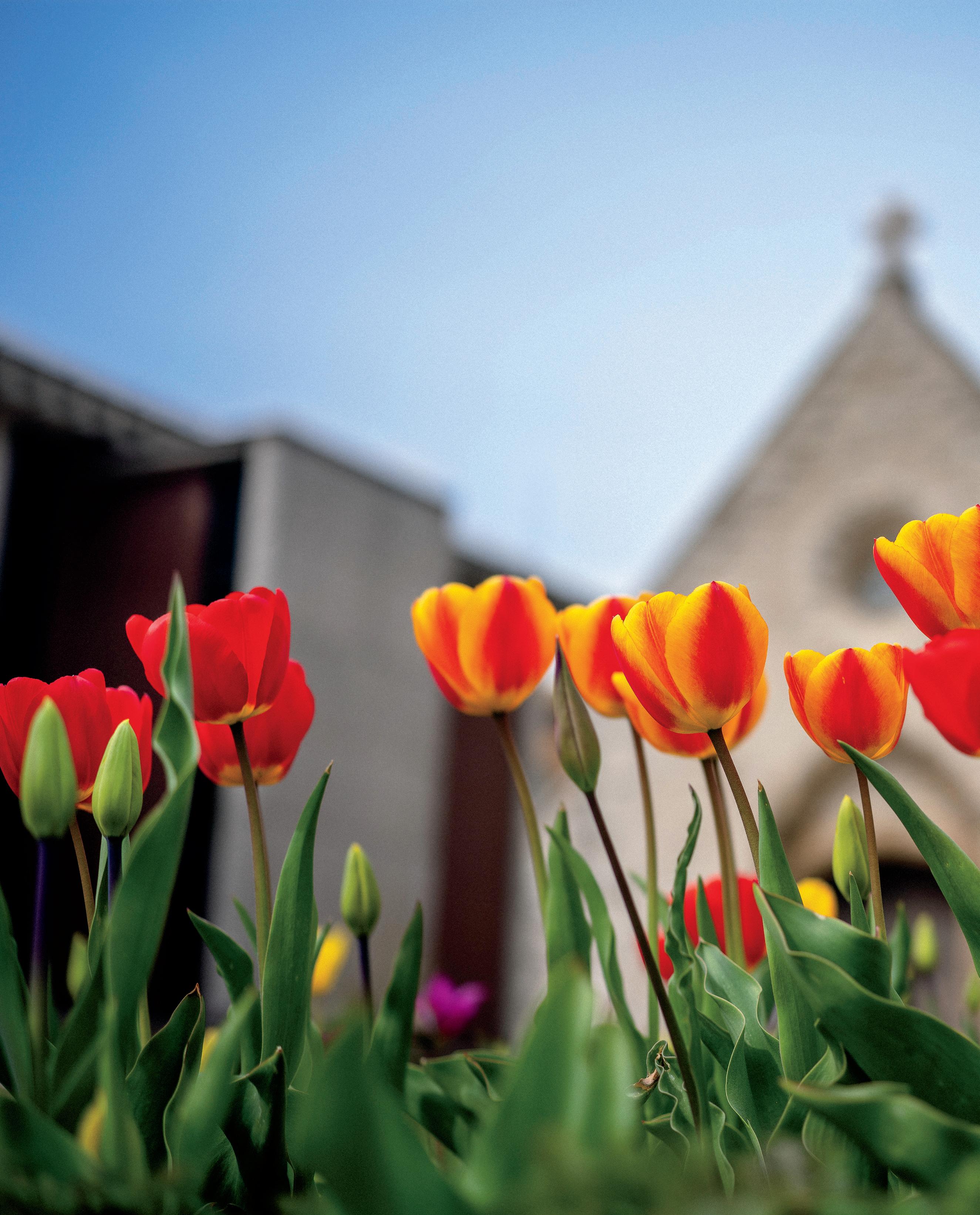

Season of Renewal
After Wisconsin winters that drag on and inevitably deliver a late-season wallop of snow (March 22 this year), Marquette’s abundant tulips celebrate spring with a welcome and emphatic burst of color. Waves of tulips around St. Joan of Arc Chapel and other key campus locations have been a seasonal fixture since former president Rev. Albert Diulio, S.J., personally donated nearly 10,000 bulbs to get the tradition started in the 1990s, facilities officials recall. Now, groundskeeping crews plant between 2,000 and 5,000 bulbs each fall — early-, mid- and late-blooming varieties — to keep the beloved blooms going for weeks and weeks, usually right through Commencement.
And speaking of spring renewal, you’re not wrong if you’ve spotted something different about the magazine you’re holding. After six years with the same design, Marquette Magazine has a refreshed look. Respecting the positive assessments readers shared in recent surveys, we were careful not to change too much. But the process led by talented designer Julie Savasky yielded a design we’re excited to share — with graceful-yet-energetic page layouts, distinctive new fonts that promote greater readability, and the name “Marquette” proudly front and center on the cover again, after previously being split between front and back.
You’ll notice refreshed contents too, tuned to reflect reader feedback (like more history and nostalgia). We’re also excited to debut our response to the burgeoning examples of Marquette’s academic leadership and innovation — a new eight-page section, “MU In Focus.”
Breathe in and smell that spring air.
PHOTO BY PATRICK MANNING
3 M ARQUETTE M AGAZINE
Postcard
Seen & Heard

Home Court Advantage
Editor: Stephen Filmanowicz
Assistant Writer/Editor: Rachel Gintner Orlando
Art Director: Julie Savasky, 508 Creative
Editorial Team: Sarah Koziol, Arts ’92; Jennifer Russell; Karen Samelson; Stacy Tuchel; Kasie Van Sistine
Marquette Magazine
(Spring 2024, Vol. 42, Issue No. 1), for and about alumni and friends of Marquette, is published two times a year by Marquette University, 1250 W. Wisconsin Ave., Milwaukee, WI 53233
This issue’s contents are current as of April 1, 2024. For up-to-date Marquette news, visit today.marquette.edu
Postage paid at Milwaukee, WI
Address correspondence to Marquette Magazine, P.O. Box 1881, Milwaukee, WI 53201-1881 USA mumagazine@marquette.edu.
Phone: (414) 288-7448
Publications Agreement No. 1496964
Marquette men’s basketball ranked eighth nationally in average attendance this year (16,307 fans per game), its highest finish ever. And Head Coach Shaka Smart did his part to drive this turnout, offering students rides across campus in his “Shaka Shuttle” before a couple of home games. After a trip with the coach, who revealed himself to be incredibly affable and genuinely curious about their lives, students said he could count on them and their energy in Fiserv. See the videos on Instagram, @Marquette.basketball.
Deep Space Vision
It takes a special telescope in a special location to help determine if cosmic rays arriving in our atmosphere have their origins in far-off stars collapsing into black holes. Dr. Karen Andeen, associate professor of physics, has been leading the team that is designing and building that telescope. Shown here with postdoctoral fellow Dr. Arun Vaidyanathan, Andeen installs optical guides that ensure optimal performance of the device’s advanced sensors. After calibration and cold-testing, the Marquette IceAct telescope will be shipped this summer for deployment at the best place on Earth for its work — the IceCube Neutrino Observatory at the South Pole.
High-impact Gift
Made possible by a generous gift from Perry Vieth, Bus Ad ’79, and Sheila (Wherity) Vieth, Arts ’80, the just-announced Vieth Institute for Real Estate Leadership will take the College of Business Administration’s undergraduate real estate program and Center for Real Estate — ranked 12th in the nation by U.S. News & World Report — to the frontlines of leadership again, this time through collaboration with other colleges. The institute will bring together expertise from law, engineering and business for academic experiences that mirror the interdisciplinary ways of the professional world of real estate development, investment and management. It’s a timely innovation that benefits students, faculty and alumni — and again distinguishes Marquette nationally.

4 SPRING 2024
LAB PHOTO BY PATRICK M ANNING; A M U TERRACE PHOTO BY REGHAN FEEHERY, CLASS OF 2024
Read about how Marquette has changed during Dr. Lovell’s 10 years as president, p. 24.
“Demographic challenges lead to more competition for students for every institution in higher education. It’s essential to be able to communicate value to students and their parents. They’re questioning it, and we have to be able to speak to that and to demonstrate our value to broader society. ”
PRESIDENT M ICHAEL R. LOVELL
Sun Spot
A 70-degree day in February made one thing clear — the new terrace outside the Chapel of the Holy Family in the Alumni Memorial Union is a prime spot for campus relaxation. Soon, a sculpture of St. Ignatius will join students on those same tiers, promoting reflection along with sun seeking.


FEATURES
Power of Ten
A look at Marquette’s new spirit of collaboration and innovation and what it’s made possible over the past decade. Page 24
Accepting the Invitation
A course that asked a student to write about 10 viewings of the same painting seemed absurd — until it became a life-changing spiritual experience. Page 30
Babs Knows Best
What prepared septuagenarian Barbara Costello to become a social media star and the internet’s favorite mom? Everything in her seven-plus decades, including her years at Marquette. Page 32
Inspiring Lives
Marquette’s Alumni National Awards honor alumni who embody Marquette’s mission through their transformative service, achievements and influence. Page 35
The Campus That Rocked
Hands up for the high-volume days when students brought bands such as Pearl Jam and Radiohead to Marquette. Page 40
5 M ARQUETTE M AGAZINE
Contents
IN EVERY ISSUE Postcard ................................................... 2 President’s Letter ........................................ 7 MU 360 .................................................... 8 MU In Focus 16 Class Notes.............................................. 44
We are on the rise.
Thanks to you, Marquette has incredible momentum in the final month of our historic philanthropic campaign, Time to Rise: The Marquette Promise to Be The Difference. We’ve surpassed our $750 million goal — and we continue to rise through the campaign’s culmination on June 30, elevating our students, faculty and university like never before.
Join us alongside more than 70,000 alumni, parents and friends with a gift today.


Scan to support Marquette through Time to Rise.

In my first Marquette Magazine column almost 10 years ago, I shared how grateful I was for the warm welcome my family and I received upon my appointment as the university’s 24th president.
Over the last decade I’ve had the very good fortune to meet so many students, faculty, staff and alumni from around the world at an untold number of gatherings and events. These individuals, along with our neighbors, partners and supporters, all share the common interest of Marquette fulfilling our Catholic, Jesuit mission by providing our students a transformative
education and experience that prepares them to live their lives in service of others.
Our students impress and humble me daily. I see the challenges they overcome and the ways they are making a positive impact on the world. I am so proud of their many accomplishments in the classroom, on the athletic courts and fields, and in the community. I always enjoy welcoming alumni back to campus and learning about the amazing ways they are using their Marquette education to Be The Difference. On my arrival at Marquette, I shared how I was looking forward to reaching new heights in the years ahead. Countless stakeholders have contributed in so many significant ways to the success we have collectively achieved. As president, one of the most important things I can do is build a great team of leaders in key roles and then trust those experts to use their knowledge and skills to bring our vision to life. We have been able to build upon an already solid foundation thanks to an incredible team effort. These positive outcomes help keep Marquette strong at a critical time for higher education and position us to reach even newer, greater heights — all while continuing to serve the greater glory of God.
Dr. Michael R. Lovell President
7 M ARQUETTE M AGAZINE President’s Letter
Watch President Lovell’s 2024 Presidential Address @ bit.ly/LovellAddress2024.

What’s new on campus & beyond
True Blue
Marquette Hall’s tower glowed a lovely shade of blue (and some gold too) after the men’s basketball team earned a spot in this year’s NCAA tournament Sweet 16. The appearance drove a 134 percent surge in engagement with Marquette’s main social media accounts and a 40 percent increase in new users to the home page of Marquette.edu.
Percentage of last year’s first-year students who are now Marquette sophomores — a record retention rate for the university.
LEADERSHIP
To Serve with Love
The new leader of mission and ministry at Marquette is a priest, scholar and coach who finds lessons everywhere — from the lives of saints and martyrs to clashes on the hockey rink.
BY RACHEL GINTNER ORLANDO
“En Todo Amar y Servir” — to love and serve in everything — is the university’s mission theme this year. Rev. John Thiede, S.J., Marquette’s vice president for mission and ministry since December, encourages you to say it aloud. A fluent Spanish speaker, Father Thiede and the mission team found the theme in the Spiritual Exercises of St. Ignatius and introduced it earlier this year when he began as acting vice president.
This beckoning to move with love and in service to others is one Father Thiede
can then offer in return to others. “I ask, how can we flourish? As with our mission theme, sometimes translating a phrase from a different language gives deeper meaning,” he says.
In guiding the Marquette community in faith matters, he is grounding himself in leadership lessons from many experiences — studying in Santiago, Chile; publishing and teaching on the Jesuit martyrs in El Salvador who gave their lives standing up to oppression; even coaching hockey at Marquette University

91.4%
ENGINEERING
Powering the Water Economy
Marquette is again at the forefront of national water innovation as one of eight anchor institutions managing Great Lakes ReNEW, a massive Midwest-based collaboration focused on extracting valuable minerals and toxic forever chemicals from wastewater. One of 10 regional “engines” selected by the National Science Foundation, ReNEW will access up to $160 million in NSF funding over 10 years — an investment that “will grow job training in the water sector, starting with Wisconsin, Illinois and Ohio,” says Dr. Daniel Zitomer, chair and professor of civil, construction and environmental engineering, and director of Marquette’s Water Quality Center. All told, the NSF centers represent one of the largest investments in placebased research and economic development in U.S. history. — Rachel Gintner Orlando
9 M ARQUETTE M AGAZINE
Students — and alumni — are encouraged to apply for the fall 2024 service immersion. Contact Sherri Walker at mu.edu/peace for more info.

LOCAL SERVICE
Service Trip to Milwaukee
Marquette service trips transform students as they assist communities in need. This time, students chose an immersive weekend in the streets and blocks around campus.
BY RACHEL GINTNER ORLANDO
Marquette students are known for spending their winter or spring breaks immersed in far-off places, responding to natural disasters or humanitarian crises with determined spirits and helping hands. The experience tends to be eye-opening, consuming and often transformative for students, as it is for partners in need.
This year, leaders of two student groups came together around a shared idea — what if they applied that same kind of energy to Marquette’s own neighborhood and spent fall break on a service trip to the Near West Side?
“This is where I live — and there’s a vibrant community here, also with people in need,” says senior Nathan Russell, an organizer of the immersion and current
president of CAMPus Impact, which focuses on local service. Russell talked with fellow students Tori Maentz and Sam Loop, members of MARDI GRAS, the Marquette student group that regularly mounts service trips to communities devastated by hurricanes or other disasters. They realized they should engage in service around Marquette, together, over fall break 2023.
Sixteen students signed up ready to spend their long weekend partnering with local nonprofits and faith organizations. After meeting with staff at Hope Lutheran Church, Neighborhood House and Full Circle Construction, they rolled up their sleeves and got to work — painting a new children’s playroom, deep-cleaning the community center’s kitchen and pantry,
planting tulips, collecting trash, ripping out vines and beautifying outside areas.
The group’s largest assignment took them to Project Homeless Connect, a United Way event hosted by Marquette that brought more than 300 people who lack secure housing to campus for a comprehensive resource fair. As personal guides for the day, each student paired up with an individual or duo — walking them to their haircut, flu shot, and birth certificate or warrant information station, and navigating a maze of booths in the Alumni Memorial Union.
“We carried their supplies and answered all their questions,” Russell says. Finding that day a highlight of the weekend, students learned firsthand what mattered most to residents and where best to refer them — to shelters, child care, pantries and more. They listened as attendees expressed their difficulty accessing housing, and for some, finding resources as they raise young children.
“I found myself helping a middle-aged man who came in looking for a fresh start,” says Tess Cangialose, the only freshman on the trip. “Having a genuine conversation with him encouraged me to never take my situation for granted and to learn more about the people who make up this place.”
The immersion included a bus tour of the seven neighborhoods that constitute the Near West Side, narrated by Russell and alumna Dia Henderson, Grad ’22, housing resource coordinator for Near West Side Partners, who explained the area’s evolving economic and housing landscapes. That night, the group reflected on all they learned over a dinner hosted by alumni.
“You can absolutely tell these students want to reach out to their own community in an intentional way, building relationships and making an impact,” says one of the hosts, Elizabeth Killian, Ed ’20, CAMPus Impact’s past president.
As with past trips to far-off locations, that’s the kind of immersive, compassionate work that epitomizes service at Marquette, only this time they were serving in their own backyard. ¤
10 SPRING 2024
PHOTO PROVIDED BY M ARQUETTE THEATRE ARCHIVES

Lookback
Stage Centennial
Interest in live performances — music, vaudeville, Shakespeare — exploded on campus in the early 1920s, leading to new student theatre clubs and Marquette’s first theatre course in 1924. A century later, Marquette Theatre has been busy celebrating triple milestones — 100 years of theatre at Marquette, 50 years in the Helfaer Theatre and professor Deb Krajec’s retirement after 40 years with the department. “Our students use their talents in a uniquely Jesuit liberal arts context to impact the world positively,” says Stephen HudsonMairet, professor of digital media and performing arts. And hundreds of performances over the decades have positively impacted campus and community cultural life. If you recognize the production and performers in this one, write us at mumagazine@marquette.edu and we’ll share a few reflections in our next issue.
Class Act

No Average Canoe
For most people, concrete is not the material of choice for a canoe. But for these students, constructing a canoe of concrete is the ultimate challenge. Members of the Marquette chapter of the American Society of Civil Engineers — pictured here during the biggest day of their year, the canoe pour — refine design strategies by experimenting with mesh inserts, glass beads and carefully layered concrete. Junior Simon Mathiowetz, the ASCE chapter president, admits, “There’s a lot of pressure for everything to go right, and we must think on our feet.” After seeing previous plans to compete grounded by a pandemic and icedover waters, the team was excited to travel to the ASCE competition in Chicago this spring and race for the first time in more than five years. — Rachel Gintner Orlando
Building a Brand — in the Podcast Studio
A new partnership between student media and student-athletes Kam Jones and Stevie Mitchell navigates the new world of NIL in athletics. BY
TIM CIGELSKE, COMM ’04, GRAD ’18,
When men’s basketball team standouts
Kam Jones and Stevie Mitchell entered a podcast studio in Johnston Hall in December, they kicked off a unique collaboration.
For student journalists supporting the effort, the new K1 and Stewie Show provides audio production and co-hosting experience. For Jones and Mitchell, the podcast is an opportunity to share their perspectives as student-athletes, find their voices as public figures and build their personal brands.
Part of the NCAA landscape since 2021, Name Image Likeness (NIL) guidelines create a gateway for student-athletes to benefit professionally and financially from the value they create through sports. There’s now an NIL general manager at Marquette, Madison Dunker, Comm ’18, and an NIL store where students such as Aubrey Hamilton of the volleyball team market branded gear.
This podcast follows suit. When Jones showed interest in the idea, Dr. Patrick Johnson, Ed ’11, Grad ’13, director of student

’20
media in the Diederich College of Communication, saw educational value in it for a range of students and partnered with Dunker to make it possible.
With Hope Moses, executive director of the Wire, serving as co-host, the show focuses on relationships as much as basketball. The first episode featured teammate guests Tyler Kolek and Oso Ighodaro opening up about their journeys beyond the spotlight. “My biggest aspiration is to just have fun with it and to learn new things about our guests,” says Mitchell, a thirdyear business major. “Kam is one of my best friends, so being able to do a podcast together is so awesome.”
Dunker adds. “The main NIL component is how these guys and the students on the project are growing their brands and professional skills for life beyond Marquette. They really want it to feel like you are in the room with them and hanging out when you listen to the show.” ¤

PHILANTHROPY
Mission-driven Scholars
In addition to founding the Trek Bicycle Corp., Richard Burke, Bus Ad ’56, Hon Deg ’06, established two programs in the early 2000s that connect deeply with Marquette’s mission. The Burke Scholars program provides fullride scholarships to 10 exceptional high school seniors each year to study at Marquette and engage in service to others. The Trinity Fellows program supports graduate students committed to social justice leadership through study and roles at local nonprofits. Now, both programs will be supported well into the future thanks to a $4.6 million recent gift from the Burke Foundation. “These programs are foundational to who we are at Marquette,” President Michael R. Lovell says. “It’s our shared values with the Burke Foundation that make them possible.”

The K1 and Stewie Show is hosted by student-athletes
Stevie Mitchell (left) and Kam Jones, with Hope Moses, communication student and executive director of the Marquette Wire.
13 M ARQUETTE M AGAZINE
ATHLETICS
OPPOSITE PHOTO BY PATRICK MANNING; PHOTOS THIS PAGE COURTESY K 1 AND STEWIE SHOW

Students Into Teachers
Two psychology professors expand an effective campus wellness program by training students to lead it.
BY DIANE M . BACHA
Emma Schuster had two reactions after learning Dr. Alyson Gerdes was recruiting students to co-lead a campus wellness program. First: It sounded like a great chance to work with one of her favorite psychology professors. Second: What wellness program?
“Dr. Gerdes was not too happy to hear that second reaction,” Schuster, Arts ’23, now a graduate student in counseling, says with a laugh.
Gerdes and her colleague Dr. Nakia Gordon, associate professor of psychology, launched the program two years
earlier in response to the COVID-19 pandemic. “We could see how students were struggling, and it didn’t appear they had a lot of coping strategies,” Gordon says.
The results were encouraging, but two busy faculty members could only reach so many students. Hence the plan, supported by a Marquette Explorer Challenge grant, to train students.
The six-week program introduces six to eight students to the practice of techniques such as yoga and deep breathing. Students also explore relaxation, gratitude, self-compassion, emotion regulation, time management, nutrition and movement. Before and after self-reporting revealed improvements “across almost all of the different dimensions we were looking at,” Gerdes says.
So, last fall, Schuster and her co-leader, Arts and Sciences student Casey Perez, first observed, then led sessions overseen by Gerdes and Gordon. Following the “see one, do one, teach one” model, they already trained a new set of co-leaders this winter.
“Now the new co-leads are running the groups and my partner and I are critiquing and assisting them with the material — as Dr. Gerdes and Gordon did for us,” Schuster says. “This cycle of teaching will continue as another set of co-leads has been chosen to learn in the fall.”
Perez says the benefit of peers teaching peers goes both ways. “I learn a lot from the people in our sessions, and I can tell they learn a lot from us.”
Gerdes and Gordon are working with campus partners to promote the program more widely and plan to measure its impact on academic performance in addition to well-being. ¤
14 SPRING 2024
WELLNESS
OPPOSITE: CURATED BY LYNNE SHUMOW, ASSISTANCE FROM DR. ROBERT SMITH, M IA PHIFER, INTERNS. PHOTOS BY BILL TENNESSEN, SILVER NITRATE PRINTS, COLLECTION OF THE ARTIST; BILL TENNESON PHOTO BY ALAN HERZBERG


Dynamic Range: Photographs by Bill Tennessen , which ran through May 12, featured the work of Bill Tennessen, a self-taught photographer, appraiser and Marquette alumnus.
Curated


Milwaukee in Monochrome
Fifty photographs of Milwaukee from the 1980s to early 2000s made up the Haggerty Museum of Art’s recent exhibition, Dynamic Range: Photographs by Bill Tennessen. Tennessen, Bus Ad ’56, has been a contributor to the Milwaukee Community Journal since 1981 and has captured moments of joy and reckoning in Milwaukee’s Black community, from church storefronts and Juneteenth celebrations to political figures and protests — notably the Ernest Lacy demonstrations in 1982.
15 M ARQUETTE M AGAZINE
Where Marquette leads in ideas, innovation and research
The App Has Their Back Professors
and partners launch a peer-to-peer health app for veterans — just the latest example of campus innovation brought to market.
BY NIKKI SWEENEY ETTER

In military culture, a “battle buddy” is the fellow soldier who has your back on and off the battlefield. That concept is at the heart of BattlePeer, a telehealth app that uses peer-to-peer support to help meet the mental health needs of veterans. The app — created in part by Marquette faculty — is used by about 200 veterans and is poised for broader impact since Marquette and the Medical College of Wisconsin licensed the intellectual property to BattlePeer Corp.
“With the licensing, we have a massive scale advantage,” says Dr. Praveen Madiraju, professor of computer science. “We can now potentially reach hundreds of thousands of veterans across the nation.”
The app builds on work by combat veteran Bob Curry who founded Dryhootch, a nonprofit with coffeehouses and resource centers in Milwaukee and Madison, Wisconsin, where veterans find peer support and sober recreation.
“It’s really a tool to enhance the peersupport model that Bob created,” says Dryhootch President and CEO Otis Winstead, who uses the app daily to check in with his mentees.
The Dryhootch team spent years collaborating with Madiraju; Dr. Iqbal Ahamed, Wehr Professor of Computer Science; and Dr. Zeno Franco, associate professor at the Medical College of Wisconsin and psychologist at the U.S. Department of Veteran Affairs. And next up: The collaborators plan to adapt the app to support first responders and people with chronic diseases.
“Meaningful innovation doesn’t happen in a vacuum,” says Dr. Kalpa Vithalani, who has overseen an increase in startup and licensing activity as Marquette’s first executive director of technology transfer. “This is an amazing model of community-engaged research and commercialization.”
INNOVATION
World-class Technology Made at Marquette
BattlePeer isn’t alone as an example of Marquette’s technology transfer success. Here are others:
Dr. Chung Hoon Lee, associate professor of electrical and computer engineering, invented a sensor that monitors water for contaminants without ever getting wet — preventing corrosion that can cause technology failure. The technology was licensed to five companies simultaneously.
Co-founded by Dr. William Donaldson, professor emeritus of chemistry, using intellectual property jointly owned by three universities, Estrigenix Therapeutics develops drugs to treat or prevent dementia in post-menopausal women as alternatives to high-risk traditional hormone replacement therapies.
Dr. Paige Peters, Eng ’11, Grad ’19, ’23, created a fast-acting wastewater treatment system that prevents sewer overflows during storms. The technology was licensed to Peters’ company, Rapid Radicals.
16 SPRING 2024

by $3.3 million in federal grants, Dr. Tony Gamble, associate professor of evolutionary biology, is making a name for himself in his field while expanding knowledge of the evolutionary processes that generate biological diversity.
And now, his name is part of the animal kingdom too. In
NURSING
Epic Partnership Puts Marquette Students First
At a college event in early 2023, Dr. Jill Guttormson, dean of the College of Nursing, had a chance encounter with Chris Alban, a physician informaticist at Epic Systems, that proved fruitful. Alban mentioned that Epic was developing a classroom version of its industry-leading electronic health records software and would soon be looking for educational partners.
“My first reaction was, ‘When can we talk and how soon can we do it?’” Guttormson says. That conversation led to the college signing a deal with Epic in August to bring Lyceum, the company’s new EHR learning platform, to students.
geckos. They named one of them — a brown gecko with distinctive striped markings under its mouth — Lygodactylus gamblei in recognition of the Marquette professor’s “substantial contributions to the evolutionary biology of geckos.”
A humbled Gamble says he hopes the new species can “inspire curiosity about the natural world and the need for continued research to catalog the diversity of life on Earth.”

Marquette is the first U.S. nursing school where students can use Lyceum to build EHR skills they’ll depend on throughout their careers.
“Offering our students experience on industry-standard software from a leading health technology company is a game changer for our college,” Guttormson says. “We pride ourselves on producing nurses who are well-prepared for practice. Skilled, ethical use of medical records is a major part of that.” — Andrew Goldstein, Comm ’18
The Marquette Law School Poll is the nation’s third-best poll, according to ABC News’ 538 rating of more than 500 polls. It’s also ranked No. 1 for transparency.
BUSINESS
Student-led Deals
When Grace Vanden Heuvel arrived for her first class in Marquette’s Real Estate Asset Program, she immediately got to work analyzing a real estate investment offering. By semester’s end, her student team had fully vetted the deal and presented it to REAP’s professional committee that oversees a $2 million investment fund.
Experience like that is unique. REAP is the first and only program in the United States through which undergraduates learn all aspects of real estate investment and guide investments in actual properties. Since its inception in 2021, acting on student recommendations, REAP has invested as a limited partner in five property deals consisting mostly of apartments and industrial buildings in Wisconsin, Illinois and Maryland.
Andy Hunt, Bus Ad ’08, Grad ’13, Vieth Director of the Center for Real Estate, says, “Being the only program like this in the nation matters, because when it’s time to compete against other talent, our students are more prepared than anyone else in the country.”
All 10 students in REAP’s inaugural cohort landed jobs after graduation, including Vanden Heuvel, Bus Ad ’23, now an associate for Midloch Investment Partners.
“A lot of what I do now is an exact translation of what I did in REAP,” she says. — Shannon Shelton Miller

17
ILLUSTRATIONS BY DANIEL ZENDER

EDUCATION, ARTS AND SCIENCES
What Happens When Students See Themselves in Their History Lessons?
The $1.27 million MKE Roots Project makes social studies stickier by making it more place-based, culturally sensitive and relatable. BY
TREE M EINCH
There’s an issue that arises when history is taught in a traditional K–12 classroom: The material tends to drift through young minds with an air of far-off places and faint relevance. Dates and facts may linger just long enough to help a student pass aquiz.
This educational shortcoming, known as banking, has been a target of Dr. Melissa Gibson, associate professor of educational policy and leadership, in her work preparing Marquette education students to be teachers. Then the COVID-19 pandemic made it feel even more urgent.
At St. Joan Antida High School, an all-girls Catholic school in downtown Milwaukee, administrators noticed an alarming slip in social studies performance when the school switched to remote learning in 2020. St. Joan’s innovative new principal, Megan Otero, craved creative solutions to put students back on track. And thanks to some word-of-mouth connections with Marquette, she partnered with Gibson on a new credit-recovery elective that debuted when in-person classes resumed in 2021.
Recognizing the limits of conventional classroom instruction in addressing this gap, Gibson drew upon a place-based framework she’d been applying in Marquette courses for future educators. Dubbed Explore Milwaukee, that pilot course put students in contact with living people and institutions outside the classroom, while featuring Black, Latinx and Indigenous history in which students could recognize their own roots. It ran two semesters at St. Joan while garnering impressive results and broader interest, including from leaders of Milwaukee Public Schools.
Three years later, the promising pilot has grown into the ambitious new MKE Roots: The Democratizing Local History Project. Supported by a $1.27 million award from the U.S. Department of Education, Gibson and partners are launching a three-year program in multiple K–12 schools, where social studies instruction will benefit from a new curriculum and vibrant educational ecosystem that allows for more than merely depositing facts into students.
“What the students are learning is a completely new way to see their city,” Gibson says. “My charge was this: I want them to be curious, and to see themselves in the social studies.”
Helping to form the framework of Gibson’s curriculum have been local storytelling initiatives and partnerships led by Dr. Robert Smith, Harry G. John Professor of History, and Milwaukee cultural leader Adam Carr. MKE Roots is now housed under Marquette’s Center for Urban Research, Teaching and Outreach, which Smith directs.
Through placebased learning in Milwaukee neighborhoods such as Walker’s Point and Sherman Park, students learn how history is “built into these spaces where we walk around, visit and meet each other,” says Dr. Sergio González, assistant professor of history.
The program also leverages the expertise of Dr. Sergio González, assistant professor of history at Marquette, whose involvement started when he led St. Joan students on a tour through Walker’s Point.
“I tell students how our family histories are built into these spaces where we walk around, visit and meet each other,” González says. Many students went wide-eyed when they heard that Wisconsin’s earliest known Mexican immigrant settled in Walker’s Point in the 1880s, less than 40 years after Wisconsin became a U.S. state. “These histories exist all around us,” he adds. “I think it’s a form of curriculum that could be replicated all across the state of Wisconsin.”
Key learning sites for MKE Roots will include America’s Black Holocaust Museum, city art installations and other landmarks in communities of color. Other tools will include contextual backstories and question guides.
The MKE Roots project will also fund and facilitate weeklong professional development summer camps for interested educators that will include visits to touchstones of the curriculum and opportunities to tailor material to unique classrooms, where teachers are often hungry for new resources.
“MKE Roots leans heavily on Marquette’s mission of engaged scholarship and outreach,” Smith says. “We’re doing our part as responsible neighbors and citizens here in Milwaukee.” ¤
19 M ARQUETTE M AGAZINE
PHOTO BY PATRICK MANNING
Intersection
Dr. Jeanne-Nicole Saint-Laurent Associate Professor of Theology and Director of Graduate Studies

 Dr. Michael Zimmer Professor and Vice Chair of Computer Science; Director of Center for Data, Ethics, and Society
Artificial Intelligence and Us
Three faculty voices on our present and future with AI.
BY STEPHEN FIL M ANOWICZ
Intersection brings together faculty members from different disciplines to share perspectives on a consequential topic. This time, with large-language models such as ChatGPT and artificialintelligence-driven image and video generators exploding into our lives, schools and economy, three professors reflect on the change AI is making us grapple with. Following are key excerpts from a conversation with them.
Dr.
Nasim Yahyasoltani Northwestern Mutual Data Science Institute Assistant Professor of Computer Science

What’s the most promising or exciting thing you’ve seen from the world of AI over the past year?
MZ When I study how users interact with these technologies, there’s a lot of utility. I’m not even thinking about ChatGPT or similar platforms, but about how smart devices are becoming better at processing voice commands and predicting my needs and wants. I joke in my classes that we critique the issues and challenges posed by AI, but I rely on Apple Maps. I rely on Grammarly to autocorrect my grammar. So, there are definitely benefits. AI is helping to make a lot of these tools better for a lot of people.
NY Generative AI is the most promising thing that I have seen. I have been using it in a lot of useful ways for my research — to address challenges that had been hard to
20 SPRING 2024
ILLUSTRATIONS BY JAYA NICELY
solve. I can generate synthetic data to compensate for a lack of enough data. I can remove the biases in my data set. This is something that has amazed me in the last few years.
JSL The way AI can handle huge sets of data has wonderful implications for our approaches to major ethical problems, such as climate change, because AI can handle calculations that an individual person can’t. Same with medicine. So on those issues AI could be really promising — especially when we make accountability and transparency priorities, so people understand, at least somewhat, what’s going on behind what AI generated for them.
What has been the most concerning development — or the AI-related challenge that most urgently needs addressing?
JSL For professors in the humanities, what’s going on in our circles is the question of what we’re trying to teach our students to do, composing an essay, most obviously. Is that being perceived, or is it in fact, not even useful to them anymore? How can we convince our students that the creative process — which is something we’ve been given by God, the act of writing and the rigor that entails — is actually important for them? It’s like a basketball player practicing their shots. There are some things you just can’t have a machine do for you, for your own growth. (Saint-Laurent also cited concerns with the use of deep fakes by malicious actors or states, and with AI potentially worsening inequalities.)
NY There are a few things I should mention: ethical and privacy risks, the use of generative AI for creating content — fake audio, video, images and even assignments at school — that can put people at risk. My other concern is our need to learn how to have human–AI collaboration … because it’s crucial to know what you need from AI and how to use it correctly. A final point in terms of using these algorithms is their explainability. Do their processes make sense? The algorithms are getting better
and better, but the interpretability of the AI is another concern.
MZ It’s hard to add to the points already being made. But a broader concern that I share with students is an overall kind of quantification bias that’s emerged that assumes AI or anything data-driven will be inherently correct and better than having a human make a decision or a prediction. We rely on algorithmic and AI-driven systems without having that explainability as Nasim was saying. And now that data — the things we can compute and put into a model — are what matters most, that could have an impact on things like humanness or imperfection or broader kind of humanistic qualities that we’re losing because of the reliance on these models.
How dramatically do you see AI impacting higher education? How should Marquette prepare for that impact?
MZ Part of me asks, why are we treating this differently than the emergence of the calculator or an online encyclopedia? Students have always been able to copy or find shortcuts for their work, but it does seem to be at a different scale now. Does that require us to change our mode of instruction or what we’re expecting of students? I suspect we expect different things in a math classroom than we did 30 years ago because memorizing the multiplication tables is just not as necessary.
Still, in our computer science classrooms, we’re struggling because there are tools out there that can write code for our coding assignments. Students can ace the assignments, but when there’s an exam and they’re forced to do it on their own, they’re suddenly struggling, realizing what they’re not learning. That puts pressure on us as instructors to help students see that difference.
JSL It’s kind of hard to underestimate the impact. Frankly, I’m actually worried about the divisions in the faculty and the students that this might cause. This has to be an interdisciplinary endeavor for us as a university, so we are talking to one
another in important ways and not bringing our own bias against other disciplines, saying, “We know this better than you do.” It’s impacting all of us, and it’s all of our responsibility.
We’re not going to have a unified voice, but we must be able to identify what our concerns are, what is in keeping with the Jesuit mission of the university, how are those still really important questions for us all, so we’re not becoming like the Luddites over here and the techies over there. No, we have to put our students at the center and also us as professors … to really try to get the human heart back in there. We can see what AI can do. Yes, it is amazing, but it also can give us greater awe about what the human person is too, what our capacities are, and to help our students not lose sight of that.
NY Most of the faculty are now struggling with assignments and things that are given to them by students who may be using AI tools. It’s all part of an adjustment process. It reminds me of how people were not ready to use elevators when they were first introduced; people were still using stairs. We need to get ready. As faculty, we need to learn how to use these tools and teach students how to use these tools correctly. There is now software to help us detect fakes and copied information. So, we need to get ready and define rules. Then we can probably even benefit in the classroom. AI may help us find personalized content for the students of the future based on their needs and GPA, and recommendations for custom course content. We could benefit as people did when they began using elevators. ¤
The conversation continues online. Visit mu.edu/ai-roundtable to see an expanded version of this interview where the participants address the question of how well prepared we are for our AI future.
21 M ARQUETTE M AGAZINE
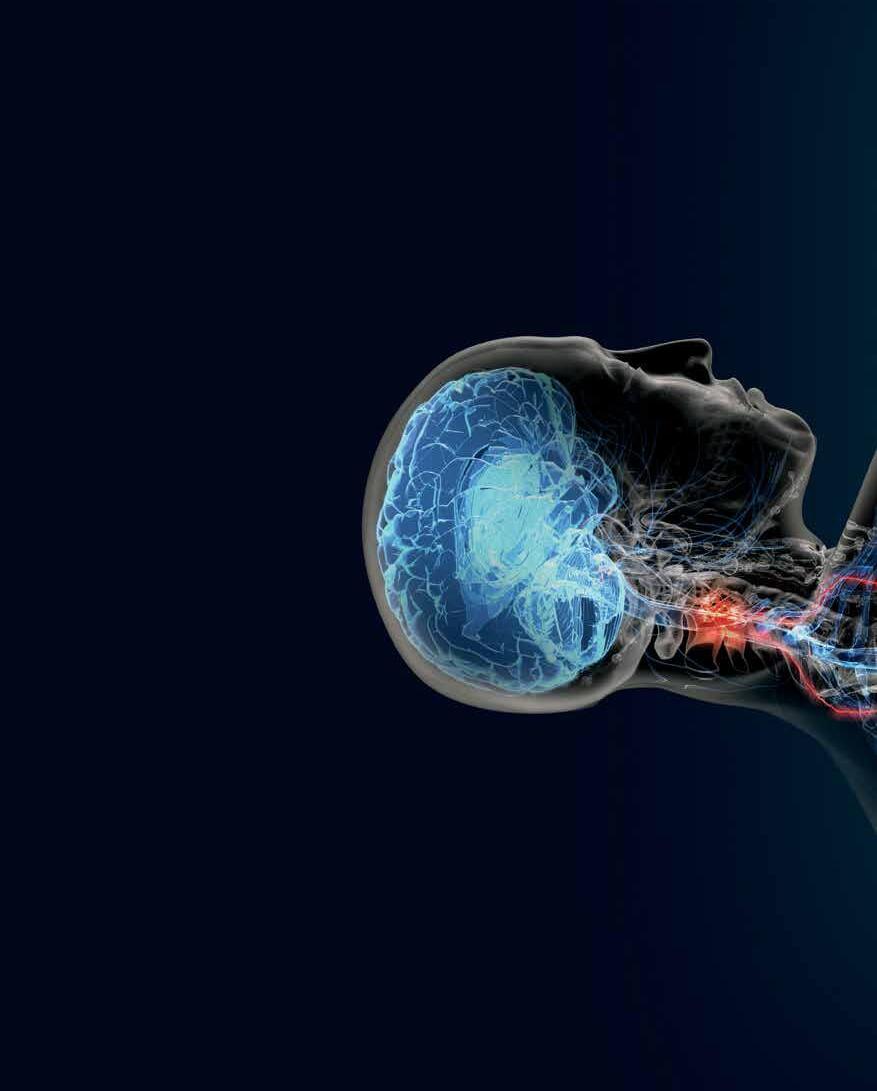
Dr. Kristi Streeter has a simple but monumental goal: to help people with spinal cord injuries breathe better. In her lab at the College of Health Sciences, the assistant professor of physical therapy dives deep into the nervous system superhighways that control one of the body’s most basic needs. With a recently awarded $420,000 grant and diversity supplement from the Neilsen Foundation, she is building on research conducted over the past few years under a $747,000 R00 grant from the National Institutes of Health. Using cutting-edge technology to reveal the workings of interventions that promote improved function of these neural pathways, Streeter works to paint a clearer picture of how the nervous system communicates — and how it can heal.
The Target: Better Breathing After Spinal Cord Injuries
Damaged connections Every breath begins with a message from the brain. It’s carried through the phrenic nerves, which depart the spine in the neck, run on either side of the body and connect to the diaphragm. The diaphragm receives the message to contract and then relaxes, completing one breath — then another, and another, in a process that feels automatic for most people. But after a spinal cord injury, breathing can become perilous. If damage is severe and too high in the spinal cord (above the phrenic nerves), a person may require assistance from a ventilator to breathe. An injury not as severe and not as high in the neck may cause other breathing-related problems like shallow, rapid breathing and reduced ability to cough, which contributes to infections such as pneumonia. In these latter cases, the functioning of this neural superhighway isn’t necessarily static, however, and can even be strengthened. To that end, Streeter and her team focus on the phrenic nerves, studying the microscopic connec
tions between nerve cells and how they transmit signals between the brain, diaphragm and back again.
COMM ’19
JENNIFER WALTER,
Dr. Kristi Streeter’s research targets the neural feedback loop between brain and diaphragm, using neural plasticity to improve post-injury breathing. BY

Damage control
Shortly after a spinal cord injury, tissues become inflamed as the body begins its healing process. But excess inflammation can cause bigger problems down the road, such as scarring and permanent damage that prevent nerve connections from ever regaining function.
Streeter’s team is focusing its attention on ways to reduce inflammation after injury and minimize permanent tissue damage. Inspired by past research that Streeter conducted on the African spiny mouse, famous for its ability to heal without any scars, her team is investigating a supplement to be taken after an injury. The idea is to preserve nerve connections as much as possible, so that people can rehabilitate more easily and breathe more freely.
HEALTH SCIENCES
22 SPRING 2024
By mapping these connections, she’s building a bedrock of information that can help researchers develop interventions that promote better breathing and improved quality of life for these patients.

Switching it up To study how nerve cells share information between the brain and diaphragm, Streeter employs a cutting-edge technique called chemogenetics, through which researchers place artificial channels inside individual nerve cells. Working with rodent subjects, they then use specially formulated compounds that can attach to the channels and stop or start a cell’s function on command.
Streeter compares this process to a light switch. When the switch is flicked off, researchers can see how stopping the cell’s function impacts other cells. That helps them pinpoint each cell’s role in transmitting information and better understand how they affect the nerve cells around them.

Setting the pace
Many patients who have difficulty breathing after a spinal cord injury benefit from diaphragm pacers. These devices send electrical pulses into the diaphragm to stimulate breathing, much as a pacemaker assists patients with heart conditions. But Streeter has observed that the electrical signals from pacers also help strengthen the signals going from the brain to the diaphragm (as seen in the EMG recording below right). In research on rats, she’s seen phrenic nerve connections come back to life — to the point where a pacer is no longer needed.
Streeter envisions that pacers — rather than being a permanent treatment that patients rely on for the rest of their lives — could one day be used as a therapy to encourage neural plasticity in human patients that helps them eventually breathe reliably without a pacer.



 BY M ARQUETTE M AGAZINE STAFF
Power of Ten
A look at Marquette’s new spirit of collaboration and innovation and what it’s made possible over the past decade.
Marquette is a different place than it was 10 years ago. Dotted with new buildings and reimagined spaces, the campus also has a different hum. It’s a place where fresh ideas are celebrated and collaboration is key.
In fact, “a growing ethos of collaboration” has become a distinguishing feature of Marquette, says Dr. Jeanne Hossenlopp, vice president for research and innovation. “Marquette is increasingly engaged in partnerships in the community, cross-disciplinary campus collaborations, and partnerships with external groups to support new research and educational activities on campus,” she says.
Working together — across traditional university boundaries — is how Marquette has faced challenges such as the effects of the COVID-19 pandemic on its students or the stiff demographic and economic headwinds putting pressure on higher education. It is how Marquette has renewed its commitment to themes such as cura personalis and magis at the core of its Catholic, Jesuit mission.
Not coincidentally, this culture reflects the vision and leadership — the passions — of the leader who became Marquette’s president 10 years ago, Dr. Michael R. Lovell. As Lovell says, “When you pull diverse groups together to have a common vision or a common goal to do something, the idea is that the pie just gets bigger and bigger and the impact you make gets broader and broader. Collaboration really allows you to accomplish more and to do great things.”
To build on Marquette’s proud legacy, collaboration and innovation are essential to meeting the ever-evolving needs of students and society. As Lovell forecast during his inauguration on Sept. 19, 2014: “We will be change agents for social innovation and justice, and work to solve many of the problems facing Milwaukee, our country and the world.”
25 M ARQUETTE M AGAZINE
Ten momentum builders from the last 10 years:
Faith as a foundation — Before accepting the appointment as Marquette’s 24th president, Dr. Michael Lovell prayed with his wife, Amy, arriving at a sense of peace about this opportunity to incorporate faith in his professional life. As the university’s first lay president, he has worked with campus partners, members of the Jesuit community and benefactors to elevate faith across campus.
Impressed by the many chapels, statues, and art installations on campus, Lovell developed in-person and virtual pilgrimages of these sacred spaces as his capstone project for the Ignatian Colleagues Program, a formation initiative for leaders of Jesuit universities and colleges. One of the newest sacred spaces is the Grotto of the Blessed Virgin, a proposal from the capstone achieved in collaboration with colleagues from Campus Ministry, University Advancement and Facilities Planning and Management. It is a place of devotion, inspiration and prayer whose beauty, in particular the statue of the Virgin Mary, was realized through the generosity of longtime Marquette supporter Geri “Nana” Fotsch.
A rich partnership resulted when
a small group of students approached Lovell seeking opportunities to practice eucharistic exposition and adoration on campus. In response to this request, multiple opportunities for the practice are now offered weekly in St. Joan of Arc Chapel.
Unleashing great ideas — Recognizing that students, faculty and staff were generating great ideas but lacked a mechanism to bring them to fruition, Lovell helped create the Strategic Innovation Fund in 2014, which grew into the Explorer Challenge.
These funds have been used to develop educational programs and pathways that encourage staff and faculty initiatives and entrepreneurism among students. In the spirit of the Ignatian term magis, every department has been offered the opportunity to compete for funds to implement innovative and entrepreneurial ideas within their units and beyond.
Combined, the programs have awarded $7.8 million to 100 teams to seed new initiatives, helping them generate almost $70 million in external revenue, a healthy 790 percent return on those good ideas.

Doubling down on research — Marquette’s annual research expenditures were around $25 million when Lovell and colleagues set the ambitious goal in 2015 of doubling that funding. The university is now on track to reach that goal in the next one to two years thanks to faculty-led projects that have helped Marquette climb to 34th on U.S. News & World Report’s list of most innovative universities. Facultymentored research has emerged as a strength of the Marquette student experience. And 13 faculty members representing five colleges are among the top 2 percent of cited scientists in the world.
Marquette + Milwaukee — Marquette is engaged in partnerships that provide new opportunities for students, faculty and staff and support a growing number of major community-building and strategic regional initiatives. So much so that Dr. Patrick Kennelly, Arts ’07, Grad ’13, ’23, director of the Center for Peacemaking, says, “Marquette’s community involvement has evolved from one-off partnerships with individual nonprofits … to a full embrace of our community that has led to a reinvigoration at the neighborhood level.”
Marquette is an anchor institution, along with Advocate Aurora Health, Harley-Davidson, Molson Coors and Potawatomi Business Development Corp., in the Near West Side Partners. The organization has helped to revitalize and sustain business and residential areas near campus.
The President’s and Chancellor’s Challenge, developed in partnership with the University of Wisconsin–Milwaukee and Johnson Controls, provides funding for innovative, interdisciplinary work that addresses critical issues and opportunities facing the city of Milwaukee. And another key partnership, the Northwestern Mutual Data Science Institute, advances southeastern Wisconsin as a national hub for technology, research, business and talent development.
26 SPRING 2024
“The reason why we commit to these jobs is because we want to help our students achieve their goals and dreams and become changemakers,” President Lovell says. At 10 years of service as of this summer, he is the fourth longest-serving Marquette president, behind only Rev. John Raynor, S.J., Rev. Robert Wild, S.J., and Rev. Edward O’Donnell, S.J.

From research and teaching to the practice of faith and pursuit of service and social entrepreneurship, the Marquette community’s purpose-driven collaboration is a source of pride for President Lovell, says First Lady Amy Lovell (right). “Mike lives with the spirit of collaboration. Nothing Marquette has accomplished has been because of his efforts alone, and he knows and values this.”


Student-powered hub — One of the most bustling spaces on campus was conceived by two undergraduate business majors. Sam Wesley and Creighton Joyce, both Bus Ad ’17, dreamed of a well-resourced workspace for student innovators from across Marquette and got it approved through the Explorer Challenge in 2015. Debuting in early 2017, the 707 Hub has become a headquarters of student innovation and entrepreneurship — and home to initiatives such as the Dorm Fund and Brewed Ideas Challenge that seed student startups and social innovation projects.
Entrepreneurship also abounds in student-led Blue & Gold Brewing, marketer of Marquette-themed coffee and beer. “Not many universities provide opportunities like Blue & Gold Brewing for their students,” says Stella Quinlan, a student in the Diederich College of Communication. “The program is evidence that Marquette stands apart in its ability to find new ways of supporting its students, while also creating valuable experiences along the way.”
Inclusion and belonging — Marquette’s Urban Scholars program — providing full-tuition scholarships to students from Milwaukee, particularly first-generation students from financially disadvantaged backgrounds — grew from 10 to 40 new students per year in 2020, a lead commitment made by Lovell and Provost Kimo Ah Yun after meetings with students who voiced concerns around Marquette’s climate for Black students.
The university adopted a Land and Water Acknowledgment in 2021 (recognized in the physical marker pictured to the left) and updated its official seal in 2022 to recognize and honor the long history of Native peoples and nations who lived on and stewarded the land and water on which the university now resides. Building a culture of belonging is a priority Marquette is continuing to focus on through its new 2031 strategic plan, Guided by Mission, Inspired to Change.
28 SPRING 2024
Rev. Ryan Duns, S.J., associate professor of theology, reflects on that imperative: “During classroom discussions, I often ask myself, ‘So, whose voice is missing?’ Our job as teachers is not to deliver a monologue but, rather, to empower our students to claim their voices and use their gifts and talents to pursue truth. Unless every perspective is represented, unless every voice is made present, we cannot hope to understand fully any issue.”
Breaking down silos — To prepare graduates to excel on the cross-disciplinary teams that drive industry innovation, initiatives such as Excellence in Leadership (E-Lead) and the Omron Advanced Automation Lab engage students from multiple colleges in building those skills. Another is Marquette’s Product Realization course, which Lovell has co-taught four times. The course brings together engineering and communication students to design products in response to local companies’ needs.
Marquette Law student Fhernam Batiz, Eng ’21, had the opportunity to experience Marquette’s president in the classroom. “President Lovell led by example and demonstrated that innovation does not follow a straight line,” Batiz says. “I look back at this one-of-a-kind experience that propelled my development as an engineer and see President Lovell as a symbol of resilience and leadership.”
Plan of action — Shortly after Lovell’s arrival, Marquette began work on a new campus master plan. Led by Lora Strigens, vice president for planning and facilities management, it integrated the vision for academics, research and the student experience, creating a road map for Marquette’s capital projects. Ten years on, nearly every project in the plan is completed or underway — from The Commons residence hall to the new homes of the College of Nursing and Marquette

Business and innovation leadership programs, and more (see next item).
“The campus environment is crafted to support every aspect of Marquette’s mission and to enhance all aspects of the student experience,” Strigens says. “The master plan presented an opportunity for us to engage the campus community in thinking about how the future of the physical campus could support the ambitious goals of our faculty, staff and students. We’ve worked to create a variety of campus spaces that enhance the well-being and sense of belonging of our entire Marquette community.”
Student-centered vision and philanthropy — Marquette’s historic Time to Rise campaign has surpassed its $750 million goal under the leadership of Tim McMahon, vice president for university advancement, and fueled much of the physical transformation of campus. The campaign, which culminates at the end of June, has kept a strong emphasis on students, scholarship funding and underwriting significant projects such as the Lemonis Center for Student Success and the Wellness + Helfaer Recreation facility that position Marquette as a leader in supporting the academic, physical, mental and spiritual health of all students, as well as their career aspirations. “Time to Rise
has showcased what our university community can accomplish when we come together to realize our undeniably bright future for Marquette,” McMahon says.
Where next? — With higher education facing generational challenges, it’s important to be guided by sound strategies aligned with Marquette’s strengths and mission. Fortunately, that describes the university’s new strategic plan, Guided by Mission, Inspired to Change, which resulted from campuswide discernment, exploration and collaboration.
As Marquette looks ahead to the celebration of its 150th anniversary in 2031, the plan affirms the university’s commitment to its mission, vision and guiding values and the tremendous value of a Catholic, Jesuit education grounded in the liberal arts that forms thoughtful leaders with the knowledge and passion needed to transform the world.
“The reason why we commit to these jobs is because we want to help our students achieve their goals and dreams and become changemakers. I have seen firsthand how a Marquette education transforms them,” Lovell explains. “I believe that, now more than ever, we need Marquette graduates who make the world a better place by living out our Catholic, Jesuit values.” ¤
29 M ARQUETTE M AGAZINE
BY WILL PAWLOWSKI, CLASS OF 2024
Accepting the Invitation
struggling with similar unease. I thought it would help me, yet here I was. As I left the Haggerty, all I felt was stress. Not knowing how to turn in a quality paper challenged my pride as a student, and I hardly had the will to put my thoughts to paper.
A course that asked students to write about 10 viewings of the same painting seemed absurd — until it became a life-changing spiritual experience.
During week one of the fall 2023 semester, I received the most absurd assignment I have ever encountered. It was simple. Go to the Haggerty Museum of Art, stand before a painting for 15 minutes, and then write a 1,000-word essay on the experience. I don’t think my stomach has ever dropped as much as it did when I first saw this assignment described — and realized this process would be repeated 10 times, with the same painting each time. Writing and art aren’t my forte, so I knew staying in this class would lead to some stressful weeks.
My regret peaked during my fifth session viewing the painting I chose, Eye and Dove by Michael Rothenstein. I was experiencing one of those perfect storms where school projects collided with real-life demands. I feared this assignment could be the final blow to knock over the wobbling card tower that was my sanity. I stood and stood, seeing nothing. I desperately tried to grasp onto small details — from random blotches of paint to Rothenstein’s signature — to find something to write about, yet nothing came to me. After a tauntingly long 25 minutes, the futility of my efforts slammed into me. Goodbye card tower. Overwhelmed, I desperately wondered what I was missing. What was the point of this?
The irritating part of my confusion was that this had been the class I was most excited about heading into the fall. Over the summer, during the dry and tedious work of an internship, restlessness had begun to stir within me. I feared that life after graduation would have more of these dry spells, and that could be it for me, nothing more to my life. Before the semester, encouraged by friends, I went on a walk with Rev. Ryan Duns, S.J., the mastermind behind this assignment, to express my restlessness. During the walk, he mentioned how this class has helped others
When I vented about my dejection to a friend in the course, he told me he had a similar experience and suggested I write about my agitation. So, that is what I prepared to do, and it became a pivotal moment. I began thinking about hints Father Duns had been giving about his goals for this assignment; one that stuck with me was to try and dialogue with the art. I slowly realized I had been monologuing with the art, trying to control my time with the painting because I was focused on completing an assignment. Yet, as Father Duns had made clear, the point of the assignment was not to earn a grade but to encounter something other that moves with us throughout the semester. I knew then that if I wanted to dialogue, I had to let go and humbly accept the invitation of that other.
The other that awaited me at the end of that invitation was God, who had been calling to me through my restlessness. His invitation moved me to be comfortable giving up my worries and letting Him move me through the experience. The time in the gallery had a new flow to it and was oddly peaceful. I would sit in prayer before the painting until I felt moved to journal, and then I would return to silence, waiting for a new invitation. Dialogue.
Throughout the following weeks of dialogue, the painting became a mirror that revealed parts of myself I couldn’t acknowledge alone. I reflected on why Rothenstein chose this piece as valuable enough to release, causing me to contemplate on the legacy I want to leave behind. Another week, a small blotch of paint moved me to reflect on times I’ve felt lonely and like a small detail in the story of life. The thread that linked each week together was my desire for genuine connections; that was the final discovery that helped me understand why I was here.
My experience culminated in the last week when I saw how God had been beside me throughout the entire assignment. God wanted to reveal how He longs for a relationship with me, but could only do so when I stopped trying to control the experience. The connection I desired was staring me in the eye, an image occupying half the painting. The final week, however, was not an end, but the start of a new frame of mind, attentive to how God walks alongside me. Thanks to the efforts of Father Duns, drawing on the Ignatian practice of encountering the movements of the Spirit, when I finally accepted my futility, I learned how to encounter God uniquely and intimately wherever I go. ¤
Pawlowski is a senior majoring in engineering.
30 SPRING 2024

ILLUSTRATION BY JULIEN POSTURE
 BY ANNA FUNK
Babs Knows Best
What prepared Barbara Costello to become a social media star and the internet’s favorite mom? Everything in her seven-plus decades, including her years at Marquette.
“Hi everybody, it’s Babs.” Amid the hot takes, living room dances, Taylor Swift concert clips and adorable animals filling so many social media feeds, a smiling grandma sharing encouraging words might seem out of place.
But not Babs. Bursting with warmth, sparkle and an endless supply of handy, mom-tested tips to make life easier, her eponymous @BrunchWithBabs videos have struck a chord on a massive scale. Known as “the internet mom/grandma you didn’t know you needed,” Babs has amassed almost 4 million followers on TikTok and a similar number on Instagram. She’s also 75-yearold Barbara (Shamon) Costello, Arts ’70.
Costello wasn’t on social media — “not even Facebook”— when her youngest daughter, Elizabeth Ariola, persuaded her to make a video during the COVID-19 lockdown. In it, Costello walked viewers through a recipe for one-sheet Greek chicken and potatoes. The 43-second “easy family staple” went up on TikTok on April 7, 2020, and Costello thought she was done — until she read the comments.
“The comments were like: ‘You are getting me through this horrible period; you are my anchor to stability; you remind me of my mom that I can’t see, my grandmother that I lost,’” she says. “They were all so heartfelt, and I realized, this is bigger. This social media platform is very powerful.”
Since then, Costello’s content has expanded to include household hacks, party hosting tips (Did your mother ever tell you that your punch bowl doubles as
a cake stand?) and life lessons. There’s also Costello’s favorite segment, “a slice of peace,” sharing motherly advice directly with viewers. Ariola is still behind the camera and doing the editing, as part of a creative partnership that packs plenty of Babs lovability into each minute-or-less package.
M O M GOES VIRAL
“I remember looking at my phone and seeing the numbers ticking up — it was all the people clicking ‘follow.’ It was like a meter on fast forward,” Costello says. “The followers seemed to gravitate from the very beginning.”
She had 100,000 followers in about nine months. In just under a year, Costello and her daughter were driving to New York to do a promo with Summersalt — a swimsuit company that features real women, not models, in its advertising — and was soon pictured on a billboard in lower Manhattan and in an ad in The New York Times. Appearances on the Today show, Good Morning America and the Drew Barrymore Show followed, as did interest from brands such as Talbots, Viva paper towels and Arnold (Brownberry, to Midwesterners) bread.
Although Costello originally intended to create videos only a couple of days a week, today it’s a full-time job with sponsors, partners, book deals and TV appearances. Her first cookbook, Celebrate with Babs, is out, dispensing menus, recipes and advice for holidays throughout the year. “All of this happened when I was 72 years old,” she says. “It was a second act I wasn’t expecting.”
33 M ARQUETTE M AGAZINE
PHOTO BY RIKKI SNYDER
Costello, center, with lifelong friends Lucy (Smith) Shaker, Arts ’70, and Sandy (Soden) Noel, Arts ’70, left to right.


LIFE BEFORE BRUNCH

Costello grew up on Chicago’s west side and attended Marquette with a group of friends. She loved the independence, the atmosphere and the experiences she had at the university, where she majored in English with a minor in education. “Being a liberal arts major, you learn how to think, you learn how to write, you learn how to communicate — I think that’s really important,” Costello says. “Marquette gave me that foundation.”
She would eventually settle in Connecticut with her husband, Bill (“Mr. Babs” to her followers). There, she and Bill raised four children and she started a preschool called The Growing Tree, which she directed and ran for almost 25 years.
LOTS TO CELEBRATE
Costello’s book is dedicated to all the mothers in her life — spiritual, biological and “mothers-in-love.” She credits much to her heritage. “I think it’s a wonderful combination, Italian and Lebanese,” she says. “It’s the love of family. The love of food and celebrations. That’s what my book is totally about.”
On the horizon, Costello is looking forward to taking trips and sharing them with her followers, writing a second cookbook, already in the works, as well as spending time with her nine grandchildren. She and Ariola have also started renovating an 1830s cottage on Connecticut’s Silvermine River. That may become the new home for Brunch with Babs.
Though Costello still isn’t scrolling social media with the rest of us now (“I just don’t have the time,” she says), she’s earned her spot as a presence in many of our feeds — and lives. And that doesn’t surprise her closest collaborator. “She is very charismatic and a teacher at heart, plus she doesn’t take herself too seriously,” Ariola says. “She really is and always has been a complete natural in front of the camera.” ¤
Babs’ Greatest Hits
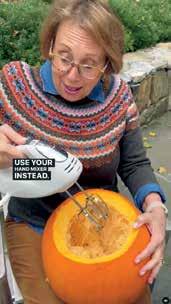
Remove pumpkin guts with a hand mixer With this hack that’s earned 4 million likes on TikTok and nearly 1 million on Instagram, Babs says skip the stress, keep your hands clean and let your mixer do the dirty work.

Give your washing machine a spa day. For mildew relief, smear toothpaste on two lemon halves, drop them in and run the machine on hot. Nearly 250,000 on TikTok loved it, with another 1.4 million liking her washer filter demo.

Clean a grill like a master. Grab some vegetables and get scrubbing. Use an onion to remove char on your grates and a halved potato, skin-side-up, to create a non-stick surface. Enjoy, as have 3 million TikTok users.

Keep mosquitoes away with Irish Spring soap. All you need is a cheese grater and a bar of soap — spread it around the fire pit and take in the clean scent that mosquitos hate. A popular Babs tip with 660,000 Instagram likes.
34 SPRING 2024
Marquette’s Alumni National Awards honor alumni, parents and friends who embody Marquette’s mission through their transformative service, achievements and influence.
Inspiring Lives
Marquette will recognize 47 distinguished alumni, parents and friends in ceremonies extending from April to September. In the following pages, we profile four recipients of the All-University Awards who will be celebrated on May 31.
35 M ARQUETTE M AGAZINE
Colleen Anne Fotsch
Lawton, M.D., Arts ’79 Oconomowoc, Wisconsin
An encounter early in her career with a cervical cancer patient undergoing radiation treatment set Dr. Colleen A.F. Lawton on course to her life’s work advancing world-class cancer care for 40 years, more than 25 of which she served as the residency program director at the Medical College of Wisconsin’s department of radiation oncology. As her career became her calling, Lawton relied on values learned from her time at Marquette and from her family and their strong Marquette legacy. “Faith has helped to steady me daily, but especially in the highs and lows of life,” she says. “As a student, I was a frequent flier at St. Joan of Arc Chapel, and I’ve tried to pass on the incredible importance of faith to our kids.” Beyond her contributions to patient care and research, Lawton has expertly guided the next generation of oncology physicians and researchers. “If you make a difference in the life of one person, you’ve made a difference,” she says. “Both in my career as a radiation oncologist and now in my new career as a volunteer, I have made and hope to continue to make a difference.”

BY
ALUMNA OF THE YEAR AWARD
PHOTOS
MIKE MILLER
PROFESSIONAL ACHIEVEMENT AWARD
Jo Ann Gardner Lenz Schedler, Nurs ’82 Gresham, Wisconsin
Weaving history and tradition into a fabric to pass to future generations is a sacred duty for Jo Ann Schedler. She has long strived to honor her tribal roots, serve her country, and uplift her community and young Native leaders. “My Marquette education and experience taught me critical thinking skills, compassion, dedication, the need to continually learn by developing body, mind and spirit, and the importance of service to others,” she says. She credits her nursing education at Marquette for preparing her for more than 20 years of service as an Army nurse reservist as well as leadership roles in Indigenous heritage, cultural preservation and education. A founding member of Marquette’s Council on Native American Affairs, Schedler is dedicated to reinvigorating the university’s ties to Native communities and supporting students through mentorship. She says, “Receiving this award is recognition of the Mohican Nation and my ancestors, who are a strong and determined people.”

SPIRIT OF M ARQUETTE AWARD
(ACHIEVEMENT BEFORE AGE 40)
Matthew D. Wagner, Bus Ad ’07
Long
Grove, Illinois
For Matt Wagner success has no finish line. Wagner joined Camping World, the world’s largest recreational vehicle dealer, as an inventory analyst and rose rapidly through the ranks, earning his current role as chief operating officer last year. As reflected in his personal life and career at Camping World, Wagner is committed to working in service of others, a philosophy that shines through in his passion for people leadership. By incorporating this philosophy, Wagner not only expands his company’s horizons but also inspires personal growth and fulfillment in his team. Wagner credits his Marquette experience for paving his professional path. “True success in my life is defined by the positive impact I hope to have on the lives of my friends, family and colleagues,” he says. “My Marquette experience helped to shape the manner in which I approach goal setting.”

BY
PHOTO
MIKE MILLER

SERVICE AWARD
James Wright Foley, Arts ’96 (posthumously), and the James W. Foley Legacy Foundation
Portsmouth, New Hampshire
Frontline journalists are unsung heroes, risking their lives to report on conflicts and amplify the voices of the voiceless in war-torn regions. James Foley’s unwavering commitment to telling those stories tragically led to his abduction and killing in Syria in 2014. The foundation of moral courage Foley gained at Marquette and his pursuit of truth, compassion and justice are now reflected through the work of the James W. Foley Foundation, which advocates ceaselessly on behalf of American hostages so the world doesn’t turn a blind eye to suffering in war zones. “We never imagined what a transformative spiritual and intellectual experience Marquette would provide for both Jim and our family,” says Diane Foley, Jim’s mother and the founder and president of JWFLF. “Jim’s spirit was fed and nurtured daily and challenged to make a difference.” His legacy at Marquette lives on through the James Foley Scholarship and the foundation’s journalism safety program, first piloted at the Diederich College of Communication, as well as the preserving of Jim’s letters, journals, stories and photos for an archive at Raynor Library.
Prepare to be inspired
Reserve your place at Marquette’s 2024 Alumni National Awards, 11 ceremonies that began in April and extend through September. The dinner honoring All-University Awards recipients will be held May 31. Visit marquette.edu/awards to read the stories of all 47 awardees.
April 18 Law School
May 29 Association of Marquette University Women and Institute for Women’s Leadership
May 30 College of Business Administration; Intercollegiate Athletics; Helen Way Klingler College of Arts and Sciences and College of Education; Opus College of Engineering
May 31 College of Nursing; College of Health Sciences; J. William and Mary Diederich College of Communication; All-University
September 20 School of Dentistry
PHOTO FROM 2011, PROVIDED BY UNIVERSITY ARCHIVES, RAYNOR LIBRARY
39 M ARQUETTE M AGAZINE

 BY JENNIFER WALTER, CO MM ’19 ILLUSTRATIONS BY M ARIA JESUS CONTRERAS
The Campus That Rocked
Hands up for the heady days when students brought an array of future musical legends to play Marquette.
In November 1992, singer-songwriter Tori Amos was set to perform a sold-out show at the Weasler Auditorium. But there was a problem.
The piano the student sound team brought in for Amos’ show just wasn’t up to par. “Her tour manager came in, hit one key, and said, ‘She’s not playing tonight,’” recounts Lisa Moore, PT ’94.
At the time, Moore was head commissioner of the Marquette concert committee — a student-run organization that booked acts such as Amos to perform at venues around campus. From negotiating contracts to advertising shows to setting up the stage, students managed every part of these concerts from start to finish.
In some cases, they had to go the extra mile to make sure the show went on.
The day of Amos’ performance, Moore sent the sound crew on a frantic search for a better piano. One of the crew members knew someone at the Bradley Center, where Frank Sinatra was playing the same night. In a stroke of luck, there was a piano available — and the students were able to bring it to campus in time for the concert.
“It was a wonderful, wonderful show,” Moore recalls. Every seat in the Weasler was filled, so she watched the performance from the catwalk, alongside committee members including Michelle (Mahoney) Anthony, Arts ’96, PT ’99, and Andy MacIntyre, Bus Ad ’95.
“I remember looking down, watching Tori Amos playing piano and thinking, ‘I love this. This is where I’m supposed to be — helping out with concerts,’” Anthony says. “And everybody else [on the committee] was the same way.”
Anthony, who became head commissioner in 1995, describes the committee’s volunteers as “all major music nerds.” It was about more than just putting on concerts; the committee wanted to bring exciting, new acts to campus.
Many colleges and universities were then hosting one or two large concerts per year, usually rock acts that were at or past
41 M ARQUETTE M AGAZINE
their peak. The Marquette committee set itself apart by booking newer and smaller acts more frequently — sometimes catching artists on their way to explosive fame.
Future megastars like Radiohead and Pearl Jam, which commissioners booked for just a few thousand dollars in the early 1990s, were in their infancy playing at venues like the Varsity Theatre. “You’d see them a year later on the cover of Rolling Stone,” Moore says.
But it wasn’t all rock ’n’ roll: Commissioners made sure to book acts that covered a broad range of genres to appeal to the broader student body. “That’s one of the things that I think we did well,” says Mike Swartz, Bus Ad ’95, who was head commissioner in 1994. “There were a lot of diverse styles of music that came to the university, and we tried to touch on as many different interests as we could.”
In the late 1980s and ’90s, genres such as grunge, alternative rock and hip-hop exploded in popularity. And being the music nerds they were, Marquette’s concert commissioners kept their ears open for artists who were causing a buzz.
“Back in the day, it was word of mouth and people sharing CDs,” Moore says. MTV was broadcasting music videos from hot new acts, and DJs were playing the latest hits on the radio. Finding music was more organic than it is today, she says.
In the late ’90s and beyond, the internet transformed how people discovered new bands and booked them. “The live entertainment space has evolved considerably since those days … specifically post-pandemic,” MacIntyre explains. Today, middle agents, boutique agencies and social media create a fragmented landscape that can be complicated to navigate.
Since graduating, MacIntyre has built a career as a talent procurement executive matching musical acts with corporate brands. And many other alumni on the concert committee continued working in music in some way after graduation. For example, Anthony toured as a musician for several years in bands and as a solo artist, and Moore was a music festival producer for many years, helping to put on events such as Bumbershoot in Seattle. Swartz is a volunteer organizer of the Maha Music Festival in Omaha, Nebraska. His time as commissioner helped him foster a love for music and make connections with people he still sees at concerts around Omaha today. “It was fun to be part of it,” Swartz says. “And there was a lot of camaraderie.”

Four Unforgettable Shows
1992 – Pearl Jam/Eleven

The Varsity Theatre could barely contain the raucous energy of Pearl Jam’s sold-out show. When frontman Eddie Vedder began to climb up a light fixture mid-performance, “I was horrified,” says Swartz. “I set them up. And those things are not that stable.”
The seats in the Varsity were a point of contention for the band, which almost refused to play, since Pearl Jam rarely performed at venues with seats. Vedder warned amateur crowd-surfers to take caution, comparing the seats to a coral reef. All night, people jumped on stage and dove into the crowd as the band shredded through tracks from their 1991 album, Ten, which eventually went platinum 13 times over.
“They put on a hell of a show,” Moore says. “And then it was like, three minutes later, we would have never been able to afford them.”
1992 – Yo-Yo
One of the most prominent female rappers to rise to fame in the ’90s, Yo-Yo drew a significant crowd to her performance at the Alumni Memorial Union Ballroom. Moore also booked several local hip-hop acts to open for her, including Kali Tribe, which was the first Milwaukee-area hip-hop group to appear on BET.
But when doors opened for the show, Yo-Yo was nowhere to be found. “She was downtown, shopping,” Moore says. Thankfully, the rapper arrived at the venue just in time to go on stage. Before she started her set, Moore helped Yo-Yo with a quick mic check. “She started rapping right when I was standing there, before she hit the stage,” Moore recalls. “That was actually kind of cool.”

42 SPRING 2024
1993 – Radiohead/Belly
Following the release of their 1992 single Creep, English rock group Radiohead was picking up traction all around the globe. Their appearance at the Varsity Theatre drew a full house, complete with a few musical stars in the audience.
“When a band that had a lot of buzz around it would come, we would get calls from other bands asking if they could come to the show,” Swartz says. The Breeders, an alternative rock outfit that had played Marquette earlier in the year, asked for tickets. They sat in the balcony as VIPs, alongside agents and media professionals, watching the up-and-coming band wow the crowd.
“Radiohead was the biggest show, in my opinion, that we had at Marquette,” Anthony says. “That show was just over-the-top awesome. I will always remember it.”


1996 – Everclear/No Doubt
Touring as an opening act for the band Everclear, No Doubt left an impression on the concert committee both on and off stage. “I remember No Doubt, and Gwen Stefani in particular, just being so genuinely and sincerely friendly to all the Marquette concert committee members,” Anthony recalls. Band members signed CDs and even sat for an interview on MUTV.
On stage, their presence was electric. “If you were just alive and breathing, you could tell that that band was gonna be huge by the summer,” Anthony says. Sure enough, it was. The band continued its worldwide tour through 1996, and was nominated for two Grammys in 1997. ¤
A few famous acts booked with Marquette and almost graced campus — learn about the shows that never were at mu.edu/almost-happened

Marquette Magazine and the Alumni Association accept submissions of news of personal and professional achievements and celebrations for inclusion in “Class Notes.” Visit classnotes. marquette.edu/submit to share your news or milestones photo. The editorial staff reserves the right to edit for content, accuracy and length. Publication of the news, events and milestones of our alumni does not constitute endorsement by Marquette University.
REUNIONS!
Alumni Reunion Weekend is May 31 – June 2, 2024. We will celebrate undergraduate class years ending in a 4 or 9 and our First Reunion (Class of 2023)! Get connected at marquette.edu/reunion.
62
Denny H. Ebert, Eng ’62, is a first-time grandfather, of Silas.
63
Bonnie J. (Sisson) Finkler, Jour ’63, worked with Catholic Charities of Northern Virginia conducting domestic and international adoptions after retiring in 2003 as a supervisor with the Bureau of Milwaukee Child Welfare.
Michael H. Molenda, Sp ’63, published The Elements of Instruction, proposing a novel typology for instructional methods.
66
James L. Gutmann, Arts ’66, Dent ’70, was honored with a 2023 Alumni Achievement Award from the University of Illinois Chicago, where he completed his dental specialty training in endodontics. He is a professor emeritus in endodontics/restorative sciences at Texas A&M College of Dentistry, a former president of the American Association of Endodontists and author of more than 40 journal articles and three textbooks.
67
John R. Albright, Arts ’67, retired from Pfizer Inc. and served as a governor-appointed volunteer commissioner on the Missouri Community Service Commission for 15 years. He was recognized by Voices for National Service as Advocate of the Year and America’s Service Commis-
sion as Commissioner of the Year in 2016. In June 2023, in the Missouri Capitol, he received the MCSC Lifetime Achievement Award, and the inaugural Albright Award was presented to the community of Mendon, Missouri.
REUNION YEAR
69
James B. Sensenbrenner, Bus Ad ’69, published his fourth book, Outdoor Legends. It features epic stories about 50 great hunters and outdoorsmen and women.
71
Rhaoul A. Guillaume, Sr., Eng ’71, was recognized by the Louisiana Section of the American Society of Civil Engineers with its 2023 Wall of Fame award. The award is the Louisiana Section’s highest award and signifies lifetime service, ASCE involvement

Last May, Kevin J. Lovell, Eng ’95, retired Army lieutenant colonel, was awarded the Society of American Military Engineers’ Gibson Veteran Transition Medal. This medal is given out yearly to a SAME member for outstanding support in assisting veterans with their transition from the military to the private sector.
News from fellow alumni
and evidence of character, honor and technical competence. Guillaume is founder and president of Gotech Inc., a professional consulting and engineering firm headquartered in Baton Rouge.
Bruce Olson, Bus Ad ’71, and Barbara (Anthony) Olson, Sp ’71, celebrated their 50th anniversary.
72
Ronald R. Hofer, Arts ’72, Law ’81, retired from The National Judicial College in Reno, Nevada, as the NJC distinguished professor emeritus, after 30 years of teaching. During his tenure, he taught 220 courses and went to 40 states, as well as Russia, the Czech Republic, Ukraine, Switzerland, Jamaica, Guam, the Federated States of Micronesia and Panama. He is the first distinguished professor in the college’s 63-year history.
REUNION YEAR
74
Malcolm MacKinnon, Sp ’74, published his book of photography Pot Shots: The Journey of a High Times Photographer, which covers his 25-year career as an editor and photojournalist for High Times magazine.
Dr. Thomas J. Rowland, Arts ’74, published Patriotism is a Catholic Virtue: Irish-American Catholics and the Church in the Era of the Great War, 1900-1918 (The Catholic University of America Press, 2023).
44 SPRING 2024

Behind the Handle
Zoë Comerford took Marquette sports media by storm. Now she’s doing the same at CBS Sports, drawing over 110,000 followers to its college basketball brand in one year.
BY RACHEL GINTNER ORLANDO
Zoë Comerford, Comm ’21, breathes sports. She always has. So, it was a big deal for her to be courtside last spring covering her first men’s basketball Final Four for CBS Sports. “It was Jim Nantz’s last Final Four. It was one of the best experiences of my career,” she says. From witnessing the San Diego State buzzer beater over Florida Atlantic to filming UConn’s Dan Hurley cut the 2023 championship net, Comerford captured every prime-time moment.
One of the youngest hires ever at the Marquette Wire, Comerford arrived weeks before the start of her freshman year to cover tennis,
Off & Running
After Marquette, Comerford landed an extended internship with ESPN. Now social media producer for college basketball at CBS Sports, Comerford lives for moments just like this — pictured here at the 2023 NCAA men’s basketball championship game.
her childhood passion. By her junior year, she was executive sports editor and covering basketball. Although the pandemic derailed the Big East Tournament, a much-anticipated coverage opportunity, she learned to explore less-familiar storylines and found audiences cared about players’ lives on and off the court. An influential pairing with then-Chicago Cubs, now-Chicago White Sox announcer Len Kasper, Comm ’93, through Marquette Mentors reinforced this nuanced approach. Now she’s the wizard behind the screen of CBS Sports College Basketball on Instagram, TikTok, Threads and YouTube Shorts, drawing on her Marquette experiences to drive impressive follower growth. “Recently, KJ Adams, a Kansas Jayhawk, gave a game-winning performance in the face of flying home the next day for his mother’s funeral. I shared that story,” she says. “You’re not always going to get those humanistic storylines from other outlets.”
While her schedule is intense — she works nearly every single night shift from November through March — she loves her beat and owns every post. “These are not just game recaps for me. They’re about truly connecting.” ¤
45 M ARQUETTE M AGAZINE
SOCIAL M EDIA WHIZ

ANSWERING THE BELL
After-hours Contender
When Izzy Ries isn’t working her day job or being a mom, she finds fulfillment lacing up and focusing her energy — and her punches — on her opponents in the ring.
BY GUY FIORITA
It sounds like something out of a superhero story. By day, Izzy Ries, Arts ’14, is a buttoned-down business analyst for an affordable housing developer. By night, she is transformed, honing jabs and uppercuts on a punching bag or facing off against a sparring partner at locally owned Ford’s Gym in Madison, Wisconsin. Ries took up tae kwon do at the age of 5, and then took a class at the United Community Center in Milwaukee, where boxing “found her.” That was in middle school. “It just clicked. It made sense,” she says. Class was one thing; stepping into the ring another. “It’s your first kiss and facing your worst fear all at once. You learn to direct that feeling into focused energy, but the first time it’s pure chaos inside. It’s awesome.”
Boxing as a featherweight or lightweight, Ries is undefeated with a 4-0 record. She’s also 1-1 in kickboxing matches. Her toughest feat is balancing her moonlighting career with a full-time job and the demands of mothering a 2-year-old with her wife. Her time at Marquette helped. “At school I experienced a lot of mental and spiritual growth,” she says. “I learned to prioritize what’s important in life, and the bottom line is, if it’s important, you can find time.”
When she hangs up her gloves, Ries wants to go into coaching. “Life presents challenges, and boxing teaches you that anything worth having takes time and commitment. It’s a matter of giving yourself the grace and patience to grow. That’s a lesson I want to pass on.” ¤
46 SPRING 2024
Moonlighting
M I K E M ILLER
PHOTO BY
75
Dr. Paul Sackett, Arts ’75, University of Minnesota professor of psychology, is the winner of the Society of Human Resource Management’s 2023 Michael R. Losey Excellence in Human Resource Research award. The award honors his lasting contributions to understanding the causal nature of individual differences in behavior and performance. In 2020 he received the Dunnette Prize, an award from the Society for Industrial and Organizational Psychology. Sackett plans to donate the award money to a Marquette University scholarship that he and his wife, Dr. Patricia (Holt) Sackett, Arts ’75, a chemist, created many years ago to benefit University Honors students with a focus on women in STEM fields.
78
Rich Agnello, Sp ’78, published the sports-behavioral health novel Going to Williamsport in November 2021. The book was recognized as a finalist in the sports genre category for the 2023 American Fiction Awards, sponsored by the American Book Fest. His second novel, Jojay and the Joy of Anyway, is in progress.
John Byrne, Arts ’78, received a Lifetime Achievement award from the Association of Certified Anti-Money Laundering Specialists. Byrne is the executive chairman of the advisory board of AML RightSource. He is also an adjunct professor at George Mason
University’s Schar School of Policy and Government at the Terrorism, Transnational Crime and Corruption Center. Byrne has received numerous awards, including the Director’s Medal for Exceptional Service from the U.S. Treasury Department’s Financial Crimes Enforcement Network and for his podcast, AML Now. He also serves on Marquette’s Commercial Banking Board and other boards and steering committees.
REUNION YEAR
79
Anna M. (Dalhaimer) Bartkowski, Jour ’79, published Dead Reckoning, a modernday genealogical murder mystery set in the Southwest featuring Rosalind Schmidt, the sole survivor of her family, who gets caught in a web of genealogy, murder and karma that intertwines with her ancestors in Europe in the 1760s.
Carmela G. (Giuffre) DeVito, Jour ’79, writes monthly book reviews for the Milford Orange Times
Thomas P. Troast, Sp ’79, had his business Shore Counseling & Consulting Clinic named as one of Milwaukee’s Best Places to Work by Milwaukee Business Journal. Troast is the clinic owner and director.
80
Patrick J. Russoniello, Arts ’80, has done probation work for 44 years and is still going strong.
Joel Stoller, Arts ’80, a former Midwest Express captain, retired from 747 global flying


with Kalitta Air and is now a Beechcraft King Air captain with Wheels Up private jets out of New York City.
81
Michael B. Thimmig, Bus Ad ’81, joined the law firm Blank Rome LLP as a partner in the finance group based in Dallas.
82
Debra (Estes) Booker, Bus Ad ’82, was appointed as a human resources expert at the U.S. Peace Corps.
83
John P. Pickard, Arts ’83, a commander with the Lakewood (Colorado) Police Department, was assigned the commander of the Denver Metropolitan Auto Theft Task Force overseeing 15 detectives from 11 metro-area jurisdictions.
Dave Ross, Sp ’83, became chief operating officer for New York-based BioDigital, a high-end 3D animation and extended reality company.

All Together Now
Since Jennifer Lewis, Arts ’85, was diagnosed with ALS in 2021, the debilitating neurologic disease has robbed her of the ability to speak, made walking difficult and required her to use a feeding tube.
But Lewis, a former chef instructor in Chicago, got some help in her battle last fall when a group of Marquette classmates formed a team for the annual Les Turner ALS Foundation Walk for Life at Soldier Field. They helped her participate physically and raised funds to support people living with the disease and researchers working toward a cure.
“I was, and still am, truly humbled,’’ Lewis says of the support from her classmates. “They are giving me courage to stay strong in my everyday struggles.’’
— Mary Schmitt Boyer, Jour ’77
47 M ARQUETTE M AGAZINE

Honor Role
Dr. Kristina Ropella, Eng ’85, had a winning 2023. The Opus Dean of the Opus College of Engineering was named an Imprint Award winner by Milwaukee’s Professional Dimensions. The award recognizes women making a lasting mark in their career, community and collaborations. Ropella was also the Groundbreaker honoree in the 2023 Betty Awards, presented by Milwaukee Magazine in honor of late publisher Betty Quadracci.
Ropella — whose firsts in the Opus College have included being its first female full professor, department chair and dean — founded Marquette’s E-Lead program, through which students from across campus build their innovation leadership abilities. “It is gratifying to see our graduates discovering the ‘groundbreaker’ in themselves by using their strengths and core values to lead change in the world,’’ Ropella said in accepting her Betty Award, recognizing students not traditionally represented in engineering. “It is inspiring that this vision is shared by the Milwaukee community, and I hope we will see more collaboration in the important work ahead.’’
REUNION YEAR
84
Bruce Bode, Bus Ad ’84, became the executive director of the U.S. Adult Soccer Association in March 2023.
85
Steven Broniarczyk, Jour ’85, visited Antarctica in 2023, having completed traveling to all seven continents of the world.
Thomas Lenz, Arts ’85, was inducted as a fellow of the College of Labor and Employment Lawyers on Nov. 14, 2023. He practices labor and employment law with Atkinson, Andelson, Loya, Ruud & Romo in Pasadena, California, and is a lecturer at USC Gould School of Law.
86
Mary M. (Conway) Sullivan, Arts ’86, began writing and sharing essays of her experiences about her newly purchased farm in a blog, What the Farm. Her new book of the same name is an outgrowth of her experiences.
87
Anthony Dalesandro, Sp ’87, won a 2023 Clio Award for his work as an editor in the branded entertainment category for the Sony Entertainment feature film Bullet Train
Rev. W. Thomas Long, Bus Ad ’87, was the first of three Marquette alums in a row to serve as vicar for clergy in the Diocese of Green Bay. Long served 2010-2017; Rev. Luke
Ferris, Arts ’86, served 20172023, and Rev. Mark Vander Steeg, Arts ’95, began serving in July 2023. The three priests all appreciate their Marquette education.
REUNION YEAR
89
Mike Malec, Arts ’89, was named Distribution Rep of the Year for medical sales by Repertoire Magazine
90
Maria Pica, Arts ’90, was named one of the top 200 optometrists in the U.S. by Newsweek magazine. She practices in St. Charles, Ill., at a multi-specialty clinic, specializing in primary eye care, dry eye disease and myopia control. She co-founded one of the top centers for myopia control in the Midwest.
91
Erin K. (Muldoon) Kresse, CJPA ’91, Grad ’04, accepted a new job at the Chicago law firm Grant & Eisenhofer.
Beatriz Terry, Dent ’91, was named president of the Florida Dental Association on June 30, 2023.
93
Gene Lass, Arts ’93, was promoted to editor in chief of Worship Facility Media at EH Media. He also published his eighth book of poetry, American
REUNION YEAR
94
Jeff Bahr, M.D., Arts ’94, medical group president for the Midwest region of Advocate Health, was named chair-elect of the Wisconsin Hospital Association’s Board of Directors for 2024. Bahr joined the WHA board in 2018.
Nicole (Budecki) Nelson, Arts ’94, PT ’97, was promoted to executive director of ambulatory operations at Children’s Wisconsin.
Dr. Brian O’Neill, Bus Ad ’94, earned his doctorate in business administration from Creighton University. His dissertation focused on the effects of cognitive and affective organizational identification and personality on job satisfaction and organizational commitment. He is an assistant professor and graduate business program director at Molloy University’s School of Business.
Jennifer (Lay) Riske, CJPA ’94, is an executive producer at NBC Chicago (WMAQ). She and her co-workers received an Emmy for best morning newscast for “Kenwood Highrise Fire.”
Steve Sapita, Arts ’94, was promoted to section manager for Chemical Personnel Search’s industrial laboratory recruiting division.
95
Nathan Y. Andres, Arts ’95, global HR executive, coach and well-being leader, recently published his first book, Your
48 SPRING 2024
SHARE YOUR NEWS WITH FELLOW ALU M NI @ CLASSNOTES. M ARQUETTE.EDU/SUB M IT.
Did you catch Adam J. Plantinga, Arts ’95, on his book tour? Plantinga published his debut novel this year, the thriller The Ascent about an excop caught up in a prison riot. It has received starred reviews from Kirkus Reviews and Publishers Weekly, and been praised by bestselling authors such as Harlan Coben and Robert Crais. Plantinga’s first book, 400 Things Cops Know, was nominated for an Agatha Award and won the 2015 Silver Falchion award for best nonfiction crime reference.

REAL Life: Get Authentic, Be Resilient & Make It Count. The book hit Amazon’s bestsellers in numerous categories and is inspired by the foundations of cura personalis. Drawing on what Andres calls The REAL Model and the power-packed combination of authenticity and resilience, the book is a formula for living a life of well-being, good mental health and joy.
Kevin J. Lovell, Eng ’95, recently started on CBRE multinational technology client to lead design teams delivering critical infrastructure projects across a data center portfolio. In May, Lovell, a retired Army lieutenant colonel, was awarded the Society of American Military Engineers’ Gibson Veteran Transition Medal. This medal is given out yearly to a SAME member for outstanding support in assisting veterans with their transition from the military to the private sector.
Adam J. Plantinga, Arts ’95, published his debut novel in January 2024, a thriller from Grand Central Publishing, The Ascent, about an ex-cop
caught up in a prison riot. Plantinga, a former Milwaukee police officer, is a sergeant with the San Francisco Police Department. See more about his new book above.
96
Craig A. Hausz, Bus Ad ’96, the managing partner for CMH Advisors in Dallas, was added to the board of directors for the Professional Association of Small Business Accountants.
97
Jennifer A. (Smith) Damiano, Arts ’97, was named the Cincinnati Market president for KeyBank, continuing with her responsibilities as market leader for Key Private Bank for Cincinnati and Dayton, Ohio.
Dr. Katharina A Quinlan, Arts ‘97 Grad ‘04, an assistant professor of biomedical and pharmaceutical sciences at the University of Rhode Island’s Ryan Institute for Neuroscience, is principal investigator on three new grants totaling $8.5 million
to investigate key questions in cerebral palsy.
01
Dr. James P. Keane, Grad ’01, was named director of the Boston Bulldogs Running Club, an innovative peerto-peer collective of people recovering from drug and alcohol addictions, and their allies, who use the fellowship of the road to provide support and solidarity to others in similar situations.
03
Michael W. Carney, Bus Ad ’03, Grad ’05, was named co-managing director at Vrakas CPAs + Advisors in Chicago. He will specialize in small business accounting and tax compliance for privately held, for-profit companies.
Zac A. Dooley, Eng ’03, was recently elected to the Biomedical Engineering Society board of directors for a threeyear term.
Adrienne Perry, Comm ’03, was promoted to chief revenue officer at Borsheims, where she will steward sales divisions toward continued growth while aligning departments to create a seamless omnichannel experience. Perry has been with Borsheims for 19 years. She also volunteers with Omaha Performing Arts and the Child Saving Institute, where she was Volunteer of the Year in 2022.
Manuel Santiago, Grad ’03, was recognized by Madison 365 as one of Wisconsin’s 40 Most Influential Latino Leaders for 2023.

When it comes to milestones, your golden wedding anniversary is quite the celebration. Barbara (Anthony) Olson, Sp ’71, and Bruce Olson, Bus Ad ’71, celebrated their 50th wedding anniversary in July 2023. Seen here on their special day in 1973, the couple now live in Naples, Florida.
49 M ARQUETTE M AGAZINE
Deeds Not Words
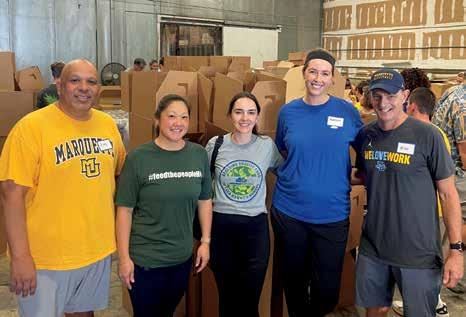
Marquette Kokua in Action
When Marquette fans traveled to Hawaii for last November’s Maui Invitational, they did more than cheer on the men’s basketball team. More than 30 alumni, parents and friends served (kokua in Hawaiian) with the local nonprofit Aloha Harvest to prepare 500
REUNION YEAR
04
Quenjana Adams, Comm ’04, opened 2048, a low-alcohol, no-alcohol wine shop in the heart of Chicago on Sept. 1, 2023. The mission is to offer an inclusive experience for all wine enthusiasts, featuring a curated selection of low-alcohol and alcohol-free wines.
05
Kyle O’Meara, Bus Ad ’05, was promoted to chief financial officer of MW Components, a manufacturer of springs, fasteners and other precision components. He has been with MW since 2018 and is based in Chicago.
06
Heidi Knuth, Arts ’06, was selected as the Youth Services Librarian of the Year by the Illinois Library Association and presented with the award at its annual conference.
07
�� Jenny (Bobula) Buttino, Comm ’07, and Thomas Buttino: twins Maxx and Mia born March 29, 2023. They join big brother Roman. The family lives in Phoenix.
Heather Leszczewicz, Comm ’07, is recruitment marketing manager for Conagra Brands in Chicago. She was recently named Inspirational Solo Tal-
Thanksgiving meal boxes for the Honolulu community. Alums and others organized food donated from local Hawaiian farms and collection bins, before they assembled meal boxes, wrote cards to accompany the boxes and wrapped pallets for delivery.
“Our purpose is greater than ourselves,” says Jeremy Fukunaga, whose family owns the warehouse in which Aloha Harvest assembled the meals. He expressed gratitude for Marquette’s service. “The world is bigger than us, so let’s make a mark on the world.”
WHAT’S SHA K IN’
As Marquette welcomes alumni home this summer and nears the June culmination of its Time to Rise campaign, explore how you can connect and serve with the Marquette University Alumni Association at mu.edu/engage
ent Brander of the Year at the Talent Brandies by the Talent Brand Alliance.
08
❤ Margaret M. (Pollard) Hogan, Comm ’08, and Andy Hogan, wed June 9, 2023, in Door County, Wisconsin, on a sailboat.
REUNION YEAR
09
Dr. Maria Novotny, Arts ’09, recently published a collection of curated art and writing, Infertilities, A Curation. The book portrays the varied perspectives of individuals who have lived with infertility and makes
visible the emotional depths of infertility. Novotny is an assistant professor of English at the University of Wisconsin–Milwaukee and co-directs The ART of Infertility.
Payal Patel, Comm ’09, was appointed to the role of United Nations global goals ambassador in summer 2023 and will represent the U.N.’s Sustainable Development Goal of Economic Growth, helping to develop, promote and implement programs and initiatives designed to create a more equitable and sustainable economy. Patel also recently launched her own business, specializing in crisis management consulting.
50 SPRING 2024
�� Veronica L. (DeBiase) Zimmer, Nurs ’09, and Joseph Zimmer: daughter Alaina Stephanie born Nov. 6, 2022.
10
�� Paige M. Jorgensen Hutson, Comm ’10, and Matt Hutson, Arts ’10: son Harvey born April 28, 2023.
�� Christine (Kehl) Trainor, Ed ’10, and Lucas Trainor, Arts ’10: daughter Nora Marie born June 18, 2023. She joins big brother Jackson.
�� Lauren (Schultz) Woelfel, Comm ’10, and Joe Woelfel, Comm ’10: son Douglas born May 11, 2023. He joins big brother Charlie.
11
❤ Kristi (Candotti) Eby, Eng ’11, and Joe Eby, wed May 6, 2023, with a small ceremony at Central Standard Crafthouse & Kitchen followed by the first wedding reception ever held at Wheel & Sprocket Bay View. The celebration was attended by Marquette alumni from 1968 to 2023.
❤ Liz (Grams) Ford, Comm ’11, and Scott Ford, wed in July 2023 and spent a special moment at St. Joan of Arc Chapel.
❤ Allison (Reitzner) Murto, H Sci ’11, and Reijo Murto, wed June 24, 2023, in Neenah,

As promised, cherished alumni milestones have been continuously shared online at @youaremarquette on Instagram since our last issue. Submit your photos at classnotes.marquette.edu/submit. Pictured here is son Colin, born Oct. 2, 2023, to the Landry family — Gina (Black) Landry, H Sci ’13, PT ’15, and Alex Landry, Bus Ad ’14.

Wisconsin. The wedding was officiated by Mallory Steinberg, Comm ’08. The bridal party included alumna Kendall (Yates) Allmaras, H Sci ’09.
Alyssa L (Hafner) Sarno, Bus Ad ’11, has stepped into a new role at Royal Caribbean Group, leading the global destination experiences for Celebrity Cruises.
�� Grace (Ledet) Widseth, Bus Ad ’11, and Jared D. Widseth, Law ’14: son George Julian born March 7, 2023. He joins older brother Gabriel. The family lives in Omaha, Nebraska.
12
Reba (Marana) Copeland, Grad ’12, was named one of Almabase’s 50 Under 50. 50 under 50 celebrates advancement professionals nationwide in fundraising, events, data and engagement for their work creating value-driven relationships with alumni.
Micah Ogé , Comm ’12, was recognized as one of the Phil-
Alumni Spotlight
When Pedro Colón, Arts ’91, was appointed to the Wisconsin Court of Appeals by Gov. Tony Evers, he became the first Latino to serve as a judge on the court. It’s another step in a trailblazing career for Colón, who previously served on the Milwaukee County Circuit Court bench and was the first Latino elected to the state Legislature in 1998. His swearing-in ceremony in November was a proud milestone for him and a state Latino community that often sees the courthouse as something unattainable, he says. “It’s important we create a judicial system that speaks to all of us.” As a nod to his Latino heritage, a mariachi band performed the national anthem before he took his oath of office.
— Guy Fiorita
51 M ARQUETTE M AGAZINE
ALUMNI SPOTLIGHT PHOTO BY STEVE SCHUSTER, M ANAGING EDITOR OF WISCONSIN LAW JOURNAL
anthropic Five by the United Way of Greater Milwaukee and Waukesha County, for his consistent record of leading sustainability, diversity, equity, inclusion and justice initiatives connecting change movements for the business while also making an impact on local communities.
Katherine L. Pauly, H Sci ’12, Dent ’16, completed her endodontics residency in 2020 and opened her own practice, Erie Canal Endodontics, in Buffalo, New York, on July 3, 2023.
13
❤ Maura (Falk) Buss, Nurs ’13, and Eric Buss, Bus Ad ’15, wed at the Church of the Gesu on May 6, 2023. After never crossing paths at Marquette, they met and fell in love several years later. About 75 Marquette alumni were in attendance, including parents and siblings of the bride and groom and the majority of the bridal party. The couple live in Milwaukee.
Emily Foster, Comm ’13, has been named festival director of the prestigious Academy Award-qualifying Full Frame Documentary Film Festival in Durham, North Carolina. Out of nearly 7,000 film festivals worldwide, only 63 are a pathway to an Oscar nomination. She is the youngest head of an Academy Award-qualifying event.
�� Gina (Black) Landry, H Sci ’13, PT ’15, and Alex Landry, Bus Ad ’14: son Colin, born Oct. 2, 2023.
�� Brianna (Basta) Shernell, Arts ’13, and Tyler Shernell: son Cooper born July 14, 2023. He joins big brother Leonardo.
REUNION YEAR
14
�� Alix (Wilt) Fron, Ed ’14, and Ken Fron: son Garrett Joseph born Sept. 8, 2023.
�� Catherine (Nelson) Ortner, Ed ’14, and Jake Ortner: son Luka James, born Aug. 22, 2023.
Sean C. Pitts, Bus Ad ’14, associate strategy director at
agency Walton Isaacson, was recently featured as a 2023 Ad Age 40 Under 40 honoree.
15
Kevin J. Clancy, Comm ’15, leads production for documentary television, currently as Scripps’ senior international producer in longform cinematography. He has done so in over 15 countries and has previously freelanced for outlets such as Vice, Netflix and CNN. Read about his recent Emmy win in the far column on the next page.

Won’t you be my neighbor? Kaleen (Kortz) Holland, Ed ’18, and Brian Holland, Bus Ad ’18, met as neighbors on 17th Street. Five years later, they wed June 24, 2023, in Grand Rapids, Michigan. Many members of the bridal party were friends from Marquette.
�� Grant Kros, Arts ’15, and Kate (Merrill) Kros, Arts ’11: son Theodore John born June 17, 2023. Grant met Kate when he moved to Washington, D.C., in 2016 at a Marquette Alumni Club event where Kate was the club president. They married in October 2021 at the Church of the Gesu.
�� Alex Patnoe, Nurs ’15, and Gina (Bartindale) Patnoe, Nurs ’16: son Gordon Thomas born Aug. 30, 2023.
❤ Giuliana Scardina, Arts ’15, Grad ’18, and Kurt Wittmeyer, Bus Ad ’15, started dating during their senior year of high school but consider their love story truly beginning at Marquette. It was no question that Marquette needed to be a part of their big day in July 2023.
Valay A. Shah, Eng ’15, Grad ’20, started a new job as a research scientist with Leidos, supporting the Air Force research laboratory to advance war fighting capabilities and readiness.
16
❤ Jacqueline (Borzillo) Ball, Comm ’16, Grad ‘18, and Anthony J. Ball, Ed ’17, Grad ’20, wed Sept. 30, 2023, in Williamsburg, Virginia, with Rev. John Laurance S.J., associate professor emeritus of theology, officiating.
❤ Megan (Gliebe) Riutta, Bus Ad ’16, and Neal Riutta, Arts ’15, wed Aug. 12, 2023, at Jan Serr Studio in Milwaukee, the city where they met and fell in love.
❤ Thomas Wright, Bus Ad ’16, Grad ’18, and Ariana Moshref
52 SPRING 2024
SHARE YOUR NEWS WITH FELLOW ALU M NI @ CLASSNOTES. M ARQUETTE.EDU/SUB M IT.
Wright, Comm ’16, wed at Church of the Gesu on Oct. 14, 2023, with about 50 MU alums in attendance spanning two generations.
17
❤ Scott M. Friedrichs, Eng ’17, and Allison (Talken) Friedrichs, H Sci ’16, Grad ’18, wed July 16, 2022.
❤ Sydney (Dieck) Frullo, H Sci ’17, and Braden Frullo, wed Aug. 5, 2023, with 26 Marquette alumni there to help them celebrate.
❤ Derek Grifka, Bus Ad ’18, and Lexi Bueno, Arts ’13, wed Oct. 14, 2023.
❤ Rachel (Grischow)
Koshalek, H Sci ’17, PA ’20, and Zach Koshalek, H Sci ’17, Grad ’18, wed March 25, 2023, surrounded by their Marquette family.
❤ Jaden M. (Burns) McCurdy, Eng ’17, and Michael McCurdy wed May 6, 2023 in Minnesota.
❤ Caitlin Ostenby, Nurs ’17, and Philip Reid-Francisco, wed Oct. 28, 2023, in Westport, Connecticut.
Michael Tayo, Bus Ad ’17, accepted a role as assistant vice president for vulnerability management and application security product and engineering at U.S. Bank to aid in securing the digital transformation.
❤ Kendra A (Hilgemann) Troyer, H Sci ’17, Grad ’19, and Nate Troyer, wed Aug. 26, 2023, with several alumni in attendance.
❤ Carissa (Roberts) White, Bus Ad ’17, and William White, Jr., wed at the Pritzlaff in Milwaukee on Oct. 7, 2023. The couple and their cats live in Sussex, Wisconsin.
❤ Shannon (Kulpins) Zanon, Bus Ad ’17, and Ryan Zanon, Ed ’14, wed in August 2023. Their love story started at Marquette in 2014.
18
❤ Sydney Bradley, H Sci ’18, and Andrew Depies, H Sci ’18, PT ’20, who met at Marquette, were married in October 2023 surrounded by friends and family in Milwaukee, where it all began.
❤ Kaleen (Kortz) Holland, Ed ’18, and Brian Holland, Bus Ad ’18, met as neighbors on 17th Street. They wed June 24, 2023, in Grand Rapids, Michigan. Many members of the bridal party were friends from Marquette.
REUNION YEAR
19
Hannah M. Compton, Law ’19, was named to Leadership Florida’s Class of 2024.
Quazaye A. Konkel, Arts ’19, published her first chapbook, Bubblegum Heart & Other Elastic Things, on July 4, 2023.
❤ Olivia C. (Bauer) Peters, Nurs ’19, and John Chuong Peters, H Sci ’19, Dent ’22, met during their freshman year and wed in June.
❤ Michelle K. Vuong, Nurs ’19, and Jordan Obert, Eng ’19, wed in September 3, 2022, in

Milwaukee, with two generations of family members among the Marquette alums in attendance. The couple met during freshman year in McCormick Hall.
20
❤ Sophia (Pirozzoli) Ciesinski, Nurs ’20, and Jack Ciesinski, Arts ’20, wed April 22, 2023, in Washington, D.C. They met their second day of freshman year in the Cobeen dining hall. Sophia lived in Cobeen and Jack in Abbottsford.
❤ Luke Kazmer, Eng ’20, and Kate Harrison, Eng ’19, wed Sept. 2, 2023, at Villa Terrace Decorative Arts Museum, with many Marquette alumni in attendance. The wedding party ended the night at Caffrey’s Pub.
22
Johannah Lee, Arts ’22, works at the Church of the Gesu as the director of child, family and youth formation.
Honor Role
The 2022 documentary episode “Plastic Time Bomb” makes a compelling case that the recycling of plastic waste is a broken cycle. So compelling, in fact, that Kevin Clancy, Comm ’15, won an Emmy for his role producing, photo directing and editing it for Scripps News’ In Real Life series. Clancy, Scripps’ senior international producer in longform cinematography, and his team were recognized for Outstanding Science, Technology or Environmental Coverage at the 44th News and Documentary Emmy Awards last year. To see the award-winning episode — which follows the journey taken by 91 percent of the world’s “recycled” plastic, sold to developing countries and finding its way into waterways, food sources and people’s bodies — visit bit.ly/ plastictimebomb
53 M ARQUETTE M AGAZINE

I Am Marquette
TO NURTURE AND TO LEAD
His Father’s Son
Djdade Denson grew up in the impoverished-but-resilient 53206, and returned there with a passion for restoring community.
BY DJDADE DENSON, ENG ’19, AS TOLD TO DREW DAWSON, COMM ’16
My work is a reflection of my father. Both my parents, really. They were teachers in Milwaukee, guiding me through the 53206. My neighborhood sits at the bottom of a lot of lists: infant mortality, joblessness, male incarceration. You can only talk about the divisiveness between our community and others for so long. It takes a stronger community to mend divisions. I single my dad out because he helped me see another side. You see, my dad, Ron Johnson, was an activist in the city — creating restorative justice programs, youth basketball leagues and a father-son retreat, Camp Xhongo, works that still shine today even after he passed in 2021. He was respected for his ideals and praised for his creativity in bringing people together. How could I be like that?
Well, it wasn’t the path I took initially. Upon graduation in 2019, I left Marquette with an engineering degree and worked on projects like the Summerfest amphitheater and Milwaukee Youth Arts Center for a local construction firm. Accomplished? Yes. Fulfilled? Not the way I wanted to be.
There’s an African proverb: “The child who is not embraced by the village will burn it down to feel its warmth.” I wanted to create community, to provide that embrace. That’s what led me to become a manager at Coffee Makes You Black, a coffee shop and community gathering place owned by my father’s best friend, Bradley Thurman. Being there every day, face-toface with the community, reinvigorated the passion my parents instilled in me. That’s when I saw an opportunity to combine my education with this work, too. I found my way back to Marquette for the ACRE Program, which taught me about commercial real estate. Housing is a major issue in my and many communities. So, I want to dedicate my life to developing buildings, homes and communities with sustainable, affordable practices. That starts in the 53206. I’m working on a housing project with the Wisconsin Black Chamber of Commerce. Doing this, managing the coffee shop and taking over Camp Xhongo keeps me working seven days a week. But it’s not work.
Don’t get me wrong; it’s a lot. Yet, to be able to take the knowledge I’ve learned, grow it and reapply it right where I grew up, it’s a blessing. I try to be the example that I needed. ¤
In Memoriam
30s
Anita M. (Schroeder) Shanahan, Dent Hy ‘39
40s
Mary Alice E. (Eggert) Kubiak, Jour ‘43; Elizabeth J. (Cary) Bostrom, Arts ‘45; Carol L. (Kraus) Wenzler, Bus Ad ‘46; Nell C. (Culp) Percival, Arts ‘47; Albin J. Gyzinski, Eng ‘48; Constance M. (Murphy) Loescher, Arts ‘48; Alexander E. Berens, Bus Ad ‘49; Donald V. Uhen, Eng ‘49
50s
Marilyn F. (Timken) Casanova, Arts ‘50; Dorothy M. (Kelly) Hynes, Nurs ‘50; Francis H. Keuler, Eng ‘50; Robert A. Matar, Arts ‘50, Eng ‘53; Margadette (Moffatt) Moffatt Demet, Law ‘50; William P. Schuster, Arts ‘50, Law ‘52; Ralph P. Windler, Bus Ad ‘50; Rita G. (Poliquin) Denny, Nurs ‘51; Robert J. Elsbury, Arts ‘51; August A. Glazer, Arts ‘51; Jane K. (King) Guhl, Nurs ‘51; John Guidotti, Eng ‘51; Richard J. Hogan, Eng ‘51; Joan E. (Esser) Janssen, Sp ‘51, Grad ‘53; William G. Longe, Med ‘51; Robert L. Neis, Eng ‘51; Adeline C. Prokes, Grad ‘51; Robert L. Roberts, Arts ‘51; David G. Wartman, Arts ‘51; Henry E. Arndt, Dent ‘52; Donald F. Baumann, Eng ‘52; James A. Belli, Arts ‘52, Grad ‘56, Med ‘57; Elizabeth K. (Slupinski) Cadell, Nurs ‘52; Marguerite M. (Schimmel) Horne, Nurs ‘52; LeRoy F. Jost, Sp ‘52, Sp ‘54; Joan A. (Motowski) Kleinhenz, Arts ‘52; Ruth M. (Wagner) Leffler, Med Tech ‘52; Monica M. (Mooney) Nilles, Dent Hy ‘52; Charles F. Poehlmann, Bus Ad ‘52; John M. Swietlik, Arts ‘52, Law ‘56; Rita E. (Tousignant) Wilson, Arts ‘52; Dolores M. (Wilfer) Gasiorowski, Nurs ‘53; Patricia O. (O’Malley) Malone, Arts ‘53; William P. Mullane, Jour ‘53; John E. O’Connell, Grad ‘53; Joseph S. Rucci, Arts ‘53; Thomas L. Schaefer, Arts ‘53; Donna M. (Lechner) Schultz, Sp ‘53; Eleanore K. (Krage) Stockum, Grad ‘53; Robert J. Werra, Arts ‘53, Med ‘57; Clifford R. Boeckman, Med ‘54; Robert F. Buntrock, Jour ‘54; M. B. Gottschalk, Law ‘54; Barbara J. (Lang) Haessly, Nurs ‘54; Dennis R. Kobs, Arts ‘54; Sonia M. (Christie) Larson, Bus Ad ‘54; Grace I. (Fleuker) Ramseyer, Nurs ‘54; Eugene A. Ranney, Arts ‘54, Law ‘59; Richard L. Schwaller, Grad ‘54; Kathleen M. (Calteaux) Swain, Arts ‘54; Jean O. Thompson, Nurs ‘54; Lew E. Wartman, Arts ‘54; Richard H. Berg, Eng ‘55; Alexander S. Cuenin, Eng ‘55; Lucille M. (Doberneck) Daley, Arts ‘55; Donald C. Gancer, Arts ‘55, Law ‘57; John A. Gresch, Eng ‘55; Robert P. Kennedy, Eng ‘55; Rose M. (Ullrich) Kinnebrew, Med Tech ‘55; Donald L. Latus, Bus Ad ‘55; Mary Lou Masik, Dent Hy
55 M ARQUETTE M AGAZINE
PHOTO BY MIKE MILLER
‘55, Dent Hy ‘68; Richard E. Schwab, Dent ‘55; Janet M. (Horan) Treacy, Med Tech ‘55; Mary N. (Bachhuber) Treible, Dent Hy ‘55; Jeanann (Jacks) Wirth, Sp ‘55; Stanley J. Andrie, Eng ‘56; James A. Egide, Bus Ad ‘56; Thomas O. Felton, Bus Ad ‘56; Thomas J. Johnston, Bus Ad ‘56; Jane A. (Hymer) Kriz, Dent Hy ‘56; Alexander J. MacGillis, Med ‘56; Janyce M. (Lee) Mau, Jour ‘56; Patrick W. Putzi, Arts ‘56; David K. Sullivan, Bus Ad ‘56; Peter Terranova, Bus Ad ‘56; Gerald J. Ziebert, Dent ‘56, Grad ‘71; Gerald R. Armour, Arts ‘57; Frank O. Buhl, Bus Ad ‘57; Mary O. (McClimon) Cannon, Bus Ad ‘57; Donald A. Dupies, Eng ‘57; John R. Goska, Dent ‘57; Robert Kenney, Bus Ad ‘57; Ann C. Kesting, Bus Ad ‘57; Andrew J. Kinane, Eng ‘57; Roderic E. Kirk, Dent ‘57; Richard G. McGary, Dent ‘57; Robert E. Mierendorf, Eng ‘57; Bernadette M. (Slaven) Nachazel, Nurs ‘57; Eugenia M. (Schmidt) Ott, Jour ‘57; Robert B. Schilli, Bus Ad ‘57; Frank L. Schmit, Eng ‘57; Alan I. Seltz, Dent ‘57; Adrienne J. (Darovic) Smith, Arts ‘57; Dennis W. Wiesen, Eng ‘57; Rosemary E. (Holderried) Cardinal, Arts ‘58; Gerald T. Gmeiner, Eng ‘58; Rev. M. Dennis Hamm, S.J., Arts ‘58; Robert F. Jene, Arts ‘58; Donald B. Kiey, Dent ‘58; Robert M. Kools, Bus Ad ‘58; Eugene T. Krembs, Dent ‘58; Thomas M. Lally, Bus Ad ‘58; Daniel J. Miron, Arts ‘58, Law ‘60; James J. Olinger, Eng ‘58; Gary G. Ranzinger, Bus Ad ‘58; Marcia A. (Dzwinel) Roenspies, Sp ‘58; Robert J. Romalia, Arts ‘58; Gervase R. Rose, Eng ‘58; Mathias J. Willems, Eng ‘58; Willard J. Wyman, Med ‘58; Katherine B. (Blonski) Zahorik, PT ‘58; Giles F. Allison, Dent ‘59; Carol A. (Anderson) Anderson, Arts ‘59; Ann M. (Ratajczyk) Buck, Arts ‘59; Thomas E. Casey, Dent ‘59; M. L. Hansknecht, Arts ‘59, Grad ‘66; Robert G. Hoch, Eng ‘59; Henry R. Karolus, Dent ‘59; Jasper J. Laudicina, Arts ‘59; John M. Mack, Dent ‘59; Marjorie H. Mahr, Arts ‘59, Grad ‘62; Michael J. Moran, Bus Ad ‘59; Franklyn H. Schellinger, Bus Ad ‘59; Joanne M. (Riedel) Schulte, Arts ‘59; Carolann R. (Squire) Winslow, Arts ‘59, Grad ‘60
60s
Joan D. (Zauner) Barthel, Arts ‘60; Kenneth M. Batinovich, Arts ‘60; David F. Betz, Arts ‘60; John T. Frey, Arts ‘60; Herbert F. Frymark, Bus Ad ‘60; William E. Greenwood, Bus Ad ‘60; Nancy L. (Peik) Heimbold, Arts ‘60; Connie M. Hesch, Nurs ‘60; Joann S. (Schaetzl) Kriege, Arts ‘60, Grad ‘69; Mary Ellen P. (Pilgreen) Kujawa, Arts ‘60; Frank J. Lahey, Eng ‘60; Judith K. Lawrence, Arts ‘60; Gloria (Lopez Tan) Lopez-Tan Galang, Grad ‘60; Robert R. Packee, Eng ‘60; Richard W. Parker, Eng ‘60; Daniel J. Quiery, Bus Ad ‘60; Jack W. Righeimer, Jour ‘60; Robert B. Roesler, Grad ‘60; John R. Rogers, Med ‘60; Elizabeth A. (Bey) Rollo, Nurs ‘60; James S. Sovey, Arts ‘60, Grad ‘63; Jerry W. Walker, Dent ‘60, Grad ‘70; James R. Armstrong, Eng ‘61, Grad ‘75; James F. Bishop, Arts ‘61, Grad ‘65; Patricia L. (Kelley) Cunningham, Grad ‘61; William F. Fox, Law ‘61; James T. Fuller, Bus Ad ‘61; Richard J. Goeden, Eng ‘61; Donald E. Heinkel, Arts ‘61, Grad ‘66, Dent ‘71; Richard D. Hitt, Eng ‘61; Saburo Kami, Dent ‘61; Eleanore C. (Barts) Kasid, Arts ‘61; Sarah A. (Nolan) Phillips, Arts ‘61; Florence M. (McGuire) Potts, Arts ‘61; Walter J. Rottenkolber, Med ‘61; William H. Schatz, Bus Ad ‘61; Paul F. Thesing, Med ‘61; John A. Bach, Law ‘62; Barbara L. (Dutney) Barschow, Nurs ‘62; Lionel H. Dahmer, Grad ‘62; Raymond Doorack, Grad ‘62; Phillip J. Eckert, Law ‘62; Dennis R. Faltynski, Eng ‘62; Isabel F. (Firpo) Frimmersdorf, Dent Hy ‘62; C. Michael Hausman, Bus Ad ‘62, Law ‘67; James L. Huiras, Eng ‘62; Stanley V. Jaskolski, Eng ‘62, Grad ‘64, Grad ‘67; Janet H. (Johnson) Johnson Sullivan, Arts ‘62; Richard J. Kamps, Law ‘62; Albert G. Kuntemeier, Grad ‘62; Richard B. McConnell, Law ‘62; Margaret M. (Ondo) McNitt, Nurs ‘62, Grad ‘64; Gary E. Moore, Dent ‘62; Kathleen M. (Foy) Ogrin, Arts ‘62; James S. Reffkin, Sp ‘62; Kathleen E. (Kavanagh) Chapman, Arts ‘63; John L. Ciesemier, Bus Ad ‘63; Ronald S. Gawronski, Arts ‘63; Theresa A. (Villers) Griep, Arts ‘63; Arthur J. Grossman, Eng ‘63; Gerald W. Kintzle, Bus Ad ‘63; Coletta J. (Norton) Kudlack, Nurs ‘63; Marie A. (Carella) Leonardini, Arts ‘63; Hugh S. McManus, Arts ‘63, Law ‘65; Phyllis M. (Van Goethen) Nickchen, PT ‘63; John J. O’Meara, Arts ‘63; Daniel A. Orth, Bus Ad ‘63; Richard A. Pacholski, Grad ‘63; Richard A. Rock, Med ‘63; Thomas W. Urban, Eng ‘63; Andrew P. Vander Ploeg, Bus Ad ‘63, Grad ‘71; Theodore F. Zimmer, Eng ‘63; Leon O. Cummings, Dent ‘64; Fred J. George, Bus Ad ‘64; Joyce A. (Barthelme) Heinisch, Nurs ‘64; Jo Ann (Kolanda) Iglauer, Arts ‘64, Grad ‘98; Eugene H. Jobst, Bus Ad ‘64; Suzanne M. (O’Meara) Johnson, Jour ‘64; Jonathan A. Leitner, Bus Ad ‘64; Ronald M. Maher, Dent ‘64; Ronald E. Morrison, Arts ‘64; Mary J. (Clesceri) Niemiec, Arts ‘64; Helen M. (Stamm) Stangl, Arts ‘64; Donald P. Byrne, Arts ‘65; Mitzi J. (Knapp) Hlavac, Grad ‘65; William H. Kuhns, Jour ‘65; James E. Low, Law ‘65; Joan M. (Rohr) Myers, Grad ‘65; Ray J. Riordan, Bus Ad ‘65; Roberta A. (O’Hara) Schmitt, Grad ‘65; John J. Schultz, Dent ‘65; Lois A. (Gardner) Seibel, Arts ‘65; Jude M. Werra, Arts ‘65; Frederick J. Zilly, Eng ‘65; Jean T. (Meyer) Baumhardt, Med Tech ‘66; Stephen V. Bentley, Arts ‘66; Mary A. (Beerhalter) Donaghy, Arts ‘66; Bernadette A. Evanchec, Grad ‘66; William H. Flanagan, Dent ‘66; Stanley L. Lind, Law ‘66; John L. Maretech, Eng ‘66; Kenneth R. Marszalkowski, Bus Ad ‘66; Robert L. Milardo, Arts ‘66; Judith E. (Perhay) Nemmers, Arts ‘66; Gerald J. Pearson, Eng ‘66; Marie E. Pink, Grad ‘66; Thomas J. Rouse, Bus Ad ‘66; Douglas M. Roy, Arts ‘66; William M. Schmitz, Law ‘66; Mary Lee (Carron) Schweiger, Sp ‘66; Susan D. (Kreuser) Seewald, Arts ‘66; Russell G. Shomperlen, Eng ‘66; Rita L. (Laimins) Skostins, Arts ‘66; David F. Walsh, Arts ‘66; Kenneth R. Weeks, Grad ‘66; Bonnie C. (Knox) Wiesmueller, Med Tech ‘66; Peter J. Wolf, Eng ‘66; George J. Ferguson, Med ‘67; Bernard J. Kearney, Sp ‘67; Francis S. Luecke, Eng ‘67; M. J. O’Brien, Grad ‘67; Lawrence J. Pakyz, Dent ‘67; Stephen B. Rodi, Grad ‘67; Mary A. Weigel, Bus Ad ‘67; Joseph R. Aicher, Grad ‘68; Glen J. Barrett, Arts ‘68, Grad ‘70; Nancy B. (Boles) Brien, Grad ‘68; Brian F. Eckl, Bus Ad ‘68; J. M. Goodwin, Arts ‘68, Law ‘74; Mary Pat (Sullivan) Hoffmann, Grad ‘68; Paul R. Horvath, Arts ‘68; William J. Kalmer, Arts ‘68; Mary E. Koenigs, Arts ‘68; Robert J. Kroll, Arts ‘68; Robert M. Kuenn, Bus Ad ‘68; Gerald R. Lynch, Dent ‘68; Sophia A. (Din) Madden, Grad ‘68; Mary B. (O’Grady) Nicodemus, Arts ‘68; Robert G. Sadorf, Arts ‘68; Karen S. (Anderson) Schreiner, Med Tech ‘68; William D. Semlak, Sp ‘68; Thomas J. Smith, Eng ‘68; Robert J. Stoiber, Eng ‘68; Larned S. Whitney, Arts ‘68;
56 SPRING 2024
William M. Cannon, Arts ‘69; Paul A. Carmody, Arts ‘69; Ronald O. Crewe, Grad ‘69; Elizabeth A. Holmes, Arts ‘69; Kathleen M. (Doody) Liddle, Arts ‘69; Joseph J. Meylor, Eng ‘69; James L. Michalak, Arts ‘69; Renee M. (Archambault) Morrow, Sp ‘69; Gerald L. Myers, Grad ‘69; Marie Oliger, Grad ‘69; Wendy M. (Kam) Redman, Bus Ad ‘69; Eugene D. Schmitz, Eng ‘69; Lenora F. Seitz, Arts ‘69, Grad ‘90; Barbara M. (Lutz) Strosahl, Nurs ‘69; Ravindra K. Talwalker, Eng ‘69; David J. Thompson, Grad ‘69; John R. Ujda, Med ‘69; Eugene L. Woods, Eng ‘69
70s
Frances K. (Kayser) Fabian, Grad ‘70; Dona L. (Johann) Fabyan, Nurs ‘70; Gary E. Immel, Eng ‘70; Cynthia M. Johnson, Arts ‘70, Law ‘73; Shirley N. (Nelson) Kersey, Grad ‘70; Donald E. Klockow, Eng ‘70; Wilhelm J. Martin, Arts ‘70; David T. Michaud, Arts ‘70, Grad ‘74; John M. Parr, Bus Ad ‘70; Richard S. Schaff, Jour ‘70; Charles J. Slanicky, Eng ‘70; Deborah J. (Pasquinelli) Wallner-Lovasko, Arts ‘70; Eileen M. Wisneski, Arts ‘70; Charles R. Burke, Bus Ad ‘71; Thomas P. Ciccarelli, Arts ‘71; Michael F. Flynn, Grad ‘71; Frederick G. Gruhl, Grad ‘71; Mary A. (Chybowski) Jante, Arts ‘71; Elaine L. (McCart) McCart-Mercer, Arts ‘71; Claire J. Ohlmiller, PT ‘71; Barbara A. (Tortorello) Cavanagh, Jour ‘72; Phyllis A. Champeau, Arts ‘72; Margaret L. (O’Toole) DiPaolo, Sp ‘72; Richard F. Drews, Bus Ad ‘72; Maria T. (Stepovich) Greulich, Nurs ‘72; Lyle W. Heller, Grad ‘72; Dennis J. Macchia, Arts ‘72; Nancy A. (Weideman) Phelps, Law ‘72; David F. Behnke, Grad ‘73; James C. Cullen, Bus Ad ‘73; Daniel S. Grossman, Grad ‘73; Gregory B. Hays, Law ‘73; Richard W. Janisch, Grad ‘73; Herman B. John, Law ‘73; Owen R. Morse, Dent ‘73; Karen G. (Christensen) Oechler, Med Tech ‘73; Donald J. Piotrowski, Arts ‘73; Patrick N. Schuette, Arts ‘73; Paul D. Dibley, Dent ‘74; Andrew P. Friedrich, Sp ‘74; Robert G. Luberda, Arts ‘74; Joseph W. Rochefort, Grad ‘74; Gregory A. Ruidl, Arts ‘74, Law ‘78; Sharon R. (Novara) Bertram, Arts ‘75, Law ‘91; Frances L. (Loiacono) Demo, Nurs ‘75; Charles J. Elliott, PT ‘75; Patricia A. (Johnson) Lynch, Arts ‘75; Robert B. Rivers, Sp ‘75; Janet E. Steiner, Grad ‘75; John C. Candon, Law ‘76; Michael K. Coughlin, Jour ‘76; Christopher R. Dix, Dent ‘76; Elmer C. Prenzlow, Arts ‘76; Richard P. Scharnell, Bus Ad ‘76; Jean M. (Elmer) Simone, Dent Hy ‘76; David W. Ullrich, Arts ‘76; John R. Willert, Arts ‘76; Frederick L. Zievers, Law ‘76; Timothy G. Costello, Arts ‘77, Law ‘80; Robert P. Hockenberry, Eng ‘77; James P. Karolewicz, Med Tech ‘77; John J. Schaefer, Bus Ad ‘77; Lynne F. (Du Puis) Soto, Grad ‘77; Mary A. (Dusnak) Baewer, Arts ‘78; Debra A. Heiber, Grad ‘78; Theresa J. (Kelly) Berry, Sp ‘79; Ronald W. Erickson, Grad ‘79; Nichols L. Nelson, Arts ‘79, Dent ‘84; Gary R. Topolski, Bus Ad ‘79
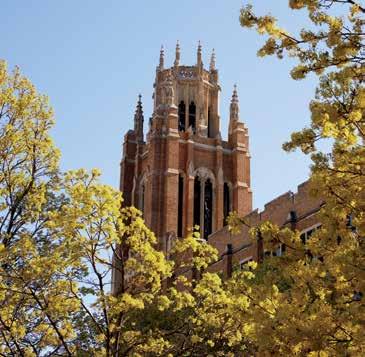
McDermott, Sp ‘81; Judith A. (Hudek) Reilly, Arts ‘81; Joseph R. Eshoo, Eng ‘82; Lisa M. (Morin) Lafrance, Bus Ad ‘82; Kathleen A. (De Bruin) Sinclair, Nurs ‘82, Grad ‘90; Peter C. Freiburger, Bus Ad ‘83; Douglas L. Meyer, Bus Ad ‘84; Gregory P. Rader, Eng ‘85; Nelson W. Sechrist, Grad ‘86; Thomas M. Suchla, Eng ‘86; Joan E. Carter, Grad ‘87; Mark J. Tillmann, Eng ‘87; Dan L. Beaupre, Dent ‘88; David A. Diehl, Grad ‘88; Mark J. Galligan, Grad ‘88; Dwight A. Sabee, Eng ‘88; Gayle E. (Dimmick) Walkowiak, Grad ‘89
90s
Caroline M. (Chisholm) Conway, Arts ‘90; Charlene S. (Danecki) Hall, Nurs ‘90; John C. Kuehne, Grad ‘90; Sharon L. Brooks, Dent ‘91; Mary P. Still, Arts ‘91; Steven A. Prescott, Arts ‘92; Michael F. Bishop, Law ‘93; Anthony J. Hutton, Bus Ad ‘93, Bus Ad ‘00; Margaret M. Jacques, Grad ‘93, Grad ‘00; Jeffrey R. Klaiber, Grad ‘94; Susan K. Hanley, Arts ‘96; Brian K. Oppeneer, Law ‘96; Daneen D. (Fitzpatrick) Berres, Arts ‘97; Mary K. (Dooley) Newcomb, Grad ‘97; Barbara A. (Schiefelbein) Scheibe, Grad ‘97
00s
David J. Horzewski, H Sci ‘00; Margaret M. Melton, Prof St ‘00; Paul C. Westrup, Eng ‘03; Diane Ciskowski, Law ‘04; Peter W. Krol, Bus Ad ‘04, Grad ‘05; Timothy L. Pagel, Law ‘07
Michelle A. (Smith) Jacobson, Law ‘80; Timothy M. Schultz, Law ‘80; John A. Zerfas, Eng ‘80; Margaret M. Broeren, Sp ‘81, Grad ‘83; Mary C. Dugan, Arts ‘81; John S. Kaluzny, Arts ‘81; Mary V. (Butler)
10s
Adrian M. Kasperowicz, Grad ‘19
57 M ARQUETTE M AGAZINE
80s
Helping Students and Communities RISE.
By opening doors through scholarship, benefactors have the power to change student lives. Wintrust — Marquette’s commercial banking partner and proud supporter — has championed hundreds of scholarship awards through its Wintrust Ignatian Promise Scholarship Fund.
Our shared spirit of service and excellence continues to grow.
Scan the code to learn how Wintrust is being the difference for Marquette and beyond.


Difference Maker

IN DEFENSE
Gold-standard Public Service
Kelli Thompson’s impact is defined by her work representing more than 10,000 defendants in need during 27 years in Wisconsin’s State Public Defender’s office, 12 of them as its leader.
BY DREW DAWSON, CO MM ’16
It’s a passion that began at Marquette Law School, where an internship in her third year brought her to the Milwaukee public defender’s office. She felt called to serve, and to forge a path distinct from but informed by that of her teacher and health advocate mother, Sue Ann, and multi-term Wisconsin governor father, Tommy.
“There was such a focus on trial advocacy at Marquette, and years later, here I am, working with people, some of whom feel marginalized by the criminal justice system,” says Thompson, Law ’96. “You get to stand with them. You get to advocate for them. I would say there’s no more important role in the criminal justice system.”
When she became the state public defender in 2011, she inherited a statewide staff of more than 600 and a $1.13 million budget. Facing a long-brewing crisis around attorney satisfaction and recruitment, she
responded by sitting down with public defenders in all counties and initiating collaboration with prosecutors, governors, legislators and legal associations. She unified the legal community to advocate for better public defender pay and ultimately prevailed upon a hyperpartisan Legislature to allocate state funds to boost long-stalled pay for public defenders from $27.24 per hour to $36.
This was Thompson’s final victory at the helm. She left the office in October for private legal practice in Madison, yet she still makes time to serve as a public defender when she can. “Marquette is mission-driven, and this work I do is mission-driven,” Thompson says. “And this will always be my mission.” ¤
59 M ARQUETTE M AGAZINE
PHOTO BY GARY PORTER
Come home to Marquette.
Whether you graduated five years ago or 60, we welcome you home to reconnect and reminisce with classmates and to enjoy unforgettable events — from campus tours, a block party and Marquee Night with live music to our Golden Jubilee celebration, milestones for Marquette’s EOP and Hispanic Alumni Association, Mass and much more.


May 31 – June 2, 2024 mu.edu/reunion
2023 2019 2014 2009 2004 1999 1994 1989 1984 1979 1974 1969 1964
1881
Marquette University P.O. Box
Milwaukee, WI 53201-1881
