November 2022 Marquette Monthly 3

2 Marquette Monthly November 2022
November 2022 No. 403
Publishers Jane Hutchens James Larsen II Managing editor Jackie Stark Calendar editor Carrie Usher
graPhiC design Jennifer Bell Knute Olson
Proofreader Laura Kagy
Armstrong
PhotograPher
Buchkoe
Monthly, published by Mod el Town Publishing, LLC, located at PO Box 109 Gwinn, MI, 49841, is

2022 by Model Town Publish
contents

4 City Notes
highlights of iMPortant haPPenings
14 oN Campus news froM u.P. universities & Colleges
16 theN & Now Superior View the luMberjaCk tavern
17 New York Times Crossword puzzle uPs & downs (answers on Page 64)
18 Feature Brad GiSchia ProjeCt jade
22 the arts John SmolenS Michael Waite’s birdsong
25 lookout poiNt michael murray a vision for the future
28 iN the outdoors Scot Stewart oh deer
34 BaCk theN larry chaBot ‘Marion tried theM all’
36 lookout poiNt KriSty BaSolo malmSten CoMPassionate Care
40 iN the outdoors KriSti eVanS recreatinG reSponSiBly
at the taBle Katherine larSon a luCullan thanksgiving
superior reads Victor VolKman happy endings and a feW laughs in noveMber’s picks
lookout poiNt deBorah K. Frontiera Making ConneCtions
ColoriNg page Brad GiSchia how to dress a turkey
ries
to jane@marquettemonthly.
james@marquettemonthly.com
BaCk theN larry chaBot disPuted firsts, Milestones and reCords
poetry Janeen perGrin raStall how to build a sauna
About the Cover Artist
Sandi Mager made her living as a nurse, but art has always been her passion. Twenty-five years ago, she got together with friends to learn oil painting, which turned into weekly classes to help pass the long winter months, and now her work is in galleries. Find her on Facebook and Instagram under sandimagerart or email her at sandileamager@aol.com
iN the outdoors alex lehto clarK snowy serenity
lookout poiNt Brad GiSchia south side Pride
lookout poiNt Joyce wiSwell working with the weather
home CiNema leonard heldreth aCtion takes Center stage in three unCoMMon thrillers
out & aBout carrie uSher noveMber events and MusiC,
and MuseuM
November 2022 Marquette Monthly 3
in the area
44
47
48
51
52
55
56
60
62
63
65
art
guides Marquette
locally and independently owned. Entire contents Copyright
ing. All rights reserved. Permission or use of editorial material in any manner must be obtained in writing from the publish ers. Marquette Monthly is published 12 times a year. Subscriptions are $65 per year. Freelance material can be submitted for consideration to editor@marquette monthly.com. Events can be submitted to calendar@marquettemonthly.com. Ad inqui
can be sent
com or
CirCulation Dick
Chief
Tom
www.marquettemonthly.com (906)360-2180
city notes
League of Women Voters to host November meeting
The League of Women Voters of Marquette Co. will hold its next membership meeting on Wednesday, Nov. 2 from 6:45 to 8:15 p.m. Social time begins at 6:30 p.m. The meeting will be held in Studio 1, in the low er level of the Peter White Public Li brary. The League of Women Voters is a nonpartisan political organization that encourages informed and active participation in government, works to increase understanding of major pol icy issues, and influences public pol icy through education and advocacy. All are welcome to attend. Email to lwvmqtco@gmail.com for more in formation.
41 North Film Festival returns

The annual 41 North Film Festival will be held Thursday, Nov. 3, through Sunday, Nov. 6, at the Rozsa Center for the Performing Arts. The festival once again offers an excep tional opportunity for people to gather together and watch thought-provok ing, entertaining and award-winning films from around the world that ex plore a range of issues, ideas and per sonalities. Along with over 20 films (both features and shorts), there will be special guests, educational panels and other attractions. Visit 41north filmfest.org to see the full line-up of films and events. The festival is free and open to the public. MTU students will need to bring their HuskyCard. No ticket is necessary for others at tending the festival this year. Email festival director, Erin Smith, at er smith@mtu.edu for more informa tion. Major sponsorship for the festi val is provided by the Department of Humanities, the Department of Visual and Performing Arts, the College of Sciences and Arts and the Rozsa Cen ter for the Performing Arts.
DNR seeks committee members
The Department of Natural Re sources’ Nonmotorized Advisory Workgroup is seeking applications to serve a four-year appointment. Mem bers are expected to participate in four meetings each year. The group assists the Michigan Trails Advisory Council in performing the duties and responsi bilities of the council and to provide the DNR with advice related to the nonmotorized trails program. This in cludes advice related to the creation,
development, operation and mainte nance of the state-managed and des ignated nonmotorized trail system. Applications must be completed by Nov. 15. In addition, the Michigan State Waterways Commission is seek ing two candidates to assist its adviso ry board that works with the DNR on the use of dedicated funds, provided by boaters, for the acquisition, devel opment and maintenance of public harbors and boating access sites and certain locks and dams.
Revolve CC Conference set to take place in November
On Nov. 4 and 5, Revolve CC will host four keynote speakers and two engaging design paths — Ignite and Forge. Ignite aims to set ablaze creativity with seminar-focused con versations about creative work. Forge focuses on workshop-like sessions. The conference takes place at Ma sonic Square, located in downtown Marquette. Visit revolvecc.net/regis tration to purchase tickets, which are on sale through Nov. 5.
UP Health System-Bell nurses vote to join union
With a vote of 51-0, nurses at UP Health System-Bell have voted to form a union with the Michigan Nurses Association. The National La bor Relations Board counted the bal lots from the mail-in election at their offices in Milwaukee in October. The results mean that the over 60 nurses at UPHS-Bell will now have a union. This is the fourth facility of health care workers in the Upper Peninsula that has voted to unionize with the Michigan Nurses Association since the start of the pandemic. Techs and ancillary staff at UPHS-Marquette, nurses at Aspirus Keweenaw Hospi tal, and healthcare professionals at the Chippewa County Health Department have all previously voted to unionize with MNA.
Marquette farmers market moves indoors
Starting Saturday, Nov. 5, the Downtown Marquette Farmers Market transitions indoors at the Mar quette Commons. Customers will be able to continue shopping the market through Dec. 17. During the month of November, shopping hours will be Saturdays from 9 a.m. to 1 p.m. There is no market on Saturday, Nov. 26. The first-ever Holiday Market will be Saturdays in December from 10 a.m.

4 Marquette Monthly November 2022
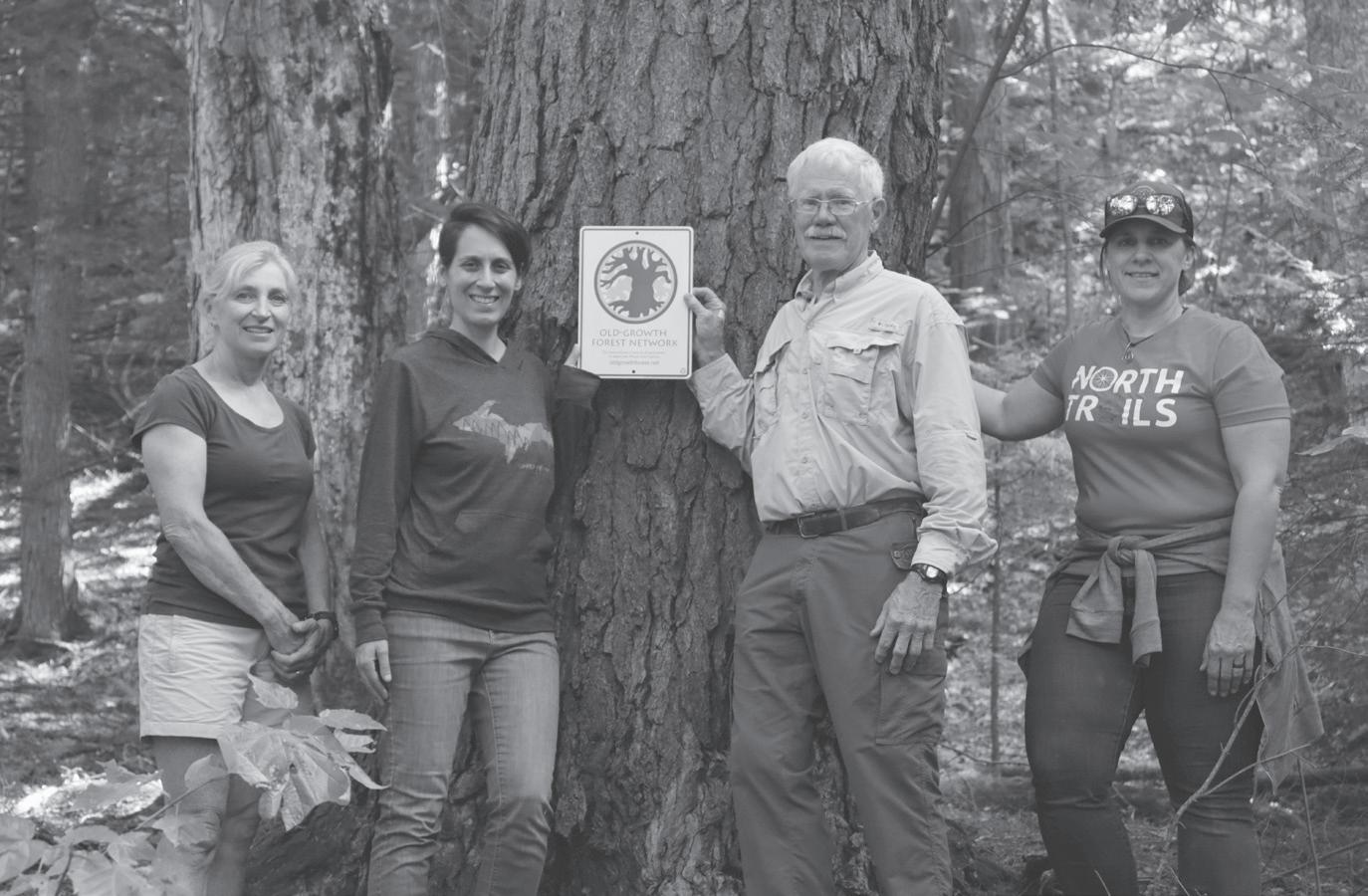
Marquette became the first county in the Upper Peninsula to officially include 92 acres of old-growth forest within the Old-Growth For est Network (OGFN). The OGFN is the only national network in the United States of protected, older native forests, and Saux Head Lake Forest became the first in Michigan to be dedicated on private lands. Property owners Craig & Phyllis Stien were recognized for their efforts to protect and steward this area for future generations of Upper Peninsula residents to enjoy. Saux Head Lake Forest was chosen due its boreal growth, age of trees, variety of species, accessibility to the public and its urgent need for protection due to a proposed commer cial rocket launching site 1.5 miles away. Pictured from left to right are NTN Board Member Tracy Goble, OGFN Coordinator Lanni Lantto, property owner Craig Stien and NTN Executive Director Lori Hauswirth presenting signage next to a 400-year-old Hemlock. (Photo courtesy of Marquette County Old-Growth Forest Network)

to 2 p.m., ending with the season fi nale on Dec. 17. Follow the market on social media and visit mqtfarmers market.com to subscribe to its news letter for up-to-date information.

Wolfshead Theatre company returns with Mr. Burns
The Wolfshead Theatre company will open Mr. Burns at 7:30 p.m. on Nov. 2 at the Ore Dock Brewing Co. with additional shows at the same time on Nov. 9, Nov. 13 and Nov.16. Visit www.upshakes.org for tickets. Anne Washburn’s imaginative dark comedy propels its audience forward nearly a century, following a new civ ilization stumbling into its future. Af ter the collapse of civilization, a group of survivors shares a campfire and be gin to piece together the plot of The Simpsons episode “Cape Fear” entire ly from memory. Seven years later, this and other snippets of pop culture (sitcom plots, commercials, jingles, and pop songs) have become the live entertainment of a post-apocalyptic society, sincerely trying to hold onto its past. Seventy-five years later, these are the myths and legends from which new forms of performance are creat
ed. A paean to live theater, and the re silience of Bart Simpson through the ages, Mr. Burns is an animated explo ration of how the pop culture of one era might evolve into the mythology of another. Directed by Jamie Weeder. For more info call 906-869-1456.
UP-Wide LIVE Art & Word Contest
West End Suicide Prevention will kick off the 3rd Annual LIVE Art & Word Contest as a way to help break the stigma surrounding men tal health issues and suicide, engage students, encourage positive men tal health and showcase the talents of high school students from across the Upper Peninsula. The LIVE Art & Word Contest is open to all high school students across the Upper Peninsula. Students can submit en tries with the theme “Mental Health Awareness” in three categories: Visu al Art, Written Word and Song/Dance/ Theater. Students may submit poetry, paintings, photography, song, graphic arts, dance, quilting or any other art form that addresses the theme of men tal health awareness. New this year, students will have the opportunity to

November 2022 Marquette Monthly 5
Marquette County forest included in national registry
2022 Annual Celebration: Celebrating Community Together
Nearly 300 guests, donors, spon sors, staff and trustees gathered on Sept. 14 at NMU’s Northern Center for the Community Founda tion’s especially festive Annual Cel ebration. During the dinner’s annual meeting, new officers and trustees were announced and departing of ficers and trustees were thanked for their service. Annual awards were also presented to the following:
Beth Millner Jewelry, Catalyst Award, Business Beth Millner is celebrating her 15th year in business creating and selling unique and beautiful pieces of jewelry that evoke the beauty of the Upper Peninsula and nature. In 2007, she came up with the idea to design a custom pendant reflecting the work of a local non profit and then donating a portion of sales of the pendant back to the non profit. Every year, Millner chooses two nonprofits to donate sales from a specific design to, and is currently focused on supporting arts and en vironmental organizations. Another expression of giving back to the en vironment is the business’ tree plant ing initiative. Thanks to this collabo rative project, Beth Millner Jewelry has been able to plant more than 6,500 trees in collaboration with the National Forest Foundation.
Cedar Tree Institute, Catalyst
Award, Nonprofit Organization
Established in 1995, The Cedar Tree Institute (CTI) is a non profit organization providing ser vices and initiating projects in the areas of mental health, interfaith collaboration and environmental stewardship. Jon Magnuson is CTI’s founder and executive director. In 2021, CTI helped develop programs addressing the rising challenges of mental health needs, isolation and substance abuse in rural Northern Michigan, which were exacerbat ed by the COVID-19 pandemic. In addition, CTI’s annual tree planting project, a collaborative effort with the Yellow Dog Watershed Preserve and Big Bay’s Community Pres byterian Church, planted 500 trees along the banks of Lost Creek. CTI also established the Northern Great Lakes Interfaith Water Stewards Ini tiative, which is currently focused on addressing the quality of drink ing water in the Great Lakes region.
Barb and Pete Kelly, Catalyst Award, Individual
For residents and visitors, a short walk around Marquette provides tangible manifestations of Pete and Barb Kelly’s dedication to the city they call home. Many of the loveli est areas in town are due to the Mar quette Beautification Committee’s efforts, a group the Kellys helped

establish in 1978. Petunia Pande monium has served as the kickoff to summer in Marquette since it began in 1989. Every year since its incep tion, the Kellys have spearheaded the event, with Barb coordinating the soil preparation, flower planting and volunteers, and Pete tireless ly working to ensure that irrigation systems and all 200 sprinkler heads are perfectly calibrated for the sea son.
Maya Lackey, Catalyst Award, Youth
experience in community philan thropy and grantmaking.
Joani Miller, Posthumous Cat alyst Award
M
aya Lackey, a senior at Mar quette Senior High School, inspires others through her enthusi asm and commitment to giving back to her community. Maya has vol unteered with many nonprofits and events in Marquette, including Hope Starts Here, The Noquemanon Ski Marathon, Hiawatha Music Festival and the Marquette-Alger Regional Educational Services Agency, where she’s worked as a parent-meeting babysitter. Lackey is also involved with many activities and programs at MSHS, including the MSHS Blood Drive, giving incoming students tours of the high school, and tutor ing. Maya also organized a commu nity garbage pick-up. In addition, Maya is a member of CFMC’s Mar quette Youth Advisory Committee (YAC), where she is gaining her first
Joani Miller, the visionary be hind the dream of an inclusive playground that could be enjoyed by everyone, was honored with a posthumous Catalyst Award at the Community Foundation’s 2022 An nual Celebration. Joani, who died in 2019, continues to be a catalyst in her beloved Marquette community through her legacy of service and vision of inclusion. At the age of three, Miller contracted polio, which forever changed her life but nev er limited her contributions to the greater community. While she had great determination and an adven turous spirit, there were times when she was unable to access spaces or activities, including playgrounds, because of her limited mobility. Her longtime dream was to be able to visit with and watch her grandchil dren while they played at a local playground. Miller’s vision of de veloping Marquette’s first universal ly designed playground for persons of all ages and abilities to enjoy was the impetus for Kids Cove 2.0 — a Playground for All — which will become a reality in 2023.
MM
6 Marquette Monthly November 2022
Upper Peninsula Children’s Museum announces new executive director
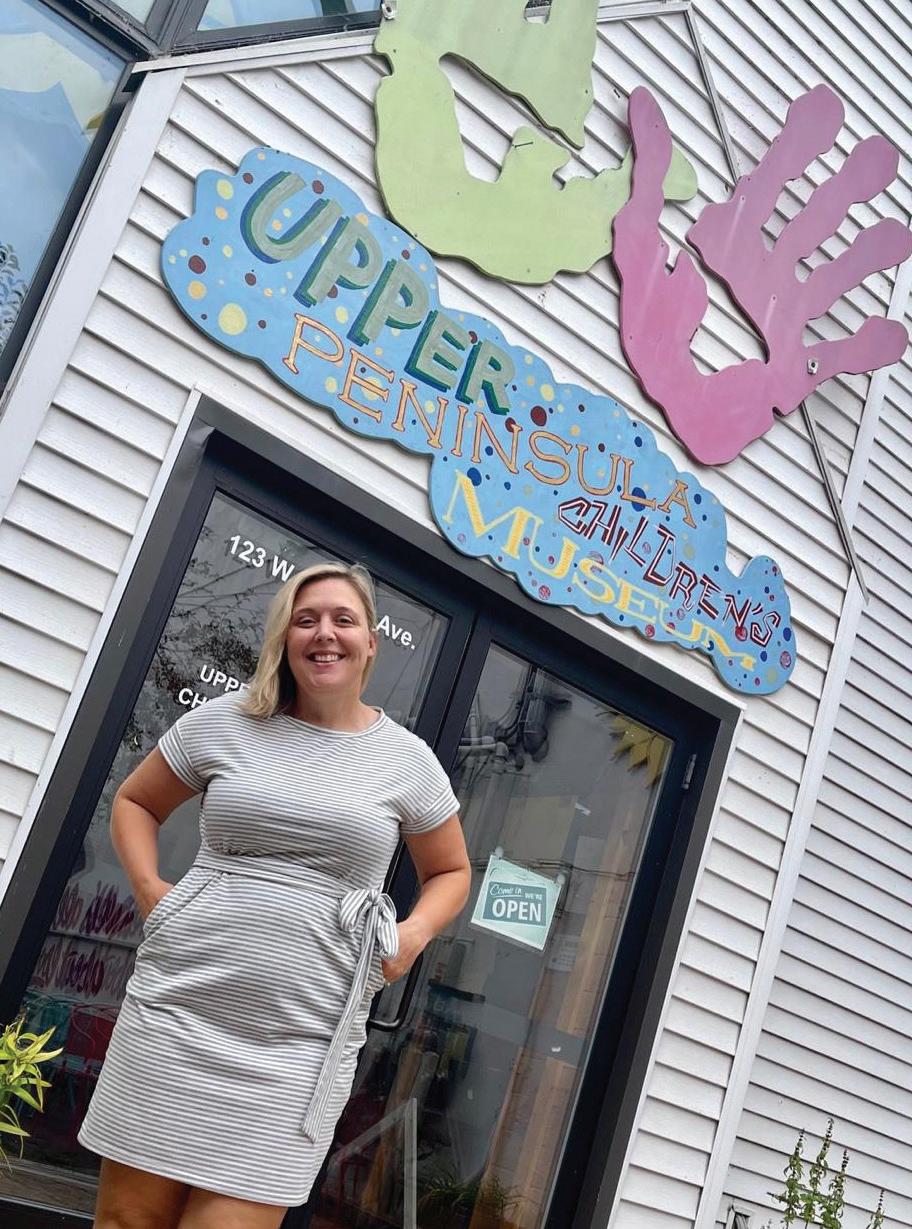
The Upper Peninsula Children’s Museum’s Board of Directors recent ly announced Jessica Hanley as its new executive director, replacing founder Nheena Weyer Ittner. Hanley is a U.P. native who has lived in Marquette for 18 years. She lives with her husband, Adam, and son, Oliver. She has spent the last 10 years as general manager of Jeffrey’s Restaurant. For the last two years, she has served as a Commissioner for the City of Marquette. Hanley began in her new role on Monday, Oct. 3. The UPCM Board of Directors will soon share details about a fundraising campaign to honor Ittner’s leadership. The museum is also planning for the in-person return of the annual Celebrity Art Auction on Dec. 1. (Photo courtesy of Upper Peninsula Children’s Museum)
display their entries at Peter White Public Library in Marquette for a spe cial LIVE Art & Word Display. The contest will run through Feb. 15, and the display at Peter White Public Li brary will take place in May – Mental Health Awareness Month. Students can visit www.greatlakesrecovery. org/LIVE-art-word to submit their en tries online or for more information.
Brock Tessman selected as next president of NMU Brock Tessman, who grew up in Plymouth, Mich., will become the 17th president of Northern Mich

igan University, effective Feb. 1. He has served as deputy commissioner of higher education for the Montana University System since 2018, and has previous experience as a facul ty member and campus leader. The NMU Board of Trustees unanimous ly approved his selection at a special meeting. Tessman was among four fi nalists invited to campus by the NMU Presidential Search Advisory Com mittee. All participated in forums with faculty, staff, student and community/ alumni groups, and were interviewed by NMU trustees.

November 2022 Marquette Monthly 7
The US Postal Service contracted with a variety of people, especially Native Americans, who carried literally bushels of mail by dog sled or on their backs and brought it on a monthly basis to U.P. towns. Its arrival in Marquette became an instant holiday as people read letters and welcomed out-dated newspapers.
Submitted by Dr. Russell M. Magnaghi, history professor emeritus of NMU and author, including the newly released Classic Food and Restaurants of the Upper Peninsula..
UPHP rated highest ranking Medicaid Health Plan in Michigan
Upper Peninsula Health Plan (UPHP) is once again one of the nation’s highest ranking health plans, according to a recent national rating of health plans by the Nation al Committee for Quality Assurance (NCQA) Insurance Plan Ratings. The health plan currently ranks as the highest rated Medicaid Health Plan in the State of Michigan, and ranks 9th out of 278 Medicaid Health Plans nationally, earning a 4.5 out of 5 rat ing. NCQA rates health plans based on patient experience, prevention, and treatment. The rating system fo cuses on patient satisfaction on their quality of care, health plan improve ments, and overall care experience. In addition to Medicaid Health Plans, rankings for Medicare, Commercial, and Exchange Health Plans are also available.
New book club starts in November

Upper Michigan Today (UMT) an chor’s Elizabeth Peterson and Tia Trudgeon, along with Health Stelten pohl and Jenifer Kilpela from the Pe ter White Public Library, will host the first “All Booked UP” book club chat at 11 a.m. on Nov. 16 at The Court yard in Marquette. The free, in-person discussion is open to anyone wishing to attend. The first book is This Time Tomorrow by Emma Straub. Can’t make it in person? Tune in at 9 a.m. on UMT to hear the book discussion and watch the reveal of the Novem ber/December book for “All Booked UP.” Email Jenifer Kilpela at jkilpe la@pwpl.info with questions.
8-18 Media launches podcast
The Upper Peninsula Children’s Museum’s 8-18 Media program has officially launched its new pod cast, 8-18 Media Queen City Kidcast.
The first episode of the podcast was designed and produced by 8-18 Me dia youth members. Each episode will focus on a new topic related to issues that affect the lives of young people. In the inaugural episode, 17-year-old Collin Gallion interviews vinyl enthu siasts Jon Teichman and Geoff Walk er. Gallion and his guests explore why vinyl records are once again so pop ular with today’s youth. Listen to the podcast on Spotify, Amazon Music, Acast, and coming soon Apple Pod casts.
Marquette Holiday Art Sale returns for 22nd year
The Marquette Regional Histo ry Center and City of Marquette Arts and Culture Center will host their 22nd Annual Holiday Art Sale, to be held from 10 a.m. to 4 p.m. on Saturday, Nov.12. The sale will take place at the Marquette Regional His tory Center. The Museum will hold an old-fashioned bake sale, their an nual Dollhouse Days, a Membership Drive, and the History Center gift shop will be open for the event. There will be a $2 admission fee, which includes entrance to the Holiday Art Sale, MRHC Exhibits and all other activities. All proceeds support the MRHC, a private, non-profit organi zation. For more information or ques tions, contact the Marquette Regional History Center via email at jbays@ marquettehistory.org or by phone at 906-226-3571; or the City of Mar quette Arts and Culture Center via email at arts-culture@marquettemi. gov or by phone at 906-228-0472.
Free COVID-19 tests available to Michiganders
The Michigan Department of Health and Human Services is announcing the availability of an additional 289,000 COVID-19 tests through its expanded partnership with the Rockefeller Foundation through

8 Marquette Monthly November 2022
DiD You Know... how Yoopers received winter mail, in the early days of settlement, after shipping season ended in late October?
Bell Express Care expands

UP Health System–Bell recently announced its Express Care Clinic expansion to a newly renovated and larger suite located within UP Health System–Bell in Ishpeming. UP Health System – Bell Express Care offers and treats the full spectrum of acute and non-life-threatening illnesses and injury services—including influenza, sore throat, fever, immunizations, seasonal allergy injections, minor wounds, sports screenings, COVID-19 testing and more—while in a family-friendly environment. The clinic is staffed by skilled and compassionate nurse practitioners, to ensure the highest level of care is delivered to patients. The new suite location is open and is ready for patients. UP Health System–Bell Express Care can be reached at 906-485-7777. Visit UPHealthSystem. com/Express-Care for more information. (Image courtesy of UP Health System–Bell)
Project Act. The expansion will provide COVID-19 tests to 58,000 households located anywhere in the state free of charge. All households in the state of Michigan can visit AccessCovidTests.org to order their free COVID-19 tests. Each household will receive one kit with five tests, typically within a week of ordering. Individuals without internet access can contact 211 for assistance order ing tests. Visit Michigan.gov/Coro navirus for more information about testing.
State funding helps estab lish family resource center in UP M
ichigan families will benefit from $1.9 million in funding to pilot resource centers in six locations around Michigan that will help pre vent child abuse and neglect. Children Trust Michigan and the Children’s Services Agency, both within the Michigan Department of Health and Human Services (MDHHS), will fund the family resource center initiative. Children Trust Michigan is Michi gan’s agency solely focused on child abuse and neglect prevention and is within MDHHS. Including among the six pilot sites is the Keweenaw Fam ily Resource Center, which will sup port Baraga, Houghton and Keween aw counties. Family resource centers
are community-based resource hubs where people and families can ac cess formal and informal supports to promote their health and well-being. While family resource centers have many things in common, they are de signed to reflect and be responsive to community needs and interests. They build parenting skills, connect fam ilies to resources and develop parent and community leadership.
Marquette Music Hall Of Fame to host induction ceremony
The Marquette Music Hall Of Fame is announcing its 6th annual in duction ceremony. The ceremony will be held from 6 to 9 p.m. on Nov. 26 in the Red Room of the Marquette Ma sonic Building located in downtown Marquette. In addition to honoring this year’s inductees, there will be live music, libations and cake. Donations support the trophies and party. There will be silent auctions and bucket raf fles during the event. Visit the MMS Hall of Fame Facebook page for up dates and listings.
Beautification committee hosting candy fundraiser

The Marquette Beautification & Restoration Committee is kick ing off its annual See’s Candy Sale. All proceeds from this fundraiser go

November 2022 Marquette Monthly 9
toward support of Petunia Pande monium on Front St. Due to MDOT construction on Front St. the irriga tion system needs to be replaced. The committee is halfway toward its goal of raising $100,000 to bring back the flowers for 2023. Visit the group on Facebook or call 906-273-0249 to place an order by Nov. 19. Candy will be available by Dec. 3.
Marquette Choral Society to perform in December
Marquette Choral Society returns to the stage of Kaufman Audi torium in December to present two works for the Holiday Season. The first is “A Ceremony of Carols” by Benjamin Britten. Written in 1942, this set of carols is based on medieval poetry and plainsong, and is a peren nial favorite for the Christmas season. This will be followed by “Carols and Lullabies: Christmas in the South west” by Conrad Susa. This set of pieces was commissioned in 1992 as a companion piece to “Ceremony of Carols” and includes some famil iar holiday tunes with Spanish lyrics. Both sets of carols will include harp accompaniment. The concerts will take place at 7:30 p.m., Saturday, Dec. 17, and 3 p.m., Sunday, Dec. 18, in Kaufman Auditorium in Marquette.
Admission is $10 for the general public, and $5 for seniors, students and children. Tickets are available through the NMU ticket office and at the door. This activity is supported by the Michigan Arts and Culture Coun cil, administered by Upper Peninsula Arts and Culture Alliance.
SHF awards next round of grants
The Superior Health Foundation (SHF) in Marquette awarded more than $739,000 in health-cen tered grant funding at its Fall Grants Celebration at the Holiday Inn in Marquette. The event was present ed by 44 North. The Superior Health Foundation awarded $531,563.80 in proactive Year 2 grants to address food insecurities in the Upper Penin sula, $195,688.44 in fall grants and $11,823.06 in pilot-project and equip ment grants. In its 10-year history, the U.P-wide, health-centered non-profit has awarded more than $5.2 million in grant dollars to non-profits in the U.P. The SHF is in year two of award ing funding to address food insecu rity issues. This initiative is striving to address access, distribution and delivery of healthy food across the Upper Peninsula. In 2021 and 2022, SHF has awarded more than $1 mil
lion in funding to address food inse curities. SHF has actively engaged and collaborated with Upper Penin sula and statewide funding partners to leverage the foundation’s funding to make substantial progress in ad dressing food access and education, with an emphasis on local growth and production. The West End Health Foundation and Community Founda tion of Marquette County provided matching funding. In addition, the Michigan Health Endowment Fund and Blue Cross Blue Shield of Michi gan Foundation also provided funding for this project. At the event, the SHF awarded $195,688.44 in fall grants to 14 non-profit organizations in the U.P. Applications for the spring grants cycle will be accepted from Dec. 15 through January 16, 2023. Visit www. superiorhealthfoundation.org to learn more and apply for funding.
Mindfulness classes announced
MSU Extension is offering a pro gram, Preparing for Holiday Stress Using Mindfulness, free online each Monday starting Nov. 14 and go ing through Dec. 12 Classes begin at noon for five sessions. Visit events. anr.msu.edu/HolidaySLM2022 to register. Call Anita Carter at 906-360-
9732 or email carte356@msu.edu for additional help. Preparing for Hol iday Stress Using Mindfulness will provide an opportunity to try a wide variety of strategies in mindfulness, leading to stress reduction and health ier living. Some of the topics include: begin with the breath, mindful eating, mindful walking and thought surfing, be kind to your mind and laughter is good medicine. Michigan State Uni versity Extension offers programs for older adults in Michigan. Visit https:// www.canr.msu.edu/rlr/ to learn about the numerous programs offered.
Dandelion Cottage Short Story Contest now open to students
The Dandelion Cottage Short Sto ry Contest, organized by the Upper Peninsula Publishers and Authors As sociation (UPPAA), is now open to short story submissions by students in the Upper Peninsula. The contest is accepting submissions from 5th through 12th grade students who at tend (or are being homeschooled in) an Upper Peninsula school district. The next contest deadline is Jan. 31. Per rules of the contest, submissions are accepted in two categories: 5th through 8th grade and 9th through 12th grades. Any teacher in an Upper

10 Marquette Monthly November 2022

November 2022 Marquette Monthly 11
Peninsula school district may nomi nate up to two short stories per grade segment. Stories entered should not exceed 5,000 words in length. The top prize is $250 cash for first place senior division winner and $150 cash for junior division winner; there are no entry fees for writers.
Craft bazaar to be held in Lake Linden

Shoppers who wish to buy local for the holidays will get their chance during the Lake Linden Craft & Food Bazaar, set to take place from 10 a.m. to 3 p.m. on Saturday, November 26 at Lake Linden’s St. Joseph’s Church. The free event will have lunch provid ed by the St. Joseph Knights of Co lumbia and will include local vendors.

WZMQ launches newscast
WZMQ-TV is now offering a live news broadcast from its new studios in downtown Marquette at 6 p.m. and 11 p.m. on weeknights. Sar ah Blakely is the anchor, with Ariane Stassek handling the weather. The sta tion also features a variety of weekly programs, hosted by different people,
including Karl Bohnak, Jim Koski, Megan O’Conner, Luke Ghiardi and Scott Minshall.
Yarnwinders Fiber Guild to host sale
The Yarnwinders Fiber Guild are hosting a sale from 11 a.m. to 3 p.m. on Saturday, Nov.19 at the Fed erated Women’s Clubhouse, on the corner of Front and Ridge Street, in Marquette. Members will demon strate spinning and weaving tech niques throughout the day. Many woven items will also be for sale, such as towels, placemats, table run ners, rugs, grass cloth, transparencies, scarves, tote bags, ornaments and oth er unique, high-quality textiles. For more information contact Rosemary at 906-475-9308 or 906-204-6978.
Local business news…in brief
• UP Health System recently wel comed board-certified sports med icine physician, Colleen Dupuis, DO, specializing in comprehensive, non-surgical treatments for a wide range of orthopedic and sports-relat
12 Marquette Monthly November 2022
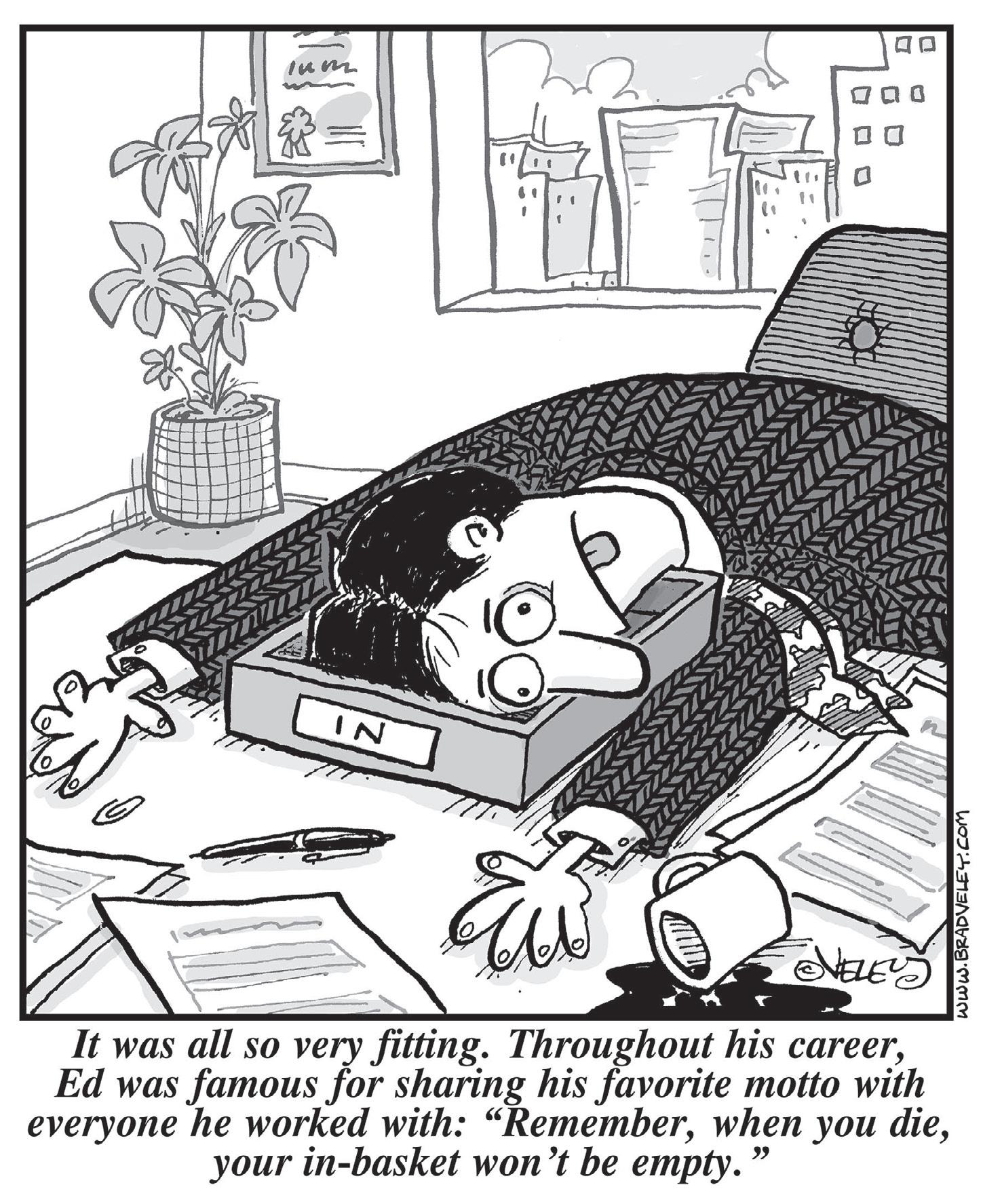
Bradford Veley is a freelance cartoonist, illustrator and farmer in the U.P. Follow him on Facebook, Instagram and at www.bradveley.com
ed conditions, from routine sprains and strains to concussions, fractures, and arthritis. Dr. Dupuis’ goal is to help people of all ages live active life styles as long and safely as possible. She especially enjoys working with the pediatric and adolescent patient populations and getting out into the community to teach safe sports prac tices to young athletes. Involving her patients as integral members of the care team is key to the success of her treatment program.
• UP Health System–Marquette re cently announced that Lisa Long, MD has been named Chief Medical Offi cer (CMO). Dr. Long has served as the hospital’s Chief of Staff since 2021. Board-certified in Family Medicine and Integrative Medicine, Dr. Long is a long-time UP Health System phy sician, where she has been practicing for more than 23 years. She brings extensive medical expertise and clini cal leadership experience having held roles such as Chief of Staff, Section Chair for the Department of Family Medicine, and faculty physician for the UPHS–Marquette Family Med icine Residency Program through Michigan State University.
• UP Health System recently wel comed husband and wife pulmonol ogy duo Matthew Karulf, MD, and Marykay Lehman, MD, to the Respi ratory Medicine team. Both Dr. Karulf and Dr. Lehman provide comprehen sive consultation, diagnoses, and treatment of diseases of the lungs and respiratory system — such as asthma and COPD — and offer pulmonary function testing and chest imaging in terpretation, among other services.
• The Upper Peninsula Collabora tive Development Council (UPCDC), led regionally by Michigan Works and InvestUP will launch a first-ofits kind comprehensive U.P. coun ty-by-county labor market study. The study will address wages and benefits, workforce shortages, barriers to em ployment, talent attraction, and more. It began in October, with results avail able in late spring of 2023.

From the governor’s desk

• Gov. Gretchen Whitmer an nounced that student loan relief would not be treated as taxable income in Michigan. Approximately 1.4 mil lion Michiganders eligible for relief will not owe any state taxes for re ceiving benefits of the Public Service Loan Forgiveness (PSLF) program or other student loan forgiveness. The announcement builds on Gov. Whit mer’s actions to make higher educa tion more affordable.
• Gov. Gretchen Whitmer an nounced that applications are now
open for Regional Child Care Plan ning Grants from the Early Childhood Investment Corporation’s (ECIC) Child Care Innovation Fund. Re gional coalitions can apply for up to $150,000 to develop a regional child care plan that meets the needs and preferences of working families, and addresses Michigan’s pressing need for more access to high-quality, af fordable child care.
• Gov. Gretchen Whitmer an nounced the completion of two U.P. infrastructure projects in Alger and Baraga counties. The recently com pleted projects include the M-28 re building project in Alger County, and the US-41/M-28 resurfacing project in Baraga County.
• Gov. Gretchen Whitmer recently announced the appointment of Rob in Chosa, of Baraga, to the Mchigan Board of Counseling. Chosa is the owner of Rez Robbins LLC where he operates a food vending business that services pow wows and local festivals. He is also an operations manager for the Ford Center. He holds a Bachelor of Science in Psychology from Mich igan Technological University. Chosa is appointed to represent the general public for a term expiring June 13, 2025. He succeeds Charles Corley whose term expired June 30, 2022.
From the desk of Michigan’s senators
• U.S. Senator Debbie Stabenow (D-MI), Chairwoman of the U.S. Sen ate Finance Subcommittee on Health Care, and Senator Steve Daines (RMT), Ranking Member of the U.S. Senate Finance Subcommittee on Health Care, introduced five bills as part of the Finance Committee’s bi partisan mental health initiative. The bills will expand the mental health workforce to make it easier for Amer icans to get mental health and sub stance use disorder care when they need it. Senator Bob Menendez (DNJ), a longtime leader of the effort to expand graduate medical education, who secured 1,000 new slots in the FY21 spending deal, is a co-lead on the Training Psychiatrists for the Fu ture Act.
• Senators Debbie Stabenow and Gary Peters announced that Michigan will receive $1,567,824,375 from the Infrastructure Investment and Jobs Act to fix crumbling roads and bridges across the state. The total funding will come through 11 formula programs that will rebuild roads and bridges, re duce carbon emissions, and improve safety. The Act was signed into law on November 15, 2021.
November 2022 Marquette Monthly 13
MM
on campus
Michigan Tech adopts new campus master plan
TheBoard of Trustees for Mich igan Technological University has voted unanimously to adopt a new campus master plan to guide the University in its growth to 2035 and beyond.

After two years of community in put and discussion, the Michigan Tech Board of Trustees voted to adopt the University’s campus master plan at its meeting Friday, Oct. 7. According to the resolution presented to the Board, the plan represents a “collection of ideas that establishes a flexible, real istic, and multiple-decade framework for coordinating facility improve ments across the institution.” While adjustments to the plan are anticipated as a natural facet of long-range plan ning, and while initiation of specific projects will remain individually sub ject to Board approval, the campus plan will serve as a beacon to guide Tech as it continues its steady rise as Michigan’s flagship technological university.
Michigan Tech President Rick Koubek said the campus master plan is a necessary vision document for the University, which is on track to meet its goals for measured growth, includ ing increases in student enrollment, faculty recruitment and research ex penditures, along with a $300 million endowment.
“The campus master plan presents a collective vision from our students, staff and faculty about the future of Michigan Tech and the facilities we will put in place to support that vi sion,” said Koubek. “We are grateful to the Board of Trustees for their sup port and confidence as we implement this plan for Michigan Tech.”
The news comes just weeks after Michigan Tech welcomed its sec ond-largest incoming class of firstyear students since 1984, who boast the highest academic credentials in school history. Likewise, Tech record ed its second-highest fundraising total ever last year, along with the highest number of research expenditures in University history, projected to be up 16% from last year’s record. Also,
since its official groundbreaking in April, construction is well underway on the new H-STEM Complex, which will house state-of-the-art teaching and research labs for health-related STEM studies and will, like the Great Lakes Research Center before it, serve as a model for future transdisciplinary educational centers constructed on campus.
The collaborative two-year process included multiple campus visits from representatives of SmithGroup, a five-decade partner of Michigan Tech since authoring the University’s initial campus master plan in 1966. The in clusive design process facilitated by SmithGroup involved 25 stakeholder listening sessions, a student life sur vey that garnered 919 responses, a campus-wide survey that garnered 2,281 responses, a virtual town hall with over 275 participants, an online forum and many meetings of the MTU steering and advisory committees.
Among the opportunities identified in the plan development was the de sire among stakeholders to align the University’s facilities with its ster ling reputation and create spaces for collaboration that put technology on display. To make the most of these opportunities, the plan encourages efficient use of limited land. The out come will be a sustainable, innovative Michigan Tech campus with state-ofthe-art facilities designed to celebrate outdoor space, create a public realm and engage the waterfront.
The campus master plan will be implemented in phases, beginning with extensive renovations of existing classrooms and laboratories. “During the planning process, we heard from our community that upgrading the educational and instructional environ ment for our students and faculty was of primary importance,” said Dave Reed, Michigan Tech’s vice president for research. “We listened, and we worked with SmithGroup to get ren ovations of classrooms and classroom labs to the top of the priority list.”
14 Marquette Monthly November 2022
MM

November 2022 Marquette Monthly 15
then & now
Photos provided by Superior View Studios, located in Art of Framing, 149 W. Washington Street Marquette www.viewsofthepast.com



16 Marquette Monthly November 2022
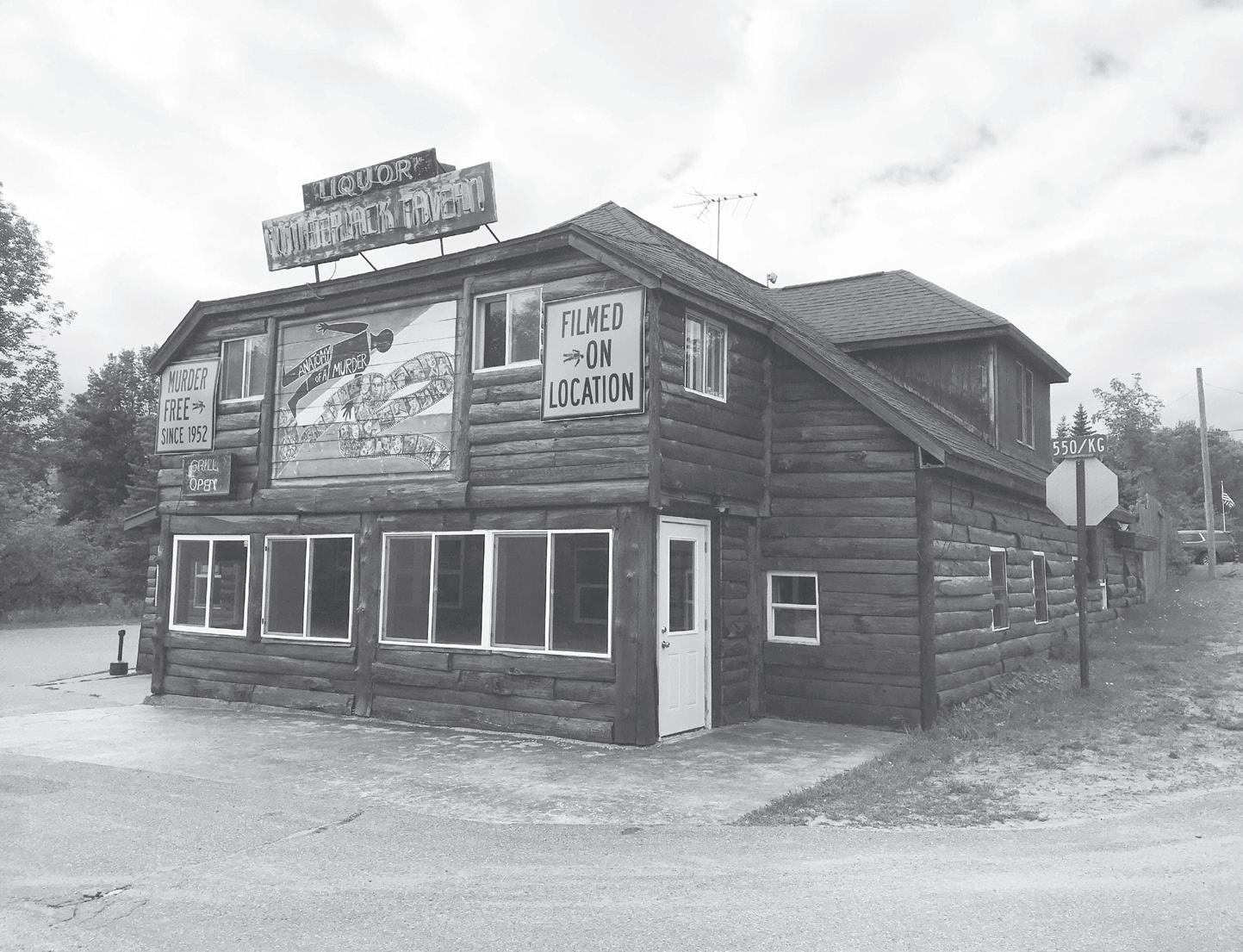
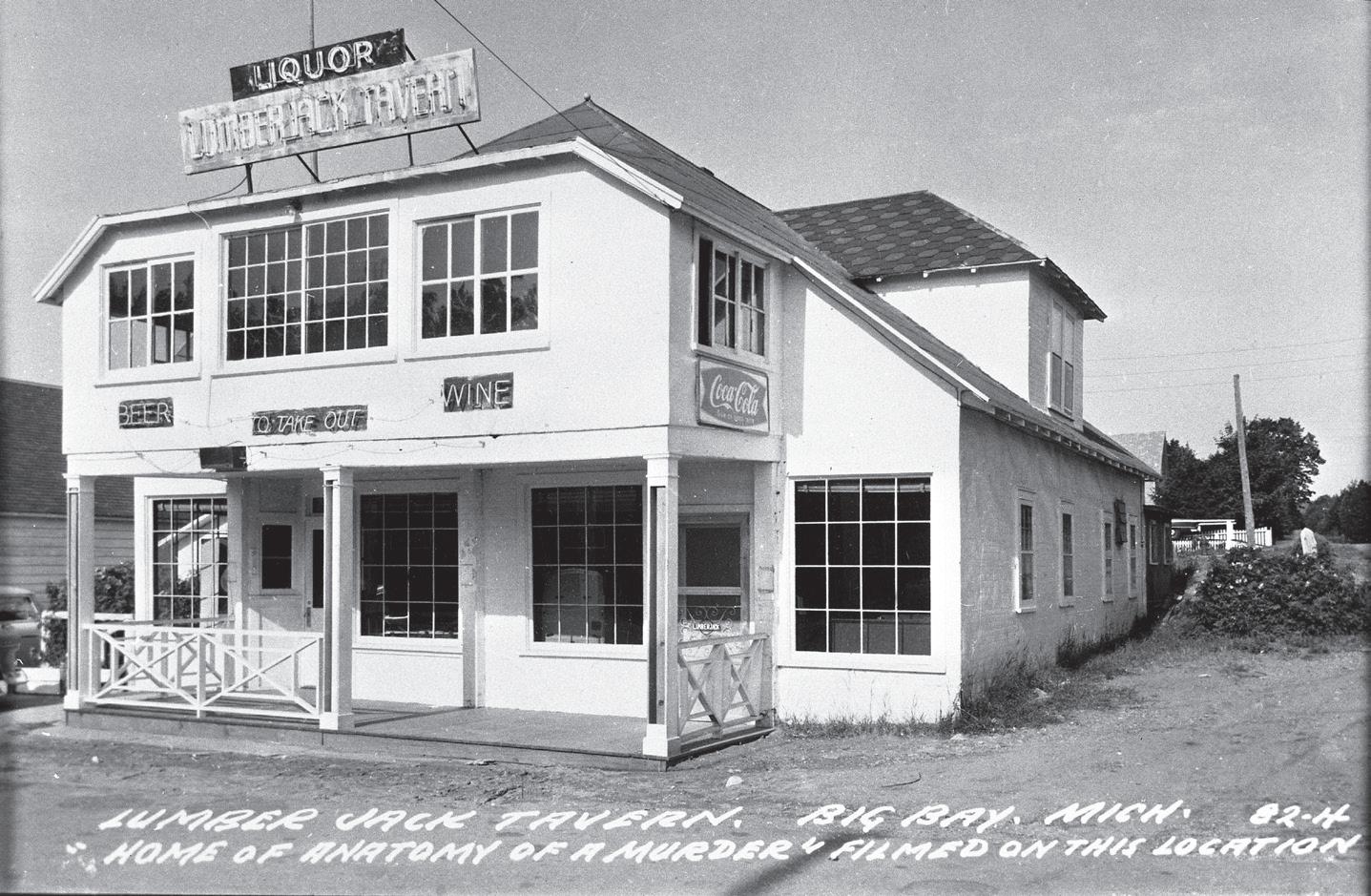
The Lumberjack Tavern in Big Bay, famous for being a filming location for the movie, Anatomy of a Murder
The Lumberjack tavern as it stands today.
Pasco/EditEd By Will shortz
to
____ make
in the middle of
tennis court
rather
____, 1990s
leader
home
prongs
Angela
to play solitaire
have high
on theBeaufort scale
Jokester’s arsenal
it,’’ on paper
org.

near Tel Aviv
at un café
Business-card abbr.


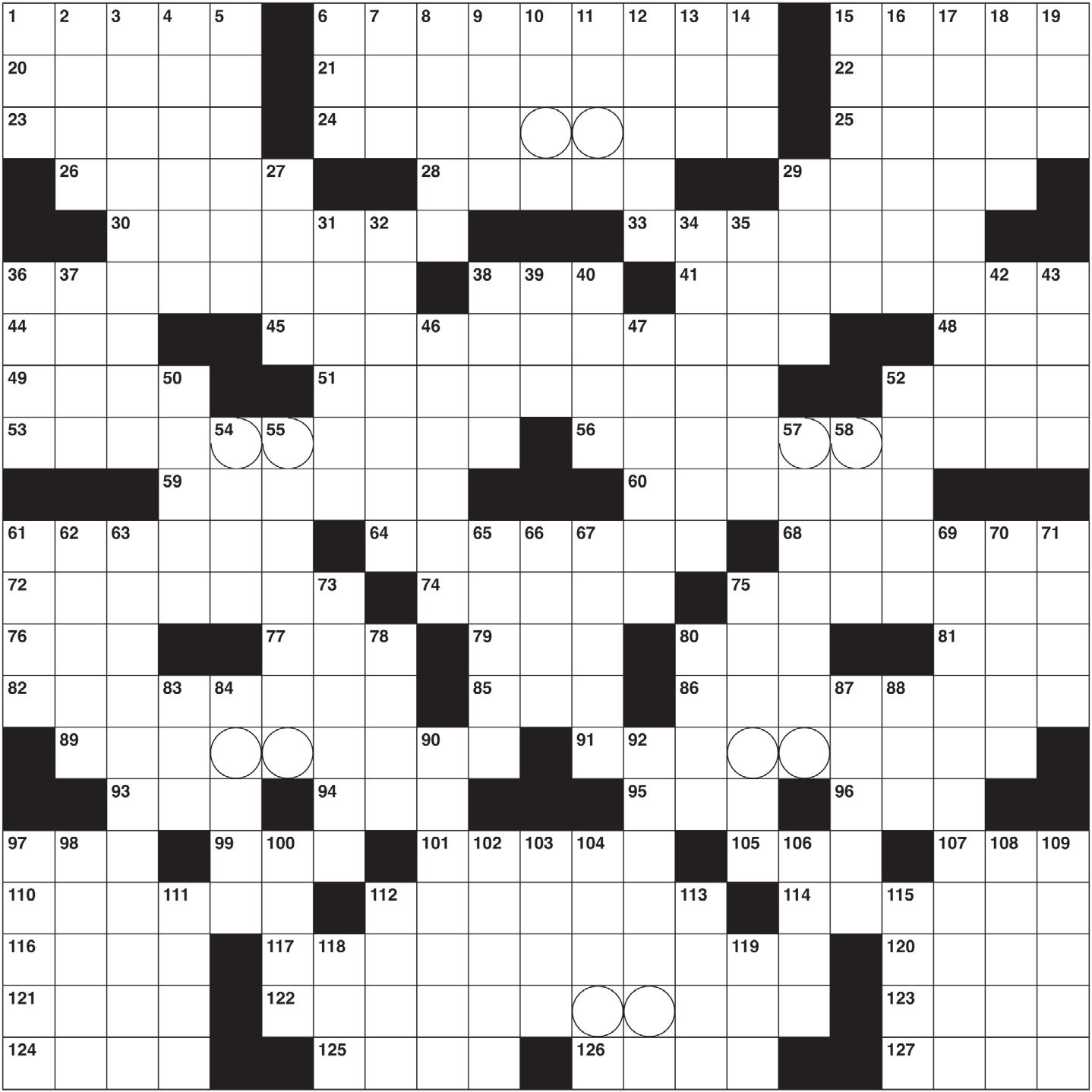
November 2022 Marquette Monthly 17 ACROSS 1 ‘‘Te quiero ____’’(Spanish words ofendearment) 6 ____ axis, half ofan ellipse’s shorterdiameter 15 See-worthy? 20 Volume on an iPad, say 21 Singer of ‘‘Fame’’fame 22 ‘‘____: Game Over’’(2014 documentary)video-game 23 Grown-up efts 24 Old-fashioned letter opener 25 Turn into confetti 26 12/25, e.g. 28 ____ Lewis, singerof the 2007 No. 1 hit ‘‘Bleeding Love’’ 29 Tennis star Naomi,who was born in 29-Across 30 ‘‘I’m gonna tell yousomething huge’’ 33 Mossy growths 36 River with a ‘‘White’’ counterpart 38 Lil ____ Howery(‘‘Get Out’’ actor) 41 Stuffs into a hole, say 44 F-, for one 45 Ritual with bamboo utensils 48 God, in Italy 49 Repeated word inan ‘‘Animal House’’ chant 51 Pastry with thesame shape as anArgentine medialuna 52 Attorney generalbefore Garland 53 Online collectivelypromotions, 56 What businesses goby 59 Cut down 60 ‘‘Eureka!’’ 61 Word with easy or stop 64 Provide change inquarters? 68 Long, tragic stories 72 Up to this point 74 Best actresssupporting nominee for ‘‘The Power of the Dog,’’ 2021 75 Letter opener, pencilcup, inbox tray, etc. 76 Phanerozoic ____(what we live in) 77 Classroom aides, forshort 79 British term of address 80 Currency for theprize on ‘‘SquidGame’’ 81 Reddit Q. and A.session, in brief 82 Most unpleasantlyold and mildewy 85 Letters before Constitution or Enterprise 86 Popular hatchbacksubcompact from Japan 89 Rock commonlyused in asphalt 91 Part of a hotel with décor fitting a certainmotif 93 Video-game serieswith settings inLiberty City and SanAndreas, for short 94 Gobsmack 95 Scottish interjection 96 ‘‘Everything Everywhere ____at Once’’ (MichelleYeoh movie) 97 R.&B. artist whose name sounds like a pronoun 99 Eats 101 Travis of countrymusic 105 One of 2,297 forHank Aaron, forshort 107 Annoyance for aTwitch streamer 110 Figure with equalangles 112 Sunday ____ (end-of-week casually)anxiety, 114 Country whose flagdepicts a machete 116 With company121-Across, that sellsscuba gear 117 Certain furniturestore purchases 120 Missing 121 See 116-Across 122 ‘‘Be My Baby’’group, 1963 123 Bygone Microsoftmedia player 124 The lights in fairylights 125 Some travel considerations, inbrief 126 Tarnish 127 Donkey Kong andothers DOWN 1 Bachelors, e.g. 2 ____ Eats 3 Ninja catchphraseTurtle’s 4 One who’s good-lookingsuper5 Affirmative gesture 6 *Baseball pitchingstyle . . or a weapon 7 Afore 8 Dining-hall offerings 9 About, on a 10Down 10 See 9-Down 11 Volunteer’s words 12 Tennis’s ‘‘king ofclay’’ 13 Hour, in Italy 14 *Big name in hotels 15 Access providers 16 Within reach 17 Actress who played ‘‘Jessica’’ in‘‘Parasite’’ 18 No-go ____ 19 Something to pry ortwist off 27 Volunteer’s words 29 [Gasp!] 31 Chooses 32 More run-down 34 Period in ancient history 35 Like a defeatist’s attitude 36 *Indentation on a chew toy 37 Textile-making device 38 *Light again 39 ‘‘I mean . . ’’ sounds 40 *Whom Holmes tells, ‘‘You do find itvery hard to tacklethe facts’’ 42 Telegram 43 *Many a Viking 46 Pulled a fast one on 47 College near Vassar 50 Where van Gogh andGauguin briefly livedtogether 52 Dyeing method using wax 54 Chief ____ (rapperwith a rhymingname) 55 Where feudal workers worked 57 French equivalent of‘‘Stephen’’ 58 ____ van der Poel,Olympic speedskater 61 Academic acronym 62 *Grand 63 Hits shore unintentionally 65 *Early ProtestantsFrench 66 Burden 67 *Basic rivalry 69 ‘‘Continuing wherewe left off last time . ’’ 70 *’’G.I. Jane’’ star,1997 71 Field goal avg., e.g. 73 Believers in Jah,informally 75 Fatalistic sort, inslang 78 Place in an overhead bin 80 No ____! (punnilynamed chocolatedairy-free brand) 83 Explosive stuff 84 U.S. ID? 87 Bad place
pour grease 88 ‘‘Have
my email (Destiny’sstop’’Child lyric) 90 Cable
a
92 Would really
not 97 ‘‘What’s everyone!’’up, 98 -ish 100 *’’Encore!’’ 102 Fidel
Philippine
103 Tehran’s
104 Fork
106 *Actress
108 How
109 They
ratings
111
112 ‘‘Leave
113 Alien-seeking
115 Strip
118 Beverage
119
No. 1030TERMINAL CoNNECTIoN REpRINTEd fRoM ThE New York Times By Paolo
Answer Key To check your an swers, see Page 64.
Project Jade
New signs meant to make communication universal for all
By Brad Gischia
Takingyour kids to the park. It’s the most normal thing in the world. But when your child is on the autism spectrum that can be come more difficult. Autism is a con dition that manifests symptoms in a variety of ways. Communication dif ficulties can often be one of the issues that people on the spectrum face.
Jade is one of those people.
“Very often you have to prompt her,” said Neily Collick, Jade’s moth er. “‘Are you hungry?’ ‘Yes or no?’ That sort of thing.”
Jade has difficulty making her feel ings known verbally. Instead, she uses scripting, a way of making her wants and needs known through the repeti tion of phrases known to her.
“When Jade wants to go on a slide, she’ll say ‘a slide, how fun,’ which is something she’s seen on her favorite TV show. I know it, and her teachers know it, because we’re with her all the time,” Collick said.
But when Jade is with someone who isn’t familiar with the way she communicates, it can be difficult to understand what she, or in fact any person with communication difficul ties, may want or need.
Project Jade, a registered 501(c)3, is changing that in Marquette County, and all over the country.
“Neily and I are good friends and she shared an article on Facebook that showed a communication board at a school in St. Louis,” said Sarah Fos
ter, CEO of Project Jade, “ I looked at it, and thought, ‘I probably have some HBA members who could help with this.”
Foster’s day job is CEO of the Home Builders Association of the Up per Peninsula.
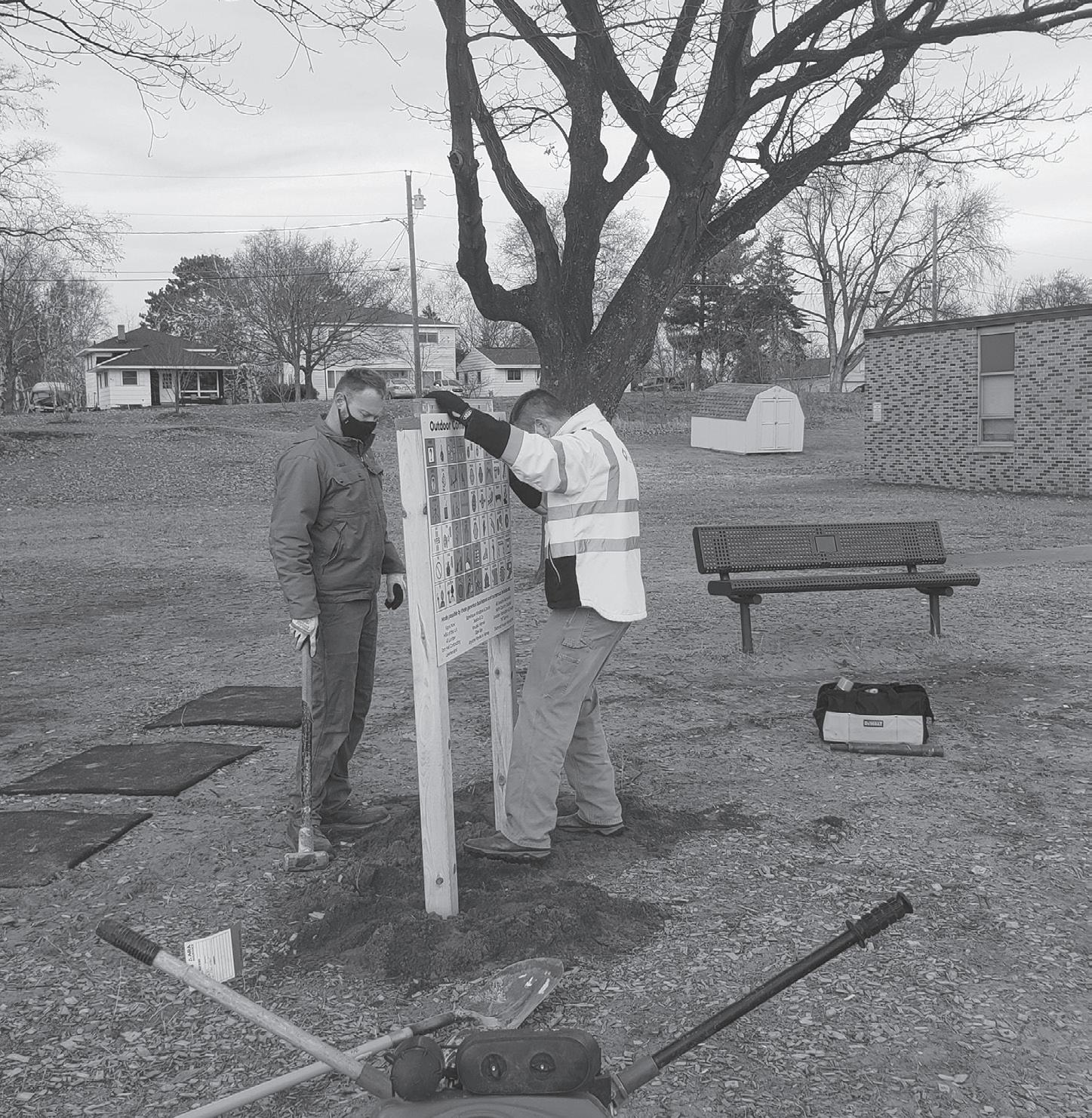
“I reached out to HBA members in the U.P. and got immediate response from several,” she said. “41 Lumber has been donating the 4x4 treated posts, Signs Now has been printing all of the boards and giving us a dis count,” Foster said. “Bromley Hall, from Tom Hall Contracting, he and his crew have been doing the installs locally.”
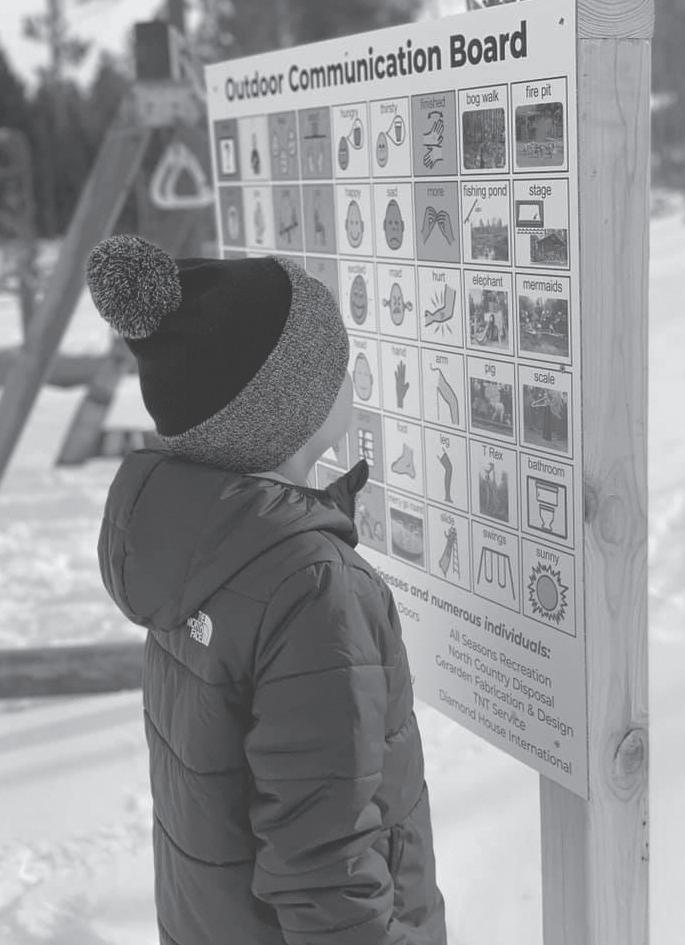
They’re installing communica tion boards, which are visual repre
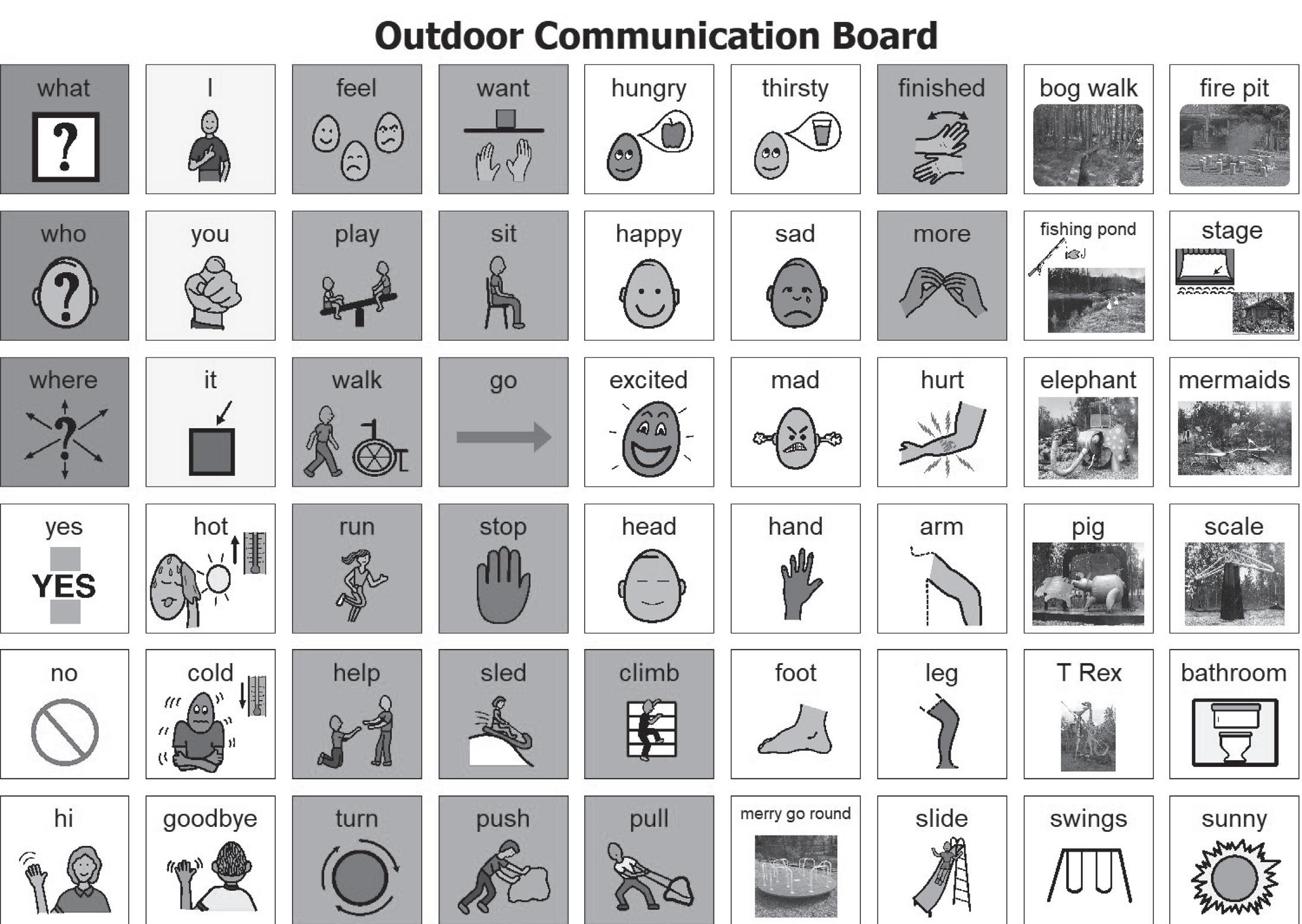
sentations of a place, for example, a playground, that have pictures of the equipment on them so that people with communication difficulties can point to a picture to show what they’d like to do.
“I wanted to put us together in one place, so we started Project Jade, after Neily’s daughter. It was just supposed to be this one project, and the money started to pour in,” Foster said. “In a couple of months we had $4,000, and after that we decided to make it an on going project.”
All of that help is important and needed, but without the boards them selves, the help would be for naught.
Foster and Collick recruited Speech Language Pathologist Jennifer Bleck

18 Marquette Monthly November 2022 feature
Hockey game raises funds for Project Jade
By Brad Gischia
On October 15, members of the local electricians union and miners from the Upper Peninsula met on the ice at Lakeview Arena to raise money for Project Jade, a non-profit that was created to provide communication boards for people with communication difficulties.
The Sparkys met the 906 Miners on the ice, a battle that was good-naturedly waged with sticks and skates.
“If I had to guess I’d say we had two or three hundred people,” said Sarah Foster, CEO of Project Jade.
There was a silent auction, with prizes donated by local businesses, and even a script from the Television series Last Man Standing donat ed and signed by Tim Allen.

“We did pretty good on the auction, and the raffle was a big suc cess,” Foster said.
Collin Kerry, an electrician with B&D Electric, was instrumental in getting the game organized.
“I’ve been friends with Neily’s (Collick) family for a while,” Kerry said.
The idea of getting a hockey game between trades-people had been bouncing around for awhile.
“I knew about the Pigs ‘N Heat hockey game, and we have so many guys in our local that play hockey, I wanted to do something like that,” Kerry said.
Once the kernel was established, the idea grew quickly.
“My buddy Mac Larson and I were in the break room talking about it, and we reached out to a bunch of other friends.” Those friends talk ed to friends, and soon employees of the Tilden Mine, Eagle Mine, and LS&I Railroad were all teaming up to face the electricians.
“I was never a hockey mom or a big fan growing up,” said Foster, “but I found myself watching the game. It was great.”
At the end of three periods the game was tied. The 906 Miners were victorious after a shootout to end the game 2-1.
“We’ve already got plans to do this again next year,” Foster said. “If we can get enough teams we may even do a tournament.” No matter who was victorious, the only winner was Project Jade, which received all money raised.
iner, owner of Find Your Voice LLC, and who at the time was Jade’s speech pathologist at school, to help come up with the images on the board.
“Neily sent me an email to see if I could help her design a board,” Becki ner said. “We started with the first one for Sandy Knoll and it kind of went crazy after that.”
Jade uses an iPad in school with special software that helps her to communicate, but those aren’t always available on the playground and out side of school.
“After the board was put up, she was so excited,” Bleckiner said. “She was clapping and so happy to see something she was familiar with. She was able to show us different plac es she wanted to go to on the play ground.”
After the first board went up, other schools began to contact Project Jade, and it’s continually growing in, and outside, of Michigan.
“Boston Children’s Hospital has agreed to put one in their kids’ waiting room,” Foster said. “We’re working on getting them in all Michigan wel come centers, state parks, and we’re working on boards for schools in Montana, Texas, Alabama, New York, New Jersey, and North Carolina.”
The expansion is rapid, but the team at Project Jade is still focused on local places.
“We’re putting one up in the new playground in Lower Harbor, the Children’s Museum, the Marquette History Museum, and UP Rehab is getting one,” Foster said.
They’re getting noticed as well.
November 2022 Marquette Monthly 19
MM
“We’re getting a lot of people from the schools who are neurotypical on the playground, that are finding the boards out in the real world,” Collick said. “The biggest reaction I’ve seen is at Lakenenland. People on the au tism spectrum might be more visual or aural, and when you bring them into a place like that, they see a giant T-rex, and now they see it on the board and in real life, and they can connect those two things.”
The importance of communication can be lost on those who can easily do it.

“One thing about using visuals with any child that has communica

20 Marquette Monthly November 2022
Left, a child reads another commu nication board. Bottom left, a board is installed at Sandy Knoll Elemntary School. (Photo courtesy of Project Jade)
WE STARTED WITH THE FIRST ONE FOR SANDY KNOLL AND IT KIND OF WENT CRAZY AFTER THAT.
“
tion difficulties,” Bleckiner said, “is that before words we use visual sym bols in our society for everything, so often they can understand before they can express it. Being able to express anything that they’re feeling is so im portant. Being able to use those sym bols makes it easier for them to be understood.”
Each board, depending on material prices, can cost more than $300. Each board is donated to the location.

“To make it work for other schools, and anywhere really, each board has to be customized for each location,” Foster said.
Bleckiner is the one who actually puts the boards together, and it can be time consuming.
“It depends on the space. For ex ample, I`m working on a board for the fish hatchery. I went over and talked with their staff and found out what kinds of things they’d be communi cating to people who visit, and I can then customize what they’re trying to say,” she said.
“Schools are a lot easier, because there are very few changes from our sample board,” Bleckiner contin ued. “It usually takes half an hour to an hour to customize a board. Then email back and forth, asking about specific symbols for their location. There might be a climber, or other equipment with a specific name, that
I want to use the name they’re using. I send those pictures and changes to the printer.”
With all that work to do, the big gest time factor is the lag in commu nication between parties. The boards could go up in as fast as a couple of weeks, but could take longer than a month.
The donated money goes toward paying for printing and for licenses required for the software they use to make the boards. Project Jade is also looking to expand their product line and make donations where needed.
“Many schools have iPad and tab lets loaded with software that helps kids with communication issues to relate to the world around them,” Col lick said. “Those devices are paid for through school or government grants, but many places outside of the school system don’t have access to those types of funds. We went to Bay Cliff, they had no actual hand held commu nication devices and we were able to fund boards in their common areas, and a few iPads, which we donated.”
The group is currently working on lanyards, like a deck of cards that are laminated and hole punched, for faceto-face communication. The lanyards have a safety breakaway, so they’re safe for both teachers and students. Those will be for sale.

“They’re pretty labor intensive.
Each one has to be laminated, cut, punched and strung together,” Foster said.
Project Jade will ship a board any where, but outside of Michigan, lo cations must find installers. Foster has been successful within the state, through the HBA, to find installers.
“By having these boards in loca tions all around our community, it becomes more inclusive. People with communication delays feel like they can communicate in a way that is uni versal’’ Bleckiner said. “It’s so excit ing to see the response, to know that we’re helping people all over to better communicate with each other.”
The boards help facilitate accep tance of communicating in multiple ways.
“If anyone, special needs parents included, if there is a facility that they use, that they would like a board there, let us know.” Collick said. “If they can get some contact information to me we can get that process started.”
Visit ProjectJade.org to contact the organization or to donate.
Brad Gischia is a writer and artist na tive to Upper Michigan. He has pub lished two children’s books and done illustrations for both comic books and novels.

November 2022 Marquette Monthly 21
MM
Pictured here are the images used on the communication board at Lakenenland. (Photo courtesy of Project Jade)
the arts
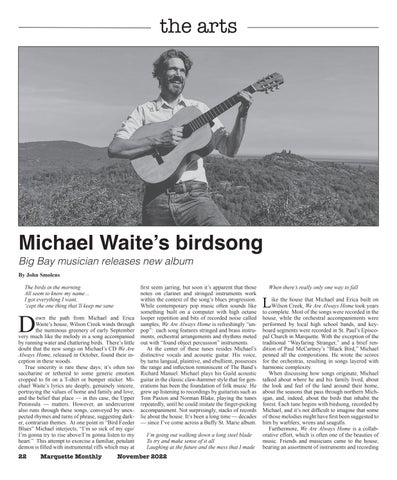
Michael Waite’s birdsong
Big Bay musician releases new album
 By John Smolens
The birds in the morning All seem to know my name… I got everything I want, ‘cept the one thing that’ll keep me sane
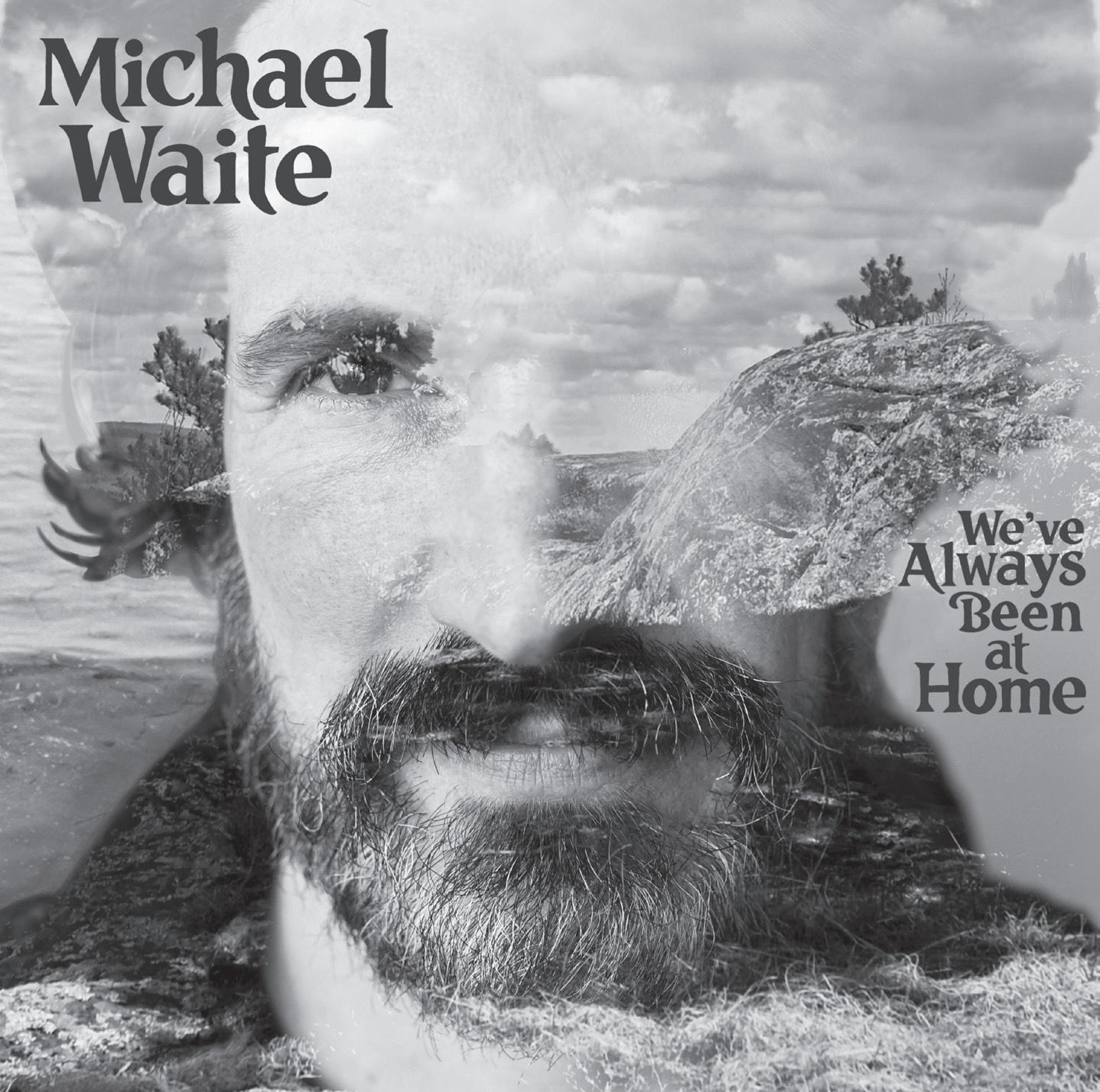
Down the path from Michael and Erica Waite’s house, Wilson Creek winds through the numinous greenery of early September very much like the melody in a song accompanied by running water and chattering birds. There’s little doubt that the new songs on Michael’s CD We Are Always Home, released in October, found their in ception in these woods.
True sincerity is rare these days; it’s often too saccharine or tethered to some generic emotion cropped to fit on a T-shirt or bumper sticker. Mi chael Waite’s lyrics are deeply, genuinely sincere, portraying the values of home and family and love, and the belief that place — in this case, the Upper Peninsula — matters. However, an undercurrent also runs through these songs, conveyed by unex pected rhymes and turns of phrase, suggesting dark er, contrarian themes. At one point in “Bird Feeder Blues” Michael interjects, “I’m so sick of my ego/ I’m gonna try to rise above/I’m gonna listen to my heart.” This attempt to exorcise a familiar, petulant demon is filled with instrumental riffs which may at
first seem jarring, but soon it’s apparent that those notes on clarinet and stringed instruments work within the context of the song’s blues progression. While contemporary pop music often sounds like something built on a computer with high octane looper repetition and bits of recorded noise called samples, We Are Always Home is refreshingly “unpop”: each song features stringed and brass instru ments, orchestral arrangements and rhythms meted out with “found object percussion” instruments.
At the center of these tunes resides Michael’s distinctive vocals and acoustic guitar. His voice, by turns languid, plaintive, and ebullient, possesses the range and inflection reminiscent of The Band’s Richard Manuel. Michael plays his Guild acoustic guitar in the classic claw-hammer style that for gen erations has been the foundation of folk music. He grew up listening to recordings by guitarists such as Tom Paxton and Norman Blake, playing the tunes repeatedly, until he could imitate the finger-picking accompaniment. Not surprisingly, stacks of records lie about the house. It’s been a long time — decades — since I’ve come across a Buffy St. Marie album.
I’m going out walking down a long steel blade
To try and make sense of it all
Laughing at the future and the mess that I made
When there’s really only one way to fall
Like the house that Michael and Erica built on Wilson Creek, We Are Always Home took years to complete. Most of the songs were recorded in the house, while the orchestral accompaniments were performed by local high school bands, and key board segments were recorded in St. Paul’s Episco pal Church in Marquette. With the exception of the traditional “Wayfaring Stranger,” and a brief ren dition of Paul McCartney’s “Black Bird,” Michael penned all the compositions. He wrote the scores for the orchestras, resulting in songs layered with harmonic complexity.
When discussing how songs originate, Michael talked about where he and his family lived, about the look and feel of the land around their home, about the seasons that pass through northern Mich igan, and, indeed, about the birds that inhabit the forest. Each tune begins with birdsong, recorded by Michael, and it’s not difficult to imagine that some of those melodies might have first been suggested to him by warblers, wrens and seagulls.
Furthermore, We Are Always Home is a collab orative effort, which is often one of the beauties of music. Friends and musicians came to the house, bearing an assortment of instruments and recording
22 Marquette Monthly November 2022
equipment, but most importantly, their ability to play those instruments in a manner that can express a complex palette of emotions. They set up on the second floor of the Waite house, in a large open room designed to serve as Erica’s dance studio. The row of tall windows facing south admits sunlight through a skein of leaves, and over head arches a gorgeous barrel ceiling made of pine. For a musician, acous tics are essential; just a simple con versation in the dance studio sounds clear and honest, natural as the trees looming outside the windows.
I sit at my window and look at the stars
And wonder whose heaven you’re under I bet you’re on a tall ship, somewhere real far So full of resentment and wonder

The lyrics of every song are filled with images of the forest, of wa

November 2022 Marquette Monthly 23
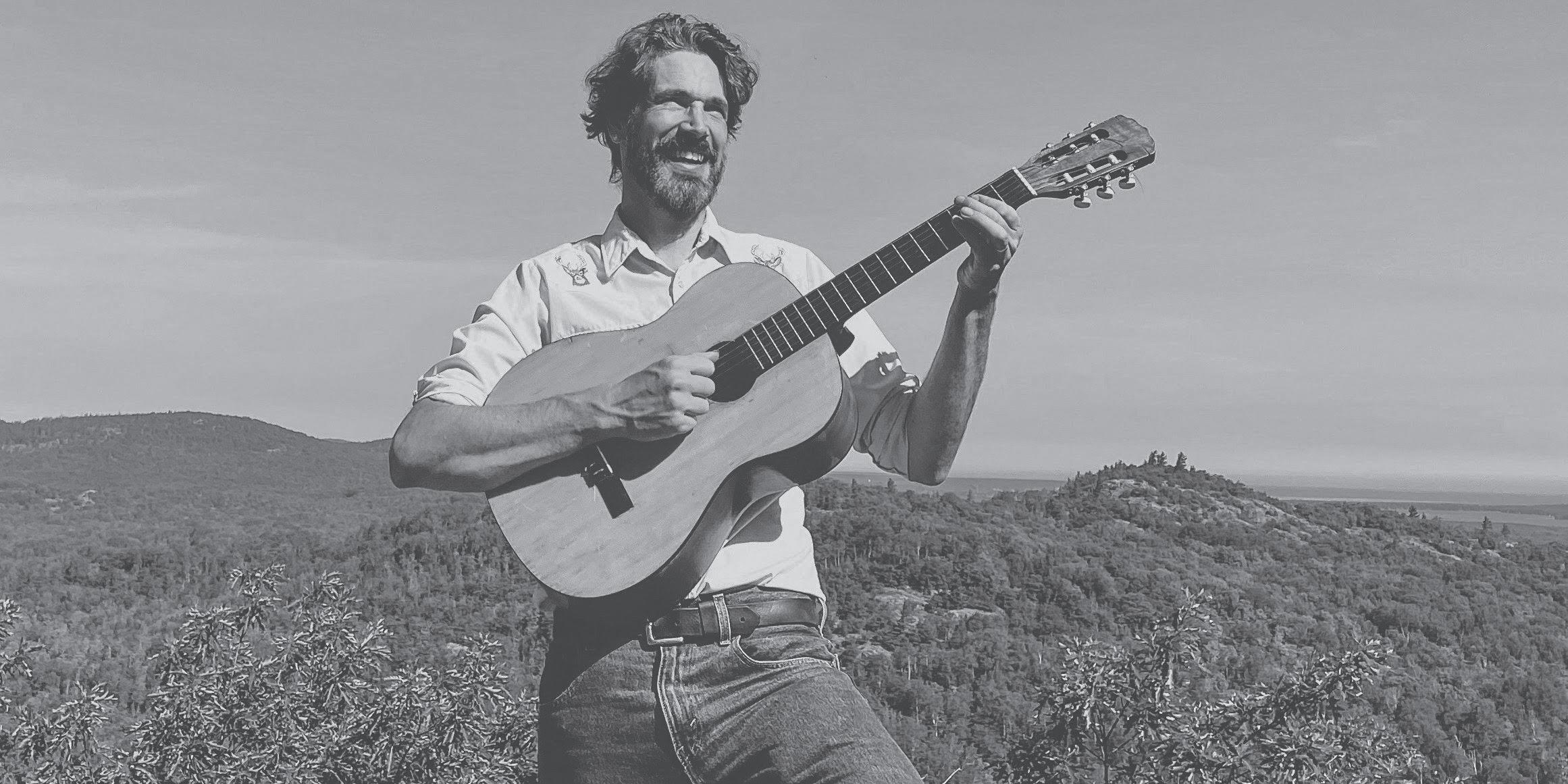
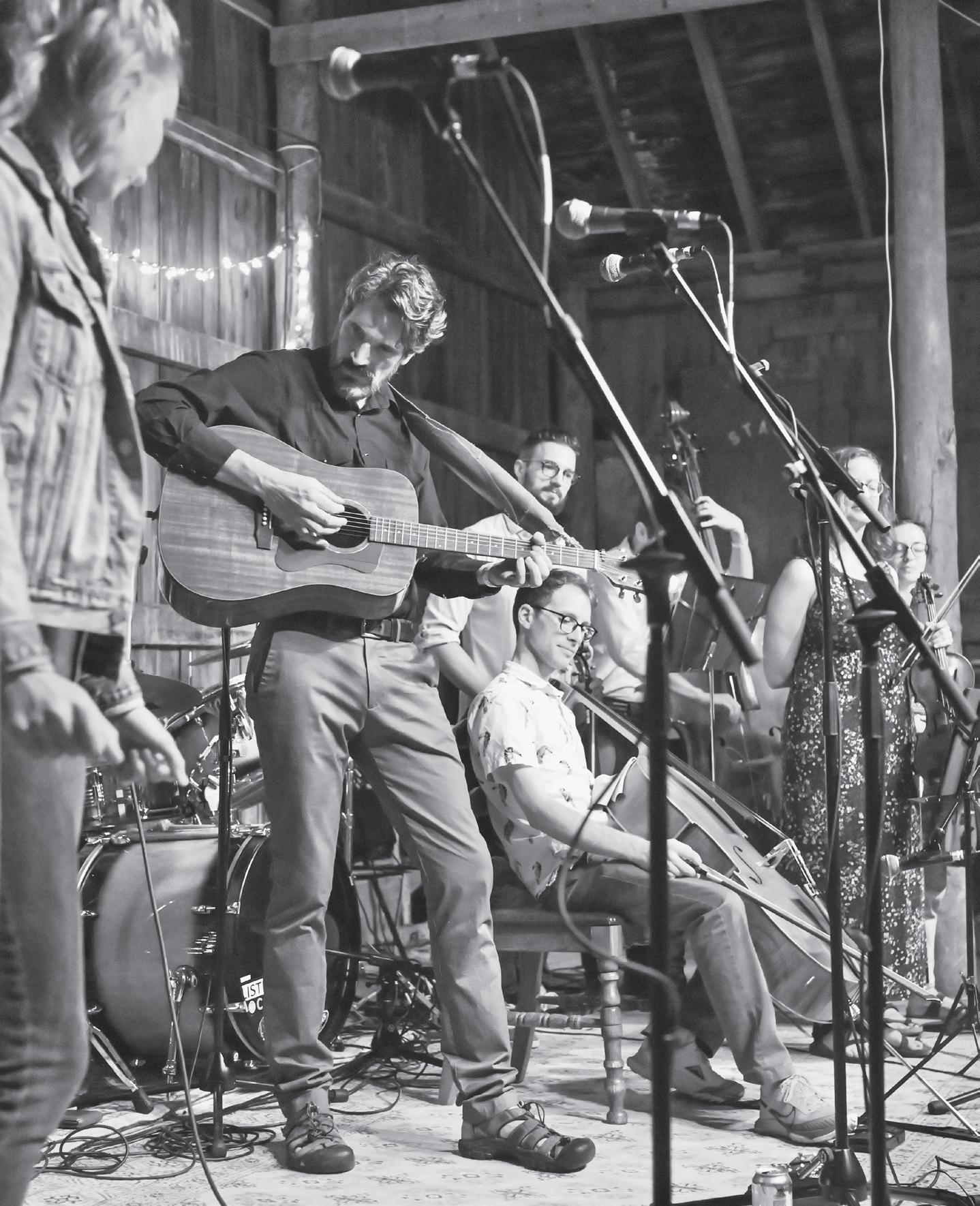
Left, musician Michael Waite often plays outdoor concerts, including in out-of-the-way places like Sugarloaf Mountain. Above, Waite gets ready to perform with other musicians. (Photos courtesy of Erica Waite)
MICHAEL WAITE’S LYRICS ARE DEEPLY, GENUINELY SINCERE, PORTRAYING THE VALUES OF HOME AND FAMILY AND LOVE AND THE BELIEF THAT PLACE ... MATTERS.
“
ter, of animals (along with a variety of birds there’s mention of a threelegged cat, a pony called Vixen, and a mule that intentionally doesn’t rhyme with past). We are often reminded of what are inaccurately called the sim ple pleasures: the fragile beauty of a summer’s day, the image of a new born baby, or in the case of the rendi tion of “Black Bird” a child’s unique perspective (Michael’s son Moses revises McCartney’s lyrics as only a four-year-old can). Each tune paints its own emotional landscape, and love is the common theme that binds all the songs together. Homage is paid to the ordinary miracles of a given day: the song of the river thrush, yard sales, the sea beneath a billowing sky. They are wistful, and they are often tinged with longing and, at times, regret. There is the sense that the singer is thankful for what he has, and yet there’s the desire for so much more. If there is resolu tion, it comes with the realization that one must eventually let go, a notion that carries over from Michael’s pre vious CD Let It Go
When asked how he writes songs, if he started with the lyrics, which he then put to music, or started with a melody and a chord progression, which led to the words, Michael said that both lyrics and music usually come to him all at once. When that happens, he would take notes, and in some instances record bits of the song on his phone.
You can call me Uncle Harry Or Cousin It, or hairy canary Or freaky, fickle fairy
With a hairy derriere
Michael
Waite’s new CD, We Are Always Home, takes the listener down a verdant and sinuous musical path. The lyrics to these songs are quirky, wry and often playful (sin cerity works best when couched in humor); the rhyming schemes sneak up on the listener, twisting the mean ing of a stanza, confirming a simple fact: life is a beautiful conundrum. There are few answers here; plenty of questions (“What if we had no fear of losing our loved ones?”), and when the music blends with birdsong the tune arrives at a place where answers might be found.
Little birds fly away same thing happens every day why’s it gotta be that way?
Visit michaelwaitemusic.com for more information on Michael Waite’s music and his live performances.

MM
John Smolens, NMU professor emer itus, has published 12 books, most re cently Wolf’s Mouth and Day of Days, both of which are Michigan Notable Book selections. In 2010, he received the Michigan Author Award from the Michigan Library Association.

24 Marquette Monthly November 2022
We’ve Always Been at Home album cover. (Image courtesy of Erica Waite)
lookout point
A vision for the future
By Michael Murray
Over the past four years, among his numerous and diverse re sponsibilities as deputy com missioner of higher education for the Montana University System, Brock Tessman has served as chair of four search committees tasked with fill ing top leadership roles on the state’s campuses.
In vetting chancellor candidates for Montana Technological University and Montana State University–Bill ings and CEO/dean applicants for Hel ena College and Great Falls College, Tessman has overseen the process of sifting through applications, fol lowing up on references, conducting interviews and making recommenda tions—all with the goal of placing the right person in the right job.
Tessman’s experience matching the priorities of institutions with the strengths of leaders came in handy recently when he saw that Northern Michigan University was searching for a new president. He had someone in mind who might be a good fit for the role: Brock Tessman.
After a process that involved more than 50 applicants, video interviews with 11 candidates and campus vis
its by four finalists, the NMU Board of Trustees ultimately agreed, voting unanimously on September 29 to ap point Tessman the school’s 17th pres ident.
“There was a long list of things that motivated me to apply for this fan tastic role,” Tessman said, “but at the very top of the list was the spirit of in novation that seems to run throughout the NMU campus and the Marquette region. That is incredibly exciting be cause it signals an opportunity for the entire community to work together toward real, positive and substantial change in so many areas. I would add that the student-centered nature of NMU was a drawing point, as was a natural setting that is second to none.”

Tessman’s hiring came 370 days af ter the board fired Fritz Erickson. Kerri Schuiling, the university’s former pro vost and vice president for academic affairs, has served as interim president since then. Tessman will officially as sume his new role on February 1.
“After a rigorous interview and community engagement process, Dr. Brock Tessman rose to the top as the clear choice for the next NMU pres ident,” board chair Steve Young said.
“He possesses the qualities and capa bilities critical to the advancement of the university. His strong leadership skills and understanding of the vital need for strategic planning will create an environment for student, faculty and staff success.”
Tessman, 46, grew up in Plym outh, Michigan. He earned degrees at Brown University (B.A. in inter national relations, 1998) and the Uni versity of Colorado at Boulder (M.A. in international affairs, 2001; Ph.D. in political science, 2004).
He has held faculty and adminis trative positions at the University of Georgia and the University of Mon tana and was named deputy com missioner of higher education for the Montana University System in 2018. In his current role, he serves as the chief academic, research and student affairs officer for a system with about 50,000 students and 8,000 full-time faculty and staff.
Clayton Christian, commissioner of higher education for the MUS, said Tessman has excelled in many areas in this position.
“Most notably, Dr. Tessman played a significant role in leading our sys
November 2022 Marquette Monthly 25
Brock Tessman appointed NMU’s 17th president
HE IS POSITIVE AND ENGAGING, HE HAS A VISION FOR THE FUTURE OF NMU AND SEEMED LIKE A PARTICULARLY GOOD FIT FOR OUR INSTITUTION.
“
tem-level response to the COVID-19 pandemic,” Christian said. “This in credibly complex and challenging ef fort aligned the efforts of 16 colleges and universities across Montana. Dr. Tessman has also led a new and inno vative student success and retention effort that is gaining state and national attention for its positive results. These are just two examples where Dr. Tess man performed well in his current role, and there are many more.”
Christian added: “I have had the pleasure of working with many talent ed leaders from Montana and beyond. However, Dr. Tessman stands out for his strong leadership qualities and ability to move the needle on multiple complex priorities. … Dr. Tessman is thoughtful, passionate about his work and committed to shared successes. … The Board of Trustees for NMU made an excellent hire with Dr. Tessman, and his colleagues in Montana will
greatly miss him.”
Jason Morgan, an NMU graduate and board member, said these traits became evident throughout the presi dential search process.

“Dr. Tessman brings leadership experience and exceptional qualifi cations to Northern Michigan Uni versity,” he said. “I was particularly interested in Dr. Tessman’s recent experience as a professor of political science and to understand that he was a well-liked and very engaging teach er. As an instructor of political science myself, I know that the connection to students is a critical part of truly serv ing a public institution.
“We received hundreds of com ments, both formally and informal ly, regarding Dr. Tessman from the Marquette and campus community. We even received some comments from colleagues at his former campus who felt strongly that he would make

26 Marquette Monthly November 2022
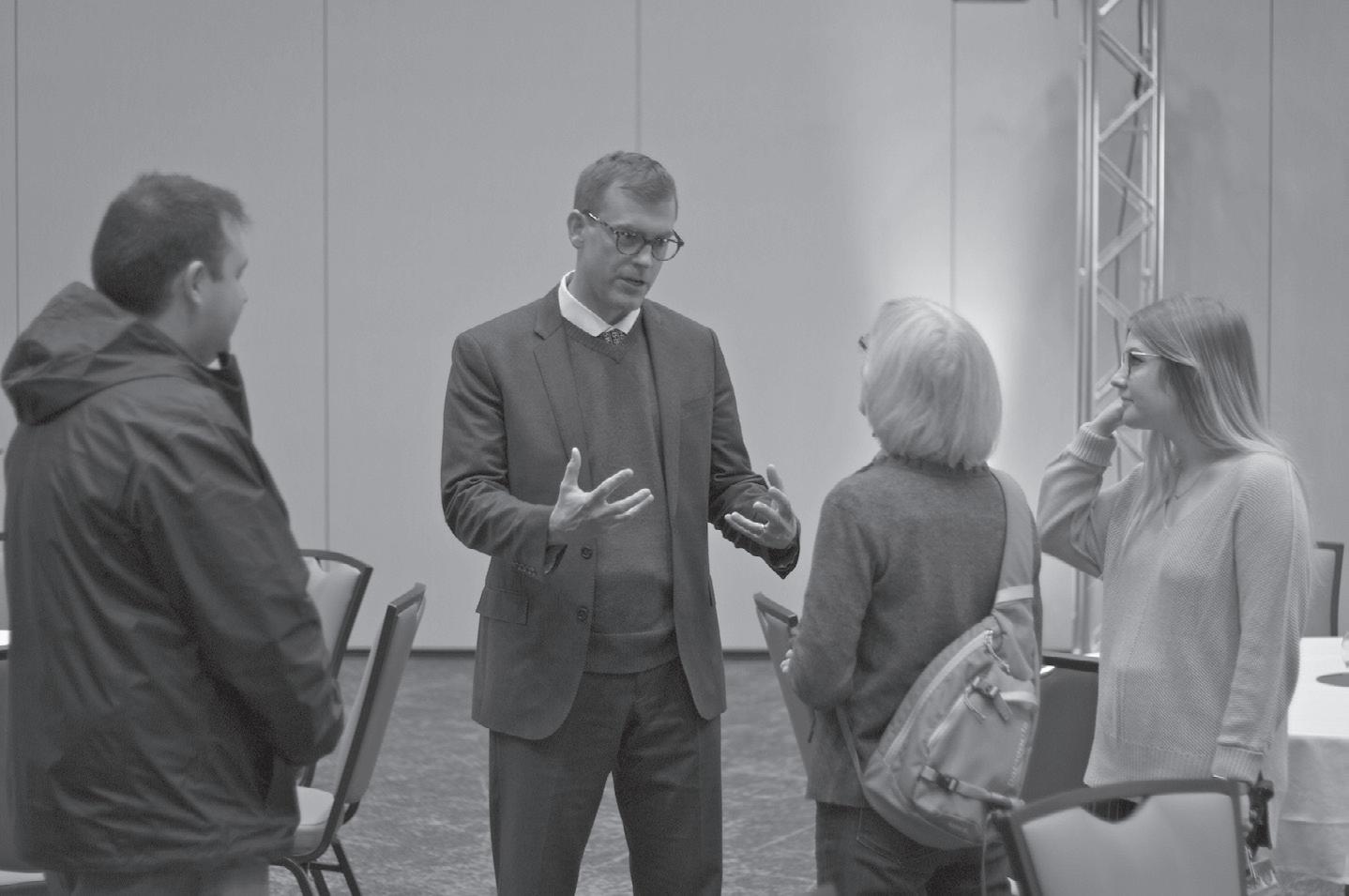
Brock Tessman being interviewed by local news at a recent event on NMU’s cam pus. (Photo by Tom Buchkoe)
a great president. Many of the com ments that I heard centered on a few key areas: He is positive and engag ing, he has a vision for the future of NMU and seemed like a particularly good fit for our institution.”
During Morgan’s time as an under graduate, he was elected president of Associated Students of NMU, the stu dent-government body. In that role, he was able to interact with the universi ty president on a level inaccessible to most students.
“I had the pleasure of serving as ASNMU president during a time when the [university] president was very engaging with students,” he said, “and I know that takes intentional ef fort and sincere interest from the pres ident. From what I have seen so far, I think Dr. Tessman will find joy and great value in working with students on campus. He seems genuinely inter ested in getting to know everyone on campus and described his type of en gagement as one that involves getting out and meeting people where they are.”
Tessman said he looks forward to increasing the university’s connection to the community.

“After a couple of short visits to Marquette, it is already apparent to me that everyone is ready for the campus and the community to work even more closely together,” he said. “There are so many areas, from workforce and economic development, to communi ty engagement, athletics, and arts and culture, in which we can collaborate, innovate and develop together. Anoth er thing that is clear is that Marquette values a sense of family and commu nity, and as a proud husband and fa ther, that means a lot.”
Tessman and his wife, Kristin, have two daughters, Frances and Le
ona. NMU’s announcement of his appointment noted that he is an avid trail runner, board game enthusiast and lifelong fan of the Detroit Lions. As an undergraduate at Brown, he was a member of the track and field team.
When the NMU board parted ways with Erickson in September 2021, several trustees said they wanted more visionary leadership and strate gic planning from the president. Even though Tessman is still months away from formally assuming that role, he said some of his priorities are clear:
“In terms of early priorities, it may seem cliché but the first goal real ly needs to be listening and learning from folks who know this place best. I have done that a bit already during the interview process, of course, and I can see a number of areas of initial focus.
“First and foremost, we need to build on some positive momentum with respect to campus culture, trust and morale. Second, we need to make sure we are engaging areas of student concern—mental health; diversity, equity, inclusivity, belonging; sustain ability—honestly and substantially. Third, we should build on a terrific foundation of student success. That involves enhancing the quality of the student experience on campus as much as we can, but also looking at how to maximize retention, completion and, ultimately, enrollment. A fourth area of interest may be as important as any thing else—energizing business and industry across the U.P. and Northern Michigan and positioning NMU as a visible catalyst and leader in terms of economic and workforce develop ment.”
MM
Michael Murray, a writer and editor in Marquette, has covered NMU on and off for more than 25 years.


November 2022 Marquette Monthly 27
Brock Tessman speaks with people during an alumni and community reception held recently at NMU to welcome the new president. (Photo by Tom Buchkoe)
in the outdoors
By Scot Stewart
There seems to be an amazing natural con nection so immediately felt, tying wildlife to the land of this region, whether it is a life long resident to the Upper Peninsula, or a first-time visitor. Deer, foxes, wolves, bear, eagles, squirrels, chipmunks, porcupines, and of course, mosquitoes and blackflies, are all part of an integral weaving of this inherently beautiful place.
The natural history of the Upper Peninsula has changed greatly since the first of the Europeans ar rived in what is now Sault Ste. Marie in 1618. But it remains a place where one can travel for an hour and still not see a large town, but find cranes hunt ing grasshoppers along the road, and a bald eagle perched in a large white pine at a lake edge, or a small herd of deer grazing in an open field. The deer may be some of the easiest to find and the most cherished. In Marquette, cars cruise slowly around
Presque Isle as riders strain to spot a doe and fawn or a small buck peering out from the maples.
Tall stands of eastern hemlock and white pine once covered large portions of the U.P., especially in places like the Porcupine Mountains, the Huron Mountains and across the northern tier of counties including the area from Kingston Plains to Tahqua menon Falls in the east. These mature forests creat ed areas with little undergrowth and favored animal species like moose and woodland caribou.
However, some biologists like John Ozaga, be lieve there were breaks in the old growth forest brought about by fires, insect outbreaks and other events, creating a patchwork of plant communities. These pockets probably favored white-tailed deer. Today they are the most likely large mammal to see in the Upper Peninsula.
The Upper Peninsula was once home to four
members of the deer family found in Michigan. Woodland caribou were found in mature forests of the northern parts of the U.P., including Isle Royale, their last stronghold in the state. As hunting and loss of the great forests closed in on them, they disap peared around 1912 in mainland Michigan and in 1928 from the island national park. Some linger in Ontario on the north shore of Lake Superior, but they are gone, probably forever from wild Michi gan.
Elk were once found in Michigan, across the Lower Peninsula, and probably across more open areas of the southwestern U.P. They disappeared from the state around 1875, but were reintroduced in 1918 to the L.P. and reintroduction efforts in Wis consin have led to an elk or two making it to the U.P. in 2018.
Moose have followed a path similar to that of
28 Marquette Monthly November 2022
Oh deer A history of UP deer, and the infamous Marquette-area albino population
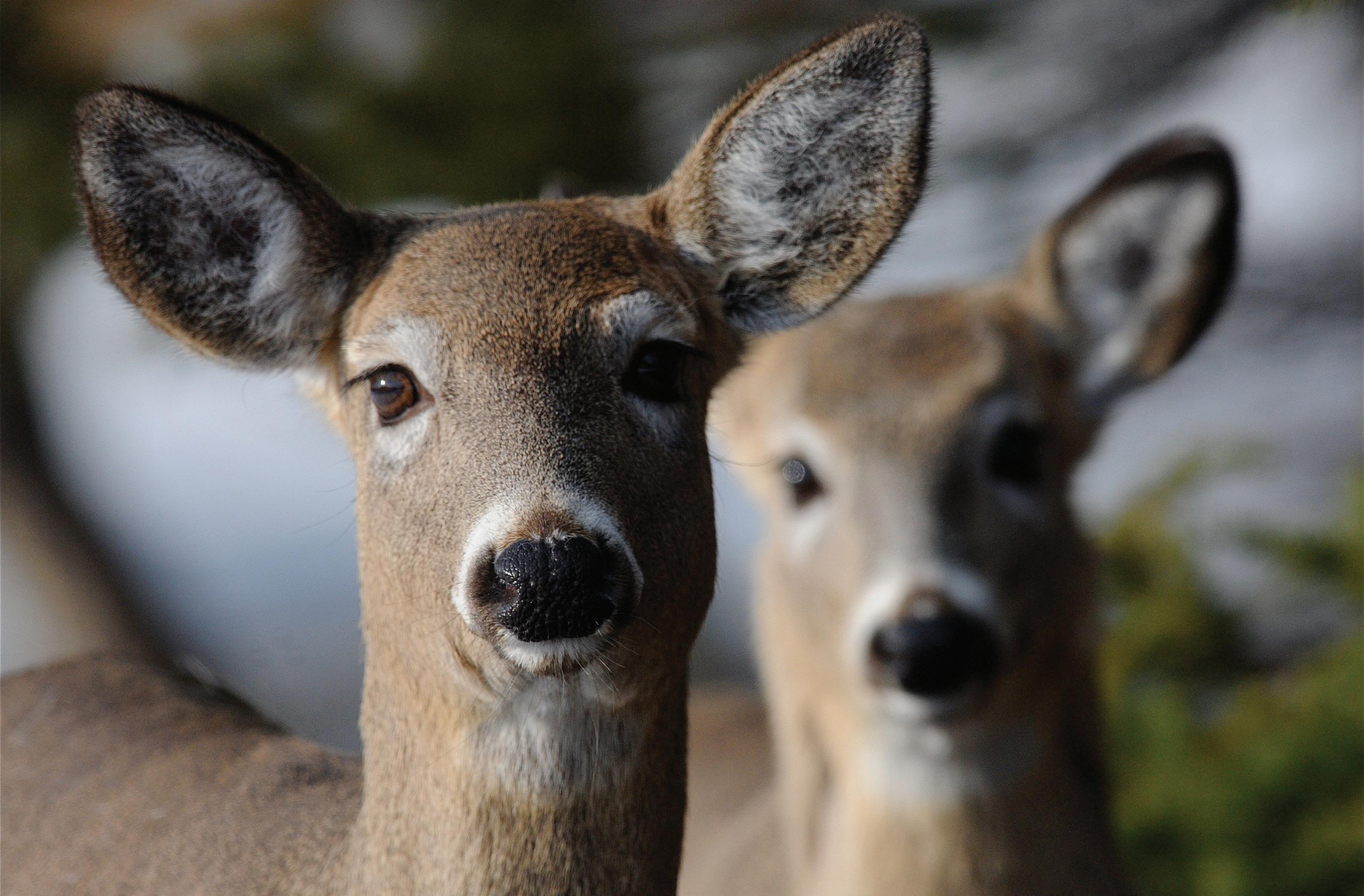
A doe and her fawn, wondering what in the world you’re doing. (Photo by Scot Stewart)
the woodland caribou. They are found mostly in more mature forests, espe cially boreal forest areas of the east ern U.P. and the central U.P between Republic and the Huron Mountains. Isle Royale has been their stronghold too, as habitat change and hunting all but decimated them from the rest of the U.P. Reintroduction efforts were attempted from 1934 to 1937 when 71 were deposited in Keweenaw and Schoolcraft Counties. Some may have survived, but extensive logging and hunting during the Great Depression and other factors may have limited the effort’s success. Others in the eastern U.P. probably wander across the St. Mary’s River from Ontario into re mote areas west of Whitefish Point and the area around Tahquamenon Falls State Park.
There were two small populations of moose in the U.P. when a more recent transplant was initiated. In the 1980s, that second effort brought 59 moose from Ontario in a trade for wild turkeys. They have reestab lished a small population in the cen tral U.P., but are limited in part by a parasite found in white-tailed deer. This parasite, the meningeal worm, carried harmlessly by deer, causes se rious damage to the nervous systems of moose and usually death. Add to this global warming and the effects of winter ticks, and it would appear moose will have a difficult time ever returning to their former numbers here in the U.P.


That leaves white-tailed deer as the one member of the deer family able to continue to thrive in the U.P. As log ging opened more and more forests in the northern U.P., deer were able to move farther and farther north. Until the 1960s, deer in some high snowfall areas had to rely often on slash, the branches left by logging, to help sus tain them during winter months. Usu
November 2022 Marquette Monthly 29
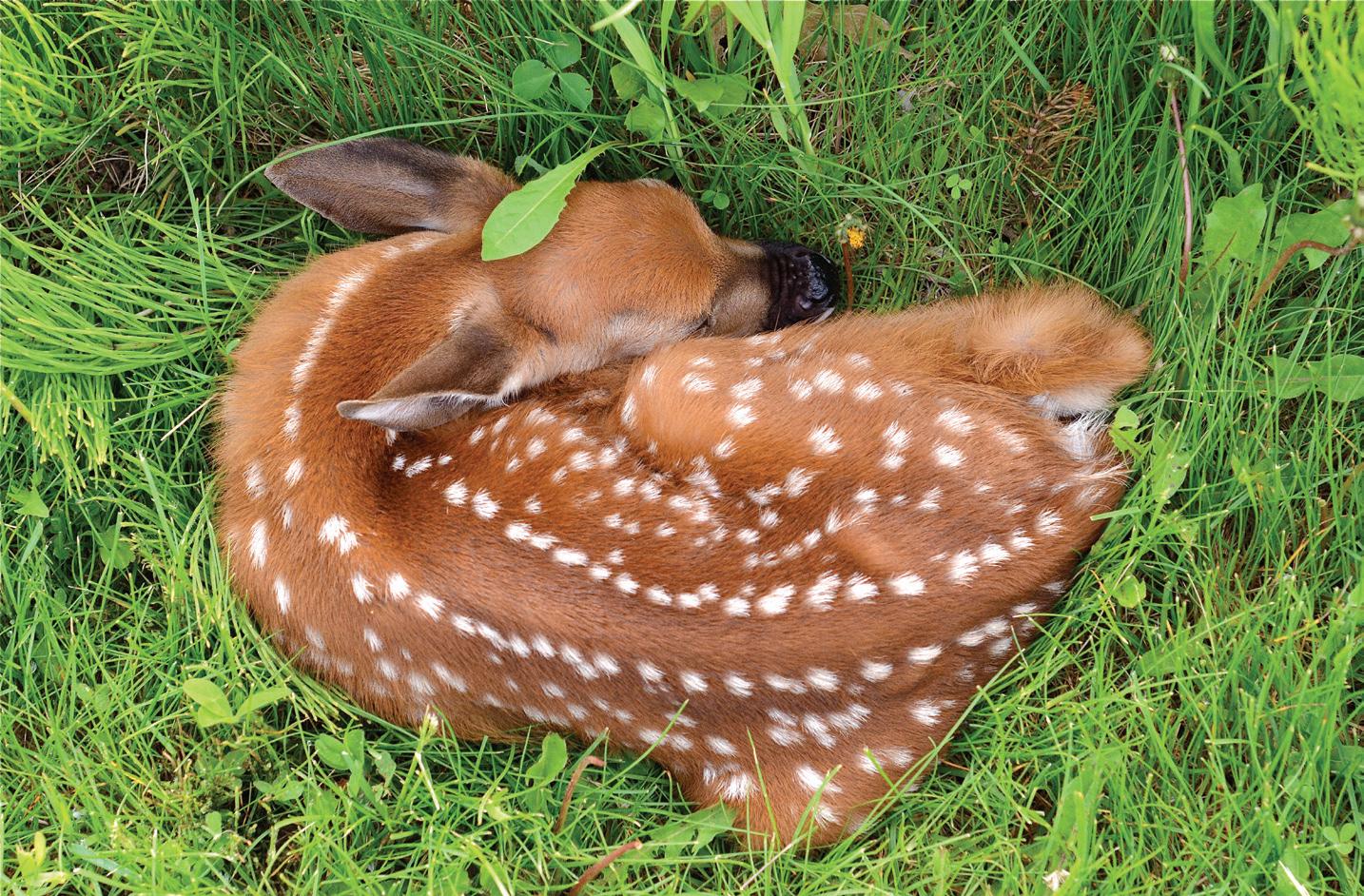
Above, a fawn snoozing in some tall grass. (Photo by Scot Stewart)
A SPECIAL GROUP OF DEER STARTED DEVELOPING AROUND 40 YEARS AGO IN MARQUETTE, AND TODAY THE DESCENDANTS CONTINUE TO SUPPLY A VERY SPECIAL EXPERIENCE FOR NATURE LOVERS.
“
ally grazers, in parts of the U.P. where snow fall accumulations are high, they turn to browsing on white cedar and the branches of deciduous trees like maple, Global warming, lower snow depths in many regions and the open ing of more roads have helped them through the winter in many areas.
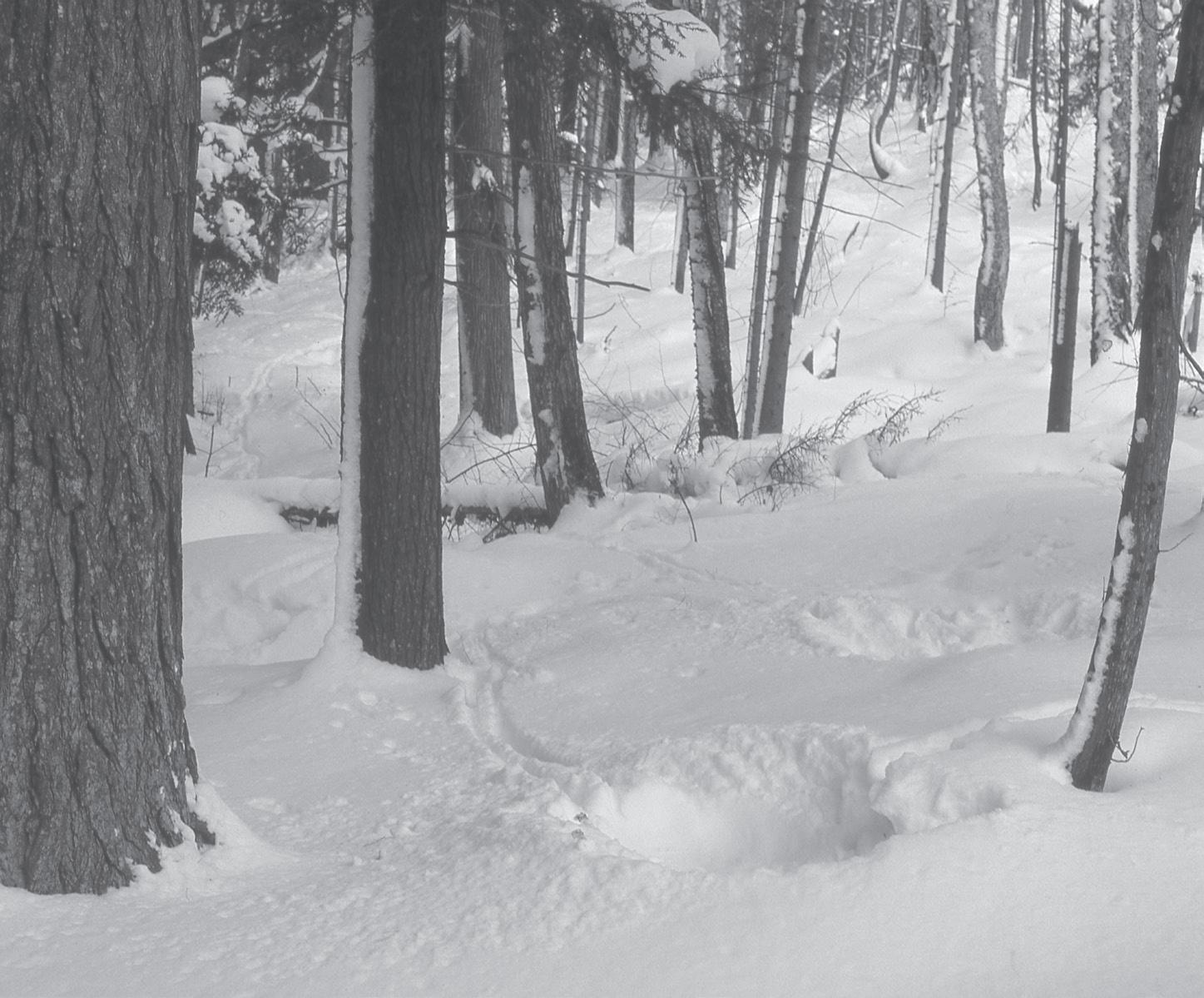
High density populations of deer relied on yarding areas under stands of conifers to find warmer temperatures and lower snow depths, traveling less to avoid more serious energy loss es. That seems to have changed with easier winters. In some of those same areas, new challenges, like chron ic wasting disease have replaced the tougher winters as a bigger challenge to some deer populations. Chronic wasting syndrome is a disease of deer, moose and elk and is currently found only in two U.P. counties, Dickinson and Menominee counties, and sever al parts of Lower Michigan. The U.P.
location is the northern edge of an area in Wisconsin where the disease is more prevalent. It is a disease caused by a prion, an agent similar to the one causing mad cow disease. There is no cure for it and once a deer has it, its doomed.
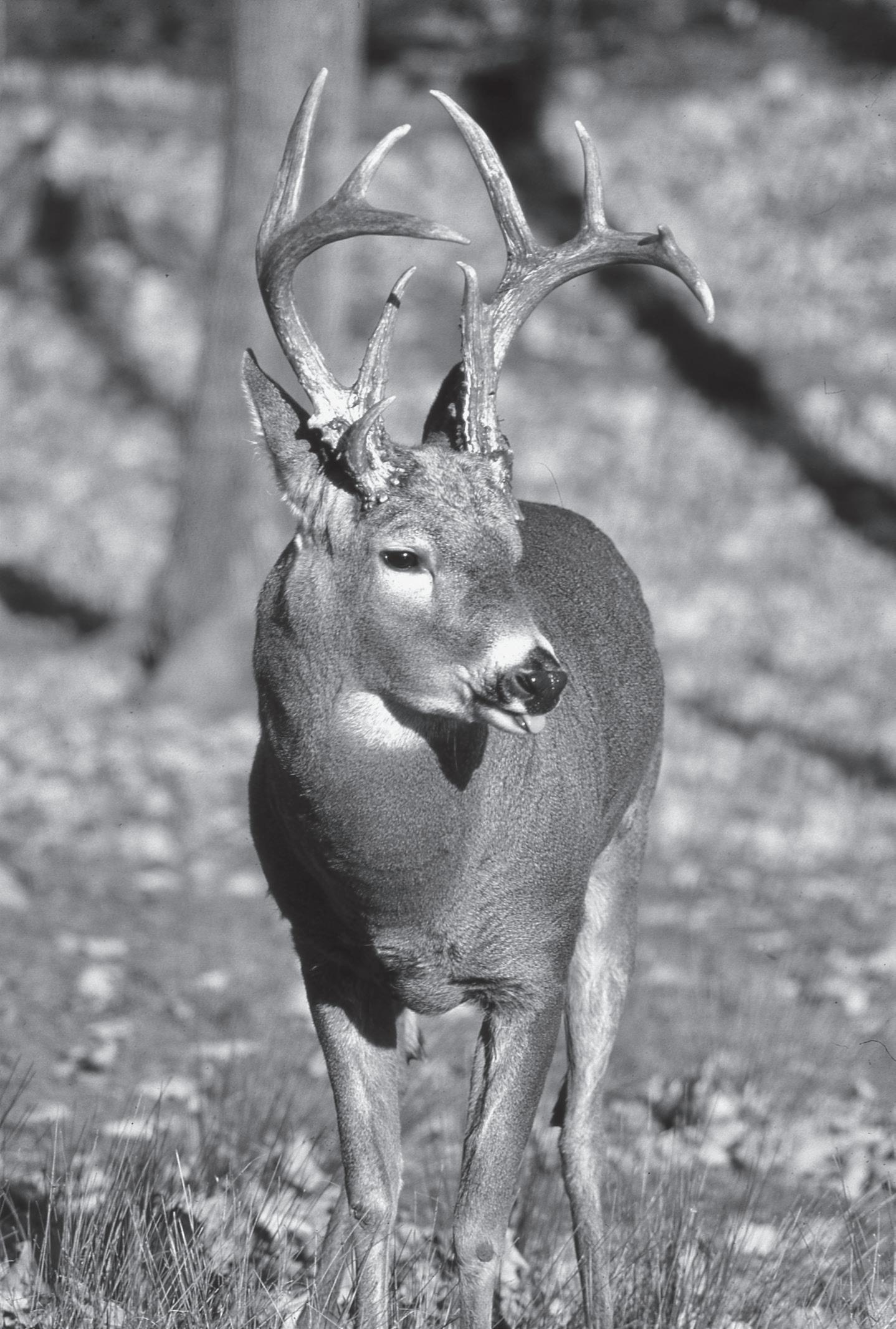
A special group of deer started developing around 40 years ago in Marquette, and today the descendants continue to supply a very special experience for nature lovers. In the winter of 1981 to 1982, the Michi gan Department of Natural Resources learned of an albino male fawn in a deer yard near Delta County’s Rap id River. At that time the state had a law prohibiting the killing of albino. Because the young buck was seen fre quently along a road near the yard and many had known about its presence, a number of local residents began to fear for its safety. A petition from a number of them was sent to the Mich

30 Marquette Monthly November 2022
Top left, an older buck at the former Presque Isle Deer Pen. Above, deer beds in a conifer stand in winter. Top right, the original Marquette albino buck on the day he arrived in Marquette. (Photos by Scot Stewart)
igan DNR, resulting in a decision to tranquilize it and take it to a deer pen then being maintained at Presque Isle Park in Marquette.
On April 15, 1982 Dr. Steven Schmitt, a MDNR biologist, flew to Escanaba and drove out to the deer yard, where he waited until he was able to locate the albino deer. Once darted, it was taken to Marquette and placed in the deer enclosure with
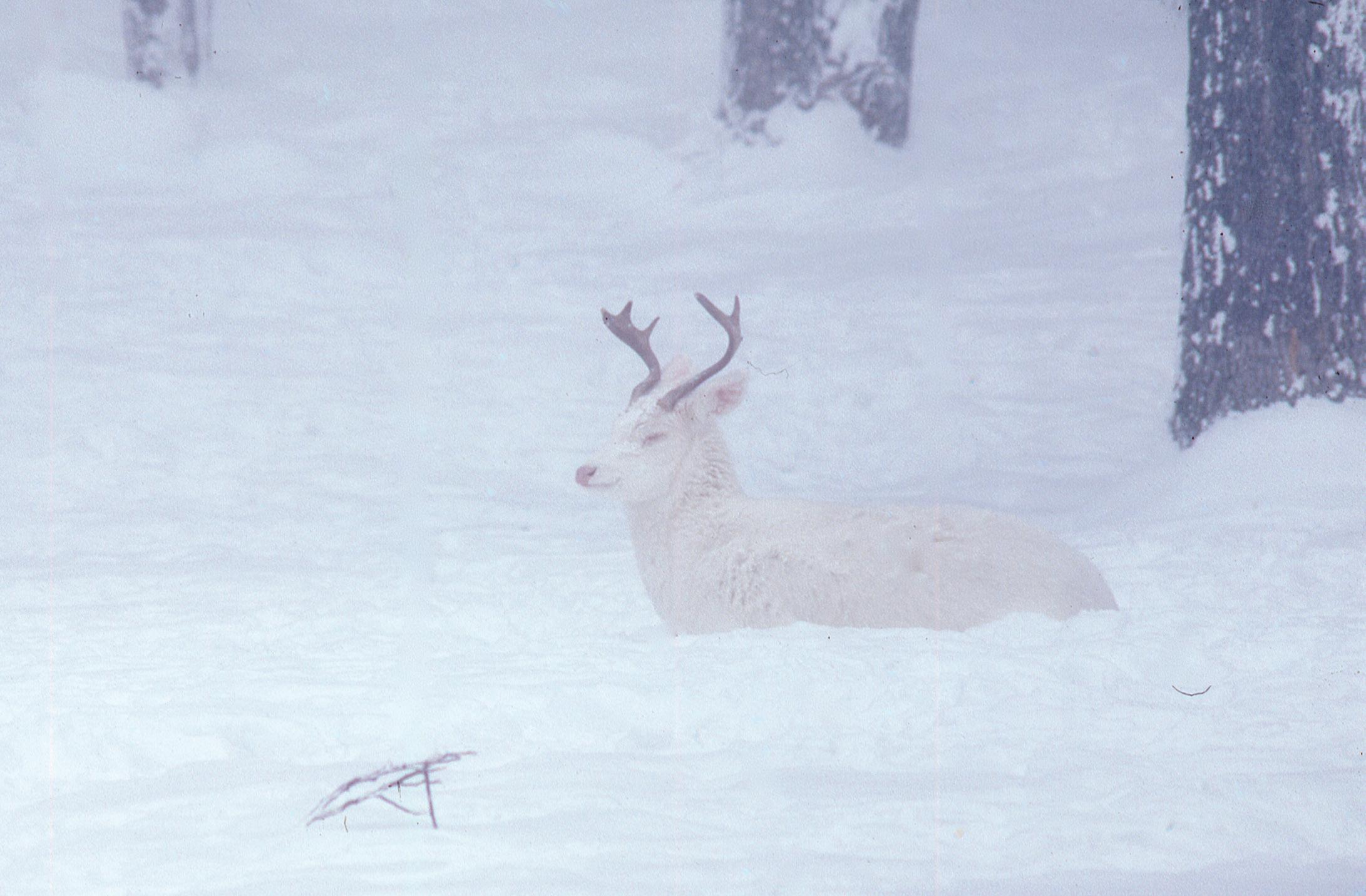
around two dozen other white-tails, all normally-colored deer. The young buck pushed against the fence, appar ently in an attempt to get out, and the other deer seemed upset at the pres ence of the newcomer.
Upon seeing the unsettling situ ation, Ozzie “Bucky” O’Neill, the park caretaker at Presque Isle, called the MDNR and asked what action he should take to ensure the safety of the
young albino buck. The MDNR re sponse was “What would you suggest be done?” O’Neill suggested letting all the other deer go, build a fence to create a separate section in the pen along the north end of the enclosure for the albino buck, and build a oneway entrance at the other end of the pen to let the deer back in.
The MDNR approved the idea. The park was closed after visitors and
their cars were made to leave, and O’Neill proceeded to open the south west corner of the fence. With the help of a photographer there at the time, O’Neill walked clockwise around the outer edge inside the pen from the northwest corner to the southwest and herded all the deer except the albino, who was huddled against the northern edge of the pen, around toward the opening. The photographer provided an obstruction to push the deer out of the pen.

Once all the deer were outside the fence, the opening in the fence was secured, leaving only the albino in the pen. O’Neill then constructed a fence inside to separate the albino on the north end and built a one-way open ing on the southeast side of the pen to let the deer in to an area where there was a large platform of food. Within a few days, the deer were back in the pen. Over the next few months, the herd became accustomed to the albino deer and eventually O’Neill was able to take down the temporary partition in the pen to allow the herd to mingle with the albino.
Over the next couple of years, the albino buck developed its annual set of antlers, although they were small and unusually shaped. Each year the Parks and Rec department removed surplus deer to maintain a stable pop ulation inside the two-acre pen and the albino buck became the dominant buck.
With that position in the herd, the albino buck had the opportunity to breed with many, if not all of the does in the pen. Over the next few springs
November 2022 Marquette Monthly 31
Pictured here is the original Marquette albino buck at age 6.5. (Photo by Scot Stewart)
several fawns were born with very faint brown backs and spots, results of the albino buck mating with does having no albino genes. Even though one was taken from the pen and hand fed, they all died. Eventually a true albino fawn was born and thrived. In the following years, the city continued to release excess animals to maintain a stable population.

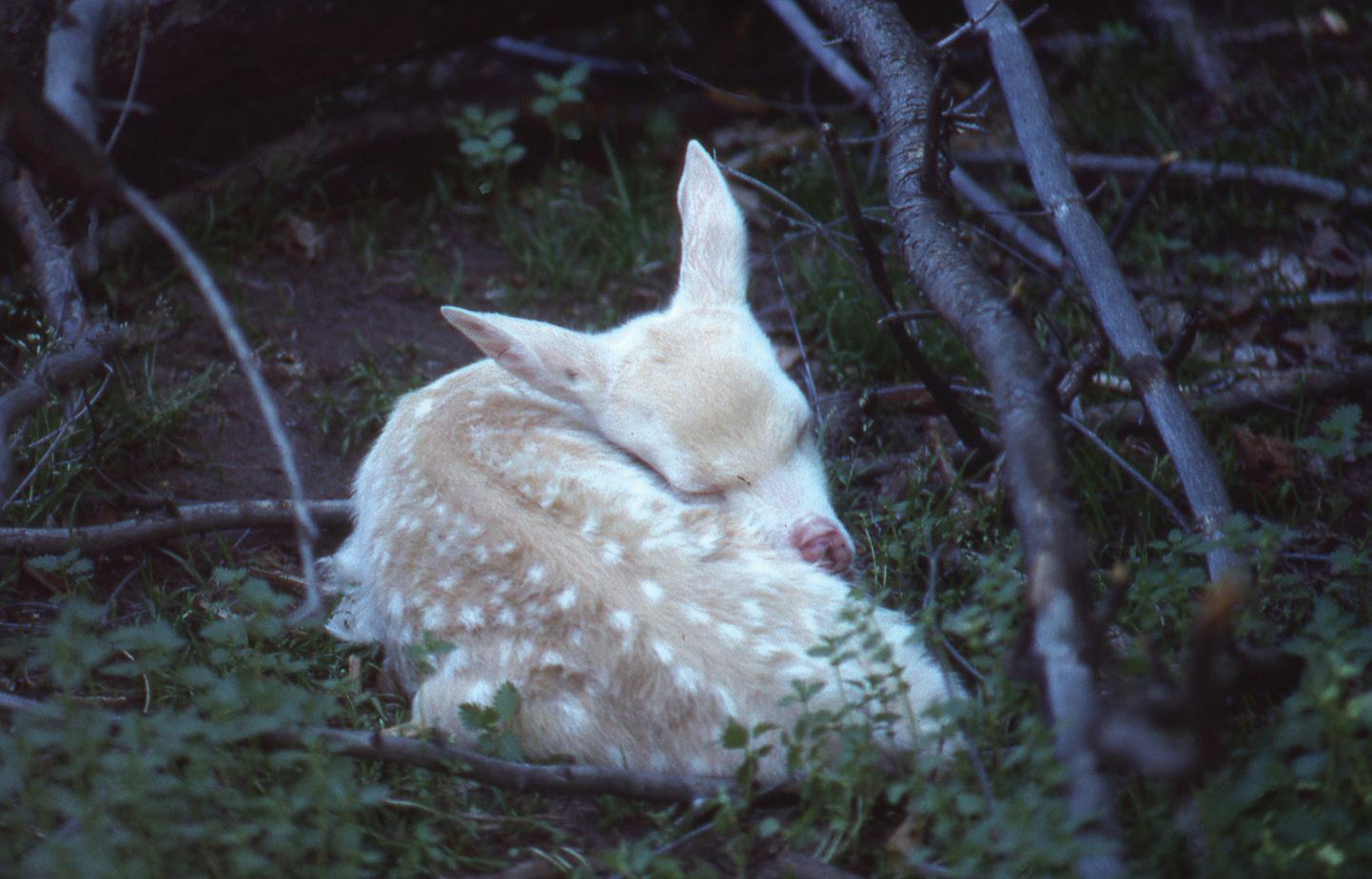
When the albino buck began the rut in 1988, it got into a fight with another buck in the pen and was se riously injured. The injuries dictated the buck be euthanized. Four years later, in 1992, because of changes in the laws regarding “roadside zoos,” the classification the Department of Agriculture gives small wildlife exhi bitions, the city of Marquette declined to proceed with the construction of a double fence required to provide an area of separation between animals and humans. This resulted in the dis mantling of the fencing, and the deer were freed.


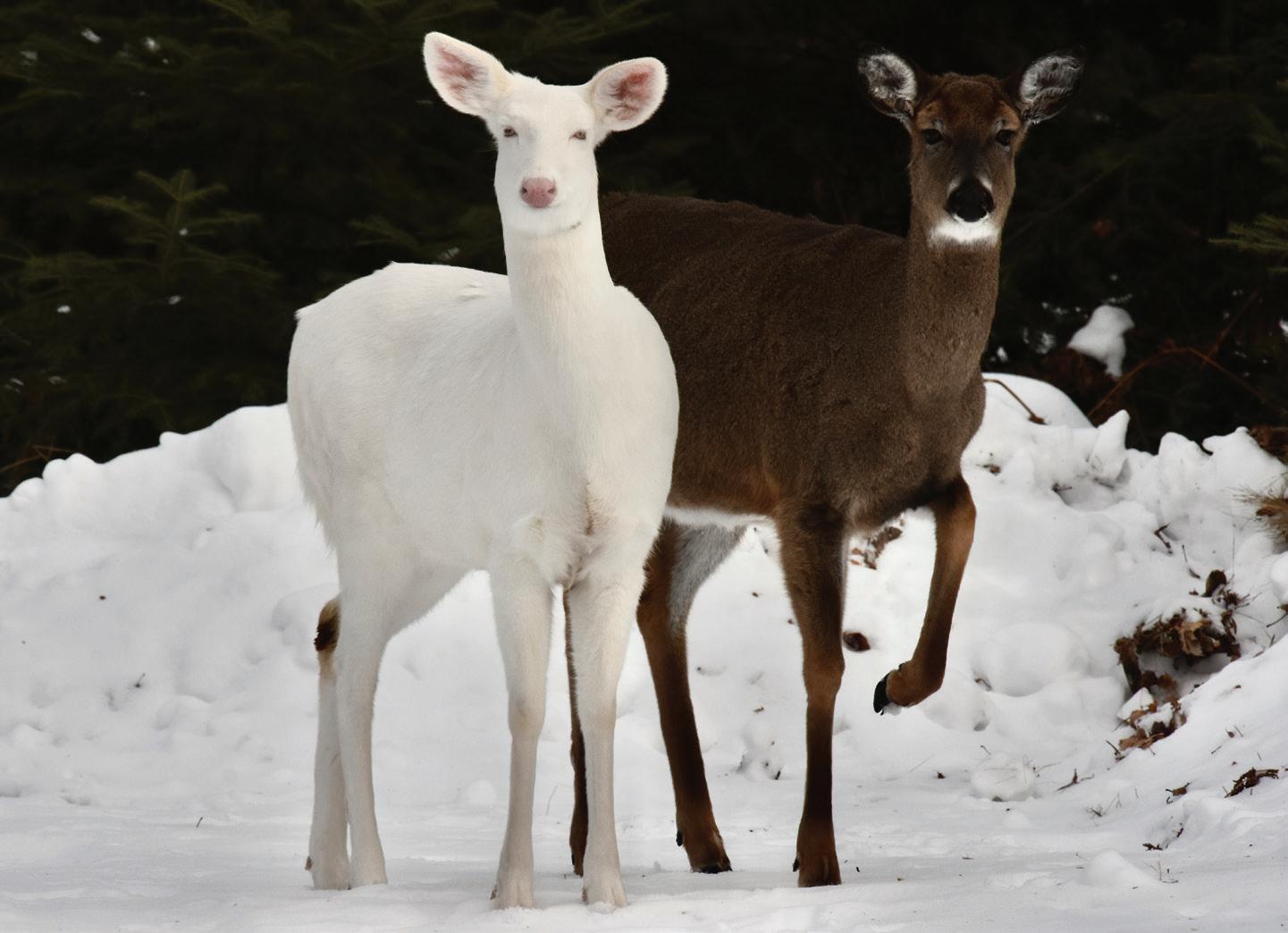
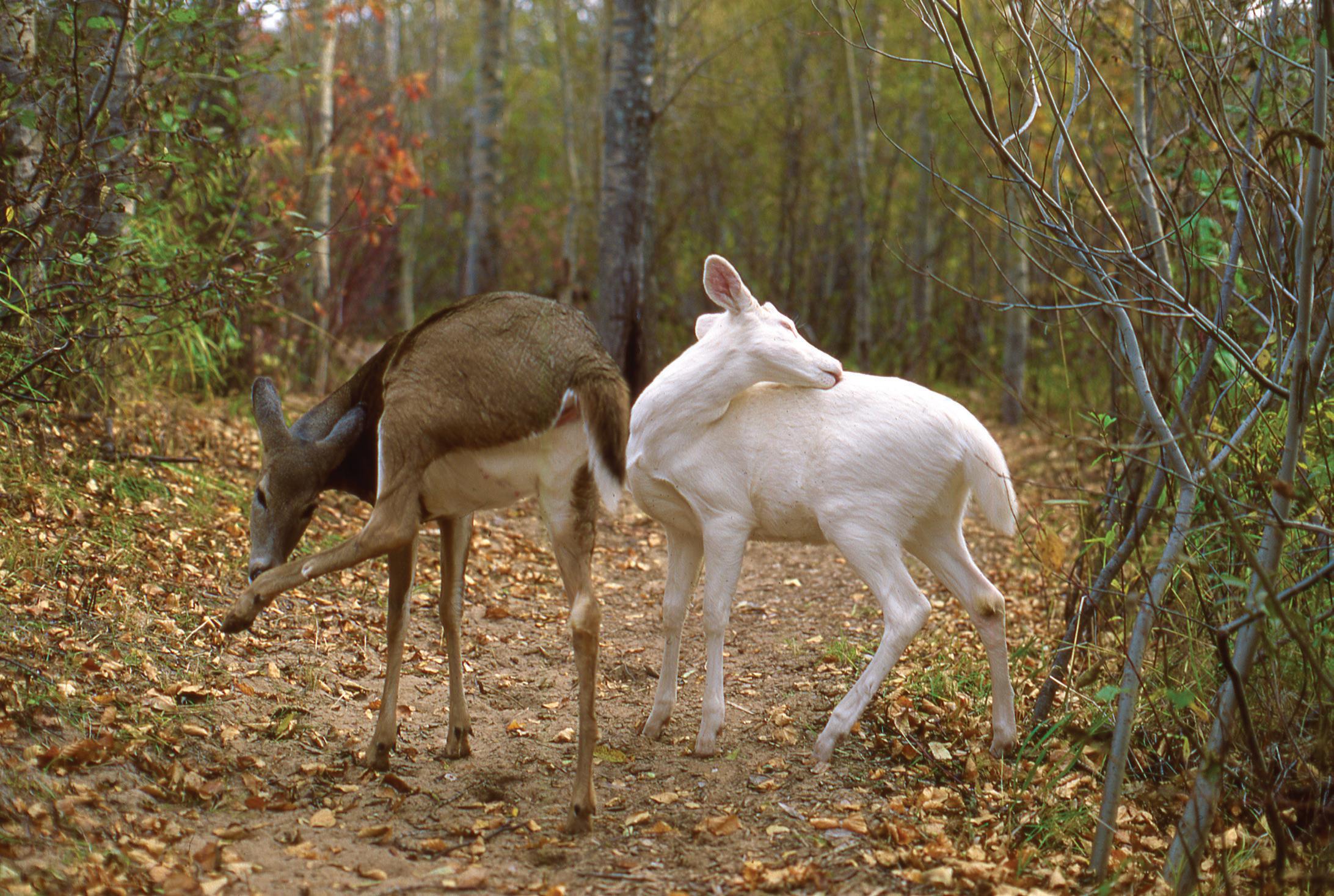
32 Marquette Monthly November 2022
Above, a pair of twins at the bog walk in Marquette. Middle left, an albino doe with a brown doe. Bottom left, a fawn born to an albino buck and a doe with no albino genes. (Photos by Scot Stew art)
After the fencing was removed, many of the deer remained in the park, creating some environmental issues as the deer browsed across the park, removing a sizeable portion of the understory, including some of the herbaceous species. They opened up portions of the vegetation, creating changes to airflow and essentially lowering the moisture content in the soil, a change capable of challenging the survival of animals like blue-spot ted salamanders, ones in need of criti cally moist soil to survive.
Until 2000, citizens were allowed to feed deer in the park, but the con cern over a higher deer density, a sit uation encouraging the easier spread of deer diseases, and the changes to the plant life in the park’s woods, led to a ban of deer feeding in the park, and eventually a decision was made to reduce the size of the herd in the park with a special hunt due to its ex cessive size. A total of 61 deer were taken, some carrying the albino gene. Some deer did leave the park, in cluding the albino doe born in the enclosure, and although the rest were of the normal coloration, they car ried the recessive albino gene. Re cessive genes are carried on one set
of a deer’s 35 pairs of chromosomes. With recessive genes, the organism must have the gene present on both chromosomes (essentially getting the gene from both parents), one from the mother and one inherited from the fa ther in the given pair for the trait to be expressed. In this case, the albino gene creates a lack of pigments in skin, fur and pupils of the eyes.
If a deer inherits the albino gene from one parent, it appears to look “normal” as far as fur, skin and eyes look. That “normal” gene is a domi nant one, meaning if it is received by just one parent it will be expressed, or shown in the new individual. The albino gene must be inherited from both parents, and even if both have typical coloration, the albino gene is expressed, and the deer is white, with pink colored skin and reddish eyes, colored by blood in blood vessels.
With a number of normal colored deer sired by the albino buck carrying the albino gene, the possibility of two carrying the gene that mate has a one in four chance of producing an albino fawn. If an albino parent mates with a partner carrying the albino gene there is a 50/50 chance of producing an al bino fawn. But if only one parent car
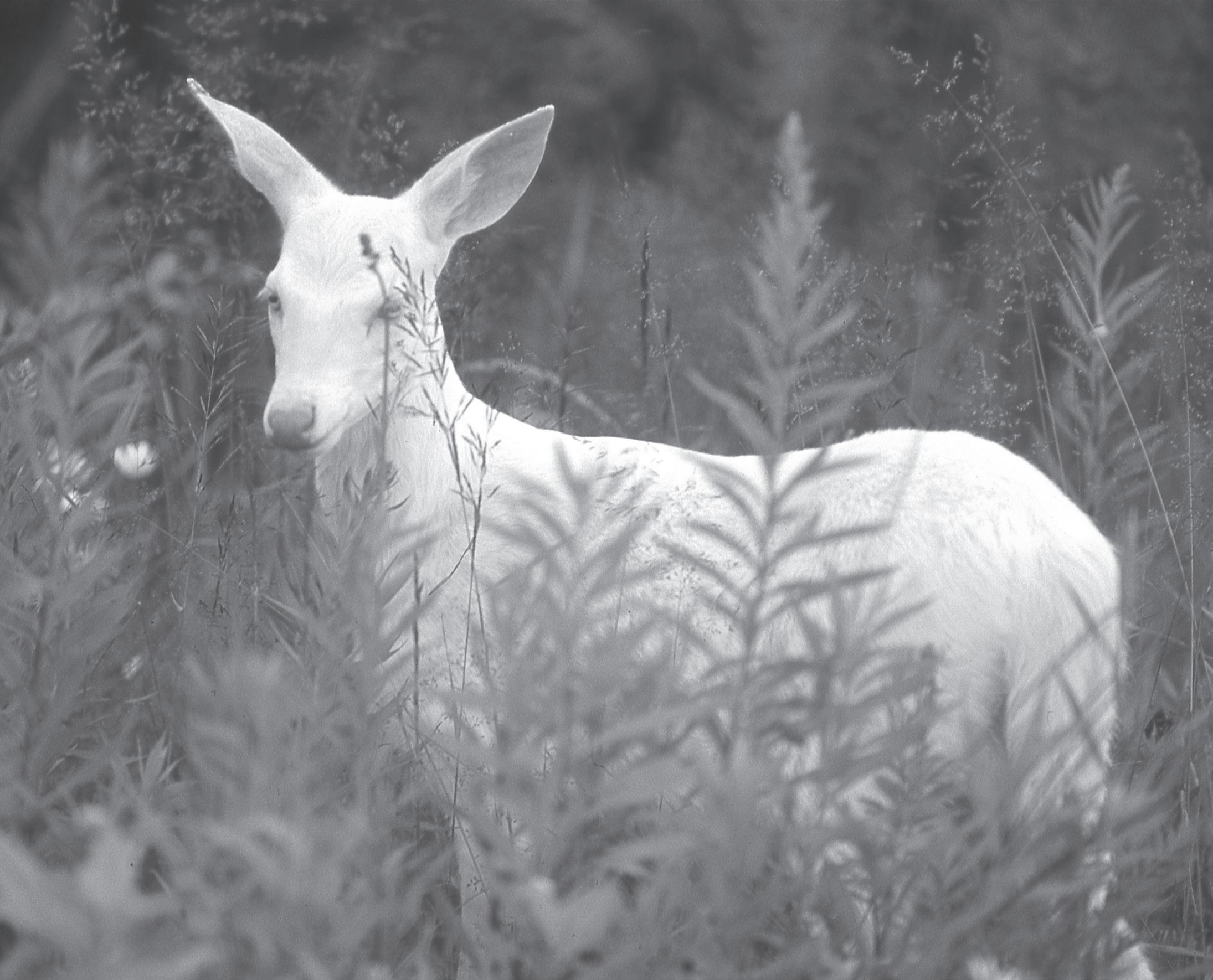
ries the gene it is impossible for two to produce an albino offspring.
Today there are two or three albino does in the Marquette and Marquette Township area. Most of the albino bucks reared in the area disappear fairly quickly. Until 2008 it was il legal to hunt albino or leucistic (pie bald) partially white deer but most bucks in the Marquette area have fall en to poachers or autos prior to that year or hunters since the law changed. While they are not considered sacred in the same way albino or white bison are, they are considered truly special to most that see them today.
Most people watching deer, espe cially those in town where wildlife may be more difficult to see regular ly, get a special feeling when they see one and continue to feel connected to the Upper Peninsula’s natural world, despite the changes that come, even the manmade ones. It is a truly magi cal place.
Scot Stewart has lived in Marquette long enough to be considered a true Yooper even though he was born in Il linois. He is a teacher and loves to be outdoors photographing and enjoying nature.


November 2022 Marquette Monthly 33
MM
An albino deer at Presque Isle in the summer. (Photo by Scot Stewart)
back then
Marion tried them all’
UP woman had amazing athletic skill
By Larry Chabot
It’s


hard to imagine the conditions which women athletes endured in sports before Title IX in the early 1970s opened a path to equal treat ment. Most teams were unaffiliated, had volunteer coaches, and were lucky to find a sponsor to fund uniforms and equipment.
Several U.P. women’s softball teams not only had uniforms but played in a real league; there the sim ilarities with male teams pretty much ended. A local incident was typical of the casual attitude which attended women’s’ teams. In 1951, a talented group of Marquette women athletes called the Plumberettes were play ing softball under the sponsorship of Mehrman Plumbing. Having won the U.P. championship that season, they were invited downstate to play for the state title, a first for a U.P. squad. Among team members were two super athletes: Karen Violetta (later Kunkel)

Journalist Dixie Franklin described the sequence of events which showed how tough it was for a female team to play for such high stakes. They had to borrow a big limousine from Belmore Taxi Company and most of the play ers stuffed themselves into a vehicle which was limited to 45 miles an hour. Karen Violetta, only 17 at the time, was at the wheel of the limo. The rest rode with manager Dick Dorman in his car.
As the taxi got in line at St. Ignace for a ferry, the vehicle wheezed and groaned to a halt (the Mackinac Bridge was only a dream then). Rain was coming down like bullets as the team piled out of the taxi to push it onto the ferry. Then they ducked inside the ve hicle to avoid the downpour.
When the ferry arrived at Macki naw City, Karen was able to re-start
and drive off, but once on the road to Flint they blew a tire. A spare was mounted and away they went. Anoth er flat tire brought them to a halt. Be cause there were no more spares, pairs of girls took turns rolling the flat to the next town for repairs. Sorry, said the tire changer at one gas station, as he held up a pawful of bandages. “Lawn mowing accident,” he said.
Someone had to fix the tire. Up stepped driver Karen Violetta, who had learned the tire-fixing drill at her dad’s gas station. At last, the caravan arrived in Flint, 20 hours after leaving Marquette. The girls were tired, hun gry and soaking wet, and were able to grab a few hours’ sleep before taking the field against a team from Athens.
The Plumberettes had another prob lem: their regular catcher was seven months pregnant and couldn’t squat behind the plate. She was switched to the outfield. The “veteran” infield
34 Marquette Monthly November 2022
and Marion Anderson. Our salute this time is to Marion.
‘
Illustration by Mike McKinney
consisted of three 16-year-olds and a 17-year-old. They were blasted 12-3.
But this talented, resilient, close-knit, seasoned squad was eager to capture the state crown. This being a double-elimina tion tourney, they had another shot, and unleashed the fabulous Marion Anderson, who pitched a nearly flawless game to even the series. Game three, which decided the title, was an easy win, giving the girls another tro phy.
Alas, the big taxi had more flats on the way home, but they limped into Marquette with Kar en Violetta pounding the horn so much that she was pulled over by a policeman. When he learned who they were and what they had done, he proud ly escorted them into town and a waiting welcome home. As proof that their championship season was no fluke, the Plumberettes repeated as state champs in 1952.
So who was this Marion Anderson, whose manager called her “the belle of the diamond?” Her extraordinary athletic skills enabled her to excel at every sport she entered, both men’s and women’s, almost too many to count: a dizzying array including soft ball, baseball, tennis, bowling, golf, swimming, football, volleyball, bas ketball, hockey and snowmobile rac ing. Even pillow fighting, as she told Michael Murray of The Mining Jour nal. “I wanted to try them all.” Have we left anything out?
In bowling, she carried an impres sive 200 average “when pins were heavier,” she noted. She rolled a high game of 267 and high series of 654, even got a rare 300 game. To learn the sport of golf, Marion taught herself to play the game by watching televised tournaments. Wouldn’t you know, she actually made a hole-on-one.
In tennis, she was as good as it got. She was a superb tennis player, taking on the top men and women players. The late Leonard “Oakie” Brumm and his brother Bob were having lit tle trouble winning most of the men’s matches, but admitted to big trouble with Marion.
He was a big fan of hers. Scoring 50 points in a basketball game, said Oak ie, was routine for her, and she was noted for her “sharp elbows” playing hockey on the East Ohio Street rink. She never played dirty or cursed her opponents, and was very strict about playing by the rules.
In a 2006 story, The Mining Jour nal’s Craig Remsburg called her an exceptional athlete, a pioneer in wom
en’s sports. He quoted teammate Kar en Violetta, her catcher for six years in fast-pitch softball. “Marion was one of the most outstanding athletes ever from Marquette and one of the best fe male athletes the U.P. ever turned out. She was a standard underhand pitcher, not the windmill type. We all respect ed her.”
Oh wait, there were more sports to master: we forgot skiing, biking, pole vaulting (really!) and touring with a men’s traveling baseball team.
“I tried everything,” she often said. “I played all the boys’ sports. It kept me out of trouble.”
She had to support herself, which she did as a press operator for Guelff Printing Company in Marquette. She has a baseball field named for her in North Marquette, and is in the U.P. Sports Hall of Fame. Marion died at age 84 in 2006. Oakie Brumm, who died the same year and is also in the hall, called her “the best all-around U.P. female athlete and one of its best citizens.”


MM
Writer’s note: Let’s hear it for the members of that championship team: Dorothy Laurich, Kay Milner, Joanne Cline, Barbara Racine, Connie Mohr man, Joan Lequia, Joanne Marceau, Grace Marceau, Margaret Graham, Mary Hazeres, Carol Boyle, Karen Vi oletta, and Marion Anderson.
Larry Chabot, an Ontonagon native, worked his way through Georgetown University and was then employed at White Pine Copper Company for 32 years, before moving to Marquette with his wife, Betty. He is a freelance writer who has written for several publications, including more than 180 articles for Marquette Monthly.

November 2022 Marquette Monthly 35
lookout point
Compassionate care
Hospice providers work together to raise awareness
 By Kristy Basolo-Malmsten
Itsometimes takes special circum stances for competitors to come together. For two local health care providers, that means taking advan tage of an opportunity to educate the public about what they do.
November is National Hospice & Palliative Care Month. Hospice agen cies in Marquette County have teamed up to raise awareness about what hos pice is, and when the right time is to
seek out these services. And there’s nothing competitive about it.

“What we’ve done for the past many years is work with Lake Su perior Life Care & Hospice to offer community education in Marquette County to explain what hospice pro vides to people,” said Kori Tossava, U.P. Home Health & Hospice director of community services. “From both of our hospices’ standpoints, as long
as people understand that hospice is an option and when the right time is to discuss hospice, the better it works out for both of our organizations and the families helped.”
The challenge is how to educate people about something they might not need yet.
“It’s hard to get people to listen when they might not need hospice now,” Tossava said. “It’s important
for them to learn about it before they need it for themselves or a loved one in the future.”
This year’s theme is “Meeting You Where You Are.”
“People like to be in their homes,” she said. “We are bringing these ser vices to them. Hospice is meant to be comforting and filled with care.”
Tossava said there are many con fusing things about hospice, including
36 Marquette Monthly November 2022
Hospice patient, John, enjoys a day of fishing on Lake Independence with some volunteers. (Photo courtesy of Lake Superior Hospice)
its definition.
“Hospice is about living the life that you want with a life-limiting di agnosis,” she said. “This means tak ing priorities and quality of life into consideration.”
Hospice teams include doctors, spiritual leaders, mental health pro fessionals and more.
“It’s a really beautiful interdisci plinary team that gets together to help someone,” Tossava said. “The pur pose of hospice is to bring a team of people together to support life. The biggest term people struggle to un derstand is ‘life-limiting diagnosis.’ We used to call it end-of-life care, but that’s not exactly correct. The point is to be able to live with the diagnosis.”
The other term associated with hospice is “palliative care.” Pallia tion—or symptom management for disease—differs from a curative path.
“It’s not entirely about cancer pa tients, although that’s a common one,” Tossava said. “A palliative path includes comfort care and symptom management. This can take place with a diagnosis of Alzheimers, organ fail ure, Parkinsons—they all could be considered in this.”
Each hospice plan is unique, de pending on the individual and their
diagnosis.
“There are so many confusing things about it for people who are hearing about it for the first time,” Tossava said. “That’s why we want to get people together to talk about it and understand it before they or a loved one need it and are in crisis.”
On November 1, the two agen cies will have their Bells for Hospice event at 6 p.m. in the Marquette Com mons. The program will include staff from both organizations, spiritual leaders and musical entertainment. A bell choir and singers will be featured in the short program, which is meant to kick-off hospice month activities in the county.
“Bells for Hospice is a healing op portunity,” Tossava said. “It’s for any one who has lost a loved one who was in hospice, or for people who are cur rently touched by hospice. This is the first thing that we do together (during hospice month) to bring attention to hospice.”
Throughout the month, the two hospice organizations will team up for community education events at senior centers and other key places through out the county. U.P. Home Health & Hospice does angel displays to help draw people in.

November 2022 Marquette Monthly 37
A hospice patient with caregivers. (Image courtesy of Lake Superior Hospice)
“We do angel displays in local businesses in the community,” Tos sava said. “We hope people can start to understand and ask questions about what you get from hospice, and what to expect leading up to it.”
For details about the angel dis plays, call (906)225-4545 or visit www.uphomehealth.org
Tossava wants people to know that hospice is not about death, it’s about empowerment—both for the patient and their families.
“This is about raising awareness that hospice isn’t just about death and dying,” said Lake Superior Hospice & Lifecare clinical director, Sharon Walker, RN. “It’s about life and living life to the fullest, and quality of life.”
Hospice isn’t just for the last days, hours and minutes of your life, she said.
“A lot of people miss out on the benefit of hospice because they wait too long, dealing with suffering and anxiety that could be prevented,” Walker said. “Our job and purpose in pairing up with U.P. Home Health & Hospice is to raise awareness and understanding of what hospice has to offer so more people can reap the ben efits of hospice.”
Among the things hospice staff want everyone to know is that there is
a Medicare benefit that can cover a lot of the costs.
“One of the biggest things we hear from people is that they wish they would’ve gotten involved with hos pice sooner,” Tossava said. “If you get diagnosed with something that quali
fies for the hospice Medicare benefit, so much is available to you.”
Calling to have a conversation with a hospice agency can clarify what might be available, and what, if any, cost is associated with the services.
“So much is covered under that
benefit,” Walker said. “Our purpose is to be able to relieve suffering, pro vide comfort and support patients and their loved ones through their journey, wherever they’re at. This is the most intimate and toughest time in their life; we want to help alleviate that burden in whatever way is possible.”

Patient care funds are available at both hospices to help pick up where the Medicare benefit leaves off or as sist with deductibles for private insur ance.
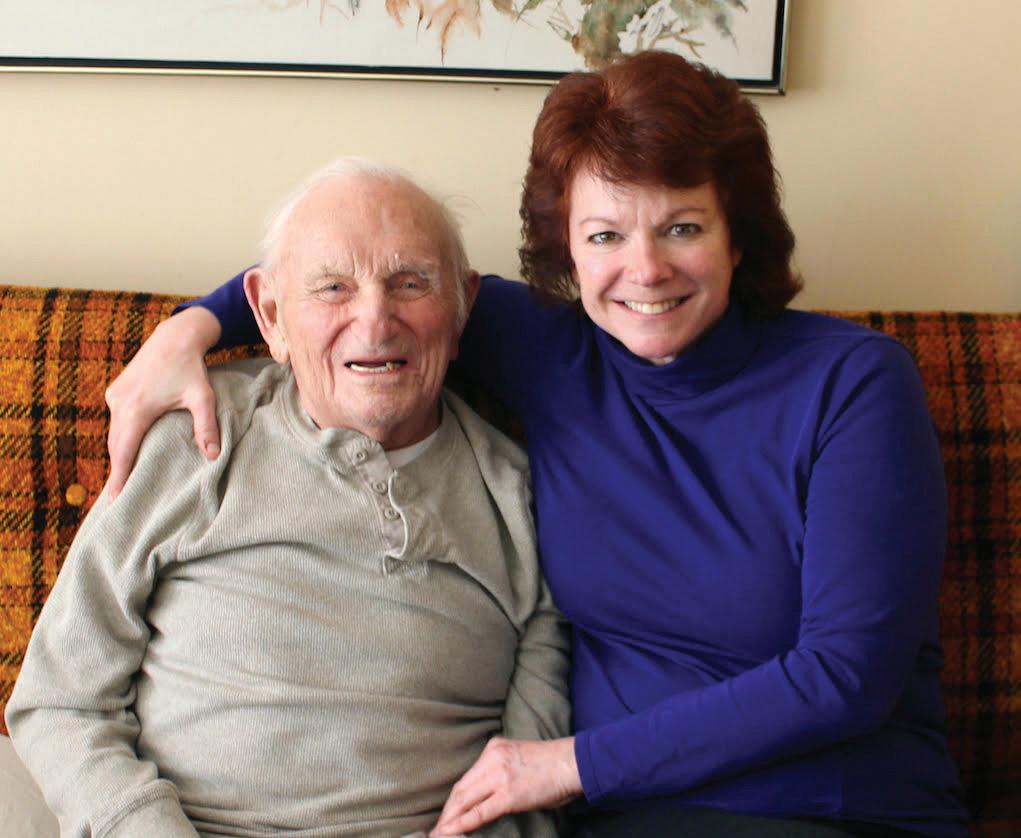
Lake Superior Life Care & Hos pice will kick off its “Heart of the Moment” online auction fundraiser on November 2. The auction raises funds so that no Lake Superior Life Care & Hospice patients will be denied hos pice services due to the inability to pay.
Auction items include a variety of experience packages, both local and afar, which is an intentional thing.
“With hospice, we often work through what the best day would look like for the patient,” said Jamie Bar biere, RN, community outreach coor dinator for Lake Superior Life Care & Hospice. “Our patient care fund can help pay for that day. Maybe it’s dinner and a movie with their family, an afternoon of fishing or dinner and drinks from their favorite restaurant.
38 Marquette Monthly November 2022
A hospice patient with a volunteer. (Photo courtesy of Lake Superior Hospice)
We work to provide those special moments for patients and families as well.”
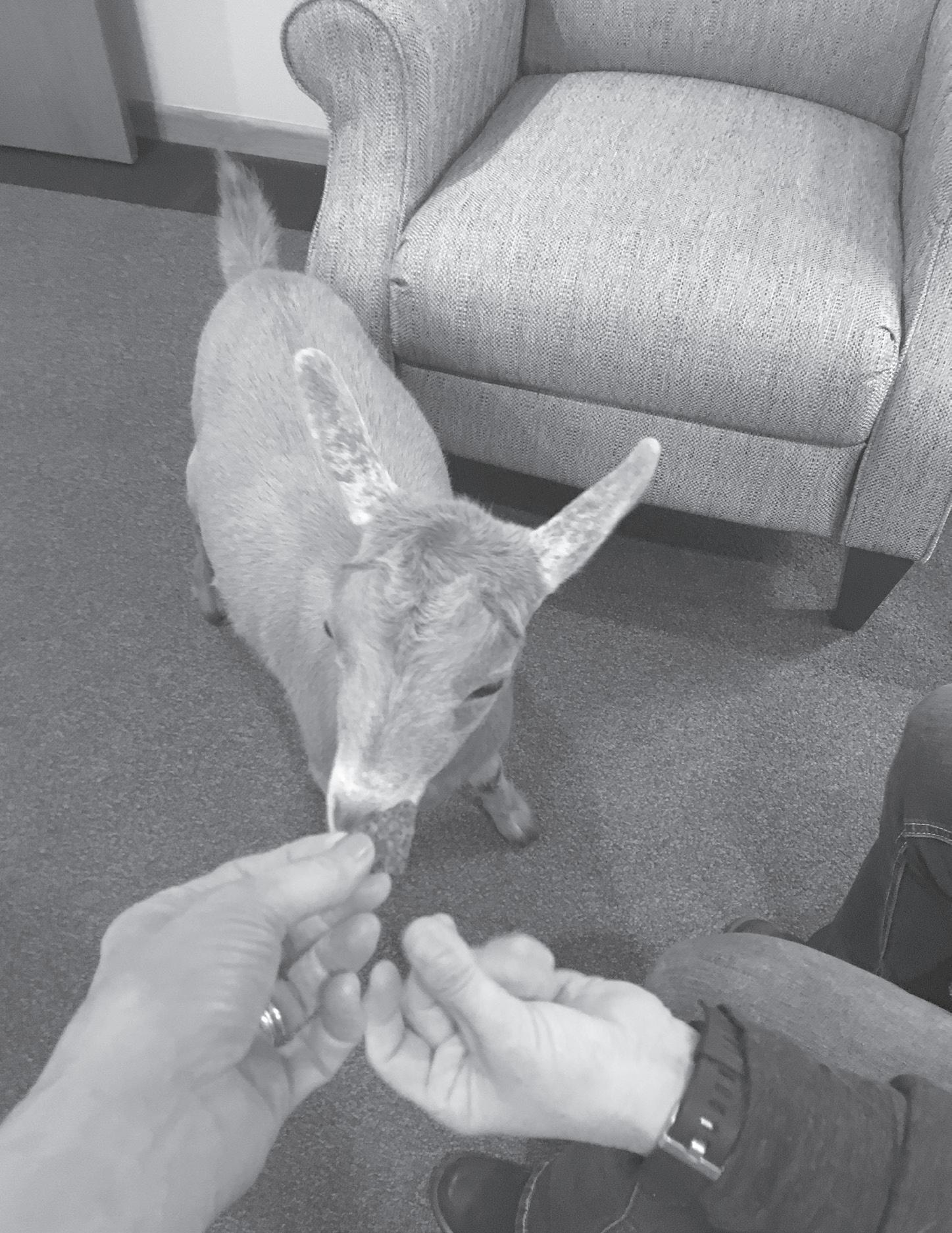
The auction mirrors these mem ory-creating experiences. From a Grand Hotel getaway to dinner & a Marquette Symphony night, the items up for grabs all strive to create a mem orable moment.
“The proceeds benefit Lake Su perior Life Care & Hospice’s patient care fund, indigent care and grief and bereavement support,” Barbiere said. “The goal is to raise $25,000 this year, with 100% of the proceeds supporting the fund.”
Those not interested in bidding on an auction item may donate from the same site.
For details about the auction, call (906)225-7760 or visit www.LakeSu periorHospice.org

Statistics show that once people enter hospice and their symptoms are being managed, they live longer—and sometimes they even graduate from hospice.
“There is a stigma to hospice,” Bar
biere said. “People are programmed to live, but the best thing we can do in outreach is to include pictures of peo ple who sign up for hospice in time so they can enjoy the days they have left with less suffering.”
All hospice staff encourages the community to learn about what hos pice has to offer now, so they are ready if it’s needed.
“At the end of the day, we’re trying to help people going through a crisis,” Barbiere said.

If you have questions about wheth er or not hospice is right for you or your loved one, Tossava said to talk to your physician.

“Hospice supplements your phy sician team,” she said. “We work in conjunction with your primary care doctor, not in place of your doctor.”
MM
Kristy Basolo-Malmsten is an NMU grad with degrees in writing and has worked for MM for more than 15 years. She also is the director of the Negaunee Senior Citizens Center.
November 2022 Marquette Monthly 39
Hospice patients receive many different types of therapy, including goat therapy. (Photo courtesy of Lake Superior Hospice)
in the outdoors
Recreating responsibly
Respect Marquette partners with Leave No Trace
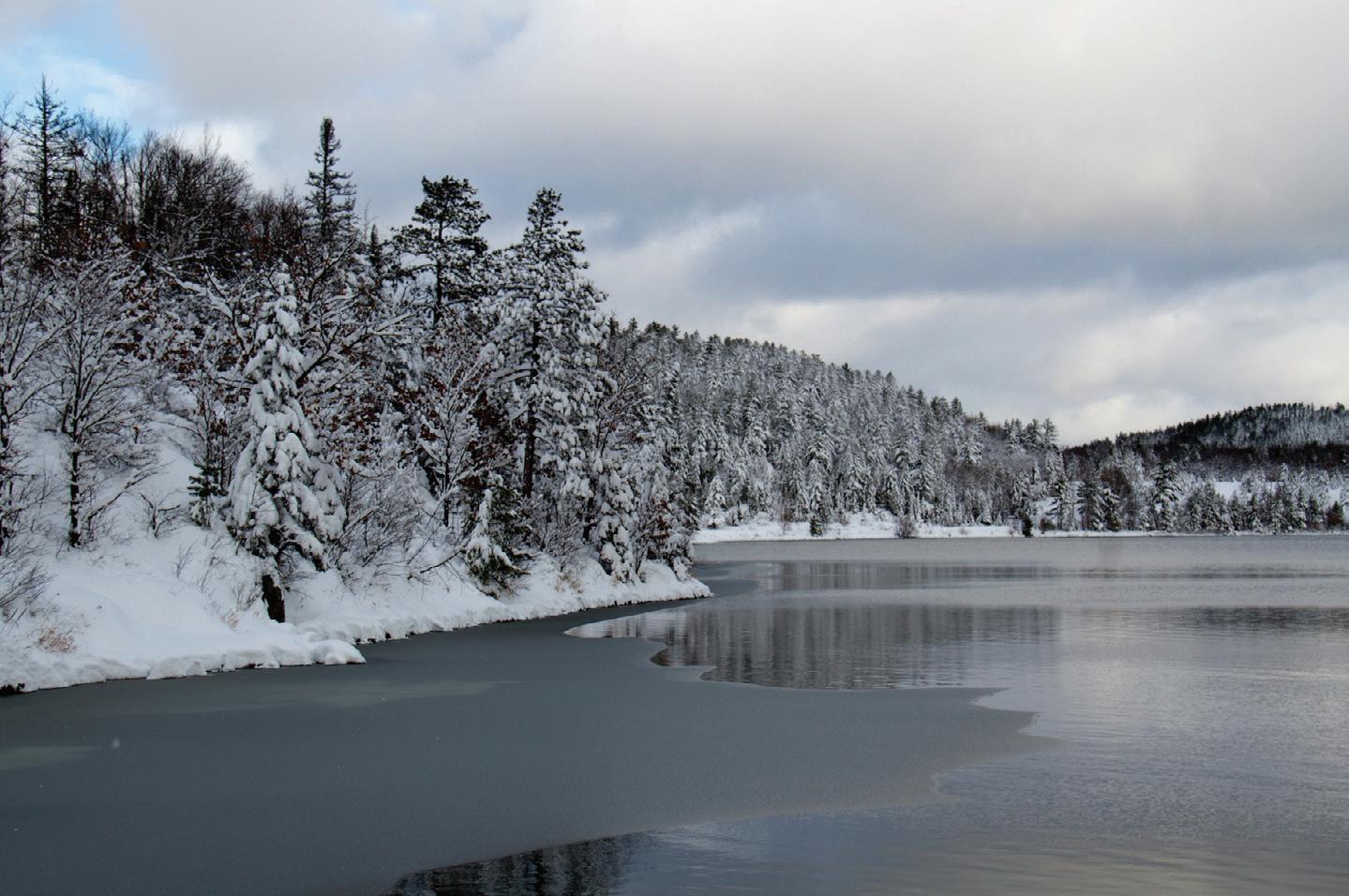

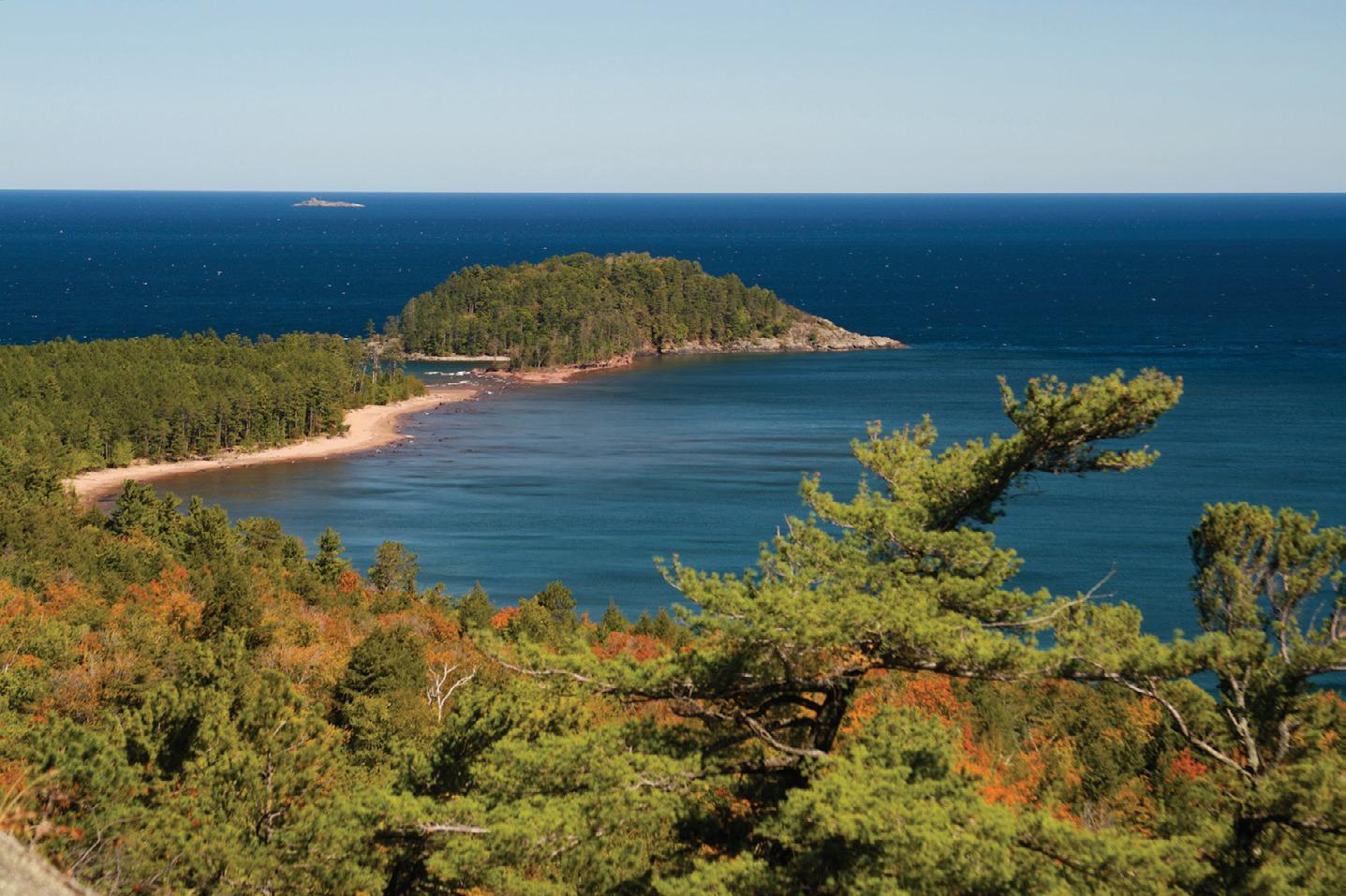 By Kristi Evans
Inan effort to minimize the impacts of human recreation on Marquette County’s beautiful landscapes, pristine shoreline and dense forests, a coalition of entities has partnered with the national Leave No Trace nonprof it organization to launch the Respect Marquette initiative. The well-estab lished Seven Principles of Leave No Trace — a framework of sustainable practices for visiting outdoor spaces — have been customized so that they retain their original intent, but are pre sented in a way that is more applica ble to local residents and visitors.
Travel Marquette initiated the ef fort in response to the pandemic-fu eled spike in tourism, which has since tapered off. President and CEO Susan Estler said the high volume of visitors seeking to experience the Upper Pen insula’s enviable natural environment demonstrated the need for increased awareness and consistent messaging on how to do so respectfully and re sponsibly.
“Based on what I saw on social me dia and in the community, there was a need for better sensitivity on both sides: locals understanding why peo ple want to come here and taking the time to help them do the right thing; and visitors recognizing that locals value where they live and recreate and showing respect for the land,” Estler said. “I also sensed a disconnect with different groups in Marquette County with ‘skin in the game’ related to sus tainability and wanted to bridge that because we planned to add a sustain ability component to our new strate gic plan. It really needed to be one of Travel Marquette’s tenets moving forward.”
Estler consulted with Cathy Ritter, who founded Better Destinations LLC to help leaders take a holistic approach to creating thriving tourism econo
mies while addressing complex chal lenges. Ritter gave a related presenta tion at a charrette held in Marquette this past March. She also helped Es tler establish a partnership with Leave No Trace after the Respect Marquette coalition was formed, for guidance on implementing a meaningful program to promote low-impact recreation.
“I’m excited about the partner ship,” said Carol Fulsher, adminis trator of the Iron Ore Heritage Trail (IOHT) and coalition member. “It helps to have a broad coalition work ing together toward a common goal and communicating with one voice rather than each organization working separately. And I really like that the focus is on why we’re asking people to do this — how following the Seven Principles will protect the environ ment and benefit all of us. We just did a survey and discovered that the big gest issues on the IOHT right now are dog waste, unleashed dogs, trash, trail etiquette and Ebikes. All of these are addressed in the principles.”
Faith Overall, Leave No Trace’s community engagement manager, traveled from the organization’s base in Boulder, Colo., to lead an Oct. 5 awareness workshop for coalition members at the Landmark Inn.
“We started working within the destination management world in 2017, when we started a partnership with the Colorado Tourism Office,” Overall said. “As visitation picked up in 2020 and 2021, more places be came interested in management plan ning for responsible visitors and be gan to approach us for guidance. We now have 15 partners within the tour ism industry. Leave No Trace (LNT) sat down with each to determine the best suite of resources and to help adapt the core Seven Principles to better focus on the predominant recre
40 Marquette Monthly November 2022
Respect Marquette has partnered with national organization Leave No Trace to help keep Marquette County’s pristine outdoor areas untouched by nature-goers, protecting places like Teal Lake (top), Little Presque Isle (middle), and Deer Lake (bottom). (Photos by Tom Buchkoe)
ation-related impacts each destination is confronting, from user conflicts to pets to people venturing off trail.

“We’re trying to help individuals take action to move along the spec trum toward fewer impacts. I would much rather see loads of people prac ticing Leave No Trace principles im perfectly than very few practicing them perfectly. There’s a great op portunity here in Marquette County. Things still look great, and this is all about maintaining that by addressing issues that have been identified as concerns before they become too se rious.”
The Marquette-ified version of the Seven Principles follows: • Know Before You Go: This is causing issues in Marquette County, particularly among visitors who don’t adequately research trail use and ter rain, conditions and required gear, and their routes. Download maps or bring

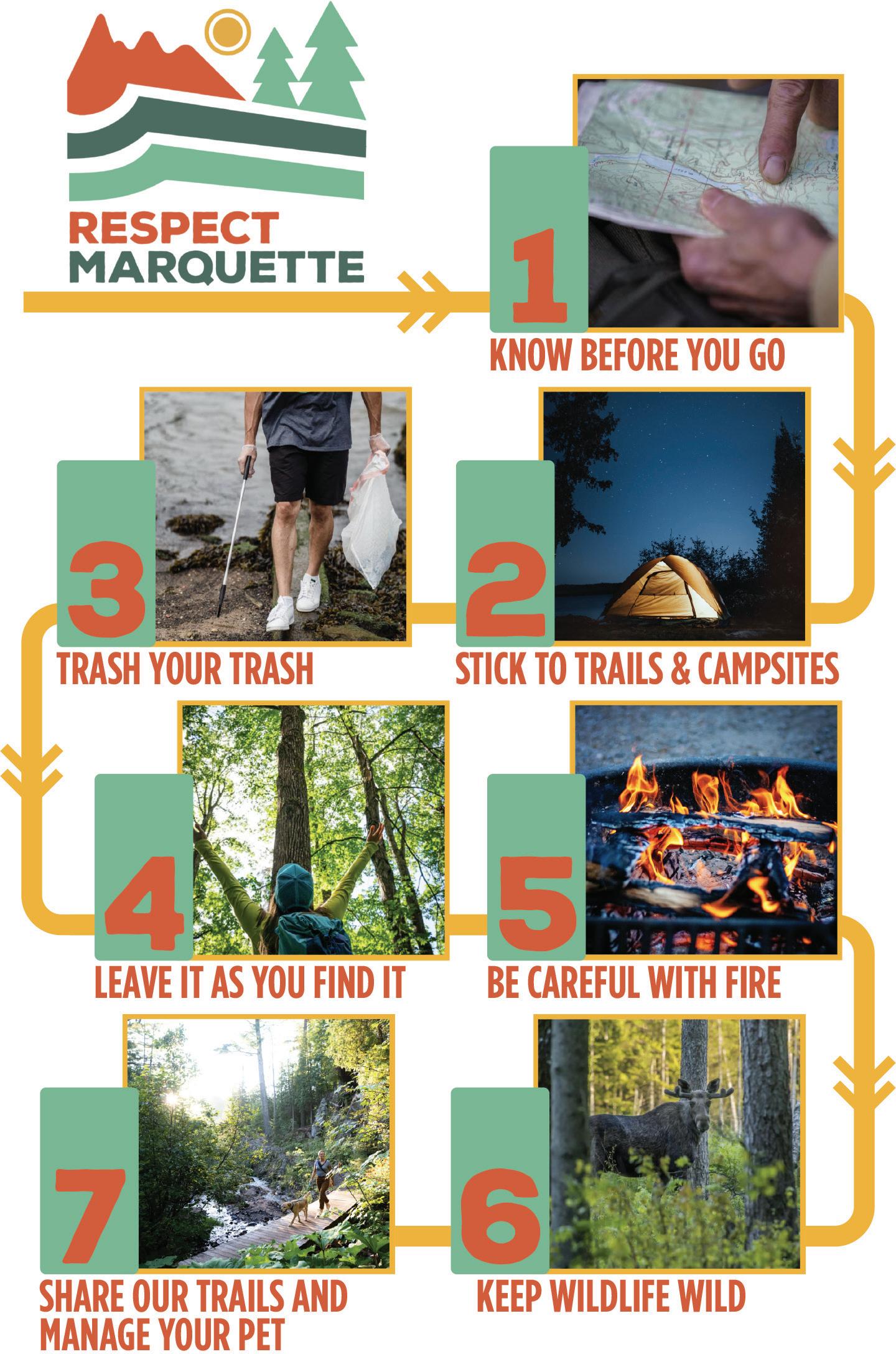
paper versions, as mobile service is not always available.
• Stick to Trails and Campsites: Respect private property and prevent erosion and the creation of new trails. In wet/muddy conditions, consider saving your activity for another day, or walk through puddles instead of around them to prevent trail widening. Camp only in existing or designated campsites to avoid damaging vegeta tion.
• Trash Your Trash: Protect water sources, wildlife and other visitors by burying human waste 6-8 inches deep and 70 big steps from trails, camp and water. Pack out your pet’s poop to the closest garbage can. Put litter—even crumbs, peels and cores—in garbage bags and carry home; it can take years to decompose.
• Leave It as You Find It: Reduce the spread of invasive species by brushing off boots and bike tires. If

November 2022 Marquette Monthly 41
boating, clean, drain and dry all wa tercrafts before and after every outing. Leave plants, rocks and other natural items, as well as cultural artifacts, so others can enjoy them.
• Be Careful with Fire: Be sure a fire is permitted and safe in the area you’re visiting. Only use existing fire rings to protect the ground from heat. Keep fires small, burn all wood to ash, and extinguish with water so it is cool to the touch. Buy firewood locally or gather on site, if allowed, because it may harbor tree-killing insects and diseases.
• Keep Wildlife Wild: Observe an imals from a distance and never ap proach or follow them. Allow extra space during sensitive times such as mating, nesting, raising young or win ter. Securely store meals and trash. Human food is unhealthy for all wild life and feeding them could start bad habits.
• Share Our Trails and Manage Your Pet: Trail etiquette is that hikers yield to uphill hikers, bikers yield to hikers and everyone yields to horses and wheelchairs. Before passing other users, verbally communicate that you are approaching. Keep pets leashed and under control. Not everyone en joys them as much as we do.
By working with the public and
those managing public lands, Leave No Trace (LNT) focuses on educat ing people — instead of costly resto ration programs or access restrictions — as the most effective and least re source-intensive solution to land pro tection. The LNT concept is more than a half-century old, its website states. While it originated in backcountry settings, the principles have been adapted to apply anywhere — from remote wilderness areas to local parks to backyards — and to almost every recreational activity. The organization is dedicated to providing innovative education, skills and strategies to help people become environmental stew ards.
“The Seven Principles of Leave No Trace are not rules and regulations,” Overall said. “They are just simple and effective guidelines for how any one can use the outdoors responsibly. And because they are based on sci entific research, they are continually evaluated and reshaped, if necessary.”
Overall told Respect Marquette co alition members at the workshop that there are four phases of the recreation experience that present opportunities to reach people with key messages about responsible tourism. For ex ample, during the anticipation phase of general trip planning, individuals
who book lodging or activities could receive confirmation emails with links to the Respect Marquette website and its adapted Seven Principles, along with social media accounts.
As visitors travel to their desired locations, state welcome centers and tourism offices can post or relay infor mation on sustainability (Marquette is already doing this). The onsite expe rience can also include educational components, such as signage at trail heads, volunteers on trails, or a poster on the bathroom stall at a local brew ery. As tourists reflect on their expe rience afterward, emails from a guide service thanking them for visiting and practicing Leave No Trace while there would further reinforce the message.
“Leave No Trace is a great organi zation to partner with because it has a fantastic reputation and has been around long enough that it has honed in on all things we need to understand about being outside,” said Heather Vivian, information manager with Travel Marquette and the point person for implementing Respect Marquette. “I’m personally super-passionate about environmental sustainability and outdoor recreation. I look forward to making the community more aware of issues impacting our natural sur roundings and encouraging them to
take steps to minimize these issues.”
Vivian said Travel Marquette staff members ramped up promotional ef forts over the summer. They created posters, social media and blog posts, and recently produced a video. They also started a series of MARQeti quette tips from various individuals that explain how best to connect with and care for the area while visiting. In her tip, NMU Professor Jacquie Me dina wrote:
“Have some background knowl edge about the area before coming so that you are able to develop a true understanding and appreciation for it, as well as find your own connection to this place. Think of and treat Mar quette how you would your own com munity and family: with respect and care. We should all be in the mindset of caring for places we travel to as it was our own backyard.”
For more information on Respect Marquette, and to see the full list of coalition partners, visit www.travel marquette.com/respect-marquette/ MM
Kristi Evans is a PR professional, writer and hobby photographer who spends much of her free time out doors. She has served on the board of the Marquette Area Chapter of the NCTA since fall 2021.

42 Marquette Monthly November 2022

November 2022 Marquette Monthly 43
at the table
A Lucullan Thanksgiving
dinner
By Katherine Larson
shouldn’t be an afterthought
Lucullus,
as Plutarch tells the story, was a Roman who was famous for his banquets. Each evening, guests would flock in and, through the combined efforts of Lu cullus and his chef and his chef’s enslaved assistants, everyone would feast lavishly.

Once, though, no guests were invit ed. The chef offered a less stupendous meal: “I assumed that since there were no guests, there was no banquet.” He assumed wrong. “Tonight, Lucullus dines with Lucullus!”
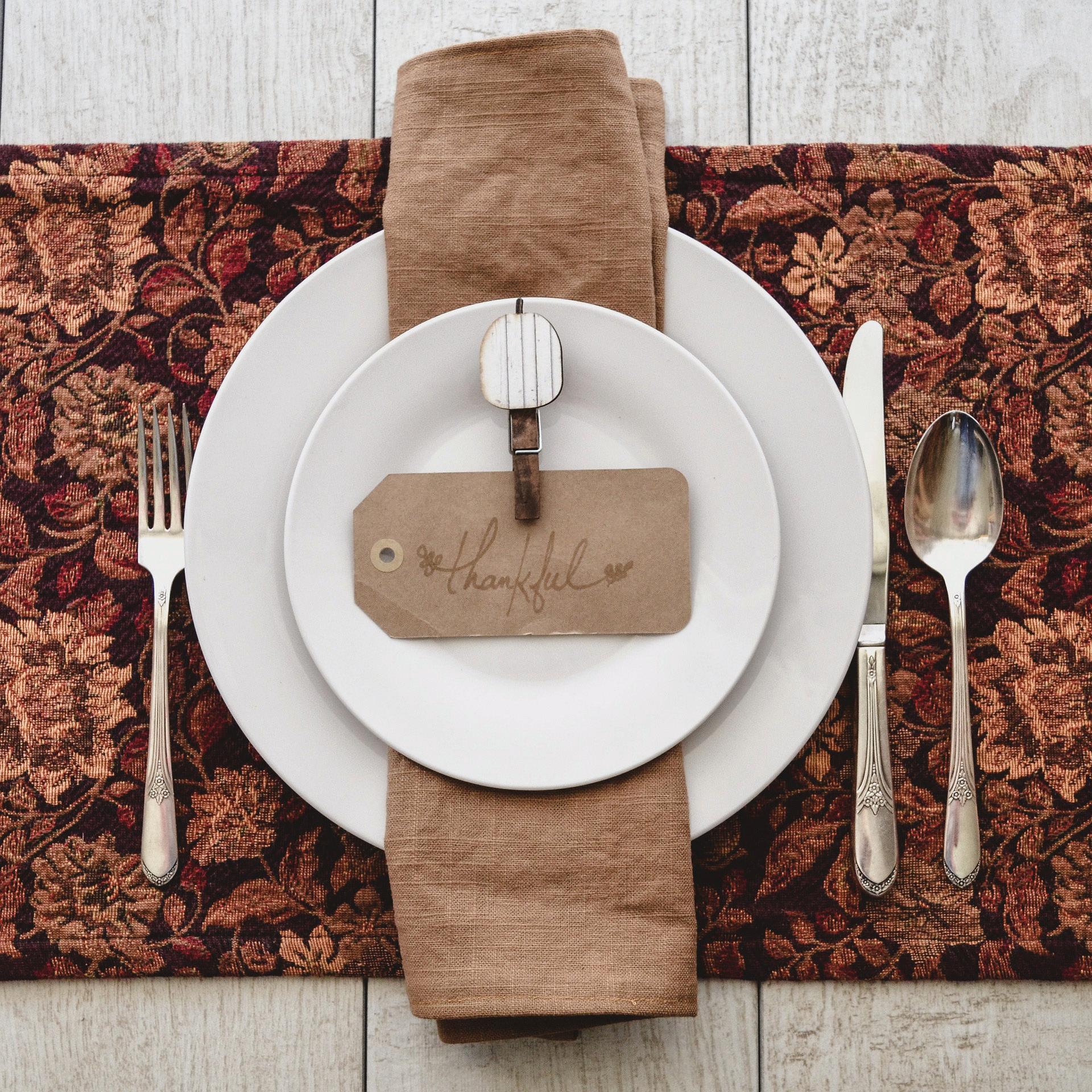
There are times when each of us dines alone, and when this happens, each of us has a choice: to make do with a scrap of whatever happens to be around the kitchen, or to provide
a Lucullan feast, one that honors our own solitary and individual worth.
Even Thanksgiving, that most con vivial of American holidays, the one that is peopled, per cliché, with a groaning board and a flock of guests — even Thanksgiving sometimes must be, or can be, or cries out to be, Lucullan.
How does Lucullus manage it, es pecially without a personal chef and chef’s assistants? With the smallest of turkeys weighing in at something like 10 pounds, how does Lucullus keep from being burdened with leftovers well into the New Year and beyond?
With a Rock Cornish Game hen, is how. This tiny beauty is the result of work by Jacques and Te Makowsky,
refugees from the Nazis who end ed up settling in Connecticut and, in the mid-1950s, cross-bred standard Cornish chickens with White Plym outh Rock hens and Malayan fighting cocks. They dubbed the result a Rock Cornish Game hen, though in stores you often find it with the “Rock” left off. Look in the frozen meat coolers; an ideal bird weighs in at no more than a pound-and-a-half.
The beauty of a Cornish game hen, for a solo diner, is its size; one can enjoy it without being overwhelmed with leftovers.
The sorrow of a Cornish game hen, for Thanksgiving, is its size; it is hard ly possible to squeeze more than a few tablespoons of stuffing into the bird.
44 Marquette Monthly November 2022
Why
for one
THERE ARE TIMES WHEN EACH OF US DINES ALONE, AND WHEN THIS HAPPENS, EACH OF US HAS A CHOICE...

“so as to maximize coverage.
Now place the whole thing into the oven. The spatchcocked bird and the stuffing cook together while meaty juices filter down, yielding that same moist, juicy, and ineffable flavor that an in-bird stuffing achieves.
I’m embarrassed that it took me so long to arrive at this simple and ele gant solution; I experienced plenty of Lucullan Thanksgivings before the re cent pandemic forced me to look the whole question squarely in the eye. Now, however, I’m not sure I’ll ever go back to a turkey.
(And that includes for groups larg er than one. Our camp neighbors were going through a rough time recently, and comfort food seemed in order. What could be more comforting than the echo of good times past and good times yet to come? All we needed was two hens instead of one, and comfort came.)
The thing about Cornish game hens is not just a question of quantity. It’s also time: start to finish, the bird/ stuffing combination finishes bak ing in only about 45 minutes. Com pare that to the hours and hours that a stuffed turkey demands, and sudden ly a whole Thursday opens up — for walks, poetry, football, music, naps, books, all the joys that a person can enjoy when not creating a gargantuan meal.
Can it really be this easy? Yes. Here are details.

First, ideally hours before you want to eat, spatchcock your game hen. Place the bird breast down on a clean surface, then brandish your best pair of poultry shears. Starting at one side of the tail, snip up one side of the backbone to the neck. Then, going back to the tail, snip up the other side of the backbone to the neck. Set the backbone aside for a minute.
Oh, sure, you can always put some stuffing into a little casserole dish and bake it on the side, thereby turning it into dressing. But for those who love their stuffing moist, juicy, and im pregnated with the ineffable aroma of roasting bird, that’s a half measure at best. Dressing on the side, for these folk, is not much better than a sim ple vehicle for gravy — something that you can scoop gravy over and eat politely, without incurring the oppro brium that meets those of us who skip the vehicle and simply slurp gravy with a spoon.
The Lucullan diner solves this problem by spatchcocking. (Tech nique detailed below.) Place a suitable amount of stuffing into a buttered cas serole dish, sure. But then take your Cornish game hen and spatchcock it. Unfold it and place it over the stuffing

Next, open up the game hen like a book so you can season its inside with salt and pepper. Place the openedup and flattened hen on a rack over a plate, skin side up, and season its outside with salt and pepper. (If the wingtips aren’t very beautiful, use your shears to nip them off too and set them aside with the backbone.) Place the plate, rack, and seasoned bird in the refrigerator — importantly, un covered. The combination of cold dry air and salt will dry off the skin, re sulting in a crispier hen for the table.
With the set-aside backbone and possibly wingtips, you have choic es. Choice 1: put them in the bone bag that lives in your freezer for lat er stock-making. Choice 2: put them into the pot in which your stock is happily turning into gravy, for addi tional flavor. Choice 3: put them into a
November 2022 Marquette Monthly 45
pan and sauté or roast them till brown; then add the browned bones to the pot where your stock is happily turn ing into gravy, for even more flavor. For even more flavor than that, use a splash of white wine or vermouth to deglaze the pan where the bones cooked, and then add that to the gravy pot too.
I love gravy (I would indeed eat it with a spoon) so I go with Choice 3. My gravy consists of some of the frozen stock I keep at hand, gussied up by simmering it with onion, carrot, celery, garlic, bay leaf, thyme, pep percorns, and a bit of allspice — plus those browned bones — for as long as I have patience, then straining out
all the solids and thickening the result with a flour/butter roux.
Importantly, I can do all of that (spatchcocking, seasoning, simmer ing, straining) well ahead of time, Wednesday evening or first thing Thursday morning. Then it can all wait peacefully until the hour or so before Thanksgiving dinner.
I am not going to try to tell you what stuffing to use. That would con stitute at least a whole article of its own, and a controversial one at that. People have come to blows over sau sage versus oyster, nuts versus dried fruit, simplicity versus ornamentation reminiscent of the Roman empire.
For my own Lucullan feast, I go simple: the basic bread stuffing recipe out of Joy of Cooking. It’s what I grew up with; it’s what I’m used to; I can do it practically blindfolded. You do you.
So now it’s an hour or so before you want to eat. Take the bird out of the refrigerator and preheat the oven to 400 degrees. Butter a shallow cas serole dish of suitable size, preferably just a bit bigger than the splayed-out Cornish game hen. Fill the dish with stuffing then set your bird on top, skin side up, arranging it nicely to act like

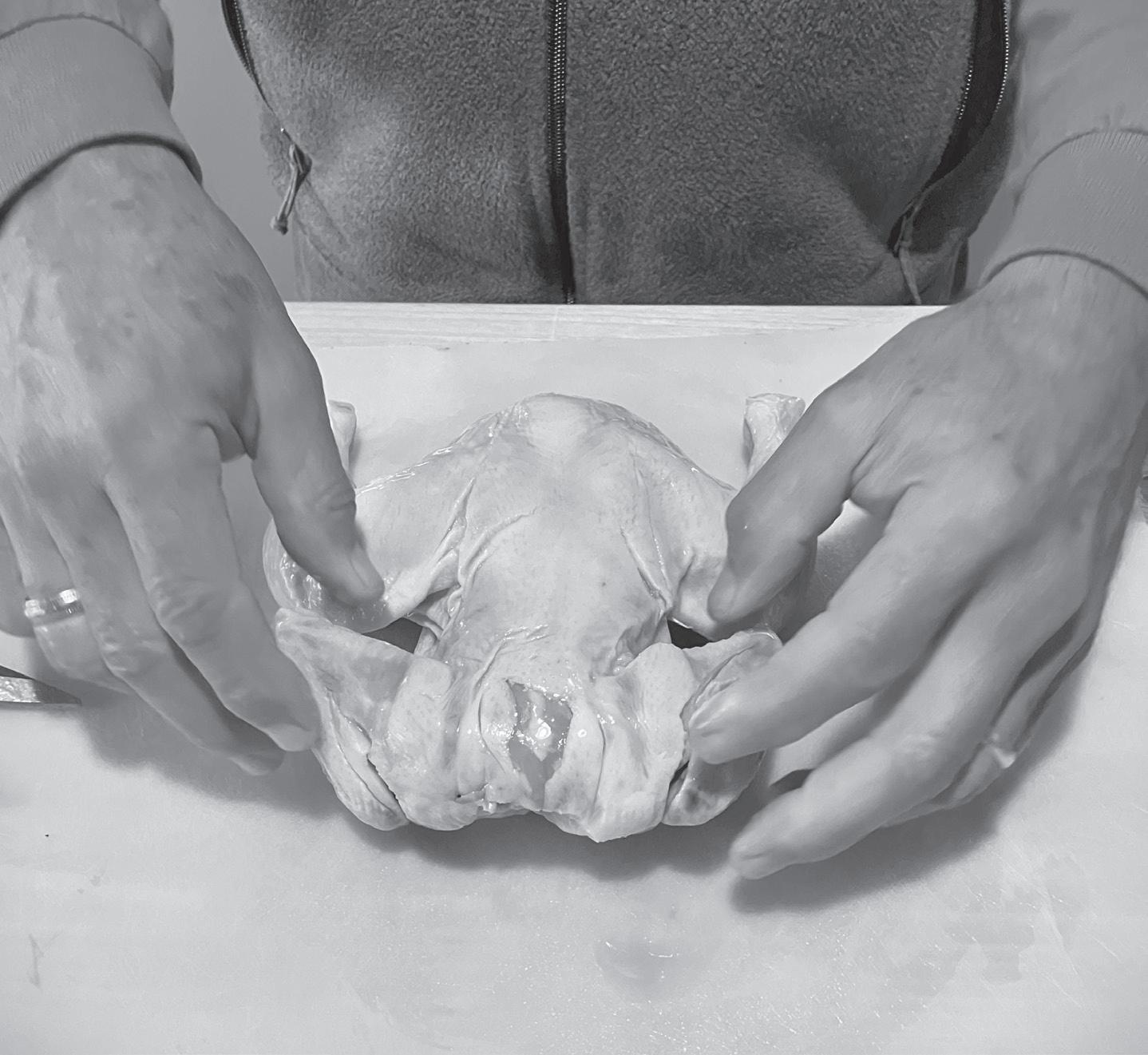
a lid. Then, 45 minutes before dinner time, put the dish in the oven.
You have time, now, to please yourself. Heat up the gravy. Prepare your favorite Thanksgiving vegetable. Pour a glass of wine and think back happily over the highlights of the day you just spent not tied to a hot stove. Set the table, light a candle, relax.
The bird and the stuffing will be done simultaneously; no need to jug gle finishing times or let anything wait. Use the poultry shears to snip yourself a suitable helping of Cornish game hen and a big spoon to scoop out stuffing, swath the whole thing with gravy, add your vegetable, and sit down.
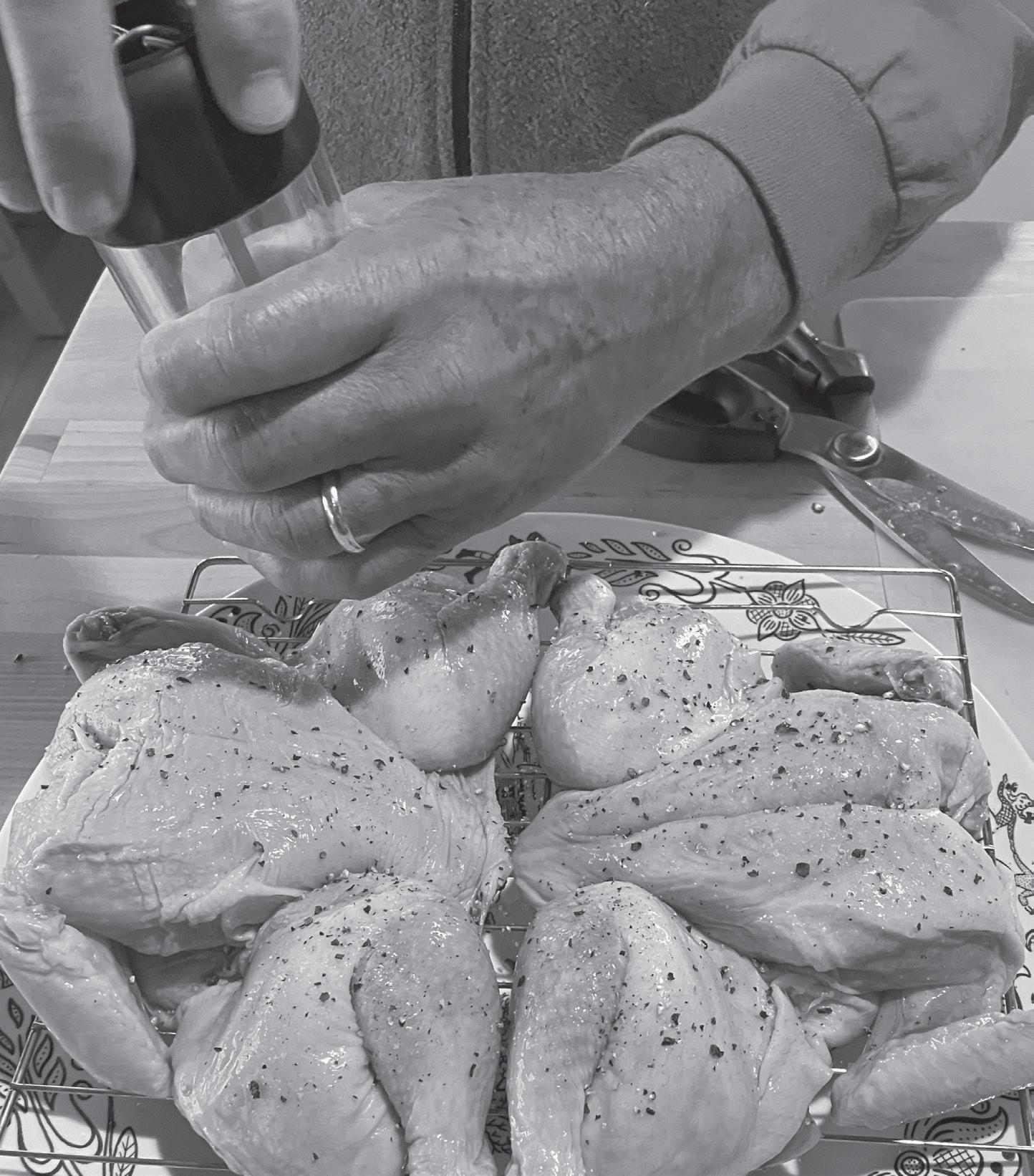
Tonight, Lucullus dines with Luc ullus.
Katherine Larson is a teacher and former lawyer who loves to eat, solo or in company. For these photographs she prepared two Cornish game hens and shared the results with her hus band and camp neighbors; she spent the time in between spatchcocking and cooking out on the lake in the kayak.
46 Marquette Monthly November 2022
Top left, a Cornish game hen ready to be prepared. Bottom left, pepper is added after they have been spatchcocked. Above, the final product, cooked to a perfect golden brown. (Photos by Katherine Larson)
MM
superior reads
Happy endings and a few laughs in November’s picks
Reviews by Victor Volkman
Shipwrecked and Rescued: Cars and Crew – The “City of Bangor”
 By Larry Jorgensen
Ihope it’s not a spoiler, but Shipwrecked and Res cued: Cars and Crew has a pretty happy ending for a shipping disaster on Lake Superior. The City of Bangor was an early automobile or “car carri er” ship that ran aground near Eagle Harbor on the last day of November 1926. Originally an ore carrier, she was refitted and length ened to haul automo biles from Detroit to Duluth just a year earlier. The City of Bangor was fully loaded with 248 au tomobiles aboard on its fateful final run. Although the story is pretty well-known around the tip of the Keweenaw, folks in other parts of the U.P. may be hearing this tale for the first time, thanks to Larry Jorgensen’s just-pub lished highly detailed account. The wreck of the City of Bangor is probably the most photographed shipping disaster of the 20th century owing to the proximity of hull to the shoreline — literally a few hundred yards offshore and locked in ice for the first six months of its captivity.
Jorgensen’s volume contains several dozen re productions of rare archival photographs from the Keweenaw County Historical Society (KCHS) now available for the first time to the public at large. This alone makes the book a worthwhile addition to any one who likes to read about Great Lakes shipwrecks. Shipwrecked and Rescued goes much further than the typical chapter-length treatment you’ll find in other shipwreck compilations because the author has done the legwork of investigating the personal collections of descendants of the principals, accord ing to Mark F. Rowe, a trustee of the KCHS.
The wreck of the City of Bangor avoided tragedy by a hair’s breadth. As late as 1926, ships were not necessarily equipped with radios despite the Wire less Ship Act of 1910. Only ocean-going passenger ships were required to be so equipped with full-time radio operators, even after the sinking of the Titanic in 1912. The City of Bangor had no wireless on board, not even for primitive Morse Code signaling. So it was an extremely happy coincidence that the Coast Guard had already been alerted to the foun
dering of the Thomas Maytham within sight of the City of Bangor and so they were able to intervene.
Although it is miraculous that none of the crew died in this dire incident, the crew that were able to get ashore on the ship’s boat were probably literally just a few hours away from certain death. They had not a single bit of winter survival gear, just ordinary summer-weight work shoes and pants that gave al most no protection from the bitter cold, unrelenting winds and hip-deep snow drifts. Even worse, they miscalculated their position and began walking in the wrong direction. Several would be hospitalized after finding refuge with the family of William Ber gh in Copper Harbor.
There’s a lot more to the book as it follows the early history of the ship and its sisters, the aftermath of the disaster, attempted salvage of the ship, and the status of important artifacts up to present time, all of which are beyond the scope of this review. If you like tales of courage and survival in the worst con ditions that Lake Superior can dish out, you’ll really enjoy Larry Jorgensen’s Shipwrecked and Rescued: Cars and Crew. Copies are available from many Upper Peninsula bookstores and giftshops or direct from the author at shipwreckedandrescued.com
High on the Vine: Featuring Yooper Entrepreneurs Tami and Evi Maki
By Terri Martin
Fans of Terri Martin’s serialized stories in UP Magazine, published monthly by Porcupine Press, will be thrilled to see a new novelization of them in the just-re leased book High on the Vine. This is her second hu mor anthology following Church Lady Chronicles: Devilish Encoun ters. Although this story also takes place in the mythical town of Budworm, Michi gan somewhere in the U.P., High on the Vine features a brand-new cast of characters. The protagonists, Tami and Evi Maki, are Yoopers by marriage only owing to some drunken revelry following a downstate wedding they both attended. The two women became enamored of the
two brothers Toivo and Eino Maki and were quickly whisked off to the U.P. after their own nuptials. Fast forward a few years — both women have become extremely bored housewives and long to break their economic dependence on the Maki brothers who seem to spend all their time idling at their hunting camp or the local bar. Regardless of what Toivo and Eino are up to, it never ends with bringing home a paycheck.
The storyline of High on the Vine follows the exploits of Tami and Evi as they parlay one highly unlikely business venture into another in search of financial independence from the brothers Maki. In a fit of pique, the two women decide to commandeer the Maki hunting camp and transform it into “Camp She-Shed” complete with a pink outhouse, a Queen Anne dinette set, lace curtains, a two-burner propane stove for the kitchen area, and doilies all around. Easily bored Evi quickly gets the idea to turn the camp into “Rustic Pleasures,” a getaway for fami lies who want a vacation literally unplugged from the world. A little while later the camp is leased to an Amish family who run a chicken farm on behalf of the women, stocked with chickens that the Maki brothers won in a card game.
While the egg money is nice, the women decide they can really cash in with an Amish cookbook. However, the Amish eventually move out and they rent the camp to the Sylvan Brotherhood of Benev olent Monks for an off-the-grid retreat. The monks eventually buy the property to convert it to a winery and the women use the proceeds to setup a genuine tourist trap giftshop in town — the Wickiup Wine and Fudge Shoppe. There’s almost nothing Tami and Evi won’t try after finishing another box of wine!
My favorite episode from the book involves Tami and Evi dealing with the band of misogynistic monks who have a line of wines with names like “Resurrection Red Rosé”, “White Infidel”, “Pinot Gristly”, and “He is Riesling.” Terri Martin gets to show off her propensity for puns the best when Evi gets drunk at their weekly “teatime” which starts with boxed wine and ends with her passing out, most often. If you like a good chuckle about Yoop er foibles and follies, I highly recommend High on the Vine by Terri Martin. Be sure to enjoy it with a bottle of your favorite beverage for best effect! The book is most easily obtained from the author’s site www.TerriLynnMartin.com

Victor R. Volkman is a graduate of Michigan Tech nological University (Class of ’86) and is the cur rent president of the U.P. Publishers and Authors Association (UPPAA). He is senior editor at Mod ern History Press and publisher of the U.P. Reader
MI
November 2022 Marquette Monthly 47
MM
Send Upper Peninsula-related book review suggestions to victor@LHPress.com Books submitted for review can be sent to: MM Book Reviews, 5145 Pontiac Trail, Ann Arbor,
48105
lookout point
Making connections
Great Start Collaborative serves parents and families
By Deborah K. Frontiera
According to the Michigan State Website for GSC, the Great Start Collaborative and its sister organizations “strive to orga nize early childhood systems building bodies in the State of Michigan.” Es tablished and fully funded by the state of Michigan, the purpose of the orga nization is to build and reform local early childhood systems, understand community strengths and challenges with an emphasis on local.
A total of 20 percent of the mem bership must consist of parents of children from birth to age 8. Other businesses and organizations under the GSC “umbrella” may be philan thropic groups, community mental and physical health, private health care, juvenile and family court, ele mentary and preschools, Head Start, childcare providers, and even elected

officials. The only requirement is a genuine interest in helping build fam ilies or being the parent of young chil dren, birth through age eight.
It’s easy to join. Anyone who is already part of any partner organiza tion can attend any or all meetings as a representative of that group. Those simply interested in helping out, can contact the Marquette director, Ange la Miller-Porter by email at amiller prter@maresa.org or via phone at 906226-5157 to be put on the notification list for the next meeting. Meetings are every other month on the second Monday. The next meeting is January 9, 2023. Meetings are not held during the summer months.

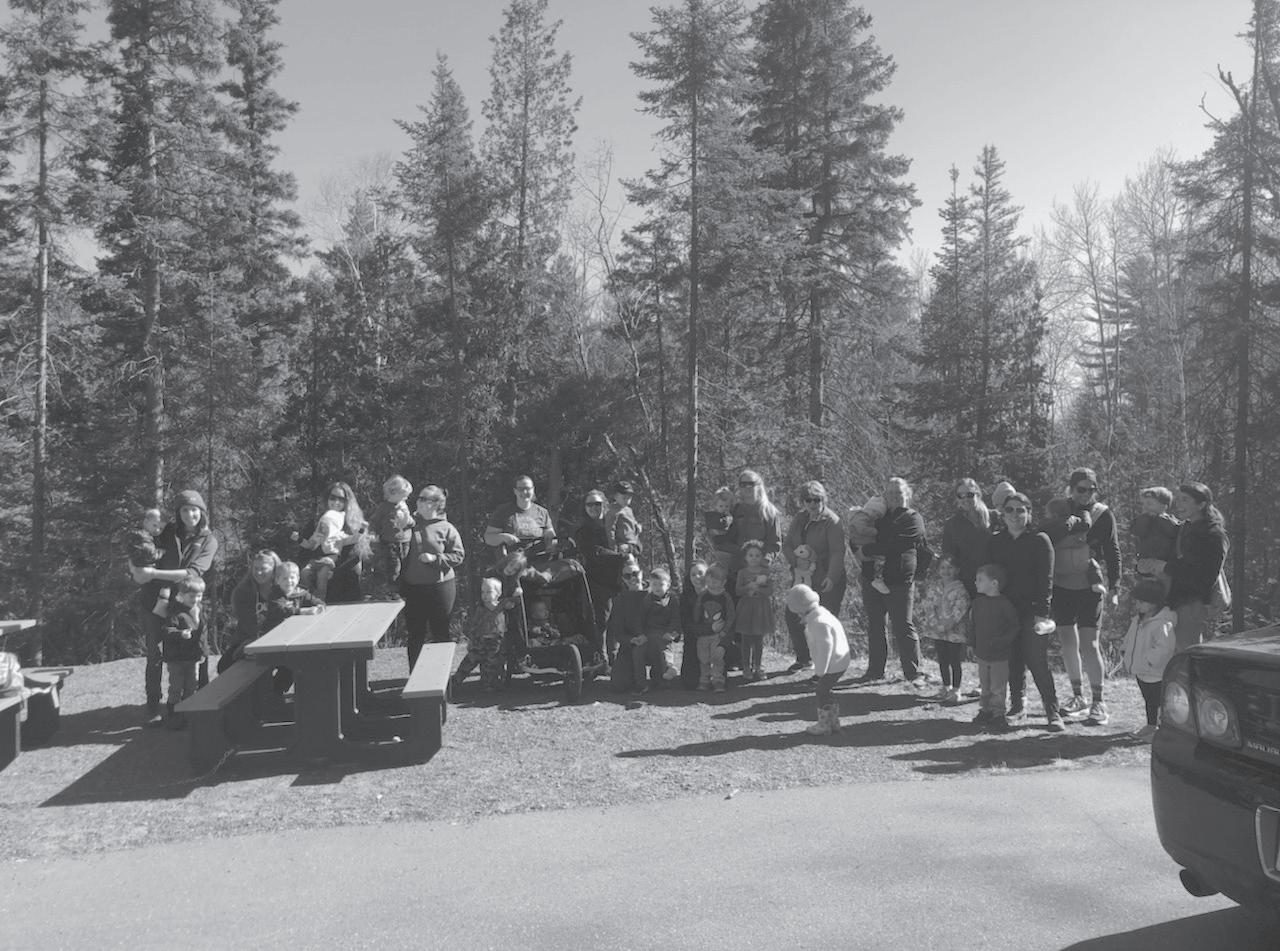
October’s meeting was held at the Marquette/Alger Regional Education Service Agency (MARESA) and fo cused on Diversity, Equity and Inclu
sion. It was “a parent café” to learn to share more about religion, culture, children with disabilities, and training for Early Childhood Education. All who work with children or families of young children in any capacity were welcomed. Lunch was provided, and the program was free.
Babies have never come with in struction books. In days of old, when “the village” helped raise children, it was the extended family (often living in the same house) that supported and encouraged parents, lending their wis dom to the process. Nowadays, while there are many places out there to get help, the proverbial “left hand” often doesn’t always know what the “right hand” has available. That’s where the Great Start Collaborative opens wide its umbrella over multiple groups to let everyone know who is out there
48 Marquette Monthly November 2022
A sharing nature event at Lakenenland, hosted by the Great Start Collaborative. (Photo courtesy of Shilpa Jhobalia)
and what they have to offer.

The state’s website is a treasure trove of information with tips and links for prenatal care, infant, toddler, pre-K, early-on (birth to pre-k), home visiting, finding childcare or help for anyone with concerns about childcare, preventing suspension or expulsion in early childhood and primary grades, diagnosing developmental disorders, early intervention, the importance of resources, you name it. But for a more personal approach, Angela Miller Por ter, the director of the Marquette/Alg er County GSC, is there to help.
Miller Porter is helped by two part-time parent coordinators: Shil pa Jhobalia for Marquette County, and Chelsey Mills for Alger County. These two busy moms help keep track of everything in their respective areas. Parent coordinators must have at least one child under age 8 in their homes. and they are able to do their work from home. They are paid through the state program. While the parent advisors must have at least one child under 8 at the time of hiring, they are not “let go” the minute the youngest child reaches their 9th birthday. Some have stayed on long beyond that — by 10 or 15 years. Other U.P. counties have groups, too, and Miller Porter can direct any inter ested people to groups in their area.
Each county decides where to house their coordinator/director. Mill er Porter said she has her office in the Marquette area Intermediate School District office complex.
“Each area reaches out to the com munity to network in different ways,” she said. “Marquette County uses a Facebook page to reach families.” (Just search Marquette-Alger Great Start Collaborative on that platform.) Miller Porter also said she has an extensive email network through which people can communicate in a more personal way.
“Our group recently collaborated with other agencies to apply for a lit eracy grant to help families with chil dren struggling to learn to read,” she said.
They also recently offered a training program for people to become better
facilitators of whatever program they serve. People often come to Marquette (the “hub” of the U.P. with its central location) for other types of training — even for teachers and others for adap tive education in schools. The point is to build relationships between parents, families, teachers, and other groups to network with each other for the bene fit of all.
The Marquette group meets five times a year — basically every other month. An email goes out to commu nity partners and individuals to noti fy them of when, where and what the program will be. Miller Porter often organizes these meetings “café style” where people work at pod-type ta bles discussing various topics. Then they shift to another group and repeat. There are questions and dialogue on a mix of topics. There is always free food available, a friendly atmosphere, and usually childcare on site so parents can participate in discussion groups and activities. In the off months, there are various work groups that also pro vide programs.
Miller Porter said she tries to keep things practical with tangible out comes to better serve families. For example, last year, there was a school readiness program for parents of in coming kindergartners. School profes sionals came to talk to parents about what to expect and help their child be ready, and every child left with a “readiness bag” filled with two books, a whiteboard, marker and eraser, soft dice for math games, glue stick, pencils, crayons, a pack of cards for games, a blow-up beachball, and oth er related items. A parent survey af terward showed that parents and kids loved it and felt they gained a lot from the experience.
An example from the physical health work group is connecting fam ilies with outdoor free play. At Friday play groups, between eight and 20 families might gather at a park, run ning and hiking trails, or even at sled ding hills in the winter. There were field trips to a petting zoo, and one weekend for the “rooted in the earth series,” the group met at Lakenenland
November 2022 Marquette Monthly 49
EACH AREA REACHES OUT TO THE COMMUNITY TO NETWORK IN DIFFERENT WAYS.
“
where they had several activities go ing on including making S’mores, learning about plants on a trail, and just plain having fun together.
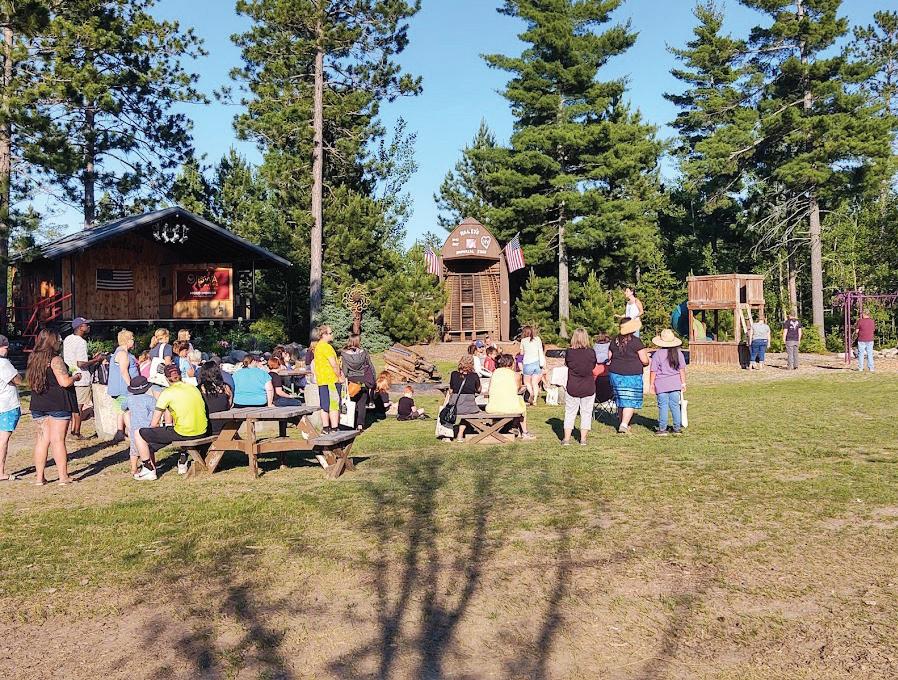
Miller Porter also includes caring for parents in her programs.

“I’ve taught parents in meditation and mindfulness sessions to care for themselves so they can better care for their children,” she said.
Miller Porter also pointed out that connection is one of the most import ant aspects of GSC.
“The Great Start Collaborative fa cilitates social connections with di rect family programming, parent ed ucation and support for families with young children in our community. Ad ditionally, the collaborative serves to hold space and action planning for the collaboration of professionals serving families.”
She also added that she absolutely loves her job.
MM Deborah K. Frontiera knows about early childhood, having taught kin dergarten and pre-k in inner-city Houston, TX schools from 1985 until 2008. She has since retired to her na tive U.P. where she writes in several genres from her Calumet home. Visit her website at: www.authorsden.com/ deborahkfrontiera
50 Marquette Monthly November 2022
One of the Great Start Collaborative’s nature-based hiking groups. (Photo courtesy of Shilpa Jhobalia)
November 2022 Marquette Monthly 51
back then
Disputed firsts, milestones & records
By Larry Chabot
Every place is proud of some thing, no matter how small the town or odd the claim. For ex ample, the Copper Country was once home to the world’s tallest man: Louis Moilanen – “Big Louie” – in the ear ly 1900s. The son of very short par ents, he stood over 8 feet by age 18, wore size 19 shoes and his clothes were handmade in Houghton. His tooshort legs and huge torso often caused him to topple over. Louie farmed and mined for a while before joining a circus as a side show phenomenon.
Tiring of show business, he opened a popular bar in Hancock, where he was elected justice of the peace. He died in 1913 at age 28, buried in a casket 9 feet long and 3 feet wide. Some of his clothing is on display in area mu seums.
Sault Ste. Marie claims the only sitting U.S. president to sail through the Soo Locks was William Howard Taft, who rode a tug on September 19, 1911, while campaigning for reelec tion. Former president Harry Truman was there for the facility’s 100th anni
versary in 1955; President George H. W. Bush visited in 1992; and Public Enemy No. 1 John Dillinger hid in a Soo house in 1934, but it’s not known if they took the boat ride. The first ship through the new locks was the steamer Illinois on June 18, 1855. A ship by that name, probably the same one, was sunk by a German subma rine in 1917.
Although at least 16 U.S. presi dents visited the U.P. before, during, or after their terms, the first was fu ture president Abraham Lincoln, who

sailed through U.P. waters off St, Ig nace in 1848 while returning from Buffalo, New York.
The First Railroad
America’s first railroad is in dis pute, with claims dating back to 1816. The first U.P. carrier was probably the Iron Mountain Railroad between Negaunee and Marquette in 1855-1859. Apparently the first seri ous passenger travel began in 1881 on the Detroit, Mackinac and Marquette line between Marquette and St. Ig
52 Marquette Monthly November 2022
Who did it first? Well, that depends on who you ask...
EVERY PLACE IS PROUD OF SOMETHING, NO MATTER HOW SMALL THE TOWN OR ODD THE CLAIM.
“
nace, with an overnight stop at Seney. Radio historian Kenyon Boyer noted that the line’s four passenger and two baggage cars were parked along Mar quette’s Lake Street for “gawkers” to inspect.
The first outboard boat motor was created at Lake Shore Engine Works in Marquette by Nels Flodin and Carl Blomstrom. Lake Shore manager S. H. Holley had been tinkering with a kerosene and gasoline engine start ing in 1895, which led to the Flo din-Blomstrom creation the next year, powered by batteries borrowed from the local phone company. A Mining Journal story said the motor was “be lieved to be first one developed in this country.”
Another first: Albert Carter, a Chi cago jazz musician, drove his 1951 Chevrolet station wagon across the new Mackinac Bridge on opening day, November 1, 1957. His request to dump the car off the bridge as a trib ute to its rich history was stopped by environmental concerns. He crossed again on the bridge’s 20th anniversa ry, then stored the Chevy in a Grand Rapids museum, where it sits today. He died in 1987; his tombstone men tions the Mackinac crossing.
Who painted the first line down the center of a road? Among claimants was Kenneth Ingalls Sawyer, Mar

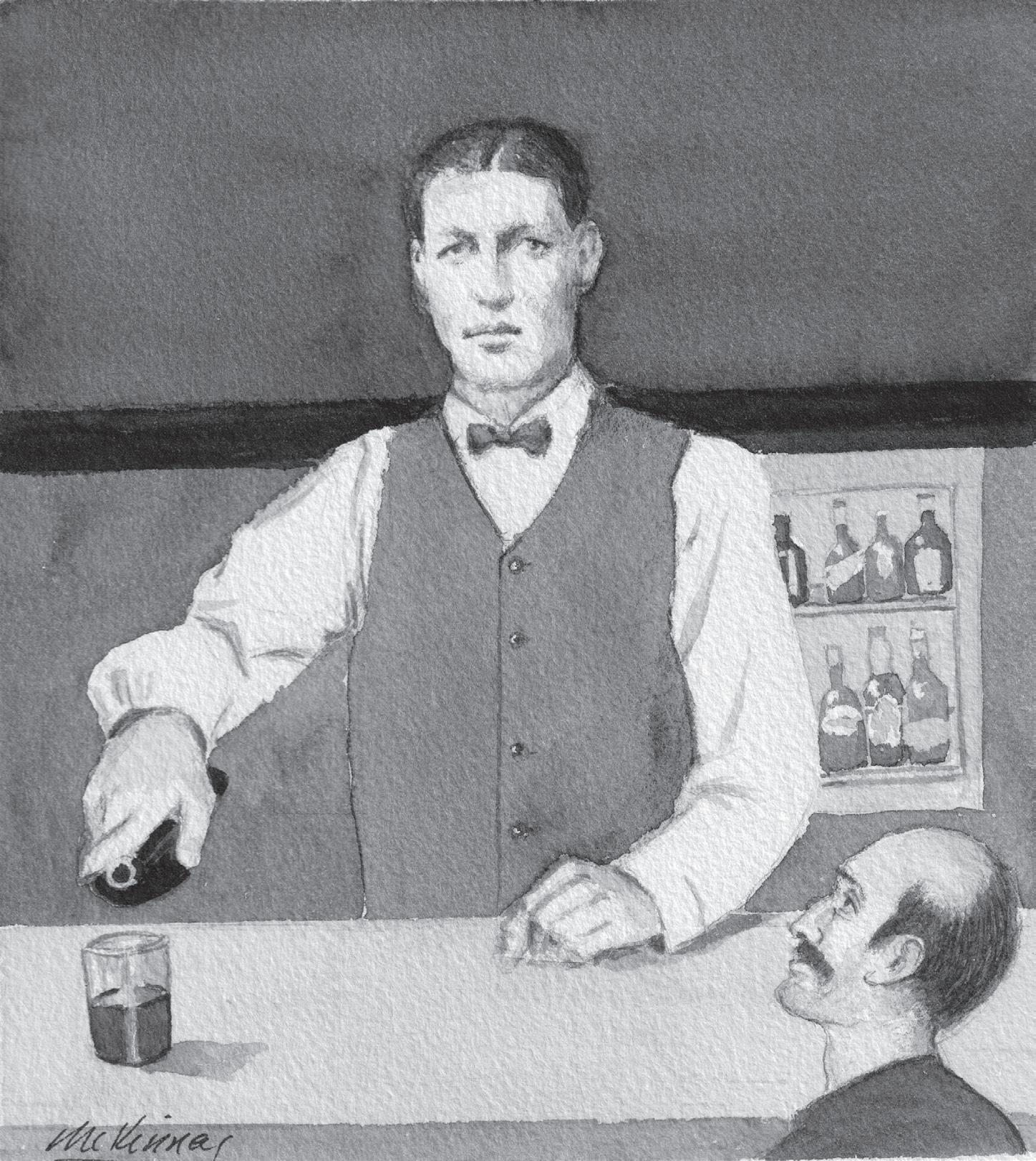
quette’s county highway engineer, who wrote his version for a 1920 magazine. The historic spot was Dead Man’s Curve on old M-15 between Marquette and Negaunee. The tricky road needed a warning because of the many accidents chewing up people and machines. Two followup probes give the honor to highway foreman William Skewis in 1917 for both sug gesting a line and wielding the brush. The next year, the county began paint ing all the main roads. Skewis died in 1936 at age 52, victim of a brutal heat wave which claimed about 5,000 lives.

Sports Breakthroughs
This one is undisputed: the U.P. was the birthplace of profession al hockey in America. It all began in the Houghton Amphidrome in 1903 when the Portage Lake team of the International League began paying its players. The team’s core was a group of Canadian doctors. In Jan uary 1927, the Amphidrome burned down, wiping out the hockey gear of Portage Lake, Michigan Tech, two high schools and the area high school hockey season. Dee Stadium sits in the Amphidrome’s spot on the shore of Portage Lake, with Dee being one of the oldest indoor stadiums in the world.

November 2022 Marquette Monthly 53
Illustration by Mike McKinney
What about golf? In Harvey, North ern Michigan University owns the second longest golf hole in the world at 1,007 yards (behind one in South Korea) and sports a putting green of 29,000 square feet.
North of Bessemer is the highest ski flying hill in the world: Copper Peak. Yikes: the top of the structure is 241 feet above its hill, has an 18-story elevator which gets one within 60 feet of the top (take the stairs the rest of the way), and jumpers look down at a 469 foot long slide.
Locked UP
Marquette Branch Prison opened on June 22, 1889. The first pris oners, from Jackson Prison downstate, were skilled tradesmen brought in to help finish off the new place: Wil liam Durno of Detroit, Horace Beck er of Saginaw and Gust Peterson of Bay City, arrived dragging 25-pound weights on their legs. The same day, three U.P. convicts from Gogebic County raised the prison population to six.
Michigan’s first state park was originally the second national park before the switch. It’s on Mackinac Island, covering 80 percent of the island’s area, and is a rare park with permanent residents inside its bound aries. After Yellowstone became the first national park, Mackinac was sec ond for many years before the state took it over.
In media, the first known U.P. newspaper was the Lake Superior News and Miner’s Journal, created in the Keweenaw Peninsula in 1846. The paper appeared weekly in the summer and monthly in the winter. It was moved to the Soo in 1847, folded in 1849, was then revived by inven tor and developer John Burt. The pa per was a predecessor of The Mining Journal
Thank goodness for penicillin, the antibiotic wonder drug. Marquette’s St. Luke’s Hospital was the drug’s first U.P. recipient. The patient and doctor weren’t identified but the patient did have a severe stomach infection. One source claimed that first local recipi ent was a young girl.
A 1999 Mining Journal story by Bud Sargent claimed that Marquette may have been the site of the first American Boy Scout troop in 1910, although he noted that there were other claimants. No less than nine other states also took credit. Mar quette troops were formed by several churches. The first scoutmaster, Bart lett King, died in France in World War I while serving with an engineering outfit.
Quick Takes
The first U.P. college was an 1885 mining school (now Michigan Technical University) which opened in the Houghton fire hall with 23 stu dents and four instructors. By 1890,
Tech was the largest mining school in the country.
The late Fred Dakota opened the first Native American casino in a twocar garage in Zeba with a blackjack table and three poker machines; more tables and a bar soon followed. De spite government interference, includ ing a shutdown, he persevered, lead ing to the current casino complex on highway M-38 in Baraga. He is con sidered the father of Native American gaming, which now counts hundreds of casinos.
America’s first roadside park was on US-2 in Iron County in 1919, with a grill and picnic table.
Station WRAK in Escanaba was the U.P.’s first radio station, on the air from 1923 to 1927.
The most snow fell at Delaware location in the Keweenaw in 1978-79 at 390 inches, over 32 feet! Bone-rat tling temperatures included a chilly -49 at Humboldt in 1899 and Bergland
at -48 in 1912. A -53 reading at Amasa in 1994 was not officially recognized. MM
Writer’s note: The author recalls at tending a sold-out hockey game at Dee Stadium in Houghton where the only seat he could find was on a win dow sill high above the ice. He can’t remember a single snow day while attending the Ontonagon schools, but does remember his face freezing while walking to class in -42 weath er. He also recalls being in a Calumet museum staring at Big Louie’s jumbo pants.
Larry Chabot, an Ontonagon native, worked his way through Georgetown University and was then employed at White Pine Copper Company for 32 years, before moving to Marquette with his wife, Betty. He is a freelance writer who has written for several publications, including more than 180 articles for Marquette Monthly.
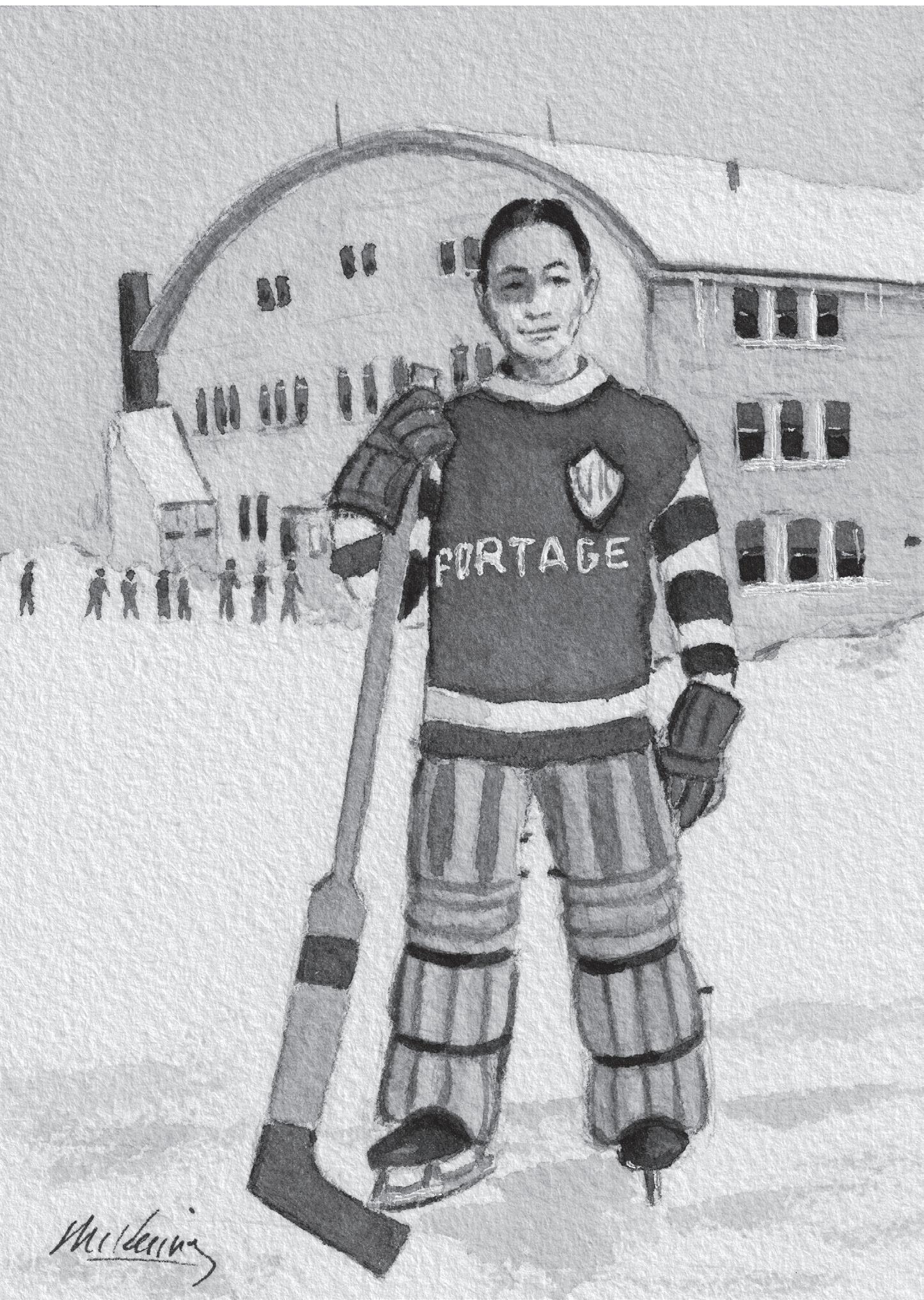
54 Marquette Monthly November 2022
Illustration by Mike McKinney
THIS ONE IS UNDISPUTED: THE U.P. WAS THE BIRTHPLACE OF PROFESSIONAL HOCKEY IN AMERICA.
“
poetry
How to Build a Sauna
By Janeen Pergrin Rastall
How shall we hew the sun. Split it and make blocks - Wallace Stevens
With titanium pick axes, we chip the sun, hack a chunk off every dawn. Trees shudder and surrender their leaves. Frost licks the lawn with a coated tongue.
We shutter the blinds and stack our blocks by the furnace. Steam climbs the basement stairs. We slam the door before the neighbors guess who brings this early winter on.
About the Author: Janeen Pergrin Rastall is the au thor of In the Yellowed House (dancing girl press, 2014), Objects May Appear Closer (Celery City Chapbooks, 2015) and co-author of Heart Radicals (About Editions, 2018) and True Companions (Gor don Publications, 2017). Her poems have been pub lished in Atticus Review, The Fourth River, North Dakota Quarterly, and The Raleigh Review. She has been nominated for Best of the Net Awards and Pushcart Prizes. She is the 2021 winner of the City of Marquette Writer of the Year Award.
The Marquette Poets Circle is very thankful for the sup port of Marquette Monthly with respect to its five-year anthology Maiden Voyage



The 10-year anthology, Superior Voyage, is available for purchase.
November 2022 Marquette Monthly 55
in the outdoors
Snowy serenity
share winter camping secrets
By Alex Lehto-Clark
Love it or hate it, the snow is on its way. For many, that means an end to overnights in the out doors. But, as all good Yoopers know, the snow is nothing to be afraid of. Some even venture out in it, make shelters of it, and spend the night in the tranquility of the northern hemi sphere’s most dark and sleepy season.
Of course, many would wonder why anyone would choose to go out when the air is so cold it hurts. For Jeremiah Johnson, a Northern Minne sota native and long-time Marquette resident, winter camping is a high-risk high-reward experience.
“The way you move on earth is different. You can use lakes to travel. You can travel so fast on skis, espe cially,” he said.
Johnson looks the part of a U.P. outdoor enthusiast. In fact, he plays outside for a living. He’s currently the Bike Park Manager, trail builder and professional patroller for both win ter and summer sports at Marquette Mountain.
A graduate of the Northern Mich igan Adventure Outdoor Recreation and Management program, Johnson has led several student groups for win ter treks into the U.P.’s McCormick Wilderness Tract for NMU’s outdoor living skills and extended wilderness classes. Johnson found teaching win ter skills to be especially rewarding, because it gave the students a chance to see a different side of the woods. It’s also why he goes on multi-day trips in February and March.
“It’s awful pretty in the woods in the winter,” he said.
Another U.P. Winter wilderness expert, Andrea Denham, said winter camping gives her a chance to test her preparedness.
“I learned from a very young age from my dad that there is no such thing as bad weather, only poorly pre pared people,” Denham said.
Born a city kid, she spent many childhood vacations in the north
56 Marquette Monthly November 2022
Two snow structures built during a win ter camping outing on the McCormick Wilderness Track. (Photo courtesy of Andrea Denham)
UP outdoor experts
woods, backpacking in all kinds of weather. Denham said these skills came to be a part of her identity, and she had strong female role models who paved the way for her to feel con fident in her outdoor expertise.
“My aunties had this fairly hilari ous club. They called it the ‘Wilder ness Women Victorious Club,’” she said.
Winter experiences are on her mind often in her role as the executive di rector of the Upper Peninsula Land Conservancy, an environmental ad vocacy group focusing on land pro tection and policy throughout the U.P. Also an alumnus of the NMU Outdoor Leadership and Recreation Manage ment Program, she went on to be a wilderness guide in Alaska, receiving her EMT-Cold Injury Certification. It was in Alaska where Denham really fell in love with cold-weather back packing, but it’s also where she real ized how quickly climate change is rapidly impacting the world’s coldest environments.
“There is no hiding from global warming there,” Denham said. “When you see a glacier that’s receded by miles in just a handful of years, it’s not so removed from the public eye.”
Denham saw similar damage while working as a guide in California’s Yosemite National Park. The deso lation of forest fires and the shoul der-to-shoulder trail hikes and smog warnings made her wish for the cold, pristine wilderness of Upper Michi gan. It also made her realize how im portant it is to get people outside, in all kinds of weather.
“People care for and protect things that they love. For me, that translates to protecting our forests, water, trails and access,” she said.
Denham said it also means learning how to respect nature’s power, a les son that can be learned with high-risk experiences like winter camping.
Denham and Johnson both agree that it’s untouched wilderness that
makes Upper Michigan’s winters dif ferent from other areas.
“Silence. There is absolutely noth ing in the entire world like waking up in the middle of the night in the depths of a February or March winter. Know ing there’s five feet of snow beneath your feet and crystal clear skies above you. Colder than you could ever imag ine. Feeling peaceful, safe and still ness on the inside. There’s nothing like the silence of the deep snow in the middle of the woods,” said Denham.
Johnson said one unique feature in winter camping is customizing the camp space.
“I make benches, walls, you can even make your shelter out of the snow,” he said. Ample snow to work with is part of the reason he prefers getting out in the later mid-winter sea son. “You’re gonna have a different experience in late December than you would in February or March. I prefer late winter because of terrain obsta cles.”
It’s easier to move with more packed snow on the ground. His pre ferred method of transportation is skis, but snowshoes are also a good choice for those who don’t mind mov ing a bit slower.

It’s important to let a loved one know the planned destination and the expected return time. Johnson said this is a good idea no matter the out door activity, but especially for winter camping when temperatures and con ditions can change drastically.
“The really basic stuff is just like any other camping. You need to think about water, shelter, fire and food,” Johnson said.
Of course, a favorite element of ev ery camping excursion is the fire ring. However, Johnson says to think about it less as a traditional campfire many are familiar with during the warmer days of summer and fall, and more as an exclusive source of heat. Food is very important.
“Bring more calories than you

November 2022 Marquette Monthly 57
There’s nothing like the silence of the deep snow in the middle of the woods.
“
think you’re gonna need,” Johnson said. He swears by one secret way to stay warm all through the night. “Hot chocolate with butter in it, right before bed.” The drink fills you up, allowing your body to focus on its primary duty when you are outside: staying warm.
Both Denham and Johnson stressed that clothing choice is vital.
“The single most important thing about winter camping is what you’re wearing on your body because it’s what’s gonna keep you alive,” John son said. “More than any other el ement, clothing provides heat and shelter, protecting your body from the elements, keeping it warm and keep ing it dry.”

Johnson said there’s an easy way to remember what you want out of the clothes you choose: “W.I.S.E stands for wicking, insulating, shell, and extra base layers. For the bottom and mid layers, you want to focus on fabrics that wick moisture away from your skin.”
For beginners, Johnson recom mends investing in polar fleece initial ly, and merino wool and silk as anoth er level of protection and comfort.
What should winter campers stay away from when it comes to winter clothing?
“Cotton,” he said. “Cotton is bad because it won’t wick away from you.”
Johnson said that cotton is typi cally found in the waffle style long underwear that many people use during deer camp or when staying in a cold-weather cabin or camper.

In fact, moisture management is the biggest hurdle, especially on multiday winter wilderness trips.

“Have a plan for getting your gear dry. Multiple nights create an even bigger challenge.” Johnson has a few tricks for making sure that he’s dry and comfortable through a multi-night winter stay. “You can dry stuff in your sleeping bag at night, depending on the level of moisture. Or you can tuck gloves and hats around your hips or thighs and they’ll dry out as you’re sleeping.” He also hangs things up outside, especially on those cloudless frigid days.
Even on colder days, it’s import ant to think about how much you’re moving. Johnson says he’s especially
58 Marquette Monthly November 2022
Students participating in an NMU winter skills class head through snow-laden woods on the McCormick Wilderness Tract. (Photo courtesy of Andrea Denham)
aware of how much he’s sweating, because sweat creates moisture and it can be hard to get dry again. Another rookie mistake is rolling around in the snow a little too much.
“Even if it’s 10 degrees and it’s dry outside, your body heat will melt the snow in your layers,” Johnson said.
Denham said it’s up to each person to figure out their own individual lim its before heading out into the cold.
“I’ve learned that one of the biggest cold weather measures is knowing yourself. Take care of your own stuff. If you can’t take care of yourself, you can’t take care of anyone else. If you are not prepared, things will go wrong. Knowing your body, your clothes, is absolutely essential. My body will be different from your body.”
Both stress that it’s good to do a trial run before heading out on a big excursion.
“The best place to start winter camping is your own backyard,” Den ham said.
Other suggestions include state
campgrounds where there are yurts or cabins available. That way, if some equipment fails or the adventurer re alizes they are in over their head, they can get out of the cold quickly. Both Denham and Johnson recommend checking out state parks and wilder ness areas. Many stay open during the winter.
The biggest benefit to winter camp ing, the reason Denham and Johnson keep coming back to it, is the chal lenge.
“We get to know the people that we travel and camp with on a different level,” Denham said. “In my mind, it’s worth the effort for experiences that help me fall in love with the world around me.”
Alex Lehto-Clark is a poet and es sayist who lives in Ishpeming. He has called Upper Peninsula home for 12 years and graduated from Northern Michigan University with a Bache lor’s and Master’s degree in English.



November 2022 Marquette Monthly 59
MM
Another snow structure, built for warmth and shelter. (Photo courtesy of Andrea Denham)
lookout point
Volunteers make South County Fund strong part of community South side pride
By Brad Gischia
Whenthe government closed K.I. Sawyer Air Force Base, the surrounding community lost a lot more than a group of military personnel and their families. They lost the funding that went along with the base.
The surrounding area struggled to keep things normal for residents. One of those normalcies was keeping the YMCA, renamed the “W” for West branch township, open. Funding was tight.
“I worked for the township in 2009,” said Michelle “Mick” Christal. “The gym was having financial trou bles, and I thought maybe I could get a group of people together to raise some money.”
What was born out of that was the South County Fund, a group of wom en from the south end of Marquette County, who, through their rotating membership, has continued to raise funds for several things in the area.
“I sat on the school board in Gwinn for 20-plus years,” said Chris Su dinsky. “For me to understand what teachers were going through and what it was like to be in that school setting, I decided to start volunteering.”
It wasn’t long before Sudinsky fell in with Christal.
“Once Mick gets your phone num ber, she’s going to use it,” Sudinsky said.
“We put on dances for kids, se nior citizens, spaghetti dinners, battle
of the bands and ladies’ night at the gym,” Christal said. “A bunch of ven dors would come in and we’d spend the night there.”
All of those good fundraising events weren’t enough to save the “W,” but it forged a bond between the group members.
“We didn’t want to stop because it was a lot of fun,” Christal said.
They began to look around for oth er things to support.
“We started looking at the needs of kids, because when the base closed, all of the funding for anything recreation al stopped,” Sudinsky said. “We saw a major lack of activities for kids on our end of the county, so we became the South County Fund Committee, to raise those funds.”
Since then, the group has accumu lated a laundry list of donations total ling up to around $80,000.

There are any number of things that the South County Fund is willing to give money to.
“My oldest grandchild was gradu ating and I knew she didn’t have a lot of money to go to college,” Christal said. “So, we decided to start a schol arship fund. We gave $600 to two kids that year.”
For the next several years, no one applied for the scholarship. The mon ey raised did not go to waste.
“I don’t know why, for a couple of years we got no applications.” Christal said. “So we went right back
to those two students and gave them the scholarships right through college. It’s exciting. We saw them get their bachelor’s degrees, and now both have good jobs.
“We give a lot of money to the school for sports,” Christal said. “One year, the cheerleaders needed mats, we paid for senior trips for a few students who couldn’t afford it and we raised money for the food bank at Vic tory Lutheran Church.”
Dawn Andrews, a Gwinn school board member, has been involved with the group for about four years.
“I’m always hearing about things that are needed in the school system,” she said. “We’ve given funds for Stuff-the-bus, we helped fund several cheerleaders who needed help to par ticipate, and several seniors for a class trip. Gilbert Elementary School had a flood several years ago and the group helped to buy books to replace what was lost.”
The South County Fund also raised and fully-funded a park in West Branch Township.
“That was all us,” Christal said. “It took us a few years, and we had to re ally save up, but we did it.”
They’re always looking toward the future as well.
“The township has been trying for several years to build a basketball court and tennis courts at the (town ship) hall,” Sudinsky said. “We’re saving up to help with that. Before
that money comes out, we make sure to fund the scholarships.”
All of these funds come through the hard work and time of a dedicated few. Sudinsky said there are currently eight members.
Since it began, the South County Fund has had a rotating membership.
“People come in and out as their schedules dictate,” Sudinskey said.
The current roster consists of Ni cole Latta, Vickie Beltz, Dawn An drews, Jaime Barnhart, Effie Miha leow and Cathy Winkler, along with Sudinsky and Christal.
“We’ve got mothers, grandmothers and former teachers,” Sudinsky said. “We’re a crazy group of girls. It’s a lot of fun.”
That crazy group of girls spends their time working several different events to raise money for the South County Fund. There is a thrice-yearly pie sale, which has become a favorite event in the community.
“We’ve sold a heck of a lot of pies,” Christal said.
The annual craft bazaar takes place at the West Branch Township Hall and is accompanied by a soup and sand wich luncheon. Andrews organizes that event.
“It was fantastic. We had a full house packed with vendors. We ran out of pies and our lunch that day.”
There is also a turkey dinner, which has been an event for several years in a row.
60 Marquette Monthly November 2022
“I was sitting with my husband before a South County meeting and I leaned over and said to him, ‘What if we do a turkey dinner instead of a spa ghetti feed?’” Christal said. “He said ‘Are you nuts?’”
Bringing up the idea to Sudinsky brought a similar response.
“But we did it, and it was really fun.”
Covid tried to put a damper on the festivities, but it was no match for the ladies of the South County Fund.
“It’s become quite the deal for the community,” Christal said. “We did takeout, and that helped to keep it go ing.”
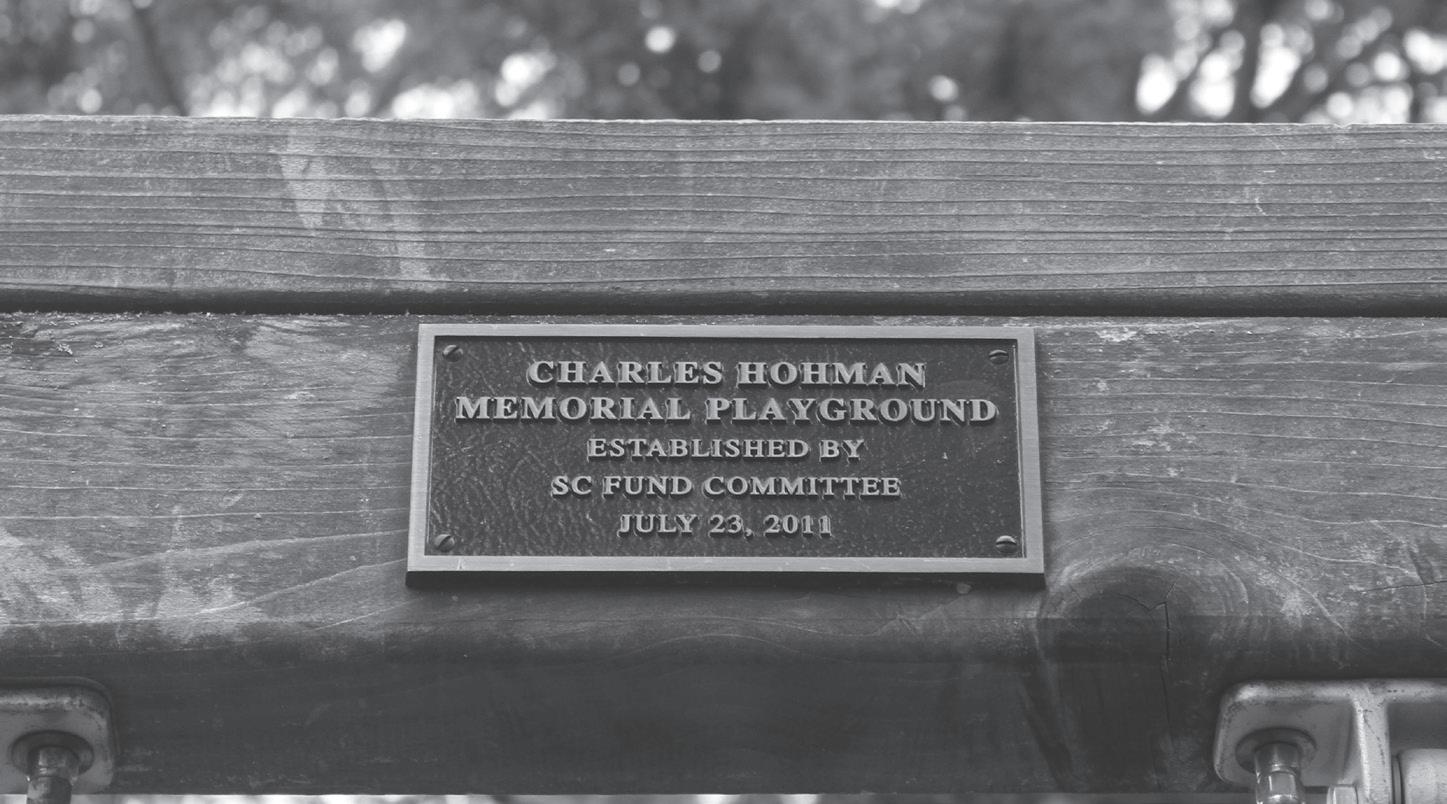
The event continues to grow.
“In the four years since I’ve been involved with the ladies’ group, we’ve doubled the amount of food we’ve had to prepare,” Andrews said.
The community has stepped up when it comes to helping out as well. Christal said Larry’s Foods in Gwinn, Lofaro’s in Harvey, Devooght’s in Skandia and Tadych’s in Marquette have always been on hand with donated items.
“When people find out you’re do ing stuff for kids, they really step up,” she said.
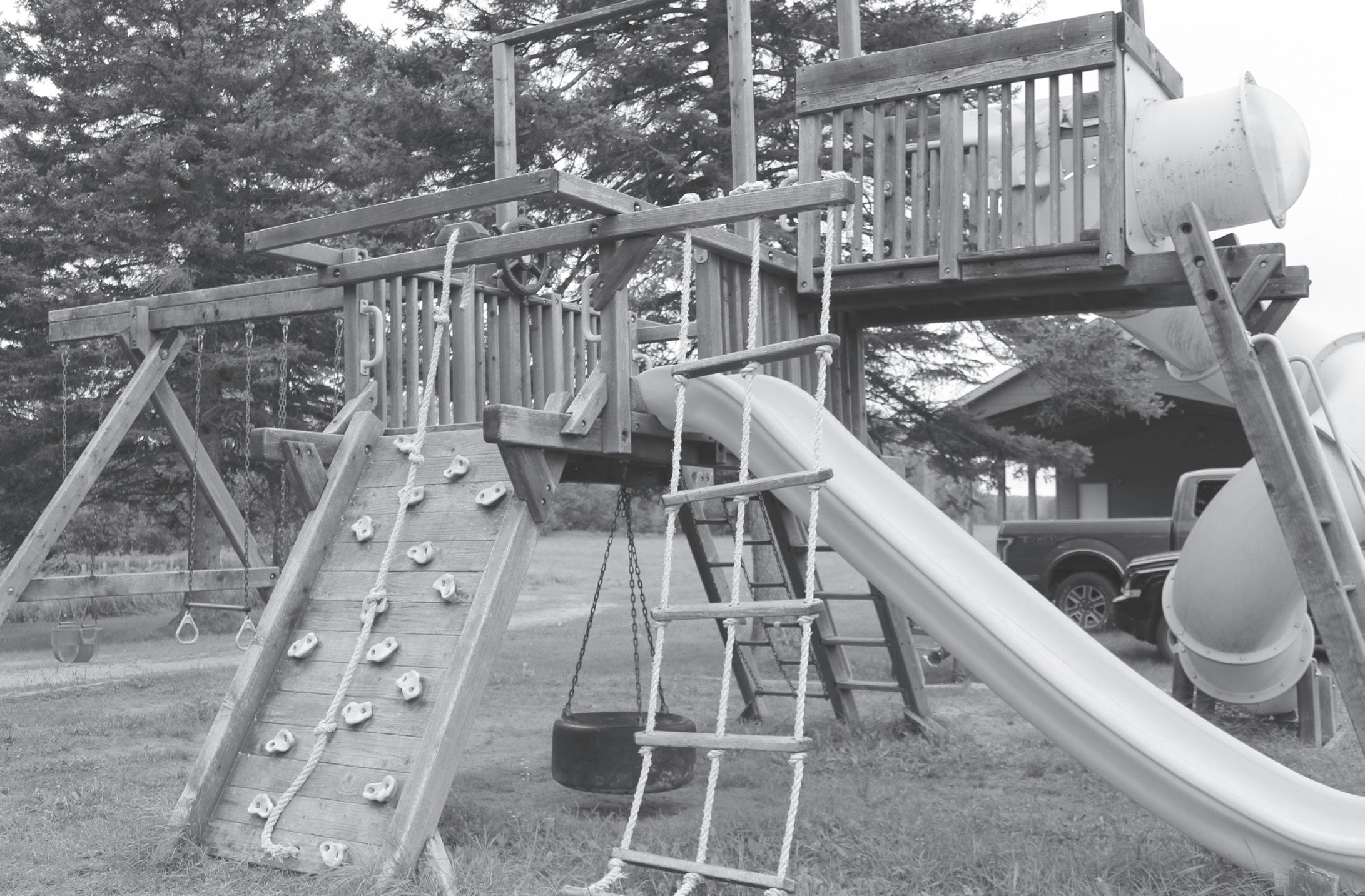
The South County Fund’s tur key dinner fundraiser is from 4 to 7 p.m. November 12. It will be at West Branch Township Hall, and each din ner is $10.
“As long as we can keep getting everything donated, we can keep it at that price,” Christal said. “If we have
to start paying for a lot of the food, then the price may go up, but up to now we’ve been fortunate and we can keep the price the same.
“I love writing checks and giving them to people for the things they need,” Christal said. “When we give back, people are so grateful. That’s why we do it.”
The South County Fund is always ready to help.
“It’s a commitment to youth,” Christal said. “Our kids are so im portant. If we don’t take care of them, we’ve lost them. If we can help youth in any way, we’re there. If a teacher needs to do a special program, all they have to do is send us a letter and tell us how it affects kids.”
Though all the volunteer work can be time consuming, the group agrees
its worth the effort.
“It’s been very busy. Sometimes it’s a lot of work, but it’s so worth it when you help kids out,” Sudinksy said.
Andrews also stressed the impor tance of community involvement in fundraising activities.
“The only way that we can be suc cessful is by having the community come out to our events,” Andrews said. “So far we’ve been really fortu nate to have such great support.”
To contact the South County Fund, call Michelle Christal at 906-3603018.
Brad Gischia is a writer and artist na tive to Upper Michigan. He has pub lished two children’s books and done illustrations for both comic books and novels.

November 2022 Marquette Monthly 61
MM
Playground equipment from funds raised by the South County Fund, erected in 2011 at the West Branch Township Hall in Skandia where they host events such as craft bazaars, pie sales and the upcoming turkey dinner in November. (Photos by James Larsen II)
lookout point
“
Working with the weather
A peek inside the National Weather Service
By Joyce Wiswell
It must be nice to have a job where you’re wrong 70 percent of the time but still get a paycheck.” That, said Matt Zika, meteorologist at the National Weather Service Weather Forecast Office (WFO), is something he and his colleagues hear all the time.
In fact, their forecasting accuracy is a lot better than that: they are usual ly correct 70 to 80 percent of the time, especially for a two-day period. “But there are days when things sneak up on us,” Zika admitted, adding, “If a baseball player is batting .300 he is doing fantastic — but he’s still miss ing most of the time.”
The WFO has had a Marquette station (actually located in Negaunee since 1979) since 1870. Nearly two decades before that, Dr. G.H. Blaker (who has a Marquette street named af ter him) was reporting weather condi tions via telegraph to the Smithsonian Institute in Washington, D.C.
The U.P.’s is one of 121 weather stations across the country, and among the most difficult to forecast, thanks to the influence of Superior and the other Great Lakes.
“The effect of the lakes and the in terface of the marine environment and land area make forecasting more chal lenging than anywhere in the lower 48 states,” Zika said. “No two days are the same. If we have similar weather two or three days in a row, that is un usual.”
Weather Or Not
Apart of the Department of Com merce under the National Oce anic and Atmospheric Administration (NOAA), the WFO has a staff of 21 and is open 24/7. Just as commercial airplanes require a pilot and co-pilot on board, the office always has a min imum of two meteorologists on hand. Their core mission, Zika said, is to help keep people safe ahead of weath er events and minimize their impact on the economy.
Did you know you can actual ly pick up the phone and talk to the weather station? Many Yoopers take advantage of this service.
“In the summer we deal with doz ens of calls every day — contractors who want to pour concrete or take a roof off, kayakers who want to go out, a boater who wants to fish. In the win ter it’s more school superintendents and folks concerned about the road conditions,” Zika said. “That is what we are here for, to get those calls. And we work very closely with emergency managers, hydroelectric partners, the road commissions, the Forest Service and the Department of Natural Re sources.”
They also do educational outreach and supply information to the U.P.’s myriad of newspaper, radio and tele vision forecasters, including Noel Navarro, the evening meteorologist at WLUC-TV6 News.
“Time and time again they are the authority, and we all take a page from them,” said Navarro. “They are my guides, they are my professors, they teach me new things every day with the discussions and bulletins they post. I definitely need those guys; I always start with them. And they have years and years of data, which is the most important part.”
Never a Dull Moment Regardless of the season, weather is a major aspect of Upper Pen insula life.
“The climate is changing, but it has for tens of thousands of years. We were once buried in ice,” Zika pointed out. “Obviously, we are now in a peri od where temperatures are warming at a fairly rapid rate. Our top 12 warmest years in the U.P. have occurred since 2000. Twenty of the last 21 Septem ber temperatures have been above normal, and so have 14 of the past 20 Octobers. On the flipside, only two of the top 12 coldest years have occurred since 2000.”
Those who despair the late arrival of spring each year are not crazy — it really is coming later and later.
“Fifteen of the last 20 April and May temperatures have been below normal. Winter is hanging on longer,” Zika said. “If there is a month to leave the U.P., it’s April.”
There is “no doubt” that we’re warmer than 20 or 30 years ago, Zika
said, and there’s also been an increase in intense rainfall events.
“It used to be extremely rare to see flash floods in the U.P.,” he said, but recent years have seen tremendous flooding in Marquette (May 2022), Houghton County (June 2018) and north of Ironwood (July 2016).
While the U.P. averages just one tornado per year, straight-line winds are more common and can be just as damaging.
Then, of course, there is the snow.
“On the Keweenaw Peninsula in win tertime, no matter which way the wind is blowing you will see lake effect snow,” said Zika. “That’s now true for everywhere in the U.P.”
For residents, it all boils down to being aware of the forecast and being prepared.

“It only takes a couple cents to have common sense,” Zika said.
That means stocking extra supplies at home; bottled water if you rely on a well; and a shovel, cat litter and blan ket in your car all throughout the long winter months.
“You never know if you’ll get stranded in a ditch,” he said. “We know winter is coming, so plan ap propriately.”
62 Marquette Monthly November 2022
MM
Joyce Wiswell is a freelance writer and editor in Hancock.
Snow totals, as shown here, are one of the many unique factors that come into play when you’re a meteorologist at the Upper Penin sula’s only National Weather Service station. (Photo courtesy of NWS)
cinema
Action takes center stage in three uncommon thrillers
By Leonard Heldreth
Films this month are technically “thrillers” although the thrills they inspire vary from film to film.
First Love
Takashi Miike is a unique Japanese director who turns out several feature films per year. Since starting to direct in the ’90s, he has made well over 100 films. Quentin Tarantino starred in one of the early ones and is an admirer of Miike. Films such as Ichi the Killer, Audition and samurai epics such as 13 Assassins and Blade of the Immortal have won him a crit ical reputation among film viewers who like their genres mixed and their humor splashed with copious blood. First Love is typical Miike work, sometimes frightening, sometimes lyrical, punctuated with unexpect ed moments of insanity and hilarity. Some of the scenes seem to be there just for shock or humorous value. A decapitated head rolls into the street in an opening scene. The unlocking of a seatbelt leads to a bloody bashing by way of continuous, rapid acceleration and deceleration. A man attempts to unclench a gun from his own severed hand. There’s an impromptu animat ed scene, and a character loudly pro claims: “I’m out to kill! Everybody! Out to kill!”
The main thrust of the plot con cerns an up-and-coming young boxer named Leo (Masataka Kubota), who is knocked out too easily in a match that he should have won. A doctor ex amines him and finds an inoperable brain tumor that ends his boxing ca reer. As he wanders the Tokyo streets that night, he meets Monica (Sakura ko Konishi), who’s being chased by a man. He drops the pursuer with one punch, thereby rescuing the girl, who clings to him. What he doesn’t know is that she is a drug addict, and the man he slugged, Otomo (Nao Ohmori), is a dirty cop involved in drug dealing. But given his terminal diagnosis, he has nothing to lose by protecting the girl, so he lets her trail along after him.
While Leo and Monica follow a trajectory that will, of course, lead them toward an ending together (or maybe not), much of the fun of the film involves the secondary characters that wander through, waving samurai swords, firing guns and killing or be ing killed. The background that grad ually becomes clearer is that the local yakuza are staging a drug deal, but it is being infiltrated by other local crim inals and a group of Chinese mobsters “who have no honor” according to the Japanese. Otomo, the dirty cop, has teamed up with gangster Kase (Shôta Sometani) in a scheme to steal some meth from Kase’s boss, Gondo (Seiyô Uchino), who has just been released from prison. Gondo is also looking to settle some scores with a Chinese gang that is battling for territory.
There’s a lot here, including Gon do’s more personal rivalry with a Chinese gangster, whose arm he cut off. Those details and people, though background, are critical to the plot. There’s Julie, whose boyfriend was killed when the drug deal went bad, and she wants revenge; periodical ly she bursts into the main action, screaming and waving a gun or a knife, and vowing murder. Perhaps the most amusing is Kase, the yaku za who set up the crooked drug deal, but seems to lack the brains to make it work.
As the plot strands come togeth er, the schemes and betrayals lead to a hardware store and a multi-par ty standoff with samurai swords and other deadly equipment, where ev eryone seems to want to kill everyone else for one reason or another. How it all turns out, and who gets away and who doesn’t, is for the viewer to find out, but in First Love Japanese direc tor Takashi Miike has taken a handful of styles and genres and mixed them into an outrageously twisted film about one wild night in Tokyo.
Lou
Less successful than First Love and violent in less imaginative ways
is Lou, a film that draws much of its plot from films such as Taken and No body. Lou (Allison Janney) lives on a small island off the Washington coast near Seattle with her dog Jax. A mid dle-aged woman, she demonstrates her self reliance in the opening scenes by shooting a deer and dragging it back to her cabin to stock her freez er; she also digs up money from her backyard, downs a shot of burbon, and reloads her rifle, telegraphing to the audience that she has secrets that will be revealed as the film progress es. Further adding to the tension, the weather forecast is predicting one of the worst storms ever to hit the area. To cap it off, Hannah (Jurnee Smol lett), the woman who rents a trailer from Lou, pounds on the door to say her pre-teen daughter, Vee (Ridley Asha Bateman), has been kidnaped by Hannah’s sociopath ex-husband, Philip (Logan Marshall-Green), and two of his Green Beret buddies. Lou decides she will help Hannah, and the two set off in the driving rain with Jax to find the little girl. If all this sounds a bit contrived, plot-wise, the good thing is that Janney has the acting tal ent and no-nonsense believability to pull it off. After all, over the course of three decades, she has consistently delivered great performances in po litical TV dramas (The West Wing), film dramas (I, Tonya), and even movie musicals (Hairspray), picking up Primetime Emmy, Golden Globe, and Academy Award nominations and wins. While she’s not as bulky as Liam Neeson, she can be just as deadly.
The first stop is to eliminate the villain’s buddies. Pretending to be an old woman lost in the storm, Lou, in a tightly choreographed se quence, takes out one man with a pan of hot water and uses a tin can lid to slice the other’s throat. Lou is not shy about displaying her skill set and her CIA training. But Vee has al ready been taken by her father to a lighthouse on the coast, and Lou and Hannah must track them down. This
process involves fighting the torren tial storm, crossing a collapsing foot bridge, and dealing with heel blisters from the wet boots. Finally, everyone still standing arrives at the lighthouse on the coast, and the game becomes one of who can lure Vee away from her father without getting her killed.
The ending is fairly predictable with explosions and swooping CIA helicopters firing machine guns, but before the plot gets to the end, it has some unusual revelations. Whether the viewer finds them believable or just an example of a plot stretched too thin depends on the viewer; I was in trigued by the twist but unconvinced of its likelihood.
There’s also the Reagan TV clip sandwiched in, whose function could be clearer. The actual ending may be problematic (or maybe just sloppy) as though the writers and director were unsure of what they wanted to do next — who’s the person with binoculars at the end? Are we looking at Lou 2? I guess it depends on the box office.
The director, Anna Foerster, nev er goes beyond the boundaries of the thriller except in the casting of Allison Janney as the lead, but that’s enough to lift the film out of the genre Bob Odenkirk-Liam Neeson rut. Even if the script complicates itself more than necessary and fails to explain itself when it should, Janney makes Lou worthwhile, especially when you want to see an aging female star kick some butt.
I Came By
Like Lou, Babak Anvari’s I Came By puts most of its acting eggs in one basket, and, like Lou, it pays the price. Also, like Lou, the director casts against type, putting the suave, aristocratic Hugh Bonneville from Downton Abbey as a serial killer. Un fortunately, the plot gives little reason why he delights in slaughtering vic tims, especially young Middle-East ern men, and cremating the bodies. Is he fighting repressed homosex uality (a few scenes suggest that)?
November 2022 Marquette Monthly 63 home
Was he abused as a child (he has a fetish about his father’s picture)? Yes, I know there is often no reason why killers do what they do, but in fiction or film a reason gives the plot an ad ditional leg to stand on, and in some films, a more solid plot would be ben eficial.
The title comes from a prank that one of the characters likes to play. He breaks into the homes of wealthy people and leaves graffiti on the walls that says “I Came By,” apparently just to remind the own ers that, despite all their alarms and guards, they are still vulnera ble. In the eyes of Toby (George MacKay), a black-clad, hoodedand-masked mischief maker who paints the graffiti at the start of the film, it’s a middle-finger to the British upper class. Originally working with Toby is Jay (Percelle Ascott), but when Jay’s law stu dent girlfriend becomes pregnant, Jay decides to hang up his paint cans. Toby decides to continue on a planned mission into the gated mini-mansion of retired judge Sir Hector Blake (Hugh Bonneville), but when he finds a man chained in the basement, he decides that was a bad move and quickly leaves, calling the police on the way out.

By the time the police arrive, the man in the basement is gone, and Sir Hector has pulled enough strings to ensure they won’t be
back.
Other victims appear and are disposed of in the next months, but Jay eventually overcomes Sir Hector and justice triumphs. De spite some tense moments, the plot never really revs up to the lev el one expects from a thriller, and with the exception of Jay, the oth er characters are killed off too fast for much identification with them.
As in some other Netflix films, the director seems to have too much leeway and tries to cram too much into the plot. For every masterpiece like The Irishman that Netflix finances, perhaps we have to accept half a dozen films that are less impressive. Maybe that’s the price we pay for young film makers learning their crafts.
MM
About the Author: Leonard Hel dreth became interested in films in high school and worked as a movie projectionist in undergraduate and graduate school. His short “Cinema Comment” aired for some years on WNMU-FM. In 1987, he started writ ing reviews for Marquette Monthly. He taught English and film studies at NMU for more than 30 years.
Editor’s Note: All films reviewed are available on DVD or streaming video.



64 Marquette Monthly November 2022
Answers for the New York Times crossword puzzle, located on Page 17.
Out & About
Out & About is a
Upper
E-mail your December events by

november events

TUESDAY
sunrise 8:31 a.m.; sunset 6:36 p.m.
• Book Babies. Newborns to age 17-months with an adult are invited for songs, rhymes and stories. 9:45 a.m.
Great Room, Peter White Public Li brary, 217 N. Front St. (906) 226-4323.
• Preschool Storytime. Preschool-age children are invited for stories, songs, finger-plays, crafts and other school-readiness activities. 10:45 a.m. Great Room, Peter White Public Li
to:
brary, 217 N. Front St. (906) 226-4323.
• Superiorland Duplicate Bridge Club. Games open to all interested players. 12:30 p.m. $5 for games. Mar quette Senior Center, 300 W. Spring St. superiorland_bridge.tripod.com
• Oil Painting, Pastels and Drawing Classes with Marlene Wood. Bring your own supplies. $20. 1 to 3 p.m. Mar quette Arts and Culture Center, lower level, Peter White Public Library, 217 N. Front St. (906) 225-8655.
• Dumbledore’s Army. Students in grades 4 to 6 are invited for Harry Potter-related crafts. 4:30 p.m. Great Room, Peter White Public Library, 217 N. Front St. (906) 226-4323.
• Bells for Hospice. The Bell Choir will perform. The event serves to ed ucate people on hospice and services
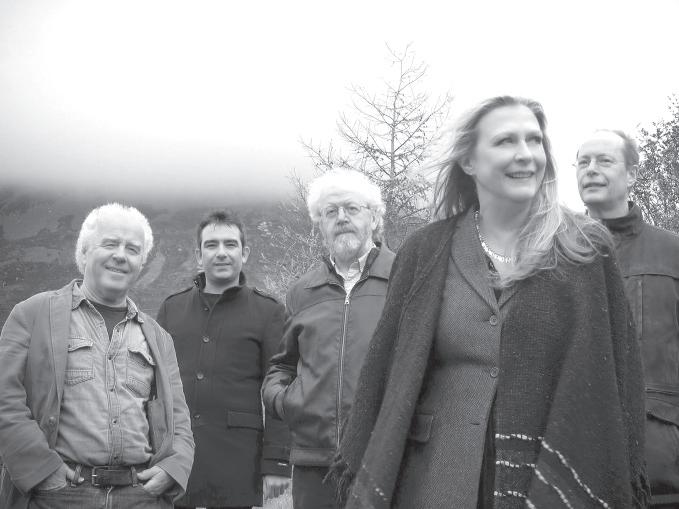
November 2022 Marquette Monthly 65
free listing of
Peninsula events. Events included must cost $25 or less (except fundraisers). All events are free and in Eastern time unless noted. We print information sent to us by a wide variety of people and organizations. It pays to double check the date, time, place and cost before heading out. Due to changing event requirements, please call ahead to ask about safety precautions, or bring a mask to events, as many events require masks regardless of vaccination status.
Thursday, November 10
calendar@marquettemonthly.com Marquette
Altan Concert | November 2 | Marquette
01
Index on the town …………………………………………………… 66 art galleries …………………………………………………69-70 museums ……………………………………………………… 72 support groups………………………………………………… 78
on the town
Gwinn
• Hideaway Bar.
Mondays: The Hideaway AllStars. 7 p.m. 741 M-35. (906) 346-3178.
• Up North Lodge Friday, November 25: Jeff Var vil comedy with music by Justin Biltonen from 3 Doors Down. $10. 7 p.m. 215 S. CR-557 (906) 346-9815.
Marquette
• Barrel + Beam.
- Friday, November 4: Strung To gether.
- Saturday, the 19th: Dylan Con ger-Lyewski.
Music begins at 6 p.m. 260 Northwoods Rd. (906) 273-2559 or barrelandbeam. com
• Blackrocks Brewery.
- Tuesdays: Trivia. 7 to 9 p.m. - Wednesdays: Open mic. 6 p.m.
- Thursday, November 10: Dano Keller Duo. Music begins at 6 p.m. 424 N. Third St. (906) 273-1333 or blackrocksbrewery.com
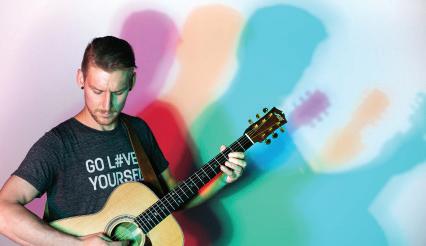
• Drifa Brewing Company.
- Mondays: Musicians’ Open Mic. 6 to 8 p.m.
- Saturday, the 5th: Alex Teller.
- Saturday, the 12th: Troy Graham. - Saturday, the 19th: The Derrell Syria Project. Music begins at 5p.m. 501 S. Lake St. 273-1300.
• Flanigan’s.
- Tuesday through Thursday: Kara oke. 9:30 p.m.
- Friday, November 25: DayDream ers Acoustic.
Cover charge on weekends only.
429 W. Washington St. (906) 2288865.
• Iron Bay Restaurant & Drink ery.
- Wednesdays: Trivia. 7 pm. 105 E. Washington St. (906) 2730990 or ironbaymqt.com
• Ore Dock Brewing Company.
- Mondays: Board game night. 7 p.m.
- Friday and Saturday, the 11th and 12th: Brits and Brews.
- Friday, the 18th: Noah Bauer. 8 p.m.
- Saturday, the 19th:Millennial’s Falcon.
- Sunday, the 20th: Westerly Winds Band. 2 p.m.
- Friday, the 25th:Nick Gonnering. 8 p.m.
All shows are free and begin at 9 p.m. unless noted.
114 W. Spring St. 228-8888.
• Rippling River Resort.
- Thursdays through Sundays: Fire side music by various musicians. 6 to 9 p.m.
4321 M-553. (906) 273-2259 or ripplingriverresort.com
• Superior Culture.
- Wednesday, November 2: Electric Words and Music. 7 p.m. 717 Third Street. 273-0927 or supe riorculturemqt.com
• The Fold.
- Sunday, November 6: Slow Fiddle Jam. 1:30 to 3 p.m.
Sunday, the 6th: Old Timey Music Jam. 3 to 5 p.m.
Sunday, the 20th: Slow Fiddle Jam. 1:30 to 3 p.m.
- Sunday, the 20th: Old Timey Mu sic Jam. 3 to 5 p.m.
- Saturday, the 26th: The Knock abouts, John Gillette and Sarah
Mittelfehldt. 10 a.m. to 4 p.m. 1015 N. Third Street, #9. (906) 2268575.
Munising
• Falling Rock Café and Book store.
- Wednesdays and Thursdays: Open Jam.
- Saturday, November 5: Birdsley Sunshine Jazz Band. 10 a.m.
- Saturday, the 19th: Birdsley Sun shine Jazz Band. 10 a.m. 104 E. Munising Ave. (906) 3873008.
• Gallery Coffee Company.
- Saturday, November 26: Open mic, open jam. 8 p.m.
120 Elm Ave. Munising Ave. (906) 387-8010.
Negaunee
• Barr’s Bar.
- Saturday, November 26: Day Dreamers. 9 p.m.
511 Iron St. (906) 273-2559.
Republic
• Pine Grove Bar.
- Friday, November 4: Spun. 9 p.m. to 1 a.m.
- Friday, the 11th: Toni Saari. 7 to 10 p.m.
- Saturday, the 12th: Reverend. 8 p.m. to midnight.
- Friday, the 18th: DayDreamers Acoustic. 7 to 10 p.m.

- Saturday, the 19th: K-Blitz. 9 p.m. to 1 a.m.
- Friday, the 25th: Swampberry Moonshine. 8 p.m. to midnight.
- Saturday, the 26th: Old Skol. 8 p.m. to midnight.
286 Front St. (906) 376-2234.
66 Marquette Monthly November 2022
Nick Gonnering | November 25 | Ore Dock Brewing Company, Marquette
MM
available to families. Coffee, bars and cookies will be served. 6 p.m. Mar quette Commons, 112 S. Third St. (906) 225-7760 or (906) 225-4545.


• What’s Up? Astronomy Series. Scott Stobbelaar of the Marquette As tronomical Society will discuss what can be seen in the U.P. skies. 7 p.m. via Zoom. Visit pwpl.info for Zoom link.
02 WEDNESDAY
sunrise 8:32 a.m.; sunset 6:34 p.m.
Escanaba
• Toddler Art with Nicole Nelson. Toddlers ages 1 to 4, with an adult, are invited for a morning of art. $5. 9:30 a.m. Bonifas Arts Center, 700 First Ave. S. (906) 786-3833 or bon ifasarts.org
• Community Acoustic Musical Jam Session. All musicians welcome. 6 p.m. Room 901, Joseph Heirman Cen ter, Bay College, 2001 N. Lincoln Rd. baycollege.edu
Ishpeming

• Open Crafts Night. 6:30 p.m. U.P. Level Your Stash Crafter’s Lounge, 113 Cleveland Ave. (906) 458-0626.
Marquette
• Wiggle Worms STEM Storytime. Stories are intermixed with activities followed by STEM-related activities to stimulate senses. 9:45 a.m. Great Room, Peter White Public Library, 217 N. Front St. (906) 226-4323.
• Congregate Meals for Seniors–Dine in or Curbside Pickup. Meals avail able to those age 60 and older. Call to reserve a meal. $3.50 suggested donation. Noon to 1 p.m. Marquette Senior Center, 300 W. Spring St. (906) 228-0456.
• Visual Art Class: Painting with JoAnn Shelby. This class is for those age 55 and older. Register in advance. Marquette city and surrounding town ship residents, free; nonresidents, $5 donation. 1 p.m. Marquette Arts and Culture Center, lower level, Peter White Public Library, 217 N. Front St. (906) 225-8655.
• Teens Game On. Youth in grades 6 to 12 are invited to play video games, board games and other games. 4 p.m. Teen Zone, Peter White Public Library, 217 N. Front St. (906) 226-4321.
• Junior Graphic Novel Geeks. Youth in grades 1 to 3 will look at graphic novels that feature animals as char acters, with time to draw characters as well. 4:30 p.m. Great Room, Peter White Public Library, 217 N. Front St. (906) 226-4323.
• Dark Side of the Mitten Reading. True crime writer Tom Carr will read from his book Dark Side of the Mitten: Crimes of Power & Powerful Crim inals in Michigan’s Past & Present 7 p.m. Heritage Room, Peter White Public Library, 217 N. Front St. (906) 226-4323.
• League of Women Voters of Mar quette County Membership Meeting. Social, 6:30 p.m. Meeting, 7 p.m. Low er level, Peter White Public Library,
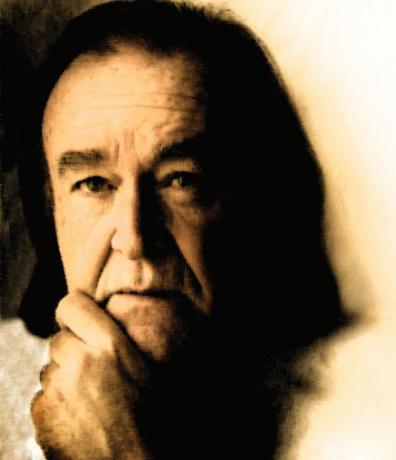
November 2022 Marquette Monthly 67
Gordon Lightfoot Tribute Band | November 3 | Escanaba
Courtesy of Bay College
217 N. Front St. lwvmqt.org
• La Table Française. French speakers of all abilities are invited for informal conversation and discussions. 7 p.m. NMU Library. (906) 227-2648.
• Altan Concert. This group will per form a variety of Irish folk music. $ Prices vary. 7:30 p.m.. Northern Cen ter. tickets.nmu.edu
Negaunee
• Knitting Group. Those interested in crocheting, knitting and other fiber arts are welcome to bring their projects and share with others. Coffee provided. 1:30 p.m. Negaunee Public Library, 319 W. Case St. (906) 475-7700, ext. 18.
• Wings of Fire Interest Group. Youth age eight and older are invited to discuss the series, write fanfiction, make crafts and other activities. 3 p.m. Negaunee Public Library, 319 W. Case St. (906) 475-7700, ext. 18.
• Kid-Friendly Come Write In. As part of National Novel Writing Month, those looking for a quiet place to write and meet other writers are welcome. 4 p.m. Negaunee Public Library, 319 W. Case St. (906) 475-7700, ext. 18.
03 THURSDAY
sunrise 8:34 a.m.; sunset 6:33 p.m.
Escanaba
• Game Apalooza. Proceeds will ben efit the Bay College food pantry. $2 or a canned food item. 5 to 8 p.m. Café Bay, Bay College, 2001 N. Lincoln Rd. baycollege.edu
• Gordon Lightfoot Tribute Band Concert. Mike Fornes and the band with will play the iconic songs of Gor don Lightfoot, along with telling some backstories. $20. 7 p.m. Besse Center, Bay College, 2001 N. Lincoln Rd. (906) 217-4045 or events.baycollege.edu
Houghton
• 41N Film Festival. This festival will showcase award-winning independent films and filmmakers. Film times vary. Rozsa Center, MTU. 41northfilmfest. mtu.edu
Ishpeming
• Protect Yourself from Scams. Learn how to recognize, respond and prevent phone, email and mail scams. 11 a.m. Ishpeming Senior Center, 121 Green wood St. (906) 225-7760.
Marquette
• Toddler Storytime. Toddlers age 18-months to age 3, with an adult, are invited for stories, songs and senso ry-friendly activities. 10:45 a.m. Great Room, Peter White Public Library, 217 N. Front St. (906) 226-4323.
• Superiorland Duplicate Bridge Club. Games open to all interested players. 12:30 p.m. $5 for games. Mar quette Senior Center, 300 W. Spring St. superiorland_bridge.tripod.com
• Wings of Fire. Youth in grades 4 to
6 are invited to discuss the series while creating mask designs to use for Hal loween. 4:30 p.m. Great Room, Peter White Public Library, 217 N. Front St. (906) 226-4323.
• Stand UP Comedy Festival. Co medians Dwight Simmons, Brent Ter hune, Joe Fernandez and Adam Burke will perform. Single Show, $15; Night Pass, $25. 7:30 p.m. Ore Dock Brew ing Company, 114 W. Spring St. tickets. nmu.edu

Negaunee
• Music, Movement and More. This parent-led story time is for all ages. 10:30 a.m. Negaunee Public Library, 319 W. Case St. (906) 475-7700, ext. 18.
04 FRIDAY
sunrise 8:35 a.m.; sunset 6:31 p.m.
Gwinn
• Story Time. This story time is geared towards preschool-age children with stories, crafts and a light snack. 10:30 a.m. Forsyth Township Library, 180 W. Flint St. (906) 346-3433.
Houghton
• 41N Film Festival. This festival will showcase award-winning independent films and filmmakers. Film times vary. Rozsa Center, MTU. 41northfilmfest. mtu.edu
Ishpeming
• Tame Your Tech. Bring in your de vices and get your questions answered. 11 a.m. Ishpeming Carnegie Public Li brary, 317 N. Main St. (906) 486-4381.
Marquette
• Sonderegger22: Heritage Preservation and Tourism. This symposium will include presentations by nine speakers throughout the day. Lunch provided and live streaming available. 8 a.m. to 5 p.m. Northern Center, NMU. nmu.edu
• Preschool Storytime. Preschool-age children are invited for stories, songs, finger-plays, crafts and other school-readiness activities. 10:45 a.m. Great Room, Peter White Public Li brary, 217 N. Front St. (906) 226-4323.
• Superiorland Duplicate Bridge Club. Games open to all interested players. 12:30 p.m. $5 for games. Mar quette Senior Center, 300 W. Spring St. superiorland_bridge.tripod.com
• LEGO Club. Meet other LEGO en thusiasts and build LEGO projects us ing the library’s LEGO blocks. Youth age 7 and younger must be accompa nied by an adult. 4 p.m. Great Room, Peter White Public Library, 217 N. Front St. (906) 226-4323.
• NMU Theatre: Finding Home. This production centers on the stories of his torically marginalized communities, and attempts to highlight what it’s like to work and live in Marquette. Prices vary. 7:30 p.m. Panowski Black Box
68 Marquette Monthly November 2022
Calumet
• Calumet Art Center. Works by local and regional artists. Monday through Friday, 11 a.m. to 4 p.m., Saturday, 11 a.m. to 2 p.m., 57055 Fifth St. (906) 934-2228.
• Copper Country Associated Artist. Works by members and workshop participants in watercolor and oil, drawings, photography, sculpture, quilting, wood, tex tile, clay, glass and other media. Thursday through Saturday, 11 a.m. to 4 p.m. 205 Fifth St. (906) 3371252 or ccaartists.org
• Gallery on 5th. Works by local and regional artists. Days and hours vary. 109 Fifth St. (906) 369-0094.
Copper Harbor
• EarthWorks Gallery. Featuring Lake Superior-inspired photography by Steve Brimm. Daily, 10 a.m. to 8 p.m. 216 First St. (910) 319-1650.
Escanaba
• Besse Gallery. Featuring works by local, regional and national artists. Days and hours vary. Bay College, 2001 N. Lincoln Rd. baycollege.edu
• East Ludington Art Gallery. Works by local artists. Tuesday through Friday, 10 a.m. to 4 p.m. Saturday, 10 a.m. to 3 p.m. 1007 Ludington St. (906) 786-0300 or eastludingtongallery.com
• Hartwig Gallery. Featuring works by local, regional and national art ists. Days and hours vary. 2001 N. Lincoln Rd. baycollege.edu
• William Bonifas Fine Arts Gallery.
- Northern Exposure XXIX, a juried competition show, featuring works by U.P. artists, will be on display November 10 through December 29, with a public reception at 6 p.m. on November 10.

- New Works, featuring oil paintings by John Hubbard, will be on display November 10 through December 29. Tuesday through Friday, 10 a.m. to 5:30 p.m., Saturday, 10 a.m. to 3p.m. 700 First Avenue South. (906) 7863833 or bonifasarts.org
Hancock
• Finlandia University Gallery.
- Self-Revolving Line, an exhibit by Finnish artist Tuomas Korkalo, will be on display through December 14, with a public reception at 7 p.m. on November 10. Monday through Friday, 8 a.m. to 4:30 p.m. Saturdays, noon to 4 p.m. 435 Quincy St. (906) 487-7500.
• Kerredge Gallery.
- The Shaft, a community exhibi tion, featuring works inspired by the mining history in the Copper Country, will be on display through
November 30.
Tuesday through Friday, 11 a.m. to 6 p.m. Saturday, 10 a.m. to 2 p.m. Community Arts Center, 126 Quincy St. coppercountryarts.com or (906) 482-2333.
• Youth Gallery.
- Junior Shaft, a community exhibi tion, featuring works inspired by the mining history in the Copper Country, will be on display through November 30.
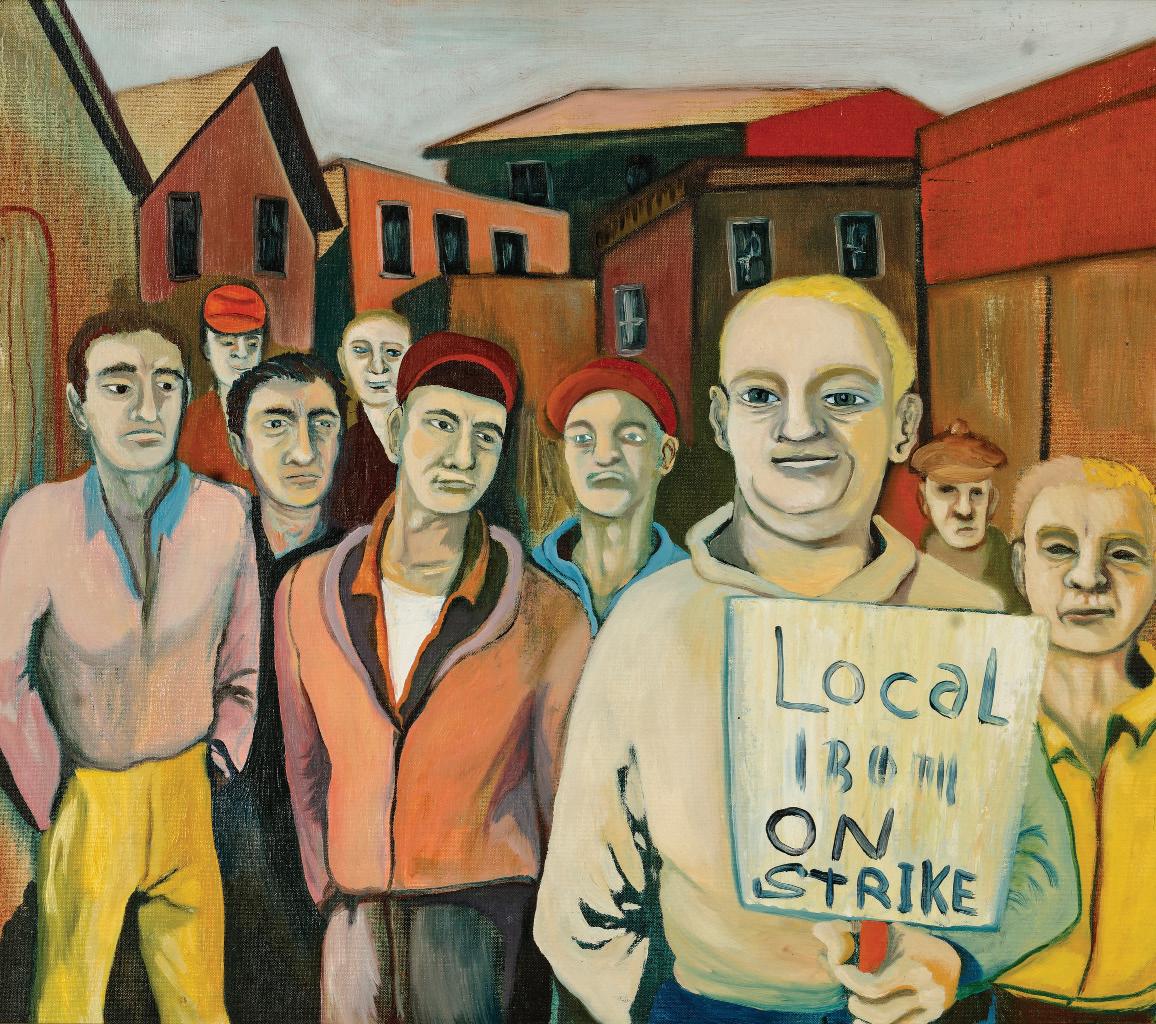
Tuesday through Friday, 10 a.m. to 5 p.m. Saturday, 10 a.m. to 2 p.m. Community Arts Center, 126 Quincy St. coppercountryarts.com or (906) 482-2333.
Houghton
• The Rozsa Galleries.
- Arabesque, an exhibition featuring works by Clement Yeh and Tomas Co will be on display through November 4.
Monday through Friday, 8 a.m. to 8 p.m. Saturdays, 1 to 8 p.m. Rozsa Center, 1400 Townsend Dr. mtu.edu/ rozsa
Marquette
• Art—U.P. Style. Art by Carol Papaleo, works by local artists, gifts, classes and more. Monday through Friday, 11 a.m. to 5 p.m. Saturday, 11 a.m. to 4 p.m. Sunday, noon to 4 p.m. 130 W. Washington St. (906) 225-1993.
• DeVos Art Museum.
- U.P. Focus, an exhibition featuring works by Lindsey Heiden and Linda King-Ferguson, will be on display through November 4.
- The Last Place on Earth, featuring works by Jan Manniko, will be on
display through November 18. Monday through Friday, noon to 5 p.m. Corner of Seventh and Tracy streets. NMU. (906) 227-1481 or nmu.edu/devos
• Graci Gallery. Works by regional and national artists. Featuring fine craft, contemporary art, and jewelry. Thursday and Friday, noon to 5 p.m. Saturday, 11 a.m. to 6 p.m. Sunday through Wednesday, by appoint ment or chance. 555 E. Michigan Street. gracigallery.com
• Huron Mountain Club Gallery.
- The Best of Us: an NCLL Retrospective, featuring works by NCLL members, will be on display through November 30. Monday through Thursday, 9:30 a.m. to 8:30 p.m. Friday, 9:30 a.m. to 5:30 p.m., and Saturday, 9:30 a.m. to 4:30 p.m.
Peter White Public Library, 217 N. Front St. (906) 228-0472.
• Lake Superior Photo and Gallery. The studio features landscape pho tographic art by Shawn Malone, including naturescapes of the Lake Superior region. Monday through Saturday, 11 a.m. to 6 p.m. 211 S. Front St. (906) 228-3686 or lakesu periorphoto.com
• Marquette Arts and Culture Center Deo Gallery.
- Grids and Pixelation: Visual Poetry, featuring works by Michael Friend and Carol Irving, will be on display November 1 through 30, with a public reception at 6 p.m. the 10th. Monday through Thursday, 9:30 a.m. to 8:30 p.m., Friday, 9:30 a.m. to 5:30 p.m., and Saturday, 9:30 a.m. to 4:30 p.m. Peter White Public Library, 217 N. Front St. (906) 228-0472.
• Peter White Public Library
(continued on page 81)
November 2022 Marquette Monthly 69
Jan Manniko | C & H Miner’s Strike 1968 | Kerredge Gallery, Hancock (continued on page 70) art galleries
art galleries
Reception Gallery.
- Digital Humans, featuring digital art by Lari Wendt, will be on dis play through November 30. Monday through Thursday, 9:30 a.m. to 8:30 p.m., Friday, 9:30 a.m. to 5:30 p.m., and Saturday, 9:30 a.m. to 4:30 p.m.
Peter White Public Library, 217 N. Front St. (906) 228-0472.
• Presque Isle Station. This work ing pottery studio features pottery by Michael Horton and Terry Gilfoy, along with works by local artists. Days and times vary. 2901 Lakeshore Blvd. (906) 225-1695.
• The Gallery: A Marquette Artist Collective Project. Works by local and regional artists. Monday, 11 a.m. to 4 p.m., Tuesday, 10 a.m. to 4 p.m., Wednesday, 11 a.m. to 5 p.m., Thursday, 11 a.m. to 7 p.m., Friday, 10 a.m. to 4 p.m., Saturday, 11 a.m. to 5 p.m., Sunday 1 to 4 p.m. Suite U7, 130 W. Washington St. mqtar tistcollective.com
• The Studio Gallery at Presque Isle. Works by local and internation ally acclaimed artists. Wednesday, 10 a.m. to 5 p.m. Thursday and Friday, 10 a.m. to 3 p.m., Saturday, noon to 4 p.m. 2905 Lakeshore Blvd. (906) 360-4453.
• Wintergreen Hill Gallery and Gifts.
- Hope-Dreams Art, by will be on display through November 11.
- Works by Kathy Binoemi will be on display November 12 through 25, with a public reception at 6 p.m. on the 17th.
(continued from page 69)
Theatre, NMU. tickets.nmu.edu
• Stand UP Comedy Festival. Come dians Ella Horwedel, Sam Rager, Mike Bobbitt and DJ Dangler. Single Show, $15; Night Pass, $25. 7:30 p.m. Ore Dock Brewing Company, 114 W. Spring St. tickets.nmu.edu
Negaunee
• Come Write In. As part of National Novel Writing Month, those looking for a quiet place to write and meet other writers are welcome. Coffee and snacks provided. 10 a.m. to noon. Negaunee Public Library, 319 W. Case St. (906) 475-7700, ext. 18.
05 SATURDAY
sunrise 8:36 a.m.; sunset 7:35 p.m.
Calumet
• Winter Markets. 10 a.m. to 2 p.m. Calumet Art Center, 57055 Fifth St. (906) 934-2228.
Escanaba
• Holiday Art Fair. Shop for art from local artists, along with bake sale items.

Tuesday through Saturday, 10 a.m. to 6 p.m. 810 N. Third St. (906) 273-1374.

• Zero Degrees Artist Gallery. Works in oils, watercolors, mixed media, jewelry, photography, metals, woods, recycled and fiber arts and much more. Tuesday through Saturday, 10 a.m. to 6 p.m. Sunday, 11 a.m. to 3 p.m. 525 N. Third St. (906) 228-3058 or zerode greesgallery.org
Munising
• UP-Scale Art. Featuring works by local and regional artists. Thursday through Monday, 11 a.m. to 5 p.m. or by appointment. 109 W. Superior Ave. (906) 387-3300 or upscaleart. org
Rapid River
• The adhocWORKshop. Owner Ritch Branstrom creates sculptures with found objects inspired by the land in which the objects were found. By appointment or chance. 10495 South Main Street. (906) 3991572 or adhocworkshop.com
Sand River
• Aurelia Studio Pottery. Featuring high fire stoneware, along with functional and sculptural pieces inspired by nature, created by potter and owner Paula Neville. Open by appointment or chance. 3050 E. M-28. (906) 343-6592.
MM
An art raffle also will be held. 10 a.m. to 4 p.m. Bonifas Arts Center, 700 First Avenue South. (906) 786-3833 or bon ifasarts.org
• Story Hour. Stories are geared to ward children ages 5 and older. 1 p.m. Escanaba Public Library, 400 Luding ton St. (906) 789-7323.
Gwinn
• Holiday Craft Show. 10 a.m. to 3 p.m. Gwinn VFW, 54 Mitchell St.
Houghton
• 41N Film Festival. This festival will showcase award-winning independent films and filmmakers. Film times vary. Rozsa Center, MTU. 41northfilmfest. mtu.edu
Marquette
• Saturday Morning Farmers Mar ket. 9 a.m. to 1 p.m. Marquette Com mons, 112 S. Third St. mqtfarmersmar ket.com
• Fall Bazaar. Bazaar booths featuring bakery, knitted and crocheted goods, jewelry, books, children’s items, white elephant and Christmas items will be available for purchase. A soup, salad
70 Marquette Monthly November 2022
and dessert lunch will be available to children for $5 and adults for $10. 10 to 2 p.m. St. Michael Catholic Church, corner of Kaye Avenue and Hebard Court.

• Saturday Storytime. Stories, songs, rhymes, finger-plays and activities for babies and toddlers with an adult. Old er siblings welcome. 10:30 a.m. Great Room, Peter White Public Library, 217 N. Front St. (906) 226-4323.
• Superiorland Duplicate Bridge Club. Games open to all interest ed players. Lessons, 10 a.m. Games, 11:30 a.m. $5 for games. Citizens Fo rum, Lakeview Arena, 401 E. Pine St. superiorland_bridge.tripod.com
• NMU Theatre For All Performance: Finding Home. Lights and noises will be subdued during this performance. This production centers on the stories of historically marginalized commu nities, and attempts to highlight what it’s like to work and live in Marquette. Prices vary. 1 p.m. Panowski Black Box Theatre, NMU. tickets.nmu.edu
• Hiawatha Music Co-op Annual Meeting, Dinner and Dance. Follow ing the meeting, dance to music from The Pasi Cats. Meeting, 5 p.m.; Dance, 7:30 p.m. Barrel + Beam, 260 North woods Rd. (906) 226-8575.
• NMU Theatre: Finding Home. This production centers on the stories of his torically marginalized communities, and attempts to highlight what it’s like to work and live in Marquette. Prices vary. 7:30 p.m. Panowski Black Box Theatre, NMU. tickets.nmu.edu

• Stand UP Comedy Festival. Come dians Tyler Ross, Marz Timms, Nick Leydorf and Mike Stanley will per form. Single Show, $15; Night Pass, $25. 7:30 p.m. Ore Dock Brewing Company, 114 W. Spring St. tickets. nmu.edu
Michigamme
• Holiday Market. Shop for home made, home baked, home grown and handcrafted wares from local arti sans. 10 a.m. to 4 p.m. Community Building, 202 W. Main St.
06 SUNDAY
sunrise 7:45 a.m.; sunset 6:30 p.m.
Daylight Saving Time Ends Crystal Falls
• WOR Concert. Belgian musicians will perform 18th century classics with a modern twist. $25. 7 p.m. Crystal Theatre, 304 Superior Ave. (906) 8753208 or thecrystaltheatre.org
Ishpeming
• Bingo. Snacks and beverages avail able for purchase. Noon. Ishpeming VFW, 310 Bank St. (906) 486-8080.
Houghton
• 41N Film Festival. This festival will showcase award-winning independent films and filmmakers. Film times vary.
Rozsa Center, MTU. 41northfilmfest. mtu.edu
Marquette
• Slow Fiddle Jam. Play, share and learn traditional fiddle tunes. 1:30 p.m. The Fold, 1015 N. Third St. (906) 2268575.
• Old Timey Music Jam. Play, share and learn songs from traditional , folk and Americana genres. 3 p.m. The Fold, 1015 N. Third St. (906) 226-8575.
• NMU Percussion Ensemble Con cert. 3 p.m. Reynolds Recital Hall, NMU. (906) 227-2563 or nmu.edu
Skandia
• Skandia Lions Club Pancake Breakfast. Proceeds from this pan cake breakfast will benefit new play ground equipment and pickle ball court. Youth 5 and younger, free; ages 6 to 12, $5; age 13 and older, $7. 9 a.m. to 1 p.m. Skandia Township Hall, 224 Kreiger Dr.
07 MONDAY
sunrise 7:38 a.m.; sunset 5:28 p.m.
Ishpeming
• Joy of Sound Meditation. Enjoy a relaxing meditation with sounds pro duced by Tibetan singing bowls and metallic gongs. 7 p.m. Joy Center, 1492 Southwood Dr. (906) 362-9934.
Marquette
• Book Babies. Newborns to age 17-months with an adult are invited for songs, rhymes and stories. 9:45 a.m. Great Room, Peter White Public Li brary, 217 N. Front St. (906) 226-4323.
• Marquette Playgroup. This weekly playgroup is led by an early childhood educator and geared toward newborns to age 5. Activities include free play, story time, a snack and other activities to promote social-emotional develop ment. 10 to 11:30 a.m. Lake Superior Village Youth and Family Center, 1901 Longyear Ave. sjhobalia@greatstart ma.org
• Toddler Storytime. Toddlers age 18-months to age 3, with an adult, are invited for stories, songs and senso ry-friendly activities. 10:45 a.m. Great Room, Peter White Public Library, 217 N. Front St. (906) 226-4323.
• Dinner with the Doctor. Dr. Evan Luokusa will discuss food and Type 2 diabetes. 4 p.m. Marquette Food Coop, 502 W. Washington St. (906) 2250671, ext. 701.
• NCLL Winter Kick-Off with Russ Magnaghi. Russ Magnaghi will dis cuss past diets and how to eat healthy foods growing in our community. Bring a dish to share. 5:30 p.m. Community Room, Peter White Public Library, 217 N. Front St. (906) 361-5370.
• Wiggle Worms STEM Storytime. Stories are intermixed with activities followed by STEM-related activities to stimulate senses. 6 p.m. Great Room, Peter White Public Library, 217 N.
November 2022 Marquette Monthly 71
Calumet
• International Frisbee Hall of Fame and Museum. Learn about the history of Guts Frisbee. Days and hours vary. Open when events are held. Second floor ballroom, Calumet Coliseum, Red Jacket Rd. (906) 281-7625.
Escanaba
• Upper Peninsula Honor Flight Legacy Museum. The museum chronicles the history of the U.P. Honor Flights with the history of the trips. Donations appreciated. Monday through Friday, 8 a.m. to 4 p.m. and by request. Inside the Delta County Chamber of Commerce, 1001 N. Lincoln Rd.
• Upper Peninsula Military Museum. The museum honors Upper Peninsula Veterans, and features exhibits and dioramas portraying the Upper Peninsula’s contribution to U.S. War efforts from the Civil War through the Afghanistan wars. Donations appre ciated. Monday through Friday, 8 a.m. to 4 p.m. and by request. Inside the Delta County Chamber of Commerce, 1001 N. Lincoln Rd.
Hancock
• Quincy Mine Hoist and Underground Mine. Attractions include tours of the No. 2 Shaft House, Cog Rail Tram, Underground tours, the Nordberg Steam Hoist. The musuem houses mining artifacts, interpretive panels and more. Prices, days and hours vary. (906) 482-3101 or quincymine.com
Houghton
• A.E. Seaman Mineral Museum. View the largest collection of min erals from the Great Lakes region and the world’s finest collection of Michigan minerals. Exhibits educate visitors on how minerals are formed, fluorescent minerals and minerals from around the world. Prices vary. Monday through Saturday, 9 a.m. to 5 p.m. 1404 E. Sharon Ave. museum. mtu.edu or (906) 487-2572.
• Carnegie Museum. Features rotat ing displays of local history, natural science and culture. The Science Center is dedicated to interactive exhibits about science for kids. Tuesday and Thursday, noon to 5 p.m. Saturday, noon to 4 p.m. 105 Huron St. (906) 482-7140 or carn egiekeweenaw.org
• MTU Archives and Copper Country Historical Collections. Features a variety of historical memorabilia, highlighting life in the Copper Country. Open by appoint ment. Lower level of the J.R. Van Pelt Library, MTU. (906) 487-3209.
• World War II Glider and Military Museum. During World War II, the Ford Motor Company’s Kingsford plant built the CG-4A Gliders for the U.S. Army. View one of seven fully restored CG-4A G World War II glid ers, military uniforms from the Civil War through the wars in Iraq and Afghanistan, memorabilia, restored military vehicles and more. Prices vary. Days and times vary. 302 Kent St. (906) 774-1086.
Ishpeming
• Ishpeming Area Historical Society Museum. New exhib its include a military exhibit and artifacts from the Elson Estate. Donations appreciated. Friday, 11 a.m. to 2 p.m. Gossard Building, Suite 303, 308 Cleveland Ave. ish peminghistory.org

• U.S. National Ski & Snowboard Hall of Fame & Museum. The museum features more than 300 Hall of Fame inductees, presented in photographs and biographies, and displays and exhibits of skiing history and equipment, an extensive library, video show, gift shop, special events and more. By appointment only. US-41 and Third St. (906) 4856323 or skihall.com
K.I. Sawyer
• K.I. Sawyer Heritage Air Museum. The museum promotes and preserves the aviation history the air base brought to the area. Air Force-related materials are on dis play, including photographs, flags, medals and more. Donations appre ciated. Wednesday through Sunday, 1 to 5 p.m. 402 Third St. (906) 2363502 or kishamuseum.org
Marquette
• Baraga Educational Center and Museum. View artifacts and tools used by Venerable Bishop Baraga. Donations appreciated. Monday through Friday, noon to 5 p.m. and by appointment. 615 S. Fourth St. (906) 227-9117.
• Beaumier Upper Peninsula Heritage Center.
- Above/Under the Surface: The
Fisheries of the Upper Great Lakes, an exhibition examining the changes to fish populations and the impact of humans on native fish species, will be on display through December.
Three separate collections focus on cultural artifacts relating to ethnic, religious and social diver sity in the U.P. Monday through Wednesday and Friday, 11 a.m. to 5 p.m. Thursday, 11 a.m. to 8 p.m. Saturday, noon to 4 p.m. NMU, corner of Seventh Street and Tracy Avenue. (906) 227-3212 or nmu. edu/beaumier
• Marquette Regional History Center.
- Railroads of Marquette County: Yesterday and Today, featuring select hands-on elements, as well as maps, artifacts and photographs, will be on display through February 2023.
- The museum includes interactive displays as well as regional history exhibits. Youth 12 and younger, $2; students, $3; seniors, $6; adults, $7. Monday through Saturday, 10 a.m. to 3 p.m. 145 W. Spring St. (906) 226-3571 or marquettehistory.org
• Upper Peninsula Children’s Museum. A variety of interactive exhibits offer learning through investigation and creativity. Monday through Saturday, 10 a.m. to 5 p.m. Prices vary. 123 W. Baraga Ave. (906) 226-3911.
Munising
• Alger County Historical Society Heritage Center. Exhibits include the Grand Island Recreation Area, Munising Woodenware Company, barn building, homemaking, sauna and more. Tuesday through Saturday, noon to 4 p.m. 1496 Washington St. (906) 387-4308.
Negaunee
• Michigan Iron Industry Museum. The museum overlooks the Carp River and the site of the first iron forge in the Lake Superior region. The museum exhibits audio-visual programs and outdoor interpretive paths. Daily, 9:30 a.m. to 4:30 p.m. 73 Forge Rd. (906) 475-7857.
72 Marquette Monthly November 2022
Iron Mountain
MM
Beaumier Upper Peninsula Heritage Center, Marquette
museums
Front St. (906) 226-4323.

• Craft Magic Series: Origami Magic with Lydia Taylor. Join origami fiber artist Lydia Taylor for a beginner origa mi project. Materials provided. Space is limited. 6:30 p.m. Heritage Room, Peter White Public Library, 217 N. Front St. (906) 226-4322.
Negaunee
• All-Ages Online Storytime. Enjoy stories, songs and rhymes from the comfort of your own home. 11a.m. via Facebook Live. facebook.com/ NegauneePublicLibrary
Classes with Marlene Wood. Bring your own supplies. $20. 1 to 3 p.m. Mar quette Arts and Culture Center, lower level, Peter White Public Library, 217 N. Front St. (906) 225-8655.

• The Art of Bonsai. Learn the history of the art of bonsai, tools to get started, how to choose your first tree and the local Gichigami Bonsai Guild. NCLL members, $5; nonmembers, $10. 3 p.m. Shiras Room, Peter White Public Li brary, 217 N. Front St. (906) 360-2859.
08 TUESDAY
sunrise 7:41 a.m.; sunset 5:26 p.m.
ELECTION DAY
Marquette
• Book Babies. Newborns to age 17-months with an adult are invited for songs, rhymes and stories. 9:45 a.m. Great Room, Peter White Public Li brary, 217 N. Front St. (906) 226-4323.
• Preschool Storytime. Preschool-age children are invited for stories, songs, finger-plays, crafts and other school-readiness activities. 10:45 a.m. Great Room, Peter White Public Li brary, 217 N. Front St. (906) 226-4323.
• Superiorland Duplicate Bridge Club. Games open to all interested players. 12:30 p.m. $5 for games. Mar quette Senior Center, 300 W. Spring St. superiorland_bridge.tripod.com

• Oil Painting, Pastels and Drawing
• Myconaut Launch Party. View mushroom art installations, sample mushroom foods and beer while learn ing about Myconaut, a local startup company. Myconaut focuses on com mercial and retail mushroom produc tion for climate resilience and envi ronmental toxicity, including PFAS contamination. 5 to 9 p.m. Barrel + Beam, 260 Northwoods Rd.
09 WEDNESDAY
sunrise 7:42 a.m.; sunset 5:34 p.m.
Calumet
• Red Jacket Readers Book Club. The group will discuss The Mason House by T. Marie Bertineau. $5. 6:30 p.m. Community Room, Calu met Public Library, 57070 Mine St. (906) 337-0311, ext. 1107 or clk schools.org/library
Escanaba
• Toddler Art with Nicole Nelson. Toddlers ages 1 to 4, with an adult, are invited for a morning of art. $5. 9:30 a.m. Bonifas Arts Center, 700
November 2022 Marquette Monthly 73
Toddler Art
| November 9 |
Escanaba
First Ave. S. (906) 786-3833 or bon ifasarts.org
Ishpeming
• Open Crafts Night. 6:30 p.m. U.P. Level Your Stash Crafter’s Lounge, 113 Cleveland Ave. (906) 458-0626.
Marquette
• Wiggle Worms STEM Storytime. Stories are intermixed with activities followed by STEM-related activities to stimulate senses. 9:45 a.m. Great Room, Peter White Public Library, 217 N. Front St. (906) 226-4323.
• Congregate Meals for Seniors–Dine in or Curbside Pickup. Meals avail able to those age 60 and older. Call to reserve a meal. $3.50 suggested donation. Noon to 1 p.m. Marquette Senior Center, 300 W. Spring St. (906) 228-0456.
• School’s Out, Library’s In. Students are invited to make beads, kinetic sand and watch the film Little Mermaid Beads and kinetic sand, noon to 4 p.m.; Film, 12:45 p.m. Youth Services Room, Peter White Public Library, 217 N. Front St. (906) 226-4323.
• Junior Teen Advisory Board. Stu dents in grades 5 to 8 are invited to meet new people, plan events and gain volunteer experience. 4:15 p.m. Great Room, Peter White Public Library, 217 N. Front St. (906) 226-4321.
• Why and How to Unclutter. Pro fessional organizer Dar Shepherd will discuss how clutter causes stress and how to put our home in order. 6:30 p.m. Lions Room, Peter White Public Library, 217 N. Front St. (906) 3603000.
er Concert. Enjoy a night of jazz and local favorites. 7 p.m. Community Room, Peter White Public Library, 217 N. Front St. (906) 226-4322.
• NMU Brass Studio Concert. 7:30 p.m. Reynolds Recital Hall, NMU. nmu.edu
• NMU Theatre: Finding Home. This production centers on the stories of his torically marginalized communities, and attempts to highlight what it’s like to work and live in Marquette. Prices vary. 7:30 p.m. Panowski Black Box Theatre, NMU. tickets.nmu.edu
Negaunee
• Knitting Group. Those interested in crocheting, knitting and other fiber arts are welcome to bring their projects and share with others. Coffee provided. 1:30 p.m. Negaunee Public Library, 319 W. Case St. (906) 475-7700, ext. 18.
• Wings of Fire Interest Group. Youth age eight and older are invited to discuss the series, write fanfiction, make crafts and other activities. 3 p.m. Negaunee Public Library, 319 W. Case St. (906) 475-7700, ext. 18.
• Kid-Friendly Come Write In. As part of National Novel Writing Month, those looking for a quiet place to write and meet other writers are welcome. 4 p.m. Negaunee Public Library, 319 W. Case St. (906) 475-7700, ext. 18.
en Dionne. Karen Dionne will discuss her book The Wicked Sister. 7 p.m. Call or email to register and receive the Zoom link. (906) 875-3344 or egathu@ uproc.lib.mi.us
Escanaba
• Basic Food Preservation. Learn the basics of food preservation with a focus on pressure canning and dehydrating. 4:30 p.m. Escanaba Public Library, 400 Ludington St. (906) 789-7323.
Marquette
• Toddler Storytime. Toddlers age 18-months to age 3, with an adult, are invited for stories, songs and senso ry-friendly activities. 10:45 a.m. Great Room, Peter White Public Library, 217 N. Front St. (906) 226-4323.
• Community Action Alger-Mar quette: What They Do and How We Can Help. Learn about the ser vices provided by Community Action Alger-Marquette, including Meals on Wheels and projects focused on homelessness. NCLL members, $5; nonmembers, $10. Noon. Community Room, Lost Creek, 200 Lost Creek Dr. (906) 458-5408.
• School’s Out, Library’s In. Students are invited to make tropical birds, paper flower bracelets and watch the film En canto Tropical birds and paper flower bracelets, noon to 4 p.m.; Film, 12:45 p.m. Youth Services Room, Peter White Public Library, 217 N. Front St. (906) 226-4323.
• Superiorland Duplicate Bridge Club. Games open to all interested players. 12:30 p.m. $5 for games. Mar quette Senior Center, 300 W. Spring St. superiorland_bridge.tripod.com
• Graphic Novel Geeks. Youth in grades 4 to 6 will look at graphic novels that feature science-fiction and manga themes. 4:30 p.m. Great Room, Peter White Public Library, 217 N. Front St. (906) 226-4323.
• Second Thursday Creativity Series: Turkey Dance. Youth are invited for turkey-themed hands-on activites, snacks, music, and free Culver’s frozen custard. 5:30 to 7:30 p.m. U.P. Chil dren’s Museum, 123 W. Baraga Ave. (906) 226-3911.
• Jeff Vandezande Reading. Michigan writer Jeff Vandezande will read from his new dystopian novel Rules of Or der 7 p.m. Shiras Room, Peter White Public Library, 217 N. Front St. (906) 226-4322.
• NMU Theatre: Finding Home. This production centers on the stories of his torically marginalized communities, and attempts to highlight what it’s like to work and live in Marquette. Prices vary. 7:30 p.m. Panowski Black Box Theatre, NMU. tickets.nmu.edu
Negaunee
• Music, Movement and More. This parent-led story time is for all ages. 10:30 a.m. Negaunee Public Library, 319 W. Case St. (906) 475-7700, ext. 18.
11 FRIDAY
sunrise 7:45 a.m.; sunset 5:22 p.m.
Veterans Day
Gwinn
• Story Time. This story time is geared towards preschool-age children with stories, crafts and a light snack. 10:30 a.m. Forsyth Township Library, 180 W. Flint St. (906) 346-3433.
Marquette
• Preschool Storytime. Preschool-age children are invited for stories, songs, finger-plays, crafts and other school-readiness activities. 10:45 a.m. Great Room, Peter White Public Li brary, 217 N. Front St. (906) 226-4323.
• Docu Cinema Matinee. The docu mentary film Young Lakota: A Native American Leader Fights for Reproduc tive Rights will be shown. Noon. Shiras Room, Peter White Public Library, 217 N. Front St. (906) 226-4322.
• School’s Out, Library’s In. Students are invited for LEGO activities and to watch the film The LEGO Movie LEGO activities, noon to 5 p.m.; Film, 12:45 p.m. Youth Services Room, Peter White Public Library, 217 N. Front St. (906) 226-4323.
• Superiorland Duplicate Bridge Club. Games open to all interested players. 12:30 p.m. $5 for games. Mar quette Senior Center, 300 W. Spring St. superiorland_bridge.tripod.com
• LEGO Club. Meet other LEGO en thusiasts and build LEGO projects us ing the library’s LEGO blocks. Youth
74 Marquette Monthly November 2022
• Kirsten Gustafson and Dave Zeign
10 THURSDAY
sunrise 7:44 a.m.; sunset 5:23p.m.
Crystal Falls • Virtual Q&A with U.P. Author Kar
Brits & Brews | November 11 & 12 | Marquette
age 7 and younger must be accompa nied by an adult. 4 p.m. Great Room, Peter White Public Library, 217 N. Front St. (906) 226-4323.
• Brits and Brews. Bands will perform music from the 1960s-1970s British Invasion era and beyond. Proceeds benefit JJ Packs. Donations appreciat ed. 5 to 10:30 p.m. Ore Dock Brewing Company, 114 W. Spring St.
• Marquette Male Chorus: It’s Too Darn Hot. The concert will feature mu sic of Cole Porter and George Gersh win. Masks are optional. $10 suggested donation. 7:30 p.m. Messiah Luther an Church, 305 W. Magnetic St. (906) 249-9867.
• NMU Theatre: Finding Home. This production centers on the stories of his torically marginalized communities, and attempts to highlight what it’s like to work and live in Marquette. Prices vary. 7:30 p.m. Panowski Black Box Theatre, NMU. tickets.nmu.edu
• Siril Concert Series. Opera singer Mimmi Fulmer and pianist and con ductor Craig Randal will perform songs from Finland, Sweden and Den mark. Youth ages 18 and younger, and NMU students, free; 18 and older and nonstudents, $12. 7:30 p.m. Reynolds Recital Hall, NMU. tickets.nmu.edu
Negaunee
• Come Write In. As part of National Novel Writing Month, those looking for a quiet place to write and meet other writers are welcome. Coffee and snacks provided. 10 a.m. to noon. Negaunee Public Library, 319 W. Case St. (906) 475-7700, ext. 18.
12 SATURDAY
sunrise 7:47 a.m.; sunset 5:21 p.m.
babies and toddlers with an adult. Old er siblings welcome. 10:30 a.m. Great Room, Peter White Public Library, 217 N. Front St. (906) 226-4323.
• Superiorland Duplicate Bridge Club. Games open to all interest ed players. Lessons, 10 a.m. Games, 11:30 a.m. $5 for games. Citizens Fo rum, Lakeview Arena, 401 E. Pine St. superiorland_bridge.tripod.com
• 22nd Annual Holiday Art Sale. This annual sale will feature works in paint ing, photography, fibers, glass, jewelry, metals, wearable art and other medi ums. $2. 10 a.m. to 4 p.m. Marquette Regional History Center, 145 W. Spring St. (906) 226-3571.
• Brits and Brews. Bands will perform music from the 1960s-1970s British Invasion era and beyond. Proceeds benefit Music for All Kids. Donations appreciated. 5 to 11:30 p.m. Ore Dock Brewing Company, 114 W. Spring St.
• NMU Theatre: Finding Home. This production centers on the stories of his torically marginalized communities, and attempts to highlight what it’s like to work and live in Marquette. Prices vary. 7:30 p.m. Panowski Black Box Theatre, NMU. tickets.nmu.edu
Skandia
• Turkey Dinner. Proceeds from this annual dinner benefit local scholarships and youth development programs. Take-out available. Youth age 5 and younger, free; ages 6 to 12, $5; age 13 and older, $10. 4 to 7 p.m. West Branch Township Hall, 1016 CR-545.
N. Front St. (906) 226-4323.
• Senior Theatre Experience: Month ly Workshop and Discussion. This workshop is for those age 55 and old er. Register in advance. Marquette city and surrounding township residents, free; nonresidents, $5 donation. 4 p.m. Marquette Arts and Culture Center, lower level, Peter White Public Li brary, 217 N. Front St. (906) 225-8655.
• Wiggle Worms STEM Storytime. Stories are intermixed with activities followed by STEM-related activities to stimulate senses. 6 p.m. Great Room, Peter White Public Library, 217 N. Front St. (906) 226-4323.
• Docu Cinema. The documentary film Young Lakota: A Native Ameri can Leader Fights for Reproductive Rights will be shown. 7 p.m. Commu nity Room, Peter White Public Library, 217 N. Front St. (906) 226-4322.
Negaunee
• All-Ages Online Storytime. Enjoy stories, songs and rhymes from the comfort of your own home. 11a.m. via Facebook Live. facebook.com/ NegauneePublicLibrary
15 TUESDAY
sunrise 7:51 a.m.; sunset 5:17 p.m.
Gwinn
• Literature at the Lodge Adult Book Club. The group will discuss The Last House on the Street by Diane Cham berlain. 7 p.m. Up North Lodge, 215 CR-557. (906) 346-3433.
Marquette
Escanaba
• Story Hour. Stories are geared to ward children ages 5 and older. 1 p.m. Escanaba Public Library, 400 Luding ton St. (906) 789-7323.
Marquette
• Fall Home/Christmas Craft Show. Shop for locally made items. 9 a.m. to 6 p.m. 26 W. Sandwood Dr.
• Saturday Morning Farmers Mar ket. 9 a.m. to 1 p.m. Marquette Com mons, 112 S. Third St. mqtfarmersmar ket.com
• St. Louis Fall Bazaar. Shop for homemade crafts, baked goods, jew elry, and rummage sale items. Lunch will be available for purchase. 9 a.m. to 2 p.m. St. Louis the King Catholic Church, 264 Silver Creek Rd.
• Superiorland Ski Swap. Shop for used snow-sports equipment. This an nual sales helps benefit youth cross country ski programs. Equipment drop off, 9 a.m.; Club member shopping, 10:30 a.m.; Public sale, 11 a.m. to 12:30 p.m. Marquette Township Hall, 1000 Commerce Dr.
• Saturday Storytime. Stories, songs, rhymes, finger-plays and activities for
Marquette
• Book Babies. Newborns to age 17-months with an adult are invited for songs, rhymes and stories. 9:45 a.m. Great Room, Peter White Public Library, 217 N. Front St. (906) 2264323.
• Marquette Playgroup. This weekly playgroup is led by an early childhood educator and geared toward newborns to age 5. Activities include free play, story time, a snack and other activities to promote social-emotional develop ment. 10 to 11:30 a.m. Lake Superior Village Youth and Family Center, 1901 Longyear Ave. sjhobalia@greatstart ma.org
• Toddler Storytime. Toddlers age 18-months to age 3, with an adult, are invited for stories, songs and senso ry-friendly activities. 10:45 a.m. Great Room, Peter White Public Library, 217
• Winter Wonderland Walk Tree Setup. Groups and individuals who have signed up to display a tree may begin setting up their displays. Trees must be decorated by closing time on De cember 2. 9:30 a.m. to 8:30 p.m. Peter White Public Library, 217 N. Front St. (906) 226-4322.
• Book Babies. Newborns to age 17-months with an adult are invited for songs, rhymes and stories. 9:45 a.m. Great Room, Peter White Public Li brary, 217 N. Front St. (906) 226-4323.
• Preschool Storytime. Preschool-age children are invited for stories, songs, finger-plays, crafts and other school-readiness activities. 10:45 a.m. Great Room, Peter White Public Li brary, 217 N. Front St. (906) 226-4323.
• Tasty Reads Book Group. The group will discuss The Last Chinese Chef by Nicole Mones. Noon. Shiras Room, Pe ter White Public Library, 217 N. Front St. (906) 226-4303.
• Superiorland Duplicate Bridge Club. Games open to all interested players. 12:30 p.m. $5 for games. Mar quette Senior Center, 300 W. Spring St. superiorland_bridge.tripod.com
• Oil Painting, Pastels and Drawing Classes with Marlene Wood. Bring your own supplies. $20. 1 to 3 p.m. Mar quette Arts and Culture Center, lower level, Peter White Public Library, 217
N. Front St. (906) 225-8655.
• Dungeons and Dragons. Students in grades 6 to 12 are invited for a quest with this role-playing game. Registra tion required. 4 p.m. Teen Zone, Peter White Public Library, 217 N. Front St. (906) 226-4321.
• Authors Read Virtually: B.G. Bradley. Author B.G. Bradley will read his book, The Seasons of Hunter. 7 p.m. via Zoom. Visit pwpl.info for Zoom link.
16 WEDNESDAY
sunrise 7:52 a.m.; sunset 5:16 p.m.
Escanaba
• Toddler Art with Nicole Nelson. Toddlers ages 1 to 4, with an adult, are invited for a morning of art. $5. 9:30 a.m. Bonifas Arts Center, 700 First Ave. S. (906) 786-3833 or bon ifasarts.org
• Community Acoustic Musical Jam Session. All musicians welcome. 6 p.m. Room 901, Joseph Heirman Cen ter, Bay College, 2001 N. Lincoln Rd. baycollege.edu
Ishpeming
• Ladies Night In. Local businesses and crafters will offer sales, gift draw ings, snacks and beverages throughout the day. 9 a.m. to 8 p.m. Locations vary. mqtfarmersmarket.com
• Open Crafts Night. 6:30 p.m. U.P. Level Your Stash Crafter’s Lounge, 113 Cleveland Ave. (906) 458-0626.
Marquette
• Wiggle Worms STEM Storytime. Stories are intermixed with activities followed by STEM-related activities to stimulate senses. 9:45 a.m. Great Room, Peter White Public Library, 217 N. Front St. (906) 226-4323.
• All Booked UP Monthly Book Club. The group will discuss This Time To morrow by Emma Straub. Elizabeth Peterson, Tia Trudgeon, Heather Stel tenpohl and Jenifer Kilpela will lead the discussion. 11 a.m. The Courtyards, 1110 Champion St. jkilpela@pwpl.info
• Congregate Meals for Seniors–Dine in or Curbside Pickup. Meals avail able to those age 60 and older. Call to reserve a meal. $3.50 suggested donation. Noon to 1 p.m. Marquette Senior Center, 300 W. Spring St. (906) 228-0456.
• PWPL Non-Fiction Book Club. The group will discuss Evicted by Matthew Desmond. 1 p.m. Conference Room, Peter White Public Library, 217 N. Front St. (906) 226-4311.
• Visual Art Class: Painting with JoAnn Shelby. This class is for those age 55 and older. Register in advance. Marquette city and surrounding town ship residents, free; nonresidents, $5 donation. 1 p.m. Marquette Arts and Culture Center, lower level, Peter White Public Library, 217 N. Front St. (906) 225-8655.
• Teen Advisory Board. Students in grade 9 to 12 are invited to meet new
November 2022 Marquette Monthly 75
13 SUNDAY sunrise 7:48 a.m.; sunset 5:19 p.m.
Ishpeming • Bingo. Snacks and beverages avail able for purchase. Noon. Ishpeming VFW, 310 Bank St. (906) 486-8080.
14 MONDAY
sunrise 7:50 a.m.; sunset 5:18 p.m.
people, plan activities and gain volun teer experience. 4 p.m. Great Room, Peter White Public Library, 217 N. Front St. (906) 226-4321.
• Grief and the Holidays Presenta tion. Social workers will discuss how to deal with loss and grief during the holidays during this special support group meeting. 6:30 p.m. Heritage Room, Peter White Public Library, 217 N. Front St. (906) 225-7760.

• Documentary Film: Warrior Law yers: Defenders of Sacred Justice. This documentary film focuses on Native American role models, nation re-building and tribal justice. Filmmak er Audrey Geyer will answer questions following the film. $5. 6:30 p.m. Mar quette Regional History Center, 145 W. Spring St. (906) 226-3571.
• Joy of Sound Meditation. Enjoy a relaxing meditation with sounds pro duced by Tibetan singing bowls and metallic gongs. 7 p.m. St. Paul’s Epis copal Church, 201 E. Ridge St. (906) 362-9934.
• Sierra Club: Wilderness Surviv al Cell Phone Use. Michigan Sierra Club Wilderness Guide Michael Neiger will explain how to use a cell phone effectively when lost in the woods. 7 p.m. Community Room, Peter White Public Library, 217 N. Front St. (906) 226-4322.
• NMU Jazz Ensembles Concert. 7:30 p.m. Reynolds Recital Hall, NMU. nmu.edu
Negaunee
• Knitting Group. Those interested in crocheting, knitting and other fiber arts are welcome to bring their projects and share with others. Coffee provided. 1:30 p.m. Negaunee Public Library, 319 W. Case St. (906) 475-7700, ext. 18.
• Wings of Fire Interest Group. Youth age eight and older are invited
to discuss the series, write fanfiction, make crafts and other activities. 3 p.m. Negaunee Public Library, 319 W. Case St. (906) 475-7700, ext. 18.
• Kid-Friendly Come Write In. As part of National Novel Writing Month, those looking for a quiet place to write and meet other writers are welcome. 4 p.m. Negaunee Public Library, 319 W. Case St. (906) 475-7700, ext. 18.
17 THURSDAY
sunrise 7:54 a.m.; sunset 5:15 p.m.
Escanaba
• Being Heumann. Disability rights activist Judy Heumann will speak during this Zoom presentation. 4 p.m. Besse Theater, Bay College, 2001 N. Lincoln Rd. baycollege.edu
Houghton
• Keweenaw Symphony Orchestra: Community Music Recital. Musicians from the community will perform with the Keweenaw Symphony Orchestra. Donations appreciated. 7 p.m. Portage Lake United Church, 1400 E. Hough ton Ave. events.mtu.edu
Marquette
• Toddler Storytime. Toddlers age 18-months to age 3, with an adult, are invited for stories, songs and senso ry-friendly activities. 10:45 a.m. Great Room, Peter White Public Library, 217 N. Front St. (906) 226-4323.
• Superiorland Duplicate Bridge Club. Games open to all interested players. 12:30 p.m. $5 for games. Mar quette Senior Center, 300 W. Spring St. superiorland_bridge.tripod.com
• Ladies Night Out. Visit participating businesses for sales, giveaways, hors d’oeuvres, prizes and more. 4 to 8 p.m. Downtown. downtownmarquette.org
• PWPL Kindness Club. This club is for school-aged children to get in volved and give back to the communi ty. 4:30 p.m. Great Room, Peter White Public Library, 217 N. Front St. (906) 226-4323.
• MSHS Musical: Once Upon a Mat tress. Students from Marquette Senior High School will perform. 7 p.m. Stu dents, $5; adults, $12. Kaufman Audi torium, 611 N. Front St. tickets.nmu. edu
Negaunee
• Music, Movement and More. This parent-led story time is for all ages. 10:30 a.m. Negaunee Public Library, 319 W. Case St. (906) 475-7700, ext. 18.
18 FRIDAY
sunrise 7:55 a.m.; sunset 5:14 p.m.
Gwinn
• Story Time. This story time is geared towards preschool-age children with stories, crafts and a light snack. 10:30 a.m. Forsyth Township Library, 180 W. Flint St. (906) 346-3433.
Marquette
• Preschool Storytime. Preschool-age children are invited for stories, songs, finger-plays, crafts and other school-readiness activities. 10:45 a.m. Great Room, Peter White Public Li brary, 217 N. Front St. (906) 226-4323.
• Global Cinema. The Federico Fel lini classic Armarcord will be shown. Noon. Community Room, Peter White Public Library, 217 N. Front St. (906) 226-4322.
• Superiorland Duplicate Bridge Club. Games open to all interested players. 12:30 p.m. $5 for games. Mar quette Senior Center, 300 W. Spring St.
superiorland_bridge.tripod.com
• LEGO Club. Meet other LEGO en thusiasts and build LEGO projects us ing the library’s LEGO blocks. Youth age 7 and younger must be accompa nied by an adult. 4 p.m. Great Room, Peter White Public Library, 217 N. Front St. (906) 226-4323.
• MSHS Musical: Once Upon a Mat tress. Students from Marquette Senior High School will perform. 7 p.m. Stu dents, $5; adults, $12. Kaufman Audi torium, 611 N. Front St. tickets.nmu. edu
Negaunee
• Come Write In. As part of National Novel Writing Month, those looking for a quiet place to write and meet other writers are welcome. Coffee and snacks provided. 10 a.m. to noon. Negaunee Public Library, 319 W. Case St. (906) 475-7700, ext. 18.
19 SATURDAY
sunrise 7:57 a.m.; sunset 5:13 p.m.
Calumet
• Winter Markets. 10 a.m. to 2 p.m. Calumet Art Center, 57055 Fifth St. (906) 934-2228.
Escanaba
• Kiwanis ‘N Cops ‘N Kids Story Hour. 1 p.m. Escanaba Public Library, 400 Ludington St. (906) 789-7323.
• Veterans Speak: An Intergenerational Dialogue. 1 p.m. Escanaba Pub lic Library, 400 Ludington St. (906) 789-7323.
Marquette
• Saturday Morning Farmers Market. 9 a.m. to 1 p.m. Marquette Com mons, 112 S. Third St. mqtfarmersmar ket.com
• Autumn Comforts Quilt Show. Quilts by area quilters will be on dis play, along with special exhibits and demonstrations. Fabric, sewing ma chines, notions and other materials will be available for purchase. $6. 10 a.m. to 5 p.m. Grand Ball Room, University Center, NMU. marquettequilters.org
• Jingle Bell Shop. Shop for items from more than 30 local vendors. 10 a.m. to 7 p.m. Westwood Mall, 3020 US-41.
• Saturday Storytime. Stories, songs, rhymes, finger-plays and activities for babies and toddlers with an adult. Old er siblings welcome. 10:30 a.m. Great Room, Peter White Public Library, 217 N. Front St. (906) 226-4323.
• Superiorland Duplicate Bridge Club. Games open to all interest ed players. Lessons, 10 a.m. Games, 11:30 a.m. $5 for games. Citizens Fo rum, Lakeview Arena, 401 E. Pine St.
superiorland_bridge.tripod.com
• Yarnwinders Fiber Guild Sale and Demonstrations. Shop for handwo ven textiles including towels, runners, rugs, wall hangings, scarves and oth er items. Demonstrations will include
76 Marquette Monthly November 2022
Jingle Bell Shop | November 19 | Marquette
weaving and spinning. 11 a.m. to 3 p.m. Federated Women’s Clubhouse, corner of Front and Ridge streets. (906) 4759308.
• MSHS Musical: Once Upon a Mat tress. Students from Marquette Senior High School will perform. 7 p.m. Stu dents, $5; adults, $12. Kaufman Audi torium, 611 N. Front St. tickets.nmu. edu
20 SUNDAY
sunrise 7:58 a.m.; sunset 5:12 p.m.
Ishpeming
• Bingo. Snacks and beverages avail able for purchase. Noon. Ishpeming VFW, 310 Bank St. (906) 486-8080.
Marquette
• Autumn Comforts Quilt Show. Quilts by area quilters will be on dis play, along with special exhibits and demonstrations. Fabric, sewing ma chines, notions and other materials will be available for purchase. $6. 11 a.m. to 4 p.m. Grand Ball Room, University Center, NMU. marquettequilters.org
• Jingle Bell Shop. Shop for items from more than 30 local vendors. 10 a.m. to 7 p.m. Westwood Mall, 3020 US-41.
• Slow Fiddle Jam. Play, share and learn traditional fiddle tunes. 1:30 p.m. The Fold, 1015 N. Third St. (906) 2268575.
• Old Timey Music Jam. Play, share and learn songs from traditional , folk and Americana genres. 3 p.m. The Fold, 1015 N. Third St. (906) 226-8575.
21 MONDAY
sunrise 7:59 a.m.; sunset 5:11 p.m.
Ishpeming
• Joy of Sound Meditation. Enjoy a relaxing meditation with sounds pro duced by Tibetan singing bowls and metallic gongs. 7 p.m. Joy Center, 1492 Southwood Dr. (906) 362-9934.
Marquette
• Book Babies. Newborns to age 17-months with an adult are invited for songs, rhymes and stories. 9:45 a.m. Great Room, Peter White Public Li brary, 217 N. Front St. (906) 226-4323.
• Marquette Playgroup. This weekly playgroup is led by an early childhood educator and geared toward newborns to age 5. Activities include free play, story time, a snack and other activities to promote social-emotional develop ment. 10 to 11:30 a.m. Lake Superior Village Youth and Family Center, 1901 Longyear Ave. sjhobalia@greatstart ma.org
• Toddler Storytime. Toddlers age 18-months to age 3, with an adult, are invited for stories, songs and senso ry-friendly activities. 10:45 a.m. Great Room, Peter White Public Library, 217 N. Front St. (906) 226-4323.
• Global Geeks Book Club. The group
will discuss Slave Old Man by Patrick Chamoiseau. 6 p.m. Dandelion Cottage Room, Peter White Public Library, 217 N. Front St. (906) 226-4312.
• Wiggle Worms STEM Storytime. Stories are intermixed with activities followed by STEM-related activities to stimulate senses. 6 p.m. Great Room, Peter White Public Library, 217 N. Front St. (906) 226-4323.
• Troy Graham Gives Thanks Concert. Listen to the music performed by Troy Graham. 7 p.m. Community Room, Peter White Public Library, 217 N. Front St. (906) 226-4322.
Negaunee
• All-Ages Online Storytime. Enjoy stories, songs and rhymes from the comfort of your own home. 11a.m. via Facebook Live. facebook.com/ NegauneePublicLibrary
22 TUESDAY
sunrise 8:01 a.m.; sunset 5:10 p.m.
Marquette
• Book Babies. Newborns to age 17-months with an adult are invited for songs, rhymes and stories. 9:45 a.m. Great Room, Peter White Public Li brary, 217 N. Front St. (906) 226-4323.
• Preschool Storytime. Preschool-age children are invited for stories, songs, finger-plays, crafts and other school-readiness activities. 10:45 a.m. Great Room, Peter White Public Li brary, 217 N. Front St. (906) 226-4323.
• Superiorland Duplicate Bridge Club. Games open to all interested players. 12:30 p.m. $5 for games. Mar quette Senior Center, 300 W. Spring St. superiorland_bridge.tripod.com
• Oil Painting, Pastels and Drawing Classes with Marlene Wood. Bring your own supplies. $20. 1 to 3 p.m. Mar quette Arts and Culture Center, lower level, Peter White Public Library, 217 N. Front St. (906) 225-8655.
• Outword. LGBTQIA youth and al lied students in grades 7 to 12 are in vited. 4 p.m. Great Room, Peter White Public Library, 217 N. Front St. (906) 226-4321.
• Women in Science: Dr. Maris Ci nelli. Dr. Maris Cinelli will discuss her background, work and interest in cancer and Parkinson drugs, as well as her involvement in the Medical Plant Chemistry program at NMU. 7 p.m. via Zoom. Visit pwpl.info for Zoom link.
23 WEDNESDAY
sunrise 8:02 a.m.; sunset 5:10 p.m.
Ishpeming
• Open Crafts Night. 6:30 p.m. U.P.
Level Your Stash Crafter’s Lounge, 113 Cleveland Ave. (906) 458-0626.
Marquette
• Congregate Meals for Seniors–Dine in or Curbside Pickup. Meals avail
able to those age 60 and older. Call to reserve a meal. $3.50 suggested donation. Noon to 1 p.m. Marquette Senior Center, 300 W. Spring St. (906) 228-0456.
Negaunee
• Knitting Group. Those interested in crocheting, knitting and other fiber arts are welcome to bring their projects and share with others. Coffee provided. 1:30 p.m. Negaunee Public Library, 319 W. Case St. (906) 475-7700, ext. 18.
• Wings of Fire Interest Group. Youth age eight and older are invited to discuss the series, write fanfiction, make crafts and other activities. 3 p.m. Negaunee Public Library, 319 W. Case St. (906) 475-7700, ext. 18.
24 THURSDAY
sunrise 8:03 a.m.; sunset 5:09 p.m.
THANKSGIVING
25 FRIDAY
sunrise 8:05 a.m.; sunset 5:08 p.m.
Marquette
• Winter Outback. Shop for art by lo cal artists. 11 a.m. to 4 p.m. U.P. Ma sonic Center, 128 W. Washington St.
• Superiorland Duplicate Bridge Club. Games open to all interested players. 12:30 p.m. $5 for games. Mar quette Senior Center, 300 W. Spring St. superiorland_bridge.tripod.com
26 SATURDAY
sunrise 8:06 a.m.; sunset 5:07 p.m.
Caspian
• Christmas Tree Galleria: Snow Day. This fundraiser will feature more than 30 decorated trees, a gift basket raffle and more. Raffle tickets go on sale November 1. 10 a.m. to 2 p.m. Iron County Museum, 100 Brady Ave. (906) 265-2617 or ironcountymuseum.org
Houghton
• Home for the Holidays Gift Mar ket. This annual market will feature high-quality, hand-crafted items. 10 a.m. to 3 p.m. Rozsa Center, MTU. events.mtu.edu
Marquette
• Superiorland Duplicate Bridge Club. Games open to all interest ed players. Lessons, 10 a.m. Games, 11:30 a.m. $5 for games. Citizens Fo rum, Lakeview Arena, 401 E. Pine St. superiorland_bridge.tripod.com
• Christmas with the Co-ops. Enjoy music by The Knockabouts, John Gil lette and Sarah Mittelfehldt. Children’s activities provided. 10 a.m. to 4 p.m. The Fold, 1015 N. Third St. (906) 2268575.
• Winter Outback. Shop for art by lo cal artists. 11 a.m. to 4 p.m. U.P. Ma sonic Center, 128 W. Washington St.
27 SUNDAY
sunrise 8:07 a.m.; sunset 5:07 p.m.
Caspian
• Christmas Tree Galleria: Snow Day. This fundraiser will feature more than 30 decorated trees, a gift basket raffle and more. Raffle tickets go on sale November 1. 10 a.m. to 2 p.m. Iron County Museum, 100 Brady Ave. (906) 265-2617 or ironcountymuseum.org
Ishpeming
• Bingo. Snacks and beverages avail able for purchase. Noon. Ishpeming VFW, 310 Bank St. (906) 486-8080.
28 MONDAY
sunrise 8:09 a.m.; sunset 5:06 p.m.
Caspian
• Christmas Tree Galleria: Snow Day. This fundraiser will feature more than 30 decorated trees, a gift basket raffle and more. Raffle tickets go on sale November 1. 10 a.m. to 6 p.m. Iron County Museum, 100 Brady Ave. (906) 265-2617 or ironcountymuseum.org
Marquette
• Marquette Playgroup. This weekly playgroup is led by an early childhood educator and geared toward newborns to age 5. Activities include free play, story time, a snack and other activities to promote social-emotional develop ment. 10 to 11:30 a.m. Lake Superior Village Youth and Family Center, 1901 Longyear Ave. sjhobalia@greatstart ma.org
• Home for the Free and Brave. Learn about the history, present and future of the D.J. Jacobetti Home for Veter ans. NCLL members, $5; nonmembers, $10. 1 p.m. Shiras Room, Peter White Public Library, 217 N. Front St. (906) 458-5408.
• Senior Theatre Experience: Month ly Workshop and Discussion. This workshop is for those age 55 and old er. Register in advance. Marquette city and surrounding township residents, free; nonresidents, $5 donation. 4 p.m. Marquette Arts and Culture Center, lower level, Peter White Public Li brary, 217 N. Front St. (906) 225-8655.
Negaunee
• All-Ages Online Storytime. Enjoy stories, songs and rhymes from the comfort of your own home. 11a.m. via Facebook Live. facebook.com/ NegauneePublicLibrary
29 TUESDAY
sunrise 8:10 a.m.; sunset 5:05 p.m.
November 2022 Marquette Monthly 77
support groups
• Alano Club. Twelve-step recov ery meetings daily. Monday through Saturday, noon and 8 p.m. Sunday, 9 a.m. and 8 p.m. 3020 US-41, Marquette.
• Al-Anon Family Groups. A fellow ship offering strength and hope for friends and families of problem drink ers. al-alon.org or (888) 425-2666.
• Alcoholics Anonymous. Meetings throughout Marquette County, open daily, at many locations and times. Twenty-four-hour answering service, aa-marquettecounty.org or (800) 605-5043.
• ALZConnected. This is a free, online community for everyone affected by Alzheimer’s disease and other memory loss diseases. alzcon nected.org
• American Legacy Foundation. Smoking quit line for expectant mothers and cessation information for women. (800) 668-8278.
• Amputee Social Group. This peer support group is for amputees, friends and families to share resources, life experiences and create relationships. A Zoom link also will be available. November 8. 6 p.m. SAIL Office, 1200 Wright St. (906) 273-2444.
• Blood Pressure, Blood Sugar and Cholesterol Checks. Cholesterol checks are $5. Call for Marquette County schedule. (906) 225-4545.
• Divorce Care—Ishpeming. This non-denominational group is for people who are separated or divorced. New members are welcome. Tuesdays, 6 p.m. Northiron Church,
Caspian
• Christmas Tree Galleria: Snow Day. This fundraiser will feature more than 30 decorated trees, a gift basket raffle and more. Raffle tickets go on sale November 1. 10 a.m. to 6 p.m. Iron County Museum, 100 Brady Ave. (906) 265-2617 or ironcountymuseum.org
Marquette
• Superiorland Duplicate Bridge Club. Games open to all interested players. 12:30 p.m. $5 for games. Mar quette Senior Center, 300 W. Spring St. superiorland_bridge.tripod.com
• Oil Painting, Pastels and Drawing Classes with Marlene Wood. Bring your own supplies. $20. 1 to 3 p.m. Mar quette Arts and Culture Center, lower level, Peter White Public Library, 217 N. Front St. (906) 225-8655.
• Superior Alliance for Independent Living (SAIL). Learn about SAIL, the only disability network in the U.P. NCLL members, $5; nonmembers, $10 p.m. 3 p.m. SAIL, 112 Wright St. (906) 360-2859.
• Dinner with the Doctor. Dr. Aaron Wu will discuss how to build a cardio and strength training routine. 4 p.m.
910 Palms Ave. northiron.church or (906) 475-6032.
• Grief Share—Ishpeming. This non-denominational group is for people dealing with grief and loss. Mondays, 2:30 p.m. Northiron Church, 910 Palms Ave. northiron. church or (906) 475-6032.
• iCanQuit. Smokers are invited to learn more about quitting with the help of a quitting coach. (800) 480-7848.
• Lake Superior Life Care and Hospice Grief Support Group— Gwinn. People dealing with grief and loss are encouraged to attend. Individual grief counseling is avail able. November 9. 2 p.m. Forsyth Senior Center, 165 Maple St. (906) 225-7760 or lakesuperiorhospice.org
• Lake Superior Life Care and Hospice Grief and the Holidays Presentation—Marquette. This special presentation will discuss how to deal with loss and grief during the holidays. November 16. 6:30 p.m. Heritage Room, Peter White Public Library, 217 N. Front St. (906) 2257760 or lakesuperiorhospice.org
• Lake Superior Life Care and Hospice Grief Support Group— Negaunee. People dealing with grief and loss are encouraged to attend. Individual grief counseling is avail able. November 17. 3 p.m. Negaunee Senior Center, 410 Jackson St. lakesuperiorhospice.org or (906) 475-6266.
• Michigan Tobacco Quit Line. This free quit smoking coaching hotline
Marquette Food Co-op, 502 W. Wash ington St. (906) 225-0671, ext. 701.
• Marquette Ukulele Group. Bring your ukulele to play, share and learn songs with others. 6 to 8 p.m. The Fold, 1015 N. Third St. (906) 226-8575.
• Bluesday Tuesday. Visit the library for a night of blues music. 7 p.m. Com munity Room, Peter White Public Li brary, 217 N. Front St. (906) 226-4322.
• NMU Choral Ensembles Concert. 7:30 p.m. Reynolds Recital Hall, NMU. nmu.edu
30 WEDNESDAY
sunrise 8:11 a.m.; sunset 5:05 p.m.
Caspian
• Christmas Tree Galleria: Snow Day. This fundraiser will feature more than 30 decorated trees, a gift basket raffle and more. Raffle tickets go on sale November 1. 10 a.m. to 6 p.m. Iron County Museum, 100 Brady Ave. (906) 265-2617 or ironcountymuseum.org
Gwinn
• The 3 D’s: Dementia, Delirium
provides callers with a personal health coach. (800) 784-8669.
• Motherhood Support Group. This free group meets the second Thursday of each month. November 10. 6 p.m. Suunta Integrative Health, 1209 N. Third St. (906) 273-0964.
• National Alliance on Mental Illness—Support Group. Individuals living with mental ill ness and friends or families living with an individual with mental illness are welcome. November dates to be announced. 7 p.m. Superior Alliance for Independent Living, 1200 Wright St. Ste. A. For the Zoom invitation, email ckbertucci58@charter.net or call (906) 360-7107 by 6:45 p.m. the day prior to the meeting. namimqt. com
• Nar-Anon Meetings. Family and friends who have addicted loved ones are invited. Thursdays, 6:30 p.m. Mission Covenant Church, 1001 N. Second St. (906) 361-9524.
• Nicotine Anonymous. (415) 7500328 or www.nicotine-anonymous. org
• Parkinson’s Support Group— Marquette. November 16. 2 p.m. Marquette Senior Center, 300 W. Spring St. (906) 228-0456.
• Senior Support Group— Marquette. Vicki Ballas will discuss nutrition, strength, flexibility and balance training. November 17. 2 p.m. Mill Creek Clubhouse, 1728 Windstone Dr. (906) 225-7760 or lakesuperiorhospice.org
• Sexual Health and Addiction
Therapy Group. Call Great Lakes Recovery Centers for more details. Dates, times and locations vary. (906) 228-9696.
• SMART Recovery—Calumet. A self-help group for alcohol and substance abuse and other addictive behaviors. Mondays, 7 p.m. Copper Country Mental Health, 56938 Calumet Avenue. smartrecovery.org
• SMART Recovery — Hancock. Thursdays, 7 p.m. Basement Conference Room, Old Main Building, Finlandia University, 601 Quincy St.
• SMART Recovery — Marquette. Mondays, Noon. Zoom meeting. Visit smartrecovery.com for Zoom link.
• Take Off Pounds Sensibly. This is a non-commercial weight-control support group. Various places and times throughout the U.P. (800) 9328677 or TOPS.org
• Virtual Caregiver Support Group. U.P. family caregivers are welcome to join. A device with an internet con nection, webcam, microphone and an email address are required. Advanced registration required. 2 p.m. Second Tuesday of the month. (906) 217-3019 or caregivers@upcap.org
• Women, Infants and Children (WIC) Supplemental Food Program. Clinics include nutri tional counseling and coupon pick-up. Appointments required. Call for Marquette County schedule. mqthealth.org or (906) 475-7846.
and Depression. Learn how to dis tinguish between dementia, delirium and depression, and for signs and symptoms of each. 1:45 p.m. Forsyth Senior Center 165 N. Maple St. (906) 225-7760.
Ishpeming
• Dinner and a Movie. The film Where the Crawdads Sing will be shown and sub sandwiches provided. 5 p.m. Ish peming Carnegie Public Library, 317 N. Main St. (906) 486-4381.
• Open Crafts Night. 6:30 p.m. U.P. Level Your Stash Crafter’s Lounge, 113 Cleveland Ave. (906) 458-0626.
Marquette
• Congregate Meals for Seniors–Dine in or Curbside Pickup. Meals avail able to those age 60 and older. Call to reserve a meal. $3.50 suggested donation. Noon to 1 p.m. Marquette Senior Center, 300 W. Spring St. (906) 228-0456.
• Teens Cook. Teens in grades 6 to 12 are invited to learn how to make sushi. Advanced registration required. 4:30 p.m. Marquette Food Co-op, 502 W. Washington St. (906) 226-4321.
• Judaism: Religion, Culture and Practices. Dan Arnold will discuss the history of Judaism, the High Holidays, celebrations and customs. NCLL mem bers, $5; nonmembers, $10. 6 p.m. Shi ras Room, Peter White Public Library, 217 N. Front St. (906) 361-5370.
Negaunee
• Knitting Group. Those interested in crocheting, knitting and other fiber arts are welcome to bring their projects and share with others. Coffee provided.
1:30 p.m. Negaunee Public Library, 319 W. Case St. (906) 475-7700, ext. 18.
• Wings of Fire Interest Group. Youth age eight and older are invited to discuss the series, write fanfiction, make crafts and other activities. 3 p.m. Negaunee Public Library, 319 W. Case St. (906) 475-7700, ext. 18.
• Kid-Friendly Come Write In. As part of National Novel Writing Month, those looking for a quiet place to write and meet other writers are welcome. 4 p.m. Negaunee Public Library, 319 W. Case St. (906) 4757700, ext. 18.
78 Marquette Monthly November 2022
MM
MM

November 2022 Marquette Monthly 79