k
Looking Back
Images from history By James Day
Lange: Why did you leave?
In the summer and fall of 1939, photographer Dorothea Lange toured the Pacific Northwest taking photos of the Great Depression for federal agencies.
Boy: We couldn’t make it.
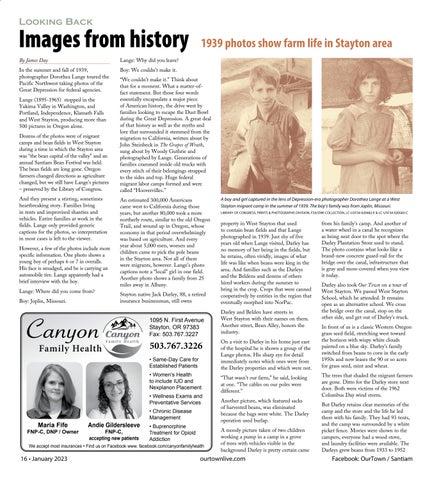
Lange (1895-1965) stopped in the Yakima Valley in Washington, and Portland, Independence, Klamath Falls and West Stayton, producing more than 500 pictures in Oregon alone. Dozens of the photos were of migrant camps and bean fields in West Stayton during a time in which the Stayton area was “the bean capital of the valley” and an annual Santiam Bean Festival was held. The bean fields are long gone. Oregon farmers changed directions as agriculture changed, but we still have Lange’s pictures – preserved by the Library of Congress. And they present a stirring, sometimes heartbreaking story. Families living in tents and improvised shanties and vehicles. Entire families at work in the fields. Lange only provided generic captions for the photos, so interpretation in most cases is left to the viewer. However, a few of the photos include more specific information. One photo shows a young boy of perhaps 6 or 7 in overalls. His face is smudged, and he is carrying an automobile tire. Lange apparently had a brief interview with the boy. Lange: Where did you come from? Boy: Joplin, Missouri.
1939 photos show farm life in Stayton area
“We couldn’t make it.” Think about that for a moment. What a matter-offact statement. But those four words essentially encapsulate a major piece of American history, the drive west by families looking to escape the Dust Bowl during the Great Depression. A great deal of that history as well as the myths and lore that surrounded it stemmed from the migration to California, written about by John Steinbeck in The Grapes of Wrath, sung about by Woody Guthrie and photographed by Lange. Generations of families crammed inside old trucks with every stitch of their belongings strapped to the sides and top. Huge federal migrant labor camps formed and were called “Hoovervilles.” An estimated 300,000 Americans came west to California during those years, but another 80,000 took a more northerly route, similar to the old Oregon Trail, and wound up in Oregon, whose economy in that period overwhelmingly was based on agriculture. And every year about 5,000 men, women and children came to pick the pole beans in the Stayton area. Not all of them were migrants, however. Lange’s photo captions note a “local” girl in one field. Another photo shows a family from 25 miles away in Albany. Stayton native Jack Darley, 88, a retired insurance businessman, still owns
Canyon
Family Health
1095 N. First Avenue Stayton, OR 97383 Fax: 503.767.3227
503.767.3226 • Same-Day Care for Established Patients • Women's Health to include IUD and Nexplanon Placement • Wellness Exams and Preventative Services
Maria Fife
FNP-C, DNP / Owner
Andie Gildersleeve FNP-C, accepting new patients
• Chronic Disease Management • Buprenorphine Treatment for Opioid Addiction
We accept most insurances • Find us on Facebook www. facebook.com/canyonfamilyhealth
16 • January 2023
A boy and girl captured in the lens of Depression-era photographer Dorothea Lange at a West Stayton migrant camp in the summer of 1939. The boy’s family was from Joplin, Missouri. LIBRARY OF CONGRESS, PRINTS & PHOTOGRAPHS DIVISION, FSA/OWI COLLECTION, LC-USF34-020482-E & LC-USF34-020583-C
property in West Stayton that used to contain bean fields and that Lange photographed in 1939. Just shy of five years old when Lange visited, Darley has no memory of her being in the fields, but he retains, often vividly, images of what life was like when beans were king in the area. And families such as the Darleys and the Beldens and dozens of others hired workers during the summer to bring in the crop. Crops that were canned cooperatively by entities in the region that eventually morphed into NorPac. Darley and Belden have streets in West Stayton with their names on them. Another street, Bean Alley, honors the industry. On a visit to Darley in his home just east of the hospital he is shown a group of the Lange photos. His sharp eye for detail immediately notes which ones were from the Darley properties and which were not. “That wasn’t our farm,” he said, looking at one. “The cables on our poles were different.” Another picture, which featured sacks of harvested beans, was eliminated because the bags were white. The Darley operation used burlap. A moody picture taken of two children working a pump in a camp in a grove of trees with vehicles visible in the background Darley is pretty certain came
ourtownlive.com
from his family’s camp. And another of a water wheel in a canal he recognizes as being next door to the spot where the Darley Plantation Store used to stand. The photo contains what looks like a brand-new concrete guard-rail for the bridge over the canal, infrastructure that is gray and moss-covered when you view it today. Darley also took Our Town on a tour of West Stayton. We passed West Stayton School, which he attended. It remains open as an alternative school. We cross the bridge over the canal, stop on the other side, and get out of Darley’s truck. In front of us is a classic Western Oregon grass seed field, stretching west toward the horizon with wispy white clouds painted on a blue sky. Darley’s family switched from beans to corn in the early 1950s and now leases the 90 or so acres for grass seed, mint and wheat. The trees that shaded the migrant farmers are gone. Ditto for the Darley store next door. Both were victims of the 1962 Columbus Day wind storm. But Darley retains clear memories of the camp and the store and the life he led there with his family. They had 93 tents, and the camp was surrounded by a white picket fence. Movies were shown to the campers, everyone had a wood stove, and laundry facilities were available. The Darleys grew beans from 1933 to 1952
Facebook: OurTown / Santiam