
Tusa Fels
M OSQ UE S CO CHIN MOSQUES COCHINof



Tusa Fels
Centre for Heritage, Environment and Development
Mapin Publishing
First published in India in 2011 by Mapin Publishing Pvt. Ltd in association with
1949–2007
Centre for Heritage, Environment and Development
(Corporation of Cochin)
C-HED Building, Kacherippady Cochin, Kerala 682 018
T: 91 484 2391766 • E: c.hed@vsnl.net
Simultaneously published in the United States of America in 2011 by Grantha Corporation
77 Daniele Drive, Hidden Meadows, Ocean Township, NJ 07712
E: mapin@mapinpub.com
Distributors
North America
Antique Collectors’ Club, USA
T: 1 800 252 5231 • F: 1 413 529 0862 • E: info@antiquecc.com www.antiquecollectorsclub.com
Australia & New Zealand
Peribo Pty Ltd., Australia
T: 61 2 9457 0011 • F: 61 2 9457 00228 • E: michael.co ey@peribo.com.au
Southeast Asia
Paragon Asia Co. Ltd, ailand
T: 66 2877 7755 • F: 66 2468 9636 • E: info@paragonasia.com
Rest of the world
Mapin Publishing Pvt. Ltd
502 Paritosh, Near Darpana Academy Usmanpura Riverside, Ahmedabad 380 013 INDIA
T: 91 79 40 228 228 • F: 91 79 40 228 201 E: mapin@mapinpub.com • www.mapinpub.com
Text © Patricia Tusa Fels
Photographs © as listed below: Feroze Babu: Front Cover, 5, 6-7, 12, 18, 20, 21R, 22R, 24, 27, 29, 33, 34, 40, 41, 42, 44, 46Top, 47, 51, 53, 57, 58, 60, 61, 62, 70, 74, 80
Donald Fels: 1, 2-3, 10, 11, 15, 17, 21L, 22L, 25, 32, 35, 38, 43, 45, 46Bot, 54, 55, 64L, 69, 73, Back Cover
Krishnan Nair Studio: 9, 65
Patricia Tusa Fels: 31, 49, 64R
Maps by Shweta Bhatia Gupta
All rights reserved under international copyright conventions. No part of this book may be reproduced or transmi ed in any form or by any means, electronic or mechanical, including photocopy, recording or any other information storage and retrieval system, without prior permission in writing from the publisher.
ISBN: 978-81-89995-24-9 (Mapin)
ISBN: 978-1-890206-01-7 (Grantha)
LCCN: 2008937549
Designed by Revanta Sarabhai / Mapin Design Studio
Edited by Vinutha Mallya / Mapin Editorial
Printed and processed at omson Press, India
Editor’s Note: ‘Cochin’ is the colonial spelling of Kochi, a former princely state, which is now located in Ernakulam district of Kerala state. e author has preferred to retain the old spelling due to the historical context of the subject.
Front: Carved beams and woodwork at Chembi a Palli
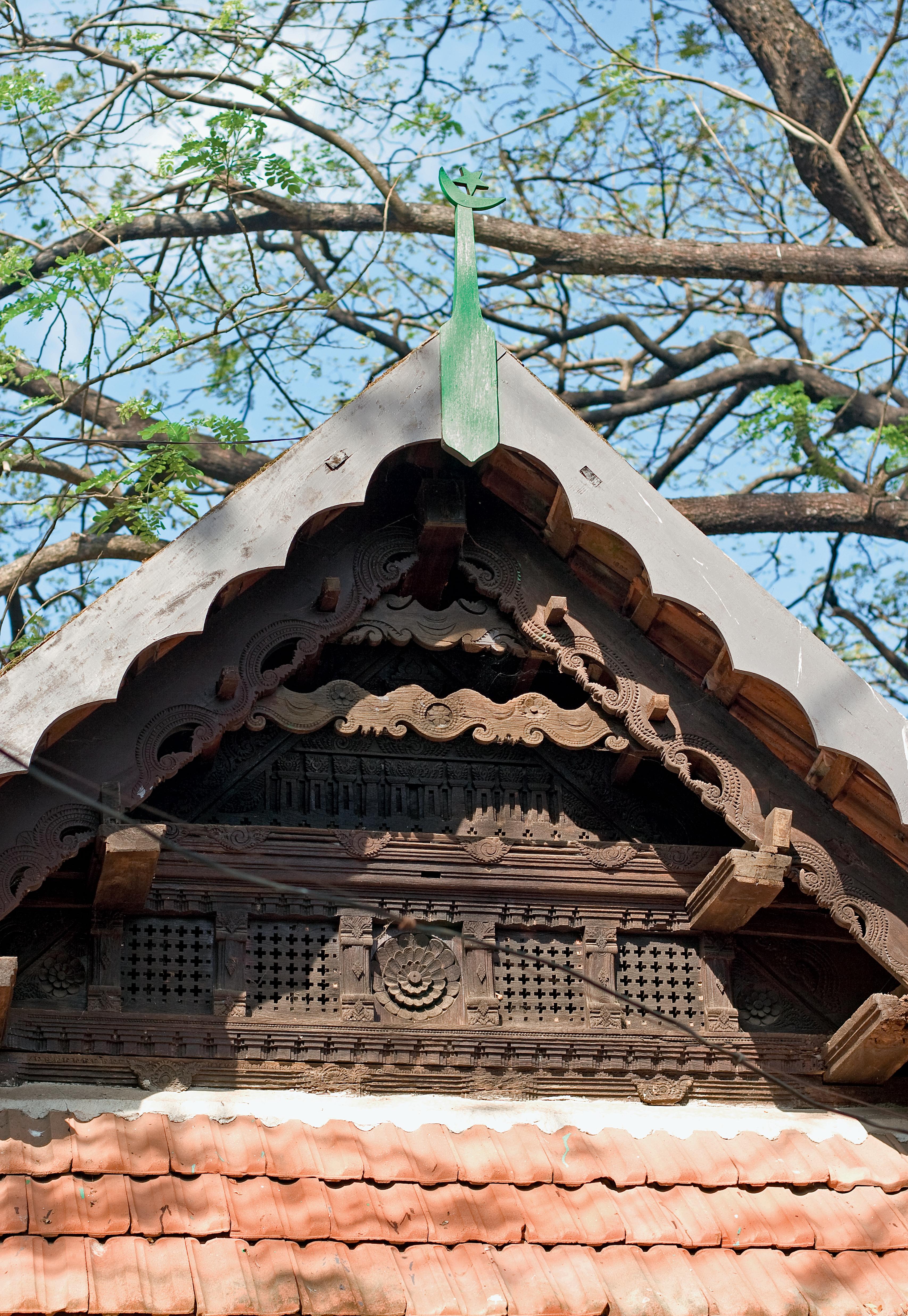
Back: Carved gable of a building
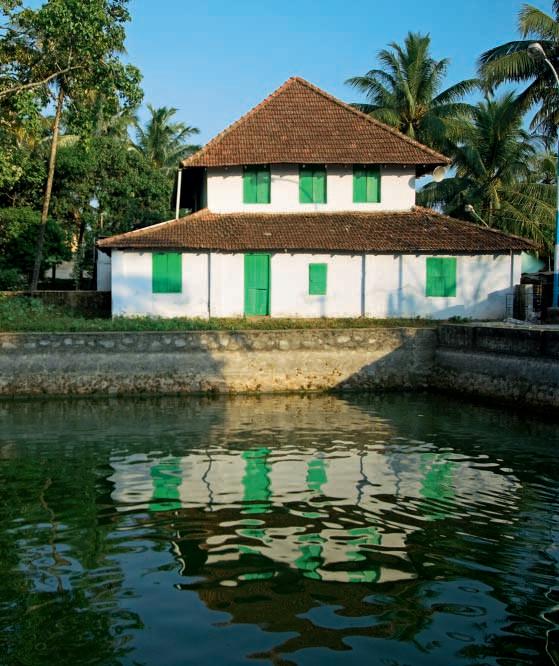
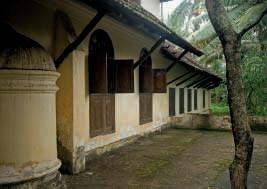
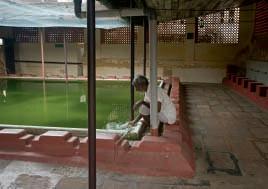
Page 1: Mammu Surka and the adjacent pool
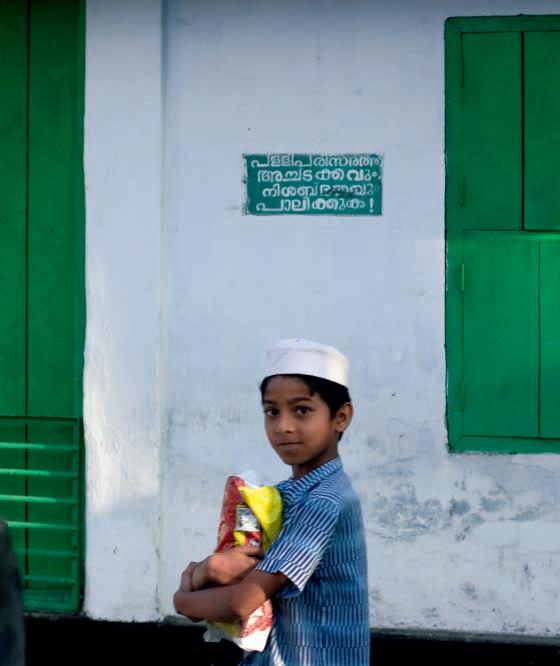
Pages 2–3: Life in Kochangadi, a school boy in front of Mammu Surka
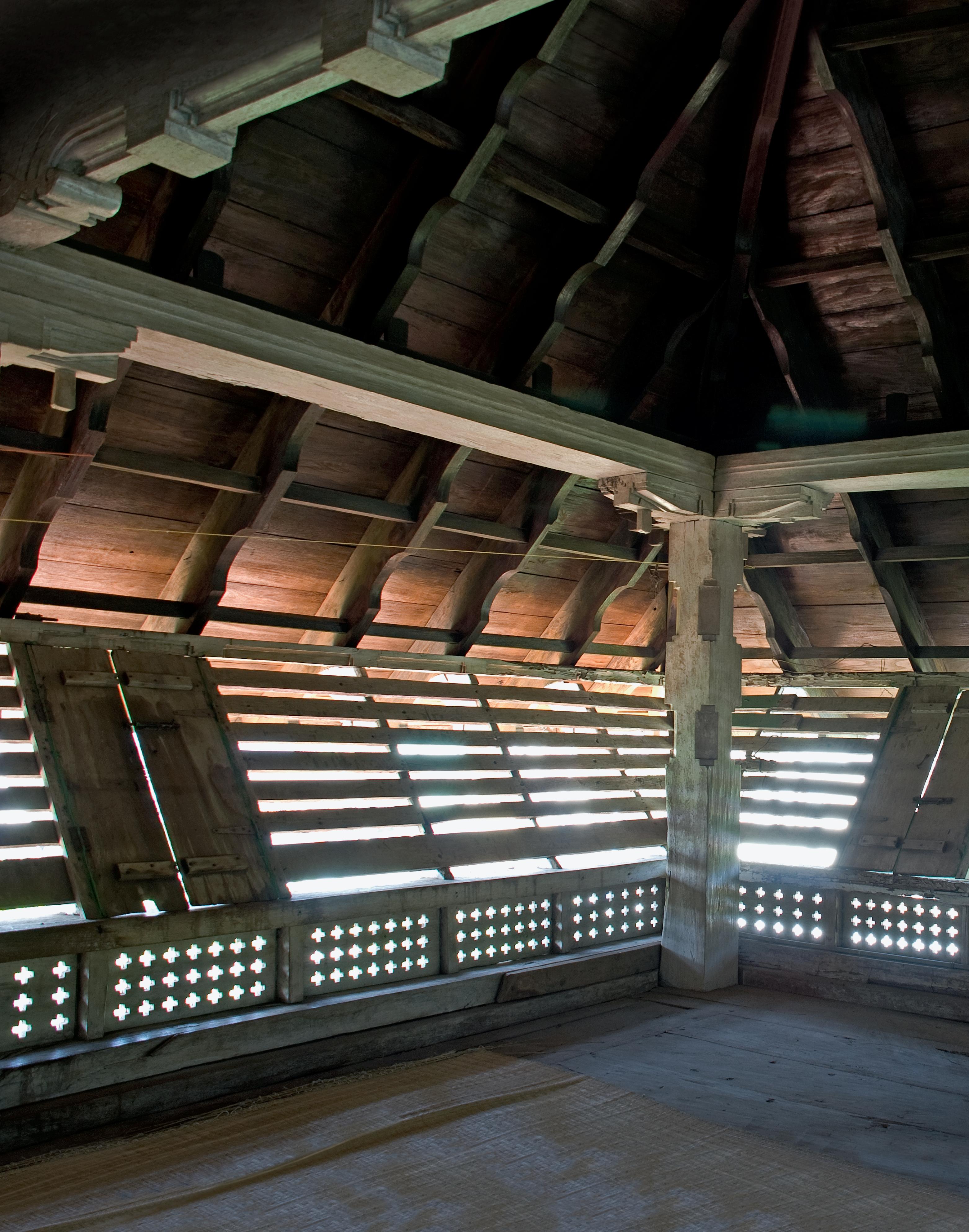
Page 5: Interior of Chembi a Palli
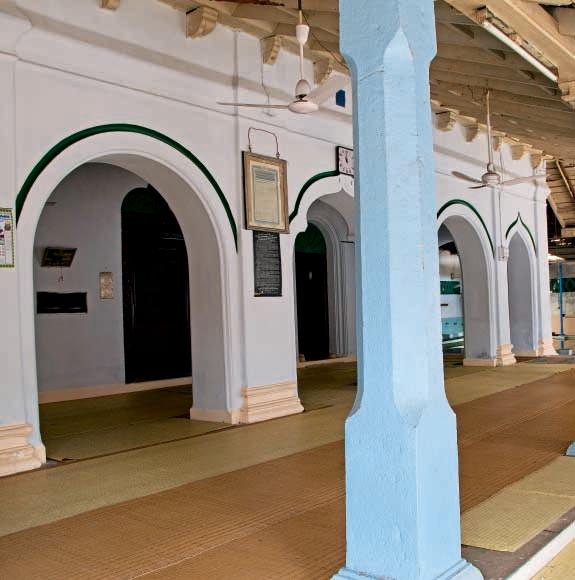
Pages 6–7: Outer veranda at Chakarayidukku
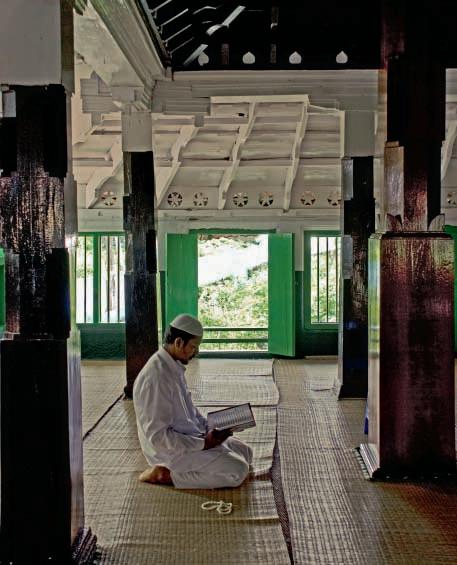
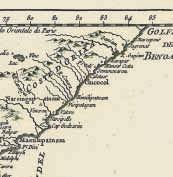
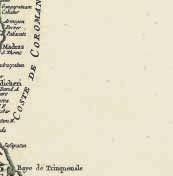
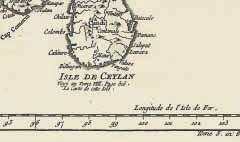

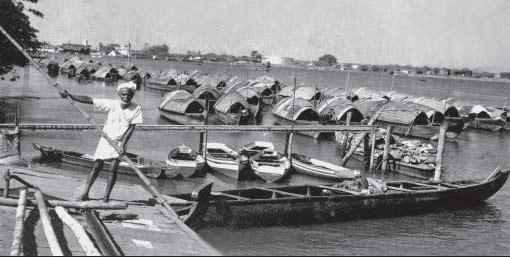
Facing page: Cochin waterway with a fleet of thoni delivering goods, 1950.
“Of all the world, best is our India: We are her nightingales and she our Garden.”
Muhammad Iqbal
“Who so buildeth for God a place of worship, even if it be as small as the nest of a qata bird, God buildeth for him a house in paradise.”1
e rst contacts between the new religion of Islam and the people of India occurred peacefully, very early in the history of the faith. By the seventh century, Arab merchants had already been trading with the people of southwestern India for centuries. e exotic spices that grow along the Malabar Coast had long been objects of desire around the globe, especially pepper, the famous ‘black gold’. ese spices were freely traded with Middle Easterners who then carried them to Europe. Until Vasco da Gama found a sea route from the Mediterranean to India in 1498, the spice trade was dominated by Arabs who shipped spices across the sea to the Arabian peninsula. Cardamom, turmeric, ginger, cinnamon and the precious peppercorns were unloaded from ships, transported by camel overland, then sailed across the Mediterranean to
1 Inscription commonly seen at Indian mosques (found in the Hadith, a document containing stories of or about the Prophet). Another version states: “Whosoever builds a mosque for God, God will build for him a house like it in Paradise.” Horovitz, J.
Italy, and from there to all of Europe. When Arabian merchants converted to Islam, they began spreading their new faith to Malabar. Learned men arrived in India to establish the faith.
With the spread of Islam came the need for houses of prayer. e mosques of Malabar are a direct re ection of the place ( at wetlands along a tropical coast with two annual monsoons), the materials (abundant wood and local stone), and the religious custom (need for a large hall for prayer). ey stand as powerful and visible expressions of the integration of Islam into the culture of Malabar.
Unlike the Islamic conquerors of north India, the early Muslim traders made peace with the local leaders. e region escaped most of the invasions that swept through north India. Generations of Middle Eastern traders (Jews, Muslims and Syrian Christians2) arrived in Malabar with the wish to maintain the extensive, and longstanding, trading networks. ere was no need for conquering warriors. For centuries, the Arabs enjoyed a golden age of Middle Eastern preeminence in trade. e native Hindu rulers welcomed all as long as they shared a common interest in cooperation.3 is enlightened thinking brought prosperity to all.
It was only with the arrival of Vasco da Gama and the Portuguese a empt to control all overseas commerce that violence entered the trading world of Malabar.4 From the sixteenth
2 Additional traders included north Indians, Tamils, Chinese (who abandoned their networks on the western Indian Ocean around 1430), and Southeast Asians.
3 “ e Hindu rajas of the coastal states le their Muslim subjects to worship as they wished…since the rulers’ power and wealth depended almost entirely on customs revenues and the pro ts of their personal transactions in the maritime trade. We may suppose that the government of these cities was nothing less than a working partnership between the rajas and the leading Muslim merchants.” pp. 220-21 e Adventures of Ibn Ba uta, Ross E. Dunn.
4 “…before the arrival of the Portuguese in the Indian Ocean in 1498 there had been no organised a empt by any political power to control the sea-lanes and the long-distance trade of Asia.” p. 14 Trade and Civilization in the Indian Ocean, K.N. Chaudhuri, Cambridge University Press, 1985.
to the nineteenth century, change swirled around the people of the coast. e Portuguese were replaced by the Dutch and then the English. e Hindu kings were partially successful in protecting the trade rights of their populace (of many di erent faiths) during Dutch and Portuguese reigns, but the British East India Company overpowered the longstanding, although now weakened, tradition of collaboration. During British rule, the power of the native merchants declined as the East India Company created their own exclusive trade monopolies.
British ‘divide and conquer’ practices ultimately drove a wedge between the Hindu and Muslim peoples. ese tactics were developed for the colonialists’ bene t—li le thought was given to the repercussions which even today haunt South Asia.
e rajas of Malabar’s princely states made both peace and war with the Europeans; they also fought amongst themselves and against the invasions of inland rulers. With the loss of native people’s trade income, a slow eroding of the traditions brought about by centuries of respect and peaceful co-existence began. Eventually Malabar, a series of princely states, was assimilated into the British Empire. As an old Malay proverb warned about the British arrival on Malaysia’s shores: “Once the needle is in, the thread is sure to follow.”
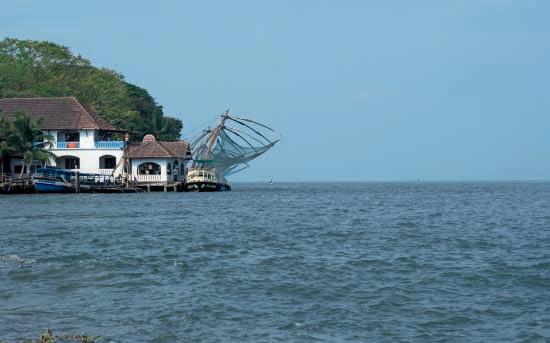
A er the formation of an independent India, the new state of Kerala was created in 1956. Kerala, the land of lush vegetation, extensive backwaters, ubiquitous coconut trees and universal literacy, stretches along the Malabar Coast. Isolated from the rest of India for millennia by the dense forests and mountains of the Western Ghats, the people along the coastline, a thin sliver of land between mountains and sea, interacted easily with traders from all around the Indian Ocean. e sea at Kerala’s doorstep brought wealth, new religions, new ideas, traders and se lers. Midway up the coast, Cochin [now Kochi] is a jewel of the trading culture. Cochin gained ascendancy a er the great ood of 1341 silted up the historic port of nearby Cranganore [now Kodungalloor]. Cochin is sited on a peninsula, with the Arabian Sea to the west, a sheltered waterway and port to the east, and the river channel’s opening to the sea at the north. e natural harbour connected inland backwaters and global sea-lanes, o ering a protected landing for generations of overseas traders and local merchants. A er Vasco da Gama was thrown out of the northern Kerala port of Calicut [now Kozhikode] by the powerful raja, or Zamorin, the Portuguese looked to Cochin. us began four hundred and y years of European interference and eventual domination. Fort Cochin, at the northern tip of the peninsula, became the rst European se lement in India, and one of the few with a history of Portuguese, Dutch and English presence. e adjacent, older se lement of Cochin (also called Ma ancherry) remained the home of the
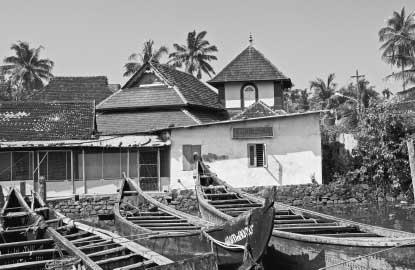
ruling maharaja and site of the port. Here the storage, shipping, and trading of goods took place. As in other colonial port gateways, a multi-ethnic population learned to live and work together. In the watery paradise of Kerala, a vast network of lakes, rivers and canals function as navigable waterways that connect the countryside to the city. Until recently, all the products of the region—spices, wood produce, rice, bamboo—arrived by thoni (country boats) at the portside ‘godowns’, or warehouses. Foreign goods arrived from China, Southeast Asia and Arabia. e Malabar coast served as an entrepôt for the Middle East and Southeast Asia, a hinge between the western and eastern ends of the Indian Ocean.
e activities of the city’s older trading days have continued into the present, but in changed locales and with di erent rhythms. As peninsular Cochin slipped into a daydream, the mainland area of Ernakulam and the new port of Willingdon Island5 became the centres of modern industry. Shipping containers are outlined against the huge cranes of Willingdon Island and hi-tech jobs entice the young to Ernakulam. In Cochin, the ancient commodities of rices and spices move to a di erent pace, at reduced volume, in and out of decaying godowns on the heads of porters. e newest ‘goods’ are tourists, arriving by cruise ship, airplane, train and backwater boat. It is to Ma ancherry, home to the local people, that we now turn. Here, amongst the godowns and shophouses, the Muslim community built mosques, schools, and homes. e two neighbourhoods of Ma ancherry to be examined in this book, Bazar Road and Kochangadi, grew in response to the port and its commerce. ese districts comprise some of the highest population densities in the present city of Kochi, and also the largest concentration of mosques. Both were trade dependent se lements, one predominantly Muslim, one a mix of many ethnic and religious groups. In both communities the pa erns of town
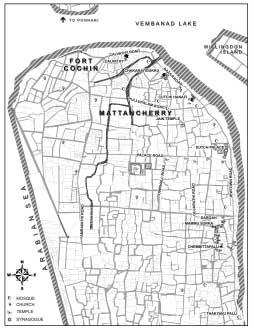
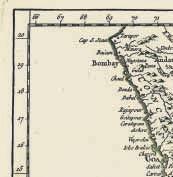
5 All three areas make up the modern city of Kochi. Map of the Cochin peninsula.
life remain intact. With the rapid changes urban India is undergoing, these neighbourhoods are among the few that maintain physical evidence of the historic townscape. is book documents not only the mosques, but also the vibrant communities that support them.
Sited in compounds replete with coconut palms, the mosques o er an oasis of tranquility in the densely populated neighbourhoods. Large wood-framed pyramidal roofs, deep overhangs, and ne wooden cra smanship distinguish a Kerala vernacular that re ects the climate, the culture and the materials of the place. e adoption and adaptation of the local vernacular by the Muslim congregations for their mosques is an undocumented and unappreciated phenomenon. Rarely mentioned in architectural histories or heritage surveys, the mosques’ lack of recognition exposes a persistent prejudice against the humble vernacular. Recently, many of these ne old buildings have been demolished or remodelled; replaced by generic concrete structures that mirror nothing of the local history. Each of the mosque communities stewards a beloved house of worship with countless years of useful service ahead. Leaders should be encouraged in their role as custodians of an irreplaceable architectural heritage, proof of centuries of peaceful existence.
“ e past… is evidence that a society has existed. Wipe it away and a culture begins to feel, like a man without a memory, shallow and super cial.”
Donald Appleyard
“ ey came to Malabar for ginger, cinnamon, arecanut, coconut, sandalwood, teak, incense, silk, co on, ivory, jewels, and particularly black pepper…”
“What shall I say? e greatness of India is beyond description.”
Bindu Malieckal
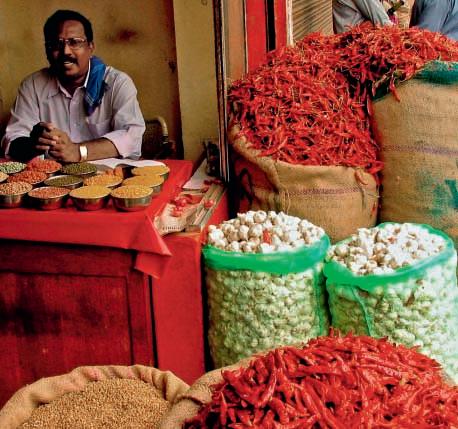
India has the third largest Muslim population in the world, a er Indonesia and Pakistan. Although Gandhi stressed that India should be a secular country, religion remains a powerful force in India. For the masses of poor people religion is their guide, their community, their social life, their past, present and future. One is always aware of religion: shop owners display pictures of their god(s) or photos of Mecca. ere are no secrets in the manner of faith. If someone isn’t sure, they will ask. Yet, although the house of worship is a focus of people’s lives, few people of Kerala would de ne themselves purely through religion. Faith plays a major role in their identity but is integrated into other aspects of life. It is to this balanced view that a new generation of Indian scholars is turning, noting the positive interplay between the di erent peoples of India that occurred in pre-colonial times. Instead of repeating the old tales of separation, they are looking to identities forged within the Indian culture, expanded and not bounded by the forces of religion.
In the times before the Portuguese arrival, the Malabar maharajas encouraged trader se lers. e Cochin raja was a patron to traders, welcoming Jews, Christians, and Muslims, Gujaratis, Tamils and Chinese. Diversity, he knew, was good for trade and trade networks. Since, traditionally, upper caste Hindus in Malabar were sanctioned against venturing out to sea, peoples of diverse faiths and faraway lands were invited into the sea-going life of Cochin. Historians have much recounted the era of peace and the pluralistic society that thrived. Prosperity in international commerce was to the advantage of everyone’s pocketbook; times of economic well-being placed less stress on the social fabric. is period of tranquillity may be sometimes romanticised by local people, the rough edges removed. What is indubitable is that many take great comfort in believing that strong historical precedents exist for peoples of many faiths to live together.
At present the Greater Kochi Region (including old Cochin and modern Ernakulam) has a population of over one million with nearly 25% of that population being Muslims. Together with Kochi’s concentration of Christians and Jains, the three groups come close to equaling the number of Hindus, an uncommon statistic in predominantly Hindu (80%) India. In this urban potpourri, people became more open to a multi-cultural view of themselves, identifying with their community and not exclusively with religion. Social reforms instigated a er Independence by a radicalised Kerala state government, including land ownership restructuring, health care, and schooling for all, helped to create an educated, healthy citizenry.
Many of the original Muslims of Kerala came from Gujarat, Yemen and Baghdad. In seventh century Cranganore—known as Muziris in Roman times—the reigning ruler greeted Malik Ibn Dinar1, the rst Islamic leader to reach his shores, with great respect. Tradition has it
1 is date is much debated. Shaikh Ahmad Zainuddin, the 16th century author of the well known Tuhfat al-Mujahidin, claims that Malik Ibn Dinar came to Kerala 200 years a er the Prophet’s time, which would place his arrival in the early-ninth century.
that Malik Ibn Dinar so impressed all with his wisdom and piety that he was allo ed land for a se lement. He and his followers then built what may have been the rst mosques in India.
e American historian Richard White wrote about the “search for accommodation and common meaning…” People “met and regarded each other as alien, as other… over the next two centuries, they constructed a common, mutually comprehensible world.” e relationship between Hindu and Muslim in Malabar was eased by the longstanding presence of Arab traders along the Malabar coast. is predisposed the local people to an acceptance of the ‘other’, the alien foreigner.
e spice trade, assisted by the trade winds, carried Islam to south India and southeast Asia. e Muslims of these trading ports share a distinctive faith. Traders survive and ourish because of their ability to adapt, o en accommodating their religious practices to local traditions. A culture of compromise thrived, a more dynamic and exible faith was fostered as local people voluntarily converted to the new faith while holding on to indigenous pa erns. is can be clearly seen in the mosque architecture. e unique architecture of the Indian Ocean trade se lements, re ecting common climate and building materials, forms its own subset of Islamic architecture. e mosques of Kerala are some of the few remaining examples of a typology that once appeared throughout the tropical Muslim world of South and Southeast Asia. e remaining concentrations of the unique Malabar mosques can be found in the coastal cities of Cochin, Calicut and Ponnani.
Communal worship is the raison d’etre of any mosque. e Kerala mosque is truly a Kerala ‘house’ of prayer. Quite di erent from the mosques of the rest of India, the Malabar
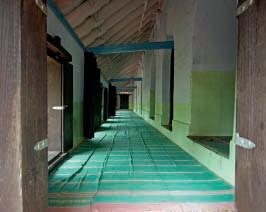
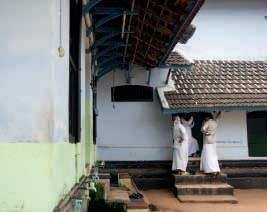
mosque has been critically overlooked because of an outward simplicity. e much more elaborate stone edi ces of the north have always dominated discussions of Indian architecture. Yet there is a similarity. e well known Mughal masterpieces were a result of the northern invaders slowly assimilating the in uences of Indian culture; the Kerala mosques, without the invasion, likewise re ected the adaptation of local traditions.
e original mosque was Prophet Muhammad’s home in Medina, a house with a large courtyard and an open portico. In Kerala, because of the monsoon rains, it was necessary to elevate the oor and provide a roof. e Prophet’s open courtyard became a raised unadorned interior room. e essence of a mosque remains a positive emptiness, a space that lls and un lls, a place that marks time with the ve daily calls to prayers. e composition of the Kerala mosque provided a cool, peaceful, digni ed, dry, and functional place of worship.
e Arabic tradition of structural simplicity was not translated to the highly ornamental Indo-Islamic style of northern India. But the ideal of unpretentiousness married perfectly with Keralite indigenous architecture. e Malayalees2, like all Indians, love a profusion of textures and senses, but they tended to avoid extreme displays of exuberance in their worship, food, music and buildings. is can still be tasted in Kerala food, heard in the music and seen in the older buildings by the discerning observer. Just as there is an abundance of spices available for cooking, so there was a splendid natural surrounding for buildings. Like the food, the traditional architecture integrated many elements into an eversurprising creation. e di erent dishes of a meal do not overwhelm the palate but join together to produce a masterpiece; the buildings were not monumental but complemented
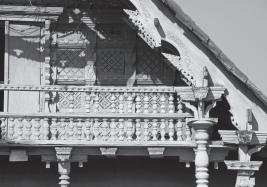
the lush surroundings. An outwardly straightforward geometry was based on layers of complexity; structural elements were manipulated to create harmony through balance. Except for the handsome wood carvings, the old mosques of the Malabar coast are quite austere. Local artisans adapted to Islamic injunctions against images by carving geometrical shapes, abstractions of ora, and religious inscriptions to adorn ceilings, beams, columns, doors, gable ends and eaves.
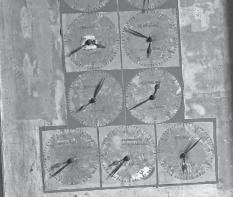
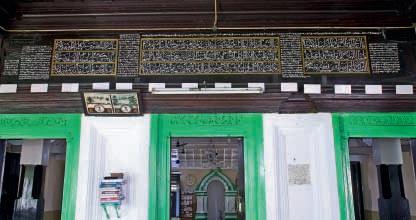
e simplicity of the mosques did not exclude timepieces and lamps, some of the few ‘furnishings’ of the mosques. All of the Cochin mosques display an abundance of clocks and hanging light xtures, from hand-adjusted se ings of prayer time to the latest digital product, from glass candle holders to candelabra. O en, the wall facing Mecca will have at least two clocks. All of the halls have numerous listings of the ve daily prayer times. e importance of correct prayer times is re ected by the quantity of timing devices. e need for spiritual illumination is metaphorically symbolised by the array of lights.
e vernacular mosques of Ma ancherry that we see today were built (and rebuilt) between the fourteenth and early-twentieth centuries. ey were constructed by resident masons and carpenters, men well versed in local design idioms and methods. e mosque builders, familiar with the structure of the traditional houses and temples of Kerala, adapted these styles to create a comfortable house for prayer made of native materials. It seemed perfectly ing that the house of prayer would respond to local customs and replicate indigenous building practices. In uences from afar are seen mainly in the details— ooring stone imported from the home country or interior particulars such as a window or door shape. As transformations in building technology occurred, some new materials or methods were incorporated into traditional techniques. Circulation of men, goods and ideas has never ceased in a port city like Cochin, even though climatic needs remained constant and cultural constraints changed very slowly.
e Kerala vernacular developed within a Hindu population and is based on spiritual tenets. But these codes of belief could be adapted in the design of a mosque. While a Hindu house should be oriented to a certain direction for the house god, the mosque mihrab3 must face Mecca. All mosques are free-standing structures, oriented towards Mecca, 20 to 23 degrees north of west for Kerala. O en this causes a jog on street fronts with the rectangular form of the mosque angled to face Mecca, a clear sign to the public of the religious meaning of the building. Inside, larger mosques have a pulpit (the mimbar) to the right of the mihrab. ese two elements, the focus of the praying community, are o en heavily decorated and brightly painted.
3 An arched niche, the mihrab, marks the wall facing Mecca (the qibla wall). e Koran says: “We have seen the turning of your face to heaven. We shall therefore make you turn toward a qibla that pleases you. So turn your face toward the Holy Mosque…”
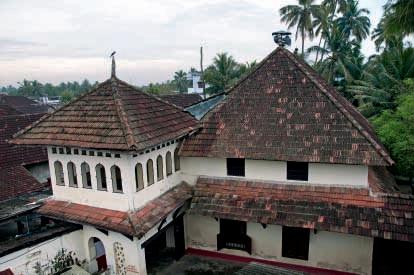
At the time of the Europeans arrival on the Indian peninsula there were three types of structures visible in Kerala: the common mud and thatch hut, more substantial houses, and religious buildings. In sixteenth century Cochin only the houses of nobles and the temples had stone walls and clay tile roofs. An exception was made for Muslim merchants who were allowed to build walls of stone. Over the centuries everyone began to build their houses with stone walls. Following a detailed science of proportion and principles of construction, the houses adhered to a hierarchy of plans: a rectangle forms the basic plan, then advances to an L or C plan, and then to the completely surrounded courtyard. e more courtyards a home had, the wealthier the owner. It was said that if a home had more than one courtyard it was the home of a nobleman. A palace was a house of many courtyards. Whereas most homes were one-storey, a two-storey home was another indicator of wealth. Two-storey homes o en had a one-storey veranda that wrapped two or more sides. Religious buildings used the same structural system as the courtyard homes, albeit highly decorated. Jewish and Islamic traders based their synagogues and mosques on adaptations of vernacular plans. Interestingly the surviving Christian churches tend to show much less adherence to the local vernacular.
e house form was opened up to create a large interior hall for worship where the faithful could gather to pray. To show the importance of the building, oor heights were raised.
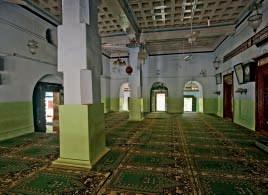
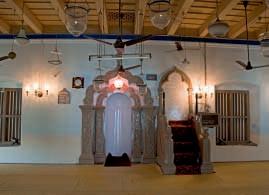
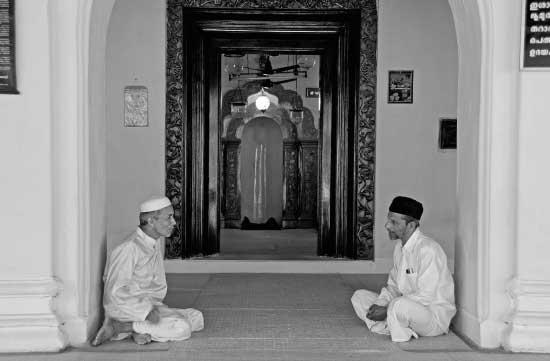
e old mosques were typically two-storied, although many started their lives as one-storey structures which were expanded in later centuries. Usually, one-storey verandas (or colonnades) enveloped the building to provide shaded space for discussion and/or prayer. ese verandas became an important part of the composition and, as more space was needed, were o en enclosed. A large front porch formed the entrance to the prayer hall, although this space was also used for prayer. e wall between the entrance and the prayer hall served as a bearing wall for second oor beams as columns disappeared from the interior. e upper oor was used for study, for visiting scholars, and for over ow crowds at Friday prayer. Many of the mosques repeated a smaller version of the mihrab upstairs. Balustered openings in the oor allowed the voice of the imam preaching below to reach the worshipers above.
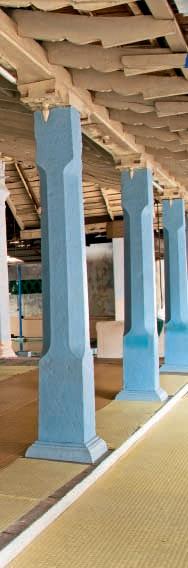
Houses were built on a granite base, with laterite block walls, and a timber pitched roof. e walls of the mosque were also built of laterite, the porous, easily worked and abundant Kerala stone, and plastered in mud and lime plaster. A granite plinth raised the structure above the ground for protection from dampness, monsoon oods and insects. House columns were wood with a stone plinth. Mosques used wood columns and also granite, a popular variant for temples. Wooden brackets cap the columns, the more elaborate the carvings the more prestigious the building. As availability of timber changed, the shape of the mosque columns was transformed from large sculpted timbers to a simpler slimmer form. Interior posts disappeared in later mosques, with oor loads handled by beams spanning from wall to wall. e upper oors of the mosque were framed with large, exposed, squared o timbers. Joists running
perpendicular to the beams combined with oor boards to create a pa erned rst oor ceiling. Some ceilings have a carved overlay in the form of a co ered ceiling.
At the time of the construction of these mosques, dense, insect resistant wood was abundant in the lush and luxuriant forests of Kerala. High quality timbers came out of the hills east of Cochin. Teak and beautiful jungle woods such as rosewood were transformed into eaves, air vents, columns, ra ers, beams and ceilings. A long tradition of wood-working cra smanship had developed to serve the local industries of boat and building construction. Several mosques contain inscriptions crediting a shipmaster’s work. Artisan wood carvers performed their magic, replicating pa erns and standards of indentation and proportion while removing any reference to temple gods.
In local vernacular buildings, wood beams and ra ers displayed exact joinery. e roof developed from a simple double pitch to the gabled hip roof. Scholars are always conjecturing on what in uenced a particular architectural style. Sources for the large, pitched Kerala roof are much debated: some suggest southern China, others the wood structures of Nepal, but the probable truth is that the roof form developed independently as a solution to regional conditions. e entire ensemble acted like a huge lung, allowing air in and out of the building while keeping water out. V.S. Naipaul wrote about a tropical mosque: “Much of the architectural energy of the building had gone into this roof.” Construction of the signature timber roof was typical of mosques throughout the tropical areas of Asia. In the monsoon zone the motif of roof as umbrella is ubiquitous, in Kerala the umbrella has further associations with royalty and power. e grander the scale of the lo y, tiered ‘crown’ of the building, the more status was implied.
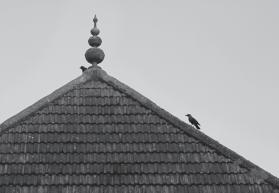
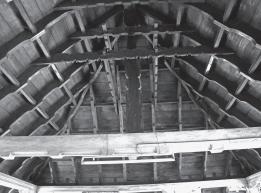
e wooden superstructure of the mosque has the most layers of complexity; beams, purlins and ra ers ascending to the peak. e long standing idioms of proportion (relation of width to depth to length) and framework were faithfully followed to insure structural stability.
e lack of any sag in the roofs even today speaks to the value of these parameters. Ra ers were extended for overhangs to shade the walls and protect them from the weather, especially the monsoon rains. Eave boards throughout Kerala repeated standard carved details. Hipped roofs o en had a gable set near the ridge; gable inserts displayed an array of oral and shaped carvings that also served as ventilation panels. Gable ends o en owered into balconies, similar to those seen in palaces, with ever- ner levels of cra smanship. e mosques may have an ensemble of roofs, but a uniform roof pitch created a sense of balance and proportion. Early mosques employed thatch for roo ng. For the well endowed mosque, copper shingles were applied over a wood base. By the sixteenth century, clay tiles had replaced the palm thatch.
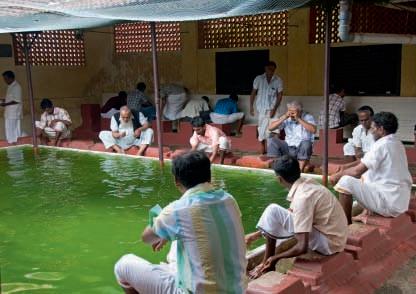
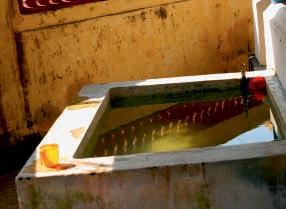
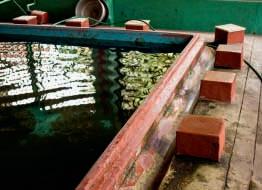
ere are always facilities for the ablutions obligatory before prayer. Even if one is not going to pray, the feet must be washed before entering the mosque. e washing area di ers in every culture, from the fountains of the Middle East to a simple rectangular bath. In steamy Kerala the fountain was transformed into a pool; water was plentiful and washing a pleasurable and favoured activity. Malayalees could easily connect the act of washing with prayer, as Hinduism has a tradition of ceremonial bathing. e ablution pool was placed in an open veranda or an a ached structure. Several mosques housed the pool in a two-storey tower adjacent to the main building. Some have adopted the courtyard tradition; the open air pool lls the courtyard space while a four-sided surround provides a roofed enclosure. Almost all of the mosques with a large pool have resident sh. Some pools are favoured by children because a caretaker will let a child catch a small sh to take home for a special occasion. Besides a source of pets, the sh also work in mosquito control, for Cochin has long been known for its abundance of mosquitoes. e pools are a reminder of another time and as mosques modernise, they are disappearing. e participants at Friday prayer no longer wish to bend down to wash and they do not want to use a common pool. Stand up fountains—similar to the one placed at Calvathy mosque during its renovation—and individual water taps are replacing the spacious, evocative pools. Popular imagery equates a mosque with domes and minarets. Neither dome nor minaret has a liturgical imperative and neither was present in Kerala architecture. e Malabar coast had no tradition of dome building. Roof construction was of wood, not stone. e minaret developed in the crowded city, but in the villages of Kerala the call to prayer could easily reach the people. e muezzin would climb up to the roof or the second oor; now of course there are loudspeakers perched on every mosque’s roof. Kerala was—and old Cochin remains—a place of one and two storied houses, villages with gardens. People believed that the height of temples should be kept below the tops of coconut palms.
Islam arrived from the Middle East, but Malayalee Muslims (children or grandchildren of converts) built their mosques using local designs and cra smen. Today, those mosques are being torn down to be replaced by awkward copies of modern Arabic mosques or throwbacks to Mughal designs. While the mosque building is not considered sacred, the human and spiritual energy that went into the construction cannot be disregarded. It is sadly ironic that a er one thousand years the local style is being discarded for an import. e lovingly cra ed and sculpted roof structures are being replaced with at rough concrete; openness to sea breezes swapped for sealed spaces. e ancient connection to the Arab world remains, for now Keralites travel to the Persian Gulf for work. Some of the returning wealth is shared with the mosques, but o en these riches are misdirected. Instead of maintaining an old mosque, a new one is built or a modern expansion wraps around the old structure, making it almost invisible. A er ve hundred years of mosque building, the Keralites are now turning their backs to their native place, designing mosques that embrace a foreign culture. e grandeur of the old mosques with their outstanding cra smanship and powerful spatial presence is missing in the new mosques which rely on size alone for impact.

Certainly, new mosques will be built as the population expands. ese mosques will not look like the old Kerala mosque because the timbers are no longer available, the cra smen are una ordable and the styles have changed. Once the old mosques are gone they can never be replaced. Didier Repellin, a French conservation expert and UNESCO advisor on conservation, reminds us: “We have to realise that behind every detail of your beautiful heritage, there was somebody who one day gave the best of his spirit, heart and love to his work. We want to give back dignity to the qualities of human work.”
e indigenous Kerala mosque architecture and the story of its growth from trade across the Arabian Sea provide a valuable historical example of cultural adaptation. Globally, there are few extant reminders of this decidedly non-violent process. e tropical mosques of the Indian Ocean are rapidly disappearing due to the forces of nature, economics and religious fundamentalism. e wooden structures of south India are some of the few survivors.
… “how can the separate identities of these cultures – the regionalism of Islam – survive in the face of modern views and methods that seek everywhere to standardize and unify? For the strength of Islam has always lain in unity through diversity – the unity of Islam itself through the diversity of its multifarious cultures.”
Architecture in Continuity, Building in the Islamic World Today. Sherban Cantacuzino, ed.
“In the end, stories are what’s le of us, we are no more than the few tales that persist.”
Salman
Rushdie
“ e good storyteller tells his story…One of these mornings, the old storyteller will not wake up. But someone of those who hears his stories will tell them to others. And later this someone will also die, and the stories will stay alive as long as there are big houses and people gathered around the re.”
Eduardo
Galeano
Before discussing the individual mosques, it is helpful to consider the role of stories and oral histories. All of the mosques in this book have long chronicles with uncertain and varied building dates. A sixteenth century date can be expanded back in time to the fourteenth century; one authority may claim an eighteenth century building while another puts the construction earlier. Dates in old documents refer to the Malayalam or Islamic calendar, rarely the Western calendar. For centuries there was no wri en history in Cochin. Even the carved inscriptions can be interpreted in various ways, some are judged illegible. e European colonialists who wrote about or documented the area barely mentioned Ma ancherry, the ‘native’ area south of the Fort Cochin se lement. e world of the native se lement was too complicated and too ‘foreign’ for the Europeans.
Today, one member of a mosque gives one version of history while another recounts an altered version. e mosque we see today may have been rebuilt several times. Pieces of its past not immediately visible linger in the handed down stories.
Even the history of Islam in Malabar is given varied interpretations. Because Islam so peacefully entered the life of the coast, its early arrival was discounted by major historians. Recently, more and more research points to the arrival of Islam on Malabar’s shores shortly a er the lifetime of the Prophet. Logically, mosques would have been constructed from an early date. A mosque we see today may have had many antecedents, pieces of which could be visible in walls and foundations. At other sites, the remnants of older mosques have completely vanished.
In India, the Western version of historic preservation is an alien concept. Instead, until contemporary times, there was a tradition of continuity in building practices, especially as they related to religious structures. A temple could be rebuilt to maintain the spirit of the original, using the same conventions of construction. Since the materials and methods remained similar,
the resulting building was part of an on-going chronicle. It is only recently that new materials and methods have completely changed this process, resulting in a loss of continuity from ancient building to contemporary structure. Until the twentieth century, mosques were built and rebuilt on the same foundation, maintaining an ongoing presence. A mosque’s past may be hidden under a series of additions or remain gloriously visible.
All that is known for certain is that the buildings hold many stories. e mosques bring physical evidence for the stories, serving as the material culture or the ‘stu ’ of the forbearers. ey are the solid evidence for the presence of the Muslim trading communities.
Many of the old Ma ancherry mosques possess an association with a Su scholar. e Su is an excellent paradigm for the architecture and the stories of these mosques. Su s oated above Sunni and Shia sects. ey enlightened with stories and embraced Hindu and Christian thought, weaving Islam into local traditions. Su s came to teach and to convert, preaching love and tolerance. Su s were neither Arab nor Indian or Persian, but scholars, founders and builders of community. According to an oral Su tradition, when a pair of
scissors was gi ed to Baba Farid1, he gave it back and said, “I am not the divider but the weaver, give me thread.”
On ursdays and Sundays, the women of Cochin visit the shrines of the holy men, some of which we will examine. ey come to whisper their stories, and to make requests. Since most south Indian mosques are closed to women, it is at the shrines that women can pray. e tenets of Islam make it clear that prayers should be directly to God; these women have found, in the tradition of the Su s, a way to participate in Islam.
Fictions are added to facts, an honoured scholar added to the list of founders. Djinns (ghosts) are rumoured to be in the a ic. e goal here is not to dispute stories, or to establish one shining truth. at certain stories have survived for centuries speaks to a probable basis in some facts. is is not a de nitive history and it is hoped that the telling of tales will continue. In a place where names and spellings are in constant ux, physical structures adjusted constantly, and streets renamed yearly, it would be counterproductive to try and create an irrefutable classic. e variety and richness of the recountings speak to the vitality of the communities and the mosques they support. e one unquestionable fact is that the Muslim population has played a signi cant role in Cochin’s history over many centuries.
“Places come to exist in our imaginations because of stories, and so do we. When we reach for a ‘sense of place,’ we posit an intimate relationship to a set of stories connected to a particular location…”
William Ki redge, e Nature of Generosity
“Collective memory… is a current of continuous thought still moving in the present, still part of a group’s active life, and these memories are multiple and dispersed, spectacular and ephemeral, not recollected and wri en down in one uni ed story. Instead, collective memories are supported by a group framed in space and time. ey are relative to that speci c community, not a universal history shared by many disparate groups.”
M Christine Boyer, e City of
Collective Memory
1 Baba Farid Ganj-i Shakar was a famous Indian born Su (1175-1265). His shrine is located in Pakpa an, Pakistan.
“…when any one of you enters the mosque, he should say, ‘O God open to me the doors of your blessing’, and when he leaves it should say, ‘O God open to me the doors of your wisdom’…”
Inscription at Chembi a Palli
South of the old Maharaja’s estate (now called the Dutch Palace) and Jewtown (once home to Jewish merchants) sits Kochangadi, the original Muslim quarter. Stretching along the backwaters to the east, far from the eyes of the European colonialists who rarely travelled to Ma ancherry, this area has been home to Muslims since the founding of Cochin. e se lers chose the unoccupied east side of the peninsula for its excellent harbour. Here they were protected from the rough open seas at the west. e life of the local Muslims, complete with schools, mosques, shops, storehouses, homes and shrines thrived. Today, the population remains and the ve daily calls to prayer continue to ll the air, distinct voices emanating from the many di erent mosques.
Successful merchants built ne homes in Kochangadi and contributed to the construction of its mosques. e neighbourhood has more than a dozen mosques, catering to a predominantly Sunni population, with a variety of sub-sects and ethnic backgrounds. Coconut
palms sway overhead, lush vegetation shades narrow roads, large water reservoirs bring to mind the classic Indian temple pool. Roads jog, narrow lanes branch o the main street, twisting and turning to reach groups of family homes. ere are few cars on these back lanes and a village atmosphere permeates the neighbourhood. Children are everywhere, women gather to cook, to wash clothes, to talk, and to watch their o spring.
e neighbourhood is do ed with shrines dedicated to the early scholars who brought Islam to Cochin. Many are secreted in medieval lanes. One node holds the grave of Ali Marankar, a personage who, neighbours confess, they know li le of except for the remembered name. An ancient banyan tree has embraced the tomb and the remnants of the shrine’s stone walls.
e mosques showcased in this chapter are early adaptations of the Kerala vernacular. ey are some of the oldest mosques still standing in Cochin. All sit on raised plinths of granite with plastered laterite walls. From a utilitarian foundation, the buildings rise up, each level bringing forth more nely wrought details. Door and window openings at the older mosques are rectangular; fenestration at the later structures re ects the assimilation of European in uence. During the eighteenth and nineteenth centuries structural framing was simpli ed. Roofs continued to dominate the ensembles.
At the end of the chapter, we take a look at several mosques in Ponnani, known as the ‘Mecca of Malabar’. One hundred and forty kilometres north of Cochin, the city of Ponnani is the centre of Islamic study for the state of Kerala. Here many old mosques still stand, although several have been engulfed by additions. Understanding of the vernacular mosques of Cochin can be expanded by looking at Ponnani, especially considering the strong ties that existed in the sixteenth century between the two cities. e Muslims of Cochin looked to the scholars of Ponnani for religious counsel. Both cities were active ports with large Muslim trading families, many of whom were united by marriage.
sN¼n« ]Ån
Chembi a Palli—Kochangadi Juma Masjid
Malayalam: Chembu (copper) Palli (church or mosque)
e heart of Kochangadi is Chembi a Palli, the oldest and nest mosque of the area. e grand two-storey mosque is centrally located on a large plot of land. Well-travelled paths pass through the low-walled compound, connecting roads to the east, west and south. Sharing the compound with the regal mosque building are two shrines and several outbuildings. Most of the property is open, punctuated by large trees. e heavily vegetated ground is predominantly used for burial. Graveyards to the north and south of the mosque have a sca ering of old granite and new marble stones. Most graves are merely body-length mounds which slowly se le back into the earth.
“A truly stunning achievement.”
Charles Correa “…well-produced volume… most timely”
Outlook Traveller
Mosques of Cochin
Patricia Tusa Fels
80 pages, 30 colour photographs
40 b&w photographs
7.5 x 9” (191 x 229 mm), Flexicover
ISBN: 978-81-89995-24-9 (Mapin)
ISBN: 978-1-890206-01-7 (Grantha)
₹595 | $20.00 | £12.95
2011 • World rights
Cochin—a historic port city on the Malabar Coast in Kerala—has for centuries remained a centre of maritime trade along the Indian Ocean. ese commercial contacts brought with them the earliest in uences of Christianity, Judaism and Islam to India, resulting in a cosmopolitan mosaic of people in the region. Against this backdrop, some of the very rst mosques were built in India, located in compounds replete with coconut palms. ese tropical mosques reveal a distinctive legacy in form, acknowledging and celebrating the place, history, and building techniques of the region.
Mosques of Cochin documents the surviving vernacular mosques, which stand as powerful and visible expressions of Islam’s integration into the culture of Malabar. Many of these ne old mosques have recently been demolished or remodeled, and replaced by uninspiring concrete structures. In highlighting the beauty and historical importance of the mosque architecture of Kerala, the book aims at bringing greater recognition to these remarkable structures.
“A truly stunning achievement. Beautifully photographed and elegantly designed, this book takes one into the traditional mosques of Cochin. And through images of surpassing beauty, it conveys the simple and primordial power of vernacular architecture… and the context in which it exists.”
—Charles Correa, Eminent Architect and Planner, Mumbai
“Mosques of Cochin is an invaluable contribution to understanding the cultural and social value of the traditional architecture of Kerala. e book documents a rapidly vanishing architecture while pointing the way to a twenty- rst century modern Indian city that taps into the uniquely rich local heritage in building, conservation, and urbanism, of which the mosques have been an integral part for many centuries now.”
—Khoo Salma Nasution, Founder of Lestari Heritage Network, Penang
Patricia Tusa Fels is an architect and historic preservationist. She has been involved in conservation projects in the United States, Europe and Asia for thirty years. In addition to a lengthy career in architecture, she has wri en articles for a wide range of journals and newspapers. Her research on the mosques of Cochin was sponsored by the Ford Foundation.
Centre for Heritage, Environment and Development (c-hed) is an autonomous institution functioning as a Research and Development wing of the Corporation of Cochin, in the elds of heritage, tourism, culture, environment and urban development. Established in the year 2002 by the city administration, c-hed is an integral part of the planning e orts and development aspirations of the Corporation of Cochin.
“Fels has made a compelling case for the importance of these old mosques toward the social, historical and architectural continuity of Cochin. I hope this work changes the way people view and value these incredible buildings. It is a book worth reading, while pondering on the role of history in the changing environments of urban India. It is well-researched, eloquently wri en and beautifully illustrated.
—Manish Chalana, Assistant Professor (Urban Design and Planning), University of Washington