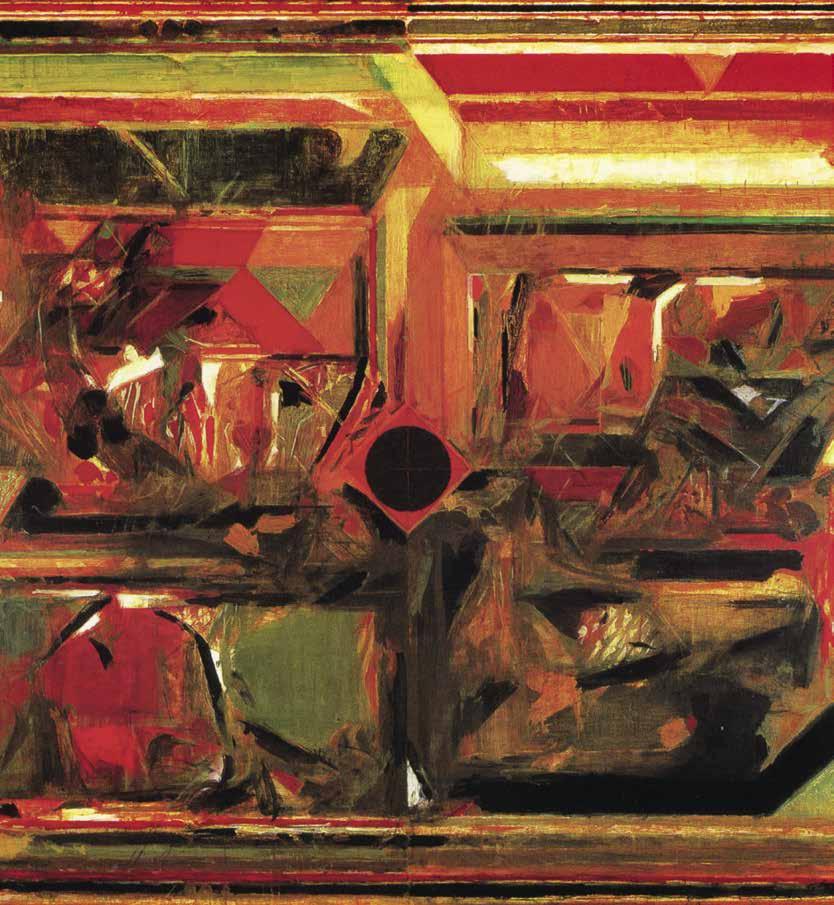
Bindu
Space and Time in Raza’s Vision
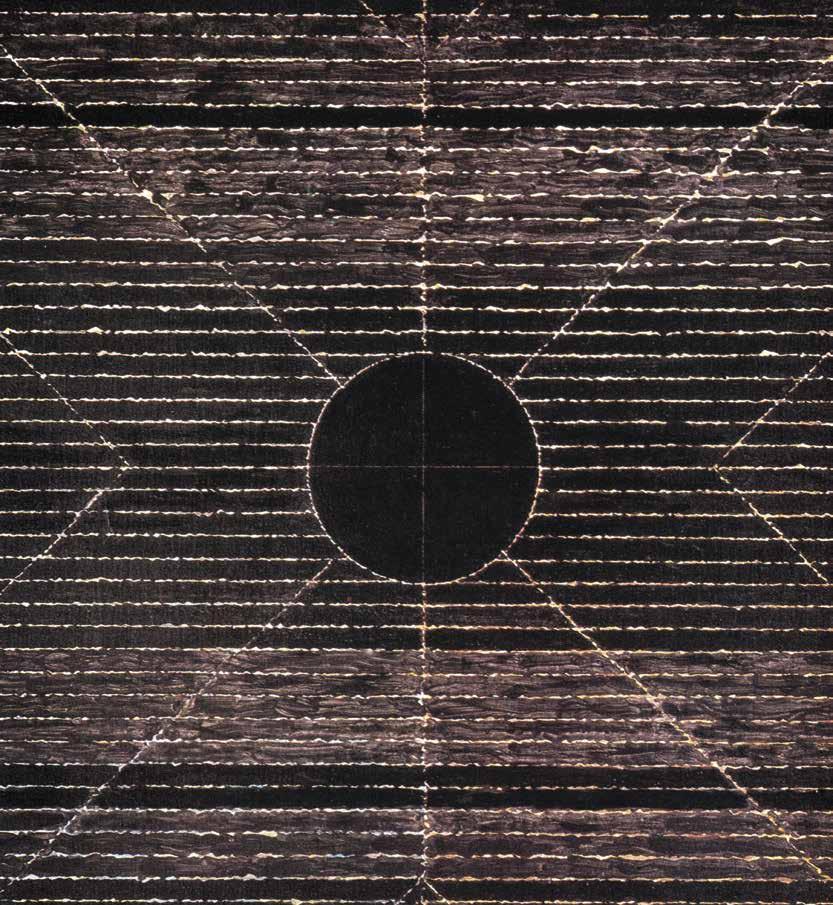

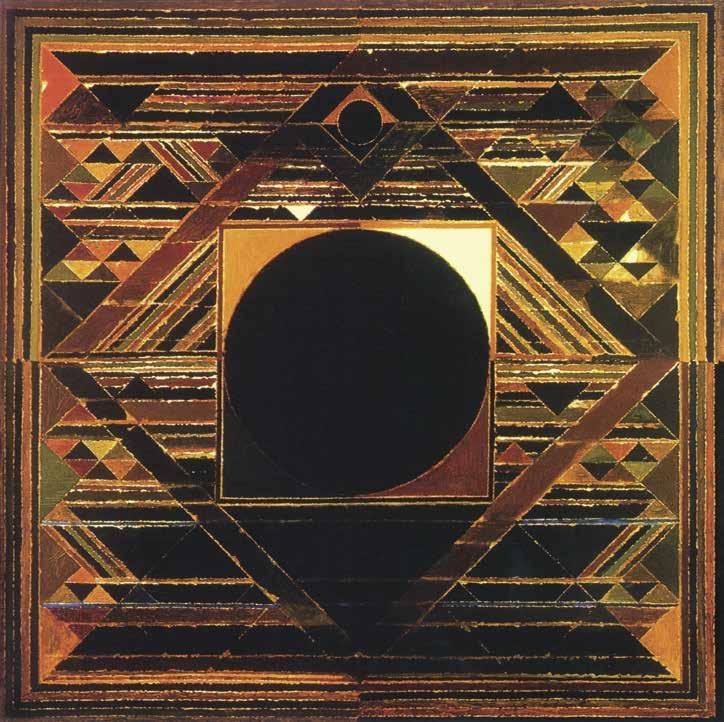
The bindu has been the leitmotif in S.H. Raza’s work, growing in meaning over many years. To this primordial symbol, he was introduced as a boy of eight years, in his native village of Kakaiya in Madhya Pradesh. The intensity of the experience remained, pursuing him as a lodestar, surfacing many years later when he was in France with dynamic force as The Black Sun.
Raza’s concern with nature was to explore the elementary principles of space and time that govern the universe. To express these fundamental concepts, which form the basis of Indian thought, he used the principles of pure geometry. His use of the point, line, square, circle, and triangle compose part of a universal language—explored equally by the pioneers of abstract art in 20th-century Europe and, later, the abstract artists of the New York school as well as traditional shilpins in ancient India.
This book traces the evolution of a vision over fifty years of painting, by an artist who retains his Indian sensibility. His is an impassioned language of colour and form, which evokes through the senses, poetry and music in painting. His images are improvisations on an essential theme: the mapping out of a metaphorical space in the mind that is India. The bindu becomes enshrined as an icon, as sacred geography, restoring us to a sense of wholeness.
With 70 colour and 20 b&w photographs.
Dr. Geeti Sen

Revised edition in new format published in India in 2020 by Mapin Publishing Pvt. Ltd in association with Raza Foundation
Original edition published in 1997 by Media Transasia India Limited, New Delhi
International Distribution
North America
ACC Art Books
T: +1 800 252 5231 • F: +1 212 989 3205
E: ussales@accartbooks.com • www.accartbooks.com/us/
United Kingdom, Europe and Asia
John Rule Art Book Distribution 40 Voltaire Road, London SW4 6DH
T: +44 020 7498 0115
E: johnrule@johnrule.co.uk • www.johnrule.co.uk
Rest of the World
Mapin Publishing Pvt. Ltd
706 Kaivanna, Panchvati, Ellisbridge Ahmedabad 380006 INDIA
T: +91 79 40 228 228 • F: +91 79 40 228 201 E: mapin@mapinpub.com • www.mapinpub.com
Text © Dr. Geeti Sen
Illustrations © Raza Foundation
All rights reserved under international copyright conventions. No part of this book may be reproduced or transmitted in any form or by any means, electronic or mechanical, including photocopy, recording or any other information storage and retrieval system, without prior permission in writing from the publisher.
The moral rights of Dr. Geeti Sen as author of this work are asserted.
ISBN: 978-93-85360-81-7
Copyediting: Ateendriya Gupta / Mapin Editorial Design: Gopal Limbad / Mapin Design Studio Production: Mapin Design Studio Printed in China
As we approach the birth centenary year of Sayed Haider Raza (1922–2016), there is a need to look into both the critical explorations done of his work so far and to encourage fresh insights into the life, vision and art of a master of Indian modern art. Dr Geeti Sen’s book Bindu: Space and Time in Raza’s Vision, first published in 1997, is a seminal work and continues to be relevant for understanding Raza in his plural dimensions, aesthetic sources and unique artistic vision. It has been out of print for many years, and the Raza Foundation is happy to have it reprinted in this slightly revised format. It is a work of critical depth and significance. Hopefully, its publication marks the beginning of a series of publications on Raza, and new studies by diverse hands.
Ashok Vajpeyi
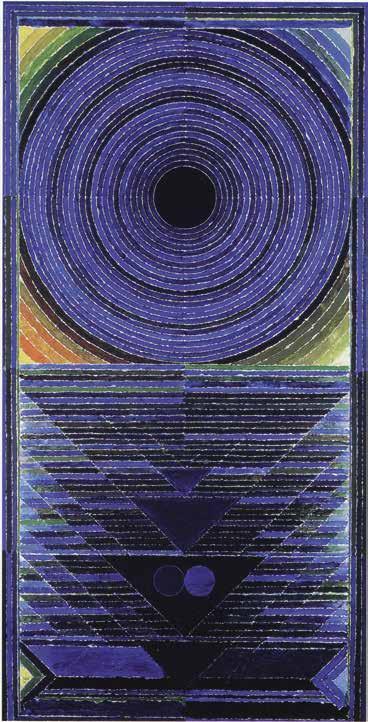
Every work pursues its internal logic of growth. Referring to the metaphor of the “earth–seed” relationship, which plays so vital a role in Raza’s later paintings, this book was in gestation for over 25 years. In 1972, we met Raza and his wife, Janine, in Paris, to be inspired by his impassioned paintings and their relation to poetry and music. Our conversations nurtured a friendship that matured over time, exploring the ideas rooted in the perennial philosophies of the world— some of which are made manifest through his images.
This is why commentaries by the artist form an integral part of this book. Indeed, they become the raison d’être and formulation for the chapters, each addressing itself to different problems in his life and work. Yet, the text is by no means a linear history, except for chapters two and three, which trace the beginnings of his career—first in India and then in France. The remaining four chapters deal essentially with a thought process that evolved to express itself in the language of visual metaphors.
Based on interviews with the artist and with his contemporaries, my writing explores assumptions about the nature of art, its relation to values and its relevance today. Both in the West and the East, art has to play the role assigned to it in ancient civilizations—of restoring to the earth a sense of sanctity, and our place in this universe. It is time that we examine the subtler implications of art as related to our beliefs and values. The subtext for this book is my genuine concern to see art not merely as connoisseurship but as a composing part of a larger canvas that integrates different disciplines. This is why references to the new propositions in scientific theory about Gaia, to an intrinsic relation between
sound and image and between space and time, as explored in the writings of Marcel Proust, Mircea Eliade and Henri Bergson—and much earlier, in the philosophy of the Upanishads—find their place in this book.
Several institutions, artists, critics and friends helped in the research for this book; I am grateful to them for their support and enthusiasm in this endeavour.
The writing of this book was initially supported by a research grant from the Ministry of Human Resource Development, New Delhi. Shri Ashok Vajpeyi mediated in urgent communications with Raza, about the text and pictures supplied by Shri S.H. Raza. Smt. Anjali Sen provided the catalogue on the Bombay Progressives that had just opened in Bombay.
From France, I received support from the Maison des Sciences de L’Homme to research at the Centre de Pompidou and interview critics in Paris. I am indebted to Professor Aymard, Mme Montefalcon, and especially Professor Jean-Luc Racine for his suggestions. The drafts were discussed with Raza and Janine in the magical environs of their studio and garden in Gorbio. I am privileged to have enjoyed their affection, which inspired me to persist in the realization of a book that spans 50 years of painting.
While in Paris, Jean and Freny Bhownagary revived through anecdotes the early days of their camaraderie with Indian artists in Paris. The critic and poet JeanDominique Rey offered invaluable insights into Raza’s work from the sixties and seventies. But perhaps the greatest surprise was the warm response from
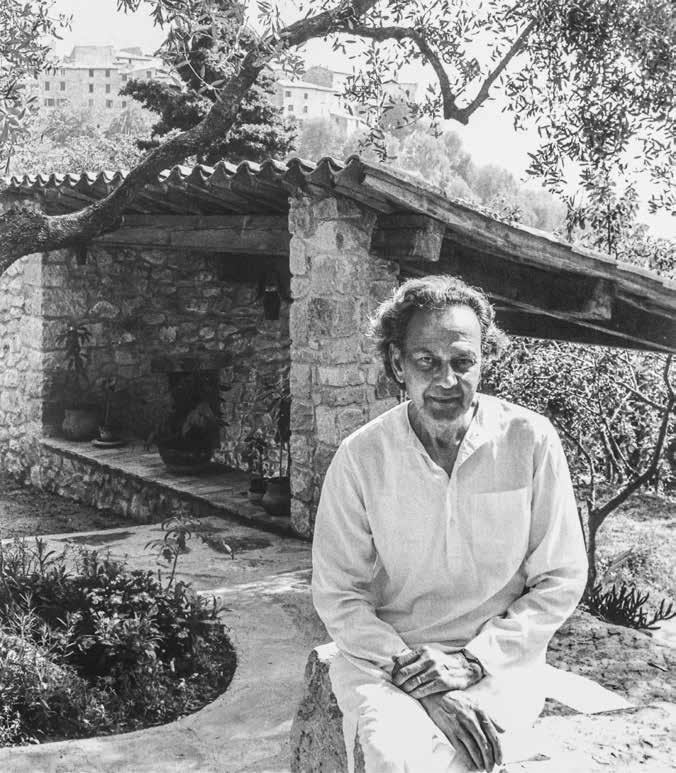
Henri Cartier-Bresson, who telephoned me long-distance to offer his classic photograph of Raza for use in this book. My visit to Magnum Studios and the tenacity of Mme. Marie-Pierre Gissey in locating this portrait from their archives introduces other dimensions of the visual image. My explorations into the artist’s life and work took me to California, where I met Karl Kasten, who had taken the initiative to invite Raza to teach in the art department at Berkeley in 1962. Visiting California opened that expanse of experiments by the pioneers of gestural expressionism, which left their impress upon Raza’s work.
In India, my search took me to several stimulating discussions with the artist Paritosh Sen in Calcutta, Ram Kumar and Gaitonde in Delhi, and F.N. Souza about the Bombay Progressive Artists, where he and Raza had been among the core members. P.N. Mago supplied that first rudimentary catalogue of the Progressives, containing the Manifesto written by Souza quoted here. While searching for pictures by Raza from this crucial phase, we discovered that vibrant painting Bombay (1964), now in the collection of Masanori Fukuoka, reproduced here with his permission.
Many other friends helped us to locate pictures: Krishen Khanna, Himmat Shah, Javed Abdulla from the Archives at Sotheby’s, Ravi Kumar from his publication on Jain Cosmology, Prema Shrimali, Surinder Singh, Usha and Ranjana Mirchandani. The Ektachromes supplied by Raza, of superb quality, were assembled through the personal enthusiasm of Nitin Bhayana, whom I must thank for his commitment to this project. Through these efforts, we aspire to a book of some magnitude and sophistication. The support received from Media Transasia was generous, allowing us to conceive a production of high quality. We
(Rosalind Krauss, “Grids” in The Originality of the Avant-Garde and Other Modernist Myths, MIT Press, Cambridge, Massachusetts, 1985, p. 237). This is perhaps one major reason that the pioneers of abstract art in 20th-century Europe—Paul Klee, Wassily Kandinsky, Kasimir Malevich and Mondrian— explained in their manifestos the “meaning” behind their work. Debates in Paris in the 1950s were heated on the originality of abstract art, by artists from Matisse, Cezanne to Ferdinand Leger. Abstraction, its values and purpose, has been discussed, debated and defended by critics such as Greenberg and Arnheim.
In India, abstraction has been practised for centuries in the visual arts and in music, with just the repetition of a single mantra, such as Om. There is no need to defend the status or the position of abstraction. The representation of the abstract in contemporary art has been powerful, articulated early in the 20th century by Rabindranath Tagore and artists such as Nirode Mazumdar and Paritosh Sen in post-Independence Bengal. A new direction was taken by Swaminathan in the 1960s to turn to Adivasi paintings, and by Ram Kumar and Gaitonde in Delhi and Bombay. The remarkable soliloquies by Prabhakar Barwe in Bombay create their own music of abstraction. The potentials of abstraction were explored in different mediums, with Sohan Qadri in Copenhagen and Zarina Hashmi in New York. This listing of some of the leading artists who played a significant role in abstraction in India is already an impressive number, without even mentioning those from Chennai, Baroda and Trivandrum.
Raza remained always—from the beginning to the end of his career—a painter of landscapes, as his near-contemporary Gaitonde mentioned. But it was only in the 1980s that Raza began to explore the potency of landscape in abstraction. He and Gade were the only artists among the original six of the Bombay Progressives to explore “landscape” in its purity. Raza extended his vision to projecting the wholeness of the world, the earth, the sea and sky, to conceive the whole cosmos
in harmony. In his later paintings, he reaches beyond the scope of the Bombay Progressives. In conceiving this perspective, he had absorbed fundamentals of Indian aesthetics—with colouration and a compositional order that eschews realistic representation.
In 1947, three artists who formed the core group of the Bombay Progressives moved to spend some years in Europe: Francis Newton Souza, Sayed Haider Raza and, a few years later, Maqbool Fida Husain in London. Also living in Paris in the same years was Akbar Padamsee. A group photograph taken in 1952 shows the three in a studio in Montparnasse in Paris, along with their paintings. It is a remarkable study of three young Indians in the 1950s: Souza, Raza and Padamsee, suggesting already their differing temperaments and the character in their work, which is beginning to be defined. Both Souza and Padamsee turn to figurative expression, largely as defined then in European Art. Raza’s canvas in the photograph is his celebrated painting Haut de Cagnes, which makes use of the brilliant Indian yellow-ochre found in miniature paintings and a space order that defies reality.
The raw colours of expressionism in European paintings left its impact on Raza’s depiction of churches: Chapelle Bleue and Eglise at Calvaise Breton, 1956. According to critics such as Lassaine, Soupault and Waldemar George, his works did not fit into any category of Western art or into what they described as neoorientalism, but they were moved by his passionate outbursts of energy. There was an inherent dilemma for Raza who was living in Paris. A new world order of ambivalence seemed to have become inevitable, when the East was turning Westward for influence, while the West was moving Eastward for inspiration.
I was fortunate to have met Raza Sahib in the 1980s, in the crucial decade when he was embarking on rediscovering the significance of the Bindu. It
Hidden in nature, which is mine own, I emanate forth again and again All these multitude of beings Necessarily by the force of nature.
—Bhagavad Gita IX, 8
“It’s strange that I needed forty years to understand my passion and love for nature, and to transpose this on to canvas. I’m glad that I took all this time, because it was not a gift to me by someone—a teacher, a book, or something else; it was the conclusion of a lifelong experience!”
—S.H. Raza
Coll.
We can never speak about nature without, at the same time, speaking about ourselves.
Increasingly, there is a new perception of reality—a new paradigm with fundamental changes in values that are moving away from the mechanistic view of the world to a truly holistic conception of the universe.
Different disciplines and spheres of knowledge have begun to contribute to this realization of the universe as a dynamic web of interrelated events. In atomic physics, for instance, the former Cartesian division—between the mind and matter, between the observer and the observed—can no longer be maintained. The hypothesis of the chemist James Lovelock and the microbiologist Lynn Margulis would suggest that the complex phenomena of the biosphere “can be understood only if the planet as a whole is regarded as a single living organism”. Resurrecting an ancient Greek myth, they have invested their hypothesis about this earth with the name of the goddess Gaia.2
Drawing his conclusion from several sources and scientific data, Fritjof Capra introduced a plausible and poetic evocation of Gaia as a living personification:
The earth then is a living system; it functions not just like an organism but actually seems to be an organism—Gaia,
a living planetary being. Her properties and activities cannot be predicted from the sum of her parts; every one of her tissues is linked to every other tissue, and all of them are mutually interdependent; her many pathways are highly complex and nonlinear; her form has evolved over billions of years and continues to evolve. These observations were made within a scientific context, but they go far beyond science. Like many other aspects of the new paradigm, they reflect a profound ecological awareness, which is ultimately spiritual.3
The ecological imperative of our times connects art to this web of interrelationships in which we live, to this modern world in which art is beginning, once again, to play a vital role. In all professional spheres, a combination of philosophy and physics and macrobiology and the social sciences bring us to an acute awareness of the dilemma of the 20th century—that the earth needs to be sanctified, made whole again.
Traditionally, the role of art in all ancient cultures was related to religious belief and practice, to make manifest the sacred and divine. Even when this impulse waned in the 18th century, art was invested with a seemingly reversed role, “with the power to heal a decadent human condition”. Nietzche would say that “art raises its head when religions decline”.4 How, in what way was it perceived that art could “heal” or restore
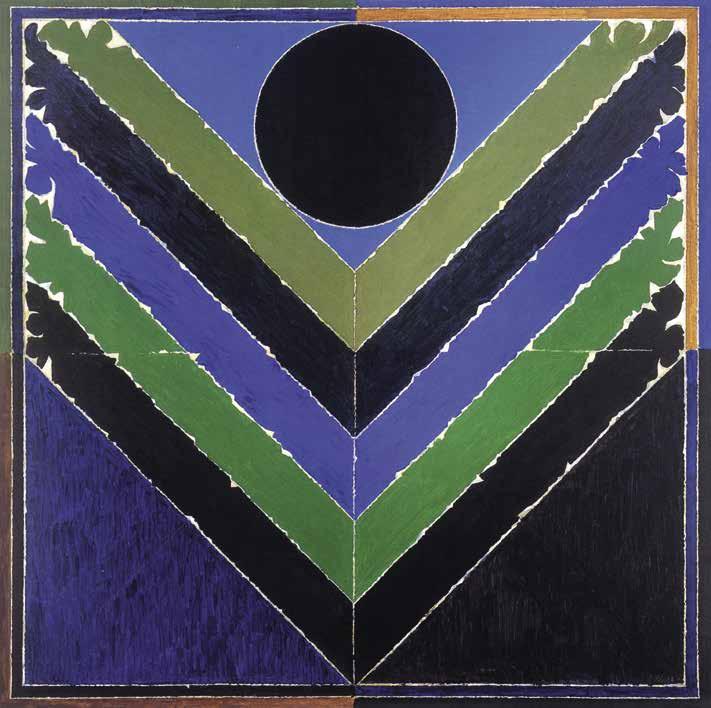
Tree, 1995
Acrylic on canvas, 152 x 152 cm
Coll. Private
to us a sense of wholeness? It is critically important to recognize that the role of art was perceived—both in Eastern and Western cultures—as linking us to “ la belle nature”. Thus, Montesquieu could assert that “art comes to our rescue and lifts the veil behind which nature conceals herself”.5 In Europe, this dilemma was keenly sensed and expressed by writers, poets and philosophers, and artists of the late-18th century. In Germany, the philosopher Schopenhauer, the writer Schiller and the romantic poet Novalis; and in America, the pantheism of Walden and Thoreau and the poetry of Walt Whitman return us in different ways to a romantic evocation of nature.
Early in the 20th century, the artists Franz Marc and Wassily Kandinsky expressed in words and in images why they turned from the material substance to the essential spirit of things. Nature contemplated brings the artist to a metaphysical view of the world—to see it in essence, abstracted. In his seminal book of 1914, Concerning the Spiritual in Art, Kandinsky wrote:
When religion, science and morality are shaken ... man turns his gaze from externals into himself. Literature, music and art are the first and most sensitive spheres in which this spiritual revolution makes itself felt ... they turn away from the soulless life of the present towards those substances and ideas which give free scope to the non-material strivings of the soul.6
In the idealist tradition of Germany, this led to a “re-enchantment” through art. As has been pointed out in a recent essay,
“Enchantment consists of an apparatus of belief whose form of representation of enactment is thought to exert influence over the realities it configures.” 7
We perceive this “enchantment” in the magical pictures by Paul Klee, with his intense fascination and experiments with plant life growing, swaying to music—their secrets, “their sexuality and their fruitfulness”. This is demonstrated in his paintings titled Growth of Nocturnal Plants (1922) and Fish Magic (1925), both defined by forms glowing from within. In the course of his experiments, Klee discovered that, firstly, the growth of plants may be compared with the growth of pictures—a view that has striking affinities with the statements made by Raza. Secondly, he discovered that the forms and feelings are not unlike those of men. Klee images himself as a large omniscient eye looking down on nature: “The artist is a man, himself nature and a part of nature in natural space.” 8
Most importantly for us, in France at the turn of the century, it was Cezanne whose approach to nature was to construct it anew, who believed that “all things, particularly in art, are theory developed and applied in contact with nature”.9 This statement is significant because Raza acknowledged
“Our art must render the thrill of nature’s permanence along with her elements, the appearance of all her changes. It must give us a taste of her eternity. What is there underneath? Maybe nothing. Maybe everything. Everything, you understand? ”
—Paul Cezanne
page 40
Ankuran, 1986
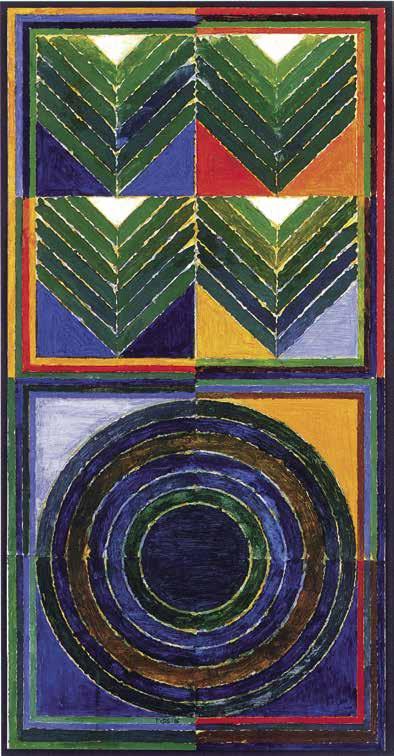
The five elements, the pancha bhutas, are considered in Indian thought to constitute the “raw material” for everything in this universe. Raza introduced them into his paintings, as he explicitly mentioned, through five bold colours of black, white, red, yellow and blue. Secondary colours rarely played a major role, except on occasion, as in Ankuran, to suggest the effulgence of nature.
The formal elements of the circle, the square, the triangle, and horizontal and vertical lines are used in his pictures to signify the elements in nature. As we shall see in another chapter, there is a precedence in earlier texts in India for using these abstracted forms to refer to the earth, wind, water or sky. And with the understanding that all things are interrelated, Raza integrated these elements to compose one whole.
In using abstraction, Raza turned away from the external to the internal substance. There is implicit a sense of timelessness that is allpervasive, which brings a different meaning to his pictures. There is no reference here, as with his earlier work, to a particular village or church, or to the expression of a mood of day or season or to a “climate of thought”. Instead, he has “abstracted” from nature its essence, its deeper implications for mankind.
In her significant book The Re-Enchantment of Art, Suzy Gablik pleaded for an ecological subtext for art. With vivid examples, she demonstrated how this awareness was growing among artists who act out their relation to nature. She observed:
The holistic paradigm is bringing inner and outer - subjective and objective worlds closer together ... The “observer” is a notion that belonged to the classical way of looking at the world. The observer could approach the world without taking part. But this is not the case with a holistic view ... A world view is not something formal “out there” but is something individuals construct and create.14
Raza was, in fact, constructing through his recent pictures a paradigm that is both relevant for the modern world and in harmony with traditional Indian concepts. Living in the West, with his antennae attuned to the pervasive crisis of modern age, and searching for his roots in India, his images coalesced into a metaphor. Raza’s contribution, in the best tradition of symbiosis, has been to create images that possess universal meaning, that relate each one of us to the universe “out there”.
Space and Time in Raza’s Vision
Geeti Sen
208 pages, 72 colour illustrations
8.26 x 9” (210 x 228.6 mm), hc
ISBN: 978-93-85360-81-7
₹1950 | $39 | £31
Fall 2020 • World rights
Dr. Geeti Sen is a cultural historian, professor, art critic and editor, trained at the Universities of Chicago and Calcutta. She is a prominent figure in the Indian cultural world and has been invited to lecture in many parts of the world: United Kingdom, United States of America, Canada, Ireland, France, Spain, Brazil and Russia. In the 1970s, Sen was the art critic for The Times of India in Bombay and the Assistant Editor at Marg, the prestigious art journal from Mumbai. Later, she served for two years as the art critic for India Today, Delhi. From 1990 to 2006, she was appointed the Chief Editor of publications at the India International Centre in New Delhi. In 2009, she was selected by the Government of India as the first Director of the Indian Cultural Centre in Kathmandu, Nepal, serving until 2013.
Sen is the author of several books, including Your History Gets in the Way of My Memory (2012), Feminine Fables: Imaging the Indian Woman in Painting, Photography and Cinema (Mapin, 2002), Revelations: Ganesh Pyne (2000), Bindu: Space and Time in Raza’s Vision (1997), Image and Imagination (Mapin, 1992) and Paintings from the Akbar Nama: A Visual Chronicle of Mughal India (1984). Each of these books interprets art with an interdisciplinary approach, integrating art with the wider concerns of ethics and social values in India. Sen is the recipient of several awards including the Smithsonian Fellowship, the Homi Bhabha Fellowship, the Jawaharlal Nehru Fellowship, a grant from the Asian Cultural Council in New York, and was selected as the Asian art critic for the Sao Paolo Biennale in Brazil in the year 2000.

www.mapinpub.com www.therazafoundation.org