COMMERCIAL CORNER
Nick Ogden and this was also a pivotal step in my career as I went on to join the firm as an asset manager in 2007 following graduation. CCG is one of the best value-add private equity shops in the country, and I owe much of my career to the education that I received from the principals at that firm.
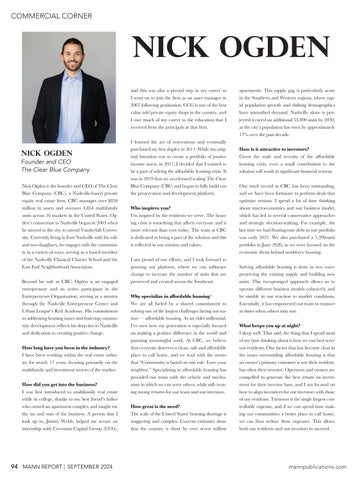
NICK OGDEN Founder and CEO The Clear Blue Company Nick Ogden is the founder and CEO of The Clear Blue Company (CBC), a Nashville-based private equity real estate firm. CBC manages over $850 million in assets and oversees 4,854 multifamily units across 16 markets in the United States. Ogden’s connection to Nashville began in 2003 when he moved to the city to attend Vanderbilt University. Currently living in East Nashville with his wife and two daughters, he engages with the community in a variety of ways, serving as a board member of the Nashville Classical Charter School and the East End Neighborhood Association. Beyond his role at CBC, Ogden is an engaged entrepreneur and an active participant in the Entrepreneurs Organization, serving as a mentor through the Nashville Entrepreneur Center and Urban League’s Red Academy. His commitment to addressing housing issues and fostering community development reflects his deep ties to Nashville and dedication to creating positive change. How long have you been in the industry? I have been working within the real estate industry for nearly 17 years, focusing primarily on the multifamily and investment sectors of the market. How did you get into the business? I was first introduced to multifamily real estate while in college, thanks to my best friend’s father who owned an apartment complex and taught me the ins and outs of the business. A person that I look up to, Jimmy Webb, helped me secure an internship with Covenant Capital Group (CCG),
94 MANN REPORT | SEPTEMBER 2024
I learned the art of renovations and eventually purchased my first duplex in 2011. While my original intention was to create a portfolio of passive income assets, in 2017, I decided that I wanted to be a part of solving the affordable housing crisis. It was in 2019 that we accelerated scaling The Clear Blue Company (CBC) and began to fully build out the preservation and development platform. Who inspires you? I’m inspired by the residents we serve. The housing crisis is something that affects everyone and is more relevant than ever today. The team at CBC is dedicated to being a part of the solution and this is reflected in our mission and values. I am proud of our efforts, and I look forward to growing our platform, where we can influence change to increase the number of units that are preserved and created across the Southeast. Why specialize in affordable housing? We are all fueled by a shared commitment to solving one of the largest challenges facing our nation — affordable housing. As an elder millennial, I’ve seen how my generation is especially focused on making a positive difference in the world and pursuing meaningful work. At CBC, we believe that everyone deserves a clean, safe and affordable place to call home, and we lead with the motto that “Community is based on one rule: Love your neighbor.” Specializing in affordable housing has provided our team with the vehicle and mechanism in which we can serve others, while still creating strong returns for our team and our investors. How great is the need? The scale of the United States’ housing shortage is staggering and complex. Current estimates show that the country is short by over seven million
apartments. This supply gap is particularly acute in the Southern and Western regions, where rapid population growth and shifting demographics have intensified demand. Nashville alone is projected to need an additional 53,000 units by 2030, as the city’s population has risen by approximately 17% over the past decade. How is it attractive to investors? Given the scale and severity of the affordable housing crisis, even a small contribution to the solution will result in significant financial returns. Our track record at CBC has been outstanding, and we have been fortunate to perform deals that optimize returns. I spend a lot of time thinking about macroeconomics and our business model, which has led to several conservative approaches and strategic decision-making. For example, the last time we had floating-rate debt in our portfolio was early 2021. We also purchased a 1,200-unit portfolio in June 2020, as we were focused on the economic thesis behind workforce housing. Solving affordable housing is done in two ways: preserving the existing supply and building new units. This two-pronged approach allows us to operate different business models cohesively and be nimble in our reaction to market conditions. Essentially, it has empowered our team to transact at times when others may not. What keeps you up at night? I sleep well. That said, the thing that I spend most of my time thinking about is how we can best serve our residents. One factor that has become clear in the issues surrounding affordable housing is that an owner’s primary customer is not their resident, but often their investor. Operators and owners are compelled to generate the best return on investment for their investor base, and I am focused on how to align incentives for our investors with those of our residents. Turnover is the single largest controllable expense, and if we can spend time making our communities a better place to call home, we can then reduce these expenses. This allows both our residents and our investors to succeed.
mannpublications.com