Confusion and Surprise at Iowa›s Democratic Caucus
A Weekly Political News Magazine
Freundschaft and Brexit
Issue 1786- February - 07/02/2020
A Weekly Political News Magazine
2
Issue 1786- January- 07/02/2020
Zeina Akar: Lebanon’s New Defense Minister is First Woman in Arab World to Hold Post www.majalla.com
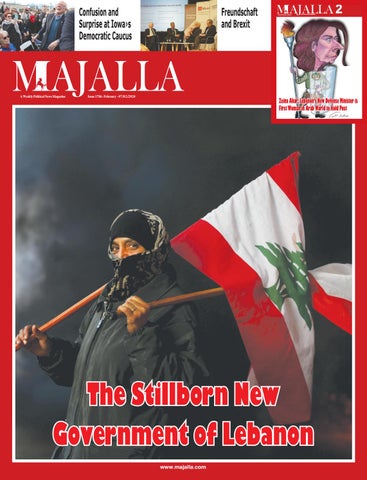
The Stillborn New Government of Lebanon www.majalla.com
Editorial
A Weekly Political News Magazine
In an effort to curtail anti-government protests, a new cabinet has been named in Lebanon, and Hassan Diab has been chosen to succeed Hariri. However, such a move is not likely to satisfy the protestors since Hezbollah is still very much in control of the government. As a matter of fact, this reshuffling of the cabinet has given the group the opportunity to remove elements who are not loyal to them. This week’s cover story by Hanin Ghaddar focuses on this new reshuffling and argues that it will enable Hezbollah to increase its operations in the country. However, she also contends that the new cabinet will probably not have much longevity, as it does not have public support nor international support. The Gulf states (except Qatar) have said that it would not give bailouts to a Hezbollah controlled Lebanon while the US and Europe would only back the government if it goes through on ministerial promises and gains the vote of confidence from parliament. This past week, a terrorist stabbed two people to death in London. The assailant, -20year-old Sudesh Amman, was released from jail early despite still harboring to extremist views. As this is the second time in two months that a released person with extremist views has conducted a terrorist attack in Britain, the Prime Minister vowed that he would scrap early releases of those who have been radicalized. Yasmine ElGeressi writes on why de-radicalization programs in UK prisons don’t seem to be working and explores what more can be done to improve such programs to protect the lives of innocent civilians on Britain’s streets. The Iowa Caucus came and went, and despite a delay in results, it has become evident that leftist candidate Bernie Sanders has garnered a lot of support at the expense of other establishment candidates, particularly former vice president Joe Biden. Joseph Braude writes on this massive victory for Sanders and considers what his presidency would mean to US foreign policy. While further Brexit negotiations are still going to take place throughout the year, the UK has technically left the EU on January 31. Now that this is done and dusted it is time for both sides to carefully consider how they want their relationship to be like, once the divorce is finalized. One of Britain’s biggest partners within the EU was Germany, as both London and Berlin shared a close trade and foreign policy partnership. Ali El Shamy reports on an LSE panel that took place this week featuring Baroness Pauline Neville-Jones of the House of Lords, Dr. Norbert Röttgen of the German Bundestag and Professor Iain Begg of the European Institute. These three experts discussed the implications of Anglo-German relations, and how the tone set during the negotiations can impact these relations.
2
07/02/20
www.majalla.com/eng
Editor-in-Chief
Ghassan Charbel Editorial secretary Mostafa El-Dessouki HH Saudi Research and Marketing (UK) Ltd 10th Floor Building 7 Chiswick Business Park 566 Chiswick High Road London W4 5YG Tel : +44 207 831 8181 Fax: +44 207 831 2310
الوكيل اإلعالني ،www.alkhaleejiah.com :موقع إلكتروني hq@alkhaleejiah.com :بريد إلكتروني + 9714 3 914440 : دبي،920 000 417 : من داخل اململكة +44 207 404 6950 : لندن+00764 537 331 :باريس +966 11 441 1444 : ومن مختلف الدول
- طريق مكة- حي املؤتمرات- مرخص لها الرياض تقاطع التخصصى +44 207 831 8181 : لندن- 4419933 هاتف:الرياض
A Weekly Political News Magazine
32 Venezuela’s Problem Isn’t Socialism
The Threat from Within: Are UK
24 ?Prisons Warehouses for Radicalisation
28 Syria’s Kurdish Forces Hold Back the Tides
20 Brexit Is Just the Beginning
09 App Error Delays Results of Iowa Democratic Caucus
36
Late Interfaith Dialogue Champion Ali ElSamman Honoured by the Dominican Institute of Oriental Studies 3
07/02/20
42 How to Prepare for a Coronavirus Pandemic
S
napshot
4
07/02/20
House Speaker Rep. Nancy Pelosi (D-CA) rips up pages of the State of the Union speech after U.S. President Donald Trump finishes his State of the Union speech in the chamber of the U.S. House of Representatives on February 04, 2020 in Washington, DC. President Trump delivered his third State of the Union to the nation the night before the U.S. Senate voted acquit him in his impeachment trial. (Getty)
5
07/02/20
S
napshot
6
07/02/20
Chinese children wear plastic bottles as makeshift homemade protection and protective masks while waiting to check in to a flight at Beijing Capital Airport on January 2020 ,30 in Beijing, China. (Getty)
7
07/02/20
W
eekly news
Terrorist Stabs Two People in London, Shot Dead by Police Shortly Afterwards
British Prime Minister Boris Johnson vowed to end the early release of convicted terrorists after an Islamist attacker stabbed two people days after he was set free half way through his prison term. Sudesh Amman, jailed in 2018 for possession of terrorist documents and disseminating terrorist publications, was shot dead by police on Sunday after he went on the rampage with a stolen 10-inch (25 cm) knife on a busy London street. Amman had previously praised ISIS, shared an online al Qaeda magazine and encouraged his girlfriend to behead her parents. Johnson said the government would announce fundamental changes in dealing with people convicted of terrorism offences, saying he had come “to the end of my patience” with freeing offenders before they had completed their sentences and without any scrutiny. “I think the idea of automatic early release
for people who obviously continue to pose a threat to the public has come to the end of its useful life,” he said in a speech. The government has repeatedly promised tougher rules on terrorism since another former convict killed two people and wounded three more before police shot him dead near London Bridge in November. Johnson said the instances of deradicalizing and rehabilitating Islamists was hard and the instances of success were few. Amman went on the rampage after strapping a fake bomb to his body. He stabbed two people, while a third suffered minor injuries caused by shattered glass when police opened fire. Amman was under surveillance at the time by police, who shot him dead.
Senate Acquits Trump in Historic Vote as Re-election Campaign Looms President Donald Trump was acquitted on Wednesday in his U.S. Senate impeachment trial,
8
07/02/20
saved by fellow Republicans who rallied to protect him nine months before he asks voters in a deeply divided America to give him a second White House term. The businessman-turnedpolitician, 73, survived only the third presidential impeachment trial in U.S. history - just like the two other impeached presidents - in his turbulent presidency’s darkest chapter. Trump now plunges into an election season that promises to further polarize the country. Trump was acquitted largely along party lines on two articles of impeachment approved by the Democratic-led House of Representatives on Dec. 18. The votes to convict Trump fell far short of the two-thirds majority required in the 100-seat Senate to remove him from office under the U.S. Constitution. The Senate voted 52-48 to acquit Trump of abuse of power stemming from his request that Ukraine investigate political rival Joe Biden, a contender for the Democratic nomination to face him in the Nov. 3 election. Republican Senator Mitt Romney joined the Democrats in voting to convict. No Democrat voted to acquit. The Senate then voted 53-47 to acquit him of obstruction of Congress by blocking witnesses and documents sought by the House. Romney joined the rest of the Republican senators in voting to acquit on the obstruction charge. No Democrat voted to acquit.
Trump and Pelosi “Clash” During State of the Union Address
Just one day before Trump was acquitted of corruption charges, President Trump delivered the annual State of the Union Address. There was an air of abhorrence from both sides from the very start of the event, as some Democrat Congress members decided to break from decorum by not attending the address. Among the Democrats that did not attend was Alexandra Ocasio-Cortez who is part of the far-left wing of the party. For her part, Pelosi also broke from tradition as it is customary for the Speaker of the House to use honorifics when announcing the entrance of the President, something she did not do. Then as the President was giving Mike Pence and Pelosi copies of the speech, he appeared to snub Pelosi who extended her hand to for a handshake. The speech served as part of Trump’s re-election campaign as he stated some of his accomplishments as president, particularly economic growth which he demonstrated through stock market growth. Then after the address, Pelosi ripped up the speech in what appeared to be an act of “protest” against the president.
Lebanon Cabinet Approves Financial Rescue Plan
App Error Delays Results of Iowa Democratic Caucus
race, as the results showed him at fourth place, meanwhile Pete Buttigieg and Bernie Sanders were firmly in front, as the former has so far earned 26.2 percent of the vote, while the latter secured 26.1 percent.
Sudanese and Israeli Leader Meet in Uganda
The first Democratic caucus took place in Iowa this week, as the Democrats are vying to pick their candidate who will take on Trump in November’s presidential election. However, a “coding error” in an app which was being used for the first time, caused a major delay in reporting the results. Three days later, only about 70 percent of the results have been disclosed. It was not a good week for Former Vice President Joe Biden, who was one of the front runners in the
Abdul Fatah Burhan, the head of the transitional sovereign council in Sudan, met with Israeli Prime Minister Benjamin Netanyahu in Uganda this week. The meeting was unprecedented since both nations have been hostile towards each other, especially during the 30 years in which the Islamist Bashir regime was in power in Sudan. During the meeting, Burhan agreed to allow flights to and from Israel (except for those belonging to the Israeli El Al airline), while Israel would be allowed to use Khartoum’s airspace. The meeting was part of the transitional government’s attempts to remove Sudan from the US’s list of states that sponsor terror and happened one day after US Secretary of State Mike Pompeo invited Burhan to visit the US, the date for this meeting has not been announced as of yet.
On Thursday Lebanon’s new government approved a rescue plan to pull the country from its worst economic and financial crisis in decades and it must now win a vote of confidence in parliament. A draft policy statement seen by Reuters on Sunday outlined broad plans, including reducing interest rates, recapitalizing banks, restructuring the public sector and seeking support from foreign donors. Prime Minister Hassan Diab urged European states to open a credit line and provide aid to rescue his country. Foreign donors have said they stand ready to support Lebanon only if it implements long-stalled reforms. The information minister said the cabinet approved the rescue plan on Thursday with some amendments, which ministerial sources said were minor. It was not immediately clear what changes were made to the 17-page statement, due to be presented on Tuesday in parliament for the new government to secure a vote of confidence. Diab’s cabinet was formed last month by the Iran-backed Hezbollah movement and its political allies, which hold a parliamentary majority.
Skids Off Runway 737 Pegasus Boeing in Istanbul Airport
A Pegasus jet carrying 177 passengers and 6 crew members crash landed Sabiha Gokcen airport, causing three people to lose their lives. The plane crashed while it was about 30 to 40 meters above the ground and poor weather caused it to skid pass the runway. The accident has added more trouble to Boeing’s growing list of woes, as it is already facing scrutiny over a lack of adequate safety checks on its 737 Max which has been grounded in March 2019 after two fatal crashes happened within 5 months.
9
07/02/20
C
over story
The Stillborn New Government of Lebanon As the Financial Collapse Looms, the New Cabinet Will Face its Failure Sooner Than It Expects 10
10/01/20
Having rid itself from some of the few opponents, Hezbollah and its allies have more access to the state and its resources, or whatever is left of them. October 17 has grown increasingly angry at banking policies. The Lebanese people are worried that the new cabinet’s measures are going to target the poor and their bank savings, instead of the rich and political figures, in an attempt to slow down the economic collapse. No one really believes the promises made by the Central Bank, Commercial banks and political leaders, that depositors will not lose their money. The signs are not reassuring.
THE NEW GOVERNMENT’S MISSION
Female ministers of the newly formed Lebanese government, Labor minister Lamia Yammine, Justice Minister MarieClaude Najm, Deputy Prime Minister and Defense Minister Zeina Akar, Youth and Sports Minister Vartini Ohanian, Information Minister Manal Abdel-Samad and Minister of Affairs for the Displaced Ghada Shreim pose for a photo after a new government formed in Beirut, Lebanon in January 2020 ,22. (Getty)
While all eyes are cast on the banks’ new policies and the deteriorating economic situation in Lebanon, the new government is trying to focus on two issues. First, protect Hezbollah and its allies’ political and financial interests. For example, the new ministerial statement talked about corruption generally, without moving forward with concrete steps on the electricity sector. That’s mainly because both Hezbollah and its ally Gebran Bassil are very much involved in this sector and any anti-corruption measures could cause them major financial loss.
by Hanin Ghaddar During the same week as Lebanon’s new cabinet finalized its Ministerial Statement, and made promises of reform and anti-corruption measures, most Lebanese banks slashed the monthly dollar withdrawal limit by %50, according to a number of media reports. Three major banks contacted by AFP last week confirmed they have halved the dollar withdrawal limit since the beginning of February, some capping the amount at 600$ a month. The informal controls have sparked public outrage in protest-hit Lebanon, where an antigovernment street movement launched on
11
10/01/20
This is also a government that was carefully tailored by Hezbollah, former Security General Director Jamil Assayed – known to be an Assad ally – and Bassil – who owns the blocking third of the cabinet. This is not a government that would threaten Hezbollah’s power, weapons or aces to state institutions. On the contrary, having rid itself from some of the few opponents, Hezbollah and its allies now have more access to the state and its resources, or whatever is left of them. In that sense, Hezbollah’s operations inside
C
over story
Lebanon will increase, as well as its cross border ones such as smuggling and military transfers. Hezbollah will also be able to bring in hard currency and goods from the region – mainly from Iran, Iraq and Syria - into Lebanon as some of the basic goods are in shortage. Second, this government will try to make a few superficial or selective reforms in order to fool the international community into bailing it out. As it stays away from the interests of Hezbollah and its allies, this government will target their opponents, mainly those who have been implicated in corruption deals. To cover its real intentions, the new government might resort to target one of its known allies with anti-corruption measures. This person could likely be Speaker Nabih Berri, knowing that both Bassil and Assayed have serious issues with him. Assayed wants to take his spot as the next Speaker of the House, and the BassilBerri relationship has always been sore. For Hezbollah, Berri might have served his purpose and is no longer needed. The fact that he has been protected by Hezbollah for so long has actually back-fired on Hezbollah’s support-base, mainly due to the fact that Berri’s corruption has become too obvious and too painful to endure. The Shia street that has joined the Lebanon protests recently has focused on Berri’s corruption, and Hezbollah might benefit as well from throwing him into the pit. Lebanon’s new government will try to hide these complexities and play on the international community’s fear of instability. Again, they will sell the same formula of stability for the status co, while adding to it a few cosmetic reforms. That is why it is essential for the international
As people lose their savings, their jobs and their dignity, the street will become the only place to be and express their anger.
community to avoid bailing this government at all costs; otherwise, Hezbollah will win again .
THE NEW GOVERNMENT’S CHALLENGES
There is a big difference between what the government plans to do and what it can actually and realistically do. The mission – outlined above - is quite clear, and will be accompanied by a campaign to crack down on the protestors in the street, to make sure they are no longer heard. If that fails, the plan is to destroy their credibility in the form of international public opinion, by turning the protests into violent ones, or at least create scenes of clashes between the protestors and the security forces.
12
10/01/20
Lebanese riot police forces block a road leading to the parliament during clashes with antigovernment protesters in downtown Beirut, on January 2020 ,22. (Getty)
The indications that this government will fail are many. It will not gain the trust of the street and the international community. verge of collapse before. As people lose their savings, their jobs and their dignity, the street will become the only place to express their anger. Second, the international community does prioritize stability in Lebanon; however, it has become clear that stability can no longer be tied to Hezbollah and Iran. The Gulf States – except for Qatar - have already made it clear that they will not bail out Lebanon with a Hezbollah-backed government. The US and Europe stated that they will wait and see until the new government starts working; that is after it issues its ministerial statement and gets the vote of confidence from the parliament.
However, this is easier said than done. First, the street protests have become an authority that will be taken very seriously, mainly by the international community. Many officials in the US and Europe have linked their response to the new government by the street response. And cracking down on the street protests have essentially failed for the past four months. The previous government, the Lebanese Army, the Internal Security, and Hezbollah-supported thugs, have all taken turns in scaring the protestors into submission. However, what all these factions did not realize is that violent tactics and the fear factor does not work with people who have nothing left to lose. The Lebanese people have demonstrated many times before, but they have never lost so much, and the economic situation has never been on the
13
10/01/20
However, if the Lebanese government does not start implementing serious reforms, including those stipulated by CEDRE, no bailout will be offered. And if one looks closely at CEDRE, it is clear that the electricity sector has been prioritized in the list of required reforms, something that this government overlooks in its current ministerial statement. The indications that this government will fail are many. It will not gain the trust of the street and the international community. In a matter of months, if not days, the financial collapse will become a reality and this government will have to face its failure sooner than it expects. The hopes that PM Hassan Diab has to enter history as the savior of Lebanon, and Hezbollah’s hopes that the international community will bail out Lebanon, will probably be buried not long after the parliament approves the cabinet. It is a government that was stillborn, and it is probably the last trick Hezbollah and its allies have up their sleeves. Hanin Ghaddar is the Friedmann Visiting Fellow, Washington Institute for Near East Policy
P
olitics
Confusion and Surprise at Iowa›s Democratic Caucus
The Three-Way Split of the Moderate Camp Between Biden, Buttigieg, and Bloomberg is the Greatest Asset to the Sanders Campaign
by Joseph Braude Despite technical problems delaying the release of the results of Iowa’s caucus vote, field data as of this writing indicates a strong performance for
Senator Bernie Sanders and a fracturing of the moderate camp between Vice President Joe Biden and South Bend Mayor Pete Buttigieg. If Sanders should ultimately carry the nomination and the presidency, his foreign policy preferences would
14
07/02/20
herald a break with American foreign policy of the Trump administration, and possibly prove more dovish than the Obama administration.
BERNIE SURGES, BIDEN STUMBLES
Democratic presidential candidate Sen. Bernie Sanders (I-VT) greets people during a stop at a campaign field office on February 2020 ,02 in Cedar Rapids, Iowa. (Getty)
A comprehensive accounting of the first contest within the Democratic Party will have to wait, due to a “major coding error” in the software being used to tabulate results. Over the 24 hours since the caucus concluded, conflicting results have emerged. One set of field data collected by Senator Sanders’ campaign portends a victory for the Vermont Senator and, more surprisingly, a dismal fourth-place showing for former VicePresident Joe Biden. A slightly fuller but still only partial count by the Iowa Democratic Party shows South Bend mayor Pete Buttigieg holding a slender lead of %26.9 to Sanders’ 25.1 percent. Meanwhile Vice President Biden — previously the leader in national polling — trails in fourth place at 15.6 percent. With Iowa still too close to call, eyes are beginning to turn to the next contest in New Hampshire. There, polling shows Senator Sanders holding a substantial lead over his next closest competitor, Joe Biden. Should Sanders overtake his rivals in both Iowa and New Hampshire — as is eminently possible — it significantly increases the odds that he will secure the Democratic Party’s nomination for President. Famed statistician and political analyst Nate Silver went so far as to calculate that “Iowa was the second most-important date on the calendar this year, trailing only Super Tuesday,” claiming that historical patterns indicate “it [is] worth the equivalent of almost 800 delegates, about 20 times its actual number.”
IMPLICATIONS OF A SANDERS TRIUMPH A Bernie Sanders nomination raises the possibility of one of the more dovish major-party presidential candidacies in American history. To take one notable example, in January, Sanders unequivocally denounced what he termed “the assassination” of Qods Force commander Qassem Soleimani, saying “Trump’s dangerous escalation brings us closer to another disastrous war in the Middle East that could cost countless lives and trillions more dollars,” and claiming that “Trump promised to end endless wars, but this action puts us on the path to another one.” Sanders has also advocated steep budget cuts to the
15
07/02/20
Perhaps of even greater salience, given the Presidency’s wide latitude in foreign policy decision-making is Sanders’ pledge to re-enter the Iran nuclear deal. U.S. Department of Defense. He observed, “We are now spending more than the next 10 next countries combined — we are spending over 700$ billion a year. At the same time, you have veterans sleeping out on the streets, major crisis after major crisis in affordable housing, infrastructure. I think we have to get our priorities right, and our priorities should include not spending more than the 10 next nations on earth.” Perhaps of even greater salience, given the Presidency’s wide latitude in foreign policy decision-making is Sanders’ pledge to re-enter the Iran nuclear deal “on day one of my presidency and then work with the P1+5 and Iran to build upon it” while negotiating directly with Tehran to “forge a new strategic balance in the Middle East.”
FRACTURING OF THE MODERATE CAMP Biden’s underperformance in Iowa is significant in several respects. Up to this point, he has led in polling for the more centrist wing of the Democratic party. His apparent fourth-place finish leaves him behind not only the more progressive Sanders and Warren, but upstaged in the centrist column by the youthful Pete Buttigieg. Should Buttigieg lay claim to leadership of the moderate camp, he could siphon off a substantial share of what would otherwise be Biden’s support base. More ominously still for the fortunes of the former Vice President, former New York Mayor Mike Bloomberg has been rising in national polling in recent weeks. Despite his late entrance into the race, Bloomberg has been using his 50$ billion private fortune to finance the largest TV ad campaign in modern primary history. In just under three months, he has spent 132$ million on ads, with much to show for it. Perhaps the greatest asset to the Sanders campaign is the developing three-way split of the moderate camp between Biden, Buttigieg, and Bloomberg.
P
olitics
Freundschaft and Brexit LSE Delves into the Future of Anglo-German Relations After Brexit by Ali El Shamy Britain and Germany’s relationship is a bit of a rocky one. While Germany has worked tirelessly to move past its militaristic reputation of the early 20th century, some British politicians have always had a nagging suspicion towards Germany’s rise as a continental leader. Former Prime Minister Margaret Thatcher famously opposed German reunification at the end of the Cold War, viewing the process as a slippery slope that might persuade Germany to go back to its old ways. While
Anglo-German relations have moved towards a positive direction during the last 30 years, Brexit has placed many things into question. It’s no secret that some of the more extreme Brexit rhetoric did hark back to the anti-German sentiment which portrayed Berlin as this domineering state that sought to dominate Europe, but this time not through warfare but rather through wider political and economic integration within the EU. Now that Britain has officially left the EU’s institutions, it is time for both nations to rethink their relations and see what can be done moving forward. On February
16
07/02/20
3, 2020, the prestigious London School of Economics (LSE), hosted a panel discussion that explored the prospect of maintaining Anglo-German relations once Brexit is finalized. The panel consisted of three speakers, Dr. Norbert Röttgen a Christian Democratic Union member of the German Bundestag and Chairman of the German Foreign Affairs Committee, Baroness Pauline Neville-Jones a member of the British House of Lords, and Professor Iain Begg a research fellow at the European Institute and LSE, Professor Tony Travers served as the chair of the panel.
COMING TO TERMS WITH BREXIT
(L-R) The panel consisting of Professor Tony Travers, Dr. Norbert Röttgen, Baroness Pauline Neville-Jones and Professor Iain Begg.
Despite the fact that the result of the referendum has been known for three years, the three speakers, all of whom were anti-Brexit, were still grieving Britain’s exit from the bloc. Dr. Röttgen, in particular, started his talk by stating that he opposed Brexit from the very beginning and he viewed it as contrary to what he considered current geopolitics and the geopolitical revolution that started 5 years ago. He also stated that united foreign policy front that counters the challenges that face continent, particularly the rise of an increasingly repressive Chinese state, and the myriad of Middle Eastern conflicts that might spill over to the Middle East. He would repeat such sentiments again in the middle of the conference, stating that German politicians thought they understood how the British public thought of the EU and they were thus surprised to see how many elements within British society evolved to become increasingly hostile towards the EU. However, he along with the other speakers agreed that it is now time to move on and try to salvage Anglo-German relations.
LOSSES ON BOTH SIDES YEILDING LONG-TERM BENEFITS ? Ever since the referendum, most news outlets reported on the losses that the UK would face once it left the EU, but they seldom talked about what Germany and the EU would lose. Iain Begg stated the fact that Germany is the UK’s second-biggest export market, a fact that made it critical for both sides to find a working economic trade policy. Begg emphasized that fallout in trade negotiations would result in a lose-lose situation for both sides; not only would the UK lose a vital trade partner in Germany, but Berlin could also possibly see one of its largest export markets (London) move towards Washington to fulfill its trading needs. Baroness Pauline Neville-Jones, one of the most ardent remainer members within the House of Lords, was cautiously optimistic about the benefits Brexit can yield
17
07/02/20
Röttgen would go on to say that Johnson seemed to have played a balancing act that worked, at home front he displayed tough rhetoric that appealed to hardline Brexiters, meanwhile on the other side he acted pragmatically with the EU and negotiated a deal in a short time period. for Britain, however, the country might not start seeing those benefits for another 10 to 15 years. Barriers such as tariffs would hinder Anglo-German relations in the short-term. However, Baroness Neville-Jones also was also confident that the current technological revolution centered on AI was reason to believe that the high-tech industry may penetrate economic barriers such as tariffs and customs. The prospect of these eventual economic gains does not mean that Britain wouldn’t lose out on other aspects, Baroness Neville-Jones said that the UK might not be effective when it comes to policing and counterterrorism since it would lose organic access to institutions like Europol and the European Arrest Warrant.
BORIS JOHNSON’S BALANCING ACT IN NEGOTIATIONS The coming 11 months will be a make or break moment for current UK-EU relations. In spite of the nationalistic rhetoric used by the Johnson government, the panel was adamant that it would ultimately take a pragmatic approach to negotiations. Dr. Röttgen said that he always urges his compatriots in Germany not to take a bitter view of Britain, and he much prefers if they view the act of Brexit as part of the wider identity crisis happening within Western countries which has given right-wing populism room to grow and spread. Moreover, he believed that both sides had two clear options, they can either choose to mutually inflict harm on each other or try to do yield the best outcome out of the current circumstances. Röttgen believed that the British government will ultimately choose the more pragmatic approach out of necessity. While all three speakers in the panel were against Brexit, they surprisingly had some words of praise for Boris Johnson. Iain Begg stated that Johnson was able to appease most Brexiters by giving them the big prize of
P
olitics
Brexit, this has now given him leg room to ask for a sensible deal from the EU. The speakers further spoke about the importance of language and rhetoric during the coming rounds of negotiations, again something they think Johnson has a clear understanding of. In Röttgen’s view, the rhetoric will create the political reality of either a messy breakup or a divorce built on mutual understanding. Baroness Neville-Jones stated that she did not admire the way the EU handled the first round
Baroness Neville-Jones reminded the audience that the English electorate’s decision to vote in favor of Brexit was based on jingoistic feelings rather than economic reasoning, as such, it is not farfetched that the Scottish electorate could follow suit should they get another independence referendum.
of negotiations back in 2017 when the EU kept emphasizing the rules and procedures of exiting the bloc. Iain Begg, for his part, thought that Theresa May also started off on the wrong foot during the Lancaster House speech when she spoke of the red lines she wouldn’t be flexible on, in a way both parties made negotiations difficult from the start. Röttgen would go on to say that Johnson seemed to have played a balancing act that worked; at home front he displayed tough rhetoric that appealed to hardline Brexiters, meanwhile on the other side he acted pragmatically with the EU and negotiated a deal in a short time period. He did warn, however, that such an approach may not work again in future negotiations.
A UNITED EU AND A DISUNTITED KINGDOM? My question for the panel had to do with the possibility of Scottish independence and if greater Scottish-EU relations would further isolate England in the continent. Iain Begg said that the fact that a nationalist party is in power in both England and Scotland was a recipe for major political clashes. In fact, if Westminster continues to deny the SNP another independence referendum, the latter might take the case to the supreme court. He did warn that the fact that the SNP hasn’t been doing a stellar job while in power might hinder its goal of persuading voters to choose independence. Furthermore,
18
07/02/20
Bundestag Member Dr. Norbert Röttgen addressing the audience at LSE’s Old Theatre.
House of Lords Member Baroness Pauline Neville-Jones addressing the audience at LSE’s Old Theatre.
economic factors might dissuade voters from voting to leave the UK. For example, the question of what currency to use post-independence would cause a stir, also Scotland’s biggest export market is England, not the EU. These factors make independence economically unsound. Baroness Neville-Jones did refute Begg’s op-
German Chancellor Angela Merkel (CDU, R) greets British Prime Minister Boris Johnson as he arrives for an international summit on securing peace in Libya at the German federal Chancellery 2020 ,19 on January in Berlin, Germany. Leaders of nations and organizations linked to the current conflict are meeting to discuss measures towards reaching a consensus between the warring sides and ending )hostilities. (Getty
19
07/02/20
timism though, as she reminded the audience that the English electorate’s decision to vote in favor of Brexit was based on jingoistic feelings rather than economic reasoning, as such, it is not farfetched that the Scottish electorate could follow suit should they get another independence referendum.
P
olitics
Brexit Is Just the Beginning The United Kingdom Heads Into the Storm After the Storm by Pippa Norris On the night of January 31, the United Kingdom officially left the European Union. After almost 50 years of EU membership and three years of bitter division over the vote to leave, the moment of formal departure is a historic milestone. But to say that the British are finally “getting Brexit done,” as Prime Minister Boris Johnson has claimed ad nauseam, is hopelessly optimistic. January 31 marked the beginning of a new and uncertain phase of Brexit, not its end.
The British government still needs to negotiate the terms of its future relations with the EU, a task so complex that many doubt it can be completed by the end of the year, when another ominous deadline looms. In the meantime, the country will be stuck in EU purgatory, bound by the bloc’s laws and regulations but powerless to shape them. Trade deals with other countries remain to be hammered out. And at home, the toxic fallout of Brexit division will linger—and potentially reshape British politics for years to come.
20
07/02/20
THE NIGHTMARE CONTINUES Westminster has agreed to pay Brussels a hefty divorce bill, but beyond that much of its future relationship with the EU remains unknown. Predictions about the terms of an eventual deal are usually rooted more in the hopes and fears of the speaker than in any real evidence. Pessimists such as William Keegan, a columnist for The Guardian, predict economic catastrophe for manufacturing and agriculture. Government officials offer Churchillian sound bites about the “sunlit uplands” ahead, but they have been less forthcoming with detailed plans about how to manage the movement of goods, people, and services.
A general view of Victoria Tower on a cloudy day. (Getty)
The rights and access to social benefits of the 2.7 million EU citizens who have applied to stay in the United Kingdom remain unclear. (There is chatter of adopting an Australian- and Canadian-style points system for immigrants but no published plan.) Downing Street has expressed its determination to leave the EU’s customs union and single market, and to use that freedom to strike new trade deals, including with the United States. At the same time, the government hopes to maintain easy access to markets across the channel through a “zero tariff, zero quota” free trade deal with the EU, according to Brexit Secretary Stephen Barclay. Of course, Brussels has no interest in creating a Singapore-on-Thames on its doorstep—a hyper-deregulated competitor that would undercut EU prices and standards on matters such as workers’ rights, environmental protection, and food safety. Trade negotiations will be lengthy and contentious. For London, a drawn-out process means trouble. If Johnson fails to negotiate a mutually satisfactory deal with the EU by the end of the year, the United Kingdom will crash out of the EU’s economic framework, with all the risks of a “hard Brexit”: tariffs slapped on British goods and services, disrupted supply chains, and reams of customs paperwork while Kent strawberries and Dutch flowers rot in lorries. Even if that worst-case scenario is averted, Brexit will cause costly disruption in the British economy. Indeed, it already has; according to Bloomberg Economics, the price tag stands at around 170$ billion today and will balloon to roughly 260$ billion by the end of 2020— more than the United Kingdom’s total payments to the EU budget over its 47 years of membership. In an ironic twist of fate, the regions expected to be worst hit by the loss of EU regional aid, and by potential tariffs down the line, are pro-Leave strongholds in the Midlands and northern England. For what it’s worth,
21
07/02/20
The toxic fallout of Brexit division will linger—and potentially reshape British politics for years to come. the United Kingdom has signed trade deals with a handful of countries, including Lebanon, Tunisia, and Liechtenstein—but these are unlikely to compensate for the loss of unrestricted access to markets of 450 million people across the channel.
AFTERSHOCKS The arrangements with Brussels may be less fraught, in the end, than the arrangements Britain must make with itself in the wake of all the acrimony and strife of the Brexit years. British politics has the potential to be transformed. Already, in December, Britain’s general election demonstrated the monumental political shifts that Brexit has occasioned. Johnson campaigned against an unpromising backdrop: nearly ten years of austerity cuts under successive Tory governments, doubts about his flamboyant character, and fratricidal division within his party over Brexit. And yet he triumphed, with the Tories winning their largest parliamentary majority since 1987 and their highest vote share since 1979. Under Jeremy Corbyn, the Labour Party, by contrast, won the fewest number of seats since 1935 and suffered its fourth successive defeat. The party waving the Remain flag most passionately, the Liberal Democrats, lost its leader’s seat and returned with barely enough MPs to squeeze into two London cabs. Johnson likely owes his victory to his focused message. He repeated, with great discipline, the Conservative Party’s ultra-vague “Get Brexit done” mantra. Corbyn, meanwhile, assiduously sat on the fence on Brexit, angering both Leavers and Remainers. (Labour also offered a Christmas tree of policy promises and was divided over allegations of anti-Semitism within its ranks.) Johnson further understood the appeal of “one-nation conservatism,” blending traditional flag-waving Union Jack nationalism with a commitment to social welfare services. The Tories aggressively targeted the Leavevoting mill and mining districts of northern England, the traditional heartland of Labour, with pledges to end austerity and splash the cash. In many of these
P
olitics
areas, they prevailed. For now, with a substantial majority, a signed withdrawal agreement with Brussels, and opposition parties demoralized and distracted by internal leadership contests, the Conservative government enjoys largely unfettered power in Westminster. That success may fade once Labour and the Liberal Democrats overcome the shock of their electoral drubbing and settle on new leaders—but it may also presage a lasting political realignment around deep cultural divisions between young and old and the country’s north and south. After the Tory landslide, Johnson acknowledged that many pro-Leave Labour voters had “lent” him their vote based on his pledge to “get Brexit done,” with some constituencies changing hands for the first time in a generation. Whether he can turn that toehold into a foothold depends, in part, on the success or failure of his one-nation Toryism gamble. The government has promised more public spending in northern England, especially on hospitals, higher education, and railways. But such investments will take many years, even decades, to bear visible fruit, and in the meantime many cities in the north face spending gaps. Even if public investment eventually improves living conditions in depressed areas in the north, it will do little to address the cultural rifts that drove the vote for Brexit in that region as much as elsewhere in the country. Deep divisions between
In an ironic twist of fate, the regions expected to be worst hit by the loss of EU regional aid, and by potential tariffs down the line, are pro-Leave strongholds in the Midlands and northern England.
cosmopolitan liberals and social conservatives will persist, with one side embracing globalization, multiculturalism, and openness to social change, the other retreating into nationalism, xenophobia, and resentment about the loss of traditional values (a clash that is in part generational, and one that bears striking similarities to debates in contemporary U.S. politics). Those cultural wars may end up benefiting Johnson, but that is not a given. If the promises of the Brexiteers fail to materialize and the United Kingdom’s power, prosperity, and status all suffer, people may grow disillusioned with the government. And if, with Brexit in the rearview mirror, the mania of recent years subsides and the political agenda shifts to traditional bread-andbutter concerns such as health care and schools, the opposition parties, particularly Labour, may regain support in their heartland areas. In that scenario, the December election may prove to have been a oneoff deviation rather than the harbinger of a longterm populist realignment.
A TEMPORARY TRUCE The signing of the withdrawal agreement on January 24 was “a fantastic moment, which finally delivers the result of the 2016 referendum and brings to an end far too many years of argument and division,”
22
07/02/20
A Brexit supporter shouts at proEU activists in Parliament Square in London, England, on January 2020 ,31. (Getty)
Johnson said. The Brexit civil war has indeed ground to a halt, at least for now. Whether the truce will hold is another matter. Most Remainers, staring into the abyss of electoral defeat, have moved on from denial to grief. They may yet turn to anger if the political and economic impact of leaving the EU is as disastrous as some predict. It is safe to say that Johnson’s bluster about “taking back control” will be severely tested. Leaving the EU has increased pressures for another Scottish independence referendum. And the imposition of customs for goods traded between Northern Ireland and mainland Britain is likely to accelerate demands for Irish reunification. Faced with London’s diminished role in the world, the foreign office will seek to bolster transatlantic ties, as always, but with unpredictable results, given U.S. President Donald Trump’s questionable loyalty and his love of tariffs. A costly and traumatic divorce may just be the beginning of the United Kingdom’s troubles. This article was originally published on ForeignAffairs.com.
Missing EU Already hold candlelight vigil outside the Scottish Parliament at Holyrood as the UK leaves the EU on January 2020 ,31 in Edinburgh, Scotland. (Getty)
23
07/02/20
P
olitics
The Threat from Within: Are UK Prisons Warehouses for Radicalisation? Why Longer Sentences for Terrorist Offences Might not be the Answer by Yasmine El-Geressi Following two stabbing attacks in London in just over two months carried out by convicts who had been let out of jail early, the question is being raised again of how to
make prison more effective in dealing with this type of offender. In the latest attack on Sunday, -20year old Sudesh Amman carried out his knife attack on a busy London street one week after being been released from jail after having served half of his three-
24
07/02/20
year sentence for “possession of terrorist documents and disseminating terrorist publication.” Prime Minister Boris Johnson’s government announced Monday that it is moving to curtail early release for those jailed for terrorism-related offenses, including acts that stop short of violence. This sounds like a promising move, but taken against the backdrop of the two latest attacks where it appears that the terrorist’s extremism might well have been intensified while in prison, the measures appear illogical. No matter when an individual is released, and with the exception of a limited number of the most serious cases such as the killer of soldier Lee Rigby, they are all going to be released sooner or later. Many in Britain are arguing that it is time for the government to put more time, energy and resources into what happens inside prison and are questioning whether deradialisation programs meant to steer terrorists away from violent ideology and help them reintegrate into society actually work.
Sudesh Amman was jailed for three years and four months and had only recently been released from prison. (Met police)
Former Prisons Minister and current independent candidate for Mayor of London Rory Steward told LBC that Saudi Arabia had done “very good programmes on de-radicalisation”. The kingdom claims to have had the most success, targeting 3,000 inmates since 2005.
There are around 220 prisoners currently serving time for terrorism offences in England and Wales. About 245 were freed from jail between 2012 and 2019. The «vast majority», 77 per cent (173), were branded as holding Islamist-extremist views, according to Home Office data. A programme called Healthy Currently, a prisoner serving a determinate Identities Intervention (HII) is the UK’s main sentence is normally released automatically in-prison scheme to challenge the thinking of halfway through their sentence. If their terrorism offenders. It aims to get offenders sentence is longer than one year, they would to think carefully, often over a very long be released on probation. Proponents of series of counselling sessions, why they chose early release for such convicts say jailhouse to turn to violence. They are asked whether experience sometimes heighten the likelihood the violence, or support of it, defines their they will go on to carry out an attack. Nazir identity. In some cases, an offender may turn Afzal, a former chief prosecutor in the north- away from violence quickly. But it is often west, said without an effective rehabilitation more difficult when prisoners who have spent process, delaying release of a prisoner is just years in jail. In the case of those aligned with jihadist organisations, prison service imams delaying an inevitable attack. “Yes, a longer sentence, we could have delayed also get involved in religious counselling this inevitable crime by a few months, if we’d sessions. These have been criticized for using given him that,” “he told BBC Radio 4. “But chaplains without the detailed knowledge there is a real problem with de-radicalisation of jihadist ideology required to break down and disengagement programmes. They have extremist beliefs. been largely underfunded. They are poorly executed. This is all down to the impact of Usman Khan had completed the UK’s principle de-radicalsion scheme when he launched his austerity on the probation service.” attack in December killing two and injuring He added: “There’s no formal mechanism to three others in London Bridge. He had even risk assess them, they will commit this crime been used by Cambridge University as a case unless there something is done about this in study of success. Following the attack, the the prison. Yes, longer sentences will have an creator of the -10year-old scheme, forensic psychologist Chris Dean, told the BBC there impact but it just delays the inevitable.”
25
07/02/20
P
olitics
is no certainty that all terrorism offenders can be reformed. The success rate of HII is unknown as the programme has never been independently evaluated. One reason is it would be unethical to carry out a scientific trial in which some offenders are released without receiving therapy, just to see if they were most likely to reoffend. In an effort to tackle ‘jail jihadism’, authorities have also adopted a policy of segregation. Socalled ‘prisons-within-prisons’ look to isolate the most influential extremists from those at risk of radicalisation—but critics say the programme is flawed. Rather than diminish extremism, experts warn that confinement of the most ardent inmates entrenches their ideology. Likewise, the policy risks alienating less radical terror offenders, forcing them away from the mainstream and towards militancy. The Ministry of Justice insists there is no evidence of large-scale radicalisation in prisons but there were considerable risks behind bars where terrorists and vulnerable people mix. But Mayor of London Sadiq Khan has described UK prisons as “warehouses” for radicalisation and called upon the government to give jails resources and support to properly punish and reform those convicted of a serious offence as well as handing judges the power
No matter when an individual is released, and with the exception of a limited number of the most serious cases such as the killer of soldier Lee Rigby, they are all going to be released sooner or later.
to pass sentences which would help keep dangerous terrorists behind bars. Might lessons be learned from Saudi Arabia? Former Prisons Minister and current independent candidate for Mayor of London Rory Stewart told the LBC radio station that Saudi Arabia had done “very good programmes on de-radicalisation”. The kingdom claims to have had the most success, targeting 3,000 inmates since 2005. The authorities there claim an %80 success rate– with the remaining %20 returning to violence. The offenders go through a number of stages: counselling in prison before entering a specialist rehabilitation facility, intensive
26
07/02/20
cognitive behavior programmes – aimed at the way they think and respond to situations, introduction to wider range of art, sporting and religious activities to help them return to normal life and society and “after care” once they are back in society. But with prison deradicalisation teams complaining of underfunding and under resourcing, the money required to sustain such a holistic programme seems sparse. Furthermore, the government appears to be more concerned about meeting immediate public safety concerns. That means keeping dangerous person imprisoned for longer.
27
07/02/20
Usman Khan had completed the UK’s principle de-radicalsion scheme when he launched his attack in December killing two and injuring three others in London Bridge. He had even been used by Cambridge University as a case study of success.
P
olitics
Syria’s Kurdish Forces Hold Back the Tides But Without a Political Solution, War and Trauma Will Rush Right Back In by Gayle Tzemach Lemmon In December 2019, just two months after U.S. President Donald Trump withdrew most U.S. forces from Syria, I crossed into the country from Iraq for my seventh visit since August 2017. A Turkish offensive against the Kurds had upended
northeastern Syria in October, making a region that had been an experiment in democratic self-rule at the time of my last visit, in May 2019, an uneasy patchwork of competing dominions. I expected to find signs of the Turkish presence everywhere, along with Russian and Syrian regime checkpoints at every pass; perhaps local people would be shuttered
28
07/02/20
indoors, waiting to see what the great powers would force on their future. What I found instead was at once heartening and devastating. Some scenes of hardship were indelible: children, forced from their homes by the Turkish offensive, now sat out of school in freezing, hastily constructed camps, without coats and with their small bare feet poking out of plastic sandals covered in mud spawned by the incessant rain. But also striking was the region’s hard-fought stability despite its deep scars. The Kurdish-led Syrian Democratic Forces, known as the SDF, has done a heroic job of holding the northeastern region together, providing some security to the region’s traumatized people under conditions that would try most nation-states, and sustaining the governance model that it had earlier established to a remarkable degree.
A member of the Kurdish internal security services known as Asayish stands guard during a demonstration by Syrian Kurds against the Turkish assault on northeastern Syria and in support of the Syrian Democratic Forces (SDF), in Syria›s northeastern city of Qamishli on October 2019 ,28. (Getty)
Turkey’s offensive undermined the stability of northeastern Syria and the fight against ISIS.
ISIS from its self-styled capital. In Raqqa, a new café overlooks Naim Square, recently renovated. This is the site where ISIS used to behead people. Now families snack on French fries, while groups of men drink squat cups of coffee and smoke shisha. The city hums with generators, and the people I spoke with worried mostly about the security and the collapsing value of the Syrian pound. I watched children play an intense match of soccer on the carcass of a bombed-out building. At a gleaming, newly renovated restaurant, crowds of lunch-goers impatiently waited for the white plastic bags holding But Syria now needs a political settlement more their takeout—steaming famous Raqqa pizzas, with than ever. The SDF cannot continue to the hold the and without meat. The checkpoints here, too, were line, plus rebuild ruined cities, reabsorb displaced much the same as they had been last year and the people, and resist incursions from Turkey and ISIS, year before. without robust and credible commitments from the outside powers that hold the country’s fate in hand, But underneath, the change is profound. A year ago, including a serious effort to broker talks between SDF forces controlled the area, backed by a small, Turkey and the Kurds. The United States, Russia, nearly invisible U.S. presence. On this visit, in the and other outside actors all benefit from the stability course of just a few hours’ drive between Hasakah that the SDF brings to northeastern Syria, and they and Ain Issa, I saw convoys flying Russian, Syrian should take an interest in securing the region’s regime, and U.S. flags. What had been a U.S. base in Ain Issa now flew a Russian flag. And the best road future. between Hasakah and Kobani has become unusable because of security concerns following Turkey’s A FRAGILE EQUILIBRIUM military attack, forcing Syrians to take a minimum A precarious but effective normalcy has held in parts three-hour, poorly paved detour. Trucks lined up to of northeastern Syria fortunate enough to have fallen pass the uneven and pockmarked road. outside the radius of the Turkish offensive. When I visited these areas in December, the United States Turkey’s offensive undermined the stability of was again conducting joint operations with the SDF northeastern Syria and the fight against ISIS. The against ISIS. Cities from Qamishli to Hasakah were forces engaged in that fight have had to divert governed much as they had been before the Turkish resources to defend themselves. NGOs, some of offensive, and the SDF was in charge of all their which did important work to assist the populace, checkpoints. The SDF’s authority has proved highly including providing medical care to those who most durable, despite the group’s status as a nonstate needed it, were forced to flee, as were thousands actor in a region where great powers are shifting the of civilians in the towns of Ras al-Ain and Tel Abyad. ISIS has more room to maneuver amid the tectonic plates all around. upheaval. And the question of how to deal with the The buzz of ordinary life is lulling amid the still group’s followers and families remains urgent and uncleared wreckage of the 2017 campaign to rout unresolved. Many, including ISIS followers from
29
07/02/20
P
olitics
overseas, are indefinitely confined to the Hol camp, in Hasakah Province, where security and material needs are pressing, resources few, and international support wildly insufficient. Turkey’s incursion also displaced more than 200,000 civilians, and the administration the Kurds established in 2012—run through civil councils led by Arabs as well as Kurds—have been left to deal with the aftermath. The SDF sent the heavy equipment, and the Barzani Charity Foundation in northern Iraq sent donations, to turn a bare plot of land into a camp for the displaced in the town of Hasakah. A woman I met there told me that her husband had sent her and the children away as soon as Turkish-backed forces entered their town of Ras al-Ain. Her teenage daughter drove the family out in their tractor. Now that daughter was waiting in line to secure a tent for the family to sleep in. A teacher from the same town told me that his house had been stripped down to the electric wires by Turkish-backed forces who looted everything he owned. There would be nothing like normalcy for these uprooted communities for a long time to come. THE MAN IN THE MIDDLE Northeastern Syria is today an uncertain territory, buffeted by great-power politics, ravaged by fighting, and staving off both Turkey and ISIS. Only a political resolution to the Syrian conflict can yield a durable peace for the region. But whether such a settlement is possible depends on the actions of outside powers.
Russia could push the Syrian regime to cut a deal sustaining the northeast’s autonomy. But at the time of my visit, the SDF was concerned that Moscow may instead give Turkey permission to launch a new offensive against the town of Kobani, where the United States and the Syrian Kurds handed ISIS its first defeat five years ago, and where regime and Russian forces now patrol.
A U.S. withdrawal would undermine the SDF’s leverage to counter Russia and the Syrian regime. Meanwhile, if the Turks do attack Kobani, more upheaval and displacement will follow.
The U.S. presence in Syria provides the SDF some diplomatic leverage and space. But for how long the United States is committed, and whether it plans to contribute its diplomatic muscle to the cause of those whose valiance it once praised in the ISIS fight, has been an open question at least since October, if not longer. The recent upsurge in tension between the United States and Iran has complicated the calculus over Syria still further. The Iraqi parliament has asked the United States to withdraw its forces from Iraq. But if the United States were to do so, it would almost certainly be forced to pull out of Syria as
30
07/02/20
A convoy of US armoured vehicles patrols the northeastern town of Qahtaniyah, Syria at the border with Turkey, on October ,31 2019. (Getty)
told me that the SDF did not have the luxury of choosing between the United States and Russia. It needed the support of both in order to safeguard the area and work toward a political settlement. The political process, in Mazloum’s view, contains the key to solving most other issues, from restraining ISIS to keeping oil profits out of the group’s hands. Mazloum stressed that while the United States should not stay in Syria forever, neither should it leave before a political process was underway. “Right now, we have a kind of equilibrium in place with the Americans here. Without the Americans, the situation would be different and far worse,” he said. “Everyone is waiting for the United States to pull out so that they can pursue their agenda in the region: the Turks, the Syrian regime, the Russians, the Iranians.” Late last fall, a bipartisan group of senators wrote to the State Department seeking an expedited visa for Mazloum to visit the United States and meet with policymakers. Turkey responded with ire, and even some inside the U.S. State Department opposed the idea. But the effort is still active, and Mazloum said he would accept the invitation if offered. well, because logistics support for the troops in Syria depends on the U.S. presence in Iraq. A U.S. withdrawal would undermine the SDF’s leverage to counter Russia and the Syrian regime. Meanwhile, if the Turks do attack Kobani, more upheaval and displacement will follow. An SDF forced to both fight Turkey and protect its citizens cannot also prioritize the ISIS fight. The man at the center of all of these pressures is the head of the SDF, Mazloum Abdi Kobani, a military strategist whom the United States respects for his intense calm and ability to deliver, as he did as in helping U.S. forces to defeat ISIS militarily and to locate its leader, Abu Bakr al-Baghdadi. Now Mazloum must tread a diplomatic tightrope, balancing rival powers as he works toward a political solution that protects the gains that the Syrian Kurds have made since 2011. When I met with Mazloum in December, he
31
07/02/20
“I would like to come to the United States to speak directly to the people who make the decisions, and to speak to the American public,” he said. The groundswell of support from the U.S. Congress, news media, and public had buoyed the Kurds’ cause during Turkey’s offensive, he told me. “In the past, people said that the Kurds only called the mountains their friends, but now we’ve seen that that’s not true. We could feel the public’s support and that really has given us hope.” Yet October’s events made clear that hope is not a strategy, nor is pinning the Kurds’ future exclusively on U.S. commitments. “We want to protect what we have achieved together, including Kobani,” Mazloum told me. But, he added with a knowing smile, “We have learned here that everything is possible. We should be prepared for whatever comes.” This article was originally published on ForeignAffairs.com.
P
olitics
Venezuela’s Problem Isn’t Socialism Maduro’s Mess Has Little to Do With Ideology by Moisés Naím and Francisco Toro In the last three years, tragic scenes of poverty and mayhem have dominated the coverage of Venezuela, a nation that used to be one of the wealthiest and most democratic countries in South America. Venezuela has become both a byword for failure and, curiously, something of an ideological hot potato, a rhetorical device dropped into political conversations around the world. In election campaigns from Brazil to Mexico, Italy to the United States, politicians invoke Venezuela as a cautionary tale of the dangers of socialism. Left-wing candidates from Jeremy Corbyn, in the United Kingdom, to Pablo Iglesias, in Spain, find themselves accused of sympathizing with socialist Chavismo—and suffer real political damage from the association with Venezuela’s rulers. The charge, endlessly repeated, is that Venezuela’s failure is the failure of an ideology; socialism is to blame, and if you make the wrong choice at the ballot box, the chaos of Venezuela could come to your doorstep, too. Like all good propaganda, this line is effective because it contains an element of truth. The socialist policies of former President Hugo Chávez have devastated the country. Wide-ranging and
chaotic expropriations, disastrous price and currency controls, stifling regulations, and unbridled hostility toward the private sector and foreign investment have all helped produce the economic catastrophe that now engulfs Venezuela. Few wars have destroyed as much of a nation’s wealth as have the policies of Chávez and his handpicked successor, Nicolás Maduro. But also like all good propaganda, the charge obscures more than it reveals. The deeper driver of Venezuela’s implosion isn’t Maduro’s doctrinaire adherence to socialism but, rather, the country’s slide into kleptocracy. To focus on Venezuela as a failure of socialism is to miss the real story: the collapse of the Venezuelan state and the takeover of its resources by a confederation of ruthless criminals from both inside and outside the country. This dynamic is commonly ignored in much of the commentary about Venezuela, which continues to treat Maduro’s standoff with his opponents as some variant of a recognizable left-right political confrontation. Such commentary tends to describe Venezuela as if it were like other fractious democracies where the battles of rival parties are fierce and occasionally violent. But thinking of Venezuela as a democracy gone wild or just as
32
07/02/20
an example of the failure of socialism fails to fully capture the causes and consequences of the country’s predicament. In truth, Venezuela’s democracy collapsed years ago. Polls consistently show that four out of five Venezuelans want to see Maduro step down immediately, but no democratic mechanism will fulfill their demand. With elections crudely rigged, the remaining options are all problematic: a foreign military intervention against Maduro remains a remote prospect, as do military and palace coups. Foreign experts and do-gooders, from the Vatican to the Norwegian Foreign Ministry, counsel negotiations and put themselves forward as intermediaries. But attempts to facilitate talks elide the major problem: the opposition in Venezuela isn’t like a faction that sits across the aisle of a normal parliamentary democracy. Members of the opposition are more like hostages—and, in the case of the many political prisoners, are quite literally hostages—of a criminal clique ruthlessly exploiting the country’s mineral wealth for its own benefit.
DEN OF THIEVES
Venezuelan President Nicolas Maduro waves during the opening ceremony of the judicial year at the Supreme Court of Justice in Caracas, on January ,31 2020. (Getty)
Maduro continues to peddle the rhetoric of socialism, but his authoritarian government has constructed not a worker’s paradise but a den of thieves. The classic twentieth-century Latin American dictatorship—what political scientists called a “bureaucratic authoritarian regime”—was a highly institutionalized affair. An oppressive but efficient state machine, propped up by a large, permanent bureaucracy, worked hard to maintain power and squeeze out dissent. Contemporary Venezuela is nothing like that. Rather than a professionalized bureaucracy, the Maduro regime amounts to a loose confederation of foreign and domestic criminal enterprises with the president in the role of mafia boss. The glue that holds the government together is neither ideology nor the quest for rigid order: it’s the scramble for the spoils that flow from a dizzying array of illegal sources. Today, Venezuela is a hub for traffickers in every kind of contraband: from price-controlled consumer staples to cocaine bound to the United States and Europe, as well as diamonds, gold, coltan, weapons, and sex workers. The proliferation of bodegones—semi-legal retailers that flout price controls in hawking contraband consumer goods—has increasingly reshaped the domestic market for what remains of the middle class. These middlemen then funnel the proceeds straight to the friends, family, and accomplices of the governing elite. But government cronies and the military are not the only ones controlling large-scale criminal enterprises. Sprawling prisonbased criminal gangs are the effective civil authority over vast territories, as are rebel fighters from neighboring Colombia’s guerrilla movements. They extort payments from thousands of small businesses, farmers, and ranchers. Some run illegal mines, relieving local authorities of the savage business of keeping order in the mining settlements, and providing the government its last reliable source of foreign currency in the wake of oil sector sanctions.
33
07/02/20
The charge, endlessly repeated, is that Venezuela’s failure is the failure of an ideology; socialism is to blame, and if you make the wrong choice at the ballot box, the chaos of Venezuela could come to your doorstep, too. Back in their air-conditioned offices in Caracas, regime bigwigs sit atop a mountain of loot. Jorge Giordani, one of Chávez’s economic policy chiefs and now an opponent of the regime, calculated that officials had skimmed 300$ billion off the top during the oil boom from 2003 to 2014. The precise figure can be disputed, but the macroeconomic scale of Chavista kleptocracy cannot. Caracas has become one of the world’s capitals for money laundering. Having stolen unfathomable sums, Venezuelan officials and their cronies have forged high-powered friendships around the world. The Washington Post recently revealed that one of Venezuela’s most notorious crony capitalists has retained the legal services of Rudy Giuliani, while Erik Prince, the owner of the military contractor Blackwater, jets to and from Caracas to drum up business. When U.S. and European law enforcement officials look at Venezuela, they see a sprawling racketeering network clumsily hidden behind the façade of a government.
LIBYA ON THE CARIBBEAN To diplomats charged with managing the fallout of Venezuela’s collapse, the country looks like a failed state. Much of its vast territory is ungoverned and remote from the squabbling politicians in the capital. Since the beginning of 2019, when Guaidó became in the eyes of many inside and outside Venezuela the constitutionally sanctioned interim president, Venezuela has been mired in an unresolved dispute over the legitimacy of its regime. The country risks becoming Libya on the Caribbean: a nation with two leaders jockeying for power, each with the support of a separate coalition of foreign nations. Most major democracies—and more than 50 countries— recognize Guaidó’s claim to the presidency. But within the country’s borders, the men with guns remain loyal to Maduro. He has gone to great lengths to sustain his monopoly on violence, even as he has lost international recognition. In early January of this year, Maduro made one more push to sideline his challenger, installing an erstwhile ally of Guaidó’s as speaker of the National Assembly. Undeterred, Guaidó ignored Maduro’s travel ban and toured the world in January, meeting with Latin American leaders and U.S. Secretary of State Mike Pompeo, as well as with
P
olitics
Emmanuel Macron, Angela Merkel, Boris Johnson, and Justin Trudeau, and taking a coveted spot on the plenary speaker roster at the World Economic Forum meeting in Davos. The world’s democracies stand with Guaidó. Yet when in Venezuela, the threat of political prison hangs constantly over his head. The exodus of refugees from Venezuela since 2017 is another unmistakable sign of state failure. Approximately ten percent of the population has left the country in the last few years. Venezuelans are fleeing not only destitution but also the collapse of law and order and of the most basic services: electricity, running water, telecommunications, usable roads, a workable currency, and basic health and education. Refugees aren’t fleeing “socialism”; they’re escaping from a hellishly broken country.
THE CAVALRY AREN’T COMING Venezuela’s collapse threatens the stability of the wider region. Neighboring Colombia is the country most exposed, but the failure of the Venezuelan state reverberates across the hemisphere, from Brazil, whose northernmost state is straining under the weight of hungry and sick Venezuelan refugees, to Trinidad and Tobago, where flotillas of Venezuelans arrive to a hostile welcome, and to Aruba, a transit point for trafficked people and narcotics. Venezuela’s leaders have tried to export instability as well. Since the Chávez years and with Cuban direction, the Venezuelan regime has lent enthusiastic support to far-left fringe groups throughout Latin America. Maduro often speaks publicly of his desire to undermine opponents around the region. To the extent that a stable, democratic Latin America is a long-standing U.S. national security priority, the implosion of Venezuela is a problem not only for the security of neighboring countries but for that of the United States. As Maduro destabilizes the region, the prospect of military intervention to depose him never entirely fades out of view. For more than a year, the Trump administration has made a show of keeping “all options on the table.” This diplomatic
Today, Venezuela is a hub for traffickers in every kind of contraband: from pricecontrolled consumer staples to cocaine bound to the United States and Europe, as well as diamonds, gold, coltan, weapons, and sex workers.
formulation—a sly wink at a military intervention—seems aimed more at Venezuelan exiles registered to vote in Florida than at military planners in the Pentagon. Desperate for a quick, magical solution to a problem that has upended their lives, exiles have rallied to Trump’s cause. Unsurprisingly, many Venezuelans clamor for the removal of Maduro and his henchmen. But foreign governments have little desire to invade Venezuela and risk blood and treasure to force regime change. Latin American countries and the European Union have stridently rejected the suggestion of military intervention. In truth, the United States has no appetite to carry out a major military operation in Venezuela. An invasion—which, to be clear, nobody is seriously contemplating—would risk becoming a tropical quagmire given the presence of armed groups scattered throughout the country. Maduro’s government cooperates closely with Russia on defense, making Venezuela a tricky military theater. And in addition to Russia, China, Cuba, and Turkey would surely oppose any U.S.led intervention. Many Venezuelan exiles may be convinced that nothing short of outside force will dislodge Maduro, but no foreign government is willing to answer their call.
THEORIES OF CHANGE Over the last three years, various “theories of change” seemed to offer possible ways out of Venezuela’s current calamity. These theories have so far failed, in many cases because they continue, wrongly, to see Venezuela’s crisis in ideological terms. Throughout 2017, hopes centered on the ballot box. Activists petitioned for a recall referendum to cut short Maduro’s term in office. Such a measure is enshrined in the country’s constitution, and it seemed the last, best hope for securing an orderly transition. Maduro’s handpicked Supreme Court snuffed it out. Then Maduro won a presidential vote in 2018 widely viewed as fraudulent: top opposition figures were disqualified from running,
34
07/02/20
Canada›s Prime Minister Justin Trudeau (R) listens to Venezuela opposition leader Juan Guaidó during a meeting January 2020 ,27 in Ottawa, Canada. (Getty)
broker a power-sharing deal that could pave the way to a managed regime change. But Maduro has a strong grip over his criminal enterprise; he felt no compulsion to entertain significant concessions during the various talks that have taken place in the last few years. Instead, he has used negotiations to pit his opponents—both domestic and foreign—against one another.
A BETTER TRANSITION
Maduro’s allies engaged in widespread voter intimidation, no foreign election monitors were allowed to scrutinize the polls, and the media was tightly controlled. In retrospect, the hope that the ballot box could displace a thuggish kleptocracy now looks hopelessly naive. Having given up on the ballot box, some Venezuelans came to wish for a military coup. Facing economic catastrophe and daily street protests, this line of argument went, Venezuela’s military might decide to oust Maduro before things got entirely out of hand. But a cycle of protests in late 2017 left thousands jailed and dozens killed, and the military remained loyal to the government. As 2017 turned into 2018, the economic implosion of the country raised the prospect of an uprising of impoverished Venezuelans pushed to the brink by food shortages. Opponents of the regime hoped that the same soldiers who had shown little compunction in attacking middle-class protestors the year before might be less willing to attack hungry people in the slums. After all, Venezuela’s authorities presided over an ostensibly socialist revolution. Once more, an ideological frame distorted the reality on the ground: the military moved against the working-class food rioters just as ruthlessly as it had the middle-class protesters in 2014 and 2017. The rise of Guaidó as a lightning rod of protest in 2019 inspired further visions of sweeping change. Democratic countries from Chile to Croatia no longer recognized the Maduro regime, and oil income collapsed: surely now the government’s days were numbered. But Maduro responded by doubling down on efforts to fund his security forces through the internationally laundered proceeds of gold mined by desperate, hungry Venezuelans working in slavery-like conditions under the control of armed gangs. Throughout this period, dovish voices continued to press for a negotiated solution. They hoped that a neutral player in the international community (perhaps Norway or Uruguay) might
35
07/02/20
Any conceivable end game to the Venezuelan crisis will hinge on an internationally backed deal between Maduro and his opponents. But such a negotiation can only succeed once Maduro is convinced it is his last resort. Until such conditions obtain, talks will simply play into his cynical strategy of stringing along his opponents. Only when the regime feels it has run out of money, friends, and options will a negotiated settlement become inevitable. But to ease an odious regime out of power bloodlessly entails difficult compromises. In Spain in 1978, in Chile in 1988, and in South Africa in 1991, hated figures from the old autocratic regimes kept substantial shares of power through successful transitions to full democracy. Venezuelans today are far from prepared to countenance this kind of resolution—the government is not ready to consider it because it doesn’t feel its hold on power is truly under threat, nor will the opposition because the regime’s crimes remain too raw. People will recoil at a settlement that, for instance, guarantees seats in the legislature to figures in the regime, thereby shielding them from prosecution, or allows those potentates to keep their stolen loot. Confoundingly, the history of successful late-twentieth-century transitions to democracy undermines their viability today. The arrest and eventual prosecution of Chile’s former leader Augusto Pinochet in 1998 (a decade after he had ceded power) created a precedent that obliges the international community to treat gross human rights abuses as subject to universal jurisdiction. Maduro and his henchmen have not merely stolen huge sums; they have imprisoned, tortured, and murdered hundreds of opponents. With Pinochet’s arrest in mind, they have very good reason to doubt the reliability of any amnesty offered to them. The arrest of an erstwhile right-wing dictator dramatically narrows the options for Venezuela’s supposedly socialist revolutionaries, underlining, once more, how tangential ideology is to understanding the crisis. Even if Maduro’s henchmen could be persuaded to accept a negotiated outcome, Venezuela’s problems will be very far from over. The end of the Maduro regime, when it does come, will reveal a hollowed-out husk of a state. The competent public administrators fled years ago. Rapidly rebuilding critical physical infrastructure may be possible, but rebuilding the institutional infrastructure will take much longer. The fall of the regime will just be the necessary start to a tumultuous decade of Venezuela’s rebirth. This article was originally published on ForeignAffairs.com.
R
eport
Late Interfaith Dialogue Champion Ali El-Samman Honoured by the Dominican Institute of Oriental Studies The Egyptian Statesman was a Leading Voice for Peace and Understanding Among Monotheistic Faiths Majalla - London The Dominican Institute of Oriental Studies (IDEO) in Cairo paid tribute to Ali El-Samman (2017‒1929) — an Egyptian statesman, a leading voice for peace and understanding among
monotheistic faiths, and a columnist for Majalla –by naming the reading room of its library which the seminal thinker had played a decisive role in obtaining the construction permission. The IDEO was founded in Cairo in 1953 at the request of the Holy See to open a dialogue, without proselytism, between
36
07/02/20
Former Grand Mufti Dr Ali Gomaa during his screened speech Bishop of Egypt Dr Mouneer Hanna delivering his speech
Muslim and Christian scholars. It is home to one of the most extensive collections of works on Arabic culture and Islam and is recognized as a preeminent research institution by international scholars. Born in Alexandria, Egypt in 1929, El-Samman graduated from the Faculty of Law at Alexandria University in 1953, and received a PhD in Law and Political Science from the University of Paris in 1966. Over his -60year career, he worked with the French newspapers La Vie Africaine, Le Monde Diplomatique, and La Tribune des Nations. He served as director of Egypt›s Middle East News Agency for Western Europe from 1967 to 1974. On behalf of Egyptian president Anwar El-Sadat, he led the «Foreign Information Department for the Presidency of the Republic,” and served as foreign media advisor to Sadat personally between 1972 and 1974. He went on to hold senior government positions in other realms, including the development of Egypt’s national infrastructure. The special evening took place in the presence of El-Samman’s wife Brigitte Lefebvre-Elsamman, his son Sam Elsamman a great number of prominent personalities, religious figures including former Grand Mufti of Egypt Dr Ali Gomaa, Dr Hamdy Zagzoug , former dean of Al Azhar faculty of theology and minister of Awqaf, Bishop of Egypt Dr Mouneer Hanna Anis, Mrs Boutros Boutros Ghali, former ministers Dr Ahmed Darwish and Dr Ahmed Zaki Badr, Mustafa El Fikki director of Alexandria Library and journalist Moufid Fawzi. The IDEO was founded in Cairo in 1953 at the request of the Holy See to open a dialogue, without proselytism, between Muslim and Christian scholars. It is home to one of the most
37
07/02/20
“Aly El-Samman was a scholar, a patriot and a loyal man. He was a man of peace between all religions, all peoples and all civilizations.” – Former Grand Mufti Dr Ali Gomaa. extensive collections of works on Arabic culture and Islam and is recognized as a preeminent research institution by international scholars. Friar Jean Druel, director of IDEO read a message sent from Jerusalem by Friar Jean-Jacques Perennes, former director of IDEO, in which he underlined the important role played by El-Samman in supporting Dominican Institute for Oriental Studies and in promoting religious understanding and human fraternity. “Dr. Aly El-Samman was one of the honorable delegation of Al-Azhar in the series of interfaith dialogue meetings in the Italian city of Assisi, which was organized at the request of Pope John Paul II in October 1986. He realised the importance of these meetings in light of a growing stream of mutual mistrust and he sought to enhance respect for all
parties - this respect is the only guarantor of peace in the world,” said Perennes. He added, “Dr. Aly El-Samman also had the courage to develop trust and friendship with Jewish leaders such as the Chief Rabbi of France. He was a member of the Board of Directors of the «Aladdin» project since its establishment in 2009 which aims to build bridges between Jews and Muslims. He then established the international union for dialogue between Christianity, Islam and Judaism and remained its president until his departure.” In the field of interfaith dialogue, El-Samman served as Vice-Chairman of the Permanent Committee of AlAzhar for Dialogue with the Monotheistic Religions, and an interfaith advisor to Grand Imam Mohammed Sayed al-Tantawi for interfaith dialogue. From 1996 to 2011, he led the Committee for Interfaith Dialogue at Egypt’s Supreme Council for Islamic Affairs. Until his death, he served as president of the International Union for Intercultural and Interfaith Dialogue and Peace Education (ADIC). A video message from former Grand Mufti of Egypt Dr Ali Gomaa was screened at the ceremony where the Islamic scholar conveyed ElSamman’s tireless advocacy for peace and the rapprochement of cultures and religions. “Aly El-Samman was a scholar, a patriot and a loyal man. He was a man of peace between all religions, all peoples and all civilizations. He was one of those who raised dialogue between religions, civilizations and peoples. That was his entire life mission. All those who met him loved him, and could never forget his gestures, his projects or his writings that allowed him to serve science, history and his
country,” he said. Dr Gomaa also praised El -Samman’s wife Brigitte. “She used to keep in touch with him wherever he was in the world, to hear from him, to reassure herself of his wellbeing and his health. She was the best wife ever,” he said. In her speech, Brigitte talked about her late husband’s work in bringing together Al-Azhar and the Vatican in the early 1990s when Dr. Aly El-Samman organized a series of three meetings between the two organizations with the aim of creating an official agreement for dialogue. “April 1994 - when Dr. Al-Samman was Chairman of ADIC he organized a meeting in Bern with the late Cardinal Franz Koenig, a member of the Holy Vatican College and the late Grand Imam of Al-Azhar, Gadelhaq Aly Gadelhaq. This was the first step in Al-
38
07/02/20
Friar Jean Druel Director IDEO, Mrs Boutros Boutros Ghali, Brigitte LefebvreElsamman, Mustafa El Fikki Director of the Alexandria Library
Commemorative plaque by the name of Dr Aly Elsamman, unveiled in the reading room of the IDEO library
Friar Rene-Vincent du Grandlaunay Director of library IDEO , Brigitte Lefebvre-Elsamman, Sam Elsamman and Friar Jean Druel Director IDEO in front of the commemorative plaque
Azhar’s dialogue with the Vatican,” she said. “Four years after the initial effort was made, his determination culminated in success,” she added, referring to the agreement between Al-Azhar and the Vatican signed on May 1998 ,28 that strives to create a spirit of fraternity, solidarity, justice and peace between Christians and Muslims throughout the world. “The naming of the Reading room at the IDEO Library is a
Journalist Soliman Gouda, Mustafa El Fikki Director of Alexandria library, Dr Hamdy Zagzoug, former dean of Al-Azhar Faculty of theology, Friar Rafic Greiche, Bishop of Egypt Mouneer Hanna, Brigitte Lefebvre-Elsamman and Sam Elsamman
39
07/02/20
wonderful tribute to my husband who believed that information and knowledge is a necessity and that the strongest enemies of coexistence are the threat that result from ignorance of different cultures,” she said. At the end of the ceremony the commemorative plaque was unveiled in the reading room of the Library by Friar JeanRene Vincent du Grandlaunay, Director of the Library and Sam El- Samman.
A Weekly Political News Magazine
2
Issue 1786- January- 07/02/2020
Zeina Akar: Lebanon’s New Defense Minister is First Woman in Arab World to Hold Post www.majalla.com
H
ealth
How to Prepare for a Coronavirus Pandemic The Worst-Case Scenario Isn’t Inevitable, But It Can’t Be Ignored by Tom Inglesby
Chinese cities isolated large numbers of patients and quarantined some 50 million residents. At the latest When the first reports of a coronavirus outbreak hit the count (as of January 31), there have been 213 deaths airwaves in early January, several dozen people had in China out of a total of 9,776 confirmed cases, and already caught the disease in or around the Chinese the virus has spread to more than 20 countries. On city of Wuhan. In the weeks since, the virus, nCoV, January 30, the World Health Organization (WHO) has spread quickly and the number of infections declared the disease a “Public Health Emergency of has grown by the day, even as Wuhan and other International Concern.”
42
07/02/20
The epidemic is still in its early days, and its defining characteristics will take time to understand. The scale of nCoV’s ultimate impact will depend on just how contagious it reveals itself to be and how lethal it is in those who fall ill—properties that cannot be precisely determined at this stage. The efforts underway to contain the disease in China and elsewhere could prove effective in the weeks ahead, and they should be fully supported. Yet there is a clear possibility that nCoV may not be contained in time to prevent a large global outbreak. Countries should start preparing for that prospect now.
KNOWNS AND UNKNOWNS
People, wearing masks, wait at a bus station in Beijing, China on February 2020 ,01. (Getty)
At the latest count (as of January 31), there have been 213 deaths in China out of a total of 9,776 confirmed cases, and the virus has spread to more than 20 countries. to spread widely and quickly, scientists cannot now accurately judge. SARS was contained within about seven months, but each year’s seasonal flu circulates globally until the next year’s strain replaces it. So far, the control measures that China has taken have not seemed to slow nCoV down. And although the virus has not evolved substantially over the course of this outbreak, its genome could change over time, perhaps affecting its lethality or capacity to spread.
Assessing the risks of nCoV will require data and time. Among the most crucial indicators in any epidemic is the fatality rate: the share of the infected who die from the disease. The statistics on diagnosed nCoV cases available as of today would suggest a fatality rate of around two percent. (For comparison, SARS, or severe acute respiratory syndrome, had a fatality rate of ten percent when it broke out in 2002 and 2003, while seasonal flu has a fatality rate of about 0.01 percent.) But that fatality rate will change. At the start of a new outbreak, the most serious cases of illness and death are the easiest to spot and are thus recorded first. As more cases come to light, including many milder ones, the fatality rate is likely to go down, perhaps substantially. In an optimistic scenario, nCoV will have a lethality closer to seasonal flu than to SARS—but it is too early to know. As of now, older adults appear to be most at risk, with very few recognized cases in children.
NEXT STEPS
Another critical factor is the rate at which the virus spreads. The rapid rise in cases in China suggests that nCoV is transmitted efficiently from human to human, although scientific details about the patterns of its spread among most of the infected are not yet fully available to the WHO or governments other than China. In past outbreaks of respiratory disease, the rate of spread has sometimes slowed over time, probably because people became more aware of the risks and took steps to protect themselves (washing their hands, covering their coughs, staying home if sick, canceling large gatherings, and so on). And as more people fall ill, recover, and become immune, fewer people will remain susceptible. But whether nCoV will follow that path or will instead continue
An nCoV pandemic would require a strong and sustained response by governments and the international community. Developing a vaccine is a top priority, and a number of countries, companies, and international organizations have already started this work. An effective nCoV vaccine could slow the spread and lessen the impact of the disease dramatically, but vaccine development normally takes a long time. Assuming that everything goes right, an nCoV vaccine could take around a year to develop, according to leading experts in the field. That timeline would already be record breaking in a new outbreak, but governments, international organizations, and philanthropies should make every available effort to accelerate it by coordinating and giving support to any
43
07/02/20
Some steps should help slow the disease’s international spread in the short term. A number of airlines, for instance, have reduced or canceled service to China, and new arrivals from the country are being screened for the disease at many airports around the world. Within China, steps to isolate patients and protect health-care workers from contagion will continue to be vital no matter what. But given nCoV’s rapid rise and spread so far, even these measures may not suffice to stop it. Planning for that outcome is an urgent necessity, even as containment efforts continue.
H
ealth
and all serious vaccine candidates. Contenders might come from universities or biotech and pharmaceutical companies—nobody knows where an effective vaccine will appear first. Money should not be a limiting factor. Once a vaccine is developed, it will need to be produced on a large scale at different sites around the world. To disperse the manufacturing in this way would be unusual, as a vaccine is normally made in one location. But the WHO, other international organizations, and private-sector logistics companies could more quickly distribute the vaccine if it is produced in multiple locations. Moreover, any one country producing the vaccine will face strong domestic pressure to vaccinate its own people before sharing any of it. While work on a vaccine is underway, researchers should look for medicines that could help treat nCoV, including antivirals, a class of drugs that fight a virus’s ability to replicate. Existing antivirals— some experimental, others for known human viruses such as the flu and HIV—might have some value in combating nCoV. They should rapidly be tested for their utility. Therapies that rely on patient injection of antibodies have proved successful in treating SARS in humans and animals; researchers might have success in developing similar treatments for humans with nCoV. Conducting the necessary trials for new treatments during an active outbreak is a
So far, the control measures that China has taken have not seemed to slow nCoV down. And although the virus has not evolved substantially over the course of this outbreak, its genome could change over time, perhaps affecting its lethality or capacity to spread.
challenge—so much so that medical professionals long considered it too difficult—but the response to an Ebola virus outbreak in the Democratic Republic of the Congo in 2018 and 2019 showed that new therapies can be tested and proven even in the middle of an epidemic. In order to find new cases and treat them, medical professionals will need to quickly identify people with nCoV, which requires a reliable diagnostic test. Fortunately, an accurate test already exists, but the number of labs capable of conducting it is limited, creating delays that will only get longer as the case count rises. Governments should fund a major global effort to manufacture rapid diagnostic kits and distribute them to countries around the world. Once patients are identified, hospitals must stand ready to care for them, a task that requires immediate preparation. If an nCoV pandemic occurs, hospitals could receive high numbers of patients, many requiring intensive care. Past coronavirus epidemics
44
07/02/20
A convoy of coaches carrying British nationals evacuated from Wuhan in China amid the novel coronavirus outbreak, and medical personnel in a protective suit, arrive at the Arrowe Park Hospital in Wirral, near Liverpool in north west England on January 2020 ,31. (Getty)
Past coronavirus epidemics have spread widely within hospitals and infected health-care workers. Hospitals should prepare for this risk by strengthening their infection control procedures. at certain locations, and agreeing to be isolated while contagious. To such ends, confidence in government action and advice will be crucial. Governments will also have to partner with traditional and social media to help distribute factual information and minimize hoaxes and conspiracies.
A GLOBAL ACTION PLAN
have spread widely within hospitals and infected health-care workers. Hospitals should prepare for this risk by strengthening their infection control procedures, making sure their workers have the right training, and maintaining a reliable supply of masks, gowns, and gloves. Such preparation is harder than it sounds: only a small number of countries produce these essential materials and supply them to the world, so international planning to keep supply chains functioning will be paramount.
An nCoV pandemic would require a great many measures from governments, the World Health Organization, other international organizations, medical and public health professionals, industry, and the public. The priorities above are just some of those measures—and alarmism is not among them. The virus may still be contained before it spreads widely around the world, and all useful efforts toward that goal should continue. And even if nCoV does spread widely, it may eventually prove to be so mild that it comes to resemble other common respiratory diseases, obviating the need for continued extraordinary steps. Yet the world cannot afford to presume these bestcase scenarios. This new virus could prove to be both uncontainable and to cause a serious or lethal disease for many across the globe. Governments need to come to grips with this risk and act accordingly. If that worst-case outcome fails to materialize, their work will still have been right and worthwhile, as an insurance against this crisis and as preparation for the next one. If these measures turn out to be necessary, however, then the earlier we start, the more valuable our efforts will be.
Governments and public health authorities, too, will shoulder significant burdens, not least in communicating with the public in moments of crisis. Authorities will need to say what they know, what they don’t know, and when they will know it. They should be accurate and not withhold information, whether the news is good or bad. Public trust is essential to controlling an epidemic, for a simple reason: trust will determine whether the public listens to what authorities advise, such as suspending social gatherings, getting diagnosed quickly, seeking care This article was originally published on ForeignAffairs.com.
45
07/02/20
Po
rt
ra
it
Zeina Akar: Lebanon’s New Defense Minister is First Woman in Arab World to Hold Post Majalla - London
Information International, Adra lead the Beirut-based research Zeina Akar was born in Koura, and consultancy firm in survey database collection Lebanon. She a BS degree in research Social Sciences in Marketing/ and analysis of projects for the Management from the Lebanese Arab World and the Near East American University. Akar is in the areas of health, education, Greek Orthodox. She is married to agriculture, infrastructure facilities Jawad Adra, a Sunni businessman and demographic and sociowho heads one of the country›s economic studies. largest companies, and built the Nabu Museum with artefacts Akar was appointed Defense mostly from his private collection. Minister and Deputy Prime They were married in Cyprus Minister in January 2020, one as they could not have a civil of six women appointed to the marriage in Lebanon as a Christian twenty-member Cabinet in the new government headed by Prime and Muslim couple. Minister Hassan Diab. She is the country›s first female defense In 1998, she fo unded the Social and Cultural minister and the first female Development Association defense minister in the Arab (INMA), a non-profit, non- world. governmental organization that services clusters of villages Akar has no military or defense and specific neighborhoods background. She has been accused throughout Lebanon. As a of being affiliated with various partner and executive director for political parties, but sources
46
07/02/20
denied this saying she has no partisan background and was chosen by President Michel Aoun. Lebanon›s new prime minister claims to lead a government of technocrats but critics argue the line-up is window dressing for a set of ministers who are neither experts nor independent.Protesters reacted angrily to the line-up, arguing it fell short of a clean break from the sectarian-driven way of apportioning government jobs that has characterised Lebanese politics for decades. At the handover ceremony on 23 January, 2020, when she replaced Elias Bou Saab, Akar spoke about the right of the people to protest and pressure the government and the government›s responsibility to act in the people›s best interests. She said her priority was fighting corruption and asked people to watch she would do before judging her.