A Weekly Political News Magazine
2
Issue 1803- June - 05/06/2020
Elon Musk: The Eccentric Genius Who Put America Back in the Space Race Œ Ž � ‘ ’ � ’ � ’ “ � “ �
www.majalla.com
† ‰ Š Â… ˆ Â
‹   € ‚
� ƒ „ …
 Â? Â? Â? Â? Â? Â? Â? Â
www.majalla.com
† †  ‡ € � ˆ
A Weekly Political News Magazine
30 Libyan Army Retakes Tripoli Airport as
Warring Parties Resume Truce Talks
Issue 1803- June - 05/06/2020
20 China Flexes its Legal Muscles in Hong
Kong Potentially Ending its Unique Status
Is Russia’s Strongman in 34 Where the Coronavirus Crisis?
24 The Pandemic Does Not Spell the
End for Cities
Spanish Flu Didn’t Wreck the 42 The Global Economy
16
Egyptian Apollo Astronaut Farouk El-Baz to Majalla: The World Will End in 500 Million Years 3
05/06/20
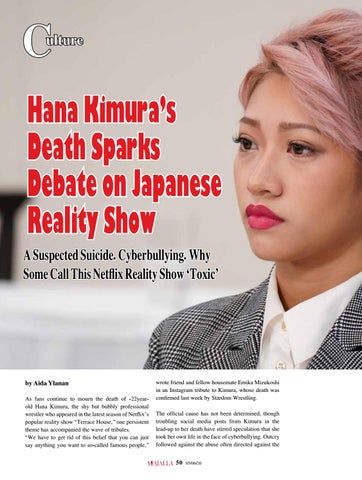
Hana Kimura’s Death Sparks De-
50 bate on Japanese Reality Show
Editorial
A Weekly Political News Magazine
www.majalla.com/eng The murder of George Floyd at the hands of a Minnesota police officer has caused waves of mass protests across the United States. Although this isn’t the first time an African American man faced police brutality, the fact that the video of the murder has been shared thousands of times across social media has helped the outrage spread across the nation. Moreover, the murder coincided with the COVID-19 pandemic which the Trump administration failed to respond to, and the average American is frustrated over the lack of healthcare provisions and the mass job losses that have recently reached 40 million due to business closures. As these protests spiralled in many major cities, they soon grew into riots. While history has shown that riots such as these tend to fizzle out in a few days, the demonstrators and rioters have thus far shown little signs of fatigue. Ali El Shamy writes this week’s cover story, which focuses on the history of the American police’s brutal practices towards African Americans, and how previous race related riots have carried out in the past. Moving on to another form of oppression across the Pacific, China has recently enacted a controversial new legalisation, which made it illegal to criticise Beijing in Hong Kong, potentially ending the city-state’s special autonomous arrangements. These arrangements gave Hong Kong the sovereignty to make its own laws, which Beijing could not oppose. The only aspects that the China had control over were Hong Kong’s foreign policy and defence. Since 2014, Beijing has slowly been eroding Hong Kong’s sovereign laws as it has sought to dissolve the city into full Chinese authority. Yasmine El-Geressi writes on these recent developments as she highlights how Beijing exploited the world’s COVID-19 distraction in order to make such a move. Farouk El-Baz is one of Egypt’s most renowned astronomers having worked in NASA’s Apollo missions for lunar exploration. Dalia Assem recently sat down with El-Baz as he spoke to her about the scientific estimate of when the world will come to an end, and the potential that space tourism has in the future. As the world emerges out of lockdowns, several countries are trying to find ways to adjust to a new normal. Sarene Al-Natour Zein writes on how different governments around the world have approached lockdowns and how they are currently approaching the first steps towards life after said lockdowns.
2
05/06/20
Editor-in-Chief
Ghassan Charbel Editorial secretary Mostafa El-Dessouki HH Saudi Research and Marketing (UK) Ltd 10th Floor Building 7 Chiswick Business Park 566 Chiswick High Road London W4 5YG Tel : +44 207 831 8181 Fax: +44 207 831 2310
الوكيل اإلعالني ،www.alkhaleejiah.com :موقع إلكتروني hq@alkhaleejiah.com :بريد إلكتروني + 9714 3 914440 : دبي،920 000 417 : من داخل اململكة +44 207 404 6950 : لندن+00764 537 331 :باريس +966 11 441 1444 : ومن مختلف الدول
- طريق مكة- حي املؤتمرات- مرخص لها الرياض تقاطع التخصصى +44 207 831 8181 : لندن- 4419933 هاتف:الرياض
S
napshot
Syrian artists Aziz Asmar and Anis Hamdoun finish a mural depicting George Floyd, an unarmed AfricanAmerican man who died while being arrested and pinned to the ground by the knee of a Minneapolis police officer, in the town of Binnish in Syria›s northwestern Idlib province on June 1, 2020. - Getty
4
05/06/20
5
05/06/20
S
napshot
Demonstrators confront secret service police and Park police officers outside in 2020 ,30 of the White House on May Washington DC, during a protest over the death of George Floyd, an unarmed black man, who died after a Minneapolis police officer kneeled on his neck for several minutes - Getty
6
05/06/20
7
05/06/20
W
eekly news
Trump Threatens Military Force .Against Protesters Across the U.S
Wielding extraordinary federal authority, U.S. President Donald Trump threatened the nation’s governors on Monday that he would deploy the military to states if they did not stamp out violent protests over police brutality that have roiled the nation over the past week. His announcement came as police under federal command forced back peaceful demonstrators with tear gas so he could walk to a nearby church and pose with a Bible. Trump’s bellicose rhetoric came as the nation braced for another round of violence at a time when the country is already buckling because of the coronavirus outbreak and the Depression-level unemployment it has caused. The president demanded an end to the heated protests in remarks from the
White House Rose Garden and vowed to use more force to achieve that aim. A military deployment by Trump to U.S. states would mark a stunning federal intervention not seen in modern American history. Yet the message Trump appeared to be sending with the brazen pushback of protesters outside the White House was that he sees few limits to what he is willing to do.
tween protesters and authorities raging in the United States, anti-police-brutality activists gathered by the thousands in support of the Black Lives Matter movement in various European and African cities. Peaceful protesters highlighted allegations of abuse of black prisoners by their jailers, social and economic inequality, and institutional racism lingering from the colonial pasts of the Netherlands, Britain and France. In Istanbul, more than 50 people clashed with police officers minutes after beginning a protest over Floyd and what they called police brutality in Turkey. In Nairobi, protesters at the American embassy held signs reading “Black Lives Matter” and “Stop Extrajudicial Killings”. In Spain, protesters will mark the death of Floyd and “all sisters and brothers who have died at the hands of institutional racism on our streets,” the African
Protests Over George Floyd’s Death Expose Raw Race Relations Worldwide
Images of a white police officer kneeling on the neck of African-American George Floyd, who then died, have sparked protests from Amsterdam to Nairobi, but they also expose deeper grievances among demonstrators over strained race relations in their own countries. With violent clashes be-
and Afro-descendant Community CNAAE said.
Leaked Documents Reveal China Withheld Crucial Information About the Coronavirus from WHO
Throughout January, the World Health Organization publicly praised China for what it called a speedy response to the new coronavirus and thanked the Chinese government for sharing the genetic map of the virus “immediately.” But in fact, Chinese officials sat on releasing the genetic map, or genome, of the deadly virus for over a week after multiple government labs had fully decoded it, not sharing details key to designing tests, drugs and vaccines. Strict controls on information and competition within the Chinese public health system were largely to blame, The Associated Press has found from internal documents, emails and dozens of interviews. Health officials only released the genome after a Chinese lab published it ahead of authorities on a virology website on Jan 11. Even then, China stalled for at least two weeks
8
05/06/20
more on giving WHO the details it needed, according to recordings of multiple internal meetings held by the U.N. health agency in January — all at a time when the outbreak arguably might have been dramatically slowed.
Saudi-Led Coalition Shoots Down Two Drones Launched by Yemen’s Houthis
The Saudi-led coalition engaged in Yemen shot down two drones launched in the direction of Saudi Arabia by the Houthi group, Saudi state news agency SPA reported, citing a coalition spokesman. The two drones were launched toward the border town of Khamis Mushait, SPA said, accusing Houthi forces of targeting civilian facilities and residential areas. The Houthis did not confirm the attacks. The group’s media reported dozens of air strikes on Sunday by the coalition’s warplanes against several provinces including Marib, where fighting has raged over the last three months. A unilateral ceasefire announced by the Saudi-led coalition in April expired last week without leading to a permanent truce, after the Houthi movement rejected the offer. Violence has continued in several provinces. However, missile and drone attack against Saudi cities have decreased significantly this year thanks to peace efforts led by United Nations’ special envoy Martin Griffiths and to indirect talks between the kingdom and Houthi officials
Army (LNA), which launched an offensive on Tripoli last year pledging to unite Libya after years of chaos. Continued Russian, Egyptian and United Arab Emirates support for the LNA means the Government of National Accord (GNA), which is recognised by the United Nations and backed by Turkey, has little hope of carrying the war into eastern Libya for now. But, with eastern forces withdrawing towards their northwestern stronghold of Tarhouna, the lines are being drawn for battles to come although both sides have agreed to resume U.N.-brokered ceasefire talks.
global vaccine alliance part-funded by Bill and Melinda Gates that for more than 20 years has developed and distributed vaccines in some of the world’s poorest countries for diseases such as malaria, cholera, measles and HIV/Aids. he UK alone has promised $1.65bn over the next five years. The US has set aside $1.2bn over three years, Norway $1bn and Japan $100m. The Gates foundation will unveil its contribution at the summit due to be attended by over 30 heads of state.
UK PM Johnson Hosts Global Vaccine summit, Calls for Funding Boris Johnson urges world leaders at a virtual summit to raise $7.4bn (£5.9bn) to distribute vaccines to combat infectious diseases in some of the poorest countries of the world over the next five years. Meeting the target, Johnson said ahead of Thursday’s summit, would show that humanity could finally come together on global health after months in which it has become contested diplomatic terrain, mainly between the US and China. The money will go to Gavi, the
More Large Protests in US but Vio� lence Falls Tens of thousands of people have demonstrated, mainly peacefully, across the United States for an eighth night following the death of African-American George Floyd in police custody. Tne of the biggest protests, joined by Floyd’s relatives, took place in his hometown of Houston, Texas. Many defied curfews in several cities, imposed after violence and looting in some districts on Monday night. The Floyd case has reignited deep-seated anger over police killings of black Americans and racism. Demonstrators have taken to the streets - not only to express their outrage at the treatment of Mr Floyd - but to condemn police brutality against black Americans more widely.
Eastern Forces Quit Libyan Capital After Year-Long Assault
Libya’s internationally recognised government regained control of Tripoli on Thursday, driving eastern forces out of the capital after a year-long battle in which foreign powers poured in arms and fighters. A military source with the eastern forces, whose base is in the eastern city of Benghazi, said they were pulling back from all of Tripoli’s suburbs. Government forces said they now held everything within the city boundary. It represents a stinging reversal for eastern commander Khalifa Haftar and his Libyan National
9
05/06/20
C
over story
Black America’s On-going Struggle with Police Violence From Slave Patrols to Mass Incarceration to Police Brutality
by Ali El Shamy On May 25, 2020, Minneapolis police arrested an African-American man named George Floyd. During the arrest, police officer Derek Chau-
vin put his knee on Floyd’s neck for 8 minutes and 46 seconds. Over this short period of time, Floyd started struggling to breathe and called out for mercy. Meanwhile, other police officers accompanying Chauvin stood by, allowing
10
05/06/20
During the eighteenth centuries, policing was an informal institution that was not government regulated and relied heavily on volunteer vigilantes. In the South, slave patrols consisting of white men were formed in order to keep an eye on black slaves and make sure they didn’t escape their owners
A crowd of people stands to watch the lynching by burning of Jesse Washington whose charred corpse leans chained to the trunk of a tree. Waco, Texas. - Getty
the first time riots have occurred following a brutal treatment of an African American, it is the first time that rioting has simultaneously taken place across many states. Moreover, while these protests and riots have happened in front of a backdrop of a brutal murder of a black civilian, there are many factors that have led to these current circumstances. First and foremost, there’s the Trump administration’s mishandling of the coronavirus pandemic, as its slow response caused more than 100,000 Americans to lose their lives. Meanwhile, busithe murder to unfold. The entire incident was ness closures that resulted from the pandemic caught on camera by on looking bystanders, have caused 40 million Americans to lose their and has been shared multiple times over social jobs. So to recap, the average American has media. The incident triggered mass protests all been unnecessarily exposed to the virus, and over the United States, as many of the country’s many have lost their source of health insurance. major cities were mired in demonstrators chant- Furthermore, millions are now at home bored ing Floyd’s last words: “I can’t breathe”. Even- without anything to do, and school/universities tually, many of the demonstrations escalated are approaching summer break. All these facinto riots, as groups such as ANTIFA and anar- tors pointed to a disaster waiting to happen, and chists started to destroy public property, while all that was needed now was a simple trigger some people used the chaos as an opportunity to kick start said disaster. While the events are to loot stores. The riots have had an extraor- in many ways unprecedented, this isn’t the first dinary effect on the government, as President time such riots happened. Trump took to twitter to threaten those taking part in the protests, and the National Guard was During the eighteenth centuries, policing was sent to some cities in an attempt to deescalate an informal institution that was not governthe situation. Moreover, many states cities such ment regulated and relied heavily on volunteer as Chicago, New York and San Francisco have vigilantes. In the South, slave patrols consisting issued curfews to demotivate the public from of white men were formed in order to keep an joining protests and/or riots. While this is not
11
05/06/20
C
over story
eye on black slaves and make sure they didn’t escape their owners. As some white families and individuals were aiding escaping slaves by hiding them in their homes, these slave patrols would search homes suspected of hiding slaves. When these patrolmen found slaves trying to escape, they would lash them as punishment.
These unjust laws became the background for the Civil Rights Movement of the 1960s, which gave rise to several African American activists such as Martin Luther King, Jr. and Rosa Parks. These activists would often hold marches or disobey unjust laws, and they would often be arrested for doing so.
After the Civil War had ended and slaves were emancipated, several states, particularly those in the South, enacted Black Codes which gave the newly freed slaves limited rights and effectively only granted former slaves low wage jobs. When the 14th amendment was passed to grant citizenship to former black slaves, many states began issuing Jim Crow laws, which attempted to circumvent the 14th amendment. Under the Jim Crow laws, public facilities in a state would be separate but equal. That meant that there would be segregated institutions for whites and blacks, but these institutions would be equal in quality. For instance, there would be schools exclusively for white children and schools exclusively for black children and although segregated, they would, in theory, provide the same quality of education. In practice, that wasn’t the case as facilities made for African Americans were often underfunded and as a result black Americans did not have the same opportunities presented to their white counterparts. As policing became more institutionalised in the nineteenth century, the unfair laws became engrained into American policing, and officers would arbitrarily target black Ameri-
12
05/06/20
Long Beach, CA: Policeman holds gun on African American rioters, circa 1965 (Getty)
Police and rioters clash in widespread riots that erupted after the acquittal of 4 LAPD officers in the videotaped arrest and beating of Rodney King on April ,29 1992 in Los Angeles, California. (Getty)
cans for miscellaneous reasons. In addition to institutionalized racism, AfricanAmericans would also be the target of public racial attacks, and in some cases blacks would lynched to death by white members of the public. What’s worse is that these lynchings would often go unpunished by authorities. In one infamous 1916 incident in Waco, Texas, a young black man named Jesse Washington was accused of raping and killing the white wife of his employer. Washington was subsequently arrested and was put on trial in front of a racially biased jury consisting of white jury members. The jury found him guilty, and he himself pleaded guilty. It should be noted that there are reports that indicate that he might have had learning difficulties so there was a chance that he might not have been fully aware of what was happening around him. In anyway, after the conviction, an angry mob formed in the courthouse and Washington was chained and paraded through the streets. The crowds then built a large bonfire under a tree, and Washington was lynched and repeatedly lowered into the fire for almost two hours, as such Washington was liter-
13
05/06/20
ally roasted to death. These unjust laws became the background for the Civil Rights Movement of the 1960s, which gave rise to several African American activists such as Martin Luther King, Jr. and Rosa Parks. These activists would often hold marches or disobey unjust laws, and they would often be arrested for doing so. Rosa Parks was famously arrested for riding in the front of a public bus in Alabama, a section reserved for white riders. Although the Civil Rights Act was passed in 1964, discrimination in policing still persisted. One of the earliest incidents of racially motivated mass rioting in the US happened in 1965 in Watts, a city in South Los Angeles. South LA had a large African American community and it suffered from several issues such as deteriorating schools and lack of government funding. Moreover, 2/3 of South LA residents lacked a high school degree and many were living in out-dated housing structures. These conditions reaped frustration and animosity among the residents. On August 11, 1965, an altercation between a black family and police as a young black man named Marquette Frye
C
over story
was pulled over for reckless driving and subsequently failed a sobriety test. When the man’s mother, Rena Frye, got involved Marquette became hostile towards police and eventually a fight broke out between the Frye family and the police. This fight drew in crowds, but eventually Marquette, his mother and half brother were arrested. Eventually word spread around about the arrest and a rumour also circulated alleging that the police were abusing Rena. This sparked the Watts riots as stores were looted, buildings were set ablaze and crowds threw objects at the police. The riots then spread throughout South
What distinguished the 1992 riot from that of 1965 was the fact that it seemingly displayed the tensions between the African-American community and another minority group, Korean-Americans.
LA, and police were forced to call on the services of the National Guard. The riots lasted until August 16, and 34 people died in the riots. In spite of these riots, many of these injustices remained unaddressed and in less than three decades later another riot would be sparked in Los Angeles. In 1991, a young AfricanAmerican man named Rodney King was caught speeding at the Foothill Freeway in LA, after a high speed police chase King pulled over. Four police officers subsequently beat up and tased King, however what they didn’t know was that a local resident was filming the incident nearby. The film footage was shown on TV news cycles, and caused a national stir. One year later, a trial was held on these four police officers and the jury was mostly made up of white Americans with a few minorities and only one half black man. The four officers were found innocent, triggering another series of riots in LA. What distinguished this riot from the previous one is the fact that it seemingly displayed the tensions between the African-American community and another minority group, KoreanAmericans. Despite the fact that they were a minority group, Korean migrants who came
14
05/06/20
Korean storeowners defend their property as gunfire breaks out in Koreatown at Western Avenue and 5th Street in Los Angeles, California. (Getty)
Demonstrators and police face off on the sixth consecutive day of protests over the death of George Floyd, an unarmed black man who died last week after being pinned down by a white police officer in Minneapolis on June ,3 2020 in Washington, DC, United States. (Photo by Yasin Ozturk/ Anadolu Agency via Getty Images)
to LA in the 1960s were able to start marginal businesses such as opening corner stores and liquor shops. However, by the 1980s, they had emerged as a model minority as their children began to move up the social ladder and attain higher education and better jobs. This brewed animosity and cultural misunderstanding between the African-American community and the Korean-American community, which spiralled during the riots. The fact that prior to the riots, a Korean-American storeowner had shot dead a black child after suspecting her of shoplifting didn’t help matters. During the riots, Korean owned stores were targeted by looters, and what made matters worse is that the police did little to help shop owners. Instead, Korean business owners had to fend for themselves and many gunfights happened between black rioters and Korean storeowners. While the police and National Guard were on duty in LA, they prioritised protecting affluent white neighbourhoods, while the riots went on for about a week causing 63 deaths. Eventually, the National Guard did make its way to Koreatown, but so much damage to livelihoods had already occurred by then. One year later, another trial was held on the police officers, and two out of the four cops
15
05/06/20
were given prison sentences. Police brutality against African Americans wouldn’t improve in the coming years; in 1994, then President Bill Clinton enacted the Violent Crime Control and Law Enforcement Act. This new law had indirect negative effects on communities of colour in the United States, for instance the new bill had called for harsher sentences for youth convicts believed to be members of a gang. Because law enforcement reports indicate that 90 per cent of gang members are of minority backgrounds, the police have become more encouraged to target black and ethnic youths on the ground that they might be part of a gang. Furthermore, recent movements such as Black Lives Matter are evidence that police encarcaration and brutality towards African-Americans is still a massive problem that American society and lawmakers have failed to address. History has shown that riots have a tendency to fizzle out and things tend to go back to the way things were, however this time the riots are not centred in one state or city. Nevertheless, it is still too early to tell if this nationwide spread of protest and civil disobedience will result in any concrete changes.
I
nterview
Egyptian Apollo Astronaut Farouk El-Baz to Majalla: The World Will End in 500 Million Years
The noted scientist and geologist answers questions on the latest developments in space and astronomy and the impact of the coronavirus pandemic on our planet Cairo: Dalia Assem Dr. Farouk El-Baz is an Egyptian-American space scientist who worked with NASA to assist in the planning of scientific exploration of the Moon, including the selection of landing sites for the Apollo missions and the training of astronauts in lunar observations and photography. El-Baz previously served as science advisor to Anwar Sadat, then president of Egypt. He is the author or editor of landmark books on the use of space photography to define geological features and has chaired several scientific committees. He has won numerous awards and honors such as NASA’s Apollo Achievement Award and recently had a newly discovered asteroid named after him by the American space agency in honor of his outstanding contributions to Science. The Geological Society of America has established an annual prize called the Farouk El-Baz Desert Research Award. The noted geologist, who was nicknamed “the king,” in honor of the Egypt’s King Farouk while training astronauts for the moon landing, is currently Director of the Center for Remote Sensing and Research Professor at Boston University; his research has
resulted in important advances in archaeology, geology, and geography. I spoke with El-Baz about the latest developments in space and astronomy, humanity›s future in space and the impact of the coronavirus pandemic on our planet. Q. There have been reports recently that planet Earth is entering a period of «catastrophic solar hibernation» and that we are on the brink of an ice age. Is this true? The planet is not in danger. There is a theory that if the sun stopped moving completely, everything that is orbiting it would be subject to destruction, which would be the end of the universe as we know it. At the same time, there is no reason for the sun to stop moving as it has not changed since its creation 4.5 billion years ago. Q. What is this phenomenon and does it have a scientific basis? We know that suns - which are stars - are born to grow and live, and then die. This means that they all follow the same life cycle, regardless of how long they live. According to observations by astronomers,
16
05/06/20
it is understood that our sun will expand in size in 50 thousand years, just like other stars from far away galaxies. Of course, during that time, there will be no life on planet Earth. This is only in the hands of God Almighty. Q. According to Islam, the sun will rise from the west before the Day of Judgment. Are there any signs that this could happen? What could pave the way for this astronomically? According to science, the world will come to an end in 500 million years. This is based on how long astronomers predict it will take the sun to reach the Red Giant phase of its evolution. As a Red Giant, the sun will grow so large that it will fill half of the earth’s sky and scorch everything on the planet. It will then shrink significantly to a size invisible to the naked eye as it evolves into a White Dwarf. This will probably occur in about 500 billion years. A White Dwarf is sometimes referred to as “the invisible” as it so dense that not even light can escape it. These astronomical theories have no definite proof, but they try to explain what
17
05/06/20
The door is open for a revival of space tourism and possibly future tourism to the moon. As for human colonies on Mars, this will not begin until the trips to the moon are almost normal and financially feasible. astronomers see in the vast universe that only God knows of. Q. Can the Earth›s magnetic field weaken for any reason? Never before has the Earth›s magnetic field weakened, but a change in the location of the Earth›s
spin axis may alter the position of the magnetic north. However, this change would not affect life on Earth. Some magnetic metals have demonstrated a shift in the direction of the magnetic north during the rotation of the Earth. Q. Have the environmental impacts of the coronavirus affected the earth’s atmosphere and helped to heal the Ozone hole? Coronavirus alone does not affect the earth and its
I believe that the ‘Cold War’ between the world›s great powers does not extend beyond the Earth›s atmosphere and space will continue to represent an area of cooperation and negotiation.
environment. It will only impact the environment if human behaviour shifts and causes a change in CO2 emissions and green gases responsible for the increase in the earth›s temperature. Q. Has the pandemic affected the NASA’s space tourism and Mars colonization projects? No, Coronavirus has not affected NASA’s programs yet; neither has it affected astronauts who are being prepared to be sent to outer space soon or the production of the new spacecraft by by SpaceX. Future trips to space will be on board space vehicles made by the American private sector. In addition to that, since the end of the American space shuttle’s flights (April 1981 to April 2011), American astronauts have been travelling to the International Space Station orbiting the Earth on a Russian shuttle at a cost of 70$ million per person. For this reason, the American private sector began developing aircrafts to carry astronauts to the Earth’s orbit. This means that the door is open for a revival of space tourism and possibly future tourism to the moon. As for human colonies on Mars, this will not begin until the trips to the moon are almost normal and
18
05/06/20
financially feasible. Q. We recently read about the discovery of a new black hole. Is this true? Yes. A new black hole has recently been discovered. Astronomers believe that black holes will increase in number as the technology used to photograph the vast universe advances. Q. NASA set the stage for a global debate over the fundamental principles that will govern humanity›s return to the moon, as it released the main tenets of an international pact for moon exploration called the Artemis Accords. Could wars such as the ongoing ‘Cold War’ between China and America extend into space? Are there clashes between the two nations over space presence? Space exploration represents an area of cooperation between countries, for example, despite the USChina coronavirus feud, the two nation continue to cooperate and exchange information on China›s mission to the moon. Therefore, I believe that the ‘Cold War’ between the world›s great powers does not extend beyond the Earth›s atmosphere and space will continue to represent an area of cooperation and
19
05/06/20
negotiation. Another example; during my participation in the Apollo mission, we were racing against Russia with all our might and won the bet by getting the first man on the moon before the Soviet Union. As soon as the Apollo program ended, and Russia accepted America›s victory, NASA sent me and five scientists to Moscow to consult with the Russians on how to collaborate to produce a map of the moon that combined images from American and Russians missions. Although our trip to was not fruitful, it ignited the possibility of space cooperation between the eastern and western camps, that was in December 1973. Q. The Daily Star newspaper reported that NASA scientists have detected a parallel universe where time runs backwards and the rules of physics operate in reverse. Is this true? I have not heard about this from the scientific community, so I cannot comment on it. Maybe you can ask a physicist about this, and if you get an answer, I will be very happy if you tell me about it.
P
olitics
China Flexes its Legal Muscles in Hong Kong Potentially Ending its Unique Status
Trump’s Rebuke Curtails Ties to Hong Kong but Does Little to Blunt Beijing’s Influence
by Yasmine El-Geressi With the world distracted by covid-19, China has been advancing its regional ambitions through a series of aggressive
actions across Asia in recent weeks. The moves were capped on May 21 when China stripped away a layer of Hong Kong’s autonomy by announcing a new national-security legislation which would make it a crime to undermine Beijing’s author-
20
05/06/20
ity in the territory – potentially ending Hong Kong’s unique status. Beijing is now facing mounting worldwide condemnation and a wave of anti-mainland protests.
WHAT IS IN THE NATIONAL SECU?RITY LEGISLATION The National People’s Congress gave the new security law which was drafted in secret the green light last week and it is due to be enacted before September. Full details about exactly what behaviour will be outlawed are not yet clear as it is yet to be drafted, but it is expected to criminalise secession (breaking away from China), subversion (undermining the power or authority of the central government), terrorism (using violence or intimidation against people) and foreign interference (activities by foreign forces that interfere in Hong Kong).
Pro-democracy protesters are arrested by police in the Causeway Bay district of Hong Kong on May 2020 ,24, ahead of planned protests against a proposal to enact new security legislation in Hong Kong. (Getty)
Experts say that China’s the latest provocative move undermines the city’s freedoms by giving Beijing a new tool with which to crack down on protesters and dissidents and push forward education that trumpets the successes of the Communist Party - as happens in mainland China. For example, China jailed Nobel Laureate Liu for 11 years for subversion after he co-authored a document calling for political reform. Beijing has also frequently referred to Hong Kong’s sometimes violent pro-democracy protests as the work of “terrorists.” Moreover, the new law could also see China installing its own security and intelligence agencies on Hong Kong’s soil for the first time. Hong Kong currently has its own police force and independent judicial system. China’s People’s Liberation Army keeps a garrison in Hong Kong, but it must abide by Hong Kong’s laws. That could all change if the new national security law is enacted. The erosion of Hong Kong’s autonomy will likely hurt the business and financial community, as well as damage educational and social systems and the media. There will be an especially heavy toll on younger generations for economic and political reasons. Prodemocracy lawmakers, diplomats, and many of the city’s 7.4 million residents were stunned when the new legislation was approved and are left questioning Hong Kong’s future.
CORONAVIRUS: AN OPPORTUNITY FOR AGGRESIVE DIPLOMACY This is the most flagrant violation of Hong Kong’s treasured autonomy guaranteed by the 1997 “one country, two systems” Sino-British Joint Declaration under which it was returned to China from the UK. Article 18 of Hong Kong’s Basic Law – the territory’s de facto mini-constitution that
21
05/06/20
Beijing is using the coronavirus pandemic to advance its regional ambitions, not only because the world is distracted, but also because the arrival of COVID19- has given China and the Hong Kong government some relief from the protests. came into effect after the British handover– specifically limited Beijing from applying national laws to the territory, except in matters of defence and foreign affairs. But as China’s economic and military might grew, so did fear that Hong Kong’s significant autonomy could erode. The years since 1997 have been marked by sniping attacks on Hong Kong’s legal system, chipping away at what Hong Kongers see as the territory’s core value: the rule of law. Its independent judges have been termed “administrators” who must toe the party line. Retiring judges have spoken of the impending demise of the rule of law. The NPC decision accelerates all that. It not only authorises the standing committee to draft such a law, it allows the law to be inserted into Hong Kong’s Basic Law by decree. In recent years, Hong Kong has seen many protests to push back on what many people see as China’s interference in their autonomous affairs. The Umbrella Movement in 2014 brought parts of the city to a standstill for months as thousands of Hong Kongers demanded more free elections. Huge protests were revived again last year after proposed changes to an extradition law, which could potentially have seen people wanted for crimes transported to mainland China for trial. The massed ranks of para-military police, equipped with tear gas, pepper spray, water cannons and rubber bullets, openly fought protesters on the streets. Though China has failed to pass this law through its allies in Hong Kong, it is feared that this new legislation is an attempt to bring this sort of action under the thumb. Beijing maintains the inability of the Hong Kong government to deal with months of often-violent pro-democracy protests means that Beijing must step in. Chinese authorities view the protests in Hong Kong as a direct threat to the CCP’s autocratic system and they portray the protests as a foreignbacked plot to destabilise the motherland. The CCP appears to have calculated that unless it halts protests by the increasingly dissatisfied Hong Kong population, local affairs will
P
olitics
get out of hand. Moreover, Hong Kong’s democratic electoral government has continued to progress despite Beijing’s maneuvers. Minority democratic politicians in Hong Kong’s Legislative Council have stalemated pro-government legislation. And in light of their overwhelming victory in district elections last November, democratic candidates could win a majority in September’s Legislative Council elections. The timing of the move is noteworthy. Beijing is using the coronavirus pandemic to advance its regional ambitions, not only because the world is distracted, but also because the arrival of COVID-19 has given China and the Hong Kong government some relief from the protests. Now that social distancing is diminishing, fears of renewed rallies against them are growing. Beijing has used this opportunity to undertake aggressive actions elsewhere in Asia, too. Chinese maritime surveillance vessel rammed a Vietnamese fishing boat near islands in the disputed South China Sea, sinking it. Off the coast of Malaysia, in the country’s exclusive economic zone, a Chinese survey vessel in the South China Sea, accompanied by coastguard and fishing ships—likely part of China’s maritime militia, civilian vessels marshaled by Beijing in times of need— began survey work near a Malaysian oil rig. Three American warships and an Australian frigate conducted a joint exercise near the site of Petronas’ operations amid the standoff last month. Beijing then announced the establishment of two new administrative structures on islands in the South China Sea that are also claimed by Vietnam. The idea behind the new districts is to make administrative control in the area more effective, which can facilitate the building of additional infrastructure and enhance China’s military presence in the area.
US RESPONDS TO CHINA WITH RESTRAINT The US Congress responded to last year’s events by passing
The years since 1997 have been marked by sniping attacks on Hong Kong’s legal system, chipping away at what Hong Kongers see as the territory’s core value: the rule of law.
the Hong Kong Human Rights and Democracy Act. That law requires the US secretary of state to certify every year that Hong Kong remains autonomous, which is a precondition for the US to continue its preferential economic relationship with Hong Kong. In response to the CCP’s latest move, Secretary of State Mike Pompeo notified Congress claimed the NPC’s decision means Hong Kong is no longer politically autonomous from the mainland. Pompeo’s certification gave the president and secretary of state the ability to impose consequences including targeted sanctions, new tariffs and further restrictions on Chinese companies. Trump said sanctions would be imposed on Chinese and Hong Kong officials who were believed by Washington to be involved in eroding the territory’s autonomy but did not outline what form these sanctions would take. The State Department, he added, would revise its travel advisory for Hong Kong in light of “increased danger of surveillance” from China. The president also said the US would suspend the entry of foreign nationals from China identified by the
22
05/06/20
Umbrellas are opened as tens of thousands come to the main protest site one month after the Hong Kong police used tear gas to disperse protesters October ,28 2014 in Hong Kong. (Getty)
While Removing Hong Kong’s special privileges sends a strong warning signal to China and adds a new edge to the deteriorating US-China relations, Trump stopped short of fully escalating relations between the two nations. fully escalating relations between the two nations. Financial markets saw Trump’s announcement as more bark than bite and U.S. stocks finished mostly higher as it was seen as less threatening to the U.S. economy than investors had feared. Thus, many observers have wondered if the U.S. might end up hurting the very people they were trying to help far more than China, while inadvertently accelerating Hong Kong’s loss of autonomy.
US as potential security risks which could affect thousands of graduate students. These moves will harm Hong Kong’s special trading status with the US. While how much of its special status will be lost and how quickly any changes will take effect remains to be seen, the territory now appears to be on the cusp of having its status in the world change more fundamentally than it did with the handover from Britain in 1997. Experts warn that ending the special trading relationship that has existed for decades would carry costs for the more than 1,300 U.S. firms that have offices in Hong Kong and provide about 100,000 jobs, and would rattle an already fragile global economy while threatening Hong Kong’s standing as an international financial hub. While Removing Hong Kong’s special privileges sends a strong warning signal to China and adds a new edge to the deteriorating US-China relations, Trump stopped short of
23
05/06/20
Throughout the protests in Hong Kong last year, the US was consistent in its support of people’s right to take to the streets and have their voice heard. Their support was gladly accepted in Hong Kong, where some protesters last year took to flying the US flag and calling for Trump himself to intervene as they lobbied for the passage of a bill in support of the city’s political freedoms. But Experts say that the ability of Washington to influence Beijing’s position on Hong Kong – which was already severely limited - has been hurt even more by the Trump administration’s reaction to widespread unrest and public anger at home in the wake of the death of George Floyd, an unarmed black man, at the hands of a police officer in Minneapolis. This has created an awkward situation for the U.S. Hua Chunying, a spokeswoman for China’s foreign ministry, tweeted “I can’t breathe” -- among the final words uttered by Floyd before he died -- along with a statement by the US State Department on Hong Kong. Hua, one of a new breed of increasingly vociferous Chinese diplomats, also shared an article by RT, the Russian state-run broadcaster, accusing the US of hypocrisy for its reaction to the respective protests. Then, Carrie Lam, the chief executive of Hong Kong, accused the U.S. of “double standards” in its response to violent protests and new national security laws planned for the territory, and warned that Washington’s plan to sanction the city would only damage its own interests.
P
olitics
The Pandemic Does Not Spell the End for Cities Urban Planners Should Embrace—Not Fear—Density 24
05/06/20
As dense urban areas such as New York City have become hot spots of COVID19-, the disease caused by the novel coronavirus, countless articles have decried density as causing or exacerbating the rampant spread of the virus. goods—parks, transit, libraries, and beaches. The great North American urban project of the past century has encouraged people to trade backyard pools for public pools; a long commute in a car for a short one on a subway or bike; the reprieve of one’s own garden for shared plazas, squares, and other urban landscapes; solitude for access to the spectacle of sport, art, and culture. The coronavirus complicates such collective spaces and activities, leading some to prognosticate that the urban project has come to an untimely end: a concerted retreat from North America’s cities is imminent, news media and real estate agents increasingly predict.
People shop at Ridley Road market in Dalston as social distancing markers are set out on the floor on June 2020 ,01 in London, England. (Getty)
by Jennifer Keesmaat The novel coronavirus pandemic threatens to upend urban life as we know it. Metropolises such as New York City have ground to a halt while grappling with high rates of infection. The requirements of social distancing are harder to follow in cities than they are in places where people live in larger homes or drive cars. Some city dwellers have fled or plan to leave soon. The new normal seems to cut against the very ethos of dense urban centres. Cities bring people and their activities close together. They rely on shared public space and
25
05/06/20
But the obituaries are premature. Cities will remain vibrant and dynamic centres of economic and cultural activity. The density that supposedly made them vulnerable to the pandemic does not have to be their undoing. City planners just need to take a lesson from this experience and work to make cities dense in the right ways: by avoiding overcrowding, minimizing car use, and building inclusive communities with affordable housing. When the pandemic is long gone, density and good urban planning will continue to deliver on the great promises of the city in the twentyfirst century.
THE DENSITY MYTH As dense urban areas such as New York City have become hot spots of COVID19-, the disease caused by the novel coronavirus, countless articles have decried density as causing or exacerbating the rampant spread of the virus. Commentators have gone so far as to suggest that the pandemic could put an end to the “rise of cities” and compel many urban residents to move to smaller towns and
P
olitics
suburban or rural areas. But density in and of itself does not condemn cities to high rates of infection. New York City is, of course, extremely dense compared with most other U.S. cities, but dense cities elsewhere in the world have dealt with the coronavirus much more successfully. Hong Kong, Seoul, Singapore, and Taipei—to pick just a few—have seen many fewer infections and deaths. New York City, with a metropolitanarea population of nearly 21 million people, has reported more than 200,000 cases of COVID19- and more than 20,000 deaths, while Seoul, which has a metropolitan population of more than 25 million, has reported just 735 cases of COVID19- and four deaths as of May 16. Both New York and Seoul are dense cities, but their responses to the virus couldn’t have been more different. In South Korea, authorities acted swiftly and decisively to contain the disease. Their American counterparts did not. Even within the United States, density doesn’t determine how badly the virus strikes communities. Yes, New York City has the highest number of cases per 100,000 people of any metro area in the country. But a number of significantly less dense U.S. cities, including Buffalo, Detroit, Hartford, and Indianapolis, also appear near the top of the chart. Moreover, at least 40 percent of large U.S. cities have higher rates of reported cases per capita in their less dense suburbs than in their denser urban cores. Rates of infection have more to do with factors such as public health preparedness than with the sheer number of people per square kilometer. For centuries, the popular imagination has held dense cities
Both New York and Seoul are dense cities, but their responses to the virus couldn’t have been more different. In South Korea, authorities acted swiftly and decisively to contain the disease. Their American counterparts did not.
to be cesspools of disease. But modern urban lifestyles are actually often healthier than their counterparts in suburbs and rural towns. Urban residents in North America have lower rates of obesity and mortality than people who don’t live in cities. Compared with suburban residents, they are less likely to be sedentary and depend less on cars, often walking to work or using public transit in preference to driving. Cities by design require their residents to be physically active—and that activity, in turn, lowers residents’ risk of heart disease, arthritis, and diabetes. Understandably, the novel coronavirus currently subsumes all discussion of public health. But the single-minded focus obscures a bigger picture. Americans in fact tend to live longer, healthier lives in cities. Rural communities in the United States typically report shorter lifespans as a result of higher rates of respiratory and cardiovascular diseases, some cancers, diabetes, and Alzheimer’s disease, among other afflictions. The divide is widening: a 2019 report published in the American Journal of Public Health found that the disparity in mortality rates between rural and urban communities increased from roughly 77 excess deaths per 100,000 people in 2004 to 135 deaths per 100,000 in 2016.
26
05/06/20
A man sits on empty benches in the stands during morning training at Belmont Park on June 2020 ,01 in Elmont, New York. Horse racing had stopped operations in New York due to the coronavirus COVID19pandemic and has been cleared to resume racing on June 3rd, 2020. (Getty)
suburbs of single-family homes surround a high-rise city centre. More than a quarter of the land area of a typical North American city is reserved for the moving and storing of cars. It is a flawed design, often resulting in crowding in city centres. Dense cities do not have to live at the extremes of elevation and spread. Some of the most dense metropolises in the West—Barcelona and Paris come to mind—consist predominantly of mid-rise buildings. The COVID19pandemic should jolt U.S. cities to more intelligently allocate precious public space. Already, many cities have tested schemes that close streets to car traffic, widen sidewalks to make room for physical distancing, and make more space available to pedestrians and cyclists. These steps underline how the misallocation of space—not the bare fact of density—creates overcrowding. When cars are not in use, the space for people in cities is plentiful. On many city streets, for example, parking typically takes up the curb lanes on both sides—even when there is enough parking in the surrounding area. Unnecessary parking could be immediately repurposed as a bike lane or an expanded sidewalk. Using that space properly makes all the difference between overcrowding and “good density”—one in which buildings and activities are clustered in relative proximity, supported by exceptional public transit, safe sidewalks, parks, and cycling routes.
GOOD DENSITY Infectious diseases do spread easily among people who are clustered together in close quarters. Such conditions are not, however, the necessary byproduct of urban density. Density should not be confused with “overcrowding,” which is neither inherently nor solely an urban condition. Overcrowding can happen in all kinds of contexts—say, in prisons, meatpacking plants, and senior centers—regardless of geographic location. If North American cities are often overcrowded, it is because they have allocated space poorly, prioritizing cars over people. Although many cities have downtowns where residents tend to walk or bike, they often have less dense suburban peripheries where residents drive. Even New York City, which is generally denser than its American counterparts, exhibits this dynamic, with many neighborhoods in Queens, Staten Island, and other outer boroughs poorly served by public transport and reliant on car use. North American city planning has long embraced the extremes of “tall and sprawl,” in which low-density
27
05/06/20
When a dense city still encourages driving, it crams people into smaller and smaller remaining public spaces. Pedestrianonly zones, for example, are really efficient ways to move residents through cities, because without vehicles people don’t take up that much space. Less congested cities will better cope with the threat of future pandemics. Affordable housing, wide sidewalks, an abundance of park space, and access to nature, schools, and other neighbourhood institutions within walking distance of residents’ homes— all of these are also elements of good density. To the extent that they promote inclusive, physically active communities relatively free of stress, all are also integral to the long-term public health of city life.
MASS TRANSIT IS ESSENTIAL The pandemic has inspired some cities to make changes that may lead to meaningful and lasting transformations. Milan, for instance, has made formerly busy streets into pedestrian thoroughfares during the pandemic and has now announced ambitious plans to make those changes permanent. Doing
so will be good not only for the city’s quality of life but also for its carbon emissions. Before the pandemic, many cities fixated on figuring out how to move more cars around more quickly. Some considered autonomous vehicles as a possible solution to traffic congestion. The pandemic has instead encouraged cities to adapt roadways for walking and cycling—a much cheaper and comparably effective way to move more people through the city. The most effective and scalable way to move high volumes of people through dense urban environments has always been public transit, and these systems remain vital to urban life. Indeed, one lure of cities in the West is that they allow residents to live without the burden of owning a car. The
Making cities more walkable and bikeable will also make them more resilient, but they will still need public transit.
clustering of people creates the critical mass to support high-frequency transit, which along with walking and cycling offers an affordable and low-carbon lifestyle. Thriving, dense cities will become unviable without public transportation. But the pandemic has disrupted mass transit in cities such as New York, where rates of bus and subway ridership have plunged, both because people are staying at home during the lockdown and because many who do venture out try to avoid crowds. Public transit agencies in many cities face extraordinary dual crises of both confidence and financial sustainability. New York’s Metropolitan Transportation Authority must reckon with a shortfall of 8.5$ billion. Making cities more walkable and bikeable will also make them more resilient, but they will still need public transit. After the pandemic passes, governments will have to make major investments in these systems if they are to regain ridership and recover from their losses. Adding new routes—including “relief routes” to reduce overcrowding on the busiest lines—and taking other steps to reduce overcrowding on buses, streetcars, and subways will help restore riders’ confidence. Cities can take several protective
28
05/06/20
Buddhist followers wearing face masks attend a celebration ceremony for Buddha’s Birthday at Jogye temple in Seoul on May 2020 ,30. - The celebration event for Buddhas Birthday, originally set for April 30 this year, was delayed until May 30 due to the coronavirus outbreak. (Getty)
A woman holding roses sits on the Barceloneta Beach boardwalk in Barcelona on May ,30 2020 as the country begins to loosen a national lockdown to prevent the spread of the novel coronavirus. (Getty)
measures to make transit safe and to encourage riders to return, including more aggressive sanitization of buses and trains, ensuring proper protective gear for transit workers, noninvasive temperature checks of passengers (as is being done in Taipei), and mandating riders to wear face coverings. If there was ever a question of mass transit’s value, the pandemic should have answered it: cities such as New York have depended on buses and subways to ferry their essential workers, including nurses, cashiers, and delivery people, to their jobs every day.
MORE DENSITY, BETTER DENSITY Density does not necessarily precipitate overcrowding, except where cities have failed in their design. City leaders can still correct the mistakes of the past and reclaim space in service of their residents’ health. Anne Hidalgo, the mayor of Paris, recently ran for reelection on the pledge of turning the French capital into a “-15minute city,” in which residents can meet all their work, shopping, and leisure needs within a short walk or bike ride. North American cities should follow this vision. By adding gentle residential density—for example, through laneway housing and multifamily
29
05/06/20
walkup apartments in what are currently predominantly single-family-home neighborhoods—and by loosening municipal zoning regimes that typically separate commercial and residential areas, cities can become more tranquil, more interesting, and more sustainable. They can grow richer with commercial and cultural activity without being overcrowded. Revisiting land-use restrictions is essential, even if changing them provokes opposition. Rezoning may have the added benefit of encouraging people to get around without cars: in a -15minute city, far more people will be able to walk or bike to pick up milk from the grocery store or drop off their kids at a community center. The pandemic has shown that the planning decisions allocating public space—for roads, parks, buildings, and everything in between—are inextricably linked to public health and happiness. American cities can continue to grow ever more sprawling, unsustainable, and vulnerable to infectious disease. Or they can strive to become more connected, more livable, more sustainable, and less crowded—models of density done right. This article was originally published on ForeignAffairs.com.
P
olitics
Libyan Army Retakes Tripoli Airport as Warring Parties Resume Truce Talks Warplanes Strike New Battlefield Gharyan in First Use of Air Power by Eastern Forces Since US Accused Russia of Deploying Fighter Jets 30
05/06/20
by Yasmine El-Geressi Libya’s internationally recognised government took control of Tripoli international airport on Wednesday, all but driving Field Marshal Khalifa Haftar’s Libyan National Army (LNA) from the capital following a string of significant losses in western Libya ahead of what appeared to be moves towards talks on a truce. Fayez al-Serraj’s Government of National Accord (GNA) said its forces had captured the airport and pushed the LNA into the neighbouring Qasr Ben Gashir district. An LNA military source confirmed its forces had withdrawn and the GNA controlled the airport. The announcement came a day after the UN announced that the country’s warring sides agreed to resume ceasefire talks. Libya has been without central government authority since 2011, with towns and cities controlled by factions fighting for rival governments set up in the east and the west since 2014 in a sometimes chaotic war that has drawn in outside powers and a flood of foreign arms and mercenaries.
Members of Libyan army celebrate after recapturing Tripoli airport from warlord Khalifa Haftar’s militias in Tripoli, Libya on June 2020 ,03. (Getty)
Haftar, the most powerful figure in the east, launched an offensive to capture the capital Tripoli in April 2019 but it stalled within months. This week’s developments in the complex conflict follow a month of gains for the GNA. Backed by Turkish air defences and drone strikes, Serraj neutralised LNA air power and advanced rapidly against Haftar’s forces, which have been backed by Russia, Egypt and the United Arab Emirates. The GNA have successfully retaken several towns in the northwest and a strategic airbase near the Tunisian border, driving the LNA from much of its foothold.
NEW OFFENSIVE ON LIBYA’S GHARYAN With the LNA driven from almost all its ground in the capital, the next big battle likely to focus on the areas to the south and southeast of Tripoli around Gharyan, held by the GNA, and Tarhouna, a town that lies around 90km (55 miles) south-east of the capital held by the LNA and controlled by a militia known as al-Qaniyat, mainly made up of men previously loyal to the Gaddafi regime. This week, the LNA renewed its offensive in mountain
31
05/06/20
Haftar’s first success in recent weeks as the LNA begins to reformulate its strategy after pulling troops from the Tripoli frontlines broadly reflects the seesawing nature of the war. regions, conducting extensive aerial attacks on positions held by forces aligned to the GNA and advancing towards the strategic town of Gharyan which it lost almost a year ago. Haftar’s forces retook the town of Asabiah, lying around 15km southwest of Gharyan, on Monday. A source close the general said that he had given orders for regaining control of Gharyan before October this year. Haftar’s first success in recent weeks as the LNA begins to reformulate its strategy after pulling troops from the Tripoli frontlines broadly reflects the seesawing nature of the war.
CEASEFIRE TALKS RESUME There was a burst of diplomacy on Wednesday as leaders from both sides travelled abroad for meetings hosted by the foreign powers embroiled in the conflict. GNA Prime Minister al-Serraj travelled to Ankara late on Wednesday, Turkish broadcasters reported. Meanwhile Haftar travelled to Egypt to meet defence officials, a source close to him said. Meanwhile, the United Nations said its top envoy in Libya held talks on Wednesday with a delegation from Haftar’s forces to follow up on the agreement by the country’s warring parties to resume cease-fire negotiations, calling it “a positive step.” All previous attempts at a cease-fire, most recently in January on the occasion of a conference in Berlin, have failed. In February, when talks were suspended, the rival camps had agreed to negotiate a “permanent ceasefire” under a joint GNA/pro-Haftar military commission.
P
olitics
The U.N. Mission in Libya expressed they hope the talks would “mark the beginning of calm on the ground” and allow the country’s war-scarred health system to cope with the coronavirus outbreak in the country. The virus has infected at least 168 people in Libya, but testing is extremely limited. The impact of a large outbreak would likely be severe given the continued fighting and the state of the country’s health system. U.N. spokesman Stephane Dujarric said acting special representative Stephanie Williams would hold a similar video meeting with a delegation from the U.N.-supported government in the capital of Tripoli “in the coming days.” Dujarric called the meetings with the two delegations “first steps ... in the right direction.” “We will continue pushing and working with the parties ... to alleviate some of the suffering of the Libyan people,” he said. “To say that the situation on the ground, the violence and the political situation, is complex would be the understatement of the year.” Dujarric said negotiations on a cease-fire agreement and technical arrangement will continue on the basis of a draft presented to both sides by Libya’s U.N. Mission on February 23. Egypt and the UAE have said they welcome the announcement that warring factions in Libya have agreed to resume ceasefire negotiations. The joint statement by the Egyptian and Emirati foreign ministries “called for parties to fully commit to the political process under the auspices of the UN and the Berlin conference”.
On Wednesday, an LNA military source said warplanes had struck near Gharyan, the first acknowledged use of warplanes by eastern forces since Washington said Russia had supplied the new MiG 29 and Su24- jets.
France’s foreign ministry welcomed the agreement and said it “intends to do everything in its power to bring about an immediate resumption of discussions and the swift signing of a ceasefire agreement.” “The worst scenario would be a Turkey-Russia deal imposing their conditions,” said a top French official, speaking anonymously under the French presidency’s customary practices. “What we seek is not the victory of one side over another, but political negotiations and resource sharing.”
GROWING CONCERNS OVER RUS� SIAN INVOLVMENT U.S. and Libyan officials have accused Russia of deploying fighters from the Wagner Group in key battleground areas in Libya. Last month, the U.S. military accused Russia of 14 MiG 29 and Su-24 fighter jets to the
32
05/06/20
Smoke fumes rise above buildings in the Libyan capital Tripoli on May ,9 2020. (Getty)
LNA’s Jufra air base in central Libya, saying the move was part of Moscow’s longer term goal to establish a foothold in the region that could threaten NATO allies. According to a leaked UN report, the Russian private military contractor deployed about 1,200 mercenaries to Libya to strengthen Haftar’s forces. They have been identified by their equipment, typically reserved for Russia’s armed forces. UN monitors said more than two dozen flights between Russia and eastern Libya from August 2018 to August 2019 by civilian aircraft “strongly linked to or owned by” Wagner Group - or related companies. Across the Wagner Group, personnel are predominantly Russian, but also include citizens of Belarus, Moldova, Serbia and Ukraine, the UN report said. Moscow and the LNA denied this, although the LNA says it has refurbished some old Libyan planes and is preparing a new air campaign.
33
05/06/20
There was a burst of diplomacy on Wednesday as leaders from both sides travelled abroad for meetings hosted by the foreign powers embroiled in the conflict. On Wednesday, an LNA military source said warplanes had struck near Gharyan, the first acknowledged use of warplanes by eastern forces since Washington said Russia had supplied the new MiG 29 and Su-24 jets. The United Nations has warned that the flood of weapons and fighters into Libya in defiance of an arms embargo threatens a major new escalation in the fighting. L
P
olitics
Where Is Russia’s Strongman in the Coronavirus Crisis? Putin Lets Local Leaders Take the Credit and the Fall by Alexander Baunov In Russia, the pandemic has wrong-footed both the opposition and the authorities. The opposition, used to comparing President Vladimir Putin’s regime unfavourably with largely more effective democracies, must contend with the failures of Western countries such as the United States, which now leads the world in infections, deaths, and as Putin has pointed out, ineptitude. But Putin’s supporters can hardly claim that Russia furnishes an example of the benefits of the authoritarian model in a crisis. Rather, Russia briefly rose to number
two in the world in cases (it ceded this place to Brazil just a few days ago) and has manifested a conspicuous absence of decisive central leadership. By the official numbers, even Ukraine—long Russia’s official example of a corrupt and dysfunctional democracy and a boogeyman for those who fear regime change—has done better than Russia in containing the pandemic’s spread. Putin has neither covered his system in glory nor wholly discredited it by his management of the pandemic crisis. His supporters expected a strong show of leadership that never came;
34
his detractors expected a display of mendacity and cruelty that Putin forwent. By the reticence of his response, Putin has lost some political advantage and even seeded future problems for his rule. Russia has not managed to make geopolitical use of the pandemic crisis, and domestically, the pandemic has weakened Putin’s vertical of power and intensified conflict within the country’s ruling elite.
AN AMBIVALENT RESPONSE At the pandemic’s outset, many Russians assumed that Putin would behave with despotic disregard for their personal safety. A popular TV series had recently reminded Russian viewers of how, in 1986, the Soviet state, for political reasons, urged its citizens to proceed with May Day parades five days after the explosion at Chernobyl, not informing them about the danger. No less was expected from Putin. When the pandemic struck, two public occasions appeared immovable on the calendar. One was April 22, the day for which Putin had scheduled a referendum on constitutional changes that aimed to extend his power. The other was May 9, when Russia normally celebrates Victory Day as its de facto national day. Many Russians expected that Putin would hold to those dates at the expense of public safety. Putin’s Belarusian counterpart, Alexander Lukashenko, certainly held his country’s May 9 military parade and even kept his national soccer league going as usual. But Putin surprised these critics. He postponed the referendum and cancelled the V-day celebrations. Russian President Vladimir Putin addresses the nation via teleconference at the Novo-Ogaryovo state residence outside Moscow on May ,11 2020. - President Vladimir Putin on May 2020 ,11 said Russia’s non-working period imposed to contain the spread of the coronavirus will be lifted from May 12. (Getty)
The number of COVID-19 cases in Russia was initially quite low, which led some sceptics to speculate that Putin had engaged in a Chernobyl-style cover-up; but here, too, critics were embarrassed when the authorities publicly disclosed a growing case count that reached almost 300,000 countrywide by the middle of May. Now, the daily increase in infections has stabilized at around 10,000 new cases countrywide, with 5,000 of these in Moscow, the most populous and hardest-hit part of the country. The number of new infections has even begun to decrease slightly, suggesting that the peak is over and the country is reaching a plateau. Putin undoubtedly saw an opportunity for Russia at the pandemic’s outset, when Russia’s numbers were not alarming and life in Moscow looked much more normal than in many Western metropolises. For the leader of a country that sought to revise the world order in its favour, Putin’s advantage lay in showing that he had tackled the crisis more successfully than his Western counterparts. In March, China and Russia hurried to send aid abroad to both their traditional allies and to Western democracies, including the United States. This aid was not just an expression of solidarity but also an instrument of soft power and a display of superiority. But within a few weeks, Russia was receiving ventilators as aid from the United States, and Putin’s edge had evaporated.
35
05/06/20
By the official numbers, even Ukraine— long Russia’s official example of a corrupt and dysfunctional democracy and a boogeyman for those who fear regime change—has done better than Russia in containing the pandemic’s spread. The loss was partly self-inflicted. Because the pandemic struck Russia later than it struck other countries, Moscow could have gleaned lessons from abroad in order to be better prepared. But it did not appear to do so. Moreover, Russian officials had often spoken of pivoting to the East and pursuing an alliance with China. But when the pandemic hit, the government was quick and ruthless in closing its borders to China and other Asian countries but very slow to do the same to the West—an impulse that betrayed the true mental and financial orientation of the Russian elite. As a result, the virus reached the Russian Far East not from China but from Europe. The contagion did not elicit from Putin’s regime a muscular response worthy of the best arguments for authoritarian discipline. Russia imposed its lockdown measures, restrictions, and fines far less stringently than China did. Authorities exercised their most effective control over Moscow, where they tracked the movements of people using QR codes and of cars using CCTV surveillance. But even there, the streets were empty mostly because there was no place to go—Putin had forced employers to put their workforces on paid holiday, and shops and restaurants were closed—and people feared getting sick. Putin might have taken the occasion of the crisis to display some strong personal leadership to the public. Instead, his interventions have come across as belated and confusing. He gave his first speech about the pandemic only on March 25, three days after Moscow’s mayor, Sergei Sobyanin, announced restrictive measures to control the virus’s spread. From that point, information and even leadership seemed to emanate from Moscow rather than from the central government. Putin never declared a state of emergency and seemed to follow behind events rather than anticipating them. Perhaps most remarkably, Putin’s public reticence has carried over to his behaviour behind the scenes. A leader whom one might have expected to consolidate power in a crisis has instead returned a lot of decision-making powers to regional governors. The move is particularly curious because for nearly two decades, Putin has consistently worked to strip power
P
olitics
from local strongmen and vest it in his own hands. Now, when the news is grim and the policies restrictive, Putin has chosen the local governors to play the bad guys responsible for the health-care failures and personal constraints. For himself he has chosen the role of benefactor, bestowing gifts in the form of nonworking days and financial assistance. The trick hasn’t worked as planned. Putin’s approval rating has fallen to a historic low of 56 percent from a peak of 86 percent. Russian citizens—accustomed to news of Russia’s strong macroeconomic performance, triple surplus, and solid reserves—had imagined that in the event of a disaster, a powerful and generous Putin would take full control, overcome the crisis, and help the people. That vision has turned out to be far removed from reality. The president and his central government loosened the reins in the midst of the crisis rather than tightening them. Putin receded into the background, allowing others to take responsibility for tackling the epidemic and issuing less financial assistance than people expected. He has left his supporters unnerved and embarrassed.
EMBOLDENED RIVALRIES By decentralizing Russia’s response to the pandemic, Putin has not only damaged his own prestige but also helped intensify a power struggle among his regime’s factions. The pandemic weakened the position of the recently appointed Prime Minister, Mikhail Mishustin, who for a time was seen as a potential successor to Putin. Now, Mishustin is overshadowed by other figures, and after having caught the virus, he has totally disappeared behind the scenes. At the center of the fiercest factional fight is Moscow, with its enormous budget and influential position as the nation’s capital. Many players see the crisis as an opportunity to displace Sobyanin, the city’s ambitious mayor, and seize his powerful post. Chief among the mayor’s
Because the pandemic struck Russia later than it struck other countries, Moscow could have gleaned lessons from abroad in order to be better prepared. But it did not appear to do so.
opponents are representatives of the Russian security services (or siloviki), who have reportedly been manoeuvring to take advantage of the pandemic in order to grab more power. Just before the pandemic arrived in Russia, Putin had cast his lot for unashamed authoritarianism: he reset the clock on presidential terms to allow himself to run again in 2024. As the two events—Putin’s shift into uncamouflaged autocracy and the scourge of the coronavirus—have coincided in time, they are now also linked in politics. The fitness of Putin’s claim to be Russia’s leader in perpetuity will be judged by his ability to beat the virus and by how he is seen to lead that battle. As of now, he is not satisfying popular expectations. But many democracies are not, either. The pandemic has revealed how complex the structure of the world really is. Lifestyles, leisure activities, and everyday culture have turned out to be more important than political systems in containing—or failing to contain—the virus. Democracies can reset themselves by changing governments through elections. Modern Russia cannot. By the confluence of events, Putin has made his domestic political future contingent on unpredictable factors: the worldwide pandemic and the world economic recovery. Back in March, Putin had cleared his own way to run for two more terms in power. He seemed to believe that fortune would always smile on him, as it had done from the beginning, when he flew fast and high from modest functionary to Russian pres-
36
05/06/20
Russian President Vladimir Putin wearing protective gear visits a hospital where patients infected with the COVID19- novel coronavirus are being treated in the settlement of Kommunarka in Moscow on March ,24 2020. (Getty)
Russian citizens had imagined that in the event of a disaster, a powerful and generous Putin would take full control, overcome the crisis, and help the people. That vision has turned out to be far removed from reality. ident. For a while, he had reason to believe in his luck. But the day Russians should have been at the polling stations voting to extend his power, they were instead locked in their homes, watching Putin’s unconvincing fight against the second-largest outbreak in the world. Now, the Russian president is trying to return to that more optimistic past and bring the people out to vote for his plans at the end of June—but he does so from a position he has weakened. This article was originally published on ForeignAffairs.com.
A man by a shop window in a street. According to a decree by Moscow Mayor Sergei Sobyanin, non-food retail facilities reopen as the 1 starting June lockdown restrictions are loosened amid 19-the COVID coronavirus )pandemic. (Getty
37
05/06/20
S
ociety
Emerging from the Great Lockdown How Countries Around the World are Easing Restrictions Imposed to Contain the Spread of COVID- 19 by Sarene Al-Natour Zein
has hit Europe and North America the hardest millions of people were infected and thousands It seems like Covid19- has invaded our lives and of people lost loved ones to this deadly virus changed them forever. 2020 has definitely been while hospitals and staff were overwhelmed a tough and tragic year so far, and the months by the huge demand to assist patients who ahead are yet filled with uncertainty. COVID19- struggled with their agonising symptoms. It’s
38
05/06/20
undeniable that the medical field brawled to cope with this grave situation by providing the necessary personal protective equipment to keep first responders, doctors, nurses, ICU nurses, and other vital workers safe, leading to PPE shortages in many countries such as the USA, Spain, and Italy. This has vividly shown how the world was definitely not prepared for a devastating pandemic on such scale. As the number of infected individuals began to decline in many countries, governments began easing lockdowns to save the economy and guide people into resuming their daily routine in the safest possible manner. Few questions linger: How harsh was lockdown in some countries? How are some nations emerging out of lockdown?
A couple has a lunch under plexiglass protection designed by Christophe Gernigon at the H.A.N.D restaurant, on May 2020 ,27 in Paris, as France eases lockdown measures taken to curb the spread of the COVID19pandemic, caused by the novel coronavirus. (Getty)
Lockdown varied from one place to another depending on each country’s strategical response to Covid19-. In Quebec, Canada, having more than 44,000 confirmed cases so far, lockdown measures were not strict although some people believe they should have been. There was no curfew, and people were able to go out and practice sports while maintaining a -2metre distance. All restaurants were closed, but deliveries were available, and Uber Eat and similar applications offered their services for free to encourage people to stay at home. Also, people were told to work from home if possible. Ibrahim who is a construction worker spoke to Majalla explaining that all construction sites were closed until May 11. Before he resumed work, he stayed at home and was able to adjust to the situation quite well by spending some of his time gaming with his friends. He avoided meeting his sister who doesn’t live in the same household until she was confined indoors for 15 consecutive days. The Canadian government offered around 2000$ per month for people who lost their jobs due to the pandemic, but it was criticized by some people who believed that officials should have provided more adequate assistance to Quebec’s vulnerable seniors during the lockdown.
39
05/06/20
The UAE has been bravely battling the virus offering a large amount of testing among citizens, bringing back stranded nationals abroad, and helping neighbouring countries tackle this deadly virus by providing the necessary protective equipment to those in need. Just like in Canada, Switzerland also enforced a lockdown which began on March 13 until May 11. During this period, people were allowed to go out, but businesses, shopping centres, and restaurants were closed. Starting May 11, life gradually shifted to a “new” norm, and restaurants filled up with customers again with tables being distanced according to suggested regulations, but there were no specific restrictions applied on individuals seated on the same table. Shops are required to provide hand sanitizers at the entrance and are restricted to allow 1 customer per 10m2, meaning there is a limited number of customers allowed depending on the shop’s size. Omar who has been living in Lugano, Switzerland for many years and works in the jewellery business told Majalla that his shop can accommodate 1 individual at a time following the recommended regulations while shopping centres that obviously cover more space installed screens at the entrance displaying their capacity. These screens serve as stop signs to customers: when the screen displays a red signal, an individual should wait at the door. Once the screen turns green, a customer may enter. Denmark is another European country that implemented a moderate lockdown. The public sector, schools, nurseries, and restaurants were closed while supermarkets, small shops, and doctors’ clinics remained open. Dentists only
S
ociety
opened their clinics for emergencies, and people who can work from home were asked to do so. However, lockdown measures were loosened in May, and shopping centres reopened with recommended guidelines regarding social distancing. Floors were marked with arrows segregating people depending on the direction they’re heading towards to avoid cramming. This week, restaurants resumed their businesses as usual, and it is possible for funfairs to reopen next week.
one vehicle, and people wear mandatory masks and are asked to use sanitizers frequently in supermarkets. Thomas who works at a tissue paper production company said that workers are not forced to wear face masks, and life seems to be going back to normal. He added that at the beginning of the crisis, it was stressful to see people hoarding cleaning products, tissue papers and other items, but it took them a few days to calm down and abandon this so-called “trend�.
In the U.K, England generally and London specifically were hit hardest by this deadly virus, claiming the lives of thousands of people. But now, with an easing of lockdown, people are taking advantage of the brilliantly sunny weather and spending their time in open areas such as parks. Shops are also gradually reopening, and schools have cautiously welcomed reception, year 1, and year 6 students by limiting the number of pupils per class to maintain social distancing. The school administration is leaving the decision up to parents to send their children back to school.
Moving towards the Middle East, Lebanon, with 961 reported cases of Corona Virus so far, initially began with a somewhat strict lockdown on March 15th. Universities and schools were closed, official exams were cancelled, and classes were continued online. Malls, shops, churches, mosques, and other places of worship were all closed while pharmacies, supermarkets, and bakeries remained open, and people were only allowed to go out for necessities. Moreover, mass gatherings were banned and a strict curfew was implemented from 7pm till 5am. As the cases of Covid19- shrunk near the beginning of April, the lockdown was slightly eased by pushing the curfew to 8pm and allowing Friday prayer and Sunday Mass in mosques and churches respectively. Also, officials permitted cars with license plates ending with odd digits on the streets on Mondays, Wednesdays, and Fridays while the ones ending with even numbers were out on the three other days, keeping Sunday with no cars at all.
Germany is said to be one of the best responders to this pandemic providing rapid and mass testing of individuals to control the spread of the virus. The country has emerged from lockdown while maintaining social distancing. For example, two individuals are allowed in
It looks like our lives have already been altered for what seems like forever, and it is suspected to remain as such for many months or perhaps years ahead.
On the May 4, Lebanese officials announced that very few or potentially no new cases of Coronavirus patients were recorded for the past 4 days which led to further easing of lockdown. Some flights carrying stranded Lebanese citizens were evacuated from other virus-struck countries and brought into Lebanon, most shops reopened, and the curfew was pushed further an hour. However, these measures have worryingly escalated matters once again causing confusion and concern among Lebanese
40 05/06/20
Social distancing sign in a mall in Dubai. (Majalla)
officials, the Emergency Committee, and citizens due to the sharp rise of new Covid19infections in different parts of the country. As a result, officials implemented a harshly abrupt lockdown on May 14th for four days to investigate the origins of those new cases. The issue that is questionable is the fact that the government decided to ease the lockdown after those 4 days opening shops, businesses, and beaches- banning swimming in the seadespite the gradual rise of newly infected cases. The streets that seemed almost haunted for many days are now bustling with people. Is the government solely depending on the awareness and alertness of the Lebanese citizens? The UAE, with more than 25,000 reported cases of Covid19- and over 200 reported deaths, has been bravely battling the virus offering a large amount of testing among citizens, bringing back stranded nationals abroad, and helping neighbouring countries tackle this deadly virus by providing the necessary protective equipment to those in need. The easing the lockdown was done very cautiously to restrict any further spread without risking economic setbacks at the same time. Shopping centres are in business offering a maximum number of clients per shop to maintain social distancing. People should wear face masks in supermarkets and other places, and a curfew from 8pm till 6am has been implemented. Whether some countries enforced rather strict or moderate lockdown, the aim was always to ensure the safety of citizens with the least possible damages. However, it looks like our lives have already been altered for what seems like forever, and it is suspected to remain as such for many months or perhaps years ahead. For the time being, the adequate thing to do is large-scale testing of people, and our only salvation is a viable vaccine or a life-saving cure.
41
05/06/20
P
olitics
The Spanish Flu Didn’t Wreck the Global Economy What Is Different About the Coronavirus Pandemic? by Walter Scheidel In October 1918, the Spanish flu descended on Stanford University. Residents donned facemasks, football games were cancelled, and students were asked to quarantine on campus. But classes and
assemblies continued to meet. And in addition to fulfilling their regular academic obligations, male students trained to combat German machine guns and poison gas in World War I. Over a tenth of all students fell ill, and a dozen died—roughly in line with the 45,000 cases and 3,000 fatalities re-
42
05/06/20
corded in nearby San Francisco. Yet faculty and students started to abandon face coverings just a month after the initial outbreak. Football returned to campus shortly thereafter, even as the disease .lingered throughout the winter The contrast with the current coronavirus pandemic is striking. I cannot enter my office at Stanford without special permission from the dean. Almost all undergraduates have left campus, and everyone who can is required to work online. The university hospital, recently rebuilt to the tune of $2 billion, had to cut pay by a fifth for all of its 14,000 employees as anxious patients put off treatment. San Francisco County, now almost twice as populous as a century ago, has reported 2,400 infections and 40 deaths—a per capita fatality rate 99.2 percent lower than that of the 1918–19 pandemic. But two full months after California Governor Gavin Newsom ordered residents to “shelter in place,” the prospect of even a gradual return to normalcy remains elusive at .best
In an unspecified barbershop, a man receives a shave from a barber in an influenza mask during the ongoing pandemic, Chicago, Illinois, 1918. (Photo by Chicago Sun-Times/ Chicago Daily News collection/Chicago History Museum/Getty Images)
Scaling up California’s experience by several orders of magnitude gives a good sense of the state of the world right now. Several hundred million workers have lost their jobs. Global GDP is set to decline by a greater percentage than at any time since the Great Depression. One and a half billion students—some 90 percent of the world’s total— have been affected by school shutdowns. Most societies now face a prolonged economic slump .that will derail and blight countless lives The economic fallout from the Spanish flu was far less dramatic. In the United States, industrial output fell sharply but rebounded within a few months. Retail was barely affected, and businesses did not declare bankruptcy at higher rates than usual. According to the latest econometric analysis, the pandemic of 1918–19 cut the United States’ real GDP and consumption by no more than two percent. The same appears to have been .true for most advanced Western economies Yet the Spanish flu may turn out to have been far deadlier than the novel coronavirus. It killed at least 550,000 Americans—0.5 percent of the population. Adjusted for population growth over the last century, this would work out to a little
43
05/06/20
So why did this ferocious pandemic (Spanish Flu) fail to wreck the economy? The answer is deceptively simple: for the most part, whether by necessity or choice, people barrelled through. under two million deaths today, close to the number predicted in the worst-case, zero-distancing scenario for the coronavirus that Imperial College London published in March. Death rates in 1918–19 were far higher outside of the industrialized world. Worldwide, the Spanish flu carried off 40 million people, or two percept of humanity, equivalent to more than 150 million people today. Even worse, it stalked not only the elderly and infirm but also infants and those in their twenties and thirties. This squeezed the workforce and snuffed out the lives of many who had just started families, leaving behind spouses and children to .fend for themselves in a sink-or-swim society So why did this ferocious pandemic fail to wreck the economy? The answer is deceptively simple: for the most part, whether by necessity or choice, .people barrelled through Authorities in many countries recommended hand washing and the use of handkerchiefs as face coverings. In the United States, measures varied widely from city to city and state to state, but across the country, local officials closed many schools and large public venues. For the most part, however, nonessential businesses remained open, and customer demand was sufficiently robust to keep them afloat without the help of costly .stimulus packages Were the lives of Americans back then worth less than they are today? Only in the most technical sense. In recent years, various U.S. government agencies have set the value of a human life at around $10 million. Estimates in other high-income societies are not far behind. A century ago,
P
olitics
no one would have thought of putting similarly hefty price tags on human beings. More to the point, life was shorter overall. In the mid-1910s, mean life expectancy at birth in the United States was only two-thirds of what it is now. Worldwide, .it has doubled since What is more, a century ago Americans still inhabited a physical and mental universe that had not yet been sanitized by modern science. The older generation would have remembered catastrophic outbreaks of cholera and yellow fever. There were no vaccines for influenza, tuberculosis, tetanus, diphtheria, typhus, measles, or polio, no antibacterial sulfonamide drugs, no penicillin, no antiviral drugs, and no chemotherapy. Wealth offered limited protection at best: more often than not, the rich and poor were in it to.gether Over the last hundred years, peace, medicine, and prosperity have steered humanity toward greater comfort, safety, and predictability. For the first time in history, the residents of the developed world have good reason to expect science to shield and heal them. To varying degrees, these expectations have also taken hold in developing countries as income and education have expanded, hunger and premature death have receded, and conscription has gone
For the first time in history, many in the developed world can afford to give free rein to their anxieties. Even 20 years ago, hardly anybody could have worked or studied from home. Technology alone has made sustained distancing feasible, even tolerable.
out of fashion. People expect more from life .and behave accordingly It may be tempting to take the collective embrace of lockdowns and social-distancing measures as signs that higher expectations have made people kinder, ready to shoulder economic burdens in order to protect the elderly, the immunocompromised, and the plain unlucky in their midst. But diligent citizens under lockdown ought to be wary of congratulating themselves for letting the better angels of their nature take flight. Empathy remains in short
44
05/06/20
A woman works from her home in streaming contact with a colleague. The Italian government has ordered the closure of all schools and offices until further notice in an attempt to control the spread of the coronavirus COVID19-. (Getty)
a devoted parent, or a beloved grandparent. It is these personal anxieties and tribal empathies that have sucked the oxygen out of the economy and .put lives on hold For the first time in history, many in the developed world can afford to give free rein to their anxieties. Even 20 years ago, hardly anybody could have worked or studied from home. Technology alone has made sustained distancing feasible, even tolerable. But not for all. The days when Stanford students braved the same risks to life and limb as today’s cops and cashiers are long gone. Expectations of life have grown across the board, yet more for some than for .others Today, the selective empathy of privilege amplifies existing inequalities. Thanks to Social Security and Medicare, Americans have long been in the habit of transferring wealth from young to old. But now they have taken the more radical step of destroying resources—by shrinking the economy—to safeguard the often few remaining years of those most at risk from COVID-19, the disease caused by the novel coronavirus. Technology renders this gambit least painful for the most protected, those who can hope to ride out the storm from the relative security of their home offices and higher.paying work
supply: if Americans really cared about refugees or those affected by their foreign wars, their politics would look quite different. Their kindness does not extend even to their fellow citizens—witness the endless plight of the unor underinsured and those doomed in so many .ways by their ZIP codes
Meanwhile, a large part of society is left behind, mired in unemployment and precarity or stuck in face-to-face jobs that promise on-going exposure. The young and the poor, already held down by inequality, debt, and fading prospects of social mobility, are bound to pay the heaviest .price Pundits have yet to tire of predicting how this crisis will change everything. But will the unnerving experience of this pandemic also inspire humanity to review some of the loftier expectations we have nurtured? We must face up to the tradeoffs we are rushing to accept with scant regard for those who .can least afford them
Viewed against this unflattering background, the response of many Americans to the pandemic can be more plausibly explained by the fear—unfamiliar in these times of prosperity and science— This article was originally published on ForeignAfthat the next victim could be a vulnerable spouse, .fairs.com
45
05/06/20
o
pinion
Everlasting Memories of a Dark May in Syria
by Alia Mansour
May 25 marked eight years since the Houla massacre and nine years since the death of Hamzah al-Khateeb, a Syian boy who was killed in one of al-Assad’s prisons. His horrifically mutilated body was later handed back to his family. Days before the massacre of Houla, another massacre was perpetrated in Al-Bayda and Ras al-Nabaa in the city of Baniyas. Hardly a day goes by in Syria without the memory of a massacre or an atrocity committed by Assad’s regime, his forces, and militias. What these two massacres and Hamzah’s murder have in common is the extreme use of violence by someone who claims to be the country’s president. Not only has his regime engaged in mass killings and executions, but it has also continuously adopted brutal methods unprecedented in modern history. The Houla massacre is one of the most atrocious massacres against civilians. According to the Syrian Network for Human Rights, the massacre claimed the lives of more than 107 people, including 49 children under the age of ten and 32 women. “Two men raped me and then raped my 21-year-old daughter Sawsan in front of my husband who was screaming and crying before they shot him in the head. Out of the 27 people in that house, only seven of us came out alive. They were even checking if children and women were alive, and those who were found still breathing were finished off with a knife,” Umm Alaa, Fawzia Hussein Al-Khalaf, a Houla massacre survivor said in her testimony. That day, the regime’s forces murdered their victims with knives and used rape as a means of humiliation before slaughtering innocent civilians, and the same horrifying tactic was repeated a year later in the Baniyas countryside. Images taken by “Caesar”, a Syrian military police defector show photographic evidence of torture and death of thousands of civilians in Assad’s prisons. Assad could have chosen to execute them, but he and his regime would rather indulge in brutal violence. Families of detainees and missing people spent many long months looking through thousands of pictures to figure out if their children are still alive or have already been killed. Can any sane person bear watching a mother search for a photograph of her only child among thousands of other victims’ pictures to know his fate? And while looking at the these photographs, how many times did she envisage the horrifying methods of torture that her son had to endure? Hamzah al-Khateeb, a thirteen-year-old Syrian child, left his home town al-Giza in the Daraa governorate with others to call for the lifting the siege in Daraa at the beginning of the Syrian revolution. He was arrested at a Syrian security checkpoint on April 29, 2011, and his body was handed over to his family on May 25, 2011. Hamzah’s torture and death were performed under the close supervision of people who are supposedly entrusted to protect him. Some speculate that by using violence - sectarian violence in particular - the regime’s aim was to compel people to take up arms to transform the killing of innocent civilians and children to a battle against armed extremists to add a façade of legitimacy. These speculations may be true, but how do these explanations benefit the families of the victims, and how do Syrians forget something that had happened years ago and is still ongoing to this day? The Qur’an says: “Whoever kills a person—unless it is for murder or corruption on Earth—it is as if he killed the whole of mankind.” What then can be said then about someone who is responsible for the murder of more than half a million people? The Houla massacre sent shockwaves around the world, as a result, the 15-member UN Security Council unanimously condemned the Syrian government, while the United States, the United Kingdom, and eleven other countries expelled Syrian ambassadors and diplomats. “Caesar” and others had succeeded in smuggling pictures of torture victims out of Syria. As a result, The Ceasar Act was signed into American law in 2019 to help end the horrific and ongoing conflict in Syria by promoting accountability for the Assad regime. Even if small steps have been taken towards justice, Syrians expect much more: they await a homeland befitting their sacrifices, a homeland to which millions of displaced and homeless people yearn to return to without the fear of massacres and tragedies. They are awaiting support in combating terrorism in all its forms, whether that be in the form of organisations such as ISIS and al-Qaeda, or a doctor who studied in the West and inherited his father’s rule after his brother was killed in a traffic accident. At the end of her testimony about the Houla massacre, Umm Alaa says: ‘I do not wish anyone to experience what I have encountered, and I do not want anyone to see even small part of it. I never thought that humans can stoop to such a level of immorality, sectarian hatred and brutality. I will always tell my story as I wait for justice that will bring back my children back to life, and I will remember the massacre for as long as I live. The victims will never overcome the memory of this tragedy, as Umm Alaa said: No one wants revenge, only justice - for these are only fragments of our memories from the month of May in Assad’s Syria...
46
05/06/20
A Weekly Political News Magazine
2
Issue 1803- June - 05/06/2020
Elon Musk: The Eccentric Genius Who Put America Back in the Space Race
www.majalla.com
C
ulture
Hana Kimura’s Death Sparks Debate on Japanese Reality Show
A Suspected Suicide. Cyberbullying. Why Some Call This Netflix Reality Show ‘Toxic’
by Aida Ylanan
wrote friend and fellow housemate Emika Mizukoshi in an Instagram tribute to Kimura, whose death was As fans continue to mourn the death of -22year- confirmed last week by Stardom Wrestling. old Hana Kimura, the shy but bubbly professional wrestler who appeared in the latest season of Netflix’s The official cause has not been determined, though popular reality show “Terrace House,” one persistent troubling social media posts from Kimura in the lead-up to her death have stirred speculation that she theme has accompanied the wave of tributes. “We have to get rid of this belief that you can just took her own life in the face of cyberbullying. Outcry say anything you want to so-called famous people,” followed against the abuse often directed against the
50
05/06/20
The official cause has not been determined, though troubling social media posts from Kimura in the lead-up to her death have stirred speculation that she took her own life in the face of cyberbullying. facing reality TV stars, social media influencers and others of “in-between” celebrity status. Figures like these may be exposed to far more scrutiny — or abuse — than the average person, without the protective layers of the traditional celebrity entourage. It’s not a phenomenon unique to “Terrace House,” the Japanese reality show that’s obtained a global cult following since being acquired by Netflix in 2015. Each season, the show follows the lives of six strangers — three men, three women — as they live together under the same roof. Deep friendships and budding romances bloom as housemates learn more about one another. But the “Terrace House” cast — unlike that of the “Big Brother” reality franchise, for instance — often draws on those, like Kimura, who bring with them a following that predates their time on the show. Though not everyone who enters the house is already semi-famous, aspiring models, talented musicians and dedicated athletes have all been among the cast, and the series offers a tangible shot at greater fame and its material benefits.
Hana Kimura (-1997 2020) looks on during the press conference Bushiroad and Stardom on October 2019 ,17 in Tokyo, Japan. The Japanese professional wrestler passed away on May 2020 ,23 and is suspected to have taken her own life. (Photo by Etsuo Hara/Getty Images)
famous, and “so-called famous,” online. (Japanese distributor and Netflix’s co-producer on the series, Fuji TV, announced the cancellation of Kimura’s season on Wednesday. Filming had already stopped because of the COVID19- pandemic.) Though such harassment finds expression in countless forms and on countless platforms, Kimura’s untimely death has drawn attention to the particular difficulties
51
05/06/20
In fact, the series’ thorny relationship with celebrity is one of its central features: While “Terrace House” was a boon to professional snowboarder Takayuki Nakamura, whose clothing brand received international attention after he wore it on the show, basketball player Ryo Tawatari found himself in hot water when fans theorized he cut short an in-house romance to placate his admirers. Unfortunately, the abuse that may accompany a star’s rise to prominence is often treated as par for the
C
ulture
course — the trade you make in return for notoriety. “Terrace House” alumni began sharing their own experiences with the phenomenon after Kimura’s death. “I was often told ‘that’s the price of being on television,’ ‘if you’re going to get hurt, don’t be on it,’ ‘die,’ ‘leave,’” Mizukoshi wrote. That price is a lot to ask, even of someone who’s signed away their privacy for the sake of our enjoyment. “I’m just an athlete, not an entertainer,” Tawatari wrote in his online tribute to Kimura. For those who enter the house with even less experience in the public eye, the transition may be even more difficult. Try as they might to be themselves, it’s all but impossible for housemates to do so truthfully on the show — a rich irony given that “Terrace House,” with slice-of-life scenes that stand in contrast to the more obviously manufactured drama of reality series the “Real Housewives” franchise, has been hailed as one of the most “realistic” entries in the genre. On “Terrace House” as on any unscripted program, editors sort through hours and hours of footage — most of which we never see — to select intimate moments or heated arguments that will help them build a narrative or shape our understanding of each
Each season, the show follows the lives of six strangers - three men, three women - as they live together under the same roof. Deep friendships and budding romances bloom as housemates learn more about one another.
“character” on the show — even if the problem gets ironed out in level-headed discussions by housemates afterward. And there’s little they can do once they’ve been transformed into that episode’s hero or antagonist. “Terrace House” ups the ante by featuring running commentary from panellists — TV personalities and other established celebrities — who pick apart the housemates’ actions and offer opinions that shape the dramatic arc of the show. Sometimes playful and genuinely funny, their comments can come with a mean streak as they poke fun or scorn an unfortunate blunder. Critics of the show have pointed out the panellists possess biases of their own. When one female housemate was forced into a kiss by her male roommate last season, only one of the six panellists
52
05/06/20
The death of -22yearold Hana Kimura, a Japanese pro wrestler starring in the newest season of the Netflix reality show «Terrace House,» is swiftly morphing into a narrative about the possible perils of cyberbullying. (Fuji Television/ East Entertainment/ Netflix/TNS)
suggested she had looked uncomfortable — before hesitantly retracting her original observation. The rest had more to say about the female housemate’s looks, with one calling the inscrutable gaze that followed the troubling moment a display of her “womanly side.” Indeed, some close observers have complained that “Terrace House” has become more sensational over its eight-year run: As one Redditor wrote of the latest season: “I need to watch something positive just to detox from (‘Terrace House’s’) severe toxicity.” Disagreements and love triangles seem to receive more airtime than scenes focused on personal development, and the series has also attracted scrutiny for the growing number of dates that display an alarming absence of consent.
53
05/06/20
Of course, no one can — or should — assign blame for the tragedy that fans and showrunners alike are now facing. Increasingly clear, however, is that at least some “Terrace House” participants feel their casting on the series requires a trade-off between material reward and mental well-being — an impossible calculation to expect anyone to make. Leading a life of intensely scrutinized semi-performance can exhaust the most media-savvy of stars, much less the “so-called famous.” As Kimura’s death and subsequent remarks by her fellow housemates suggest, even a TV series best known for being exceptionally wholesome risks becoming a pressure cooker of expectations for its stars. Originally published in LA Times
Po
rt
ra
it
Elon Musk: The Eccentric Genius Who Put America Back in the Space Race by Ali El Shamy Child Prodigy Shows Early Promise
Elon Reeve Musk was born on June 1971 ,28 in Pretoria, South Africa. His mother, Maye Musk (nee Haldeman) is a dietician and a model who still does photo shoots to this day. His father Errol Musk is an electromechanical engineer. From a young age, Elon showed a deep curiosity for the world around him and he would quench that thirst for knowledge by reading anything he would get his hands on, from science books and encyclopaedias to comic books and science fiction novels. At the age of ten, Elon got a Commodore VIC20- computer and from there his love for programming was born. Elon would go on to learn the BASIC programming language in three days, which for most novice users takes six months to learn. Two years later, he made his first entrpreneurial venture when he programmed a video game called Blaster which he sold to a tech magazine for 500 US dollars. His niche interests did not make him the most popular kid at school and he was bullied throughout his school years.
Expanding His Horizons During the Early Years of the Internet
Unlike many renowned tech entrepreneurs who have dropped out of university, Musk pursued and completed a bachelor’s degree. His university years weren’t a straightforward journey, as he transferred out of South Africa’s University of Pretoria and Canada’s Queen’s University before finally settling at the US’s University of Pennslyvania where he graduated with a degree in physics, and economics, respectively. Musk would then join a number of
internships at Silicon Valley in 1994. One year later, he started a PhD course at Stanford University, but he would drop out days later to chase a dream within the dot com boom of the 1990s.
Early Success and Paypal
Shortly after his educational pursuits, Musk founded Zip2 with his brother Kimbal. Zip2 was an online city guide which was intended for the newspaper industry, the database contained information such as city maps and yellow pages. The business venture proved successful, as major American newspapers like the New York Times and the Chicago Tribune signed contracts with Zip2 to obtain the database’s service. Computer company Compaq bought Zip2 in 1999, and Musk reportedly acquired 22 million dollars in cash
from the purchase
Musk would use the money obtained from Zip2’s sale to found X.com, an online payment and money transfer service. At the time, another tech venture, Confinity, was providing the same service. Instead of competing with Confinity, Musk decided to merge with it, and the new merger was called PayPal, which was the name of Confinity’s money transferring service. Musk would later became PayPal’s CEO. In 2002, eBay bought PayPal and the purchase left Musk with 165 million dollars.
Tesla: Revolutionizing the Auto Industry
In 2003, Marc Tarpenning and Martin Eberhard, two Silicon Valley engineers, founded Tesla, an automobile company that aimed to produce only electric vehicles. Elon Musk was one of the early investors for the company. Right off the bat, Tesla
54
05/06/20
faced an uphill battle to make electric vehicles appealing to the masses, as most consumers viewed them as too costly and not as efficient as their petrol counterparts. As such, the company planned to use lithium ion batteries to power its vehicles with the idea being that such technology would become cheaper over time. Secondly, the company would take the risky decision of producing a high-end sports car before a more affordable vehicle, in order to prove that electric cars can perform just as well as petrol cars. In 2008, Tesla unveiled its first car, the Roadster sports car. The Roadster was one of the fastest sports cars in the market, and proved that electric vehicles could perform just as well as traditional gas powered cars. However this early victory came at a massive cost. As the company produced 93 per cent of the Roadster’s parts, the venture proved expensive and the company was on verge of collapse. The founders, Tarpenning and Eberhard, left Tesla but Musk remained as he took over as CEO. Musk managed to salvage the company through cutting its workforce, borrowing funds from the government and forming a strategic partnership with Mercedes. In 2017, Tesla introduced the Model 3, or the car for the masses. At a retail price of around 54,000 dollars the Model 3 proved to be much more affordable than the company’s Roadster which retails at around 200,000 dollars. The Model 3 is a massive success as it accounts for 80 per cent of Tesla’s sales. This also helped the company become an emerging player in the market as sales data shows that the Tesla delivered 368,000 vehicles by the end of 2019. To further cut production costs, Musk unveiled a plan for a “gigafactory” in 2013, this massive factory would mass produce the parts
needed for electric vehicles. The Giga Nevada began operations in 2016, and expansions to the factory are still made to this day.
SpaceX and Humanity’s Transition to Become an Interplanetary Species
Elon Musk has always been fascinated with space exploration. However, his passion goes beyond making space discoveries, in an article he wrote in 2017 Musk explained that he believes humanity is destined for two separate paths. The first path is to remain on Earth, however he believes that this option would expose us to extinction since he believes that a doomsday event will happen eventually. Consequently, humans can choose a second path, namely to establish a space colony on the planet Mars. It is this belief that humans could and should become an interplanetary species, which is the main driving force behind his space exploits. In 2002, Musk used the money he earned from PayPal’s sale to found Space Exploration Technologies, more commonly known as SpaceX. One of the goals of SpaceX is to massively decrease the cost of space exploration; Musk figured that one of the biggest costs of sending out space shuttles was the fact that costly launch rockets could only be used once. As such, Musk wanted to create launch rockets that could safely land back to Earth intact, thereby preventing the need to keep producing new launch rockets for every mission. Since SpaceX is a privately owned space company, most people thought that it would never be able to carry out space exploration missions. However, one of Musk’s admirable traits is his drive to achieve the seemingly “impossible”. During the company’s initial years, SpaceX started working on the Falcon 1 and the Falcon 9 rockets. In 2006, SpaceX attempted to do its first eversuccessful launch as the Falcon 1 was slated to take flight on March 26 of that year. However, this maiden flight ended in failure due to a fuel line rupture. On September 2008 ,28, the Falcon 1 was successfully launched into orbit, this was a pivotal moment in space exploration history as it marked the first time a privately owned company launched a rocket into space. SpaceX’s success would continue throughout the years as it made 88 successful rocket launches and 35 reused flights. Moreover, the company produced the Dragon spacecraft, which has been flown 25 times on top of a Falcon 9 rocket.
Putting America Back on the Space Map
Ever since the mid 20th century, two major global
powers have dominated the space exploration field, the United States and Russia. In 2011, NASA conducted the last manned mission using American made vehicles as it retired its Space Shuttle program. Although NASA never stopped manned missions, it has been using Russian produced spacecraft ever since 2011. Undoubtedly, this caused the US space industry to decline in prestige. Nevertheless, a partnership set up the previous year between SpaceX and NASA ensured that the US would once again have its moment under the sun. This partnership paid off as by 2020, SpaceX was prepared to use its vehicles to launch NASA astronauts into space. Astronauts Bob Behnken and Doug Hurley were set to make history on May 27, but bad weather conditions forced NASA and SpaceX to delay the mission to three days later on
55
05/06/20
Saturday May 30. Thankfully, the May 30 launch went as planned as the Falcon 9 successfully sent the Dragon spacecraft into space. Moreover, the Falcon 9’s launcher successfully landed ensuring its reuse value, while the Dragon made its way to the International Space Station. This occasion was an important historical milestone for SpaceX as it successfully launched humans into space for the first time and it also became the first privately owned company to send NASA astronauts to space. Elon Musk’s space ambitions are only just beginning. He is still adamant on his vision for a space colony on Mars. On his Twitter page, Musk has stated that he intends to send one million people to the red planet by the year 2050, where they will settle and establish a brand new civilisation.