CURRENT AFFAIRS Is small beautiful?
BUSINESS Not enough bling
LUXEMBOURG IN ENGLISH
WWW.DELANO.LU
€4
WINTER 2016
ISSUE 40
5 453000 010015
DON’T STRESS FIGHT OFF THE WINTER BLUES
D A N S L’ Œ I L D U F L  N E U R
13, rue Philippe II Luxembourg Tél. (352) 220 981 Hermes.com
3
Write to PO Box 728 L-2017 Luxembourg Offices 10 rue des Gaulois, Luxembourg-Bonnevoie ISSN 2220-5535 Web www.maisonmoderne.com Founder and CEO Mike Koedinger Administrative and financial director Etienne Velasti Innovation, quality and operations director Rudy Lafontaine
EDITORIAL
Text by DUNCAN ROBERTS
Photography by CHRISTOPHE OLINGER
A BATTLE FOR MINDS
PUBLISHER Phone (+352) 20 70 70 Fax (+352) 29 66 19 E-mail publishing@maisonmoderne.com Publisher Mike Koedinger Editor in chief Duncan Roberts (duncan.roberts@maisonmoderne.com) Desk editor Aaron Grunwald (aaron.grunwald@maisonmoderne.com) Contributors Wendy Casey, Neel Chrillesen, Jean Comte, Stephen Evans, Marina Lai, Bjarke Smithe-Meyer, Alix Rassel, Zuza Reda-Jakima, Tonya Stoneman, Wendy Winn Photography Julien Becker, Eric Chenal, Steve Eastwood, Jan Hanrion, Olivier Minaire, Christophe Olinger, Lala La Photo, Mike Zenari Proofreading Pauline Berg, Muriel Dietsch, Sarah Lambolez, Cynthia Schreiber DESIGN Phone (+352) 20 70 70-200 Fax (+352) 27 62 12 62-84 E-mail studio@maisonmoderne.com Director, Maison Moderne Studio Guido Kröger Creative director Jeremy Leslie Art director Cassandre Bourtembourg Studio manager Stéphanie Poras Layout Sophie Melai (coordination), Cassandre Bourtembourg, Bernard Gissinger, Sara Giubelli, Jan Hanrion ADVERTISING Phone (+352) 20 70 70-300 Fax (+352) 26 29 66 20 E-mail regie@maisonmoderne.com Director, Maison Moderne Advertising Sales Francis Gasparotto (francis.gasparotto@maisonmoderne.com) Sales director Luciana Restivo (luciana.restivo@maisonmoderne.com) Account manager Aysel Boschian (aysel.boschian@maisonmoderne.com) SUBSCRIPTIONS For subscriptions, please visit www.delano.lu Luxembourg (shipping included) 1 year / 8 issues / 25 euros 2 years / 16 issues / 50 euros Europe (shipping included) 1 year / 8 issues / 31 euros 2 years / 16 issues / 68 euros Printed by Imprimerie Centrale Distribution by Valora Services Luxembourg
In accordance with article 66 of the law of 08.06.2004 on the freedom of expression in the media: the company that publishes Delano is indirectly held, by a stake exceeding 25%,by Mike Koedinger, an independent editor registered in Luxembourg. Mike Koedinger is chartered with daily management. Delano™ and Maison Moderne™ are trademarks used under licence by MM Publishing S.A.© MM Publishing S.A. (Luxembourg) COVER PHOTO
Mike Zenari shot Polly Edwards in Bambësch forest. NOTE TO OUR READERS
The next print edition of Delano will be published on 5 February 2016. For updates, commentary and our weekly what’s on guide, visit www.delano.lu.
C
all it what you will, the Patriot Act (USA 2001), the Prevention of Terrorism Act (UK 1974, amended ad infinitum) or the new act that prime minister Xavier Bettel wants to impose on Luxembourg in December, emergency measures introduced in the face of acts of wanton terrorism are more often than not a knee-jerk reaction show of strength that does little but stifle liberties. Bettel’s new state of emergency law would allow for the extension from 24 to 48 hours the time police can hold a suspect before charges are made. The act would ban the sale of prepaid phone cards and extend communications surveillance capabilities as well as allow entrapment of enemies of the state through social media. Furthermore, if the security threat to Luxembourg reaches Level 3, the authorities will also be able to conduct searches--of home, property or person--without having to obtain a warrant. These changes should be temporary, but history tells us this in not always the case. The 21st century is already littered with examples, some laughably ridiculous, others worryingly brutal, that highlight precisely how open to abuse such emergency laws are. At best, innocents have been arrested and held for hours for doing nothing more
than walking on a cycle path. At worst the law has allowed armed officers to shoot a man dead on public transport because he was wrongly identified as a terror suspect. In the wake of the Paris terror attacks there is a clear need for the security forces to be fully informed and to have the ability to track people on verified suspect lists. Professional armed response teams are also a necessity, but while deploying extra police officers at potential soft target public events, such as the Bazaar International at the end of November, certainly looks like a solid preventative measure, it may just make the public more jittery as much as serve to reassure. The most promising new measure in the prime minister’s package of proposals is the introduction of a counsellor at schools who can be approached if parents or friends think a student is in danger of becoming radicalised. Because this so-called war on terror can only be won, in the long run, through a battle for the minds of the next generation. It certainly won’t be won by the surrender of liberties held dear by democracies and abhorred by the terrorists. REMEMBERING PARIS Xavier Bettel shows respect for victims, but the battle against terror will be won in the minds of the young Winter 2016
CONTENTS
DELANO WINTER 2016 CURRENT AFFAIRS 6
7
UPFRONT Catching up with…
Irina Aleksandrova, the president of Sportunity, who has one very special wish this Christmas. 8
9
SNAPSHOTS Double turkey day feasts
The international community celebrated America’s signature holiday during two heartfelt events in November. 10
16
THE JOURNAL Dispatches from Delano writers
BUSINESS 28
29
UPFRONT Catching up with…
Patrick Rahme, the co-founder of All Square, the golf app celebrating its third anniversary.
LIFESTYLE 62
Luxembourg’s culture minister was not amused by a British comic’s punchline.
SNAPSHOTS They’re not bossy…
… they’re the boss. Delano visits the Luxembourg-Poland Business Club’s Entrepreneurial Women Project. 40
ENTREPRENEURSHIP Starting up
18
23
What inspires people to found their own company? And why are more and more professionals choosing self-employed status? 42
The Saltire flew proudly above the British ambassador’s residence on St. Andrew’s Day, and an international crowd found a warm reception inside. 66
Small countries are generally richer than large ones, sometimes much richer. Why is that exactly? And what are the downsides? 26
HEALTH Findel facilities
The Luxembourg Freeport is meant to help attract wealthier visitors to the Grand Duchy. Is it working? 50
70
TRAVEL Room with a view
What puts the “boutique” in boutique hotels? Four Luxembourg hoteliers share their passion. 80
COVER STORY Don’t stress
54
Winter is coming, and bringing with it gloomy days, the stress of the festive season and, for many, the burden of end-of-year work deadlines. How can we recognise the danger signs of stress, and what can be done to relieve the symptoms and return to a normal, relaxed life? 86
87
HOLIDAY GIFT GUIDE Share the local touch
PERSONAL FINANCE Death and…
Luxembourg Air Rescue is moving into its new HQ. Its chief, René Closter, looks back at how the outfit has grown, and why he’s excited about the “big stuff”.
How fast are Luxembourg internet speeds? www.delano.lu/news/topbroadband-list
POETRY ON DELANO
Zoé Perrenoud reflects on taking a walk www.delano.lu/news/poetrydelano-legacy
46
TOURISM Not enough bling
INTERNATIONAL AFFAIRS Is small beautiful?
24
EU BROADBAND
SNAPSHOTS Great Scots
74
The departing British ambassador recommends saying “yes”; did the Grand Duchy’s EU presidency help shake off the “tax haven” label; the smothering of Schengen could mean more than miserable commuters; expats blogging about Luxembourg; not all expats celebrate Christmas; and who’s Jean Asselborn?
63
UPFRONT Grand Duchy files
64
30
32
DELANO DIGITAL HIGHLIGHTS
SEE WHO WAS THERE
Miss that community or networking event? Check Delano’s “Snapshots” section www.delano.lu/news/5 HAVE A COMMENT? Delano is always looking for reader feedback and guest contributors: news@delano.lu
You can proudly buy these unique Luxembourg items to give family and friends back home. Reading this article could save you thousands of euro off your tax bill. Seriously. 60
MY OTHER LIFE Finding balance
Serving diners is not the only time you’ll find restaurateur Olivier Fellmann running.
98
MY FAVOURITES Stop and smell the bouquet
Wine maker Antoine Clasen shares three spots to enjoy a nice glass.
WHERE TO FIND DELANO The print edition is available at the Bibliothèque nationale de Luxembourg. More locations listed at: www.delano.lu/WhereToFindDelano
Winter 2016
Flickr user Robert (CC BY 2.0) Paul Davidson (CC BY 2.0) Jan Hanrion Olivier Minaire (archives)
5
6
7
UPFRONT
CURRENT AFFAIRS 5 million MEIN KAMPF DANGER Prime minister Xavier Bettel says that anyone in Luxembourg publishing or distributing copies of Mein Kampf, Adolf Hitler’s notorious treatise, could face prosecution on the grounds that they are inciting hatred. The book becomes copyright free at the end of December.
XMAS BRANDING
Secretary for the economy and foreign trade Francine Closener was in Strasbourg to inaugurate the Luxembourg village in the French city’s famous Christmas market. Luxembourg was invited as the “country of honour”, installing a village of 13 chalets in the market near the cathedral. Closener is pictured here with Strasbourg mayor Roland Ries.
LUXEMBOURG ON ISIS LIST The Grand Duchy has been included in a video allegedly made by ISIS listing 60 countries that Islamic State names as being a “coalition of devils”. NO NATIONAL VEIL BAN The government has left it to individual communes to decide whether to impose a ban on full-face veils or coverings after the hot topic threatened to divide the coalition.
Winter 2016
"WE HAVE TO BE PROACTIVE AND TAKE PEOPLE SERIOUSLY." CORINNE CAHEN The new Democratic Party president in a speech following her election on 28 November. The cabinet minister ran unopposed at an extraordinary meeting of the party, called after Xavier Bettel announced he was stepping down from the post.
CLIMATE AGENDA
Environment minister Carole Dieschbourg represented the European Union at the COP21 climate conference in Paris, which started at the end of November. The minister was accompanied by a delegation of around 20 experts from a number of ministries in the Luxembourg government. But on the first day of the conference, reserved for government leaders, it was prime minister Xavier Bettel (pictured) who spoke on behalf of Europe and Luxembourg. He said that the sealing of an agreement in Paris was “essential to allow humanity to accelerate its transition to a society and economy that is more sustainable, for a more just and fairer world.” Secretary of state for sustainable development, Camille Gira, was scheduled to attend the second week of the conference. Meanwhile, just over several hundred people attended Luxembourg’s climate change rally organised by Votum Klima on 30 November. “We need to encourage bold actions to drastically reduce greenhouse gases to ensure a safer world for our children,” the organisers said. The march wound its way from place Guillaume II to the Rotondes.
SIP / Jean-Christophe Verhaegen – ME > Gaël Lesure
IN BRIEF
The amount in euros that Luxembourg will contribute to a total package of 3 billion euros the EU will give to Turkey to aid its efforts to house some 2.2 million refugees from Syria.
After months of polemic and controversy, the Ville de Luxem bourg has decided to take af firmative action against organised begging in its streets. The city council debated the issue at the end of November and has voted in favour of amending general police laws regarding organised begging, especially the harassing of passers-by or the ringing of doorbells and the blocking of entrances to buildings used by the public. The city says it wants to send out a signal to beggars that such behaviour will not be tolerated. Mayor Lydie Polfer said that some 3,000 verbal warnings had been given to beggars since 2009. How ever, often no follow-up is reported as the beggars have no permanent address in Luxembourg.
Cour grand-ducale
ROYAL VISIT
Grand Duchess Maria Teresa, in her capacity as UNICEF Eminent Advocate for Children, welcomed 16 year-old Syrian refugee Hanin Mahmud to the palace on Uni versal Children’s Day. Mahmud is one of four child refugees from Syria who took over the @UNICEF #youthtakeover Twitter account. She was accompanied by her mother as well as Omar el-Hattab from UNICEF Syria and Maryse Arendt, president of UNICEF Luxembourg.
IRINA ALEKSANDROVA The president and co-founder of Sportunity has CATCHING UP WITH…
one very special wish this Christmas.
Russian-born Irina Aleksandrova co-founded Sportunity in 2013 and hasn’t looked back. Her ultimate goal was to improve children’s lives through sport, “in particular we focus on disadvantaged children from marginalised communities in Luxembourg who need encouragement, motivation and a strong role model.” Originally the initiative was designed to support athletes with outstanding talent, but this year Sportunity extended its efforts to the local community. “We’ve added a number of additional programmes that target a far greater number of kids. They may not be tomorrow’s champions, but many of them come from disadvantaged backgrounds and we encourage them to do better in life.” She is clearly passionate about these children and it is easy to understand why. “I’ve met a young child who walked for three months from Afghanistan with his brother, no parents. Refugee kids like him may never have played a sport in their lives and now I see him as part of our society; I see his eyes sparkling again.” Sportunity teams up with world class, high-profile athletes who donate time to training and mentoring these children and to connecting with them. “Seeing this in action is very touching and inspiring for everyone involved.” Aleksandrova has reason to be optimistic. Her NGO recently received a first prize of €6,000 in the ING Solidarity Awards, in the “national projects from 100% voluntary associations” category. This was largely in recognition of their Sporty Santas initiative, where “well-trained Santas will be delivering gifts and sports activities to kids in several refugee shelters in Luxembourg.” That initiative and other sport-orientated refugee projects were possible as a result of support received from both public and private funders. So what was Aleksandrova’s own Christmas wish? “I want every kid to have an opportunity in life and to realise their true potential.” www.sportunity.org
Winter 2016
Lala La Photo
CAPITAL SHUNS ORGANISED BEGGING
8
9
CURRENT AFFAIRS
SNAPSHOTS
Text by WENDY CASEY and MARINA LAI
Photography by LALA LA PHOTO
DOUBLE TURKEY DAY FEASTS
MORE AMCHAM:
WWW.DELANO.LU/ AMCHAMTHANKSGIVING15
T
he international community celebrated America’s signature holiday during two heartfelt events in November. Members of Amcham (www.amcham. lu) took time out of the business year to say “thank you”. “I’m thankful to be healthy and to be living in a peaceful country,” said Alessandra Nonnweiler of Luxembourg Air Rescue. “We are really very privileged and very lucky,” stated the chamber’s chair, Paul Schonenberg. He presented US flags to the magician David Goldrake and to the British ambassador Alice Walpole, both of whom will leave Luxembourg shortly. Then expats got a family friendly taste of turkey with the fête put on by the AWCL (www.awcluxembourg.com). While the communal-dining setup was a bit unconventional, “the kids are running around enjoying themselves” in rather traditional fashion, noted one member, Anne de Filippis. Sharlene Helfgott observed: “We know it’s not a typical Thanksgiving. People are away from their families, but at least we can be here celebrating together as a community.”
F
C
G
D
A
B
E
Winter 2016
H
AMCHAM A. Razvan Diaconu and Mihaela Diaconu B. Amcham CEO Paul Schonenberg C. Alessandra Nonnweiler, David Goldrake and Dilek Ayaydin D. Angela and Francis Hoogewerf, Alison Shorter Lawrence and Alice Walpole E. Michel GrevesseSovet, Debora Ferretti, Sabrina De Nardi, Catharina Biver and Florence Lemeer-Wintgens F. Marco and Jelena Houwen G. Marco Boesen H. Irène Heinen, Andrew De Luca and Isabel Teitgen
MORE AWCL:
WWW.DELANO.LU/ AWCLTHANKSGIVING15
AWCL I. Alysha, Mary Rose and Bert de Vries J. AWCL board members Andrea Fiebelkorn and Giny Behrend K. Hiren Patel and AWCL board member Tina McIntyre L. The Kuzak family M. Nora, Amanda, Taylor and Elsie Mackay N. Lauren, Roald and Holden O. Makia Kekuewa and Sharlene Helfgott P. Tony, Joann and Andrew De Luca
K
I
L
J
M
O
N
P
Winter 2016
10
CURRENT AFFAIRS
JUST SAY YES!
exists here to engage and be part of it.” She says she has been incredibly lucky, having experienced the wedding of Crown Prince Guillaume, two years of Luxembourg on the UN Security Council and the presiBritish ambassador to Luxem- dency of the European Council bourg Alice Walpole will leave during the ambassador’s final six her post in January. She finds months in office. Not to mention the time to reflect on the last four exhibition of the Magna Carta at the European Court of Justice. and a half years. “And in the middle of all that we hen she was appointed, had a time of real change for Luxpeople asked Alice Walpole embourg with the election. One of whether Luxembourg would be my abiding memories is that on quiet after her stint in Iraq. “I very election night I called the result quickly realised, no, there is a lot wrong, but so did the person who going on here. And the opportunity went on to become prime minister.
W Winter 2016
It’s been really interesting to be here.” However, as might be expected, Walpole says her biggest challenge --and the biggest challenge for any British ambassador to an EU member state--is to show that the UK is not being difficult or selfish with regards to the EU, but is serious. “We do have a vision of the EU. We absolutely are committed.” That challenge was made even trickier for Walpole when the UK said that it thought the way the European Commission president was selected, from the leading candidate of the political bloc with the most seats in the EU parliament, was wrong.
Julien Becker
THE JOURNAL
Bright people. Bright ideas.
Deloitte Luxembourg’s app is
© 2015. For information, contact Deloitte Touche Tohmatsu Limited.
13
CURRENT AFFAIRS
THE JOURNAL
“It gave a completely inappropriate role to the European Parliament. But it descended in the British press to attacks on Jean-Claude Juncker, and a lot of people that I like very much in this country were upset.” She even says she knows and admires Juncker. However, the silver lining came when right in the middle of that fight prime minister Xavier Bettel, sporting Union Jack socks, took time to attend the Queen’s birthday celebrations at the embassy residence.
BILATERAL RELATIONSHIP That gesture underlined the strength of depth of bilateral relations between Luxembourg and the UK. Walpole cites the RAF graves dotted around the country--all of which she has visited at least once--as evidence of this. “When you dig around, there is a solid underpinning to our relationship. It’s been a real privilege to be part of that. We had a lot of collaboration on the security council and in the EU on financial services.” The ambassador says that whereas Luxemburg and London might be seen as competitors there is in fact much that is complementary about the two financial services centres. “Everyone wants a foot in the euro zone, and they want a foot in London. There are real opportunities for companies that are here to expand and invest in the UK.” On a more personal note, Walpole has made many friends during her time in Luxembourg, and just a few weeks before the 2013 election celebrated her fiftieth birthday party, which was attended by leading candidates from many of the parties. It is the accessibility that the ambassador has come to love about Luxembourg. “I’ve been invited to weddings and funerals, and I had a great relationship with the synagogue in Esch, where the rabbi until recently was a fellow Cambridge graduate.” Indeed, the ambassador says that what struck her about Luxembourg was just how welcoming and accessible people were, and the opportunities up for grabs. As for her advice to Winter 2016
CONTINUED
her successor, John Marshall, Walpole explains that there is traditionally no real handover period between ambassadors. “You provide a list of people to call on, and a general steer, but then you actually leave them to get on with it as they see fit. But if I had to give a piece of advice I would say, say yes to everything. Once at least.” Interview by DUNCAN ROBERTS
LUXEMBOURG’S LUXLEAKS DEAL The EU’s ongoing investigation into Luxembourg’s tax agreements with multinational corporations is threatening to leave a black mark on the Grand Duchy at the end of its six-month European presidency.
L
uxembourg’s finance ministry could face legal action from the European Commission, as the EU authority continues its probe into illegal state aid to corporates seeking favourable tax treatment in the Grand Duchy. The commission has already accused Luxembourg of helping carmaker Fiat avoid paying high taxes in 2012, after headquartering a lender in the country. Brussels found “a large variety of methods, one more complex than the other”, that enabled Fiat to gain certain tax advantages. “These arrangements shifted profits from one company to another in the same group, with no valid economic justification,” said the EU’s antitrust ch i e f, M a r g r e t h e Vestager. “The result is that the company pays almost no tax on profits made.” The probe is part of a crackdown on tax rulings that European gov-
ernments grant corporations as a pre-determination of how they will be treated by national tax authorities. The EU watchdog is currently scrutinising Amazon’s tax treatment in the Grand Duchy as well. But Luxembourg “disagrees with the conclusions reached by the European Commission,” it said in a statement. Vestager has “not established in any way that Fiat received selective advantages with reference to Luxembourg’s national legal framework,” according to the government. The commission has nonetheless told the Grand Duchy to recover up to €30m in unpaid taxes from the Italian company. In 2014, Fiat only paid the country €400,000 in tax, a year in which the company’s global prof its almost reached €1.2bn before tax. If Luxembourg refuses to comply, the case could end up in the European Court of Justice in Kirchberg.
EUROPEAN PRESIDENCY The accusations have put a black mark on the country, which ends its six-month term as the facilitator of European lawmaking among states --the EU presidency--in December. Luxembourg had hoped to use the presidency as a means to rid its reputation as a tax haven. To do that, the country helped push for a
European Parliament
12
new EU rule that would bring greater transparency to tax arrangements, like the ones used for Fiat and Amazon. It will require finance ministries to exchange their corporate tax arrangements with each other from the start of 2017. “The EU is leading the way,” said Luxembourg’s finance minister, Pierre Gramegna, as he unveiled the agreement in October. “This is a decisive step towards greater transparency in tax matters.” But the infor mation exchange will exclude one authority: Vestager, the commissioner responsible for holding the country to account over state aid matters.
Her exclusion has left EU lawmakers disappointed, to the extent that the European Parliament criticised the new rule as “a missed opportunity to create more transparency in taxation” in a non-binding opinion. “You need to have an arbitrator,” said French conservative MEP Alain Lamassoure, who heads a special committee on tax rulings. “Simply having a mutual exchange [between EU governments] does not guarantee that illegal practices won’t happen again,” he said. Reported by JEAN COMTE and BJARKE SMITH-MEYER
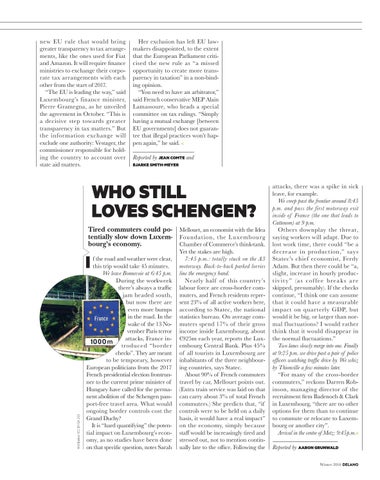
WHO STILL LOVES SCHENGEN? Tired commuters could po- Mellouet, an economist with the Idea tentially slow down Luxem- Foundat ion, t he Lu xembourg bourg’s economy. Chamber of Commerce’s think-tank.
Will Bakker (CC BY-SA 2.0)
I
f the road and weather were clear, this trip would take 45 minutes. We leave Bonnevoie at 6:45 p.m. During the workweek there’s always a traffic jam headed south, but now there are even more bumps in the road. In the wake of the 13 November Paris terror attacks, France introduced “border checks”. They are meant to be temporary, however European politicians from the 2017 French presidential election frontrunner to the current prime minister of Hungary have called for the permanent abolition of the Schengen passport-free travel area. What would ongoing border controls cost the Grand Duchy? It is “hard quantifying” the potential impact on Luxembourg’s economy, as no studies have been done on that specific question, notes Sarah
Yet the stakes are high. 7:45 p.m.: totally stuck on the A3 motorway. Back-to-back parked lorries line the emergency band. Nearly half of this country’s labour force are cross-border commuters, and French residents represent 23% of all active workers here, according to Statec, the national statistics bureau. On average commuters spend 17% of their gross income inside Luxembourg, about €925m each year, reports the Luxembourg Central Bank. Plus 45% of all tourists in Luxembourg are inhabitants of the three neighbouring countries, says Statec. About 90% of French commuters travel by car, Mellouet points out. (Extra train service was laid on that can carry about 3% of total French commuters.) She predicts that, “if controls were to be held on a daily basis, it would have a real impact” on the economy, simply because staff would be increasingly tired and stressed out, not to mention continually late to the office. Following the
attacks, there was a spike in sick leave, for example. We creep past the frontier around 8:45 p.m. and pass the first motorway exit inside of France (the one that leads to Cattenom) at 9 p.m. Others downplay the threat, saying workers will adapt. Due to lost work time, there could “be a decrease in product ion,” says Statec’s chief economist, Ferdy Adam. But then there could be “a, slight, increase in hourly product iv it y ” (a s c of fe e br e a k s a r e skipped, presumably). If the checks continue, “I think one can assume that it could have a measurable impact on quarterly GDP, but would it be big, or larger than normal f luctuations? I would rather think that it would disappear in the normal fluctuations.” Two lanes slowly merge into one. Finally at 9:25 p.m. we drive past a pair of police officers watching traffic drive by. We whiz by Thionville a few minutes later. “For many of the cross-border commuters,” reckons Darren Robinson, managing director of the recruitment firm Badenoch & Clark in Luxembourg, “there are no other options for them than to continue to commute or relocate to Luxembourg or another city”. Arrival in the centre of Metz: 9:45 p.m. Reported by AARON GRUNWALD Winter 2016
14
CURRENT AFFAIRS
THE JOURNAL
CONTINUED
A
s soon as I found out we were moving to Luxembourg I did the obvious: went online to find information,” says Sophia. “While googling my way through rentals, I came upon thebeetgoeson.net blog. It gave a fun insight in life in Luxembourg. I continued to read it when we moved here; it tackled a lot of my questions.” The blog is no longer updated yet still gets tens of visits every day. Why? Because it remains an account of what an expat can encounter when living in Luxembourg and that can be useful on many levels. The number of bloggers delivering personal stories in English from the Grand Duchy has grown steadily these past years and they are a goldmine. From explaining traditions, suggesting events to attend and places to visit, down to which place is best to celebrate your kid’s birthday, they share everything--and more importantly, they’ve experienced it themselves. Selecting which blogs to follow depends on your interests. However, if you want to get to know Luxembourg better, forget about the many, many ones about fashion, cooking and beauty, as few of these are locally focused. Instead get to know the grand ducal family thanks to lux-arazzi.blogspot.lu, a rich (and accurate) source for news and history concerning the Luxembourg royals. More interested in the music scene? Try edgedinred.wordpress.com by Pa t r i c k C a m e ro n a n d l e a r n everything about upcoming concerts in Luxembourg. There’s also a nice selection of blogs for parents, starting with the indispensable whatsonforkids.lu but also more personal ones like expatmuminluxembourg. wordpress.com and the newest mummy Winter 2016
blog in town cookieandpeanut.lu. If your thing is handmade stuff and second hand opportunities, try yourshoplu.wordpress.com. “I’ve lived in Luxembourg for ten years and always get extremely annoyed when people say it’s boring here,” says Corie Bratter, who’s behind barefootinluxembourg.com, known for giving honest advice about restaurants, places and events. “There are tons of things to do if you’re a bit curious and openminded and writing about them is part of my personal crusade.” The blog gets 5,000 visits per month and its Facebook page has over 1,500 likes. “I like being helpful and followers know that I don’t get paid to sponsor anything, so it’s like talking to friends.” “An American in Luxembourg”, aka Mike McQuaide, has shot to
fame via his Facebook page where he writes about his adventures here and posts pictures and videos (including songs he writes about Gromperekichelcher). “In the beginning it was more about keeping friends up to date,” he says. “But then Luxembourgers became interested and within months they represented two thirds of my followers!” The page currently has over 7,000 followers. A story posted about a homeless man telling McQuaide that Xavier Bettel had just bought him a pair of shoes was shared 500 times and made national TV. Over 160 Luxembourg bloggers can be found on www.facebook.com/ bloggerLU Reported by NEEL CHRILLESEN
HOLIDAY SPIRIT The festive season brings time off from work and school, but not every expat in Luxembourg catches yuletide fever.
W
ith more than 160 nationalities living in the Grand Duchy, it isn’t surprising some expats don’t do the 25 December holiday. “Asking a Muslim how they celebrate Christmas is a bit like asking a Christian what they do at Ramadan,” Waleed, a practicing Muslim, said with a smile. “Most Muslims have a huge respect for Jesus, but Christmas is not
the actual day of the birth of the prophet Jesus. It is a holiday made to coincide with the earlier, pagan holiday,” he stated. “Having said that, many Muslims in Luxembourg have children at local schools, so they often celebrate with decorations, gifts and a special meal. I think it’s quite typical when you live in a European country to adapt to some of the local customs.” As many children in the Grand Duchy attend schools with different nationalities and religions, it is inevitable that they will become aware of Christmas, irrespective of their family’s faith. For many parents this is a key factor in deciding how best to mark the holidays. “We celebrate Christmas at my parents-in-law in Slovenia,” said Lucy, a practicing Buddhist. “We eat a special meal, decorate the tree and give gifts. As a child I had Catholicism forcibly imposed upon me and I don’t want to do the same
Nanette Turner (CC BY 2.0)
Grand Duchy expats are blogging like never before.
Maison Moderne
TIME TO BECOME A FOLLOWER
INHERITANCE IN THE EU JUST GOT SIMPLER More clarity. More choice. Do you live abroad? You can now choose the law of your nationality to apply to your estate.
e-justice.europa.eu #EU4Citizens
Justice and Consumers
CURRENT AFFAIRS
THE JOURNAL
to my kids. In time they can decide upon their own spiritual path.” François, who was brought up as an atheist, agreed: “I may not personally believe in god or celebrate Christmas, but I would never force my beliefs on my children. These days, there is more and more focus on commercialism than religion and I know that this is the aspect my children get excited about. St. Nicholas, presents and gifts are mentioned in our house much more than Jesus and the Christmas story.” “When you are living in a predominantly Muslim country, Christmas is not something that your children think about,” Wandeer explained. “But here in Luxembourg, where they are surrounded by images and taught about Christmas at school, it wouldn’t be fair to exclude them because of religious beliefs.” For those without children, the decision whether or not to celebrate is made somewhat easier. “My husband is not particularly religious and I am a Buddhist,” said Judith. “We spend Christmas volunteering at the ‘Noël de la rue’, which has been providing those who are homeless in Luxembourg with a meal for more than 30 years. It is a great initiative and in keeping with traditional Buddhist values.” Sanju, who runs a local restaurant and is spiritual but agnostic, also finds plenty to do on Christmas. “Usually, I am working at the restaurant,” he explained. “I like the philosophy of Jesus as he was a liberal, so I will offer free drinks and snacks to my friends during the Christmas period, regardless that I have no specific faith.” “As in Christianity, many of the world’s religions hold Jesus in high esteem, be it as a prophet, a wise teacher or a Bodhisattva [enlightened one]”, in Judith’s view. “If you combine this with the Christmas themes of peace, joy, love and kindness, then there is certainly something for everyone to celebrate regardless of faith.” Reported by ALIX RASSEL Winter 2016
CONTINUED
WHO’S WHO?
With Luxembourg holding the presidency of the European Council, the LSAP foreign minister has been in the spotlight as the EU responds to crisis after crisis. Europe’s longest serving minister of foreign affairs has proven once again that Luxembourg punches well above its weight on the international stage. Jean Asselborn, the former trade union activist and mayor of Steinfort, has appeared on news broadcasts and had his opinion printed in newspapers as the European Union lurches from one crisis to another. A forthright politician, Asselborn is also very popular at home--he scored an impressive 82% approval rating in a “politmonitor” survey in November, the most likeable government politician by a long chalk (Xavier Bettel placed second with 63%). Travelling the world, Asselborn has the ear of many influential politicians and can take advantage of the fact that even though Luxembourg is a member of the EU and
NATO it is often seen as a country that is not seeking geo-political advantage for itself. Most recently he was in Teheran for talks with Iranian president Hassan Rouhani that focused on the fight against terrorism. He urged for a concerted international effort, but named Daesh especially as a menace to the entire international community. Representing the presidency on foreign affairs matters, Asselborn has also been at the forefront of the response, or lack of it, to the immigration crisis. Not one to mince words, he recently issued a stern warning against the dangers of EU member states in the Schengen zone implementing stricter controls along their borders, saying such measures threaten to make fail “the greatest achievement of the European Union.”
EXPRESS BIO
JEAN ASSELBORN
"THE EUROPEAN UNION CAN BREAK APART. THIS CAN GO INCREDIBLY FAST…"
Born 27 April 1949 in Steinfort. Education Quit the Athénée in Luxembourg City at age 18. In 1976 he took his school leaving diploma by attending night classes. He obtained a master’s degree from the University Nancy II. Career In 1967 he started at Uniroyal. In 1968 he became a local government civil servant. He was elected to parliament for the first time in 1984. He was president of the LSAP from 1997 to 2004. After the 2004 and 2009 elections, he was named deputy prime minister and foreign minister. When the new government was formed in 2013, he was named minister for foreign and European affairs.
Illustration by Jan Hanrion
16
Season of Style
Pizza oven
79,95
Christmas ornament Ø 9 cm
16.Picture frame
50.-
6 Table knives
409.-
Big cup with fir decoration
14,95
Christmas decoration
18,95
Opening times : Monday to Friday from 10am - 7pm and Saturday from 9am - 6pm | 69, parc d’activités Mamer-Cap L-8308 Capellen | Tel. 26 30 30 1
KITCHEN • FURNITURE • BATHROOM • GARDEN FURNITURE • BABY SHOP • LIGHTING • CARPETS • HOME DECOR
kichechef.lu
18
19
CURRENT AFFAIRS
INTERNATIONAL AFFAIRS
Text by STEPHEN EVANS
Photography by ERIC CHENAL
IT’S AN ADVANTAGE BEING A SMALL COUNTRY, BUT… Small countries are generally richer than large ones, because they are more open to the world and more responsive to their populations. The downside is that they would struggle to defend t hemselves aga inst larger aggressors.
L
uxembourg is the richest country in the world. In 2013 the economy produced goods and services worth $110,665 (equivalent to €83,300 in 2013) per head of population, said the World Bank. That’s 8% more than Norway, 14% more than Qatar and about a third more than Bermuda and Switzerland. Luxembourg’s
Winter 2016
figure is boosted by the contribution of non-resident commuters, but this country is still handily placed. What else is clear is that small countries dominate the list. The only big country in the top ten is natural-resources rich Australia, with the US 11th. It’s not easy to compare countries, but on the whole small countries with similar economies and cultures are wealthier (see page 20).
RICHER BECAUSE MORE REACTIVE Large country media, commentators and politicians often give the impression that this phenomenon must be because small countries are up to no good. In reality, it is because knowledge flows more quickly in small countries.
“Government, businesses and citizens benefit from proximity to each other,” said Tania Berchem, a senior advisor at Luxembourg’s ministry of foreign affairs, who is working on the government’s nation branding project. “Information flows quickly, making it easier to understand what is needed and wanted, and what is possible,” she added. The smaller the country, the more agile it is. “The Irish finance minister asked me ‘why is Luxembourg’s fund industry so much stronger than ours?’,” a financial sector executive (who did not wish to be named) told Delano. “I said it was simply a case of reactivity. In Luxembourg, local service providers, regulators and the government are
"WE HAVE FLEXIBILITY AND OPENNESS YOU JUST DON’T FIND IN OTHER COUNTRIES, SO NEW, INNOVATIVE IDEAS GET MAJOR SUPPORT." SASHA BAILLIE
better able and more willing to find a solution than in Dublin,” he said. Ireland is not a large country, but it is still nine times the population of Luxembourg and has a more complicated civil service, plus a larger financial sector and wider economy with conflicting interests. This reactivity helps firms of all types. “We have flexibility and openness you just don’t find in other countries, so new, innovative ideas get major support,” noted Sasha Baillie, a senior economy ministry official who is deputy chief of staff to the deputy prime minister, and who is also working on the nation branding project. Public-private cooperation has been key to the
success of the likes of Cargolux, SES and RTL. The government’s willingness to pump money quickly into top quality data centres and internet connections has helped foster the e-commerce sector. Tax plays an important role too, but Luxembourg’s advantage is that while it offers tax deals similar to those available elsewhere, it does so more quickly and accurately than most others. The figures suggest companies do better in all types of smaller countries. Stock markets linked to economies with fewer than 10m residents have risen by about 15% more than those in large countries over the last twenty years, said an April 2015 report by
the bank Credit Suisse, “The success of small countries and markets”. Smaller countries have to embrace global trends and markets. The Credit Suisse report calculated a globalisation index based on things like the amount of foreign investment into the country, measurements of the ease of doing businesses, tariff rates, and the take up of technology. Luxembourg came top, followed by Singapore and Switzerland, with the Netherlands being the largest country in the top ten. The smaller the country, the more “outside world” there is, meaning there is no option but to embrace regional and global markets. By doing so, small countries become highly specialised and thus Winter 2016
20
21
CURRENT AFFAIRS
INTERNATIONAL AFFAIRS
uniquely efficient in their field. The trick is not to become too dependent on a handful of businesses, and the Grand Duchy has managed this with a diverse financial sector and wider economy. These advantages are often not known outside, but also inside the country. “Hence the government’s motivation for a nation branding strategy of comprehensive, credible messages,” said Baillie. Internationally, few people have a clear idea of what or where the Grand Duchy is, but if they do, negative comments about the financial sector are likely to crop up. “Luxembourg has a lot to offer all kinds of businesses, as well as this being a good place for the financial sector,” agreed Berchem. “Our aim is to put Luxembourg on the map, and not just focus on one industry,” she added.
MORE PRAGMATIC According to Credit Suisse and KPMG, the average personal income tax rate in countries with more than 25m people is 32% but just 26% where there are fewer than 10m residents. For corporate taxes the comparison is 27% to 20%. This could be because big organisations and projects are harder to run (and thus are probably more expensive) than smaller ones. Economies are easier to run too, so it is more obvious that higher income taxes reduce output. Public sector debt also tends to be lower in smaller countries. MILITARILY EXPOSED Also, smaller country governments become aware of looming problems earlier and are forced to react quickly. For example, it became clear to Luxembourg in the mid-1970s that the steel industry was shrinking and would not recover. A plan to manage the decline was put in place, alongside moves to boost other industries. Governments in large countries, however, were able to accommodate political pressure to prop up failing industries, wasting resources as they did so. Winter 2016
CONTINUED
SMALLER COUNTRIES ARE RICHER We used World Bank data from 2013 and 2014 to compare countries with similar economies and cultures, but different sizes.
2
1
Cyprus is about 10% the size of Greece but its GDP per head is higher by 25%.
Ireland is about 10% the size of the UK but its GDP per head is higher by 17%.
12
12
There are exceptions. The US has a uniquely productive economy, and even resources rich Canada can’t match this. There are about ten times more people in the States, but GDP per head is a tenth lower in Canada. It could be argued, though, that America’s federal system makes it more like a collective of small and medium sized countries.
11
12
11
Uruguay has one twenty-fifth of Mexico’s population, but on average, people are two-thirds richer. 11 10
Tunisia has one-third Morocco’s headcount, yet the relative size of the economy is 39% higher.
3
Luxembourg has 0.7% of Germany’s population, but GDP per person is roughly 130% higher in the Grand Duchy.
2
2
5 4
Austria is about 10% the size of Germany but its GDP per head is higher by 7%.
Belgium has about one-fifth the population of France and 10% more national income per capita.
6
3 5
3
4
5
7
4
1 10
Taiwan has about one-fifth the population of Japan and 10% more national income per capita.
1
10
6
14
8
8
7
Singapore’s population is 4.3% the size of Japan’s, but relative national income is 56% higher.
6 8
9 14 9
GDP per head in Macao is well over double that of Hong Kong, with just 8% of their population.
7 14
Vietnam has just 7% the population of China, but has 73% less GDP per head.
13
9
Sri Lanka has 1.6% of India’s population, but GDP per head is about 130% higher.
New Zealand has two-thirds the GDP per head of Australia, despite 19% of the population. But Australia has the advantage of being extremely rich in natural resources.
13
13
Winter 2016
22
23
CURRENT AFFAIRS
INTERNATIONAL AFFAIRS
CONTINUED
"OUR AIM IS TO PUT LUXEMBOURG ON THE MAP, AND NOT JUST FOCUS ON ONE INDUSTRY." TANIA BERCHEM
The big downside is that small coun tries are exposed to aggressors. The desire for military strength was a motivation for the creation of large states with a strong central government, for example, in Spain in the 16th century, France in the 17th, the UK in the 18th, and Italy and Germany in the 19th. To this day, only large states have the ability to undertake major, meaningful military action. History has many examples of war breaking out after decades of peace, and it has to be doubted that a loose coalition of small states would be able to mount a serious defence from a major attack from a force yet unfore seen. Being a founder member of NATO is the centrepiece of the country’s foreign policy. However, Winter 2016
this comfort blanket has enabled Luxembourg and most European countries to soft pedal, with the Grand Duchy spending a quarter of the NATO recommended level on defence. Luxembourg, like many, relies on the US for protection. No longer a pawn in the geopolitical game, the EU gives this country substantial po litical cover and more influence than its size would suggest. Luxem bourg’s perceived weakness translates into an opportunity to play the honest broker in big-power discus sions. Agreeing to an idea made by Luxembourg comes free of thoughts of giving into threats or a power play. This is exemplified by three out of the 13 presidents of the Eu ropean Commission having been
Luxembourgers. Ex-prime minister Jean-Claude Juncker, the current incumbent, was also the political head of the Eurozone. “Luxembourg often plays the role of intermediary between larger countries,” noted Berchem. Thus the country’s ideas have got more traction across the EU, but this can be a bumpy ride. Was it a coincidence that the LuxLeaks revelations about tax avoidance by multinational companies emerged days after Juncker’s appointment? The infor mation was available before he was appointed. Also, the previous Luxem bourger commission president, Jacques Santer, found himself dumped from the commission after an incident which also had a whiff of power
CANARIES IN THE COALMINE? Small country influence is a good thing, and there should be more of it, suggests the Credit Suisse report. “Small open economies are the canaries in the coalmine of the world economy… [because they] provide a clearer, sharper sense of the economic and political pressures building in the system,” it said. The reality, though, is that big countries have a greater voice than ever, with the G20 group of the most powerful nations
now the premier agenda-setting body. That said, sustained success breeds complacency. Every serious analyst sees the Luxembourg public sector pension scheme as being dangerously unstable. The Chamber of Commerce says payments from the state pension fund are due to exceed income by 2023. There is a similar story for the national health fund, which will need reform as the population ages. A bust would be painful and would put many of the economic gains at risk. But the chances are the country would learn from this experience and adapt. This happened in Ireland and Iceland, which have been quite successful relaunching their economies following their real estate and banking crises in 2008.
JEAN-CLAUDE JUNCKER Luxembourg’s former prime minister took over as the head of the EU’s executive in November 2014. His road from Redange to president of the European Commission in Brussels is a remarkable path. He trained as a lawyer but started working as parliamentary secretary for the Christian Social Party (CSV). After being elected MP in 1984, Juncker held, at various times, the labour, finance, treasury and religious affairs portfolios in the cabinet. Then Juncker served as head of the Grand Duchy’s government from January 1995 to December 2013--when he often played the role of mediator between big EU states like France and Germany--and as head of the Eurogroup council of Eurozone finance ministers from January 2005 to January 2013. AG Winter 2016
Sven Becker (archives)
politics. The country has, eventually, to go along with concerted big country demands. For example, complete banking secrecy had to be relinquished following more than a decade of EU pressure.
24
CURRENT AFFAIRS
HEALTH
Text by NEEL CHRILLESEN
Photography by MIKE ZENARI
LUXEMBOURG AIR RESCUE MOVES TO THE FUTURE
LUXEMBOURG AIR RESCUE:
New premises in Findel airport will finally give one of the world’s largest repatriation organisations worthy work conditions and long desired “normality”.
WWW.LAR.LU
W
hen René Closter looks at the architectural model of Luxembourg Air Rescue’s new buildings, which will soon be inaugurated in real size, it’s with both anticipation and nostalgia. He’s eager to finally see the members of his team work in optimal conditions, but that doesn’t prevent him from feeling a bit wistful too. It’s nearly 30 years since he managed to get Luxembourg’s first medical helicopter in the air and it’s been a long struggle to get where things are today. “When we started out, we had nothing,” recalls LAR’s founder and current president. “Our first office was a tattered caravan and we used an old army tent bought in Germany as a hangar. I remember when we were setting it up: we found an entire mouse family in there, plus the big holes they’d made. In fact, the only running water we ever had in the tent hangar came from those holes!” Later on, LAR was able to rent a real hangar at Findel airport and bought a container to use as offices. Luckily, to turn LAR into a re‑ nowned life saving organisation Closter’s determination proved more important than perfect premises. Despite lack of finances and official backing, the former professional fireman managed to build up a medical air service of which the Grand Duchy can be immensely proud. LAR started off by renting one helicopter and two pilots from the German Air Rescue. Today it has a fleet of five rescue helicopters and five air ambulance jets, a dediWinter 2016
RENÉ CLOSTER Enthusiastic about the “big stuff” that Luxembourg Air Rescue will now be able to do
cated team of 164 people and a worldwide reputation. It is also the largest association in Luxembourg: 62% of the country’s population are members.
NOT JUST TRAVEL INSURANCE “That’s something we thought about when planning the new buildings,”
says Closter. “We get 200 to 300 groups of visitors every year and it’s important to be able to welcome them and show them everything without disturbing any of our activities. So we’ve created a sort of ‘glass route’ that goes through all the buildings. In that way people can see and feel everything, for example
Decreased electricity prices in 2016!
*This offer does not apply to network usage fees or legal fees. These costs will be passed transparently onto your electricity bill.
Secure an even better price for 3 years now*
Limited offer valid until 15 March 2016
From 1st January 2016, naturstroum electricity prices will continue to decrease. With this latest reduction, naturstroum electricity prices for our residential customers will have fallen by 20 % since the end of 2014. Benefit from the FIX formula and secure an even more attractive price for 3 years. For further information, call 8006-6000 (free serviceline). Conditions on enovos.lu This offer is also available for Leo, NordEnergie and Steinergy customers. Energy for today. Caring for tomorrow.
Mix naturstroum 2014
100%
énergie hydroélectrique
émissions de CO2: déchets radioactifs:
0 g/kWh 0 mg/kWh
Mix total Enovos 2014
(approuvé par l’ILR)
28,6% 5,4% 65,8% 0,2%
éneriges fossiles énergie nucléaire énergies renouvelables autres sources
émissions de CO2: déchets radioactifs:
192,30 g/kWh 0,33 mg/kWh
26
CURRENT AFFAIRS
HEALTH
CONTINUED
the Alert Centre, without interrupting operations.” In addition to medical emergency services (2,000 helicopter missions every year in Luxembourg and the Greater Region) and repatriation of its members, LAR is the exclusive coordinator and dispatcher for all organ transportation centres in France, excluding Paris (over 1,300 organ transportations each year). And when you see the Luxembourg Police helicopter in the sky--it’s flown by an LAR pilot. Moreover the outfit offers repatriation services to insurance companies and other organisations (around 1,000 such missions per year) and, as official partner of the UN and NATO, it collaborates with Luxembourg authorities and the EU to deploy rapid emergency medical aid in case of natural or humanitarian disasters. Last year alone, LAR had missions in 98 different countries. Over the years, Closter himself has performed 14,000 missions and still likes to be the first to go on the critical international tasks.
MAJOR INVESTMENT Three main structures make up LAR’s new premises in Findel airport: the hangars, the offices (including the operations and control centres) and the maintenance building. These were previously geographically separated. “Our internal communication is going to improve greatly in the coming months,” predicts Closter. But that is not the only change that is expected. “Now that we have sufficient space, we’ll be able to unload patients inside, which is a clear advantage when it’s raining or snowing. We won’t have to tie the aircrafts down to the ground either when there’s a storm because we can park all of them inside. Something we’re very proud of is that we now have our new maintenance centre, which allows us to do the big stuff too. We’ll no longer need to send our helicopters to the UK for their yearly check-up for starters. That will save us a lot of money and give us so much more flexibility.” Winter 2016
NEW FACILITIES LAR staff finish relocating by the end of January; the official inauguration takes place in the spring
Even though LAR is somewhat of a public service, all the building costs (around €12 million) are entirely supported by the non-profit association itself. It’s the largest investment in its history, which also explains why it took so long to initiate. A 30-year lease on the space was negotiated with LuxAirport, who will also benefit from LAR’s expansion: the new building will act as Findel’s “advanced medical post” (every international airport is required to have one). “We have installed a big infirmary with all the necessary medical equipment and 50 emergency beds ready. In case of a major disaster, it can be used as a makeshift hospital.” The new headquarters also have highly equipped training
rooms (LAR trains the Belgium army, among others) and even a gym. “When our pilots get back from a long mission, they’ll be able to stretch out.” The whole staff finish moving by the end of January; the off icial inauguration is planned for April 2016. “It will change everything,” Closter says with a smile. “We’ll all be together in the same place and we’ll be able to work in normal conditions. We even have a canteen now, so everyone will be able to sit together and talk. Our people are extraordinary and do very difficult, demanding jobs. They are finally going to work in the environment they deserve. It’s a dream come true.”
"IN CASE OF A MAJOR DISASTER, IT CAN BE USED AS A MAKESHIFT HOSPITAL." RENÉ CLOSTER
DOOR FLOORING STRAIR KITCHEN TERRACE C U S T O M F U R N I T U R E D R E S S I N G E X T E R I O R
Choice, advice and quality for home and garden design ALZINGEN 586, route de Thionville \\ T. (+352) 36 00 36-1 MERSCH 4, allée John W. Leonard \\ T. (+352) 26 32 31-1 INFO@HOFFMANNS.LU / WWW.HOFFMANNS.LU
28
29
UPFRONT
BUSINESS NWC WORK TALK
"DOOMAND-GLOOM TALK IS NOT WARRANTED." YVES MERSCH
RIGGING RULES
As part of Luxembourg’s EU presidency, Pierre Gramegna, the finance minister, brokered a EU-wide deal to prevent insider manipulation of the important Libor and Euribor banking indices.
CORRECTION
On page 34 of the December edition, Thomas Scherer of Telindus was referring to “infrastructure as a service” not “internet as a service”.
Winter 2016
The executive board member of the European Central Bank said on 17 November that there is no sign the the previous week’s terror attacks in Paris would harm the euro zone economy.
TICKER
8% more office space was let nationally the first 9 months of 2015 compared to the same period last year, said Inowai, a real estate agency. >>> The Luxembourg branch of ICBC, a big Chinese bank, received a license from Beijing to invest funds in China’s domestic stock market. >>> Luxembourg has “temporarily” taken the 13% stake in national airline Luxair held by German carrier Lufthansa; the state is looking for a buyer. >>> Insurance premium revenue dropped 10% the first nine months of 2015 compared to the same period last year, said the Insurance Commission. >>> A British firm lost its protest against EU energy labels on vacuum cleaners; the EU General Court in Kirchberg said Dyson had to suck it up. >>> Luxembourg’s public debt will exceed 0.5% of GDP this year, over the national ceiling and EU limits, warned the budget watchdog CNFP. >>> State pension payments will rise 0.5% on 1 Jan.; at the current pace, the system will fall into deficit by 2023, said the Chamber of Commerce. >>> Europe’s rescue fund in Kirchberg disbursed €2bn to Athens after “the completion by the Greek authorities of the first set of milestones” under the summer’s revised EU deal. >>> Lot Polish Airlines said it would launch service between Findel and Warsaw four days a week starting 1 March. >>> At press time Cargolux said it reached a “major breakthrough” with unions to avoid a threatened strike.
Flickr user Joel (CC BY-SA 2.0) Nordic Women’s Club European Parliament European Central Bank
About 80 people heard two CEOs talked about gender balance and Nordic values during the Nordic Women’s Club’s Nordic Professional Women event. More at: www.delano.lu/news/ nwc-work-talk
PATRICK RAHME The co-founder of All Square marks the golf app’s
FOUND OUT
More than 100 people showed up for a speech on “How to disappear” by Frank M. Ahearn, a privacy expert. Full report: www.delano.lu/Disappear2015
A
B
C
D
PAPERJAM CLUB TALK A. Frank M. Ahearn B. Olivier Lombardo and Diana Kustekova C. Virginie Michielsen, Stéphanie Rompen and Thibaut Barras D. Gérald Belisle, Sandie Woelffel and Yves Lahaye
third anniversary.
CATCHING UP WITH…
Founding All Square on 12.12.12, Patrick Rahme and his business partner Arthur de Rivoire saw an opportunity to unify the $180 billion golf market through a free app. Three years later, it has a directory of more than 33,000 golf courses worldwide. The app enables golfers to follow other golfers, find someone of the same skill level or “play golf with someone they want to do business with”, Rahme explains. “Golfers love to travel and explore new golf courses all over the world, as well as compare experiences with their peers. So we created a platform for golfers to connect as well as review courses,” says the 27-year old entrepreneur. All Square has been coined “Facebook and Tripadvisor for golf.” When asked about this, he is flattered by the term: “if anything, this comparison helps us because it quickly explains what our app does.” Previous golf apps focused on scoring and GPS, but Rahme recognises that most golfers play socially. “I believe that only 1% of golfers use apps for scoring and GPS tracking. For the rest of us, it’s more about showcasing the different golf courses we have visited and sharing our experiences through reviews.” At 13, Rahme was already playing golf with people from all social circles, “including top bank managers in Luxembourg.” It comes as no surprise that he has a 0 handicap and several European championships under his belt. “Actually my business partner and I were competitors when we were junior golf players,” Rahme laughs. After they graduated, both he and de Rivoire started working in private banking in Geneva before launching their firm. “If we are going to take a business risk, now is going to be the best time, neither of us have any major responsibilities,” he says. What’s next for All Square? “We’re working with the ING international management group for the next six months, leveraging their network and expertise as well as business development.” The two-time national golf champion is proud to represent the Grand Duchy in his sport and also in his business. “I’m very grateful that we chose to start the company in Luxembourg. We received a significant grant from the government and let’s be honest, it would just be too expensive to do this in Switzerland,” he grins. www.allsquaregolf.com
Text by MARINA LAI Photography by MIKE ZENARI
Winter 2016
BUSINESS
30
SNAPSHOTS
Text by ZUZANNA REDA-JAKIMA
Photography by LALA LA PHOTO
THEY’RE NOT BOSSY, THEY’RE THE BOSS!
T
hey have a myriad of ideas: import windows, advise on fashion, help decorate apartments. Luxembourg’s businesswomen-to-be have just finished the second edition of the “Entrepreneurial Women Project”, organised by the Luxembourg-Poland Business Club and aimed at introducing future entrepreneurs to legal and tax frameworks, funding, HR and marketing--all crucial when setting up a company. There were 27 participants in this edition of the course. “I came here with no concrete idea of what I would like to do,” said Malgorzata Wroblewska, now working in telecommunications. “Over the span of six Saturday meetings I started to understand my strengths, brainstorm with the fellow participants and I have understood that I could sell jewellery, which now I only design and create for myself.” “I have met great women who would also like to do something on their own, but simply didn’t know where to start,” commented Kinga Kolouszek, an artist who plans to organise workshops. “It is very encouraging.” www.lpbc.lu
A
GETTING STARTED A. Nancy Wendt and Anastasiya Garova during a training course held in November on the University of Luxembourg’s Limpertsberg campus. The headline of this article was inspired by Beyoncé and the “Ban Bossy” campaign. B. Mandy Patrick C. Lynsey Baxter D. Kasia Strejmer and Gosia Wroblewska E. Ewelina Tabone and Kinga Schubert F. Sylwia Ponienska and Kinga Kolouszek G. Heidi Kurki, Fatoumata Kaba, Kasia Krzyzanowski and Alina Beloussova H. Stephania Scerri and Elizabeth Cardona
B
E
C
F
D
G
H
Winter 2016
MORE ON THIS STORY: WWW.DELANO.LU/ EWP2015
ALIGHIERO BOETTI - CHRISTIAN BOLTANSKI - PEDRO CALAPEZ - MAT COLLISHAW - TONY CRAGG MARLENE DUMAS - JAN FABRE - REBECCA HORN - CALLUM INNES - IRWIN - PRAVDOLIUB IVANOV ANISH KAPOOR - PER KIRKEBY - MATTHIAS KOCH - BRIGITTE KOWANZ - ZOFIA KULIK MICHEL MAJERUS - FRANÇOIS MORELLET - CLAIRE MORGAN - HERTA MÜLLER - CLAUDIO PARMIGGIANI PARIS PETRIDIS - JORMA PURANEN - ANRI SALA - CHARLES SANDISON - ANTONIO SAURA - EVA SCHLEGEL SEAN SCULLY - NEDKO SOLAKOV - FRANK THIEL - MICHAEL WARREN - LUCIEN WERCOLLIER
EuroScope A PANORAMA OF EUROPEAN CONTEMPORARY ART FROM THE EIB’S COLLECTION
CERCLE CITÉ EXHIBITION FROM 20.11.2015 TO 24.01.2016 EVERYDAY FROM 11AM TO 7PM - FREE FREE GUIDED TOURS EVERY SATURDAY AT 11AM FREE GUIDED TOURS WITH THE CURATOR (IN FRENCH AND ENGLISH) SATURDAY, 05.12.2015 AT 11AM (FOR THE WHOLE FAMILY) SATURDAY, 16.01.2016 AT 11AM
Cercle Cité Entrée principale Place d’Armes ∙ L-1136 Luxembourg info@cerclecite.lu ∙ T.+352 47 96-51 33 www.cerclecite.lu
32
33
BUSINESS
ENTREPRENEURSHIP
Text by WENDY CASEY
Photography by JULIEN BECKER
THE WORLD OF STARTUPS In the startup world, ideas are paramount. Hit on a great one with mass market appeal, add a stack load of determination, adequate funding and all the motivation you can muster, and you might just conceive the next Twitter.
T
here are certain words that kick-start the imagination and fire-up graphic images; startup is one. We can’t help imagining a group of highly intellectual postgrad students who haven’t showered in weeks, working feverishly away in an unaired room until the early hours of the morning on a concept that few of us can quite grasp--yet. One thing we do know is they’re all about to become incredibly successful and incredibly rich at an incredibly young age. So what is a startup and why can’t we all… well, start one? The term has been bandied around for a number of years and gained momentum during the dotcom boom when the internet was in its infancy, offering up immense market potential to any entrepreneur with the foresight to jump on the bandwagon. While the startup definition varies greatly depending on who you talk to, there are a number of factors which roll from the mouths of most startup founders. It doesn’t have to be technology-focused, although many are, and most of the multi-million dollar companies to have hit the headlines have had their roots deeply imbedded in the digital economy.
SEEKING CHANGE Charles-Louis Machuron, founder of Silicon Luxembourg, is happy to expand. “You have to want to change things, to make a difference through the digital environment. A new bakery is not a startup, but launching a social network for bakeries is innovative Winter 2016
and utilises the digital platform.” As a new father, he considers the development of his baby son in comparable terms. “I have a ‘startup’ at home with two arms and two legs. There was a nine month incubation period, the birth can be a stress and in the early months he was growing and learning very quickly.” Rapid growth is one of the defining factors, which can only be achieved if the product or service is highly appealing to a broad market. The web opens up a world of clients with the ability to purchase at a distance and irrespective of the time zone. It’s for this reason startups are so closely associated with technology. Machuron speaks from experience. Originally from Paris, he established Silicon Luxembourg two years ago and works pretty much alone. “Silicon is the Luxembourg startup media. It provides all the latest startup news and reports on the digital environment in Luxembourg, posting articles, interviews, job offers, event agendas and press releases.” He worked for two Luxembourg e-commerce startups some years ago and then joined Maison Moderne (the firm that publishes Delano) where he worked with the Paperjam Club, learning the ins and outs of the Luxembourg business and media environments. “I’m a really curious person, always reading startup blogs and I was surprised there was no media dedicated to this type of information in
Luxembourg. That’s how I decided to set up a website and two weeks after the launch I was already receiving lots of news from event organisers and incubators.” In addition to managing the website, Machuron organises monthly events with some of the many entrepreneurs he has met, believing this is the best way to source a larger audience. Event formats have included workshops, breakfast meetings, after work drinks, conferences and keynote talks catering to groups of 15 to 150 people. “In 2014, 1,000 people attended Silicon Luxembourg events and they also read the website and shared news.” A recent newsletter featured a video of an interview with the prime minister, Xavier Bettel. “The interview was agreed back in June and Bettel’s team believed that Silicon was a good platform on which to communicate and promote the digital environment. I’m the only one fully dedicated to this in Luxembourg and while it’s taken two years, I’m now invited to press conferences. I’m really grateful to be acknowledged--it’s been a real challenge.”
FIRST STEPS Funding is a further hurdle which needs to be jumped before an idea can evolve into a fully fledged business. Many startups seek funding from business angels and venture capitalists, which generally implies outside involvement in the management plus
WHAT INSPIRED THEM?
CHARLES-LOUIS MACHURON Launched a startup media brand
" I’M A REALLY CURIOUS PERSON, ALWAYS READING STARTUP BLOGS AND I WAS SURPRISED THERE WAS NO MEDIA DEDICATED TO THIS TYPE OF INFORMATION IN LUXEMBOURG."
Winter 2016
BUSINESS
34
ENTREPRENEURSHIP
CONTINUED
the US recently who would like me to represent him in Luxembourg,” after reading about the firm online. This reinforces Sosna’s plan not only to import “know-how” to Luxembourg through his range of speakers, but to promote Luxembourg globally via Luxembourger presenters. In fact Sosna has talked with a number of high profile candidates who believe in his philosophy and are keen to participate, he says.
B
BÉATRICE WARICHET Launched a language learning software firm
Winter 2016
extra support and guidance where it’s needed. But not all businesses qualify (or want such backing). Artur Sosna, founder of Inspiring Speaker, recommends saving enough money to ensure you can survive during the first six to twelve months. He also warns that while you are earning very little income during the initial months, the tax bill can seem very high. He established Inspiring Speaker in August, “to provide the right speaker for the right event.” His inspiration came at the age of 40 while out running. Having worked with Berlitz for twelve years he questioned whether this was what he wanted to continue doing for the next 25 years. “I’ve listened to many interesting speeches in my life; they can open your mind and inspire new opportunities. In the western world religion is dying and less and less of us go to church regularly. Back in the 18th and 19th centuries the priest was our inspiration--he was our speaker. We still need this guidance and speakers are our substitutes. They can show us the way and provide the inspiration we are looking for.” Sosna certainly recognises the power of the internet. “I received an email from a well known speaker in
CHILD’S PLAY Ask any startup founder about their journey and you’ll be sure to hear of challenges encountered and overcome. Béatrice Warichet is the creator of LaSauce, which promotes learning through play. “Finding the money to set up my company was not really a problem but it was certainly a challenge, as was the prospect of quitting my day to day job to do something entirely new. You have to put a lot of money on the table and it’s particularly difficult for a one-person company.” She set up in 2013 and in so doing left her job of 20 years as a senior manager with a large consulting firm in order to immerse herself fully in the new venture. “I learned English as a child while playing adventure games. They were always in English and so to interact well with the characters I needed to be able to type in the correct words. This never felt like study to me.” During her career she encountered many friends and colleagues who wished to learn a language but couldn’t face studying after working hours. She always believed that the concept of having fun while learning was a great idea and finally decided to take the step and “go outside of her comfort zone”. Her first game, BattaKlang, is a Luxembourgish vocabulary app that can be purchased on both the Apple Store and Google Play. It contains beautiful graphics that Warichet created herself using software called vector drawing. “The app was designed with teenagers and young adults in mind; it can also support a great exchange between parents and
VAKANZ THE TOURISM FAIR 15, 16 AND 17 JANUARY 2016
LUXEXPO - LUXEMBOURG FRIDAY LATE OPENING HOURS 2PM-9PM, SATURDAY AND SUNDAY 10AM-7PM WWW.EXPOVAKANZ.LU WWW.LUXEXPO.LU
36
BUSINESS
ENTREPRENEURSHIP
CONTINUED
their children. The children can touch the colourful images while parents read the words aloud.” The app covers 1,000 Luxembourgish words and was so popular that she developed a second version for learning English, called BattaKing. “I’m about to reach 10,000 downloads in the coming weeks; this would have been unbelievable to me when I started. For a Luxembourg app that’s a huge amount of downloads and it’s considered a success. Every download counts!”
HAPPY MONDAYS Inspiration for business comes in many forms and at various moments in life. As a young child, Amandine Maroteaux dreamed of decorating the family home and found inspiration in the form of her godmother’s daughter who was an interior designer in Singapore. “She worked in luxury boutiques and yachts without the traditional boundaries and with more freedom of expression,” Maroteaux recalls. “This is what encouraged me to give up my lawyer’s business suit. I wanted to enjoy my own creativity, diversity of clients, beautiful places and exclusive materials--to live a life without traditional rules and borders.” So it was that Maroteaux founded Les Pampilles, an interior design company that takes charge of renovation and construction projects for businesses and private clients. “We renovate town houses, apartments, offices and advise investors on the interior design of housing developments. I never thought that on Sunday morning I would be looking forward to the next week but creating Les Pampilles has made that possible.” She clearly has a passion for her craft and endeavours to surpass all expectations. “I always want the next project to be even more beautiful, technically and aesthetically--to keep surprising my clients.” You can understand then why many large organisations have ceased focussing on in-house initiatives in favour of acquiring startups--home to cutting-edge concepts, passion, innovation, energy and the occasional unwashed entrepreneur.
START UP A CONVERSATION Inspiring Speaker www.inspiringspeaker.com LaSauce www.lasauce.lu Les Pampilles www.lespampilles.lu Silicon Luxembourg www.silicon luxembourg.lu
"I’VE LISTENED TO MANY INTERESTING SPEECHES IN MY LIFE; THEY CAN OPEN YOUR MIND AND INSPIRE NEW OPPORTUNITIES."
Winter 2016
ARTUR SOSNA Launched a speakers bureau
L E A R N T O D A Y, A P P L Y T O M O R R O W L LE EA AR RN N T TO OD DA AY Y ,, A AP PP PL LY Y T TO OM MO OR RR RO OW W
EARN YOUR MBA EARN YOUR MBA EARN YOUR MBA WHILE WORKING WORKING •WHILE Complete at your own pace or in a minimum of 18 months WHILE WORKING ••• ••• ••• ••• ••• ••• •• • ••• ••
Complete at Evening Completeclasses at your your own own pace pace or or in in aa minimum minimum of of 18 18 months months Evening classes Flexible entry dates Evening classes Flexible entry dates Interna Flexibletional entryfaculty dates and student body Interna faculty AACSB accredited International tional faculty and and student student body body AACSB accredited Financialaccredited help available AACSB Financial available Possibility of internship Financial help help available Possibility of internship Possibility of internship OR OR OR Complete a certificate in: Complete a certificate in: Management Complete a certificate in: Management Finance Management Finance Finance
INFORMATION INFORMATION INFORMATION SESSION SESSION SESSION Thursday, Jan 21 aT 6:30 pm T , Jan 21 aT 6:30 pm Thursday hursday, Jan 21 aT 6:30 pm Jack Welch COLLEGE OF BUSINESS Jack Welch Jack Welch COLLEGE OF BUSINESS
COLLEGE OF BUSINESS 7, Rue Alcide de Gasperi
c/o Chambre de Commerce 7, Rue Alcide de Gasperi 7, Rue Alcide de Gasperi L-2981 Luxembourg c/o Chambre de Commerce c/o Chambre de Commerce L-2981 Luxembourg L-2981 Luxembourg shu.lu welchmba@shu.lu shu.lu shu.lu welchmba@shu.lu welchmba@shu.lu
JACK WELCH COLLEGE OF BUSINESS
Call for details: +352 22 76 13 1
JACK WELCH COLLEGE OF BUSINESS Luxembourg JACK WELCH COLLEGE OF BUSINESS
38
BUSINESS
CAREERS
Text by KASIA KRZYZANOWSKI
Photography by MIKE ZENARI
TAKING THE PLUNGE More and more people in Luxembourg are choosing self-employment. But what are the challenges that await them?
PIROSKA BALLA Self-employed status and contracting bring flexibility
I
t was the realisation that life was too short to commit so much time to a job which wasn’t making her happy that pushed Christine Hansen to leave her secure teaching position and become an independent baby sleep consultant. Now, she says, “I love what I do and even though I am probably working a lot more, it doesn’t feel like it at all.” Amidst the growing buzz around entrepreneurship in Luxembourg, more and more people are choosing to become self-employed. A recently published report by Statec, the national statistics agency, counted 5,597 sole proprietorships in 2015, or 17.5% of all companies subject to VAT. Defined as someone who carries out an activity in their own name, whether a trader, a skilled craftsman or an intellectual worker, the self-employed entrepreneur holds full personal liability towards third parties and is solely responsible for financing their business. Despite this inherent risk, for many it is an attractive option that puts entrepreneurship within their reach.
AN ALTERNATIVE TO A COMPANY When Piroska Balla, an international disaster relief expert and lawyer turned pilates instructor, decided to open her studio, called Respirit Pilates, in 2014, she was put off by the high cost of creating a SARL (limited liability company), which requires startup capital of around €12,400, in addition to notary costs and other fees. Instead, she chose to open a sole proprietorship, which has the benefit of requiring no minimum capital or constitutional documents to set up shop. Piroska now works with several other self-employed Winter 2016
" THE TREND IS THAT MORE FOREIGNERS WANT TO BE SELF-EMPLOYED. THIS MIGHT BE BECAUSE IT’S EASIER FOR LUXEMBOURGERS TO ENTER THE LOCAL JOB MARKET." TOM BAUMERT
instructors on a contractual basis, which has allowed her studio the flexibility to grow and attract new clients. Despite the relative lack of financial costs in becoming self-employed, many still find the administrative
formalities a major headache. “It was a nightmare to find out how to pay VAT, social security, and so on,” recalls Richard Moreau, a freelance French teacher who started up on his arrival in Luxembourg in 2008. “I didn’t
TERM COURSES
INTENSIVE COURSES
This formula is ideal for those whose learning needs are not dictated by a pressing deadline. The course lasts eleven weeks and concentrates on communication skills in a general context. Vocabulary speciďŹ c to a particular sector is not covered.
This formula is ideal for those who wish to refresh, reactivate and give an extra push to their general language skills within a short period of time.
07.03 > 24.03.2016
25.01 > 15.04.2016
Contact us for more details : Villa Lotti - 45a, avenue Monterey L-2163 Luxembourg-Centre @ aschroeder@prolingua.lu X 40 39 9172
www.prolingua.lu
kosmo.lu
A FOREIGN LANGUAGE TO LEARN OR IMPROVE? THINK PROLINGUA!
40
BUSINESS
CAREERS
CONTINUED
know where to go, and didn’t get any help, so it wasn’t very welcoming.” Tom Baumert, a counsellor at the Chamber of Commerce’s Espace Entreprises (Business Zone), acknowledges this issue; it is something he encounters on a daily basis. “In general, people don’t know much when they call. Things like social security can be very difficult to understand.” To address this, his team offers individual consultations, free of charge, to provide the basic information required to start a business. “We are the first contact point when you want to become independent. We go through all the steps, including business permit, qualifications, and how to get a VAT number.”
MORE FOREIGN FREELANCERS Interestingly, Baumert notes that of the 6,000 people who have already contacted Espace Entreprises this year, around 70% are foreigners and only 30% Luxembourg nationals. “The trend is that more foreigners want to be self-employed. This might be because it’s easier for Luxembourgers to enter the local job market.” However, Alain Godek, an independent concierge and co-owner of the Wishbox coworking space, notices a gradual shift underway: “Young Luxembourgers are more open-minded now, and more diversified. Luxembourg was very stable in the past, you had your path already written. But now you need to find other types of employment.” COWORKING: KEY TO SUCCESS? After succeeding in navigating the maze of administration, what is the day-to-day experience of self-employment? Many find the biggest challenge to be the lack of a fixed boundary between personal and professional life. “I have difficulty saying no, so I don’t take time for myself, for lunch,” says Moreau. “Even if you try to make a separation between professional and home life, it will blend together,” observes Yves Hoffmann, a freelance graphic designer. This was one of the reasons he and Godek co-founded Wishbox, to offer an alternative to working at Winter 2016
KOEN CLOOSTERMANS Coworking is a huge plus
GOING SOLO
GETTING STARTED Get inspired by meeting like-minded people For women www.mumpreneurs.lu For young creatives www.facebook.com/ braveyouthglobal For everyone Search for “Luxembourg Entrepreneur & Startup Community” on www.meetup.com
home. “Here, people work differently, more efficiently,” adds Godek. For Koen Cloostermans, a service design consultant, coworking was the key to his success. “An important shift in the development of my business came when I started working at the Impactory, now [part of] Nyuko. I got out of my home office environment and entered a community where people of different backgrounds work in a very inspiring open office space. The enthusiasm in these places keeps you in the positive mind state you need to fight against the drawbacks and fatigue you encounter.”
NEW SUPPORT AVAILABLE Nyuko, which offers a range of services to entrepreneurs, is just one of many
new government-backed initiatives that will make it easier to become self-employed in Luxembourg. The recently announced House of Entrepreneurship is set to open in mid2016 with the aim of creating a “one-stop shop”. “The idea is to create a place where an entrepreneur can come in the morning and leave in the evening with all of the necessary documents and authorisations,” explains Baumert. Another hot topic is the 1-1-1 company, which will be somewhere between a sole proprietorship and an SARL in terms of finances and formalities. As Baumert notes: “You really see that there’s something changing. Right now is a great time to start!”
Get info on legal and administrative matters Espace Entreprises Search for “Starting up my business” on www.cc.lu/en Online guide www.guichet.lu Develop your business plan With a personal coach www.nyuko.lu Online tool www.businessplan.lu Join a coworking space 1535°C in Differdange www.1535.lu Nyuko in Luxembourg-Hollerich www.nyuko.lu Wishbox in Bereldange www.wishbox.lu
Unique platform of entrepreneurial expertise, nyuko intends to propel Luxembourg’s entrepreneurial ecosystem by creating a favorable environment for the emergence of the new. nyuko addresses all entrepreneurs, regardless of the stage of creation or development of their business.
«To me, everyone has potential. In my daily work, I witness the distress of people excluded from the labor market. I want to restore the confidence of the unemployed by opening a door.» explains Carisa. This door is Suite Couture, an upcycling workshop for clothing aiming the professional rehabilitation through sewing. Participating in the 1,2,3 GO Social program organized by nyuko, Carisa is at the stage of elaborating the business plan of Suite Couture. As her coach, Carina follows her step by step, advises and encourages her in moments of uncertainty. «Carina believes in my project, I take advantage of her expertise and field knowledge but mostly she is there for me when I doubt. » Together, these two strong women will certainly manage to launch this beautiful social project.
121, rue de Hollerich L-1741 Luxembourg T. +352 28 84 08-1 info@nyuko.lu - www.nyuko.lu
Carisa Dias
Carina Gonçalves Managing director Caritas Jeunes et Familles, Coach
Start with an idea if you want to leave your mark on the world of tomorrow.
Social assistant, Project holder of Suite Couture
42
43
BUSINESS
TOURISM
Text by ZUZANNA REDA-JAKIMA
Photography by MIKE ZENARI
LUXEMBOURG FREEPORT
Winter 2016
NOT ENOUGH BLING The Grand Duchy has taken on international hubs including Beijing, Geneva and Singapore with the opening of the Luxembourg Freeport nearly a year and half ago. This has not helped reel in first class tourists. But has the site still moved the needle?
I
n the game of attracting so-called high net worth individuals (HNWIs) Luxembourg competes with the world’s greatest: Paris, London, Zurich, Monaco. To make someone turn their head and consider visiting, the Grand Duchy must still do a lot to position itself as an interesting alternative. The Luxembourg Freeport--a secure art storage facility inside Findel airport’s customs zone that was inaugurated in September 2014--was meant to help bring rich visitors to the country. So far, rich visitors remain scarce. So what are the Grand Duchy’s odds of succeeding in the high-end tourism space? “The challenge for Luxembourg is its size: the city is very small, hence not able to provide the attractions and thrills of big European capitals”, notes Patrick Hansen, CEO at Luxaviation, an international private jet company. It is common that some wealthy travellers fly into Brussels or Paris and then, if need be, only make a side-trip to Luxembourg. “The most urgent [requirement] is to upgrade the private jet terminal so it answers HNWIs’ needs and meet standards seen in other cities”, he adds. Even though the terminal was refurbished not long ago, he believes it is not enough and argues that by not welcoming HNWIs properly, Luxembourg loses potential rich visitors.
MARKET SHIFT For decades Luxembourg’s financial services market had positioned itself
as a safe hub for the assets of middle class professionals living in surrounding countries. Products were created to meet their needs. Since legal changes in 2013, resulting in the end of banking secrecy, the Grand Duchy lost part of its allure. Over the past couple of years, the country has shifted its positioning and now focuses more on attracting HNWIs. The opening of the Luxembourg Freeport is an important step towards moving into this market. “It increases the attractiveness of Luxembourg for high new worth customers by widening our wealth management offering”, says its managing director, David Arendt.
JET-SET LIFESTYLE Beyond the freeport, other facilities in the country should--but in reality do not yet--meet the needs of the wealthy. “HNWIs have a certain lifestyle. We don’t have the vibe of Paris, Berlin, or even Zurich,” states Aude Lemogne, a director at Link Management, an art advisory firm based at the Luxembourg Freeport. “There are hardly any cool restaurants, original, underground spaces or hip cafés. Even though it is slowly changing, attracting HNWIs will be difficult. I rather see Luxembourg as a service centre for those who are interested in art investments. We have a great potential in this line of business.” As means of promotion and attraction of art-lovers, in late November the freeport held its first auction, offering works by Georges Braque, a major 20th century French artist. “More auctions would definitely help attract buyers and sellers to Luxembourg. The obstacle is that the Luxembourg law only allows to run them in the presence of a notary, meaning that no auction house could run them on their
DAVID ARENDT Think classic Porsche, not Picasso Winter 2016
45
BUSINESS
TOURISM
CONTINUED
own”, observes Lemogne. The recently created Luxembourg Art Law and Finance Association is lobbying for a change, but this might take a while. “Luxembourg is much more a buyers’ than sellers’ market”, notes Roland de Lathuy from the Brussels office of a leading auction house, Christie’s. The main interest of local collectors is in 20th century art and watches. “There is no tradition of art dealers, galleries, collectors, hence our interest in Luxembourg is moderate. There are, however, some interesting corporate collections, like the ones of Banque de Luxembourg or KBL; they are unfortunately very [illiquid].” The auction house admits, though, that they see potential and the freeport could be an important trigger to draw more art collectors to Luxembourg. “We closely collaborate with the freeports in Geneva and Singapore. We have our contacts in the Luxembourg facility. In order to become an important hub it must, however, show more movement in terms of trading”, says de Lathuy.
FINDING NICHES This should come with time. “The art business is much about word-ofmouth,” explains Lemogne. “Already when you compare to 15 years ago, you can see a tremendous development of the art scene, back then almost inexistent. There is still much to do, but the ministry of culture is making a big effort to promote our artists abroad. Part of the positioning process aimed at pinning Luxembourg on the European art map was the first Art Week just some weeks ago.” One of the freeport’s activities is to attract sellers to organise viewings at the Luxembourg premises. Auction houses would follow as their business is not with a freeport itself, but with a freeport’s clients. “If a collector asks us to come and assess his collection which is kept in Luxembourg, we will be glad to do so. It should be especially interesting for collectors from outside of Europe, in terms of storage”, de Lathuy states. Winter 2016
But Arendt cautions that expectations should not be set too high: “Let’s be realistic. No major auction house will conduct impressionist or post-modern public auctions in Luxembourg any time soon. But we do expect that with time they will find the market interesting enough to conduct high profile auctions of asset classes that are already here”. A good example of that is vintage cars, where Luxembourg already has a strong existing client base.
COMPETENCE HUB Market players highlight that the freeport is not only about attracting wealthy individuals. There is a lot of business around the facility: asset managers, private bankers, lawyers, art advisors, insurance agents, handling experts, and so on. All these professions can and already do benefit from the opening of the facility. “The freeport contributes to the diversification of the Luxembourg economy, enriching and complementing its logistics platform, as well as its financial and cultural centre,” says Daniel Liebermann, director of logistics at the economy ministry. “Our aim is, among others, to stimulate business investment within Luxembourg’s logistics sector, either by supporting the development of established companies or by attracting new ones from abroad.” The private sector shares his view. “Luxembourg is a cluster of competence,” reckons Lemogne. “We can ensure a more complex and holistic solution to our art-seeking clients by providing them with a full service package comprised of logistics, insurance, tax advice and many others. There is so much money in art that it has to be well managed and structured.” The Grand Duchy is very well positioned in this context as it has professionals from all those fields gathered and working together. “The freeport on its side is a great facilitator as it is a very convenient hub in terms of geographic location and safety”. Art advisors observe a growing interest in Luxembourg
WHAT IS THE LUXEMBOURG FREEPORT? The idea behind a freeport is simple: create a secure, exclusive facility where art collectors, investors, diamond buyers or antique car lovers meet, deal or just keep their valuables, not bothered by the cameras of paparazzi. Based at Findel airport, the facility is dedicated to storing and trading vintage wine bottles, renowned paintings, precious metals, and any other goods that wealthy punters could be interested in. The building, which is 22,000 square meters, features a showroom where sellers can present their objects to potential buyers, but mainly offers safe deposit boxes and vaults for storage of valuables. It is similar to freeports located at Singapore and Geneva airports. Within the EU, however, the Luxembourg Freeport is the first one of the kind. The value of objects stored at the Findel facility may, when used to its full capacity, amount to several billion euros. However, as The Economist wrote in November 2013, “the value of goods stashed in freeports is unknowable”.
Sven Becker (archives)
44
from part of family offices. Financial institutions, on the other hand, see Luxembourg as a growing centre that can facilitate art investments of their clients.
OVERALL GROWTH While still awaiting the art boom and visits of the wealthy clientele, Luxembourg sees a growing interest of mainstream visitors. For the third consecutive year, Findel airport went over the threshold of two million passengers and the Luxembourg City Tourist Office saw a 5% increase in the number of visitors between 2014 and 2015. The Grand Duchy is seeing a resurgence of business travel and rising importance of the country as a leisure destination, according to Euromonitor Inter national, a research firm. Its recent Travel in Luxembourg report states: “Marketed
as a place with beautiful nature and excellent infrastructure and a country with much to offer in terms of both lodging and gastronomy, Luxembourg is becoming more popular as a leisure travel destination. On the other side, the more favourable business environment is expected to benefit business travel.” The authors of the report did not peek into travelers’ wallets, but apparently well-off visitors come to town more often. It is reflected in a more sophisticated hotel and airline offer. The Sof itel Le Grand Ducal, one of the few f ive-star hotels in Luxembourg, has seen an increase in demand for high-end service. “We have recently opened a new 20 0 square metre suite which costs €3,000 -€4,000 per night, and the hotel’s overall occupancy is already at 65%”, reveals
its general manager, Fernando Lopez Lens. He notes an increase in individual guest visits and a higher occupancy on weekends, which are typically leisure travellers. Emirates Airline, in turn, is seeing more interest in Luxembourg among its Middle East customers, and started offering a free chauffeur-driven car service between Brussels and Luxembourg to its business and first class passengers.
SIGNATURE EVENTS “We are reasonable and don’t expect to be hosting HNWIs from around the world,” adds Lopez Lens. “Even if they visit Luxembourg on business they tend to fly in with their private jets in the morning and leave in the afternoon. Our guests, however, bankers or asset managers, work for those billionaires doing business in Luxembourg.”
AUDE LEMOGNE Not quite the right vibe… yet Winter 2016
46
BUSINESS
TOURISM
CONTINUED
The tourism sector actors agree that there is still much room for improvement in terms of making Luxembourg an interesting destination. “There is huge potential in the country, but it lacks iconic festivals. The country should invest in having at least one flagship event per month and promote it heavily”, suggests Lopez Lens. Good existing buzz-creating examples are the jazz and blues festival, the Christmas market, and Art Week could become one, but it is still not enough to compete with major European tourist destinations. Some also note that Luxembourg is not attractive in terms of
travel versus hotel prices ratio. The typical formula in Europe is that the plane ticket is cheaper than, or at the same level as, an average night stay in a given city. With Luxembourg this is often not the case, which discourages some travelers. A combination of developing the art-related services market, with more sophisticated venues and memorable events, could let Luxembourg hit two birds with one stone: bring in HNWIs to the freeport, and make their advisors and contractors stay in the city for longer than just the transaction.
IS THE LUXEMBOURG FREEPORT UP FOR SALE? Due to legal problems the freeport’s two main shareholders have put their stakes up for sale, according to Luxembourg’s 100,7 radio. Yves Bouvier faces trial for fraud in Monaco (he has strongly denied all the charges); Olivier Thomas is being investigated for fraud in France (although these allegations have not yet led to any charges). “The latest articles about [the sale of] the freeport are based on rumors and we do not comment on rumors”, Marc Comina, a spokesman for Bouvier, told Delano. The freeport’s managing director, David Arendt, said he could not comment about the possible impact of the sale as he “does not know if and to whom the freeport would be sold”.
PATRICK HANSEN Airport doesn’t thrill the rich Winter 2016
48
BUSINESS
FUNDS
Text by STEPHEN EVANS
Photography by LALA LA PHOTO
LOOKING TO THE FUTURE Will the EU’s new “ELTIF” class of funds jumpstart growth or add to investor confusion?
WHAT’S AN ELTIF? In 2013, the European Commission suggested the creation of a new fund vehicle, the European Long-Term Investment Fund, designed to make longer term investment easier both for managers and investors. It aims to give access to “patient” capital to finance projects with long term, stable returns, helped by a new “European passport” for marketing to retail investors. Secondly, it seeks to address the specific needs of investors that commonly invest on a longterm basis, such as insurance companies and pension funds.
C
ould Luxembourg provide a solution to Europe’s unsatisfied need for long term investment? Could the country bring to life the EU’s latest idea, the European Long-Term Investment Fund? Europe’s savers are having a miserable time in a world of low interest rates. Governments cannot invest for future growth because there are political limits on state borrowing. The EU hopes it has found a solution by allowing individuals to put their savings into projects such as building transport links, social housing, funding promising small businesses and so on. This would be run through an ELTIF, and local fund specialists are hoping this will open another niche. Current rules require funds aimed at the average investor (UCITS) to allow investments to be withdrawn at short notice. Financial institutions and the super rich can invest in large, long term, “illiquid” projects (through Alternative Investment Funds, AIFs), but there are difficulties packaging these to enable the retail saver to get involved. It is hoped that the ELTIF will provide a bridge. “As well as it being a problem for direct investment by the retail investor, some institutions such as pension funds can only invest in assets which are retail eligible,” noted Silke Bernard, counsel at the law firm Linklaters. There is not yet consensus of whether this initiative will fly, with an industry figure saying “we wonder where this would fit into the product mix.” Investment funds need to reach critical mass to become profitable, so there are concerns that they could be a distraction from existing UCITS and AIFs, which perform similar functions. Winter 2016
ALTERNATIVE FUND CONFAB: WWW.ALFI.LU
SILKE BERNARD Raise your hand in you are bullish on ELTIFs
Bernard is more bullish, saying a recent review of the proposals had removed some stumbling blocks, particularly regarding an adjustment of the “Solvency II” rules that apply to insurance companies. “When I speak at industry conferences I ask the audience whether they think the ELTIF will be a success and at least half put their hands up,” she noted. “Some of the big fund houses are looking at this closely.” The European Commission has also reviewed the rules regarding the European Social Entrepreneurship Fund (EuSEF) and European
Venture Capital Fund (EuVECA). Introduced earlier in the decade, these vehicles sought to make it easier to channel savings to these priority areas. Take up was extremely disappointing as the rules proved to be too complicated even for regulators to understand. ELTIFs, EuSEFs and EuVECAs are to be discussed at the upcoming European Alternative Investment Funds Conference organised by the Association of the Luxembourg Fund Industry at the European Convention Center Luxembourg on 19-20 January.
You are always a student, never a master. You have to keep moving forward. Conrad Hall mSc in Banking & Finance A comprehensive curriculum encompassing both classic and more recent areas of the finance discipline as well as the principal functions of banking.
maSter in WeaLth management
cropmark.lu
A visionary and innovative programme, developed in close collaboration with industry experts to meet the needs of a rapidly growing sector in Luxembourg and worldwide.
Luxembourg School of Finance
FuLL- & Part-time cLaSSeS …starting every year in September. For further information, contact lsf@uni.lu or www.learnmore.lu Open to the World
Study Finance in Luxembourg FACULTY OF LAW, ECONOMICS AND FINANCE
lsf@uni.lu +352 46 66 44 6807 www.lsf.lu
50
51
BUSINESS
PERSONAL FINANCE
Text by STEPHEN EVANS
Photography by MIKE ZENARI
THIS COULD SAVE YOU THOUSANDS There are many ways to cut your tax bill, including loan interest, life insurance, pensions, even charitable giving. If you want to benefit to the full, you have to act by the end of the year. So what are the options?
C
ompleting a tax declaration form next year could enable you to claim back hundreds or even thousands of euros that have been deducted directly from your salary. It is possible that you may not know about this, as not everyone has to declare. You don’t need to if your household has one earner with gross annual income under €100,000. And households with more than one earner with total gross income under €36,000 don’t have to either. For many people, some of the things you need to do to benefit to the full are an investment rather than a tax decision. “If you are only staying in Luxembourg for a few years, you may not want to bother,” said Laura Foulds, managing director of Analie Tax and Consulting. “Some high earners decide that saving several hundred euros might not be a major priority. But if you are planning to stay long term it makes more sense,” she added.
REDUCING TAXABLE INCOME You are taxed on your income after you have paid your social security and received a reduction for traveling to work (up to €2,574 per year depending how far you commute). It is this taxable income that you can reduce by taking the following steps. Many types of interest can be deducted if the loan is from a lender based in the EU. This includes interest from personal loans, including consumer items, and investments, such as for purWinter 2016
chases of cars, land or shares. You can also write off interest on bank accounts, credit cards and so on. For all these, the maximum amount deductible is €336. You add a further €336 if you are married or in a civil partnership and for each child you have. So a family of five can write off up to €1,680 in interest. Interest related to the purchase, construction, renovation and redecoration of your home can be taken into account. Luxembourg tax law converts this payment into a rental value, and it is this which is deductible. Your housing loan provider will give you a certificate with the figure.
INSURANCE Policies to cover death, accidents, invalidity or illness are deductible. This includes policies taken out to cover housing loans and also savings plans for children. Contracts must be fixed for at least 10 years. The maximum you can claim back is €672 multiplied by the number of people in your family; that is by four if you have a spouse or civil partner and two children. Special life insurance products that help you save for retirement (known as “111bis”) can be written off. Again, the contract has to be fixed for at least 10 years and proceeds cannot be received before early retirement age. “For this product you sign up until you reach the age of 60. At that age, you will be able to get a lump sum for half the capital and a life monthly annuity for the other half,” noted Aude-Marie Breden, personal tax manager with Mazars, a financial consultancy. The amount you can put into this scheme (and thus written-off) increases with age: from €1,500 per year until the age of 40, by 45 €2,100 can be invested and from 55 the maximum policy is €3,200.
TAX CHECK-UP
"LUXEMBOURG DOES NOT OFFER HUGE POSSIBILITIES TO REDUCE YOUR TAX LIABILITY." AUDE-MARIE BREDEN
Winter 2016
52
BUSINESS
PERSONAL FINANCE
CONTINUED
You can choose to invest this money as you like via a range of investment funds. Only policies taken with Luxembourg insurance companies are deductible. So for example, Banque et Caisse d’Épargne de l’État, the state savings bank, reckons that if a 35 year o ld s u b s c ri b es th e m ax i mu m amount until the age of 60, they would receive a lump sum of about €48,000 and a monthly pension of €134. For a 45 year old, the figures would be a €27,000 lump sum and a €79 per month payment. Neither are enough to retire on, but the government only intends this as a back-up retirement scheme. Subscription to all “mutual” bodies receives a tax break, and for health this includes the likes of the Caisse médico chirurgicale--which is there to top up National Health Fund (CNS) reimbursements--and any other health insurance organisation operating in the EU. The maximum you can claim back is €672 multiplied by the number of people in your family; that is multiplied by four if you have a spouse and two children.
COMPANY SCHEMES Your employer might oblige you to pay into a company health and pension scheme. These can be written off too. Voluntary complementary pension schemes provided by the employer can also be deducted. Premiums paid for civil responsibility (third party) insurance can also be deducted whether this is related to a vehicle, your home, your private life, etc. So for car insurance, premiums paid to cover material damage are not deductible, but premiums for passenger insurance are. The maximum you can claim is €672 multiplied by the number of people in your family; that is multiplied by four if you have a spouse and two children. HOUSING SAVING PLANS Subscriptions paid to housing saving funds can also work to cut your tax base. A housing saving plan allows people to plan for the construction, Winter 2016
purchase or renovation of an apartment, house or plot of land used as your home. The property can be anywhere in the EU. The maximum you can claim back is €672 multiplied by the number of people in your family, e.g., multiplied by four if you have a spouse and two children. One of three funds approved and based in Luxembourg can be used: Bausparkasse Schwäbisch Hall, BHW Bausparkasse and Wüstenrot Bausparkasse.
CHARITABLE GIVING Up to €1m can be written off by donations to officially approved Luxembourg-based charities. This applies to gifts to local branches of international organisations such as Médecins Sans Frontières or the Red Cross, as well as local charities such as Lëtzebuerger Kannerduerf and Fondatioun Kriibskrank Kanner. Donations have to add up to at least €120 before they can be written off, but the total cannot be more than 20% of your total taxable income. You need to send proof of these gifts, either letters from the charities or bank statements. If you employ cleaning staff or a nanny, or pay crèche fees or help for the aged, and you have declared them to the social security, you can write off up to €3,600 per year or €300 per month. You have to be able to prove that you need this expenditure. For example, you have to prove that a child aged 14 or less is living with you. TAX FORMS Make sure you keep all papers to show the tax authorities when you file your tax form next year. The forms are relatively easy to complete if you have a good grasp of French and German. If not, you might think about talking to a firm who can help you with these forms. Then you would just copy the procedure in subsequent years. If you read French, there is a handy booklet, “Guide des impôts”, downloadable from www.lesfrontaliers.lu, written by Philippe Graces of the tax consultancy AssCoFisc.
" TAX BREAKS HELP DRIVE PARTS OF THE LOCAL ECONOMY." PHILIPPE GRACES
Miami University in Oxford, Ohio, U.S.
Miami University in Differdange, Luxembourg
OxfOrd, OHiO
LUxEMBOUrG
est.
est.
Over 10,800
students from Miami University have been educated in Luxembourg
Miami University John E. Dolibois European Center is located in the Castle of Differdange, Luxembourg
FOR ST UD ON TI
IN UN
John E. Dolibois European Center in Luxembourg, 1 impasse du Château Differdange +352 58 22 22 1
MiamiOH.edu/Luxembourg
OA ABR D
Miami University’s European Center in Luxembourg is named after John E. Dolibois (1918–2014) a native of Luxembourg who became U.S. Ambassador to his country of origin
Y
Each year Miami University makes up to $150,000 available in scholarships for Luxembourgish students to study at Miami
IN THE NA
ADUATE TE GR AC R DE
. IDE NW
#
RSITIES NA TI IVE O UN
AMONG PUBL IC NG I H
54
BUSINESS
PERSONAL FINANCE
CONTINUED
The tax office is pretty relaxed about when you have to get your form in. They will tell you the deadline is March, but many people don’t get around to completing this chore until the autumn. After all, the later you send in your form, the later you receive any overpaid tax back.
MARRIED WITH KIDS: THE BIG BONUS It’s not the most romantic motivation, but getting married or having a civil partnership before the end of the year will in most cases save you a lot of tax, if you then go on to be taxed collectively. There are rare exceptions where agreeing a civil partnership is disadvantageous, such if you partner with someone who is, in some cases, earning any salary in Luxembourg and has a child or is over 64 years of age. Normally there are generous tax breaks for having children too, even if you are a single parent or your kids are away studying. We will not go into all these complicated details, and saving a few thousand euros may not be the best incentive for getting hitched. Also, as Graces pointed out: “There are rumours that the planned tax reform for 2017 will reduce the gap between the taxes charged on single and married people.” SHOULD I BOTHER? “Luxembourg does not offer huge possibilities to reduce your tax liability but still there are some ways to pay less tax for your costs or if you organise a couple of investments,” stated Breden. Some people decide not to bother, and as we pointed out above, not everyone has to. Some don’t want the hassle and paperwork that is needed to make a full claim. “It often depends on the kind of person you are,” noted Foulds. “You may not want to have to worry about that small pension pot you have in Luxembourg, but others find it no trouble keeping track and receiving their due,” she added. Indeed, it is easy enough to unlock funds in housing saving Winter 2016
CASE STUDIES Single A single person with no children earning €45,000 per year might pay around €5,500 income tax. This bill could be reduced by over €900 if they took out a car loan, insurance policies, a housing savings plan and a pension savings plan. Couple A married/partnered couple both working in Luxembourg earning €90,000 together might pay around €8,500 in income tax. The amount they could get back depends on the number of children. With no children they could cut this bill by around €2,140, with one child by €2,800, and with two children by €3,500.
plans when you move to anywhere in the EU. Also, you can continue paying into Luxembourg-based policies from abroad. The government is talking about a large scale reform of the tax system for 2017, so potentially, many of these rules could change. However, as Graces said: “These tax breaks help drive parts of the local economy and also provide a useful function of helping people plan for their futures.” Maybe the government could perhaps do more to explain these advantages to people. Graces thinks that people often get the impression that filling out a tax form would cost them money as well as being an administrative hassle. For the vast majority the opposite is true. So if you intend to stay here for the medium term this could be worth looking into.
" YOU MAY NOT WANT TO HAVE TO WORRY ABOUT THAT SMALL PENSION POT YOU HAVE IN LUXEMBOURG." LAURA FOULDS
The best of Philharmonie 4 christmas subscriptions from 67 €
Sir Simon Rattle Magdalena Kožena OPL, Andris Nelsons Emmanuel Krivine, Ann Petersen Christian Tetzlaff, Tabea Zimmermann Leif Ove Andsnes Simon Bolivar Symph. Orch. of Venezuela Gustavo Dudamel, Eliahu Inbal, Vadim Repin «Niblo: Ben Hur», Sir András Schiff Kit Armstrong, Jean-Francois Zygel Fanfare Ciocărlia & Adrian Raso Chamber Orchestra of Europe Yannick Nézet-Séguin Cameron Carpenter Andrea Marcon «Verdi Requiem» Leonidas Kavakos Gustavo Gimeno
Christmas subscriptions
Give a whole world of music!
www.philharmonie.lu Partenaire officiel: Partenaire automobile exclusif:
56
BUSINESS
AGENDA
TEN EVENTS
Delano presents a selection of upcoming business and networking events for Luxembourg’s international community. Advance registration and fees may be required, so consult the website indicated for full details. Events are held in English unless otherwise noted. DIGITAL BREAKFAST Tue 15 Dec
CHRISTMAS LUNCHEON
www.mnks.com
CAREERS COCKTAIL
Tue 15 Dec
AMBASSADOR’S EVENING
JSLuxembourg www.meetup.com
The monthly meeting of Luxembourg’s JavaScript User Group, which says it is “aimed at people that have an interest in JavaScript, either professionally or simply just for fun.” Venue to be announced, 19:00
WORK SMARTER
Fri 18 Dec British chamber www.bcc.lu
At press time, seats were still available, but act fast. This will be British ambassador Alice Walpole’s fifth and final time as guest speaker at this pre-Christmas tradition. Hémicycle, LuxembourgKirchberg, 12:00
SPEECH SKILLS
Tue 26 Jan Inspiring Wo-Men Business Club
Toastmasters
Chat informally with faculty and staff about the Luxembourg School of Business’s executive and full-time MBA programmes during its “MBA Afterwork Drinks” event. House 17, Luxembourg-Centre, 19:00
Bossuet Gaveliers, Casemates and Green Heart Club are three of the eight Toastmasters public speaking groups in Luxembourg that meet two evenings a month. No need to be a native Anglophone. Click on “Go to…” on website for venues and times
www.district59.eu
The ambassadors of Belgium, Romania, Russia (photo), Spain and Turkey answer the question: “Which was your biggest professional challenge?” at this annual event. In English and French. Space limited. Cercle Munster, LuxembourgGrund, 18:30
Tue 12 Jan www.paperjam.club
Catharina Biver of SparxFactory hosts a workshop on “Optimising your resources”, which covers “the evaluation of personal work habits” and “the principles of effectiveness in planning”. Neimënster, Luxembourg-Grund, 14:00-17:15
Mon 4 + Wed 13 Jan
LSB
www.luxsb.lu
Mon 11 Jan
www.inspiringwo-men.eu
MNKS
Legal conference analysing Luxembourg’s recently introduced e-archiving law. Presenters are Rima Guillen of the MNKS law firm and David Gray of the document service provider Numen Europe. MNKS, Luxembourg-Cloche d’Or, 08:00-09:30
JAVA JAM
NEW YEAR COCKTAIL
TECH TALK Mon 1 Feb
Startup Grind
www.startupgrind.com
The Luxembourg branch of the global Google-backed group hosts Marco Houwen, the founder of several IT firms, including the fintech vendor BHS Services, for its monthly get-together. Venue to be announced, 18:45
Wed 20 Jan
British chamber www.bcc.lu
Start off your 2016 networking right with the BCC’s annual new year mixer. Hosted by Alice Walpole, the British ambassador. Chamber members only. UK embassy residence, Luxembourg-Centre, 18:30
AWARDS NIGHT 2016
Wed 3 Feb
www.media-awards.lu
your FARE real estate partner sales · rentals · commercial · residential www.FARE.LU · t. 26 897 897 Winter 2016
Who will win the professional jury’s and the people’s choice awards for Luxembourg’s best adverts in six media categories? Organised by Maison Moderne (Delano’s publisher) and RTL. Rockhal, Esch-Belval, 17:45
YOUR EVENT MISSING? If your organisation’s upcoming event belongs on this page, let us know the details: news@delano.lu
The IDEA Foundation is a Luxembourg based Think Tank focusing on socio-economic topics. Supported by the Chamber of Commerce, IDEA endeavours to work as an autonomous, versatile and open entity and strives to lead reflections in terms of sustainable development in Luxembourg by pursuing the general economic interests of the country, and to contribute to the improvement of the socio-economic debate. The objective of IDEA Foundation is to improve the quality of socio-economic policy, notably through fact-based economic analyses and the development of innovative ideas presented and discussed in public with various audiences. Curious ? To find out more about the IDEA Foundation please visit our homepage: www.fondation-idea.lu or contact us by email info@fondation-idea.lu
BUSINESS
58
SNAPSHOTS
Text by MARINA LAI
Photography by STEVE EASTWOOD
" UNITY AND TOGETHERNESS" T
he fête fell less than 24 hours after the Paris massacre, prompting Sudhir K. Kohli, president of the Indian Business Chamber of Luxembourg, to say: “During Diwali, we celebrate light and peace, family and togetherness, but we also celebrate hope over despair.” He added: “It is also about unity and togetherness, and here in Luxembourg we really focus on the integration and relationship between India and Luxembourg.” Around a quarter of guests were children and the evening was without a doubt a celebration for all. “Diwali is not just about having fun it is also a time to celebrate family so we really wanted the kids to enjoy themselves too,” said the chamber’s Lydia Matveeva. It was a fantastic event for those who were not usually part of the Indian community too. Bex Williams, from New Zealand, attended with her 6 year old daughter. “We’re fascinated by the dance, the music and the culture so we decided to come with some friends and we’re definitely coming back next year! What a party!” www.ibcl.lu
A
E
B
F
C
G
H
D
I
Winter 2016
COLOURFUL PICS: WWW.DELANO.LU/ DIWALI2015
FESTIVAL OF LIGHTS A. Vani Patten and her daughter, two of 520 people who attended the IBCL’s 7th annual Diwali celebration, held at the Casino in Mondorf. B. Aditya Sharma (on left) C. Sudhir Kohli and Dolly Singh D. Naristé Sonunbekova, and Ava and Bex Wilson E. Elfi and Elektra Dontis F. Amy and Mark Hughes G. Jean-Jacques and Chloé Schonckert H. Luc, Michèle, Aurélie and Jérôme Verbeken I. Prakash, Niket, Vidoushi and Simran Domah, and Ashweenee and Hans Basenoo
Integreat s.a. Relocation Specialists
Make your transition great Let us help you relocate!
We provide service to corporate and private clients for all relocation needs. •Internationally accredited • Multicultural team • Qualified consultants 1 9 , Av. du Bois L-1251 Lu x -L im pert sberg
t: +352 26 44 16 73 M: +352 621 134 074
www.integreat.lu relocationspecialists@integreat.lu
60
BUSINESS
Text by TONYA STONEMAN
Photography by LALA LA PHOTO
FINDING BALANCE Restaurateur Olivier Fellmann is carefully merging two very different worlds.
MY OTHER LIFE
O
livier Fellmann has two passions in life: food and sport. While it would seem the two are worlds apart, the entrepreneurial Frenchman has found an ingenious way to bring them together--and whatever your own passions may be, you’re going to like it. Fellmann moved to Luxembourg, by way of London, 30 years ago to cook. Having graduated from culinary school in Besançon, he took a job in the gastronomic arts. Initially, he intended to stay about six months or so, but had a change of heart after meeting friends and finding his stride--he and partner Dominique Colaianni decided to open a restaurant together. La Mirabelle opened its doors in 1992 serving traditional French cuisine and was very well received. So much so that the duo opened a second restaurant three years later, Goethe Stuff, offering Alsatian cuisine. The formula took off and they opened Come Prima within two years, this time serving Italian fare. In 2000, the duo established an entity for their restaurant group and called it Les Espaces Saveurs. Within the next decade they opened three more restaurants: Sapori Ristorante (Italian), Gusto (Pizzeria) and L’Ultimo (traditional and modern Italian). Olivier doesn’t cook in his restaurants anymore. He spends most of his time taking care of administrative duties. But he does wait tables to stay in touch with his clientele. And when he’s not doing that, he pursues his other great love: Xterra triathlons. “It’s the perfect sport for working out all parts of the body,” he says. “It’s a very balanced way to approach physical fitness.” He trains six days a week alternating biking, swimming and running for one to three hours for a total of 12 Winter 2016
hours a week. To date, he has done three IronMan competitions and six Xterra events. He can do a race in three to four hours, depending on the terrain and conditions, and has competed in numerous countries including Italy, England, Portugal and Switzerland, Malta and France. His present goal is to be one of the ten best in the world in Xterra for his age category. But Fellmann has another goal, as well: he wants to open a seventh restaurant. This one will feature healthy food and incorporate people’s fitness goals into the overall theme: the menu will cater those who want to lose weight, to increase flexibility in articulation, build up their strength, etc. He will use less gluten and lactose in his ingredients and more bio products. He also hopes to offer cooking lessons to those wanting to learn how to cook healthful meals. “I see a lot of people work out and then eat a sandwich at the gas station,” Fellmann says. He hopes his new restaurant will introduce a measure of balance to those seeking a healthy lifestyle.
BEST OF BOTH WORLDS Find one of Fellmann’s restaurants: www.espaces-saveurs.lu Learn more about Xterra events: www.xterraplanet.com
Radio
E
E
C CL E
T IC & ALT
EM ATIV USIC N R
E N G L I S H NE
WS
S IC
op Radio
YO
UTH
SHOWS
NEW FREQUENCY
102,9 MHz
, CHAT & MU
Graffiti
62
63
UPFRONT
LIFESTYLE STRIKE A LIGHT The Candle Shop has opened a new outlet in the capital city to complement its Rumelange store. The new shop sells scented candles, with a large stock of items from the Yankee Candle brand (“the world’s best loved candle”, apparently) as well as Max Benjamin and Les lumières du temps. The store also sells electric diffusers and accessories for cars or wardrobes. Where: Candle Shop, 7 Grand-Rue, Luxembourg-Centre Info: on Facebook
EASY LIKE SUNDAY MORNING Residents of the city centre are rejoicing at news that French supermarket chain Monoprix has opened its third Monop’ store in the capital, in the heart of downtown. The store comes hot on the heels of the opening of a Monop’ in Limpertsberg. It means that city centre residents can now also shop on a Sunday morning (the only other supermarket in town doesn’t open on Sundays). Where: Monop’, 14 rue Chimay, Luxembourg-Centre Info: www.monoprix.fr
LITTLE CHILDREN Sunflower Montessori Crèche has opened its fourth crèche in Ersange to complement the original crèche in Findel and those in Moutfort and at the Galileo Building in Findel. The new facility, handily located for parents travelling into the city from Remich and the German border area, provides care and early education for pre-school aged children. Where: Sunflower Montessori Crèche, 15 route de Remich, Ersange Info: www.sunflower.lu
Winter 2016
W
hen Luxembourg unwittingly became the butt of a joke by comedian John Oliver on his Last Week Tonight programme, the reaction in the Grand Duchy was predictable. A section of his HBO show on 22 November about the Paris terrorist atrocities involved the airing of a clip of François Hollande addressing the French parliament and stating: “What would our country be without its cafés, concerts, sporting events and museums?” Oliver’s comment was like a swift kick to the nether regions of the Grand Duchy (and we are not talking about Differdange). “Oh, I can tell you what France would be like without all its cultural institutions. It would be Luxembourg,” he said. “And nobody wants that.” The joke was a cheap shot and all the more disarming because it is the sort of jibe that the Brits usually make about Belgium (typically, and mistakenly, claiming it is difficult to name a famous Belgian). But clearly Belgium, on a level 4 security alert, was too sensitive a target for Oliver at the time the show was broadcast. So he merely plumped for the next best target. Social media was quick to respond. Prime minister Xavier Bettel, via Twitter, invited Oliver to “discover Luxembourg, its history, culture and the very nice people ;-)”, mirroring his invitation to a German quiz show contestant who had failed to name him as the prime minister of Luxembourg. Facebook was awash with local contributors up in arms to varying degrees of severity and calling out the British comedian for his comments. However, culture minister Maggy Nagel failed to see the funny side of the satirical jab. She was reported to have told a Wort journalist that she was “not amused” by Oliver and would even bring up the subject of the show in a cabinet meeting. Let’s hope that Oliver doesn’t get wind of her reaction, or he might next be tempted to compare Luxembourg to Germany without the sense of humour. We don’t see what all the fuss is about. Frankly, being deemed culturally void papers over the LuxLeaks image quite neatly, and a lot of very concerned European citizens would probably settle for a quiet life in a boring but safe country right now.
Benjamin Champenois Olivier Minaire Yileste COS Tom Karier Xmas market
HOME ADDITIONS Swedish clothing retailer H&M has added a new H&M Home section to its Grand-Rue store. The “all-in-one” concept store now sells its collection of smart and affordable cosmetics, linen, storage solutions and soft furnishings, tableware and other household accessories in addition to its clothes for men, women, children and babies. Where: H&M Home, 83 Grand-Rue, Luxembourg-Centre Info: www.hm.com
KNICKERS IN A TWIST OVER OLIVER’S JIBE
GRAND DUCHY FILES
Perfect Christmas holiday
e their tmas celebrations can tak The three days of Chris ips . Here’s some suggestions in toll on family relationshhappy and enter tained. how to keep everyone
Diary LITERARY WINNERS
Anne Faber, Laurent Witz, Roland Harsch, John Rech and Andy Genen were the winners of the 2015 Lëtzebuerger Buchpräis awards. Faber won for her latest Anne’s Kitchen cookbook of recipes inspired by Barcelona, Istanbul and Berlin. Harsch won for his novel Rasch(t)Auer. Rech and Genen were rewarded for their comic book Dream Catcher Volume 3, while Witz won for his coffee table book showcasing the art of Oscar-winning animated film Mr Hublot.
MUTINY ON THE RISE
It’s been a busy few weeks for Luxembourg’s premier math rock band Mutiny On The Bounty. Not only did their ‘MKL JKSN’ video, shot by Stephen Korytko and Raoul Henri, win two Luxembourg Music Video Awards (for best video and for best young directors), but the group took a oneweek tour of Japan with fellow Luxembourg musician Sun Glitters. The tour took in Tokyo, Osaka, Nagoya and Kyoto.
THURSDAY 24.12 – 6 P.M.
HOP! TO LYON
HOP! Air France has announced it will start daily flights (except Saturdays) between Luxembourg and Lyon as of 21 February 2016. Tickets can already be booked. www.hop.com
THEATRES SEEK TALENT
TalentLAB is a new programme to encourage the career development of creative talent in the world of theatre. The winners of a competition will get the chance to develop their original project, and perform a workshop production in June next year. Submissions must be made by 15 December. www.theatres.lu
PLAN YOUR HOLIDAY
The Vakanz holiday fair takes place at Luxexpo from Friday 15 to Sunday 17 January. The largest holiday and tourism fair in the region, Vakanz attracts some 200 companies offering deals on familiar and unusual destinations. www.expovakanz.lu
MEDIA AWARDS
The bi-annual love fest for the local advertising and media industries takes place on 3 February 2016 at Rockhal. But before the gala event, starting mid December, voting for the Prix du Public takes place via the Media Awards website. The Media Awards are organised by Delano publisher Maison Moderne and RTL Luxembourg. www.media-awards.lu
RHYTHMS AND CAROLS
Amcham and the Lions Club Luxembourg-Amitié are hosting their annual family concert of carols and seasonal music on 13 December at the Conservatoire at 4 p.m. Funds raised from the concert will go to charity, with 30% earmarked for a refugee integration project in Luxembourg. www.amcham.lu
VISIT THE CHRISTMAS MARKET… …on the last night of the market the atmosphere is especially international--many Luxembourgers are at home celebrating Christmas Eve. So enjoy a hot drink or two and, if you are sans kids, head to one of the international bars around the old town for a few more celebratory bevvies. Where: place d’Armes & place de la Constitution, Luxembourg-Centre Info: www.winterlights.lu
FRIDAY 25.12 – 7 P.M.
GO TO THE CINEMA… …unheard of in the UK, but a visit to the cinema on Christmas Day is quite the norm in Luxembourg, where the main celebration feast has taken place on the 24th. OK, so we would avoid the Star Wars film, but The Peanuts Movie might be just the thing. Where: Utopolis, avenue JF Kennedy, Luxembourg-Kirchberg Info: www.utopolis.lu
SATURDAY 26.12 – 3 P.M.
SING ALONG TO ABBA… …at the hit musical Mamma Mia! What better way to make sure the kids aren’t hanging around bored with their discarded or broken presents than taking them to the Boxing Day matinée performance, which is not yet sold out. Where: Grand Théâtre, rond-point Schuman, Luxembourg-Limpertsberg Info: www.theatres.lu Winter 2016
64
LIFESTYLE
SNAPSHOTS
Text by WENDY WINN
Photography by LALA LA PHOTO
Great Scots, what a celebration
T
he Saltire flies above the British embassy for St. Andrew’s Day (30 November). The blue flag with its white cross is one of the oldest flags in use in the world. Celebrating St. Andrew’s at the British embassy dates way back too. Ambassador Alice Walpole has Scottish blood herself and graciously hosted the Scottish Association of Luxembourg event. The annual fête featured performances by the Luxem bourg Pipe Band, local artist Danny Boland and Luxembourg Scottish Country Dance Club. The Scottish dancers are an international bunch and even include a lassie from the Baltic region. “The steps are the same as in Estonia, but the logic is different,” said Mari Väli. Once the dance floor was opened to everyone, Sarah Baubion jumped in with expertise. “I spent summers in Scotland,” she said in a French accent. “My mother is Scottish but I was raised in France.” She did not, however, have a British passport--until recently. Ambassador Walpole presided when Sarah finally got proof of what she’s felt all along-“I’m Scottish!” she beams. Luxembourger Florence Gunn lived with her Scottish husband in Aberdeen for 13 years, but “wanted the kids to learn languages so we just moved back here.” But with her husband still in Scotland, she came to the St. Andrew’s soirée alone--that’s an “aye” for Scotland all right. Find the Scottish Association of Luxembourg on Facebook Winter 2016
MORE SCOTS: WWW.DELANO.LU/ STANDREWS15
SALTIRE PROUD A. The Scottish Association of Luxembourg’s annual St. Andrew’s Day fest at the British ambassador’s residence B. The president of the SAL Phil Taylor, Mary McIntyre and Dan Kelly C. Dennis Robertson and the British ambassador Alice Walpole D. Evita and Allan Stewart E. Mike Müller and Christian Lokcick F. Isabel Teitgen, Laurent Buniet and Ann van Aken G. Margaret Ferns and Gilly Mathieson H. Mari Väli and Jüri Väli I. Anna Moravkova and Viviane Craig J. Beth Park, John Park, Sarah Baubion and Laurent Baubion
A
B
E
H
C
F
I
D
G
J
Butter Rose The recipe of “Rose” brand butter has not changed since 1932. It has been handed down from generation to generation, which is the source of its quality of authenticity and hence Luxlait’s little secret. The best possible quality made from the most natural ingredients, without preservatives or chemicals.
It is a quality unsalted butter, prepared using cream acidified by selected bacteria. Because of its quality, the Luxembourg government has awarded it the quality label of “Rose butter, a National Brand of the Grand Duchy of Luxembourg”.
Luxlait Association Agricole Am Seif • L-7759 Roost/Bissen info@luxlait.lu • www.luxlait.lu
66
67
LIFESTYLE
TRAVEL
Text by WENDY CASEY
Photography by ERIC CHENAL
Boutique or not boutique… e” into boutique hotels? What puts the “boutiquand you’ll receive a hundred . Ask a hundred people basic principles stand firm dif ferent answers but the
I
f you’ve grown up believing that size matters, then we’re happy to announce that in this instance at least, smaller really is better. Boutique hotels began springing up in the 1980s as a reaction against the multiple corporate hotel chains that had flooded the market. These standardised giants offered uniform services and since many boasted guest rooms in the high hundreds, a personalised service was something the corporate traveller could only dream of. Cue the boutique hotels. With less than a hundred rooms (many with less than forty), these cosy intimate alternatives could dedicate more time to the client--to understanding exactly how to float their boat. Boutique hotels are generally independent although a number of the bigger chains have invested in boutique “wings” or floors with separate reception areas and checkin facilities. Location is key and is consistently rated a top priority by guests wishing to stay close to the action--in the most vibrant cities and exotic holiday resorts. Easy access to an array of “happening” restaurants and bars is high on the wish list together with loads of chic shopping streets in which to while away the
Winter 2016
" I RECEIVED A CALL FROM A YOUNG LADY GUEST WHO WAS COMPLETELY LOST IN TOWN. SHE WAS ABLE TO TELL ME THE STREET NAME, SO I DROVE IN AND PICKED HER UP." FRANÇOISE KONSBRUCK-SCHMITZ hours. Each hotel strives to be entirely unique and so invests considerably in the right building. Whether it is of historic interest or of a modern, state of the art construction, it should never be humdrum or banal. The same can be said of the interior, which should always feel quirky and hip and display a deliciously subtle sense of humour. Nicole Federmeyer, head of marketing and communication at the Clervaux Boutique & Design Hotel agrees. “An ‘imaginative’ use of graphic motifs above our urinals lends a humorously irreverent twist. You really need to see our décor to appreciate it--it’s spiced-up with
delightfully unexpected details. In fact we received an award for the ‘Most Surprising Visual Element’ from the Boutique Design Awards shortly after we opened.”
COUNTRY EXPERIENCE If stunning Luxembourg scenery is what you’re after, then Le Clervaux takes a lot of beating. Overlooking a 12th century medieval château high in the Ardennes, this century-old building was once the private villa of a wealthy banker. Opened in 2012, it is linked to a sister hotel (Hôtel International) by a glass bridge and affords 22 luxurious suites. “The rooms have been designed with a
NICOLE FEDERMEYER Le Clervaux, once a private estate, offers amazing views
contemporary approach,” explains Federmeyer. “It’s an elegant mix of old and new--a blend of baroque style and modern comfort. We encountered a number of challenges in bringing for example the working fireplaces up to current standards and guiding guests through the two inter-connected buildings. Our solution was to create special signage and carpet designs that provide visual clues.” Much focus is placed upon guest satisfaction: “it’s all about service with a big ‘S’”. In addition to the many standard facilities including flat screen TVs and Nespresso machines, the Clervaux offers chauffeur-driven
luxury Range Rovers, payment of organised golf green fees, team building events, private customised “street parties” and even a luxury handmade bed that would cost upwards of €30,000 to buy. No expense is spared.
URBAN EDGE Boutique hotel restaurant facilities vary enormously given that original, traditional venues provided bed and breakfast facilities only; lavish restaurants were not on the menu since by nature, the buildings were relatively compact. Some of the newer premises, however, provide outstanding restaurant and bar facilities featuring award-winning chefs.
“In fact Fabrice Salvador, our executive chef, has just won the ‘Chef of the Year’ award in Luxembourg,” enthuses Franck Leloup, general manager of the Hôtel Le Place d’Armes. “We house three different restaurants catering to a variety of needs and La Cristallerie has one Michelin star.” Leloup has been managing luxury hotels for more than 25 years and is clearly passionate about his work. Having worked mostly on the French Riviera, he joined the hotel in 2011 after an assignment in Zanzibar. “I remember sunbathing on a particularly quiet beach when a local man walked over to my lounger and took my sunglasses. Winter 2016
68
LIFESTYLE
TRAVEL
CONTINUED
I thought he was stealing them when he suddenly whipped out a small container, sprayed and polished each lens and then passed them back to me saying, ‘Here you are Mr. Leloup’. He even knew my name!” And that’s the level of service that Leloup aspires to deliver on a daily basis. “What luxuries do we offer our clients? Yes, we provide chocolates and champagne but it’s the relationship that we create between the guest and the hotel that makes people feel at home, or even better than at home--which for me is the greatest compliment. We’re all stressed and in a rush and if we can provide comfort and trust, make them feel that they’re in really good hands, then our guests will enjoy their stay.” Hôtel Le Place d’Armes was created from seven buildings stretching from the place d’Armes to the Grand-Rue and was five years in the making. During the excavation process, many historic treasures were uncovered and preserved including a stone vault, stone staircase, mosaic flooring, stained glass windows and antique parquet flooring complete with original wooden nails. The interior decoration is stunning throughout, from the open stonework and vaulted bedroom ceilings to the harlequin chequered cabinet and beachy striped wallpaper. “It’s sumptuous,” Leloup states, “but never showy. Every piece of furniture has been handpicked with the ultimate of care,” and by golly it shows.
HERITAGE SITE Another delightful boutique hotel has recently launched itself onto the market and can be found in Luxembourg’s Grund, a Unesco world heritage site. “Our aim was to seek a building that was architecturally unique in a location of historical value,” explains Françoise KonsbruckSchmitz, owner of La Pipistrelle B&B Hotel. “The building, which pre-dates 1823, was a classical Luxembourgish family house and we guess that it’s between 250 and 350 years old. During the renovation process, we tried to keep as many of the original features as we could. We saved the old external walls, several internal walls, part of the original staircase and the ceramictiled flooring on the ground floor Winter 2016
which dates back to the beginning of the last century.” As a B&B, there’s no restaurant but they do pride themselves on the quality of their breakfast. “All the ingredients are locally sourced wherever possible, our ham is freshly sliced each morning on our own slicing machine, juices are freshly squeezed and our cheeses are delicious. If a client wishes me to cook only the white of his egg, then that’s what I do.” With just four suites, two with separate living rooms and all able to accommodate a family of four or more, personal service here is exceptional. “I received a call from a young lady guest who was
completely lost in town. She was able to tell me the street name, so I drove in and picked her up.” The décor is exquisitely simple. “We have opted for a very pure style so as not to disturb the architecture. White walls, black lacquered doors, natural oak flooring and different styles of carpets in each room. We also found some black lacquered antique Chinese furniture which blends in beautifully,” states Konsbruck-Schmitz.
CULTURAL ENVIRONMENT It seems that boutique aesthetics need careful planning and investment--get it absolutely right
FRANCK LELOUP Hôtel Le Place d’Armes is sumptuous but makes guests feel at home
Grand ThéâTre Thursday 28Th, Friday 29Th & saTurday 30Th January 2016 aT 8pm
J.B. PriesTley’s classic Thriller an insPecTor calls © roBerT day feaTurinG The 2011-12 TourinG casT
an inspecTor calls
Winner of 19 maJor aWards in enGlish, WiTh french surTiTles direcTor sTePhen daldry
casT
insPecTor Goole liam Brennan mrs BirlinG caroline Wildi mr BirlinG Geoff leesley Gerald crofT maTTheW douGlas sheila BirlinG KaTherine JacK eric BirlinG hamish riddle edna diana Payne-myers ProducTion naTional TheaTre london
adulTs 25€, 20€, 15€ i sTudenTs 8€ Grand ThéâTre i 1, rond-PoinT schuman i l-2525 luxemBourG WWW.lesTheaTres.lu BooKinG: WWW.luxemBourGTicKeT.lu i Tel.: + 352 47 08 95-1
70
LIFESTYLE
TRAVEL
CONTINUED
WHERE TO STAY LE CLERVAUX 9 Grand-Rue, Clervaux Rack rates: €155-€450 Info: www.le-clervaux.com HÔTEL LE PLACE D’ARMES 18 place d’Armes, Luxembourg-Centre Rack rates: €365-€1,500 Info: www.hotel-leplacedarmes.com LA PIPISTRELLE B&B HOTEL 26 montée du Grund, Luxembourg-Grund Rack rates: €170-€220 Info: www.pipistrelle.lu HÔTEL SIMONCINI 6 rue de Notre-Dame, Luxembourg-Centre Rack rates: €120-€205 Info: www.hotelsimoncini.lu
and you’re on to a winner. So what could be better than a guest room positioned within the heart of a genuine art gallery? Hotel Simoncini fuses a hotel and art gallery under one roof and can be found on the rue Notre-Dame, right in the centre of town. Owner and director André Simoncini is both highly creative and a gentleman in the truest sense of the word. “It’s a generic evolution, a gallery-hotel and not a hotel-gallery,” he points out. “The hotel is an extension of the gallery. I wanted to bring the art onto the street and integrate it,” and to this end, the external wall comprises one ultra large window. “Some art hotels exist Winter 2016
ANDRÉ SIMONCINI
Hôtel Simoncini is an extension of the family’s gallery, and passion for art
but here it is different. You are not overwhelmed or aggressed by art. Our guests can discover if they like it--we respect our client’s intimacy and we have a discrete approach.” The artwork (paintings, sculptures and etchings) of more than 40 artists and the framed poetry of more than 60 poets adorn the walls of the guest rooms, corridors, reception and gallery. It is an incredible collection, gathered over the course of 34 years and Simoncini is passionate about every one of the artists. Guest bedrooms are furnished to a high standard and are painted white “to avoid a visual conflict,” providing the perfect canvas on which to
display the art work. “I have two sons, Laurent and Stéphane, and our wish is that they continue the running of the hotel after me and long into the future.” There is no doubt Simoncini will leave behind a rich legacy that goes way beyond the hotel’s bricks and mortar. To conclude, the boutique hotel environment is uniquely individual and as far from pretentious and stuffy as it’s possible to be. It is a homely, “never want to leave” haven which embraces its guests with a hug (implied or actual), prepares the martini shaken (just as they like it) and leaves them wanting to come back time and time again.
WISHING YOU A COLORFUL HOLIDAY SEASON
cmd.hosting
cmd.mail
cmd.box
cmd.phone
Le partenaire des PME pour les services IT et Télécom www.cmd.solutions
cmd.desktop
cmd.services
72
LIFESTYLE
CONSUMER CHOICES
Text by AARON GRUNWALD
Photography by JAN HANRION
‘Tis the season
FAIR TRADE SANTA The fair trade concept has been growing since the 1990s, but will 2016 be the breakthrough year? The proportion of chocolate currently sold in Luxembourg that is fair trade “is not enough”, says Jean-Louis Zeien, president of Fairtrade Lëtzebuerg, a certification and advocacy group. To change that, he looks to repeat what happened with fair trade bananas, which have a 25% share. Sales took off when what he calls a “big supermarket chain” (which is Cactus) started stocking fair trade bananas right next to conventional ones, instead of off in a special section. He reckons the same approach will work for other fair trade products, like the sweet stuff. So what’s behind the 60g and 150g chocolate Saint Nicks that we picked up at Cactus for €1.74 and €2.37 respectively?
GET THE PICTURE
BITTERSWEET FORECAST
Euromonitor International, a research firm, estimates the overall chocolate confectionery market in Luxembourg will shrink 15%, from $39.5m to $33.7m, between 2014 and 2015. However retail sales are then expected to rebound 23%, to $41.3m, in 2020. The firm does not track the fair trade segment.
WHAT IS FAIR TRADE?
The fair trade movement aims to create a more direct link between producers and consumers, so that farmers and farm workers get a fairer deal on the fruit, flowers and other produce that they raise. Advocates say this results in higher wages (and lower levels of poverty) and improves health and environmental standards.
CAPTURING MORE MARKET SHARE
Jean-Louis Zeien of Fairtrade Lëtzebuerg says the NGO is talking with big bakery brands about adding goods made with fair trade chocolate to their everyday shelves. He hopes to announce such partnerships in 2016. The group also works with patisserie students at the Lycée Technique de Bonnevoie (who made a fair trade chocolate sculpture in November, for example) to lobby “the future chocolatiers in Luxembourg”.
AVAILABILITY
Certified fair trade products-everything from coffee and rice to gold and linens--are available at 100 locations in the Grand Duchy, including 24 in the capital. For a complete list (in French), go to www.fairtrade.lu and click on “FR”, then “Produits” and then “Points de vente”. Winter 2016
74
75
LIFESTYLE
COVER STORY
Text by DUNCAN ROBERTS
Photography by MIKE ZENARI
Don’t stress
Winter is coming, and bringing with it gloomy days, the stress of the festive season and, for many, the burden of end-of-year work deadlines. This can be even truer for expats, who may be planning to travel abroad to visit family or will be preparing their home in Luxembourg to welcome relatives. How can we recognise the danger signs of stress, and what can be done to relieve the symptoms and return to a normal, relaxed life? Winter 2016
76
77
I
LIFESTYLE
COVER STORY
CONTINUED
n the fight against stress there is some good news. “For most people who feel stressed, it is not that bad. They are just busy,” says stress management coach Elisabeth Møllgaard. The bad news though, the real danger, comes when people are unaware of how to cope with stress. And stress can affect anyone. “Even people you thought would never get stressed.” Elisabeth’s patients range from young bankers starting out in their career to managers, from people working in international institutions to housewives. “You can get stressed from so many different things. People who are not very good at taking care of themselves are more prone to stress, but that is not a specific type. It used to be common belief that sensitive people or perfectionists were more prone. But there are lots of sensitive people who know how to look after themselves.” Elisabeth pinpoints the different levels of stress that a typical victim will suffer. They start with what she calls the green phase-“ordinary stress”--when the symptoms can include stomach reactions, sweaty hands, temporary palpitations, a dry mouth, pressure in the chest and tenseness. “This is fine; these reactions can come if someone has to make a presentation or host a conference. If you are aware of the symptoms, then you know you need to wind down.” However, people who don’t take heed can move to the next level, the yellow stress symptoms of tiredness, which may be poor sleep, being restless and unable to stop thinking, shouting at loved ones. “Most people can probably recognise this sort of change of behaviour, although reactions are very individual. These signals are ok, too, if after a longer period of stress you take a vacation or take it easy for a while.”
BURNOUT DANGER The real danger comes if these symptoms persist--they can be caused by work or personal relationships--and the victim enters the red zone. “This is where it gets bad, it is the stage from which you can’t keep bouncing back. Your body becomes physically ill.” The reason is that the stress hormones, including adrenaline and cortisone, are working overtime and cause severe symptoms such as forgetfulness--the brain simply stops functioning normally--and aggressiveness as well as heightened anxiety. Many victims start using external stimuli such as alcohol or caffeine but also sugar, which increases fluctuations and mood swings. What happens after the red level is burnout. “This is a physical disease that has to be treated. It is where you can’t do anything, you can’t get up in the morning.” Elisabeth admits that at the burnout stage, she can no longer help. “If you are over the edge with a burnout, it takes a very long time to recover. It will take as much as a three-month residency in a place like a therapy garden, which don’t yet exist in Luxembourg.” Elisabeth says that many doctors in Luxembourg will prescribe “happiness pills” or will treat stress as a case of depression and simply bring the patient in for a consultation to talk things over and get to the bottom of the reason for the depression. “That is the last thing you need when stressed. You don’t need psychotherapy. You have to act.” However, some doctors in the Grand Duchy are open to sending patients to residential therapies. There is hope however; otherwise people like Elisabeth wouldn’t have a job. She says that anyone suffering the symptoms indicated in the green or yellow phases will generally take as long to recover as it took them to reach those levels of stress. “The treatment is not that difficult. It involves taking care of yourself, starting with the physical condition.” Even though she teaches mindfulness, which has become the buzzword in therapy treatment, Elisabeth says that this is not enough to properly alleviate stress symptoms. Indeed, she estimates that around 75% of people who come to her mindfulness class also require stress coaching. Winter 2016
Quick de-stress
Close your eyes. You already start to relax, giving yourself the signal that you’re safe. And while you’re doing that…
Breathe. Sounds natural, but chances are that the way you are breathing is too shallow. Place your palms on your belly and feel it rise as you inhale and fall as you exhale. Ignore everything else. Jacuzzi time!
Be self-aware. How’s your energy? Relax your shoulders. Feel your feet on the floor. You have a body and it talks if you listen.
Ban your inner bully. The one that always says “I can’t do this”, “I can’t cope”, “I’m too busy”, “I’m so stressed”. Start paying attention and you’ll be surprised how often this bully steals your lunch money. So out with the bully and in with the buddy who says “I got this!”
Elisabeth Møllgaard
"E a t i n g
and sleeping correctly a nd t a k i ng exercise a re ba sic w a y s t o c o m b a t s t r e s s ."
Eating and sleeping correctly and taking exercise, but not to excess, are the most basic solutions and Elisabeth can provide plenty of tips on how to achieve these. She also advises people to be prudent with communications devices. “Get an alarm clock, but never, ever take your phone with you to bed.” But, she says, it is the exercise that most people skip. “You don’t have to do a marathon or intense cardiac exercise, that will simply add to stress. You just need to walk for half an hour every day. And I mean, every day.” Elisabeth also recommends yoga as a great way to de-stress. She holds consultations and classes at Yoga Balance in Kirchberg, where Jennifer Crisman and her team deliver a range of different courses. A real trend in yoga right now, however, is Bikram. Luxembourgraised Bikram teacher Polly Edwards recently opened a new state-ofthe-art facility in Limpertsberg with beautifully appointed changing facilities, and a studio that incorporates proper air circulation.
LEARNING TO BE STILL Ironically, says Polly, the relaxation achieved in Bikram yoga comes from being put in a stressful situation. “Your mind focuses on the heat and on the teacher’s instructions. People who come out of class never complain about the postures. They are taken away from their lives for 90 minutes, because they just focus on their body and themselves. The repetition is meditative, it becomes a rhythm to go
was seconded to the European Commission in Luxembourg in 1997. When she returned to work after having children, she became very stressed and decided to quit her job. She approached mindfulness and meditation, the things that helped her get better and took a course to become a coach. But she soon found that more and more of her clients were coming to her with symptoms of stress. So, she took training in stress management in Denmark and is now a qualified stress coach. “I now have lots of clients. Unfortunately, it is quite lucrative. But I find it really important to try to help people in those circumstances, because stress is a very serious disease.” www.emcoaching.lu
Winter 2016
79
LIFESTYLE
COVER STORY
CONTINUED
into the postures.” It is this way that students learn to be relaxed and comfortable. Polly says that one of the most difficult poses to perfect for many is just lying down and being motionless and quiet. “People are so used to traffic and noise and stress and movement. So when it comes to being still it’s nearly impossible… the mind rushes.” Bikram can be practiced every day, but Polly says that anyone who wants to see changes in their physical or mental condition should do at least two sessions per week. “Once a week is good enough for maintenance. It depends on what you are doing it for.” The postures are easy to learn, says Polly. She claims that anyone with a bit of flexibility can come in off the street and do them. Once the 26 postures are familiar the routine is easier to cope with. You slowly learn. “The hardest part is getting here,” she says. “Once you are in the room, the teacher guides you through.” Even so, the attitude of the student is important. Polly has seen some new arrivals give up and claim it is too hard. Others still take a too combative approach. “It’s very easy to fight your way through the postures and not feel anything, but that way you don’t absorb the benefits. Bikram is about learning to relax in the posture. Then you can apply that to stress situations in the outside world.”
PAMPERING Perhaps the most famous spa facility in the Grand Duchy, and indeed the Greater Region, the Domaine Thermal at Mondorf-lesBains offers a huge range of treatments that can help relieve stress. Its 36-degree thermal pool is an ideal place to relax and forget about the stress of the day, but visitors to the spa can also avail themselves of fitness equipment and a newly refurbished sauna complex featuring indoor and outdoor facilities. “We provide a whole range of anti-stress treatments as well as advice on nutrition and training in things like auto-massage,” says director of sales and marketing Roland Lammar. With two hotels attached to the thermal spa, Mondorf is also a place to treat yourself for a weekend of pampering and relaxation. “Customers like to be offered a package like our séjour Unplugged, which is a three-day, two-night stay along with four treatments. And our couples treatments, for massage or hotstone therapy, are also very popular.” But if you prefer the comfort of your own home to receive a massage, then Dorothy Germaine’s company, Spa Anywhere Anytime, is just the ticket. “We tailor to men as well as women, because I think men believe spa institutions are not really their domain. So we want them to be able to relax at home, in a familiar environment. That is so helpful to get the full benefit of the massage, and for us to be able to take them to another level of relaxation.” But the company also does visits to workplaces. “We can give employees 15 minutes of downtime with a seated massage. This can be beneficial in relieving tension, getting rid of headaches or easing carpal tunnel syndrome.” Dorothy also offers mini-massages at events or private parties, and has a location to which clients can come if they want to get away from it all; to temporarily escape the environment that may have been a cause of stress in the first place. But it is the more intense treatments that can really help with the more deep-seated symptoms of stress. ESSENTIAL DOWNTIME Like Elisabeth, Dorothy says that scheduling some downtime is essential to coping with stress. A massage before or after the holiday season can do wonders. And creating a warm and relaxing atmosphere can help render the massage experience even more beneficial--candles, chill out music and the personality of the masseuse are all important factors. “The type of service depends on the anxiety level people are experiencing.” Swedish or aromatherapy massages can have longer-term benefits. Winter 2016
Quick de-stress
Stop filling up on garbage. Constantly checking the news and Facebook? Stay informed without getting hooked on the drama. And don’t try to live on caffeine, junk food and no sleep.
Laugh. Plenty of material on YouTube and there are also two comedy clubs in Luxembourg: www.comedy.lu and www.internationalcomedians.com
Drink more water. You will have more energy and better skin. A glass of wine or a beer can be the liquid equivalent of kicking off tight shoes and pulling on slippers, but make it a treat, not a habit.
Walk. Outside if you can. Just down the hall if you can’t. Quick de-stress text by Wendy Winn
78
Pol l y Edwards became fascinated by Bikram after years of doing high impact sports including riding, rugby and boxing. She had suffered injuries and says she was very stiff. “After the first class I died. I thought, this cannot be true.” But she felt so good the following day that she was hooked and soon afterwards she went to train as a Bikram teacher in the United States. Failing to find a Bikram studio on her return to Luxembourg, Polly simply did what a lot of young entrepreneurs seem to do in such a situation--she opened her own. From that small makeshift studio she has now moved into her own purpose built premises in Limpertsberg. She says that teaching is motivating, especially when she sees the progress students make. www.bylu.lu
"L e s s o n s
from Bikram can be applied to stress situations i n t h e o u t s i d e w o r l d ." Winter 2016
80
LIFESTYLE
COVER STORY
CONTINUED
Dorot hy Germaine
"R e l a x i n g
a t h o m e, i n a fa m i l i a r e nv i ron me nt, help s get t h e f u l l b e n e f i t o f a m a s s a g e ." “Head massages are also good to get rid of cobwebs,” she says smiling. For men, a power massage will involve a bit of discomfort because it is about stretching tight muscles and getting rid of knots. “But at the end of the day, that will also hopefully take the client into relaxation mode.” Dorothy is also aware that people can do a lot by themselves to help relieve some of the physical symptoms of stress (see our quick de-stress guide). She encourages people to be physically active, drink plenty of water, be conscious of posture and work on breathing techniques, for example. But she says that a positive attitude is perhaps the most important factor if dealing with stress. “One client said that at the end of the day it is about how you take stuff on. He lets it roll off his shoulders and doesn’t let things consume him.”
moved to Europe from her native Canada eight years ago. She had started her own business and worked with spas in Toronto after being made redundant when the Canadian retail icon she worked for went bankrupt. She wanted to bring the health-conscious element of her own lifestyle into her work. The idea behind the business that she started in Luxembourg four years ago was to be different. “I wanted to target clients, both men and women, who may not take the time out to visit a location. So we visit them at their home. Hotels without their own spa facilities also use our services. And we also work with employees and management at the workplace.” www.spaanywhere.lu
CHECK OUT Yo g a B a l a n c e Where: 2 circuit de la Foire, Luxembourg-Kirchberg Info: www.yogabalance.lu Winter 2016
Yo g a L of t Where: 11 rue de Machault, Luxembourg-Merl Info: www.yogaloft.lu
Doma ine Ther ma l Les Ther mes Where: avenue des Bains, Where: rue des Mondorf-les-Bains Thermes, Strassen Info: www.mondorf.lu Info: www.lesthermes.net
Yo a ke U l t i m a t e S p a Where: 98 boulevard de la Pétrusse, Luxembourg-Gare Info: www.yoake.lu
www.lesthermes.net
C.N.I. Les Thermes · Strassen-Bertrange · Rue des Thermes · L-8018 Strassen · Tél: 27 03 00 27
Reloaded in 144 days…
LIFESTYLE
QUICK GUIDE
Text by NEEL CHRILLESEN
You’re the chef!
doesn’t agree or maybe ok ? Maybe your family y not book a cooking co n ca u yo nk thi u yo So ur culinary exploits . Wh you’d like to spice up yoperience to do with friends or colleagues--and ex class? It’s also a fun makes a great gif t too.
MAGIC IN YOUR KITCHEN Wouldn’t it be nice to throw a dinner party knowing that nothing will go wrong? That the guests will love your cooking, that you won’t forget anything and that you’ll actually have time to set a nice table? Look no further. Boris Merens created his culinary academy for you. How does it work? “A chef will come cook with you in your kitchen,” he explains. “You choose the menu you want to make, he brings the ingredients, teaches you how to cook it and how to stay organised. Of course, you can invite other people to join in too.” The chef team can accommodate any wishes regarding type of cuisine and speaks English too (just be sure to specify it when signing up). If you’d rather take a group cooking class, that’s possible too. These are organised in various partner restaurants. Info: www.cours-de-cuisine.lu
Winter 2016
REAL CURRY Ever dreamt of making real Indian food or even blending your own “garam masala” spice powders? Then take lessons with Sunita, who will guide you expertly into the culinary world of Indian cuisine. Both vegetarian and non-vegetarian cooking classes are available for novices as well as expert cooks. Classes are given in English. The cost is €25 per class, per person, with a minimum of six classes. This includes your freshly prepared luncheon/ dinner takeaway. www.spicecurry.com
THAI WONDERS Charunee Molinari met her Luxembourger husband at Bangkok airport when they both were boarding at the same gate. Before moving to the Grand Duchy, she ran her own restaurant in Thailand. Now she teaches Thai cooking classes (in English) every weekend. She’ll have you making curries, spring rolls, satay and pad thai in no time. www.charunee.wix.com/ cookingthai
INSPIRING CHOICES Asap-Concept’s 2016 programme has something for everyone. Adults can choose between French cuisine, oriental cuisine and sushi lessons, and there is a great new “Cook & lunch” formula (€20/person) to try out. A course for teenagers has also been added to the youngster section. Sessions take place in English or French and the atmosphere is great! www.asap-concept.com
AYURVEDIC INSPIRATION Food plays an important role in the Ayurveda medical system and practitioner Anne-Marie also shares her knowledge by dispensing cooking lessons. The food is colourful, tasty and vegetarian and during the lessons (in French or English), you will also approach the main principles of Ayurveda. Also available: raw vegan cooking lessons. www.escaleindienne.com
SUSHI EXPERTISE Sushi lovers should be able to make their maki, sushi and other delights using perfectly prepared sushi rice, but should learn to tell good sushi from bad when they’re out too. You will learn all this, and more, with the culinary academy’s sushi lessons. They can be taken in your own home or in a group at different restaurants (a group lesson takes 3 hours and costs €55). Classes are available in several languages, including English. www.sushi-cours.lu
FRENCH TOUCH Fancy a lesson in the kitchen of the Michelin-starred restaurant Ma langue sourit? Cyril Molard welcomes students Saturday mornings, to prepare a three-course meal that is then savoured on site. There’s an added challenge: you get to practice your French too. Courses are given in the language of Molière only (but the chef “can give succinct explanations in English”). The lesson and meal costs €155 per person. www.mls.lu
CUISINE CONVIVIALITY Bertrand was the first to offer cooking lessons in Luxembourg and his colourful atelier has been busy now for 10 years. The adult cooking lessons take place in a relaxing atmosphere and the meals prepared (with seasonal, local products) are eaten on site afterwards. It can make a great evening amongst friends too. The cooking sessions take place in English or French. Info: www.atelier-de-cuisine.com
GUDD COOKING Looking at the list of cooking classes you can take in the A Guddesch restaurant is like looking at an appetising menu. The themed courses allow you to learn anything from classic French cuisine to sushi. You can also join a “learn the basics” or finger food course. The promise of an “evening full of delights” will always be kept. Remember to ask for the course in English when signing up. Info: www.gudd.lu/ cookery-studio
Académie Culinaire Flickr user ozz13x (CC BY 2.0) Olivier Minaire Flickr user Jennifer (CC BY 2.0) Sushi Cours Luxembourg Mike Zenari L’atelier de cuisine Bertrand A Guddesch
82
niessen.lu
There’s only one butcher’s in Luxembourg able to tell you the whole story about the meat on your table. Guess which one?
BOUCHERIE ST R E SS-F R E E SL AUGH T E R I NG • I N DI V I DUA L C U TS • ORGA N IC PRODUC T ION • PROC E SSI NG • PAC K AGI NG • A DV IC E
Niessen owns the only private abattoir in Luxembourg – a unique asset. With every stage of the processing continuously monitored, Niessen guarantees fresh, top-quality meat. Boucherie Niessen 103, grand-rue L-9905 Troisvierges BIO Boucherie Niessen 137, Avenue Gaston Diederich L-9905 Luxembourg
84
LIFESTYLE
FOOD & DRINKS
Text by DUNCAN ROBERTS
Photography by STEVE EASTWOOD
Fresh produce
PICK OF THE BUNCH: WWW.BERNARDMASSARD.LU
A TASTE OF THE SUN Les templiers de Provence has unveiled its 2015 vintage AOC Extra Virgin olive oil. Some 22 tonnes of fruit were harvested at the estate belonging to Luxembourg resident Thomas Seale, who describes the oil as having a “fruité vert” taste. The company has also, for the first time, made available for sale a lavender honey from the estate’s beehives. Restaurants including Brasserie Guillaume use the olive oil. Info: lestempliersdeprovence. com
Riesling is traditionally the last of the grape varieties to be harvested, and this year’s pick of the Groaërd vineyard looks likely to yield another fine vintage.
B
ernard-Massard was able to harvest some exceptional Riesling grapes at its Groaërd vineyard, just upriver from Grevenmacher, at the beginning of November, the patience bearing fruit as the grapes reached the height of their maturity. The vineyard has a very low yield of just 40 hectolitres per hectare, but produces a complex wine that will bear the winery’s prestigious Clos des Rochers label. The wine that will eventually be produced traditionally showcases the very mineral structure of the Groaërd sub-soil, making it dense yet very well balanced with a complete harmony between acidity and low residual sugar. “This is one of our nicest vineyards,” says Bernard-Massard cellar master Stephan Kraemer, as he watches the harvesting team at work. “It is south-east facing. The only disadvantage is that the terrace location requires a lot of manual work.” Production manager Freddy Sinner explains that the winery can call on a loyal team of Winter 2016
experienced grape pickers during the harvest, many of who have worked with Bernard-Massard for over ten or even 20 years. “They can work really quickly here,” says Kraemer. “There are only eight grapes per vine.” The Groaërd harvest will make some 2,000 litres of wine, which will only be ready at the end of 2017. Kraemer reveals that another highlight of the 2015 vintage is that Bernard-Massard has managed to pick grapes for what promises to be a great Riesling Vendanges Tardives (Late Harvest) at the Palmberg vineyard. An analysis showed the grapes had an Oechsle scale reading of 179°. As always, the vendange tardive wine will be highly sought after, as only 130 litres will be produced. “We have also closed off some plants in Ahn for ice wine, but we have to wait and see if we get a frost,” says Kraemer. “The last time we managed to make ice wine was in 2009. But that was a really great ice wine. It won a gold medal at Mondus Vini.”
VINTAGE MUSTARD Domaines Vinsmoselle and the Moutarderie de Luxembourg have joined forces to create a new Riesling mustard. As might be expected, the producers say the condiment provides the perfect accompaniment to traditional Luxembourg dishes such as Judd mat Gaardebounen. Only 9,000 jars of the special edition mustard were produced. It is also part of a gift pack containing two bottles of Domaines Vinsmoselle’s Riesling Grand Premier Cru 2014. Info: www.moutarderie.lu
Olivier Minaire Domaines Vinsmoselle
Harvesting the king of grapes
niessen.lu
“So, how was the walking dinner?” That is certainly the most commonly asked question the day after a work event.
FINGER FOOD • BUFFET • SERVICE AT TABLE • MOLECULAR GASTRONOMY • SHOW COOKING • MOVING KITCHEN
For your future business events or private receptions, there should only be one name on your lips: Niessen Traiteur
86
87
LIFESTYLE
HOLIDAY GIFT GUIDE
CLAUDIE GRISIUS: BOUTIQUE OPENS 11 DEC.
Winter 2016
Text by MARINA LAI
Photography by JULIEN BECKER
Share the local touch ts that represent pats want to give presen At holiday time many exmbourg. But after wading through touristy the special side of Luxe ck. Here are three gif t ideas that you can souvenirs , many get stuand friends back home. proudly buy for family
With this much zest and enthusiasm, there is no doubt that the sky is the limit for this snazzy new line. “Our goal is to take this Luxembourgish brand worldwide; we’re already selling in Shanghai, Japan and Paris.” For those who are not into fashion, don’t fret. A unique steel fruit basket by G Design makes a great gift for someone who has everything. The basket was developed by the young Luxembourger Gilles Gardula. The handmade Fruitfan has been designed and produced locally, in honour of the heritage of Luxembourg’s steel industry. Three hundred were made at the request of the Grand Duchy’s government last year, as an official gift to other countries. At press time, a limited supply remained available to the public via the firm’s website. It is made purely of Luxembourg steel. The modest yet stylish item is made of the sustainable and easily recyclable metal that is used all over the world. The only additional material used is a coating of fine beeswax to prevent rust.
" WE WANTED TO EMPOWER THE WEARER AND REMIND THEM THAT EVERYTHING IN LIFE HAS A SILVER LINING!" CLAUDIE GRISIUS
Thanks to this elaborate design, the offcut and energy consumption related to its production are reduced to a minimum. That makes it an eco-friendly gift for the most green-conscious loved-one. Still don’t have the perfect gift? Check out Georges Schiltz’s Hunnegdrëpp (Luxembourg honey liquor). His outfit, Tudorsgeeschter, was founded to create delicious drinks with an identity rooted to the environment that the product is grown and manufactured in. The apple and the honey are locally sourced; a great way to treat your friends and also support local business. To make this gift extra special, you can supersize it and order the “Metre-long Tudorsgeeschter”. Happy shopping!
WHERE TO FIND THESE GIFTS VOL(T)AGE 26 rue Michael Welter, Luxembourg-Gare
Info: www.vol-t-age.com G DESIGN Zare industrial zone, Ehlerange
Info: www.gdesign.lu TUDORSGEESCHTER’S "HUNNEGDRËPP" Available at Ben & Pepper 21 avenue de la Liberté, Luxembourg-Gare
Info: www.tudorsgeeschter.lu
MORE IDEAS LËT’Z GO LOCAL Directory of local products, designs and services
Info: www.letzgolocal.lu LUXEMBOURG HOUSE High-end local products
Info: www. luxembourghouse.lu
MUDAM BOUTIQUE Original items from Luxembourg (and abroad)
Info: www.mudam.lu
NORDIC FLAIR Local brands at Nordic women’s expo
Info: www.delano.lu/NWCexpo15 POPUP STUDIO Accessories and décor items
Info: www.popupstudio.eu
Winter 2016
Vol(t)age Gaël Lesure Christophe Olinger
G
iving up a day job to pursue your dream is a huge leap for most people. Claudie Grisius does not see it that way. “Life is something to be lived, you shouldn’t ignore something that you really want to do,” says the former lawyer. The native Luxembourger started Vol(t)age in 2011, but it wasn’t until May 2015 that she threw in the towel at the law firm and started working for her own company full time. Having always had a passion for clothes and fashion, Claudie was adamant that accessories like scarves could really transform any outfit but “people did not wear them enough.” The first person with whom she shared her aspirations, to create an eye-catching scarf range, was her sister. Although a little taken aback by this confession at first, she was quick to jump on board to help Claudie. “We went to an old-fashioned fabric store in Luxembourg and chose the fanciest fabrics and assembled them to make our first patchwork scarf in 2011.” Working in her own cellar, until now Claudie could not do any press interviews nor could she really talk publicly about this secret hobby. “It was difficult because it is illegal to do this whilst working as a full-time lawyer, but having retired from the law firm, I can now do this in broad daylight.” Four years into her endeavor, she is moving her studio from the basement to a shop in the Gare district. Opening its doors on 11 December, the Vol(t)age store premieres just in time for Christmas shopping. What do her peers think of her brave transition? “They are happy for me. They think I’m a little bit crazy. But that’s OK, you need a little bit of crazy in this world!” Her positivity is infectious and her charming message comes with her scarves too: “Every item we make is lined in silver fabric. We wanted to empower the wearer and remind them that everything in life has a silver lining!” Despite having a very distinguishable style, the scarves are surprisingly versatile. The rectangular scarves are double sided, one side consists of their signature snakeskin motif and the other side is more subtle, “so that you can energise or evolve your look depending on what you need that day!” And if you don’t know which scarf to buy for your loved ones, they sell gift vouchers too.
88
LIFESTYLE
IN THE SPOTLIGHT
Text by DUNCAN ROBERTS
Madam takes a bow
based on the musical Call Me Madam, Perle Mesta , rlin Be ing Irv the , gly ourg Surprisin ge. n ambassador to Luxemb experiences of America ed in the Grand Duchy. That is about to chan rm rfo pe en be r ve has ne
HOSTESS WITH THE MOSTEST: EDDA PETRI IN CALL ME MADAM
Did you know?
T
he life of the legendary socialite Perle Mesta, the “hostess with the mostest”, who became the first ambassador of the United States to Luxembourg in 1949, was the basis for Irving Berlin’s hit musical Call Me Madam. The show, with a book by Howard Lindsay and Russel Crouse, enjoyed a run of 644 performances at the Imperial Theatre on Broadway starting in October 1950. It later ran for 486 performances at the Coliseum in London and was subsequently made into a film starring Ethel Merman as the fictional ambassador Sally Adams. Adams is a “glamorous grande dame and tenacious businesswoman from Oklahoma” who must use her wiles to negotiate her way around the politics of Lichtenburg--the fictional name given to Luxembourg--and the complex link between an imminent royal wedding and a muchneeded loan to the impoverished country. Surprisingly, the musical has never been performed in Luxembourg. But that is changing with a production by the Mierscher Kulturhaus, in cooperation with the Cube 521. The show, directed Winter 2016
by Claude Mangen, features a mixed international and local cast and music by the renowned Orchestre de Chambre du Luxembourg. Mangen says that Call Me Madam is a real musical, not a show “with cover versions of ABBA songs”. He is also fascinated by the show’s oblique historical references to early 50s Luxembourg-the Schueberfouer, the parliamentary elections in 1954, the arrival of American chemical giant DuPont De Nemours, the construction of a dam to create the Upper Sûre lake and even a mention of a famous cheese, which is undoubtedly meant to be Kachkéis. Ambassador Adams also receives several phone calls from the president--Mesta was famously close and a great supporter to Harry Truman, who had appointed her ambassador, and she was also friends with Dwight Eisenhower. The show is packed with catchy Berlin melodies, romance and intrigue and is a splendid, if rather rose-tinted, time capsule of what life was like in the Grand Duchy some 60 years ago.
INTERNATIONAL CAST German actress Edda Petri leads the cast as Sally Adams. She is joined by Kosovan actor Astrit Alihajdaraj, British pair Calvin Hudson and Emily-Jane Ashford, Luxembourg-based American actor Timothy Lone and Luxembourger Clod Thommes. PARTY In the spirit of Mesta’s recipe for a good party (good food, good music and good company) the Mierscher Kulturhaus will organise a special 50s swing party, after the performance on Saturday 12 December. Costumes are encouraged. PERFORMANCES Mierscher Kulturhaus on 11, 12 and 13 December, Cube 521 in Marnach on 16 and 17 January. Tickets can be reserved online or on tel. 47 08 95 1 Info: www.kulturhaus.lu and www.cube521.lu
Patrick Galbats
© Prenom Nom
DOCUMENTARY AND BOOK Anyone interested in the story of Perle Mesta in Luxembourg should check out Paul Lesch’s 1997 documentary Call Her Madam and his book Playing Her Part: Perle Mesta in Luxembourg (the latter is available from Amcham). Info: www.amcham.lu
m7g.de
Parquet Böhm – always in tune with your home.
For over 50 years we have been giving rooms a personality… and a little bit of us.
LIKE US ON FACEBOOK!
Parquet Böhm S.à r.l. | L - 6871 Z.A. Wecker | 10, Op Huefdréisch | Tél. 347 115 | www.parquetboehm.lu
90
91
LIFESTYLE
Text by ALIX RASSEL
Photography by LALA LA PHOTO
Taking action this winter As temperatures drop, Wanteraktioun gives Luxembourg’s homeless a warm place to sleep.
W
anteraktioun (winter action) was initially launched by the ministry of family and integration (MFI) during the winter of 2001-2002 at a small location in Hollerich to provide shelter for the homeless during the coldest winter months. Since 2012, with the help of Luxair and Caritas, the initiative has been based in larger premises at Findel airport, where 200 beds are available for those needing shelter during the night. Last winter it provided refuge for 674 people. “The Wanteraktioun is coordinated by the MFI and supported by Inter-Actions, Croix Rouge [Red Cross] and Caritas,” says the family and integration minister, Corinne Cahen, who herself was a Winteraktioun volunteer several years ago. “Other NGOs such as Stëmm vun der Strooss are also closely involved in supporting the action.” The shelter provides individuals with a light evening meal, a bed for the night and breakfast in the morning, as well as showering facilities. “The facilities are very basic and some rooms house more than 70 beds, which is not ideal,” explains Cahen (pictured). “However, the ministry of family and integration is currently looking to build
its own facility for December 2016 close to the current Findel location.” In addition, the Red Cross runs a shelter at Dernier Sol in Bonnevoie, where a warm meal and refuge is offered during the daytime. During the 2014-2015 Wanteraktioun, 1,174 different people made use of those facilities. Stëmm vun der Strooss also provides food and shelter for the homeless via its “Restaurant social” programme, which has locations in both Luxembourg City and Esch-sur-Alzette. “The Restaurant social is open all year,” says William Anstett, manager of the Hollerich site. “We are supported by the ministry of health, donations and Auchan, who donate more than 110 tons of food a year.” As it is a year-round initiative, there is a small charge to use the restaurant: €0.50 for a meal and €0.25 for a drink. “The meals are prepared by those currently supported by government social programmes, so there is a benefit not only to the homeless, but those who are getting back on their feet,” Anstett explains. In 2013, they served 56,512 meals to those in need. The not-for-profit restaurant also provides showering facilities, free clothing and access to medical care once a week. The sites are open from 11:30 a.m. to 4:30 p.m. “Often people come here to get some sleep for a few hours because it is warm and safe,” he adds.
Whilst there are several foyers (shelters) in Luxembourg City that offer accommodation for the homeless, these are usually reserved for those who are registered with Luxembourg’s social welfare system. But in 2015, 42% of those in the Wanteraktioun programme were non-EU citizens. “The action is open to everyone,” notes Cahen. “We do not ask for identification or the reasons why people need shelter and food; we are just there to help.” “It’s very difficult,” says Dom, a refugee from Algeria. “There are only so many beds available in the shelters, so we look forward to the Wanteraktioun, just to be warm.” For Philippe, a homeless EU citizen, the situation is more complicated: “My dog is my best friend; I love him and trust him, but he is not allowed in Findel or in the Dernier Sol at Bonnevoie. What am I meant to do? I don’t want to leave my dog; he only knows me.” Cahen says pets can be billeted overnight at the Gasperich animal shelter and “we are looking into other solutions”. The Stëmm vun der Strooss canteens do accept cats and dogs. “For many of the homeless, this is the only love they have ever received,” explains Anstett. “Animals offer them unconditional love. If we did not let them bring their pets, they simply would not come.”
Community notebook
HAVANA NIGHTS FUNDRAISER
WORK TALK
CHRISTMAS CONCERTS
BOOK CLUB
MAKE-A-WISH 167 people attended the charity gala, raising €21,000. The group says that is enough to grant wishes to five seriously ill children. Info: www.make-a-wish.lu
NORDIC WOMEN’S CLUB About 80 people heard two CEOs talked about gender balance and Nordic values during the NWC’s Nordic Professional Women event. Info: on Facebook
VOICES INTERNATIONAL The international choir presents “A groovy Christmas” with proceeds going to children’s home Maison Françoise Dolto. 12-13 Dec. Info: www.voicesinternational.lu
LUXEMBOURG EXPAT MEETUP December’s book is City of Quartz by Mike Davis. Come and discuss over a glass of wine. Feel free to bring books to swap. 16 Dec. Info: www.meetup.com
Winter 2016
WANTERAKTIOUN Winter action runs from 1 December 2015 until 31 March 2016 and when temperatures drop below 5 degrees for prolonged periods of time. TO VOLUNTEER FINDEL If you speak Luxembourgish or French, contact Martine Drauden: martin.drauden@casasbl.lu BONNEVOIE Contact Carole Lentz: carole.lentz@croix-rouge.lu RESTAURANTS SOCIAUX Contact Alexandra Oxacelay: a.oxacelay@stemmvunderstrooss.com MORE INFO INTER-ACTIONS www.inter-actions.lu
GETTING INVOLVED
EXPAT EVENT
MONTHLY MEETING
RUSSIAN NEW YEAR BALL
ANNUAL SKI TRIP
INTERNATIONS Join the expat mingling club’s last cocktail mixer of the year, held at JahBar (near the central train station). 16 Dec. Info: www.internations.org
BSCOC All British car enthusiasts are welcome to join members of the British Sports Car Owners Club to talk about rambles and repairs. 5 Jan. Info: www.bscoc.lu
RUSSIAN CLUB Fundraiser for children’s charities SOS Villages d’Enfants Monde and Podsolnuh Fund. Last year they raised €27,500 for each NGO. 16 Jan. Info: ball.russki.lu
IRISH CLUB The group returns to Les Deux Alpes in France for 3 days of skiing, spa-ing, and sipping (après-ski drinks). Book early. 20-24 Jan. Info: www.irishclub.lu Winter 2016
Make-A-Wish Luxembourg NWC Maison Moderne archives Tyler Merbler (Creative Commons) Russian Club of Luxembourg Flickr user lucianf (CC BY 2.0)
FAMILY AND INTEGRATION MINISTRY www.mfi.public.lu
92
93
LIFESTYLE
ON STAGE
Text by DUNCAN ROBERTS
14 shows you must see
eclec tic and new year delivers an to a cutting old the er ov e dg bri e es Th ce, from a feisty Peach choice of live performan an innovative Priestly play, liberating via k cal music edge Massive At tac a clutch of brilliant classi dance from Soweto and concerts. PEACHES Bruise control Merrill Beth Nisker comes to Luxembourg with her sixth studio album and a reputation for defiantly challenging social norms and for her sexually explicit lyrics. The new album, Rub, features guest vocals from former Sonic Youth mainstay Kim Gordon as well as from Feist. It has been described by Ian Wade in The Quietus as “an album of well-sheened extremes.” Where: den Atelier, Luxembourg-Gare When: 16 December Tickets: www.atelier.lu
NEW YEAR’S CONCERT A fine start Gustavo Gimeno conducts the Orchestre Philharmonique du Luxembourg in what is now a traditional New Year’s celebration concert. The programme features familiar works by Tchaikovsky and Johann Strauss the Younger, as well as pieces by Enrique Granados and Alberto Ginastera and the overture to Otto Nicolai’s The Merry Wives Of Windsor. Where: Philharmonie, Luxembourg-Kirchberg When: 7 January Tickets: www.philharmonie.lu Winter 2016
MISTER PARADISE Tennessee Williams shorts Anne Simon directs five of Tennessee Williams’ short plays written before he became famous. They explore familiar themes of isolated characters “struggling against a cruel world.” They include The Fat Man’s Wife and Mister Paradise, which have been described as “an x-ray look onto Williams’ soul.” The cast features local actors including Elisabet Johannesdottir and Steve Karier. Where: Théâtre National, Luxembourg-Merl When: 7, 9, 16, 17, 21 & 22 January Tickets: www.tnl.lu
Festive spirit Pierre Cao leads the OPL, the Robert-Schuman choir and the LandesJugend choir from Saarland in a rousing concert. The first half features works by Bach and Haydn, while after an interval the audience can join in singing traditional seasonal songs ranging from ‘O Tannenbaum’ and ‘Stille Nacht…’ to ‘Santa Claus is coming to town’. Where: Philharmonie, Luxembourg-Kirchberg When: 19 December Tickets: www.philharmonie.lu
SIDI LARBI CHERKAOUI Exotic discovery Described as an extension of Fractus, a short work that was created for the 40th anniversary of Tanztheater Wuppertal in 2014, Fractus V is a new show by Sidi Larbi Cherkaoui. The exotic work features five especially chosen dancers from disciplines such as circus, flamenco and breakdance, as well as four musicians from Japan, Korea and India. Where: Grand Théâtre, Luxembourg-Limpertsberg When: 6 & 7 January Tickets: www.theatres.lu
SIMÓN BOLÍVAR SYMPHONY Classical greats Venezuela’s renowned Simón Bolívar Symphony Orchestra performs over three nights at the Philharmonie. Star pianist Yuja Wang joins the orchestra for Olivier Messiaen’s Turangalîla-Symphonie on the 10th of January. On the 11th, the programme features works by Ravel, Desenne and Villa-Lobos. On the 12th, Stravinsky’s Petrushka and The Rites Of Spring are performed. Where: Philharmonie When: 10, 11 & 12 January Tickets: www.philharmonie.lu
IMAGINE DRAGONS Pop tarts The music of Imagine Dragons has been unavoidable over the past two years. Earworm hits such as ‘Radioactive’, ‘It’s time’ and ‘I Bet My Life’ have been ubiquitous on radio and TV. In a bid to appeal to a global audience, the band has unashamedly assimilated the trendiest sounds of the past decade to create a distinctive if rather unimaginative sound. Where: Rockhal, Esch-Belval When: 14 January Tickets: www.atelier.lu
CHRËSCHTKONZERT
HOZIER Spiritual soul Irish singer-songwriter Andrew Hozier-Byrne makes his Luxembourg bow a little over a year after he shot to fame with his single ‘Take Me To Church’. The song, enriched by Hozier’s enchantingly spiritual voice, scored him a worldwide hit and was one of the singles of 2014. He has since released an acclaimed self-titled album of similar soulful blues and more uplifting songs. Where: Rockhal, Esch-Belval When: 21 January Tickets: www.atelier.lu
CATHY KRIER Piano works Luxembourg pianist Cathy Krier performs solo on the stage of the Philharmonie’s grand auditorium. Krier was nominated as one of the European Concert Hall Organisation’s rising stars. She plays a selection of works by 20th century composers such as Denis Schuler, Henri Dutilleux and Wolfgang Rihm as well as by Jean-Philippe Rameau and Maurice Ravel. Where: Philharmonie, Luxembourg-Kirchberg When: 26 January Tickets: www.philharmonie.lu
THE TALLEST MAN ON EARTH Soft rock Swedish folk soloist Jens Kristian Mattsson has taken a leap of faith with his new album. No longer just recording with his voice and guitar, The Tallest Man On Earth has employed much richer instrumentation on Dark Bird Is Home. It is a record that The Guardian says “bathes in sound” and likens to soft rockers such as Jackson Browne-a “sumptuous drivetime cocoon.” Where: den Atelier, Luxembourg-Gare When: 2 February Tickets: www.atelier.lu
SOWETO’S FINEST African youth A youthful, self-taught troupe from the slums of Johannesburg, Soweto’s Finest mix traditional dance with more contemporary western styles and throw in imagery from cinema for good measure. The result is dance that is free from restriction, performed with freedom and passion, and reflecting the society from which it emerges. Where: Grand Théâtre, Luxembourg-Limpertsberg When: 2 & 3 February Tickets: www.theatres.lu
RATTLE AND KOŽENÁ Bohemian works Sir Simon Rattle visits the Philharmonie in his capacity as a pianist (he returns to conduct the LSO in April) to accompany mezzo-soprano Magdalena Kožená. They are joined by six musicians for a programme of works by Stravinsky, Strauss, Brahms, Ravel and Janáček as well as Dvořák’s Gipsy Songs and other works by the Bohemian composer. Where: Philharmonie, Luxembourg-Kirchberg When: 27 January Tickets: www.philharmonie.lu
AN INSPECTOR CALLS Innovative thriller Stephen Daldry’s revival of his own innovative 1992 production brings J. B. Priestley’s classic thriller right up to date by staging the play in both 1912 (its original setting) and 1945 (the year it was written). The result heightens Priestley’s commentary on class divisions in England, and can also be seen as a contemporary critique on financial greed. Where: Grand Théâtre, Luxembourg-Limpertsberg When: 28 to 30 January Tickets: www.theatres.lu
MASSIVE ATTACK On message At the time of writing not much was known about Massive Attack’s new music, announced for release towards the end of 2015. But the group’s live shows are renowned for their innovative production and cutting edge messages--the band have been and remain political in every sense. Support will come from Scottish hip-hop outfit Young Fathers, who played the Congés Annulés festival at Rotondes in 2014. Where: Rockhal, Esch-Belval When: 9 February Tickets: www.atelier.lu Winter 2016
94
95
LIFESTYLE
IN THE SPOTLIGHT
Text by NEEL CHRILLESEN
Photography by ERIC CHENAL
A room to be a child in
ctional one. ct child’s room was a fun , room to play rfe pe a e, tim a on up ess Once ters thrive better if cosin Today, we know youngs o included. Investing in furniture that can als and good design are ws will limit the costs . evolve as your child gro
W
hen it comes to designing your child’s room, there are a lot of expectations to live up to and needs to cover--and the fact that these change on a regular basis as your kid grows up doesn’t make things easier. The first real challenge is when baby moves towards the active toddler years and the room stops being a place where your child just sleeps. Your time marvelling over the cute crib, tasteful mobile and matching duvet and changing-table mattress is over. Instead you must now create a space where your offspring can play and--as child psychologists put it--“develop their creativity and express their personality”. So start by looking at the room through your child’s eyes. Is everything reachable? Is there space enough to play a game that will last several days? Is there a cosy spot? A place to hide, to draw, to read? Most importantly, make a place for toys, toys and more toys.
PLAY SPACE “When designing a child’s room, the central thing to make space for is play,” says François Bourmanne, manager of the 2,700 square metre Abitare Kids store in Junglinster. “It’s all about finding the perfect combination of functional, fun and cosy. It’s not always easy, also because children’s rooms often have small surfaces, but there are plenty of solutions available today, including easy-to-use storage units with elements that have wheels for example. Of course, opting for flexible furniture which adapts, grows and transforms to meet your child’s ongoing needs is a really good idea.” For instance, investing in flexible furniture will allow you to change the height of the bed. “It works for all ages,” says Bourmanne. “When your child feels secure enough to move from a low bed you can raise it so there’s a space underneath to play or hide in. Later on, the bed can be raised further to make space for a desk and when the teenage years arrive, you can go back to a low bed, sofa style.” Abitare Kids works with several brands that offer transformable furniture, like the well-known Danish mark Flexa (which also has a store of its own in Luxembourg) and sees a high demand for such systems. The store also carries a large
A
Winter 2016
ABITARE KIDS SHOP A. François Bourmanne and Pierre Friob B. 2,700 square metres of décor ideas
FURNITURE AND ACCESSORIES ABITARE KIDS 7 rue Nicolas Glesener, Junglinster Info: www.abitare-kids.com CONFORAMA 296 route d’Arlon, Strassen Info: www.conforama.lu FLEXA SHOP 226 route d’Arlon, Strassen Info: www.flexaworld.com B
selection of furniture made of natural materials, which is another popular trend. Anything crafted in wood, for example, is very much “in”. “The ecological aspect has become more important and parents also pay increasing attention to the technicality of the products intended for their children,” explains Bourmanne. Forget the plain foam mattresses you slept on when you were young. Today’s parents look into the breathability of the mattress they are buying, just as they appreciate the ergonomics of a chair and thoroughly check that materials used are nontoxic and non-allergenic. But security and comfort isn’t all that’s needed to get the equation right. “We favour brands that offer great quality but that will also surprise our clients, whatever their age,” explains Pierre Friob, managing director of Abitare Kids, who was inspired to open the store 10 years ago when his own children were young. “I was frustrated about the offer in Luxembourg,” he says. “I wanted something more emotional, more cheerful and more colourful. Our philosophy is: ‘all the colours of childhood’. We aim to capture both children’s and parent’s imagination. A perfect example is our tree house beds--everybody wants one!” Abitare Kids will start exporting its concept next year by opening six stores in Barcelona. Its own collection of interior decoration, furniture and clothing is also underway (the first items will be out beginning 2016).
Nowadays, it’s easy to find a bed, a closet and storing units that can evolve as your child grows. Especially if you opt for neutral colours and clean lines, as this not only prevents the furniture from becoming quickly outdated but also allows you to easily change the décor.
REGULAR REFRESHES Changing the curtains and the colour of the bedspread, adding new pictures, a new rug, some different cushions and so on will make a whole new room. Be prepared to do this. No interior decoration will last more than a few years in a child’s room. Batman obsessions, jungle themes and pink princess bubbles rarely last. The way you decorate the room is nonetheless essential as it is what will define the room’s atmosphere and make it a personalised space. If you have many hours to spend, go surfing for inspiration on Pinterest. There is also a fair amount of stores in which you will get creative ideas, and yes, you should of course also listen to your child. Orange walls are generally a bad idea, but if your kid really, really wants it, compromise. Paint one wall orange and buy orange lamps and toy boxes. The most important thing is that this room becomes your child’s, a place where he or she can feel totally “at home”.
FLY 91 route des Romains, Thionville, France Info: www.fly.fr IKEA 100 rue de Grass, Arlon, Belgium Info: www.ikea.be LAPINO 486A route de Longwy, Luxembourg-Hollerich Info: www.lapino.lu MAISONS DU MONDE 42-44 avenue de la Gare, Luxembourg-Gare Info: www.maisonsdumonde.com NATURWELTEN 7 rue Auguste Charles, Luxembourg-Bonnevoie Info: www.naturwelten.lu PETITS PRINCES 8 rue Beaumont, Luxembourg-Centre Info: www.petits-princes.lu STUDIO-LAND Weiergewan industrial zone, Contern Info: www.studio-land.lu
Winter 2016
96
LIFESTYLE
KIDS
Text by WENDY WINN
t i t e l , w o h s t i t Le ! w o h s t i t e l , w sho STREET ARTISTS Pull on the mittens and head to the Knuedler 15 & 17 Dec. at 3p.m. to see street performances geared for the younger set. Info: www.lcto.lu
A RECORD EVENT Get ready to dig through the vinyl together during the 9th International Record and CD Fair, at the Rockhal on 20 Dec. Info: www.rockhal.lu
HALF-DAY ACTIVITIES Let little ones 4-10 years old get crafty, creative cooking and more, supervised by multi-lingual professionals. 22-23 & 29-30 Dec. Info: www.zigzag.lu
W
e’re more spoiled for sensational shows this winter than a kid who is getting both the electric skateboard and the 3D printer off his or her wish list. Heard about those Lords a Leaping? There will be more than 10 of them: there’s a whole troupe performing Lord of the Dance: Dangerous Games at the Rockhal in Esch-Belval on 13 December (www.rockhal.lu). Next up is the Holiday on Ice show Believe on 15 and 16 December in Saarbrücken, but it will also be in Trier in February, if that’s easier for you (www.ticketonline.de for both venues). It’s a modern day twist (literally here) on Romeo and Juliet, with music, dance, great sets and costumes and gorgeously fit skaters who fly around the rink with such ease you forget they’re balancing on blades. Winter 2016
Bah, humbug! Catch a “reading filled with acoustic delights” of the holiday classic A Christmas Carol, in English, at the Théâtre des Capucins on 27 December at 3p.m. (www.luxembourg-ticket.lu). Head to Saarbrücken a couple weeks later if you want to experience the magic and mystery of Mother Africa on 8 January at the Circus der Sinne’s performance in the Saarlandhalle (www.eventim.de). The Nutcracker is closer to home, performed on 31 January at the Rockhal--it’s become nearly as essential a part of the season as sugar cookies and plum pudding (www.rockhal.lu). And one more plum choice, on from 10 to 14 February near Brussels, but get tickets now. It’s Disney on Ice’s Worlds of Fantasy (www.gracialive. be), and yes, Ariel will be there--along with Buzz and Woody from Toy Story and Flash McQueen from Cars. We’re not quite sure how mermaids manage on skates, but you’ll see!
SPOT SANTA SantaCon is the global gathering of people dressed in the classic red and white jolly suits, on 13 Dec. See how many you can count! Info: “Santaconlux” on Facebook
HOFFMANN’S TALE This version of Nussknacker und Mausekönig is “a musical winter fairy tale” for kids 5 and up (narration in German). 31 Jan. Info: www.cube521.lu
www.CGPGrey.com
’Tis the season for splashing out, so why not treat the family to a big extravaganza they’ll never forget?
Looking for an original Christmas gift? Thanks to our ‘ciné chèque’, you will offer laughs, shivers, adventure and so much more… The ‘ciné chèque’, an original gift that will please anyone ! Find out more on www.utopolis.lu or at our cash desks at Utopolis & Ciné Utopia.
PerhaPs all the Dragons Berlin, Antwerpen (BE)
Sun 31.01.16 Mon 01.02.16 video installation documentary theatre in the framwork of Fabula Rasa rotondes.lu
30 chairs, 30 TV monitors, 30 stories… Perhaps All The Dragons is about connecting us humans : Hear the funny, bizarre and thought-provoking onscreen monologues of 30 individuals, all so different and yet, so close.
Free : Special gift cards featuring THE PEANUTS ! (limited edition)
98
LIFESTYLE
Text by MARINA LAI
Photography by MIKE ZENARI
Stop and smell the bouquet
MY FAVOURITES
sen 33 year old Antoine Cla ion rat ne ge h fift is the to work for the Bernard ourg xemb Massard vineyard in Lu . lu) rd. ssa ma rdrna .be (w ww the largest Established in 1921, it is porter of private producer and ex Grand Duchy. wine and crémant in the firm five Having joined the family king for ward years ago, Antoine is looess. He says to taking over the businng in any that the secret to worki communication. family-run enterprise is od relationship “Luckily I have a very go re’s any with my father and if thelarge or small, conflict, no matter how toine shares we talk about it.” Here Ances to enjoy some of his favourite pla a nice glass of wine.
CERCLE MUNSTER “When I was younger I didn’t like coming here because it’s a private club that asks guests to wear a tie. It is such an old school rule but now I think it has flair,” Antoine says. “Their wine list is the most impressive in Luxembourg. Like a bible, it takes you half an hour to get through it!” Its secret is that you can drink exceptional wines at reasonable prices. “Château de Fonsalette 1998 is my favourite, but I doubt they will have any left, as I have probably drank it all!” After first spotting the price, “I said, ‘oh bring me two!’” Where: Luxembourg-Grund Info: www.munster.lu Winter 2016
GUILLOU CAMPAGNE Formerly a two-Michelin-starred establishment, the chef, Pierrick Guillou, subsequently “converted his restaurant from a fine-dining concept to an easygoing eatery”. Describing it as “very cozy and the opposite of stiff”, Antoine recommends the pig’s feet washed down with the Château de Schengen riesling. “My grandfather loved this place, but before the concept change it was too expensive to eat here regularly. As soon as Guillou changed it, we were there every week. Despite being traditional, the customers are very trendy.” Where: Schouweiler Info: www.guilloucampagne.lu
DIPSO “Tanja de Jager gave up journalism to pursue her love of wine and opened Dipso about a year ago.” Following her passion for wine, she made a tour of every grower in Luxembourg and that is how Antoine met her. “She has such good taste and a very eclectic list of wines.” This unique wine bar has a rotation of all the wines of Luxembourg. “When you visit, you should try the Clos des Rochers Domaine et Tradition, a pinot blanc from the village of Ahn. It is not a wine that one would usually order, but I can tell you that this is a hidden gem.” He adds that you must not leave without trying the pata negra platter, which Antoine says, “is the most delicious Spanish ham you will find in Luxembourg”. Where: Luxembourg-Centre Info: www.dipso.lu
TRUST BEGINS BY SHARING