No. 83
NOVEMBER 2021
Luxembourg in English
Myrna Koster : The fight for climate justice The Greenpeace campaigner on acknowledging the social, economic and public health issues linked to climate change.
Funds: alternatives trends €4
pwc.lu/alternatives
Alternatives from a different angle Venture capital: Seed the opportunity. Harvest the investment.
#FinanceInFineHands Vincent Lebrun, Alternatives Leader
+352 49 48 48 3193 | vincent.lebrun@pwc.com
© 2021 PricewaterhouseCoopers, Société coopérative. All rights reserved. In this document, “PwC” or “PwC Luxembourg” refers to PricewaterhouseCoopers which is a member firm of PricewaterhouseCoopers International Limited, each member firm of which is a separate legal entity. PwC IL cannot be held liable in any way for the acts or omissions of its member firms.
Hitting the right notes? Xavier Bettel knows how to hit the right notes and use the right keywords to deliver the headlines. That has been his strength as a politician for the past 10 or so years since he was elected mayor of Luxembourg City. During his state of the nation address on 12 October, the prime minister again was on point, even if critics would argue that much of what he said lacked real substance, which, given the two-hour running time of the speech, is quite some feat. One wag on social media even suggested a drinking game while watching the live broadcast from the Chamber of Deputies--but taking a drink every time the prime minister said the word “sustainability” would probably have left most viewers semi-paralytic. Bettel did tackle the big issues of the day. Climate change was top of the agenda, and while some commentators welcomed the proposal to launch a citizens’ council on the subject, others argued that the people have already spoken, and that immediate concrete action rather than popular tokenism is what is required. The housing problem, which Bettel called “the main factor of exclusion in Luxembourg,” will be eased with a law to reform property tax within the next year to combat speculation in the real estate market. A promise to build an additional 8,200 public housing units by 2025--while more than developers had planned--is not sufficient to alleviate the shortfall and help dampen rocketing prices. Assistance for lower income families in the form of free school meals may help close
the poverty gap only slightly. But making out-of-hours childcare free of charge as of the next school year, in September 2022, could be seen as the starting shot for the 2023 election campaign. That is the sort of savings that will make a significant impact to the disposable income of many families in which both parents are working. On the other hand, making music lessons free of charge while failing to reform the mandatory solfège system will hardly encourage more take up of that particular art. Further accusations of lack of clarity came from unions over Bettel’s promise to improve work-life balance by introducing a right for employees to work part-time. How is that supposed to work, asked OGBL president Nora Back. The lack of progress on two of the big reform promises made when the current coalition took power at the end of 2018--reworking of the tax system and of the constitution--also drew criticism. Both remain on the agenda, Bettel pledged. But that requires his Democratic Party, the LSAP and déi Gréng to win enough seats at the next election to continue the coalition’s work. Despite the current weakness of the opposition, striking the right chord but failing to deliver bold policies may not be enough.
Editor-in-chief, Delano digital DUNCAN ROBERTS
3
NOVEMBER 2021
Editorial #StateOfTheNation
A WORK-RELATED ACCIDENT CAN BE... traumatised employees a guilt-ridden team damaged equipment
PUB VIDE xxxx.
indefinite leave from work the end of a career project delay
AVOIDED!
Together, through a culture of prevention Join VISIONZERO.lu
Contents November 2021
28 Business report
Alternative funds: financing economic growth
06 #POLITICS - STACY A. CUMMINGS
“Luxembourg remains a steadfast partner” –
08 #BUSINESS - TOM KETTELS
36 Head to head
“GDPR was at the centre of creating Infrachain”
SÉRGIO FERREIRA VS FRED KEUP
Foreigner voting rights
–
10 #FINANCE - MICHAEL SAVENAY
“We just have to deliver the right service for the right price” –
12 #CULTURE - YANN TONNAR
p. 16 Greenpeace Luxembourg’s Myrna Koster on climate justice and hopes ahead of Cop26
40 Essay
Between a tree and a leafy place 44 Gusto
Conversations
“It’s a very good vintage, 16 POLITICS - MYRNA KOSTER “Leaders need to I think” go beyond the 14 Dashboard commitments that Media breakdown, they’ve made so far” workforce – 22 BUSINESS - MALIK ZENITI and R&D figures “Opportunities are there for people who jump on board”
Seasonal flavours! 46 Business club 50 Pick’n’mix
Side jobs
p. 40
Photos
Guy Wolff, Shutterstock, Udo Schmidt/flickr.com
Wood as a commodity: can Luxembourg’s forests keep up?
p. 22 Cluster for Logistics Luxembourg director Malik Zeniti on sector challenges and tech advancements
NOVEMBER 2021
Ristretto
5
Ristretto #Politics
NOVEMBER 2021
6
“Luxembourg remains a steadfast partner” Stacy A. Cummings, since September, leads Nato’s Support and Procurement Agency (NSPA), based in Capellen, as the organisation prepares to face new threats such as cyberattacks and climate change. You made the move to the NSPA from the US department of defence. How has your career so far prepared you for this position? In my last position, I was performing the duties of the undersecretary of defence for acquisition and sustainment, which is an all-encompassing breadth of acquisition and logistics, and environmental activities, which matches up perfectly with the mission of the NSPA.
we operate? Nato has formally recognised that climate is an issue it needs to actively participate in from both of those perspectives. One opportunity is looking at how we help nations to dispose of military-type items that they don’t need anymore. We need to be able to do that in a way that’s environmentally sound. I also see opportunities in innovation and acquisition. We need to think of how the environment will change over the next 10, 20, 30 years and how we can make sure that we’re considering the environmental impact as we acquire new systems for use with allied nations or with Nato.
To fulfil this mission, the NSPA is scheduled to undergo a €200m refurbishment, co-funded by Luxembourg. Why is this necessary? We have been here in Luxembourg for over 50 years. The buildings are the same buildings that we moved into over 50 years ago. The other thing is that we’ve changed a lot--the environment and the way we work, but also our size. We’ve expanded fivefold in the last decade. We really needed to be able to operate and partner in a different way. That’s why it was so important that we put together this multiphase, multiyear upgrade to our infrastructure.
Speaking of innovation--the grand duchy’s army is quite small. Where do you see avenues for Luxembourg to increase support for Nato? There are a lot of ways that Luxembourg already contributes. Cyber is a wonderful opportunity and we’re very pleased to be working with Luxembourg on cyberdefence as well as modern, advanced and secure data centres. Satellite communication is another area in which Luxembourg brings a lot of strength.
It’s not part of the refurbishment, but you are also working with Luxembourg on building a cyber range, a virtual training environment for cybersecurity. You spoke about how the agency has changed over 50 years. How have the threats it faces also changed? In the last year, Nato has formally endorsed cybersecurity as being a threat. But this is not just a Nato issue. Cybersecurity is critical for individuals, for businesses, for governments and for international organisations. Cyber threats impact us every day, and both Nato and the NSPA are looking at cyber in a new way, and the need to defend and protect our data. Another potential threat is climate change. How is this impacting your operations? We look at climate change from two perspectives. How does climate change impact the operational environments we operate in? And how do our operations impact the environments in which
But Luxembourg is far from reaching the 2% of GDP defence spending pledge Nato members made in 2014. Is it realistic for the country to ever fulfil that commitment? I certainly can’t speak on behalf of any member nation, let alone a host nation. I will say that we’re pleased to be here. We’re happy that Luxembourg remains a steadfast partner as our host nation and as a member of Nato, and I look forward to seeing what different areas there are to participate in with Luxembourg as part of a greater partnership.
Cummings most recently worked at the US department of defence
Interview CORDULA SCHNUER Photo MIKE ZENARI
WE OFFER TAILOR-MADE SOLUTIONS Claude HIRTZIG
PUB VENDUE BCEE
Banque et Caisse d’Epargne de l’Etat, Luxembourg, établissement public autonome 1, Place de Metz, L-2954 Luxembourg, R.C.S. Luxembourg B30775
Ristretto #Business
NOVEMBER 2021
8
“GDPR was at the centre of creating Infrachain” The Infrachain Summit takes place in Luxembourg, Italy and online on 18 November. Tom Kettels reveals more about the flagship conference and what hot topics Infrachain’s members are most focussed on. What can participants look forward to at the upcoming Infrachain Summit? It’s the fifth time that we organised this conference… The main objective is to showcase operational blockchain projects, use cases, with an emphasis on the operational part which, when we started, was still more important than today, but even today, it’s still important. We see a lot of blockchain ideas, but we want to see something which is really already operational… to share best practices, experiences…
blockchain is about immutable data, so there’s kind of a conflict. Today, the general advice is never to put any personal data on a blockchain. There are possibilities to do it in different ways [e.g., hashing]. With GDPR, there are works going on in Brussels on how to make adaptations, also how [on] interpretations… Another concern is the value of blockchain. You can register value in the blockchain, but the legal basis is very thin. In the financial field, Luxembourg was among the first to have some laws… to allow for the transfer of securities on the blockchain [and] also the issuance of securities on a blockchain… We have now, in the finance world, also this European regulation called Mica [Markets in Cryptoassets Regulation] which will bring some additional clarity… Where blockchain will have all its value is when you combine it with IoT and artificial intelligence… But here, we have, you know, kind of interaction where it could be important also to register what is happening. So, for instance, who is the provider of the data? Who does this data belong to?
What’s this year’s focus? The objective is to show these operational use cases for blockchain… This year, we have a focus on three topics: industry 4.0, circular economy and creative industries… We organise it in Luxembourg, in Italy and online. We [have] international membership [and] have a few members in Italy. [This year,] we will have speakers and audience in Italy and in Luxembourg, and online. Can you tell us more about Infrachain’s membership base and growth since launching in 2017? We’re currently around 30 members... The bulk of our membership is from Luxembourg, but we have members in Italy, in France, in Slovenia, in the UK. Blockchain is not something you can do individually; hence, it was the idea initially to do something together… We have pure blockchain companies, IT service providers, big law firms, Big Four, the University of Luxembourg with the SnT, the List… It’s really the ecosystem that is interested in blockchain. Our members are exclusively corporates. What are the current regulatory or other concerns for your members? GDPR [General Data Protection Regulation] was at the centre of creating Infrachain; it was quite new at that time. If you look at blockchain, you could say blockchain could not exist with GDPR because there is a right to be forgotten in GDPR, and
What’s in the works for Infrachain into 2022? Our goal is to provide more services to our members. We started with a few European projects [e.g., Horizon 2020]… For Infrachain, the big thing we’re working on is the Luxembourg Blockchain Lab, an initiative we started in 2019 together with Lhoft, List, SnT and LëtzBlock… we’ve planned a lot of things, for instance, in the field of training… And we plan calls for projects, to support projects with mentoring to advance in their development. Before, we do that basically setting up the whole lab… the idea is to have physical space by the end of next year.
Kettels is project lead at Infrachain and Luxembourg Blockchain Lab co-project lead
Interview NATALIE A. GERHARDSTEIN Photo MATIC ZORMAN
CLK turns 40. Always with you.
Nuno Fernandes, Facade builder
PUB VENDUE CLK
Because innovation drives us, Team CLK Constructions went all-in to blow out our 40 anniversary candles in an original way. Discover the result now on CLK.lu
Ristretto #Finance
NOVEMBER 2021
10
“We just have to deliver the right service for the right price” What does the future hold for the grand duchy’s private banking sector? Michael Savenay, who’s been with Luxembourg-headquartered Quintet since 2014, says technology will play an ever larger role. Where do you see Luxembourg’s private banking sector three to five years from now? I think there’s a bright future for private banking. First of all, Luxembourg, as such, is a USP [unique selling point] in the market. So if you go to France, if you go to the UK, if you go to the Nordics, if you go to other countries, the fact that you’re a banker from Luxembourg already is a door opener. The second element, if you look at retail banking, if you look at corporate banking, there’s a lot of robotisation. There’s a lot of digitalisation, and there’s less human contact. Now in private banking, or wealth management, trust is one of the most important elements. To become a trusted partner, you need people, you need contact and you need human contact. So, in our business, that can’t fade away, there will be human contact. That will be more important in the future. At the same time, we see a shift in clients from broader affluent servicing to the focus in the next five years being more ultra-high-net-worth and high-net-worth. Because the cost to serve an affluent model is becoming too high for the bank. So you really have to focus your competences, your specialists towards the ultra-high segment... that doesn’t mean that affluent clients are not welcome anymore at private banks, but I think they will be served in another way, more digitalised.
people used to do manually, when they retire, you replace them with a robot, so to say... but I can’t give you any insights from my perspective [if that’s] a 20% cut, is that a 10% cut? That I don’t have a vision of. Also, most banks, with the pressure on margins in the last five years, with covid, with the highly competitive markets, the pressure from regulations, the investments they have to do for regulations and for digitalisation, I think that each bank went through a transformation over the last years. So I don’t think there’s fat on the bone there. I think everybody is already staffed in a very efficient way. You mentioned margin pressure. Do you think that situation will improve? No. There will be further pressure on margins, due to competition, due to digitalisation. Due also to client sensitivity. They’re more price sensitive than they used to be. So, I don’t think there will be a margin uplift in the coming years. To the contrary. And you think the sector here in Luxembourg is prepared for that? I think so... we just have to deliver the right service for the right price. I think that’s the main challenge for the future, where you also can differentiate yourself from competitors. I mean, doing something 10 basis points cheaper than another bank is not an advantage, it’s not a criterion for wealthy people to change bank, or to choose a bank. It’s more like the kind of service you provide for the price you charge them. And that’s the differentiator, and banks have to play there. That’s where the commercial fighting takes place.
Like robo advisors? Like robo advisors, or hybrid models. That doesn’t mean that they will have less good servicing or performance, but they won’t necessarily get the same kind of human touch, I think, in five years that they have today. With more digitalisation, do you think the same number of people will be working in the Luxem bourg private banking sector in a few years? Well, I think robotisation has an impact on backoffice staffing. If you optimise processes, what
Michael Savenay was named CEO of Quintet Luxembourg in February 2021
Interview AARON GRUNWALD Photo MATIC ZORMAN
INVEST FOR THE LONG TERM SAVE PUBIN VENDUE THE SHORT SWISSQUOTE Trade at lower cost with the leading bank for investors.
swissquote.lu
All investments carry a degree of risk. Swissquote Bank Europe SA – RCS B78729. Bank licensed in Luxembourg under supervision of the CSSF.
Ristretto #Culture
NOVEMBER 2021
12
“It’s a very good vintage, I think” Filmakademie president Yann Tonnar looks ahead to this year’s Filmpräis and says that the quality of film production in Luxembourg has improved vastly over the years. In November, a year later than planned, we will finally get to celebrate the local film industry at the Filmpräis awards. How has the delay affected the event? It was difficult because the main activity of the Filmakademie is to organise the Filmpräis every two years. And, of course, as the new president, I was looking forward to celebrating film--it’s a great event. But the delay gave us a chance to make a whole lot of changes that we had already planned. Also, because it's at the end of the year, we will be able to invite a lot of people and, hopefully, it will be a festive event.
And you split the Best Acting prize into gender categories… Yeah, that's interesting, because there's a discussion in other festivals about whether they should bring the Acting prizes together. We had a discussion with Actors.lu [the association of actors and actresses] and they decided this is what they want. We have seen several co-productions winning prestigious international awards over the past two years. Do you think this year’s Filmpräis will be the best ever in terms of quality of the nominees? I think it has been incredible the last two years. If you look at the selection this year, in most categories, we have very high quality. I mean, we have seven [purely] Luxembourg productions where, in the past, we sometimes only had two or three. Look at the level of co-productions and animation, it’s a very good vintage, I think.
You mentioned the changes, which include a new voting system to select the final nominees. Why that particular change? Because it needed to be done. I mean, all the academies in Europe, and even the Oscars, work with this two-tier system. Before, we had a selection committee that decided who was nominated. And then, the members voted. And, you know, Luxembourg is small and everybody is involved in everything, so there was one production here or there, where someone [on the committee] might be involved, and you never get rid of this suspicion… And also, the new system allows us to give more power to the members. It actually makes it more competitive, because now, after the first round, we have a maximum of five nominees. Before, we had categories where, in the last round, you sometimes had 14 nominees. You have also introduced some new categories, including for Best Music. Does this reflect a growing pool of talent making music for films in the grand duchy? There used to be a Best Music prize a long time ago sponsored by [music copyright agency] Sacem. I mean, the best score was since included in the Best Artistic Contribution prize… But when we saw that we have enough potential nominees, we thought, let's do this now. And it’s nice to slim down the Best Artistic Contribution category, which already includes sound engineers, set designers, costumes, hair, makeup, script writers…
The last Filmpräis ceremony in 2018 became quite political, with several recipients calling on the government to provide more support for the industry in Luxembourg. Has the government’s response been satisfactory? Of course. I mean, the budget was increased. But one victim of that was that the studios planned for Dudelange are not going to be a built. It was a battle, because there were tensions between the minister [Xavier Bettel is responsible for the audiovisual industry] and the sector. They won and got the increase in budget, but the minister said, ‘I can't do everything’. So it's a question of what was more important.
Yann Tonnar has been president of the Filmakadamie since May 2019
Interview DUNCAN ROBERTS Photo MATIC ZORMAN
Dashboard #NumbersAndDemographics
70%
20%
Eurostat 20%
EU 27
15%
According to Luxembourg’s statistics portal Statec, 70% of Luxembourg’s population trust official statistics. The study additionally found that having a higher level of education corresponded with having higher levels of trust.
LUXEMBOURG
15% 10.5% 10%
5%
5%
0%
0%
20 09 20 10 20 11 20 12 20 13 20 14 20 15 20 16 20 17 20 18 20 19 20 20
20 09 20 10 20 11 20 12 20 13 20 14 20 15 20 16 20 17 20 18 20 19 20 20
Source
10%
20%
20%
BELGIUM
15%
6.5%
GERMANY
8%
10%
8.5%
10%
0%
0%
20 09 20 10 20 11 20 12 20 13 20 14 20 15 20 16 20 17 20 18 20 19 20 20
5%
20 09 20 10 20 11 20 12 20 13 20 14 20 15 20 16 20 17 20 18 20 19 20 20
5%
20%
20%
FRANCE
PORTUGAL 15%
15%
15% 11,2% 10%
5%
5%
0%
0%
RESEARCH & DEVELOPMENT Government spending on R&D per person in 2020 in the EU. Luxembourg tops the chart by a margin of about €130. Not listed below are neighbours France (€235) and Belgium (€285). Source
Eurostat
TOP 5 800€
800€
€648
600€
600€
Denmark
Austria
Germany 400€
Finland
400€ Bulgaria
Latvia 200€
200€ Poland
0€
0€
0.1%
A Liser paper from 2021 has found that “barely 0.1%” of Luxembourg’s population owns half of the total value of privately held residential land in the country. It also found that the majority of land is indeed owned by private individuals, at a rate of 72.5% (versus 14.9% by companies and 11% by public bodies).
Hungary
“ Cows are not machines” Claude Turmes So commented energy minister Claude Turmes (déi Gréng) on the subject of how difficult it is to meet CO2 reduction goals in the agriculture sector. Agriculture emissions in Luxembourg have risen since 2005.
BOTTOM 5
Luxembourg
Statec
Source Paccoud, Antoine et al. “Land and the housing affordability crisis: landowner and developer strategies in Luxembourg’s facilitative planning context” (Taylor & Francis)
20 09 20 10 20 11 20 12 20 13 20 14 20 15 20 16 20 17 20 18 20 19 20 20
10%
€1.49
The average price of one litre of fresh milk is €1.49 in the grand duchy, as of June 2021. A croissant will run you €1.22 on average, a kilogram of apples €3.00 and medical consultation with a GP €50.98. Source
15%
Statec
Romania
€15
Nader Ghavami (archives)
Source
20 09 20 10 20 11 20 12 20 13 20 14 20 15 20 16 20 17 20 18 20 19 20 20
NOVEMBER 2021
TEMPORARY WORKERS Temporary workers as a percentage of the total number of employees, 2009–2020. Compared with its neighbours and the EU average, Luxembourg has consistently employed fewer temporary workers over the last decade.
Photo
14
15
WORKFORCE 65+ Country-by-country percentages of persons aged 65 and older who were employed as of September 2021. In Luxembourg, fewer women are working in that age bracket than anywhere in the EU, while the rate for men is lower only in Spain. Eurostat
NOVEMBER 2021
Source 20%
15%
10% 8%
4,1%
5%
3,5%
1,6%
a ni to Es
ay w N
or
la er it z Sw
N
Men
nd
en ed Sw
nd Ire
la
l ga tu
rla he et
Po r
nd
s
an y m er G
nm
ar
k
ia De
an Ro m
27 EU
d Fi
nl
an
ce G
re e
ry H
un
Fr a
ga
nc
e
m lg
Lu
xe m
Be
bo
Sp
iu
ai
n
ur g
0%
Women
FOOD & DRINK EXPENDITURE
JOURNALISTS BY GENDER
A comparison of how annual household spending habits changed in the grand duchy between 2019 and 2020, when the covid-19 pandemic hit.
Breakdown, by gender, of journalists covering particular topics in Luxembourg media (data from 2020). Male journalists more heavily cover crime and violence, while female journalists cover a larger share of society and legislation.
Source
Eurostat
Source
Eurostat
Oils and fats 100% Salt, spices and sauces
Sugar, jams, honey, chocolate and sweets
80%
Fish 60%
Non-alcoholic drinks
Alcoholic drinks
€414
€727
40%
Milk, cheese and eggs
Bread and cereals
20%
Meat
Fruit and vegetables
€0
€300
0%
€600
€900
€1,200
€1,500
Women
Politics
Men
Economy
Society and legislation 2019
2020
Total
Science and health Crime and violence
Celebrities, arts and media, sports
NOVEMBER 2021
16
Myrna Koster has been with Greenpeace Luxembourg since 2018
“Leaders need to go beyond the commitments that they’ve made so far” Greenpeace Luxembourg climate justice and liability campaigner Myrna Koster talks about the human rights aspects of climate protection, what is required from Luxembourg to improve its climate strategy and her hopes for the Cop26 summit. Interview DUNCAN ROBERTS Photo GUY WOLFF
fulfil its duty in protecting human rights. call from the youth and organised by the The phrase “climate justice” is often And you can also force corporations or youth. There is unfortunately this gap, used in media and pressure group campaigns, but can you explain companies to include climate change con- which I think is true everywhere. precisely what the concept means? But for climate litigation, for example, siderations into their practices or policies. there’s this really interesting case in Switz Climate justice, for me, is more than just erland, where a group calling themselves a term or concept. It’s actually a global We see youth on marches all around movement. Every person has a right to the world calling for climate justice, senior women for climate [KlimaSeniorina healthy environment, and every person but is there a generational gap nen] have basically launched a lawsuit against has a right to a stable climate. So it’s in awareness of climate justice and the Swiss government, asking it to correct making this link between human rights empathy for its victims? climate policy so that it is adapted to the and climate change. Because we know I think it really depends on where we’re current climate targets. As senior Swiss that climate change poses major threats looking at in the world. But generally, we women, they say they are more vulnerable to human life or human existence, be can see that it’s something that is really to the effects of climate change than other that to physical health, to survival, present in the younger generation. Young parts of the population. So, I think, in cereverything that has to do with water and people as well as old people, people from tain areas, maybe there is this awareness food shortages, but also loss of property, rural and urban environments are really coming through, or it’s already there. loss of way of life, of culture--so many standing up against climate change and things where climate change impacts our standing up for climate justice. I mean, We have seen arguments from rights as human beings. That counts for everybody knows that climate change is business that we should leave climate everyone, but specifically for the more an issue and the need to really act upon action to market forces, and that under vulnerable, which can be the younger it. But the action really comes from the pressure from consumers, the market generation, it can be the elderly, and also younger generations, and I think one of will react. But that’s not going to solve the more marginalised communities. It’s the main reasons is that we’re talking the problem, is it? Governments really acknowledging that there are dif- about their future. Maybe that’s what and international institutions need fering social, economic and public health makes the younger generation more will- to impose a legal framework. issues that come with climate change. ing to act. As for the older generation, Yes, definitely. The time for voluntary If you go a step further, you ask how I think they might not see themselves as measures and the time for reacting to you can act upon climate injustice, and being around at a time where the system consumers, as you say, is over. It’s really that’s where what we call climate litiga- has completely changed, so maybe they now for governments to take responsition comes in. This allows ordinary peo- feel less involved. In Luxembourg, at the bility and actually combine the necesple to actually try to seek the protection last Climate March [on 24 September], sary climate mitigations that they’re of their human rights through legal chan- we could see that although different gen- planning with the legal frameworks for nels. You can force your government to erations participated, it was definitely a the measures to be really effective, so
17
NOVEMBER 2021
Conversation Myrna Koster
Conversation Myrna Koster
18
NOVEMBER 2021
DETERMINATION REQUIRED At the end of September, Climate Change (IPCC) report energy minister Claude Turmes that urged governments, presented the government’s including Luxembourg’s, to hydrogen strategy, which says better their efforts in confrontthat “renewable hydrogen will ing climate change. “We must be able to play a complementary confront climate change with role in integrating sectors that the same determination as we are difficult to decarbonise did the covid crisis,” Thinnes through direct electrification”. said at the time. “The recent Greenpeace Luxembourg floods in Luxembourg and our climate and energy campaigner neighbouring countries must Fränk Thinnes says that, “Yes, be a wake-up call for society.” green hydrogen can make a His mood hardly improved difference for those high-carbon when, at the beginning of emitting industries. For example, October, Turmes and minister for chemical processes or when for the environment Carole you need a lot of heat, so for Dieschbourg proudly steel works.” announced that, based on But the problem is that the figures from 2020, the grand capacities of green hydrogen duchy was on track to meet its necessary to just get to that greenhouse gas emissions point don’t exist yet. “If we still reduction targets. The 7.86m use coal-powered electricity to tonnes of CO2-equivalent make the hydrogen through emitted in 2020 represented a electrolysis, that would mean reduction of 22% compared that the CO2 emissions are even to 2005, above the EU target of higher than if you were to use 20% over the same period. conventional electricity, so it But 2020 was an anomaly doesn’t make any sense.” because of the covid-related Even carbon capture and lockdowns and working from storage (CCS) technology would home policies that signifinot make it much better, cantly reduced combustion Thinnes explains. Which is why engine use, as well as a fall he is sceptical of so-called blue in demand for goods that hydrogen that is being touted as helped lower emissions from a solution until truly green hydro- manufacturing. gen can reach the capacity “Yeah, we reached the goal,” required. “In the end, we’re says a resigned Thinnes. financing a new technology that “But it’s just not worth really we don’t really want to use in talking about it. It’s what comes 10 or 15 years because we want next that counts. Can we to have it all green.” really maintain that level when In August, Thinnes had the economy is going full reacted to the UN’s power again, and if we don’t Intergovernmental Panel on change track?”
“It’s what comes next that counts” FRÄNK THINNES Climate and energy campaigner, Greenpeace Luxembourg
that companies and the markets are obliged to act. We are at this time of the climate emergency where merely reacting to market forces is not sufficient anymore, and we need legal frameworks that somehow underline these matters and make them mandatory. Is there anything in the pipeline, in that regard, that offers us some hope? We are really hoping for a legal framework, specifically in Luxembourg, regarding its finance sector [see interview with Martina Holbach, page 21]. This is something in which Luxembourg clearly could play a really important role internationally and could also be one of the leaders. One of our biggest wishes for the upcoming Cop26 is for the government to actually take a stance on that. I’m not sure it’s going to happen. On a more local level, what is Luxembourg already doing to tackle climate justice, and what does it need to do better? I mean, Luxembourg is very good when it comes to sending money and helping financially, be that locally after the floods that happened in July but also internationally, where Luxembourg says it wants to be the leader in climate finance that actually supports developing countries in climate adaptation and mitigation. I think this will also come up at Cop26--the statements that [the] Luxembourg government will make at the conference will probably be around how much financial help they’re providing. Which is true, but that’s just one part of it. The other part is actually preventing climate change catastrophe and its consequences. So that’s where we really see that Luxembourg needs to improve, through limiting emissions and reducing the financing of emissions worldwide through the financial sector, for example. Is it surprising, or disappointing, that we’ve had a Green party in this coalition for eight years now and not more has been done? Surprising? I wouldn’t say so. Because it’s a coalition of three parties. I think it’s always hard for one party to come through with their ideas. Disappointing? I guess, yes, we can say that. We had hoped for much more from this government. But as Greenpeace, we are very demanding as well.
How to recognize sustainably acting restaurants ?
www.ecobox.lu
Look out for the Label SDK next time you visit a restaurant ! The label stands for : l Waste
prevention (ECOBOX) l Protection of resources l Climate protection
FIR EN NOHALTEGEN ËMGANG MAT RESSOURCEN
SDK – geliefte Klimaschutz – more info : Tel. 488 2161, www.sdk.lu and
An acitivity of the SDK and her partners:
Conversation Myrna Koster
NOVEMBER 2021
20
Myrna Koster addresses media at a Greenpeace demo ahead of a parliamentary debate on the investment strategies of Luxembourg’s sovereign pension fund in December 2020
In September, Greenpeace and other organisations in the Climate Action Network actually called for the postponement of Cop26. What were the main complaints involved in that decision? Basically, because it wasn’t possible for everyone to participate in a safe, equitable and inclusive way. The current covid-19 restrictions [in the UK] meant that certain delegates--especially from countries such as the Philippines, for example, and around that area--couldn’t have come or would have been obliged to quarantine for such a long time they could not financially afford it. Many countries, especially from the global south, are on the red list of the UK, and representatives from these countries are among those most affected by climate change. Their voices are really the ones that you want to hear and are really a big part of the discussion. So we said we only want Cop26 to go ahead if it’s accessible and safe for everyone. But I think now the UK has taken some measures to actually make sure that everyone can attend. They have said they are taking on all the costs for the
Lisa Bockler/Greenpeace
Climate protection doesn’t go without climate justice. So, in the end, we will see it come up in different contexts.
Photo
What role can technology play of living, of moving around. The technolin improving the situation? ogies for that are there. Working from I think you have to start with our own home is such a normal thing now since energy supply and our own energy con- one and a half years. It wasn’t before, even sumption. Trying to convert our energy though the technology was already there. supply towards more sustainable alterAnd the technology of solar panels is natives, maybe solar energy or wind energy. also there, but then it is about the politBut then, also maybe questioning the way ical will to actually use it as much as we we consume energy in the first place… if can, to really fully take advantage of this we really need all of this. The bigger pic- free energy that we have every single day. ture is really questioning the whole sys- And then, also, we are humans that are tem as it exists right now. So, we’re kind of used to our way of living, our way talking about system change… changes of doing things. So it’s hard for people to our economy and the functioning of to imagine living differently or making society as a whole. changes to their everyday routines. They And of course, we must share the tech- have to see the benefits behind it, and nology that we have with the developing sometimes it’s not obvious enough for countries that really could benefit from them to actually make the change. them but don’t have the necessary means to put them in place. This is where tech- The Cop26 summit is on the nology can really play a big role in help- horizon. There doesn’t seem to be ing climate justice and acting against much direct mention of climate justice on the conference agenda. climate change. Is that disappointing? It is a little bit disappointing. But, at the I mean the pandemic seemed to teach us a bit of a lesson about how same time, if you look at the agenda, there we can work from home, for example. are several areas where you can actually But now, you see the traffic, include climate justice. For example, and everybody’s commuting again I think there was one point about youth in private cars… and people empowerment, there’s one That was one big example where we could session about gender. There’s one session see that, from [one] day to the next, we about adaptation, loss and damage. All of could actually change our way of working, these definitely concern climate justice.
21
A FRAMEWORK
quarantine stay for people from red list countries. So I hope they follow through with that. It’s important to know that it was not about postponing the discussions about climate change and climate protection, but it was really about making sure that everyone can be there, and especially the most vulnerable. We, especially Europeans, have such a big voice everywhere. But those countries, not so much. So, for them, not be[ing] present would not be productive for the Cop discussions. But the summit is going ahead, and we have just had the Milan pre-Cop meeting. What are your expectations of Cop26? We feel that for Cop26 to be a real success, leaders need to go beyond the commitments that they’ve made so far. They need to back up their promises with concrete plans, objectives, policies and also investment. This is all needed to be able to keep temperature increase below 1.5°C to align with the Paris Agreement. And for Luxembourg specifically, to make sure we are coherent as a country. We must be really bold and make the necessary changes and legal frameworks to be able to make an impact worldwide. We are all about promoting sustainable finance, but we’re not really about making sure the quality of sustainable finance is actually in place. So one of our main hopes for Cop26 is for our environment and finance ministries--I’m not sure who is actually going to attend--really to take a stance to align Luxembourg’s investments with the Paris Agreement. The grand duchy can also play a big role at EU level. We must make sure that the Fit for 55 target is met. Because, in our eyes, 55% is not enough. We are talking about at least a 65% reduction [in CO2 emissions by 2030]. So Luxembourg needs to really take a stand and make this very clear.
On 27 September Greenpeace joined a group of civil society associations that launched a critique of the Luxembourg Sustainable Finance Strategy. The environmental campaign group’s representative that day, Martina Holbach, explains that, while the NGOs were all invited to the consultations process on the LSFS, and delivered what she calls “detailed input” about what needs to happen, what united them in their critique was that “our considerations haven’t been taken on board”. Holbach argues that it is not enough for Luxembourg to promote itself as a centre for sustainable finance, but that there is a need for a framework to make the financial sector in Luxembourg green. “We need to see the larger picture. And the larger picture is, unfortunately, not sustainable,” Holbach says. “If we want to be credible, and if we want to be coherent, we need the financial sector to set objectives and then decide on a framework on how to achieve these objectives with concrete strategies, with measures of costs and timelines. And, of course, also with control mechanisms and monitoring.” Holbach refers to a report Greenpeace Luxembourg conducted with Greenpeace Switz erland in July into 51 so-called “sustainable” funds available in both jurisdictions. It found that the funds in question “barely managed to redirect more
capital towards a sustainable economy than conventional funds” and that they hardly contributed to addressing the climate crisis, and even “mislead investors” who want to channel their money into sustainable projects. “More and more critique is coming, not just from NGOs, but also from inside of the [finance] sector about the risk of greenwashing,” she explains. But the Luxembourg government’s own pension fund investment scheme, the Fonds de Compensation, has also been slammed for not ensuring it divests from fossil fuels or other problematic investments in companies with poor human rights records, for instance. The FDC did issue a sustainable investors report in December last year, which Holbach says she welcomed, even though not all data was available. However, an analysis published by Greenpeace in July this year from the 2020 annual report showed that, although there had been a substantial decrease of investments into oil and gas companies, “investments into coal companies were increasing”. Nevermind the environmental considerations, Holbach argues, “from a fiduciary perspective, it’s a no-brainer to not invest in coal anymore. It’s the sector that will most likely be phased out first… if we want to respect the 1.5 degrees.”
“Our considerations haven’t been taken on board” MARTINA HOLBACH Finance campaigner, Greenpeace Luxembourg
NOVEMBER 2021
FOR GREEN FINANCE
Conversation
NOVEMBER 2021
22
Malik Zeniti is pictured at Mertert port, which could soon offer 5G solutions to users
Conversation Malik Zeniti
“Opportunities are there for people who jump on board” Director of the Cluster for Logistics Luxembourg Malik Zeniti argues the case for Eco-liners, discusses smart technologies and the challenges faced by the sector, including the shortfall in heavy goods vehicle drivers. Interview DUNCAN ROBERTS Photo GUY WOLFF
Logistics has been touted as a significant, and constantly strengthening, pillar of the economy. What role does Luxembourg have to play as a hub at the crossroads in Europe for logistics movements? I think it’s really location. We really have a perfect location in the heart of the powerhouse that we call ‘the blue banana’ [the corridor that stretches roughly from north-west England through London, the Benelux, Germany and Switzerland down to Milan]. For example, the Swiss running shoe brand ON uses Luxembourg for all their distribution outside of Switzerland, including for e-commerce, through Kühne+Nagel in Contern. Also south of the airport Japanese robotics company Fanuc has established its European customisation and distribution centre that allows it to adapt products that arrive by maritime transport to Luxembourg centrally for its 17 European subsidiaries. Other companies who, for example, deliver spare parts across Europe from Luxembourg--you might know Husky-are quite happy to have an excellent nextday supply base. They have a very good reputation because they really digitise a lot of their stuff that they are able to supply any spare parts in record time. My first involvement with logistics was with air freight… so the fact that our airport has also seen record volumes in the last 18 months is obviously
MALIK ZENITI SELECTED CV 1981-1987 University Karlsruhe Chemical engineering 1988-1990 Euro-Composites Corp process and engineering 1990-2015 DuPont - various roles rising to business development manager 2015-present Cluster for Logistics - director
huge news. E-commerce has been obviously very strong, but also vaccines and pharmaceuticals… In the past, there has been debate about night flights. I recall, several years ago, DHL wanted to set up a hub in Luxembourg but in the end they didn’t because they weren’t allowed to land at night. I think more or less we have agreed that the sector is not pushing for the lifting of the night flight ban. What has helped has been the extension of the number of places for 747s. So, if somebody lands at midnight, it’s still being unloaded up to three o’clock before leaving at six in the morning.
I think the supply chain disruptions obviously hit the sector very strongly, and Luxembourg is now seen as a secure place where you get your products without too much delay. So having a robust process in Luxembourg, which is independent of belly freight, which accounted for 50% of air cargo but completely disappeared for a long period [during the pandemic travel bans] and is only slowly coming back, is important. So how are logistics companies emerging from the pandemic, and what opportunities presented themselves because of the lockdowns and restrictions? Initially, there was a lot of suffering. I mean it’s in the nature of a transport logistics company to be flexible and to reorganise itself on a daily basis, but there were really rough times during the closure of the borders and for drivers who could not even go to eat something or sleep somewhere. There is also still a lot of bureaucratic burden that’s not making life any easier. Luxembourg trucking companies, which already pay the highest minimum salary across Europe, still have to prove wherever they drive that they are paying more than the minimum salary of that country. So the European directives, which were trying to create a level playing field, have created overheads and a big burden for the companies. The conclusion is that
NOVEMBER 2021
23
Conversation Malik Zeniti
24
NOVEMBER 2021
LOGISTICS IN LUXEMBOURG really those companies who have started to digitise and simplify their processes are the ones who can seize opportunities. Opportunities are there for people who jump on board and organise themselves with good IT--and make sure they get the right IT, because sometimes logistics is not necessarily seen as the sexiest sector and IT experts are being sought everywhere. We hope that Luxinnovation’s digital innovation hub will also help our players to digitise and get their act together.
230,000m2 Warehouse capacity created in the last 10 years
20,000+ Jobs in supply chain, transport and logistics
€234.4m
With the Cop26 summit on the horizon, what efforts are being made by trucking companies to reduce their environmental footprint? We are seeing pressure coming up from the new EU Fit for 55 programme, which requires every country to agree on saving 55% carbon dioxide emissions by 2030. Luxembourg starts to be a good student in matching this programme, and so that creates a lot of demand for new technology and new ways of doing things. Trucking companies always try to minimise the use of fuel. They train their drivers in eco-driving, they use the most modern Euro 6 standard trucks--many companies here no longer have any Euro 5 vehicles. On the other hand, it was not helpful that at a certain time the ministry of the economy excluded transport from incentives for innovation. Probably they didn’t want companies who had no physical presence here but only had truck drivers to get support for that. But basically it was a disadvantage for all the companies who have all their substance and all their resources here.
But we have our Lean and Green programme [see page 26] that allows companies to address the challenges in their business planning. It has been adopted by a dozen forward-looking companies in Luxembourg and over 600 across Europe. We see very ambitious goals being promoted by the government in its so-called PNEC [Plan national intégré en matière d’énergie et de climat] national energy and climate plan. This would require us to even save 57% on the carbon side. When we see people struggling to achieve 20%, 30%, or 35%--only one company who has achieved that 35%-that means that we really have to look at other means of doing things, changing the processes and technology.
“ We really have a perfect location in the heart of the powerhouse that we call the blue banana”
You recently did a presentation of so-called Eco-liner trucks… I realised that some industrial companies, for example, send two or more trucks per day between a location in Luxembourg and a location which is no more than 100 kilometres away. They would love to use Eco-liners because that would decrease the number of trucks, the number of drivers that you need, and you could also save up to 25% in emissions. And then there’s also the cost. We saw that there’s no movement in Luxembourg on that subject, so we promoted it through a video that shows how Eco-liners work in 2021.
CFL freight business in 2020
1,107,071 tonnes Sold by Cargolux in 2020 Sources
Cluster for Logistics, CFL, Cargolux
Because it has been tested in the Netherlands, where they started with a pilot programme in 2000 and, after 20 years, they now have some 2,000 Eco-liner trucks. In Germany, too, they have been investigating all the questions surrounding Eco-liners since 2011--parking lots, what type of infrastructure you need, what about emergency braking and so on. Now Germany has a positive network of 12,000 kilometres where you are allowed to use Eco-liners. And just before the [German Bundestag] election, Germany and the Netherlands agreed to allow Eco-liners to cross the border. We find it an unfair advantage given to our Dutch, Belgian and German neighbours. And as we have this big challenge of 57%, how can we just afford to exclude such technology? So why is Luxembourg being so reticent? We know that Mr [François] Bausch [déi Gréng transport minister] does not approve the Eco-liners. But he’s basing his reasoning on studies from NGOs that were published in 2007. We are now 13 years further down the road. It has been proven that the trucks have lower weight per axle, so they do not damage bridges. They have a dolly in the middle which allows them to easily negotiate roundabouts. They cannot be used to transport hazardous goods and only drivers with certain training and without any lost points on their licence are allowed to drive Eco-liners. We’re just adding five or six metres to a truck that allows for more volume and will still be within the weight limit. In Scandinavia, they even use 60 tonnes instead of the 44 tonnes that we are allowed to drive here in Luxembourg. In Germany, it’s only 40 tonnes. The trailer has to be what we call ‘craneable’, so it has to be reinforced which already makes it a tonne heavier and more expensive, but means you can also load it onto a train. At the Cluster for Logistics, we also want to promote rail, so I would be happy if we could start with an agreement that if you drive to the Bettembourg hub from within a 150-kilometre radius, that could be a pilot to start. It would create a positive network, allowing people to use certain roads and certain patterns to take the goods to the hub, do your 600, 800 or 1,000 kilometres by train and then be
let us inspire you Showroom: 7, rue de Godbrange L–6118 Junglinster
layout © marcwilmesdesign.lu | picture © ivc group
T. 42 64 95 – 1 www.phillipps.lu
home specialist
Conversation Malik Zeniti
26
NOVEMBER 2021
removed again on the other side. You can use this to save some energy and to address the lack of drivers.
The employment agency, Adem, has been organising courses to support training for new truck drivers. But young truck drivers prefer to stay close to their family rather than be gone for two or three weeks as is often usual. Some large European trucking companies already take this into consideration by adding intermodal transport so that drivers can work in their home region instead of mostly depending on international transport.
Yes, there has been much in the media about the shortage of HGV drivers. What impact is this having on the industry in the short- and long-term, and how can the logistics sector attract more talent? Those figures we hear of up to 100,000 drivers lacking… where should they come from? You know, who would suddenly be excited to do to become a truck driver? Is that having an impact on other We know that on the eastern border coun- modes of freight transport? tries of the European Union, businesses The lack of truck drivers will also increase are going to Ukraine and to Belarus to demand for rail. Sooner or later, I think find drivers, because their truck drivers that might be the next bottleneck. It has are driving for us. already been a bottleneck on the Silk The apprenticeship programme we Road linking to China. Now that is also have had since 2014 has brought in new completely full, because when people talents, but mostly to supply chain back-of- couldn’t get transport on ships, the next fice activities. In Luxembourg, some best was rail from a cost perspective. So trucking companies will probably limit today, the Silk Road does not need any the capacity of the trucks they own and financial support anymore. turn to using more subcontractors to I think that our national railway commaintain flexibility. As long as Luxem- pany [CFL] is quite happy with the prodbourg depends on 90% non-resident ucts that they created linking Luxembourg truck drivers who cannot drive more than to the North Sea ports in Germany or to 25% in their own country--otherwise Spain and even to Marseille. they will lose their insurance--this will continue to create a lot of headaches. How are smart technologies being used to make logistics more efficient for providers and end users? I think here there’s maybe a positive effective of covid, because it forced companies to start working-from-home policies and to digitise and use data in a more paperless way… to be proactive and to LEAN & GREEN plan ahead and provide precise informaAWARDS 2021 tion. A lot of companies obviously could On 11 October the Cluster for not make everything paperless, there’s Logistics Luxembourg hosted its 2021 Lean & Green Awards. Four still a lot of physical handling but everycompanies received awards, two of body’s trying to really use technology to which--agriculture sector cooperative the highest possible extent. De Verband and passenger transport company Sales-Lentz--joined the We hope the fact that Germany’s secLean & Green initiative in Luxembourg ond chamber, the Bundesrat, has signed in 2021. Both set up audited and legislation for the so-called e-CMR, the eligible action plans that provide the framework to reduce their CO2 electronic consignment letter that Luxememissions from transport and logistics bourg embarked on in 2018, will make activities by at least 20% within the next five years. things easier. Once that is made law, under the new German government, it will take In addition, Mertert port-based logistics and transport company some work away from the drivers, because Luxport Group, and Bettembourgalthough it should be the shipper who Dudelange based international road fills that in, quite often it is the driver. transport company Transalliance, achieved a 20% reduction of their All the west coast of Europe has already transport-related CO2 emissions signed, so you can transport tomatoes compared to 2015, for which they from Spain to the Netherlands without received the first Lean & Green Star in Luxembourg. having to print any paper. Cabotage is
“ The lack of truck drivers will also increase demand for rail” also something which can be both verified and controlled digitally, so creating a more level playing field. 5G is another subject we’ve started to talk about, but it’s a chicken-and-egg problem. Most people just think about increased speed, but there are other benefits of 5G, including slicing, which is a network architecture that enables you to put several companies in your data broadband. We don’t yet have enough user cases for people to see why they should invest in that technology. We are encouraging people and the goal is to have the port of Mertert and the Bettembourg hub offer 5G and that will then help people find solutions and use this technology. Data analysis, end-to-end track and tracing, improved digitally supported planning tools and last but not least pick by light virtual or augmented reality and drones are the smart technologies being evaluated or already used. Investments in robots and co-bots will also increase, due to lack of manpower and IT specialists.
RECOVERY AWA R DS
Resilience
Business Model Innovation
Digitalisation
Solidarity T H U RS DAY
Share your experience by submitting your application to the Paperjam Recovery Awards competition and give your company the visibility it deserves. Awards ceremony with attendance of Mr Franz Fayot, Minister of the Economy.
2
D EC E M B E R
18:30 G O L D S P O N SO RS
S I LV E R S P O N SO R
O RGA N I S E RS
REGISTER AND BOOK YOUR TABLE ON RECOVERYAWARDS.PAPERJAM.LU
Business report
NOVEMBER 2021
28
8,000bn
Financing economic growth €72bn
7,000bn
€5,847bn
€6,000bn
€4,000bn
€2,000bn
€0
Q1
Q2
Q3
2017
Q4
Q1
Q2
Q3
2018
Q4
Q1
Q2
2019
Alternative funds
29
1 Private debt What to do with all that dry powder
NOVEMBER 2021
Ahead of the Association of the Luxembourg Fund Industry’s PE & RE Conference (30 November-1 December), Delano examines three topics affecting alternatives: the European Long-Term Investment Fund revamp; environmental, social and governance (ESG) criteria potentially impacting property prices; and the surge in loan funds.
p. 30
2 Real estate Office demand holds, but ESG rules will hit valuations p. 32
3
Infrastructure
Making the Eltif more accessible to retail investors p. 34
€7,600bn
€60bn
€40bn
€18bn
EUROPEAN ALTERNATIVE INVESTMENT FUNDS After a brief covid blip, net asset growth has returned to its previous trajectory.
€20bn
Source European Fund and Asset Management Association
€12bn
N et sales N et assets
Q3
Q4
Q1
Q2
Q3
2020
Q4
Q1
Q2
2021
€0
30
Alternative funds
Business report
1
What to do with all that dry powder Valeria Merkel
Moreover, Merkel notes that “private debt is not only about providing risk capital and liquidity needs. So, it’s not always about the risky part, it’s also about financing the growth and innovation of smalland medium-sized enterprises.” Currently, SMEs need to invest in areas like digital infrastructure and supply chain resilience, and private debt funds are quicker to respond to these short-term requirements, in her view.
mean overheating in that the deals I find are always overpriced, I would say not.” Deals are “more and more complex” and it’s “more difficult to find good deals” but that is countered by more specialisation and consolidation among fund firms. “I truly believe that there are still a lot of opportunities, and there is still attractive yield there.” Like many in the alternatives space, Merkel would like the segment opened up to retail investors, with the proviso they understand, “This is not for short-term [investing], that’s for sure. And it’s not going to be a liquid investment, that’s also clear. But if we’re clear on that, and if retail investors are in the search for a pension product, this could be a wise investment as it has a longer lifespan.”
The latest figures from research outfit Preqin suggest that European private debt funds could notch up a record-breaking year. The segment has soared since the mid-2010s as banks sought to get riskier Still room to grow loans off their balance sheets and insti- Asked if the growing stack of dry powder tutional investors increasingly searched means the segment is overheating, Merkel for yield. replies: “If you mean overheating in that Covid drew in another tranche of cash. I don’t easily find deals, then yes. If you Words AARON GRUNWALD “In anticipation of pandemic-induced market distress, many investors committed to private debt managers in Q2, Q3 2020,” according to Merkel. “There was the expecEUROPEAN PRIVATE DEBT FUNDS tation that increased numbers of compaAlthough there have been fewer funds raising cash in 2021, the total amount of capital raised is on track to surpass the levels recorded in recent years. nies would be under financial distress, Source Preqin and that would create interesting oppor$bn tunities for investors.” 70 70 “There is still a lot of dry powder sitting there, but the strategy was a bit over60 60 stated probably; the expectation did not 50 50 fully play out.” Government policies, such as direct aid packages and loan guaran40 40 tees “extinguished these fires. So, a lot 30 30 of companies that were probably thought to be in distress were, after all, not in 20 20 distress, or not yet” there. “However, you 10 10 could think the government support is going to stop at a certain point in time. 0 0 2012 2016 2013 2017 2014 2018 2015 2019 2020 2021* And then, what’s going to happen? That’s Aggregate capital raised *Year to date, as of 16 September 2021 Number of funds the question mark.”
KPMG Luxembourg
Loan funds are experiencing a surge, partially fuelled by the pandemic, says Valeria Merkel, co-head of private debt at KPMG in Luxembourg. And they could help small- and mid-sized companies with their postcovid recovery.
Photo
NOVEMBER 2021
Private debt
PUB VENDUE KEYTRADE
Experienced or beginner trader invest 100% online €0 custodian fees From only €14.95 per transaction Open a free account on keytradebank.lu
keytradebank.lu Contact us on +352 45 04 39 Monday to Friday from 9.00 am to 5.30 pm
32
Alternative funds
Business report
2
Gunnar Herm
Another factor is just as influential. Herm has heard from many occupiers that staff themselves want to return to the workplace, particularly those in the technology sector, which employs a higher proportion of younger employees. “Young people actually want to go back to the office. While, I would say, middle-aged people are less keen to come back.” That is largely because younger employees are more likely to live in a smaller flat, while older staff probably have a larger home.
“Six months ago, a lot of people were talking about the death of offices,” Herm told Delano in late September. “Over the last two months or so, we are seeing slightly different movements, but it also really varies between countries.” Local labour laws play a big role. Spain’s labour code essentially imposes higher costs on employ- Green not priced in today ers if their staff work remotely, and “this What will “have a much more significant actually pushes employees back” to the impact than the pandemic is the changoffice. On the other hand, many in Ger- ing regulations from the EU on sustainmany are just starting to return. ability.” The upcoming Sustainable Finance
EUROPEAN REAL ESTATE FUNDS
2021 fundraising is down notably compared to recent years. Source
Preqin $bn
120
60
100
50
80
40
60
30
40
20
20
10
0
2012
2013
2014
Number of funds
2015
2016
2017
2018
2019
2020
2021*
Aggregate capital raised *Year to date, as of 16 September 2021
0
Disclosure Regulation “will reshape the whole industry.” SFDR “ultimately will have an impact on asset valuations. Maybe not in 2021, probably by the end of ‘22 to ‘23.” The rules are not finalised, and Herm does not “want to panic the market, but I think everyone needs to be aware” of the potential impact. “If the real estate industry, or real estate as such, [is to] really contribute to reducing the carbonisation of the world, then we are talking about significant [capital expenditure] in real estate. And that needs to be reflected in the pricing and probably also on the valuations of properties. And this is not incorporated in today’s evaluations or in today’s prices.” Another layer of complexity, particularly for cross-border investment funds that need to comply with rules in multiple jurisdictions, is “how this EU regulation is actually translated into national laws”. For example, a building using nuclear power would pass as CO2 neutral in France, but not in Germany.
Impact on returns Despite this uncertainty, investors can get ahead of the curve by “always being on the forefront” of building technology. Modern methods “might be behind in 10 years, but if you already compromise today, and just try to make shortcuts, I think you would lose out in the medium term. So always do it at the highest possible standards.” In the property market overall, “investors should expect that, with all these ESG regulations, it will cost returns. There’s no doubt about it.” While the property market needs to “contribute to society”, Herm notes that lower returns will hit institutional investors, such as pension funds, that also have societal obligations. “We have to give feedback to our clients” about this potential trade-off. Words AARON GRUNWALD
UBS
The European office market is far from cratering, reckons Gunnar Herm, managing director of UBS Real Estate in Germany and Austria. He says the pandemic will have less of an impact on commercial property than coming environmental rules.
Office demand holds, but new rules will hit valuations
Photo
NOVEMBER 2021
Real estate
Cybersecurity 10 shades of risks T H U RS DAY
25 With the digital age and the development of technologies in companies, new risks have appeared. From computer viruses to Trojans, worms, bots, adware, ransomware, spyware and rootkits, the threats are evolving as technology and practices evolve. Moreover, the integration of Artificial Intelligence opens up as many opportunities as threats. How can we understand and implement digital progress while preserving the security of the company and its employees? This 10�6 will trace the path of the hacker to the solutions and resolution of threats and risks.
REGISTRATION REQUIRED ON CLUB.PAPERJAM.LU
N OV E M B E R
18:30 GOLD SPONSORS
34
Alternative funds
Business report
3 Infrastructure
NOVEMBER 2021
Making the Eltif more accessible to retail investors What changes do fund companies want to see come out of the European Commission’s current review of the European Long-Term Investment Funds structure? Carlos Morales, CEO of Adepa Global Services, wants the category opened up to retail investors. In the coming months, Brussels is set to outline a revamp of the Eltif, which started in 2015 with the aim of funnelling capital to infrastructure projects and other long-term investments that would boost European economic growth. Takeup has been slow. While there has been a slight uptick in Eltif activity in recent months, much of that is tied to the overall growing appeal
of alternative funds. In the low interest rate environment, “there has been very successful stories in the alternative investment space, and there has been more and more interest in entering these types of asset classes,” reckons Morales. “However, for some investors, there is no possibility because of the restrictions on the product. The beauty of the Eltif is the ability to offer this type of product to small investors. But the market was not prepared and the industry was not prepared” to make it happen. The biggest shift Morales would want to see is a reevaluation of restrictions placed on individual investors. “The regulation created to protect retail investors, in a way, didn’t protect them because it didn’t give them the ability to invest in
EUROPEAN INFRASTRUCTURE FUNDS Investor interest has ticked up this year. Source
Preqin
$bn
60
60
50
50
40
40
30
30
20
20
10
10
0
2012
2013
2014
Number of funds
2015
2016
2017
2018
2019
2020
2021*
Aggregate capital raised *Year to date, as of 16 September 2021
0
good products.” Eltifs and other alternative funds need to be “more accessible to investors in general. There has been a situation that’s a bit surrealistic.” With the goal of protecting retail investors, regulators put limits on punters with a total portfolio under €500,000 and set a high minimum investment amount, €10,000, for an Eltif. That in effect has “restricted them to wealthy individuals and institutional investors”. “We need to change this approach.” A high floor “is not even protecting an investor. Somebody could take the risk of doing something crazy to be able to invest. Why don’t we say a maximum €5,000 investment? So you cannot invest more than this. So we protect you by allowing some exposure to this product but up to a maximum. I feel this could be a better option… because we cannot continue to ban investors from having access to investment opportunities.” Perception gap “The image of the Eltif” also needs a refresh. “The Eltif is not recognised” as a brand or a top option by investors and industry players, “and this is where we need to make efforts.” At the same time, the industry should not put form before function. “An investor is not going to an Eltif because it’s an Eltif.” Investors want to access the underlying assets. And fund managers opt for an Eltif only if it allows them to reach “a different investor base.” Other structures can work in infrastructure too, he says. Infrastructure funds, Eltif or not, are “a good way for investors to inject money into the real economy. This is what we need at the moment,” states Morales. “It’s a win-win situation for everybody: for managers, for investors and for economies, too.” Words AARON GRUNWALD
www.maisonmoderne.com
“I work for a qualitative Luxembourg rather than a quantitative one.” 92% agree* *46% “completely agree”, 33% “agree”, and 13% “rather agree”.
Extract from The Evolutionaries Survey of 1,641 people conducted on Delano.lu et Paperjam.lu during June and July 2021
DISCOVER The Evolutionaries
Head to head
36
NOVEMBER 2021
Foreigner voting rights The government plans to abolish a five-year residency requirement for foreigners to vote in local elections.
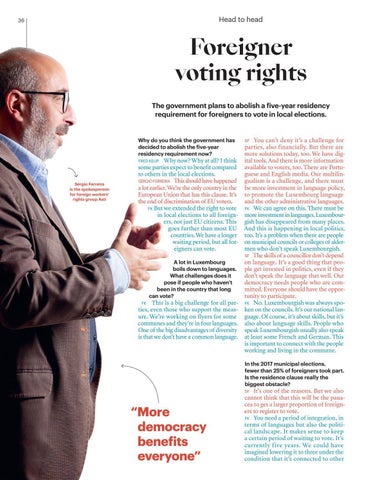
Sérgio Ferreira is the spokesperson for foreign workers’ rights group Asti
Why do you think the government has decided to abolish the five-year residency requirement now? FRED KEUP Why now? Why at all? I think some parties expect to benefit compared to others in the local elections. SÉRGIO FERREIRA This should have happened a lot earlier. We’re the only country in the European Union that has this clause. It’s the end of discrimination of EU voters. FK But we extended the right to vote in local elections to all foreign ers, not just EU citizens. This goes further than most EU countries. We have a longer waiting period, but all for eigners can vote. A lot in Luxembourg boils down to languages. What challenges does it pose if people who haven’t been in the country that long can vote? FK This is a big challenge for all par ties, even those who support the meas ure. We’re working on flyers for some communes and they’re in four languages. One of the big disadvantages of diversity is that we don’t have a common language.
“ More democracy benefits everyone”
SF You can’t deny it’s a challenge for parties, also financially. But there are more solutions today, too. We have dig ital tools. And there is more information available to voters, too. There are Portu guese and English media. Our multilin gualism is a challenge, and there must be more investment in language policy, to promote the Luxembourg language and the other administrative languages. FK We can agree on this. There must be more investment in languages. Luxembour gish has disappeared from many places. And this is happening in local politics, too. It’s a problem when there are people on municipal councils or colleges of alder men who don’t speak Luxembourgish. SF The skills of a councillor don’t depend on language. It’s a good thing that peo ple get invested in politics, even if they don’t speak the language that well. Our democracy needs people who are com mitted. Everyone should have the oppor tunity to participate. FK No. Luxembourgish was always spo ken on the councils. It’s our national lan guage. Of course, it’s about skills, but it’s also about language skills. People who speak Luxembourgish usually also speak at least some French and German. This is important to connect with the people working and living in the commune.
In the 2017 municipal elections, fewer than 25% of foreigners took part. Is the residence clause really the biggest obstacle? SF It’s one of the reasons. But we also cannot think that this will be the pana cea to get a larger proportion of foreign ers to register to vote. FK You need a period of integration, in terms of languages but also the politi cal landscape. It makes sense to keep a certain period of waiting to vote. It’s currently five years. We could have imagined lowering it to three under the condition that it’s connected to other
Politics
Should foreigners be registered to vote automatically, and then have to vote? FK I don’t think it’s something foreigners want. You would oblige them to vote with the risk of penalty if they don’t. It’s something that makes foreigners hesitate, I think. Once you’re registered, you have to vote every time. They don’t know this from their countries. SF There are a lot of questions around automatic registration. It’s a legal issue, too, whether you can force an EU citizen to vote in another country. You could register them automatically with the option to de-register, which is an option today. When we abolish the residence clause, this should be one of the topics up for discussion.
“ You need a period of integration”
At the beginning, you said that some parties might support this reform to gain more votes. What is the risk for parties like the ADR to be pushed aside? FK In the local elections, we’re not the strongest party. We will be running in several communes for council seats. People always say the ADR isn’t interesting for foreigners, but we have a lot of foreign members. We are trying to build an international section. It depends a little on nationality. The ADR is a partner party of the Conservatives, for example. This means something for people from the UK. SF I’m not sure if it’s a gain for one party over another. I don’t have any facts to back this up. It’s not a new challenge, but it’s a responsibility for the parties to reach more people. That’s maybe more difficult for smaller parties. But more democracy benefits everyone. A lot of everyday life is decided in the communes. Is the right to vote a right you must earn as a foreigner? FK In the communes, you get it after five years. It’s not a reward. For national elections, this is different. It’s about national sovereignty. This requires that extra step, that you come here, integrate, learn the language, acquire nationality, and then you vote. SF A foreigner who comes here, lives here, works here in my eyes must be interested in politics. But we also know that a lot of Luxembourgers aren’t interested in politics. It’s not about being a foreigner or not. It’s a question of making politics engaging for all of society. Moderated by CORDULA SCHNUER Photos MATIC ZORMAN
NOVEMBER 2021
measures--doing more for languages, for Luxembourgish, for communication in communes. A lot of commune websites are only in one language. You need them in more. But under three years, we don’t achieve anything. SF I can’t agree. It’s not that we’re doing something special for foreigners. There is a discrimination of EU citizens who come here and who must wait five years to vote. If we went to another EU country, we could vote tomorrow. It’s a message to people. It’s a symbol. You’re a part of the country. FK But if you have a wait period, it’s also a symbol of integration. People moving here is very well, but we want them to integrate, to understand things, and then you can vote. Because there is also a danger of manipulation. You could find yourself in a situation where people could easily be manipulated who to vote for. It’s a risk that shouldn’t be underestimated. SF This argument was used against women’s suffrage--that they’d be manipulated by their husbands. We have to give people some credit. They’re adults and, in the end, everyone can be manipulated--foreigners or not-foreigners. FK When you arrive here and you don’t know the political culture, the electoral system, you don’t understand the languages and you must vote, you are manipulable. SF But a foreigner who comes here, who doesn’t know the society, doesn’t know the languages or the politics, won’t get registered on the electoral list.
37
Fred Keup is an MP for the Alternative Democratic Reform (ADR) party
BRAND VOICE
38
TAX RECLAIM PROCESS
NOVEMBER 2021
Tax
Technology at the heart of tax outsourcing Sponsored content by ARENDT
In an increasingly complex tax environment, financial players are seeking to rely on trusted partners. They are keener than ever to avail of the opportunity to turn to service providers combining tax and legal expertise with technological solutions in order to manage their regulatory obligations and operational tax claims (FATCA/CRS analysis and documentation, tax returns, tax claims, etc.)
Financial players operating in an international environment are confronted with numerous different tax regimes and rules. In recent years, regulations such as the FATCA and CRS laws have forced them to be more transparent. Beyond that, all players need to be able to juggle the reporting obligations of the jurisdictions in which they operate with opportunities to recover taxes overpaid by the various tax administrations. “To manage these aspects, investment funds and asset managers, banks and investment companies need to rely on legal and tax expertise as well as on advanced technological solutions,” explains Farah El Messiri, a tax manager
with Arendt Services. “Changes in tax regulations from one jurisdiction to another, as well as changes to the processes of tax authorities, require regular adjustments to IT systems. Increasingly, stakeholders are looking for ways to address these issues more effectively.” Tax expertise combined with technology Since the introduction of FATCA/CRS, Arendt supports its clients with a dedicated reporting technology solution. “Considering the complexity associated with the tax reclaim process in a heterogeneous and everevolving environment, the idea was to go even further in terms of operational taxation for the Arendt
“ Banks and investment companies need to rely on legal and tax expertise as well as on advanced technological solutions.” Farah El Messiri Tax manager at Arendt Services
How technology is key for outsourcing services? — Transparency and trust — Flexible and up-to-date process — Integrated and secured web platform — Reliable WHT experts
group,” says Yann Fihey, a partner within Arendt Regulatory & Consulting. “Starting with the firm’s legal and tax expertise and relying on the local relays that comprise our network of partners in Europe, the idea was to offer an advanced solution. With our technological expertise – thanks in particular to the acquisition of digitalisation and robotisation specialist Mobilu – and the ability to assist market players due to our status as an FSP, it was possible to implement an operational management service to address the tax issues of each of our clients.” Reducing the burden, guaranteeing control Arendt’s new Operational
39
4 3 2 1
Tax service is a response to the growing complexity of tax affairs and the requirements of stakeholders – made more urgent by COVID – to use efficient operational solutions. “Outsourcing the operational management of tax concerns offers financial players reassurance. They can be sure that their tax obligations will be fulfilled in accordance with the constraints imposed by the various jurisdictions,” says Farah El Messiri. “The technology combined with tax expertise, moreover, allows us to considerably reduce the administrative burden required while allowing players to benefit from the ‘pooling’ effort. The group’s teams keep
“ Without having to assume the administrative burden, the client benefits from increased visibility” Yann Fihey Partner at Arendt Regulatory & Consulting
TRACKING OF CLAIM Follow-up of the claim with foreign tax authorities available on the client platform
NOVEMBER 2021
TAX
CLIENT
5
REIMBURSEMENT & ALLOCATION Reimbursement of the claim by foreign tax authorities and preparation of the allocation of income for the client’s finance department
FILING OF THE WITHHOLDING TAX (WHT) RECLAIMS Preparation and filing of the WHT reclaims before the respective tax authorities
DOCUMENTATION COLLECTION & PRODUCTION Preparation of the claim documents electronically validated and signed by the client
BUSINESS CASE
ARENDT
6
Production of the Business case and upload on the platform. Validation of the claims to process by the client
DATA COLLECTION Collection of payment data from custodian
a close eye on regulations while constantly adapting digital tools and procedures in line with local and international trends.” Increased visibility Helping stakeholders, the service makes it easier to assess the opportunities for initiating tax reclaim procedures to recover sums withheld at source that constitute an overpayment by the local tax administration under the current system. “Without having to assume the administrative burden, the client benefits from increased visibility of each case throughout the operational management process, which consists of seven stages. Using the tool, the client
can follow the files securely – analyse the opportunity, consider the various local or international legal aspects, effectively recover any overpaid tax, by submitting the necessary documentation, opening the file and processing it”, observes Yann Fihey. Ultimately, the client benefits from better control of costs and risk inherent in tax optimisation.
ation inform More our n about solutio claim e R x a T
NOVEMBER 2021
40
Essay
Between a tree and a leafy place Words JEFF PALMS Illustrations MARIELLE VOISIN
In our attempts to salvage the environment and to inaugurate more sustainable futures, wood--eco-friendly, carbon-positive wood--has emerged as a meaningful material. But the discussion goes much deeper than “Use more wood!”
Together with the ocean, trees are argu“If we cut down a tree,” adds Brever, ably the most-toted icons of environ“it’s to build a house that is ecologically mentalism. The universes lurking deep friendly.” undersea and in the heart of wild forests Brever certainly wouldn’t mind being represent the spaces on Earth farthest, able to buy more local wood. “It would be at least in our imaginations, from anthropinteresting for us to buy smaller quantities ic influence. They are ecosystems full of from private owners,” she says. She explains bewondering secrets, and in an era where that the advantage is that Bois Brever’s main competitors, Belgian and French humanity represents the death of the SECTOR SNAPSHOT natural world by plastic and pollutants, sawmills, are too huge to find such minor A glimpse of wood figures for Luxembourg they are more sacred than ever. deals lucrative. Plus, she adds, “Luxembourg is small so transport is short, and And it isn’t only in this age of the Anthrousually these trees are very good quality.” pocene--that in which humankind’s mark Indeed, the tension between visions on the planet has become irreversible--that of pristine forestland and the desire for forests have been special. The Western organic building materials is a contradicpopular imaginary has long held them as Wooded hectares tory one. And the story of this tension is realms of mystery, from the thirteenth-censtill in its ascending phase, with public tury Breton lai Sir Orfeo, in which Orfeo’s wife is kidnapped by a faery king deep in opinion, government action, marketplace the woods, to the Forbidden Forest of J.K. realities and climate instability all intensifying in their voices. Rowling’s Harry Potter series, where uniCompanies active in the wood supply chain corns, giant spiders and other remarkable In the marketplace things--remarkable even to witches and Demand for wood seems to be healthy. wizards--reside. According to the wood cluster of LuxinThese are the cultural contexts in which ordinary people in Luxembourg see their novation, the proportion of wood (versus forests. Accordingly, when a tree is felled, other materials) used in the grand duchy’s Individual entities who own forested land a fuss is made. Locals will even call the construction industry is projected to rise Sources Nature and Forest Agency, Luxinnovation, authorities when they see a tree being to 13% in 2025, compared to 10% now Lëtzebuerger Privatbësch chopped down, according to anecdotal and 6% in 2016, suggesting that we are evidence given to me by Michel Dostert amidst an upward trend. Stephan Hostert, of Lëtzebuerger Privatbësch, a nonprofit managing director of construction serthat advises private forest owners. ations,” he says. “But still they feel very vice provider Steffen Holzbau, confirms And the law is on the side of ordinary disturbed by it. And then they’ll contact that wood and sustainability “are more people. Even when a tree isn’t felled ille- the [Nature and Forest Agency] and say: and more important in building”, while gally, there is a minefield of other infrac- ‘They’re destroying the forest!’” the government is openly pushing for its tions that workers might commit. The Corinne Brever, director of the Éisl- use: various subsidies are on offer to progovernment has lately ramped up nature ek-based Bois Brever sawmill, has a sim- mote the use of wood for energy and protection policies as well as the penalties ilar take: “The forest is considered to be building purposes, while in May a new for destroying parts of forest ecosystems, a place where people can spend their free incentive for private forest owners to to the point where many contractors and time. They want to go there to do some practise sustainable forest manageexperts break the law without knowing it. mountain biking or to walk their dog. But ment—i.e., to sell their wood (responsiFor example: if you fell a single tree and on the other hand, they want their nice bly)--was announced. The government’s consequently vary the sunlight situation wooden table or a wooden roof on their new Eist Holz (“Our Wood”) promotionin a way that threatens a protected species house…” al brand also highlights the link between Accordingly, Dostert has observed a forests and wood. of moss, that’s a crime. The message remains, The trajectory isn’t as straightforward and remains simple: forests are precious. trend whereby private forest owners choose to do nothing with their forests. “It’s very as rising numbers and interest, however. And yet… romantic for a lot of people,” he says, refer- Small and medium European sawmills The symbolic value of trees is something ring to the idea of leaving wildlands experienced a beyond-the-curve explothat wood industry professionals under- untouched by humans. “But if we want to sion in demand this year: in February, prostand differently, however. Dostert points produce this material [wood] here, then duction problems in Canada induced the out that folks can’t have their cake and we need to actively manage the forest in US to buy timber from Europe at exorbieat it too, i.e., have wood as a sustainable order to get it.” After all, he points out, what’s tant rates--up to €800 per m³, where about construction material but not cut down the alternative? Importing wood from €300 is average--which left a vacuum in any trees to get it. “People will walk a places like Africa or Russia? Not only would the European market. “We had ten times forest path every day or three times a that incur carbon costs in the transport more work than during normal times,” says week, and maybe once in five years this process, but it would also support indus- Brever. “It’s just crazy. We are too small for the number of orders that we’re path will be blocked for harvesting oper- tries that are likely to be underregulated.
90,000 1,300
Photos
Shutterstock, Udo Schmidt / flickr.com
14,000
41
NOVEMBER 2021
Industry
Species mismatch The bark beetles, sadly, are not only a footnote in cases of market volatility; they are no strangers to Luxembourg, where they have been thriving thanks to dry springtime weather and hot summers. Their favourite meal is spruce, which incidentally is the most important commercial wood in the region. Bois Brever, one of two sawmills in the grand duchy, doesn’t process anything except spruce. “All of our customers buy spruce,” says Brever. “It’s the most commonly used construction timber. It grows very fast and you can use 100% of it.” But the popularity of this softwood introduces another element of public opinion (besides a general mood of protectionism): spruce is not native to the grand duchy, whose local ecosystem is, treewise, naturally composed of hardwoods like oak or beech. Beyond a romantic--to borrow Doster’s word--attachment to native species, there are several reasons to be upset about the proliferation of spruce. For one thing, Luxembourg is so spruce-crazed that nobody here is even capable of processing hardwood, most of which ends up getting exported to China on container ships. (“A shame,” says Dostert.) For another, spruce is more vulnerable to bark beetles because it’s an outsider in this bioregion.
FOCUS ON FORESTS Details of Luxembourg's forests, by percentage
65%
Of wood grown per year is harvested
64% Of forests are hardwood
54%
Of forests are privately owned Sources Luxinnovation, Nature and Forest Agency
Obviously, we can’t abandon spruce overnight in favour of native varieties, since the economic demand for it remains high while the infrastructure to process hardwood--which grows much more slowly--doesn’t even exist. Plus, discussions of forests require large timescales: spruce is now prevalent partly because everyone was planting it after World War II as an investment in their retirement. But its vulnerability has problematised its ubiquity, leading some German firms to begin conducting research on how to process hardwood. The quagmire here is thus the following: economic demand for softwood is rising, for legitimate reasons, yet public demand for hardwood is rising, and also for legitimate reasons. Is wood the answer? So which futures are possible, in terms of Luxembourg’s forests and the sustain-
ability of its building practices? There is some comfort in knowing that the wooded proportion of the country has remained stable for the last two decades, in spite of growing demand (and production). It also sounds like the laws are not outpacing the industry, even if more acts are criminalised than forestry workers tend to realise. For instance, since 2018 clear-cutting has been banned except for small areas (half a hectare), so the extraction of wood is happening predominantly via thinning, the strategic removal of a tree here, a tree there. Thinning remains a viable business activity (worth from €1,000 to 2,000 per hectare of coniferous forest every ten years) and it alters the ecosystem rather than destroying it outright. Plus, by law you have to replant what you take. Yet the “circularity” of the process is also a bit of a mirage. Statec numbers show that Luxembourg’s forests are getting sicker by the year: in 1986, 77% of trees were in perfect health while today that number is just 14%, due to air pollution and global warming. Meanwhile, the Organisation for Economic Co-operation and Development reports that the grand duchy’s biodiversity has been worsening for 40 years: Luxembourg’s protected areas “have obviously not succeeded in halting the decline in biodiversity,” it said in its 2020 environmental performance report. These linear trends confuse the simple idea of one-tree-out, one-seed-in. In holistic terms, wood’s role in the modern age is so obvious that it might serve as a bellwether for the feasibility of other “circular” futures: instead of increasing wood production to meet demand, will it be possible to lower demand to meet output levels that are ecologically responsible? I.e., to let the health of the forests decide how much wood we use (while not running to eco-unfriendly materials to fill the gap)? This is the kind of shift in business thinking that wood desires of us. People are calling wood a hot commodity, and while that is broadly correct the sector is also anomalous. Ironically, it may not be a “growth” sector in the traditional sense. In fact, Brever is tuned into the reality that little innovation is required within it: essentially, harvesting wood has been working well for a long time. “Wood can be the answer,” she reasons… “because it has always been kind of an answer.”
Photos
NOVEMBER 2021
getting.” In Europe, prices hit the €1,000 mark before starting to fall. Such volatility is, of course, down to global warming and its knock-on effects: the Canadian province of British Columbia had been scourged by bark beetles and wildfires for 10 years, culminating in the supply crisis in the US. Demand is thus unlikely to fall, but supply remains a concern because of beetles, weather or simply the number of wooded hectares. “Will we have enough wood left in 50 years’ time?” asks Brever. “That’s maybe one problem: that the demand for sawn timber exceeds the actual wood that’s in the forest. That’s a fear that I have.” She stipulates that her fear isn’t based on any scientific forecast. And currently, more wood is grown in Luxembourg annually than is harvested (760,000 m³ versus 500,000 m³), meaning that there is nothing to panic about-there are laws about replacing felled trees--but, true, rising demand will put pressure on this differential.
Shutterstock
Essay Industry
42
www.delano.lu
The Delano offering is expanding! Finance The latest industry news from the heart of Luxembourg’s financial centre Twice a month, every other Tuesday at 2:00 pm –› Launch date: 19.10.2021
Weekend "10 Things To Do" Every Saturday at 9:00 am –› Launch date: 18.09.2021
International Daily Stay up to date with the Breakfast & Noon Briefings
For local and global players interested in expanding their business Once a month on Wednesday at 2:00 pm –› Launch date: 22.09.2021
–› Briefings at 6:45 am and 11:45 am
SUBSCRIBE on get.delano.lu/newsletters
Gusto
NOVEMBER 2021
44
Seasonal flavours! Enjoy the fruits of the season in various forms: pastries, ice pops, sorbet, jams, even seasonal spirits.
1 Ladurée The Ispahan is made with rose-flavoured macaron filled with rose petal and lychee cream and embellished with fresh raspberries. www.laduree.fr
2 Oberweis The Piémont dessert presents an essential taste of autumn: hazelnuts from Piedmont. It is used in powder form in the biscuit, in paste form in the crumble and the ganache, and in the praline used in the mousse. www.oberweis.lu
3 Pretemer Haff Several seasonal fruits make up the base for the jams, including pears, quetsch plums, blueberries and apricot. www.pretemerhaff.lu
4 Anna & Paul A taste of the quetsch-cannelle sorbet is a great way to enjoy the local plums. The recipe also contains honey, lemon juice and cinnamon. www.anna-paul.lu Words ABIGAIL OKORODUS Photos MATIC ZORMAN
NOVEMBER 2021
45
5 Glacier Bargello Heart-shaped ice pops made of pear sorbet and dark chocolate with no milk. They also have cakes made with Madagascar vanilla and apple-cinnamon sorbet and dark chocolate sorbet and pear sorbet cake. www.bargello.lu
“The trees that are slow to grow bear the best fruit.” French playwright Molière
Seasona l
irits sp Seasonal spirits by Distillerie Diedenacker
6 Au pain de Mary The bakery complements its offering with homemade jams, such as the quetsch jam which includes a little sugar to tantalise your taste buds. www.aupaindemary.lu
Distillery Diedenacker prides itself as the first whisky distillery in Luxembourg. The brand has been in existence since 1862. It produces exquisite spirits and liqueurs from local and regional fruits. Varieties of spirits include Williams pear, Reinette apple, plum, quetsch and many other fruit-based selections.
Welcome to the Club
Business Club
NOVEMBER 2021
46
In numbers
Flashback Your events
1,100
It has been a busy month for live events! The minister for mobility 1 François Bausch opened our 10�6 on mobility sponsored by Enovos, encouraging all of us to consider multimodality as we move around the country. Sustainability was at the heart of every presentation from the 10 speakers. The first Paperjam Real Estate seated dinner with gold sponsors Inowai and ING was filled to capacity to hear 2 François Trausch, CEO of Allianz Real Estate, discuss how real estate remained a good investment, despite the change in yields between retail and logistics. 3 Nicolas Mackel, CEO of LFF, and 4 Cindy Tereba from the Luxembourg Chamber of Commerce spoke at our Delano Live. “Covid has asked a lot of questions and it’s our duty to find the answers,” Tereba said. At our last Delano Breakfast Talk, 5 Pierre-Alexandre Degehet (BSP) spoke about “shareholder rights in the light of corporate interests” at Sofitel Le Grand Ducal.
COMPANIES The number of company members of the largest business club in Luxembourg.
18,000 MEMBERS
The number of individuals who are part of the vibrantly active Paperjam + Delano Club community with whom you will get to interact.
383
EVENTS The number of digital and on-site events. Choose from about 400 conferences, training, networking and workshop events each year.
“[Luxembourg is] very dependent on supply chains.”
500
Thomas Kallstenius LIST
HOURS
The number of annual training hours for your employees to develop their hard and soft skills: an additional benefit for you and useful extras for your teams.
HOW TO ATTEND PAPERJAM+ DELANO CLUB EVENTS ?
3 4
You’re already a member Please check the Club section on our website paperjam.lu. Select, among all the digital and on-site events listed, the ones you would be interested in, fill in the registration form at the bottom page and register.
You’re not a member yet Please email the Paperjam+Delano Club via club@paperjam.lu and an account manager will be in touch to introduce you to all the perks offered by the largest business club in Luxembourg.
1
47
Programme October-November
NOVEMBER 2021
Tuesday 26 October
Start-up Stories Round 4 TIME 18:30 – 21:30 LOCATION The Cube (MAE) SPONSORS Startup Luxembourg, Office Freylinger PARTNER University of Luxembourg Tuesday 16 November
Delano Live: How to move up without burning out? TIME 18:30 – 20:00 LOCATION Knokke Out SPONSORS Enovos, ING Wednesday 17 November CLUB TALK
5
2
How to regulate crypto-assets without killing them? TIME 18:30 – 21:30 LOCATION ARHS Building Thursday 25 November
Gilles Feith Luxair
Cybersecurity: 10 shades of risks TIME 18:30 – 22:30 LOCATION Athénée de Luxembourg SPONSORS Post Luxembourg, Cubic Consulting
Photos
“1 million tonnes.” [Expected target of cargo in 2021]
Simon Verjus
10×6
Sign up on the Paperjam + Delano Club site: club.paperjam.lu
011 BY MIKE K N2 OE DI DI DE
N GE
R
FO UN
48
NOVEMBER 2021 EDITION
NOVEMBER 2021
PUBLISHING DIRECTOR
Mike Koedinger EDITORIAL DEVELOPMENT DIRECTOR
Editorial Phone (+352) 20 70 70-150 E-mail news@delano.lu JOURNALISTS
Teodor Georgiev (-158) Aaron Grunwald (-152) Tracy Heindrichs (-164) Abigail Okorodus (-155) Jeffrey Palms (-156) Bianca Panainte (-159) Cordula Schnuer (-163) COMMUNITY MANAGER
Christophe Lemaire PROOFREADING & FACTCHECKING
Maison Moderne PHOTOGRAPHY
Romain Gamba Guy Wolff Mike Zenari Matic Zorman
Nathalie Reuter EDITOR-IN-CHIEF, DELANO MAGAZINE
Publisher
Natalie Gerhardstein (-154) EDITOR-IN-CHIEF, DELANO DIGITAL
Duncan Roberts (-151)
Brand Studio Phone (+352) 20 70 70-300
www.maisonmoderne.com Phone (+352) 20 70 70 E-mail publishing@maisonmoderne.com
DIRECTOR
FOUNDER AND CHAIRMAN
Youcef Damardji
Mike Koedinger
STRATEGIC BUSINESS DEVELOPMENT ADVISOR
CEO
Francis Gasparotto (-301)
Geraldine Knudson
HEAD OF MEDIA SALES AND SOLUTIONS
ADMINISTRATIVE AND FINANCIAL DIRECTOR
Dominique Gouviaux (-338)
Etienne Velasti
COMMERCIAL ASSISTANT
Maison Moderne is a partnership between Francis Gasparotto, Mike Koedinger and Etienne Velasti.
Céline Bayle (-303) MEDIA ADVISORS
Nicolas Galtier (-318) Mélanie Juredieu (-317) Virginie Laurent (-322) Aline Puget (-323) Léo Santoro (-335) Mikaël Spezzacatena (-326) HEAD OF CONTENT STRATEGY
Emmanuelle Thivollard CREATIVE DIRECTOR
Jeremy Leslie TRAFFIC MANAGER
Sandrine Papadopoulos ART DIRECTOR
José Carsí LAYOUT
Sophie Melai (coordination), Elina Luzerne, Juliette Noblot, Marielle Voisin
PUBLISHING DIRECTOR
Mike Koedinger STRATEGIC BUSINESS DEVELOPMENT ADVISOR
Francis Gasparotto DEPUTY DIRECTOR, BUSINESS CLUB
Ana Wiscour-Conter CHIEF DIGITAL OFFICER
Viktor Dick HR MANAGER
Sylvie Notarnicola ADMINISTRATIVE MANAGER
Sylvia Leplang DIGITAL PROJECT MANAGER
Meryem Alamy DISTRIBUTION MANAGER
Kévin Thirion IT MANAGER
Matthew Dixon
ILLUSTRATIONS
Marielle Voisin
To contact staff members SEND AN E-MAIL TO
All rights reserved. Any reproduction, or translation, in whole or in part, is prohibited without the prior written consent of the publisher. © MM Publishing and Media S.A. (Luxembourg). Delano™ and Maison Moderne™ are trademarks used under licence by MM Publishing and Media S.A. ISSN 2220-5535
firstname.lastname@maisonmoderne.com WRITE TO
PO Box 728, L-2017 Luxembourg natureOffice.com | DE-261-JYACEBD
OFFICES
10, rue des Gaulois Luxembourg-Bonnevoie 10, avenue de la Liberté, Luxembourg-Gare
Maison Moderne is committed to reducing its ecological footprint. Delano magazine uses CO2 neutral printing, Blauer Engel recycled paper for its cover and FSC® certified sustainable paper for interior pages. Please recycle. Have you finished reading this magazine? Save it, pass it on or recycle it!
In accordance with article 66 of the law of 08.06.2004 on the freedom of expression in the media, the following statement is obligatory “one time per year, in the first edition distributed”. We have decided to publish it each month. The company that publishes Delano is indirectly held, by a stake exceeding 25%, by Mike Koedinger, a publisher registered in Luxembourg. Geraldine Knudson is chartered with general and daily management.
NOVEMBER 2021
49
Monthly subscriptions on eshop.maisonmoderne.lu
Expat Guide
11 issues/year
Supplement Deep dives into hot topics
Published each summer for newcomers
NEXT EDITION: DECEMBER 2021
NEXT EDITION: JULY 2022
Business Club
Delano.lu
Networking, workshops and a variety of events. Learn more on paperjam.lu/club
Business, finance, politics and more each day
ECOSYSTEM
Newsletters
Delano Jobs
Sign up at subscription. maisonmoderne.com/en
Find the latest listings on jobs.delano.lu
Podcasts
Social media
Listen on delano.lu/list/podcasts
Social @DelanoMagazine Delano Delano_lu Delano Delano Magazine @Paperjam_Club Paperjam + Delano Club Paperjam + Delano Club
Pick’n’mix
50
Side jobs
Sai Arpita Immaneni
Ricardo Martins
Side job
FOUNDER OF LES TEMPLIERS DE PROVENCE
CO-OWNER OF KRISHNA VILAS LUXEMBOURG
BARTENDER
While CEO of EFA, I began an olive oil business in 2010. See: lestempliers deprovence.com
I was fully employed during the launch of our business in 2021. I work for Amazon. We started a South Indian Restaurant, Krishna Vilas.
PHOTOGRAPHER
EXECUTIVE DIRECTOR OF THE INSIGHT PROJECT
Yes… Since I’d often go to The Tube bar, I decided to ask them if they needed extras.
I was fully committed to my charitable projects, and I put my career on hold temporarily.
As a foreigner, it was the best way to meet new people, and I really liked the environment at that pub.
My goals are not driven by income expectations. The Insight Project is a non-profitable organisation, and the directors do not receive any income.
Are you ready to give what it takes and stay relentlessly optimistic to overcome the blockers?
I wondered if they would accept me since I already had a full-time job, and if my employer would be okay with that too.
Passion.
Exploring your passion while still having a secure source of income.
Depending on the side job, you get to make new friendly professional connections and see a different side of the job others are doing.
My company is in France: red tape!
From my experience, extremely high revert time from government officials.
The main challenge is the first impression you give, as you never know if they would take you in or not.
My family helped.
Presently, I am on my maternity leave, but if not, having a good team is a necessity to juggle between jobs.
At first, it was okay, but with time, it started to get harder as my full-time job duties increased. For two years, I worked as an extra almost every weekend, but now it’s not that often.
Should you make this your main job?
Pierre Blavier
Is it legal?
You run so much that you don’t need to go to the gym anymore.
Overcoming the three-year period to be recognised as a charity of public interest.
I always work sideways and… I don’t have a boyfriend…
I was a student when I did my first photo reports. If I remember correctly, it was in 2016.
Photography being an expensive passion, I thought it would be a good idea to pay off the cost of the equipment a bit.
What percentage of my free time can I allocate?
Merging passion and work but also putting aside the stress of startups, such as having a fixed income needed at the end of the month.
Time. Being a full-time employee with a 40-hour week, it is sometimes complicated to combine passion and work.
I have more or less an hour and a half commute, which leaves me time to work on my photo retouching or video editing.
Provided by the participants, Matic Zorman/Maison Moderne, Shutterstock
I did this for fun, not profit.
A gap in accessible Indian food in Luxembourg; a desire to introduce authentic South Indian cuisine.
Marta Ventura Correia
Photos
How do you manage time working multiple jobs?
One main challenge first-time entrepreneurs face in Luxembourg?
One advantage of a side job?
One question to ask before pursuing a side job?
Why did you decide on another stream of income?
Thomas Seale
Were you fully employed when you launched your first business venture?
NOVEMBER 2021
Professionals in Luxembourg share their experiences and things to consider before taking on a “side job”.
BANQUE RAIFFEISEN, société coopérative.
With your Visa card, you pay, you plant. Visa cards that plant trees. In collaboration with the foundation Hëllef fir d’Natur from natur&ëmwelt and the Friendship Luxembourg, Raiffeisen commits to planting 1 tree for every 200 transactions made using its new, sustainable Visa credit cards to combat the damaging effects of climate change. Join our commitment at letsplanttrees.lu
The Bank that belongs to its members
Fund lawyers making the difference
PUB VIDE xxxx. We believe that smart solutions require an integrated approach. Our Luxembourg investment management practice is unique in combining fund, finance and tax capabilities. > loyensloeff.lu