3
Write to PO Box 728 L-2017 Luxembourg Offices 10 rue des Gaulois, Luxembourg-Bonnevoie ISSN 2220-5535 Web www.maisonmoderne.com Founder and CEO Mike Koedinger Administrative and financial director Etienne Velasti Innovation, quality and operations director Rudy Lafontaine PUBLISHER Phone (+352) 20 70 70 Fax (+352) 29 66 19 E-mail publishing@maisonmoderne.com Publisher Mike Koedinger Editor in chief Duncan Roberts (duncan.roberts@maisonmoderne.com) Desk editor Aaron Grunwald (aaron.grunwald@maisonmoderne.com) Contributors Wendy Casey, Alessandro Maria Esposito, Stephen Evans, Marina Lai, Bjarke Smith-Meyer, Sarah Pitt, Alix Rassel, Zuza Reda-Jakima, Tonya Stoneman, Kimberly Willardson, Wendy Winn Photography Sven Becker, Benjamin Champenois, Marion Dessard, Steve Eastwood, Jan Hanrion, Lala La Photo, Mike Zenari Proofreading Pauline Berg, Muriel Dietsch, Sarah Lambolez, Cynthia Schreiber
EDITORIAL
Text by DUNCAN ROBERTS
Photography by CHRISTOPHE OLINGER
THE REVOLUTION WILL NOT BE IMPROVISED
DESIGN Phone (+352) 20 70 70-200 Fax (+352) 27 62 12 62-84 E-mail studio@maisonmoderne.com Director, Maison Moderne Studio Guido Kröger Creative director Jeremy Leslie Art director Cassandre Bourtembourg Studio manager Stéphanie Poras Layout Sophie Melai (coordination), Monique Bernard, Bernard Gissinger, Jan Hanrion ADVERTISING Phone (+352) 20 70 70-300 Fax (+352) 26 29 66 20 E-mail regie@maisonmoderne.com Director, Maison Moderne Advertising Sales Francis Gasparotto (francis.gasparotto@maisonmoderne.com) Sales director Luciana Restivo (luciana.restivo@maisonmoderne.com) Account manager Aysel Boschian (aysel.boschian@maisonmoderne.com) SUBSCRIPTIONS For subscriptions, please visit www.delano.lu Luxembourg (shipping included) 1 year / 8 issues / 25 euros 2 years / 16 issues / 50 euros Europe (shipping included) 1 year / 8 issues / 31 euros 2 years / 16 issues / 68 euros Printed by Imprimerie Centrale Distribution by Valora Services Luxembourg
In accordance with article 66 of the law of 08.06.2004 on the freedom of expression in the media: the company that publishes Delano is indirectly held, by a stake exceeding 25%,by Mike Koedinger, an independent editor registered in Luxembourg. Mike Koedinger is chartered with daily management. Delano™ and Maison Moderne™ are trademarks used under licence by MM Publishing S.A.© MM Publishing S.A. (Luxembourg) COVER PHOTO
Mike Zenari shot ArcelorMittal’s François Gaasch inside the Gadderscheier industrial estate. NOTE TO OUR READERS
The next print edition of Delano will be published on 11 December. For updates, commentary and our weekly what’s on guide, visit www.delano.lu.
T
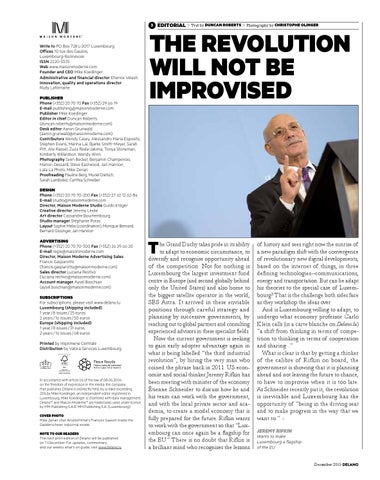
he Grand Duchy takes pride in its ability to adapt to economic circumstance, to diversify and recognise opportunity ahead of the competition. Not for nothing is Luxembourg the largest investment fund centre in Europe (and second globally behind only the United States) and also home to the biggest satellite operator in the world, SES Astra. It arrived in these enviable positions through careful strategy and planning by successive governments, by reaching out to global partners and consulting experienced advisors in these specialist fields. Now the current government is seeking to gain early adopter advantage again in what is being labelled “the third industrial revolution”, by hiring the very man who coined the phrase back in 2011. US economist and social thinker Jeremy Rifkin has been meeting with minister of the economy Étienne Schneider to discuss how he and his team can work with the government, and with the local private sector and academia, to create a model economy that is fully prepared for the future. Rifkin wants to work with the government so that “Luxembourg can once again be a flagship for the EU.” There is no doubt that Rifkin is a brilliant mind who recognises the lessons
of history and sees right now the sunrise of a new paradigm shift with the convergence of revolutionary new digital developments, based on the internet of things, in three defining technologies--communications, energy and transportation. But can he adapt his theories to the special case of Luxembourg? That is the challenge both sides face as they workshop the ideas over. And is Luxembourg willing to adapt, to undergo what economy professor Carlo Klein calls (in a carte blanche on Delano.lu) “a shift from thinking in terms of competition to thinking in terms of cooperation and sharing...” What is clear is that by getting a thinker of the calibre of Rifkin on board, the government is showing that it is planning ahead and not leaving the future to chance, to have to improvise when it is too late. As Schneider recently put it, the revolution is inevitable and Luxembourg has the opportunity of “being in the driving seat and to make progress in the way that we want to.” JEREMY RIFKIN Wants to make Luxembourg a flagship of the EU December 2015