Sally Outram
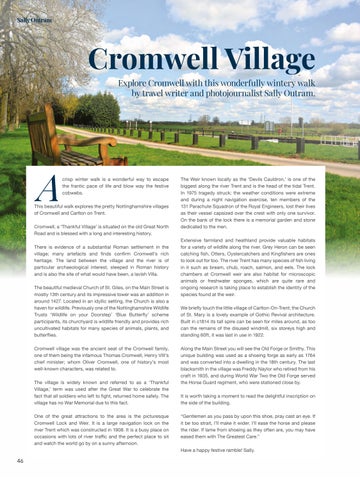
Cromwell Village Explore Cromwell with this wonderfully wintery walk by travel writer and photojournalist Sally Outram.
A
crisp winter walk is a wonderful way to escape the frantic pace of life and blow way the festive cobwebs.
This beautiful walk explores the pretty Nottinghamshire villages of Cromwell and Carlton on Trent. Cromwell, a ‘Thankful Village’ is situated on the old Great North Road and is blessed with a long and interesting history. There is evidence of a substantial Roman settlement in the village; many artefacts and finds confirm Cromwell’s rich heritage. The land between the village and the river is of particular archaeological interest, steeped in Roman history and is also the site of what would have been, a lavish Villa. The beautiful medieval Church of St. Giles, on the Main Street is mostly 13th century and its impressive tower was an addition in around 1427. Located in an idyllic setting, the Church is also a haven for wildlife. Previously one of the Nottinghamshire Wildlife Trusts ‘Wildlife on your Doorstep’ ‘Blue Butterfly’ scheme participants, its churchyard is wildlife friendly and provides rich uncultivated habitats for many species of animals, plants, and butterflies. Cromwell village was the ancient seat of the Cromwell family, one of them being the infamous Thomas Cromwell, Henry VIII’s chief minister; whom Oliver Cromwell, one of history’s most well-known characters, was related to. The village is widely known and referred to as a ‘Thankful Village,’ term was used after the Great War to celebrate the fact that all soldiers who left to fight, returned home safely. The village has no War Memorial due to this fact. One of the great attractions to the area is the picturesque Cromwell Lock and Weir. It is a large navigation lock on the river Trent which was constructed in 1908. It is a busy place on occasions with lots of river traffic and the perfect place to sit and watch the world go by on a sunny afternoon.
46
The Weir known locally as the ‘Devils Cauldron,’ is one of the biggest along the river Trent and is the head of the tidal Trent. In 1975 tragedy struck; the weather conditions were extreme and during a night navigation exercise, ten members of the 131 Parachute Squadron of the Royal Engineers, lost their lives as their vessel capsized over the crest with only one survivor. On the bank of the lock there is a memorial garden and stone dedicated to the men. Extensive farmland and heathland provide valuable habitats for a variety of wildlife along the river. Grey Heron can be seen catching fish, Otters, Oystercatchers and Kingfishers are ones to look out for too. The river Trent has many species of fish living in it such as bream, chub, roach, salmon, and eels. The lock chambers at Cromwell weir are also habitat for microscopic animals or freshwater sponges, which are quite rare and ongoing research is taking place to establish the identity of the species found at the weir. We briefly touch the little village of Carlton-On-Trent; the Church of St. Mary is a lovely example of Gothic Revival architecture. Built in c1814 its tall spire can be seen for miles around, as too can the remains of the disused windmill, six storeys high and standing 60ft, it was last in use in 1922. Along the Main Street you will see the Old Forge or Smithy. This unique building was used as a shoeing forge as early as 1764 and was converted into a dwelling in the 18th century. The last blacksmith in the village was Freddy Naylor who retired from his craft in 1935, and during World War Two the Old Forge served the Horse Guard regiment, who were stationed close by. It is worth taking a moment to read the delightful inscription on the side of the building. “Gentlemen as you pass by upon this shoe, pray cast an eye. If it be too strait, I’ll make it wider. I’ll ease the horse and please the rider. If lame from shoeing as they often are, you may have eased them with The Greatest Care.” Have a happy festive ramble! Sally.