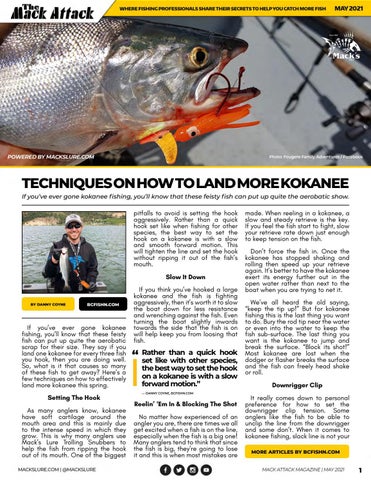
TECHNIQUES ON HOW TO LAND MORE KOKANEE If you’ve ever gone kokanee fishing, you’ll know that these feisty fish can put up quite the aerobatic show.
pitfalls to avoid is setting the hook aggressively. Rather than a quick hook set like when fishing for other species, the best way to set the hook on a kokanee is with a slow and smooth forward motion. This will tighten the line and set the hook without ripping it out of the fish’s mouth. Slow It Down
BY DANNY COYNE
BCFISHN.COM
If you’ve ever gone kokanee fishing, you’ll know that these feisty fish can put up quite the aerobatic scrap for their size. They say if you land one kokanee for every three fish you hook, then you are doing well. So, what is it that causes so many of these fish to get away? Here’s a few techniques on how to effectively land more kokanee this spring. Setting The Hook As many anglers know, kokanee have soft cartilage around the mouth area and this is mainly due to the intense speed in which they grow. This is why many anglers use Mack’s Lure Trolling Snubbers to help the fish from ripping the hook out of its mouth. One of the biggest
If you think you’ve hooked a large kokanee and the fish is fighting aggressively, then it’s worth it to slow the boat down for less resistance and wrenching against the fish. Even turning the boat slightly inwards towards the side that the fish is on will help keep you from loosing that fish.
than a quick hook “ Rather set like with other species, the best way to set the hook on a kokanee is with a slow forward motion.” — DANNY COYNE, BCFISHN.COM
Reelin’ ‘Em In & Blocking The Shot No matter how experienced of an angler you are, there are times we all get excited when a fish is on the line, especially when the fish is a big one! Many anglers tend to think that since the fish is big, they’re going to lose it and this is when most mistakes are
made. When reeling in a kokanee, a slow and steady retrieve is the key. If you feel the fish start to fight, slow your retrieve rate down just enough to keep tension on the fish. Don’t force the fish in. Once the kokanee has stopped shaking and rolling then speed up your retrieve again. It’s better to have the kokanee exert its energy further out in the open water rather than next to the boat when you are trying to net it. We’ve all heard the old saying, “keep the tip up!” But for kokanee fishing this is the last thing you want to do. Bury the rod tip near the water or even into the water to keep the fish sub-surface. The last thing you want is the kokanee to jump and break the surface. “Block its shot!” Most kokanee are lost when the dodger or flasher breaks the surface and the fish can freely head shake or roll. Downrigger Clip It really comes down to personal preference for how to set the downrigger clip tension. Some anglers like the fish to be able to unclip the line from the downrigger and some don’t. When it comes to kokanee fishing, slack line is not your MORE ARTICLES BY BCFISHN.COM
1
friend. The majority of the time, a kokanee will not strike the lure hard enough to pick up all the slack line when the line becomes unclipped. Set the line into the clip with enough tension that when a kokanee strikes the lure, the rod tip will bounce but you still have to unclip it. Reel down tightly to the clip, picking up all the slack, then with one smooth sweep, unclip the line from the downrigger and quickly reel to pick up any slack between the rod tip and the fish. Once you feel the fish, a slow and steady retrieve wins the race. By applying these simple tactics while kokanee fishing, it will help decrease the amount of fish that are lost during the fight and will make you a better kokanee angler!
SBF TIPS & TECHNIQUES
PRODUCT HIGHLIGHT
“Ultimately, the Double D™ Dodger 5.8 was created for fishing the ‘inbetween species and styles.’ This dodger specializes in being able to fish deep, with a lot of movement at much slower speeds with larger lures.
DOUBLE D™ DODGER 5.8 BY MACK’S LURE
SHOP NOW
Mack’s Lure has added a new size option to the popular and deadly Double D™ Dodger line. The new 5.8 version of the Double D™ Dodger is an expansion of the product line, which includes a 4.4- and 7.6-inch version, ideal for trout, kokanee, salmon and many other species.
dodger specializes in “ This being able to fish deep with a lot of movement at much slower speeds, while also using larger lures.”
“THE BEST LURE ACTION” BY PETE ROSKO
SBF TECH GUIDE
In last month’s issue, the unique action of the Sonic BaitFish™ was highlighted because of its effectiveness in catching fish. Through the ice, or in open water, the vertical jigging action is unlike other metal jigs. As with other sonictype lures, attaching your line to the top of the back on a Sonic BaitFish™ results in a strong-side vibration on the lift. But, only the Sonic BaitFish™ duplicates this action on the fall — whether the line is attached to its nose, tail or back. This is significant in separating the Sonic BaitFish™ from all other metal jigs in catching more fish! Please refer to the video (right) to witness this critical action. As always, thank you for subscribing to the monthly issue of the Mack Attack Magazine.
kokanee and trout and the larger 7.6-inch version works great for steelhead and salmon, but you have circumstances that leave you with a void.
— BOB LOOMIS, MACK’S LURE SALES DIR.
“The Double D™ Dodger 5.8 was created out of necessity,” Mack’s Lure Sales Director Bob Loomis said. “The 4.4-inch works fantastic for
“You would generally hang up and lose more gear with the larger dodgers trying to fish the bottom and have problems attracting fish from much further away with the smaller dodgers. “The new Double D™ Dodger 5.8 works fantastic for all of these issues and will be a welcomed addition to the 4.4 and 7.6 lineup.” Like its predecessors, the Double D™ Dodger 5.8 not only has the proven, traditional dodger action, but it also delivers its patent-pending stop-and-go action to your lure. With five attachment points, you can also easily spread your lines, while also doubling as a side planer. The Double D™ Dodger 5.8 is now available at MacksLure.com in UV Lemon Lime, UV Pearl, Silver and Hot Pink. SHOP THE DOUBLE D™ DODGER
VIDEO: HORIZONTAL OSCILLATION OF A 1 OZ. SBF
Capt. Pete Rosko, inventor of the Sonic BaitFish™, demonstrates horizontal oscillation of a 1 oz. Sonic BaitFish™. Tap the video above to watch this excellent under water view of a SBF in action.
2
GUEST COMMENTARY
POD: MATCH THE HATCH
5 TACTICS FOR TROLLING TROUT IN DIRTY WATER BY DANNY COYNE
BCFISHN.COM
The spring can be a very challenging time for anglers to target rainbow trout. As the freshet sets in, so do the dirty water conditions. If you have ever tried to catch rainbow trout in these murky water situations, you know it can be difficult. However, these periods can also offer some of the greatest fishing opportunities of the year. As anglers, we need to work extra hard to discover ways to increase the fish we catch in murky water conditions. Here’s our top five tactics for trolling rainbow trout in dirty water to help increase your odds the next time you are faced with these conditions.
On Ep. 23 of the WAO Podcast pres. by Harrod Outdoors & Mack’s Lure, Richy, Bob and Britton talk about how to match the hatch to improve lure selections. Click here to listen & subscribe.
extremely milky water circumstances, using dark flashers or dodgers with dark lures can payoff big dividends. Sound & Vibration Rainbow trout are the apex predator in a majority of our fisheries. They are very good at homing in and attacking their prey. One of the ways they do this is by detecting the low frequency vibrations or movements of smaller prey fish by utilizing their lateral lines. Using lures that create a small vibration (sound) can help the trout locate your presentation from a far distance, even during stained water conditions. Mack’s Lure offers several lures, including the
aforementioned Cripplure™ and Hum Dinger®, which emit a ringing sound. Lures that have small rattles in them have a tendency to out-fish non-rattle lures, such as spoons. Another great way to put off an attractive vibration is to use lures such as the Wedding Ring® Classic or Pee Wee™ Spinner Hoochie. These blades put off sonic vibrations that entice a trout to track down your gear and strike. Using attractors will also really put the odds in your favor. Using Double D™ Dodgers, Troll Lite® Flashers or a Sling Blade™ are a huge benefit during dirty water conditions. Attractors create ——
Contrast & Fluorescent UV Colors While fishing in stained water, paying attention to color and contrast is very important. In fact, in my experience, it’s the time of year that changing your lure color can make the biggest difference. You need to think about contrast! There is a lack of light penetrating the water, so using darker colors will create contrast to stand out much better to fish. Using attractors, such as the Sling Blade™ in brass or copper, will outproduce regular silver or chrome 4-to-1 due to the low amount of light available for reflection. Using lures such as spoons with brass and fluorescent or glow can be lethal combinations. Fluorescent UV and glow colors will give that eye-appeal to the fish, as these colors require less light to reflect the lure’s color. Choosing lures such as a Hum Dinger® or Cripplure™ that has dark or fluorescent spots on them will also stand out to the fish. In
ANGLER WEST: SPRING COLUMBIA WALLEYE Cold, muddy water in the Spring or a windy summer day, it doesn’t matter. Learn techniques for handling the tough conditions with Ted Beach, Bob Schmidt & Bobby Loomis. First, fish out of Boardman for Pre Spawn walleye in April and then fish Crow Butte for summer, post spawn walleye on a very windy day. Adjusting the size and color of our Smile Blades did the trick.
3
displacement in the water that help the trout find your presentation. During these low visibility periods, you can size up the size of attractors without spooking the fish like it can in clear water conditions. The new Double D™ Dodger 5.8 or Sling Blade™ 6” are deadly in these situations.
Speeds Your trolling speeds need to adjust to the conditions. Unlike in clear water, when we troll a variety of speeds with pulses and intervals, I find it more productive to troll at a continuous speed. In murky water, the trout have to work extra hard to locate your baits. By trolling at a constant speed, the fish won’t give up as quickly when hunting down your gear. The key to this is that you need to find the productive speed that your lure’s action continues to work effectively and you start to get strikes. Once you start to connect with fish, pay attention to your trolling speed and keep with it. It’s a fine balance from going too slow and too fast. Choosing lures, such as a variety of Mack’s Lure Smile Blade® spinners that work in slow trolling applications will aid you in this process.
Depth Of Your Presentation
Surface Fishing
Before the freshet arrived, you may have been hammering rainbows in the deep water regions of the lake. However, rainbows’ behavior will change once the spring runoff starts to enter the lake. The tributaries are not only bringing in warmer water, but they are depositing a ton of nutrients into the lake. These elements attract small forage fish into the shallow shoals. The warm water can also provide extra comfort for the trout. Rainbows that were once chasing baitfish on the surface over a couple hundred feet of water can now be residing near shallow shoals or ledges, feeding upon baitfish while being in comfortable water conditions. A lot of the time, you will see a distinct divide within the water where the clean lake water meets the murky runoff water. These are excellent areas to target, as the trout will tend to hangout in these zones. Troll just on the edge of the clean water in these areas. It is important to note that during these spring runoff seasons, it is also the time of year when rainbow trout are staging in front of the tributaries to run up for their spawn. It’s an ethical angling practice to release these spawning fish so they can complete their spawning cycle.
Usually, on the bright spring days, the sun will push the fish down within the water column, as it’s harder on their eyes, as well as they will follow their food. When the water clarity diminishes, the rainbows are more apt to stay near the surface because the murky water provides a filterlike effect from the bright light. This can be a very good time to surface for rainbows no matter if you have bright or cloudy days.
Your lure depth while trolling is also extremely important to pay attention to. Unlike clear water conditions, the fish’s strike zone is reduced during murky times. If you are marking fish at 50-feet on your sonar and your gear is at 65-feet, you need to adjust your downrigger to the depth in which you are marking the fish. This way, you can be confident that your presentation is within the fish’s strike zone. During dirty water situations, rainbows tend to not move quickly throughout the water column chasing forage, but rather wait for an opportunistic meal to present itself. The cloudy water conditions aid predator fish like the rainbow trout in providing them an advantage in ambushing their prey.
As noted above, the trout tend to use the low water clarity to ambush their prey. By trolling your lures on the surface, it delivers a silhouette effect to your lure, making for an easy target. Running dark colored lures that have an erratic, vibrating action, such as the Mack’s Lure Pee Wee™ Wiggle Hoochie™, is an excellent option for this method.
EP 12: FISH RECIPES
WALLEYE, KOKANEE, SALMON
LISTEN
SUBSCRIBE
Page 4
4
QUESTION
HOT DEAL : USE CODE KAN25
OF THE MONTH Have a questions you want answered? Send your inquiry to us and yours may be featured! Simply send an email to media@mackslure.com or reach out to us on social media.
Q: How does the Ultra Release™ and Shuttle Hawk™ work? A: Common question! The Ultra Release™ is an ultra-light release with a tension screw adjustment and has proven itself not only as a great release, but it is ideal for stacking multiple lines on one downrigger with the Shuttle Hawk™.
PHOTO OF THE MONTH Outdoor writer & author Gary Lewis shows off a beautiful trout caught on a river in Oregon with a Smile Blade® Fly, which features an interchangeable Smile Blade®.
To attached the line to the release, you have to think of the back of the release as a temporary extra hand. Make several loops in the line, then use the edge of the back of the release to create leverage in the line, then pull and snap into place. If the line does not pop in with leverage on the line, ensure that the adjustable screw matches the diameter of your line and how easily you want it to release. Once you’ve established that, the release will let go at the exact same pressure every time.
VIDEO OF THE MONTH Head to Lake Roosevelt on this episode of the Northwest Outdoorsmen as Richy, Bobby and Lance target monster kokanee and trout at this special fishery.
If the screw is too tight, you will never be able to snap the line into place. For more information, click here for an instructional video or shop now.
Follow Mack’s Lure on Facebook and Instagram and tag us with #MacksLure. Facebook.com/MacksLure @macks_lure To submit your catch, send us an email at media@mackslure.com or tag us on social media using #MacksLure.
5