LUXURY AVENUE
LUXURY www.luxuryavenue.com
AVENUE m a g a z i n e
FASHION MODA
Menswear gets rough and ready La ropa para hombre se vuelve tosca y simple
BEAUTY BELLEZA
YEAR 15
From catwalk to counter De la pasarela al mostrador
WATCHES RELOJES
NUMBER 3 NOVEMBER 2010-FEBRUARY 2011
Timepieces and technology Relojes y tecnología
CANCÚN
Teresa is in town Teresa está en la ciudad
Scarlett
LOS CABOS
Get the adrenaline pumping Haz que la adrenalina suba
Glamour is back! Screen sirens and the clothes that celebrate their curves ¡El glamour regresa! Sirenas de la pantalla y la ropa que celebra sus curvas
www.luxuryavenue.com
THE LUXURY BOUTIQUE MALLS IN CANCÚN & LOS CABOS
© D. YURMAN 2010
nicolas rieussec escritor del tiempo. Un tributo al inventor del primer cronógrafo. En 1821, Nicolas Rieussec inventó una pieza revolucionaria con dos discos giratorios debajo de un índice con una punta llena de tinta que dejaba una marca sobre las carátulas para indicar los tiempos finales de las carreras de caballos. Tomando la esencia de esta invención, Montblanc ha creado una pieza maestra: el Montblanc Nicolas Rieussec. Cronógrafo monopulsador, movimiento de cuerda automática
. Contadores de 30 minutos
y 60 segundos a través de discos giratorios fijos por un puente en la carátula. Reserva de marcha de 72 horas. Creado en la Manufactura Montblanc en Le Locle, Suiza.
exclusive montblanc boutiques: luxury avenue, boulevard kukulcan km 13.5 zona hotelera cancun, mexico luxury avenue marina cabo san lucas, esquina andador maderones, cabo san lucas, mexico www.montblanc.com
Contents
contenido
BEAUTY
BELLEZA
56 Be beautiful ....................................
56 Sé bella .............................................
60 Beauty news ...................................
60 Novedades de belleza .........................
62 Beauty buzz ....................................
62 El rumor de la belleza .........................
64 Face of fashion ...............................
64 El rostro de la moda ...........................
68 A good sport ...................................
68 Negocio redondo ................................
72 New beauty launches .......................
72 Lanzamientos de belleza .....................
WATCHES & JEWELRY
RELOJES Y JOYAS
74 Girl with a pearl earring ...................
74 La joven con el arete de perla ..............
76 Watch & jewelry news .......................
76 Novedades en relojes y joyería .............
78 Get real ................Watches in cyberspace
78 Seducción virtual ...Los relojes en el ciberespacio
84 A date to remember .........................
84 Un día para recordar ..........................
86 New watches and jewelry .................
86 Nuevos relojes y joyería ........................
88 Right time, right ring .......................
88 El momento preciso, el anillo preciso ....
CULTURE
CULTURA
91 Mexico party on ..............................
91 México de fiesta .................................
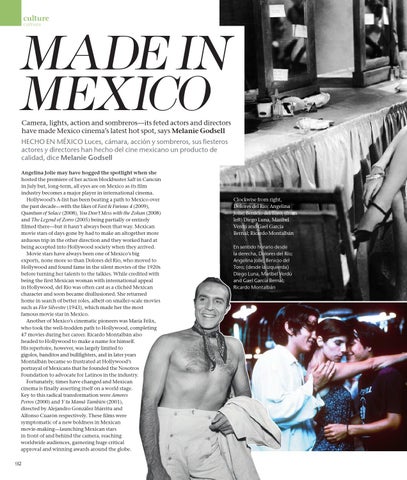
92 Ready to roll ...With Mexican movie-making
92 Listo para rodar ...Con las películas mexicanas
CANCÚN
CANCÚN
97 Food glorious food ...........................
97 Comida y más comida ........................
98 Spotted ........Starstruck at Luxury Avenue
98 Vistos ...........Celebridades en Luxury Avenue
100 Ultimate Luxury Experience ......20%
100 La mejor experiencia de lujo ...........20% de
103 Wining & Dining ..........................
103 Paladar exigente ..............................
LOS CABOS
LOS CABOS
105 A whale of a time .........................
105 Una experiencia irrepetible ................
107 Ultimate Luxury Experience ...Luxury
107 La mejor experiencia de lujo ..............
108 Live fast .......................................
108 Vive rápido ......................................
113 Wining & Dining ..........................
113 Paladar exigente ..............................
The latest looks and products Bouncing back to the 1960s Make-up on the runway Macho men’s fragrances Love the skin you’re in
Jewels fit for a pearly queen Ultrajewels is 20 years old
92
Rolex’s Oyster Perpetual Datejust Lady 31mm All shapes and sizes
The ultimate proposal
The holiday season begins
on the rise, is it next stop Mollywood?
Cancún’s fab food festival
72
off for every reader at Coral Beach Gem Spa
Our pick of Cancún’s restaurants
Swimming with whale sharks
108
Avenue Los Cabos’ Chopard Gala Celebration Fast and furious in Baja California
Our pick of Los Cabos’ restaurants
Presentamos Be Ultrafemme
Los más recientes looks y productos De regreso a los 60
Maquillaje en la pasarela Fragancias para hombre Ama tu piel
Joyas para una reina
Ultrajewels cumple 20 años
Oyster Perpetual Datejust Lady 31mm de Rolex De todos tamaños y formas La mejor propuesta
La temporada navideña comienza
robando cámara, ¿es Mollywood la siguiente parada?
El festival de Cancún
descuento en el Coral Beach Gem Spa para cada lector
Restaurantes en Cancún
Nadando con el tiburón ballena
La gala Chopard en Luxury Avenue Los Cabos Rápido y furioso en Baja California Restaurantes en Los Cabos
Perfumería Ultra, S de R. L. de C.V. Blvd. Luis Donaldo Colosio Km 6.5, S.M. 310, MZ. 66, LT. 88, Rancho Nazareth, Cancún, Q.Roo C.P. 77560. Published on behalf of Ultrafemme by: Illustrated London News Limited, 10 Fashion Street, E1 6PX, UK. Tel: +44 (0)20 7426 1010. Fax: +44 (0)20 7426 1020. Publisher: Lisa Barnard Editor-in-chief: Georgina Caldwell Assistant Editor/Chief Sub-Editor: Kate Gilchrist Art Director: Linda Elander, Pia Constenius Designer: Mathew John Picture Researcher: Millie Simpson Group Production Manager: Nathan Eaton-Baudains Account Managers: Iriana del Rivero, Edgardo Tello de Meneses Translation: Alicia González Repro: Altaimage Print: Offset Multicolor Mexico. © 2010/11 Illustrated London News Limited. Original articles and other contributions published in this journal may be reproduced only with permission from Perfumería Ultra, S de R. L. de C.V. (Número de Certificado de Reserva de Derechos al uso exclusivo: 04–2010–072613392800), and the publishers. Neither accepts responsibility for any views or statements made in the articles and other contributions reproduced from any other source. No responsibility is accepted for the claims made in advertisements appearing in this journal and the publishers reserve the right to accept or refuse advertisements at their discretion.
REUTERS
Introducing Be Ultrafemme
IMPERIALE COLLECTION
BOUTIQUE CHOPARD UBICADA EN LUXURY AVENUE LOS CABOS.
essentials esenciales
contributors COLABORADORES CECILIA ESCRIBANO
16
JESSICA KIDDLE
JO ALLEN
Journalist and social commentator Cecilia
Jessica Kiddle (The Face of Fashion, page 64)
An award-winning beauty journalist, Jo Allen
Escribano (Let’s Get this Party Started!, page 91)
is a British freelance writer recently returned
(A Good Sport, page 68) has her finger on the pulse
is Argentinian by birth, but has lived in Cabo
from Cape Town, South Africa, where she
when it comes to beauty trends. She is fanatical
San Lucas with her husband and their daughter
worked for Condé Nast writing about all
about fragrance and lives in the UK with her
for more than two years.
things design, travel and beauty.
husband and two sons.
Periodista y comentarista social Cecilia Escribano
Jessica Kiddle (El rostro de la moda, página 64)
Una premiada periodista de belleza, Jo Allen
(México se viste de Fiesta, página 91) es argentina
es una escritora británica freelance que acaba
(Negocio redondo, página 68) pone el dedo
de nacimiento, pero ha vivido en Cabo San
de regresar de Ciudad del Cabo, Sudáfrica, donde
en el lugar correcto cuando se trata de belleza.
Lucas con su esposo y su hija por más de
trabajó para Condé Nast escribiendo acerca
Es fanática de las fragancias y vive en el Reino
dos años.
de diseño, viajes y belleza.
Unido con su esposo y dos hijos.
MELANIE GODSELL
HYWEL DAVIES
MERCEDES MANDICH
Melanie Godsell (Made in Mexico, page 92) has
Fashion writer and journalist Hywel Davies (Let’s
Mercedes Mandich (High Jinks, page 108) divides
worked as a journalist for six years, writing for UK
Go Outside, page 50), previously fashion editor
her time between New England, the US, and Cabo
and international titles on everything from
at iconic British magazine Sleaze Nation, is the
San Lucas, where she writes for Los Cabos Magazine,
cosmetics and charities to babies and business.
author of Modern Menswear and 100 New Fashion
Destino, and Mexico Living, and is a regular
She lives in London and loves travel and film.
Designers, both published by Laurence King.
contributor to Luxury Avenue magazine. Mercedes Mandich (Juegos Extremos, página 108)
Melanie Godsell (Hecho en México, página 92) ha
Periodista y escritor de moda Hywel Davies
trabajado como reportera por seis años, escribiendo
(Salgamos, página 50) previamente un editor de
divide su tiempo entre Nueva Inglaterra, EU, y Cabo
para publicaciones del Reino Unido e internacionales
moda para la icónica revista británica Sleaze Nation,
San Lucas desde donde escribe para Los Cabos
desde cosméticos hasta de beneficencia, bebés y
es el autor de Modern Menswear y 100 New Fashion
Magazine, Destino, y Mexico Living y es colaboradora
negocios. Vive en Londres y disfruta el cine y los viajes.
Designers, ambos publicados por Laurence King.
regular de Luxury Avenue.
BOUTIQUE CHOPARD UBICADA EN LUXURY AVENUE LOS CABOS.
cartier.com
Boutique Cancún, Luxury Avenue, Blvd. Kukulkán Km 13.5, Zona Hotelera, Cancún, Quintana Roo, tel: +52 (998) 848 7302 Boutique Los Cabos, Luxury Avenue, Marina Cabo San Lucas esq. Andador Maderones, Los Cabos, BCS, tel: +52 (624) 163 4280 www.luxuryavenue.com Boutique Masaryk, (55) 5283 9933 - Boutique El Palacio de Hierro Perisur, (55) 5335 3688 - Boutique El Palacio de Hierro Santa Fe, (55) 2167 8030 Boutique Monterrey, (81) 8335 0177 - Boutique El Palacio de Hierro Guadalajara, (33) 3648 9870 - Boutique Cozumel, (987) 872 4532 - Informes, (55) 5283 9942
Colecci贸n Trinity
essentials esenciales
Welcome...
...to our wonderful world of luxury shopping in Cancún and Los Cabos BIENVENIDOS…a nuestro maravilloso mundo de las compras de lujo en Cancún y Los Cabos
On the eastern and western coasts of Mexico, the Riviera Maya, Cancún and Los Cabos lure visitors with the promise of fun, sun and the kind of first-class facilities you can expect to find in the best resorts around the world. It’s no surprise then that the quality of the shopping is as impressive as the scenery, with millions visiting both destinations each year to spoil themselves in some of the finest luxury boutiques in Mexico. Before you set off shopping, you need to know only three names: Luxury Avenue, Ultrafemme and Ultrajewels. These iconic experiences offer the best retail therapy you’ll find. If you’re looking for somewhere to browse some of the world’s most famous designer brands in unparalleled comfort, there’s a dazzling selection of high-end stores at Luxury Avenue boutique shopping malls in Cancún and Los Cabos, showcasing the very latest in fashion, beauty, jewelry, gifts and accessories. Ultrafemme is number one for all your beauty needs, with skincare, fragrances and cosmetics from the biggest brands. Ultrajewels stocks the widest selection of watches and jewelry in Cancún and the Baja California, from ultra-exclusive names such as Rolex, Cartier, Tiffany & Co., David Yurman, Breguet and Bvlgari. In this magazine we’ve gathered together some of our favorite launches for the coming season, which you can buy now at our boutiques. Turn the page for where to find us, and for a comprehensive boutique directory to Luxury Avenue Cancún and Los Cabos, go to pages 24 and 25.
20
Las costas este y oeste de México, la Riviera Maya, Cancún y Los Cabos atraen a los visitantes con la promesa de la diversión, el sol y el tipo de comodidades que puedes esperar de los mejores resorts alrededor del mundo. No es de sorprender, entonces, que la calidad de las compras que puedes hacer sea tan impresionante como estos destinos. Antes de que planees las compras que harás sólo debes conocer tres nombres: Luxury Avenue, Ultrafemme y Ultrajewels. Estas tres importantes experiencias en compras te ofrecen la mejor terapia que puedes encontrar. Si estás buscando un lugar donde encontrar artículos de los diseñadores más famosos en una atmósfera incomparable, hay una selección de las mejores marcas en Luxury Avenue Cancún y Los Cabos, ofreciendo lo mejor en moda, belleza, joyería, regalos y accesorios. Ultrafemme es la número uno en cuanto a tus necesidades de belleza, con tratamientos, fragancias y cosméticos de las firmas más reconocidas a nivel mundial. Ultrajewels cuenta con la más amplia selección de relojes y joyería en Cancún y Baja California, desde marcas extra exclusivas como Rolex, Cartier, Tiffany & Co., David Yurman, Breguet y Bvlgari. En esta revista hemos reunido algunos de nuestros lanzamientos favoritos para la siguiente temporada, que podrás adquirir ahora mismo en nuestras boutiques. Da vuelta a la hoja para saber dónde encontrarnos, y para ver el directorio detallado de Luxury Avenue Cancún y Los Cabos, ve a las páginas 24 y 25.
WHY SHOP WITH US?
¿POR QUÉ COMPRAR CON NOSOTROS?
● Great savings on your luxury purchases
● Grandes ahorros en la compra de artículos de lujo
● The widest selection of luxury products in Cancún and Los Cabos
● Tenemos la más amplia selección de productos de lujo en Cancún
● Fashion, jewelry, gifts and accessories from the world’s best-known brands ● Exceptional service and after-sales service ● Expert advice from professionally trained staff ● Additional luxury services at Luxury Avenue Cancún/Los Cabos ● Low-tax prices in Cancún and Los Cabos, with great savings compared
to US retail ● Added incentives to shop with us, including Travel Retail Exclusives and gifts with purchase ● The ultimate places to spoil yourself when you’re on vacation
Above left and above: high-end
Arriba izquiera y superior: El mejor
shopping at its very best at
lugar para hacer tus compras es
Luxury Avenue in Cancún
sin duda Luxury Avenue Cancún
and Los Cabos respectively
y Los Cabos respectivamente
y Los Cabos ● Moda, joyería, regalos y accesorios de las mejores marcas a nivel mundial ● Servicio excepcional y atención post-compra ● Asesoramiento experto por parte de nuestro personal ● Servicios de lujo adicionales en Luxury Avenue Cancún/Los Cabos ● Precios con impuestos bajos en Cancún y Los Cabos, con grandes ahorros
comparados con los precios en EU ● Incentivos agregados al comprar con nosotros, incluyendo ofertas exclusivas
para viajeros y regalos con compra ● Los mejores lugares para consentirte cuando estás de vacaciones
21
essentials esenciales CANCÚN
3
10
Punta Nizuc
5
9
7
8
Playacar
Av. 10
6 1
SHOPPING CENTERS
Nichupte Lagoon
1 Plaza Malecón Américas 2 Avenida Talúm 3 Plaza Caracol 4 La Isla Shopping Village 5 Luxury Avenue
Ferry to Isla Mujeres
HOTELS
Tulúm
1
erto Aeropu Cancún
2
6 Hilton Cancún 7 Le Méridien 8 Ritz-Carlton 9 Aqua 10 ME by Meliá 11 Le Blanc 12 Coral Beach
SHOPPING CENTERS 1 Paseos del Carmen 2 Calle 12 3 Calle 14 & 16
LUXURY AVENUE
Cá rde na s
CANCÚN
Av . L.
SHOPPING CENTERS
N
1
1 Luxury Avenue 2 Puerto Paraíso Mall
HOTELS
Blv d. M ari na
3
3 Hotel Marina Fiesta 4 Hotel Finisterra 5 Medano Beach
Marina Cabo San Lucas Bahía San Lucas
Blvd.Marin a
4
Los Arcos
11am-10pm; daily/diario Blvd Kukulcán Km 13, Hotel Zone, Cancún. Tel: (998) 848 7300/7301.
LOS CABOS
11am-10pm; daily/diario Marina Cabo San Lucas (a un costado de plaza Puerto Paraíso), Andador Maderones. Tel: (624) 163 4280.
ULTRAFEMME
1
Av. 5
Ca lle 7
Calle 3
Cal le 5
Av. 5
Av. Rosado Salas
Av. Benito Juarez
Av. 10
SHOPPING CENTER 1 Ultrajewels
22
Punta Langosta cruise ship port
N
Luxury Avenue – 11am-10pm; daily/diario See Luxury Avenue, left/Vea izquierda Plaza Dorada – 10am-10pm daily/diario Sobre Blvd Marina, Col. Centro CP.23450 Tel: (624) 163 4280 ext 3163/3164.
ULTRAJEWELS CANCÚN Luxury Avenue – 11am-10pm; daily/diario See Luxury Avenue, top left/superior izquierda
Plaza Las Américas – 11am-10pm; daily/diario Av Tulúm Sur No 260, Local 227, Cancún. Tel: (998) 892 0191/0246.
La Isla Shopping Village – 11am-10pm; daily/diario Blvd Kukulcán Km 12.5, Hotel Zone, Cancún. Tel: (998) 883 1912/5219. Malecón Américas – 11am-10pm; daily/diario Plaza Malecón Américas, Av Tulúm, No. 260 Col. Centro, Local 35 y 36 A, SM 7, Cancún. Tel: (998) 881 3589.
PLAYA DEL CARMEN
Plaza Caracol – 11am-10pm; daily/diario Blvd Kukulcán Km 8.5, Hotel Zone, Cancún. Tel: (998) 883 1225/0767.
5th Avenue – 11am-10pm; daily/diario 5ta. Avenida entre 14 y 16, Local 1 y 2 Mza. 27. Tel: (984) 803 0591/0593/0595.
Avenida Tulúm – 10am-7pm Mon-Sat/Lunes a Sábado; closed/cerrado Sun/Domingos. Av Tulúm No 111, M5 SM 22, downtown Cancún. Tel: (998) 884 1402/887 4559.
COZUMEL
PLAYA DEL CARMEN Ferry pier to Playa del Carmen
LOS CABOS
Luxury Avenue – 11am-10pm; daily/diario See Luxury Avenue, above/Vea Luxury Avenue, arriba
Be Ultrafemme – 11am-10pm; daily/diario Malecón Américas, Av Tulúm, No. 260 Col. Centro, Local 34A, SM7 Tel: (998) 272 5474.
Av. R afae l Me lgar
Centro Comercial Paseos del Carmen – 11am-10pm; daily/diario Av 10 Sur S/N Local 18, Col Centro, Plaza Paseos del Carmen. Tel: (984) 803 3737.
CANCÚN
La Isla Shopping Village – 11am-10pm; daily/diario Blvd Kukulcán Km 12.5, Hotel Zone, Cancún. Tel: (998) 883 1912/5219.
COZUMEL
Porto Real
FIND US
5
2
N
Where to
LOS CABOS
Av. 15
3
5ta. Avenida
N
4
2
Av. Constituyentes
11
Calle 14
Av.15
Mexican Caribbean
12
Calle 16
Punta Cancún
Calle 12 Norte
PLAYA DEL CARMEN
5th Avenue – 11am-10pm; daily/diario 5ta. Avenida y calle 14 Bis. Local 1 y 2 Mza. 27. Tel: (984) 803 4665. 5ta. Avenida S/N y calle 12 Nte., Local 102 P.B. Tel: (984) 803 0591.
Av Rafael Melgar – 10am-8pm; daily/diario Av Rafael Melgar No 201 Esq. Rosado Salas. Av Rafael Melgar No 101, Local 1 Esq. Con Calle 2 Norte. Tel: (987) 872 0025.
LOS CABOS Luxury Avenue – 11am-10pm; daily/diario See Luxury Avenue, top left/superior izquierda. Tel: (624) 163 4280/4299 ext 3108/3110/3111/3114. Marina Cabos – 11am-10pm; daily/diario Plaza 2 El Dorado, Blvd Marina, Cabo San Lucas. Tel: (624) 145 6092/6095.
T H E S I M P L I C I T Y O F I N N O V AT I O N . LUMINOR 1950 MARINA 3 DAYS AUTOMATIC Automatic mechanical movement P.9000 calibre, two spring barrels, 3-day power reserve. Water-resistance 300 metres. Steel case 44 mm Ø. Steel buckle.
www.panerai.com Available exclusively at Panerai boutiques and select authorized watch specialists.
CANCÚN | PLAYA DEL CARMEN | COZUMEL | LOS CABOS www.ultrajewels.com
essentials esenciales
LUXURY AVENUE
Boutique
DIRECTORY FASHION MODA BCBGMAXAZRIA
LOUIS VUITTON
Cancún: (998) 840 6805 One of the hottest names in fashion has arrived in Cancún. Uno de los nombres más atractivos de la moda finalmente llegó a Cancún.
Cancún: (998) 840 6055/57 Iconic brand whose LV logo pattern is world famous. Prestigiosa marca cuyos artículos de lujo se cuentan entre los más selectos del mundo.
BURBERRY
MAXMARA
Cancún: (998) 840 6256 Brit brand Burberry’s only store in the Mexican Caribbean. La única boutique de la casa británica en el Caribe mexicano.
Cancún: (998) 840 6066 Italian women’s fashion label. Diseños italianos de moda para dama.
CH CAROLINA HERRERA
Cancún: (998) 848 7300, Ext 1144 Los Cabos: (624) 163 4280, Ext 3130 Specializes in nautical-themed leisurewear. Especialista en ropa casual de influencia náutica.
Cancún: (998) 840 6558 Los Cabos: (624) 143 8793 The diffusion line from the iconic designer. La casa de la icónica diseñadora.
ERMENEGILDO ZEGNA Cancún: (998) 840 6072 Stockist of both Z Zegna and Zegna Sport lines. Prendas de las gamas Z Zegna y Zegna Sport.
PAUL & SHARK
PINEDA COVALIN Cancún: (998) 840 6100 Mexican brand that celebrates Latin-American culture.
LEATHER GOODS ARTÍCULOS DE PIEL COACH Cancún: (998) 8440 6396 Los Cabos: (624) 105 0723 Bags, accessories and gifts from this top American luxury label. Bolsas y accesorios de la marca americana conocida.
FENDI Cancún: (998) 848 7300, Ext 1190 Los Cabos: (624) 163 4280, Ext 3122 Italian luxury label for women, best known for its iconic bags. La marca italiana líder en moda
24
femenina ha creado algunas de las bolsas más icónicas de la historia.
LONGCHAMP Cancún: (998) 848 7300, Ext 1140 French brand specializing in handbags, travel bags, luggage, wallets, briefcases, small leather goods and fashion accessories. Famosa firma francesa especializada en bolsas, maletas, bolsas de viaje, carteras, maletines y accesorios en marroquinería.
Marca de lujo mexicana que celebra la cultura latinoamericana.
PURIFICACIÓN GARCIA Cancún: (998) 840 6549 Spanish brand stocking the latest trends for him and her. Las últimas tendencias para dama y caballero en esta original firma española.
SALVATORE FERRAGAMO Cancún: (998) 840 6080 Los Cabos: (624) 143 3918 Luxury fashion from one of Italy’s most famous labels. Moda de lujo de una de las casas italianas más famosas del mundo.
VILEBREQUIN Cancún: (998) 840 6403 Los Cabos: (624) 105 0457 Swimming trunks all the way from Saint-Tropez. Trajes de baño recién llegados de Saint Tropez.
PEPE JEANS Cancún: (998) 840 6845/44 Denim and casualwear to lust after. Mezclilla y ropa casual que te encantará.
WINING & DINING
ALIMENTOS Y BEBIDAS LUXURY BAR & CAFÉ Cancún: (998) 848 7328, Ext 1197 Veuve Clicquot champagne bar and café serving deli sandwiches and hot and cold drinks. Café y bar de champaña Veuve Clicquot que sirve sándwiches gourmet y bebidas calientes y frías.
An at-a-glance guide to stores at Luxury Avenue Cancún & Los Cabos Una breve guía de las boutiques en Luxury Avenue Cancún & Los Cabos WATCHES & JEWELRY RELOJES Y JOYERÍA CARTIER Cancún: (998) 848 7300, Ext 1170 Los Cabos: (624) 163 4280, Ext 3135 Exclusive Cartier boutique with a full range of jewelry, watches, leather goods, pens, eyewear, fragrances and gifts. Exclusiva boutique con joyas, relojes, artículos de piel, accesorios e instrumentos de escritura.
CHOPARD Los Cabos: (624)163 4280, Ext 3129 Watches, jewelry and accessories from the classic Swiss brand. Relojes, joyería y accesorios de la marca suiza clásica.
MONTBLANC Cancún: (998) 848 7300, Ext 1181 Los Cabos: (624) 163 4280, Ext 3118 The German brand with the famous star logo.
BEAUTY BELLEZA
La marca alemana con el famoso logo de estrella.
SWAROVSKI Cancún: (998) 848 7300, Ext 1151 Los Cabos: (624) 163 4280, Ext 3120 Jewelry, accessories and homeware from the king of crystals. Joyería, accesorios y artículos decorativos del rey de los cristales.
SWATCH Cancún: (998) 848 7300, Ext 1132 The widest selection of Swatch timepieces and jewelry in Cancún. La más amplia selección de relojes Swatch en Cancún.
TOUS
with the teddy logo. Funky jewelry, bags and watches. La marca española con el famoso logo del osito. Joyas, bolsas, relojes y accesorios divertidos.
ULTRAJEWELS Cancún: (998) 848 7300, Ext 1100 Los Cabos: (624) 163 4280, Ext 3108 Boutique dedicated to watches and jewelry by Chanel, Chopard, David Yurman, Omega, Panerai, Roberto Coin, Rolex, Tag Heuer, Tiffany & Co. and Zenith. Boutique dedicada a las principales marcas de relojería y joyería como Chanel, Chopard, David Yurman, Omega, Panerai, Roberto Coin, Rolex, Tag Heuer, Tiffany & Co. y Zenith.
Cancún: (998) 848 7300, Ext 1160 Los Cabos: (624) 163 4280, Ext 3126 The cool Spanish brand
GIFTS REGALOS
ULTRAFEMME
ULTRAJEWELS GIFTS
Cancún: (998) 848 7300, Ext 1120 Los Cabos: (624) 163 4280, Ext 3101 Dedicated perfumery stocking cosmetics, skincare and fragrances from the big names, plus exclusive specialist brands. Perfumería que cuenta con fragancias, cosméticos y tratamientos de las marcas más exclusivas del mundo.
Cancún: (998) 848 7300, Ext 1151 Gifts by Baccarat, Lalique, Lladro, ST Dupont, Christofle and Swarovski. Marcas como Baccarat, Christofle, Lalique, Lladró, ST Dupont y Swarovski.
SERVICES CENTRO DE SERVICIO ULTRAJEWELS Due to reopen in February 2011 / Próxima reapertura febrero de 2011 Ultrajewels’ customer service center for expert after-sales advice/repairs. El centro de servicio multimarca más importante de Latinoamérica para la reparación de joyas y relojes.
LOS CABOS ● Coming soon Selected stores at Luxury Avenue Los Cabos are now welcoming visitors, with more set to open throughout 2011. To find out what will be open on your visit, please call (624) 163 4280. ● Próximamente Las mejores boutiques están ahora abiertas en Luxury Avenue Los Cabos, y algunas más abrirán durante el 2011. Para saber qué estará abierto cuando vayas, por favor llama al (624) 163 4280.
25
LuxuryAvenue 28 30 32 34 36
THE SOUND OF LUXURY
EDITOR’S PICK LA ELECCIÓN DEL EDITOR
WHAT A WOMAN WANTS LO QUE ELLA QUIERE WHAT A MAN WANTS LO QUE ÉL QUIERE SHOPPING MECCA LAMECADELSHOPPING BOUTIQUE PROFILE PERFILDEBOUTIQUE
LOS SONIDOS DEL LUJO
It’s not just the chic clothes and stylish surroundings that make Luxury No son sólo las prendas chic y los elegantes alrededores lo que hace a los Avenue boutique malls so special—the delicate scent of designer perfume Luxury Avenue boutique malls tan especiales, la delicada fragancia que wafting up from the Ultrafemme perfumery, the flavor of freshly brewed sube desde los mostradores de la boutique Ultrafemme, el sabor del café coffee as you take a load off at the bar and the gentle tinkling recién hecho mientras te relajas en el bar y la música de of the latest tunes in the background all combine to create an moda que suena de fondo en el lugar se combinan elegant ambiance that’s bound to set your senses a-tingling. para crear un ambiente elegante y deleitar tus sentidos. And now you can make that feeling of pure luxury last all Ahora ya puedes hacer que esa lujosa sensación dure todo day, thanks to the launch of Luxury Sounds™, a brand new CD el día gracias al lanzamiento de Luxury Sounds MR, un nuevo from Luxury Avenue. Luxury Sounds™ is a unique collection of CD de Luxury Avenue. Luxury SoundsMR es una colección lounge music selected by renowned Swedish DJ Jeff Bennett. única de música lounge seleccionada por el reconocido The CD will be on sale in Luxury Avenue boutique malls DJ sueco Jeff Bennett. in Cancún and Los Cabos throughout December. Each CD The CD collection, above, El CD estará a la venta en los Luxury Avenue boutique contains exclusive discounts and special offers redeemable and wallpaper, top malls de Cancún y Los Cabos durante diciembre. Cada La colección de CDs, arriba, at select Luxury Avenue boutiques and two dollars from CD contiene descuentos y beneficios exclusivos canjeables y el tapiz, superior every CD sold will be donated to the Mayan communities en las boutiques de Luxury Avenue seleccionadas y dos of Quintana Roo. dólares de cada CD que sea vendido, serán donados a las And if you want to recreate the Luxury Avenue experience comunidades mayas de Quintana Roo. in its entirety in your own home, why not download one Follow Luxury Avenue on Y si lo que quieres es recrear la experiencia Luxury Avenue of the stylish wallpapers from the Luxury Avenue website Facebook and Twitter completa en tu casa, ¿por qué no bajar uno de los tapices Sigue a Luxury Avenue en (www.luxuryavenue.com)? There’s a whole range of stunning del sitio web de Luxury Avenue (www.luxuryavenue.com)? Facebook y Twitter designs to choose from. Hay toda una gama de donde puedes elegir bellos diseños.
26
REVERSO. CAMBIE DE ZONA HORARIA EN UN SEGUNDO.
GRANDE REVERSO 986 DUODATE. Calibre Jaeger-LeCoultre 986/1000®
El legendario Reverso, creado en 1931 para los jugadores de polo, posee un ingenioso sistema patentado: dos esferas, colocadas una contra la otra y animadas por un solo movimiento mecánico, indican dos husos horarios ajustables mediante una misma y única corona. La inventiva de Jaeger-LeCoultre en la caja reversible redimensionada.
¿HABÍA TENIDO ANTES UN AUTÉNTICO RELOJ?
CANCÚN | PLAYA DEL CARMEN | LOS CABOS www.ultrajewels.com
luxury avenue
k c i p S ’ R O T I ED
m rfect ar e p k o o will l classic ate tones r e h t a cta xe le ocol soft, lu s and rich ch rá perfe e A v ? e s p i a h lásic gold ons josa y c rada g relati ptuous n lu m o , l u e s v a a r ’s o u fo season a piel s ta temp s n Ready s i e U h t e ? a d h r t s wi late rade in arm ción du rados y choco la e r a n o ara u os d ¿Lista p a con los ton d a combin
We’re in love with Fendi’s Peek aboo tote. This stylish carry-all is the perfect investment buy—the classic shape and rich caramel hue mean it won’t date and it’s suitable for any occasion, be it a business meeting or lunch with girlfriends. The slouchy “peekaboo” pouch is bang on trend for this season, while the luscious saddle-so ft leather gives an ultra luxe feel. But this bag is not just a pretty face. Fendi has clearly thought through the practicalities of carting this lust object around the city: the pocket can be closed with a turn-lock clasp, plus there’s a zip-section for your valuables; the base is fitted with metal feet to protect the purse from dust and dirt; and there’s a removable shou lder strap.
Estamos fascinados con el nuevo bolso de Fendi Peekaboo. Este estilizado bolso es la inversión perfecta, su forma clásica y su color camel significan que segu irá vigente y usable en cualquier ocasión. El desgarbo de la bolsa “peekabo o” está totalmente a la moda en esta temporada, mientras que la suave piel le da un toque lujoso. Pero esta bolsa no es sólo una cara bonita. Fendi ha pensado claramente en la funciona lidad que debe ofrecer este objeto de lujuria al usarse en la ciud ad: puede cerrarse con un broche giratorio y tiene una secc ión con cierre para tus valores; la base tiene patitas metálicas para protegerla del polvo y de la suciedad. Además cuenta con una correa para el hombro. Available in Fendi at Luxury Aven ue Disponible en Fendi en Luxury Aven ue
28
luxury avenue
UNDER WRAPS This season is camel colored, so this elegant wallet from Cartier’s Les Musts range is bang on trend. EN EL INTERIOR En esta temporada el camel lo es todo, así que esta elegante cartera de Les Musts de Cartier es ideal.
I PODS Sparkle with these divine pavé diamond and white-gold rings from Pandora’s Love Pods collection.
CODE BREAKER L’Oreal’s Youth Code is designed to reduce fine lines and pep up tired complexions.
CUT AND COLOR MaxMara’s fall/winter 2010 collection has a timeless quality with its muted color palette and immaculate tailoring.
I PODS Brilla con estos divinos anillos de oro blanco con diamantes de la colección Love Pods de Pandora.
CODIGO ROTO Youth Code de L’Oreal está diseñado para disminuir las líneas de expresión y mejorar la complexión.
DIAMANTE TIME Baume & Mercier’s steel and mother-of-pearl watch gleams with its diamante-set bezel.
CORTE Y COLOR La colección de MaxMara otoño/ invierno 2010 tiene una cualidad imperecedera con su discreta paleta de color y sus cortes inmaculados.
What a woman wants You won’t be able to resist these luxury must-haves, from diamond rings and bejeweled watches to the latest catwalk fashions, courtesy of Luxury Avenue
LO QUE ELLA QUIERE No podrás resistirte a estos lujosos artículos, desde anillos de diamantes y relojes con gemas hasta lo último en moda, cortesía de Luxury Avenue 30
DIAMANTES El reloj de Baume & Mercier en acero y madreperla deslumbra con su bisel lleno de diamantes.
RED OR DEAD Fendi’s classic Mia bag has gone all festive in this season’s red. AL ROJO VIVO La clásica bolsa Mia de Fendi le ha dado un toque festivo al rojo de esta temporada.
www.chanel.com
luxury avenue
What a man wants
Make time at Luxury Avenue for the new season’s most stylish menswear collections, covetable gifts and desirable accessories
LO QUE ÉL QUIERE Dedica tiempo en Luxury Avenue para las nuevas colecciones de ropa para hombre, los regalos y accesorios más codiciados JOURNEY’S END Voyage d’Hermès is a woody, fresh, musky scent that makes the perfect companion on any journey. FIN DE VIAJE Voyage d’Hermès es una fragancia fresca y maderada lo que la hace la mejor compañera de viaje. FUN IN THE SUN Vilebrequin’s nostalgic fall line is the perfect antidote to the winter blues—as is a holiday in the sun.
DANCING THE TANGO Tudor’s Glamour Double Date is inspired by the seductive Tango. BAILANDO TANGO El Glamour Double Date de Tudor está inspirado en el seductor tango. RAISE THE BAR Earn your fashion stripes with a cotton polo shirt from Paul & Shark. GRADÚATE Gánate tus condecoraciones en moda con una camiseta tipo polo de Paul & Shark.
32
CARRY ALL Zegna Sport’s envelope bag in Burgundy leather is a marriage of function and form.
FANCY FEET Beachwear has just got much smarter with Louis Vuitton’s Solstice thong.
MULTIUSOS El bolso tipo sobre de Zegna Sport en piel Burgundy es una combinación de utilidad y forma.
PIES DE DIEZ La ropa de playa se ve mejor con las sandalias Solstice de Louis Vuitton.
A PLENO SOL La nostálgica línea otoñal de Vilebrequin es el antídoto perfecto a la melancolía invernal porque es un baño de sol.
luxury avenue
Shopping heaven at
LOS CABOS
December marks the second anniversary of Luxury Avenue Los Cabos and it’s bigger and better than ever, finds Georgina Caldwell
EL PARAÍSO DE LAS COMPRAS EN LOS CABOS Diciembre marca el segundo aniversario de Luxury Avenue Los Cabos, y está mejor y más grande que nunca, dice Georgina Caldwell
Overlooking the Marina Cabo San Lucas in the area known as the “Golden Zone”, Luxury Avenue Los Cabos couldn’t be in a more exclusive location. Inside it’s every bit as glamorous with its stunning quartz columns, marble and granite floors, fine woods and fountains—not to mention the boutiques themselves. With internationally renowned luxury brands such as CH Carolina Herrera, Coach, Fendi, Salvatore Ferragamo, Vilebrequin, Paul & Shark, Cartier, Montblanc, Chopard, Swarovski and Tous, as well as an Ultrafemme perfumery and glittering Ultrajewels jewelers, Los Cabos’ only luxury mall is truly a shopping paradise for fashionistas everywhere. Luxury Avenue boutique mall is open 11am-10pm daily.
Con vistas a la Marina Cabo San Lucas ubicada en la Zona Dorada, Luxury Avenue Los Cabos no podría estar en un lugar más exclusivo. Por dentro es glamorosa de esquina a esquina con sus impresionantes columnas de cuarzo, sus pisos de mármol y granito, maderas finas y fuentes, sin mencionar las boutiques. Con marcas internacionalmente reconocidas como CH Carolina Herrera, Coach, Fendi, Salvatore Ferragamo, Vilebrequin, Paul & Shark, Cartier, Montblanc, Chopard, Swarovski y Tous así como una perfumería Ultrafemme y una joyería Ultrajewels, este único centro comercial de lujo en Los Cabos es un paraíso de las compras para los fashionistas. Luxury Avenue boutique mall abre de 11am-10pm diario.
34
Luxury Avenue Los Cabos enjoys an enviable location overlooking the marina Luxury Avenue Los Cabos tiene una envidiable locación con vistas a la marina
29
luxury avenue e
Boutique profile
PEPEJEANS
Ultra cool Pepe Jeans does denim to die for, but the British brand has also brought a unique selection of bathing suits and Bermudas to Luxury Avenue PEPE JEANS La súper cool Pepe Jeans hace mezclilla para morirse, pero esta marca británica ha traído también una exclusiva colección de trajes de baño y bermudas a Luxury Avenue The latest brand to make a splash at the Luxury Avenue boutique mall in Cancún is hip and happening denim label, Pepe Jeans London. As the name suggests, Pepe Jeans specializes in everyone’s favorite staple—jeans. With more than 80 styles to choose from, the brand is known for its cutting-edge design and perfect fit, whether it be skinny or bootcut, boyfriend or regular. Pepe Jeans has come a long way from its humble
36
La marca Pepe Jeans tomó un giro refrescante muy recientemente en Luxury Avenue boutique mall en Cancún. Como su nombre sugiere, Pepe Jeans se especializa en la prenda favorita de casi todo el mundo, los jeans. Con más de 80 estilos para elegir, la marca es reconocida por su estilo vanguardista y la forma en la que se amoldan perfectamente.
Guys go utility and gals look nerdy-chic in Pepe Jeans’ fall collection Los chicos van por lo práctico y las chicas por el chic nerdy en la colección de otoño de Pepe Jeans
HERBERT NITSCH. PILOTO DE LÍNEA AÉREA. BUCEADOR ABISAL. RECORDMAN DE LO EXTREMO. De él se dice que no suele tener a menudo los pies en la tierra. Pasa una buena parte de su tiempo a 10.000 m de altitud a los mandos de su avión de línea. Y cuando no vuela, se las ve con los abismos marinos: ¡ Herbert Nitsch es el único apneísta que ha descendido hasta la increíble profundidad de 214 metros ! Acompañándole por mar y aire, en su muñeca luce el nuevo Superocean, un reloj de uso extremo forjado para todo tipo de hazaña. Nitsch, atleta excepcional con mentalidad de acero, pronto será el primero en alcanzar la barrera mítica de los 1.000 pies o 300 metros de profundidad. En el Breitling Superocean, robusto, de altas prestaciones y sumergible hasta 1.500 m, ha encontrado el cómplice ideal para este reto.
BREITLING SUPEROCEAN Sumergible hasta 1.500 m, con válvula de descompresión. Bisel giratorio unidireccional. Movimiento automático con certificación oficial de cronómetro.
W W W. B R E I T L I N G . C O M
luxury avenue beginnings. Founded in 1973 by three brothers—Arun, Milan and Nitin Shah—the brand started out selling its detail-rich jeans at a stall in London’s Portobello Market. An instant hit with the androgynous models, socialites and musicians who flocked to the market to lay their hands on the latest clothes and accessories, Pepe Jeans soon became known for its innovative tailoring and up-to-the-minute cuts. Thanks to its ability to stay one step ahead of the fashion crowd, Pepe Jeans’ success has snowballed from that first London market stall to 300 stores in 60 countries today. Indeed, Pepe Jeans has a knack for spotting the next big thing. The brand was the first to hire Kate Moss to front its advertising campaign in the ’90s and its latest face is none other than style icon and Vogue favorite, Alexa Chung. Other A-list fans include actress Sienna Miller, model Laetitia Casta, footballer Cristiano Ronaldo and actor and Punk’d creator and host, Ashton Kutcher. This season’s look captures Chung’s insoucient style perfectly, with denim hotpants and micro minis offset with nerdy-chic, knee-length socks, shirts and blazers. Double denim and brogues are the other big trends for fall. For men, winter 2010 is all about utility wear—think large puffas and plaid shirts. Jeans were by and large tucked into large, military-inspired boots. As well as a selection of the brand’s best-selling denim and casualwear, the Pepe Jeans store in Cancún's Luxury Avenue boutique mall stocks a unique collection of bathing suits, sundresses and Bermuda shorts, to suit the balmy Mexican Caribbean climate.
Micro minis and plaid shirts steal the show Las micro minis y camisas escocesas se robaron el show
38
The brand started out selling its detail-rich jeans at a stall in London’s Portobello Market La marca empezó vendiendo jeans en un puesto en el Portobello Market de Londress
Pepe Jeans ha recorrido un largo camino mino desde sus humildes inicios. Fundada en 1973 73 por tres hermanos, Arun, Milan y Nitin Shah,, la marca empezó vendiendo jeans en un puesto sto en el mercado Portobello Market en Londres. ndres. Un éxito instantáneo con modelos, músicos y socialites que corrían al mercado para conseguir lo más nuevo en ropa y accesorios, Pepe Jeans ans pronto se volvió conocida por su hechura chura innovadora y sus cortes modernos. Gracias a su habilidad para mantenerse nerse un paso adelante de la multitud, el éxito xito sto de Pepe Jeans se convirtió de un puesto en el mercado a 300 tiendas en 60 países aíses el día de hoy. De hecho, Pepe Jeans tiene el don de anticiparse a lo que viene. Esta marca fue la primera en contratar a Kate Moss para su campaña publicitaria en los 90 y su modelo más reciente es un ícono del estilo y favorita de Vogue, Alexa Chung. Entre sus fans se encuentran Sienna Miller, Laetitia Casta, Cristiano Ronaldo y Ashton Kutcher. El look de esta temporada capturaa el estilo despreocupado de Chung, con pantalones de mezclilla y micro minis con calcetas hasta la rodilla, camisas escocesas y blazers. La mezclilla doble y los zapatos gruesoss son otra tendencia fuerte. Para los hombres bres el invierno 2010 tiene que ver con la utilidad, piensa en chamarras grandes es y camisas escocesas. Los jeans se vieron n por lo general metidos en botas de tipo militar. Además de una selección de las piezas ezas de mezclilla y la ropa casual más vendidas didas de la marca, la tienda de Pepe Jeans en Luxury Avenue Cancún tiene una colección única de trajes de baño, vestidos y bermudas para acoplarse al cálido clima del Caribe Mexicano.
Fashion moda
42 46
FASHION NEWS NOTICIAS DE LA MODA
50
THE GREAT OUTDOORS LOS GRANDES EXTERIORES
54
FURRY FRIENDS AMIGOS PELUDOS
CURVES ARE BACK LAS CURVAS HAN VUELTO
BROUGHT TO YOU BY/TRAIDO HASTA TI POR
Right, Salvatore Ferragamo takes the camel palette to the max in this season’s collection Derecha, Salvatore Ferragamo lleva la paleta en camel al máximo esta temporada
Camel
CRUSADERS After a summer dominated by pastels and nudes, the natural progression for fall/winter 2010 was inevitably a palette of camel, caramel and biscuit. It might not be bold or exciting but there’s good reason to be thankful that trusty camel is the color this season. A style classic, camel is timeless—a favorite of style icon Jackie Kennedy, it’s a shade that oozes sophistication and never goes out of style. MaxMara showed some sublime overcoats—the Prato coat from the signature collection and Fabian from MaxMara Weekend were our top picks. The camel chunky knit was big at Salvatore Ferragamo, where belted cardigans, turtlenecks and sweater vests were teamed with silk blouses and burnt umber accessories. Immaculately tailored pants and city shorts also featured strongly in the collection. Camel is incredibly versatile, but there’s nowhere to hide, so quality and cut are key to getting the look right. As if we needed an excuse, credit cards at the ready!
Guerreros
DEL CAMEL Después de un verano dominado por colores pastel, la progresión natural para otoño/invierno 2010 es una paleta en camel, caramelo y bizcocho. Puede no ser muy intensa pero hay una buena razón para que el camel sea el color de esta temporada. Un clásico del estilo, favorito de Jackie Kennedy, es un color que exuda sofisticación y que nunca pierde vigencia. MaxMara mostró algunos abrigos sublimes, su abrigo Prato y el Fabian de MaxMara Weekend fueron nuestros favoritos. El tejido grueso color camel fue el tema central para Salvatore Ferragamo. Con cardigans con cinturones, cuellos de tortuga y chalecos combinados con blusas de seda y accesorios café oscuro. Los pantalones inmaculadamente fabricados y los shorts de ciudad también fueron una tendencia fuerte en la colección. El camel es increíblemente versátil pero nada se le puede ocultar así que la calidad y el corte son claves para este look. Como si necesitáramos una excusa ¡desenfunden tarjetas!
Follow Luxury Avenue on Facebook and Twitter Sigue a Luxury Avenue en Facebook y Twitter
40
>/ A:3->:D 85:303H9 47?@
*E#%;CE1F# "! 1&?1 FE!$<!%$=1 "! -1%<F1$?<E1 8<=,1
G>H356) >/ >8A':352 A3DH>:D B>8B> 4(+.
fashion
moda
MAD FOR METALLIC
There’s a right time and right place for sparkle and this season, it’s anytime, anywhere. We loved the draped sequin effect sent down the runway by BCBGMAXAZRIA and Louis Vuitton’s sequined stilettos will make any outfit shine.
COACH
LOCURA POR EL METÁLICO Hay un lugar y un momento precisos para brillar y esta temporada es siempre y en donde sea. Nos encantó el drapeado con lentejuelas que BCBGMAXAZRIA lanzó a la pasarela y los brillantes tacones de Louis Vuitton.
FASHIONTips
PEEKABOO
Shoe boots have enjoyed a couple of seasons under the fashion spotlight, but now designers have taken it one step further with a peep-toe version. Kill two trends with one stone with a pair of riotous red peep-toes from CH Carolina Herrera or walk straight into next season’s hottest trend—fringing—with the delectable burgundy cut-outs from Louis Vuitton or Coach’s Teegan Platform.
CUCÚ
LOUIS VUITTON
Los botines han estado un par de temporadas bajo los reflectores, pero ahora los diseñadores los han llevado un poco más lejos con una versión sin punta. Mata dos tendencias de un tiro con un llamativo par color rojo de CH Carolina Herrera, o camina derechito a la próxima temporada con los de Louis Vuitton en color burdeos o los Teegan Platform de Coach.
OPT FOR MONOCHROME accessories if you’re rocking a sequin dress. Take your cue from the BCBG runway where sparkling dresses were teamed with white pantyhose and black shoes. ELIGE ACCESORIOS MONOCROMÁTICOS si vas a usar un vestido de lentejuelas. Date una idea con la pasarela de BCBG donde estos vestidos brillantes fueron vistos con ropa blanca y zapatos negros.
PEPE JEANS
CH CAROLINA HERRERA
MAXMARA
FASHIONTips CAUTION, peep-toe shoe boots need to be styled with care. Pantyhose just won’t cut it, so opt for bare legs, leggings or footless pantyhose. PRECAUCIÓN, los botines sin punta deben usarse con cuidado. Las pantimedias no son una buena opción, es mejor llevar las piernas desnudas o leggings.
42
LOUIS VUITTON
FERRAGAMO
CARTIER LONGCHAMP
COACH
A walk on
LOUIS VUITTON
print in the all the animal r fo t en om em e tame than ing a cat at th . If you’re mor ay w You can’t sw at lot th ay st amptons Oce e’d like it to of Coach’s H rm fo stores—and w e bo th m in co and jacket sh of leopard ntaisie purse tearaway, a fla h p’s Xlight Fa am ch ared to unleas ng ep Lo t for those pr Flap purse or bu opard d, le en tr ng is ni owed a stun ay to nail th w sh st ra be re e er th H a is Carolin instincts, CH nway. their animal inter 2010 ru w ll/ fa e th on s es dr coat and r un gato por te ocurra pasa se i N al E AJ LV tre tanto anim R EL LADO SA va a perder en te UN PASEO PO se de ue rq lso po a de bo una tienda opardo en form el aparador de , un poco de le e, aj ight Fantaisie lv Xl sa p, go al am o de Longch print. Si eres , ap Fl t lo ce es O on ons es opci Coach, Hampt , son las mejor lso y chaqueta pero para a, ci en combo de bo en esta tend es rn te in instintos, te e para qu ra liberar sus preparadas pa n tá es nte s ne ne ie po qu im errera creó un leopardo. CH Carolina H de o id rigo y vest conjunto de ab
CH CAROLINA HERRERA
39
LONGCHAMP
E D I S D L I W THE
fashion
moda
FASHIONTips IF YOUR ATTEMPT AT preppy chic is more Harry Potter than Gossip Girl, you may need to tone it down a notch. Layer blazers over skinny jeans for a rock-chick edge or team a polo shirt with a mini and flats for a more laid-back look.
ZEGNA
SI TU LADO adolescente se inclina más hacia Harry Potter que a Gossip Girl, tendrás que bajar la intensidad. Los blazers en capas sobre jeans entallados son ideales, o puedes combinar una playera tipo polo con una mini y zapatos de piso para un look más sencillo.
FASHION IVY LEAGUE
With the much-anticipated new season of Gossip Girl airing this fall/winter, preppy chic is having another moment. Paul & Shark is the go-to brand for the look’s staples: polo shirts and striped jumpers. Pepe Jeans’ collection is going for top of the class with knee-length socks and neck ties, and Coach’s Alex Blazer is straight from the country club.
COACH
MAXMARA
Capes are the new coats this season. Perhaps it’s the imminent release of the Sherlock Holmes sequel, or maybe it’s a simple desire to be coddled as winter approaches, but we can’t get enough of them right now. We love the magenta Bonnie Cape by Coach and the utterly fabulous geometric monochrome poncho by Louis Vuitton. But if you just can’t get on board with a full cape, try the fluted coats sent down the runway by MaxMara. Guys, we haven’t forgotten you—look to Ermenegildo Zegna for your very own Dr Watson moment.
LOOK UNIVERSITARIO PEPE JEANS
CAPE HOPE
Con la nueva temporada de Gossip Girl rondando el otoño/invierno, el chic universitario está viviendo su momento. Paul & Shark es la marca ideal para obtener este look: camisetas tipo polo y jumpers a rayas. Pepe Jeans busca el cuadro de honor con calcetas a la rodilla y corbatines, y el Alex Blazer de Coach parece recién sacado de la oficina del director.
DE CAPA CRUZADA
LOUIS VUITTON
FASHIONTips
PAUL & SHARK
COACH
Las capas son los nuevos abrigos durante esta temporada. Quizás sea el inminente lanzamiento de las secuelas de Sherlock Holmes, o quizás sólo las ganas de estar bien abrigado durante este invierno. Nos encanta la Bonnie Cape by Coach en magenta y el poncho fabuloso, monocromático y geométrico de Louis Vuitton. Pero si no eres capaz de usar una capa completa, prueba con los abrigos de MaxMara. Chicos, no nos hemos olvidado de ustedes, si pasas por un momento detectivesco ve a Ermenegildo Zegna.
IF YOU’VE GONE ALL OUT for capes this season, you’ll have to think carefully about your purse options. Shoulder straps and capes just don’t mix. Try the fabulously retro Gatsby bag from Longchamp. SI YA TE DECIDISTE A USAR una capa en esta temporada, tendrás que pensar muy bien tus opciones de bolsos. Las correas en los hombros no van bien con las capas. Elige la Gatsby de Longchamp. Some items available upon request only. Algunos artículos están disponibles solo bajo pedido.
44
STYLEHUNTER
DO use metallic accessories to jazz up this season’s minimal color palette à la Sarah Jessica Parker at the opening gala of the renovated Chanel Boutique in Soho, New York. Try Coach’s Storypatch tote.
Can’t stomach an aviator? DO follow Catherine Zeta-Jones’ lead and channel this season’s shearling into a pair of cosy Coach Mandy boots. We love Louis Vuitton’s Jane high boots.
DO go hell for leather—team a fitted jacket with a pair of fabulous Ferragamo heels like Angelina Jolie. Coach’s Tyler Moto jacket will go perfectly with Ferragamo’s classic peep-toe.
DO rock a casual chic look with a pair of immaculately fitted jeans and a classic Ferragamo belt like Cameron Diaz in Paris. Steal her style at Luxury Avenue’s Ferragamo boutique.
OK usa bolsos metálicos para darle vida a la paleta de esta temporada al estilo Sarah Jessica Parker en la gala de la reinauguración de la boutique Chanel en Soho. Prueba el bolso de Coach Storypatch.
¿No puedes soportar las aviador? OK imita a Catherine Zeta-Jones y cambia el shearling de esta temporada por un par de botas Mandy de Coach. Nos encantan las botas altas Jane de Louis Vuitton.
OK enloquece con la piel, combina una chamarra ceñida con un par de tacones de Ferragamo como Angelina Jolie. La chaqueta Tyler Moto de Coach combina perfecto con los zapatos de Ferragamo.
OK dale un giro a un look chic casual con un par de jeans entallados y un cinturón clásico de Ferragamo como Cameron Díaz. Róbate su estilo en la boutique Ferragamo de Luxury Avenue.
CHANEL LOOK 47 CRUISE 2010/11; OLY.COM; GETTY IMAGES
They wear it, we want it. With sleuthing skills worthy of a character from The Wire, we’ve tracked down the key items you need for the hottest looks right now—in store at Luxury Avenue today ESTILO DETECTIVE Ellas lo usan, nosotros lo queremos. Con conocimientos dignos de la serie The Wire, hemos seguido la pista de los artículos clave para el look más atrevido de esta temporada, disponibles en Luxury Avenue
45
fashion
moda
From top, all woman—Karolína Kurková for Louis Vuitton; Mad Men pin-up Christina Hendricks Desde arriba, muy femeninas— Karolína Kurkova para Louis Vuitton; pin-up Christina Hendricks para Mad Men
There have been whispers for a while—the voluptuous Beth Ditto resplendent on the runway for Jean Paul Gaultier, a growing obsession with all things Mad Men and the record-breaking sales of V Magazine’s dedicated Size Issue—but when Victoria Beckham, queen of the über waifs, unveiled her collection for spring/summer 2011 with the words “it’s all about shape and curves”, it was official. Curves. Are. Back. Ladies, we owe it all to the cast of Mad Men. When the world witnessed the power of Christina Hendricks et al to seduce with their womanly wiles, there was no going back. And the result? Fashion has fallen in love with femininity once more. Skeletal stars used to steal the spotlight with prominent collarbones and jutting shoulder blades, but right now the runways are full of busty beauties and the celebrities causing a sensation are those who know how to work those curves. Scarlett Johansson is one leading light who knows a thing or two about sex appeal. Once described by Woody Allen
Ya estaban corriendo rumores, con la voluptuosa Beth Ditto brillando en la pasarela de Jean Paul Gaultier, y una creciente obsesión con todo lo que Mad Men y las ventas estratosféricas de la edición Size Issue de la revista V, pero cuando Victoria Beckham, la reina de la delgadez, reveló su colección Primavera/Verano 2011 con las palabras “todo está en la forma y las curvas” fue oficial: las-curvas-volvieron. Y todo se lo debemos al elenco de Mad Men. Cuando el mundo fue testigo del poder de Christina Hendricks para seducir con sus muy femeninas formas, ya no hubo retorno. ¿El resultado? La moda se ha enamorado de la feminidad otra vez. Las esqueléticas estrellas robaban toda la atención con los huesos que se les notaban en el escote, pero ahora las pasarelas están llenas de sensuales bellezas y las celebridades que causan sensación poseen unas fabulosas curvas. Scarlett Johansson es una de las que mejor sabe de lo que se trata el sex appeal. Descrita alguna vez por Woody Allen como “sensualmente impactante”, Scarlett siempre se ha manifestado en contra de la tiranía de la talla cero: “Ser ultra delgada no es para nada sexy”. Su más reciente campaña para el maquillaje D&G tiene que ver con esto. El comercial muestra a esta sensual estrella con una peluca rubia, aplicándose un lápiz labial color rojo mientras se mira en el espejo.
The return of
SEX APPEAL Farewell, size-zero waif… voluptuous curves are back in vogue, as designers celebrate the hour-glass figure once more, says Georgina Caldwell
EL REGRESO DEL SEX APPEAL Adiós a la talla cero… las curvas voluptuosas están de vuelta con todos los diseñadores celebrando la figura en forma de reloj de arena otra vez, dice Georgina Caldwell 92
A smoldering Scarlett Johansson. Once described by Woody Allen as “sensually overwhelming”, Scarlett has publicly spoken out against the tyranny of size zero, proclaiming: “Being ultra thin is not sexy at all” Una hermosa Scarlett Johansson. Descrita alguna vez por Woody Allen como “sensualmente impactante”, Scarlett siempre se ha manisfestado en contra de la tiranía de la talla cero: “Ser ultra delgada no es para nada sexy”
93
fashion
moda
Retro styling is everywhere—this season’s runways were awash with femininity El estilo retro está en todas partes, las pasarelas de esta temporada estuvieron repletas de feminidad
Left, hot this season, caged shoes give Carolina Herrera’s take on ’60s style a modern edge
Izquierda, en esta temporada, los zapatos tipo jaula le dan al look de los 60 de CH Carolina Herrera un toque moderno
48
Right, designers rush to embrace the new silhouette with circle and pencil skirts, figure-following sheaths and plunging necklines Derecha, los diseñadores se abrazan a la nueva silueta con faldas circulares y tipo lápiz, líneas que definen la figura y notorios escotes
Viendo a Scarlett modelar para D&G, es fácil saber por qué el estilo retro está tan presente en esta temporada, los desfiles de Otoño/Invierno 2010 estuvieron inundados de glamour. Louis Vuitton eligió a Laetitia Casta, Adriana Lima, y Karolína Kurková para la pasarela; las tres bendecidas con impresionantes escotes en los bustiers que combinaron con faldas circulares estilo años 60 que conformaron el look principal de la colección. El diseñador Marc Jacobs se inspiró en las sexys estrellas Brigitte Bardot y Marilyn Monroe. Las cinturas entalladas fueron la novedad de Salvatore Ferragamo, con cinturones enfatizando la cintura por encima de todo, desde fabulosos tejidos hasta vestidos. La colección fue creada alrededor de los colores otoñales como el chocolate, naranja y camel que, combinados con enterizos y un cinturón, le dieron un toque vintage a esta temporada. CH Carolina Herrera también ajustó cinturas. Una vez más el glamour estaba al principio de la agenda, en esta ocasión como toda una gama de guantes hasta el codo y toreras de pieles. Está claro que la clave de esta nueva sensualidad está en la tela y el corte, el look debe ser sexy pero discreto, con materiales lujosos y una silueta. Pero a estos fabulosos looks retro se necesita darles un toque contemporáneo. Combina una falda larga con un moderno jersey, o agrega un cinturón con aplicaciones o una chamarra de piel para modernizarlo. Es un balance truculento, como dice Annabel Tollman, la estilista de Scarlett: “A Scarlett le gusta trabajar conmigo porque entiendo esta proporción y sé cómo lograrla, no es tan fácil como parece.” De hecho, Annabel es a las curvas lo que Rachel Zoe a la delgadez, y tiene a Mariah Carey, Jessica Simpson y América Ferrara entre sus clientas principales. Tomando pistas del glamour de Hollywood, imagina a Elizabeth Taylor y Brigitte Bardot, Annabel es una gran fan del “glamour sensual”, pero lo mantiene en un punto contemporáneo, agregando accesorios más modernos.
PREVIOUS PAGES: GETTY IMAGES; SCARLETT JOHANSSON – CLIFF WATTS/ICON INTERNATIONAL. MICHELLE MCOOL (STYLIST); DAVID BABAII (HAIR) & MATTHEW VANLEEUWEN (MAKE-UP) FOR TRACEYMATTINGLY.COM
CH CAROLINA HERRERA
as “sensuall “sensually overwhelming”, Scarlett has publicly spoken out against the tyranny of size zero, proclaiming: “Being ultr ultra thin is not sexy at all.” Her latest campaign make-up is a case in point. The commercial for D&G m the sultry star, with a Monroe-esque blonde features th bob, applying bright-red lipstick as she gazes at herself in the mirror with almost feline, Cleopatra-like eyes. Cl Watching Scarlett smolder for D&G, it’s easy to see why retro styling is everywhere this season— se the Fall/Winter 2010 shows were awash th with glamour. Louis Vuitton chose Laetitia Casta, w Adriana Lima and Karolína Kurková to walk Ad the runway, all three blessed with dazzling décolletages perfectly suited to the bustiers teamed with ’60s-inspired circle skirts that formed the signature look of Vuitton’s collection. Designer Marc Jacobs was inspired c by ’60s bombshells Brigitte Bardot and ’ Marilyn Marily Monroe. Nipped-in waists were big news at Salvatore Nip Ferragamo, with belts emphasizing the waist on Ferra everything from figure-hugging knits to fabulous, every flowing metallic gowns. The collection was built flow around fall-fabulous chocolate browns, oranges arou and caramels which, combined with a couple of belted belt jump suits, lent a distinctly vintage mood to the t season. CH C Carolina Herrera also cinched in waists across acro the board. Again, glamour was high on the agenda, this time in the form of an array of elbowagen length leng gloves and sable shrugs worn over gowns, or draped seductively over shoulders. d It is clear from the collections that key to this new sensuality is fabric and cut—the look must be sexy, sexy but not overtly so—with luxe materials and a defined silhouette hinting at sensuality rather than defi an o overt display of flesh. And, as fabulous as retro ret looks on the runway, it needs to be given a contemporary twist to work in everyday life. con
LOUIS VUITTON
FERRAGAMO
CH CAROLINA HERRERA
FERRAGAMO
LOUIS VUITTON
Match a full skirt with a distinctly modern jersey singlet, or add a studded belt or battered leather jacket to stay the right side of prim. It’s a tricky balance, as Scarlett’s stylist, Annabel Tollman admits: “Scarlett likes to work with me because I understand this proportion and know where to find it and how to achieve it—it’s not as easy as you might think.” Indeed, Annabel is to curves what Rachel Zoe was to waifs, counting Mariah Carey, Jessica Simpson and America Ferrera among her A-list clients. Taking her style cues from old Hollywood glamour—think Elizabeth Taylor meets Brigitte Bardot—Annabel is a huge fan of “bombshell glamour”, but keeps it contemporary, adding an edgy twist to pretty with “bad-ass” accessories. It’s a look you’d do well to get acquainted with because, if the spring/summer 2011 shows are anything to go by, curves are here to stay. In New York, Tom Ford chose the curvalicious Beyoncé to strut her stuff down his runway, while Zac Posen sent plus-size models, including Crystal Renn, up the catwalk in Paris, declaring that he wanted to make clothes for “women who love life, and all the best things in it—sex, friendship and food”. In London, Giles Deacon’s show was awash with celebs and models of all shapes and sizes. It appears that, despite years spent defending the use of ultra-thin models on the runway, the fashion industry has finally caught on to the fact that beauty comes in all shapes and sizes and, after 10 long years under the dictatorship of all things thin, womanly figures are finally back in vogue. Out is the brand of thin championed by stylist Rachel Zoe (big bag, big shades, prominent bones). In is Mad Men-style sex appeal. As Victoria Beckham said when she unveiled her latest collection: “What’s alluring for me are the curves of a woman’s figure—sensual volume and a defined silhouette.” Bring on the carbs!
Es un look al que deberías tratar de pegarte, si los desfiles de Primavera/Verano 2011 siguen como van, las curvas llegaron para quedarse. En Nueva York, Tom Ford eligió a la curvilínea Beyoncé para presumir su belleza en la pasarela, mientras que Zac Posen prefirió modelos de tallas grandes, incluyendo a Crystal Renn, en la pasarela de París, declarando que él quiso hacer ropa para “mujeres que aman la vida, y todas las cosas buenas que tiene, sexo, amistad y comida”. En Londres, el show de Giles Deacon estuvo repleto de estrellas y modelos de todas las formas y tamaños. Resulta que, a pesar de todos los años invertidos en defender modelos ultra delgadas en las pasarelas, la industria de la moda por fin entendió que la belleza viene en todos las formas y tamaños y, después de pasar 10 años bajo el yugo de la delgadez, las figuras femeninas están de vuelta. Ya está fuera la obsesión por la delgadez que Rachel Zoe impulsó (bolso grande, lentes grandes, huesos prominentes). Ahora está de moda el sex appeal al estilo Mad Men. Como dijo Victoria Beckham al presentar su colección: “Lo que es atractivo para mí son las curvas de la silueta femenina, un volumen sensual y una silueta definida.” ¡Vengan los carbohidratos!
49
fashion
moda
Let’s go
OUTSIDE
Menswear has gone all rough and ready this season. It’s all about the great outdoors, as Hywel Davies discovers
SALGAMOS La ropa para hombre se ha vuelto tosca y simple en esta temporada. Todo tiene que ver con exteriores, descubre Hywel Davies Menswear designers are heading for the hills this season, looking to the great outdoors to inspire their collections. Sporting a new casual and relaxed aesthetic, with endless practical wares for men who aren’t afraid to get their hands dirty—or at least look like they aren’t—the fall/winter 2010 collections are fit for action. The outdoorsy mood was reflected in everything from color choice to fabric on the runway, with the timeless appeal of classic fabrics forming the core palette. Traditional tweeds, wools, luxurious shearling and the protective qualities of fur pointed to a season focused on comfort and a sense of practicality—albeit with a luxurious twist. Key to pulling off the look are rugged menswear staples including chunky knitwear—preferably with a winterwonderland motif—plaid shirts, classic denims, cords and solid footwear. Long johns, shearling jackets, knapsacks and hiking boots are the must-have accessories for the fashion-conscious guy this season. This trend is certainly nostalgic, rooted as it is in traditional workwear— a lumberjack’s plaid shirt, as seen at Pepe Jeans and Paul & Shark, a rancher’s riding boots and wax overcoat, as sent down the runway by Ferragamo, and the shearling jacket favored by the dashing, daring pilots of old at Burberry. However, the look has been updated with the use of modern cuts, shapes and materials. The trend started at Louis Vuitton with an inherently practical collection for professional guys. Walking with purpose, the Louis Vuitton man was all set for the outdoors: gloved-up, sometimes suited and almost always booted. In tweeds, rich chocolate and caramel hues, he was dressed in layered ensembles—tuxedos and chunky-knit cardigans beneath macs—and plaid shirts that, although untucked, still looked smart. An offshoot of the testosterone-fueled alfresco trend is the military look. Although menswear never strays far from the compelling allure of a man in uniform, the fall/winter 2010 runways saw military wear marched out in full force. Coats with brass-button detailing, aviator boots and army greens and navy blues were core to Burberry’s latest collection, which took the trend from combat uniform to catwalk style. Burberry Prorsum also produced leather aviator jackets, lined with shearling. These jackets are a statement-maker for this season with many of the design powerhouses backing the trend. Worn with jeans they exude casual but informed style. Other designers pushing shearling coats include Salvatore Ferragamo, Gucci, John Varvatos, Prada and YSL.
50
CH CAROLINA HERRERA
Above, Carolina Herrera’s CH collection gives the outdoors look a sharp, sophisticated twist Arriba, Colección CH de Carolina Herrera le da a las aventuras un giro sofisticado y pulido
PAGE FLAG l PAGE FLAG
Z ZEGNA
BURBERRY PRORSUM
BURBERRY PRORSUM
The military trend has inspired designers to show denim jeans tucked into boots—the epitome of rugged masculinity. Pepe Jeans has always been innovative when it comes to denim and, this winter, casual finishes and relaxed cuts captured the outdoors, relaxed style perfectly. The Kingston regular-fit jean worn with Work Well plaid high-top sneakers are core items for this season. Wear with a plain denim blue shirt to sharpen the look. For more washed-out denim, try Carolina Herrera’s jeans, which are perfect for low-key winter style. Herrera’s classic, preppy menswear range is ideal for the immaculately dressed man, offering a tailored version of outdoors-inspired clothing. From creased trousers and sharp outerwear to cozy knits, Herrera captures refined luxury with ease. Another brand inspired by the open air was suit expert Z Zegna. Celebrating the brand’s centennial year, the collection drew on monochromatic colors informed by nature—the blue of clear skies, green of pristine forests and gray of mountain stones explored the relationship between man and nature. Fabrics including cashmere, velvet, sheepskin and shearling, formed coats and suits that were worn together with a nonchalant attitude. Denims worn with cashmere sweaters created a seemingly informal sophisticated elegance that is right on trend for fall.
This outdoors trend is certainly nostalgic, rooted as it is in traditional workwear Hunting-inspired clothes can add a rugged element to wardrobes. Equestrian-inspired classic country gear was seen at Etro and at Ferragamo where riding boots and jodhpur-style trousers were key items. The Salvatore Ferragamo collection brings to mind wide-open prairies, roamed by lone-rangers on horseback. Clothes included scarves in forest greens, navy-royal blues and maroon worn with shearling coats and ponchos. A less formal approach to the outdoors trend is the focus on more modern, utilitarian garments: puffa jackets worn with classic staples such as flat-front chinos, a shawlcollar cardigan and a trim plaid shirt. The best puffas come from Paul & Shark. In fact, the utility look will carry you through to next winter, when the concept of the functional, go-anywhere parka is high on the fashion agenda. Fabrics to watch
Above, from left, utility wear, shearling jackets and sturdy boots are big news this winter Arriba, desde la izquierda, ropa útil, chaquetas de
FERRAGAMO
shearling y botas son los protagonistas de este invierno
include techno nylons, quilted leather and water-proofed canvas. Add a luxe touch with fur trims as per Gianfranco Ferrè, Alexander McQueen, Cerruti and Paul Smith. Moving to footwear, Louis Vuitton, Lanvin, Hermès and Zegna all delivered a sturdy boot. Look for thick soles in a lug pattern that veer towards hiking boots or casual dress boots. They can be high or low, leather or suede, laced or slip-on; it is the sole that is the defining fashion statement. Ultimately, to pull off the outdoors trend, stick with luxury basics. Layering contrasting textures such as tweed, wool and thick cottons is key to the look. Taking a rugged turn this season will ensure you stay ahead of the pack in fully functioning and stylish attire.
La tendencia de exteriores, es ciertamente nostálgica, con raíces en la ropa tradicional de trabajo Los diseñadores de ropa para hombre están dirigiéndose hacia las montañas esta temporada buscando inspiración para sus colecciones. Con una nueva estética casual y relajada con infinidad de detalles prácticos para el hombre que no teme ensuciarse las manos, las colecciones otoño/ invierno 2010 están listas para la acción. El ánimo aventurero se ha reflejado totalmente en la pasarela, desde el color hasta los textiles, con el inmortal gusto por las telas clásicas como centro de la paleta. Los tradicionales
51
fashion
moda
Clockwise from right, Pepe Jeans sports relaxed cuts; get a great puffa jacket from Paul & Shark; brogues with a difference from Louis Vuitton En sentido horario desde la derecha, los cortes relajados de Pepe Jeans; consigue la mejor chamarra acolchada en Paul & Shark; botas con una diferencia de Louis Vuitton
LOUIS VUITTON
PEPE JEANS
tweeds, lanas, lujosos shearling y las cualidades protectoras de la piel que se apunta a una temporada enfocada en la comodidad y la practicidad, aunque con un giro lujoso. Las claves para lograr el look son básicos robustos como el tejido grueso, preferentemente con un motivo invernal, camisas escocesas, jeans clásicos, pantalones de pana y zapatos sólidos. Mayones, chaquetas de shearling, mochilas y botas son los accesorios que debes tener si estás interesado en la moda. Esta tendencia es ciertamente nostálgica, con sus raíces en la ropa de trabajo una camisa a cuadros, como las de Pepe Jeans y Paul & Shark, botas de ranchero y un impermeable como lo mostró Ferragamo y la chamarra de shearling usada por los guapísimos pilotos de antaño que revivió Burberry. De cualquier manera, el look ha sido modernizado con el uso de cortes modernos, formas y materiales. Esta tendencia empezó en Louis Vuitton con una colección inherentemente práctica para hombres profesionales. Con toda la intención el hombre Vuitton está vestido para exteriores, siempre con guantes, a veces con traje y casi siempre con botas. En tweeds, tonos chocolate y caramelo, fue vestido en capas, tuxedos y cardiganes de tejido grueso y camisas a cuadros que incluso desfajadas se ven bien. Otra muestra de que los altos niveles de testosterona están de moda es el look militar. Aunque la ropa de hombre nunca se ha alejado del encanto particular de un hombre en uniforme, las pasarelas otoño/invierno 2010 vieron la ropa militar marchar con fuerza. Abrigos con botones de acero, botas de aviador, verdes militar y azules navales fueron el corazón de la más reciente colección de Burberry, que tomó la tendencia del uniforme de combate y la llevó a las pasarelas.
52
PAUL & SHARK
Burberry Prorsum también produjo chaquetas de aviador de piel forradas de shearling. Estas chaquetas son una declaración para esta temporada con muchas de las casas de moda más importantes detrás de esta tendencia. Otros diseñadores impulsando los abrigos de shearling son Salvatore Ferragamo, Gucci, John Varvatos, Prada e YSL. La tendencia militar ha inspirado a los diseñadores a mostrar jeans de mezclilla metidos en las botas, el epítome de la masculinidad. Pepe Jeans siempre ha sido innovador cuando se trata de mezclilla y, en este invierno, los acabados casuales y los cortes relajados capturan la idea de los exteriores. Los jeans Kingston de corte regular y los tenis Work Well a cuadros son piezas centrales esta temporada. Úsalos con una camisa de mezclilla azul lisa para un look impecable. Si te gusta la mezclilla más deslavada, los jeans de Carolina Herrera, son perfectos para este invierno. La línea clásica de Herrera tipo prepy es ideal para el hombre que viste impecable ofreciendo una versión a la medida de la ropa inspirada por los exteriores. Desde pantalones arrugados y ropa estilizada hasta tejidos acogedores, Herrera captura el lujo refinado con facilidad. Otra marca inspirada por el espacio abierto es Z Zegna. Celebrando el año centenario de la marca, la colección se basa en colores monocromáticos inspirados por la naturaleza. Las telas incluyendo cachemira, terciopelo, piel de oveja y shearling formaron abrigos y trajes usados juntos con una actitud relajada. Mezclilla con suéteres de cachemira crearon una elegancia sofisticada que parecía informal y está muy de moda esta temporada. Las prendas inspiradas por la caza pueden agregar un elemento rústico al guardarropa. El look ecuestre clásico fue visto en Etro y Ferragamo donde las botas para montar y los pantalones estilo jinete fueron piezas claves. La colección de Salvatore Ferragamo está inspirada en la idea de las grandes praderas, recorridas por jinetes solitarios a caballo. Las prendas incluían bufandas en verdes, azules navales y marrón usadas con chaquetas de shearling y ponchos. Una aproximación menos formal a la tendencia de exteriores es el centro de piezas más modernas y útiles: chamarras acolchadas usadas con básicos clásicos como los pantalones de gabardina sin pliegues, un cardigán de cuello abierto y una camisa a cuadros. De hecho el look útil te llevará al próximo invierno cuando el concepto de la chamarra parca multifuncional está a la alza en la agenda. Las telas más llamativas serán los tecno-nylons, la piel acolchada y la lona a prueba de agua. Agrega un toque lujoso con tejidos de pelo como Gianfranco Ferrè, Alexander McQueen, Cerruti and Paul Smith. Hablando de zapatos, Louis Vuitton, Lanvin, Hermès y Zegna todos usaron las botas. Busca suelas gruesas con un patrón que pueda ser usado como botas casuales o más formales. Pueden ser cortas o largas, de piel o de gamuza, con agujetas o sin ellas, lo que importa es la suela. Finalmente, para lograr la tendencia de exteriores, apégate a los básicos lujosos. Hacer un giro tosco esta temporada te asegurará un lugar a la cabeza de todo el rebaño en estilo y funcionalidad.
JULES AUDEMARS CALENDARIO PERPETUO
www.audemarspiguet.com
fashion
moda
BVLGARI
COACH
BURBERRY
LOUIS VUITTON
CLOCKWISE FROM LEFT: COACH Python Sophia MAXMARA Sportmax fall/winter 2010 collection CAROLINA HERRERA Gloves LOUIS VUITTON Zippy wallet in Ostrich BURBERRY Fall/winter 2010 collection EN SENTIDO HORARIO DESDE LA IZQUIERDA: COACH Python Sophia MAXMARA Colecci贸n Sportmax oto帽o/invierno 2010 CAROLINA HERRERA Guantes LOUIS VUITTON Cartera Zippy en Ostrich BURBERRY Colecci贸n oto帽o/invierno 2010
54
CAROLINA HERRERA
MAXMARA
TOUCHYFEELY WHETHER it’s faux fur, snakeskin, lace, shearling or even a lion cub, fashion is all about texture this season
SENSIBILIDAD TÁCTIL Ya sea piel sintética, piel de serpiente, encaje, shearling, o incluso cachorro de león, la moda de esta temporada tiene que ver con la textura
LONGCHAMP
PEPE JEANS
COACH
CLOCKWISE FROM LEFT: BVLGARI Julianne Moore models Leoni bag in soft lamb leather LONGCHAMP Sheep and chic fold-over clutch PEPE JEANS Fall/ winter 2010 collection CARTIER Small bag, gray python skin COACH Floral and Feather clutches EN SENTIDO HORARIO DESDE LA IZQUIERDA: BVLGARI Julianne Moore modela el bolso Leoni en piel de cordero LONGCHAMP Sheep and chic clutch PEPE JEANS Colección otoño/invierno 2010 CARTIER Bolso pequeño, piel de pitón gris COACH bolsos Floral y Feather Some items available upon request only. Algunos artículos están disponibles solo bajo pedido.
CARTIER
55
Beauty
belleza
PAGE FLAG
60 64 68 72
l PAGE FLAG
BEAUTY NEWS NOTICIAS DE BELLEZA THE FACE OF FASHION EL ROSTRO DE LA MODA A GOOD SPORT NEGOCIO REDONDO NEW ON THE BEAUTY SCENE LO NUEVO EN LA ESCENA DE BELLEZA
BROUGHT TO YOU BY/TRAIDO HASTA TI POR
The new Be Ultrafemme store in downtown Cancún is a must-visit for any beauty-product junkie La nueva Be Ultrafemme en el centro de Cancún es una visita obligada para cualquier adicto a la belleza
BE BEAUTIFUL
Introducing… Be Ultrafemme—a brand new store concept from the brains behind Ultrafemme, Ultrajewels and Luxury Avenue boutique malls. The new store made its debut at Cancún’s shiny new shopping mall, Malecón Américas, this fall. As well as bringing a whole host of exciting new brands to Cancún, including The Body Shop, make-up from NARS and Smashbox, prestige skin care from Decléor and professional hair care label Redken, Be Ultrafemme has also turned the traditional beauty store format on its head. Instead of grouping products by brand, the store is divided into three zones: skin care, make-up and fragrance—each stocked with a solution for every conceivable beauty emergency. Plus, there’s an expert on hand in each section to help you pick out the best product for you. The new store also boasts a dedicated day spa, Skin Lounge, with a wide range of facials on offer. There’s no doubt this new store is set to be a big hit with shoppers—so you may well see a Be Ultrafemme open near you in the future. Watch this space! Follow Ultrafemme on Facebook and Twitter Sigue a Ultrafemme en Facebook y Twitter
56
SE HERMOSA
Introduciendo… Be Ultrafemme, un nuevo concepto de tienda creado por los cerebros de Ultrafemme, Ultrajewels y Luxury Avenue boutique malls. La nueva tienda debutó en el centro comercial Malecón Américas en Cancún en el otoño. Además de traer todo un equipo de marcas nuevas a Cancún, incluyendo The Body Shop, maquillaje de NARS y Smashbox, cuidado para la piel de Decléor y para el cabello Redken, Be Ultrafemme le ha dado la vuelta al concepto tradicional de tienda de belleza. En lugar de agrupar los productos por marca, la tienda está dividida en tres zonas: cuidado de la piel, maquillaje y fragancias, cada uno con todas las soluciones posibles a cualquier problema de belleza. Además hay un experto a la mano en cada sección para ayudarte a elegir lo mejor. La nueva tienda cuenta con un spa durante el día, Skin Lounge, con una amplia gama de tratamientos. No hay ninguna duda de que esta tienda será un gran éxito con los clientes, así que seguramente abrirán una Be Ultrafemme cerca de ti en el futuro. ¡No le pierdas la pista!
MA S C U L I N E C HA R I S MA
cartier.com
ESSENCE D’ORANGE NEW FRAGANCE, ALSO FOR HIM
beauty
belleza
I feel like
AWOMAN
Classic fragrances
Fall’s fashion was all about femininity and it seems the theme has crossed over to the fragrance world, too. With names like Beauty (Calvin Klein), Pretty (Elizabeth Arden) and Sensuous (Estée Lauder), together with seductively curved flacons, this season’s scents are all-woman. The hot scents right now are built around fabulously feminine floral notes. The peony—Chinese symbol of beauty— used in Ferragamo’s Attimo lends a wonderful womanly character to the juice, while the inventive neo lily note in Calvin Klein Beauty captures the essence of femininity. Britney Spears claims the white flowers used in her latest scent, Radiance, “have the power to make any woman feel beautiful”, while Givenchy’s Play for Her is a radiant floral designed to seduce and turn heads wherever you go. And while Thierry Mugler positively affirms womankind in Womanity, other fragrance houses are challenging gender stereotypes altogether. Cartier, for one, is refusing to tick a box for the three new additions to its Les Heures de Parfum line.
Great classic fragrances,
Ultrafemme Luxury
such as Guerlain’s
Avenue, Las Américas
iconic Shalimar, are
y Tulúm cuentan con
stocked at Ultrafemme
fabulosas fragancias
perfumeries in Luxury
clásicas, como la
Avenue, Las Américas
icónica Shalimar
and Tulúm
de Guerlain
Of the hundreds of fragrances launched each year, few possess the power to trigger our olfactory memory—but those that do will be treasured forever for their ability to transport us back in time with a single sniff. Unfortunately, these classic scents can be hard to find. The team at Ultrafemme has traveled the world in search of your favorite fragrances, from Jean Patou’s Joy to Bal à Versailles, so you can relive those precious memories all over again.
MUJER DE CUERPO ENTERO La moda de este otoño estuvo relacionada con la feminidad y parece que el tema llegó hasta las fragancias. Con nombres como Beauty (Calvin Klein), Pretty (Elizabeth Arden) y Sensuous (Estée Lauder), junto con frascos bastante seductores, las fragancias de esta temporada son totalmente femeninas. En este momento las esencias están construidas alrededor de fabulosas notas florales. La peonia, símbolo chino de la belleza, usada en Attimo de Ferragamo, le da un carácter femenino al perfume, mientras que la inventiva nota neo lily en Beauty de Calvin Klein captura la esencia de la feminidad. Britney Spears asegura que las flores blancas usadas en Radiance, “tienen el poder de hacer que cualquier mujer se sienta hermosa”, mientras que Play for Her de Givenchy es una radiante floral diseñada para seducir en donde sea. Y mientras Thierry Mugler reafirma al género femenino en Womanity, otras casas están retando todos los estereotipos de género. Cartier, por su parte, se niega a marcar la caja de sus tres nuevas adiciones a su línea de perfumes Les Heures.
Clockwise from top: Cartier, Givenchy, Thierry
FRAGRANCIAS CLÁSICAS De los cientos de fragancias lanzadas cada año, sólo permanecen aquellas que tienen el poder de provocar nuestra memoria olfativa transportándonos al pasado con sólo olerlas. Desafortunadamente, estos perfumes clásicos son difíciles de encontrar. El equipo de Ultrafemme ha viajado por todo el mundo en la búsqueda de tus fragancias favoritas, desde Joy de Jean Patou hasta Bal à Versailles, para que revivas esos preciosos recuerdos.
60
Mugler, Calvin Klein, Ferragamo, Elizabeth Arden, Britney Spears and Estée Lauder En sentido horario desde arriba: Cartier, Givenchy, Thierry Mugler, Calvin Klein, Ferragamo, Elizabeth Arden, Britney Spears y Estée Lauder
Perfect peepers: make tired eyes sparkle with Clinique’s all about eyes duo Miradas que matan: haz que tus ojos revivan con el duo de Clinique all about eyes
Travel light CLINIQUE DE-PUFF AND BRIGHTEN AND COLOR TRAVELER Carry these ultra cute sets in your purse and freshen up in a flash.
BEAUTYTips MAKE YOUR FRAGRANCE last longer—layer over a perfumed moisturising lotion in the same scent to boost staying power and keep you smelling sweet all day long. Most top fragrance houses now produce travel and purse sizes, too, so you can spritz on the go. HAZ QUE TU FRAGANCIA dure más usándola sobre un humectante con el mismo aroma. La mayoría de las casas de fragancias hacen presentaciones para viaje y para bolsa para que puedas ponerte durante el día. FRAGRANCES ARE LIKE clothes, you will need a closet of scents to cover all bases. Wear a light citrus or floral fragrance during the day and save the more intense, spicy scents for after dusk.
CLINIQUE DE-PUFF AND BRIGHTEN Y COLOR TRAVELER Lleva estos lindísimos sets en tu bolso y refréscate en un santiamén. THE BODY SHOP HAVE A SMOOTH TRIP AND LOVE ETC With community trade ingredients such as babassu oil, this is travel with a conscience. THE BODY SHOP TEN UN VIAJE AGRADABLE Y LOVE ETC Con ingredientes que no se producen masivamente como el aceite de babassu, esto es viajar con conciencia. ESTÉE LAUDER EXPERT COLOR PALETTE With the latest shades for eyes, lips and face, this is the closest we’ll get to traveling with our own make-up artist.
BEAUTYTips TRAVEL SETS make great gifts. Not only are they luggage-friendly, but they usually contain exclusive products that aren’t available in stores back home. LOS SETS DE VIAJE son un buen regalo. No sólo son fáciles de transportar, además contienen productos exclusivos que no encontrarás cuando vuelvas a casa.
ESTÉE LAUDER EXPERT COLOR PALETTE Con los más recientes tonos para ojos y labios, esto es lo más cercano a viajar con tu propio maquillista.
LOS PERFUMES SON COMO la ropa, necesitas un clóset de fragancias para cubrir todas las posibilidades. Usa una fragancia ligera durante el día y deja las más intensas y especiadas para después del atardecer.
61
beauty
belleza
BEAUTYTips
Beauty buzz
YOUR LIPSTICK WILL last longer if you prime your lips first. Exfoliate to get rid of flaky skin and follow up with a moisturiser to smooth and plump. For the perfect finish, line your lips before applying your lipstick with a lip brush. TU LABIAL DURARÁ más si preparas tus labios. Exfólialos y luego usa un humectante para suavizarlos. Para un acabado perfecto delinea tus labios antes de ponerte el labial con un pincel. LOOK AFTER YOUR lips. Like the eye area, the skin around your lips is delicate and prone to fine lines. Apply a dedicated antiaging product regularly—Crème de la Mer’s lip balm is great for keeping lips soft and supple.
The Mad Men look is beauty’s hottest trend right now. This look is all about glamour— think red carpet and then some. Hair should be pinned up as high as you dare, cheekbones picked out with a pretty blush and nails need to be immaculately polished—this season’s shade, a seductive deep purple, as seen at Chanel and Dior, is perfect. The ’60s siren wouldn’t be seen dead without lipstick. Classic red looks luscious on brunette beauties, like Salma Hayek, but if it’s not your tone, try a neutral or pink shade à la Scarlett Johansson. LA SIRENA OTOÑAL DE LOS 60, COMO LA USAN JENNIFER LÓPEZ, JANUARY JONES, CHRISTINA HENDRICKS, SALMA HAYEK Y SCARLETT JOHANSSON El look de Mad Men es la tendencia más llamativa del momento. Este look es acerca del glamour, piensa en la alfombra roja. El cabello debe prenderse tan alto como te atrevas, los pómulos realzados con un lindo rubor y las uñas deben estar inmaculadamente pulidas, el color de esta temporada, un seductor púrpura, como el de Chanel y Dior, es perfecto. La sirena de los 60 no estaría completa sin labial. El rojo clásico se ve exquisito en las morenas, como Salma Hayek, pero si no es tu tono usa un color neutral o rosado al estilo Scarlett Johansson.
62
Choosing the right
Elegir el labial correcto
lipstick can be tough
puede ser difícil si no
if you don’t usually
lo usas normalmente,
wear it—ask the
pide a los expertos
experts at Ultrafemme
de Ultrafemme que
to help you pick out
te ayuden a elegir
the perfect shade
el color ideal
FILM MAGIC; REX FEATURES; GETTY IMAGES; WIREIMAGE
Fall’s 1960s siren, as worn by Jennifer Lopez, January Jones, Christina Hendricks, Salma Hayek and Scarlett Johansson
CUIDA TUS LABIOS. Igual que el área alrededor de los ojos, la piel alrededor de tus labios es delicada y propensa a las líneas. Aplícate un producto especial regularmente, el bálsamo para labios de Crème de la Mer es magnífico para suavizarlos.
the new fragrance
attimo.salvatoreferragamo.com
beauty
belleza
The face of
FASHION
Fashion and beauty have always gone hand in hand, but this season they’re working even closer together. Jessica Kiddle reports
MAKE-UP TOM PECHEUX FOR ESTÉE LAUDER; NAILS JIN SOON CHOI FOR ESTÉE LAUDER
EL ROSTRO DE LA MODA La moda y la belleza siempre han ido de la mano, pero durante esta temporada están más cerca que nunca. Jessica Kiddle reporta When it comes to trends, fashion and make-up are the glamorous sisterhood responsible for setting the style barometer. Yes, culture plays a part (a touch of Mad Men’s 60s glamour, anyone?), but the definition of the hot and the not lies in this pair’s hands. And these two have never been so close. While we’re used to seeing runway looks filter down to the shop floor, today they appear at the beauty counter just as quickly in the form of palettes designed to copy or compliment the catwalk. The rise of the backstage make-up star—creative directors Tom Pecheux for Estée Lauder and Peter Philips for Chanel are now under the media spotlight as much as the big brand fashion designers—continues the crosspollination. Michael Kors Spring 2010 “Very Hollywood” make-up range for Estée Lauder, meanwhile, looks likely to spur another trend: the designer make-up collection. It all started with Chanel, the original luxury fashion and make-up brand. Coco created her first designer fragrance in 1921—Chanel No 5—not long after she’d established her clothing line. Make-up came later. Other big houses, including Christian Dior, Yves Saint Laurent and Dolce & Gabbana, have done the same. Burberry joined their ranks last year with creative director Christopher Bailey taking inspiration from the label’s iconic trench coat to devise Burberry Beauty, a natural, wear-anywhere line. As a result, it’s never been easier to buy into the labels we love and the looks we want to work. So, how does such stylistic synergy evolve? Planning and preparation are key. “Once a fashion designer completes their collection, they collaborate with their make-up artists and hair stylists to realize their ultimate vision,” explains
64
GET THE LOOK
THE ORANGE EYE-OPENER Tom Pecheux uses Estée Lauder’s Pure Color lipstick for smudgy depth, but the exact shade won’t be in store until March. Instead, try MAC’s mineralize eyeshadow trio Love to Love. NARANJA PARA AGRANDAR LOS OJOS Tom Pecheux usa el labial Pure Color de Estée Lauder para obtener profundidad, pero el color exacto no estará en las tiendas hasta marzo. En su lugar utiliza el trío de sombras mineralizadas de MAC Love to Love.
PAGE FLAG l PAGE FLAG
The skill of a good make-up artist is to interpret what the designer wants but also to put their own creative stamp on it
Far left, Tom Pecheux goes for
Extrema izquierda, Tom Pecheux
bright orange at Derek Lam
elige el naranja brillante en Derek Lam
Top, Peter Philips takes mascara
Superior, Peter Philips lleva la
to the extreme at Chanel
mascara al extremo en Chanel
Above, warm colors and deep
Arriba, los colores cálidos y las cejas
brows dominate at Givenchy
profundas dominan en Givenchy
Clif deRaita, resident make-up artist at Elizabeth Arden. This is a process that Roberta Kearsey is only too familiar with. “Make-up is an integral part of a runway show, it helps to convey the message a designer is trying to communicate,” says the backstage pro, who works for another famous fashionbeauty crossover, catwalk model turned make-up artist Jemma Kidd. “The skill of a good make-up artist is to interpret what the designer wants, but also to put their own creative ‘stamp’ on it, all without detracting from the clothes themselves. It’s this collaboration which helps relay a powerful message from runway to front row to fashion store.” So, what’s the catwalk saying to us this season? Sartorially speaking, there’s been a return to tailoring and clean lines—an updated version of 90s minimalism. Gray and camel are the hues of the moment. Cue a raft of chocolate grays and khakis in make-up palettes for softly defined eyes. “We’re seeing lots of charcoals and metallics,” deRaita says. “From this, make-up artists can create a smoky, sexy look. Another hot trend is gold, from sun-kissed bronzers to shimmering eyeshadows.” Perennial red also filters through with the new red lip—as seen at Chanel and Dolce & Gabbana—offering an alternative to the on-trend nudes. Then there are touches of disco and russet warmth with plums, purples and oranges the shades of choice at shows, including Yves Saint Laurent and Dior. Burberry, Louis Vuitton and Fendi, meanwhile, have extended the pared-back aesthetic to all-natural make-up. Of course, often make-up’s biggest buzz cannot be translated directly into nine-to-five. Take the show-stopping look Peter Philips created for Chanel’s Ready-to-Wear fall/
65
beauty
belleza
GET THE LOOK
THE BARE-FACED BEAUTY For fresh-faced appeal, cover-up with concealer before applying Bobbi Brown’s Illuminating Finish matte powder (available from Ultrafemme). BELLEZA A FLOR DE PIEL Para un look natural, utiliza corrector antes de utilizar los productos Bobbi Brown.
winter 2010 show. Inspired by the black marks on the collection’s bags and shoes, he recreated his “crackling ice” effect of mascara creeping up the eye. Likewise, the megabrow, the multicolored brow or even Givenchy’s bleached-out version. “Sometimes what we see on the runway is quite bold and dramatic, but it’s about taking the essence of the look— whether it’s a deep smoky eye or a dark red lip—and toning it down for ‘everyday’,” says make-up guru Bobbi Brown. Thankfully, there are also plenty of accessible looks this season, which means that you can now have a flirtation with fashion without changing your entire wardrobe. Ask the experts at Ultrafemme to help you to pick out the right products and recreate the latest looks.
Above left, minimalism, as seen at Louis Vuitton, is big news this season, with khaki, grays and golds key to the look. Try this
Cuando de tendencias se trata, la moda y el maquillaje son la pareja. Si, las tendencias culturales hacen su parte pero la definición de lo que está bien y de lo que no sigue estando en manos de esta pareja. Y nunca antes habían estado tan cerca. Mientras que estamos acostumbrados a ver cómo los looks de desfile se filtran hasta el piso de ventas, esta vez aparecen en los mostradores de belleza en forma de palettes lo suficientemente rápido para complementar la pasarela. El auge del maquillista estrella de backstage—Tom Pecheux para Estée Lauder y Peter Philips para Chanel, están tanto tiempo bajo los reflectores como los diseñadores más reconocidos—ha provocado esta polinización cruzada. La línea de maquillaje de Michael Kors “Very Hollywood” Spring 2010 para Estée Lauder parece que va a catapultar otra tendencia: la colección de maquillaje de diseñador. Todo empezó con Chanel, la primera marca de moda y maquillaje de lujo. Coco creó su primer fragancia de diseñador en 1921, Chanel No.5, poco tiempo después creó su línea de ropa. El maquillaje vino luego. Otras casas importantes, incluyendo a Christian Dior, Yves Saint Laurent y Dolce & Gabbana, han hecho lo mismo. Burberry se unió a sus filas el año pasado cuando su Director Creativo, Christopher Bailey, se inspiró en el abrigo representativo de la marca para crear Burberry Beauty, una línea natural y fácil de usar.
66
palette (above) from Chanel’s fall/winter collection Arriba izquierda, minimalismo, visto en Louis Vuitton, es una gran noticia esta temporada, con kaki, grises y dorados. Prueba esta paleta (arriba) de Chanel
¿Y cómo evoluciona esta fusión de estilo? Planear y preparar son la clave. “Una vez que el diseñador ha completado su colección, colabora con su maquillista y sus estilistas para crear la visión general,” explica Clif deRaita, maquillador estrella para Elizabeth Arden. Este es un proceso que Roberta Kearsey conoce muy bien. “El maquillaje es una parte integral de la pasarela, ayuda a transmitir el mensaje del diseñador,” dice esta profesional del backstage que también trabaja para Jemma Kidd la modelo que se convirtió en artista del maquillaje. “La habilidad de un artista del maquillaje radica en interpretar lo que el diseñador quiere, pero también en poner su propio sello creativo sin demeritar las prendas de ropa. Es esta colaboración lo que ayuda a crear un mensaje poderoso de la pasarela a la primera fila y de la primera fila a la tienda.” Entonces ¿qué nos dice la pasarela esta temporada? Hablando en términos de sastrería, ha habido un regreso a las líneas impecables y a la confección a la medida, una versión moderna del minimalismo de los 90. El gris y el camel son los tonos del momento. Como referencia colores gris chocolate y kaki en las paletas de maquillaje para ojos suavemente definidos. “Estamos viendo muchos tonos carbón y metálicos,” dice deRaita. “A partir de estos, los maquillistas pueden crear un sexy look smoky. Otra tendencia fuerte es el dorado, desde autobronceadores hasta sombras.” El eterno rojo también se cuela con los nuevos labios rojos, así lo vimos en Chanel y Dolce & Gabbana, como una alternativa a los tonos nude. También hay algunos toques de disco y calor con colores ciruela, morado y naranja, los colores elegidos en las pasarelas por Yves Saint Laurent y Dior. Burberry, Louis Vuitton y Fendi han llevado el maquillaje hasta lo más natural. Por supuesto, no todas las tendencias en maquillaje vistas en la pasarela pueden traducirse a la vida cotidiana. Como el look creado para Chanel por Peter Philips para la colección Ready to Wear Otoño/invierno 2010. Inspirado por las marcas negras en los bolsos y los zapatos de la colección, el recreó el efecto de hielo resquebrajado con la mascara trepando por encima del ojo. Del mismo modo, la súper ceja, la ceja multicolor o la ceja totalmente decolorada de Givenchy. “Algunas veces lo que vemos en la pasarela es muy intenso y dramático, pero se trata de extraer la esencia
La habilidad de un buen artista del maquillaje es interpretar lo que el diseñador quiere, pero también ponerle su marca personal del look, ya sea una sombra smoky o unos labios rojo profundo y adaptarlo al día a día,” dice Bobbi Brown, gurú del maquillaje. Afortunadamente, esta temporada hay muchas opciones accesibles, lo que significa que puedes estar a la moda sin tener que cambiar todo tu guardarropa. Consulta a los expertos de Ultrafemme para que te ayuden a elegir los productos adecuados para recrear los looks más recientes.
www.dior.com
Charlize Theron
beauty
belleza
A good
SPORT
The latest fragrances for men are so big, famous directors are queuing up to make movies about them. Jo Allen inhales deeply to sample some of the scents vying for superstar status NEGOCIO REDONDO Las fragancias masculinas más recientes son tan buenas que los directores más famosos están haciendo fila para hacer filmes sobre ellas. Jo Allen inhala profundamente para conocer estas futuras celebridades
If you could bottle the scent of success, chances are it would look a little like 1 Million by Paco Rabanne. The scent has raised the bar—literally, with its impressive gold nugget flacon— having rapidly wafted its way into the top 10 wherever it is sold. Rabanne’s spicy woody scent has inspired some to follow in his footsteps, while others simply want to create a better perfume. For anyone looking to buy a new fragrance, this is good news. The latest scents are inspiring men to take new challenges, with some offering a barrage of boosting benefits. Biotherm’s Homme Force, for example, aims to stimulate mental and physical energy with citrus top notes of sweet lime, grapefruit and green mandarin. Creator of the fragrance, Bruno Jovanovic of IFF, says: “Mental strength gives men the power to get what they want and the confidence to acquire physical strength. I wanted to recreate that in this fragrance by using fresh-scented ingredients with ultra-stimulating top notes.” Citrus notes are, in fact, proven to have an energizing effect. Dr Alan Hirsch of The Smell & Taste Research & Treatment Foundation in Chicago says: “Citrus scents tend to stimulate the RES part of the brain that wakes you up and keeps you alert.” A spritz of Davidoff Champion will help men to tap into their fundamental instinct for victory and power, according to manufacturer Coty. Zesty top notes of bergamot and lemon refresh and inspire, while galbanum essence and aromatic clary sage provide energizing heart notes. Even the bottles of these fragrances are symbols of power. They leave little doubt that you could use Force and become a Champion with regular workouts thanks to Biotherm Homme’s silver dumb-bell or Davidoff’s chunky black glass barbell. And if you need a challenge to get you started, one look at the sculpted torsos of Tyson Ballou or Aitor Mateo—the
68
Si pudieras embotellar el perfume del éxito, lo más probable es que sea algo parecido a 1 Million by Paco Rabanne. La fragancia ha elevado los estándares, literalmente, con su frasco en forma de pepita de oro, lo que la ha llevado a ser de las 10 más vendidas en cualquier lugar que la distribuyan. Esta fragancia maderada de Rabanne ha inspirado a otras a seguir sus pasos. Para quienes desean comprar una nueva fragancia, estas son buenas noticias. Los nuevos aromas están inspirando a los hombres a tomar nuevos riesgos, algunas ofrecen beneficios importantes. Homme Force de Biotherm, por ejemplo,
Post-recession, fragrances are taking new directions está enfocada a estimular la energía física y mental con notas cítricas de lima dulce, toronja y mandarina verde. El creador de la fragancia, Bruno Jovanovic de IFF, dice: “La fortaleza mental le da al hombre el poder de obtener lo que quiere y la confianza necesaria para adquirir fuerza física. Yo quise recrear eso en esta fragancia usando ingredientes frescos con primeras notas.” Las notas cítricas tienen, de hecho, un efecto energizante. El Dr. Alan Hirsch deThe Smell & Taste Research & Treatment Foundation en Chicago dice: “Las esencias cítricas tienden a estimular la parte del cerebro que nos mantiene alerta.” Una rociada de Davidoff Champion ayuda a quien la usa a desarrollar su instinto natural de poder y triunfo según su creador Coty. Las notas de bergamota y limón refrescan e inspiran, mientras que el gálbano y la salvia, las notas de corazón, resultan energizantes. Incluso los frascos de estas fragancias son símbolos de
Above and inset, Martin Scorsese directs the Bleu de Chanel commercial, starring French actor Gaspard Ulliel. Below, Davidoff’s Champion is all about power Arriba y recuadro, Martin Scorsese dirige el comercial de Bleu de Chanel con el actor francés Gaspard Ulliel. Abajo, Champion de Davidoff tiene todo que ver con el poder
CHARLES HOPKINSON/CAMERA PRESS
male supermodels advertising the scents—should do the trick. Marc Jacobs saw an opportunity for a different challenge with Bang, his first masculine scent in almost a decade. The provocative ad campaign features Jacobs himself lying naked on a bed of silver Mylar with only an oversized bottle of the fragrance protecting his modesty. Sporting a highly toned body, the image marks a personal transformation for the designer. But here’s an irony true to Jacobs’ style: for all the media attention the image has gained, it is not the most important thing here. The juice is—and it’s good. Spicy and woody, it is as contemporary and daring as the guy it’s created for, with black, white and pink peppercorns wrapped with “primal masculine” woods, including elemi, benzoin, vetiver, white moss and patchouli. Bang crashes straight into another trend. As we head out of recession, fragrances are taking new directions and inviting men along for the ride. Bleu de Chanel is about overcoming self-doubt. This is reflected in its notes, where a dash of ginger heightens the bitterness of grapefruit zest, and in its epic commercial, directed by the legendary Martin Scorsese. Who would have thought world-famous directors would be shooting perfume advertisements? Guy Ritchie has also been lured by Dior Homme, directing a short film featuring Jude Law as a slick-suited, vintage-convertible-driving character who has the good fortune to be involved with the Slovakian supermodel Michaela Kocianova.
Las fragancias están tomando una nueva dirección poder. No dejan ninguna duda de que puedes usar la fuerza y convertirte en un campeón ejercitándote lo suficiente gracias a las pesas de Biotherm Homme o la barra de cristal negro de Davidoff. Y si necesitas que te reten, basta con que veas el torso de Tyson Ballou o Aitor Mateo, los modelos que promueven ambas fragancias, para que empieces a moverte. Marc Jacobs enfrentó un reto distinto con Bang, su primera fragancia masculina en casi una década. La provocativa campaña muestra a Jacobs recostado sobre una cama de plata Mylar con una enorme botella del perfume protegiendo su modestia. Presumiendo un cuerpo remarcable, la imagen marca una transformación personal para el diseñador. Pero esta imagen es una ironía muy al estilo de Jacobs. Con toda la atención que ha ganado esta imagen, eso no es lo más importante; el perfume lo es, y es bueno. Picante y maderada, es tan contemporánea y atrevida como el hombre para el que fue creada, con granos de pimientas negras, rosas y blancas envueltas en notas maderadas “masculinas” como el benjuí, vetiver, musgo blanco y pachulí. Bang impulsa una nueva tendencia. Mientras salimos de la recesión, las fragancias están tomando una nueva dirección. Bleu de Chanel tiene que ver con superar la inseguridad. Esto se refleja
Top, talk about the power of fragrance—Marc Jacobs shows off his gleaming toned torso. Above, Paco Rabanne’s bestselling 1 Million fragrance Superior, a propósito del poder de una fragancia, Marc Jacobs enseña su impresionante figura. Arriba, 1 Million de Paco Rabanne
69
beauty
belleza
Left, Jude Law for Dior Homme. Below left, the charismatic Clive Owen is a Bvlgari Man Izquierda, Jude Law para Dior Homme. Abajo izquierda, el carismático Clive Owen es un hombre Bvlgari
Clive Owen—the actor who somehow manages to both gain the respect of men and the adoration of women—is a highly suited visual manifestation of a fragrance that “represents the absolute declaration of masculinity and innate charisma”. Bvlgari Man is that fragrance, with its sexy white woody oriental scent opening with contemporary notes of bergamot, violet leaves and lotus blossom. Inhale further and you’ll be led to a heart of decisive vetiver and cypriol notes, white woods, sandalwood and cashmere, and an oriental sensation with vegetal amber, benzoin, white honey and musk. So, can you sniff your way to a six-pack? Studies have shown that men who use fragrance are more confident, and a new fragrance is certainly an instant way to update your image and increase your self-esteem. Who knows what might happen next? As Humphrey Bogart once said: “Ain’t nothing a man can’t do if he believes in himself.”
en sus notas, donde una pizca de jengibre realza la amargura natural de la toronja, y en su épico comercial dirigido por el legendario Martin Scorsese. ¿Quién se hubiera imaginado que los mejores directores de cine estarían realizando comerciales de fragancias? Guy Ritchie también fue seducido por Dior Homme, dirigiendo un cortometraje con Jude Law como el conductor de un auto antiguo vestido con un traje impecable que tiene la fortuna de involucrarse con la modelo Michaela Kocianova. Clive Owen, el actor que puede provocar el respeto de los hombres y la adoración de las mujeres, es la representación perfecta de una fragancia que representa “la declaración absoluta de la masculinidad y el carisma innato”. Bvlgari Man es esa fragancia, con su sexy combinación de madera oriental y notas de bergamota, hojas de violeta y retoños de loto. Inhala más profundamente y serás guiado a un corazón de vetiver y cypriol, maderas blancas, sándalo y cachemira, además de una sensación oriental con ámbar vegetal, miel blanca, benjuí y almizcle. ¿Así que puedes oler un six-pack a distancia? Los estudios demuestran que los hombres que usan perfume son más seguros de sí mismos, y una nueva fragancia es el camino más directo a renovar tu imagen. ¿Quién sabe qué pueda suceder? Como dijo Humphrey Bogart: “No hay nada que un hombre no pueda hacer si confía en sí mismo.”
70
fragrance takes to the wing
beauty
belleza
Smooth operators, the latest anti-aging treatments will keep you young and beautiful Ultra suavizantes, los tratamientos anti-edad más recientes te mantendrán joven y hermosa
Better
SHAPEUP
Achieving the perfect hourglass figure is no mean feat—especially when you’re on holiday and prone to over-indulging. But it doesn’t have to be that way anymore. The folk at Luxury Avenue have teamed up with national gym chain, Sport City Cancún, to offer a free, three-day double gym pass when you spend over $3,500 pesos at participating stores in Luxury Avenue boutique mall. To get those killer curves, the experts at Sport City Cancún recommend eating a healthy, balanced diet. “It’s a myth that crash dieting leads to greater weight loss,”
says Sport City nutritionist, Elena Ortiz Cornejo. “In fact, the opposite is true— fasting can lead to weight gain as it will trigger the body’s natural inclination to build fat reserves in lean times. A sensible diet combined with exercise is the best way to tone up.” Last, but certainly not least, head down to Ultrafemme and pick up some firming products to tackle those stubborn spots. Blast cellulite with Biotherm’s Celluli Laser Biofibrine and banish your muffin top with Orlane’s SOS Abdomen.
PONTE EN FORMA Lograr la silueta perfecta no es cualquier cosa, especialmente cuando estás de vacaciones. Pero no tiene que seguir siendo así. La marca Luxury Avenue ha hecho una alianza con el gimnasio Sport City Cancún para obsequiarte un pase doble por tres días en la compra mínima de $3,500 pesos en las boutiques participantes de Luxury Avenue boutique mall. Para lograr esas curvas que matan los expertos de Sport City Cancún te recomiendan llevar una dieta sana. “Es un mito que las
dietas relámpago te hacen perder más peso,” dice la nutrióloga de Sport City, Elena Ortiz Cornejo. “De hecho lo que sí es cierto es lo contrario, apresurarte provoca que el cuerpo adquiera reservas de grasa y ganarás peso. Una buena dieta y ejercicio es la mejor forma de ponerte en forma.” Después te recomendamos pasar a la boutique Ultrafemme para adquirir tratamientos reafirmantes y así lidiar con los puntos difíciles. Acaba con la celulitis con Celluli Laser Biofibrine de Biotherm y tonifica tu abdomen con SOS Abdomen de Orlane.
SPECIALOffer Spend $3,500 pesos at participating stores at Luxury Avenue boutique mall and get a free, three-day double pass to Sport City Cancún, worth $3,300 pesos. Restrictions apply: valid for 30 days from date of purchase. To claim, present your sales receipt at Sport City Cancún. Valid for residents of Quintana Roo, aged over 18, for a single visit per client, pass transferable. Offer ends March 2011. For more information, visit www.luxuryavenue.com.
En la compra mínima de $3,500 pesos en las boutiques participantes de Luxury Avenue, obtén un pase doble por tres días a Sport City Cancún con un valor de $3,300 pesos. Restricciones: válido por 30 días después de la compra. Para recibirlo presenta tu ticket de compra en Sport City Cancún. Válido para residentes en Quintana Roo, mayores de 18 años, para una sola visita por cliente, pase transferible. Vigencia hasta Marzo del 2011. Para más información visita www.luxuryavenue.com
72
Age of innocence Forget surgery, the latest anti-aging treatments combine luxurious ingredients with cuttingedge technology—no scalpel required. Facelifts could be a thing of the past thanks to Sisley’s Sisleÿa Global Firming Serum, which promises to redefine facial contours in just eight weeks thanks to key ingredient dill extract. Clinique’s Repairwear Laser Focus Wrinkle & UV Damage Corrector could spell an end to those visits to the dermatologist’s office, too. The “de-aging” serum claims to be almost as effective as laser treatment, helping to reduce fine lines and repair UV damage. Clarins, meanwhile, has harnessed the power of two pioneer plant extracts to restore luminosity to aging skin—which should be more than enough to put a natural smile on your face.
LA EDAD DE LA INOCENCIA Olvídate de la cirugía, los más recientes tratamientos anti-edad combinan ingredientes lujosos con tecnología de punta. Los facelifts pueden quedar en el pasado gracias a Sisleÿa Global Firming Serum de Sisley, que promete redefinir los contornos faciales en solo ocho semanas gracias a su extracto de eneldo. Repairwear Laser Focus Wrinkle & UV Damage Corrector de Clinique podría ponerle fin a esas visitas al dermatólogo. Este serum rejuvenecedor dice ser tan efectivo como un tratamiento con láser reparando el daño solar y las arrugas. Clarins, por su parte, ha reunido el poder de dos extractos de plantas pioneros en restaurar la luminosidad de la piel, lo que debe ser suficiente para hacerte sonreír.
BEAUTYTips GENTLY DOES IT: to keep wrinkles at bay, avoid scrubbing around your eye area. Take off make-up with a non-astringent remover, using soft strokes. SUAVEMENTE para mantener las arrugas a raya, evita exfoliar alrededor de la piel de tus ojos. Retira el maquillaje con un limpiador no astringente con toques suaves.
Light of my life
To bee or not to be This fall’s hottest ingredient is royal jelly. Guerlain turned to the healing power of the noble bee after groundbreaking research conducted by Professor Alexis Desmoulière, a physiology professor at the University of Limoges, in France, revealed that micro-tears in the dermis aggravate the aging process. The end result, Abeille Royale Youth Serum Firming Lift Wrinkle Correction, is a healing serum with a nectarlike texture that boosts the skin’s self-repair faculty, reducing fine lines and wrinkles. Orlane ushered in Royal Program, a range of three anti-aging treatments that draw on the properties of 24-carat gold and fresh royal jelly to help rejuvenate cells and improve elasticity in the skin.
UN INGREDIENTE REAL El ingrediente más importante de esta temporada es la jalea real. Guerlain se ha enfocado en su poder curativo después de las importantes investigaciones realizadas por el profesor Alexis Desmoulière de la Universidad de Limoges, en Francia, que demostraron que los micro-desgarros en la dermis agravan el proceso de envejecimiento. El resultado, Abeille Royale Youth Serum Firming Lift Wrinkle Correction, es un serum curativo con una textura de néctar que promueve la auto regeneración de la piel. Orlane ofrece Royal Program, una línea de tres tratamientos que cuenta con las propiedades del oro de 24kt y la jalea real para rejuvenecer las células y mejorar la elasticidad de la piel.
Problem pigmentation is a thing of e pa the past thanks to the latest launches. La Prai Prairie’s White Caviar Illuminating Système, with precious golden imperial caviar extract, tackles uneven pigmentation, loss of u firmness and wrinkles head on, fir while L’Occitane’s Divine range wh contains organic immortelle cont essent essential oil to reduce dark spots. CUENTA CUENTAS CLARAS El problema de la pigmentación pigmenta ya no es tal gracias a los nuevos lanzamientos. la White Caviar Illuminating Illumin Système de La Prairie, con precioso pr extracto de caviar imperial imperi ataca la pigmentación desigual, desigua la pérdida de firmeza y las arrugas, mientras que arru la línea Divine Di de L’Occitane contiene aceite esencial ac orgánico de siempreviva s para reducir los puntos punt oscuros.
73
Watches & jewelry
relojes y joyería
76
WATCH AND JEWELRY NEWS NOVEDADES EN RELOJES Y JOYERÍA
78
WATCHES GET TECHNICAL LOS RELOJES SE PONEN TÉCNICOS
84
A DATE WITH ROLEX UNA CITA CON ROLEX
86
NEW WATCHES AND JEWELRY NUEVO RELOJES Y JOYERÍA
88
RIGHT TIME, RIGHT PLACE, RIGHT RING EL MOMENTO IDEAL, EL LUGAR IDEAL, EL ANILLO IDEAL
BROUGHT TO YOU BY/TRAIDO HASTA TI POR
Girl with a
PEARL EARRING
Diamonds may be a girl’s best friend but pearls are the constant companion of women in the know, thanks to their subtle elegance and complexion-enhancing luster—it’s no accident that Dutch painter Johannes Vermeer’s Girl with a Pearl Earring is so well-loved that it inspired a novel and a movie. And when it comes to pearls, Mikimoto is king. Founder Kokichi Mikimoto’s goal in life was to adorn the necks of beautiful women the world over and, in 1893, he developed a method for culturing pearls that turned his dream into a reality. More than a century later, his company is still going strong and the latest collection, Baroque Couture, celebrates the unique silhouette of Mikimoto Baroque cultured pearls. Thanks to the pearl’s irregular shape, every piece is unique, the setting individually crafted in 18-carat white gold by Mikimoto’s designers to suit each pearl. The range includes earrings, pendants, brooches, rings and an iconic necklace, enveloped with pavé diamonds (left).
La joven con el
ARETE DE PERLA
Los diamantes pueden ser los mejores amigos de las mujeres pero las perlas son una compañía constante de quienes saben. Gracias a su sutil elegancia y su favorecedora belleza, no es una casualidad que la obra La joven con el arete de perla del pintor Johannes Vermeer haya inspirado una novela y una película. Cuando de perlas se trata, Mikimoto es el rey. La meta de su fundador, Kokichi Mikimoto, era adornar el cuello de mujeres hermosas por todo el mundo; en 1893 desarrolló un método para cultivar perlas que hizo su sueño realidad. Más de un siglo después, su compañía sigue fortaleciéndose, su colección más reciente, Baroque Couture, celebra la silueta única de las perlas Mikimoto Baroque. Gracias a la forma irregular de las perlas, cada pieza es única así como la montura individual diseñada para la forma de cada perla en oro blanco de 18kt. La línea incluye aretes, pendientes, broches, anillos y el icónico collar, rodeado de diamantes pavé (izquierda). Follow Ultrajewels on Facebook Sigue a Ultrajewels en Facebook
74
watches & jewelry
relojes y joyería
Left: Ultrajewels is celebrating its 20th birthday
ULTRAJEWELS IS 20!
Below: Chanel’s J12 Nano also comes set with diamonds Izquierda: Ultrajewels
Happy birthday Ultrajewels! The fine watch and jewelry retailer is celebrating its 20th anniversary this year, though it certainly isn’t showing its age—it recently opened a new store in the trendy Malecón Américas mall in downtown Cancún. The store is a reminder of how far the company has come in the past 20 years. It’s a history to be proud of but, for José García Villarreal, president and director general of Grupo Ultrafemme, it’s all down to the staff: “I’m proud to see how our sales team has become more and more professional and knowledgeable.”
¡ULTRAJEWELS CUMPLE 20 AÑOS! La joyería y relojería fina que todos conocemos celebre su 20 aniversario este año y definitivamente no demuestra la edad que tiene. La marca abrió una tienda recientemente en el centro comercial Malecón Américas en Cancún. La nueva tienda es un recordatorio de lo lejos que ha llegado la marca durante estos 20 años. Para José García Villarreal, Presidente y Director General de Grupo Ultrafemme, todo se debe al personal: “Estoy orgulloso de ver cómo nuestro personal se vuelve cada vez más profesional y conocedor.”
Small is beautiful at Chanel To celebrate the 10th anniversary of the J12, Chanel has produced a new Nano version featuring a dial measuring only 29mm. Chanel has cleverly emphasized all the features that made its older sibling so popular in the new micro model, using a notched bezel to accentuate the round case and a lacquered or iridescent dial to intensify the ceramic’s shine. The ultra-contemporary design is casual enough to be worn with flats and jeans in its pure state—or for a more dressy feel, opt for a diamond-set bezel.
76
LO PEQUEÑO ES BELLO EN CHANEL Para celebrar los 10 años del reloj J12, Chanel ha creado una nueva versión Nano con una carátula de tan sólo 29mm. Chanel ha enfatizado todas las características que hicieron de este reloj una pieza tan popular en el nuevo micro modelo usando un bisel con cortes para acentuar la caja redonda y un numeral laqueado o iridiscente para intensificar el brillo de la cerámica. El diseño ultra contemporáneo es lo suficientemente casual para ser usado con jeans y zapatos de piso, si quieres algo más sofisticado para un look más glamoroso elige la versión con diamantes.
cumple 20 años Abajo: J12 Nano de Chanel también viene con diamantes
Bvlgari’s new B.Zero1 rings are made from a combination of ceramic and pink gold Los nuevos anillos B.Zero1
Giftfinder You’ll find a gift for every occasion at Ultrajewels—check in-store for great deals and discounts.
de Bvlgari están hechos de oro rosa y cerámica
ENCUENTRA EL REGALO Encontrarás un regalo para cada ocasión en Ultrajewels, busca descuentos y ofertas en las tiendas. LADY OF LEISURE You can’t go wrong with Gucci’s U-Play. The stylish watch can be worn at work or at play and the interchangeable design elements mean it’ll never go out of style.
B.Zero1 CELEBRATES10THBIRTHDAY Bvlgari is celebrating the 10-year anniversary of its iconic B.Zero1 line this year. The rings, with their unique spiral design—a metaphor for transition—enjoyed instant success on their launch at the turn of the millennium. Over the years, the range has evolved as the gold bands became embellished with diamonds and other gems and the rings developed into a series of bracelets, pendants, earrings, wristwatches and even handbags. The B.Zero1 line is Bvlgari’s most successful collection ever, selling 1.4m pieces since it was launched. To celebrate, the brand has created a new line of 15 B.Zero1 rings, using innovative materials. The sophisticated and unusual combination of pink gold and ceramic is a particular highlight, along with a steel and gold piece designed by renowned sculptor, Anish Kapoor—get yours at Ultrajewels now.
B.ZERO1 CELEBRA SUS 10 AÑOS Bvlgari celebra los 10 años de su icónica línea B.Zero1 este año. Los anillos, con su diseño en espiral único, una metáfora de la transición, tuvieron un éxito inmediato cuando fueron lanzados al empezar el nuevo milenio. A través de los años la línea ha evolucionado agregando gemas y diamantes a los anillos y surgieron brazaletes, pendientes, aretes, relojes y hasta bolsos. La línea B.Zero1 de Bvlgari es la más vendida de todas sus colecciones con 1.4 millones de piezas desde que fue lanzada. Para celebrar sus 10 años, la marca ha creado 15 anillos nuevos B.Zero1, con materiales innovadores. La combinación inusual y sofisticada de oro rosa y cerámica es particularmente llamativa, junto con una pieza de acero y oro diseñada por el reconocido escultor, Anish Kapoor. Adquiere el tuyo en Ultrajewels.
Chopard pays homage to Cavalli Chopard helped Italian designer Roberto Cavalli celebrate his 40th anniversary in style at a starstudded event during Paris Fashion Week in September. The jeweler produced a rose-gold bracelet (right) to mark the occasion and the lucky celebrity guests, including Taylor Swift and Eva Herzigova, were each given one as a gift to take home. CHOPARD RINDE HOMENAJE A CAVALLI Chopard ayudó al diseñador italiano Roberto Cavalli a celebrar su 40 aniversario con estilo en un evento realizado en la Paris Fashion Week durante septiembre. El joyero creó un brazalete de oro rosa (derecha) para celebrar la ocasión y entre los afortunados invitados estuvieron Taylor Swift y Eva Herzigova, que recibieron un brazalete de recuerdo.
SIN RESTRICCIONES No puedes equivocarte con el U-Play de Gucci. El estilizado reloj puede ser usado en el trabajo o en la casa y los elementos intercambiables harán que siempre esté a la moda. WORDS OF WISDOM The addition of a diamond to Montblanc’s classic Meisterstück makes this timeless writing instrument all the more special. PALABRAS SABIAS La adición de un diamante a la clásica Meisterstück de Montblanc hace de este instrumento de escritura algo muy especial. GOING FOR GOLD The red-gold edition of Omega’s De Ville X2 Co-Axial Chronograph will add a little luxury to your life. BUSCANDO ORO La edición en oro rojo del Omega De Ville X2 Co-Axial Chronograph agregará un toque de lujo a tu vida. THE FINAL COUNTDOWN Time how long it takes to open your gifts with Zenith’s El Primero Striking 10—the precise central chronograph hand measures to 1/10th of a second. CUENTA FINAL Mide el tiempo que tardas en abrir tus regalos con El Primero Striking 10 de Zenith, la precisa manecilla en el centro mide 1/10 de segundo.
77
watches & jewelry
relojes y joyería
Virtual
SEDUCTION
Luxury watch brands are embracing digital breakthroughs and flexing their technological muscle with apps and augmented reality to create an exciting new online experience, says Melanie Godsell SEDUCCIÓN VIRTUAL Las marcas de relojes de lujo están adoptando los avances digitales y ejercitando su músculo tecnológico con aplicaciones como realidad aumentada para crear una emocionante experiencia on-line, dice Melanie Godsell Imagine a world in which you could try on luxury watches and experiment with different models, straps, colors and functions from the comfort of your designer armchair. In fact, forget imagination, thanks to augmented reality (AR), armchair shopping is becoming all the rage. Augmented reality is a clever digital development whereby graphics, audio and other computergenerated content are superimposed onto the real world, or at least onto a live camera view of the world. The technology is widely used in television broadcasts of football and ice hockey, for example, and, in this instance, the real-world elements are the pitches and players, and the virtual elements are the graphics drawn over the image by computers in real time. While critics and their technophobe counterparts were initially quick to dismiss AR as just another gimmick, designer watch brands have been keen to get in on the act. Of course, they’ve been capitalizing on the hype surrounding this new technology, but more importantly, they’ve ensured that it serves as a useful and functional tool for prospective customers. TAG Heuer became the first watchmaker to launch AR on its website. Users print out a paper watch and fasten it to their wrist. The app reads a barcode on the watch and users then select the watches they want to try by holding their wrist in front of a webcam. As if by magic, their chosen model appears on screen on their wrist. AR is surprisingly realistic—the watch on your wrist gets larger as you move closer to the screen and rotates when you turn your wrist; light even reflects off the watch face. Tissot has also been keen to show that it is at the forefront of digital developments. Potential customers can try on the T-Touch Expert collection and experiment with the touchscreen diver functionality, compass and thermometer. It’s not just AR that watch brands have been embracing—
78
Left, download Tissot’s paper watch, attach it to your wrist and, with the help of a webcam, try on your favorite models Izquierda, imprime un reloj Tissot en papel, ponlo en tu muñeca y, con la ayuda de una cámara web, pruébate tus modelos favoritos
Imagínate un mundo en el que pudieras probarte tus relojes preferidos y experimentar con diferentes modelos, correas, colores y funciones desde la comodidad de tu sillón de diseñador. Esto ya es real gracias a la realidad aumentada (RA), ir de compras desde el sillón, se está convirtiendo en la nueva euforia. La realidad aumentada es un avance digital en el que gráficos, audio y otros efectos generados por computadora se sobreponen en el mundo real, o por lo menos, en la imagen que una cámara proyecta del mundo real. Esta tecnología es ampliamente utilizada en las emisiones televisivas del fútbol y hockey sobre hielo, por ejemplo, en donde los elementos del mundo real son los lanzamientos y los jugadores y el elemento virtual son los gráficos que están sobrepuestos utilizando una computadora en tiempo real. Mientras que los críticos y sus homólogos “tecnófobos” descartaron rápidamente la tecnología RA por ser un truco, las marcas de relojes se han volcado sobre ella. Obviamente han capitalizado la publicidad que rodea a esta nueva tecnología, pero lo más importante, es que han asegurado que es una herramienta útil y efectiva para los clientes potenciales. TAG Heuer fue el primero que lanzó la RA en su sitio web. Los visitantes del sitio imprimen un reloj de papel y lo fijan a
Websites
www.tagheuer.com www.tissot.ch/reality www.panerai.com www.breitling.com www.jaeger-lecoultre.com
AR is surprisingly realistic: the watch on your wrist gets larger as you move closer to the screen La RA es increíblemente realista: el reloj en tu muñeca se agranda conforme te acercas a la pantalla Above from left, Breitling’s Chronomat app and one of Jaeger-LeCoultre’s watch-making lessons Arriba desde la izquierda, la aplicación Breitling Chronomat y una de las lecciones de Jaeger-LeCoultre
iPhone apps are another hotbed of horology activity. Panerai has created an app that enables users to look at images and information about the collection while on the move. Available in Italian and English, the app opens with an image of the Luminor Marina displaying the correct time. It also allows users to locate the Panerai boutiques nearest to them, along with contact details and a map, as well as providing news on the latest products and initiatives. The fun doesn’t end there either. Thanks to the aptly
su muñeca. La aplicación lee un código de barras en el reloj y los usuarios pueden seleccionar los relojes que quieren probarse poniendo su muñeca frente a una cámara web. La RA es increíblemente realista, el reloj en tu muñeca se agranda conforme te acercas a la pantalla y gira al girar tu muñeca. Tissot también ha demostrado que está a la vanguardia en la era digital. Los clientes pueden probarse la colección T-Touch Expert y experimentar con la pantalla digital, la brújula y el termómetro.
79
watches & jewelry
relojes y joyería
Left, the Panerai iPhone app provides practical information with a healthy dose of fun Izquierda, la aplicación para iPhone de Panerai proporciona información práctica con una saludable dosis de diversión
named Panerai Fun, users can download wallpapers or play a game called Panerai Memory, which is designed to test your knowledge of Panerai watches. Breitling has also been showing off its digital prowess with the free Breitling Chronomat B01 app, which enables users to customize models. They can try out the Chronomat B01 with a range of cases from steel to rose gold; with dials including Antarctica white and Riviera blue; and leather straps in various colors. Users can also email an image of their preferred customized watch—presumably as a reminder to loved ones of what gift they’d like to receive.
Pero no sólo existen las aplicaciones RA en los relojes, también han desarrollado las que provienen del iPhone. Panerai ha creado una aplicación que permite a los usuarios ver imágenes e información de la colección mientras te mueves. Disponible en italiano e inglés, la aplicación inicia con una imagen del Luminor Marina mostrando la hora correcta. También permite a los usuarios localizar las tiendas Panerai más cercanas, junto con un mapa y las noticias más recientes. Pero la diversión no termina allí. Gracias a Panerai Fun, los usuarios pueden descargar protectores de pantalla o jugar un juego llamado Panerai Memory, que está diseñado para poner a prueba tu conocimiento en los relojes Panerai. Breitling ha estado presumiendo su destreza digital con la aplicación gratuita Breitling Chronomat B01, que permite a los usuarios personalizar sus modelos. Pueden probar Chronomat B01 con una gama de cajas desde el acero hasta el oro rosa; con diferentes carátulas que incluyen blanco Antártica o azul riviera, y las correas de piel en varios tonos. Los usuarios también pueden mandar la imagen por email de su reloj personalizado
Jaeger-LeCoultre’s app educates and entertains users, thereby achieving something marketers have struggled with for years La aplicación de Jaeger-LeCoultre educa y entretiene a los usuarios, logrando así lo que muchos mercadólogos no han podido en años
Get real If you’ve tested the technology, but want to try the watches for real, come to Ultrajewels. Go to p22 to find your nearest Ultrajewels store. Si ya has probado la tecnología pero quieres ponerte los relojes en la vida real, visita Ultrajewels. Ve a la página 22 para que encuentres la tienda más cercana.
80
Jaeger-LeCoultre has gone one step further. What makes it really stand out—and perhaps the reason why it had 100,000 downloads in less than two months—is that it offers a series of six hands-on video tutorials on the watchmaking process. Users can practice watchmaking techniques online— assembling a chronograph mechanism, polishing and engraving. There is also a class in which budding horologists have to gem-set a Reverso Neva, making no mistakes and in record time, by sliding the diamonds onto the watch case. You can also consult the comprehensive horological dictionary and enter a competition to win a guided tour of Jaeger-LeCoultre’s manufacturing site in Switzerland. This app cleverly showcases the brand’s collection, while educating and entertaining users, thereby achieving something marketers the world over have struggled with for many years. The question now is how designer brands will take augmented reality to the next level. Industry experts say we’ll all soon be wearing augmented reality spectacles, which will provide us with messages, commentary, directions and graphics while we’re on the move. But for now, rest assured that it won’t be long before other brands are upping the ante in terms of AR and apps—literally bringing luxury to your fingertips.
favorito como un detalle a sus seres queridos o como una idea del regalo que les gustaría recibir. Jaeger-LeCoultre ha ido un paso más allá ofreciendo una serie de tutoriales en video sobre el proceso de relojería. Y es esto lo que la hace diferente. Los usuarios pueden practicar técnicas de relojería en línea ensamblando un mecanismo de cronógrafo, puliendo y grabando. También hay una clase en la que los relojeros en ciernes tienen que ensamblar las gemas de un Reverso Neva sin cometer errores en un tiempo record deslizando diamantes en la pantalla hasta la caja del reloj. Incluso puede consultar un diccionario completo de relojería y concursar para ganar una visita guiada a la fábrica de JaegerLeCoultre en Suiza. Esta aplicación muestra la colección de la marca, mientras educa y entretiene a los usuarios, logrando así lo que muchos mercadólogos no han podido hacer en años. La pregunta ahora es ¿cómo estas marcas llevarán la realidad aumentada al siguiente nivel? Los expertos dicen que pronto todos vamos a usar lentes de realidad aumentada, que nos darán mensajes, direcciones y gráficos mientras nos movemos. Pero por ahora, puedes estar tranquilo de que no pasará mucho tiempo antes de que otras marcas usen aplicaciones y RA para poner el lujo literalmente en tus manos.
A
U
M
E
&
M
E
R
C
I
E
R
&
M
E
Fotografía © Greg Gorman
B
Ha llegado la HORA de marcar la diferencia. Descubra cómo Baume & Mercier y ANDY GARCIA colaboran con los programas para mejorar la educación de nuestros niños, la investigación para el tratamiento de la curación del cáncer, así como la protección del medio ambiente visitando nuestra página web: www.baume-et-mercier.com
C L AS S I M A EXECUTIVES
Reloj XL en acero, automático, correa en piel de caimán
watches & jewelry
relojes y joyería
A date to
Remember Rolex has combined youthful good looks with refined grace in the new Oyster Perpetual Datejust Lady 31mm
UNA FECHA PARA RECORDAR Rolex ha combinado un perfecto look juvenil con elegancia y refinamiento en el nuevo Oyster Perpetual Datejust Lady 31mm
Only Rolex could combine so many seemingly contradictory characteristics in a single watch—the new Oyster Perpetual Datejust Lady 31mm is at once elegant and playful and, despite the larger case, delicate in design yet durable enough for daily wear. This is one pretty watch with a range of colored dials and diamond details but precise too, thanks to a COSC-certified chronometer. Even the material used for the case and bracelet, the renowned Rolesor—a combination of precious 18-carat gold and practical 904L steel—seems paradoxical but there’s no denying it works. Available in Everose, yellow or white Rolesor, each model boasts a wide range of colored dials and decors. Our favorite is the sophisticated Everose with chocolate dial (pictured) but you can choose from pink, purple, mother-of-pearl and olive or a tone-on-tone floral motif on either rhodium or champagne. For those who like a bit of bling, there’s the option of a domed bezel set with 24 or 46 brilliant-cut diamonds, not to mention a gem-set six o’clock hour marker. The Everose and yellow Rolesor versions boast a two-tone Oyster bracelet with Easylink comfort extension link clasp while the white Rolesor has a Jubilee bracelet with Crownclasp. You’ll always be fashionable with a Datejust Lady on your wrist, but with the mechanical, self-winding 2235 Calibre movement, it’s unlikely you’ll be fashionably late.
84
Sólo Rolex podría combinar dos características que parecen ser antagónicas en un solo reloj. El nuevo Oyster Perpetual Datejust Lady 31mm es elegante y atrevido a la vez, aunque la caja es grande, es de diseño delicado y lo suficientemente fuerte para usarse a diario. Este es un magnífico reloj con carátulas de colores y detalles en diamante, preciso ya que fue certificado por la COSC como cronómetro. Incluso el material usado para la caja y el brazalete, el reconocido Rolesor, una combinación entre bello oro de 18Kt y práctico acero 904L, parece una paradoja pero sin duda funciona. Disponible en Rolesor Everose, amarillo y blanco, cada modelo presume una amplia gama de coloridas carátulas y diferentes detalles que lo hacen único. Nuestro favorito es el Everose con carátula chocolate (en la imagen) pero puedes elegir entre rosa, morado, madreperla u oliva o el motivo floreado en rodio o champagne. Para quienes gustan del brillo, existe la opción de un bisel con 24 ó 46 diamantes corte brillante, sin mencionar el marcador en el 6 con diamantes. Las versiones Rolesor en Everose y amarillo tienen un brazalete Oyster en dos tonos con el seguro Easylink, mientras que la versión en oro blanco tiene un brazalete Jubilee con seguro Crownclasp. Siempre estarás a la moda con un Datejust Lady en la muñeca y su movimiento mecánico, auto recargable, 2235 Calibre.
We love the Everose Oyster Perpetual Datejust Lady 31mm with diamond bezel and chocolate dial—and no doubt you will too Nos encanta el Everose Oyster Perpetual Datejust 31mm con bisel de diamantes y carátula color chocolate. Sin duda a ti también te encantará
designed for performance. engineered for elegance.
TUDOR HERITAGE CHRONO Self-winding mechanical movement Bidirectional rotatable steel bezel Sapphire crystal, screw-down crown Waterproof to 150 m, steel case 42 mm
watches & jewelry
relojes y joyería
GUCCI
CITIZEN CHOPARD
All shapes and
SIZES
BVLGARI
Expect the unexpected in jewelry and watches this season, says Georgina Caldwell
TODAS LAS FORMAS Y TAMAÑOS Espera lo inesperado en joyería y relojes en esta temporada, dice Georgina Caldwell The latest watch and jewelry launches have drawn on unusual materials, shapes and innovative technology to keep us hooked this season. Take Chopard’s Happy Diamonds watch, with its mobile, diamond-set number six, for example, or the unusual black diamonds and pink sapphires used in Pandora’s Stories collection. Even Gucci’s iconic Bamboo collection and Audemars Piguet’s classic Royal Oak Offshore have been reinvented thanks to new materials and technical expertise, delivering exciting additions to the fold.
CLOCKWISE FROM TOP: GUCCI Bamboo collection CITIZEN Normandie watch CHOPARD Happy Diamonds watches DIOR FINE JEWELRY Oui necklace in white gold and diamonds SWATCH Lifestyle Collection Fire Point BVLGARI Serpenti watch EN SENTIDO HORARIO DESDE ARRIBA: GUCCI colección Bamboo CITIZEN reloj Normandie CHOPARD relojes Happy Diamonds DIOR FINE JEWELRY collar Oui en oro blanco y diamantes SWATCH Lifestyle Collection Fire Point BVLGARI reloj Serpenti
86
Los lanzamientos más recientes en joyería y relojes han sido creados con materiales poco comunes y con tecnología innovadora para mantenernos enganchados. El reloj Happy Diamonds de Chopard con su número seis movible lleno de brillantes, por ejemplo, o la rara combinación de diamantes negros y zafiros rosas usados en la línea Stories de Pandora. Incluso la icónica colección de Gucci, Bamboo, y el clásico Royal Oak Offshore de Audemars Piguet han sido reinventados.
DIOR
SWATCH
DAVID YURMAN
PANERAI
CLOCKWISE FROM LEFT: PANERAI Radiomir 330 Tourbillon GMT 48mm Pink Gold DAVID YURMAN Midnight Melange cuff PANDORA Stories rings in 14ct gold MONTBLANC Star in Colour bracelet AUDEMARS PIGUET Royal Oak Offshore Chronograph DIOR FINE JEWELRY Diablotin ring in white gold, diamonds and spinels VICTORINOX Officer’s Chrono
VICTORINOX
PANDORA DIOR
EN SENTIDO HORARIO DESDE LA IZQUIERDA: PANERAI Radiomir 330 Tourbillon GMT 48mm Pink Gold DAVID YURMAN pulsera Midnight Melange PANDORA anillos Stories en oro de 14kt MONTBLANC brazalete Star in Colour AUDEMARS PIGUET Royal Oak Offshore Chronograph DIOR FINE JEWELRY anillo Diablotin en oro blanco, diamantes y espinelas VICTORINOX Officer’s Chrono
AUDEMARS PIGUET
MONTBLANC
87
watches & jewelry
relojes y joyería
Left and above, Tiffany & Co’s The Tiffany Setting and Cartier’s Ballerine Izquierda y arriba, Tiffany & Co The Tiffany Setting y Ballerine de Cartier
Picture the scene: a table laid for two in a candlelit palapa, the sound of waves lapping at the shore, silk drapes gently swaying in a soft breeze, champagne on ice, rose petals scattered across the table and the perfect ring nestled snugly in your pocket. There’s no better place to propose than in Cancún or Los Cabos and there’s not a girl in the world who could resist. Your engagement should be a moment you both treasure forever and—unlike the wedding—not only do you get to spend the evening entirely à deux but the man normally gets to choose how, where and when, which means the pressure is on guys! But don’t panic—if you’re planning to pop the question over the holiday season, you’ll find everything you need to make the moment special in Cancún and Los Cabos. First stop: Ultrajewels to find the perfect ring. Find a good excuse to slip away for a couple of hours—booking your intended in for a manicure will get her ring-ready and give you a chance to let the experts at Ultrajewels guide you through the ring-buying process, that is the technical side of the purchase, such as the diamond cut and quality (clarity, color and carat) and the various different settings available. But ultimately the choice is yours and yours alone. How do you decide? Why not take your cue from the proposal itself?
Montblanc’s La Dame Blanche has a unique star-shaped diamond, perfectly suited to the original cinema proposal masterminded by the Las Ventanas Al Paraiso resort in Los Cabos. This incredible hotel boasts its very own director of romance, Esmeralda Silva, who can arrange for you to secretly videotape your proposal with a professional production company, using state-of-the-art sound and lighting equipment to produce a movie-quality proposal she’ll never forget. All you’ll need to do is sit your other half down with a bottle of champagne and press play. Or how about sleeping under the Baja’s starry skies on one of Las Ventanas’ penthouse terraces? Silva can arrange for a couple massage as the sun sets, or for a plush king-size bed to be set up alongside a telescope for stargazing, plus all the amenities one would expect at a five-diamond resort—a phone, fan, washbasin, coffee machine, nightstand, candles and a jacuzzi; you name it, Silva can arrange it! As for the ring, the natural choice is one that will twinkle just like the stars above. Cento’s C ring could well be the answer, with three diamonds, each cut with a hundred facets, helping it to glitter like none other. If your girl likes to be wooed over dinner, there’s no better place than the Ritz-Carlton in Cancún. The hotel boasts two of the only three restaurants in Mexico to receive fivediamond AAA ratings. The Club Grill is one and, with its live jazz music and dance floor, it’s the perfect setting for good oldfashioned romance. And if we’re talking dinner and dancing, the ring has to be the classic Tiffany setting from Tiffany & Co. For something altogether more private, the Ritz-Carlton’s romance concierge can cater to your every whim—you could even pop the question underwater. Our pick is dinner for two in your very own beachfront cabana, complete with the Cartier Ballerine, with its emerald-cut diamond mirroring the traditional shape of the palapa’s thatch. Whatever your plan, and whichever ring you choose, be sure to savor the moment, and good luck!
In the mood
FORLOVE
Are you ready to ramp up the romance? Mexico’s top resorts are the perfect place to propose, says Georgina Caldwell
EL MOMENTO PERFECTO ¿Estás listo para mostrar tu lado romántico? Los mejores resorts de México son el lugar ideal para comprometerse, dice Georgina Caldwell 88
Left and below, Montblanc’s La Dame Blanche and Roberto Coin’s Cento C Izquierda y abajo, La Dame Blanche de Montblanc y Cento C de Roberto Coin
Left and above, Las Ventanas’ roof-top terrace is a private haven under the stars; a candlelit dinner for two on the beach at The Ritz-Carlton at Cancún is romance personified Izquierda y arriba, una terraza en Las Ventanas es un refugio privado bajo las estrellas, una cena romántica para dos en la playa de The Ritz-Carlton en Cancún es la personificación del romance
Imagínate esto: una mesa para dos en una palapa iluminada con velas, el sonido de las olas rompiendo en la playa, cortinas de seda que se mecen suavemente con la brisa, la champaña puesta en hielo, pétalos de rosa esparcidos sobre la mesa y el anillo perfecto en tu bolsillo. No hay mejor lugar para comprometerse que Cancún o Los Cabos y no hay chica en el mundo que pueda resistirse a eso. Su compromiso debe ser un momento inolvidable para ambos, a diferencia de la boda, no sólo se trata de que pasen la velada, se trata de que normalmente el hombre elige cómo, cuándo y dónde, lo que significa que ¡la presión está en ellos! Pero no te apaniques, si estás planeando pedirle matrimonio en las próximas vacaciones vas a encontrar todo lo necesario este momento especial ya sea en Cancún o en Los Cabos. Primera parada: Ultrajewels para hallar el anillo perfecto. Encuentra una buena excusa para escaparte por un par de horas, si le haces una reservación a tu novia para un manicure la preparará para el anillo y te dará el tiempo necesario para que los expertos de Ultrajewels te guíen a través del proceso de compra revisando los puntos necesarios, tales como el corte y la calidad del diamante (claridad, color y quilataje) y las diferentes monturas disponibles. Pero finalmente la elección es tuya. ¿Cómo puedes decidirte? ¿Por qué no seguir las pistas de la propuesta en si misma? La Dame Blanche de Montblanc tiene un diamante único en forma de estrella, que se adecúa perfectamente a la propuesta de película pensada por Las Ventanas al Paraíso en Los Cabos. Este hotel cuenta con su propio director de romance, Esmeralda Silva, que puede organizar que una compañía profesional grabe en secreto este momento con calidad cinematográfica para que ella nunca lo olvide. O ¿qué te parecería dormir bajo el cielo estrellado de Baja California en una de las terrazas de Las Ventanas? Esmeralda puede hacer arreglos para que les den un masaje en pareja durante la puesta del sol, o para una cama king-size con un telescopio cerca para que puedan observar las estrellas, además de todas las amenidades que esperas de un hotel cinco diamantes, velas, cafetera, jacuzzi… todo lo que se te ocurra, lo puede organizar allí mismo. En cuanto al anillo, lo normal es que elijas uno que brille como las estrellas. El anillo C de Cento bien podría ser la respuesta, con tres diamantes, cada uno cortado con cien facetas, que lo hacen brillar como ningún otro. Si a tu novia le gusta ser cortejada durante la cena, no hay mejor lugar que el Ritz-Carlton Cancún. El hotel presume dos de los tres únicos restaurantes en México que han recibido el distintivo cinco diamantes AAA. The Grill Club es uno y, con una banda de jazz en vivo y una pista de baile, es el escenario perfecto para el romance a la antigua. Y si estamos hablando de cena y baile, el anillo debe ser el clásico Setting Tiffany de Tiffany & Co. Si quieres algo más privado, el concierge de romance del Ritz- Carlton puede satisfacer todos sus caprichos, incluso si quieres comprometerte bajo el agua. Nuestra elección es una cena para dos en una cabaña privada frente a la playa con el anillo Ballerine de Cartier lanzando sus reflejos hacia el techo de palapa. Sea cual sea tu plan y el anillo que tú elijas asegúrate de disfrutar el momento, y ¡buena suerte!
89
PAULA CREAMER, U.S. Women’s Open® Champion
UNSTOPPABLE. PAULA CREAMER IS.
So is her Citizen Eco-Drive. Paladion 26 Diamonds Black Mother-of-Pearl Dial
Fueled by light, it never needs a battery. IT’S UNSTOPPABLE.
©2010 Citizen Watch Company
Just like the people who wear it.
Culture cultura
92
MEXICO: THE NEW HOLLYWOOD? MÉXICO: ¿EL NUEVO HOLLYWOOD?
LET’S GET THIS PARTY STARTED!
If the promise of Christmas parties has got you in the festive mood, why not kick off the celebrations early? The Day of the Dead (1-2 November) marks the start of three months of festivities in Mexico. From Cancún, just follow the trail of incense to Xcaret’s Mausoleum for a spectacular and joyous celebration, where loved ones are remembered. Flowers, cigars, tequila, delicious dishes and every conceivable offering will be brought to the altar while the revelers enjoy folk dance, theater, music, and a tour of Riviera Maya’s beautiful cemetery. If you’re in Cabo you’ll be able to catch the Baja California Sur region’s Day of the Dead celebrations, held in Plaza San José del Cabo. There’ll be theater, poetry and traditional rituals aplenty in this colorful festival. And be sure not to miss the Catrina Masquerade as it passes through! This is a unique celebration indeed; in Mexico, death is a cause for celebration. But the party doesn’t end there—next up is the marathon of festivities known as Guadalupe-Reyes, starting on 12 December with the Day of the Virgin Guadalupe and ending with Epiphany on 6 January. Music, feasting and fun is guaranteed to reach every corner of the country—but the beaches of Cancún and Cabo are the perfect place to live it up under the warm Mexican sun. Brace yourselves, the party is about to start!
PHOTOLIBRARY.COM
MÉXICO SE VISTE DE FIESTA Ya se acerca noviembre y la temporada de fiestas mexicanas está por comenzar. El Día de Muertos es sólo la antesala de lo que seguirá en diciembre y enero con Guadalupe-Reyes y las posadas. Si estás en Cancún el 1 y 2 de noviembre, no dejes de asistir al “Festival de Tradiciones de Vida y Muerte” en el Panteón de Xcaret. El olor a copal te guiará a esta celebración espectacular y alegre, en la que se recuerda a los seres queridos que ya no están. Flores, cigarros, tequila, platillos deliciosos y todo tipo de ofrendas se acercan a los altares mientras los visitantes disfrutan de danza folclórica, teatro, música y un recorrido por el panteón en la maravillosa Riviera Maya. Si visitas Baja California Sur, podrás ser testigo del Festival del Día de Muertos en la Plaza de San José del Cabo: teatro, lectura de poesía y rituales hispánicos junto a un altar tradicional en una fiesta colorida. ¡Y no querrás perderte el carnaval de la Catrina que pasea por el centro! Una celebración original… porque en México, la muerte está fiesta. ¡Pero aún queda por festejar la fiesta más larga de todas! Del 12 de Diciembre -Día de la Virgen de Guadalupe-, al 6 de enero -Día de Reyes-, la música, comidas deliciosas y la diversión asegurada invaden cada rincón del país. Las playas de Cancún y Los Cabos son los lugares perfectos para vivir estas posadas “maratónicas” bajo el cálido sol mexicano. ¡Prepárate, que la fiesta está por comenzar! Left, Mexico celebrates the Day of
Izquierda, México celebra el día
the Dead in November
de muertos en noviembre
91
culture
MADEIN MEXICO cultura
Camera, lights, action and sombreros—its feted actors and directors have made Mexico cinema’s latest hot spot, says Melanie Godsell
HECHO EN MÉXICO Luces, cámara, acción y sombreros, sus fiesteros actores y directores han hecho del cine mexicano un producto de calidad, dice Melanie Godsell Angelina Jolie may have hogged the spotlight when she hosted the premiere of her action blockbuster Salt in Cancún in July but, long-term, all eyes are on Mexico as its film industry becomes a major player in international cinema. Hollywood’s A-list has been beating a path to Mexico over the past decade—with the likes of Fast & Furious 4 (2009), Quantum of Solace (2008), You Don’t Mess with the Zohan (2008) and The Legend of Zorro (2005) being partially or entirely filmed there—but it hasn’t always been that way. Mexican movie stars of days gone by had to make an altogether more arduous trip in the other direction and they worked hard at being accepted into Hollywood society when they arrived. Movie stars have always been one of Mexico’s big exports, none more so than Dolores del Río, who moved to Hollywood and found fame in the silent movies of the 1920s before turning her talents to the talkies. While credited with being the first Mexican woman with international appeal in Hollywood, del Río was often cast as a clichéd Mexican character and soon became disillusioned. She returned home in search of better roles, albeit on smaller-scale movies such as Flor Silvestre (1943), which made her the most famous movie star in Mexico. Another of Mexico’s cinematic pioneers was María Félix, who took the well-trodden path to Hollywood, completing 47 movies during her career. Ricardo Montalbán also headed to Hollywood to make a name for himself. His repertoire, however, was largely limited to gigolos, banditos and bullfighters, and in later years Montalbán became so frustrated at Hollywood’s portrayal of Mexicans that he founded the Nosotros Foundation to advocate for Latinos in the industry. Fortunately, times have changed and Mexican cinema is finally asserting itself on a world stage. Key to this radical transformation were Amores Perros (2000) and Y tu Mamá También (2001), directed by Alejandro González Iñárritu and Alfonso Cuarón respectively. These films were symptomatic of a new boldness in Mexican movie-making—launching Mexican stars in front of and behind the camera, reaching worldwide audiences, garnering huge critical approval and winning awards around the globe.
92
Clockwise from right, Dolores del Río; Angelina Jolie; Benicio del Toro; (from left) Diego Luna, Maribel Verdú and Gael García Bernal; Ricardo Montalbán En sentido horario desde la derecha, Dolores del Río; Angelina Jolie; Benicio del Toro; (desde la izquierda) Diego Luna, Maribel Verdú and Gael García Bernal; Ricardo Montalbán
Angelina Jolie puede haber monopolizado la atención cuando se presentó al estreno de su película de acción Salt en Cancún en julio, pero, a largo plazo, todos los ojos están puestos en México mientras su producción cinematográfica se vuelve más importante. Una lista de actores importantes de Hollywood ha estado buscando abrirse camino a México en los últimos 10 años desde que éxitos como Fast & Furious 4 (2009), Quantum of Solace (2008), You Don’t Mess with the Zohan (2008) y La Leyenda del Zorro (2005) fueron parcial o totalmente filmadas allí, pero no siempre ha sido así. Las estrellas de películas mexicanas de antaño tuvieron que hacer un viaje mucho más difícil en la dirección contraria y hacían grandes esfuerzos para ser aceptados en la sociedad de Hollywood cuando llegaron. México siempre ha sido exportador de grandes estrellas de cine como Dolores del Río, quien se mudó a Hollywood y encontró la fama en el cine mudo de la década de 1920 antes de llevar su talento al cine sonoro. Acreditada como la primera mujer mexicana con atractivo internacional en Hollywood, Del Río fue encasillada como personaje cliché mexicano y pronto se desilusionó. Ella regresó a México en busca de mejores papeles, aunque en películas menos importantes, como Flor Silvestre (1943), que la convirtió en la estrella de cine más famosa de México. Otra de las pioneras del cine mexicano fue María Félix, quien también quiso abrirse camino en Hollywood, completando 47 películas. Ricardo Montalbán también se dirigió a Hollywood para hacerse de un nombre. Sin embargo, su repertorio se limitaba a gigolós, bandidos y toreros, por lo que en años posteriores Montalbán se frustró tanto por la representación en Hollywood de los mexicanos que fundó la fundación Nosotros para abogar por los latinos en dicha industria. Afortunadamente, los tiempos han cambiado y el cine mexicano se está ganando un lugar propio en el escenario del mundo. Películas como Amores Perros (2000) e Y tu mamá también (2001) dirigidas por Alejandro González Iñárritu y Alfonso Cuarón respectivamente, fueron claves para este cambio. Estas películas fueron un síntoma de que el cine mexicano estaba cambiando y lanzaron nuevas estrellas delante y detrás de la cámara, logrando la atención de todo el mundo. Fundamentalmente, estas películas les enseñaron a los actores y directores mexicanos que no es necesario darle la espalda al español para progresar. De hecho, ahora se podría hacer cine mexicano, en México, pero no sólo para mexicanos. Estos éxitos en español también le dieron el valor a los directores, entre ellos Guillermo del Toro, que ganó tres Óscares por El Laberinto del Fauno. Y le permitieron a lo mejor de la industria del
JOHN KOBAL FOUNDATION/GETTY IMAGES; GETTY IMAGES; REUTERS; REX FEATURES
Crucially, these movies showed Mexican actors and directors that they didn’t have to turn their backs on the Spanish language to progress. In fact, they could now make Mexican movies, in Mexico, but not just for a Mexican audience. These Spanish-language successes also gave courage to other directors, including Guillermo del Toro, who went on to scoop three Academy Awards for Pan’s Labyrinth. And they allowed the cream of the Mexican movie industry to work in Hollywood on their terms rather than as the bit-part players of the past. In fact, Hollywood was queuing up to work with the talent south of the border. Iñárritu subsequently directed 21 Grams, starring Sean Penn and Benicio del Toro, and Babel, starring Brad Pitt and Cate Blanchett. Cuarón, meanwhile, was handed the reins to
93
culture
cultura
Clockwise from left, Gael García Bernal; María Félix; Eva Longoria Parker En sentido horario desde la izquierda, Gael García Bernal; María Félix; Eva Longoria Parker
Harry Potter and the Prisoner of Azkaban, the third installment in the biggest grossing movie franchise of all time. For actors, it also signaled an end to one-dimensional roles. Gael García Bernal, who starred in Amores Perros and Y Tu Mamá También, has since played Argentine revolutionary Che Guevara in The Motorcycle Diaries, while Salma Hayek’s career reached a high when she played Mexican painter Frida Kahlo in the eponymous Frida. Such roles are a far cry from the stereotypes that constrained their predecessors. With this growing band of well-respected actors and directors, it’s little wonder that Mexico is making a name for itself on the movie front and attracting A-listers such as Angelina Jolie and her Salt co-stars. Much is being done to develop the next generation of actors and directors in Mexico, too. The annual Underground Film Festival in Riviera Maya started life as a small showcase of movies, five years ago, but has grown into one of the major cinematic events in the country—further testament to how far Mexico has come in movie-making terms. Several movies in the pipeline for next year will further boost Mexico’s position on the world stage, including Cristiada, which tells the story of the conflict between Catholic rebels and the anticlerical government in the 1926-29 Cristeros War. Starring Andy Garcia, Peter O’Toole and Eva Longoria Parker, who is of Mexican descent, the film has been billed as the largest ever produced in Mexico. Coming to a movie theater near you soon, Cristiada will surely confirm Mexico’s place on the movie map.
94
cine mexicano trabajar en Hollywood en sus propios términos. De hecho, Hollywood estaba haciendo fila para trabajar con ellos. Posteriormente Iñárritu dirigió 21 Gramos, protagonizada por Sean Penn y Benicio del Toro, y Babel, protagonizada por Brad Pitt y Cate Blanchett. Cuarón, por su parte, ha llevado las riendas de Harry Potter y el prisionero de Azkaban, la tercera entrega de la franquicia cinematográfica más taquillera de todos los tiempos. Para los actores ha significado el fin de los papeles unidimensionales. Gael García Bernal, quien actuó en Amores Perros e Y tu Mamá También, hizo el personaje del Che Guevara en Diarios de Motocicleta, mientras que la carrera de Salma Hayek alcanzó la cima cuando hizo el papel de Frida. Con este creciente grupo de actores y directores respetados, lo normal es que México esté tallando su propio nombre dentro de la industria y sea de gran interés para actores como Angelina Jolie y sus coestrellas de la película Salt. Mucho se está haciendo para desarrollar la próxima generación de actores y directores en México. El festival anual de Cine Underground en la Riviera Maya comenzó como una pequeña muestra de películas, hace cinco años, pero se ha convertido en uno de los grandes eventos cinematográficos del país. Hay varias películas cocinándose para el próximo año que impulsarán aún más la posición de México en el escenario mundial, incluida Cristiada que narra la historia del conflicto entre los rebeldes católicos y anticlericales del gobierno en la guerra de Los Cristeros de 1926 a 1929. Protagonizada por Andy García, Peter O’Toole y Eva Longoria Parker, quien es de ascendencia mexicana, la película ha sido calificada como la más grande jamás producida en México. Pronto la podrás ver en cines, seguramente Cristiada confirmará el lugar de México en la industria del cine.
TIME & LIFE PICTURES/GETTY IMAGES; REX FEATURES; REUTERS
With a growing band of respected actors and directors, it’s little wonder Mexico is making a name for itself Con un creciente número de actores y directores respetados, no es de extrañar que México se esté haciendo de un nombre
Cancún food festival in November Consiente a tu paladar en el festival culinario Taste of Playa durante noviembre
LUXURY AVENUE ON FILM LUXURY AVENUE EN CINE
100
THE ULTIMATE LUXURY EXPERIENCE LA MEJOR EXPERIENCIA DE LUJO
103
WINING AND DINING DE GUSTO EXIGENTE
A taste
OF MAYA
Chefs across the Riviera Maya are busy preparing for the second edition of the Taste of Playa food festival to be held at the end of November. Participating in this year’s event will be local celebrity chef, John Gray. A well-known restaurateur, Gray owns four culinary establishments in Cancún and Playa del Carmen, and has called the Mayan Riviera home for 17 years. A native of San Clemente, California, Gray managed operations as chef de cuisine for the Ritz-Carlton Cancun’s The Club Grill and Fantino, earning the AAA Five Diamond Award for both restaurants. “People are surprised to learn that the food of the Mayan Riviera is a blend of tastes and cultures, much like California,” says Gray. “The Mayan spices and flavors have been refined and combined with international flavors to achieve culinary sophistication that rivals any international city.” So if you’re in Playa del Carmen in November, get yourself to the Parque Fundadores to sample creations from 40 of the region’s top restaurants and 10 marketplace vendors. Conceived and developed by a group of local entrepreneurs, Taste of Playa promotes the unique culinary perspectives of local chefs, while raising funds for local charities. This year’s donations will go to a new food education program implemented by the Rotarians of Playa del Carmen. For further information, visit www.tasteofplaya.com.
Con sabor
MAYA
Los chefs de la Riviera Maya están muy ocupados preparándose para la segunda edición del festival gastronómico Taste of Playa a realizarse a finales de noviembre. El chef John Gray participará este año. Bien conocido en el lugar, Gray tiene cuatro establecimientos culinarios en Cancún y Playa del Carmen y ha vivido en la Riviera durante 17 años. Originario de San Clemente, California, Gray fue Chef de Cuisine para The Club Grill y para Fantino en The Ritz Carlton Cancún, donde ganó el reconocimiento AAA Five Diamond en ambos restaurantes. “La gente se sorprende cuando sabe que la comida de la Riviera Maya es una mezcla de culturas y sabores parecida a la de California,” dice Gray. “Los sabores y las especias mayas han sido combinadas con sabores internacionales para alcanzar una sofisticación culinaria al nivel de cualquier otra ciudad internacional.” Así que si vas a estar en Playa del Carmen en noviembre, dirígete al Parque Fundadores para probar las creaciones de 40 de los mejores restaurantes de la región. Pensado y desarrollado por empresarios locales, Taste of Playa promueve la perspectiva culinaria única de los chefs locales mientras se recaudan fondos para caridad. Las donaciones de este año se destinarán a un nuevo programa educativo alimenticio implementado por los Rotarios de Playa del Carmen. Para mayor información visita www.tasteofplaya.com.
MICHAEL HOLMES/RAFAEL LIZARRAGA PHOTOGRAPHY
Your palate will be spoilt for choice at the Taste of Playa
98
97
Cancún
Teresa shops
INSTYLE
Mexico’s favorite soap stars sure know where to shop—at Luxury Avenue of course, says Georgina Caldwell
GETTY
TERESA COMPRA CON ESTILO Las estrellas de las telenovelas favoritas de México saben bien donde comprar, en Luxury Avenue por supuesto, dice Georgina Caldwell Be still our beating hearts. The delectable Sebastián Rulli, of Ugly Betty fame, and French-Mexican actress Angelique Boyer were recently spotted shopping up a storm at Luxury Avenue. The actors were filming a scene for the latest installment of Mexican soap opera Teresa, the show that launched Salma Hayek’s acting career into the stratosphere. Led by producer José Alberto Castro, and with the help of Luxury Avenue staff, the Teresa team filmed scenes in several boutiques, including Burberry, Ermenegildo Zegna, Fendi and Tous, as well as in the glamorous foyer and mezzanine of the Luxury Avenue boutique mall in Cancún. The stars’ presence caused quite a stir, with eager fans lining up outside to get pictures and autographs. Boyer wore a cute green crop top teamed with cream pants and sandals while Rulli kept it classic in a white shirt and blue slacks. And, although we’ve sworn to keep the storyline a secret, we can certainly reveal what keeps Teresa’s leading lights in such great shape— carting all those shopping bags around, of course! If you want to try this novel work-out for yourself, head to Luxury Avenue where the staff will be more than happy to assist. Remember, you heard it here first.
98
Que se detengan nuestros corazones. El guapísimo Sebastián Rulli y la actriz Angelique Boyer, fueron vistos comprando en Luxury Avenue hace poco. Los actores estaban grabando una escena de la más reciente versión de la telenovela Teresa, la misma que le dio proyección mundial a Salma Hayek. El equipo de Teresa, encabezado por el productor José Alberto Castro y con la ayuda del staff de Luxury Avenue, filmaron algunas escenas en las boutiques, incluyendo Burberry, Ermenegildo Zegna, Fendi y Tous así como en la glamorosa entrada y el mezzanine de Luxury Avenue Cancún. La presencia de las estrellas provocó gran revuelo con varias fans formándose afuera para conseguir fotos y autógrafos. Boyer llevaba un lindo top color verde, unos pantalones color crema y unas sandalias, mientras Rulli optó por lo clásico, con una camisa blanca y pantalones azules. Y, aunque prometimos mantener la trama en secreto, si podemos revelar porqué Teresa sigue siendo un éxito… ¡claro porque lleva todas esas bolsas de compras con ella! Si quieres intentar verte como una estrella de la televisión dirígete a Luxury Avenue donde el staff estará encantado de ayudarte. Recuerda, lo leíste primero aquí.
Spotted! Teresa’s Sebastián Rulli and Angelique Boyer shopping at Luxury Avenue Los protagonistas de Teresa, Sebastián Rulli y Angelique Boyer, de compras en Luxury Avenue
Experience at:
ULTRAJEWELS
MALECÓN AMÉRICAS MARINA CABO SAN LUCAS LUXURY AVENUE, LOS CABOS BOUTIQUE LA ISLA
Cancún
The Coral Beach Gem Spa in Cancún makes relaxation a seriously blissful pastime El Coral Beach Gem Spa en Cancún hace de la relajación un maraviloso pasatiempo
The Ultimate Luxury
EXPERIENCE
Need to chill out in style? The new Coral Beach Gem Spa in Cancún is 40,000 square feet of pure indulgence, says Georgina Caldwell
LA MEJOR EXPERIENCIA DE LUJO ¿Necesitas relajarte con estilo? El nuevo Coral Beach Gem Spa en Cancún te da 4,000 metros cuadrados de pura satisfacción, dice Georgina Caldwell From the moment you step through the doors, a visit to the new Coral Beach Gem Spa is a sensual, sumptuous experience. The largest spa in Cancún, every inch of the Gem Spa’s 40,000 square feet is kitted out in the finest materials including dark woods, black granite, sand marble, translucent onyx and Italian mosaics. With the muted lighting, gentle music, soft, cosseting robes, therapeutic aromas and exotic fruits and juices served in the dedicated tea lounge, your every sense will be soothed, lulling you into a blissful state of relaxation. The spa’s 26 cabins cater for an array of luxurious treatments from relaxing massages to shiatsu and hydrotherapy. But no visit is complete before you’ve experienced the Gem Spa’s signature treatments—choose from Caribbean Sea Treasures, which celebrates the ocean’s bounty, Mayan Mysteries, inspired by ancient Mayan customs, and Jewels of Coral Beach Gem Spa, a range of rituals built around the principles of gemstone therapy. The Gem Spa’s therapists use the créme de la créme of spa products from top brands, including Natura Bissé, Decléor and Germaine de Capuccini.
100
Desde el momento en que cruzas la puerta, una visita al nuevo Coral Beach Gem Spa es una experiencia sensual y suntuosa. El spa más grande de Cancún, cada centímetro del Gem Spa está equipado con los materiales más finos incluyendo maderas oscuras, granito negro, mármol color arena, ónix traslúcido y mosaicos italianos. Con la suave iluminación, la música apropiada, las túnicas envolventes, los aromas terapéuticos y un arrullo tranquilizador, el lugar te lleva a un estado de relajación. Las 26 cabinas del spa cuentan con una gran cantidad de lujosos tratamientos, desde masajes relajantes hasta shiatsu e hidroterapia. Pero ninguna visita está completa si no experimentas los tratamientos exclusivos del Gem Spa, elige de entre el menú Caribbean Sea Treasures, que celebra las bondades del océano, Mayan Mysteries, inspirado en las antiguas costumbres mayas, y Jewels of Coral Beach Gem Spa, una gama de rituales construida a partir de la terapia con gemas. Los terapeutas del Gem Spa usan los mejores productos disponibles incluyendo Natura Bissé, Decléor y Germaine de Capuccini.
SPECIALOffer
PROMOespecial
For 20% off spa treatments and services, quote Luxury Avenue or show this copy when you make your reservation at the spa reception desk today. www. fiestamericana.com Restrictions apply. Available until 31 March 2011.
Obtén un 20% de descuento en los tratamientos y servicios mencionando Luxury Avenue o mostrando este ejemplar cuando hagas tu reservación en el spa. www.fiestamericana.com. Aplican restricciones. Vigencia al 31 de marzo de 2011.
I M AG I N E
T H E P L AC E S T H E Y W I L L G O .
Cancún Chef Cristian Morales fuses local ingredients with fresh Mediterranean flavors El Chef Cristian Morales fusiona ingredientes locales con sabores mediterráneos frescos
Cancún
WINING&DINING
CHEF CRISTIAN MORALES Av Xpuhil No. 20, Sm.17 Mza.10. Tel: (998) 251 9145 CUISINE: Mediterranean, Mexican fusion/
SILK
FANTINO
ME Cancún, Blvd Kukulcán, Km 12,
The Ritz-Carlton, Cancún,
AMBIENCE: Intimate, fine dining/Intimo, elegante
Zona Hotelera.
Retorno del Rey, 36,
OPEN: Monday-Friday/Lunes a viernes, 2pm-11pm Saturday/Sábado, 6pm-11pm
Mediterránea, mexicana fusión
Tel: (998) 881 2666
Zona Hotelera.
CUISINE: Asian fusion/Asiática fusión
Tel: (998) 881 0808
CHEF’S SPECIAL: Black cod and grasshoppers/
OPEN: Daily/diario, 6.30pm-10.30pm
CUISINE: Mediterranean/Mediterránea
Bacalao negro y chapulines
AMBIENCE: Fine dining/Elegante The Argentinian-born chef Cristian Morales
Silk’s Asian bistro offers a Japanese-inspired
OPEN: For dinner, Monday to Saturday/Para cenar,
menu with classics, including sushi and sashimi,
lunes a sábado , 7pm-11pm
has been inspired by Hispanic Mexican cuisine
alongside bolder creations, such as guava yakitori,
CHEF’S SPECIAL: Truffle-crusted sea scallop, oxtail
to create an unusual menu fusing the finest
and roasted duck with tamarind and ginger, with
tortellini, butternut squash/Almejas con costra de trufa,
local ingredients with fresh flavors from the
a gaujillo seed glaze.
tortellini de rabo de toro, calabaza coreana
Mediterranean. A trained sommelier, Morales has
El bistro asiático de Silk ofrece un menú inspirado
Expect innovative cuisine and slick service at Fantino,
Guests can dine under the stars at a garden table,
stocked the wine cellar with over 200 fine wines. en clásicos japoneses, incluyendo sushi y sashimi,
one of only two restaurants in Mexico (the other is the
sampling dishes such as quail, salmon, sea bass
junto con creaciones más intensas como yakitori de
Club Grill in The Ritz-Carlton) to hold the 2008 and
and crab. Reservations are strongly recommended.
guayaba y pato rostizado con tamarindo y jengibre.
PUERTO MADERO
2010 AAA coveted Five Diamond award. Enjoy its sea views, smart yellow-and-red dining room with hand-
El chef de origen argentino Cristian Morales se
painted frescoes, and dishes such as seared tuna with
ha inspirado en la cocina Mexicana Hispana para
Blvd Kukulcán, Km 14,
orange and cactus pear granita, to Parmesan, asparagus,
crear un menú inusual fusionando los sabores de
Zona Hotelera.
pancetta and raviolini soup. And there’s always a
los ingredientes locales con los mediterráneos. Un
Tel: (998) 885 2829
pianist playing in the corner.
entrenado sommelier, Morales tiene en su cava más de 200 vinos. Los comensales pueden disfrutar de una
CUISINE: Argentinean/Argentina AMBIENCE: Seaside chic/Chic playero
En Fantino encontrarás la cocina más innovadora
OPEN: Daily/diario, 1pm-1am
y el mejor servicio, es uno de los dos restaurantes
With views of the Marina Barracuda, this
que han sido reconocidos con el premio Five
en México (el otro es Club Grill en The Ritz-Carlton)
cena al aire libre. Se recomienda hacer reservación.
SPECIALOffer
Argentinean restaurant offers top-quality meat and
Diamond de la AAA en el 2008 y 2010. Disfruta de
Get a free drink when you quote “Luxury
seafood prepared with typical Buenos Aires panache.
sus maravillosas vistas al mar y su decoración con
Avenue” at Chef Cristian Morales.
Con vista a la marina Barracuda, este restaurante
asado a la naranja con nopales o sopa de Parmesano,
Obtén una bebida de cortesía al mencionar
argentino ofrece la mejor selección de carnes
esparragos, raviolini de pancetta. Siempre hay
Luxury Avenue cuando visites Cristian Morales.
y mariscos cocinados al estilo Buenos Aires.
un pianista tocando en vivo.
frescos pintados a mano, y platillos como el atún
103
All the best brands at the Marina.
Marina Cabo San Lucas (Next to Puerto Paraiso Mall) Open from 10:00 am to 10:00 pm. Phone: 624-163-42-80 www.luxuryavenue.com
Chopard unveils its latest
los cabos
collection in style at Luxury Avenue Los Cabos Chopard revela su más reciente colección en Luxury Avenue Los Cabos
The Ultimate Luxury
EXPERIENCE There’s more to the Los Cabos Luxury Avenue boutique mall than meets the eye, as Georgina Caldwell discovers
LA MEJOR EXPERIENCIA DE LUJO Las boutiques de Luxury Avenue en Los Cabos tienen encantos escondidos, como Georgina Caldwell nos revela Luxury Avenue is not just any shopping mall. It’s the place to see and be seen. A whole bunch of special events take place at the Luxury Avenue boutique malls in both Cancún and Los Cabos, from the annual Summer Festival spectacular to perfume launches and photographic exhibitions. Pay a visit to either mall and you could find yourself watching a Justin Timberlake lookalike dancing through Ultrafemme, tasting typical Caribbean dishes and even spotting the odd celebrity. But the recent Chopard Gala Celebration that took place at the brand’s Los Cabos boutique—the largest in Mexico—was something special, indeed. Los Cabos’ glitterati were out in force to celebrate the first anniversary of the stunning store, with its warm wooden façade. While the guests enjoyed a glass of fine wine, models showed off the latest collections, including Happy Diamonds jewelry, Caroline purses and watches from the brand’s iconic Mille Miglia line. So what are you waiting for? Check out Luxury Avenue’s Facebook page for the scoop on special events—get down to Luxury Avenue and let the fun begin!
Luxury Avenue no es una plaza comercial cualquiera: es un lugar para ver y ser visto. Toda una serie de eventos se llevan a cabo en las boutiques de Luxury Avenue en Cancún y en Los Cabos, desde el espectacular Festival de Verano hasta lanzamientos de perfumes o exposiciones fotográficas. Una visita a cualquiera de estas plazas te permitirá observar a un doble de Justin Timberlake bailando por Ultrafemme, degustar platillos típicos del Caribe o incluso descubrir a alguna peculiar celebridad. Pero la más reciente gala de la boutique de Chopard en Los Cabos—la más grande en México—fue, indudablemente, algo especial. Las personalidades más selectas de Los Cabos se dieron cita para celebrar el primer aniversario de la deslumbrante tienda de fachada de cálida madera. Mientras los invitados disfrutaban de una copa de selecto vino, modelos portaban la última colección de la marca, incluyendo la joyería Happy Diamonds, bolsas Caroline y relojes de la icónica línea de la marca, Mille Miglia. ¿Qué estás esperando entonces? Entra a la página de Facebook de Luxury Avenue para enterarte de estos eventos y ven a Luxury Avenue: la diversión está garantizada.
107
los cabos
HIGHJINKS If you want to fully explore the natural beauty of Baja California Sur, get set to become seriously hooked on adrenaline, says Mercedes Mandich
PICTURES COURTESY OF WILD CANYON ADVENTURES, WWW.WILDCANYON.COM.MX
JUEGOS EXTREMOS Si quieres explorar la belleza natural de Baja California Sur, prepárate para engancharte seriamente a la adrenalina, dice Mercedes Mandich Baja California Sur is rich with desert and tropical mountains, rustic canyons and water so blue and clear it’s hard to believe it’s real. What better way to explore the geography, flora, and fauna of this unique ecosystem than to make an adventure out of it—you’ve come this far, after all. For a different take on the mountains and canyons, hook onto a sling swinger pendulum or a zip-line tour. Suspended at 70m, and traveling at speeds of up to 120km an hour, you’ll get the thrill of a lifetime, while taking in the more rugged parts of the landscape and its wildlife along the way. One of the best eco-adventures in Baja involves a trip to Espiritu Santo Island, just outside La Paz. There, you can hop on a panga tour boat and explore caves where the ancient peoples of Mexico once lived, snorkel in isolated bays, and visit the sea lion colony where you can swim with the playful pups. If you ask a local for another great place to visit in Baja, the odds are high that you’ll be urged to head for the East Cape. If you’ve never experienced the magic of the Cape’s Cabo Pulmo, the largest coral reef in the Americas, then jump in a Hummer and cruise away! The Hummer has excellent suspension and is the best-suited vehicle for the rough, unpaved roads you’ll find on the edge of civilization— instead of bouncing and bumping along, you’ll be sailing. However, if a bumpy ride is more your style, hop into a Green Zebra Tomcar, to tear across the desert, or an ATV quad-runner, to head up narrow mountain side paths for amazing views over the Sea of Cortez. Cabo Pulmo is a surfing, snorkeling and kayaking paradise: with thousands of bright, tropical fish and isolated beaches, you’ll be experiencing the Baja that the locals have been singing about for years. Surfing novices may want to take a few lessons first. The Cabo Surf Hotel, in San Jose del Cabo, is home to the Mike Doyle Surf School. Learn proper riding and paddling techniques in the warm waters of Acapulquito Beach. With the help of the excellent surf school staff, you’ll be hanging 10 in no time. Parasailing is another exciting way to enjoy the beautiful water here—from upon high, that is. Imagine flying over El Arco, Lover’s Beach
108
From left, a sling swing lets you take in the view from 70m; get off the beaten track on an ATV quad-runner Desde la izquierda, un teleférico te permitirá tener una vista panorámica; aléjate del camino fácil en una cuatrimoto ATV
Baja California Sur está llena de montañas desérticas y tropicales, cañones y agua tan azul y clara que no se puede creer que sea real. ¿Qué mejor forma de explorar la geografía, flora y fauna de este ecosistema único que hacer una aventura de él? Para una visita diferente a los cañones y las montañas, engánchate a un paseo en teleférico o a una tirolesa. Suspendido a 70m y viajando a 120km por hora, tendrás la experiencia más emocionante de tu vida mientras conoces las partes más escarpadas del paisaje y de la vida silvestre. Una de las mejores eco-aventuras en Baja tiene que ver con un viaje a Isla Espíritu Santo, cerca de La Paz. Allí puedes brincar a una panga y explorar las cavernas donde la gente del México antiguo vivía, podrás hacer esnórkel
For a different take on the mountains, hook onto a sling swinger pendulum Para un paseo diferente en las montañas, engánchate a un teleférico en bahías apartadas y visitar la colonia de leones marinos donde podrás nadar con los juguetones cachorros. Si le preguntas a algún local acerca de otro lugar para visitar en Baja, las probabilidades de que seas mandado a East Cape son muy altas. Si nunca has experimentado la magia de Cabo Pulmo, el arrecife de coral más grande de América, entonces súbete a una Hummer y diviértete. La Hummer tiene una excelente suspensión y es el vehículo mejor equipado para las brechas sin pavimentar que encontrarás en los alrededores pero si lo tuyo es un paseo con más saltos súbete a un Green Zebra Tomcar para cruzar todo el desierto o una cuatrimoto ATV para que puedas recorrer los estrechos caminos que perfilan las montañas mientras disfrutas de la vista del Mar de Cortés. Cabo Pulmo es un paraíso para surfear, esnorkelear y andar en kayak: con miles de peces multicolor y playas vírgenes, vas a experimentar la Baja que los locales han cantado durante años. Los novatos en el surf querrán tomar unas lecciones primero. El Cabo Surf Hotel, en San José del Cabo es la casa de la escuela Mike Doyle Surf School. Aprende la manera correcta de montar una ola y remar sobre una tabla en las cálidas aguas de Acapulquito Beach. Con la ayuda del excelente staff de la escuela aprenderás en muy poco tiempo a dominar la tabla y montar las olas. El parasailing es otra opción emocionante para disfrutar las cristalinas aguas desde
109
los cabos
and Pelican Rock from the safety of a kite made for humans and securely steered by a motorboat. If you and your sweetheart want to fly together, some of the tours offer parasailing for two. If you’d prefer to be on terra firma, why not explore the local terrain by mountain bike? You’ll have a blast racing your friends along the trails around Cabo, or pedaling at your own pace. If your muscles are aching from too much exertion but you still want to get out and about, horse-riding along the beach or into the mountains is another great option. Some tours offer camping trips into the mountains, which is another great way to experience the wilds of Mexico. And if those activities aren’t wild enough for you, there is always the pinnacle of heart-to-stomach thrills: bungee jumping. You can go overboard in style on one of the bungee jumping tours at Wild Canyon Adventures, an
Clockwise from above, group-
En sentido horario desde arriba,
style zip-lining in Cabo; discover
paseo en tirolesa en Cabo; recorre
the Baja in a Tomcar; bungee-
Baja en Tomcar; salta dentro
jump into one of Cabo’s canyons
de un cañón de Cabo
If zip-lining, surfing or parasailing aren’t wild enough for you, there’s always bungee jumping Si la tirolesa, el surf o el parasail no son suficientemente salvajes para ti, siempre queda el bungee jumping eco-park located behind El Tule Beach. There, you can float along the skyline to the middle of a canyon in what the park calls the only “glass-bottomed gondola” in Cabo. Admire the wonders of the canyon from inside the gondola, then bungee-up and get ready, because the riverbed is about to get a lot closer!
110
el cielo. Imagínate volando sobre El Arco, Playa del Amor o Isla Pelícano desde la comodidad de un cometa hecho por humanos y arrastrado de forma segura por una lancha de motor. Si tú y tu pareja quieren volar juntos algunos de los paseos pueden realizarse en pareja. Si prefieres estar en tierra firme, puedes explorar el terreno en una bicicleta de montaña, te encantará retar a tus amigos recorriendo los caminos de Cabo o puedes pedalear a tu propio ritmo. Si tus músculos se quejan del exceso de esfuerzo pero tú todavía tienes ganas de más te recomendamos dar un paseo a caballo por la playa o las montañas; una magnífica opción para explorar la vida salvaje de México. Pero si todo esto aún no es suficiente para ti, siempre está la opción más emocionante de todas: el bungee jumping. Puedes ir más allá del límite en uno de los tours de bungee jumping en Wild Canyon Adventures, un eco-parque localizado detrás de Playa El Tule. Allí podrás flotar sobre el horizonte hasta las entrañas de un cañón en lo que el parque llama “góndola con fondo de cristal”. Admira las maravillas del cañón desde dentro de la góndola y entonces prepárate porque estarás a punto de saltar y de acercarte a la estera del río.
SAINT TROPEZ
SINCE 1971 IN SAINT-TROPEZ 14 et 24, rue Gambetta – 1, rue de la Poste – Place de la Garonne
CANCÙN, Q. ROO – LUXURY AVENUE – Blvd Kukulcán Km 13.5, Zona Hotelera – www.luxuryavenue.com – Tel. (998) 840 6403 CABO SAN LUCAS – LUXURY AVENUE – Av. Lazaro Cardenas, Col. El Medano – www.luxuryavenue.com – Tel. (624) 105 0457
WWW.VILEBREQUIN.COM
los cabos
Lorenzillo’s Oyster Bar sits on the marina, the perfect spot for Martinis and oysters Lorenzillo’s Oyster Bar se ubica en la marina, el lugar perfecto para un Martini y unos ostiones
Los Cabos
WINING&DINING BAJA LOBSTER COMPANY
LORENZILLO’S
Marina Golden Zone,
Blvd. Lazaro Cardenas. Esq. Malecon s/n
Cabo San Lucas.
Area Marina, Cabo San Lucas.
Tel: (624) 145 6011
Tel: (624) 105 0212
CUISINE: Eclectic seafood/Ecléctica Mariscos
CUISINE: Global/ Global
AMBIENCE: Casual chic/Casual chic
AMBIENCE: Smart casual/Casual pulido
OPEN: Daily/diario, 11.30am-11pm
OPEN: Daily/diario, 12pm-11.30pm
Blvd. Lazaro Cardenas. Esq. Malecon s/n
CHEF’S SPECIAL: Black Goddess Lobster/
CHEF’S SPECIAL: Lobster Thermidor/
Area Marina, Cabo San Lucas.
Langosta Black Goddess
Langosta Termidor
LORENZILLO’S OYSTER BAR Tel: (624) 105 0212 CUISINE: Global/Global
This waterside eatery has views of sunsets over
Situated on Los Cabos San Lucas’ smart marina,
AMBIENCE: Smart casual/Casual pulido
the marina to die for. It specializes in seafood,
Lorenzillo’s offers lobster dishes galore, alongside
OPEN: Daily/diario, 10am-12am
but lobster is the main draw here—cooked every
international favorites. From Los Bucaneros (a twist
CHEF’S SPECIAL: Oysters Rockefeller/Ostiones
which way, from lobster coconut curry to a seafood
on prawn cocktail made with Gulf shrimps and a
Rockefeller
bisque laced with ample chunks of prawn and
horseradish-spiked cocktail sauce) to Las Cornamusas
lobster. Other favorites include green peppers
(pan-fried lobster croquettes served with a chilli
Jutting out among the tall masts that dominate
from Todos Santos stuffed with gulf shrimp and
mayonnaise). The restaurant has won many awards,
the marina, Lorenzillo’s Oyster Bar hogs a prime
Chihuahua cheese. The chef’s signature dish,
helped by having its own lobster farm— complete
spot with its outdoor platform dangling over the
the Black Goddess Lobster, comes with a mix of
with 20,000 lobsters—4km along the coast. To
azure ocean. It’s perfect for cocktail sundowners
sautéed vegetables and a secret sauce. The best
drink? Mexican wine of course—try a sauvignon
(the Martini is a specialty) and a plate of oysters.
table? On the cantilevered deck, with jazz wafting
blanc from Monte Xanic in the Guadalupe Valley.
The chef is partial to Oysters Rockefeller—oysters
Ubicado en la marina de Cabo San Lucas,
and breadcrumbs. Ella Fitzgerald on the sound
Este restaurante a la orilla del mar tiene
Lorenzillo’s ofrece platillos con langosta a puños,
system completes the retro mood.
impresionantes atardeceres. Se especializa en
además de comida internacional. Desde Los
baked in the half shell with cheese, spinach, butter
into the fragrant night air.
mariscos, pero la langosta es primordial, cocinada
Bucaneros (un giro moderno al coctel de langostino
Sobresaliendo entre los mástiles que dominan
de todas las formas, desde el curry de langosta con
hecho con camarones del Golfo y una salsa de rábano
la marina, Lorenzillo’s Oyster Bar ofrece un lugar
coco hasta el bisque de mariscos con trozos de
picante) a Las Cornamusas (croquetas de langosta
privilegiado con su plataforma colgando sobre
langosta. Otro de los favoritos son los chiles rellenos
servidas con mayonesa picante). El restaurante ha
el océano azul. Es el lugar perfecto para un coctel
de queso y camarón, de Todos Santos. El platillo
ganado varios premios, con la ayuda de su propia
al atardecer y un plato de ostiones. El chef prefiere
especial del chef, langosta Black Goddess, viene
granja de langosta con 20,000 ejemplares. ¿Para
los ostiones Rockefeller, servidos en la mitad de su
con verduras salteadas y una salsa secreta ¿La mejor
tomar? Vino mexicano, por supuesto, prueba
concha con queso, espinacas, mantequilla y trozos
mesa? En la terraza del acantilado donde suena
un sauvignon blanc de Monte Xanic en el Valle
crujientes de pan. Ella Fitzgerald como música de
el jazz en medio de la noche.
de Guadalupe.
fondo completa el ambiente retro.
113
the
leader’s
watch
No other watch is engineered quite like a Rolex. The Day-Date II, launched in 2008, enhances the legacy of the original Day-Date, which was the ďŹ rst watch to display the date, as well as the day in its entirety. Now in a larger, more commanding 41 mm size, the Day-Date II is a natural evolution of a classic. The Day-Date II can display the day in a wide choice of languages and is presented here in platinum.
t he d ay - d at e ii