FILM
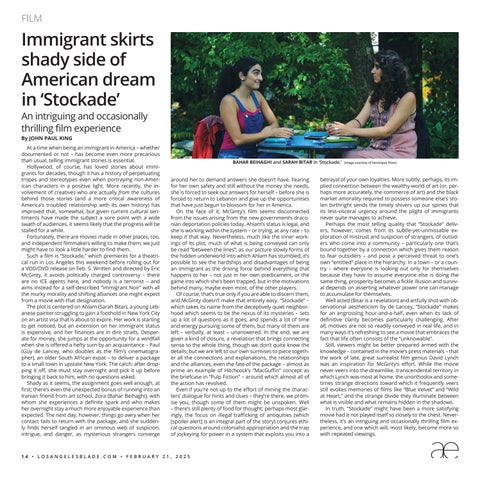
Immigrant skirts shady side of American dream in ‘Stockade’ An intriguing and occasionally thrilling film experience By JOHN PAUL KING At a time when being an immigrant in America – whether documented or not – has become even more precarious than usual, telling immigrant stories is essential. Hollywood, of course, has loved stories about immigrants for decades, though it has a history of perpetuating tropes and stereotypes even when portraying non-American characters in a positive light. More recently, the involvement of creatives who are actually from the cultures behind those stories (and a more critical awareness of America’s troubled relationship with its own history) has improved that, somewhat, but given current cultural sentiments have made the subject a sore point with a wide swath of audiences, it seems likely that the progress will be stalled for a while. Fortunately, there are movies made in other places, too, and independent filmmakers willing to make them; we just might have to look a little harder to find them. Such a film is “Stockade,” which premieres for a theatrical run in Los Angeles this weekend before rolling out for a VOD/DVD release on Feb. 5. Written and directed by Eric McGinty, it avoids politically charged controversy – there are no ICE agents here, and nobody is a terrorist – and aims instead for a self-described “Immigrant Noir” with all the murky morality and shifting alliances one might expect from a movie with that designation. The plot is centered on Ahlam (Sarah Bitar), a young Lebanese painter struggling to gain a foothold in New York City on an artist visa that is about to expire. Her work is starting to get noticed, but an extension on her immigrant status is expensive, and her finances are in dire straits. Desperate for money, she jumps at the opportunity for a windfall when she is offered a hefty sum by an acquaintance – Paul (Guy de Lancey, who doubles as the film’s cinematographer), an older South African expat – to deliver a package to a small town in upstate New York. The catch: after dropping it off, she must stay overnight and pick it up before bringing it back to him, with no questions asked. Shady as it seems, the assignment goes well enough, at first; there’s even the unexpected bonus of running into an Iranian friend from art school, Zora (Bahar Beihaghi), with whom she experiences a definite spark and who makes her overnight stay a much more enjoyable experience than expected. The next day, however, things go awry when her contact fails to return with the package, and she suddenly finds herself tangled in an ominous web of suspicion, intrigue, and danger, as mysterious strangers converge
BAHAR BEIHAGHI and SARAH BITAR in ‘Stockade.’ (Image courtesy of Veronique Films)
around her to demand answers she doesn’t have. Fearing for her own safety and still without the money she needs, she is forced to seek out answers for herself – before she is forced to return to Lebanon and give up the opportunities that have just begun to blossom for her in America. On the face of it, McGinty’s film seems disconnected from the issues arising from the new government’s draconian deportation policies today. Ahlam’s status is legal, and she is working within the system – or trying, at any rate – to keep it that way. Nevertheless, much like the inner workings of its plot, much of what is being conveyed can only be read “between the lines”; as our picture slowly forms of the hidden underworld into which Ahlam has stumbled, it’s possible to see the hardships and disadvantages of being an immigrant as the driving force behind everything that happens to her – not just in her own predicament, or the game into which she’s been trapped, but in the motivations behind many, maybe even most, of the other players. Of course, that’s true only if you are able to discern them, and McGinty doesn’t make that entirely easy. “Stockade” – which takes its name from the deceptively quiet neighborhood which seems to be the nexus of its mysteries – sets up a lot of questions as it goes, and spends a lot of time and energy pursuing some of them, but many of them are left – verbally, at least – unanswered. In the end, we are given a kind of closure, a revelation that brings connecting sense to the whole thing, though we don’t quite know the details; but we are left to our own surmises to piece together all the connections and explanations, the relationships and the alliances, even the fate of the package – almost as prime an example of Hitchcock’s “MacGuffin” concept as the briefcase in “Pulp Fiction” – around which almost all of the action has revolved. Even if you’re not up to the effort of mining the characters’ dialogue for hints and clues – they’re there, we promise you, though some of them might be unspoken. Well – there’s still plenty of food for thought; perhaps most glaringly, the focus on illegal trafficking of antiquities (which [spoiler alert] is an integral part of the story) conjures ethical questions around colonialist appropriation and the trap of jockeying for power in a system that exploits you into a
14 • LOSANGELESBLADE.COM • FEBRUARY 21, 2025
betrayal of your own loyalties. More subtly, perhaps, its implied connection between the wealthy world of art (or, perhaps more accurately, the commerce of art) and the black market amorality required to possess someone else’s stolen birthright sends the timely shivers up our spines that its less-visceral urgency around the plight of immigrants never quite manages to achieve. Perhaps the most telling quality that “Stockade” delivers, however, comes from its subtle-yet-unmissable exploration of mistrust and suspicion of strangers, of outsiders who come into a community – particularly one that’s bound together by a connection which gives them reason to fear outsiders – and pose a perceived threat to one’s own “entitled” place in the hierarchy. In a town – or a country – where everyone is looking out only for themselves because they have to assume everyone else is doing the same thing, prosperity becomes a fickle illusion and survival depends on asserting whatever power one can manage to accumulate for themselves. Well acted (Bitar is a revelation) and artfully shot with observational aestheticism by de Lancey, “Stockade” makes for an engrossing hour-and-a-half, even when its lack of definitive clarity becomes particularly challenging. After all, motives are not so readily conveyed in real life, and in many ways it’s refreshing to see a movie that embraces the fact that life often consists of the “unknowable”. Still, viewers might be better prepared armed with the knowledge – contained in the movie’s press materials – that the work of late, great surrealist film genius David Lynch was an inspiration for McGinty’s effort. While the movie never veers into the dreamlike, transcendental territory in which Lynch was most at home, the unorthodox and sometimes strange directions toward which it frequently veers still evokes memories of films like “Blue Velvet” and “Wild at Heart,” and the strange divide they illuminate between what is visible and what remains hidden in the shadows. In truth, “Stockade” might have been a more satisfying movie had it not played itself so closely to the chest. Nevertheless, it’s an intriguing and occasionally thrilling film experience, and one which will, most likely, become more so with repeated viewings.