Cabrini Cross Country TV Fall Previews

YOU SPEAK, WE LISTEN

YOU SPEAK, WE LISTEN
 KAITLIN BARR EDITOR IN CHIEF KMB738@CABRINI EDU
JAMIE HUFNAGLE NEWS EDITOR JLH729@CABRINI EDU
KAITLIN BARR EDITOR IN CHIEF KMB738@CABRINI EDU
JAMIE HUFNAGLE NEWS EDITOR JLH729@CABRINI EDU
According to U.S. law, an immigrant is a foreignborn individual who has been admitted to reside permanently in the United States as a lawful permanent resident (LPR).
Immigration is an ongoing topic discussed in the United States today. With such a wide range of elements to consider, key facts are necessary in the quest to gain a complete understanding of the effect that immigration will have on the upcoming election.
KAITLIN BARR EDITOR IN CHIEF KMB738@CABRINI EDU JAMIE HUFNAGLE NEWS EDITOR JLH729@CABRINI EDUSince the beginning of the school year, thefts have been occurring all over Cabrini’s cam-

pus. Items ranging from money and calculators to laptops have been stolen from residence halls and campus offices. So far, public safety and facilities have not released detailed information regarding the incidents.

According to Lillian Burroughs, director of public safety, the Public Safety department is working with the Radnor police
department. As of now, one student has been arrested on Sept. 12 on theft charges and also faces judicial proceedings here at Cabrini according to Burroughs.
The last reported theft or burglary was on Sept. 11. Howard Holden, director of facilities, commented on the situation. “It really does stem from folks being somewhat care-
free with their belongings.”
Safety tips were given to students in an email sent out alerting students and faculty to keep a close watch on their belongings in order to avoid future occurrences. Tips include keeping windows and doors locked, never
THEFT, page 3
Nine Cabrini faculty, staff and graduates returned from a trip to the Texas-Mexico border with a clearer picture of the human face of immigration.
Dr. Kathy McKinley, a sociology professor, said she knew 13 million people are here in the United States illegally and, before the trip, that was just a statistic that she taught her students in a theoretical way but now she has witnessed the human face and emotional dimension of the issue.
The nine Cabrini representatives traveled to El Paso, Texas and its sister city across the Rio Grande River, Ciudad Juarez, Mexico to study all sides of the immigration issue from June 19 to June 23.
The experience destroyed misconceptions that many Americans have about immigrants. The faculty and staff did not find terrorists and criminals but rather that 90 percent of the people struggling to cross the border illegally are decent human beings running from a corrupt economic system. They are willing to work hard to support their families. They are not coming here for a handout but rather a better life.
Through the experience the faculty and staff met with people who had many different ties to the issue including a man who had just crossed over the border to seek work.
“We met someone from Guatemala who has tried seven times
Fence between Mexico and Texas. About 80 miles of the border is fenced. Current proposals are for 700 more miles. Rep. Duncan Hunter wants to go all out and build 2,100 miles of fencing

This article will explain the different types of immigration, outline some of the causes of the controversy and present the Catholic Church’s standpoint on the issue because it is one of the leading proponents of reform.
When a U.S. citizen sponsors his or her foreignborn spouse, parent, child or sibling, it is called family-sponsored immigration. Distant family members such as aunts, uncles and cousins are not permitted to enter the United States under this type of immigration.
For jobs for which there is a lack of U.S. workers, an employer can hire an individual to fill the empty positions. This situation is often referred to as employment-based immigration.
When diversity visa lotteries in other countries occur, a person may be able to win one of the possible numbers of immigrant visas, granting them a ticket to the United States.
Certain titles are given to different classes of people who come to this country. Each title allows us to understand their place in the spectrum of people from abroad who come here.
George W. Bush has attempted to bring the immigration issue to the forefront in Washington. Unfortunately, as a result of more pressing issues like the Iraq War at hand, the issue of immigration has not been resolved and probably won’t be until the next president takes office.
Immigration is a hot topic not only among the 2008 presidential candidates but also among Americans. The impact immigration will have on our country is profound and needs to be addressed.
The United States is sometimes called “the land of milk and honey,” and it is because of that, that people risk their lives every day to cross the border to come to America for better opportunities.
As Americans, we ask questions such as, do we want people from other countries taking away our jobs, do we want our neighborhoods to change from dominantly English speaking, should illegal immigrants be able to attend our public schools and receive healthcare, what should the penalty be for businesses that employ illegal immigrants?
We as an editorial staff know and understand that our country is founded by immigrants. Some of our own parents are immigrants and because of that, we believe that we do not have the right as Americans to turn away people who want to do honest work to better the lives of their families, particularly work that most Americans would never do themselves.
The United States Department of Labor projects that by 2010, the U.S. will create 22 million new jobs but we have only 13 million new American workers.
However, The United States should know who is entering and leaving the country because times have changed. Post 9/11, safety has become of utmost importance. Legislation should be passed to ensure that the borders are heavily guarded from drug traffickers and terrorists.
Twelve million illegal immigrants reside in the United States today. In hopes of finding them, we believe Congress should make a time period in which illegal immigrants can come forward in an effort to become a legal citizen of the United States. Congress should specify that one of the factors of becoming a United States citizen is to speak and write English. Being able to clearly speak and write is absolutely a necessary factor in adapting to our culture.
Employers should be held accountable for knowing whether or not their employees are here illegally or legally. Employers employing illegal immigrants should be fined. Recently in the news, senators have been pushing hard for Congress to hear more about the Development, Relief and Education for Alien Minors Act. Also known as the “DREAM Act,” it is a bill that would provide a six-year path of citizenship for illegal immigrant students if they graduate from high school and continues on to college or military service. It would allow states to provide in-state tuition to illegal immigrant students. Although presented to Congress several times, Senate has approved nothing as of now. The immigration policy that Congress passes should be true to American’s history, a country of immigrants.
There’s a new broom on campus. Temco Services Industries is no longer the provider of housekeeping services for Cabrini College. On July 1 CSI International began providing those services for the college as part of a new two-year contract, taking over from the former provider, Temco Services Industries.
“All of our housekeeping contracts have been written for two years,” Howard Holden, Cabrini College director of facilities, said. “Housekeeping is one area where customer service, cleanliness and appearance are critical and contractors need to know we take their performances seriously.”
Holden said CSI was selected after considerable research by the facilities department, consultation from a third-party consulting firm and a final review by a committee composed of campus representatives of major users of housekeeping services.
This is its first housekeeping contract with a college or university for CSI. Its other
housekeeping contracts are primarily with corporate and institutional facilities. In addition to facilities-support services, the company provides engineering and management services.
“CSI has always been interested in the higher education market segment. We see it as a great opportunity to bring our passion for service and commitment to uncompromising quality to the college environment,” Roger Garrett, CSI International executive vice president, said. “We definitely intend to seek other college contracts, but first we want to prove ourselves to the Cabrini community by keeping our promise to provide extraordinary service to the Cabrini facilities.”
Founded in 1989, CSI has 1,500 employees in 17 states and will be responsible for housekeeping services including residence hall restroom cleaning, trash and recycling removal daily, vacuuming, cleaning floors, cleaning academic, athletic and administrative spaces daily, cleaning the dining areas nightly, litter pickup daily and project work such as deep cleaning and waxing.
Temco, an 88-year-old Man-
hattan-based company with over 10,000 employees in the United States and Europe, had been providing housekeeping services for Cabrini for the last two years. However, frequent changes in its staff were a factor in the change to CSI.
“The previous provider was experiencing a high rate of turnover which translates to too much focus on training and retraining and not on monitoring and improving services,” Holden said. “The current provider has a good track record of recognizing and keeping its employees and therefore can focus on the details.”
CSI’s expressed commitment to customer satisfaction is evident on its website which proclaims “We take pride in exceeding your expectations, by going the extra, value-added mile. We invest more time, effort and money than our competitors to find exactly the right people to manage your services.”
“We have heard many compliments from all sectors of the community thus far telling how much they appreciate the improved cleaning standard and a much friendlier staff,” Holden said.
Editor in Chief Kaitlin Barr
Deputy Editor Liz Lavin
Managing Editor Nicole Osuch
News Editor Jamie Hufnagle
News Editor Ashley Cook
A & E Editor Grayce Turnbach
A & E Editor Katie Clark
Features Editor Brittany Lavin
Perspectives Editor Jillian Smith
Sports Editor Kasey Minnick
Sports Editor Jessica Hagerty
Copy Editor Megan Pellegrino
Copy Editor Vickie Papageorge
Events Editor Diana Vilares
Adviser Dr. Jerome Zurek
Staff Writers
Jonathan Barnett
Michael Bieker
Christopher Blake
Christopher Campellone
Alicia Cook
Nicole Duggan
Danielle Feole
Laura Lombardi
Brittany McLeod
Christina Michaluk
Sarah Pastor
Nicholas Pitts
Samantha Randol
Christy Ross
Liz Garrett Meghan Smith
Christine Graf
Jessica Storm
Jessie Holeva Mallory Terrence
Danielle Kaine
Robert Kallwass

Shannon Keough
Ryan Kirby
Our Mission Statement
Lauren Townsend
Diana Trasatti
Jake Verterano
Britany Wright
The Loquitur is Cabrini’s College weekly, student-run, campus newspaper. It is widely respected as the voice of students, staff, faculty, alumni and many others outside the Cabrini community. The Loquitur has earned its position by advocating for self expression through freedom of speech, and by serving as an outlet for readers to affect change on campus and off.
Founded in 1959, the Loquitur has thrived and greatly expanded its readership. The paper now has over 2,000 online readers and 1,500 print readers on a weekly basis.
Our mission is to provide readers with an opportunity to voice their opinions freely, in an environment where their voices are effectively heard and respected.
The Loquitur: You Speak. We Listen


Loquitur is a laboratory newspaper written, edited and produced by the students of COM 353, 352, 250 and 251. Subscription price is $25 per year and is included in the benefits secured by tuition and fees. Additional copies are $1 each. Loquitur welcomes letters to the editors. Letters to the editor are to be less than 500 words. These are usually in response to a current issue on campus or community area. Guest columns are longer pieces between 600 and 800 words and also are usually in response to a current issue on Cabrini College campus or community. Letters to the editor and guest columns are printed as space permits. Submissions may be edited for length, clarity and content. Name, phone number and address should be included for verification purposes. Personal attacks and anonymous submissions will not be printed. Letters to the editor and guest columns can be submitted to loquitur@googlegroups.com or to the newsroom mailboxes in Founders Hall 264.
IMMIGRATION, page 1
A refugee is a person who seeks protection in the U.S. for fear that they will be persecuted in their homeland. In order to obtain refugee status, a person must prove on the grounds of race, religion, membership in a social group, political opinion or national origin that they have a “wellfounded fear of persecution.” They remain in their own country awaiting the approval.
Like a refugee, an asylum seeker fears persecution from his homeland. They are, however, already on U.S. soil when making this claim. Unlike refugees, they remain in the United States in hopes of avoiding deportation to their homeland.
ered non-immigrants. They are permitted to enter the United States for a limited time.
The naturalization process allows legal permanent residents to apply for U.S. citizenship as long as they reside in the United States for five years without having committed any serious crimes.
To qualify, these individuals have to understand, speak and write ordinary English.
THEFT, page 1
leaving property unattended, not letting strangers into residence halls and houses and traveling in pairs especially at night. The email also said that the items stolen were out in clear view.

Heather Shanley, communications center supervisor, was a victim in the campus thefts and claims otherwise.
“None of the items were in clear view,” Shanley said.
Shanley’s office is located in the communications wing of Founder’s Hall and was locked when the thefts took place. An iPod, two MP3 players and an iPod dock with a total value of about $600 were stolen over a period of three days.
“I had a video camera sitting out in clear view, and they didn’t take that,” Shanley said.
“They were looking for things they could stuff in their pockets and not get caught with.”
When contacted, Radnor police department could not provide detailed information regarding the current situation on grounds that it is an on-going investigation.
“It’s a problem and something needs to be done about it,” Shanley said. “If there’s a problem, you need to fix it.”
Undocumented immigrants, also known as illegal immigrants, are those who reside in the United States without the permission of the U.S. government. They can enter illegally, without being inspected by an immigration officer or by using false documents. They also can obtain a temporary visa legally, and then continue to reside in the United States illegally beyond the expiration date.
People such as students, tourists, temporary workers, business executives, diplomats, artists and entertainers and reporters are all consid-
The Catholic Church, one of the most outspoken advocates of immigration reform, has viewpoints on the immigration issue. The Catholic Church does not condone illegal immigration because it is not good for society. However, the church understands that, although those without legal status have broken the law, they do so in order to survive. The Catholic Church thinks it is in the best interest of the nation to reform the current immigration laws.
Having organized a grass roots campaign, called the Justice for Immigrants campaign, the Catholic Church is making it so that Catholics may be more involved. They will continue to speak out on the moral consequences of immigration and the effects of human life.
Many more topics remain in the immigration debate, all of which will be touched upon in the upcoming presidential debate.

TRIP, page 1
to get to the United States but kept getting sent back. The man said that he wished people in America would realize that we are just human beings in search for a better life for our families,” Fr. Michael Bielicki, the chaplain, said. He added that the man will probably not see his family for four years in the process.
“What really tore me about the experience is it showed me the greed here in America.” Fr. Michael said a man about 24 years old is paid 85 cents to fill a bag with onions everyday between the hours of 3 a.m. and the afternoon the next day.
The group lived on both sides of the border with an organization called Annunciation House, which has houses on both sides of the border, serves immigrants who have crossed the border without work documents who are considered by the U.S. government to be “illegal” or “undocumented.” Although the Annunciation House does not help people cross the border, they do provide them with food, clothing and shelter. Faculty and staff stayed in the house for five days.
The group also met a repre-
sentative of the U.S. Border Patrol. Talking to the border patrol, faculty and staff learned that it takes about two hours to cross the border with a work pass just for the day. During their five day stay, there was a 17-year-old boy shot trying to cross the border.
The faculty who went on the experience included Ann Servey, associate professor of business administration; Dr. Nick Rademacher, assistant professor of religion; Dr. Kathy McKinley, professor of sociology; Dr. Jeff Gingerich, associate professor of sociology; Dr. Nancy Watterson, assistant professor of English and communication; and Dr. Jerry Zurek, professor of English and communication. The staff that went on the trip were Father Michael Bielicki and Wolfington Center staff member David Chiles. Meghan Hurley, an alumna of 2007, also attended.
The trip was sponsored by the Academic Affairs office and the Wolfington Center.
The issue of immigration will impact the future of Cabrini students’ lives because immigration is having a large influence on our culture and economy. Zurek pointed out that many businesses such as restaurants and farms in
the United States, could not function without their labor. McKinley said that people are working in factories and getting exploited by American corporations. For Hurley, Zurek, McKinley and Fr. Michael, they feel change is needed.
“The trip only reinforced my opinions on immigration. I feel that we need comprehensive immigration reform and that higher security measures on the border and building higher walls are not the answers,” Hurley said.
The immigration issue is one
that holds special meaning to Cabrini College, since St. Frances Cabrini is the patron saint of immigrants. Zurek, said that if Mother Cabrini were alive, that he is sure she would be working with them.
cording to the New York Times.
Dr. Nicholas Uliano, assistant professor of romance languages and the study abroad coordinator said that is not the case at Cabrini.
“Cabrini students can rest assured that Cabrini is not in the business of making money from study abroad students,” he said. “In fact, when students study abroad through programs sponsored by other institutions, such as Arcadia, all of the billing which the student receives is through the sponsoring institution. Cabrini’s Business Office is not even involved.”
Receiving perks from a study abroad provider is not illegal because there are no regulations placed on study abroad programs, just a voluntary code of ethics that “limit members to gifts of nominal value and that do not seem intended to influence professional decisions,” according to the New York Times. This investigation raises the question of whether or not it is ethical to receive these gifts.
LIZ LAVIN DEPUTY EDITOR EAL723@CABRINI EDUA recent investigation into alleged unethical practices of study abroad programs could potentially make study abroad cheaper.
Andrew Cuomo, New York’s Attorney General, has issued subpoenas to organizations that provide study abroad programs to colleges, according to a recent New York Times article. The organizations are being investigated to find out if the perks they offer influence universities decisions about
where they send their students.
Arcadia University’s Center for Education Abroad, the No. 1 ranked study abroad provider in the county and one of the providers that Cabrini College frequently uses, is among the providers that have been subpoenaed.
The director of Arcadia’s program would not comment on the issue without first speaking to a lawyer, saying in a New York Times article that “the university wants to obviously be responsive, but this is strange water for us.”
It has been found that colleges and universities have
been receiving bonuses from study abroad programs to market their programs. These perks rarely benefit students.
Some perks that colleges receive are free travel overseas for faculty and staff, stipends for marketing, unpaid memberships on advisory boards and cash bonuses and commissions.
In addition, colleges and universities make money on study abroad by charging full local tuition to study-abroad students, paying just part of that money to the institution overseas and pocketing the rest, ac-
Critics of the study abroad programs say the receiving of gifts is unethical and are afraid colleges may reach the point where they rely on the money they are receiving from perks; supporters say the perks are so common they do not influence decisions and are relatively minor.
Uliano neither recommends nor advises students to choose a study abroad program offered by for-profit travel companies.
Instead, he guides students toward programs offered through academic institutions, saying he would rather work other accred-
ited colleges and universities than with for-profit organizations.
A “Study Abroad National Challenge Survey” found that most people believe that financial issues are the biggest barrier for students who wish to study abroad.
That is sometimes the case at Cabrini. Junior elementary education major Gary Pester is in the process of trying to study abroad.
“I would like to go abroad, I’m looking to see if I can afford it,” Pester said.
Pester narrowed his choices down from a fall or spring semester, which can cost between $10,000 and $15,000, to a summer semester, which costs about $6,000.
Studying abroad is pricey, but students do not have limited options at Cabrini, according to Uliano. Cabrini’s goal is to match a student’s overseas school to their budget.
Through Arcadia’s program, a person could spend a semester in Spain for just over $10,000. The cost of a semester in England varies; the University of Essex costs $13,500 but City College, London costs $22,000. The price of one’s semester abroad depends almost completely on its location.
When asked about the fact that Arcadia has been subpoenaed for this investigation, Uliano said, “Nothing will happen to Arcadia; it is not a sleazy organization. I would imagine this is how big business and politics works all across the country.”
 SARAH PASTOR STAFF WRITER SEP722@CABRINI EDU

Ask a typical college student when their next physics test is or how many weeks are left until finals and you can expect an answer in less than five seconds. But when questioned on the total amount or interest rate of their student loans, even the brightest students are often stumped. Unfortunately, recent restrictions by the Federal Education Department on payment regulations for university lenders are forcing more and more students to rely on private loans that can carry interest rates up to five times that of a university loan. And with college tuition rising steadily every year, the majority of college students find it necessary to take on private loans that can leave them over $100,000 in debt upon graduation.
But as a high school graduate with no other source of college funding, relying on a private lender to foot the yearly bills seems like the perfect solution. Although expected to increase slightly beginning next month, most federal loans have a limit of $17,125 for up to four years. And as thousands of college-bound students and their families know, the expenses of a college education, plus books, lab and computer fees, room and board and all
of the other miscellaneous costs far exceed this government grant. Parents who want their children to receive a college education but are unable to afford the financial undertaking often have the option but turn to private lenders.
The huge amount of profit associated with student loans is no secret to private lenders across the country. According to a report by the College Board, private student loans have more than tripled their revenues in the past five years, reaching over $17.3 billion in the 2005-06 school year. They are quickly becoming one of the fastest growing divisions in the student finance market. As tuition prices continue to rise, experts foresee this monopoly increase accordingly.
A recent complaint filed by the United States Student Association to the FTC, the “false and deceptive [advertising] claims” used by many lenders to further market their services only add to the problem. In fact, the assurance by private lenders of a debt free college education until graduation, including all of the hidden costs associated with it, is sometimes so misleading that some students are using unregulated private loans before using all of the fixed rate, low interest government aid they are eligible for private lenders have been accused of using false accusations
towards government sponsored financial aid to persuade students to turn directly towards for- profit private loan organizations for college aid. Unknowing college hopefuls are lured toward lenders that reserve the right to change interest rates freely until the loans are paid off. Sadly, many students approach graduation in more debt then if they would have paid the difference in college tuition after government loans personally.
The prospect of being able to attend a four year college is often so alluring that many kids don’t think twice about signing their lives away in private, unregulated student loans. The excitement of moving away from home, starting new classes and beginning the next chapter in life make it all too easy to overlook the mounting debt that will be accumulating over the next four years. Students are so preoccupied in the college lifestyle that many forget the debt they are amassing entirely and spend extra cash recreationally instead of saving to pay off student loans. For kids who aren’t even old enough to be considered legal adults, four years of schooling without debt seems like an eternity. Only by looking beyond the near future can students begin to realize the consequences of private loans and sign with private lenders cautiously.
An eating disorders counselor is the newest member of the counseling services staff.
Andrea Sussel was hired this year after previous experience in outpatient and inpatient services. Sussel’s specialty is in the area of eating disorders but like the other members of Cabrini’s Counseling Services, she serves as a generalist as well.
“We’re all generalists here,” said Dr. Sara Maggitti, director of Counseling Services. “We see and work with all students.”
By being generalists, they have the ability to assist students in all different areas, rather than having each person specialize in just one area. This practice also frees up space so they are able to meet with students more promptly.
“I encourage students looking for help to meet with the first available counselor, that way we can schedule an appointment with them within a week.” Maggitti said when asked about students who may seek assistance when suffering from an eating disorder. “After the first meeting I am able to determine whether I can work with them or if I should refer them to Andrea, our eating disorder specialist.”
Along with individual counseling services, Sussel will be offering different group services that will address eating disorders. One such group will focus on the “Freshman 15 and you” a look at how to avoid the inevitable weight gain during the first year of college.
Body Image groups will also be offered throughout the year in attempt to form support groups for individuals who suffer with these issues.
Maggitti said that Sussel’s role at Cabrini would involve finding out the need on campus and then discovering ways of addressing these needs.
“She really is in charge of outreach programs,” said Maggitti about Sussel’s role as the eating disorder specialist.

Maggitti feels that eating disorders are an issue, especially in a college atmosphere. She said she continuously heard from students that their body image was always an issue and she decided it was time to address this issue head-on.
“There’s so much pressure to look a certain way. Girls think the only way they can do it is by starving themselves,” senior English and communication major AnnMarie Chacko said.
The government has just approved a revamp toward college grants on Sept. 7 which means more money toward college. When this bill was passed in the Senate, the ratio was 79 to 12, based on the rise of price in college tuition. In the White House, this bill passed 292 to 97 in support that it would significantly increase funding. This bill raises the maximum Pell, basic, federal and low-income student grants. With this bill there will now be balance to the unjust college loan system and will create more opportunities for students to further their education.
“Before they started offering these services a lot of girls were going to outside counseling.”

Students can call the Counseling Services to set up an appointment within a week. All meetings are completely confidential unless there is a serious risk involved.
Along with their regular appointments, emergency walk-in hours are also offered from noon to 1p.m. without an appointment. The office is located in Grace Hall room 196 and can be reached at 610-902-8561. Additional information is on Cabrini’s Web site.
Maggitti urges all students who seek help from the Counseling Services to set up an appointment with the first available counselor and specific arrangements can be made after the initial meeting.
President of the Annapolis Group said to the New York Times, “We should be defining the conversation, not a magazine that uses us for its business plan.”
The New York Times reported that of the 80 liberal arts colleges associated with the “Annapolis Group,” a majority will drop out of the annual U.S. News survey. The Decision came after the Annapolis Group, a loose organization of liberal arts colleges, held their annual meeting.
U.S. News is supposed to be the most accurate college ranking system available, and this represents the biggest opposition the report has ever faced. Graduation retention rates, student-to-faculty ratio and class size are the types of categories that the report covers. The critics say that ranking system encourages colleges to gain more applicants and then reject a larger percentage of them, in order to appear more selective.
The Annapolis Group also announced that they would come up with their own system of ranking colleges, one that will not ignore the educational priorities that they are trying to establish.
Katherine Will, president of Gettysburg College and incoming
Brian Kelly, the editor of the U.S. News, said that he understands if certain colleges don’t want to participate, but also said that he feels the majority of presidents still support their survey. “We take our critics seriously, but we also think our ranking is valuable.”
Dr. Antoinette Iadarola, Cabrini’s president commented through e-mail, “I have been following this controversial issue for some time now and am sensitive to both the pros and cons, and to ‘US News and World Report’s’ efforts to address issue. Cabrini supplies ‘US News & World Report’ with the data they request. Readers are free to use the magazine’s rankings in any way that is useful to them.”
Dr. Jeffrey Gingerich, associate professor of sociology, said that the U.S. News rankings have been under criticism for some time now. Gingerich also said that it is not surprising schools are starting to revolt because the magazine does not have an ad-
equate way of ranking the college and yet potential college students rely heavily on the magazine to help them make their decision. Gingerich said, “It then becomes a case of a popular magazine determining what is a good college education rather than the educators themselves. It is interesting that it is mostly higher ranked colleges that seem to be revolting. They have enough name recognition that they are able to drop out without being hurt too much. Whether lesser-known colleges like Cabrini are able to afford to not be listed in the rankings is an interesting question.”
Gabe Valentino, a senior marketing major, said, “I remember looking at the magazine my senior year for the graduation retention rates, because I wanted to pick a school not only that I would want to stay at for four years but one that would give me great job opportunities.”
Schools in the area that made the top 112 liberal arts colleges in this year’s report included Ursinus, Susquehanna, Swarthmore, Juniata, Bryn Mawr, Gettysburg and Dickinson.
The price of employer-provided health insurance rose 6.1 percent this year. That’s the smallest increase since 1999 but it’s still higher than the increase in wages and consumer prices. The percentage of people covered by employer-based health insurance decreased to 59.7 percent in 2006, compared to 64.2 percent in 2000. The number of Americans without health insurance rose to a record high of 47 million in 2006. Since 2001, premiums for family coverage have gone up 78 percent, while wages have risen 19 percent and consumer prices have increased 17 percent.
The concern about the impact of rising oil prices could have on the world economy, Organization of Petroleum Exporting Countries (OPEC) approved to increase oil production by 500,000 barrels a day to 27.2 million barrels a day. Oil-consuming countries have been advising OPEC producers to increase its oil output because of fears winter would bring an increase in oil consumption that producers outside OPEC – such as the U.S. - would not be able to meet. OPEC provides nearly 40 percent of the world’s oil supply. Thus, the price of crude oil rose to a record high of $78.23 a barrel.
An earthquake felt nearly four countries away in Indonesia injured 100 people and killed seven people. This earthquake had then triggered a tsunami due to the magnitude of the 8.2 quake. It shattered buildings along the coast for 1,200 miles and sent aftershocks of 6.6 which then triggered a second tsunami. The tsunami wave was nine feet in height and hit the town of Bengkulu within twenty minutes of the aftershock.
8
DR KATHLEEN MCKINLEY PROFESSOR OF SOCIOLOGYI teach a junior Sem 300 on Wealth and Poverty. In that course we study the impact of globalization, U.S. trade policies and corporate practices on the poverty of less developed countries. When the Wolfington center sponsors student trips to the border, I always encourage my students to go to learn first hand about the maquiladoras, the factories on the Mexico side of our southern border and to meet the people who were risking their lives to come to this country to find employment. When the opportunity presented itself to go with other Cabrini faculty on this trip I felt privileged to be able to meet and speak with people living the experiences we discussed in class. For me this trip put a human face on the key questions we must all address as we look around the world today: fairness, justice, caring and most importantly our moral responsibility to others.
 ANN SERVEY
PROFESSOR OF ACCOUNTING
ANN SERVEY
PROFESSOR OF ACCOUNTING
I returned from Cabrini College’s Border Awareness Experience overwhelmed. Processing the information seemed an insurmountable task. The day I arrived home I was asked to share my experience with an Adult Contemporary Issues class the next day. My internal reaction was “No way, I could not possibly prepare a talk in time.” Externally, reluctantly, I said “Sure.”
As always my global interest peaks after a visit to an area and any discussion of the immigration issue grabbed my rapt attention. The day we left I had clipped an article from the El Paso Times to read later.
Later was here and I was reviewing and processing the information from the study tour in preparation for my impending talk. This article by Chris Roberts, El Paso Times, June 23 titled “Immigrant copes with tragedies, detention” and the Border Awareness Experience gave me my voice and prompted me to state the obvious. To summarize the article:


“Veronica Villa, mother of eight children, an undocumented immigrant has lived in the United States for 14 years. She attended her father’s funeral in Juarez and on June 10 she was detained by the U.S. Border Patrol while trying to re-enter the United States and faced immediate deportation. Her husband visited her regularly at the detention center. One day he arrived too early and was told he couldn’t see her. Before he could return to the prison, he was killed in a single-car accident. In two weeks, Veronica lost her father, her husband and she was detained.

For humanitarian reasons, she was given a different process by the Border Patrol. Veronica was reunited with her children and was permitted to remain in the United States at least until her court case is resolved. Veronica’s release took longer then expected and she was unable to attend her husband’s burial.” (El Paso Times, 6/23/2007) No fence, no wall should separate families.
DR JEFFREY GINGERICH ASSOCIATE PROFESSOR OF SOCIOLOGYThe trip for me was powerful in terms of the experience of being on the Mexico-U.S. border. Even though I try to keep up and educate myself on the issues of immigration to the U.S., it was really transforming for me to stand on the border fence, and to watch young children peaking through the fence to the U.S. side, while large Border Patrol SUV’s cruised nearby. Things that seemed so rational from far away in Pennsylvania, suddenly felt very irrational during the time we spent at the border.
DR NICHOLAS RADEMACHER ASSISTANT PROFESSOR OF RELIGIOUS STUDIESThe Border-Awareness Experience provided faculty the opportunity to see first-hand the complexities surrounding immigration from the perspective of key players on both sides of the U.S.-Mexico border. The trip enriched my knowledge and understanding of the immigration issue, which will in turn enrich my work in the classroom. The topic is relevant to many of the classes that I teach from Liberation Theology, which has to do with ending economic and political oppression, to the history of the Catholic Church in America, which centers on the stories of immigrants. The dignity of the human person is at the center of Catholic social teaching as are the concomitant rights that we all have with respect to the common good: a right to life and the means to develop as fully as possible as human beings. We also have the obligation, at both the institutional and personal level, to enhance one another’s access to what will fulfill basic human needs such as but not limited to food, clothing, shelter, and meaningful work. While most of the attention on the issue of immigration, both legal and illegal, focuses on the institutional response (i.e., what is the government doing?), during this trip, when the human side of the debate overcame the abstractions of policy debate, my attention turned to the personal response. What can we do in our everyday lives to overcome the divide between rich and poor, to help the people who come here in search of those things that will help them become more fully human? In part, the answer was in the terrain – the desert – a place where, in the history of Christianity, women and men would go in search of solitude, to find God by overcoming that self-centeredness that separated them from God. In reading a meditation by Thomas Merton, who wrote a half-century ago, “Everywhere is desert,” I was reminded that the struggle for survival at the border is not limited to the people on both sides of the fence who are still there engaged in that daily effort. Rather, the struggle is present in each of us everyday, in the search for God and the over-coming of self-centeredness; the struggle continues even here as we strive to fulfill our responsibility to ensure the dignity of all persons not only at the institutional but also at the personal level through thoughts, words, and actions.
DR JERRY ZUREK COMMUNICATION PROFESSORThe fight over immigration puts the label of “illegal” on many Spanish-speaking people in the United States. On this trip, I met so-called “illegals.” I met men sleeping on a hard tile floor of a large room like Jazzman’s Cafe, rising at 1 a.m., to be chosen by farming companies to work from 3 a.m. until 2 p.m., picking peppers under a scorching sun. What they told us they want is the opportunity to work hard, at jobs that we Americans need to be done, to make a better life for their families. I found that the problem is not that they are “illegal.” The problem is that we in the United States are more interested in partisan politics than in fixing a broken system.
afternoon until past midnight and then work in the
elds from 2 or 3 a.m. until early afternoon the next day. This center serves 5,000 farm workers, provides a place where they can rest, get a shower and a good meal. It also provides English classes, health workshops and cultural events.
faculty members and 1 alumni visit the Texas/Mexico Border to encounter first-hand the immigration issues that the United States deals with daily. These are there stories.
For more Cabrini Border Experience responses, please go to www.theloquitur.com
how scary it is to possibly have your personal belongings stolen and to never be seen again.
ing taken away from them, and officials have no information or quotes to give me? Wow.
KAITLIN BARR EDITOR IN CHIEF KMB738@CABRINI EDU
With all the recent thefts on campus, as a student, I feel I have the right to know what’s happening. Although I’m a commuter, I’ve lived on a college campus in the past, and I know
Being a reporter for the Loquitur has broadened my curiosity in many different areas, so when another editor and I decided to find out more about the recent thefts, we wanted to tell Cabrini students the truth about what has been happening. When we were told by administrators in certain offices that they were “not allowed to comment,” we were shocked.
Not allowed to comment? Seriously? People’s personal belongings are be-
Cabrini is keeping quiet, when they should be speaking out to their students.
Other universities in the area keep blogs about the crimes happening around campus. Advice to “watch your personal belongings and shut your doors” is unbelievable. We’re college students, not second graders; I think we know to lock our doors and watch our belongings. It’s not our fault if someone may have a master key to get in everywhere on campus.
I do understand public safety’s concerns with leaking information; if they gave out the wrong information there could be negative repercussions. However, there are serious thefts occurring all over campus, and students have the right to know.
The fact that there was $600 worth of equipment taken from Heather Shanley’s locked office in the communications wing, and all administrators can say is that students should be more careful with their belongings, is absurd.

After talking with other editors in chief on
IN MY OPINION
with you.
I bet you didn’t know that just drinking from bottled water instead of tap water was part of such a controversy. I know I didn’t.
NICOLE DUGGAN STAFF WRITER NLD723@CABRINI EDU
Every time you pick up a bottle of water to drink, you probably don’t realize you’re contributing to one of the 30 million bottles a day that has to be tossed out and then recycled.
This process of recycling all those glass and plastic bottles takes up tons of gallons of oil and gasoline to ship them to the recycling plants. Whether or not you realize it, this causes a lot of pollution to our environment.
I feel like everyone drinks bottled water. I bet more than half the students on our campus walk around every day with a bottle of water in their school bag. Go and walk around the city streets; people are always carrying them. It’s just the most convenient way to always have water
The only thing I thought I was doing was making in more convenient for myself to have something to drink easily and not have to find a sink every time I needed or wanted water. That would really get to be a pain in the neck after awhile.
As an athlete, I definitely find it easier to just go to the grocery store, pick up a case of water for about six or seven dollars and put it in my refrigerator. Then for practices and games, I just have to grab a bottle before I go and I am on my way.
Did you know that last year, almost two million tons of plastic was used to make bottles for water? This manufacturing of plastic uses a huge amount of petroleum which pollutes the air we breathe.

This makes me think, if everyone continues to drink from bottles more and more when they want water, we are just harming the environment even more. I know that when I’m running around on that soccer field,
America
Almost
I don’t want the air I’m taking in to be polluted.
An average person could probably go through at least one or two bottles of water a day. That’s a lot of plastic to be shipped around if you think about how many bottles that one person will go through in an entire month.
Think about it. Is having that bottled water really that important? Try buying a Brita purifier to clean your tap water for you. I know a lot of people now tend to have one in the dorm rooms
other campuses, and telling them our current situation with hardly receiving any information, they were blown away. They made a few good points, and one of them is this. Regardless of Cabrini being a private four-year college, we participate in federal financial aid programs for students
According to the Student Right-to-Know Act and the Clery Act, any college or university that participates in financial aid programs has to disclose information about campus safety policies and procedures and provide annual statistics of certain crimes
occurring on campus.
Getting turned away from information to help the well being of the campus is ridiculous.
We’re not trying to make people look bad, like they’re not doing their jobs. All we want to do is report the news that affects Cabrini.
People don’t feel safe having no idea of what’s happening on their campus. Receiving an uninformative email that there were a few thefts around campus doesn’t give anyone assurance.
Hopefully we get some new information soon.
To the Editor:
Holy freaking cow?!
Can it be true?! Has the wicked witch of the campus decided to step down?
This can’t be.
This has to be some sort of ploy by Cabrini to try to have the Alumni stand up and take note and hopefully begin donating back to the Campus. I can tell you one thing, as an Alum, the soon to be Ex-Prez was one reason I would never donate a cent to Cabrini as long as she was there.
nizations a year while at Carbini and participated in a few Alumni functions after graduation and to this day I am sure she still has no idea who I am.
I understand that “we,” America, do not want foreigners here because of the
job market. But at one time ancestors of all of our families were immigrants; that is why America is called “the melting pot”.
So I am split between this decision but leaning more towards not letting them over just because I want a job and I want everyone in America to have one too.
Allowing immigrants to come to the United States would allow more diversity, as well as more jobs in the hospitality and restau-
rant business. Without having immigrants over in the United States we have no one to fill those jobs, even though Americans get first choice of any job.
The National Restaurant Association had forecasts of a 15 percent increase in the job market in the next decade, which will benefit any immigrants coming into the country.
But the federal government projects only a 10 percent growth. This growth would be for the people be-
so they can just refill it.
You could be one of those people who will continue to drink bottled water just because it’s more convenient, like me.
To at least help a little, try cutting the amount of bottled water in half that you purchase and start refilling your old ones with tap. This will not only save you have the money you spend on bottled water each year, it will help keep the air you breathe everyday, a whole lot cleaner.
She was the worst. She hated when anyone did not share her ideas, God forbid someone had an opinion of their own, or even worse someone actually be respected and loved more than her, see Coach Dzik.
I worked in 3-4 orga-
This truly is a great day in Cabrini history; the campus is free of her reign of ignorance to the student and those precious teachers who put students first and her agenda second. It is just a shame so many good teachers, coaches, advisors and ministers had to leave before they could see this day. I can only hope the next President takes note and does NOT follow in her footsteps and carves out a path of their very own.
- Jared Schierbaum, Class of 1999tween the ages of 16 to 24.
In America anything that is “illegal” is unacceptable or wrong.
Americans having this view of immigrants as being unacceptable and more of a hassle is something that would have to be overcome.
The citizens of America are worried about if more immigrants migrate to the United States, there could possibly be a lack of employment. As well, the demand for houses will in-
crease by about 18 million dollars.
If the United States government decides to allow more immigrants over to the United States then tax dollars will have to be raised. As well as a plan to create more visas; the ones that exist currently are only for the established. There is a huge blockage and lack of funds when it comes to immigration.
I currently stand at a cross-road when this issue comes about; because
I know each and everyone of our families came either from a country other than North America.
So at one point in our history we were all immigrants and had to fight our way into this country. I know the times have changed but if America can afford it and if there are enough jobs; should more visas be created?
I would say yes, change is always good.
is called ‘the melting pot’ for a reason
College students have certain ways to deal with their fatigue, whether it involves drinking coffee, taking a shower or going for a jog. But what happens when those techniques wear off?
The people from Prevention magazine studied a variety of research studies on the body and discovered new ways for people to stay awake and alert throughout the day.

Daryn Eller, a health writer, wrote an article on eight tips and said that this is a perfect plan to feel “refreshed and recharged.”
Chris Hyson, director of Health & Wellness Education, was asked whether or not she agreed with the points in the article.
Hyson said that she agrees with some and not others.
Hyson said it depends on the person because each body is different.
Eller said that drinking coffee in the morning is a waste of time because it will wear off in the afternoon.
He suggests that drinking coffee mid-afternoon will keep you energized for the rest of the day.
Brittany DeCicco, a
senior history and political science major, agrees with this advice because she usually drinks coffee in the afternoon but when she does drink it in the morning she crashes by early afternoon.
Hyson disagrees. She believes that water, exercise or eating a healthy snack is more helpful late in the day.
Eller also advises not to take power naps, rather to go out into the sunlight for awhile to restore energy.
“I like my naps,” Mary Rita, a sophomore education major, said. Although she said she feels more tired afterward, she believes it’s worth it.
Another point Eller makes is that it’s better to listen to music while exercising because a person won’t exert themselves as much.
Melissa Benedetti, a junior exercise science major, said that listening to music while working out is just a distraction, much like watching television. She doesn’t really pay attention to it anymore.
The amount of carbohydrates a person takes in is another point. Eller said that if a person eats too many it will be “an energy drain.”
Matt Leitch, a junior biology major, agrees that
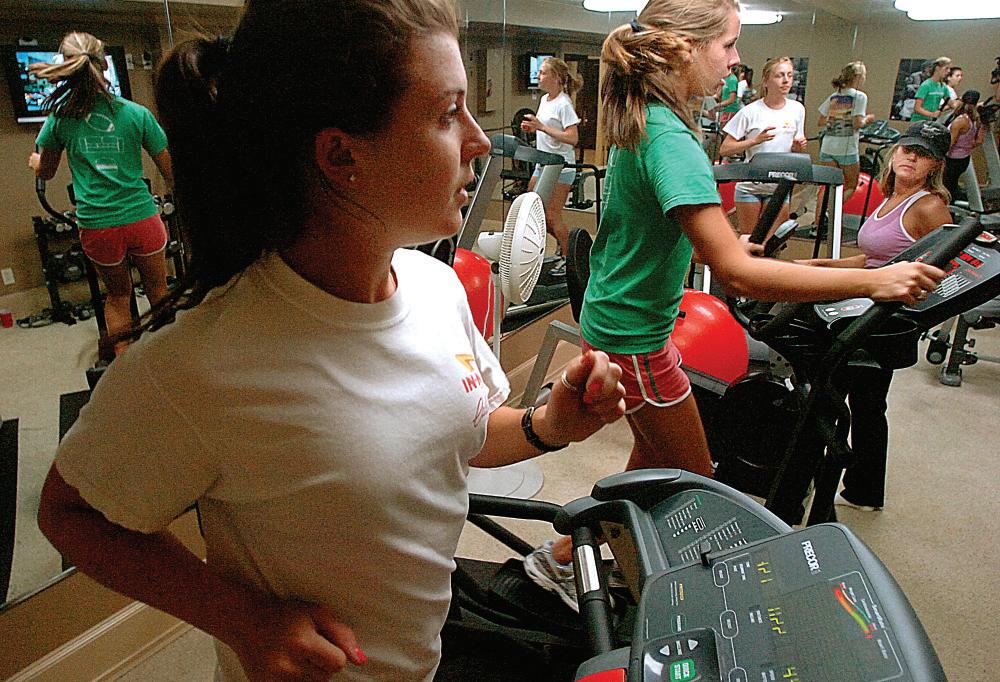
Students may find that exercise is a good energy boost, as it it known to give you endorphins.
eating a lot of carbs is like a sugar high and afterwards he “burns out.”
Hyson believes that carbs are an important part of a person’s diet but there are good and bad carbs and a person needs to know the difference.
The next point is that watching TV before bed is okay but looking at a computer screen will decrease the body’s energy and confuse the body’s sleep pat-

It is hard to go anywhere nowadays without seeing an Apple product somewhere, whether it be an iPod or an iPhone. Pretty soon it may be difficult to drive down the street without seeing an “iCar” in the other lane.
That’s right, Apple Inc. and Volkswagen are in preliminary discussions of possibly building an iCar that would feature products from the omnipresent computer company. There is currently no indication of what products the iCar will feature, but there is no shortage of speculation.

“I hope it would at least have an iPod,” Anthony Casazza, a sophomore graphic design major, said. “I don’t know what else they could possibly put into it.”
Apple President Steve Jobs and Volkswagen President Martin Winterkorn have been very reluctant to get into details about what the contents of the iCar are going to be.
In a statement released to the Associated Press,
Volkswagen representative Hans-Gerd Bode said “there are scores of ideas but few concrete plans at this point.” The hope of both of these companies is that the iCar would be attractive to the younger demographic.
“I think it’s a great idea if they can put it together and make it affordable,” Casazza said.
However, not everyone seems to share the same enthusiasm for the potential iCar.
“I would absolutely not
buy it,” Jason Cohen, a sophomore communications major, said. “It’s completely unnecessary to use my car as an entire iPod.”
The iCar is still in preliminary stages and nothing concrete has come about. Apple is attempting to
build on the success of the iPhone, which has sold over one million units according to Wired Magazine.
Apple seems like it is always ahead of the competition and if the iCar comes to fruition it may just run the competition over.
terns. He suggests turning the computer off one hour before bed.
Charles Bush, a junior English and communication major, believes that television is entertaining to watch, but when a person is on the computer they aren’t usually staring at the screen, they’re doing something on it, which is what makes them tired.
Eller says to eat meals at the same time everyday be-
cause a body expects food at a certain time. If a meal is skipped, the body will not have enough energy to function correctly.
Hyson said that the body needs a healthy supply of food to keep energy, otherwise it will crash.
Meditating is another way to stay energized according to Eller.
Meditating is an activity that can “decrease the stress hormones that tense your
muscles and constrict your blood vessels,” as quoted from the 8-point Energy Solution article.
Whether a person takes a walk or sits by a window, it’s important to expose the body first thing in the morning.
Eller suggests getting up at the same time everyday and exposing the body to sunlight as a good source of energy.
“Inspiration is conceptualized as an appetitive motivational state.”
Facebook has recently beem revamping itself by adding a multitude of new applications to suit its numerous followers. This may not be breaking news since the majority of the campus is already addicted to the site; but is Cabrini equally as fixated on the wide range of new applications Facebook recently added over the summer?
keep users on edge and using the site more frequently. It is now possible to send your friend a virtual gift, draw a graffiti picture and share the newest song clips. And that’s just to name a few of the extremely common tricks Facebook’s managed to conjure up. Has this trend taken off or already fizzled?

Susan Schmidt, a freshamn elementary and special education major, feels the fun will only last so long. “If someone’s going to send me a present, then do it in real life and not on Facebook.”
applications,” Shawne Gehman, a sophomore indeclared major, said.
The fancy ones will probably die off soon, but there are a few even the skeptics have on display.
DIANA TRASATTI STAFF WRITER DLT722@CABRINI EDUPeople are inspired by many different things. Some of these things include being inspired by their major, friends, family and other various aspects of life.
Webster’s dictionary defines inspiration as a “stimulation of the mind or emotions to a high level of feeling or an activity also as something, such as a sudden creative act or idea that is inspired.”
Todd Thrash, author of “Inspiration: Core Characteristics, Component Processes, Antecedents and Function” and a psychology professor from The College of William & Mary, said that there are three core characteristics to inspiration.
The three things include transcendence, evocation and motivation.
“Transcendence refers to the fact that inspiration orients toward something that is better or more important that one’s usual concerns, one can see better possibilities,” Thrasher said.
Kelly Hornbach, a junior elementary and special education major, feels most inspired by her parents.
“My parents are my inspiration because they have always been pushing me to succeed so I could accomplish my goals,” Hornbach said.
The support of her parents helps Hornbach to achieve her goals and see the bigger picture.
Likewise, Brendan Murtagh, a senior history secondary education major, feels that his parents are his biggest inspiration.
“My parents are hard workers and love my family. They are commmited in everything they do for my sister and I,” Murtaugh said.
This type of inspiration can be summed up by a quote from Mark Twain, who once wrote that: “Really great people make you feel that you, too, can become great.”
“Something that inspires me would be either music or theater, because they
usually get my creativity flowing, which helps when I sit down to write or when I have to rehearse my lines for a show,” Shannon Winters, a sophomore English secondary education major, said. “I usually have admiration for whoever I am listening to or have seen perform on stage and I aspire to be like them.”
The primary cause of Winter’s inspiration is her motivation. People are motivated in many ways by different situations in their lives. According to Thrasher, motivation is seen as the key element that helps most people to be inspired.
Motivation is the force that propels most people once they have experienced something that has inspired them. A person experiences a particular thing and then feels that they can do something extraordinary just as the person before them has.
Loquitur welcomes your comments on this story. Please send your comments to: Loquitur@googlegroups.com. The editors will review your comments each week and make corrections if warranted.
Many Cabrini students check Facebook more than three times a day. Others, like Steve Klapy, a sophomore marketing major, simply minimizes the site so never to be behind the times with a new comment or friend request.
Now, there’s more to
Jolaine Gero, a senior marketing major, used to love having virtual food fights with her Facebook companions. However, she admits the novelty did wear off.
Gero’s opinion well represents the voice of others asked on campus.
Cabrini freshmen, relative newbies to Facebook, are even feeling lethargic over the applications the website has to offer.
Klapy expressed the same opinion towards similar features like the happy hour application. He too, doesn’t see the point in virtual giving.
Here’s the truth. The Cabrini students interviewed for this story practically check Facebook non stop but only put the features to use maybe once weekly but more often than not, even less. The overall opinion is that these creative applications are overrated.
“When they first came out I had a lot more of the
“Happy Hour,” an application used to send others drinks, is one of the most popular and widely used.
“Top Friends,” which is similar to a feature Myspace started, has also caught on in the Facebook community.
Whether or not the majority is over the application obsession, Facebook will try to be inventive.
“The previous ones will ware off, but they’ll come up with more to make the applications more popular,” Schmidt said.
Dr. John Cordes is currently teaching the courses Introduction to Mass Communication, Presentation of Communications, Career Preparations and Job Search Techniques. He received his undergraduate degree at the prestigious University of Notre Dame, his Master’s degree at Syracuse University and his Doctorate at the University of Maryland.

Q: What are your interests?
A: Working with the elderly and I’m a member of the Knights of Columbus.
Q: What is you favorite book?
A: The Voices of Time.
Q: What is your favorite musical?
A: Les Miserables.
Q: What is your favorite sports team?
A: The University of Notre Dame’s basketball team.
Q: What is your favorite college memory?
A: Spending my time by the Grotto during my years as an undergraduate at the University of Notre Dame.
Q: How do you feel about Cabrini so far?
A: am very happy to be apart of the Cabrini community and want to fulfill the mission statement. I feel that the students are wonder ful and I hope to guide them in their plans and dreams.
Q: What are your favorite quotes?
A: “An eye for an eye only ends up making the whole world blind.” - Mahatma Gandhi
“Do small things with great love.”
- Mother Teresa


It’s that time of year again. School is in full swing and TV once again becomes interesting. The fall lineup is filled with many returning favorites and new shows to watch for. Premiere Week starts Monday Sept. 17, so get the popcorn ready and
“Back To You” is a promising new sitcom starring Kelsey Grammer and Patricia Heaton as local news anchors in Pittsburgh. Catch the comedic duo Wednesdays at 8 p.m. on FOX starting Sept. 19.
For those who watch TV religiously, you are most likely familiar with the cavemen from the Geico commercials. Well, now they have their own show, “Cavemen”. Tune in Tuesdays at 8 p.m. on ABC to decide if they can hold their own for a whole 30 minutes.
The new Grey’s Anatomy spin off, “Private Practice” will be either hit or miss with devoted Grey’s fans. “Private Practice” follows Dr. Addison Montgomery to a new job in Los Angeles where she retreats to forget about McSteamy and McDreamy. With a star-studded cast, the show should prove to be just as good as the popular Grey’s Anatomy.
“Private Practice” airs Wednesday, Sept. 26 at 9 p.m. on ABC.
ABC seems to be the channel to turn to for new shows this fall. Premiering after “Private Practice” at 10 o’clock is the new drama “Dirty Sexy Money.”
The series follows the lives of a wealthy New York City family and their business after the patriarch dies in a suspicious plane crash. “Dirty Sexy Money” seems as if it will have enough excitement to keep viewers on the edge of their seats.
CBS’s new drama, “Moonlight,” is definitely the show to watch if you happen to be staying in on a Friday night. Alex O’Loughlin stars as a vampire who works as a private investigator. With the supernatural aspect of “Buffy the Vampire Slayer”, the drama of “Grey’s Anatomy” and a CSIlike color quality, “Moonlight” looks to be promising.
The CW’s new shows seem to be geared toward the high school viewers. “Gossip Girl,” based on the Best-Selling series, premieres Wednesday Sept. 19th at 9 p.m. It looks as if it’s the East-Coast, non-reality version of MTV’s “Laguna Beach;” replacing the surfer boys and blonde haired beauties with a posh, stuck-up New York City boarding school crowd. I’m sure it will suffice if there is nothing else on.
Check out http://tvaddict.com for a full schedule of dates and times of your favorite shows so you won’t miss any of the action!
phone interview that he wants Flava Fest to “portray a more positive side of hip-hop” as well as “turn new people onto a new perspective of hip-hop”.
“Hip-hop artists are often blamed for promoting violence and misogyny in their music...” Freshout Media said in their press release sent out on August 27. Freshout Media, along side of Goodie Goodie Productions, two Philadelphia-based marketing services companies, are out to change this stereotype of hip-hop artists through their three day Flava Fest event kicking off on Sept. 20.
Over the course of the three days Flava Fest hopes to capture hip-hop artists in a different light, specifically targeting the hip-hop cultures “four disciplines – breaking, emceeing, DJing and graffiti art,” Freshout Media said in their press release.
Christopher Anderson, marketing director and partner of Freshout Media said in a
In addition to Flava Fest hitting the streets of Philly on Sept. 20, the event will also be celebrating the 10 year anniversary of “The Gathering”, Philadelphia’s longest-running hip-hop event, which takes place the last Thursday of every month at The Rotunda on Walnut St.
Starting at 6 p.m. at 1231 N. Broad St. on Thursday, Sept. 20, Flava Fest will begin the three-day event with a slam poetry competition. A prize of $350 will be awarded.
Along with the poetry competition will be a display of custom sneakers, graffiti artwork, as well as open breaking ciphers. Admission is $5 and it will be open to all ages.

On Friday, Sept. 21 Flava Fest will con-
tinue the three day celebration at F.U.E.L Collection located on 249 Arch St. This event will focus on the dance aspect of hiphop, which will include a series of “breaking, popping and locking dance battles…” Anderson said.

The event starts at 8 p.m. Flava Fest will have dancers coming from all over the United States to face off against some of Philadelphia’s best.
There will also be the preliminary round for the Freestyle Face-Off, a lyricist competition. This event is $10 to attend and is open to all ages.
The festival will continue into Saturday, Sept. 22 starting at 1 p.m. at the 40 St. Field (near Penn’s campus). This segment of the festival will bring hip-hop performances from local and regional talents.
Along with the performances, there will be vendors selling items such as artwork and clothing. An open dance floor will be
available as well as a showcase of graffiti art.
The headliner event of Flava Fest will take place that Saturday night at the Trocadero Theater, where international recording artist Pharoahe Monch will take the stage. “Our main goal is to show we are truly pushing hip-hop to another level,” Anderson said.
Other performers such as Juggaknots, Reef the Lost Cauze and Philadelphia Slick will help round out the rest of the night. Anderson says he is “excited for all of these regional performers.” The final round of the Freestyle Face-Off will take place in between sets.
The concert is $18 to attend and tickets much be purchased in advance.
For more information on Flava Fest 2007, you can visit myspace.com/flavafest. For tickets, visit ticketmaster.com.

Hypnotized students were spotted dancing, singing and even performing sexual acts with chairs in the Grace Hall atrium last Monday night. No, this was not a situation where resident assistants would be writing people up but rather a case of hypnosis. Former MTV and Maxim guest, Damian, hypnotized 17 students on Sept. 10.

“I’ve been developing my skills since 1996,” Damian said. Damian has been seen in radio, television, and film…a triple threat.
“I do a show once a month with the guys from Jackass,” Damian said. Damian has also performed his hypnosis act with members of the All-American Rejects on MTV in 2006. He also did interviews with Maxim Radio and performed at Maxim events.

“We wanted to bring something new to Cabrini,” Megan Kutulis, a sophomore communications major, said when asked about Damian’s appearance “ CAP Board is really trying to get more people involved with the events on campus this year.”
This is the first of many events CAP board has planned to create interest in oncampus events.
The CAP Board is doing a puzzle piece promotion, where you bring a puzzle designed piece of paper to events and have it stamped. Each stamp gets you one step closer to winning a special prize. The prizes range from gift cards to even a flat screen television.
“The turnout was a lot better than we had expected, this was a definite success for CAP Board,” Kutulis said.
Damian’s act caused students to lose total control of themselves. There were people dancing like Chippendales, Britney Spears lip synching and even a swarm of people climbing around like orangutans.
“That’s not even my craziest act,” Damian said, “If you want to see some really crazy acts…look me up on Youtube.”
“I thought the show was interesting and yet hilarious,” Meghan Monroe, a sophomore psychology and sociology major
said. Monroe was one of nearly 60 students who turned out for the show.
“The crowd was really great. For a smaller audience they were definitely into it,” Damian said. “I’m used to working with all different sizes of crowd. I do nearly 150 shows a year.”
When he isn’t hypnotizing people, Damian can be found racing cars, flying or giving some motivation empowerment.
“If you’re a smoker, when you wake up you will think cigarettes are disgusting. You will never have one again,” Damian said during his act to promote some motivation empowerment. Damian is also a board member of the Humane Society.
“Hypnosis is like playing guitar. You mess around for a little bit and just see what works. Eventually, a hobby can turn into a life’s work,” Damian said.
Information on Damian can be found on his official website, damianthehypnotist. com. You can also read about his tricks in his upcoming book, “Hypnotism In The New Millenium.”
Loquitur welcomes your comments on this story. Please send your comments to: Loquitur@googlegroups.com. The editors will review your comments each week and make corrections if warranted.
Singer and songwriter, Venice Maki performed for students and staff in Jazzman’s on Sept. 6. The artist performed an hour long concert for free. He created a laidback atmosphere where students gathered in between classes, as Maki sang acoustic.

“Commuters can come and relax in between classes. This is one of the afternoon events for commuters that we are beginning to have,” Ashley Shoenfelt, assistant director of student activities said. Many students and staff came in to eat and get going. However, in between there were many who enjoyed the sounds of Maki.
Maki was able to grab the attention of the crowd by doing a cover song of Dave Matthews Band, “Crash”. He put his own personality into it without changing the song by Dave Matthews. Another attention grabber was his original song about Cabrini College. Maki sang a song about the day he was currently having at Jazzman’s.
His other songs were about his own life experiences. He sang about love, heart breaks, failure and life itself
Maki, who was born Zaire of Central Africa, came across the country from his current home in Los Angeles. He was raised in the states and became a great soccer player. He didn’t realize it then but he would have a life-changing decision between his two passions.
“One day I am going to juggle the soccer ball and play my guitar at the same time. When I come back here, I will have my soccer ball,” said Maki while telling the audience more about himself.
According the Maki’s myspace that he openly announced in between songs myspace.com/venicemaki, in 1999 Maki recorded “Surviving the fall”. He selfproduced the album with no funding help as well. He soon went on tour between the years of 2000 and 2001. Maki then vanished for four years and came back with 40 original songs. He currently has a new album out called “Which way is out,” which includes 12 of those songs.
Many students were able to enjoy his sound of music between classes. “I love that type of music with independent artists,” sophomore, Cate Romano, a graphic design major said. “I bought his cd and would definitely go see him in concert.”
New York rapper 50 cent and the windy city’s rapper Kanye West did not have beef but had one of the most anticipated feuds of rap. Both rappers dropped their albums on the same day, Sept. 11. 50 cent stated that if Kanye West’s album “Graduation” sold more than his album “Curtis” that he would stop making solo projects and would only rap on featured tracks.
Kanye West and 50 Cent’s quarrel was seen on the cover of Rolling Stone and on MTV’s VMAs. 50 Cent towered over Kanye West as they presented a VMA award but Kanye West stole the show from 50 with his private “Good
Answers to:
Life” concert.
Kanye West performed singles “The Good Life” featuring T-Pain and “Stronger” off his new album “Graduation” during the VMAs.
50 cent was on TRL the day of his album release bringing an album for everyone in the MTV crowd. 50 also told TRL about the process of making his CD and how he had no attachment to any of his songs, he just asked Eminem and if Em liked it then it went on the CD.
50’s past CDs after “Get Rich or Die Trying” have been more materialistic and commercially appealing to a broader fan base but it has been the same type of music over and over again. Kanye West on the other hand shows a more mature side with this CD. The rapper/
producer had many guest appearances such as Lil Wayne and T-Pain and high energy melodies like “Stronger” to give people that Kanye West feel of music.

Two different Emcees, two different types of music, one similar release date and one outcome. 50 Cent explained to the LA times on how Def Jam manipulates West’s record sales with marketing tricks. Nonetheless Kanye West has sold more CDs than 50 Cent thus far in their first week.

Loquitur welcomes your comments on this story. Please send your comments to: Loquitur@googlegroups.com. The editors will review your comments each week and make corrections if warranted.
Old School
- Home Alone
- Demi Moore
- Wannabe
- Adam Sandler
- Will Smith
- Camp Anawanna
- Captain Planet - Masseuse
- Teletubbies
- “10 Things I Hate about you”
- Steve - Melissa Joan Hart
New School
- Melanie Brown (Scary Spice), Sabrina Bryan (Cheetah Girls), Helio Castroneves (Indy 500 driver), Mark Cuban (Dallas Mavericks owner), Jennie Garth (90210), Josie Maran (Model/ Actress), Cameron Mathison (All My Children), Floyd Mayweather (Boxer), Wayne Newton, Marie Osmond, Albert Reed (Models), and Jane Seymour (Wedding Crashers).
- Mark Wahlberg
- Ashley Tisdale
- Forest Whitaker
- The Hills
- Rachel McAdams & Ryan Gosling
- “It won’t be soon before long”
- Twyla Tharp
- Harry Potter & the Deathly Hallows
- “Superbad”
- September 19, 2006
- Rob Zombie
- “Private Practice”
BRITANY WRIGHT STAFF WRITER
BLW723@CABRINI EDU
“Lunch in Lisbon” anyone? This catchy debut album will be premiering this Fall 2007 as Brandon Reynolds tours the east coast.
So who is Brandon Reynolds? Brandon Reynolds is an artist with a unique set of lyrics set to the smooth, bluesy tunes of folk-rock.

Reynolds is returning to the east coast for his tour, he is no stranger to the Atlantic Ocean’s shorelines. He grew up in various cities during his childhood, ranging from Minneapolis, Greenwich Village, Northern California and Austin.
The true turning point in his musical career occurred when he went to the University of Central Florida located in Orlando, Fla.
After working his way through school singing in bars, coffee houses and
musical festivals he began touring in early 2002.
Reynolds says in his biography, “I started out writing and performing these haunting, introspective songs, which were an extension of my poetry writing throughout adolescence and my studying of psychology at college…I begin tinkering with more uptempo songs and including harmonica in my songs.”
“This coincided with a period of my life where I really got into old acoustic blues guys, like Robert Johnson and Leadbelly.
This led directly to the type of music I play now. Folk-Rock with a dash of Root Blues,” Reynolds said.
Some of his other influences besides Robert Johnson and Leadbelly include Johnny Cash, Bruce Springsteen, Bob Dylan and Tom Waits.
He really began to jump-


start his career in 2006 when he moved to Southern California and through his ties in the Los Angeles musical underground he met producer Rob Seals.
Seals recorded a threetrack acoustic demo by Reynolds. By recording this demo Reynolds had a chance to enter the world of music quicker than his fellow musicians.


On the album itself there are six tracks. Every song tells a story in the form of a poem.
Reynolds uses the technique of repetition in his lyrics to help the song to be more catchy.
The song “Lisbon Girl” demonstrates this with the phrase, “don’t you know, what you’re doing to me.” The song itself is about a girl that seems to run every time she is about to enter a relationship with a boy.
Another song, “Country Seminole,” paints a picture
of a man playing his guitar on a rainy night just waiting for his friend to get off of work.
Reynolds writes about where he is in great detail, for example, “traffic lights are blinking in Seminole… quiet night, books and wine…”
The music Reynolds performs is down-to-earth and something that everyone can easily relate to.
Reynolds creates an album that can be listened to for relaxation or to jam out to a blues song.
For more information on this artist check out Reynolds’ site, brandonreynoldsmusic.com or his myspace page at myspace.com/ brandonreynolds.
There is information about his life journeys, articles and interviews about his performances and also samples of his music that can be heard for free.
Staying well can sometimes be a tall order, especially for busy college students. Yet, it is vital to your success in the alwayshectic setting, so here are some way students and everyone can keep themselves healthy in this week’s Health Nut topic, “Wellness 101.”
Those wanting to stay healthy should exercise at least three times a week, doing exercises you enjoy; eat a balanced mix of healthy foods and remembering to make smart choices about alcohol and other drugs; spend your time wisely and try not to procrastinate; renew your spirit in ways
that feel right, whether it is out in nature, in a place of worship or being with family and friends and lastly, finishing the night off right with a healthy sleep that should become a regular pattern.
If these tips may not work for you or you are having difficulty with a certain class or simply need some guidance, getting help is the smart thing to do. One of the great things about being at school is that many different kinds of help are right at your fingertips.
To come in contact with the Counseling Center call, 610-902-8561, for Student
Health Services call 610-902-8531, for Health and Wellness Education call 610902-8316 or for The Center for Teaching and Learning call 610-902-8213.
In addition, there are many health information Web sites that may be a valuable resource such as mdchoice.edu, acha.org, familydoctor.org, Ulifeline.org and Goaskalice.columbia.edu.
The Health Nut topic “Wellness 101” is a courtesy of Susan Fitzgerald of Health Services.
to ensure a victory against the Eagles.
The women’s field hockey team remains winless as they are 0-5 overall and 0-2 in the Pennsylvania Athletic Conference after falling to Alvernia College and Eastern University.

On Saturday, Sept. 15 the team traveled to Alvernia where freshman goalkeeper Caitlin Donahue stopped 10 of the 24 shots on goal by Alvernia. The Cavaliers only recorded three shots on goal by senior Alyssa Soto, junior Melissa Benedetti and freshman Allie Rodolico.
In a rival game on Wednesday, Sept. 12, the Cavaliers played their biggest rival, Eastern.
The Cabrini women made a statement when they came on the field and scored in the first 45 seconds, but in the end, it was not enough
At half time the game was tied 1-1, but Eastern scored first in the second half gaining much momentum.
The momentum quickly shifted when Cabrini freshmen Desiree Umosella returned the favor.
“The ball came from the corner. I had to stop and reverse the shot all at once,” Umosella said.
Eastern scored once more in the second half to guarantee the win with a 3-2 victory.
“I’m very excited. This team is young, but I do not want to call it a rebuilding year because that is insinuating that this year does not matter. This year is the one that counts!
I’m pleased with the players overall performance, the upperclassmen being strong leaders and the younger players are good players that will mature,” Coach Jackie Neary said.


Today, more professional athletes than ever are using their respective fields of play as pulpits to express and promote their faith according to salon.com.
Many fans though, do not know that there is often a “coach” behind the postgame prayers and testimonies such as Kevin Harvey, the team’s volunteer Christian chaplain for the Philadelphia 76ers basketball team.
According to salon.com, Harvey said, “I look for ways to challenge the guys all the time -- everyday things they can do with the platform God has given them.”
At Cabrini College though, is praying before a sporting event a ritual for the sports’ teams, or do interval athletes pray on their own before engaging in their sport?
Loquitur welcomes your comments and questions on this story. Please send your comments to: Loquitur@googlegroups. com. The editors will review your comments each week and make corrections if warranted.
KARA DRIVER JUNIOR, COMMUNICATIONS WOMEN’S LACROSSE

“We pray before every game. It’s tradition to make the freshmen learn and recite the prayer.”
“I pray when I feel anxious or before a big game. I pray that I will calm down and have a good game.”

do not personally pray before games, but I would if I wanted to.”BRETT HELLER SOPHOMORE , BUSINESS ADMIN. MEN’S GOLF
team does not pray and I do not either.”
“As a team before games, we like to come together and hold hands as we pray the Hail Mary.”PAUL LEVINE SOPHOMORE , ELEMENTARY EDUCATION MEN’S LACROSSE
“I pray during big games when I know I am playing.”MORAN
 LAURA LOMBARDI STAFF WRITER LCL723@CABRINI EDU
The Women’s tennis team had extraordinary performances this past weekend as they are tied for the record of 35 consecutive Pennsylvania Athletic Conference wins.
The team beat Cedar Crest College 8-1 on Friday, Sept. 14 then defeated Marywood University on Saturday, Sept. 15 with another 8-1 victory. The Marywood match tied the Cavaliers for the PAC record of 35 consecutive wins, ironically held by their Saturday opponent.
The Cavaliers, now 4-2 overall and 3-0 in the PAC, swept the doubles competition with partners junior graphic design major Dina DiTaranto and senior English secondary education major Carolyn Wilson, freshman undeclared major Megan Simmons and junior business administration major Christine Telling and freshman physical therapy major Stephanie Tighe and sophomore elementary education major Nicole Pontious.
With one more “W”, it will be the first time the Cavaliers have achieved a feat of 36 consecutive wins.
DiTaranto said, “I think our team is stronger than ever. We have a strong ethic and we love to win! We’re looking forward to gaining a fourth PAC championship title
and bringing home the plaque where it belongs.”
Simmons said, “I think that the 35 wins is awesome and I’m so excited about breaking the record and am very proud to be apart of the team to help beat the record.”
The team will aim to break the tie between them and Marywood and register 36 wins at their next home game against the College of Notre Dame at 3:30 p.m.
Simmons said, “All of the girls, ‘our tennis family,’ are so supportive of each other, and I think that is one of the main reasons why our team is so successful, besides all of our hard work and everyone’s dedication.”
Often, when the women’s team is playing a home match, the other Cabrini single and double teams will practice on the back courts, but several other players will stick around to cheer on their friends.
The Cavalier fans are always very supportive by waving posters and signs that give hope and inspiration to outlast their opponents.
Loquitur welcomes your comments and questions on this story. Please send your comments to: Loquitur@googlegroups. com. The editors will review your comments each week and make corrections if warranted.
After the Monday Night Football game on Sept. 17 the Philadelphia Eagles continue a losing streak. Defeated by the Washington Redskins by a score of 2012, the “birds” are also dealing with injured free safety Brain Dawkins. Dawkins sustained a neck stinger as a result of a hit he put on Redskins tight end Todd Yoder in the fourth quarter. Meanwhile, tight end L.J. Smith continues to fight a groin strain since early on in training camp.
Buffalo Bills’ tight end Kevin Everett has recently shown movement in both his hand and greater strength in his leg muscles. The 25-year old athlete received a life-threatening spinal-cord injury during Buffalo’s season-opening game against the Denver Broncos on Sept. 9.
“Kevin Everett remains medically stable in the intensive care unit, and continues to make daily improvement in his neurological status,” Bills doctor John Marzo said Monday, Sept. 10 according to espn.com.
By Thursday, Sept. 13, Everett slightly -- and voluntarily -- moved three fingers on his right hand, something he had previously been unable to do.
New England Patriots coach Bill Belichick said on Monday, Sept. 17 that he will comply to the National Football League’s request to give them any tapes, notes or recordings that he may have had to use to get inside information on other teams in the NFL.
According to espn.com, Belichick declined a comment when he was asked about commissioner Roger Goodell’s request and referred to team owner Robert Kraft’s remarks during an interview at halftime of the game against the San Diego Chargers on Sunday, Sept. 16. “I think that’s a fair question and I’m sure there are other questions out there as well,” he said. “I’ve made my comments on that and, as Mr. Kraft said last night, we’ll handle it as an internal matter. So I’ll just leave it at that.”
According to espn.com, prosecutors filed charges on Tuesday, Sept. 18 against fallen football star O.J. Simpson. Allegedly, Simpson committed 11 felonies including kidnapping in the armed robbery of sports memorabilia collectors in a casino-hotel room. Simpson, 60, was arrested and booked on suspicion of assault and robbery with a deadly weapon. Clark County District Attorney David Roger filed those charges and added kidnapping and conspiracy to commit kidnapping, according to court documents.
Thursday, Sept. 20
Women’s Soccer vs. Franklin & Marshall College (6:30 p.m.) Volleyball at Penn State-Berks (7 p.m.)
Saturday, Sept. 22
Men’s Cross Country - Philly Metro Meet (Belmont Plateau at Fairmount Park) (12:15 p.m.)
Women’s Cross Country - Philly Metro Meet (Belmont Plateau at Fairmount Park) (12:15 p.m.) Volleyball at Fairleigh Dickenson University - Florham (3 p.m.)
Men’s Soccer at Immaculata University (3:30 p.m.)
Men’s Tennis at ECAC’s (Lehigh University) (TBA)
Women’s Field Hockey at Wilkes University (1 p.m.)
Women’s Tennis at Gwynedd-Mercy College (1 p.m.)
Sunday, Sept.23
Men’s Tennis at ECAC’s (Lehigh University) (TBA)
Monday, Sept. 24
Men’s Soccer at Delaware Valley College (3 p.m.)

Women’s Soccer at Immaculata University (4 p.m.)
Tuesday, Sept. 25
Volleyball vs. Gwynedd-Mercy College (7 p.m.)
Women’s Field Hockey at Gwynedd-Mercy College (4 p.m.)
Wednesday, Sept. 26
Men’s Soccer vs. Neumann College (6:30 p.m.)
Women’s Tennis vs. Eastern University ( 3:30 p.m.)
ERIN LAGARENNE/PHOTO STAFF Senior Lauren Gambescia runs through drills at a practice earlier this week.
The Cabrini men’s and women’s cross country teams ran in their second competition of the season at the Ursinus Invitational on Sept. 8. The women’s team placed 5th out of the 6 teams and the men’s team placed 4th out of the 8 teams.
The women’s team ended with a final score of 141, behind first place Franklin and Marshall College with 46 points and Ursinus College in second with 56 points. Freshman Diana Gapinski made 18th place for Cabrini College.
The team competed without their top runner, senior Carolyn Roberts.

According to cross country head coach Tom O’Hora, Roberts turned her ankle in the previous week’s Delaware Valley Invitational. She will begin training in a few days and O’Hora believes she will be healthy for the Philly Metro Meet on Sept. 22.
The men’s team scored a total of 85 points, with freshman Eddie Penatar
finishing 3rd and junior Justin Walsh finishing 14th out of a total of 65 runners.
“The Ursinus meet was just a training for us,” O’Hora said, “because it was hot, I asked all the runners to take it easy and not go all out. Considering that and the high level of competition, we did very well. There weren’t many teams at the meet, but they were quality teams.”
Cabrini’s cross country teams are working well with the new freshmen who have joined the team according to O’Hora.
“The freshmen have been great! They have mixed in very well with the veterans of the team.”
The Cabrini cross country team will compete in the Philly Metro Meet at 12:15 p.m. at the Belmont Plateau at Fairmont Park on Saturday, Sept. 22.
Loquitur welcomes your comments and questions on this story. Please send your comments to: Loquitur@googlegroups. com. The editors will review your comments each week and make corrections if warranted.
 ALICIA COOK STAFF WRITER ARC725@CABRINI EDU
On Monday, Sept. 17 the women’s volleyball team defeated Alvernia College 3-0. This brings the Cavaliers to their third straight win, improving to 5-5 overall and 1-1 in the Pennsylvania Athletic Conference.
The team also beat Swarthmore College on Sunday, Sept. 16 with a 3-2 victory.
To recap an intense match that took place at home on Saturday, Sept. 8 against DeSales University, the Cavaliers lost 3-1. The women showed great skill throughout the the start of the matches, but lost the momentum toward the end.
In the books for the night, junior Lindsay Martin registered 19 kills and an impressive 35 digs, sophomore Traci Beltz added 13 kills and sophomore Lizzie Williams added a season-high 50 assists.
Danielle Finnegan, a junior elementary and special education major, said, “We came out strong to start each game and took the lead right away. There was no question in the beginning about who was in control of the game.”
Although the women felt strong, Finnegan also said, “The low points of the game were when they came from behind and we gave up some very crucial points.”
Beltz, a sophomore exercise science and health promotion major, said, “We play really well together as a team when we talk and if we keep up the talk, we do a great job of keeping the ball off the floor on our side and getting down on theirs.”

Freshman religious studies major Eddie Penetar is the first men’s cross country runner to earn the runner of the week title.

Placing first out of 60 runners at the Mule/Falcon Classic in Allentown on Saturday, Sept. 15, Penetar led the Cavaliers to a first place overall win. So far this season, he has placed in the top five in all of the three invitationals that the team has competed in.
The freshman athlete comes from Bishop O’Hara High School in Scranton, Pa. where he medaled at the All-States track and cross country. His senior year he was named ‘runner of the year’ by the Lackawanna High School League.
Penetar has been running since he was in seventh grade.
Penetar said that his running times have greatly improved since high school. At this time his cross country team ran a 3.1 mile race whereas college races are five miles.
“I never ran a five mile race before college, but I made a smooth transition,” Penetar said. “I feel I am stronger with longer races.”
The young runner feels he gets his motivation from his teammates.
“My teammates keep pushing me. I’m happy with the team’s performance. We win as a team,” Penetar said.
Up next for Penetar is the Philly Metro Meet at the Cavaliers home course at the Belmont Plateau at Fairmount Park on Saturday, Sept. 22.
A big meet for Penetar is the Paul Short Invitational at Lehigh University where the team will run against Division I colleges. The meet will take place on Friday, Sept. 28. The course at Lehigh is also the course where Regionals will take place. This is an important meet for Penetar to get used to the course to do well at Regionals in mid November.
Penetar’s goal of the season is to make it to Nationals at the end of the season.
“I’m going to have to work hard, but I hope to make it,” Penetar said.
The Cabrini College men’s soccer team, now 7-1 overall and tenth in the MidAtlantic Region is looking to do more damage to their opponents this season as they try to further themselves in the standings.


At their last home game against Alvernia College on Sept. 12, Alvernia came out early to score the first goal at the 2:50 mark. With a strong offensive and defensive showing from both teams, it wasn’t until the second half that Cabrini put themselves on the scoreboard with a first career goal from freshman Matt O’ Shaughnessy.
As the time passed off of the scoreboard, fans were beginning to feel nervous with the game tied and both teams getting more “fired up” to take the lead.
With just over two minutes remaining in the game, sophomore political science major Evan Hanauer released a kick from the corner to senior graphic design major Dom Rizzo, who fired the ball into the corner of the net to go up 2-1, releasing some of the tension from the squad.
Alvernia, looking for a quick comeback, couldn’t hold Cabrini back from wanting to seal the fate of their opponents as Hanauer headed the ball into the net to final the score 3-1.
According to the Cabrini College Athletic Web site, assistant coach Rob Dallas said, “As a whole, we didn’t have the greatest first half, but we came back and played a complete second half. In the end, our hard work paid off.”
Hanauer said, “We have the ability to go undefeated the rest of the season. We have a ton of seniority on the team and they
really push us to work hard and do well.”
Michael Douglas Kroener, a sophomore marketing major, said, “The captains are very determined this year, pushing us everyday so we can hopefully end their senior year with a PAC championship, which is very likely if we just keep working hard together.”
Senior political science major Barry Magagna said, “We are a hard working team who just happens to find some magic in second halves. The goals that we have scored late are a real tribute to our hard training. Overall we are looking to keep clicking and making things happen.”
DIANA VILARES EVENTS EDITOR DVV722@CABRINI EDUBuzz Sutherland comes to Cabrini
Comedian Buzz Sutherland will be performing on Saturday, Sept. 22 at 8 p.m. in Jazzman’s café. CAP Board welcomes all students to this event, which is guaranteed to be laugh-out-loud hilarious. For more information please contact Ashley Shoenfelt at 610-902-8461.

Five Times August is coming to Cabrini on Tuesday, Sept. 25 to put on a rockin’ concert at Jazzman’s café. The concert starts at 9 p.m. and everyone is encouraged to come and bring friends! For more information please contact Ashley Shoenfelt at 610-902-8461.
Stop by Jazzman’s on Monday, Sept. 24 for a friendly game-o of bingo! The fun starts at 9 p.m. and all are welcome to come. For more information please contact Ashley Shoenfelt at 610-9028461.
Laura Briggs, a representative from The Washington Center, is coming to Cabrini on Tuesday, Sept. 25 to talk about possible U.S. government internship opportunities for Cabrini students. Briggs will be speaking in the Holy Spirit Library from 3:15 to 4:30 p.m. For more information please contact Dr. James Hedtke at 610-902-8336 or visit The Washington Center’s website at http://www.twc.edu/.