SPRING 2020
the journal LevinLand’s
Illustrators
JADE DRESSLER Marketing Expert
DANA COLLINS
Designer/Illustrator
ALEXANDER BOSTIC Modern Master
DONNA BARSTOW
Comic Artist
ANGEL ALVAREZ Fun and games artist
Illustration by Alexander Bostic
Chuck Pyle
Classic Brilliance
HEATHER LEARY 'S
SHOUT
OUT
I’m A Freelance Artist - Now What? So, you have everything you need to start your Freelance career. You have a portfolio, website, resume, and even business cards. Now what? In this article I am going to cover what comes next when diving into your new career. After graduating from art school, I was quite lost on where to begin as a Freelance Artist. I never got an internship while I was in school, so I had no connections to the Animation Industry. A couple months passed and despite applying to multiple jobs on Indeed.com, I was unsuccessful. I had no clue what I was doing wrong. I had received an email that my college was having a portfolio review event. Thus, brings me to my first important tip, go to events! The Animation Guild, Women in Animation, and Animation World Network are a couple places that hold events that can be beneficial to
you. If you are feeling particularly gutsy take your portfolio to a Comic-Con. You never know who you are going to meet let alone who would be interested in hiring you. I realize, being an introvert, that this can be absolutely nerve wracking. If I had let my nerves get to me it would only have hindered my chances of finding work. Going to this event was beyond helpful to; my portfolio, demo reel, and resume where critiqued by those who were heavily connected in the Animation Industry. Most importantly I got my first gig as a Freelance Artist. Let’s say you have gotten your portfolio reviewed, the next thing is to take that advice and make those changes. Now we have come to my second tip, don’t be too sensitive about your art. Artists can get
"If I had let my nerves get to me it would only have hindered my chances of finding work."
especially attached to their artwork. I have been guilty of this. This sensitivity can get in your way of improving. Art is a very personal thing and it can be hard to receive criticism, but when someone who has a better understanding of the industry and what they are looking for it’s in your best interest to take that advice. You also can’t grow as an artist if you don’t push yourself and try new things. I have a terrible habit of falling in love with the first design I come up with for a character design. Due to this, I never push myself let alone improve my art. Pushing yourself is such an important aspect in being a Freelance Artist. It’s something I am working on everyday so I may become a stronger artist.
Your art style is always going to change. I started art school in 2013 and my art style has changed a lot since then. This leads me into my next tip, stay educated. I’m sure more schooling is the last thing anyone wants, especially when you have graduated. For artists the education never stops. Like an athlete, an artist’s skills need to stay in peak condition. I personally have found some great ways to stay educated without having to go back to art school. The Internet can be a very helpful tool to you. Which brings me to my final tip, use tools. Freelance Artists don’t need a fancy gallery to show their work. The Internet and social media are excellent to get your artwork viewed. It’s hard to get hired as a freelance artist when no one knows who you are which is why started putting my work on a wide range of sites. Instagram, Twitter, Artstation, Tumblr, YouTube, Upwork’s, the list goes on. By putting your artwork out
there you start to develop a presence. People in the art
©Lon Levin/Heather Leary
community will have an easier time finding you and you can get some great feedback. Putting your artwork on the internet can be scary. I didn’t start doing this until last year. I was afraid of people stealing my work and being trolled for something I put time and love into. I started to fear I was getting behind other artists and that my career would never fully take off unless I bite the bullet and put my art on social media. Once I did, I found such a wonderful community of artists who are supportive and give me lots of encouragement. This only fed into my desire to create more work, develop a larger portfolio, and share my art. In conclusion, being a Freelance Artist is not the easiest job. There’s no manual and a lot of it has to do with being at the right place at the right time. By sharing my story and tips I want to reach out to fellow artists and give them a guide so they may not have to go through the same struggles I faced while working as a Freelance Artist. Heather is a regular contributor to The Illustrator's Journal and has work with the editor on various projects like the artwork depicted in this interview. You can find Heather's work at https://www.artstation.com/ heatheraaleary and her animation at https://www.youtube.com/watch?v=6JnQqdDwUGk
Interview with
Lon Levin
When
did
you
first
think
thing you wanted to do? discouraged
by
about
Were family, friends,
art
as
some-
you encouraged or teachers,
mentors?
I was seven years old when art came into my life. When I was young boy my mother would go grocery shopping, and during that time she would go to the A&P grocery store. She would give me the brown paper bags from the A&P and I would open them up and use them as drawing paper to do my art with. I’m the second oldest of five children and the only one who would get the brown paper bags, well I was the only one who wanted them. My siblings were not interested in the arts at all. This is how it all started, the dream of me wanting to be an artist. With that kind of support what else can I do but to dream big and pave my way to a career in art. I would like to talk about support and why it’s important. For a young artist and for that matter any artist to have support in the making of their career. I know that most parents never ever want their child to grow up to be anything in the creative arts. But I’m telling you now if you take on this fight you will lose, I know my mother and stepdad did. You see don’t give a stray cat milk if you don’t want them to stay. But my story did not start with my mom, it started with my older brother Charles. Yep my big brother.
Let me tell you how this happen. Well this story starts with fire. Okay it was a match, one day my brother and I was playing on the stoop in Brooklyn, and we decided that we're going to play with matches. My brother liked to play army, and with a book of matchsticks, we decided we would get an army together. My brother and I were just striking matches trying to make an army when an old lady stuck her head out the window and told us to stop playing with matches. My brother told the old lady to mind her business and she stuck her head back inside her apartment. Ten minutes passed and then we heard a fire truck. The fire truck went streaming down the street and it stopped right in front of my brother and I. A fireman got out of the truck and said, “Are you kids playing with matches?” Of course, we said, “No.” We were then asked to get into the fire truck and they drove us to their fire station. At the fire station, they gave us a tour and showed us where they slept, where they ate, and even went up and down the fire pole which was fun.
"I was seven years old when art into my life.
"
Alvarez Angel M.
WITH STYLE
"When I’m
drawing, I’m usually thinking about giving these characters life and a personality. I try to feel the emotions and expressions that I am drawing. "
When did you first think about art as something you wanted to do? Were you encouraged or discouraged by family, friends, teachers, mentors? Art has always been a big part of my life. I remember winning first place in a watercolor competition in kindergarten for painting a flower and drawing for family and friends every chance I got. My family was encouraging and my mom was always looking to enroll me in art classes when I was a kid. When I was in high school there was a Spanish teacher that saw me drawing in her class, and instead of getting upset she recommended I audition for an art magnet school in Miami. I ended up getting accepted to Design and Architecture Senior High, it was a great academic environment surrounded by other art students in high school.
Style is something that just develops over time after you make tons of work and find your voice.
What kind of kid were you? Where did you grow up? What were your influences? My childhood was spent playing baseball and drawing. I grew up in South Florida in a very family oriented Hispanic community. My biggest artistic influence as a child had to be the hours of Disney animated films and cartoons I would watch. When I was a kid, I wrote a letter to Disney animation telling them I wanted to be an animator and they sent me back a packet all about drawing and animation. I also spent a lot time drawing ninja turtles, cartoons and comics. I loved comic strips and I would get so excited to read and draw from the Sunday paper. Your style and take on creation of art is unique. Did you work on developing a style or is that what naturally came out of you? Style is something that just develops over time after you make tons of work and find your voice. I think most artist are a product of all their influences and life experiences, you take all that in and a new mix comes out that is hopefully unique and authentic to you. Style is also something that should evolve as you grow. Over the course of your artistic journey, your artwork will change depending on your inspirations and interests.
If I’m going to spend hours on an illustration, I have to make sure I’ve studied all my options for that image. My drawing is created over the original thumbnail sketch. I find that the closer I stick to my thumbnail, the better off my composition and design will be. After that, I usually gather visual reference. Even if I’ve drawn an elephant hundreds of times, I still look at tons of reference to draw an elephant. Reference is there to give you visual information, but you should also push and combine reference to make something unique. I sketch my drawings on a Wacom Cintiq using Photoshop or my iPad and Procreate. Digital sketching gives me the most flexibility and is faster for corrections. After I’ve worked out my drawing digitally, I create my final drawing traditionally over my digital sketch. I just like the feel of drawing with a pencil, and I get more pleasure out of drawing traditionally at this phase. I always do a color and value study to work out my color pallet and value structure. At this point, all the problems in my illustration should have been worked out and the rest is just a matter of painting the image. This part should be easy and enjoyable because of all the steps that were taken to ensure success.
You offer drawing and painting info on your website for other artists. When did you start that and Why?
I got my MFA in illustration from the University of Hartford during Murray Tinkelman’s last year and with the new program director C.F. Payne. I was fortunate to be surrounded by amazing illustration faculty and peers that work at an incredibly high level. I got inspiration from so many amazing artists in that program. It was truly a humbling experience and also a point of great artistic growth in my life. The info I share is meant to pass some knowledge on to individuals interested in storytelling and illustration. I’m curious about how you choose what to work on. What’s does your process entail? Start to finish. Can you give us a short step-by-step?
Like many artists, I have more ideas than I have time to execute. I have periods where I’m disciplined about drawing in my sketchbook everyday and other times where I put it down for a while. I think the sketchbook is a great place for me to generate ideas based on things I see, hear or read. I start off with thumbnails to work out ideas, designs and compositions. I’ve learned the importance of exploring various ideas before committing to one.
What’s the future hold for you? Any ultimate goal? My goal is to continue to grow as an artist and find more opportunities in the children’s book market. That is something that I am continuously focusing on. I have three kids and they are my biggest motivation and inspiration in life. My older kids are seven and five, and we have a newborn. They are constantly teaching me about true artistic freedom. They love to draw and are totally uninhibited with their art and unbound creativity. My ultimate goal is to make them proud. They love that their dad is an artist. I love the idea of walking into a bookstore with them and they see their Dad’s book on the shelf. If you could meet anyone in the field you’re in, who would it be and why? My art hero for a long time has been Scott Gustafson. I love everything about his work and how he approaches illustration. I’m always excited to see what he's working on. I’m fortunate enough to own some of his original drawings and they serve as a constant inspiration in my studio. I’ve not met him in person, but I would love to hear him speak about his work one day
atkinson KEVIN by Lon Levin
What kind of kid were you? Where did you grow up? What were your influences?
As a kid I did not have too many typical interests, especially sports, which I thought was very boring. I grew up in Texas, initially in a very suburban kind of place. My friends were mostly of the outsider stripe, like myself. When I was 13, my family moved to a very small, rural type of town. Really deep in the middle of nowhere. So I spent even more time than before, immersing myself in comics and art and drawing. I also got very into music, specifically stuff like the Beatles and the Rolling Stones. My early childhood influences were television like 60's Batman and Dark Shadows. Also comics, Marvel, DC, Gold Key Horror and tv adaptions. Disney animated films, Harryhausen. Lots of stuff. By age 12 I had discovered Golden Age comics, EC comics, R. Crumb and the Undergrounds. Also the golden age of newspaper comics with Alex Raymond, Windsor McCay, Caniff and all those legendary cartoonists. Painters like Van Gogh and Rembrant. By my mid teens I discovered Heavy Metal and the Europeans. When did you first think about art as something you wanted to do? Were you encouraged or discouraged by family, friends, teachers, mentors? I wanted to be a cartoonist since I was 4, in 1965. I used to copy the funny papers. Charlie Brown, Dennis the Menace. Popeye, etc. My dad noticed me doing this and encouraged it. He told me it was a job people had and comics became the one I wanted, never was interested in another career path. I was a little bit of a child art prodigy, took art lessons from age 6 and began winning prizes in local art shows. My teacher in first grade hung up a big piece of butcher paper and had me draw cartoons all over it while everybody else had to read or something, so that was a nice piece of early recognition.
Donna
Barstow An Interview with Lon Levin
CARTOONS THAT CHALLENGE YOUR SENSES
When did you first think about art as something you wanted to do? Were you encouraged or discouraged by family, friends, teachers? My mother and step-mother were both artists and my grandmother on my father's side was very artistic. I never thought about doing it! I played in my mother's studio a bit and gave up on being a good artist early. I did well in grade school, but got a D in my only art class in high school. In college I was more Bs, but got a comment from an upper student assisting in reviewing our sketchbooks: she said I had a great, cartoony style. I liked that! I took a couple of figure drawing classes after college and also modeled in art schools myself. It wasn't until I was in my thirties and kind of floundering in direction that I decided to try doing single panel cartoons. Both my boyfriend at the time, who was not much of a reader, and one of my best friends, a lawyer, laughed at them til they got tears in their eyes, so I went forward with that encouragement.
What kind of kid were you? Where did you grow up? What were your influences? Heavy reader and an introvert! Philadelphia. Our newspaper in my family didn't have many cartoon strips, but I loved comic books. I was most interested in the old magazines at my grandmother's apartment. They were mostly Saturday Evening Posts, with tons of black and white cartoons. I devoured them. She helped to nurture my passion from a young age. Your style and take on creation of art is very unique. Did you work on developing a style or is that what naturally came out of you? Thank you!! I just draw as best as I can. To me, the perfect cartoon would have just one amazing line on the paper and make everyone laugh. I'm working on that. My mentor here in Los Angeles was Marty Murphy, a classic Playboy cartoonist, a great draftsman and a true curmudgeon. But we got along well and talked about cartoons all the time. We both agreed that many cartoonists - in strips and in MAD and the New Yorker, particularly -have pigeonholed their style, afraid to change anything, lest they lose their jobs. I'm excited when I discover a new way to draw! You do a lot of cartoon work for various publications. How did that happen? I like a challenge, so it was fun to try wildly different publications. I probably sold most to law and business pubs, because they pay the most, and I'm very practical. :) I also sold a ton to women's magazines,
Chuck
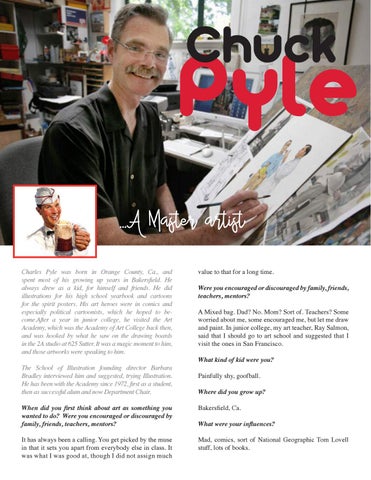
Pyle . .A Master artist Charles Pyle was born in Orange County, Ca., and spent most of his growing up years in Bakersfield. He always drew as a kid, for himself and friends. He did illustrations for his high school yearbook and cartoons for the spirit posters. His art heroes were in comics and especially political cartoonists, which he hoped to become.After a year in junior college, he visited the Art Academy, which was the Academy of Art College back then, and was hooked by what he saw on the drawing boards in the 2A studio at 625 Sutter. It was a magic moment to him, and those artworks were speaking to him. The School of Illustration founding director Barbara Bradley interviewed him and suggested, trying Illustration. He has been with the Academy since 1972, first as a student, then as successful alum and now Department Chair.
value to that for a long time. Were you encouraged or discouraged by family, friends, teachers, mentors? A Mixed bag. Dad? No. Mom? Sort of. Teachers? Some worried about me, some encouraged me, but let me draw and paint. In junior college, my art teacher, Ray Salmon, said that I should go to art school and suggested that I visit the ones in San Francisco. What kind of kid were you? Painfully shy, goofball. Where did you grow up?
When did you first think about art as something you wanted to do? Were you encouraged or discouraged by family, friends, teachers, mentors?
Bakersfield, Ca.
It has always been a calling. You get picked by the muse in that it sets you apart from everybody else in class. It was what I was good at, though I did not assign much
Mad, comics, sort of National Geographic Tom Lovell stuff, lots of books.
What were your influences?
Do you recommend that to younger illustrators as an alternative to working digital? An iPad is a great tool, but I can work when the power is out. I can draw with anything that makes a mark and on anything that will receive it. Breadth and mastery of hand, eye and brain is what is key. Don’t be a one tool only artist.
Your style is very uniquely classical. Did you work on developing a style or is that what naturally came out of you? It came out of discovering Norman Rockwell and Dean Cornwell at the end of art school. Prior to that I tried many approaches to being an illustrator, which was my major. Art should feed you was my attitude. You’ve worked in a couple different styles. One traditional and one that is more caricature. How did that evolve and was that an asset for you or a problem for art directors?
Caricature was first. I wanted to be a political cartoonist like Thomas Nast, or Pat Oliphant. I wanted to bring Richard Nixon down. In art school, my teacher, Barbara Bradley suggested that I ‘try illustration’ and then spent three years broadening my horizons. The caricature side yet lives, though. I notice you do a lot of life drawing studies. Do you do that on a regular basis? Life drawing is key, keeping a sketchbook of the world around you is key to developing a way to process the world around you into what it needs to become in your pictures.
JACK FOSTER
An Interview with Lon Levin
When did you first think about art as something you wanted to do? Were you encouraged or discouraged by family, friends, teachers, mentors?
To this day, I’m not sure if the motivation to succeed as an artist came from trying to prove my mom right, or trying to prove my dad wrong.
When I was in first grade, the teacher, Sister Rose, asked the class to draw a self-portrait. I drew myself walking home from school. At a parent teacher conference, Sr. Rose showed the picture to my mom and told her that she thought I had artistic talent because in the picture, I was leaning forward as I walked against the wind and my tie (yes, we wore ties to school back then), was blowing over my shoulder. Sr. Rose told my mom that knowing how to draw was just a small part of art. Perception was the rest. So my mom hung my self-portrait on the fridge and told me what Sr. Rose said. I knew that I liked to draw, but the encouragement I received from my mom and Sr. Rose ignited a passion in me that has never died down. My dad on the other hand was a hard working sheet metal worker and tried to discourage my art and pushed me to focus on a trade where I could make money.
What kind of kid were you? Where did you grow up? What were your influences? I was a very quiet kid, the eldest of seven. We were raised just northwest of Chicago. I loved baseball. Every day during the summer, we would walk around the neighborhood with our bats, balls and mitts, gathering the “regulars” together for a game. In grammar school, I was a bit above average, but excelled in art and would volunteer to do posters for library events. In the evenings, my family would gather around the TV. I would take the Sunday paper comics, which I guarded with my life all week, lay them out across the kitchen table and trace them or draw them freehand. Drawing a daily comic strip for the newspapers was my dream. So naturally
COLLINS
DANA
An Interview with Lon Levin
“I grew up with my sister and
mother. I grew up in a Navy town within a very conservative machismo military culture, isolated on an island (Whidbey Island, in the Puget Sound.”
When did you first think about art/design as something you wanted to do? Were you encouraged or discouraged by family, friends, teachers, mentors? I was doing design actually before I knew what it was. I played in a punk/hardcore band from age 13-20. We toured, made records, the whole shabang. We would make our own flyers, stencils to graffiti with, xeroxed record covers … etc. After the band, I worked at a small newspaper company. The company published 5 or 6 small neighborhood daily newspapers. I used to work and maintain the stat camera, spec type for the typesetter, do pasteup, cut rubylith …this was around 1988(?) just before computers came along and changed how print work was produced. I was doing these things but wasn’t aware of the term graphic design.