

IRÈNE JACOB

Uniti dall'amore per i film.
Grande cinema in Piazza Grande o a casa, con blue TV.
Pronti, insieme.
ESTABLISHING SHOTS

Giona A. Nazzaro ARTISTIC DIRECTOR
Gli attori sono gli ambasciatori del cinema. I loro volti sono i capitoli di una storia che è stata scritta nel buio delle sale cinematografiche e trasmessa attraverso il desiderio e la seduzione di generazione in generazione. E – a ben vedere –sono sempre gli attori a trasmettere e a incarnare il mito stesso del cinema. Sin dalle origini della sua lunghissima storia, i grandi nomi del cinema hanno fatto di Locarno una meta immancabile. Il Locarno Film Festival – la nostra capitale mondiale del cinema d’autore – è quindi un luogo privilegiato per osservare da vicino alcune delle personalità più illustri del cinema contemporaneo. Ed è anche il luogo per eccellen-
za dove i divi di domani s’incrociano con le leggende di oggi. Da Irène Jacob, leggendaria musa di Kieślowski, a Paz Vega e Bérénice Bejo, a Mélanie Laurent e Guillaume Canet, e ai nostri giurati Luca Marinelli e Tim Blake Nelson per giungere sino a Shah Rukh Khan, il Locarno Film Festival è una galassia nella quale le stelle splendono luminose sopra il cielo di Piazza Grande. E in fondo è proprio lei, la Piazza Grande, la nostra stella più bella e ammirata.
Buon cinema, e ci vediamo in Piazza Grande.


EDITOR-IN-CHIEF: Christopher Small
LEAD EDITOR: Leonardo Goi
DEPUTY EDITORS: Hugo Emmerzael, Maria Giovanna Vagenas, Keva York
STAFF WRITERS: Laurine Chiarini, Savina Petkova
CONTRIBUTORS: Mathilde Henrot, Christina Newland, Julia Scrive-Loyer
TRANSLATORS: Tessa Cattaneo, Anna Rusconi
BRAND, EDITORIAL & MEDIA: Oliver Osborne
DESIGN: Joshua Althaus, Nadine Curanz, Alex Furgiuele
PHOTOGRAPHERS: Elia Bianchi, Julie Mucchiut, Ti-Press
COVER PHOTO: Davide Padovan
PARTNERSHIPS: Marco Cantergiani, Laura Heggemann, Nicolò Martire, Fabienne Merlet
CROSSWORD DESIGNER: Nicholas Henriquez
HIGHLIGHTS
PIAZZA GRANDE
21:30 ELECTRIC CHILD by Simon Jaquemet 118’ | o.v. English, Japanese, Swiss German s.t. German, French Piazza Grande
UNE FEMME EST UNE FEMME by Jean-Luc Godard
English, Old Scots | s.t. English, French, Italian
16:45 Palexpo (FEVI) LUCE by Silvia Luzi, Luca Bellino 95’ | o.v. Italian | s.t. English, French
CONCORSO CINEASTI DEL PRESENTE 11:30 PalaCinema 1 FEKETE PONT by Bálint Szimler 119’ | o.v. Hungarian | s.t. English, French
18:00 PalaCinema 1 LES ENFANTS ROUGES by Lotfi Achour 100’ | o.v. Arabic | s.t. English, French
RETROSPETTIVA
11:30 GranRex THE WHOLE TOWN’S TALKING by John Ford 93’ | o.v. English
20:00 GranRex BITTER VICTORY by Nicholas Ray 102’ | o.v. English
22:15 GranRex MR. DEEDS GOES TO TOWN by Frank Capra 115’ | o.v. English | s.t. French 10:30 Forum @Spazio Cinema Conversation with STACEY SHER RAIMONDO REZZONICO AWARD
16:30 GranRex DJANGO UNCHAINED by Quentin Tarantino HISTOIRE(S) DU CINÉMA RAIMONDO REZZONICO AWARD STACEY SHER
15:00 PalaCinema 1 LE ORE DELL’AMORE by Luciano Salce 106’ | o.v. Italian | s.t. English HISTOIRE(S) DU CINÉMA
17:30 La Sala FRÉWAKA by Aislinn Clarke 103’ | o.v. Irish, English | s.t. English FUORI CONCORSO
18:30 PalaCinema 2 MULHER DE VERDADE by Alberto Cavalcanti HISTOIRE(S) DU CINÉMA – HERITAGE ONLINE
Mélanie Laurent and Guillaume Canet receive their
Irène Jacob:
“È fondamentale per un attore divertirsi a giocare con le emozioni”
Il Festival onora quest’anno con il Leopard Club Award Locarno77 un’artista e una donna d’eccezione: Irène Jacob.

di Maria Giovanna Vagenas
Attrice, cantante, musicista, scrittrice, autrice-sceneggiatrice di opere teatrali, presidente del prestigioso Institut Lumière, madrina del laboratorio di astrofisica APC dell’Università di Paris Cité, madre di due promettenti attori, Paul e Samuel Kircher; il percorso artistico e personale di Irène Jacob, così ricco e straordinario, suscita in noi profonda ammirazione. Un solo fotogramma è sufficiente per imprimere nella nostra memoria il suo sguardo intenso, la sua voce dal timbro unico, capace di toccarci profondamente come in La double Vie de Vèronique (1991) di Krzysztof Kieślowski che, a soli 25 anni, le valse il premio per la migliore interpretazione femminile a Cannes consacrandola mondialmente. Da allora, Irène Jacob non ha mai smesso di mettere il suo grande talento a disposizione dell’arte, lavorando in Europa e negli Stati Uniti con molti grandi nomi del cinema, moltiplicando i progetti e restando sempre aperta ad ogni nuova sfida. La sua grazia e la sua generosità sono disarmanti, la sensibilità con cui approccia ciascun aspetto del suo lavoro fanno di ogni conversazione con lei un momento inestimabile. Nel corso del nostro incontro abbiamo avuto l’occasione di ripercorrere le tappe salienti della sua carriera e di discutere cosa significhi per lei essere attrice.
Maria Giovanna Vagenas: Il 2024 si preannuncia un grande anno per la sua carriera. L’abbiamo vista protagonista in Shikun di Amos Gitai e MeetingwithPolPot (Rendez-vous avec Pol Pot) di Rithy Pahn, recentemente presentato a Cannes. Può dirmi qualcosa di più su questi progetti?
Irène Jacob: Con piacere. Rithy Panh era entusiasta di tornare a Cannes, una vetrina importante per un film con un taglio artistico audace e personale come il suo. Meeting with Pol Pot è una storia vera, tratta dal libro della corrispondente di guerra statunitense Elizabeth Becker, una fra i pochissimi giornalisti scelti per raccontare la rivoluzione del 1978 in Cambogia. Rithy Panh e Becker, che si conoscevano da tempo, erano entrambi impazienti di portare questa storia sul grande schermo. I protagonisti del film sono tre francesi: una giornalista, interpretata da me, un fotografo e un intellettuale simpatizzante della rivoluzione. Tutti e tre accettano l’invito del regime a visitare il Paese. Sul posto la propaganda è palese, ogni cosa è una messinscena. Come si può testimoniare da un luogo dove si fa di tutto affinché non si veda nulla? Il genocidio è anche una questione di silenzio. Non si vede nulla, non si sente nulla. Questo è il nucleo del film. Le riprese in Cambogia sono state struggenti perché, nella storia che volevamo raccontare, ci sono ancora molte ferite aperte. Per non offendere gli spiriti con la nostra rievocazione dei fatti, dovevamo offrire loro un pollo bollito ogni settimana. In una situazione del genere, non ci si può limitare alla propria performance, ma si cerca di capire anche il mondo circostante. Ho dovuto essere aperta e ricettiva, con tutti i miei sensi, il mio corpo e le mie emozioni.
MGV: In Shikun, lei interpreta tutti i ruoli della pièce Il rinoceronte(Rhinocéros) di Eugène Ionesco. Come ha affrontato questo compito così complesso?
IJ: Amos Gitai mi ha dato molta libertà. Mi ha chiesto di preparare degli estratti della pièce, cosa che ho fatto, anche se nessuno sapeva come e dove si sarebbero svolte le riprese. Shikun è stato realizzato in modo istintivo e in pochissimo tempo, ma per Amos Gitai questo è del tutto irrilevante, perché il suo lavoro si fonda su un pensiero ed un impegno che lui porta avanti da 50 anni. Prima delle riprese, gli ho detto che avremmo avuto bisogno di un attore per interpretare gli altri ruoli del Rinoceronte e lui mi ha risposto: ““No, farai tutto da sola, perché la schizofrenia nasce dentro di noi!” Shikun è di fatto una parabola sull’ascesa del totalitarismo ed è stato girato in Israele durante le proteste del 2023 contro la riforma giudiziaria del governo Netanyahu. Per puro caso il film è uscito in sala dopo il 7 ottobre e l’inizio della guerra a Gaza, nonostante ciò, Shikun portava già in sé i segni di tutto quello che sarebbe successo. Eravamo perplessi all’idea di proiettarlo [a Berlino] quando il conflitto era al suo culmine, quindi abbiamo chiesto ad Amos se non fosse meglio datare il film in modo più preciso. Ma lui ci ha risposto: “Non si può mettere una data a un film, i film devono essere atemporali. Vengono creati in un momento specifico, ma quel momento contiene in sé i germi del passato e quelli del futuro”. Per lui è estremamente importante collaborare con persone di culture diverse, abbattere le barriere, integrare varie lingue e restare aperto alla pluralità.
MGV: Passando in rassegna la sua carriera, La doppia vita di Veronica (La double vie de Véronique, 1991) di Krzysztof Kieślowski, per il quale ha vinto il premio come migliore attrice a Cannes, ha mantenuto intatti nel tempo tutta la sua grazia e il suo mistero.
IJ: Sì, è meraviglioso vedere come questi film abbiano attraversato le frontiere e il tempo e siano ancora attuali. Quando giro il mondo per lavoro – che sia cinema o teatro, che sia Città del Messico, Rio de Janeiro o Tokyo – mi viene spesso chiesto di presentare questo film o Tre colori: Film rosso (Trois Couleurs : Rouge, 1994) di Kieślowski. Anche se per me è un po’ strano rievocare quei tempi, lo faccio volentieri, perché c’è molto da dire sul modo in cui si lavorava nel cinema polacco di quel periodo. Kieślowski amava girare facendo poche riprese ma con molte angolature diverse, e gli piaceva molto il montaggio, per cui i suoi film venivano essenzialmente costruiti in sede di montaggio. Sul set sapeva ascoltare tutti e riunire e organizzare le varie proposte in un’unica straordinaria partitura. Per lui le riprese erano un vero e proprio lavoro d’équipe insieme ai suoi direttori della fotografia con i quali scambiava continuamente idee. Gli piaceva creare nuove sensazioni, offrire agli spettatori delle immagini mai viste, come per esempio il paesaggio filmato attraverso una biglia di vetro in La doppia vita di Veronica. Lavorare con lui su questi due film ha mi ha lasciato un’impronta profonda, forse proprio per la sensibilità straordinaria con cui sapeva illustrare il mistero degli esseri umani e quello della vita stessa.
MGV: La musica è sempre stata importante nella sua vita artistica. Dopo essersi diplomata al Conservatorio di Ginevra, nel corso degli anni ha continuato a cantare o a suonare in diversi progetti. Cosa rappresenta la musica per lei?
IJ: Ho detto spesso di essere approdata al cinema grazie al pianoforte, perché il mio primo ruolo – in Arrivederci Ragazzi (Au revoir, les enfants, 1987) di Louis Malle – è stato il mio trampolino di lancio. Stavano cercando un’attrice che sapesse interpretare il Rondo Capriccioso di Saint-Saëns, un pezzo piuttosto impegnativo. Ho fatto il provino perché sapevo suonare il pianoforte e sono stata scelta. All’inizio della mia carrieraquesto film mi ha davvero aperto tutte le porte, permettendomi di conoscere Kieślowski e molte altre persone nel mondo del cinema. Ne La doppia vita di Veronica interpretavo una cantante e ho dovuto prendere delle lezioni di canto per preparami a questo ruolo. Nel corso degli anni, mi sono state offerte varie parti in opere liriche come in Perséphone di Igor Stravinsky o in Giovanna d’Arco al rogo (Jeanne d’Arc au bûcher) di Arthur Honegger, o dei ruoli di attrice in opere in cui la musica rivestiva un ruolo importante. Mi piace lavorare con la musica ogni volta che se ne presenta l’occasione, che
sia in teatro o al cinema. In questo momento mi esibisco con la cantante-musicista Keren Ann in una pièce teatrale intitolata Où est-tu? che raccoglie poesie, canzoni e storie scritte da noi due. Anche quando mi preparo per un ruolo, mi piace molto ascoltare della musica. Scegliere la musica che voglio ascoltare di mattina e averla con me durante tutta la giornata mi aiuta nel lavoro. In generale, la musica ha un grande impatto sugli attori perché passa per il corpo e ci trasporta immediatamente in un altro mondo, con un’energia nuova.
MGV: Mi piacerebbe sapere cosa l’ha spinta da giovane a scegliere questa strada.
IJ: A un certo punto ognuno di noi si chiede: “Perché ho scelto di fare questo mestiere?”. Penso che ci siano sempre delle ragioni, anche se non sono mai ovvie. Da bambina non andavo né al cinema né a teatro e a casa non avevamo la televisione. Mio padre era fisico e lavorava al CERN, per cui sono cresciuta in Svizzera vicino al laboratorio. Mia madre era psicologa e amava la musica. In casa non avevamo un background teatrale, ma ci piaceva leggere prosa e poesia. Da piccola mi piaceva recitare dei testi ad alta voce e, alle feste di famiglia, imitare vari membri della mia famiglia, come per esempio mia nonna. Recitavo sempre, come sanno fare i bambini. Far parte di una storia e raccontare una storia mi ha sempre affascinato. Da adolescente sono entrata in un gruppo teatrale dove creavamo i nostri spettacoli; in seguito mi è stato offerto un lavoro alla televisione Svizzera. Poi, quando ho compiuto 18 anni, sono andata a Parigi per frequentare la scuola nazionale di teatro, la Rue Blanche.
MGV: La sua filmografia conta oltre 60 film e i nomi dei registi con cui ha collaborato sono davvero impressionanti. Tra questi spiccano due grandi maestri: Michelangelo Antonioni e Theo Angelopoulos. Che ricordo serba del suo lavoro con loro?
IJ: Incontrare Antonioni sul set di Al di là delle nuvole (Beyond the Clouds, 1995) è stata un’esperienza profondamente toccante. Antonioni aveva visto Film rosso, ed è per questo che mi ha chiesto di lavorare con lui. È stata un’avventura eccezionale perché quest’uomo, colpito da un ictus, era fortemente limitato nei movimenti, ma aveva conservato intatte tutte le sue idee e la sua passione per il cinema. C’era anche Wim Wenders, venuto per assistere Antonioni e far sì che le compagnie di assicurazione finanziassero il film. Anche se Antonioni avesse potuto muovere solo una palpebra, sua moglie Enrica e Wenders avrebbero fatto di tutto per aiutarlo a realizzare questo film. Durante le riprese, ho avuto modo di assistere ai suoi leggendari piani sequenza. Antonioni filmava come nessun altro regista al mondo, concentrandosi solo su ciò che intendeva montare in seguito. Tutti i film di Antonioni sono stati realizzati con questi piani sequenza, non c’era montaggio; tutto ciò che restava da fare dopo le riprese era metterli in ordine uno dopo l’altro, il che è davvero straordinario.
MGV: Com’è stato lavorare con Theodoros Angelopoulos in Lapolveredeltempo (TrilogiaII:Iskonitouhronou, 2008)?
IJ: La polvere del tempo era la seconda parte di una trilogia iniziata nel 2004 con La sorgente del fiume (Trilogia I: To Livadi pou dakryzei) e mai conclusa a causa della sua prematura scomparsa. Questa trilogia, a cui lui teneva molto, era dedicata alla storia dolorosa del suo paese, segnato nel XX secolo dalla dittatura e dal comunismo. Nel film c’erano degli attori eccezionali tra cui Michel Piccoli, Bruno Ganz, Willem Dafoe... Io interpretavo Eleni, la madre del protagonista, e dovevo passare da 18 a 80 anni. Penso che Angelopoulos fosse combattuto tra il desiderio di creare un affresco storico, come era solito fare, e quello di approfondire i singoli personaggi. In fin dei conti, in questo film non ha particolarmente curato la recitazione, anche se noi ci siamo ritrovati a far parte di alcuni piani sequenza straordinari. Una statua che cade, un tram che passa, una folla che si muove: tutto era perfettamente sincronizzato, come in un’orchestra. Era stato Antonioni, in realtà, a ispirargli l’uso dei piani sequenza, che poi Angelopoulos avrebbe continuato a utilizzare nei suoi film, ma in modo molto diverso. Mentre Antonioni se ne serviva per raccontare delle storie intime, lui li usava per creare degli affreschi storici. Comunque, non penso che La polvere del tempo sia il suo film più memorabile.
MGV: La recente retrospettiva del MoMA dedicata al regista Ilkka Järvi-Laturi ha contribuito alla riscoperta di un film curioso di cui lei è stata protagonista assieme a Bill Pullman: History is Made at Night (aka Spy Games, 1999), scritto da Patrick Amos e Jean-Pierre Gorin, dove interpretava una giovane e ambiziosa recluta del KGB. Può dirmi qualcosa di più al riguardo?
IJ: Devo ammettere di non averlo visto da molto tempo. Ilkka aveva fatto un primo film un po’ sperimentale, molto bello, ma per quanto riguarda Spy Games temo avesse delle ambizioni contraddittorie: voleva fare una pellicola commerciale, preservando però anche il suo tocco artistico personale. Non sono sicura che si tratti di un’opera riuscita. In quell’epoca venivano realizzati molti film europei - chiamati “europrogetti” - a cui partecipavano varie nazionalità; vi collaboravano tedeschi, francesi, inglesi e americani, e tutti quanti erano entusiasti all’idea di lavorare insieme; purtroppo, spesso però venivano fuori dei film con un’identità “diluita” come questo.
MGV: Tra i suoi numerosi impegni al di fuori dello schermo, lei ricopre dal 2021 la prestigiosa carica di Presidente dell’Institut Lumière di Lione. Può parlarci brevemente di questo suo incarico?
IJ: Sono stata molto toccata dalla richiesta di assumere la presidenza dell’Institut Lumière, succedendo così a Bertrand Tavernier, suo fondatore e presidente per 40 anni. Il compito di trasmettere l’interesse per la cinefilia, che svolgo con l’aiuto di un’équipe meravigliosa diretta da Thierry Frémaux, è per me un’avventura straordinaria. L’Institut Lumière gestisce il museo dei fratelli Lumière e un’importante cineteca, nonché tre cinema d’arte ed
essai a Lione. Inoltre, organizza un festival rinomato che s’impegna a sensibilizzare il pubblico verso il patrimonio cinematografico creando nessi tra la storia e l’attualità del cinema anche attraverso presentazioni ad hoc.
MGV: Ripensando a tutti questi anni di lavoro, c’è qualcosa –un ricordo particolare, un’emozione – che vorrebbe condividere con noi?
IJ: Quando ho iniziato a lavorare come attrice professionista, sognavo di poter fare questo mestiere il più a lungo possibile e di continuare a evolvermi. È una vera sfida perché, ovviamente, ti fai conoscere quando hai 20 anni, poi ne hai 30 e devi raccontare un’altra storia sulla persona che sei a 30 anni, e poi su quella che sarai a 40 anni. Bisogna anche trovare un equilibrio con la propria vita personale; capire dove e come si vuole vivere, e con chi; tutte queste cose devono essere gestite in contemporanea. Poi si compiono 50, 60, 70 anni e si deve andare avanti, sperando di poter lavorare fino a 80 anni, perché sono convinta che lavorare il più a lungo possibile ci renda felici. Quando vedo delle attrici come Judith Magre, che a 90 anni sono ancora in scena, mi rendo conto di quanto le aiuti a mantenersi in forma. Quando si ama il proprio lavoro, si vuole continuare a farlo. D’altra parte, la discontinuità fa parte del mestiere di attore, per cui dopo ogni pausa bisogna sempre sapersi rimettere in gioco.
MGV: Come è riuscita a costruire una carriera così prestigiosa?
IJ: Non sono sicura di poterla definire una grande carriera, in ogni caso è un viaggio che inizia con i propri desideri e continua con gli incontri che si fanno e i progetti che ci vengono proposti. Spesso mi si chiede: “Con quale regista ti piacerebbe lavorare?”. Potrei citare vari registi con cui mi piacerebbe collaborare, come i fratelli Dardennes, per esempio, fatto sta che non ho mai lavorato con nessuno di loro. Poi, inaspettatamente, mi viene presentato qualcuno che non ho mai visto prima, ed è un incontro straordinario. Bisogna definire i propri desideri, bisogna attualizzarli ed essere aperti alle opportunità che si presentano. Anche in teatro mi sono state fatte proposte molto interessanti: Thomas Ostermeier mi ha chiesto di lavorare con lui in Retour à Reims e Katie Michell in La Voce Umana (La Voix Humaine)... Non avrei mai immaginato di potere lavorare con Louis Malle, Krysztof Kieślowski, Antonioni, Amos Gitai o Rithy Panh. Continuo a chiedermi: “Come è successo? Perché?” Davvero non lo so.
MGV: Come definirebbe il suo stile di recitazione?
IJ: Recitare è un mestiere estremamente personale. Kieślowski me lo ha detto subito: “La doppia vita di Veronica è un film poetico che non parla tanto di cose connesse all’azione. Ho bisogno che tu dia qualcosa di te stessa, altrimenti il film non sarà vivo, risulterà pretenzioso e non toccherai nessuno!”. È questo l’obiettivo di scuole come l’Actors Studio o il metodo Stanislavskij: insegnarci ad attingere ai sentimenti ed esplorare il nostro bagaglio emotivo. È un approccio istintivo e ognuno lo gestisce in modo diverso, ma è fondamentale per un attore divertirsi a giocare con le emozioni. Bisogna anche imparare a lavorare con una varietà di registi diversi, ognuno dei quali ci consente di vedere noi stessi in una luce nuova.
MGV: Concludendo, cosa significa per lei essere un’attrice?
IJ: La recitazione è un’arte collettiva, non è un lavoro che si fa da soli. Si esce di casa per incontrare una nuova squadra con cui creare un’intesa comune. Un progetto è interessante quando quest’incontro è sorprendente e inatteso. Quello dell’attore è un lavoro esigente e richiede molto da noi. Bisogna essere sempre all’erta. Spesso si viene ingaggiati all’ultimo minuto, bisogna mollare tutto e partire subito. Molti progetti non giungono mai a buon fine. La carriera di un attore consiste in tutto quello che hai fatto, in tutto quello che non hai mai fatto, e in tutto quello che hai fatto ma non nel modo in cui avresti voluto. Si continua ad andare avanti e, all’improvviso, c’è un momento di grazia – e poi c’è un contraccolpo. È un lavoro che bisogna costruire con la generosità, con incontri, osservazione ed empatia.

◼ TroisCouleurs:Rouge screens on Saturday, 10.8 at 17:00 at GranRex

LOCARNO FINDS ITS LEOPARD

By Christopher Small
After 15 years with the same leopard as its public face, the Locarno Film Festival travelled to the Cotswolds in England last year for a special encounter with Bagheera, the leopard who will hereafter represent it on the world stage. We sat down with Michele Jannuzzi of Jannuzzi Smith, the campaign’s creative director, and world-renowned wildlife photographer Tim Flach to find out more about the shoot.
Astuffed leopard sits atop a wooden beam. In this studio in Oxfordshire, soft lights, diffused by mirrors, swing one way and then the other, struggling to settle on a point of illumination. A long lens swivels left and right as its operator rehearses specific movements. Everything is set in place. The plushy toy is removed. A heavy door slides open and out saunters Bagheera, the would-be face of the Locarno Film Festival. His principal trainer walks besides him, clutching a spear. Impaled on its tip is a lump of red meat the size of a fist. A wall of metal lattice separates the leopard from Tim Flach, the world-renowned British wildlife photographer, and a team of technicians manning the various sound desks and lighting stands arranged in a semi-circle around his camera. Flach peers into the eyepiece. The leopard hops up onto the wooden beam and takes a few heavy steps. The trainer swings the meat towards him and then yanks it away. Bagheera snarls angrily, his sharp teeth bared. Flach’s camera lets off a series of rapid clacks: chk, chk, chk. Got it. Bagheera gets his lump of meat; Locarno gets its leopard.
“We have a very small window to get the shot,” Flach tells us from his studio in London, several months after the shoot. “Working with a leopard is a little like dealing with a celebrity – you really have to have your act together. Nothing can be left to chance.”
At Heythrop Zoological Gardens, Bagheera roars a few times for the video team and struts back and forth across the beam, a movement captured for the Locarno Film Festival’s pre-film trailer on the Piazza Grande. After that, it is time for the still photos: another fearsome snarl and a more placid front-on shot, his lips drenched in drool as he peers at another chunk of dinner.
People who ask about the previous leopard, the Locarno Film Festival’s public face since 2008, are often under the impression that it is not real – perhaps computer- or even AI-generated. But that leopard was also one of Flach’s real subjects, photographed in an era when its walk across the screen was captured in 35 mm, illuminated by huge, cumbersome batteries of lights. Jannuzzi Smith – the same design studio, working with Tim Flach – was responsible for both shoots.
“Locarno previously had no leopard whatsoever. Designs and spots, yes. But there was no leopard walking before the start of a film, for example,” Michele Jannuzzi told us. “We made a proposal to [Artistic Director] Frédéric Maire in 2006 or 2007; once we had decided against the idea of animation, we had to go to England to find our photographer and find our leopard.”
Both shoots took place 15 years apart at Heythrop Zoological Gardens with the same animal handling team, the same photographer, and much of the same crew. “In situations like this one, you can’t have anything that might make it challenging or dangerous for the person inside the cage with the leopard,” Flach continues in his very English, matter-of-fact way. “We must set up lights that allow the cat a safe passage in and out of the space. If a light were to be knocked over accidentally, it could spook him. And Bagheera is an animal that can do serious damage if he gets scared.”
“Indeed, there’s always an uncertainty with animals, especially big cats. We are no different, are we? We’re not in the same mood when we wake up from one day to the other. With that front of mind, we do our work near where they sleep and where they play. They’re not travelling anywhere, there’s no stress. If they begin to be confused or feel scared, that’s when it becomes quite dangerous. Our job is to make sure everything is comfortable and familiar.”
Flach brings more expertise and experience to these kinds of shoots than pretty much anybody. Across his various books, exhibitions, and professional commissions over the years, he has – photographically speaking – captured the essence of all manner of big cats, and in many distinct contexts. “As the old saying goes, dogs have owners and cats have staff,” he quips as we marvel at the sheer variety of the felines in the pictures that adorn his studio.
Lions. Tabbies. Panthers. Royal White Tigers. Cheetahs. Housecats. Leopards. These photographs bear out that depth of experience. Though the shoot with Bagheera comes at the behest of the Locarno Film Festival and Jannuzzi Smith, Flach is engaged in a long-term project about felines in general. Together with some of the world’s leading evolutionary biologists and neuroscientists, the seasoned photographer is trying to get at the essence of our relationship with cats big and small, and what makes them such crucial parts of the lives of so many people. “Why are house cats more popular than dogs? Look, it’s like when Tim Berners-Lee, the founder of the internet, was asked what was most surprising about his invention,” says Flach. “His response was, ‘Kittens’.”
Bagheera is now the official leopard of the Locarno Film Festival. These new shots, intended to last as enduring icons for the Festival, were captured over two days. “Technology and its evolution are of course hugely important to what I do,” Flach says when we put this conundrum to him. “As the equipment gets more advanced, it gives us more opportunities to capture the requisite images in rather brief shoots like this one. With the leopard, I’m using sophisticated eye tracking technology to make sure I don’t miss out in a very narrow window of opportunity.”
For all the difficulty of working with a big cat like Bagheera, the results speak for themselves. On the day of the shoot, the leopard gets tired after a couple of hours, a shorter period than was hoped for. “I, like many photographers, live by the old maxim ‘It’s never the last shot’ – even when working with animals,” Flach adds. “But with a cat like that, the maxim is more like, ‘Okay, understood.’”
Bagheera, sitting where the stuffed leopard toy once sat, has without realizing it become the public face of the world capital of auteur cinema.
Special thanks to: Fabienne Merlet, Michele Jannuzzi, and Tim Flach


There’s always an uncertainty with animals, especially big cats. We are no different, are we?
We’re not in the same mood when we wake up from one day to the other.
MR. DEEDS GOES TO TOWN
By Lucía Requejo
Delighted by his opulent new mansion, Mr. Deeds (Gary Cooper) recruits his butler and a couple other employees in bellowing into the endless, empty hallway. Listening to the echo, he tells them playfully, “Let that be a lesson to you.” Once Deeds has left the frame, one of the workers repeats the call they’ve just been taught, and listens to the echo for himself: Deeds was not wrong. Although this can be seen as a traditional dynamic between a rich house owner and his servants, the newly wealthy boss in question is also himself discovering a foreign environment that he now must call home. From time to time, the space we find ourselves living in is not completely ours, not because we aren’t the actual owners of the property, but because we don’t care to know it, because we aren’t asking the right questions, or because we forget to make it truly ours – to draw upon our senses and explore.
Frank Capra’s Mr. Deeds Goes to Town (1936) revives a trope as old as time itself, one that still resonates with us as modern spectators: an outsider, through a miraculous twist of fate, brings a new way of walking and feeling to the same world others have been inhabiting forever, but who have simply not been paying attention. A country boy, Longfellow Deeds has never left his hometown (he has no suitcases – no baggage, one might say), until he inherits a giant fortune from out of the blue. Money makes the world go round, as we know, and his presence is immediately required in the city, with that pure traditional urgency that city matters usually carry. We are as overwhelmed as our protagonist, and from the very beginning of the film are swept away by its speed in narrating the urban way of life: scenes feel as fast as shots, as links in a chain, with little time to breathe or to stop and think, with brief glimpses of angry tele-
phone conversations, the industrial mechanisms of a newsroom, or people constantly trying to get answers out of each other. But in pastoral scenes, the countryside forces things to slow down: questions will not be immediately answered, waiting is entirely necessary, and an unhurried lunch is more important than anything. The sounds of chaos and frenetic music are supplanted by silence, and the montage relaxes. Form and narration go hand in hand: the pace at which Mr. Deeds is moving through the world can be felt through the pace of the images themselves.
Deeds’s odd behavior in the urban world that is alien to him – and which he does not care to know, mainly because he is not impressed by it – quickly earns him the nickname “Cinderella Man”, as bestowed upon him by enterprising journalist Babe Bennett (Jean Arthur), adding a bit of hostile literary color to his clueless wanderings in the city. Seeking, on one level, to demean him through associating him with the feminine, I wonder if a certain truth might be hidden in this tendentious nickname. Candid but never innocent and certainly not manageable, Mr. Deeds embodies a sensibility that is not taken seriously because it is too playful. His new world is one that will not submit to being played with, inquired into, nor disrespected. Maybe, this childish nickname marks him as possessing a recreational sensitivity, the kind of impulse that makes children, women, and poets not take the world for granted, maybe because it’s not made for them. That’s why Deeds can be surprised by the sound of a firefighter’s siren, slide gleefully down the railing of a grand staircase, or emulate with his mouth the sound of an imaginary instrument. It’s just good common sense to ‘unlearn’ how to live, or to question the one-sided social definitions of objects and ways of behaving.

Ignoring the fact that the world has owners inevitably leads to conflict. Institutions, invented for this very purpose, seek to correct those that ask too many questions. But also, unlearning the ways of the world can lead to the most primitive way to disrupt the state of things: to love without restraint. Approaching the classic melodramatic moment when a lie withheld between lovers bursts out into the open, Babe and Mr. Deeds find themselves engulfed by a fog that alters their outlook. This foggy state of mind subsumes both parties – though Babe, her silence louder than words, debates within herself whether she should allow herself to submit to the intense emotion. Babe’s is the same silence to which we were introduced in the film’s countryside scenes, even though this crucial scene takes place in the most urban of settings. In this silence, we suddenly understand how Deeds’s way of seeing has transformed Babe’s. For, to be willing to think outside the box, but most importantly, to truly see those who are generous enough to share their precious thoughts with them, is to be duly affected – and that is the only lesson worth caring about at all.
LUCÍA REQUEJO is a participant in the Locarno Critics Academy, the Festival’s workshop that prepares emerging critics for the world of film festivals and professional writing about cinema.


See the full program here
Images: Mr. Deeds Goes to Town © 1936 Columbia Pictures Industries, Inc. All Rights Reserved
◼ Mr. Deeds Goes to Town screens tonight, 9.8 at 22:15 at GranRex
Cinema in piazza piazza affari?
Qualunque sia il luogo di vostro interesse, noi sosteniamo chiunque desideri una consulenza previdenziale e finanziaria personalizzata.
Per una vita in piena libertà di scelta.
la cultura in prima fila

Emozioni uniche al Locarno Film Festival con la Posta.

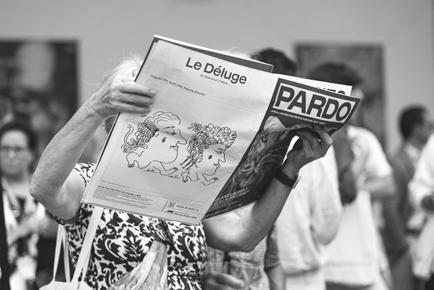


Going Electric
A Conversation with Simon Jaquemet

Pardo speaks to Simon Jaquemet, a Zurich-based filmmaker who has twice before graced Locarno – first with his debut feature Chrieg, in 2015, and then with Der Unschuldige in 2019, both in the Panorama Suisse section. Now, he returns to the cobblestones of the Piazza Grande with Electric Child, a deeply personal exploration of what science fiction can be.
by Laurine Chiarini
Picture a place in German Switzerland where you can hear languages from the four corners of the world, yet everyone speaks English: it could be a multinational company, or an institution like the Swiss Federal Institute of Technology, in Zurich. In one such place, computer science expert Sonny (Elliott Crosset Hove) has just received the news that his newborn son Toru has been diagnosed with a neurodegenerative disease. Desperate to save his progeny, Sonny sets about manipulating the code of an AI super-intelligence he had previously designed as an experiment. He makes a deal with this computer-generated being (Sandra Guldberg Kampp): so long as the AI dedicates itself to coming up with a cure for Toru, it can have unlimited energy and freedom of action.
Starting out like an arthouse film, delving into drama, and ending up as a thriller, Electric Child weaves a narrative that explores parenthood, loss, and the extraordinary abilities wielded by the most human-like AI you’ve ever encountered. In our conversation, Jaquemet dug into how filming real actors in live settings is more convincing than using computer-generated imagery – even when it comes to depicting a virtual environment – and how fragile the condition we call “reality” truly is.
Laurine Chiarini: Watching Electric Child a few days ago, another Swiss movie spontaneously came to mind, Fredi M. Murer’s Grauzone (1979), maybe because of the heaviness in the atmosphere or the empty streets. Was that film an inspiration? Or were you thinking in particular about any other films?
Simon Jaquemet: I saw Grauzone a very long time ago. I wouldn’t say it was a direct inspiration, but now that you mention it, yes, it could be. It’s hard to say: my movie probably has several different inspirations, but I couldn’t pinpoint just one like that. I also drew inspiration from some Asian movies. I won’t say the title, but there’s one Japanese movie in particular that is very minor, but it has a bit of the same vibe. It really inspired me to make a film that starts almost like an arthouse one, with a small drama, and then by the end it’s closer to a disaster movie. I saw that in this Japanese film and thought to myself, “Okay, this is possible and it makes sense too.”
LC: And then, there was the global Microsoft outage recently, which I found quite ironic – as if reality was giving fiction a run for its money. In the film, Sonny’s colleague Raul says that it would be the end of everything if technology goes down. And sure enough, there are serious consequences when the hospital where Sonny’s son is runs into massive IT problems.
SJ: Yes, though I think things are exaggerated quite a bit in the movie, which is also like a kind of fantasy story. I honestly think that the main danger of AI is not something like killer robots walking in the streets, but rather lies in us possibly having to turn off the internet, potentially causing immense damage to humanity. I mean, as we’ve seen with this really small [Microsoft] bug, we are totally dependent on technology. So, I think the real danger of AI is that it might actually destroy the internet for us. And I hope that doesn’t happen.
LC: You’ve previously spoken about how, as a child, you had an ATARI computer whose inner workings you knew inside out. You’re also a coder, and for this film, you trained a neural network on 35 mm footage to give the colors a more organic look. That’s a pretty original approach. Can you tell me more about it?
SJ: The ATARI thing was really during my teenage years. I started as a gamer and then met a friend who was also into computers. We formed a little “cracker cell” that sold illegal games, and I was coding demos. I got really deep into computers, especially my ATARI, but I don’t think I’ve ever been that deep into it since. Later, I got into neural networks for color processing while I was learning Python and machine learning. It started as an experiment but turned into a research project. Eventually, it became a near-final product that we used in the film. The entire color grade was rendered with this neural network. It’s not something you consciously notice as a spectator, but it makes the colors look more analog than digital.
LC: It’s safe to say you have a fair level of expertise in the matter. But do you see AI as a powerhouse for getting things done, or do you prefer to use it for more playful and creative pursuits?
SJ: A bit of both, actually. I use ChatGPT a lot for workflow, tasks and generally making things faster. In film, I see it as a really interesting artistic tool, to explore the glitches and the fringes of technology – I find it fascinating. But things change very quickly. In the film industry, a lot more will be made with AI in the near future.
LC: Talking about glitches, Sonny wants to create one in the computer program in order to save his son. Glitches happen when the network doesn’t recognize something it encounters, and you’ve spoken about how the results are amazingly organic. But wouldn’t there be a risk of breaching Isaac Asimov’s First Law of Robotics, “A robot may not injure a human being or, through inaction, allow a human being to come to harm”?
SJ: I don’t know if it’s dangerous. What I’m really interested in is mostly just machine learning and AI. I love the glitchiness, especially when you see the neural network hitting the edge of its own capabilities. Generative AI often resembles dreams, which is not a coincidence. These networks work in a very similar way to the human mind. I don’t think that has an inherent danger, but it shows that with AI and neural networks today, we are replicating how the brain works – and this is not just theory.
LC: Sonny tries to save his son using AI, but when he gets stuck in an MRI machine without oxygen after a power outage at the hospital, it’s his wife Akiko who breaks the glass to free him. But is it human vanity to believe that we will always be superior to machines in some way?
SJ: Yeah, unfortunately, I think it is vanity. That scene reflects what the two main characters think. Sonny is curious and believes the network might save the kid, so he doesn’t want to intervene. It’s his wife who steps in. But I think it’s a delusion to assume that human brains or minds are superior to artificial neural networks.
LC: So if there is no limit to what AI can achieve, nor the uses to which people could potentially put it; if it’s bigger than us and can explain everything – do we still need a god?
SJ: From what I know about AI, I really don’t think there’s much of a limit. In recent years, it has been proven that the more computing power we give it, the more intelligent it becomes. I see no reason to think that superintelligence isn’t possible. At some point, it almost becomes a religious question. I think some of the big players in AI, even if they don’t say it, want to create a kind of ultimate god in the end.
LC: I admit I had to hang on a bit at the beginning of the film in order to follow the dual narrative - there’s the world of Sonny and his family, and then there’s the life of the AI on the island – but it truly soars as the film progresses. How did you approach this aspect in the writing process?
SJ: It was an interesting one. In the very first draft, I envisioned the story of the AI’s virtual environment as a kind of 3D rendering, sort of like a game. And then from that thought, as I developed the idea, I found it more intriguing to present it as live action, intentionally leaving the question of where this was somewhat unclear. In my previous films, I always followed a single narrative perspective, usually that of the main character. But Electric Child is the first time I’ve followed two points of view. One perspective belongs to Sonny, while the other is that of the nameless AI entity. I approached the writing process by getting as close as possible to the interior perspective of each character, taking their experiences seriously. For the AI, its surroundings are a full reality. From its perspective, Sonny is somewhat of an intruder.
LC: The AI undergoes an accelerated growth process: it starts off naked, without speech or knowledge, and ends up clothed, speaking multiple languages, and possessing empirical knowledge. Thanks to this, it can take care of Toru, who appears to grow very slowly in comparison. When humans merge with technology, the media frequently refers to them as “augmented”. Does this imply that a person without technology would be a “diminished” human in the future?
SJ: I could imagine that, but it’s also a scary thought. Maybe there will be a kind of division at some point, with people who choose to “check out” of technology, a bit like the situation of the couple in the film. Akiko is very holistic, doesn’t want to have a phone, while Sonny is totally versed in technology. This might happen; some people might just say, “Okay, goodbye,” and walk away from technology, while another part of humanity will get more and more connected with computers, maybe until they become one at some point.
LC: The person who plays the nameless AI on the island does a remarkable job. They are an androgynous being, looking emotionless initially, but they reveal themselves to be incredibly human as the film progresses. I first thought they might be played by a young actor, only to discover that she’s a young actress, Sandra Guldberg Kampp. How did you come to cast her?
SJ: It was quite a long process, because we were open to both professional and non-professional actors, and unsure whether we wanted to cast a boy or a girl for the role. It was only clear that it should be someone who is quite undefined. We met Sandra towards the end of the casting process. I knew of her for quite a long time because I had seen her in a Danish film together with Elliott [Crosset Hove, who plays Sonny]. I was a bit hesitant because I thought that we couldn’t cast her together with Elliott again. But then I met her, and we did an audition. She was super impressive and convinced us quite completely. Her special ability is that she can play the silent parts with a lot of intensity.
CAREFUL:Spoilersahead!Inordertopreservetheelementof surprise, the remainder of our interview with Simon Jaquemetshouldbereadafterviewingthefilm
LC: At some point, the AI speaks to Toru in Japanese, his mother’s tongue, and then sings a lullaby in Swiss German, as his father would have done. It seems to have a keen ear for the linguistic quirks of the baby’s environment. Was that important for you?
SJ: I think to some extent it’s connected to what the AI tells Toru in the scene: “Someday, your parents will come here and you’ll be reunited with them.” While this seems unlikely, I always thought that the AI would want to create a virtual environment as “natural” as possible, which is why it would try to teach him the languages of both parents, so that he could speak with them just in case [they did return].
LC: And meanwhile, in the real world, the parents reconnect with nature.
SJ: This was a very important discrepancy to me. It is fascinating to observe these contrasting movements: the tech super-enthusiasts, and then the dropouts, walking away, returning to nature. The film touches on this theme when Raul says that if AI were to disappear, it would kick us back directly to the Middle Ages. But living a simple life in nature is, perhaps, what humanity needs?
LC: And a last question: can we talk about the word “electric” in the title? I was wondering if it referred to the AI, whose lifeblood originally comes from electricity, or to Toru, who himself becomes a semi-human, semi-virtual “electric child” in the liminal space his father originally created.
SJ: Actually, it’s exactly as you say: it’s the ambiguity between both. Of course, at the beginning, the meaning refers more to the AI, but at the end, it’s Toru who has become an “electric child”. ◼ Simon


In film, I see [AI] as a really interesting artistic tool, to


Jaquemet’s Electric Child premieres tonight, 9.8 at 21:30 at the Piazza Grande
Bogancloch
by Giovanni Marchini Camia

It’s been 13 years since we left Jake Williams sitting by the fire at the end of Two Years at Sea (2011), Ben Rivers’s debut feature. Like the rest of the film, this closing image was charged with poetic ambiguity. Is Williams a hermit living off the grid in the Scottish Highlands, or might he be the lone survivor of a cataclysm, roaming the post-apocalypse? Does such a solitary and self-sustained existence correspond to our idea of heaven or hell?
At first glance, not much seems to have changed for Williams. In Bogancloch, he is still living alone in the same large house in the middle of the woods (from which the film takes its name); he still likes listening to cassette tapes while tinkering away in his workshop or cooking outdoors; and he still goes on long walks through nature, which Rivers’s dreamy, sumptuously imperfect 16 mm cinematography renders as something out of a fairy tale. After Williams falls asleep leaning against the moss-covered roots of a giant tree, however, people appear walking in the distance. Is he dreaming these strangers, or are they – as we’ve come to expect from countless post-apocalyptic stories – a threat, come to loot his property and cause him harm? Though Rivers enjoys playing with such genre tropes, there is no room for marauders, cannibals or the like in this gentle vision of the world.
As it turns out, the group crossing the forest are friends on their way to visit him. In a scene that echoes the ending of Two Years at Sea, they all sit together around a fire and sing a song. Evidently, Williams is neither a recluse nor the last man on Earth. This clear positioning of Williams within contemporary society shifts the film’s political perspective. The potential utopia suggested by his alternative way of life becomes at once more urgent and more grounded in reality. The mistakes and self-destructive tendencies of civilization might not receive direct mention, but Rivers’s ravishing images and the space for contemplation that they open for us inevitably call them to mind. If Bogancloch represents a form of activist filmmaking, it is of the most peaceful and generous kind.
The song that Williams and his friends sing is “The Flyting o’ Life and Daith”, by the Scottish poet Hamish Henderson. Its lyrics, in Scots, tell of an argument between Life and Death over which of them rules the world. Life gets the last word in a couplet that beautifully captures the essence of the film’s philosophy: “An open grave is where things will grow / You’ll not keep my seed from falling in.”


Les Enfants Rouges
by Keva York


The Tunisian theater and film director Lofti Achour’s unsparing second feature opens by identifying itself as “a fiction based on a true story”. The story from which Les Enfants rouges (Red Path) springs is a brutal and tragic one, centered on an act of terrorism in rural Tunisia that went largely unreported by the Western press – presumably not least because it happened on November 13, 2015, the same day as the Paris attacks.
The beheading of 16-year-old shepherd Mabrouk Soltani by members of Jund al-Khalifah (Soldiers of the Caliphate), an extremist organization allied to the Islamic State, took place in the mountains nearby the tiny village in the Jelma region of Tunisia, where the boy lived with his mother –and where Soltani was reported to have often spent days on end, accompanied by his sheep and sheepdogs. The 15-year-old cousin who had also gone with Soltani that fateful day in November was spared – so that he might deliver the severed head to the family.
Certainly, to roam Mount Mghila, where Soltani was ruthlessly executed, is to take one’s life in one’s hands. It has been used as a hideout by members of a variety of militant Islamist groups since the ousting of dictator Zine El Abidine Ben Ali, early in 2011, and the country’s subsequent democratization. The country’s western mountain ranges are seeded with landmines, planted by these extremists in order to deter – or destroy – government authorities and civilians alike.
But Les Enfants rouges does not seek to situate Soltani’s murder in some densely historicized grand narrative. Rather, the film adopts a resolutely subjective, small-scale view of the surrounding events – depicting them as seen by 13-year-old Achraf (Ali Hleli), who, in Achour’s fictionalization, must play the role of traumatized emissary after witnessing the horrific and seemingly senseless attack on his cousin, Nizar (Yassine Samouni). Before Achraf has returned home with his bloody cargo, Rahma (Wided Dabebi), a close friend of both boys, attempts to offer the bewildered survivor some comfort: “The adults will know what to do,” she says – but the viewer may well suspect that she already knows this to be untrue. Achour’s debut feature, 2016’s Burning Hope (Demain dès l’aube) – the original, French title drawn from the Victor Hugo poem by that name – is set on the day Ben Ali fled Tunisia, the culmination of a national revolution that would become the spark for the Arab Spring. A devastating snapshot of a few years later, Les Enfants rouges demonstrates that perhaps the greatest impact the arrival of democracy has had on certain impoverished, far-flung parts of the nation – thus far – has been this cruel spike in extremism.
Worlds in Disarray
by Anne Gaschütz SELECTION COMMITEE

Almost a century after one of the most catastrophic periods in history, we are on the brink of repeating the same mistakes, with conflicts erupting all over the world. If we do not act now, we might soon find ourselves down a steep slope to disaster. The future is not entirely dismal though; the five films in today’s program highlight what is at stake and how we can prevent the preventable. They remind us that hope remains, if we listen to those unheard, stand up for justice, and remember to dance to the beat of our own drum. And just like that, we might find ourselves in a world where power dynamics change, prejudices are overturned, and one can be free to do and love what and who they want.
We start our journey with French director Anton Bialas’s latest work, Ludwig (Power Inferno), a visually opulent and alluring short set just before the turn of the 20th century. It tells the story of King Ludwig II of Bavaria, who led a life of abundance whilst prophesying a dystopian future of a Europe that would soon cease to exist.
From early 20th century Germany, we move on to present-day France. A graduate of the Lugano-based CISA (International Academy of Audiovisual Sciences), Theo Kunz’s captivating documentary Métropole takes viewers on a journey across Lyon’s cityscapes, where the dreams of today’s youth clash with protests over the pension reform. Homing in on young skaters reclaiming their city, Métropole follows their quest as they navigate steep roads and renegotiate public spaces.
The notion of public property opens up a very different debate in American artist Kevin Jerome Everson’s latest work, Practice, Practice, Practice. In this masterful piece, the exploration of pole climbing and the importance of its practice turn into a much broader conversation about racism and memory. After all, its protagonist Richard Bradley practiced a lot before he climbed a flagpole three times to take down the confederate flag in San Francisco.
Political questions are also raised in Valentin Merz’s new film. After premiering his feature debut De noche los gatos son pardos in Locarno just two years ago, the Swiss director returns to the festival with Les Bouches, a short set in Mexico City that deftly explores the power dynamics between the haves and the have-nots. Accompanied by the omnipresent sound of barrel organs, two street musicians try to make a living whilst two European tourists set up a scam.
The last film of the program ships us back to an undefined place somewhere in Europe. A follow-up to his 2023 Pardi di Domani entry “Slimane”, director Carlos Pereira returns to the competition with his latest short, Icebergs, which centers on a Theo, longing to quell his loneliness in an indifferent city. Questioning his own fragility and looking to overcome his solitude, he sets off to visit his friend Ida, who lives a quiet life in the countryside.
And so we conclude this journey with a glimpse of hope that the world we know is not entirely lost. That understanding its mechanisms, taking action, and supporting each other is what we need to change it for the better. Or, perhaps, we just need to learn to dance again.


Fekete Pont by Keva York
The Abbas Kiarostami documentary Homework (Mashgh-e Shab, 1989) comprises a series of interviews with young school children about the eponymous topic. From this simple and seemingly straightforward set-up emerges a complex and troublesome picture of both their homelives – where a lack of resources makes it difficult for the children to study – and a school system characterized by a lack of understanding. Notably, Homework succeeds 1987’s Where is the Friend’s House? (Khane-ye doust kodjast?) in Kiarostami’s filmography – a film that explores much the same thematic territory, but in narrative form.
So too Fekete pont (Lesson Learned). Bálint Szimler’s lightly off-kilter, disquieting fiction feature debut approaches the education system of his native Hungary through two points of view: firstly, that of Palkó (Paul Mátis), the reserved but headstrong new boy in a fifth-grade class, transplanted from Berlin, and secondly, that of his teacher, Juci (Anna Mészöly), the school’s newest – and youngest – recruit. Palkó soon discovers that the institution is quick to brand any departure from standard procedure as deviance: his sporting of a gray shirt instead of the required red during P.E. earns him a couple of extra laps around the gym; when he rushes in through the wrong door one morning, running late to class, he is made to go back out and enter again, ‘correctly’. “Order is the soul of everything,” reproaches the staff member who caught him out.
Luce
di Maria Giovanna Vagenas
Luce, scritto e diretto da Silvia Luzi e Luca Bellino, è una storia di legami familiari ma è anche, e soprattutto, la storia di un’assenza, di un viaggio attraverso uno spazio immaginario saturato di desideri e di sogni. Il film s’interroga sul nostro rapporto con il mondo. Che cos’è vero? Che cos’è reale? In questa storia tutto è sentito e sofferto – anche se, non sempre, è vero. La vicenda inizia in medias res. In una giornata d’inverno in Campania, un gruppo di persone, che vediamo sfuocate in secondo piano, si accalca impaziente davanti all’obiettivo di un fotografo. L’atmosfera è gioiosa; dei ragazzini corrono su e giù, fanno scoppiare dei petardi, mentre il giovane fotografo cerca, come meglio può, di ritrarre una bimba che festeggia la sua prima comunione. Poi la cinepresa si sposta sul bel volto di una ragazza sulla ventina, la protagonista del film (interpretata da Marianna Fontana), che assiste con aria assente e mesta a questa festicciola, ricordandosi che la sua prima comunione fu l’ultima volta in cui vide – forse – suo padre. La famiglia, di estrazione popolare, ha organizzato un rinfresco in un localino sulla spiaggia. La ragazza si allontana da tutti e, in riva al mare, si china per mettere le due mani nell’acqua, poi guarda meravigliata verso il cielo. Questo primo virtuosissimo piano-sequenza c’immerge subito nell’atmosfera malinconica ed enigmatica che permea Luce. La narrazione è deliberatamente lacunare, segnata da vuoti, omissioni e non detti. La protagonista stessa non ha un nome – o almeno, noi non lo sentiremo nominare mai. La sua storia cresce e si sviluppa in una zona d’ombra. Un drone, manovrato dal fotografo, e un cellulare diventano i mezzi attraverso i quali la ragazza riuscirà, quasi magicamente, a ristabilire un contatto con la figura paterna.
Silvia Luzi e Luca Bellino sanno coniugare perfettamente questa storia intima, che si snoda sul filo dell’immaginario, con una presa diretta sul reale. La fabbrica per la lavorazione di pelli dove la protagonista lavora alla catena di montaggio, è tratteggiata con autenticità documentaria: il ritmo dell’attività è estenuante, le pause sono scarse e i materiali bruciano la pelle delle mani. Le chiacchere fra le operaie, le loro preoccupazioni quotidiane e i loro bisticci sono molto concreti, ma la messa in scena trasforma anche questo luogo di lavoro, come il resto della vita quotidiana della protagonista, in un’unica ossessione.
Servendosi spesso di primi piani e di primi piani larghi, i registi creano un’atmosfera asfittica e frammentaria, mentre la fotografia, che opta anche di giorno per una luminosità smorzata, riflette perfettamente lo stato d’animo della protagonista. Luce ci invita ad un’intensa esperienza sensoriale: se la vista è un elemento cruciale del film – buio e luce, in senso proprio e figurato conformano il nucleo della vicenda – l’udito lo è altrettanto. Il suono e la musica investono, con il loro potere evocativo, l’intimità che si viene a creare fra la ragazza e la voce maschile all’altro capo del telefono, offrendo ai due interlocutori le piste per immaginare lo spazio in cui evolve l’altro. A partire dal suono entrambi costruiranno un proprio racconto, sempre plausibile ma spesso non vero. In questo non-luogo i registi sanno plasmare un rapporto meraviglioso e fragile, appassionato ma difficile, affettuoso e a volte brutale. Fiancheggiata da un favoloso cast di attori non professionisti, Marianna Fontana illumina ogni singolo fotogramma con la sua sensibilità a fior di pelle, i suoi scoppi di gioia e la sua desolazione, mentre Tommaso Ragno da vita, con la sua sola voce, ad un grande personaggio che non vedremo mai. Se la fantasia, il desiderio e la forza dell’immaginazione ci aiutassero a vivere felici – fosse solo per poco – perché non dovremmo abbracciarli? Questa domanda resta aperta, in un film che associa rigore estetico ed intensità emotiva, mantenendo intatto tutto il suo mistero.
Juci, for her part, represents a breath of fresh air in what would seem a stagnant environment – Mészöly’s performance radiates both warmth and fragility, likely to evoke the figure of Miss Honey for those who grew up with Roald Dahl’s Matilda. Rather than stick slavishly to the rules and curriculum against which her young wards chafe, Juci endeavors to cultivate a connection with them. It is telling that she chooses to read them “Wildflower of Nature” (1844), an early poem by Sándor Petőfi, in which the Hungarian poet and revolutionary repeatedly proclaims: “I’m a wildflower of nature / Untamed, free, and unrestrained.” It is also perhaps telling that the poem has been torn out of the copy of Petőfi’s works Juci finds in the school library: such an anti-conformist message simply has no place there.
Juci’s pedagogical approach clashes not only with those of her colleagues, but also with the expectations of her students’ parents, who are perturbed by the idea that she’s going off-book. But they are not the villains of the film, nor are the other teachers, really – Szimler would not make the mistake of being so didactic as the system his artful film critiques. Proceeding by way of accreting incidents and fable-like metaphors, Fekete pont illustrates the perfidiousness of a system that punishes teachers as much as students for not toeing the line. Outsmarting it, however, is something that must be achieved offscreen.
Bogancloch premieres at 14:00 at Palexpo (FEVI) Les Enfants rouges premieres at 18:00 at PalaCinema 1
The second Pardi di Domani program screens at 14:30 at La Sala Luce premieres at 16:45 at Palexpo (FEVI)
Fekete pont premieres at 11:30 at PalaCinema 1


A Portrait of Locarno as
Remembered by its Guests
In the weeks leading up to the Festival, we reached out to some of Locarno’s most illustrious former guests and asked them to share their first memories of the fest – whether that meant impressions from their world premieres or casual walks around the lake. The result, Beginnings, is a treasure trove of anecdotes and recollections; a polyphonic mosaic of the Festival assembled by those who’ve shaped its history.
Maya Da-Rin, 2009

I was in Locarno for the first time in 2009 to present Lands in a program that is no longer part of the festival: Here and Elsewhere, a name borrowed from Anne-Marie Miéville and Jean-Luc Godard’s 1976 film about Palestinian resistance. It was a beautiful summer day and I sat on the lawn around Lago Maggiore to watch the movie-goers sunbathe. Next to me was a man with long gray hair, reading a copy of this very same publication you are holding in your hands. Something about him caught my attention and I took a photo of him; he didn’t notice. When I returned to Brazil and downloaded the photos, I realized this person was Eugène Green, who had presented The Portuguese Nun at the festival that year. To this day, I remember the feeling of watching a film by Eugène for the first time: that, in the cinema, words need to be said with precision so that they can leave an impression on the spectators’ memory. Recently, I was talking to a friend about a certain homogenization we see in contemporary theater and how rare it is to watch a play in which the actors are able to make themselves heard. We commented about how, today in Brazil, evangelical churches and their pastors play a role that once belonged to theater and cinema – not by chance, many theaters have been converted into neo-Pentecostal temples. My friend recalled a phrase by Pasolini, who said that the audience will fully appreciate the actor’s work when, “hearing the actor speak, they recognize that the actor has understood the text.” What we take away from a play or a movie is not so much what we can perceive from a certain story, but the feeling that the actors intimately understand what they are telling. I returned to Locarno 10 years later to present my second feature film, The Fever, accompanied by actors Rosa Peixoto and Regis Myrupu – who, at the end of the festival, would receive the Leopard for Best Actor. It was the first time we watched the film together and I remember that, for much of the screening, I preferred to close my eyes so as to just hear how the words of the Tukano language resonated in the crowded movie theater. At a time when people’s narratives are increasingly up for grabs, film festivals are like temples of resistance, just as indigenous populations have taught us for centuries how to resist colonialism in Latin America. Here and Elsewhere.
Alessandro Comodin, 2011

It hasn’t been that many years, yet I have only very few memories of the first time I set foot in Locarno; they are more like flashes, as if the trip had happened in my childhood. Yes, come to think of it, that’s how I want to remember my first time in Locarno: I was a child, seven or eight years old. Everything seemed big to me, spectacular; there were so many people I knew. I’m not sure if they were known to the general public, but for the child I was then, I felt like I was in a place only grown-ups had access to.
As if by magic, I’d wandered out at night to a party all by myself, without my parents. It’s not normal to go out at night alone when you are seven or eight, I can assure you. But that’s how I felt in Locarno in 2011.
There were people greeting me and shaking my hand, which I politely reciprocated with a smile. But I don’t remember who I greeted, except for one: enrico ghezzi. If you don’t know him, well, for the child I was then, in the world of my personal cinema, he was one of the most important people. I said almost nothing, pretended I was a grown-up, too, then ran away.
One morning, my three best friends with whom I’d made the film I was at the festival with, Summer of Giacomo, arrived in Locarno. Surprise! They rang the doorbell with a bottle of bubbly wine. My parents also came, and so did my sister and Giacomino, who played the film’s protagonist. It seemed that our film had won the award, the cool one, the golden one. Ah, what a beautiful morning that was! I didn’t understand much of anything, but that was the beginning of a great party.
A Revolution in Locarno?
By Cyril Cordoba
For this year’s edition of Pardo, we invited historians Cyril Cordoba and Lucia Leoni to take us daily on a tour through the Locarno Film Festival’s history, chapter by chapter.
Political unrest characterized the late 1960s, in Switzerland as much as the rest of the world. For the Locarno Film Festival, this period offered an opportunity to break with tradition. At the time, the festival was directed by Sandro Bianconi, a professor involved in the local film club, and Freddy Buache, director of the Cinémathèque suisse (Swiss Film Archive). Together, they worked to further specialize the LFF in emerging cinema and make it a home for Swiss cinephiles. To that end, they made two radical decisions: firstly, to end the open-air screenings in the Grand Hotel’s garden, emblematic of the Festival as a glamorous entertainment destination, and secondly, to move the event from summer to autumn, in order to attract more of the local students rather than the usual tourists.
With the revolts of May 1968 and the subsequent cancellation of the Cannes Film Festival, protest was growing in Ticino, too. In March, students occupied Locarno’s Scuola normale; at the Festival that October, just after the Soviet invasion of Czechoslovakia, the Czechoslovak New Wave pioneer Jiři Menzel stepped down from his post as a juror, refusing to judge any films from the Warsaw Pact countries – and, in an act of solidarity, his fellow international jury members followed suit. Though they were replaced by the Youth Jury, the closing ceremony in the Kursaal was still disrupted by young spectators, who denounced Locarno as too bourgeois. Rather than call the police, directors Bianconi and Buache let them discuss their positions late into the night.
Revolt was also on the rise on the big screen, with provocative new sounds and images emerging from psychedelic pop culture, as in The Beatles’ animated surrealist caper, Yellow Submarine (1968), as well as out of more intellectual movements, such as the New German Cinema. Meanwhile, postcolonial fables like Soleil Ô (1970) and anti-imperialist pictures like Biladi, a Revolution (Biladi, une révolution, 1970) stirred cinephiles and activists alike. Third Cinema, a highly politicized filmmaking ideology rooted in Latin America that denounced European auteurism alongside Hollywood entertainment, stoked audiences with such incendiary offerings as Entranced Earth (Terra em Transe, 1967), The Hour of the Furnaces (La Hora de los Hornos, 1968), and Three Sad Tigers (Tres tristes tigres, 1968).
However, Bianconi and Buache’s radical programming was not appreciated by everyone. In addition to being labeled as “crypto-communist” within Switzerland, the LFF acquired a reputation for being too intellectual and repulsive to tourists. Disappointed by this reaction, both directors quit after four years. In 1971, a compromise was reached by a provisional committee: the Festival would return to the summertime and the open-air screenings would resume. In place of the Grand Hotel garden, however, a venue that was both familiar to locals and very attractive to cinephiles and tourism promoters was recruited: the Piazza Grande.
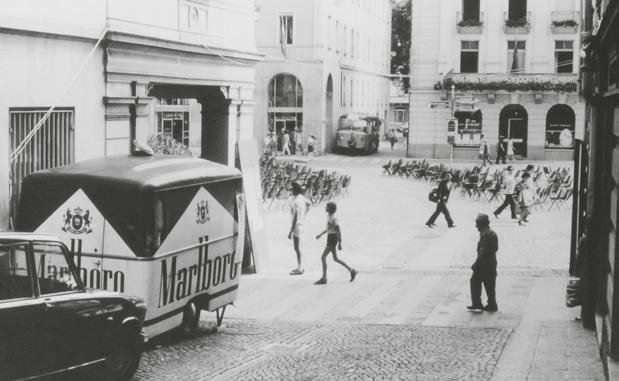

Do you have any memories or anecdotes from
Join PIAZZA NOSTRA, a new initiative launched to collect people’s experiences of the Festival ahead of its 80th edition in 2026!
Locarno you’d like to share?
“The
Rule Doesn’t Work Without an Exception”
Justine and Stefano Knuchel
on BaseCamp 2024


What’s important is that these conversations endure beyond the actual BaseCamp experience, creating human connections that bring diverse people from all over the world together in one place
By Christopher Small
Since 2019, the sprawling BaseCamp has injected a youthful spirit into the Locarno Film Festival, bringing more than 200 emerging artists, critics, performers, writers, and filmmakers from around the world each year to share in a communal creative experience at the heart of the Festival. To mark the fifth anniversary of its existence, Pardo sat down with Stefano and Justine Knuchel, the father and daughter duo responsible for management and artistic program of the BaseCamp, to chat about its history, vision, and promise for the future.
Christopher Small: 2024 marks the fifth year of this improbable project. How does it feel to look back on BaseCamp’s successes and failures?
Stefano Knuchel: Yeah, after five years, there’s a powerful impetus to review what we’ve done and take stock of the direction it’s gone in. People who make movies know that feeling of trying to make one thing and, over the course of the shooting, it becomes something else entirely. Well, we have a little of that. It has become something beyond our wildest dreams. Once an idea like BaseCamp – making a space for all different kinds of creative people in the heart of the Locarno Film Festival – comes in contact with reality, well, it becomes something much more complex and interesting. BaseCamp reinvents itself every year, probably because we’re dealing with young people, who constantly push us to try new ways of doing things. Reinventing the established ideas we’ve always taken for granted is essential in this kind of creative environment.
CS: Reinvention in what sense?
SK: Well, as an example, Justine this year proposed the idea of the BaseCamp library. But that also meant asking, rather fundamentally, “What does it mean to have a library?” It’s not just about the books and booksellers, which you can curate well, making certain ideas and books from certain printing houses available. It also helps us to challenge ourselves about which ideas we’re working with when designing the BaseCamp as a whole. So yeah, that idea dovetails well with our motto this year: In Conversation We Trust. We really think that what defines us after five years is conversation. Yes, we have performances, we give space for artistic creations, we host masterclasses. Still, what really has worked – and to an extent that has always amazed us – is the conversation between people; conversation that really crosses all borders. And why “trust”? Well, we trust that the conversation has been good for five years and will keep on being good. This is one thing that everyone should take away from a film festival: you go there not only to watch films, but to interact with people, to be immersed in ideas. Locarno is a rather small place in the south of Switzerland, a kind of miniature Sim City. But still, in the relatively small scale of the project, you find such enormous diversity – I would dare say, even more diversity than in the body of the Festival itself. With that in mind, we see conversation as the essential bridge.
CS: Can you speak a little bit about those conversations and why they are so fruitful?
SK: First of all, people at BaseCamp share rooms, usually, with at least six or seven people. In that sense, there’s always a bit of hardship. It’s not a cakewalk sleeping there. We also insist on the fact that they must stay the full 10 days, knowing full well how demanding this can be. To survive, you have to let go; you have to get out of your lane. Think about it: it’s easy to sleepwalk through a conversation. You know exactly what you’re going to say, what the other person is going to say – and you just do it. That changes nothing. At the BaseCamp, people come from all over the world, who are at different stages of their working lives, their artistic practice – whatever. This really brings the impulse to make conversation out of people. It creates a bond.
Justine Knuchel: My feeling is that we often forget about the very basic things of life at festivals. It has always been important to us to find ways to make it easier for people to hang out, to share a drink, share a meal. We’re always working with our partners so that, just as an example, we can host regular encounters that allow people to see a performance, a talk, a presentation, but also to have some drinks and get something to eat. Those kinds of shared events allow people to take off their mask, loosen up, share their thoughts about the experience. It’s a human experience, going through it together, and that is borne out by the fact that our participants continue to collaborate. And really, there are only a few spaces in Locarno for hanging out and drinking together, so it’s easy to become super close over 10 days. That’s what I love. Some people from BaseCamp have founded a music festival together; others made a film together. And this is only after five years. What’s important is that these conversations endure beyond the actual BaseCamp experience, creating human connections that bring diverse people from all over the world together in one place, whether that’s a doctor from Munich who uses cinema to increase empathy with the students he’s training, a queer Nepalese filmmaker, or a video artist from Basel – just to cite three examples we met with again at the Berlinale this year. For me, the idea is to build a family or a community, tied to the spirit of the Locarno Film Festival more broadly. It’s not a random collection of people, either; we select the participants and they come with a very specific sensibility and approach.
SK: Exactly. Another example: we have this ongoing conversation with Botswana Independent Cinema. A few years ago, a director named Tricia Sello came to the BaseCamp from Botswana, and she saw the opportunity to access the Festival in a very open way, where people could really get something out of it in terms of experience. We star-
ted a conversation with her about the indie scene they’re trying to develop there, so every year we will invite two people from Botswana to help them grow their international connections. These international connections make the whole project more alive, in some sense. It’s not about us strictly defining the contents of the BaseCamp, but also being open to new collaborations and exchanges. You have to accept that the BaseCamp cannot and shouldn’t be defined as one thing.
CS: It seems like a sacred thing that it runs in parallel to the Locarno Film Festival but is not strictly defined by it. There’s no explicit trade-off, but one makes the other richer, simply by the cross-pollination of people and ideas.
SK: Yes, it’s also one way to kind of manage the unexpected. You put the elements together, and you expect them to work together. You can’t exactly predict what will come out of it, but something will. And every festival wants to renew itself, talking endlessly about the younger generations and things like that. But very often they simply say, “Okay, you are young, you sit here, you answer these questions, you listen and learn.” It’s a whole different thing to give them access to the inside of the festival. Nor are we just a fancy Airbnb. If you take 200 young people and you sit them on the Piazza Grande at night among the audience, would you really see a difference? Absolutely not. Would it change anything in the festival? Absolutely not. But if you bring 200 people to Locarno, house them in the same place, give them access to talks and events and things like that, you allow them to create things and to actively engage with the Festival – then you suddenly have something on your hands. Their questions will provoke new ethics, new aesthetics, new ideas. The Festival then takes note. Over time, that has an influence, something that you can hear and see.
CS: Can you speak a bit about selecting the participants? Because, as you mentioned, that’s also a work of curation. There’s an open call, but also a collaboration with schools, music academies, other cultural institutions.
JK: We manage between the two of us to find lots of different kinds of people, whether through the open call, institutional collaborations, or through other random exchanges. Out of 300 applications, perhaps 150 are filmmakers, but frankly we tend not to take so many of them. When someone is a huge cinephile, they simply want to use the opportunity to attend the Festival and see movies. You need those people of course; bringing 50 hyper cinephiles into the mix is absolutely necessary to achieve the right balance of personalities. But we also need people who bring something else to the experience, who come from the outside. We might bring a physicist who is passionate about cinema, for instance. I tend to select people whose interests and trajectories are very special. Yes, you need people directly from cinema or you would lose the magic balance, but you also must ask yourself what the exchange is going to be – between art and cinema, music and cinema, or whatever else and cinema. That is the key. And then over the years, they spread the word in their communities, and so the applications become even more diverse. It spreads mostly by word of mouth, honestly.
SK: You don’t have to speak to everyone in the world, but you must try to speak to all of the world. Switzerland has its problems, but I think it’s a good venue for that. It’s something of a neutral meeting point in Europe, a crossroads. We can to some extent be trusted as a meeting point for these diverse people and views. I’m not looking for the young American director who will be the next big shot in Hollywood – though that has its place and we respect that, ultimately it’s not what I care about. We ask ourselves: how come they knew about our program in the Central African Republic? How did they know about it in Tibet? Opening the door to these different realities creates a space for all kinds of possible paths to develop – but it also must be natural and not forced. I’m always very nervous when we talk about open calls. It’s a very important resource. But it’s also the easy solution for people who have no idea how to solve a problem. “Just do an open call and people will apply” – that thinking drives me completely mad. Doing a festival means doing the work of curation. Knowing who you are, knowing what you can do. This is very basic. Everyone has their own taste, of course, but if you’re not clear about those points, it becomes a big mess.
CS: It must be nice to be at the fifth-year mark, and to see that the project actually had some longevity.
SK: Well, what I think we’ve proved is that by curating the people who participate, you can organically add to the cultural and political weight of the festival. Also nationally –every year we have around 60 to 80 young students of cinema and art from within Switzerland, who come for free to the BaseCamp. That means a lot. When we started, Locarno was the least visited festival by young filmmakers and artists in Switzerland, because it’s during summer, more difficult to get to, expensive – and now we are the most visited festival of all the Swiss festivals! So
even just from the Swiss perspective, BaseCamp has brought along a sea change in attitudes. We also integrate a lot with the Festival. There might be young filmmakers who are in the Open Doors radar but wouldn’t have the opportunity to stay at the Festival because their work is still in development, thanks to the BaseCamp they can stay the whole 10 days and find a lot of inspiration or make valuable connections. Perhaps then, in the future, that can grow into something special.
CS: What are some of the events planned this year?
JK: Last year, we made an exhibition of original research, “As I Was Moving Ahead”, made just before the festival, inspired by paracinema. [Video artist] Tony Conrad, who came from that experimental community, was a big influence on us again this year. He did this thing called “holding the sound”; he would pass the mic to the audience and say, “Hold the sound.” With [curator] Jan Steinbach we created this program that starts from the library space, as Stefano mentioned earlier. Besides the physical objects in the library, people can come and hold the sound: discuss ideas, read, and especially try to stimulate creative ideas about what to produce together. Sound is maybe one of the elements of cinema that is least explored; I remember that like, no one cared about sound in my film school. And so, we wanted to work with sound as a concept this year, provocatively. The library is not just shelves and books – it’s going to be a really freaky and special place. As for the performances, we’ll have one by the artist Andrew Norman Wilson, linked to the future of survival, which is another thematic strand this year. It’s a program that is not so strictly linked to cinema. But my idea is always to nourish the participants with stuff that is more around cinema.
SK: We’ll also collaborate with Montreux Jazz Festival. We asked Marianne Faithfull if we could use a performance of hers at Montreux in 1995 of the song, “Why D’Ya Do It?”, with lyrics by the English poet Heathcote Williams. This song that was made 45 years ago, and which is still banned by the BBC because it’s just so violent, has become, over time, an anthem of female empowerment. We’ll cut the song in three segments that will alternate with three original creations by groups of artists – musicians, writers, directors, and performers. They will come together in this shared creation. That is another example of how we create concrete opportunities for collaboration between different creative disciplines and artists who had never worked together before. We want to stress the musical aspect, because music is a little bit missing at Locarno.
JK: We’ll have a lot of music this year, as we really think it’s necessary. Also experimental music and this focus on sound. I’m also doing it to convince myself because, to be honest, I never engaged too much with the idea of sound in cinema or performance. But then I met Daniel Deshays, who did the sound for [Chantal] Akerman’s A Whole Night (Toute une nuit, 1982). He taught me that the beauty of sound in film could also be a series of sounds put together in a line, not heavily mixed. Jacques Tati also did that. It’s so simple but it’s very interesting. We’re used to hearing so many sounds mixed together on a soundtrack, laid over each other. It’s a very different discipline to work with fewer sounds, to keep a certain clarity. Maybe 80 percent of people are less sensitive to sound and could benefit from these kind of provocations.
CS: This will all take place at Istituto San’Eugenio in Locarno again?
JK: Yes. And we’ll also use the church that’s in the Istituto, which we had previously used for exhibitions, for a few performances this year.
SK: There’s a church directly inside!
JK: For two years now, they’ve allowed me to use it for exhibitions. The first year was about the many forms love can take, an exhibition by Julie Sando, and the second year it was about a law against pregnancy interruption in Dominican Republic by Karla Voleau. This year will host two sensitive sound performances and a performance based on the viral declaration-article It’s Not What the World Needs Now, about how miserable young artists often feel, by Andrew Norman Wilson.
SK: It’s also funny because the Istituto itself is an elementary school, which is already a bit strange. There’s Marianne Faithfull in the gym! With things like this, I’m confident that whatever will happen with the BaseCamp, if it disappears, some people in the future will say, “Ah, do you remember, there was this crazy thing and we would go to the Locarno Film Festival because of that...” That perspective of the after gives me strength to continue, to imagine people looking back on it as something positive. All together, we are making a small personal history of the festival for some people.
CS: You’re making a future yesterday for people to look back on. It reminds me of the time Werner Herzog was asked what he would do if the world was ending. He said he would pick up his camera and shoot the apocalypse. What I love so much about that suggestion is that by doing it he would be creating a possible future even when one doesn’t exist; when you shoot, that means you have to edit what you’ve shot. The world would be destroyed, and it would be impossible, but it’s still worth doing.
SK: That’s exactly right. Creating productive tensions and impossible dreams within the festival is an obsession for me. The festival is a rule. If you have a rule, it can only exist – at least in a healthy democracy – if you have an exception. Nor could the exception exist without the rule. If you’re stuck with a rule without an exception, that’s when everything dies. That’s where I personally go crazy. When they’re in concert – the rule and the exception – or sometimes in a bit of tension, both rule and exception become so much more beautiful.
COME TOGETHER at Rotonda by la Mobiliare

Lose yourself in the core of Locarno Film Festival’s pulsating atmosphere at Rotonda by la Mobiliare .
La Mobiliare is Main partner of the Locarno Film Festival. mobiliare.ch/locarnofestival
“We Are All the Forest”
On Eami and Raíz
by Ena Alvarado
Tales of environmental destruction have long haunted our collective imagination. In the Epic of Gilgamesh, the oldest known epic poem, the eponymous hero cuts down countless trees for lumber, turning a cedar forest into a wasteland. Soon after, the entire planet is engulfed in a deadly flood. The injuries humans inflict on nature, it would seem, often come at an unimaginable price.
A handful of films in this year’s program of Open Doors Screenings give new meaning to this age-old conflict between humanity and the natural world. Eami (2022), Paraguayan director Paz Encina’s fourth feature, uses myth and testimony to commemorate an indigenous community’s intimate relationship with a forest under attack. The film premiered at the International Film Festival Rotterdam (IFFR) two years ago, where it won the prestigious Tiger Award. Though quite different in form, Peruvian director Franco García Becerra’s Raíz (2024) delves into similar territory, asking what possibilities remain when sacred habitats are menaced by extractive industrial pursuits. His tender and deeply felt film obtained this year’s Special Mention at the Berlinale’s Generation Kplus competitive section. Together, Eami and Raíz stand out for their fierce political clarity, despite a palpable absence of ideological heavy-handedness in either film. Perhaps most importantly, they offer a sense of urgency to the ongoing cycles of environmental devastation that plague our planet.
In the Ayoreo language, eami means both “forest” and “world”. In Encina’s film, Eami is also the name of a five-year-old girl who wanders the Gran Chaco all by herself. This vast expanse of hardwood trees and salty marshes stretches from eastern Bolivia through western Paraguay and Brazil, all the way to northern Argentina. It is home to South America’s second largest and most biodiverse forest, following the mighty Amazon. Though barely populated, the Ayoreo Totobiegosode – Eami’s people – have lived there for centuries, but over the last two decades, their ancestral lands have faced one of the highest deforestation rates in the world. It is no wonder, then, that the lush landscape Eami traverses is often punctured by leafless trunks and empty dirt tracts. In fact, what begins as a child’s wondrous excursion soon turns into a painful ceremony of farewell. Eami must journey through the forest in order to abandon it. “Remember everything,” an elderly narrator counsels her. “Once we leave, we can never come back.”
The threat of a similar fate lurks in the background of García Becerra’s Raíz. Feliciano, an eight-year-old Quechua boy, spends his days herding alpacas in the foothills of Apu Ausangate, a mesmerizing, snow-capped mountain in the Andes. He plays with Rambo, his dog, and Ronaldo, his favorite alpaca, while listening to radio broadcasts of the Peruvian national football team’s qualifying matches for the World Cup. Back home in the village of Upis, however, his family and their neighbors are in trouble. A mining company, eager to expand its operations, has been pressuring them to sell their land. Its henchmen eventually resort to cruel intimidation, killing several alpacas and endangering the villagers, who live off selling wool.
Whereas Raízfavors traditional, plot-driven storytelling, Eami embraces a fragmented narrative structure, mostly advanced by its on-and-off voice-overs. Yet both films share a crucial feature: each is centered on a solitary child’s perspective. Upon deeper reflection, this choice seems hardly incidental. Eami and Feliciano are born into a world already at high risk of disappearing, through no fault of their own. Across the Gran Chaco, Eami’s people have endured decades of displacement at the hands of prospective cattle farmers. The environmental decimation of the forest thus goes hand in hand with the banishment of the Ayoreo Totobiegosode, who have been its nomadic custodians for hundreds of years. As the last member of her tribe to leave, Eami bears the responsibility of safeguarding her loved one’s memories. This task is thrown into sharper relief because it falls on a little girl’s shoulders. Children tend to stand in for the future, yet in this case, Eami embodies the cruel foreclosure of hope.

Luckily, Feliciano’s Quechua community has managed to hold onto the land of its ancestors – at least for now. Throughout the film, the mining company gradually acquires a more ominous presence, as it also falls back on more ruthless tactics of persuasion. The adults seem hyper-aware of this game, and they exhibit fear accordingly. Feliciano, on the other hand, walks near the company’s plant and barely bats an eyelid whenever he sees the henchmen on motorcycles. He has nothing to be afraid of, it appears, perhaps because he fails to understand the potential ramifications of their encroachment. A child’s looking, one could argue, carries a simplicity and vulnerability that adults cannot afford to offer.
Both Eami and Raíz are inscribed in a rich cinematic tradition that has harnessed the singularity of childhood to reflect on some of society’s most intractable problems. Countless films, for example, have explored the ravages of war through the eyes of children: from Roberto Rossellini’s Germany,Year Zero (Germania anno zero, 1948) to Andrei Tarkovsky’s Ivan’s Childhood (Ivanovo detstvo, 1962). Like Eami and Feliciano, other boys and girls on screen have captured experiences of loss or played roles as witnesses to atrocities – two, very different examples that come to mind being Carlos Saura’s Cría cuervos (1976) and Peter Weir’s Witness (1985) especially come to mind.
Encina and García Becerra breathe new life into this genre through their respective subjects. Encina was only able to finalize her project after a full six years of contact with the Ayoreo Totobiegosode people. The film’s script and production process were the result, in her own words, of “crossing cultural barriers”. “For them, many things we do are absurd, like going to the restroom when the whole forest is at our disposal. Or having to repeat a scene,” she explained in an interview. Similarly, García Becerra’s protagonist had not only never participated in the shooting of a film – he had never even seen a camera before.
This year’s Locarno Film Festival marks the final one in the Open Doors initiative’s three-year cycle focused on Latin America and the Caribbean. The choice of these two major films entirely devoid of Spanish and urban spaces – both frequently assumed to be constitutive of these regions – feels significant. Taking them as a microcosm, this gesture truly showcases the range of the 22 countries covered by the selection. Ultimately, as Irish novelist James Joyce once explained, “in the particular is contained the universal.” At one point in Eami, the little girl explains how she got her name, so pregnant with meaning for the Ayoreo Totobiegosode people. Her mom chose it for her, and the reason was simple: “We are all the forest and the world to someone.”


Ena Alvarado is a Venezuelan writer based in Berlin. A member of the Locarno77 Letterboxd Piazza Grande Jury, Alvarado’s work has appeared in Americas Quarterly, JSTOR Daily, and The Atlantic. She made her acting debut in Los capítulos perdidos (2024), which will screen at this year’s Locarno Open Doors.


SPLENDIDA CASA NEL VERDE CON AFFACCIO SUL FIUME TRESA
Monteggio | 4.5 locali | superficie abitabile mq 100 ca. | superficie terreno mq 2'000 ca. 4 posti auto esterni | certificazione Minergie | CHF 1'200'000.-


ATTICO CON SPLENDIDA VISTA LAGO
Paradiso | 5.5 locali | superficie abitabile mq 150 ca. | superficie terrazza mq 50 ca. 1 posto auto interno | locali ampi e luminosi | CHF 1'250'000.-


VILLA D’AUTORE CON PISCINA
Novazzano | 8.5 locali | superficie abitabile mq 365 ca. | superficie terreno mq 1'730 ca. 2 posti auto interni e 2 esterni | zona tranquilla e ben servita | CHF 2'850'000.-


VISTA LAGO CON DARSENA E POSTO BARCA

Brusino Arsizio | 4.5 locali | superficie abitabile mq 170 ca. | superficie terreno mq 1'363 ca. | terrazza mq 22 ca. | residenza secondaria | 3 posti auto | CHF 1'860'000.-

Per informazioni: +41 91 695 03 33 immobili@interfida.ch interfida.ch
Looking for adventure?
Discover the challenges ahead

Balladrum, Ascona @ Switzerland Tourism – Silvano Zeiter
VILLA
by Nicholas Henriquez
Electric Child
by Simon Jaquemet
August 9th, 21:30, Piazza Grande

Vote for the Prix du Public UBS
◼ The voice of the audience is key for a film’s success. That’s why since 2000, the Festival’s most trusted jury – the audience – decides which film wins the Prix du Public UBS award.
◼ Vote for your favorite film at the Piazza Grande with the QR code or the link on your e-ticket.
◼ All participants have a chance to win Festival Passes for Locarno78 (6-16 August 2025) and enter the final prize draw for an exciting holiday in Switzerland!

Vote & win →

Electric Child — Illustration of the film by Natasha Goncharova