WINTE R 2025/2026 ISSUE 73
Elio
PHOTOGRAPHY BY MATT GLENN
Happy 2026 to our fellow readers, supportive friends and incredible team at Local Wolves! I must admit that there is something about the beginning of a new year– fresh starts, new beginnings, and leaving the past behind to focus on becoming the best version of yourself. Don’t get me wrong, I’m a believer in that you can reset at any time that works best for you, as it doesn’t have to be on January 1st or an exact date– everyone has their own timeline. In this issue, we focus on the theme of metamorphosis as a new year begins. It helps to reflect on this past year, to discover more about your own perspectives and personal growth. Our Winter 2025/2026 cover star, ELIO shared about her creative process when creating her sophomore album, autonomy and entering this new chapter in her life. The issue covers incredible stories of Camille Zacky, Earth to Eve, Hana Bookman, Chris Lanzon, PRYVT, Sydney Rose and many more. We’re grateful for everyone who supported our independent magazine for the past 13 years and let’s continue this journey together. See y’all in the spring time!
Cathrine Khom
2
EDITOR'S LETTER
local wolves • 3
4
contents
classics 02
editor’s letter
08
playlist
10
pinpoint
16
wolf ie submissions
118
off line itinerar y
119
behind the cover
features 26
hana bookman
40
earth to eve
46
chris lanzon
60
ELIO
80
camille zack y
86
PRY VT
92
sydney rose
perspectives 32
back to school
52
lunch break
72
disability in bloom
102
blended eyes
110
murmurs of morning
local wolves • 5
ISSUE 73 — ELIO WINTE R 2025/2026
FOUNDER & EDITOR-IN-CHIEF
FEATURING
Cathrine Khom
ELIO
WINTE R 2025/2026 ISSUE 73
COPY EDITOR
THEME
Sophia Khom
Metamorphosis
DESIGNERS
COVER PHOTO
Lisa Lok, Yoolim Moon
Dillon Matthew
SOCIAL MEDIA COORDINATORS
COVER DESIGN
Jessica Spiers, Tatiana Diaz de Leon
Lisa Lok
CONTRIBUTING WRITERS
LOGO
Alexis Marion, Amanda La, Ang Cruz, Jessica Spiers,
Lisa Lok, Fiona Yeung
Keely Cat-Wells, Mara Go, Natalie Howard, Uma Snow CONTACT CONTRIBUTING PHOTOGRAPHERS
General: info@localwolves.com
Abigail Gorden, Dillon Matthew, Emily Machan,
Press: press@localwolves.com
Hannah Sacca, Harry Sung, Isabel Spooner Martinez,
Advertising: advertising@localwolves.com
Kara Rook, Lily Stevens, Lucy Hwang, Mackenzie Ryan,
Get Involved: community@localwolves.com
Sravya Balasa, Tiffany Phung WOLFIE SUBMISSIONS Aerin Riegelsberger, Aleksandra Shadrina, Alifah Humaira, Amy Hadley, Ang Le, Auriana Petach, Avalon Combs, Brisa Gomez, Charlie Elizabeth Culverhouse, Chiho Lee, Clare Yates, Danielle Seitz, Elaina Barnes, Emily Camacho, Gwendolyn Hill, Isabella Martinez, Janelle Parallel, Jenna Thurley, Joline Alice, Kalina Mihova, Kierra White, Kristen Case, Leeanna Hariprashad, Marie Recalde, Marisa Flores, Nina Tanujaya, Olivia Bokesch, Rachel Lee, Samantha Marie Saglibene, Sophie Rouja MANY THANKS 2B Entertainment, Camille Zacky, Chris Lanzon, Dylan Tabirara, Earth to Eve, Erica Ko, Feather Creative, Good Manners, Hana Bookman, Harry Sung, Impulse Artists, Lindsey Solomon, Matt Glenn, Mercury Records, PRYVT, Sydney Rose
6
LET'S CONNECT Instagram: instagram.com/localwolves Twitter: twitter.com/localwolves TikTok: tiktok.com/@localwolves Pinterest: pinterest.com/localwolves
Elio
O N TH E COV E R
ELIO CONTINUED ON PG 60
COVER ELIO STORY Natalie Howard
PHOTOGRAPHER & CREATIVE DIRECTION: Dillon Matthew BTS PHOTOGRAPHER: Matt Glenn local wolves • 7
01 DAYS Ravyn Lenae
between 02
FOLDED Kehlani
03
CANDY GRAPES (FEAT. STEVE LACY) Fousheé
PLAYLIST CURATED BY DYLAN TABIRARA
04
GLISTEN BY THE WIND Nick Leng
05 BEAUTIFUL MIND BEAN. 8
06 MOVING ON JOHN 07 AAAANNNNTEEEEENNNAAAAAA HYUKOH and Sunset Rollercoaster
08
suns
THE SETTING SUN The Poles
09 OVERTIME - PT 2 Mk.gee
10 GREAT PRETENDER Dominic Fike local wolves • 9
PINPOINT
10
GARDEN OF THE GODS IN COLORADO SPRINGS, CO
In May of 2025, I traveled from my home in Pennsylvania to Colorado for the first time, as part of my self-exploration journey to discover new places and ignite my inner-self. During my time in Colorado, I visited a place that is like no other, an archeological masterpiece that has been graciously loved through the ages— Garden of the Gods in Colorado Springs, Colorado. Knowing that for centuries, so many others found inspiration and enlightenment here, something was drawing me in to discover something new within me. When I first arrived in Colorado, being greeted by the magnificence of the Rocky Mountains, I knew there was something special there, and I was washed with a feeling of calmness that I haven’t felt anywhere else. Being coined during its discovery as “A place fit for the Gods,” this geological nirvana places Pikes Peak, one of the most prominent summits of the Rocky Mountain range, in between a collection of blazing red and orange rock formations, making for some of the most picturesque natural areas I have ever witnessed. As I hiked my way through various trails that sit over six thousand feet above sea level surrounded by sprawling plantlife and wildlife, I felt grounded and truly present. Garden of the Gods is home to several hiking trails that are naturally woven between its towering rock formations. Whether you’re looking for a leisurely walk or you’re ready to take in the views of the mountains above and the Colorado Springs valley below, everyone will find something to love here. During my visit, I was lucky enough to see fresh snow falling over Pikes Peak in the distance. Visiting Colorado and Garden of the Gods was more than a short vacation. It was an adventure to recognize new corners of the world– and in turn– new corners of myself.
BY KARA ROOK
12
local wolves • 13
14
WOLFIE SUBMISSIONS METAMORPHOSIS
Wings AVALON COMBS, LOS ANGELES, CA, USA
For our 73rd issue, we are reflecting on the changes you go through— the wins, challenges, and everything in-between to become the best version of ourselves. The theme for this issue is metamorphosis from your own transformation, developing new perspectives on life, and personal growth. What are the changes you made in your life that helped transform who you are today?
flourish LEEANNA HARIPRASHAD, NEW YORK, NY, USA Photographer: Leeanna Hariprashad Lighting & Production Assistant: Aaron Pham
ballet of pearlescent white don’t remember the day that things changed, but as my feet cross fresh soil that they have not walked before, i’m convinced the sun is brighter, a technicolour world that has always existed in static, the water calls to me as the breeze tangles in my hair and there it is, on my hand, the prickle of something protruding from my skin, feather-light to the touch, as white as the clouds, one after another until i am masked by them entirely, piercing through the goosepimples and mute with awe, life is beautiful, and finally so am i, wings that beat against the current to take me away, up, up, and away to the ballet of swans and to those who have also learnt how to live as gods
the essence remains unchanged ALEKSANDRA SHADRINA, RISHIKESH, IN
AMY HADLEY, NORWICH, ENGLAND, UK
local wolves • 17
once if feelings could be shelved like books, spines softened by touch, waiting to be taken down, dusted off, breathed in, held close, lingering, settling into the bones, quiet and patient, waiting to return to the warmth of sun on skin, the weight of your hands, your voice low and steady, a memory woven into wind. the moss, thick on rain-drenched earth, feels like time curled in the roots, like laughter still humming in the hush of evening. and i’m there again, back to the taste of your mouth, salt and longing, back to the ocean, the wild scent of rain and wood as we laughed like children. i take myself down from the shelf, dust off the pages, run my fingers over the words of who i used to be, soft, unafraid, open. but the pages no longer turn so easily. the words have faded at the edges. i used to trust. i used to open like a field in the wind. now the cover is worn. the spine creaks in my hands. and still, i read. still, i remember. but now i brace for the storm, hold myself as branches do, tensing for wind i’ve already felt, still changed in ways only weather understands. JOLINE ALICE, SHELTON, WA, USA
氛围感男神 SOPHIE ROUJA, BERMUDA Photographer, Creative Direction, Styling, Hair & Makeup: Sophie Rouja Model: Leo Wang
18
TRANS* Emergence GWENDOLYN HILL, LOS ANGELES, CA, USA (TOVAANGAR)
Photographer & Artist: Gwendolyn Hill Creative Direction: Gwendolyn Hill & Chiara M. Styling & Model: Chiara M.
Grand Self-mythology AURIANA PETACH, LOS ANGELES, CA, USA Photographer: Julieanne Benson Creative Direction & Model: Auriana Petach Set Assistant: Ivan Arnove
local wolves • 19
Sisa Masa NINA TANUJAYA, LONG ISLAND CITY, NY, USA Photographer & Creative Direction: Nina Tanujaya Lighting & Production Assistant: Leandro Miyasaka Talent: Kirana Rumpak & Btari Rumpak
Five-year plans and ego Since middle school, I always knew exactly what was expected of me, there was no time to wander around. My minor and major life events were already written down for me; all I had to do was perform my best and scratch them off. I never really understood why it was such a hollow experience to grab the pen and draw the line across every step. I had made a contract in which it seemed I had no active part in, I was in a rush to reach my perfect self, my surroundings seemed so irrelevant. As I was just ready to put the pen down and move on to the next step to my endless construction and renovation of who I thought I was supposed to be, I started doodling with the pen. It seemed to move in very bizarre directions that didn’t make any sense, as I blinked a few times I saw very beautifully shaded roses with thin leaves and thorns beneath them. At first, I got so irritated that I ruined my progress journal, but the image of roses suddenly took me to first grade. I would draw flowers in my notebooks as I was daydreaming and my spirit always seemed to be elsewhere, frolicking through different worlds. It seemed that my child self knew something I had forgotten. She did not make five-year plans, she didn’t get perfect grades or only eat carbohydrates before 7pm, yet she seemed so much happier than me. If she met my perfect version of myself, she probably wouldn’t like her, she wouldn’t even play with her. I always thought that real growth was achieved through discipline, running and chasing an ideal, going through mundane daily life out of breath. Being still and taking deep breaths felt scary, all the progress would probably vanish if I wasn’t actively struggling to
prove it existed. But then if I go back to the most meaningful moments of my life, it wasn’t those mornings I woke up at 6 am to run for half an hour and fast until noon. My mind always seemed to go back to these weird unplanned interactions with life where time just seemed to stop moving. Riding a horse for the first time, walking barefoot in the Egyptian desert, seeing a group of children in Zanzibar running shoeless on the rocky pavement carrying fruits and fish for dinner feeling my palpable geographic privilege and having so much empathy. All those moments when I am connected with how much there is to experience. Those moments of surrender to art, music, nature and the kaleidoscope of cultures where narratives vanish and awareness is all that’s left. When both of us hear the ocean waves crash onto the rocks in the same tune without any attachment to outcomes. When life gets so chaotic that all plans go to hell and all you have left is to laugh back at it, the same way the Universe probably laughs at us when it hears all of our conditions to be happy. It’s as if every grain of sand on the beach line was pretending to be something that it’s not and being too proud to admit that it’s part of something bigger. I think the biggest metamorphosis we can have is an ego death, releasing all premeditated conditions for self-worth and success. Stopping to constantly throw stones at the river in hopes of producing enough noise to prove our existence and instead letting the waters clear, seeing all the living creatures underneath and making peace with our reflections. KALINA MIHOVA, ROTTERDAM, NL
CHANGELING OLIVIA BOKESCH, NEW YORK, NY, USA Photographer, Creative Direction & Styling: Olivia Bokesch Hair, Makeup & Model: Alori Cerutti
local wolves • 21
ROTTEN I am the willow. I wither, I weep, as I’m stripped to branch and bone. I shiver in wake of winter’s winds– bruised, bleeding, and overgrown. Beneath my skin hums the sting of fear. I writhe with a chronic ache, a wayward soul tethered to a cycle bound to break. This forlorn path of swallowed wrath guides me to the brink of change, yet I stay stuck. I know not but a life constrained. I am wrought from ruins. These rotten roots twist and tear at my tender flesh. Bringing me forth, the wilting willow, aflame within the woods, possessed. Destruction sheds a haunting glow on scars unhealed and scabs picked. As I sit scorched and sick, lost in the dark unknown, I wonder: will I ever find the courage to grow? The wind carries my wails, I beg for answers beyond the veil, yet I am left to lay to rest alone in my woe. Try as I may to cast away faults, my hands are crimson stained. I sowed this seed, bore into the dirt. I know where to plant my blame. Pity, this wound I've worried by digging to dull the gnawing pain. Shame, the truths I’ve buried, the rot I’ve let crawl through my veins. Pray, release me from this burden, this thirst for sorrow and thorn. Illuminate the darkness. Take the sick out of my bones. Rinse my body with sweet earth, the sacred soil from which I came. I’ll claw my way to my rebirth as I surrender to decay. ISABELLA MARTINEZ, AUSTIN, TX, USA Photographer: Sunny Ceballos Writer, Creative Direction, Costume Design & Model: Isa Velita Lighting Assistant: Rust Yohman Production Assistants: Calpurnia, Noah French, Jayden McBride Makeup & SFX: Jhyzel Rojas & Jade Andalon Hair: Amador Flores Nails: Jade Andalon
22
Believe in Aurora Morpho If you only had 30 days to live your life to the fullest would you be ready? The Aurora Morpho butterfly lives its adult life for about a month before it passes. Only thirty days, barely a chapter in human life but for them it’s their entire story. Somehow within this short window it manages exploration and finding the beauty of life. They help remind us that a month isn't the small amount of time we think it is. In the right circumstances a month can change everything. Before the Aurora Morpho ever spreads its wings it spends time prepping in silence. From the larva to its crystallized shape, it grows, shedding the old version of itself in favor of something new and beautiful. When it emerges the Morpho steps into the world as something completely different from what it was before. That shift alone is enough proof that change can happen faster than we think. One moment you’re crawling up a leaf and the next you’re soaring through the sky. Though humans don’t transform in the literal sense the emotional and mental parallels are easy to see. A month can be the difference between feeling stuck and finding meaning in life. It can be the moment where someone takes a risk that leads to breaking a pattern from their past. We tend to underestimate how quickly things can shift within a month because we’re used to thinking in bigger increments like years. Growth often happens when one has had enough with the world around them. From sudden decision making to new opportunities that eventually lead to opening up something bigger.
Efflorescence MARIE RECALDE, COLOGNE, DE
For the Aurora Morpho a month is a lifetime. It has no time to overthink, it doesn’t wait for the “right time”. Its entire existence is built on the urgency and the intentions of getting things done. Everyday matters. Every hour has value. But that doesn’t make the butterflies' life less meaningful or less significant. That mindset applies to people more than we would like to admit. We as a society tend to think about the bigger picture without laying the foundations needed for the changes we seek. Most major life changes look dramatic but are often formed from small moments that had intentional choices. You don't need a full year to shift the direction of your life, you just need the courage to start. Even the hardest situations can look different after thirty days. Healing can begin when you least expect it. person can rediscover a passion or build up a habit for a lifetime to come. So though the Aurora Morpho's lifespan is short it's not a tragedy it's a testament. They show us that a month is enough to change and leave an imprint in the world. Sometimes all it takes to change your life is deciding you're ready to. KIERRA WHITE, AUSTIN, TX, USA
Metamorphosis AERIN RIEGELSBERGER, OAKLAND, CA, USA
local wolves • 23
beneath the surface JENNA THURLEY, ARROWHEAD LAKE, ONTARIO, CANADA Photographer & Creative Direction: Jenna Thurley Model: Tara Thurley
awake at night I lie awake at night rummaging through past and future.
I’m learning how to talk again I’m learning how to talk again with this new voice I’ve never heard before
The weak, the unsatisfied, the hopeful, the promising.
the one who lost her grandmother 101 days ago
The quiet lingers through the dark, attaching itself to new companions who conjure up at the table and converse. They laugh at me. They root for me. They wish me recovery from incessant badgering. Each night is a reintroduction to the people that live inside. I shed them hoping for metamorphosis. Maybe I’ll get lucky. BRISA GOMEZ, MIAMI, FL, USA
it grovels and sighs, breaking just after 1am, growing deeper from rasp and the unwillingness to sleep I thought it would feel familiar, like déjà vu and it would all come back to me but the grass keeps getting taller and I am seeping under. There is no way to prepare for how lost you are about to become. my eyelids are growing lead, whittled to whispers “I can’t do this today. Tomorrow I’ll try again.” then I will wake up from the soil, stretch towards the heavens, tell her I love her to the moon and back. how lucky was I to know a love so cosmic, surpassing the deepest depths of the oceans, taking up the most space in my soul. we will dance and sing and laugh and kiss and hug and cry again. I’m learning how to talk again so I can tell you all that’s been happening since you left. MARISA FLORES, SAN FERNANDO VALLEY, CA, USA
24
Spinning DANIELLE SEITZ, NEW YORK, NY, USA Photographer: Sidney Petersen Models: Lydia Boyce, Sylvie Fera, Delaney Pfeiffer, Camden Zhu, Bella Toledo, Juliana Grageda, Feliz Castañeda, Isabel McClain
haircut ANG LE, BALTIMORE, MD, USA
local wolves • 25
“Imaginal Cells” SAMANTHA MARIE SAGLIBENE, BROOKLYN, NY, USA Photographer & Creative Direction: Julissa Ramirez Model: Samantha Marie Saglibene
the power of changing There are days when change feels loud. It comes very obviously, like when everything inside you is breaking at once, and rearranging you into someone you barely recognize. And there are days when change feels so quiet, that you even need time to notice it. Months later, you finally notice that you are brave enough to say "no", or you realize that your hands no longer tremble when you choose yourself. Metamorphosis isn't always pretty and isn't always easy. It only comes to people who are brave enough to let go of the versions of themselves they once loved. It comes to the people who finally can make decisions about themselves.
Crossing over by force ELAINA BARNES, DETROIT, MI, USA
It will feel very hard, very uncomfortable, and very weird at first to become someone who is not the old you. But it doesn't mean you're breaking. It doesn't mean you've lost yourself. It means you can finally break the rope that kept you tired to the worst version of you. You are not breaking, you are unfolding. Every effort, every small step, every quiet decision to stay true to yourself is another step in your becoming. ALIFAH HUMAIRA, JAKARTA, ID
26
Your Story Isn’t Finished I went on a walk today to breathe a little, circling my neighborhood and trying to untangle the thoughts from this week. As I walked, it felt like I was carrying a weight no one else could see like I’ve been living inside a shell I didn’t realize I built. Maybe it was meant to protect me, but over time it hardened into something I didn’t know how to break out of. For so long, I believed I was only allowed to be the version of myself that existed right now. As if growth was a privilege I had to earn. As if change was something only other people were allowed to do. But the truth is, I spun these walls myself, which means I can also outgrow them. I’m not writing this because I’ve figured anything out. But maybe this is the beginning of cracking open. What if I let myself shed the expectations society glued onto me? What if I stopped treating the outlines other people drew as the only shape I could become? People love to tell us how to grow, like growth has a syllabus. In college, a professor told me that if I just followed “the line,” I would succeed. I tried to mold myself into the path everyone said made sense so I wouldn’t fall behind. But maybe “falling behind” was just old skin slipping off. Maybe I wasn’t behind, I was changing. Those whispers of doubt the “you’re not ready,” the “you’re too late” were never the whole story. They were just the static inside the cocoon, noise you hear when the familiar is dissolving so something new can take form. My story isn’t finished. How could it be? I don’t fully know what I’m capable of. When I turned 26 in June, I felt lost, like I was standing between versions of myself shedding one and not yet forming into the next. Maybe that confusion is the transformation. Maybe not knowing is proof the old shape no longer fits.
I’ve spent so much time trying to be polished and composed that I forgot growth is messy. It cracks and falls apart before it rebuilds. I took a ceramics class yesterday, a hilarious choice for someone who got a C- in art. I failed three times. Everything collapsed. But instead of spiraling, I let myself enjoy the soft clay, the trying, the breaking. Things fall apart, you reshape them, you keep going. I look around at my friends getting promotions, landing dream jobs, getting married. For a long time, I wondered, “What happened to me?” But maybe nothing happened to me. Maybe something is happening within me. Their stories aren’t mine. My transformation doesn’t have to look like theirs to be real. The past isn’t a final form. It’s just a stage you pass through. I’m learning that I can be enough even when I’m unraveling because unraveling isn’t the end; it’s the start of becoming. I’ve been rigid with myself, telling myself I could enjoy life only after everything fell into place. But that’s not how transformation works. You don’t wait to live until you’re finished. You’re never finished. You’re always emerging. So go waste time. Go create something imperfect. Lose yourself in unfamiliar places where your old self feels like a stranger. Read until you forget the hour. Love fiercely, even if it breaks you open because that cracking is where the light slips through. I’m learning to let the world feel real again. To let myself shift. To molt expectations I never needed and carry only what is mine. I’m letting my gut lead and my heart speak. Because this life is still forming. This story is still unfolding. And I am still becoming. KRISTEN CASE, LOS ANGELES, CA, USA
Reaching JANELLE PARALLEL, NEVADA CITY, CA, USA
local wolves • 27
The girls are bugging out CLARE YATES, PENRITH, NEW SOUTH WALES, AU Photographer & Creative Direction: Clare Yates Hair & Makeup: Zoe Robertson & Ally Jones Styling: Clare Yates, Zoe Robertson, Ally Jones Models: Zoe Robertson & Ally Jones
somewhere between gain and loss EMILY CAMACHO, NASHVILLE, TN, USA Photographer, Creative Direction & Model: Emily Camacho
The Scar We Both Inherited CHIHO LEE, NAKANO, TOKYO, JP Photographer: Chiho Lee
Morning rituals Each morning I light a candle. I do this as I’m brewing tea, after the kettle has stopped screaming on the hob but before the tea bag becomes over-stewed. It might be a tealight that I choose and I might place it beneath my oil burner to release the gently floral, sunny scent of the wax coin I bought while in Edinburgh once, on a holiday with my sister. Or I might light a simple candlestick, scentless, standing tall and proud in its antique holder. If it’s raining, I’ll undoubtedly settle on the red candle, with its rich cinnamony smell and deep notes of damp earth. Whichever I choose, as I strike a match and hold flame to wick, I’ll pray. Perhaps that’s not exactly the word for it, what with its westernised, Christian connotations. But as my eyes linger on the light, I’ll check in — with who? Certainly not God as I’ve been taught to understand them. The universe maybe? – and I’ll give thanks or ask for something or other; protection, inspiration, simply enough energy to get me through the day. I can’t say that my prayers are answered, as I also can’t say they’re not. But this ritual has brought me closer to something. If not a deity, then at least to myself; that sacred being I so often ignore. CHARLIE ELIZABETH CULVERHOUSE, NORTHAMPTON, ENGLAND, UK
yes RACHEL LEE, LOS ANGELES, CA, USA
local wolves • 29
BY MARA GO PHOTOGRAPHY & CREATIVE DIRECTION BY DILLON MATTHEW STYLING – ERICA KO SPECIAL THANKS – LINDSEY SOLOMON DESIGNERS – BELLA ANNA, TAO TAO
30
HANA BOOKMAN SEEKING WHAT IS SEEKING YOU
Allowing ourselves to pause in a world that never seems to pause for us is a special kind of power — to sit in with what is quiet, weathered, and ever-evolving. This is where beauty begins to emerge. Not in the hands of vanity. But with the hum of life that surrounds us: towering trees forming a green canopy, leaves crunch underfoot, sunlight piercing through branches, creating patterns on the ground. Komerebi. It is how multi-disciplinary artist HANA BOOKMAN described it.
has its sneaky ways to let light flow through our lives, both in the ordinary and the mundane — one thing that perfectly encapsulates Hana Bookman’s story as an artist.
Komorebi means sunlight leaking through trees. A Japanese word that describes the beauty and wonder of rays of light dappling through overhead leaves, casting dancing shadows on the forest floor. More so, it is also the feeling of profound peace and sense of tranquility that one can absorb from simply stopping to appreciate its transience.
YOU HAVE SHARED WITH US THAT YOUR ARTISTIC JOURNEY STARTED AT A VERY YOUNG AGE. YOU STARTED DANCING AT THREE YEARS OLD. THAT IS IMPRESSIVE! CAN YOU TELL US MORE ABOUT IT? I'm really grateful that I started with dance. It was the perfect way for me to express myself without focusing on technical skill. It felt like the freest I could be. My mom enrolled me in various dance styles, including ballet, jazz, tap, and hip-hop. Each style had a different teacher, and they exposed us to a wide range of music. This experience truly broadened my passion for all genres. Even now, when people ask me about my own music and what genre I identify with, I find it difficult to answer because each song I create feels like a different genre to me.
But Komorebi is the house visitor that the artist once did not expect. “The first time I encountered it was actually in my house. It wasn't even outside. I was sitting by my window. I was going through a dark time,” she recalled. “And then I looked up at my window. I noticed how the light perfectly seeped through the house plant that was sitting next to it. It had this beautiful glow around it. I told myself, it's right here, it's right in front of me. That's Komorebi.” She added, “That's the essence of how nature and how something as simple as the light through leaves can just kind of take you out of a dark space. I felt light. Komorebi is the state of looking up and recognizing how there's always life around us.” The beauty of komorebi is not in the pursuit of finding it. It is in the very moment of letting it find us. The paradox is: Komorebi does not only seek us in moments where we find ourselves in nature. It
In this exclusive interview with Local Wolves, we sit down with Hana Bookman to talk about her growth as a multi-disciplinary artist, her story of belongingness and place, and how her journey to creative independence brought her to a state of komorebi in her life.
AND LATER ON, YOU DISCOVERED ACTING AND CHOIR IN MIDDLE SCHOOL. Yes! That was the first time I really felt the power of group singing. I also learned a lot of new music that I'm not even familiar with. There is also the joy that comes from performing music itself. It wasn’t just about dancing; getting on stage to sing and express myself was significant. I feel that singing embodies a level of vulnerability that dance does as well. While dance is an extension of your body and has its own form of vulnerability, singing feels even more personal
because your voice is uniquely yours. I found that I immediately connected with this vulnerability on stage. From there, I knew I wanted to pursue this. DURING THIS TIME, YOU ALSO SPENT YOUR EARLY YEARS TRAVELING BETWEEN CALIFORNIA AND TOKYO, AND LATER BASED IN NEW YORK. HOW HAS THAT JOURNEY BEEN FOR YOU, AND HOW DID IT SHAPE YOUR IDENTITY AND CREATIVITY? I grew up between California and Tokyo, with extended family in Chicago and Miyagi in Northern Japan. I am currently based in New York, and my life has always felt like a collection of strings connecting different cities. In the past, I found it challenging to transition between the two cultures. However, over the years, I've learned to embrace both cultures while staying true to myself. They are both part of who I am, just expressed differently. It’s still me and my experiences; I'm allowed to channel that through different cultures. It's been an interesting journey. My love for both cultures bled through in my songwriting, so it's been exciting to incorporate more lyrics in Japanese and have that be its own thing. THAT PULSED THROUGH YOUR TRACK “PURPLE HUE.” CAN YOU WALK US THROUGH THE STORY BEHIND THAT SONG? HOW IS YOUR SONGWRITING PROCESS? I wrote that song while I was in California, at the beach, looking out at the horizon. I missed home in Japan so much. I miss being there, I miss my family, and I especially miss my nieces and nephews. That’s where the song was born. It came from a place of longing
32
and missing the other side of the ocean. When I think of the lyrics, the words usually come to me in English. The first verse just flowed out in English, capturing my immediate feelings. However, for the second verse, I wanted to convey a message to them—words they can carry with them for the rest of their lives. That verse represents my wish to let them know that I will always be with them, no matter where I am or how far apart we are. I want to express that in a verse in Japanese. I thought it would be cool to have the chorus in English. Including both languages feels like my most authentic self. I'M ALWAYS AMAZED BY HOW ARTISTS CAN EXPRESS OTHERS' EMOTIONS AND THEN SHIFT TO REFLECTING THEIR OWN EXPERIENCES. HOW DID YOU TRANSITION FROM DANCING AND ACTING IN THE CHOIR TO FINDING YOUR OWN VOICE AND CREATING YOUR OWN MUSIC? WHAT WAS THAT JOURNEY LIKE FOR YOU? It’s really life-changing. Originally, I was a theater major in college. I did film as well. And doing theater and film, it was always working in someone else's writing and working like performing someone else's musical. The stories and songs were written by someone else. I often had my own ideas and small seeds of inspiration, but I never allowed myself to fully explore them. I think fear held me back, like, "Oh, I can't do that." Having to get approval for access to the art always made me feel stuck. However, once I was freed from that requirement, it truly opened me up to new possibilities and changed my life. I started tapping into my personal story. I had a collection of poems from my journal entries, which weren’t struc-
tured like traditional journal sentences. Instead, they were bits and pieces of words. I thought, what if I put a melody to them? I ended up collaging them together, and it began to sound like a verse for a song. That’s how I wrote my first full-length song. After that, I performed my first show, a small set with just my guitar and voice for a group of people. That experience made me realize, "Oh my God, maybe I could do this as a singer-songwriter!" I started incorporating more of my influences from indie folk music and storytelling, as well as elements of musical theater. I realized that this could be my own project, and I’ve been pursuing it ever since. That was the beginning of my journey. LOOKING BACK AND NOW, HOW WOULD YOU DESCRIBE YOUR STATE OF CREATIVE INDEPENDENCE? My creative independence is what I want to carry with me and continue to evolve in: my sense of womanhood, being a woman in the industry, being Asian, being an Asian American woman, and being both Asian and American, which means being deeply tied to both cultures and communities. I constantly remind myself that my opinions and voice matter. I have the right to take ownership of my creativity and engage in decision-making. I am allowed to make significant decisions. It’s something that I want to empower myself and others as well. AND SO IT DID. IT SHOWS A LOT IN YOUR WORK, WHICH INCLUDES YOUR DEBUT EP, ao blue. TELL US THE STORY ABOUT THIS AND HOW IT CAME TOGETHER? It was a journey! I took my time with writing. Each of the five songs represents a different time of my life: belonging, love, grief, and everything in between. I like to think of each one as having a contained universe of its own. The first track I wrote was “Everywhere and Nowhere.” This, for me, is a memorable one because it was my first time creating a full-length track. I had my friend/producer who helped me put this single out. It’s amazing! The project came together through collaboration with several amazing producers, each bringing their own sound and perspective. This experience also helped me pinpoint what I want my EP to be: a form of genre exploration within the world of Tao Blue. The pieces were later woven together by Aleksi Godard, who mixed and mastered the EP. YOUR CREATIVE PROCESS FEELS PERSONAL AND INTENTIONAL. ARE THERE ANY HIDDEN SURPRISES OR INTERESTING FACTS ABOUT YOUR DEBUT EP THAT YOU HAVEN'T SHARED TO THE WORLD YET? Each track represents a different color. “Bittersweet” is like my red song. “Seven Meters” represents blue. For purple, we have “Purple Hue.” “Everywhere Nowhere” and “Afterglow” are a bluish, yellowish-orange hue that feels nostalgic, almost like a gloomy orange. I loved painting these images into my songs. ao blue ALSO TACKLED EMOTIONS AND EXPERIENCES THAT ARE OFTEN HARD TO TALK ABOUT. HOW DID MAKING THIS EP HELP YOU GROW AS AN ARTIST AND AS A PERSON? Releasing this was scary! I feel scared with the idea of, “Oh my God, I don’t know who’s going to hear this,” especially since I’ve delved into my personal experiences. However, it’s also comforting to realize that I’m not the only person who has gone through these struggles. Grief manifests differently for everyone, but that kind of pain is universal. There’s so much beauty in finding connection
through shared experiences. When I hear a song that resonates with my grief or supports me during a particular time in my life, it feels significant. If I could create something that does that for someone else, that would be amazing. I believe that tapping into these feelings serves as a way to honor important moments in my life. It’s also a way to express gratitude for those who have been or are a part of my journey. As people, we evolve, grow up, and face challenges that shape us. Many of these experiences have influenced who I am today. While some of those moments were difficult, and may still be, I’ve found that channeling feelings like anger and bitterness into a song is incredibly liberating. THIS REALIZATION FEELS CONNECTED TO HOW YOUR NEWEST TRACK, “KOMOREBI,” CAME TO BE. TELL US THE STORY BEHIND THIS. "Komorebi" is the title of my latest single that I just released. This word has always been one of my favorites, especially when I'm hiking with a group of people who might not know what it means. It's such a beautiful word that it encapsulates not just the vision of the light coming through the leaves, but also the feeling that it evokes, and connection to nature, and being present. “Komorebi,” produced from start to finish by Aleksi Godard, was written to remind myself and hopefully others that there is light, life, and breath all around us, no matter where we find ourselves. I love the journey from city to forest and the spaces in between, and that’s what I wanted to convey in the song. I wanted the story to feel transformative, that I, as the character, am learning and being changed through the process. THE MUSIC VIDEO IS BEAUTIFULLY EXECUTED. IT PERFECTLY CAPTURES WHAT KOMOREBI FEELS AND MEANS. AND YOU’VE WORKED WITH ROMÁN ZARAGOZA ON THIS? HOW DID THIS STORYLINE COME TO LIFE? Yes! I have worked with Román Zaragoza and our extremely creative team to build this cinematic world for the track. Writing the song and working on the music video is a transformative experience for me. In that journey, the storyline mirrored my feelings at home, something that started as someone who is insular but soon ventured into nature and left town on an adventure. Ultimately, what I learned from this experience is that I feel more open, lighter, and freer. I have learned to look around me, and that was the quiet transformation captured in the music video.
34
HOW IS YOUR CREATIVE PROCESS IN WORKING ON “KOMOREBI” DIFFERENT FROM ao blue? There was something about "Komorebi" that made me feel comfortable leaving it ambiguous at times. I didn’t feel the need to explain too much. It was exciting to let the chorus flow out of me one day. The verses, however, were a bit trickier to finish. Typically, choruses are the most challenging part for me, while verses come easily for some reason. But "Komorebi" felt like a celebration of freedom, life, and light. And so it was a fun one to write versus ao blue. It's a lot of reflection and grief. Although the verses of "Komorebi" touch on darker themes, I allowed myself to embrace the light and the desire to run through a field, capturing that freedom. It was liberating to let myself have more fun and create songs that are happy and uplifting. I definitely want to explore that feeling more in future songs. Overall, "Komorebi" brought me joy during the writing process, which was a wonderful experience. There's definitely joy in writing "Komorebi."
One of the best things I have learned is to give my own experiences a place to kind of breathe. I think of it as a form of therapy, where I'm allowed to process feelings from times of grief or heartbreak. Writing those emotions into a song helps me release them.
THAT'S A POWERFUL STATEMENT. CONSIDERING YOUR MUSIC NOW ORIGINATES FROM A PLACE OF LOVE AND PERSONAL GROWTH, I'D LIKE TO ASK: NOW THAT YOU'VE RELEASED YOUR FIRST EP AND A NEW TRACK, WHAT HAVE YOU LEARNED ABOUT YOURSELF THROUGH MAKING MUSIC THAT YOU THINK YOU WOULDN'T HAVE DISCOVERED SOLELY THROUGH ACTING OR DANCE?
AND TO WRAP UP THIS INTERVIEW, LET’S LOOK FORWARD TO THE FUTURE. WHAT IS NEXT FOR HANA BOOKMAN? Definitely continue expanding how I tell stories: through sound, movement, and visually. I’m working on my next EP, maybe even an album. Keep playing shows with my band all around the world. Keep being a kid. Keep being weird.
Taking a moment for myself to sit down with my feelings is an essential part of how I process life experiences. There are songs I've written in the past that I still resonate with or can look back on with clarity. It feels like each song is a little jar containing a memory. And I love nostalgia. Most especially, I grew up in different places. Japan represents one part of my life, New York carries its own experiences, and California represents my childhood and innocence. Each place symbolizes a different time in my life. When I write a song, it feels like home. It may not refer to a physical place; instead, the home can be found in the song itself. Since I belong to many places, I realize that I can create a song that becomes the house in which I feel at home.
local wolves • 35
BACK TO
A COMMENTARY ON INSTITUTIONALIZED SUCCESS IN THE MODERN DAY 36
SCHOOL
PHOTOGRAPHY BY LUCY HWANG LIGHTING ASSISTANT – CHRIS THOMAS STYLING – MAYA NGUYEN & CHRIS THOMAS MODELS – MALIBU DIAMBA, KARINA FUNG, RUSHIL PUNYA, MAYA NGUYEN
38
local wolves • 39
40
After continuous years of playing the game of order and structure, students finally graduate from their lifelong dedication to academia. And with only knowing A, B, C, D and F used to categorize our intelligence, they’re left missing the rest of the alphabet needed to answer: What is the next step? The endless possibilities of new beginnings not only challenges the institutionalized idea of success and failure, but offers a first taste of the freedom to redefine it. The era of revolution and rebellion is more alive than ever. This generations’ new wave of mid-twenty-something-yearolds are revolutionizing the way we think about jobs and the relationship we have with our careers. In the year of 2025, we are faced with a layoff epidemic across thousands of corporations. We were raised on the belief that corporations would reward loyalty with stability – but we grew up to find that the only real reward is disposability. Over and over again, bright-eyed and eager-minded graduates are taught that the future that they were once promised, no longer belongs to them. While school provides a community for childhood friendships and introduces the joy of first passions such as music, art, and sports, at age twenty five, I hesitate to answer my sixteen year old sister when she asks: “What major should I choose when I go to college?” My sister is sixteen and filled with hope, talent, and so much promise. She is sharp, kind, and surrounded by friends who are already fluent in the language of love and care. She does her homework without being told even once and reports back with a beaming smile for everything she aces, while also crumbling to pieces with every academic failure. She is a living reminder of the life of a student that now seems so far away. So when she exclaims, “I can’t wait to take cool classes in college,” or asks me excitedly, “What should I be when I’m older?” I carefully dance around any promise of security, and tiptoe around the looming collapse of our economy. Knowing I cannot lie to my little sister, I look her straight in the eyes and tell her the only truth I can guarantee. Don’t search for success in your textbooks, in our parents' lecturing of what you should or shouldn’t be, or in the career development class slides. Don’t search for success in the number of tests you pass, or the awards you are given, or the countless good jobs you will receive. Let yourself feel what success is. Let success live inside of you. Let yourself have the space to find what makes your heart swell, and what makes your voice louder, and learn that the only guarantee in life is how you choose to live it. Don’t let school bells dictate when you can play anymore. You can call the shots at any time. Anytime. And if you find yourself in an unfulfilling career path, I push you to search for passion beyond your day to day job and to never stop asking yourself: “What should I be when I’m older?” You are never too young or old to make a possibility a reality. You are never too young or old for change. And even if you don’t find the answer you’re looking for, you’ll find something better. You will find a new you.
42
local wolves • 43
Earth to Eve is No Longer Holding Back BY ANG CRUZ PHOTOGRAPHY & CREATIVE DIRECTION BY MACKENZIE RYAN
EARTH TO EVE is an artist you can’t place in a box. Unapologetically vulnerable and expressive, its brainchild, LA-based Eve Weisberger, isn’t afraid to create music that can’t be placed in a single category. Inspired by a wide-range of artists from Amy Winehouse, Nina Simone, Ren, and Mac Miller, Earth to Eve can be defined by its raw lyricism, fusion of orchestral and alternative beats, and experimental genre-blending sounds. Eve’s shift into her current iteration started when she decided to self-teach herself how to produce and become more hands-on with her music. Dedicating hours to the craft, Eve studied YouTube videos, practiced piano, and learned how to manipulate and use her voice as an instrument. “It felt like another way to bring people into the writing process and make them feel like they’re a part of the creation itself.” Eve said, explaining the experience. “I started cataloging everything: from sitting at the piano to the final production. That mindset changed everything for me.”
local wolves • 45
This shift has inspired her current creative process, a brain dump at the piano or dropping sounds at her work station in an effort to “evoke a feeling” until everything comes together. That feeling can range, as Eve’s song catalog features music about the "visceral rage at the state of the world” or being vulnerable about her mental health and depression. “A lot of us are trying to navigate the nuance of being mentally ill inside an already sick, crumbling world.” Eve explained, “I catch myself hierarchizing issues and spiraling about it. I’m trying to unlearn that and make space for all the parts of myself, the political, the angry, the exhausted, the depressed, etc., because they all live in my brain, and consequently, in my music.” Her latest single “No Kings,” is a perfect example of this work—a politically-charged anthem that offers biting critiques and reflection on current events with heavy drum beats and gospel-esque odes. Written after a weeklong mental health program and the introduction of the Big Beautiful Bill, the song’s defining line, “He ain’t your prophet, only preaches for profits” looped in her head until the sound came to light. “I wanted it to feel like something you could chant at protests even without the production... A gritty confessional. A release valve for how disillusioned so many of us have become. I want people to feel validated in their dissent. To feel comfortable sitting in their anger without shame. To feel a boost of morale, a reminder that questioning authority and holding power accountable is normal and absolutely necessary.” Despite achieving virality, Eve is still in the process of figuring her next steps. When asked about what’s to come, Eve replied, “I’m not entirely sure yet, and I kind of like that.” But that doesn’t mean there aren’t things on the docket. In fact, the musician is working on a longer-form project featuring untouched songs that will hopefully find its way to the public. “I hope the next phase is an unapologetic one. Loud, messy, imperfect, honest. No holding back, whether it’s my anger at the world or my willingness to embrace the parts of myself I used to hide.”
46
local wolves • 47
"I wanted it to feel like something you could chant at protests even without the production... A gritty confessional."
48
Chris Lanzon
Is Getting Out Of His Own Way BY JESSICA SPIERS PHOTOGRAPHY BY TIFFANY PHUNG
local wolves • 51
Years ago as a young person making music in his room, CHRIS LANZON thought he knew everything. Now, after releasing four EP’s and debuting his first full length album You’re Missing The Best Part, he wishes he could go back and talk to that younger version of himself and tell him to get out of his own way. Lanzon, a Sydney, Australia based singer songwriter, used to do everything himself. He wrote the lyrics, played each instrument even if he didn’t know quite how, produced each song and more. For his debut album that came out on November 28, he loosened the reins and let people in to collaborate on the project. You’re Missing The Best Part is a ten track, indie euphonious album filled with honesty and complicated, specific feelings that has allowed Lanzon to find comfort and confidence in releasing the project. “It’s strange because it feels like the biggest thing I’ve ever done but also the least stressed I think I’ve felt. Usually coming up to releases, I feel super anxious about it. I think I really trust this album,” Lanzon said. “This album specifically, I made the conscious decision to be uncomfortably honest. If I was writing something that made me want to turn away from it, that was the signal to keep going down that path and really say the things that I was uncomfortable saying.
from ‘So maybe don’t call me / I know you don’t miss me’ to ‘The only thing that matters is being here with you / (I feel so happy, my friends around me).’ The title of the album, originally written as a joke about someone talking over your favorite part of a movie, then became metaphorical about how we miss the good things and people around us sometimes. This line then clicked. “That phrase kind of connected the whole world with this album. Collaboration, community, friendship, love, being a human being in a world that’s full of distractions and artificial and superficial things all the time. A lot of what I was thinking about and writing about was coming back to what really matters and what makes us human,” said Lanzon. If you read the “About” section of his website, it describes his music as a way to “find comfort in the delicate, the understated, and the imperfect - to feel seen and understood.” You’re Missing The Best Part feels intimate and real, echoing the idea of feeling imperfect yet feeling seen, like loosening those reins for this project was worth it. “It was a really interesting exercise in letting go of control and finding that through that letting go that it gets even closer in finding what you wanted and sometimes you’re in your own way. If I’m trying to control it too much, I can be
You think that getting more specific might alienate people but I think it does the opposite. It was such a cathartic process for me and realizing that I was trying to avoid certain things pushed me into that.”
in my own way,” Lanzon said. “I got very lucky this time around, the process was a lot more open and a lot more collaborative but in a way that elevated what I was trying to do on my own for the longest time and made it actually possible in a very effortless way. “This album feels like everything I’ve always wanted my music to feel like but it’s just actualized now.”
You’re Missing The Best Part takes the listener through love and loss, soft indie melodies and loud, drum heavy bridges. Feelings
52
"This album feels like everything I’ve always
wanted my music to feel like but it’s just actualized now."
54
Lanzon has been playing music for a lot of his life, he was on The Voice Kids and in a boyband when he was younger. Since starting his solo career, his music has been recognized by publications like BBC Radio 1, triple j, Rolling Stone and more. He also recently completed his first North American tour, the first time he’s ever played his music live on the other side of the world, which playing his music live has been very transformative. “I think some people forget how precious live music can be. It’s such a unique space for community and coming together to share an experience. There’s not many other things that are similar to what a concert feels like. I’m just very grateful to be able to do it on the other side of the world. Seeing people sing the words back at me was very surreal, strange and wonderful,” Lanzon said. The growth from Lanzon’s career has spilled over into his personal life, allowing him to be vulnerable in all facets of life. “Where I am now, I feel overall so much more open as a human being though everything, whether that’s music or even just day to day things. I think learning openness and learning other people’s perspectives and to not be so internal and stuck in your own head has been a big part of my journey and still is.”
local wolves • 55
L unch B reak
BY ISABEL SPOONER MARTINEZ PHOTO ASSISTANT – MARCUS VIDAURRI HAIR, MAKEUP & GROOMING – SANTANA AGUIRRE | STYLING – ISABEL SPOONER MARTINEZ FEATURING JEWELRY PIECES FROM YEAH IT’S JEWELRY | MODEL – SANTANA AGUIRRE
56
local wolves • 57
In an era where people move mindlessly behind screens– photographer Isabel Spooner Martinez explores the deliberate ‘lunch break’ one must take to step outside and reconnect with our world. The setting is a garden, a manicured center for nature, because even when rejoining the outdoors there is a desire to control its majestic beauty. The photography is analog, shot exclusively on vintage cameras to embrace the practice of presence and tactility.
58
local wolves • 59
60
local wolves • 61
62
local wolves • 63
Autonomy and Beyond:
ELIO Redefining Pop on Her Own Terms
BY NATALIE HOWARD PHOTOGRAPHY & CREATIVE DIRECTION BY DILLON MATTHEW
64
local wolves • 65
ELIO, the Welsh-born, Canada-raised pop shapeshifter has been writing and producing since she was a teenager messing around on her laptop, slowly building a universe that feels equal parts confessional and cosmic. After racking up hundreds of millions of streams and co-signs from basically every cool person in pop, she’s back with Autonomy—her boldest, most self-assured project yet. It’s the kind of record that sounds like someone finally trusting their own instincts, and inviting the rest of us along for the ride. MOVING COUNTRIES AT A YOUNG AGE CAN SHIFT ONE’S SENSE OF IDENTITY — HOW DO YOU FEEL THAT EXPERIENCE SHOWS UP IN YOUR MUSIC? ELIO: I think moving from the UK to Canada definitely exposed me to different types of music. I grew up on a lot of either classical music or rock like Oasis. When I moved to Canada, the music had such a sound. It was like a lot of Canadian indie rock, dad rock and then more jazzy stuff. I think it definitely exposed me to a lot of new genres and then moving countries, especially at the age that I was at, which gave me a different perspective on both places and that really allows me to have a different perspective on something that's innately Canadian or a different perspective on something that’s British. YOU TAUGHT YOURSELF HOW TO WRITE, RECORD, AND PRODUCE YOUR MUSIC. WOULD YOU SAY YOUR CURRENT SOUND HAS DRASTICALLY SHIFTED FROM THOSE EARLY DAYS OF FIRST CREATING MUSIC? Oh my god, yes. I feel like I’ve done almost every genre at this point. I started in high school and I had a shoegaze band at first, so it was a lot of instruments and noise and reverb. Then I got really into pop music and dance music and completely shifted into getting the most clean sounds you could possibly get. Now I’m kind of wandering somewhere in the middle, which is really nice to finally find a space that’s just in between, but definitely. I think my sound is always changing and probably will always change. YOU DROPPED YOUR DEBUT EP U AND ME, BUT MOSTLY ME IN THE MIDDLE OF THE GLOBAL PANDEMIC. IT WAS A TIME OF ISOLATION, WHERE EVERYONE WAS LEANING ONTO SOME FORM OF CREATIVITY TO KEEP THEMSELVES SANE. HOW DO YOU FEEL THAT TIME SHAPED YOUR CURRENT WRITING AND YOUR CONNECTION TO MUSIC? By the time Covid was happening, a lot of the songs on the EP are about spending a lot of time away from my family and my friends and my boyfriend at the time, and because I was coming to LA and I was writing and
66
local wolves • 67
then I was going home. I wasn’t necessarily in my social circles and so already when it came out, the topics of it were very isolated and it definitely allowed me to hone in on writing and doing everything that I possibly could DIY style in my room. It definitely allowed me to really be able to produce, be able to make a music video, edit, and shoot whatever I was doing at the time and really get good at it myself because nobody else could really be there to do that. It was really interesting and then when I came out of that, there were so many parts of being an artist that I wasn’t experienced with. I hadn’t toured for the first three years of being an artist, which is unfathomable. And then, there was a lot of stuff that I had to get used to after that in terms of being an artist. I’m really grateful that I released music during that time because I was living at home with my parents and it gave me a lot of stuff to do and it was quiet when everything should’ve been going crazy, or I guess was going crazy, but I was able to shut the door on it. YOU’VE COLLABORATED WITH SOME INCREDIBLE NAMES— CHARLI XCX, ROSTAM, TOBIAS JESSO JR., AND THE CHAINSMOKERS. WHAT'S ONE THING YOU’VE LEARNED FROM WORKING WITH OTHER ARTISTS THAT CHANGED HOW YOU APPROACH YOUR OWN SONGS? I think honestly, more than anything, especially with Charli and The Chainsmokers, is just watching them really commit to the bit. They have their thing and that is their thing and nobody can change that, which sounds so easy to do, but when you are exposed to so much criticism and so many voices and opinions, it’s really easy to get lost in that. Just being able to watch them have their thing and nobody is shaking them on that and that's honestly inspiring to watch and watching them have so much success from that is so amazing to see.
YOU’VE PERFORMED SHOWS ALL OVER THE WORLD — WAS THERE A CITY THAT SURPRISED YOU WITH ITS ENERGY OR CONNECTION TO YOUR MUSIC? When I opened for Charli xcx on the leg of her Crash tour, we did a few shows in Europe. That was so sick to see and hear everybody singing “Charger,” our song together. You’d go to one city, like Milan, and it would be like thick Italian accents singing “Charger,” or in Germany everyone singing with their accent, and it was really the first time that I was able to tour in general, but then also to leave America and the world that I’m used to. There’s people there that are singing those songs. And even if they didn’t really speak English much they were really connecting with the music. That was the first time that I was like “wow this is universal.” It’s so amazing. WHEN YOU’RE WRITING, DO YOU START BY HAVING A SPECIFIC STORY YOU WANT TO TELL — OR DOES IT COME FROM EMOTION IN THE MOMENT, OR DOES IT ALL JUST FLOW TOGETHER? It definitely varies. Sometimes I’ll go in and I know exactly what I wanna say. Sometimes I have to hear what the instrumental is sounding like and then from there, all kinds of feelings about what I wanna write about come. I think it's really ever-changing for sure. I’d say for the most part though, it’s definitely more from feeling. I very rarely, especially now, go to the studio and say, “I want to write a song called this.” It's usually very much like, “Okay. This is making me feel like I should write this today.” And then sometimes you’re singing on the mic and that’s just what comes out, and I’ll have no thought process about it at all.
local wolves • 69
YOU’VE SAID THIS IS YOUR MOST FULLY REALIZED PROJECT YET — WHAT MOMENT IN MAKING AUTONOMY MADE YOU THINK, “OH! THIS REALLY IS WHAT I’VE BEEN WAITING FOR?” For this album, it was the first time since my first EP where I didn’t have the opinions of others or their criticisms. That’s something that I felt like I had to return to. When I released my first EP, which I’m so grateful for, people had their own thoughts and their wants from me. I think that is amazing and can be taken for sure, but I definitely felt a little bit like “Okay, like this is what’s expected of me, so I guess I’ll do this.” I think writing Autonomy was the first time where I said, “I’m gonna share this process with literally the immediate people that are working on it with me and absolutely nobody else gets to hear it or have an opinion on it until it's done.” That really allowed me to have space and to trust my own intuition and my own likes and dislikes. Which again sounds easy, but in execution is hard. WHAT ABOUT THIS NEW ALBUM WOULD YOU SAY IS YOUR “METAMORPHOSIS”? DID YOU FEEL A PERSONAL TRANSFORMATION DURING THE PROCESS OF IT COMING TO LIFE? When I was writing the album, It was a lot of unraveling what I had been experiencing. I moved to LA just before I started writing, so I was starting fresh in that department. I broke up with my boyfriend of eight years so I was, for the first time in my twenties, single. I could do whatever I wanted, and that thought scared me for a very long time. Then I finally had to jump off the cliff. Autonomy as the album was not necessarily a good thing for me at first. I felt like “Oh, this is very scary to be able to do whatever you want.” And now it’s being able to be on this journey with yourself where you can do anything and you can be friends with anybody. The people that you choose in your life and the places you choose to live are so incredible and so freeing and getting to know yourself is one of the biggest joys of your life. I think a lot of people put that to the side and focus on the outside sources and their relationship with others. For me, the process of being autonomous went from scary to very liberating. It’s ever changing for me.
70
local wolves • 71
THE OFFICIAL DEFINITION OF AUTONOMY IS “THE QUALITY OR STATE OF BEING INDEPENDENT, FREE, AND SELF-DIRECTING”— WHAT DOES THAT WORD MEAN TO YOU IN THIS CHAPTER OF YOUR LIFE? The entire course of the album, I wrote in three weeks after my break up. A lot was happening; a lot of thinking and growing was happening in such a short amount of time. I was going from the fear of realizing that you’re alone in your life and having that thought in a very sad way to having that thought in a very beautiful way was definitely a big realization for me while making the album. Life is so big and everyone is so ever changing and I think just relinquishing control was such a mas-
IF THE WORLD LEARNS ANYTHING ABOUT YOU, ELIO, FROM LISTENING TO AUTONOMY, WHAT WOULD YOU WANT THAT TAKEAWAY TO BE? Autonomy is a very experience specific album. It’s like a chapter in my life more than it is a statement of who I am. Maybe this is across my whole artist project, but I think it is okay to change, and I will forever be changing. I don’t think I am one specific artist or one specific person for the rest of my life and Autonomy to me is a big transformational album. I think listening to it and seeing that I did change throughout the course of the album and I probably will change is a big one. But now that Autonomy is out, it’s a lot about the listener and
sive thing that I was dealing with and now being able to finally let go of that is really amazing. It’s because of this album and trusting myself in the process and being able to really be with myself and sit with myself, which is something that I don’t think I could do before.
being able to listen to it and realizing that for yourself is more important to me than what it says about me, which is interesting cause I made the album for me. Now it’s very much like “You take it and do whatever you want with it and connect.” I think it’s realizing that I’m an ever changing person, and you can be too.
local wolves • 73
“The people that you choose in choose to live are so incredible to know yourself is one of th
74
your life and the places you e and so freeing and getting he biggest joys of your life.”
local wolves • 75
DISABILITY IN
BLOOM 76
BY KEELY CAT-WELLS PHOTOGRAPHY BY ABIGAIL GORDEN CREATIVE COLLABORATOR & DISABILITY RIGHTS ACTIVIST — KEELY CAT-WELLS MAKEUP BY EMMA CARTER CO-STYLISTS— RACHELLE MOSER & COURTNEY DAVILA STYLIST ASSISTANT —LISA PARKER MODELS — KEELY CAT-WELLS, ANGEL GIUFFRIA, MARSHA ELLE, CONNER LUNDIUS, KAYLEE BAYS
local wolves • 77
KAYLEE CORSET: DEBORAH LINDQUIST SKIRT: ALLSAINTS HEELS: ELIZÉE
DISABILITY IN BLOOM is an ode to Disabled beauty in its fullest expression. It is more than a portrait series, it is a reclamation of space, power, and unapologetic femininity by Disabled women who have too often been erased from the narrative. For generations, we have been excluded from cultural spaces that celebrate beauty, strength, and womanhood. Our existence has been framed through pity, charity, or invisibility rather than recognition of our brilliance and resilience. This project turns that history on its head. In a political climate that seeks to silence and diminish us further, Disability in Bloom insists on visibility. We bloom louder. Each portrait resists erasure and pushes against a world that frequently denies Disabled women the right to define themselves. This is grace as resistance, femininity without apology, and Disabled excellence unapologetically in full view. Created by and for women, the project is a love letter across time. It honors those who came before us, who fought simply to survive in societies that excluded them. It uplifts those living now, carving out space in industries and institutions that continue to overlook Disabled talent, beauty, and leadership. And it extends to future generations, ensuring that Disabled girls and women grow up knowing they are not only seen but celebrated.
The images capture a truth that words alone cannot hold: Disabled women have always thrived, even when the world refused to recognize it. Our beauty has never required permission. Our strength has never been conditional. These portraits are not an introduction but an affirmation—reminders of what has always existed. Disability in Bloom is not simply about representation; it is about reclamation. It challenges rigid ideas of femininity by showing that softness and power, grace and defiance, fragility and resilience can coexist. It dismantles the false narratives that label Disabled women as less than, positioning us instead as creators, leaders, and visionaries who are redefining culture itself. This project stands as both art and activism. It insists that Disabled beauty is not marginal, but central. It is rooted in dignity, grounded in resilience, and unapologetically vibrant. We are not waiting for acceptance or permission. We have always bloomed, and no matter the climate—political, cultural, or social—we always will.
"CREATED BY AND FOR WOMEN, THE PROJECT IS A LOVE LETTER ACROSS TIME." local wolves • 79
ANGEL BUSTIER: DEBORAH LINDQUIST HEELS: UNITED NUDE EARRINGS: DEBORA MALOUF JEWELRY
MARSHA DRESS: DAPHNE VALENTE EARRINGS: DEBORA MALOUF JEWELRY
80
CONNER DRESS: HOUSE OF CB NECKLACE: DEBORA MALOUF JEWELRY
local wolves • 81
KEELY DRESS: NATALIA PETRUCH FOOTWEAR: JEFFREY CAMPBELL
82
local wolves • 83
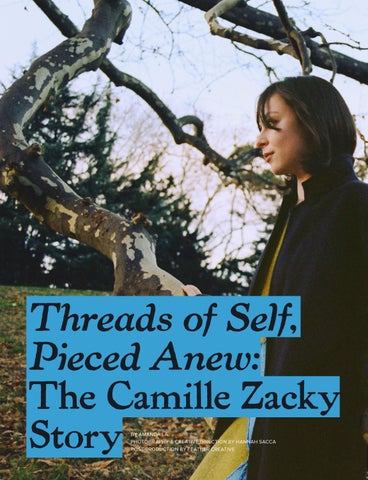
Threads of Self, Pieced Anew: The Camille Zacky Story BY AMANDA LA PHOTOGRAPHY & CREATIVE DIRECTION BY HANNAH SACCA POST-PRODUCTION BY FEATHER CREATIVE
local wolves • 85
CAMILLE ZACKY is sitting in her backyard, and with the lush greenery surrounding her, it isn’t hard to understand why she roots so much of her work in the natural world—it’s the perfect reflection of the quiet rhythms in life. Her work exists as a liminal meeting point between winter and spring, something she describes as “a frosty forest in the woods with deer and bunnies that are sprouting for the first time.” Her signature color scheme grew out of a fixation from her mother’s old printed photographs that were stored away for years. The softened tones from those images stuck with her. Particularly “the colors of film and how they were washed out. When they’re sun-stained they get a little pinkish as they fade. I really love that color story… I want things to feel like they’ve had a story.” When I look through her Instagram feed, this is certainly true as the muted hues often flow and blend seamlessly together. However, a particular red sweatshirt that makes semi-consistent appearances instantly comes to mind. A stark contrast amongst the softer tones. When I bring this up, she confesses that while she doesn’t really like optic colors in her work, “When it comes to nature, there’s a different story there. I’ll use a bright red because I feel like that’s a really symbolic color.” Zacky’s journey as an artist started long before her introduction to knitwear. When she entered the Rhode Island School of Design (RISD), she had envisioned herself becoming a painter because she liked to draw. But after a tour with the textile department and being introduced to all the looms and knitting machines, something changed within her. It was there that she started to feel “randomly passionate about it.” Even if this was the moment her focus changed, she didn’t have to give up painting entirely either. The school encouraged students to view textile as a form of fine art and would often push students to incorporate various mediums into their works as a way to think outside the box. It was also here that Zacky built her confidence through criticism. She learned that “you have to take criticism with a grain of salt. Reflect on it if you disagree. Reflect on why and then that “why” is what makes your work intentional. Because you made it for a reason and that’s still important.” Since graduating, her creative rhythm has adapted to fit the needs of her newfound corporate schedule. Looking back, she describes herself as being a fast worker who would immediately start working on developing a piece as soon as
86
an idea enters her mind. “Once I start, I won’t stop. It possesses me and I just need to get it out and see it in its physical form.” When the first prototype is completed, she’ll tweak it a bit before stepping back and taking a break away from it, letting the idea rest until she feels drawn to complete it. However, “it’s the exact opposite now. I have to be thinking about an idea for a really long time. If it gets old in my head, I feel like it wasn’t meant to be.” The shift has forced her to work slower and more methodically which she’s made peace with. To her, the change isn’t entirely bad, just different. “The ideas filter themselves out. When you’re working really quickly, it’s good to get things out— like painters who paint something every day. Now, it’s more purposeful. I think to myself — ‘Is it worth it?’ ‘Is it worth my time?’” The time constraint becomes more apparent after learning exactly how much time it takes to make a piece, much less the amount of orders Zacky receives. The production of her best-selling bunny sweater once consumed the entirety of her school breaks. She remembers the one-man operation: days spent locked inside her childhood bedroom, churning out pieces nonstop. She had the patterns memorized and was replicating it to the point that she essentially, in her own words, “became the machine.” This wreaked havoc on not only her mind, but her body as well — leaving her to deal with an aching back and cut up fingers. The entire experience was so suffocating, she dubbed it as a “hamster wheel nightmare” that drained her desire to create anything new.
And while she feels incredibly blessed that people still love the design to this day, having a corporate job leaves her with little time required to meet the demands. As a result, she started partnering with a small factory in Chelsea for the specific sweater design. She chose the factory carefully, rejecting the idea that factory-made clothing is inherently lesser. “They know how to make it… they do stuff like this every day. I wouldn't knock on that.” What was really important to Zacky was finding somewhere ethical that she could trust. She remains very involved in the creation process, knitting the first prototype herself before translating it into a spec sheet and even working alongside them when she finds the time. Through all the chaotic changes, her favorite part of the process remains steadfastly unchanged: photographing the final product herself. “I like to see the stuff I make out in its character, living.” Selling clothes is secondary to how the clothes will come to life through the person wearing it. This is why she often gravitates towards using her friends as models. “I feel like they’re my muses and to see my clothes on them is so fun.” Because she is just one person at the end of the day, every piece is deliberate, made with the hope that it will be a beloved and cherished piece in someone’s closet. “I don't want to make
88
something unless it speaks to me and my vision. I'm not trying to rewrite the book and make something crazy avant-garde. What I want is to make things that don't exist — [things] that feel a little special and one of a kind.” She tells the story of a specific commission that underscores this point completely. Someone had reached out to her because she wanted to wear Zacky’s swan sweater for their wedding. “I was honored because I'm a hopeless romantic. I'm inspired by all things magical, whimsical, and love. And what's more romantic than a swan themed wedding because swans mate for life?” This is why she resists the urge to follow the traditional fashion calendar, even when she feels pressure working in a corporate fashion setting that expects rapid output to match the seasonal cycles. “I don't want my things to become too commercial. I do this because I have an idea that I really want to make [real] and I want people to like it.” But not all ideas turn into viable products right away. “If I'm not feeling something, I can't look at it. I’m taking it off and throwing it in the corner. I'm not someone who will think of ways to fix it right away.” She doesn’t abandon it completely, instead, she moves it to a scrap pile that she can revisit months later to create something new with it. “You forget about how frustrated you were when you made it the first time, and then you're like, I'm so thankful I made this. It's just what I needed to rework into a new vision I have.” And where do these visions come from? Everything and nothing. Quite literally, Zacky gives an expansive list on her different sources of inspiration: from browsing Pinterest to watching old movies for the costumes. Her references range anywhere from the roaring 20s to the 70s, detailing how each era was impacted by the historical events that defined their times. There’s something in every decade. For her, this is important because she wants to create timeless pieces by “finding the balance between something from the past and adding a more modern twist to it.”
Her environment has also seeped into her work. Despite growing up in California, it’s the complete antithesis to her aesthetic preferences — “It’s so hot [there] you can’t even wear a sweater.” With the sweltering heat, constant sunshine and lines of palm trees, Los Angeles felt too artificial and manicured. The East Coast on the other hand offers a deeper and richer charm to Zacky. Rhode Island has “secret running paths, trails, and snow. When you wake up and it’s absolutely white out, I think that’s so beautiful.” Since relocating to New York, she hasn’t been designing anything, but she’s curious as to how her designs will change once she starts again. “Because New York is concrete — so dark, so gray. I’m hoping I can still keep the whimsy in my work. Let me stay magical, please.” But it might not be just the physical locations that are influencing her designs, but how she feels in those environments. In fact, Zacky’s life transitions can be carefully traced through her art. She acknowledges that “indirectly, your art is whatever emotion you're putting into your work. So I think if I look back, everything is pretty accurate and related to one another.” She brings up a nameless girl that cameos on her Instagram feed as proof: “If you look at my other drawings or prints, I always have this face that I can't help but to make. She encapsulates the Camille Z. aura, she’s the girl that I'm designing for. She's been with me ever since I started knitting. She’s this persona, like a forest nymph that speaks to the animals on the [sweater] chest. She’s matured as my art matured, so I do feel like she's grown up.” But just because you’re grown up doesn’t mean you’re finished. Just like that nameless girl, Zacky isn’t done evolving yet either. “I'm working on other projects. Not to sell, just to feel inspired again.” And as each thread weaves through to form the story she wants to tell, you can unravel it so that it becomes part of your story too.
local wolves • 89
PRYVT Blending Time and Space
BY UMA SNOW PHOTOGRAPHY & STYLING BY HARRY SUNG
Vancouver duo PRYVT’s newest album, BACK TO REALITY, beautifully blends different eras and genres of music to evoke intense
YOU GUYS MET IN SCHOOL, RIGHT? WHAT WAS IT THAT MADE YOU WANT TO COLLABORATE WITH EACH OTHER?
nostalgia. Although the band has only existed for a little over two years, PRYVT has been wildly successful. Hanuel (singer, songwriter, guitarist) and JT (producer, guitarist) have amassed over 600,000 monthly listeners on Spotify, sold out their recent album release shows, and have just announced a new solo tour.
HANUEL: We met in school, but we didn't really get a chance to work together because we were in two different classes. After we both graduated from our music school, I would reach out to Justin to be like, “Yo, you want to produce some stuff for me?” And that's how we got closer and closer. And then, after a while, I realized how efficient it was to work with JT and how, in a way, he very much understood what I wanted when it came to production and even just melodic things. I was working on my solo albums [then], but I was kind of getting drained by that. And so I started making more music to cater towards indie and rock. Naturally, I was already asking JT to help produce it. But then I think I realized it would be great if we did it together, as a band. JT: Yeah, that's pretty much the story.
BACK TO REALITY was crafted specifically with live performances in mind. Hanuel and JT wanted these songs to shine on stage. The range in genre—from indie to rock and ballad to R&B—only enhances the journey the album carves for its listener. The title track, “BACK TO REALITY,” mixes acoustic guitars and soft synths to express heartrending uncertainty and turbulence. The hard-hitting beats and guitar solo in “NEXT TO ME, AGAIN” were made for an audience to move to. “WON’T YOU” builds and crashes like a wave; it leaves me mesmerized with every listen and is sure to entrance any crowd at a PRYVT show. Right before the release of BACK TO REALITY, I had the opportunity to chat with Hanuel and JT about their music-making process, how they’re processing their success, their inspirations, and everything in between. FIRSTLY, CONGRATULATIONS ON YOUR NEW ALBUM. HOW DOES IT ALL FEEL? HANUEL: Exciting! Pretty exciting. It's a different sound from our first album and, the past year and a half, we've worked pretty hard to get this out. JT: Yeah, definitely excited. We've been working on this project for a year-ish now. Like, some of these songs are from the last album! So yeah, excited to get it out. DO YOU STILL FEEL NERVOUS ABOUT RELEASING NEW MUSIC? JT: [laughs] Yeah. HANUEL: Personally, I would say I get nervous, but over time it does get a little better. I guess I got used to it, kind of. Now, getting nervous is more a good thing, where I'm curious as to what people [will] think about the song.
I WAS WONDERING—HOW DO YOU DECIDE WHEN TO WRITE KOREAN LYRICS VERSUS ENGLISH LYRICS? I KNOW THAT HANUEL, YOU’RE KOREAN, BUT JT ISN’T. SO, HOW DO THE LYRICS COME TOGETHER? HANUEL: Most of the time, I write the songs. Here and there, JT will help me. But, mainly, I try to write in English because that is what I'm most comfortable with. But recently I just kind of wanted to challenge myself with Korean and see how I can express different emotions through [it], which is why I started using more Korean. But because of that a lot of people do think JT is also Korean. [laughs] I guess [I’m] just experimenting with new ways to write. THAT'S COOL. I’M CURIOUS ABOUT YOUR SONGWRITING PROCESS. COULD YOU USE YOUR TITLE TRACK, “BACK TO REALITY” AS AN EXAMPLE IN EXPLAINING HOW YOUR PROCESS USUALLY GOES? HANUEL: Yeah! “BACK TO REALITY” is probably one of the fastest tracks we've written together and produced. We had just come back from a trip and were with a couple of friends, just talking about music and whatnot. But then the idea came up about like… what it would feel like to not have someone there with us anymore. And then we came to my studio and just started playing guitar. JT started making a beat and producing it, I started toplining, and
local wolves • 91
then we had the first bit of the song. After we split ways, I think I spent the whole night writing the song—the verse, the hook, and everything. I think that definitely is one of the most memorable moments because it just flowed so naturally, from the start to the end. And then I sent it over to JT and he finished the production. So that's how “BACK TO REALITY” came about. JT: Yeah. We actually worked on it on that Slchld tour as well, a little bit. WITH THIS ALBUM, YOU FOCUSED A LOT ON HOW THE TRACKS WOULD SOUND LIVE WHILE YOU WERE WORKING ON THEM. WHAT ELEMENTS OF THE MUSIC WOULD YOU FOCUS ON WHEN TRYING TO GAUGE WHAT A SONG MIGHT SOUND LIKE LIVE? JT: I think, for me, you just try to imagine yourself in a venue. And it really comes down to the arrangement of the song. If it's really big and spacey, it would take you to that place, at least for me. HANUEL: Yeah, I agree with that. I think that was probably the main focus—how we wanted, specifically, the drums to sound, the guitars, the vocals. Overall, it did reach [a point] where I think it would sound pretty good in a venue. So yeah, I'm pretty happy about that. IS THERE A SONG THAT YOU'RE MOST EXCITED TO PLAY LIVE? JT: Ooh! HANUEL: I’ve got two personally. I think “NEXT TO ME, AGAIN” would be pretty fire live. Also, “BACK TO REALITY.” JT: Yeah, I’d say “BACK TO REALITY.” And “HOW WAS YOUR DAY?” too. HOW INVOLVED ARE YOU GUYS WITH YOUR MUSIC VIDEO PROCESS? HANUEL: As much as we [can] be. We have a really solid team this year. Thankfully they're all really talented people. I can say, maybe let’s try this, and then they try their best to execute it. And, so far, I've been very happy with all the visuals and how they came out. I think it represents the album pretty well. JT: The new team really sees the vision and executes it really well. HANUEL: Yeah. Very quickly too. HOW DO YOU VISUALIZE YOUR MUSIC? WHAT IS YOUR THOUGHT PROCESS FOR TRYING TO FIGURE OUT WHAT A SONG LOOKS LIKE, VISUALLY, TO YOU? HANUEL: [Usually] when I'm writing the song, it comes to me. And, for example, if I'm writing a song and I'm watching a movie or something, then I get inspiration from that. But it really depends on the song and where I gain inspiration. But I think it's similar to how we wanted these songs to sound good in live performances. Like, we would imagine them in, you know, venues. And then we made the songs. So I think [this process] is pretty similar to that. HOW WOULD YOU DESCRIBE YOUR VISUAL STYLE FOR THIS ERA? HANUEL: It’s very experimental, everything that we've been doing. Especially “NEXT TO ME, AGAIN,” because it is definitely the odd one out of all the visuals that we've had so far. But I think that's why I really like it the most, because it shows off a new side of [us].
92
JT: I’d say it’s that and also…grounded. To me, at least. Grounded as in, like, it's not too out there, if that makes sense. Like it's still like something you can relate to. SO, YOU GUYS HAVE ONLY BEEN A BAND FOR TWO YEARS, BUT YOU'VE ALSO BEEN SUPER SUCCESSFUL IN THOSE TWO YEARS. WHEN YOU LOOK AT YOUR STREAMING NUMBERS AND HOW FAST YOUR SHOWS ARE SELLING OUT, HOW DOES THAT MAKE YOU FEEL? HANUEL: Actually, when we announced our album release shows, we were kind of worried because we were like, “Yo, what if nobody shows up? What if we [ just] sell 10 tickets?” So we were honestly pretty shocked that they sold out, and that fast too. It still doesn’t make sense in my head, that we’re bigger than we think we are. We're really thankful for it and it's definitely something that we always dreamed of. But it is definitely something we're still getting used to because that was crazy. When we found out it sold out, we were like, there’s no way. At first we were thinking, what if it was glitching or there was something wrong with the site? But yeah, it's been very exciting too because every artist dreams of this moment. It's been very cool. JT: Yeah. It's motivating, too, that there's already this much demand for us. We really want to put on the best shows that we can. It’s thanks to the fans that we can do this…yeah. HANUEL: So crazy. HOW IS IT WHEN YOU MEET FANS IN PERSON? HANUEL: Because we are both very introverted, it is kind of awkward at times. But it [ just] doesn't seem real. Like, in a good way. It's so crazy to me that they know us and they know our music, which I really appreciate. It’s just—it's kind of hard to fully grasp [it], but it is very cool to talk to fans. Especially when they just come up to us randomly, like [when] we were in LA, I think. Was it LA or New York? I forgot where it was. They just came up to us. We started talking a little bit and they were saying how they're such big fans. That definitely sticks with us for a while because it's not every day you get that experience. WAS THAT JUST ON THE STREET? JT: It was, yeah, like in New York. We were just in SoHo or something. We were walking and then like these two people just came up to us and [said], “Hey, we saw you in New York last year!” We were like, what?! We were just minding our own business. It was evening, too. So it's kind of crazy that they spotted us from the crowd. WOW. YEAH, THAT IS CRAZY. I THINK THERE'S A LEVEL OF LISTENING TO AN ARTIST WHERE YOU KNOW THE MUSIC AND YOU LIKE THE MUSIC. AND THEN THERE'S A LEVEL WHERE YOU KNOW THE MUSIC AND YOU ALSO KNOW THE FACES OF THE PEOPLE WHO ARE MAKING IT. HANUEL: Yeah, it's so cool. I don't really know how to describe it, but it's definitely a really cool experience.
local wolves • 93
94
I IMAGINE YOU GET A SIMILAR SURREAL FEELING WHEN FANS ARE SINGING WORDS THAT YOU WROTE, BACK AT YOU FROM THE CROWD. HANUEL: Our first headlining tour, when we were performing, we had no album out. Like, we just had four or five songs out. We didn’t know what to expect. So, for me, I just kept my expectations low. But then, in all of the cities, they [sang] along with us. And I think that really got to me. There’s one video of me smiling really big on stage. It was a really cool moment because I wrote these songs in my bedroom. And to perform in front of people and, you know, to sing and they sing along with me…it is a dream come true. WHAT ARE YOUR FAVORITE AND LEAST FAVORITE PARTS OF TOURING? JT: Oh, man. The best part, honestly—besides performing and meeting the fans—it's waking up in a new city every day and just exploring. My least favorite would be, I think, sleeping. Because we were on a bus for both of those tours, which is great, but it’s almost like a coffin. And there's like 12 people in that same area with you. And on the road, it gets kind of bumpy sometimes, so you kind of get woken up by the bumps and, yeah, hit your head. But yeah, that's all my complaints. HANUEL: Yeah, I think it's pretty similar [for me]. Like, I think the best thing that I really liked about touring is meeting everybody. Like, you know, I think especially for Slchld and wave to earth, we met so many people within their teams and the crew. And I think because we got to learn so much off of that, that's something I really liked. And I think my least favorite thing is the bathroom situation. JT: Ohhh, yeah. HANUEL: [laughs] It's pretty hard, actually. It's like survival mode, you know? But even so, it's such a fun experience, something that you don't go through every day. So I'm not complaining about it, but if I had to choose, it would probably be that. I’D LOVE TO HEAR WHO YOUR CURRENT FAVORITE ARTISTS ARE. AND ALL-TIME FAVES, TOO. HANUEL: Right now, I've been listening to the new Daniel Caesar album. I think it's pretty good. And then a lot of indie rock and oldschool Korean ballads. I'm not too sure if you're familiar with any, but just the emotions that kind of show through [those] are very different from the ballads now. All-time favorite artist is kind of hard, but I guess I did fully start doing music because of Keshi, so I guess in a way I could say [him]. I did grow up seeing what he did. I was in high school and he inspired me to pursue music. JT: Oh man, I'm still looking. But at least right now what I'm listening to is Geese, the band Geese from New York. A lot of Oasis as well these days. And all-time favorite…man. Between Dijon or like Mk.gee, at least right now, off the top of my head. WHERE DO YOU FIND INSPIRATION OUTSIDE OF MUSIC? HANUEL: I don't know, it's really random for me. I get inspiration from anything. Like, if I'm talking to a friend, [inspiration could] hit me. And then especially when I'm reading or watching something. I watch a lot of movies and I like to dissect them little by little as
I’m watching. I used to walk a lot around my neighborhood and I [would get inspiration] from that, too. So yeah, anything. It just hits me. I could be bowling or working out or something. And it just comes through my head. JT: Yeah. Like, everyday life, really. But also, before I go to sleep, sometimes I'll think of an idea. Then I'm just like, oh man, I can't go to sleep now. Or [I think] I’ll remember in the morning and I just completely forget. If I have an idea before I go to sleep, I try to at least record it somehow. SINCE YOU MENTIONED THAT YOU LIKE WATCHING A LOT OF MOVIES. WHAT ARE YOUR FAVORITE MOVIES? HANUEL: I think collectively we've watched Cars so much. Our first tour, that's all we'd be watching. LIKE JUST AGAIN AND AGAIN? JT: [laughs] Yeah. HANUEL: And there's like different sequels, like there's Planes and stuff like that. But all-time—Cars is inspirational, it’s motivational. We actually [talked about] it on stage, too, when we opened for wave to earth. I think it was JT. But for my all-time fave, I think it'll be Cars and Shrek. JT: Yeah. HANUEL: [laughs] I don't think any movie can beat that for me when it comes to the storyline.
local wolves • 95
96
Sydney Rose
BY ALEXIS MARION PHOTOGRAPHY BY LILY STEVENS
Writes What Hurts local wolves • 97
Georgia-born and now based in Nashville, SYDNEY ROSE has become a voice for anyone who turns to music when their own words fall short. Her soft, vulnerable style shaped by influences like Phoebe Bridgers and Bon Iver has connected with a massive online audience, earning her billions of TikTok views and hundreds of millions of streams. She started posting songs from her bedroom as
WHEN YOU THINK BACK TO GROWING UP IN GEORGIA, WHAT DO YOU REMEMBER THE MOST ABOUT THE FIRST TIME THAT MUSIC REALLY CLICKED WITH YOU? I grew up constantly surrounded by music…I couldn't be in the car without it. I never thought that I could make my own music, so I'd never even tried. Then when Covid happened and no one was do-
a teenager, eventually signing her first record deal at 18 years old and later rebuilding her career independently before joining Mercury Records. Breakout tracks like “We Hug Now” showcase her ability to translate the quiet heartbreaks and shifting friendships of young adulthood into relatable songs that move listeners long after the song ends.
ing anything at all, that's when I started making music. It felt like I could try anything at all, so that's what I did and how I found out I could make music. I was 16 at the time and…being isolated was what made it all happen.
YOU’VE DESCRIBED MUSIC AS SOMETHING THAT SPEAKS FOR YOU WHEN WORDS CAN’T. WHEN DID YOU FIRST REALIZE SONGWRITING COULD DO THAT FOR YOU? Music has always been kind of like therapy for me…it started in middle school when I was so anxious and depressed. I would come home and all that would calm me down was to sit in my room and sing. It didn't matter if it was me making a song or [singing] covers, I would literally just sit in my room and sing to myself. It felt like I was releasing some tension in my body. Then when I started writing music, it was like a whole different thing. Wow, I can process my feelings through music and do what all of these other artists have done for me.. WERE INSTRUMENTS A PART OF THAT THERAPEUTIC PROCESS AT THE TIME OR WAS SINGING THE FOCUS? It was [also] playing instruments…it started in middle school and it was the day after Grace VanderWaal performed on America's Got Talent. The next day, I bought a ukulele and that was the beginning. I did a bit of piano lessons and learned the guitar by myself.
98
HOW DID YOUR UPBRINGING PLAY A ROLE IN INFLUENCING YOUR SONGWRITING AND YOUR STYLE? HOW DO YOU FEEL LIKE YOUR LOCATION OR ENVIRONMENT INFLUENCED YOUR WRITING? Growing up, I always felt like I was the odd one out. I knew that I liked things that most people didn't like. No one was really writing music and doing what I loved doing. So, I felt very isolated doing all of that. I think that wove itself into my songwriting because I wrote songs about how lonely I was and how different I felt from other people. I was so anxious [growing up] and I felt like the only way I could process all of that was to make music. WHAT DOES YOUR SONGWRITING PROCESS LOOK LIKE NOW IN COMPARISON TO WHEN YOU STARTED WRITING? When I started making music I was 16 and I definitely can see how much I've matured and grown with the way that I write music. When I was writing music for the first time, I wasn't as intentional as I am now…with trying different things melodically or structurally. I've definitely grown.
local wolves • 99
100
HOW HAS SHARING YOUR MUSIC ONLINE INFLUENCED YOUR MUSIC JOURNEY? It's weird being vulnerable to so many people online, but I think
doing anything with it and I remember sitting down at my piano and writing it. I remember crying because I was writing about a specific friendship that made me so upset. I didn't know that people would
because I started on TikTok during the pandemic, it was kind of me trying to find my sense of community, especially within music. I had never had friends who did music, so when I did TikTok and finally found friends that I could write music with— it made me feel like I have a purpose. I think I've always been trying to find a sense of community with people who write songs. When I wrote “We Hug Now,” I had never felt so bad in my entire life. I felt like I was insane, like I was truly the only person on the planet that was feeling that way, but that wasn't the case. Everyone was feeling the same way. So I'm taking that mentality with all of the music that I'm making right now... I just love not feeling crazy.
relate to it so much. It was the coolest thing to see and the fact that people are still singing it at my shows is just wild.
HOW DID THE DISCONNECT WITH PEOPLE DURING THE PANDEMIC GIVE YOU MORE COURAGE TO SHARE YOUR MUSIC? If the pandemic never happened, I wouldn't be doing this. I think it was just so much easier to… record a video by myself and put it on the internet, compared to me singing in front of like 100 people. YOU MENTIONED YOUR SONG, “WE HUG NOW.” WHAT WAS GOING THROUGH YOUR HEAD WHEN YOU SAW THE SONG START TO BLOW UP ONLINE? It was crazy and surreal. When I released that song, I just wanted to release it to have something for people to listen to so that I could work on another project. I had no intention of ever singing it or
YOU'VE TALKED ABOUT MISSING HOME IN SOME OF YOUR MUSIC. NOW THAT YOU’RE BASED OUT OF NASHVILLE, WHAT DOES HOME MEAN TO YOU AND HOW HAS MUSIC HELPED YOU FIGURE THAT OUT? I feel like home is definitely the people I surround myself with and the people who make me feel loved. When I was writing this EP, it took me a very long time to find my people. I was very homesick, but even when I was home before I moved to Nashville, I was so lonely. I didn't have a community of people I could share my music with or chill with. I didn't have college to find friends, so being here, surrounded by music and finding people I'm so content with, has been the best thing ever. It truly feels like a second home. WHAT ARE SOME UPCOMING GOALS YOU HAVE IN MUSIC? I'm trying to write music that I love. It was very scary when “We Hug Now” came out because I was like, ‘wow, I'm never gonna write a good song ever again.’ My goal is to fulfill myself instead of trying to have a viral moment again. I know what's going to make me happy is making music that I really love, so that's what I'm working toward.
local wolves • 101
BLENDED EYES
PHOTOGRAPHY & CREATIVE DIRECTION BY SRAVYA BALASA ONSITE ASSISTANT – YEJIN LIM | HAIR & MODEL – ADITI HARISH MAKEUP BY HANNAH LAUREN DEL ROSARIO | STYLING BY SRAVYA BALASA
102
local wolves • 105
106
108
local wolves • 109
Murmurs PHOTOGRAPHY BY EMILY MACHAN CREATIVE DIRECTION BY EMILY MACHAN & MICHAELA TONG MODEL – MICHAELA TONG
of
Morning
local wolves • 111
112
local wolves • 115
116
Alex Lam
she/her
editorial & branding photographer
Long Beach, CA
@alex_lammy
alexlammy.com
Taco Bell stacker hack (it’s only $4)
Anything with caffeine milk and sugar
Reruns of New Girl Been listening to Adam Grant books on Audible (if that counts) but 10/10 recommend such a wholesome approach to working hard The Life of a Showgirl by Taylor Swift a wittle garden gummy and getting to reconnect with my inner 9th grader 118
In bed.
In bed.
In bed.
BEHIND THE COVER
PHOTOGRAPHY BY MATT GLENN
local wolves • 119
I think it is okay to change,
and I will forever be changing.