P18:
TRI - C®
TIMES
SUPPORTING ENTREPRENEURS
DONE, WITH CLASS!
P12: JAZZ TO JOBS P22: ANIMATING HISTORY P26: THE STATE OF POETRY
A PUBLICATION OF CUYAHOGA COMMUNITY COLLEGE
SUMMER 2026
Keep
Moving Forward Your Next Chapter Starts Here As a parent, veteran and student, he’s building new opportunities for himself and his family. Tri-C provides flexible pathways, affordable tuition and the support to help you reach your goals and keep moving forward.
tri-c.edu | 216-987-6000
PRESIDENT’S Message TO OUR ALUMNI AND FRIENDS: At the end of every spring, we arrive at one of the most exciting days of the year: Spring Commencement. It’s a day of goals achieved, dreams realized and new beginnings. It’s a day when Cuyahoga Community College (Tri-C®) administrators, faculty and staff get to gaze with pride on each of our graduates as they walk across the stage in their teal caps and gowns to receive their diplomas and certificates, cheered on by their family and friends. We also have a Commencement in December, and we are as proud of those graduates as we are of our spring graduates. But the May Commencement also signals the end of the academic year. It’s a time to reflect on the progress we have made and the challenges we have overcome — and a time to look toward the future with great anticipation. In this Summer 2026 issue of Tri-C Times, I invite you to reflect and anticipate along with us. You’ll read about some of the inspiring graduates from our Spring 2026 class. They arrived at Tri-C from many different backgrounds, but all came here with the focus and determination to succeed. In addition: • Revisit the 47th Tri-C JazzFest Cleveland, presented by KeyBank. It’s more than a community event featuring performances by world-class musicians — it’s also a unique environment where students can develop outside the classroom. • Learn about the Center for Entrepreneurs at Corporate College®, turning ideas into real-world businesses that are expanding the regional economy. • Meet Edward Julian Sr., the first Black Ohioan to hold the title of poet laureate in Ohio. He is using his life’s story and gift of poetry to spread a message of hope and empowerment across the state. • Read about Associate Professor Matthew Phillips, who uses immersive learning techniques to help students see the humanity behind history. Tri-C’s impact on Northeast Ohio continues to spread far and wide, from our events and programs to our faculty and alumni. This year’s class will continue that legacy, becoming our new generation of business, industry and community leaders. I’m looking forward to what comes next, and I hope you are, too! With gratitude and respect,
Michael A. Baston, J.D., Ed.D. President, Cuyahoga Community College
In this issue of Tri-C Times, I invite you to reflect and anticipate along with us. You’ll read about some of the inspiring graduates from our Spring 2026 class.
SUMMER 2026
3
IN THIS ISSUE:
12
26 22
EDITOR
Jarrod Zickefoose ASSISTANT EDITOR
Erik Cassano
TABLE of CONTENTS
COPY EDITOR
President’s Message.......................... 3
Noelle Bye
Upfront.............................................. 5
WRITERS
Bright Futures Ahead.......................... 6
Noelle Bye Erik Cassano Anthony Moujaes Jarrod Zickefoose ART DIRECTOR
Debbie Benz
From Jazz to Jobs..............................12 One Idea Is All It Takes......................18 Faculty Profile: Matthew Phillips..........22 Alumni Profile: Edward A. Julian Sr......26 Donor Profile: Emily Drake..................30
DESIGNER
Frida Etchell PHOTOGRAPHERS
Noelle Bye Alundis Hayes Victoria Stanbridge
FOLLOW TRI-C Tri-C Times is published by Cuyahoga Community College’s Marketing and Communications department for its friends and constituents. Feedback and story ideas are welcome. Send correspondence to Tri-C Times, 2500 E. 22nd St., Cleveland, OH 44115; call 216-987-4322; or email editorial@tri-c.edu. 4
TRI-C TIMES
Upfront GUARDIANS TRAINING FACILITY OPENS AT THE WESTERN CAMPUS The Cleveland Guardians, Cuyahoga Community College (Tri-C®) and EL1 Sports, the Proud Youth Baseball and Softball Training Partner of Major League Baseball, have launched the first Guardians Training Center. The state-of-the-art training facility on the Tri-C Western Campus in Parma will offer team training, baseball and softball clinics, and individual and group lessons.
TRI-C AWARDED $410K FOR STATEWIDE CHOOSE OHIO FIRST PROGRAM Tri-C has been awarded $409,150 through Ohio’s Choose Ohio First (COF) program, a scholarship initiative aimed at strengthening the state’s workforce competitiveness in science, technology, engineering, mathematics, and medicine or health careers. Funding is awarded for four years from the 2027–2028 academic year through the 2031–2032 year.
SUMMER 2026 TRI-C LANDSCAPE PROGRAM CAPTURES NATIONAL CHAMPIONSHIP For the second time in four years, the College’s Plant Science and Landscape Technology team finished in first place among 54 competing institutions at the 2026 National Collegiate Landscape Competition, including many four-year colleges. Organized by the National Association of Landscape Professionals, the annual competition challenges students in 30 individual or group events to demonstrate their skills in landscape design, plant and tree care, irrigation and more.
NCLC 2026
SUMMER 2026
5
C L A S S of 2 0 2 6
The Bright
Futures Ahead TRI-C CELEBRATES THE INSPIRING ACHIEVEMENTS OF THE CLASS OF 2026 STORY BY Anthony Moujaes AND Jarrod Zickefoose
For more than six decades, Cuyahoga Community College (Tri-C®) has opened doors to opportunity. But Commencement is when those open doors lead to life-changing milestones.
In the pages ahead, meet a handful of the graduates whose journeys represent Tri-C’s promise to every student and every community.
The College celebrated the accomplishments of more than 1,500 graduates in May. Held twice a year, the ceremony is a landmark celebration that underscores Tri-C’s commitment to empowering individuals to transform their lives through accessible, innovative pathways to success.
“Their presence at Commencement is inspiring to their instructors, tutors, financial aid staff and all 3,200 employees at Tri-C,” Tri-C President Michael A. Baston, J.D., Ed.D., said. “It shows us that not only has their hard work paid off, but the work we do to support them and advance higher education in our region is also paying off.”
Behind every cap and gown is a story of resilience, ambition and community support. These graduates are our future healthcare leaders, innovators, creators and public servants, ready to strengthen the social and economic vitality of Northeast Ohio.
6
TRI-C TIMES
Joyce Tagne’s
Remarkable Journey
Joyce Tagne first came to Cleveland from Cameroon as an exchange student in 2019 and was struck by the city’s welcoming spirit. Returning in 2024, she decided to attend Cuyahoga Community College (Tri-C®). Her journey has been nothing short of remarkable. At Tri-C, Tagne balanced roles as Student Government secretary and president of Active Minds. She was a member of the Honors Program, Jack, Joseph and Morton Mandel Scholars, Democracy Fellows and the President’s Society. She was active in both the Phi Theta Kappa Honor Society and the Psi Beta National Honor Society in Psychology and consistently made the dean’s list. These experiences deepened her passion for leadership, service and creating meaningful change within her community. “Moving to the U.S. has shaped my resilience, adaptability and perspective,” she said. “I am passionate about student advocacy, mental health awareness and creating spaces where students feel seen and supported.” Tagne graduated summa cum laude with an Associate of Science from the School of Liberal Arts and Sciences. She will pursue a bachelor’s degree in biology and a minor in psychology at Cleveland State University, with the goal of becoming a psychiatrist.
What made you choose Tri-C? I chose Tri-C because of its affordable tuition, multiple campuses and strong reputation. Cleveland welcomed me when I was an exchange student at 15 years old.
“Moving to the U.S. has shaped my resilience, adaptability and perspective. I am passionate about student advocacy, mental health awareness and creating spaces where students feel seen and supported.” — Joyce Tagne
Describe your Tri-C experience. Has a specific person, class or event played a role in your success? I have been supported by mentors who have each contributed to my leadership journey in unique ways. Tri-C’s extensive resources, from tutoring and bus passes to the food pantry and emergency funds, have helped remove barriers to my success, and I am deeply grateful for that.
How has Tri-C changed your life? I came to Tri-C for my education, and I am leaving with a support system. Tri-C has supported me as a whole individual and helped me achieve my goals. It was here that I found my place, discovered my purpose and built lifelong connections. As the saying goes, “It takes a village,” and Tri-C has truly been my village. Now, I am ready to blossom.
SUMMER 2026
7
Josiah Hull
Finds His Opportunity After a decade behind the camera as a commercial photographer, Josiah Hull felt a pull toward something new. Instead of photographing landscapes, he wanted a career that aligned more closely with his passion for environmental stewardship and community impact. That led him to Cuyahoga Community College (Tri-C®) in 2024 and a bold career shift into plant science. At Tri-C, Hull found both direction and opportunity. The Plant Science and Landscape Technology program at the Eastern Campus gave him a strong science foundation along with hands-on field experience. “These skills have further reinforced my desire for a career that helps positively impact the environment and shape the community I call home,” Hull said. His time at the College reached a milestone when he represented Tri-C at the 2026 National Collegiate Landscape Competition in March. Tri-C placed first among 54 four-year and two-year institutions, and Hull placed second among 726 students. He won two of the five events he competed in and finished in the top 10 in three other events. “Competing and representing Tri-C at the national level was a life-changing experience,” Hull said. Hull earned an Associate of Applied Science from the School of Liberal Arts and Sciences. He plans to enter the workforce full time while pursuing a Master in Plant Health Management degree from The Ohio State University.
What made you choose Tri-C? The incredible reputation of the Tri-C Plant Science program and faculty made choosing Tri-C a no-brainer.
8
TRI-C TIMES
“These skills have further reinforced my desire for a career that helps positively impact the environment and shape the community I call home.” — Josiah Hull
Describe your Tri-C experience. Has a specific person, class or event played a role in your success? My experience at Tri-C has been even more incredible than I could have imagined. The mentorship of the entire Plant Science faculty has played a critical role in my success.
Do you have any pearls of wisdom to share with students considering a similar degree or certificate program? If you have an interest in a career within the green industry, I cannot recommend the Tri-C Plant Science program enough. Changing careers was incredibly daunting, but the skills and confidence I gained during my time at Tri-C have undoubtedly prepared me for an exciting career ahead.
Elizabeth Williams
Gains the Knowledge to Succeed
Elizabeth Williams’ path to graduation is rooted in service, resilience and a deep connection to Cleveland. A lifelong resident of the city, Williams came to Cuyahoga Community College (Tri-C®) to build a career that allows her to advocate for people in her community. As an online student in Tri-C’s Paralegal Studies program, Williams balanced coursework with family responsibilities, drawing motivation from personal and community experiences that shaped her professional goals. “I enjoy helping people who may not have resources or the knowledge to help themselves,” she said. “My career path will allow me to help people in my community.” At Tri-C, Williams found a welcoming environment and faculty who emphasized practical knowledge and real-world application. She graduated with an Associate of Applied Business in Paralegal Studies from the School of Business, Legal Professions and Hospitality.
What made you choose Tri-C?
“I enjoy helping people who may not have resources or the knowledge to help themselves. My career path will allow me to help people in my community.” — Elizabeth Williams
How has Tri-C changed your life? Tri-C gave me the knowledge to succeed in a meaningful career and the confidence that I can continue to provide for my children.
I chose Tri-C because I am a Clevelander, born and raised here, and wanted to support our community college.
Do you have any pearls of wisdom to share with students considering a similar degree or certificate program?
Describe your Tri-C experience. Has a specific person, class or event played a role in your success?
Pay attention to the hints, tips and tricks your professors share with you during instructional time. These are things they often have come across during their careers or educational journeys that have helped them in some way.
I had a great time at Tri-C and felt welcomed from day one. Assistant Professor Mardy Chaplin is an amazing teacher. He ensures you have a full understanding of the material. Assistant Professor Joseph Fell is also an amazing and thorough teacher, using real-life events and experiences to help us relate to the information being taught.
SUMMER 2026
9
Keely Souther Builds a Foundation to Succeed
Keely Souther’s lifelong appreciation for learning and creativity grew from being raised around college campuses by parents who are both college professors. That foundation helped her pursue her goals confidently and ambitiously at Cuyahoga Community College (Tri-C®) while still in high school. “I’m passionate about making a difference in the world around me, and the way I most want to do that is through what I create — whether it be the music I play, the art I make, or the stories I write,” she said. Souther began her Tri-C journey as a College Credit Plus student. In the fall of 2025, while taking in-person classes as a high school senior, she realized she could earn her associate degree if she attended Tri-C full time instead of staying at her high school. She graduated cum laude from Tri-C with an Associate of Arts from the School of Liberal Arts and Sciences. She plans to major in architecture at the Savannah College of Art and Design in Georgia.
What made you choose Tri-C? I enrolled in my first class, English 1010, the summer after my freshman year of high school. Tri-C gave me a much calmer environment to work and learn, and I felt much more at ease being here.
Describe your Tri-C experience. Has a specific person, class or event played a role in your success? One of my most influential online classes was Creative Writing with Dr. Bridget Kriner, where I was able to expand my writing skills beyond basic academic writing. I earned recognition for some of my pieces in the Scholastic Awards.
10
TRI-C TIMES
“I’m passionate about making a difference in the world around me, and the way I most want to do that is through what I create — whether it be the music I play, the art I make, or the stories I write.” — Keely Souther
How has Tri-C changed your life? Tri-C provided me with a strong foundation of academic and personal skills. It’s prepared me to move away from home to another state for a four-year college, where I already know I can succeed, because I had success here at Tri-C.
Do you have any pearls of wisdom to share with students considering a similar degree or certificate program? Send an email to your professor if you’re struggling to understand something. Ask for help when you need it before you feel overwhelmed. Most professors will accommodate you if you need help with something.
Ameer Eatmon
Discovers Inspiration and Direction
Ameer Eatmon was unsure what to do after high school, but at Cuyahoga Community College (Tri-C®), he found the support and direction he needed. Tri-C helped him discover strengths he didn’t realize he had. “What makes me unique is my love for learning,” Eatmon said. “I’m a huge Jeopardy fan, and my journey has taken me from being a shy individual to someone who is actively embracing and celebrating my true self. Embracing my identity as a gay male has fueled my passion for social work.” Eatmon earned an Associate of Arts from the School of Liberal Arts and Sciences in Spring 2026 and will begin pursuing a bachelor’s degree in social work at Ursuline College this fall.
What made you choose Tri-C?
“What makes me unique is my love for learning. I’m a huge Jeopardy fan, and my journey has taken me from being a shy individual to someone who is actively embracing and celebrating my true self. Embracing my identity as a gay male has fueled my passion for social work.”
I graduated high school with no clear vision of my next steps. But when my mom took me on a road trip to the Eastern Campus to fill out an application, it changed everything. I enrolled in the spring of 2024. My path wasn’t linear. I explored accounting and psychology before discovering my true calling in social work in Fall 2025.
How has Tri-C changed your life?
Describe your Tri-C experience. Has a specific person, class or event played a role in your success?
Tri-C challenged me to reach a potential I never knew I possessed. It helped me find my purpose and reassured me that my life has meaning that can contribute something great to the world.
First and foremost, my faith has kept me grounded during the times I wanted to give up. My mother and sister have been my primary motivators. My mom recognized my potential even when I didn’t, and my sister, a high-achieving 10th grader, inspired me to strive for greatness for myself. The Tri-C faculty and tutors were essential to my success.
— Ameer Eatmon
Do you have any pearls of wisdom to share with students considering a similar degree or certificate program? Embrace everything college has to offer. Make connections and never struggle in silence. The tutors and faculty are there to help you excel.
SUMMER 2026
11
FROM
JAZZ TO JOBS Alundis Hayes PHOTOGRAPHER 12
TRI-C TIMES
BEHIND THE SCENES, TRI-C JAZZFEST IS A LIFECHANGING EXPERIENCE FOR STUDENTS AND GRADUATES STORY BY Jarrod Zickefoose
Five minutes before showtime, Nina Lunde is making sure the microphones are all set. The William M. Weiss Foundation Next Gen Stage needs to be just so for the 47th annual Tri-C JazzFest Cleveland, presented by KeyBank. The scene looks like controlled chaos. Stagehands are bustling here and there, trying not to trip over thick lines of cable. It’s hot out, and the clock is ticking. A final check. The backline looks good. The chairs are in a perfectly straight line that matches the layout sheet. Someone checks the mics — “Testing, one, two, testing.” “We literally put everything together,” Lunde said. “You come for the performances, but you don’t realize how much work it takes to set it up.” Lunde is one of many Recording Arts and Technology (RAT) students at Cuyahoga Community College (Tri-C®) working as stagehands at this year’s JazzFest. As the artists begin their set, the students mill about, catching their breath. In about 45 minutes, they will tear down what they just set up and do it all again. For three days each year, Tri-C JazzFest takes over Playhouse Square and the intersection of Euclid Avenue and East 14th Street. Patrons see a giant party — a place to eat and drink, shop and celebrate one of America’s most loved musical idioms. But many Tri-C students have a different view. Behind the scenes, JazzFest is an opportunity to gain hands-on work experience, network with industry professionals and, in
some cases, land jobs. This Tri-C event is a hub where students rub shoulders with touring professionals while learning what music-industry work looks and feels like. And it goes beyond the music industry. Students in programs as farflung as graphic design, business, photography and culinary arts gain valuable experiences and insights through JazzFest. William Horschke is an adjunct in the RAT program and director of technical production at JazzFest. If you see someone working at the festival, there is a good chance that person is or was a Tri-C student. “When we include all the student stagehands and interns, from the RAT department specifically, we are probably around 15. When we include students who are studying other disciplines around the College, the number grows higher. When we include recent graduates and former Tri-C students, the number grows significantly, as many of our staff are working professional Tri-C graduates,” he said.
“We literally put everything together. You come for the performances, but you don’t realize how much work it takes to set it up.” — Nina Lunde
SUMMER 2026
13
“Often, at the end of the festival, the Local 27 people are so impressed with the students that they offer them employment, which is incredible.” — Mark Poritsky
Making the Scene
“We have a schedule. Everything is to time,” Poritsky said.
Marc “Marky Ray” Poritsky — aka the Rock and Roll Mercenary — has been teaching in the RAT program for 20 years as a member of the adjunct faculty. He holds his Concert Technical Production class at the Beachland Ballroom & Tavern, where the learning is hands-on and involves loading bands in and out, running sound, etc.
For the next two nights, the team tears down and sets up, tears down and sets up. They will sleep a bit and eat, occasionally. Then tear down and set up some more. After the last act on Saturday night, they will work into Sunday morning, doing the final teardown and packing up, like a film of Thursday running in reverse.
“This class has essentially staffed the entire Northeast Ohio music scene,” Poritsky said.
During all of this, there is a kind of job interview and networking going on.
Poritsky started working at JazzFest in 2015 and, today, he is in charge of outdoor-stage production. Each year, he has crew spots to fill.
“Playhouse Square is the purview of IATSE Local 27, so we work with their people,” Poritsky said. “We bring in our students and work together setting up the stages.
For some of the spots, he hires former Tri-C students who now work at local music venues like the Agora Theatre, Jacobs Pavilion or Brothers Lounge. He reserves other spots for current Tri-C students, who can test what they learned in the Beachland classroom while effectively apprenticing with alumni who have done the work before.
“Often, at the end of the festival, the Local 27 people are so impressed with the students that they offer them employment, which is incredible.”
“In that class, we give them a skill set that they can use at JazzFest, which is an intense three days,” Poritsky said. JazzFest is next level. Starting on a Thursday, the team sets up the outdoor portion of the festival. The crew unfurls and sets up two outdoor stages at Playhouse Square. They roll out cable. They set up the P.A. They install lighting and other equipment. They unpack and inventory rental gear from Woodsy’s Music in Kent.
14
TRI-C TIMES
Returning students who already work in the industry often bring current students to the attention of their co-workers and hiring managers. After exchanging contact information, those connections can lead to jobs at the Agora or Rock & Roll Hall of Fame or to placement on the work-call list for Jacobs Pavilion. As a RAT student, Aurora Wentz worked as an intern at JazzFest. She’s now part of the audiovisual team at the Rock Hall, and at JazzFest, she oversees sound and production at the William M. Weiss Foundation Next Gen Stage, allowing Poritsky to focus on the SeibertKeck Insurance Stage.
Getting the Picture Across Euclid Avenue, Alundis Hayes adjusts the camera equipment strapped to his shoulders. The College hired him as one of the photographers for JazzFest this year. Hayes first shot the festival as a photography student at Tri-C. He enrolled at the College in the fall of 2024. The following spring, he noticed that students in a graphic design course were making JazzFest posters. “I really wanted to photograph the festival,” Hayes said.
“JazzFest is a great introduction to what a music festival feels like, with the safeguard of being less punishing. It’s a real festival, and you’ve got the same responsibilities, but you also have support behind you.” — Dominic Alberto
As luck would have it, JazzFest organizers were looking to involve a student in festival photography. He was brought on to take pictures for the JazzFest Academy, a JazzFest-adjacent music performance program for kids 12 to 18. This year, the JazzFest team brought him back as a freelance photographer. “I also started getting more gigs, like concert photography. I do band pictures for the Bedford High School marching band,” Hayes said. Hayes finished his associate degree this spring. He currently works full time as a data tax specialist while side-gigging as a photographer with plans to pursue a bachelor’s in communications at Cleveland State University. Eventually, he’d like to use his photography skills in public relations.
Dominic Alberto first worked as a student intern at JazzFest in 2022, the same year he graduated from the College’s RAT program. Today, he is a freelance sound engineer and stagehand, working for music venues around Greater Cleveland like Jacobs Pavilion, the Agora Theatre and Globe Iron. He sometimes works audiovisual for corporate events, too. Sitting backstage at the festival, he said, “JazzFest is a great introduction to what a music festival feels like, with the safeguard of being less punishing. It’s a real festival, and you’ve got the same responsibilities, but you also have support behind you.”
JazzFest photography by Alundis Hayes
SUMMER 2026
15
Beyond Jazz JazzFest is, of course, more than just jazz. It includes a promenade of local vendors, family activities and more. This year, the festival even had a “rage room,” courtesy of the Yo! Crash Mobile Rage Room. Hayes will show you the sights of JazzFest, and Poritsky and his team will make sure the sound is on point. But there are appetizing smells, too. Food plays an important part at JazzFest, and the Tri-C Hospitality Management program is one of the cooks in that kitchen. This year, Tri-C President Michael A. Baston, J.D., Ed.D., even took a turn in the Tri-C Hospitality Management tent, dubbed the Jazz Kitchen. So did Peggy Cruz. She did her fourth JazzFest cooking demonstration this year. Cruz owns Cha’Firo Catering & Events, which she founded in 2016. A creative soul with an analytical mind, she started at Tri-C to study accounting. Along the way, she discovered that she was an entrepreneur at heart, and cooking was the way to give expression to her calling. “It was a light bulb moment. Cooking was what was in my heart. It was my passion,” Cruz said. She completed her culinary degree in 2018. While she didn’t cook at the festival as a student, her Tri-C connections combined with her unique vegan and vegetarian take on Cuban cuisine secured her cooking demo slots in the Hospitality tent post-graduation. She has since done similar demonstrations at Tri-C’s Eastern Campus and has gigs in the works for Baldwin Wallace University, Cleveland City Hall and the Cuyahoga County Public Library. “That all grew out of JazzFest,” Cruz said. As a result, she is making educational outreach a bigger part of the Cha’Firo business model. “I talk about the food, a little bit about the history,” she said. “I talk about where to source it. They get a recipe and a sample. I talk a little bit about myself and Tri-C.”
16
TRI-C TIMES
A Unique Opportunity While JazzFest offers opportunities for Tri-C students and graduates from many fields, the College’s RAT program is its beating heart. May Vianna, a native of Brazil, initially enrolled in the Jazz Studies program at Tri-C. Along the way, she switched to the RAT program. She got her first taste of JazzFest as a student in 2021. Vianna was working in the RAT studio when then-JazzFest Director Terri Pontremoli asked her if she wanted to be an artist host. Vianna said, “Of course.” “I didn’t really know what it meant, but I ended up being the point of contact for two big acts,” Vianna said. That fateful encounter opened Vianna’s eyes. Like many who want to make it in the music business, her dreams were filled with Grammys and sold-out stadiums, but the music and sound industry — especially in Northeast Ohio — is one of tremendous breadth, from the many clubs to the stagehand unions to international sound companies like Eighth Day Sound (headed by RAT alum Cory Osadciw). And that’s just music. There is also work in theater and television, artist management and more. “Working at JazzFest is when I realized that a band needs a tour manager, that a band needs a distributor, a PR person. That’s when I saw that there were so many areas in the music industry,” Vianna said. Around the same time, Vianna was offered an internship at the Rock Hall. Drawing on her can-do attitude and experiences at JazzFest, Vianna parlayed the internship into a part-time job there. After she finished the RAT program in 2022, the Rock Hall hired her as a full-time audio engineer.
“Working at JazzFest is when I realized that a band needs a tour manager, that a band needs a distributor, a PR person. That’s when I saw that there were so many areas in the music industry.” — May Vianna
Vianna, Hayes, Cruz, Wentz, Alberto — these are just a few of the many students whose experiences at JazzFest directly or indirectly informed their careers. Even among the many ways Tri-C shepherds its students through education to jobs, JazzFest is unique. It’s a three-day laboratory where students from across a spectrum of disciplines can measure their skills against the real world, gain insights into their fields, make life-changing contacts, and be exhausted when it’s all said and done. Like jazz itself, the beginning doesn’t always predict the end, but the joy is in the journey.
SUMMER 2026
17
ONE IDEA
IS ALL IT TAKES
STORY BY Jarrod Zickefoose PHOTOS BY Noelle Bye
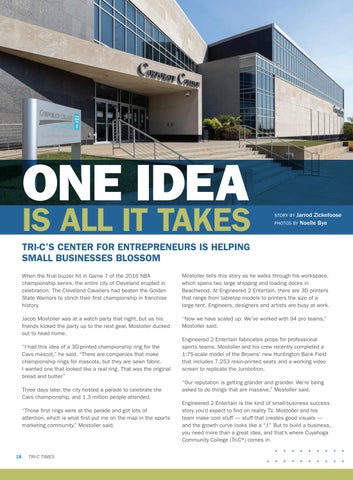
TRI-C’S CENTER FOR ENTREPRENEURS IS HELPING SMALL BUSINESSES BLOSSOM When the final buzzer hit in Game 7 of the 2016 NBA championship series, the entire city of Cleveland erupted in celebration. The Cleveland Cavaliers had beaten the Golden State Warriors to clinch their first championship in franchise history.
Mostoller tells this story as he walks through his workspace, which spans two large shipping and loading docks in Beachwood. At Engineered 2 Entertain, there are 3D printers that range from tabletop models to printers the size of a large tent. Engineers, designers and artists are busy at work.
Jacob Mostoller was at a watch party that night, but as his friends kicked the party up to the next gear, Mostoller ducked out to head home.
“Now we have scaled up. We’ve worked with 94 pro teams,” Mostoller said.
“I had this idea of a 3D-printed championship ring for the Cavs mascot,” he said. “There are companies that make championship rings for mascots, but they are sewn fabric. I wanted one that looked like a real ring. That was the original bread and butter.” Three days later, the city hosted a parade to celebrate the Cavs championship, and 1.3 million people attended. “Those first rings were at the parade and got lots of attention, which is what first put me on the map in the sports marketing community,” Mostoller said.
18
TRI-C TIMES
Engineered 2 Entertain fabricates props for professional sports teams. Mostoller and his crew recently completed a 1:75-scale model of the Browns’ new Huntington Bank Field that includes 7,253 resin-printed seats and a working video screen to replicate the Jumbotron. “Our reputation is getting grander and grander. We’re being asked to do things that are massive,” Mostoller said. Engineered 2 Entertain is the kind of small-business success story you’d expect to find on reality TV. Mostoller and his team make cool stuff — stuff that creates good visuals — and the growth curve looks like a “J.” But to build a business, you need more than a great idea, and that’s where Cuyahoga Community College (Tri-C®) comes in.
— Jacob Mostoller
The Bottom Line About three years ago, the College created the Center for Entrepreneurs at its Corporate College® division. “The goal was to help people in the community who had an idea about a business or who had started a side hustle that they wanted to see become a full-fledged business. That’s the bottom line,” said Ronna McNair, the Center’s executive director. “We’ve actually carved out a niche for ourselves in that we work with early-stage entrepreneurs,” McNair said. “For some entrepreneurial programs, you have to have $20,000 in annual revenue — or even more — to get started. We try to remove those barriers.” The Center plays a unique role within the College’s ecosystem. It’s a resource for Tri-C graduates as well as for entrepreneurs who have never taken a class. The doors are open to everyone, from the graduate of Tri-C’s Recording Arts and Technology program who wants to start her own studio to the baker who has noticed his fellow church members just love his cakes. They both get the institutional weight of the College’s brand and reputation behind them. The surface goal is simple: help entrepreneurs succeed — but when entrepreneurs can turn their ideas into action, a cascade happens. The economy and social fabric of Northeast Ohio bloom. A flourishing business generates revenue, jobs and, not least of all, a livelihood for the entrepreneur.
C HE M ARR A B RYAN T
H ARRY J O NE S
JAC O B M O S TO LLE R
“I had this idea of a 3D-printed championship ring for the Cavs mascot. There are companies that make championship rings for mascots, but they are sewn fabric. I wanted one that looked like a real ring. That was the original bread and butter.”
The Raw Ingredients Many parts go into the making of a successful entrepreneur. Some things can’t be taught: tenacity, passion, purpose and the kind of temperament that sees obstacles as opportunities. Then, there are the things that must be learned. Mostoller had a great idea and the requisite grit, but Engineered 2 Entertain was basically a phone number and an Instagram account before he took the Center’s Discovery Track, an entrepreneurship program for refining and launching business ideas. “A few projects fell in my lap, and I started to see that this could be the best way to provide for my family,” he said. In February 2025, he decided to put all his focus on the business. “I hadn’t fully thought out what owning and operating a business meant. The Discovery Track is perfect for getting that foundation built,” Mostoller said. The Discovery Track helps budding entrepreneurs identify how their idea solves a problem or meets a need, define and analyze a target market, define a business structure, file paperwork, manage money and establish a brand. “I had never thought about who our ‘core customer’ was. What is our value proposition?” Mostoller said. “As soon as I finished the courses, I was like, ‘This is what our website looks like, this is what our brand guidelines are, this is what our models are going to be, this is our identity.’” He also gained critical insights into structuring the financial side of the business. “To run a business, you have to have this thing that you are good at, but then you have to check off all of these other boxes,” he said. “I am a sports guy, and I make things, but there is this whole administrative side to running a business.”
SUMMER 2026
19
The Heart of the Matter Chemarra Bryant is CEO of Seaside Support Services for Professionals. Her business offers nature-centered wellness programs for leaders, professional helpers and pregnant and postpartum women. “I am a for-profit with a nonprofit heart,” Bryant said. Bryant founded her business in 2019, and a year later, Covid shut down the world. She regrouped and decided to lay a better groundwork before diving back in. Workshops and webinars, however, left her disheartened. “It wasn’t helping me build,” she said. “I felt discouraged. The Center for Entrepreneurs gave me hope.”
Right on Track The Discovery Track that Mostoller took is 32 hours of coursework over four weeks. It is a place to develop an idea, to turn a concept into a concrete plan and launch a business. The Center’s Foundation Track is a complement to and continuation of the Discovery Track. It’s 48 hours of coursework over six weeks that focuses on stabilizing and growing a business. A third track focuses on nonprofit management, mission development, legal compliance, strategic planning, fundraising, financial management, community engagement and impact measurement. Harry Jones III had worked for 20 years in security and law enforcement before successfully launching his own private security company, Jones Protective Services. The company had been up and running for six years with four full-time employees when he decided it was time to take it to the next level. A Google search led him to the Center for Entrepreneurs. “I felt like it would sharpen my skills as a business owner. There were some foundational things that I needed to learn, like accounting, marketing — things like that. It was an opportunity to build a stronger foundation for the business,” Jones said. Jones enrolled in the Foundation Track, and its impact was immediate. “I was able to create a more structured environment for the business,” he said. “I learned a lot of key things: marketing, being more out there on social media, promoting the business. They helped me see things totally differently, more as an entrepreneur.”
20
TRI-C TIMES
She completed both tracks and began taking clients in 2025.
A Class Act The Center’s classes are offered in the evenings and are taught in person by actual entrepreneurs. The instructors are not there to give pep talks. They teach the nuts and bolts that give a business the structure to succeed. In-person classes provide networking opportunities with instructors and fellow entrepreneurs. The program also includes online check-ins and workshops. Bryant described the course structure and material as “thoughtful.” “Cheryl Perez, an instructor for the Discovery Track, taught me about the ‘Idea Parking Lot,’” Bryant said. “I am flooded with ideas on a daily basis, which can be overwhelming, so it was a relief to know I could ‘park’ the ideas and retrieve them when needed. It freed me up to work on the foundation of my business and take actionable steps in the areas where attention was most needed.” “It’s such a natural environment,” Jones said. “Everybody feeds off each other. There are ideas put out there. We hear about real-life experiences from the instructors. Everybody shares their experiences, and it opens your eyes. “The program resets your thoughts on how to run a business, how to be an entrepreneur, and even though it’s very diverse, all of us have similar goals: to be the leader of a business and to make that business grow. We are all in that together.”
“It’s such a natural environment, everybody feeds off each other. There are ideas put out there. We hear about real-life experiences from the instructors. Everybody shares their experiences, and it opens your eyes.” — Harry Jones
A Different Breed
No Small Business
There’s more to the Center than just coursework.
At three years old, the Center for Entrepreneurs is still growing, and McNair envisions new programs that involve mentorship and long-term support for businesses.
“We find that entrepreneurs are a bit of a different breed,” McNair said. “If they come through our program, they’re excited. They have this idea and they want to bring it to fruition. We are there to help them.”
“The Center itself is run like a business. We are able to pivot, and we listen to our customers,” she said.
The Center helps connect entrepreneurs with funding through grants from local businesses and foundations that trust the Tri-C brand and want to give back to the community. Jones received a $2,000 grant from the Burton D. Morgan Foundation through the Center.
As the Center matures, its impact on the small business community will expand. It will be measured in facts and figures like annual revenues and the number of people employed by its alumni businesses. These are the whitepaper points about the Center for Entrepreneurs.
Bryant has secured two grants with assistance from the Center. With the most recent, she bought a Cricut, a smart cutting machine, for her business. Bryant said securing grants was about more than money, though.
But underneath all of that, there is something else taking place, something harder to quantify, something on the level of the individual. The Center for Entrepreneurs teaches people to believe in themselves.
“If you are a for-profit startup, it all boils down to loans, which I couldn’t do. I felt like there had to be another way. You spend all your time trying to find money. You lose the focus of why you’re doing what you’re doing,” she said.
Bryant, a woman of faith and a licensed counselor, was able to combine her years of working in end-of-life and prenatal care with a mission to help underserved communities through nature-based wellness programs. She combined those elements into a business that’s her own.
The Center’s Pitch Competition is its take on Shark Tank, where entrepreneurs compete for cash awards. Mostoller himself was a pitch winner and used the money to buy an industrial-sized 3D printer, which created new capacity for Engineered 2 Entertain. The Center hosts a speaker series that features successful entrepreneurs as guests. Speaking of Entrepreneurship is an award-winning podcast that’s a spinoff of the speaker series. The Center also launched its Podcast Studio and courses that allow entrepreneurs and community members to build their brands and audiences through podcasting. The Center for Entrepreneurs also has scholarships available. “We’ve been able to work with foundations and corporations locally that believe in what we are doing,” McNair said. That means most entrepreneurs can complete tracks at no cost when scholarships are available.
“The work I do allows me to be my authentic self.” Mostoller spent years trying to find his niche. He worked in marketing for the Lake County Captains. He worked at GNC. With his bachelor’s in engineering and two toddlers at home, he figured he’d eventually wind up at a 9-to-5 job at Boeing. He didn’t find any of these options particularly exciting. But when he talks about Engineered 2 Entertain, he is animated. As he talks about how “cool” this project was and the special touches he added to it, you can see on his face that he feels it. He can’t wait to see what the next job will be. “That February, I put in my two weeks’ notice,” Mostoller said. “I realized that I had my own full-time job.”
More than 350 entrepreneurs have gone through the program. The Center boasts a 90% course completion rate. Of its participants, 80% have been women, and 90% have been people of color. More than 1,000 entrepreneurs have participated in the Huntington Entrepreneur in Residence program or attended the speaker series and workshops. SUMMER 2026
21
TRI-C FACULTY PROFILE
Bringing
History
to Life
22
TRI-C TIMES
STORY AND PHOTOS BY Noelle Bye
TRI-C FACULTY PROFILE
ASSOCIATE PROFESSOR MATTHEW PHILLIPS USES IMMERSIVE LEARNING TO HELP STUDENTS SEE THE HUMANITY BEHIND HISTORY. Matthew Phillips, Ph.D., does not want students to simply sit with history — he wants them to walk through it. The associate professor of history at Cuyahoga Community College (Tri-C®) fills his classrooms with images and videos, turning the rooms into museum-style exhibitions where students move through at their own pace. As they go, they write observations and questions on whiteboards, building a shared record of what they notice and how the pieces connect. “The first impact I’m hoping for is immersion,” said Phillips, who teaches history and humanities courses at Tri-C and serves as the History Club advisor at the Metropolitan Campus. “Students receive ideas differently when they aren’t sitting in ‘student note-taking mode.’ There’s nothing wrong with traditional instruction, but this changes their relationship to the material.”
One of Phillips’ most immersive examples is what he calls “the cave.”
“Students receive ideas differently when they aren’t sitting in ‘student note-taking mode.’ There’s nothing wrong with traditional instruction, but this changes their relationship to the material.” — Matthew Phillips
SUMMER 2026
23
TRI-C FACULTY PROFILE
The Cave Using multiple screens, projections, movable whiteboards and dim lighting, Phillips and several colleagues transform Studio 101 in the Liberal Arts building into an immersive installation of cave art, symbols, shadows and questions. The goal is not to create an exact replica of a prehistoric cave. It is to help students explore and interpret the past differently. Students examine cave art from around the world, comparing symbols across continents and considering how early humans used images in communal gathering places to make sense of the world around them. They discuss cultural differences along with patterns and expressions that still feel familiar. “They realize people were trying to understand how the universe worked — for survival but also out of curiosity and wonder,” Phillips said. The cave has become a shared project among faculty. Melissa Clark, an archaeologist at Tri-C, has contributed 3D-printed artifacts, carvings and replicas of objects that might have existed in ancient environments. She also created a campfire installation using twigs and Christmas lights, giving students a place to gather, tell stories, paint rocks and create together. “The cave became something much bigger than a single class,” Phillips said. “It evolved into a Collegewide experience.” One of Phillips’ favorite discoveries came when Clark brought her then-5-year-old daughter into the cave. She stepped between a projector and the wall, casting shadows across the images and creating stories with them. “It immediately struck all of us — of course humans would have done this in caves thousands of years ago,” he said. His teaching also asks students to think about history on a different scale.
24
TRI-C TIMES
Human Connection Phillips often asks students to think of 60 years as a “human connection” — roughly the span between a student and an older relative, such as a grandparent. It takes about 100 human connections to reach the first cities, roughly 6,000 years ago. To reach cave art from 50,000 years ago takes about 833. “Picture one person talking to the next person, then the next,” Phillips said. “It’s only 833 steps.” Since 50,000 years often seems impossible to imagine, Phillips asks students to picture a typical crowd at a Cleveland Guardians game. If each of those 24,000 people represented one 60-year human connection, the line would stretch back well over 1 million years. In comparison, 833 human connections suddenly feels almost personal. The exercise helps students see that history is not as distant as it seems. It is a chain of human lives, close enough to imagine one person at a time.
TRI-C FACULTY PROFILE
Phillips carries the collaborative approach beyond his own classes. In April, he helped organize Everybody Has a Story, an event that brought together students, faculty, deans, staff, alumni and other members of the Metro Campus community. Participants were asked to bring an object, activity or creative work that told a story. The result was part exhibition, part gathering and part celebration. The room was arranged like a fair, with activities and displays throughout room 201 in the Alex B. Johnson Campus Center. The Cleveland Museum of Art brought masks from its collection, and music videos played throughout the event — songs that told stories in different ways. For Phillips, it showed that learning does not need to begin and end in a classroom. It can happen when people share their stories.
“I realized I couldn’t imagine spending 40 hours a week programming in a cubicle.” — Matthew Phillips
Being Present Phillips came to Tri-C in 2019 after years of teaching at Cleveland State University, Kent State University, Kent State University at Salem, Notre Dame College and Walsh University. Before history became his life’s work, however, Phillips thought he might spend his career in computer science. He started at Thiel College as a computer science major, but during his first year, a faculty advisor suggested he try an English or history course. Phillips took a history class and loved it. He added history as a minor, then eventually changed direction. “I realized I couldn’t imagine spending 40 hours a week programming in a cubicle,” he said. His interest in history deepened during his first semester as a history major, when another student walked into his 9 a.m. class and said planes had hit a building. It was Sept. 11, 2001. “That moment solidified everything for me,” Phillips said. He became interested in foreign relations and the historical forces behind major world events. That path led him to Kent State University, where he earned his master’s degree and, ultimately, his Ph.D. in History in 2011. Phillips describes part of his teaching as bringing his “wobble” into the classroom — the space between expertise and vulnerability. That does not mean making the class about the instructor, he said. It means being present enough to create an environment where students feel encouraged to question and make connections. Whether students are walking through a U.S. history exhibition, studying cave art by projector light, or bringing their own stories into a campus gathering, Phillips wants learning to feel human — and useful beyond the classroom. “While most students will not become history majors, I design my courses and other educational environments so that students develop transferable skills, a deeper understanding of the world they inhabit, and a greater sense of what they might strive for within it,” Phillips said.
SUMMER 2026
25
TRI-C ALUMNI PROFILE
THE POWER OF THE WRITTEN WORD OHIO POET LAUREATE AND TRI-C GRADUATE EDWARD JULIAN SR. USES HIS STORY OF INCARCERATION AND REDEMPTION TO HELP OTHERS LEARN, GROW AND HEAL STORY BY Erik Cassano PHOTOS BY Victoria Stanbridge
26
TRI-C TIMES
TRI-C ALUMNI PROFILE
Prison time is slow time. It’s lonely time. It’s angry time. Edward A. Julian Sr. knows this journey firsthand. Facing a possible life sentence in 1998, he accepted a plea agreement for 20 years on federal drug charges. He entered federal prison believing he would spend the next two decades behind bars. A sentence reduction trimmed his time to 14 years, but he still spent more than 5,000 days in prison — almost a decade and a half during which he felt abandoned, helpless and hopeless. “I remember my mom bringing my son, who was about 5 at the time, to visit me,” Julian said. “In the prison, there was a row of vending machines, and my son wanted a snack. But there was a yellow line on the floor in front of the machines that inmates couldn’t cross. I remember thinking that I couldn’t do something as simple as buy my son a bag of chips.” But even at this low point, a transformation was starting to take place. Prison wasn’t going to be the end of Julian’s story. In fact, it became a new beginning — one rooted in his gift for the written word. Julian turned to writing poetry. He embraced it to survive. He wrote so relentlessly that the finger gripping his pencil started to bleed. He wrapped it with toilet paper and tape and kept writing. “My poetry started in prison as a way to cope with the frustration, pain and anger I felt,” Julian said. “It started off as a way to release my emotions. But I soon realized the power I had to uplift and motivate through my words. And I wanted to use my words and my story to help others improve their lives.”
During his incarceration, Julian authored more than 300 poems and developed the Begin, Believe, Become Adult Life Skills Curriculum and the 12-Week Character Development and Youth Empowerment Curriculum. Since returning home in 2012, he has published two books, From Inmate to Advocate: A Journey of Transformation and Begin, Believe, Become: The 3-Step Process to Transformation and Achievement. His mission to change lives has drawn attention from state leadership. Earlier this year, Gov. Mike DeWine named Julian the Ohio poet laureate — the first Black person honored with the title. He now travels to schools, prisons and community events to teach others the principles that transformed his own life.
“My poetry started in prison as a way to cope with the frustration, pain and anger I felt. It started off as a way to release my emotions. But I soon realized the power I had to uplift and motivate through my words. And I wanted to use my words and my story to help others improve their lives.” — Edward A. Julian Sr.
SUMMER 2026
27
TRI-C ALUMNI PROFILE
Planting the Seeds Julian didn’t initially find his refuge on the pages of a poetry notebook — he found it on the basketball court. A promising young player, he was a star at Glenville High School before early legal troubles put his education and career on hold until 1992, when he enrolled at Cuyahoga Community College (Tri-C®).
“So many seeds were planted in my mind at that time, and I didn’t realize it then,” he said. “It was my mom who gave me a poem titled ‘Don’t Quit,’ and it gave me an initial interest in poetry. I’d keep coming back to that poem during the tough times in my life.”
At Tri-C, he played on the basketball team alongside future Basketball Hall of Famer Ben Wallace. He also studied for an Associate of Arts degree, which he earned in 1995.
When Julian came to Tri-C as a student, he ultimately decided to major in social work. He then planned to enroll at Cleveland State University to pursue a bachelor’s degree, but the streets lured him back to crime and, ultimately, to his prison sentence.
“My time at Tri-C was an eye-opener for me,” he said. “Even though I ran into trouble after I left Tri-C, I feel like the lessons I learned there helped me not to give up while I was in prison and helped give me direction after I was released.” Tri-C had been a part of Julian’s life since he was 13. As a teen, he would come to the Metro Campus with his mother, Marjorie Love, who worked on the campus cleaning staff for 33 years.
“I suffered an ankle injury, which ended my basketball career,” Julian said. “And unfortunately, I was still kind of living on both sides of the fence. I was pursuing an education but still selling drugs. I hadn’t left that life behind, and without basketball or anything else keeping me away, I fell all the way back into it.”
“My time at Tri-C was an eye-opener for me. Even though I ran into trouble after I left Tri-C, I feel like the lessons I learned there helped me not to give up while I was in prison and helped give me direction after I was released.” — Edward A. Julian Sr.
28
TRI-C TIMES
The Message When Julian was released from prison in 2012, he came back to his old neighborhood on Cleveland’s east side. He saw the decay and poverty wrought by drugs and crime. It was a world he was once a part of, but now, with the perspective of someone who had served years in prison, he saw a neighborhood in need of change. And he knew he had the ability to help make it happen.
“So many people in prison or coming out of prison have limited life skills,” he said. “We teach math and English in school, but we don’t teach enough of things like finance and proper money management.”
A year after his release, he founded the Begin Within Initiative and began using his poetry to spread a message of hope. It’s a message that has gained momentum in the 14 years since his release, taking him around Ohio to prisons, churches and community organizations.
“One in 11 people in Ohio has been convicted of a felony,” he said. “And having that on your record can hold you back from jobs, financial aid, college admission, even renting an apartment. That’s a major hurdle we have to help people clear.”
“The three words I live by are ‘begin, believe, become,’” Julian said. “It’s something I talk about in all my public appearances. Think about your future and plan for it. Find positive creative outlets like writing, drawing, music and meditation. Pursue an education. Talk to others, but be careful who you allow into your life.”
Julian, who now lives in Columbus, dreams of a day when he can come back to his old neighborhood in Cleveland and see prosperity where there was once poverty and pain.
But Julian doesn’t just want to prevent people from descending into a life of crime — he wants to help those who have already walked that path, as he has. Recently, he set up a second organization, Beyond the Label Community Services, to assist those who already have felonies and prison time on their record.
Julian is also working with the state government to raise awareness about pardons and record expungement.
“I turned my life around because I had people who believed in me and showed me a new way,” he said. “I want to do that for others. We’ve made great progress in recent years, but I’m looking forward to the work we have yet to do.” For more information, visit edwardajuliansr.com
Edward A. Julian Sr. will return to Tri-C on Sept. 17 to share his poetry and talk about his experience. The event is free. Register at tri-c.edu/poetjulian.
SUMMER 2026
29
TRI-C CHANGE MAKERS
A LASTING LEGACY TRI-C FOUNDATION BOARD MEMBER EMILY DRAKE CHAMPIONED THE GUARDIANS FOR THE FUTURE INITIATIVE, A LEGACY SOCIETY HONORING INDIVIDUALS WHO SAFEGUARD ACCESS TO EDUCATION AND OPPORTUNITY BY INCLUDING TRI-C IN THEIR LONG-TERM OR ESTATE PLANS. SHE IS A GUARDIAN HERSELF.
I got involved with the Cuyahoga Community College (Tri-C®) Foundation board because two people I deeply respected approached me and said I should join. When people you hold in such high regard ask you to be part of something they believe in, it’s hard to say no. I was honored that they thought I could contribute, and once I became involved, I quickly understood why they were so passionate about the Foundation and its impact on the community. The Foundation helps remove obstacles that might otherwise keep someone from pursuing an education. Whether through scholarships, new programs or other resources, the Foundation helps students focus on reaching their goals instead of worrying about how they’ll get there. It’s also about shaping our community and showing people how access to education can transform lives. That’s an investment that benefits not only the students but also our entire community.
30
TRI-C TIMES
I’ve always believed that if you’re fortunate enough to be able to give back, you should. A legacy gift was a way for me to support something I care deeply about while helping future generations. To me, Guardians for the Future is about investing in our community’s future. Cleveland’s philanthropic community is what it is today because generations before us chose to include charitable giving in their estate plans. Tri-C welcomes everyone and recognizes that there isn’t just one path to success. Whether someone is just starting out, changing careers or returning to school later in life, the College gives them the chance to move forward. I feel blessed to play a role in that. Learn more at tri-c.edu/foundation.
NOW OPEN ONLINE
Tri-C Spirit Shop Show your Tri-C spirit in style with the all-new Tri-C Spirit Shop, the College’s official online apparel and accessories store.
www.tri-c.edu/spiritshop Whether you’re looking for trendy apparel, accessories or gear, our shop has something for everyone. Browse by category to easily find what you need, or shop by your favorite national brands for high‑quality, recognizable products. From hoodies and hats to mugs and more, you’ll find the perfect swag to represent Tri‑C with pride! SUMMER 2026
31
700 Carnegie Ave. Cleveland, Ohio 44115
SAVE THE DATE
Cuyahoga Community College Foundation 2026 PRESIDENTIAL SCHOLARSHIP LUNCHEON Presented by
A Conversation With
AL ROKER TUESDAY, NOVEMBER 10, 2026 11:30 A.M.
AL ROKER Weatherman and Host of NBC’s Today Show, Bestselling Author and Multimedia Entrepreneur
NEW LOCATION THE ATRIUM BALLROOM HUNTINGTON CONVENTION CENTER OF CLEVELAND
Benefiting Student Scholarships and Success at Tri-C® Call 216-987-4868 or email foundation@tri-c.edu for more information.
26-0311
F E AT U R I N G
26-0438