ISSUE NO. 5 SUMMER 2026
RESEARCH & SCHOLARSHIP MAGAZINE
BRINGING THE WORLD INTO THE CLASSROOM through children’s books PAGE 14
03
14
08
18
Research with shared conviction creates life-changing impact Research at Lipscomb has always been about more than discovery for its own sake. It’s about asking questions that matter and pursuing answers that serve our neighbors, near and far. This edition of Discovery captures a university in motion. Across every college, our faculty and students are engaged in scholarship that reaches well beyond our campus, shaping classrooms, clinics, courtrooms and communities around the world. One of the most significant developments in higher education today is the rapid emergence of artificial intelligence (AI), and Lipscomb is approaching this moment with both enthusiasm and great thoughtfulness. In addition to new certificates and degrees, innovative classroom projects and simulations and faculty research into AI use in education,
our faculty are also exploring best practices, ethical considerations and the boundaries of this powerful technology (page 3). This isn’t adoption for adoption’s sake; rather, we’re focused on integration guided by our core values. You’ll find stories of impact at every turn. A social work student’s capstone project is now being implemented in the Davidson County District Attorney’s office (page 21). Our graduate programs continue to expand, including new partnerships with international universities and organizations to fuel greater archaeological findings (page 44). In these pages, we also celebrate the continued growth of programs that nurture student scholars (the J.S. Ward Society, the John Parker Humanities Society and the the nation’s Fulbright program) as well as an undergraduate research culture that has produced more than 30
20 students eligible for academic authorship in biology alone, alongside student publications in philosophy, poetry, faith, robotics and political science (page 8). We also honor the College for Bible & Ministry’s Ellis Lectures and its role in advancing historical scholarship on the Churches of Christ, as reflected in the books this lecture series continues to generate (page 34). What connects all of this work is a shared conviction: that scholarship should be about discoveries that make the world a better place and that serve our neighbors. I am grateful for the faculty, students and partners who bring this vision to life every day. Thank you for celebrating their work with us.
Dr. Jennifer Shewmaker Provost
24
30
42
XX 44
46
On the Cover: The vast array of children’s books available at the Global Voices conference, where this year undergraduate students played a key role in advising local teachers on the best books for their classroom libraries.
Vice President of Marketing & Communications Kim Chaudoin Senior Managing Editor Janel Shoun-Smith Writers Kim Chaudoin Janel Shoun-Smith Photography Kristi Jones Design Emily Kinney
Produced by the Office of Public Relations & Communications. Lipscomb Now: Discovery is published by Lipscomb University®. Go to lipscomb.edu/research to read more. Postmaster: Send changes of address to Lipscomb Now: Discovery Lipscomb University One University Park Drive Nashville, Tennessee 37204-3951 ©2026 Lipscomb University. All Rights Reserved.
Degree abbreviations follow standard academic abbreviations except for: (LA), alumni of Lipscomb Academy, and (A), non-degreed alumni or those whose degree is unknown.
RESEARCH & SCHOLARSHIP MAGAZINE
ISSUE NO. 5
Contents 3
Coding the future in AI
STUDENTS 8
Undergraduate students earn rare distinction as published authors
14 Bringing the world into the classroom 20 Student’s exhibit celebrates books
28 Faculty share expertise through the written word 30 Historian turns his pen to Tennessee football legend Robert Neyland 34 Bible dean shines a light on the search for identity within the Church of Christ fellowship
GRADUATE PROGRAMS
21 Social work student makes impact at
38 Doctoral students pipe insight into schools
Nashville district attorney office
42 An ancient mystery brought to light by Lanier
FACULTY 24 Biology professor puts students first in faith walk and scientific pursuit
archaeologist 45 Tennessee’s first anesthesiology assistants will study at Lipscomb 46 Changing the face of future healthcare
from the PRESIDENT
More than 350 students from all nine of Lipscomb’s colleges participated in the April 2026 Student Scholars Symposium.
As the world changes, Lipscomb is there bringing opportunities to harness change for good If there is one constant in our world today, it is change. Technological changes, demographic changes, industry changes. Changes fueled by new knowledge, new policies and new insight. Some fight change, hoping for consistency; others constantly fight to bring about change, believing it to be for the good. We at Lipscomb, like all of us, are facing the headwinds of change, but knowing we have God and our Christ-centered core values as an anchor, we are able to not simply reject or embrace change but to navigate it, constantly pivoting and adapting, but with confidence in our purpose. When it comes to research, that approach means addressing the industry and societal trends of today, looking ahead to a future expected to be vastly changed by technology, going deep into our history to glean new insights and preparing a new generation to not just adapt to change but to become the changemakers themselves.
2
:
When changes to state law earlier this year allowed anesthesiology assistants to be certified to practice in Tennessee, Lipscomb College of Pharmacy was there to fill the need, becoming the first in the state to establish a master’s degree to train Certified Anesthesiologist Assistants to populate the state’s operating rooms that currently stand empty due to a shortage in the field (page 45). When artificial intelligence (AI) burst onto the scene and began re-writing how we collect knowledge, how we create and how we do our jobs, Lipscomb was there to take on new ways of doing things while also asking the hard questions and developing a strategic response to this massive change. Lipscomb’s approach has resulted in a campus culture of AI use far ahead of other universities but still thoughtful and focused on ethical use of this world-changing technology (page 3). As the world becomes more interconnected, Lipscomb is there to train teachers on best practices to bring global
voices into the classroom and prepare the next generation for their worldwide culture (page 14), and students in Lipscomb’s Doctorate of Education program are not just learning how to enact strategic change, but are carrying it out through dissertation projects that positively impact school districts and students throughout the state (page 38). Our church fellowship is also not immune, with today’s faith organizations facing demographic and societal changes and opportunities unlike ever before. Still, Lipscomb is there, bringing insights gained from how spiritual leaders of the past both triumphed and struggled through conflicts and growth (page 34). As a community engaged with the life and teachings of Jesus and committed to an ongoing search for truth, Lipscomb is able to face change with a nimbleness and confidence that others do not possess. That shows in the discoveries we share with the world around us. And those discoveries provide students with opportunities. Opportunities to see their words published in academic journals; opportunities to travel to other continents to fulfill their research goals; opportunities to experiment with the building blocks of life in laboratories; opportunities to impact the community around them. When the students of today take advantage of those opportunities to become the scholars, leaders and health care practitioners of the future, that’s how Lipscomb is not just surviving change, but crafting positive change for the next generation. Best,
Dr. Candice McQueen (BS ’96) President, Lipscomb University
Coding the future in AI Less than four years into the AI revolution, Lipscomb is ahead of the pack in researching, teaching with and educating about artificial intelligence. November 30, 2022, is certainly a day that will go down in history. That’s the day that OpenAI released ChatGPT to the public, and within two months the platform had 100 million users. It’s not a stretch to predict that in future historical texts, our world may be categorized as “before AI” and “after AI.” Artificial intelligence (AI) is already changing the way we live, work and learn. Students entering college today are already graduating into a world where AI is integrated into nearly every profession. At Lipscomb, that’s not a problem. We believe it’s time for education to lead, not lag, in preparing students to thrive in this new reality. So it’s no surprise that this past school year saw classrooms filled with faculty using AI platforms to boost student engagement and understanding as well as faculty and students conducting their own research on how to use AI to educate even better.
Faculty shared AI knowledge in specific industries both informally in hallways and formally in coordinated speaking opportunities. New computing equipment keeps data analyst students on the cutting edge, and a new applied AI degree launched its first graduates into the marketplace. From almost the beginning of this societal sea change, Lipscomb has embraced its responsibility to both help students understand the innovative tools shaping our world and instill in them the wisdom to use these tools ethically and to lead with skill and conviction. More than two years ago, the university formed an AI Committee to develop a responsible integration strategy and appointed an AI Faculty Fellow. That group now serves as an advisory body guiding policy development, training initiatives and academic integration. In 2024, a group of on-campus “super users” piloted use of AI tools on campus, and the university’s first AI academic program—
the Master of Science in Applied Artificial Intelligence in the Raymond B. Jones College of Engineering—launched its first cohort that fall. In summer 2025 the university released its official AI usage policy and gave every student, faculty and staff member access to enterpriselevel AI tools through a partnership with BoodleBox, a web platform providing secure, unlimited access to top AI tools like ChatGPT, Claude, Gemini and Perplexity. The year 2026 is shaping up to be no different with the first cohort of the AI master’s degree graduating in May, the College of Health and Human Sciences holding its own speaker series for faculty on how AI is used in healthcare and a 12-hour undergraduate certificate in applied AI to be offered as of this fall to any interested students in any discipline. The undergraduate certificate includes four courses: Introduction to Applied AI, Modern Tools in Artificial Intelligence, Ethics and
LIPSCOMB.EDU/NOW
3
AWARD-WINNING INNOVATION: In College of Education Assistant Dean Dr. Lance Forman’s educational leadership graduate courses, students watch a Lipscomb-produced film (pictured here) depicting an ethical dilemma in schools, read supplementary documents related to the case and converse directly with the film characters by using AI-powered bots. Incorporating these bots and other AI platforms into the online courses has produced such positive results—rapidly growing enrollment, greater student satisfaction, deeper learning and a national AACTE Best Practice Award for the Innovative Use of Technology—that the College of Education is including similar usage of AI in four other online asynchronous academic programs this fall.
Responsible Use of AI, and AI Studio, where
and sustain excellence in teaching, has been
strategy to solve society’s problems.
AI for at least two years.
students will use AI platforms as a solution
nurturing various faculty projects in regards to Various faculty endeavors to use or
ACADEMIC INNOVATION On the academic side, faculty’s understanding
and engagement is critical to helping students
not just thrive in an AI world but to help shape
it. Therefore, Lipscomb’s Center for Teaching
and Learning (CTL), which works to promote
research AI for teaching have sparked from the CTL’s AI Community of Practice, a time of collaborative brainstorming and
cross-germination of ideas led by Lipscomb’s
2025-26 AI Faculty Fellow Sarah Gibson; and its Scholarship of Teaching and
Learning training series, a five-session series intended to help faculty create a laboratory of effective teaching within their daily classes. These projects have included an AI study coach that uses the Socratic method to challenge students beyond surface-level description, an AI bot to guide students through the critical analysis of primary research papers, an AI navigator to discuss ethical dilemmas in case studies and a bot designed to help students collaborate and critique each other in the classroom. The CTL began informational, baseline programming for faculty on AI two years ago and has already moved on to including the use of AI as a given throughout its effective pedagogy programming in the 2025-26 year, said Dr. Adam Wilson, director of the CTL. Lipscomb’s placement on the cutting edge of infusing AI into higher education has become clear to Wilson this past year as he served as one of Lipscomb’s participants in the American Association of Colleges and Universities’ (AACU) 2026 Institute on AI, Pedagogy and the Curriculum, a seven-month, team-based program that helps institutions respond to the opportunities and challenges of AI. “We are required to submit a project for the program, and since we have so many faculty already implementing AI in their classrooms, our project is actually looking 10 years into the future. In 10 years, when we have AI-native students, what are the human skills that we—as an institution
“THOSE ARE THE KINDS OF THINGS I FIND REALLY FORWARD-THINKING ABOUT WHAT WE’RE DOING AT LIPSCOMB. WHILE A LOT OF INSTITUTIONS ARE REACTIVELY TRYING TO FIGURE OUT HOW TO TEACH AI LITERACY TO THEIR STUDENTS, WE’RE PROACTIVELY ASKING: HOW WILL AI PRESSURE OUR STUDENTS TO CHANGE, AND HOW CAN WE INSTILL IN THEM THE VALUE OF HUMANITY WITHIN THIS NEW PARADIGM?” —DR. ADAM WILSON, DIRECTOR OF CTL 4
:
MAKING IT PERSONAL: In Adjunct Instructor Windy Frank’s Bible course, Story of Israel, students are able to spend time personally talking with AI versions of the Old Testament Bible characters they could previously only see on the page. The conversational bots created by the students help them understand the real-world emotions of the characters and the high stakes of the situations we can only read about today, said Frank (far right), who got the idea at the Center for Teaching and Learning’s AI Community of Practice gatherings (pictured here). The students had to both gather the research about their character and then know that research well enough to test the bot to see if it was answering questions as the Bible character would.
and in society at large—want to make sure we protect?” said Wilson. Based on surveys of the faculty, Lipscomb’s AI Institute cohort is determining the six key, critical skills and plans to highlight them at the fall 2026 all-faculty meeting to kick off the school year, said Wilson. A project carried out by three Doctor of Education students in 2024-25 came up with much the same conclusions. Dr. Kendra Bush (EdD ’25), Justin Uppinghouse (EdD ’25) and Amy Baltimore (EdD ’25) conducted surveys and qualitative interviews of students and faculty at a small northern private university, and found high levels of anxiety, lack of communication and inconsistent classroom policies around using AI on campus. Those results were far from what the students said they experienced at Lipscomb
throughout the course of their two-and-half-year doctoral program. “It didn’t start that way,” said Uppinghouse. “But even while we were doing this AI research on another school, it was really refreshing to see our professors in the doctorate program growing in that way.” “Not just growing, but getting excited about it and building out their own bots,” said Baltimore. “It was the coolest thing to watch them just leap through the AI literacy pyramid. I, for one, definitely appreciate Lipscomb’s approach.”
CODING THE NEXT GENERATION OF AI MANAGERS Lipscomb is also taking a different approach when it comes to preparing students to enter the field of AI. Instead of starting with training typical of those majoring in computer science, Lipscomb’s School of Computing began with
a master’s program designed to allow any professional from any career field to learn how to become an AI guru within their profession, no matter the industry. The first four cohorts since the master’s was established include students working in robotics, information technology, marketing, education and higher education, art, social work, business, software design, engineering and graphic design. Many of the eight members of the May 2026 graduating cohort were elevated or took on new roles in their company based on their new AI expertise, said Dr. Steve Nordstrom, associate dean of the School of Computing. The May 2026 graduates, for their capstone projects, created exciting AI-driven programs such as an assistant for physical therapists that analyzes the patient’s poses and
VERIFYING AI CONSISTENCY: Dr. Jeffrey Adams (pictured here), director of Lipscomb’s Health Sciences Simulation Lab (who literally wrote the book on AI in health simulation: Engaging Minds: Rethinking Student Assignments in the Age of AI), also enacted a research project this spring semester focused on verifying if AI platforms provide consistent results when used to grade health sciences students’ work in documenting patient care. The investigators are testing to see if AI can take the notes from students working through a health care simulation provided by different faculty and grade them all the same way, providing a faster and consistent grading method.
LIPSCOMB.EDU/NOW
5
FUTURE HORIZONS IN HEALTHCARE: The health science faculty who developed the Applied Artificial Intelligence in Health Care course for Lipscomb’s applied AI master’s degree, gathered to share their expertise with health science faculty this past school year in the Healthcare Horizons Speaker Series. Jenna Sissom (LA ’03) (pictured below), assistant professor in the School of Nursing, discussed how AI can be used to aggregate and synthesize data from patient charts into comprehensive summaries, reducing the time nurses spend on documentation and data review.
TESTING THE AI TEACHER: Kinesiology Assistant Professor Dr. Zach Droll (pictured here, above center) is guiding his strength and conditioning students through coding an AI platform to provide tests using a teaching principle called varied repetition. The AI system randomly presents test questions from curriculum units covered earlier in the semester, creating spaced and randomized retrieval across the semester. Students track their usage of the system, and that data is anonymously compared with course performance. Each student serves as their own control by completing the first half of the semester without the AI system, allowing the students to evaluate whether AI-supported spaced retrieval improves learning outcomes.
movement through a video feed as well as a bot to give an oral exam in chemistry classes, conversing with students through the Socratic method to boost critical thinking and ethical reasoning. Projects in other cohorts include using AI to create an automatic sports voice-over (called AI Michaels, after famed sports announcer Al Michaels) for sporting events and a framework to help administrators of national points of interest to build AI tour guides. This coming fall, the applied AI program will have a new director, Gilberto Diaz (BS ’17, MS ’19), who has spent many years in industry using the technology and software development skills he initially built while he was a student here at Lipscomb. In addition, a new Bachelor of Science in artificial intelligence, now addressing the need for a new wave of computer scientists to build more advanced AI for the future, has been approved for students in the 2026-27 academic year, said Nordstrom.
AI EXPERTS IN REAL LIFE: The first eight graduates of Lipscomb’s MS in applied AI stepped into the real world in May (graduate Isaac Onekutu (MS ’26) pictured here). Among the capstone projects of the inaugural graduates was an AI-driven oral examiner that conducts individualized Socratic dialogues with students, assessing not just what they memorized but also probing their reasoning, conceptual understanding and problem-solving skills. Cohort members Joy Osipchuk (BS ’24, MS ’26), Dr. Matt Vergne (MS ’26) and Dr. John Smith (MS ’26), programmed the AI tool to tailor each conversation to each student, which sidesteps many of the vulnerabilities of conventional written tests, such as surface-level assessment and the inability to ask follow-up questions.
6
:
PUMPING UP SOFT SKILLS: This past spring undergraduate students in Associate Professor Dr. Dwayne Towell’s computer science special topics course on AI developed a program to help enhance email communication soft skills. The program, named Edna Modal, inspired by fictional fashion designer to the super heroes Edna Mode in The Incredibles, responds to initial emails with humorously sassy but valuable critiques to help the sender edit and improve their message before it goes to the final recipient. PERSONALIZED STUDY COACH: Seniors in the Cognitive Psychology course use Coach Hildy 3.0, an advanced AI study coach that uses a Socratic coaching approach to help students evaluate the significance of research findings, identify patterns across multiple studies and connect individual findings to broader theoretical frameworks. Coach Hildy, named after Hildegard von Bingen, a 12thcentury visionary, and coded by Dr. Shanna Ray, executive associate dean of the College of Liberal Arts & Sciences, challenges students beyond surface-level description toward sophisticated scholarly analysis.
focus on STUDENTS
Research: Curiosity made visible Each year, Lipscomb undergraduates have the opportunity to show the curiosity, wonder, discipline and courage they possess to hunt down answers to new questions and to share their journey at academic conferences across the nation. DEPARTMENT OF BIOLOGY American Scientific Affiliation Lakewood, Colorado, July Mentor: Dr. Josh Owens (BS ’16) Emmalyn Browns, Joy Lawson “Theological Perspectives on Faith and Science: Insights from Protestant Ministers in the Southeastern U.S.” (first place in poster competition)
National Collegiate Honors Council Annual Meeting San Diego, California, November
Awarded a travel stipend from the Honors College Mentor: Dr. Josh Owens (BS ’16) Braxton Ivie (BS ’26) “Title: δ-Valerobetaine as a Novel Inhibitor of Breast Cancer Cell Migration: Hinders Cellular Migration of MCF-7 Cells Through Reducing ATP Concentrations and FAK Activation” (second place for the Sloane Prize in Undergraduate Research)
St. Jude Bringing Chemistry to Medicine Conference Memphis, Tennessee, October Mentor: Dr. Beth Conway (LA ’98) Ellie Griner (BS ’26), Kai Lam, Daniela Menjivar (BS ’25) “Neprilysin Expression Affects Invasion and AKT Signaling in Triple Negative Breast Cancer Cells”
Meharry-Vanderbilt Tennessee State Cancer Partnership Nashville, February Mentor: Dr. Beth Conway (LA ’98) Kai Lam, Ellie Griner (BS ’26), Daniela Menjivar (BS ’25) “Elucidating the Mechanism of NeprilysinRegulated Triple-Negative Breast Cancer Invasion”
COLLEGE OF BUSINESS Student Managed Investment Fund Consortium Conference Chicago, Illinois, October Mentor: Dr. Han-Sheng Chen Braeden Burrow (BBA ’26), Oscar Zarraga Perez, Noah Swidan, Kalista Mendez, Opal Lomax, Luke Nichols (BBA ’26)
CFA Institute, Greater Tennessee Research Challenge Nashville, February Mentor: Dr. Han-Sheng Chen Casey Yu (BBA ’26), Gregory Robble (BBA ’26), Luke Nichols (BBA ’26), Noah Swidan, Catalin Grecu (BBA ’26) “An Equity Analysis on Harrow Inc.”
Global Asset Management Exhibition Forum New York City, New York, March Mentor: Dr. Han-Sheng Chen Oscar Zarraga Perez, Luke Nichols (BBA ’26), Kalista Mendez “Lipscomb Student Managed Investment Fund in TVA Investment Challenge 2025”
DEPARTMENT OF CHEMISTRY & BIOCHEMISTRY American Chemical Society National Spring Meeting Atlanta, Georgia, March Faculty Mentor: Dr. Matt Vergne Caroline King (BS ’26) “Spot-Checking the System: Comparison of Aqueous-based Dried Blood Spot Extraction with Traditional Whole Blood Analysis in LCMS/MS forensic drug testing” Jiedan Hu “Have You Had your Vitamins Today? LC-MS/MS/MS Method for B Vitamins for Pharmacokinetics Studies” Rachel Annas “Mass Appeal: Quantifying Exogenous Ketones with LC-MS/MS”
DEPARTMENT OF ENGLISH & MODERN LANGUAGES Pop Culture Association Atlanta, Georgia, April Faculty Mentor: Dr. Jan Harris Mac Chamberlain (BA ’26), poetry reading, “Auteur” Megan Gables (BA ’26), paper, “The Creation and Continuation of the Elvish Language” and poetry reading: “Podcasts and Meal Times” Allison Aardsma (BA ’26), research essay, “Hindrances to English-Spanish Bilingualism” Zoe Macgill, research essay, “English Loanwords and their Sociolinguistic Influence on the Japanese Language”
Sigma Tau Delta Convention New Orleans, Louisiana, March Faculty Mentor: Dr. Brandi Kellett Ellie Heslon (BA ’26), “Painting the Past: Trauma and Identity in The Best We Could Do” Faculty Mentor: Dr. Jan Harris Diane Brown (BA ’26), poetry reading, “Seasonal Affectiveness Disorder” Faculty Mentor: Tori Thurmond Allison Aardsma (BA ’26), creative nonfiction reading: “How to Crochet a Blanket”
RAYMOND B. JONES COLLEGE OF ENGINEERING 2026 IEEE International Conference on Robotics and Automation’s RoboARCH Workshop Vienna, Austria, June Mentor: Juan Rojas Ryan Vanderstelt (BS ’26), Cleiver Ruiz-Martinez (BS ’26), Blake Hull, Gabe Everett, Brice Gunter “Accelerating Reel-Robot Deep Reinforcement Learning via Branched Symmetries”
DEPARTMENT OF HISTORY, POLITICS & PHILOSOPHY Gordon H. Clark Symposium in Philosophy Chattanooga, Tennessee, March Mentor: Dr. Caleb Clanton Hudson Tucker (BA ’26) “The ‘No Best World’ Argument: A Strong or Weak Objection to the Possibility of Perfect Goodness” Oreoluwa Sharon Omotola Ajiboye (BA ’26) “The Compatibility of Divine Hiddenness and a Perfectly Loving God”
LIPSCOMB.EDU/NOW
7
focus on STUDENTS BIOLOGY
Cited for Excellence Lipscomb students earn rare distinction as published authors in academia before earning their degrees, across disciplines from biology to poetry. Academics know that notoriety in research is usually long in coming. Scientific research projects take years to complete and academia reserves its journal space for only the best of peer work. So, it is rare, if ever, that students ever get to see their name in print for work done in their undergraduate years. This year at Lipscomb, however, there are at least 52 students who have either been published or have done publishable work soon to be submitted in both the humanities and science.
From philosophy to biology, from chemistry to poetry and political science, Lipscomb students have partnered with faculty to submit their research, resulting in published work adding to knowledge and perspective in various fields. Learn more about students’ published work at lipscomb.edu/Discovery/published26.
Biology faculty mentors nurture publishable skills For decades, Lipscomb’s biology professors have been exploring potential ways to fight cancer, to fight Crohn’s Disease, to heal those infected with parasitic worms or to improve the health of premature infants. Along the way they have instructed and inspired untold numbers of students who went on to medical and science careers. And they also mentored at least 72 who have risen to the level of published authors in the biology field for work completed as undergraduates or master’slevel students. Lipscomb’s modern age of student authorship in biological lab-based research kicked off in 2013 when eight undergraduate students were named as authors on an article by Dr. Beth Conway (LA ’98), now associate chair and professor of biology, published in Angiogenesis. Conway has spent 24 years studying proteins that encourage blood vessel growth to tumors, a topic particularly relevant to triple negative breast cancer, the most difficult type of breast cancer to treat. In 2016, 10 students were named as
8
:
authors on another article by Conway, published in the journal Oncogenesis. Following that, 16 students were named as authors in a third article by Conway published in the Journal of Cancer. The latest publication with student authors was released in April, when Dr. Brian Ellis, associate professor of biology, had seven years of work on a worm called C. elegans culminate in a published article in the open access journal PLOS One (Proceedings of Library Science). The article included 18 Lipscomb undergraduate and graduate students named as authors along with Ellis. And more are in the works, with both Conway and Dr. Josh Owens (BS ’16), associate professor, expecting to complete experiments this summer and submit new articles for publication soon after. At least 20 students could earn a citation for their name once those research studies are published. In the sciences, it is particularly difficult for a student to be included as an author on a paper because authors must substantially contribute to the paper
by either developing the study design, running the experiments, completing the data analysis or writing part of the submitted manuscript. Few bachelor’s, or even master’s programs, allow students to independently conduct these major portions of bench science research studies. Lipscomb’s biology department, however, uses a model that allows students to take on both developing and conducting experiments themselves, at three skill levels over the course of their bachelor’s studies. This model results in many more undergraduate students, as well as master’s students in biomolecular science, made eligible for authorship status on academic journal articles.
FIGHTING TRIPLE NEGATIVE BREAST CANCER Conway began her breast cancer research 15 years ago wanting to better understand what makes some breast cancers more invasive and metastatic than others, and students have been a part of the research efforts since the beginning of her studies.
From 2015 to 2020, Conway and student researchers examined the four main types of the Endothelin B receptor protein. The protein’s widespread presence in epithelial cells and its increased presence and impact in some tumors has prompted investigation into their ability to regulate cancer progression, Conway explained. Conway and her student researchers assessed the mRNA role of the major Endothelin B receptor gene isoforms and found differences in both mRNA and protein functions in normal breast cells and breast cancer cell lines. “Sometimes different forms of protein will actually have different functions. So we wanted to know if these four main forms of
Endothelin B receptor varied in their function in breast cancer, especially triple negative breast cancer cells,” she said. Since 2020, Conway and her students have pivoted back to studying the protein Neprilysin, and have made surprising discoveries that Conway hopes to get published within the year. Scientists know that Neprilysin seems to prevent cancer from at least spreading, but in the experiments in Conway’s lab, the protein appeared to be increasing the cancer that flows through an important pro-cancer signaling pathway called the pi3 kinase pathway. “Those two things were oxymorons. Neprilysin is activating this pathway that normally we think of as promoting cancer, but Neprilysin is somehow inhibiting cancer. So we dug into that a little deeper,” said Conway. Drawing from existing research from other labs, the team honed in on a protein called AKT1, which sometimes regulates breast cancer metastasis by countering AKT2. “So we thought well, if Neprilysin is somehow favoring the activation of AKT1 over AKT2, then that could make sense of all these different puzzle pieces,” said Conway. “So in the last year, that’s really where we’ve been focused, testing that hypothesis.”
A paper covering this work is almost ready to be submitted, said Conway, with Mirna Mina Abouda (BS ’19, MS ’22) listed as first author and Ellie Griner (BS ’26), Ariadna Menjivar (BS ’25) and Kai Lam, rising senior, having carried out the most recent lab work. “Ellie and Kai have taken this research to the next level,” said Conway. “Ellie pushed through a really difficult protocol, and Kai had
Dr. Beth Conway (LA ’98) works with student Ellie Griner (BS ’26) in the biology lab.
LIPSCOMB.EDU/NOW
9
The latest generation of contributing and potential authors Mass drug administration approved and candidate anthelmintics beginning on larval stage 1 Caenorhabditis elegans are generally potent, suggesting a novel, preinfective control for helminths, Brian Ellis, PLOS One, 2026 Dr. Brian Ellis with biology students.
many ideas about experiments we could conduct. Together, they have brought us to a better understanding of what’s going on.”
SEEKING NEW WAYS TO PREVENT INFECTION Ellis’ 2026 article is the latest work in his goal to help find a more efficient and effective way to prevent people in highpoverty areas from becoming infected with parasitic worms. His hypothesis is that there may be a way to kill parasitic worms in the environment before they infect people, as opposed to the current best treatment practice which is to treat an entire population with drugs without knowing whether each individual is actually infected or not. “There are 1.5 billion people in the world infected with parasitic worms, with three main types: hookworm, Ascaris and whipworm,” said Ellis. “They don’t typically kill you, but they make you tired, and if you’re tired, you don’t go to school as often. So you don’t get a good education, you don’t get a good job, and it’s more likely you will stay in a cycle of poverty.” Building on earlier lab work with later staged C. elegans, Ellis is now exploring at Lipscomb what would happen if drugs were introduced earlier in the C. elegans life cycle, such
10
:
as in the first larval stage, which would model hookworm in the soil, before they infect humans. Through lab experiments, Ellis and his students found that the primary drugs used today were about as effective on the worms in a younger larval stage. They outlined those results in the PLOS One paper and suggested that further studies to determine which drugs are most effective at various stages of the worm’s life would be beneficial to developing treatments, given that people are infected with the worms at various larval stages. “We’re suggesting that a novel preinfective control, by spraying the soil, in areas where high amounts of worms are located, is something that we would want to explore in the future,” said Ellis. Using the three-tier model of incorporating students into the lab, Lipscomb students conducted all the experiments for this paper, said Ellis, and Sam A. Attalla (BS ’23), the first author, did multiple experiments and wrote the first rough draft of the paper as an undergraduate student. He is now in medical school at the University of Tennessee Health Sciences in Memphis. Despite their comparatively short time in the lab, these 18 Lipscomb students who authored the article developed the skills and knowledge to consistently replicate each other’s data and gave Ellis confidence that the data was correct, he said.
Sam A. Attalla (BS ’23), first author Justin R. Hockaday (BS ’25) Raegan Weatherly (BS ’24) Malia B. Asselin (BS ’25) William A. Huff Jr. (BS ’21) Mason H. Long (LA ’20, A ’22) Anna K. Thurman (BS ’24) Audrey L. Cox (BS ’26) Giselle Domingo Diaz (BS ’25) Morgan Pfeffer (MS ’22) Allison K. Lewis (BS ’20, MS ’21) Viveke Rai (MS ’20) Tashna Placide (MS ’21) Kala R. Pearce (MS ’22) Leopold N. Nkengbeza (MS ’21) Jasmine Carter (MS ’20) Nathan Stein (MS ’20) Sam Fischer (MS ’22)
DR. BETH CONWAY’S LAB Mirna Mina Abouda (BS ’19, MS ’22), first author Edom Seyoum (BS ’21, MS ’22) Ellie Griner (BS ’26) Kai Lam, senior Adriana Menjivar (BS ’25) Caleb Reagor (BS ’19) Reed Haga (MS ’20) Andrew Stai (BS ’22) Lily Dao (BS ’22) Jazmine Stubblefield (MS ’19) Mariam Iskandar (BS ’24) Christian Yang (BS ’25)
DR. JOSH OWENS’ LAB Braxton Ivie (BS ’26), first author Audrey Birdwell (BS/BA ’25) Lincoln Brown (BS ’25) Carolyn Tran (BS ’25) Bryson Lovorn, junior Thomas Manaye, junior Lydia Waldrop, sophomore Cathy Youssef, sophomore
Oxford-bound senior collaborates on analysis of religion in the journal ‘International Organization’ “The Marginalization of Religion in
came to Lipscomb. Four years later,
Analysis of International Organization
intimidated by research when she first however, she finds herself not only
having produced a research project
POLITICAL SCIENCE
Her collaboration with Haynes on
(BA ’26), of South Africa, was quite
worthy of publication but also accepted to two universities with two of the
International Relations: A Content
(2000-2024),” explored how mainstream international relations scholarship treats the subject of religion.
Ajiboye conducted a content analysis
top graduate international relations
of the topic of religion in the academic
University and Kings College London.
one of the field’s most important
programs in the world: Oxford She chose to attend Oxford.
When she entered Associate
Professor Dr. Susan Haynes’ Research Methods course as a junior, she was
inspired by Haynes’ promise to include
journal International Organization,
journals, and categorized how religion was framed in 110 articles mentioning religion and published between 2000 and 2024.
“Our research asked whether
the top two students in the class in a
mainstream international relations
problem meeting that standard.
something that helps explain global
research project. She didn’t have any
scholarship treats religion seriously as
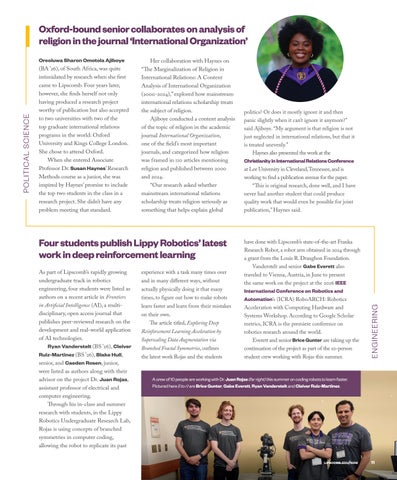
Four students publish Lippy Robotics’ latest work in deep reinforcement learning As part of Lipscomb’s rapidly growing undergraduate track in robotics engineering, four students were listed as authors on a recent article in Frontiers in Artificial Intelligence (AI), a multidisciplinary, open access journal that publishes peer-reviewed research on the development and real-world application of AI technologies. Ryan Vanderstelt (BS ’26), Cleiver Ruiz-Martinez (BS ’26), Blake Hull, senior, and Caeden Rosen, junior, were listed as authors along with their advisor on the project Dr. Juan Rojas, assistant professor of electrical and computer engineering. Through his in-class and summer research with students, in the Lippy Robotics Undergraduate Research Lab, Rojas is using concepts of branched symmetries in computer coding, allowing the robot to replicate its past
experience with a task many times over and in many different ways, without
actually physically doing it that many
times, to figure out how to make robots
learn faster and learn from their mistakes on their own.
The article titled, Exploring Deep
Reinforcement Learning Acceleration by Superscaling Data Augmentation via
Branched Fractal Symmetries, outlines
the latest work Rojas and the students
politics? Or does it mostly ignore it and then panic slightly when it can’t ignore it anymore?” said Ajiboye. “My argument is that religion is not just neglected in international relations, but that it is treated unevenly.” Haynes also presented the work at the Christianity in International Relations Conference at Lee University in Cleveland, Tennessee, and is working to find a publication avenue for the paper. “This is original research, done well, and I have never had another student that could produce quality work that would even be possible for joint publication,” Haynes said.
have done with Lipscomb’s state-of-the-art Franka Research Robot, a robot arm obtained in 2024 through a grant from the Louis R. Draughon Foundation. Vanderstelt and senior Gabe Everett also traveled to Vienna, Austria, in June to present the same work on the project at the 2026 IEEE International Conference on Robotics and Automation’s (ICRA) RoboARCH: Robotics Acceleration with Computing Hardware and Systems Workshop. According to Google Scholar metrics, ICRA is the premiere conference on robotics research around the world. Everett and senior Brice Gunter are taking up the continuation of the project as part of the 10-person student crew working with Rojas this summer.
ENGINEERING
Oreoluwa Sharon Omotola Ajiboye
A crew of 10 people are working with Dr. Juan Rojas (far right) this summer on coding robots to learn faster. Pictured here (l to r) are Brice Gunter, Gabe Everett, Ryan Vanderstelt and Cleiver Ruiz-Martinez.
LIPSCOMB.EDU/NOW
11
ENGLISH
Student creativity and insight grace the pages of literary journals
12
Lipscomb’s Department of English & Modern Languages has produced seven published student authors for the 2025-2026 school year, with a combination of poetry and essays published in literary journals. The consistent success of Lipscomb’s student writers is achieved through a combination of individual tailored support and focused curriculum, Dr. Jan Elaine Harris, professor of English and writing, observed. “Through a scaffolded approach to our creative writing curriculum, we have been able to include advanced writing techniques as well as mentorship/instruction in the publication process,” Harris said. “And Dr. Brandi Kellett (chair of the department), has honed a curricular focus on undergraduate research through both creative and scholarly engagement.” Two of the seven published students, Layla al Sadoon (BA ’26) and Miller “Mac” Chamberlain (BA ’26) received full tuition to enter elite Master of Fine Arts programs, both in the top 20 of the nation’s creative writing programs, at the University of Michigan and the University of Nevada-Las Vegas, respectively, said Harris. Another student in Advanced Poetry in fall 2025, English major Diane Brown (BA ’26), took on a creative experiment in the course that ended up paying off in a big way. She decided to experiment with stream-of-consciousness writing, and in 2026 the comedic poem she produced, referencing everything from asthma to elves, was ultimately selected to be published in The Blue Route, Widener University’s biannual undergraduate poetry magazine. Students in Harris’ poetry class are not only required to write one poem a week, but to also submit at least one of those poems to a blind-submission journal with an anonymous and competitive selection process. Brown’s September, published in May, was inspired by the work of Heather Christle, who also has a stream-of-consciousness style in her poetry. “I had done stream-of-consciousness once or twice before, but not really very seriously. Now it has really become my style of poetry,” said Brown, a Crestwood, Kentucky-native who focused on fiction writing in her English major. “I feel that poetry has improved my fiction as well.” Brown’s poem includes a wealth of references to her childhood passions and her life’s journeys, including J.R.R. Tolkien’s Lord of the Rings, Emily Bronte’s Wuthering Heights, her love of nature and her struggles with asthma. “People like the poem because it balances humor with sentimentality, but not in a cheesy way,” said Brown. “It is an invitation to the reader into the thought process behind all these different ideas that get combined together.” :
Provost Jennifer Shewmaker (left) with Diane Brown (right)
English students published in 2025-26 Allison Aardsma (BA ’26) August Lethargic and alone, I am a choir in redrosethorns Layla al Sadoon (BA ’26) sara in New Feathers Anthology sisters’ daughter in Rowayat Literary Journal, Issue 13 Diane Brown (BA ’26) September in The Blue Route Miller “Mac” Chamberlain (BA ’26) Love and Dying in the Nuclear Age in Feral: a Journal of the Arts An Empathetic Approach, The Life of a Showgirl: Bodes Unwell for Popular Feminism, and Combatting Militarized Logic, in The Fulcrum Megan Gables (BA ’26) My Hat Man and Honey, in Belladonna’s Garden, Issue 2 Emily Golembiewski, senior The Limbs of My Family Tree are Splintered and Cracked, in Mangrove Literary Journal Maxwell Kuecker, senior Composting, in The Blue Route
Bible major publishes thoughts on ‘No Best World’ argument
You might think that Dr. John Smith, professor and department chair in chemistry, most often likes to think about small things: molecules, atomic particles or nanocrystals. But Smith actually likes to think about big things, like how natural wonders like the Grand Canyon are God’s artwork or how scientists and engineers can be creators as a reflection of the great Creator of all. Those big thoughts, over years of teaching an upper-level Engagements course at Lipscomb on science, art and faith, are what fueled him to invite his chemistry students in a Colloquium class to write down their own thoughts on the intersection of faith and science. In fall 2024, Lilyan Robinette (BS ’26), then a junior, took him up on the offer, and the essay she wrote about how the tiny details of chemical organization point toward a big God, was chosen for publication in the American Scientific Affiliation’s (ASA) academic journal God & Nature in December 2025. The ASA, an international network of Christians in the sciences, publishes God & Nature, a quarterly online magazine offering essays, stories, poetry and artwork by scientists, scholars, pastors, students and lay persons around the world on the topic of science and Christian faith. When Smith and fellow Instructor Morghan Morris read Robinette’s essay, “Divinely Woven,” they suggested that she submit it to the journal, which had also published one of Smith’s articles in 2022 about humans’ inability to understand the scale of God’s awesomeness. “It’s focused on the way the things in chemistry are so organized and put together so purposefully in every little, tiny detail,” Robinette said of her own essay. “That order and organization is not an accident. So many people try to keep science and faith separate, but it’s really difficult to do, especially because they want to be together.” Robinette, a Maryville, Tennessee, native, also read her essay at Lipscomb’s 2024 Student Scholars Symposium. Smith says Lipscomb is a safe space for students to voice their questions about how faith and science work in harmony, and he would love to find ways to help them do that more often. “Giving them an opportunity to explore in a safe place where they can be guided is a huge benefit to our students,” he said. “Here they have access to experience and wisdom, and faculty who act as partners in helping them discover things.”
Hudson Tucker (BA ’26), of Baton Rouge, Louisiana, knows his calling is to be a minister, but as part of his preparation for that career he decided to indulge in another of his passions while at Lipscomb: philosophy. As a junior, Tucker took a Philosophy in Religion course and ended up producing a paper so profound that it was published in spring 2025 in an academic journal. Published in Aporia, an undergraduate journal of philosophy at Brigham Young University in Provo, Utah, Tucker’s paper argued that the “No Best World” argument does not debunk the existence of God. Using the criteria for a morally best world developed by German philosopher Gottfried Wilhelm Leibniz, the argument for infinite value by Nevin Climenhaga and the second-order reasons used by Joseph Raz, Tucker argued that the “No Best World” argument “fails to undermine the possibility of perfect moral goodness.” Dr. Caleb Clanton, distinguished university chair in philosophy and humanities, encouraged Tucker to send the paper to Aporia to be considered for publication. Clanton reserves such encouragement for only his “blue-chip” students, he said. “I encourage students to submit work when I run across a paper that is impressive, probative, unique and original,” said Clanton. “Tucker has made an interesting contribution to a debate within the philosophy of religion. The scholars he is responding to in his paper are first-rate contemporary scholars in philosophy of religion.” Tucker’s inclusion in Aporia puts him in league with students from prestigious universities such as Oxford, Brigham Young, George Mason, Boston College and Emory, said Clanton. Tucker also presented the paper at an academic conference, the 2026 Gordon H. Clark Symposium in Philosophy at Covenant College in Chattanooga. “When I preach, I want to know the Word so, so well,” said Tucker, a pastoral leadership major. “All the work that I did for this paper, is the kind of work I want to do every Sunday when I preach.”
PHILOSOPHY
CHEMISTRY
Senior shares her thoughts on faith and science in national journal
lipscomb.edu/now
13
focus on STUDENTS
Bringing the world into the classroom Undergraduate students’ scholarly research fuels the ability of local teachers to bring the globe to Tennessee students.
F
or nine years, Lipscomb’s College of Education (COE) has gathered teachers from throughout Middle Tennessee for a free on-campus professional development conference called Global Voices. True to its name, the event focuses on helping classroom teachers introduce students to cultures all over the world, especially through children’s books. Close to 300 teachers attend annually to hear the latest research-based, practical methods to boost literacy and critical thinking; to learn new instructional practices and leadership methods; to pick from almost 700 carefully curated books to take back to their classrooms; and to build community among Middle Tennessee’s teaching corps. This year was the first year, however, that the conference also featured research-backed recommendations from groups of undergraduate education students. Four groups of 15 students, most of them headed to the classroom themselves upon graduation, spent the spring semester analyzing children’s books for various themes and learning benefits, so they could provide practical, easy-to-enact take-aways for teachers attending Global Voices. Their inclusion is part of a college-wide goal to have education students engage in more research, said Dr. Jeanne Gilliam Fain, professor and coordinator of the Global Voices conference. “Not only does involving our undergraduate teacher candidates in this research allow them to head into their jobs with a toolbox full of critical ways to analyze literature and teaching practice in authentic ways, but it also tends to make the information provided to teachers at Global Voices particularly useful on the ground,” said Fain. “A lot of professional development for teachers is about long-term changes, but this conference provides teachers with methods they can employ the very next day.” Like every presenter at the conference, the student groups were held to strict scholarly standards, said Fain. Three of the four groups focused on themes within children’s literature.
14
:
“The books in those studies have been carefully critiqued and analyzed by committees across the United States,” said Fain, who brings her expertise to bear on selecting all the books recommended and given out in the conference’s popular book room as well as for two of the students’ studies. “We look at all the books for accuracy, authenticity and lack of stereotypes. We check the bibliographies and, of course, highquality books need kid appeal.” Fain is the outgoing chair and member of the International Literacy Association’s Notable Books in Global Society Committee, which selects an annual list of 25 outstanding trade books for enhancing student understanding of people and cultures throughout the world. Another COE faculty member, Dr. Ally Hauptman, assistant dean of teacher education, will soon become the new chair of the National Council of Teachers of English’s Children’s Literature Assembly which identifies an annual Notable Books list. She also presented to teachers at Global Voices. Each group of student researchers brought their best to the project, working to promote quality instruction among today’s teachers even before they step into their own classrooms.
IGNITING HOPE Allison Croft (BA ’26), English education; Jillian Verver, English education; Ruby Bills, elementary education; Chandler Bell (BS ’26), elementary education; Kayla Hill, K-5 & special education; and Katerina Contreras, K-5 education. Faculty Mentors: Fain and Dr. Sarah Duncan, professor When Nashville’s Youth Encouragement Service (YES), came to the COE and asked for recommendations of books exemplifying hope to boost its library, the faculty and students were not only happy to take on the challenge but did so through a rigorous qualitative research model. The final 14 selected books, winnowed down from 50, were given to YES, a Nashville-based after-school enrichment program for at-risk youth, and will be used with their participants. This group conducted a textual analysis of K-5 children’s books published within the last eight years, exploring the theme of hope, using Hope Theory, developed by
Free children’s books for classroom libraries are a popular aspect of the College of Education’s annual Global Voices conference for teachers. This year, three undergraduate student groups presented research findings on the best children’s books for learning.
LIPSCOMB.EDU/NOW
15
Jeanne Fain (far left) and Sarah Duncan (far right), with their students research team after their Student Scholars Symposium presentation.
psychologist C.R. Snyder. They identified to what extent goal-based pathways and agency thinking were present in the characters’ journeys in the plots. Within the top selected books, the students found various themes that fueled hope, including mentorship (i.e. Jabari Jumps and Tani’s Hew Home), healing of brokenness (i.e. After the Fall and How to Heal a Broken Wing), overcoming racial discrimination (i.e. Wat Takes his Shot and Nina), memories and artifacts, creating art or expression (i.e. Listen), acceptance of a difference and identity formation. “We found that all of our other resources, they really tied into identity formation,” said Contreras, a junior, during the group’s second presentation of their project at the Lipscomb Student Scholars Symposium. “Whether you had a mentor helping to influence the character or you had a memory that really helped push the character along, we found that at the end of these books, with all these factors coming together, these characters really had a big identity formation at the end.” While the project’s topic helped equip these undergraduates for their future career, working on the project itself helped them understand how working in a school will function. “This project made me re-think and re-analyze my future classroom library and how I want that to look for children,” said Hill, a senior. “I want to make sure that every child and every story, that every background, ethnicity and religion, and all these different factors are represented in my library.”
16
:
A MATHEMATICAL STORY Emily Bass (BS ’26), K-5 & special education; Amada Lashmit-Pena (BS ’26), 6-12 mathematics; Victoria Modani (BS ’26), 6-12 mathematics; and Samantha Sanders (BS ’26), K-5, special education & English language learning Faculty Mentor: Dr. Emily Medlock, professor Thanks to a Scholarship of Teaching and Learning grant from Lipscomb’s Center for Teaching & Learning, Medlock spent the school year working with undergraduate students to explore children’s literature’s impact on learning math. Using a selection of about 20 K-6 children’s literature books purchased through the grant, Medlock and her team analyzed the books to see how well they support the Standards for Mathematical Practice, which are the processes and proficiencies included in the Tennessee Academic Standards and needed by K-12 students to be successful in mathematics.
Emily Medlock’s research team at work analyzing children’s books related to math.
“We wanted to understand how using children’s literature can help enhance the standards for math practice by reading through the books, finding the common themes and then recommending the best books for teachers to use in the classroom,” said Medlock. “We also created a methodology for teachers to use on their own in selecting books.” Using books is an effective way to foster a love for math, make connections to other subjects and to overcome students’ math anxiety, said Medlock, who is currently the president of the Tennessee Association of Mathematics Teacher Educators. The team rated the books’ usefulness, ability to make connections and how easy they were to understand. Bass signed on for the extracurricular research project after completing her teaching placement in a fifth-grade math class. Among her favorite books in the project were Code Breaker, Spy Hunter: How Elizebeth Friedman Changed the Course of Two World Wars, telling the story of pioneering cryptanalyst Elizebeth Smith Friedman and featuring hidden codes for kids to solve, and How Do You Turn Data Into Drawings?: A Statistics Book About Graphs and Data, that teaches students how to create graphs and charts by using statistics
A member of Suze Gilbert’s research group talking with teachers at Global Voices.
about the world “in fun ways that students would be interested in,” said Bass. That’s important as the Tennessee Academic Standards now have greater emphasis on data literacy and statistics, said Medlock. The students also presented a poster on their work at Lipscomb’s Student Scholars Symposium, and as part of her grant process, Medlock is analyzing how valuable the research project itself was for the undergraduates and hopes to present her conclusion at future academic conferences.
THE READ ALOUD REVOLUTION Kayla Hill, K-5 & special education; Lily Bray, K-5 & special education; Kayla Darden, early childhood education; Olivia Grace Martin, K-5 & special education; Brooke Autrey, K-5 & special education Faculty Mentor: Dr. Suze Gilbert, associate professor In keeping with the Global Voices 2026 theme, “Imagine, Ignite, Inspire,” this group conducted a critical analysis of books looking for themes of joy, resilience and courage, characteristics that lead to student flourishing. “Our goal was to help students view the curriculum as a tool that supports them as the instructional experts in their classrooms,” said Gilbert. At Global Voices, the students presented a curated book list intended to create joyful learning communities grounded in brain research, she said. Each student reviewed three to seven books, and the group rated their chosen books based on how engaging they were, their structure, use of authentic voices and layered meaning as well as how well they linked to imagining, igniting or inspiring. Among the books the group chose to recommend were My Home Is in My Backpack, Little Tree, How Do You Spell Unfair?, Spelling Bee and Lubna and Pebble.
“We looked for books where students can see themselves, in everyday situations,” said Bray, a junior, “books that show kids they can be who they want to be… In elementary education, you want to think of texts that will do more than just teach them to read.” Students also need to build emotional growth, she said. Throughout the course of the project, Hill said she was reminded of how “big things can come in small packages, how much of life kids live and that kids really can change the world.” The group’s session at the conference focused on methods of reading these books aloud, such as ways to encourage students to notice details or to wonder about questions, to achieve the goals of the Wit & Wisdom K–8 English language arts curriculum used in Nashville public schools.
HONORING STUDENTS’ KNOWLEDGE Rachael Ferguson, interdisciplinary studies in education Faculty Mentors: Dr. Michelle Hasty, associate professor, and Dr. Kristin Baese, associate professor What do effective teachers do when information in a state-mandated curriculum is just not clicking with today’s schoolchildren? How about a game of Grebe Grebe Goose, a riff on the well-known childhood game Duck Duck Goose? That was one method used by a teacher highlighted in Ferguson’s qualitative study of how teachers can effectively teach what is called a scripted curriculum by tapping into students’ funds of knowledge, meaning their lived experience including cultural background, personal interests and family life. When that teacher was required to teach first-graders the vocabulary word “grebe,” a freshwater diving bird that few students would have personal experience with, she overcame that knowledge barrier by inventing the game of Grebe Grebe Goose.
That was just one method that Ferguson observed through more than 70 hours of observation and participation in the teacher’s classroom. She also conducted qualitative interviews with the teacher and an extensive literature review of studies involving scripted curriculums. She and her faculty mentors came up with three ways that teachers can keep students engaged and interested, even when the subject matter is well outside their lived experience. The first, decentering the curriculum, involves teaching methods that center on the students, rather than the curriculum, such as when the teacher created a tooth-loss graph, where students marked each month of the semester on the horizontal X axis and how many of the students’ teeth were lost in that month on the vertical Y axis. The second involved flipping the classroom power structure and allowing students to have a voice in decisions and operations within the class or encouraging them to think of themselves as young scientists or literary scholars. The third is to view the class as a larger ecosystem, recognizing that activities such as socializing with each other and sharing with each other are also ways to learn. Ferguson presented a poster on her research at Lipscomb’s Student Scholars Symposium as well as her presentation at Global Voices.
Learn more about the students’ research at lipscomb.edu/ Discovery/global-voices26.
Rachael Ferguson, presenting at Global Voices.
LIPSCOMB.EDU/NOW
17
focus on STUDENTS
Student Scholars Symposium 2026 Two-day conference highlights students’ scholarly academic work. This year’s 15th annual Student Scholars Symposium (SSS) in April not only drew more freshmen and graduate students, but it also hosted timely and thoughtful conversations on everything from the use of AI in warfare to gluten-free recipes. More than 350 students from all nine of Lipscomb’s colleges participated in 207 presentations and exhibits, with 35 presenters chosen and honored as the outstanding presenters in their oral or poster presentation group. See some of the symposium highlights below.
FOOD RESEARCH AND PRODUCTION Students in Chair of Nutrition Dr. Autumn Marshall’s undergraduate food research course conduct both a scientific experiment and a sensory evaluation survey each year. In 2026, student groups chose to compare methods of keeping fresh apples from browning, the effects of flour type on texture and flavor in muffins and loaf breads, and the effects of alternative fats and sugars in brownies, among other topics. After producing their experimental food items, students offered them to taste tasters who ranked the items on sensory characteristics such as appearance, aroma, flavor, texture and moisture. The project teaches students how to modify a recipe, the steps of the scientific method and qualitative research methods. Eighteen students in the course presented at SSS 2026 and some included samples of their winning recipes with their poster presentations.
ADVANCED PHYSICS Seniors Madouna Barsoum and Ryan Dunn spent time in Advanced Physics Lab this spring learning how to use a Nuclear Magnetic Resonance (NMR) device and how to read the NMR spectra. Working with Dr. Randy Bybee, chair of the physics department, they used a miniature version of an NMR device (somewhat similar to an MRI device at a hospital) to study spectra from organic and inorganic materials. Additionally, they determined the gyromagnetic ratios calculated from the Nuclear Magnetic Resonance spectra. The students focused on hydrogen in tetrafluoroboric (inorganic), citric and lactic (organic) acids. The project teaches students how to use NMR to answer specific questions about substances and why certain NMR devices are more efficient and can display more details about the samples.
ANALYTICAL CHEMISTRY Dr. Matt Vergne, professor of chemistry & biochemistry, introduces students each year to forensic analysis work at the Tennessee Bureau of Investigation by having them compare the efficacy of two dried blood sample collection methods: inexpensive dried blood spot (DBS) cards and commercially available dried plasma spot (DPS) cards. Students compared results from the traditional analysis method against both the card methods. Both could potentially be used for rapid on-site DUI testing in the future. This year, students detected fentanyl, oxycodone and ketamine in the DBS card samples, and methamphetamine, ketamine, oxycodone, cocaine and THC in the DPS cards, demonstrating that both methods can detect drugs consistently. Two student groups presented their findings at SSS, and one group presented similar work at the American Chemical Society national meeting.
18
:
2026 SSS Outstanding Undergraduate Presenters Resilience and Representation: A Qualitative Study of Student Perspectives in IPSE Programs, Carson Borgman
ADICAY & Peugeot Center Solar Power Project, Yoshiro Saito, Matt Holdren, Eduardo Jimenez, Micah Nelson, Petsimnan Dayit, Caleb Demas
Bible
English & Modern Languages
Garden Fellowship: An Introduction to Starting a Church Garden, Caitlin Vanderkamp
French Language Usage in Imperial Russia, Diane Brown
Biology The Role of Neprilysin in Regulating Triple Negative Breast Cancer Invasion Through CK-Mediated AKT Activation, Kai Lam, Ellie Griner (BS ’26) δ-Valerobetaine as a Novel Inhibitor of Breast Cancer Cell Migration: Hinders Cellular Migration of MCF- Cells Through Reducing ATP Concentrations and FAK Activation, Braxton Ivie, Isabella English Early-Stage Development of a Mosaic Nanoparticle Platform Targeting RSV and hMPV, Katherine Kidd, Alexis Sher Dose-Dependent Effects of Human Alpha Defensin on TGF-β Expression and Wound Healing in Colonic Epithelial Cells, Gabriella Longoria, Savoie Bryce, Kyle Meadows, Mariam Basta, Kerolos Ghobrial, Trevor Keele Investigating the Role of HD in Cytoskeletal Regulation During Colonic Epithelial Wound Healing, Sandra Masad
Chemistry & Biochemistry HdcB, a Mystery Protein from Probiotic Bacteria, Riley Robertson Computational Investigation of Platinum-Based Anticancer Drugs and the Design of Less Toxic Metal-Based Alternatives, Isabelle Riera, Elena Harvey
Communication Chilling Dissent: Executive Power and the First Amendment, Ameila Babb, Emy Fawzy, Hannah Owensby, Madelyn Newsom, Gabriela Pinheiro Barreto, Andrew Forney Reducing Food Waste and Expanding Healthy Food Access, Hayden Cassetto, Christopher Ferguson, Gabriela Pinheiro Barreto
Education
Leaving the Tower: Gender Performativity and Resistance in Tangled, Ellie Heslon
History, Politics & Philosophy The Marginalization of Religion in International Relations: A Content Analysis of International Organization (-), Oreoluwa Sharon Omotola Ajiboye Measuring Implicit Associations Involved with Militarized and Non-militarized Law Enforcement Equipment, Cambryn Crumpler, Katherine Haralson
Kinesiology Comparing the Effects of Beet Juice and Honey Water as a PreWorkout Substitute on Exercise Performance in Upper Body Muscular Endurance, Isabella Gilbert, Maggie Payne, Sarah Froemming, Macey Ogle, Elle Smith
Nursing Artificial Intelligence Charting and its Effect on Nursing Burnout: An Integrative Review, Ellie Moen, Abigail Fisk, Lacy Kaufman Risk Factors Contributing to Anterior Cruciate Ligament Tears in the Female Population: An Integrative Review, Delaney Hawthorne, Courtney Sauer, Finley Elder, Alexis Sher
Nutrition Effects of Flour Types on Texture and Sensory Characteristics of Blueberry Muffins, Bella Burdette, Audrey Jackson, Abigayle Thornburg
Physics The Behavior of Hyperspheres: Volume Formulas and Dimensional Scaling, Deron Young
Psychology
Pathways to Hope: Analyzing Goal-Directed Thinking in K- Picture Books, Allison Croft, Jillian Verver, Ruby Bills, Chandler Bell, Kayla Hill, Katerina Contreras
Prosperity Beliefs Under Stress: Relations with Religious Doubt and Well-Being, Claire Simmons, Shiann Roker, McKenna Buz’Zard, Mary Evans Cooper, Grace Henry, Aaron Barnes, Douglas Krull, Joseph Horton
Engineering
Visual Arts
Intelligent Transportation Systems: Proof of Concept for the Truck Parking Availability System, Anthony Buckland, Britney Sosa, Mark Smith, Koral Quezada-Mendoza, Bryan Beasley, Javier Gutierrez
Benefits of Art Therapy Practice for Prison Inmates and Their Families, Eliana Bowman, Emily Derrick
Accessibility in One’s Own Space: An Accessibility Lock made for Disability Friendly Bathroom Stalls, Audrey Curtis
Ward Research Fellow Crystal Structure of the Nucleoside Triphosphate Pyrophosphohydrolase (NTPH) from Klebsiella Pneumoniae, Vina Nguyen
See page 41 for graduate-level SSS honorees.
Accessibility and Learning Supports
LIPSCOMB.EDU/NOW
19
focus on STUDENTS
Reading vs. scrolling
STUDENT SPOTLIGHTS
Hannah Fritsch’s 2026 Student Scholars Symposium exhibit tells the story of how reading opened a world of wonder and possibility.
20
At 11 feet tall, Hannah Fritsch’s (BA ’26) Book House is hard to miss. Built from wood, thousands of pages and about 900 books once destined for a landfill, the structure rose inside the atrium of Lipscomb University’s Beaman Library for the April Student Scholars Symposium. Visitors could walk inside it and take in a world made almost entirely from the written word. There are walls covered in pages from old books. Shelves made from repurposed packing crates. A full-size chair with a page-covered figure sitting and reading. Outside the house, a figure looking at a cell phone is covered in binary code, while it walks a dog, covered in book pages largely showing images from sports, gardening, animal and bird books. Inside, there are miniature worlds tucked throughout the installation, a mouse house, a mug of hot chocolate with sailboats floating on top, mountains, a castle waiting for a dragon to be created, a ladder, an owl, a pine tree and other small surprises that invite visitors to slow down and look closer. But for Fritsch, who graduated in May with a Bachelor of Arts degree in history,
:
the Book House, titled Imaginate: Other Worlds/What We Make of Books, is more than a creative project. It is a monument to the impact books have had on her life. “I have dyslexia,” said Fritsch, of Columbia, Tennessee. “For years, books were something I could only experience through other people who read them aloud to me. But at nine years old, when I was finally able to read whole sentences and climb through the wardrobe myself, I was intoxicated by a love for books that has never left me.” The idea for the Book House came from a simple question: “What would it look like to show the difference between someone who simply consumes information and someone who actively imagines, reads and creates?” So Fritsch selected pages intentionally to show the dichotomy between a cellphone-scrolling dog walker, covered in sheets of binary code, and a seated reader surrounded by a personal, enriching environment, all covered in book pages. Colorful book covers adorn the roof as shingles. Pages often match the source material to the object they cover. The outside is papered in pages from old
collector manuals and quotation books. Inside, the walls are lined with pages from dictionaries, books on household maintenance, literature and history among other topics. The chair is covered in pages from a book about reupholstering and refurbishing furniture. “What I hope people take away from this is that they actually take a moment to pause,” said Fritsch. “You cannot simply sit back and let the visuals wash over you as with a video. You interact with the work, your mind is engaged and you contribute to the story. You become a part of it, and it becomes art.”
Learn more about the Book House at lipscomb.edu/ discovery/fritsch-book-house.
Student making community impact today, not tomorrow
Social work student’s innovation impacts lives of Nashville’s domestic abuse survivors May 2026 graduate Ava Noviello, from Portland, Connecticut, didn’t have to wait until she gets her degree to see the positive impacts of her ideas and hard work. She spent the past school year working at the Davidson County District Attorney’s Victim Witness Services Division, and her proposal for improvement, drafted as her senior capstone project for her Bachelor of Social Work degree, is already being implemented and having positive effects on Nashvillians. During the 2025-26 school year, Noviello worked as a victim witness coordinator, who works one-on-one with domestic abuse survivors during the course of their court case, educating them on how the court process functions and how they can access local resources such as temporary housing and food aid. Noviello’s supervisor Tracey Houston, director of victim witness services, was interested in enhancing the programs’ contact with victims after case closure, to ensure they remain on stable footing as they work toward recovery. Noviello took on the challenge and researched the demonstrated impact of follow-up calls to survivors outlined in past studies and analyses. Research showed that within the first week after the close of a case, survivors’ emotions come to the surface and they begin to feel the full weight of the situation, said Noviello. Informed by her research, Noviello recommended that the program’s social workers reach out to high-risk survivors within the first week, a less intensely stressful time for them but around the time they may be experiencing an emotional surge. This spring, Noviello and fellow Lipscomb intern Amaya Dryden, have been making the follow-up calls, giving survivors
the chance to ask any additional questions or inquire about any additional resources. Affordable mental health counseling is one of the most requested resources at that time, said Noviello, as many bottled up emotions are usually expressing themselves. Noviello recommended a second contact as well, after about three-to-four weeks, allowing enough time for the survivors to act on suggestions and take advantage of available resources. “Ava has had great success with very positive feedback, even from people who don’t need any additional action,” said Houston. “They are very appreciative of the call. The criminal justice system is overwhelming. Anything we can do to humanize the process is helpful for both us and the victim.” “Even in the short period of time of my internship,” said Noviello, “I would say that during those follow-up calls, I have interacted with survivors in situations where I realized
that abuse was still occurring and that there were actions we could take. I have been hearing back from them that they were able to arrange counseling sessions, so there has definitely been improvement within this program.” But even after this spring’s interns graduate, Houston said she will continue the post-court follow-up calls with high-risk victims. Noviello has made that possible by carefully documenting all the follow-up calls and recommended actions that she and Dryden have made this spring. “Sometimes they are just trying to survive the process, and it is not until the criminal process is over that they can begin really healing, and they need help for that,” said Houston.
Learn more about Noviello’s senior project at lipscomb. edu/Discovery/noviello.
LIPSCOMB.EDU/NOW
21
focus on STUDENTS
Student academic honors and awards From finance to poetry, healthcare to canoes, Lipscomb’s students make their mark each year across the nation in regional and national competitions in their field of choice. These students aren’t waiting for a job offer to use their hands-on, real world skills to rack up trophies in academic contests. COLLEGE OF BUSINESS Fowler Global Social Innovation Pitch Competition • Kendal Matas (BBA ’25) and Natalie Blickensderfer (BS ’25), third place, $10,000 prize to invest in their venture, OnTheJob™
American Marketing Association International Collegiate Conference • Ramon Nunez Molina, Daniela Jarpa (BBA ’26), Olivia Smith, Ella Crouch (seventh place) and Rowan Wahrenberger (honorable mention), finalists in the Perfect Pitch competition with 600 competitors • Daniela Jarpa (BBA ’26), fourth place out of 250 student competitors
National Collegiate Digital Marketing Championship • Lauren Rougas (BBA ’26), winner, Speed Sell and Viral (Tik Tok) and named one of the Top 50 Digital Marketing Students in the Country • Isabelle Araujo (BBA ’26), winner, simulation-based competition (Man vs. Machine) and named one of the Top 50 Digital Marketing Students in the Country
Poets&Quants for Undergrads Best & Brightest 2026 • Nate Wallace (BBA ’26)
SCHOOL OF COMMUNICATION Society of Professional Journalists’ Mark of Excellence Awards, Region 12 • Micah Barkley (BA ’26), winner, Feature Writing • Sam Morgan (BA ’26), Lindy Osborn, Hanna Brazeal and Cari Willer, first place, Best All-Around Radio Newscast
22
:
Tennessee Association of Broadcasters’ Excellence in Broadcasting Awards • Forrest Maners, Isaiah Davis (BA ’26) and Brandon Bigsby (BA ’24), finalists, Best Local Use of Digital or Social Media Platforms
Southeast Journalism Conference Best of the South Awards • The Bison, first place, Best Radio Station • Will Blackmon, third place, Best Radio News Reporter
On-site Contests • Micah Barkley (BA ’26), honorable mention, Sports News Photography • Samuel Espinoza, second place, Radio News • Kylie Kissler (BA ’26), Madelyn Paul (BA ’26) and Sophia Skelton, third place, Public Relations Challenge • Harold Lopez, first place, Sports Writing • Madelyn Paul (BA ’26), third place, Feature Photography
RAYMOND B. JONES COLLEGE OF ENGINEERING American Society of Civil Engineers’ 2025 National Student Championship • Concrete Canoe Team, placed in the top 10 in Women’s Sprint, Men’s Sprint and Co-Ed Sprint • Alex Aylor-Ibarra (BS ’26), Jackson Stephens (BS ’25), Alisa Rowell, Josh Brake (BS ’25), Joelle Noble (BS ’25), Bryan Beasley (BS ’26), Reece Boyd (BS ’26), Anthony Buckland (BS ’26) and Alexa Cady (BS ’26). • Iaya Kamber (BS ’26), 2026 New Face of Civil Engineering, one of 10 selected nationwide
COLLEGE OF HEALTH & HUMAN SCIENCES • Alpha Chi student chapter, Department of Nutrition, named a Notable Chapter for 2024-25, one of eight recognized nationwide
COLLEGE OF LIBERAL ARTS & SCIENCES The Poet’s Billow’s Bermuda Triangle Poetry Prize • Mac Chamberlain (BA ’26), awarded for two poems: persephone/proserpina and la bruja haibun
COLLEGE OF PHARMACY United States Public Health Service’s Excellence in Pharmacy Award • Chelsey Sparks (PharmD ’26), one of only 89 selected nationwide
American Association of Colleges of Pharmacy’s Community Pharmacy Student Scholars Program • Mackenzie Midgley, one of 20 students selected nationwide for the yearlong program
American Pharmacists Association National Meeting • Operation Immunization, winner • Operation Reproductive Health, first runner-up • Chapter of the Year, second runner-up • Operation Diabetes, second runner-up • Emma Wadlington, winner, National Patient Counseling Competition • Seth Meyer, winner, APhA Student Leadership Award
American Society of Health-System Pharmacists’ Student Leadership Award • Allison Duffy (PharmD ’26), one of 12 students selected nationwide
2026 Student Fulbright Awards The Fulbright English Teaching Assistant (ETA) Program, sponsored by the U.S. Department of State, is one of the nation’s most selective international exchange programs. It is designed to foster mutual understanding between citizens of the United States and other countries through academic study, research and English-language teaching. Claire Edmondson (MA ’26), a graduate student pursuing a master’s degree in archaeological and biblical studies, was accepted into the Fulbright ETA program to teach in Greece. Edmondson has volunteered and interned with Lipscomb’s Lanier Center of Archaeology, assisting with conferences, open houses and the management of archaeological collections.
First Parker Society awardee studies in France Kaela Abbate, a rising senior
history major from Thompson’s
Station, is the inaugural recipient of the Parker Humanities
Research Award, which supports students in English, history or
philosophy who require funding
for travel related to conferences or research. While
studying at the Université Catholique de L’Ouest in Angers, France, in June and July, Abbate, who also
minors in French, is studying the role of women in
the French Resistance during World War II, through research trips to Caen and Normandy.
2026 J.S. Ward Society Honorees Each year, Lipscomb’s top pre-health students are awarded its most prestigious research fellowships. Funded by donors and the J.S. Ward Society, a group of committed donors and advocates working to connect Lipscomb science alumni to today’s students, these fellowships allow students to conduct undergraduate research in the summer both on- and offcampus to gain skills needed to thrive in graduate and professional programs and the health science workplace.
Learn more about all these stellar students at lipscomb.edu/ Discovery/honors26.
WARD SUMMER FELLOWSHIPS
HERMAN G. LAVELLE RESEARCH GRANTS
Divid Abdelshahid, biology major, Summer Research Lab: Meharry Medical College Beaman Adel, bioscience and philosophy major, Summer Research Lab: Meharry Medical College, SuRP** Saja Al-shaweily, neurobiology major, Summer Research Lab: Meharry Medical College Emerald Cole, molecular biology major, Vanderbilt University, UCRIP* Katherine Kidd, bioscience and philosophy major, Vanderbilt University Medical Center Bryson Lovorn, molecular biology major, Vanderbilt University UCRIP* Kiomi Tanakura, biochemistry major, Vanderbilt University, UCRIP*
Daniel Domyan, biology major, Summer Research Lab: Lipscomb University, biology Ivana Huffines, molecular biology major, Summer Research Lab: Lipscomb University, biology
MITCHELL SCHOLARSHIP Emma Bolz, molecular biology major, Summer Research Lab: Campbell Clinic Summer Orthopedic Internship
LANGFORD-YATES SUMMER FELLOWSHIP Lydia Waldrop, Lipscomb with Dr. Josh Owens (BS ’16) Cathrine Youssef, Lipscomb with Owens Isabelle Riera, Lipscomb with Morghan Morris Thomas Manaye, Lipscomb with Owens *Vanderbilt Undergraduate Clinical Research Internship Program **Meharry Cancer Summer Research Program
All 10 of the fellows funded by the J.S. Ward Society, with society director Dr. Florah Mhlanga (center).
LIPSCOMB.EDU/NOW
23
focus on FACULTY “For me it is about being a really good mentor and having the students excited about doing research,” said Owens, Lipscomb’s undergraduate research coordinator in STEM. He is proud of the fact that 100% of his mentees have been accepted into medical school.
24
:
Scientific mind, faithful spirit Biology’s Dr. Josh Owens puts students first in his faith walk and in his scientific pursuit to fight cancer. For Associate Professor Dr. Josh Owens (BS ’16), biology at Lipscomb is a very personal pursuit. It’s true that he is a respected scieIt’s true that he is a respected scientific researcher who has helped discover a new molecule, won an award from the National Cancer Institute, has been published in academic journals many times over and will soon become a published book author, but he came back to Lipscomb in 2021 for reasons far deeper than intellectual recognition. “How I view research at Lipscomb, is that it is really fun to ask interesting questions and pursue interesting angles even if it doesn’t make a huge immediate impact in the research world,” said Owens, who has 15 or more students carrying out experiments in his lab every semester because, he admits, he has a hard time saying no to any student excited to learn. “For me it is about being a really good mentor and having the students excited about doing research,” said Owens, who is also Lipscomb’s undergraduate research coordinator in STEM. He is proud of the fact that 100% of Lipscomb students he has mentored have been accepted into medical school, and he is hopeful that within a year his research into the effects of the microbiome and metabolism on obesity and cancer will be accepted for publication and at least eight Lipscomb students will be listed among the authors. On top of his love for students, Owens has deep roots with
Lipscomb’s biology program, as his grandfather, Dr. Willis Owens (BA ’53) taught biology and genetics at Lipscomb for almost 40 years until 1990, training several of the professors who came to be mentors for his grandson. After earning his bachelor’s degree from Lipscomb, Josh Owens pursued his Ph.D. in immunology at Emory University in Atlanta and was weighing job offers from the Centers for Disease Control and a biotech firm in California when his former mentor, nowbiology department Chair Dr. Jon Lowrance (BS ’77) contacted him about an open position at Lipscomb. “When God calls you, you have to respond, and I feel like this was a direct call,” he said.
DISCOVERING NEW POSSIBILITIES TO FIGHT CANCER Owens brought some impressive scientific skills with him to the faculty. During his time at Emory, he was awarded the Ruth L. Kirschstein National Research Service Award by the National Cancer Institute and as well as publishing 17 peer-reviewed articles on topics including cancer immunology, the microbiome, fat metabolism and Covid-19. He jumped right in at Lipscomb to continue research spawned by his Ph.D. research at Emory, where he helped lead a joint discovery of a novel microbially produced molecule, delta-Valerobetaine (VB), that comes from bacteria in the gut and prevents the burning of fat.
This discovery was the cover story of the journal Nature Metabolism when it was published. At Lipscomb, Owens is exploring if VB can be used to maximize treatments for cancer by cutting off one of the disease’s energy supplies: fat. Owens’ hypothesis is that VB, which prevents fat burning, may be able to effectively starve cancer of that fuel source, weakening the cancer cells and making them more susceptible to chemotherapy and other cancer treatments. Over the years, with students running all of his hands-on, in-lab experiments, Owens had demonstrated that VB can break the cycle of cancer using fat energy, thus weakening the cancer cells’ ability to migrate, divide and proliferate, he said. This summer, he will be overseeing three Langford-Yates Scholar students, Thomas Manaye, Lydia Waldrop and Cathy Youssef, who will conduct the final experiments to observe VB behavior before he submits his latest findings for publication this summer or fall.
DISCOVERING TODAY’S FAITH/SCIENCE MINDSET As both a scientist and a lifelong Christian, Owens harbors a deep interest in exploring the dichotomy of faith and science, and is working to help the Christian community navigate that complex intersection in a godly way. “As college professors and administrators at faith-based institutions, we are committed to
LIPSCOMB.EDU/NOW
25
helping our students learn how to remain rooted in their faith while pursuing highlevel academics,” says Owens. “We want to remove any perceived stumbling blocks for students who are capable of making an impact in their fields but fear they must abandon their faith in order to engage in relevant academic discussions.” Owens has worked with Lipscomb’s McClure Center for Faith and Science to carry out two grant-funded projects: a study of college freshmen’s perceptions of faith and science, surveying students
at Lipscomb, Belmont and Samford universities; and a workshop to equip ministers to engage their congregations in conversations about faith and science, exploring biblical interpretations alongside scientific perspectives on Scripture. In his own faith and science research, Owens is exploring viewpoints amongst ministers in the South, believing them to be highly influential on the beliefs of young people entering college today. Owens believes that national surveys on Americans’ perspectives of faith and
science, tend to under-count Southern rural areas, he said. So a few years ago he began a survey of ministers, starting with rural churches of Christ in Tennessee and Alabama, to find out just what that population believes on the subject. “What the results of almost 200 responses have revealed is that while ministers broadly affirm compatibility between faith and science, there’s often more complexity in how they engage with specific scientific concepts—highlighting an opportunity for deeper dialogue and resources,” says Owens. In his most recent work, he has expanded the survey to other Christian faith groups (i.e. Southern Baptist and Methodist) and is working to obtain another 150 responses to shore up his findings to submit the work for publication.
DISCOVERING LIFE IN THE SPIRIT
Owens at Lipscomb’s annual Faculty Research Day.
Owens in a McFarland Center biology lab where his grandfather Willis Owens would have taught during his almost 40 years at Lipscomb.
26
:
Whether guiding students through bench research in the biology lab or emailing ministers throughout the Southeast, Owens is passionate about the mission of Lipscomb and desires to be an advocate for his students, so when he turned his mind toward writing a book, he decided that the best way he could influence others was to share how God has shaped his own life through the Holy Spirit. “It’s exploring the idea that we can experience God in every moment and in everything we do,” he said of the book, which has been contracted to be published by Wipf and Stock. Even while juggling so many projects and a growing family, Owens’ “main focus is always on students,” he said. “I want them to have a good experience in the lab, to learn how to ask good questions, to dive deep and to become experts in their own right. Winning awards and being published is just the cherry on top of the cake.”
Learn more about Owens at lipscomb.edu/discovery/owens.
Raising a Joyful Noise in the Wilderness Assistant professor establishes network of choir directors and fall conference to connect and sustain collegiate gospel choirs. This October, Lipscomb will host a new enrichment opportunity for the nation’s collegiate gospel choir directors through the Joyful Noise in the Wilderness conference, an event created and hosted by a collegiate gospel choir network spearheaded by Liscomb’s Dr. Aaron Howard, founding director of the Lipscomb Gospel Choir. This national initiative to educate, connect and sustain collegiate gospel choirs across the United States, was funded through a $250,000 grant from the Creative Arts Collective for Christian Life & Faith. The one-year grant was awarded through the collective’s Create, Educate and Network Grant Program, a highly competitive biannual program that supports faith-based arts initiatives nationwide. The collective awarded nearly $2 million in funding to 10 programs across the nation in 2026. “Gospel music has always been a powerful vehicle for faith, resilience and hope, yet many people are unaware of how deeply it continues to be nurtured within colleges and universities,” Howard said. “This grant allows us to build a national network of collegiate gospel choir directors and students who can encourage one another, exchange resources and celebrate the beauty and significance of this music together.” The three-day Joyful Noise conference will culminate in a live audio and video recording featuring a 150- to 200-voice mass choir composed of students from universities across the country. The initiative also includes the development of a nationwide network of collegiate gospel choir directors who will
convene monthly in virtual sessions. In addition, the project will result in an album being recorded and an accompanying songbook published, contributing to the choral literature and enabling broader use of gospel repertoire in collegiate and church settings. Among the key leaders joining Howard, assistant professor of ethics, worship and reconciliation, to establish the network and conference are Dr. Eric Williams, director of Black church studies at Duke University and former curator of religion at the Smithsonian National Museum of African American History and Culture, and Gilbert Nanlohy, senior A&R director at Integrity Music. “This grant underscores the role of the arts as a powerful form of teaching, scholarship and spiritual formation,” said Lipscomb Provost Dr. Jennifer Shewmaker. “Dr. Howard’s leadership and the excellence of the Lipscomb Gospel Choir create an extraordinary opportunity for learning, collaboration and national impact.” Choir directors and students participating in the project will be educated on the history and theology of gospel music, best practices for sustaining unity and sense of community, methods for increasing artistic creativity and production, and navigating the contemporary Christian music industry. The network is designed to strengthen understanding of gospel music’s historical and theological significance among participants. Outcomes will include case studies documenting specific gospel choirs, their growth trajectories including examples of enhanced artistic output, new creative works produced and successful advocacy efforts
Dr. Aaron Howard, founding director of the Lipscomb Gospel Choir, was awarded $250,000 to develop a network and fall conference for gospel choir directors.
that resulted in increased institutional funding and support. Howard plans to conduct pre- and post-surveys measuring directors’ understanding of their leadership skills, knowledge of gospel music history and theology, artistic ability and their existing network. One-on-one interviews with network choir directors will assess how the project impacted the participants and how the album, videos and songbook serve as useful teaching and learning materials. Founded approximately five years ago, the Lipscomb Gospel Choir has quickly gained national and international recognition for its musical excellence and emotional impact. The ensemble has performed across the country, been featured in a BBC program broadcast worldwide and has collaborated on projects with Christian artists. The 2025-26 choir included 35 students representing 25 academic programs, hailing from 15 states and four countries. The Gospel Choir is a collaboration of Lipscomb’s College of Bible & Ministry and the George Shinn College of Entertainment & the Arts.
LIPSCOMB.EDU/NOW
27
focus on FACULTY
Lipscomb faculty share expertise through the written word Lipscomb faculty are always seeking to learn and always willing to share their discoveries. Various faculty members have put pen to paper to produce books released in 2025 and 2026. Subjects vary from cutting-edge use of AI to Christian children’s humor, but each volume shares new insight, knowledge and informed perspective.
The Dead Sea Squirrels: Cybersquirrels The Dead Sea Squirrels: Field Day Frenzy (October )
Mike Nawrocki (MFA ’19), Visiting Professor in Cinematic Arts George Shinn College of Entertainment & the Arts Tyndale Kids, 2026 These books are the latest in Nawrocki’s chapter book series about Merle and Pearl, 2,000-year-old squirrels petrified in sea salt and discovered by ten-year-old Michael and his friend in the Dead Sea caves. Once fully
FACULTY READING ROOM
revived, hijinks ensue and Merle and Pearl share faith-fueled life lessons drawn from their experience living in the time of Jesus with their new modern-day friends.
In Cybersquirrels, the squirrels discover artificial intelligence as a handy
solution to make-up homework and they all learn a lesson about integrity. In Field Day Frenzy the squirrels must overcome obstacles to help team
captain Michael learn to work with his team amidst his greed for victory. Nawrocki, the co-creator of VeggieTales, began the series in 2019
and the first book, Squirreled Away, marked 100,000 in sales this year.
Dr. Kelly Kidder, Professor of French College of Liberal Arts & Sciences Routledge, 2025
Aimed at high school and undergraduate students, Apparences
takes an approach to teaching French that encourages discovery of
grammatical structures and vocabulary through an engaging, modern narrative inspired by the classic French play, Cyrano de Bergerac.
Through comprehensible language, each chapter tells the story of
Max, a first-generation college student from the Democratic Republic of Congo, and Roxane, an exchange student from Italy.
The text encourages comprehension and allows teachers to
provide the kind of prompts that engage students and facilitate meaningful interaction. The text finds compelling ways to
contextualize the traditional vocabulary and grammar presented in
many first-year textbooks, while also providing a means for students to engage deeply with what they are reading.
Kidder applied foreign and second language acquisition research,
The series earned a bronze award from the Evangelical Christian
such as comprehensible input and output activities, joint production
platform Minno an animated video version of the series produced
activities for students.
Publishers Association this year. Last year he debuted on the web through Lipscomb’s Imagine House production studio involving faculty
and dialogic inquiry, to create relevant and engaging language learning She received her Ph.D. from The Ohio State University in foreign
and students.
and second language education, and instructs students and future
after a 30-year career in production that earned him multiple Dove awards.
school classrooms and for teaching English abroad.
Nawrocki, the voice of Larry the Cucumber, came to Lipscomb in 2017
28
Apparences: A Novel Approach to Elementary French
:
teachers in research-based pedagogical practices both for public
Chapters by Faculty Dr. Nina Morel, Executive Director of Coaching and Leadership Development College of Business
Building Inclusive AI: The Complete Ecosystem Guide
Dr. Meagan Spencer, Chair of Communication Sciences and Disorders College of Health & Human Sciences Independently Published, 2026 Students with disabilities face persistent
Engaging Minds: Rethinking Assignments for Critical Thinking in the Age of AI Dr. Jeffrey Adams, Director of the Health Sciences Simulation Center College of Health & Human Sciences The Healthcare Lab, 2025
barriers in higher education, not from lack
Adams’ book is a bold, practical call to redesign
says Spencer.
intelligence (AI).
Framework, an original prompt engineering
to groundbreaking work in AI-powered medical
affirming artificial intelligence tools that
learning experiences that challenge students to
of ability, but from inaccessible design, Her book introduces the ACCESS
methodology for creating neurodiversityremove format-dependent barriers while maintaining academic rigor.
Grounded in Universal Design for
education for a world transformed by artificial
From early struggles with undiagnosed dyslexia
simulation, Adams has spent decades designing
think critically—not just memorize facts or click through modules.
The work includes practical assignment
Learning and disability rights research,
frameworks that drive real critical thinking,
reasoning into scalable digital solutions that
partner and insights into how digital-native students
this work teaches how to transform clinical presume competence, provide appropriate scaffolding and honor diverse ways of
strategies to leverage AI as a creative teaching actually learn—and how to reach them.
At Lipscomb’s simulation center, Adams has led
thinking and learning.
efforts to expand the center’s curriculum, implement
pathologist, educator, advocate for rural
interprofessional training opportunities for both
Spencer is a seasoned speech-language
health care access and inclusive education.
She is a distinguished American Speech-
innovative AI-driven simulation tools and foster students and practicing healthcare professionals. Adams is also the author of the Textbook of
Language-Hearing Association Early
Modern Medical Simulation, and has healthcare
leadership roles on the executive board of the
Edward Via College of Osteopathic Medicine,
Career Professional and has served in various Tennessee Association of Audiologists and Speech-Language Pathologists.
simulation experience at Duquesne University,
Philadelphia College of Osteopathic Medicine and The Ohio State University.
Morel co-wrote chapter four, “Core Coaching Competencies and Skills,” for Coaching Education: Foundations of Excellence, a volume that examines essential academic standards that strengthen the coaching profession. The editors gathered contributions from 45 leading scholarpractitioners, including Morel, who wrote about the integration of coaching competencies into graduate-level coaching education. She also penned chapter four, “Developing the Well-being and Presence of a Coach” for Professional Development for Coaching Practitioners, available now. This book presents a guide for supporting the development of coaches and coaching psychologists. Morel is also the co-author of Redefining Competency Based Education: Competence for Life (2018). Dr. Phillip Camp (MA ’93), Professor of Bible College of Bible & Ministry Camp wrote the chapter on Ezra-Nehemiah for Adaptable for Life: The Message of the Old Testament for Contemporary Readers, available from Cascade in October 2026. The book is a user-friendly textbook designed to help undergraduate students and modern readers navigate the enduring significance of the Old Testament, connecting the ancient contexts of Israel’s Scriptures to contemporary Christian life. Camp is also the author of Finding Your Way: A Guide to Seminary Life and Beyond and Living as the Community of God: Moses Speaks to the Church in Deuteronomy.
See more faculty books in the Faculty Reading Room at lipscomb.edu/facultyreading-room.
LIPSCOMB.EDU/NOW
29
focus on FACULTY 30
Tim Johnson, noted military historian and author of eight previous books, sheds light on the little-known military career of football coach and Army Brig. Gen. Robert Neyland, who used his military experience on the football field to coach the University of Tennessee Volunteers.
:
Engineering victory Noted military historian Tim Johnson turns his pen to ‘the General’ of Tennessee football, Brig. Gen. Robert Neyland, in a biography released in July during the 100th anniversary of Neyland’s first year as head coach.
W
hen a Tennessean hears the name “Robert Neyland,” they think of one thing: football. Makes sense, given his name adorns the walls of the Knoxville home to the Tennessee Vols football team. But Dr. Tim Johnson, Elizabeth Gentry Brown Chair in History, wants everyone to know that there was so much more to Gen. Neyland than the one thing he is best known for. “Most people don’t know that Neyland’s first loyalty was to the Army,” said Johnson, noting that Brig. Gen. Neyland graduated from West Point in 1916 and was still in active service through much of his coaching career. “A lot of people think of Neyland as a coach, who also happened to be in the Army. I think the correct way to view Neyland is that he was an officer in the Army who happened to be a coach.” So it makes sense that Johnson, a noted military historian and author of eight previous books, would be drawn to the little known life of Neyland outside the football stadium that bears his name. Johnson chose to make Neyland the subject of his ninth book, and wrapped up research and writing for Robert Neyland: The West Point Engineer Who Built Tennessee Football in time for it to be released in July 2026, the 100th-year anniversary of Neyland’s first year as Tennessee’s head coach.
‘I NEVER INTENDED TO BE A COACH. I AM AN ENGINEER.’ – NEYLAND The man who won four national championships and seven conference titles actually wanted most to be remembered as an engineer, said Johnson. Late in life, when asked what he was most proud of in his career, Neyland said he wanted to be remembered for his work as commander of the Port of Calcutta in 1944-45. Calcutta, India, was an important supply base in the war against Japan. Previous to that, Neyland had supervised building projects and water conservation and dredging projects for the Army. During his time coaching, from 1926 to 1952, Neyland used his engineering expertise to coordinate five expansions of the football stadium at the University of Tennessee-Knoxville, increasing seating capacity from 3,200 to 53,000 during his tenure. The stadium was named for Neyland in 1962, the year of his death. Neyland served in two World Wars, was a staff officer under West Point superintendent Douglas McArthur in the 1920s, and there is no doubt that Neyland’s football career and military career intertwined, said Johnson. “What I’ve tried to show in this book is how he juggled both of those careers, and how he used his knowledge and his training in the military to inform the way he coached football, and how he used his knowledge of
LIPSCOMB.EDU/NOW
31
football to inform the way he commanded soldiers,” he said. “He used each profession to strengthen the other.” So don’t worry football fans, about half the book does cover Neyland’s football coaching career, said Johnson. It was Neyland’s innovative engineering side that brought about many advancements in victory on the football field. According to Johnson, he was one of the first coaches to use a tarp to cover the game field to protect the turf from weather, he was one of the first to use a telephone to talk to assistant coaches positioned in the press box to have a better view of the game play; he helped create more lightweight padding and lower cut shoes for players; and was one of the first to begin reviewing film of the games. “All of these things were new and novel when he started coaching,” said Johnson. “He was always looking for innovations, looking for ways to make his team better, stronger and faster.”
‘HE GAVE FOOTBALL SOME OF ITS BEST COACHES.’ – ASSOCIATED PRESS Inspired by an academic paper on the use of military language in football, Johnson began research on Neyland’s life in 2022. His book will be the first scholarly researched biography of Neyland written by a historian. He worked through information in 45 newspapers, interviewed several people who knew or played for Neyland and pulled information from the Neyland family papers, he said. While working on the book, Johnson met Neyland’s grandson Blake Neyland and through their interactions gained access to a box of photos, clippings and letters the Neyland family has held for years, to use as resources for the book as well as to be archived by the Lipscomb archival librarians.
Among the materials loaned from the family were photos of Neyland as a cadet at West Point and in his West Point baseball uniform, where he was a star pitcher on the team. In his four years as a starting pitcher, Neyland’s record was 35-5, and when he graduated he turned down offers from major league teams. Johnson also collaborated with Demetria Kalodimos, Lipscomb’s then-professional-in-residence and a group of students from Lipscomb’s School of Communication to create a documentary about Neyland, which was screened locally in May. When Blake Neyland was interviewed for the documentary, the film team presented to him two of his grandfather’s cadet jackets from West Point, which they had discovered during their research. Johnson and the student documentary team also interviewed the last two members of Neyland’s football teams who were living at the time of the interviews in 2024: James Haslam, who was the captain of Neyland’s 1951 championship team, father of former Tennessee Gov. Bill Haslam and founder of the Pilot Corporation, one of the largest privately owned companies in the U.S.;
“NEYLAND TOOK HIS JOB SERIOUSLY IN TRAINING YOUNG MEN FOR LIFE AFTER FOOTBALL. HE STRESSED DETERMINATION AND LEADERSHIP. HE WANTED HIS PLAYERS TO SUCCEED IN LIFE, AND HE KNEW FOOTBALL WOULD EVENTUALLY END FOR THEM.”
PHOTO BY ANDREW FERGUSON/TENNESSEE ATHLETICS
—DR. TIM JOHNSON, ELIZABETH GENTRY BROWN CHAIR IN HISTORY
32
lipscomb now: discovery
(at right) Photos of Neyland included in the family’s archives, and (middle photo) the label in Neyland’s West Point cadet jacket.
and Mack Franklin of Hermitage, Tennessee, who, in addition to being an All-SEC player at UT, was an educator, coach and 2002 inductee into the TSSAA Hall of Fame. Johnson also interviewed another former player, Gaylon Wilson; Phil Fulmer, Vols football coach from 1992-2008; and Doug Dickey, UTKnoxville athletic director from 1985 to 2003. “Neyland took his job seriously in training young men for life after football,” said Johnson. “He stressed determination and leadership. He wanted his players to succeed in life, and he knew football would eventually end for them. “They went into all walks of life, but at the time of his death in 1962, there were more than 175 of his players who had gone into coaching. One reporter said he had given ‘the game of football some of its best coaches.’ “He treated his team like an army,” said Johnson. “Discipline. Precision. All of that was crucial to the way he coached.” And the team members remembered. The last living team members were in their 90s when Johnson interviewed them, and they still remembered Neyland’s seven game maxims, the keys to victory he had his team members recite before every ballgame. The seven maxims are still mounted on the wall of the locker room and Vols football teams today still recite them before games. In fact, in 2001 and 2025 former Tennessee players led UT fans in reciting the maxims before each home game, with the maxims listed on the Jumbotron. Johnson even starts his book with the story of a former player, Marine Austin Shofner from Shelbyville, Tennessee, who once told Neyland that those maxims got him safely through time in a Japanese prison camp, a death march and an escape that included days of travel before reaching Allied forces in World War II. “Shofner’s son said he could quote the seven maxims until the day he died,” said Johnson. “That’s how important they were to Neyland, and he impressed that importance on every one of his players.”
Robert Neyland: The West Point Engineer Who Built Tennessee Football can be purchased at Johnson’s website at lipscomb. edu/discovery/timothy-johnson.
LIPSCOMB.EDU/NOW
33
focus on FACULTY 34
:
A search for identity Bible Dean Leonard Allen encourages spirituality today by shedding light on the Church of Christ’s historical search for its own identity in a series of symposiums and books.
S
Building on the scholarship presented at Lipscomb’s Carroll B. Ellis Symposium, College of Bible Dean Leonard Allen has produced three books available now on Church of Christ history and is working on two additional books for 2027 that bring the historic timeline up to the 1980s.
ometimes you have to look back to understand where you are and how far you have traveled. Dr. Leonard Allen, dean of the College of Bible & Ministry and one of the nation’s leading experts on the history and thought of the Restoration Movement, certainly believes that is the case, and he has focused his academic career on understanding, analyzing and enlightening about the history and development of the Church of Christ in America. In 2026, his continuous research, especially through the coordination of Lipscomb’s biennial Carroll Ellis Symposium, has culminated in a three-volume work on the modern history of the Church of Christ that not only highlights the evolution of the fellowship’s vision of unity over the course of a century, but also creates a structure for describing the various ideological groups within the fellowship today. The first of the three books, A Wild Democracy, was released in May, and the following two volumes, Truth and Consequences and Divided We Stand, are scheduled to be released in early 2027. Church of Christ leaders and scholars have described the first book as a well-structured, easy-to-understand volume that helps Church of Christ-associated readers comprehend their spiritual identity in today’s world by understanding where their church fellowship originally began. While Allen has written on Church of Christ history throughout his career, five of his latest works have been particularly shaped by his coordination of Lipscomb’s Ellis Symposium, established to spotlight scholars with outstanding knowledge, scholarship and accomplishments in Restoration preaching and history. Created 24 years ago in honor of the late Dr. Carroll B. Ellis, 40-year faculty member and chair of the department of speech communication, the symposium has featured preachers and historians such as Dr. Robert Hendren (BA ’64), Dr. John Mark Hicks, Ancil Jenkins (BA ’58) and Dr. Robert Hooper (BA ’54) presenting on the life and work of pillars of Church of Christ history, such as James A. Harding, A.G. Freed, Alexander Campbell and David Lipscomb.
But with Allen’s arrival in 2014, the symposium took on a broader view of restoration history and tackled topics that have shed new light on the Church of Christ today as a reflection of major milestones in its history. The three symposiums held since 2019 became the scholarly foundation for two earlier books and the 2026 three-book series, all written, co-written or edited by Allen: • Answered by Fire: The Cane Ridge Revival Reconsidered (2021); • Faithful Defiance: Marshall Keeble’s Life and Legacy (2025); • A Wild Democracy: The Struggle for the Soul of Churches of Christ, 1889-1939 (May 2026); • Truth and Consequences: Churches of Christ and the Habit of Division, 1939-1989 (forthcoming January 2027); and • Divided We Stand: The Landscape of Churches of Christ, Post-1989 (forthcoming March 2027). Allen has used the symposium as a workshop to spur development of academic presentations and papers that are then collected and consolidated into book form. The 2025 symposium spurred Allen to write A Wild Democracy which then evolved into two additional books continuing the Church of Christ timeline to present insights on its presence in today’s society. Answered by Fire explores the Cane Ridge Revival of 1801, which Allen describes as the place that the modern Church of Christ began. The charismatic revival, which took place 20 miles outside of Lexington, Ky., saw hundreds of people “slain in the spirit” and is considered one of the landmark events of the Second Great Awakening. Faithful Defiance explored the life of Marshall Keeble, whom Allen calls one of the most effective and powerful evangelists in the Church of Christ. It is estimated that he baptized 30,000 people and helped plant 300 congregations, said Allen. “There was a modest body of literature on him, but I found that among churches of Christ, and particularly among Black churches of Christ, the memory of Marshall Keeble has
LIPSCOMB.EDU/NOW
35
been fading,” said Allen. “I felt that it was time to produce a work based on scholarship but accessible to average readers that would keep his memory alive.” Allen has collaborated with Dr. John Mark Hicks, now-retired professor of theology at Lipscomb and prolific author, on the symposium over the years and especially to produce A Wild Democracy, which tells the story of how the churches of Christ battled for their identity after parting ways with the Christian Churches/Disciples of Christ in the late 19th century. Hicks had previously published writings on the time period (1897-1907), and Allen and Hicks used that as the jumping off point to invite presenters for the 2025 Ellis Symposium, presenting four viewpoints on the Church of Christ’s split from the Disciples of Christ. “At this time period, churches of Christ were in some disarray. They were trying to rebuild and define who they were,” said Allen. “Three traditions arose to define the new orthodoxy of the Church of Christ.” A Wild Democracy explores the emergence of what the authors call the “Texas tradition,” led by Austin McGary, R. L. Whiteside and Foy Wallace Jr.; the “Nashville tradition,” led by James A. Harding, David Lipscomb and J. N. Armstrong; and the “Indiana tradition,” led by Daniel Sommer and his followers. “All three had a common commitment to restore the core of Christianity, but the Tennessee tradition had a dynamic view of the sanctifying work of the Holy Spirit, and the Texas tradition prioritized human initiative,” said Allen. “By the 1930s, most congregations espoused some form of the Texas tradition.” This work led Allen to develop the two forthcoming books, Truth and Consequences and Divided We Stand, further analyzing and
describing the history of the ideological divisions of the Church of Christ up to 1989, by which time Allen argues there were five distinct and mostly separate major groupings: • Conservative Mainstream Churches of Christ, which grew from the Texas tradition prioritizing human initiative; • Black Churches of Christ, separated largely by cultural tradition, not orthodoxy; • Moderate Mainstream Churches of Christ, which have become one of the larger of the groups since the mid-20th century and focus on the overarching story of Scripture as the means of defining the church; • Noninstitutional Churches of Christ, which developed in the 1950s and reject the financial support of institutions (such as orphans organizations) that are operated outside of individual congregations; and • International Churches of Christ, established through the Crossroads Church of Christ in Gainesville, Florida, and the Boston Church of Christ in Boston, Massachusetts, which employ a hierarchical structure to enact disciple-making. The three latest works take a strictly descriptive approach to informing the reader
about these Church of Christ groups, said Allen. Each volume of the trilogy includes an appendix, called “In Their Own Words,” with excerpts from the writings of the historical founders of the fellowship. Volume three, Divided We Stand, provides an overview of each of the five groups, with each chapter written by an author associated with that particular group. Authors were asked to provide a fair and equitable description of how that group emerged and how they operate today, he said. Allen hopes the books will bring Church of Christ-associated readers some new perspective on the divisions that have emerged in the 20th century and provoke new thinking about the dream of Christian unity which first launched the Restoration Movement in America. “If you don’t look at your own history, you can be shaped and often bound by it unconsciously,” he said. “Do you want to be a conscious participant in your tradition or be unconsciously bound by it? If you are not informed, things you don’t know could constrain and control you.”
“DO YOU WANT TO BE A CONSCIOUS PARTICIPANT IN YOUR TRADITION OR BE UNCONSCIOUSLY BOUND BY IT? IF YOU ARE NOT INFORMED, THINGS YOU DON’T KNOW COULD CONSTRAIN AND CONTROL YOU.” —DR. LEONARD ALLEN, DEAN OF THE COLLEGE OF BIBLE & MINISTRY
36
:
Supporting our own in scholarship and research Lipscomb funds 2026 summer research to advance humanitarian engineering and to test and validate a new method of testing drug levels in blood plasma.
Each year, Lipscomb University awards grants to allow Global Humanitarian Technology Conference in Boulder, Colorado, for which Dodson serves as the technical program chair. faculty to focus on research and scholarship during the summer. In 2026, two professors will be working on Dr. Matt Vergne developing new ways to impact our world for the better. Professor, Chemistry and Biochemistry Development of Protein Exclusion Direct Aqueous Injection for LC-MS/MS Associate Professor, Mechanical Engineering When forensic toxicologists or clinical labs Building a Network of Humanitarian need to know exactly how much of a drug Engineering Scholars, Practitioners and is in someone’s blood plasma, they turn to Students Inspired and equipped through her work with a technique called LC-MS/MS—liquid chromatography coupled to tandem mass spectrometry. Lipscomb’s Peugeot Center for Engineering Services in Developing Blood plasma, however, is packed with proteins that will clog and Communities, Dodson will take the first steps to create a network of destroy the delicate analytical column at the heart of the instrument humanitarian engineering scholars, practitioners and students, with if injected directly, so scientists have to perform a prep step called the intention to create a space for humanitarian engineering experts protein precipitation, which is slow, hands-on and uses environmentally to collaborate, network, learn and grow their efforts responsibly, unfriendly solvents and costly lab supplies. sustainability and effectively. Vergne proposes to skip the protein precipitation step entirely by Currently, there is not a location, society or group that formally developing and rigorously validating to FDA standards an LC-MS/ supports and encourages engineering educators to incorporate MS method using a specialized HPLC column called the Imtakt humanitarian efforts into their own programs. Though many groups Cadenza HS-C18. Unlike conventional analytical columns, this one perform this type of work either in a professional or educational is engineered to handle raw biological samples directly, thus handling setting, there is lack of access to a network or space where these protein removal and drug separation in a single step, automatically, groups can join forces and build a better practice of humanitarian while the instrument is running. engineering, said Dodson. The Cadenza HS-C18 column isn’t brand new. The manufacturer “The intention of this network is to change the perception of the has marketed it for direct injection of blood samples for a while, but field of engineering to one that is well-known as a leading profession in independent, fully validated applications of this column to forensic and positively impacting the world,” she said. “Together, these groups will clinical drug panels remain surprisingly rare in the published literature. cross boundaries between industry and academia, between research and Verge will directly compare the direct-injection method to the practice, between learning and doing, between people and projects, to conventional protein-precipitation workflow and assess method create meaningful change in their world.” ruggedness and reliability. He will develop and validate this approach Over the summer, Dodson plans to gather, summarize and analyze for two categories of real-world significance: information around humanitarian engineering efforts, recruit and • Drugs of abuse, including ketamine, oxycodone, fentanyl and organize core participants and leadership, and develop plans for a summit cocaine—compounds central to the ongoing overdose crisis and that brings together participants to discuss next steps. to forensic casework; and The results of the faculty summer grant will be the founding of a • Exogenous ketones, including beta-hydroxybutyrate and network of humanitarian engineering scholars and practitioners as well as raspberry ketone—compounds increasingly common in the plans for a humanitarian engineering summit to be held in October dietary supplements. 2026. The summit will likely be held immediately following the IEEE
Dr. Kirsten Dodson
LIPSCOMB.EDU/NOW
37
focus on GRADUATE
Persist Nashville staff and program participants are among the locals who have benefitted from Lipscomb’s Doctor of Education students’ dissertation research.
The benefits of research: Recycled for good Hundreds of doctoral students have brought the benefits of scholarly research to the region’s educational institutions, both as students and as graduates. Each school year, a rotating cycle of scholarly service for the benefit of Nashville’s students and teachers plays out on the Lipscomb campus in the College of Education. Each fall, more than 30 local educators begin a journey in Lipscomb’s Doctor of Education program that will have them analyzing various local and regional educational organizations, both big and small, in hopes of positively impacting their students. And each May and December, these new Doctors of Education return to their educational roles (or new and elevated roles in some cases) as better equipped agents of change from within. It’s a cycle of positive strategic change that has impacted hundreds of educational organizations in the state, nation and the world, including districts, schools, policy makers and other organizations on a variety of topics, said Autumn Hillis (MA ’16, Ed.D. ’19), assistant professor of education and doctoral research coordinator. “Since its launch in 2010, Lipscomb University’s Ed.D. program has distinguished itself through a consistent mission to grow educational leaders as steadfast practitioners
38
:
but also as engaged in research that directly benefits educational organizations in their local and extended communities,” she said. “Central to this model is a belief that doctoral research has the opportunity to serve and benefit the community.” Topics covered over the 16 years of the program include talent and recruitment programs, instructional delivery models, early reading initiatives, and other district and statewide initiatives, said Hillis, a product of the Ed.D. program herself. Projects in the works in 2026 include examinations of STEM learning in informal settings, effective ACT preparation for multilingual learners, the impact of leadership development on student outcomes and the impact of Covid-19 closures on current chronic absenteeism. When Preston Taylor Ministries (PTM), an after-school enrichment program originally born from the Preston Taylor Housing Development in North Nashville, began a new program allowing students to meet with social workers each week for social and emotional learning (SEL), they could see that the program was of great benefit to students, but they needed someone to scientifically document it, especially
to enhance grant proposals, said Dwight Johnson, executive director of PTM. “We just didn’t have the bandwidth. We could not have done this just by our own observations.” said Amber Jackson, PTM chief operation officer. The social work program “is a huge asset that makes us stand out compared to other programs, but we wanted to know definitively how effective it is. We could see their behavior changing, but we wanted some data behind it.” Brandon McGill (M.Ed. ’23, Ed.D. ’25), now assistant principal of instruction for Nashville’s LEAD Southeast High School, and LaToya Avent (M.Ed. ’23, Ed.D. ’25), dean of culture over grades 5-8 at Explore! Community School in Nashville, were assigned to the case. The PTM program works alongside students who have experienced adverse childhood experiences (ACEs) such as trauma, neglect and violence and provides them time to meet one-on-one and in groups with social work interns earning their master’s degrees,
described Avent. The social workers teach the students calming techniques (such as breathing exercises, countdowns or squeezing a stress ball) shown to decrease anxiety, withdrawal, defiance and aggressive behaviors, among other behavioral issues. A preliminary literature review did not turn up much information on after-school programs conducting SEL in this way. “That gave us a confidence boost that not only is this something needed, but it also needs to be further explored,” said Johnson. McGill and Avent conducted surveys and interviews with students, parents, the social work interns and the PTM site directors to determine the effectiveness of the program, Avent said. They found a significant positive benefit as students grew in emotional regulation and self management, selfreflection and accountability, social awareness and peer relationships, and various other criteria. “They’re actually taking these different strategies, and applying them to their life,” said Avent, “and that is a big thing, because when you think about the type of students that we interviewed who’ve had those adverse childhood experiences, this is like gold for them. They’re taking it and they’re transferring it.” “Those parents and guardians who were interviewed thought very highly of our program,” said Jackson. “They said the kids can self-regulate and put words to their emotions. Our program staff noticed that some students who used to just shut down, were now taking a pause and doing the techniques learned in their social work groups.” Recommended areas for improvement were to use a tracking tool to ensure the social work interns use the provided curriculum consistently across sites, to boost student attendance and to create trainings for both staff and parents to maximize students’ use of the SEL techniques on a daily basis, said Avent.
Doctoral students have researched topics such as talent and recruitment programs, instructional delivery models and early reading initiatives.
Bringing educational research to the community By December 2026, the latest cohort of 37 students will have carried out 13 projects benefitting local educational organizations.
STEM Learning in Informal Settings Darnetha Jenkins Ariel Graves
Effective ACT Preparation for Multilingual Learners Michaela Mahoney Benjamin Ennis Daniel Worsham
Perceptions of School Order in a Middle School Setting Ashley Everett Tempest Covington Courtney Fletcher
Perceptions and Experiences of Instructional Coaching Structures and Their Funding Brennan Boucher Serena Coles Jeanetta Harper
The Experiences of Counselors and Early High School Graduates in Rural Districts Michele Colbert Kyra Knight Montrell Williams
The Impact of Leadership Development on Student Outcomes Brenda Johnson Martin Kirksey Linda Pham
The Impact of Covid-19 Closures on Current Chronic Absenteeism Sara Landing Melanie Robe Jillian Runser
Teachers’ Perceptions of and Experiences within Professional Learning Communities Devonna Hunter Marvin Moore Ashley Summers
Stakeholder Perceptions of a Positive Behavior Intervention System’s Electronic Platform Lisa Jaskot Sarah Richards Brandi Wiggins
Experiences of Educators as They Engage in the STEM Designation of their School Kyla Hardin Kimberly Smallwood
Perceptions of the Effectiveness of STEM Professional Development Antoinette Cox Charity Demay-Samuels Carlette Frye
Instructional Coaching Systems in a Rural School District
The Experience of High School Mentors in an After-School Program
Melinda Fleischer Brandy Lewis Laura Toffoletto
John David Baites Frankie Skinner James Tucker
LIPSCOMB.EDU/NOW
39
Students’ 2026 research brought new insight to Preston Taylor Ministries’ program where social work interns meet with students to learn behavioral calming techniques.
“They put words to the impact now,” said Jackson, “and the information we have received is only going to enrich our program and make us better.” Both Avent and McGill said they walked away from the experience with a new appreciation for SEL techniques, the best ways to teach them and their importance in the life of a student who has experienced ACEs. “The most beneficial thing that I learned from this research was how to effectively implement SEL,” said McGill, who works with the guidance counselor and teachers at LEAD to implement their version of an SEL program called CREW. “I think everybody has their own way of doing it, but the research pointed to specific measures or how you have to train people to see the benefit… I have helped staff to understand why it is important and the rationale behind it.” And this is just one of the many community-based projects Lipscomb’s Ed.D. students have made a positive impact on. Persist Nashville, a college success coaching program for low-income students, first generation college students and students of color in Nashville, for example, could not have carried out the research on its own to fully understand how its programs lead to college persistence, said Jennifer HIll, executive director of the program established in 2019. “We’re knee-deep doing the work and we want to make sure we are doing the specific work that is most beneficial to students. We are in a cycle of program improvement and redesign, incorporating what we have learned
40
:
over the last few years,” said Hill in 2024. “As a small organization, it would be difficult to hire the kind of research capacity we were able to get through this partnership.” Ed.D. students Andrew Holt (M.Ed. ’14, Ed.S. ’19, Ed.D. ’24), Abby Pitts (Ed.D. ’24) and Raquel Pointer (Ed.D. ’24) worked together to study the different factors that may impact college enrollment and persistence and how Persist Nashville is serving different students based on student ACT scores. “Learning how to conduct various statistical analyses was helpful, but it was also helpful to just work (and sometimes struggle) through the research process,” said Pitts. Persist’s three-pronged approach provides success coaching during the college admittance process, coaching while students are in their first year of college and coaching during students’ final years of college as they transition into a career. The Ed.D. students’ analysis found that the coaching during the final years of college, was the strongest predictor of success among the program participants, said HIll. Pitts, who works to strengthen student retention as the executive director of student support at Cumberland University, said the Ed.D.’s collaborative approach to research is of benefit to all parties. “The collaborative nature of this project was so important because so much of what we do as professionals is collaborative,” she said. “All three of us on this dissertation team come from very different backgrounds and experiences, but the process of working
together produced a much better result than we ever would have generated on our own.” Lipscomb’s traditional dissertation research model involves Hillis seeking out research opportunities from local and regional organizations, developing contacts from those organizations, matching students into groups and assigning them their research topic. This process was originally designed to overcome traditional choke points that often stall doctoral students or keep them from finishing their degree, and it has resulted in a database of more than a 100 organizations that have contracted with the program and a very positive completion rate over the life of the program. While keeping that model available to students, this year the program offered two additional dissertation pathways: one where students can work independently to choose their topic and conduct the research and a second where students can create their own teams and choose their own research topic, said Hillis. “Our Ed.D. students come with a variety of expertise and experiences, and we wanted to provide options for these students to design studies either independently or collaboratively that aligned with their areas of interest,” said Hillis. “While we have always been able to match students with compelling studies, we wanted to offer more choice.” All three research approaches have been taken on by groups in the current cohort graduating in December, she said.
A celebration of intellectual courage Graduate students at Lipscomb are stepping into conversations and questions that matter. In doing so, each year they bring a deeper understanding of the important questions in our world and answers to make the world a better place. LANIER CENTER FOR ARCHAEOLOGY Society for American Archaeologists San Francisco, California, May Faizan Khan “Pushing Boundaries of the La Milpa Realm: Identifying Archaeological Features and Neighborhoods through Lidar Analysis”
Society of Biblical Literature National Meeting Boston, Massachusetts, November Marcella Barbosa Rigsby “A New Understanding of the Cultic Area at Tel Burna”
National Near East Archeological Society Conference Denver, November Joshua Hunter “Jeremiah and the Tale of Two Potters: Exploring the Egyptian Background of Anthropogeny By Clay”
American Schools of Overseas Research Southeastern Regional Conference Greeneville, South Carolina, April Faizan Khan “Area of Potential Congregants for the Early Christian Basilicas in Late Antiquity Cyprus: Cost-Based and Distance Based-Catchment” Andrew Cahill “By Yaho and Khnum: Religious Syncretism and the Origin of the Judean Colony on Elephantine” Marcella Barbosa Rigsby “The Canaanite City of Gezer During the Late Bronze Age-Early Iron Age Transition” Scott Huff “Who Took the Dogs Out?”: Religious and Ethnic Shifts behind Levantine Canine Mortality Rituals in the Southern Coastal Plain between the Early and Late Iron Age”
COLLEGE OF EDUCATION Association for Behavior Analysis International San Francisco, California, May Mentor: Dr. Annette Little Autumn (Ratliff ) Chmielewski (MS ’26) “Training and Coaching Educators Through ABA Principles to Increase the Effectiveness of Inclusive Classrooms to Support Special Education Programs within K-12 Private Schools”
RAYMOND B. JONES COLLEGE OF ENGINEERING Teaching and Learning with AI Orlando, Florida, June Joy Osipchuk (BS ’24, MS ’26), Dr. Matt Vergne (MS ’26) and Dr. John Smith (MS ’26) “The Alternative Examiner: AI-Assisted Socratic Assessment for Personalized Learning at Scale”
COLLEGE OF LEADERSHIP & PUBLIC SERVICE Public Housing Authorities Directors Association’s Annual Commissioner’s Conference Tampa, Florida, January
Seventeenth Annual T-Cell Lymphoma Forum San Diego, California, January Mentor: Dr. Jay Dorris Katelin Baird “Real World Outcomes of Interferon Treatment in CTCL: A Single Center. Retrospective Review”
2026 LIPSCOMB STUDENT SCHOLARS SYMPOSIUM GRADUATE-LEVEL OUTSTANDING PRESENTERS ARCHAEOLOGY The Ark in Absence: Sacred Memory and the Top Panel of the Magdala Stone, Samuel Becker The Collision of Israel and Judah: the Region of Benjamin as a Borderzone in the Divided Kingdom, Gabrielle Graber
CONFLICT MANAGEMENT Creative Arts in Peacebuilding: Practices from Dance, Theatre and Storytelling, Lily Corley (BA ’23, MA ’26)
DIETETICS Position-Specific Body Image Dissatisfaction and Body Composition in NCAA Division I Football Players, Madison Stanzell, Mikayla Vacek
Jamie Berry (MA ’25) “The Hidden Cost of Conflict: Strategies to Manage and Overcome It”
Environmental Factors in Toddler Eating Behaviors: A Video-Based Observational Study, Mary Watkins, Julia Chandler
COLLEGE OF PHARMACY
PHARMACY
Academy of Managed Care Pharmacy Annual Meeting Nashville, April Mentor: Dr. Jay Dorris Lino Gaglio “Comparative evaluation of AI models in Heart Failure Education: Assessing Accuracy and Teaching Quality for PharmD Learners and Managed Care Leaders” Katelin Baird “Favorable Responses to BTKi based Regimens in RELAPSE/Refractory Mantle Cell Lymphoma (MCL): a Prospective Review from the MER and LION Cohorts”
Pharmacokinetic-guided optimization of weight-based, high-dose oral montelukast in children with acute asthma exacerbations, Dana Dishman Dupilumab for Eosinophilic Esophagitis: Characterizing Symptoms and Clinical Outcomes in a Real-World Pediatric Population, Charlotte Haskell Expanding Point of Care Testing as an Active Learning Intervention with First-Year Student Pharmacists, Seth Meyer, Jessica Rezk
LIPSCOMB.EDU/NOW
41
focus on GRADUATE
An ancient mystery brought to light New Lanier Center archaeologist Chris McKinny brought the mystery of the Ark of the Covenant to theaters nationwide in April.
F Dr. Chris McKinny, Lipscomb associate professor who also serves as director of research at Gesher Media, serves as the host of a documentary film exploring the legends surrounding the Ark of the Covenant.
42
:
or more than two millennia, the fate of the Ark of the Covenant has stirred curiosity, debate and imagination for millions of people around the globe. This spring, that ancient mystery was explored in movie theaters across the country with a Lipscomb University archaeology professor helping to lead the search. Legends of the Lost Ark, a cinematic documentary adventure investigating one of history’s greatest mysteries, is hosted by Dr. Chris McKinny, associate professor of archaeology in Lipscomb’s Lanier Center for Archaeology, housed in the College of Liberal Arts & Sciences. The film blends archaeological research, historical inquiry, immersive reenactments and cinematic storytelling to explore what may have happened to the biblical artifact that many believe embodies the presence of God. Legends of the Lost Ark premiered on April 7 at the Museum of the Bible in Washington, D.C., was released in 1,000 theaters nationwide for one weekend in April and is now available for streaming on platforms such as Amazon Prime Video and others.
For McKinny, who joined Lipscomb’s faculty this past school year, the film represents the culmination of years of scholarship, fieldwork and persistence. “The Ark was not only lost, but its story and significance have also largely been forgotten,” said McKinny. “What happened to the Ark remains one of the most fascinating mysteries in human history. This film charts new territory in investigating the most ancient legends surrounding its disappearance.” The 90-minute film is directed by Stephen Pettit, produced by Gesher Media in partnership with Myriad Pictures and distributed by Fathom Entertainment. Filmed across multiple countries, the documentary follows McKinny on a global investigation to examine three enduring legends about the Ark’s disappearance through textual analysis, archaeological exploration and expert theological debate. Through archaeological investigation in Israel and cinematic reenactments filmed in Colombia, the film vividly portrays the prophet Jeremiah’s desperate mission to safeguard the Ark during Jerusalem’s fall. The documentary explores theories tied to a rock, a tomb and the Temple Mount—all traditions associated with Jeremiah and the final known movements of the Ark. The seeds of the film stretch back five years, when McKinny made connections that led to his work as director of research at Gesher Media, a company created to serve as a bridge between the world of the Bible and modern audiences.
“I have always understood that to be active in this very difficult field of biblical archaeology, you have to have a public face,” he said. “That’s not only important for me as a scholar. It’s also incredibly important for our field. If we don’t grow the field, if we don’t keep showing people why this matters, we lose something important.” “Films like Legends of the Lost Ark help people understand that these stories happened in real places, among real people, in a real world,” said McKinny. “We really can’t understand Scripture fully without understanding the world in which it was written and received. The best thing about archaeology is that every year, new discoveries add nuance and depth. They don’t change the biblical text, but they help us see it more clearly,” said McKinny. McKinny earned a master’s degree at Jerusalem University College and then completed both a master’s degree and Ph.D. at Bar Ilan University in Israel. Over the years, he has excavated at multiple sites and developed expertise in biblical archaeology, historical geography and the world of ancient Israel and the New Testament. McKinny has worked with Lanier Center scholars Dr. Steve Ortiz, center director, and Dr. Mark Janzen, associate professor of archaeology and ancient history and chair of the Department of Archaeology, for years through excavations, academic collaborations and shared research interests. He has written extensively in both academic and popular publications. He is the
author of My People as Your People: A Textual and Archaeological Analysis of the Reign of Jehoshaphat (2016), and has co-edited several volumes, including The Late Bronze Age and Early Iron Ages of Southern Canaan (2018); Tell it in Gath: Studies in the History and Archaeology of Israel: Essays in Honor of Aren M. Maeir on the Occasion of his Sixtieth Birthday (2018); and New Studies in the Historical Geography of the Ancient Near East (2025). The Lanier Center also teamed up with Lipscomb’s George Shinn College of Entertainment & the Arts’ Imagine House production arm to produce bonus material about the Lanier Center for Archaeology that appeared after the credits during select showings of Legends of the Lost Ark. The special segment highlights the Lanier Center’s mission and invites audiences to keep learning, participate in archaeological digs and support the work being done through Lipscomb. McKinny hopes future projects will connect the Lanier Center’s fieldwork, research and teaching with documentary storytelling and digital outreach. Among the projects ahead is work connected to Bethsaida (el-Araj), the Galilean hometown of Simon Peter, where McKinny hopes to continue exploring how archaeology can illuminate the world of the New Testament. “Archaeology turns the Bible from black and white to color,” McKinny said. “It helps people understand that these stories happened in real places, among real people, in a real world. That’s why this matters.” See the movie trailer, streaming platforms and how to order the companion book at the Gesher Media website.
lipscomb.edu/now
43
focus on GRADUATE
The power of partnership Two master’s archaeology students benefit from partner university’s grants allowing them to study artifacts in Israel this summer. This summer, two master’s level archaeology
to 2017. The project is now in the publication
will get the chance to advance their research
forward with theories and conclusions, all
students in the Lanier Center for Archaeology and knowledge of life in biblical times through
work funded by grants from Ariel University in Ari’el in Israel.
Leona Cicone and Sam Becker, both
in the second year of their master’s studies at Lanier, will each travel to Israel to conduct cataloging and typology work of artifacts
discovered at two Israeli excavation sites that
both Lanier and Ariel have been involved with for many years.
Cicone, from Baltimore, Maryland, will
spend six months working with a storehouse full of ground stone, stones that have been
used by humans in some way such as pounding or grinding for manufacturing or preparing food, she said. There she will have access to microscopes and other technology to more effectively examine the stones.
The stones, stored in the Tel Gezer Lab, on
the grounds of Jerusalem University College,
were discovered at the Tel Gezer excavation site through ten seasons of excavations from 2006
Sam Becker at Tel Burna excavation
44
:
Both students will use their summer projects
phase, and in order for researchers to move
as primary data for their master’s thesis research.
the items must be organized, identified,
said Ortiz. “Ariel has a strong archaeology and
measured, dated, catalogued and typed.
Becker, from Dallas, Texas, will work on
cataloging and interpreting plaque figurines
from the Late Bronze Age (around the time of the Exodus from Egypt), which were
“Our universities have a unique partnership,”
science component. In addition to partnering on these two major projects that just ended, we are also starting a new joint project together at Tel Ashdod (in Israel).
“Because of these joint research interests,
made of clay and had domestic or cultic uses.
we’ve developed a great international
co-excavated by Lanier (including Becker)
archaeology students, and their grants provide
The figurines were found at Tel Burna, a site and Ariel under the directorship of Dr.
Itzhaq Shai at Ariel and Dr. Steven Ortiz, director of the Lanier Center.
The excavation phase was completed in
partnership. They are impressed with our
a great opportunity for our students to get
international exposure and funding for public archaeology,” he said.
With its administration of eight excavation
2024 and now scholars are in the publication
sites and two associated field projects, the Lanier
Becker will digitally scan the items,
research topics for its students, both doctoral and
phase of the project.
noting details and making comparisons to
other sites, he said. He’ll look at the shapes
of the figurines, the color, the composition of the clay and other details to determine time periods and make comparisons to figurines found on other sites.
Leona Cicone in the Lanier Center
Center is able to offer more breadth of potential even at the master’s level, who might not have
such flexible opportunities at other universities.
Learn more about Cicone and Becker at lipscomb.edu/ discovery/ariel-partnership.
First Tennessee CAAs train at Lipscomb New MS in anesthesiology sees overwhelming response from students desiring to become certified anesthesiologist assistants. Tennessee’s first-ever students in a Master of Science in Anesthesiology are approved and will begin courses at Lipscomb in August. Twenty-four students have been accepted out of more than 300 applicants for the state’s first program to prepare certified anesthesiology assistants (CAAs). Following the enactment of new state law in January, CAAs can now practice in Tennessee, and Lipscomb stepped forward to establish the first academic program in the state to equip CAAs. The program has seen overwhelming interest from potential students, and the first cohort includes students from both Nashville and across the nation with medical-school level credentials, said Todd Christian, inaugural program director. “The reality is in Tennessee that there are ORs (operating rooms) that are not open right now all across the state because they don’t have anesthesia care to provide for surgeons,” said Christian. “There’s more surgeons and demand for surgeries then there are anesthesia providers to support those surgeries.” Christian arrived at Lipscomb in October to begin building the program, which is the first-of-its-kind to be housed in a College of Pharmacy. In March, he became the first CAA to be certified to practice in Tennessee, with a CAA license number of 1.
Christian brings to Lipscomb a multifaceted background in clinical anesthesia, pharmacy, military healthcare and law enforcement, combining extensive operating room experience with a strong commitment to mentorship and service. A licensed anesthesiologist assistant in Indiana and Florida as well as Tennessee, he has practiced in a wide range of surgical settings including cardiac, pediatric and obstetric anesthesia. That diversity of experience will be reflected in Lipscomb’s 28-month anesthesiology program as well, said Christian. Students will gain hands-on clinical experience with patients ranging from neonates to geriatrics. Over the course of the program, students will provide anesthesia for surgeons across all specialty services, including dedicated open-heart, pediatric and obstetric rotations. Graduates will have 2,200 to 2,500 clinical hours over at least 650 cases, mastering a comprehensive range of anesthetic techniques including sedation, general anesthesia, neuraxial and regional techniques. “There is a lot of saturation in the other states where CAAs are currently practicing as it pertains to clinical sites for students,” said Christian. “However, there is a large capacity of OR space here in Nashville to build this program while also bringing experienced CAAs into the state to solve our shortage.”
With students expected to begin clinical observations in OR rooms within weeks of their first day on campus, Christian is actively recruiting clinical faculty for both didactic and clinical training in the Lipscomb master’s program. “We’ve been expanding those relationships that Lipscomb already has with its pharmacy, perfusion and PA program, building on those relationships to open opportunities for CAAs to work in those spaces,” he said. “We’re also working with local anesthesia groups to help facilitate a plan to hire CAAs who could then serve as our preceptors.” The program is designed to have all first-year rotations in Nashville and second-year rotations primarily throughout the state, said Christian, although students are free to accept clinical rotations in any state during their second year. He also hopes to utilize the university’s missions program and global learning program to provide students with international and humanitarian experience. “What excites me most is preparing our students not only to be technically proficient but also to serve in meaningful and impactful ways,” said Christian.
Learn more at lipscomb.edu/ Discovery/firstCAAs.
LIPSCOMB.EDU/NOW
45
focus on GRADUATE
Changing the face of future healthcare Pharmacy faculty raise their voices to impact the future of healthcare through innovative grant-funded projects and scholarly publications. Lipscomb’s College of Pharmacy faculty with expertise in clinical patient care, drug development, point-ofcare services, health simulation and interprofessional education, are making their mark on the future through federally funded improvement projects, professional engagement and partnerships with innovative partners leading in today’s healthcare.
Student pharmacist Leslie Williams explains her spring 2026 work to prepare for the Sarah Cannon Research Institute clinical trial.
PARTNERING TO LEAD IN DEVELOPING NEW CANCER THERAPIES In 2026, the College of Pharmacy’s Pharmaceutical Sciences Research Center (PSRC) signed a contract with SCRI Development Innovations, the contract research organization for Nashville-based Sarah Cannon Research Institute (SCRI), to carry out pharmacokinetic research for an ongoing oncology clinical trial of tucatinib and doxorubicin for breast cancer patients. SCRI is one of the world’s leading oncology research organizations conducting community-based clinical trials. SCRI is a leader in drug development and has contributed to pivotal research that has led to the majority of new cancer therapies approved by the FDA in the past decade.
46
:
In the clinical trial, SCRI is looking at the safety and efficacy of using two chemotherapy drugs, tucatinib and doxorubicin, in combination, in hopes that the tucatinib may buffer some of the cardiac toxic effects of doxorubicin, said Dr. Scott Akers, executive director of the PSRC and associate dean of research. As the doctors are exploring a new way to use doxorubicin, they are veering away from the recommended dosage amounts, and thus need bioanalysis to know the concentration of the drug in the patient’s blood at various times during their treatment, he said.
Akers and Leslie Williams, a third-year pharmacy student from Las Vegas, Nevada, worked in March to develop the analytical method to measure the compounds and the pair are processing the clinical samples this summer to measure the concentration of doxorubicin in the patient’s plasma at various times during their treatment. The concentration in the blood varies based on when the drug was administered, how long the patient has been in treatment and other patient parameters and adverse effects, said Williams. “This new contract opens up new opportunities,” said College of Pharmacy Dean Tom Campbell. “Sarah Cannon has been a good partner of ours for a number of years, but this is the first time we have been engaged with them from a research perspective. We can offer them a reliable and proven local lab for bioanalysis, rather than them having to send samples across the country.” Lipscomb’s PSRC specializes in pharmacokinetics, which is the study of how the body processes and excretes a drug. Metabolism and excretion rates impact how effective a drug can be and over what time period. The PSRC has been conducting pharmacokinetic analysis for 20 years through various grants and contracts with healthcare organizations such as Vanderbilt University’s hospitals, Cumberland Pharmaceuticals, American Heart Association, Northwestern University, the Cleveland Clinic and National Institutes of Health.
WALLACE SETS TONE FOR FUTURE CARE FOR KIDNEY DISEASE PATIENTS Dr. Jessica Wallace, associate professor of pharmacy practice, is leading changemaking in her field of pharmacy not only through practice, but also through professional engagement and scholarship. In 2025, she was the first author on an article in the Journal of the American College of Clinical Pharmacy advocating that clinical pharmacists should use a new standard, the race-free estimated glomerular filtration rate (eGFR) equation for drug dosing in patients with kidney disease. In her role as the 2025 chair of the Nephrology Practice and Research Network (PRN) of the American College of Clinical Pharmacy, Wallace penned Adopting race-free estimated glomerular filtration rate for unifying medication-related decision-making: An opinion of the Nephrology Practice and Research Network of the American College of Clinical Pharmacy, published in November 2025. The article presented the endorsement by the PRN, a group of nephrology practitioners, of a 2024 position paper from the National Kidney Foundation workgroup encouraging all pharmacists to use the racefree eGFR equation for determining kidney patients’ medication doses. New research has found that the eGFR is more accurate than the existing equation in use by most pharmacists, the CockcroftGault creatinine clearance (C-G eCrCL), which was established 50 years ago using antiquated research methods, said Wallace. Nephrologists do not have a direct way to measure a patient’s kidney function, and the amount of function impacts how much of any medication dose that patients should receive. The eGFR and C-G eCrCL mathematical equations are used to determine the best dose for that patient’s kidney function. The article discussed the lack of uniformity in how pharmacists are using the C-G eCrCL, based on survey results by a PRN member; laid out the challenges of getting the new equation embedded in
Dr. Jessica Wallace
electronic medical record devices and within the pharmacy licensure exam; noted some research gaps and recommended solutions; and set out a roadmap for what the field needs to do to educate pharmacy schools about the new equation, health system advocacy and institutional leadership. “This work by Wallace is significant in that this opinion is actually changing pharmacy practice and is endorsed by the National Kidney Foundation, the FDA and Kidney Disease: Improving Global Outcomes (KDIGO),” said Campbell. “It is exciting that we have faculty playing significant roles in shaping medical practice of the future.” Wallace, who joined Lipscomb’s pharmacy faculty in 2012, not only teaches Lipscomb student pharmacists, she also practices as a clinical pharmacy specialist at the Nashville VA Medical Center and is currently working with a research study at Vanderbilt University Medical Center. The Caring for OutPatiEnts after Acute Kidney Injury (COPE-AKI) research study is funded by the National Institutes of Health and is designed to evaluate if a multimodal process of care intervention, delivering different types of therapy together, may improve outcomes in patients following hospitalization for acute kidney injury. This multicenter study includes not only Vanderbilt, but also Yale and Johns Hopkins universities and the Cleveland Clinic among its nine sites.
Wallace’s work at Vanderbilt University, including the grant-funded study, led to her becoming more involved with the nephrology PRN of the American College of Clinical Pharmacy, and she was eventually elected chair. Wallace also recently spoke at the National Kidney Foundation annual meeting on drug dosing in patients with kidney disease.
PIONEERS IN POINT OF CARE PROVIDE BEST PRACTICE ADVICE Through Lipscomb’s community pharmacy residency in West Tennessee, Dr. Justin Kirby (Pharm.D. ’15), associate professor, and the College of Pharmacy’s community residents are helping to usher in new healthcare opportunities for pharmacists’ patients in Tennessee. A state law passed in 2024 now allows Tennessee pharmacists to conduct pointof-care testing for maladies that can be diagnosed with a lab test onsite at the pharmacy itself. This allows patients to get tested for illnesses such as Covid-19, the flu, strep throat and urinary tract infections and walk out of the pharmacy with a prescription, all in one location.
LIPSCOMB.EDU/NOW
47
Through Lipscomb’s partnership with Phipps Pharmacies, a small locally owned chain of pharmacies in West Tennessee, Lipscomb community pharmacy resident Dr. Brice Wagner (Pharm.D. ’24, MS ’24), supervised by Kirby, worked throughout 2025 to set up and implement standard operating procedures for the Phipps’ Huntingdon location to begin offering point-of-care services. In February, Kirby and Wagner co-authored an article in the Journal of the American Pharmacists Association ( JAPhA) on best practices for implementing “test and treat” services at a community pharmacy. The article provides a blueprint for starting pointof-care services and the results of a survey of patients regarding their perception of the level of care, their satisfaction with the care and willingness to recommend pharmacy point of care to their friends. “It scored very well, overall,” said Kirby. “Patients were happy to have this one-stop shop.” Phipps’ owner, Dr. Jay Phipps, was keen to implement the new service, as the West Tennessee rural region has a shortage of urgent care options, said Kirby. Kirby was also keen on the idea as such a project would provide residents a strong opportunity to develop both clinical and business skills, he said. As Tennessee is one of the first states to adopt the law, scholarly research on how to implement such care is sparse, said Kirby. “Our journal article will be valuable for pharmacy providers in both Tennessee as pharmacists continue to roll out this service and in other states as their governments begin debating or taking on the point-of-care approach,” he said.
48
lipscomb now: discovery
Lipscomb’s community pharmacy residency program is growing, with plans in the works for Lipscomb to add a second residency position at Gibbs Pharmacy in Lebanon later this year. In addition, the Lipscomb resident at Phipps this year, Dr. Sankalp Vadlapudi received a grant from the Tennessee Department of Health to create and implement a diabetes self-management education and support program at the pharmacy to help address the growing needs of patients in rural parts of the state. Vadlapudi’s project is similar to a grantfunded project Kirby conducted in 2019 at Perkins Drugs in Gallatin. Insights from that project were later published in JAPhA.
HEALTH SIMULATION EDUCATION JUMPS TO THE NEXT LEVEL With the advent of artificial intelligence (AI) and an ever-changing healthcare system, the world of health science simulation for student learning is changing fast. Since 2023, Dr. Sarah Uroza, associate professor, has been part of an innovative group of faculty working to make sure health science faculty at Vanderbilt University and Lipscomb can keep up and maximize such a valuable learning tool. The project, recently completed, was funded by the federal government’s Health Resources and Services Administration
(HRSA) and was awarded to the Vanderbilt University School of Nursing. The Vanderbilt School of Medicine, Vanderbilt School of Divinity and Lipscomb’s College of Pharmacy all partnered in the effort. For three years Uroza and the Vanderbilt partners have coordinated three-day workshops to educate faculty, including four Lipscomb pharmacy faculty, about simulations and help them develop their own simulation, as well as developing webinars for students on issues like geriatric health, trauma-informed care, overdose awareness and the varying roles of a healthcare team. Uroza walked away from the partnership with new knowledge of impactful resources to provide experiential learning opportunities for Lipscomb’s pharmacy students, including a platform called Recourse that she has begun using in her medication therapy management class. Recourse works with university faculty to create an AI-powered avatar, Uroza’s is called Amy Ponder, that meets the instructor’s specific criteria for a patient case study. The instructor can outline factors such as gender, age, health conditions, medications, substance use, living situations, family resources and access to urgent health care, among other factors. Previously, Uoroza had her students interview family members as a case study in the course, but that approach means every student is getting a different patient experience.
The college has also hired standardized patients, actors who portray a patient with certain conditions, but that approach takes a great deal of resources, said Uroza. Recourse allows all students in the class to get an equivalent simulation experience while using less financial resources, as the avatar gets created once and can be used over and over again, said Uroza. “Formative assessments like simulations are often more time-consuming for faculty to give students consistent, immediate feedback, but formative simulations are often the better teaching tool,” she said. “Much of the work this grant funded was researching, developing and educating about how to make that feedback process more consistent and easier for faculty.”
BUILDING BETTER TEAMS FOR COLLABORATIVE HEALTHCARE Dr. Abbie Burka, associate professor and director of interprofessional education (IPE), has been coordinating interprofessional education for College of Pharmacy students for eight years, and that expertise has not gone unnoticed. In 2024, Burka was tapped to carry out IPE for Tennessee students through a federal grant to help integrate geriatric care into primary care delivery.
When HRSA awarded a federal grant to the Middle Tennessee Geriatric Workforce Enhancement Program (GWEP), run by the Vanderbilt School of Nursing, coordinators awarded the subgrant to Lipscomb to develop and promote IPE events to train health science students to take care of older adults. In 2025-26, Burka began coordinating three virtual and in-person workshops per year for 234 Meharry Medical College medical students, Lipscomb pharmacy students and social work and pharmacy students from Union University. These first-year students learn about the Patient-Centered Medical Home model of care, Medicare wellness visits and telehealth while studying patient case studies of older adults with complex care needs, said Burka. The events include two encounters with actors portraying patients. Following the IPE events, 98% of students surveyed agreed that “I am better able to collaborate with other healthcare providers, patients, family and/or caregivers to provide patientcentered care.” “IPE really builds appreciation of the roles of other professionals as well as communication skills,” said Burka.
“I think a lot of programs do a very good job of teaching patient communication, but they don’t directly teach how to communicate with other professionals. “Modern healthcare is team-based, and our students have to be ready to be practicing members of a healthcare team,” she said. “IPE provides a foundation for our students to be teamready to enter a collaborative practice.” In addition to GWEP, Burka also works with the Vanderbilt Interprofessional Health Education Collaborative (VIPHEC) to develop IPE programs for 207 Vanderbilt nurse practitioner and medical students, Lipscomb’s pharmacy, counseling, and marriage and family therapy students, and University of Tennessee-Knoxville social work students. In the coming school year, Lipscomb dietetic interns will also participate. Currently, Burka is a co-principal investigator with Vanderbilt VIPHEC co-director Charlotte Brown of a study on the effect of home visits conducted by interprofessional student teams on both the students and patient volunteers.
Learn more on all these pharmacy endeavors at lipscomb.edu/Discovery/ pharmacy26.
lipscomb.edu/now
49
NON-PROFIT ORG. U.S. POSTAGE
PAID
NASHVILLE, TN PERMIT NO. 921
One University Park Drive Nashville, TN 37204-3951
View this issue and more at lipscomb.edu/research
A Future of Creativity, Understanding and Faith At the heart of every vibrant society are the stories we tell, the art and music we create, the lessons we teach and the questions we ask about what it means to be human—and to live a life of faith. Lipscomb University’s research projects in the humanities and arts not only spark innovation and foster empathy, but also explore spirituality as it shapes our values, traditions and communities.
Your support empowers students and researchers to delve into the intersections of faith, culture and creativity—producing works and scholarship that inspire hope and deepen understanding. Your investment supports groundbreaking research, stages transformative performances, shapes classroom teaching and opens doors for the next generation of creative artists, writers, teachers and thinkers who are guided by purpose and faith.
You’re equipping future leaders to act compassionately, think critically and serve faithfully to positively impact the world. You can make a lasting impact on hearts, minds and the enduring power of faith.
Make a gift today to support students who faithfully serve and impact the world. SCAN CODE TO GIVE TODAY!
lipscomb.edu/youdiscover