Contents
1. Our mission 2. Our history 4. Message from our CEO 6. Message from our Chairman 7. A year in review 2019/2020 8. A year in review 2020/2021 9. Social media 10. Conservation 11. Research 13. The National Turtle Sanctuary 15. The National Parrot Sanctuary 16. ARRC 18. What lies ahead 20. Our Patrons 23. Thank you
Mission
“Meeting the needs of captive animals” Raising funds through our visitors to undertake research & breeding in order to assist endangered species in the wild.
1
OUR HISTORY Our organisation was founded by Mr. Steve Nichols in the early 1990’s, after many years studying the behaviour of parrots, and realising there were very few sources of information relating to these spectacular creatures. Steve initially developed the organisation to help parrot owners around his home town of Sheffield – but it wasn’t long before demand outgrew these humble beginnings, and a national call centre was launched to assist people, and their parrots, from around the globe. Within 12 months, Steve’s work was being recognised by national and local animal welfare bodies such as the RSPCA, RSPB, and Police Forces nationwide; Steve became the first and only port of call for anyone needing assistance with parrot-related issues. After two years of intense work, travel of over 100,000 miles, visits to over 200 people and assisting more than 600 parrots in ‘person’, the organisation and Steve began receiving lots of media interest. It soon became apparent that, however good their intentions, not everyone was able to look after their parrots to the extent that was needed, begging the question; ‘What happens to all the unwanted parrots’? Obviously, Steve made the decision to step in and help, but only on a small scale to begin with.
While running his construction business in Sheffield, Steve took in a small number of birds that needed special help and started travelling the country giving educational talks on the pros and cons of owning a parrot as a family pet. Steve also started visiting children’s hospices with the parrots to provide some light relief and learning about these wonderful birds. Unfortunately, visits were short lived because of the possible risk of infection, meaning that Steve was unable to continue, very much to the disappointment of all those involved and the birds who clearly loved visiting. It was at this point, everything changed. Steve made the decision to take things to another level and find a suitable location to build a sanctuary, where he could offer long-term rehabilitation and care to more birds and create a safe environment for children to visit. After viewing over 150 potential sites and travelling more than 10,000 miles throughout the UK, Steve found the perfect site in Lincolnshire; a flat, featureless one-acre piece of land – and the perfect blank canvas to realise his dream. This land was to become known as ‘The National Parrot Sanctuary’. And so, in 1995, The Parrot Zoo Trust - Lincolnshire Wildlife Park was born. The Parrot Zoo Trust (Registered Charity) now receives more than 250,000 email enquiries and over 50,000 telephone calls each year.
In 2003, and as a result of the amazing work and dedication, we were granted a UK Zoo Licence. We were finally able to open the doors to the public, but more than that, we began to realise the dream of becoming one of the largest parrot rescue centres in the world. Steve and the Trustees quickly realised that one acre was never going to be enough to create the place of refuge envisaged, so over the years that one acre has gradually increased to over 30 acres - future-proofing the site for any additional expansion. In 2008 the Parrot Zoo Trust felt they were able to assist more amazing creatures - this time, mammals. As before, with the parrot community, calls from the public started to roll in – and before long we were offering advice to people with exotic pets and/or in possession of a DWA (Dangerous Wild Animal licence). People wanted advice and support for Meerkats to Marmosets, and even the odd Tortoise. Over the next few years, a vast array of mammals arrived and were given their forever home receiving care and love in our luxury enclosures.
What happened next was never part of the ‘dream plan’. In 2014 Steve received a call from the local council advising him that there were several big cats, specifically tigers, in the county. These were kept by the public and they asked if we would be able to help with their re-homing. Their needs varied, but without help and a new home, the future was bleak for these beautiful animals, they would almost certainly have to be euthanised, a tragedy. After lengthy discussions between Trustees and staff, the decision was made to help these spectacular creatures and put a long-term plan together, to offer a safe and secure future for them. Skipping forward to 2021, the charity now provides home to the largest collection of parrots in the country, and the largest collection of Bengal Tigers who live and play in one of the best big cat facilities – Bengal Gardens. To this day we remain dedicated to helping captive exotic animals, with 99.8% of all the animals within the sanctuary rescued. The Parrot Zoo Trust – Lincolnshire Wildlife Park is now one of the country’s premier animal sanctuaries and Lincolnshire’s very own gem.
3
MESSAGE FROM OUR CHIEF EXECUTIVE OFFICER This has got to be by far the strangest annual report CEO message I have ever written, why? Well it feels like I’m writing a chapter from a fiction book. First of all it’s not a single year it’s actually a message for two years, and secondly, some of the events within don’t actually feel real now. So here goes The period started in mayhem as we were recovering from the worst floods the area has ever suffered and the park in particular felt the brunt of it, this meant for the first time ever we had to close our doors in the summer period in order to make the site safe and also attempt in vain to relocate thousands of gallons of water, the parrots had to stay high on their perches, animals were moved on to concrete pads which were located a little higher than the sodden ground and we all mucked in with buckets, pumps and hoses strewn everywhere. It took approximately ten days but eventually we were dry and ready to receive customers again. We are very fortunate that our amazing new development the Animal Rehabilitation Reception Centre (ARRC) was fully complete and operational giving us many options to cater for any of the birds or small animals that needed that little bit of extra care. Work began on a number of projects including a new enclosure for our ageing lemurs, a sensory enclosure for Nigel our puma who’s eyesight is deteriorating slowly and a new parrot enclosure that we aptly titled the Cathedral Aviary due to its unique design, this will provide new facilities for the mixed Amazon Parrots and also create further space for the growing number of psychologically damaged cockatoos. The year ended with the arrival of Pascha and Uganda, a truly spectacular pair of 9-year-old white lions (brothers) who needed long-term sanctuary. Sadly the pair were very institutionalised with a lot of mental health problems and had suffered some facial trauma. Christmas was therefore all things lion as I personally spent an awful amount of my time with these two in order to settle them in. 2020 began with rumours on the international news of a virus that was spreading around China, something named Covid-19. Naturally this was of little concern to all of us in the UK as we’d heard these kinds of scare-mongering rumours many times over the past 30 or 40 years. Little did we know this one was real.
There was no real hurry to get things done so all at the park continued with their daily duties and began preparing for a new season with full optimism of it being a good year. The situation accelerated rapidly and before we knew it we were in March, the virus was spreading world-wide. The news we were all dreading appeared in my inbox. The Park had to close its doors to the general public the same for all zoos and wildlife parks along with many industries. Over the next few months we experienced a different atmosphere as the park staff had to be split into groups to prevent spread of the disease should it occur. We took our little park online and began generating followers and supporters from Facebook which turned out to be one of the best things we have ever done with regards to realising just how important we are to some people and how we helped them throughout this awful period. We were allowed to open for a few weeks in the summer, but again requested to close as the winter drew in. This period lasted for a further 5 months and eventually in April 21 we were allowed to open and this time we expect it to be for good (fingers crossed). The charity had suffered considerably but managed to get through. We opened with a bang deciding to increase our staffing levels along with inviting a whole new set of Trustees to the board in order to increase our strength and position should anything like this happen again. So here we are in the middle of 2021 licking our wounds from the worst year we’ve ever had but with the optimism of a new exiting period in front of us. We’ve generated nearly 100,000 followers on Facebook, over 12 million video views from our live videos, we have completed the Cathedral Aviary and the parrots love it, Nigel’s is very near to being completed, the lemurs are in their new home and Pascha and Uganda have settled in very well. We have many new staff and practically a completely new team of excited Trustees who are willing to take us to the next level. So let’s use the past 2 years as a lesson in life and make this charity as strong as we can get. Thank you to my family for sticking by me as I watched my dream take its biggest threat against its existence to date. A massive thank you to our amazing staff who turned up day after day throughout this pandemic and not once questioned why half of the UK were taking nearly a years paid holiday, yet they had to continue working. Finally thank you to our wonderful supporters who without your support, I am sure we would have suffered much more than we did. Here’s to the future…….
5
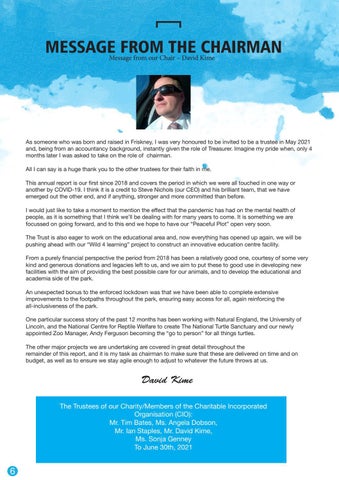
MESSAGE FROM THE CHAIRMAN Message from our Chair – David Kime
As someone who was born and raised in Friskney, I was very honoured to be invited to be a trustee in May 2021 and, being from an accountancy background, instantly given the role of Treasurer. Imagine my pride when, only 4 months later I was asked to take on the role of chairman. All I can say is a huge thank you to the other trustees for their faith in me. This annual report is our first since 2018 and covers the period in which we were all touched in one way or another by COVID-19. I think it is a credit to Steve Nichols (our CEO) and his brilliant team, that we have emerged out the other end, and if anything, stronger and more committed than before. I would just like to take a moment to mention the effect that the pandemic has had on the mental health of people, as it is something that I think we’ll be dealing with for many years to come. It is something we are focussed on going forward, and to this end we hope to have our “Peaceful Plot” open very soon. The Trust is also eager to work on the educational area and, now everything has opened up again, we will be pushing ahead with our “Wild 4 learning” project to construct an innovative education centre facility. From a purely financial perspective the period from 2018 has been a relatively good one, courtesy of some very kind and generous donations and legacies left to us, and we aim to put these to good use in developing new facilities with the aim of providing the best possible care for our animals, and to develop the educational and academia side of the park. An unexpected bonus to the enforced lockdown was that we have been able to complete extensive improvements to the footpaths throughout the park, ensuring easy access for all, again reinforcing the all-inclusiveness of the park. One particular success story of the past 12 months has been working with Natural England, the University of Lincoln, and the National Centre for Reptile Welfare to create The National Turtle Sanctuary and our newly appointed Zoo Manager, Andy Ferguson becoming the “go to person” for all things turtles. The other major projects we are undertaking are covered in great detail throughout the remainder of this report, and it is my task as chairman to make sure that these are delivered on time and on budget, as well as to ensure we stay agile enough to adjust to whatever the future throws at us.
David Kime The Trustees of our Charity/Members of the Charitable Incorporated Organisation (CIO): Mr. Tim Bates, Ms. Angela Dobson, Mr. Ian Staples, Mr. David Kime, Ms. Sonja Genney To June 30th, 2021
6
A year in review 2019/2020 July 19 – October 19 Swings and Roundabouts What a strange period it was for all in the park as we were hit by the worst floods ever experienced. We spent every hour we possibly could trying to move 1000s of gallons of water to try and make it safe for the animals and the return of the customers. On a positive note we did complete our amazing development ARRC which has taken the charity to a new level in parrot welfare and quarantine facilities and is proving a huge hit for the visitors while the staff wondered how we managed before!! Nov 19 – Feb 20 There is only one thing (two really!!) to mention about this period, and that is the arrival of the majestic white lions Pascha and Uganda who are the largest lions we have ever seen. Although displaying a few injuries caused by restricted environments and suffering a little from agoraphobia it didn’t take long for them to settle in and become part of the fixtures and fittings. Mar 20 – June 20 This can only be described with one word ‘COVID’. No one here had ever heard of it before, but we all soon became experts in the field as devastation took over the world as the pandemic broke out and our park having to close down for long periods. Although devastating to us, this paled into insignificance when we witnessed the events around the world and the staggering death count. Being closed gave us the opportunity to make it a better experience on reopening by way of concreting all of the pathways (something we would never normally get the chance to do when we are open) along with creating something quite special throughout this horrendous period and that is our Facebook Lives, a series of live videos that generated a massive following and an upbeat alternative to the gloomy news felt by all
Where the money comes from:
Financial report 2019/2020 Where our money comes from
£581,382 Donations/legacies £581,382 Other Trading activities £39,525 £39,525 Other income £32,810 Other income £32,810 £653,717 £653,717
legacies Charitable Other income
Where our money goes Raising donations/legacies Other trading activities Support costs Support costs Finance Management Finance Governance Governance costs
£319,000 £390,883 £73,562 £318,857 £184,686 £6561 £318,857 £4,882 £42,064 £42,064 £758,365 £758,365
No employee received emoluments in excess of £40,000 No Trustee received remuneration or benefits No Trustee received any expenses Lincolnshire Wildlife Park is a part of the Parrot Zoo Trust (Charity Number 1162135)
Where the money goes: Charitable Support costs Finance Governance
7
A year in review 2020/2021 July 20 – Oct 20 We were allowed to open for 10 weeks in a bid to try and recover valuable lost funds, if nothing else the visitors got to play on our newly constructed play area. Fortunately our amazing followers and visitors donated large quantities of goods, food and produce for our animals to assist in the hard times. Our 2 new enclosures The Cathedral Aviary and Lemur Enclosure were greatly received by the returning visitors as well as the parrots and lemurs that now live in them Nov 20 – Feb 21 This was a very quiet and sombre Christmas for the park, just as we thought things couldn’t get any worse we were hit by the news from our veterinary team that Sangha, one of our amazing male Bengal Tigers would have to be euthanised. It was for the best but never a nice thing for anyone to have to experience. Mar 21 – June 21 Now back open full time we could set about rebuilding our animals future. It was decided by the Trustees and staff alike that it is no good dwelling on the past and trying to catch up on lost revenue but instead to start again from the beginning. What had happened, had happened, and there was no changing that. We decided to start again in many ways and that included a whole new team of Trustees (Except Tim who is part of the furniture now) who we welcome greatly. Plans have been drawn up for some very exciting new projects, especially Wild 4 Learning, a whole new initiative in the world of education.
Where the money comes from: Financial report 2020/2021 Where our money comes from
£852,405 Donations/legacies £581,382 £15,411 Other Trading activities £39,525 Other income £32,810 Other income £74,338
legacies Charitable Other income
£653,717 £942,154 Where our money goes Raising donations/legacies Other trading activities Support Supportcosts costs Management Finance Finance Governancecosts Governance
£319,000 £466,182 £73,562 £184,686 £441,716 £318,857 £7,282 £4,882 £52,196 £42,064 £967,376 £758,365
Where the money goes: Charitable Support costs
No employee received emoluments in excess of £40,000 No Trustee received remuneration or benefits No Trustee received any expenses Lincolnshire Wildlife Park is a part of the Parrot Zoo Trust (Charity Number 1162135)
8
Finance Governance
SOCIAL MEDIA Social media remained huge for the park over the last two years and our presence increased beyond our dreams, particularly during the periods when we were in lockdown due to Coronavirus in 2020 and 2021. Our Chief Executive Officer, Steve Nichols, continued to throw himself in front of the camera and filmed hundreds of live videos with many of our animals and birds. The ‘Lives’ enabled us to remain connected with our thousands of followers and keep everyone updated with their favourites at the park. Videos were streamed live to Facebook, and it was soon apparent that our ‘Super Steve’ was fast becoming a social media star across the world. Over 3 million views later and a resounding success, we are hoping Super-Steve will not get camera shy too soon. The charts below show the numbers of unique users to our Facebook page, and demonstrate how numbers have increased gradually to June 2020, with a huge leap in numbers in early 2021 due to a ‘live hatching’.
The popularity of the ‘live’ videos and our use of social media prompted us to develop a short survey for our followers in order for us to determine just how beneficial they have been throughout a very difficult time for everyone across the world. The survey was launched in April 2021 as we approached the lifting of restrictions. A huge amount of people have responded so far and have overwhelmingly said that the videos helped people cope with the challenges associated with the pandemic.
We will be carrying out a full analysis of the comments received shortly, and the outcomes will be detailed in our next Annual Report.
9
CONSERVATION In 2018 Lincolnshire Wildlife Park chartered a new course for psittacine conservation in zoos around Europe by commencing the Captive Parrot Conservation Program. This program enabled the development of a unique gene pool for psittacines bred for UK and European collections.
Captive Parrot Conservation Programme As more species face extinction around the world, it is a zoo’s moral obligation to support as many programmes as possible that have a positive effect on both flora and fauna.
Already holding over 100 species, our long-term intention is to increase numbers to enable captive security for the common parrot alongside the more endangered species already recognised in the parrot world.
The National Parrot Sanctuary recognises that the psittacine (parrot) is a very important creature within captive populations and over the past decade parrot populations have decreased massively within the United Kingdom, caused by several factors.
This totally new concept is directed towards preserving the species within captivity while benefiting in-situ conservation projects around the world. Lincolnshire Wildlife Park provides a unique facility that fulfils and encourages the natural reproductive needs of the many psittacines that enter the Park, without the worry of overstocking - whilst allowing European collections to have young, parent reared, unrelated, disease-free birds to enter their facilities, something never been achieved before. This conservation program validates our Conservation Policy, which states: “Lincolnshire Wildlife Park will continue to support the preservation and restoration of all psittacines both in captivity and their natural habitats”.
Now, the unstable population needs help. The common species of parrot has maintained its position within captivity through previous mass importation, generating ample breeding stock which in turn produced a significant amount of hand reared specimens for the pet market. Sadly, the majority of these birds are unsuitable for breeding, and with the welcome arrival of the import ban on wild birds in 2006, the parrot population has fallen into mass decline with many of the more common parrots almost extinct in captivity. Unfortunately, it is with this fact in mind, that it will only be a matter of time before UK zoos are devoid of the spectacular parrot family.
RESEARCH
Lincolnshire Wildlife Park actively maintains a partnership with the University of Lincoln to facilitate research. This collaboration has led to several undergraduate and postgraduate student research projects at the park, while also generating further interest from other universities seeking research opportunities. Below is a description of the research project approval process, research facilitation efforts by the park, recent and current park research projects, and their value, and future plans. Research Project Approval Process Individuals interested in undertaking research projects at the park are directed to Dr. Anna Wilkinson at the University of Lincoln, who is the Lead Research Coordinator for Lincolnshire Wildlife Park. After discussing research project ideas, Dr. Anna Wilkinson and the interested party present the proposed research to Steve Nichols, CEO and Senior Animal Manager of the Park. Mr. Nichols provides input, indicating the feasibility of the intended project.
Once the project plan has been developed, researchers submit a formal application to the Ethics Review Board at the University of Lincoln for approval. Once approval has been obtained a research project may begin. Lincolnshire Wildlife Park facilitating research In addition to providing guidance during the initial stages of research project development, staff at the park provide training and educational materials on animal welfare and care management. If enclosure modifications are deemed necessary to meet project requirements and have been approved, staff will assist in this process, as well as assisting in construction of research materials. Future plans Lincolnshire Wildlife Park provides unique opportunities to investigate the cognitive abilities, behaviour, welfare, and management of psittacines. This is an area of growing international interest for researchers; however, groups of suitable captive animals are incredibly rare. No other site has the potential to host comprehensive comparative (cross-species) studies of key aspects of parrot behaviour and welfare. Most have access to a small number of birds and house only a few species. 11
RESEARCH In partnership with the University of Lincoln (and potentially in collaboration with other universities including The Veterinary University of Vienna) we are at the forefront of this type of research. Our recent projects involve research with the big cats; investigating fundamental questions relating to behaviour and welfare, such as enclosure use and intra-specific communication. In parallel, we also plan to increase our focus on British wildlife with a focus on Corvids, (crow family). We plan a research programme investigating cognition and behaviour of these birds. All projects are run alongside an education programme focussing on key issues related to captive care and conservation.
Research Projects • Navigation in an open field task in Sulcata Tortoises • Individual recognition in Blue-fronted Amazons • Spatial navigation in Leopard and Sulcata Tortoises in a T-maze using cues • Relationship quality and problem-solving ability in Orangewinged Amazons • Numerical discrimination in African-greys • Physical cognition in Macaws • Human cue use in Lemurs Research projects such as those above benefit the species involved by providing a greater understanding of their cognitive capacities and social behaviour. Information can and is used in both conservation efforts and efforts to improve the quality of life of captive animals. The research on navigation in tortoises, for instance, sheds light on how these animals locate food sources in the wild, while the research on parrot cognition and social behaviour lends support to the notion that enrichment and stimulation (cognitive and social) are necessary for their well-being. By continuing to support such research projects, Lincolnshire Wildlife Park makes a significant contribution to the body of knowledge that exists on these species so that they may be better understood and cared for.
THE NATIONAL TURTLE SANCTUARY The National Turtle Sanctuary is housed within the Parrot Zoo Trust – Lincolnshire Wildlife Park and was founded in 2019, providing another valuable resource at the Park – this time for these very special reptiles. Where did it startIt was when the Park’s Herpetologist, Andy was visiting Leeds Tropical House to carry out research, that he concluded ‘dwell time’ (the length of time people pause) for turtles was higher than for many other species including Morelet’s Crocodile. Andy developed and submitted a proposal for Steve suggesting that a disused pond/garden area could be made available for maybe 12 turtles. The National Centre for Reptile Welfare (NCRW) was quickly becoming inundated with turtles needing new homes. We were approached for help to assist due to the vast space available at the Park and the success of the sanctuary model developed for parrots. After talks with Steve, and many experts in the field, it was agreed that a few turtles in some existing ponds was achievable and would increase dwell time. What started out as housing a few turtles quickly escalated into creating a sanctuary, receiving turtles directly from owners. Building a sanctuaryThe next stage in development was to design “pods” which would provide housing for the terrapins and could be placed in areas around the Park that were available. These “pods” needed to be deep enough to allow natural behaviours all year round and have adequate basking space for all inhabitants. The first ‘pod’ for these much-loved pet terrapins was a small and simple design that proved to be successful but only for our smaller turtles such as our Musk (Sternotherus) species, or juvenile Maps (Graptemys) species. Although the first design was effective because of the ease of installation of heaters, filters, and land mass, it could only be developed on a small scale for 2-3 adult specimens of Trachemys species. With the projected numbers we were likely to receive, this initial design would prove far too costly.
Turtles and research-
The creation of the National Turtle Sanctuary has allowed LWP to strengthen research opportunities with several Universities including the University of Lincoln and Liverpool John Moore’s University. One of the main research projects developed alongside the University of Lincoln is centered on stress levels when moving to a new habitat. Evidence now shows that within 1 hour the turtle’s stress levels return to normal, showing how these creatures adapt so well to change. Another project with the University of Lincoln is testing for salmonella levels in individuals coming in from different water bodies including home tanks, ponds, and wild, natural bodies. Research with Liverpool John Moore’s University has included conducting a finding and tracing project, monitoring movements of turtles across the UK and via importation. As we gather information from turtle owners, we have been able to support this important research. The National Turtle Sanctuary has also supported the development of excellent links with the RSPCA who we now proudly work alongside to provide accommodation for case animals and forever homes for animals in need, not just for turtles but other reptiles, mammals, and birds. What’s next for the sanctuaryWe currently have 350 turtles of varying species residing at the park and following the completion of our new natural pond will be able to increase numbers dramatically in the years to come. The addition of the poly tunnel and it’s heating equipment means that we will be able to continue to receive turtles throughout the winter months, where previously this would not be possible. Winter, especially leading up to Christmas is a time where people realise how little space they have or how much support these animals require, both monetarily and time wise, and that is why it was so important to ensure we are a year-round sanctuary.
Andy Ferguson
It also became apparent that many of the larger turtles that were coming in were unable to swim properly as their current tanks meant they were unable to learn in accommodation which was too small or not sufficiently deep and therefore the muscles required to swim were not developed enough. The solution was the development of a training pond which varied from very shallow to full depth of their future homes. It also allowed keepers to observe individuals easily. As well as the building of these “pods” we have been fortunate to be able to create natural ponds around the park. As we’re a sanctuary open to the public, we have to be mindful of appearance and interaction with the general public which is key. These developments have been costly, and we are grateful for the support we have received along the way. From paths to plumbing to signage, all are costs that are easily forgotten or overlooked.
13
NATIONAL PARROT SANCTUARY The National Parrot Sanctuary is the largest facility in the UK for psittacines, providing ‘home’ to more than 1000 birds. The Sanctuary is unique in the United Kingdom offering long-term sanctuary for all of its residents. The Sanctuary is known worldwide for the amazing work carried out and is led by Steve Nichols who has studied this amazing creature for nearly 30 years. The Sanctuary team are there to help any parrot in any situation that arises. Nestled within the Parrot Zoo Trust Lincolnshire Wildlife Park, the Sanctuary remains the most important part of our work and the core reason we exist. We have been operating since the early 1990’s and have helped thousands of birds from all over the world.
Unlike any other rescue centre or sanctuary in the United Kingdom, The National Parrot Sanctuary offers long-term care where parrots can live outside in fresh air, taking in the sun and rain making their own daily choices as to when they eat, sleep, play or scream. (And they all do at some point every day!). After many years of change at the park, animals arriving left right and centre, we are now ready for reinvigorating The National Parrot Sanctuary, starting with the ARRC, closely followed by the Captive Parrot Conservation Project.
Working alongside top veterinary surgeons and universities in the United Kingdom, we have created a haven for these special creatures and strive to ensure all our birds are catered for with housing, enrichment, and nutrition. Our team of animal carers are dedicated to offering every bird everything they need to enable a fulfilling quality of life, from nutrition to ‘one-to-one’ care and enrichment. We encourage all our birds to live naturally within a colony to prevent one of the main causes of behavioural problems. It is accepted that parrots thrive when offered the opportunity to live with others of their own species, and with over 100 species of bird already living at the Sanctuary this is something that only we have the facilities to offer.
15
ARRC
Animal Rehabilitation and Reception Centre The Animal Rehabilitation and Reception Centre, (ARRC) is a 2600m2 development that delivers a new level of specialism within the park as the numbers of parrots arriving at the centre increase. The ARRC development comprises of ‘State of the Art’ facilities, including a 4-stage ‘negative air pressured’ quarantine unit for newly arrived birds. Parting with much-loved pets can be a very distressing time, therefore a modern and comfortable reception area has been created to make the experience as comfortable as possible. The Park’s veterinary surgeons, Iain Cope, Sarah Pellett, and Ian Bates are excited by the development of our fully equipped hospital with both on-show and off-show convalescing wards. A laboratory enables on-site parasitology and microbiological tests to be carried out, increasing disease management for the many animals residing at the sanctuary. There is a hatchery and nursery supporting our newly hatched birds that need assistance should their parents have problems - then what makes it even more exciting is, the visitors to the park are able see the staff in action as they go about their amazing day-to-day work. Professor Anna Wilkinson, from the University of Lincoln who is also the Park’s Research Coordinator said, “Lincolnshire Wildlife Park has always excelled where positive research is concerned, and the amazing ARRC facility has enabled us to find out more about these special animals in order to provide them with even better homes”. Also incorporated within the development is a new food preparation unit allowing visitors to gain a unique insight into the vast quantities of high-class food served to the animals daily. Hidden facilities incorporate staff mess rooms and lockers, shower unit and administration offices for both animal and development managers. CEO of the charity Mr. Steve Nichols commented “The development and opening of ARRC is just as exciting as when we laid the first brick at Bengal Gardens, our Tiger research centre. Probably more so if I’m honest as we are now able to complete the circle and put Parrots as the number one animal on site again, reinvigorating and re-launching The National Parrot Sanctuary”
16
17
WHAT LIES AHEAD We are already nearing the end of a very busy 2021, and as we reflect on the previous two years, we are so thankful to our supporters and visitors for sticking with us. Little did we know that when we started our year in July 2019, what lay ahead for the world. We re-opened from lockdown number two, on 12th April 2021, with many restrictions in place due to COVID-19, including mask wearing, social distancing and a new one-way system around the park. During Easter and the Summer our visitor numbers soared, and it was so lovely to see so many happy faces again. During the lockdown months we started thinking about how we can support the wider community as well as providing a forever home for our animals and birds. One idea was to reconnect with local organisations and make every effort to work collaboratively with them to provide activity and care to those local to us. We are pleased to say that our new ‘Reconnecting Network’ is now off the ground with two meetings under our belts and a third on the way. We have high hopes that the network will produce some great project ideas. Around the Park, we have all sorts of ideas about how we can enrich the lives of our animals and birds and, of course provide a great welcome to our visitors. Our Ring-tailed Lemurs now have a new home, we have recently completed our new Cathedral aviary and we are expecting to complete Nigel’s sensory enclosure before Christmas – please keep up to date with new developments on our website at www.lincswildlife.com or our Facebook page. Not forgetting our other social media on Twitter and Instagram. Hot off the press; we have just received confirmation of funding to develop our very own memory garden and sensory space – The Peaceful Plot - watch out for updates for that too!
18
19
OUR PATRONS Hello there. I’m Derren Brown Off Of The Telly. As an important celebrity, I’m more than happy to do a bit of charity work every now and then as long as it doesn’t involve meeting too many weird or embarrassing people. Hence my involvement with The Parrot Zoo Trust and the Lincolnshire Wildlife Park, where I’ve only met one peculiar person: Steve Nichols, he’s the one that runs the place. Peculiar, perhaps, because he has devoted his life to ensuring the welfare and rehabilitation of some of our most engaging and beautiful creatures, and when I talk to Steve about how the sanctuary started, I’m hugely impressed and touched by his motives. He started as a guy with a few tame parrots, who would take a few parrots round to children’s hospices letting the kids play with them. Soon though, the outside risk of introducing infection to such places meant that Steve wasn’t allowed to continue, to the disappointment of his little fans. So he built an aviary at home so that the kids could come and visit. From these beginnings the project grew, and now Steve runs the largest parrot rescue centre in the country, and uniquely is dedicated to researching and protecting the species through this charity. If, like me, you have owned parrots, you’ll know that they are stunning creatures. It’s like having a toddler around the house - only one who can fly. I’ve had breakfast at the Sanctuary and had one of their wards, a Panama Amazon called Hercules, came and stood on the table awaiting to be given something from my plate, each time he’s given something, he says ‘Thank you’. The first few times, you can’t believe your ears, by the time you’ve given him half of what you have just to keep hearing his polite response, you realise that he has you trained far better than someone trained him.
Now Steve and his wonderful team of keepers have expanded even further into the world of animal welfare. From those early days of running around his ‘Back garden’ the small plot of land they aptly titled ‘The National Parrot Sanctuary’, the caring staff now meet the needs of the many 100’s of parrots that are dotted around 20 acres of wonderfully planted woodland and gardens, only now they have company! Nestled within the park is a huge array of exotic animals from Tapirs to Lemurs and even Emus but what’s even more amazing is it now includes the UK’s largest collection of the spectacular Bengal Tigers. ‘Yes’ the iconic tiger, the wonderful place now titled, Lincolnshire Wildlife Park assisted local councils and made provisions to house privately owned big cats from in and around the country. I am so proud to be a part of this amazing worthy organization, of course I fully understand we live in a world where far more disastrous things happen than a cockatoo plucking a hole in its chest or an African Grey shouting obscenities at old people. Many terrible things are worthy of our attention, and occasionally even a little of our time or money. I confess my own charitable instincts are probably not what they could be, but The Parrot Zoo Trust and the sanctuary are all about preserving enjoyment , and I think that enjoyment is a very important thing. The enjoyment that a patient owner can derive from a parrot at home. The enjoyment that a parrot can find again after being neglected, and the sheer delight of visiting a countryside haven where, for the small price of an admission fee and a bag of bird food, you can spend all afternoon in the loud and curious company of parrots. Some will tell you what they think of you. Others will mimic your ring-tone. Some you’ll fall in love with. A few, inexplicably, will just whistle The Simpsons theme tune as you walk past. Steve and his team of dedicated staff have a passion in life, and that is, to meet the needs of captive wild animals. I for one support this whole heartedly and wish them a very prosperous future.
Derren . Visit Derren at: www.derrenbrown.co.uk
20
OUR PATRONS Lord Lieutenant of Lincolnshire and park patron Toby Dennis “I was very thrilled when I was asked to come and meet Steve Nichols and his staff at the Lincolnshire Wildlife Park in June and could not have imagined the experience I was to encounter! Having run a range of family businesses in Lincolnshire including farming and management, for the last forty years the idea of being introduced to the country’s largest collection of parrots and greatest gathering of Bengal Tigers was something I was looking forward to and which turned out to be both unique and delightful. The park is a remarkable place and Steve is an exceptional person and I was impressed with his knowledge and passion for all the animals he has taken responsibility for along with his dedication to their well-being, enclosures and for some, their special needs.
Steve’s concerns for the park to provide for the animal’s future needs and requirements is equally impressive demonstrated by his relentless energy to construct more homes and facilities for the animals whilst at the same time providing special buildings to enhance the visitor experience and for school children to learn about the importance of conservation and animal care. There have been some significant accomplishments for the Park this year beginning with the opening of the magnificent Bengal Gardens in March, a tremendous International Tiger Day and re-naming ceremony in July and a spectacular winter walk in the park and Christmas celebrations campaign in December and all encompassed by the incredible achievement of becoming East Lindsey’s Business Awards Winner for Best Visitor Attraction of the Year a resounding and well-deserved achievement. I am delighted to be a patron to the Lincolnshire Wildlife Park and applaud all of the staff for their hard work, dedication and commitment and pleased to be part of the team that is delivering innovative, exciting and ambitious projects for the parks continued success and future. Toby Denis
21
OUR PATRONS Cleo Rocos As an ambassador I am very proud to be associated with such a unique animal charity. A parrot owner myself for over 20 years, I know the time and dedication it takes to look after just one bird, so caring for the 100’s that these amazing guys and girls do on a daily basis is absolutely awe inspiring. Speaking regularly to Steve (the founder of the charity), I have followed and supported his progress over many years. His utter determination to offer a caring home to a huge array of exotic animals, including the largest collection of Bengal Tigers and Parrots in the country, is testament to the place. Add this to his single minded persistence to never give up no matter what hurdles are put in front of him, and you soon discover that between him, his family and his amazing staff, we are so lucky that this organization is here to stay and will continue to grow, which is just so fortunate for the many animals that need their continued help.
Cleo Ivan Massow Most of us like an animal of some sort, but few dedicate their entire life into caring for them. I am proud to be a Patron and personal supporter of this wonderful charity operated by Steve and his dedicated team of carers, who relentlessly and selflessly offer these needy creatures ‘one to one’ attention 24 hours per day for 365 days per year.
Ivan 22
Thank you! A huge thank you goes to each one of our supporters and followers. We would be nothing without you. Whether you have ‘liked’, ‘followed’, shared, or all three, on Facebook, Twitter, Tik Tok, Instagram, or all four. We are so pleased that you have been part of our journey and the Lincolnshire Wildlife Park family.
Thanks also to our sponsors:
Our Accountants Duncan & Toplis 27/29 Lumley Avenue Skegness Lincolnshire. PE25 2AT
Our Bankers – Lloyds Bank Lumley Road Skegness PE23 5JH
Our Solicitors –
23
The Trustees of the Parrot Zoo Trust – Lincolnshire Wildlife Park would like to offer their sincere thanks to everyone in the team for their continued dedication and commitment to the charity during what has been a very interesting two years.
Dickon Hill Road, Friskney, Boston, Lincolnshire. PE22 8PP Telephone: 0871 3841130