THEATRE/SA | Great expectations LULU by Michael Morley Lulu by Frank Wedekind adapted and translated by Louis N owra. State Theatre Company, Playhouse, Adelaide SA. Opened June 5, 1981. Director, J im Sharman; Sets. Brian Thomson: Costumes. Luciana A rrig h i: Lighting. Nigel Levings; Stage Manager. C oralie Ashton. Cast: Schon, M a lco lm R obertson; Schwarz. Geoffrey Clendon; Goll, John Frawley; Lulu. Judy Davis: Aiwa, Brandon Burke: Rodrigo, John Wood; Schigolch, R alph C otte rill; Geschwitz, K erry W alker; Escerny, R obert Grubb; Magelone, M argaret Davis; Hugenberg, Juliet T aylor; August, Russell Kiefel; Bianetta, Sharon Calcraft.
( Professional)
During his lifetime, Frank Wedekind suffered severely at the hands of con temporary performers: his views on directors were rather more complimentary — but then he was lucky enough to have had Karl Kraus and Max Reinhardt taking him seriously. Much of the same sort of comment could be made about Jim Sharman’s production of Lulu: it is a brave choice, with many good directorial touches and some fine performances. But overall, it misses out on doing full justice to Wedekind’s text. Some of the weaknesses and uneven features can be attributed to Louis Nowra’s adaptation, which reduces Wed ekind’s two plays to two and a half hour’s playing time. Of course there is ample justification for condensing Earlhspirit and Pandora’s Box into one play: Wedekind himself did so in the last decade of his life, Pabst followed suit in his film version and Berg’s libretto is a wonderful example of an opera composer’s sense of dramaturgical aptness. But Nowra seems not so much to have "disembowelled" (as Shaw put it, speaking of Irving’s cuts to Shakespeare) Wedekind, as filletted him and thrown away the bones of the dramatic structure. His insertions — mostly cabaret songs — are well-chosen and effective (though the added prison scene is surely a miscalculation). But because so much of Wedekind’s dialogue has been pared away, the audience is left somewhat bemused by the development of the plot-line, which becomes even more episodic and disjointed than in the original. To take but one example: it is difficult in Nowra’s version to follow the logic of Lulu’s rise (in Act I) and fall (in Act 2). But this sequence depends on her relationship with Dr Schon. Schon acts as her protector and
entree to society in Act 1: with his death. Lulu is easier prey for the men in Act 2. This is not the same as saying that Schon controls her: but just as it is inevitable that he will destroy himself through her, it is clear that without Schon, Lulu will be exploited by those around her. Once she kills the men she fought to possess, she deprives herself of the good that sustained her and gave her such vitality in Act 1. The sense of aimlessness is well caught by Judy Davis in Act 2, as are the exuberance and vitality which character ise the Lulu of the first half. In fact all the "girlish" qualities in Lulu’s makeup are conveyed without exaggeration — her pertness, her coquettishness, her teasing of Schwarz and Hugenberg. But Lulu is
something more (and less) than a teenage vamp; she is a canvas on which each of the men sketches his own idealised figure. And it is this impassivity, verging on the anonymous and the enigmatic which is lacking in Ms Davis’ reading of the part. Lulu is beyond good and evil, and the almost mythical and quasi-metaphysical aspect of the character receives little attention. Of course, this side of Lulu is difficult to catch in performance; but Nowra’s adaptation could have made things easier for the performer by retaining more of Wedekind’s dialogue in which this aspect was referred to. The positive qualities of Judy Davis’ Lulu are her energy, her sense of presence, her readiness to throw herself into scenes
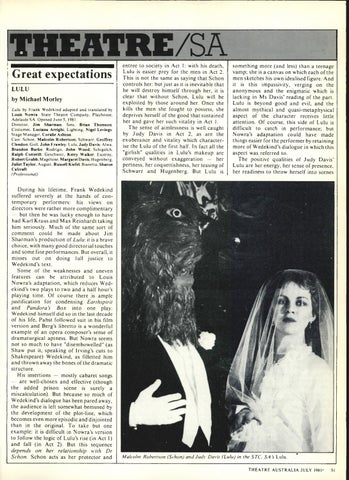
Malcolm Robertson (Schon) and Judy Davis (Lulu) in the STC, 5/1 's Lulu. THEATRE AUSTRALIA JULY 1981
51