THEATRE/NSW Commercial theatre at its best THE DRESSER EVITA YOU NEVER CAN TELL by Michael le Moignan The D r e s s e r by Ronald Harwood. Presented by Helen M ontagu, W ilto n M orley, The M L C Theatre Royal CompSfiy and the A ustralian Elizabethan Theatre Trust by arrangement w ith Michael Codron. Theatre Royal, Sydney NSW . Opened M ay 22, 1981. D irector, Rodney Fisher; Designer, Laurie Dennett; C ostupes, Melody Cooper; L ighting. Nigel Levings. Cast: N orm an, Warren Mitchell; Her Ladyship. Ruth Cracknell; Madge. Jennifer Hagan; Sir, Gordon Chater, Irene, Linda Cropper; Geoffrey, Ken Fraser; M r Oxenby, Frank Garfield; w ith Ron Ratcliff, David
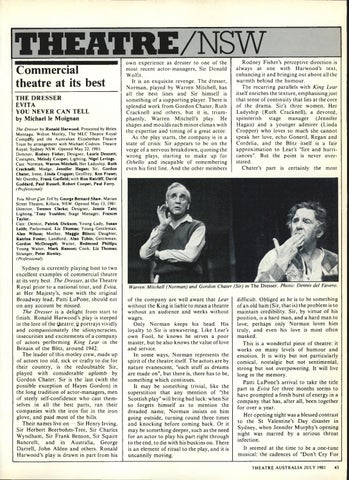
own experience as dresser to one of the most recent actor-managers, Sir Donald Wolfit. It is an exquisite revenge. The dresser, Norman, played by Warren Mitchell, has all the best lines and Sir himself is something of a supporting player. There is splendid work from Gordon Chater, Ruth Cracknell and others, but it is, trium phantly, Warren Mitchell’s play. He shapes and moulds each minor climax with the expertise and timing of a great actor. As the play starts, the company is in a state of crisis: Sir appears to be on the verge of a nervous breakdown, quoting the wrong plays, starting to make up for Othello and incapable of remembering even his first line. And the other members
Rodney Fisher’s perceptive direction is always at one with Harwood’s text, enhancing it and bringing out above all the warmth behind the humour. The recurring parallels with King Lear itself enriches the texture, emphasisingjust that sense of continuity that lies at the core of the drama. Sir’s three women, Her Ladyship (Ruth Cracknell), a devoted, spinsterish stage manager (Jennifer Hagan) and a younger admirer (Linda Cropper) who loves so much she cannot speak her love, echo Goneril, Regan and Cordelia, and the Blitz itself is a fair approximation to Lear’s "fire and hurricanoes". But the point is never over stated. Chater’s part is certainly the most
Goddard, Paul Russell, Robert Cooper, Paul Ferry. ( P r o fe s s io n a l) Y ou N e v e r f a n T e ll by George Bernard Shaw. M arian Street Theatre, K illara, NSW . Opened M ay 13, 1981. D irector, Terence Clarke; Designer, Jennie Tate; L ig h tin g , 'Tony Youlden; Stage Manager, Frances
Taylor. Cast: Dentist, Patrick Dickson; Young Lady, Susan Leith; P arlorm aid, Liz Thomas; Young Gentleman, Alan Wilson; M other. Maggie Blinco; Daughter, Katrina Foster; L andlord. Alan Tobin; Gentleman, Gordon McDougall; W aiter, Redmond Phillips; Young W aiter, Mark Ranson; C ook, Liz Thomas; Stranger, Peter Rowley. ( P r o fe s s io n a l)
Sydney is currently playing host to two excellent examples of commercial theatre at its very best. The Dresser, at the Theatre Royal prior to a national tour, and Evita, at Her Majesty’s, now with the original Broadway lead, Patti LuPone, should not on any account be missed. The Dresser is a delight from start to finish. Ronald Harwood’s play is steeped in the lore of the theatre: tf portrays vividly and compassionately the idiosyncracies, insecurities and excitements of a company of actors perfbrming King Lear in the Britain of the Blitz, around 1942. The leader of this motley crew, made up of actors too old, sick or crafty to die for their country, is the redoubtable Sir, played with considerable aplomb by Gordon Chater. Sir is the last (with the possible exception of Hayes Gordon) in the long tradition of actor-managers, men of steely self-confidence who cast them selves in all the best parts, ran their companies with the iron fist in the iron glove, and paid most of the bills. Their names live on — Sir Henry Irving, Sir Herbert Beerbohm-Tree, Sir Charles Wyndham, Sir Frank Benson, Sir Squire Bancroft, and in Australia, George Darrell, John Alden and others. Ronald Harwood’s play is drawn in part from his
of the company are well aware that Lear without the King is liable to mean a theatre without an audience and weeks without wages. Only Norman keeps his head. His loyalty to Sir is unwavering. Like Lear’s own Fool, he knows he serves a poor master, but he also knows the value of love and service. In some ways, Norman represents the spirit of the theatre itself. The actors are by nature evanescent, "such stuff as dreams are made on", but there is, there has to be, something which continues. It may be something trivial, like the superstition that any mention of "the Scottish play" will bring bad luck: when Sir so forgets himself as to mention the dreaded name, Norman insists on him going outside, turning round three times and knocking before coming back. Or it may be something deeper, such as the need for an actor to play his part right through to the end, to die with his buskins on. There is an element of ritual to the play, and it is uncannily moving.
difficult. Obliged as he is to be something of an old ham (Sir, that is) the problem is to maintain credibility. Sir, by virtue of his position, is a hard man, and a hard man to love; perhaps only Norman loves him truly, and even his love is most often masked. This is a wonderful piece of theatre: it works on many levels of humour and emotion. It is witty but not particularly comical, nostalgic but not sentimental, strong but not overpowering. It will live long in the memory. Patti LuPone’s arrival to take the title part in Evita for three months seems to have prompted a fresh burst of energy in a company that has, after all, been together for over a year. Her opening night was a blessed contrast to the St Valentine’s Day disaster in Sydney, when Jennifer Murphy’s opening night was marred by a serious throat infection. It seemed at the time to be a one-tune musical: the cadences of "Don’t Cry For THEATRE AUSTRALIA JULY 1981
43