Children’s Theatre: A series to mark The International Year of the Child
International Year of the Child 1979 W hen 1 first knew H elm ut, ten years o r m ore ago, he was an acto r who was beginning to be interested in w riting. W hen we first w orked together he played Pericles in a production o f the play th at 1 was doing for Jane St, and the D uke in a M easure for M easure that 1 was doing for the SA TC . A nd H elm ut w rote a G othic play called Shadow s o f B lood that we presented at old N im rod and again, later, at Jan e St. My first question, then, was how and when did H elm ut begin the involvem ent with youth arts and c o m m unity arts that has led to his present appo in tm en t as A rtistic D irector o f St M a rtin ’s Youth A rts C entre. HB: W hen I was w orking at the M TC as an acto r in the late 60’s 1 w rote my first plays for children (Pageant o f the L o ve Tree and The L ittle L ady Steps O ut) and the M TC produced them . But the m ajo r involvem ent began in A delaide with my w ork as director of youth activities with the SA TC under G eorge O gilvie’s artistic direction — 1 set up, directed and w orked in various collective ways with the S aturday C om pany, 1 was in strum ental in setting up the C arelew A rts C entre, 1 was a m em ber o f the com m ittee responsible for the youth com ponent o f the A delaide Festival — in fact 1 was on a n um ber o f b oards with only one thing in com m on: they were all related to extending public aw areness o f youth arts. RC: But why youth? HB: It’s not that I see m yself as cham pion of the rising generation o r anything like that — it’s just th at I fo und, q uite early in my career, that I get a good response from them . I like the fact that there is no hierarchical system o f values — Bugs Bunny and Jo an S u therland are equally acceptable aspects of culture to them . I suppose I followed a n atu ral line o f developm ent in the sense that the wide range o f things I ’m interested in can all find expression in youth and com m unity arts — like film and video, or the relationship between educational system s and politics, or the possibilities o f p a r ticipation — orientated rath er than p roduct-orientated arts. A nd in the specifically theatrical part o f the w ork 1 get a chance not only to w rite and act but also to design, direct, cho reo g rap h , an d w rite music. RC: W hat happened after A delaide? HB: I was given a g ran t by the A ustralia Council to study with D o ro th y H eathcote in N ew castle-upon-Tyne — her p ostg rad u ate (after BA Dip Ed) D ram a in E ducation course (Newcastle U niversity having agreed to recognise my experience as equivalent to the degree). 1 got on very well with D orothy H eathcote but found the course rather frustrating — it was designed for trainee teachers w ithout theatrical background. A fter two term s
Interview with Helmut Bakaitis
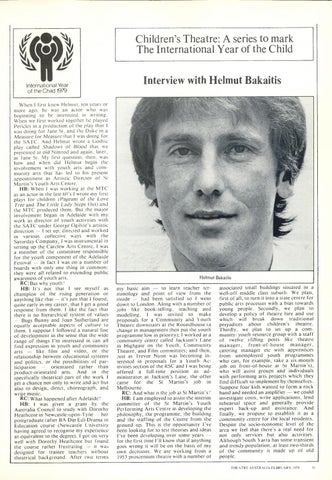
Helmut Bakaitis my basic aim — to learn teacher te r m inology and point of view from the inside — had been satisfied so I w ent dow n to L ondon. A long with a n u m b er o f jo b s like book-selling, teaching an d m odelling, I was invited to m ake p ro p o sals for a C om m unity and Y outh T h eatre dow nstairs at the R oundhouse (a change in m anagem ent then put the youth program m e low in priority); I w orked at a com m unity centre called Ja c k so n ’s L ane in H ighgate on the Y outh, C o m m u n ity T heatre, and Film com m ittees; and th en , ju st as T revor Nunn was becom ing in terested in proposals for a Y outh A c tivities section o f the RSC and 1 was being offered a full-tim e position as a d m in istrato r at Ja c k so n ’s Lane, the o ffe r cam e for the St M a rtin ’s jo b in M elbourne. RC: A nd w hat is the jo b at St M a rtin ’s? HB: I am em ployed to assist the interim com m ittee o f the St M a rtin ’s Y outh P erfo rm in g A rts C entre in developing the philosophy, the program m e, the building and the staffing o f the C entre from the gro u n d up. This is the o p p o rtu n ity I ’ve been looking for to test theories and ideas I ’ve been developing over som e years — for the first time I’ll know that if any th in g goes w rong it will be on the basis o f my own decisions. W e are w orking from a 1953 proscenium theatre with a n u m b er o f
associated small buildings situated in a w ell-off middle class suburb. W e plan, first o f all, to turn it into a state centre for public arts processes with a bias to w ards young people. Secondly, we plan to develop a policy o f theatre hire and use which will break down tra d itio n a l prejudices a b o u t c h ild ren ’s th eatre. T hirdly, we plan to set up a com m u n ity /y o u th resource gro u p with a sta ff o f twelve (filling posts like th eatre m a n a g e r, f r o n t-o f -h o u s e m a n a g e r, catering m anager etc with ap p rentices from unem ployed youth p rogram m es who can, for exam ple, take a six-m onth jo b on front-of-house at St M a rtin ’s), w ho will assist groups and individuals with perform ing arts projects which they find difficult to im plem ent by them selves. Suppose four kids w anted to form a rock band and needed an am plifier — we could investigate costs, write applications, lend rehearsal space and generally provide expert back-up and assistance. A nd finally, we propose to establish it as a com m unity centre for the local residents. D espite the socio-econom ic level o f the area we feel that th ere’s a real need for not only services but also activities. A lthough South Y arra has som e transient an d trendy p opulation, at least tw o -thirds o f the com m unity is m ade up o f old people. THEATRE AUSTRALIA FEBRUARY 1979
35