ANNIE HALL
Alvy (Woody Allen), dropping in on his childhood, talks to a young Alvy. Annie Hall.
psychiatrist, or neither. The humor depends above all on timing; on that John O’Hara moment in which different conversations, different intentions, come together and reflect on each other. Lor instance, as Alvy Woody Allen tells awful jokes. At the and Annie wait in a cinema queue they are beginning of Annie Hall he is speaking assailed by a loud-mouthed psuedofrom the screen, like a performer without intellectual behind them, who is berating an audience, reminding us of Groucho his girlfriend with his opinions about Marx. “ I’d never like to belong to a club,” Fellini, whom he regards critically as an he says, “ that would have me for a indulgent filmmaker. member.” The obnoxious critic moves on to So life’s like that; one struggles on McLuhan and expounds, at tedious despite the bad jokes. They are just one length, the differences between hot and more attempt, along with the psychiatrists cold media. At this point Woody Allen and stage performers, to screw some sense drags McLuhan from behind a screen and out of experience. has him tell the bore that he knows Like Lenny Bruce, Woody Allen exists nothing about his writings. Again, Woody on a precarious balance, hung up over his remarks how nice it would be if life were childhood, sex and death. He is anxious like that. about his Jewishness, about living in New The comic point of the episode though York, about his relations with a succession is not the put-down of a bore, but the of women, including two wives, and the sense of anxiety and futility in the ways inimitable Annie Hall. different conversations intersect. “ So,” Annie is played by Diane Keaton in a says Alvy to Annie, “ does everyone in the warm, bubbly performance; her own self queue have to know our rate of mockery infiltrating her Chippewa Tails intercourse?” accent, her manic driving, her slow and “ Samuel Beckett” , starts up the bore wistful singing {It had to be You). Woody behind him. Woody grapples with Allen plays himself as Alvy Singer, fragments, with repetition, and at the comedian and television performer, same time is paranoid about seeing films fighting off the cast of The Godfather in in their entirety. If it’s not possible to grasp the street (“ Say buddy, didn’t 1see you on some central meaning, then one might as TV last night?” ). well insist on something that doesn’t Both Alvy and Annie exist in a city of matter. strang e e n co u n ters and unstable Alvy was brought up in Brooklyn, in relationships, darkness and garbage. New what appears as a series of running gags. York appears as a hot-house routine of His father worked the dodgem cars in a shuffling academics, publishers and carnival, and little Alvy lived in a shack journalists and of artists dragging their beneath the big dipper. Each time the fetishes around parties (The long-hair has trains went overhead, the house shook; sandwiched the girl against a wall. “ Put and we see Alvy trying to eat his soup as it your foot on my heart.” he says). vibrates on the table. Alvy is taken to a party by his wife; he Alvy literally drops into his childhood, then retires to a bedroom to watch football appearing as a middle-aged man while his on television. His wife finds him and he family life is re-enacted in the household. tries to pull her down on the bed, attracted Allen repeatedly uses this technique of by the idea of fucking while the PhDs next bringing together his different perceptions door discuss modes of alienation. She is of an event or situation. He returns to his horrified. “ There are people here from the school-room, and six-year-old kids get up New Yorker,” she says. and announce what they became in later The kind of assurance represented by life: president of a rail-road, a little girl the cool prose of the New Yorker — and its who’s “ into leather” , a reformed heroin incredible length — contrasts with Alvy’s addict who is now a methadone addict. Or hesitant, compulsive style. His timing during a conversation with Annie, just after he has met her, they indulge in the depends on the breaks betw een paragraphs, the uncertainty of beginning usual abstract conversation piece, while their thoughts are flashed in sub-titles. and not knowing how to finish. While he expounds his views on art, His humor depends on playing around with the chances of making life something and she is listening respectfully, Woody is different, while recognizing that one never thinking, “Christ, 1sound like FM radio.” will. One needs the jokes as well as the He summarizes forcefully one’s own
ANNIE HALL
260 — Cinema Papers, January
LA BETE
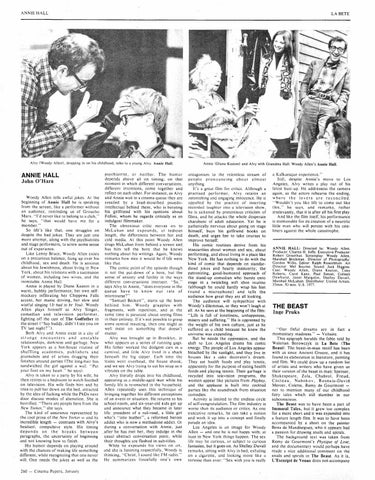
Annie (Diane Keaton) and Alvy with Grandma Hall. Woody Allen’s Annie Hall.
antagonism to the relentless stream of people pronouncing about almost anything. It’s a great film for critics. Although a practised performer, Alvy retains an astonishing and engaging innocence. He is appalled by the practice of inserting recorded laughter into a television show, he is sickened by pretentious criticism of films, and he attacks the whole desperate charabanc of adult education. Yet he is pathetically nervous about going on stage himself, buys his girlfriend books on death, and urges her to take courses to improve herself. His comic routines derive from his insecurities about women and sex, about performing, and about living in a place like New York. He has nothing to do with the kind of comic that depends on standar dized jokes and hearty insincerity; the patronizing, good-humored approach of the stand-up comedian who bursts onto stage in a twinkling soft shoe routine (although he could hardly wrap his feet round a microphone) and tells the audience how great they are all looking. The audience will sympathize with Woody’s dilemmas, or they won’t laugh at all. As he savs at the beginning of the film: “ Life is full of loneliness, unhappiness, misery and suffering.” He is oppressed by the weight of his own culture, just as he suffered as a child because he knew the universe was expanding. But he needs the oppression, and the shift to Los Angeles drains his comic energy. The people of Los Angeles appear bleached by the sunlight, and they live in houses like a cake decorator’s dream. They eat health foods and play tennis, apparently for the purpose of eating health foods and playing tennis. Their garbage is recycled into television programs, the women appear like pictures from Playboy, and the applause is built into cocktail parties like the soundtrack from situation comedies. Activity is limited to the endless circle of self-congratulation. The film industry is worse than its audience or critics. As one executive remarks, he can take a notion and work it up into a concept and finally parade an idea. Los Angeles is an image for Woody Allen — and one he is not happy with; at least in New York things happen. The sex life may be curious, or subject to curious fantasies, but it goes on. As Shelley Duvall remarks, sitting with Alvy in bed, exhaling on a cigarette, and looking more like a tortoise than ever: “ Sex with you is really
a Kafkaesque experience.” Still, despite Annie’s move to Los Angeles, Alvy writes a play out of his latest bust-up. He addressess the camera again, as the actors rehearse the ending, where the lovers are reconciled. “ Wouldn’t you like life to come out like this,” he says, and remarks, rather irrelevantly, that it is after all his first play. And like the film itself, his performance is memorable for its creation of a neurotic little man who will persist with his oneliners against the whole catastrophe.
ANNIE HALL: Directed by: Woody Allen. Producer: Charles H. Joffe. Executive Producer: Robert Greenhut. Screenplay: Woody Allen, Marshall Brickman. Director of Photography: Gordon Willis. Editor: Ralph Rosenblum. Art Director: Mel Bourne. Sound: Jack Higgins. Cast: Woody Allen, Diane Keaton, Tony Roberts, Carol Kane, Paul Simon, Colleen Dewhurst, Janet Margolin, Shelley Duvall, Marshall McLuhan. Distributor: United Artists. 35mm. 93 min. U.S. 1977.
THE BEAST Inge Pruks “ Our fitful dreams are in fact a momentary madness.” — Voltaire. This epigraph heralds the fable told by Walerian Borowczyk in La Bete (The Beast). The beast-in-man motif has been with us since Ancient Greece, and it has found its elaboration in literature, painting and film. We could draw up a random list of artists and writers who have given us their version of the beast in man: Spenser, Shakespeare, Zola, Chabrol, Freud, Cocteau, Nabokov, Resnais-David Mercer, Colette, Remy de Gourmont — not to mention many of our childhood fairy tales which still slumber in our subconscious. The Beast was to have been a part of Immoral Tales, but it grew too complex for a mere short and it was expanded into a feature length film. It was to have been accompanied by a short on the painter Bona de Mandiargues, who it appears had a passion for drawing snails and spirals. The background text was taken from Remy de Gourmont’s Physique of Love, and the documentary would perhaps have made a nice additional comment on the snails and spirals in The Beast. As it is, L’Escargot de Venus does not-accompany