Advance Information for A Level 2022
Contents JCQ Advance Information Student Guide.............................................................................................3 RAG Rating Explained...........................................................................................................................4 Exam Recharges....................................................................................................................................5 Pearson Arabic......................................................................................................................................5 AQA Biology..........................................................................................................................................8 AQA Business......................................................................................................................................10 OCR Chemistry....................................................................................................................................14 Pearson Chinese..................................................................................................................................17 OCR Computer Science.......................................................................................................................19 Edexcel Economics..............................................................................................................................22 AQA English Language........................................................................................................................26 AQA Further Maths.............................................................................................................................27 AQA Geography..................................................................................................................................30 OCR History.........................................................................................................................................44 AQA Mathematics...............................................................................................................................46 AQA Physical Education......................................................................................................................49 AQA Physics........................................................................................................................................52 AQA Psychology..................................................................................................................................55 AQA Spanish........................................................................................................................................58
1
JCQ Advance Information Student Guide The infographic below explains how this booklet can help support students, studying for their exams.
2
RAG Rating Explained This booklet contains advance information published by a range of exam boards. Each exam board and subject area has published information in different formats. The school have added a range of RAG rating tables to each publication (where possible). These are intended to support students throughout their revision. Red = a subject that I know little about and need to complete a significant amount of revision around Amber = a subject that I know about, but need to focus on in order to be confident in my examinations Green = a subject in which I know a lot about and am confident in answering high mark questions We recommend that students start by assessing their own knowledge and completing the tables relevant to their subject choices. This will give them an overview in where their strengths lie and any gaps in knowledge. Using the RAG table, students can then prioritise their revision to ensure that they get to a point where all of the Green columns are ticked meaning they are fully prepared for their examinations. Example RAG Rating Table: Topic 4.1.1 Cell structure 4.1.3 Transport in cells 4.2.2 Animal tissues, organs, and organ systems 4.3.1 Communicable diseases 4.4.1 Photosynthesis
Red
Amber
Green
3
Advance Information and Instructions
For each subject specification this booklet includes the advance information and advice for candidates taking each assessment. The information provided has been taken directly from each awarding body. This information is repeated throughout the booklet for each subject, as each awarding body has their own specific requirements, so it is important to read for each subject. Some of the language used by the awarding bodies is educational jargon, this will be clearly explained by subject teachers to students.
Exam Recharges
You will shortly be receiving an invoice for examination fees. The school charges these at the end of the Lent Term for examinations sat in the Trinity Term. These will be due to be paid on the first day of Trinity Term 21.04.22. Exam fees are charged at the Awarding Body rate +15% to cover the additional costs of running exams to the school. These additional costs include invigilation, exams management and administration. It is common practice for this fee to be charged by independent schools, although some consolidate this charge into their whole fee. Each Awarding Body charges an exam entry fee for each individual candidate, the fee you will be charged will be representative of the examinations for which your son or daughter has been entered.
4
Pearson Arabic Arabic Advance Information Instructions • Please ensure that you have read this notice before the examination. Information • This notice covers Papers 1, 2 and 3. It covers Sections A and B of Paper 1, Section A of Paper 2 and all sections of Paper 3. There is no advance information for Sections B and C of Paper 2. • The format/structure of the papers remains unchanged. • This advance information document details the focus of the content of the exams in the May–June 2022 assessments. • There are no restrictions on who can use this notice. • This notice is meant to help students to focus their revision time. • Students and teachers can discuss the advance information.
General advice • In addition to covering the content outline in the advance information, students and teachers should consider how to manage their revision of other parts of the specification which may provide knowledge which helps with understanding the areas being tested in 2022. • For specifications with synoptic assessments, topics not explicitly given in the advance information may appear, e.g.where students are asked to bring together knowledge, skills and understanding from across the specification. • For specifications with optional papers, students should only refer to the advance information for components for which they intend to sit examinations. Advance Information Subject specific section • This advance information details the major focus of the content of the 2022 assessments in A level Arabic. • Students may focus their revision on these specific aspects, but it is still important to understand these in the context of the whole sub-theme to
5
be able to both answer questions in the assessment and support their progression.
6
AQA Biology Because of the ongoing impacts of the Coronavirus (COVID-19) pandemic, we are providing advance information on the focus of June 2022 exams to help students revise. This is the advance information for A-level Biology (7402) Information • This advance information covers all examined components. • For each paper the list shows the major focus of the content of the examination; the topic areas are listed in rank order, with the areas carrying the highest mark allocations at the top of each list. • Topics not explicitly given in the list may appear in multiple-choice items, low tariff questions, or via synopticity. • Assessment of practical skills (section 8.3 of the specification) and maths skills (section 6 of the specification) occurs throughout the three papers. • It is not permitted to take this advance information into the examination. Advice • Students and teachers should consider how to focus their revision of other non-listed parts of the specification, which may be tested in lower mark questions. • Students will still be expected to apply their knowledge to unfamiliar contexts. • Students will be expected to draw on knowledge, skills and understanding from across the specification when responding to synoptic questions. Focus of the June 2022 exam The inclusion of Required Practical’s in the lists below should not be taken to imply direct references to those procedures quoted in the Practical Handbook. They are there to give a general idea of the context in which practical work is being assessed. 2 of 2 Paper 1 7402/1 Topic 3.2.3 Transport across cell membranes (including Required Practical 3) 3.2.1 Cell structure • 3.4.4 Genetic diversity and adaptation (including Required Practical 6) 3.3.2 Gas exchange 3.1.4 Proteins (including Required Practical 1) 3.1.2 Carbohydrates • 3.3.4 Mass transport
Red
Amber
Green
7
3.4.6 Biodiversity within a community
Paper 2 7402/2 Topic 3.6.4 Homeostasis is the maintenance of a stable internal environment 3.5.2 Respiration (including Required Practical 9) 3.6.2 Nervous coordination 3.5.3 Energy and ecosystems 3.5.4 Nutrient cycles 3.7.1 Inheritance 3.8.2 Gene expression is controlled by a number of features 3.5.1 Photosynthesis Paper 3 7402/3 • 3.5.1 Photosynthesis 3.2.2 All cells arise from other cells (including Required Practical 2) 3.8.4 Gene technologies allow the study and alteration of gene function allowing a better understanding of organism function and the design of new industrial and medical processes 3.6.2 Nervous coordination 3.3.4 Mass transport 3.4.2 DNA and protein synthesis 3.1.4 Proteins 3.6.1 Stimuli, both internal and external, are detected and lead to a response
Red
Amber
Green
The final question, as always, on 7402/3 will be a choice of two synoptic essays. ➢ The level of response mark scheme makes references to ‘several topics’ being covered in order to qualify for the top two levels. ➢ The ‘commentary’ on the scheme defines ‘several’ as at least four topic areas. END OF ADVANCE INFORMATION
8
AQA Business A-level Business (7132) Version 1.0 Because of the ongoing impacts of the Coronavirus (COVID-19) pandemic, we are providing advance information on the focus of June 2022 exams to help students revise. This is the advance information for A-level Business (7132). Information • This advance information covers all examined components. • For each paper the list shows the major focus of the content of the exam. • Topics not explicitly given in the list may appear via synoptic questions or in case study material. Synoptic questions are those that bring together knowledge, skills and understanding from across the specification. • It is not permitted to take this advance notice into the exam. Advice • Students and teachers should consider how to focus their revision of other non-listed parts of the specification, for example to review whether other topics may provide knowledge which helps understanding in relation to the areas being tested in 2022. • Students will be credited for using any relevant knowledge from any non-listed topic areas when answering questions. • Students’ responses to individual questions may draw upon other areas of specification content where relevant, and credit will be given for this where appropriate. • Students will still be expected to apply their knowledge to unfamiliar contexts. • Students will be expected to draw on knowledge, skills and understanding from across the specification when responding to synoptic questions. Focus of the June 2022 exam A-level Business Paper 1 (7132/1) 3.1.2 Understanding different business forms Topic 3.1.3 Understanding that businesses operate within an external environment 3.2.2 Understanding management decision making 3.2.3 Understanding the role and
Red
Amber
Green
9
importance of stakeholders 3.3.1 Setting marketing objectives 3.3.3 Making marketing decisions: segmentation, targeting, positioning 3.3.4 Making marketing decisions: using the marketing mix 3.4.3 Making operational decisions to improve performance: increasing efficiency and productivity 3.4.4 Making operational decisions to improve performance: improving quality 3.5.1 Setting financial objectives 3.5.2 Analysing financial performance 3.5.3 Making financial decisions: sources of finance 3.5.4 Making financial decisions: improving cash flow and profits 3.6.2 Analysing human resource performance 3.6.3 Making human resource decisions: improving organisational design and managing the human resource flow 3.7.1 Mission, corporate objectives, and strategy 3.7.2 Analysing the existing internal position of a business to assess strengths and weaknesses: financial ratio analysis 3.7.3 Analysing the existing internal position of a business to assess strengths and weaknesses: overall performance 3.7.4 Analysing the external environment to assess opportunities and threats: political and legal change 3.8.1 Strategic direction: choosing which markets to compete in and what products to offer 3.8.2 Strategic positioning: choosing how to compete 3.9.1 Assessing a change in scale 3.9.4 Assessing greater use of digital technology 3.10.1 Managing change 3.10.3 Managing strategic implementation 3.10.4 Problems with strategy and
10
why strategies fail
Quantitative Skills Calculate, use and understand ratios, averages and fractions Calculate, use and understand percentages and percentage changes Construct and interpret a range of standard graphical forms Calculate cost, revenue, profit and break-even Interpret, apply and analyse information in written, graphical and numerical forms. A-level Business Paper 2 (7132/2) Topic 3.1.2 Understanding different business forms 3.3.1 Setting marketing objectives 3.3.2 Understanding markets and customers 3.3.3 Making marketing decisions: segmentation, targeting, positioning 3.3.4 Making marketing decisions: using the marketing mix 3.4.5 Making operational decisions to improve performance: managing inventory and supply chains 3.6.4 Making human resource decisions: improving motivation and engagement 3.7.5 Analysing the external environment to assess opportunities and threats: economic change 3.8.1 Strategic direction: choosing which markets to compete in and what products to offer 3.9.1 Assessing a change in scale 3.10.4 Problems with strategy and why strategies fail
Red
Amber
Green
Quantitative Skills Calculate, use and understand percentages and percentage changes Construct and interpret a range of standard graphical forms Interpret values of price and income elasticity of demand Use and interpret quantitative and non-quantitative information in order to make decisions Interpret, apply and analyse information in written, graphical and numerical forms. A-level Business Paper 3 (7132/3) Topic 3.2.3 Understanding the role and
Red
Amber
Green
11
importance of stakeholders 3.3.4 Making marketing decisions: using the marketing mix 3.5.2 Analysing financial performance 3.5.3 Making financial decisions: sources of finance 3.5.4 Making financial decisions: improving cash flow and profits 3.9.1 Assessing a change in scale 3.9.2 Assessing innovation 3.10.2 Managing organisational culture 3.10.3 Managing strategic implementation 3.10.4 Problems with strategy and why strategies fail
Quantitative Skills Calculate, use, and understand ratios, averages and fractions Calculate, use and understand percentages and percentage changes Construct and interpret a range of standard graphical forms Use and interpret quantitative and non-quantitative information in order to make decisions Interpret, apply and analyse information in written, graphical and numerical forms. END OF ADVANCE INFORMATION
12
OCR Chemistry Advance Information for Summer 2022 A Level Chemistry A H432 We have produced this advance information to help support all teachers and students with revision for the Summer 2022 exams.
Information • This notice covers all examined components. • This notice does not cover the practical endorsement component. • Assessment of practical skills and maths skills will occur throughout the papers. • The format/structure of the papers remains unchanged. • There are no restrictions on who can use this notice. • You are not permitted to take this notice into the exam. • This document has 2 pages. Advice • For each paper the list shows the major focus of the content of the exam. • Students are advised that content not listed may appear on the question paper. • The aim should still be to cover all specification content in teaching and learning. • Students and teachers can discuss this advance information. • The information lists topic areas in rank order, with the areas carrying the highest mark allocations at the top of each list. • Students’ responses to individual questions may draw upon other areas of specification content where relevant, and credit will be given for this where appropriate.
13
H432 GCE A Level Chemistry A
H432/01 Periodic table, elements and physical chemistry: Topic 2.1.3 Amount of substance (includes practical skills) 5.3.1 Transition elements 5.1.3 Acids, bases and buffers (includes practical skills) 3.1.1 Periodicity 3.2.1 Enthalpy changes (includes practical skills) 5.1.1 How fast? 5.2.2 Enthalpy and entropy 2.1.4 Acids (includes practical skills)
Red
Amber
Green
Red
Amber
Green
Red
Amber
Green
H432/02 Synthesis and analytical techniques: Topic 2.1.3 Amount of substance (includes practical skills) 4.1.3 Alkenes 6.3.2 Spectroscopy 6.1.1 Aromatic compounds 6.2.5 Organic synthesis (includes practical skills) 6.1.2 Carbonyl compounds (includes practical skills) 4.1.1 Basic concepts of organic chemistry 4.2.4 Analytical techniques 6.2.3 Polyesters and polyamides
H432/03 Unified chemistry: Topic 2.1.3 Amount of substance (includes practical skills) 5.2.3 Redox and electrode potentials (includes practical skills) 3.2.3 Chemical equilibrium (includes practical skills) 4.1.1 Basic concepts of organic chemistry
14
4.2.3 Organic synthesis (includes practical skills) 5.1.3 Acids, bases and buffers 5.2.1 Lattice enthalpy (includes practical skills) 6.2.2 Amino acids, amides and chirality 6.3.2 Spectroscopy
END OF ADVANCE INFORMATION
15
Pearson Chinese Chinese Advance Information Instructions • Please ensure that you have read this notice before the examination. Information • This notice covers Papers 1, 2 and 3. It covers all sections of Paper 1, Section A of Paper 2 and Task 1 for Paper 3. There is no advance information for Sections B and C of Paper 2. • The format/structure of the papers remains unchanged. • This advance information document details the focus of the content of the exams in the May–June 2022 assessments. • There are no restrictions on who can use this notice. • This notice is meant to help students to focus their revision time. • Students and teachers can discuss the advance information. General advice • In addition to covering the content outlined in the advance information, students and teachers should consider how to: • manage their revision of parts of the specification which may be assessed in areas not covered by the advance information. • manage their revision of other parts of the specification which may provide knowledge which helps with understanding the areas being tested in 2022. • For specifications with synoptic assessments, topics not explicitly given in the advance information may appear, e.g. where students are asked to bring together knowledge, skills and understanding from across the specification. • For specifications with optional papers/topics/content, students should only refer to the advance information for their intended option. • For specifications with NEA, advance information does not cover any NEA components. Advance Information Subject specific section • This advance information details the major focus of the content of the 2022 assessments in A level Chinese. • Students may focus their revision on these specific aspects, but it is still important to understand these in the context of the whole sub-theme to be able to both answer questions in the assessment and support their progression.
16
17
OCR Computer Science Advance Information for Summer 2022 A Level Computer Science H446 We have produced this advance information to help support teachers and students with revision for the Summer 2022 examinations. Information • This notice covers all examined components. • This notice does not cover non-examined assessment (NEA) components. • There are no restrictions on who can use this notice. • You are not permitted to take this notice into the exam. Advice • It is advised that teaching and learning should still cover the entire subject content in the specification. • Students and teachers can discuss this advance information. • Students can ask their teachers for advice. Guidance • The following areas of content are suggested as key areas of focus for revision and final preparation. • It is important to note that advance information is NOT being provided for every question. Students are advised that some questions will be on content not listed. • The aim should still be to cover all specification content in teaching and learning. • Some questions may be answerable using more than one area of specified content, including ones not listed. • The information is presented in specification order and not in question order.
18
H446/01 Topic 1.1.1 Structure and function of the processor (b) The Fetch-Decode-Execute Cycle, including its effect on registers (d) The use of pipelining in a processor to improve efficiency (e) Von Neumann, Harvard and contemporary processor architecture 1.1.2 Types of processor (a) The differences between and uses of CISC and RISC processors 1.2.1 Systems Software (d) Scheduling: round robin, first come first served, multilevel feedback queues, shortest job first and shortest remaining time 1.2.2 Applications Generation (d) Translators: Interpreters, compilers and assemblers (e) Stages of compilation (lexical analysis, syntax analysis, code generation and optimisation) 1.2.4 Types of Programming Language (c) Assembly language (including following and writing simple programs with the Little Man Computer instruction set). See appendix 5d 1.3.2 Databases (d) SQL – Interpret and modify. See appendix 5d (f) Transaction processing, ACID (Atomicity, Consistency, Isolation, Durability), record locking and redundancy 1.3.3 Networks (b) The internet structure: • The TCP/IP Stack
Red
Amber
Green
19
1.4.1 Data Types (f) Convert positive integers between Binary Hexadecimal and denary (g) Representation and normalisation of floating point numbers in binary (j) How character sets (ASCII and UNICODE) are used to represent text
H446/02 Topic 2.1.1 Thinking abstractly (a) The nature of abstraction (b) The need for abstraction 2.1.2 Thinking ahead (c)The nature, benefits, and drawbacks of caching (d) The need for reusable program components 2.2.1 Programming techniques (b) Recursion, how it can be used and compares to an iterative approach (c) Global and local variables (d) Modularity, functions and procedures, parameter passing by value and by reference (e) Use of an IDE to develop/debug a program (f) Use of object-oriented techniques 2.2.2 Computational methods (f) Learners should apply their knowledge of: • performance modelling • visualisation to solve problems 2.3.1 Algorithms (e) Algorithms for the main data structures, (stacks, queues, trees, linked lists, depth-first (postorder) and breadth-first traversal of trees)
Red
Amber
Green
20
END OF ADVANCE INFORMATION
Edexcel Economics Economics Advance Information You are not permitted to take this notice into the examination. This document is valid if downloaded from the Pearson Qualifications website. Instructions • Please ensure that you have read this notice before the examination. Information • This notice covers Components 01, 02 and 03. • The format/structure of the assessments remains unchanged. • The advance information details the focus of the content of the exams in the May–June 2022 assessments. • There are no restrictions on who can use this notice. • This notice is meant to help students to focus their revision time. • Students and teachers can discuss the advance information. General advice • In addition to covering the content outline in the advance information, students and teachers should consider how to: • manage their revision of other parts of the specification that may provide knowledge which helps with understanding the areas being tested in 2022. • For specifications with synoptic assessments, topics not explicitly given in the advance information may appear, e.g., where students are asked to bring together knowledge, skills and understanding from across the specification. • For specifications with optional papers, students should only refer to the advance information for components for which they intend to sit examinations. • For specifications with NEA, advance information does not cover any NEA components.
21
Advance Information Subject specific section • This advanced information details the main focus of the questions on the examination papers • For our Pearson Edexcel A Level Economics Specification A, for the component 01 and 02 examination papers, questions within these papers will examine content from the areas specified in this notice. • For component 03, students will not be disadvantaged if solely using the areas indicated in this document, however students’ responses to individual questions may draw upon other areas of specification content where relevant, and credit will be given for this where appropriate. Students should draw upon knowledge, skills and understanding from across the specification when responding to synoptic questions, and again credit will be given where this occurs beyond the content listed. • The specification content is presented in numerical order as set out in the specification, and not reflecting the question order of the examination papers. • Some questions may be answerable using more than one area of specified content. • Any content listed may appear in the examination papers in any question style, from short response questions through to extended response questions. • Candidates will not be expected to answer questions specifically focused on other areas of the specification, but it is important that candidates appreciate that many topics in Economics are interconnected and cannot be understood in isolation. Paper 1 – 9EC0/01 Theme 1: Introduction to markets and market failure Topic 1.1 Nature of economics • 1.1.1 Economics as a social science 1.2 How markets work • 1.2.1 Rational decision making • 1.2.2 Demand • 1.2.3 Price, income and cross elasticities of demand • 1.2.4 Supply • 1.2.5 Elasticity of supply • 1.2.6 Price determination • 1.2.7 Price mechanism 1.3 Market failure • 1.3.1 Types of market failure • 1.3.2 Externalities 1.4 Government intervention • 1.4.1 Government intervention in markets
Red
Amber
Green
22
• 1.4.2 Government failure Theme 3: Business behaviour and the labour market 3.1 Business growth • 3.1.2 Business growth 3.2 Business objectives • 3.2.1 Business objectives 3.3 Revenues, costs and profits • 3.3.1 Revenue • 3.3.2 Costs • 3.3.3 Economies and diseconomies of scale • 3.3.4 Normal profits, supernormal profits and losses 3.4 Market structures • 3.4.1 Efficiency • 3.4.4 Oligopoly • 3.4.5 Monopoly • 3.4.7 Contestability 3.5 Labour market • 3.5.2 Supply of labour 3.6 Government intervention • 3.6.1 Government intervention
W73034A Paper 2 – 9EC0/02 Topic Theme 2: The UK economy – performance and policies 2.1 Measures of economic performance • 2.1.1 Economic growth 2.2 Aggregate demand (AD) • 2.2.2 Consumption (C) • 2.2.3 Investment (I) 2.4 National income • 2.4.1 National income • 2.4.2 Injections and withdrawals • 2.4.4 The multiplier 2.5 Economic Growth • 2.5.3 Trade (business) cycle 2.6 Macroeconomic objectives and policies • 2.6.2 Demand-side policies • 2.6.3 Supply-side policies Theme 4: A global perspective 4.1 International economics • 4.1.1 Globalisation • 4.1.2 Specialisation and trade • 4.1.6 Restrictions on free trade 4.2 Poverty and inequality • 4.2.2 Inequality 4.4 The financial sector
Red
Amber
Green
23
• 4.4.1 Role of financial markets • 4.4.2 Market failure in the financial sector 4.5 Role of the state in the macroeconomy • 4.5.2 Taxation • 4.5.3 Public sector finances • 4.5.4 Macroeconomic policies in a global context
W73034A Paper 3 – 9EC0/03 Topic Theme 1: Introduction to markets and market failure 1.2 How markets work • 1.2.3 Price, income and cross elasticities of demand 1.3 Market failure • 1.3.2 Externalities Theme 2: The UK economy – performance and policies 2.6 Macroeconomic objectives and policies • 2.6.2 Demand-side policies • 2.6.3 Supply-side policies Theme 3: Business behaviour and the labour market 3.1 Business growth • 3.1.2 Business growth 3.5 Labour market • 3.5.1 Demand for labour • 3.5.2 Supply of labour • 3.5.3 Wage determination in competitive and non-competitive markets Theme 4: A global perspective 4.1 International economics • 4.1.2 Specialisation and trade • 4.1.8 Exchange rates 4.3 Emerging and developing economies • 4.3.2 Factors influencing growth and development • 4.3.3 Strategies influencing growth and development 4.5 Role of the state in the macroeconomy • 4.5.4 Macroeconomic policies in a global context
Red
Amber
Green
END OF ADVANCE INFORMATION
24
AQA English Language A-level English Language (7702) Version 1.0 Because of the ongoing impacts of the Coronavirus (COVID-19) pandemic, we are providing advance information on the focus of June 2022 exams to help students revise. This is the advance information for A-level English Language (7702). Information • This advance information relates to the unseen texts in Paper 1 Section A and Paper 2 Section B. • For each text, the advance information gives one of the following: o genre o purpose o mode o time period. • It is not permitted to take this notice into the examination. Advice • Students and teachers should consider how to focus their revision of other non-listed text types, for example to review whether such texts may provide knowledge and context which helps understanding in relation to the texts being used in 2022. Focus of the June 2022 exam 7702/1 Paper 1 Language, the individual and society Section A • Text A genre: news article • Text B genre: opening chapter of a cookbook. 7702/2 Paper 2 Language diversity and change Section B • Text A genre: opinion article • Text B genre: two opposing sides of an argument. END OF ADVANCE INFORMATION
25
AQA Further Maths A-level Further Mathematics (7367) Version 1.0 Because of the ongoing impacts of the Coronavirus (COVID-19) pandemic, we are providing advance information on the focus of June 2022 exams to help students revise. This is the advance information for A-level Further Mathematics (7367). Information • This advance information covers all examined components. • Each bullet point gives the major focus of the content for one question. All questions are covered. • Where a bullet point lists multiple topics for a question, the most relevant topic is listed first. • The bullet points are listed in specification order according to the major topic area (ie lettered headings in the specification) of the first topic referred to in each bullet point. Any further subordering required is alphabetical. • Due to the synoptic nature of some questions, not all relevant topics are listed. Synoptic questions are those that bring together knowledge, skills and understanding from across the specification. • It is not permitted to take this advance information into the examination. Advice • Students and teachers should consider how to focus their revision of other non-listed parts of the specification, which may be of supplementary use in questions as well as aiding general understanding. Focus of the June 2022 exam 7367/1 Paper 1
Topic Arithmetic of complex numbers in modulus/argument form Complex roots of polynomials Loci in the Argand diagram, conversion between Cartesian and modulus/argument form Use of complex roots of unity to solve geometric problems Eigenvectors and eigenvalues Inverse of a 3 × 3 matrix Angle between a line and a plane, distance from a point to a plane Area enclosed by a polar curve, linear transformations in 2D
Red
Amber
Green
26
Differentiation of hyperbolic functions • Logarithmic form of inverse hyperbolic functions Damped harmonic motion where damping force is proportional to velocity, types of damping, forming equations for simple harmonic motion using Hooke's Law Simple harmonic motion
7367/2 Paper 2 Proof by induction Arithmetic of complex numbers in real/imaginary form Eigenvectors and eigenvalues Representation of 2D linear transformations using matrices Finding Maclaurin series of a function, use in evaluation of limits Graphs of conic functions, transformations of graphs Rational functions with linear numerator and denominator, associated inequalities Roots and coefficients of polynomials Mean value of a function Volume of revolution Graphs of hyperbolic functions Coupled first order differential simultaneous equations Solving first order differential equations analytically, Euler's method (improved) for solving first order differential equations Mid-ordinate rule
7367/3M Paper 3 Mechanics Topic Dimensional analysis to predict formulae Conservation of momentum for collisions in 2D Impulse of a variable force • Conservation of energy, work done and kinetic energy Power Work done by a variable force, kinetic energy, conservation of
Red
Amber
Green
27
energy Vectors in the context of circular motion Centre of mass of a system of particles Conditions for sliding and toppling, centre of mass of a composite body
7367/3S Paper 3 Statistics Topic Probability distribution function for discrete random variable (DRV); mean, variance and standard deviation of a DRV; sums of independent RVs Properties of the discrete uniform distribution Poisson probabilities: sum of independent Poisson distributions; mean, variance and standard deviation of Poisson distribution Means and medians of CRVs, cumulative distribution function • Probability density function for a continuous random variable (CRV) Rectangular distribution Chi-squared test for association, Yates correction, Type I and II errors Functions to represent the exponential distribution, probabilities Confidence interval and hypothesis test for mean of a normal distribution from small sample
Red
Amber
Green
28
7367/3D Paper 3 Discrete Topic Euler's formula for connected planar graphs Kuratowski's theorem Route inspection problems Network flow augmentation Critical path analysis, earliest start times, latest finish times, critical activities Resource levelling Conversion of higher order games to linear programming problems Existence or non-existence of stable solution to zero-sum game, playsafe strategies, dominated strategies Binary operations, commutativity, associativity, identity Groups, subgroups, generators, inverses, closure, Cayley tables
Red
Amber
Green
END OF ADVANCE INFORMATION
AQA Geography 29
A level Geography (7037) Version 1.1 Because of the ongoing impacts of the Coronavirus (COVID-19) pandemic, we are providing advance information on the focus of June 2022 exams to help students revise. This is the advance information for A-level Geography (7037). Information • This advance information covers all examined components. • This advance information mainly identifies the required AO1 content that will be assessed in this paper, as well as the required geographical skills. • Due to the synoptic nature of the geographical content, the aims of the specification and its design, there are in places large proportions of content identified. • It is not permitted to take this notice into the examination. Advice [Students and teachers should consider how to focus their revision of other non-listed parts of the specification, for example to review whether other topics may provide knowledge which helps understanding in relation to the areas being tested in 2022. The information contained in this document does not identify all possible opportunities where students may apply their knowledge and understanding (AO2). This means that students’ responses to individual questions may draw upon other areas of specification content where relevant and credit will be given for this, where appropriate. There are a few points to be considered when using this information to help focus revision: • The aims of the specification stipulate that students are encouraged to: “apply geographical knowledge, understanding, skills and approaches in a rigorous way to a range of geographical questions and issues.” In particular, this is important when it comes to accessing higher levels of the mark scheme. • It is good practice in many areas of the specification for the content to be taught through the required case studies (eg local and distant place studies). It is therefore essential that students include case study knowledge as part of their revision in all units studied. • It is important to remind students of the range of ways that data can be presented when looking at Geographical skills (eg different types of bar charts and line graphs), that are assessed in some questions – such as 6 mark AO3 questions.
30
• Opportunities to engage with qualitative and quantitative data as outlined in the specification should be considered in relation to the highlighted AO1 content (eg “qualitative approaches involved in representing place, and to analysing critically the impacts of different media on place meanings and perceptions”). • Questions will be included in the assessment that draw from links made within units, and across units. It is important that students consider this still as part of their revision. Focus of the June 2022 exam 7037/1: Physical Geography 3.1.1 Water and carbon cycles 3.1.1.1 Water and carbon cycles as natural systems Topic Systems in physical geography: systems concepts and their application to the water and carbon cycles – inputs, outputs, energy, stores/components, flows/transfers, positive/negative feedback, dynamic equilibrium.
Red
Amber
Green
Red
Amber
Green
3.1.1.3 The carbon cycle Topic Global distribution, and size of major stores of carbon – lithosphere, hydrosphere, cryosphere, biosphere, atmosphere. Factors driving change in the magnitude of these stores over time and space, including flows and transfers at plant, sere and continental scales. Photosynthesis, respiration, decomposition, combustion, carbon sequestration in oceans and sediments, weathering. The carbon budget and the impact of the carbon cycle upon land, ocean and atmosphere, including global climate. Changes in the carbon cycle over time, to include natural variation (including wildfires, volcanic activity) and human impact (including hydrocarbon fuel extraction and burning, farming practices, deforestation, land use changes). The carbon budget and the impact of the carbon cycle upon land, ocean and atmosphere, including
31
global climate.
3.1.1.4 Water, carbon, climate and life on Earth Topic The key role of the carbon and water stores and cycles in supporting life on Earth with particular reference to climate. The relationship between the water cycle and carbon cycle in the atmosphere.
Red
Amber
Green
Red
Amber
Green
The role of feedbacks within and between cycles and their link to climate change and implications for life on Earth. Human interventions in the carbon cycle designed to influence carbon transfers and mitigate the impacts of climate change.
3.1.2 Hot desert systems and landscapes 3.1.2.1 Deserts as natural systems Topic Systems in physical geography: systems concepts and their application to the development of desert landscapes – inputs, outputs, energy, stores/components, flows/transfers, positive/negative feedback, dynamic equilibrium. The concepts of landform and landscape and how related landforms combine to form characteristic landscapes. The global distribution of mid- and low-latitude deserts and their margins (arid and semi-arid). Characteristics of hot desert environments and their margins: climate, soils and vegetation (and their interaction). Water balance and aridity index. The causes of aridity: atmospheric processes relating to pressure, winds, continentality, relief and cold ocean currents.
32
3.1.2.2 Systems and processes Topic Sources of energy in hot desert environments: insolation, winds, runoff. sediment sources, cells and budgets.
Red
Amber
Green
Red
Amber
Green
Red
Amber
Green
Geomorphological processes: weathering, mass movement, erosion, transportation and deposition. The role of wind – erosion: deflation and abrasion; transportation; suspension, saltation, surface creep, deposition. Sources of water: exogenous, endoreic and ephemeral; the episodic role of water; sheet flooding, channel flash flooding.
3.1.2.3 Arid landscape and development in contrasting settings Topic Origin and development of landforms of mid- and low-latitude deserts: ventifacts
3.1.2.4 Desertification Topic The changing extent and distribution of hot deserts over the
33
last 10,000 years. The causes of desertification – climate change and human impact; distribution of areas at risk; impact on ecosystems, landscapes and populations. Predicted climate change and its impacts; alternative possible futures for local populations.
3.1.2.6 Case studies Topic Case study at a local scale of a landscape where desertification has occurred to illustrate and analyse key themes of desertification, causes and impacts, implications for sustainable development. Evaluation of human responses of resilience, mitigation and adaptation.
Red
Amber
Green
Red
Amber
Green
Red
Amber
Green
3.1.3 Coastal systems and landscapes 3.1.3.1 Coasts as natural systems Topic Systems in physical geography: systems concepts and their application to the development of coastal landscapes – inputs, outputs, energy, stores/components, flows/transfers, positive/negative feedback, dynamic equilibrium. The concepts of landform and landscape and how related landforms combine to form characteristic landscapes.
3.1.3.2 Systems and processes Topic Sources of energy in coastal environments: winds, waves (constructive and destructive),
34
currents and tides. Low energy coasts. Sediment sources, cells and budgets. Geomorphological processes: weathering, erosion, transportation and deposition.
3.1.3.3 Coastal landscape development Topic Origin and development of landforms and landscapes of coastal deposition.
Red
Amber
Green
Red
Amber
Green
Estuarine mudflat/saltmarsh environments and associated landscapes; factors and processes in their development. Coastlines of emergence and submergence. Origin and development of associated landforms: fjords. Recent and predicted climatic change and potential impact on coasts.
3.1.3.4 Coastal management Topic Human intervention in coastal landscapes. Traditional approaches to coastal flood and erosion risk: hard and soft engineering. Sustainable approaches to coastal flood risk and coastal erosion management: shoreline management/integrated coastal zone management.
3.1.3.6 Case studies Case study of a contrasting coastal landscape beyond the UK to illustrate and analyse how it
35
presents risks and opportunities for human occupation and development and evaluate human responses of resilience, mitigation and adaptation. 3.1.4 Glacial systems and landscapes 3.1.4.3 Systems and processes Topic Geomorphological processes – weathering: frost action, nivation; ice movement: internal deformation, rotational, compressional, extensional and basal sliding; erosion: plucking, abrasion; transportation and deposition.
Red
Amber
Green
Red
Amber
Green
Fluvioglacial processes: meltwater, erosion transportation and deposition. Periglacial features and processes: permafrost, active layer and mass movement.
3.1.4.4 Glaciated landscape development Topic Origin and development of glaciated landscapes. Erosional and depositional landforms: corries, arêtes, glacial troughs. Fluvioglacial landforms of erosion and deposition: meltwater channels, kames, eskers, outwash plains. Characteristic fluvioglacial landscapes. Periglacial landforms: patterned ground, ice wedges, pingos, blockfields, solifluction, lobes, terracettes, thermokarst. Characteristic periglacial landscapes. The relationship between process, time, landforms and landscapes in glaciated settings: characteristic glaciated and periglacial landscapes.
36
3.1.4.5 Human impacts on cold environments Topic Concept of environmental fragility. Human impacts on fragile cold environments over time and at a variety of scales. Recent and prospective impact of climate change. Management of cold environments at present and in alternative possible futures.
Red
Amber
Green
3.1.4.7 Case studies Case study of a contrasting glaciated landscape from beyond the UK to illustrate and analyse how it presents challenges and opportunities for human occupation and development and evaluate human responses of resilience, mitigation and adaptation. 3.1.5 Hazards 3.1.5.2 Plate tectonics Topic Destructive, constructive and conservative plate margins. Characteristic processes: seismicity and vulcanicity.
Red
Amber
Green
Red
Amber
Green
3.1.5.3 Volcanic hazards Topic The nature of vulcanicity and its relation to plate tectonics: forms of volcanic hazard: nuées ardentes, lava flows, mudflows, pyroclastic and ash fallout, gases/acid rain, tephra. Spatial distribution, magnitude, frequency, regularity and predictability of hazard events. Impacts: primary/secondary, environmental, social, economic, political. Short- and long-term responses: risk management designed to reduce the impacts of the hazard through
37
preparedness, mitigation, prevention and adaptation. Impacts and human responses as evidenced by a recent volcanic event.
3.1.5.4 Seismic hazards Topic The nature of seismicity and its relation to plate tectonics: forms of seismic hazard: earthquakes, shockwaves, tsunamis, liquefaction, landslides. Spatial distribution, randomness, magnitude, frequency, regularity, predictability of hazard events. Impacts: primary/secondary; environmental, social, economic, political. Short and long-term responses; risk management designed to reduce the impacts of the hazard through preparedness, mitigation, prevention and adaptation.
Red
Amber
Green
Red
Amber
Green
Impacts and human responses as evidenced by a recent seismic event.
3.1.5.5 Storm hazards Topic The nature of tropical storms and their underlying causes. Forms of storm hazard: high winds, storm surges, coastal flooding, river flooding and landslides. Spatial distribution, magnitude, frequency, regularity, predictability of hazard events. Impacts: primary/secondary, environmental, social, economic, political. Short- and long-term responses: risk management designed to reduce the impacts of the hazard through preparedness, mitigation, prevention and adaptation. Impacts and human responses as evidenced by two recent tropical
38
storms in contrasting areas of the world.
3.1.5.6 Fires in nature Topic Characteristic human responses to wildfires – fatalism, prediction, adjustment/adaptation, mitigation, management, risk sharing – and their relationship to hazard incidence, intensity, magnitude, distribution and level of development.
Red
Amber
Green
Red
Amber
Green
Red
Amber
Green
Nature of wildfires. Conditions favouring intense wildfires: vegetation type, fuel characteristics, climate and recent weather and fire behaviour. Causes of fires: natural and human agency. Shortand longterm responses; risk management designed to reduce the impacts of the hazard through preparedness, mitigation, prevention and adaptation. Impact and human responses as evidenced by a recent wildfire event.
3.1.6 Ecosystems under stress 3.1.6.1 Ecosystems and sustainability Topic Ecosystems and their importance for human populations in the light of continuing population growth and economic development. Human populations in ecosystem development and sustainability.
3.1.6.2 Ecosystems and processes Topic
39
Nature of ecosystems – their structure, energy flows, trophic levels, food chains and food webs. Application of systems concepts to ecosystems – inputs, outputs, stores and transfers of energy and materials. Concept of biomass and net primary production. Concepts of succession: climatic climax Mineral nutrient cycling. Nature of terrestrial ecosystems and the inter-connections between climate, vegetation, soil and topography which produce them. Ecosystem responses to changes in one or more of their components or environmental controls.
3.1.6.3 Biomes Topic The concept of the biome. The global distribution of major terrestrial biomes.
Red
Amber
Green
Amber
Green
The nature of the savanna grassland biome to include: • the main characteristics of the biome • ecological responses to the climate, soil and soil moisture budget – adaptations by flora and fauna • human activity and its impact on the biome • typical development issues in the biome to include changes in population, economic development, agricultural extension and intensification, implications for biodiversity and sustainability.
3.1.6.4 Ecosystems in the British Isles over time Topic
Red
40
The concept of the biome. The global distribution of major terrestrial biomes. The characteristics of the climatic climax: temperate deciduous woodland biome.
3.1.6.6 Local ecosystems Topic The main characteristics of a distinctive local ecosystem (such as an area of heathland, managed parkland, pond, dune system). Ecological responses to the climate, soil and soil moisture budget – adaptations by flora and fauna.
Red
Amber
Green
Local factors in ecological development and change (such as agriculture, urban change, the planned and unplanned introduction of new species). The impacts of change and measures to manage these impacts. Conservation strategies and their implementation in specific settings.
3.1.6.7 Case studies Case study of a specified ecosystem at a local scale to illustrate and analyse key themes set out above, including the nature and properties of the ecosystem, human impact upon it and the challenges and opportunities presented in its sustainable development. 3.4.2 Specific skills 3.4.2.1.Core Skills
• Use and annotation of illustrative and visual material: base maps, sketch maps, OS maps (at a variety of scales), diagrams, graphs, field sketches, photographs, geospatial, geolocated and digital imagery. • Literacy – use of factual text and discursive/creative material and coding techniques when analysing text. 41
• Numeracy – use of number, measure and measurement. 3.4.2.2 Cartographic skills • Maps with located proportional symbols. • Maps showing spatial patterns – choropleth, isoline and dot maps. 3.4.2.3 Graphical skills • Line graphs – simple, comparative, compound and divergent. • Bar graphs – simple, comparative, compound and divergent. • Pie charts and proportional divided circles. 7037/2: Human Geography 3.2.1 Global systems and global governance 3.2.1.1 Globalisation Topic Factors in globalisation: the development of technologies, systems and relationships, including financial, transport, security, communications, management and information systems and trade agreements.
Red
Amber
Green
Red
Amber
Green
Amber
Green
3.2.1.2 Global systems Topic Issues associated with interdependence including how: • unequal flows of people, money, ideas and technology within global systems can sometimes act to promote stability, growth and development but can also cause inequalities, conflicts and injustices for people and places.
3.2.1.3 International trade and access to markets Topic
Red
42
Global features and trends in the volume and pattern of international trade and investment associated with globalisation. The nature and role of transnational corporations (TNCs), including their spatial organisation, production, linkages, trading and marketing patterns. World trade in at least one food commodity or one manufacturing product. Analysis and assessment of the geographical consequences of global systems to specifically consider how international trade and variable access to markets underly and impacts on students' and other people's lives across the globe.
3.2.1.4 Global governance Topic Issues associated with attempts at global governance, including how: • agencies, including the UN in the post-1945 era, can work to promote growth and stability but may also exacerbate inequalities and injustices • interactions between the local, regional, national, international and global scales are fundamental to understanding global governance.
Red
Amber
Green
Red
Amber
Green
Red
Amber
Green
3.2.1.5.1 Antarctica as a global common Topic Threats to Antarctica arising from: fishing and whaling.
3.2.1.6 Globalisation critique Topic
43
The impacts of globalisation to consider the benefits of growth, development, integration, stability against the costs in terms of inequalities, injustice, conflict and environmental impact.
3.2.2 Changing Places 3.2.2.1 The nature and importance of places Topic The concept of place and the importance of place in human life and experience Categories of place: experienced places and media places.
Red
Amber
Green
Red
Amber
Green
Red
Amber
Green
Factors contributing to the character of places: • Endogenous: location, topography, physical geography, land use, built environment and infrastructure, demographic and economic characteristics.
3.2.2.2.1 Relationships and connections Topic How the demographic, socioeconomic and cultural characteristics of places are shaped by shifting flows of people, resources, money and investment, and ideas at all scales from local to global. How past and present connections, within and beyond localities, shape places and embed them in the regional, national, international and global scales.
3.2.2.2.2 Meaning and representation Topic
44
The importance of the meanings and representations attached to places by people with a particular focus on people's lived experience of place in the past and at present. How humans perceive, engage with and form attachments to places and how they present and represent the world to others, including the way in which everyday place meanings are bound up with different identities, perspectives and experiences. How external agencies, including governments, corporate bodies and community or local groups make attempts to influence or create specific place-meanings and thereby shape the actions and behaviours of individuals, groups, businesses and institutions. How places may be represented in a variety of different forms such as advertising copy, tourist agency material, local art exhibitions in diverse media (eg film, photography, art, story, song etc) that often give contrasting images to that presented formally or statistically such as cartography and census data. How both past and present processes of development can be seen to influence the social and economic characteristics of places and so be implicit in present meanings.
3.2.2.3 Quantitative and qualitative skills Students must engage with a range of quantitative and qualitative approaches across the theme as 45
a whole. Quantitative data, including the use of geospatial data, must be used to investigate and present place characteristics, particular weight must be given to qualitative approaches involved in representing place, and to analysing critically the impacts of different media on place meanings and perceptions. The use of different types of data should allow the development of critical perspectives on the data categories and approaches.
3.2.2.4 Place studies Topic Local place study exploring the developing character of a place local to the home or study centre. Contrasting place study exploring the developing character of a contrasting and distant place.
Red
Amber
Green
Red
Amber
Green
Red
Amber
Green
Place studies must apply the knowledge acquired through engagement with prescribed specification content and thereby further enhance understanding of the way students' own lives and those of others are affected by continuity and change in the nature of places. Sources must include qualitative and quantitative data to represent places in the past and present.
3.2.3 Contemporary urban environments 3.2.3.1 Urbanisation Topic Urban resurgence. Urban policy and regeneration in Britain since 1979.
3.2.3.2 Urban forms Topic
46
Spatial patterns of land use, economic inequality, social segregation and cultural diversity in contrasting urban areas, and the factors that influence them. New urban landscapes: town centre mixed developments, cultural and heritage quarters, fortress developments, gentrified areas, edge cities. The concept of the post-modern western city.
3.2.3.3 Social and economic issues associated with urbanisation Topic Issues associated with economic inequality, social segregation and cultural diversity in contrasting urban areas. Strategies to manage these issues.
Red
Amber
Green
Red
Amber
Green
Red
Amber
Green
3.2.3.4 Urban climate Topic Thunderstorms in urban environments.
3.2.3.6 Urban waste and its disposal Topic Urban physical waste generation: sources of waste – industrial and commercial activity, personal consumption. The environmental impacts of alternative approaches to waste disposal: unregulated, recycling, recovery, incineration, burial, submergence and trade. Comparison of incineration and landfill approaches to waste disposal in relation to a specified urban area.
47
3.2.4 Population and the environment 3.2.4.1 Introduction The environmental context for human population characteristics and change. Key elements in the physical environment: climate, soils, resource distributions including water supply. Key population parameters: distribution, density, numbers, change. Key role of development processes. Global patterns of population numbers, densities and change rates. 3.2.4.2 Environment and population Topic Global and regional patterns of food production and consumption. Agricultural systems and agricultural productivity. Relationship with key physical environmental variables – climate.
Red
Amber
Green
Characteristics and distribution of two major climatic types to exemplify relationships between climate and human activities and numbers. Climate change as it affects agriculture. Strategies to ensure food security.
3.2.4.3 Environment, health and well-being
48
Topic Global patterns of health, mortality and morbidity. Economic and social development and the epidemiological transition.
Red
Amber
Green
Red
Amber
Green
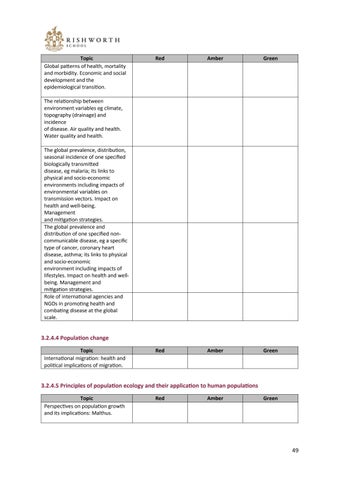
The relationship between environment variables eg climate, topography (drainage) and incidence of disease. Air quality and health. Water quality and health. The global prevalence, distribution, seasonal incidence of one specified biologically transmitted disease, eg malaria; its links to physical and socio-economic environments including impacts of environmental variables on transmission vectors. Impact on health and well-being. Management and mitigation strategies. The global prevalence and distribution of one specified noncommunicable disease, eg a specific type of cancer, coronary heart disease, asthma; its links to physical and socio-economic environment including impacts of lifestyles. Impact on health and wellbeing. Management and mitigation strategies. Role of international agencies and NGOs in promoting health and combating disease at the global scale.
3.2.4.4 Population change Topic International migration: health and political implications of migration.
3.2.4.5 Principles of population ecology and their application to human populations Topic Perspectives on population growth and its implications: Malthus.
Red
Amber
Green
49
3.2.4.6 Global population futures Topic Health impacts of global environmental change: ozone depletion – skin cancer, cataracts; climate change – thermal stress, emergent and changing distribution of vector borne diseases, agricultural productivity and nutritional standards.
Red
Amber
Green
Prospects for the global population. Projected distributions. Critical appraisal of future population environment relationships.
3.2.4.7 Case studies Case-study knowledge and understanding of patterns of health and morbidity related to physical and socio-economic characteristics at a local-scale. 3.2.5 Resource Security 3.2.5.1 Resource development Topic Concept of a resource.
Red
Amber
Green
Red
Amber
Green
Stock resource evaluation: indicated reserves, inferred resources.
3.2.5.2 Natural resource issues Topic Global patterns of production, consumption and trade/movements of energy. Global patterns of water availability and demand. The geopolitics of energy.
3.2.5.3 Water security
50
Topic Sources of water; components of demand, water stress.
Red
Amber
Green
Red
Amber
Green
Relationship of water supply (volume and quality) to key aspects of physical geography – climate, geology and drainage. Sustainability issues associated with water management.
3.2.5.4 Energy security Topic Sources of energy, both primary and secondary. Components of demand and energy mixes in contrasting settings. Energy supplies in a globalising world: competing national interests and the role of transnational corporations in energy production, processing and distribution. Environmental impacts of a major energy resource development such as an oil, coal or gas field and associated distribution networks. Sustainability issues associated with energy production, trade and consumption: acid rain, the enhanced greenhouse effect, nuclear waste and energy conservation.
51
3.2.5.5 Mineral security Topic Reference to iron ore or a specified globally traded non-ferrous metal ore eg copper, tin, manganese.
Red
Amber
Green
Red
Amber
Green
Sources of the specified ore. Distribution of reserves/resources. End uses of the ore. Components of demand for ore. Role of specified ore in global commerce and industry. Environmental impacts of a major mineral resource extraction scheme and associated distribution networks. Sustainability issues associated with ore extraction, trade and processing.
3.2.5.6 Resource futures Topic Alternative energy, water and mineral ore futures and their relationship with a range of technological, economic, environmental and political developments.
3.4.2 Geographical skills 3.4.2.1.Core Skills • Use and annotation of illustrative and visual material: base maps, sketch maps, OS maps (at a variety of scales), diagrams, graphs, field sketches, photographs, geospatial, geolocated and digital imagery. • Literacy – use of factual text and discursive/creative material and coding techniques when analysing text. • Numeracy – use of number, measure and measurement.
3.4.2.2 Cartographic skills 52
• Maps with located proportional symbols. 3.4.2.3 Graphical skills • Line graphs – simple, comparative, compound and divergent. • Bar graphs – simple, comparative, compound and divergent. • Scatter graphs and the use of best fit line. • Pie charts and proportional divided circles.
END OF ADVANCE INFORMATION
OCR History Y113: Britain 1930–1997 53
• Questions will be drawn from the indicated areas of specification content. • There is no expectation of knowledge beyond that identified in order to achieve full marks. Key Topic Churchill and international diplomacy 1939–1951 Labour and Conservative governments 1964– 1979 Thatcher and the end of consensus 1979– 1997
Content Churchill’s view on Britain’s world and imperial role; relations with other wartime leaders (Roosevelt, Stalin and de Gaulle); contribution to international conferences; plans for post-war Europe; Iron Curtain speech; attitude to Empire and Europe after 1945. Labour victory 1964, Wilson as leader 1964–1970; economic problems and policies; relations with the Trade Unions; Labour party divisions; 1970 election, Heath as party leader and Prime Minister; aims and policies of Heath’s government; industrial relations, miners’ strike; Wilson and Callaghan 1974–1979, problems and policies 1974–1979. Election victories; Thatcher and her ministers; reasons for support and opposition; social and economic policies including monetarism, free-market, supply-side economics, and privatisation; social policies and unrest; unemployment and the Trade Unions, the Miners’ Strike; fall of Thatcher and replacement with Major; Conservative divisions under Major and electoral defeat 1997.
Y212: The American Revolution 1740–1796 • Questions will be drawn from the indicated areas of specification content. • There is no expectation of knowledge beyond that identified in order to achieve full marks.
Key Topic The development of British hegemony in America Causes of the American Revolution
The American Revolution 1774–1783
Content British, French, and Spanish colonies in North America in 1740; socio-economic development and relations with settlers and Native American Indians; territorial expansion to 1765; wars with France, reasons for British success including War of Austrian Succession, Seven Years War. The relationship between Britain and the colonies in 1763; British policy and America reaction including Proclamation Act (1763), Stamp Act (1765), Declaratory Act (1766), Townshend Duties (1767) and their repeal, the Boston Massacre (1770); Tea Act (1773) and response including the ‘Intolerable Acts’ (1774– 1775); developments in political thought and emerging leaders, including Locke, Jefferson, Dickinson, John Adams and Samuel Adams; colonial and political ideas including views on trade and taxation. The move towards independence 1774–1776 including the first and second Continental Congresses, Declaration of Independence (1776); outbreak of hostilities, key military developments, their role in British defeat; American unity, including Washington, French entry to the war, quality of British military leadership; 1783 Peace of Paris.
Y312: Popular Culture and the Witchcraze of the 16th and 17th Centuries • Questions will be drawn from the indicated areas of specification content.
54
• There is no expectation of knowledge beyond that identified in order to achieve full marks. Key Topic The main reasons for the growth and decline in the persecution of witches
The persecuted
Responses of the authorities to witchcraft
Hopkins and the witch hunt of 1645–1647
Content Developments from the Papal Bull of 1484 and the Malleus Maleficarum (1486) to the end of the period; causes of growth and decline, including religious changes and confessional strife, economic causes, social structure, changes and divisions within society, scapegoats and minorities, popular culture and cultural changes, growth of rationalism and enlightened thinking, understanding of medicine and remedies; persecution from above or below; the role of wars and natural disasters, including plague and the mini–Ice Age. The geography of the Witchcraze in Europe and North America; regional variations; towns; countryside; religious variations, gender, age, social and employment composition of those prosecuted for witchcraft. Legal developments including the Inquisitorial system of criminal procedure, secular courts on both a local and regional scale; campaigns against medieval superstition; torture, trials, felony, burnings, sleep deprivation, confessions; survival of popular beliefs, impact on the Reformation; mistrust and fear, denunciations; impact on legal procedure. The religious, political, social and economic situation and their impact on order and conformity; moral regulation and the challenges to popular culture in the 1640s; the reasons for the persecution; the frequency, nature and geography of the persecutions; the response of the authorities to witchcraft and its impact on society.
END OF ADVANCE INFORMATION
55
AQA Mathematics A-level Mathematics 7357 Version 1.0 Because of the ongoing impacts of the Coronavirus (COVID-19) pandemic, we are providing advance information on the focus of June 2022 exams to help students revise. This is the advance information for A-level Mathematics 7357. Information • This advance information covers all examined components. • Each bullet point gives the major focus of the content for one question. All questions are covered. • Where a bullet point lists multiple topics for a question, the most relevant topic is listed first. • The bullet points are listed in specification order according to the major topic area (ie lettered headings in the specification) of the first topic referred to in each bullet point. Any further subordering required is alphabetical. • Due to the synoptic nature of some questions, not all relevant topics are listed. Synoptic questions are those that bring together knowledge, skills and understanding from across the specification. • It is not permitted to take this advance information into the examination. Advice • Students and teachers should consider how to focus their revision of other non-listed parts of the specification, which may be of supplementary use in questions as well as aiding general understanding.
56
Focus of the June 2022 exam 7357/1 Paper 1 Topic Factor theorem, cubic graphs Transformations of graphs Conversion between parametric and Cartesian forms, trigonometric identities Coordinate geometry, equations of straight lines and circles
Red
Amber
Green
Arithmetic sequences and series, inequalities Periodic sequences Sum to infinity of a geometric series, exact values of trigonometric functions Graphs of trigonometric functions, transformations of graphs Small angle approximations of trig functions, binomial expansion Implicit differentiation, stationary points of curves Tangents to a curve The gradient function of a curve Area under a curve, integration techniques, trapezium rule Integration by substitution, differentiation of trigonometric functions, trigonometric identities Newton-Raphson method, areas of sectors and triangles, locating roots by considering a change of sign
7357/2 Paper 2
57
Section A Topic Proofs by counterexample and exhaustion Transformations of graphs, sketch curves defined by simple equations Coordinate geometry of the circle Binomial expansion, integration of polynomials Sine and cosine rules Laws of logarithms Convex and concave sections of curves Differentiation from first principles Maximum and minimum points of polynomials Solving differential equations, exponential models, partial fractions
Red
Amber
Green
Red
Amber
Green
Section B Topic Position vectors, constant acceleration formulae in two dimensions Calculus in kinematics using vectors, calculus for exponential and trigonometric functions, calculus techniques, magnitude of a vector Constant acceleration formulae Projectile motion, trigonometric functions Velocity-time graphs Forces in equilibrium in 2D Newton's laws of motion, friction, resolving forces, constant acceleration formulae Weight and acceleration due to gravity Moments
7357/3 Paper 3
58
Section A Topic Proof by contradiction Inverse functions Validity of binomial expansion Graphs of trigonometric functions, trigonometric equations Using logarithmic graphs to estimate parameters in non-linear relationships Connected rates of change Parametric differentiation, parametric models Stationary points of curves, graphs of a function, domains and ranges of a function, simultaneous equations Area between two curves Integrating powers of x
Red
Amber
Green
Red
Amber
Green
Section B Topic Critique statistical sampling Interpreting statistical diagrams, distributions Probability using Venn diagrams, conditional probability, independent events Binomial distribution, binomial probabilities Normal distribution properties and probabilities, calculations with summary statistics Parameters of a normal distribution Hypothesis test for mean of a normal distribution Hypothesis test for proportion using binomial distribution
END OF ADVANCE INFORMATION
59
AQA Physical Education A-level Physical Education (7582) Version 1.0 Because of the ongoing impacts of the Coronavirus (COVID-19) pandemic, we are providing advance information on the focus of June 2022 exams to help students revise. This is the advance information for A-level Physical Education (7582). Information • This advance information covers all examined components. • For each paper the list shows the major focus of the content of the exam. • Topics not explicitly given in the list may appear in multiple-choice questions, low tariff questions or via synoptic questions. Synoptic questions are those that bring together knowledge, skills and understanding from across the specification. • It is not permitted to take this advance information into the examination. Advice • Students and teachers should consider how to focus their revision of other non-listed parts of the specification, which may be tested in lower mark questions. • Students and teachers should consider how to focus their revision of other non-listed parts of the specification, for example to review whether other topics may provide knowledge which helps understanding in relation to the areas being tested in 2022. • Students will be credited for using any relevant knowledge from any non-listed topic areas when answering questions. • Students will still be expected to apply their knowledge. • Students will be expected to draw on knowledge, skills and understanding from across the specification when responding to synoptic questions.
Focus of the June 2022 exam 60
The major focus of the June 2022 exam will be as follows. Paper 1: Factors affecting participation in physical activity and sport 3.1.1.6 Energy systems Topic Energy transfer during short duration/high intensity exercise.
Red
Amber
Green
Energy transfer during long duration/lower intensity exercise. Impact of specialist training methods on energy systems.
3.1.2.2 Impact of skill classification on structure of practice for learning Topic Types of practice.
Red
Amber
Green
Amber
Green
Amber
Green
Amber
Green
3.1.2.3 Principles and theories of learning and performance Topic Stages of learning and how feedback differs between the different stages of learning. Learning plateau.
Red
3.1.3.1.2 Industrial and post-industrial (1780–1900) Topic Characteristics and impact on sport (limited to development of association football, lawn tennis, rationalisation of track and field events and the role of the Wenlock Olympian Games).
Red
3.1.3.2.1 Sociological theory applied to equal opportunities Topic The interrelationship between Sport England, local and national partners to increase participation at grass roots level and underrepresented groups in sport.
Red
61
3.2.1.1 Diet and nutrition and their effect on physical activity and performance Topic Positive and negative effects of dietary supplements/manipulation on the performer.
Red
Amber
Green
Red
Amber
Green
3.2.3.1.10 Importance of goal setting Topic Principles of effective goal setting.
Paper 2: Factors affecting optimal performance in physical activity and sport 3.2.1.2 Preparation and training methods in relation to maintaining physical activity and Performance Topic Understanding of the key terms relating to laboratory conditions and field tests.
Red
Amber
Green
Red
Amber
Green
Red
Amber
Green
Red
Amber
Green
Red
Amber
Green
3.2.1.3 Injury prevention and the rehabilitation of injury Topic Understanding different methods used in injury prevention, rehabilitation, and recovery.
3.2.2.5 Projectile motion Topic Factors affecting horizontal displacement of projectiles.
3.2.2.6 Fluid mechanics Topic The Bernoulli principle applied to sporting situations.
3.2.3.1.2 Attitudes Topic Triadic model
3.2.3.1.11 Attribution theory
62
Topic Strategies to avoid learned helplessness leading to improvements in performance.
Red
Amber
Green
Red
Amber
Green
Red
Amber
Green
Red
Amber
Green
Red
Amber
Green
3.2.3.1.12 Self-efficacy and confidence Topic Bandura’s Model of self-efficacy.
3.2.3.1.13 Leadership Topic Theories of leadership in different sporting situations.
3.2.4.3 Ethics in sport Topic Understanding of the key terms relating to ethics in sport.
3.2.4.6 Sport and the law Topic The uses of sports legislation.
3.2.4.7 Impact of commercialisation on physical activity and sport and the relationship between sport and the media Topic The positive and negative impact of commercialisation, sponsorship, and the media.
Red
Amber
Green
END OF ADVANCE INFORMATION
63
AQA Physics A-level Physics (7408) Version 1.0 Because of the ongoing impacts of the Coronavirus (COVID-19) pandemic, we are providing advance information on the focus of June 2022 exams to help students revise. This is the advance information for A-level Physics (7408)]. Information • This advance information covers all examined components. • For each paper the list shows the major focus of the content of the examination; the topic areas are listed in rank order, with the areas carrying the highest mark allocations at the top of each list. • Topics not explicitly given in the list may appear in multiple-choice items, low tariff questions, or via synopticity. • Assessment of practical skills (section 8.3 of the specification) and maths skills (section 6 of the specification) occurs throughout the three papers. • It is not permitted to take this advance information into the examination. Advice • Students and teachers should consider how to focus their revision of other non-listed parts of the specification, which may be tested in lower mark questions. • Students will still be expected to apply their knowledge to unfamiliar contexts. • Students will be expected to draw on knowledge, skills and understanding from across the specification when responding to synoptic questions. Focus of the June 2022 exam The inclusion of Required Practicals in the lists below should not be taken to imply direct references to those procedures quoted in the Practical Handbook. They are there to give a general idea of the context in which practical work is being assessed.
Paper 1 7408/1 64
Topic
Red
Amber
Green
Red
Amber
Green
Amber
Green
Amber
Green
3.2.1 Particles 3.4.1 Force, energy and momentum 3.5.1 Current electricity 3.6.1 Periodic motion 3.2.2 Electromagnetic radiation and quantum phenomena
Paper 2 7408/2 Topic 3.6.2 Thermal physics 3.8.1 Radioactivity 3.7.5 Magnetic fields 3.7.2 Gravitational fields
Paper 3 7408/3A + 7408/3BA (Astrophysics route) Topic 3.6.2 Thermal physics (including Required Practical 8) 3.5.1 Current electricity (including Required Practical 5) 3.4.2 Materials (including Required Practical 4) 3.9.3.1 Doppler effect
Red
3.9.3.2 Hubble’s law 3.9.1.1 Astronomical telescope consisting of two converging lenses 3.9.2.2 Absolute magnitude, M
Paper 3 7408/3A + 7408/3BB (Medical physics route) Topic 3.6.2 Thermal physics (including Required Practical 8)
Red
3.5.1 Current electricity (including Required Practical 5) 3.4.2 Materials (including Required Practical 4) 3.10.2.2 Sensitivity and frequency response 3.10.5.3 Absorption of X-rays 3.10.4.3 Magnetic resonance (MR) scanner 3.10.1.2 Defects of vision and their correction using lenses
65
Paper 3 7408/3A + 7408/3BC (Engineering physics route) Topic 3.6.2 Thermal physics (including Required Practical 8) 3.5.1 Current electricity (including Required Practical 5)
Red
Amber
Green
Amber
Green
Amber
Green
3.4.2 Materials (including Required Practical 4) 3.11.1.2 Rotational kinetic energy 3.11.2.4 Engine cycles 3.11.2.6 Reversed heat engines
Paper 3 7408/3A + 7408/3BD (Turning points in physics route) Topic 3.6.2 Thermal physics (including Required Practical 8) 3.5.1 Current electricity (including Required Practical 5) 3.4.2 Materials (including Required Practical 4) 3.12.1.4 Principle of Millikan’s determination of the electronic charge, e 3.12.2.2 Significance of Young’s double slits experiment 3.12.3.5 Mass and energy
Red
Paper 3 7408/3A + 7408/3BE (Electronics route) Topic 3.6.2 Thermal physics (including Required Practical 8) 3.5.1 Current electricity (including Required Practical 5) 3.4.2 Materials (including Required Practical 4) 3.13.4.1 Inverting amplifier configuration 3.13.5.1 Combinational logic 3.13.6.4 Amplitude (AM) and frequency modulation (FM) techniques
Red
END OF ADVANCE INFORMATION
66
AQA Psychology Advance information June 2022 A-level Psychology (7182) Version 1.0 Because of the ongoing impacts of the Coronavirus (COVID-19) pandemic, we are providing advance information on the focus of June 2022 exams to help students revise. This is the advance information for A-level Psychology 7182. Information • This advance information covers all examined components. • There is no advance information for the assessment of Research Methods throughout the papers or in Section C Paper 7182/2, due to the integrated nature of the research methods content. • For each paper the list shows the major focus of the content of the exam. • It is not permitted to take this advance information into the exam. Advice • The aim should still be to cover all specification content in teaching and learning. • Students and teachers should consider how to focus their revision of other non-listed parts of the specification, for example to review whether other topics may provide knowledge which helps understanding in relation to the areas being tested in 2022. • Students will be expected to draw on knowledge, skills and understanding from across the specification when responding to synoptic questions and extended writing. • Students will be credited for using any relevant knowledge from any non-listed topic areas when answering questions. Focus of the June 2022 exam 7182/1 Paper 1 Introductory topics in Psychology 4.1.1 Social Influence Topic Explanations for obedience: agentic state and legitimacy of authority, and situational variables affecting obedience including proximity and location, as investigated by Milgram, and uniform. Dispositional explanation for obedience: the Authoritarian Personality. Explanations of resistance to social influence, including social support and locus of control.
Red
Amber
Green
Minority influence including reference to consistency, commitment and flexibility. The multi-store model of memory: sensory register, short-term memory and long-term memory. Features of each store: coding, capacity and duration. The working memory model: central
67
executive, phonological loop, visuospatial sketchpad and episodic buffer. Features of the model: coding and capacity. Improving the accuracy of eyewitness testimony, including the use of the cognitive interview.
4.1.3 Attachment Topic Animal studies of attachment: Lorenz and Harlow. Explanations of attachment: learning theory and Bowlby’s monotropic theory. The concepts of a critical period and an internal working model. Ainsworth’s ‘Strange Situation’. Types of attachment: secure, insecure-avoidant and insecureresistant. Cultural variations in attachment, including van Ijzendoorn. Bowlby’s theory of maternal deprivation. Romanian orphan studies: effects of institutionalisation.
Red
Amber
Green
Red
Amber
Green
The influence of early attachment on childhood and adult relationships, including the role of an internal working model.
4.1.4 Psychopathology Topic Definitions of abnormality, including deviation from social norms, failure to function adequately, statistical infrequency and deviation from ideal mental health. The behavioural approach to explaining and treating phobias: the two-process model, including classical and operant conditioning; systematic desensitisation, including relaxation and use of hierarchy; flooding. The biological approach to explaining and treating OCD: genetic and neural explanations; drug therapy.
68
7182/2 Paper 2 Psychology in context 4.2.1 Approaches in Psychology The basic assumptions of the following approaches: Topic Learning approaches: i) the behaviourist approach, including classical conditioning and Pavlov’s research, operant conditioning, types of reinforcement and Skinner’s research; ii) social learning theory including imitation, identification, modelling, vicarious reinforcement, the role of mediational processes and Bandura’s research. The psychodynamic approach: the role of the unconscious, the structure of personality, that is Id, Ego and Superego, defence mechanisms including repression, denial and displacement, psychosexual stages. Humanistic Psychology: free will, self-actualisation and Maslow’s hierarchy of needs, focus on the self, congruence, the role of conditions of worth. The influence on counselling Psychology.
Red
Amber
Green
Red
Amber
Green
4.2.2 Biopsychology Topic The divisions of the nervous system: central and peripheral (somatic and autonomic). The structure and function of sensory, relay and motor neurons. The process of synaptic transmission, including reference to neurotransmitters, excitation and inhibition. Localisation of function in the brain and hemispheric lateralisation: motor, somatosensory, visual, auditory and language centres; Broca’s and Wernicke’s areas, split brain research. Plasticity and functional recovery of the brain after trauma. Ways of studying the brain: scanning techniques, including
69
functional magnetic resonance imaging (fMRI); electroencephalogram (EEGs) and event-related potentials (ERPs); post-mortem examinations.
4.2.3 Research Methods – No advance information provided 7182/3 Paper 3 Issues and options in Psychology 4.3.1 Issues and debates in Psychology Topic Free will and determinism: hard determinism and soft determinism; biological, environmental and psychic determinism. The scientific emphasis on causal explanations. Idiographic and nomothetic approaches to psychological investigation.
Red
Amber
Green
Red
Amber
Green
Ethical implications of research studies and theory, including reference to social sensitivity. Relationships, Gender or Cognition and Development
4.3.3 Gender Topic The role of chromosomes and hormones (testosterone, oestrogen and oxytocin) in sex and gender. Atypical sex chromosome patterns: Klinefelter’s syndrome and Turner’s syndrome. Cognitive explanations of gender development, Kohlberg’s theory, gender identity, gender stability and gender constancy; gender schema theory.
70
4.3.5 Schizophrenia Topic Psychological explanations for schizophrenia: family dysfunction and cognitive explanations, including dysfunctional thought processing. Drug therapy: typical and atypical antipsychotics. Cognitive behaviour therapy and family therapy as used in the treatment of schizophrenia. Token economies as used in the management of schizophrenia. The importance of an interactionist approach in explaining and treating schizophrenia; the diathesis-stress model.
Red
Amber
Green
Red
Amber
Green
4.3.9 Forensic Psychology Topic Offender profiling: the top-down approach, including organised and disorganised types of offender; the bottom-up approach, including investigative Psychology; geographical profiling. Psychological explanations of offending behaviour: Eysenck’s theory of the criminal personality; cognitive explanations; level of moral reasoning and cognitive distortions, including hostile attribution bias and minimalisation; differential association theory; psychodynamic explanations.
END OF ADVANCE INFORMATION
71
AQA Spanish A-level Spanish (7692) Version 1.0 Because of the ongoing impacts of the Coronavirus (COVID-19) pandemic, we are providing advance information on the focus of June 2022 exams to help students revise. This is the advance information for A-level Spanish (7692). Information • This advance information covers Papers 1 and 3 only. • There is no advance information for Paper 2, due to the nature of the questions in this paper. • For each paper the list shows the major focus of the content of the exam. • Assessment of skills will occur throughout the papers. • It is not permitted to take this notice into the examination. Advice • The aim should still be to cover all specification content in teaching and learning. • The bullet points in the specification often overlap and, while other areas of the specification will not be specifically tested, they may provide underpinning knowledge to support understanding of the material provided in the exam. • Knowledge of the grammar listed in Section 3.3 of the specification will be required. Focus of the June 2022 exam • The information is presented in specification order and not in question order.
72
2 of 3 Paper 1: Listening, Reading and Writing Topic 3.1.1 Aspects of Hispanic society Modern and traditional values (Los valores tradicionales y modernos) La influencia de la Iglesia Católica Cyberspace (El ciberespacio) Los móviles inteligentes en nuestra sociedad Equal rights (La igualdad de los sexos) Los derechos de los gays y las personas transgénero 3.1.2 Multiculturalism in Hispanic society Racism (El racismo) Las actitudes racistas y xenófobas Integration (La convivencia) La convivencia de culturas
Red
Amber
Green
3.2.1 Artistic culture in the Hispanic world Modern day idols (La influencia de los ídolos) Estrellas de televisión y cine Spanish regional identity (La identidad regional en España) La identidad regional en España Tradiciones y costumbres Cultural heritage (El patrimonio cultural) Sitios turísticos y civilizaciones prehispánicas: Machu Picchu, la Alhambra, etc Arte y arquitectura 3.2.2 Aspects of political life in the Hispanic world Today's youth, tomorrow's citizens (Jóvenes de hoy, ciudadanos del mañana) Los jóvenes y su actitud hacia la política: activismo o apatía Monarchies and dictatorships (Monarquías y dictaduras) La dictadura de Franco Popular movements (Movimientos populares) La efectividad de las manifestaciones y las huelgas.
73
3 of 3 Paper 3: Speaking Topic 3.1.1 Aspects of Hispanic society Modern and traditional values (Los valores tradicionales y modernos) Los cambios en la familia Cyberspace (El ciberespacio) Las redes sociales: beneficios y peligros Equal rights (La igualdad de los sexos) El machismo y el feminismo 3.1.2 Multiculturalism in Hispanic society Immigration (La inmigración) La inmigración en el mundo hispánico Racism (El racismo) Las actitudes racistas y xenófobas Integration (La convivencia) La convivencia de culturas La educación
Red
Amber
Green
3.2.1 Artistic culture in the Hispanic world Modern day idols (La influencia de los ídolos) La influencia de los ídolos Spanish regional identity (La identidad regional en España) Tradiciones y costumbres Cultural heritage (El patrimonio cultural) Arte y arquitectura 3.2.2 Aspects of political life in the Hispanic world Today's youth, tomorrow's citizens (Jóvenes de hoy, ciudadanos del mañana) El paro entre los jóvenes Monarchies and dictatorships (Monarquías y dictaduras) Dictadores latinoamericanos Popular movements (Movimientos populares) Ejemplos de protestas sociales (eg. El 15-M, las Madres de la Plaza de Mayo, …)
END OF ADVANCE INFORMATION 74