Sustainability by
TableWare International November 2026
'VIEXI YRJSVKIXXEFPI I\TIVMIRGI [MXL %VMERI *MRI 4SVGIPEMR
XL .ER XS RH *IF +DOO _ %RRWK 1R '
6FDQ WR OHDUQ PRUH
Z
):)6= ',3-') 7,%4)7 8313663; %X %VMERI [I IQFVEGI VIWTSRWMFPI QERYJEGXYVMRK XLVSYKL VIWSYVGI GSRWIVZEXMSR WSPEV IRIVK] ERH QEXIVMEP VIYWI JSV E QSVI WYWXEMREFPI JYXYVI
6IG]GPIH ;EXIV
2SRLE^EVHSYW 4SVGIPEMR 6IYWI
ZZZ DULDQHILQHSRUFHODLQ FRP
2IX >IVS 'SQQMXQIRX
DULDQHSRUFHODLQ
)RIVK] 7SPEV TS[IVIH
#DULDQHSRUFHODLQ
)RZMVSRQIRX 1EREKIQIRX 'IVXMJMGEXMSR
DULDQHILQHSRUFHODLQ
MADE FOR MOMENTS TOGETHER. HAPPY HOLIDAYS.
COCOON SERIES FINO SERIES STARLIGHT SERIES
35/1'B B7DEOHZDUH,QWHUQDWLRQDO6XVWDLQDELOLW\'HUJL,ODQLB FRS\ SGI
&
0
<
&0
0<
&<
&0<
.
EDITORIAL_ENDLESS_TABLEWARE INTERNATIONAL.pdf 1 03/11/2026 12:12:39
C
M
Y
CM
MY
CY
CMY
K
Sustainability by
TableWare International
78
At the heart of retail To subscribe, email: subs@lemapublishing.co.uk
Published by Lema Publishing Ltd. Unit 1, Broomstick Industrial Estate, High Street, Edlesborough, Buckinghamshire LU6 2JA www.tablewareinternational.com
Tableware Team
Contents 10 18 20 24 28 34 38 42
PUBLISHER PAUL YEOMANS pyeomans@lemapublishing.co.uk
Editor
The annual Sustainability publication from Tableware International is here. Published just once a year, the magazine is printed in recognition of the efforts being made by ceramic, glass and steel manufacturers who are collectively working towards more sustainable circular systems. From harvesting rainwater to reusing ceramic waste material, efforts – both big and small – are being made across a large swathe of companies, each determined to produce in a greener manner. Famously, the industry is a large consumer of energy, something our cover stars Portmeirion acknowledge, but they are amongst a large percentage of companies who are recognising that this industry simply must do better. On page 20, we learn about Portmeirion’s efforts.
November 2026
EDITOR MAIREAD WILMOT maireadwilmot@lemapublishing.co.uk
From the
Meanwhile, on page 24, Costa Verde tell us about the significant investment it has placed on its production practices, while another Portuguese manufacturer, Costa Nova, tells us about its determined approach to environmental management on page 28. Similarly, other brands such as Sambonet, Beatriz Ball, Arc, Mepra and Fine2Dine inform us about their approach to more ethical production methods, while designer Gemma Bernal gives us some insight into her recycled and recyclable collection with Betik on page 34. While we acknowledge the industry is by no means perfect, it is also important to recognise the work of those companies who are trying to produce in a more responsible manner which is what we strive to do here.
20
News Editor’s Choice Nikko Cover Story: Portmeirion In focus: Costa Verde Interview: Costa Nova Interview: Gemma Bernal Studio Column: Ariane Fine Porcelain In focus: Beatriz Ball
MANAGING DIRECTOR MARK NAISH mark@lemapublishing.co.uk
24 68
28
CHAIRMAN MALCOLM NAISH malcolm@lemapublishing.co.uk
32 38
PRODUCTION DIRECTOR PAUL NAISH paul@lemapublishing.co.uk
34
18
The views of the contributors expressed in this journal are not necessarily those of the publisher or Lema Publishing Ltd. Comments, letters and criticism are welcome.
Tableware International
tableware_international
@tablewareintmag
tablewareintmag
News Mikasa Hospitality announces brand expansion with Fine2Dine EcoMade Mikasa Hospitality has expanded its collaboration with Fine2Dine to include the EcoMade brand. Manufactured in the world’s first fully electric, zero-emission dinnerware factory, EcoMade collections are fired in solar-powered kilns and made from locally sourced clay, reducing the manufacturing process’s environmental footprint. Through this addition, Mikasa Hospitality
Bergner Europe publishes its new sustainability report Bergner Europe has published its sustainability report, reinforcing the company’s commitment to a management model based on transparency, rigour and continuous improvement in its ESG performance. In preparing the report, Bergner Europe has drawn on the sustainability reporting criteria and principles set out in the European regulatory framework for large corporations, particularly those derived from the Corporate Sustainability Reporting Directive (CSRD) and the European Sustainability Reporting Standards (ESRS). The report is also underpinned by a double materiality assessment, a methodology the company has already been using to identify the most relevant sustainability issues. The publication covers progress in areas such as responsible product design and development, material selection, quality and durability, supply chain management, the reduction of environmental impacts, people development, diversity, social initiatives, and the strengthening of governance and compliance mechanisms. The new Sustainability Report is available on Bergner Europe’s corporate website: https://bergnereurope.com/en/sustainability
12 Sustainability by TABLEWARE INTERNATIONAL 10
says it continues to expand its portfolio with thoughtfully designed dinnerware solutions that address the evolving needs of the hospitality industry. Mikasa adds that Fine2Dine EcoMade offers operators an opportunity to incorporate more responsible production practices into their dining environments without compromising on aesthetics or performance.
bloomhouse presents the Agra Serving Board Collection The bloomhouse brand is showcasing its Agra Serving Board Collection which has been handcrafted in India from mango wood that has finished its fruit-bearing years. Each one has its own grain and character, so no two pieces are alike. Designed as a centerpiece, the board also makes the perfect gift and can be styled for charcuterie or small plates. The brand says it is sturdy enough for weeknight dinners while also ideal for entertaining.
Vicrila launches energy recovery project Glassware manufacturer Vicrila has launched an innovative energy recovery project in collaboration with the pharmaceutical company Faes Farma and the energy services firm Giroa Veolia. The project captures surplus energy generated during Vicrila’s production process and supplies it to the pharmaceutical firm, where it serves as a useful resource for its operations. This initiative improves both energy and environmental efficiency. It involves recovering energy emitted from Vicrila’s glassmelting furnace and repurposing it for use by Faes Farma, which is located next to the glass manufacturer in Lamiako, in the province of Biscay. Through efforts like this, Vicrila advances its commitment to the circular economy and the fulfillment of the Sustainable Development Goals. In recognition of this, the company was honoured with the “Sustainable SME” award (Accésit a la Pyme Sostenible) for the Biscay region—an initiative promoted by Banco Santander and the Spanish Chamber of Commerce.
News
Lucideon’s kiln of the future tackles high energy challenges Outdoor living but make it biodegradable Made from natural, plant-based materials, the Year & Day Outdoor Collection from Lifetime Brands is plastic-free, durable, and safe for the dishwasher and microwave. Featuring refined minimalist pieces, including big bowls, small bowls, big plates, and small plates, the collection is made from renewable plant starches and bamboo and produces 80 per cent fewer carbon emissions than plastic dinnerware. These dishes are made for the long-haul, but should you wish to dispose of them, they’re biodegradable in an industrial facility.
New advances in firing technology developed by Lucideon are delivering highly detailed insights into kiln performance, reducing the potential for breakages and improving energy efficiency. The global technology company has introduced a state-of-the-art unit, capable of offering pinpoint accuracy in terms of the control and review of firing processes. Centred around three dynamic key functions, the new system includes the ability to switch between gas and electric power to enable users to compare the effect of changing between the energy sources and its effect on product quality. Advanced monitoring systems have also been built in, including cutting edge optical and infrared cameras, to deliver realtime visibility of the firing process. The kiln system is completed with thermodynamic modelling, which enables firing schedules and energy strategies to be best optimised. These three elements of technology collectively de-risk the firing of advanced ceramic products, reduce energy use, and create an environment for research and development in demanding sectors such as nuclear, energy, and aerospace. Richard Goodhead, chief marketing officer at Lucideon said: “This technology is designed to help clients to fine tune their processes, leading to greater product consistency and quality, and a reduction in energy use.” Lucideon has developed the new kiln - which can operate at up to 1700 °C using gas, or up to 1600 °C when powered by electricity - in collaboration with The AMRICC Centre, based in Staffordshire.
Nikko branches out
with Bonearth Food Market
12 Sustainability by TABLEWARE INTERNATIONAL
From Nikko, Bonearth Food Market is a brand Nikko says embodies its vision of a circular society in a form anyone can experience by eating. By crushing discarded tableware produced in-house and regenerating it as a fertilizer called “bonearth,” they grow vegetables that become the star ingredients of their ice cream. Currently, the lineup features six types of vegetables grown with bonearth— kale, rocket, carrot, corn, edamame, and beet. As a company that has long produced tableware, Nikko says it is uniquely positioned to take on the challenge of a “food cycle”— from tableware to fertilizer, from fertilizer to the field, and from the field back to the table. Additionally, they offer an original picture book that clearly explains this circular system, as well as original cups and spoons made from bone china to enhance the ice cream-eating experience. The cups and spoons feature spiral motifs symbolising the cycle and the Bonearth Food Market logo, and their compact, stackable design makes them convenient for everyday use at home.
News
The sustainable appeal
of the pewter Pewter products at Royal Selangor are made to last. Sustainability and circularity are addressed on a daily basis in the design studio, on the factory floor and at the travel retail outlets. Recent lines such as coasters, travel caddies and photoframes utilise ecocomposite material that combines resin with sawdust from the company’s wood workshop. The wood workshop creates wood frames, bases and boxes. It also sustainably sources its wood from forests certified by the Programme for the Endorsement of Forest Certification, or PEFC. By 2023, Royal Selangor had achieved an 80 per cent ratio of biodegradable or recyclable material in its overall purchases. Moreover, 58 per cent of its active items are free from
non-biodegradable content, a jump from zero per cent in March 2022 (source: Royal Selangor Sustainability Report 2024, pg. 22). The pewter itself, a 100 per cent recyclable alloy, ensures that nothing goes to waste. Scraps, prototypes and discontinued items are routinely melted down and reused. The brand also uses biodegradable packaging and since 2025, Royal Selangor runs an annual Eco Week event that promotes sustainability initiatives through public outreach programmes. Amongst the collections highlighted were Sculptura and Earth, which raise awareness of species on the brink of extinction, as well as tea caddies and coasters incorporating composite eco-materials.
A
S’well collection
The reusable hydration, food storage, and lifestyle brand S’well, a division of Lifetime Brands, Inc., is redefining the everyday tumbler and food jar with the launch of its highly anticipated zero-plastic Glass+ Collection. A first-of-its-kind innovation in the drinkware space, the fully plastic-free collection features a patent-pending design that pairs a borosilicate glass insert with a triple-layer vacuum-insulated stainless steel sleeve, bringing pure taste, temperature control, and zero plastic together in a Travel Tumbler and Food Jar made to go anywhere. For consumers looking to move away from everyday plastic without compromising design or performance, Glass+ offers something new to the market: the taste of glass with the insulation and protection of stainless steel.
Did you know? Founded in 1947 in Lumezzane, in the province of Brescia, family-owned Italian manufacturer Mepra has steadily invested in processes that reduce its environmental impact. Most of the stainless steel Mepra uses in production comes from recycled sources – nothing is wasted along the way: all production offcuts are collected and recycled to become new raw material, closing the loop on the company’s most important resource. A photovoltaic system installed across Mepra’s production facilities now generates more than 160,000 kWh of electricity every year. This reduces the company’s carbon footprint by around 84,000 kg of CO₂ annually, a meaningful contribution to the industry’s wider effort to offset energy consumption. The brand adds that long before sustainability became a talking point, Mepra introduced an advanced closed loop system that recovers, filters and returns washing water and detergents to the production cycle. The result? Zero discharge into the public sewer network, a practice the company has maintained for over thirty years. The brand also holds ISO 9001 certification, the internationally recognised standard for quality management systems.
14 Sustainability by TABLEWARE INTERNATIONAL
:25/':,'( (9(17
7+ (',7,21
%7.+0#4; (;3(5,(1&( 7+(
914.& %72 'LVFRYHU LQWHUQDWLRQDO FKHIV FRPSHWLQJ OLYH
1RYHPEHU /8;(;32 7+( %2;
* č 9"1, 6 - /
8*" č-/° 1
In focus Sambonet
Beyond the
product… Innovation and responsible manufacturing is something Sambonet Paderno Industrie takes seriously in equal measures. We hear about the company’s latest sustainability report which shines a light on both development and environmental responsibility… Behind every product lies a manufacturing process built on materials, technologies and expertise. For Sambonet Paderno Industrie, part of Arcturus Group, responsible manufacturing means continuously improving these processes, combining a long-standing manufacturing heritage with investments in innovation, efficiency and resource management. This approach is reflected in the company’s latest Sustainability Report, now in its 14th edition, which highlights how technological development and environmental responsibility are becoming increasingly interconnected. Between 2023 and 2025, Sambonet Paderno Industrie invested €3.9 million in industry 4.0 technologies, introducing advanced machinery and manufacturing solutions
designed to improve production precision, optimise processes, and reduce waste and energy consumption per unit produced. Innovation also extends to the finishing techniques that give the Italian company’s products their distinctive character. From the unique textures of the Antique and Vintage finishes to the colours achieved through PVD technology, the company combines craftsmanship with advanced surface treatments. The Vintage finishing process, for example, uses abrasive materials made from recycled plastic to give stainless steel a distinctive, aged appearance. At its manufacturing facility in Orfengo, Italy, energy management is based on continuous monitoring of consumption and investments in renewable energy sources.
Fact!
More than 5,000 photovoltaic panels generated approximately 1.46 million kWh of electricity in 2025, covering around 40 per cent of the facility’s energy needs. 16 Sustainability by TABLEWARE INTERNATIONAL
More than 5,000 photovoltaic panels generated approximately 1.46 million kWh of electricity in 2025, covering around 40 per cent of the facility’s energy needs. Furthermore, since 2014, 100 per cent of the electricity purchased has been covered by Guarantees of Origin certifying its renewable source. The commitment to resource efficiency also extends to water management. The manufacturing facility is equipped with dedicated water at different stages of the process. Waste recovery is another important aspect of this approach. In the 2025, approximately 65 per cent of the waste generated at the manufacturing facility was sent for recovery, with all metal, paper and cardboard waste managed though recovery process. For Sambonet Paderno Industrie, responsible manufacturing is also closely linked to product quality and durability. Stainless steel and aluminium, two of the company’s main materials, are recyclable, while its stainless steel cutlery is designed to withstand everyday
use and maintain its functionality over time. By combining manufacturing expertise, technological innovation and measurable environmental initiatives, Sambonet Paderno Industrie continues to develop an industrial model in which product excellence and responsible resource management go hand in hand. To learn about Sambonet Paderno Industrie’s initiatives and achievements, the 2025 Sustainability Report is available at Sambonet.com.
Þ±£Ä ǑæËǑ ½ËÄ£ Different collections. O n e s e a m l e s s h a r m o n y.
ID Fine's Sustainable Harmony approach brings past, present and future collections together, giving chefs the reedom to create without starting over.
Sustainable Harmony
Define Dining
Explore ID Fine Collections idfine.com.tr
Editor’s
Choice Fact!
Meet Nikko’s homage
to paper cups Nikko’s “like a paper cup” collection is beautiful in its simplicity yet notable for its creativity. Pairing a bone china cup with a high-performance fabric sleeve, the collection fuses technologies and materials from different fields as it redefines the disposable culture of paper cups. Jointly developed by Nikko Company, and Komatsu Matere, a company which manufactures a wide range of high-performance materials, including highly designed materials used by globally renowned luxury brands. Beyond fabrics, they are also focusing on developing advanced materials such as environmentally friendly ceramics made from recycled waste and carbon fiber composite materials. The cup design takes inspiration from the Tsuzumimon Gate—the symbol of Kanazawa Station, which was selected as one of the world’s most beautiful train stations—and Gōshi latticework found in traditional teahouse architecture. Each design is available in two variations—with or without gold trim—offering a total of four options to choose from. The sleeves appear to have the thickness and weight of cotton canvas but are surprisingly light when held. Available in four colours, they are dyed using an eco-friendly dyeing technique that utilises plant-based ingredients, such as discarded onion skins. www.nikko-tabletop.jp
Did you know?
Currently, it is estimated that tens of millions of paper cups are used daily in Japan. 18 Sustainability by TABLEWARE INTERNATIONAL
Nikko has established a technology to recycle off-spec products generated during the production process into fertilizer. This fertilizer, “BONEARTH®,” made from discarded tableware, is attracting attention as a sustainable fertilizer.
7,B129 B9,17$*(B%5,'$/B 3* LQGG
ɐ30
cover story Portmeirion
The Portmeirion Group is leading the charge on British manufacturing from its base in Stoke-on-Trent and with that, comes a determined and significant approach to its ESG programme. We learn more from the brand…
Crafting a more sustainable future for British tableware The reckoning that transformed fashion has arrived at the table. Across the industry, scrutiny is turning squarely onto ‘fast homeware’ - the cycle of buying cheap trend-led pieces only to discard them a season later. As the industry welcomes a consumer shift towards conscious living, the conversation is opening up around pieces that marry everyday elegance and robust performance with authentic responsibility. For forward-thinking retailers and buyers, this growing appetite for longevity presents an exciting opportunity: offering discerning customers authentic, well-crafted collections by brands whose sustainability credentials are built on substance, durability and lasting British craft. We cannot ignore ceramics is an energy-intensive industry, making lower-carbon manufacturing particularly difficult. However, as a wider Group, Portmeirion
is holding itself accountable to sustainable improvement as a key business objective, with action being taken across design, manufacturing, logistics and the wider supply chain. With brands such as Portmeirion, Spode, Royal Worcester and Nambe, the progress the Group is making gives trade customers a partner they can stock with confidence. Quality that lasts A more sustainable future for British tableware begins with making products people want to keep. Quality and durability are central to that ambition. Well-made crockery can be used and enjoyed for decades, offering an alternative to the cycle of buying cheaply and replacing often. A plate, bowl or mug should do more than look beautiful; it should be made with the demands of everyday life in mind. By focusing on lasting quality, Portmeirion
20 Sustainability by TABLEWARE INTERNATIONAL
aims to give consumers greater confidence in their choices and encourage them to think beyond short-term trends. Design has an important role to play, too. Tableware that people love stays in use for longer. That is why they invest so much time in creating designs with broad appeal, from collectors who cherish its classic patterns to new generations looking for something more contemporary. The brand’s heritage is never far away: signature patterns, colours and illustrations run through all their collections, seen even in the newest launches, perfectly balancing legacy and modernity. Versatility matters just as much as appearance. Pieces that can be used for multiple occasions are the ones that earn their place in the cupboard. Rather than treating tableware as disposable, consumers increasingly see it as something worth caring for,
investing in and handing down to the next generation. The. Group says its goal across all its brands is to offer a meaningful alternative to throwaway culture, with products that bring pleasure to daily life while encouraging a more considered approach to buying. Making every unit of energy work harder If lasting design is what shoppers seek, the evidence behind it is what gives buyers confidence. At Portmeirion’s Stoke-on-Trent factory, successive improvements to kiln technology and heat recovery demonstrate how established ceramic-making processes can evolve to use energy more efficiently. From upgrading core kilns to better recirculate hot air and recover more excess heat, reducing emissions by 10-15 per cent, increasing kiln capacity and improving production yields, the
“We recognise that customers’ expectations around sustainability are increasing. For us, the response is to demonstrate practical action and be clear about both our progress and the challenges that remain” Steve Wright, head of SHE, Portmeirion Group
Sustainability by TABLEWARE INTERNATIONAL 21
cover story Portmeirion
In conversation with… Steve Wright, head of SHE (safety, health & environment) & product compliance, at Portmeirion Group Steve, how important is it to the Portmeirion Group to have a viable sustainability programme?
Portmeirion Group is always looking for ways to manufacture more efficiently. In 2025, the installation of kiln sensors added real-time energy monitoring capabilities, giving them even greater visibility of consumption to inform further improvements. Measuring emissions per tonne of saleable product, rather than total emissions alone, shows performance against output – with manufacturing emissions falling from 4.23 tonnes of CO₂e per tonne of saleable product in 2020 to 3.99 in 2025. Working towards a lower-carbon future Giving themselves a bold target, the Group is committed to reaching net zero for Scope 1 and 2 emissions by 2040. Progress is already underway with the move to 100 per cent renewable electricity for UK operations. Efficiency improvements and the retirement of less efficient equipment have already cut emissions by 20.8 per cent, from 10,005 tonnes of carbon dioxide equivalent in 2019 to 7,922 tonnes in 2025. The next steps will be challenging. Ceramic firing still relies heavily on natural gas, making it one of the most important areas to address. To explore what a lower-carbon future for the industry could look like, the Group has taken part in industry-led hydrogen feasibility trials. These trials are helping to build an understanding of alternative firing technologies, although their adoption at scale will depend on factors including infrastructure, energy costs and government policy. Applying this practical thinking beyond the kiln The same thinking extends beyond the kiln, using every resource as intelligently as possible, from packaging to supplier relationships. In 2025, Portmeirion’s UK business
sent no operational waste to landfill, working with approved waste carriers to divert it through recycling, repurposing and energy recovery. The introduction of Simpler Recycling in March 2025 improved waste segregation, with the proportion of operational waste sent for incineration falling from 41 per cent in 2019 to 14 per cent in 2025. They are continuously looking at how materials can be put to good use before they become waste. Plastic void-fill packaging has been eliminated by shredding incoming cardboard and reusing it to protect products in transit. A sustainable craft, built step by step British manufacturing remains an important part of Portmeirion’s approach to building a more sustainable business. Through the company’s “Made in Stoke-on-Trent” strategy, they have brought several product ranges back into their UK manufacturing operations, giving greater oversight and direct control over the environmental impact of production. Producing ware closer to key domestic and regional markets also shortens distribution journeys for finished goods, curbing transport emissions and eliminating redundant movements across international supply chains. Made to last In a world where shoppers expect more from their homewares, sustainability is no longer a nice-to-have. Consumers want to buy responsibly, but increasingly they want transparency too. With evidenced sustainability progress, timeless design, everyday versatility and centuries of heritage, Portmerion’s brands offer a compelling choice for ceramics, homeware and gift retailers and buyers looking for collections that truly meet the needs of today’s consumers.
22 Sustainability by TABLEWARE INTERNATIONAL
A robust and forward thinking ESG programme is no longer a choice but a necessity. It must inform how the business operates and plans for the future. For us as a Group, this means connecting environmental objectives with commercial priorities, including investment, cost control and resilience. Alongside stronger governance and performance measurement, our framework helps translate those objectives into practical decisions. Environmental accountability has, in the past, not been a driving factor for the ceramics industry. How difficult is it for a business such as Portmeirion to recognise and implement effective changes? The challenge is both technical and commercial. High-temperature firing is fundamental to ceramic production and replacing natural gas is more complex than making an equipment adjustment. Better data “Better data helps helps identify where identify where changes can be effective, changes can be but implementation effective, but also depends on capital, implementation suitable technology and infrastructure. That makes also depends on it important to pursue capital, suitable achievable improvements technology and while assessing longerinfrastructure” term options. Many ceramic brands report an increase in interest from customers who are looking to buy from environmentally conscious companies—is that something Portmeirion has noticed? We recognise that customers’ expectations around sustainability are increasing. For us, the response is to demonstrate practical action and be clear about both our progress and the challenges that remain. Having direct control over production in our factory allows us to make changes to how energy and resources are used. These choices give our audience an opportunity to support a British ceramics business evidently working to reduce its environmental impact; a journey we believe our loyal customers want to join us on. What are the next steps for Portmeirion now in terms of its ESG and sustainability programme? The priority is to make fuller use of the information now available. This includes developing consistent measures for energy, waste, packaging and supplier performance, so that changes can be assessed more reliably over time. The next phase also involves strengthening accountability across the business and bringing environmental considerations more consistently into sourcing and operational decisions.
• • • • •
in focus Costa Verde
Costa Verde’s sustainability story…
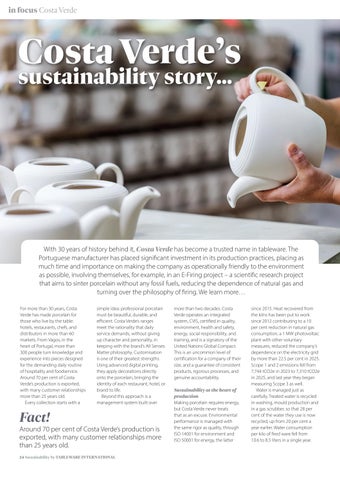
With 30 years of history behind it, Costa Verde has become a trusted name in tableware. The Portuguese manufacturer has placed significant investment in its production practices, placing as much time and importance on making the company as operationally friendly to the environment as possible, involving themselves, for example, in an E-Firing project – a scientific research project that aims to sinter porcelain without any fossil fuels, reducing the dependence of natural gas and turning over the philosophy of firing. We learn more… For more than 30 years, Costa Verde has made porcelain for those who live by the table: hotels, restaurants, chefs, and distributors in more than 60 markets. From Vagos, in the heart of Portugal, more than 300 people turn knowledge and experience into pieces designed for the demanding daily routine of hospitality and foodservice. Around 70 per cent of Costa Verde’s production is exported, with many customer relationships more than 25 years old. Every collection starts with a
simple idea: professional porcelain must be beautiful, durable, and efficient. Costa Verde’s ranges meet the rationality that daily service demands, without giving up character and personality, in keeping with the brand’s All Senses Matter philosophy. Customisation is one of their greatest strengths. Using advanced digital printing, they apply decorations directly onto the porcelain, bringing the identity of each restaurant, hotel, or brand to life. Beyond this approach is a management system built over
Fact!
Around 70 per cent of Costa Verde’s production is exported, with many customer relationships more than 25 years old. 24 Sustainability by TABLEWARE INTERNATIONAL
more than two decades. Costa Verde operates an integrated system, CVIS, certified in quality, environment, health and safety, energy, social responsibility, and training, and is a signatory of the United Nations Global Compact. This is an uncommon level of certification for a company of their size, and a guarantee of consistent products, rigorous processes, and genuine accountability. Sustainability at the heart of production Making porcelain requires energy, but Costa Verde never treats that as an excuse. Environmental performance is managed with the same rigor as quality, through ISO 14001 for environment and ISO 50001 for energy, the latter
since 2015. Heat recovered from the kilns has been put to work since 2012 contributing to a 10 per cent reduction in natural gas consumption, a 1 MW photovoltaic plant with other voluntary measures, reduced the company’s dependence on the electricity grid by more than 22.5 per cent in 2025. Scope 1 and 2 emissions fell from 7,744 tCO2e in 2023 to 7,310 tCO2e in 2025, and last year they began measuring Scope 3 as well. Water is managed just as carefully. Treated water is recycled in washing, mould production and in a gas scrubber, so that 28 per cent of the water they use is now recycled, up from 20 per cent a year earlier. Water consumption per kilo of fired ware fell from 10.6 to 8.5 liters in a single year.
Did you know?
The Endless collection turns treated industrial sludge into porcelain pieces and shows what circular thinking can achieve. The collection was developed in partnership with ClementinAtelier, creating unique products, by using and reconverting production waste.
Waste is treated as a resource: fired scrap and glazes go back into production, plant partnerships give a second life to by-products, and 98 per cent of waste is recovered. Cloudy glaze is a result of industrial waste symbiosis. The Endless collection, which earned an honourable mention in Ecodesign and Sustainability, turns treated industrial sludge into porcelain pieces and shows what circular thinking can achieve. Sustainability also shapes how the brand designs. Their eco-design work looks for thinner pieces, the use of recovered materials and fewer firings, saving raw materials and energy before a product is even made. In 2025, Costa Verde published its Sustainability Report under the European voluntary
standard for SMEs, with no legal obligation to do so, because they believe transparency is part of trust. People and partners A good piece of porcelain is made by good people. Costa Verde invests in the safety, health, and training of their employees, with physiotherapy, psychology and exercise sessions on site, and a programme to welcome and develop new generations. Staff turnover and workplace accidents have both fallen sharply. Almost all their suppliers have signed their Supplier Regulation, extending the same ethical, environmental, and social standards along the value chain, supported by a Code of Ethics and Conduct and a whistleblowing channel.
Looking ahead The kiln remains Costa Verde’s biggest challenge, and they are investing accordingly. E-Firing is a completely disruptive scientific research project that aims to sinter porcelain without any fossil fuels, reducing the dependence of natural gas and turning over the philosophy of firing. Another project is working towards Portugal’s first polyurethane recycling center in the tableware sector by 2027, and a further one (HIPAI) will
use heat and CO2 from their processes to grow food through hydroponics. Laser-engraved codes will give each piece digital traceability, anticipating the European digital product passport. Whether equipping a new hotel, renewing a restaurant table or creating an exclusive collection, Costa Verde offers more than porcelain: it offers a trusted partner, with quality products, close service, and a clear commitment to a more sustainable future.
In numbers
28 per cent of the water Costa Verde uses is now recycled, up from 20 per cent a year earlier. Sustainability by TABLEWARE INTERNATIONAL 25
Let’s look at
Poemi
Embrace the earth
First launched in 2020, Poemi’s Earth Collection, designed by Alexandra and Florin Popescu from their base in Transylvania, is a beautiful example of caring craftsmanship. Poemi describe the collection as an “exquisite tribute to our planet”. The organic glaze has been developed in-house consisting of stoneware leftovers from the production process, and recovered wood ash. Interestingly, the designers say the glaze’s unique colour can change over time due to its reclaimed components. The collection features bowls and plates in various sizes along with cups, ramekins and even beautiful baking pots. Simply divine!
Visit www.poemi.store/en/ for more.
Did you know?
The Earth Collection’s glaze has been designed to be exceptionally resistant for professional services so as not to scratch, particularly with cutlery. 26 Sustainability by TABLEWARE INTERNATIONAL
in focus Costa Nova
“Ultimately, progress comes from commitment and improvement”
Jorge Carneiro, head of the research and development department, and Carolina Cabral, environmental engineer at COSTA NOVA Industria, tell us about the brand’s determined approach to environmental management Can you describe COSTA NOVA Industria’s approach to its sustainability programme? At COSTA NOVA Industria, sustainability is integrated into our industrial strategy and daily operations. Our approach focuses on making better use of materials and energy throughout our manufacturing processes. We have invested in technologies for energy recovery, water treatment and reuse, renewable energy generation and the incorporation of recycled materials into ceramic production. We also consider environmental criteria in product development and packaging, while recognising that ceramic manufacturing remains resourceand energy-intensive and presents its challenges. When did the company first identify its environmental impact as a priority? Environmental management has been part of COSTA NOVA Industria’s development since the foundation of Grestel, its first company, in 1998. Over the years, we have progressively introduced measures to improve energy efficiency, manage water consumption, recover production waste and explore alternative materials. The development of ecogres, in collaboration with the University of Aveiro, marked an important milestone in this journey. This innovative recycled clay body incorporates surplus from our own ceramic production processes, alongside waste and
by-products from neighbouring non-ceramic industries, giving these materials a new purpose. More recently, Grestel obtained ISO 14001:2015 certification that provided a formal framework for monitoring and continuously improving our environmental management practices. Tell us about some of the industrial practices you use that reduce environmental impact. Across our three manufacturing facilities in Portugal, we have
approximately 95 per cent recycled materials, we give new value to ceramic surplus from our own production, as well as waste and by-products from neighbouring industries. We have also introduced improvements to our packaging, that is plastic free, incorporates recycled materials and is recyclable. We have explored alternative fuels, including an industrial firing trial using a mixture of 50 per cent hydrogen and 50 per cent natural gas. Although this was an
“Evolving regulations, rising energy and raw material costs and growing interest from customers in how products are made have all contributed to making environmental responsibility an increasingly important topic across the ceramic industry” introduced photovoltaic panels for electricity generation, systems that recover and reuse heat from kilns in other manufacturing processes, and wastewater treatment facilities that allow treated water to be reused, particularly in cleaning operations. More than 90 per cent of our industrial waste is directed to internal or external valorisation processes, while our single-firing process avoids the additional firing stage required by some conventional ceramic production methods. Through the development of ecogres, incorporating
46 Sustainability by TABLEWARE INTERNATIONAL 28
experimental application rather than a transition to hydrogenpowered production, it provided valuable technical knowledge about the potential use of hydrogen in ceramic firing. Do you have specific sustainability targets, and how do you measure progress? Yes. At COSTA NOVA Industria, we have established environmental performance objectives focused on improving energy efficiency, reducing resource consumption and continuously improving our manufacturing processes.
Our factories have defined energy performance improvement targets, monitored through Energy Rationalisation Plans (Planos de Racionalização de Energia), which allow us to assess consumption patterns, identify opportunities for improvement and evaluate progress over time. We also monitor specific indicators related to water and energy consumption. Groundwater consumption is reviewed monthly, while natural gas and electricity consumption are assessed quarterly, allowing us to track performance against our reduction objectives. These monitoring practices support our environmental management approach, helping us identify areas for improvement, evaluate the effectiveness of implemented measures and make informed decisions regarding future investments and operational improvements. You developed ecogres, an original clay formula made of recycled surplus and other industrial waste from nearby factories. Can you elaborate on its development and why it has worked so well? Ecogres is an important example of how research and industrial collaboration can create new opportunities. The project originated from our intention to find an alternative use for ceramic production surplus and industrial by-products that would otherwise require other forms of waste management - we have developed it in partnership with the University of Aveiro.
After extensive research and testing, we developed a ceramic body incorporating approximately 95 per cent recycled materials, including ceramic surplus from our own manufacturing processes, as well as selected waste and by-products from neighbouring industries, such as the metalworking industry, for instance. One of the project’s main achievements was developing a formulation suitable for industrial production while meeting COSTA NOVA’s standards for quality, performance at the table and in professional service, as well as aesthetics. The results have already led to the creation of several collections made from ecogres, and the project’s success ultimately justified the establishment of Ecogres, a dedicated manufacturing facility that allows us to incorporate these recovered materials into stoneware production on an industrial scale. This experience has also reinforced the importance of collaboration between manufacturers, research institutions and different industrial sectors.
Do you think sustainability programmes have become more important to tableware producers over the past number of years? Absolutely. Evolving regulations, rising energy and raw material costs and growing interest from customers in how products are made have all contributed to making environmental responsibility an increasingly important topic across the ceramic industry. Ceramic manufacturing is an energy-intensive industry, and we know there are challenges when it comes to managing resources and reducing waste. But we also see these challenges as opportunities to innovate and find better ways of working. At COSTA NOVA Industria, this has been our approach for many years. We’ve continued to improve our manufacturing processes, invest in research and explore new technologies, knowing that there is always room to do better.
Which key performance indicators do you use to evaluate your sustainability performance? We monitor key environmental performance indicators, including specific energy, natural gas and groundwater consumption, the percentage of waste directed to valorisation processes, and the environmental performance of our suppliers.
Equally, as the industry becomes more stretched financially, do you think sustainability will play as important a role? We believe environmental responsibility grows more essential in challenging economic times. Measures such as heat recovery, material reuse and improved water management help reduce operational costs
“We’ve continued to improve our manufacturing processes, invest in research and explore new technologies, knowing that there is always room to do better” and improve efficiency. Of course, some solutions require significant investment, so finding the right balance between environmental objectives and economic viability is key. For us, it’s about taking a long-term approach and focusing on improvements that make sense both environmentally and financially. Finally, what more, as an industry, can we do to improve our environmental responsibility?
We think the ceramic industry needs to continue investing in research and technologies that help reduce energy consumption, emissions and raw material use. Collaboration is equally important. Our experience with ecogres has shown us how partnerships between manufacturers, universities and other industries can lead to great solutions. Ultimately, progress comes from commitment and improvement.
Sustainability by TABLEWARE INTERNATIONAL 29
in focus Arc
Built to last… Backed by its Arc Responsible programme, Arc is designing its products to last. Using Krysta glass and culinary opal, Arc’s pieces are made to be tough and user friendly…
The greenest product is the one you never throw away – that’s the idea behind Arc Responsible, a programme launched in 2020 by Arc. Arc designs its pieces to last. Its Krysta glass is 30 per cent stronger than conventional crystalline glass, and its culinary opal is three times tougher than standard oven-safe materials. Making glass requires serious heat: Arc’s furnaces in northern France run day and night at 1,600°C. Arc already melts its opal glass with electricity, and furnace upgrades helped cut its CO₂ emissions intensity by seven per cent between 2015 and 2025. Electric furnaces are the next step. Very little goes to waste. Almost all factory offcuts are melted down and reused, the packaging is 100 per cent FSC-certified cardboard, and Arc aims to use 30 per cent less plastic by 2030.
30 Sustainability by TABLEWARE INTERNATIONAL
Arc says… To make a difference choose durable glassware such as Arc’s lighter Opal tableware made with fewer raw materials and swap single-use containers for reusable glass bowls. Discover more at arctableware.com
in focus EcoMade
Making responsible
production the new standard What if the future of tableware wasn’t about choosing between sustainability, design and performance? With EcoMade, Belgian tableware brand Fine2Dine is proving all three can coexist. From fossil-free production to fully vitrified Natural Porcelain, EcoMade introduces a new perspective on responsible tableware manufacturing. Fine2Dine tells us more… Porcelain production has traditionally been an energyintensive industry. Firing ceramics at temperatures exceeding 1200°C requires considerable energy, historically supplied by gas-fired kilns. EcoMade challenges this conventional approach. Produced in Portugal, the collections are manufactured in an innovative facility equipped with fully electric kilns powered by renewable energy. By
eliminating fossil fuels from the firing process, EcoMade achieves zero direct carbon emissions during this crucial production stage. Combined with locally sourced raw materials and a zero-waste production policy, this approach demonstrates how technological innovation can fundamentally transform traditional manufacturing. The ambition is clear: to make responsible production the new standard, without sacrificing the
qualities professional tableware demands. Beyond its innovative production process, EcoMade distinguishes itself through the material itself. Every collection is crafted from Natural Porcelain, a high-performance ceramic body containing natural iron oxide, responsible for its characteristic warm beige tone. With an alumina content exceeding 20 per cent, the porcelain is fired at approximately 1260°C. At
this temperature, the material becomes fully vitrified, creating an exceptionally dense and compact structure with zero per cent water absorption. This technical achievement has important practical advantages. Fully vitrified porcelain offers high mechanical strength, excellent durability and a non-porous surface that is hygienic and easy to clean. For hospitality professionals, these properties translate into reliable tableware
Did you know? The EcoMade collections are now available from stock, ready for immediate dispatch. 46 Sustainability by TABLEWARE INTERNATIONAL
32 Sustainability by TABLEWARE INTERNATIONAL
capable of withstanding intensive daily service. Because sustainability is not only about how something is produced. It is equally about how long it lasts. Organic shapes and creative freedom Technical excellence, however, is only part of the story. EcoMade remains unmistakably Fine2Dine: expressive, contemporary and developed with the creativity of chefs in mind. The collections explore organic silhouettes, natural textures and distinctive glazes, creating an artisanal appearance supported by
advanced manufacturing technology. From the sculptural character of Cone to the contemporary versatility of Base, and from Bubba and Ferro to Moya and the expressive Icon collection, EcoMade offers different interpretations of modern tableware. Each collection provides its own visual identity while sharing the same underlying philosophy: distinctive design, consistent quality and practical functionality. The result is tableware that allows chefs to experiment with presentation, create visual contrasts and bring personality to every dish.
Sustainability that makes commercial sense Responsible manufacturing should not come at the expense of accessibility. Through an efficient European production process, EcoMade combines premium quality with competitive pricing, consistent manufacturing standards and dependable supply. And importantly, the EcoMade collections are now available from stock, ready for immediate dispatch. For distributors, restaurants and hotels, this means shorter lead times, greater flexibility and the confidence to develop new table concepts
without lengthy production delays. Whether opening a restaurant, refreshing an existing concept or expanding a tableware assortment, EcoMade offers an immediately accessible solution. EcoMade represents a new direction for professional tableware: one where renewable energy, advanced ceramic technology and creative design reinforce each other. By combining zero-emission firing, fully vitrified Natural Porcelain, distinctive shapes and immediate availability, Fine2Dine demonstrates that responsible innovation can deliver tangible benefits.
Sustainability by TABLEWARE INTERNATIONAL 33
interview Gemma Bernal Studio
Making waves with
recycled tableware At Ambiente 2025, Spanish brand Betik presented the Gemma Bernal-designed Nuba for the first time. This stand-out collection, remarkable for its sustainability story, has now hit the market to great acclaim. We speak with the designer and her team to learn more… Thank you for speaking with us. Could you explain the concept behind your NUBA design for Betik? Betik asked us to design a tableware collection made from rPET, mainly intended for restaurants, outdoor dining areas and seaside settings. They also asked us to think of a story and we really gave this a great deal of thought. The story had to be part of the design itself, inspiring the pieces, with the sea as the thread connecting the entire collection. I would also like to mention that Nuba means turtle in Arabic. We
liked the name because it has a lovely sound, is short and easy to remember. Betik describes Nuba as “recycled and recyclable”. Could you elaborate on this? The pieces are made from rPET, a material that symbolises circularity. Each piece is reusable and recyclable, in keeping with Industrias Betik’s commitment to offering products with a responsible life cycle. The starting point is PVC plastic bottles. In production, 20 PVC bottles are used to make one plate, 18
Did you know? rPET stands for Recycled Polyethylene Terephthalate. Made from existing plastic materials think soft drink bottles, water bottles, and food containers—that have been melted down to create new plastic resin, pellets, or spun polyester fibres. 34 Sustainability by TABLEWARE INTERNATIONAL
bottles to injection-mould a bowl, and so on. Had you designed with a material like this before? From your perspective as a designer, what were its advantages and disadvantages? I had never designed with this material before. The pieces are
The Gemma Bernal Studio team: Gemma (centre), with Philippe and Paula
“The origin of its material is a very positive selling point. Today, recycling plastics, and allowing them to be recycled again, is part of our responsibility to improve the ecosystem” designed to meet the same requirements as any product manufactured through plastic injection moulding. The finish is very good, and the material has a substantial weight, giving it a feel similar to ceramics. The inside of the pieces is more susceptible to scratching, which gave us an
opportunity to design textures suited to each piece. The exterior has either a glossy finish or a subtle texture, depending on the shape of the particular piece. Other advantages of this material include its resistance to high temperatures and the fact that it is microwave- and dishwasher-safe.
The concept…
“Tableware collections usually share a consistent formal language: something that is repeated in every product. Nuba takes a different approach”
Nuba was launched this year, intended for the hospitality sector. How has it been received? Yes, it was launched this year, and it has been very well received. The origin of its material is a very positive selling point. Today, recycling plastics, and allowing them to be recycled again, is part of our responsibility to improve the ecosystem. Tell us a little about the collection: how many pieces does it include, and why did you choose this colour palette? The collection currently has 21 pieces, although we are already
designing new ones. Once a collection is introduced to the market, you discover whether any pieces are missing, how people want to use them, and so on. One of the things I like most is that tableware collections usually share a consistent formal language: something that is repeated in every product. Nuba takes a different approach. The connecting thread is the marine world, and this allows the imagination to roam freely and find expression in products with very different shapes and textures. I sincerely believe the collection brings a smile to people’s faces. Its textures
complement and enhance the shapes, and some include fish, turtles and other motifs. Nuba includes pieces shaped like shells, turtles and limpets, serving platters that resemble a patch of sand, stones and so on, all naturally adapted to their intended use. We have used four colours: black, off-white, sand and aqua. The first two were chosen because they are the most widely accepted in the market, the other two represent the sea and the sand. Do you think designing with recycled materials, such as the one used in Nuba, represents the future of the tableware industry? Clearly, this is something we must increasingly consider if we want to help preserve and improve the planet. Evidence of this can be seen in the incorporation of recycled components even into the most used tableware materials, such
“Nuba tells the story of a little turtle born in the warm cradle of the sand, to the whisper of the sea. Its shell carries the traces of sea foam, shells and waves: the memory of its origins. As it returns to the ocean, its journey becomes a symbol of the eternal cycle of life. Each piece in this collection reflects that story: the rhythm of the water, the softness of the sand and the movement of nature. Nuba transforms what was once waste into beauty and renewed purpose. A tableware collection that celebrates the sea, the earth and nature’s constant rebirth. It embodies sustainable design through organic shapes that evoke sea foam, dunes and the gentle pulse of the ocean. Every wave returns to the shore, and every material can be born again.” as porcelain and stoneware. The same considerations also extend to finishes, glazes and production processes. The most pioneering and forward-thinking companies are researching this subject and making progress. Betik is one of the companies putting these principles into practice, offering to the market a variety of products made from materials with these characteristics.
Fact!
Nuba is currently a 21-piece collection available in four different colourways. Sustainability by TABLEWARE INTERNATIONAL 35
in depth Porcel
Porcel’s journey to reducing
its carbon footprint
For nearly 40 years, Porcel has established itself as a leader in the field of porcelain, now the brand is taking its commitment to excellence even further – combining its innovative design, for which it is globally recognised, with true accountability for its output. We learn more from the brand… With the goal of becoming a global leader in porcelain solutions that combine design, innovation and sustainability, Porcel has been consolidating a management model that balances economic, social and environmental pillars,
gradually paving the way for a more sustainable future for generations to come. Supported by an integrated quality and environmental management system, Porcel is promoting a culture of continuous improvement.
The drive towards decarbonisation is transforming the ceramics industry. In the case of porcelain, the challenge is particularly complex: preserving key characteristics such as whiteness, hardness and translucency, which depend on high-temperature firing under specific atmospheric conditions, while exploring alternatives to processes that rely on fossil fuels. For Porcel, this is an ongoing journey of research, learning and transformation. The brand took its first steps with the installation of a photovoltaic self-consumption unit, comprising 1092 panels, supporting the progressive electrification of their production processes. Since then, Porcel has continued to invest in technological transformation. Among these investments are electric firing technology and hybrid drying systems, which combine electricity, heat recovered from kilns, and, when necessary, natural gas. These solutions aim to reduce dependence on fossil fuels. This transformation also requires research. As part of the ePORCEL project, developed with academic
Did you know? Porcel has invested in electric firing technology and hybrid drying systems, which combine electricity, heat recovered from kilns, and, when necessary, natural gas. These solutions aim to reduce dependence on fossil fuels. 36 Sustainability by TABLEWARE INTERNATIONAL
and industrial partners, solutions are being studied to adapt porcelain production to electric firing, while seeking to preserve the technical and aesthetic characteristics that define it. The published article specifically examines the final characteristics of pieces fired in different types of kilns. At the same time, Porcel has been implementing circular economy practices, including the reuse of treated water, waste separation and recovery, and the reuse of materials. The company is also carrying out a life cycle assessment of a slip-cast product, with the aim of gathering data that may support the future development of an Environmental Product Declaration. Measurement and transparency are also integral to this process. In this context, the company has prepared its sustainability report in accordance with the VSME standard. Throughout its nearly 40-year history, Porcel has established itself through the high quality of its products and processes, becoming a leader in porcelain solutions for its customers. This journey reflects the commitment to sustainability, guided by responsible management and a vision of responsible progress.
A417
column Ariane Fine Porcelain
Greener by
design
Since opening their factory in 2014, Ariane Fine Porcelain has been on a journey towards greener production methods, from sourcing materials from local suppliers to harvesting rainwater, the brand continues to make huge inroads in its sustainability programme Sustainability has been part of Ariane Fine Porcelain since the day its factory opened in 2014. We at Ariane Fine Porcelain have always kept sustainability at the top of our priorities, and it started before we fired a single plate. When we opened our factory in 2014, we designed it around three simple ideas: reduce, reuse and recycle. They were never just a marketing line for us. They are in our floor plan, in our water tanks and in the way we handle every scrap of
clay. We know porcelain is a demanding material. It needs heat, water and minerals, and our industry has a reputation
plan to complete before 2030. Phase 3 is the longer research that we believe can change how porcelain is made. For
“We know porcelain is a demanding material. It needs heat, water and minerals, and our industry has a reputation for using a lot of all three” for using a lot of all three. Change like this does not happen overnight, so we split our work into phases. Phase 1 covers what we have already achieved. Phase 2 is what we
our managing director, Sunil Malesha, this way of working comes naturally. It starts in the ground Every plate begins as raw
38 Sustainability by TABLEWARE INTERNATIONAL
material, so that is where we begin too. Today half of our materials come from local suppliers, and by the end of Phase 2 we aim to raise that to 70 percent. Shorter journeys mean lower transport emissions, and buying locally keeps money and work in the communities around us. We work only with partners who share our values, and we ensure that green standards are met at every stage of our supply chain, because a sustainable product cannot come out of an unsustainable one.
Every drop counts Water was one of our first priorities. We harvest rainwater and store it in large tanks, and that water now covers what our production needs, so we no longer rely on outside sources for it. The water we use then goes through our own treatment plant. Most of it returns to production, and what is left waters our gardens. It is a simple loop, and one we are quietly proud of. Nothing goes to waste In a porcelain factory a lot can happen between the mould and the kiln. A piece can crack, warp or simply fail inspection. In Phase 1 we reached the point where we reuse 100 percent of our unfired green material and our bisque. Nothing from those stages goes to landfill. The harder part is glaze fired waste, which cannot just go back into the clay body. In Phase 2 we will start repurposing a portion of it. Our packaging follows the same thinking. Already 99 percent of it is recyclable, and next we will be asking our customers to help by reusing and recycling it too.
The longest lasting plate is the greenest At Ariane, we believe the most sustainable plate is one that lasts for years and rarely needs replacing. That is why design sits at the centre of everything we do. We create timeless shapes that will not look dated in five years, and we build them to last. Our pieces have a strong, heavyduty body, a smooth glaze that resists scratches and temperature changes, and a rolled edge that reduces chipping. They are dishwasher, microwave and salamander safe, and they stand up to thermal shock. In a busy restaurant kitchen, that durability means fewer breakages, fewer reorders and less waste. Every glaze and colour we use is tested to make sure it is free of lead and cadmium. Our Slow Fast collection takes this a step further. Many restaurants still serve burgers, fries and pizza in disposable packaging. Slow Fast gives them porcelain designed for exactly that kind of food, so they can leave single use items behind without losing the relaxed feel of the meal. It is a small change for a restaurant and a big one for the bin. Power from the sun Firing porcelain takes a great deal of energy, and that is where our biggest challenge lies. Our solar panels already supply 35 percent of the energy for our plant and all of the energy for our offices. In Phase 2 we will move the office, the factory and the streetlights around it to LED lighting. For the long term, our Phase 3 work supports a local research firm that is developing a kiln based on infrared technology. Infrared kilns use far less energy and give off much less waste heat than conventional ones. If it works at scale, it could change the footprint of our whole industry, not only ours. Small changes, lasting habits Some of our changes are very simple. Instead of printing thousands of catalogues, we now hand out a small business card with a QR code that opens
our full digital collection. It saves paper, cuts the emissions from printing and shipping, and means customers always see our latest range. We run a bus service for our staff, which takes many individual journeys off the road, and in Phase 2 we plan to launch an electric vehicle incentive for employees. We have invested in training so that sustainability is part of everyday work on the factory floor, and we monitor and report our environmental performance regularly so we know whether our efforts are actually paying off. People first Sustainability is not only about the environment. A factory is only as strong as the people inside it and the community around it. We provide free on site accommodation for 400 workers and junior staff, and a new building for another 200 people is under construction. Every factory employee receives a free, nutritious meal on every shift. Sanitary pads are freely available in the factory so women can access them easily and discreetly. And because our team comes from many cultures and faiths, we run sports programmes and celebrate every major festival together. Beyond our gates, we donate clothes, books, computers
and winter equipment to local schools and orphanages. Once a year we organise a free medical clinic in the nearby village, and we recently gave the village a new ambulance. In Phase 2 we will donate solar panels and rainwater harvesting tools to local schools, and share what we have learned about saving water and reducing carbon footprints. We also care about the next generation of chefs, the people who will one day choose the plates their food is served on. We sponsor the Young Chef Olympiad, which brings together young cooks from around the world, and we support the British Culinary Federation in its education programmes, workshops and events. What comes next Our work is far from finished, and we see that as a good thing. By the end of Phase 2 we will be certified to ISO 14001 and FSC standards, adding to our existing SA 8000:2014 and ISO 9001:2015 certifications. These matter to us because they hold us to account. Every piece that leaves our factory will sit on tables around the world for many years, and we want each one to carry a small part of this story. We cannot do it alone. To our partners, our customers and everyone else in this industry, we would love you to join us.
Sustainability by TABLEWARE INTERNATIONAL 39
in focus Bonna As Türkiye’s first 100 per cent HoReCa brand, Bonna has been creating solutions for chefs and gastronomy professionals since 2014. Bonna supports sustainable practices across production and distribution, dedicating a significant part of its investments to sustainability initiatives...
High-Durability,
Sustainable
Tableware by A Sustainable Series: Premium Vitrified With its recycled porcelain collections named Cras and Ground, Bonna became the first in the tableware industry to earn an EPD (Environmental Product Declaration) certificate. Taking its responsibility to nature and society a step further, the brand introduced the Premium Vitrified category as an alternative solution, designed for the needs of gastronomy professionals. This series is produced from a dense formulation of raw materials. While standard porcelain is fired twice in industrial kilns, every piece in the Premium Vitrified category is fired only once, a process Bonna calls “Single Firing Technology.” As seen in standard porcelain production, more energy and labor are required; Bonna encourages professionals to choose Premium Vitrified to reduce carbon footprint. Bonna’s General Manager, Erbil Aşkan, explains: “We launched the Premium Vitrified series in the beginning of 2024. Selected plate shapes are covered by our lifetime edge-chip warranty; all our products are highly resistant to scratching and heavy kitchen use. In short, if you choose Premium Vitrified, these products will serve you for many years. Single Firing Technology cuts energy use in half, so we consume less electricity in production. Choosing this category benefits society, the environment, and foodservice operations alike. We’re pleased with the results so far. There is a growing interest in Türkiye and global industry, especially from casual dining restaurants.” 40 Sustainability by TABLEWARE INTERNATIONAL
The Premium Vitrified Family Grows: Meet Ripple Liora Responding to strong market interest and rising market shares for Premium Vitrified collections, Bonna is expanding with new collections and broadening shape, design, and color options in existing lines. One of the newest additions to the sustainable, eco-conscious Premium Vitrified category is the Ripple Liora collection. Like the rest of the category, Liora is produced with Single Firing Technology, and select shapes carry Bonna’s lifetime edge-chip warranty. All pieces are stackable and resistant to scratching and thermal shock. By choosing Premium Vitrified, you can showcase your restaurant’s commitment to sustainability while supporting Bonna’s environmentally conscious approach to manufacturing.
in focus Beatriz Ball
Beautiful things made in a
beautiful way
The Beatriz Ball brand tells us about their approach to a circular production system at their zero-waste facility in Mexico… Beatriz Ball’s flagship Atelier collection includes highly polished metal serveware and gift items, made of recycled aluminum. The company utilises sustainable and recycled materials in its foundry, located on the outskirts of Mexico City. The aluminum employed, as well as the special sand used for sandcasting molds, is all recycled. At this zero-waste foundry, all metal miscasts are melted down to create new pieces. The company also disposes of its waste products through eco-responsible methods. The foundry has recently installed solar panels, producing 100 per cent of the electricity it needs. Debris from the polishing wheels, and also the water
Did you know?
Beatriz Ball is based in New Orleans, Louisiana. It will exhibit at the U.S. Winter 2027 shows in Dallas, Atlanta, Las Vegas and now also in New York. 42 Sustainability by TABLEWARE INTERNATIONAL
used for washing the pieces, is taken to a company which processes the waste sustainably. Pieces of polishing compound bars are washed and then melted and remade into new polishing bricks. Beatriz Ball, founder of the company that carries her name, educates and encourages her
no limit on how many times it can be recycled,” says Ball. “Indeed, nearly 75 per cent of all aluminum ever produced is still in use today. Recycling aluminum saves around 95 per cent of energy needed to make the metal from raw materials, and 95 per cet of greenhouse gas emissions.”
“Aluminum is a boon for the environment because there is no limit on how many times it can be recycled” Beatriz Ball artisans to individually embrace recycling by monetising their efforts. At the end of the year, all funds from the selling of leftover materials for recycling are redistributed to employees. “Aluminum is a boon for the environment because there is
Sustainability has always been a component of Beatriz Ball’s handmade manufacturing. Her intensely handmade Atelier metalware products employ ecofriendly and sustainable materials and are crafted by artisans who trace a heritage of metalworking.
ECOMADE MADE IN EUROPE
Sustainable Process No Carbon Emission Durable Quality Hospitality Approved Locally Sourced Natural Porcelain Craftsmanship Made Accessible Proudly Made in Europe
@fine2dine | www.fine2dine.com | +32 14 24 29 00 | info@fine2dine.com
$GVB7:,QW (FR0DGH LQGG
Dining serves up successes ambiente.messefrankfurt.com/dining info@uk.messefrankfurt.com Tel. +44 (0) 14 83 48 39 84
29. 1. – 2. 2. 2027 FRANKFURT / MAIN
79450-027_AM_Dining_Tableware-International_210x297_UK • PSO Coated V3 • CMYK • so | DU: 01.10.2026
The future is set at the most important consumer goods fair, the world’s No.1 for table, kitchen and household. Dining will inspire you with the latest designs, materials and innovations – from glass, porcelain and ceramics to HoReCa products and practical storage solutions.
UK
THE NEXT MOVE IN DINING