This month Pramland’s John Barker is focussing on margins and how after compiling data and analysing his own margins, found some very interesting results.
54 The Nursery Store
The Nursery Store’s Christy Foster this month takes a look at trading in the rst two months of 2025 and how March is a month that can set the tone for the remainder of the year. Features 16
36 Sleeptime 42 Bottles & Sterilisers
50 Meet the PRs
Turn to page 12 to check out the new Oyster4 Stroller from BabyStyle. Interview
32 Red Kite Baby
Nursery Today caught up with Red Kite’s Debra Tucker. With the business celebrating their 20th anniversary we discuss challenges, successes, innovation and trends over the years.
editor’s letter
Welcome to the March issue where we cover a number of product categories, including wheeled goods, bottles/sterilisers and sleeptime products.
Talking of wheeled goods you would have spotted BabyStyle as our cover star this month. Good news, the Oyster4 has landed! Through clever design the Oyster4 offers comfort, style, adaptability, functionality and of
course innovative features. You can check out Oyster4’s features by simply to page 12.
This month also sees Red Kite celebrating their 20th anniversary! Having started the business with a small range of eight products, they have continued to develop and enhance their range over time, all of which keep up with current consumer trends. We had the pleasure to catch up with one of the original founders, Debra Tucker, to discuss challenges,
successes, innovation and trends over the years that the business has experienced. You can find out more over on page 30.
And now to the thorny subject of ‘margins’. Pramland’s John Barker takes time this month to look at this topic over in his Barking Mad article. John, after compiling data and analysing his own margins, found some very interesting results. Want to know more? You can read his article starting on page 34.
I would also this month like to extend a warm welcome to Danni Gomes who has joined the Nursery Today team and of course also Claire Naish, who many of you met at Harrogate last year. Great news – it’s now official - Claire has also now joined the team as our Media Sales Manager (alongside being a Director of Lema Publising). I’m looking forward to continuing to build on the strength of Nursery Today working alongside Danni and Claire. Danni is so looking forward to meeting everyone in the Nursery industry and I hope you all prove me right as you did with Claire at Harrogate – that the nursery industry is truly one of the friendliest you can find. You will find out more in the news item at the foot of this page. Feel free to ping Danni a ‘welcome’ email introducing yourself to danni@lemapublishing.co.uk – she would love to hear from you.
Danni Gomes joins Nursery Today
The team at Nursery Today are delighted to announce the newest member to the team, Danni Gomes.
D anni joins from a strong 20 year media background and is excited to be part of the team commenting: “With over 20 years of experience in the media industry and as a devoted mum of three, I’m thrilled to be working on Nursery Today. This role will enable me to combine my personal parenting journey together with my passion for early years.”
Claire Naish, sales director, Lema Publishing said: “It’s great that Danni has joined the Nursery Today team. She has extensive sales and marketing experience having worked in the publishing sector for many years, and both myself and Danni are really looking forward to working on Nursery Today magazine and collaborating with all the great people that make up this fantastic industry.”
With the team expansion, Nursery Today will continue to grow and deliver news, new products, relevant interviews and highlights across the many nursery category sectors.
Danni can be contacted via email or telephone and will be happy to discuss any marketing activity you have planned. danni@lemapublising.co.uk | Tel: +44 (0) 7904 115022 | www.nurserytoday.co.uk
Finally, to all the golfers out there (or those who would like to be part of a fun day out and get into the ‘swing of things’!) The Nursery Today Golf Day is back! The popular Nursery Today golf day will once more take place at Puckrup Hall on the 1st July. This will be a fun day’s golf with the usual format of 9 hole morning Texas Scramble followed by lunch and an 18 hole individual Stableford and team fourball. For good measure we shall also include the ‘Yellow ball’ competition and a special 24+ handicap trophy. A barbeque followed by presentation of trophies concludes the day, enabling those wishing to drive home, able to leave by 8 o’clock. Check out the advertisement appearing on 11 for full details. You can also find out more by emailing Malcolm Naish on malcolm@lemapublishing.co.uk
BabyStyle Oyster4 is here! Find out more by turning to page 12.
Owlet Partners with Winstanleys Pramworld
Owlet have been excited to collaborate with Pramworld to create a striking window display for the month of March, supporting Safer Sleep Week and raising awareness of the importance of infant sleep safety.
At the heart of this initiative is the Dream Sock + Owlet Cam 2, designed to give parents peace of mind by tracking their baby’s sleep trends, including pulse rate and oxygen level. By showcasing the Owlet range in-store, they’re helping parents discover how technology can support safer sleep habits.
This partnership highlights their commitment to educating families and empowering them with tools to make informed choices. Owlet are thrilled to see retailers like Pramworld bringing this message to life, and we hope to inspire more retailers to join us in raising awareness.
Stay tuned as they continue working with retailers to drive awareness and make a real impact.
For further information visit: www.cheekyrascals.co.uk
Clair de Lune Acquires East Coast Nursery
Clair de Lune, a trusted name in baby bedding and nursery essentials, is delighted to announce the acquisition of East Coast Nursery, including its well-respected East Coast and Silvercloud brands. Bringing together two heritage nursery brands, this exciting move strengthens Clair de Lune’s commitment to providing high quality, beautifully designed products for families across the UK.
Eric White, joint founder and long-time owner of East Coast Nursery who has been awarded both the Nursery and Pre-School Lifetime Achievement Awards shares his confidence in the transition:
“Having worked with Clair de Lune’s parent company in the past, I know they’re the right fit to carry the East Coast brand forward and build on its strong reputation.”
With over 65 years of history, East Coast Nursery has been a trusted choice for generations of families. Eric extends his heartfelt thanks to the dedicated staff and loyal customers who have supported the brand over the years.
Hadley Pollard, Managing Director of Clair de Lune, reflects on the company’s growth: “Over the past five years, we’ve taken Clair de Lune to new heights, and this acquisition is the next step in our journey. We’re excited to honour East Coast’s legacy while bringing even more high-quality nurseryproducts to parents across the UK.
“As part of this transition, we are pleased to welcome Anna Wilkinson, who brings extensive retail experience from her time as a buyer at Mothercare and Toys ‘R’ Us and has successfully led Silvercloud with East Coast for 15 years. Hadley adds, “Anna’s expertise and passion for the industry make her a fantastic addition to our team, and I look forward to working alongside her.”
This marks the beginning of an exciting new chapter for Clair de Lune, ensuring families across the UK continue to enjoy the trusted nursery products they know and love now with even more to offer.
Bright start for Harrogate 2025
Having opened priority booking for the 2025 show in January, Harrogate International Nursery Fair confirms an extremely positive exhibitor take up with four of the halls of the Harrogate Convention Centre now 80 percent full.
The show takes place at from 12th to 14th October 2025 and as the UK’s only nursery trade show, has firmly reestablished its position in the nursery trade calendar. This year sees the majority of favourite brands already re-booked with companies such as Cuddleco, Cybex, Thule and Uppababy securing even larger space; and the return of favourites such as Silver Cross, Done by Deer; plus Newcastle-based Haus Distribution which showcased its Little Dutch and Wildride brands for the first time last year and have now secured a significant 160 sqm stand to present six of its brands this time.
Adrian Sneyd, show organiser, comments: “We are delighted with the positive vibes so far, and whilst its still early days we do advise any brand owners who are thinking about exhibiting to get in touch as soon as possible in order to find the most stand options available to them.”
Exhibitor feedback after the 2024 show was incredibly affirming with comments on the quantity and quality of visitors attending.
Adrian adds: “It seems there is a definite inclination from brands to fully support a UK event in order to be as accessible as possible to all. We have lots of new enquiries coming in and are looking forward to welcoming everyone back in October.”
Now that half term is out of the way, the Nursery Fair team will be working to allocate stand spaces to previous exhibitors who have requested a new location and to companies exhibiting for the first time.
For more information about the show and to request a stand visit www.nurseryfair.com
A Truly Royal Rabbit from The Puppet Company
The team at The Puppet Company are super excited to have spotted the Princess of Wales playing with one of their puppets while on a royal visit this week.
In the photo, shared on the official Instagram account of The Prince and Princess of Wales – Kate Middleton can be seen playfully engaging with a child with one of the brands adorable Rabbit puppets.
During her visit to HMP Styal’s Mother and Baby Unit last week, the Princess can be seen happily playing with a young child with the brands sweetest and most charming Rabbit from the My First Puppet collection.
Speaking about this exciting news, Sue Lockey, co-founder of The Puppet Company: ‘Oh we just love our friendly Rabbit hand puppet, it’s a perfect Easter or new baby gift and it’s truly delightful to see The Princess Wales happily playing with it. This cheeky bunny will now forever be known as our Royal Rabbit!”
For sales enquiries, please contact Sam@thepuppetcompany.com
Rockit
are partying like it’s 2025!
After celebrating their 8th Birthday at the end of 2024 and being a awarded a ‘Good Housekeeping Institute Approved’ endorsement, the team at Rockit are celebrating more success. Rockit Rocker has picked up Platinum for ‘Best Baby Rocker’ and Gold for ‘Best Innovative Pushchair Accessory’ at the Loved by Parents Awards.
The Loved by Parents awards are in their 15th year and are a symbol of trust. Each product is vigorously tested to specific criteria by a panel of parents.
Matt Dyson, co-founder at Rockit said “This is another great award to add to the list and re ects the hard work from all the team. We have constantly innovated and improved our products to make sure they remain relevant and meet the needs of our customers all over the world. This award cements our position as not only the original, but also the ‘best’ baby rocker on the market.”
www.rockitrocker.com
Graco’s ‘One Family’ Campaign Connects Parents
Graco announces, ‘One Family’, a campaign that will stretch across 10 months from March-December 2025, following one family, Fab and Ell on Instagram and You Tube as they share their journey parenting twin toddlers. ‘One Family,’ aims to o er reassurance to all families, that behind every door are shared moments, uniting families across the UK into one community.
Graco understands the frustrations, fun, concerns, and chaos that shape the reality of family life. ‘One Family’ will explore some of the challenges faced by families today, with a di erent theme each month. Tackling subjects ranging from nancial planning, weaning and nutrition, and managing your mental health. Experts will give advice and Fab and Ell will share their personal experiences on these subjects on Instagram and YouTube along with Graco post information and signposting to experts advice via its online community hub The Graco Village Graco will also continue its charitable partnership with PANDAS, the charity that o ers mental health support from conception, to birth and beyond.
With ‘One Family’, Graco continues its commitment to supporting parents and carers as they navigate the challenges of day-to-day family life, to help families feel connected, supported, and seen. The campaign launches on Graco’s Instagram page on 21st March 2025, with the Graco Village being live from 2nd April with regular updates.
Meet WriggleEase - A new baby travel solution that is taking social media by storm
Rachel Thompson
We chatted with Rachel Thompson, the inventor of WriggleEase, to nd out all about this brand new innovation and her plans to break into the busy baby travel accessories market.
How did you come up with the WriggleEase?
Unless you’ve travelled with young kids, you may not realise that an infant plane ticket doesn’t include a seat! It only allows you to bring the infant onto the plane and have them sit on your lap for the duration of the ight. This is uncomfortable for everyone as parents have to use both hands to hold the child on their lap for hours, and the child just wants to get up and move around.
My own experience of di cult ights, as well as looking around at all the other families in the airport facing the same challenge, inspired the simple solution that is the WriggleEase.
How does it address the problem?
WriggleEase is a lap seat with a ve-point harness, to secure and support a 6-24m old while sitting on an adult lap.
One of the very rst experiences a baby has when leaving the hospital is being strapped into a ve-point harness in their car seat. Right from their very rst days a seatbelt harness is associated with travelling and sitting still.
The WriggleEase has a familiar, soothing ve-point harness, the feeling of this tted snugly around the body signals to the child that it is time to sit and relax, leaving the parent hands free to enjoy their journey!
Is it safe for use on planes?
As a brand new type of product de ning the testing required was tricky. We worked with an internationally recognised independent testing house to risk assess and test the product to all relevant European Safety Standards, including EN 14988:2017+A1:2020, EN 71-1: 2014+A1: 2018 and all 19 REACH tests.
However, airlines are a di erent matter! As every airline is an independent business they can each set their own rules for conduct on board. So, we approached the CAA UK, EASA and IATA as the organisations that represent authority and safety in aviation. They each considered the product and found that it poses minimal risk, so agreed that it is acceptable to be used during the cruise portion of a ight. We were so delighted to receive this acknowledgement, as we know it will be very reassuring to consumers and retailers!
You launched in January 2025, how’s it going so far?
I can’t believe it’s only been a month. After months of development, testing, and patiently waiting for stock to land in the UK it has been a whirlwind! We launched with a collaboration with @sophiefamilytravel - a travel in uencer who created a great video showing her and her daughter using the product on a ight. This video has been viewed over 2 million times and kicked o a huge wave of interest including lots of DMs asking us to ship internationally - watch this space!
We have already gained over 1000 followers on social media, and over 500 people have joined our email list. We are getting consistent daily orders through our own D2C site, and have already got the product listed with retailers including Not On The High Street, Robert Dyas and The Range.
On top of all of that, we won Nursery Today’s competition for a stand at the Babyshow, so we are looking forward to exhibiting there for the rst time at Excel in March!
Tell us a bit about yourself and the team behind WriggleEase?
I have worked in the NHS for 17 years, so child safety is a big part of my everyday work. I am also a parent to two gorgeous daughters so I have created this product from a place of lived experience!
I have pulled together a team of Nursery Industry experts to drive the launch forward and get this product in front of parents who need it. Elliot at Bebelephant has already got us listings with some major High Street retailers and he’s got a great plan to build on those through working with a broad range of retailers from majors to independents.
Heidi at Ink & Pixel has worked closely with me to bring the brand to life, from building the website to setting up collaborations and advertising campaigns and managing our social content and community. I can’t wait to see the marketing plans come to life over the coming year.
What’s your biggest obstacle and how do you plan to overcome it?
We’ve had amazing feedback from the parents who have discovered the WriggleEase so far. Once they see what it is and how it works they understand it’s purpose and how it genuinely solves a problem, and they feel the RRP of £49.99 is a small price to pay in the grand scheme of holiday spends and reducing stress!
Our biggest obstacle is getting the word out there. We will overcome that through collaborations with in uencers and user-generated content that shows the product in use. Our marketing strategy is focussed on using that authentic content to get in front of new audiences. We have planned paid advertising campaigns with some key media partners to reach our target audience, with peaks of activity ahead of travel seasons. We also know that working closely with retailers to meet shoppers where they are already shopping will be key to stretching across the market.
The feedback we’ve received in this rst month shows that consumers are happy to snap up the product when they see it, so we’re focussed on building brand awareness and reach.
For sales contact Elliot Bishop on the below.
elliot@bebelephant.com ? www.wriggleease.com
“We continue to be incredibly proud of the success of the Shnuggle Baby Bath, which holds a special place in our hearts as one of the first products we ever launched. At Shnuggle, we always base our business on the needs of parents, aiming to make parenting just a little bit easier. When we recognised that there is strong market demand for bath supports alongside our baby bath, it inspired us to think creatively about how we could meet that need. This led to the creation of the Newborn Bath Support, a product we believe is the perfect addition to the Shnuggle range, guiding parents towards a safe, practical and enjoyable bath-time.”
Sinead & Adam Murphy, Co-Founders, Shnuggle
Introducing the Newborn Bath Support
The Perfect Addition to a Safe, Practical Bath-Time Journey with Shnuggle
At Shnuggle, they are dedicated to designing products that meet the needs of new parents, offering a variety of options to suit their individual preferences. They understand that bath time can be a stressful experience for both parents and babies, which is why their products are designed to make it as easy and worry-free as possible.
As parenting styles evolve with each generation, the Shnuggle team see endless opportunities for innovation. They are constantly looking for ways to make parenting just a little bit easier. Feedback from their customers reveals that many discover the Shnuggle Bath through research—whether via word of mouth from other parents, influencers, award wins, or online parent forums. Additionally, their research has shown that many parents still feel anxious about handling a newborn during bath time. While babies spend months in the womb surrounded by fluid, the fear of placing them in water is common: Is the temperature right? Is the baby safe? These are all natural concerns.
As such, they designed the Shnuggle Baby Bath to address parents’ concerns by creating a tub specifically tailored for newborns, featuring their unique ‘Bum Bump’ for added security, ensuring babies remain safely in place. This thoughtful design helps parents feel more at ease, turning bath time into a relaxing and enjoyable experience.
Since its launch over 10 years ago, the Shnuggle Baby Bath has remained a favourite among parents and continues to be the top choice for a baby’s first bath, trusted by thousands of families worldwide.
As the go-to brand for baby bath time, they are committed to offering a range of products that cater to the diverse needs of new parents. Recognising that some parents prefer a more compact and cost-effective option, Shnuggle are thrilled to expand their collection with the new Shnuggle Newborn Bath Support.
Now, parents have the flexibility to choose the perfect product for their baby, with the option to purchase both the bath support and the Shnuggle Baby Bath from a brand they can trust—providing a complete, stress-free, fun, and safe bath time experience.
Designed to hold baby securely in a cradled position, the Shnuggle Newborn Support has been ergonomically designed to support even the tiniest baby, leaving hands free to bathe, bond and comfort baby with confidence.
The contoured design cradles baby in a reclined position and the soft to touch material offers additional comfort and warmth. Available in a choice of five colours to complement any home and the wider Shnuggle bath time range, the newborn support is designed for use in the bath and includes a water level indicator for the ideal water level. www.shnuggle.com
www.b-p-a.org
If your company is a member of the BPIA and you are not currently receiving members’ e-bulletins with industry updates, but would like to, please email julie@b-p-a.org who will add you to the database.
BPIA notice board
Trade show update
The BPIA has now nalised the details of its UK Pavilion at Kind + Jugend in Cologne and space is now on sale. The show takes place from 9th to 11th September 2025 and BPIA members will bene t from special show packages to participate in the UK Pavilion. Visit the BPIA website for more information and to download an information pack and booking form – www.b-p-a.org – alternatively contact Marc Hardenberg – marc@majuma.co
Member profile
Cheeky Rascals has been a member of the Baby Products Industry Association for 27 years. We ask the company a little more about its business and why being a member of its industry trade association is so important.
BPIA welcomes new members
FULL MEMBERS
Babymore of Basildon, Essex
www.babymore.co.uk
What is your business – and what is your best-selling product?
Babymore specialise in design, manufacture and distribution of hight quality nursery furniture and baby transport products. Product range includes crib, cot bed, mattress, pram pushchair, and car seat, all crafted with focus on style, functionality and safety.
Penny + Kids of Edinburgh www.pennyandkids.com
Penny + Kids product (The Home System) won the BPIA’s 2024 Concept and Innovation Award. The company is currently nontrading as it re nes the product with a view to bringing it to market in Q4 of 2025.
Bellamoon of County Down www.bellamoon.co
Bellamoon is an ergonomically designed pillow to support tired mums during pregnancy and feeding.
Dr Albani of London www.albanibaby.com
Design, Manufacture and commercialisation of an innovative Class 1 Medical Device /Baby Product that holds babies in a semi-vertical position mimicking a shoulder assisting with minimising symptoms of Colic/Re ux.
ASSOCIATE MEMBERS / PARTNERS
Azaria PR of Castle Ashby www.azariapr.co.uk
As a new Associate Partner of the BPIA, members can bene t from either complimentary PR/marketing review; or a discounted rate.
We are a leading retailer in the baby products industry, o ering a carefully curated selection of innovative and trusted brands for parents. Our best-selling ranges include Baby Brezza, Owlet, and Lascal. Baby Brezza is renowned for its intelligent baby formula makers, designed to simplify feeding by automatically mixing formula and water to the perfect consistency at the correct temperature. Owlet, with its Dream Sock and Owlet Cam, provides parents with peace of mind by tracking their baby’s vitals, including oxygen level and pulse rate, o ering real-time updates via a smartphone app. These products have become essential tools for modern parents who prioritise convenience and safety. In addition, Lascal has been a long-standing and beloved brand in our portfolio. Known for their innovative solutions in child mobility, Lascal’s products, including the BuggyBoard, are designed to make life easier for parents on the go.
Where are you based and how big is your team?
We are based in the UK, with our head office located in Liss in Hampshire. Our team of 27 is passionate about providing the best products and support to families.
How long have you been a member of the Baby Products Industry Association?
We have been a proud member of the Baby Products Industry Association for 27 years, and during this time, we have gained valuable insights and fostered strong connections within the industry.
What was your main reason for joining?
Initially, our main reasons for joining the BPIA were to connect with other industry leaders, stay updated on the latest trends and regulations and to gain support and credibility as we continued to grow and expand our o erings in the baby products sector. Once a member, we realised the extent to which the BPIA contributes to the development of safety standards; unique and valuable work which we wanted to contribute to.
Do you participate in any of the Association’s committees and if so, what?
Yes, Selina has been a part of the executive team since 2000, sat on standards committees including the development of the original Code of Practice for Baby Sleep Bags and the EU committee that develops the safety standard for Pushchairs. She has recently joined the exec of the ENPC (the pan European industry association) to represent UK/ BPIA interests there.
Do you use any of the free services provided (business support helpline, Trading Standards partnership, technical support, etc.)?
Yes, we make full use of the Baby Products Industry Association’s business support services, including the technical support and the Trading Standards partnership. These resources help us stay compliant with industry standards and provide invaluable guidance on the regulatory landscape.
Since joining the Association, what has been the main bene t of membership?
Innovation has been a key feature of our Brands, so there has frequently been no o cial safety standard that applies directly to our products. The BPIA has been an invaluable second pair of eyeshelping us ensure that everything we bring to the market has been thoroughly and appropriately safety tested.
Tell us one interesting fact about you or your business that would surprise your industry colleagues.
We have an exciting history in nding new products and bringing them to UK parents and babies – many of which have become mainstream over the years. The rst company to introduce Bath Supports and Baby Sleep Bags, we were also the inspiration behind the development of the BuggyBoard.
The tradition continues. In 2024 we launched the Baby Brezza Bottle Washer ( rst 3 in 1 Washer / Steriliser/ Dryer), and the rst consumer Baby Monitor that meets medical requirements - the Owlet Dream Sock® . We have been able to o er cutting-edge solutions that truly revolutionise the way parents care for their babies, and we continue to look for groundbreaking products that make parenting easier and safer.
Nursery Today & Christmas Industries golf day
Tuesday 1st July at Puckrup Hall
With 5 trophies up for winning, plus nearest the pin in one and two plus the longest drive Our golf day is a fun golf day for all golfers good or very average (that’s me) Ladies are also most welcome The morning nine hole Texas Scramble begins the day, followed by lunch, The afternoon round includes the team four-ball Babystyle trophy – a handsome trophy held for a year by the winning team and won last year by Red Kite JMDA supply the trophy for our Yellow Ball competition won by Red Kite For the less gifted golfers we also have a cup for the 24-28 handicap golfers
A barbeque for the presentation of trophies concludes the day and to keep the occasion as relaxed as possible the dress code is casual allowing those wanting to leave for home after the presentation a reasonably early evening journey, leaving those of us staying over able to discuss the day at the bar till closing time. Whilst most teams come as team four-balls, individual golfers are very welcome. Any team/player NOT staying for the presentation will not receive any prizes they might have won hand they stayed.
Cost £110
retailer opinion
Nursery Today caught up with Snuggle & Stroll co-owners Sophie Dembrey & Jess Munn and My Baby Stroller owners Richard & Laura Smerdon to find out their thoughts on the wheeled goods sector and how this category performs for them as a business.
Jess Munn & Sophie Dembrey
SNUGGLE & STROLL
How have your customer preferences in the pram and pushchair market evolved over the past few years, are they focussed on added features such as compact folding or multifunctionality in travel systems?
There seems to be a real shift in people focussing on functionality and features over accessories. Our customers are mainly looking at all terrain pushchairs, so definitely multifunctionality over everything.
Do you feel that your customers are cost conscious when it comes to purchasing their chosen set of wheels?
Recently we have found that our customers are really looking at value as a real key element of their buying and decision making, when considering overall cost.
We have found that our customers are really looking at value as a real key element of their buying and decision making
Is this a category where you are asked to perhaps price-match items that they have seen online? Is this something you consider and how does it affect your business?
Yes, we have seen a real increase in this. We are seeing that after promo periods have ended, online retailers are still keeping the pricing low.
We are having to consider when we price match the prices online whether we offer the same full in store service e.g. store, build, remove all the packaging and flexible payment options, so that it is truly like for like.
How important are product demonstrations for your customers?
Incredibly important. We want our customers to feel confident using a product and also use it correctly. Customers love to have a play with the products and have a go themselves before buying!
Are brand names important when we look at this category –are your customers brand focussed?
Some are and come in set on a particular brand, but the majority of our customers come in looking at what will fit their lifestyle and what they like best over the brand name.
Is there a particular set of wheels that are performing well for you, for example, travel systems, compact folds, strollers, magic fold, etc?
Definitely travel systems for us. With our demographic of customers wanting an all terrain pram, bigger wheels and good suspension is always top of their list when looking.
With stroller season here, we have seen an increase in compact strollers but that does tend to be quite seasonal for us.
Richard & Laura Smerdon
MY BABY STROLLER
How have your customer preferences in the pram and pushchair market evolved over the past few years, are they focussed on added features such as compact folding or multifunctionality in travel systems?
We have found over the last year that people are really keen on lightweight travel systems, the lighter the better. They love a one hand fold and a carrycot that that has overnight sleeping.
Do you feel that your customers are cost conscious when it comes to purchasing their chosen set of wheels?
Yes, over the last few months people are definitely more aware of costs, they are always looking for the best price or a price match. The sales of lower priced prams have increased recently.
Is this a category where you are asked to perhaps price-match items that they have seen online? Is this something you consider and how does it affect your business?
We get price matched nearly every single day. You can see the customer googling while you are talking to them. Price matching has definitely increased in the last few months. We do offer price matching, but we have a few conditions to match to agree to it, and we don’t always accept it if its ridiculously low. Obviously, this negatively affects our business– and it is frustrating because small businesses suffer and there is room for everyone to do well without it.
How important are product demonstrations for your customers?
I feel the customer really makes their mind up after seeing the product and testing it out. Most of the time they come instore wanting a pram they have seen online, but after testing it they go for something more suited to their lifestyle
Are you customers looking at eco-friendly credentials when making this purchase decision?
Generally, with larger purchases we see customers are prioritising price over eco, which is a shame. Although, when people hear about the eco-friendly aspects of a product, it definitely creates a good impression of that brand, and might have weight when making a decision.
We do see with sales of smaller items (gifts, weaning, toys etc) the eco-friendly aspect is a massively important thing for a lot of customers.
Is there a particular set of wheels that are performing well for you, for example, travel systems, compact folds, strollers, magic fold, etc?
Travel systems are always doing well, especially lightweight ones. Also, compact strollers are selling fast, especially ones with one hand magic fold, all you have to do is show the fold and its sold.
Traditional play
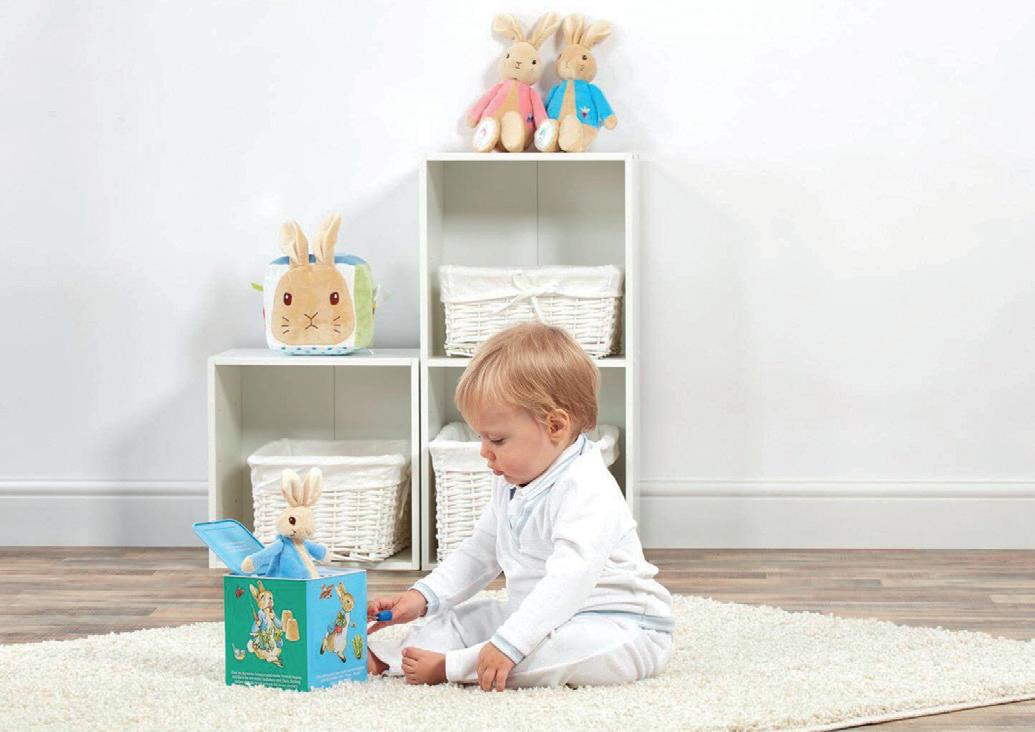
There are plenty of joyful and inspiring traditional and wooden toys, coupled with much-loved timeless characters, to be found at Rainbow Designs! These playful and engaging toys that feature Peter Rabbit, Paddington Bear, Disney’s Winnie the Pooh and Lion King, as well as The Very Hungry Caterpillar, Elmer, and Guess How Much I Love You, have been created specifically for toddlers and are brimming with developmental features.
Rainbow’s range of wooden toys are exceptionally popular with young preschoolers, helping to aid the development of fine motor skills, as well as matching and counting skills. Fun, high quality Wooden Pull-Alongs, Shape Puzzles, and Domino Sets are available in both the best-selling Peter Rabbit and The Very Hungry Caterpillar ranges.
One of the most fun and traditional toys is the Jack-in-the-Box, and Rainbow’s Peter Rabbit Jack-in-the-Box is a best seller, and a very popular gifting choice. Decorated with Beatrix Potter’s beautiful illustrations, this classic toy plays ‘Pop goes the Weasel!’ until the lid pops open to reveal Peter Rabbit, creating much excitement and laughter, time and time again.
New to the Rainbow range for 2025 are Activity Cubes, in both the Harry Potter Wizarding World and Guess How Much I Love You collections. The super soft and squishy Activity Cubes have been created to keep tiny hands busy through endless play and exploration. Each side of the Cube features a unique texture, shape, and design, introducing your little one to a world of sensory fun and adventure.
TEL: 01329 227300 | www.rainbowdesigns.co.uk
new!
Best wheel forward
Wheeled goods are essential for modern parenting, providing both convenience and comfort for babies and toddlers and perform exceptionally well for many independent nursery retailers.
In recent years, consumer trends show an increasing demand for products that combine functionality with style. Parents look for lightweight, compact designs that do not compromise on durability or safety. The convenience of folding mechanisms and the ability to fit into tight spaces, such as car boots, has also become a top priority. As Cuddleco’s Sales Director Chris Armstrong told Nursery Today: “Over the past few years, consumer demand has shifted towards compact, multifunctional travel systems that offer both convenience and safety. Parents today lead increasingly busy lifestyles, travelling frequently and using a variety of transport methods from cars to planes to public transit.”
Hauck’s Head of Sales, Helen Robinson would agree commenting “There is a definite trend towards smaller compact folding pushchairs, we get asked more and more often for pushchairs that are suitable for air travel.
“We have also seen strong sales in pushchairs more suitable for the great outdoors, consumers seem to be looking for models that can stand up to any terrain, or for use in fitness.”
With consumer preferences changing over time we also asked Dorel’s (Maxi-Cosi) Senior Field Marketeer, Nicola Coletti how has the market evolved over the past few years with regards to consumer expectations. “Parents today expect pushchairs to be more than just a way to get from A to B. Compact folding, lightweight designs, and versatile 3-in-1 travel systems have become must-haves, especially for families navigating urban spaces or travelling frequently via car or public transport. Ease of use is a major priority, with intuitive one-hand folding mechanisms and car seat compatibility making daily life simpler. Comfort for both baby and parent is also key, with ergonomic push bars, lie-flat seat recline, and superior suspension now considered essentials rather than nice-to-haves.”
Before making a purchase, parents tend to research extensively, utilising online resources such as review sites, parenting blogs, and social media platforms. The shift towards e-commerce has also made it easier for parents to compare different products and prices from the comfort of their homes. However, many still prefer visiting brick-and-mortar nursery retailers for demonstrations and gain invaluable expert advice. In-store experiences allow parents to physically test products, assess the ease of folding mechanisms, and verify whether the product is comfortable for both the baby and the parent and suitable to their lifestyles.
Cost versus function continues to remain a consideration. While some parents are willing to pay a premium for high-end strollers that offer advanced features such as multiple recline positions or all-terrain wheels, others may prioritise costeffectiveness and opt for simpler models. The growing awareness of the need for long-term durability and value is driving the market towards a broader range of options, from budget-friendly models to premium brands. “Every parent considers cost, but purchasing behaviour varies depending on experience.” Said Chris Armstrong. “First-time parents often buy with their heart, investing in what they perceive as the best for their baby, even if it comes at a premium. Second-time parents, however, tend to buy with their head, having a clearer sense of what they actually need versus what they want, making them more practical and value-driven in their decisions.”
Joie’s Head of Product Development, Damon Marriott feels
that the consumer views this purchase as a significant investment stating: “Parents are increasingly value-conscious, particularly in today’s challenging economic climate, but they’re not just looking for the lowest price - they want quality, durability, and long-term usability. A pram or pushchair is a significant investment, so parents expect it to last from newborn to toddler years. We ensure our wheeled goods offer premium features at a competitive price, with bundle options that provide everything needed from day one. We focus on safety, comfort and convenience, as much as we do ensuring our products are durable and designed to last - so parents can be confident they are making a worthwhile investment.”
Innovation in chassis weight and style also continues to be a key trend with leading brands fully focussed on creating stylish designs that blend functionality with aesthetics while also offering a variety of colourways and accessories to appeal to modern parents’ tastes.
You will find a plethora of products across the following page highlighting a great selection that are all available to order now.
Nicola Coletti
Senior Field Marketeer UKI, Maxi-Cosi/Dorel
What new innovations as a brand have you featured in the design and functionality of your wheeled goods range that aim to improve user experience or enhance product safety and convenience?
Innovation in ease of use and safety is at the centre of our design process. Fame was designed with a range of one-of-a-kind features, including our LumiRide lighting system to enhance visibility for safer strolls, while the integrated USB charging port ensures parents stay connected on the go. These truly premium features combine technology with everyday practicality, to enhance both safety and convenience for modern families. Features like one-hand folding, puncture-proof all-terrain wheels, and ergonomic reclining seats also make our pushchairs more convenient for parents. In addition, Fame has an integrated SoothingSlope, enabling parents to easily adjust the incline to aid with reflux and discomfort. We’ve also enhanced safety with five-point easy-in harnesses, pivotable bumper bars, and UPF 50+ sun canopies - whilst ensuring that travel system compatibility remains another key focus, offering patents a hassle-free transition from car to pushchair.
What kind of support or training do you provide to nursery retailers to help them better understand and sell your products, especially in terms of unique selling points or emerging trends?
We provide nursery retailers with comprehensive training to ensure they feel confident demonstrating and recommending our products. This includes detailed product guides and in-person training from our dedicated team. We also offer in-store point-of-sale materials, allowing customers to see key product features at a glance. As consumer trends evolve, we work closely with retailers to share insights into emerging needs, whether that’s compact travel systems, sustainability, or advanced safety features.
Have you as a brand integrated a level of sustainability into your product designs and materials, and how do you ensure that your products align with the growing demand for eco-friendly, ethically sourced goods?
Over the last few years. sustainability has become a key focus for us. Our newest pushchairs, including Fame and Oxford, feature Eco Care fabrics, which are made from 100% recycled materials without compromising on softness or durability. By designing long-lasting, adaptable travel systems, we also help parents invest in products that grow with their child, reducing unnecessary waste. Sustainability is an ongoing journey, and we continue to explore ways to improve materials and processes to lessen our environmental impact while maintaining the highest standards of safety and durability.
All in One Compact Stroller
Effortless transitions
Packing big adventures into small spaces
The Maxi-Cosi Oxford is a premium 3-in-1 travel system, blending timeless style with cutting-edge innovation.
Designed for city strolls and outdoor adventures, it features puncture-proof all-terrain wheels, four-wheel soft suspension, and a spacious, lie- at seat for ultimate comfort. The UPF 50+ canopy, 5-point easy-in harness, and pivotable bumper bar keep little ones safe, while the intuitive fold, large storage basket, and parent pocket add convenience.
Paired with the Pebble 360 Pro car seat and FamilyFix 360 Pro base, Oxford delivers e ortless transitions and superior safety, ensuring modern parents travel in style from birth to four years.
www.maxi-cosi.co.uk
One hand fold
Graco’s award-winning
Myavo is a game-changing stroller at a fantastic high
At just 5.8kg, Myavo is one of the lightest compact strollers on the market, and its one-hand, onesecond fold makes it perfect for modern families on the go.
Myavo comes in a range of on-trend colours such as an elegant Mulberry and neutral Steeple Gray, all with a knitted canopy and quilted seat fabric for a luxurious look and feel.
www.gracobaby.eu
The Metro 3 All-in-One Compact Stroller is the newest addition to Ergobaby’s award-winning Metro Stroller line, engineered to deliver premium comfort, convenience, and versatility.
Integrating consumer feedback with its unique design expertise Ergobaby has combined the best of previous Metro models with new and improved features such as a self-assisted one-handed fold, a more comfortable stroll for all, new storage solutions, accessories and more.
Perfect for families on the move, this stowable stroller is suitable from newborn-4yrs, weighs 7.7kg and folds to just 56x44x23cm – all while having the roomiest seat in its class.
The Metro 3 also comes with the ErgoPromise Lifetime Guarantee. For more information, please contact Claire Morris on the below. cmorris@ergobaby.co.uk www.ergobaby.co.uk
Birth to big kids!
Meet pact pro, the newest compact fold to join the Joie portfolio.
Designed for every journey from birth to big kids, the pact pro is three strollers in one, compatible with Joie infant carriers and carry cot (sold separately). Whether little one wants to sit up and take in the sights or lie back and snooze, there is an option to suit, thanks to the multiple recline positions.
Light as a feather, at just 6.3kg, the pact pro is super easy to fold with a quick one hand action, to create a compact, freestanding fold.
uksales@joiebaby.com www.joiebaby.com
The most stylish ride around
finiti
4in1 reversible pram birth to 22 kg (approx. 4 years)
Meet finiti™, the luxe y w transitions, a ever y stage from ba a adventurer, featuring both p to
Meet finiti™, the luxe and ylish adventurer designed for effortless ansitions, ready to pack away or roll out in an instant. Glide through ev from baby to big kid with this luxurious 4-in-1 entu aturing both parent-facing and world-facing modes to seamlessly adapt to each growth milestone
or more information and all sale enquiries, please contact Joie on 01889 808 900 or email: uksales@joiebaby.com mpra 4 birth to 22 kg
For more information and all sale e juksales@
Full selection
Red Kite’s Push Me range of strollers include something for everyone. Practical value buggies, compact strollers, twin strollers and amazing value Travel Systems to suit all tastes and budgets.
The Push Me Astro is available in 3 trending colour designs and is a super convenient compact folding stroller suitable from birth until approx. 22 kgs so older toddlers. Featuring a generous sized padded seat and sleek matte black modern frame with full suspension for a comfortable ride. Autofold closing allows for practical and easy use when out and for storage and can also stand independently when folded. Includes a generous shopping basket, bumper bar, hood and full raincover ready just incase of showers! Available in Jet Black, Sage Green and Sand
The Red Kite Travel Accessory range has been through a re vamp recently with updated quality soft knitted fabrics and new packaging. Updated features to the very popular Travel Booster and new additions such as the amazing new Backpack mean that this selection gives you an essential travel accessory range at brilliant price points.
Head over to the Red Kite website to check out the full range. www.redkitebaby.com
Award-Winning Comfort
The My Babiie MB450 Travel System: Stylish, Practical, and BANTA AwardWinning – The Ultimate Travel Solution for Modern Parents.
The My Babiie MB450 Travel System is a premium 3-in-1 or 2-in-1 solution designed for style and practicality. With a sleek nish, it includes a carrycot, a reversible pushchair seat, and a secure i-Size car seat, ensuring comfort from birth. Its all-terrain wheels, e ortless fold, and adjustable handlebar make every journey smooth.
Thoughtful features like an extendable canopy, plush padding, and a spacious basket enhance convenience. Recognised for excellence, the MB450 proudly won the BANTA Award for Best Travel System, highlighting its superior design and functionality. Perfect for modern parents, this travel system combines luxury with everyday ease. www.mybabiie.com
Seeing double
Meet Estrella, the new double stroller from Joie Signature. This luxe and stylish lightweight double stroller features two customisable seats – perfect for navigating adventures with little ones who don’t always see eye to eye.
Styled in the brand-new Signature look, Estrella has a lie at recline in each seat that works individually, creating a cosy, ergonomic haven that is suitable from newborn to toddler.
The adjustable leg rests o er cushy calf supports to let growing, tired legs kick back comfortably, while the all-wheel suspension will absorb the impact of any terrain without disturbing sleeping tots.
uksales@joiebaby.com | www.joiebaby.com
Full of functional features
Part of the award winning trax family, the versatrax is perhaps the most versatile of the Joie pushchairs. Combining stylish design and functional features, the versatrax is ideal for new parents wanting to create the perfect travel system.
Suitable from birth to 22kg, the versatrax is a stylish pushchair in every mode imaginable, o ering both rearward and forward-facing options as well as pairing with the super lightweight ramble XL carry cot, available separately.
The versatrax is also compatible with a wide range of Joie infant carriers including the i-Snug 2 allowing you to create a complete travel system for little one. Suitable from birth to 75cm, i-Snug 2 boasts the Joie Tri-Protect headrest with three layers of foam including the patented Intelli-Fit memory foam in the infant pillow to ensure and safe and secure ride for baby.
uksales@joiebaby.com | www.joiebaby.com
Simply sleek with Balios S
The CYBEX Balios S Lux is a pushchair designed to support every family’s needs.
The Balios S Lux pushchair has been recently updated featuring a smoother curved handlebar, a trendy aluminium footrest and sleeker front wheel forks. It is also travel-system ready and o ers advanced suspension, ergonomic lie at recline and the usual CYBEX one-pull harness feature.
· Travel system ready
The BALIOS S LUX o ers custom made travel options on one single frame, so that all city parents may have the absolute best, based on their own individual needs.
The system can be used with the COT S LUX, or the stroller seat. Furthermore, the pushchair is fully compatible with all the awardwinning CYBEX infant car seats.
· A exible and luxuriously comfortable daily companion
The BALIOS S LUX is equipped with advanced city-ready suspension system, so that all parents can take on di erent terrain and in providing their baby with the smoothest ride. The seat can also be reclined to a full ergonomic lie- at position, meaning the perfect, comfortable sleeping position for baby and child.
· Wide colour range
The BALIOS S LUX is available in six modern single-toned and eye-catching colours.
The taupe frame with dark brown faux leather handlebar is paired with Stormy Blue, Almond Beige and Seashell Beige. The silver frame with dark brown faux leather handlebar comes in Stone Grey and Ocean Blue. And nally, the black frame with black faux leather handlebar matches with Moon Black.
For more information, get in touch with your sales representative! www.CYBEX-online.com
Adventure on Two Wheels
The hauck Dryk Duo Plus – a versatile bike trailer and buggy with rear suspension, spacious seating for two children, and smooth manoeuvrability.
For active families who love to explore, the hauck Dryk Duo Plus is the perfect companion. Whether cycling through the city or enjoying a walk in the park, this 2-in-1 bike trailer and buggy provides maximum comfort, exibility, and safety.
Smooth ride with rear suspension
Uneven roads, cobblestones, or curbs? No problem! The rear-wheel suspension and air- lled tyres ensure a smooth and comfortable ride, even on bumpy surfaces. Your little ones will sit comfortably while you can ride e ortlessly.
Spacious & practical
The hauck Dryk Duo Plus comfortably seats two children side by side, making it ideal for siblings or friends. The ergonomic seating provides plenty of legroom, while the large storage compartment at the back o ers ample space for bags, toys, or groceries – perfect for family outings.
Easy conversion & compact storage
Need to switch from cycling to strolling? The hauck Dryk Duo Plus easily converts from a bike trailer to a buggy with a quick and secure coupling system. When not in use, it folds down compactly with a one-handed mechanism, making storage
and transport a breeze. Dedicated pockets for the front wheel and drawbar keep everything neatly in place.
E ortless handling & control
Pushing the hauck Dryk Duo Plus is e ortless. The height-adjustable handlebar, with eight positions, ensures an ergonomic grip for parents of all heights. The rubber swivel front wheel allows for smooth and precise steering, while the improved brake system provides more legroom for comfortable walking. A wrist strap ensures extra control and security.
Safety rst
Designed with safety in mind, the hauck Dryk Duo Plus features a reliable 5-point harness system to keep children securely strapped in. Re ective strips and an integrated LED rear light enhance visibility in low-light conditions. The sturdy frame ensures stability, whether in bike trailer or buggy mode.
Weather-ready design
British weather can be unpredictable, but the hauck Dryk Duo Plus has you covered. The 2-in-1 weather protection shields against wind and light rain, while the integrated mosquito net keeps insects away. With UPF 50+ sun protection, your little ones stay safe all year round.
Perfect for everyday adventures
With a width of just 79 cm, the hauck Dryk Duo Plus ts through standard doorways and is ideal for cycle paths. Whether heading to the park, running errands, or embarking on a weekend adventure, it o ers seamless mobility for modern family life.
With its smart design, comfort, and enhanced safety features, the hauck Dryk Duo Plus is the solution for parents seeking a versatile, high-quality bike trailer and buggy in one. info@hauckuk.com www.hauck.de/en
Venicci unveils the Upline 2, the latest evolution of its bestselling travel system, designed to enhance comfort and convenience for parents and babies alike.
This upgraded model features built-in height adjusters, allowing the carrycot and seat unit to be positioned at three di erent levels for a customised t. Enhanced ventilation, including additional vents at the bottom of the carrycot and a ventilated mattress, ensures improved air ow for maximum comfort.
The spacious carrycot is also approved for overnight sleeping, o ering a safe and cosy resting space.
With premium fabrics, sleek aesthetics, and re ned details, the Upline 2 blends luxury with practicality.
www.venicci.co.uk
From a Shed in Portishead to Buckingham Palace and Beyond…
Launched in 2017 Rockit was the rst truly portable baby rocker for prams and strollers. It was invented by 3 ordinary dads on mission to help other parents safely soothe their babies to sleep. Like all the best inventions it was developed to meet a personal need. Rockit co-founder Dr. Nick Webb explains “My threemonth-old daughter Abby refused to sleep in the pushchair, and I had noticed other stressed parents wheeling prams around the block trying to get their little ones to drift o . One night I had a lightbulb moment, went to my shed and put together a prototype to t to Abby’s stroller. The next day I tested it, and it
worked! She remained asleep even when we stopped.”
The rest is history, and Rockit is now stocked by retailers large and small all over the world. The award-winning design has even been to Buckingham Palace to pick up 2 Queen’s Awards.
www.rockitrocker.com
Packing Big Adventures into Small Spaces
Ergobaby launch the Metro 3 All-in-One Compact Stroller
Aglobal leader in ergonomic baby gear, Ergobaby continue to deliver products that make parenting a little less hard and a little more amazing with their latest innovation: the Metro 3 All-in-One Compact Stroller. The Metro 3 All-in-One Stroller is the newest addition to Ergobaby’s award-winning Metro Stroller line. Integrating consumer feedback with its unique design expertise, Ergobaby has combined the best of previous Metro models with new and improved features at a competitive price point. Perfect for families on the move, this stowable stroller packs big adventures into small spaces.
Key Features of the Metro 3 All-in-One Compact Stroller:
Travel light, travel anywhere: The Metro 3 weighs just 7.7kg and folds down to 56 x 44 x 23cm, compact enough to t in tight spaces, from airplane overhead bins to small car boots.
One-handed fold: The self-assisted fold mechanism collapses the stroller quickly and easily while leaving parents with one hand free for securing baby, bags etc.
Roomiest seat in its class: Its ergonomic, cushioned seat is the roomiest* in its class, providing surprising size and superior comfort from newborn babies through to 4-years-old (22kg). It’s even machine washable to easily clean up inevitable spills and stains.
Newborn ready: The integrated newborn nest and car seat compatibility (with accessory available separately) make it suitable for use with newborns while the near- at recline support naps on-the-go at any age.
Smooth ride: Innovative all-wheel CushionRide suspension ensures a smooth journey on a variety of terrains and enables e ortless one-handed strolling.
On-the-go convenience: A spacious storage basket that can hold up to 10kg, an easy-to-reach
zippered pocket and adjustable handlebar (101108cm to cater for a range of heights) all make busy parents’ lives easier.
All-weather protection: Ready for anything, the extendable UV-protective and water-resistant canopy helps keep baby protected from sun or rain while a mesh panel and peek-a-boo window allow for ventilation and easy monitoring of baby. Every Metro 3 stroller also comes with a rain cover included in the box.
Accessories for every adventure: As well as the above, car seat adapters, a snack tray, support bar, cup holder, carry bag bug net, and coloured sunshades are all available separately to add even more versatility to an already feature-rich stroller.
On-trend colours: The Metro 3 is currently available in Black, Graphite Grey, Natural Beige, and Soft Olive. ErgoPromise Lifetime Guarantee: The Metro 3 comes with Ergobaby’s limited lifetime warranty against manufacturing defects in materials and workmanship, sending a clear message to consumers that Ergobaby are committed to quality and durability. Compact strollers are a lucrative opportunity for retailers. From customers looking for a compact, everyday stroller to use from birth or those on the hunt for a second or travel stroller at a competitive price point, the Metro 3 appeals to a broad range of consumers with varying lifestyles and needs. It is uniquely placed to bring comfort, convenience, and versatility to parents and babies alike, rede ning what it means to travel light without compromising on quality, whether that’s in everyday life or adventures further a eld.
For further information contact Claire Morris on the below.
*Based on surface area vs. leading ultra-compact strollers, Circana Data, March 2024
Stride with ease
Weighing in at only 6.1 kg, the Nuna IXXA next is engineered for lightweight travel without compromising your little one’s comfort. The all-wheel suspension and large EVA foam-filled tyres ensure babies’ comfort and its 3 position recline make customising strolls for every occasion simple.
The IXXA next folds easily with one hand and stands on its own when folded for fuss-free travel and stowing. It’s travel system ready-compatible with Nuna car seats or pair it with the new IXXA compatible LYTL carry cot for maximum comfort. The IXXA next will see you through from baby stage to toddler stage, providing comfortable strolling for your child up to an impressive 22kg. www.nunababy.eu/uk
Suitable for any terrain
Inglesina Aptica XT – where nature begins
The Aptica XT System Quattro has been designed for off-limits walks. Thanks to the new materials and state-ofthe-art technical solutions, Aptica XT delivers even higher performance levels on any terrain.
The large rear wheel and omproved tyre compound make for a smooth and comfortable stroll, while the new suspension adjustment mechanisms allow for the perfect setting at all times based on the child’s weight and the type of terrain.
The Aptica XT also features the brand-new Open Up Carrycot, with five ventilation windows to promote optimal airflow for baby, helping to regulate climate control and maintain the perfect temperature. sales@cuddleco.co.uk
Experience ultimate ease with Doona X
Doona X effortlessly transitions from car seat to stroller in seconds, making it a compact and practical choice for life on-the-go. It’s innovative design features three adjustable recline positions – Sit, Relax, and Lay Back. It smoothly transitions from an upright sitting position to a near lay flat (or full recline) mode. This adaptable design serves as an all-in-one solution, streamlining the parenting journey.
Doona X meets stringent safety standards and is R129 certified. Along with three recline positions, Doona X boasts a new shock absorbent mechanism for a smoother ride, and a soft release system when moving from car seat to stroller. sales@cuddleco.co.uk
Luxury strolling
Maxi-Cosi Fame redefines luxury strolling for both parent and baby from newborn to four years old.
This innovative pushchair and travel system features the inventive LumiRide LED lighting system, to illuminate darker streets and pathways, always keeping parent and baby safe and visible. A spacious height adjustable Close2Me carrycot ensures parents never get backache when lifting their newborn in and out. With an integrated SoothingSlope, parents can easily adjust the incline to aid with reflux and discomfort. This plush carrycot also has a reversible, breathable memory foam mattress and ventilation window, encouraging optimal sleep and comfort for baby. www.maxi-cosi.co.uk
supplier snapshot
Nursery Today caught up with some of the industry’s nest to gain their thoughts on wheeled goods.
Luke Burns
GENERAL MANAGER, CYBEX
How have consumer preferences in the pram and pushchair market evolved over the past few years, particularly regarding features like compact folding or multifunctionality in travel systems?
Chris Armstrong
SALES DIRECTOR, CUDDLECO
At CYBEX we are always striving to make parents lives easier, and there are always evolving ways we can do this, from ultra-compact fold strollers, to e-powered pushchairs to the safest car seats. On top of this, there are also ever-evolving fashion trends and colours are always one of the main trends for pushchairs; those that are in line with fashion and home trends will continue to be popular – but the core collections in Black and Grey will always remain favourites for the mass market.
How have consumer preferences in the pram and pushchair market evolved over the past few years, particularly regarding features like compact folding or multifunctionality in travel systems?
Over the past few years, consumer demand has shifted towards compact, multifunctional travel systems that o er both convenience and safety. Parents today lead increasingly busy lifestyles, travelling frequently and using a variety of transport methods—from cars to planes to public transit.
The Doona X has rede ned compact travel solutions by combining a car seat and stroller in one seamless design. Doona X’s revolutionary design features three adjustable recline positions, o ering full recline at 159 degrees. It’s the perfect choice for modern, on-the-go families looking for a space-saving, travel-friendly system without compromising on safety.
Inglesina, on the other hand, retains all the functionality of a traditional travel system but prioritises Baby Wellness, ensuring that little ones are supported in an environment designed for their optimal comfort and development.
This evolution re ects a broader industry trend—parents are no longer just looking for a stroller; they’re investing in a holistic solution that balances functionality, convenience, and well-being.
Have you as a brand integrated a level of sustainability into your product designs and materials, and how do you ensure that your products align with the growing demand for eco-friendly, ethically sourced goods?
As consumer demand for eco-friendly, ethically sourced products continues to grow, we are committed to integrating sustainability into our product o ering.
The use of bamboo fabrics provides a naturally antibacterial and hypoallergenic environment, creating a healthier space for babies. Bamboo is a highly sustainable crop, growing rapidly without the need for harmful pesticides or excessive water consumption, making it an eco-conscious choice for our textiles.
How do you leverage social media and digital marketing to promote your products, and what strategies have proven most effective in engaging with your target audience and increasing brand awareness?
Social media is a great tool to inform customers about products and services. This year, our strategy going forward is to utilise our socials by posting content that educates customers on the features and bene ts of our products. This will help them make more informed decisions when shopping for their baby.
Do you feel that consumers are very cost conscious when it comes to purchasing their chosen set of wheels? As a brand how do position the cost of your wheeled ranges?
As we go through 2025, there will continue to be a focus on the need for value for money. Consumers are continuing to consider the features vs. cost. With the CYBEX Gold & Silver collections, we are well placed to supply those that are looking for a balance between budgets, functionality and design.
What kind of support or training do you provide to nursery retailers to help them better understand and sell your products, especially in terms of unique selling points or emerging trends?
Retailers can continue to expect regular visits from their dedicated CYBEX sales representative. The sales team o er dedicated training for store sta on all new products, refresher training, or if you are a new starter, the team will be happy to come into store and support.
Support:
• All retailers can access the CYBEX UK & Ireland Marketing SharePoint to discover new launch information, key dates, marketing assets and regular social media content.
• CYBEX have a WhatsApp community where the marketing team regularly provide social media content
• The CYBEX sales representatives and the marketing team are always on hand to support with social media and creation of reels or content
• Access to branded POS display materials and POS selling tools – hangtags, totems and much more.
Holly Brewer
B2B MARKETING MANAGER DOMESTIC UK AND DISTRIBUTORS, ERGOBABY
How have consumer preferences in the pram and pushchair market evolved over the past few years, particularly regarding features like compact folding or multifunctionality in travel systems?
Consumers want something that will last and that will o er them exibility, and a compact stroller is a popular choice for a variety of parents. From those looking for a compact and lightweight travel stroller that doesn’t compromise on comfort or features, to those living in cities or with small homes or cars with less room for a full system, to those transitioning to a stroller as a better t for an older child, our new Metro 3 stroller is a great choice. What new innovations as a brand have you featured in the design and functionality of your wheeled goods range that aim to improve user experience or enhance product safety and convenience?
We are in the process of launching the latest iteration of our award-winning Metro range, Metro 3 and it is packed with innovative new features designed to make parents‘lives even easier. For example, its ingenious self-assisted fold mechanism is bound to impress customers; after pressing the button on the handlebar users simply release the handle to allow the stroller to collapse by itself quickly and easily, while keeping one hand free for securing baby, bags etc. And don’t underestimate the power of little details in driving conversion. Simple yet meaningful additions such as an extra, easy-to-reach, zippered pocket for valuables, improved accessory compatibility, and the roomiest1 seat in its class, all appeal to both new and experienced parents alike. How do you leverage social media and digital marketing to promote your products, and what strategies have proven most effective in engaging with your target audience and increasing brand awareness?
We have a dedicated content creation team creating a wide variety of engaging content for social media. One of our most e ective tools are educational short form videos with various objectives such as instructing consumers on product usage and safety or showcasing product features. We also see great success with targeted pieces of light-hearted, relatable content that share the highs and lows of parenthood and how our products make life with baby easier.
Damon Marriott
Luisa Rollins-Svensson
UK CONSUMER AND TRADE MARKETING MANAGER, GRACO
HEAD OF PRODUCT DEVELOPMENT, JOIE
Do you feel that consumers are very cost conscious when it comes to purchasing their chosen set of wheels?
The past few years have taken their toll on consumer’s budgets, so whilst stylish prams are still the target for the new parent, the cost of these is a large consideration. This is why we have positioned our new launch signature range at an accessible price point, with no compromise on the style and quality of the features included – this range should be a real winner in 2025.
What new innovations as a brand have you featured in the design and functionality of your wheeled goods range that aim to improve user experience or enhance product safety and convenience?
We have incorporated the one hand fold feature into many of our new launch items, to maximise the day-to-day user experience. For our true ‘walking prams’, we have added the adjustable seat height feature to ensure the parent can be nice and close to their baby on longer walks. This creates a more comfortable experience for the parent, while little one is cosy and safe, giving these pushchairs an advantage over traditional prams with a xed seat.
What kind of support or training do you provide to nursery retailers to help them better understand and sell your products, especially in terms of unique selling points or emerging trends?
Our sales training teams are always on hand to run through new launch items for our retail partners and can help cascade the knowledge to front line retail sales sta . We are also able to o er virtual training sessions online and have plenty of digital assets available. While we aim to have all support assets available to our retail partners we are always looking to improve where we can, so feel free to talk to your representative if you have additional ideas for how we can help.
Have you as a brand integrated a level of sustainability into your product designs and materials, and how do you ensure that your products align with the growing demand for eco-friendly, ethically sourced goods?
As a brand that produces all our goods from our own factory facilities, we have been an early advocate for ensuring our products are made with an ethical approach. Our facility has received many green awards for recycling initiatives that have been implemented, such as water recycling, energy use reduction and many plastic recycling projects to minimise waste.... to name but a few.
How do you leverage social media and digital marketing to promote your products, and what strategies have proven most effective in engaging with your target audience and increasing brand awareness?
Its really important to understand our target audience and to create engaging content across a variety of platforms, utilising brand and in uencer content, ensuring our content is relatable. We also collaborate with retail partners and consumer media and develop a diverse content calendar utilising high-quality visuals to capture attention and enhance brand recognition. We regularly monitor key metrics such as reach, engagement and conversions, making any adjustments to our strategy throughout the duration of the campaigns.
How have consumer preferences in the pram and pushchair market evolved over the past few years, particularly regarding features like compact folding or multifunctionality in travel systems?
We nd parents are prioritising a mix of convenience and value for money in their purchases. They are looking for products that not only complement their lifestyle, from lightweight, compact designs to useful features such as cup holders which cater to the needs of the modern family.
Do you feel that consumers are very cost conscious when it comes to purchasing their chosen set of wheels?
We consistently focus on providing strollers that are both a ordable and reliable, ensuring parents always receive great value for their money. We have been tracking the impact of the cost-of-living crisis on UK parents, and have seen a considerable number of families with heightened price sensitivity.
What new innovations as a brand have you featured in the design and functionality of your wheeled goods range that aim to improve user experience or enhance product safety and convenience?
Innovation at an a ordable price in core to Graco’s product development. Our award winning Near2Me DLX Trio Travel System is testament to this. It incorporates the Slide2Me height adjustment technology, making it a particularly great choice for couples with distinct height di erences and bringing baby close when seated. It’s also compatible with the SnugLite i-Size R129 infant car seat which has rotation capabilities when paired with the SnugTurn i-Size R129 rotating ISOFIX base.
How do you leverage social media and digital marketing to promote your products, and what strategies have proven most effective in engaging with your target audience and increasing brand awareness?
Through 2025, we are collaborating with one family who will share their journey as parents to toddler twins with Graco’sInstagram followers and on The Graco Village microsite. Sharing their highs and lows of parenting, the key objective of the campaign is to ensure more parents feel less isolated and part of a wide parenting community.
Helen Robinson
HEAD OF SALES - UK & IRELAND, HAUCK
Do you feel that consumers are very cost conscious when it comes to purchasing their chosen set of wheels? As a brand how do position the cost of your wheeled ranges?
During and after Covid cost played a very signi cant part, and we saw huge growth in our basic pushchair range, but over the past 12-18 months there is a move towards consumers willing to spend a little more if the product o ers the style or functionality they want.
What new innovations as a brand have you featured in the design and functionality of your wheeled goods range that aim to improve user experience or enhance product safety and convenience?
Although not new to the market, we have begun to update our fabrics to o er SPF 50 protection and o er removeable and washable fabrics on many of our pushchairs.
What kind of support or training do you provide to nursery retailers to help them better understand and sell your products, especially in terms of unique selling points or emerging trends?
We have a very extensive online Product Information Catalogue that retailers can access to gain all information relating to the product, including technical information such as the size of wheels or length of back rest. This can be linked to customer websites directly to help drive quality online content. Have you as a brand integrated a level of sustainability into your product designs and materials, and how do you ensure that your products align with the growing demand for eco-friendly, ethically sourced goods?
All our wooden products, such as the Alpha Highchair or Wooden toy range are all ethically sourced from FSC sources.
How do you leverage social media and digital marketing to promote your products, and what strategies have proven most effective in engaging with your target audience and increasing brand awareness?
As a Pan-European brand we have a presence across most social media platforms driven by our marketing department in Germany.
We also work closely with a range of in uencers through Instagram, working closely with retailers to help drive tra c and sales of key lines.
Red Kite
As an established nursery brand, Nursery Today caught up with Debra Tucker, one of the original founders of Red Kite as they celebrate their 20th anniversary to discuss challenges, successes, innovation and trends over the years that the business has experienced.
Red Kite Baby is celebrating 20 years of innovation in nursery products. Can you take us back to the beginning? What was your very first product range?
Red Kite started with a very basic small range of only 8 lines. But as the original key team all had previous experience in the nursery trade, we quickly built on the early success and luckily already had many loyal contacts and customers happy to have faith in our new brand and company. We still have the same core sub ranges that we introduced 20 years ago as an example, Feed Me, Push Me, etc.
Over the years, how have you seen the landscape of the nursery product sector evolve, and what do you think have been the most significant changes?
I think the growth of online and different platforms including social media means that both selling and marketing has changed considerably over the years. Whilst I firmly believe nothing can substitute experience and advice from a dedicated sales person in a retail store, the fact is that young people are constantly on phones and online and have very different attitudes to purchasing products these days.
Consumer preferences and trends change rapidly. How has Red Kite Baby kept up with these shifts to ensure your products remain relevant?
It is sometimes unbelievable how fast trends can come and go and that can often be a challenge when you are having to look ahead and forecast demands and trends! Nursery can be very fashion led so looking at colour trends on cat walks and online gives an indication of what is in and out! Also, home styling is key for interior colour themes as parents more often
want complementary colours to match their homes these days. I personally had a dark brown pram for my eldest son over 40 years ago and browns and earth colours are everywhere again now. Often these things come back around! Trade shows both home and abroad also help showcase innovation in products so these also are a key factor in looking ahead.
It is sometimes unbelievable how fast trends can come and go and that can often be a challenge when you are having to look ahead and forecast demands and trends!
Nursery can be very fashion led so looking at colour trends on cat walks and online gives an indication of what is in and out!
Looking back, what would you say has been the biggest challenge Red Kite Baby has faced during its 20 years in business?
We have grown very steadily over the past 20 years despite many challenges such as Brexit and the pandemic which when working closely with partners in the Far East daily gives many frustrations. Outside factors beyond your control can present challenges that can be difficult to work with, but we have dealt and strengthened during these periods by being honest and transparent with our team and customers.
Push Me Tandem 2005
Lets Fly a Kite Playgym 2008
Push Me Stroller 2005
turns
Similarly, what do you consider your most signi cant success in those 20 years?
I believe we have a happy workforce and the original four of us (myself, Liz Murphy, Marisa Britton and David Barnes) that started the company 20 years ago are still the massive heart of Red Kite. We are a relatively small team, but we genuinely get so much satisfaction and pride in seeing our products out and about and receiving lovely feedback from customers. To be running a successful business with happy employees and customers throughout some tough economic periods is a great achievement.
Innovation seems to be at the heart of Red Kite Baby. How much emphasis do you place on innovation when developing new products?
To be relevant it is vital to evolve and evaluate product design and demand. Whilst some core lines such as our original award-winning travel cot the Sleeptight is still a massive part of our range, other lines have changed as fashions and trends have moved on. Sometimes innovation can take a while to grow in demand like compact strollers replacing umbrella fold buggies. Now compact strollers are everywhere in all shapes
and sizes! Parents are always looking for core products when buying for newborn such as travel systems and highchairs, it’s just ensuring that the functions, safety and quality along with value all stack up.
How do you ensure that new product launches align with both market demands and Red Kite Baby’s values?
Red Kite Baby’s main ethos from day one was and is to supply great quality products with amazing value. Today’s market demands created from current economic challenges mean our core values are even more relevant and vital today than they ever have been.
As you approach your 20th anniversary, how do you plan to celebrate this signi cant milestone?
We have had a small internal celebration with our team on our anniversary already but will be planning some trade celebrations at Harrogate later this year!
Will there be any special promotions or o ers for nursery retailers in honour of your 20th anniversary?
We have run some limited promotions already but again will be planning some further o ers during year.
Looking to the future, are there any exciting product releases or developments in the pipeline that retailers can look forward to or any news that you would like to share with Nursery Today’s readers?
All our new lines that we showcased at last year’s Harrogate fair are now available including the amazing Sway Swing which we won the BANTA Best Nursery Product for and our fantastic new range of car seats. We had a fabulous show and some wonderful feedback from customers at Harrogate last year and are already getting such lovely comments on the new lines. As always, we use Harrogate to introduce brand new development and listen and take on feedback from our lovely friends and customers in the industry.
www.redkitebaby.co.uk
Barking Mad
This month Pramland’s John Barker is focussing on margins and how after compiling data and analysing his own margins, found some very interesting results.
Hello one and all. I trust the recent bout of sunny weather has you skipping to work in the morning ready for another fun day in the nursery industry. Before I get to the crux of my article this month, I want to mention someone that recently announced they are leaving the industry – Julie Shaw of Simply Baby Lancaster. I would like to take this opportunity to wish Julie every success for the future and hope that the decision she has made leads to happiness and a stress-free life. Julie is a remarkable lady and has shown me nothing but kindness and I will be very sorry to see her leave the industry. When an industry loses fabulous retailers like Julie due to pricing and an inability to maintain margin you really must question who’ll be next. Good luck Julie, we’ll all miss you x This leads me on nicely to my article this month – I want to address margins and just to set the cat amongst the pigeons share with you some research I have been conducting right here in my laboratory (aka my o ce). Those of you that know me well will know I’m a real numbers guy. I have a spreadsheet for everything and really enjoy drilling
down into the nitty, gritty of margins and costings etc. I honestly believe that a business has to have a very rm grasp on its numbers if it’s to drive forward, or more importantly, stay relevant. Without teaching your grandmother how to suck eggs there’s two sides to margins. One is a percentage and the cold hard money in your till. We all talk about good margins and “idiots online giving it away” but what we are talking about is percentage points. Percentage points don’t directly keep the lights on, and the wages paid – money in the till does. In its simplest terms it’s better to earn a 20% margin on a £1000 sale than a 40% margin on a £200 sale. In an ideal world we’d all earn a 40% on a £1000 sale but that is just pie in the sky and it’s very unlikely it would ever happen.
Recently I have been compiling data and analysing my margins, and I have found some very interesting results. Working on a period of 3 months (which included Black Friday and the January Sales) I looked at the goods we’d sold and calculated my top 10 products. I then calculated what the margins are on these products when sold at full RRP.
I have a spreadsheet for everything and really enjoy drilling down into the nitty, gritty of margins and costings etc. I honestly believe that a business has to have a very firm grasp on its numbers if it’s to drive forward, or more importantly, stay relevant.
So here goes, my average margin for my top 10 products sold at RRP is 33.2%. This is a number that surprised me. I honestly thought it would have been slightly lower, but I guess we are supporting the products and brands that earn us money which is fabulous news. This, however, is only half the news. I then sat and worked out the actual sale price for these top 10 items during this time period. This takes into account promotions, price matches and even sta working out the bill incorrectly. You won’t be surprised to read that the actual achieved margin is lower – however you’ll be amazed to read that it wasn’t lower by much. The actual margin we achieved on my top 10 selling products for the 3 month period I analysed was 31.3%.
Now this could mean one of many things such as us supporting the correct brands in store (brands like BabyStyle that o er strong margins and who do a great shop of ensuring prices are kept at RRP - without telling us to keep them at RRP)), buying items at the correct time and holding stock until promotional periods end in order to increase margins. . .just dumb luck or us being in an area less nancially capable of shopping online and needing simpler instore payment options. The fact remains that my numbers suggest margins in our industry (although lower than many other retail sectors) are actually sustainable. So why is cash ow so di cult? Why do I have to sell more to stay ahead? The answer to this question comes down to cash margin.
It’s not the percentage points that are costing our industry store closures it’s the cash margin. All our costs are increasing, and April 2025 will see a huge cost spike for all employers – we need to increase the money we are earning to offset these increases. Suppliers cannot afford to give us more margin – their costs are about to rocket too.
If this research has illustrated anything to me it’s shown me that the nursery industry is completely inflation proof. When was the last time you got an all sku price increase from a brand? I can’t remember one. Why does my shopping go up every week at the checkout in Tesco or Asda? Why are petrol prices heading north every time I fill up? Don’t even mention gas and electricity – yet if I was to purchase a pram it would be the same price as it would have been 5 years ago or maybe even less! This seems crazy to me – why are the parents to be winning? We should be winning, and they should be footing the bill. A 5% increase in a products RRP is reasonable – after all inflation dictates everything should increase. The
national living wage is set to increase by almost 7% in April so can’t we increase our goods by 7% to reflect this? And here lies the true margin issue. It’s not the percentage points that are costing our industry store closures it’s the cash margin. All our costs are increasing, and April 2025 will see a huge cost spike for all employers – we need to increase the money we are earning to offset these increases. Suppliers cannot afford to give us more margin – their costs are about to rocket too. They can however increase RRP’s. Here comes the maths: on my previous numbers an average customer spending £1000 will clear me £313.00 cash margin in the till, with an increase of 5% to the RRP the customer will now pay £1050 for the
same item (hardly a huge jump). On the same average margin of 31.3% I’ll now be getting £328.65 cash margin, an increase of £15.65 per thousand. If you turnover £10,000 a week that means, you’ll have an extra £8,138 per year in your till. My guess would be that a business turning over this level would hugely benefit from that increase in their cashflow annually. The brilliant thing is that the manufacturer hasn’t footed the bill, you haven’t footed the bill – oh no, the customer has, and so they should after all they are the customer. So, for the sake of our industry and to ensure the future of the stores you rely on to sell your goods I ask each and every brand reading this –
please increase your prices! If you’re feeling generous by all means we’d love an extra percentage point here or there but if you can’t do that at least look at your prices. Your costs have and will continue to rise – pass these costs on to us and we’ll pass them on to the customer. We’ll all earn more, and we’ll all find it easier to make ends meet. If brands don’t support this, we all need to review who we support. Sadly, for every brand that is happy to destroy our industry by selling car seats to Tesco Clubcard holder for £75 there are fewer brands like BabyStyle that are all about us independents. If my figures have done nothing else, they have at least highlighted that if you support the correct brands you’ll find things will be better.
Sweet dreams
COFFEE BREAK
Nursery
Today caught up with Debbie Grant, Sales Director at Cheeky Rascals to gain insight into the rise in popularity of the Smart baby monitor and why the Owlet Dream Sock has become the go to when it comes to parents’ peace of mind.
Many parents experience anxiety about their baby’s safety during sleep. How does the Owlet Dream Sock help alleviate these concerns, and what features have been most e ective in providing peace of mind to parents?
Truly a rst-of-its-kind, the Owlet Dream Sock provides caregivers with a deeper understanding of their infant’s safety and well-being through real-time health readings and timely noti cations when their baby needs their attention. Parents have the peace of mind of knowing they can go to sleep with the base station next to their bed which will sound an alarm if the baby’s oxygen or heart rate changes to an unsafe level. Is the Dream Sock medically certi ed and if so, what bene ts does this bring to the product?
Yes, the Dream Sock is medically certi ed, o ering a unique technology that provides clinically proven medical accuracy that parents can trust and rely on.
What has driven popularity for the Dream Sock and do you have any feedback/testimonials from parents about its impact on their daily routines?
We hear time and time again that parents and carers have found the Dream Sock a true game changer. O ering them a peace of mind that has allowed them to really relax knowing the Dream Sock has their back. Has social media had an impact on this type of product to drive brand awareness?
I think incorporating social media as part of your marketing strategy is a must these days. Nurturing content and shout outs are an invaluable way to drive awareness for any brand and product, but I do feel for a product like Dream Sock especially, given the safety implications, ensuring an authentic presence on social media and honest reviews from real parents makes a huge di erence.
What are the main trends you’re currently seeing among consumers when it comes to baby monitoring products? Are parents increasingly seeking tech-driven solutions like the Dream Sock, and if so, what features are they prioritising?
Indeed, the trend for smart baby monitors has grown and nowadays it’s not so much a question of whether parents want a smart monitor, but more what they want from the smart monitor they pick. Parents are so used to using smart devices in their own lives for health tracking and convenience, it’s a natural progression to use available technology in baby monitors. The real time updates ensure they are always there for their baby and priority is on the accuracy and reliability, so high-grade tech is a must.
How has Owlet innovated with the Dream Sock, and do you foresee advancements or features to meet the growing needs of parents looking for enhanced baby monitoring solutions?
Fundamental to the product’s innovation was to nesse the accuracy of the results and ensure the monitor provides clinically proven medical accuracy, along with real time monitoring and e cient noti cations. However, the new predictive sleep function has become a hugely popular feature as well. Using historical sleep data and best practices for sleep, based on the baby’s age, the Dream Sock uniquely recommends the next appropriate sleep window, helping parents to create a seamless routine.
For nursery retailers who choose to stock the Dream Sock, what bene ts do you o er them in terms of product education, customer support, and the potential for driving sales through this type of innovative product?
We are really grateful for the part our brand partners play in educating new parents about the bene ts of using an Owlet product. We o er comprehensive product training and education, dedicated customer support, and marketing resources such as POS units for store and a demo TRY ME app. We run regular supported promotions and strong marketing campaigns and will always be on hand to answer any questions the retail teams or their customers have.
Many parents have huge anxieties when it comes to sleeptime – fortunately as an industry we have many leading nursery brands who o er products that assist.
Baby sleep time can often be a source of anxiety for parents, especially with the overwhelming responsibility of ensuring their baby sleeps safely and soundly. Parents are naturally concerned about their child’s well-being during sleep, which can lead to stress over everything from sleep position to room temperature. Understanding this, nursery brands have made signi cant strides in developing innovative products designed to ease parental anxiety and improve the quality of both baby’s and parent’s sleep. These innovations range from cribs/cots and mattresses to baby monitors, with an emphasis on safety, comfort, and convenience.
One of the key advancements has been in crib design. The rise in popularity of bedside cribs, which allow parents to have their baby close by during the night, has been a game-changer. These cribs provide easy access for parents while minimising the risks associated with co-sleeping. Many of these cribs also incorporate features that enhance air ow, contributing to safer sleep environments for babies.
Another critical area of innovation is in mattresses. Brands have focused on the breathability of materials to ensure proper air ow and reduce the risks of overheating, which is a key concern in safe sleep guidelines. The Lullaby Trust, a charity that advocates for safe sleep practices, emphasises the importance of breathable materials in mattresses to minimise the risk of sudden infant death syndrome (SIDS). As a result, many new mattresses are designed with advanced, breathable materials that help maintain a safe sleeping environment.
In the realm of technology, baby monitors have also evolved to o er more than just sound detection. Through smart tech monitors o er a range of features designed to give parents additional peace of mind. These devices keep parents connected and informed, allowing them to monitor their baby’s sleep patterns from anywhere in the home. Together, these innovations highlight how the nursery industry has responded to parental concerns, combining safety, comfort, and cutting-edge technology to support better sleep for both babies and their families.
Exclusive Support for Growing Sleepers
Prestige Sleep is raising the bar in nursery mattress innovation with an exclusive double-pocket spring system, delivering exceptional comfort, durability and support for growing babies. As the only UK nursery mattress manufacturer licensed to use this advanced spring technology it sets them apart in quality and performance. With every one of their British-made mattresses handcrafted, Prestige Sleep proudly holds the Made In Britain certi cation as it continues to lead the way in nursery sleep solutions. “Every innovation we bring in is designed to give babies the best possible sleep”, says Managing Director Jack Nijjar. Learn more by visiting their website. www.prestigesleep.co.uk
Super snug
Home of the Moses basket, The Little Green Sheep’s unrivalled range provides a safe and super snug place for little ones to spend their rst six months as they grow, develop and dream.
Beautifully crafted with natural materials and using specially sourced palm leaf, The Little Green Sheep’s Moses basket provides a calming space for baby to sleep soundly from birth. Available in many colours and prints, the lovingly woven, lightweight, and portable Moses baskets come with a premium-quality liner made from 100% organic cotton. Complete with the brand’s signature chemical-free mattress to create the purest environment for sleep, it o ers rm support, as recommended by safe sleep experts.
TEL: 01789 734 022 | trade@greensheepgroup.com
Sleeping soundly
Parents can sleep soundly at night with little one close by, whether at home or on travels, with the new roomie go from Joie.
This easy to fold, bedside sleeper is a portable powerhouse that will let parents and little ones sleep safely, side by side, without sharing a bed. What sets roomie go aside from similar bedside cribs is the quick and easy fold that packs up conveniently into one tiny package. Compact and lightweight, roomie go is your perfect travel partner that is easy to carry and tucks away into small boots and cupboards.
Roomie go also comes with a comfortably cushioned, yet rm mattress that is covered in a soft knit mesh so that baby can breathe easily which means a peaceful rest for parents and baby.
uksales@joiebaby.com www.joiebaby.com
Creating Comforting Bedtime Routines with Rainbow Designs
Bedtime cuddles and stories time play a vital role in establishing a soothing night time routine for babies and young children.
A comforting ritual helps little ones develop healthy sleep habits, and Rainbow Designs’ delightful collection of cuddly characters, paired with beloved storybooks, makes the perfect combination for those special bedtime moments.
The Bedtime Cuddles range from Rainbow features the most-cherished children’s characters. Little ones can snuggle up with the adorable Peter Rabbit or Paddington Bear Bedtime Cuddles Nightlights, that features adorable cuddly soft toys of the much-loved characters. Designed to help soothe little ones to sleep with a gentle cuddle, calming lights, and soft music, these super-soft plush toys each come with a soft detachable nightlight that illuminates to provide a mesmerising starry sky pattern, while playing a soothing lullaby to help little ones drift o to sleep.
For extra comfort, Cuddly Comfort Blankets make the perfect nap-time and bedtime companions. These soothing blankets feature Rainbow Designs’ most popular characters, including Peter Rabbit, Paddington, Disney’s Winnie the Pooh and The Lion King, and Harry Potter from The Wizarding World, Guess How Much I Love You, and The Very Hungry Caterpillar. Exciting new additions for 2025 include a Disney Baby Dumbo comforter as well as a selection of animal comforters from the new Tikiri Toys range, to o er even more snuggly sleep-time options.
TEL: 01329 227300 | www.rainbowdesigns.co.uk
Snüz - where
sleep begins
Award winning nursery brand Snüz has been delivering sweet dreams in style since 2013.
Built on the belief that parenting is made easier through a great night’s sleep, the brand has created sleep-centred solutions with an unwavering commitment to safety, quality, innovation and contemporary design. The brand behind the iconic SnüzPod (the rst bedside crib to enter the market), Snüz has truly pioneered the category. With safety at its heart, functionality in its DNA and e ortless style in hand, the SnüzPod has become a symbol of comfort and security, trusted for its excellence and meticulous quality, in over 40 countries worldwide. Now the 5th model has arrived, it’s set to support the next generation of parents catch those all-important ZZZ’s!
TEL: 01789734022
trade@greensheepgroup.com www.snuz.co.uk
What Are Babies Actually Sleeping On?
A mattress is one of the most important purchases parents will make – but how much do we really know about what’s inside? Many assume all baby mattresses are created equal, but the reality can be very different…
For parents, nothing is more important than their baby’s safety and comfort, especially when it comes to sleep. With newborns spending up to 16 hours a day asleep, their mattress plays a huge role in their well-being. Yet many parents don’t realise nursery mattresses can wildly differ, leaving nursery retailers to bridge the gap between expectation and reality.
Some mattresses are filled with synthetic materials that trap heat, contain chemical-based fire retardants or lack the structural integrity to provide proper support.
The Core – More Than Just Padding
There is much more to a mattress than a padded sleep surface. At Prestige Sleep, the UK’s leading nursery mattress manufacturer, intensive research ensures every mattress has a well-designed core that provides vital spinal support so a baby’s growing body is correctly aligned.
Without reinforcements, a mattress can sag over time, increasing the risk of poor posture and discomfort.
Jack Nijjar, managing director at Kent-based Prestige Sleep said: “It’s one of the reasons we introduced our dual-sided mattress (designed with one firmer side for newborns and an alternative softer side for toddlers). Not only does it extend the life of the mattress itself, it enables each mattress to appropriately support the child with structural
reinforcements and high-quality support layers that prevent dangerous dips that could compromise their safety.”
Materials Matter – What’s Inside The Mattress?
Materials have a significant impact on breathability, temperature regulation and overall health. Many massproduced mattresses contain synthetic foams, which can trap heat and lead to restless sleep.
Handcrafted vs. Mass-Produced – Why It Matters
While many mattresses are created on automated production lines, Jack’s skilled team hand assemble every mattress. At a time when many brands use loose ‘British-made’ claims, this approach to British craftsmanship is a genuine mark of distinction.
Prestige Sleep sources 100% of materials from Europe, more than 99% from the UK. The difference is clear. Hand-cut fabric panels, carefully layered support cores and expert stitching all contribute to a safer, high-quality mattress that stands the test of time – while still representing excellent value for money.
Prestige’s approach to British Craftsmanship is a genuine mark of distinction.
“ ”
By contrast, all Prestige Sleep mattresses are handcrafted by the team at their Kent factory using high-quality, natural materials like British wool, keeping babies warm in winter and cool in summer, and coir (made from coconut husk fibres) providing firm yet flexible support. All materials used are chemical-free.
A breathable mattress that regulates temperature and has moisture-wicking properties creates a comfortable sleep environment – meaning happier parents and increased customer trust.
Building Trust Through Transparency
Parents rightly want to know they’re making the right choice and retailers need clear information to provide that confidence. This is where manufacturing transparency is key. Retailers who stock mattresses made with visible care will offer customers real peace of mind. Prestige Sleep’s Made In Britain certification helps retailers demonstrate their products meet the highest standards, with carefully vetted supply chains and responsible manufacturing processes.
The Right Mattress For A Better Night’s Sleep
Choosing the right baby mattress is about ensuring babies the safest, most supportive sleep possible while balancing value. The right core, quality materials and expert craftsmanship make all the difference.
Monitor what Matters with Owlet Dream Sock
Owlet products are trusted by over 1 million parents, with the Dream Sock being a clinicallyproven, medicallycertified smart baby monitor for infants aged 0-18 months
The Dream Sock tracks vital signs such as pulse rate, oxygen levels, wakings, and sleep trends in real-time through the Owlet Dream App. Parents receive notifications on the Base Station and app
data and trends. Additionally, Owlet’s predictive sleep technology offers insights into your baby’s next sleep window, promoting better sleep habits www.cheekyrascals.co.uk
Helping Parents Create the Perfect Sleep Environment
Getting a baby to sleep peacefully is one of the biggest challenges parents face and having the right sleep device can make all the difference. If you’re a retailer or distributor looking for innovative baby sleep solutions to offer your customers, VTech’s range of baby sleep devices is an excellent choice.
VTech is a globally recognised brand known for its high-quality and technologically advanced baby products. Their baby sleep devices combine soothing sounds, gentle nightlights, and smart technology to help babies (and parents) get better sleep. From sound machines with lullabies and white noise to smart sleep soothers with voice activation and app connectivity, VTech’s range caters to different needs and preferences.
By stocking VTech baby sleep devices, retailers can offer parents reliable and easy-to-use solutions that are designed with safety, convenience, and innovation in mind. VTech ensures that all its products meet the highest safety standards while providing exceptional warranties and customer support.
For distributors and retailers looking to add trusted and effective baby sleep devices to their inventory, VTech is a brand that delivers both quality and peace of mind.
Parents looking for effective sleep solutions need products that are both reliable and easy to use. The VTech V-Hush Mini Sleep Training Soother is a compact yet powerful device designed to create a soothing sleep environment.
It features customisable lullabies, white noise, and a gentle nightlight to help babies fall asleep faster. The sleep training mode uses a colour-changing light system to establish healthy sleep habits. Parents can personalise schedules and adjust settings remotely via the VTech app, providing convenience and flexibility.
With its portable design, smart connectivity, and intuitive controls, the V-Hush Mini is an essential tool for ensuring restful nights and happier mornings.
Available from Murrays Health and Beauty. www.murrayshealthandbeauty.com
Natural sleep
With mattress excellence at its core for almost two decades, The Little Green Sheep offers a natural approach to sleep, providing lovingly handmade mattresses to suit a variety of sleeping needs!
From newborn to toddlers, all the way through childhood and even supporting adults, the brand’s broad range of natural mattresses are free from harmful chemicals and promise the most peaceful slumber! Created using just 4 of the highest quality natural materials, including cotton, coconut, wool and latex, all of which are free from all toxins.
TEL: 01789 734 022 trade@greensheepgroup.com
CuddleCo’s sleeptime must-have
The CuddleCo Cot Bed Waterproof Mattress Protector is designed to keep cot bed mattresses safe from night-time accidents.
Featuring a waterproof layer, this waterproof mattress protector provides reliable protection against leaks while keeping baby dry and comfortable throughout the night. Crafted with natural bamboo fibres, the hypoallergenic fabric is luxuriously soft against delicate skin. Its breathable design promotes continuous airflow, helping to regulate temperature so babies can sleep soundly and comfortably. Also available in cot size. sales@ cuddleco. co.uk | www. cuddleco. co.uk
Shnuggle Newborn
BATH SUPPORT
Designed to suppor t even the tiniest baby securely in a cradled position; leaving parents hands free to bathe, bond and comfor t baby with confidence.
Ergonomic contoured design
Recline supports and cr adles baby
Soft and warm to touch
Compact and lightweight
0 - 6 Months Available Now
In a choice of 5 beautiful colourways O ering parents the complete choice of baby product whatever their p reference from our t rusted and award winning bath time range.
Contac t Rosie: uksales@shnuggle.co.uk or visit shnuggle.com for further information.
Bottle Fed
Baby bottles have evolved significantly over the years, driven by advancements in design, materials, and consumer preferences.
Baby bottles years back were made of glass and had narrow openings. These designs often made it difficult for parents to clean and feed their babies. Over time, plastic bottles became more popular due to their lighter weight and durability. However, safety concerns regarding chemicals like BPA (bisphenol A) in plastic led to a shift towards BPA-free materials, such as polypropylene and silicone. Dr Brown’s Sales Director Phil Bosher told Nursery Today that they are noting a demand for the return of the glass bottles commenting: “Plastic is the most common material to make bottles from and all plastic baby bottles in the UK are required to be BPA-free. Dr. Brown’s have seen their innovative glass bottle rise in popularity in recent months as the consumer becomes more environmentally conscious and looking for more premium options for feeding their baby. Tempered glass bottles are more durable and resistant to thermal shock, making them safer for sterilisation.”
Ergonomics has played a key role in the development of baby bottles. Modern bottles often feature ergonomic shapes that are easy for parents to hold, even during long feeding sessions. Bottles with contoured grips, angled necks, and anti-slip features reduce hand strain and allow for more comfortable, onehanded feeding. Some bottles even come with handles that help babies transition to holding their own bottle as they grow. “Recent innovations in baby bottle design aim to closely mimic natural breastfeeding. Ergonomic shapes ensure a comfortable grip, while teats are crafted to replicate the softness and flexibility of the breast.” Said BIBS Denmark’s Regional Marketing Manager Peggy Juche, adding “At BIBS Denmark, we specialise in natural rubber latex teats, which are incredibly soft, elastic, and responsive making them an ideal choice for babies who prefer a more natural feel. Natural rubber latex is derived from a renewable resource, adding an eco-friendly benefit. Additionally, our baby bottles feature adjustable flow rates, allowing parents to adapt the feeding experience to their baby’s needs.”
“There are more options than ever when it comes to designergonomic of bottles with many now featuring contoured shapes and lightweight materials for easier gripping, designed for a range of hand sizes. As more parents are looking to combi-feed the advanced teat designs mimic the natural feel and movement of breastfeeding and reduces nipple confusion.”
Phil Bosher, Sales Director Dr. Brown’s
Consumer trends have focused on convenience, safety, and enhancing the baby’s feeding experience. Parents today are more conscientious about choosing bottles that align with natural feeding behaviours. As a result, many bottles are designed to mimic the breast in both shape and flow, aiming to reduce nipple confusion when transitioning between breast and bottle. These bottles come with different nipple flow rates to accommodate varying needs as babies grow. “There are more options than ever when it comes to ergonomic design of bottles with many now featuring contoured shapes and lightweight materials for easier gripping, designed for a range of hand sizes,” comments Phil. “As more parents are looking to combi-feed the advanced teat designs mimic the natural feel and movement of breastfeeding and reduces nipple confusion. Adjustable flow rates allow bottles to grow with the baby, offering slow, medium, and fast flows to match different developmental stages.”
Anti-colic features have become increasingly popular, with many brands incorporating vent systems that reduce the amount of air babies swallow during feeding. These systems help prevent colic, gas, and discomfort. Peggy explains further adding: “Anti-colic systems are designed to reduce air intake during
feeding, helping to minimise gas, reflux, and discomfort. These systems typically use built-in air vents or valves to regulate air pressure inside the bottle, ensuring a smooth milk flow without unwanted air bubbles. At BIBS Denmark, we’ve taken this a step further by integrating our anti-colic valve into a charming heart-shaped design on our bottle teats, a small but meaningful detail that reflects the care and love we put into every product. Paired with our signature natural rubber latex teats, which offer a soft, breast-like feel, our anti-colic system creates a gentle, intuitive feeding experience that parents and babies can trust.”
“The baby bottle market has evolved significantly, with parents increasingly prioritising safety, functionality, and sustainability. There is a growing demand for bottles that support a natural feeding experience, particularly those designed to complement breastfeeding. Material choices have also become a key focus, with more parents opting for natural and chemical-free options.”
Peggy Juche, Regional Marketing
Manager EMEA BIBS Denmark
Colic is often a cause for anxiety for many parents and as such is an area that will be researched when considering which bottle to select. “Dr. Brown’s bottles have a unique internal vent system that eliminates air bubbles, reducing gas, spit-up, and discomfort by creating a vacuum-free feeding.” Said Phil. “This innovation has not only improved feeding comfort for babies but also increased trust in Dr. Brown’s as a go-to brand among UK parents and healthcare professionals. As awareness of colic solutions grows, demand for Dr. Brown’s bottles has surged, with Dr. Brown’s owning a significant market share in the specialist bottle landscape.”
Of course, let’s also remember dads – with huge shifts in modern parenting dads want to be more involved and bottle feeding enables a close bonding experience for many fathers. Dr Brown’s is seeing a shift with the new generation of fathers wanting to be more hands on and involved. “The baby bottle market is evolving not just through innovation but also in response to shifting parenting dynamics. With more dads taking an active role in early childcare, brands are adapting to a new generation of hands-on fathers,” States Phil, adding: “The breaking down of traditional stereotypes mean feeding products are now being designed with both parents in mind. As shared parenting becomes the norm, the market is seeing a shift towards bottles that cater to the needs of all caregivers, reinforcing inclusivity and modern family lifestyles. Alongside side this, we see more brands focussing on anti-colic designs, following in Dr. Brown’s footsteps as pioneers in this type of feeding solution.”
Setting the standard
Dr. Brown’s bottles and sterilisers continue to set the standard for innovative, healthfocused infant feeding solutions.
Designed with an anti-colic vent system, Dr. Brown’s bottles help reduce colic, spit-up, burping, and gas - making feeding more comfortable for babies. Their advanced sterilisers ensure bottles, teats, and accessories are clean and hygienic, removing 99.9% of bacteria and germs in just minutes. With a commitment to science-backed design and trusted by healthcare professionals worldwide, Dr. Brown’s remains a must-have brand for retailers catering to new parents seeking the best for their little ones. Stock up today and offer the very best in baby feeding essentials! www.babycentral.co.uk
The Baby Bottle, Reinvented
A lightweight, award-winning bottle with anti-colic technology, available in two sizes, single or multipacks, and teat options in three flows.
In a market where parents demand both safety and style, this innovative baby bottle delivers. Designed for comfort and convenience, it features a breast-like nipple for easy transitions, an anti-colic valve to reduce gas and reflux, and a sleek, modern aesthetic.
Now available with silicone or natural rubber latex teats in three flow options, it adapts to every stage of feeding. Offered in two sizes and available in single or multipacks, this bottle is a must-have for retailers looking to meet the needs of modern families. With a focus on quality and functionality, it’s a trusted choice for both parents and professionals in the baby care industry.
uktrade@bibsworld.com www.bibsworld.com
COFFEE BREAK
Nursery Today takes a break with Vital Baby’s Brand Development Manager Hannah Juniper to discuss how sterilisers have developed over time with the addition of advanced technology.
How have advancements in sterilising technology impacted the effectiveness and convenience of baby bottle sterilisation methods?
Innovations in sterilising technology have significantly improved baby bottle sterilisation methods recent years, making the process faster, more efficient, and easier in all ways for parents. Moving away from chemicals, water and extreme heat to UV sterilising is a game-changer for energy efficiency and product maintenance - dry sterilisation means no descaling or mess and UV LEDs are more cost effective to run than microwaves and steam sterilisers. Equally, the use of UV LEDs means that parents don’t need to stop at baby bottles but can safely sterilise almost anything that fits, including keys, phones or make up brushes giving these machines a purpose beyond parenting. This proved particularly valuable at the time of the COVID-19 pandemic, and enabled families to sterilise everyday objects whenever necessary.
What innovative features are driving growth in the baby bottle steriliser category, and how have these innovations improved safety and efficiency for parents?
Speed has always been a priority for sterilising technology to support the hectic lives of busy parents, and this has always been a major consideration when developing and refining our products. This focus on innovation to reduce sterilisation time has positioned Vital Baby sterilisers as market leaders. Vital Baby was the first brand to bring a sub-30-minute UV sterilising & dry cycle to the market in 2021, maintaining our place as fastest with our newest model being 7 minutes faster.
Above all else, the most important aspect of sterilising is safety. Our advanced pro UV sterilisers are particularly effective at killing bacteria and viruses with no need for extreme heat or moisture. In addition, the HighEfficiency Particle Air (HEPA) filters built into our advanced pro UV steriliser ensure the air inside is as clean as can be.
How has the introduction of smart technology, such as UV sterilisers, enhanced the baby bottle sterilising process for modern parents?
The introduction of UV sterilisers has significantly enhanced efficiency in a world of juggling work schedules, childcare and nursery drop offs. Our steriliser uses UV LED technology to destroy 99.99% of bacteria, viruses, and mould in just five minutes, with a combined sterilising and drying time of 22 minutes. They are energy efficient, more cost effective to run than steam sterilisers, and versatile enough to sanitise a range of items, including bottles, soothers, toys, and even phones. With no need for water, chemicals, or heat, these sterilisers offer a hassle-free, safe, and effective solution for modern parents.
How can stocking baby bottle sterilisers help nursery retailers increase foot traffic in-store or boost website clicks by appealing to tech-savvy parents looking for convenient, hygienic solutions?
Stocking the advanced pro UV steriliser in nursery retailers’ stores or on their websites can help increase foot traffic or boost online clicks by appealing to tech-savvy parents looking for convenient, hygienic solutions for their baby care needs. The advanced pro UV offers a fast and efficient sterilising solution that can sanitise a wide range of items, including bottles, soothers, toys, and even mobile phones, giving busy parents time back in their day – as parent’s ourselves, we know that every minute counts.
With a 22-minute sterilise & dry timethe fastest UV sterilise and dry time on the market - the technology addresses the need for hassle-free baby products. Parents today are looking for products that fit into their busy lifestyles, and the advanced pro UV is designed to meet these demands.
The latest model’s ability to sterilise a wide range of items adds to its appeal for parents seeking convenience. Additionally, the fact that items can be kept sterile for up to three days makes it a top choice for those who prioritise hygiene. It’s no water, chemicals, or heat feature also sets it apart from traditional sterilising methods, offering a hassle, mess and chemical free solution. By stocking an innovative product, retailers can tap into the growing market of tech-savvy, eco-conscious parents who value efficiency, safety, and convenience.
Vital Baby’s most advanced UV steriliser yet
Vital Baby pioneered the UK baby market’s first UV steriliser and now, their thirdgeneration model is here, faster and more energy-efficient than ever.
Designed to meet the needs of modern parents, it delivers powerful, chemical-free sterilisation in record time. Plus, with two trend-led new colours, it blends seamlessly into contemporary homes.
As demand for convenience and sustainability grows, their latest innovation ensures retailers stay ahead of the curve. Stock the next evolution in baby care because when it comes to protecting little ones, it’s at the heart of what Vital Baby do.
www.vitalbaby.com
A lightweight, award-winning bottle with anti-colic technology, available in two sizes, single or multipacks, and teat options in three ows
In a market where parents demand both safety and style, this innovative baby bottle delivers. Designed for comfor t and convenience, it features a breast-like nipple for easy transitions, an anti-colic valve to reduce gas and re ux, and a sleek, modern aesthetic. Now available with silicone or natural rubber latex teats in three ow options, it adapts to every stage of feeding. O ffered in two sizes and available in single or multipacks, this bottle is a must-have for retailers looking to meet the needs of modern families With a focus on quality and func tionality, it ’s a trusted choice for both parents and professionals in the baby care industry.
bibsworld.com | uktrade@bibsworld.com
Safety first
Safety gates from Clippasafe help to prevent falls and access to dangerous areas
It’s no surprise that with falls in the home accounting for a large percentage of child casualties, parents are advised to install barriers to prevent toddlers accessing dangerous areas like stairs, as well as rooms that require supervision such as kitchens and bathrooms.
Clippasafe’s large range of safety gates includes The Extendable Dual Fix Wooden Gate, made from sustainable wood. This gate has two fitting options - using either permanently wall mounted hinges and wall cups, or pressure fitted between wall cups for permanent or temporary use.
Also available is the Extendable No Trip Gate which is secured with a releasable wall mounted hinge and is operated with one hand using a thumb catch and lift mechanism. It extends to fit gaps of 60cm - 109cm.
Both of these gates feature a safer, no trip design - ideal for use at the top of stairs.
Safety Gates Start at £27.99 RRP
TEL: 0115 9211 899 | www.clippasafe.co.uk
GPerfect PR
Public relations (PR) plays a crucial role in the success of nursery products by building brand awareness, fostering consumer trust, and creating a positive public image. Effective PR strategies help nursery brands reach and resonate with their target audience, including parents, caregivers, and expecting families. These strategies involve selecting the right channels to communicate the brand’s message, whether through digital platforms or traditional print media.
etting you news out into the world can sometimes prove a tricky business which is where the role of a good Nursery PR really comes to the fore. From contacting the necessary press to marketing online, the perfect PR knows how to get your news, new products and promotions read by the right people.
One of the key aspects of PR for nursery products is knowing which channels to use for effective outreach. For example, digital platforms such as social media, blogs, and parenting forums offer direct access to engaged, relevant audiences. These channels enable specialist nursery PRs working with nursery brands to create curated, targeted content, from educational articles, product demos and also build a level of excitement for new product launches while also gaining consumer brand awareness. By selecting the right digital outlets, specialist nursery PRs can increase consumer engagement and drive conversations formulated around a brand’s products.
In addition to digital channels, print media, such as parenting magazines, brochures, and catalogues, continue to be effective for building brand credibility and reaching a wider, more diverse audience. When combining both digital and
print content, by working with a specialist PR within our industry, nursery brands can create a cohesive PR strategy that generates greater consumer awareness.
As a specialist Nursery PR, these companies can gain a great reach via their extensive contacts to also deliver fantastic launch and press events, and also roll out Influencer campaigns.
Curated, targeted content plays an essential role in shaping consumer perceptions. Through compelling storytelling, product education, and communitybuilding efforts, Nursery PRs can assist in establishing a meaningful connection with consumers. For nursery brands, effective PR ensures their products are recognised as safe, innovative, and valuable, ultimately driving consumer interest and influencing purchasing decisions.
As an industry sector, we are fortunate that we have specialist PRs who are able to help and via their extensive contacts are able to deliver fantastic launch and press events, and also roll out Influencer campaigns.
Here we highlight leading PR companies who have the experience, knowledge and know how to assist.
Great PR - Guaranteed
Ideas Network is a boutique PR agency with a unique offer – guaranteed media coverage or your money back.
Ideas Network have worked with parenting brands for over 25 years, building up an extensive network of contacts across all media channels. Their core strength is in high-volume press office media relations - getting product on the right page, at the right time.
From strollers and slings to cots, car seats and clothes – the team love to organise launch events, run press trips and roll out Influencer campaigns, all while achieving a solid foundation of coverage for their clients.
Features, profiles and expert comments are all in their heartland too along with an energetic and creative approach which gets results where they want them. Their unique guarantee to achieve mutually agreed targets gives their clients peace of mind that they’ll deliver what they’ve promised and, in these uncertain times, that’s worth its weight in gold.
To find out more please contact: Victoria@ideasnetwork.co.uk www.ideasnetwork.co.uk
Expert PR & Marketing Support Under One Roof
Azaria is a multiple-gold-award-winning family specialist PR and digital marketing agency, with a proven track record for building brands and drives sales through targeted creative and engaging multi-platform campaigns.
Well-known amongst the media, influencers and celebrities, Azaria is the go-to agency for all-things family. Its client portfolio spans big and small including VTech & Leapfrog, Cosatto, ebebek and Baby Central to name but a few. From strategy to content to execution, Azaria handles it all. Now in its 21st year as an agency, the Team’s experience and expertise includes:
• Media relations
• Product launches
• Celebrities & influencers
• Social creative content and advertising
• Digital media content & advertising
• Awards
• Sampling
• Brand & expert partnerships
• Product placements
…and much more.
Clients can take advantage of Azaria’s comprehensive influencer database, which combines data-driven insights and innovative tactics to produce meaningful relationships between brands and creators. Whilst its digital marketing service includes Facebook Retargeting, Google Shopping, Search and SEO, to deliver fully-rounded campaigns that drive web traffic and product sales.
Azaria’s annual Family Report reveals current UK trends and market insight, confirming Azaria has the knowledge behind its expertise to deliver truly excellent results. hello@azariapr.co.uk | www.azariapr.co.uk
Brand Building PR for the Nursery Market
Vista PR changes hearts and minds.
Led by Jane, with 29 years in brand building PR for family brands, Vista uses emotion to draw people towards brands and products to drive sales.
Delivering communications strategies that integrate creative, editorial coverage, advertising, digital marketing and influencer partnerships, Vista’s key objective is always to improve commercial performance.
Operating with the highest standards of honesty and integrity, Vista is a valued partner to clients, helping businesses in the nursery sector make lasting, meaningful connections.
“If you need a new PR agency, Jane and her team are incredible.”
“We are under no illusion of the part Vista has played in our growth. We work with an open and honest dialogue, and absolute trust.”
Luisa Rollins-Svensson, Consumer & Trade Marketing Manager, Graco UK
“Our SEO tech team are thrilled with how Vista’s backlinks and written content performs. We’d be lost without them.”
Kate Piennar, Marketing Manager Start-Rite Shoes Knockknock@thevistavillage.com www.thevistavillage.com
Finger on the pulse
Welcome to the awardwinning agency The Media Snug, where PR meets personality in the vibrant world of the baby industry!
The Media Snug are not your average PR agency – they’re a fun and dynamic team dedicated to getting your brand noticed in all the right places.
With their finger firmly on the pulse of the industry, they’ve got the contacts, the creativity, and the charisma to make magic happen. From one-to-one chats with journalists to influencer partnerships, they’ve got your back.
The dynamic team don’t just wait for opportunities; they go out and grab them with both hands! Whether it’s with proactive PR pitches or scoring those coveted spots on online review sites, they’re all about making waves.
But that’s not all! They also offer top-notch marketing services to complement their PR efforts, ensuring your brand shines across all channels. So, if you’re ready to inject some energy and excitement into your brand’s PR and marketing strategy, have a chat with the friendly team at The Media Snug!
adeline@mediasnug.com | www.mediasnug.com
Tailored to your needs
At Wire PR, they help brands connect with families in fun, meaningful, and creative ways.
Whether it’s securing top media coverage, building brilliant influencer campaigns, or placing products directly into classrooms through school campaigns that highlight real-world engagement, Wire PR make sure your brand gets the attention it deserves.
Their team have built fantastic relationships with family influencers across the UK, allowing them to run highly effective gifted campaigns that deliver real impact. With over 6,000 followers across Wire PR’s social media channels and a trusted network of parenting and lifestyle influencers, their influencer-led campaigns have reached more than 30 million followers in the past year!
From must-have family toys to exciting new games, they’ve helped leading brands including CoComelon, Numberblocks, Spidey, Peppa Pig, PAW Patrol, Squishmallows, and many more - reach the people who matter most: parents, children, and families.
Their media expertise also means they can secure top-tier press coverage, from national newspapers and lifestyle magazines to TV shows such as This Morning and The Late Late Toy Show.
At Wire PR, they tailor everything to your needs, ensuring your brand’s story is told in the most engaging way possible.
contact@wirepr.co.uk | www.wirepr.co.uk
Friendly approach
At NION PR, they specialise in building bold, unforgettable brands in the baby and children’s sector.
Nion’s culture and family-first approach blends the latest trends with creative PR strategies, from media relations and influencer collaborations to celebrity partnerships.
They create dynamic, interactive campaigns that cut through the noise and connect your brand across the media spectrum. Their long-term client relationships speak for themselves and they only work with brands with an ethos like their own.
Whether through strategic third-party partnerships or produce placement media coverage, NION deliver results that keep your brand top of mind.
NION PR is where creativity, culture, and lasting impact come together. www.nionpr.co.uk
Bursting with passion
bumpPR’s down to earth, friendly, and enthusiastic approach to PR ensures they remain one of the leading PR agencies in the nursery and children’s sector, working with some truly iconic family brands.
Having supported brands to flourish for nearly 15 years’, the award-winning agency, with its vibrant team of 7, is continuing to evolve its services, covering traditional PR, influencer and celebrity outreach, events, social media, copywriting and much more!
Priding itself on having long-standing relationships with many of its clients (some for over a decade!) bumpPR represents a number of iconic brands including Medela, Snüz, The Little Green Sheep, Joolz, Ladybird Books, and Polarn O. Pyret, to name a few. However, the team, who have more than 45 years PR experience between them, are equally well-versed supporting starts ups in the sector too.
The small, dedicated team ensures each client is made to feel important, with bespoke planners being thoughtfully created to seamlessly support individual brand’s marketing objectives. Whether it’s a long-term, integrated PR strategy, a one off product launch including an event, or a cheeky social post, bumpPR will ensure that your company, product or service gets credible exposure in all the relevant places. In other words, we’ll get the right people talking about you.
lisa@bumppr.co.uk | www.bumppr.co.uk
Retail matters
The Nursery Store’s Christy Foster this month takes a look at trading in the first two months of 2025 and how March is a month that can set the tone for the remainder of the year.
It’s hard to believe that we’re already in March — the year is flying by, and the first two months have been both fast-moving and encouraging. Despite the wider economic uncertainty, trading has been positive, showing once again that the nursery sector remains resilient. Families and caregivers will always need highquality, reliable products for their little ones, and while we’re all operating in a landscape of shifting consumer confidence, we’re pleased with the strength of early 2025 trading.
Of course, retail never stands still, and the conversations happening across the industry at the moment reflect that. The upcoming increase to the minimum wage, along with other policies introduced by the new government, is prompting discussions about growth, investment, and long-term strategy. These changes will naturally impact businesses in different ways, but they also present opportunities — whether in how we structure operations, how we support our teams, or how we continue to drive efficiency while maintaining a strong customer focus. In an ever-changing retail environment, adaptability is key, and as a sector, we’ve proven time and again that we can navigate change and come out stronger.
One of the most notable shifts in this year’s trading calendar is Easter. Last year, it fell at the end of March,
but in 2025, it’s in mid-April, meaning a slightly different pattern to seasonal demand. In retail, timing is everything, and key dates in the calendar can make a big difference to how customers shop. The later Easter means that some of the spending we’d usually see in March will shift into next month, particularly in gifting and travel-related purchases. However, this also allows us to capitalise on a longer lead-up, ensuring we are well-positioned when demand peaks.
At the same time, the early mild weather we’ve seen through February has been a positive signal for certain categories — most notably, outdoor toys. This is a category that always fascinates me because of how quickly it gains momentum. Every year, we see the same pattern: as soon as we get the first warm weekend, customers respond almost instantly. The demand for outdoor toys, garden play equipment, and anything that helps families make the most of the outdoors ramps up in a matter of days. It’s a great example of how responsive shoppers are to seasonal shifts, and we’re already seeing early signs of interest in these products.
Last year, our early trading in outdoor play was particularly strong, and we’re excited to see how things develop this year. We’ve refined our product offering based on last season’s insights, introducing more
variety in colours alongside innovation in functionality and design. Interestingly, we’re seeing a shift in colour trends within this category that mirrors what’s been successful across pushchairs and
to evolve, but strong brands and retailers know how to anticipate change and make the most of opportunities as they arise. We’re looking forward to what’s ahead and remain focused on delivering for our
One of the most notable shifts in this year’s trading calendar is Easter. Last year, it fell at the end of March, but in 2025, it’s in mid-April, meaning a slightly different pattern to seasonal demand. In retail, timing is everything, and key dates in the calendar can make a big difference to how customers shop.
nursery furniture. Where bright reds and blues have traditionally dominated, we’re noticing an increased appreciation for more muted, natural tones — think cashmere, soft greys, and earthy greens. Parents are looking for outdoor play products that complement modern garden spaces rather than clashing with them, and this trend is shaping the way we approach our range.
As always, March is a key time for setting the tone for the rest of the year. The retail landscape continues
customers — both in the short term and as we plan for future growth. For now, it’s full steam ahead, with an exciting few months ahead of us.
Christy Foster, Managing Director
One click installation
CYBEX have recently launched the Pallas G2; the successor to the ADAC testwinning Pallas G i-Size.
The Pallas G2 offers a safe alternative when forward facing and also features one-click installation to provide parents with confidence of a safe fit. The Pallas G2 also features an integrated impact shield that secures children and significantly reduces neck injuries compared to traditional harness systems. The Pallas G2 is designed to be a loyal companion for children throughout toddlerhood to adolescence. Transitioning to the seatbelt from the impact shield is essential when a child reaches a height of 105 cm or a weight of 21 kg, allowing for extended use of this versatile 2-in-1 seat.
Pallas G2 retails for £209.95 and Pallas G2 Plus for £229.95. Availability in stores and online is from 5 March, 2025. www.CYBEX-online.com
Award-winning highchair for every life phase
The Arketa by Hauck is a stylish and versatile wooden highchair, now recognised with the prestigious German Design Award 2025.
Designed to grow with a child, this highchair features 13 adjustable seat and footrest levels, ensuring comfort from infancy to adulthood (up to 130 kg).
Crafted from FSC-certified oakwood, it’s a sustainable choice for modern families. The tilt-proof design and included 5-point harness provide maximum safety. With optional accessories like trays and cushions, it adapts to every stage.
A premium bestseller from Hauck, a family business with over 100 years of expertise in child mobility and safety. info@hauckuk.com www.hauck.de/en
Great new launches
Many of Red Kite‘s 2024 Harrogate launches are now available and customers which pre ordered are already feeding back how amazing some of the new products are!
The Sway Swing won the Banta Best Nursery Product at the show and is a sumptuously padded side sway motion swing that softly cuddles and cocoons baby in a soft deep seat. Softly vibrating and musical with an overhead toy bar for gentle stimulation this is a beautiful new addition to their nursery range.
The new highchair Feed Me Kombo is already turning heads with the quality finish on this 3 in 1 wooden highchair. Simple and compact sized this will fit into any modern home setting. A wipeable seat insert and adjustable tray and full 5 point safety harness at an affordable price point. What’s not to love!
Check out the newly revamped Baya Bouncers in Dove Grey and Oatmeal. A true gravity bouncer gives a natural bouncy seat for young babies and includes a simple toy bar for extra stimulation when playing.
Head over to the Red Kite website to check out the full range. www.redkitebaby.com
5th generation of SnüzPod
This March, award-winning nursery brand Snüz is thrilled to launch the 5th generation of its bestselling bedside crib, the SnüzPod.
The same bedside crib parents know and love but with new and improved features, the refined SnüzPod5 offers more visibility & breathability, portability and choice of colour. Trusted by parents globally, the truly striking evolution has been curated with function and form, bringing grown up style into the nursery and around the home.
Already a safe and stylish choice for over half a million parents globally, the reimagined SnüzPod5 3 in 1 bedside crib with zip down wall, offers many new and improved features for parents wanting to keep little ones close, so they can comfort and feed all night long.
TEL: 01789734022
trade@greensheepgroup.com www.snuz.co.uk
• Craftsmanship - every mattress is hand-assembled in the UK
• Quality - locally-sourced premium materials from the UK & Europe
• Innovation - double-sided designs to adapt as babies grow