HORI Z ON S LAKE COUNTY FOREST PRESERVES
PRESERVATION, RESTOR ATION , EDUCATION AN D RECRE ATION
QUARTERLY
fall 2019
VOLUME 28 , ISSUE 4
LAK E COUNTY FOR E ST PRE S E RVES
A
5
7
On the cover: On a September morning at Fort Sheridan Forest Preserve (Lake Forest), photographer Jeff Goldberg captures the sun shining through the trees and reflecting a warm glow on Lake Michigan. nearly
31,000 acres are
protected by the lake county forest preserves .
A MESSAGE from ANGELO D. KYLE PRESIDENT LAKE COUNTY FOREST PRESERVES AKYLE@LAKECOUNTYIL.GOV
14
12 LAKE COUNTY FOREST PRESERVES BOARD of COMMISSIONERS PRESIDENT
Angelo D. Kyle, Waukegan VICE PRESIDENT
Julie Simpson, Vernon Hills TREASURER
Paul Frank, Highland Park ASSISTANT TREASURER
Autumn is one of the best seasons to enjoy nature and its surrounding scenery in your Lake County Forest Preserves. Summertime heat gives way to cooler temperatures. Skies are a bright blue, the air is crisp, the days are shorter, and the stunning colors of fall foliage transform our woodlands and grasslands. I encourage you to check out the calendar of events on pages 9–14 and take a look at the activities available to you this fall. We are offering a brand-new event on October 6—the OAKtober Celebration & Native Tree and Shrub Sale at Ryerson Conservation Area (Riverwoods). Bring the family for a celebration of oak trees. Fall is the perfect time to plant native trees and shrubs. Our experts will help you select the right mix for your yard. The sale runs from 10 am–3 pm. Native Flower and Grasses and Tree Planting 101 workshops are offered throughout the day. As with so many of our programs, nature-themed activities and guided tours of the woodland are available for the whole family at this FREE event. Be adventurous and try out preserves you’ve never visited before as part of the Hike Lake County program. Or take a step toward your own well-being through our Rx for Health program, to walk and talk with a health professional and our own environmental educators. Or do what many Lake County residents do—find a place you love and go there. Walk the trails past the newly restored oak savannas at my favorite— Greenbelt Forest Preserve (North Chicago)—or chose your own favorite preserve or trail. Let being in our beautiful open spaces rejuvenate your mind and spirit. There’s so much to do during the most colorful season of the year. I personally invite you to use and enjoy your Lake County Forest Preserves this fall. All the details you need to get started can be found right here in this issue.
Craig Taylor, Lake Zurich Dick Barr, Round Lake Beach Steve Carlson, Gurnee Jennifer Clark, Libertyville Mary Ross Cunningham, Waukegan Michael Danforth, Fox River Grove Adam R. Didech, Buffalo Grove Bill Durkin, Waukegan Sandy Hart, Lake Bluff Diane Hewitt, Waukegan Ann B. Maine, Lincolnshire Judy Martini, Fox Lake Brent Paxton, Zion Linda Pedersen, Antioch S. Michael Rummel, Lake Forest Jessica Vealitzek, Hawthorn Woods John Wasik, Grayslake Terry Wilke, Round Lake Beach EXECUTIVE DIRECTOR
Ty Kovach
HORIZONS
VOLUME 28 , ISSUE 4 Fall 2019 EDITOR
Susan Hawkins, Horizons@LCFPD.org DESIGN
Jeanna Cristino CONTENT CONTRIBUTORS
Diana Dretske, Kim Mikus Croke, Jackie DeMasi, Brittany Abrams, Rebekah Snyder PHOTOGRAPHY
Jeff Goldberg (cover), Jonathan Hartsaw, Jenny Chase, G. Aldana, S. Vlaun, Emma England, Peter Schulz, Kimberly Kingen, John Weinstein, Daniel Suarez, Steven Diver, Jess Smith, Mike Borkowski, Alma Dzib-Goodin SUBSCRIBE, UNSUBSCRIBE, UPDATE ADDRESS: 847–968–3335 | Horizons@LCFPD.org
Photo and videos are periodically taken of people participating in Forest Preserve District programs and activities. All persons registering for Forest Preserve District programs/activities or using Forest Preserve property thereby agree that any photo or video taken by the Forest Preserve District may be used by the District for promotional purposes including its website, promotional videos, brochures, fliers and other publications without additional, prior notice or permission and without compensation to the participant.
If you have ever wanted to travel back in time, then we encourage you to visit Fort Sheridan Forest Preserve in Lake Forest. The site of the historic U.S. Army post (1887– 1993) holds national significance for its landscape and architecture design, and for the preparation and training of American soldiers for military service.
ESTABLISHED IN 1887 , the Fort was developed during an era of national policy change that marked the end of temporary frontier posts in favor of permanent garrisons. This coincided with national economic
workers and police injured. This
commanding General of the Army
was one of several instances when
from 1883 to 1888.
federal troops were called, ultimately motivating the Commercial Club of Chicago to petition for a permanent military garrison near the city to
volatility and labor unrest.
protect their interests. Among the
In July 1877, Chicago workers joined
George M. Pullman (1831–1897),
the nationwide Great Railroad Strike.
businessman Marshall Field (1834–
Police and militia were brought in
1906), U.S. Senator Charles B.
to disperse the crowds of workers,
Farwell (1823–1903), and General
resulting in violent clashes, the deaths
Philip H. Sheridan (1831–1888), the
of some 30 workers, and dozens of
Civil War cavalry general and the
Club’s membership were industrialist
A 632-acre site 25 miles north of Chicago in Highwood was selected and named Camp at Highwood. The location along the shore of Lake Michigan had access to railroads and lake shipping, and landforms of “value to infantry and cavalry training.” The Club facilitated the purchase and then donated the land to the federal government.
ABOVE: Postcard circa 1918 of troops drilling on the parade grounds, designed by Ossian C. Simonds, and the tower and barracks, designed by Holabird and Roche. ABOUT THIS FEATURE: All images used in this article are part of the Bess Bower Dunn Museum's Fort Sheridan collection. Article author, Diana Dretske, is curator of the Dunn Museum in Libertyville. LCFPD.org/Museum . LAK E COUNTY FOR E ST PRE S E RVES
1
A
B BUILDING THE FORT The first infantry companies arrived in November 1887 under the command of Major William J. Lyster (1869–1947). In February 1888, the post was renamed Fort Sheridan to honor General Sheridan’s service to Chicago, and his role in restoring order after the Chicago Fire of October 8, 1871. Sheridan was the first living general
C An integral component in the Fort’s
tower, built in 1891. The tower served
plan was its landscape design.
an essential purpose as an elevated
William Holabird (1854–1923) and
water storage tank, and it dominated
Martin Roche (1853–1927) hired their
the region’s landscape. At 227 feet
former colleague, landscape architect,
tall, it was taller than any structure in
Ossian C. Simonds (1855–1931).
Chicago at that time. It became the
Simonds designed the landscape,
symbol of Fort Sheridan’s military
drainage and sewage systems, parade
might. In 1940, the top of the tower
grounds, winding roads, and the
was modified and the tower’s overall
parkland. His appreciation of the
height reduced to 169 feet.
ravines and native plants enhanced
to have a post named in his honor.
the beauty and cohesion of the site.
In 1889, Congress appropriated
TRAINING & TRENCHES
Simonds chose the land between the
$300,000 (equivalent to $8.4 million
The entire site, including the plateau,
site’s two ravines for the military
in today’s market) for permanent
bluffs and ravines were used for
parade grounds and to create an
buildings. Approximately 80 troops
infantry and cavalry training.
open space reminiscent of prairies.
Cavalrymen were undaunted by the
stationed there had been living in
While Simonds preferred that much
tents for two years and had struggled
of the natural areas be preserved,
to stay warm through the frigid
the bluffs held deposits of sand,
northeastern Illinois winters.
gravel and clay useful in the Fort’s
The Chicago architectural firm
construction. The harvested clay was
Holabird and Roche was awarded the
used to make 6 million bricks for the
commission to design the buildings.
buildings constructed between 1889
The firm’s ability to combine classical
and 1910, including 66 buildings
beauty and practicality resulted in
designed by Holabird and Roche. The
one of the finest examples of archi-
cream-colored bricks with their subtle
tecture in a permanent military
greenish hue were molded and fired
installation. They would be one of the
in the old brickworks of the former
few architectural firms to receive such
Village of St. John’s (1844–1865). The
a commission, since in 1896, Congress
bluffs were stripped of clay, leaving
prohibited the use of private firms to
them vulnerable to erosion from the
design military installations. Holabird
removal of vegetation.
and Roche became influential in the
The most prominent of the Holabird
development of early skyscrapers.
uneven terrain of the ravines and bluffs, and reveled in showcasing their horsemanship as they rode their mounts down the bluffs to the lakeshore or performed trick riding at public horse shows. During World War I, an extensive trench system constructed on the southeast portion of the post served to simulate the trench warfare at the European front for infantry training. Beginning in 1924 with the arrival of the nation’s first anti-aircraft regiment, practice rounds were fired over Lake Michigan. Army engineers also found the site’s landscape useful for training as they built temporary bridges with tree trunks harvested from the ravines.
and Roche structures was the water
PHOTOS >> A. Water tower and barracks from across the parade grounds, circa 1891. B. Bluffs or “canyons” at Fort Sheridan, circa 1910. C. 3rd Field Artillery members (and their dog) peeling potatoes, circa 1933. D. In the trenches, Officers Training Camp, 1917. E. Horse jumping, circa 1930. F. In 1917, Company B of the 112th Engineers of Ohio utilized Fort Sheridan’s ravines for training.
D
2 HORI ZONS QUARTERLY FALL 2 01 9
E
F
Museum Collections After more than a century, Fort Sheridan was slated for closure in
1
1993 by the Base Realignment and Closure Commission. Many wondered what would become of the site and the surrounding communities whose history, culture and economy had been so closely tied. While 90 acres were
2
retained for the Fort Sheridan Army Reserve Center, the U.S. Department of Defense sold a portion of the land for private development and conveyed 250 acres to the Lake County Forest Preserves in 1994 as part of the Base Closure Act.
3
To ensure that Fort Sheridan’s history and the role it played locally and on
4
the national stage was preserved and interpreted, the Bess Bower Dunn Museum (formerly named Lake County Discovery Museum) partnered with the Fort Sheridan Museum, operated
5
by the U.S. Center for Military History in Washington, D.C. Dozens of artifacts and nearly 3,000 photographs and postcards were transferred to the Dunn Museum for permanent care. By keeping these materials in Lake County, we can maintain that link
6
between the past and the present, and provide greater access to the stories of people and events that shaped the world around us. Through a grant from the U.S. Department of Education, the collection was digitized and is accessible to the public online through the Illinois Digital Archives.
9 7
8
1. Jail key used at the Guard House at Fort Sheridan. By 1905, the building accommodated up to 120 prisoners whose offenses included drunkenness and attempted desertion. 2. Souvenir pillow covers were popular for soldiers to send to their families. This pillow cover from circa 1925 features the Howitzer and Tank Company 2nd Infantry. 3. Deck of cards, circa 1950. 4. Cream-colored brick made of clay from the bluffs and fired on-site during the Fort’s construction, circa 1895. 5. Trophies were highly valued by the Fort’s cavalrymen. This cup was presented to the "Intra-Circuit Champions” by the United States Polo Association at Fort Sheridan in 1933. 6. World War I era toy soldiers, circa 1918. 7. Brass whistle used by Military Police, Corporal John E. Zenner (1938–2007) while stationed at Fort Sheridan from 1962–63. Infantry uniform insignia pin is attached at the end of the whistle’s chain. 8. 5th U.S. Army patch worn on the Military Police dress uniform of Corporal Zenner. 9. Recipe book belonging to Gabrielle Josephine Shubrick Crofton (1835–1894) and her daughter Mary Ethel Crofton Hunt (1876–1961). Gabrielle was wife of Post Commander Colonel Robert Erskine Anderson Crofton (1834-1898) who led the troops in the Pullman Strike in Chicago in 1894.
LAK E COUNTY FOR E ST PRE S E RVES
3
Featured Preserve
FORT SHERIDAN Lake Michigan
Cemetery
W
hen renowned landscape designer O.C. Simonds (1855–1931) conceived
A Preserve
plans for the Fort Sheridan army base in 1889, he meticulously
SH ER
merged military needs with the
AN ID RD
OLD ELM RD
s und Gro toric ade His Par ional ark) t m (Na Land
land’s rolling terrain and ecologically sensitive bluffs and ravines while making breathtaking views of Lake Michigan a priority. Nearly 130 years
FORT SHERIDAN FOREST PRESERVE 250 ACRES | LAKE FOREST
PRESERVE AREA
BLUFF/RAVINE
WATER PRESERVE TRAILS ROBERT MCCLORY BIKE PATH ENTRANCE
P
PARKING
OVERLOOK
EXHIBIT
SELF-GUIDED TRAIL TRAIL ACCESS
ACTIVITIES & AMENITIES
later, Michael Haug, one of our landscape architects, considered many of the same philosophies when planning how the public would experience the site and learn from its unique history.
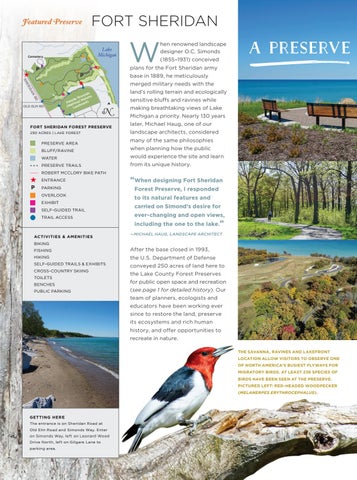
“When designing Fort Sheridan Forest Preserve, I responded to its natural features and carried on Simond’s desire for ever-changing and open views, including the one to the lake.” —MICHAEL HAUG, LANDSCAPE ARCHITECT
BIKING FISHING
After the base closed in 1993,
HIKING
the U.S. Department of Defense
SELF-GUIDED TRAILS & EXHIBITS
conveyed 250 acres of land here to
CROSS-COUNTRY SKIING TOILETS BENCHES PUBLIC PARKING
the Lake County Forest Preserves for public open space and recreation (see page 1 for detailed history). Our team of planners, ecologists and educators have been working ever since to restore the land, preserve its ecosystems and rich human history, and offer opportunities to recreate in nature. THE SAVANNA, RAVINES AND LAKEFRONT LOCATION ALLOW VISITORS TO OBSERVE ONE OF NORTH AMERICA’S BUSIEST FLYWAYS FOR MIGRATORY BIRDS. AT LEAST 236 SPECIES OF BIRDS HAVE BEEN SEEN AT THE PRESERVE. PICTURED LEFT: RED-HEADED WOODPECKER (MELANERPES ERYTHROCEPHALUS).
GETTING HERE The entrance is on Sheridan Road at Old Elm Road and Simonds Way. Enter on Simonds Way, left on Leonard Wood Drive North, left on Gilgare Lane to parking area.
With a View
The Natural Scene Because of the coastline that hugs Lake Michigan, Fort Sheridan is home to many rare plant and animal species not found elsewhere in the region. “The ravines, coastline and lake bluff are unique because the lake waters cool the immediate shoreline in the summer and warm the same area in the winter,” said Restoration Ecologist Ken Klick. We led an effort to develop a collaboration for a large-scale coastal restoration project using federal, state and private grants. The effort included the U.S. Army Corps of Engineers, Alliance of the Great Lakes, Openlands, the City of Lake Forest and Lake Forest Open
Fort Sheridan is one of only a few places in Lake County that offer free public access to Lake Michigan. Last summer, Haug unveiled several improvements to augment that access, including new trails (close to 4 miles) and parking areas, a wider entrance drive, better trail accessibility and an awe-inspiring Lake Michigan overlook perched on a 70-foot-high bluff. From this vantage point, large boulders appear to have been pushed by glaciers, and custom benches have rows of laser-cut stars on the backrest. “The design ultimately references both the military and natural history of the site,” Haug said. Yet to reopen is the 1.6-mile grass loop trail that underwent extensive drainage improvements and bridge modifications. Check LCFPD.org/Fort-Sheridan for opening date.
Lands Association. Extensive restoration efforts were conducted along 398 acres of Lake Michigan coastline, bluffs, ravines and uplands. In the second phase, in-water living reefs will be installed to provide habitat for Lake Michigan near-shore species.
PRESERVENEWS NEW FOREST PRESERVE, DOG PARK OPENING THIS FALL
Check LCFPD.org for Opening Dates
Facility Rental Opportunity Let nature be the backdrop for your next event. With 18,500 square feet of space and a spectacular view of the surrounding forest preserve, our Greenbelt Cultural Center is ideal for any occasion. Reserve the facility for business meetings and retreats, job fairs, weddings, special celebrations, family reunions, holiday parties, or a host of other social gatherings. Indoor and outdoor spaces are available. To arrange a facility tour or learn about amenities and rates, call 847-968-3477, email Greenbelt@LCFPD.org or visit LCFPD.org/GCC.
Waukegan Savanna Dog Park. Canines will soon have a new 11-acre off-leash area where they can exercise, play and socialize. Entrance and parking are at the northeast corner of Delany and Yorkhouse Roads in Wadsworth. The park has toilets, drinking water, shade shelters, and an enclosed area for dogs weighing less than 25 pounds. Ethel's Woods Forest Preserve. Get ready to explore this 500-acre preserve in Antioch. Entrance and parking are on Miller Road east of Route 45. The preserve has toilets and 1.5 miles of trails with four scenic overlooks.
Bird and Butterfly Migration Autumn is a great time to see birds in Lake County as they pass through on their way south for the winter. Try an early morning hike near the lakeshore or join one of the birdwatching programs listed in our calendar. Also watch for monarch butterflies departing for Mexico. These amazing insects migrate thousands of miles to reach their warm winter home. Their departure represents the beginning of one of nature’s more astonishing journeys.
STRATEGIC PLAN UPDATE | Conservation Part of our 100-year vision is to conserve nature at a landscapescale. Residents are our most important partners in this effort. By developing a network of critical landscapes, everyone can work together to safeguard the resources and places that benefit people, wildlife and the economy. Native flowers, grasses and forbs play an irreplaceable role in increasing biodiversity. These indigenous plants provide food and homes for insects, birds and mammals. Healthy habitats are essential for ecological processes, such as capturing carbon, recharging groundwater, maintaining water quality, and storing floodwaters. A large tree can remove more than 1,000 pounds of carbon dioxide from the atmosphere per year. Forest soils can store 50% more water than urban, developed land. A stand of woodland can intercept more than
LCFPD.org/vision
200,000 gallons of stormwater per acre annually. In turn, healthy homes help maintain healthy habitats.
E X C E L L E N C E I S I N O U R N AT U R E
6 HORI ZONS QUARTERLY FALL 2 01 9
GREEN YOUTH FARM GROWING STRONG STUDENTS Erin Williams, a college student at Milwaukee School of Engineering, is in her fifth summer working at the Green Youth Farm in Lake County. Serving three years as a student and now an intern, she says what she learned on the farm has assisted her in her electrical engineering studies. “Working here has helped my thought process for coding. It’s taught me a new way of thinking about things,” says the 21-year-old student who lives with her mom in Waukegan. Williams serves as a role model for about 20 area high school students working to plan, sow, tend and harvest a 1.25-acre sustainable farm located within Greenbelt Forest Preserve (North Chicago). The program is a partnership between the Lake County Forest Preserves, its charitable partner the Preservation Foundation, and the Chicago Botanical Garden. It was founded in 2003 in Lake County as a pilot program to provide teens exposed to varied risk patterns with a paid summer job working on an urban farm.
Since 2003, the Green Youth Farm has: Employed MORE THAN 320 young people.
Produced OVER 60,000 LBS. of fresh produce.
The teenagers in the program operate the farm stand. “I really enjoy selling the produce,” Miguel Figueroa said last week. “The sale is really fun,” agreed Waukegan High School student Arissa Harris. She said she also
In addition to work experience, high school students
enjoys harvesting, adding that the group works hard.
also gain entrepreneurial and job skills training, guidance
“I really like how we have all come together like a
by adult mentors, and exposure to healthy foods and
family to get the job done. No one slacks off. We stick
cooking. They also provide affordable produce to
together,” said Harris, who wants to go to college and
Lake County's food-insecure residents, and nutrition
become a doctor.
demonstrations at Women and Infant Children centers.
"The program addresses an array of life lessons and life
Fresh produce is available for purchase weekly at a farm
skills," said Rebekah Snyder, executive director of the
stand that operates from 9 am–1 pm on Wednesdays
Preservation Foundation of the Lake County Forest
through October 9 at the Greenbelt Cultural Center,
Preserves. “It’s a trifecta. You have kids getting jobs,
1215 N. Green Bay Road. Herbs, honey, flowers, and fresh
spending quality time with mentors and providing
vegetables and fruit are available at discount prices.
healthy food for the community.”
Support the Green Youth Farm by helping to underwrite the cost of a student crew. Find details at LCFPD.org/donate. LAK E COUNTY FOR E ST PRE S E RVES
7
TOGETHER, ACHIEVING MORE FOR OUR FOREST PRESERVES.
The Preservation Foundation is the charitable partner of the Lake County Forest Preserves. Gifts of all sizes are meaningful and help support projects and initiate programs that may otherwise go unfunded or take many years to complete. Learn more at LCFPD.org/donate or call 847-968-3110. MAKE YOUR GIFT TO GREENBELT GO FURTHER Help us meet our latest Community Stewardship Challenge Grant from Illinois Clean Energy Community Foundation (ICECF). Give your time or give a gift—both will help bring dollars to our restoration efforts at Greenbelt Forest Preserve (North Chicago). ICECF will contribute $3 for every $1 we receive (up to $7,000) between now and October 2020. That turns a $10 gift into a $40 impact! You can also volunteer during one of our monthly workdays at Greenbelt. When we reach 400 volunteer hours, ICECF will provide another $4,000. Altogether, our goal is to secure a total of $32,000 to continue habitat restoration and community engagement at Greenbelt in the coming year. Learn more about how to volunteer or how to donate by visiting LCFPD.org/donate.
Improving Our Outdoor Places With a $15,000 Outdoor Places Grant from REI, the Forest Preserves implemented 14 public access improvements across Lake County this summer. Projects included upgrading an existing grass trail to a woodchip trail at Lakewood Forest Preserve (Wauconda), extending an existing boardwalk along a key education trail at Ryerson Woods (Riverwoods), and planting more than 20,000 wetland plugs at Ethel’s Woods Forest Preserve (Antioch). Thank you, REI.
ANNUAL FUND SPOTLIGHT
The federally threatened eastern prairie fringed orchid (Platanthera leucophaea).
8 HORI ZONS QUARTERLY FALL 2 01 9
At its May meeting, the Preservation Foundation Board of Directors approved a $15,000 Annual Fund grant to protect critically rare plants in Lake County. This pilot program will leverage a $3,200 grant from the Illinois Orchid Society and provide funds to monitor up to 10 species, such as the eastern prairie fringed orchid. We will also undertake hand pollination, collect seed and begin propagation efforts. Our hope is to increase the population of these critically rare plants throughout our forest preserves.
FALL CALENDAR
Don't miss your last chance to see the special exhibition "Marvelocity: The Art of Alex Ross." Open through September 8 at the Dunn Museum.
Registration required for all programs unless otherwise indicated. For detailed program descriptions, specific meeting locations, directions and registration, visit LCFPD.org or call 847-968-3321. For updates outside of normal business hours, call 847-968-3113.
SEPTEMBER Through Nov. 30 Hike Lake County Hike seven of the 12 designated trails throughout the county to earn a commemorative hiking shield. Details and materials: LCFPD.org/HLC. All ages. FREE. No registration required. 5 Hands-On Family Tour Travel through time on this interactive, hands-on, sensory-based family tour of the exhibition galleries.
Thursday, 5:30–6:30 p m , Dunn Museum. All ages. FREE. No registration required.
7 Walk with a Naturalist Take a stroll and enjoy this rare tallgrass savanna.
Saturday, 9–10:30 a m , Middlefork Savanna. Adults. FREE. No registration required.
®
7 Carp-O-Rama Compete to catch the largest and the most carp. Help reduce carp overpopulation. Catch and keep, or turn in your carp to us. No limit. Cash prizes awarded. Saturday, 6:30 a m –12 p m , Independence Grove marina. All ages. Adult supervision required. $10 per person. Valid Illinois fishing license required for ages 16 and up. 8, 15, 22, 29 Guided Hike Lake County Join us for a guided walk on this year’s Hike Lake County trails. Walk a new trail each session.
Sundays, 2–3:30 p m , for weekly locations see LCFPD.org/GuidedHLC. All ages. Adult supervision required. FREE. No registration required.
9 Playdate with Nature Move your kids outdoors for unstructured seasonal play activities, proven healthful and beneficial.
Monday, 1–2:30 p m , Grant Woods. Children of all ages. Adult supervision required. FREE. No registration required. A Lake County Nature Network event.
10 Hikin’ Tykes: Animal Tails Learn about a variety of animal tails through a nature-based story and hands-on activities. We’ll make our own tail and go exploring outdoors, weather permitting.
Tuesday, 9:30–10:45 a m Hastings Lake — Shelter A. Children ages 2–4, with an adult. $6 adult/ $3 child.
11, 26 Lunchtime Tours: Lake County Highlights Enjoy a 30-minute guided tour of the permanent exhibition galleries.
Wednesday, Thursday, 12–12:30 p m , Dunn Museum. Adults. $6 adult/$3 senior. Includes Museum admission.
12 Connecting Kids with Nature Unite kids with nature through outdoor exploration. Along the way, learn about the benefits of nature play.
Thursday, 10:30–11:45 a m , Greenbelt Cultural Center. Children of all ages. Adult supervision required. FREE. No registration required. A Lake County Nature Network event.
14 Access to Nature Don’t let your cane or walker stop you from joining us on this hike to enjoy a stunning view of Lake Michigan from the paved trail.
Saturday, 3–4 p m , Fort Sheridan. All ages. Adult supervision required. FREE. No registration required.
14 Night Voyageur Paddle into the 1740s with our 34-foot Montreal canoe and learn about Lake County’s tie to the French fur trade.
Saturday, 6–8 p m , Van Patten Woods. Meet at the boat launch lot. Adults, families with children ages 8 and up. $10 residents, $14 nonresidents.
17, 24 Walk with Me: Tree ID Embark on an exploration into the woods. We will discover clues that help us identify trees.
Tuesdays, 10–11:30 a m , visit LCFPD.org/calendar for locations. Children ages 5–14, with an adult. FREE. In collaboration with CLC Library and the NEA Big Read.
LAK E COUNTY FOR E ST PRE S E RVES
9
10
Registration required for all programs unless otherwise indicated. For detailed program descriptions, specific meeting locations, directions and registration, visit LCFPD.org or call 847-968-3321. For updates outside of normal business hours, call 847-968-3113.
SEPTEMBER (continued) 18 Chicagoland Prehistory In honor of Archaeology Awareness Month, enjoy a lecture by Great Lakes archaeologist, Dan Melone, as he discusses the Native people of presettlement Chicago. Wednesday, 6:30–7:30 p m , Dunn Museum. Adults. $6 adult/$3 senior. Includes Museum admission. 19 Healthy Hedges Learn about our efforts to eliminate buckthorn. Experts will share tips for removing this invasive species and suggest great replacement plants.
Thursday, 6–7 p m , Dunn Museum. Adults. FREE. No registration required.
20 Beers, Brats and Birdies! Enjoy a 30-minute golf clinic followed by a round of 9 holes, with beer tastings and bratwurst.
Friday, 4:30 p m , Countryside Golf Club. Ages 21 and up. $49/player.
20 Community Campfire Friday Nights Join friends and family to roast marshmallows, share stories and enjoy nature at night.
Friday, 7–9 p m , Greenbelt Cultural Center. All ages. Adult supervision required. FREE. No registration required. A Lake County Nature Network Event.
22 Par 3 Golf Challenge Two-player teams compete for fun and prizes.
Sunday, 2 p m , Countryside Golf Club. All ages. $49/player.
25 Senior Series: Monarchs and Migration Monarchs across the Midwest are migrating south. Learn more about monarch life cycles, the importance of native milkweeds and what you can do to help.
Wednesday, 2–3:30 p m Ryerson Woods —Welcome Center. Adults 62 and up. FREE residents, $5 nonresidents.
25 Object Talks: Women of Fort Sheridan Take a closer look at a woman’s military uniform from Fort Sheridan and hear stories of the important roles women played.
Wednesday, 2–2:30 p m , Dunn Museum. Adults. $6 adult/$3 senior. Includes Museum admission.
®
28 Special Exhibition Opening: A Celebration of Souls Join us for the opening of A Celebration of Souls: Day of the Dead in Southern Mexico. Create crafts such as paper flowers and learn about traditions on a guided tour. This exhibition was developed by the Field Museum in collaboration with Mars, Incorporated. Saturday, 10 a m –12 p m , Dunn Museum. All ages. Free with Museum admission.
© G. Aldana
OCTOBER 1, 8 Walk with Me: Tree ID Embark on an exploration into the woods. We will discover clues that help us identify trees.
Tuesdays, 1–2:30 p m , visit LCFPD.org/calendar for locations. Children ages 5–14, with an adult. FREE. In collaboration with CLC Library and the NEA Big Read.
3 Animals of the Night Drop in to learn about animals that come out at night and make a craft to take home.
Thursday, 6–7 p m , Dunn Museum. Families with children ages 12 and under. FREE. No registration required.
5 Walk with a Naturalist: Gander Mountain Come walk with us to see beautiful views from Lake County’s highest natural elevation.
Saturday, 9–10:30 a m , Gander Mountain. Adults. FREE. No registration required.
HORI ZONS QUARTERLY FALL 2 01 9
®
See page 15 to find out more about the Dunn Museum's upcoming special exhibition "A Celebration of Souls: Day of the Dead in Southern Mexico."
OCTOBER (continued)
6 OAKtober Celebration & Native Tree and Shrub Sale Bring the family for a celebration of oak trees. Select the perfect native tree or shrub for your yard at our sale then join us for nature-themed activities and tours of the woodland. Sunday, 10 a m –4 p m , Ryerson Woods —Welcome Center. All ages. Adult supervision required. FREE. No registration required. Native Tree and Shrub Sale: 10 a m –3 p m | Tree Planting 101: 9 a m ; 9:30 a m ; 2 p m ; 2:30 p m Native Flowers and Grasses: 9 a m ; 9:30 a m ; 2 p m ; 2:30 p m . | Activities and Guided Tours: 1–4 p m 6, 13, 20 Guided Hike Lake County Join us for a guided walk on this year’s Hike Lake County trails. Walk a new trail each session.
Sundays, 2–3:30 p m , for weekly locations see LCFPD.org/GuidedHLC. All ages. Adult supervision required. FREE. No registration required.
8 Hikin’ Tykes: Owls Learn about these hooting birds of prey through hands-on activities and a nature-based story.
Tuesday, 9:30–10:45 a m , Ryerson Woods—Welcome Center. Children ages 2–4, with an adult. $6 adult /$3 child.
9, 23 Lunchtime Tours: A Celebration of Souls Tour our special exhibition, A Celebration of Souls, to learn more about the traditions of Dia de Los Muertos in southern Mexico.
Wednesdays, 12–12:30 p m , Dunn Museum. Adults. $6 adult /$3 senior. Includes Museum admission.
10 Connecting Kids with Nature Unite kids with nature through outdoor exploration. Along the way, learn about the benefits of nature play.
Thursday, 10:30–11:45 a m , Greenbelt Cultural Center. Children of all ages. Adult supervision required. FREE. No registration required. A Lake County Nature Network event.
11 Hops and History Grab a beer, engage in local history and hang out with friends after hours at the Dunn Museum with Light the Lamp Brewery. Go on a scavenger hunt through the exhibition galleries, learn about the first brewery in Lake County, and explore Day of the Dead traditions in our special exhibit. Friday, 7–9 p m , Dunn Museum. Ages 21 and up. $13 residents, $15 nonresidents. 12, 19 Birdwatching Hot Spots Look for waterfowl, migrating raptors and other migratory species. Scopes and binoculars will be provided.
Saturday, 12–2 p m , Fort Sheridan. All ages. FREE. No registration required.
13 Colossal Cup Two-Player Golf Scramble Two-player teams compete for fun and prizes. The colossal cup is double the standard cup so putts will sink with ease.
Sunday, 10 a m , Countryside Golf Club. Adults and children ages 10 and up. $55/player.
14 Columbus Day: Buckthorn Busters Learn to identify one of the most invasive plants in the county. Then put on some work gloves and join in to remove it.
Monday, 10–11:30 a m , Old School. Homeschoolers and families with children ages 5 and up. FREE. Adult supervision required. No registration required.
14 Playdate with Nature: School Day Off Move your kids outdoors for unstructured seasonal play activities, proven healthful and beneficial.
Monday, 1–2:30 p m , Old School. Children of all ages. Adult supervision required. FREE. No registration required. A Lake County Nature Network event.
LAK E COUNTY FOR E ST PRE S E RVES
11
12
Registration required for all programs unless otherwise indicated. For detailed program descriptions, specific meeting locations, directions and registration, visit LCFPD.org or call 847-968-3321. For updates outside of normal business hours, call 847-968-3113.
OCTOBER (continued) 14 Tinkering Through Time: Exploring Day of the Dead Discover the story of how calaveras, humorous skeleton drawings, came to be associated with Day of the Dead.
Monday, 3:30–4:30 p m , Dunn Museum. Children ages 6–11 with an adult. $6 adult/$3 child. Adult supervision required. Includes Museum admission.
16 Senior Series: Fall Color Walk Join us for a walk through these beautiful woods and discover the science behind the changing colors.
Wednesday, 2–3:30 p m , Ryerson Woods —Welcome Center. Adults 62 and up. FREE residents, $5 nonresidents.
18 Community Campfire Friday Nights Join friends and family to roast marshmallows, share stories and enjoy nature at night.
Friday, 7–9 p m , Greenbelt Cultural Center. All ages. Adult supervision required. FREE. No registration required. A Lake County Nature Network Event.
20 2019 Ethel Untermeyer Conservation Forum: Restoration of Mill Creek This decade-long project has transformed the landscape of Ethel’s Woods, recreating a picturesque stream from one of Lake County’s lowest quality lakes. Project Manager Leslie Berns will reveal the story of this complex restoration success. Sunday, 1–3 p m , Ryerson Woods —Welcome Center. Adults, families with children 5 and up. FREE. 20 Chocolate in Life and Death Learn how chocolate was made in ancient Mexico and about its use today in Dia de los Muertos traditions.
Sunday, 2–3 p m , Dunn Museum. Adults. $8 residents, $10 nonresidents. Includes Museum admission.
23 Homeschool Companion: A Celebration of Souls Join other homeschoolers to explore our special exhibition A Celebration of Souls: Day of the Dead in Southern Mexico.
Wednesday, 10–11:30 a m , Dunn Museum. Ages 5–12, with an adult. $6 adult/$3 child. Includes Museum admission.
24 Dunn Museum Teacher Open House Learn about programs and resources for your class, attend sessions and hear about our new Teacher Ambassador program.
Thursday, 5–8 p m , Dunn Museum. Lake County Educators. FREE. Professional development credits available. Light snacks and refreshments provided.
25, 26 Halloween Hikes Join a guided group hike along a candlelit path to watch fun nature-themed skits, followed by donuts and cider. Not scary. Even your littlest will enjoy this family favorite. Total event time 90 minutes. Total distance walked about 1.5 miles. Friday and Saturday. Hikes begin every 30 minutes from 6–8 p m . Ryerson Woods. All ages. $9 residents, $11 nonresidents. Ages 3 and under are free. Registration required. 26 Family Celebration Day Experience our special exhibition, A Celebration of Souls, through crafts, activities and demonstrations.
Saturday, 10 a m –1 p m , Dunn Museum. All ages. Free with Museum admission. No registration required.
30 Bilingual Storytime: The Dead Family Diaz La Hora de Cuentos Bilingues: The Dead Family Diaz Learn about the Mexican traditions of Day of the Dead. We will have fun with stories, songs and crafts.
Wednesday, 10–11 a m , Dunn Museum. Ages 2–5. $6 adult/$3 child. Includes Museum admission. Adult supervision required.
Programs with this icon are bilingual and taught in both Spanish and English.
HORI ZONS QUARTERLY FALL 2 01 9
Learn about one of America’s first dinosaur discoveries, the Dryptosaurus, on Thursday, October 17, 6:30–7:30 pm, at the Dunn Museum. See our life-sized fleshed-out reconstruction of the predator and hear about the process from the artist. The event is FREE and open to adults. No registration required.
®
NOVEMBER 1 Lunchtime Tours: A Celebration of Souls Tour our special exhibition, A Celebration of Souls: Day of the Dead in Southern Mexico, to learn about the traditions of Dia de Los Muertos in southern Mexico.
Friday, 12–12:30 p m Dunn Museum. Adults. $6 adult/$3 senior. Includes Museum admission.
© S. Vlaun
2 Lake County History Symposium Open to the public, this annual symposium focuses on Lake County history. Join us for a fascinating series of presentations on this year’s theme, Prohibition in Lake County. Saturday, 10 a m –1:30 p m , Dunn Museum. Adults, youth ages 12 and up. $5 ages 12–17, $10 ages 18 and over for both residents/nonresidents. Includes Museum admission. Teacher professional development hours available. 2 Walk with a Naturalist: Pine Dunes Come enjoy the spendor of fall with a walk through colorful oak-hickory woodlands.
Saturday, 9–10:30 a m , Pine Dunes. Adults. FREE. No registration required.
3 Chili Scramble Golf Tournament Join this fun, low-pressure 18-hole tournament that ends with prizes, chili and beverages.
Sunday, 10 a m , Countryside Golf Club. Adults and children ages 10 and up. $49/player.
3, 10 Guided Hike Lake County Join us for a guided walk on this year’s Hike Lake County trails. Walk a new trail each session.
Sundays, for weekly times and locations see LCFPD.org/GuidedHLC. All ages. Adult supervision required. FREE. No registration required.
6, 22 Lunchtime Tours: Foodways Discover the many ways people have produced, prepared and consumed food in Lake County.
Wednesday, Friday 12–12:30 p m , Dunn Museum. Adults. $6 adult/$3 senior. Includes Museum admission.
7 Green your Home Clean your house and help the planet. Make safe and effective eco-friendly cleaning products. Learn about the best alternatives to commercial cleaning products.
Thursday, 6:30–7:30 p m , Dunn Museum. Adults. FREE. No registration required.
8 Small Discoveries: Funny Bones Discover the story of how calaveras, humorous skeleton drawings associated with Day of the Dead, came to be through crafts, activities and more.
Friday, 10–11 a m , Dunn Museum. Children ages 2–5, with an adult. Adult supervision required. $6 adult/$3 child. Includes Museum admission.
9 Community Conservation: Removing Buckthorn Learn about the impacts of European buckthorn on our local ecosystems and how to manage the invasive weed.
Saturday, 9–11 a m , Ryerson Woods —Welcome Center. Adults. FREE.
®
9 Phenology and Photography Outdoor workshop combines a staff naturalist’s insight with technical tips from a professional photographer. Saturday, 1–4 p m , Ethel’s Woods. Adults, youth ages 16 and older. $20 residents, $28 nonresidents.
LAK E COUNTY FOR E ST PRE S E RVES
13
14
Registration required for all programs unless otherwise indicated. For detailed program descriptions, specific meeting locations, directions and registration, visit LCFPD.org or call 847-968-3321. For updates outside of normal business hours, call 847-968-3113.
NOVEMBER (continued) 11 Playdate with Nature: School Day Off Move your kids outdoors for unstructured seasonal play activities, proven healthful and beneficial.
Monday, 1–2:30 p m , Greenbelt Cultural Center. Children of all ages. Adult supervision required. FREE. No registration required. A Lake County Nature Network event.
12 Hikin’ Tykes: Seeds See and touch a variety of seeds and learn how they travel. Includes nature-based story and craft, and outdoor exploration, weather permitting.
Tuesday, 9:30–10:45 a m Greenbelt Cultural Center— Education Wing. Children ages 2–4, with an adult. $6 adult /$3 child.
13 Senior Series: What’s in the Name Lake County’s rich tapestry of history is woven into the very fibers of its place names. Learn the origins of names and the people and events that influenced them.
Wednesday, 10–11 a m , Dunn Museum. Adults 62 and up. $3 residents and nonresidents. Includes Museum admission.
14 Connecting Kids with Nature Unite kids with nature through outdoor exploration. Along the way, learn about the benefits of nature play.
Thursday, 10:30–11:45 a m , Greenbelt Cultural Center. Children of all ages. Adult supervision required. FREE. No registration required. A Lake County Nature Network event.
20 Senior Series: Owls in Lake County Throughout the year, eight different species of owl live in, or migrate through, Lake County. Learn about the natural history of each species and their unique adaptations.
Wednesday, 2–3:30 p m Ryerson Woods—Welcome Center. Adults 62 and up. FREE residents, $5 nonresidents.
21 Cuentos from the Americas Hear a combination of ancient legends, myths, folktales and personal tales from North, Central and South America in this engaging musical and movement performance from storyteller Jasmin Cardenas.
Thursday, 6–7 p m , Dunn Museum. All ages. FREE. No registration required.
23 How Corn Changed Itself and then Changed Everything Else Hear writer and food historian Cynthia Clampitt tell the story of how corn has developed over its 10,000-year history.
Saturday, 2–3 p m , Dunn Museum. Adults. FREE with Museum admission. No registration required. Supported by: Illinois Humanities
®
24 Thanksgiving for Nature Scavenger Hunt Find clues along the trail to discover what we should be thankful for in nature. Activity is self-paced along a 1-mile gravel and grass pathway. Sunday, 1–3 p m , Lakewood— Shelter C. All ages. $2 residents and nonresidents. Ages 3 and under are free.
SCHOOL PROGRAMS |
Registration is open for the new school year —view programs online at LCFPD.org/School. Field Trips Bring your students into our classrooms for handson learning incorporating science, social studies, history and language arts, and featuring our expert historians and naturalists.
HORI ZONS QUARTERLY FALL 2 01 9
In-School Programs Let our environmental and history educators come to your classroom with live animals, historical artifacts, and other activities and tools on a variety of nature and local history topics.
Each year, families in villages across Mexico gather to welcome home the visiting spirits of departed relatives on the Dia de Muertos (Day of the Dead). Explore the complex and rich histories of honoring the dead in ancient Mesoamerica, the labor of love involved in these diverse rituals, and the spiritual importance of this holiday through photographs taken in and around Oaxaca, Mexico.
$1
OFF MUSEUM ADMISSION
Present this coupon for $1 off a single admission. One-time use. May not combine. Offer expires 01/05/20.
HM19D
1899 W. WINCHESTER RD, LIBERTYVILLE • DUNNMUSEUM.ORG • 847-968-3400 LAK E COUNTY FOR E ST PRE S E RVES
This exhibition was developed by the Field Museum in collaboration with Mars, Incorporated.
15
16
SPECIAL FACILITIES Directory
GENERAL OFFICES
OPERATIONS AND PUBLIC SAFETY
1899 West Winchester Road Libertyville, Illinois 60048
19808 West Grand Avenue Lake Villa, Illinois 60046
847-367-6640 tel 847-367-6649 fax 847-968-3155 TDD
847-968-3411 tel (Operations) 847-968-3404 tel (Public Safety) 847-968-3116 fax
8 am –4:30 pm , Monday–Friday
6:30 am –3
OUTDOOR RECREATION
EDUCATION
GOLF
COUNTRYSIDE GOLF CLUB
pm ,
911 emergency 847-549-5200 nonemergency public safety issues
Monday–Friday
INDEPENDENCE GROVE
BESS BOWER DUNN MUSEUM
16400 West Buckley Road Libertyville, Illinois 60048
1899 West Winchester Road Libertyville, Illinois 60048
847-968-3499 Main 847-247-1111 Banquets, Meetings
847-968-3400 Main
IndependenceGrove.org
LCFPD.org
Prairie and Traditional Courses 20800 West Hawley Street Mundelein, Illinois 60060
DunnMuseum.org
847-968-3100 Tee Times 847-968-3441 Golf Gift Cards 847-489-1931 Golf Outings
Gallery and Gift Shop Hours Visitors Center Hours 9 am–4:30 pm, unless otherwise posted For beach, marina and café seasonal hours and fees, visit our website. Parking Fee Lake County residents FREE Nonresidents $5 per car Monday–Thursday $10 per car Friday–Sunday and holidays Vehicle window stickers allow entry without having to verify residency. Fee is $5, available at the Visitors Center. FOX RIVER MARINA 28500 West Roberts Road Port Barrington, Illinois 60010 847-381-0669 FoxRiverMarina.org
10 am–5 pm, Tuesday–Saturday 12–5 pm, Sundays Closed, Mondays
CountrysideGolfClub.org
$6 adults $3 seniors, youth ages 4–17 Free, children ages 3 and under
A Robert Trent Jones Jr. championship golf course
Open until 8 pm on the first and third Thursdays of every month with free admission after 5 pm. Free admission sponsored by: ®
RYERSON CONSERVATION AREA 21950 North Riverwoods Road Riverwoods, Illinois 60015 847-968-3320
847-968-3100 847-968-3441 847-489-1931 847-968-3450
Tee Times Golf Gift Cards Golf Outings Banquets
ThunderHawkGolfClub.org BRAE LOCH GOLF CLUB 33600 North U.S. Highway 45 Grayslake, Illinois 60030 847-968-3100 847-968-3441 847-489-1931 847-247-1119
Tee Times Golf Gift Cards Golf Outings Banquets
BraeLochGolfClub.org
Boat Launch and Marina Hours Welcome Center Hours 9 am–5 pm, Tuesday–Saturday 11 am–4 pm, Sundays Restroom only, Mondays GREENBELT CULTURAL CENTER 1215 Green Bay Road North Chicago, Illinois 60064 847-968-3477 GreenbeltCulturalCenter.org Office Hours By appointment only HORI ZONS QUARTERLY FALL 2 01 9
39700 North Lewis Avenue Beach Park, Illinois 60099
Discount Tuesdays $3 adults $1.50 seniors, youth ages 4–17
LCFPD.org/Ryerson For hours and fees, visit our website.
THUNDERHAWK GOLF CLUB
LCFPD.ORG
LAKE COUNTY FOREST PRESERVES
Nearly 31,000 acres make up your Lake County Forest Preserves. Most preserves are open 6:30 a m –sunset, daily. If a preserve gate is open before 6:30 a m , the preserve is considered open for use.
FOREST PRESERVE Entrance/Parking
GENERAL OFFICES AND DUNN MUSEUM
FOREST PRESERVE EASEMENTS
OPERATIONS AND PUBLIC SAFETY FACILITY
COMMUNITY GARDEN
STATE LAND (IDNR)
MILLENNIUM TRAIL Planned Section
MIDDLEFORK TRAIL AND GREENWAY Planned Section
DES PLAINES RIVER TRAIL
FORT HILL TRAIL Planned Section
M CCLORY TRAIL /NORTH SHORE PATH (LCDOT)
CASEY TRAIL
MAP CURRENT AS OF
Friday, August 2, 2019
!! ! !
Cedar Lake Rd
33rd St
!! ! !
! ! !! ! !
Kilbourne Rd
Hunt Club Rd
WADSWORTH
!
Wadsworth Rd
!
McDONALD WOODS
BONNER HERITAGE FARM
BEACH PARK
WAUKEGAN SAVANNA
!
Yorkhouse Rd
LYONS WOODS
Sand Lake Rd
MILL CREEK
!
FOURTH LAKE
!
OLD MILL CREEK
!
!
Monaville Rd
!!
!!
!!
ROUND LAKE HEIGHTS
! !
! !
Sand Lake Rd
Crawford Rd
!!! ! ! ! !! !! ! ! ! !
! ! ! !
GRANT WOODS
!
DUCK FARM
LAKE VILLA
d
Adeline Jay Geo-Karis Illinois Beach State Park
THUNDERHAWK GOLF CLUB
Ste arns Sc
hoo
SEDGE MEADOW
l Rd
!
Blanchard Rd
Delany Rd
! ! ! !! !
! ! ! ! ! ! ! ! ! ! ! ! ! !! !! ! !
!!
!! !!
!! ! !
! !
! !
LINDENHURST
! !
! !
eR
! !
Wilmot Rd ! ! !
! ! !
! ! ! !
!
!
!
ak
!
!
!
ZION
Lewis Ave
Cedar Lake State Bog
Grass Lake Rd
! ! ! !
!
OAK-HICKORY
WADSWORTH SAVANNA
ETHEL'S WOODS
! ! ! !! ! ! ! ! ! ! !
HASTINGS LAKE Grass L Gelden Rd
! ! Petite Lake Rd
! ! ! !
SUN LAKE
! !
!
!
Des Plaines River
! !
BLUEBIRD MEADOW FOX LAKE
SPRING BLUFF WINTHROP HARBOR
!
! ! ! ! ! ! ! ! ! ! ! ! ! ! ! ! ! !
RAVEN GLEN
Town Line Rd
VAN PATTEN WOODS
!! !
DUTCH GAP !
Beach Grove Rd
Grass Lake Rd
PRAIRIE STREAM
!
! !
Sheridan Rd
Chain O'Lakes State Park
SEQUOIT CREEK
Edwards Rd
! ! ! ! ! ! ! !
LAKE MARIE
ANTIOCH
!
Russell Rd !
GRAND ILLINOIS TRAIL Planned (IDNR)
Rd
! ! ! !
! !
Deep Lake Rd
! ! ! ! ! ! ! ! ! ! ! ! ! ! ! ! ! !
! ! ! ! ! ! ! ! ! ! ! ! ! ! ! !! !! ! ! !
! ! ! ! ! ! ! ! ! ! ! ! ! ! ! !
!!
Red Wing Slough State Natural Area
PATRIOT PATH Planned (LCDOT)
Green Bay
PINE DUNES
Fox River
! ! ! ! ! ! ! ! ! ! ! ! ! ! ! ! ! ! ! ! ! ! !!
DOG PARK
CHAIN O’LAKES BIKE PATH Planned Section (LCDOT)
PRAIRIE CROSSING TRAIL (LCDOT)
GANDER MOUNTAIN
! !
CANOE LAUNCH
WAUKEGAN
Grand Ave
!
Rollins Rd
! !
! ! !
Kil bo Rd urne
! ! ! !
! ! ! !
Everett Rd
en
R
d
cH
HALF DAY
Rd
!
Quentin Rd
M
id
lo
th
ia
n
ry
Riverwoods Rd
LONG GROVE
Half Day Rd
gton Rd
ey R d
!
Cuba Rd
BANNOCKBURN
DUFFY STORMWATER FACILITY Deerfield Rd
HIGHLAND PARK
BERKELEY PRAIRIE ee Gr
RIVERWOODS
BUFFALO GROVE
DEERFIELD LAK E COUNTY FOR E ST PRE S E RVES
Rd
CAHOKIA FLATWOODS
ay
er Rd
nB
Check
Saunders Rd
!
Rd
Lake Cook Rd
BUFFALO CREEK
!
NORTH
SKOKIE RIVER WOODS
y
d
nr
dR
DEER PARK
!
e cH
Ra n
EDWARD L. RYERSON CONSERVATION AREA
°
HIGHWOOD
!
Duffy Ln
WELCOME CENTER
M
CUBA MARSH
Arlington Heights Rd
BARRINGTON
LINCOLNSHIRE
Schaeffer Rd
BARRINGTON HILLS
KILDEER
HERON CREEK
!
PRAIRIE WOLF
!
FORT SHERIDAN
Rd
!
EGRET MARSH
Old Elm Rd
ge Rid
Ela Rd
Kels
LAKE ZURICH
!
! !
! !
CAPTAIN DANIEL WRIGHT WOODS
! !
!
! !
ADLAI E. STEVENSON ! HISTORIC HOME
INDIAN CREEK
d
! ! ! ! ! !! !! !
R
! ! ! ! ! !
er
! !
! !
!!
Rand Rd
! ! ! !
HAWTHORN WOODS
!!
!!
!!
!
G ilm
d
Miller Rd NORTH BARRINGTON
LAKE FOREST
! !
Fish Lake Rd
Hunt Club Rd ! !
! ! ! ! ! !
yR
! !
Rd
Almond Rd
! ! ! !
nr
Sheridan Rd
St Mary's Rd
e Ave
He
Old M
!
Old Barrin
GRAINGER WOODS CONSERVATION PRESERVE !
GRASSY LAKE LAKE BARRINGTON !
Mc
Rd
Ke
Rd
eld
Old
TOWER LAKES
y lse
!
irfi
s Rd
MIDDLEFORK SAVANNA
METTAWA
Rd Fa
n Milto
!
MacARTHUR WOODS
LAKEWOOD
!
River Rd
Fox River
VERNON HILLS
Rd
FOX RIVER
n Iva
d eR ho
ORIOLE GROVE
!
OLD SCHOOL
er
!
Rob ert
ke Milwau
m Gil
!
!
MUNDELEIN
Des Plaines River
!!
! !
!!
! ! ! !
!! F!!isher
! ! ! ! ! ! ! !
Midlothian Rd
COUNTRYSIDE GOLF CLUB
! !
! !
!!
! !
Fremont Center Rd
Hawley St
!
LAKE BLUFF
LIBERTYVILLE
WAUCONDA
!
Atkinson Rd
ATKINSON STORMWATER FACILITY
!
ISLAND LAKE
PORT BARRINGTON
Rd
! ! ! ! ! ! ! !
!
Bonner Rd
Oak Spring Rd
Lake Michigan
Bay
! !
GREEN OAKS
WILMOT WOODS
Winchester Rd
!
NORTH CHICAGO
! ! ! ! ! ! Rd ! ! ! ! ! ! ! ! ley ! ! ! ! ! ! ! ! ! ! ! ! ! ! ! ! ! ! ! ! ! ! ! ! ck ! ! Bu!
! ! ! ! ! ! ! ! ! ! ! ! ! ! ! ! ! ! ! ! ! !
Peterson Rd
Erhart Rd !
14th St
GREENBELT
INDEPENDENCE GROVE VISITORS CENTER
Historical Ray Lake Boundary
!
!
Casey Rd
!
Chardon Rd
GREENBELT CULTURAL CENTER
Rd
! !
!
!!
RAY LAKE
MARINA
Belvidere
ALMOND MARSH
!
!!
SINGING HILLS
PARK CITY !
Green
ll Rd
Rd! er ! ! ilm ! G
e Darr
!!
!
Rd
re Rd
ROUND LAKE PARK
! ! !! ! ! ! ! ! ! ! !
ay
!
GRAYSLAKE
KETTLE GROVE
nB
MARL FLAT
HAINESVILLE
LAKE CARINA
Waukegan Rd
LAKEMOOR
Belvide
!
ee Gr
Washington St
Center St
KESTREL RIDGE
!
! !
BRAE LOCH GOLF CLUB
NIPPERSINK
ROUND LAKE
Washington St
THIRD LAKE !
Washington St
Nippersink Rd VOLO
GURNEE
ROLLINS SAVANNA
! ! ! ! ! !
! ! ! !
Volo Bog State Natural Area
Moraine ! Hills ! State Park !! ! !
! !
n ry L Dru
ROUND LAKE BEACH
TANAGER KAMES
Lake Cook Rd
17
LAKE COUNTY FOREST PRESERVES GENERAL OFFICES 1899 WEST WINCHESTER ROAD LIBERTYVILLE ILLINOIS 60048
PLEASE DELIVER PROMPTLY—
t
TIME- SENSITIVE MATERIAL
HORI Z ON S SUBSCRIPTION SERVICES HOTLINE: 847–968–3335 email : Horizons@LCFPD.org
q
THIS PUBLICATION IS PRODUCED USING 100% RECYCLED PAPER, ALLOWING US TO SAVE 81 MATURE TREES, 6,080 GALS WATER, 11,670 LBS GREENHOUSE GASES
OAKtober Celebration & Native Tree and Shrub Sale October 6 | 10 am–4 pm at Ryerson Conservation Area
Fall is the perfect time to plant trees and shrubs. Let our experts help you select the right mix for your yard. Bring the entire family out for a native tree and shrub sale, and free workshops, nature-themed activities and tours of the autumnal woodland. See page 11 or visit LCFPD.org/OAKtober for event details.
201 9 HIKE LAKE COUNTY Surround yourself in the beauty of forests and prairies during nature's
FREE SENIOR MUSEUM ADMISSION
Plan Your Picnic
most colorful season while exploring
Reservations for 2020 shelter
Complete just seven of the hikes
Senior admission to the Dunn
rentals begin Monday, October
between August 15 and November 30
Museum (Libertyville) is free for the
21. Purchase permits online
to earn a commemorative shield.
entire month of October. Plan your
starting at 12:01 am; by phone
For this year's hike locations and
visit and learn about our exhibition
or in person starting at 8 am.
galleries at LCFPD.org/Museum.
Details: LCFPD.org/permits.
challenge details: LCFPD.org/HLC.
2 HORI ZONS QUARTERLY FALL 2 01 9
designated "Hike Lake County" trails.
For maps: LCFPD.org/maps.
◄ FLICKR PICK With the fantastic yellows of autumn as his backdrop, photographer Steven Diver captured morning dew on oak leaves changing color with the season at Wright Woods Forest Preserve (Mettawa).
Connect with us! Find us on: Facebook, Instagram, Twitter, Flickr, or YouTube @LCFPD. Download our mobile app in the Apple App Store or Google Play Store—search for “Lake County Forest Preserves.”