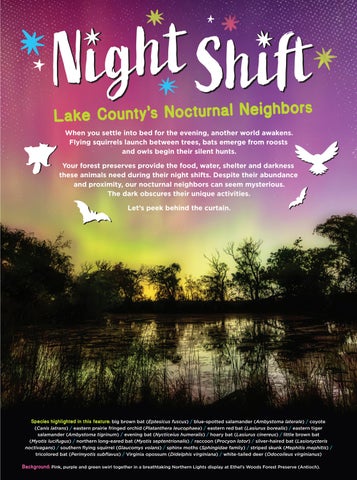
When you settle into bed for the evening, another world awakens. Flying squirrels launch between trees, bats emerge from roosts and owls begin their silent hunts. Your forest preserves provide the food, water, shelter and darkness these animals need during their night shifts. Despite their abundance and proximity, our nocturnal neighbors can seem mysterious. The dark obscures their unique activities. Let’s peek behind the curtain.
big brown bat (Eptesicus fuscus) / blue-spotted salamander (Ambystoma laterale) / coyote (Canis latrans) / eastern prairie fringed orchid (Platanthera leucophaea) / eastern red bat (Lasiurus borealis) / eastern tiger salamander (Ambystoma tigrinum) / evening bat (Nycticeius humeralis) / hoary bat (Lasiurus cinereus) / little brown bat (Myotis lucifugus) / northern long-eared bat (Myotis septentrionalis) / raccoon (Procyon lotor) / silver-haired bat (Lasionycteris noctivagans) / southern flying squirrel (Glaucomys volans) / sphinx moths (Sphingidae family) / striped skunk (Mephitis mephitis) / tricolored bat (Perimyotis subflavus) / Virginia opossum (Didelphis virginiana) / white-tailed deer (Odocoileus virginianus) Pink, purple and green swirl together in a breathtaking Northern Lights display at Ethel’s Woods Forest Preserve (Antioch).