
Birdwatching Guide
General Offices 1899 W. Winchester Road Libertyville, IL 60048
847-367-6640 LCFPD.org

For emergencies, call 911. For nonemergency public safety issues, call our Ranger Police at 847-968-3404 (Mon–Fri, 6:30 am–3 pm) or visit LCFPD.org/safety to report a concern. After hours, call the Lake County Sheriff’s 911 Communication Center at 847-549-5200. You can also email FP_police@LCFPD.org.
Bird illustrations © Samantha Gallagher. Photography © Michael Affinito, Bob Callebert, Tim Elliott, Liz Rose Fisher, Phil Hauck, John D. Kavc, Paco Luengo, R. Scott McNeill, Justine Neslund, Thomas G. Wilson. Writing and design by Environmental Communications Specialist Brett Peto. Learn birdwatching techniques at an education program. 847-968-3320 LCFPD.org/birding
How to Use this Guide
This guide lists hundreds of bird species that may be found in Lake County, Illinois. Extremely rare birds—those seen here only a few times since 1900—are not included.
Size Ranges
Hummingbird
Typical habitats
Size ranges and habitats for each bird family are shown. Additional habitats are listed for certain species. A species may be found in both grasslands and woodlands, for example.
other icons
Most species in this guide are native. Some common non-native species are indicated with icons. Native species are those that have historically existed in Lake County regardless of human influence. On the other hand, non-native species haven’t historically existed in our area and are typically introduced by humans.
Uncommon and rare native species are indicated, too. Uncommon species are present in Lake County but harder to find. Sightings of rare species are very infrequent or once-in-a-lifetime events. Endangered and threatened species are noted, as well. Endangered species are in immediate danger of extinction in the wild across all or most of their range. Threatened species are in decline and likely to become endangered.
Words About Birds
Birds are usually known by two names: their common name and their scientific name. Common names use everyday language, such as Baltimore oriole or northern cardinal. Scientific names come from Latin, used by scholars to identify living things.
Two parts, the genus and the species, make up a scientific name. A genus is a group of closely related organisms that share a recent common ancestor. For example, great horned owls and snowy owls are in the genus Bubo. A species is a smaller group of organisms whose members can successfully reproduce with each other. Snowy owls can breed with other snowy owls, but not with great horned owls.
Common and scientific names, current as of February 17, 2026, are listed in this guide.
Bird Basics
Birds are warm-blooded vertebrates. They have a backbone and regulate their body temperature—usually 102–104 degrees.
They also have feathers, a toothless beak and a four-chambered heart. All birds reproduce by laying hard-shelled eggs. And most have lightweight bones.
More than half of all 11,000 or so bird species worldwide are passerines, or perching birds. Think of the robins, blue jays and cardinals you might see in the Lake County Forest Preserves.
Their feet are adapted for perching on plants, with three toes pointing forward and one pointing back for a tight grip.
Many other bird families live locally, too, from wading birds to waterfowl to raptors, each with their own unique characteristics and natural histories.
Birds are renowned for their beautiful feathers, unique calls and songs, diverse nesting behaviors and—in the case of corvids, such as American crows—even using sticks and leaves as tools.
Lake County’s Birds
With nearly 400 species documented, Lake County’s bird diversity is second only to Cook County in the Chicago region. Why do millions of birds live and visit here? Location, location, location.
The county’s position at the border between cooler, northern climates and warmer, southern climates attracts a blend of species. Lake Michigan creates unique shoreline habitats and milder microclimates.
Nearly 200 inland lakes, the Des Plaines and Fox rivers, prairies, savannas, woodlands and wetlands provide food and shelter for birds. Large tracts of land, such as those in your forest preserves, are needed to support certain species.
Some feathered friends, like northern cardinals, stay here year-round. Resident birds eat seeds, nuts, insect larvae, mammals or other birds. Most of these food sources are available all year.
Birds that eat seasonal foods—fruit, nectar
or flying insects—typically head south for winter. Many migrants pass through along the Mississippi Flyway, a major northsouth flight path that brings incredible bird variety and abundance to Chicagoland each spring and fall.
Though less common, you could spot a vagrant—a bird that’s strayed far from its normal range. A rare Mexican violetear hummingbird visited a Mundelein couple’s home in 2021. Just one other observation of the species in Illinois was recorded in 2009.
Flight Plans
If you want to spot as many birds as possible, visit your forest preserves during spring and fall migrations.
In Illinois, spring migration peaks from March to mid-May. Fall migration kicks off in July—yes, July—and winds down in November. Some birds travel hundreds or thousands of miles. Others barely budge.
Short-distance migrants relocate not too far from their starting point. Red-headed woodpeckers sometimes migrate only 10–50 miles south of Lake County to follow the annual acorn crop in oak woodlands.
Medium-distance migrants fly across one state or several. Long-distance migrants breed in the U.S. and Canada, and spend winter in Central and South America.
Scientists don’t fully understand just how birds navigate such epic journeys.
However, there are clues. A bird’s instincts to fly in certain directions during certain seasons plays a role. Migratory restlessness, referred to by the German word zugunruhe, affects even caged birds.
Geographical landmarks, the positions of the sun and stars, seasonal food and weather patterns and the Earth’s magnetic field are thought to help with navigation. Some juvenile birds play follow-the-leader, relying on adults to show them the route.
The amount of daylight in a 24-hour timeframe—photoperiod—is an important, reliable trigger for bird migration.
Increasing daylight can help spark a bird’s trip to northern breeding grounds for spring and summer. Dwindling daylight nudges it to fly south for the winter.
Relocating to warmer areas is vital for birds that can’t survive colder temps or limited food. But traveling long distances exposes birds to predators, weather and other obstacles.
Deforestation, development of natural areas, power lines, cellphone towers, free-roaming domestic cats, skyscrapers and light pollution can disrupt migration. Migratory birds often face these forces in both wintering and nesting grounds.
Climate change, too, is increasingly altering the patterns of food sources.
A 25-year study in Ithaca, New York found that insects are emerging 3–12 days earlier and their populations are peaking over a shorter time, likely due to warmer springs.
Finding Feathered Friends
Ready to take flight with birdwatching?
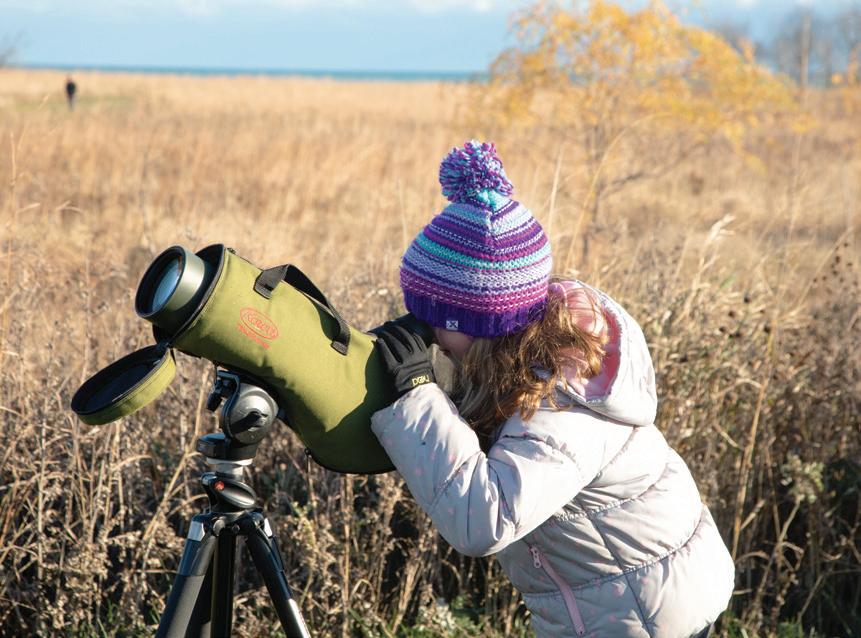
Bring this guide and check off what you see. Also carry a notebook or mobile device to take notes; a field guide to birds of the eastern U.S.; and a pair of 7 or 8-power binoculars. These make objects appear seven or eight times closer.
Purchase them or borrow from a friend, family member or library. Binoculars are available to borrow at the Ryerson Welcome Center (Riverwoods) for the length of your visit.
To identify birds, focus first on GISS General Impression, Size and Shape.
Some birds are round. Others are sleek. Raptors can be 2–3 feet tall, hummingbirds 2–3 inches. Think of recognizing a friend or family member at a distance.
Listen, too. Birds produce two kinds of sounds: songs and calls.
9 Designed to attract a mate or defend breeding territory.
9 Often heard during breeding season.
9 Sung by adult male birds, with some notable exceptions.
9 Tend to be longer and complex.
Calls
9 Designed to communicate nonbreeding messages, such as warning of predators in an area.
9 Heard any time of year.
9 Produced by male and female birds.
9 Tend to be shorter and simpler.
Combining sounds and GISS can point you toward solid identifications.
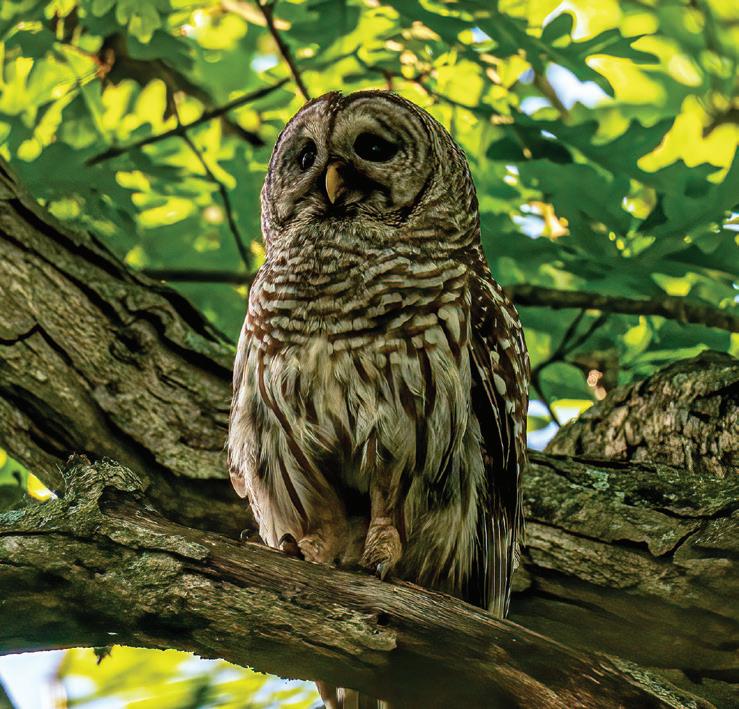
The great horned owl’s hoo, hoo-hoo, hoo, hoo song is common, but the barred owl’s who-cooks-for-you call is distinct and less common. Ear tufts are prominent on the great horned, while the barred has none.
Free bird identification and monitoring apps are available to help.
9 Cornell Lab of Ornithology (eBird, Merlin Bird ID).
9 National Audubon Society (Audubon Bird Guide).
Local groups welcome new members.
9 Lake County Audubon Society (lakecountyaudubon.org).
9 Audubon Great Lakes (gl.audubon.org).
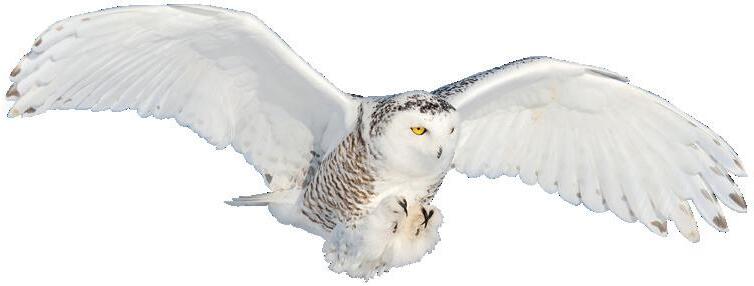
Snowy owl
Birdwatching in Your Lake County Forest Preserves
Every preserve offers birdwatching from 6:30 am–sunset, daily.
Timing matters. Many birds are most active around sunrise and sunset. There’s often a lull in the afternoon as birds digest morning meals. Nocturnal birds such as owls and night herons awaken after dark.
Seasons shape what you see. Breeding season and spring and fall migration are prime birdwatching windows.
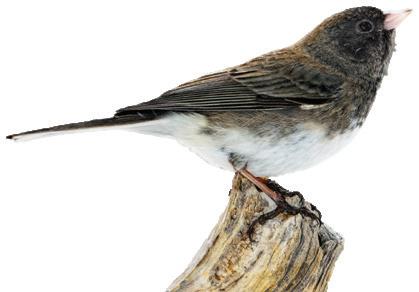
Winter offers less activity, but certain northern-breeding species are only visible in Lake County then, such as dark-eyed juncos and short-eared owls.
Location also matters. Learning a species’ typical habitat and geographic range improves your chances of spotting it.
For example, the Lake Michigan shoreline at Fort Sheridan Forest Preserve (Lake Forest) is a magnet for migrating raptors like ospreys, peregrine falcons and hawks.
Meanwhile, wide-open grasslands and wetlands at Rollins Savanna Forest Preserve (Grayslake) entice nesting sparrows, ducks, blackbirds and shorebirds. For the best bang for your buck, start with the preserves below.
9 Captain Daniel Wright Woods (Mettawa)
9 Cuba Marsh (Deer Park)
9 Des Plaines River Trail*
9 Fort Sheridan (Lake Forest)
9 Independence Grove (Libertyville)
9 Lakewood (Wauconda)
9 Lyons Woods (Waukegan)
9 Middlefork Savanna (Lake Forest)
9 Pine Dunes (Antioch)
9 Rollins Savanna (Grayslake)*
9 Ryerson Conservation Area (Riverwoods)
*Important Bird Area, National Audubon Society
Visit LCFPD.org/birds and LCFPD.org/preserves for more sites.
Our educators teach birdwatching techniques at programs. See sessions at LCFPD.org/birding or call 847-968-3320
Practice Better Birdwatching
1. Avoid disturbing birds and their habitats. Stay on trails. Keep your distance from active nests, roosts, colonies and food sources. Use binoculars or scopes to look from afar.
Be quiet, move slowly and limit flash photography. Don’t play recorded calls (playbacks) to lure birds.
2. Keep domestic cats indoors. Roaming cats are estimated to kill over 1 million birds per year in Chicagoland.
3. Prevent window strikes. Birds can’t distinguish between a reflection of a tree and the real thing. Window strikes often result in injury or death. Stickers, tape, poster paint or soap applied in grids or dots reduces collisions. Spring and fall migrations are peak times for window strikes. See more at feederwatch.org/windows
4. Think twice before broadcasting news about the location of a rare bird. Crowds can unintentionally stress or scare away the animal. Wait to share until after the bird has left the area.
5. Consider weather. On very hot or cold days, many birds rest to save energy. If disturbed, they’ll use precious calories to fly away.
6. Support bird conservation. Don’t collect eggs, nests and feathers; it’s against federal law. Plant native plants—see tips at LCFPD.org/nativeplants. Clean birdfeeders regularly. Upload your notes, photos and videos to eBird (ebird.org) or iNaturalist (inaturalist.org).
BIRDS & HABITAT RESTORATION
We remove invasive species such as buckthorn and honeysuckle from the preserves. This benefits birds and overall habitat health, even though it may make some birds more difficult to see up close.
More than 31,700 acres make up your Lake County Forest Preserves.
Most preserves are open 6:30 am–sunset, daily. If a preserve gate is open before 6:30 am, the preserve is considered open for use.
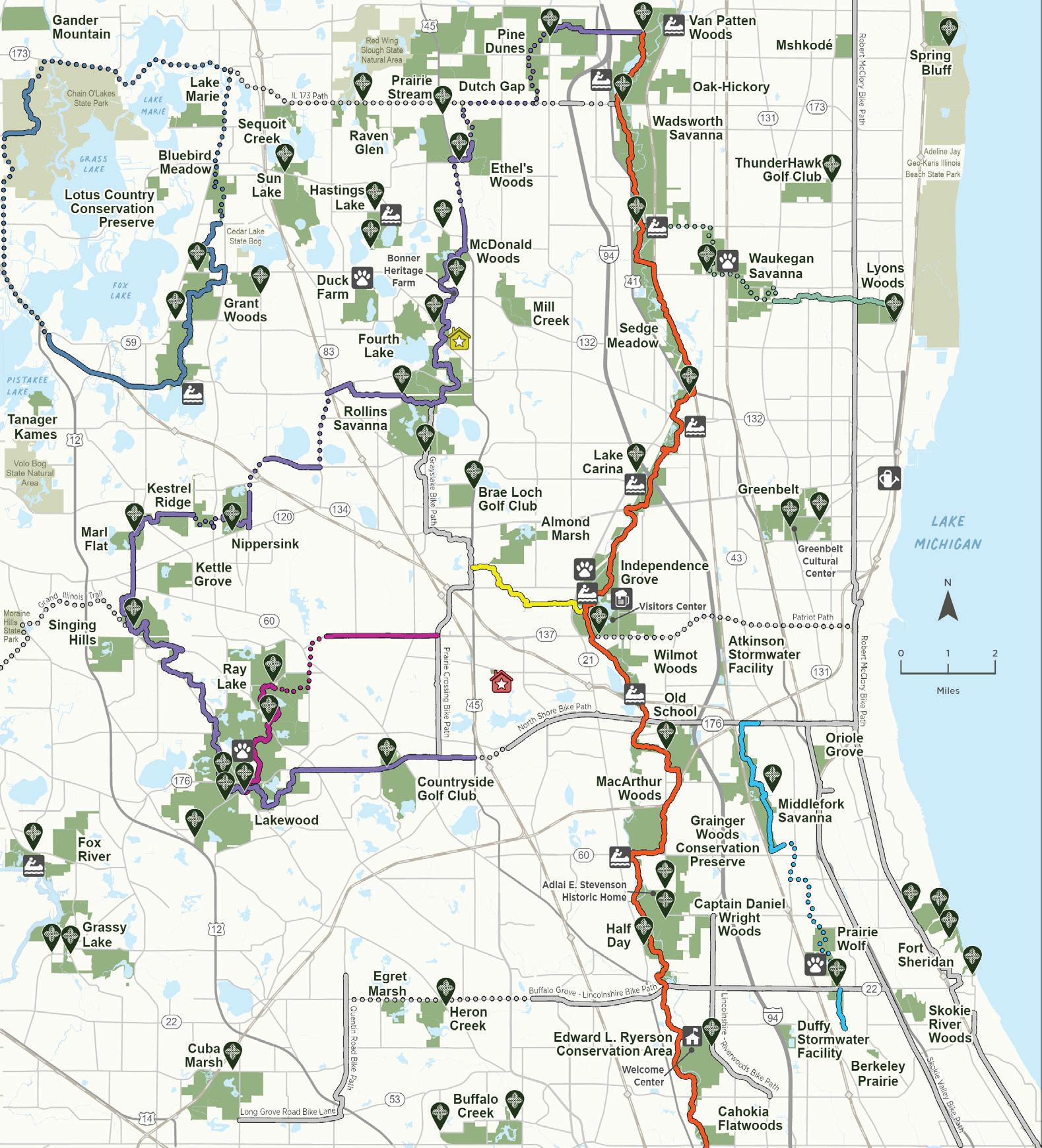
Use our interactive trail map to navigate your next adventure: LCFPD.org/maps
MAP CURRENT AS OF February 17, 2026
FOREST PRESERVE
STATE LAND
ENTRANCE / PARKING
METRA STATION
CASEY TRAIL
CHAIN O’LAKES
BIKE PATH Planned Section
DES PLAINES RIVER TRAIL (DPRT)
DPRT TO LYONS WOODS Planned Section
FORT HILL TRAIL Planned Section
MIDDLEFORK GREENWAY Planned Section
MILLENNIUM TRAIL Planned Section
OTHER REGIONAL TRAILS Planned Section
GENERAL OFFICES & DUNN MUSEUM OPERATIONS & PUBLIC SAFETY
BEER GARDEN
CANOE LAUNCH
COMMUNITY GARDEN
EDUCATION CENTER
OFF-LEASH DOG AREA
Ducks, Geese & Swans
family Anatidae
Forest preserve hotspots
• Cuba Marsh (Deer Park)
• Des Plaines River Trail
• Fort Sheridan (Lake Forest)
American black duck
Anas rubripes
American wigeon
Mareca americana
Blue-winged teal
Spatula discors
Bufflehead
Bucephala albeola
Cackling goose
Branta hutchinsii
Canada goose
Branta canadensis
Canvasback
Aythya valisineria
Common goldeneye
Bucephala clangula
Common merganser
Mergus merganser
Gadwall
Mareca strepera
Greater scaup
Aythya marila
Greater white-fronted goose
Anser albifrons
Green-winged teal
Anas crecca
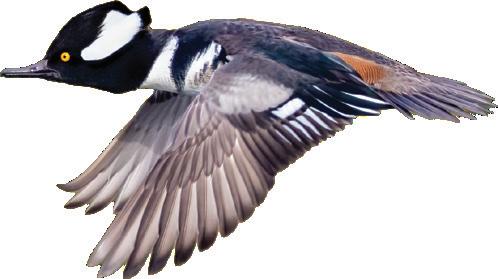
Hooded merganser
Lophodytes cucullatus
Lesser scaup
Aythya affinis
Long-tailed duck
Clangula hyemalis
Mallard
Anas platyrhynchos
• Independence Grove (Libertyville)
• Pine Dunes (Antioch)
• Rollins Savanna (Grayslake)
• Van Patten Woods (Wadsworth)
Species Showcase •
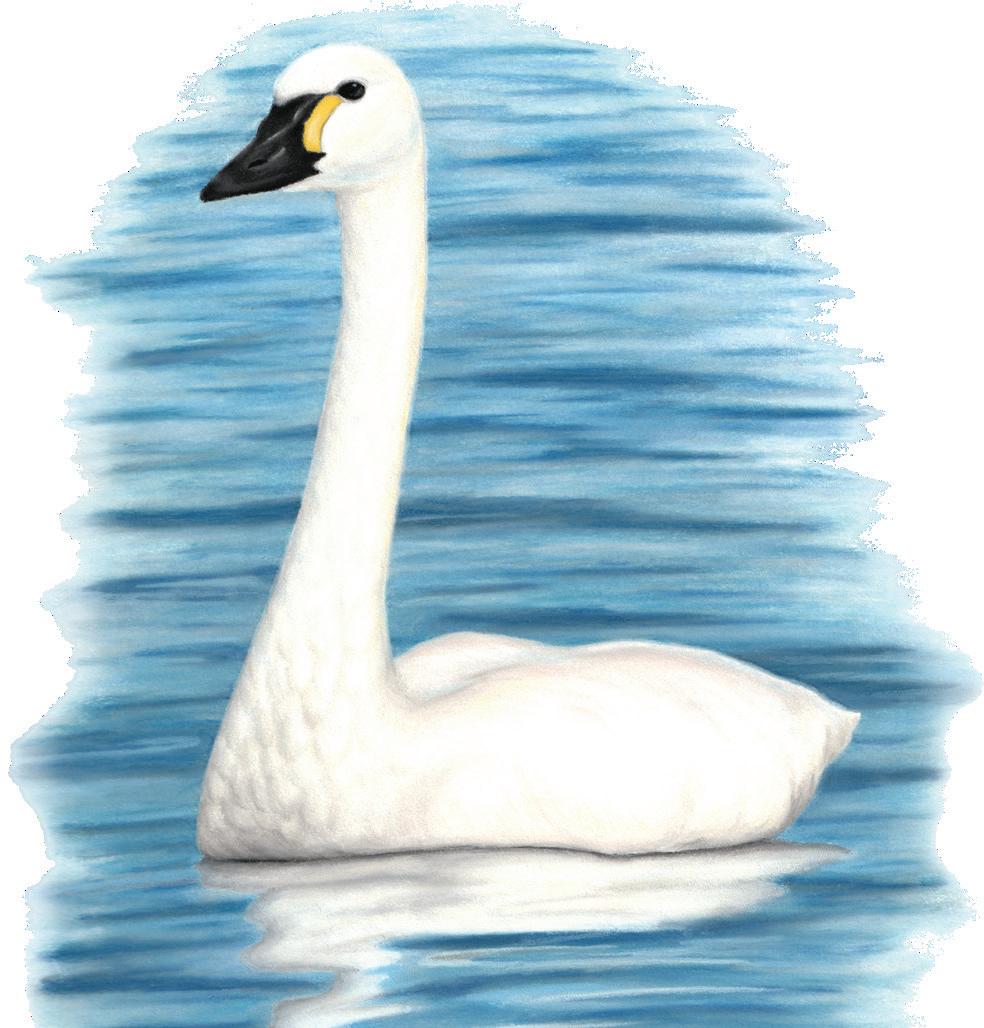
Tundra swan
In summer, tundra swans nest in far northern Canada and Alaska. Weighing between 8–23 pounds, these large, white waterfowl visit Lake County during late fall and winter.
They pause at unfrozen lakes and ponds on their way to and from wintering grounds in the Chesapeake Bay area.
Breeding pairs mate for life. If one mate dies, the other tundra swan may wait a few years before accepting a new partner.
You can tell them apart from mute swans, a non-native invasive species, by how they carry their heads. Mute swans have curvy, S-shaped necks. Tundra swans have straight necks. Another native species, trumpeter swans, have straight necks and entirely black bills.
Species Showcase •
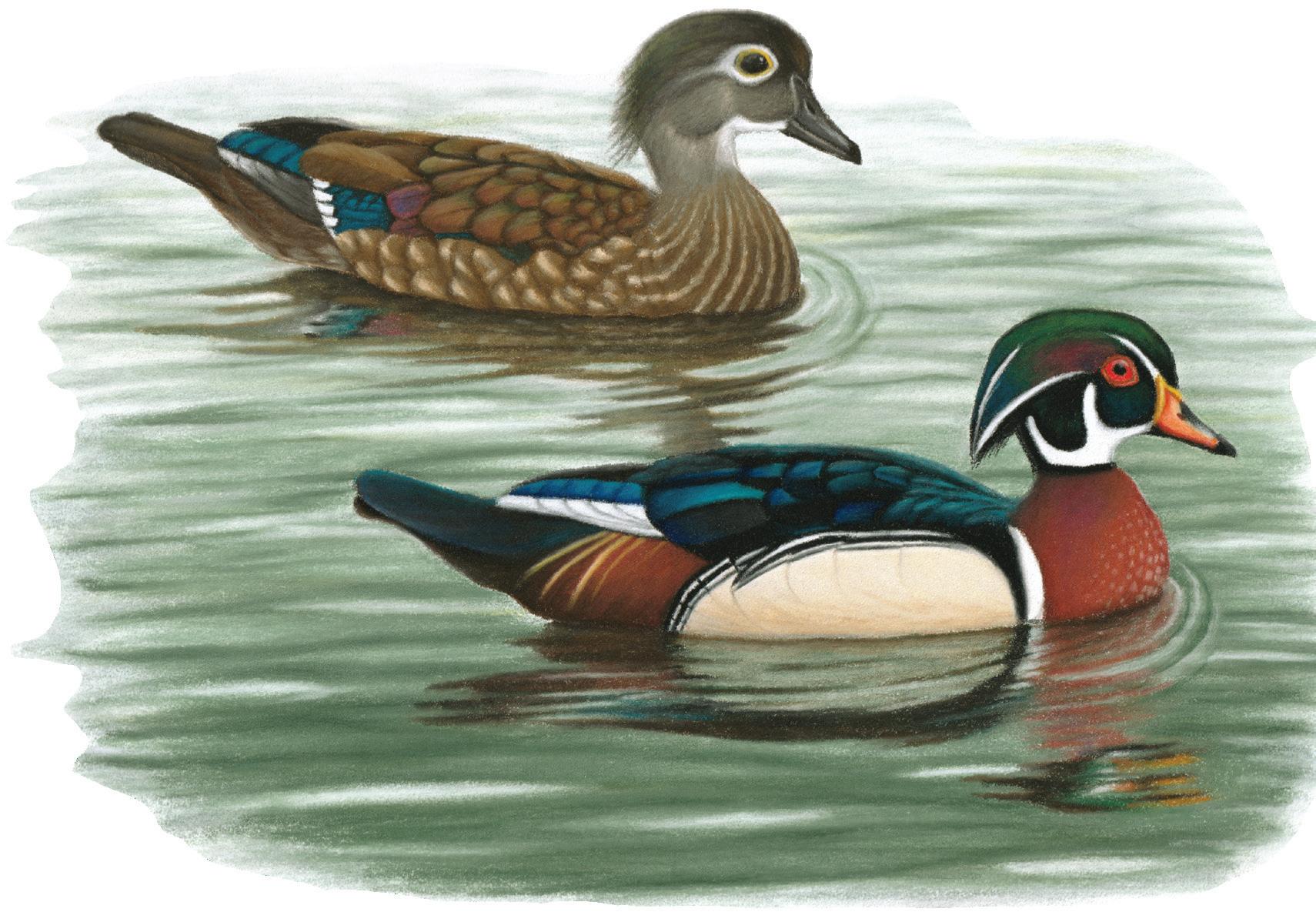
Wood duck
Wood ducks are some of the only perching, or tree-nesting, ducks native to the U.S. and Canada. Claws on their feet help them cling to branches and access their nests in tree cavities and wooden boxes. Males, or drakes, are vibrantly colored. Their heads shimmer green, supported by a chestnut breast and yellow-brown sides.
Females, or hens, have a white teardrop around their eyes and a navy patch on the part of the wing closest to the body. Adult wood ducks search for mates in fall and pair up by midwinter for a one-year partnership. Read more: LCFPD.org/wood-duck
Mute swan
Cygnus olor
Northern pintail
Anas acuta
Northern shoveler
Spatula clypeata
Red-breasted merganser
Mergus serrator
Redhead
Aythya americana
Ring-necked duck
Aythya collaris
Ross’s goose
Anser rossii
Ruddy duck
Oxyura jamaicensis
Snow goose
Anser caerulescens
Surf scoter
Melanitta perspicillata
Trumpeter swan
Cygnus buccinator
Tundra swan
Cygnus columbianus
White-winged scoter
Melanitta deglandi
Wood duck
Aix sponsa
Hooded merganser
Pheasants, Turkeys & Quails
family Phasianidae
Wild turkey
Grebes family Podicipedidae
Forest preserve hotspots
• Independence Grove (Libertyville)
• Pine Dunes (Antioch)
• Rollins Savanna (Grayslake)
Eared grebe
Podiceps nigricollis
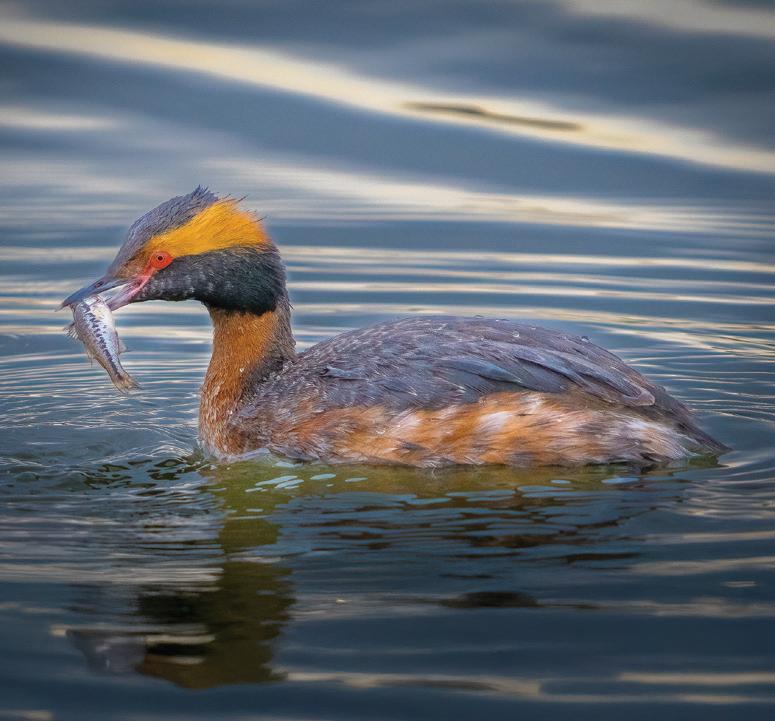
Horned grebe
Podiceps auritus
Pied-billed grebe
Podilymbus podiceps
Red-necked grebe
Podiceps grisegena
Forest preserve hotspots
• Ethel’s Woods (Antioch)
• Lyons Woods (Waukegan)
• Rollins Savanna (Grayslake)
Northern bobwhite Colinus virginianus
Ring-necked pheasant Phasianus colchicus
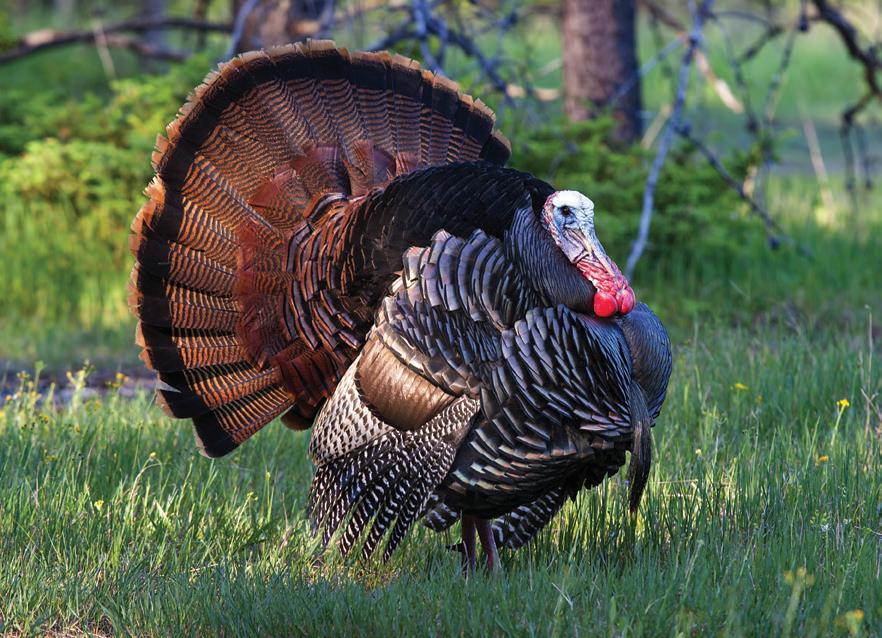
Wild turkey Meleagris gallopavo
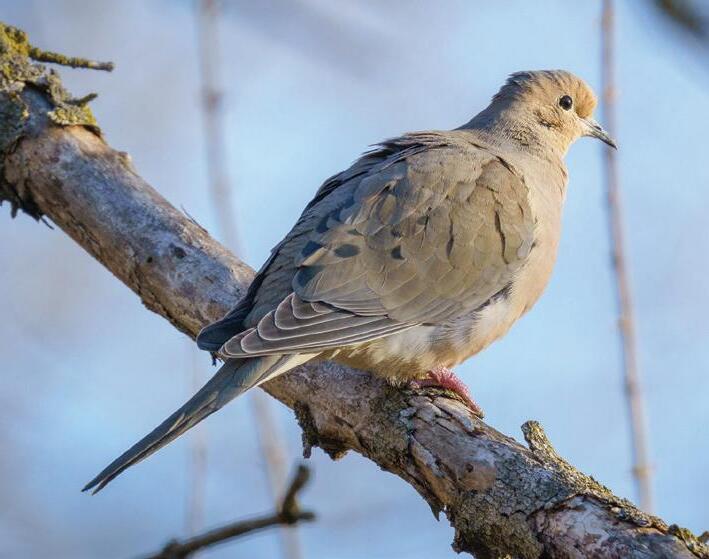
Doves & Pigeons family Columbidae
dove
Forest preserve hotspots
• Half Day (Vernon Hills)
• Independence Grove (Libertyville)
• Ryerson Conservation Area (Riverwoods)
Mourning dove Zenaida macroura
Rock pigeon Columba livia
Horned grebe
Mourning
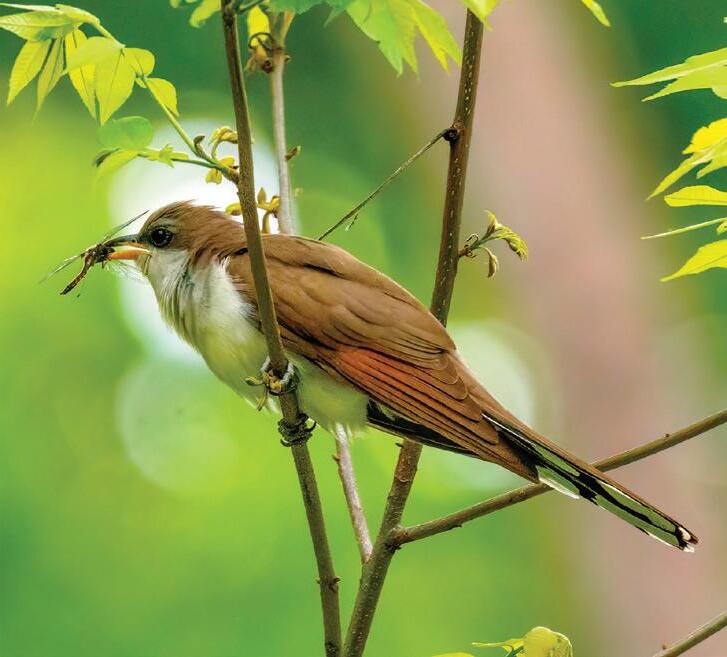
Cuckoos family Cuculidae
Forest preserve hotspots
• Fort Sheridan (Lake Forest)
• Ryerson Conservation Area (Riverwoods)
• Sedge Meadow (Wadsworth)
Black-billed cuckoo
Coccyzus erythropthalmus
Yellow-billed cuckoo
Coccyzus americanus
Nighthawks & Nightjars
family Caprimulgidae
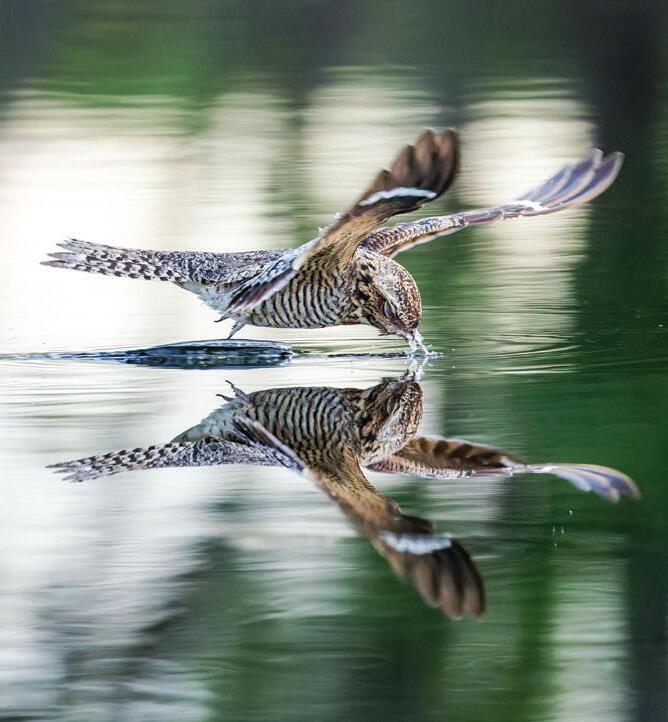
Common nighthawk
Swift family Apodidae
Forest preserve hotspots
• Cuba Marsh (Deer Park)
• Fort Sheridan (Lake Forest)
• Nippersink (Round Lake)
• Ryerson Conservation Area (Riverwoods)
Chimney swift
Chaetura pelagica
Yellow-billed
Forest preserve hotspots
• Captain Daniel Wright Woods (Mettawa)
• Fort Sheridan (Lake Forest)
• Middlefork Savanna (Lake Forest)
Common nighthawk
Chordeiles minor
Eastern whip-poor-will
Antrostomus vociferus
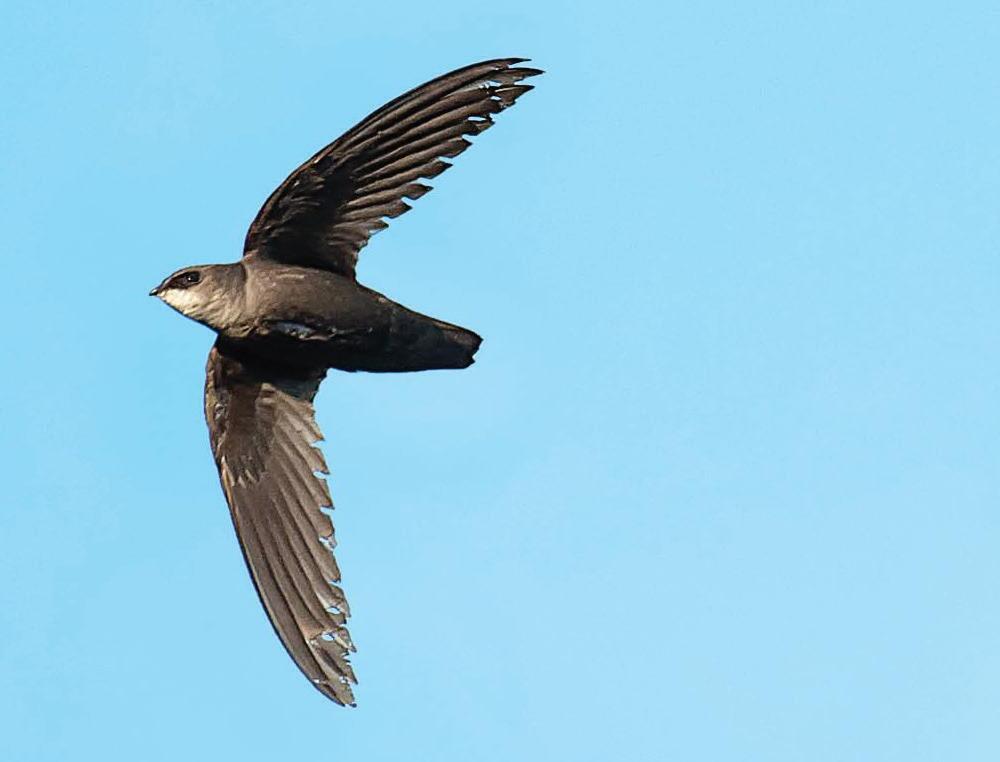
Chimney swift
Hummingbird family Trochilidae
• Ryerson Conservation Area (Riverwoods) Forest preserve hotspots
• Captain Daniel Wright Woods (Mettawa)
• Des Plaines River Trail
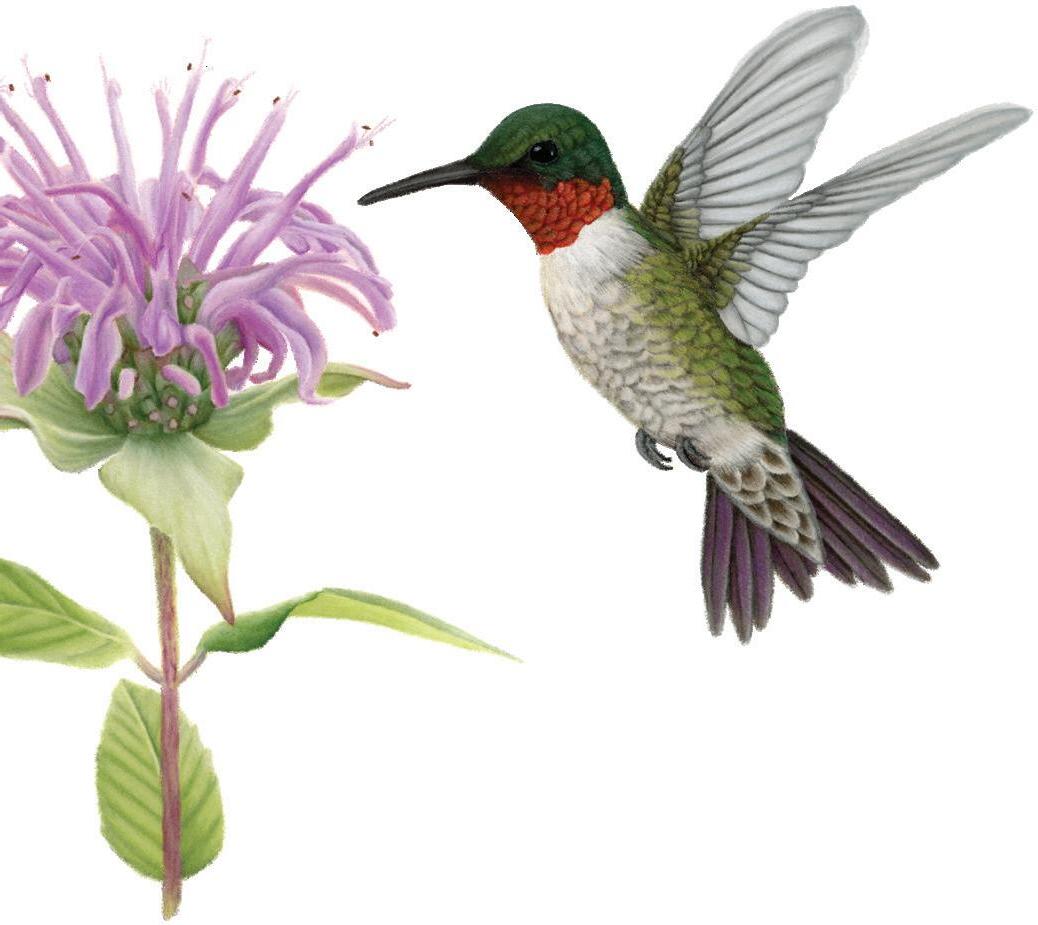
Ruby-throated hummingbird
Archilochus colubris
Species Showcase
Ruby-throated hummingbird
Beating their wings up to 53 times a second, ruby-throated hummingbirds zigzag from flower to flower, sipping nectar.
The sugary liquid fuels their metabolism, one of the fastest in the whole animal kingdom. Surprisingly, insects and spiders are also on the menu.
Hummingbirds weigh just 0.1–0.2 ounces, yet consume 2–3 times their body weight daily—about 3–7 calories.
That may not seem like much, but in human terms, that’s equivalent to eating 155,000 calories a day.
Attract these speedsters to your home by planting native blooms and filling up flowerlike feeders with sugar water. Hummingbirds prefer red or orange tube-shaped flowers.
Rails, Coots & Gallinules family Rallidae
Forest preserve hotspots
• Pine Dunes (Antioch)
• Rollins Savanna (Grayslake)
• Spring Bluff (Winthrop Harbor)
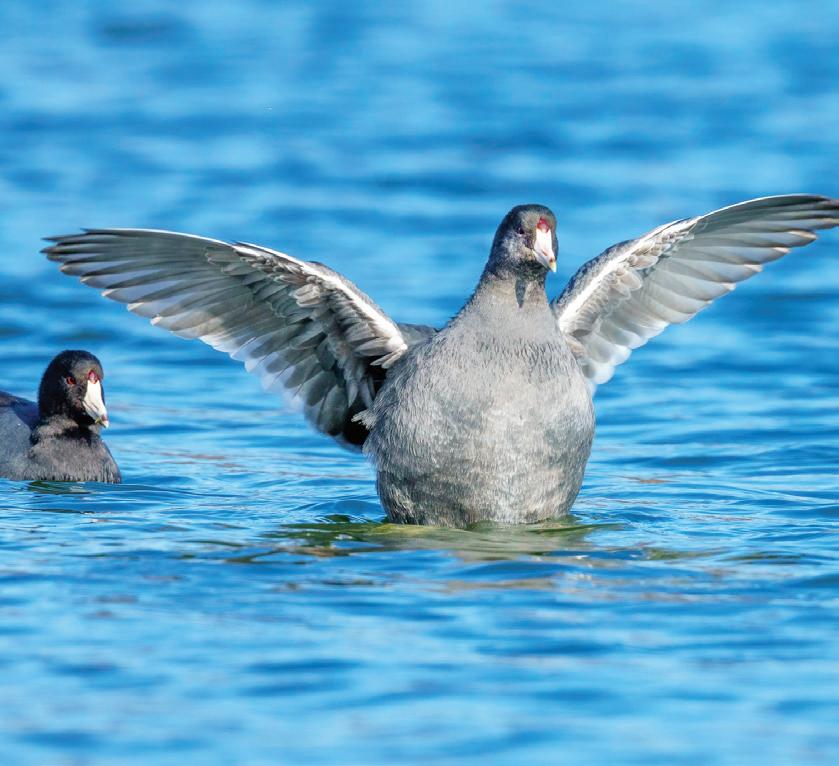
American coot
Fulica americana
Common gallinule
Gallinula galeata
King rail
Rallus elegans
Sora
Porzana carolina
Virginia rail
Rallus limicola
Crane
family Gruidae
Forest preserve hotspots
• Cuba Marsh (Deer Park)
• Hastings Lake (Lake Villa)
• Middlefork Savanna (Lake Forest)
Sandhill crane
Antigone canadensis
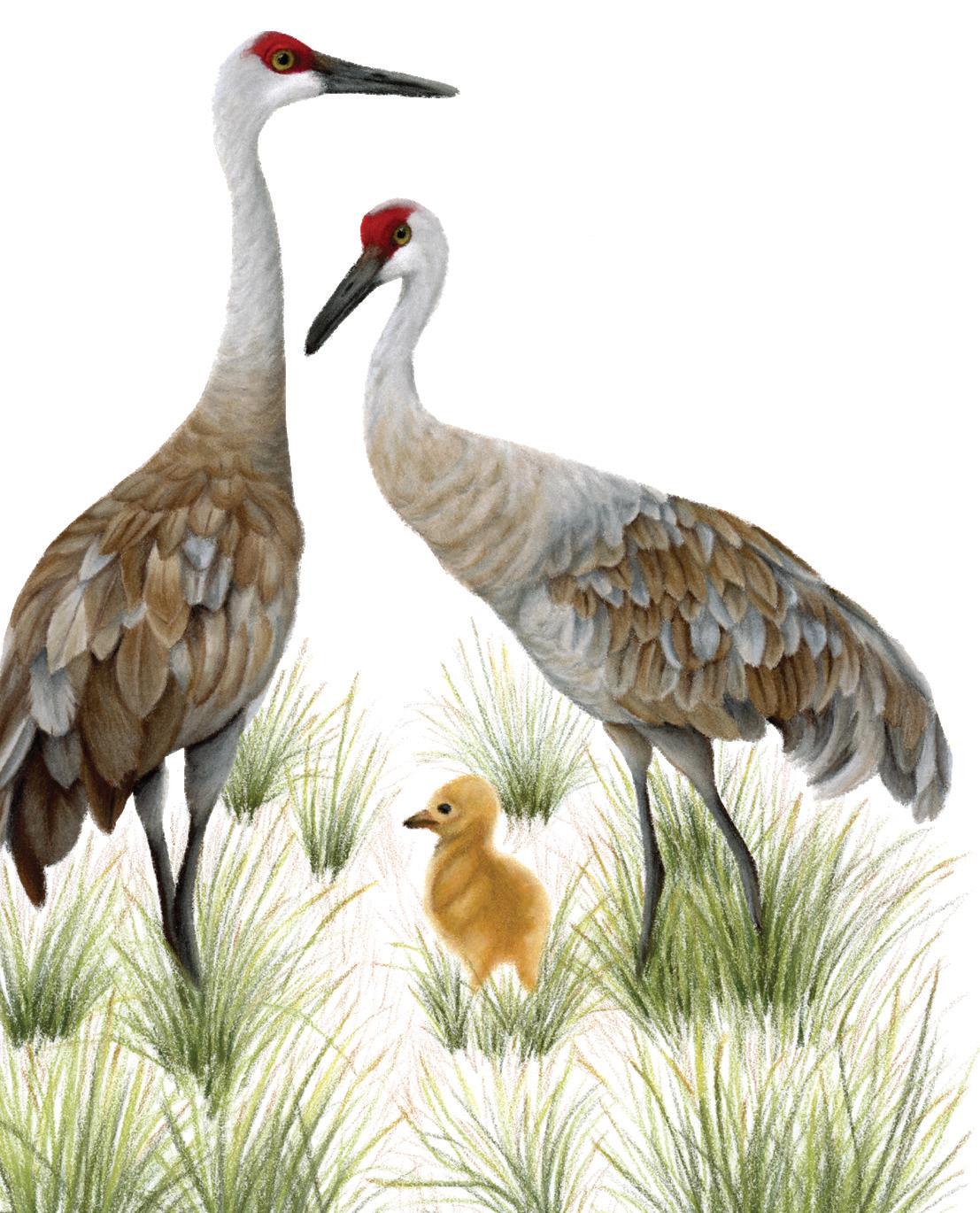
Species Showcase • Sandhill crane
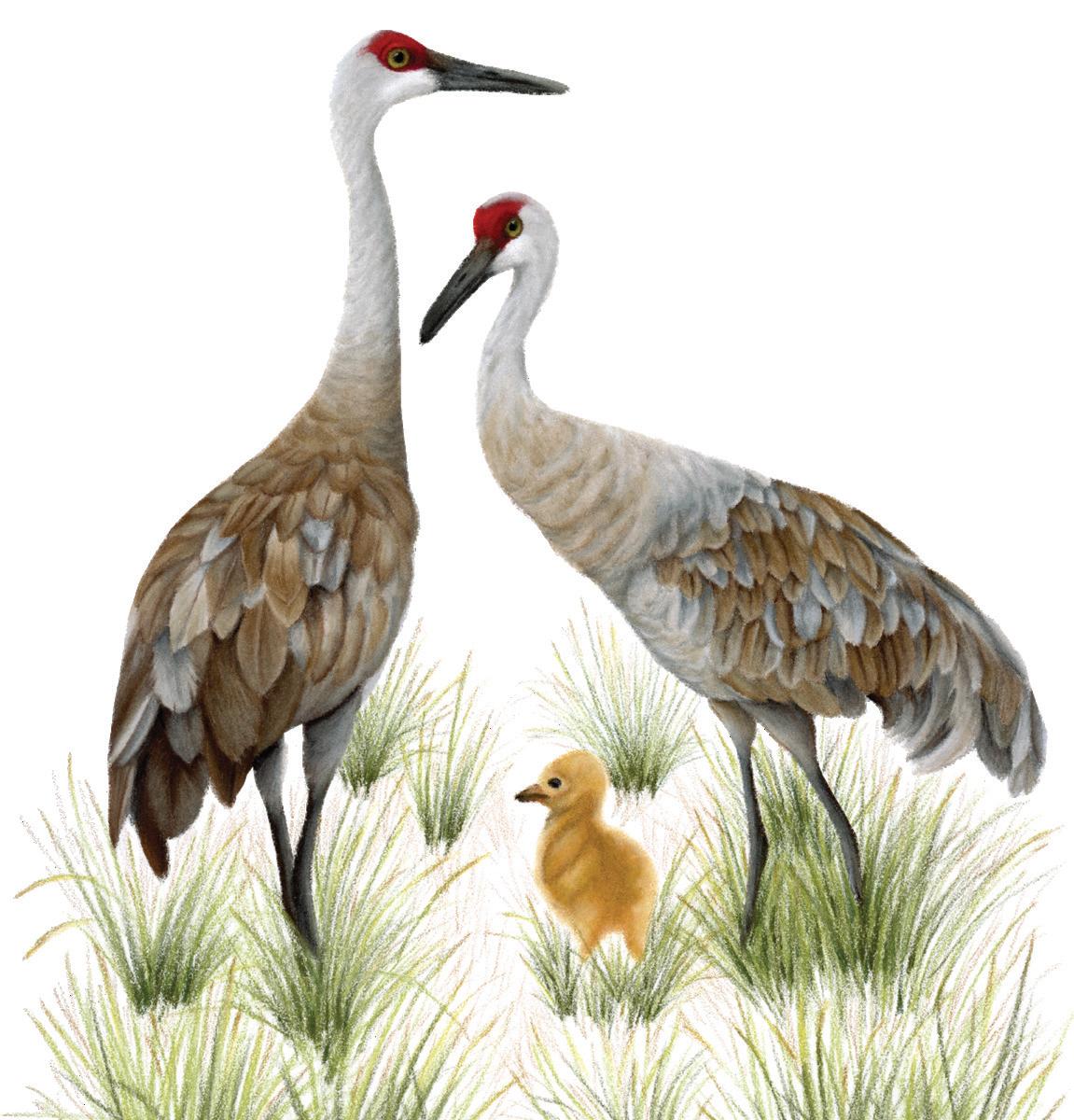
Sandhill cranes are long-legged, red-capped birds known for their dancing skills. Courting cranes stretch their wings, pump their heads, bow and leap into the air to form monogamous, usually lifelong bonds—a rarity among birds.
Mated pairs nest on the ground, often in wetlands. Both parents care for their eggs and young. Just eight hours after hatching, chicks can leave the nest and even swim. However, they’ll stay near their parents for the next 9–10 months. Chicks may start breeding as early as two years old or as late as seven.
The species is a Lake County conservation success story. Sandhill cranes were once listed as threatened in Illinois, but made a comeback and were de-listed by 2009.
Avocets & Stilts
family Recurvirostridae
Forest preserve hotspots
• Buffalo Creek (Long Grove)
• Rollins Savanna (Grayslake)
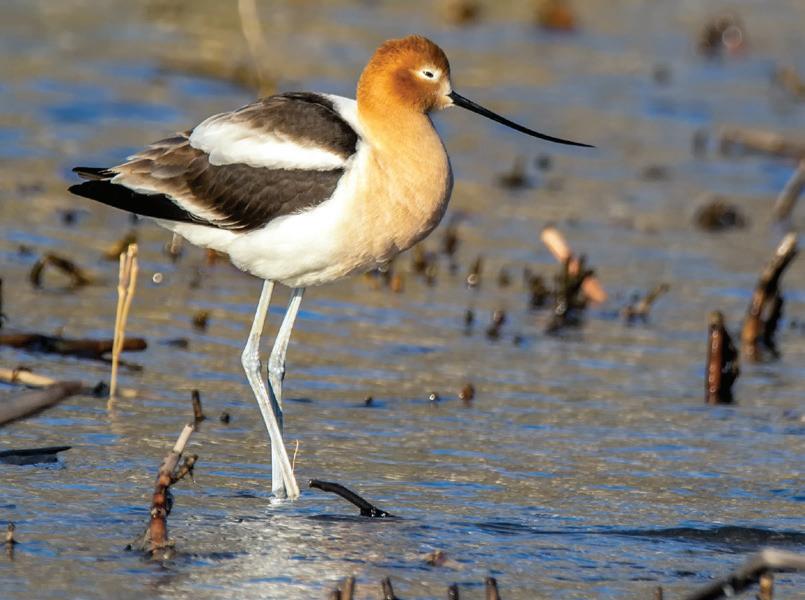
American avocet
Recurvirostra americana
Black-necked stilt
Himantopus mexicanus
Plovers family Charadriidae
• Pine Dunes (Antioch) Forest preserve hotspots
• Fort Sheridan (Lake Forest)
• Independence Grove (Libertyville)
American golden plover
Pluvialis dominica
Black-bellied plover
Pluvialis squatarola
Killdeer
Charadrius vociferus
Piping plover
Charadrius melodus
Semipalmated plover
Charadrius semipalmatus
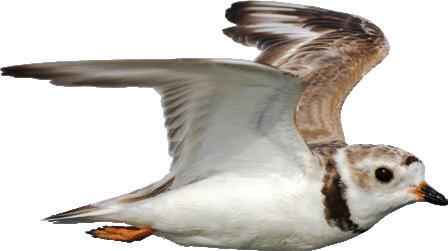
Piping plover
Species Showcase
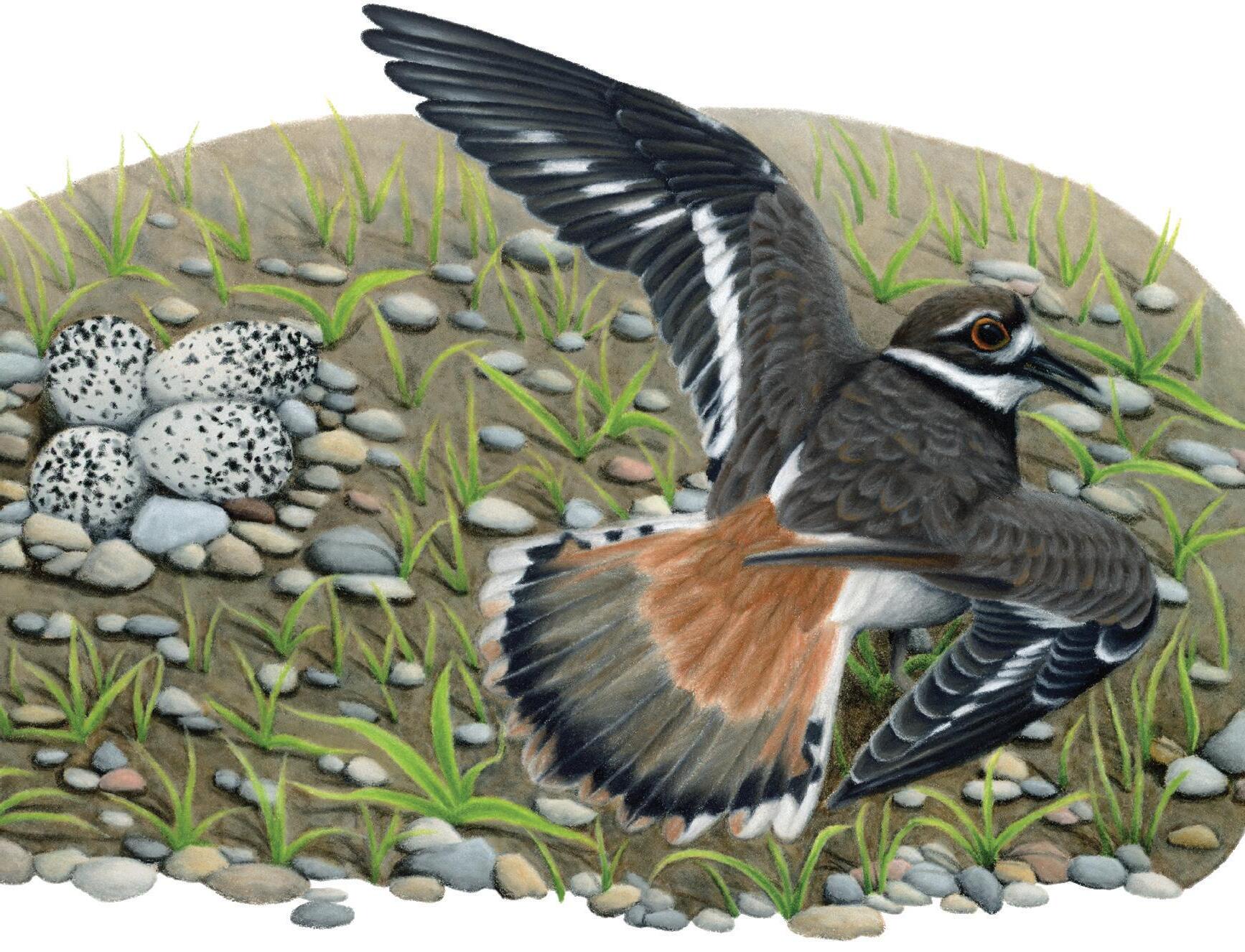
Killdeer
Killdeer parents want you to look at them. They distract predators from their ground-based nests by putting on a dramatic broken-wing act.
Bending one wing at a sharp angle as if broken, they drag their feet, fan their tail feathers and produce shrill kill-deer calls.
If a predator such as a raccoon or red-tailed hawk follows the adult, it will lure them a safe distance away, then “miraculously” recover and escape.
Killdeers are known for building nests in places that are inconvenient to humans, including gravel parking lots, golf courses, lawns and sports fields.
Though they nest in dry areas, the species is considered a shorebird in the plover family. Adults are good swimmers, and young birds can navigate small streams.

Godwits, Turnstones, Sandpipers, Dowitchers,
Snipes, Woodcocks & Phalaropes
family Scolopacidae
Forest preserve hotspots
• Cuba Marsh (Deer Park)
• Des Plaines River Trail
• Fort Sheridan (Lake Forest)
• Middlefork Savanna (Lake Forest)
American woodcock
Scolopax minor
Baird’s sandpiper
Calidris bairdii
Buff-breasted sandpiper
Calidris subruficollis
Dunlin
Calidris alpina
Greater yellowlegs
Tringa melanoleuca
Hudsonian godwit
Limosa haemastica
Least sandpiper
Calidris minutilla
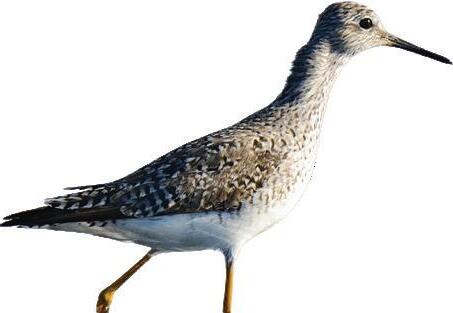
Lesser yellowlegs
Tringa flavipes
Long-billed dowitcher
Limnodromus scolopaceus
Marbled godwit
Limosa fedoa
Pectoral sandpiper
Calidris melanotos
Purple sandpiper
Calidris maritima
Red knot
Calidris canutus
Red phalarope
Phalaropus fulicarius
• Pine Dunes (Antioch)
• Rollins Savanna (Grayslake)
• Van Patten Woods (Wadsworth)
Red-necked phalarope
Phalaropus lobatus
Ruddy turnstone
Arenaria interpres
Sanderling
Calidris alba
Semipalmated sandpiper
Calidris pusilla
Short-billed dowitcher
Limnodromus griseus
Solitary sandpiper
Tringa solitaria
Spotted sandpiper
Actitis macularius
Stilt sandpiper
Calidris himantopus
Upland sandpiper
Bartramia longicauda
Western sandpiper
Calidris mauri
White-rumped sandpiper
Calidris fuscicollis
Willet
Tringa semipalmata
Wilson’s phalarope
Phalaropus tricolor
Wilson’s snipe
Gallinago delicata
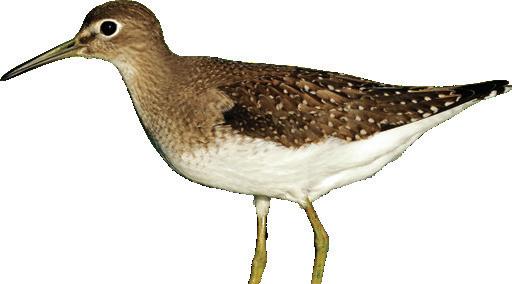
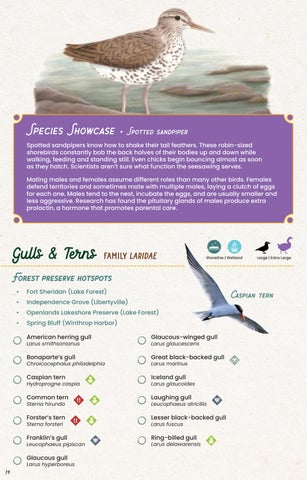
Species Showcase • Spotted sandpiper
Spotted sandpipers know how to shake their tail feathers. These robin-sized shorebirds constantly bob the back halves of their bodies up and down while walking, feeding and standing still. Even chicks begin bouncing almost as soon as they hatch. Scientists aren’t sure what function the seesawing serves.
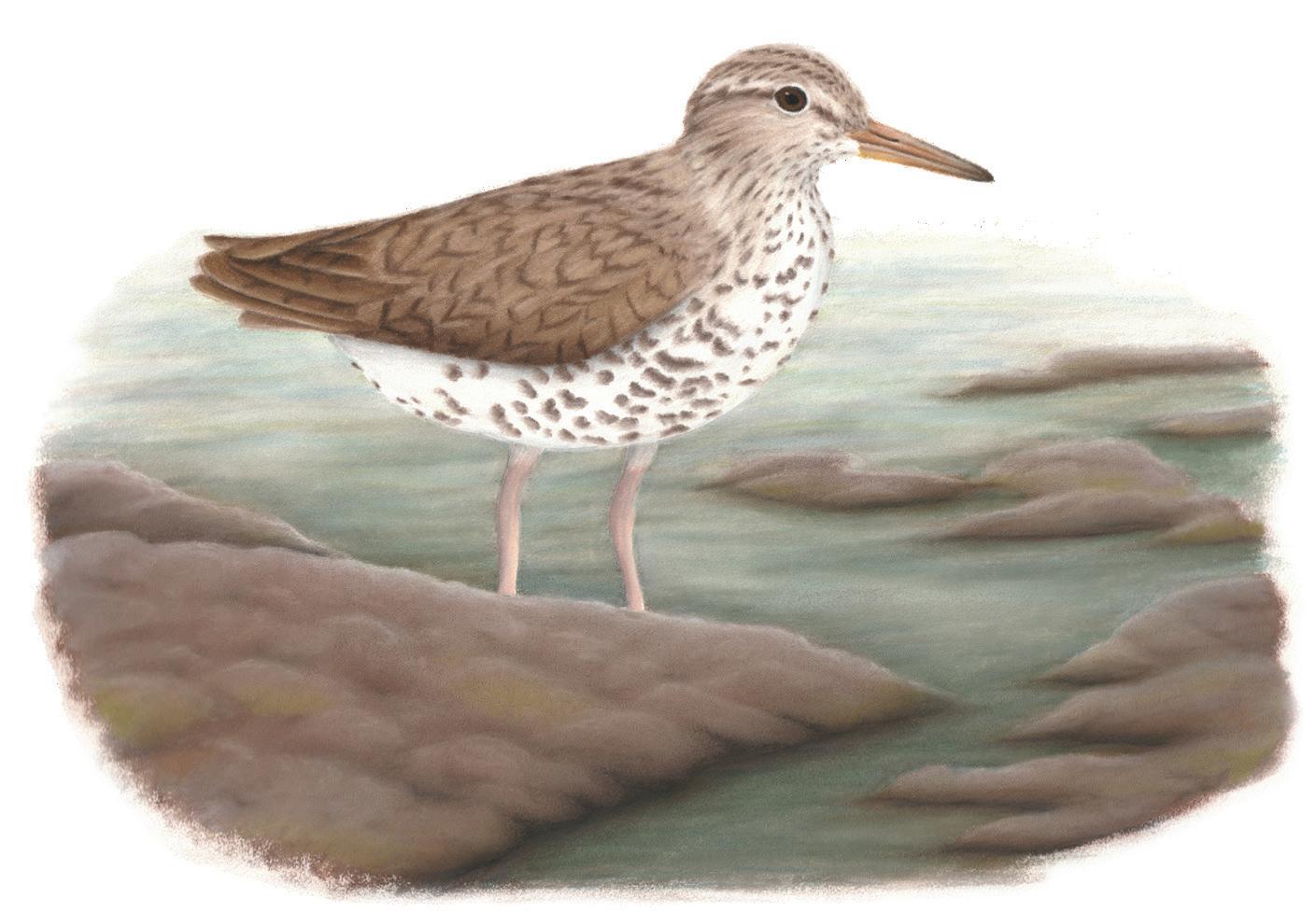
Mating males and females assume different roles than many other birds. Females defend territories and sometimes mate with multiple males, laying a clutch of eggs for each one. Males tend to the nest, incubate the eggs, and are usually smaller and less aggressive. Research has found the pituitary glands of males produce extra prolactin, a hormone that promotes parental care.
Gulls & Terns
family laridae
Forest preserve hotspots
• Fort Sheridan (Lake Forest)
• Independence Grove (Libertyville)
• Openlands Lakeshore Preserve (Lake Forest)
• Spring Bluff (Winthrop Harbor)
American herring gull
Larus smithsonianus
Bonaparte’s gull
Chroicocephalus philadelphia
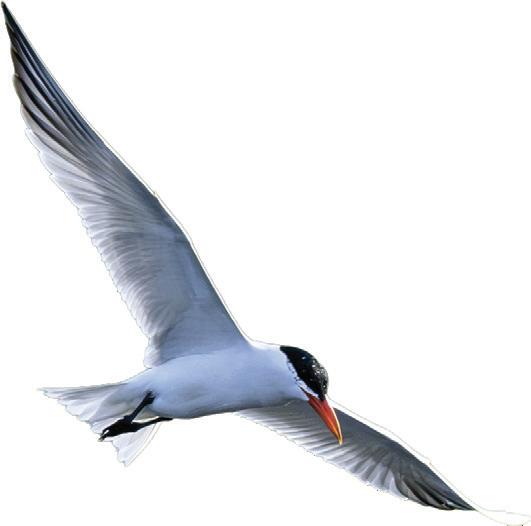
Caspian tern
Hydroprogne caspia
Common tern
Sterna hirundo
Forster’s tern
Sterna forsteri
Franklin’s gull
Leucophaeus pipixcan
Glaucous gull
Larus hyperboreus
Glaucous-winged gull
Larus glaucescens
Great black-backed gull
Larus marinus
Iceland gull
Larus glaucoides
Laughing gull
Leucophaeus atricilla
Lesser black-backed gull
Larus fuscus
Ring-billed gull
Larus delawarensis
Large | Extra Large
Shoreline | Wetland
Caspian tern
Loons family Gaviidae
Forest preserve hotspots
• Hastings Lake (Lake Villa)
• Independence Grove (Libertyville)
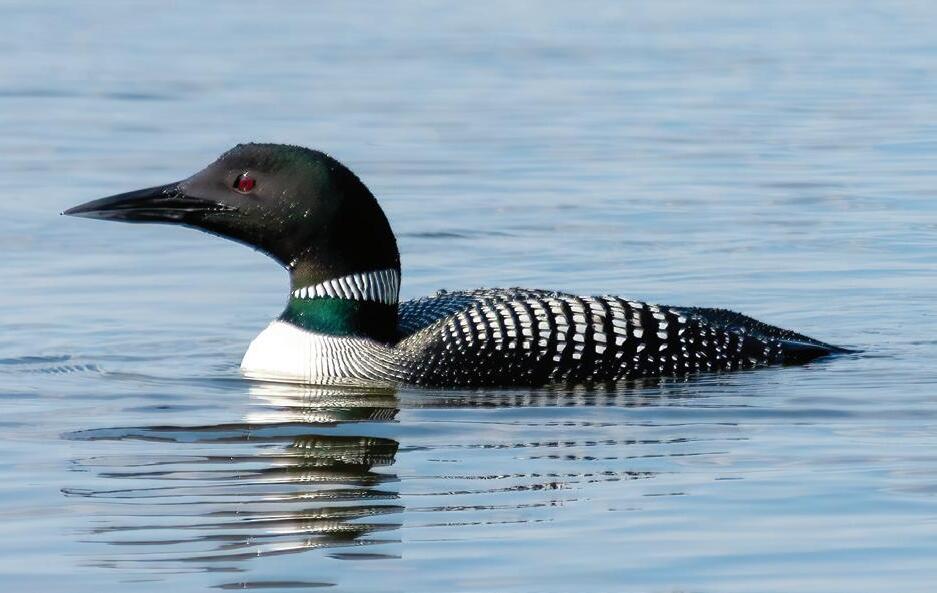
Common loon
Gavia immer
Red-throated loon
Gavia stellata
Cormorant family Phalacrocoracidae
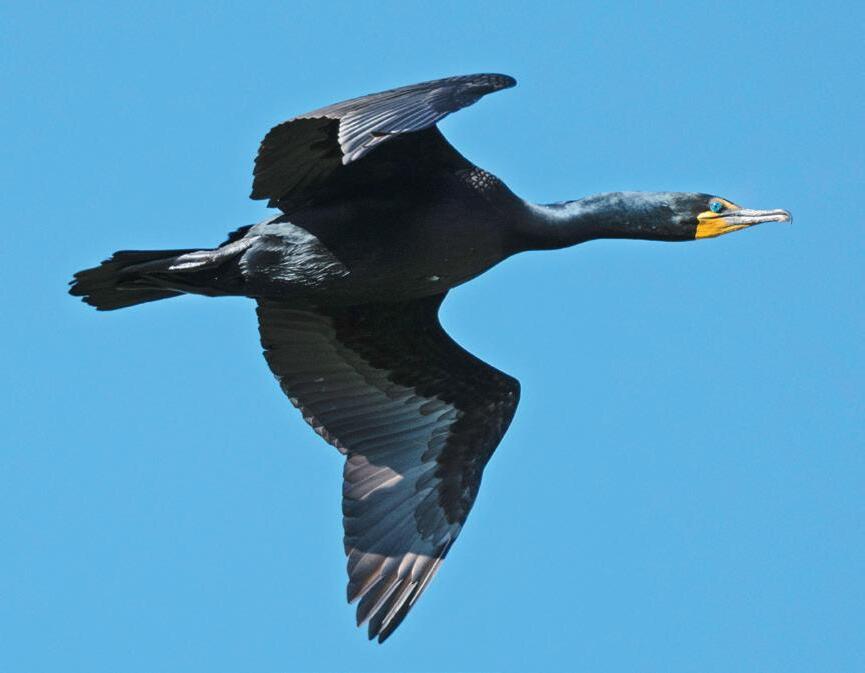
Double-crested cormorant
Pelican family Pelecanidae
Forest preserve hotspots
• Fox River (Port Barrington)
• Grassy Lake (Lake Barrington)
• Hastings Lake (Lake Villa)
• Tanager Kames (Ingleside)
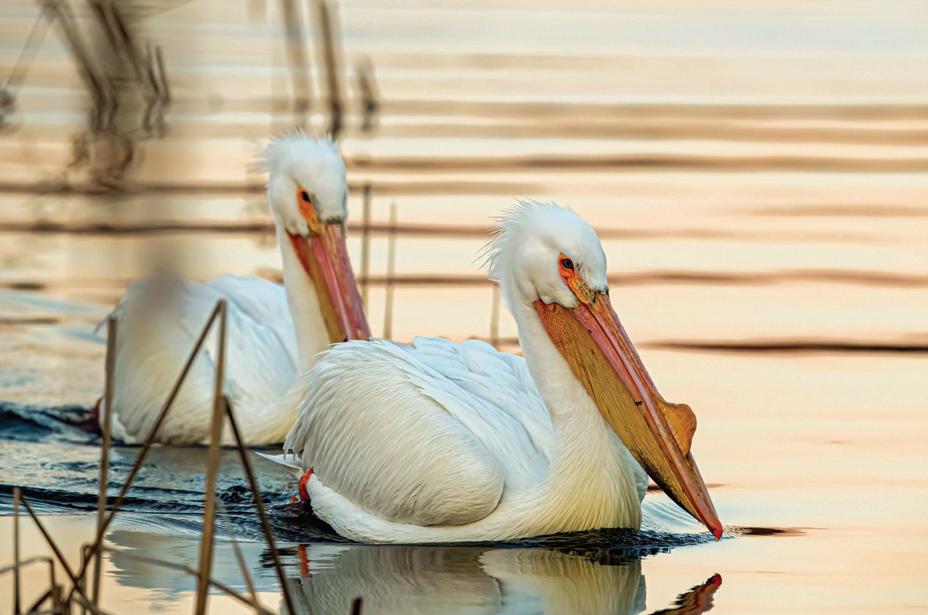
American white pelican Pelecanus erythrorhynchos
Forest preserve hotspots
• Buffalo Creek (Long Grove)
• Fort Sheridan (Lake Forest)
• Lakewood (Wauconda)
Double-crested cormorant Nannopterum auritum
Bitterns, Egrets & Herons
family Ardeidae
Forest preserve hotspots
• Cuba Marsh (Deer Park)
• Des Plaines River Trail
• Middlefork Savanna (Lake Forest)
• Nippersink (Round Lake)
• Rollins Savanna (Grayslake)
American bittern Botaurus lentiginosus
Black-crowned night heron Nycticorax nycticorax
Great blue heron Ardea herodias
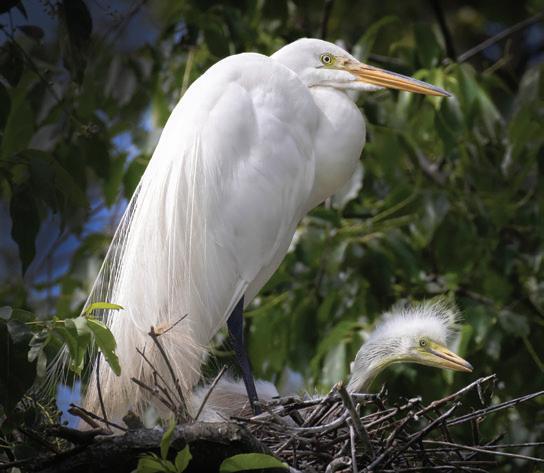
Great egret Ardea alba
Green heron Butorides virescens
Least bittern Botaurus exilis
Great egret
Species Showcase
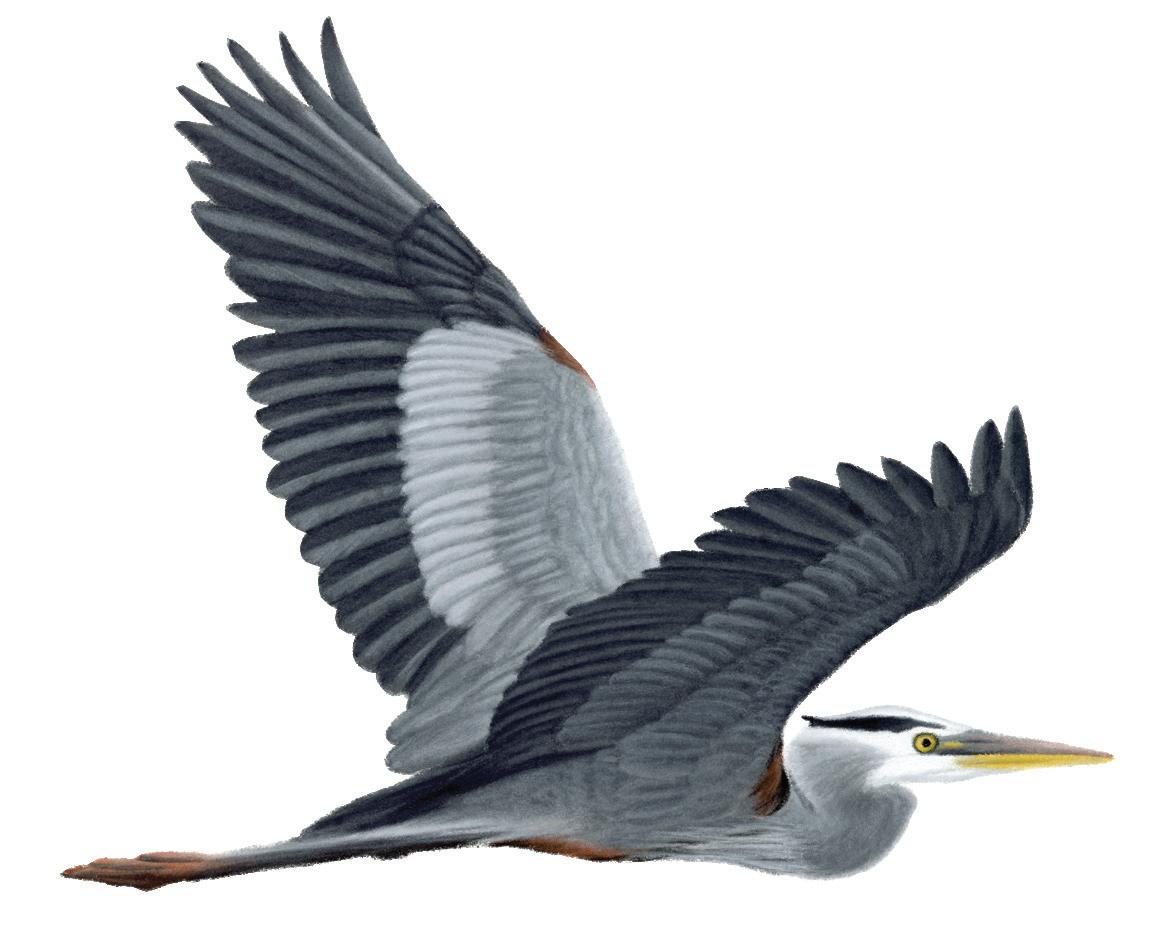
Great blue heron
With sleek, blue-gray feathers, a tall frame and a 6-foot wingspan, the great blue heron is a towering sight around Lake County’s waterways. These longlegged wading birds fly with slow, graceful flaps and their necks tucked into an S-shape. Look for them perched in trees over water or stalking fish, amphibians and reptiles in shallow wetlands.
Using sticks and twigs, herons build nests near the tops of trees up to 100 feet off the ground. On average, they raise 3–5 chicks per breeding season. Herons commonly nest in colonies.
Vulture family Cathartidae
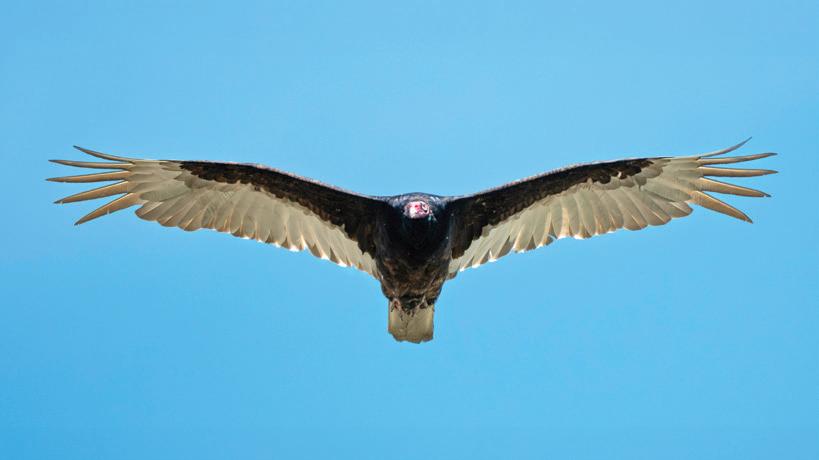
Turkey vulture
Forest preserve hotspots
• Fort Sheridan (Lake Forest)
• Grant Woods (Ingleside)
• Ryerson Conservation Area (Riverwoods)
Turkey vulture Cathartes aura
Osprey family Pandionidae
Forest preserve hotspots
• Fort Sheridan (Lake Forest)
• Fox River (Port Barrington)
• Heron Creek (Lake Zurich)
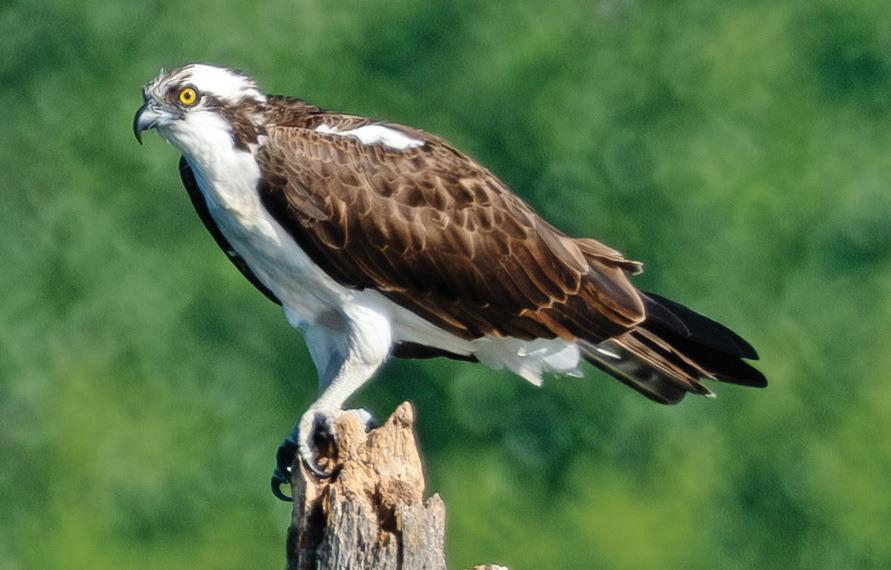
Osprey
Pandion haliaetus
Eagles, Hawks & Harriers
family Accipitridae
Forest preserve hotspots
• Des Plaines River Trail
• Fort Sheridan (Lake Forest)
• Fox River (Port Barrington)
• Independence Grove (Libertyville)
• Rollins Savanna (Grayslake)
American goshawk
Accipiter gentilis
Bald eagle
Haliaeetus leucocephalus
Broad-winged hawk
Buteo platypterus
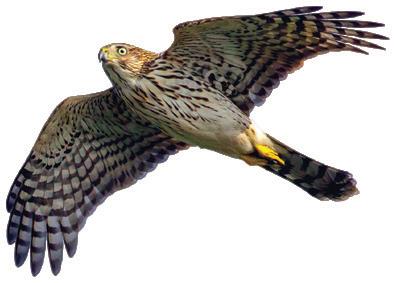
Cooper’s hawk
Accipiter cooperii
Golden eagle
Aquila chrysaetos
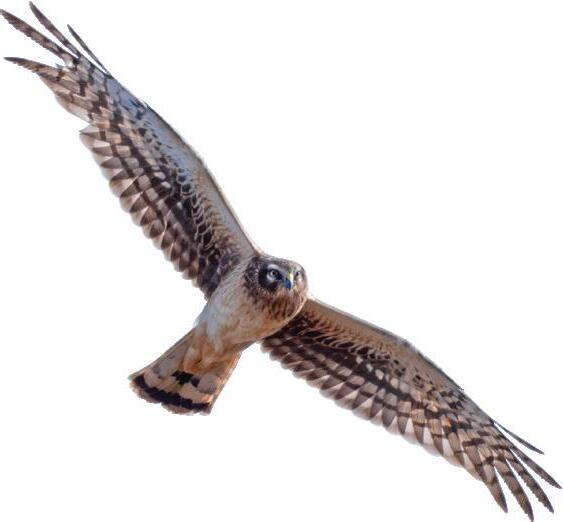
Northern harrier
Circus hudsonius
Red-shouldered hawk
Buteo lineatus
Red-tailed hawk
Buteo jamaicensis
Rough-legged hawk
Buteo lagopus
Sharp-shinned hawk
Accipiter striatus
Swainson’s hawk
Buteo swainsoni
Species Showcase • Red-tailed hawk
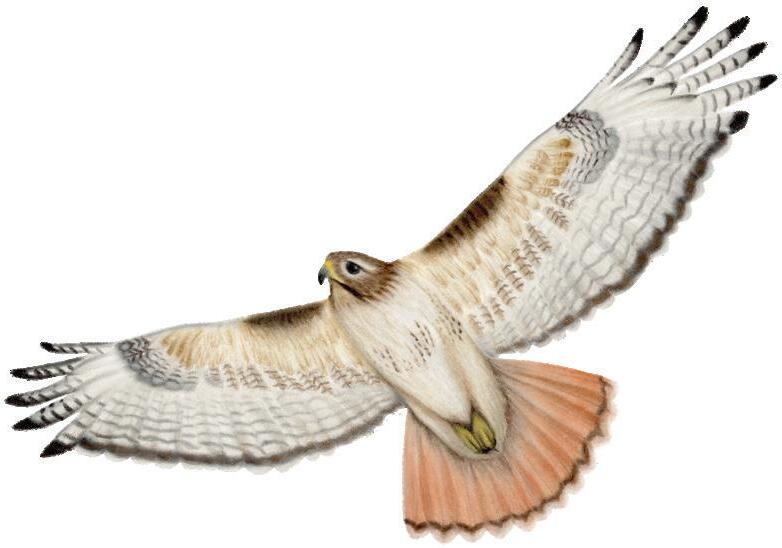
Take a road trip across Lake County and you’re bound to see some red-tailed hawks. Thought to be North America’s most common hawk, adult red-tails are true to their name. Their gently arcing tail feathers are the color of rusty iron. A band of dark feathers wraps around their white bellies. Red-tailed hawks inhabit open areas with long sightlines to see prey. They soar over grasslands, fields and pastures or perch on trees and utility poles, hunting for small mammals, birds and snakes.
Northern harrier
Grassland | Woodland
Species Showcase
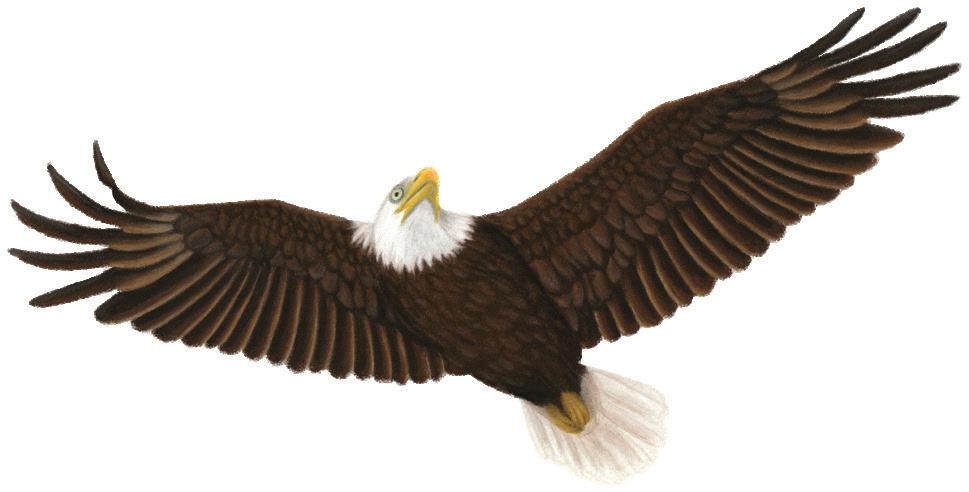
• Bald eagle
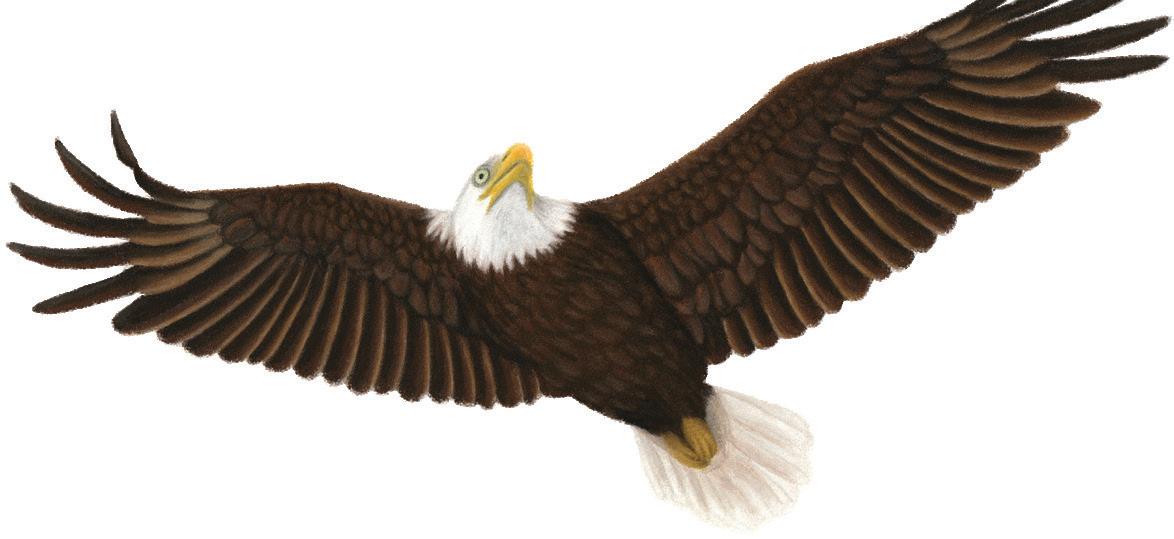
With wingspans up to 7.5 feet and vision eight times sharper than humans, bald eagles are built for the hunt. They snatch fish, amphibians, reptiles and invertebrates out of rivers, lakes and marshes using razor-sharp talons. Eagles aren’t afraid of pickpocketing prey from other birds, either.
Bald eagle nests are enormous, spanning 5–6 feet across and 2–4 feet deep. January and February are the best months to see bald eagles in Illinois. More than 3,100 of these regal birds spend winter here annually. It’s one of the largest populations of wintering bald eagles in the contiguous U.S.
Owls family Strigidae
Forest preserve hotspots
• Captain Daniel Wright Woods (Mettawa)
• Fort Sheridan (Lake Forest)
• Lyons Woods (Waukegan)
• Pine Dunes (Antioch)
• Ryerson Conservation Area (Riverwoods)
Barred owl
Strix varia
Eastern screech owl
Megascops asio
Great horned owl
Bubo virginianus
Long-eared owl
Asio otus
Northern saw-whet owl
Aegolius acadicus
Short-eared owl
Asio flammeus
Snowy owl
Bubo scandiacus
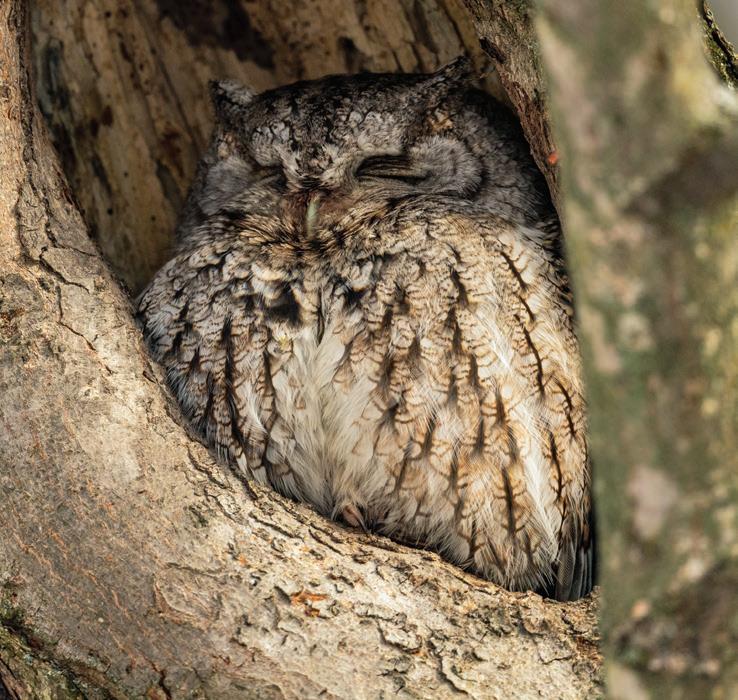
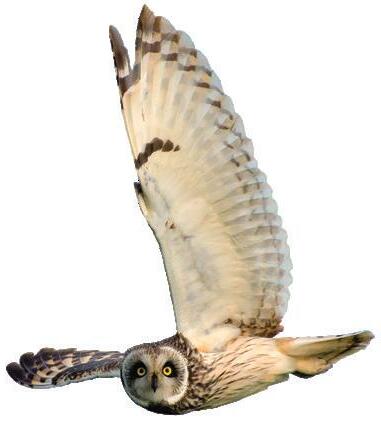
Eastern screech owl
Barred owl
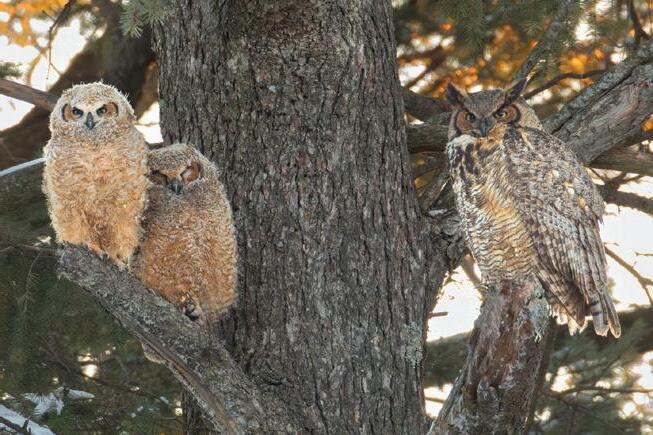
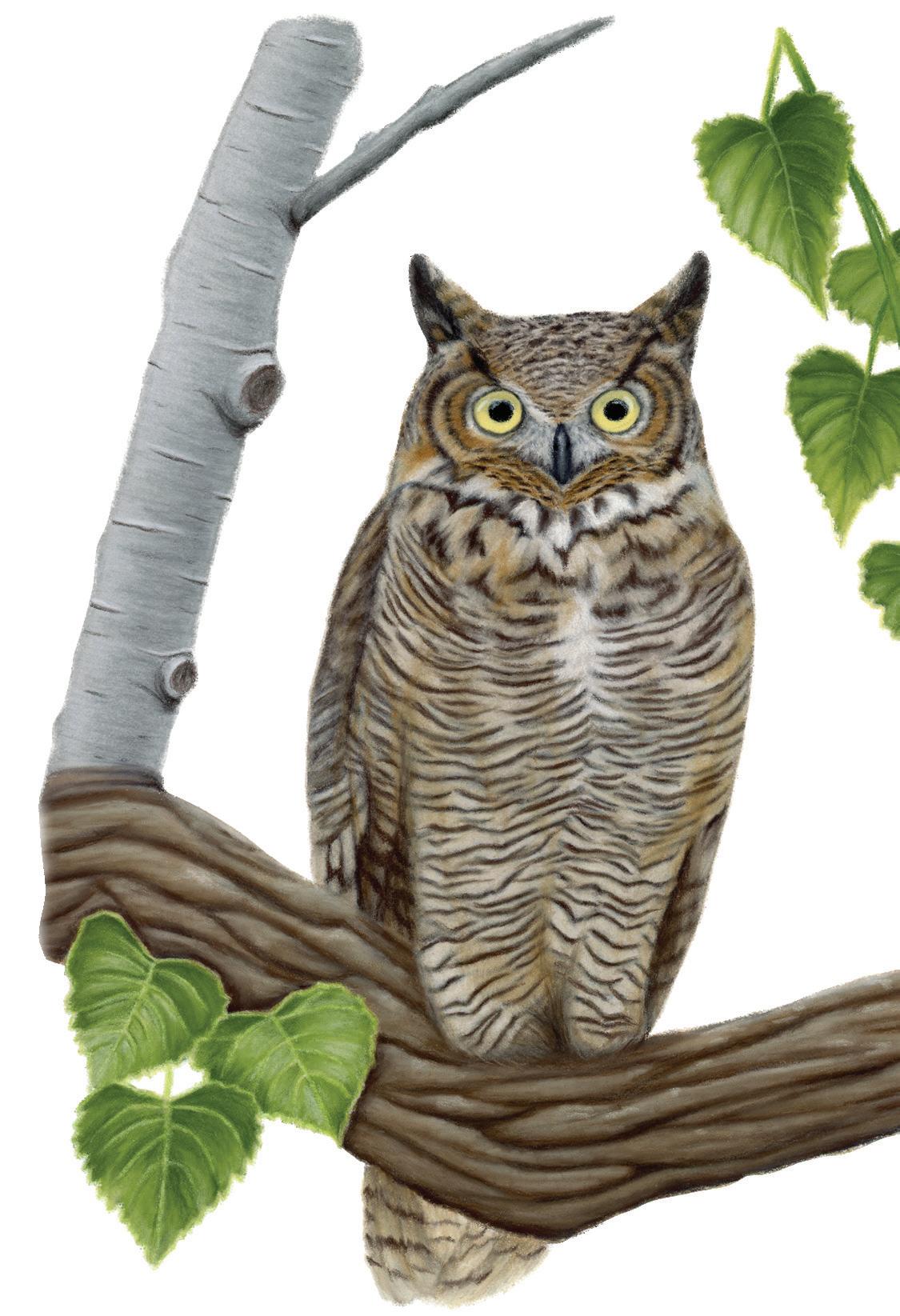
Great horned owl Species Showcase
Great horned owl
Great horned owls are likely what most people picture when they think about owls.
The piercing yellow eyes, fluffy ear tufts and hoo, hoo-hoo, hoo, hoo songs are featured in countless books, movies and TV shows.
This species is Lake County’s largest resident owl. It’s also the earliest bird to kick off courtship and nesting.
Because young owlets face a steep learning curve to master flying and hunting at night, parent owls need a head start.
Hooting duets begin annually in December, followed by egg-laying in January.
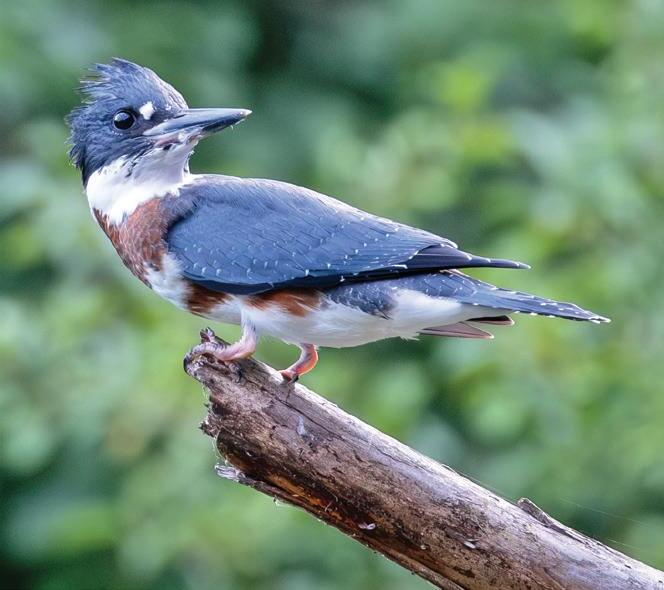
Kingfisher
Read about owls in Horizons magazine
family Alcedinidae
Forest preserve hotspots
• Captain Daniel Wright Woods (Mettawa)
• Des Plaines River Trail
• Middlefork Savanna (Lake Forest)
• Ryerson Conservation Area (Riverwoods)
Belted kingfisher Megaceryle alcyon






Hfeathers Frisket Of and


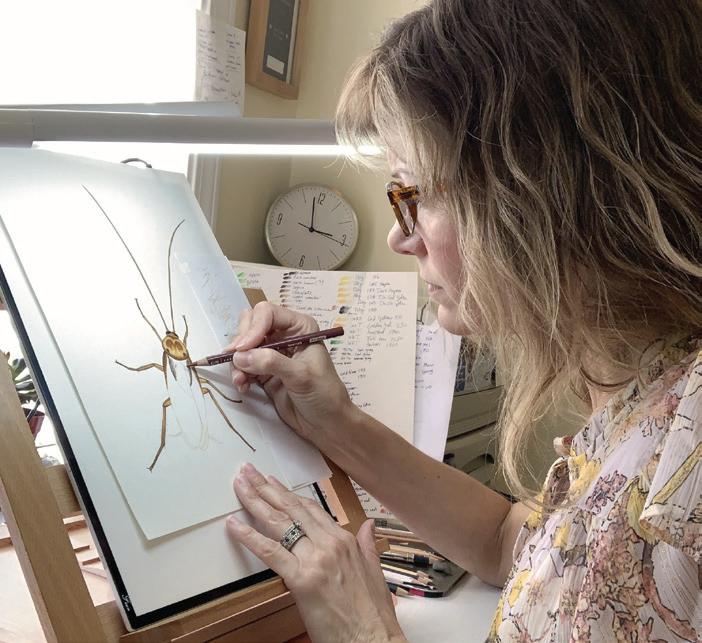
ere’s something you may find hard to believe. The illustrations in this guide are some of the first birds that Samantha Gallagher has ever drawn.
Based in Lake County, the freelance scientific illustrator usually focuses on insects and plants.
In 2024, the Forest Preserves approached Gallagher with a need and a vision: 20 beautiful, scientifically accurate bird illustrations for this brand-new Birdwatching Guide.
Gallagher said yes, seeing a chance to experiment with pastel pencils.
“They’re a blend between painting and pencils. That medium seemed like it would be great for drawing birds.”
She was also ready to move beyond the staged poses typically seen in insect illustrations—think of a top-down view of a butterfly with its wings spread flat at a 90-degree angle.
“You’d almost never see that in the wild,” Gallagher said.

feathers
For the bird illustrations, she wanted to depict lifelike poses and scenes.
Two blue jays watching over a clutch of eggs nestled among oak leaves.
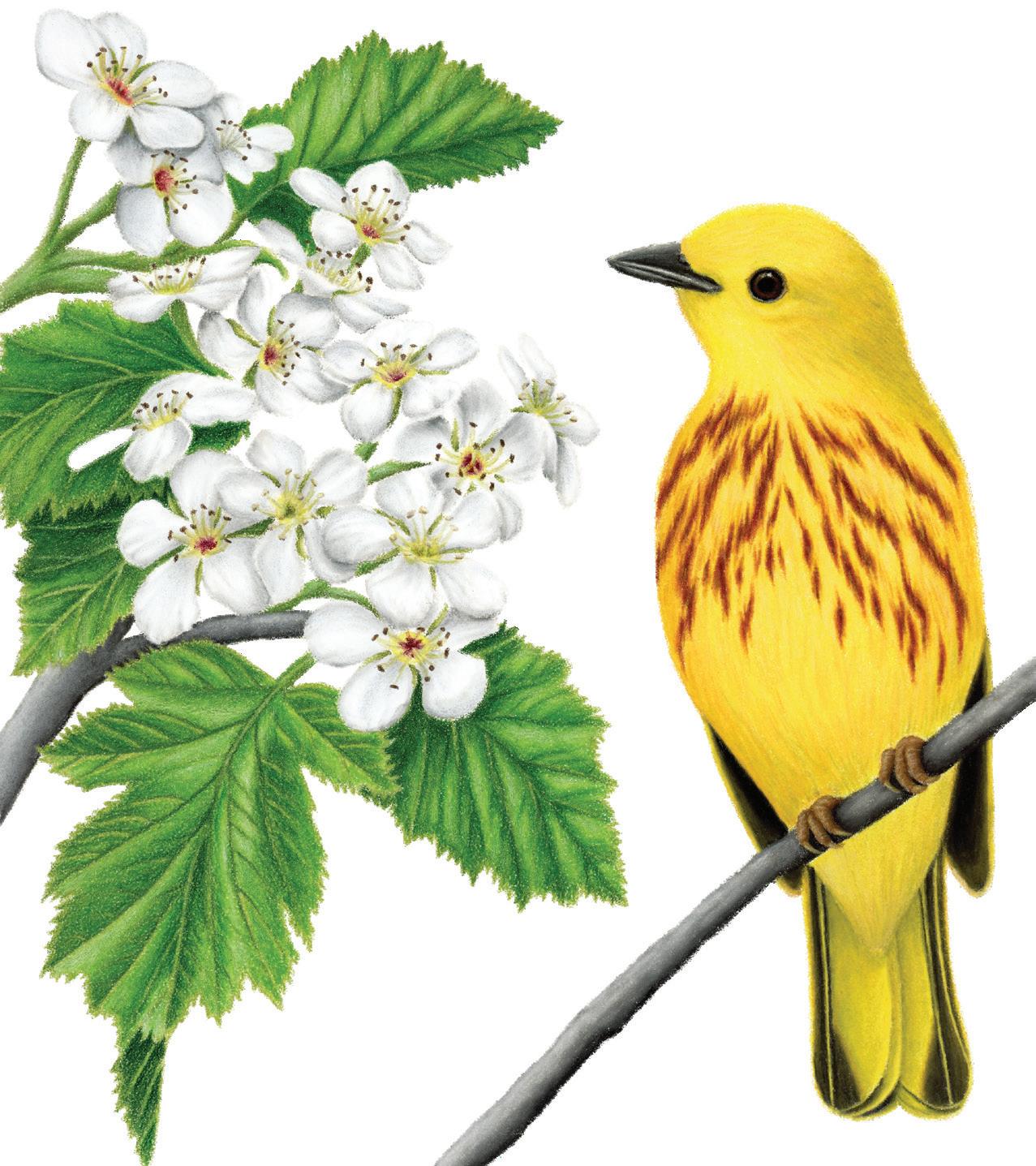
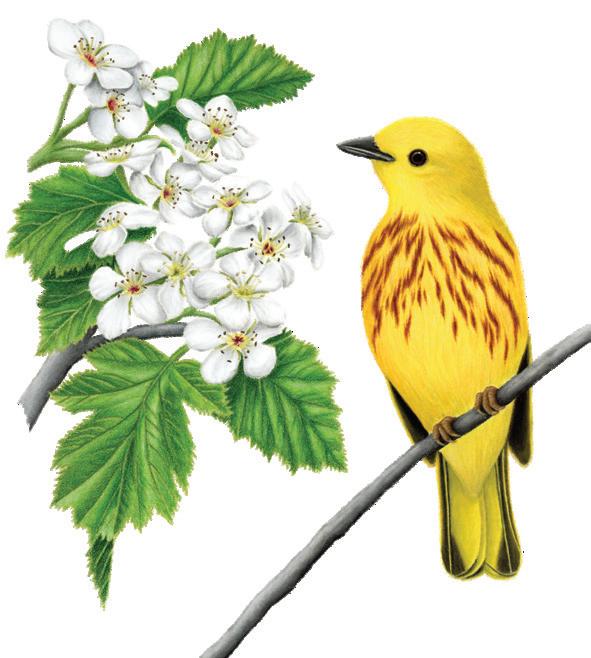
A yellow warbler eyeing some downy hawthorn flowers as if hunting for insects to eat. A pair of purple martins perching at the entrance to their human-made house.
To achieve this authenticity, Gallagher consulted various sources.
Her first stop: visiting our environmental educators at Ryerson Conservation Area (Riverwoods).
“I looked at bird specimens in person and held them. I took pictures of different angles and saw how bright the colors are. That gave me a sense of scale,” she said.
YouTube was a reliable resource to understand how birds naturally move. Gallagher watched many videos there, and studied photos in public databases such as iNaturalist and eBird.
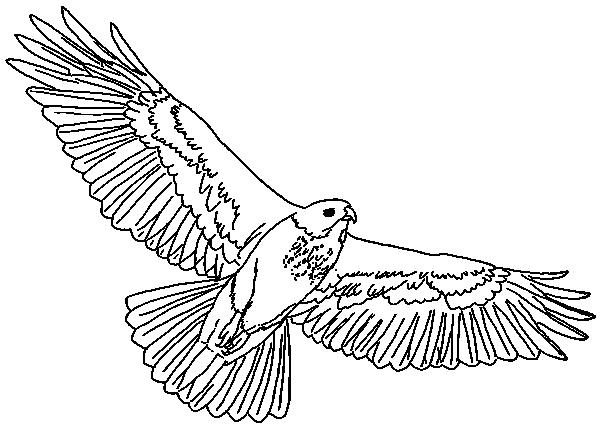
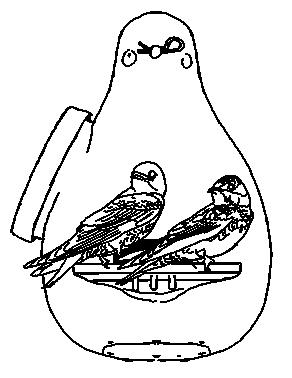
Local artist Samantha Gallagher drew the 20 beautiful bird illustrations in this guide.
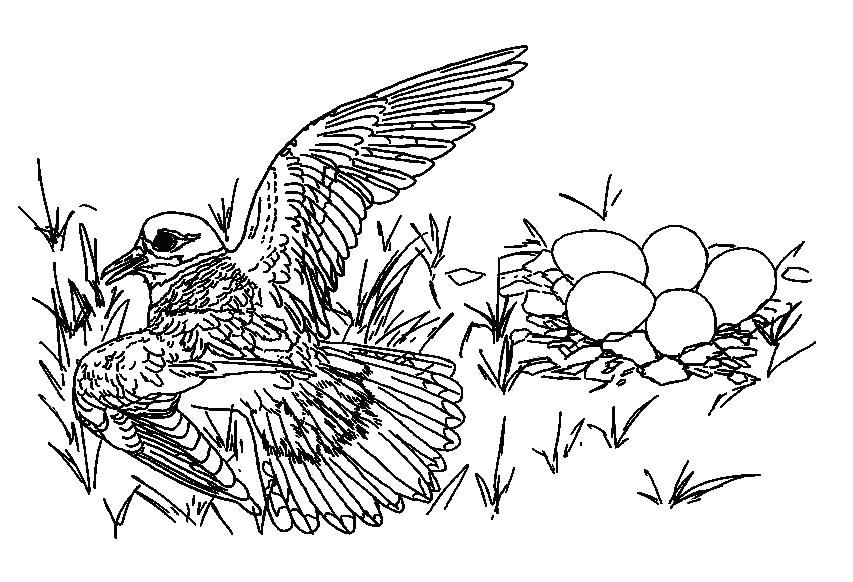
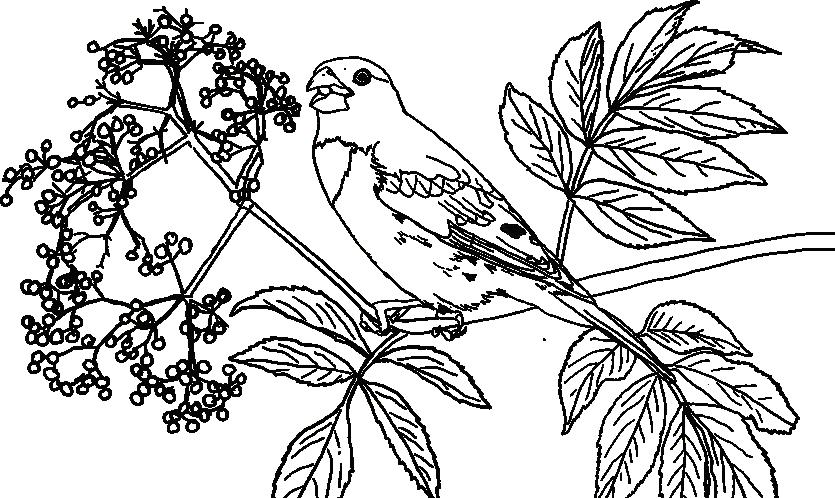
Line sketches like the ones on these pages informed each illustration’s composition.

Soon, it was time to draw. Each species demanded a careful strategy to avoid smudging the art.
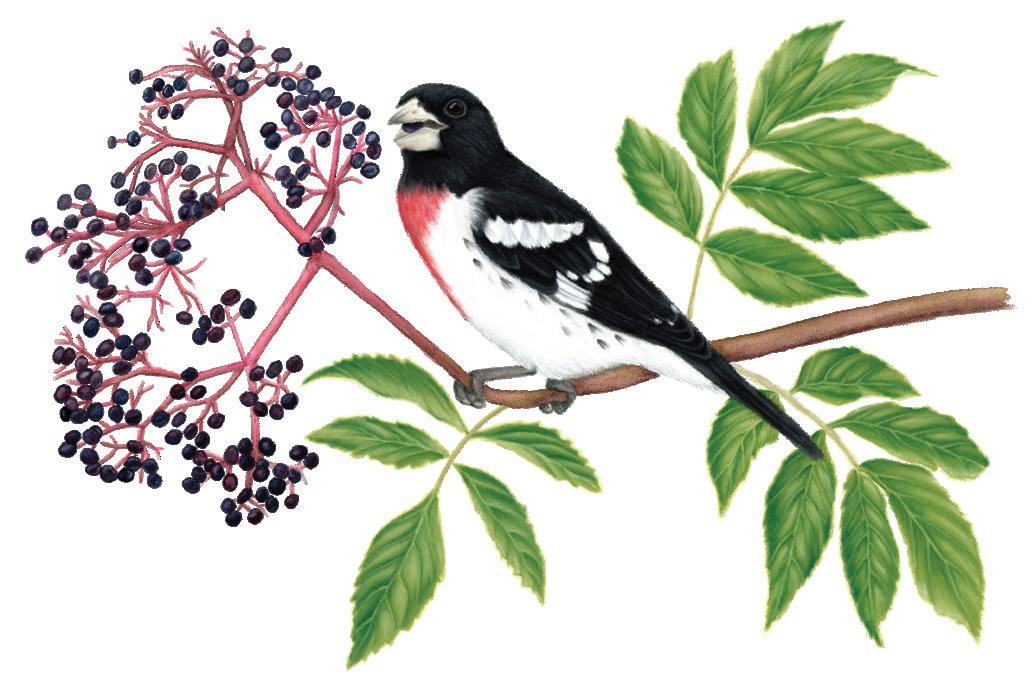
For example, the rose-breasted grosbeak drawing—showing the bird perched with an elderberry in its beak— required frisket
Frisket is a stenciling material artists use to protect finished parts of a piece.
“It’s like a sticky note in that it doesn’t leave residue. I used watercolor for the berries and branches, then laid frisket on top and drew the bird. It was simple to peel the frisket off at the end.”
Feathers were another fork in the road.
Smaller birds often have closely packed feathers that can be blended into patches of plumage.
However, individual feathers tend to be visible on larger birds. “Wings are not just random feathers,” said Gallagher. “They’re very specific.”




It’s tempting for many artists to endlessly tweak their work. But natural stopping points appeared here.
Pastel pencils pair best with pastel paper, “which is like sandpaper. It wears down the pencils and you can build up layers. Eventually, it gets to a point where the paper physically can’t take more pastel.”
Representing several bird families, the illustrations brought Gallagher closer to Lake County’s wildlife.
“Drawing these birds gave me more awareness. ‘Oh, I didn’t know we had that here. I’ve never seen one of those.’

“It made me feel more connected to the sense of place and how unique Lake County really is.”
She hopes readers of the guide will feel inspired to look for birds—and support them. “If I see a bird on an elderberry shrub, maybe I can plant elderberries and see it at home, too.”

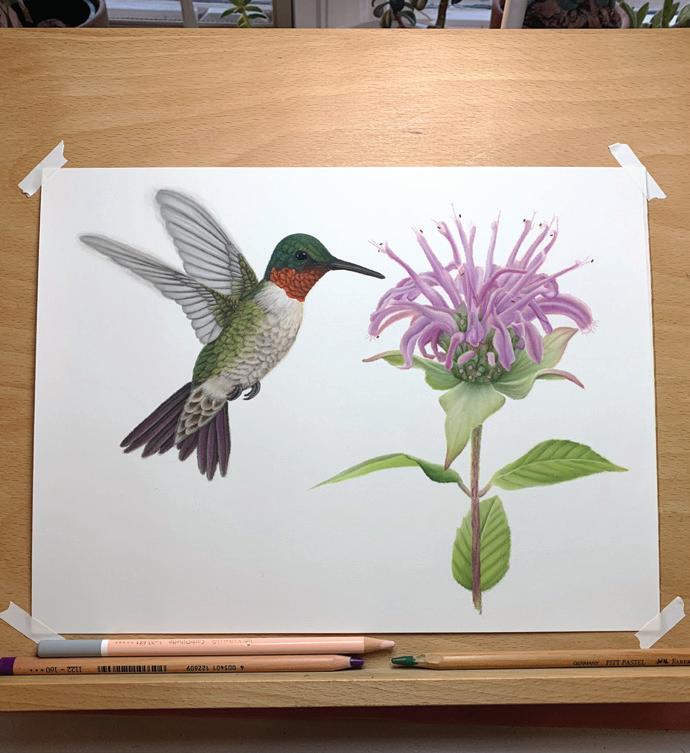
This hummingbird illustration is so vibrant, it almost seems ready to fly off the page.
Gallagher spent 8–20 hours perfecting each piece using many artistic tools.
Woodpeckers family Picidae
Forest preserve hotspots
• Fort Sheridan (Lake Forest)
• Middlefork Savanna (Lake Forest)
• Rollins Savanna (Grayslake)
• Ryerson Conservation Area (Riverwoods)
Downy woodpecker
Dryobates pubescens
Hairy woodpecker
Dryobates villosus
Northern flicker
Colaptes auratus
Pileated woodpecker
Dryocopus pileatus
Red-bellied woodpecker
Melanerpes carolinus
Red-headed woodpecker
Melanerpes erythrocephalus
Yellow-bellied sapsucker
Sphyrapicus varius
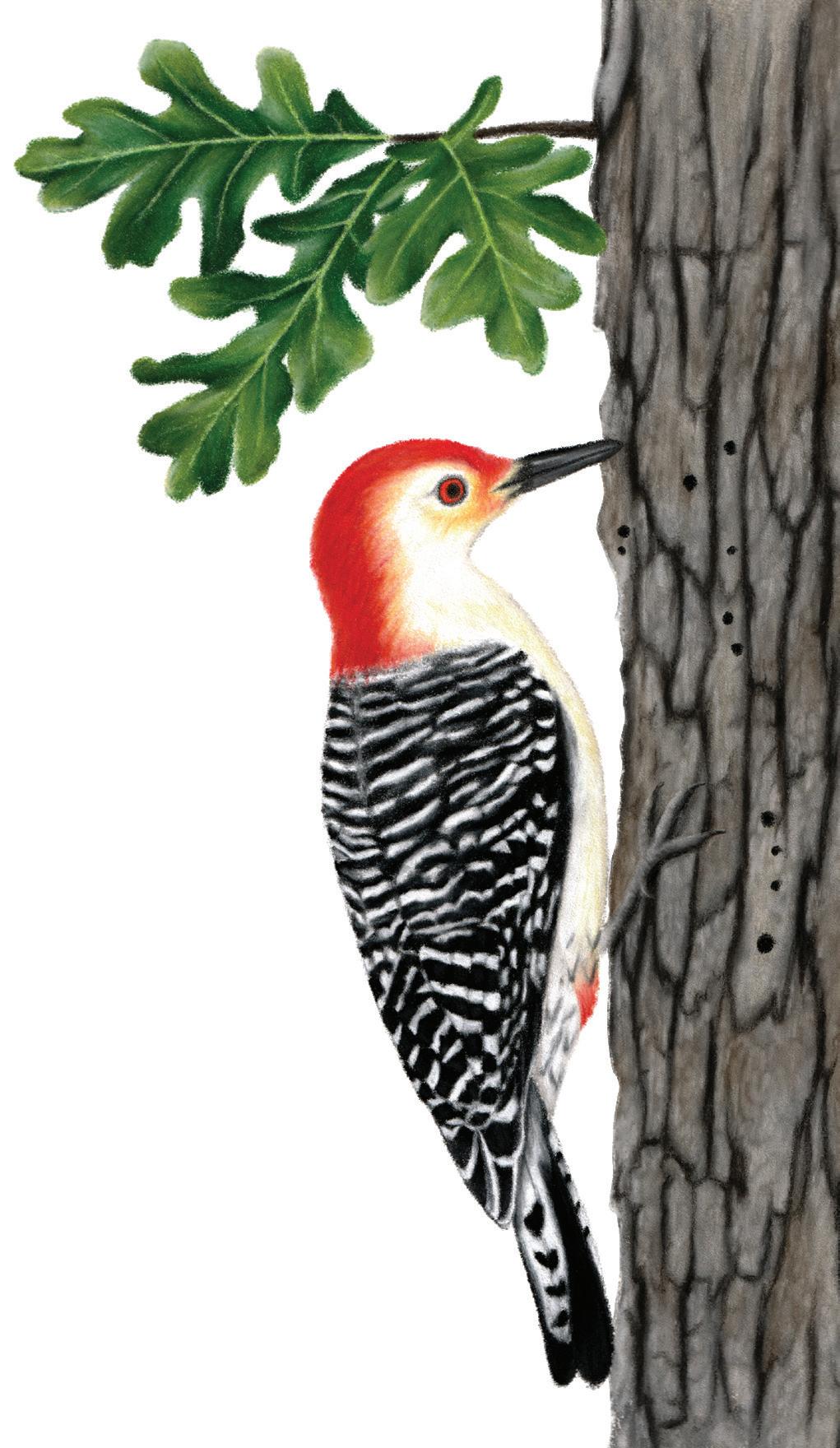
Species Showcase
Red-bellied woodpecker
This medium-sized woodpecker isn’t very well-named. The red patch on the bottom of the belly is quite faint.
More noticeable are the black-andwhite bars on the back and wings, and the red-capped head. Females have a red nape on the back of their neck. Males have a continuous red nape and crown.
Red-bellied woodpeckers communicate loud and often. Their rolling, raspy churrrr call is reminiscent of someone talking with a hoarse voice after a concert.
Drumming their pointed bills on trees, utility poles or even metal gutters is another communication method. Males can drum up to 19 times per second.
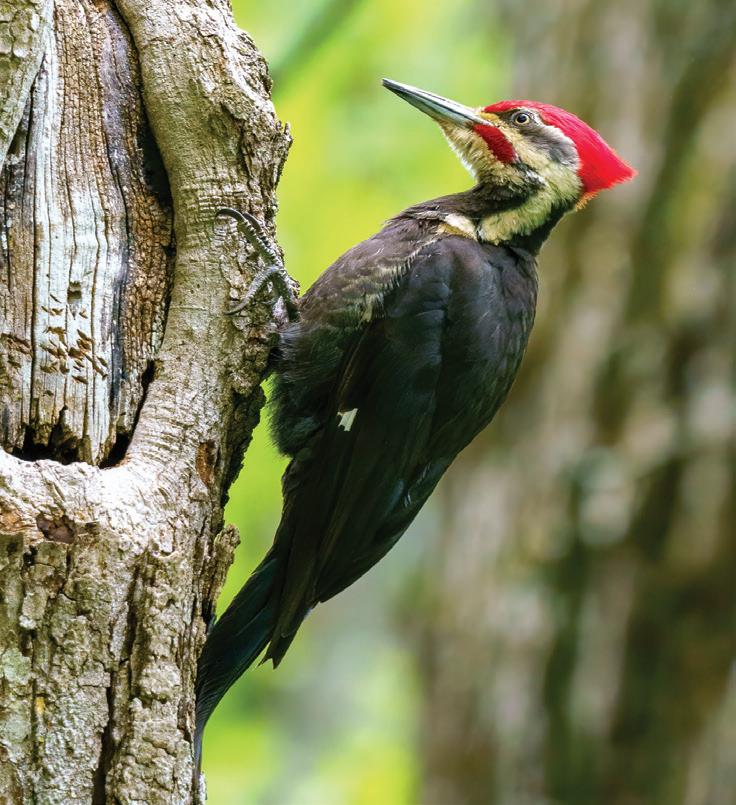
Pileated woodpecker
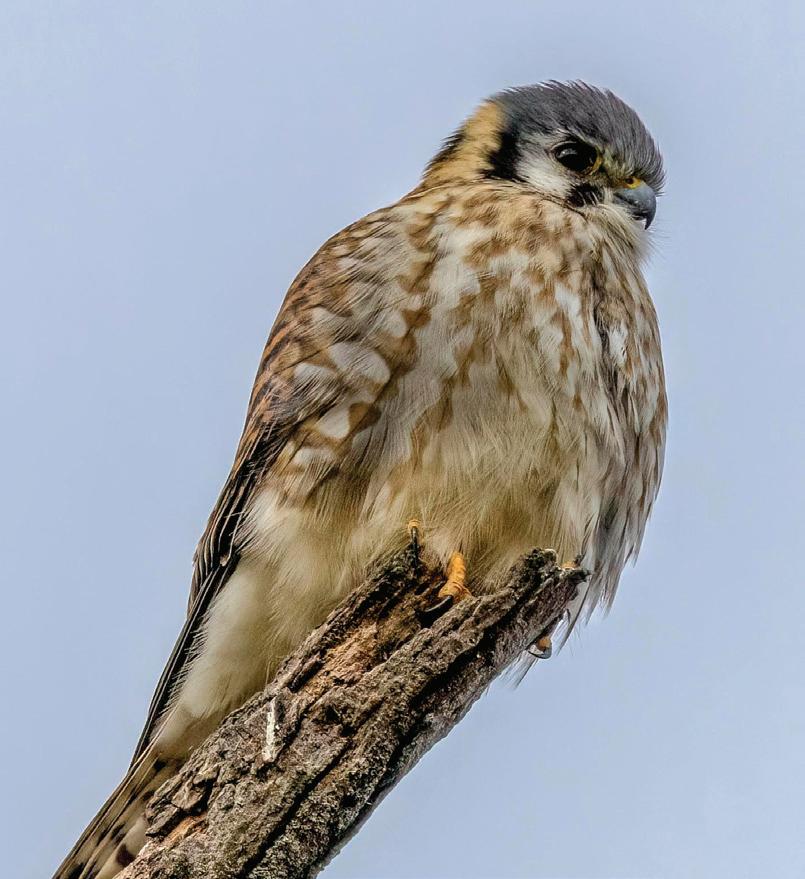
American kestrel
Flycatchers family Tyrannidae
Forest preserve hotspots
• Captain Daniel Wright Woods (Mettawa)
• Lyons Woods (Waukegan)
• Prairie Wolf (Lake Bluff)
• Ryerson Conservation Area (Riverwoods)
• Van Patten Woods (Wadsworth)
Acadian flycatcher
Empidonax virescens
Alder flycatcher
Empidonax alnorum
Eastern kingbird Tyrannus tyrannus
Eastern phoebe Sayornis phoebe
Eastern wood-pewee Contopus virens
Great crested flycatcher Myiarchus crinitus
• Van Patten Woods (Wadsworth) Forest preserve hotspots
• Fort Sheridan (Lake Forest)
• Lyons Woods (Waukegan)
American kestrel Falco sparverius
Merlin Falco columbarius
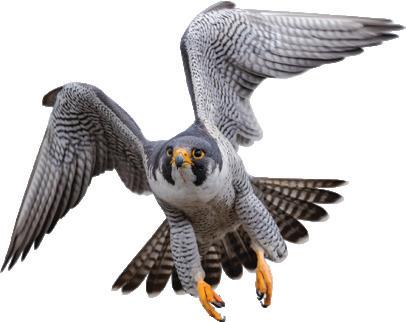
Peregrine falcon Falco peregrinus
Peregrine falcon
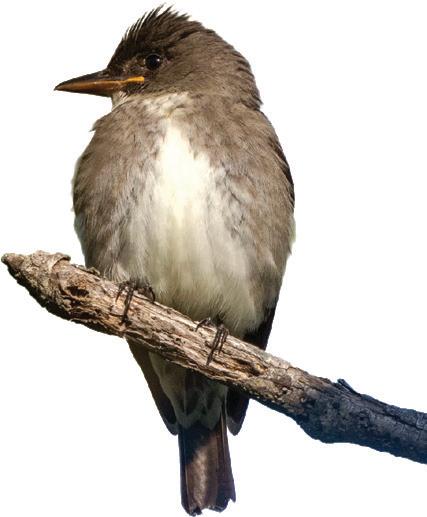
Olive-sided flycatcher
Least flycatcher
Empidonax minimus
Olive-sided flycatcher Contopus cooperi
Scissor-tailed flycatcher Tyrannus forficatus
Willow flycatcher
Empidonax traillii
Yellow-bellied flycatcher
Empidonax flaviventris
Shrikes
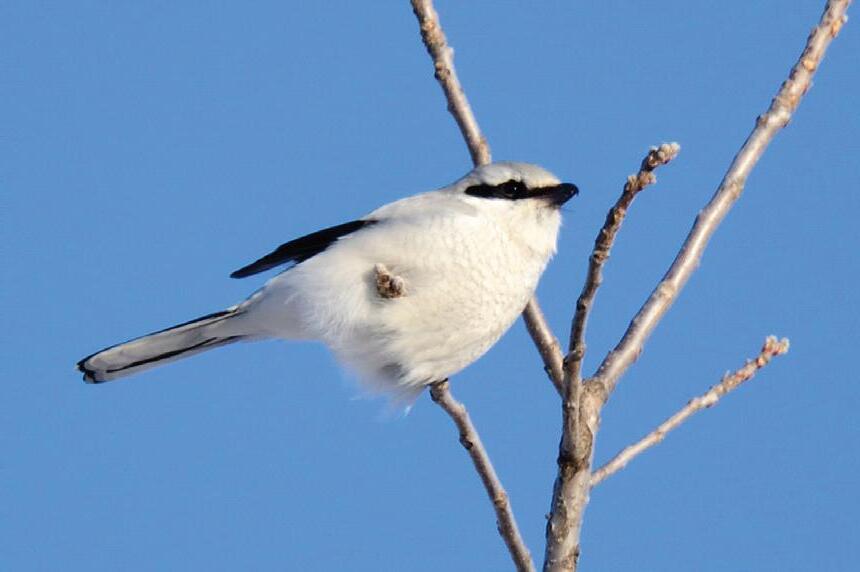
Northern shrike
family Laniidae
Vireos family Vireonidae
Forest preserve hotspots
• Captain Daniel Wright Woods (Mettawa)
• Des Plaines River Trail
• Grant Woods (Ingleside)
• Lakewood (Wauconda)
• Ryerson Conservation Area (Riverwoods)
Bell’s vireo Vireo bellii
Blue-headed vireo Vireo solitarius
Philadelphia vireo Vireo philadelphicus
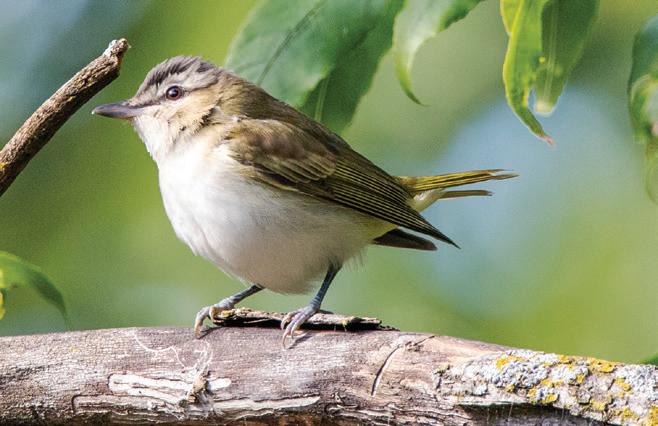
Red-eyed vireo Vireo olivaceus
Forest preserve hotspots
• Buffalo Creek (Long Grove)
• Cuba Marsh (Deer Park)
• Independence Grove (Libertyville)
Loggerhead shrike Lanius ludovicianus
Northern shrike Lanius borealis
Red-eyed vireo
Warbling vireo Vireo gilvus
White-eyed vireo Vireo griseus
Yellow-throated vireo Vireo flavifrons
Jays & Crows family Corvidae
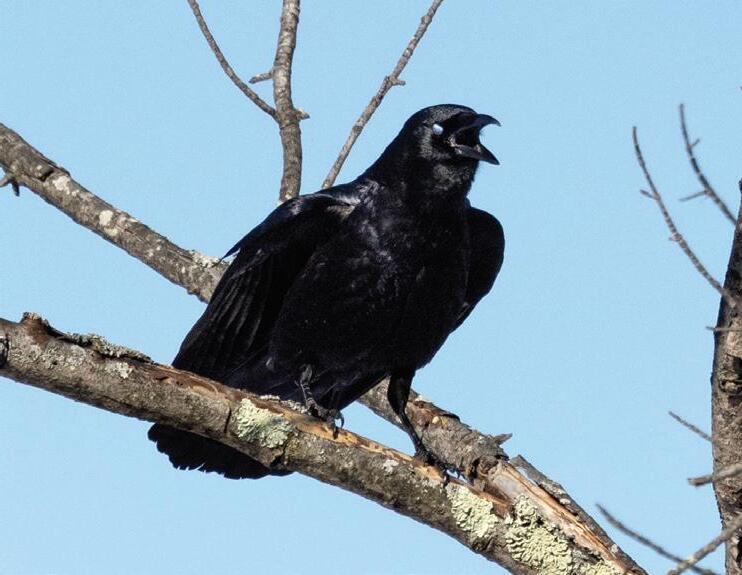
American crow
• Captain Daniel Wright Woods (Mettawa)
• Hastings Lake (Lake Villa)
• Ryerson Conservation Area (Riverwoods) Forest preserve hotspots
American crow Corvus brachyrhynchos
Blue jay Cyanocitta cristata
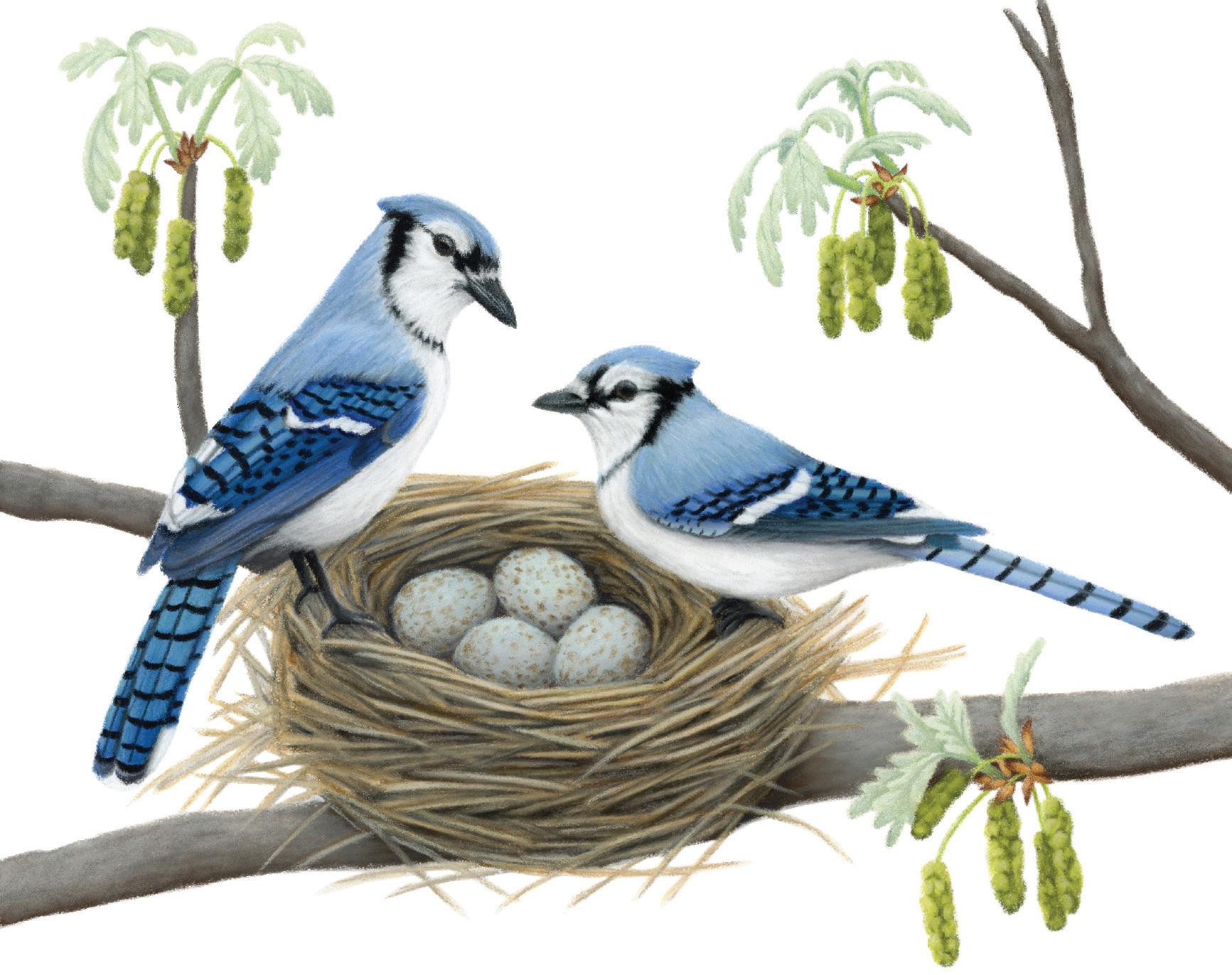
Species Showcase • Blue jay
Handsome, spunky and common in the eastern U.S., blue jays are familiar visitors to suburban backyards and birdfeeders. Their swoopy blue head crest, necklace of black feathers and cascades of blue-white wing bars are easy to admire. Mating pairs assemble loose nests of sticks and grasses in the forked branches of trees, incubating 4–6 green eggs speckled with brown spots.
Blue jays are acorn aficionados. Skilled at burying healthy acorns, the species is thought to have helped spread oak trees in Chicagoland after glaciers retreated from the area 10,000–12,000 years ago.
Lark family Alaudidae
Forest preserve hotspots
• Fort Sheridan (Lake Forest)
• Spring Bluff (Winthrop Harbor)
Horned lark
Eremophila alpestris

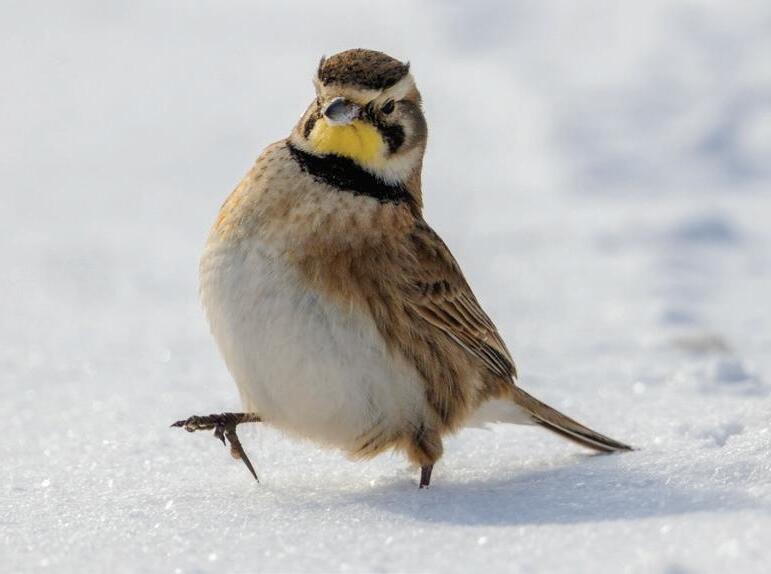
Horned lark
Swallows
family Hirundinidae
Forest preserve hotspots
• Independence Grove (Libertyville)
• Middlefork Savanna (Lake Forest)
• Old School (Mettawa)
• Pine Dunes (Antioch)
• Spring Bluff (Winthrop Harbor)
Bank swallow
Riparia riparia
Barn swallow
Hirundo rustica
Cliff swallow
Petrochelidon pyrrhonota
Northern rough-winged swallow
Stelgidopteryx serripennis
Purple martin
Progne subis
Tree swallow
Tachycineta bicolor
Species Showcase • Purple martin
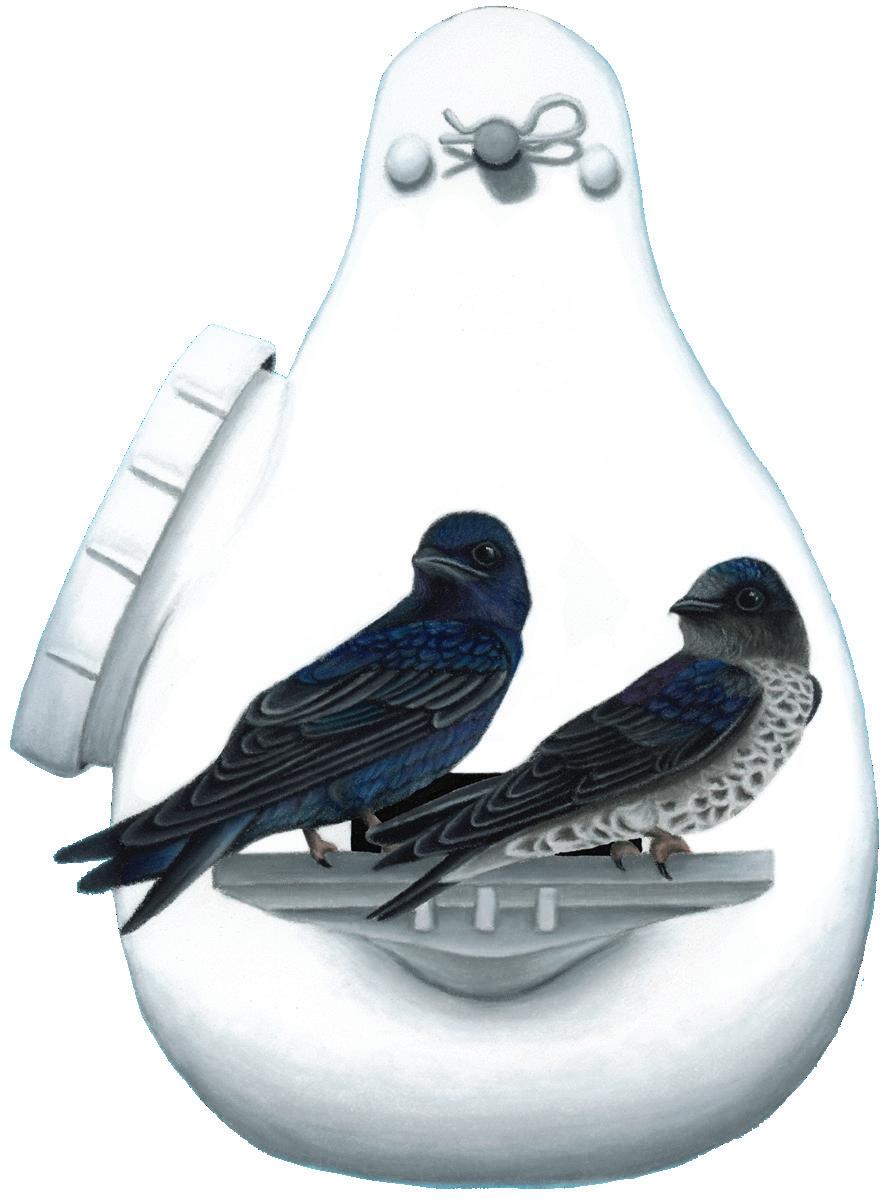
Purple martins are the largest member of the swallow family, famous for their aerial acrobatics, swooping and swirling to nab flying insects.
Traveling up to 600 miles a day during migration, purple martins arrive in Lake County in early April after spending the winter in South America. Most nest near cities and towns in human-made purple martin houses throughout the eastern U.S. and southeastern Canada. Such houses are installed at Independence Grove (Libertyville), Lakewood (Wauconda) and Old School (Mettawa) forest preserves.
Chickadees & Titmice family Paridae
Forest preserve hotspots
• Independence Grove (Libertyville)
• Lakewood (Wauconda)
• Ryerson Conservation Area (Riverwoods)
Black-capped chickadee
Poecile atricapillus
Tufted titmouse
Baeolophus bicolor
Tufted titmouse
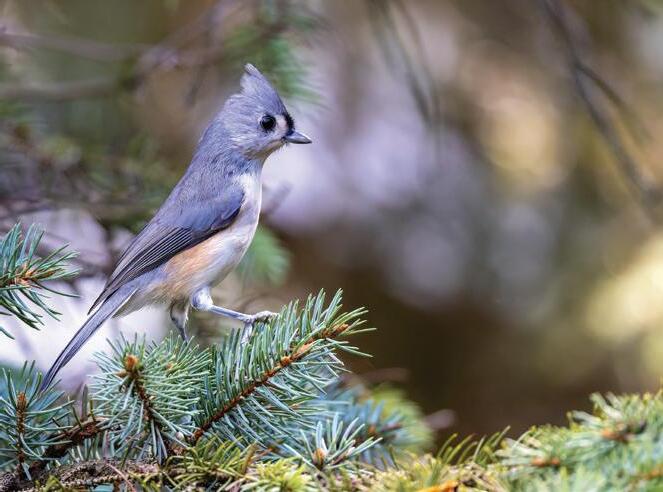
Small Woodland
Nuthatches family Sittidae
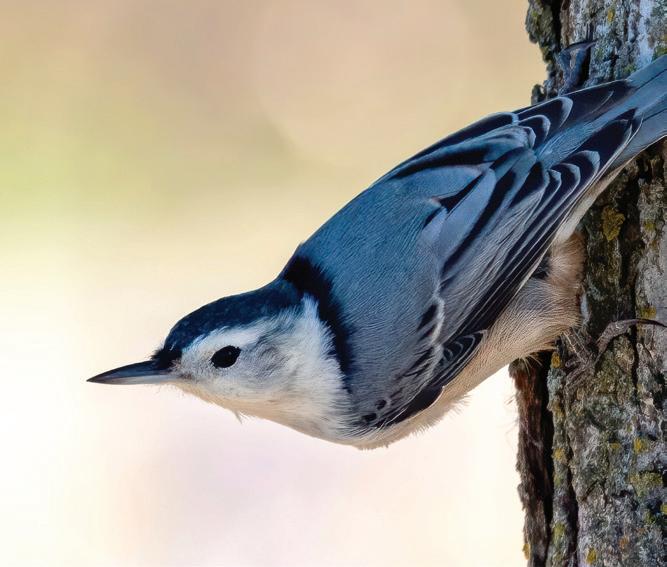
White-breasted nuthatch
Forest preserve hotspots
• Captain Daniel Wright Woods (Mettawa)
• McDonald Woods (Lindenhurst)
• Ryerson Conservation Area (Riverwoods)
Red-breasted nuthatch
Sitta canadensis
White-breasted nuthatch
Sitta carolinensis
Creeper
family Certhiidae
Forest preserve hotspots
• Captain Daniel Wright Woods (Mettawa)
• Lyons Woods (Waukegan)
• McDonald Woods (Lindenhurst)
• Ryerson Conservation Area (Riverwoods)
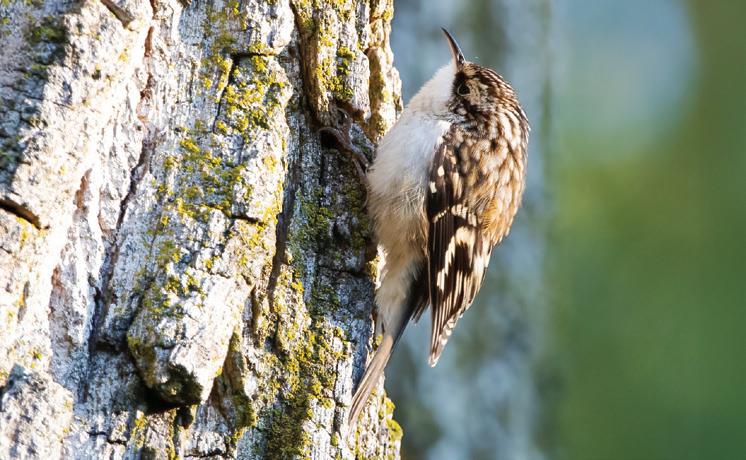
Brown creeper Certhia americana
Wrens family Troglodytidae
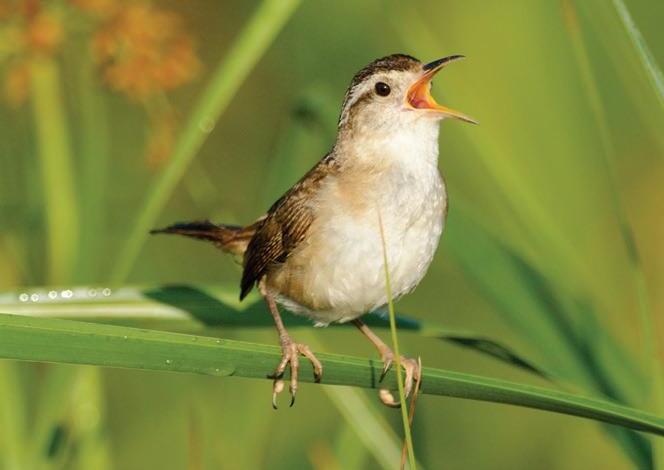
Marsh wren
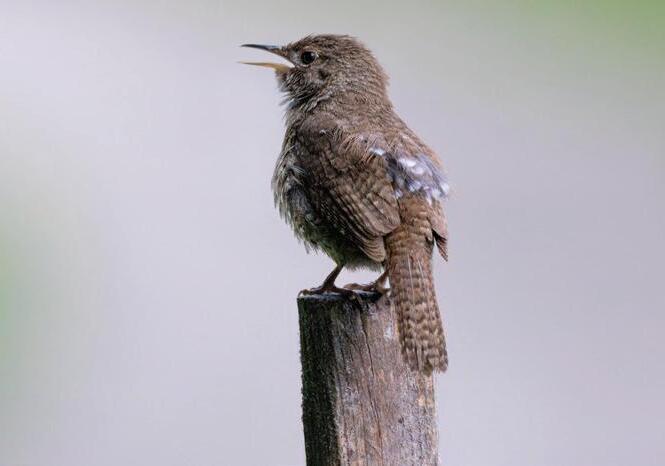
Northern house wren
Brown creeper
Forest preserve hotspots
• Captain Daniel Wright Woods (Mettawa)
• Des Plaines River Trail
• Grant Woods (Ingleside)
• Ryerson Conservation Area (Riverwoods)
Carolina wren
Thryothorus ludovicianus
Marsh wren
Cistothorus palustris
Northern house wren
Troglodytes aedon
Sedge wren
Cistothorus stellaris
Winter wren
Troglodytes hiemalis
Kinglets & Gnatcatchers
Forest preserve hotspots
• Captain Daniel Wright Woods (Mettawa)
• Des Plaines River Trail
• Grant Woods (Ingleside)
• Ryerson Conservation Area (Riverwoods)
Blue-gray gnatcatcher
Polioptila caerulea
Golden-crowned kinglet
Regulus satrapa
Ruby-crowned kinglet
Corthylio calendula
Bluebirds & Thrushes
family Turdidae
Forest preserve hotspots
• Buffalo Creek (Long Grove)
• Grassy Lake (Lake Barrington)
• Independence Grove (Libertyville)
• Old School (Mettawa)
• Ryerson Conservation Area (Riverwoods)
American robin
Turdus migratorius
Eastern bluebird
Sialis sialis
Gray-cheeked thrush
Catharus minimus
Hermit thrush Catharus guttatus
Swainson’s thrush Catharus ustulatus
Veery Catharus fuscescens
Wood thrush
Hylocichla mustelina
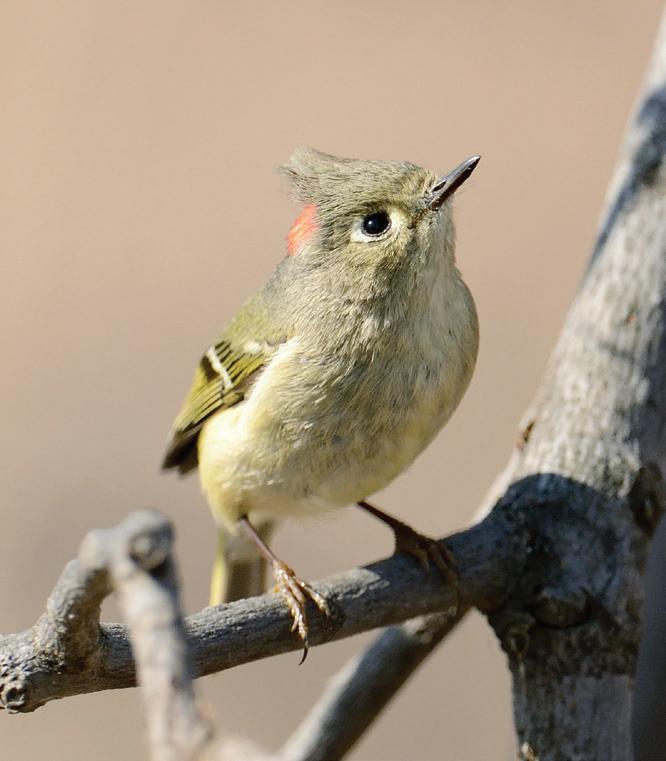
family REGULIDAE
Ruby-crowned kinglet
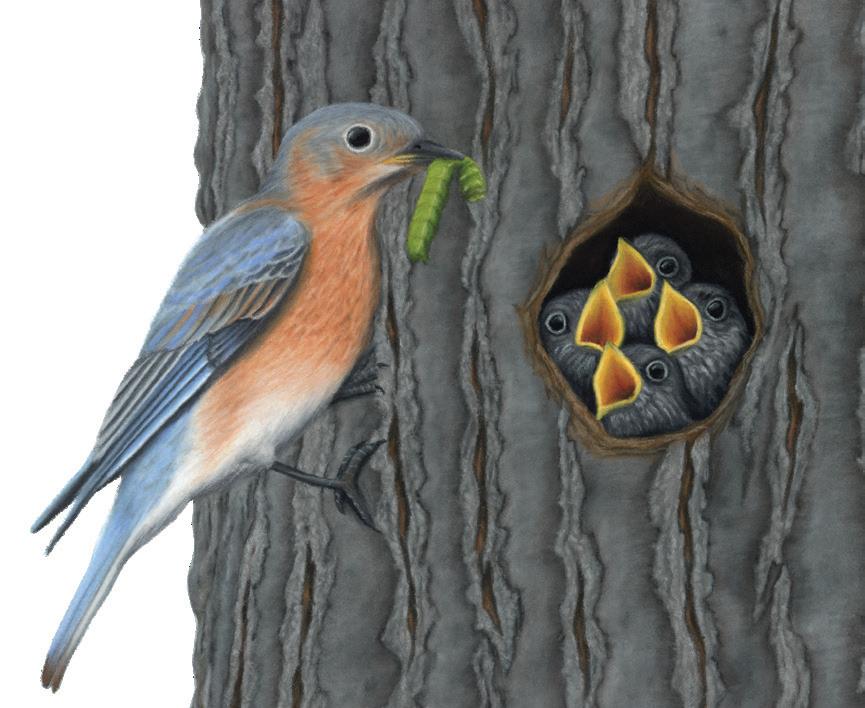
Species Showcase • Eastern bluebird
The male bluebird’s vibrant feathers are like one of nature’s exclamation points—“spring is here!”
These migratory beauties spend winters in the southern U.S. and Mexico. In mild winters, they may stick around in the north if food is plentiful.
Bluebirds feast on berries, seeds and insects in open woodlands, meadows, orchards and farmland edges. Watch as they hover to catch insects or “ground-sally”—darting from a perch, landing to grab a snack on the ground, returning to their perch.
Catbirds, Mockingbirds & Thrashers
family Mimidae
Forest preserve hotspots
• Grant Woods (Ingleside)
• Grassy Lake (Lake Barrington)
• Half Day (Vernon Hills)
• Prairie Wolf (Lake Bluff)
Brown thrasher Toxostoma rufum
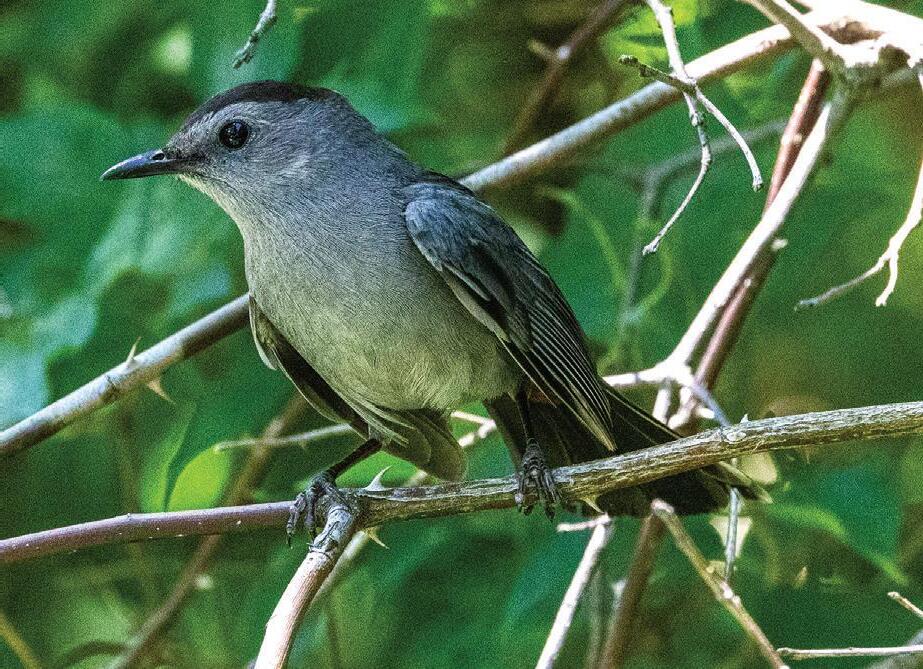
Gray catbird Dumetella carolinensis
Northern mockingbird Mimus polyglottos
Starling family Sturnidae
Non-native species seen countywide
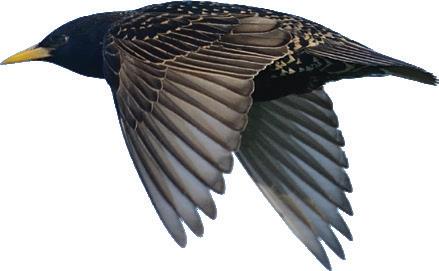
European starling Sturnus vulgaris
Forest preserve hotspots
• Cuba Marsh (Deer Park)
• Lakewood (Wauconda)
• Middlefork Savanna (Lake Forest)
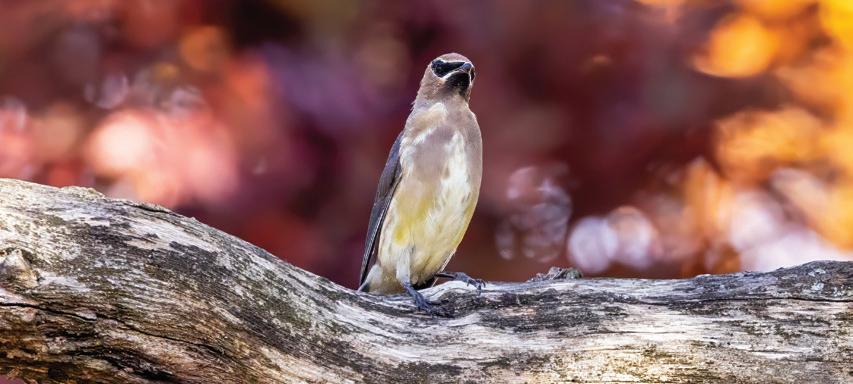
Cedar waxwing Bombycilla cedrorum
Waxwing family Bombycillidae
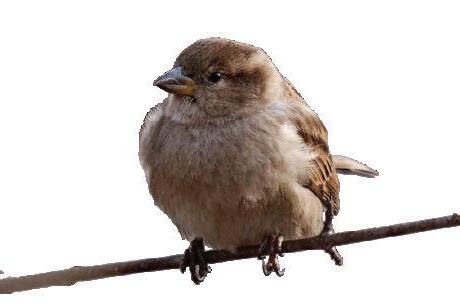
Old World Sparrow family Passeridae
Non-native species seen countywide
House sparrow Passer domesticus
Gray catbird
Cedar waxwing
Grassland | Woodland
Pipit family Motacillidae
Forest preserve hotspots
• Fort Sheridan (Lake Forest)
• Van Patten Woods (Wadsworth)
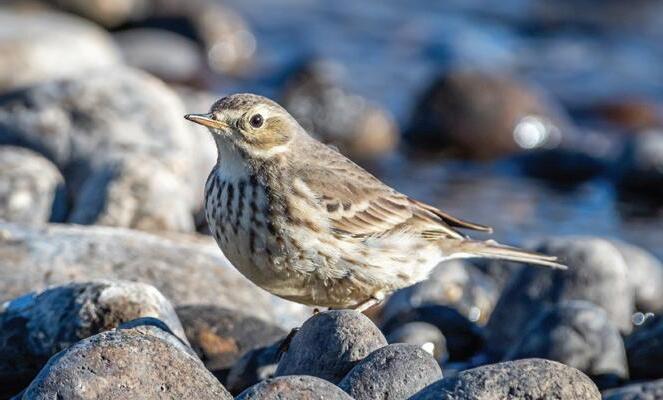
American pipit
Anthus rubescens
Finches family Fringillidae
Forest preserve hotspots
• Fort Sheridan (Lake Forest)
• Lakewood (Wauconda)
• Middlefork Savanna (Lake Forest)
• Ryerson Conservation Area (Riverwoods)
• Van Patten Woods (Wadsworth)
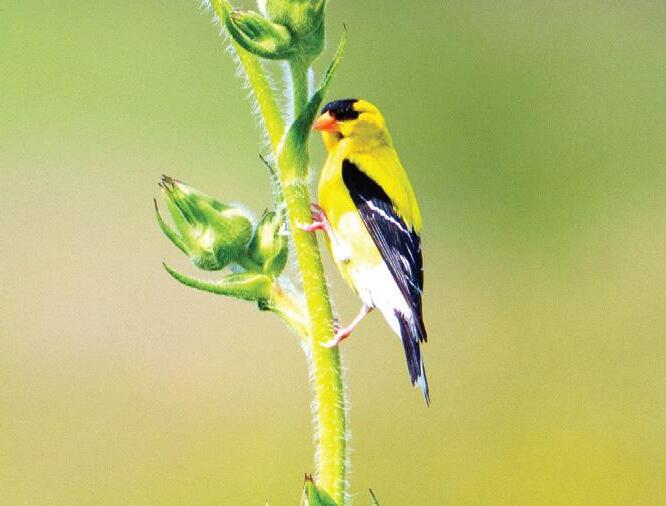
American goldfinch
Spinus tristis
European goldfinch
Carduelis carduelis
Evening grosbeak
Coccothraustes vespertinus
House finch
Haemorhous mexicanus
Pine siskin
Spinus pinus
family Calcariidae
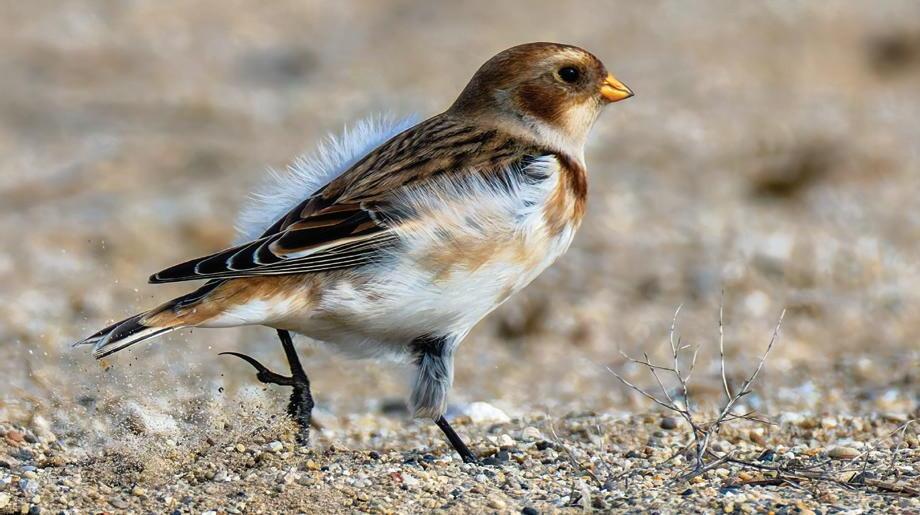
Snow bunting
American goldfinch
Purple finch
Haemorhous purpureus
Red crossbill
Loxia curvirostra
Redpoll
Acanthis flammea
White-winged crossbill
Loxia leucoptera
Longspurs & Old World Buntings
Forest preserve hotspots American pipit
• Fort Sheridan (Lake Forest)
• Spring Bluff (Winthrop Harbor)
Lapland longspur Calcarius lapponicus
Snow bunting Plectrophenax nivalis
New World Sparrows, Juncos & Towhees
family Passerellidae
Forest preserve hotspots
• Fort Sheridan (Lake Forest)
• Middlefork Savanna (Lake Forest)
• Pine Dunes (Antioch)
• Rollins Savanna (Grayslake)
American tree sparrow
Spizelloides arborea
Chipping sparrow
Spizella passerina
Clay-colored sparrow
Spizella pallida
Dark-eyed junco
Junco hyemalis
Eastern towhee
Pipilo erythrophthalmus
Field sparrow
Spizella pusilla
Fox sparrow
Passerella iliaca
Grasshopper sparrow
Ammodramus savannarum
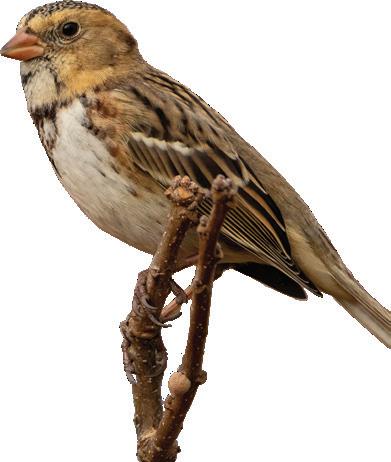
Harris’s sparrow
Zonotrichia querula
Henslow’s sparrow
Centronyx henslowii
Song sparrow
Lark sparrow
Chondestes grammacus
LeConte’s sparrow Ammospiza leconteii
Lincoln’s sparrow
Melospiza lincolnii
Nelson’s sparrow
Ammospiza nelsoni
Savannah sparrow
Passerculus sandwichensis
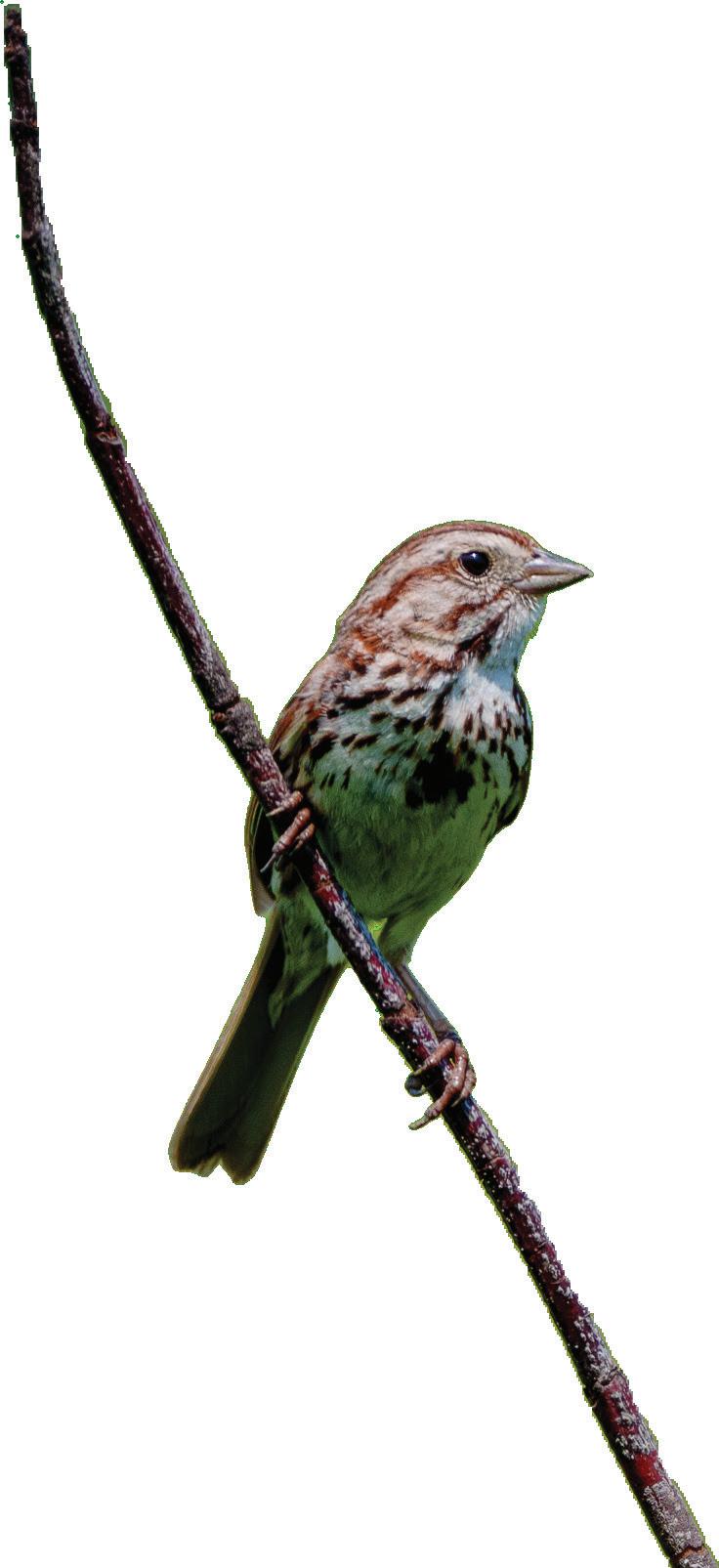
Song sparrow
Melospiza melodia
Swamp sparrow
Melospiza georgiana
Vesper sparrow
Pooecetes gramineus
White-crowned sparrow
Zonotrichia leucophrys
White-throated sparrow
Zonotrichia albicollis
Yellow-breasted Chat family Icteriidae
Forest preserve hotspots
• Hastings Lake (Lake Villa)
• Lakewood (Wauconda)
• Rollins Savanna (Grayslake)
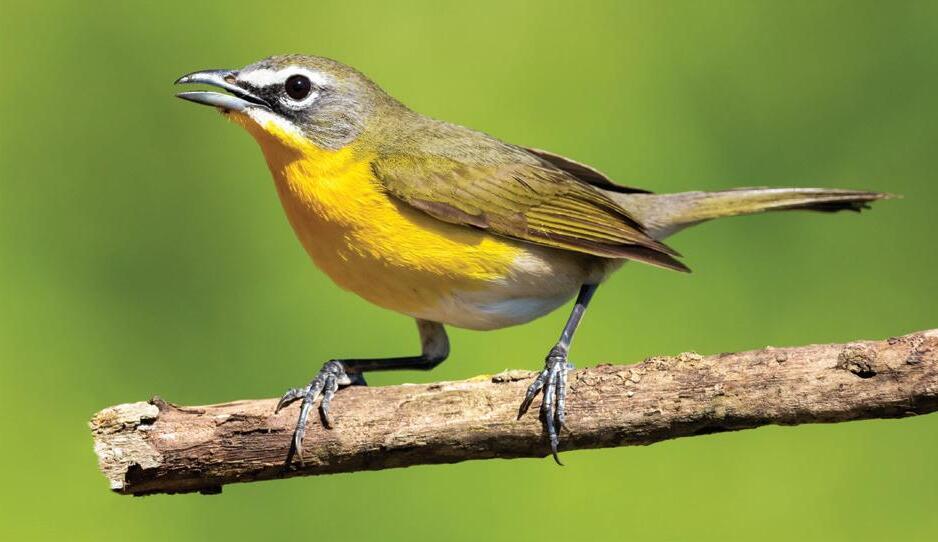
Yellow-breasted chat
Icteria virens
Harris’s sparrow
Blackbirds, Bobolinks, Meadowlarks, Grackles, Cowbirds & Orioles
family Icteridae
Forest preserve hotspots
• Captain Daniel Wright Woods (Mettawa)
• McDonald Woods (Lindenhurst)
• Middlefork Savanna (Lake Forest)
• Pine Dunes (Antioch)
• Rollins Savanna (Grayslake)
Baltimore oriole
Icterus galbula
Bobolink
Dolichonyx oryzivorus
Brewer’s blackbird
Euphagus cyanocephalus
Brown-headed cowbird
Molothrus ater
Common grackle
Quiscalus quiscula
Eastern meadowlark
Sturnella magna
Orchard oriole
Icterus spurius
Red-winged blackbird
Agelaius phoeniceus
Rusty blackbird
Euphagus carolinus
Yellow-headed blackbird
Xanthocephalus xanthocephalus
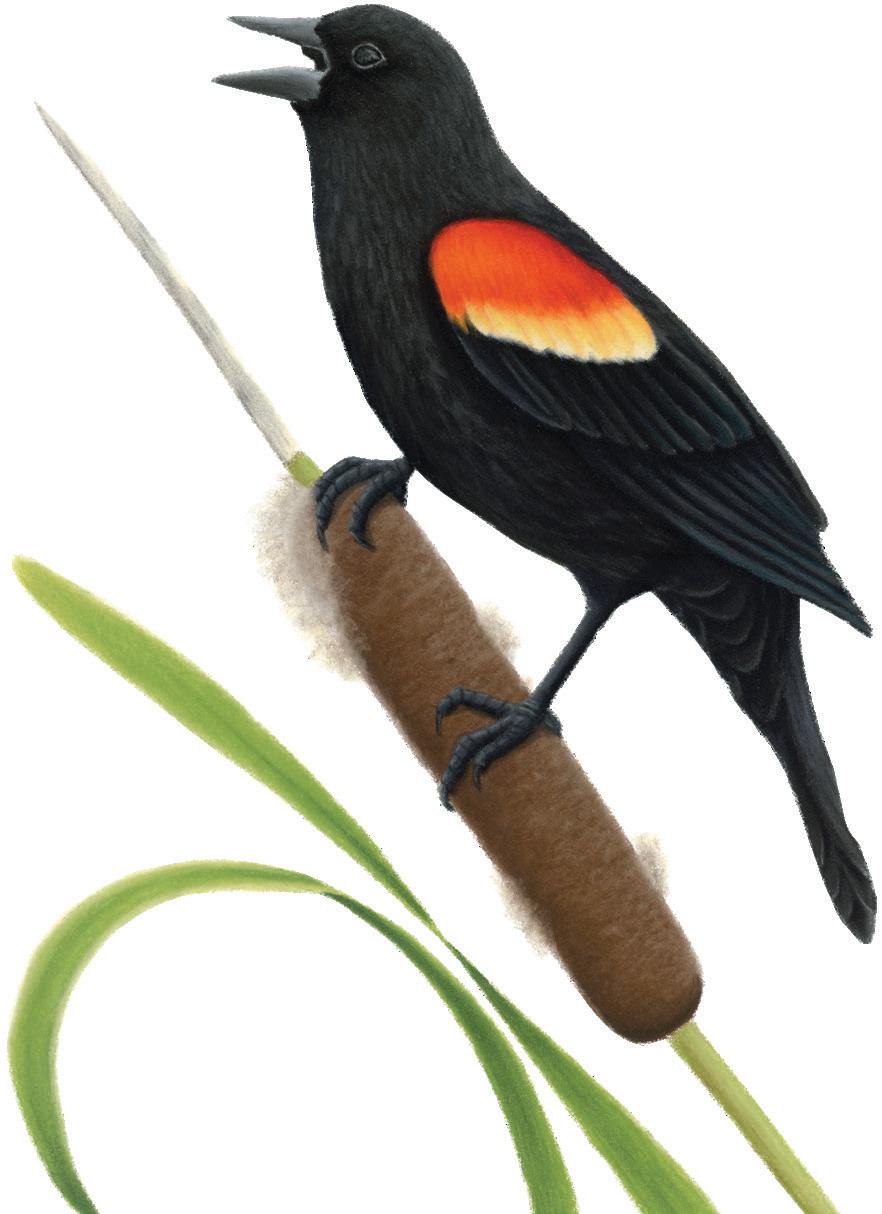
Species Showcase Red-winged blackbird
Conk-la-REE! Look at ME! The return of red-winged blackbirds is one of the ways nature tells us spring is around the corner.
Eastern meadowlark
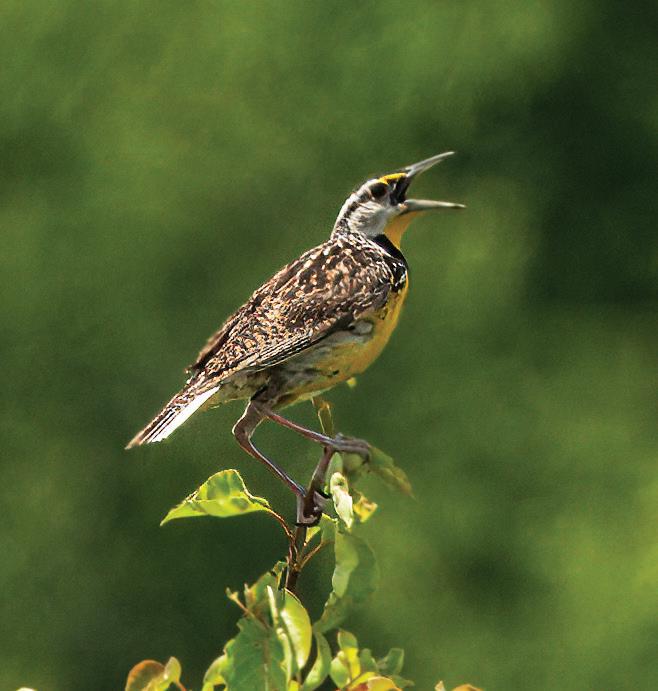
The male’s red shoulder patches and unmistakable song are first seen and heard at the tail end of winter. Males usually return to Lake County’s wetlands in March, a month before females arrive.
They use the time to mark territories with dramatic displays from trees and cattails. Females are more secretive, staying low to the ground and weaving cup-shaped nests for the 2–3 clutches of eggs they’ll lay.
Wood Warblers
Forest preserve hotspots
Species Showcase
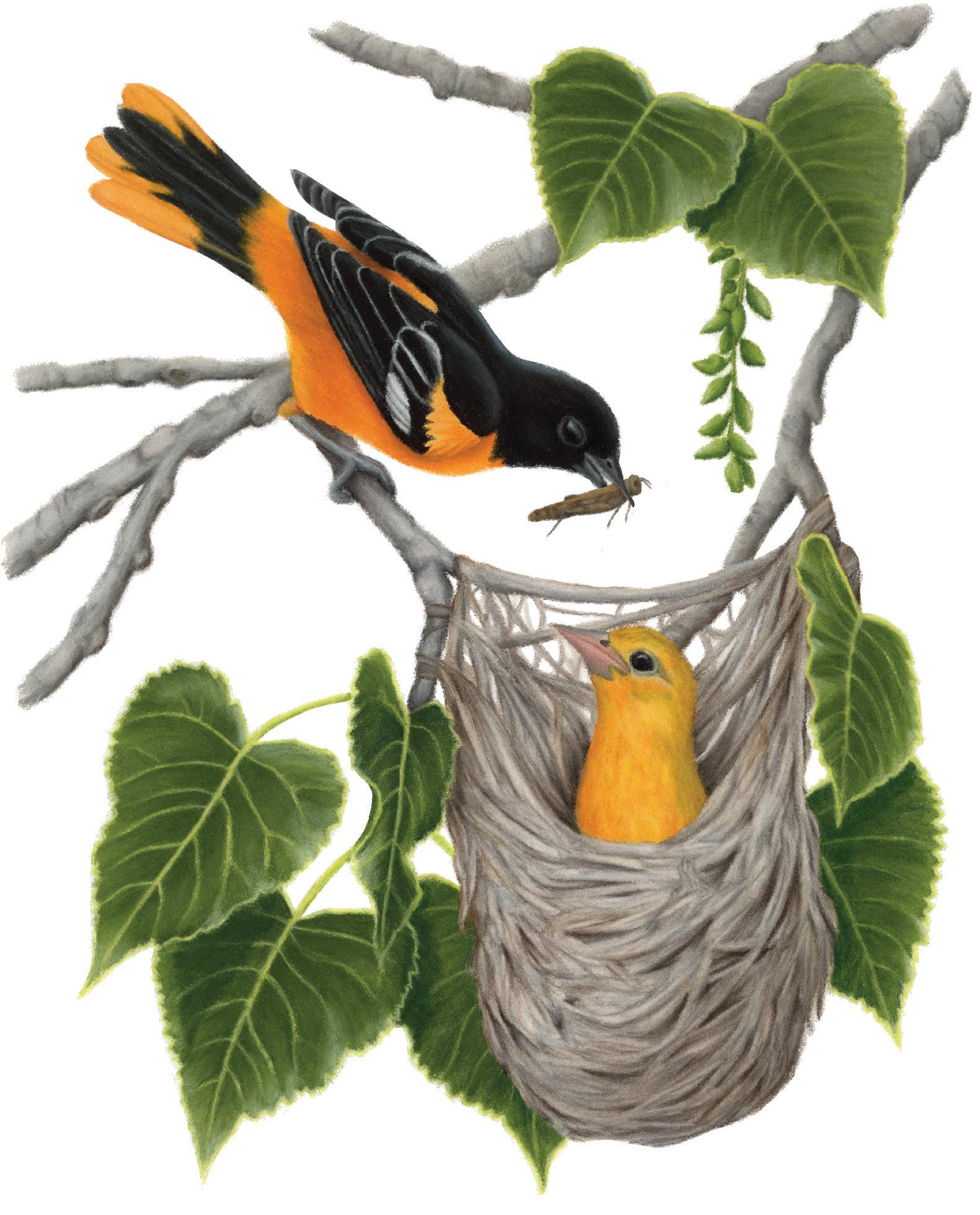
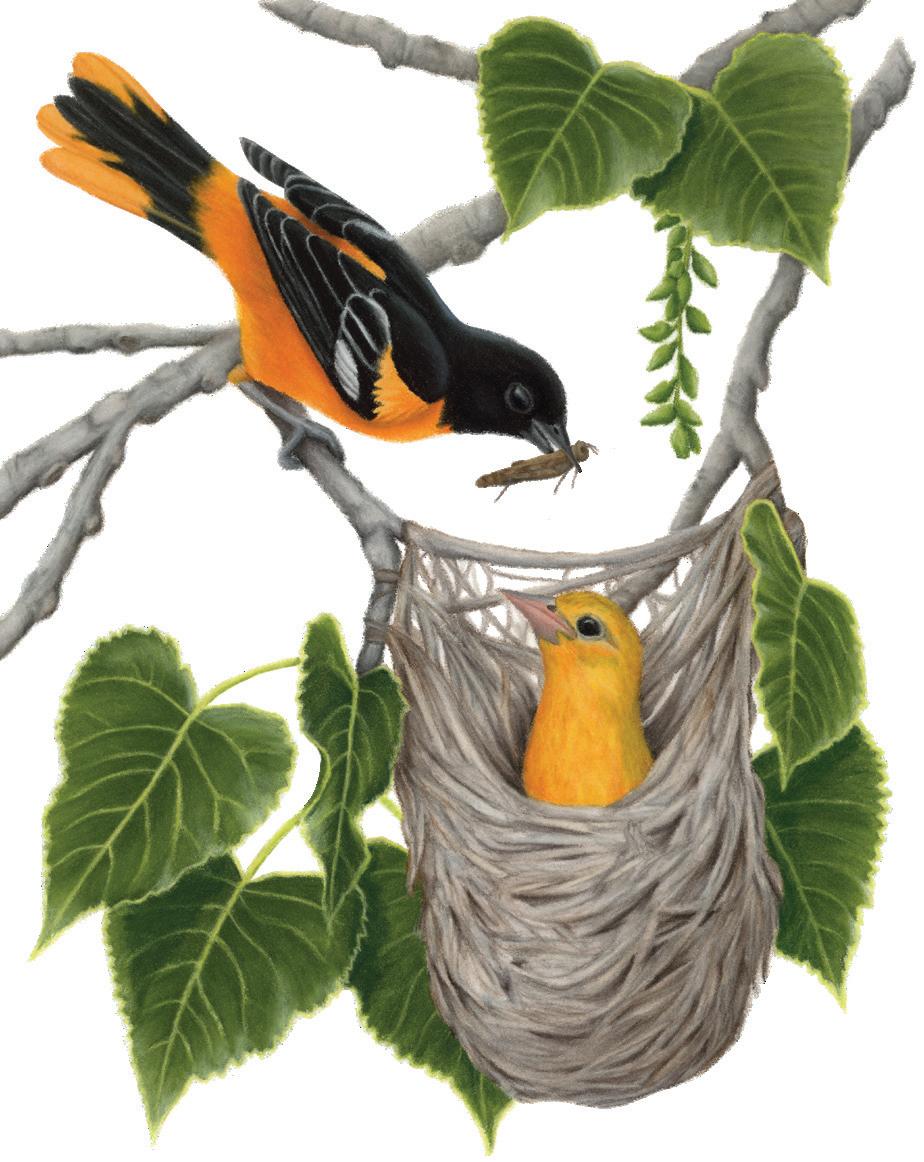
Baltimore oriole
Baltimore orioles visit Lake County from May–September. Males sport an orange chest, belly and rump, black head, and black wings marked with a white bar.
Females are a muted yellow or brown, with two white wing bars.
Using grasses, bark and artificial fibers, orioles weave sock-like nests high up in trees. The nest has a cozy chamber where mating pairs incubate 3–7 eggs per year.
Attract orioles to your home in spring by putting grape jelly at your birdfeeder.
Orioles are also fond of fruits and berries. Cut an orange in half, stick the slices onto tree branches and they should eat it up.
family Parulidae
• Captain Daniel Wright Woods (Mettawa)
• Des Plaines River Trail
• Grant Woods (Ingleside)
• Ryerson Conservation Area (Riverwoods)
American redstart
Setophaga ruticilla
Bay-breasted warbler
Setophaga castanea
Black-and-white warbler
Mniotilta varia
Blackburnian warbler
Setophaga fusca
Blackpoll warbler
Setophaga striata
Black-throated blue warbler
Setophaga caerulescens
Black-throated green warbler
Setophaga virens
Blue-winged warbler
Vermivora cyanoptera
Canada warbler
Cardellina canadensis
Cape May warbler
Setophaga tigrina
Cerulean warbler
Setophaga cerulea
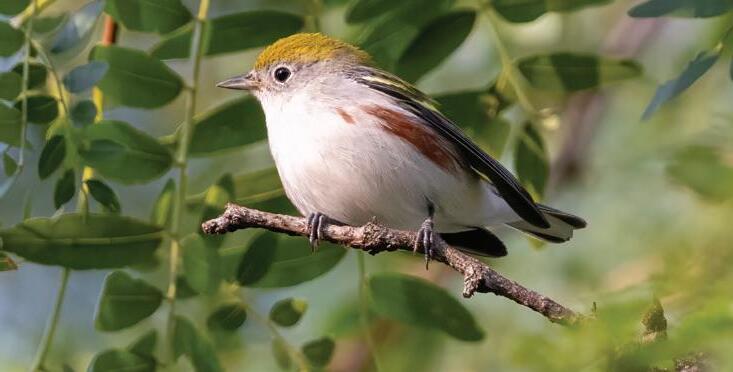
Chestnut-sided warbler
Setophaga pensylvanica
Common yellowthroat
Geothlypis trichas
Connecticut warbler
Oporornis agilis
Golden-winged warbler
Vermivora chrysoptera
Hooded warbler
Setophaga citrina
Continued on next page
Chestnut-sided warbler
Kentucky warbler
Geothlypis formosa
Louisiana waterthrush
Parkesia motacilla
Magnolia warbler
Setophaga magnolia
Mourning warbler
Geothlypis philadelphia
Nashville warbler
Leiothlypis ruficapilla
Northern parula
Setophaga americana
Northern waterthrush
Parkesia noveboracensis
Orange-crowned warbler
Leiothlypis celata
Ovenbird
Seiurus aurocapilla
Palm warbler
Setophaga palmarum
Species Showcase
Yellow warbler
Sweet-sweet-sweet-sweet-I’m-sosweet goes the yellow warbler’s crisp song. True to their name, these peppy birds are almost entirely sunny yellow.
Males have soft chestnut streaks on their chests. Though common throughout Lake County, yellow warblers face pressure from brown-headed cowbirds. Cowbirds don’t build nests.
Instead, they dodge parenting duties and lay their eggs in the nests of more than 200 other bird species.
Surprisingly, most host birds don’t notice. They raise the oversized chicks as their own—but not yellow warblers.
Pine warbler
Setophaga pinus
Prairie warbler
Setophaga discolor
Prothonotary warbler
Protonotaria citrea
Tennessee warbler
Leothlypis peregrina
Wilson’s warbler
Cardellina pusilla
Worm-eating warbler
Helmitheros vermivorum
Yellow warbler
Setophaga petechia
When a female spots an unfamiliar egg in her nest, she buries it under a fresh layer of material. Researchers have found some unlucky nests with as many as six layers built atop intruder eggs.
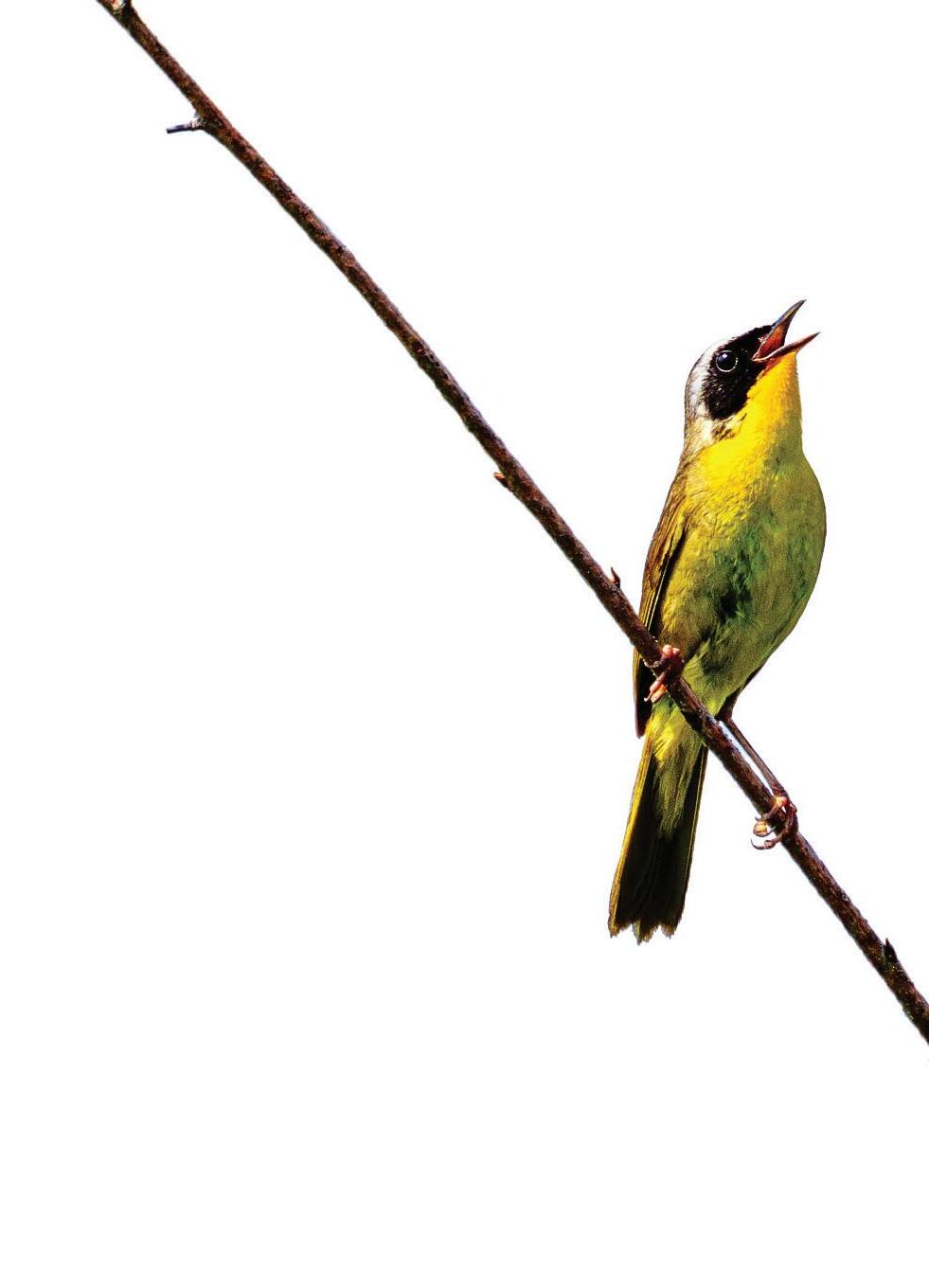
Yellow-rumped warbler
Setophaga coronata
Yellow-throated warbler
Setophaga dominica
Cardinals, Grosbeaks, Buntings &
family Cardinalidae
Tanagers
Forest preserve hotspots
• Buffalo Creek (Long Grove)
• Captain Daniel Wright Woods (Mettawa)
• Lakewood (Wauconda)
Blue grosbeak
Passerina caerulea
Dickcissel
Spiza americana
Indigo bunting
Passerina cyanea
Northern cardinal Cardinalis cardinalis
• Middlefork Savanna (Lake Forest)
• Rollins Savanna (Grayslake)
• Ryerson Conservation Area (Riverwoods)
Rose-breasted grosbeak
Pheucticus ludovicianus
Scarlet tanager
Piranga olivacea
Summer tanager
Piranga rubra
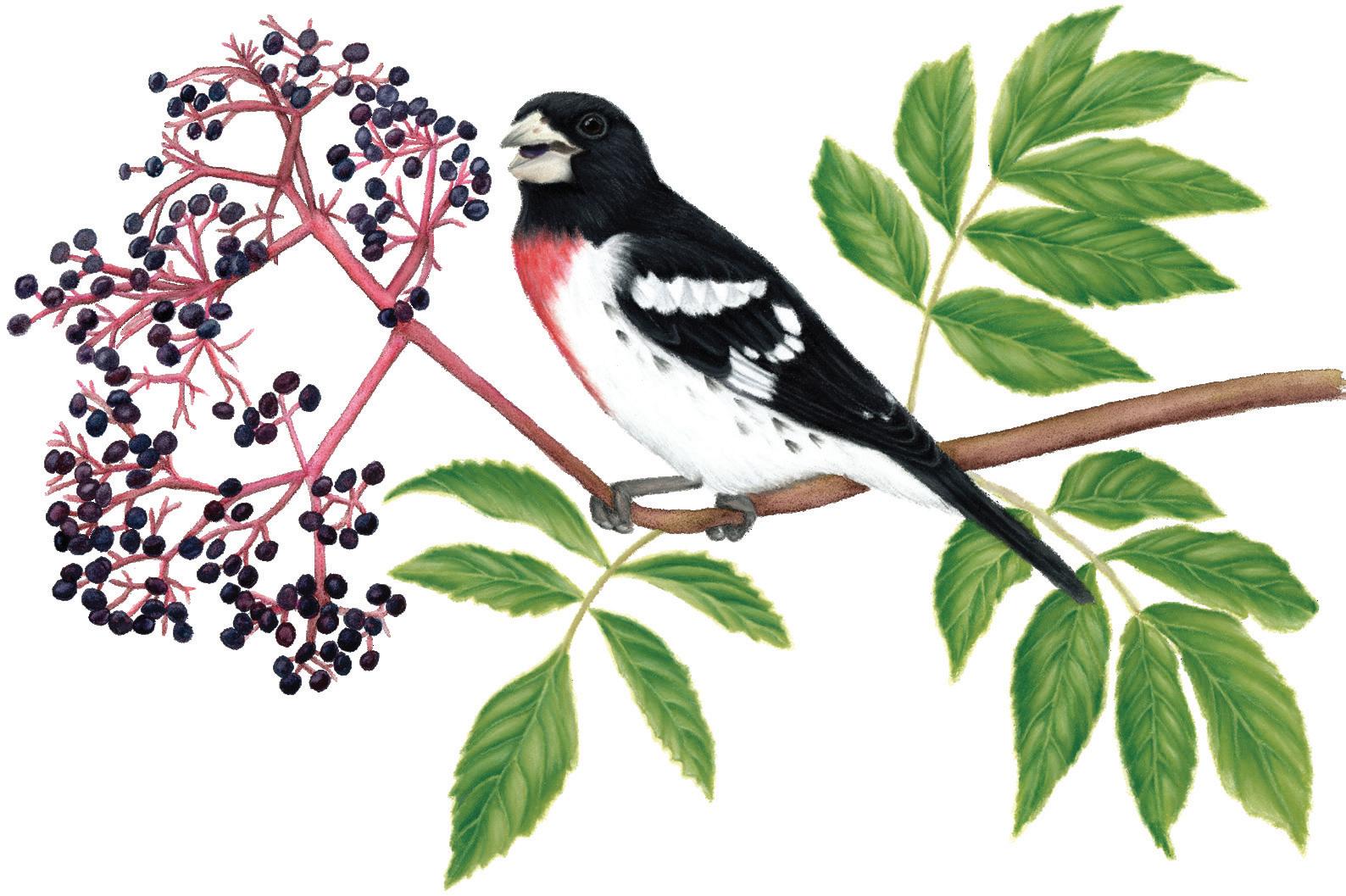
Species Showcase • Rose-breasted grosbeak
This 8-inch-tall migratory bird is named for the male’s triangular, rose-red chest patch. Another identifying characteristic is the species’ chunky bill, perfect for cracking seeds and munching insects and berries.
Grosbeaks are seen in areas with a blend of large trees, thick shrubs and open spaces. You may hear their sweet songs before you see them. “The song sounds like an American robin in an unusually good mood,” writes the Cornell Lab of Ornithology.
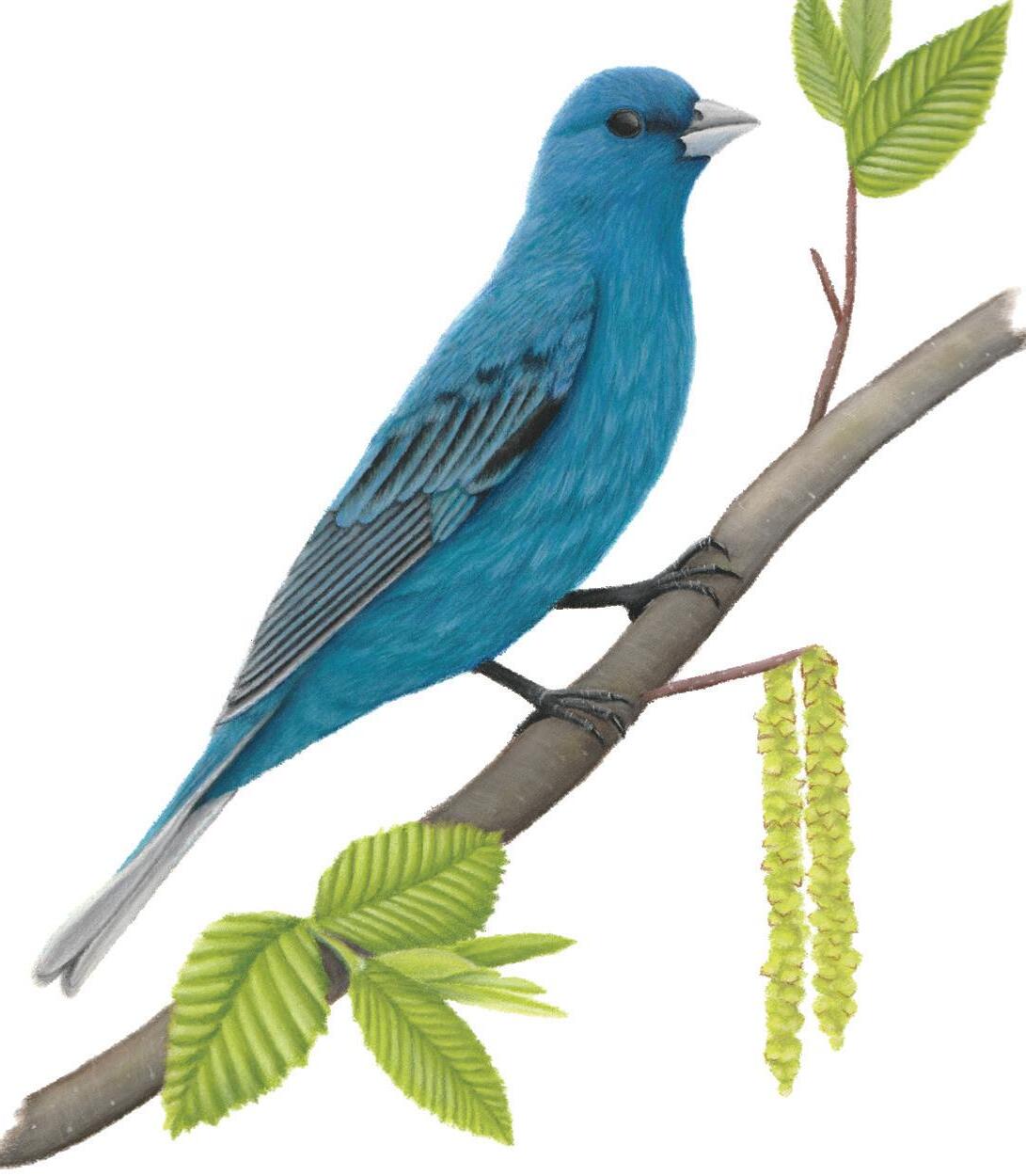
Species Showcase
Indigo bunting
Look where woodlands meet fields or pastures—that’s prime real estate for indigo buntings.
These little birds benefit farmers by eating weedy seeds and pesky insects.
Believe it or not, the male’s vivid feathers don’t contain a drop of blue pigment. The feathers are actually black.
Air pockets and proteins in the bunting’s feathers absorb every wavelength of light except blue, bouncing that color back to our eyes in an optical illusion.
It’s a neat quirk—one that only adds to the indigo bunting’s beauty and charm.
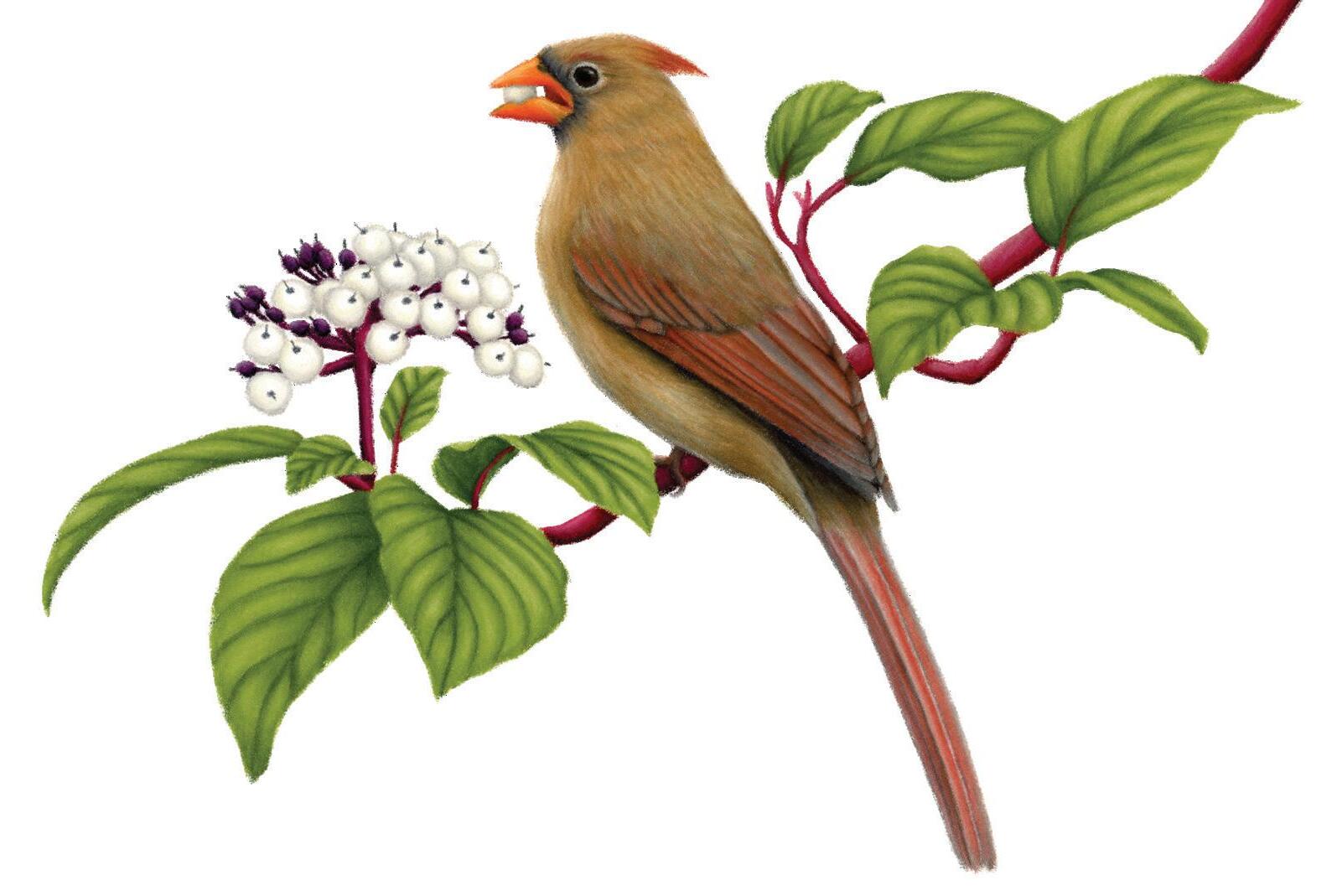
Species Showcase • Northern cardinal
The northern cardinal may just be the quintessential Midwestern bird. In 1929, Illinois schoolchildren selected it as the State Bird—a title this species has also earned from Indiana, Kentucky, North Carolina, Ohio, Virginia and West Virginia.
Cardinals remain in Lake County year-round. Males derive their signature red color from pigments in the seeds they eat. Females have red accents on their wings, tail and head to complement their brown bodies. Both sexes display a spiky head crest.
Give Your Time & Talent
Are you a skilled birder? Enjoy exploring off-trail?
Help us better understand bird populations in the forest preserves by becoming a wildlife monitor.
Volunteer monitors visit a site two or more times in June to record observations using a standard process. Trainings are hosted annually in late winter and early spring. Skilled birders are also needed to lead bird education programs.
Apply at LCFPD.org/volunteer. Call 847-968-3408 or email volunteer@LCFPD.org with questions.
Help the Forest Preserves Do More
The Preservation Foundation is the charitable partner of the Lake County Forest Preserves. The mission of the 501(c)(3) nonprofit organization is to extend and accelerate the Forest Preserves’ goals through private philanthropy.
Your gift to the Foundation’s Every Acre Strong endowment campaign will help provide a perpetual, dependable funding source and ensure every acre of habitat we restore remains ecologically healthy. Forever.
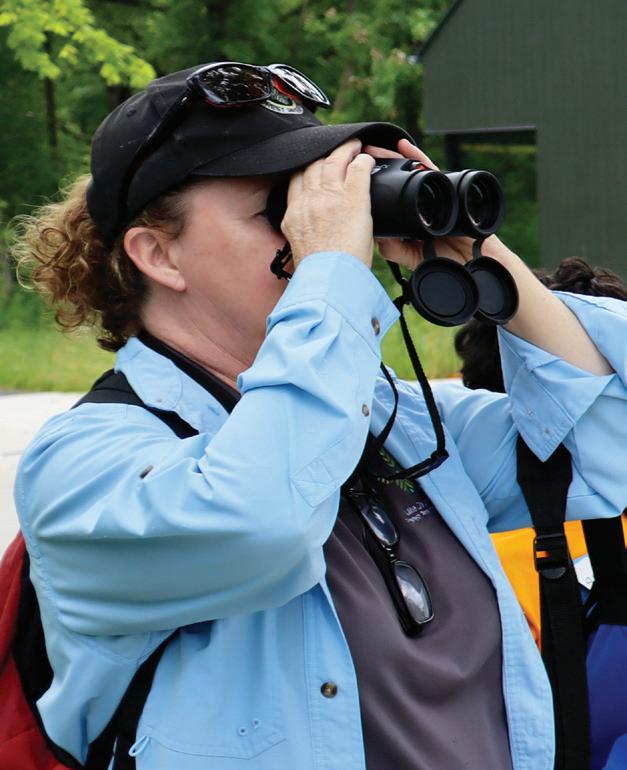
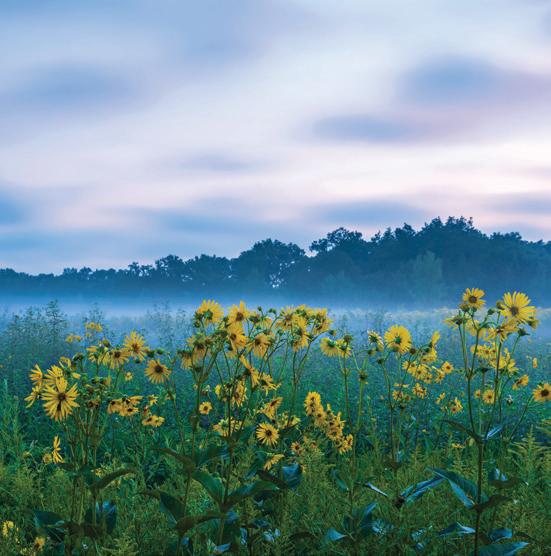
Lake County, Illinois, is teeming with birds. This guide will help you get started spotting them in your Lake County Forest Preserves and beyond.
9 Track your sightings with a checklist featuring hundreds of species.
9 Enjoy custom bird illustrations by a local artist.
9 Discover your passion for finding—and protecting—our feathered friends.
Birds shown in this guide represent species that may be found in Lake County. Presence and abundance can vary between preserves and by season.
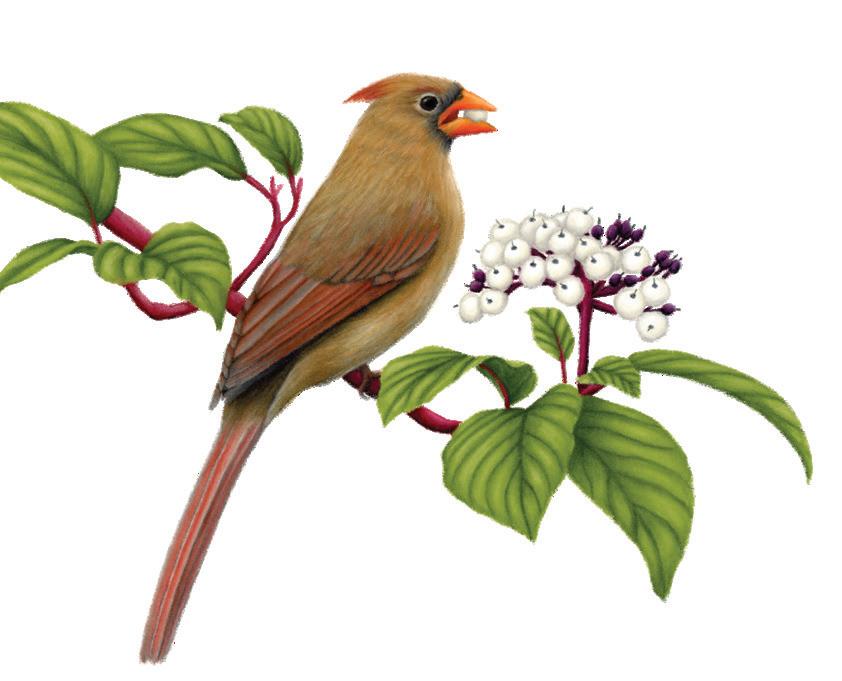
Northern cardinal
Sandhill crane
Rose-breasted grosbeak
Yellow warbler
Bald eagle