WI N ! awesome science magnet sets
EXPERIMENT Make your own
rocket!
Ice cool
science
get
buthzbzeeys wi
WWW.WHIZZPOPBANG.COM ISSUE 1
EXPERIMENTS PUZZLES AMAZING FACTS SCIENCE NEWS
Dear grown-ups, Welcome to WHIZZ POP BANG the magazine bursting with enticing articles, mind-boggling facts and hands-on experiments to get your child hooked on science! Whizz Pop Bang is designed to capture your child’s imagination and help them to get excited, engaged and enthusiastic about science. Every idea has been tested with kids and we’ve included the topics that interest them the most, whilst also introducing some valuable science concepts. The magazine is linked to the National Curriculum, so it will support their schoolwork as well. It’s not just science that your child will be learning either. Why not test your child’s comprehension of the Amazing Life Story on page 26? It will help with their literacy development. The puzzles should give expanding minds a mental work out too and the small paragraphs of text are ideal for fledgling readers to dip into and practice their reading skills. Whizz Pop Bang is a gender-neutral magazine. Science is for girls just as much as it is for boys so expect to find plenty of strong female scientists as role models and content that is just as likely to appeal to both sexes, whether it’s space, dinosaurs, flowers or bumble bees. Whizz Pop Bang is only available by subscription. If you haven’t subscribed yet, simply go to www.whizzpopbang.com and sign up for as little as £2.95 per magazine, including delivery. There is a whole universe of unanswered questions out there. With the help of WHIZZ POP BANG magazine, just imagine what your mini-scientist might one day discover!
1
MEET THE GANG! Hi!
I’m Emmi –
science girl
extraordinaire!
Woo hoo!
I’m Gaak,
My n
Y – it favou
quest
ame’s
’s my
visiting from a far away planet!
rite
ion!
Hey!
Riley here,
get IN TOUCH
pleased to meet you!
Email: hello@whizzpopbang.com Post: Whizz Pop Bang, 20 Aldsworth, Cheltenham GL54 3QP Website: www.whizzpopbang.com Facebook: facebook.com/whizzpopbangmag Twitter: twitter.com/whizzpopbangmag
WHIZZ POP BANG is made by:
Editor: Jenny Inglis Deputy Editor: Tammy Osborne Designer: Claire Brisley Illustrators: Clive Goodyer and David Carron Contributors: Mark Thompson, Joe Inglis and Sylvie Austermann
Welcome! Welcome to the very first edition of Whizz Pop Bang! You lucky readers are the first people ever to be reading this awesomely amazing magazine! It’s packed full of as many science experiments, activities, puzzles and facts as we could possibly cram in, so grab your lab coats and safety goggles and let’s blast off into the wonderful world of science!
CONTENTS 4 Awesome News and Amazing Facts Get the low down on recent scientific discoveries
6 The Science of Sleep
You spend a third of your life sleeping. Find out why here.
10 Cats TV vet Joe Inglis examines our furry feline friends
12 Buzzing Bees
Build a bee apartment block and discover the secret of honey
16 Rocket Science
Build your very own rocket with TV astronomer Mark Thompson
18 A Trip to the Moon
Pack your bags; we’re taking a trip to the Moon
20 Interview
Learn what it takes to get a dream job as a chocolate scientist!
22 Ice Cool
Cool off this summer with some ice cold science fun
fi n d th e sc ie n ce eq u ip m en t
Hidden on each double page is a piece of science equipment. Circle each one to find the complete ki t!
26 My Amazing Life
Discover the pioneering work of fossil hunter Mary Anning
28 Digging the Dirt
Investigate the world beneath your feet
32 Competitions Create a marbled planet painting and win a science magnet set
33 ASK Y?
Tell us about your science news or ask us a question
34 Answers and Thank you!
Get the answers to the puzzles and see who helped bring Whizz Pop Bang to life
Awesome News & Schoolboy discovers new planet 15-year old Tom Wagg was doing work experience at Keele University, using a computer program that surveys millions © DAVID A . HARDY of stars in the night sky. On his third day there he spotted a tiny dip in the light of one of the stars – a clue that there could have been a planet passing in front of it. It took astronomers two years to prove that it really is a new planet, the size of Jupiter and 1000 light years away from Earth.
Could cats be using their wee to control mice? Crazy though it sounds, new research has shown that if baby mice are exposed to a chemical in cats’ urine they are less likely to steer clear of the smell of © NEMO’S GARDEN their nemesis when they grow Underwater farm up. The scientists who carried Divers in Italy are growing strawberries out the research think that this and other plants in underwater could be a cat’s way of making greenhouses 10 meters below the surface the mice easier to catch! of the ocean. Transparent, air-filled bubbles anchored to the sea floor provide the plants with all they need to grow – the constant temperature of the ocean, sunlight, protection from insects and harsh weather, and a constant supply of fresh water, as evaporated sea water drips down from the roof of the bubble. You can even watch these aquatic farmers in action on live video: www.nemosgarden.com 4 whizzpopbang.com
Amazing Facts Monkeys keeping wolves as pets
N
AT IO NA
LG EOG RA
PHIC
Gelada monkeys and Ethiopian wolves have been found living together in harmony in the grasslands of eastern Africa. This unlikely relationship looks a lot like the way humans first tamed dogs thousands of years ago. Instead of eating the baby geladas, as other wild dogs would, the wolves eat rodents which they seem to be able to catch more easily when the monkeys are nearby.
IN ND U F Y, ER B ©JEFF K
G
Robo-gecko
.CH | REVILLARD | REZO © SOLAR IMPULSE
Flying on sunshine An environmentally friendly aeroplane named Solar Impulse has flown a record-breaking 7,200km across the Pacific Ocean. The plane, which is powered only by sunlight, is covered in 17,248 solar cells which power the motor during the day and charge the batteries that the plane relies on during the night. The epic journey of 118 hours is the longest continuous flight ever made by a single-seater aeroplane.
Tiny robots have been made that can walk up walls carrying 100 times their own weight. Their design borrows some neat tricks from nature. The robot’s feet are based on the design that allows a gecko to run across a ceiling without falling off, and the motion is inspired by that of an inchworm. The 9g robot can carry over a kilogram up a vertical glass wall, which is like you climbing up a skyscraper while carrying an elephant!
1kg
© BIOMIMETICS AND DEXTEROUS MANIPULATION LAB, STANFORD UNIVERSITY
whizzpopbang.com 5
THE SC ENCE Human beings spend a third of their lives asleep, which might seem like a waste of time when there are so many fun things you could be doing. But sleep is more important than you might think...
o we need to sl p ? Why d ee
Although you look like you are doing nothing while you snooze, many parts of your brain are very busy indeed. One of the most active parts is the cortex – the big wrinkly bit that covers the brain and is responsible for learning, thinking and organising information. While you sleep, your brain is busy sorting through all the things you have seen and learnt during the day and filing the information into your long-term memory. Sleep is also important for your health. Although your muscles are resting at night, your brain is producing hormones that help you grow and repair damage.
And what happens if we “You’ve probably noticed that don’t get enough? not getting enough sleep can make you feel We asked Professor grumpy and tired. But did you know that sleep Russell Foster, a also helps you remember things and solve problems. It can also scientist at the improve your sense of humour, stop you doing stupid things, University of Oxford and even improve your performance at sports! Poor sleep not who studies the only prevents the brain from working properly, but also makes importance of sleep. us feel hungrier, reduces immunity to infection and increases stress levels. Everybody really needs to take their sleep more seriously if they want their brains to work properly and to have a healthy body”.
6 whizzpopbang.com
of sleep
Your body clock An area of your brain acts like an internal alarm clock, telling your body when it is time to go to sleep or wake up. This ‘body clock’ is set by daylight entering your eyes in the morning. The daily cycle of waking and sleeping is called your circadian rhythm.
When it becomes morning on one side of the world, it is becoming night time on the opposite side. If you have been on holiday to a country where it gets dark at a different time, you will know that it takes a few days for your body clock to adjust! Until your circadian rhythm is reset by daylight you will feel tired and hungry at all the wrong times.
trouble sleeping?
It could be because you have been looking at a bright TV or computer screen too close to bedtime. The blue light from a bright screen alerts your brain and makes you feel less sleepy. So make sure you switch off that screen at least an hour before you go to bed!
Zzzzzzzz… why do pe
ople snore? Snoring is caused by th e soft tissues in your mouth and throat vibrating as the air you breathe flows ov er them. You can recreate this noise your self by gently pressing down on the middle of a piec e of baking paper while you blow onto the edge of the pa per. The vibrating pape r makes a sound similar to snor ing.
Zz z
. z . . z z z z Why do we YAWN?
We all know that we yawn when we are sleepy or bored, but no one really knows why! Some scientists think that it might be our bodies’ way of cooling down our brains so that we can think more clearly when we are tired. What we do know is that yawning is very contagious! In fact, you may be yawning as you read this!
y tr ipped or fell jus t as y l n e ou w dd Sleep s u su r k s, happen as your bo tar t s o ere y t e d a j h y t c Ever ha dr i i g e n nte ypn them, but some d that jol ting feeli ftin e h v a r r h o s e s, think t a r w of f to s a t y s de g h W ! s i e h leep? These sleep e w e t r n t ep y ma o ur b pt in sure e t er ’ l y o n s s tage o e d r b rs y o e q t d u f sleep. Scientis ts a n i r c a k s l e y e e wake l ax a ur tre r anc s u o e leftover o y y s n o f e , yo uu ref lex from wh out o p! l l ur a f o t brain th ink s you are about
sweet dreams! Long ago, people thought that dreams were predictions of what would happen in the future. Since then, scientists have come up with many theories about how and why we dream. One theory is that dreams don’t mean anything and are simply the by-product of the brain activity that goes on while we sleep. When we wake up, our minds piece together these random thoughts and images into a story. 8 whizzpopbang.com
Preparing for danger Some scientists argue that dreams evolved to allow our ancestors to practise escaping from dangerous situations in their sleep, so that they would be better prepared if they ever encountered real danger. Recent research has suggested that dreams help us process emotional experiences by allowing us to explore feelings we prefer not to think about when we are awake.
When dreams turn bad Professor Jim Horne, a sleep scientist at Loughborough University, has some good advice about nightmares:
to think about the nightmare during the day, it is better to talk through what
happened in the dream with a grown up, until
you feel happier about it, and then it will just
LUNAR
FACTS
Lucid dreaming Some people have dreams in which they are aware of what they are dreaming and can actually control what happens in the dream! Most people will have at least one of these ‘lucid dreams’ in their lifetime, but some people are able to have them whenever they like! Imagine being able to choose your dream world – what kinds of adventures would you go on?
“Instead of trying not
disappear for good. Often something that felt scary at night seems really silly in the light of day.”
Can you find all 20 sheep hidden amongst these sleep pages?
LPS SHEEP HE COUNTING ASLEEP YOU FALL shown that s a h h c r a e s s Re lly increase a tu c a p e e h p, counting s to fall aslee le p o e p s e k the time it ta g scene of a relaxin g in k in th s s wherea holiday help a r o ll fa r te like a wa off faster. people drop
whizzpopbang.com 9
The cat family ranges from the pet cat sleeping on your sofa to the powerful lions in Africa… By TV vet Joe Inglis
TAIL Cats’ tails help them to keep their balance. When a cat falls they whip their tail round and twist their body to land on their feet. PAWS Cats have spongy pads on their feet to cushion them on rough ground. The pads also help them to tread quietly whilst hunting.
EARS Each ear can move by itself. Cats can aim their ears towards the place that sound is coming from.
NOSE Cats have an excellent sense of smell. Newborn ki ttens can recognise their home by the smell alone.
CLAWS Cats’ toes have claws that they can pull in or push out. Their paws help them to catch food, climb trees and defend themselves.
OURSELF like a c Y M O at! GRO You will need... The rough side of a piece of Velcro
What you do... 1. Dampen the Velcro with a little water. 2. Use it to brush your hair! You should notice... The Velcro does a pretty good job of cleaning and smoothing your hair! Cats’ tongues are similar to Velcro; they too are covered in lots of tiny hooks to smooth their fur. Cats also use their tongues to lick the meat off bones, but we wouldn’t recommend you try that with your Velcro!
10 whizzpopbang.com
EYES At the back of each eye, cats have a special mir ror-layer to ref lec t light. This helps them to see in the dark.
WHISKERS The whiskers of a cat are special hairs that sense touch. They help cats to feel their way around in the dark and to feel changes in wind direction.
the ve a S
wild c
at s Sadly poaching and loss of habitat means that many types of leopards, lions, lynxes, cheetahs and tigers are endangered. Unless we make every effort to protect them, they may soon become extinct.
Cute kit tens Domestic cats usually have between 3 and 5 kittens at a time. Newborn kittens weigh about 100grams – about as much as a tangerine! For the first 7 to 10 days they cannot see or hear because their eyes and ears are sealed. They stay very close to their mother and drink her milk but when they are around 3 weeks old they begin to explore and cause all sorts of mischief!
DS S p ot ty L E O PA R . ry good climbers Leopards are ve they killed an animal When they have a tree to eat it. carry the body up s, , antelope, jackal ys ke on m t ea ey Th s. , sheep and goat peacocks, snakes been know to kill They have even an quills of more th porcupines with ! 20 cm long – ouch
St rip y TI GE RS Tigers are the largest memb ers of the cat family. They weigh aroun d 190 kilograms – twice as much as an adult human and they are about 2.7 metres long, including their tails. Ea ch tiger has a unique stripe pattern that is as distinctive as a human finger print. Tigers are good swimmers and on hot days they like to cool off in water.
ps in grou e v i l s ion over a anes. L s t m n h u t h i ts w ions kings for only ca ide of l r LION e p h to eat t A g e . n r s i e a h d t s i ny pr ion eat Male l catch a s of m , called t s m o n a n o r i l y g a o il o 35 ym as 34 k of 10 t but the h h! c a u e r m a u weig as ge o t r y a a l e n a y n r h ca ve re t ale lion bly mo m a b A o . r s p day at’s eal – th m e n in o
whizzpopbang.com 11
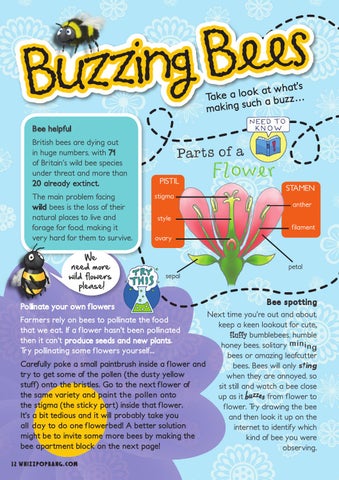
s e e B g n i z z u B t what’s a k o lo a Take buz z… a h c u s g mak in
Bee helpful British bees are dying out in huge numbers, with 71 of Britain’s wild bee species under threat and more than 20 already ex tinct. The main problem facing wild bees is the loss of their natural places to live and forage for food, making it very hard for them to survive. We need more wild flowers please!
Pa rt s of a PISTIL stigma
Flower
STAMEN anther
style filament ovary
petal sepal
Pollinate your own flowers
Bee spot t ing
Next time you’re out and about, keep a keen lookout for cute, fluffy bumblebees, humble honey bees, solitary min i n g bees or amazing leafcutter Carefully poke a small paintbrush inside a flower and bees. Bees will only s ing try to get some of the pollen (the dusty yellow when they are annoyed, so stuff) onto the bristles. Go to the next flower of sit still and watch a bee close the same variety and paint the pollen onto up as it bu zz e s from flower to the stigma (the sticky part) inside that flower. flower. Try drawing the bee It’s a bit tedious and it will probably take you and then look it up on the all day to do one flowerbed! A better solution internet to identify which might be to invite some more bees by making the kind of bee you were bee apartment block on the next page! observing. Farmers rely on bees to pollinate the food that we eat. If a flower hasn’t been pollinated then it can’t produce seeds and new plants. Try pollinating some flowers yourself...
12 whizzpopbang.com
We sometimes fly up to six miles to find nectar!
e Bee welcom ore bees To at trac t m ol den or scho r a g r u o y to adult if you n a k s a , s d n grou wild flower e m o s t n la can p sure that e k a m d n a seeds als are used n o c h e mic e har mful that could b to bees.
Bee apartment block
Solitary bees are either completely stingless or not at all aggressive. They will pollinate your flowers, and keep your garden literally buzzing with life! Here’s how to build a cosy nest to attract solitary bees…
What you do…
You will need…
1
Ask an adult to cut the top off the plastic bottle, so that it has a wide opening.
2
Snip the hollow sticks and stems to the same length as your bottle (you might need an adult to help with this).
• A large (2l) plastic water or fizzy drink bottle • Some hollow flower stems, bamboo or Japanese knotweed • String
3
Completely fill the bottle with your hollow sticks and stems.
4 5
Tie a piece of string around the bottle. Hang your bee apartment block outside in a south facing position, making sure that it’s level.
You may find… ee Typ e s o f b er 20,000 v o e r a e r e Th f bees in the o s e p y t t n e dif fer 50 more than 2 h it w , ld r o w g in Br itain. of them livin
After several weeks or months, you may find that some of your hollow sticks have been sealed off with leaves or mud. This is a sure sign that the apartment is in use. Most likely a solitary bee has laid her eggs inside, along with leaving some food for the bee larvae to eat when they hatch. whizzpopbang.com 13
gether to collect Bees have to work to them through the st la to y ne ho gh ou en to communicate winter, so they need ar can be found. where the good nect int so instead they They can’t talk or po ial waggle dance have developed a spec each other! to communicate with
Honeycomb Maze Bees use hexagons (six-sided shapes) to build their honeycomb. Hexagons tessellate, which means that they fit together next to each other without any spaces. Can you help this bee to find the most direct way through the honeycomb maze to get to the flower on the other side? Write down the letters that the bee passes and you’ll find the answer to this joke:
R
I
C
S A T
A
E
B
D
C
P
J
N
M
Q: How do bees get to school? A: On the...
W
L
H O
U
O I Z
F
Z
G S U
DID YOU
KNOW? A colony of honey bees consists of 20,00060,000 worker bees and just one queen bee.
14 whizzpopbang.com
DID YOU
KNOW? Honey bees’ wings move incredibly fa st – they flap them at arou nd 200 beats per second, making the famou s buzzing sound. The average worke
r bee produces on ly about a twelfth of a teaspo on of honey in her lifetime.
Bee vomit on toast anyone?
Woah! Honey bees can fly as fast as 15 miles per hour!
Honey bees collect nectar from flowers and store it in their nectar stomach, before regurgitating it back up again into the hexagonal honeycomb cells. I bet you never knew that the stuff you spread on your toast in the mornings was practically bees’ vomit! We worker bees do all the hard work!
g Honey in k a M o T roboscis e e ’s G u id e n s tick your p
A W o r k e r inBg for a flower that contains nectar, th
e
r. d look out the nec ta k c su d n a r 1. Fly aroun e e flow tongue) into th e ik -l w a tr s r (you mach our nec tar s to y ce n O . ip tr on each ying d 100 flowers n u ro e. As you’re fl a m it o is h v k c to a b d e y e fl e to 2. You’ll n as you do. Tim h c u m s tar to break a c e h n ig e e th w n ill o w k wor is full it ch will s tar t to a m to s r u o y y mes in back, the enz ars. down the sug t nec tar so tha e th ) p u it m o means v ill rgitate (that u g re , ceiver bees w e m re o e h h k T c . a ss b ce ce ing pro 3. On e honey-mak been th r e v o e k ta e sugars have can th s f e o e b t s r o e iv m l ce ti re lves un ongs t themse m a it m o v e regurgitate th . broken down n the b cells, and fa m co y e n o h to c tar in opy. ansformed ne tr e th t y nice and glo u e p n ill o h w e s e th e b e k nd ma 4. These orate water a p a v e to s g in w cells with their ith ill be sealed w w it y e n o h e s becom the nec tar ha t a th w o inter. N 5. ating in the w e r fo y d a re s tore it a wax cap to
J
T
whizzpopbang.com 15
ROCKET SCIENCE Become a fearless space traveller with your very own rocket! By TV astronomer and author Mark Thompson
1 d… What you nee bottle 2 litre plastic he snuggly into t s it f t a h t k cor bottle neck e ycle inner tub valve from bic hand pump garden fork
Get an adult to put a hole through the cork lengthways so that the valve can fit inside. The hole needs to be just the right size so the valve is held tightly in place.
2
Fill the bottle about a quarter full with cold tap water and then place the cork inside the neck of the bottle.
3
Prepare the launchpad: In a large open outdoor space, push the garden fork into the ground at a very low angle so that the handle is about 30cm above the ground. You can now place the bottle in the handle of the fork with the cork facing downwards.
4
Attach the hand pump to the valve.
5
Make sure nobody is standing in the direction that your rocket is pointing, start the countdown and start pumping 5 - 4 - 3 - 2 - 1 See if you can get to number 1 before the rocket shoots up into the air!
water
! 16 whizzpopbang.com
What you do…
Adult supervision required – make sure that the rocket is facing well away from people, animals and buildings.
How Rockets Work All rockets work in the same way. Even your bottle rocket works just like big space rockets. You probably know that if you push or pull something then it moves. About 300 years ago a man called Sir Isaac Newton learned that if you push against something then it will also push against you. Pushing and pulling are types of forces. Rocket engines push hot gases out of the back of the rocket. This forces the rocket to go in the opposite direction. Your bottle rocket forces water out of the back of the bottle making the rocket shoot up into the sky. Stand on a skateboard or put on some roller skates and stand against a wall. Push gently against the wall and you will find that there is an equal force from the wall pushing on you, forcing you backwards.
lled ade was ca m r e v e ts e k biggest roc if it was One of the so tall that s a w It . ) e in a V (fiv rs parked a c 5 the Saturn 2 s a g s lon would be a ree brave laid flat it ket took th c o r V n r 69 a Satu and Mike line. In 19 uzz Aldrin B , g n o tr s rm men, Neil A the Moon. Collins, to
vacuum cleaners that to a big box. suck all the waste in space, gravity are not felt in • Because the effects of ery day. for at least 2 hours ev e cis er ex to ve ha ts astronau cleaned. urine once it has been n ow eir th k in dr ts • Astronau people the Moon and only 12 to t ge to ys da 3 t ou • It takes ab have been there.
• Toilets in space are like
©NASA
whizzpopbang.com 17
a trip to the
MOON
You’re unlikely to be holidaying on the Moon this summer, so we’re taking you on a virtual vacation instead…
go… Of f we r s t unde ju is n o at The Mo rom Ear th. Th miles f i t’s not t u b , 250,000 t like a lo to the res t sounds pared m o c r mily car fa r u that fa o y t e. In fac r haps e p d e ll of spac ve ave tra h t eady. h lr a ig s m e il 00 m to 50-100,0 u’re not going y er, yo ur famil o y Howev in n he Moo bet ter get to t ’d e w car, so cket. get a ro
? Did you know
e Moon becaus e h t on d in w o There is n left he footprints T . e r e h p os m t there is no a ing lo 11 lunar land ol p A e h t om r f by explorers less e forever – un r e h t y a t s ill in 1969 w urbs them. someone dist
..1
Pack yo ur bags … You’ll nee d a spac esuit and som e breath ing apparatu s. There’s no air on the M oon, bec ause the pull of gr avit y the re is too small to hold any atmosph ere.
2 . . ! 3 F . . F 4 . 5. O T S A L B
It’s a SMALL WORLD It takes around 3 days to reach the Moon in a spacecraft, and the games of ‘I spy’ can get pretty monotonous! As you approach, you’ll see that the Moon is approximately spherical, like the Earth and the Sun, but it is only small – 2000 miles in diameter, compared to 8000 miles for the Earth. There’s still plenty to ©NASA explore though…
Moon Walk nded. Time to Ok, we’ve la ighs suit – this we e c a sp r u o y h as put on bout as muc (a s m ra g ilo around 80 k on’t feel that w it , y r r o w on’t is a man), but d ce the Moon in S . n o o M e heav y on th gravit y. Tr y ss le s a h it , th Ear the smaller than the Moon – n o g in lk a Lunar exploring w n take a to imagine c u o y t a th it y means Let’s explore… the Moon weaker grav eigh 30kg w u o y If s. e id has mountains, valleys, plains and enor mous s tryou will only weigh 5kg , craters. These were made by pieces of here on Ear th ly the h g u ro s t’ a th material hitting the Moon from outer on the Moon ld baby! o k e e w 6 a space. Some of the Moon’s craters are well weight of over 150 miles across; they are also very old. Nothing much happens on the Moon today; the last craters were on of the Mo e id s e m formed at least a thousand million The sa o until e Earth, s h t s e c fa it always years ago – well before dinosaurs ographed t o h p ft a r c e c a n p as roamed the Earth. Perhaps it’s time ever see body had o n , 9 5 9 in 1 to go home to Earth, which is oon. e of the M the far sid teeming with life and activity. When there is a full M
oon in the sky, the M oon is roughly on the opposit e side of the Earth to the Sun and so the whole of the sid e that faces the Eart h is lit by the Sun. As the Moon go es around the Earth, we see less and less of its sunlit side until we can’t see it at all; this is called a new Moon the Moon is between the Sun and the Earth, so the unlit sid e is facing towards us .
Signs of life? There is no evidence of life on the Moon. But evidence of water-ice discovered there recently means that it may make it easier for us to build a lunar base there so that people can stay on the Moon for long periods of time. It may well be that some of you will go there one day – if you do, please send us a postcard! whizzpopbang.com 19
interview with a
Chocolate Scientist We managed to stop drooling for just long enough to talk to Beccy Smith about her job as a chocolate scientist…
© Bodo
Wow! You’re a chocolate scientist - the dream job! Are you like Willy Wonka? Well, there’s plenty of experimenting with different chocolates, jellies, nuts and caramels. But we have to be a lot more health and safety conscious than Wonka – no Augustus Gloops falling in the chocolate and no Mike TVs messing with dangerous equipment! Do you get to sample the chocolate? To check that the flavour and the texture are just right, the chocolates HAVE to be tasted! There are special rooms that we use to taste the chocolates. Each person sits on their own, in silence, in a little booth, so they can’t be distracted by seeing or hearing what other people think of the chocolate. The temperature of the room has to be just right and always the same, so that the chocolate doesn’t melt more easily or snap more easily. The lights in the room are red so that we concentrate on tasting how cocoa-y the chocolate is, rather than being distracted by seeing how dark brown it is. Some people smell then taste then spit, but I never spit out a good chocolate!
How do you become a chocolate scientist? Are there any golden tickets? There are no golden tickets for this job. You’ll need to understand more science than they can teach you at school so, when you’re grown up, you’ll have to go to university to keep on learning.
20 whizzpopbang.com
Theobromine molecule:
the “feel-
good” part of chocolate
© Pamela Hodson | Dreamstime
How does science come into chocolate making? I work with lots of other chocolate scientists because chocolate making is all about science. From the biology of how to grow the best cocoa beans, through the chemistry of creating the right flavours when roasting the beans, including the engineering of designing the best machines to grind the chocolate smooth, using the physics of explaining how to flow the chocolates into moulds, right up to the psychology of eating the bars! Do you use maths too? Maths is the language of science so we all use maths equations to describe the results that we get from laboratory tests. And more importantly, to predict what will happen if we try something different.
Do you have any tips for readers who would like to be a chocolate scientist when they grow up? Start experimenting in your kitchen now. Try different combinations of flavours – a marmite chocolate has just been invented! Try different combinations of textures – crunchy nuts and gooey caramels work well together in chocolate. What about popping candy and fresh strawberries?!
ndisclosed
ffer U © Christo
Cocoa beans, used to make
What are the best things about your job? The team I work with; we help each other out and have fun together. The maths puzzles I get to solve as part of my job. And the fact that, if an experiment goes wrong, I can just eat the mistake!!
What’s the worst thing about being a chocolate scientist? Having to wear a hairnet on my head and having to wash my hands all the time to keep the chocolate making area clean.
chocolate
whizzpopbang.com 21
Ice cOOL Before you drop that ice cube into your lemonade this summer, let’s take a closer look at this highly unusual solid…
WHAT IS ICE?
hen water Ice is for med w low 0°C. Ice is e b n w o d ls o co lly Liquids nor ma ver y unusual. e up less space k ta to t c a tr n co t water does u b , ze e e fr y e as th s, s water freeze A . te si o p p o e th hich means w , s d n a p x it e p more space. that it takes u
1
Fill a jam jar right up to the brim with water and lay the lid very loosely on top (don’t screw it on at all).
2
Place the jar carefully into the freezer and leave overnight.
3
When you check the next morning you should see that the lid has been lifted up by the expanding ice. If you had screwed the lid on the jam jar tightly it would probably have broken the glass – don’t try this!
©KEN LUND
FREEZING POWERS
gy is released; the er en f o ts lo e, ic s to reak When water turn that it can even b g n ro st so e b n see force created ca ck formations we ro ny a M s. er ld u o call rock s and b ansion. Scientists p ex r te a w y b ed today were shap side rock s, e.g. in in r te a W . ss ce ro ’p the it the ‘freeze-thaw it freezes, split ting en h w s d n a p ex gaps and crack s, the water thaws en h W s. ck a cr e th ing rock and widening water gets in, push re o m d n a ft le re bigger crack s a nex t freeze. The e th g n ri u d rt a p a g in them even further any times, resultin m en p p a h n ca e d freeze-thaw cycl Many boulder s an . ff o n ke ro b g n ei b y. big chunk s of rock e created this wa er w s in ta n u o m e rock s found in th
We all know that ice melts when it warms up, but did you know that ice also melts when something presses on it – try it and see… Put lots of ice cubes in a glass. After a short while they will stick together. The pressure created by the weight of each ice cube melts a little bit of the ice. This water then re-freezes, ‘gluing’ the cubes together.
TRUE OR FALSE? Q: There’s no land at the North Pole.
Scientist can’t agree on how skaters can glide with such little resistance from friction. We used to think that the pressure on their ice-skating blades melted the ice so that they glided on a thin layer of water. However this doesn’t explain how skaters can skate at very low temperatures, when the pressure alone isn’t enough to melt the ice.
See page 34 for the answer...
POTHOLES
The freeze-thaw process also creates po tholes in the roads. Water co llec ts under the tarmac and freezes, lifting up the tarmac. When the ice melts, the wate r drains away, causing the tarm ac to crack, eventually leavin g a pothole.
Scientists have now found that the ice molecules on the surface cannot properly bond with the rest of the ice and so they are free to move around like molecules of liquid water, but they haven’t been able to show that this creates less friction. Perhaps this is something you can investigate?
whizzpopbang.com 23
KEEPING OUT THE COLD Inuit people who live in very cold climates sometimes build shelters using big block s of very compacted snow to make igloos. The weight of the block s on top of each other causes the snow to melt slightly. The water then re-freezes, closing the gaps and keeping out the icy winds. Igloos are used as overnight shelters when people are out hunting, and you can even cook inside them.
THE BIGGEST “SHIPS” ON THE OCEAN Close to the Earth’s poles there are many icebergs floating in the sea. Some of them are small floes, just big enough for a seal to take a rest; others are the size of a small country. How is it that these immensely heavy blocks of ice can float on the water? We say that when water freezes it expands. This means that the same amount of ice takes up more space than the equivalent amount of water, so ice weighs less than water. A scientist would say that ice has a lower density. Ice will float in water regardless of its size; small ice cubes in your drink or an iceberg the size of a small county.
Drop an ice cub e into a glass of water and watc h what happens. Now tr y dropping an ic e cube into a gl ass of cooking oil (which has a lower density th an water, and lower even than ice) and s ee what happe ns. You should find that the ice cube sinks to the bottom of the glass of oil. 24 whizzpopbang.com
ICE GAME Ice forms in hexagonal (six-sided) shapes. Challenge a friend to see who can make the most ice in this game‌ 1. Take it in turns to draw a straight line from one dot to an adjacent dot, following the hexagonal pattern. 2. If the line that you draw completes a hexagon then write your initials inside the completed hexagon and then take an extra turn. 3. The winner is the person with the most completed hexagons at the end of the game.
le of Each molecu e up of water is mad n atoms two hydroge gen and one oxy freezes, the r te a w n e h atom. W r forming e th e g to d n o molecules b l agonal crysta x e h g n o tr s a ape hexagonal sh e h T . e r tu c stru ixf lakes have s w o n s y h w is try. sided symme
whizzpopbang.com 25
My Amazing Life:
I
Mary Anning
had an unusual start to life. I was born in 1799 and when I was just a year old, I survived a lightning strike! I was being held by one of my mother’s friends. She was standing under a grand old elm tree holding me in her arms and chatting away to two of her friends. All of a sudden there was an almighty flash and a massive explosion in my ears. The tree had been struck by lightning and all three women died instantly. Amazingly I survived! Onlookers couldn’t believe their eyes. Some say that my survival of that lightning bolt is how I became so full of life and eager to learn!
I grew up beside the seaside in Lyme Regis where huge cliffs tower over the beach below. When there have been winter storms, there are often landslides where great chunks of rocks get torn away from the cliffs and crash down onto the beach below. If you look carefully amongst the landslide you can sometimes find the most amazing discoveries - fossils! Life was hard for my family. My parents lost eight of my siblings to illnesses and accidents. Only my brother Joseph and I survived. Our father was a cabinet-maker, but finding enough work to feed our family wasn’t easy. My father used to take Joseph and me down to the bottom of the cliffs to look for fossils. We used to put a little table 26 whizzpopbang.com
outside our home and set out our fossil finds for passing holidaymakers to buy as souvenirs. It was a good little enterprise for us and it often made the difference between having supper or having no supper, so I was always happy to help! Besides, I loved the fossil hunting; the feeling of being the very first person to have seen and touched those beautiful fossils in all those millions of years was always a thrill for me. I was only 11 when my father died. That was hard on all of us. My brother and I did all we could to find enough fossils to keep food on the table. About a year after my father died, Joseph made an incredible discovery - a huge dinosaur skull. I did lots of careful excavation and eventually I uncovered the rest of the
skeleton. It was from a dinosaur that had never been seen before. It was given the name of ichthyosaur, meaning fish lizard. My family was able to sell the entire fossil ichthyosaur for £23, which is worth about £1500 in today’s money. Over the years the fossil business grew and I made a name for myself by selling important finds to well-known scientists, geologists and museums. Along with my faithful dog Tray, I would go out most days, searching the foot of the cliffs for interesting fossils to sell. One very sad day, my dog and I were ambling over the rocks when there was a sudden crash. My poor dog had been crushed and killed under a piece of cliff that had fallen on top of him. Back home later that day I reflected on just how close I had been to the same fate, but I couldn’t stop fossil hunting; it was my passion and I was getting rather good at it! One exciting winter’s day in 1823, I was out searching for fossils when something unusual caught my eye. It was the first complete Plesiosaurus ever to have been found. A few years later, I also found a flying reptile, now called a pterosaur, which was displayed in the British Museum in London. I started up a fossil shop, where I could display my fossil finds to visitors. Many famous fossil-collectors and geologists came from far and wide to purchase my finds. It was a frustrating time to be a woman though - we had very few rights; we couldn’t vote or even go to university. I
TOP: Mary’s sketch of a Plesiosaurus BOTTOM: An Icthyosaurus skeleton found at Lyme Regis
would have loved to have joined the Geological Society, but it was gentlemen only in those days. Instead I learnt as much as I could from books and papers and I studied my own fossils, as well as the anatomy of modern day sea creatures, so that I could start to classify fossils myself. It was frustratingly hard to gain much recognition for my work because I was a woman but in fact I was much more knowledgeable than many of the gentlemen fossil collectors around at the time. Mary died from breast cancer ag ed 47 and was honoured with a stained gl ass window in her lo cal church, fund ed by the Geological So ciety in recognit io n of her sizeable cont ribution to scienc e. ting of Fossil hun ng much lo a d n u o an be f start Fossils c why not o s , e n li coast Britain’s s? iscoverie d n w o r u o of making y has lots k u . o c . s l fossi ns. www.uk st locatio e b e h t ion on informat
whizzpopbang.com 27
DIGGING THE Get muddy in the name of science...
settling soil Find out what soil is made of…
You will need… • • • • • •
1
2 3
4
2 glass jars with lids Water Soil is teeming with Dessert spoon bacteria, so don’t forget Soil to wash your hand s after 2 sticky labels this activity! Pen
What you do… Think of two different places where you can collect samples of soil; for example from a friend’s or school’s garden or a park (ask permission first). Write the two places you intend to collect soil from on the two labels and stick one label to each jar. Next, collect your soil samples by placing 10 spoonfuls of soil into each of the labelled jars. For example if you were collecting soil from your front garden you would put that soil in the jar labelled ‘Front Garden’. Fill three-quarters of both jars with water. Screw the lids on tightly and shake well. Let the jars stand and sit back and observe.
28 whizzpopbang.com
YOU SHOULD NOTICE... The soil slowly settles in both jars. The things in the soil settle in order of the size of their particles, with the largest particles at the bottom. Most soil is a mix of sand, silt and clay as well as rotten plants and animals (organic matter). Pieces of rock will settle to the bottom, then sand, silt and clay next. Lastly, rotten plant and animal matter floats at the top. The size of the layers in each jar might differ because soil from different places contains different amounts of minerals and organic matter.
Soil life When you pick up a handful of soil, did yo u know that you are holding billions of living thin gs? A teaspoon of soil has more living organism s than there are people on planet Earth! Soil is literally e e m i t ng with life. Along with the more obvious cr eatures, like earthwor ms, beetle s, ants and woodlice, there are also millions of tiny organisms that you can only see with a microscope, su ch as bacter ia, fung i and algae.
Urgh! On my planet we have lovely purple soil!
d from mu s e in ic d Me s medicine ’s y a d r o t f . Howeve Many o il o s m o ef fec tive ame fr c w y e ll n a y in n ig a d or discovere c i ti ng news ’t n x e v e a e h h .T scientis ts ince 1987 s s e tis ts from in n ic ie d c e s m n a ic r ic antibiot hey had ear Ame t y t is a h h t t r d e r li nce is that ea it y annou s r e f bac ter ia iv o n s U e r p e y ll t Rockefe some new o new apar tments w ia r o r te c g a B o t t in ad managed y soon le n’t be grown a a c m ia r t te a c . a h s b t to sse Mos t soil from soil for scientis ts cure illne rd a o h t y s r e e v in ’s it rs so medic ller researche laborator ies, fe e k c o R e th owever, ual bac ter ia id iv s tudy them. H d in t u p at they could nt block s for e tm r a p discovered th a e lik esigned pods, d lly ia the soil and c e to sp in k c a into b t u be p eady hich can then now... w k , u ia r o they have alr y te , c e a u id b iq n D h c te ew fertile . Using this n f are d o re m tu r a u r n g tics and they One io b ti n a o w t e n 5 ontain up discovered 2 n be able to o so ill soil can c w e m so bacteria. hopeful that one billion edicines. be used as m
GET INVOLVED Mmm! Soil - my favourite food!
The Rockefeller University team want to investigate soil from every country in the world, but they need help getting samples. They want to hear from people from all countries, especially from unique, unexplored environments such as caves, islands, and hot springs. They are particularly interested to hear from schools, so why not ask your school to sign up at www.drugsfromdirt.org and get involved in some real cutting-edge scientific research! whizzpopbang.com 29
If a plant’s roots are sitting in too much water the plant dies. Luckily water is able to drain through most soils so that excess water can drain away. Find out how much water drains through different types of soil…
What you do...
1 Cover your table with sheets of newspaper. 2
Take four labels and write ‘soil’ on one, ‘soil and sand’ on the next and then ‘water’ on the last two. Stick a label to each of the four cups.
3 Take another four labels and use a ruler to mark 1cm, 2cm and 3cm on each. Stick these labels vertically at the bottom of each of the cups.
rubber band
4
paper towel cup
Yo u w ill need … • 4 plastic cups • 2 rubber bands • ¾ cup of potting soil • ¼ cup of water • ¼ cup of sand • 8 sticky labels • pen • 2 paper towels • ruler • mixing bowl • spoon • newspaper
Lay a paper towel over the top of both the ‘soil’ and the ‘soil & sand’ cups. Push the paper towel in about half way and secure with a rubber band. Pour 1/2 cup of soil into the paper towel in the cup marked ‘soil’.
5
Pour ¼ cup of sand into the mixing bowl, add the remaining soil and mix with a spoon. Pour this mixture into the paper towel inside the ‘soil & sand’ cup.
6 Next, pour water up to the 2cm mark into each of your
cups marked ‘water’. Then hold one ‘water’ cup above the ‘soil’ cup and the other ‘water’ cup above the ‘soil & sand’ cup. Now add the water to the sample in each paper towel at the same time and observe. Is there any difference between how much water drips through or how fast the water drips into each cup?
YOU SHOULD NOTICE...
You will probably find that the water drains through the sand & soil mixture more quickly than the unmixed soil (unless you used play sand, which has very small particles). We saw in the previous experiment that sand is made up of larger particles than soil, which means that there are larger gaps between the particles for water to drain through. 30 whizzpopbang.com
lovely layers Dig deep into soil and you’ll find that it’s made up of different layers... Humus
On the very top is the organic layer, called humus, which is a layer of mostly plant remains, like leaves and twigs.
Topsoil
Then the topsoil is a layer of decayed organic matter mixed with some small stones – this is where the plant roots are and where lots of organisms, like fungi, worms and bacteria live.
Subsoil
Next, the subsoil is made of mostly clay, iron and organic matter (the stuff from plants and animals).
Parent material Next comes a layer of mostly large rocks. This layer is called the ‘parent material’ because this is what the upper layers of soil were originally made from. When Bedrock Deep down underground is the bedrock, gardene rs grow which is a large solid lump of rock. plant
s that d on’t like much wa ter (like cactus plants), they oft en mix some san d in with the soil to help w ater dra in away fro m the roots.
now... Did you k orm is the w h t r a e st The longe rthworm, a e t n ia g African .7m long. 6 o t p u grow which can across g n li w a r c hat Imagine t rbed! the flowe DOWN 1 The layer of soil that is mostly made 3 of clay, iron and 4 organic material. 3 These creatures live in soil and some species can grow over 6m long. 5 One gram of fertile soil can contain up to a billion of these micro-organisms. 7
1 2
MUDDY CROSSWORD 5
6 ACROSS 2 The decaying plant and animal remains found at the very top of soil. 4 Scientists are trying to grow new versions of these medicines in soil. 6 This layer of soil contains decayed organic matter and the roots of plants. 7 The large solid lump of rock underneath all the other layers of soil. whizzpopbang.com 31
Use the power of science to create these awesome marbled planets.
1 2 3 4 5
What you do…
You will need…
Spread shaving foam over a baking tray.
• Baking tray • Shaving foam • Poster paints, acrylic paints or food colouring • Spoon • Circle of card • Newspaper • Ruler
Drizzle some paint or food colouring on top. Use a spoon to swirl the colours around, but don’t mix them too much. Press down your card circle onto the surface and leave for 10 seconds. Remove the card and place it onto some newspaper for 5 minutes so that the colours soak into the card.
! N I Wagnet M science sets
6
7
Use a ruler to wipe off the excess foam and paint to reveal your stunning marble planet. Add some rings to your planet if you like.
We have three of these amazing Magnet Science sets to give away. Send a photo of your planet artwork along with your name, age and address to win@whizzpopbang.com or post your creation to Whizz Pop Bang, 20 Aldsworth, Cheltenham GL54 3QP. The best three will win a prize. We are unable to return original artwork, sorry. Deadline: 5th September 2015
32 whizzpopbang.com
How does it work? The shaving foam is a different kind of substance to the paint. The paint is called a polar substance. It dissolves easily in water and soaks into the paper readily. The shaving foam is mostly non-polar and it isn’t easily absorbed by the paper.
ASK
Y?
Our very knowledgeable robot, called “Y”, would love to hear what you’ve been up to, so please send in your experiments, ideas, drawings, facts, photos, jokes, questions and theories and he’ll select the best to be printed in the next issue.
water for a gers and toes after being in fin ly ink wr t ge I do hy W Y, Dubai long time? Jemima, Hi Jemima, But recent the answer to this question! For a long time nobody knew rbles and pass ople are able to pick up ma research has shown that pe ir fingers are derwater more quick ly if the them from hand to hand un se they helped wr ink ly fingers evolved becau wr ink ly. Scientis ts think that d from wet our ances tor s to gather foo wr ink ly plants or streams. Likewise, Y, Why do things go mouldy? Mo llie, age 8 le not to feet would have helped peop Hey Mollie, ad on slip in the rain, jus t like the tre ir grip on Moulds are simple, microscopic org tyres helps car s to keep the anisms, found set up virtually everywhere – in the soil, in wet roads. Maybe you could dus t and in the bath to air. They can grow wherever there your own experiment in the is moisture, a food r to grip source and oxygen. As moulds dig see if you find marbles easie est their food, they gradually des troy whatever they are wi th wr ink ly fingers! growing on. There are many different types of mould. Many are toxic to eat and dangerous to breath e in. But moulds also per for m a ver y important job , breaking down dead plants and animals so that the ir nutrients can be recycled back into the soil. And som e are ver y useful, like Penicillium, which is used as a me dicine and the moulds used to make blue cheese Y, Why can you see some aeropl – so we shouldn’t ane think too badly of them! vapour trails and not others? Oliver, Cirencester Hello Oliver, Aeroplane vapour trails, or contrails, are clouds that for m when water vapour condenses and freezes around small par ticles in aircraft exhaus t fumes. Some of the water vapour comes from the air and som e from the exhaus t fumes. Contrails are only for med in damp air, so planes flying at different alti tudes make diff erent trails depending on how much moisture is in the air.
Email: y@whizzpopbang.com Post: Y, Whizz Pop Bang, 20 Aldsworth, Cheltenham GL54 3QP We can’t return any post so, if it’s precious, please only send a photocopy. whizzpopbang.com 33
Answers Page 14 - Honeycomb Maze R
I
C
S D
A
E
B
C
T
H
A
L
J
N
M
U
Page 23 - True or false?
O
O
P
W
I
F
Z
Z
G S
Q: How do bees get to school? A: On the...
A: TRUE: The North Pole is just a big ice sheet that’s there all year round; there is no landmass. However, the South Pole (Antarctica) is a continent with large mountain ranges.
S 2 HUMUS 3 E Page 31 - Muddy Crossword B 4 5 AN T I B I O T I C S R A O T C I 6 H T O P S O I L W E Riddles (back cover) 7 B E D R O C K R 1. Water R I 2. A towel 3. A mushroom M A 4. A river S 34 whizzpopbang.com S
C
H
O
O
L
B
U
Z
Z
1
Adam and Emily Bradburn
The Wilson Family
Jemima Tapping
Archie
Katie an d David
d Dylan Jones Callie, Elliot an
David and Tom
d Emily Poppy, Owen an
Robbie and Amy Gemmill
mie Sylvie and Ja
McVeigh Tom and Rachel
THANK YOU!!! Whizz Pop Bang Magazine has only been possible thanks to the amazing help, support and backing of hundreds of people. So this is a page of intergalactically huge “thank you”s!
Our turbo-charged thanks to all these wonderful fans and their parents: Jake Webster, Finley Brown and Rosa Brown, Arthur & Emma, Noah Jones, Phoebe Kilmurray, Connor Atherton, Ella Martha Phillips, Abigail Rutherfoord-Lawson, River Brame, Mahi Raedeker, Vincent Wojtek Quartel, Sunny Fan. Finally, our super-sonically grateful thanks go out to all these fabulous Whizz Pop Bang readers and their grown-ups, pictured around this page... Last but by no means least, thanks to my wonderful husband, Joe, who has single-handedly cooked, taxied, tidied, cleaned, vacuumed, mowed, dogwalked, washed, dried and packed lunches to keep my family going these last few months – thank you! Jenny xxxxx
e and Adam James, Eddi
Ella
Emily Crow Betty Nolte
d Charlie Sophie an
There are too many to mention everyone in person here, but we’d particularly like to thank David Carron, Sylvie Austermann, Tammy Osborne, Bob Osborne, Maddie Wheeler, Mark Thompson, Jason Bradbury, the Tapping family and all the many, many other people up and down the country who were instrumental in helping to get the magazine off the drawing board and into print.
Ben and Rosie Armitage
Benjy
Tia Walford
Finlay and Ann a Madams
h Isabelle Goug
Sanam Shah
oxall d William Y Rachel an
Olly and Finn
ggy Oliver and Ti a nnah and Lyr Alexandra, Ha r be eb W nlai Chamber
Max Grayson Nathaniel and Ta lia Keep
Lily Magnu sson
ng Mollie Tappi
RIDDLES and jokes Answers to these riddles on page 34 (no peek ing until you’ve tried your hardest to work them out!)
1 2 3 4
What can run but cannot walk?
If you’ve got a science joke of your own, wr ite to us at jokes@whizzpopban g.com and we might feature your joke in the next issue!
The more it dries, the wetter it becomes. What is it?
What kind of room has no doors or windows?
What has a head but never weeps, has a bed but never alks, sleeps, can run but never w ey? and has a bank but no mon
icky? Why was the bee’s hair st y-comb! Because he used a hone
What game do spac e men and women play ? Astronauts & cros ses! tone What did the limes t? say to the geologis granite! Don’t take me for
Why do tigers have strip es? So they don’t get spotte d!
E B I R C SUBS ! Y A D TO
n. ia subscr iptio v le b a il a v a ang is only ing Whiz z Pop B omely amaz s e w a w e n ua We send yo it ing science c x e f o ll fu d cke magazine pa ver y month. e ts n e im r e exp ar ticles and Educational and fun
4 4 Hours of happy kids 4 Free delivery 4 Linked to the
12
issues per year
National Curriculum
4 Literacy as well as science
WI N !
Prices from just
EXPERIMENT Make your own
rocket!
£2.95
per magazine (£34.99/ year)
aweso m science e magne t sets
Ice
cool
science EX PE RI WhizzPop_
cover_001_
M EN TS
amend.indd
1
get
bu z z y with bees
PU ZZ LE
S AMA ZI
WWW.WH IZZPOPB ANG.COM
N G FA CT S
SC IE N CE
ISSUE 1
N EW S 25/07/2015
20:46
SIGN UP NOW - visit whizzpopbang.com/subscribe