LATINO LEADERS IS A HISPANIC STAR. READY TO SHINE
www.latinoleaders.com
41
JAVIER SAADE
EXPERT VISION: CAPITAL INVESTING AND WEALTH CREATION IN THE LATINO COMMUNITY
MORGAN STANLEY LEADERS ILEANA MUSA
32
THE STORY OF HOW A MAN WITH A VISION FOR INVESTMENTS CREATED THE LARGEST HISPANIC OWNED PRIVATE INVESTMENT FIRM
JAMES COTTO
38 TOP LATINO WEALTH ADVISORS AND FINANCE EXECUTIVES
SPECIAL SECTION ON
JOSÉ E. FELICIANO 32
CLEARLAKE CAPITAL CO-FOUNDER
GROWING SUPPLIER DIVERSITY 17 CORPORATE RESPONSE TO COVID-19 CRISIS
LEADERS IN THE 45 AUTO INDUSTRY MORE LEADERS IN HIGHER POSITIONS BMW, FORD, TOYOTA, GM… AND MORE.
March / April 2020 Vol. 21 No. 2 PortadaMarch-April20.indd 5
6/2/20 11:50 AM
00LL-JPMorgan.indd 2
14/05/20 16:15
00LL-AFLAC.indd 2
04/05/20 11:15
CONTENTS
MARCH / APRIL
FOLLOW US LatinoLeadersMagazine
Lydia Gutierrez
7 COMERICA- Owner and President of Hacienda Mexican Foods, Lydia Gutierrez, shares her late husband, Richard’s visions for the company and how her leadership has taken tortilla manufacturer to new heights. 12 WE ARE ALL HUMAN- The Hispanic Star has recently and temporarily shifted focus in order to help businesses impacted by the pandemic. The Response and Recovery Plan, through a series of daily webinars, will aim to provide resources and inform of opportunities for Latinos.
Jose Turkienicz
14 CTCA- Dr. Arturo Loaiza-Bonilla of Cancer Treatment Centers of America, discusses how healthcare has evolved in the era of COVID-19. 17 SUPPLIER DIVERSITY- A variety of interviews with experts in Supplier Diversity. During this pandemic, it’s been extremely crucial to highlight the importance and benefit of working with Latino-owned small and medium businesses. 29 WEALTH MANAGEMENT- Some of the most influential Latinos in the financial industry. Not only do we release the Top Investment Firms and Wealth Advisors, but we also include our feature story, the life of entrepreneur and philanthropist, Jose Feliciano. We also sit and chat with Javier Saade, Venture Partner from Fenway Summer Ventures who discusses his journey through capital investments, tech innovation and policymaking.
Jacqueline Thomas
45 AUTOMOTIVE- The diversity within the automotive industry has shown great growth. Our list of the Latinos in Automotive continues to show the Latino print. In this section we have also collaborated with Toyota to bring you two of powerful Latinas in executive positions. 50 DR. REYES GONZALEZ- As President of St. Augustine, Dr. Reyes Gonzalez looks after the success of Latinos. From a small town outside of Jalisco, Mexico, Dr. Gonzalez knows the importance of receiving an education. He is a prime example of how much success you have achieve if you study hard. 54 SPOTLIGHT- Meet author Monica Brown. A Latina author that has written children’s literature. Brown finds inspiration through her culture and upbringing and deposits that into her work, creating lively books adapted for children.
IN EVERY EDITION Monica Brown
4 PUBLISHER’S LETTER 6 DE LA VEGA ON LEADERSHIP 10 LEADERS HUB WITH JOE 11 LATINO ART LEADERSHIP
2 LATINO LEADERS MARCH/ APRIL 2020
02-TOC.indd 2
6/1/20 7:03 PM
00LL-CTCA.indd 2
04/05/20 11:19
PUBLISHERS
Publisher Jorge Ferraez
President and CEO Raul Ferraez
Administrative Director Lawrence Teodoro Editor Sarai Vega svega@latinoleaders.com Business Development Manager Cristina Gonzalez cristina@latinoleaders.com Art Director Fernando Izquierdo
COVID-19: THANK YOU! YOU MADE US BETTER. AS WE BEGUN the editorial work for this issue, we started the lockdown in Dallas. We faced many challenges, including the organizational ones. How are we going to work from home? As weeks passed, we became more adapted but also everyone at Latino Leaders staff started discovering their best abilities and capacities to remain engaged and productive. For that we are very proud. This edition was produced mostly while in lockdown. Everything was remote, not a single meeting in person and we felt more focused and eager to explore ways of keep doing our job. We started this effort of exploration asking ourselves: What should Latino Leaders role be? What do our readers and followers expect from us? What should be our contribution to the Community? We started by defining ourselves: Storytellers of stories of success, creators of the content that provides examples, information, connections and inspiration. So next, we realized that we needed to explore ways of keep producing our content while using new, alternative, additional and virtual vehicles to do it. We discovered the potential benefit that our role as content creators would have in our reader community by expanding our platforms and becoming even more present and propositive. Almost two months later, we find ourselves with a variety of new and exciting formats to distribute our content: a newsletter monitoring the actions of leaders in the COVID-19 crisis, the start of a new era for Latino Leaders live interviews open to the virtual public to participate, the expansion of a larger virtual attendance to our events and a campaign to collect videos with positive messages from the Top Latinos in the Country. With this, we want to think that a new era for Latino Leaders is born. The future will be even more engaging and inspiring with extended outreach and better stories. We also want to recognize the support and effort from many of our sponsors and advertisers to walk with us during these hard times. While we’re not out of the woods yet, we are hopeful that them, who we call our “partners” will keep bringing that support to our mission.
Editorial Art & Design Carlos Cuevas Luis Enrique González Moisés Cervantes Human Resources Manager Susana Sanchez Administration and Bookkeeping Claudia García Bejarano Executive Assistant to the Publishers Liliana Morales Digital Media & Design Manager Mia Carrera mcarrera@latinoleaders.com Administrative Assistant & Event Coordinator Paola Aleman paola@latinoleaders.com For advertising inquiries, please call 214-206-9587
Latino Leaders: The National Magazine of the Successful American Latino (ISSN 1529-3998) is published seven times annually by Ferraez Publications of America Corp., 11300 N. Central Expressway, Suite 300, Dallas, TX, 75243, March / April 2020. Subscription rates: In U.S. and possessions, one year $15.00. Checks payable to Ferraez Publications of America, 15443 Knoll Trail, Suite 210, 75248 Dallas, TX, USA. POSTMASTER: Send address changes to Latino Leaders, 15443 Knoll Trail, Suite 210, 75248 Dallas, TX, USA.© 2001 by Ferraez Publications of America Corporation. All rights reserved. No part of this periodical may be reproduced without the consent of Latino Leaders: The National Magazine of the Successful American Latino. The periodical’s name and logo, and the various titles and headings therein, are trademarks of Ferraez Publications of America Corp.
Member of The National Association of Hispanic Publications
Enjoy this edition. Audited by Member of
Jorge Ferraez
Jorge Ferraez
Reg. # 283/01
MEMBER OF SRDS
4 LATINO LEADERS MARCH / APRIL 2020
Publishers.indd 4
Latino Leaders The National Magazine of the Successful American Latino 11300 N. Central Expressway, Suite 300, Dallas, TX, 75243 Phone: 214-206-9587 / Fax: (214) 206-4970
02/06/20 9:23
00LL-LCDA.indd 2
04/05/20 11:26
DE LA VEGA ON LEADERSHIP
HOW THE INDUSTRY OF AUTOMOTIVE IS CHANGING In the early 20th century the automobile industry changed the American landscape and way of life.
C
ar ownership fueled Americans’ spirit of independence and made the American dream possible. New roads were built. Suburban life was born. Gas stations popped up. Family vacations with stops at the new motels and drive-through restaurants became popular. Related industries such as steel, petroleum, and rubber flourished. Millions of jobs were created. Now in the 21st century, the automobile industry is embarking on a massive transformation that is likely to change the American way of life once again. It’s very exciting. And it all begins with the electric vehicle (EV).
The future of the car is electric
Electric vehicles have been around for a while but penetration is still relatively low. However, technology is advancing rapidly, especially in the area of electric car batteries. Car manufacturers are realizing that the future of the car is electric. Just as an example, in a single announcement in March, GM revealed it is working on 10 new EVs, all equipped with 400-mile-range batteries. Battery range is the distance that the car can travel without requiring a battery recharge. A 400-mile battery should appease most consumer concerns over not being able to drive long distances. But it’s battery life—that is, how many times can the battery be recharged before it begins to degrade—that will change the dynamics of car ownership. Progress is being made to extend battery life also, including tests of batteries that promise a 1-million mile lifespan. A 1-million-mile battery may not be a major selling point for individual electric vehicle buyers; they probably don’t plan to own a car that long anyway. But it’s a major consideration for rideshare companies. They are building their electric-vehicle fleets and preparing for the time when autonomous vehicles will receive regulatory approval to operate. And that may not be so far off. Uber recently received approval by the California Department of Motor Vehicles to test autonomous vehicles on public roads. Which takes me to the next point: autonomous vehicles. Cars are getting increasingly sophisticated. Today, they can warn you about oncoming vehicles. They can stop when they detect an obstruction ahead of you. They park themselves. As more advancements like these are introduced cars will become increasingly smarter and more autonomous.
James Arbib and Tony Seba, authors of Rethinking Transportation 2020-2030, argue that the convergence of these forces will make way for a new disruptive business model that can completely change the way we move about. In other words, they believe that at some point in the near future, people will find ridesharing services easier and more economical than owning an asset that sits idle 95% of the time. “By 2030, within 10 years of regulatory approval of autonomous vehicles, 95% of U.S. passenger miles traveled will be served by on-demand autonomous electric vehicles owned by fleets, not individuals, in a new business model we call ‘transport-as-a-service’ (TaaS),” they say. If that scenario comes true, how will the urban landscape and way of life change? Will there be a need for as much parking as we have today? In fact, will the family home even need a two-car garage? How will today’s children, once they become adults, get to work?
Making it possible
You can play with possible scenarios, but before any of them becomes a reality, one thing must happen: electric autonomous vehicles must be proven to be safe to drive on public roads. New technologies always raise concerns, and these must be addressed in full. Manufacturers, regulators, and stakeholders must work together to arrive at solutions that make everyone feel comfortable and safe. Fortunately, the auto industry has a track record of improving safety over the years by introducing seat belts, air bags, and rearview cameras, to name a few. I believe this is going to be one of the most dramatic industry transformations we’re going to see in our lifetime. Hispanic leaders in the automobile industry, including those featured in this issue, will play a part in this history-making transformation as the internal-combustion engine car evolves to an electric vehicle powered by a long-lasting, rechargeable battery. And, in the process, these leaders and their colleagues will Now here is what may be one of the most significant impacts to the American change the American landscape and way of life. way of life as electric vehicles, improved car batteries, and ridesharing become Ralph more popular.
Getting around in the 21st century
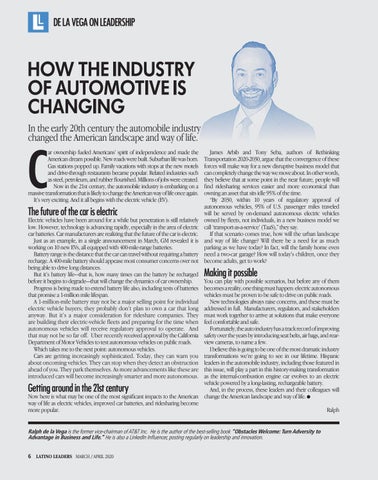
Ralph de la Vega is the former vice-chairman of AT&T Inc. He is the author of the best-selling book “Obstacles Welcome: Turn Adversity to Advantage in Business and Life.” He is also a LinkedIn Influencer, posting regularly on leadership and innovation. 6 LATINO LEADERS MARCH / APRIL 2020
Ralph.indd 6
02/06/20 9:23
COMERICA CORNERX
X
HACIENDA MEXICAN FOODS The power of culture around the world have guided many Latinos in their development, but it was the power of the business that helped guide a compassionate, driven Latina in Southwest Detroit. Lydia Gutierrez is the current owner & president of Hacienda Mexican Foods, a company that produces authentic tortillas and tortilla chips. Her ability to lead a tortilla-making business allowed her to grow and develop as a leader.
Lorenzo Almanza
COMERICA.indd 7
Courtesy
Moisés Cervantes
T
HE LATINA LEADER began her journey learning from her late husband, Richard. “Richard carried the vision and I worked alongside him to implement the vision,” Gutierrez said. Lydia and Richard’s success did not start off easy. They had to learn how to properly grow and build their brand as a company. “We would buy tortillas and tortillas chips from a man who had a company nearby and we would put them in our van and make the delivery,” Gutierrez said. What started off as a small business, soon developed into some amazing opportunities. The company started to build their market by making “tortillas for companies like Stouffer foods and McDonalds.” “We started to grab quite a bit of traction and respect from the other companies,” Gutierrez said. As the company grew, Lydia’s husband Richard began to feel ill. Richard developed Hepatitis C and his health would soon depress. The realm of the company fell into the hands of Lydia and she began to lead the company. With Lydia at the head of the company, things would soon develop. “It was in a year after he passed away, that I had added a 33,000 square foot warehouse,” Gutierrez said. Lydia felt moving into a larger building was significant to the company’s growth. Some of Lydia’s other accomplishments include her growing the size of employment within the company. “We have over 75 plus employees,” Gutierrez said. “I run my company as if my employees are my children. I instill in them values and camaraderie.” However, like with every business, hardships are part of a company’s growth. Back in 2010, the company lost a nice sizable piece of business. “We went from maybe a six million company to a million-dollar company,” Gutierrez said. Her ability to leader and grow in difficult situations have propelled her to face whatever life has to offer: even if it’s a pandemic. Even in the darkest times, Lydia’s light continues to shine. When the pandemic hit, the Hacienda owner gave her employees two options: to continue working or stay at home. “We were going to work with the people we had, to continue to try and keep the business going,” Gutierrez said. “Thankfully everyone is working, and we put some additionally protocols in place” Along with focusing on her employees, Lydia has strived to continue providing the best opportunities for her customers. No matter the circumstances, Hacienda Mexican Foods continues to go above and beyond for its customers. “We understand our customers pay us and being in a position to ask a customer how we can help them makes a significance difference,” Gutierrez said. “I’m incredibly humbled and thankful to be leading this company during this pandemic and it has made me a stronger leader, more focus leader, more continuous leader and one who is looking forward to the day this is behind us,” Gutierrez said. MARCH / APRIL 2020 LATINO LEADERS 7
02/06/20 9:13
LCDA
A CALL FOR CHANGE TO THE BOARDROOM LANDSCAPE Esther Aguilera, President and CEO, Latino Corporate Directors Association (LCDA)
8 LATINO LEADERS MARCH / APRIL 2020
LCDA.indd 8
02/06/20 9:22
In Collaboration with:
"THE ACCELERATING PACE AND INTENSIFYING COMPLEXITY OF CHANGE ARE LEADING TO THE EMERGENCE OF A FUNDAMENTALLY DIFFERENT OPERATING REALITY THAN INCUMBENT EXECUTIVES AND DIRECTORS HAVE EXPERIENCED IN THEIR CAREERS TO DATE” CORPORATE BOARDS are being called on to re-examine their composition based on shifts in demographics, technology, growing social activism, and changing consumer and investor expectations. What’s worked for board governance in the past is unlikely to work in the future and, to adapt, boards and directors will also have to transform—how they think, operate, and interact with the business—while also becoming more diverse and inclusionary. A recent report from the National Association of Corporate Directors (NACD) 2019 NACD Blue Ribbon Commission initiative, Fit for the Future: An Urgent Imperative for Board Leadership, addresses these developments and makes it clear that for businesses to thrive, leaders must create a collaborative culture that will utilize the skillsets of a more diverse group of board members. “The accelerating pace and intensifying complexity of change are leading to the emergence of a fundamentally different operating reality than incumbent executives and directors have experienced in their careers to date,” Blue Ribbon Commission Co-Chairs Cari Dominguez (LCDA Member, Director at ManpowerGroup and Triple-S Management Corp.) and Lester Lyles (Director at General Dynamics Corp. and KBR Inc.) write in the report. “However, this dizzying amount of change also creates immense opportunities for companies to out-innovate the competition, to generate value in new ways, and to strengthen their governance.” Written by a commission of more than two dozen directors, the report continues, “This is by definition not an easy process. It will involve uncomfortable decisions about board members who are not fit for the future, and challenging discussions with management teams whose strategies may be stuck in the past.”
A Fundamental Change to Board Composition Practices is Required
The report examined board composition through the lens of what it describes as a “business revolution with profound implications for companies… a period of challenge and transition.” An organization that wants to maintain its competitive advantage needs to be willing to revamp its board composition, bearing in mind that “the most important aspect here is to ensure the right balance between expertise on emerging issues and relevant past experience.” Clearly, the current pace of change requires a different, more diverse board membership model. Another key message is that boards of major companies must step up their board refreshment practices in order to face these challenges. While acknowledging that some progress has already been made towards this goal, the report encourages the board to be a more involved partner in the director nomination process. Effective governance means that boards must move away from the “pale, and stale” status of many current corporate boards and pursue a model similar to a successful professional sports team, which brings together players with different skills and talents to create a team that works together cohesively. This need for this type of specialized expertise is what is leading nominating committees away from the traditional emphasis on directors from similar backgrounds, genders, ethnicities, and age groups.
an effort LCDA has long supported. Federal legislation to support this disclosure is currently stalled but state legislative efforts have increased lately, as reported in the last issue of this magazine. To fill the void of detailed reporting on board composition, LCDA has recently launched the online Latino Board Tracker (see sidebar) to reveal which Fortune 1000 companies do and don’t have Latinos on their boards. Users can search by F1000 rank, company name, company headquarter location, and the number of Latino/as on each board. LCDA’s BoardReady Institute, featured in this magazine in the Winter 2019 issue, is fostering the next generation of Latino board directors by preparing highly credentialed Latino executives and national leaders for corporate board service. The program’s curriculum was developed in collaboration with the KPMG Board Leadership Center, the Rock Center for Corporate Governance at Stanford Law School, Boardspan, and LCDA’s search firm strategic partners, to assist candidates on their journey to the boardroom. Through these efforts and others, LCDA continues to work with its members, partners, and corporate leaders to increase the number of Latinos on corporate boards. As summarized in the NACD report, the boards that succeed in this new business environment will be the ones that embrace the diversity of their employees and consumers and mirror that inclusion in their boardroom.
LCDA is Leading the Charge for Greater Board Diversity
LCDA Is leading the way in creating programs and advocating for legislation that will support the evolving composition of the corporate boardroom. In order to facilitate that change, the first step is disclosure, so board composition is transparent,
WRITE AND SHARE #ConnectLL
MARCH / APRIL 2020 LATINO LEADERS 9
LCDA.indd 9
02/06/20 9:22
LEADERS HUB WITH JOE
LEADING REMOTE TEAMS IN TIMES OF CRISIS ACCORDING TO GALLUP, the percentage of full-time employees working from home because of COVID-19 closures has increased from 33% to 66% and daily stress has increased from 48% to 65%. In these times of uncertainty about physical and financial health, we wonder if we as leaders can maintain momentum with our remote teams to keep productivity afloat. Business strategies have changed at the executive level to cope with this new normal. You wonder if your remote employees are empowered to be on their own and rowing in synchronicity with you and your executive team to reach the new strategic goals. Specially now when their daily stress and worry has far surpassed those recorded in previous years. Getting your team set up to work remotely means thinking beyond logistics and technology. Helping your employees adopt the right mindset and supporting them will impact their experience and productivity. Leaders must improve communication by being present, transparent, connected, and engaged with their remote teams. They must address the followers’ four basic needs: trust, compassion, stability, and hope (Gallup Poll). The ability to bounce back rapidly from difficulties is called “Resilience” and is a trait that separates some individuals from the rest of the population. Stress is a fact of life. It can be a silent killer, causing emotional and physical damage. And it can be a catalyst for personal growth and hardiness. Changing your stress mindset as a fundamental requirement for growth and leaning on intrinsic motivators such as character strengths are ways to turn stress into an ally. As leaders, we have the responsibility to increase self-awareness of our own character strengths and then observe the character strengths of others to maintain a higher level on engagement and empathy with employees.
Character Strengths are the positive parts of your personality that impact how you think, feel, and behave. Scientists have identified 24-character strengths that you have the capacity to express. Knowing and applying your highest character strengths is the key to you being your best self. These top character strengths are called signature strengths. They are essential (Core to who you are), energizing (Uplifting and give you a boost of energy or joy), and effortless (Come easy and natural to you). For instance, if an employee is in a position that does not leverage his/her strengths, then his/her drive and performance will suffer. Leaders must focus on character strengths and provide remote employees with resources to improve employee self-management, 1-on-1 behavioral dynamics between leaders and direct reports, and overall team dynamics/ culture. Research studies show that character strengths can lead to the following outcomes (Dr. Ryan Niemiec, author of the Strengths-Based Workbook for Stress Relief): 1. Greater levels of flourishing 2. More resilience 3. Less distress 4. Improved coping with stress 5. More positive emotions 6. Higher engagement with activities 7. Increased life meaning 8. Higher work productivity, job satisfaction, and work engagement 9. Stronger and more intimate relationships If you are interested in discovering your character strengths, visit the AlliancesHub website and take the free VIA Survey to get your strengths profile. Character Strengths fuel emotional intelligence and our emotions are more contagious than COVID-19. Have you left your remote workforce more capable and inspired after connecting with them today?
ABOUT JOE Joe Bacigalupo, MBA, MPEC, ACPEC is a Managing Partner and an Executive Advisor at AlliancesHub International, LLC. AlliancesHub offers Change Management and Strategy Consulting, Talent Optimization and Analytics, Leadership Development, and Executive/ Leadership Coaching services.
www.allianceshub.com info@allianceshub.com 469-287-2086
10 LATINO LEADERS MARCH / APRIL 2020
JoeBacigalupo.indd 10
02/06/20 9:14
ART
WILLIAM HANHAUSEN
LATINO ART LEADERSHIP, WHAT WE NEED TO LEARN FROM IT!
L
atino Artist Fernando Casas wrote, “[Charles] Baudelaire, poet and art critic, called upon 19th Century artists to interpret their own age. This call became the aesthetic imperative of the second half of the 19th Century but it remains valid today. However, at this time we have an additional obligation, not simply an aesthetic but a moral imperative; we have placed life itself –old ‘Mother Nature’– in jeopardy and her survival and our own crucially depend on how we act now.” As a common denominator to the existential threat we are suffering, Latino Artists are forthcoming with a non-nationalist compiling resurgence in their work that doesn’t follow exclusive trends. The challenge is to understand the pandemic in a way where they will have a say in how this story is represented alongside a simplified complexity, merged with the fearless concept towards dead as one of the pillars of their Latin-American inheritance thus generating an epic resonance in their artistic communication. This critical situation is redefining who they are as a genre, less selfish, in constant crucial collaboration and creating a new ritual of human contact. A fact where contemporary artists cannot ignore the duty of modern art and the moral action required of the contemporary artist that by definition has a multi-cultural view. A view which helps them, as Latino Art Leaders, to understand the global magnitude of the problem. Where they juxtapose all the visible and invisible to impact the expression of their communication format and better grasp of the present suffering voice. This living tragedy is a vast opportunity for all of us to learn and explore humankind. Art as a product of it, is not intended as a pure diversion. It is a communication channel, the vehicle of a genre perspective, that is not in solitude but aware of it uniqueness.
02
01 Fernando Casas “Colossus” 894” x 66” Mixed Media 01
02 Marcos Raya “Night Nurse” from The Fetish of Pain installation, A/C 03 Yvette Grütter, in front of “Marerei” Mixed Media 55” x 55” 04 Fernando Casas “Waiting” 64” x 112” O/C
03 04
WRITE AND SHARE #ConnectLL
MARCH /APRIL 2020 LATINO LEADERS 11
11 HANHAUSEN.indd 11
02/06/20 10:32
WE ARE ALL HUMAN HISPANIC STAR
HISPANIC STAR IN ACTION: RESPONSE AND RECOVERY PLAN
We are facing a global pandemic that will not only have a clear public health impact, but will also have devastating economic effects on those most vulnerable, particularly including Hispanic-owned small businesses, entrepreneurs, independent workers.
W
hile Hispanics represent 18% of the US population, they represent between 30.5-38.6% of America's essential workers. Additionally, Hispanic-owned businesses contribute more than $700 billion in sales to the economy annually1 and provide employment to more than 2.3 million people. However, during this time, the unemployment rate for Hispanics is increasing 25%2 faster than the rest of the population. Also, 20.1% of US Hispanics under 65 years of age do not have medical insurance. In response to the current and developing health and economic impacts of COVID-19 and as a reflection of the resiliency, compassion, and heart of our community, the Hispanic Recovery Plan was launched as a clearinghouse for information and action to support and protect Hispanics whose businesses and jobs have been affected by the coronavirus pandemic. The initiative is part of the Hispanic Star, a collective platform to unify Hispanics in the US and celebrate their contributions to the country. The Hispanic Recovery Plan is a platform to communicate, organize and mobilize individuals nationwide, unify efforts to mitigate the immediate economic impact of COVID-19 and set a path for a solid and speedy recovery. To drive tangible impact in the community, the Hispanic Recovery Plan will provide access to key leaders and subject matter experts via daily informational webinars on health, policy, business and other topics of interest for Hispanics 12 LATINO LEADERS MARCH / APRIL 2020
WAAH.indd 12
during this time of crisis. The platform will enable a marketplace for talent and services to provide visibility and available opportunities. Leaders will appeal to corporate America to support the Hispanic community in a number of ways, including advocating to promote retention and increasing Hispanic supplier diversity. The initiative will also empower the more than 5,000 Hispanic Star ambassadors nationwide to create “Hispanic Star Hubs” to share information and take action on local priorities. Our country needs to come together in these hard times. As a gesture of solidarity, community and resilience, the Hispanic Star Platform revived an official Spanish language version of the U.S. National Anthem (El Pendón Estrellado) that was commissioned by President Roosevelt in 1945 with the intention for it to be sung, shared abroad and widely circulated. This official version is more relevant today than ever before. Hispanics are massive contributors to America, yet often not seen, heard or valued. We are 100% Hispanic and simultaneously 100% American. We hope this Spanish language version will celebrate the good being done by Hispanics on the front lines of this pandemic, and that all Americans will come together and support one another during this very challenging time in our country’s history. We don't win this alone. We only win together. Learn more about the Hispanic Star Response and Recovery Plan in: www.hispanicstar.org. 1 U.S. Hispanic Chamber of Commerce 2 U.S. Census Bureau - Annual Survey of Entrepreneurs 2014.
02/06/20 9:25
00LL-WAAH.indd 2
04/05/20 11:32
HEALTH
CANCER CARE
››››››
CANCER TREATMENT CENTERS OF AMERICA CALLS FOR SPECIALTY HOSPITALS TO PLAY A MAJOR ROLE IN THE FIGHT AGAINST COVID-19 Pat Basu, MD, MBA, President and CEO, Cancer Treatment Centers of America; Former White House Senior Advisor for President Obama’s economic and health agenda
M
any state governors have taken bold and necessary steps in our ever-evolving fight to contain and control the spread of COVID-19, including working to identify additional hospital sites in their states. As America continues to take on this crisis, we must not lose sight of an equally important population: those with high risk medical conditions who require continued care. Nationwide, we have seen reports of cancelled or delayed cancer surgeries and treatments due to COVID-19 disruption on an individual treatment center level. In a time like this, however, it is critical for all regional hospitals to find solutions before patients are told to forego treatment. While many areas might not yet have reached that point, now is the time to collaborate on an appropriate path forward, and certainly before a second wave hits. In order to do this, members of the larger health care ecosystem must come together to ensure there is no disruption for those impacted by COVID-19 as well as the tens of millions suffering from other acute conditions including cardiac disease, cancer and stroke. Those conditions will eventually backlog into a “double hump” of clinical shortage that will quickly worsen morbidity and mortality for those conditions. At a local and regional level, specialty hospitals must look to partner with community general hospitals to help them create more capacity, more concentrated expertise and to avoid forgetting the millions of other patients during this crisis or future crises.
Fundamentally, as a system, we must do three things in areas seeing the hardest impact from COVID-19 or any other health crisis:
1. Maximally utilize regional capacity at hospitals equipped to handle the massive amount of respiratory illness and infectious disease such as what we’ve seen in the COVID-19 pandemic.
2. Ensure acute care and specialty hospitals step up and free up capacity so the above centers can continue to maximize capacity, speed, separation and focused expertise.
3. Avoid the “double hump” of clinical shortage on a system which will
have a debt-load of COVID or otherwise clinical cases to tend to with a sick, burned out clinical workforce.
Ultimately, “flattening the curve” for a crisis like COVID-19 is contingent on having enough capacity – beds, ICUs, supplies, clinicians – to handle the spike in need. At the same time, many centers are experts at handling certain conditions which are not going to go away (heart conditions, stroke, cancer and others requiring necessary surgeries). Large health systems are generally skilled at treating many conditions across the board such as infectious diseases, cardiac and lung issues, among others. This is exactly what each should be focusing on during this pandemic. As clinicians, we always focus on the patients in greatest immediate need, which in this current crisis would seem to be COVID patients. But we must not lose sight of the tens of millions of other patients who also need our assistance now. There is an enormous imperative for specialty institutions to be prepared to bring reinforcements to their local community hospitals that need beds and resources, by treating their non-COVID patients as their own. Working together, we can all find the light through the darkness and ensure our patients remain vigilant as we walk down this unprecedented path together and plan appropriately for either a second COVID-19 wave or another pandemic.
14 LATINO LEADERS MARCH / APRIL 2020
CTCA.indd 14
6/2/20 11:14 AM
››››››››
CANCER PATIENTS AND THE HEALTH CARE INDUSTRY IN A COVID-19 ERA The COVID-19 virus, while devastating and serious, has also brought a sense of unity throughout the nation and world. Call it a silver lining of sorts that in a period of fear, we are also seeing acts of great kindness and collaboration. Hospital officials are saying it’s even changing the way the health care industry operates. Timothy Baler
S
ince mid-March, teams of nurses and physicians have been working in hyperdrive to the meet the medical needs of a pandemic. Even insurance companies are pitching in, along with pharmacies, drug manufacturers, research labs and many others, from the federal government to local leadership. Cancer Treatment Centers of America® (CTCA) Vice Chair of the Department of Medical Oncology, Arturo Loaiza-Bonilla, MD, MSEd, FACP, praises the way a collaborative effort has blossomed in clinics, hospitals and beyond. “This is a virus that can affect everyone, regardless,” he says. While certain subsets of the population are considered more at risk, everyone is susceptible, creating a “we’re in this together” sentiment. To meet the challenges associated with COVID-19, “we’ve seen significant collaboration between health care systems, providers and patients themselves,” Dr. Bonilla said in a recent interview. He discussed how CTCA® has taken a multi-faceted proactive approach, including the decision of using its national footprint to welcome cancer patients from overwhelmed hospitals across the country into their own. This not only frees up rooms in hospitals for COVID-19 patients, but also ensures that cancer patients continue to receive the care and regular treatments that are critical to their continued health.
Arturo Loaiza-Bonilla MD, MSEd, FACP
No strangers to emotional, financial and physical challenges, cancer patients are at higher risk on several fronts. They are likely to be more susceptible to contracting the virus, as their immune systems are already compromised. They are also likely to have less energy available to fight a viral attack and they may have already heightened risk due to comorbidities. Some patients have decided to suspend cancer treatments to avoid the risks associated with COVID-19. This, however, puts a new level of stress onto an already challenging situation. As Dr. Bonilla states, “Cancer doesn’t wait for COVID-19. We want to treat it, but also keep our patients, caregivers and their physicians safe.” Along with welcoming patients in need, CTCA has also taken a number of steps to protect patients and staff from the spread of the virus, including upgraded hospital cleaning, temperature checks and symptom screenings, telehealth technology options and more. “We still want to see our patients and communicate with them without delaying interactions,” says Dr. Bonilla. “It is important to keep in touch, even if just by phone.” The most vital message now, says Dr. Bonilla, is to reassure patients that not only is the health care system up and running, it is operating at a heightened level to continue serving all those that need care. “I want them to feel reassured that we are there for them,” he says. While churches, schools and countless businesses have shut down across the country, hospitals have not. They are still operating and deeply committed to putting safe protocols in place, even working together to make that possible. While these times are challenging, this example of team spirit provides some much-needed optimism. There is solace in this silver lining and comfort in the fact that one of our most vital industries stands strong and united in the face of COVID-19. “There is still hope,” says Dr. Bonilla. “We can overcome if we are mindful and work together. Collaboration is essential and medicine must go on.” MARCH / APRIL 2020 LATINO LEADERS 15
CTCA.indd 15
6/2/20 11:14 AM
00LL-Truist.indd 2
04/05/20 11:30
SUPPLIER DIVERSITY
This year has marked a shift in how we do business. As business owners, we have had to explored ideas to innovate. For Latino-owned small and medium businesses this meant having to get creative in our services and products, and also cultivating a close relationship with corporate clients. For corporates, this time has given them an opportunity to solidify their commitment not only with their suppliers, but also with their community. In this year’s installment of Supplier Diversity, our team has worked, from the safety of their own home, to provide interviews with top Supplier Diversity experts in Fortune 500 companies. MARCH/ APRIL 2020 LATINO LEADERS 17
17-Intro Supplier Diversity 2.indd 17
6/1/20 7:13 PM
SUPPLIER DIVERSITY USHCC
THE TIME IS NOW: AN URGENT CALL TO ACTION FOR LATINO AND LATINAOWNED BUSINESSES
Ramiro Cavazos
Luis E. Gonzรกlez
18 LATINO LEADERS MARCH / APRIL 2020
18-19-USHCC.indd 18
6/1/20 7:16 PM
The number of Latino business owners in the United States continues to grow significantly faster than the United States average. Over the past ten years, the number of Latino business owners grew 34%, compared to 1% for all other business owners in the United States.
A
merica’s 60 million Latinos were generating $2.3 Trillion annually in economic impact to our G.D.P. before the COVID-19 (Novel Coronavirus) crisis began. There are 4.8 million Hispanic-owned business in America. Many of these companies are young, small and fragile. With the proper equitable support, they will fuel the future economic growth of America. Without proper intervention, the Coronavirus could decimate a large segment of these companies, along with many other non-Latino owned businesses. The United States Hispanic Chamber of Commerce and Latino Leaders Magazine are proud to partner together in solidarity to actively promote the economic growth, development and interests of these more than 4.8 million Hispanic-owned businesses that aggregately contribute over $800 billion to the American economy every year. Together, we are here to support, re-engage, and revitalize America’s Hispanic-Owned Businesses that represent America’s future economic engine through their innovation, dynamism and patriotism. The Paycheck Protection Program (PPP) which was launched on April 3, 2020, ran out of funds within 13 days by April 16, 2020 due to the strong need. A total of $342,277,999,103.00 was dispersed to 1,661,367 companies. However, 2% of the firms approved for loans accounted for almost 30% of the total funding. That’s $104.7 Billion dollars for 33,200 businesses or an average of $3.15 million each. Yet, 74.03% of the total PPP loans approved went to businesses that borrowed $150,000 or less, which was only 17.04% of the total PPP funding which went to loan applicants from the same pool of small business applicants.
On April 24, 2020, a second round of funding expansion was passed to add more funds to the PPP. We will continue to advocate for more funds for the PPP and for the Small Business Administration to be administered through Community Development Financial Institutions (CDFIs) and to be earmarked specifically for minority-owned small businesses. We strong recommend allocating additional funding for the Paycheck Protection Program (PPP), Economic Injury Disaster Loans (EIDL) and grants, closing the existing gaps of inequity in accessing relief, and increasing transparency which will help enable a stronger and faster recovery for our country. Our strategic focus this year is to implement new, innovative digital technology that will allow us to continue to deliver timely and critical resources to our network of small and minority-owned businesses across the country without the need to convene physically in response to the COVID-19 economic fallout. This includes leveraging webinars, podcasts, regional meetings, virtual workshops, phone calls, among other programs. We are leading the way in creating and supporting innovative resources for your customers and for our base of small business owners. We look forward to continuing to work together to build successful resources for our Latina and Latino entrepreneurs. We are also opening this as an important call to action for new partners and supporters. Join the USHCC and Latino Leaders Magazine in this initiative. Help us provide immediate help to support and expand resources for our nation’s Hispanic and minority-owned small businesses during this national crisis.
FOLLOW US @latinoleadersmag
FOLLOW US LatinoLeadersMagazine FOLLOW US www.latinoleaders.com
MARCH / APRIL 2020 LATINO LEADERS 19
18-19-USHCC.indd 19
6/1/20 7:16 PM
SUPPLIER DIVERSITY UPS
Luis E. González
I graduated from business school at the end of that year and my wife and I got married. Shortly after our honeymoon, I received a call from a headhunter on a search for Mars Europe Petfood division. They were looking for someone who could speak Portuguese and Spanish and be responsible for their animal protein sourcing from Latin America. I thought it was quite an interesting opportunity for two or three years, to learn big business before I opened my own again. I stayed at Mars for 15 years working for Mars Europe, Latin America and North America as well as having responsibilities in Asia in a variety of roles and across petfood, food and chocolate. I found myself. I realized I could add more value working for a big company than having my own small business. That I could probably make a bigger difference than on my own. After my second promotion at Mars, my first boss took over from me as I moved to another assignment. Transitioning my role at the time to him was one of the most rewarding feelings I have ever had. After 15 years, I reluctantly left Mars to join Campbell Soup on what was a second to none global opportunity that was offered to me. I was sold when I met Doug Conant, Campbell CEO at the time. \ After Campbell, I worked at Aramark and two and a half years ago I joined UPS where I lead Global Procurement, Real Estate and Risk Management. I feel extremely privileged and blessed Latino Leaders: Please begin by sharing for all the opportunities I have been with us some of your background, given and for the people that helped your roots? me along the way. Jose Turkienicz: I was born in Brazil from Eastern European roots. My paternal LL: How did you arrive to the position grandparents left Poland for Brazil in the you are currently in? early stages of World War II. Both sides of JT: I received a call from a head hunter the family arrived in Brazil with no money 10 months before I joined UPS. He told and unable to speak the language. They me he was starting a confidential search all worked tirelessly to build a new home for a Fortune 50 company that he could and educate their children. I believe my not disclose the name yet, but that “my values and work ethics is imprinted in name was written for it” and asked me me from them. I grew up watching my if I would consider a change. I had a father and my uncle in their business big laugh and asked him to how many and helping every time I had a break others he had said the same thing. We from school or after class since middle agreed he would give me another call school. They were partners on a furniture when he could disclose more. Three business with manufacturing and retail. months later he called back. I actually
LIFTING THE ECONOMY THROUGH SUPPLIERS Jose Turkienicz, UPS Chief Procurement Officer and President, Real Estate and Risk Management, is a supply chain expert and the leader of the Supplier Diversity program at UPS. He discusses his strategy to further the inclusion of Latino small and medium businesses in suppliers. 20 LATINO LEADERS MARCH / APRIL 2020
20-UPS ok.indd 20
6/1/20 7:18 PM
had forgotten about it. He told me that the search was now active and that he was able to confidentially disclose the company’s name. It was UPS. I had a lot of respect for the company already and asked him to elaborate as he mentioned they wanted to hire a Chief Procurement Officer to transform and elevate the function globally to become best in class and a strategic competitive advantage. I was intrigued. I had thought that was already the case but the more I learned the more fascinated I became about the opportunity, and the value that I could help unleash. Part of that value was a total revamp on how UPS approached supplier diversity. Things got a bit complicated at this point. I was quite happy at my current company and I felt there was much more I could still do for them. Because of my daughter and son, it wasn’t the best time to move the family either. Everything was great personally and professionally and I hesitated in continue exploring but I was intrigued. I accepted an invitation to come to Atlanta to meet a couple of people. When I left, I knew I was in trouble. I met great people at a great company with so many opportunities to explore. We discussed for a few more months and it became clear to me that I could help. I felt very good about the team I had helped develop at my previous company and thought if I left they would continue the journey well while I could move to help UPS in their journey. We agreed to a longer transition than average as I wanted to make sure the team was solid with all its deliverables before I left my previous company. In addition to Global Procurement I became responsible for Real Estate and Risk Management at UPS. LL: Talk about some of the work you have done as Chief Procurement Officer in favor of Latino small businesses? JT:UPS has had a strong supplier diversity program in place since 1992, long before I joined the organization. In fact, UPS’s commitment to diversity and inclusion is one of the reasons I was excited to join the company.
When I arrived, we conducted a thorough review of how UPS was performing, and then built a new threeyear supplier diversity strategy. Our first area of focus was internal. We needed to ensure that our sourcing processes, technology, and metrics were optimized, and I wanted to broaden engagement in supplier diversity across the organization. With a new director appointed to lead the strategy, and additional staff allocated to the team, we were positioned to execute. Since we began, UPS spend with Latinoowned businesses has increased 32% to nearly $94M/year. We are not finished. There is certainly more work to be done, but it is encouraging to see the positive gains so far. Our partnerships with the U.S. Hispanic Chamber of Commerce and the National Minority Supplier Development Council, help connect us to potential suppliers. Together we help those suppliers grow. This is a critical part of the process and it is important enough to me that I carved out time to join the National Minority Supplier Development Council board of directors. LL: What are your goals in terms of advancing these opportunities for Latinos businesses? JT: Although we have had some success bringing more Latino businesses into our supply chain, the pace of change is still too slow. The cultural and systemic barriers to inclusion are real and cannot be wished away, or simply ignored. UPS has a platform to demonstrate the business value of supplier diversity, and I want us to continue to use it to help broaden the network of corporations committed to economic growth through economic inclusion. We also need to find ways to encourage the growth of Latino businesses in profitable, B2B industries. Through our continued sponsorships and partnerships with organizations like the NMSDC and USHCC, we are helping Latino business owners and entrepreneurs learn about the network of supplier diversity professionals, business development agencies, and certifying bodies that can help them develop and connect them to new opportunities with corporations like UPS.
WRITE AND SHARE #ConnectLL
FOLLOW US @latinoleadersmag FOLLOW US LatinoLeadersMagazine FOLLOW US www.latinoleaders.com
MARCH / APRIL 2020 LATINO LEADERS 21
20-UPS ok.indd 21
6/1/20 7:19 PM
SUPPLIER DIVERSITY TRUIST
PARTNERS IN DIVERSITY Dr. Lissa J. Miller, Head of Supplier Diversity of Truist, laser focuses on providing Latino small business opportunities at Truist Luis E. González FOLLOW US @latinoleadersmag FOLLOW US LatinoLeadersMagazine
Dr. Lissa Miller: Talk about some of the work you have done as Head of Supplier Diversity in favor of Latino small businesses? Latino Leaders: I’ve always been an advocate for Latino small businesses because I understand the many sacrifices these companies and business owners have made along the way. Over the years, I’ve supported the U.S. and Georgia Hispanic Chamber of Commerce and the Black and Latino Council by sponsoring and participating at events, including their annual business expos, to meet with Latino small businesses and provide information on how to best position their companies to work with leading financial services companies like Truist. Additionally, Truist has eight business resource groups, one of which supports the Latino community called HOPE – or Hispanics Organizing Purpose & Engagement. I’ve partnered with HOPE to help educate teammates on diversity opportunities and share key information with Latino-owned businesses to help them take their business to the next level. Truist also hosts a Supplier Diversity Tier 2 Business Summit each year, where Latino and other small and diverse businesses are invited to participate in educational workshops, matchmaking sessions, leadership insights and networking with corporate supply chain officers. As sponsor and organizer of this annual event, I enjoy bringing our Truist teammates, prime suppliers, community partners and small businesses together to share best practices, learn financial growth strategies and explore business opportunities.
LL: In your opinion and from the corporate point of view, what are the benefits of providing Latino suppliers these opportunities? LM: It’s a win-win for all -- ensuring supplier diversity as a strategic priority helps us combine our desire to create a better, more equitable world with the drive to be a competitive leader in our industry. When companies work with diverse suppliers, they encourage the growth of underrepresented businesses, which in turn support our communities through job creation, increased wages and tax revenue. And as small businesses grow, our nation’s economy grows as well. We also know that consumer needs are always changing based on shifting demographics. Partnering with diverse suppliers helps us bring added insights, reflect the communities we serve and enable companies like Truist to provide innovative, thoughtful solutions for our teammates and clients. LL: What are your goals in terms of advancing these opportunities for Latinos businesses? LM: Truist’s goals are to continue identifying and providing small and diverse businesses with the opportunity to participate in sourcing projects and procurement activities across the bank. As part of the Truist Community Benefits Plan, we will achieve 10 percent spend with minority and womenowned businesses by end of 2022. We also will continue working alongside the national diverse supplier certification organizations that we support, including the National Minority Supplier Development Council
ABOUT DR. LISSA Lissa is the Head of Supplier Diversity at Truist Financial. She serves as the interface between Truist and the diverse supplier community and their partners to expand the company’s use and development of qualified minority, women, veteran, disabled, LGBT-owned and small businesses. In this role, Lissa also ensures that Truist is in compliance with federal guidelines concerning diverse supplier inclusion in procurement activities. Lissa has more than 20 years of collective experience and expertise in supplier diversity, workforce programs, procurement, sales and logistics. She is the Board Chair of the Financial Services Roundtable for Supplier Diversity, U.S. Pan Asian American Chamber of Commerce – Southeast, and First Vice Chair and Mentor/Protégé Committee Chair of the Greater Women’s Business Council. She also actively participates with the Georgia Minority Supplier Development Council, where she previously served as board chair. Lissa has been recognized for advancing diverse businesses by Atlanta Magazine, the Georgia Mentor Protégé Connection, National Black and Latino Council, Greater Women’s Business Council and the Georgia Minority Supplier Development Council. She mentors small businesses and volunteers with organizations, including Cool Girls Inc. and Junior Achievement of Georgia.
and the Women’s Business Enterprise National Council (WBENC), to outreach to Latino businesses throughout the year and understand their capabilities. This will help us secure even more partnerships. Finally, we always look forward to partnering with our internal teams, external organizations and chambers of commerce to provide assistance to Latino businesses by way of access to capital, financial education, grants and other programs.
22 LATINO LEADERS MARCH / APRIL 2020
22-23-TRUIST.indd 22
6/2/20 9:43 AM
PROVIDING THE ROAD TO FINANCIAL KNOWLEDGE Truist’s Regional Multicultural Banking Officer, Arthur Costa, ensures Latino small businesses have the resources and knowledge to grow a business. Latino Leaders: Talk about some of the work you have done as Regional Multicultural Banking Officer in favor of Latino small businesses? Arthur Costa: At Truist, I help drive the company’s “Bank on your Success – Financial Knowledge” program – a twohour, free financial education program delivered at our Multicultural Banking Centers in both English and Spanish. The course helps teach financial basics, including the value of a checking account, key steps to developing a budget and the process of buying a home. Attendees include employees of small businesses and Community Action Groups. In 2019, we delivered more than 900 presentations with approximately 19,000 in attendance, in addition to 350 “Growing your Business” presentations impacting nearly 2,500 small business owners. Most of these presentations were done in low- to moderate-income neighborhoods and to minority-owned businesses, helping them to achieve their goals. LL: What has been your experience working with Latino businesses? AC: Latinos are extremely entrepreneurship minded – it’s part of living the American Dream to own a home and a small business in the U.S. I am passionate about helping Latino business owners be successful and truly enjoy working with like-minded Community Action Groups, including Catholic Charities, United Way, Consolidated Credit and Hispanic Unity of Florida. LL: In your opinion and from the corporate point of view, what are the benefits of providing Latino Businesses these opportunities? AC: Latino small business ownership continues to grow in this country. Florida
has two of the largest and fastest growing markets of Latino-owned businesses in Miami and Orlando. In fact, Greater Orlando is currently the fasted growing Latino community in the entire U.S. To be successful, it’s not just about having the right products, features or solutions to reach these communities. It’s important to speak the same language, understand the culture, provide the right information and knowledge to help them grow their business, and truly listen to and understanding their unique needs. When you do this, you grow loyalty, creating a mutually beneficial partnership for years to come. That’s our priority at Truist, and how we’ll continue to move forward as we strive to build better communities and better lives. ABOUT ARTHUR Arthur Costa was born in Miami Florida, the son of Cuban immigrants who came to America fleeing a communist regime in search of freedom. He attended high school in Hialeah, Florida, a community with a 90+ percent Hispanic population. After graduating from Miami Dade College with a degree in Business Administration, Arthur began his career in banking as a teller. Through various bank mergers and promotions, Arthur worked as a bank manager at BankUnited of Florida, responsible for 12 banking centers in Northeast Miami-Dade County. In 2010, shortly after the FDIC takeover of many banks during the real estate crash, Arthur was offered the position of Market Leader at BB&T in Hollywood, Florida. As a result of the SunTrust and BB&T merger to form Truist Financial, Arthur is now a Regional Multicultural Banking Officer at Truist, focusing on supporting 132 Multicultural Banking Center leaders in Florida and Alabama in their community outreach efforts.
LL: What are your goals in terms of advancing these opportunities for Latinos businesses? AC: For me, it’s all about the impact we can make on people’s lives. Helping ensure economic success and financial security for Latino businesses will always be my two main goals, and I look forward to partnering with our teammates, clients and communities to help diverse business owners achieve success..
WRITE AND SHARE #ConnectLL
MARCH/ APRIL 2020 LATINO LEADERS 23
22-23-TRUIST.indd 23
6/2/20 9:44 AM
SUPPLIER DIVERSITY AFLAC
EMPOWERING DIVERSITY
Aflac’s VP of Strategy of Sourcing & Procurement , Wassel Lewis, offers relief to Latino small businesses impacted by COVID-19
Wassel Lewis VP of Strategy of Sourcing & Procurement, Aflac Luis González
FOLLOW US @latinoleadersmag
FOLLOW US @LatinoLeadersUS
FOLLOW US LatinoLeaders Magazine
Latino Leaders: How did you arrive to the position you are currently in? Wassel Lewis: In 2007, I joined Aflac’s Information Technology division - Strategic Partnerships department, which was responsible for performing and assessing Business Process Outsourcing opportunities for various internal business units. At the time, we had a decentralized procurement organization where three key functions existed in various business units including Strategic Partnerships, Procurement and Vendor Management. These functions were soon merged into a new organization known as Strategic Sourcing and Procurement. As our maturity model advanced additional functions were added such as Category Management, Strategic Sourcing, Supplier Risk, Procurement Administration, Procurement Operations, Supplier Diversity, Supplier Relationship Management and Performance Management. Today, our department is called 3rd Party Management with our team managing all third parties and relationships at Aflac. LL: Talk about some of the work you have done as Procurement leader in favor of Latino small businesses? WL: As Aflac expands its business into diverse communities, our challenge is also to expand the business opportunities we offer to diverse suppliers. Currently, 8.5% of our total diverse
spend is with Hispanic owned businesses. We maintain close relationships with nationally recognized councils and chamber of commerce such as Georgia Hispanic Chamber of Commerce and National Minority Supplier Development Council. I am also involved with Latino advocacy partners through speaking engagements regarding doing business with Aflac. Lastly, my supplier diversity manager sits on several boards where she actively participates in mentoring diverse suppliers. LL: In your opinion and from the corporate point of view, what are the benefits of providing Latino suppliers with these opportunities? WL: We strongly believe that as demographics in the United States changes over time, Aflac must change with it. It’s important to understand that the economic enrichment of these various communities through business development is necessary to maintain our company’s and our nation’s competitiveness and growth. The benefits of having Latino and other diverse suppliers as part of our sourcing process is fundamental in providing access to opportunities within our supply chain. LL: What are your goals in terms of advancing these opportunities for Latinos businesses? WL: As previously mentioned, we have already ensured that our sourcing process aligns with our supplier diversity program; however, Aflac would like to do more. My team continues to look at categories of spend like professional services, information technology hardware or software and have strategies in place to increase spend with Latino businesses as well as other diverse suppliers within these categories. Expanding categories of spend allows Aflac to better assess gaps and areas for improvement within our supplier diversity program more broadly. LL: How is Aflac supporting these Latinos business amid the COVID-19 health crisis? What is the plan during and post pandemic? WL: The COVID-19 pandemic and its impact on people’s lives, the economy and our business is something none of us has experienced before. The unprecedented challenges ask us all to think differently and be agile in our response. Small businesses are at the heart of Aflac and understand the importance of cash flow, which is why we provided some financial relief through an interest-free loan program to support 1099 independent sales agents licensed to sell Aflac products. We also offered early payment opportunities to our small business suppliers (certain restrictions apply). Lastly, we provided virtual business workshops to educate Hispanic businesses with best practices on specific topics to aid in business growth and rebuilding.
24 LATINO LEADERS MARCH / APRIL 2020
24-AFLAC.indd 24
6/2/20 9:47 AM
SUPPLIER DIVERSITY
JPMORGAN CHASE
JPMORGAN CHASE BANK’S APPROACH TO SUPPLIER DIVERSITY JPMorgan Chase Global Head of Supplier Diversity, William Kapfer, talks about their commitment to investing in Latino-owned businesses through supplier opportunities. LATINO LEADERS: PLEASE BEGIN BY SHARING WITH US SOME OF YOUR BACKGROUND, YOUR ROOTS? WILLIAM KAPFER: I was born in a town in update New York called Warwick – a small village located 60 miles north of New York City, with a population of about 6,000. I spent my formative years, and began my work-life in Warwick. From the earliest age I can remember, diversity and acceptance had been ingrained in my family culture. My earliest memories are of working in my grandfather’s grocery store, alongside many people who were different from me. Stocking shelves, making sandwiches and bagging groceries, I worked side-by-side with people from all walks of life. The important lessons my grandfather instilled in me during those years not only taught me about the integral role that small business owners play in a community, but the importance of embracing and honoring all people, regardless of race, age, gender or sexual orientation—lessons that have indelibly influenced who I am today. LL: TALK ABOUT SOME OF THE WORK YOU HAVE DONE AS GLOBAL HEAD OF SUPPLIER DIVERSITY IN FAVOR OF LATINO SMALL BUSINESSES? WK: A big part of what I believe supplier diversity needs to do – and we do it here at JPMorgan Chase – is set the conditions for success for everyone. Our approach to advancing, growing and sustaining more diverse suppliers across the company is to partner with all lines of business at the company, participate in their initiatives, and find ways to connect them with our networks. We also collaborate with our firm’s Office of Nonprofit Engagement to support advocacy organizations such as the US Hispanic Chamber of Commerce. In addition to the US Hispanic Chamber of Commerce, JPMorgan Chase partners with diverse business advocacy organizations, such as the National Hispanic Business Group and the National Minority Supplier Development Council, some of which provide third-party certifications. These organizations offer programming to support the development and success of entrepreneurs. Active, ongoing relationships with groups such as these enable us to identify, connect with and build relationships with Latino-owned companies. During my tenure, the firm has been named to the US Hispanic Chamber of Commerce Million Dollar Club, and the Arizona Million Dollar Circle of Excellence by the Arizona Hispanic Chamber of Commerce. Last year, JPMorgan Chase was one of only two financial services firms inducted into the Billion Dollar Roundtable, a non-profit organization comprised of 28 corporations that each spend $1 billion or more annually directly with diverse suppliers.
LL: WHAT HAS BEEN YOUR EXPERIENCE WORKING WITH LATINO SUPPLIERS? WK: Over the last year, JPMorgan Chase spent over $84 Million with Latino suppliers. We currently work with Latino-owned companies across a variety of industries including asset management, construction, advertising and marketing, legal services, and ATM management. For example, as JPMorgan Chase began the process of refurbishing its midtown Manhattan headquarters, the need to move thousands of executives to nearby locations in a very short timeframe required new office build-outs and new furniture. We partnered with a Latino-owned company which met all of our furnishing needs, providing furniture on aggressive project timelines. In addition, they supplied upwards of 6,000 Herman Miller signature Aeron Chairs for five locations in midtown Manhattan. The company exceeded all supplier performance standards in having product available, staged and ready when we needed it. There are many other examples like this. JPMorgan Chase also believes in providing thought leadership and other support to diverse communities and entrepreneurs. This year, JPMorgan Chase is a Sustaining member and sponsor of the Women’s Business Enterprise National Council (WBENC) Women of Color Development & Outreach Program to provide Latina, African American and other women entrepreneurs of color a comprehensive business eco-system including tools and information that would assist in strengthening, and scaling, their businesses with access to capital, business and personal development and networking. Given the marketplace changes caused by the COVID-19 crisis, we recently held a Zoom event with LatinX business leaders across the country to talk about the impacts of COVID-19 on the LatinX community. Senator Mel Martinez gave remarks and former HUD Secretary, Henry Cisneros was also in attendance. MARCH / APRIL 2020 LATINO LEADERS 25
JP MORGAN CHASE.indd 25
02/06/20 9:20
SUPPLIER DIVERSITY LENOVO
Carlos Cuevas
IN COLLABORATION WITH THE COMMUNITY A Q&A WITH FLAVIA MOREIRA, DIRECTOR OF DIVERSITY & INCLUSION FOR LENOVO Please begin by sharing with us some of your background, your roots? I’m originally from Brazil. I moved to the U.S. in 2016 with my previous employer for a one year international assignment. It worked so well that I ended up staying. I have a broad HR background, having spent half of my career as an HR Business Partner and the other half in several subject matter expertise areas, such as Talent Management, Leadership Development, Talent Acquisition, and Organizational Development, in addition to Diversity and Inclusion. I’ve worked for major organizations such as Mercedes Benz, Kraft Foods, BG Group, and GlaxoSmithKline. I’m also an executive coach and specialize in helping international talent thrive. People describe me as results driven, open minded, and an authentic global HR leader who is passionate about development. My mission is to help people and businesses unlock their potential and grow. It took my moving to the U.S. to realize that I was Latina. Let me explain. I had to come here and experience being different to find my own identity and to start to appreciate my roots and the similarities among all of our countries. I stopped excusing my accent and started enjoying that I’ll always ‘stand out’ wherever I go when I’m in the U.S. I’ve also lived and worked in multiple European and Latin American countries, including Germany. Now, at Lenovo, I’m getting a deeper dive into Asia, and I’m fascinated. One of the ways that shows my ‘Latinidad’ or Brasileirisse’ is how I strongly value personal relationships, and I’m always looking to find ways to have fun. How did you arrive at Lenovo and to the position you are currently in? I found myself ready for my next challenge and a former Lenovo employee recommended me for the position. We had attended a Business Coaching program at NC State University in Raleigh, N.C. together and kept in touch. She had always
said so many great things about Lenovo, and when I saw the job description, I said: “This is my dream. I’m extremely passionate about D&I and have seen how much impact it can have in business and in individuals.” Prior to joining Lenovo, I led Talent Management and Succession Planning for the U.S. Pharmaceutical business at GSK where I experienced first hand the challenge of developing robust and diverse leadership pipelines. Talk about some of the work you have done as Director of Global Diversity and Inclusion in favor of Latino small businesses? Supporting Latino small businesses is a key part of our supplier diversity strategy. We’re working to bring more of these suppliers into our network of providers and to ensure they know about us. In 2019 we helped sponsor the U.S. Hispanic Chamber of Commerce Supplier Diversity Conference where we demonstrated the breadth of opportunities Lenovo has for businesses to provide products and services to hundreds of Latino small businesses. Our spend with U.S. Hispanic owned companies exceeded $115 million, which represented 33 percent of Lenovo’s Diverse Spend (Federal Fiscal Year 2018/2019). We continue to increase our number of suppliers that are Hispanic owned and our spend with them. Going forward, we will leverage the Lenovo Foundation (our philanthropic arm) alongside our Employee Resource Groups as key tools in our Supplier Diversity strategy.
26 LATINO LEADERS MARCH / APRIL 2020
26-27 Lenovo.indd 26
02/06/20 10:33
What has been your experience working with Latino suppliers? I’ve coached small business owners and have witnessed firsthand the tremendous benefits they can bring. I’ve seen powerful Latinas flourish as they build their self-confidence and dare to be their best selves. I’ve seen young Latina and Latino entrepreneurs leveraging their ability to work hard and smart, building strong relationships with their customers, and offering a completely different experience. I now have the opportunity to have an impact in a much larger scale by partnering with my Supplier Diversity colleagues and Lenovo employees in all the great things we’re doing to support and enable the Latino supplier community. In your opinion and from the corporate point of view, what are the benefits of providing Latino suppliers these opportunities? We can only be better as a company and as individuals if we are able to learn from different perspectives. Lenovo will only be able to achieve its mission of providing smarter technology for all if we really understand the meaning of all - different cultures, different backgrounds, different abilities, and different perspectives. That needs to start with the companies that we partner as supplier as well as with our employees. How is Lenovo supporting these Latinos businesses amid the COVID-19 health crisis? What is the plan during and post pandemic? We are currently researching our supply base to determine the impact that COVID 19 will have on our minority suppliers and the effect to Lenovo’s supply chain. We are also in discussions with our largest Minority Owned supplier that is Hispanic owned to determine ways of better collaboration, not only with them, but with suppliers they do business with them on our behalf. Our commitment to Minority Owned businesses remains steadfast, and when we all emerge from this pandemic we will be working with our Minority Business community to strengthen current relationships and develop new and sustainable partnerships. As far as supporting communities around the world dealing with the pandemic, we are doing a lot. Lenovo’s total commitment, through the Lenovo Foundation and teams around the world, recently passed $12 million. This includes support through donations including: $2.4 million in equipment and IT infrastructure support hospitals in Wuhan, including:
$1.4 million in distance learning support focused in China’s Hubei province; $1.3 million in software and services donations to enable distance education and security for those learning and working from home. Click here to see if you are eligible for a free LanSchool Air license. $1 million+ across Europe, Asia Pacific, and Latin American markets to respond to unique healthcare and education needs $500k+ Motorola smartphone donations supporting distance learning and U.S./ Canada charities Lenovo couples its technology with Jangala’s WiFi solutions in remote areas that lack infrastructure, such as refugee camps in Kenya and Eswatini. We are evaluating future deployments to enable connection in isolation. Our CEO, who we know as YY, also made a personal donation of nearly $1.5 million to the Chinese University of Science and Technology to support their ongoing research.
1200+ computers, 280 tablets, 660 printers, software and support $2 million to BGI Genomics in collaboration with Intel for high-performance computing hardware, software, and support $2.4 million in hardware donations support for distance learning education in North America
WRITE AND SHARE #ConnectLL FOLLOW US @latinoleadersmag FOLLOW US LatinoLeadersMagazine FOLLOW US @LatinoLeadersUS
MARCH / APRIL 2020 LATINO LEADERS 27
26-27 Lenovo.indd 27
02/06/20 10:33
SUPPLIER DIVERSITY AT&T
Luis E. González
FOSTERING SUPPLIER DIVERSITY
AT&T’s Rachel Kutz, Vice President, Strategic Initiatives, Global Supply Chain, talks about the importance of fostering relationships with Latino business owners. gram, we’ve matched Hispanic suppliers with larger businesses under AT&T contracts to provide subcontracting opportunities as well as an education on how to increase the capacity for their business. Latino Leaders: Talk about some of the work you have done as Vice President- Strategic Initiatives, Global Supply Chain, in favor of Latino small businesses? Rachel Kutz: I enjoy connecting with our Hispanic Employee Resource Group; Hacemos. I’ve conducted many Fireside Chats to speak to the efforts our Supply Chan has in place to support Hispanic suppliers and I’m able to highlight the many milestones we’ve celebrated within our Supplier Diversity organization. With over 51 years under our belt we’ve generated over $187B in spend with diverse companies and here’s what we’re doing to carry on that momentum. Our Vision of Focus is strategic in three key areas. •Expanding Measures of Success - getting more granular data-powered metrics surrounding spend, number of suppliers, utilization and even Diversity & Inclusion of Suppliers. •Investing in Educational Opportunities to support supplier involvement in AT&T programs. Our team is practicing focused efforts on Supplier Diversity participation in promoting job placement for diverse candidates/skills training. •Business Fostering Programs to help our suppliers grow capacity by elevating our Supplier advocacy through our Tier 2 program. Additionally, in our supplier education initiative, AT&T’s Business Growth Acceleration Program (BGAP), every year we ensure Hispanic Suppliers are included. Over the past three years, we’ve provided education to 5 Hispanic suppliers in our program to teach them how to expand and grow their businesses to achieve higher levels of success. And within our business fostering pro-
LL: In your opinion and from the corporate point of view, what are the benefits of providing Latino suppliers these opportunities? RK: Latino suppliers add value to our company with their innovation and fresh ideas. When we work with Latino businesses and, we mentor them and help make them stronger, too. We were one of the world’s first companies to seek out and work with Latino suppliers. Hispanic spend is best in class when compared to all other diversity segments, both in dollars terms and the number of suppliers. AT&T is committed to assisting Latino suppliers with business education initiatives that help them succeed. AT&T uses innovative techniques and technology to identify Latino suppliers and match them with our prime suppliers. LL: What are your goals in terms of advancing these opportunities for Latinos businesses? RK: AT&T is making meaningful and lasting connections with the Latino business community. At AT&T, our strength is found beyond our leading products and services. It’s in the diversity of businesses that build our network, create our products and services, and generate value for all our stakeholders. Exemplary of our ongoing efforts to advance Latino businesses is AT&T’s collaboration with the U.S. Hispanic Chamber of Commerce (USHCC). The relationship empowers AT&T to advocate and advance our relationships with Latino businesses. AT&T has two USHCC representatives: •AT&T Supplier Diversity (SD) is a member of the USHCC Council’s Procurement Corporate Advisory Board (PCAB) •AT&T External & Legislative Affairs represents AT&T on the USHCC Corporate Ad-
visory Council Furthermore, AT&T’s Employee Resource Group, HACEMOS is deeply involved with fostering Latino businesses in collaboration with our Supplier Diversity Team, AT&T Global Sourcing, and various AT&T departments. In 2019, AT&T Supplier Diversity and HACEMOS conducted a Fireside Chat with Rachel Kutz, VP Strategic Initiatives, Global Supply Chain, regarding how to promote Latino businesses; and, how certified Hispanic companies can do business with AT&T. Moreover, AT&T has developed the Hispanic Leader Podcast - The Latino Leadership Insights podcast is an exploration of the leadership journey of five AT&T Hispanic leaders. The series aims to incite personal growth and offer insightful conversation. LL: How is AT&T supporting these Latinos business amid the COVID-19 health crisis? What is the plan during and post pandemic? RK: “AT&T and VRIO are working on different ways to be able to attend their customers and employees as well as the community and the government entities. We reiterate our commitment as an entertainment company responding to our millions of clients in Latin America, who in large part receive information about the situation through their TVscreens. In addition, now we contribute to the school continuity of the students as well, offering the educational content through Escuela Plus on our screens,” said Michael Bowling, President of DIRECTV Latin America. At the same time, DIRECTV makes ESCUELA Plus available to its clients offering teaching cards and guides that will allow them to benefit from this content in the best way possible. They are available under the following link: www.escuelaplus.com. Escuela Plus is a free educational program for rural schools in Latin America. It seeks to bridge the social and technological gap, bringing audiovisual content that complements the primary and secondary curricula of schools.
28 LATINO LEADERS MARCH/ APRIL 2020
28-ATT.indd 28
6/2/20 9:47 AM
WEALTH & LATINOS Wealth and money conversations can be complex. Understanding the ins and outs of wealth creation had to be something that only the experts can help us understand. The individuals in the next pages have sat down with us to talk about the value and potential of the Latino market of wealth advisory. We have also compiled lists that feature Latinos in Investment Firms and, Wealth and Financial Advisors. These leaders have all excelled in recognizing the power of the Latino market and community. MARCH / APRIL 2020 LATINO LEADERS 29
Intro Wealth Latinos.indd 29
02/06/20 9:12
WEALTH & LATINOS MORGAN STANLEY
IN THE BUSINESS OF HELPING FAMILIES ILEANA MUSA
CO-HEAD OF INTERNATIONAL WEALTH MANAGEMENT AND THE HEAD OF INTERNATIONAL BANKING & LENDING FROM MORGAN STANLEY
30 LATINO LEADERS MARCH / APRIL 2020
30-31 Musa.indd 30
02/06/20 10:34
ILEANA MUSA, CO-HEAD OF INTERNATIONAL WEALTH MANAGEMENT AND THE HEAD OF INTERNATIONAL BANKING & LENDING FROM MORGAN STANLEY, WAS RAISED TO HELP THOSE AROUND HER. NOW AT MORGAN STANLEY, SHE CONTINUES TO DO SO, BUT THIS TIME FOCUSING ON THEIR PERSONAL FINANCES. ILEANA MUSA of Morgan Stanley was born in Cuba and raised along with an older brother and sister in Miami by a single mother. As exiles, her family had lived in Spain for three years first, and her father wasn’t able to join them in the U.S. until Ileana was 17 years old. There were many families split up during this time, but Musa said no one realized it would be a life changing event. “My mom raised us to appreciate our heritage teaching us about family values, how to anchor ourselves, to take action within the things we could change, to work and study hard. She worked three jobs to support us and instilled the work ethic in us that lasts to this day. She said, ‘Your work ethic will follow you wherever you go. You will never have all the answers, but you can control how you work and your impact on society. You should have personal accountability, but not personal gain – always look for the next opportunity to learn and particulate while helping others.’ We helped our family in Cuba, always thinking about others’ hardships.” Musa still focuses on how to help others, especially local Cuban families arriving in Miami who are sending money back to Cuba. During Musa’s college years she was determined that she was going to study dance and that she was going to be a dancer. “I had a knack for the arts, I was a dancer and a cheerleader. But when I finally reconnected with my father he influenced me to major in finance. I loved numbers and he said, ‘you can always dance, but finance will give you the background to have any kind of business.’ He had his own business and convinced me.” Musa then majored in Business with a focus in finance, graduated, and earned her MBA. Musa says, “My husband is a actor/writer/producer so I got back the arts in my life.” They were then able to move to New York and Musa obtained her first international private wealth management role in a Bank. Musa says, “At a very early stage in my career I knew I wanted to specialize in private wealth. The cultural aspect of the work spoke to me, the diversity, international private banking, and helping international clients with ties to home countries managing their wealth in the U.S. I am in the business of helping. I am passionate about enabling teams to service clients.” In addition to the obvious aspects of wealth management, Musa likes thinking about the U.S. Latino opportunity created through the next generation of wealth. She also loves education and had even become a teacher at one point. She strives to help others thrive and get to next level– to lend talent to others, to help families with wealth and education. In leading Morgan Stanley’s International Wealth Management business, Musa’s goal is to support international financial advisors in delivering on the scale, scope and commitment that Morgan Stanley has in serving global families. deliver services and solutions to off shore clients that help build, manage and preserve their wealth. MARCH /APRIL 2020 LATINO LEADERS 31
30-31 Musa.indd 31
ABOUT ILEANA Ileana Musa is the Co-Head of International Wealth Management and the Head of International Banking & Lending. In this role she leads the segment and strategy that focuses on Morgan Stanley’s International Client Advisors and international clients to ensure they have access to strategic solutions, services and thought leadership to address both sides of a client’s balance sheet. Ileana is a member of Morgan Stanley's WM Management Committee, Latin America Management Committee, International Wealth Management Executive Committee, Morgan Stanley Private Bank, National Association Management Committee, Private Banking Group Executive Committee and the Private Banking Group Bank Leadership Committee. Prior to joining Morgan Stanley she was the Global Client Segment and Strategy executive for Merrill Lynch Wealth Management. In this capacity, Ileana focused on international financial advisors to ensure the delivery of a consistent, goals-based wealth management experience for international high-net-worth and ultra-high-net worth clients. Prior to this role, Ileana was head of International Credit & Banking within Bank of America’s Global Wealth & Investment Management (GWIM) Banking group. In this role, she led the teams that supported and delivered integrated liquidity, cash
management and lending solutions and services to financial advisors and high-networth clients in Latin America, Asia and Europe. Ileana received her BBA degree, with a concentration in finance, from the University of Miami and an M.B.A. degree in finance from Florida International University. Ileana is fluent in Spanish, is FINRA registered and is Six-Sigma Greenbelt certified. Ileana sits on the Corporate Advisory Board of the Association of Latino Professionals for America (ALPFA), and she leads Women of ALPFA, a strategic initiative focused on advancing Latinas. Ileana serves on the Advisory Board of the Florida International University Honors College as well as the Board of the Cuban Heritage Collection at the University of Miami. Ileana was recognized as one of the 2019 MAKERS at Morgan Stanley Wealth Management. She received the Latino Justice 2019 Latina Trailblazer Award honoring her professional and personal achievements in opening doors and new opportunities for other Latinas. For three years in a row Ileana was recognized as one of ALPFA’s Top 50 Most Powerful Latinas in corporate America, featured in Fortune magazine in 2017-2018. In 2016 Ileana was awarded the 2015 Top 10 Corporate Executives of the Year by Latina Style magazine.
WRITE AND SHARE #ConnectLL
02/06/20 10:34
WEALTH & LATINOS JOSÉ FELICIANO
JOSÉ E. FELICIANO
CO-FOUNDER AND MANAGING PARTNER OF CLEARLAKE CAPITAL GROUP
PATHWAYS TO SUCCESS:
LEARNING FROM YOUR MISTAKES AND IMPROVING THE LIVES OF OTHERS William Peden
Courtesy
Moisés Cervantes
32 LATINO LEADERS MARCH / APRIL 2020
José Feliciano.indd 32
02/06/20 9:17
Last year, José E. Feliciano, co-founder of Clearlake Capital Group, the 30th largest private equity firm in the world, donated half a million dollars to the Toigo Foundation, a non-profit organization that supports education, leadership and diversity in the financial services industry. Feliciano, who recently virtually attended his 30-year high school reunion, has carved a path through his positivity, humility, and good old fashioned hard work, becoming one of the wealthiest and most succesful Latinos in the United States. Though he would readily admit that failures and great losses were all part of his path to success, the long and winding road traveled by this self-made billionaire solidified core values that haven’t changed since his modest upbringing in Puerto Rico.
B
orn and raised in a middle-class family, his parent’s sacrifice is a big part of Feliciano's success. Connecting the dots in adulthood, he is so appreciative of how his parents always put their children first, making love and education pillars of their parenting. They saved enough money to send their son to a private school that taught English, preparing him for his eventual travel to the United States. “I was just lucky enough to have the benefit of a very supportive family and one that was very focused on education,” he noted. Feliciano and his wife Kwanza Jones, who he met in college, share his parents’ values and give back to others for precisely that reason. Although he excelled in math and sciences early on, he displayed an uncharacteristic lack of certainty when the time came to choose a university to attend post high school. But the extension of a helping hand led to a life changing decision. “I was thinking of staying in Puerto Rico and studying engineering after graduating from high school,” Feliciano admits. Then serendipitously, a classmate applied to Princeton University and prompted a hesitant 17-year-old Feliciano to do the same. This was 1990 and the internet was merely a whisper in America, and almost nonexistent in Puerto Rico. So with very limited research, Feliciano almost blindly applied to one of the most prestigious schools in the world. He had never met anyone who had attended Princeton and admittedly didn’t think he had much of a chance, so he didn’t even fill out the paperwork completely. Once he submitted the documents, the young man was contacted by a Princeton alum named Ronald Blackburn who changed Feliciano’s life forever. Blackburn saw the potential in the teenager and convinced him to finish his application. As part of the alumni interview process, he contacted the Feliciano family and portrayed Princeton as a paradise in academia, which of course struck all the right chords with his parents. Feliciano never forgot this interaction, which taught this investor-philanthropist another important lesson - - know how your actions can affect others, and try and make each interaction honest and thoughtful. Blackburn’s thoughtfulness steered Feliciano to Princeton University which changed his life forever, introducing him to his two great loves. If it was Feliciano’s parents that imprinted the value of education in
their oldest son, then the time spent as an undergraduate at Princeton sparked his love of entrepreneurship, and perhaps most importantly, led to him meeting the love of his life, Kwanza Jones. Together, the couple have carved a unique path of accomplishments including climbing Mt. Kilimanjaro and creating the SUPERCHARGED Initiative, an organization dedicated to positive social impact. At the time of this article, the SUPERCHARGED Initiative has donated more than $25 million to organizations focused on education and/or empowerment in diverse communities, and invested or committed almost $50 million to ventures led by women and/or underrepresented minorities. Accompanied by his soulmate, and on his way to graduating from Princeton with High Honors and a B.S. in Mechanical & Aerospace Engineering, another significant relationship led him away from engineering and into the world of finance. At this time, Feliciano was on his way to
MARCH / APRIL 2020 LATINO LEADERS 33
José Feliciano.indd 33
02/06/20 9:17
WEALTH & LATINOS JOSÉ FELICIANO
01
literally becoming a rocket scientist, and he genuinely had no concept of what investment banking was. However, in another serendipitous occurrence, his roommate, Alex Doñé, now Chief Investment Officer for the $200 billion New York City Retirement Systems, had gone to work on Wall Street. His roommate's journey sparked Feliciano’s interest in finance, and led to him working several years at Goldman Sachs after college where he became involved with many international companies doing business in Latin America, primarily Mexico. This is not only where Feliciano gained his formative experience working with companies like Televisa and Telmex, but it was also during his time at Goldman Sachs that he met one of his mentors, Robert F. Smith. Smith is the founder, chairman and CEO of Vista Equity Partners, one of the most successful private investment firms in the world, and a well known philathropic-minded investor. While working together at Goldman Sachs, Smith introduced Feliciano to the idea of being truly impactful in business and personal interactions, and they are still a good friends to this day. As a result of these experiences, Feliciano embraced the intellectual challenge of understanding the operations of a business, its financial matters, and how the right leadership can create very significant value and very interesting results. That spark for business initiated by his roommate turned into a flame that led Feliciano to continue his education, and pursue his MBA at the Graduate School of Business at Stanford University in California.
01 Feliciano and Jones hiking Mount Kilimanjaro. 02 Feliciano and Jones at the peak of Mount Kilimanjaro after a five-day trek. 03 Feliciano receiving the “Mission Possible: Impact” Toigo award. 04 Feliciano and Jones award a $5,000 check to Akilah Ffriend, winner of the SUPERCHARGED startup pitch competition.
Coming out of business school, Feliciano gravitated towards private equity and the world of investments. His present-day private investment firm would end up overseeing more than $18 billion in capital from institutional investors from around the world since it was founded in 2006, acquiring technology, industrial and consumer focused companies, and producing some of the industry's best returns. Although Feliciano had discovered his new career pathway after taking a few forks in the road, there was still another detour left before he arrived where he is today. Feliciano tells Latino Leaders the story of the first company he joined out of Stanford during the “dot.com” bubble with his sights set on changing the world. “I was one of the first 10 employees and over a couple of years I held multiple titles including CFO and COO, and ultimately we raised about $60 million from some marquee investors...But it didn’t work,” he laments. The internet-based company went bankrupt, had to restructure, and Feliciano had to personally fire a lot of his friends and colleagues who he had helped recruit to the start-up. Up until this point he had experienced setbacks but ultimately had been successful in most of his endeavors. “It was one of the most painful personal and professional experiences that I ever had,” Feliciano reiterates.
02
34 LATINO LEADERS MARCH / APRIL 2020
José Feliciano.indd 34
02/06/20 9:17
FOLLOW US @latinoleadersmag
FOLLOW US LatinoLeadersMagazine
03
04
But never giving up on himself, he used this experience to get back into the investment world where he joined Los Angeles investment frim Tennenbaum Capital. Forging a new path with the lessons learned through this trial by fire, he and his wife set up roots in L.A., where they live currently, and within a few years he became a partner at Tennenbaum. Here, Feliciano learned what it takes to build a successful investment firm, and eventually he felt it was time to start his own firm. For the past 14 years since he co-founded Clearlake, Feliciano has put two values above all else at his investment firm: Teamwork and Honesty. “The importance of a team is to make the other people around you, the person to your right and the person to your left, better.” He references Michael Jordan’s success when giving young proteges pep talks imparting that there will always be a hotshot investor who wants to succeed selfishly—but that approach will never work at Clearlake. If someone is not making the team better through cooperation, hard work, and positivity, they simply will not be a fit. Just as important as being part of a supportive team, a core part of the Clearlake culture is to be brutally honest and constantly embracing mistakes as opportunities to improve one’s work. “Understanding and dissecting, trying to analyze your failures or the situations where you haven't done as well, and trying to make sure you're not repeating those same mistakes is critical for continuous improvement and growth.” It’s clear that Feliciano is a leader not only in the world of private equity, but also in civic engagement and philanthropy. As an entrepreneur and optimist at heart, he sees Latinos as a vital part of American society that are on their way to reaching their full economic potential. “As best said by one of my heroes, Cesar Chavez, ‘We cannot seek achievement for ourselves and forget about progress and prosperity for our community... Our ambitions must be broad enough to include the aspirations and needs of others, for their sakes and for
our own.’ This is particularly important now when minority communities are threatened by the combination of a health crisis as well as persistent economic and social inequities.” This is where the idea of empowerment plays into Feliciano’s ideals. He believes the Latino community will become a more empowered voice in the American economic landscape through its consumer power, its high level of entrepreneurship, and via the investment success of Latino-led firms. The Latino community is gaining power by voting with their dollar, and their point of view is starting to be noticed by American corporations targeting them as a valuable consumer market. Young Latino entrepreneurs today are also as wellversed in business operations and management as any other cohort, but the road is a challenging one for even the most accomplished and experienced. Notably, Feliciano has long promoted the idea that investment prowess does not have a color, or gender, or ethnicity. He strongly believes that Latino-led investment firms are every bit as capable of producing incredible returns for their investors as any others out in the investment management industry—if only they are allowed the opportunity to tap into institutional capital. “There are challenges ahead, but our community has never shied away from hard work.” Through its four key priorities, Education, Empowerment, Entrepreneurship, and Equal Opportunity, the Kwanza Jones and José E. Feliciano SUPERCHARGED Initiative seeks to invest in the future of those whose pathway to success has not been easy or fair. Feliciano’s own story is a story of success despite adversity. In this unlikely story, a young boy from a modest family in Puerto Rico is using the power and capital gained from investing in himself, and his industry-leading investment returns, to help others realize their own dreams. Certainly a tough act to follow for anyone, but as a fellow mountain climbing enthusiast, I can confidently presume José E. Feliciano’s journey is far from over. MARCH / APRIL 2020 LATINO LEADERS 35
José Feliciano.indd 35
02/06/20 9:17
WEALTH & LATINOS
TOP LATINOS IN WEALTH AND INVESTMENT MANAGEMENT Investment Firms and Advisors are leaders that not only understand the economy and numbers, but they are also leaders that must understand the personal needs of a client. Investment firms are those that inject capital into businesses in order for them to grow. Startups, ventures, small businesses all need investment in order to grow in large capacity and Investment Firms are the ones who make that happen. Wealth Advisors are a type of financial advisor that help address the needs of affluent clients. They help clients in investment advices, legal or estate planning, accounting, tax services, and even retirement planning. We have compiled a list of the top Latinos in Investment Firms and a list of Latino Wealth Advisors. The leaders were chosen through a careful research by our our internal team. The criteria was based off the company or firm they are employed with, years of experiences, and title. 36 LATINO LEADERS MARCH / APRIL 2020
Wealth Latinos.indd 36
02/06/20 9:26
Leader
Position
Raymond James
Jose Cabrera George Perez Elena Hernandez Randy Garcia Maya Barnes Cynthia Morales Adela Cepeda Conrad Santiago Jose Delgado Amaury Cifuentes Carlos Garcia Louis Barajas Jesse A. Garza Randy Garcia Aquiles Larrea Jr. Javier Saade
Coral Gables FL Founding Principal Impact Investing CEO and Chief Investment Officer Investment Consultant Impact Investing
Wealth Advisor Wealth & Financial Planner Mgn Director Tampa Merrill Private Wealth Management Naples, FL Merrill Private Wealth Management Punta Gorda FL Merrill Private Wealth Management Lakewood Ranch FL Merrill Private Wealth Management Indianapolis, Indiana Merrill Private Wealth Management Columbia SC Merrill Private Wealth Management FriscoTX Merrill Private Wealth Management Houston TX Merrill Private Wealth Management McAllen TX Merrill Private Wealth Management Tampa FL Global Chief Administrative Officer Global COO & Information Security Chief
Prudential
Karin Larrave Veronica Fuentes Jose Fourquet Lawrence Catena Roy Borrego Dominic Casanueva Ronald Mencias Michael Velasco Richard Platas Joni Abalos Alvaro Gonzalez Michael Valdes Nicole Ayala Fouron Elizabeth Agosto Karolyn Ferris Roxanne Martinez Daniel Pinto Ernesto Plata James Cotto Brian Acarregui Ileana Musa Roy Gutierrez Mark Elias Melissa Corrado Harrison Jennifer Garcia Miguel Viyella Garret Alcaraz Lisa Tuccio Tim Ramirez Yamela Frias
Citi
Maria G Hackley
Co-Head of Global Industrials Group, Corporate and Investment Bank, Citi
Javier Gandara Michele Docharty Joe Mella James Esposito
Head Structured Finance Lending Co head Americas Execution Services & Equity Sales COS Finance Division Global Co-Head Securities Division
Investment Counsel PFM Financial Advisors The Threntham Santiago Group Blue Key Wealth Advisors Finhabits LAB Wealth Management/ MGO Wealth Advisors. The Wealth Advisory Firm The Investment Counsel Company Larrea Wealth Management Fennway Summer Ventures/Impact Master Holdings Northwestern Mutual
Merrill Lynch
BNY Mellon Liberty Mutual JP Morgan Chase Morgan Stanley
UBS
Wells Fargo
Goldman Sachs
Private Wealth Advisor Financial Advisor Managing Partner Co-Founder President President CEO Founder & CEO Founding & Managing Partner
Top Wealth and Financial Advisors
Gen Trust
Top Latinos in Investment Firms
Company
SVP Talent Officer Co President & Co CEO Corporate & Investment Bank Manging Director Wealth Advisor MS Morgan Stanley Wealth Management, Seattle WA Managing Director, International Wealth Management UBS Financial Svcs. Little Rock Arkansas UBS Financial Svcs. Houston TX UBS Financial Svcs. Denver, CO Wells Fargo Advisors, Encino CA Wells Fargo Advisors, Miami FL Wells Fargo Advisors, Virginia Beach VA COO, Tech Infrastructure CTO President Prudential Retirement
MARCH / APRIL 2020 LATINO LEADERS 37
Wealth Latinos.indd 37
02/06/20 9:26
WEALTH & LATINOS JAMES COTTO
Latino Leaders: How did you enter this professional practice? What motivated you? James Cotto: I decided to enter this business right after graduating from Rutgers. I was always fascinated with the interconnection between world occurrences, its impact on the global economies and peoples’ personal financial situations. What we are currently living through optimizes that statement. I believe I am motivated by helping people. I like knowing that I have the ability to process the overabundance of data available, and create a well thought out, actionable strategy that my clients understand and can implement to navigate these changing times and assist them in managing their personal affairs to achieve their financial and non-financial goals. LL: What have you learned all these years of practice and experience? JC: I learned that you cannot control the global politics, its effect on the markets, nor the many unforeseen occurrences that often have unintended consequences. There are two important things you can control. First, as an investor, you can control that you have a well thought out plan that is goals based, within your risk tolerance and can react nimbly to this fluid environment. Second, from a personal perspective, you can control how you treat people. I believe it is the people you meet along your journey and how you treat them, that help you create your personal body of work. Later in life you may reflect and be proud of the impact you have made.
PROTECTING THE WEALTH OF LATINOS JAMES COTTO, WEALTH ADVISOR AT MORGAN STANLEY, IS IN THE BUSINESS OF CREATING STRATEGIES TO ACHIEVE A FINANCIAL GOAL. AT MORGAN STANLEY, HE HAS BEEN ABLE TO EXTEND HIS KNOWLEDGE IN FAVOR OF THE LATINO COMMUNITY.
"AS A LATINO, I BELIEVE THIS IS OUR TIME TO SHINE. THE DATA IS OUT AND IT IS VERY COMPELLING. THE LATINO COMMUNITY IS WELL POSITIONED TO PLAY A CRUCIAL PART IN THE FINANCIAL SUSTAINABILITY OF THE U.S ECONOMY. WE MUST ALIGN OURSELVES WITH LIKEMINDED INDIVIDUALS IN ORDER TO CAPITALIZE ON THIS OPPORTUNITY".
38 LATINO LEADERS MARCH /APRILS 2020
38-39 Cotto.indd 38
02/06/20 10:36
LL: Benefits of working with a Wealth Advisor? Are Latinos ready? JC: Managing your financial affairs is very personal. The decisions you make are a combination of what you need to accomplish, your goals and dreams for your family’s future. Balancing those needs and wants within a risk tolerance strategy that is appropriate is very important. Making those decisions and balancing all of those components can be challenging on your own. Having an Advisor that knows you and your personal aspirations, while also having the ability to be objective and remove emotion from this process is essential and critical. My Latino clientele has expressed their appreciation of my cultural affinity and understanding of their values; which is then translated into a trusted relationship. As a Latino, I believe this is our time to shine. The data is out and it is very compelling. The Latino community is well positioned to play a crucial part in the financial sustainability of the U.S economy. We must align ourselves with likeminded individuals in order to capitalize on this opportunity. When I say likeminded, I think of our core commonalities as Latinos: family, faith, entrepreneurism, giving back to our community, and our commitment to enhancing American Latino dignity and pride. We are ready to deliver. I am very proud of the effort and commitment of our generation. I am excited and hopeful for the future generations of Latinos and what they will accomplish for our country and society. LL: Challenges and Advantages of Latinos serving their clients? JC: On the contrary, as a Latino, I see myself as having a distinct advantage over other Advisors desiring to work with our community. We have similar backgrounds, experiences, values and goals for our families. It is easy to understand each other because we are Latinos and are deeply loyal. When working with my Latino clients, the relationship is both very professional and personal. They know that I sincerely care not only about their financial success and security, but also their personal financial goals. I support them in both their entrepreneurial and philanthropic endeavors. I feel blessed and cherish these relationships. I also thoroughly enjoy supporting and empowering our community. It is extremely
ABOUT JAMES COTTO James manages a wealth advisory practice residing at the Morgan Stanley Global Headquarters in Purchase, NY. He started his career as a Financial Advisor in 1988, at First Albany Corporation before joining Merrill Lynch in 1991. In 2001, he decided to move his practice and joined Wachovia Securities as a Managing Director, Investment Officer. In April 2009, he joined Morgan Stanley. From 1995-2004, James assisted the New York State Office of Mental Retardation and Developmental Disabilities (“OMRDD”), nonprofit corporations servicing this state agency and families of children with disabilities. As a result of his efforts, James was formerly appointed by Merrill Lynch as the National spokesperson for their “Families of Children with Disabilities” program. He has been featured on local, national and syndicated shows such as “Money Talks” and “Good Day New York.” In 2009 James was nominated as one of the top 100 Advisors in New York by Barron’s. James is a graduate of Rutgers University in New Brunswick, NJ. His focus is leadership, higher education and career planning through mentoring and advocacy with HSF, ALPFA, Latino Donor Collaborative and The Cisneros Hispanic Leadership Institute.
rewarding – that is why I chose to assemble and lead a multi-generational wealth advisory team comprised predominately of Latinx, whose primary focus is advising this demographic on their financial affairs. LL: Best advises you have brought to your clients? JC: Focus on long term and diversified investment strategies that help meet your financial goals and are within your risk tolerance. The world is different today, and client portfolios must evolve in order to reflect the changes that are occurring. Keep your strategy grounded with longterm fundamentals and adjustments for today’s markets. If all of this sounds a bit overwhelming, then it probably is. That is why Wealth Advisors, such as me, can help you navigate these choppy waters.
MARCH /APRIL 2020 LATINO LEADERS 39
38-39 Cotto.indd 39
02/06/20 10:36
00LL-Morgan Stanley.indd 2
14/05/20 16:24
WEALTH & LATINOS
INNOVATION AND VENTURE
INVESTING IN YOURSELF ALLOWS YOU TO INVEST IN OTHERS Latino Leaders had a series of conversations with Javier Saade, a venture capitalist and national business leader. Before his current roles, President Obama tapped him to serve as Associate Administrator of the U.S. Small Business Administration and was its Chief of Investment and Innovation. He has decades of experience as an entrepreneur, investor, executive and management consultant placing him at the center of tens of billions of capital investment, businesses building, tech innovation and policymaking. Bill Peden
“FINANCE HAS a lot of mystique around it but should be more accessible than it is.” Javier Saade understands the world of capital and innovation and his success stems from leveraging his broad experience and diverse learnings along the way. He was born in Puerto Rico and it was there where Saade learned his first lesson: work hard and if you fall, dust your shoulders off and get back on the horse. His family was “traditionally middle class” and unlike many prominent business leaders, Saade did not grow up with risktaking resources. Indomitable advocates for education, his mother and father pushed him to try as many things as he wanted and take chances. He played sports, was a Boy Scout and an altar boy and his job was at McDonalds. Eternally curious and self described as “ADD” he learned some hard lessons early on. “Burning your hand on the stove is more effective that someone telling you the stove is hot and not touch it.”
TIPS FROM JAVIER SAADE:
Pretty sunsets need dark clouds - there is always a silver lining.
01
01 Having coffee before trekking w mountain gorillas in Uganda
MARCH / APRIL 2020 LATINO LEADERS 41
JavierSaade.indd 41
6/2/20 11:23 AM
WEALTH & LATINOS
INNOVATION AND VENTURE
Upon graduating high school, he found his way to Purdue University. When Saade arrived Indiana, he found “a very different place than the beaches of San Juan” and for the first time in his life, he was considered a minority. Thousands of miles from home, Saade’s curiosity flourished and earned a degree in Industrial Management and was highly active in the student body. Out of college Saade earned a coveted spot in the management training program of a Fortune 100 pharmaceutical company; Abbott Laboratories. The early part of his career was
spent in engineering and line management roles of the multinational. Saade says he can’t think of a better grounding in business than being exposed to the operations of a highly complex and science-driven corporation. While working fulltime at Abbott, Saade earned a Masters of Science in Operations & Technology from Illinois Institute of Technology that led him to management consulting firm Booz Allen & Hamilton.
TIPS FROM JAVIER SAADE:
No seat at the table? Then bring your own chair and squeeze it in.
TIPS FROM JAVIER SAADE:
Serendipity is intention unmasked - the harder you work, the luckier you get.
02
42 LATINO LEADERS MARCH / APRIL 2020
JavierSaade.indd 42
6/2/20 11:38 AM
02 At his home in Washington DC 03 Snowshoeing in Grand Teton National Park, WY 04 Hiking to Patagonia
03
JAVIER SAADE Javier Saade is Founder & Managing Partner of Impact Master Holdings and Partner at Fenway Summer Ventures. He is Chairman of the Board of a private equity-owned financial services firm and serves on the Boards of Trustees of The Nature Conservancy and The Organization of American States’ Pan American Development Foundation. Saade also holds seats on the Global Board of Advisors of DocuSign, the Corporate Social Responsibility Board of Univision, and the Board of Advisors of Harvard University’s Arthur Rock Center for Entrepreneurship. He is a founding member of Fast Company’s Impact Council and a member of the National Association of Corporate Directors (NACD) and the Latino Corporate Directors Association (LCDA). Previously Saade was one of the highest-ranking Latinos during the Obama administration and the SBA programs he oversaw have invested over $128 billion into more than 300,000 companies. Before his White House appointment he spent time at organizations that include McKinsey & Company, Booz Allen & Hamilton, Bridgewater Associates, Global Emerging Markets and Abbott Laboratories. He holds an MBA from Harvard Business School, an MS from Illinois Institute of Technology, and a BS from Purdue University.
His first manager at Booz, one of the only Latino partners at the firm, encouraged him to pursue his MBA. As Saade puts it, “to this day I still believe I was an admissions mistake at Harvard Business School, but when they knock on your door, you answer it”. After his MBA Saade joined another top consulting firm, McKinsey & Company. What he found was that the more competitive the environment, the more intense his drive became. “In places like Harvard and McKinsey everyone is at least as smart as you think you are and in environments like that, you find yourself struggling to keep up”. He adds, “it provided me with fuel to push hard and learn.” Pushing appears to in Saade’s nature but being one of few Latinos in boardrooms, business deals and Ivy League schools he slowly realized he needed to constantly prove he belonged. “I don’t do that anymore, but I feel like people always wonder.” Saade reasons that if you get to these places based on effort and merit, not connections, it means you had to run twice as fast. After Saade left McKinsey he had a chance encounter that offered a new path. He was advising on a biotech M&A and during that spent time with the chairman of the board, who happened to be a growth capital investor. “I don’t know exactly what he saw in me 20 years ago, but he offered me the chance to learn what makes our economy go around – capital.” This was the start of his career in finance and while at Paradigm Group, he also co-founded Air America Media. This gave him another window into our wealth creation machine – entrepreneurship. Between Paradigm/Air America and his eventual White House appointment to oversee tens of billions of dollars, he spent time as an investment professional at a $160 billion macro hedge fund, Bridgewater Associates. Later he became partner at Global Emerging Markets, a firm that capitalizes private and public companies around the world. Today he invests in startups at Fenway Summer and Impact Master Holdings. Saade’s perspective is somewhat unique because he’s had experience investing private equity, venture capital and hedge fund capital. When asked why Latinos and other minorities as so underrepresented in the financial services and investment world, he remarks, “Conceptually and empirically all the markers are there - Hispanics are getting more college degrees, starting more businesses, are digitally savvy, have the power of numbers, on and on”. He goes on, “Latinos start businesses at twice the rate of the general population, Latinas are 3 times more likely to start a business.” This entrepreneurial spirit may be borne out of necessity – and the flip side is on stark display today. If you couple energy with time, the macro trends point to Latinos attaining more success. Saade points out that “youth is on our side and youth equals time and time is good for compound interest to build.” The median age in America today is 38 years old, while the median age of Latinos is about 27. He states that it is important for Latinos to take risks, and sometimes these leads to failures but the experience is invaluable. Saade also stresses that Latinos need to educate themselves on government resources because “we pay for them.” Latinos should be aggressive connecting
TIPS FROM JAVIER SAADE:
Tell me and I forget, teach me and I remember, involve me and I learn get involved.
04
dots on path to ownership because that is what ultimately leads to wealth creation. “Invest in yourself and your ideas so you can invest in others.” Saade is optimistic, even during the current devastation our community is going through, that we will see more and more Latino millionaires in the coming years. “If you can’t envision a world where you have a million Latino millionaires in the United States by 2040, I think we have a problem. Even though the march is slow, Latinos are on their way.” “We are going through a tough time and your readers have a significant role to play in our recovery.” Future Latino Leaders can follow the road taken by Javier Saade, but everyone’s mileage may vary. MARCH / APRIL 2020 LATINO LEADERS 43
JavierSaade.indd 43
6/2/20 11:39 AM
00LL-House.indd 2
19/05/20 14:25
AUTO
LATINOS AND THE AUTOMOTIVE INDUSTRY
Throughout the years, the automotive industry has taken massive steps. With the continuous development of new technologies and the growing focus on diversity, Automotive companies are moving towards a new era. In the following pages, we have included a list of the Top Latinos in Auto. We have also collaborated with Toyota to interview two top-ranking Latinas and have them share their insight on the challenges Latinos in the automotive industry face. FOLLOW US LatinoLeadersMagazine
MARCH / APRIL 2020 LATINO LEADERS 45
AutoIntro2.indd 45
6/2/20 11:44 AM
AUTO
LEADING LATINA
TOYOTA’S LEADING LATINA Jacqueline Thomas, Toyota’s Chief Compliance Officer, is the highest ranking Latina executive at Toyota. Thomas shares the mission behind Toyota’s multicultural approach. LATINO LEADERS: Can you please share your opinions on the current state of Latino talent in Automotive industries? JACQUELINE THOMAS: As the fastest-growing demographic segment, we need to continue to embrace the talent pipeline for Latinos. We have made a lot of progress over the years, but we need to do more. Latinos can offer so much to an organization. The love of family, care for others, and strong - leadership are some of the characteristics that define our culture. There is nothing that we put our minds to that we can’t accomplish with passion and hard work. While we have made some progress, the auto industry can still go further. We need to see Latinos rise throughout all leadership ranks. It begins with each of us paying it forward and helping others to rise. Teaching the new generation the tactics that can help to have our voices heard. In my career, I have worked in two predominantly male industries (oil and gas and automotive). What I’ve learned along the way is the importance of knowing when to speak up and having the courage to be willing to stand out in a crowded room. LL: How is Toyota approaching corporate diversity? JT: Toyota leaders are provided with tools and support along the way to foster an inclusive and diverse workplace. We have created cross-functional teams as champions and advocates to keep our finger on the pulse, to know how our team members are feeling. There has been a lot of investment in training to reduce unconscious bias and leverage our complete talent pool. Our Social Innovation team is a strong partner to all the diverse functional areas. They create opportunities to engage the Toyota leadership in various community activities with local and national leaders. They support executives with our Diversity and Inclusion scorecard, which tracks actions like volunteering with an employee resource group or serving on the board of a nonprofit. And these scorecards are ranked and evaluated at the end of the year and reviewed by our CEO.
JACQUELINE THOMAS Jacqueline Thomas is the Chief Compliance Officer for Toyota Motor North America. Jacqueline was born in Miami, Florida, the first in her family to be born in the U.S. to parents who immigrated from Cuba. As the global company’s first Chief Compliance Officer and highest-ranking Latina, Jacqueline is spearheading the compliance landscape within Toyota. She is making an impact on how executive management responds to compliance risks, to ensure the safety of customers and the high quality of Toyota’s products and services. After her success as part of the executive team that led the company through the threeyear SDNY Monitorship, she set a strong compliance framework for TMNA. She and her organization continue to make significant progress in how Toyota responds to the changing regulatory landscape and ensuring Toyota complies with all regulations. Prior to joining Toyota in 1999, Jacqueline worked in the Oil and Gas Industry in a variety of financial, audit and procurement management positions.
LL: Toyota has an amazing track record of focusing on the Hispanic consumer market. Why do you think this is important? JT: The Latino demographic in the U.S. is one of the fastest-growing markets, representing $1.5 trillion in buying power. Toyota appreciates the importance of the Latino community in the United States and has engaged with the Latino community. We have great business partners that help us reach out to Latinos for marketing and sales. We have strong Latino representation in our San Antonio plant, especially with our suppliers that support us there. LL: What is Toyota doing to make sure that their employees are taken care of amid the COVID-19 health crisis? JT: Toyota offers its condolences to all those who have lost loved ones, as well as our sympathy to any affected by the outbreak of COVID-19. Toyota makes decisions based on the safety and security of our employees, stakeholders and the communities in which we work and live. The Company fully embraces the Toyota Way core value of respect for people.
46 LATINO LEADERS MARCH / APRIL 2020
Toyota.indd 46
6/2/20 11:42 AM
INNOVATING TOYOTA’S CUSTOMER EXPERIENCE Peggy Turner, Vice President of Lexus, Guest Retention, has an eye for knowing how to create a memorable experience for customers. LATINO LEADERS: Please share with us a brief introduction of yourself and your background. PEGGY TURNER: I am the Vice President of Lexus, Guest Retention. I have been with Toyota Motors North America/Toyota Motor Sales for 29 years. My career has been concentrated primarily on service replacement parts supply chain, and in the past ten years, I have been supporting the customer experience side of business. I have been married for 32 years and I am a proud mother of two wonderful sons. My eldest son works at Toyota and the other one works at NBCUniversal. I was born and raised in California with my three siblings until I moved to Texas to follow Toyota three years ago. My mother was of Colombian descent, and my father American. I cherished the opportunity to have my maternal abuelita live with us for part of my childhood. She immersed me in the Latino culture. LL: What was your journey like arriving to your position. Share with us what you do. PT: I credit my career journey as the proverbial one of networking, mentorship and hard work. I started my career in the Aerospace industry after receiving my undergraduate degree from the University of California, Irvine. While working, I attended business graduate school part-time at Loyola Marymount University, where I developed a great network of mentors and friends. I studied closely with a fellow student (now, a great friend) who convinced me to apply for a job at Toyota. It was she, along with my network, who helped me see career opportunities at Toyota, and I took a risk and accepted a position. I started my career with responsibilities in the service replacement parts and accessories departments. I held positions in sales, marketing, and within the supply chain, such as purchasing, transportation logistics, warehousing and strategy. Working hard led to recognition and opportunities to volunteer, to take on unique tasks for career growth. I have always had mentors and a personal “Board of Directors” that provided me with career insight and guidance — mentorship was critical to my career growth. In fact, after almost 20 years in the supply chain business, a mentor of mine encouraged me to try a career change and follow my passion for customer relations. I have supported customer services and customer experience for the last nine years. My current responsibilities entail developing loyalty and retention programs to maintain our valuable relationships. I am passionate about the commitment Toyota and Lexus have to our customers, and I am fortunate to love what I do every day. I am an advocate for diversity and inclusion. I was one of the first members of the Toy-
ota diversity and inclusion champion training program which started over 20 years ago. I am a proud executive sponsor of the Toyota Latino Employee Resource Group named TODOS. TODOS does a great job supporting Latinos internally and in the community. I am grateful to work for a company that has Respect for People as one of its core values, and a culture that supports both team members and the community. LL: How is Toyota helping the recruitment of Latino talent? PT: Our Human Resources Department has several programs that we leverage to recruit top talent in our multicultural markets. We sponsor a number of Latino organizations, but in particular, we have a great partnership with the Hispanic Scholarship Fund organization that allows us to engage and recruit top Latino talent. LL: Is there any other topic Toyota would like to amplify at this time? PT: COVID-19 has drastically changed the environment we live in, and Toyota is concerned with the health and safety of our customers, our employees, and the community. Toyota’s focus now is to support them and contribute to improving the health of America. Toyota is using its people and factories to develop PPE for our health workers. In addition, Toyota recognizes that the minority population faces a disproportionate amount of risk in contracting COVID-19 so Toyota has shifted a lot of its ad buying and marketing dollars to ensure that the Latino and African American communities are informed about how to protect themselves from the virus through our Community Service Announcements (CSAs). We hope to catch the Latino community’s attention by featuring Latino stars such as Lupe Infante and Gilberto Santa Rosa. MARCH / APRIL 2020 LATINO LEADERS 47
Toyota.indd 47
6/2/20 11:42 AM
AUTO
LATINOS IN AUTO
LATINOS IN AUTOMOTIVE TESLA
HYUNDAI KIA AMERICA TECHNICAL CENTER, INC.
Alex Escobar
Angeles Van Ryzin
HYUNDAI MOTOR AMERICA
NISSAN NORTH AMERICA, INC.
Brandon Ramirez
Carlos Guerra
Powertrain Engineer
Senior Group Manager, Product Communications
Senior Director and Acting Vice President, Human Resources
BMW OF NORTH AMERICA
HYUNDAI MOTOR MEXICO
FORD MOTOR COMPANY
TOYOTA
Charles Silva
Senior Analyst, Finance and Business Operations
Claudia Marquez
Claudya Arana Sanchez
Diana Davis
Regional Vice President Of The Western Region
CEO
Sustainability Reporting and Integration Manager
General Manager, Field Sales Portland Region, TMS Portland Region
NISSAN MOTOR CORPORATION
TESLA
HYUNDAI MOTOR AMERICA
BMW GROUP
Fred DePerez
Gabriel Cuellar
Gilbert ´-Castillo
Guillermo Areas
VP Nissan Northeast Region
Global Supply Manager
Senior Group Manager, Advanced Vehicle Strategy,
Head of Governmental and External Affairs BMW Group Latin Americas and Catibbean
BMW GROUP
TOYOTA MOTOR NORTH AMERICA
KARMA AUTOMOTIVE
HYUNDAI MOTOR COMPANY
J. Antonio Antela Martinez
Jacqueline Thomas
Jorge Sordelli
CEO/Managing Director BMW Group Latin America and the Caribbean
Group Vice President, Chief Compliance Office
Engineer Designer
José Muñoz Global Chief Operating Officer, Hyundai Motor Company, President and CEO, Hyundai Motor North America, President and CEO, Hyundai Motor America
48 LATINO LEADERS MARCH / APRIL 2020
Auto2.indd 48
6/2/20 10:56 AM
This selection showcases the top Latinos in Auto industry. This list includes Latinos that hold positions in executive, in engineering, in marketing, and other highly important roles. We are proud of these leaders that continue to make a difference in favor of the community while fulfilling the roles within their industry. NISSAN MOTOR CO.
LEXUS
GENERAL MOTORS
TOYOTA MANUFACTORING TEXAS
Laura Hernandez-Romine
Manuel Lechuga
José Luis Valls
Ken Camarillo
Executive Vice President, Nissan Motor Co., Ltd. President and Chairman, Nissan North America, Inc.
Retail Innovation, Marketing and Technology Manager
FCA FIAT CHRYSLER AUTOMOBILES
Director of Global Media and Multicultural Marketing
Engineer Specialist
FORD MOTOR COMPANY
TOYOTA NORTH AMERICA
GM FINANCIAL
Maria Camila Chavez
Maria Eugenia (Maru) Flores
Matt Gonzales
Environmental Engineer
Global Manufacturing and MP&L Development Services Manager
Vice President Human Resources
Octaviano "T.J." Villanueva Jr.
TOYOTA NORTH AMERICA
TOYOTA MOTOR SALES
FCA
VP & Associate Counsel
MERCEDES-BENZ FINANCIAL SERVICES USA
Olga Leal
Peggy Turner
Randy Ortiz
Rodolfo Dominguez
Group Manager
VP, Lexus Customer Services
Head of Advertising, Jeep
Vice President Business Transformation and Chief Digital Officer
GM
TOYOTA NORTH AMERICA
HYUNDAI MOTOR AMERICA
FOLLOW US www.latinoleadersmagazine.com
Santiago Chamorro
Santos Bugarin
Walter Rodriguez
VP of Global Connected Customer Experience
Group Manager - North American Parts Center California
Sr. Manager, Business Management Intelligence
MARCH / APRIL 2020 LATINO LEADERS 49
Auto2.indd 49
6/2/20 10:57 AM
LEADERSHIP
ST. AUGUSTINE COLLEGE
ST. AUGUSTINE COLLEGE AN INSTITUTION BY LATINOS FOR LATINOS
DR. REYES GONZALEZ
PRESIDENT OF ST. AUGUSTINE COLLEGE
Dr. Reyes Gonzalez rose from humble beginnings in the small town of Jalisco, Mexico, where he was born as one of nine children. Even though his parents never had the opportunity to obtain a formal education, they instilled in him the importance of education. Holding that importance close to his heart, as President of St. Augustine College (SAC), he is now making it possible for others to get a college education. St Augustine is the only Latino institution of higher education in the Midwest whose mission is the success of Latinos. Dr. Gonzalez is the only Latino person in the State of Illinois who holds the position of president at a university. Christine Marshall
DR. GONZALEZ began his journey to becoming a college president when he was nine years old. His mother became extremely ill and came to the United States seeking medical assistance. Having been born in the United States, she was able to travel to the United States and later sponsor her husband and nine of the children to obtain residency in the United States. The plan always was to return to Mexico. However, his parents saw an opportunity
for their children to achieve the American Dream – an education. So the plan to return to Mexico was not realized for the Gonzalez family. Many years have passed, and his parents returned to Mexico, and the nine children and their descendants made the United States their new home. Dr. Reyes Gonzalez’ parents always encouraged their children to pursue their education. If asked, Dr. Gonzalez will tell you that his father was one of the wisest man he ever met. He will also share with you a conversation that he had with his father that transformed his life and his views about the importance of education. His father told him, “My son, I do not have knowledge to impart to you. I have no assets. I only have one piece of advice to give you. Go to school - school is your future.” Dr. Gonzalez took his father’s advice to heart. He became an engineer and, later in life, obtained a master’s degree in Business Administration. He also obtained a master’s in accountancy and change management and a doctorate in Education
50 LATINO LEADERS MARCH/ APRIL 2020
52-53 Reyes Gonzalez.indd 50
02/06/20 10:37
Management. He is immensely proud of his parents and eight siblings. Eight out of the nine children went to college and earned advanced degrees. He will also tell you that it is amazing to think that from two immigrants, who did not have an opportunity to obtain formal education, there are now children and grandchildren who went to some of the finest universities in the United States, including the University of Pennsylvania and Harvard. As most people who achieve something in life, Dr. Gonzalez did not achieve his education on his own. He was blessed and fortunate to have met two teachers who changed his life by helping him learn English so that he could be admitted into Lane Technical High School, one of the finest schools in Chicago. He will be forever grateful to these two teachers who gave him an opportunity to change his life. Dr. Gonzalez has always been fascinated to learn why things work as they do, and he enjoys building things. He sees himself as a builder. He believes that his passion for building things started when his grandfather moved to Mexico and gave his grandson a toolbox. The toolbox contained a hammer, pliers, a screw driver and some nails and screws. This was the start of building things. When coupled with his ability in math and the sciences, it was natural for him to become an engineer. As an engineer, he started several businesses in the construction industry and building homes. His life as an entrepreneur was disrupted when Reyes met a man who again changed the trajectory of his life. Dr. Gonzalez had the pleasure of meeting Dr. Arturo Velazquez, who shared many of the values of Dr. Gonzalez’s father: education, family and doing the greater good. Dr. Velazquez was instrumental in helping Reyes to obtain an entry level job as an engineer at City Colleges of Chicago. Reyes’ career at City College of Chicago was very rewarding. He always focused on excellence and innovation. As a result of his efforts, he held multiple positions at City Colleges of Chicago until assuming the position of Vice Chancellor of Administrative Services. He will tell you that the role of higher education in the United States continues to evolve. Not only must higher education seek to graduate students who are good
citizens, but also graduate students having the knowledge and skills to meet the needs of the employers – students who are work ready. As it relates to Latinos, he also believes that Latino students should be trained in areas of demand that will provide them with the greatest economic mobility, e.g., healthcare, technology and business. Most certainly, graduates must
be prepared to assume leadership positions. He also believes that higher education institutions need to cultivate greater collaboration with employers and government agencies to ensure that graduates are prepared for the workforce when they graduate. He also believes in the importance of preparing students to participate in our democracy. These are just some
MARCH / APRIL2020 LATINO LEADERS 51
52-53 Reyes Gonzalez.indd 51
02/06/20 10:37
LEADERSHIP
ST. AUGUSTINE COLLEGE
of the qualities and abilities Dr. Gonzalez strives to promote in those who attend and graduate from St. Augustine College. St. Augustine College is a very special place. It is one of the only institutions established by Latinos for Latinos. St. Augustine College offers classes in Spanish and English. St. Augustine’s bilingual education is offered by Latinos who know, understand and embrace the needs of Latinos. At St. Augustine, Latinos are valued and welcomed as are people from every walk of life. Since its inception in 1980, St. Augustine College was structured as a private, non-profit institution that serves and celebrates our community. The college offers associate’s and bachelor’s degrees and has a workforce development division, the Institute for Workforce Education (IWE), which is the leading college based provider of incumbent workforce training in Illinois. Since taking the helm as President, Dr. Gonzalez, and his colleagues, have been on a mission to strengthen the institution and to position it to meet the challenges and opportunities of the future. He is improving internal and academic structures and taking the first steps towards transforming the college into a university. Dr. Gonzalez wants the college to fill the void produced by the lack of Latinos in high demand areas like health care and social sciences, STEM, and business technology. SAC has already begun developing the infrastructure for the next academic phase in these areas. Plans are also under way to
soon offer master’s and other advanced degrees. He wants the college to be part of the movement to have Latinos recognized for what they bring to this society. Without an educated Latino community and workforce, the United States will jeopardize its position as a world superpower. According to Dr. Reyes Gonzalez, “Right now there are over 60 million Latinos in this country and only 15% have a college education. In the not so distant future, over 60% of jobs will require a college education, so Latinos will not have opportunities to obtain top jobs without a college degree.” Colleges need to focus on creating success, not just opening the first door. We need to make sure that Latinos not only have access to two year colleges, but to institutions that offer 4-year and advanced degrees, which lead to the higher paying jobs. St. Augustine is a unique institution. It is a true Latino institution – established by Latinos for Latinos. They teach Latinos in English and in their own language, in their own culture – it is where they feel safe, welcome and embraced. St. Augustine provides high quality education for the working Latinos – it is for the future. The recent COVID 19 pandemic created a challenge for St. Augustine, but as Dr. Gonzalez believes, where there is a challenge, there is an opportunity, “This situation became a catalyst for us to accelerate
our transformation. Within a short period of time, our staff, faculty, administrators and partners, engaged to offer our education in a cyber-environment. More importantly, our faculty have designed the St. Augustine Latino Education Model: a unique education model designed with the needs of Latino students in mind. As this model is developed, it will meet the needs of students with many other personal, professional and cultural needs. Together, we will create a better future for the Latino community, nationally and internationally. Dr. Gonzalez’ goal is to shape the lives and opportunities of Latinos by providing high quality, affordable, accessible and innovative education.
WRITE AND SHARE #ConnectLL
52 LATINO LEADERS MARCH / APRIL 2020
52-53 Reyes Gonzalez.indd 52
02/06/20 10:37
00LL-House.indd 3
19/05/20 14:25
SPOTLIGHT
MONICA BROWN
TALES OF REPRESENTATION “You never know what role your books will have in children’s lives...so I consider it more than a vocation. It is a passion, lifelong love, and honor to write for children.” Monica Brown is an acclaimed children’s book author who creates stories inspired by her Peruvian Jewish heritage. As a child she used books to transport to new literary worlds and escape troubles in her own. Now as an author she successfully creates the highest quality books for children who need them the most. Bill Peden
Courtesy
Moisés Cervantes
MONICA’S DEDICATION to her craft has not gone unnoticed and she’s received many honors from her peers, including but not limited to, the Américas Book Award for Children’s Literature, the Pura Belpré Honor, and The Christopher Award. Her accolades are many, but blue ribbons are not why Monica Brown has poured her soul into her children’s stories for over 13 years. The awards are milestones in her journey but Brown’s true honor is in the ability to “share (her) beautiful culture with the world and connect with LatinX children and their parents.” Like most artists Monica’s path to success has not been a linear one. It’s one filled with lessons learned through triumphs and failures and invaluable mentors. Monica is humble to give thanks to all that have helped her on her way, but it’s clear her mother is the most important inspiration in shaping the writer today. Identity was important for Brown’s mother; she never let her daughter feel different for only being “half” Latino. “My Mother never let me feel like a fraction. I was always a whole.” This later inspired Monica to later create the story Marisol McDonald Doesn't Match. Marisol McDonald is a biracial Peruvian-ScottishAmerican girl with red hair and brown skin who just doesn't match others’ expectations. Her mother would continue to influence her as a writer. As an artist and a painter in her own right, she was Brown’s biggest proponent. Through her mother’s confidence she acquired the boldness to follow her dream, and by the end of high school, the aspiring scribe was ready to take the next step. “Most kids out of high school don’t know what they want to do when they enter university.” Not Monica Brown. She declared at UC Santa Barbara as an English Major before even her first day of classes. The confidence garnered from her mother, Maria Vexler Valdivieso’s support was more than just an obligatory positive push from a caring mother. Maria was a very talented painter turned successful business woman with an eye for artistic talent. Brown knew her Mom’s opinion was based on more than everlasting maternal love.
01
54 LATINO LEADERS MARCH / APRIL 2020
Spotlight.indd 54
02/06/20 9:24
03
05
02
After graduating from UC Santa Barbara she went on to earn her M.A. and Ph.D in English. Out of school Monica used her degree and worked as a journalist, academic scholar, and eventually a professor. Monica had met her husband and started a family all while earning tenure at the university. Always disciplined and an astute worker, for many English Ph.D.’s this would seem like the normal time to “settle in”. Yet, as she began to share her love of literature with her young children, Brown looked around and didn't see any children’s books with characters of mixed race, that celebrated diverse multicultural heritages like her’s, or even stories for young readers about Latino idols. “So I decided to write the books I wanted my children to read, and because my Mom was an artist, a painter, I really understood what it took to write (for children).” Brown began writing children's books that reflected the significant contributions of the people of the Latin American heritage. In 2004 Brown published her first children's book, My Name is Celia: the Life of Celia Cruz, and like most of her stories, it was published bilingually in English and Spanish. The debut book won the Américas Award for Children's Literature. In the book Waiting for the Biblioburro, Brown tells the true story of a Colombian educator who reaches remote communities in Colombia with a donkey powered library. In 2018, Brown launched a chapter-book series Sarai, co-authored with internet sensation Sarai Gonzalez.
“SO I DECIDED TO WRITE THE BOOKS I WANTED MY CHILDREN TO READ, AND BECAUSE MY MOM WAS AN ARTIST, A PAINTER, I REALLY UNDERSTOOD WHAT IT TOOK TO WRITE FOR CHILDREN.”
04
01 SHARUKO, 2020 02 Frida Kahlo and Her Animalitos, 2017 03 Waiting for the Biblioburro, 2011 04 Marisol McDonald Doesn’t Match, 2011 05 Lola Levine is Not Mean!, 2015
Any and all praise the prolific author receives for her commitment to providing diverse, multicultural stories is obviously deserved, but this should not overshadow the quality of her storytelling. Monica has the ability to create complex unique ideas out of simple questions. Like when her daughter asked where chewing gum comes from, the mother switched into artist mode and devised the utterly unique story Chavela and The Magic Bubble where a little girl blows a bubble so big it lifts her off the ground and carries her on a magical journey. Monica has devoted her time and talents to countless charities and literacy programs over the years including the Reading Rockstar Program which donates books to school and allows students to meet their authors. Although she would be the first to admit that no artist is a consummate creative master, Monica Brown has sharpened her talents in such a way that her writing is perhaps beyond subjectivity; multilingual tales punctuating past experiences and rich diverse heritage through illustrated storytelling. The message is her own pure truth. Admiration personified and experiences gained on the path of life. Most importantly, Monica’s stories are written for all children, all parents, and anyone who believes in the power of books.
MARCH / APRIL 2020 LATINO LEADERS 55
Spotlight.indd 55
02/06/20 9:24
LATINO LEADERS CELLAR
FOLLOW US LatinoLeadersMagazine
Jorge Ferráez
@ JFerraez_Latino
Luis E. González
VIRTUAL TASTINGS
I
F SOMEONE would tell me that one day I would be doing virtual wine tastings I would have laughed with skepticism. Sharing sensatory experience of wine is crucial. But we also discovered that it was a different experience, one more centered in visual and auditive expressions of participants and using far more imagination rather than face to face interaction with other tasters. So I organized my first virtual tasting ever, asked my participants to open a bottle of their favorite wine, a wine that could have a remembrance with the group from the best wines we have tasted. Everybody brought great wines to the zoom meeting; There was a Jordan Cabernet Sauvignon, a Pedro Ximenez, a Rolu (from Mexico) and an ALION, so I decided to go with a Don Melchor 2010 from Concha y Toro in Chile; showing delicious notes of deep red fruit, currant, forest spice, dark chocolate and minty notes on a powerful yet silky and velvety texture and a powerful structure and complexity, perhaps one of my favorite Cabernet Sauvignons, and it was the perfect wine. After an hour of making comments and reviewing each one his own wine, we just relaxed, chatted and had a great happy hour with friends in wine. After we left the meeting I though: “what a great thing this Pandemic has brought to me; the opportunity to meet with people hundreds of miles away, on the same subject and still enjoy our wines”. Some of my favorite wines this month:
01 RAMON BILBAO, VERDEJO 2018
• Region: Rueda, Spain • Varietal: Verdejo • Price: $25 • Aromas: Pear, hey, citric notes • Flavors: Asparagus, green apple, flowery • Impression: Crisp and bright • Structure: Light body, easy to drink • Drink with: Sushi, Manchego cheese, seafood in general • Why I loved this wine? Savory • My Rating: 89 pts.
02 CHATEAU CERTAN (DE MAY) 2004
• Region: Pomerol, Bordeaux • Varietal: Mainly Merlot • Price: $250 • Aromas: Foret fruit, spice, rosemary • Flavors: Prune, truffle, currant, blackberries • Impression: Subtle and elegant • Structure: Complex, full bodied • Drink with: Beef, Pathe, Duckling • Why I loved this wine? Silky and layered with very complex flavors • My Rating: 96 pts.
03 DRY CREEK VINEYARD “THE MARINER” 2013
• Region: Sonoma, California • Varietal: Red Blend • Price: $48 • Aromas: Vanilla, red fruit compote, dry cherries • Flavors: Fig, cocoa, ripe plums • Impression: Powerful and complex. • Structure: Elegant, round, nice balance • Drink with: Filet Mignon, NY Strip Steak, Lamb • Why I loved this wine? Soft tanins and toasted coffee notes • My Rating: 95 pts.
01 Ramon Bilbao, Verdejo 2018
02 Chateau Certan 03 Dry Creek Vine(De May) 2004 yard “The Mariner” 2013
56 LATINO LEADERS MARCH / APRIL 2020
56-CELLAR.indd 56
6/1/20 7:30 PM
00LL-House.indd 4
19/05/20 14:25
00LL-GEICO.indd 2
13/03/20 14:07