

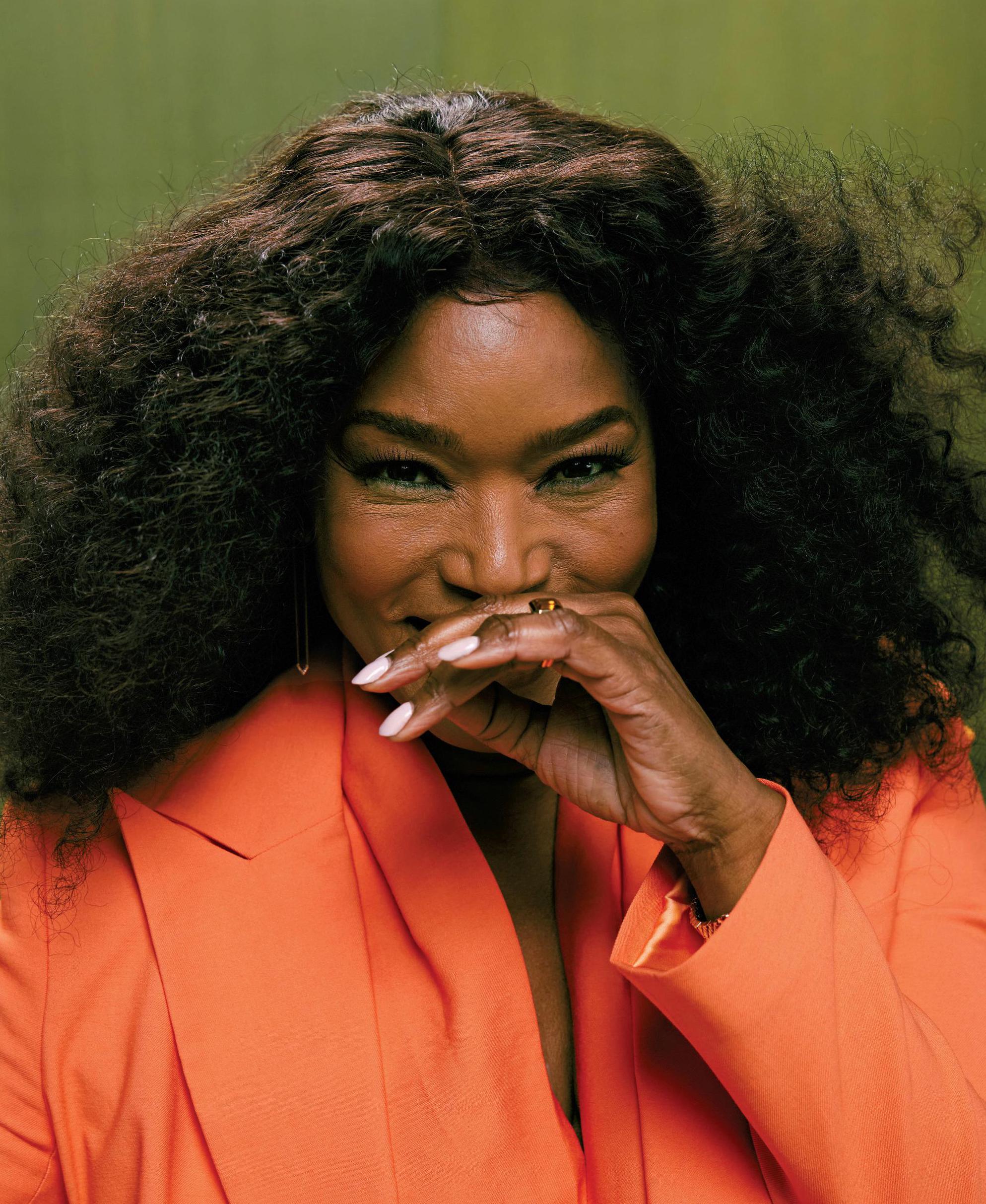
‘WAKANDA’ QUEEN ANGELA BASSETT HAS ALWAYS PUT IN THE WORK TO EARN THE CROWN.



A writer of “All Quiet on the Western Front” details what the new scenes add to it.
P. 8
Experienced novices
Four over50 firsttime Oscar nominees look at what got them here.
P. 10
Ireland’s green light
Oscar nominees are heavy with Emerald Isle work and influence.
P. 12
‘Wakanda’ nobility Angela Bassett sees her career thusly: “I did what I came to do. And I did it well.”
P. 14
ON THE COVER:
Photo of Angela Bassett by Christina House / Los Angeles Times
ON THIS PAGE:
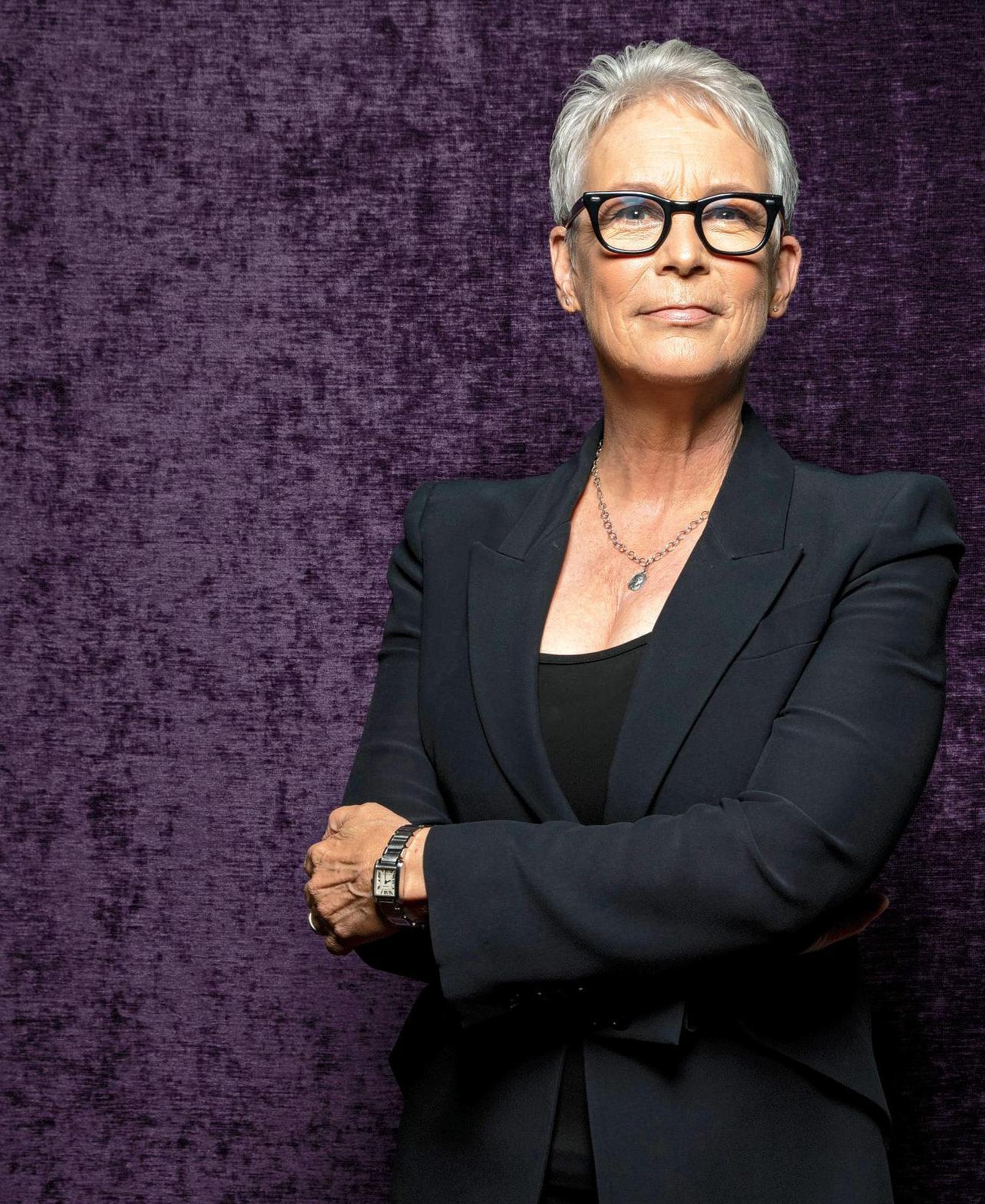
Photo of Jamie Lee Curtis by Jay L. Clendenin / Los Angeles Times
Island treasures Director Martin McDonagh adores his “Inisherin” (and “In Bruges”) stars.
P. 18
Some extra weight
“The Whale” makeup team advanced techniques to better simulate obesity.
P. 20
‘Avatar’s’ ‘pure’ acting
Does his technology dumb down a good performance? James Cameron says no!
P. 22
Gold Standard Glenn Whipp offers the selling points of the bestpicture nominees.
P. 24
War chest stretches
The “All Quiet” cinematographer had budget constraints requiring discipline.
P. 26
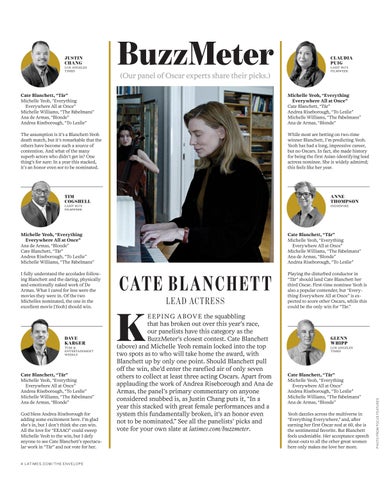
Cate Blanchett, “Tár”
Michelle Yeoh, “Everything Everywhere All at Once”
Michelle Williams, “The Fabelmans”
Ana de Armas, “Blonde”
Andrea Riseborough, “To Leslie”
The assumption is it’s a BlanchettYeoh death match, but it’s remarkable that the others have become such a source of contention. And what of the many superb actors who didn’t get in? One thing’s for sure: In a year this stacked, it’s an honor even not to be nominated.



Michelle Yeoh, “Everything Everywhere All at Once”
Cate Blanchett, “Tár”
Andrea Riseborough, “To Leslie”
Michelle Williams, “The Fabelmans” Ana de Armas, “Blonde”
While most are betting on twotime winner Blanchett, I’m predicting Yeoh. Yeoh has had a long, impressive career, but no Oscars. In fact, she made history for being the first Asianidentifying lead actress nominee. She is widely admired; this feels like her year.
Michelle Yeoh, “Everything Everywhere All at Once”
Ana de Armas, “Blonde”
Cate Blanchett, “Tár”
Andrea Riseborough, “To Leslie”
Michelle Williams, “The Fabelmans”
I fully understand the accolades following Blanchett and the daring, physically and emotionally naked work of De Armas. What I cared for less were the movies they were in. Of the two Michelles nominated, the one in the excellent movie [Yeoh] should win.
Cate Blanchett, “Tár”
Michelle Yeoh, “Everything Everywhere All at Once”
Michelle Williams, “The Fabelmans” Ana de Armas, “Blonde”
Andrea Riseborough, “To Leslie”
Playing the disturbed conductor in “Tár” should land Cate Blanchett her third Oscar. Firsttime nominee Yeoh is also a popular contender, but “Everything Everywhere All at Once” is expected to score other Oscars, while this could be the only win for “Tár.”
Cate Blanchett, “Tár”
Michelle Yeoh, “Everything Everywhere All at Once”
Andrea Riseborough, “To Leslie”
Michelle Williams, “The Fabelmans”
Ana de Armas, “Blonde”
God bless Andrea Riseborough for adding some excitement here. I’m glad she’s in, but I don’t think she can win. All the love for “EEAAO” could sweep Michelle Yeoh to the win, but I defy anyone to see Cate Blanchett’s spectacular work in “Tár” and not vote for her.
KE EPING ABOVE the squabbling that has broken out over this year’s race, our panelists have this category as the BuzzMeter’s closest contest. Cate Blanchett (above) and Michelle Yeoh remain locked into the top two spots as to who will take home the award, with Blanchett up by only one point. Should Blanchett pull off the win, she’d enter the rarefied air of only seven others to collect at least three acting Oscars. Apart from applauding the work of Andrea Riseborough and Ana de Armas, the panel’s primary commentary on anyone considered snubbed is, as Justin Chang puts it, “In a year this stacked with great female performances and a system this fundamentally broken, it’s an honor even not to be nominated.” See all the panelists’ picks and vote for your own slate at latimes.com/buzzmeter
Michelle Yeoh, “Everything
Everywhere All at Once”
Andrea Riseborough, “To Leslie”
Michelle Williams, “The Fabelmans” Ana de Armas, “Blonde”
Yeoh dazzles across the multiverse in “Everything Everywhere,” and, after earning her first Oscar nod at 60, she is the sentimental favorite. But Blanchett feels undeniable. Her acceptance speech shoutouts to all the other great women here only makes me love her more.

BA D GIRLS are the best,” Italian auteur Alice Rohrwacher says of the essence of the anarchist Christmas story at the heart of her Oscarnominated short film, “Le Pupille.”
Now streaming on Disney+, the delightfully cheeky fable takes place in a Catholic orphanage for girls during World War II where a young pupil, Serafina (Melissa Falasconi), defies the religious interpretation of benevolence. Her “wickedness” after being denied a piece of a luxurious zuppa inglese cake results in a testament to her inherent virtue.
“Le Pupille” came to be part of the Disney catalog after Mexican director Alfonso Cuarón, a producer on the project, had the idea to ask directors from around the world to create a short film set in their country and in their language celebrating an endoftheyear holiday.
A fan of her body of work, including her whimsically rustic features “The Wonders” and “Happy as Lazzaro,” Cuarón reached out first to Rohrwacher. “Alice has a unique voice in contemporary filmmaking,” he says by phone. “All of her films exude an immense understanding of human complexities and great poetic beauty.”
The morning after Cuarón invited her to do a film, Rohrwacher contacted him with a fully thoughtout short already in mind. She had long been fascinated by a letter that novelist Elsa Morante wrote to her friend and cultural critic Goffredo Fofi narrating a tale about boys in a religious boarding school and a lavish Christmas meal that tests their morality.
“I thought the letter could talk about today’s world, where everyone is trying to keep the cake for themselves,” Rohrwacher says. “In the story, the cake is shared with all those who need it the most.”
Although she changed the gender of the characters in the original account,
Producer Alfonso Cuarón chose Alice Rohrwacher to make the liveaction fable nowon Disney+.
By Carlos AguilarRohrwacher wished to preserve Morante’s words verbatim. To make them part of the film, she had musician Norina Liccardo turn the text of the letter into a song for the girls to perform.
As for the young cast, Rohrwacher set out to find girls who had not acted before. She worked with a group of about 20, looking for her Serafina. Each of them, she thought, could play a version of the character. But after a couple of weeks, she chose Falasconi to be the adorably determined main character; 16 of the other girls became her classmates.
For the key adult parts, the director enlisted Italian star Valeria Bruni Tedeschi to play Rosa, the wealthy lady who brings the cake as an offering to ask for a miracle, and her own sister and frequent collaborator Alba Rohrwacher as stern Mother Superior Fioralba.
The religious dogma that deems Serafina a naughty girl for wanting a bite of the dessert or singing along to a tune on the radio was an unavoidable aspect of the story, given that it happens at Christmastime. But
the director sees it only as a backdrop to the film’s bigger questions about what it means to be “good” and mindful of the needs of others.
Still, one prominent scene where the girls portray the Nativity scene was directly inspired by the Mysteries of Campobasso, a type of tableau vivant, or living paintings tradition in which children, dressed as angels or other sacred figures, are hung on tall structures and carried around town.

“I wanted the film to have a moment of true sacredness in which we can still feel the emotion of this day through the immobility of the girls,” Rohrwacher says. “But I also wanted it to be part of the film’s playfulness: The girls can’t move, only their “pupils” are free to move, dance, reach for the cake. Our eyes are always free, just keep them trained!”
Shot on Super 16millimeter film for a timeless quality, the 37minute short preserves the earthy aesthetic and fanciful narrative sensibilities of Rohrwacher’s previous efforts. Disney came on board after reading the screenplay and granted Rohrwacher total creative freedom to craft her sweet cinematic confection. “They understood the film for what it is and that the subject matter lends itself so well for the Disney brand,” Cuarón notes.
More accustomed to the festival circuit than the exposure of the Academy Awards — “Le Pupille” first premiered at the Cannes Film Festival last year — Rohrwacher, who lives in the largely rural central Italian region of Umbria, is enjoying the unfamiliar attention.
“Being nominated for an Oscar is one of those moments where reality surpasses imagination,” she says. “My life and my work are very far from Hollywood. I live on a farm in the countryside, and one of my main problems is to light a fire. But that’s exactly why this is something even more wonderful. Our differences are also our riches.”
EDITOR IN CHIEF
ELENA NELSON HOWE
CREATIVE DIRECTOR
AMY KING DESIGN DIRECTOR
TAYLOR LE
SENIOR DEPUTY DESIGN DIRECTOR

FAITH STAFFORD
LEAD ART DIRECTOR
JIM BROOKS
ART DIRECTORS
SUSANA SANCHEZ ANNE LATINI
DIRECTOR OF PHOTOGRAPHY KATE KUO
PHOTO EDITOR BRANDON CHOE
COPY CHIEF BLAKE HENNON
STAFF
WRITER/COLUMNIST
GLENN WHIPP
COPY EDITOR
JOAN FANTAZIA
PHOTOGRAPHERS
JAY L. CLENDENIN
CHRISTINA HOUSE KENT NISHIMURA
ADVERTISING
CHIEF OF STAFF
TO EXECUTIVE
CHAIRMAN, CHIEF REVENUE OFFICER
ANNA MAGZANYAN
MARKETING MANAGER DAVE PURDUE
EXECUTIVE SALES DIRECTOR, ENTERTAINMENT
HEIDI LINNEBACH
SENIOR SALES EXECUTIVE BETH ZELMAN
OPERATIONS
JIM ANGIUS
DIANA SHANTIC KATRINA TEN
EDITION PLANNING
JULIE BYER
JAVIER CHAVEZ RUDY FLORES
DAVE NOVOTNEY
ELIZABETH GHRERJONES
TH E CARDINAL rule of adapting a book into a film is: Don’t disregard the source material. A second is don’t copy it. With landing lights that far apart, you’d think it would come down to simply choosing the right runway, until you realize they’re all covered in black ice — the reader’s imagination, which you’re going to destroy whether you like it or not. In reality, no work of fiction comes with a chastity belt that disallows it from being reimagined or retold for newer audiences. But trying to select which elements to include and which to leave out often feels like being asked to choose your favorite organ.
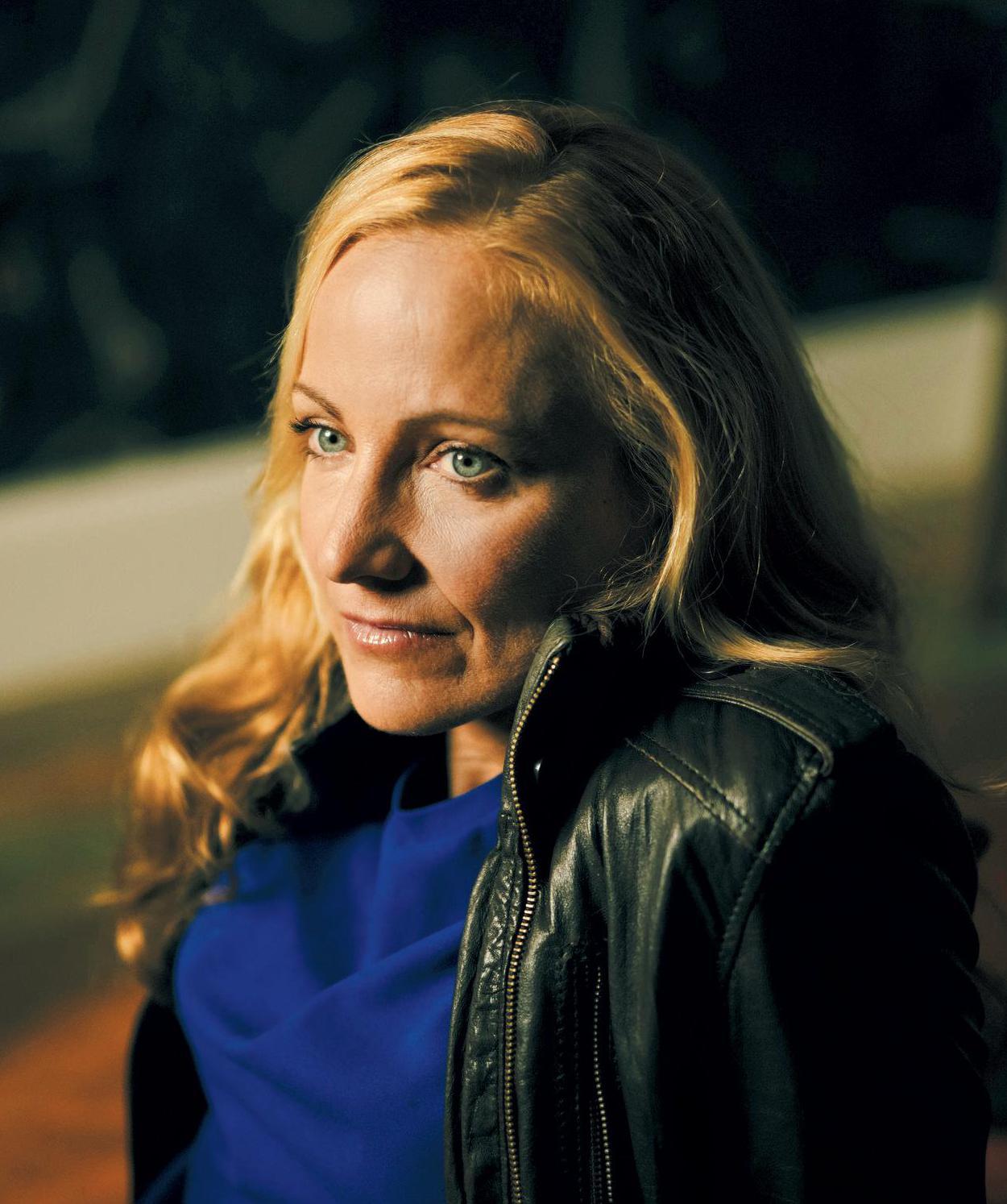
The first readable draft [from Ian Stokell and me] was bad. We knew it wasn’t great, but when our reader pointed out that it was worse than horrible, I sat in the car and cried. Where had we gone so wrong? We tossed out the draft and started again, this time going all in on theme: betrayal, the brutality and dehumanizing effect of war, the pathos of loss — of innocence, love, friendship, a full stomach — and of course the dark edges of patriotic fervor. What’s left is a war story devoid of its genre catnip, the sense of heroism and adventure that dominates war films penned by the winning side.
But there were more problems to be solved. The novel is beautiful but difficult to adapt. It’s narrated with an almost reportage style — a somewhat unemotional, factual telling of events. We needed a cinematic throughline to keep driving the story forward. After my husband and I spent a week in the Compiègne Forest visiting the armistice train carriage, we found it. The grim historical details of that November morning mirrored the thematic spine of Erich Maria Remarque’s work. The fact that the Reich sent a career politician (Matthias Erzberger, played by Daniel Brühl) to lead the delegation of negotiators was yet another example of Remarque’s central theme: betrayal. (Erzberger was the scapegoat, for which he was later murdered by an antisemitic terrorist group that considered him a traitor for signing the armistice.) This was the missing piece.
Adding the armistice story line solved another problem too — how to historically situate the story for modern audiences, many of whom know little of WWI or its geopolitical context. When the book was published in 1929, the world was blind to a second conflict, only a decade away. Remarque’s novel, as well as Lewis Milestone’s best picture winner from 1930, were oblivious to how the deal points in the armistice would be seedlings to Hitler’s deranged ideology that sprang from resentment and blame.
If we were to stay true to Remarque’s insistence that the book be a lesson to us all about the impact of war, it felt fitting that we should add this context — even if it didn’t appear in the original text or subsequent adaptations. With our knowledge of how history unfolded, we felt we had the
Depicting the armistice events in ‘All Quiet’ aided in understanding the postwar German sensibility.
responsibility to shine a light on what was yet to come, that this was not the end of the horror but only the beginning. Adding the armistice story line also enabled us to juxtapose stronger tonal shifts, scene to scene, giving the audience time to breathe from the immersive, emotional brutality of watching trench warfare. The book is far more violent than depicted in the two previous film adaptations, and we wanted modern audiences to reconnect with its brutality.
After 16 years of development Tinder, the right timing came. We were approached by German producer Malte Grunert (Amusement Park Films) and director Edward Berger with a simple ask: Would we consider doing the film in German? The truth is we had considered it but were frequently
counseled against it on purely commercial grounds. But the landscape had changed — Sam Mendes’ “1917” reinvigorated interest in WWI and a foreignlanguage film, “Parasite,” won best picture at the Academy Awards. When Edward Berger told us his vision, we were bowled over by it. I don’t think we realized it before — it wasn’t just language, there was a latent sensibility missing, a sensibility that was uniquely German to complement our own outsidein perspective.
It all sounds rather obvious now, but back then we understood this only on an intellectual level. We’d read enough German trench diaries and historical analysis to try to walk and talk in the shoes of men who felt anything but heroic or proud, but there was something deeper, visceral even, that we simply couldn’t infuse, because … well, we’re not German. It’s one thing to cogitate and empathize with national shame and collective culpability, but it’s another thing entirely to grow up with it, to have it tattooed on your DNA.
As Edward reminds us — as a German, it’s impossible to think about the two world wars from any perspective other than shame and guilt. As Brits writing about a German experience, this wasn’t just agency and appropriation of voice, it was in everything — tone and soundscape, shot composition, the entire visual telling of the story. Edward imbued the script with this sensibility that wasn’t just morally responsible, it made for a better film. It was a masterful stroke, and we couldn’t be prouder of the result.
What performance or film has moved you this season?
“I saw ‘Tár,’ and I thought [Cate Blanchett’s] work was absolutely remarkable. I love [director] Todd Field for taking us into this woman's world, with all of its weird shapes and edges, the funhouse mirrors and putting us in the shoes of the people around her, if not in her shoes. I loved how he began the movie with all the credits. But I take my hat off to Cate Blanchett and the filmmaker who made a movie where nothing is explained — you're not given any help, you're just there as if you're living with this woman and you have to put it together. I love the experience where they don't make it easy for you.”
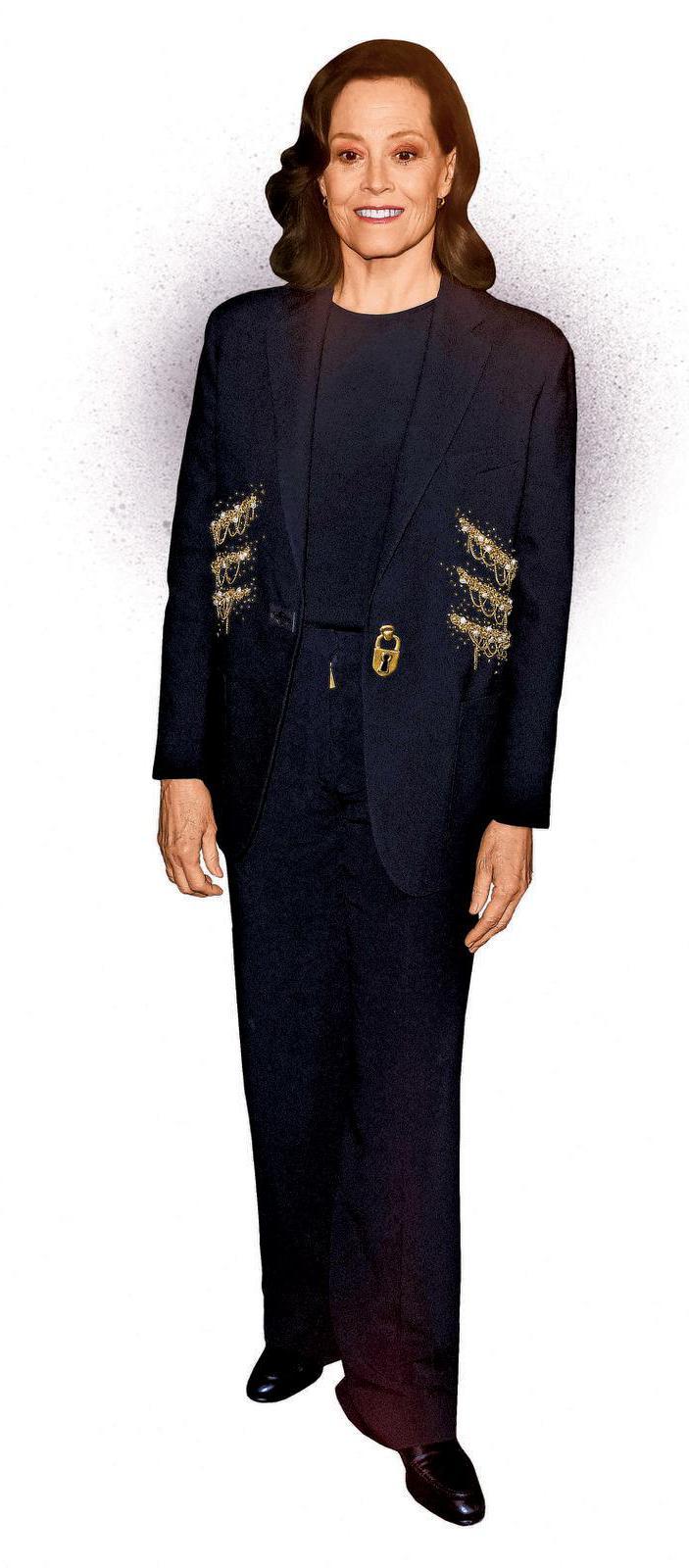

YOUTH HAS ITS CHARMS , but there’s also something to be said for the hardearned talents demonstrated this year by six over50 actors honored with their first Oscar nominations. Contenders range from Bill Nighy of “Living,” who didn’t even land substantial movie roles until his mid40s, to Ke Huy Quan, whose early start at age 12 as Harrison Ford’s plucky costar in “Indiana Jones and the Temple of Doom” led, after many years of struggle, to renewed acclaim in “Everything Everywhere All at Once.”


‘EVERYTHING EVERYWHERE ALL AT ONCE’
Supporting actress nominee
First time doing this in a role: “I relaxed. That’s the one thing I needed to do in playing [IRS agent Deirdre Beaubeirdre]. I had to relax all the muscles in my body so I could create her physicality. Most people, we walk around very clenched. I wanted Deirdre to not be clenched, and that required me to let go, to release muscles and vanity so I could inhabit this lonely, forgotten woman.”
Snapshot moment: “When I was shooting ‘Halloween 2018,’ there was a scene where my character, Laurie Strode, is alone in a truck reliving the trauma and horror of the last 40 years. It was at night, the middle of nowhere, and my last day of filming. When I walked onto the set,
the entire crew was standing silently with their hands behind their backs, and they were all wearing name tags that said, ‘We are Laurie Strode.’ I will never forget that moment.”
Advice: “I’ve been doing this since I was 19, so this comes from experience: Show up early and stay late. Be prepared. Never leave the set if you can. Let people know that you are grateful. Write thankyou notes. Reach out after work. Volunteer for any job needed. Be hungry. Most of all, be kind. Understand that this industry is a collaborative group effort. Any actor standing up on that stage clutching a shiny thing is standing there in solidarity with hundreds of other people who did their jobs.”
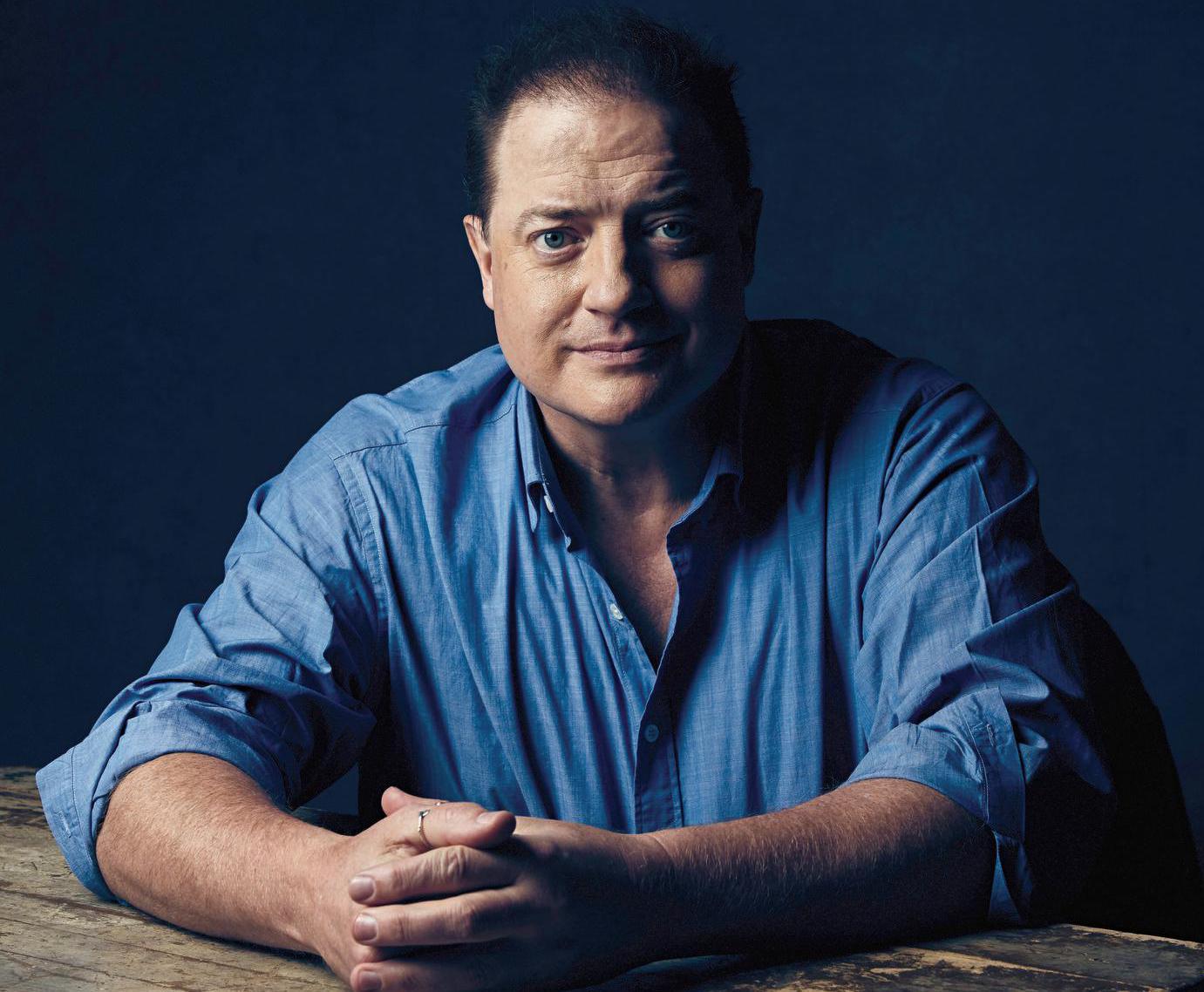
‘THE WHALE’ Lead actor nominee
First time doing this in a role:
“I used the love that I have for my kids to fuel Charlie’s whalesized heart. He has possibly five days left [to live] in these regrettable circumstances, having fallen in love with the wrong person and knowing that his little girl got lost in the mix. So Charlie throws a Hail Mary to reach out and apologize [to his daughter]. That’s Charlie’s bid for redemption. From my actor’s bag of tricks or tool chest or whatever you want to call it, I found intense empathy for this character.”
Bucket list: “My oldest son has special needs. He’s autistic. I want to work on how we can improve and expand on facilities and
services for families and people on the spectrum who are coming into early adulthood. I don’t know if I can do that singlehandedly, but that’s my passion.”
Advice: “Have courage. Acting is about wanting and wanting and wanting again. There’s always going to be something in the way. An obstacle. And the actor’s job is to get around the obstacle and achieve the objective. Living in this city alone is an obstacle. Finding an agent? That’s an obstacle. Staying in the game, staying relevant? That’s an obstacle. As a young actor 30 years ago, I would have done well to have had somebody telling me to have courage.”
Also personifying the virtues of longevity are firsttime nominees Michelle Yeoh, Brendan Gleeson, Jamie Lee Curtis and Brendan Fraser.
This over50 crowd still has some catching up to do before matching Anthony Hopkins’ achievement two years ago when he became the oldest actor, at age 83, to win an Academy Award. But in speaking with Nighy, Fraser, Curtis and Quan, The Envelope finds they are savoring their longevity and still stretching acting muscles in movie roles that crack open previously unrevealed depths.
‘LIVING’
Lead actor nominee
First time doing this in a role:
“There’s always a bit on the schedule where you go, ‘Well I almost certainly can’t do that.’ I’d never had to sing a song and go to pieces to some degree [until ‘Living’]. It was helpful [to think about] that thing where you’re at a funeral mourning the loss of someone you care for. You hold it together until they ask you to sing, and by the third line you’re falling apart, so there is something about the act of singing that unlocks your emotions. This enabled me to give the appearance of someone who had lost his wife and was singing her favorite song.”
Dream genre: “I’d like my action career to begin with me being this most unlikely action figure. It would obviously have to be either funny or sort of accidental and therefore
funny. I’d also like to be a contemporary vampire and have my own franchise, and I’d like to wear a lot of very chic, dark suits. And I’d like Christopher Walken to be a vampire alongside me.”
Snapshot moment: “On ‘Love Actually,’ the writer and director Richard Curtis was away directing someone somewhere else one day, so the film’s producer Duncan Kenworthy directed me in the bit where I lost a bet and had to play the guitar naked in a pair of cowboy boots. Once the music started, I’d have to pretend to play the guitar and sing the song. I had a tendency to lift the guitar too high, if you see my point. Duncan spent the whole hour shouting, ‘Down with the guitar, down with the guitar!’ So that was a strange day at the office.”
‘EVERYTHING EVERYWHERE ALL AT ONCE’
Supporting actor nominee
First time doing this in a role:
“Growing up in a traditional Chinesevalue culture family, I was raised to internalize a lot of my emotions. When I got this role, the only way I could do justice to [the character of] Waymond was to open up. I spent a long time with myself, persuading myself to let out feelings that I’d locked up for many, many years. I’ve experienced enough ups and downs in life; it was just a matter of convincing myself to put all those feelings into this character. When I was younger, I didn’t have the courage to do that.”
Snapshot moment: “When we made ‘Temple of Doom,’ everybody stayed at the same hotel in Sri Lanka. We’d shoot during the day and then come back and hang out by the swimming pool. That’s when Harrison Ford
found out I didn’t know how to swim. He said, ‘Ke, come on, get in the water, I will teach you.’ And to this day, the reason I know how to swim is because of him.”
Advice: “Learn to love auditions. For the entire pandemic, I was auditioning left and right. I was frustrated: ‘Oh, my God, everything that happened when I was much younger is happening again.’ My wife was worried about me, so she said, ‘Don’t think of it as an audition. Think of it as an opportunity to perform.’ So my advice would be to love the audition process. And don’t give up. I had to wait decades, but one day that opportunity will come knocking on your door, and when it does, you have to be ready to pour your heart and soul into it.”

The tiny Emerald Isle, ‘punching above our weight,’ has ties to 14 Oscar nominations this season.
By Lesley O’TooleIR ELAND HAS A PROUD tradition of Academy Award prominence — famed dual IrelandEngland citizen Daniel DayLewis is the only man with three lead actor Oscars, after all — but the country’s ties to 14 nominations this season catapulted it to new heights. ¶ Consider: “The Banshees of Inisherin” earned nine nods; Irishlanguage film “The Quiet Girl” (“An Cailín Ciúin”) has earned a place among the international feature film nominees; and “An Irish Goodbye” is a liveaction short film nominee. Then there are the people involved. Nominations were bestowed on actors Paul Mescal (“Aftersun”); the primary cast of “The Banshees of Inisherin” — Colin Farrell, Brendan Gleeson, Kerry Condon and Barry Keoghan — along with “Elvis” film editor Jonathan Redmond and Richard Baneham, visual effects supervisor for “Avatar: The Way of Water.” ¶ “Banshees” writerdirector Martin McDonagh — himself a nominee for original screenplay, director and best picture — describes its success as “beyond my understanding; the connection people have found, the discourse and reaction. It’s almost like it’s not mine at all anymore.” His own luck of the Irish includes an actual rainbow amid his pot of (potential) gold during last year’s shoot. “I’ve never seen such a beautiful summer. All those sunsets are for real, and the rainbow at the start too.”
But he’s most enthralled with the nominations for his four actors, calling Farrell and Gleeson among Ireland’s current “top four, definitely,” while Keoghan’s “already up there. And I’ve been seeing what Kerry’s been doing in theater and films for 20 years, so I’ve known how brilliant she is. There isn’t anyone I’d hire instead of her, I think — not just in Ireland, in the world.”
“That’s so sweet,” Condon says when told of McDonagh’s comment. “I think from the beginning when we met — I was doing his play ‘The Lonesome West’ when I was 17 — Martin always admired my ambition, because it was similar to his. I was always sure of myself; childlike and cocky, like, ‘I’m going global.’” Now her excitement for the Emerald Isle feels almost palpable. “My friend at
home was like, ‘Everybody’s celebrating like crazy. It’s like they’ve won the World Cup.’”

McDonagh is thrilled too for another of his former play stars, lead actor nominee Mescal, who recalls the boss’ arrival to watch 2020 rehearsals for his “The Lieutenant of Inishmore” as “the most frightening thing ever. I didn’t know Martin other than idolizing his work. I remember nothing other than, ‘There’s Martin McDonagh watching me butcher his play.’”
Ireland is tiny, of course, as Mescal notes. “Over the years, we have punched above our weight, and this year is an amazing example of that.” Citing its 25% of 2023’s acting nominations as “mad,” he’s in awe of being “in a category with Colin, somebody else I have idolized,
whose performance is phenomenal. Part of me is rooting for Colin.”
Ross White and Tom Berkeley, writerdirectorproducers of “An Irish Goodbye,” say they’re only at this party thanks to their idol too. “We’ve always loved Martin McDonagh, from the early plays. That really got us into writing for theater,” White says. The short, about two brothers (James Martin and Seamus O’Hara) processing their mother’s death, was inspired by an argumentative sibling duo Berkeley spotted at a soccer game, one with Down syndrome. Had Martin, a longtime actor with Down, not committed, the film would likely have been shelved, but he adored “the brothers’ love and hate.”
Clearly his film’s lucky charm, not least because the Academy Awards fall on his 31st birthday, Martin insists, “Anybody can act. It doesn’t matter if you have Down syndrome, autism or any disability.”
But mostly, this team is ecstatic to represent Northern Ireland, with White touting its uniquely “healthy, funny, keepyougrounded cynicism. We’ve always found the tragedycomedy line really interesting; the little place in the middle feels very honest and human to us.”
Tragicomedy, also a huge “Banshees” attribute, was in play on both prop and weather fronts. Needing a dead rabbit for the film’s opening, White mentions their “terrible time” finding one “already dead. A PA [production assistant] drove about looking for roadkill, then, finally, a farmer said, ‘If you’re looking for a rabbit, I’ve got one in the freezer that died yesterday.’”
Also requiring a spring setting for the fiveday shoot’s first scene, they reached their mountain location — and a snowstorm. “Within 10 minutes, it was a blanket of white,” Berkeley says with a
grimace. “We waited as long as we could but had to crack on. So there’s a bit of snowcapped mountain. But I like that bleakness to start now.”
“The Quiet Girl” writerdirector Colm Bairéad and his wife, producer Cleona Ní Chrualaoí, were most stressed about finding their quiet girl, who needed to speak Irish. They saw “hundreds,” Ní Chrualaoí says, but were stuck, until 11yearold Catherine Clinch appeared. “We were like, ‘Oooh, yes! It was a small miracle.” Carrie Crowley, the film’s adult female star, also seemed meant to be as she was already passionate about both the Irish language and the film’s source material, the novella “Foster,” by Irish writer Claire Keegan.
Crowley herself is thrilled “the ‘green wave’ is rolling into Hollywood” and that this “beautiful film” has worked “its magic on global audiences, regardless of age, race, genderand socioeconomic status.” “Banshees” supporting actress nominee Condon raves about Crowley’s “real elegance. I do think sometimes an understated performance is more difficult.” She even hosted a Q&A for the film, “to kind of help, because a rising tide raises all boats, and I found it really moving. I was bawling.”
“There was something so meant to be about this whole thing,” Ní Chrualaoí adds, “something greater helping the film along,” a comment seemingly applicable to many of these projects. Bairéad highlights a “sort of timelessness” shared by “these specific films we’re talking about now in an Irish context. They’re all, in their own way, quite unfashionable. They’re not necessarily of this precise moment in terms of the cultural conversation.”
Irish production designer Cedric Gibbons, who designed the Academy Award statuette in 1928 and won 11 Oscars himself, would surely approve.
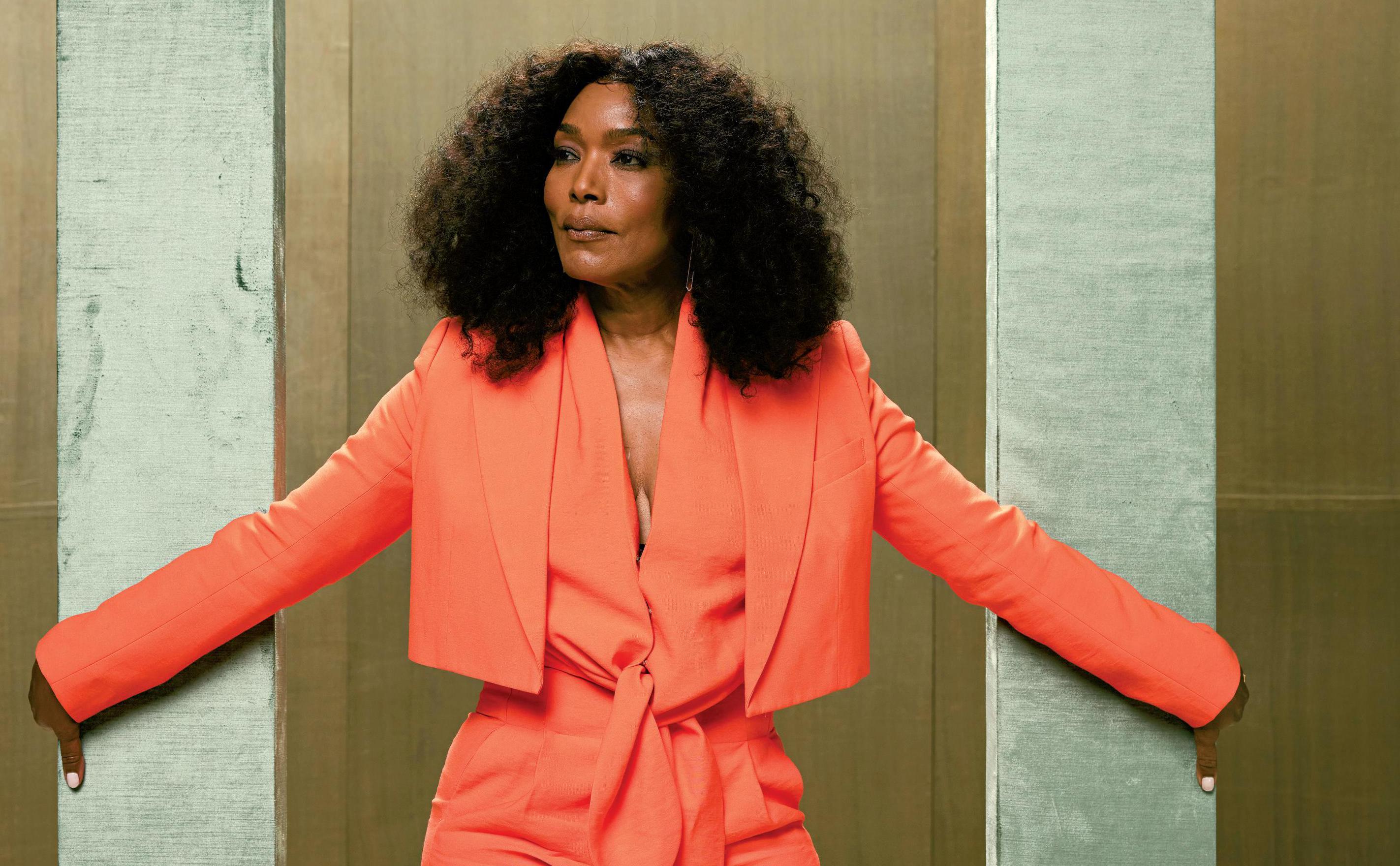

ANGELA BASSETT DEMANDS MUCH OF HERSELF BUT IS CONFIDENT THAT, AS IN ‘WAKANDA,’ SHE DELIVERS.
STORY BY GLENN WHIPP
PHOTOGRAPH BY CHRISTINA HOUSE
O MENTS AFTER THE CREDITS started rolling at the premiere of “Black Panther: Wakanda Forever,” Angela Bassett’s son, Slater, leaned over and whispered in his mom’s ear: “Oscar.” Months later, Bassett laughs at the memory because her immediate response, at least in her head, was “Aaaaaw, you’re my son. You’re supposed to say nice things to your mom. But thank you, darling!” ¶ Ever since the January announcement that Bassett had earned an Oscar nomination for reprising the role of Queen Ramonda and, in the process, becoming the first actor to win academy recognition for a Marvel movie, Slater has reminded her more than once about that evening. ¶ “At the time, the Oscars were the furthest thing in my
mind,” Bassett tells me. It’s a Saturday, and we’re seated in a booth in a noisy breakfast spot not far from her La Cañada Flintridge home, a cozy spot where Bassett stands out because she’s wearing a stylish pantsuit and has ordered only tea, forsaking the bulging breakfast plates that the wait staff carry by our booth. Also: She’s Angela Bassett! No matter the setting, her magnificence doesn’t exactly blend into the background.
We’ve been talking about transitions, thinking about Slater and his twin sister, Bronwyn, high school juniors about to make their first trip back east to check out colleges. “Thank you, Lord, for one more year,” Bassett, 64, says of their looming departure from home. “As they say, it does go by quickly. I was telling that to someone the other day that we always say that, maybe thinking time will slow down. But it doesn’t slow down, does it?”
Not long ago, a friend asked Bassett if she was ready for an empty nest. Ready? She was practically incredulous. She has been preparing for her children leaving from the moment they were born, she says, realizing it was inevitable. That hasn’t stopped her from scrolling through pictures and videos on her phone lately, watching her babies dancing and singing, the years passing, cartwheels turning into car wheels, as the song goes, and here she is today, readying them for visits to Yale and Harvard.
“The other day I asked my daughter, just fishing, saying, ‘Oh, if you go to Yale, I’m going to get an
apartment just down the street from you,’” Bassett says. “And she’s like, ‘That’d be great, Mom!’” Bassett shakes her head, laughing. “Just fishing, you know. Like, ‘I’m going to miss you! So I’m going to go back to college too.’”
But talk about time passing: To Bassett, it doesn’t feel like it was all that long ago that she moved to Los Angeles, five years after graduating from the Yale School of Drama, ending up crashing at a friend’s Hollywood apartment just behind Sunset Bronson Studios. She’d walk down Sunset Boulevard to the gym, getting strange looks from motorists. “Like, ‘What’s wrong with her? Is she crazy? What’s she up to?’ All because I was walking,” Bassett says. “I’d just come from New York and didn’t have a car. In New York, you walk. If you do that here, you feel weird, because there’s no one else on the sidewalk.”
Her mother and her aunt wanted Bassett to go into nursing or teaching. “You want to be a princess?” Bassett bursts out laughing at the memory of how they felt about her career choice. “To them, understandably, it was a pipe dream.”
Bassett brings up the 1992 scifi comedy “Critters 4,” which I’d never have pegged as a career milestone. For her, though, as a young working actor, it was a role in a horror franchise in which her character survived to the closing credits.
“You mean, I don’t die?” Bassett recalls thinking, laughing. “That was a transition.”
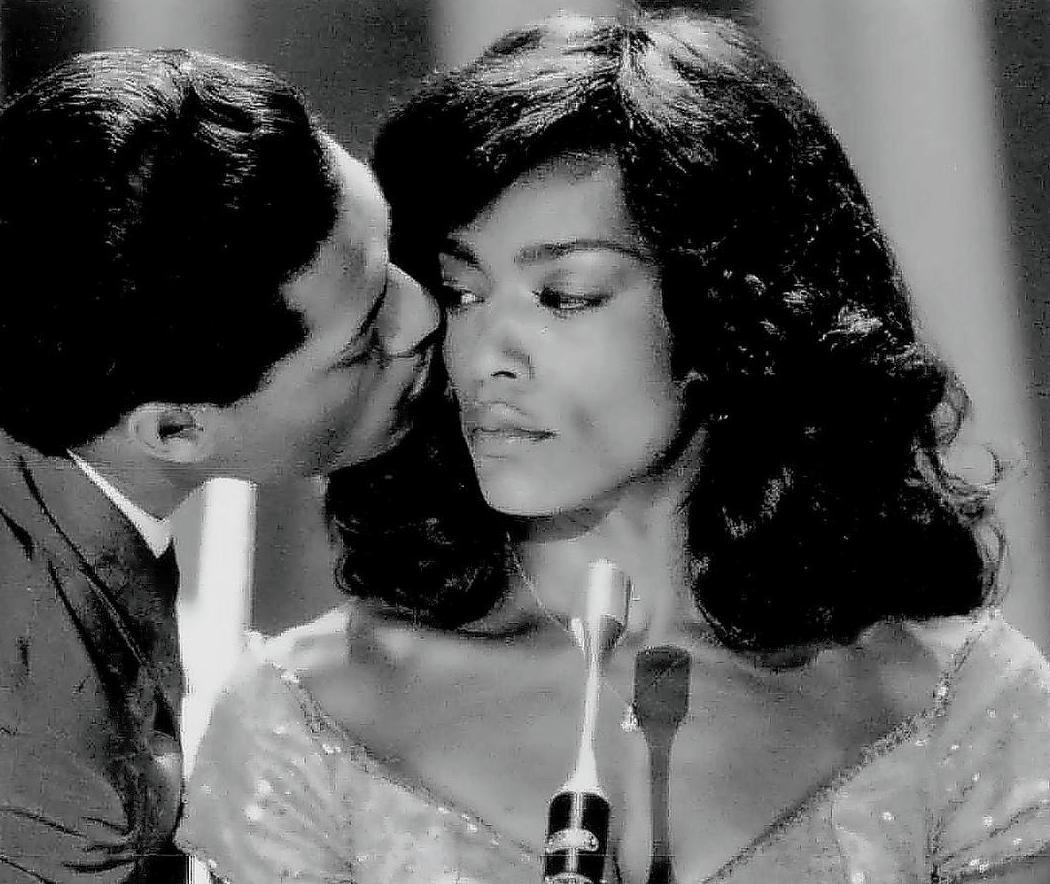
One year later, Bassett earned an Oscar nomination for playing Tina Turner in “What’s Love Got to
Do With It,” showcasing the full range of her talent and ability to shift between vulnerability and strength as well as dance in 5inch heels while singing “Proud Mary.”
During the shoot, there was chatter in the trades that the movie was in trouble and that Bassett had been miscast. Bassett heard it and asked to watch the dailies. She looked at two scenes — the “Proud Mary” performance and a small moment that had Turner finding peace through a Buddhist chant.
“I bought what I did,” Bassett says. “After that, I didn’t need to see anything else. I knew I was on the right track. I’ve always believed it’s better to be underestimated and then deliver.”
Bassett extends that philosophy to any and all expectations for industry approval. That first Oscar
nomination came 29 years ago. And despite all the strong praise for her commanding turn in “Black Panther: Wakanda Forever” as a queen working through grief while standing strong for her people, Bassett never assumed she’d ever be back at the ceremony as a nominee.

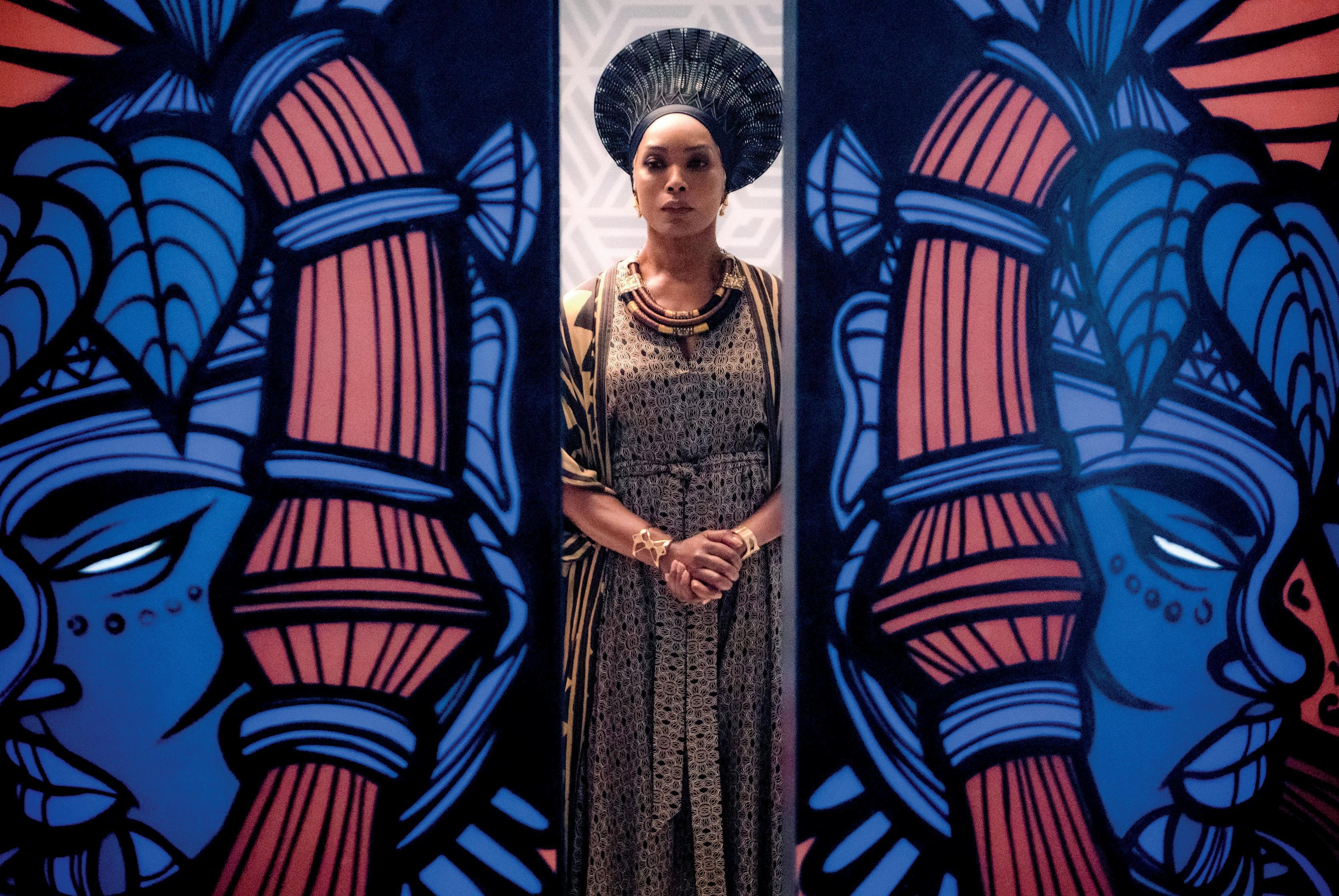
“I’m not 30, you know,” Bassett says. “You’re looking for those great roles, and for women of a certain age, it takes more effort and concentration, more creativity for the people who want to work with you. It takes some belief that it is possible. I didn’t quite believe it. But I’ll tell you who did — Courtney.”
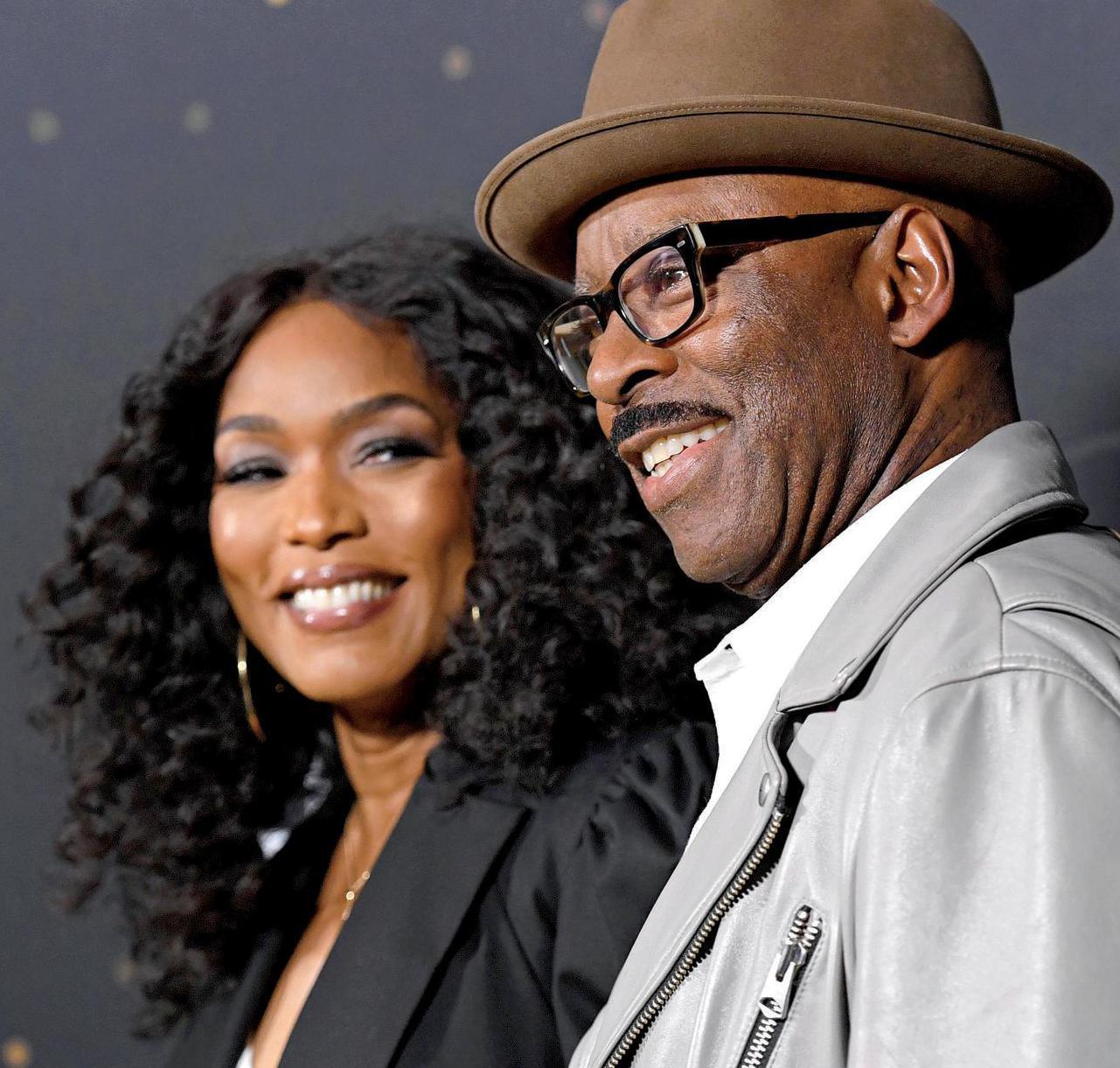
That’s Courtney B. Vance, Bassett’s husband of 25 years and the fellow actor who kept telling her that one day a role would come along to take his wife back to the Oscars. Bassett could never bring
COURTNEY
B. VANCE, left, never doubted his wife. Bassett as Ramonda, above left, and as Tina Turner, above right with Laurence Fishburne, her first Oscarnominated role.
herself to verbalize that dream. “But I would not speak against what Courtney hoped for me,” she says, smiling.
“I wouldn’t speak for it! I couldn’t chime in! I didn’t have it in me to chime in. It’s been 30 years! I’m thinking, ‘I’m 60whatever. Stop wishing. Stop hoping. Stop dreaming. You’re just my husband. I know you love me. Husbands have to say that.’”
Vance, reached by phone, says: “I kept reminding her: ‘You just have to keep going. The world will come around to you. You haven't changed a bit. You're the same hardworking actress and queen that we all know.’”
Bassett probably would have slept through the Oscar nominations announcement had her publicist not called her the day before
with a reminder. She set the alarm for 5:25 a.m., but she woke up a couple of hours earlier, stressed and nervous. She lay in bed tossing and turning, finally giving up to get out of bed and check the clock. It was 5:25. She nudged Vance, asking if he wanted to watch. Bassett tells me more than once that she likes to downplay things, but she figured this could be a twiceinalifetime moment and she wanted to share the memory with her husband. Maybe they could look back on it someday and say, “Remember when ...”
Now if she could just figure out how to turn on the damn television ...
“Smart TVs have made us dumb,” she says with a laugh. “I had one remote in each hand, trying to figure it out.”
Supporting actress was the first category announced. And as nominees are revealed alphabetically, Angela Bassett was the first name called. “I was filming it,” Bassett says. “I let out a little bit of a whoop.” She watched the rest of the announcement, answered a couple of texts and then went back to bed. She had a long day of filming ahead for her hit TV series “911” and had to be at 20th Century Fox by 8. Sleep came easy. The anxiety had evaporated.
Asked what it means to her to be nominated again, nearly three decades later, Bassett takes a moment.
“It means I did what I came to do,” she says, speaking slowly, her gaze holding mine.
“I did what I came to do. And I did it well.”
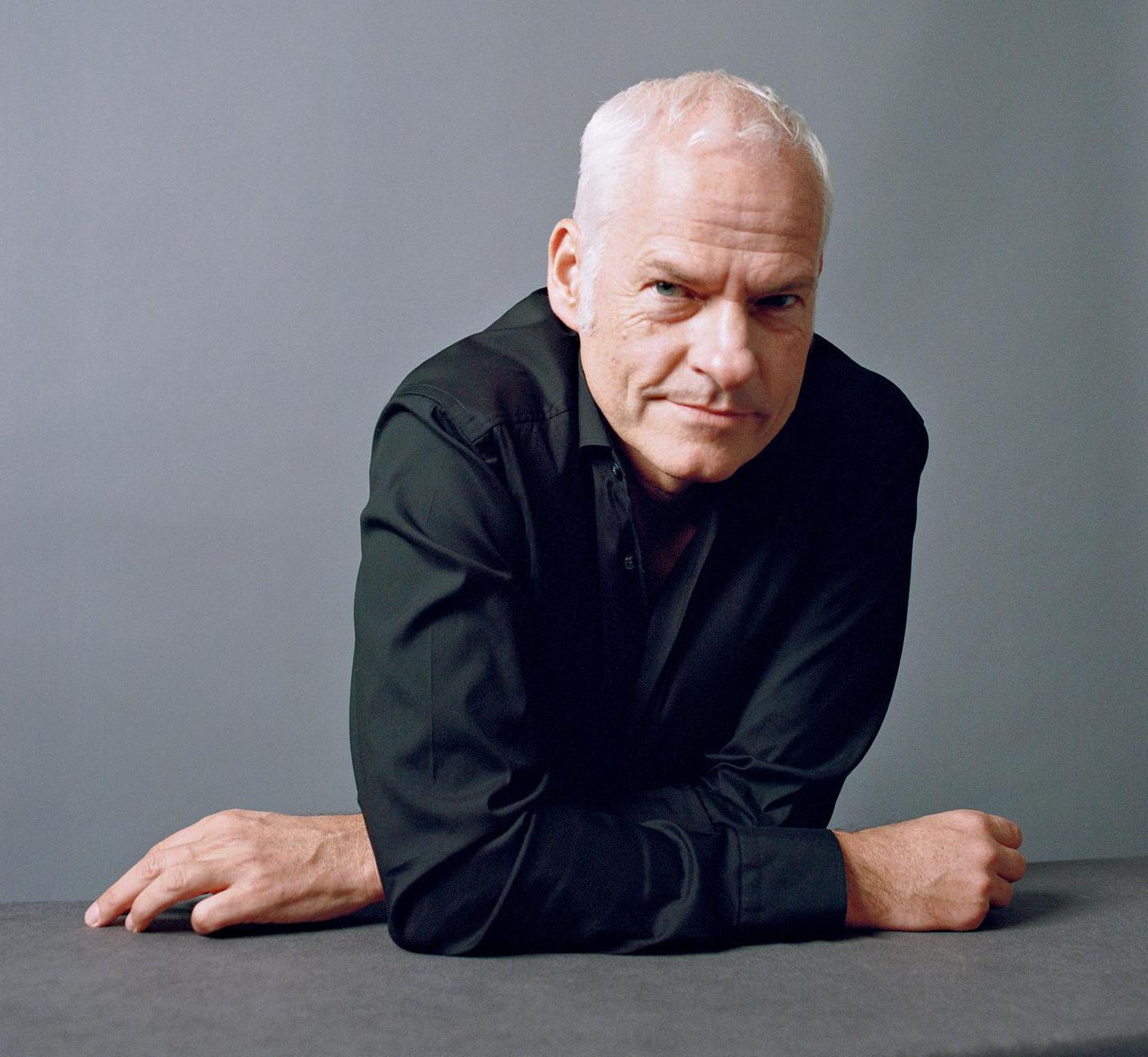
Donagh started work on a play called “The Banshees of Inisheer.” He didn’t care much for it, but he liked the title, with its echoes of his plays “The Cripple of Inishmaan” and “The Lieutenant of Inishmore.” A few years later, he began writing a screenplay that included two friends who had come to an impasse in their relationship. “The first five minutes were the same as our movie, but then it went to a very plotty place, and it wasn’t focused on that fallingout,” McDonagh said in a recent video call from his London home. “So I kind of scrapped it.” ❡ It didn’t stay scrapped. About three years ago, McDonagh picked it up again and liked what he saw in those first five minutes: an intensive look at a
friendship run aground. He realized that was the focus. And that’s how “The Banshees of Inisherin,” a pitchblack comedy that garnered nine Oscar nominations, came into its howling, absurdist existence. A gorgeousmovie fueled by pain (emotional and physical) and quiet volatility, “Banshees” is the least “plotty” film McDonagh has made. The story is minimalist. It often feels like a violent Beckett play, with a sense of comic timing to match its despair.
The first sign that McDonagh might have something special came at the film’s world premiere at the Venice International Film Festival in September, where the audience hung on every word and erupted in a long standing ovation at the film’s conclusion. Venice audiences are known for such ovations, but this one went on and on and on. The “Banshees” contingent in attendance, including McDonagh and stars Colin Farrell and Brendan Gleeson, stood and waved from the
balcony, smiling sheepishly. “It’s slightly embarrassing,” McDonagh says. “You’re appreciative of it, but then we’re not the type who blow our own trumpet.”
McDonagh won the festival’s screenplay award, and Farrell was named best actor. Both are now nominated for Oscars — McDonagh for directing, writing and producing — along with Gleeson and Barry Keoghan (both for supporting actor) and Kerry Condon (supporting actress).
Set on the fictional Irish island of the title, “Banshees” is the story of a breakup, though not the kind we’re used to seeing onscreen. As the movie begins, Pádraic (Farrell) stops at the cottage of his buddy Colm (Gleeson) to go get a pint at the pub. But Colm doesn’t want to get a pint. In fact, Colm doesn’t want to be Pádraic’s buddy anymore. He finds Pádraic dull and, in his advancing years, he figures he has no more time for dullness. But this isn’t a modern city,

THE DIRECTORS
Martin McDonagh prizes his stars and can’t figure out why no one had paired them since his ‘In Bruges.’
By Chris Vognar
COLIN FARRELL, above right, with his director (and left) on the set — a beautiful place hosting an “ugly little war.” McDonagh now feels a bit possessive of the team of Brendan Gleeson and Farrell: “I don’t want anyone else to get their hands on them.”
where the aggrieved parties can retreat to the next distraction. It’s a tiny island, in the year 1923. There’s nowhere to hide.
From such humble loggerheads is the “Banshees” tragedy built, mirrored by an Irish civil war on the mainland, heard but never seen. For McDonagh, the central idea was simple. “Sometimes, a platonic breakup can be even worse than a romantic one,” he says. “In a romantic breakup you get it, you’ve been through it before, you can understand the issues. I think there’s something more deeply personal about a platonic friend not wanting to have anything to do with you, because that is basically about you and your personality. It’s not like there’s this vague romantic thing, which you didn’t tick all the boxes for.”
This isn’t McDonagh’s first dance with Farrell and Gleason. In his 2008 film “In Bruges,” also Oscarnominated for original screenplay, the pair play hit men dispatched by their boss (Ralph Fiennes) to the fairytalelike Belgian city of the title. Their chemistry is obvious. Farrell is the wounded, almost childlike naif who doesn’t appreciate his surroundings. Gleeson is the older pro who’d like to take a load off. There is tragedy here too, along with natural beauty and McDonagh’s humor that makes one choke on the laughter.
McDonagh knows what he has in his unassuming stars. “They’re not afraid to show the fragility and the pigheadedness of men,” he says. “They love each other, and it’s crazy that no one else tried to get them together in the 14 years since ‘In Bruges.’ One wonders if that’s going to change, but I kind of feel a little proprietorial about that relationship. I don’t want anyone else to get their hands on them.”
The island of Inisherin is actually two islands: Inishmore, off the coast of Galway, is where Pádraic’s home is located, as well as many of the roads and fields featured in the film. Achill, which sits off County Mayo, is where the pub and port are set. Born in London to Irish parents, McDonagh was thrilled with the locations, especially since his parents now live within hailing distance of the film’s Inishmore set.
“It was a complete joy,” he says. “On weekends, I could go back and see them. The cast and crew felt like a proper family trying to do a good one, literally on an island together. So there weren’t any people going away for the weekend. At nighttime you’d see each other in the pub, or walking around the island on weekends. So we really felt like we were in it together, doing a good Irish movie together.”
“The Banshees of Inisherin” is driven by a fruitful tension. Its core conflict gets quite nasty, almost like a biblical feud. But it all unfolds in idyllic surroundings.
“I wanted to have this horrible, ugly little war between these two guys happen in the most beautiful place,” McDonagh says. “That meant finding the perfect islands but also shooting at a time of the year that would allow us the most daylight, the most magichour time, the most sunsets, all of that. We wanted to show the difference between the horror of the story and the beauty of the island and just to make it the most cinematic thing possible.”
‘The Whale’ makeup team takes prosthetics to a new level with Brendan Fraser’s transformation.
 By Bob Strauss
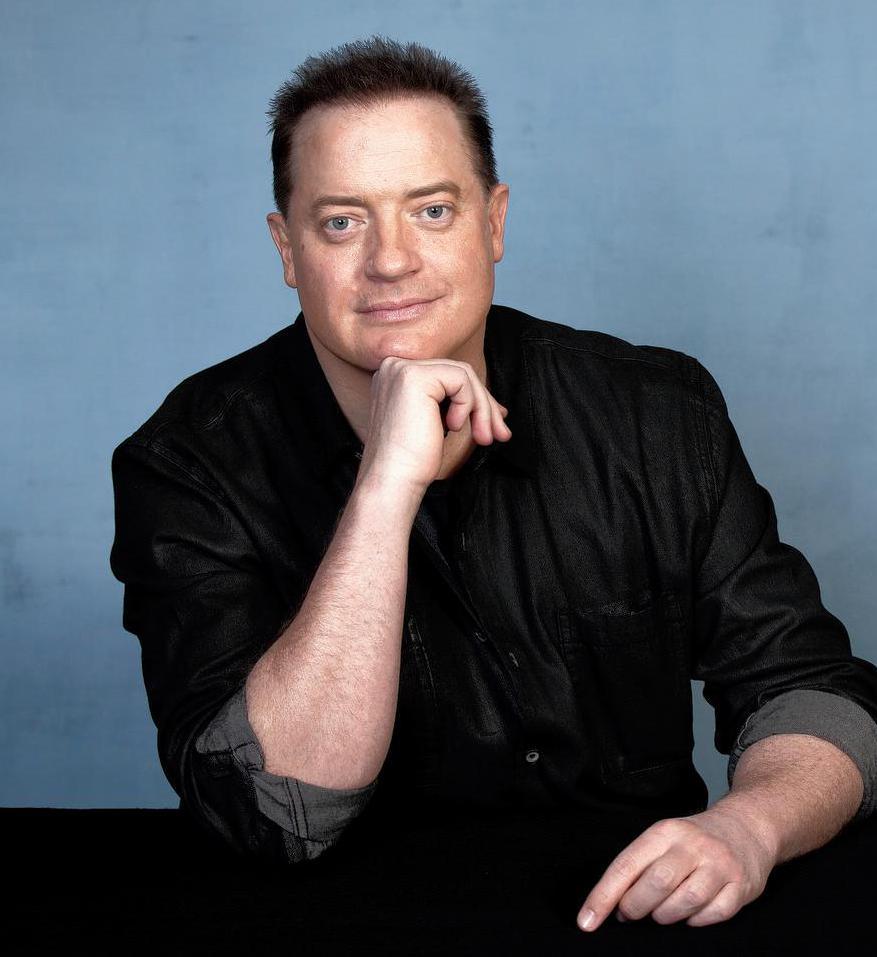
DA RREN ARONOFSKY’S frequent collaborator Adrien Morot has earned his second Oscar nomination (shared with makeup department head Judy Chin and hair artist Annemarie Bradley) for developing and fabricating “The Whale’s” weightgain prosthetic. The achievement goes beyond makeup: The innovative silicone suit is arguably as much a part of Charlie, the film’s central, 600pound character, as Brendan Fraser’s raw, sympathetic performance in the role.
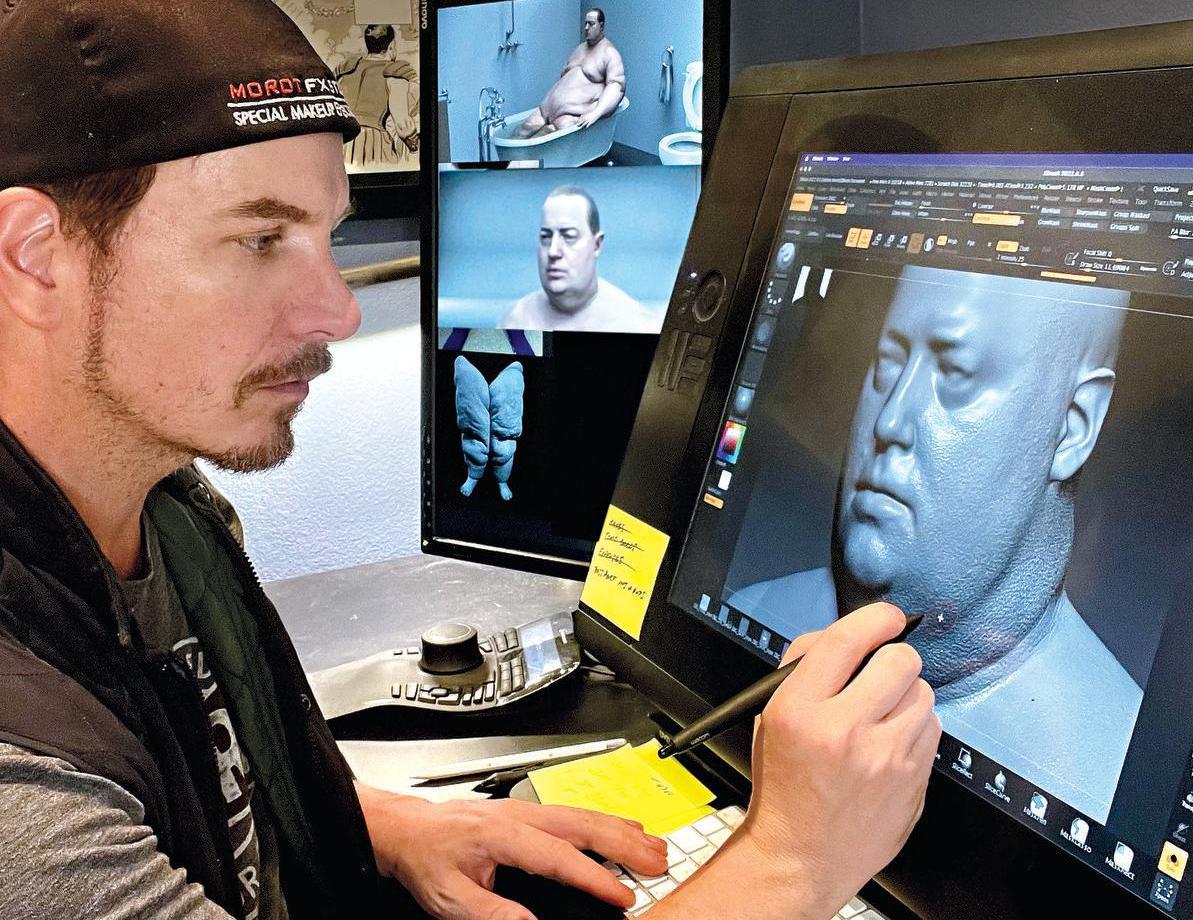
Morot has done makeup effects for director Aronofsky’s “Mother!,” “Noah” and “The Fountain”; he got his previous nomination for “Barney’s Version” and built the current horror hit “M3GAN’s” title animatronic. For “Whale,” he employed digital sculpting and 3D printing to extents previously unheard of in his traditionally handmodeled field. Now L.A.based, Morot had been experimenting with the technologies in his hometown Montreal studio for some time before COVID hit.
Soon after, Aronofsky called.
“Nobody was working, so we could isolate a little group together and film ‘The Whale,’ which happens in just one apartment and could be shot in five weeks,” Morot recalls the filmmaker enthusing. “I was like, OK, this was the time to do it. I didn’t have physical access to the actor to do a normal life casting, so let’s do that digitally. It’s a small movie; if it doesn’t go well, nobody’s going to hear about it!”
He can make that joke now, but Morot was determined to create the best, most realistic weightgain prosthetic ever filmed. For reference, he put together a bank of online photos of people with obesity. Then he checked other movie makeup artists’ workand was rather appalled.

“Almost systematically, those kind of makeups were either done in comedies where the character was the butt of a joke — ‘Nutty Professor,’ ‘Shallow Hal’ — or it’s in a scifi/horror movie,” Morot says. “I thought it was crazy to treat those characters like that. Obviously, this movie is trying to treat the subject with empathy, care and acuity.”
Though well aware of complaints about the film that range from how Charlie’s condition is depicted to why an actor of larger size wasn’t cast, Morot says he “can’t imagine anybody else doing a better job at conveying the range of emotions required in that script than Brendan did. My only job was to do my part as accurately and respectfully as I can.”
Instead of using the makeup artist’s usual clay, Morot sculpted the body suit on computer over a scan of Fraser that an associate had made in the actor’s New York garage. Positives of the digital body parts with and without the sculptures on them were 3D printed in resin that was cured, layer by microscopic layer, with ultraviolet light. Then silicone was injected between negative casts of the sculptures and the positives, which yielded the very realisticlooking prosthetics
that composed the suit.
The silicone also moved like human flesh. It bore the weight of water too.
“I opened up the mold and was like, ‘This looks great!’” Morot says. “‘A silicone suit! Never been done before!’ Then I took the skin off the positive, it flopped on the floor. I lifted it up and was like, ‘Jesus Christ, what was I thinking?’ It was so heavy.”
The torso section, in fact, had to be constructed out of foam latex so it wouldn’t crush Fraser.
“The full body — with the arms, the legs, the torso — was close to 200 pounds,” Morot says of the finished contraption. “In some places, the body was 2½ feet deep, so we needed to have a skin that was about a quarter of an inch thinand rest over a structure that needed to move like a real body.”
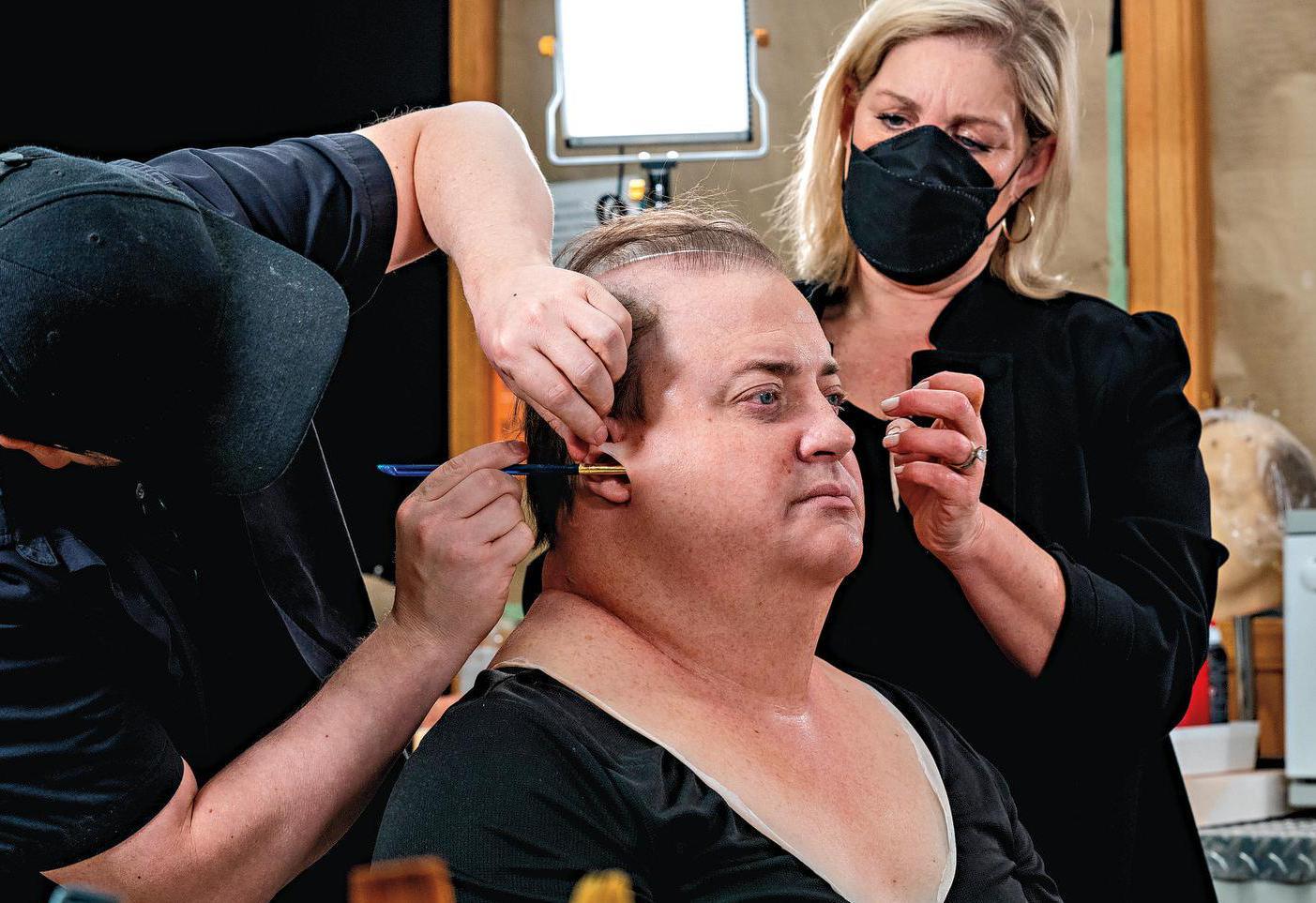
That understructure involved rings of gelatinous, squishy Orbeez balls in a mix of water and glycerin. The suit then was clipped to a parachutetype harness Fraser wore, under which he had a cooling outfit that pumped cold water through vinyl tubing.
It took five people to dress Fraser from his feet up to the top of the back zipper each day he wore the full suit (when feasible for the shots, he wore just the Orbeez sections under clothes with photorealistic arms and legs clipped on). After a few weeks on the film’s New York shoot, the makeup team got the whole process, including face and hair, down to about 3½ hours.
One arm prosthetic was detachable to permit Fraser to feed himself at lunch. And, yes, the suit had a bathroom flap. But don’t think that made things easy.
“If he needed to use the toilet, poor Brendan had to tell us 45 minutes in advance,” Morot says. “We needed to wheel him to our room, remove the arms, open the clasps at the bottom, put him back in the wheelchair and take him to the bathroom. It was an operation that needed four guys.”
No one ever said that blazing trails was easy.
“When I was doing all the tests in my Montreal shop, I thought all the real professionals out here or at Weta were doing it too,” Morot says. “Then, as I was talking to my friends in L.A. or Richard Taylor in New Zealand about the 3D printing prosthetics and stuff, everybody was like, ‘You’re doing what? How? Nobody does that!’ I think ‘The Whale’ is a perfect vehicle to bring it out, and hopefully people will remember [the process] in the future.”
ADRIEN MOROT, far right, used digital sculpting to create Fraser’s prosthetics. Below, natural Fraser, and above, in his “suit,” whose parts included foam latex and heavier silicone. The full suit was nearly 200 pounds.
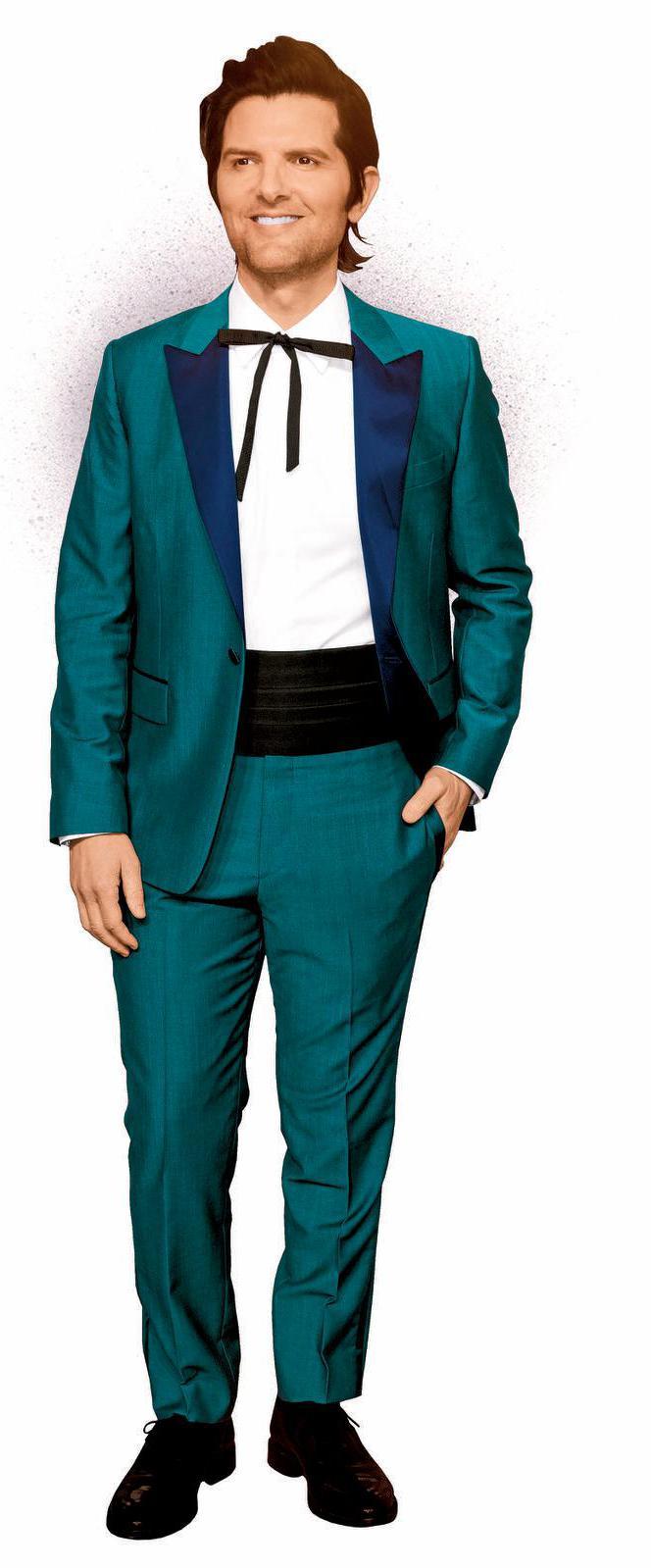
What film or performance moved you this season?
“Ke Huy Quan in ‘Everything Everywhere All at Once.’ He was the most important person in the world to me when I was 11 years old, because ‘Indiana Jones and the Temple of Doom’ is, to this day, my favorite movie, and when I was 11, it was everything to me. Then he was also in ‘The Goonies’ the following year, so he was everything to me. And then this performance is extraordinary; it’s a beautiful, vulnerable, heroic performance. The bonus of who he is as a figure in my life and seeing him come back with such an amazing performance is really lovely.”
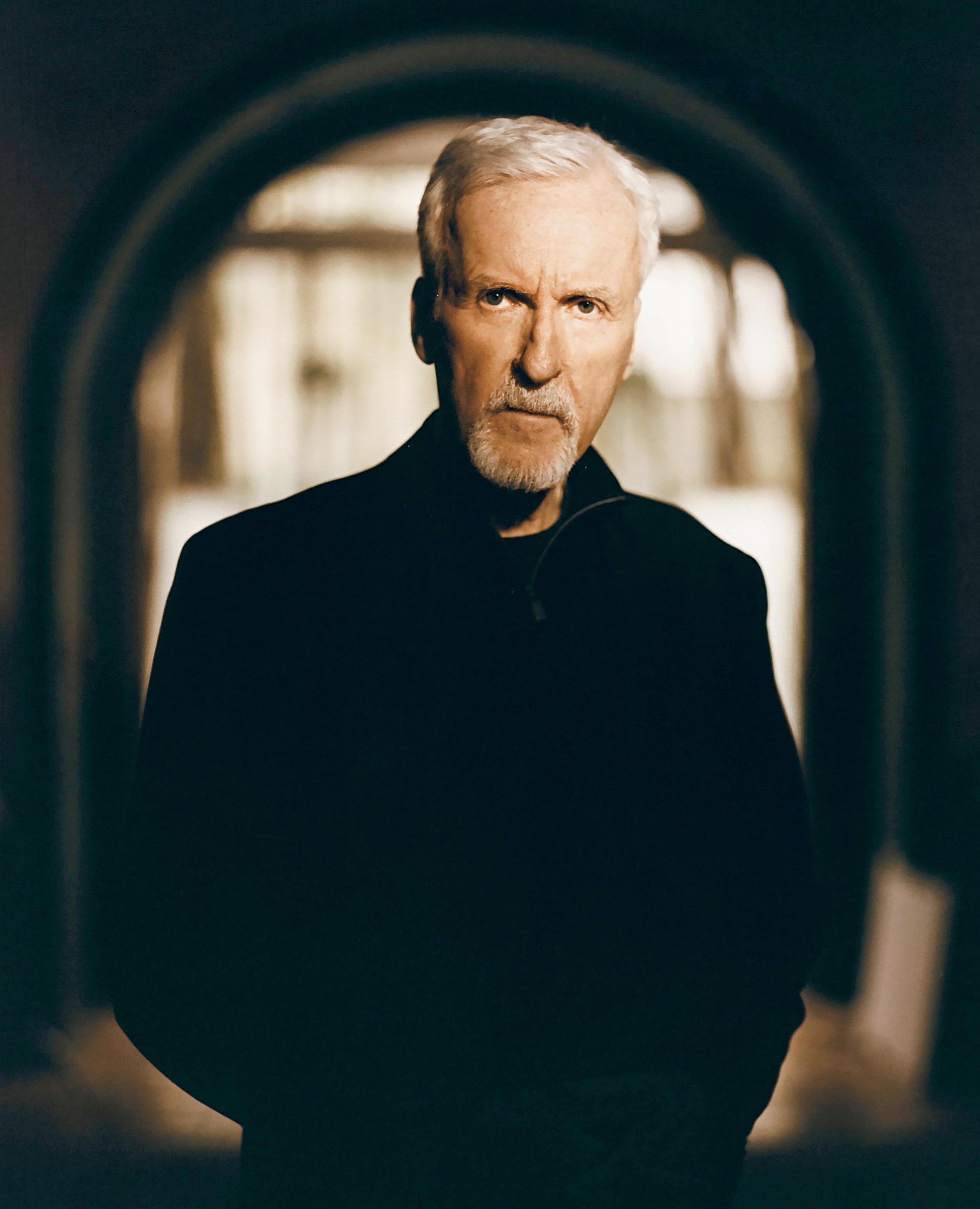
James Cameron believes that his cuttingedge technology can actually result in purer performances.
By Jordan Riefe
OV ER BUDGET and behind schedule, “Titanic” was doomed to fail. So said Hollywood soothsayers. Instead, the James Cameron classic won 11 Oscars and smashed box office records, bringing in a whopping $2.2 billion — the highestgrossing film to date in 1997. “Avatar,” a longsimmering project, was released in 2009 and set a new global record, earning roughly $2.9 billion. The director said its sequel, “Avatar: The Way of Water,” would have to return $2 billion just to break even. Well, it did.
Cameron has been defying naysayers and pioneering filmmaking techniques for more than 30 years. Now, at what would be retirement age for many, he’s hitting the after jets, gearing up for three more “Avatar” sequels and a project close to his heart, “The Last Train From Hiroshima: The Survivors Look Back.”
The good news is “Avatar 3”is already in the can and reportedly ventures into a land of fire. It’s actually the second half of the new movie, which was broken into two parts. The bad news is postproduction takes roughly two years, which means it won’t be in theaters until 2024 at the earliest. It features a more prominent role for Ronal, chieftess of the Metkayina, played by Kate Winslet, the “Titanic” star who reunited with Cameron after once saying, “You’d have to pay me a lot of money to work with Jim again.”
“She talks about how she almost gets traumatized by the characters she plays. She was talking about something recently and I said, ‘Y’know, that happened on “Titanic.” You were carrying the responsibility and the burden of that film on your shoulders,’” Cameron recalls, noting he’s the only director Winslet’s worked with twice. “There were no sparks [of anger] between us when we were working. It was a fantastic experience.”
Sigourney Weaver has Winslet beat, reuniting with the director for the third time in “Way of Water,”where she briefly reprises her role of scientist Grace Augustinebut mainly plays her halfNa’vi daughter, Kiri, a soulful adolescent who has a way with sea creatures. It’s a challenge the 73yearold actor had never been confronted with.
“She’s not a Method actor, but she basically just stayed in a light and young frame of mind,” Cameron says of Weaver, who prepared for the role by hanging out
with teens. “When she stepped into the Volume [a sort of walltowall greenscreen set] every day, even between takes, she had a bit of Kiri about her at all times. And she was tons of fun on the set because she just stayed in that buoyant state.”
With stateoftheart technology and cuttingedge performance capture, the “Avatar” movies appear to challenge actors in ways that have nothing to do with acting. Instead, the opposite is true. On a mostly bare stage without makeup or costumes, the art of acting is reduced to its purest rudimentary state.
“Actors come in and don’t know what to expect but quickly recognize what they need to do, and how easy it is. They’re getting into a more tightly linked groove with me and with each other, because we’re not constantly resetting lights and moving the camera,” Cameron says of a process he claims is 95% focused on performance. “You mock up the set. There’s nothing there, a table or a few marks on the ground. We make sure anything you touch, a doorway, a tree branch, anything you move on, it has to be physically there.”
First there’s the performance capture, which is shot simultaneously with reference footage for the editors. And don’t forget the Fusion camera, a stateoftheart 3D rig. Next take the whole production and dunk it in the drink, then you begin to understand how “Avatar: The Way of Water” came to be. Cameron can tell you how he did it, but it would take 10 hours and your eyes would glaze over. So instead,
he tells you why he did it.
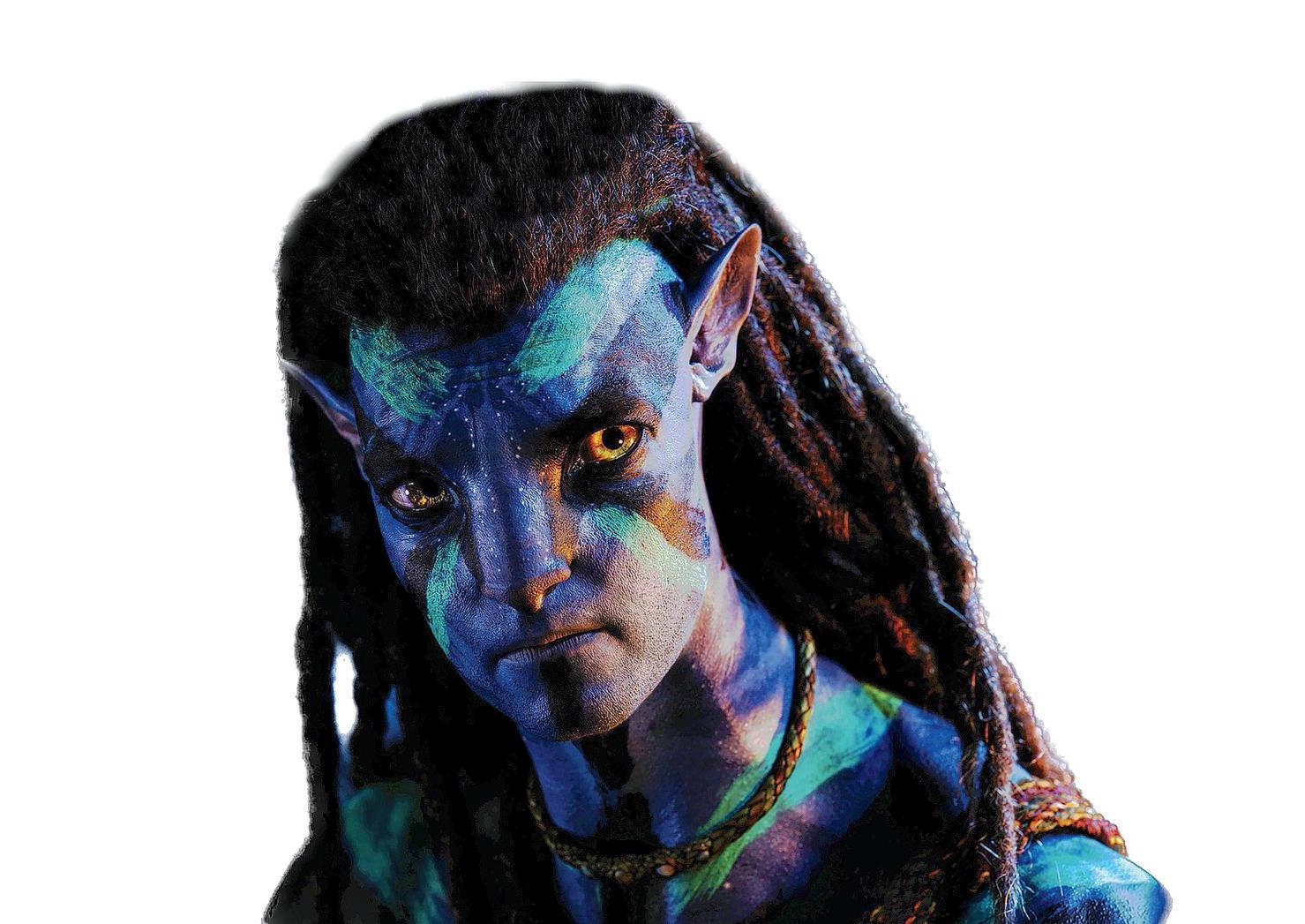
“It creates a form of cinema that doesn’t look like anything else,” he says. “It has an almost photoreal quality, and yet it’s fantastical in that the characters can’t possibly be real. We specifically designed them to not be possible with makeup. That was a creative priority. Their eyes are too big —they’re four times the size of human eyes, and it gives them that deeply empathetic kind of effect I think the audience responds to. Their sinuous bodies that are integrated with the tail movement and ear movement, they become these highly expressive versions of the actor that are in a way more emotive and, in a funny way, almost more emotionally accessible to the audience.”
Although neither “Avatar” film is explicitly about climate change, both are strong statements on conservation and the current epoch of human impact on the Earth, called by some the Anthropocene. For Cameron, such ideas constitute the reason for making the movies, which is why he nearly walked out when 20th Century Fox execs asked him to drop environmental themes from the first film.
“It’s part of our dialogue, part of our discourse to discuss our ideas and problems through our art,” offers Cameron. “And movies are part of our art. It’s what drives me to want to make these films.”
No doubt future sequels will delve deeply into these concerns, shared by writerproducer Shane Salerno, who has a story credit on all of the sequels and a screenplay credit on the fifth. “Shane’s got a lot of positive energy. He’s relentless,” Cameron says of the author, who is writing an update of “Fantastic Voyage” to be produced by Cameron and directed by Guillermo del Toro.
Although “A3” is topmost in mind for the filmmaker, he hopes to take time before “Avatar 4” to direct “The Last Train From Hiroshi
JAKE SULLY
is played by Sam Worthington in “The Way of Water.”
ma,” based on the book by Charles R. Pellegrino. Research included an interview with Tsutomu Yamaguchi, the only known survivor of both the Hiroshima and Nagasaki atomic bombings, who has since died.
“We live in a more precarious world than we thought we did,” says Cameron, reflecting on the war in Ukraine and resurgent nationalism. “I think the Hiroshima film would be as timely as ever, if not more so. It reminds people what these weapons really do when they’re used against human targets.”
Like “Avatar: The Way of Water,” the Hiroshima film seems meant to be experienced on the big screen. In fact, all Cameron films should be viewed that way. “Enough of the streaming already,” he told the Independent at the Golden Globes. “I’m tired of sitting on my ass.”
“I don’t think it’s ever going to go away, because it’s something specific,” he says of the moviegoing experience. “The deal we make to go and immerse ourselves without distraction, it’s like doing yoga or taking a walk in the forest for a couple of hours. There’s something about it I still think is sacred.”
That’s why you won’t see “Avatar” spinoffs on Disney+ anytime soon, not to mention the price tag. “Right now, the economics don’t make sense to spin off any of our CG main characters onto TV. But the cost of these things will progressively come down as we introduce machine deep learning into the processes and make them more automated. Ask me again in five years.”
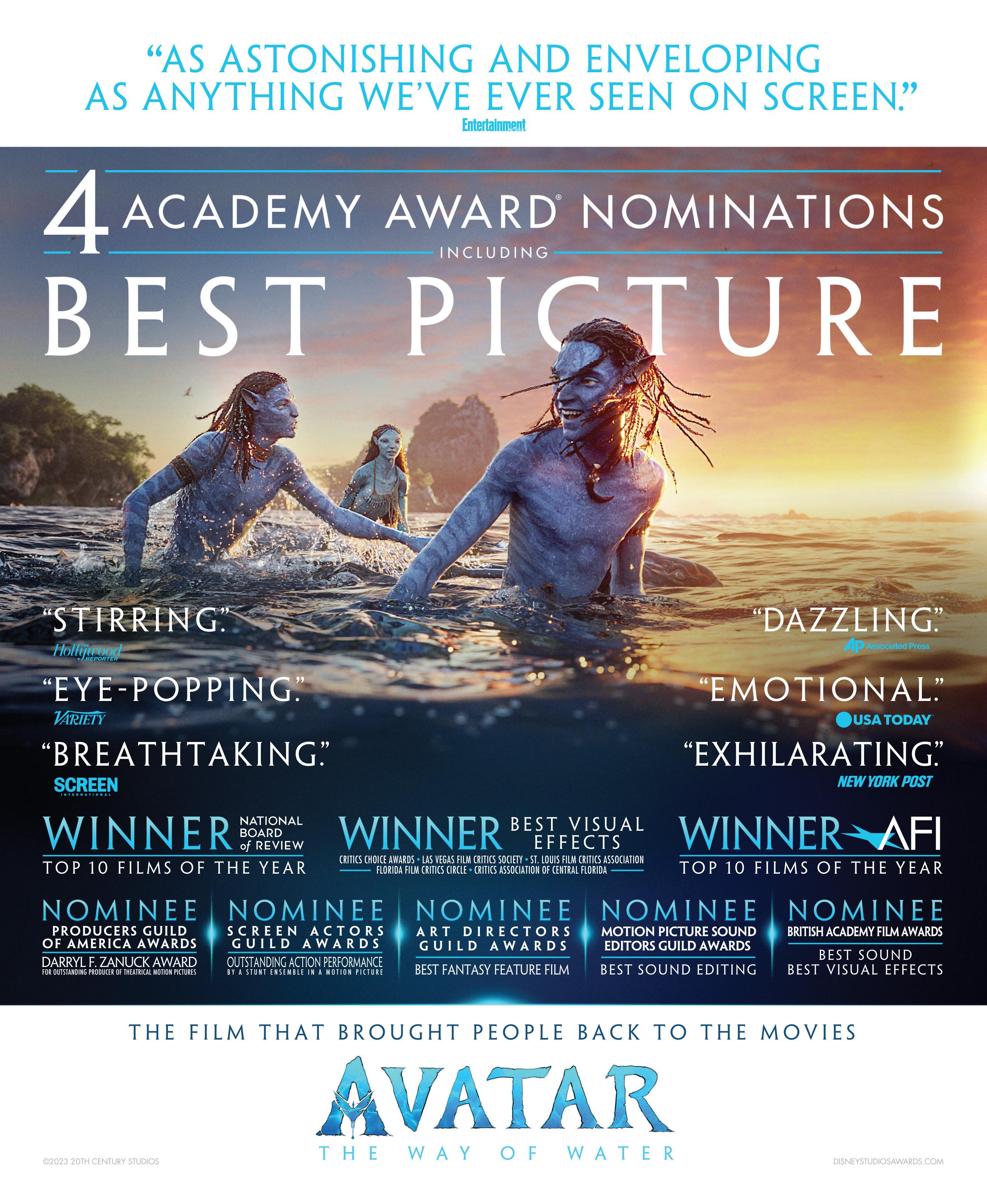
Despite the sequel’s technological innovation and vertiginous box office returns, critics and awards voters were initially reluctant to heap too much praise on it. It failed to make the BAFTA longlist for best film, then was shut out at the Golden Globes. But then came four Oscar nominations, including a nod for best picture.
“I’ve asked myself, why do this form of cinema that’s so difficult? Some think it’s a lesser form of cinema because it doesn’t involve a camera. I could argue that till I’m — to coin a phrase — blue in the face, because I think it’s a much more pure form for acting. But it’s really about creating a waking dream state on the part of the audience.”
O R THE 10 MOVIES nominated for best picture, being invited to the party was just the first step. Now the focus is on winning the Oscar in what remains a wideopen race. Campaign pitches must be freshened, talking points adjusted and the souls of all involved cleansed with Ophora water and superfood smoothies, making it possible to formulate an answer to the question “So ... how did this project originate?” and not completely die inside because it has been asked, by this point, several thousand times. ¶ So as we head into the final stretch before voting begins, let’s look at the messages the nominated movies seem to be sending.
We can give you 2 billion reasons to reward our movie. What? You turn up your nose at our box office bounty? Fine.
We’ll be over here, counting our money, knowing you’ll have another chance to honor us with “Avatar 3,” “Avatar 4,” “Avatar 5” ...
Forget the thrown fingers. And the poor donkey ... though wasn’t that a beautiful shot of Colin Farrell at her grave? In fact, we bet you remember a number of lovely images from the film. Kerry Condon letting Barry Keoghan down easy by the lake. “There goes that dream.” Whew. Was there a more perfectly acted scene in a movie this year? Was there a more perfectly cast movie this year? We’ve stumped you, haven’t we? Pour yourself a pint and raise a toast!
‘ELVIS’
[Sung to the tune of
“If I Can Dream”]
There must be votes coming our way somewhere
Got to be love for a movie so true
If we can dream of a better land
Where the Oscar goes to a movie that people can stand
Tell me why, oh why, oh why can’t our dream come true?
There must be a prize for Austin Butler sometime
For he still talks just like Elvis and it’s been years
If we can dream of a warmer sun
Where Oscars go to the deserving one


Tell me why, oh why, oh why won’t that sun shine this year?
It’s about family, OK? Yes, it takes place in the multiverse, and we know that is confusing and perhaps even threatening and/or alienating for some of you. Take a deep breath. Relax. Maybe invite your children to watch the movie with you. Or your grandchildren, if you’re so blessed. Don’t have any? Maybe that guy who lives down the street, the one with the funnylooking plants growing in his backyard, could come over and help you out. Just remember, again: It’s a story about a family, in this case an immigrant family, struggling to communicate with each other and the beautiful journey they take toward acceptance and understanding. Doesn’t that sound nice?
Yes, there have been other adaptations of “All Quiet on the Western Front,” but this is the best version. And not just because it was made by a German. OK ... it is precisely because it was made by a German! We have reclaimed this story for Deutschland, annexed it, if you will. No. Strike that. Poor choice of words. Just appreciate that this is an antiwar movie — yes, it gets off on the battle scenes, but don’t all war movies do that? — made by Germans who hate war just as much as the next European Union country, except for maybe those Swedes, but WHAT THE HELL DO THEY KNOW ABOUT THE GRIM REALITIES OF LIFE? Sorry. We didn’t mean to shout. Again: Vote for us. That’s an order.
‘Avatar:
The Way of Water’ can give you 2 billion reasons to reward its movie.THE GOLD STANDARD
Sure, sure, we’ve heard all the talk about how “Top Gun: Maverick” saved movie theaters from extinction — not disputing it, by the way — but, if we may, let’s dig a little deeper here and get real. You needed this movie. And by you, we mean all the dads who came of age with the original “Top Gun” and still get a lump in their throats when they hear those opening synths of the “Top Gun” anthem, forcing them to reach for their aviator sunglasses because, OK, something got in their eyes. We are not surprised at your tears. Strong men also cry. Especially when they’re given such a potent reminder that you can be of a certain age and still fly right into the danger zone and come out not just unscathed but a damn hero.
We know you may not have taken the time to watch our movie yet. No judgment — unless you’re one of those bros who can’t get past the title. Then, sure, you may feel a little silent contempt radiating your way. But there’s still time to appreciate one of the year’s most critically acclaimed films — we made more Top 10 lists than “Elvis” and “The Batman”! — and take note that our esteemed writerdirector, Sarah Polley, is nominated for the beautiful way she adapted Miriam Toews’ novel, making 100 minutes of women debating, encouraging, understanding and, yes, talking, into a thrilling film.
Have you heard? The London Film Critics Circle just gave us best picture, making us only the fourth movie to win top prizes from the Los Angeles, New York, National Society of Film Critics and London groups. The other three: “Schindler’s List,” “L.A. Confidential” and “The Social Network.” And, yes, of those movies, only “Schindler’s List” won best picture. But as time has passed, you probably wish the others had won too. “The King’s Speech”? Really? How does that look today? Think of what movie will stand the test of time and vote accordingly.
‘TRIANGLE OF SADNESS’
[Sung to the tune of the “Love Boat Theme”]
Puke
Was it the galley’s stew?
Overboard
Into the ocean blue!
The haaaate boat
Soon will be making another run
The haaaate boat
Making fun of the rich is fun
Keep ahold of your dentures
And try to barf in the potted plants
And hate won’t hurt anymore
Even if our satire’s a crashing bore
It’s haaaaate ...
Welcome aboard!
‘THE FABELMANS’
It’s about family, OK? In our case, it’s Steven Spielberg’s family and how his upbringing informed his art and set him on the path to become one of the greatest filmmakers in the history of the medium. “Family, art, life — it will tear you in two!” Who among you cannot relate to that line in some way, even if you’ve never been screamed at by John Ford?
‘Women Talking’:
We made more Top 10 lists than ‘Elvis’ and ‘The Batman’!
DE SPITE THE possibility of landing his first Oscar nomination, James Friend had other priorities on the afternoon of Jan. 24. Namely, sleep. The UKbased cinematographer was trying to get some rest while in the midst of three weeks of night shoots for the upcoming “Star Wars” series “The Acolyte.” He was rudely awakened by a call from his wife, who was, understandably, screaming into the phone.
“As a natural pessimist, I tend to think the worst. So I was like, ‘What the hell’s wrong? What’s going on?’ And then she said that I’d been nominated for an Academy Award. It didn’t quite sink in,” Friend says. “I’d also only been asleep for about an hour and a half. So it was even more bizarre. I spoke to her for a bit, and then the first thing I did is I threw up in the toilet because I just was in complete shock. And then I was just trying to go back to sleep again for the next night [shoot].”
Spoiler alert: He did not fall back asleep.
Friend’s cinematography nomination was one of nine for “All Quiet on the Western Front,” an adaptation of Erich Maria Remarque’s seminal 1928 novel, directed and cowritten by Friend’s favorite collaborator, Edward Berger. Despite having previously won a BAFTA and two British cinematographers honors, Friend admits he’s suffering from a wee bit of “impostor syndrome” when it comes to his Oscar recognition.
He says: “As cinematographers and as filmmakers, we make films for the general public. But for someone to kind of say, ‘Well, this is a standout moment’ — because I do it a lot [myself]. I’m on a lot of voting juries every year for BSC, ASC, for the BAFTAs. So being on the other
‘All Quiet on the Western Front’ cinematographer meticulously maps where to aim his camera.
By Gregory Ellwoodend of that kind of spectrum is a huge honor. It’s something that I don’t think I would ever experience again.”
This adaptation of “All Quiet” may feature massive and intricately shot WWI battles, but Friend’s primary concern was the responsibility involved in tackling such a beloved piece of literature, a novel that had already spawned a 1930 cinematic classic.
“You naturally have doubt in your own abilities,” he says, “and you just think, ‘Well, what we can do is we can retell it with the justice of modern cinema and filmmaking techniques and everything that comes with.’”
That approach meant an extraordinary preproduction period, as Friend and Berger spent more than six weeks in a hotel room painstakingly storyboarding the entire movie. He jokingly describes it as almost “movie jail” but in the most collaborative way possible.
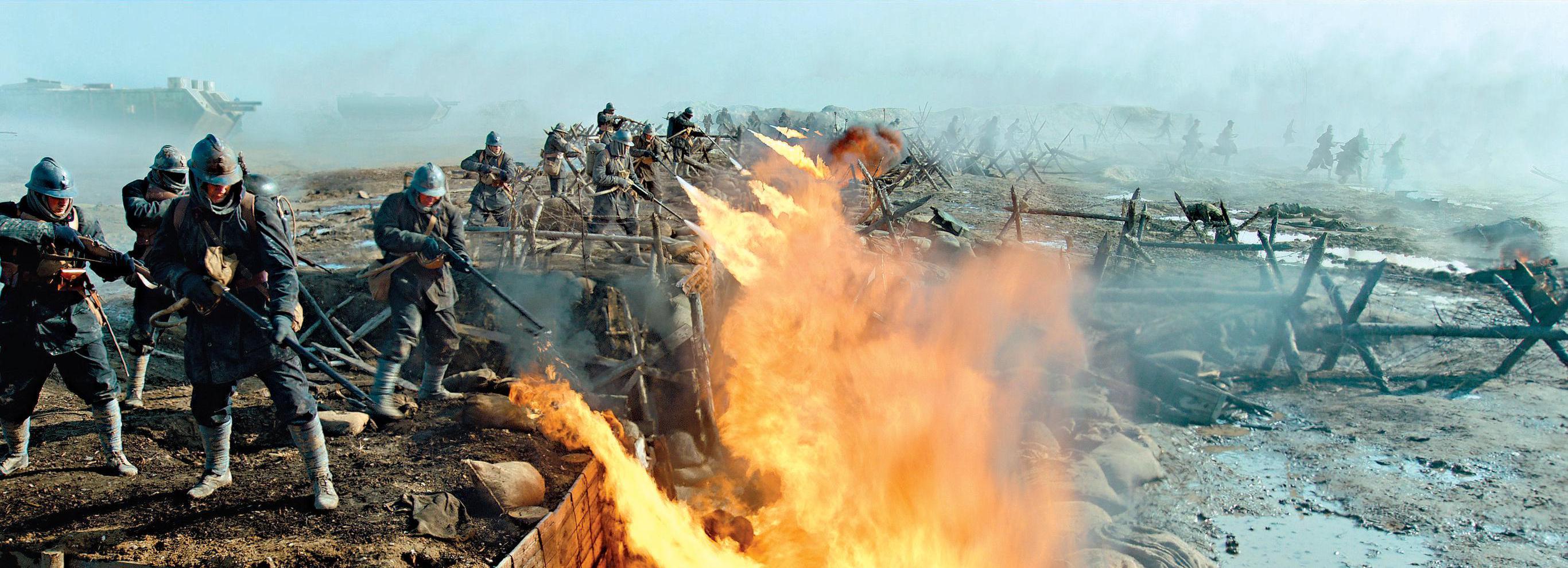
“We didn’t have the luxury of running a whole scene all the way through on a wide shot, because we didn’t have the budget for [that many] explosions or tanks or extras,” Friend says. “You run 400 extras across a battlefield, and actually, they go from one side of the frame to the other side of the frame in eight seconds. You can’t run the whole scene unless you’ve got 4,000 extras. So you need to be very disciplined with it all. It was this real exercise in shotlisting, cinematography, in editing, in directing, in everything.”
During those long days of preproduction, the pair would act out as many scenes as possible to accurately make a shot list of them, and Friend says Berger
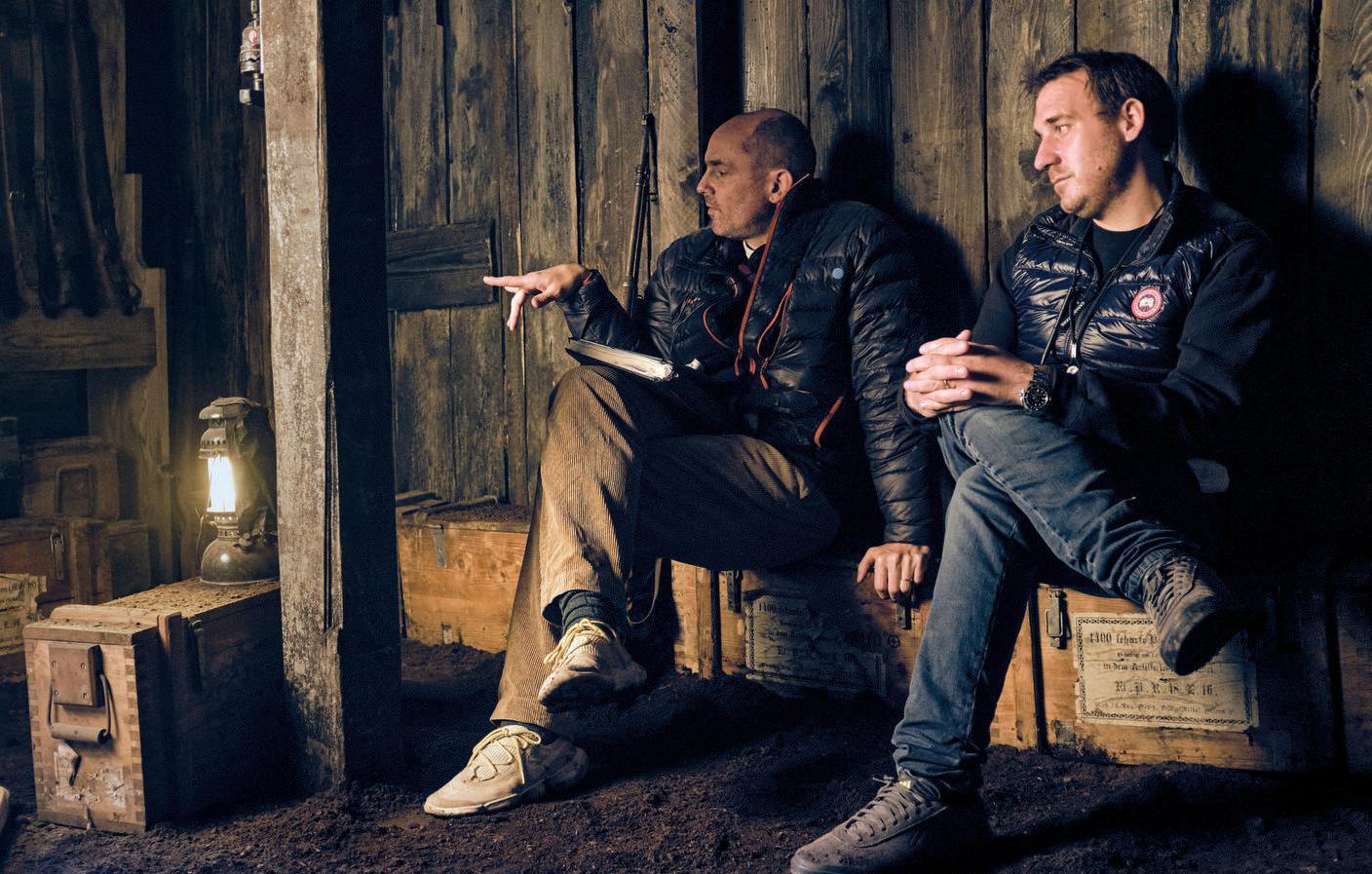
still teases him about rolling around on the hotel room floor playing a soldier. But when filming began, they were as ready as anyone could be when shooting in Eastern Europe in January and February. Friend notes, “We had snow, we had rain, we had sun, we had clouds, we had wind — everything that naturally goes against the elements of filmmaking.”
Despite those forces, it was the epic battle in the middle of the script that concerned him the most.
“It was just the sheer scale of maneuvering that amount of people and equipment and tanks and props and everything and tracking it with the sun and tracking it with the set,” Friend says. “Because you had these two sorts of environments working against each other. You had this vast battlefield that was the equivalent of 10 football pitches. And then you actually had a trench, which was a corridor, which was narrower than my office. And just trying to navigate that with the sun and just with that level of extras and with the environment, the mud and everything like that? That was one where we really had to hit the schedule every single day.”
Friend says he’s watched every Oscars telecast for more than 20 years and considers the awards hallowed ground. And although he’s overwhelmed by his turn in the awards season spotlight, what he does next will always depend on the story first.
“I always think I’ll be shooting short films up until the day I retire or die because I just like telling good stories,” Friend says. “And I’ve shot some terrible films in my time. But I’m absolutely honored beyond all articulation and expression to be nominated for an Academy Award.
“I mean, this is stuff that dreams are made of.”
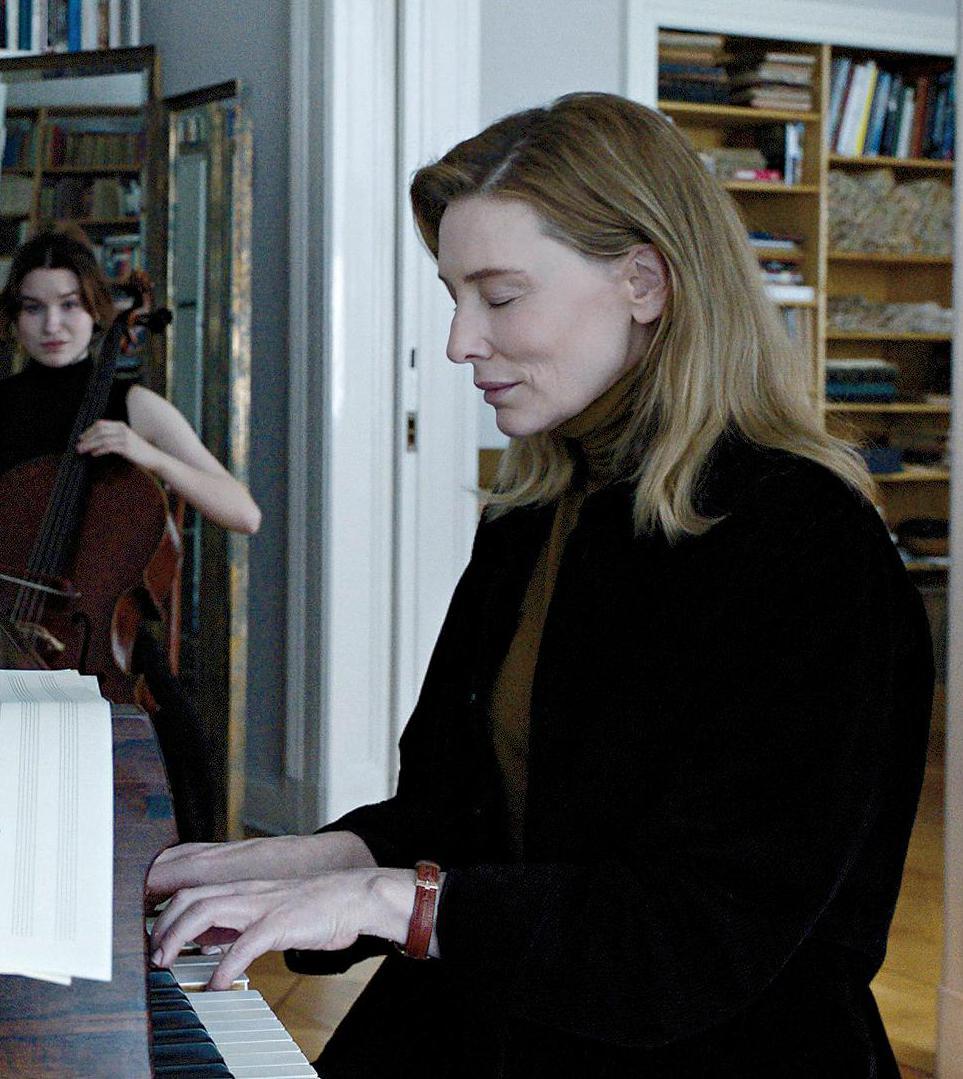
The rising suspense in director Todd Field’s “Tár” is tunefully orchestrated through a restrained yet evocative visual palette. Lydia Tár (Cate Blanchett) is a renowned conductor whose past indiscretions pull her from the spotlight.
The narrative unfolds with a deliberate, unhurried pace — the camera punctuating pivotal moments of Lydia’s psychological unraveling. One such photographic motif is the recurring dreams that haunt her. Set against a black backdrop, it’s as if she is being consumed by the young women she has groomed into having a sexual relationship throughout her career, including Krista (Sylvia Flote), who winds up taking her own life. In achieving the illusory effect, cinematographer Florian Hoffmeister couldn’t be “too specific technically” so as to not “take away the magic,” but he shares that a box was built for actors to go inside to create the scenes. “They were done in a way that was playful and improvisational,” Hoffmeister recalls. “I find personally the most beautiful thing about those sequences is that they decided to keep them so quiet. All those little moments were the precious ones. It was about how we could create a visual language where those little moments would stick out and not disappear in a flood of imagery.” —
 Daron James
LOS ANGELES TIMES (ISSN 04583035) is published by the Los Angeles Times, 2300 E. Imperial Highway, El Segundo, CA 90245. Periodicals postage is paid at Los Angeles, CA, and additional cities.
POSTMASTER: Send address changes to thisaddress. | Home Delivery Subscription Rates (all rates include applicable CA sales taxes and apply to most areas) | Print + unlimited digital rates: Sevenday $28/week, $1,456 annually. Thursday–Sunday $16/week, $832 annually. Thursday & Sunday $10/week, $520 annually. Saturday & Sunday $9/week, $468 annually. Sunday $8.50/week, $442 annually. Monday–Saturday $18/week, $936 annually (also includes Sundays, except 2/19, 4/9, 9/3, and 10/8). Monday–Friday $16/week, $832 annually. | Pricing for all subscriptions includes the Thanksgiving 11/23/23 issue. | All subscriptions may include up to eight Premium issues per year. For each Premium issue, your account balance will be charged an additional fee up to $4.49, in the billing period when the section publishes. This will result in shortening the length of your billing period. Premium issues may include: New L.A. Times Food 1/08/23, Festival of Books 4/16/23, 101 California Best 5/21/23, The Ultimate Guide to Streaming 6/18/23, Boiling Point 8/06/23, De Los Latino 10/01/23, Holiday Gift Guide 11/19/23, 101 Best Restaurants 12/10/23. Dates and titles are subject to change without notice. Subscriptions with a Thurs. delivery, include 25 special issues of The Envelope via USPS with 2 issues in Jan., 5 in Feb., 2 in May, 4 in June, 3 in Aug., 1 in Oct., 3 in Nov. and 5 in Dec.
In ‘Tár,’ wicked acts