MANUFACTURING PRODUCTION
OPINION
HOW BICS COULD TRANSFORM UK MANUFACTURING
MANUFACTURING
PRODUCTION
NOVEMBER 2026
MACHINERY
KERF BRINGS NEXT PHASE OF EVOLUTION
ENGINEERING
Food & beverage manufacturing & logistics solution design Expert Engineering. Innovative Design.
End-to-end project management, design, engineering and cost control services Engineered to optimise your process, maximising efficiencies & increasing productivity
We can help you with:
Experience-driven solutions designed by professionals from the F&B industry Architectural, MEP & Refrigeration design with sustainability in mind You’re the expert in your product we’re the experts in building the right space to keep it going strong. Let us take the stress out of your capital project so you can focus on what you do best. Kate Hancock, coo
Let’s connect
Web: spheredesign.com LinkedIn: company/sphere-design-ltd Tel: +44 (0) 1628 397 978 Email: kate@spheredesign.com
SmartParc was specifically designed to address food & beverage industry challenges and provide the springboard to develop sustainable production for the future. Each SmartParc delivers c.5000 high quality jobs & c.£2.7b GVA
A new asset class redefining food & drink manufacturing
750 - 400,000 sq ft food production units to let at our flagship development SmartParc SEGRO Derby in UK Would you like to be the next SmartParc anchor tenant at future developments? We are in search for more land in UK, Ireland, Europe and North America/Canada
Built-to-suit, A sustainable flexible lease central energy food-grade system facilities combining designed renewables by food and experts efficient heat reuse
Access to capital and property expertise
Shared services including security, utilities, waste management and more
Web: smart-parc.com LinkedIn: company/smartparc-ltd Tel: +44 (0) 1628 397 979 Email: phil@smart-parc.com
CONTENTS 40
04
08 Editor
Paul Attwood editor@mpemagazine.co.uk
Senior Editorial Assistant
John Reynolds editorial@mpemagazine.co.uk
04 08 32 40 50
32
50
Made Smarter and Toyota team up to transform South East manufacturing Investment pays off as Pre-Met stamps out £500,000 new business haul CloudNC raises $20m to expand AI tools for precision machining Can Britain compete again? How BICS could transform UK manufacturing Private Label Demand Is Growing. Are You in the Room?
Features Editor
Harry Peters editorial@mpemagazine.co.uk
Production/Design
Laura Whitehead laura@lapthornmedia.co.uk
Sales Manager
Charlotte Chapman charlotte@mpemagazine.co.uk
Accounts
Richard Lapthorn accounts@lapthornmedia.co.uk
Admin Assistant
Jade Still jade@lapthornmedia.co.uk
Circulation Manager
Leo Phillips subs@mpemagazine.co.uk
Publishing Director
Editors Note Welcome to the latest issue of Manufacturing & Production Engineering Magazine. In this edition, we explore how UK manufacturers are balancing investment, innovation and resilience against a backdrop of rising costs, skills shortages and global uncertainty. Our features examine why focusing on the factors businesses can control – from developing people to strengthening customer relationships – can help manufacturers maintain their long-term vision.
Paul Attwood Editor
Technology remains central to that journey, with developments in automation, digitalisation, ERP systems and advanced measurement demonstrating how manufacturers can improve productivity without compromising quality. We also look at the continuing importance of skilled engineering expertise alongside new technology, as well as investment in UK manufacturing capacity and emerging opportunities in sectors such as offshore wind. As ever, we bring you the latest industry news, products and developments. We hope you enjoy the issue.
Maria Lapthorn maria@lapthornmedia.co.uk
Lapthorn Media Ltd
5-7 Ozengell Place, Eurokent Business Park, Ramsgate, Kent, CT12 6PB
Every effort is made to ensure the accuracy and reliability of material published in Manufacturing & Production Engineering Magazine however, the publishers accept no responsibility for the claims or opinions made by advertisers, manufactures or contributors. No part of this publication may be reproduced or transmitted in any form or by any means, mechanical, electronic (including photocopying) or stored in any information retrieval system without the prior consent of the publisher.
mpemagazine.co.uk Connect with us @mpemaguk
Phone: 01843 808 106 Manufacturing & Production Engineering Magazine
03
Latest News
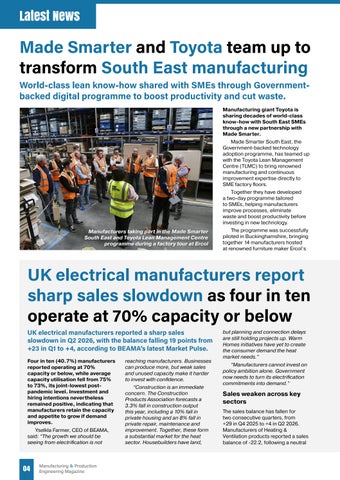
Made Smarter and Toyota team up to transform South East manufacturing World-class lean know-how shared with SMEs through Governmentbacked digital programme to boost productivity and cut waste. Manufacturing giant Toyota is sharing decades of world-class know-how with South East SMEs through a new partnership with Made Smarter. Made Smarter South East, the Government-backed technology adoption programme, has teamed up with the Toyota Lean Management Centre (TLMC) to bring renowned manufacturing and continuous improvement expertise directly to SME factory floors. Together they have developed a two-day programme tailored to SMEs, helping manufacturers improve processes, eliminate waste and boost productivity before investing in new technology. Manufacturers taking part in the Made Smarter South East and Toyota Lean Management Centre programme during a factory tour at Ercol
The programme was successfully piloted in Buckinghamshire, bringing together 14 manufacturers hosted at renowned furniture maker Ercol’s
UK electrical manufacturers report sharp sales slowdown as four in ten operate at 70% capacity or below UK electrical manufacturers reported a sharp sales slowdown in Q2 2026, with the balance falling 19 points from +23 in Q1 to +4, according to BEAMA’s latest Market Pulse. Four in ten (40.7%) manufacturers reported operating at 70% capacity or below, while average capacity utilisation fell from 75% to 73%, its joint-lowest postpandemic level. Investment and hiring intentions nevertheless remained positive, indicating that manufacturers retain the capacity and appetite to grow if demand improves. Yselkla Farmer, CEO of BEAMA, said: “The growth we should be seeing from electrification is not
04
Manufacturing & Production Engineering Magazine
reaching manufacturers. Businesses can produce more, but weak sales and unused capacity make it harder to invest with confidence. “Construction is an immediate concern. The Construction Products Association forecasts a 3.3% fall in construction output this year, including a 10% fall in private housing and an 8% fall in private repair, maintenance and improvement. Together, these form a substantial market for the heat sector. Housebuilders have land,
but planning and connection delays are still holding projects up. Warm Homes initiatives have yet to create the consumer demand the heat market needs.” “Manufacturers cannot invest on policy ambition alone. Government now needs to turn its electrification commitments into demand.”
Sales weaken across key sectors The sales balance has fallen for two consecutive quarters, from +29 in Q4 2025 to +4 in Q2 2026. Manufacturers of Heating & Ventilation products reported a sales balance of -22.2, following a neutral
Latest News Princes Risborough factory. Day one combined expert-led workshops and practical exercises with a factory tour, while day two took the learning directly into selected businesses. Toyota worked with four of the participating firms, CTE Advanced Technologies, Gibbs Gears Precision Engineers, 3 Way Displays and Hansford Sensors, deep-diving into their operations and identifying opportunities for improvement. Following the success of the Buckinghamshire pilot, Made Smarter South East and Toyota took the programme to Kent, where a further two-day course was delivered in partnership with Kent County Council in Sittingbourne. Seven manufacturers took part: Bulgaro, Catchpole and Rye, Contracts Engineering, Torr Scientific, D.K. Holdings, G & J (CNC) Group and Cammegh, with businesses travelling from across Kent and East Sussex to participate. Jez Heys, Technology Adoption Specialist, Made Smarter South East, said: “Digital transformation isn’t just about investing in new technology. Manufacturers need to understand their processes, where the waste is and where the biggest
result in Q1. Building Electrical Systems manufacturers recorded a positive balance of +33.3. Building Electrical Systems members reported slowdowns and cancelled projects across newbuild construction and the repair, maintenance and improvement market. Business optimism among manufacturers supplying construction-linked markets remained negative, with Heating & Ventilation recording a balance of -25 and Building Electrical Systems -8.3. Across BEAMA’s membership, business optimism improved from -28 in Q1 to -12 in Q2 but remained below every quarterly reading recorded in 2024 and 2025.
Manufacturers have significant spare capacity Nearly three in ten (29.6%) manufacturers reported capacity utilisation of between 51% and 70%, while around one in ten (11.1%) were operating at 50% or below. Only around one in ten (11.1%) reported
opportunities for improvement lie. This collaboration gives South East SMEs access to decades of worldclass manufacturing expertise, helping them improve the way they work today and make smarter decisions about the technology they invest in tomorrow.” Ian Peers, Operations Director at Ercol, said: “The workshop was fascinating and pitched really well for manufacturers outside the automotive sector. “We’re now looking at how we can build on what we learned through further training and support to help improve productivity at our UK factory.” The Toyota Production System has become one of the world’s most recognised approaches to manufacturing. The TLMC was established in the UK in 2009 to share that expertise with other organisations through training and practical support.
“There has been so much enthusiasm and engagement from the delegates who attended the events in Buckinghamshire and Kent. Our coaches will work with local SMEs supporting the development of their businesses, but more importantly their people. Utilising the tools of the Toyota Production System alongside the cultural toolbox we call the Toyota Way, we firmly believe that these methods can be applied in any business.” Building on the successful Buckinghamshire and Kent events, Made Smarter South East is now exploring opportunities to take the programme to manufacturers across the region. To register with Made Smarter South East and find out how the programme can support your manufacturing business, visit madesmarter.uk/ adoption/in-my-region/south-east
TLMC coach Steve Nelson said: “We are really excited to have this collaboration with Made Smarter South East. Pictured right: Jez Heys, Technology Adoption Specialist at Made Smarter South East
operating above 90% capacity. Existing capacity would allow manufacturers to respond if demand recovers.
Investment and hiring intentions remain positive Manufacturers still plan to invest despite weak sales and unused capacity. The balance expecting to increase capital investment over the next 12 months rose from +47 in Q1 to +51 in Q2. Product improvement was the most frequently cited priority at 70%, followed by plant and equipment at 65% and e-business, including AI, at 57.9%. Hiring intentions remained positive at +39, showing manufacturers continue to plan job growth despite weak sales and unused capacity. Members continue to report difficulty fulfilling their recruitment plans because of shortages of skilled engineers and high labour costs. The five-year investment balance slipped from +68 to +66 but remained positive.
Businesses can produce more, but weak sales and unused capacity make it harder to invest with confidence. Global cost pressures continue Manufacturers also reported higher raw material costs and renewed supply-chain concerns. Copper was the most frequently cited material, followed by steel, brass, aluminium and PVC resin. While availability caused fewer problems than price, some respondents again reported difficulty sourcing chips, semiconductors and microprocessors.
Manufacturing & Production Engineering Magazine
05
Latest News Eight Group chooses IFS Industrial AI to support rapid growth
Filtronic Wins $68.1m Order from SpaceX Major deal to support Starlink highlights growing global demand for UKdeveloped space technology Filtronic plc, a global leader in high-frequency connectivity solutions, is pleased to announce it has secured its largest ever single order from long-standing customer SpaceX, to support the continued growth of the Starlink high-speed internet service. The order, for Filtronic’s industry leading Cerus, E-Band Gallium Nitride (GaN) Solid State Power Amplifier (SSPA) units, marks a significant milestone in the two companies’ partnership. It also demonstrates the increased importance of GaN semiconductor technology for high-throughput satellite communications systems and of Filtronic’s commanding position at the leading edge of its development. Production units will start shipping throughout FY2028 into early FY2029. Beyond its significance for Filtronic, the contract
06
Manufacturing & Production Engineering Magazine
highlights the growing role of UK-developed technology in the global space sector. As demand for satellite communications infrastructure continues to increase worldwide, the award demonstrates the strength of Britain’s advanced engineering and manufacturing capabilities, with a UK business supplying mission-critical technology for one of the world’s most ambitious communications networks. Nat Edington, Chief Executive Officer, Filtronic, said: “This follow-on order from SpaceX, is another significant milestone for Filtronic, providing extended order visibility and coverage over the next couple of years. This order provides further evidence of the growing importance of GaN technology in high-frequency communications and reinforces Filtronic’s position at the leading edge of this transition. “Since securing our first E-Band GaN SSPA order with SpaceX just twelve months ago, we have continued to invest in scaling our manufacturing capability, and this contract is a direct validation of that strategy. It underpins our expectations for FY28 and reinforces Filtronic’s position at the leading edge of GaN semiconductor technology for satellite communications.”
IFS, the leading provider of Industrial AI software, today announced that Eight Group, a fast-growing UK facilities management provider scaling through M&A, is implementing IFS as its technology platform for growth. Building on the success of its early deployment of Nexus Black Resolve, Eight Group is expanding its suite of IFS Industrial AI solutions to include IFS Loops Digital Workers, IFS Cloud, and Planning & Scheduling Optimisation (PSO). Eight Group will gain real-time insight into finance, projects, field service, scheduling, and asset data across company-wide operations, leveraging Industrial AI to drive faster, more informed decisions as the business grows. Eight Group rolled out Nexus Black Resolve to 65 engineers within weeks. With Resolve, engineers can capture an issue on the spot, by photo, video, or voice, while AI diagnoses the fault and guides the engineer through the repair. Processes that used to take hours, and in some cases days, can now be completed in minutes, with survey and asset information populated automatically instead of requiring manual entry, giving more time to customers and less time to paperwork. The facilities management industry is undergoing an operational shift driven by advancements in technology. Traditional reactive maintenance – fixing equipment only once it has already failed – is being traded for a more predictive approach, where problems are caught and addressed before they disrupt a client’s operations, helping avoid the cost of unplanned downtime. Eight Group’s technology strategy positions them to outpace industry change. Integrating acquisitions becomes faster and smoother with a unified tech stack and automated processes. Real-time visibility across operations, paired with the ability to deploy Industrial AI at every customer touchpoint, gives Eight Group the operational sophistication to lead the new facilities management landscape, where speed and insight drive competitive advantage.
Protect Every Component of Your Business
Manufacturing insurance designed around you Whether you’re a single manufacturing facility in the UK or a global multi-site operation, Gallagher can help you protect your business, your people and your products.
CONNECT WITH A SPECIALIST TODAY. For further information, please scan the QR code.
Partner with an insurance and risk management specialist who knows your industry. Our Specialist team at Gallagher would be glad to arrange a no-obligation insurance review for your company.
AJG.com/uk The Gallagher Way. Since 1927. Arthur J. Gallagher Insurance Brokers Limited is authorised and regulated by the Financial Conduct Authority. Registered Office: Spectrum Building, 55 Blythswood Street, Glasgow, G2 7AT. Registered in Scotland. Company Number: SC108909. FP251-2026 Exp. 16.02.2027. © 2026 Arthur J. Gallagher & Co. | GGBRETUK107473
Company News
Investment pays off as Pre-Met stamps out £500,000 new business haul A Redditch-based metal pressing and stamping specialist is reaping the benefits of a sustained investment drive with a £500,000 order boost. Pre-Met, which employs 64 people at its Studley Road factory, has maximised increases in capacity and the ability to produce larger, heavier parts to win higher volumes and make new inroads into automotive, aerospace and defence.
The addition of the AgieCharmilles wire erosion machine has played a key role in this and will be joined by a Cincinnati Milacron 75-tonne press and automated feed that will help the business cope with growing demand and a strong pipeline of potential orders. Four new supervisory and maintenance roles have been created as a result, with the firm still looking for a further power press setter and a toolmaker. “We have worked really hard to identify new markets and how we can strengthen how we support existing
customers,” explained James Leng, Managing Director of Pre-Met. “It’s an approach that has started to pay off, with six wins across automotive, aerospace, defence and rail. In fact, the latter has seen us take on larger, more complex work
Goodfellow set to create 20 new jobs as it invests £1.5m into US advanced manufacturing hub One of the UK’s leading advanced materials and metals suppliers is targeting international expansion after opening a new expanded production facility in the US. Goodfellow has invested more than £1.5m into the 15,000 sq foot precision engineering centre located in the heart of Maryland, Columbia. Over 100 delegates from the local business community gathered for the ribbon cutting and official opening, including representatives from Howard County Chamber of Commerce, Howard County
08
Manufacturing & Production Engineering Magazine
Economic Development Authority and Howard County Council. They heard how the investment strengthens the company’s micro machining and advanced materials capability within the US, reducing lead times for customers and reinforcing its ability to support complex, high-volume programmes.
medical technologies push the boundaries of what’s possible, we’re investing in the capacity and capability to be a true manufacturing partner to companies shaping the future of these industries. With this investment comes a real opportunity to expand our export business, which accounts for 80% of annual sales.”
Up to 20 new jobs will be created as part of the expansion, taking the firm’s US workforce to 60.
Located in Huntingdon in the UK, Goodfellow is a global supplier of more than 170,000 different advanced metals, alloys, ceramics, polymers, compounds, and composites, serving thousands of customers worldwide across sectors including aerospace, medical, electronics, energy, and advanced technology.
“This expansion reflects our commitment to production in the US, as well as providing an advanced global hub for our micromachining business,” explained Simon Kenney, CEO of Goodfellow. “As Artificial Intelligence (AI), aerospace, and
Company News smarter and, through additional machinery, secure new orders.” Operating from Redditch since 1973, Pre-Met originally made high-value pens, cufflinks and telecommunication parts, with today’s company evolving into a critical, quality-assured supplier to aerospace, defence, mobility, medtech, construction, electrical and transport sectors, shipping its components to customers across the world. The company, which has recently signed up to the aerospace, defence and security supplier qualification JOSCAR, has spent the last twelve months integrating the acquisition of Quality Springs & Pressings facility into its Studley Road site.
for a long-term client that was only made possible by the investment and process improvements we’ve made.” He continued: “With so many external pressures on industry, it’s a sign the team we’ve got can respond and find ways to make savings, work
This prompted a significant reorganisation, modernisation of the toolroom and the start of several process improvement activities that have reduced costs and waste. James picked up the story: “Quality is a big part of what we do, and we are currently triple accredited for ISO 9001, ISO 14001 (environmental) and IATF 16949 (automotive).
The performance goes way beyond getting the standards. It’s all about the culture we instil and the desire from everyone in the business to deliver right first-time parts to customers. - James Leng
“The performance goes way beyond getting the standards. It’s all about the culture we instil and the desire from everyone in the business to deliver right first-time parts to customers.” He concluded: “This has seen us achieve an overall PPM score of 99.64% with zero defects in automotive and rail. The trust this generates is significant with our global client base.” For further information, please visit metalpressingsandstampings.co.uk
The company provides materials, precision micro machining, and technical support to help customers move innovations from research and development into full-scale production. As part of its US expansion, the site has been equipped with stateof-the-art laser systems, giving the company the ability to operate at ultra-fine tolerances and with complex micro scale components. Goodfellow has already maximised this new capability by securing a $multi-million deal with one of the world’s leading manufacturers of AI processors. Simon went on to add: “This facility represents a significant investment in our global manufacturing footprint. It’s a statement of our confidence in the Goodfellow brand, our capabilities and in the future of precision engineering.” Lori Kleppin, Director of Membership and External Affairs at Howard County Chamber of Commerce, concluded:
“Goodfellow is exactly the type of advanced manufacturer we want to attract and cultivate in this region, and we welcome the additional investment into its new precision engineering centre. The micro machining capabilities and advanced materials it provides will
be essential for US industry looking to lead the world in electrification, medical products, AI and sustainable power generation. In addition to the investment, there will also be up to 20 new high value jobs created, which is excellent news for the people of Columbia.”
Manufacturing & Production Engineering Magazine
09
Company News Delta’s presence in the Glasgow area, a region with a longstanding industrial and engineering heritage and a strong ecosystem of engineering talent, universities and technology expertise. Today, the team focuses on developing next-generation power conversion technologies for Industrial Electric Vehicles (IEVs) used in material handling, warehouse automation and logistics applications.
Delta Electronics Relocates Scottish Engineering Hub to New Facility to Strengthen its Innovative Solutions for Industrial Electric Vehicles The move reinforces Delta’s long-term commitment to the UK market by providing a modern, collaborative workplace that supports innovation, sustainability, and business growth. Delta, a global leader in power management and smart green solutions, announced the relocation of its Scottish operations to a new engineering hub and office facility at One Rutherglen Links, Glasgow. The investment marks an important milestone in Delta’s long-term commitment to the UK market, providing a modern, collaborative workplace designed to foster innovation, strengthen engineering capabilities and support future business growth. Approximately 40 employees across engineering, sales and support functions will relocate from East Kilbride to the new facility later this year, with capacity to support future expansion.
Strengthening Delta’s Engineering Presence in Scotland
“Our investment in a new Scottish headquarters reflects Delta’s long-term confidence in the UK market and our continued commitment to our employees, customers and partners,” said
Delta has maintained an engineering presence in Scotland for almost three decades, with the site evolving into an important engineering hub within Delta’s Industrial Mobility Business. The move strengthens
10
Manufacturing & Production Engineering Magazine
Jason Butcher, Country Head UK & Ireland, Delta Electronics EMEA. “The new building provides an inspiring environment that encourages collaboration, supports innovation and enables us to continue delivering high-value solutions to our customers. Most importantly, it creates a workplace where our people can thrive while supporting the continued growth of our business across the region. Its location in the Glasgow area also strengthens our ability to attract engineering talent and further develop partnerships with leading universities across the region.”
The multidisciplinary engineering team brings together expertise in electrical and mechanical engineering, firmware development, PCB layout, automated test engineering, product and project management, enabling the development of high-efficiency battery charging systems, charging modules and DC-DC converters for industrial electric vehicles. Current development focuses on increasing power density, simplifying manufacturing and improving cost efficiency while supporting customers’ next-generation electric vehicle platforms. Located adjacent to Junction 2 of the M74 motorway, the new headquarters comprises more than 11,100 square feet of newly refurbished Grade A office space across two floors. Just a 10-minute train journey from Glasgow city centre, with frequent public transport connections and close proximity to several leading technical universities, the location further strengthens Delta’s ability to attract talent and collaborate with academic partners.
Designed for Collaboration and Sustainability The new headquarters has been designed to provide a flexible and collaborative working environment that supports teamwork, creativity and employee wellbeing. In addition to modern open-plan workspaces, the facility includes dedicated collaboration spaces where engineering teams can exchange ideas, as well as a product validation laboratory for testing, customer demonstrations and technical validation activities. Open-plan workspaces, breakout areas and communal facilities encourage knowledge sharing while providing employees with a modern and efficient workplace tailored to Delta’s ways of working.
Navigate complexity with confidence. As global leaders in process automation, we help you turn precise data into clear insight - and insight into measurable results. From cutting your emissions and energy use to improving water and resource efficiency, we give you the knowledge, tools and hands-on support to optimise your processes and move confidently towards your goals.
Get in touch to discover how we’re helping thousands of food & beverage customers optimise their processes. uk.endress.com
Measurement, Sensors & Monitoring
Robust cable transducers simplify linear travel measurements When your OEM or retrofit application requires precise linear measurements, even in harsh, outdoor environments the GCA series of cable transducers, available from sensor specialist Baumer are designed for safe, low-maintenance operation. The key features and benefits of these cable transducers include easy installation, ultra-compact and robust design, combined with long-life components. Together, these key features help to ensure precise measurements, even in the most demanding applications.
HORIBA air quality monitor AP-380 series achieves key UK MCERTS certification Globally proven continuous trace gas measurement platform now secures UK’s gold-standard certification for environmental monitoring equipment. HORIBA UK Limited a HORIBA Group company, announces that its AP-380 Series Air Quality Monitor has achieved MCERTS certification, the UK’s gold-standard scheme for environmental monitoring equipment. This versatile air quality analyser series is now globally proven for the continuous measurement of trace gases, as it also holds worldwide regulatory acceptance with type approvals from other certification bodies, including US EPA, German UBA/ TÜV Rheinland, Korean NIER and Chinese SAMR.
12
Manufacturing & Production Engineering Magazine
The AP-380 Series continuously measures the concentration of CO, SO₂, O₃, NO, NO₂, NOₓ, CH₄, NMHC and THC at high-precision, ranging from ppb to ppm. Its compact, low-power, modular design means it can be used not only for ambient air pollution monitoring, but also for gas monitoring in many industries. Diverse applications include monitoring vehicles emissions, space-constrained “Mini AQMS” enclosures, industrial process monitoring, and cleanroom or semiconductor gas purity monitoring. Securing MCERTS is a significant technical achievement for the AP-380 Series. The certification followed months of rigorous field testing alongside a busy six-lane motorway near Cologne, Germany. Independent TÜV data shows that all four certified modules within the series comfortably met the 15% maximum relative expanded uncertainty
requirement, outperforming the standard by 5 to 11 percentage points. This high accuracy gives customers complete confidence and future-proofs their monitoring of investments. “Given the demanding realworld conditions that the AP-380 Series underwent to achieve the UK Environment Agency’s stringent MCERTS certification, the results of the field testing represent a strong validation of our platform’s engineering quality,” said Lewis Redford-Knight, Energy and Environmental Sales Manager, HORIBA UK. “Built on over 60 years of HORIBA’s air pollution monitoring expertise and core technology for trace gas analysis, this certification confirms the AP380’s high-sensitivity, consistent and dependable performance.” Each gas component analyser is modular, enabling integration
Measurement, Sensors & Monitoring This broad product portfolio includes compact and flexible cable transducers with a wide choice of interfaces and sensing technologies. A key reason for their high precision measurement and long-standing durability, is their precisely guided mechanical winding of the steel cable. Where angled of flexible cable travel is required, optional pulleys are available. Additionally, the cable is sheathed with polyamide, providing protection against corrosion along with superior bending proof performance. Application versatility is assured because they are designed to incorporate a wide range of standard interfaces, enabling quick and simple integration in any control environment, without the need for any additional adjustment aids.
In addition, the encoder and cable mechanics are designed to ensure perfect interaction, while high linearity of up to ± 0.01% of the measuring range is available with the flexible GCI/GCA series. When the requirement for cable transducers is for outdoor applications, the compact GCA5 series provides robust and spaceefficient solutions. With compact plastic housings and protection ratings up to IP67, these options are particularly suited to applications where space is limited, including mobile machines and utility vehicles. The compact GCA series features a three separate chamber principle, providing optimum protection of the electronics and spring mechanism against moisture or other harmful ambient impacts. High-quality components, such as corrosionproof stainless-steel cable with nylon-polyamide coating and a flat, light shock-proof housing further enhance their suitability for demanding applications. Finally, this broad product portfolio includes compact and flexible cable transducers with a
into systems and facilities to best fit customer needs, including stationary, wall-mounted, mobile, or portable installations. As well as local customisation, the modular design also supports serviceability through quick onsite module replacement. The AP-380’s fieldswappable modules allow any issues to be resolved directly in minutes, maximising uptime.
supporting low concentration gas measurements for various industrial processes; impurity monitoring for quality assurance of industrial gases; gas leakage monitoring within equipment by internally incorporating an analyser module; trace gas monitoring for ozone in water treatment plants; working environment air quality monitoring; and more.
Also enhancing user efficiency, the cutting-edge analysers offer full remote operation and diagnostics from various devices including PC, smartphones, or tablets. This advanced function is enabled by user-friendly software with built-in connectivity to significantly reduce the number of customer site visits; in turn reducing operational costs and minimising carbon footprint from transportation emissions.
More information here: www.horiba.com/gbr/processand-environmental/products/
wide choice of interfaces and sensing technologies. The compact GCA series combines integrated sensing with options including analog, CANopen® and SAE J1939 interfaces, while the flexible GCI/GCA series allows the cable transducer mechanics to be combined with a choice of incremental or absolute encoders to suit the application with varying interface options available. Versions with redundant sensing and signal output are also available. For medical technology, logistics and other similar industries the demands are even greater on cable transducers in terms of linearity. This is where the GCI and GCA flexible series with metal housings and high position encoder technology meet the most demanding measuring accuracy and service life requirements. They provide at linearity ± 0.01% of the measuring range up to 50 metres and are ideal for indoor applications. Extremely high accuracy is assured thanks to precise mechanics, guided winding of the cable, combined with precise encoder optical sensing. Their versatility is possible due to cablepull mechanics combined with a choice of incremental or absolute encoders to suit any measuring task.
Also enhancing user efficiency, the cuttingedge analysers offer full remote operation and diagnostics from various devices including PC, smartphones, or tablets.
The fully certified system’s highly flexible capabilities are proven in installations globally, where it is being used by local authorities, air quality networks, and private companies adhering to local environment regulations. It is also used across a broad range of industries,
Manufacturing & Production Engineering Magazine
13
Measurement, Sensors & Monitoring
Precision in Practice: Why Skilled Manufacturing Remains Central to Titan Enterprises
As demand for sophisticated flow measurement technology grows, manufacturers face an evolving challenge: increasing production capability without compromising the precision, quality and performance that underpin reliable measurement. For Titan Enterprises, the solution is to combine modern manufacturing and design technologies with something that cannot easily be automated – the knowledge, judgement and hands-on skills of an experienced engineering workforce.
Combining engineering experience with digital design Titan’s R&D process relies heavily on computer-aided design (CAD), 3D printing, electronics design software and programming. These technologies allow components and technologies to be developed, tested and modified with greater precision before physical manufacture. However, digital tools do not replace experience and engineering judgement. Understanding how materials respond to pressure and temperature, how components will manufacture and how minute changes in geometry can influence flow measurement remains dependent on practical engineering experience and extensive testing.
Precision manufacturing requires skilled hands Flowmeters are precision measurement instruments, meaning small variations in dimensions, surface finish, alignment or assembly can dramatically impact performance. This is particularly important with positive displacement oval gear meters, where gears must rotate freely and consistently within a precision-machined measuring chamber. Titan’s technicians can work to tolerances of around 3 microns on critical components.
14
Manufacturing & Production Engineering Magazine
Similarly, handling and accurately positioning 2mm sapphire end stones and bearings within turbine flowmeters requires considerable care and expertise. During development, performance issues can sometimes be traced to factors such as surface finish or minute material deformation. Resolving these issues requires engineers to investigate, modify, rebuild and retest physical components – demonstrating the continuing value of hands-on manufacturing knowledge.
Calibration: technology guided by people Titan performs flowmeter calibration in-house using positive displacement piston-prover systems covering flow
ranges from 2ml/min to 200l/min, with calibrations traceable to national standards. Despite the sophistication of this equipment, calibration remains highly dependent on trained personnel. Titan’s production rigs are almost entirely manually operated, with skilled staff carrying out multi-point calibration on thousands of meters each month. Calibration requires more than automated data collection. Technicians must fully understand the equipment, recognise abnormal behaviour, eliminate any potential sources of error, and assess whether the results accurately represent flowmeter performance.
Altus Extends Koh Young 3D Inspection into THT Assembly Altus Group, a leading supplier of capital equipment for the electronics manufacturing industry in the UK and Ireland, has expanded its inspection offering to support through-hole technology (THT) assembly using Koh Young’s 3D measurement technology. Koh Young is a world leader in 3D measurement and inspection technology for electronics manufacturing. Its systems are used for solder paste inspection (SPI) and automated optical inspection (AOI) by electronics manufacturers worldwide. The development comes as manufacturers increase the level of automation within THT production.
Processes range from manual assembly and soldering to automated insertion and robotic, selective and wave soldering, creating different requirements for inspection and quality control. Skilled labour can be difficult to find, while manufacturers are also under pressure to improve throughput and maintain consistent quality. As more THT processes are automated,
Measurement, Sensors & Monitoring At Titan, our expertise and consistent quality is built through experience, training and a workforce that takes pride in what it does. Technology amplifies skilled people For Titan, the future of manufacturing lies in combining engineering expertise with advanced technology. Engineering design tools, sophisticated electronics and increasingly capable calibration equipment provide greater efficiency and development capability, while skilled engineers provide the judgement needed to use these tools effectively. “At Titan, our expertise and consistent quality is built through experience, training and a workforce
inspection must keep pace if it is not to become the next production bottleneck. Altus has already evaluated the technology against competing systems in the UK during 2026. Following the trials, a leading EMS provider that already uses Koh Young systems across three SMT lines is now applying the technology within its THT assembly operations. Joe Booth, CEO of Altus Group, said: “We are delighted to have increased our capacity to support THT inspection with Koh Young. We have offered a very capable 2D solution for some time, but more of our customers are looking for the accuracy, repeatability and, most importantly, the process improvement data they have become accustomed to through 3D measurement. Securing business following customer evaluations earlier this year is a real feather in our cap and demonstrates the strength of Koh Young’s technology. It gives
that takes pride in what it does,” states Jeremy Thorne, Titan’s Operations Manager. “Our people bring decades of specialist flow measurement knowledge to the business and retaining that expertise is fundamental to maintaining our high standards. “Long-term staff retention gives us continuity, preserves critical skills and enables knowledge transfer across a growing team. Ultimately, it is our people who make the difference – ensuring the quality, consistency and technical expertise our customers have grown to expect.”
As Titan develops increasingly sophisticated ultrasonic, low-flow and bespoke flow measurement technologies, its manufacturing and engineering workforce must become increasingly multidisciplinary.
our customers a further option for applying measurement-based inspection to their THT production processes.”
configured systems within the range. Its four digital light projectors capture measurement data from multiple directions, while systems with additional projectors offer greater capacity to accommodate component variation and more complex assemblies.
The THT capability builds on the 3D light metrology used in Koh Young’s SMT inspection systems. It produces quantitative highly accurate measurement data from the assembly, allowing manufacturers to apply very tight defined inspection thresholds. The data can also be aggregated and analysed over time to identify production trends and support process improvement decisions.
For Titan, modern manufacturing is about creating the synergy between people and technology – using advanced design and production technology alongside an experienced team who understands how precision engineering works in practice. For more information on Titan Enterprises please vist: www.flowmeters.co.uk.
Visit: www.altusgroup.co.uk
THT components can vary considerably in their dimensions, positioning and height, making them more difficult to assess consistently using 3D inspection. Koh Young’s technology accounts for these variations to provide reliable measurement across the assembly. The capability can be provided on the Koh Young Zenith 2 four-way projection system and other suitably
Manufacturing & Production Engineering Magazine
15
Latest News Manufacturing Champion delivers SME support boost with launch of ManufacturingUK.org A new national platform designed to streamline how manufacturing SMEs access essential support has been launched by leading industry ambassador Andrea Wilson.
“ManufacturingUK.org exists to make life easier for manufacturers, particularly micro and SME businesses, who find that accessing support can often be difficult, timeconsuming, and overwhelming,” explained Andrea Wilson, founder of Support Manufacturing UK.
The former Managing Director of Hone-All Precision has officially unveiled ManufacturingUK.org, a free to access digital resource that will empower, connect and champion small to medium-sized manufacturers across the UK.
“We want manufacturers to have one trusted destination where they can quickly find the people, the organisations, the opportunities, and the expertise that can genuinely help them solve challenges and boost growth and innovation.”
Tapping into years of on-theground experience and feedback from hundreds of management teams, the platform will bring together a disparate support ecosystem in one single place, a place where users can tap into advice and guidance from funding providers, skills programmes, trade associations, innovation resources and best practice events.
She continued: “My recent appointment as the SME Ambassador for the Confederation of British Metalforming aligns perfectly with the aims of ManufacturingUK.org. Both are about championing manufacturers, strengthening connections, promoting collaboration, and helping SMEs thrive.”
The initiative is expected to attract tens of thousands of users every year and has already been backed by founding sponsors, including 5D-BPS, Automate UK, Clear Quality, Crowe UK, ConeX, Enginuity, NatWest and vocL. Andrea Wilson
ManufacturingUK.org went live today with dozens of verified resources and support avenues in place that meet many of the recommendations made in the ERAfunded report ‘The Growth Mission: A Blueprint For Scaling Up SME Manufacturers’.
Nothing is listed on trust. All tools and resources are checked for value by an experienced industry-backed team, with every approved asset personally signed off by Andrea before it appears. It is an approach that has received massive sector backing so far. More than 100 manufacturers signed up within 24 hours of the launch announcement last month and hundreds more are expected to join them as the message spreads across the UK. Chris Greenough, Managing Director of Westley Engineering, is one of the early users. “Running a SME manufacturer, especially in today’s climate, is extremely demanding, and can be a very lonely place.There is support out there, but it is fractured and very time consuming to find the backing you actually need. We simply don’t have that time as management teams, which means we don’t always access help that can make a real difference.” With more than 32 years in manufacturing, Andrea is widely recognised as one of the sector’s most passionate advocates. Following a successful career leading Hone-All Precision, the three-time Top 100 Manufacturer recipient has dedicated her efforts to supporting and promoting manufacturers across the UK by encouraging knowledge sharing and demonstrating the power of placing collaboration ahead of competition. Ann Watson MBE, CEO of founding sponsor Enginuity, concluded: “SMEs are the lifeblood of British manufacturing and yet getting information, advice and guidance to support these businesses is so hard to find - and it shouldn’t be.This platform will ensure that manufacturers spend their time making things whilst the information that they need to support their success is easily accessible, understandable and in one go-to-place.” For further information, please visit www.manufacturinguk.org.
16
Manufacturing & Production Engineering Magazine
Lost documents. Slow approvals. Version confusion. Fix these bottlenecks with DocuWare for Manufacturing.
Manufacturing delays rarely start on the shop floor — they start in your process. What DocuWare delivers
Why it matters
• D igital project files: Connect all documents in one place. • Streamlined production: Automatically generate, route and archive manufacturing documents. • Version certainty: Benefit from built-in version control and audit trails. • F aster approvals: Keep work moving with guided workflows, alerts and mobile sign-offs. • A P automation: Automatically match POs, goods receipts and invoices to speed up reviews, improve cashflow and capture early-payment discounts. • E nd-to-end traceability: Link batch/lot documentation, equipment logs and QC results for product liability confidence. • A lways audit-ready: Rely on secure, long-term archiving and powerful search to support HMRC, GDPR and customer audits.
start.docuware.com
© DocuWare 2026
Shorter cycle times and higher throughput
Fewer errors and less rework
Real-time visibility from the shop floor to finance
Stronger compliance and reduced risk
Boost efficiency. Deliver faster. Please scan to learn more.
Technology & Software
“Take The Jump, It’s Worth It,” Says Construction Materials Producer to Small Manufacturers Scottish insulation products manufacturer IndiNature gained control of orders, inventory, purchasing, production, and costs within a few months of implementing ERP.
Scaling up sustainable insulation manufacturing
One system for managing everything
Founded in 2016, IndiNature is a Scottish manufacturer of natural fiber insulation products. The company’s products are made using natural fibers, including UK-grown industrial hemp.
MRPeasy is now used across much of IndiNature’s operation, with each customer order running through the system from quote to delivery. For McKeown, three areas stand out as particularly important: production tracking, control over raw material inventory, and order processing. Bringing these processes together gives the company a clearer picture of what is happening across the operation without having to manually consolidate information from different spreadsheets.
In the beginning, IndiNature’s production setup was relatively straightforward. As volumes started increasing, however, managing individual parts of the operation with spreadsheets was no longer enough. Supply Chain Manager Nina McKeown explains, “It was all being done in Excel, and we realised that wasn’t going to work.”
Flexibility and cost tipped the scales IndiNature evaluated several solutions while comparing the systems in terms of cost, efficiency, and flexibility. The company ultimately decided that MRPeasy offered the best combination for its requirements. With relatively little legacy data to migrate, implementation took only a couple of months. “It was quite a quick implementation,” McKeown says.
Cost tracking has also become an important part of IndiNature’s everyday use of MRPeasy. Having manufacturing, purchasing, and inventory information in a single system helps the company remain profitable. “MRPeasy helps us keep an eye on production costs and make sure our margins are healthy,” McKeown says.
Customer service benefits from easily accessible information The centralized order information also benefits customer service. When customers contact IndiNature about
an order, the team can quickly check its status instead of looking through separate spreadsheets or asking different departments for an update. “I can very quickly see where the order is in the system and when it’s going to be delivered,” McKeown says.
Lot tracking brings traceability to the finished product Traceability is another part of IndiNature’s manufacturing workflow. The company uses barcodes and lot numbers to carry the relevant information from material lots through production and ultimately to product labels. “MRPeasy provides us with end-toend traceability,” McKeown says. “We don’t have issues very often, but if something occurs, we know exactly which batch it was.”
A system that supports a scaling company For a scaling company like IndiNature, McKeown rates MRPeasy extremely highly for its ability to support the manufacturing operation. “I would say MRPeasy is easily a nine or a ten,” she says. “At the level we are right now, as we scale up, it’s the perfect system.” McKeown’s advice to other small manufacturers considering the same move is straightforward: “Don’t be scared to use it, because it’s so easy. Take the jump. It’s worth it. Don’t wait.”
Visit: mrpeasy.co.uk
18
Manufacturing & Production Engineering Magazine
Gain complete control over your manufacturing operation
ERP software for manufacturing SMEs Production planning, inventory, traceability, cost tracking, sales, purchases, and more! Learn more and start your free trial at www.mrpeasy.co.uk
Opinion Piece
Why ‘controlling the controllables’ is key to manufacturing resilience By Gustavo da Silva, Managing Director of WEG UK Open any news app and you’ll find another challenge for manufacturers. Energy prices. Inflation. Tariffs. Geopolitical tensions. Supply chains. Skills shortages. It’s easy to feel like the industry is constantly reacting to events beyond its control. However, Gustavo da Silva, managing director of global motor manufacturer, WEG UK, believes businesses that succeed are the ones that refuse to let uncertainty dictate their strategy. Those external pressures are already having an impact on industry. Make UK’s Manufacturing Outlook for Q2, 2026 found that business confidence has fallen to its lowest level in four years. Rising costs and global uncertainty were cited as key challenges. It’s a stark reminder that uncertainty isn’t disappearing any time soon. The question is how businesses choose to respond.
During my career, I’ve seen financial crises, a global pandemic and now a rapidly changing geopolitical landscape affecting supply chains and energy costs. When I became managing director of WEG UK in 2025, I was often asked what I planned to change. My focus was always on continuity, rather than
change. It was about building on the long term vision that’s already in place, rather than reacting to short term events. In order to focus on the long term vision, in spite of the short term noise, we have to recognise that many external pressures sit outside our control. Within our team, we often come back to one simple phrase: control the controllables. It has become something of a mantra because it’s just as relevant today as it was during the pandemic. We cannot control geopolitical instability. We cannot control the cost of electricity or gas. We cannot predict what future policy changes will bring. What we can control is how we support our customers, how we run our operations and how we invest in our people.
Stay close to your customers It is not uncommon for businesses to become inward looking during periods of uncertainty. In my experience, that’s exactly when manufacturers need to get closer to their customers. Understanding your customer’s situation and challenges puts you in a far stronger position to solve their problems. The same rule applies to relationships with OEMs and systems integrators. Listening to customers should influence how you invest. For instance, as demand for more tailored motor solutions has grown, we’ve invested in expanding our UK workshop. This means we’ve increased our capacity to deliver bespoke products. It’s a practical example of customer feedback shaping business decisions, rather than simply responding with a bigger sales effort. It’s also crucial to recognise that customer needs don’t stop at the
20
Manufacturing & Production Engineering Magazine
Opinion Piece point of purchase. That’s why WEG has established a dedicated EMEA services business that provides support on equipment from any manufacturer. It reflects our belief that customers value long-term technical partners who can help keep their operations running, regardless of whose name is on the equipment. Both investments reflect the same principle: remaining close and listening to customers, understanding what they need and evolving to meet those needs.
Invest in people The second controllable is people. Technology will always play an important role in manufacturing, particularly as AI, automation and digitalisation continue to evolve. But technology only creates value when you have the right people to apply it. It’s encouraging to see the wider industry thinking in the same way. RSM’s latest Manufacturing Investment Monitor found that, for the first time, investment in people has overtaken capital investment as manufacturers’ top priority. I believe that’s the right approach.
Modular 24 V DC system (up to 20 A), single/dual channel, adjustable Backplane busbar replaces wiring for faster installation REX12: cost-efficient, reliable standard protection REX22: advanced protection with active current limitation (I²t) Higher reliability with precise fault detection, fewer false trips Compact 12mm modules save cabinet space CPC12 / EM12D enable monitoring, control, and remote access
New technologies will continue to emerge, but they’ll only deliver their full potential if businesses have the right skills, knowledge and culture to implement them.
Supports IO-Link, PROFINET, EtherNet/IP, EtherCAT, Modbus TCP/RTU
My own experience has reinforced my belief that investing in people is one of the strongest decisions a business can make. I joined WEG as a trainee in Brazil more than 20 years ago and have had the opportunity to develop my career across different roles and countries.
We won’t be beaten on value
Maintaining the long term vision The manufacturing industry has always faced uncertainty. During my career, I’ve seen financial crises, a global pandemic and now a rapidly changing geopolitical landscape affecting supply chains and energy costs. While it is important to appropriately respond to changing market conditions, manufacturers need to protect their long term vision. There will always be another challenge competing for attention. The businesses that succeed won’t be the ones that react to every one of them. They’ll be the ones that stay focused on controlling the controllables. For WEG, that’s building strong customer relationships, investing in people and remaining committed to a long term vision.
www.hpcplc.co.uk/value www.hpcplc.co.uk/value
* Deals Available! *
HPC KAESER PACKAGE PROMOTION * Limited Time Offer! *
www.hpcplc.co.uk/package www.hpcplc.co.uk/package
The official UK partner of
Discover how WEG’s range of motors, drives and industrial solutions is helping manufacturers build resilience at www.weg.net.
Find out about the Special Promotions we have on offer! Call 01444 241671 or email info@hpcplc.co.uk
Manufacturing & Production Engineering Magazine
21
Health & Safety
VIDA bioenergy Selects Blackline Safety to Identify, Protect Workers from Hazards G8 portable gas detector provides UK bioenergy facility with gas detection, lone worker protection, and communication in a single device. The Netherlands-based VIDA bioenergy has selected global connected safety technology leader Blackline Safety to help uncover safety hazards and protect lone workers at its bioenergy plant in Wormslade, UK. The facility – which transforms sustainable organic material into energy, producing clean energy products such as biomethane, biogenic CO2, and organic fertiliser
– has equipped its employees with Blackline’s industry leading G8 portable gas detectors, enabling the company to consolidate lone worker connectivity, gas detection, and communication into a single device. Launched in 2025 under the ownership of energy infrastructure leader VTTI, VIDA bioenergy is poised to become one of Europe’s leading biomethane producers, with operations and projects underway across the Netherlands and UK. The company’s decision to deploy Blackline’s technology was driven by the inherent risks of its operations, including exposure to gases, hazardous or contaminated water, explosions from hot work or combustible gas, confined space entry, and lone work.
Our goal is to not only ensure that our employees enjoy their work, but that they go home safe, and Blackline’s features and very comprehensive package made it a perfect solution for us. - Dr. Gary Cartwright
“Our goal is to not only ensure that our employees enjoy their work, but that they go home safe, and Blackline’s features and very comprehensive package made it a perfect solution for us,” said Dr. Gary Cartwright, Plant Manager at VIDA bioenergy. Blackline’s technology was already being used by one of the UK plant’s sister sites, but Cartwright had no limitations on which company to work with. “I had free choice to go anywhere I liked, but Blackline’s offering was just so good, so robust and, in my view, the best on the market.”
Almost three in 10 manufacturers have experienced production delays linked to cleaning and hygiene issues Almost three in 10 (27%) UK manufacturing leaders say their organisation has experienced production delays or downtime because of cleaning or hygiene issues, according to new research commissioned by leading commercial cleaning company Mrs Buckét. The survey of 250 senior decision makers in manufacturing, responsible for cleaning and hygiene within their facilities, highlights the potential operational and financial impact of how cleaning provision is managed across manufacturing sites.
22
Manufacturing & Production Engineering Magazine
Health & Safety Blackline’s all-in-one solution gives the bioenergy company and its employees peace of mind by having the assurance that even when no one is working nearby, workers are never alone. “It gives the team confidence that work is as safe as it could possibly be,” Cartwright said. The monitors, for example, remotely monitor gas levels, with the ability to detect multiple gases simultaneously. They can also be reliably bump tested and calibrated on site without ethernet or Wi-Fi connections, significantly reducing downtime. Pump cartridges can be remotely swapped, ensuring workers are equipped for confined space entry without carrying extra tools.
Supported by professional 24/7 live monitoring through Blackline’s in-house Safety Operations Center (SOC) or global Alarm Receiving Center (ARC) partners, the G8 monitor ensures alerts reach a real person who can respond in real time. Alerts are received in fewer than two seconds and responded to by agents in fewer than 60 seconds. VIDA bioenergy is benefitting from Blackline’s solution when it comes to data and analytics reporting as well. Powered by Blackline Analytics, which automates compliance reporting, the G8
detectors help Cartwright’s team catch trends in exposure or inefficiency before they become bigger problems. Any issues can then be resolved before the company’s annual environmental operating permit review. “When a worker is in trouble, every second counts,” said Cody Slater, CEO, Blackline Safety. “Knowing there’s a problem is only the first step. G8 ensures you know exactly what’s happening, where that worker is, and how to reach them immediately. In an emergency, that ability to act in real time can make the difference between rescue and recovery.”
The same device provides realtime alerts for falls, no-motion, and missed check-ins, plus silent and emergency SOS backed by dual-band GPS/GNSS and 4G LTE connectivity that pinpoints workers’ locations quickly and accurately. The technology’s push-to-talk capabilities (using the device like a walkie-talkie) means workers have reliable communication while only needing to carry one device. Text messaging for mass notifications is also built into the monitor.
Increased costs was the most identified consequence of cleaning and hygiene issues, cited by almost half (47%) of respondents. This was followed by quality or contamination concerns and health and safety concerns, both cited by 31% of manufacturing leaders. Almost a quarter (24%) said cleaning and hygiene issues had resulted in additional staff time being required, while 23% identified compliance risk as an impact. The findings come as manufacturers continue to face significant pressure to control costs, maintain productivity and minimise operational disruption. Other manufacturing research has similarly highlighted the importance of reducing downtime and improving operational resilience across UK industry. The survey also examined how manufacturers measure the performance of their cleaning provision, revealing a potential gap in the use of data to monitor standards.
Almost a quarter (24%) said cleaning and hygiene issues had resulted in additional staff time being required, while 23% identified compliance risk as an impact.
While many organisations measure cleaning performance in some form, 14% of manufacturing leaders said their organisation has no formal measurement in place. Rachael Flanagan, CEO and founder of Mrs Buckét, said: “Cleaning is often viewed as something that happens around the production process, rather than something that can directly influence it. These findings show that the two are much more closely connected.
“When cleaning standards slip, the consequences can go far beyond an untidy facility. Increased costs, quality and contamination concerns, health and safety issues, compliance risks and, in some cases, production delays can all follow. “For manufacturers, cleaning should be treated as an operational priority and measured in the same way as other areas of the business. Having clear standards, regular audits and meaningful performance measures gives businesses the visibility they need to identify problems early, rather than waiting for cleaning to become a production issue. “The fact that 14% of those surveyed have no formal way of measuring their cleaning provision shows there is still an opportunity for manufacturers to take a more strategic approach to this essential part of their operation.” For more info about the survey, visit here.
Manufacturing & Production Engineering Magazine
23
Health & Safety
Seeing the Unseen: Redefining ITS Safety and Incident Prevention with Thermal Imaging In the Intelligent Transport Systems (ITS) sector, the ultimate metric of success is not a headlinemaking emergency response- it is preventing an initial anomaly from escalating into a disaster. From preventing catastrophic fires in underground infrastructure to helping municipalities optimize complex intersections, Teledyne Flir has established itself as a deeply cemented pillar of transport safety. Following its acquisition of traffic technology pioneer Traficon, Teledyne Flir’s incident-detection technology— encompassing thermal imaging, video analytics, and advanced detection systems—is now deployed in more than 4,000 tunnels worldwide. In a recent comprehensive interview with Zag Daily, Stefaan Pinck, Vice President of Global Business Development at Teledyne Flir, outlined how advances in sensing and analytics are fundamentally changing how operators manage traffic, protect vulnerable road users, and prepare for a connected, autonomous future.
The Turning Point in Tunnel Safety The imperative for rapid incident detection inside tunnels was tragically underscored in the late 1990s by the Mont Blanc tunnel fire, which claimed
Success is measured by the tunnel incidents that don’t happen rather than the incidents that make headlines. - Stefaan Pinck
additional, critical safety concerns— fire detection remains the most vital application.
The Thermal Advantage: Seconds Save Lives In the harsh, enclosed environment of a tunnel, conventional cameras and traditional fire detection systems often fall short. Traditional linear heat detection can take several minutes to trigger an alarm—a delay that allows fires to grow beyond the point of effective intervention and causes severe structural damage.
39 lives. This event served as a catalyst for the industry, shifting the focus of video analytics toward automatic incident detection designed to prevent secondary accidents.
Thermal imaging bypasses these limitations. By detecting heat emitted by objects rather than relying on visible light, thermal cameras operate flawlessly in total darkness, glaring light, and heavy smoke.
“The objective is not only to detect incidents but also to prevent secondary accidents,” explains Pinck. “If an incident is detected quickly, operators can close the tunnel, activate warning signs and alert approaching drivers before they enter a dangerous situation.”
“Our systems can typically detect a fire within 10 to 15 seconds,” Pinck notes. Early detection grants operators the crucial window needed to warn drivers, halt incoming traffic, and deploy emergency services before conditions deteriorate.
Today, while stopped vehicles, accidents, and objects on the roadway remain the most common incidents operators monitor—with pedestrians and wrong-way drivers presenting
Elevating the Intersection Beyond subterranean environments, Teledyne Flir’s analytics are transforming above-ground traffic management. Originally utilized simply to replace inductive loops for basic vehicle presence, modern sensors now generate rich, three-dimensional tracking data. Current systems can classify and track the real-time position, speed, and direction of pedestrians, cyclists, escooter riders, cars, and heavy transport. This allows traffic signal controllers to make highly contextual decisions. For instance, rather than forcing a heavy goods vehicle to stop,
24
Manufacturing & Production Engineering Magazine
Health & Safety intelligent systems can hold a green light—improving traffic flow while simultaneously reducing the elevated emissions and fuel consumption caused by large vehicles stopping and starting.
Protecting Vulnerable Road Users (VRUs) When adverse conditions like poor weather, deep shadows, or inconsistent street lighting make pedestrians and cyclists invisible to both drivers and visual-light cameras, thermal imaging provides an uncompromised line of sight. As the industry moves toward vehicleto-everything (V2X) communication, infrastructure-based sensing will become the ultimate safety net. While connected vehicles will increasingly broadcast their own positions, vulnerable road users cannot be expected to carry connected devices or maintain mobile phone batteries just to ensure their own safety.
“From a public policy perspective, safety systems must protect everyone, not only those who own specific devices,” says Pinck to Zag Daily. “That is where infrastructure becomes essential. It acts as an independent source of environmental awareness.”
Purpose-Built for the Environment Because transport infrastructure presents unique operational extremes, Teledyne Flir designs both its hardware and analytics in-house. Tunnel systems are ruggedized against corrosive environments, water ingress, and intensive cleaning regimens. Conversely, Teledyne Flir’s traffic sensors feature a compact, ballshaped design. Originally conceived by the founder to be visually unobtrusive and mitigate public privacy concerns by avoiding a “surveillance” look, the design yields massive operational benefits. The aerodynamic shape sheds wind during
storms, keeps lenses clean via airflow, prevents snow accumulation, and even stops spiders from building webs across the lens. Ultimately, whether deployed at a bustling intersection or deep within a mountain tunnel, the technology serves a singular purpose: proactive mitigation. “Success is measured by the tunnel incidents that don’t happen rather than the incidents that make headlines.” — Stefaan Pinck
UK Official Distributor Since 1983 Certificate Number: 13085
Dependable Under Pressure
Pumps & Pumping Equipment • Cleaning Equipment • Hose & Hose Reels Fluid Handling Components • Fittings, Connectors & Filters Spraying & Watering • Engines, Motors & Generators
E IN
AD
Y ITAL %M
100
All our Engine Driven Machines are hand built in the UK
1
Follow / Like / Subscribe Dual Pumps 180 x132 April.indd 1
www.dualpumps.co.uk Tel: 01664 567226 • Email: info@dualpumps.co.uk 06/03/2026 10:14:31
Manufacturing & Production Engineering Magazine
25
Case Study
Is Britain’s Manufacturing Industry In Crisis? UK manufacturing employs 2.6 million people, accounts for nearly half of all exports, and has grown factory output by 27.8% in real terms since 2020. So why does it feel like the sector is always one headline away from collapse?
Precision components supplier, Accu Components, has pulled together a brand new study looking into UK manufacturing sectors, to understand which are rising and which are falling. Key highlights include: • Of the nine sectors they looked into, only 3 have grown over five years
• Over the past five years, more than 10,000 manufacturing companies have closed • Energy, machinery and automotive industries are the only ones growing in 2026 You can view the detailed report here: www.accu.co.uk/p/534-theuk-manufacturing-report-2026
The Manufacturing Industries Showing Growth Aerospace: The Standout New aerospace manufacturing businesses registered in the UK grew 191% between 2020 and 2025 from 103 in 2020 to 300 in 2025. Across the full period, 1,051 companies opened against 726 closures: a net gain of 325 businesses. Aerospace contributed £6.7bn to UK manufacturing output growth in 2025, with 25% more aircraft delivered than the year before; more than in any of the prior seven years. The government has designated aerospace a frontier industry in its Modern Industrial Strategy, committing up to £2.3bn to the Aerospace Technology Institute Programme through to 2035. For precision component suppliers up and down the aerospace supply chain, the order pipeline is the longest it’s been in over a decade.
The businesses that adapt, on productivity, technology or specialisation, are the ones still trading after five years. - Alastair Morris, Managing Director at Accu
26
Manufacturing & Production Engineering Magazine
Case Study The next few years will reward manufacturers who invest in precision and specialisation over those still competing on price alone. - Dan Jack, CEO at Accu
Machinery And Electronic Components General-purpose machinery business registrations rose 120.5% over five years, from 44 new businesses in 2020 to 97 in 2025. Electronic components grew 168.4% over the same time period, from 79 to 212. In addition, UK manufacturers delivered a 3.4% rise in the value of computer, electronic and electrical products in Q1 2026. Both sectors are benefiting from the same underlying push: UK manufacturing is becoming more technology-intensive, and both are well-placed for it.
Energy: Growth That Doesn’t Tell The Whole Story Energy manufacturing saw the largest percentage growth in new registrations of any sector tracked at 225%, from 8 new businesses in 2020 to 26 in 2025. The absolute numbers are small, and it’s worth being clear about what they represent: refined petroleum product manufacturers, not the renewables sector. However, closures heavily outpaced openings across the same period: 262 closures against 90 openings, a net deficit of 172 businesses. This shows that new entrants keep arriving into a shrinking market.
What’s Next For UK Manufacturing? The sectors growing fastest aren’t growing by accident. Commercial aircraft orders hit 569 in Q1 2026, up 9% year-on-year, government funding for the ATI runs through 2030, and both electronics and machinery
are riding the broader shift towards technology-intensive manufacturing. Automotive is recovering. Production is forecast to rise more than 10% in 2026, with the potential to reach one million units by 2027, but the supply chain businesses forming now need to be building for electric, not defending legacy ICE production. The sectors consistently losing more businesses than they gain aren’t going to turn that around without something fundamental shifting. Alastair Morris, Managing Director at Accu comments: “This data paints two different pictures of the UK manufacturing sector. Aerospace, electronics and machinery are growing on the back of genuine global demand and some long-term government investment, while metals, textiles and food machinery are stuck in a cycle where the same low barriers that make it easy to start a business also make it hard to survive. Neither story is new, but 2026 has
sharpened it. The businesses that adapt, on productivity, technology or specialisation, are the ones still trading after five years.” Dan Jack, CEO at Accu also comments: “What stands out is how consistent the divide is. Sectors with clear government backing and rising global demand keep pulling further ahead every year, while sectors competing purely on cost or volume (keep losing more businesses) appear to lose more business than they gain. That split won’t close on its own. The next few years will reward manufacturers who invest in precision and specialisation over those still competing on price alone.”
View the detailed report here: www.accu. co.uk/p/534-the-ukmanufacturing-report-2026
Manufacturing & Production Engineering Magazine
27
Company News
Manufacturing blueprint maps route to UK floating wind facility A Gloucestershire engineering company has drawn up plans for a new UK manufacturing facility that could create up to 40 skilled jobs and help supply the rapidly growing floating offshore wind sector in the Celtic Sea. Gabriel Engineering Group Ltd has partnered with the National Manufacturing Institute Scotland (NMIS) to explore how specialist anchoring and mooring systems, essential components that secure floating offshore wind turbines to the seabed in deeper waters, could be manufactured competitively and at scale in the UK. Supported through The Crown Estate’s £50 million Supply Chain Accelerator programme, the project explored how the UK could secure a greater share of the manufacturing, employment and economic benefits of floating offshore wind. The work comes as the UK’s offshore wind supply chain is expected to contribute more than £18 billion to the economy over the next decade. With the Celtic Sea becoming one of Europe’s most promising regions for floating offshore wind, the project assessed how UK manufacturing capability could be developed to supply the specialist anchoring and mooring systems required to support future gigawatt-scale deployments. NMIS worked with Gabriel Engineering to map how the systems could be manufactured efficiently and at scale, analysing materials, labour, equipment and production requirements. Using digital manufacturing models, production simulation and cost analysis, the team tested different production scenarios and identified what would be needed to establish a commercially viable UK manufacturing operation. The project also considered where a new facility could be situated, assessing 10 potential port locations including Milford Haven, Port Talbot, Cardiff and Falmouth. Locations have now been
28
Manufacturing & Production Engineering Magazine
By focusing on a modular process approach, we’ve been able to integrate these high-performance products into a system designed for the factory of the future. - Jason Simeon
identified for further engagement, based on factors including access to skilled labour, available land and infrastructure capable of handling heavy materials and finished products. Gabriel Engineering also worked with Bardex® Corporation to explore how its BarLatch® and BarMoor® technologies could be produced through a modular manufacturing
approach. Components would be manufactured and tested before final assembly, helping to identify technical issues earlier, reduce manufacturing risk and improve efficiency as production volumes increase. The findings are now supporting Gabriel Engineering’s and Bardex’s investment and commercial planning, including discussions with The Crown Estate on the next phase of the project. If developed, the proposed facility could deliver up to 40 skilled jobs by 2028, support further employment across the regional supply chain and establish a new UK manufacturing base for critical floating wind infrastructure. Jason Simeon, chief executive officer at Gabriel Engineering, said: “Our collaboration with NMIS has been a turning point for Gabriel Engineering. By focusing on a modular process approach, we’ve been able to integrate these high-performance products into a system designed for the factory of the future. We have created a better production process that removes the inherent risks associated with large-scale fabrication, enabling us to deliver at the pace required by the offshore wind market.”
UK Manufacturer
Product News Reducing maintenance in high-torque pulse fastening Desoutter expands ePULSE range with oil-free BLRTC080 pistol. Industrial assembly tools manufacturer Desoutter Tools has expanded its ePULSE Battery platform with the BLRTC080 pistol nutrunner for automotive, aerospace, heavy vehicle and general industrial applications. ePULSE, Desoutter’s fully electric pulse tightening system, uses oilfree gearbox technology and patented pulse control to deliver reactionfree fastening, improved process stability and reduced maintenance requirements.
The BLRTC080 further strengthens the ePULSE Battery portfolio, extending the benefits of Desoutter’s oil-free electric pulse technology to a broader range of tightening applications. Unlike conventional oil pulse tools that require oil maintenance, the gearbox design helps reduce servicing requirements, improve long-term reliability and lower the total cost of ownership. The BLRTC080 is engineered for tightening applications between 40 and 80 Nm, combining electric pulse tightening technology with compact, one-handed operation to support productive, reaction-free fastening. The result is a solution that helps reduce operator fatigue in repetitive assembly tasks while lowering the maintenance burden associated with high-torque tightening. At the core of the tool is Desoutter’s patented DynaPULSE technology, which waits for the gearbox rebound to fully settle before initiating the next pulse. By ensuring the system is fully stabilised before each tightening pulse, the technology supports reliable tightening performance while
Foundrax launches the BRINtronic-RIVO 800 diameters. One hand. One second. Automatic Brinell measurement, unplugged. Foundrax Engineering Products Ltd, specialists in Brinell hardness testing since 1948, have launched the BRINtronic-RIVO, a completely self-contained version of their BRINtronic automatic Brinell microscope. RIVO builds the camera, illumination, image processing and touch screen display into a single stainless steel microscope weighing under 1 kg. There is nothing to plug in: no PC, no control box and no cable. The battery lasts a full shift in normal use. The operator places RIVO over the indentation, presses the button, and the hardness appears in about a second. Where ISO 6506 and ASTM E10 require an indentation to be measured across two diameters, the BRINtronic measures 800, so significantly beats the requirements
30
Manufacturing & Production Engineering Magazine
of both standards. A refined measurement algorithm in RIVO further reduces the influence of surface condition on the result, and the instrument warns the operator if a surface is too poorly prepared to measure reliably or if an indentation is out of round beyond the limit set by ASTM E10. As with every BRINtronic, its own illumination means there are no adjustments to make, whatever the ambient light or indentation size. The Brinell test depends on measuring the diameter of the indentation, and for most of its history that measurement depended on the eye and judgement of the operator. Foundrax changed that in 1982 with the first BRINtronic, built into the first generation BRINscan hardness tester and running on a computer with 4 KB of memory (state of the art at the time). By removing operator
Product News reducing mechanical stress within the fastening process. Designed to address tightening variability in modern assembly, the BLRTC080 incorporates configurable Progressive Pulse functionality, allowing pulse behaviour to be adapted for both hard and soft joint conditions. This enables manufacturers to standardise tightening across multiple applications while maintaining consistent fastening results and reducing the need to manage separate tool strategies for different joint types. Alongside its reduced maintenance requirements, the BLRTC080 is designed for easy deployment and integration into connected manufacturing environments. RFID functionality enables contactless pairing and simplified tool setup, while compatibility with Desoutter’s CONNECT range and CVI3 Vision controller supports seamless integration with existing assembly processes and quality control systems. The BLRTC080 joins the existing EABCLRT110 within the ePULSE Battery range, extending
coverage for high-torque fastening applications from 40 to 110 Nm. Together, the tools form a unified electric pulse platform designed to support a wide range of industrial assembly requirements, while helping manufacturers move away from maintenance-intensive pulse fastening technologies. As with the wider ePULSE Battery range, ergonomics remain central to the design. Reaction-free tightening removes the need for reaction arms in applications up to 80 Nm, while
Desoutter’s ErgoShield gearbox helps reduce vibration and pulse duration to improve operator comfort during extended use. With its combination of gearbox technology, precision, ergonomic design and reduced maintenance requirements, the BLRTC080 enables manufacturers to modernise high-torque fastening processes while improving productivity and lowering total cost of ownership. For more information visit: www.desouttertools.com/en
interpretation, it turned the Brinell test from an inherently problematic measurement into a highly reliable one almost overnight, and it was widely adopted in industries including oil, gas and aerospace. The system has been upgraded many times since and remains the industry benchmark. Foundrax Managing Director Alex Austin said: “Every BRINtronic upgrade has aimed to make the system faster and smaller. With the RIVO we have taken that as far as it can go. The whole system is in the microscope housing, with no compromise on measurement performance. And if the surface is badly prepared, or the indentation is out of round, it tells you.” Each RIVO is supplied in a rugged carry case with a charger, desk stand, external backup battery, safety wrist strap and PC software for downloading results, together with a UKAS certificate of calibration to ISO 6506 and ASTM E10. It is available now from Foundrax and its distributors worldwide.
Manufacturing & Production Engineering Magazine
31
Precision Engineering
CloudNC raises $20m to expand AI tools for precision machining CloudNC, the technology company that created the leading AI software for precision machining, announces that it has raised $20 million in new investment capital.
Theo Saville (left), CEO and co-founder of CloudNC, said: “Machine shops everywhere are under pressure to quote and program faster, and deliver more with the people and machines they already have. This investment allows us to stay focused on what matters most to our customers: making CAM Assist even more effective at accelerating daily production, expanding into more markets, and developing new AI products that address critical bottlenecks across machining workflows.”
The funding is led by Nimble Ventures, a US-based venture investor, with participation from other investors including Calculus Venture Capital, Entrepreneur First and LM Ventures, Lockheed Martin’s venture capital fund. CloudNC will use the investment to further catalyze the acceleration of advanced manufacturing by enabling more machine shops to adopt its AI solutions, and to expand into new and existing markets. The funding will also support the development and launch of new products, including Quote Agent, an AI solution for quoting and estimating that will be available this year. CloudNC’s lead product, CAM Assist, uses AI to greatly reduce the time required to create CNC machining strategies and toolpaths, allowing teams to move from design to production faster and enabling skilled operators to increase their output. With CAM assist, machine shops increase throughput, improve efficiency and consistency, and make better use of the expertise already within their teams. CloudNC’s technology is now used by more than 1,000 machine shops globally, including hundreds in the US, and its customer base is also growing rapidly in new markets, where the funding will help support further customer adoption and market development.
32
Manufacturing & Production Engineering Magazine
John Burbank, founder of Nimble Ventures, said: “CloudNC’s automation of CNC will enable massive increases in onshoring of manufacturing and global production of mission-critical components.” Theo Saville
The funding comes as CloudNC moves from early adoption of CAM
A technological breakthrough in fine boring The EA-PerformanceSystem from MAPAL is unique in combining easy setting with maximum precision in the diameter range from 10 to 19 mm MAPAL is setting a new benchmark in fine boring with the EA-Performance-System. For the first time, easy setting with just one adjustment screw is now available in the demanding 10 to 19 mm diameter range, significantly reducing setting effort while delivering maximum precision.
The setting concept is key MAPAL has embodied expertise in fine boring for decades. Classic fine boring tools use two adjustment elements for setting diameter and cutting-edge taper, therefore achieving maximum precision. This highly sensitive setting process requires in-depth know-how on the part of the onsite operator and was the starting point when developing the EasyAdjust-System in diameter ranges from 20 mm. With just one adjustment screw for the diameter and a back taper permanently integrated in a cartridge system, it significantly shortens setting times while maintaining high dimensional accuracy and surface quality. It also minimises sources of error.
Precision Engineering Quote Agent is a natural next step for CloudNC as we seek to accelerate global machining with AI. - Theo Saville
Assist to broader commercial scale. Existing named customers include Lockheed Martin and Major Tool and Machine, and the company will use the investment to support further growth in its go-to-market operations, including building its commercial presence, customer support and partner activity in fastgrowing markets.
most manual and commercially important steps in machining: assessing new jobs and preparing quotes. By applying AI to quoting and estimating, CloudNC aims to help manufacturers respond to customer enquiries more quickly and consistently, reduce administrative effort, and improve confidence in early-stage job assessment.
CloudNC is also developing new products, including Quote Agent, which will be available later in 2026. Quote Agent addresses one of the
Theo Saville said: “Quote Agent is a natural next step for CloudNC as we seek to accelerate global machining with AI. CAM Assist already helps
In 2026, MAPAL is transferring the principle of one-screw setting to the technically demanding diameter range from 10 to 19 mm through a new design configuration. It is also the first company to launch the new EA-Performance-System for a broad spectrum of materials.
reproducible positioning of the insert. The clamping mechanism between the indexable insert and clamping jaw transfers the setting movement precisely and ensures stable fixation under process load.
Technical design for demanding applications
machinists get parts onto machines faster; Quote Agent will help shops assess new work, prepare quotes more efficiently and respond to customers with greater confidence. “Quoting is one of the biggest hidden bottlenecks in precision machining: move too slowly and shops can lose the opportunity, or price inaccurately and they can lose margin once the job reaches production. “We believe our AI can make quoting faster, more consistent and more scalable, helping manufacturers win more of the right work while keeping expert judgement firmly in control.”
New benchmark for easy, precise fine boring
The design implementation of stable insert fixation with integrated back taper in this diameter range places high demands on system design, manufacturing precision and stability. It requires the insert seat and clamping mechanism to be precisely coordinated. MAPAL has achieved this by adapting the design of the connection between the insert and the clamping system.
In order to meet the highest precision requirements in small diameter ranges, the new EA-PerformanceSystem from MAPAL for the first time enables micrometre-precise setting with easy handling and maximum process reliability. Minimised correction effort, low reject rates and stable machining processes ensure high efficiency in applications like high-precision fit and bearing bores, for example in transmission housings, cylinders, crankshafts and camshafts.
At the heart of the innovation is a newly developed indexable insert with defined contact geometry, which, in combination with a matching clamping jaw, achieves positive-locking and
The system is already being used by select customers, where the stable setting behaviour and reproducible machining results have been confirmed in ongoing production.
Manufacturing & Production Engineering Magazine
33
Training & Education
Two London teachers awarded 2026 Clark Prize for advancing engineering education Olivia Rodrigues of Donhead Preparatory School, Wimbledon, and Famida Noor Mahomed of London Design & Engineering UTC, Royal Docks, have received the 2026 David Clark Prize from the ERA Foundation for their work connecting students with engineering. Michael Howey of UTC Warrington received a highly commended distinction.
Each winner receives a £3,000 personal award and £12,000 for their school over three years to support engineering and STEM initiatives. Established in 2016, the prize is organised by the ERA Foundation and named for its former Executive Secretary, Dr David Clark, who passed away in September 2025. The two winners represent both ends of London and the full span of a student’s education. One begins with children as young as three, while the other supports students through Year 13 and into industry. Together, they demonstrate that engineering education is a continuous process throughout schooling.
Every child can be an engineer Olivia Rodrigues, Assistant Headteacher for Technology and
Innovation at Donhead Preparatory School, has led a school-wide transformation in how pupils aged 3 to 11 engage with technology. Her guiding principle is that children should create with technology, not just use it. In practice, Year 6 pupils build interactive projects for Reception children using Makey Makey kits, code, and recycled materials. Year 5 students design and construct a mini golf course powered by micro: bits and servo motors, while Year 4 produces stop motion animation. Pupils are encouraged to prototype, test, and refine their work, making early exposure to failure a key part of the learning process. This approach is purposeful, not focused on technology for its own sake. Olivia’s strategy is grounded in research-informed pedagogy, using the PICRAT framework to Olivia Rodrigues & Professor Dame Helen Atkinson
ensure technology supports learning objectives. Her impact is evident in measurable outcomes. In the Bebras Challenge, 28 per centt of Year 6 pupils ranked in the top 10per centt nationally. Three school teams competed in the Primary Coding League, finishing 3rd, 18th, and 22nd out of 78 UK teams. The school’s esports team placed 15th out of 35 in the IAPS tournament. All Donhead teachers now hold Microsoft Educator accreditation, and the school is recognised as a Microsoft Elevate Pathfinder School. Through the Primary Engineer Leaders Award, pupils from preschool to Year 6 have addressed real-world challenges in collaboration with professionals from Ottobock, Johnson & Johnson Innovation, The Co-op, and KimberlyClark. Olivia has actively promoted girls’ participation, resulting in one pupil winning both the Digital Wellbeing & Tech Entrepreneurship Award and the Tech for Good Award at the 2025 Digit awards. The school’s initiatives also contribute to research. In partnership with the Raspberry Pi Computing Education Research Centre and the University of Cambridge, Donhead participates in the five-year EPICS project and a twoyear study on AI and data science in the classroom. Olivia’s influence extends beyond her school. She serves on the Early Years Digital Standards Action Group and the 2Simple Purple Mash teacher panel, contributes to Digit research groups, and was recognised as a “Super Organiser” during EU Code Week 2025. She is pursuing Maker{School} accreditation with the University of Sheffield, the Good Future Foundation AI Quality Mark, and Microsoft Elevate Beacon School status, and is collaborating with Canterbury Christ Church University and Liberty Primary School on a careers and engineering project. She received the Tech Excellence Award at the BRILLIANT Festival 2025 and was named STEM Educator of the Year by SheCanCode in 2025. She
34
Manufacturing & Production Engineering Magazine
Training & Education and are carefully aligned with classroom learning, enriching the core curriculum through meaningful industry collaboration. Working directly with employers enables learners to gain valuable insights into their chosen field of study, develop a deeper understanding of industry expectations, and explore potential career pathways.
was also a finalist for the Independent Schools of the Year Award for Best Use of Educational Technology. She was shortlisted for TechWomen100 in 2025 and the Edufuturists Educator of the Year award for 2026.
Industry partnerships are integral Famida Noor Mahomed, Subject Lead for Mechatronics Engineering at London Design & Engineering UTC, has made employer engagement central to the curriculum. Her students collaborate with companies such as Amazon, Siemens, Transport for London, Cosworth, and Cubic on realworld projects rather than hypothetical assignments. This approach leads to unique experiences. During a recent Ofsted inspection, her class participated in a live 8am session with a Microsoft engineer based in Egypt, discussing artificial intelligence. Inspectors were described as “blown away” in the nomination. Her flagship International Women and Girls in STEAM event brings together over 75 female industry professionals to engage with students. This initiative addresses the persistent challenge of representation, providing young women in east London with visible role models in engineering. She supports students from Year 9 through Year 13 and beyond, with hundreds benefiting from her teaching. The transition to employment is direct: students often secure work experience and jobs with companies
they first encountered in her classroom. In one instance, Amazon and Siemens jointly created a bespoke placement for a single student. She has integrated WorldSkills into her teaching with significant results. Eleven of the nineteen regional teams were composed of her students, and one team advanced to the UK national finals in Cardiff, where her Year 12 students competed against university students and industry professionals. They narrowly missed a podium finish and placed ahead of all English university teams. “I strongly believe that learners should be exposed to industry from an early stage in their educational journey, enabling them to gain insight to the diverse career opportunities available in the world of work” Famida explains. ”This the belief underpins the annual event that I organise for International Women and Girls Day in STEM, 11th February, where women from a wide range of industries are invited to share their career journeys and engage directly with learners. The event provides an invaluable opportunity for young women to be inspired, challenge stereotypes, and build confidence in pursuing careers within engineering and other STEM-related fields.” Employer Engagement (EE) and Employer-Led Projects (ELP) are fully embedded within the Mechatronics and T Level Design and Development for Engineering and Manufacturing curricula. These activities are design in conjunction with an employer who directly presents to the groups
Furthermore, employer partnerships provide learners with access to realworld applications of their learning, allowing them to experience industry practices that would otherwise remain unseen. For example, collaboration with Jaltek on PCB manufacturing offers learners direct exposure to processes and technologies that closely align with T Level course content and examination requirements. These experiences enhance learners’ technical knowledge, contextualise classroom learning, and help prepare them for successful progression into higher education, apprenticeships, or employment. “I am deeply honoured to be the recipient of the David Clark Prize. This award will provide a valuable opportunity for us to invest in industrystandard equipment, including SCADA systems and Niryo robots, enabling our learners to gain handson experience with technologies that are widely used in industry. I am sincerely grateful for this recognition and the positive impact it will have on enhancing our learners’ skills, knowledge, and future career prospects.”
Highly commended: national impact in robotics Michael Howey, Teacher of Engineering at UTC Warrington, received a highly commended distinction for developing a scalable robotics programme. In collaboration with Sellafield Ltd and RAICo, he developed a national robotics challenge based on the open source XRP Robotics Platform, using real scenarios from nuclear decommissioning and remote operations. Presented at the FIRST UK Championship, the challenge engaged teams from 14 UTCs across England and directly involved over 150 students, with many more participating in preparation.
Continued >>>
Manufacturing & Production Engineering Magazine
35
Training & Education The use of open source technology is strategic, making the programme easily replicable. Any college can adopt and rerun the challenge. All 14 participating UTCs are now planning their own Festival of Robotics using these resources, which is expected to reach hundreds more students and create a pathway from primary to advanced technical study. A previous challenge, developed with Arm and the Aston Martin F1 Team, reached over 300 young people. The resources were later reused at a Warrington Pledge primary careers event, where an additional 300 primary pupils completed the Aston Martin challenge, supported by UTC students. Student leadership is a consistent feature. UTC students assemble robotics kits and facilitate challenges, working with peers and younger children. This approach develops their technical skills as well as teamwork and communication.
I am sure the whole of the UTC programme would like to offer a huge congratulations to Famida and Michael on their win and commendation. - Kate Ambrosi
“I am sure the whole of the UTC programme would like to offer a huge congratulations to Famida and Michael on their win and commendation,” said Kate Ambrosi, Chief Executive Officer of the Baker Dearing Educational Trust. “They both demonstrate the very best attributes of a UTC educator: delivering cutting-edge skills that students and employers need through gold-standard qualifications like T Levels, so those young people can progress to fulfilling careers.” Geoffrey Fowler, CEO and Founder, London Design & Engineering UTC, said “I am absolutely delighted that Famida has won this year’s ERA Foundation David Clark Prize. She is an exceptional teacher whose passion, creativity and determination have transformed the way our young people experience engineering.
Michael Howey & Professor Dame Helen Atkinson
“Famida represents everything we believe in at LDE UTC. She brings Famida Noor Mahomed & Professor Dame Helen Atkinson
education and industry together in a way that makes learning real, relevant and inspirational, giving our young people opportunities to work with leading employers, tackle genuine engineering challenges and see the careers that are open to them. “What makes Famida so special is the impact she has on individual young people. She raises aspirations, builds confidence and creates opportunities that can genuinely change lives. Her work with employers, WorldSkills and the International Women and Girls in STEAM programme has been outstanding. “I could not be prouder of her. This award is richly deserved and is wonderful recognition of an inspirational educator who is helping to shape the next generation of engineers.” Chris Hatherall, Principal at UTC Warrington, said: “Being highly commended for the ERA Foundation David Clark Prize is a significant achievement and we’re really proud of Michael. The award recognises exceptional STEM educators who go beyond the curriculum to inspire young people and open their eyes to the possibilities of engineering. At UTC Warrington, we are committed to offering a technical education that is second to none, blending high-quality classroom learning with real-world industry experience to prepare students for their next steps. Michael’s work is a clear example of that commitment in action, and this recognition reflects the positive impact he has on our learners, colleagues and the wider UTC Warrington community.” “What strikes you reading this year’s nominations is the range. Olivia is working with three-year-olds and Famida is taking students through to Year 13 and into industry, and both are doing the same essential job, which is making engineering feel like something a young person could actually do. Michael’s robotics work is built so that other colleges can run it themselves, which is exactly the kind of spread we want to see. Teachers do most of this on top of everything else, and it deserves saying out loud,” said Andrew Everett, Executive Secretary of the ERA Foundation. Since 2016, eighteen teachers have received the Clark Prize.
36
Manufacturing & Production Engineering Magazine
Register at:
Register at:
Nuclear and Technology nce and Science Technology
MSc - 1 year full time time MSc MSc --12year time or 3full year part time Diploma • PG Certificate partPG time MSc - 2 or 3 year part time Short Courses for CPD
Certificate PG Diploma • PG Certificate Designed to create a generation of nuclear engineers and scientists with the skills to secure a sustainable or CPD Short Courses for CPD and safe future for nuclear energy.
to create a generation of erationDesigned of nuclear engineers nuclear engineers and Key features: Demand-driven •scientists Breadth of learning • Delivered by experts • Flexibility • Short-course format kills to secure a sustainable with the skills to secure a ar energy. sustainable and safe future for Course delivered by: The University of Birmingham • University of Central Lancashire • The University of Leeds • The University of Liverpool The University of Manchester • The University of Sheffield • The Nuclear Department of the Defence Academy
nuclear energy.
For more information: email: info.ntec@manchester.ac.uk or visit www.ntec.ac.uk
Breadth of learning • Delivered by experts • Flexibility • Short-course format
Key features:
Central Lancashire • The University of Leeds • The University of Liverpool y of Sheffield • The Nuclear Department of the Defence Academy
For more information: info.ntec@manchester.ac.uk • email: Demand-driven or visit www.ntec.ac.uk
• Breadth of learning • Delivered by experts • Flexibility • Short-course format
Choose from a selection of 19 courses units delivered by the Consortium members For more information: visit www.ntec.ac.uk
email: info.ntec@manchester.ac.uk tel: +44 161 529 4799
Specialist Equipment & Tools
New EcoMeter XS dosing system applies the smallest quantities of adhesives and sealants Dürr is expanding its dispensing technology portfolio with the EcoMeter XS, a compact microdispensing unit that automatically applies very small quantities of adhesives, sealants, and other highviscosity materials. The system primarily serves manufacturers of battery and electronic components, as well as electric motors. The EcoMeter XS supports a broad range of applications, including vehicle battery assembly, power electronics manufacturing, magnet bonding in electric motors, grease and seal applications, and smallvolume potting processes. Until now, Dürr has used its EcoShot Meter dispensing technology series for these applications. However, these systems reach their performance limits when manufacturers need to apply extremely small quantities. One example is the spot application for round battery cells, where the material establishes a thermal bridge between the cell and the cooling unit. “One tenth of a cubic centimetre, applied to the front surface of the cell, is enough to establish thermal contact,”
says Sebastian Jochum, Product Manager for dispensing technology at Dürr. “With the EcoMeter XS, Dürr now offers the perfect solution for these specific requirements in the manufacture of battery systems.”
Continuous material flow eliminates refilling times The EcoMeter XS continuously meters and applies the material, eliminating the refilling interruptions associated with conventional piston dosing systems. Building on Dürr’s established large volume continuousdosing technology used in applications such as vehicle window bonding, the EcoMeter XS brings this capability to microdispensing applications. The system supports flow rates from 0.00005 cm³/s to 1 cm³/s, while allowing users to precisely control the dosing rate when supplying material from cartridges or hobbocks. “With the EcoMeter XS, we are scaling our dispensing technology to the micro range. This allows us to offer the right dispensing solution for virtually any application volume,” says Jochum.
Low weight enables mounting on axis gantries The compact EcoMeter XS weighs between 0.8 and 1.6 kg, depending
on the configuration. Its low weight allows users to install the unit on conventional robotic systems, axis gantries, and robots with low payload capacities. The EcoMeter XS therefore is ideally suited for compact production cells for battery and electronics manufacturing, electric servo motor production, and a wide range of sealing applications. A centralised dosing and process control system combines all functions to simplify operation.
Modular design increases flexibility Dürr developed the EcoMeter XS around a modular design to cover the full range of micro-quantity applications. The design supports
Cutfox 10 automatic cutting device with extended cutting capacity up to 16 mm² Phoenix Contact has redesigned the Cutfox 10 automatic cutting device and significantly improved its performance. Due to a product improvement, the device can now cut flexible conductors with cross-sections up to 16 mm² (6 AWG) with precision. The maximum cutting capacity was previously 10 mm² (8 AWG). The wire outlet and the wire guide in front of the cutting blade were redesigned to increase the performance capacity. All other
38
Manufacturing & Production Engineering Magazine
functions, features, and operating procedures of the device remain unchanged, so users can continue to rely on the same high level of process reliability and cutting quality they are accustomed to. The Cutfox 10 from Phoenix Contact is a compact, intuitive automatic cutting device for cables, litz wires, and shrink sleeves. The automatic diameter adjustment of the drive and guide rollers simplifies handling, while settings can be entered particularly quickly via the user-friendly display.
Specialist Equipment & Tools
More sifting capacity, same machine size Revolutionary Perforated Plate with Hexagonal Hole Design Boosts Throughput
multiple configurations and variants, allowing users to adapt the system quickly as process requirements change. The modular approach accommodates different application quantities, material viscosities, and component geometries.
EcoMeter XS completes Dürr’s dispensing portfolio The EcoMeter XS completes Dürr’s dispensing technology portfolio. Together with the proven EcoShot Meter and EcoMeter SP piston dosing systems, Dürr now provides automated solutions for applying 1K and 2K adhesives and sealants across the full range – from extremely small quantities to continuous, high-volume dispensing applications.
In addition, the Cutsoft software enables electronic wiring lists, including length specifications and other information, to be transferred directly to the device.
The Gericke Group announces the launch of a newly developed perforated plate featuring an innovative hexagonal aperture design. Engineered to maximise open area while maintaining structural integrity, this technology delivers significantly improved product throughput and process efficiency compared to conventional round-hole screens. The hexagonal geometry provides significantly more open area than an equivalent circular aperture of the same nominal size. The use of hexagonal apertures instead of conventional circular holes offers significant performance advantages in centrifugal sifting applications. Thanks to the increased open area, throughput and productivity can be substantially improved while simultaneously enhancing overall process efficiency. The optimized geometry reduces flow resistance, allowing material to pass more freely through the screen and
potentially lowering energy consumption during operation. In addition, hexagonal screens can be used as a direct replacement for conventional perforated plates, making upgrades straightforward and cost-effective.
The figures behind the magic For an aperture size of 3 mm (across flats), a conventional circular hole (Ø 3 mm) provides an open area of 7.07 mm² per aperture, whereas a hexagonal aperture with the same nominal size offers 7.80 mm². This corresponds to a 10.3% increase in open area compared with a circular hole. Performance trials conducted with plain white flour on a GS4722 centrifugal sifter equipped with a 3 mm screen confirmed the benefits of the hexagonal design. While the circular aperture screen achieved an average throughput of 16,567 kg/h, the hexagonal aperture screen reached 19,338 kg/h, demonstrating a substantial increase in processing capacity under identical operating conditions. The hexagonal screen delivered a 14% increase in throughput, exceeding the theoretical gain in open area and demonstrating the practical process benefits of the design.
Another feature makes operation and processing even more convenient and processreliable: The automatic cutting device can be controlled directly using the clipx Wire assist worker assistance software. This means that production data can be used consistently and time savings made. Visit: www.phoenixcontact. com/en-gb/products/ automatic-tools/automaticcutting-device
Manufacturing & Production Engineering Magazine
39
Opinion Piece
Can Britain compete again? How BICS could transform UK manufacturing By Richard Kingsbury, Managing Director - Kingsbury
For years, the debate around British manufacturing competitiveness has focused on cost. And understandably so. Rising energy prices, global competition and economic uncertainty have placed significant pressure on margins. This has forced businesses to make difficult decisions about investment, and in some cases, where production should be located. At a time when many manufacturers are questioning how best to remain competitive, the British Industrial Competitiveness Scheme (BICS) arrives with the potential to provide much-needed support. By reducing electricity costs for eligible manufacturers, it has the potential to ease one of the pressures that has made investment increasingly difficult to justify. But lower costs alone will not make British manufacturing more competitive. The more important question is what manufacturers do with the opportunity they create.
Manufacturing at a crossroads The scale of the challenge becomes particularly apparent when Britain is compared with international competitors. For manufacturers, the impact of comparatively high electricity costs goes far beyond the monthly energy bill. Every additional pound spent on keeping a factory running is a pound that cannot be invested elsewhere in
40
Manufacturing & Production Engineering Magazine
the business. That matters because competitiveness is ultimately determined by investment. With industrial electricity prices in the UK are estimated to sit between 22p-25p per kWh, and manufacturers in France and Germany benefitting from prices closer to 14p-16p per kWh, and while industrial energy costs in North America can be as low as 5p-6p per kWh – competing is near impossible. This disparity has real-world consequences. It influences not simply the cost of producing something today, but the decisions that determine where and how things will be produced tomorrow.
What opportunities could BICS unlock? Launching in April 2027, BICS will reduce electricity costs by up to £40 per megawatt hour. For businesses facing sustained pressure on margins, that relief will undoubtedly be welcome. But BICS should not be viewed as a solution to Britain’s manufacturing competitiveness challenge. Energy is only one part of the equation. Productivity, skills, access to capital, technology adoption and the ability to compete for investment will continue to determine the long-term strength of UK manufacturing. The real value of BICS is this shift in conversation from survival to opportunity. For manufacturers that have spent years managing rising costs, the scheme could create
breathing room to focus on the investments that drive long-term competitiveness. These opportunities include:
Investment and process improvement Additional resources would be directed towards modernising production processes and implementing advanced manufacturing technologies. Lower energy costs can improve a manufacturer’s position today. Investment in technology and productivity can improve its position for years to come.
Opinion Piece Skills and workforce development As manufacturing becomes increasingly automated and digitally enabled, the skills required on the factory floor are changing. Businesses need people capable not simply of operating equipment, but of programming, optimising and integrating increasingly sophisticated manufacturing systems. If BICS creates additional financial capacity, some of that opportunity should be considered in the context of skills as well as equipment.
Long-term strategic investment Arguably, the most important opportunity is building confidence. When cost pressures ease, businesses are better positioned to think beyond short-term survival and focus on future growth. Whether that means expanding facilities or entering new markets, greater certainty often becomes a catalyst for investment. And confidence in long-term growth.
The cost of standing still There is another side to the investment debate that is often overlooked. Choosing not to invest has a cost too.
Ageing equipment can become more expensive to maintain. Productivity improvements are deferred. Capacity remains constrained. Competitors that continue investing in newer technology can increase the gap. The danger is that businesses become trapped in a cycle where short-term cost pressures prevent the very investments that could improve their long-term competitiveness. That is why BICS could be more significant than the headline reduction in electricity costs suggests. If lower operating costs allow manufacturers to break that cycle and reconsider projects that have been sitting on the sidelines, the impact could extend far beyond the energy bill.
Preparing for applications The first BICS application window is due to open on 1 October 2026. For manufacturers, now is the time to begin assessing how they could make the most of the opportunity strategically.
• Evaluate skills gaps and workforce development priorities. • Consider process improvements and automation opportunities. Organisations that begin planning now will be best placed to act quickly when applications open and maximise the potential value of the scheme. Full guidance can be found here.
A test for British manufacturing Ultimately, British manufacturing has never lacked ingenuity or ambition. What it has lacked in recent years is the certainty needed to unlock longterm investment. BICS represents an important step towards improving competitiveness and rebuilding confidence. This is the beginning of the conversation. If manufacturers seize the opportunity, the scheme could do far more than reduce energy costs. It could lay the foundations for a stronger and even more resilient industrial future.
Businesses may wish to: • Review current and projected energy expenditure. • Identify investment projects that could benefit from cost savings.
Visit: kingsburyuk.com
Manufacturing & Production Engineering Magazine
41
Events & Awards News
Atsushi Horiba OBE, Chairman & Group CEO of HORIBA, Ltd., Named Honorary Fellow of University College London UCL Honorary Fellowship awarded in recognition of partnership working toward the realisation of a sustainable society, including decarbonisation. HORIBA UK Limited a HORIBA Group company, is proud to announce that Atsushi Horiba OBE, Chairman & Group CEO, has been named an Honorary Fellow of University College London (hereafter UCL), United Kingdom. Atsushi Horiba OBE
The title of Honorary Fellow is awarded to individuals who have made distinguished achievements in fields such as the arts, science, and business, or who have made outstanding contributions to UCL through service and other activities. Atsushi Horiba OBE was selected in recognition of the contributions made through the partnership between UCL and the HORIBA Group toward the realization of a sustainable society, including decarbonization. The title was conferred at the UCL Fellowship Award ceremony held on September 10, 2026, at Royal Festival Hall, a prestigious cultural venue in London, UK.
Partnership with UCL HORIBA UK Limited (Head Office: Northampton, United Kingdom;
Managing Executive: Richard Carter), a HORIBA Group company, and UCL signed a partnership agreement in 2021 and have since advanced a broad range of collaborations, including personnel exchanges and joint research for new product development. In September 2026, UCL established the HORIBA Chair of Advanced Propulsion Technologies, appointing Professor Thomas S. Miller of the UCL Faculty of Engineering as the inaugural postholder. Together, UCL and HORIBA UK Limited are advancing efforts to help realize a decarbonized society through research into advanced propulsion technologies for highly efficient, low-emission transportation using next-generation mobility, including electric vehicles and fuel cell vehicles.
Evident Inspection Technologies, Advanced Engineering 2026 - Preview Evident Inspection Technologies designs and manufactures solutions that inspection professionals rely on when accuracy matters, access is difficult, and results must be trusted. On Booth T180 at Advanced Engineering 2026, at Birmingham’s NEC, 4-5 November, Evident will highlight its latest products focused on nondestructive testing (NDT) and remote visual inspection (RVI). In NDT, Evident provides thickness gauges, conventional and phased array flaw detectors, eddy current instruments, and scanners engineered to deliver reliable results in even the most challenging environments. In RVI, its
42
Manufacturing & Production Engineering Magazine
video borescopes are built to reach where inspectors can’t, delivering outstanding image quality in hardto-access spaces across aviation, power generation, oil and gas, and industrial manufacturing.
Evident booth highlights: • The new NORTEC™ 700 Eddy
Current Flaw detector combines conventional ECT and advanced ECA together in a single platform. A new generation of powerful probe technology and high-fidelity imaging delivers user-friendly dual-frequency and bolt-hole capabilities, shortening learning curves and making inspection highly cost-effective.
• The IPLEX™ One Videoscope is
a unified, software-driven platform that combines advanced optics, rugged design and modular scalability to flexibly support faster inspections with exceptional image quality in any environment.
• ViSOL™ RVI workflow software
supports connected digital workflows, so video borescope inspectors can work more efficiently, insightfully and consistently via optimized data management and cloud-based collaboration. With agnostic compatibility at its core, ViSOL enables the consolidation of visual inspection data from virtually any device into a single, unified workspace.
Events & Awards News Finalists unveiled for 2026 ECI Training and Development Awards The finalists for the 14th annual Engineering Construction Industry (ECI) Training & Development Awards have been unveiled as excitement builds towards the prestigious ceremony on Thursday 26 November. In addition to the newly established Chair, HORIBA UK Limited supports two doctoral research students based in UCL’s Advanced Propulsion Lab, contributing to cutting-edge research and helping to develop the next generation of engineering talent. Atsushi Horiba OBE, Chairman & Group CEO, HORIBA, Ltd. comments: “I am deeply honored to receive the title of Honorary Fellow from UCL. Since its founding, HORIBA Group has placed great importance on industry-academia collaboration and has worked with many universities and research institutions to address social challenges. Going forward, we will further strengthen our collaboration with UCL and devote even greater effort to advancing technologies that help realize a sustainable society, as well as to developing diverse talent that will support those technologies.”
The event, organised by the Engineering Construction Industry Training Board (ECITB), will bring together industry leaders, as well as the rising stars of tomorrow, for a celebration of excellence in training and development at Grade II-listed London events venue 60 Great Queen Street. Three standout individuals, employers or training providers have been shortlisted as finalists across nine categories. Nominations were up from last year for what has become a highlight in the engineering construction calendar honouring individuals and organisations that set the standard in workforce and skills development across the industry. A judging panel of industry representatives – made up of Tracey Shelley (CEO of BCECA), John Simpson (Managing Director, ECIA), Mark Riley (Project Controls Lead, Phillips 66 Limited), Steve Hunt (Executive Vice President Operations, Altrad UK, Ireland & Nordics), Katie Bennett (ECITB Innov8 group member) and ECITB Chief Executive Andrew Hockey – will now pick the overall winners
that will be announced at the ceremony in November. TV presenter, radio DJ and actor Ortis Deley, best known as the presenter of Channel 5’s hit programme The Gadget Show, will host the event. Andrew Hockey, ECITB Chief Executive, said: “Congratulations to those shortlisted this year, but also to all the outstanding nominees. The standard of nominations we received was again very high, showcasing the great things happening in training and development across the engineering construction industry. “Our Leading Industry Learning strategy aims to guide skills development across the ECI amid the thousands of extra skilled workers our Labour Forecasting Tool predicts could be needed to meet demand by 2030. “The awards ceremony once again provides a wonderful opportunity to recognise the achievements that are shaping the future of the industry.” Tickets can now be booked to attend the event, while a number of sponsorship packages are still available.
• Each OmniScan™ X4 Phased
Array Flaw Detector is a complete multitechnology inspection toolbox, integrating multiple ultrasonic testing techniques in a single portable instrument. Its fast and versatile detection and measurement capabilities enable earlier, more confident detection of challenging flaws and damage.
Visit Evident’s team at Booth T180 for hands-on demonstrations with its inspection specialists, or see ims.evidentscientific.com
Manufacturing & Production Engineering Magazine
43
Machining & Machinery
Kerf Brings Next Phase of Evolution When JW Laycock first brought plate profiling in-house, the machine it chose failed to live up to expectation — but the long-established steel stockholder has since put that experience firmly behind it, investing in a Kerf Developments Ultra 3500.
The combination plasma and oxyfuel cutting machine from Kerf has slashed the firm’s profiling lead times from weeks to days, and even to hours where necessary. More importantly, it has given the company complete control over a process it previously subcontracted.
Configured as a combination system with a generous 3 by 4m bed, carrying both plasma and oxy fuel cutting heads, JW Laycock could select the optimum cutting process for every job.
PICTURED ABOVE: The Kerf Ultra in action at JW Laycock PICTURED LEFT: The Kerf plasma head delivers impeccable edge finishes on thick material PICTURED BOTTOM-LEFT: The nesting technology is cutting material costs for JW Laycock JW Laycock started making nails in Keighley in the 1740s, and when the Laycock family line ended after the First World War, it passed to the Sugden family – a dynasty in its fourth generation at the helm. More than 280 years of trading have built a reputation for first-class steel services and a propensity to evolve with technology. This evolution has moved JW Laycock from producing nails to a traditional steel stockholder and now to a complete service provider. “We’re adding more services, so we can provide the complete package,” explains Managing Director Mark Sugden. Bigger saws, angle-cutting, guillotining and drilling were all
44
Manufacturing & Production Engineering Magazine
Machining & Machinery brought in-house — leaving profiling as the last piece of the jigsaw. For a business built on responsiveness, that gap mattered. JW Laycock could cut structural steel and section with immediacy, but profile plates had to be subcontracted — which meant waiting, typically four or five working days. “Our business is very much built on being reactive. If a customer says, ‘I need something literally now,’ we’d do it — with any type of steel. But we couldn’t do it with profiles,” says Sugden. Profiles accounted for only about 5% of sales, yet they routinely held up the whole package. “For example, we could have a 10-tonne order with multiple parts, and we could supply 9.7 tonnes immediately, but there would be a few parts that needed profiling. This meant relying on a subcontractor and, subsequently, a lead-time delay.”
The Solution Discussing the business requirements, it was agreed that the right solution was the Kerf Ultra 3500. Configured as a combination system with a generous 3 by 4m bed, carrying both plasma and oxy fuel cutting heads, JW Laycock could select the optimum cutting process for every job. The vast majority of JW Laycock’s work falls between 8 and 30mm thickness, cutting sheet steel plate, tread plate, boiler plate, stainless and structural grades including S275 and S355, where the plasma head delivers the speed and edge quality modern fabrication demands. Beyond the recommended plasma cutting thickness of around 40mm, the oxyfuel head handles thicker sections up to 150mm. The Ultra 3500 is built around an ultrasonically stress-relieved frame for long-term rigidity, while digitally synchronised drives, coupled to planetary gearboxes, power twin side rack-and-pinion systems on both axes, delivering smooth, repeatable, and precise motion across the full working envelope. Machine control is provided by the Burny CNC, a controller developed specifically for profile cutting. Its touchscreen interface provides operators with an on-board shape library and an extensive process database that automatically sets the correct gas pressures, cutting speed, height adjustment, and pierce parameters for the material and thickness, taking the guesswork out of
The Kerf machine is trouble-free and value for money, and that’s exactly what we want. We’ve got confidence in the machine, in Kerf as an organisation, and the Kerf team. It allows us to sell with much more confidence. - Mark Sugden
set-up. This ensures fast, repeatable results regardless of who is running the machine. Automatic torch height control maintains the optimum height throughout the cut, regardless of variations in plate flatness. Program nesting is also automated to help JW Laycock reduce material waste and cost. Using Lincoln Electric’s FineLine 300 Ultrasharp technology, the Ultra 3500 delivers precise, high-definition 300amp cutting. The patented plasma torch and consumables enable consistent cutting that uses up to 54% less plasma gas than competing technology. With the magnum pro LC300M torch, the smallest-diameter high-definition 300A plasma torch in the industry, secondary processing is minimised, precision and cut quality are improved, and bevel cutting capabilities are maximised. Commenting on this, Sugden adds: “It’s absolutely superb. It cuts like a hot knife through butter.”
The Support Following a disappointing experience with a previous supplier, Kerf completely reset the customer experience. The Ultra 3500 was installed in December 2025, smoothly and on time, with operator training completed the following month. “With the previous machine, I had to know everything about it because I was constantly going into battle to get help and deal with breakdowns. The Kerf experience has been seamless. I have handed responsibility to my team, and
they have just got on with it. One of the biggest compliments in the context of our situation is that I know very little about the Kerf machine - because it works, we trust Kerf, and the shop floor guys love it.”
The Benefits The benefits are evident across the business, but the most striking is the transformation in lead times. Profiling that customers once waited four or five days for can now be turned around in hours with confidence – this is winning an abundance of new business from both new and existing customers. The nesting software is delivering material savings of at least 10%. The machine typically runs around 10 hours a day on a single shift, and Sugden expects the Kerf Ultra to pay for itself within 12 months. Consumables and spares are all UK-sourced from Kerf, removing delays caused by parts from overseas. Furthermore, at roughly half the footprint of its predecessor, the Ultra machine has freed up valuable floor space. Above all, the Ultra 3500 has restored confidence. With reliable profiling underpinning the company’s growth ambitions, JW Laycock has won back customers who had gone elsewhere and now sells its profiling service with conviction. “The Kerf machine is trouble-free and value for money, and that’s exactly what we want. We’ve got confidence in the machine, in Kerf as an organisation, and the Kerf team. It allows us to sell with much more confidence.” That growth shows in the numbers, with turnover expected to leap from just over £2m last year to around £3.5m this year. The Kerf Ultra is contributing to this step change. It has given the company renewed confidence to profile in-house, on demand and without compromise. With growth accelerating, Sugden can already see scope for further Kerf machines. For a business that has endured for more than two and a half centuries by evolving with the marketplace, the Kerf Ultra 3500 is exactly the kind of investment it needed: the right machine, from the right supplier, with the right support behind it.
Visit: kerfdevelopments.com
Manufacturing & Production Engineering Magazine
45
Machining & Machinery
FOPLP Curing and Annealing Oven Adds Dedicated 310mm Chamber Configuration AQWOL-5S offers optional W-AIMS machine learning monitoring. Taiwanese thermal processing equipment maker WEISUN Industrial Co., Ltd. has added a dedicated 310 x 310mm configuration to its AQWOL-5S Smart Clean Room and Inert Gas Oven, aimed at OSAT and substrate makers running fan-out panel level packaging (FOPLP) lines. The chamber is sized to a single panel format, against the standard chamber built for panels up to 700 x 700mm. Warpage and alignment error scale with panel area. They are introduced during cure and anneal. Oven performance therefore bears directly on panel level packaging yield.
CHAMBER SIZED TO ONE PANEL FORMAT The 310mm configuration holds 25 panels per cassette in a
chamber sized for the format. Process controls are the same as the standard version. Airflow is regulated through an 8-zone automatic damper system, against the 28 zones the larger chamber requires across its working area. Temperature uniformity is specified at ±3°C. A smaller working volume means less gas to purge and less thermal mass to hold stable.
SUB-50PPM OXYGEN FOR PI BCB AND PBO CURE The oven runs from room temperature to 200°C in a Class 100 clean environment, holding in-chamber oxygen below 50ppm to prevent substrate oxidation during thermal processing. The standard configuration holds temperature uniformity within ±1.5 percent. Cooling is available as air cooling with N2 or CDA, or water cooling, with a rapid air-cooling system available as an option. The standard configuration accepts steel carriers up to 700 x 700mm at 4mm thickness and 15kg per sheet. Glass panel sizes run from 310 x 310mm on the 25-slot cassette up to 700 x 700mm on a 12-layer carrying rack.
W-AIMS MACHINE LEARNING MONITORING The oven can be supplied with W-AIMS, WEISUN’s own control and monitoring software, which evaluates the condition of the airflow system across HEPA filter pressure differential, chamber airtightness, damper zone behavior and ventilation efficiency, and returns maintenance recommendations ranked by severity against configurable limits. Evaluation uses machine learning models trained before shipment and then adapted to the customer’s actual process
46
Manufacturing & Production Engineering Magazine
parameters on site. These four subsystems govern the oxygen concentration, cleanliness class and temperature uniformity the oven is specified against.
SEMI E187 CYBERSECURITY VERIFIED WEISUN completed SEMI E187 compliance verification for fab equipment, the semiconductor industry’s cybersecurity specification, at the end of 2024. The company holds both ISO 9001 and ISO 27001 certification and develops and manufactures in Taiwan, which accounts for the largest share of global advanced packaging substrate production capacity.
SECS/GEM AND CIM INTEGRATION The oven communicates over CIM, Ethernet and SECS/GEM, and PCB ECI, and supports manual loading as well as automated handling through AMR-robot or conveyor-robot configurations. Production status, temperature and oxygen concentration are available remotely, with logging for process history and traceability.
TRUSTED PERFORMANCE. UNBEATABLE VALUE.
When the job’s straightforward, the truck should be too. Cat® EQ range 3 and 4 wheel 1.6 to 3.5t lithium counterbalance forklifts deliver proven performance for everyday handling, indoors or out. Built tough. Easy to operate. Cost-effective to run and backed by Impact’s premium support as standard.
Experience unbeatable value backed with premium support. Let’s talk.
®
0800 169 9789 sales@impact-handling.com www.impact-handling.com © 2026 Logisnext Europe B.V. All rights reserved. CAT, CATERPILLAR, LET’S DO THE WORK, and their respective logos “Caterpillar Corporate Yellow”, the “Power Edge” and Cat “Modern Hex” trade dress as well as corporate and product identity used herein are trademarks of Caterpillar used under license and may not be used without permission from Caterpillar. Specifications are indicative and may vary depending on operating conditions. Failure to assess all factors may result in performance deviations. All relevant sales support materials and technical expertise of the official distributor must be considered when identifying the best product/solution. Options and technical details may change without notice. Full legal notice and up-to-date product information: www.catlifttruck.com.
People on the Move
Velocity Composites appoints experienced listed company CFO to support international growth Burnley-headquartered Velocity Composites plc has strengthened its executive leadership team with the appointment of experienced listed company finance leader Matthew Fowler as Group Chief Financial Officer, as the aerospace technology specialist prepares for its next phase of international growth. Matthew joined the AIM-listed business and its Board on 1 September 2026, succeeding Rob Smith, who announced his intention to retire from the CFO role earlier this year. Smith will continue with the business as Company Secretary, ensuring a comprehensive transition and supporting continuity across the Group. The appointment comes at a significant point in Velocity Composites’ development as global aerospace production continues to accelerate and manufacturers increasingly invest in resilient, digitally enabled supply chains capable of supporting higher aircraft build rates. Over recent years, Velocity has continued to expand its integrated manufacturing, engineering and digital material management capabilities, helping many of the world’s leading aerospace manufacturers improve efficiency, reduce waste and optimise the supply of advanced composite materials throughout the production process. Against that backdrop, the appointment of a Chief Financial Officer with extensive public markets experience reflects the company’s ambition to support continued operational growth while maintaining the strong governance expected of an AIM-listed business. Matthew joins Velocity with significant listed company experience, having previously held Chief Financial Officer positions at The Revel Collective plc, musicMagpie plc and
48
Manufacturing & Production Engineering Magazine
genedrive plc, alongside earlier experience as Group Financial Controller at Scapa Group plc. An ICAEW-qualified Chartered Accountant, he brings extensive expertise in financial reporting, corporate governance, audit and strategic financial leadership within UK public companies. Chairman Andy Beaden said the appointment would further
strengthen the company’s leadership as opportunities continue to emerge across both commercial aerospace and defence markets. “Matthew joins Velocity at an exciting stage in the Company’s development, and we are delighted to welcome him to the Board. “Over recent years, the business has delivered significant operational and financial progress, creating a strong platform for future growth. With increasing opportunities across both aerospace and defence markets, Matthew’s extensive experience in listed companies, financial leadership and corporate governance will be
Blackline Safety Names Jon Baldwin Chief Executive Officer
Jon Baldwin
People on the Move invaluable as we execute our strategy and scale the business internationally.” Andy Beaden also paid tribute to outgoing Chief Financial Officer Rob Smith for his contribution during a period of sustained development.
As aircraft manufacturers continue increasing production rates and demand for advanced composite structures grows across both civil aerospace and defence applications, the company believes strong financial leadership will play an increasingly
“I would also like to thank Rob for his outstanding contribution over the past two years. He has played a pivotal role in strengthening the business and supporting Velocity’s growth, and we are pleased that he will continue as Company Secretary. The Board looks forward to working closely with both Matthew and Rob as we build on our momentum and deliver long-term value for shareholders.”
important role in supporting sustainable international expansion, strategic investment and long-term shareholder value. Visit velocity-composites.com to learn more. Matthew Fowler
The appointment reinforces Velocity Composites’ long-term strategy of combining operational excellence, digital manufacturing innovation and experienced executive leadership to support customers operating across some of the world’s most demanding aerospace programmes.
Cody Slater transitions to Board Chair and Chief Architect after more than 15 years leading Blackline. Blackline Safety, a global leader in connected safety technology, announced the appointment of Jon Baldwin as Chief Executive Officer. Baldwin succeeds Cody Slater, who, after more than 15 years as CEO, will transition to Board Chair and Chief Architect, continuing to help shape the company’s product and technology vision. Baldwin brings more than 20 years of leadership experience across connected technology, sensing and hardware businesses. Most recently, he led Verra Mobility’s Government Solutions business, a connected platform for traffic safety. Previously, Baldwin served as President of Fortive’s Gems Sensors & Controls business and held senior leadership roles at Fortive’s Tektronix, Texas Instruments, National Semiconductor and Analog Devices. “Blackline has built something truly differentiated — a connected safety platform that brings together purpose-built hardware,
software, connectivity and data to protect people working in some of the world’s most demanding environments,” said Baldwin. “I’m excited to join a company with such a strong mission, talented team and significant opportunity ahead. Cody and the Blackline team have built an exceptional foundation, and I look forward to building on that success and bringing Blackline’s technology to even more workers around the world.” Under Slater’s leadership, Blackline transformed from an emerging technology company into a global leader in connected worker safety. Annual revenue has grown from C$2 million in fiscal 2011 to over C$150 million in fiscal 2025. During that period, Blackline expanded from lone-worker technology into a global connected safety platform spanning gas detection, area monitoring, communications, cloud software and data analytics. “Everything we’ve built at Blackline starts with protecting
workers and using technology to help bring people home safe,” said Slater. “I’m incredibly proud of how our team has turned that mission into a global connected safety company, and I believe the opportunity ahead of us is even greater. Jon brings an impressive combination of technology leadership, global operating experience and a proven ability to scale businesses, and I’m looking forward to working with him as Blackline continues to define the boundaries of what connected safety can do.” “Blackline’s customers trust its technology with the safety of their people every day, and that trust is the foundation of the business,” said Mac Fountain, Principal at Francisco Partners. “Jon knows how to take great products to more customers in more markets, and we are excited for him to extend Blackline’s reach and build on its product leadership.” Christine Wang, Partner at Francisco Partners added, “Cody’s leadership has shaped Blackline into the company it is today, and we’re pleased that he will remain an important part of its future as Board Chair and Chief Architect.”
Manufacturing & Production Engineering Magazine
49
Show Preview
Private Label Demand Is Growing. Are You in the Room? The UK’s leading product sourcing event returns to Excel London on 11th & 12th November, and for manufacturers, it could be two of the most valuable days in the calendar.
Retailers and online sellers across the UK are under pressure to compete on price without compromising on quality. Branded goods are being discounted more heavily than ever, margins are being squeezed by rising costs, and shoppers are more willing than ever to switch away from familiar names. The result is growing demand for white label and private label products, and for manufacturing partners who can deliver them. Whether it’s a low MOQ white label product or a fully custom private label line, buyers are actively searching for suppliers they can trust. That is where the White & Private Label Expo comes in. Bringing together 16,000 attendees, the show
puts manufacturers in front of retailers, brand owners and e-commerce sellers at every stage of growth, many of them ready to launch or scale a range.
300 White & Private Label Manufacturers The show floor spans several key sectors, from low MOQ white label products to large-scale custom private label manufacturing. For exhibitors, that means face-to-face conversations with buyers who are comparing suppliers and looking for the right fit. For visitors, it is a chance to benchmark capability, pricing and lead times in one place.
100 Expert Seminars & Keynote Talks A hand-selected group of industry experts will speak across both days, covering what it takes to start, grow or scale a retail business. Topics range from e-commerce and retail strategy to white label sourcing and logistics, giving manufacturers valuable insight
into what their customers need today and what they will expect from a supplier tomorrow.
Four Shows, One Free Ticket The expo is co-located with Smart Retail Tech Expo, E-commerce, Packaging & Labelling, and Retail Supply Chain & Logistics Expo. One free ticket opens all four, making Excel London a genuine one-stop shop from manufacturing to delivery. For production and engineering professionals, the packaging and supply chain shows offer a useful look at the wider chain their products move through. In a market where price pressure shows no sign of easing, the manufacturers who thrive will be those who make themselves easy to find and easy to work with. Two days at Excel London offer a direct route to both. Secure your free ticket and be part of the conversation.
50
Manufacturing & Production Engineering Magazine
THE UK’S LEADING PRODUCT SOURCING EVENT. The White & Private Label Expo is London’s leading retail event, bringing together hundreds of manufacturers with thousands of retailers, online sellers, and e-commerce professionals.
Join us at Excel London on 11th & 12th November,
where the show connects you with trusted white label suppliers and private label manufacturers across key sectors. From low MOQ white label products to large-scale custom private label production, you will find the ideal supplier for your business.
Listen to our hand-selected group of industry experts delivering seminars
and keynote sessions on e-commerce, retail, white label, and logistics. You
will gain the knowledge you need to start, grow, or scale your retail or e-commerce business.
BOOK YOUR FREE TICKETS
RUNNING ALONGSIDE