The role thermal breaks play in sustainable construction
R.I.S.E to make UK debut
Are you responsible for health and safety compliance on a construction site? Perhaps you carry out dust
When you need to carry out monitoring to help meet your health and safety legal responsibilities, it’s important to use equipment you can trust to produce accurate data.
Get hassle-free access to a huge range of health and safety monitoring equipment by renting them. You can receive equipment as soon as the same or next day.
Editor
Editorial Assistant Anna Startin editorial@constructionmaguk.co.uk
Production/Design Laura Whitehead laura@constructionmaguk.co.uk
Accounts Richard Lapthorn accounts@constructionmaguk.co.uk
Circulation Manager Leo Phillips subs@constructionmaguk.co.uk
Tel: 01843 808 106
Website: constructionmaguk.co.uk
Twitter: @constructionukm
LinkedIn: @constructionmaguk
KEEPMOAT INVESTS £102 MILLION IN FLAGSHIP NOTTINGHAM LAND
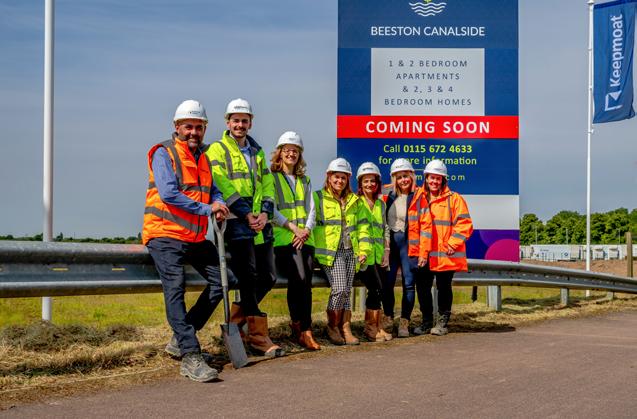
Top 10 UK housebuilder, Keepmoat, will invest more than £102 million into creating hundreds of new homes in Nottingham, with work having already commenced at a flagship parcel of land.
Partners from Platform Housing Group and Boots joined Charlotte Goode, Paul Hulme and Philippa Stewart from Keepmoat, at the 286acre site near Beeston to celebrate the start of work on site and to witness first-hand the progress that’s already been made.
When complete, the housebuilder will deliver 604 new, multi-tenure homes, regenerating the disused land and creating a thriving new community in Nottinghamshire. Of the new properties, Platform Housing Group will offer 319 affordable homes.
Charlotte Goode, Divisional Chair at Keepmoat, said: “Keepmoat is delighted to be regenerating this landmark development on a very special site that will bring much needed, high-quality new homes and significant investment to the city.
For this historical site alone, we are investing £102 million into creating a fantastic community and we’re proud to stand alongside our partners at Platform Housing Group today to mark the beginning of a wonderful community.
“We’re committed to delivering new homes for the people of Nottingham and the surrounding areas to transform the area and provide quality new homes.”
OLD CIVIC CENTRE SITE SEES FIRST HOMES NEAR COMPLETION
The first new properties at the former Sunderland Civic Centre site are nearing completion.
The clearing of the old council buildings began in October last year - the first stage of a landmark project to transform the site into a vibrant city centre community of 265 homes. West Park Quarter, as it will be called, is being constructed by regeneration specialist Vistry North East, part of the Vistry Group.
Occupying the site of the old surface level car park, this first new structure comprises 69 one and two bedroomed apartments, which will be made available for private rent by Sigma’s Build-to-Rent (BTR) brand, Simple Life Homes. The first residents are expected to move in by the end of 2024.
Vistry North East has also already begun work on a further 69 properties for Simple Life - a mix of 50 homes and 19 apartments, as well as new properties for open
market sale - via the Linden Homes brand - expected to be available to buy later this summer.
West Park Quarter will also include works to recreate Saint George’s
Square - bomb damaged during the Second World War and lost to redevelopment in the 60s - with the Grade II listed Saint George’s House as the focal point. The architecture and streetscapes being constructed have been planned to be sensitive to existing structures, the park side location and the Ashbrooke Conservation Area.
PICTURED BELOW - LEFT TO RIGHT : Mark Rutledge, Operations Director, Vistry North East; Bob Beadle, Project Manager, Vistry North East; Graham Barnet, Chief Executive Officer, Sigma; Sean Egan, Managing Director, Vistry North East; Kenny Brewster, Acquisition and Investment Director, Sigma and Jason Berry, Regional Managing Director, Sigma.
S HARRISON APPOINTS
CONTRACTOR AND WORK STARTS ON NEW EDINBURGH HOTEL
Construction work has started on an impressive new 157-bedroom hotel in the Haymarket area of Edinburgh after property development company, S Harrison, appointed Ogilvie Construction as the principal contractor on the project.
The development will see a 1970s office building, which is currently known as Osborne House, transformed into a new hotel, complete with a residents’ bar, restaurant and lounge area on the ground floor and an outdoor seating terrace.
Following part demolition of the existing building, two new accommodation wings will be built to the rear, together with a new storey above the existing building.
S Harrison acquired Osborne House in 2018 and worked with Edinburgh based architect, Comprehensive Design Architects on the transformational plans, incorporating impressive green credentials including the retention of the majority of the existing building structure.
S Harrison has made a substantial investment in Edinburgh in recent years and this latest hotel project follows the company delivering the landmark boutique hotel for Malmaison in the heart of Edinburgh’s New Town.
Following part demolition of the existing building, two new accommodation wings will be built to the rear, together with a new storey above the existing building.
The work saw the Grade A listed Buchan House, on the north-west corner of St Andrew Square, converted into a stylish 72-bedroom hotel complete with Malmaison’s renowned Chez Mal Bar and Brasserie.
The developer is also currently working on two PBSA schemes consisting of 64 studio apartments on East Newington Place, off Newington Road, and 76 studios within the historic surroundings of Canongate, just behind the Royal Mile.
In addition, the planning committee recently confirmed they are minded to grant planning consent for a major new £80 million mixed-use development in a prime waterfront location in Leith.
The development, known as Ocean Point 2, will comprise of residential and PBSA, along with commercial, co-working and amenity space.
ARUBA: A TRUSTED CEILING TILE FOR GENERATIONS
Trusted by generations of architects and installers, Aruba is specified throughout the UK almost every single day. With impressive sound properties, and a range of colours available it is an incredibly versatile range that can be found everywhere from hotels and offices to classrooms and retail environments.
The range has been named after the white sandy beaches of the Caribbean due to the finely sanded finish of the tile’s surface. The Aruba tile also reflects the vibrancy and colourful nature of the Caribbean, as it is available in 35 colours, the largest option of standard colours available on the UK market. For further design creativity, the Aruba family can be specified in alternative shapes such as the Aruba Triangle.
Additional tiles with enhanced performances are available within the Aruba family including Aruba hH, Aruba Max and Aruba dB, each bringing unique performance capabilities.
Aruba
The Aruba tile is incredibly versatile, with a number of attributes that deliver a thorough solution. Combining Class C sound absorption with a sound attenuation level of 34dB, the tile controls background noise levels whilst allowing sound to travel, creating an acoustically comfortable setting. It contains up to 44% recycled content, is 100% recyclable and is scratch resistant.
It’s always exciting when the customer wants a change from the standard types of suspended ceiling designs. It made the project extremely interesting to be involved with, and the Aruba coloured tiles look amazing, giving a modern and visual twist over the standard install. The quality of the materials was also fantastic, with everything being manufactured and delivered to suit the project requirements perfectly.
- Barry Deane, Director at East Midlands Ceilings
Recently specified for an industrial site in one of the UK’s most important manufacturing areas, the coloured Aruba tile was able to meet the aesthetic, functional and acoustic requirements set out for the project. Ceiling installer, Barry Deane, Director at East Midlands Ceilings commented on the Aruba family: “It’s always exciting when the customer wants a change from the standard types of suspended ceiling designs. It made the project extremely interesting to be involved with, and the Aruba coloured tiles look amazing, giving a modern and visual twist over the standard install. The quality of the materials was also fantastic, with everything being manufactured and delivered to suit the project requirements perfectly.”
Aruba hH
The Aruba hH tile offers enhanced high humidity resistance, making it ideal for areas such as changing rooms. It also has the same acoustic qualities as the Aruba tile; but can remain stable in conditions of up to 99% Relative Humidity (RH).
Aruba Max
The Aruba Max is a more robust variation of the standard Aruba tile, designed for interiors that require a higher technical performance. With an increased tile thickness, it offers higher sound attenuation levels of 35dB, and is perfect for settings such as classrooms where sound still has to travel but in a controlled manner.
Aruba dB
For internal settings that require extra levels of privacy such as meeting rooms and small offices, the Aruba dB tile offers the highest sound absorption rating at 39dB and reduces sound transmission through the ceiling void.
To find out more about Zentia click here.
PICK EVERARD SIGNALS EXPANSION PLANS WITH NEW DIRECTOR APPOINTMENT
Strengthening its offering in the North of England and Wales, leading independent multi-disciplinary consultancy Pick Everard has appointed a new director of project management.
Rob Dawes brings almost 25 years of experience in the construction sector to the role, with a background in property, real estate and healthcare, including six years planning and delivering capital investment strategies within the NHS.
In his new role, Rob will lead the team from the firm’s Manchester and Leeds offices, focused on delivering and managing successful development projects for existing clients while nurturing new opportunities and relationships across the region.
His appointment to the firm, which employs more than 700 people nationally across its 15 UK offices, signifies its continued commitment to developing its project management division and further driving its strong presence in the North of England and Wales.
Pick Everard boasts almost 160 years designing and managing built environment projects, including the recent redevelopment of Manchester’s derelict railway arches on Corporation Street, where the firm provided structural, civil, mechanical and electrical services on site.
HARRISON
& CLOUGH BOOSTS TEAM WITH
TWO NEW TEAM MEMBERS
Harrison & Clough, a leading UK distributor of fasteners and fixings, has appointed two new Area Sales Managers to support with business growth. Matthew Aubrey will look after the West Midlands and Wales, whilst Adam Shaw will oversee the East Midlands and East Anglia. The pair bring almost 15 years of experience in the industry to the business.
Having over a decade of experience in the fastener and fixing industry, Matthew began his career with a family-run engineering merchant where he initially worked in picking, packing and delivering. His dedication and skill quickly saw him transition into sales, where he then became an Area Sales Manager, working directly to end-users. Testament to his wealth of expertise, Matthew has since won the Platinum Sales Award awarded by Troy UK.
ACTIS EXPANDS
People On The Move
With a background in engineering, Adam’s curiosity led to him moving into the fixing and fastener industry, and after gaining experience in the packaging department of a large fastener and fixing company, Adam realised his passion for the sector. He went on to gain hands on experience in the warehouse after undergoing high level order picker training. He later became responsible for quality control and then moved into merchandising which spurred him on to take his current position as Area Manager at Harrison & Clough.
ITS
SPECIFICATION
TEAM WITH APPOINTMENT OF FORMER BUILDERS’ MERCHANT
Insulation specialist Actis has expanded its technical team with the appointment of a specification manager exclusively focused on the East of England.
Rob Bralee, who has held roles as assistant branch manager at a Cambridgeshire builders’ merchant and managed sales of various construction and roofing products over the years, joins the expanding specification team to work with architects, building control officers and energy assessors across the wider East Anglia region.
He will be working closely with regional sales director Steve Ellis and area sales manager Jerrell Paton in supporting construction professionals aiming to achieve optimal energy efficiency while also combatting overheating in homes - a clever and essential balance achieved by using Actis’ reflective products.
Like several other Actis colleagues, including Steve Ellis and northern area specification manager Amaret Chahal, self-confessed gaming nerd Rob began his career in teaching, but found construction sales more suited to his passions.
Adam Shaw
Matthew Aubrey
Rob Dawes
Rob Bralee has joined the expanding Actis team as East of England specification manager
DO YOU OR YOUR COMPANY OPERATE 4X4 VEHICLES IN OFF ROAD ENVIRONMENTS?
If you do, are you aware that a standard driving licence will not discharge your obligations under the provision and use of work equipment regulations (PUWER)? This requires you to provide “adequate and effective“ training to all drivers of “off road“ vehicles that are operated at work.
BORDA training courses fulfil an employer’s duty of care under PUWER and have been proven to reduce vehicle damage and down time which is often caused by inadvertent misuse of the vehicle.
With 4x4 vehicles having permanent, part time or on demand 4x4 systems alongside a selection of driver aids it’s really important to get the correct training for drivers. A driver who understands the vehicle is safer and more productive: even experienced operators frequently confirm that they have gained from what they have learned on the day.
With appropriate training drivers gain a better understanding of how to utilise their vehicle, learn to read the terrain to reduce the vehicle’s impact on it and subsequently stay within the vehicle’s capabilities.
The British Off Road Driving Association (www.borda.org.uk) has members throughout the UK. All have to meet rigorous membership criteria and have trainers who are qualified to deliver against your bespoke requirements.
With 4x4 vehicles having permanent, part time or on demand 4x4 systems alongside a selection of driver aids it’s really important to get the correct training for drivers.
The training needs analysis, done before the training commences, will identify whether a BORDA Basic, Standard or Higher level course is required to fulfil your training requirements. Training can be tailored to ATV’s, UTV’s, 4x4’s or any combination of the vehicles you operate.
Visit www.borda.org.uk to find out more and select from a range of BORDA members throughout the country.
BARRATT DEVELOPMENTS BRANCHES OUT WITH EDINBURGH ZOO ‘TREE-CYCLE’
Barratt Developments East Scotland has partnered with Edinburgh Zoo to recycle and donate felled trees from its upcoming Livingston development.
Barratt Developments East Scotland
– which includes Barratt Homes and David Wilson Homes – has donated 21 felled trees from its recently acquired Houston Road site, Woodland Gait, which will launch later this year.
The trees were removed due to them being in a poor condition, creating public safety concerns, or because they were low quality with low biodiversity benefits.
Following the tree removals, Barratt Developments will plant approximately 152 new trees across the site to support local wildlife. In line with its approved landscape strategy, the new tree species include Rowan and Hazel, as well as other native species. A robust landscape strategy has been approved for the Houston Road development, including native planting and various biodiverse elements such as the installation of hedgehog highways, along with bird and bat boxes.
Following the donation, Edinburgh Zoo, which is operated by the Royal Zoological Society of Scotland (RZSS), will repurpose the trees, with a significant portion being distributed to the Zoo’s resident giraffes, which consume an average of 75kg of plant matter every day.
Larger branches and trunks will also be used as climbing structures and apparatus within the ape and giant panda enclosures, enriching the animals’ habitat experiences. Meanwhile, designated portions of the trees, such as trunk bases and off-cuts, will undergo natural decomposition processes, attracting insects which are ideal for the dietary needs of Giant Anteaters.
The distribution of the repurposed trees across the diverse animal habitats within the zoo will help to ensure that there will be minimal waste, building on both Barratt Developments’ and Edinburgh Zoo’s shared commitment to sustainable practices and lowering carbon footprints.
Nicky Gordon, the Managing Director of Genesis Homes, is calling on the Government to provide more support to SME homebuilders.
‘REFORMS
TO INCREASE HOUSING OUTPUT BY SME HOMEBUILDERS SHOULD BE A GOVERNMENT PRIORITY’
The Government will continue to fall way short of its house building targets until the support it provides to SME home builders is radically reformed, claims the owner of a regional homebuilder.
Nicky Gordon, of Genesis Homes, is calling on the incoming Government to shake up the restrictive planning system and the minimal funding assistance provided to smaller, regional companies which are seriously prohibiting housing growth across the UK.
Nicky has insisted that reducing the difficulties for SME house builders to gain planning approval would broaden the country’s delivery base and provide a real boost to the industry, helping the country edge closer to the current ‘undeliverable’ Government targets of building 300,000 new homes per annum.
Genesis Homes was founded in 2017 and has completed multiple housing developments across Cumbria and Lancashire.
Fire, Safety & Security News
NEW PARTNERSHIP FOR THE FPA AIMS TO INCREASE UK FIRE TESTING CAPACITY
The FPA has announced a new partnership with CLM Fire Testing, part of CLM Group, with two state-of-theart test furnaces being installed at its fire testing laboratory in Blockley.
An industry-leading provider of passive fire protection and fire safety solutions, CLM Fire Testing will be installing the new fire resistance test furnaces at the FPA’s long-established fire testing facility in Gloucestershire.
With third-party testing a vital component for ensuring the fire resistance and safety of construction materials, in 2023, the FPA became UKAS accredited to test a range of fire resistance standards for numerous product types. The valued accreditation has enabled it to fill the gaps in the fire testing market, and as Chris adds, help support the UK construction industry with the “many demands of the tighter regulatory framework”.
The partnership between the FPA and CLM Group marks a significant milestone in advancing fire safety standards and fostering innovation within the fire protection industry. The collaboration will enable CLM Group to provide its clients and supply chain with premier access to essential fire testing. In particular, the facilities will see the fire safety solutions provider
offer its clients, which include some of the main contractors in the UK, quick turnaround testing of fire resistance systems. This is in line with the growing need for evidence testing of such systems for a more compliant and safer built environment, and it takes into consideration situations where some systems may require retesting during the construction of new or refurbishment of existing premises.
With third-party testing a vital component for ensuring the fire resistance and safety of construction materials, in 2023, the FPA became UKAS accredited to test a range of fire resistance standards for numerous product types.
The partnership ties in with the FPA’s ongoing collaboration with UL Solutions for product certification needs, with CLM Group now providing project-based testing. Once expanded, the FPA’s facilities will include four fire resistance test furnaces to support manufacturers who require independent fire testing and product certification, and to meet the demands of the wider construction industry.
LEADING SITE SECURITY FIRM LAUNCHES RAPIDLYDEPLOYABLE, SOLAR-POWERED SECURITY
SOLUTION TO COMBAT RISE IN THEFT
BauWatch, a leading site-security firm, introduces its newest innovation, designed to tackle the rising tide of theft and vandalism - The BauWatch Scout. This cutting-edge solar-powered security camera has rapid deployment capabilities, showcasing the ability to shore up defences on vulnerable outside locations, such as construction sites, retail forecourts, vacant properties and live event spaces, within a 48-hour timeframe.
The release of the BauWatch Scout comes on the heels of a concerning upward trend in construction site theft, with two-thirds of workers surveyed in BauWatch’s “Unseen Threats” report, confirming an uptick in theft since 2023. Retailers, meanwhile, are confronting a surge in shoplifting incidents that directly impact their profitability and operational efficiencies.
The BauWatch Scout aims to address this critical market need. With its state-of-theart 360° motion detection system and video verification technology, it stands out for its precision in identifying threats, particularly at night when sites are most exposed. It features an integrated LED lighting system that makes it visible in low light, acting as a significant deterrent to potential intruders. In the event of a perimeter breach or trespassing attempt, BauWatch’s central control centre is instantaneously alerted. Following an assessment of the situation, the centre team can trigger an alarm and alert the police or security patrols if necessary.
Designed to be modular and easy to relocate, the Scout exemplifies flexibility in security systems – providing users with ease when moving from one highrisk locale to another. This portability supported by robust functionality places the BauWatch Scout among the market’s leading mobile security solutions.
RECENT INNOVATION SATISFIES FIRE SAFETY ASSESSORS WHERE CAVITY FIRE BARRIER REMEDIATION
Recent developments in fire safety technology are enabling buildings to meet regulations and keep occupants safe without the need to replace the existing façade. Instead of removing external façades deemed unsafe by recent legislation, buildings are now receiving approval from fire safety assessors to install new, cost-effective cavity fire barrier solutions.
IS REQUIRED
Developments in acrylic-graphite based fire sealants, provided and installed by Injecta Fire Barrier, offer a simple yet effective way to keep residents safe by isolating potential emerging fires and preventing the spread of flames between structural voids in cavities.
With the introduction of the Fire Safety Regulations (2021) and the Building Safety Act (2022) following the Grenfell disaster, many existing high-rise residential properties across the UK were deemed unsafe. In particular, challenges arose due to the fire risk created by cavity constructions.
With recent fire safety innovations, property developers are opting to use acrylic-graphite based fire sealants designed to meet rigorous fire safety regulations while enhancing the overall safety of buildings.
The material is injected into a specially designed mesh ‘sock’ installed into a wall’s cavity, dividing each floor or party wall. In the event of a fire, when heat breaches the cavity, the Injectaclad material expands, preventing the spread of smoke and fire.
Once activated, the cavity fire barrier delivers up to two hours of certified protection, allowing occupants time to evacuate the building and for the fire to be extinguished.
Injecta Fire Barrier is the UK’s first independent approved installer of the patented Injectaclad system.
With years of experience in passive fire protection, the company offers their services to help property managers and building owners reduce costs, protect their buildings and occupants, and seamlessly install protective cavity fire barriers.
WE TEST…
Because evidence matters. Because it enables us to respond more quickly.
Because offering transparency helps educate our customers.
Because it’s our job to inform best practice.
Because it’s our job to offer guidance. Because firestopping is complex.
Because results are worth sharing.
Because people matter.
WE SHARE… BECAUSE IT’S YOUR JOB TO KNOW.
Download our White Paper, ‘Early Engagement in Firestopping’ at quelfire.co.uk/campaign
The sooner, the better.
Safety, Security & Fire Prevention
GILBERTS UPS THE STANDARD IN SMOKE AND FIRE PROTECTION
With growing emphasis on managing the risk of smoke and fire within building safety, Britain’s leading air movement engineer Gilberts is leading the way to optimise control.
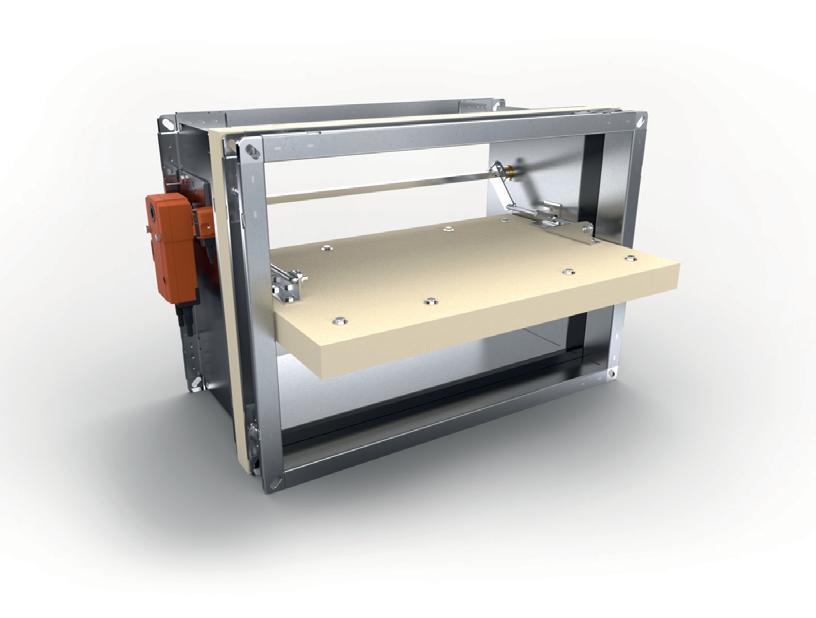
To address increasing demand and to exceed criteria laid down in the latest Building Regulations, Gilberts is launching a new, fully tested range of insulated smoke and fire dampers. The insulated dampers compliment Gilberts’ established Ductgard units for HVAC ductwork.
The insulation element of the new dampers helps minimise the risk of heat transfer and thus the risk of fire spreading beyond the compartment. Its performance exceeds the two relevant layers of fire safety in buildings: integrity of compartmentation and structural safety.
Spring and thermal fuse activated, the insulated dampers offer fire resistance of EI30, EI60, EI90 and EI120 for general ventilation systems with walls and partitions of various ratings.
Thus, they deliver effective cutoff partitioning between the fireengulfed zone and the remaining part of the building, helping maintain the building integrity.
The range is fully tested and certified to EN15650, EN135013 and EN1366-2.
Says Ian Rogers, Gilberts’ Sales Director. “Throughout Europe, having the damper maintain the integrity and insulation value of the fire compartment is preferred.
FIRE RATED ACCESS PANELS
Ceildoor’s 1 hour and 2 hour Fire Rated Access Panels are amongst our most popular products. They are chosen by hundreds of contractors across the UK when structural integrity and thermal resistance is required.
Our Fire Rated Access Panels can also be used as flue inspection hatches for heat producing appliances and are used in residential, commercial, retail and education environments.
Designed to comply with Thermal Resistance to BS EN ISO 100771:2006 (Part J) and by Exova Warrington for Fire Resistance to BS476:Part 22:1987 (Part J) for integrity performance.
Here in the UK we are seeing a tendency to follow that lead. At Gilberts we are known for offering products that exceed expectation. We believe in being proactive and giving customers options above and beyond legislated requirement, that are fully tested, to an improved performance level, now, and at an attractive price point. If standards can be improved on competitively, surely it makes sense to do so, especially when dealing with fire and its implications within buildings?
“It also means we offer a full validated range of smoke and fire control and curtain fire dampers, in the UK.”
The introduction of the insulated dampers builds on Gilberts’ 60+ years’ heritage of bringing to market advanced technology that enhances the design, safety, energy efficiency and occupier comfort of nondomestic buildings.
All Gilberts’ products- standard lines and bespoke solutions- are designed and developed in accordance with BS EN ISO 9001:2015 quality standard in the company’s state of the art 140,000 ft2 facility in Blackpool.
Gilberts tel 01253 766911; E: info@gilbertsblackpool.com
Safety, Security & Fire Prevention
PROVIDING PASSIVE FIRE PROTECTION AND FIRE DOOR REMEDIALS AT THE UNIVERSITY OF WOLVERHAMPTON
Passive Fire Protection (PFP) is an integral part of fire safety in any building, but especially in educational institutions where the density of people is notoriously high. Passive Fire Protection involves using building components to contain and delay the spread of smoke and fire. This includes fire-resistant walls, floors, ceilings and doors, as well as fire-stopping solutions such as fire barriers and fire-resistant cladding.
At Element Passive Fire Protection, we understand that ensuring the safety of students, faculty and staff is not just about fulfilling a mandate but is a profound responsibility. The University of Wolverhampton is a sprawling campus with a mix of historical and modern buildings, each presenting unique challenges and requirements for fire safety. Our mission was clear: to enhance the existing fire protection measures and ensure compliance with the latest fire safety regulations.
The Project
Our team of experts began with a thorough assessment of the University’s buildings. This involved a detailed inspection of the current passive fire protection systems and fire doors. Areas were identified as requiring urgent attention and those that required updates to meet current standards.
Fire doors are a critical (and often overlooked) element of Passive Fire Protection, designed to withstand fire and prevent it’s spread for a specified
period of time. At the University of Wolverhampton, we undertook significant remedial works to these doors. This included replacing worn/damaged and uncompliant components, as well as upgrading non-compliant fire doors and ensuring all were installed in line with both manufacturer’s guidelines and fire safety regulations.
In addition to the aforementioned fire door works, Element also conducted passive fire protection to a myriad of buildings across the University campuses. Holes/damage and service penetrations in walls and floors are potential weak spots where fire and smoke can easily spread from one fire compartment to another – To negate this possibility, Element’s Team applied the latest fire-stopping techniques to seal these vulnerable areas, therefore enhancing each building’s overall fire resistance.
Element also conducted passive fire protection to a myriad of buildings across the University campuses.
Passive Fire Protection with Element PFP
At Element PFP, we believe that every step we take towards improving fire safety is a step towards protecting lives and property. Our work at the University of Wolverhampton is a resounding reflection of our commitment to excellence and safety. As we continue to innovate and implement cutting-edge Passive Fire Protection solutions, we are proud to contribute to a safer future within educational institutions across the country.
We take care of every element of Passive Fire Protection, ensuring all aspects of fire safety are taken care of. Get in touch to find out more about our Passive Fire Protection services today and find out how we can improve fire safety within your building.
Kilwaughter Minerals has enhanced its portfolio of industry-leading products with the launch of its K Rend Eco Range which offer a suite of reduced cement render and mortar products.
Designed with innovative cement replacement technology, the range represents a significant investment from Kilwaughter and boasts re-engineered formulas for three existing products - K Post, GP Mix and Mineral TCsignificantly reducing embodied carbon in the manufacturing process by up to 56%.
Developed by K Rend’s research and development team, the launch of the K Rend Eco Range underscores Kilwaughter Minerals’ dedication to improving environmental standards in the construction industry, promoting sustainable practices and meeting the demands of eco-conscious customers.
ZUTEC FOR DOCUMENT MANAGEMENT, QUALITY MANAGEMENT, HANDOVER MANAGEMENT AND HEALTH AND SAFETY KILWAUGHTER
Each product within the range is designed with enhanced sustainability features tailored to its specific function. K Post, a premium rapidsetting concrete, comes ready-mixed and is packaged in eco-friendly 20kg showerproof bags.
GP Mix is a versatile grey ready-mixed product which can be used as a render, mortar or plaster now offering improved workability and faster drying times, while Mineral TC is a low-maintenance, through-coloured thin coat render available in a variety of colours to suit individual taste and project style.
QUANTUM GROUP CHOOSES
Quantum Group, a leading developer in Ireland, has selected Zutec to manage construction project data from a single platform.
Zutec leads the way in providing construction and property management software solutions to contractors, housebuilders, developers and asset owners across the UK and Ireland, and will roll out document, quality, handover and health and safety management solutions to support Quantum in delivering safer, higher standard homes and properties.
By digitising building information and construction documents, Quantum will use Zutec’s Document Management for planning, design, tenders, procurement, and plot tracking, including the ability to approve drawings for future developments and resolve issues on site as they arise. With project information in one place, Quantum can eliminate
inefficient and costly data sprawl, but also save time and costs by having clear visibility of information that enables better understanding of projects and drives more informed decisions that bring projects to completion faster.
Zutec’s Handover Management means Quantum can effectively manage projects to completion by bringing together O&M (Operations & Maintenance) Manuals, Fire Evacuation Files (FEF) and Health and Safety Files (H&S) in one place to meet asset owner and regulatory obligations.
All data can be captured in the field by site teams and subcontractors using the Zutec Field app from any device with or without a Wi-Fi connection. Information is then synced in the Zutec cloud, when a device is online, and uploaded into the Zutec dashboard for reporting and analytics, but also for easy information, site progress and compliance.
CEO, Gary Wilmot and Business Development Director, Caroline Rowley
GEOWORKS ROLLS OUT
COMPREHENSIVE NEW GEOSYNTHETICS OFFERING
Civil engineering specialists Wrekin Products proudly announces the creation of Geoworks, a new identity and standalone division for its geosynthetics range.
Geoworks encompasses all of Wrekin’s existing geosynthetics offerings, including geotextiles, geogrids, geomembranes, geomats, geocells, and geocellular paving. Geoworks continues to offer a wide range of geosynthetic
solutions for various industries, making their catalogue more comprehensive than others on the market. Merchants can also expect the same quality and service from Geoworks that they are familiar with through Wrekin, without any changes required to their systems.
Wrekin Products has invested substantially in resources, personnel, and market knowledge over the past 12 to 18 months. This initiative has led to a rebranding effort that signifies the next chapter of the company’s ambitious plan to grow its presence and influence in the geosynthetics market.
Geoworks will serve a diverse audience, tackling the variety of challenges and applications present in geosynthetic projects. With a solution-based approach, Geoworks is able to tailor its services to meet the specific needs of each client and project. Several
Geoworks products are suitable for residential applications and do not require specialist training or tools. This brings a consumer element to the brand, allowing Geoworks to target end users.
Geoworks has been continuously developing and expanding its geosynthetics package since 1995. In the last year alone, this has included working on projects across the UK such as Scottish wind farms and the ongoing construction of the HS2 line between London and Birmingham. In the future, the brand will be increasing stock holding and is always analysing new markets and opportunities.
BEING ‘RAIN READY’ ON SITE MEANS MANAGING SILT TO PREVENT POLLUTION AND PROTECT REPUTATION
Most construction projects can expect to deal with rain at some point. This can create problems with silty surface water run-off that is harmful to the environment, reduces the amenity value of public spaces and potentially, results in fines and reputation damage. Frog Environmental Managing Director Richard Haine explains that better planning and a process-driven approach to preventing silt pollution is both costeffective and reputation-enhancing.
Silt, a combination of all sediment, including soil, mud, clay and sand, in water is the single main pollutant to the water environment from construction sites. Largely, this arises from the erosion of exposed soils by surface water runoff from rain, which carries the silt into public bodies of water such as rivers and reservoirs.
In recent years, we have seen an increasing focus on the health of rivers in the UK. Public awareness and citizen science have grown significantly, with large numbers of volunteers joining river watch projects. Silt is a highly visible pollutant and is easily spotted in this context. In fact, many of the recent enforcement actions and fines that are being levied have come about from the public submitting video evidence using their smartphones.
Historically, awareness of silt pollution from construction sites may only have
come with a letter from the regulator advising of a pollution incident. This type of reactive approach leads to environmental damage, additional costs and reputational risk: last year, a housing developer was fined nearly half a million pounds for silt pollution, and six figure fines are increasingly common.
A significant cause of silt pollution is simply having too much water. If we cannot manage water quantity – the flow rate requiring treatment – it is highly unlikely that we will be able to achieve the desired water quality outcomes. This is because each treatment methodology, be it a tank-based system, a pipe reactor containing gel flocculant or a more humble silt sock, will have a maximum flow rate at which it can effectively treat water. Last winter saw recordbreaking rainfall. In fact, above average rainfall has been recorded most months from July 2023 to April 2024. Planning adequate water attenuation on-site and
Richard Haine
Silt capture channels
Sustainability
then releasing it at a controlled rate can significantly reduce the risk of having to cope with too much water.
It is also important to remember that different soils have different characteristics. Some subsoils are sandy and gravelly and settle out of suspension quickly. Other subsoils – such as clayey soils – contain very small particles that take a long time to separate from the water column. They are an extremely difficult pollutant to control, as they take very little energy to mobilise and remain in suspension for long periods, often travelling miles from the polluting source. If we do not understand how a subsoil behaves when suspended in water then we do not understand how the pollutant will move through the environment and cannot develop proportionate mitigation measures to manage the pollution risk.
There are many different types of silt control products available to the construction industry. A hired treatment system for managing fine suspended particles on-site could see costs reach seven figures per treatment point, annually. This approach requires chemicals such as coagulants and flocculants that help separate water and sediment and a buffering solution that controls pH. While expensive, tank-based treatment systems have several advantages, including a compact footprint, which can be of great benefit to sites that have limited space for water treatment.
An alternative to hiring tank-based treatment systems is to make use of gel flocculant to treat muddy water. Gel flocculant deployed in ditches or drainage
systems upstream of settlement ponds can be a highly effective method of treating silty water. With good planning, systems such as this can work under gravity, reducing the need for pumping, thereby saving money and reducing carbon footprint. This approach also avoids the need to use liquid chemicals or powered systems, leading to further carbon and fuel savings.
The successful deployment of all types of intervention, be they tank-based, pumped, gravity-fed or otherwise, relies on good planning and a comprehensive approach to surface water management on site.
In recent years, we have seen an increasing focus on the health of rivers in the UK. Public awareness and citizen science have grown significantly, with large numbers of volunteers joining river watch projects.
Most large construction sites have a surface water management plan (SWMP) in place, but if the plan does not carefully consider particle size within the subsoil and the quantity of water that may require treatment, the mitigation strategies put forward within the plan may not be correctly aligned with the actual risk level.
There are often multiple underlying reasons that can lead to a silt pollution incident, but they typically come down to poor planning prior to mobilisation and a lack of knowledge and awareness on-site. Water spaces throughout the UK deliver untold benefit to members of the public and critical habitat for our native biodiversity. Rather than reacting to silt pollution and risking damage to these environments, a planned approach to preventing silt pollution enables better optioneering at an early stage, and the development of cost-effective strategies to maintain legal compliance during works.
Rain is one thing we can practically guarantee in the UK. Construction sites have to be prepared for it.
Richard Haine is the managing director of RSK Group company Frog Environmental.
Gel flocculants and mats in a treatment ditch
Silt plumes in river following rainfall
THE ROLE THERMAL BREAKS PLAY IN SUSTAINABLE CONSTRUCTION
For many architects, spending money on a hidden design element can’t be viewed as a priority. However, investing in efficient thermal breaking can be one of the best decisions made for the sustainability of the building. Paul Beech, General Manager of Armatherm, discusses how incorporating thermal breaks within cladding structures, roof-to-wall transitions and parapet locations improves building envelope performance, offers continuous insulation and supports structural loads.
Although cladding is imperative to protecting buildings from outside elements and offering structural support, the impact it can have on the overall energy efficiency of a building is often overlooked. In most cases, steel framework has cladding girts attached to the structure to support the outer cladding, then insulation is installed between the girts, allowing heat to bypass through the insulation and along the Z girt. This results in substantial energy loss, decreasing the building’s overall efficiency.
Cladding structures are not the only ones to benefit from effective thermal solutions, a break can be installed at any transition location within the building envelope of a structure. Roof-to-wall transitions and parapet locations are also good examples as both of these locations require structural framing to support the weight of the roof and equipment, such as fall arrest anchors and building maintenance unit rails. As the framing needs to be load bearing, steel is often specified, but this can penetrate the low-density roof insulation causing heat and energy transfer or loss. This is where a thermal bridging solution can be implemented, to combine structural support with thermal insulation performance.
Recently, we’ve seen an uptake of temperature isolation projects, where
Cladding structures are not the only ones to benefit from effective thermal solutions, a break can be installed at any transition location within the building envelope of a structure.
project managers are looking to effectively keep interior temperatures consistent in data centres for example, where machinery can produce a lot of unwanted heat. This can be detrimental to the functioning of the data machinery, so it’s essential the buildings are kept cool, which can be made easier and more efficient with the inclusion of thermal breaks. Previously we’ve seen hardwoods such as Iroko timber specified as it holds thermal and strength properties required for a thermal break solution. Although some hardwoods can tick these boxes, unlike Armatherm thermal breaks, they are not water resistant and absorbing moisture reduces the material’s thermal performance, which makes them ineffective in construction projects.
Similarly, across the pond in the US, we’ve seen a lot of retrofit or extension projects, where buildings are undergoing costly renovations to
meet new, stringent energy regulations. On the other hand, a recent project for Hampden Academy saw thermal breaks worked into the eight classroom extension. This ensured any penetration of the building envelope made during the construction, would be thermally isolated to help insulate the warm interior wall from the cooler exterior wall, establishing a continuous thermal barrier.
Implementing a thermal solution can cut energy loss considerably, making massive savings on a building’s running costs while increasing the overall sustainability and future of the construction industry. While developers continue to come under pressure to create sustainable buildings that are energy efficient, including a thermal break as standard is an easily implemented and cost-effective solution with a resulting payback in energy savings. To put this into perspective, inserting a non-metallic thermal break where the cladding connects with the internal building structure can eliminate heat transfer by up to 80%, with the additional benefit of preventing condensation on interior walls and temperature changes when extending into the building envelope.
SOLUTIONS FOR SUSTAINABLE BUILDING
Gypsotech Externa Light Carrier Boards have received an Environmental Product Declaration.
At Fassa Bortolo, we constantly seek new ways to ensure our impact on the environment is kept to a minimum and that our products have longevity.
The Gypsotech Externa Light carrier board has obtained an Environmental Product Declaration (EPD). This highperformance render board has undergone a life cycle assessment and is proven to comply to the low VOC emission criteria which is widely used across Europe.
Designed to be applied both on the inside and outside of the building
Used to build walls, wall linings and false ceilings
TO FIND OUT MORE about Fassa Bortolo and its range of render systems and building products. Visit www.fassabortolo.co.uk or call 01684 218 305
Sustainability
FULL CIRCLE
Andy Janney, Operations Director at Polypipe Civils & Green Urbanisation, lifts the lid on the business’s polymer processing plant and recycling process.
Polypipe Civils & Green Urbanisation’s recycling journey began way back in 2011, when the business invested in twin-screw compounding capability to turn plastic flake into pellet and then into pipe.
In 2013, the business made a multi-millionpound investment in purchasing its very own polymer processing plant. Fast forward to today and the plant is no longer a secret, but a well celebrated part of the Polypipe CGU business. Located in a purpose-built building at the business’s site in Horncastle, Lincolnshire, it sorts, washes and recycles HDPE (which comes in the form of post-consumer bottles, like milk bottles and bleach bottles) to facilitate the transformation of such bottles into the highquality, expertly engineered pipes that Polypipe CGU is renowned for.
“In our business, both quality and sustainability have been at the top of the agenda for a long time,” Andy Janney, Operations Director at Polypipe CGU, says, “Sustainability is really at the core of what we do and our initial investment into the polymer processing plant was driven by the commitment of the wider construction industry to achieve their own sustainability goals. We have always been committed to delivering sustainable solutions to our customers by maximising the use of recycled materials where standards allow and having our own plant has helped massively in this.
“We need consistent, high-quality material that meets or exceeds the appropriate quality standards in the manufacture of our products and, over the course of the last decade or so, we’ve been able to bring the entirety of the manufacturing process in-house and inherit full control over our long-term supply of sustainable high-grade materials.”
On the business’s recycling process, Andy says: “Regulations change every so often, as does HDPE packaging, so our process really is ever evolving,” Andy says, “As a business, we’re committed to long-term sustainability, and we move with the times so make sure our process is working in the best way possible for our products, our customers and the planet, and a huge part of this is continuous reinvestment in what is an incredibly important element of our business.”
This commitment to continued investment in the plant has been demonstrated plenty over the years, with the business investing in additional Near InfraRed sorting technology in 2014, before purchasing an additional Erema compounding machine in 2015 to increase recycling process capacity. In 2021 and 2022, the business invested in an improved filtration system for the compounding lines in order to reduce waste and improve material quality, including effectively removing silicone from the process, before embarking on a major upgrade to the bale splitting and flake drying sections of the polymer processing plant in 2023.
“We’re extremely proud of the benefits that the polymer processing plant brings. Of course, it’s great to have our own systems in-house and enjoy the control that we have over our material quality and output, but the environmental benefits are huge, too, and we also find that having the plant helps with our recruitment, as people want to be part of a company that is serious about sustainability.
“The polymer processing plant offers traceability and inherently lowers carbon
assessments of a product’s environmental impact throughout its lifecycle – almost like a nutrition label for food, but providing key information about a product’s environmental effects. We’re passionate about transparency when it comes to environmental impact, and we’re so pleased to have recently achieved over 60% EPD product coverage.
Through the plant, we’re saving more than 337,500,000 plastic bottles from going to landfill, every single year.
impacts in our products, as well as enhancing the circularity of the polymers. Through the plant, we’re saving more than 337,500,000 plastic bottles from going to landfill, every single year. We’re able to give these bottles a new life, with many of our products having an extended life cycle of over 60 years. In 2023, 83% of all material that went into our products was from recycled sources.
“The plant is also something that has also been a great benefit to us in terms of achieving our EPDs (Environmental Product Declarations). These are comprehensive
“Plus, 75 to 80 percent of the water used within the polymer processing plant process is treated and re-used back into the plant.
“We’ve made some fantastic progress over the years and we’re proud of the impact these investments have had from both an external and internal perspective. Our customers enjoy great quality and also have peace of mind knowing the journey that our products have been through before getting to them.
“Internally, we’re pleased to be able to do our part for the planet, and we’re also delighted to have our own ‘wash and squash’ scheme within our business, the wider Genuit Group and amongst our local communities, where people are encouraged to bring in their endof-use household HDPE waste to be recycled within the plant and repurposed into product. A total of 4,189.5kg was washed, squashed and repurposed since the scheme launched – equivalent to 119,700 milk bottles – so it’s brilliant to be able to get our teams involved, as well.
“We look forward to seeing where our recycling journey takes us next!”
Events & Awards News
PRESTIGIOUS AWARD FOR TOGETHER HOUSING’S NET ZERO DRIVE
Together Housing has been named ‘housing association of the year’ at the Yorkshire and Humberside Energy Efficiency Awards 2024.
The award reflects the social housing landlord’s ambitious plan to move over 30,000 of its homes across Yorkshire and Lancashire away from fossil fuels to renewable energy and lead the way in greener social housing. This plan is part of Together Housing’s decarbonisation strategy supporting the drive to net zero.
Through all its actions, products and services, the organisation is minimising its carbon footprint by reducing waste,
cutting vehicle mileage and moving to an electric fleet.
In Together Housing’s approach, each home has an initial survey and ventilation assessment to check the home is suitable for energy efficiency improvements. Then, depending on the measures needed to make the home warmer and cheaper to heat, additional insulation is added along with fitting an air source heat pump and solar power system.
PICTURED ABOVE: Together Housing colleagues at the Yorkshire Energy Efficiency Awards. (From left to right) Gemma Voaden, Delivery Manager; Sheridan Boyd, Senior Project Coordinator; Ann Harkness, Project Coordinator
Together Housing was also commended in the ‘large scale project of the year’ category for the landlord’s carbon retrofit booster scheme improving the energy efficiency of 581 homes in Calderdale.
INNOVATIVE BASE SCREENS SPEEDING UP CONSTRUCTION PROGRAMMES ACROSS THE COUNTRY
Base Structures are announcing a new offering from its tensile fabric experts, Temporary Weatherproof Screening, promising to speed up building programmes and mitigate against weather delays on site.
Base Screens are a new product that provide a unique and efficient solution for weatherproofing requirements on construction sites. Quick to install and demount, they are customisable to meet specific site conditions, which presents contractors with the chance to remove conventional
cladding from a programme’s critical path. This accelerates the construction schedule and allow teams to progress with fit out works, staying ahead of any delays that the changing climate may bring.
Base Screens are made of PVC fabric that can cover large areas. They’re durable, easy to clean, fire retardant and a low-risk option, offering a less labour-intensive and safer solution than other more traditional weatherproofing options.
Base Structures have produced case studies of their work in this area, which can be found via the links below:
Project Resilience - Base Structures Engineered Temporary Weather Screens Dublin Terminal 2 Temporary Works Screens
They have also produced a blog post detailing some of the benefits of adding weatherproof temporary screens to your next building project.
For more information: mail@basestructures.com or visit the contact us page.
PRINCIPAL CONTRACTOR NAMED ‘COMPANY OF THE YEAR’ AT THE EXPRESS & STAR BUSINESS AWARDS
Inco Contracts has capped a record twelve months by being named the best company in the Black Country, Staffordshire and North Worcestershire.
The fast-growing principal contractor beat off competition from 50 of the region’s finest firms to land the Express & Star Business Awards’ Business of the Year in front of 350 people at The Halls in Wolverhampton.
Judges were impressed with how the management team of Sam Norton and Dave Cotterill had instilled a deep-rooted commitment to customer service and carved a growth plan that has put it on course to achieve £40m in revenue this year.
Part of this ambitious expansion has been the creation of satellite offices in the North West and South of England, providing national coverage that has seen it deliver high-profile office and industrial refurbishment projects for Anchorage in Salford, Manchester Airport, Eurolinks, Woodside Industrial Estate and Barlow Road in Coventry.
Inco Contracts, which has recently relocated its Head Office to Cannock, received its prize from Express & Star Editor Mark Drew.
The Awards evening was the highlight of the publisher’s 150th anniversary of bringing news to the people of the Black Country, Staffordshire and North Worcestershire.
HARLEY HADDOW AWARDED BEST MECHANICAL AND ELECTRICAL ENGINEERING CONSULTANCY FOR SECOND YEAR RUNNING
Multi-disciplinary consultancy Harley Haddow scooped up one of the top prizes at this year’s Grafter Awards.
On the 27th of June at The Mercure Piccadilly Hotel in Manchester, the awards aim to recognise the creme de la creme of the Northwest construction and property industry.
The awards which are part of the Grafters Super Group, were hosted again by television and radio presenter, Jenny Powell.
Ian Chalk, Director at Harley Haddow said: “It’s a real honour to be awarded best Mechanical and Electrical Engineering consultancy for the second time. This last year has been hugely successful for us in terms of growth within the Northwest
team and we’ve continued to expand our client base by working for exciting clients such as the Greater Manchester Combined Authority, Manchester City Council, Jarron Investments, and TSB bank. Winning an award like this really recognises the hard work and dedication the team put in and I could not be prouder of our Northwest office. I look forward to seeing what the next year brings and continuing to watch the team grow.”
Having opened their Manchester office in 2022, the consultancy continues to go from strength to strength with new additions such as Carlos Law and Duaa Raja (Mechanical Engineers), and Travis Ting and Luke Ridsdale (Electrical Engineers). The Northwest hub has also moved to a brand-new office located on Deansgate in the City Centre.
CONQUIP ENGINEERING GROUP ANNOUNCES SPONSORSHIP OF THE 360 EXCAVATOR CHALLENGE AT UK PLANT OPERATOR OF THE YEAR 2024
Conquip has announced that it will be a sponsor of the 360 Excavator Challenge at the UK Plant Operator of the Year Finals in partnership with the CITB, taking place at the National Training College in Norfolk on the 21st of September 2024.
This event will see the best plant operators from across the UK go head-to-head on a variety of challenges with one crowned the ultimate winner of the competition and the prize of £20,000.
It brings together plant operators, operator owners and businesses from the civils and groundworks sector and the housebuilding sector.
What to expect from the 360 Excavator Challenge…
Conquip sponsored its first operator skills challenge in 2023 at Plantworx, where it showcased their highly durable Excavator Forks.
The challenge tested the operator’s precision, patience and accuracy, tasking them to pick up a basketball off multiple cones and place them into Conquip Autolock Tipping Skips in numerical order.
This year sees the return of this awesome excavator forks challenge at the UK Plant Operator of the Year competition.
Visit the Conquip challenge area on 21st of September to join in, witness others taking the ultimate test and talk to the Conquip team about the range of best-in-class products that they design and manufacture in-house and offer to the industry for hire and sale along with after-sales services.
The UK Plant Operator of the Year – objectives
This year the organisers say the campaign will focus on these three strategic pillars:
1. Apprentices & Training
2. Technology & Performance
3. Sustainability & Carbon Neutrality
The organisers believe that the next generation of Plant Operators and Construction Skills trainees are the machine and business owners, key decision makers and influencers of the future.
A future that over the next 10 years, will see more technological advancement than in any other decade since the introduction of mechanical construction equipment.
The CITB, National Construction College, will enable exclusive access to their world class training facility where the training and preparation of apprentices to enter the world of construction begins.
The campaign will also give a truly unique opportunity, to CITB apprentices, as it is sponsored by many leading UK contractors and hirers.
Tools, Plant & Equipment
CT1 WOWS AT INSTALLER SHOW 2024
The Installer Show 2024 proved to be a monumental event for CT1, capturing the attention and admiration of new and existing customers alike. Over three bustling days, the CT1 stand was a hive of activity, drawing an impressive crowd eager to learn about the latest innovations in construction adhesives and sealants.
The undoubted highlight of the Installer Show was the highly anticipated launch of the BW1 – The Ultimate Bathroom Tanking Solution. This breakthrough in the market was met with overwhelming enthusiasm, solidifying CT1’s position as a leader in the industry. The BW1 product launch was a resounding success, with visitors eager to witness its amazing capabilities firsthand, including its ease of use, incredible bonding and unrivalled flexibility. Attendees were not only impressed by the product’s performance but also by the seamless way it addressed common challenges faced by professionals in the trade.
The real showstopper, however, was the series of live demonstrations that took place throughout the event. They showcased the true power and versatility of CT1 products, including the newly launched BW1. Demonstrators expertly highlighted the superior bonding strength, exceptional durability and versatility of CT1 adhesives and sealants.
The atmosphere at the CT1 stand was electric, characterised by high energy and a sense of excitement around the launch of BW1 that was palpable throughout the Installer Show.
These demonstrations were more than just a visual treat; they were a testament to the practical applications and reliability of CT1’s entire range. Attendees had the opportunity to ask questions and engage directly with the product experts, gaining insights into how these products could revolutionise their projects. The hands-on approach of the demos ensured that visitors left the stand with a comprehensive understanding of the product benefits and a sense of confidence in their performance.
The atmosphere at the CT1 stand was electric, characterised by high energy and a sense of excitement around the launch of BW1 that was palpable throughout the Installer Show. Visitors appreciated the vibrant liveliness that was a significant factor in making the CT1 stand a favourite among attendees.
Visitors, trade professionals, brand ambassadors and industry partners from the builders’ merchant sector were all drawn to the stand repeatedly, enticed by the engaging presentations and the welcoming demeanour of the CT1 team. The stand quickly became a social hub, where industry professionals could network, share experiences, and learn about the latest advancements in adhesive technology.
The CT1 team’s passion for their products and their commitment to customer satisfaction were evident, leaving a lasting impression on all who visited. The energy CT1 brought to Installer Show 2024 is a testament to its unwavering dedication to excellence and innovation. The positive visitor feedback was overwhelming, with many attendees expressing their appreciation for the informative and interactive experience.
In summary, the busy CT1 stand at the Installer Show 2024 was a resounding success, marked by a flurry of activity, the triumphant launch of BW1 - The Ultimate Bathroom Tanking Solution, and engaging live demonstrations. The infectious energy and customer-centric approach underscored CT1’s ability to lead and inspire within the construction industry and further bolstered CT1’s reputation for building strong relationships with customers, both new and long-standing.
Tools, Plant & Equipment News
CONCRETE INDUSTRY EXPERTS
IDENTIFY LINK BETWEEN BATCH PLANT PERFORMANCE AND EMPLOYEE
WELLBEING IN NEW WHITE PAPER
The UK’s leading concrete batching plant equipment and spare parts supplier, ConSpare, has published its second industry white paper, addressing how operators in the concrete production industry can boost employee wellbeing through improvements made to the batch plant.
The white paper, titled “The right mix: Addressing the “S” of ESG for concrete batch plants – putting people at the centre of investment decision-making”, uses qualitative data from plant supervisors and managers to demonstrate the importance of eliminating hazards and reducing the amount of repetitive, unpleasant and unproductive tasks around the plant, and the benefits that this can bring to the industry as a whole.
With commentary from sustainability expert Dr Miles Watkins and ConSpare’s CEO James Bullock, the report illustrates the impact that a people-first approach can have on both the physical and mental health of workers, in terms of improving work-life balance, job satisfaction and overall happiness.
For more information and to download “The right mix: Addressing the “S” of ESG for concrete batch plants – putting people at the centre of investment decision-making”, visit https://conspare.com/sustainability/staffwellbeing
JET PLANT HIRE DRIVES INDUSTRY STANDARDS WITH SUSTAINABLE PLANING SOLUTIONS
Jet Plant Hire Ltd, a leading UK road planing contractor, is helping drive industry standards in sustainability and compliance, with regards to used planings and sweepings removed from road surfaces.
By repurposing 100% of road planings, Jet Plant is actively reducing waste and aiming to help conserve natural resources, aligning with its strong environmental responsibility goals.
During the last year Jet Plant has delivered hundreds of thousands of planings from our work sites. The majority of those planings have gone to local businesses, with others delivered to Asphalt plants to be recycled into new materials. In the average year Jet Plant will generate nearly 1 million tonnes of road planings.
Jet Plant delivers planing solutions to a wide range of customers across
the industry. Through process optimisation, low carbon-footprint and the utilisation of advanced technologies, Jet Plant is focused on sustainability and development.
Jet Plant guarantees complete traceability of all materials, tracking their journey from origin to destination.
By carefully recording planing origin and potential destinations on Google Maps, as well as minimising travel distances for repurposing, Jet Plant significantly reduces vehicle emissions, contributing to a cleaner environment and ensuring vehicle uptime onsite. Currently the average tip is just 4.74 miles from job site.
Jet Plant’s unwavering commitment to sustainable practices and excellence in planing solutions reinforces its position as an industry leader, setting the benchmark for others to follow.
James Bullock, CEO of ConSpare, launching the white paper at Hillhead 2024
Tools, Plant & Equipment Hire
AIR & HYDRAULIC TOOL HIRE
The APP Group consists of Air Power Products (Compressed Air Specialist) and Procut Engineering (CNC Precision Engineering) and APP Site Services (Site Supplies and Tool Hire). The group benefits from a full-service department with a wealth of air and hydraulic tool knowledge. We provide an excellent service, not only with the range of products but with the level of care each order is given and the speed with which we can deliver.
The main focus of the business is the hire department for construction tools. The hire fleet has been built up over a long period of time and the tools are always fully serviced and inspected before every hire.
We have a range of tools and associated products available to hire which include Rebar Cutters, Rebar Benders, Hydraulic Splitters, and Pneumatic Picks.
Rebar Cutters
We have a range of hydraulic rebar cutters to suit both factory and on-site applications that can cut up to 40mm Rebar. Designed for professionals that need to cut high tensile rebar in all environments.
Rebar Benders
We have a range of hydraulic rebar benders to suit both factory and on-site applications that can bend up to 40mm Rebar. Designed for professionals that need to bend high tensile rebar in all environments.
Concrete Splitters
Splitters are handheld demolition devices which controllably split material with the use of hydraulic pressure. They are used when larger conventional demolition devices are ruled out due to their excessive dust, vibration, and flying debris.
Concrete Combi Shears
The combi shears are the ultimate in handheld demolition. The interchangeable jaw sets mean that this machine is incredibly versatile and can cut and crush a wide range of materials.
Pneumatic Picks
We don’t just sell & hire the H11, We have a full range of medium duty demolition picks.
Whatever your scenario we have an option for you…
Above are just a few machines we have to offer. For our full range give the office a call on 01909 519 519. Most tools are available for Same Day or next day delivery.
Site Spillage
As well as the hire fleet APP Site Services offer a range of site spillage solutions including the mobile spill kit. If you need further information on the range of spillage solutions we have to offer, please visit the website www.appsiteservices.co.uk
PPE Solutions
As part of the full package, we also stock a range of PPE equipment and workwear for our customers. If you are looking for gloves or a mask to go with your hire or purchase we have got you covered.
www.appsiteservices.co.uk
Tel: 01909 519 519
SWANTEST: SPECIALIST ENGINEERING FOR COMPLEX PROJECTS
Swantest is a specialist company that offers a complete package of services for complex projects within the construction, demolition and civil engineering industries.
Through its team of multi-disciplined engineers, they can provide with load capacity tests, geotechnical tests, balcony and barrier tests, anchor and fixing tests, welding inspections, preloading and torque loading, structural surveys and investigation, structural alterations and strengthening and hydraulic lifting
Swantest is UKAS accredited and has worked with industry leaders for more than a decade.
and jacking. Swantest can also conduct ongoing monitoring and inspections where necessary.
Swantest is part of Swanton Consulting Ltd, a temporary works design consultancy, and also possesses in-house capability for complex design solutions.
Swantest is UKAS accredited and has worked with industry leaders for more than a decade.
Website: www.swantest.co.uk
Specialist Solutions for Complex Projects
Swantest is a specialist company providing structural testing, investigation, remedial and strengthening solutions for complex projects. We are a team of multi-disciplined engineers who can provide a wide range of specialist site services to the construction, demolition and civil engineering industry.
We specialise in:
•Load capacity tests
•Geotechnical tests
•Balcony & barrier tests
•Anchor & tests
•Weld inspections
•Nondestructive Testing
•Bespoke Testing
•Structural surveys & investigation
•3D Point cloud surveys
•Structural alterations & strengthening
•Hydraulic lifting & jacking
•Preloading & torque loading
•Concrete repair & remediation
•Composite solutions
When it comes to site solutions, we want to provide our clients with a complete package of works. Therefore, Swantest can carry out all required elements for any complex project. Including initial site investigation and surveys, structural testing, subsequent remedial and strengthening solutions and design works if required. We can also provide ongoing monitoring and inspections where necessary.
Swantest are part of a specialist temporary works design consultancy; Swanton Consulting Ltd. This gives us the advantage of having capability to carry out complex design solutions in house. We are UKAS accredited and have been working with industry leaders providing a wide range of specialist solutions for complex projcets.
For more information call us on 0370 950 7707
Website: www.swantest.co.uk Email: info@swantest.co.uk 52-54 St. John Street, Farringdon, London, EC1M 4HF
AN INTERVIEW WITH ALEXIS POTTER AND ANDY JARMAN
Construction UK Magazine Q&A - Alexis Potter, MD, BauWatch and Andy Jarman, Director of Operations and Business Development for the Digital Safety, Community Interest Company
Construction site theft has long been a problem - but are thieves becoming more sophisticated?
Last year, insiders pulled off the biggest copper heist in history, when they stole 1 million euros worth of copper from Germany’s Aurubis. And now, almost half of construction workers - who are right at the coalface of crime – have admitted that they feel criminal tactics are becoming more sophisticated, according to research from security firm BauWatch. So how are the tactics changing, and who’s behind the assault? I spoke with BauWatch UK MD Alexis Potter and Andy Jarman, former Senior Law Enforcement and Policing Operational Security and Intelligence Expert to find out.
Alexis, how bad is the UK’s construction crime problem and is it getting worse or better?
It’s pretty bad, to be honest. According to industry estimates, the construction sector is losing at least £800 million a year to theft and vandalism, and unfortunately, it’s getting worse. Our recent Construction Crime Index report highlights that almost two-thirds of construction workers have seen an increase in crime over the last year. The frequency of crime is also frightening, with 70% of professionals we spoke to confirming they witnessed theft on-site at least once a year, and a fifth saying they experience it every few months. It’s a situation that needs urgent improvement.
And what are the key factors behind this trend?
The economic situation – inflation and the cost-of-living crisis – is pushing people to desperate measures. Plus, the high value of construction materials, such as copper, steel, and lumber, makes construction sites prime targets. These materials have seen significant price increases due to global supply chain disruptions, making them even more attractive to thieves. Criminals are also drawing on more advanced technology, such as drones to survey construction sites from above, identifying valuable targets and weak points in security. Two thirds of respondents in our report reflected this. We’re also seeing the use of GPS jammers to disable tracking devices on equipment.
Andy, given your 42 years of experience within Policing, wider Law Enforcement, National Infrastructure, and Operational Security, would you say this is accurate, or do you think the cost of theft and vandalism is often underestimated?
Sadly it’s most likely underestimated. The £800 million figure is already huge, but many smaller thefts go unreported, particularly those involving personal tools and small equipment. Plus, there are all the hidden costs like damage and disruption left behind, which can sometimes cost more than the stolen items themselves. For instance, project delays, higher insurance premiums and damage to a company’s reputation or employees’ well-being.
Alexis, can you provide some insights into how these crimes financially impact the construction industry beyond just the immediate loss of materials and equipment?
Sure. According to our data, around a third of UK construction projects experience delays due to theft, with some delays lasting over four weeks. This kind of disruption can really hit a company’s bottom line hard. In fact, costs can range from 10-50% of the total project cost. For example, if a project’s materials are stolen, the time taken to replace those materials can push back the entire project timeline, increasing costs and leading to potential penalties.
Additionally, the need to replace stolen items, increase security measures, and deal with higher insurance premiums
The economic situation – inflation and the costof-living crisis – is pushing people to desperate measures. Plus, the high value of construction materials, such as copper, steel, and lumber, makes construction sites prime targets. These materials have seen significant price increases due to global supply chain disruptions, making them even more attractive to thieves.
Alexis Potter
When workers lose personal tools and equipment, it not only disrupts their work but also hits their morale.
Imagine having to replace expensive tools out of your own pocket – it’s really frustrating and can lead to a sense of insecurity on the job.
can drain company resources. Some small construction firms might even face insolvency due to repeated thefts and the cumulative financial strain.
Andy, you touched on the psychological impact of theft and vandalism, can you share more about these often overlooked consequences and how they affect the broader industry?
When workers lose personal tools and equipment, it not only disrupts their work but also hits their morale. Imagine having to replace expensive tools out of your own pocket – it’s really frustrating and can lead to a sense of insecurity on the job. Again looking at the data, BauWatch’s survey revealed that a quarter of construction workers surveyed have had to replace personal equipment out of
their own pockets. This can be particularly disheartening and can lead to a drop in productivity and job satisfaction.
Andy what are some of the biggest challenges that law enforcement and security teams face in combating crimes, particularly more technologically adept criminals?
One of the biggest challenges is keeping up with the criminals’ technology and tactics. Law enforcement and security teams have to constantly update their strategies and equipment to stay ahead. The high turnover of staff and subcontractors on construction sites also makes it hard to enforce consistent security measures. Good communication between on-site staff and security providers is crucial but often lacking. There’s also a resource factor. Trying to catch every criminal is impossible and responding quickly enough can often be a challenge.
And Alexis what kinds of groups are construction professionals up against? Are they organised gangs?
Construction professionals are up against three main groups. Our report found that 15% of thefts are carried out by organised criminals who are wellprepared and often operate at night. These gangs have the resources and manpower to execute large-scale thefts. Meanwhile, just over a quarter of thefts are committed by insiders, which can be particularly challenging to prevent. Finally, opportunistic thieves also pose a significant threat, making up 40% of the reported crimes, usually targeting easy-to-grab items left unsecured. These different groups require different security strategies to effectively mitigate the risks.
Andy, in your experience, what role does insider involvement play in these sophisticated thefts, such as the massive copper heist at Aurubis? How can construction companies mitigate this risk?
Insiders are especially dangerous as they know the site layout, security measures, and where the valuable items are stored. In the Aurubis copper heist, insiders likely provided crucial information that facilitated the theft. To combat this, companies should implement strict access controls, conduct thorough background checks on employees and foster a culture of security awareness. Effective communication and training are key to ensuring that everyone on site is aware of the importance of security measures. It’s also important to reverse engineer security from the perspective of
Construction professionals are up against three main groups. Our report found that 15% of thefts are carried out by organised criminals who are well-prepared and often operate at night. These gangs have the resources and manpower to execute largescale thefts.
a potential thief, thinking about how they might exploit weaknesses and addressing those proactively.
Looking forward, Alexis, what trends do you foresee in the realm of construction site security? Are there any emerging technologies or strategies that you believe will be crucial in preventing theft?
I see artificial intelligence (AI) and machine learning playing a bigger role in construction site security. These technologies can analyse patterns and detect anomalies in real time, providing early warnings of potential security breaches. Drones equipped with AI capabilities will become more common for site surveillance, offering both security and safety benefits. Biometric access control systems also enhance site security by ensuring only authorised personnel can enter. Plus, things like RFID tagging and GPS tracking can help keeping tabs on resources a breeze.
The key will be to create a comprehensive security strategy that combines these advanced technologies with traditional strategies like physical barriers and a vigilant workforce. Additionally, continuous training and updating of security protocols will be essential to keep up with evolving threats.
Drones equipped with AI capabilities will become more common for site surveillance, offering both security and safety benefits.
Andy Jarman
Highways UK
HIGHWAYS UK
Highways UK, taking place on 16-17 October, is the must-attend event for the highways and road infrastructure sector in the UK, featuring 10,000+ attendees, 375+ exhibitors, 300+ speakers and 40+ startups. The event is free to attend and is the place for market knowledge, innovation and new business for the entire value chain.
The highways sector needs to work together to deliver for customers and become smarter, greener, more efficientand soon. That’s precisely why Highways UK is needed.
Working alongside National Highways and the Department for Transport as official partners, Highways UK covers the key topics, issues and concerns that matter to the future of transportation.
The supplier-led exhibition features the best of what the UK roads sector has
on including Balfour Beatty, Tarmac, AtkinsRealis, Mott MacDonald, Arcadis and more. From the latest developments in construction equipment, connectivity, road surface treatments and intelligent transport systems, the trade show floor has something aimed at every level of the supply chain.
The high-level, multi-stream conference includes 10 theatres covering everything from digital construction, sustainable civil materials, research, policy, connectivity and data. In 2024, the keynote stage will feature senior leaders and ministers from across all 4 devolved administrations as well as National Highways, the National Infrastructure Commission and the leading contractors.
Innovation also takes centre stage at Highways UK through their Start-up Zone. Industry disruptors are given unparalleled exposure and networking opportunities
Highways UK 2024 is more than just a conference and exhibition; it’s a hub of inspiration, collaboration, and progress.
with industry leaders, investors, and potential partners. Start-ups confirmed for this year include carbon monitoring software, smart wearable technology, e-mobility solutions and wall-climbing robotics.
New for 2024 is the Recruitment Zone, designed to address the critical talent and skills gap in the infrastructure sector. The Recruitment Zone will serve as a dynamic platform connecting leading industry employers with skilled professionals and emerging talent. Attendees can expect exclusive networking opportunities, onthe-spot interviews, and insightful career development sessions.
Highways UK 2024 is more than just a conference and exhibition; it’s a hub of inspiration, collaboration, and progress. We encourage all stakeholders in the highways and transportation sectors to join us for two days of invaluable insights, networking, and the chance to shape the future of UK infrastructure.
To register for free click here: www.terrapinn.com/ highwaysuk/conukmag
NO NEED TO THREAD TUBE EXTENDED 7-YEAR WARRANTY
COMPLIANT TO THE LATEST STANDARDS USED ON MAJOR UK PROJECTS
FIND OUT MORE GET IN TOUCH
Heating, Ventilation & Insulation
CASE STUDY: UNDERFLOOR HEATING FOR THE EIGHT GARDENS, WATFORD
Part of the wider regeneration of Watford, The Eight Gardens is a residential and commercial development from Berkeley Homes, featuring studio, 1- and 2-bedroom apartments surrounded by landscaped gardens and art installations.
Due to Gaia’s long-standing relationship as a trusted supplier for Berkeley Homes,
they were asked to provide pricing for The Eight Gardens project.
The original design involved wet underfloor heating through Heat Interface Units with a gas energy plant room or air-source heat pumps. However, Gaia proposed using exclusively electric underfloor heating for the scheme.
Using electric underfloor heating would reduce the need for heat pumps and energy plant rooms, therefore lowering capital costs for the developer. Also, it would minimise maintenance and service costs for homeowners, as well as provide quicker heat-up times.
Following Gaia’s proposal, they managed the entire electric underfloor heating design and installation process. Their expert team levelled the structural slab with latex before installing thermal insulation boards and electric underfloor heating systems, finished with a latex screed on top to achieve an SR1 finish.
By delivering their services from design to completion, Gaia provided a single point of accountability and streamlined the process for the client.
See more projects at gaia.co.uk gaia.co.uk | info@gaia.co.uk
01359 242 400
discuss the need to for advanced hygiene in public settings.
When hospitals, schools and other public buildings look to make improvements, they’ll now have a new requirement to add to the list.
As well as being fit for purpose and in budget, facilities are facing unprecedented levels of strain in result of the pandemic, making the need efficient cleaning, crucial.
Contour’s DeepClean range of LST and anti-ligature radiators and guards make it possible for a single cleaning operative to access every surface of the radiator guard without any support from a Facilities or Estates department.
This significantly improves cleaning efficiencies, helps reduce overheads and importantly, raises hygiene standards.
BioCote® anti-microbial protection is incorporated as standard into the paintwork of all the LST and anti-ligature options, inhibiting the growth of 99.99% of bacteria within just two hours.
This unique, patented additive provides an effective, safe and longlasting solution to combatting a range of bacteria, including MRSA and E. coli.
Market leaders in the design, manufacture and supply of safe heating solutions, Contour Heating,
Essential Bacteria Protection For Safer Heating
Helping you to deliver net zero
As more and more homes switch to air source heat pumps, now is the time to invest in your business and partner with Mitsubishi Electric for success. Upskill to Ecodan via our online courses and get hands-on experience at our Livingston, Manchester or Hatfield Training Centres. Made in Britain, to British standards, for British homes.
Find out more on why Mitsubishi Electric and Ecodan are the best choice for your business ecodan.me.uk/UK0824
Technology & Software
CUTTING EDGE ROBOTIC TECHNOLOGY SCHINDLER R.I.S.E TO MAKE UK DEBUT ON LONDON PROJECT IN 2024
Schindler Group has developed the world’s first Robotic Installation System for Elevators (Schindler R.I.S.E) that is speeding up vertical construction projects around the world. For the first time, one of the five robots will get to work on a UK project, when it is put to use in the upcoming months on a striking new building taking shape in central London.
Today’s buildings are growing taller, faster, and there’s a seemingly endless demand for speed and efficiency in the construction process. One area that is ripe for gains is the construction of lift shafts.
World-leading lift and escalator manufacturer Schindler has created the Schindler R.I.S.E, a self-climbing robot that is designed to maneuver itself along the building’s elevator shaft to install components. It is equipped with tools to drill holes and install anchor bolts with precision and speed.
Traditionally this part of the construction process is undertaken by fitters, but it’s hot, dusty and grueling work . Schindler R.I.S.E releases the workforce from repetitive and physically demanding tasks, preparing the shaft for the installation of guiderails. Once in the shaft, the robot operates fully autonomously, while a specialist operator can access the system remotely and gets push notifications such as for refilling an anchor bolt. This not only speeds up work, but improves accuracy, reducing the risks of potential errors or safety hazards.
Schindler R.I.S.E will touch down on UK soil for the first time this coming winter season to support the construction of a spectacular new, sustainability-focused high-rise building under construction in central London. The building will house offices, co-working spaces, retail
and other amenities, all designed to promote wellbeing and foster a sense of community.
Schindler has around 70,000 employees globally, and each day, two billion people travel in one of our elevators for an average of 30 seconds. Our commitment is to ensure the safety and well-being of every one of them. It is through pioneering innovations, such as Schindler R.I.S.E, that we fulfill this promise.
- Urs Püntener, Head of Global Fulfillment at Schindler.
Schindler R.I.S.E is the first construction robot of its kind and uses advanced automated technology to deliver the fastest elevator installation method seen to date. The robot can execute a series of previously manual steps
with the ultimate precision and totally autonomously. The existing robot fleet traverse the world supporting new construction projects. The technology has already featured to great success on projects across Europe, South-EastAsia, China, the Middle East, and South America.
Schindler R.I.S.E has the potential to change how building contractors approach the process of installing the lift in the shaft. And with the New London Architecture thinktank reporting that almost 600 new skyscrapers are currently in the pipeline in the UK, the performance of Schindler R.I.S.E will be keenly monitored.
Learn more about Schindler R.I.S.E here.
NEW VIDEO FROM DOORBIRD FOR AN IN-DEPTH LOOK AT THE D410!
Designed to transform any door into a smart, secure access point, the D410 Smart Door Controller offers unparalleled convenience, flexibility and control for both residential and commercial buildings.
The D410 offers a comprehensive range of features to upgrade both new and existing buildings. With its seamless integration, plug-and-play installation and versatile connectivity options including LTE/4G or LAN/PoE, users can now effortlessly upgrade their doors to digital, enabling smart access from anywhere. With the option to either keep existing keys, which remain fully functional as an opening option, or have remote digital access that is as secure as it is convenient. Manage access effortlessly with the A8007 Bluetooth Keyfob Remote or the DoorBird app for doors/gates, garages and lifts.
See all the benefits at a glance in the video:
Training & Education News
EKC SHEPPEY COLLEGE CONSTRUCTION STUDENTS ‘LEARN FROM THE PROFESSIONALS’ AT JONES HOMES’ SHURLAND PARK
Construction students from EKC Sheppey College in Sheerness got a valuable insight into what it’s like to work on a construction site when Jones Homes invited them to its Shurland Park development.
The eight students visited the site – where Jones Homes Southern is currently building 171 new properties off Larch End in Minster on Sea – on Friday 14 June.
The group, who are studying for their Level 2 qualification in Bricklaying and Construction, were shown different stages of build at the development including the show home, finished houses, piling, brickwork, scaffolding, and plots at the second fix stage of construction.
Nicole Fitzpatrick, Head of Building Services at EKC Sheppey College which is part of East Kent Colleges Group, said: “We would like to thank Jones Homes for this opportunity and are looking forward to developing this relationship further in the future. These links are vital in supporting our learners’ development and, as well as supporting tutor delivery, will allow them an invaluable insight into the latest developments within industry. Learning from professionals via these links will help support with the transition into their chosen vocational fields and hopefully spur their passion for this industry further.”
HOUSEBUILDER’S ARMED FORCES PROGRAMME EMPOWERS VETERANS FOR A BRIGHT FUTURE IN NOTTINGHAMSHIRE
An assistant site manager is building a path to success within the construction industry since joining Nottingham-based developer Barratt Homes through its Armed Forces Transition Programme.
The programme offers ex-service personnel a valuable opportunity to transition into the construction industry and advance their careers.
Through the scheme, participants receive comprehensive experience, training, and unwavering support to embark on a rewarding path in site management.
Nathan Woodcock (27), who works on the homebuilder’s Romans’ Quarter
development in Bingham, supports the on-site team with maintaining a five-star rated customer service by co-ordinating the trades, ordering materials, and delivering regular health and safety checks.
Since joining the developer in October 2022 as a trainee assistant site manager, Nathan has been enjoying all the perks that the industry has to offer while developing valuable skills through the programme, which helps to ensure bright and promising futures for those making the transition.
For Armed Forces Day , Nathan has highlighted how the scheme can facilitate
a smooth transition for those seeking a fulfilling career beyond their military service.
Nathan is encouraging armed forces personnel who are contemplating a career change to consider the construction industry as a viable and rewarding option.
“Barratt Homes offers continuous training to help you be the best.
“The employee benefits are also great, including excellent paternity leave and health care for your family.”
To learn more about career opportunities available, visit Barratt Careers.
Training & Education News
The students, who were all supplied with hi-vis vests and hard hats to wear during the visit, met Sales and Marketing Manager Sophie Steel, Construction Director Terry Brown, and Site Manager David Yeo.
They spoke to the students about a range of topics including health and safety, the importance of communication, hitting targets, quality control, and the process of building a home from start to finish.
Terry said: “Pursuing a career in construction is a great choice for
young people as there are so many opportunities to learn, develop and progress.
“So, we were very happy to host the students from Sheppey College and give them a real insight into the work we are doing here and give them an understanding of what the industry is like. These students are already making great strides by studying for their Level 2 qualifications and I hope that their visit to Shurland Park inspired them even further and has shown them what the possibilities are.”
SOUTH WESTBASED GREEN CONSTRUCTION ADVISORY PANEL (GCAP) TO BE ROLLED OUT NATIONALLY WITH BACH
The British Association of Construction Heads (BACH) has launched a collaborative programme with the Green Construction Advisory Panel (GCAP) to roll it out across the UK.
GCAP is a member-led committee comprising of building services, housing, and construction businesses, supported by government agencies, charities, and training providers across the UK. GCAP aims to promote, enhance, and develop sustainable training and education opportunities for the housing and construction industries. Our mission is to close the skills gap and create entry pathways into green careers. We aspire to educate both the current and future workforce on adapting to emerging technologies, considering environmental impacts, and helping the industry meet net-zero targets.
Established by Exeter College two years ago, GCAP has successfully and impactfully brought together employers, training providers, manufacturers and other regional stakeholders in the South West to drive the ‘Green Skills’ agenda locally. This has created a template model which is replicable not only across the UK but also internationally, with the Nepalese Government embedding the GCAP model into policy.
To date, over thirty training providers throughout the UK have already committed to GCAP, including local authorities and charities. GCAP currently boasts nineteen regional Centre’s who will collaborate with local stakeholders to understand more about the skills landscape and work towards action-based outcomes.
BACH will be responsible for establishing the GCAP model across the UK via its established structure in England & Wales and its contacts in Northern Ireland and Scotland over the next three years and beyond.
BACH was established 40 years ago to bring together Further Education Colleges and other providers that deliver construction training in building, civil engineering and business service engineering. Over the last two years, BACH members have been collaboratively focusing on the challenge of ‘Net Zero’ through the development of ‘Green Skills’ and the national roll out of GCAP is a key next step in this initiative.
Training & Education
SCALING NEW HEIGHTS – HOW APPRENTICES CAN HELP INCREASE THE PRODUCTIVITY OF A BUSINESS
The construction sector has in recent years witnessed challenges that have significantly impacted the industry with repercussions that will be felt for years to come. It’s vital that businesses start thinking of new ways to increase productivity to combat the growing skills shortage.
An ageing workforce, departure of EU workers, rising costs and ever-growing demands to increase housing stock and infrastructure projects across the UK has meant that businesses are in dire need to recruit more skilled people into the industry.
Apprenticeships are a valuable way of addressing the UK’s skill shortage. Despite 10,670 construction apprenticeships completed in the 2022/23 academic year, a lot more are needed to have a lasting impact.
This is why organisations such as the Growth Company’s Education and Skills service are crucial in helping to plug the skills gap and support businesses to recruit and train talented individuals who will help sustain the sector in years to come. Organisations such as these provide accredited training necessary when businesses look to upskill or recruit.
In the past year through the Growth Company’s Education and Skills dedicated apprenticeship programme
152 apprentices have completed construction related courses with 99% remaining in employment as a result.
The benefits to business are endless, below are just a few ways apprenticeships support business and the sector as a whole:
Return on Investment: By upskilling existing staff, an employer demonstrates their willingness to develop their career. Recruiting new apprentices enables businesses to train people to fit the role that both a business and the sector needs. A cost-effective way to develop talent and create a loyal workforce.
Untapped Potential: Apprentices often bring with them new ideas and are a way employers can mould talented people, already interested in and wanting to develop in the sector. Once an apprenticeship ends, they have already benefitted from on-the-job training alongside classroom-based
learning and ready to progress and take on more responsibilities.
Social Value: Apprenticeships provide a recognised certification, steady income, and social mobility. They are a great way to give back to the community all whilst employing a dedicated and passionate young person into a role that they might otherwise not have had the opportunity to achieve. They are a proactive way of providing opportunities for young people, helping them achieve their ambitions whilst benefiting your business.
Brand Value: Apprentices add value to a business’s brand and can help drive growth, unlocking new and vital opportunities. Hiring an apprentice makes a company look forward thinking, innovative and willing to try new things.
Jon Paul Rimington, Managing Director for the Growth Company’s Education and Skills service says, “Apprenticeships enable businesses to bring a wealth of talent and skills into the sector.
“These contribute to the success of not only the employer organisation but also to the construction sector.
Each new person entering or upskilling adds value. It’s a great way to invest in the longevity of your business, give people an opportunity to learn and stay in a sector they want to progress in.
ARE YOU LOOKING TO COME OFF-SITE, BUT WANT TO STAY CONNECTED TO YOUR FIELD?
Consider a Career in Education!
Are you a seasoned construction professional considering a career change? Transitioning into education could be the perfect fit. Your extensive experience and knowledge are invaluable assets that can help shape the future of the construction industry by teaching the next generation.
The Pathway to Teaching
You might be wondering how to make this transition, especially if you lack formal teaching qualifications/experience.
Fortunately, there are several pathways to consider:
• Start as a Technician: Begin as a technician, managing the college workshop and assisting with practical coursework. This role offers educational insights, with many technicians progressing to teaching and earning qualifications on the job.
• Entry-Level Teacher: Some colleges offer support to help experienced individuals transition into the classroom. If you can engage and communicate effectively, why not bring your industry knowledge straight to the table? Full support is provided, with encouragement to obtain a teaching qualification within the year.
• Academic Entry: If you’ve completed a construction-related degree, you can join higher education programs.
Your extensive experience and knowledge are invaluable assets that can help shape the future of the construction industry by teaching the next generation.
While teaching qualifications are encouraged, they ensure you’re wellequipped for the role.
What We’re Looking For
Transitioning into education requires specific skills and attributes.
• Tech-Savvy Individuals: Modern education relies on technology, so strong IT skills and knowledge of common software are essential. If you’re rusty, courses are available to help you sharpen these skills.
• Motivational Characteristics: You need to be personable, engaging, and able to connect with students, fostering an inspiring learning environment.
• Industry Experience: Your practical experience is your greatest asset. It brings authenticity and real-world relevance to the classroom.
• Enthusiasm: A genuine enthusiasm for sharing your knowledge is crucial for motivating students.
Government Training Available
Concerned about the cost of retraining? Don’t worry. The government offers free teaching qualifications/courses to help you transition smoothly into your new career. This support can ease the financial burden and provide you with the necessary skills to succeed. Please check if you are eligible!
Free courses for jobs - GOV.UK (www.gov.uk)
Make the Switch Today
If you are looking for a meaningful way to contribute to your field while enjoying new professional challenges, consider bringing your expertise to the classroom.
LAUNCHES FEMALE DRIVER ACADEMY TO ENCOURAGE
MORE WOMEN TO JOIN THE INDUSTRY
XPO, a leading provider of innovative and sustainable end-to-end logistics solutions across Europe, has created a new Female Driver Academy to help attract more women into the industry. The female drivers who join the Academy will undertake a 12 to 16-week programme using the XPO Logistics internal driver training team to develop and sharpen their skills. The goal is to create a corps of highly skilled and professional female drivers who are intimately familiar with the company’s customers and products.
Three of the initial candidates coming through the Female Academy are thrilled by the support offered by XPO and are excited to begin what is, for some, a “dream career.”
Steph is already a DAF commercial vehicle parts delivery driver who transports HGV components to dealerships. She is “beyond excited” to get behind the wheel of a truck and continue a family tradition of driving HGVs.
Casey was an apprentice tattoo artist who previously worked in warehousing for XPO Logistics. Her father was also an HGV driver, and she spent her childhood travelling the country with him.
Philippa previously worked in logistics, she got to know the driving team well and, after listening to their experiences, decided she wanted to pursue a career
in this area. She looks forward to passing, getting her “sunnies on, the road, and some good music!”
The XPO Female Driver Academy is part of the company’s Driver Excellence Academy, which was established to help people from all backgrounds who wish to train as an HGV driver. The only requirement is that participants must be aged 18 to drive an HGV. Each Driver Excellence Academy trainee works towards receiving the relevant qualification for the type of vehicle they want to drive. For example, a Cat B car licence can be upskilled to a Cat Class C (Rigid) or Cat CE (Artic). It is possible to go straight from a Cat B to a Cat CE licence.
XPO Logistics is a leading innovative supply chain company in Europe, offering end-to-end logistics solutions that combine full-truckload, less-thantruckload, pallet distribution, last-mile delivery, global freight forwarding, and warehousing services. The company tailors its solutions to the specific needs of its customers in a wide range of industrial and consumer sectors.
Philippa previously worked in logistics, she got to know the driving team well and, after listening to their experiences, decided she wanted to pursue a career in this area.
NICEIC CELEBRATES TALENTED FEMALES IN THE ELECTRICAL INDUSTRY ON INTERNATIONAL WOMEN IN ENGINEERING DAY
NICEIC, the leading certification body for the electrical industry, is shining a spotlight on talented females in the electrical sector this International Women in Engineering Day.
The awareness day, which is led by Women’s Engineering Society, highlights the successes of female engineers across the world and aims to encourage others to consider a career in engineering.
Currently only 16.5% of engineers in the UK are female, which highlights the need to encourage more women to consider a career in STEM (Science, Technology, Engineering and Mathematics) sectors. Sharing success stories of female role models within the engineering sector is, therefore, one of the most effective ways of promoting the benefits and opportunities available to those working in the industry.
One such story is that of NICEIC Area Engineer, Lisa Burge. Lisa, who was named Student of the Year whilst studying for her electrical qualification, was on the lookout for a career that would challenge her and allow her to invest in her skillset.
Following a successful career as an electrician, Lisa joined NICEIC in the role of Area Engineer. This role involves her assessing the competence of electrical contractors and gives her the opportunity to drive industry standards, something she is passionate about.
Lay the foundations for healthier and safer construction
A practical qualification that gives you the skills and confidence to take on health and safety responsibilities in the construction industry.
The NEBOSH Health and Safety Management for Construction (UK) Certificate provides valuable knowledge and practical skills that will support you in your role.
It features on the Construction Skills Certification Scheme (CSCS) list of qualifications which meet the criteria for the Academically Qualified Person (AQP) card scheme.
It is ideal for construction site managers, contract managers, site workers with health and safety responsibilities, and construction health and safety advisors.
Applying the knowledge gained from completing this qualification can help you to make your construction site healthier and safer!
About NEBOSH
NEBOSH is a leading global organisation, which provides health, safety, and environmental qualifications. Our internationally recognised qualifications help to raise the competence of safety and environmental professionals as well as individuals at all levels in the workplace. NEBOSH qualifications are highly respected by governments, employers, and our learners.
Tens of thousands of people from more than 170 countries study for a NEBOSH qualification every year, learning with our network of over 450 Learning Partners.
“NEBOSH construction qualifications are highly sought after by employers in the construction industry. It is a real stamp of quality for those who attain it.”
James Irwin, Director, Irwin & Colton Health and Safety Recruitment