Circulation Manager Leo Phillips subs@constructionmaguk.co.uk
Tel: 01843 808 106
Website: constructionmaguk.co.uk
Twitter: @constructionukm
LinkedIn: @constructionmaguk
HOMEBUILDER MOVES INTO FINAL PHASE OF CHELTENHAM SCHEME FOLLOWING INCREASED MARKET DEMAND
TRANSFORMING HOUSING
QUALITY AND CHOICE
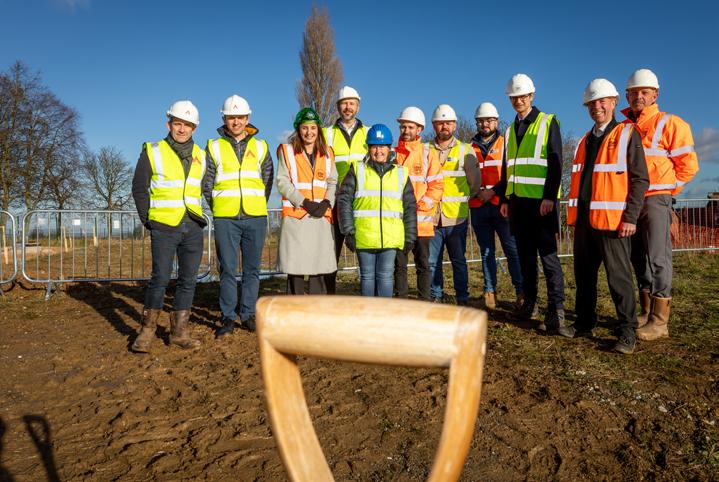
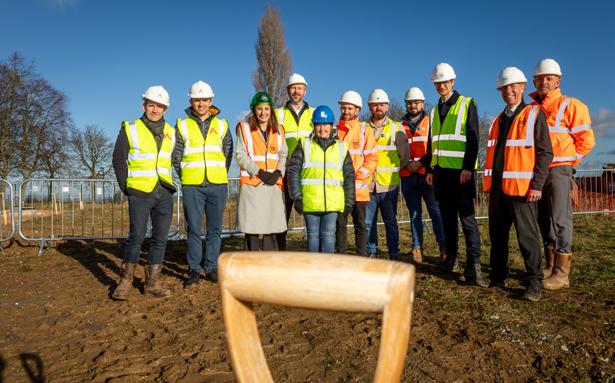
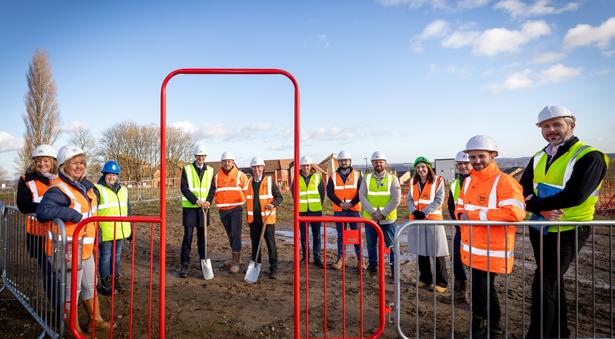
A development of 49 family homes is to be built by Gateshead Regeneration Partnership (GRP), on the site of the former Hookergate School, at High Spen. GRP has already started work on 62 affordable homes at Hyde Park Street, in Bensham.
The cross-funding initiative between the sites demonstrates the objectives of the GRP, which has a mission to improve housing quality and choice, create economic uplift and enhance community cohesion.
So far, the joint venture involving Gateshead Council, Vistry North East and registered housing provider Home Group, has delivered 570
homes across 10 sites. It is also providing job and training opportunities, a minimum of 25% of which go to local people, and commits to spend a quarter of the supply budget with businesses within the borough.
The partnership has plans to deliver a further 169 homes over the next 12 months and is currently building at the Freight Village development, close to Gateshead town centre, at Trilogy III in Bensham and at The Cedars in Birtley.
Work on all developments is being carried out by Vistry North East, which is part of Vistry Group – the UK’s leading provider of affordable mixed tenure homes.
Award-winning homebuilder Spitfire Homes has begun selling properties on the third and final phase at Fairmont, a collection of 215 design-led homes in Bishop’s Cleeve.
Every home at Fairmont has been designed to suit the needs of modern lifestyles. Spitfire is dedicated to creating sustainable communities and all homes at Fairmont include features that ensure each property is energy efficient and future proofed. These include air source heat pumps, smart heating systems and electric car charging points as standard.
Properties at Fairmont showcase a contrast of red brickwork, chalky white render, and golden reconstituted stone, creating an array of varied street scenes that complement the considered interiors of each home.
In delivering Fairmont, Spitfire Homes is contributing more than £7 million to the Bishop’s Cleeve community. Committed to supporting the area, Spitfire is making positive contributions to local facilities including improvements to education, sports facilities and public transport.
CONSTRUCTION OF SAMA’S MULTIMILLION-POUND CANALSIDE SCHEME IN BIRMINGHAM SET
TO BEGIN IN EARLY
2025
WAVERLEY JUNIOR ACADEMY EXPANSION LED BY O&P CONSTRUCTION ENHANCES EDUCATIONAL FACILITIES FOR THE LOCAL COMMUNITY
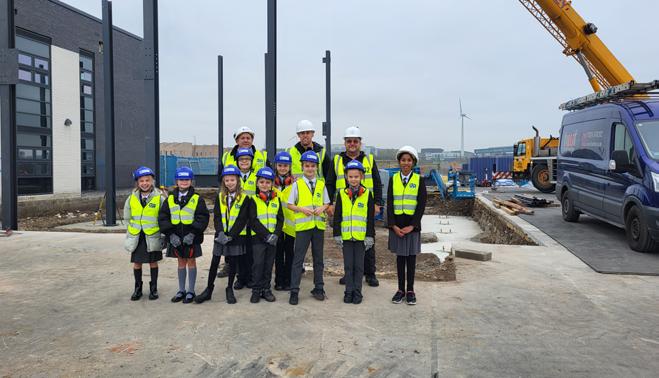
Waverley Junior Academy has partnered with O&P Construction to deliver a major expansion project that promises to support the academy’s growing student body and community.
The £2 million project will add six new classrooms, two libraries, restroom facilities, and a dedicated nursery with changing rooms and an office space, enabling the academy to accommodate over 200 additional students in the coming years.
The expansion, set to complete in July 2025 will start to facilitate a threeclass intake for all years starting with Foundation Stage 2 from September 2025. This development comes as a response to increased demand for placements, with 40 students unable to secure a place at the academy last year.
O&P Construction, committed to contributing positively to the Rotherham community, is also supporting local employment by contracting approximately £500,000 worth of work to local tradespeople.
O&P Construction has emphasised its dedication to social value through this project by engaging with students, providing work experience opportunities, and reinvesting in the Rotherham community.
Sama Investment Group, the Birmingham-based developer and investor, has announced that construction of its multi-millionpound Canalside residential scheme in Birmingham’s Digbeth Quarter will commence in the first quarter of 2025 – with 85 apartments now for sale.
The project, known as the Brickworks Canalside – which is inspired by the area’s rich industrial history – will see a range of one-to-three-bedroom homes delivered as part of an eightstorey building along Watery Lane Middleway and Bolton Street, next to one of the West Midland’s most iconic waterways, the Grand Union canal.
New homes will be supported by a dynamic range of resident amenities including communal social space, office area and gym. The proposals also incorporate biodiverse roof top terraces, plants and foliage, and clean air features such as a “living wall” as part of the sustainably led plans.
With Brickworks Canalside located within proximity to the cultural and creative hub of Digbeth, Birmingham centre, and the city’s current and emerging transport hubs, residents will also benefit from 144 cycle storage spaces. The scheme is expected to be completed in 2026.
HENRY BROTHERS TAKES THE STEER
ON NEW £13.5M DVA TEST CENTRE
Leading construction company Henry Brothers has been appointed to deliver the design and build of a new £13.5m Driver and Vehicle Agency (DVA) Test Centre and two-storey administrative building at Mallusk, Northern Ireland.
This project will modernise and expand the vehicle testing infrastructure in Northern Ireland, with state-of-the-art facilities set to enhance the DVA’s ability to provide essential services to the public.
The new Test Centre will feature a ten-lane vehicle testing area, including two pit-based inspection lanes for heavy goods vehicles, seven ramp-based lanes for light vehicles, and a dedicated bay for motorcycle testing.
External works will include the development of a new internal road network, car parking, and an off-road motorcycle driving test track to improve operational efficiency and accessibility.
Henry Brothers has built a reputation for excellence through its involvement in a range of notable projects across Great Britain and Northern Ireland, including education, healthcare, and commercial developments.
One of its key ongoing projects is the Queen’s University Belfast Advanced Manufacturing Innovation Centre. This state-of-the-art facility is part of the Belfast Region City Deal and aims to drive innovation in Northern Ireland’s manufacturing sector.
NEW HOMES PLAN APPROVED FOR FARNHAM DEVELOPMENT
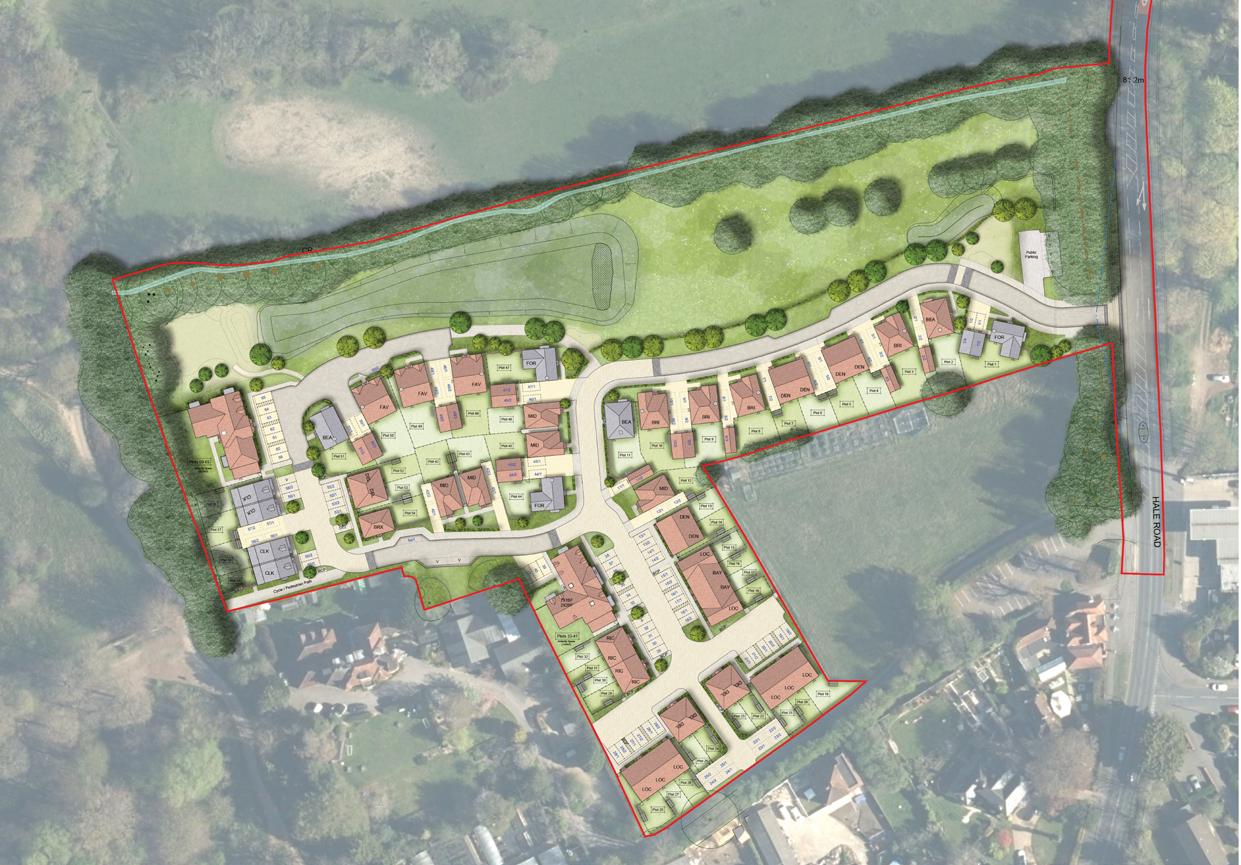
A development of 65 new homes will be built in Farnham, after planning permission was granted for the scheme.
Waverley Borough Council has given the green light to Miller Homes to build the new homes on a 7.7-acre piece of land off Hale Road, neighbouring Farnham Park and The Six Bells public house, in an area known as The Hawthorns.
The development will be named Deer Park and will include a large area of public open space to the north of the site which, coupled with new pedestrian and cycleway links, will result in a biodiversity net gain on the land.
Miller Homes is set to begin construction work shortly and will be building a mix of houses and apartments, ranging in size from one-bedroom to four-bedrooms. The national housebuilder will sell 39 homes on the open market and will build 26 properties to be provided as affordable housing, including seven to be sold via the First Homes scheme.
Car parking spaces will be provided throughout the site through private driveways and public parking areas, and every home will have direct access to an electric vehicle charging point.
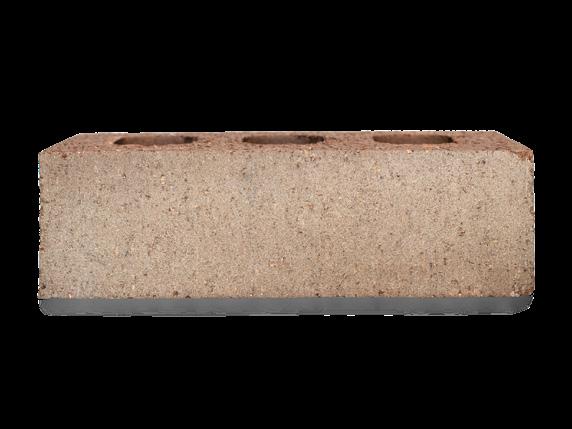
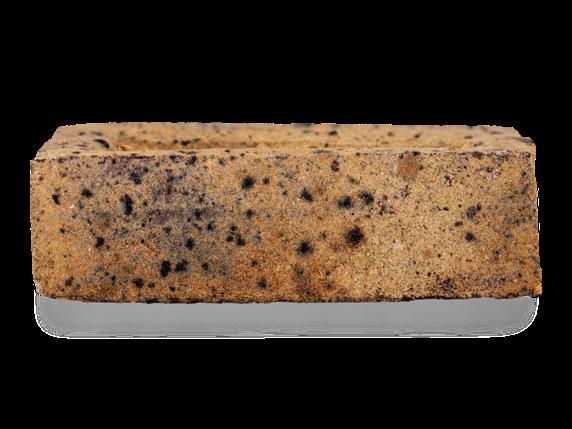
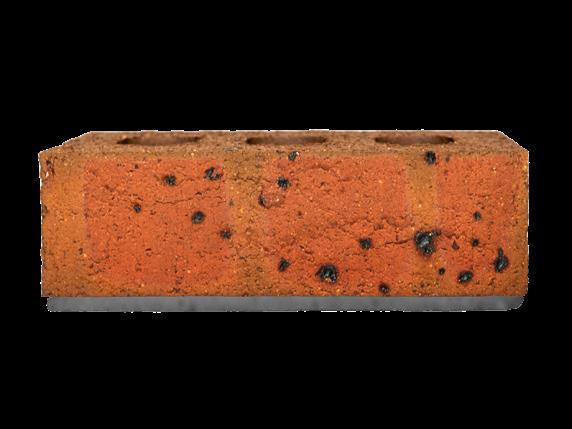
The Michelmersh Group produces over 180 core range products from 7 market leading brands, gracing the façades of numerous Stirling Prize, Brick award and RIBA award-winning buildings. Enhanced by its passion for innovation and sustainability, Michelmersh’s beautiful products are created to the highest standards and will live-on for generations to come.
www.mbhplc.co.uk
CREATING SUSTAINABLE HOMES FOR THE FUTURE WITH BRICK
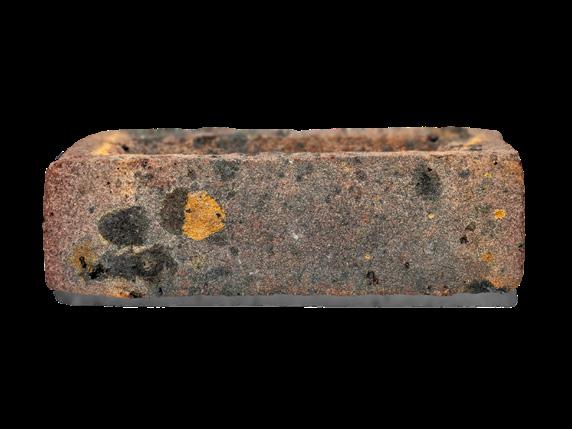
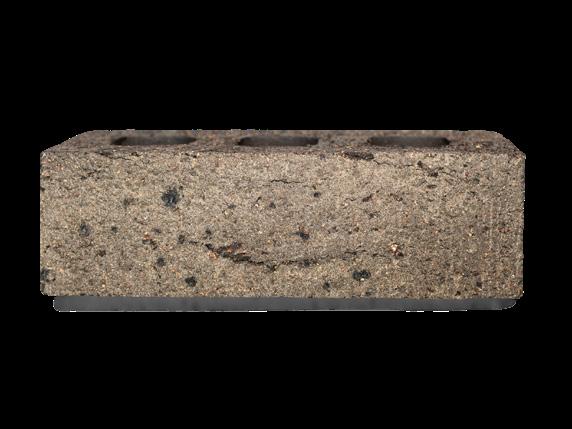
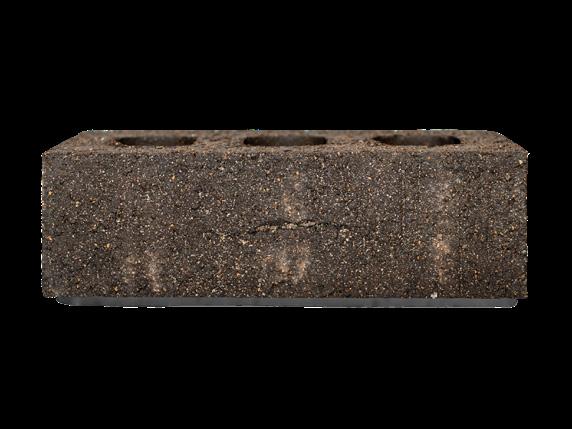
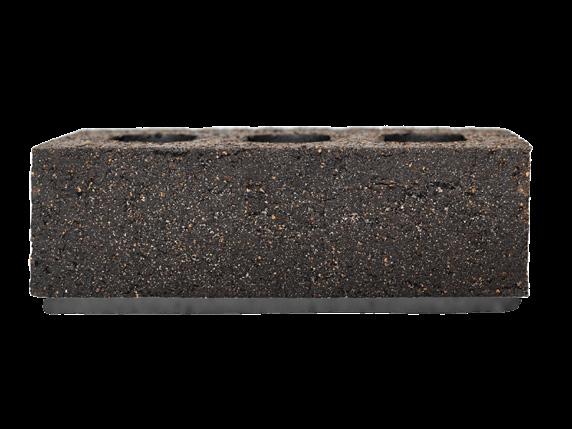
Award-winning or headline-making sustainable homes often include innovative features—think heat pumps, solar panels, or greywater recycling systems. But there’s another, simpler product that defines many of these sustainable designs: clay brick.
While sustainable home standards like Passivehaus and BREEAM might be relatively recent, the sustainable qualities of clay brick are more than 6,000 years in the making. Clay brick manufacturers like Michelmersh continue to invest in new ways to improve its sustainability profile. Bricks are also an
accessible material for projects of any budget or scale, from large housing developments to luxury renovations.
If you’re looking to design or specify a more sustainable home, here’s everything you need to know about the sustainable characteristics and innovative iterations of clay brick.
The sustainable qualities of clay brick
Anyone who works in the built environment will be familiar with clay brick’s technical characteristics—its compressive strength, rain and flood resilience, and ‘A1 non-combustible’ rating, to name a few. But, its inherent sustainability profile may be less well-known. Here are the key qualities that make it a popular choice for more sustainable homes:
• Minimal operational carbon: Operational carbon refers to the carbon emitted during a building’s life after construction, including structural maintenance. Clay brick lasts for hundreds of years, needing little to no maintenance during that time, which means it produces minimal operational carbon.
• Durable and long-lasting: In the final stages of clay brick production, the product goes through a process called vitrification. Vitrification refers to the transformation of a substance into non-crystalline glass. But, clay brickmaking only uses partial
vitrification, to make clay bricks strong and impermeable to water. Because clay bricks let in such negligible amounts of water, they’re highly resistant to the damage that freeze/ thaw cycles cause, contributing to their long lifecycle.
• Thermal performance: Thermal mass describes how much heat a building (or building material) can store when temperatures fluctuate. Clay brick has high thermal mass, which keeps internal spaces cool in hot weather and warm in cold weather. This helps reduce the energy requirements of brick-built structures, which in turn reduces operational carbon emissions.
• Reusable and recyclable: Where we might need to demolish or rebuild brick structures, we can use those bricks again by reclaiming them through urban mining. Clay brick’s durability means we often have the option of reusing whole clay bricks. If the bricks are very old or damaged, we can break them down into their composite materials to make new bricks. Both of these approaches reduce our reliance on raw materials, which reduces carbon emissions from the extraction process.
• Locally sourced: Clay is a relatively abundant resource, with most countries having their own clay deposits. As such, manufacturers can source their clay locally, which minimises carbon emissions from transportation. This also gives each manufacturer’s bricks a unique colour and finish that emulates the local landscape. At Michelmersh, we source 85 per cent of our raw materials within 2.5km of our manufacturing plants.
Manor Place, London. Refurbishment includes elements of previous site.
Photo by Beccy Lane.
Becontree Estate, London. Pioneering social housing.
Photo by FRENCH + TYE.
These are the inherent qualities that make clay brick a sustainable home staple. But, recent design and manufacturing innovations have also made them a more likely choice.
Lower carbon bricks - recycled content and alternative fuels
We’ve already highlighted how clay brick’s minimal operational carbon elevates its sustainability profile. One of the remaining challenges for clay brick and other construction products is embodied carbon—the carbon emitted during the creation of a building and its materials. One way we can reduce clay brick’s embodied carbon is by using recycled content. We’re continuing to explore other sectors’ inert waste to increase the recycled content of our products and in turn decrease our carbon footprint. In addition, we’re looking into how we can dematerialise our products—use fewer raw materials to make them. Approaches to the dematerialisation of clay bricks include developing thinner products and increasing perforation sizes or adapting the profile of brick.
Another route to reducing clay brick’s embodied carbon focuses on the manufacturing processes. The firing and drying stages are the most carbon-intensive processes involved in brickmaking due to the fuel they require. By phasing out natural gas for other nonfossil based fuels, brick manufacturers can significantly reduce the embodied carbon of their products. This was the driving force behind HyBrick™, our world first green-hydrogen-firedbrick feasibility study. We were able to achieve an 81 to 84 per cent reduction in firing carbon emissions during the trials without compromising the brick’s technical characteristics. We’re still evaluating alternative fuel sources, but
Scaling sustainable homes
The new technologies now widely available for modern homes represent hope for the built environment’s accelerated net zero goals. Clay brick continues to be a low-cost material with long-term sustainability value for occupants and the environment. We’re proud of clay brick’s legacy and excited about its future at Michelmersh. We’re always happy to help you determine its potential value for your project’s sustainability goals. Get in touch with our expert team today to find out more.
Website: www.mbhplc.co.uk
HyBrick™ has demonstrated the latent sustainability potential of clay brick.
Perforated House, London. Unique use of Floren Alaska Bricks. Photo by Novak Hiles.
Queens Quay, Glasgow, uses Blockleys Porcelain White bricks which are partially made from recycled content. Photo by Beccy Lane.
The Old Engine Yard, Edinburgh, incorporates elements of a former Engine Yard. Photo by Beccy Lane.
Chobham Manor, Blockleys Black Smooth. Photo by Beccy Lane.
INTERVIEW: DAVE ORRELL, HEAD OF DESIGN FOR MC CONSTRUCTION
Dave Orrell brings a wealth of experience to his new role as Head of Design at MC Construction. From engineering to design management, his diverse background positions him to drive innovation, sustainability, and collaboration. In this interview, Dave shares his vision for shaping the company’s design function and supporting clients in navigating the industry’s evolving challenges.
With over 17 years of experience in the construction industry, what drew you to MC Construction and the role of head of design?
I was drawn to MC Construction because it offers a fantastic opportunity to bring together the skills I’ve developed across various roles, from engineering and site management to design management. I’m particularly excited about the direction in which the company is heading. The vision and the opportunities to influence the design function and deliver high-quality,
sustainable projects align perfectly with my experience and values. I’m eager to contribute to the continued success and growth of the business, and I look forward to playing a key role in its future development.
How do you see your experience at Galliford Try and other roles in the industry shaping your approach to this new position?
Having worked at both large Tier 1 contractors and Tier 2 contractors, this role presents a unique opportunity for me to combine all the lessons learned from my experiences, including working on prestigious projects as well as those that
presented significant challenges. Each project, whether successful or difficult, has provided valuable insights that I can apply to create a best-in-practice design function at MC Construction. I’m excited to bring together the knowledge gained from working at various levels of the industry to build a design process that emphasises innovation, efficiency and quality, ensuring we deliver outstanding results on every project.
MC Construction places a strong emphasis on sustainability and modern methods of construction. How do you plan to incorporate these priorities into your work with the design teams?
I believe the business should consider offsite solutions like precast concrete and modular construction where possible, as these methods reduce waste, lower carbon emissions, and improve efficiency. I will work closely with the design teams to ensure sustainability is embedded throughout the design process to deliver cost-effective and environmentally responsible projects.
Above & Below: Opera House
Interview
Dave Orrell, Head of Design at MC Construction
Your role involves collaborating with architects, engineers, and design teams at all project stages. Can you share your approach to fostering collaboration and ensuring project success?
My approach to fostering collaboration is built on openness, transparency and strong communication. As an honest and approachable person, I believe it’s essential to create an environment where everyone feels comfortable sharing ideas and concerns. By being clear about project goals and expectations, I can drive teams forward and ensure that we’re all aligned towards achieving shared objectives. I focus on building strong relationships with architects, engineers and the design team to facilitate collaboration at every stage, which is key to successful project delivery.
Each project, whether successful or difficult, has provided valuable insights that I can apply to create a best-in-practice design function at MC Construction.
I’m very focused on staying informed. I make it a point to read and listen to as much information as possible to ensure I’m always up-to-date. I’m keen to bring this knowledge to the forefront of all submissions, ensuring full compliance and making safety a top priority at every stage. As for net zero, I’m dedicated to integrating sustainable, energy-efficient solutions into the design process where possible.
As head of design, you’ll be working on a variety of complex projects across different sectors. What excites you most about this opportunity, and what do you hope to achieve in the role?
The construction industry is undergoing rapid change, including the push for net zero carbon and compliance with the Building Safety Act. How do you see your role supporting clients in meeting these evolving challenges?
The Building Safety Act is still relatively new to the industry, and many are still getting up to speed with its requirements. However, having been involved in highrise residential building submissions,
What excites me most about this opportunity is the chance to establish a robust design management function that collaborates closely with clients to create innovative projects. My goal is to develop a process that not only meets safety standards and carbon emission targets but also ensures that the designs are practical, efficient and commercially viable to build. I’m eager to foster a design team that drives creativity, supports collaboration and ensures the successful delivery of complex projects across a range of sectors.
Hat Works Museum
Springfield School, Crewe
Events & Awards News
SCIENNES PRIMARY SCHOOL EXTENSION OFFICIALLY AWARDED PASSIVHAUS CERTIFICATION AND WINS THREE PRESTIGIOUS INDUSTRY ACCOLADES
A Passivhaus-designed extension to an Edinburgh school has been officially recognised as a first of its kind in the city, receiving recognition for its groundbreaking use of energy-efficient design and materials, including crosslaminated timber (CLT).
The extension to Sciennes Primary School, located in the popular and busy Marchmont area of the capital, has officially achieved Passivhaus certification from the Passivhaus Institute, following rigorous quality checks of the £3.2million two-storey extension to the Grade B listed building.
The project has also been honoured with three prestigious industry awards, receiving the ‘Large Scale Project award’ from the Edinburgh Architect’s Association, ‘Innovation in Delivering a Sustainable Learning Space’ award at the Learning Places Scotland Awards and the Glasgow Institute of Architects award for Education.
The new pavilion was designed by architects Holmes Miller, in collaboration with sustainable environmental design consultant, Sussed Sustainability, and constructed to Passivhaus standards, meaning energy consumption and carbon emissions will be reduced by retaining heat in winter while still being comfortably cool in warmer weather.
Adhering to Passivhaus standards, the Sciennes Primary School extension was the first in Scotland to be constructed from cross-laminated timber (CLT) – an energy efficient material which contributes to a warm interior environment and delivers exceptional air tightness performance.
The desire to futureproof the school and achieve high energy performance through Passivhaus principles became a key focus.
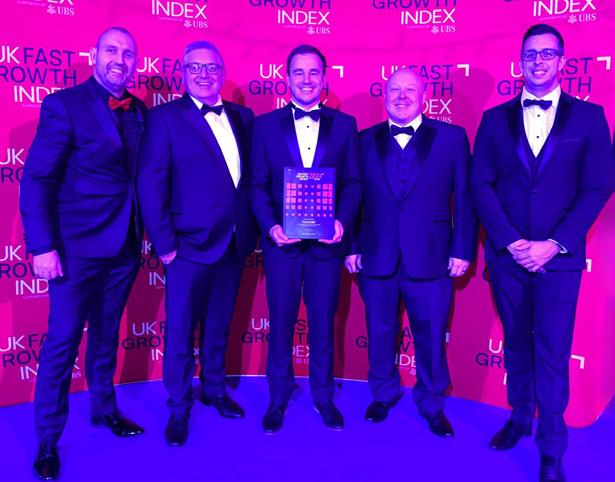
FOCUS MEP NAMED THE FASTEST GROWING MANUFACTURING AND ENGINEERING BUSINESS BY THE 2024 UK FAST
GROWTH INDEX
Starting out during unprecedented times in 2020, Focus MEP has grown from strength to strength, building a reputation for excellence in electrical, mechanical and public health engineering.
Now with a talented team of over 20 professionals, Focus MEP is excited to celebrate being recognised at the prestigious Fast Growth 50 Awards 2024.
As a proud Welsh company, Focus MEP is committed to driving economic growth in Wales by creating local employment opportunities and contributing to the region’s thriving engineering and manufacturing sector.
The Fast Growth 50 project, devised by Prof Dylan Jones-Evans, celebrates the diverse talent and entrepreneurial spirit across the UK, recognising companies that contribute significantly to economic growth through innovation and productivity.
Focus MEP’s inclusion on the 2024 index highlights the remarkable development and progress they have achieved over the past few years.
SENIOR SITE MANAGER AT BELLWAY WINS TOP ACCOLADE AT INDUSTRY AWARDS CEREMONY
A Northamptonshire senior site manager who is overseeing the construction of Bellway’s new homes in Desborough has been named the best in the region.
Cymon Robinson, Senior Site Manager at Bellway’s Weavers Fields development in Desborough, who has won a Regional Award from the NHBC
Cymon Robinson, who leads the site team at Weavers Fields, claimed the Large Housebuilder Regional Award at the National House Building Council’s Pride in the Job Awards ceremony for the Central region.
This year, the NHBC presented 449 Quality Awards to site managers nationally and from those winners chose the recipients of its Seal of Excellence Awards, before going on to select the very best site managers in each region for the Regional Award.
Cymon’s colleague Michael Crake – who is senior site manager at Chamberlains Bridge in Leighton Buzzard – joined Cymon as one of only 10 site managers to win a Seal of Excellence at the Central region awards event.
The NHBC runs the Pride in the Job awards annually and every site registered with them is automatically entered into the competition.
Each site manager is judged on a wide range of aspects of their work including attention to detail, leadership, technical expertise and health and safety.
KILWAUGHTER MINERALS
CONTINUES AWARD-WINNING RUN WITH TRIPLE SUCCESS
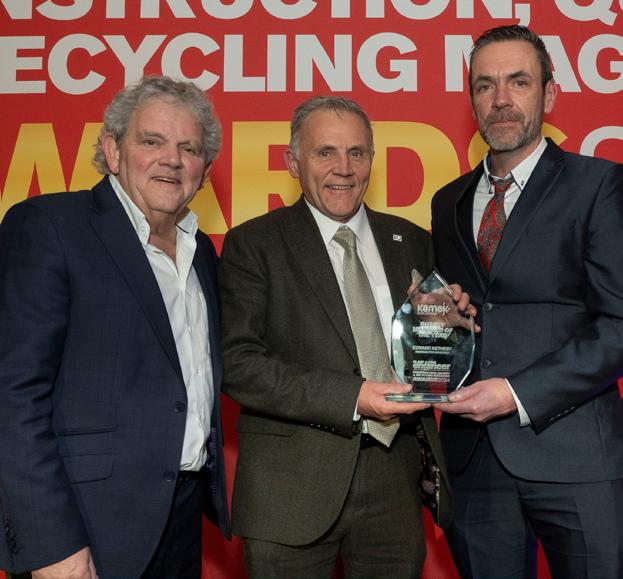
Leading quarry and minerals processor Kilwaughter Minerals has continued its award-winning run with a recent triple success in prestigious industry awards.
The company was named Mineral Products Site of the Year at the annual Plant & Civil Engineer (PCE) Awards, with Edward Nethery receiving the Quarry Manager of the Year accolade.
Meanwhile, the achievements of Senior Digital Marketing Executive Kathryn Douglas were recognised at the Construction Marketing Awards (CMAs) as she was named winner of
the ‘Emerging Talent – Young Marketer of the Year’ category.
These accolades follow Kilwaughter Minerals’ K Systems brand being honoured at the 2024 INCA Awards for Environmental Impact, receiving the award for the Low Rise (New Build) category for its innovative Curries Yard project.
Kilwaughter’s commitment to sustainability has also enabled the company to gain Gold status in Business in the Community’s environmental benchmarking survey,
Bellway Northern Home Counties is building 350 new homes at Weavers Fields, off Stoke Road, in Desborough and 180 homes at Chamberlains Bridge, off Vandyke Road, in Leighton Buzzard.
Michael Crake, Senior Site Manager at Bellway’s Chamberlains Bridge development in Leighton Buzzard, who has won a Seal of Excellence in the NHBC Awards
earning a Level 3 distinction for wellbeing.
With a career spanning over 40 years, Edward’s leadership, commitment to safety, and passion for mentorship were praised by judges, who described him as a champion of best practices and innovation in the quarrying industry.
People On The Move
GLEEDS APPOINTS NEW DIRECTORS TO BOLSTER PROJECT MANAGEMENT TEAM
International property and construction consultancy, Gleeds, has announced the appointment of two new directors within its London project management arm.
John Barnett and Ed Horne join the business from Avison Young Project Management to drive growth in Gleeds’ major London projects division, bolstering the firm’s growing presence in the capital.
John and Ed’s roles will add to a senior leadership line-up with a strong track record of delivery on some of the capital’s most influential projects.
Ed has over 30 years’ experience in the construction industry and has worked on major new build and refurbishment projects across the commercial and residential sectors for developer clients, pension funds and corporate clients. Ed’s particular sector expertise is in West End office development, and he has headed up numerous West End projects including mixed use schemes at 18-20 Hanover Square (Bond Street East Over Station Development) and Rio Tinto’s HQ at 5-6 St James’s Square. Other notable projects from his career include working on One Palace Street, the Royal Mint Court and Heron Tower.
John began his career as a chartered architect before moving into project management, and now has 25 years’ experience in the discipline. His diverse career has seen him undertake a range of roles including design and project management, with frequent secondments to client organisations. He has also headed up major projects for Battersea Power Station, One Nine Elms, Damac Tower, One Kensington,
One Hyde Park and Fitzroy Place as well as governance over numerous large scale commercial office, residential, hotel and mixed-use developments.
Gleeds’ project management offering in London and further afield has seen steady growth following significant investment from the business, with a strong outlook heading into 2025 and onwards.
Yorkshire-based housebuilder Thomas Alexander Homes has announced the appointments of Dean Woodward as Site Manager, Jasmine Thomas as Technical Coordinator and Dan Pearson as Sales Executive.
Woodward has worked in the construction industry for more than 15 years, with 11 of those spent in site management roles for organisations including Keepmoat and Avant Homes.
In his new role, he will be responsible for the successful execution of Thomas Alexander Homes’ newest development, Hartley Vale - a carefully curated mix of 23 two-, three-, four- and fivebedroom properties in the rural village of Burneston.
Boasting more than 10 years’ experience in the property industry,
Thomas’ appointment as Technical Coordinator will see her working in both the company’s architectural and engineering departments, where her responsibilities will include creating plans and coordinating designs for Thomas Alexander Homes’ forthcoming developments, ensuring all projects meet building control and sustainability requirements and actioning diversions and service providers.
New Sales Executive Dan Pearson joins the company having spent the last three and a half years working in the property sector. At Thomas Alexander Homes, Pearson will be located at the company’s new Swann Gate development in Church Fenton, where he will assist customers throughout their buying process, from initial enquiry to completion, as well as helping with their legal progression and new home choices.
Left to right: Ed Horne, Craig Ward, Andrew Todman and John Barnett
Jasmine Thomas
Dean Woodward
THOMAS ALEXANDER HOMES MAKES KEY NEW APPOINTMENTS
People On The Move
Robert
SCAFFOLDING ASSOCIATION’S CHIEF EXECUTIVE APPOINTED TO THE BOARD OF THE TRADE ASSOCIATION FORUM
The Scaffolding Association has announced that Robert Candy, the Chief Executive, has been appointed to sit on the Board of the Trade Association Forum (TAF), the voice of associations in the UK.
This appointment represents a significant opportunity to further champion the interests of our members and the wider scaffolding and access sector as part of the broader landscape of trade associations.
TAF supports 174 members who represent 190,000 businesses from across almost every industry sector, making it one of the largest business groups in the UK.
Robert brings extensive experience in association management, policy advocacy, and a dedication to raising industry standards. Under his leadership, the Scaffolding Association has strengthened its role as a vital resource for members and a prominent voice on issues that impact the scaffolding and access industry.
Joining the TAF Board allows Robert to engage directly with key policy and advocacy initiatives supporting the growth and resilience of UK businesses. His appointment to the Board signals a renewed commitment to ensuring that the needs of scaffolding and associated industries are represented in critical discussions and decisions that shape the business environment across sectors.
NEW OPERATIONS DIRECTOR JOINS WREKIN PRODUCTS TO CONTINUE STREAK OF NEW HIRES
Leading designer, manufacturer, and supplier of innovative civil engineering solutions, Wrekin Products, has expanded its workforce once again in a continued streak of new hires with the appointment of operations director, Steve O’Brien.
As the business continues to diversify its workforce as it enjoys a period of considerable growth, Steve joins at a crucial time to provide strategy and direction to an evolving pipeline. With demands on the construction sector greater than ever, projects with improved technologies will be essential in reducing carbon emissions and contributing to netzero targets.
With over 25 years of industry experience, Steve’s role will bring clarity to the wider business ambitions and support its efforts in becoming leading experts in decarbonising iron work solutions.
XPO LOGISTICS SUSTAINABILITY
LEADER DR NICHOLAS HEAD NAMED VICE CHAIR OF SUSTAINABLE LOGISTICS FORUM
XPO has announced that Dr Nicholas Head, XPO Head of Sustainability, has been named Vice Chair of the Sustainable Logistics Forum. Representing 18 larger fleet operators, the Sustainable Logistics Forum is part of Rutland Forums, a partner of XPO Logistics, which facilitate collaboration groups of sustainability and energy practitioners, helping members to decarbonise their organisations quicker and more cost-effectively.
Dr Head also sits on the Forum’s Board of Advisors, who represent the sustainability interests of all members, including large corporations and Retailers, such as Boots, John Lewis Partnership, Tesco, and many others. He has more than 15 years of experience working with organisations of all types to advance environmental goals, and holds a doctorate in sustainable waste and resource management (circular economy models and systems thinking) and a master’s degree in waste management, where he also served as an associate lecturer.
Steve O’Brien
Dr Nicholas Head
Candy
Tools, Plant & Equipment Hire
THE ULTIMATE GUIDE TO PROTECTING YOUR METAL TOOLS FROM CORROSION
Metal tools are used for a wide variety of tasks, including construction, automotive repair, machining, gardening and industrial manufacturing. They are used in a wide range of industries, from manufacturing to food processing. Metal tools have high personal use: knives, scissors, and pliers are common metal tools used in everyday life. They are esential for a variety of reasons: their durability, strength, precision and more. As most metals however, metal tools are prone to corrosion. Corrosion is a natural process that occurs when metals react with their environment. Over time, exposure to moisture, oxygen, and other elements can cause metal tools to rust, tarnish, or deteriorate. Rust and corrosion are the silent enemies of your tools. Often caused by exposure to moisture, oxygen, and other corrosive elements, they can occur almost anywhere, including in seemingly dry storage spaces.
Here are some common factors that contribute to corrosion:
• Moisture: Water, even in small amounts, can accelerate corrosion. It acts as a catalyst, allowing oxygen to reach the metal surface more easily.
• Oxygen: Oxygen in the air reacts with metals, forming oxides that can weaken the metal’s structure.
• Acids and salts: Acids and salts in the environment can speed up the corrosion process. These substances can create an acidic environment that is particularly corrosive to certain metals.
• Electrochemical reactions: When two different metals come into contact in the presence of an electrolyte (like salt water), a galvanic reaction can occur. This can cause one metal to corrode more rapidly than the other.
• Temperature: Higher temperatures can increase the rate of corrosion.
To protect your tools, it is recommended to implement a regular maintenance routine that includes:
Thorough cleaning: remove dirt, dust, and moisture from your tools
to prevent the buildup of corrosive substances.
Lubrication: Apply oil to moving parts to reduce friction and maintain optimal performance.
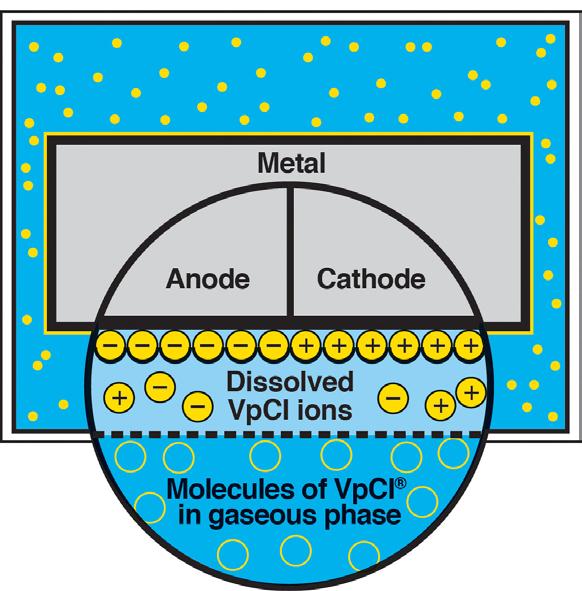
Protective coatings: Apply a corrosion protection coating to create a barrier between tools and corrosive elements, ensuring their longevity. Patented VpCI® (Vapor Phase Corrosion Inhibitor) coatings from Cortec® Corporation protect a multitude of metal products. Spraying or dipping metal parts with VpCI® provides fast and economical protection for exterior and interior surfaces.
Rust and corrosion are the silent enemies of your tools. Often caused by exposure to moisture, oxygen, and other corrosive elements, they can occur almost anywhere, including in seemingly dry storage spaces.
VpCI® technology is an innovative, environmentally safe, cost-effective option for corrosion protection. Cortec® products protect with a thin, monomolecular protective barrier. The barrier re-heals, selfreplenishes, and can be combined with other functional properties for added protective capabilities. VpCI® forms a physical bond on the metal surface creating a barrier layer against aggressive ions.
VpCI technology has many advantages. It does not require the special removal of a coating or greasy rust preventative. This reduces labor time and hazardous waste disposal fees from having to clean off traditional petroleum-based rust preventatives. VpCI® inhibitors protect multiple metal types and work in multiple phases—liquid, vapor, and interface—so they can be used to inhibit corrosion on metal surfaces below and above the fluid level in water treatment or oil and gas applications.
By taking these proactive steps, you can significantly extend the lifespan of your valuable tools and minimize the costly effects of rust and corrosion. To prevent corrosion, it’s important to keep tools clean, dry, and protected from exposure to corrosive elements.
Tools, Plant & Equipment Hire
AIR & HYDRAULIC TOOL HIRE
The APP Group consists of Air Power Products (Compressed Air Specialist) and Procut Engineering (CNC Precision Engineering) and APP Site Services (Site Supplies and Tool Hire). The group benefits from a full-service department with a wealth of air and hydraulic tool knowledge. We provide an excellent service, not only with the range of products but with the level of care each order is given and the speed with which we can deliver.
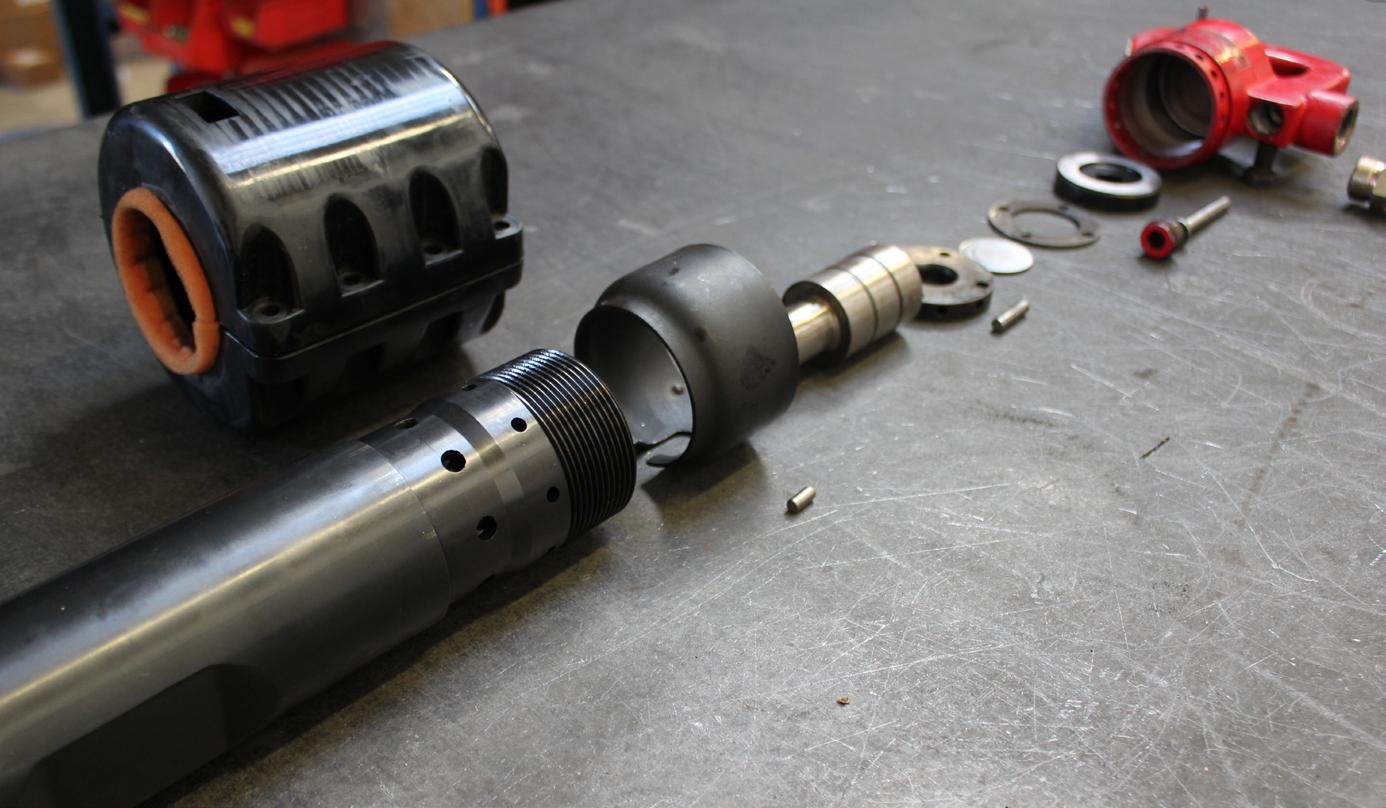
The main focus of the business is the hire department for construction tools. The hire fleet has been built up over a long period of time and the tools are always fully serviced and inspected before every hire.
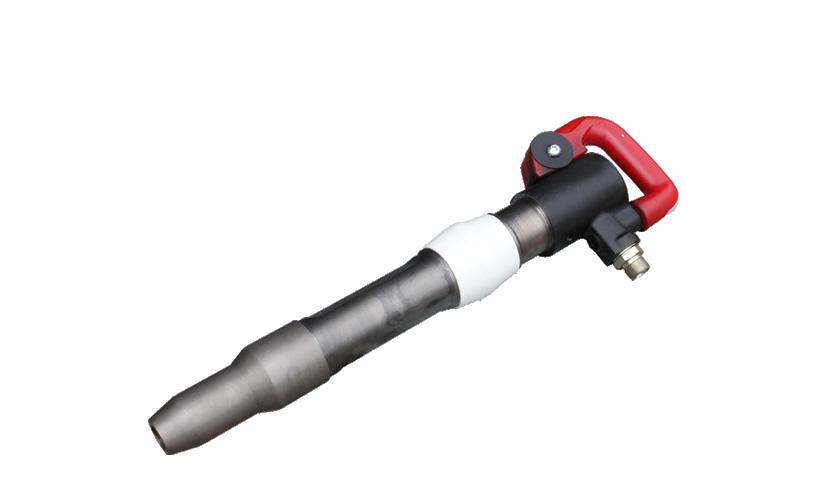
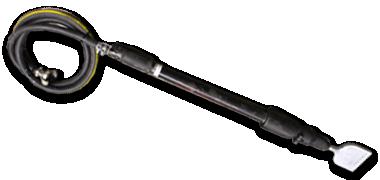
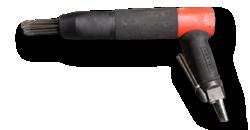
We have a range of tools and associated products available to hire which include Rebar Cutters, Rebar Benders, Hydraulic Splitters, and Pneumatic Picks.
Rebar Cutters
We have a range of hydraulic rebar cutters to suit both factory and on-site applications that can cut up to 40mm Rebar. Designed for professionals that need to cut high tensile rebar in all environments.
Rebar Benders
We have a range of hydraulic rebar benders to suit both factory and on-site applications that can bend up to 40mm Rebar. Designed for professionals that need to bend high tensile rebar in all environments.
Concrete Splitters
Splitters are handheld demolition devices which controllably split material with the use of hydraulic pressure. They are used when larger conventional demolition devices are ruled out due to their excessive dust, vibration, and flying debris.
Concrete Combi Shears
The combi shears are the ultimate in handheld demolition. The interchangeable jaw sets mean that this machine is incredibly versatile and can cut and crush a wide range of materials.
Pneumatic Picks
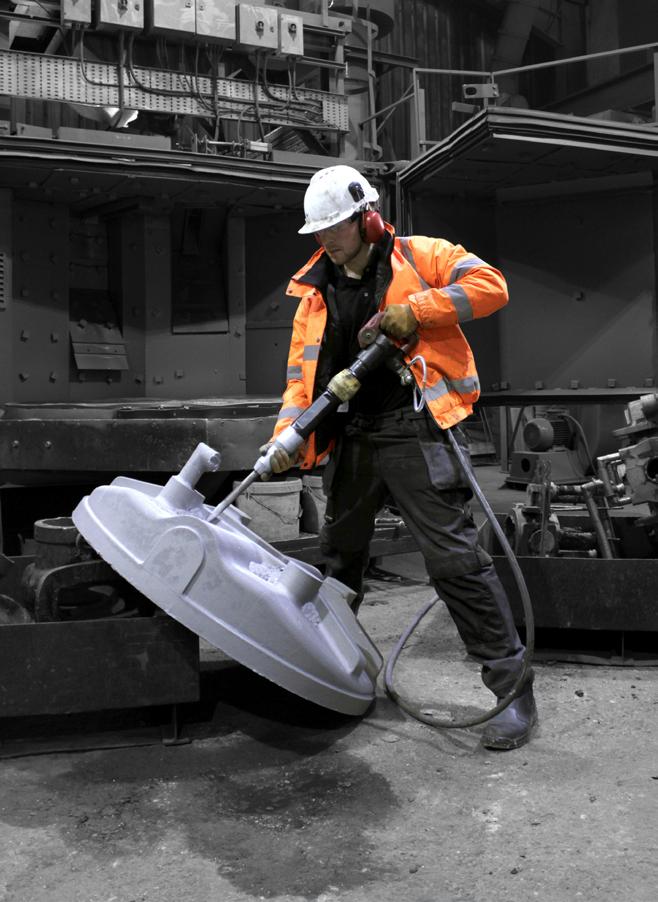
We don’t just sell & hire the H11, We have a full range of medium duty demolition picks.
Whatever your scenario we have an option for you…
Above are just a few machines we have to offer. For our full range give the office a call on 01909 519 519. Most tools are available for Same Day or next day delivery.
Site Spillage
As well as the hire fleet APP Site Services offer a range of site spillage solutions including the mobile spill kit. If you need further information on the range of spillage solutions we have to offer, please visit the website www.appsiteservices. co.uk
PPE Solutions
As part of the full package, we also stock a range of PPE equipment and workwear for our customers. If you are looking for gloves or a mask to go with your hire or purchase we have got you covered.
www.appsiteservices.co.uk
Tel: 01909 519 519
Health & Safety
Mike Lomas, founder of the BR2.0 Group
HEALTH AND SAFETY: INVESTING IN THE WELLBEING OF YOUR WORKFORCE WITH AN AED
By Mike Lomas, founder of the BR2.0 Group
While many would presume its common practice for Automatic External Defibrillators (AED) to be required by law on large scale construction sites across the UK, it’s not a legal requirement for any business to have one, regardless of its size or the industry in which it operates. Despite this not being a statutory requirement, when it most likely should be, it’s something that all construction sites should have.
According to Resuscitation Council UK, over 30,000 out-of-hospital cardiac arrests occur in the UK each year. And, while specific figures aren’t produced to determine how many of those took place on a construction site, it is worth noting that the construction industry alone employs 9% of the UK workforce, which is around 3.1 million people.
In the last three years, the HSE has reported 11 fatalities reportable under RIDDOR, which include workers ‘coming
into contact with electricity or electrical discharge’. This number may not seem high when you compare it with the number of live construction sites across the UK, however, absolutely anyone regardless of age, gender, or place of work can experience sudden cardiac arrest at any time and construction sites present additional risks.
Whilst a cardiac arrest happening on site won’t be a common occurrence, the investment of an AED pays off even just for peace of mind, or in the unfortunate incident that it may need to be used, even just once.
The intense surroundings of a construction site can put workers at
a higher risk of sudden cardiac arrest (SCA), but not all contractors will install a defibrillator on site. As stated by the HSE, construction sites in the UK are required to complete a first-aid risk assessment, which should include considerations of medical equipment and facilities. However, there’s no specific stipulation that an AED must be installed.
In August 2023, the average ambulance response time for a serious accident was eight minutes 17 seconds. While the wait has come down when compared to the previous year, the limited accessibility to a construction site can also delay paramedics from reaching a person quickly.
In 2023/24, HSE reported a total of 58 fatalities within the construction industry. Around 10% of these fatalities included contact with electricity, which can be a contributing factor to someone experiencing sudden cardiac arrest.
The majority of major construction projects will install at least one AED; however, many SME contractors won’t consider purchasing or leasing the equipment, not because they don’t want to, but because it’s not something they’re required to do by law. Plus, if a site’s principal contractor doesn’t install such equipment, it’s highly unlikely that any other contractor will take it upon themselves to install one.
Australia for example passed The Automated External Defibrillators (Public Access) Act in 2022 which requires certain buildings and facilities to have AEDs installed. While this isn’t something that’s currently set to happen in the UK, Big Red is a strong advocate for every site regardless of size, to have at least one AED installed, as well as visible documentation that shows where the nearest public defibrillators can be located if required. Delivering treatment within 3-5 minutes of a collapse increases survival chances from 6% to 74%, which is why it is imperative that AEDs are available across construction sites.
Whilst a cardiac arrest happening on site won’t be a common occurrence, the investment of an AED pays off even just for peace of mind, or in the unfortunate incident that it may need to be used, even just once. A construction site already poses as a hazardous work environment, so more needs to be done to reduce the risk of fatality alongside the usual rules and procedures to keep site operatives safe whilst at work.
Specialist construction training
As the world’s only Chartered OSH body, we’re trusted by thousands of construction companies around the world. And with our specialist training courses, aimed at both construction workers and site managers, we can help improve standards on site and ensure everyone
Find out more about our construction courses
FOCUS ON EYE HEALTH AND SAFETY: PROTECTING VISION ON CONSTRUCTION SITES Health & Safety Workwear
The UK construction industry has faced its share of challenges recently. Inflation and changing regulations have slowed projects, but with the Chancellor promising to cut planning red tape, businesses are preparing for growth.
As we focus on the future, we must remember the workers who drive the industry forward and ensure their safety—especially when it comes to vision. Eye safety is often overlooked despite being vital for on-site productivity and worker protection. If we fail to safeguard workers’ eyesight, we put their health—and the success of projects—at serious risk.
Dona McLafferty, Corporate Account Manager for Safety Eyewear at Specsavers, emphasises: “A worker’s eyesight is the most valuable tool in their box.” For construction managers, ensuring everyone has the right eye protection should be as routine as hard hats and high-vis vests.
Construction sites are high-risk environments. Every day, workers face hazards from falling debris, machinery, dust, and chemicals. While these dangers can’t be eliminated, they can be managed with proper personal protective equipment (PPE), including eye protection.
Though hard hats and high-vis clothing are standard, protective eyewear too often gets overlooked. But the risks to eyesight are ever-present—whether it’s flying sparks or metal fragments. Eye injuries can lead to anything from
temporary irritation to permanent vision loss, potentially ending a worker’s career.
Despite these risks, many workers and employers still neglect eye protection. This mindset needs to change. Safety managers should treat protective eyewear as essential PPE.
The Health and Safety Executive (HSE) plays a critical role in enforcing workplace safety, but unannounced inspections in the construction industry have dropped by 32% in the last decade. As a result, more responsibility falls on employers to uphold high safety standards.
Providing high-quality PPE isn’t just a legal requirement—it’s essential to protect workers on the job. When it comes to eye protection, employers must ensure they offer safety eyewear tailored to the unique risks of construction sites.
This includes features like scratchresistant lenses, anti-fog ventilation, and side shields.
For workers requiring vision correction, wearing regular glasses on-site can pose a significant risk. According to Specsavers, nearly half of tradespeople need prescription glasses, yet 60% wear their everyday glasses on-site—a dangerous practice. Even worse, 20% of workers aren’t aware prescription safety glasses exist.
Prescription safety glasses are specifically designed to provide both protection and vision correction. With impact-resistant frames and durable lenses, they’re the safe alternative to regular glasses on construction sites. Raising awareness of this option is critical to improving on-site safety.
Protecting workers’ eyesight goes beyond compliance—it safeguards the future of the construction industry. Workers with clear vision are better equipped to identify hazards, avoid accidents, and work efficiently. This boosts productivity and helps prevent costly downtime or injury claims.
As the construction industry gears up for growth, prioritising eye protection is essential to maintaining a safe and productive workforce. By investing in the right eyewear, along with strong safety practices and training, firms can protect their workers and ensure long-term success.
For more information about prescription safety eyewear, visit Specsavers Corporate Eyecare.
Training & Education News
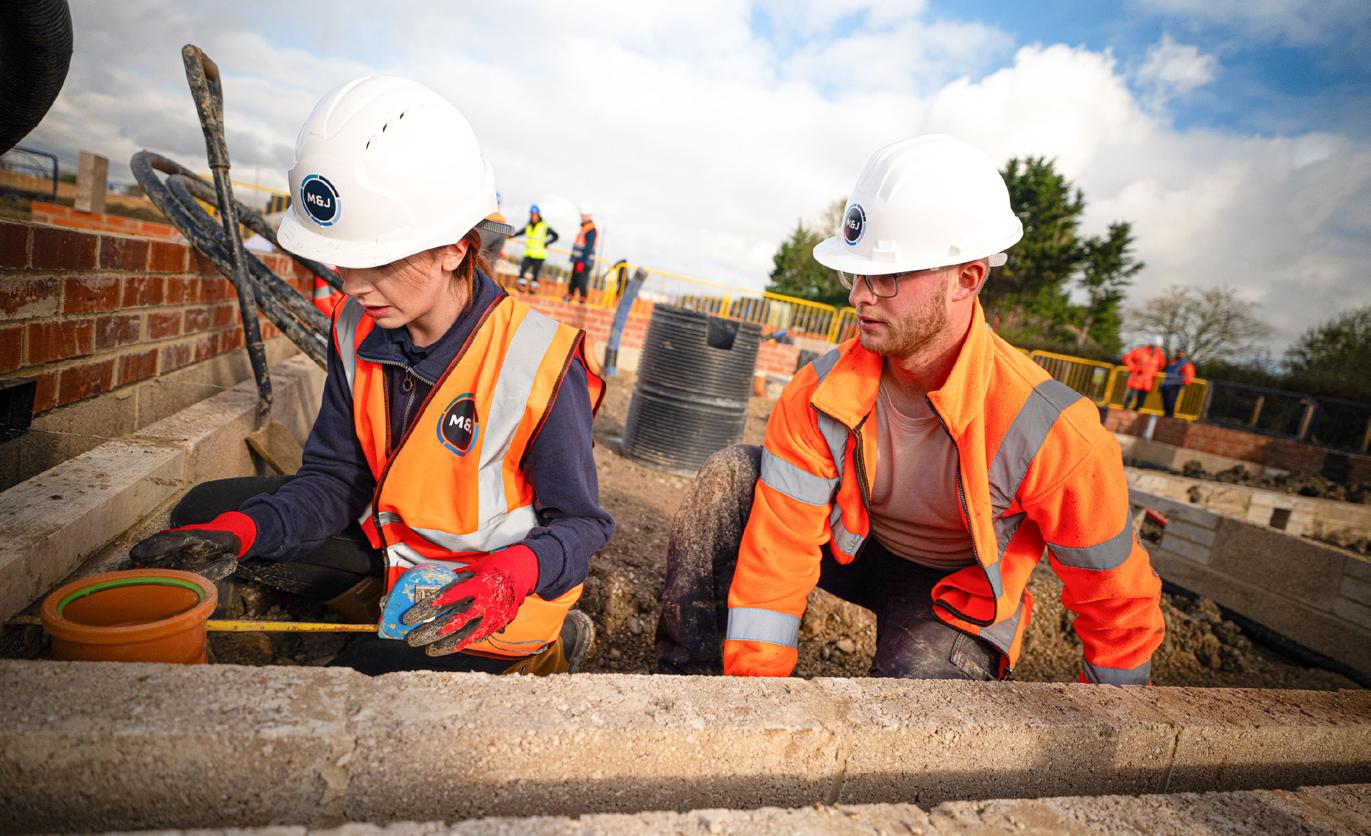
M&J LAUNCHES THE INDUSTRY’S FIRST “BESPOKE” GROUNDWORKS APPRENTICESHIP
M&J Evans, one of the UK’s largest groundworks contractors, has launched the construction industry’s first bespoke groundworks apprentice programme, in partnership with the National House Building Council (NHBC).
The programme was launched at the National School and College Leavers Festival, which took place at the Birmingham NEC in November 2024 where M&J was an exhibitor. The programme has so far attracted wide interest with many signing up already.
The programme is bespoke to M&J and is designed to give apprentices first-hand experience of what it is like to work on a live M&J site. The programme will be
administered jointly by NHBC & M&J and will see successful candidates awarded a Level 2 Groundworks Contractor qualification upon completion.
The apprenticeship can take around 1416 months to complete and will include a blend of on-the-job learning, classroombased learning at the M&J training hub in the West Midlands and practical learning at the NHBC training hub. Each apprentice is assigned a mentor, giving them a go-to person to assist with both learning and personal support.
To find out more about the M&J Apprentice Programme visit: www.mjevansconstruction.co.uk/mjapprenticeships/
COSTAIN INCREASES 2025 GRADUATE AND EARLY CAREERS INTAKE TO MATCH BUSINESS GROWTH
Costain, the infrastructure solutions company, is increasing its intake of early careers professionals to more than 180 places in 2025, in response to a strong forward work position across the business.
They will offer early careers roles for more than 60 graduates, 90 apprentices, and 30 internships and university placements following a successful period of growth for the business. This includes long-term AMP8 framework awards with Northumbrian Water, United Utilities and Southern Water, and contracts to construct a CO2 gathering network and design a hydrogen system as part of the East Coast Cluster in Teesside.
Costain recruits for early careers positions across its sectors, which include road, rail, integrated transport, energy, water, and defence and nuclear energy, and in a variety of disciplines, including civil engineering, electrical and mechanical engineering, quantity surveyors, consultancy and project management.
The graduate programme lasts two years, whilst apprentices complete a programme lasting one to six years depending on the level of study. Costain’s internships and university placements last from three to 12 months. Costain also offers work experience opportunities and T-Level placements for those at school or college.
The 2025 cohort will include the continuation of Costain’s partnership with the Nuclear Graduates programme, carried out by Energus on behalf of the Nuclear Decommissioning Authority, with the opportunity to experience some of the UK’s most complex and critical nuclear infrastructure projects in three secondments, including positions in engineering, project controls and decommissioning.
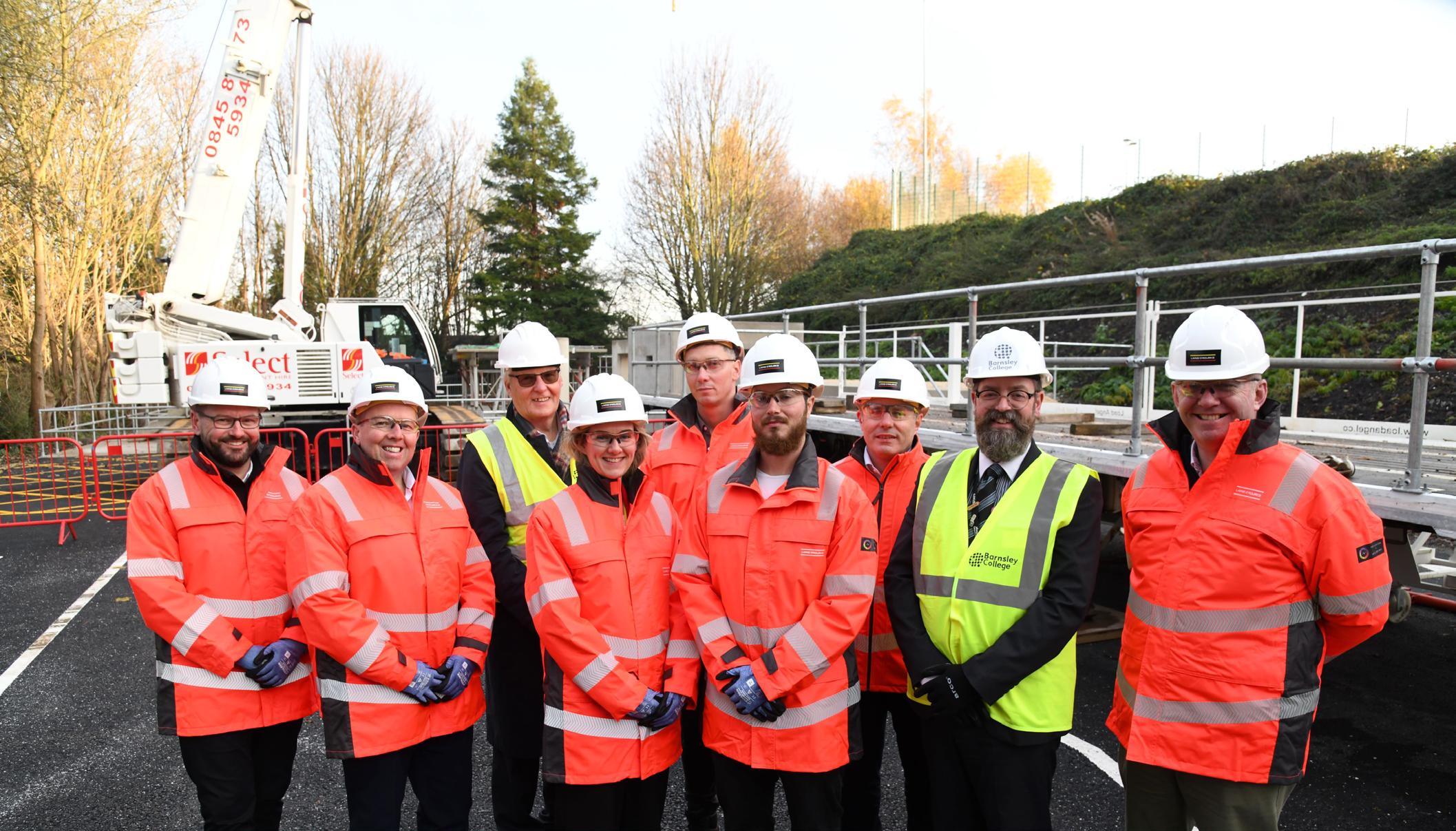
LAING O’ROURKE PARTNERS WITH BARNSLEY COLLEGE AND T3 TO LAUNCH UK’S FIRST TRAINING FACILITY FOR MODERN METHODS OF CONSTRUCTION
The ‘Modern Methods of Construction Training Centre, supported by Laing O’Rourke, will see the first cohort of apprentices begin their apprenticeships in the New Year.
Laing O’Rourke, in collaboration with Barnsley College and T3 Training & Development, opened the UK’s first dedicated modern methods of construction (MMC) training facility. The first of its kind training centre represents a ground-breaking step in addressing the UK’s construction skills shortage and modernising the industry.
The new facility, part-funded by the Local Skills Improvement Fund (LSIF), will provide people with the technical and digital skills required to assemble construction and engineering solutions that have been manufactured offsite. This includes giving learners, ‘Trainee Assembly Specialists’, access to the equipment and skills needed to work with large-scale modular components in a safe and controlled environment as they learn how to deliver sections of some of the UK’s largest infrastructure and construction projects.
Laing O’Rourke has committed to pioneering modern methods of construction for more than 15 years, knowing it offers attractive future careers that are safer, highly skilled and technical, in comparison to traditional construction approaches. The new training facility will develop digital and technical skills among their 4,500 directly employed workforces, increasing its ability to deploy a manufacturing-led approach to construction and deliver certainty for their clients.
NATWEST GROUP-BACKED RETROFIT SKILLS PROGRAMME SHOWS STRONG DEMAND AND IMPACT AFTER ONE YEAR
The first anniversary of the Supply Chain Sustainability School’s pioneering retrofit programme has been marked, sponsored by NatWest Group.
Launched to help combat climate change by upskilling the built environment sector, the free programme achieved remarkable success in just one year, with 4,668 individuals and 1,844 companies actively engaged exceeding its initial two-year goals and demonstrating strong demand for sustainable construction practices.
With buildings contributing approximately 40% of the UK’s carbon emissions, achieving netzero targets requires a large-scale retrofit of existing structures. However, a key challenge is that the current workforce lacks the necessary skills and awareness to deliver retrofitting at the scale needed.
In response, the Supply Chain Sustainability School
developed a comprehensive retrofit programme offering free CPD-accredited training. This includes e-learning modules, training assessments, workshops, webinars, and conferences designed specifically for professionals in the built environment.
Organisations such as the Construction Leadership Council, British Standards Institution, Welsh Government, Historic England, Wates, CBRE, Robertson Group, and Canary Wharf Group have actively shared their expertise at events, ensuring that the programme drives meaningful progress in retrofitting and sustainability across the UK’s built environment.
Training & Education News
MERSEYSIDE TRAINING ACADEMY LAUNCHED TO TACKLE CONSTRUCTION SKILLS SHORTAGE
Keepmoat is working with Sterling Plastering and Hugh Baird College to launch a bespoke training academy that will support young people into plastering apprenticeships, bolstering its commitment to bridge the nationwide construction skills gap.
It’s anticipated that 225,000 new construction workers are needed by 2027 in the UK, and this week the Government also announced that 5,000 more construction apprenticeship places will be made available every year through DoE funding.
The launch of the new facility, now named the SPL Change Academy, was recognised by an event attended by all the partnering businesses and current training apprentices in a celebration of the new training format.
The construction industry is also facing an ageing workforce, with the average age of a plasterer being 42-years-old, it’s imperative young people are entering the trade to prevent further workforce challenges.
The SPL Change Academy will offer Level 1 and Level 2 NVQ plastering courses, supported by tutors from Hugh Baird College.
BUILDING ROADS, BUILDING FUTURES – YOUNG PEOPLE TAKE ON A BIG DESIGN CHALLENGE
Creativity, problem-solving and teamwork helped 40 budding engineers and future project managers from six local high schools rise to the Big Design Challenge.
Tasked with designing a new road connecting Falkirk, Grangemouth and Stenhousemuir, the challenge was completed with real-world constraints like timelines, budgets and environmental impact.
Although the road was fictitious, the process of designing it was very real. Over seven weeks, the senior pupils worked in teams – and often in their free time - to scope out their projects, calculating timescales, balance costs and consider sustainability.
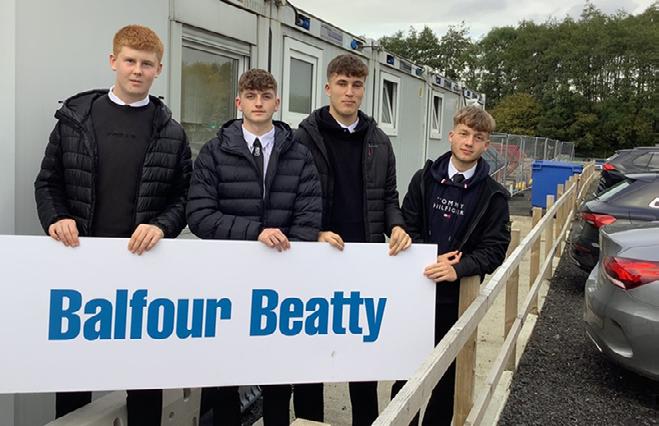
By doing so, the pupils from Braes, Denny, Graeme, Grangemouth, Falkirk and Larbert High Schools became the first in Scotland to complete Balfour Beatty’s ‘Big Design Challenge’, an innovative new programme that aims to give young people a taste of what it’s like to work on a major infrastructure project.
The challenge is just one of the ways Balfour Beatty is providing wider community benefit as part of its contract to deliver the A9/A904 Westfield Improvements Work on behalf of Falkirk Council.
Using insight from industry experts working on the Westfield project, Balfour Beatty joined forces with Developing the Young Workforce (DYW) to create the challenge.
As well as school-based learning, the challenge provided senior pupils with a unique opportunity to visit a live construction site and meet Balfour Beatty’s team at the A9/A904 project site.
They also worked with industry experts who visited their schools to give them advice and insight into the construction industry.
The challenge encouraged the pupils to think big, balance risks and build confidence – all while getting a taste of what it takes to deliver infrastructure projects that shape communities, just like the A9/A904 Westfield Improvements Work.
Lay the foundations for healthier and safer construction
A practical qualification that gives you the skills and confidence to take on health and safety responsibilities in the construction industry.
The NEBOSH Health and Safety Management for Construction (UK) Certificate provides valuable knowledge and practical skills that will support you in your role.
It features on the Construction Skills Certification Scheme (CSCS) list of qualifications which meet the criteria for the Academically Qualified Person (AQP) card scheme.
It is ideal for construction site managers, contract managers, site workers with health and safety responsibilities, and construction health and safety advisors.
Applying the knowledge gained from completing this qualification can help you to make your construction site healthier and safer!
About NEBOSH
NEBOSH is a leading global organisation, which provides health, safety, and environmental qualifications. Our internationally recognised qualifications help to raise the competence of safety and environmental professionals as well as individuals at all levels in the workplace. NEBOSH qualifications are highly respected by governments, employers, and our learners.
Tens of thousands of people from more than 170 countries study for a NEBOSH qualification every year, learning with our network of over 450 Learning Partners.
“NEBOSH construction qualifications are highly sought after by employers in the construction industry. It is a real stamp of quality for those who attain it.”
James Irwin, Director, Irwin & Colton Health and Safety Recruitment
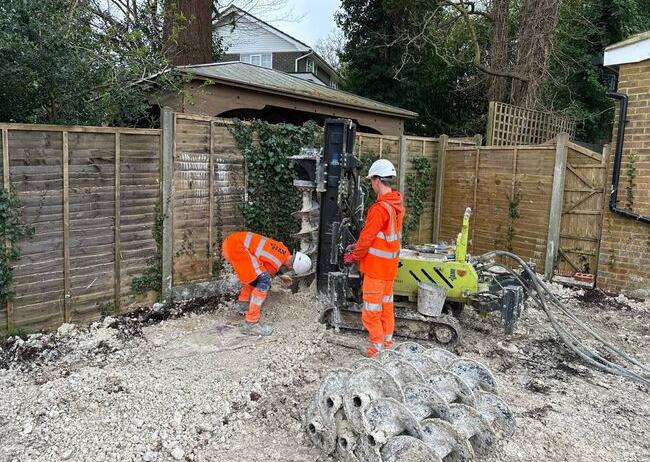
KHB PILING LAUNCHES SUSTAINABLE PILING INITIATIVE IN LONDON
KHB Piling, a leading piling contractor in London, has announced a new sustainable piling initiative aimed at reducing the environmental impact of construction projects across the city. This strategic development responds to the growing demand for eco-friendly piling solutions in London’s construction sector.
As part of this initiative, KHB Piling will introduce advanced piling techniques, including Continuous Flight Auger (CFA) piling and screw piling. These methods are designed to minimise environmental disruption while providing reliable and robust foundation solutions.
The company is also implementing a comprehensive environmental monitoring programme to assess the impact of piling works in London’s urban areas, further enhancing its commitment to sustainable construction practices.
In addition to its sustainable piling initiatives in London, KHB Piling is planning to expand these practices to other cities in the UK. The company is exploring partnerships with industry leaders and environmental organisations to set new standards in sustainable piling practices nationwide.
FUTURE
DESIGNS
REMAINS AS AMBITIOUS AS EVER
The leading UK lighting manufacturer announces its plan for continued success of the business.
Succession planning for FUTURE Designs began five years ago with the creation of the Employee Ownership Trust. This was initiated for the long-term benefit of all employees and the continued legacy of the organisation.
Since then, there has been a focused strategy to develop and strengthen the senior management team, alongside a significant investment to increase the expertise and skill sets within the business, with David Clements (pictured) taking on the role of Chairman. This moves away from the day-to-day running of the business, to focus on strategic growth in key global markets across Europe and the Middle East, whilst pushing forward with the expansion of the carbon carefulTM initiative into other market sectors.
After nine years in Farringdon the business has relocated the design and technology centre to Soho, representing a major investment to increase its presence and visibility, creating an industry hub for networking and knowledge sharing.
HERITAGE FRAMEWORK AWARDED TO PICK EVERARD IN HISTORIC PARTNERSHIP
Reinforcing its expertise in heritage and culture, multidisciplinary consultancy Pick Everard has been appointed as a supplier on Historic England’s coveted architectural, surveying, principal designer and lead professional services framework; marking the beginning of a strategic partnership with Historic England as part of its Future Office Estate Strategy.
Under the new three-year framework, Pick Everard will provide compliant, secure, and productive workplaces prioritising the wellbeing of Historic England’s staff in the UK. The firm will operate across two lots, covering north of England and the Midlands, as well the South West, South East and London regions.
The work will include the delivery of specialist surveys including condition, structural, fire zoning, and utilities, ensuring that historically significant assets are preserved, sustainable, and adapted for long-term use.
Through targeted repair, conservation, refurbishment, fit-out and M&E projects, the consultancy will support the sustainable transformation of Historic England’s diverse portfolio, encompassing modern, listed and non-listed buildings and scheduled monuments.
HAULTECH HELPS SPECIALIST HAULIER TO WORK SMARTER
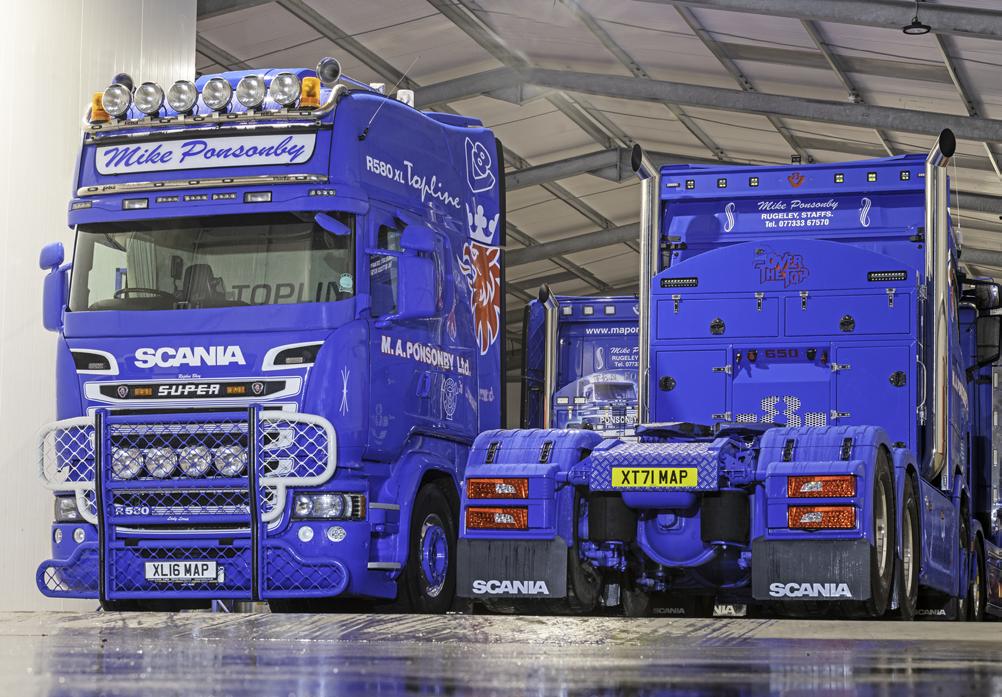
MA Ponsonby has grown from one truck operated by founder Mike Ponsonby into a thriving business with more than 15 Scania trucks and a large fleet of specialist trailers. Mike is still managing director while his son Jack is operations director. Two more sons are specialist HGV drivers.
The Lichfield-based business recognised that its increased size and scale meant that it needed to move away from pen-andpaper administration to maintain its high productivity and service quality levels. The company invested in HaulTech’s transport management system (TMS), which has provided multiple business benefits.
A specialist in construction plant and other heavy haulage for more than 20 years, MA Ponsonby’s trailer fleet includes HIABs, step frames and low loaders. The company has been a FORS member for 10 years and currently holds FORS Gold level accreditation.
Designed to meet the needs of independent hauliers, HaulTech’s TMS can reduce administrative processes by up to 80%. It also helps haulage companies to control and cut operational costs.
FUSION21 INVITES BIDS FOR £800 MILLION BUILDING SAFETY AND COMPLIANCE FRAMEWORK
Fusion21 has announced the renewal of its national Building Safety and Compliance Framework, worth up to £800 million over four years, and is now inviting bids from interested suppliers providing regional or national coverage.
The procurement with purpose provider is seeking competent and specialist suppliers to help landlords manage and maintain safe buildings and demonstrate compliance.
Suitable for all building types across the public sector, this fourth-generation framework continues to support Fusion21’s ‘big six’ offer and includes a new lot dedicated to sprinkler and mist systems.
To learn more and apply for the framework use the following link: https://hubs.li/Q02XgVxN0 and click on ‘Current opportunities’.
& Plumbing
‘FABRIC FIRST’ PRINCIPLES SHOULD BE ADOPTED BY THE WATER INDUSTRY
‘Fabric First’ is a practice recognised in the building industry, to improve the energy efficiency performance of homes.
Stewart Clements, Director of the Heating & Hotwater Industry Council (HHIC) recently stated. “It’s important that those responsible for building new homes and for upgrading existing homes – including both social and private housing providers and landlords – recognise the different factors involved in minimising energy consumption and in making tomorrow’s homes the efficient properties needed to achieve decarbonisation and reach the net zero target for 2050.”
Historically, the environmental impact of water usage has been largely ignored. However recent environmental concerns and energy costs have highlighted the link between the water coming out the tap and environment. The recent surges in energy prices have focused attention on the cost. Heidi Mottram, CEO, Northumbrian Water highlighted the fact that on average 25% of energy used in the home is to heat water.
The energy used to heat water for devices and appliances emits an average of 875kg of CO2 per household per year. This is equivalent to the CO2 emissions from driving more than 1,700 miles in an average family car.
- Energy Saving Trust
Whilst water efficient appliances, i.e. dishwashers and washing machines, can reduce domestic water and energy usage, much of this hot water used in ‘time critical’ usage e.g. taking a shower or running the tap to rinse dishes.
To date, much of the water industry’s focus has been on adapting customer
behaviour. In traditionally drought ridden environments such as Australia and South Africa, consumers have largely embraced the message. However, Britain’s grey sky and regular rainfall makes it harder to embed behaviour change. A change in the ‘fabric’ of the water network may be the solution.
Our water companies are regulated to provide a minimum standard of pressure and flow of water, but in many areas due to network structure and gravity fed systems supply is much greater. So, run a hose for five minutes at the bottom of the hill, and your lawn will be greener than the gardener that does the same at the top. These ‘time controlled’ uses, e.g. teeth cleaning, taking a shower, running a tap to rinse dishes could be standardised
down if all households received the same acceptable, ‘standardised’ supply.
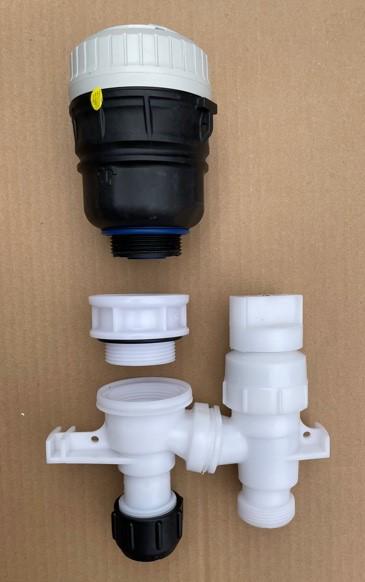
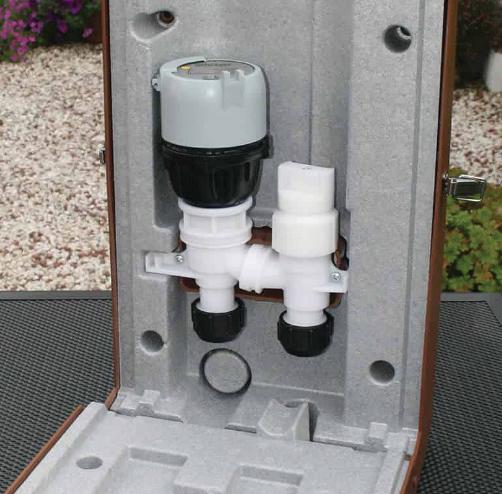
Groundbreaker’s NRv2 LoFlo® is a surprisingly simple method of working towards current water usage reduction targets NRv2 LoFlo® regulates the level of flow entering customer premises –regardless of network pressure, meaning a reduction in the level of water used by customers when ‘variable use’ appliances are used. As the flow of water into the premises is limited, then the amount used by the customer is also limited – but without providing a degradation of service, and more importantly not requiring any intervention or behavioural change on the part of the customer, leading to ‘natural’ reduction in per capital consumption.
Whilst some water companies are offering ‘environmental incentives’ to developers to build water efficient homes, and some local planning departments are insisting on water efficient homes designed to keep per capita consumption (PCC) to under 100L per person per day, this will not impact the consumption of existing housing stock.
The NRv2 LoFlo® can be easily and simply fitted to any meter installation or retrofitted on meter exchange or when upgrading or remediating underground meter chambers. Thus, allowing Water Companies to manage demand with little or no impact on consumers and at minimal cost to the water undertakers.
A simple solution at approximately £20 per household, fitted on the normal meter exchange/upgrade cycle could achieve in excess of 20% of consumption reduction targets in 10 years.
A number of flow modulation ranges are available which enable the perfect balance between usage reduction and service provision. As an added benefit, the NRv2 LoFlo® can also provide whole site protection against contamination by back flow - effectively a 3 in 1 solution.
Groundbreaker, surface mounted water meter housing, adjacent to energy meters
NRv2 LoFlo®
Water meter, NRv2 LoFlo® and manifold positioned as located in boundary box or Groundbreaker
Drainage & Plumbing
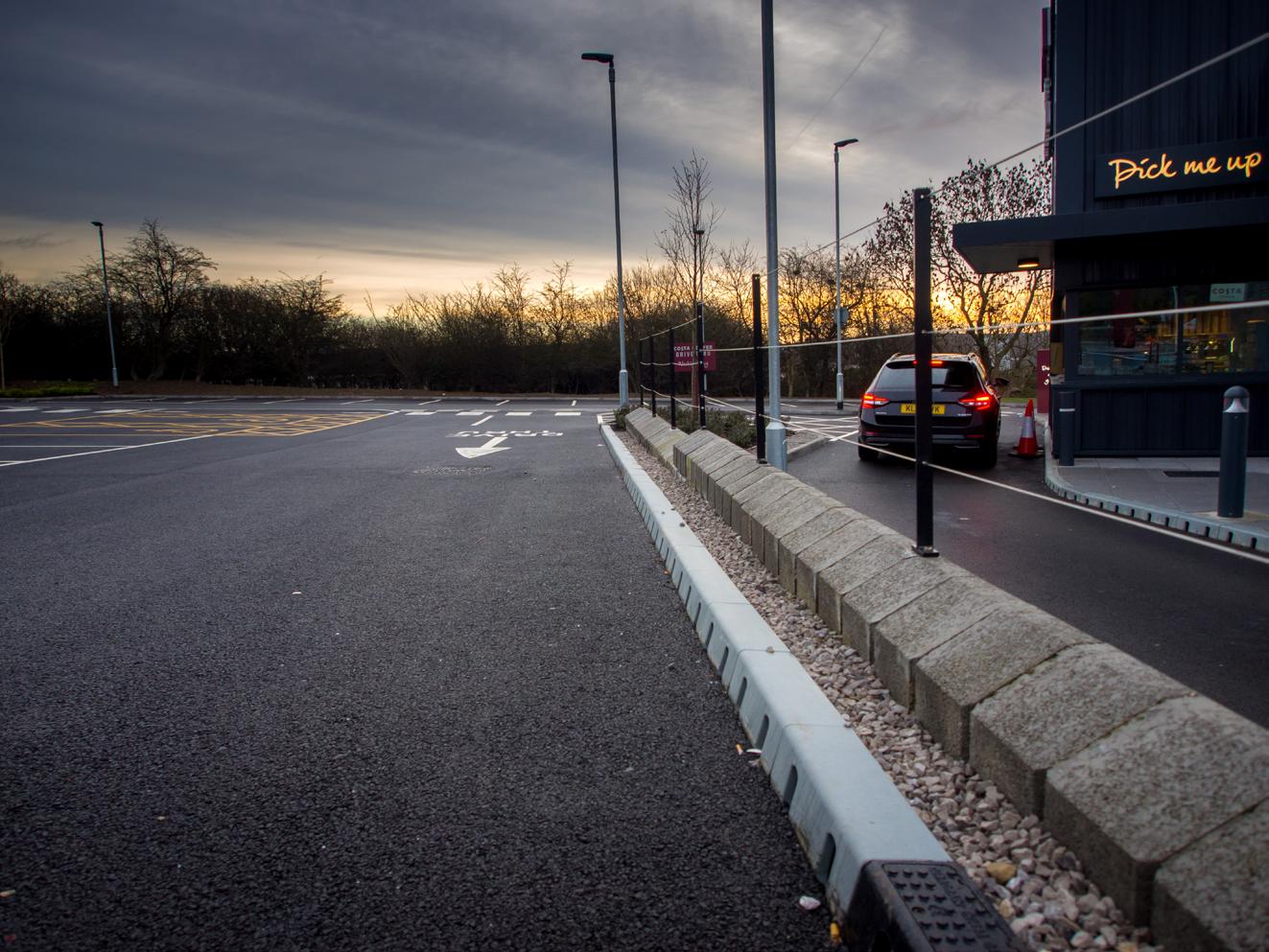
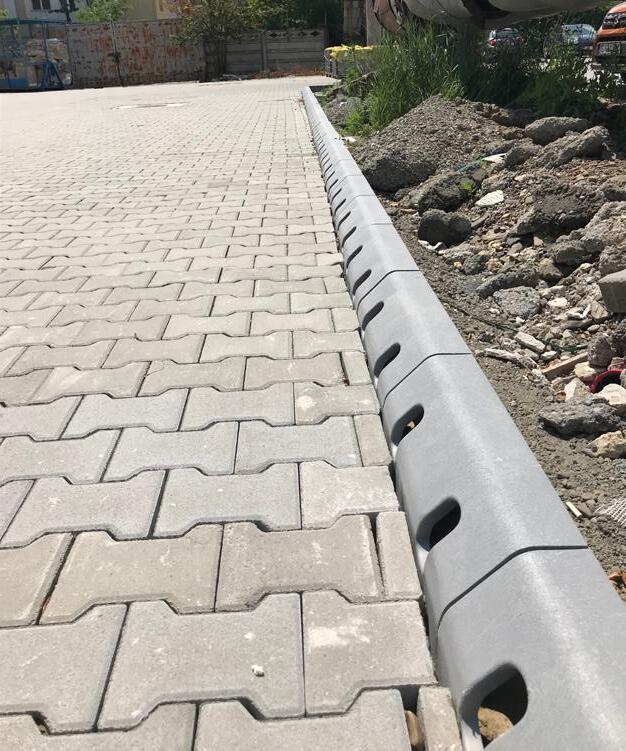
Duraproducts, a pioneer in sustainable construction since 2003, has witnessed a surge in demand for its eco-friendly solutions. Among its innovations, the 50000-Durachannel, a shallow yet robust linear drainage system, stands out. Designed for infrastructure projects like car parks and forecourts, this system provides contractors with a sustainable and efficient water management solution.
HAILING SUSTAINABILITY IN DRAINAGE
By Andy Leah, General Manager, Duraproducts
Climate change is already having visible effects on the world. The Earth is warming, rainfall patterns are changing, and sea levels are rising. In the UK, in particular, weather patterns are shifting with the country experiencing wetter summers and drier winters. With more urban environments than ever there must be sustainable methods which divert surface runoff to nearby water sources.
But in today’s environmentally conscious world, surface drainage units must not only be effective but also manufactured and installed sustainably. By adopting sustainable practices, the industry can significantly reduce
Andy Leah
its environmental impact. But how do construction companies know which solutions are good for the planet and which aren’t?
Life Cycle Assessments (LCAs) and Environmental Protection Documents (EPDs) are becoming indispensable tools for evaluating the sustainability of construction materials. These assessments provide valuable data on a product’s environmental impact throughout its entire lifecycle, from extraction and manufacturing to transportation, installation, and disposal. By considering LCAs and EPDs, planners, designers, and contractors can make informed decisions about material selection and contribute to more sustainable construction projects.
Government regulations and incentives are beginning to further drive this market, encouraging the adoption of sustainable practices in both new developments and retrofitting existing infrastructure. As awareness of environmental issues continues to rise, the demand for sustainably produced and installed solutions is expected to grow, presenting significant opportunities for businesses and communities committed to reducing embodied carbon emissions.
In addition to Durachannel, Duraproducts’ combined kerbing and drainage system, Duradrain, offers a lightweight, recycled, and recyclable alternative. Both manufactured from hydraulically efficient polymer materials, the systems provide a large usable volume while delivering low carbon outputs, contributing to reduced environmental impact. Duraproducts’ drainage solutions effectively protect surfaces by rapidly channelling runoff at multiple points along the kerb or channel lines, ensuring large areas are drained quickly and safely.
By offering innovative drainage solutions made from recycled polymers, Duraproducts is setting a new standard for sustainability in construction, proving that eco-friendly practices and innovative technology can go hand-inhand to create a better future for all.
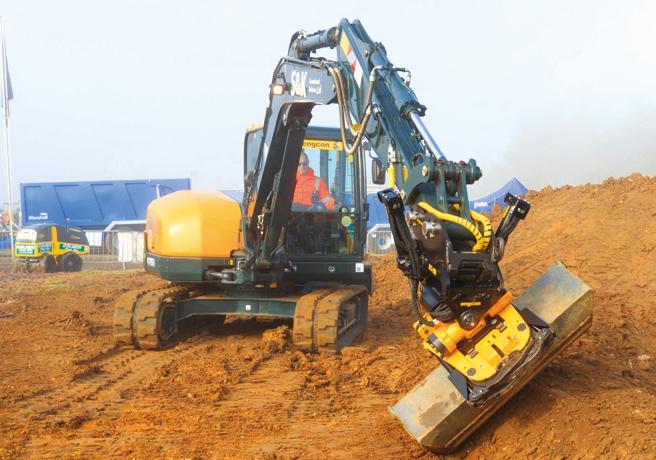
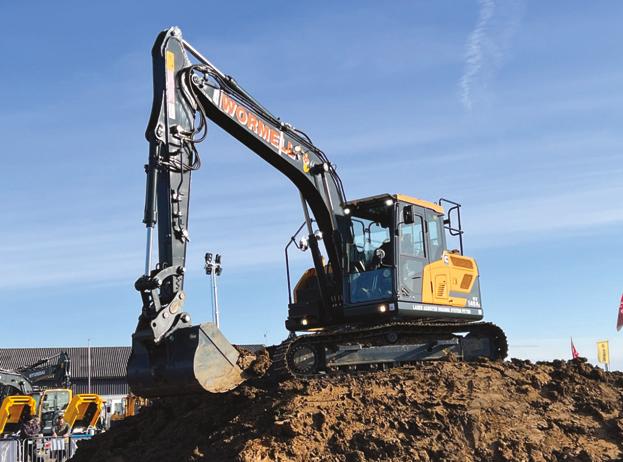
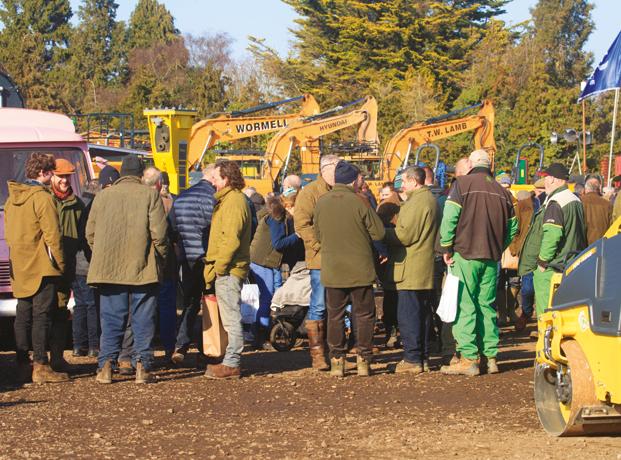
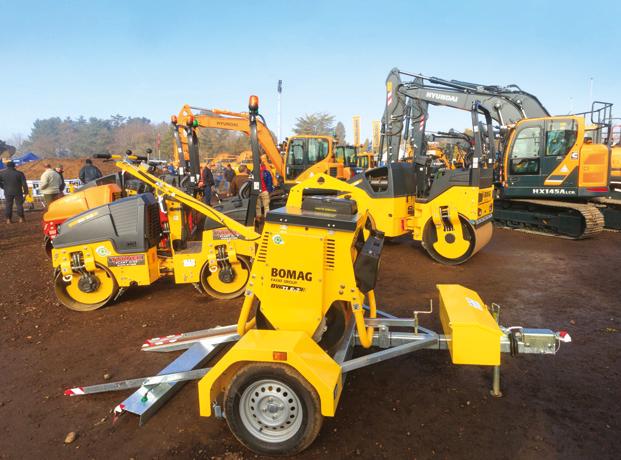
OVER 150 TRADE STANDS...
• Come and see the latest machinery and innovations available on the market
• Expanded construction zone • Meet the manufacturers
• Hyundai Construction Equipment Europe • Thwaites dumpers
• Bomag compactors • Epiroc hydraulic attachment tools and breakers
• Large demonstration plot • See the heavy plant machinery in action
• Lots of clearance bargains and used machinery deals available
• Special one off ‘Doe Show Deals’ • Clothing and footwear sale and much, much more…
BALFOUR BEATTY PLEDGES
ITS ALLEGIANCE TO VETERANS AND RESERVISTS BY RE-SIGNING THE UK ARMED FORCES COVENANT
Balfour Beatty today announces that it has re-signed the UK Armed Forces Covenant, marking nearly a decade of dedicated support for veterans, reservists, cadet force adult volunteers and their families.
The Armed Forces Covenant provides a framework for businesses in the UK to ensure that veterans, reservists and their partners are treated fairly in the workplace and are fully integrated into the wider community.
At a signing event Balfour Beatty made specific commitments around recruitment and skills development including a pledge to recruit 200 veterans annually from 2025, whilst also supporting new joiners’ transition to civilian careers through its Military Talent Pathway.
This latest commitment builds on the launch of the Mulberry Affinity Network earlier this year, recognising the importance of accommodating the needs and requirements of Armed Forces veterans, reservists and their partners to ensure the company is utilising the unique and transferable skill set they bring to the construction and infrastructure industry.
NEW PUBLICATION TO INFORM DECISIONS ON UK NATIONAL INFRASTRUCTURE
A new collection of articles featuring expert analysis, researchbased evidence and policy recommendations to address the critical challenges decision-makers face on UK infrastructure policy has been launched.
Published by The University of Manchester’s policy engagement unit, Policy@Manchester, On Infrastructure incorporates eight contributions from leading academics covering a diverse range of issues – each with a major impact on the nation’s infrastructure.
Topics covered include broadband connectivity, public transport, housing, planning, the NHS and green infrastructure.
The publication begins with an insightful foreword by Dr Janet Young CBE, Director General and Secretary of The Institution of Civil Engineers, who argues that modern infrastructure services such as energy, transportation, communication and water networks “must serve growing populations, contribute to growing economies, and respond to the growing threats of climate change and biodiversity loss.” Dr Young predicts that the future “will continue to see spectacular innovation in our field.”
The publication also includes an article on the digital infrastructure divide co-written by Professor Cecilia Wong, Director of the Spatial Policy and Analysis Lab at The University of Manchester and Academic Co-Director of Policy@ Manchester.
On Infrastructure is available to read free of charge on the Policy@Manchester website: www.policy.manchester.ac.uk/ publications/on-infrastructure/
Professor Cecilia Wong
SIG REPEATS SUPPORT FOR FOODBANK INITIATIVE
SIG are participating in supporting the Morrisons Supermarket Foodbank campaign again after receiving possitive feedback and inspiring stories from last years support.
IMPACT
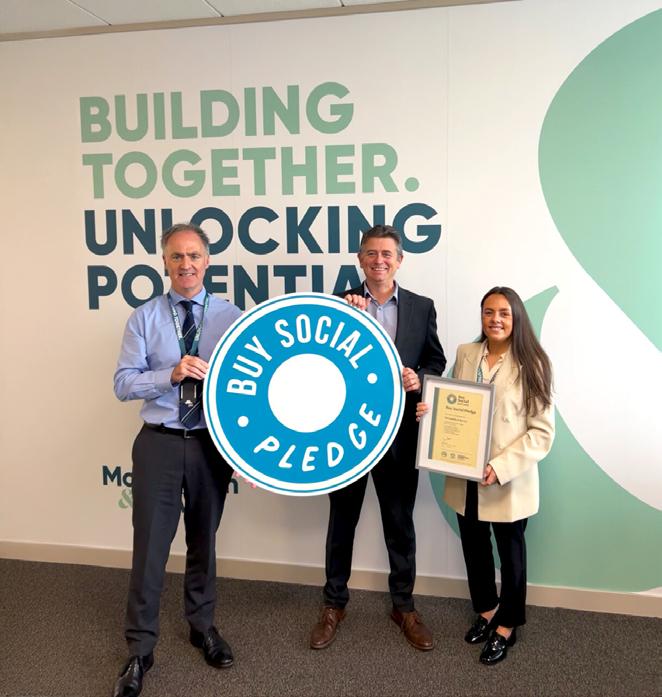
JOINING THE BUY SOCIAL PLEDGE
McLaughlin & Harvey is the latest organisation to sign the Buy Social Pledge, an initiative that empowers businesses to use their purchasing power for social and environmental good across Scotland’s communities.
The pledge, run by Social Enterprise Scotland, brings together corporate businesses, SMEs, academic institutions, and public sector bodies in a shared commitment to integrating social enterprises into their supply chains. It allows businesses and institutions to harness their purchasing power and contribute to positive social change in the communities in which they work.
Organisations who sign up to the Buy Social Pledge commit to promoting inclusive economic growth. The pledge signifies a transformative approach, where businesses become the key drivers for positive, measurable change in the communities.
Across its projects, McLaughlin & Harvey look for ways to cultivate meaningful engagement with local social enterprises. As part of its sustainable procurement strategy, it uses initiatives such as Meet the Buyer events and the Social Partnership Portal to connect with local social enterprise organisations.
For more information about the pledge, visit https://www.buysocialscotland. com/business/buy-social-pledge MCLAUGHLIN &
49 strategically placed branches nationwide from the SIG UK Roofing, SIG Interiors, and SIG Specialist Market divisions, alongside two full shopping trolleys of items from the SIG head office team based in Sheffield, are collaborating in an impressive effort.
Each branch is working closely alongside their local Morrison
Community Champions to understand what their local food banks require to address specific needs, ensuring that these efforts will have the greatest possible impact. Additionally, Morrisons has agreed to provide a 10% discount on all products purchased by SIG, allowing each pound donated to stretch even further.
The branch staff are busy creating tailored shopping lists and visiting Morrisons Supermarkets to fill their trolley with items that will be delivered by the Morrisons community team to local food banks.
FORTERRA DONATES £1,000 TO SUPPORT ACCESSIBLE ARTS FOR DISABLED CHILDREN
Building products manufacturer Forterra has contributed £1,000 from its Community Fund to Circus Starr CIC, an accessible performing arts organisation dedicated to creating inclusive entertainment for disabled children and their families.
The donation will provide 50 tickets for these families to attend a Circus Starr performance in Peterborough, near Forterra’s Kings Dyke factory in Whittlesey.
Cheshire-based Circus Starr has been a pioneering force in accessible arts since its founding as a social enterprise. Now a Community Interest Company (CIC), it organises tailored performances in safe, welcoming environments to accommodate children with disabilities, sensory impairments, neurodivergence, and additional learning needs.
During performances a professional troupe of performing artists showcase skills such as acrobatics, juggling, singing, clowning and hula-hooping, offering unique entertainment for families that otherwise might feel excluded from these experiences.
Each year, Circus Starr undertakes three major tours, reaching 74 towns across the UK. These theatre tours bring shows to various indoor venues, including stops in Cambridge, Dundee, Glasgow, and Edinburgh.
The company collaborates with a network of local organisations, including social services and hospital groups, to allocate tickets to families who would benefit the most. Families can also request tickets directly via the Circus Starr website.
Forterra’s Community Fund supports charitable projects across the UK.
For more information, visit www.forterra.co.uk/about-us/ community/community-fund.
integrate seamlessly with other smart systems, from garage doors to door locks. With over 80 integration partners in the DoorBird Connect network, customers enjoy flexibility in creating personalized smart home setups.
Going Global: A Strategic Vision
DOORBIRD: A DECADE OF SMART INNOVATION IN DOOR COMMUNICATION
How a Berlin Start-Up Became a Global Pioneer
Ingenuity and quality have long defined Germany’s place in the business world. DoorBird, the flagship product of Bird Home Automation GmbH, exemplifies these principles, evolving into a global leader in smart door intercom systems within just ten years.
In 2014, a small team in Berlin set out to revolutionize door communication. Working from the 13th floor near Kurfürstendamm, they envisioned a product that would allow residents to communicate with visitors and even open their doors remotely. By autumn, the first models were ready: featuring an HD camera with a 180° ultra-wide angle, night vision, motion sensors, Wi-Fi, and multiple connection options. This comprehensive feature set quickly distinguished DoorBird in the market. The first sale came in December 2014 to a customer in Florida, followed shortly
by a sale near Cologne, Germany. From there, DoorBird took off, solidifying its presence in the rapidly growing smart home market.
Continuous Innovation and Product Expansion
DoorBird didn’t stop at its initial success. As the D10x series gained traction, the team launched new ranges made of premium materials like stainless steel, catering to customers’ desires for flush-mounted, high-quality designs. Accessories such as additional cameras and alarm sirens followed, expanding the ecosystem.
By 2024, DoorBird offers a staggering 2,300 product variations, thanks to diverse models, colors, and configurations. Each innovation reflects customer needs, earning widespread approval in 161 countries.
Made in Germany: A Commitment to Quality
From day one, DoorBird has been proudly “Made in Germany.” Based in Berlin, the company designs, tests, and manufactures its products locally, ensuring strict quality control. Extensive product testing in custom-built environments guarantees durability and reliability.
Compatibility is another hallmark of DoorBird’s success. Through its welldocumented API, DoorBird products
While firmly rooted in Berlin, DoorBird identified the USA as a key market early on. Recognizing the country’s early adoption of home automation, the company debuted its product at a US trade fair in January 2015. The positive reception validated their strategy, leading to the establishment of a San Francisco office later that year.
Specializing in upscale residential solutions and B2B partnerships with electricians, DoorBird quickly gained a foothold. By 2021, a second US office in Jacksonville, Florida, brought the company closer to East Coast customers, strengthening its presence in a competitive market.
Joining the ASSA ABLOY Family
After years of steady growth, DoorBird entered a new chapter in 2022 by joining the ASSA ABLOY Group, a global leader in locking and security solutions. This partnership positions DoorBird to tackle large-scale projects, including hotels, commercial facilities, and residential complexes, further expanding its reach.
ASSA ABLOY’s acquisition integrates DoorBird’s expertise in IP door communication into a comprehensive global portfolio. Backed by this strong partner, DoorBird remains committed to delivering innovative products that meet diverse customer needs—all designed and manufactured in Berlin.
DoorBird’s journey over the past decade reflects a commitment to quality, innovation, and customer satisfaction. As the company continues to grow within the ASSA ABLOY family, its mission remains unchanged: to provide smart, high-quality solutions that redefine door communication, no matter where in the world they’re needed.
Made in Germany, loved globally!
TRANSFORM PROJECTS WITH SLIDING AND FOLDING DOORS
By David Knollman of Brio UK
Sliding and folding door features are naturally aesthetic in design and both systems are frequently used to enhance the style of living environments. The distinctive design of each door profile helps to extend living spaces and allow for more light to be passed through to interior rooms, with internal bi-fold doors effective at splitting large communal areas up to create smaller spaces and sliding doors proficient in saving noticeable amounts of room when floorspace is limited.
Where external doors act as a gateway to the great outdoors, internal doors create airy open plan spaces and
enhance movement from room to room, which is especially useful in large open plan gatherings, where increased traffic flow is expected. In high-end applications, large sliding panels are often utilised with specialist hardware and profiles, allowing the glazed part of the door to consist of minimal framing for uninterrupted views. Folding doors on the other hand, allow for a virtually clear opening, with smaller panels and more vertical frames, which when opened, will fold back on themselves, concertina-style, revealing a complete opening and stacking together in the process.
IP Video Door Stations from DoorBird
Easy Installation via PoE
Keyless Access via App, RFID, Keypad or Fingerprint
Compatible with Crestron, Kisi, RTI and many more
High-quality and long-lasting materials
DoorBird combines exclusive design with the most innovative IP technology in the field of door communication.
Modern doorsets are supplied in a range of materials, finishes and variants, and cutting-edge hardware systems are purpose designed to accommodate installations for virtually any fixing. Quality and reliable hardware systems will support large door set ups to achieve unbroken sight lines and panoramic views, whilst offering superior roller performance and effortless smooth operation to guarantee an element of safety and control.
In any case, sliding and bi-fold door applications can offer superior functionality, visual appeal and spacesaving capabilities when compared with traditional swing doors - and the possibilities only continue to grow.
David Knollman
Sustainability News
NEW FACILITY MARKS BCU’S COMMITMENT TO NET ZERO HOMES AND THE CONSTRUCTION WORKERS OF THE FUTURE
Birmingham City University’s (BCU) Centre for Future Homes is behind the new showroom, which is located in Millennium Point and was made possible by funding from the UKRI’s Regional Innovation Fund.
It features a range of all-electric heat solutions, including heat pumps, hot water storage, panel radiators, PV, and underfloor heating, as well as ventilation options to help the more air-tight homes breathe, and walling fabric options to increase thermal insulation.
Climate change and building safety are the key drivers for the Centre, which launched in 2021 and is leading the transition to net zero homes.
The Centre for Future Homes puts customers at the heart of the journey, rebuilding the public’s trust and confidence in the construction sector by putting quality and safety first.
In partnership with Midland Heart Housing and Keepmoat, the Centre has supported two low-carbon new build sites that meet the government’s incoming Future Homes Standard.
These insights will enable policymakers to make evidence-based decisions for a safe transition to low-carbon living that avoids tragic consequences in the wake of the Grenfell Tower Inquiry.
GOVERNMENT LAUNCHES TREE
PLANTING TASKFORCE TO
OVERSEE PLANTING OF MILLIONS OF TREES ACROSS OUR FOUR NATIONS
A new Tree Planting Taskforce has been launched to oversee the planting of millions of trees across the UK. The Taskforce brought together representatives from key arm’slength bodies and delivery partners from across the UK.
Top of the agenda at the meeting was how to drive forward the UK’s tree planting in order to meet collective net zero targets as part of the Government’s critical mission to make the UK a clean and green energy superpower.
The UK has less tree cover than almost anywhere in Europe and more work is needed to close this gap. Our nation’s woodlands and trees are the heart of communities around the UK, essential to supporting wellbeing and improving quality of life, alongside providing sustainable timber and being home to some of our most important species.
The Taskforce is designed to strengthen collaborative working across the UK, identifying opportunities to work together, to improve tree planting and ensure
the long-term survival of woodland, safeguarding their benefits for future generations.
GROUND BROKEN ON ZERO-GAS AFFORDABLE HOMES DEVELOPMENT IN SHEFFIELD
Work is underway on a £18.9 million zero-gas affordable housing development at Newstead in South East Sheffield.
North of England contractor, Esh Construction, is delivering 77 new homes with enhanced sustainability credentials on behalf of Sheffield City Council.
Designed by Peak Architects, the development will feature 36 one and two-bedroom apartments with communal gardens and balconies, alongside 41 two, three and fourbedroom properties with off street parking and gardens. All homes will be fitted with air source heat pumps instead of traditional gas boilers, as well as enhanced insulation and electric vehicle (EV) chargers.
Sheffield City Council has been awarded £1.3 million of funding from the South Yorkshire Mayoral Combined Authority’s Brownfield Housing Fund towards the Newstead development.
While on site, Esh will deliver a range of employability sessions to local schools and colleges, while investing in a local workforce and apprenticeship opportunities through its Constructing Local strategy
The scheme is expected to complete in Summer 2026.
CONDITION SURVEY ENHANCES SUSTAINABILITY OF HISTORIC LONDON PROPERTY
Protecting unique architectural elements, one of London’s Grade II listed buildings has undergone a condition and sustainability survey to preserve its 140-year-old heritage.
Situated at the heart of the Knightsbridge conservation area adjacent to the Royal Albert Hall, Queen Alexandra’s House operates as a women-only accommodation for students at the Royal Colleges of Music, Art and Science.
Built in 1884, the building required an in-depth assessment to evaluate its current condition and identify opportunities to improve its sustainability.
Pick Everard was appointed to deliver a detailed condition report, ongoing maintenance and capital works plan, a costed schedule of works, and proposals for enhancing the property’s environmental sustainability and energy performance.
Following the survey, they recommended remediations into projects which can be delivered while the tenancy is empty to ensure minimal disruption.
The condition and sustainability survey has provided the Board of Trustees at Queen Alexandra’s House with a list of recommended remediations that will maintain the property’s unique historical character and improve its energy performance.
ECOLOGY IN DESIGN: HOW HARNESSING THE GREY BELT CAN BOOST BIODIVERSITY
By Emelye Kenyon, director and head of environmental engineering at Pick Everard
When looking at Biodiversity Net Gain (BNG), the task is to create ten per cent more or improved habitats than was previously on the development site and this can inevitably mean that there is less land to develop on. Given the new housing targets in particular, this can spell problems from the get-go.
Grey belt is a concept coined by the new Labour government, in which greenbelt that is less attractive can be used in conjunction with brownfield sites to meet housing demand. However, there is also the potential for some areas, such as land alongside highways that is not really ideal for buildings, to be repurposed through landscaping. It’s a good opportunity to find a use for this land without losing prime locations for property development.
Construction constraints
Some clients are in an especially difficult situation when it comes to BNG, due to either space limitations or even safety concerns. Warehouses, for example, need a certain square footage which can sometimes be a tight fit on the chosen parcel of land, so having the option to use grey belt for BNG presents a viable opportunity.
In addition, the blue light sector has to be more careful around what landscaping is used when working on new sites. Planting trees, for example, could potentially create a risk with people being able to climb them, while planters, often deployed as crash barriers, are clever but limited in their BNG output.
Prisons are another example of infrastructure struggling for space to add in BNG elements. They are often quite prescriptive in terms of what buildings are needed under MoJ requirements, so finding additional space for BNG is complicated. Often there are recreational spaces for prisoners to use, such as gardening areas, or there may be other natureled elements in biophilic design, but it
Emelye Kenyon
won’t always be a habitat per se, so a grey belt option may work better in this instance.
BNG in practice
Whether you are dealing with a brownfield site or grey belt, it needs to be thoroughly cleaned before work can start on introducing biodiversity measures. In most circumstances, you are quite likely to find asbestos and there is sometimes groundwater contamination. It’s important to do enough site classification to find out what you are dealing with and therefore what remediation is needed. This will also involve establishing the right topsoil needed to suit the planned habitat, otherwise the client could spend money importing, exporting and re-importing.
One of the things people often forget is that so much of what we classify as biodiversity is also a hazard in itself. Dense brambles or open mosaic scrub are often found on sites where nature has been left to take over, and while this is not necessarily high quality, it is still a valuable habitat. However, in order to make this work successfully, that habitat has to be cleared and then replaced, but this can be quite difficult to recreate in the same way.
Whatever allocation you have on BNG, it has to be secured for 30 years too, so the maintenance is a huge factor to consider. One example would be open grassland, which once left to nature, can easily decay and/or
evolve into something else. But unlike traditional gardening when you would be trimming regularly and taking out every weed, you might want to retain some of those species and actually only need to cut back once a year. Many traditional landscaping companies will not understand how this works, so it is important to find the right ecologists, which like many local authorities have experienced, aren’t easy to come by.
Not all ecologists are able to provide support for BNG, because it comes down to specialising in habitat types and plant species identification. And even then, ecologist opinions can differ. As this is also still such a new practice for the industry, we are limited in how many graduates are coming out with the right skills needed, but this will hopefully come in time.
A net gain future
We are undoubtedly in a difficult period, with grey belt and BNG still so new. We have no timeframe as to when an update will come to help refine the areas that are unclear, and in the meantime, there are challenges with the cost and funding support. There are grants out there for brownfield sites, and some former levelling up options, but we know many developers are feeling the squeeze.
From an environmental point of view, the basic principles of BNG are excellent, however, there are issues with the system. Once we learn about these, we can begin to work around them.
For now, one positive that has emerged is how BNG has enabled the industry to become more creative in finding ways to tackle its limitations, including through relooking at the grey belt, and I would imagine there could be more innovation still to come.
For more information on Pick Everard’s environmental services, head to www.pickeverard.co.uk
Specifying CFA members for your flooring projects means you’ll be gaining a wealth of experience from vetted contractors with the knowledge and products to fulfil your specification with a sustainability criteria.
CFA members are part of a supply chain that includes specialist contract flooring contractors, manufacturers and distributors, all promoting the highest standards and expertise.
ALTRAD RMD KWIKFORM PROVIDES
TEMPORARY WORKS FOR HS2 KENILWORTH
OVERBRIDGE CONSTRUCTION
Temporary works specialist Altrad RMD Kwikform (Altrad RMDK) has partnered with HS2’s construction partner for the Midlands, Balfour Beatty VINCI (BBV) and leading civil engineering and groundworks contractor, Galldris, to support the realignment of the A452 road over the new HS2 rail line.
Project Overview
The A452 Kenilworth Road Overbridge is a fully integral box structure with in-situ concrete base, abutments and wingwalls, spanning over 76 metres. This project is part of the vast HS2 landscape realignment of the A452 road over the new high speed rail line.
The structure was one of the highest concrete pours undertaken by Altrad RMDK in Europe to date with a pouring height of 13.5 metres to one of the main wingwalls. The project’s success was critical in maintaining the momentum of the HS2 timeline, highlighting the collaborative efforts of all involved.
The Challenge
The project presented a multitude of challenges due to the complex shape and weight of the bridge. One of the
main challenges was overcoming the complex geometric patterns used for the wingwalls. These wingwalls tapered in height along their length and also along their width across the base. Not only this, but the external shutters lean into the internal face to taper in width across the height.
Where the wingwalls met the abutment walls, there was a complex movement joint that was required to allow for the expansion of the respective elements whilst still retaining the backfill that would eventually encapsulate the structure. The project demanded meticulous planning, coordination, and execution, with the additional pressure of adhering to a tight schedule.
The Solution
Altrad RMDK and Galldris worked in partnership, bringing together expertise and resources from both organisations, which proved instrumental in overcoming the complex challenges posed by the project’s scope.
The contractor needed a solution that could be configured into various shapes and sizes, and so a custom specification was engineered using Superslim Soldiers and Alform Aluminium Beams to meet the complex requirements.
Superslim Soldiers are designed to handle high loads, making them an ideal solution for a pour of this stature, as they were able to ensure that the formwork was able to remain stable under the pressure of the concrete. The beams helped maintain the structure’s shape and integrity during the entire pouring process, which was crucial in preventing deformities and ensuring the accurate formation.
The Alform Beams provided a quick, durable and lightweight solution, allowing for simple installation, which was particularly advantageous on this high pour as moving and positioning formwork can be time and labour intensive.
Despite being lightweight, Alform Beams withstood the substantial pressure from the concrete, working alongside Superslim Soliders to ensure that formwork remained intact and stable throughout the pour. This was important as it was essential that the solutions maintained the tapering shapes and dimensions of the wingwalls throughout the pouring process.
Stuart Grant, Senior Sales Representative at Altrad RMD Kwikform, said: “The A452 Kenilworth Overbridge project highlights Altrad RMD Kwikform’s engineering capabilities and innovative solutions.
“Through partnerships, careful planning, and the use of advanced equipment, the project demonstrated the effective collaboration needed for this infrastructure development.”
For more on Altrad RMD Kwikform, please visit www.rmdkwikform.com
the cleanliness and efficiency of engines, reducing the need to renew or repair and cutting maintenance costs.
HVO FUELS THE FUTURE OF THE UK CONSTRUCTION INDUSTRY
By Ollie Bradshaw, Sustainability
Lead at Certas Energy
The construction industry is responsible for 25% of the UK’s carbon emissions, and with the race to net zero well and truly underway, government regulations are tightening around construction-related emissions.
Sector chiefs are being encouraged to embrace new, greener methods. Last month (September 2024) saw building industry leaders including RIBA, UKGBC and RICS join forces to release new updates to the UK Net Zero Carbon Buildings Standard pilot.
The standard develops consistent, industry-wide definitions and methods for assessing and verifying net zero carbon performance across the entire lifecycle of buildings in the UK from start to finish.
With the UK construction industry under pressure to move away from petroleum diesel and support the transition to lower emissions, we must embrace pragmatic alternative fuels like Hydrotreated Vegetable Oil (HVO).
At Certas Energy we want to spearhead the transition from diesel to this biofuel to facilitate the journey towards net zero emissions.
HVO is a liquid renewable alternative to diesel composed of hydrocarbon molecules with a chemical structure and energy density similar to fossil diesel.
Manufactured from 100% renewable raw materials and sustainable waste, HVO produces 90% fewer carbon emissions than traditional options.
Simple to switch, HVO can be dropped straight into any engine currently running on diesel, making the transition seamless, and the environmental benefits immediate.
HVO produces fewer residues and lower particulate emissions because of its a higher cetane number which makes for more efficient combustion.
Not only does this reduce pollution to the atmosphere, but it extends the lifespan of diesel particulate filters.
Virtually free from aromatics, metals and sulphur content, HVO can improve
HVO has a shelf life of up to ten years, which is beneficial for long-term storage when working on longer projects.
In comparison to standard diesel, which has a shelf-life of six to 12 months, HVO allows for planning projects far in advance and enabling work to continue without the risk of interruption.
It also performs well no matter the climate, withstanding temperatures as low as -30C.
As the nation embarks on its mission to net zero, the UK construction industry faces a critical juncture.
Adopting alternative fuels such as HVO aligns with supply chain decarbonisation objectives and presents businesses with an immediate way to minimise their carbon footprint, reduce operating costs, and prepare for a sustainable future.
By embracing these solutions promptly, construction firms will play a crucial role in shaping a more sustainable UK and pave the way to decarbonisation.
Ollie Bradshaw
STAR PLATFORMS SUPPORT EAST ANGLIA’S LARGEST MURAL PROJECT ‘FROM
IPSWICH WITH LOVE’
In partnership with the Wild Walls Festival, Star Platforms supported an ambitious public art project at the University of Suffolk, facilitating what is now the largest mural in East Anglia, spanning an impressive 640 m².
Titled ‘From Ipswich with Love’ and created by artist ATMA in collaboration with the local community, this mural was completed on the James Hehir Building at the university’s waterfront campus. To enable the artist teams to complete this large-scale project safely and efficiently, Star Platforms supplied a Niftylift Height Rider 28 Hybrid (HR28 H) 4x4 articulating boom lift, specifically chosen for its advanced height capabilities and operational flexibility.
The mural’s location along Ipswich’s waterfront presented unique challenges, necessitating a versatile powered access solution that could safely elevate artists to high points on the wall while manoeuvring comfortably around the project site. The project demanded both reach and stability to allow precise movements for detailed artwork.
Star Platforms selected the UK manufactured, Niftylift HR28 Hybrid
(4x4) articulating boom lift, for its superior height capability and innovative hybrid power system. As the winner of the ‘Queen’s Awards for Enterprise 2019’ Innovation Award, the Niftylift HR28 H represents a new generation of environmentally conscious work platforms from Niftylift. It provides an impressive working height of 28 metres and an outreach of up to 16 metres, making it ideal for large-scale art installations such as this.
This powered access platform combines advanced power-source technology with efficient fourwheel drive, delivering outstanding performance from a compact, lowweight design. This hybrid option features a power-optimised EU Stage V-compliant Diesel engine, which works alongside an electric motor to ensure consistent performance while reducing fuel consumption. Additionally, the innovative ‘Diesel Re-Gen’ feature allows the machine to recharge its batteries during idle periods, enhancing overall efficiency.
Its compact structure and advanced technology allow it to navigate challenging environments like Ipswich’s
Work
Wild Walls Lead Producer and the Painting Assistant for this project, Iona Hodgson, in front of the Star Platforms NiftyLift HR28 H.
waterfront with ease, providing efficient and reliable powered access for artists and crews.
Utilising a product such as the Niftylift HR28 H (4x4) articulating boom lift, which can sometimes be referred to a cherry picker, offers distinct advantages for high-reaching projects:
• Extended Reach and Flexibility: With a 28 metre working height, and up to 16 metre outreach this model ensures maximum access to tall and wide mural surfaces.
• Enhanced Safety: Star Platforms provides powered access platforms that meet rigorous safety standards, supporting safe, stable elevation for precise artistic work.
• Eco-Friendly Hybrid Power: The Niftylift HR28’s hybrid design combines electric and diesel power for reduced emissions and quieter operation, making it ideal for urban and environmentally sensitive areas.
Star Platforms provided a powered access solution that enabled the artist teams to work comfortably at height, safely completing the mural within a challenging outdoor environment. This collaboration highlights the importance of specialised powered access platforms in enabling creative, largescale installations while upholding the highest standards of safety and environmental consideration.
For more information about our suite of powered access products, please contact Star Platforms or visit our website.
in progress using the Star Platforms, NiftyLift HR28 H to create the mural ‘From Ipswich with Love’.
A1 Loo Hire Becomes the First in the Sanitation Industry to Introduce Electric Vehicles to Its Fleet
A1 Loo Hire, a leading provider of portable toilet solutions, is proud to announce that it is the first company in the sanitation industry to add electric service vehicles to its fleet.
This milestone also makes A1 Loo Hire the first member of Portable Sanitation Europe (PSE), the sector’s trade association, to embrace electric vehicles. This pioneering move demonstrates the company’s commitment to sustainability, efficiency, and innovation in portable sanitation services.
The introduction of these electric vehicles (EVs) will support A1 Loo Hire's operations across construction sites, events, and other facilities requiring portable sanitation solutions whilst reducing its carbon footprint.
As A1 Loo Hire continues to expand its services, the company remains committed to adopting green technologies and practices that support a sustainable future for the sanitation industry.
A Commitment to Innovation
Speaking about the new addition, Clive Owen, Managing Director of A1 Loo Hire, said:
The addition of electric service vehicles aligns with A1 Loo Hire's broader sustainability goals. These vehicles, powered by clean energy, offer numerous benefits for both the business and the environment:
Reduced Carbon Emissions: Unlike traditional diesel or petrol vehicles, electric vehicles produce zero tailpipe emissions, helping to lower the company’s overall greenhouse gas emissions and contribute to cleaner air quality in the communities we serve.
Lower Operating Costs: EVs are more costeffective to maintain and operate, with fewer moving parts and lower fuel costs. This enables A1 Loo Hire to continue providing competitive pricing to customers while reducing operational expenses.
Quiet Operation: Electric vehicles operate more quietly than conventional engines, reducing noise pollution during service runs, particularly in residential or sensitive areas.
Compliance with Environmental Regulations: With stricter environmental regulations on the horizon, the adoption of electric vehicles ensures that A1 Loo Hire remains ahead of compliance requirements, particularly in low-emission zones (LEZs) and clean air zones (CAZs).
Enhanced Corporate Responsibility: As a responsible business, A1 Loo Hire recognises the importance of contributing to a greener future. This investment demonstrates our dedication to sustainable practices and improving our environmental impact.
"The addition of these electric service vehicles is a significant milestone for us. We are constantly looking for ways to innovate and improve our operations while reducing our environmental footprint. This is just the beginning of our journey towards a fully sustainable fleet, and we are excited about the positive impact this will have on our customers, the community, and the environment. We will begin with operating two of these vehicles around the London area, and one around the Birmingham area."
THE CHALLENGES OF BEING DEAF IN THE WORLD OF CONSTRUCTION
Helen Booker-Hunt, Building Control Surveyor at Acivico Group, explains why education is critical to reinforcing an inclusive and innovative construction culture.
My experience in the construction industry is likely unique, as it comes from the perspective of both being a woman in a still male-dominated field and being profoundly deaf.
My journey began in sixth form when I completed my work experience in a large property department at Nottingham City Council, where I was involved in various surveying and maintenance tasks. I found the work fascinating, enjoyed the teamwork and camaraderie, and appreciated that no two days were ever the same. This led me to apply for a building surveying degree at Wolverhampton University.
Fast forward to today, and after nearly 25 years in the sector, I’ve seen positive strides in terms of inclusion. When I started at Birmingham City Council, there were only about three female surveyors. Now, at Acivico, I’m proud to say that number has grown significantly. However, there’s still much work to be done—not just in addressing the gender imbalance, but also in challenging the perceptions surrounding hearing loss within the industry.
I am fortunate that my parents instilled in me the belief that anything is possible. I have always been determined not to let my deafness hold me back or stop me from pursuing what I want. Similarly, the fact that there were few women in construction when I started out never discouraged me in the slightest.
I am fortunate that my parents instilled in me the belief that anything is possible. I have always been determined not to let my deafness hold me back or stop me from pursuing what I want. Similarly, the fact that there were few women in construction when I started out never discouraged me in the slightest.
That said, the journey hasn’t been without its challenges. Over the years, I’ve encountered individuals who were either negative or reluctant to work with me. Communication is the foundation of construction, and project success depends heavily on a constant flow of conversations between multiple stakeholders, each with different objectives and speaking different “languages.” Being profoundly deaf presents its own difficulties. While I rely on lipreading, it’s not always easy—some people are easier to read than others, and I can only follow one person at a time in the right environment. As a result, I rely heavily on one-to-one communication and sign language interpreters in meetings to ensure I’m not missing out on vital information.
General office ‘chit chat’ can be a challenge too. Early in my career, I remember an incident where, despite being the topic of office conversation, I completely missed it. It wasn’t until a few days later that my colleagues realised I hadn’t “heard” about it and brought it to my attention. Situations like these can be isolating, which is why it has been so important for me to speak openly about my deafness. Once I did, my colleagues became more aware of how much general information I was missing out on, and they made sure to keep me in the loop. Still, it’s only thanks to the support of a few colleagues that I stay connected to the everyday office gossip and banter, which are key to relationship-building and team bonding.
Ultimately though, I love this industry –the people, the buildings, the teamwork, the mentoring, and the fact that every project is a chance to keep learning. Each day brings something new, with fresh challenges on every property or project.
Looking ahead, my hope is that the industry comes together to become more appealing to the next generation. Our sector offers incredible, challenging, and varied career opportunities that foster both personal and professional
growth. To make this happen, we need to work harder to become more inclusive, focusing on people’s skills and merits, not their gender, background, or any other characteristic.
While there’s been significant progress in recent years, the stereotype of construction being a ‘man’s game’ is still prevalent and reflected in the current demographic. To change this, companies need to step up their diversity and inclusion strategies—not just at the recruitment stage, but throughout the entire employee lifecycle. I am lucky to work for a company like Acivico Group
Looking ahead, my hope is that the industry comes together to become more appealing to the next generation. Our sector offers incredible, challenging, and varied career opportunities that foster both personal and professional growth. To make this happen, we need to work harder to become more inclusive, focusing on people’s skills and merits, not their gender, background, or any other characteristic.
which fosters a culture of inclusion, enhancing engagement, and investing in learning, development, and training to retain diverse talent.
I believe education is key. For example, many people are simply unaware of the challenges that deaf or hearing-impaired individuals face daily, and even basic training can go a long way in creating a workplace that fosters inclusion and accommodates a range of learning needs and preferences. In my experience, the right support in the workplace not only improves staff satisfaction but also boosts productivity, efficiency, and helps retain talented and experienced employees.
Deafness is one of the most common disabilities, so a little awareness goes a long way to make the world a more accessible and understanding place to be.
There’s no silver bullet, but many of construction’s challenges could be solved if women and other minority groups were better represented. Encouraging a more diverse pool to study STEM subjects could make a real difference in the long term.
In the meantime, for anyone considering entering this industry, my advice would be to simply be yourself, stay positive, curious, and flexible. Learn and work collaboratively with your team, strive to do your best on every project, and don’t be afraid to ask questions or embrace the constantly evolving learning environment.
What’s wonderful about this industry, especially within the female community, is that we truly understand how challenging the journey can be, and we are committed to making it easier for others who follow.
In the meantime, for anyone considering entering this industry, my advice would be to simply be yourself, stay positive, curious, and flexible. Learn and work collaboratively with your team, strive to do your best on every project, and don’t be afraid to ask questions or embrace the constantly evolving learning environment.
SPATEX 2025: THE ENGINEERS OF WATER LEISURE
Kickstart 2025 by taking a deep dive into the exciting world of water leisure at SPATEX 2025. Discover the latest trends, materials and technologies specific to designing water features and building in a water leisure environment. Whatever the project, SPATEX is the place for builders, pavers, tilers, developers, architects, specifiers to meet over a thousand people from the water leisure industry in one day.
Held at the Coventry Building Society Arena, Tuesday 4th to Thursday 6th February, the UK’s annual exhibition is your starting point for spas, wellness suites, swimming pools, steam rooms, saunas, enclosures and all the ancillary equipment. Free to attend, with over a hundred exhibiting companies, including all the leading manufacturers and suppliers from around the world, SPATEX 2025 gathers under one roof the industry’s key decision-makers. This is where all the conversations that will shape the water leisure market over the next 12 months will take place.
Innovations
View and compare a host of new innovations., both for the commercial and domestic markets. See, touch and discuss the latest products and take advantage of exclusive show offers. A New Product Zone (sponsored by Swimming Pool News) highlights the products that look set to make the headlines.
The British Swimming Pool Federation (BSPF) will be holding its awards ceremony on the Tuesday evening of SPATEX. Photographs of the winning projects, representing the best examples of design, construction, and installation, will be showcased on stand A1.
Free learning
With a free double seminar programme in two arenas offering over 40 talks by industry leaders, SPATEX answers the challenge of staying up to date on safety standards and compliance as well as the technicalities of constructing water leisure facilities. For example:
Tuesday 4th Feb 13.50 – 14.10 How to Install A One Piece Pool – Arena 1 – Technical Director at Evi Pools, Alex Kemsley, will be discussing the various methods of one piece pool installation and the important pitfalls to avoid. Wednesday 5th Feb 12:45-13.15 Planning, Design & Layout of Plant Rooms – Arena 1 - Michael Burnham of Pool Logic discusses how the design of a plant room plays a vital role in the success of any pool project. Discover practical strategies for creating plant rooms that are efficient, functional and a pleasure to work in.
Sustainability
Discover new technologies and practices, such as eco-friendly construction materials, which can be integrated into green building designs. Saving energy is high on the seminar agenda and in the products displayed on exhibitors’ stands, where you can expect to see the latest heat retention covers, LED lighting, air source heat pumps and super insulated one-piece pools.
Invest in yourself
Catch over 20 CPD-accredited interactive workshops in Arena 1 curated by the Institute of Swimming Pool Engineers (ISPE). Just one of many industry associations that SPATEX is fortunate to have the support of.
Expert advice – Gain the most up-todate information from over a thousand industry professionals. Some things can only be done in person - bring your plans with you – there’s no better place to seek impartial advice from a variety of specialists, and all for free.
Please visit the SPATEX Help Desk at the entrance to the exhibition hall if you need pointing in the right direction.
Register now www.spatex.co.uk
SPATEX 2025 - Tuesday 4th to Thursday 6th February. The Coventry Building Society Arena, Coventry CV6 6GE with 2,000 free car parking spaces is within two-hour drive time of 75 per cent of the population. For more info: helen@spatex.co.uk Tel: +44 (0) 1264 358558
SPATEX 2025 Exhibitor Niveko
Technology & Software
VIRTUAL REALITY PLATFORM TO TRANSFORM CONSTRUCTION TRAINING
Being a construction site operative requires a multitude of professional and personal skills, from health and safety management, and operation of equipment, through to problemsolving, team working and effective communication. Simultaneously, the construction industry itself is facing ongoing challenges in relation to skills shortages and the rising cost of training as well as the safety of site personnel.
Current construction training methods include traditional, classroom-based courses and off-the-shelf training packages, both of which do not realistically simulate the hazards that can potentially occur on building sites, and limit their usefulness to construction contractors and operatives alike. For example, in-person classes can be unfeasible due to the need to schedule training around fluctuating project timelines, while lack of reliable internet access on job sites mitigates against online course participation. Research has also shown that course content does not always adequately address contractors’ needs in relation to specific skills, processes and equipment required on job sites, and therefore lacks relevance. As a result, attendance on, and engagement with, construction industry training courses is generally low.
The SafeXtend project is addressing these multiple issues by developing an immersive, virtual reality (VR) training platform powered by artificial intelligence (AI) that provides realistic
3D modelling of building sites. It incorporates specialised scenarios, for example health and safety, and equipment operation, tailored to different construction sectors such as infrastructure and heavy civil engineering. These enable construction personnel to practice communication, problem-solving and team working through multi-user VR functionality, and AI techniques including computer vision and natural language processing provide personalised feedback to individuals on their performance.
The immersive nature of the platform’s environment will help trainees to remember what they have learnt, leading to improved productivity, and the potential for injury while learning is lessened because programme participants are trained in a way that reduces risk.
Once fully developed, the platform’s AI capabilities will automatically convert 3D site scans into interactive digital shadows and generate customised training programmes for each scan/ model. This will immerse trainees in realistic jobsite simulations via scenario-based VR environments, that have been targeted to their particular needs through embedded skills assessments. Use of conversational AI, avatars and different scenarios will help improve trainees’ engagement,
for example using visualised hazards rather than static checklists. Captured proficiency data will provide detailed reporting that can be used to gain insights, such as benchmarking training programmes against return on investment over time.
The immersive nature of the platform’s environment will help trainees to remember what they have learnt, leading to improved productivity, and the potential for injury while learning is lessened because programme participants are trained in a way that reduces risk. Additionally, the overall cost of delivering training in this way will be much lower than using traditional methods due to the platform’s scalability.
The SafeXtend consortium partners, who successfully won £1.1 million of Innovate UK funding to enable the project, are the Brunel Innovation Centre (BIC), a strategic partnership between Brunel University London, and international research and technology organisation TWI Ltd, V-LAB, who is also the Project Lead, Correll, Tricore Technical Services and The Power Hub. When fully realised, the SafeXtend platform will be demonstrated in an operational environment via an industry use case, and the consortium expect to achieve Technology Readiness Level (TRL) 7 with the project.
SafeXtend secured funding from Innovate UK under Grant Agreement No. 10102820 and has a 1-year duration.