



Concept is a wholesale supplier of fixings and applicator guns offering solutions for customer needs. With most products available in boxes / tubs / New MEGA tubs and bulk cartons we have the value sourcing solution for you.
Contact us to help you with your sourcing needs, email: sales@conceptdistribution.co.uk





Editor
Maria Lapthorn - editor@builderukmag.co.uk
Senior Editorial Assistant
John Reynolds - editorial@builderukmag.co.uk
Production/Design
Laura Whitehead - laura@lapthornmedia.co.uk
Sales Manager
Emily Jackson - emily@builderukmag.co.uk
Accounts
Richard Lapthorn - accounts@lapthornmedia.co.uk
Admin Assistant
Jade Still - jade@builderukmag.co.uk
Phone: 01843 808 106
Website: www.builderukmag.co.uk
Published by:
Lapthorn Media Ltd
5-7 Ozengell Place, Eurokent Business Park, Ramsgate, Kent, CT12 6PB
“AI can’t put bricks together and build a house”
Cruden’s next chapter as record pipeline drives growth
Building Safety Compliance Is Not a H&S Exercise
Restoring heritage with contemporary precision
Naio Environmental Launches ‘Naio Nature Explorers’
Harron Homes celebrate triple Pride in the Job win
Green light for 115 homes in Leicestershire village
‘Timber Frame: Where to Start’ digital guide launches
CITB launches Accelerated Apprenticeships programme
Secure your free tickets for the CLR Expo!
Every effort is made to ensure the accuracy and reliability of material published in Builder UK Magazine however, the publishers accept no responsibility for the claims or opinions made by advertisers, manufactures or contributors. No part of this publication may be reproduced or transmitted in any form or by any means, mechanical, electronic (including photocopying) or stored in any information
of the publisher.
A new guide designed to make it easier to specify reused structural steel in housebuilding is now available.
The free booklet, from steel reuse experts Cleveland Steel & Tubes (CST), provides a practical guide on how to specify reused steel, how to ensure
it complies with relevant building regulations, and even offers advice on logistics.
“This guide will help expand the growing market for steel reuse in housebuilding and renovation,” said Roy Fishwick, managing

director of CST. “Major construction contractors have been enjoying the cost and carbon benefits of reused structural steel for some time now in high-profile projects like sports stadia. We want to bring those same benefits to projects focused on individual homes.”
CST is the UK’s leading supplier of reused steel. It has been operating for more than 50 years, with its products featuring in high-profile construction projects like the London Olympic Stadia and Canary Wharf’s Wood Wharf.
Steel is a high carbon product with C0₂emissions up to 2,400kg/T. In the housebuilding and selfbuild sectors, real-world steel reuse applications have already demonstrated carbon savings at up to 97 percent. In addition, there are proven cost savings of up to 60 percent compared to new steel.
Two-thirds of UK homeowners are dipping into savings or investments to pay for essential building work –while almost a quarter are forced to borrow or use credit, new research reveals.
The survey of over 1,200 homeowners, commissioned by Homeowners Alliance and the Federation of Master Builders (FMB), found 65% are using savings to fund vital repairs and upgrades, with more than a third (34%) of mortgage holders extending their borrowing even further to get the work done.
The findings expose the financial pressure on families tackling essential home improvements – not vanity projects, but work needed to keep their properties safe and habitable. More than a quarter (27%) are upgrading electrics, plumbing or
heating systems, while 24% are fixing structural damage or disrepair.
Among mortgage holders, the strain is even greater:
• 14% increased their mortgage or remortgaged
• 10% turned to credit cards
• 9% used supplier financing
• 5% took out personal loans
Speaking about their rogue builder victim experience, a mother from Scotland who cannot send her son to university now that they have forked out thousands to a rogue builder said: “Due to a rogue builder leaving our home in a state of disrepair we have had to employ new contractors at significant financial and emotional cost to ourselves. The repercussions of this mean our child is unable to attend the university
of his choice as funds that were allocated to their education that we have been saving for 18 years have had to be used to repair our home.
“The devastation caused by this rogue trader is immeasurable and will have lasting consequences on our lives.”
Just a quarter (24%) could afford to pay for building work from regular household income alone.
Brian Berry, CEO of the FMB, added: “Homeowners are stretching themselves financially to make their homes safe – raiding pension pots, maxing out credit cards, and piling on more mortgage debt. These aren’t luxury kitchen extensions. People are fixing dodgy electrics and crumbling walls because they have no choice.
“We often find that clients come to us for the sustainability benefits, and are surprised at the cost savings on offer,” added Roy. “Even in the worst-case scenarios when the steel requires significant rework, we are still on a par or slightly cheaper than new steel.”
The guide also busts myths around the suitability of reused steel for building projects, demonstrating that it can be easily certified via a materials testing report (MTR).
“A lot of contractors, housebuilders and renovators are unaware of how accessible reused steel really is,” said Roy. “It requires a little more planning, but this is more than outweighed by the typical cost savings.”
The guide covers the benefits of reused steel, ensuring regulatory compliance, and how to specify reused steel. It also deals with reworking the steel if required, as well as how to manage delivery and installation.
Available as a free pdf download at: cleveland-steel.com.
“With 1 in 5 homeowners doing virtually no checks on a builder’s trading history or financial stability, they’re gambling with money they can’t afford to lose. When it goes wrong, families are left with unsafe work, empty bank accounts and nowhere to turn. Licensing small building companies has never been more important.”
Paula Higgins, CEO of the HOA concluded: “Homeowners are doing the responsible thing by maintaining their properties, but many are stretching themselves financially amid rising mortgage costs, higher living expenses and stagnant wages.
“When people put this much on the line, the risk of being ripped off or left with substandard work becomes even more serious. Homeowners deserve better protection, and the government can deliver this by licensing builders.”

Members of the Warm Homes Plan Workforce Taskforce met at InstallerSHOW to continue discussions on workforce resilience and the practical actions needed to support delivery of the Warm Homes Plan.
Co-chaired by Minister McCluskey and Assistant General Secretary of the TUC Kate Bell, the session brought together representatives from government, trade unions and industry, to explore how the sector can build a skilled, adaptable and resilient workforce capable of supporting the UK’s home energy efficiency ambitions.
The discussion focused on a number of key themes including job quality and fair work standards, business diversification, workforce confidence, skills development, barriers facing SMEs, accreditation

and compliance requirements, and how industry and government can work together to help businesses adapt to changing market conditions.
The Taskforce also explored how a stronger mix of publicly funded and privately funded activity could help create a more resilient market, giving businesses greater confidence to invest in skills, training and workforce development.
Alongside the meeting, the National Home Improvement Council (NHIC) gathered evidence directly from installers and SMEs at InstallerSHOW through a workforce resilience survey. Findings from both the Taskforce discussion and installer engagement activities will help inform the next phase of the Taskforce’s work.
The Warm Homes Plan Workforce Taskforce continues to bring together government, industry and trade unions to identify practical solutions that support longterm delivery of the UK’s energy efficiency and home upgrade ambitions.
Sarah Edwards MP has urged the Government to act swiftly on builder licensing, planning delays and the construction skills crisis — warning that without structural reform, the ambition to build 1.5 million new homes will remain out of reach.
The Tamworth MP, who chairs the All-Party Parliamentary Group for SME Housebuilders and holds a degree in spatial design from Central Saint Martins, made the intervention on Series Two of the Federation of Master Builders’ Build Up from the Basement podcast.
Addressing the construction skills shortage, Edwards argued that the sector represents one of the most secure career paths available, precisely because it cannot be automated. “AI can’t actually put bricks together and build a house,”
she said. “Unless we’re going to start investing huge amounts of money into robots - which isn’t going to be a cost-effective waythen we’re not going to be there.” She called for more agile, site-ready training that gets workers on site faster, pointing to college courses that combine on-site experience with learning as a model the country needs more of. “There is a huge opportunity for people to get themselves a career that isn’t going to be redundant. It literally can’t be.”
On the FMB’s Licence to Build campaign Ms Edwards said the current absence of any framework was leaving homeowners with nowhere to turn when work goes wrong. FMB research has found that £14.3 billion has been lost by victims of rogue builders over the last five years.

“There’s literally no recourse,” she said. “No court system, nothing.” She argued that most reputable builders are already meeting the standards a licensing regime would require and that the question is simply how the Government implements it well, she said:
“Most of the good people are already doing it. They’re already meeting those kind of standards. So it’s just agreeing with the Government — if they are going to bring that in — how do they take the right information from organisations like yours to make sure that when it is rolled out, it’s done in the best way possible.”
Ms Edwards also highlighted reforms to Companies House under the Economic Crime and Corporate Transparency Act as a step toward tackling serial rogue traders who phoenix their companies to evade accountability. She noted that Companies House now has enforcement powers it previously lacked and that AI tools could help flag patterns such as the same director appearing across dozens of dissolved companies.
On the barriers facing small housebuilders, Edwards pointed to planning delays, lack of access to land and prohibitively expensive development finance as the most pressing issues identified through the APPG’s surveys of its approximately 300 member businesses. She cited cases where builders had received planning permission only to wait a further two years for highways sign-off so were unable to start work in the meantime. The APPG is currently conducting an access to finance inquiry following evidence that development loans can carry interest rates double or triple the standard bank rate.
Construction is complex. Managing risk shouldn’t be. Gallagher supports construction businesses across the UK with specialist insurance and risk management solutions. Our teams work with contractors, developers and consultants to help identify and manage risks across the construction lifecycle, from planning and procurement through to completion. Discover how we can support your business.



Scottish housebuilder Cruden is entering one of the strongest periods in its 83-year history, with a record development pipeline worth more than £1 billion, expansion into new markets and continued investment in its people helping to drive growth across the business.
At a time when the housing sector continues to face geopolitical and
economic uncertainty, affordability pressures and planning challenges, Cruden is now seeing the benefits of a strategic transformation that has created a more diversified, resilient and growth-focused organisation.
The five-star housebuilder has a strong pipeline of over 3,500 homes across Scotland, with forecast revenues exceeding £1 billion and a

Complii, one of the UK’s leading providers of building safety and regulatory compliance services, announced the acquisition of Celtic Fire Security, a specialist provider of fire alarms, emergency lighting, fire extinguishers and dry riser testing, with an established reputation for quality and reliability across Wales and beyond.
The acquisition strengthens Complii’s fire safety capabilities and
broadens the group’s geographical reach, further cementing its position as the UK’s most comprehensive building compliance partner.
Celtic Fire Security has built a strong and trusted name in the fire safety sector, with over 40 years of experience in the industry. The business delivers a comprehensive range of fire safety services, including fire alarm installation and maintenance, fire extinguisher
near-even split between private and affordable housing.
Comprising 1,582 private homes and 1,554 affordable homes, the balanced portfolio has been a key factor in Cruden’s resilience, enabling the business to adapt to changing market conditions while continuing to invest for growth.
The strength of the pipeline reflects Cruden’s success in securing opportunities in some of Scotland’s most significant regeneration and placemaking projects, including Granton Waterfront, a new £1.3bn coastal town in Edinburgh and The Village at Dalmarnock in Glasgow.
The Dalmarnock development builds on the company’s longstanding relationship with the area, following the successful delivery of the Athletes’ Village for the Glasgow 2014 Commonwealth Games.
More than a decade on, the project remains one of Scotland’s most successful regeneration success stories, creating a lasting legacy of high-quality homes and community infrastructure.
installation and maintenance, fire risk assessments, emergency light testing, dry riser, fire hose reels, fire safety signage, fire awareness training, and fire extinguisher supply across a full range of types. With a reputation for being fast, efficient, and genuinely customer-focused, Celtic Fire Security has earned the confidence of a broad client base spanning residential, commercial, industrial, and public sector environments.
The acquisition represents the latest step in Complii’s accelerating growth strategy, through which the group has rapidly expanded its service portfolio to offer clients a single, trusted partner for every major area of building compliance - spanning water, air, fire, electrical, and lifts and escalators. With Celtic Fire Security now part of the

Alongside major regeneration projects, Cruden is continuing to expand geographically, securing opportunities in new markets including Pittenweem and Elie in Fife. The business is also progressing more planning applications than at any other point in its history, further strengthening a pipeline that is expected to see more than 1,000 homes begin on site over the next 12 months.
Cruden has also continued to invest in its people, culture and
group, Complii’s fire division gains additional depth of expertise and a strengthened operational presence in Wales and the surrounding region.
Celtic Fire Security will continue to operate under its established brand and be led by its existing team, ensuring continuity of service for customers. The business will benefit from the operational support, resources, and broader service capability of Complii, enabling it to pursue further growth while maintaining the quality and customer focus that has defined the company since its founding.
The acquisition follows a period of significant strategic momentum for Complii, which has expanded its service lines and geographical footprint through a series of targeted acquisitions.

customer experience. Over the past year, it has invested significantly in new technology to further enhance customer service, while strengthening employee training and development programmes to create clearer progression pathways. Recent people based initiatives to enhance productivity, improve efficiency and promote flexibility are also being trialled.
Building owners and managers across the UK can now access a broader, more integrated suite of compliance services through a single, trusted partner - a proposition that continues to
The company recently held its first employee awards ceremony, recognising colleagues who consistently go above and beyond across the business. This focus on people, culture and customer experience has helped Cruden achieve five-star housebuilder status for a second consecutive year, alongside a Trustpilot rating of 4.7 out of 5.
The business’s continued growth plans have also been supported by a £15 million investment from BGF, completed in November 2025, helping accelerate future opportunities across both private and affordable housing.
Fraser Lynes, Chief Executive of Cruden said: “The housing market remains challenging, with geopolitical and economic uncertainty, affordability pressures and planning constraints continuing to impact the sector. However, we have spent a number of years building a business that is designed to perform through all stages of the market cycle.
“Today, we have the strongest pipeline in our history and the business is in exactly the position we intended it to be. We have invested in our people, strengthened our customer offering, expanded into new markets and secured opportunities that will support long-term growth. As a result, we are entering the next chapter of Cruden from a position of confidence.”
resonate strongly in a market where regulatory requirements are growing in complexity and scope.
For more information, visit www.complii.com.

Leading MEP engineering consultancy, Wallace Whittle has bolstered its services with the acquisition of utilities infrastructure consultancy firm Petrie Buchanan as part of its ambitious growth plans.
Founded in 2002, Petrie Buchanan is well established across the UK and provides multi-utility infrastructure design and management to housebuilders and developers, from planning to completion.
Adding a new but complementary service to Wallace Whittle’s national client base, Petrie Buchanan will maintain its own brand identity, operating under the Wallace Whittle group following the acquisition.
Managing director at Wallace Whittle, Allan McGill, said “This is a strategic move to ensure our current and future clients have an increased level of efficiency and quality when it comes to accessing the services they need throughout
a project. Petrie Buchanan’s experience and relationships with utilities companies and energy network providers will mean our clients can get the expertise they need quicker, reducing delays and improving cohesion across services – it will essentially be a one-stop-shop for our clients.”
Wallace Whittle has a long-term existing relationship with Petrie Buchanan making it a natural partnership.
All current employees and directors will be retained post-acquisition and cross-team collaboration will allow each company to obtain expertise from the other to support their projects. Integration plans include appointing champions at each Wallace Whittle office that will support cohesive working practices and upskilling.
Allan added: “We’ve been actively pursuing our growth plans, particularly in England, and through the acquisition both businesses will be growing together and

progressing towards our goals. Petrie Buchanan has a fantastic existing reputation and we’re eager to start working closely with the team. Energy is the thorn in everyone’s side currently and with each project needing to consider it we’re looking to join up to ease those pressures.”
John Petrie, director at Petrie Buchanan, said:
“After 25 years delivering expertise for our clients in the utilities sector, becoming part of the Wallace Whittle group is a significant milestone to support our growth and succession planning as well as theirs. I feel we’ve found the perfect culture fit for our team in joining forces with Wallace Whittle.
“I’m looking forward to working with the management team, as I retain my role as company lead, to create a stronger and more comprehensive offering for the marketplace. With demand high for our service offering, it’s a new and exciting challenge to maximise this with the backing of an established group.”
The acquisition follows Wallace Whittle’s recent milestone, celebrating five years since the management buyout from German giant TÜV SÜD. After 10 years under the brand, the buyout allowed Wallace Whittle to reclaim its roots while also becoming the catalyst for rapid acceleration of the partner-led consultancy. Future acquisitions will form part of Wallace Whittle’s growth plans.

Benefits of UFH
� Supports “Greener” low temperature heating
� Energy Efficient, added cost saving control
� Maximum space, optimises room design freedom
� Healthy, cleaner, safer living environment
Systems for all projects
� New build to renovation, domestic to commercial
� Traditional screed to low-level overlay
� Smart heating and cooling controls
� Approved partner network for one-stop-shop solutions
Roth Touchline® SL
– S stands for Smart, L stands for Life
The system that meets future demands for better living comfort and well-being
New improved Roth Touchline® SL
– It takes seconds to take control, comfort meets efficiency.
Why choose Roth?
� Over 75 years HVAC solutions and innovation
� German manufacturing quality and reliability
� Design to delivery “best in class service”

Living full of energy
Artificial grass is often sold as the low maintenance alternative to real lawn, giving gardens a neat, evergreen finish without weekly mowing. But garden experts are warning that uneven, bumpy artificial turf can be a sign of deeper problems and fixing them early could save homeowners money in the long run.
Fully replacing an artificial lawn is not cheap. In the UK, the average cost of professional installation, including materials, groundwork and labour, typically ranges between £45 and £85 per square metre. This means a 40 square metre garden could cost around £1,800 to £3,400 to redo entirely if left to deteriorate, according to.
The issue is not with the grass itself but with what lies beneath.
“Many people assume lumpy artificial grass means the product has failed,” says Laura Bradbury, Head of Ecommerce at Vonhaus.
““In reality, it is almost always movement in the base layer underneath. The surface simply reflects what is happening below, and the sooner it is addressed, the simpler and more affordable the fix tends to be.”
Experts say uneven surfaces most often result from poor base preparation during installation, ground settling over time, heavy rain washing material away, frost or temperature changes shifting soil, and high footfall compressing the base.
If minor dips and ridges are ignored, they can worsen, potentially leading to larger sections lifting or creasing, increasing both the visual impact and the cost to repair.
For minor unevenness caused by flattened fibres rather than base movement, brushing can sometimes restore the surface.
Using a stiff broom or a dedicated artificial grass brush can help lift compressed areas, redistribute infill and bring fibres back upright. This is particularly effective in high traffic spots where the lawn has become compacted over time.
However, if you can physically feel a ridge or hollow underfoot, a more thorough solution is usually needed.

Homeowners should first identify problem areas by walking across the lawn and noting where it feels uneven. Next, lift the turf gently in those sections, carefully removing nails or fixings if necessary. Level and compact the base using a rake or by adding fresh sub base material such as sharp sand or crushed stone. Re-lay the grass evenly and secure it back into place.
Finish by brushing the fibres with an artificial grass brush to blend the repaired patch with the surrounding lawn and restore a more natural finish.
Bradbury adds:
“Taking the time to level and compact the base properly is what prevents the issue from returning. Brushing regularly with the right tools also helps keep fibres upright and reduces uneven compaction over time.”
The foundation of a smooth artificial lawn always starts with proper installation. This includes digging down to a stable sub base, compacting layers thoroughly, and installing a weed membrane to prevent unwanted movement.
Regular maintenance, including brushing with an artificial grass brush and removing debris, can also help prevent compaction and surface flattening. Experts also recommend checking lawns after heavy rain or frost, as seasonal ground movement can worsen existing weaknesses.
“Artificial grass is a long term investment, and like any outdoor surface, it benefits from occasional checks,” says Bradbury. “Catching small shifts early is far easier than repairing larger sections later.”
Evergreens UK has extended its partnership to distribute ONEDNA™ artificial grass across the UK Outdoor Living market, marking a pioneering step forward in the delivery of circular, responsible artificial grass solutions.
Through this partnership, Evergreens UK is the UK distributor of gamechanging ONE-DNA™ products for outdoor living solutions, integrating the range across its trusted brand portfolio including LazyLawn, LazyExpo, LazyPlay and EverRoof.
Designed as a 100% circular system, ONE-DNA™ artificial grass is made entirely from a single raw material allowing the product to be mechanically recycled into highquality new applications at the end of its lifecycle, retaining the full value of the material.
Now integrated into the marketleading EverRoof wind and fire safety rated rooftop space solution, ONE-DNA™ will also be available to homeowners and events customers with sustainability at the forefront of their green space solutions.
Andy Driver, Commercial Director, Evergreens UK, said: “This partnership reflects Evergreens UK’s long-term commitment to raising industry standards, not only in product quality, but in responsible
specification, installation, and end-of-life stewardship. Thirdparty analysis shows that the grass surface is 100% circular meaning it can be reused in high-quality formats. This is full recycling and not down-cycling, marking a significant development for the industry, and one which we are proud to be leading to offer our customers the newest and most advanced technologies.”
Jasper Eppingbroek, Managing Director, ONE-DNA™, said: “We are delighted to extend our partnership with Evergreens UK to distribute our advanced and sustainable products to customers in the UK. Together, we are providing the future of artificial grass, maximising performance and a sustainable lifecycle.”
ONE-DNA™ products are Environmental Product Declaration (EPD) verified, and to protect product performance, will be available exclusively through trained and approved channels, ensuring installations are carried out following the correct process and to the highest technical standards.
Evergreens UK will offer a 15-year warranty for all ONE-DNA™ installs and also lead the development of a UK recycling and take-back programme, working with accredited partners to deliver a credible end-oflife solution.

Sanctuary Scotland has started construction on 55 new affordable homes at the Edmonstone masterplan development in southeast Edinburgh.
Located at the corner of Old Dalkeith Road and The Wisp, the development forms part of the wider transformation of the historic Edmonstone Estate, a major residential expansion first envisioned in 2015 and updated in 2021.
Once complete, the wider masterplan will deliver more than 850 new homes and create a vibrant new neighbourhood for the city. Sanctuary’s homes will play an important role in meeting the affordable housing requirement within the masterplan and will provide high-quality, energy-efficient homes designed to meet local housing need.
The development comprises a mix of 30 two-bedroom flats, 14
David Skaith, York and North Yorkshire Mayor

two-bedroom houses, and 11 threebedroom houses. All homes have been developed with accessibility in mind, with properties suitable for future adaptation, including the installation of wet rooms and provision for wheelchair access. The development forms part of a Section 75 agreement with Avant Homes and sits within Avant’s wider masterplan for the site.
The new homes will be served by a district heating network, helping to deliver a more sustainable and energy-efficient energy system and contributing to the environmental ambitions of the wider development. This affordable homes project will help to create a balanced and sustainable community around the setting of the former Edmonstone House.
The plan to build 60,000 new homes, including 25,000 affordable properties, has been welcomed by housing organisations across the region.
At a meeting of York and North Yorkshire Combined Authority (YNYCA)) in York, its draft Housing Growth Strategy was formally adopted, with the ambition to see the new homes delivered over the next 10 years.
York and North Yorkshire Mayor, David Skaith said: “The only way to tackle the housing crisis in York and North Yorkshire is to build our way out of it. We’re stepping up to build 60,000 new homes by 2035, with a firm commitment that 25,000 of these will be genuinely affordable. Working in close partnership with Homes England and the local councils, we’ll ensure we deliver the right homes in the right places with the right infrastructure.”
The draft Housing Growth Strategy was developed in consultation with City of York Council, North Yorkshire Council, Homes England, and the York and North Yorkshire Housing Partnership (YNYHP).
It lays out plans for accelerating housing development and
Gillian Lavety, Sanctuary’s Development Director for Scotland, said: “We are delighted that work has now started on our 55 new affordable homes at Edmonstone, marking an important milestone within this significant masterplan for south-east Edinburgh. These homes will help create a vibrant and sustainable new community, providing high-quality, energyefficient housing for local people.
“Delivering more affordable homes in areas of high demand remains a key priority for Sanctuary, and we are proud to be playing our part in the wider transformation of the Edmonstone Estate.”
Work on the project has now started, with completion currently anticipated in late 2027.

increasing the supply of affordable housing through collaboration with Homes England, YNYHP, the region’s two local authorities, housing associations and homebuilders.
York and North Yorkshire Housing Partnership’s chair, Nick Atkin said: “We welcome this strategy and its strong commitment to delivering more affordable and social homes. The need for high quality, affordable housing is clear and growing.
In parts of York and North Yorkshire, housing is among the least affordable in the North, particularly in rural communities where limited supply makes it harder for local people to stay where they live and work.
“Housing associations are leading the way in meeting this demand and ready to deliver more. By backing affordable housing at scale, this strategy will deliver 25,000 affordable homes and create stronger communities across our region.”
The strategy has also been welcomed by housing associations in the region.
Rosemary
Du Rose, chief executive of Beyond Housing and vice-chair of
YNYHP, said: “At Beyond Housing, we are committed to providing quality homes that meet the needs of a wide range of people. That includes homes for affordable rent, alongside routes into owning a home, such as shared ownership and rent to buy.
“We know that many people in North Yorkshire, including those in full time work, are finding it increasingly difficult to afford market rents or buy a home locally. Increasing the supply of genuinely affordable housing will be an important part of addressing that challenge and supporting strong, sustainable communities.”
Claire Townson is Chief Executive Officer of Broadacres Housing Association in Northallerton, she said: “Broadacres is proud of the part it is playing in delivering more
affordable homes, particularly in market towns and rural communities North Yorkshire where the price of renting or buying a home privately often means local people having to move away from the places where they grew up.
“We’re pleased to be working in partnership with York and North Yorkshire Combined Authority to provide highly energy efficient, sustainable homes for now and the future - homes available for either social rent or shared ownership and which appeal to a wide cross section of the local community.”
In September last year the Combined Authority partnered with Homes England to launch the Strategic Place Partnership (SPP).
The agreement, which also includes City of York Council, North Yorkshire Council and York and North Yorkshire Housing Partnership, aims to speed up homebuilding in coastal, urban and rural areas.
The SPP commits to speeding up delivery of ‘investment ready’ sites, such as land already granted planning permission, and stalled sites. It will also strive to ensure all new homes are built using methods to support the region’s goal of achieving carbon negative by 2040.
Homeowners planning bathroom renovations are in for a shock as new research reveals a dangerous gap between expectation and reality that leaves consumers vulnerable to cowboy builders offering lower quotes.
New research carried out by the Federation of Master Builders (FMB) has found that 71% of homeowners, or seven in ten expect their bathroom renovation to come in under £10,000. However, professional builders are warning that skilled labour, quality fittings, plumbing complications and unforeseen structural issues frequently push the final bill far higher.
The data exposes a widespread misconception that puts homeowners at risk: a quarter (26%) believe a full bathroom renovation can be done for under £5,000, while only 14% expect to pay £10,000£15,000 and just 3% anticipate costs of £15,000 or more.
The research also reveals homeowners are getting the
fundamentals wrong. While 38% correctly identify labour as the single most expensive element of a bathroom renovation, many still fixate on the cost of fittings (17%)


or plumbing (16%) and a significant proportion admitted they simply don’t know where their money will go.
Timeline expectations are equally divorced from reality: nearly one in five (19%) expect a full bathroom renovation to be completed in a week or less, while 39% expect it done within two weeks – schedules that professional builders say are unrealistic for quality work involving strip-outs, drying time, and coordinating multiple trades.
Brian Berry, Chief Executive of the Federation of Master Builders, said: “Bathroom renovations are one of the most common home improvement projects, but our research shows homeowners are walking into them with unrealistic expectations about both costs and timelines.
“The gap between what people think they’ll pay and what they actually need to budget is setting them up for disappointment – or worse, pushing them towards rogue traders offering unrealistic quotes and timelines.
“When someone thinks a full bathroom can be done for £3,000 in five days, they’re prime targets for cowboys who will take a deposit, do substandard work and disappear. Most homeowners are budgeting for the bathroom they imagine, not the bathroom they’ll actually get. Labour alone can swallow half the budget before a single tile goes up.”
One homeowner who contacted the FMB after botched bathroom renovation said: “I don’t take baths anymore. It’s hard to relax when you look around your bathroom and see thousands of pounds you’ve wasted.
“Our quote came in at under half the price of installers from the retailer we bought materials from and we thought we’d get a bargain. Instead, we were left with uneven tiles, squiggly sealant, damaged fixtures including our toilet, and a radiator that doesn’t work. Eventually the whole thing will need to be stripped out and replaced.
“Everyone needs to start somewhere but as a consumer you shouldn’t be paying for someone to learn on your property.”
FMB London President and Director of FMB member companies AMIC Ltd and Nest Building group, said: “We see this expectation gap every week. Clients come to us thinking a bathroom renovation will cost £6,000 and be done in five days, and we have to walk them through the reality.
“Quality work takes time – you’re coordinating plumbers, electricians, tilers, sometimes structural work.
Rushing it is how you end up with leaking showers and cracked tiles six months down the line.
“The internet has made everyone think they’re an expert after watching a few YouTube videos or ordering tiles online based on how they look in a photo. But bathrooms are technical environments – you need proper waterproofing, the right substrate preparation, tiles that can handle moisture and temperature changes.
“That’s why we work closely with Village Ceramics in Oxshott. They offer specialist technical advice you simply can’t get from scrolling online. They understand how different tiles perform in wet environments, what adhesives and grouts to use for specific applications, and how to avoid the problems that only show up months later. Going to real experts who can see your space and ask the right questions – that’s the difference between a bathroom that lasts and one that fails.”

The findings come as the FMB intensifies its campaign for a statutory licensing scheme -which would help protect homeowners - who have already lost 14.3bn to rogues over the last 5 years across the UK.
The Sash Window Workshop is a leader in the timber windows and doors industry
We have partnered with a number of architects, developers, contractors and builders on prestigious properties to ensure that our clients get the best service.
We have worked on a variety of properties, from listed buildings to new developments, offering renovations, restorations and replacements. Our attention to detail ensures that we are the type of business you can trust on all projects, including high-end and heritage led work.



Gary Walpole, Technical Safety, Health and Environment Officer at the National Federation of Roofing Contractors (NFRC), explains why the new ‘Don’t Fall for Fragile’ campaign is urging the industry to improve planning, identify fragile roof risks and prevent avoidable falls from height.
Falls from through fragile roofs and rooflights remain the leading cause of fatality in the workplace and contribute to a high percentage of workplace injuries.
National Federation of Roofing Contractors (NFRC) is calling on the roofing sector and wider industry to take the necessary steps to identify risk and prevent falls from height, driving positive change through practical action.
Don’t Fall for Fragile is a campaign to help contractors, clients, designers, and building owners identify fragile roof risks early, plan work properly and stop unsafe shortcuts before someone gets hurt.
Every year, workers are killed or seriously injured after falling through fragile roofs and rooflights. These incidents are entirely foreseeable and
preventable. The purpose of NFRC’s ‘Don’t Fall for Fragile – Step Back & Plan’ campaign is simple: encourage everyone involved in roof work to stop, assess the risks properly, and put effective controls in place before anyone sets foot on the roof.
“Don’t Fall for Fragile is about challenging assumptions. A roof that looks safe may not be safe. That’s why this campaign focuses on planning, competence and making the right decisions at the earliest stage of a project.” explains Gary Walpole, Technical Safety, Health and Environment Officer at NFRC.
The campaign asks those working at height, or anyone involved in the planning of works at height, to pledge their commitment and reinforce safer planning, access and working practices across their workforce and supply chain.


“Clients, designers and contractors all have a role to play. The principles of prevention tell us that risks should be eliminated or reduced at the earliest opportunity. The safest solution is rarely found once work has already started’ continues Gary.
The launch of Don’t Fall for Fragile follows NFRC’s recent Cut the Dust campaign, forming part of a wider strategy cantered around health, safety, and wellbeing and providing practical guidance and solutions to enable individuals, employers, and clients to act in accordance with health and safety best practice, driving a positive change in culture and the mindset of those within the built environment.
“The statistics for falls from height are devastating,” says Gary, “and we must come together to change that.
“Don’t Fall for Fragile echoes the fantastic work of No Falls Foundation by providing people education, guidance, and practical steps to take. I really encourage anyone involved with working at height to get behind this campaign and pledge their support.”
Those who pledge will receive a PDF poster to print and display at their workplace, a certificate, NFRC guidance, and a social media pack. To find out more, visit nfrc.co.uk/ step-back-and-plan
The Insulated Render and Cladding Association (INCA) has published a new report, The Benefits of External Wall Insulation (EWI), highlighting the significant contribution that External Wall Insulation can make towards improving the energy efficiency, comfort and sustainability of the UK’s built environment.
As the recognised trade association for the External Wall Insulation industry, INCA’s latest report brings together the key benefits of EWI at a time when rising energy costs, fuel poverty and the drive towards net zero remain high on the national agenda.
The report demonstrates how External Wall Insulation can dramatically improve the thermal performance of buildings by creating a continuous insulating envelope around the external walls. This helps reduce heat loss, lower energy consumption and improve occupant comfort throughout the year.

The Benefits of EWI is structured around five key areas:
1. Design benefits - how EWI can meet building and fire regulations, manage thermal bridging, achieve U-value targets and support sustainability goals, with an extensive showcase of finish options across colour, texture and effect
2. Core thermal and financial benefits - how EWI reduces heat loss to create warmer, more comfortable homes and workplaces, lowers energy bills and cuts carbon footprint
3. Physical and health benefitsthe reduction of damp, mould and condensation risks, and the mitigation of noise pollution
4. Aesthetic and commercial benefits - the transformational ‘kerb appeal’ an EWI system can deliver to individual properties and entire communities, and its positive effect on property values
5. Installation benefits - the speed and cost-effectiveness of EWI installation, the ability to maximise internal floor space, minimal disruption to residents and internal trades, and the longterm protection EWI provides to the fabric of a building
The report also emphasises the wider societal benefits of EWI,

including its role in tackling fuel poverty, supporting healthier indoor environments and helping specifiers, local authorities and housing providers meet increasingly demanding energy efficiency standards.
INCA believes that accelerating the adoption of high-quality EWI systems will be essential if the UK is to address the challenges of decarbonising its ageing housing stock while simultaneously improving living standards and reducing energy costs for occupants.
The report reinforces INCA’s commitment to promoting technical excellence, quality installation standards and greater awareness of the benefits that EWI can deliver across residential, social housing and commercial sectors.
It concludes by underlining the importance of proper specification and installation, setting out the distinct roles and quality assurances provided by INCA’s three membership categories:
• INCA System Designers: who support the design and specification process to ensure the right EWI system is selected for each project
• INCA Contractors: who install to the highest standards of quality, adhering to industry best practice at all times
• INCA Associate Members: who provide specialist input and support across the supply chain as required
The Benefits of EWI report is available as:
• A free PDF download at: www.inca-ltd.org.uk/ the-benefits-of-ewi
• A printed A4 publication, available at INCA events and exhibitions throughout 2026. Members and stakeholders wishing to request printed copies should contact INCA directly at info@inca-ltd.org.uk
By Ari Fatah, Technical Standards Manager, Veriforce CHAS
Four years after the Building Safety Act 2022 (BSA) received Royal Assent, the industry is still adjusting to what compliance requires in practice. While many large hiring organisations have improved awareness of the expectations around building safety, accountability and competence, parts of the supplier base still have further to go in understanding what is required, which is evidenced by a continued reliance on traditional health and safety documentation as the primary evidence base for compliance.
This creates a compliance gap between what organisations believe they can evidence and what regulators expect them to prove.
Building safety is not the same as health and safety
Health and safety (H&S), building safety and building regulations are often confused, but they are not interchangeable. Health and safety focuses on preventing immediate
harm during construction activity, addressing site-based risks such as working at height, manual handling and operational hazards.
Building safety, by comparison, focuses on the safety requirements of the asset before and during its construction, and throughout its operational lifecycle. It requires organisations to demonstrate compliance with building regulations through evidence such as design decisions, material choices, competencies and safetycritical information that has been properly considered, recorded and maintained. This information must remain accessible and traceable throughout the building’s lifespan.
The separation of H&S, building safety and building regulations is key to understanding today’s supply chain compliance expectations. This is particularly important as building regulations have reinforced accountability, making duty holders and senior individuals directly responsible for compliance, with criminal sanctions possible in certain

circumstances where legal duties are breached.
The challenge of evidence compliance
Many organisations rely on health and safety documentation as their primary evidence base for building regulations compliance. While these records remain important, they do not fully address the requirements of the regulations or wider regulatory expectations.
The building regulations require individuals to demonstrate Skills, Knowledge, Experience and Behaviours (SKEB) aligned to their role to evidence competency.

“The building regulations require individuals to demonstrate Skills, Knowledge, Experience and Behaviours (SKEB) aligned to their role to evidence competency.”
Evidencing qualifications and training of individuals is common practice, but assessing and verifying experience and behaviours is often more challenging and overlooked.
Added to this is the need to ensure building information remains complete, accessible and traceable before, during and after construction to maintain the BSA’s golden thread requirements, particularly for higherrisk buildings (HRBs). This should provide a clear record of what was done, by whom, and the rationale behind key decisions.
These requirements are being scrutinised through the Building Safety Regulator’s (BSR) Gateway approval process for higher-risk buildings (HRBs), which must be passed before and after construction work. However, industry feedback and BSR commentary, has highlighted issues with incorrect evidence being submitted for approval. This highlights the current confusion over what compliance requires.
While tier-one contractors may have dedicated compliance teams, much of the construction supply chain, including many SMEs, operate with limited internal resources and often rely on outdated paper-based procedures that were not designed to meet BSA and building regulations requirements.
This can lead organisations to believe they are compliant when there are clear gaps in their evidence and documentation. Health and safety policies, RAMS (risk assessments and method statements) and training records are important, but they do not fully demonstrate how competence is applied in practice, how design

decisions are justified, or how key information is maintained throughout a project.
Addressing this requires a clearer industry understanding of what evidence is needed under the building regulations, alongside a transition toward more comprehensive contractor compliance processes.
One of the most effective ways to address this issue is through a structured, independent contractor prequalification process.
The Common Assessment Standard (CAS), delivered through recognised assessment providers such as CHAS, provides a consistent framework for assessing contractor competence and organisational capability. It assesses contractors against 13 areas of risk management, including building safety, financial stability and governance, and is recognised by both public sector procurement and private organisations.
Independent assessment against recognised standards can help contractors identify gaps in their evidence, strengthen governance and provide their partners with greater confidence that competence requirements are being met. It can also strengthen a contractor’s position in future tenders and strengthen trust and reputation in an increasingly complex regulatory environment.
“Closing the compliance gap is crucial to preventing project delays, financial losses and reputational damage.”
For hiring organisations and main contractors, it provides assurance that contractors have been assessed against a consistent benchmark, while also delivering greater supply chain transparency and visibility.
Closing the compliance gap is crucial to preventing project delays, financial losses and reputational damage.
Independent assessment against recognised standards can help bridge the gap by giving contractors and hiring organisations a consistent approach to demonstrating competence, traceability and assurance.
As the requirements of the Building Safety Act 2022 and building regulations become embedded, stronger compliance processes will help build confidence across the construction industry and support the delivery of safer buildings across the UK.
For more information visit www.chas.co.uk
The King’s Foundation and the University of the Built Environment have launched the Regional Building Foundation (RBF), a new initiative to help create the walkable, characterful neighbourhoods, delivered in line with place building principles.
The initiative is the culmination of a government-supported two-year Knowledge Transfer Partnership (KTP) between the two organisations, and marks a move away from the modern, zonal, housebuilding estate model, towards regionally distinctive place building – reimagining the way we can build new homes.
Through its 14 regional forums, the RBF brings together the key players in the housebuilding
process, including: regional builders, landowners, materials suppliers, lenders, planners, designers and built environment professionals, to work within a regionally defined, collaborative framework. The RBF is inviting these practitioners to register and gain access to the regional forums, the Knowledge Hub with bespoke research and a growing national network of experts.
Ben Bolgar, Executive Director for Projects at The King’s Foundation, comments: “We are at risk of accepting the status quo of zoning, where we build isolated business parks, retail areas, schools and housing estates that are not integrated into our communities. The stakes are extremely high, especially for the next generation

of homeowners. At The King’s Foundation we are dedicated to creating sustainable, walkable communities which place people and the planet – and most importantly green space – at the heart of development projects. We are looking forward to working with the University of the Built Environment on this exciting new project which inspires real hope for the future of housebuilding and for society as a whole.”
The RBF is underpinned by its flagship research report, Reimagining Place Building: Advancing Sustainable, Inclusive, and Locally Anchored Developments in the UK, which sets out a system architecture for place building and the conditions required for its application across distinct geographical regions. The report draws upon the proven models of Poundbury in Dorset and Nansledan in Cornwall, to analyse the frameworks that make these types of communities financially viable and practical to deliver.
Professor Ashley Wheaton, ViceChancellor at the University of the Built Environment, said: “Through our research we have developed a deep understanding of exactly what a successful place building system requires, one that can be adopted across the UK. It is a bold and innovative approach which reaches beyond the institutional logics that have historically shaped modern housebuilding in this country.”
“It is vitally important that we disrupt and challenge established norms if we are to deliver lasting and meaningful change.
“As we contemplate the considerable volume of new homes, and new towns, due to be developed over the coming decades, this work feels particularly timely and, indeed, essential.”
As a registered Community Interest Company, the RBF’s mission is to examine how we can build the places where people genuinely want to live. The research shows that these are vibrant, walkable, mixed-use communities, connected to their

local surroundings; however, these places are increasingly only found second-hand, in the towns and villages which were built generations ago.
The RBF operates across four core areas of activity:
• Networking: convening regional ecosystems required for place building through the establishment of 14 regional forums, bringing together landowners, regional housebuilders, planners, lenders, designers and other stakeholders.
• Educating: closing the knowledge gap between place building principles and development practice through the roll-out of a Knowledge Hub for practitioners.
• Enabling: providing direct technical assistance to live development projects through expert-led workshops, design review and hands-on support for schemes.
• Innovation: pioneering new tools, design approaches and delivery models that make high-quality place building more achievable and scalable.
Over the next 12-18 months the RBF will launch all 14 regional forums, beginning in the Hampshire Basin in September 2026, followed by London and the Thames Valley and then Northern England. Each forum will draw on the Lord-Lieutenant network to convene the leading regional builders, landowners, materials suppliers, lenders, planners, designers and built environment professionals to explore place building opportunities in their area.
Grounded in the principles of place building, the RBF has been established to help deliver:
• Walkable neighbourhoods that support physical and mental health, reduce car dependency and lessen environmental impact.
• Strong local centres and high streets where shops, services and community facilities are accessible on foot.
• Mixed-use communities where homes sit alongside retail, workspace, health, education and community infrastructure
— creating places that function as well as they look.
• Better access to nature, with green space, tree canopy, waterways and natural habitats integrated from the outset, supporting wellbeing, air quality and ecological resilience.
• Stronger local identity and heritage, delivered by regional builders working with local materials and design traditions, creating places that are proudly of where they are — and more likely to be valued and maintained over time.
• Better local economic opportunities, with regional housebuilders more likely to employ locally, source materials nearby and generate lasting economic value within their communities.
For more information:
To become a member, register for a forum or read the full Reimagining Place Building report, visit www.regionalbuilding.org.
Hay Castle, on the border between England and Wales, has been transformed from a partially ruined historic site into a thriving cultural and educational venue through a restoration project that carefully balanced conservation with contemporary design. A key element of this approach was the specification of approximately 300 metres of Renderplas PVC shadow gap beads, installed around door openings, circulation areas and skirting interfaces.
Working with Hay Castle Trust, specialist contractor John Weaver (Contractors) delivered extensive structural and architectural works across the site. Alongside the conservation of historic masonry and architectural features, the design team introduced contemporary interior detailing to support the building’s new public function.
Here, the profiles created clean, recessed shadow lines between walls, frames and floors, replacing traditional skirting boards and architraves with a more minimal finish.
Gary Matthews, Quantity Surveyor at John Weaver, said: “Achieving the
right level of modern intervention was critical to the scheme’s success.
“The use of PVC shadow gap beads from Renderplas helped us deliver sharp, consistent lines across the

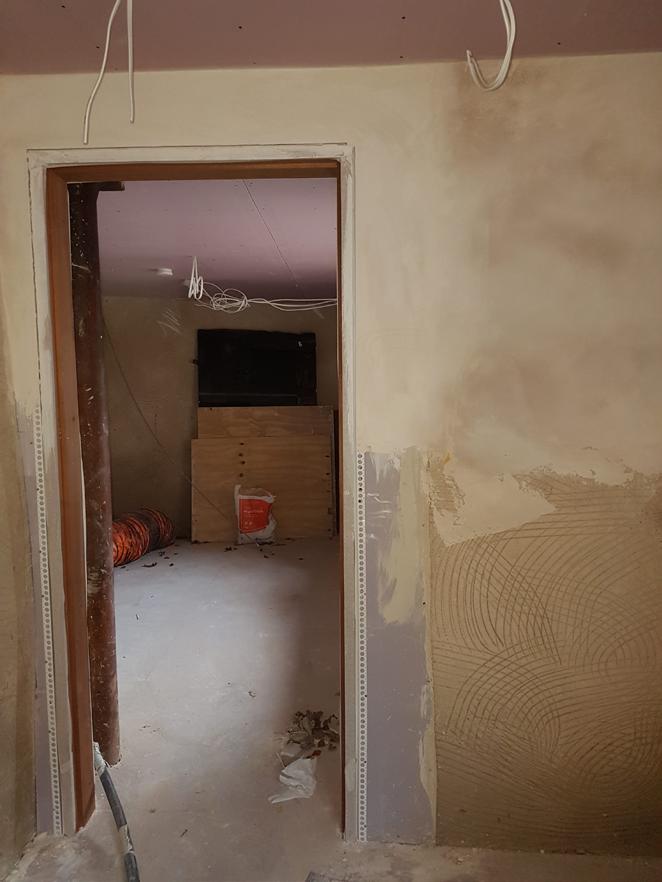

interiors while maintaining the durability required for a public building.”
Winner of the 2024 Royal Society of Architects in Wales (RSAW) Building of the Year and the RSAW Conservation Award, the project was praised by judges as:
“an excellent example of how to approach conservation and heritage with spirit and expertise”.
The detailing strategy was particularly significant given the building’s historic character. Skirting boards were not introduced until the late 15th century and door architraves appeared even later, during the Georgian period. The project adopted a contemporary shadow gap solution that complemented the building’s layered history while providing practical advantages.
Since traditional wet plaster methods were used across much of the castle, contractors installed short plasterboard sections to interface with the shadow gap profiles. PVC was chosen over metal alternatives for its durability, flexibility and resistance to rust or staining, helping maintain crisp lines despite uneven historic substrates and the demands of heavy public use.
This project demonstrates how carefully specified, contemporary detailing can enhance both historic and modern buildings. In heritage settings, shadow gap profiles provide a discreet way to introduce modern finishes without compromising architectural character. In new-build projects, they help achieve the clean, minimalist aesthetic increasingly favoured by designers. PVC shadow gap beads offer a practical and longlasting solution for creating sharp, consistent finishes across a wide range of applications.

Exterior of a Spitfire Homes collection

Award-winning Midlands homebuilder Spitfire Homes is marking its 15th anniversary from a position of strength, having delivered a record number of homes in 2025. With a pipeline of 1,600 new homes, the business is continuing to build on its strong reputation for creating distinctive, quality-driven properties.
Founded in 2011, the family-owned homebuilder completed its 1,500th home earlier this year, a milestone that reflects both the scale of its ambition and the consistency of its product, with 303 homes delivered in 2025 alone.
This signified substantial year-onyear growth of 70%, demonstrating that despite ongoing economic
£3.5
Multi-disciplinary consultancy Pick Everard has been re-appointed to provide expert construction professional services on major building projects due to be delivered by the Government and across the public sector.
The appointment to the Government Commercial Agency’s (GCA) RM6356 Construction Professional Services 2 framework will put Pick Everard at the heart of core infrastructure and built environment projects in the UK over the next four years as part of the significant £3.5 billion procurement framework.
By accessing the Government framework as a named supplier, Pick Everard will be well positioned to
lead on, and be involved in, some of the most high-profile projects across central Government and the wider public sector.
Alastair Hamilton, Chief Operations Officer at Pick Everard, said the appointment was a proud moment for the team, reflecting the growth and standing of the consultancy.
He said: “This is a major appointment for Pick Everard and a proud point in our history, reflecting the hard work, expertise and consistent success of our teams. Inclusion on this framework is reserved for firms that have demonstrated the capability and performance expected of a leading consultancy. This will provide us with
a solid foundation to play a leading role in priority upgrades and major capital investment programmes that are set to transform communities and inspire further investment and growth across the UK.
“This appointment comes at a time when the UK construction industry is getting ready to deliver on the Government’s major infrastructure programmes. As these pipelines are accelerated there will be a heavy reliance on high quality professional services, such as lead consultancy and support services, protecting investments and keeping projects on schedule in addition to delivering excellent value for money. Our experience in strategic planning and project governance will help
uncertainty and ever-changing challenges across the wider housebuilding sector, Spitfire continues to illustrate how its clearly defined premium offering can deliver sustained success.
Since its inception, Spitfire has created 62 brand-new communities, each defined by thoughtful placemaking, distinctive architecture and investment in the local area. In doing so, the business has delivered key infrastructure, a range of community amenities and supported an estimated 5,000 jobs.
To mark the 15-year milestone, the homebuilder is set to launch a £15,000 community fund later this summer, helping to support local causes and community projects in recognition of the communities it helps to shape.
Over the past 15 years, Spitfire’s portfolio has stretched as far south as Bristol and Surrey, and as far north as Nottinghamshire, taking in some of England’s most sought-after addresses along the way.
“What distinguishes Spitfire is the consistency it has maintained throughout – in the safety of our people, uncompromising design standards, a considered approach to placemaking and its core commitment to quality for the customer. This is the foundation that supports our continued success.”
Dave Smith, Managing Director, says the 15th anniversary gives an opportunity for reflection on how far Spitfire has come and the principles that have underpinned its growth, adding: “The housebuilding industry looks very different today than it did back in 2011, and has never been without its challenges. What distinguishes Spitfire is the consistency it has maintained throughout – in the safety of our
people, uncompromising design standards, a considered approach to placemaking and its core commitment to quality for the customer. This is the foundation that supports our continued success.”
“With a 1,600-home pipeline and ongoing investment in the next generation of talent, we’re primed to build on our success. It is an incredibly exciting time to be a part of Spitfire Homes.”
As it looks ahead to shaping its further growth, Spitfire is investing in its future workforce while tackling the industry’s skills crisis head-on. The homebuilder recently committed to a minimum requirement of 5% of its total workforce to be made up of trainees or graduates, which has been extended as a mandatory requirement for contractor partners, reinforcing the application of Spitfire’s values to its supply chain.
For more information on Spitfire Homes, please visit www.spitfirehomes.co.uk.
give public sector organisations the confidence and resilience they need to take advantage of improving market conditions and support from new Government programmes. Through the framework Pick Everard will play an active role in vital schemes that will form the cornerstones to prosperity, from improved healthcare facilities to widespread neighbourhood renewal projects.”
Public sector organisations can directly access Pick Everard professional services under four Lots as part of the framework: General Infrastructure and Built Environment professional services under Lot 1; Project Management under Lot 3; Commercial Management under Lot 4 and International services under Lot 7.
The Government Commercial Agency (GCA) is the UK’s central commercial and procurement organisation, connecting public and private sectors to achieve the best
outcomes for the country and its citizens. GCA uses its commercial expertise to create a simpler procurement experience that redirects valuable resources into essential public services – creating value for the nation.
Pick Everard’s appointment to the framework follows its inclusion in RM6165 Construction Professional Services 1, where its expert knowledge and specialised consultancy services enabled the successful navigation of complex issues for major public and Government-backed projects.
Ben Killeen, Group Strategic Development Director at Pick Everard, said:
“Securing a role on the Government Commercial Agency’s framework is hugely significant and will play a key role in our strategy moving ahead.”


Naio Environmental, a specialist commercial landscaping and fencing company working closely with the construction and housebuilding sector, is proud to launch its Naio Nature Explorers campaign - an initiative focused on supporting local schools, communities and developers through hands-on biodiversity and sustainability education.
Through the campaign, Naio Environmental is providing children’s activity packs and bug hotels designed to engage young people with nature while supporting practical environmental learning. Delivered in partnership with schools and new-build developers, the initiative helps embed biodiversity awareness within both education and the built environment.
With increasing emphasis on sustainable construction and Biodiversity Net Gain (BNG) requirements across the UK, Naio Environmental recognises the importance of fostering environmental awareness from an early age.
“Working in constructionparticularly alongside new-build
developers - places us in a unique position to influence not just the built environment, but the communities that grow around it,” said Juste Kavaliauskaite, BD & Marketing Manager at Naio Environmental.
“Through Naio Nature Explorers, we’re helping children connect with nature in a meaningful way, while reinforcing the long-term value of sustainable development.”
As part of the campaign, Naio Environmental has already partnered with organisations including Ernest Doe & Sons Ltd, supporting initiatives such as the Southend YMCA Eco Hub - a project dedicated to helping young people through sustainabilityfocused activities.
This collaboration has seen the donation of bug hotels, bird seed, compost, seeds and educational activity packs, providing individuals


with the tools to grow plants and vegetables while developing confidence, practical skills and a deeper connection to nature. The Southend YMCA Eco Hub continues to make a lasting impact by offering a safe and supportive environment, with sustainability at the heart of its work.
The Naio Nature Explorers campaign also builds on successful work within live developments, including King George’s Vale in Cuffley, delivered in partnership with Bellway Homes. This project showcases how biodiversity can be embedded into new-build developments through thoughtful design - featuring tree planting, native hedgerows, wildflower areas, wetlands and dedicated wildlife habitats.
As part of this initiative, local schoolchildren were invited to take part in an on-site biodiversity day, where they learned about habitat creation, wildlife protection and sustainable land management. These initiatives highlight the important role developers play in not only delivering homes but also creating environments where communities and wildlife can thrive together.
For developers, involvement in initiatives like Naio Nature Explorers offers a powerful way to deliver social value - supporting planning requirements, strengthening community relationships and demonstrating a genuine commitment to environmentally responsible construction.
Naio Environmental continues to advocate for a holistic approach to development -one that balances housing needs with ecological preservation, education and community wellbeing.
For more information visit: naioltd.com/nature-explorers

Once in a while a product comes along and changes everything, from the way it’s crafted to the way it works. Products are often copied and many are great ideas that never really see true success in their application. Many years are spent searching for a product that will ultimately surpass expectations, stand the test of time and become recognised as the leader in its field.
We created one of those successful products nearly two decades ago and still today it has never been equalled.
Why?
Because we have never compromised on quality.

86% of UK contractors would pay a premium for reliable equipment hire, and 6 in 10 are ready to switch to get it
UK construction firms would be willing to pay 13% more, on average, for an access equipment hire supplier they can rely on, as reliability overtakes price as the deciding factor in winning their business.
Asked how much more they would pay for a supplier that delivered a consistent, reliable service and was easy to deal with, 86% of construction professionals said they would pay a premium, with the average contractor willing to pay 13% more on hire rates. Just one in seven (13%) would pay nothing extra.
At the same time, nearly six in ten (58%) said they are likely to switch their primary or sole access hire supplier in the next 12 months because of service issues. Reliability, in short, has become the thing that wins and loses customers.
That is the headline finding from new Censuswide research commissioned by Horizon Platforms, the powered access hire specialist, which surveyed 300 UK construction
planning and management professionals in May 2026 on the true cost of equipment hire failures.
Kelly Burgess, Head of Hire at Horizon Platforms explains “For years this industry has competed almost entirely on price, on the assumption that contractors will always take the cheapest quote. This research says this is changing. Contractors have been burned too many times and just want to know they will get kit on time and in good working order. They are telling us, clearly, that they will pay a bit more to guarantee a reliable supplier that delivers and focuses on their needs.”
Why reliability has become a dealbreaker
The appetite for a supplier that simply turns up and works is being driven by how much unreliable hire now costs.
According to the research:
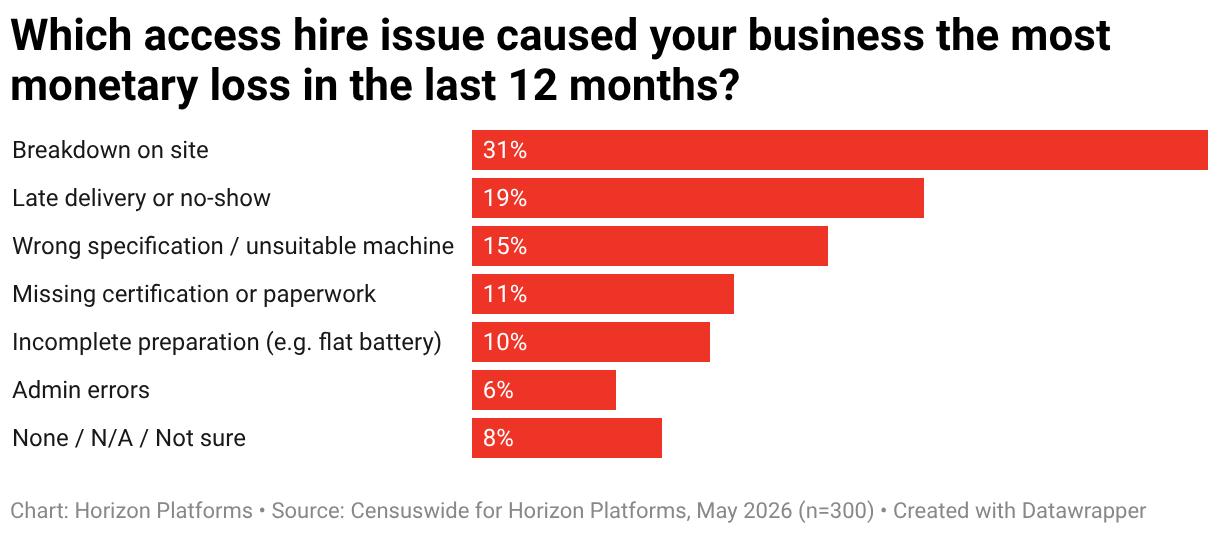
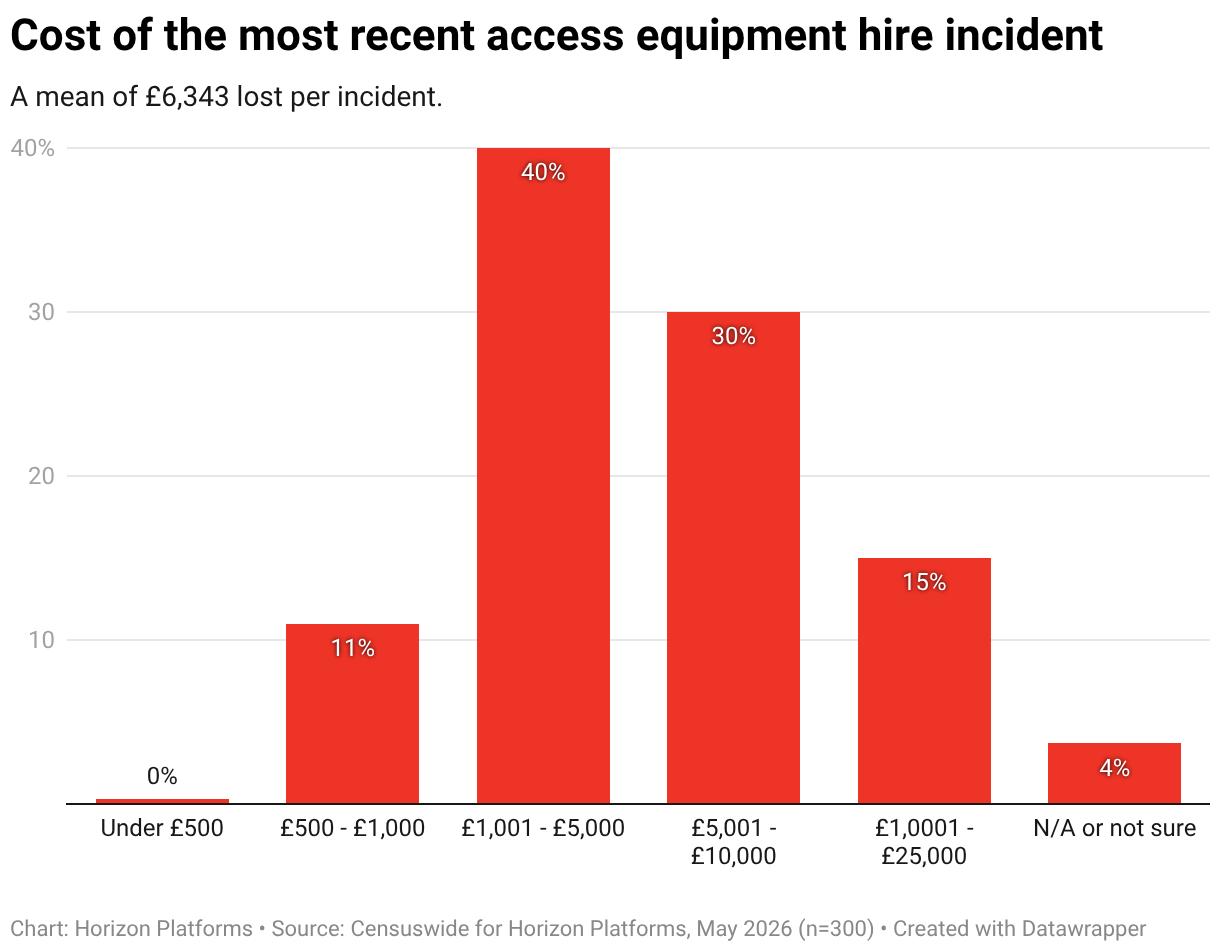
• The average access equipment hire failure costs a contractor
£6,343 once idle labour,
re-hire, overtime, rebooked subcontractors and penalties are added up
• 95% of construction managers had at least one project knocked off schedule by a hire failure in the last 12 months, with an average of 2.3 projects each
• Over the last three years, 72% of firms have been hit with contractual penalties because of a hire failure, 71% have faced costrecovery claims and 57% have paid liquidated damages
With one in six MEWP hires failing on a typical site, the cost of getting it wrong is exactly what contractors are now willing to pay to avoid.
“Contractors have been burned too many times and just want to know they will get kit on time and in good working order.”
To help contractors weigh suppliers on more than headline rate, Horizon Platforms has launched a free Cost of Poor Hire Calculator, letting construction managers compare two access equipment suppliers side by side on hire rates, breakdowns, downtime and rehires, at calculator.horizonplatforms.co.uk.
“The lesson from this data is to look at the total cost of hire, not the day rate. The cheapest hire is almost never the cheapest job. Unfortunately for contractors, cheap rates tend to come with poor service. Contractors clearly already know that. That’s why they are ready to pay for reliability and certainty. The question is which suppliers are ready to deliver it. We certainly are!”

Profile and rail cutters from Phoenix Contact enable standard DIN rails and cable ducts to be cut to length quickly, precisely, and burr-free. Due to the optimal lever ratio, cutting requires minimal effort and is easy on the joints, while the chip-free cut ensures a clean workspace and eliminates the need for rework.
The new PPS BASIC-C I/M adds a versatile cutting tool for standard DIN rails to the portfolio. In addition to the proven NS 35/7,5 and NS 35/15 DIN rails, it also cuts NS 30/15 rails with C profile and NLS CU 3/10 neutral busbars.
The 1 m long metric and inch measuring rail with end stops allows the cutting length to be set with millimeter precision. The robust design guarantees a long service life. Predrilled screw holes allow for easy and secure benchtop mounting. The tool delivers precise, smooth cuts without chips or burrs, ensuring efficient workflows and professional results.
Three Harron Homes site managers have been recognised among the best in UK housebuilding after each winning an NHBC Pride in the Job 2026 Quality Award.
Paul Jezusek at De Maulay Manor in New Rossington, Steve Jones at Nevison’s Fold in Barnsley, and Wayne Schofield at Sandlands Park in Hucknall, have all received the award in recognition of the consistent standards being delivered across their developments.
For Paul Jezusek, the award marks his third consecutive Pride in the Job Quality Award, following a coveted Seal of Excellence in 2025, while Steve previously received the award in 2016 before joining Harron in 2025, and Wayne is celebrating his first Pride in the Job win.
Widely considered the ‘Oscars’ of the house-building industry, Pride in the Job celebrates site managers’ dedication to raising standards, showcasing best practice and rewarding excellence.
Thousands of inspections have taken place to determine the 450
winners from a field of 7,500 sites, representing the top 6% of UK site managers.
Paul, 49, from Sheffield, started in the construction industry straight out of school and worked his way up from apprentice joiner to site manager. He joined Harron Homes seven years ago and was promoted to site manager after just two and a half years.
His third consecutive Pride in the Job Quality Award win underlines the consistent high standards he sets at De Maulay Manor and the strength of the team he leads.
Paul said, “To win this award three years in a row is an incredible feeling and something I’m really proud of. Pride in the Job is such a respected award in the industry, so to be recognised again by the NHBC means a great deal.
“I’ve got a fantastic team here at De Maulay Manor, and this award is a reflection of everyone’s effort. Delivering quality homes is a team effort from start to finish, and it’s very rewarding to see that commitment recognised year after year.”

“To win this award three years in a row is an incredible feeling and something I’m really proud of. Pride in the Job is such a respected award in the industry, so to be recognised again by the NHBC means a great deal.”
Wayne Schofield, who lives in Sheffield, works at Harron Homes’ Sandlands Park development in Hucknall. He previously worked for Harron Homes in 2018 before returning in 2023 as Site Manager at Sandlands Park, where he’s continued to demonstrate exceptional site standards.
Wayne said, “It’s a fantastic feeling to receive my first Pride in the Job award. The recognition of all the hard work that I’ve put into my role and Harron Homes really means the world to me.
“The support that I receive from my team is the best part of the job, and truly makes me proud to work for Harron Homes. We band together and strive to constantly improve on the service and quality we deliver at Sandlands Park.”
Steve, who is originally from Barnsley and now lives in Liversedge, joined the team at Harron in May 2025. He previously won a NHBC Pride in the Job award in 2016. “I’m completely over-the-moon to have won this award,” said Steve, “I put my all into this role, and it makes all the hard work worth it”.
“My favourite part of working at Harron Homes is the sense of accomplishment that I get when

we see what we’ve provided for the community. Delivering high-quality homes is what I want to do, that’s what it’s all about.”
James Poynor, Group Managing Director of Harron Homes, said, “We’re incredibly proud of Paul, Steve, Wayne and their teams. To have three site managers recognised in the same year is a fantastic achievement and a clear reflection of the standards being delivered across our North Midlands and Yorkshire developments.
“Pride in the Job is one of the most respected awards in the industry, and these wins recognise the leadership, attention to detail and commitment

“Congratulations to Paul, Steve and Wayne, who have demonstrated incredible dedication, passion, commitment and leadership to produce homes of exceptional quality. The judges look for site managers who go beyond strong performance and demonstrate qualities that lift a good site manager to an exceptional one.”
to quality that Paul, Steve and Wayne bring to their sites every day. Their success is also testament to the wider teams behind them, whose hard work is essential to delivering homes of the highest standard.”
Commenting on the awards, Cassandra Codling, Senior Regional Director at NHBC, said, “Congratulations to Paul, Steve and Wayne, who have demonstrated incredible dedication, passion, commitment and leadership to produce homes of exceptional quality. The judges look for site managers who go beyond strong performance and demonstrate qualities that lift a good site manager to an exceptional one.
“The competition is at the heart of NHBC’s core purpose to raise standards in house building. It inspires site managers to make their mark on the industry, earning the respect of their peers and leaving a legacy of homes built to the highest quality standards.”
The Quality Award winners will now go on to compete for Seal of Excellence and Regional Awards in the autumn, with the national Supreme Award winners unveiled in January 2027.
For more information visit: www.harronhomes.com

Planners have given the go ahead for a new housing development to bring 115 homes to a village in south Leicestershire.
Blaby District Council’s planning committee approved the proposed scheme by national housebuilder Miller Homes on Thursday, 11 June for a development to be built on land off Springwell Lane in Whetstone.
Miller Homes East Midlands will deliver its scheme on a 22.5-acre parcel of land to comprise a mix of one to five-bedroom homes.
A total of eight properties will be bungalows, part of the private mix of 86 new homes.
A further 29 properties will be built and provided as affordable housing, split between shared ownership and affordable rent.
More than half of the site to be developed on by Miller Homes will be designated as open space, and will include a children’s play area.
The significant amount of open space, coupled with other measures to be delivered as part of the scheme, will lead to a 10 per cent biodiversity net gain for this parcel of land.
Tom Roberts, regional operations director of Miller Homes East Midlands, said: “We are naturally very pleased at the resolution to grant planning permission for 115 new homes in Whetstone, in an area of south Leicestershire in which Miller Homes is already well known as a developer. Our scheme will deliver new homes to help meet Blaby District Council’s current housing supply need, as noted in the latest local plan for the area.”
“The development has been carefully thought out and through a detailed consultation process we have been able to achieve a wide ranging mix of housing to help suit the needs of any buyer in this part of Leicestershire.”
“The development will create jobs, better access through the village, support for local services and, crucially, a high quality mix of sustainable new housing which will achieve a significant biodiversity net gain.
“We will now look ahead to moving onto the site and beginning construction work to help deliver these new homes to Whetstone.
“We will endeavour to keep communication clear and consistent with residents and prospective customers to Miller Homes as we move forward with this new development.”
Access to the new development will be provided by a new road off Springwell Lane which will be delivered as part of the wider scheme in Whetstone.
Miller Homes’ development will create 120 full-time equivalent jobs, some of which will be designated for Blaby residents.
Construction work is set to begin this summer, and is expected to last until 2028.

















Insulation specialist Actis has appointed a new area sales manager for the South East and London to help merchants, builders and specifiers in the capital and home counties.
Jake Wilson, who has an MA in international HR and a degree in international business management, will be offering technical advice, product guidance and on site support to distributors, merchants, architects and builders.
He says the combination of his academic background and previous work in sales for car hire giant Enterprise has provided him with skills essential for his new role.
“My MA taught me how people think, what motivates them, and how to communicate clearly with different personalities and working styles,” he explained.

“At Enterprise I had to understand the customer’s situation quickly, ask the right questions, and recommend the best option for them, not just the most obvious one. That taught me how to listen properly and tailor solutions, a mindset essential in insulation sales, where customers rely on you for clarity, technical guidance and confidence that they’re choosing the right system for their project.”
“I was drawn to Actis because it’s a company that genuinely pushes the boundaries of what insulation can achieve. The Hybrid reflective technology is a great example of innovation with a real purpose. It isn’t just a clever product, it’s a solution that improves comfort, energy efficiency and long term performance.
“Actis pairs this innovation with a clear commitment to its customers.
Through technical support, training and tools like the U value simulator, the company makes it easy for builders, designers and homeowners to make informed decisions. It shows that Actis understands the responsibility that comes with working in a sector that directly affects people’s homes, wellbeing and energy costs.”

Leeds-based housing association Unity Homes and Enterprise has appointed Sarfraz Hussain as Director of Housing Operations.
He joins the organisation with more than 20 years of experience in senior housing leadership roles across housing associations, local government and consultancy.
Most recently, as Director of Major Estates at Southwark Council, Sarfraz led complex transformation programmes across housing services with a strong
focus on resident engagement, community involvement and service improvement.
His work included chairing the Council’s first neighbourhood pilot, leading resident engagement activity across major estate renewal programmes and overseeing the large-scale rehousing of residents into new high-quality homes along the Old Kent Road regeneration corridor in South London.
Earlier in his career, Sarfraz led a high-performing housing
Instantor, market-leaders in press solutions, has announced the appointment of a dedicated Product Manager to support the launch of its new underfloor heating range. The company, which is celebrating its 100th year in business in 2026, unveiled its underfloor heating portfolio at InstallerSHOW 2026 in Birmingham.
Jim Stafford has joined Instantor as Product Manager – Underfloor Heating and brings with him almost 25 years of industry expertise, having previously held roles in plumbing and heating installation, sales, technical and design.
With a century of expertise, Instantor has harnessed its knowledge of pipe, fittings and pumps to develop the underfloor heating range comprising of seven systems that cover every application, from screed, suspended and solid floor installations to overlay and retrofit applications. The range
management business unit for a London G15 provider, managing neighbourhood and tenancy services across 4,500 homes with responsibility for operational performance, resident engagement and frontline service delivery.
At Unity Homes and Enterprise, he will provide strategic leadership for all housing operational services, including tenancy management, repairs and maintenance, rental income and resident engagement.
Established in 1987, Unity manages almost 1,400 properties in some of Leeds’ most diverse communities. Alongside providing housing services, the association supports enterprise, employment, training and education opportunities for local people.
includes pipe, manifolds, pumps, controls and accessories. Installers, merchants and specifiers can also take advantage of a free design and support service provided by Instantor’s engineers. This will deliver detailed, installation-ready design drawings to customer specifications, together with fully compliant heat loss calculations. The service is also professionally indemnified for complete peace of mind.
Alan Hogan, Divisional Managing Director at Instantor explains: “Instantor developed and patented the first brass compression fitting in 1926 and has been providing the industry with high quality plumbing
and heating innovations ever since. We have extensive expertise in pipe, fittings, water movement and associated products and have brought all of this together in our new underfloor heating collection. We’re delighted to welcome Jim to the team, and to have launched the range at InstallerSHOW, and are looking forward to discussing opportunities with customers in the coming months.”
Jim Stafford adds: “Instantor is a recognised market-leader in press solutions. The same quality, reliability and durability that runs through every Instantor product has been applied to our new underfloor heating range. We’ve also designed the range with the installer firmly in mind, to offer straightforward, reliable and easyto-fit solutions underpinned by exceptional service and support.
“I’m very much looking forward to helping establish the underfloor heating portfolio in the marketplace and enhancing the range further with additional innovations.”

Jim Stafford
Three leading organisations in the construction sector – Timber Development UK (TDUK), the Structural Timber Association (STA) and Swedish Wood – have launched a digital platform that makes timber frame construction easier for built environment professionals to understand and adopt.
Timber Frame: Where to Start is a practical, accessible guide that provides a clear introduction to timber frame construction and its principal elements. The purpose of the guide is simple: to give users a quick and easy way to understand how timber frame works, while signposting them to credible and accessible information.
Designed for anyone interested in timber frame construction, the guide supports a wide audience. It will be particularly useful for architects, specifiers, engineers, timber frame suppliers, building operators, home builders and contractors. It also serves as a straightforward introduction for those new to timber frame who want reliable information in one place.
Timber frame is a proven, reliable and mainstream method of construction, fully supported by warranty providers, lenders and insurers. In Scotland, 92% of all new-build homes are constructed using timber frame. Seven of the top ten UK homebuilders operate their own timber frame manufacturing facilities, and it has been predicted that as many as one in three UK homes could be timber frame by 2030.

With the top construction companies now moving towards greater use of timber frame, and many smaller firms beginning that transition, the demand for clear and practical guidance is clear. This new digital guide has been created to help companies build confidently in timber, providing the insight needed to deliver successful projects and positive experiences with the system.
Dave Hopkins, Chief Executive of Timber Development UK, said: “Timber frame is no longer an alternative method of construction. It is a mainstream solution that supports productivity and sustainability. This guide brings together the information businesses need to get started, all in one accessible place.”
Andrew Orriss, CEO of the Structural Timber Association, added: “There is a growing appetite across the sector to build more in timber. The challenge for many organisations is knowing where to begin. ‘Timber Frame: Where to Start’ provides a clear route in, backed by trusted industry bodies and credible information.”
Stephen King, UK Project Manager, Swedish Wood, commented: “As a

long-standing supplier of structural timber to the UK market, we’re seeing strong growth in demand for timber frame construction. By supporting this initiative, we’re helping ensure that companies looking to build in timber have the confidence, knowledge and supply chain support they need to do it well.”
The digital platform reflects a shared commitment from TDUK, STA and Swedish Wood to support industry growth, encourage informed decision-making and promote high standards across the sector.
To access the Timber Frame: Where to Start guide, visit Timber Frame – Quick Start Timber Frame Design Guide.

Premier Forest Products has completed a landmark year of strategic growth and expansion, strengthening its position as one of the UK’s largest independent timber and timber processing groups through major acquisitions, operational investment and continued workforce growth.
Premier Forest has delivered this growth despite continued economic pressure across the sector including fiscal changes, rising operational costs and ongoing geopolitical instability impacting global trade.
The expansion has transformed Premier Forest into one of the UK’s largest independent timber and timber processing groups.
The year has been heavily defined by the successful integration of several acquisitions including timber engineering specialist National Timber Systems and multiple former Arnold Laver sites from National Timber Group England.
These additions have further strengthened Premier Forest’s capabilities across timber distribution, manufacturing, and logistics throughout the UK.
Following its recent acquisitions, the business is expected to achieve revenues of £125 million for the year ending April 2026, with annualised turnover expected to reach £200 million next year.
Headcount within Premier Forest has grown from approximately 400 employees to almost 800 across the group following the acquisitions, while the HR function has doubled in size to support workforce development.
Premier Forest has also strengthened its senior leadership
team through a series of strategic appointments and promotions, including the promotion of Neil Davies from Chief Financial Officer to Chief Financial and Operating Officer.
Alongside commercial performance, Premier Forest’s Environmental, Social and Governance (ESG) commitments are increasingly influencing customer relationships and procurement opportunities.
The business continues to expand programmes around its corporate parenting scheme with a new cohort joining the group in July, its prisoner rehabilitation scheme, military covenant commitments and employment support initiatives, with these projects now forming an important part of major framework discussions and tender opportunities.
Terry Edgell, Co-founder & CEO of Premier Forest Products, said: “The market has remained difficult
for many businesses, particularly with ongoing fiscal pressures and the wider impact of geopolitical uncertainty on trading conditions.
“Our approach has been to continue investing in infrastructure, in systems, in capability and most importantly in people so we are ready to capitalise when markets strengthen again. ESG and social value are no longer secondary conversations, they are central to how major organisations select partners. What’s important for us is that these initiatives are authentic and embedded into the culture of the business, not simply boxticking exercises.
Neil Davies, Chief Financial and Operating Officer: “Premier Forest has continued to evolve rapidly, with the business delivering significant growth over the last year through strategic acquisitions, expansion across key markets, and continued investment throughout the group. This progress has further strengthened our market position and created a broader, more resilient platform for future development. The next 12 months will be an important period for the business as we continue integrating our recent acquisitions, strengthening operations across the group, and building on the momentum we have created.”

A garage conversion is one of the most popular types of home extension, according to Thames Design & Build founder, Rob Allison, who has two decades of experience in the construction industry.
A report by bank Santander, says that 650,000 of the UK’s 9.3 million private garages have already been turned into bedrooms (the most popular choice, at 29%), as well as home offices, kitchen extensions, utility rooms or sitting rooms.
Rob Allison says giving an underused garage a makeover can unlock precious space in your property and increase its value.
He says that while garages are often converted into a home office, gym or a playroom; turning a garage into an additional bedroom can be the best option in terms of adding value to your home. Converting a double garage is going to add more value than a single garage but a garage conversion will increase the value of a standard three-bed semi-detached
house by at least 10%. The cost of a single garage conversion ranges from £20,000 to £40,000, depending on the specification.
And while a garage can be turned into an annex to house an elderly relative, homeowners looking for extra income could consider a garage conversion to use as an Airbnb rental.
Rob adds that a number of clients convert only part of the garage, creating the new conversion from two-thirds of the space, but leaving the rest as a storage area for bikes, a utility room or an extra toilet.
Planning permission isn’t usually required for a garage conversion, provided the work is internal and doesn’t involve enlarging the building, as this falls within permitted development.
However, you might need permission if you want to make your garage into a separate home, or you live in a listed building, conservation area, new housing development, flat or
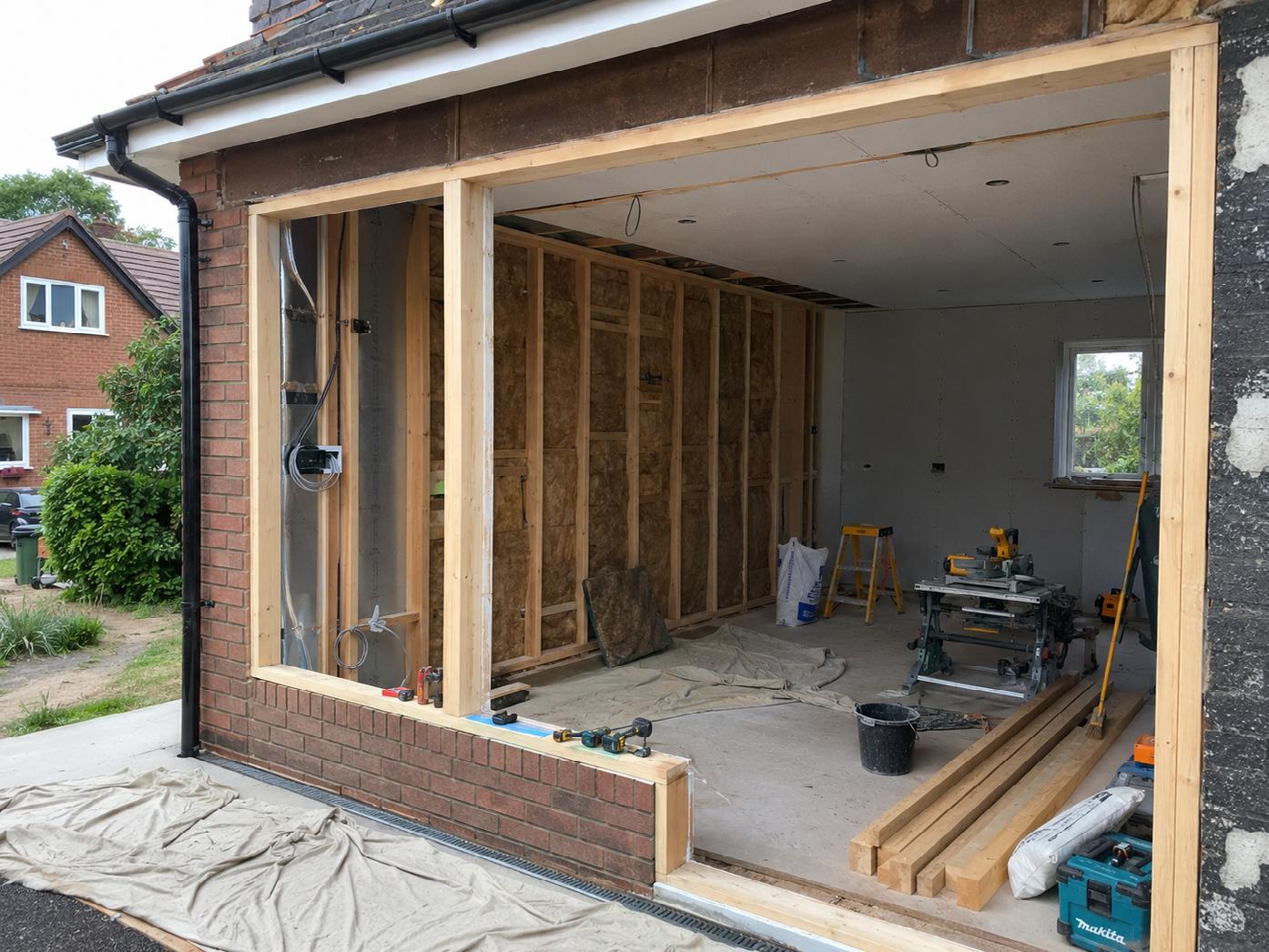
maisonette. While some councils will also require planning permission if you’re substantially changing the outside of your house.
And, of course, garage conversions will need building regulations approval. The Local Authority Building Control (LABC) advises that a Full Plans application will give more security about what work needs to be done. The LABC also recommends speaking to an architect or building contractor before beginning the work and warns that you will need to consider the rules around party walls.
“There are a number of areas in the building regulations your conversion will need to comply with including regulations on foundations, structural strength, windows and ventilation and weather proofing and insulation.”
Rob says that if the garage has only a single skin of brickwork on the external wall, then you need to consider penetrating damp. This can be managed by tanking the brickwork internally before installing the timber frame wall.
He adds that it’s good news if you already have a step down from the inside of your house to the garage slab floor as this will provide enough space to install a damp proof membrane, insulation & screed over the existing garage floor. If this space doesn’t exist, you may have to remove the garage slab which will add to the costs.
Finally, you can expect that a building control surveyor will inspect the work as it progresses and once it’s finished, they will check windows, fireproofing measures and doors before giving you a certificate of completion.
And then your converted garage is ready to provide more space and amenities for your family – or to help you earn some extra cash.

Breath the purest air thanks to the revolutionary swiss air PAPR!
· Eliminates 99.8% of particles, including quartz dust, from the air
· No face shaving and no fit test required
· Ultra easy to use
· Compatible with all common helmets, ear defenders and goggles





VIVID is the first housing association to launch a customerskills credential for all its staff certificated under City & Guilds Assured. The programme highlights the role every team plays in shaping the customer experience. It brings staff together around a shared approach, helping everyone make confident, consistent decisions that contribute to customers feeling they have a good place to live.
The Customer Advocate credential has been designed to build on staff’s existing knowledge and experience. Its flexible content means they only complete the learning that’s relevant to them, using real examples from their day-to-day work to strengthen their understanding of what great customer skills look like. At the end of the programme, staff undertake an assessment that further confirms they have demonstrated the skills, knowledge and behaviours that VIVID champions.
After a successful assessment, staff will earn a City & Guilds Assured digital badge and certificate, proving they’ve undertaken training that meets the Assured Benchmark, City & Guilds’ global quality standard
for internally developed training. With almost 150 years’ experience in workforce skills development, City & Guilds is recognised both nationwide and beyond.
“Building the City & Guilds Customer Advocate credential into its customerfocused training programme is an excellent way for VIVID to focus on how best to meet the needs of its customers both
in their home and neighbourhood, and to tailor its services to support this aim.”
All VIVID’s staff will complete the credential over the next two years, with new starters required to complete it within their first 6 months.
This initiative forms part of VIVID’s customer experience strategy, ensuring every team member has the skills, behaviours and

knowledge needed to deliver on its Customer Promises.
Susan Noone, Director of People at VIVID, said: “We’ve always made sure our teams have the technical skills they need to do their jobs well, and they already bring a huge amount of experience and dedication to supporting our customers.
“What we haven’t had until now is a company-wide customer-focused learning programme that brings all our expectations and promises together. The Customer Advocate credential does exactly that. It develops our teams and gives staff the chance to earn something with real value – both here at VIVID and throughout their careers. Just as importantly, it reinforces that customer skills are every bit as essential to our success as technical expertise.”
Alex Nagle, Customer Service Director at VIVID, added: “Great customer experience is something we create together. It isn’t just shaped by our customer facing staff – it’s influenced by how we work with each other. That’s why everyone’s getting involved in the Customer Advocate credential.
“It brings our Customer Promises to life by giving all our teams a shared understanding of what good looks like. It celebrates the strong customer skills we already have and helps us build on them, so we can keep improving the experience we deliver every day.”
Mandy Smith, Executive Director, Awarding & Assessment Customer Solutions, City & Guilds, said: “Building the City & Guilds Customer Advocate credential into its customer-focused training programme is an excellent way for VIVID to focus on how best to meet the needs of its customers both in their home and neighbourhood, and to tailor its services to support this aim.”

The Construction Industry Training Board (CITB) has launched a new Accelerated Apprenticeships programme to help deliver the Government’s homebuilding goal to build 1.5 million new homes by 2029 while addressing regional skills shortages across the construction industry.
Part of CITB’s wider homebuilding support package, the programme aims to deliver 1,680 Accelerated Apprenticeship starts across four years and is designed to increase the pipeline of skilled workers in key homebuilding trades, including bricklaying, carpentry, and roofing.
An initial five Accelerated Apprenticeship programmes will be established through further education colleges and training providers, with a further 15 programmes planned by mid-2029. These will be located in areas of highest housing demand, ensuring training provision is aligned to local labour market needs. This is aligned with CITB’s new strategic partnerships with regional mayors
across England and the delivery of Local Skills Improvement Plans, collectively underpinning the development of an integrated construction skills ecosystem.
The initiative introduces a new approach to apprenticeship delivery, enabling trainees to complete their training in as little as 14-18-months, compared to the traditional two to three years. This is achieved through a flexible model that combines intensive early-stage learning with structured block release training alongside on-site experience, helping to speed up completions, improve efficiency across the system, and put trainees in the best possible position to secure long-term work in the homebuilding sector.
Crucially, by facilitating apprenticeships to be completed quicker, the programme is designed to reduce the cost of delivering apprenticeships while responding to regional variations in demand, enabling more new entrants to train and join the industry.
The first phase will focus on five regions with high levels of homebuilding activity and identified training gaps: Greater Manchester, West Yorkshire, the West Midlands, Kent, and Bedfordshire and Hertfordshire. Additionally, the Accelerated Apprenticeships programme will feed into a new National Construction Mayoral Network being created by CITB that is expected to launch later this year.
By expanding accelerated, block release apprenticeship provision in these areas, CITB aims to increase apprenticeship uptake, boost completion rates, and ensure a steady flow of skilled workers into the construction industry.
The programme also places a strong emphasis on long-term employment outcomes, providing employers with a quicker and more flexible model to convert trainees into full-time workers. Consequently, performance measures will track not only enrolment and completion, but progression into sustained employment in construction.
CITB will support the partnering colleges and training providers with an initial set-up fund of up to £33,625 per programme. CITB will also provide apprenticeship funding along with ongoing assistance from its New Entrant Support Team (NEST), helping employers recruit candidates, access funding, and deliver highquality training.
Tim Balcon, CEO at CITB, said: “Meeting the scale of the UK’s housing need requires a step change in how we train people for construction careers. Accelerated Apprenticeships are a key part of that shift – helping more people gain the skills they need more quickly, and in the areas where they are most needed. Establishing regional Accelerated Apprenticeship programmes is a vital next step in developing our partnerships with mayoral and local authorities and is an example of the collaborative efforts that are required to address the skills shortage.
Visit: www.citb.co.uk/ funding-support/funding/ funded-projects#AcceleratedApprenticeships-programme

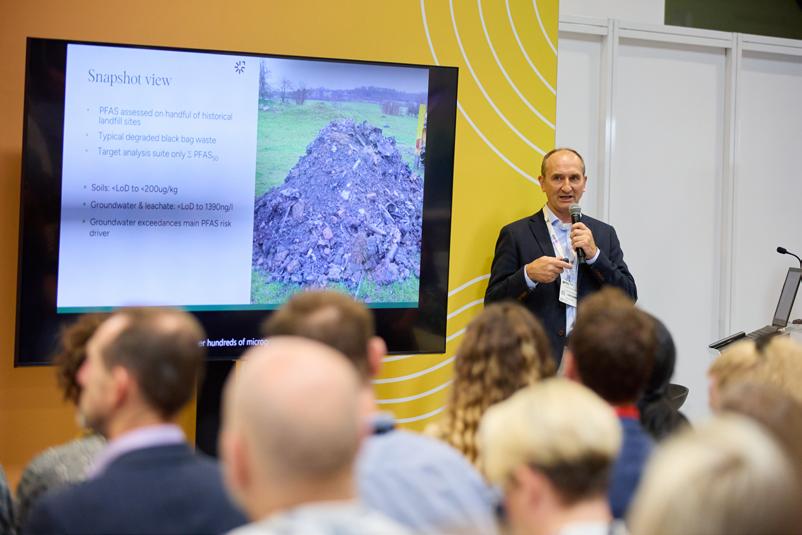
The Contamination & Land Remediation (CLR Expo), the UK’s leading business and knowledge exchange for the geoenvironmental sector, returns to the NEC Birmingham on 16-17 September 2026, bringing together 2,800+ high-level professionals for two high-impact days of innovation, networking and knowledge exchange.

Whether you’re involved in contaminated land treatment, soil and groundwater remediation, brownfield regeneration, environmental monitoring, geotechnical engineering or regulatory compliance, CLR Expo is the place to discover the latest technologies, gain valuable insights and connect with the people from across the community.
Explore the show floor to meet a range of exhibitors, all showcasing latest products, services and solutions from leading suppliers across the contamination, remediation and land management industries. From innovative remediation technologies and environmental monitoring solutions to specialist consultancy services and geotechnical expertise, you’ll have the opportunity to explore a wide range of innovations.
You’ll also be able to drop-in the Keynote and Technical Theatres for an extensive programme of expertled content. Hear from industry leaders, technical specialists and practitioners as they share practical insights, discuss emerging challenges and explore the latest developments affecting the geoenvironmental sector.
CLR Expo offers endless networking opportunities, bringing together consultants, contractors, developers, regulators, suppliers, environmental consultancies, engineers and decision-makers from across the industry. Whether you’re looking to strengthen existing relationships, meet potential project partners or expand your professional network, CLR provides the ideal environment to make valuable new connections.
As part of Environmental Services & Solutions Expo (ESS), your free ticket also gives you access to seven colocated shows, connecting you with the wider environmental services sector under one roof. With 16,000+ attendees, 700+ exhibitors and 450+ expert speakers, ESS provides a comprehensive platform to explore the latest innovations across resource management, water, energy, air quality, geotechnical engineering and more.
Free tickets available nowsecure your ticket today!