AUTUMN 2026
WWW.BUILDERUKMAGAZINE.CO.UK
STONEWATER SECURES RECORD £350 MILLION HOMES ENGLAND FUNDING ALLOCATION
ON THE TOOLS CARD PASSES 30,000 MEMBERS IN FOUR MONTHS
FOR ALL YOUR LATEST BUILDING NEWS
Pick Everard completes remediation works at nine residential blocks
Bellway unveils first completed homes at Willow Brook
e l b a w Rene le b a l c y Rec le b i s n o Resp
True sustainability starts with responsible sourcing.
FSC®F000231
Wood is one of the world’s most versatile resources. It is durable, recyclable, beautiful, and has a lower carbon footprint than other building materials, but its sustainability credentials fundamentally depend on whether it has been responsibly sourced. FSC® certification is a proven method to help those working in the built environment source wood responsibly and ensure healthy, resilient forests for generations to come.
CONTENTS
04 10
20
08 30 Editor Maria Lapthorn - editor@builderukmag.co.uk
04 On The Tools card passes 30,000 members in 4 months
Senior Editorial Assistant John Reynolds - editorial@builderukmag.co.uk
06 FMB: Northern households lose £3.6bn to rogue builders
Production/Design Laura Whitehead - laura@lapthornmedia.co.uk
10 RPS Group Secures £4.7m Magenta Living Contract
Sales Manager Emily Jackson - emily@builderukmag.co.uk
08 Stonewater secures £350m Homes England funding 12 Renovators reveal savings from residential reused steel 14 Gallagher: The Rising Threat of Cyber Attacks
Accounts Richard Lapthorn - accounts@lapthornmedia.co.uk
20 Pick Everard completes remediation works
Admin Assistant Jade Still - jade@builderukmag.co.uk
30 Aberdeen site managers recognised industry ‘Oscars’
Phone: 01843 808 106 Website: www.builderukmag.co.uk Published by: Lapthorn Media Ltd 5-7 Ozengell Place, Eurokent Business Park, Ramsgate, Kent, CT12 6PB
22 Homes to take root on Cheltenham’s old council nursery 32 Logistics UK: Women’s workwear is not “wokewear”
Every effort is made to ensure the accuracy and reliability of material published in Builder UK Magazine however, the publishers accept no responsibility for the claims or opinions made by advertisers, manufactures or contributors. No part of this publication may be reproduced or transmitted in any form or by any means, mechanical, electronic (including photocopying) or stored in any information retrieval system without the prior consent of the publisher.
BUILDER UK MAGAZINE
03
LATEST NEWS “The opportunity is not just to increase the number of homes on these sites, but to turn places built around cars into neighbourhoods where people can live, shop and spend time. That means thinking carefully about the mix of uses, the quality of public space and how each site connects with the surrounding area.”
LONDON RETAIL PARKS COULD PROVIDE SPACE FOR 11,200 NEW HOMES - RESEARCH FINDS 19 retail parks across London could accommodate around 11,200 new homes as part of mixed-use redevelopment, according to research from planning and development consultancy Lichfields. The study, Car parks to communities, looked at 102 retail parks across 29
ON THE TOOLS CARD PASSES 30,000 MEMBERS IN FOUR MONTHS The On The Tools card, which combines discounts from more than 150 brands, with built-in mental health support, has passed 30,000 members in the four months since launch.
04
BUILDER UK MAGAZINE
London boroughs, representing around 9.1 million sq ft of retail floorspace. It identified 19 sites across 13 boroughs with potential for further housing after screening for accessibility, planning commitments and policy protections, flood risk and proximity to local services.
Redevelopment is already taking place on a number of sites. 29 of the 102 retail parks are undergoing residential-led redevelopment in one form or another and could deliver up to 16,800 homes. A further 28 developments on land next to retail parks are already delivering 17,500 homes. Together, around 34,000 homes are currently being developed on or adjacent to retail park sites across London. James Singer, Associate Director at Lichfields and author of the research, said: “London needs more homes and some retail parks have clear potential to help provide them, particularly where large parts of a site are taken up by surface car parking or low-density development. That doesn’t mean every retail park is suitable for housing. Many
On The Tools is the UK’s largest online community for tradespeople. The card offers everyday trade savings with mental health support in a single app, offering discounts across materials and tools, fuel and leisure alongside wellbeing content delivered through a joint venture with On Wellbeing, part of Aspire Software Systems.
now or in the past. The single most common factor was their own finances, cited by 65%.
On Wellbeing’s content is grounded in behavioural science and designed for short, practical sessions that fit around a working day, on a break, in the van, or at the end of a shift.
Lee Wilcox, CEO and co-founder, On The Tools: “Money is the biggest thing hitting tradespeople’s mental health, and the support that’s out there is usually somewhere they’d never think to look.
On The Tools’ own research found that 93% of UK tradespeople have been impacted by mental ill health, with 73% experiencing it themselves
With cost of living pressure building again, the card is designed to work on both fronts at once, easing the financial squeeze while putting support in the same place tradespeople already go for savings.
“We’d started building the app to fix the first bit, and On Wellbeing had spent years on the second.
LATEST NEWS are trading well, and factors such as land value, existing tenants and lease structures can make redevelopment difficult. “In a lot of cases, the more realistic approach is to redevelop sites in stages, keeping successful retail and leisure uses while adding homes and improving the wider site. That can make better use of the land while retaining uses that continue to perform well.” The research comes as London looks for ways to increase housing supply under the draft London Plan, published in July. The plan makes provision for around 558,000 new homes over the next 10 years, against an identified local housing need of approximately 840,000.
Vacancy across the retail parks analysed was around 15% at the time of the research, compared with an average of approximately 6% across the wider retail park market. The research found that some of this reflects sites already moving towards redevelopment, where tenancies have been allowed to lapse ahead of future plans. For sites with development potential, the study points to phased delivery as one way of retaining retail and leisure uses while introducing housing, community facilities, new streets and
public space. It considers London examples including Hurlingham Waterfront in Fulham, Lewisham Retail Park and Southbury Leisure Park in Enfield. James added: “The opportunity is not just to increase the number of homes on these sites, but to turn places built around cars into neighbourhoods where people can live, shop and spend time. That means thinking carefully about the mix of uses, the quality of public space and how each site connects with the surrounding area.”
Existing and proposed London planning policy supports the redevelopment of low-density retail parks and car parks for housing where sites are suitable. However, viability, existing uses and the ownership and lease arrangements of individual parks will have a major bearing on what can be delivered. Retail parks have remained relatively resilient compared with other parts of the retail market, while strong occupier demand and limited new supply can support high existing use values. Existing leases, ownership structures and redevelopment costs can make residential schemes difficult to bring forward.
“Joining forces properly means the trade finally gets both in one place, from people who actually know them. The white collar world has had this for years. It’s about time the trade did too.” Dominic Bennett, Founder and CEO, On Wellbeing: “Construction has some of the highest rates of poor mental health of any industry, and often the least access to support. Everything we build is grounded in behavioural science, but none of that matters if people never open it. Putting it inside an app tradespeople
already use every day means we reach the ones who’d never go looking for help, which is exactly who we need to reach.” The On The Tools card is available now at: onthetoolscard.com, priced £12 per year. Members get access to hundreds of deals across trade and leisure brands, personalised by trade and location, plus On Wellbeing’s full support library. Pictured: Lee Wilcox and Dominic Bennett
BUILDER UK MAGAZINE
05
LATEST NEWS
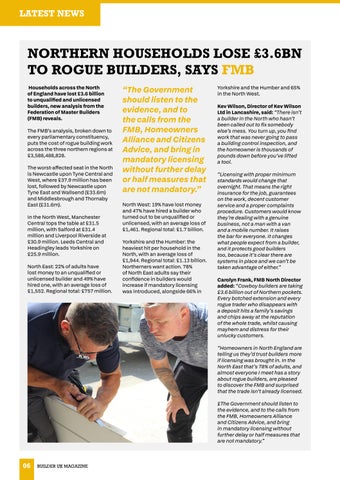
NORTHERN HOUSEHOLDS LOSE £3.6BN TO ROGUE BUILDERS, SAYS FMB Households across the North of England have lost £3.6 billion to unqualified and unlicensed builders, new analysis from the Federation of Master Builders (FMB) reveals. The FMB’s analysis, broken down to every parliamentary constituency, puts the cost of rogue building work across the three northern regions at £3,588,488,828. The worst-affected seat in the North is Newcastle upon Tyne Central and West, where £37.9 million has been lost, followed by Newcastle upon Tyne East and Wallsend (£33.6m) and Middlesbrough and Thornaby East (£31.6m). In the North West, Manchester Central tops the table at £31.5 million, with Salford at £31.4 million and Liverpool Riverside at £30.9 million. Leeds Central and Headingley leads Yorkshire on £25.9 million. North East: 22% of adults have lost money to an unqualified or unlicensed builder and 49% have hired one, with an average loss of £1,552. Regional total: £757 million.
“The Government should listen to the evidence, and to the calls from the FMB, Homeowners Alliance and Citizens Advice, and bring in mandatory licensing without further delay or half measures that are not mandatory.” North West: 19% have lost money and 47% have hired a builder who turned out to be unqualified or unlicensed, with an average loss of £1,461. Regional total: £1.7 billion. Yorkshire and the Humber: the heaviest hit per household in the North, with an average loss of £1,944. Regional total: £1.13 billion. Northerners want action. 78% of North East adults say their confidence in builders would increase if mandatory licensing was introduced, alongside 66% in
Yorkshire and the Humber and 65% in the North West. Kev Wilson, Director of Kev Wilson Ltd in Lancashire, said: “There isn’t a builder in the North who hasn’t been called out to fix somebody else’s mess. You turn up, you find work that was never going to pass a building control inspection, and the homeowner is thousands of pounds down before you’ve lifted a tool. “Licensing with proper minimum standards would change that overnight. That means the right insurance for the job, guarantees on the work, decent customer service and a proper complaints procedure. Customers would know they’re dealing with a genuine business, not a man with a van and a mobile number. It raises the bar for everyone. It changes what people expect from a builder, and it protects good builders too, because it’s clear there are systems in place and we can’t be taken advantage of either.” Carolyn Frank, FMB North Director added: “Cowboy builders are taking £3.6 billion out of Northern pockets. Every botched extension and every rogue trader who disappears with a deposit hits a family’s savings and chips away at the reputation of the whole trade, whilst causing mayhem and distress for their unlucky customers. “Homeowners in North England are telling us they’d trust builders more if licensing was brought in. In the North East that’s 78% of adults, and almost everyone I meet has a story about rogue builders, are pleased to discover the FMB and surprised that the trade isn’t already licensed. £The Government should listen to the evidence, and to the calls from the FMB, Homeowners Alliance and Citizens Advice, and bring in mandatory licensing without further delay or half measures that are not mandatory.”
06
BUILDER UK MAGAZINE
Construction Insurance Built for You Construction is complex. Managing risk shouldn’t be. Gallagher supports construction businesses across the UK with specialist insurance and risk management solutions. Our teams work with contractors, developers and consultants to help identify and manage risks across the construction lifecycle, from planning and procurement through to completion. Discover how we can support your business.
The Gallagher Way. Since 1927. Connect with us Scan the QR code to connect with a specialist today.
Arthur J. Gallagher Insurance Brokers Limited is authorised and regulated by the Financial Conduct Authority. Registered Office: Spectrum Building, 55 Blythswood Street, Glasgow, G2 7AT. Registered in Scotland. Company Number: SC108909. FP394-2026 Exp. 11.03.2027. © 2026 Arthur J. Gallagher & Co. | GGBRETUK107571
COMPANY NEWS
STONEWATER SECURES RECORD £350 MILLION HOMES ENGLAND FUNDING ALLOCATION Stonewater has secured its largestever funding allocation from Homes England, enabling the delivery of thousands of much-needed affordable homes around the country. The leading housing provider was awarded £350 million through the Social and Affordable Homes Programme (SAHP), reinforcing its position as a key strategic partner for Homes England. The funding provides vital long-term certainty for Stonewater’s development programme and will help more individuals and families access safe, affordable and high-quality homes across England.
A major focus of the bid was increasing the supply of affordable homes in rural communities. Rural delivery has long been a cornerstone of Stonewater’s development programme, helping sustain communities in areas where housing need is often high but affordability pressures are felt more acutely. Jonathan Layzell, Chief Executive of Stonewater, said: “This is fantastic news for Stonewater and the communities we serve. Securing our largest-ever allocation through the Social and Affordable Homes Programme is a strong endorsement of our ambition, capability and proven ability to deliver the homes people need. The funding provides welcome certainty for our development programme and reflects the confidence Homes England has in our ability to deliver high-quality affordable homes at scale. We’re particularly pleased that our plans include a strong focus on rural communities.
Jonathan Layzell
“We recently heard from a family who moved into a new Stonewater home in Somerset. They previously struggled with feelings of isolation, but now are thriving in a vibrant rural community they wouldn’t have been able to live in had it not been for affordable housing. These are the types of stories we’ll hear more and more of thanks to this funding. This success is the result of a huge team effort across Stonewater. Colleagues from across the organisation contributed to our comprehensive proposal, with our Development and Finance teams playing a leading role. It demonstrates what we can achieve when we combine ambition with expertise and a clear sense of purpose. Most importantly, this funding will enable us to support more people and families by providing the affordable homes that are so desperately needed across the country.”
TENTH EDITION OF CYCLING CHALLENGE FOR THE CONSTRUCTION INDUSTRY RAISES £260,000 FOR ACTION MEDICAL RESEARCH The tenth edition of epic cycling challenge Ziggurat has raised more than £260,000 for children’s charity Action Medical Research. The networking cycling event for professionals in the construction and built environment sectors took place from 23 –27 September 2026. More than 70 riders joined a four-day tour through the hills and valleys of the Basque region of Spain to reach Madrid. The ride raised funds for Action Medical Research, which has helped pioneer ways to prevent disease
08
BUILDER UK MAGAZINE
and develop treatments benefiting millions of people for over 70 years. Its research has helped to beat polio in the UK, develop ultrasound in pregnancy, fight meningitis and prevent stillbirths. Ziggurat 2026 is made possible thanks to the generous support of its main partners Brett Group, Day Group and Maylim, as well as supporting partners Herbosch-Kiere and Stortford Interiors. Bill Brett, Chairman, Brett Group, says: “Brett is so pleased to support Ziggurat and Action Medical Research again this year.
“Raising more than £250,000 is a remarkable achievement and reflects the dedication of everyone who took part and succeeded on this very challenging ride. Most importantly, the money raised will help support vital medical research for sick and disabled children.” This year’s ride covered 340 miles and included 5,700m of climbing, with the route starting on the northern coast at the port of Bilbao. Riders then proceeded into the Castile and León region, known for its medieval castles and historical significance, before ending in Madrid.
COMPANY NEWS
COMPLII STRENGTHENS LIFTS AND ESCALATORS DIVISION WITH ACQUISITION OF THE GENERAL LIFT COMPANY Complii, one of the UK’s leading providers of building safety and regulatory compliance services, announced the acquisition of The General Lift Company, a specialist lift services business operating across London and the South East. Established in 1986 and based in Swanley, Kent, The General Lift Company is a long-established specialist lift and mobility services business, serving commercial and public-sector clients across London and the South East. Its services span planned maintenance, reactive repairs, refurbishment, installation and 24/7 emergency call-out support. The business has built its reputation on the strength of its people, with deep of technical capability and long-standing customer relationships that have
made The General Lift Company a trusted name across the region. The acquisition strengthens Complii’s integrated Lifts and Escalators division, expanding its presence across London and the South East. Existing operational and technical leadership will remain in place to support continuity, with Derek Powis, Managing Director, remaining actively involved in the business going forward. Commenting on the acquisition, Sarah Dixon, CEO of Complii, said: “The General Lift Company has built an outstanding reputation across London and the South East, built on decades of technical expertise and genuine care for its customers. “Bringing them into Complii strengthens our Lifts and Escalators division in a region that matters enormously to our growth, and I’m
delighted to welcome Derek and the whole team to the Group.” Derek Powis, Managing Director of The General Lift Company, added: “Joining Complii marks the beginning of an exciting new chapter for us. “As part of a larger group, we gain access to greater scale, resources and support, strengthening our ability to deliver the outstanding service our customers rely on while accelerating the growth we’ve already been building towards.”
Sarah Stevenson, Head of Corporate Partnerships, Action Medical Research, adds: “We are so grateful to all our riders for their support – it was a challenging ride but incredibly rewarding. “Ziggurat sets the bar for what a networking ride should be, combining spectacular routes with the chance to meet people in the same industry who share the same purpose: to raise vital funds to help sick babies and children.” James Day, Managing Director of Day Group, is dad to twins Sam and Toby who were born at 33 weeks. They are now aged 27, and Sam – who has already completed Ziggurat twice – joined his dad on the ride in Spain. James says: “I’d like to thank everyone who supported us on the 10th anniversary of Ziggurat for
Action Medical Research, a charity that means a great deal to me personally and to Day Group. “I would also like to congratulate the team who took on this year’s challenge – probably the toughest ride yet – the fundraising effort has been exceptional.”
Funds raised through Ziggurat help Action Medical Research continue its critical work funding medical research to fight rare and devastating childhood conditions. Whether supporting breakthroughs in premature birth, brain injury or rare diseases, every mile cycled helps save and change lives.
BUILDER UK MAGAZINE
09
COMPANY NEWS
RPS GROUP SECURES £4.7M MAGENTA LIVING RETROFIT CONTRACT 600 homes across the Wirral to receive comprehensive energy upgrades RPS Group, one of the UK’s leading domestic low-carbon and renewable contractors, has been appointed by Magenta Living Housing Association to deliver an extensive retrofit programme worth up to £4.7 million across its homes on the Wirral, Merseyside. Starting immediately, RPS Group will carry out a mix of home energy-efficiency and renewable energy upgrades across 600 of Magenta Living’s least energyefficient homes - including fabric improvements, renewable energy, and low-carbon heating upgrades. The programme will include the installation of 550 solar PV systems, over 400 loft insulation upgrades and 25 air source heat pumps, alongside fabric improvements including external and cavity wall insulation and ventilation improvements. The PAS 2035-compliant retrofit programme will focus on enhancing thermal comfort for residents, reducing household energy and heating costs, and lowering carbon emissions.
The £4.7 million programme combines £1 million from the government’s Warm Homes: Social Housing Fund Wave 3 with £1.4 million in matched funding from Magenta Living. The housing association is investing a further £2.3 million in self-funded retrofit measures.
As one of the North of England’s leading independent specialist domestic retrofit contractors, RPS Group was selected for its expertise in renewable technologies, domestic heating systems and its proven ability to deliver complex retrofit programmes at scale. The appointment is the latest in a series of major social housing retrofit contracts secured by Greater Manchester-based RPS Group, including a 2,000-home solar PV programme with Vico Homes and a £6.2 million retrofit programme for Broadacres Housing Association. Graham Rothwell, owner and founder of RPS Group, said: “We’re delighted to support Magenta Living as it improves its homes and creates more comfortable and cost-effective places for its residents to live. Solar PV forms a key part of this programme and can help cut household electricity costs. Our analysis has shown that an average 2.6-kilowatt PV system could meet up to 30–50 per cent of household electricity demand, helping customers cut energy bills for years to come.” Leah Gilbert, Head of Sustainability & Decarbonisation at Magenta Living Housing Association, said: “At a time when many households continue to face pressure from high energy costs, investing in the energy performance of our homes has never been more important. “This programme will help improve the energy efficiency of hundreds of Magenta Living properties, with measures such as solar panels helping residents generate their own electricity and reduce the cost of running their homes. “Alongside supporting customers with rising energy bills, these improvements will create more comfortable and sustainable homes while reducing carbon emissions. It’s an important step in delivering our long-term sustainability ambitions, and we’re delighted to be working with RPS Group to make a lasting difference across our communities.”
10
BUILDER UK MAGAZINE
Leyland Trade paint available in DYI retailers and partner stockists nationwide
SUSTAINABILITY
SAVINGS FROM RESIDENTIAL REUSED STEEL REVEALED BY RENOVATORS Real-world residential construction projects are demonstrating significant cost and carbon savings from reused structural steel.
Reused steel is available as beams or pipes that come from surplus stock or are reclaimed during demolition. It is increasingly used in major construction projects to help contractors hit their sustainability targets. However, recent evidence also demonstrates that reused steel can deliver similar benefits for home renovations and extensions. “We are seeing a significant rise in enquiries and sales of reused steel for residential projects,” said Roy Fishwick, managing director of Cleveland Steel & Tubes (CST), the UK leader in reused structural steel. “The amounts of steel supplied are relatively low compared to the tonnage we provide to major contractors. But the cost and carbon savings still stack up.” The sustainability benefits of reused steel are well understood. A recent lifecycle analysis report by Giraffe Innovation found that the greenhouse
gas emissions savings were as high as 96% when using surplus steel compared to buying brand new steel.
Repurposing existing tubes was also far more environmentally friendly than sending them back to the steel mill for recycling. In addition, its attractive price profile often means that property developers can make savings of up to 60% compared to buying new steel. A great example is Rosie Bard and Ed Farndale. They required structural steel for work on their Victorian terraced property in London. Rosie was the project’s architect. The couple needed a box frame to open up the rear façade for an extension, along with steel beams for the roof of the new extension, and roof steel for a dormer conversion. Timber wasn’t an option due to height restrictions, typical in a London terrace. They researched reuse as a lower carbon alternative to new steel. In total the project incorporated more than 1.3t of reused steel, representing a carbon saving of more than 3t of CO₂.
12
BUILDER UK MAGAZINE
SUSTAINABILITY In addition, the reused steel cost 60% less than the builder’s quote for new steel, even including the additional structural engineer fees. “We achieved our low-carbon retrofit goals while staying within budget,” said Rosie. “For homeowners considering similar projects, specifying reused steel is both an environmental win and a smart financial choice.” Another happy customer was architect Philippa Birch Wood, who wanted to incorporate reused steel into a garage conversion at her home in Staffordshire. Despite the project incurring additional surveyor and structural engineer fees, it still came in at £400 cheaper than the quote for new steel. In addition, the 1.1t of reused steel deployed delivered a total carbon emissions saving of 2.24t. “Clients often come to us initially for the sustainability benefits of reused steel,” added Roy. “But they are often pleasantly surprised by the cost savings that come with it.” Based near Thirsk, North Yorkshire, CST is the UK’s largest supplier of reused steel, holding more than 70,000 tonnes in stock. It has supplied steel to major projects including the London Olympic Stadia and Canary Wharf’s Wood Wharf. CST has published a range of case studies and a guide to reusing steel on residential property developments. They are all available as free PDF downloads from its website, cleveland-steel.com. Roy said:
“One of the challenges some of our clients encounter is that smaller building contractors are unaware of reused steel. Armed with our guide and case studies, any self-builder, property developer or renovator should be able to easily demonstrate that it is safe, legal, and easy to use.”
Andrew Stott FMB Scotland Board member and Director of ML Contracts (Stone) Ltd.
FMB BRINGS SISALWOOL AND MKM AIRDRIE TOGETHER TO GET SUSTAINABLE INSULATION INTO SCOTTISH BUILDERS’ HANDS The Federation of Master Builders Scotland (FMB) has brokered a new partnership that will see natural fibre insulation on the shelves of one of Scotland’s leading merchants. The FMB brought together sustainable insulation specialist Sisalwool and MKM Airdrie - and from this month the full Sisalwool range including insulation batts, loft roll and breathable low-carbon products for new build, retrofit and conservation work will be available in MKN branches. Connecting members with the suppliers, merchants and manufacturers they rely on is part of what the FMB does for small and medium-sized building firms across Scotland. Local builders working on heritage, retrofit and conservation projects will now be able to pick up sustainable insulation from their own merchant rather than ordering it in and waiting.
Gordon Nelson, Director of FMB Scotland, said: “The FMB exists to help small, medium and micro building firms grow, and part of that is making the right products easy to get hold of. Bringing Sisalwool and MKM Airdrie together means Scottish builders can walk into their local merchant and pick up insulation that works in the heritage and retrofit projects so many of them are being asked to take on. Scotland’s builders are being asked to deliver warmer, greener homes, often in older buildings, and they need materials that can do that job.” Nic McCormick, Chief Executive of Sisalwool, added: “We’re delighted to be partnering with MKM Airdrie and to see our full range stocked locally. Thanks to the FMB for making the introduction — it’s a good example of a trade body doing something practical for its members. This is an important step in helping more builders, specifiers and architects get hold of sustainable insulation that performs in heritage, retrofit and conservation settings. And we can guarantee joiners will love it — the days of being itchy are behind them.” David McMahon, Branch Director at MKM Airdrie, concluded: “We’re pleased to welcome Sisalwool into branch. There is growing demand for sustainable products that suit heritage, retrofit and conservation projects, and this is an excellent addition to our offer.
BUILDER UK MAGAZINE
13
INSURANCE
THE RISING THREAT OF CYBER ATTACKS IN THE CONSTRUCTION INDUSTRY In an era where digital transformation is reshaping industries, the construction sector is no exception. From Building Information Modelling (BIM) to cloud-based project management tools, technology has become integral to modern construction operations. However, with this digital evolution comes an alarming rise in cyber threats, leaving the construction industry increasingly vulnerable to cyber-attacks.
Why is the Construction Industry a Target for Cybercriminals? Historically, the construction industry has not been a primary target for cybercriminals. However, as construction firms adopt advanced technologies and manage vast amounts of sensitive data, they have become an attractive target. The industry’s reliance on interconnected systems, third-party vendors, and remote work solutions has created a fertile ground for cyber threats. Construction companies often handle confidential client information, financial data, and intellectual
property, such as blueprints and project designs. These assets are highly valuable to cybercriminals, who can exploit them for financial gain, industrial espionage, or even sabotage. The increasing use of Internet of Things (IoT) devices on construction sites further expands the attack surface, making it easier for hackers to infiltrate systems. A study found a 410% year-on-year increase in Internet of Things (IoT) malware activity targeting the construction sector in 2023. This surge highlights the risks associated with the growing adoption of IoT devices in construction projects2.
The Costs of Cyber Attacks The consequences of a cyberattack in the construction industry can be devastating. Beyond the immediate financial losses, which can run into millions, companies face reputational damage, legal liabilities, and operational disruptions. For instance, ransomware attacks can halt construction projects, leading to missed deadlines and strained client relationships. Data breaches can expose sensitive client information, eroding trust and potentially resulting in regulatory fines.
A notable example is the ransomware attack on a major construction firm in 2021, which disrupted operations for weeks and cost the company millions in recovery efforts1. Such incidents highlight the urgent need for the industry to prioritise cybersecurity.
Why is the Industry So Vulnerable? Several factors contribute to the construction industry’s vulnerability to cyber-attacks: 1. Lack of Cybersecurity Awareness: Many construction firms, particularly small and mediumsized enterprises (SMEs), lack the resources or expertise to implement robust cybersecurity measures. Employees may also be unaware of best practices, such as recognising phishing emails or securing passwords. 2. Complex Supply Chains: Construction projects often involve multiple stakeholders, including contractors, subcontractors, and suppliers. This interconnected ecosystem increases the risk of thirdparty vulnerabilities being exploited. 3. Legacy Systems: Many construction companies still rely on outdated software and hardware, which are more susceptible to cyber threats. These legacy systems often lack the necessary updates and patches to defend against modern attacks. 4. Rapid Digital Adoption: The industry’s accelerated adoption of digital tools, driven by the need for efficiency and remote work, has outpaced the implementation of adequate cybersecurity measures.
14
BUILDER UK MAGAZINE
INSURANCE
Building a Cyber-Resilient Future To combat the growing threat of cyber-attacks, the construction industry must adopt a proactive approach to cybersecurity. Here are some key strategies: 1. Invest in Cybersecurity Training: Educating employees about cyber risks and best practices is crucial. Regular training sessions can help staff identify potential threats and respond appropriately. 2. Implement Robust Security Measures: Companies should invest in advanced cybersecurity solutions, such as firewalls, intrusion detection systems, and encryption technologies. Regular software updates and patches are also essential. 3. Conduct Risk Assessments: Regularly assessing vulnerabilities within systems and processes can help identify potential weak points and mitigate risks. 4. Strengthen Third-Party Security: Construction firms must ensure that their partners and suppliers adhere to strict cybersecurity standards. This includes conducting due diligence and requiring compliance with security protocols. 5. Develop an Incident Response Plan: Having a clear plan in place can minimise the impact of a cyberattack. This includes identifying
key stakeholders, establishing communication protocols, and outlining recovery procedures.
Turning Awareness into Action As the construction industry continues to embrace digital transformation, the importance of cybersecurity cannot be overstated. Cyber-attacks are no longer a distant threat but a present reality that demands immediate attention. By prioritising cybersecurity, construction firms can protect their assets, safeguard client trust, and ensure the resilience of their operations in an increasingly digital world. As cyber threats evolve, construction businesses should review whether their existing controls, employee awareness and insurance arrangements remain fit for purpose. Gallagher’s specialist cyber team can help organisations identify vulnerabilities, strengthen risk management practices, improve staff awareness and access appropriate cyber insurance protection, helping them build greater cyber resilience across their operations.
References 1. www.jacksonlewis.com. (2023). Construction Industry: Data Security Considerations - Jackson Lewis. [online] Available at: https://www.jacksonlewis.com/ insights/construction-industrydata-security-considerations. 2. Pitcher, G. (2026). Construction ‘least prepared’ industry for cyber threats, poll finds. [online] Construction News. Available at: https://www.constructionnews. co.uk/sections/data/ construction-least-preparedindustry-for-cyber-threats-pollfinds-06-05-2026. The sole purpose of this article is to provide guidance on the issues covered. This article is not intended to give legal advice, and, accordingly, it should not be relied upon. It should not be regarded as a comprehensive statement of the law and/or market practice in this area. We make no claims as to the completeness or accuracy of the information contained herein or in the links which were live at the date of publication. You should not act upon (or should refrain from acting upon) information in this publication without first seeking specific legal and/or specialist advice. Arthur J. Gallagher Insurance Brokers Limited accepts no liability for any inaccuracy, omission or mistake in this publication, nor will we be responsible for any loss which may be suffered as a result of any person relying on the information contained herein.
BUILDER UK MAGAZINE
15
CASE STUDY
FIVE THINGS TO KNOW BEFORE BUYING A WATER FILTER By Joy Delaney, NPD & Technical Director at Doulton Water Filters
As National Water Quality Month shines a spotlight on the importance of the water we drink every day, Doulton Water Filters is encouraging consumers to understand what to look for when buying a water filter. With many shoppers unaware that not all water filters are independently tested and certified to the same standards, making an informed purchasing decision has never been more important. Independent public health and safety certifications, such as NSF and WRAS, help consumers understand whether a product has been tested against recognised standards for safety and performance. However,
16
BUILDER UK MAGAZINE
with many consumers unfamiliar with what these certifications mean, or why they matter, choosing the right water filter can often feel confusing. Joy Delaney, NPD & Technical Director at Doulton Water Filters, said: “One of the biggest misconceptions is that all water filters perform in the same way, but that’s simply not the case. Taking the time to understand independent testing and certifications, checking which contaminants a filter has been tested to reduce, and researching whether the testing has been performed to the full capacity claimed by the filter manufacturer should help consumers make a much
more informed purchasing decision. NSF and WRAS certifications provide added reassurance because they independently help verify that a product is safe to use and performs as claimed.” Joy shares five things everyone should know before buying a water filter:
1. Look for independent certifications When comparing water filters, don’t rely solely on product claims. Many products undergo independent testing so looking for certifications,
CASE STUDY such as NSF and WRAS, can provide added confidence that a product has been assessed against recognised standards. It’s also important to remember that not all certifications cover the same things. So, always check which certifications a product holds, what it has been tested for, how long it has been tested for, and whether it aligns with what you’re looking for.
2. Understand what you want your filter to reduce Before choosing a water filter, think about what matters most to you. Are you looking to improve taste and odour, reduce chlorine, or target other contaminants? Different filters can target different water quality concerns, so understanding your priorities will help you choose the right filtration solution. If you’re unsure about where to start, researching your local water quality can help you to identify what’s most relevant for your household.
3. Consider the long-term cost, not just the purchase price While the upfront purchase price is important, it’s also worth considering the longer-term savings a water filtration system can offer. Having access to cleaner, better-tasting drinking water straight from the tap can help reduce reliance on bottled water, making filtration a more costeffective option over time while also helping to cut down on single-use plastic waste.
4. Choose the right type of filtration system for your home There’s no one-size-fits-all approach to water filtration. Whether you’re renting, renovating your own kitchen, or looking for a portable solution, there are different systems designed to suit different lifestyles. Consider factors such as available space, ease of installation, maintenance requirements and how often you’ll need filtered water. From under sink
and countertop water filter systems to gravity systems and reusable filtered water bottles, choose a system that fits naturally into your daily routine to make it easier to enjoy the benefits of filtered water every day.
5. Don’t forget ongoing maintenance Buying a water filter isn’t just about choosing the right product – it’s also about maintaining it correctly. Understanding how often cartridges need replacing, checking that the filter has been independently tested to verify when it needs to be replaced, and following the manufacturer’s maintenance guidance helps ensure your filter continues to perform as intended throughout its lifespan.
For more information visit: www.doulton.com
Your Tools, Secured. Your Site, Productive.
On a busy site, a missing tool isn’t just an inconvenience, it’s a direct hit to your productivity and bottom line. KeyTracker is the simple, powerful solution to take control of your valuable assets. Our secure, cabinets and individual T1 units put you in command of every tool. Know who has what, when, and for how long. No more valuable time spent searching for keys & assets.
“It’s fantastic, we’ve never looked back, and we like it that much that we’ve ordered a second one. Great service, great product, thank you!” – Balfour Beatty Secure your tools today. Visit www.KeyTracker.com. Call 01215599000. Email Sales@KeyTracker.co.uk
BUILDER UK MAGAZINE
17
SAFETY, SECURITY & FIRE SAFETY
7 FIRE SAFETY MYTHS THAT COULD PUT YOUR BUSINESS AT RISK Fire safety is one of those responsibilities that often doesn’t receive the attention it deserves - until something goes wrong, that is.
For many businesses, compliance has fallen into the trap of being a tick-box exercise that’s centred around annual inspections, manual training exercises, and having the right paperwork in place. And although these are still important, they also provide organisations with a false sense of security when it’s assumed that compliance alone is enough. The reality is that fire safety is an ongoing process that’s never quite complete, as opposed to a one-off task. Teams grow, buildings change, operations adapt, and layouts evolve and so do the risks alongside them.
18
BUILDER UK MAGAZINE
“Having strong fire safety in place not only protects people and property, but also supports business continuity, safeguards reputation, and reduces disruption should - despite all efforts - an incident occur.”
However, many organisations continue to operate under outdated assumptions. This leaves them exposed to not only enforcement action, but to unnecessary risks for employees, customers, visitors and beyond. Triton Security explores the seven most common misconceptions around fire safety that businesses should be challenging.
Myth #1: “We’ve passed our fire risk assessment, so everything is ok!” While important, a fire risk assessment is only a snapshot in time. All it shows is that risks that have been considered based on the building, its usage, and the people inside it at that point in time. However, workplaces are constantly changing - whether it’s day-to-day or over the course of a few weeks. That could be
SAFETY, SECURITY & FIRE SAFETY Myth #6: “Evacuation plans only matter in an emergency.” Whether or not your evacuation plan will be successful and effective is determined long before the fire alarm sounds. Holding regular drills, ensuring clear communication, having updated procedures, and a complete understanding of how the most vulnerable in your building will be supported are all factors that contribute to a response that’s calm and effective.
Myth #7: “Fire safety doesn’t need reviewing unless regulations change.” If legislation hasn’t changed, then neither have your risks - right? Wrong.
the introduction of new equipment, office refurbishments or redesigns, storage changes, or different ways of working altogether - all of which can alter the level of risk involved. Rather than a one-and-done, your fire risk assessment should be viewed as a living document that gets reviewed regularly - not filed away until the next inspection.
Myth #2: “Fire safety sits with one person.” While a single person or facilities manager is often awarded responsibility, truly effective fire safety relies on a collective approach. Employees will need to have a thorough understanding of evacuation procedures, visitors will need to follow all site protocols, managers will need to know how to properly respond if an incident occurs, and leadership will have the responsibility of ensuring that fire safety is always a priority. Being fully prepared for fire-related emergencies cannot sit with one person alone.
Myth #3: “We have fire extinguishers so we’re fully prepared!” Fire extinguishers are key, but only if they’re the appropriate kind, properly maintained, and people know when - and when not - to use them.
If someone attempts to tackle a fire without the proper training, then it can put everyone within the building at risk.
Myth #4: “We’ve never had a fire, so our risk is low.” Unfortunately, past performance is not a reliable indicator of future risk. Even the most serious fire incidents can occur in a building or organisation that has never experienced one in the past, making complacency a huge risk. The most effective fire safety strategy is about being prepared for lowfrequency and high-impact events - rather than assuming that it’ll never happen to you.
Myth #5: “Fire safety is all about compliance.” Does compliance matter? Absolutely. But hitting the minimum legal requirements is the bare minimum; organisations need to aim higher. Having strong fire safety in place not only protects people and property, but also supports business continuity, safeguards reputation, and reduces disruption should - despite all efforts an incident occur. When seen in this way - as opposed to a box-ticking exercise - fire safety becomes an investment in resilience, rather than a regulatory obligation.
One of the biggest mistakes businesses make is assuming that their operations aren’t constantly changing, because they are. Hybrid and flexible working, new tech, rising and falling occupancy levels, and building modifications can all have subtle yet significant implications when it comes to fire safety planning. Holding regular reviews of the systems you have in place can ensure that your safety measures remain practical, proportionate, and highly effective. Organisations that have the strongest fire safety cultures are rarely those that skate by doing the bare minimum; but rather the ones who see fire safety as a wider commitment that involves protecting people and property, maintaining operational resilience, and building confidence across the board. At the end of the day, good fire safety isn’t about passing inspections; it’s about making sure that - should the unexpected happen - everyone knows what to do, how to respond, and the systems work as they should. Fire safety should never be viewed as a standalone compliance access, but rather a key part of responsible business management.
For more information visit: www.triton-security.com
BUILDER UK MAGAZINE
19
SAFETY, SECURITY & FIRE SAFETY
PICK EVERARD COMPLETES REMEDIATION WORKS AT NINE RESIDENTIAL BLOCKS Major fire safety remediation works at nine residential tower blocks in Salford have been completed.
and safety specialists also played a key role in ensuring compliance with current building safety legislation.
The scheme has delivered replacement cladding, insulation and fire compartmentation alongside new fire alarm systems and sprinklers across nine residential blocks managed by Pendleton Together Operating Ltd (PTOL), part of the Together Housing Group.
Simon Senior, Project Director at Pick Everard, said: “This has been a complex scheme, involving nine unique residential blocks, two of which were 22-storeys, that each have their own history and challenges following previous alterations. The successful and safe completion of the scheme is a real testament to the collaboration, commitment and technical expertise of everyone involved.
The completed works at Thorn Court, Beech Court, Whitebeam Court, Malus Court, Salix Court, Spruce Court, Holm Court, Hornbeam Court and Plane Court will provide residents with safer, more comfortable homes, while improved insulation is expected to help reduce energy costs. Working alongside PTOL and principal contractor Quaysquare Consult, multi-disciplinary consultancy Pick Everard acted as lead designer and principal designer (CDM) to support the programme of safety upgrades. Fire engineering, façade and cladding designers, planning and acoustic consultants, and health
Working together with Quaysquare, Buro Happold, Wintech, and the wider project team, we have delivered a comprehensive programme of improvements that addresses vital building safety requirements while enhancing the quality and energy efficiency of these homes for the occupiers.” Adrian Storey, Managing Director at Quaysquare Consult, said: “Delivering a programme of this scale has been a significant undertaking. From coordinating the different phases of work to maintaining safety standards on site, every stage has required careful planning and close collaboration between the project team. Thanks to the commitment of everyone involved, we’ve successfully completed a complex remediation programme, ensuring the buildings are fit for the future.” Tom Miskell, chair of Pendleton Together Operating Ltd, said: “We recognise the impact these essential works have had on residents and would like to thank them for their patience throughout the programme. The completion of the vital upgrades marks an important step forward, providing residents with safer, more energyefficient homes and greater peace of mind for the future.” The scheme forms part of a wider programme of safety improvements following the identification of aluminium composite material (ACM) cladding on the buildings during the national testing programme undertaken in 2017. Simon added: “The project fell within the transition period for implementing the Building Safety Act and we ensured all services aligned and complied with the evolving legislation. Its completion reflects this disciplined governance and commitment to residentfocused outcomes, and provides a strong benchmark for other highrise remediation schemes.” The completed works ensure the buildings now meet current building safety standards, providing long-term reassurance for residents.
20
BUILDER UK MAGAZINE
Construction Safety Kit Builder Kit Options Site Alarms Extinguishers Fire Points Cabinets Trollies First Aid Signage
CUSTOM BUILD
Skip the generic packs. Fire Protection Shop's Construction Site Kit Builder lets you select the exact safety kit for your site Buy now → www.fireprotectionshop.co.uk 0330 058 0631
PROJECT NEWS
HOMES TO TAKE ROOT ON CHELTENHAM’S OLD COUNCIL NURSERY Spades are in the ground on 171 new homes off Old Gloucester Road in Cheltenham, as work starts on the second and third phases of the development.
with the other 57 for sale on the open market. The project has been part-funded by Homes England, the government’s housing and regeneration agency.
Housing association Bromford, part of Bromford Flagship LiveWest (BFL), is building the homes on two parcels of land: phase 2 on open land formerly owned by Gloucestershire County Council, and phase 3 on Cheltenham Borough Council’s old Arle Nursery site. Of the 171 homes, there will be 92 for social rent and 22 for shared ownership,
Amanda Swann, new homes regional director at Bromford, said: “It takes a lot of people to pull something like this together. From both councils, who made the land available, to Homes England, to the many colleagues at Bromford who have been involved, I’d like to thank everybody who has helped us get to this point.
“It takes a lot of people to pull something like this together. From both councils, who made the land available, to Homes England, to the many colleagues at Bromford who have been involved, I’d like to thank everybody who has helped us get to this point.” “Cheltenham’s a great place to live and we want more people to be able to make their home here. Some will rent from us, some will buy a share and some will buy outright. But they’ll all be part of this new neighbourhood, with the river, green spaces and play areas right on their doorstep. This will be the kind of place people want to settle in.” The new homes follow the first phase, now called Springbank View, which was finished in spring last year. All 85 homes there are affordable. For many years the Arle Nursery was where the borough council grew the bedding plants for Cheltenham’s parks, gardens and hanging baskets. It was decommissioned some years ago, and its old buildings have now
BELLWAY UNVEILS FIRST COMPLETED HOMES AT WILLOW BROOK DEVELOPMENT IN IWADE Bellway has unveiled the first completed homes at a new development which is taking shape on the edge of Iwade in Kent.
Construction work is progressing at Willow Brook, a collection of 455 new homes being built on land off Grovehurst Road at the eastern edge of the village. The two showhomes were opened to visitors in July as the first properties were released onto the market. The first homes for occupation are due to be completed in the autumn. Willow Brook will deliver 425 new homes for private sale, ranging from one and two-bedroom apartments to two, three and four-bedroom
22
BUILDER UK MAGAZINE
houses, alongside 30 affordable homes for rent or shared ownership. A selection of properties will be built using sustainable timber frames, making them more energy efficient than homes built using traditional methods. The development is also set to provide a new community centre and a 98-acre country park. Kirstie Frith, Sales Manager at Bellway Kent, said: “The opening of our two showhomes at Willow Brook
PROJECT NEWS
been demolished to make way for the development.
areas, and 108 new trees will be planted.
The new homes will come with air source heat pumps and solar panels to help keep energy bills down.
The River Chelt runs along the northern edge of the site, and a stream separates Springbank View from where the new phase 2 homes will go. Bromford is building a bridge over it to join the two up, the first bridge it has ever built.
The scheme is also putting more than £2.2 million towards local schools, roads, bus services and new play
was a great opportunity for visitors to look inside the first completed properties at the development, which is the first to feature Bellway’s new premium branding, and find out more about the range of homes being built here. There was an extremely good turnout for our launch event, with lots of interest. The variety of homes being built means this is a development which will appeal to a broad spectrum of buyers, from those looking to take their first step on the property ladder to growing families and downsizers. The new community centre and country park being delivered alongside the new homes are also a major draw, as is the development’s location within walking distance of the shops and other facilities in Iwade village centre.”
As well as the new country park which will neighbour the development, Willow Brook will also include a range of green open spaces featuring natural play equipment. The development will achieve a 20 per cent increase in biodiversity through the provision of the new country park and the creation of new habitats around the development. The community building will have offices, meeting rooms, nursery facilities, parking and toilets. The two showhomes at Willow Brook are both four-bedroom detached houses built in Bellway’s Scrivener and Bowyer house styles.
Wildlife is also being looked after. Bat boxes and a freestanding bat hotel are already up on site, and work near the river and stream is being carefully managed to protect migratory fish that swim up from the Severn estuary. Councillor Rowena Hay, leader of Cheltenham Borough Council, said: “Cheltenham desperately needs more homes that people can afford to live in, which is why this is so important to us as a town. “It’s wonderful to see this site, which has served the community for so many years, is being given a new purpose, helping more people to put down roots in our town.” The first homes are due to be finished in autumn 2027 and the whole development, home to more than 250 households, by winter 2029. Councillor Colin Hay, deputy leader of Gloucestershire County Council and cabinet member for finance, assets and transformation, said: “It is fantastic to see work getting under way on this exciting development, which will deliver much-needed homes for local people, including a significant number of affordable homes.” BUILDER UK MAGAZINE
23
STAIRS & BALUSTRADES
HANDRAIL MANUFACTURER INVESTS IN AI-POWERED 3D SCANNING TO BOOST PRODUCTION EFFICIENCY The UK’s leading handrail and balustrade specialist, Handrail Creations, announced investment in cutting-edge technology as part of its ongoing commitment to improving project delivery and efficiency. Handrail Creations already have 3D scanning integrated in their systems, but their investment into a wireless AI-driven 3D scanner, designed to make scanning as easy and effortless as possible, aims to support the growing demands of its project portfolio. With Handrail Creations currently managing circa 160 live projects across the UK, the additional advanced processor is there to increase the capacity and capability of project delivery. With the new, additional advanced processor onboard, 5” HD built-in display and battery, the 3D scanning technology is the ultimate all-inone 3D scanning solution for fast, accurate, and high-quality data capture. The 3D scanner is used on two-thirds of Handrail Creations’ jobs, allowing
the specialist team to take highly accurate digital measurements of complex staircases, including 3D curved and twisting designs. The 3D scanner is especially crucial where no original drawings exist, such as if a concrete stair is cast-in-situ, or a timber staircase being refurbished. With 160 live projects ongoing, and counting, Handrail Creations invested in the machine due to its advanced AI features, speed and accuracy as they aim to streamline as many of their processes as possible. The digital scan data forms the foundation of Handrail Creations’ CAD modelling process, allowing the team to create precise 3D models of bespoke handrail and balustrade systems before manufacturing begins - improving accuracy in design and production while also helping customers visualise the final result before installation. This upgraded 3D scanner comes after Handrail Creations’ factory expansion success in summer 2025, where over £500,000 was invested to refurbish the entire building including a new roof, substation,
re-wiring of the entire factory, knocking walls through, and installing new kitchens and bathrooms. Through this and the investment in cutting-edge technology like the 3D scanner, Handrail Creations has facilitated additional and more complex projects. Q3 2025 saw the company’s highest sales quarter since inception, taking on 130 new projects totalling over £1million - a 20% increase from the previous year - with a series of new prestigious commercial project wins across leisure, retail, hospitality, and wellbeing sectors. Kenny Macfarlane, Managing Director at Handrail Creations, describes the impact of the 3D scanner on their manufacturing processes: “As our live projects thrive and prospects for projects continue to grow, continuing to invest in state-of-the-art technology as it grows has become an integral part of our business to improve efficiency without compromising on quality.
“Investing in cuttingedge technology like the 3D scanner allows us to capture precise data much faster, giving our teams accurate information needed to produce accurate CAD models for manufacturing. This streamlines our production process so we can continue to consistently deliver high-quality projects to customers.” For more information visit: handrailcreations.co.uk
24
BUILDER UK MAGAZINE
MEGA TUBS
Exceptional Value for Money…
Premium Woodscrews
Professional Woodscrews
Multi Purpose Screws
Concrete Screws
Structural Timber Screws
Concept is a wholesale supplier of fixings and applicator guns offering solutions for customer needs. With most products available in boxes / tubs / New MEGA tubs and bulk cartons we have the value sourcing solution for you.
Contact us to help you with your sourcing needs, email: sales@conceptdistribution.co.uk
OPINION PIECE
IS IT TIME TO PUT GROUND CONDITIONS ON THE WEATHER FORECAST? By Jon Chevin, Commercial and Infrastructure Director at ground engineering specialist Geobear
The Met Office has stated that summer 2026 increasingly likely to be the hottest on record. With the country’s mean summer temperature 1.88°C above the 1991–2020 average, unusually hot summers can no longer be treated as a rarity. This raises a bigger question about how the built environment responds to increasingly extreme conditions. Here, Jon Chevin, Commercial and Infrastructure Director at ground engineering specialist Geobear, explains why understanding ground conditions should become a more important part of how we prepare for extreme weather. We have never had more detailed information about the weather.
26
BUILDER UK MAGAZINE
Today’s apps provide hourly forecasts, rainfall totals, UV levels, wind speeds and changing conditions throughout the day. But while we have become accustomed to monitoring conditions in the atmosphere, we have much less visibility of what those conditions are doing underground.
The hidden impact of extreme weather Weather and ground conditions are closely connected. In areas with shrinkable clay soils, prolonged periods of hot and dry weather can remove significant amounts of moisture from the ground. As clay loses moisture, it contracts, reducing
the support available beneath buildings and infrastructure. Other factors can intensify the process. Trees draw water from surrounding soil, increasing competition for moisture during drought. Uneven drying can cause foundations to respond differently, potentially resulting in movement and damage above ground. The challenge is that these effects do not necessarily follow the
OPINION PIECE same timeline as the weather. As experienced in the UK this summer, the impact of prolonged drying can accumulate over weeks. Equally, rainfall following a long dry period does not immediately return the ground to its previous condition. The soil needs time to absorb and redistribute moisture, meaning the risk of ground movement can remain even after temperatures have fallen and rainfall has returned. The connection between changing weather patterns and ground movement is being recognised by the scientific community. Anna Harrison, a scientist at the British Geological Survey (BGS), said: “Dry weather and high temperatures are a major factor in the emergence of shrink-swell subsidence. Looking ahead, these increases in hotter, drier summers and warmer, wetter winters are projected to continue.”
From weather forecasts to ground-risk forecasts If we are becoming better at predicting extreme weather, the next step should be understanding what those conditions mean for the ground. Soil moisture deficit (SMD) is one of the key indicators used to understand how much moisture the ground has lost compared with its maximum water-holding capacity. In shrinkable clay, a high SMD can indicate that the ground is contracting and that the support available beneath foundations may be changing. Geobear’s UK Subsidence Surge Forecast Dashboard monitors these signals using Met Office MORECS Square 161 data, covering Southeast England and Greater London. It compares current soil moisture conditions with previous years in which subsidence activity was elevated, helping to identify periods when ground conditions could become more concerning. The 2026 MORECS data illustrates just how exceptional this year has been. Soil moisture deficit in Southeast England and Greater London exceeded the 320mm surge threshold in July. By 1 September, conditions had remained around or above levels associated with previous major subsidence years, including 2018 and 2022. This demonstrates
how prolonged dry weather can translate into sustained stress within shrinkable clay soils, even as the summer begins to draw to a close. This type of monitoring highlights an important opportunity for the construction and property sectors. Rather than treating weather and ground conditions as separate considerations, it poses the question of whether we should be looking at how they interact. For instance, if a prolonged period of hot, dry weather is forecast, property owners and infrastructure operators should be asking which assets could be most vulnerable to the resulting changes in soil moisture.
“If hotter, drier periods become a more significant feature of UK summers, the implications extend beyond keeping buildings cool or managing water supplies.” Preparing the built environment for change The implications extend across the built environment, from commercial buildings and industrial facilities to transport networks and public infrastructure. While the consequences vary, the underlying challenge is the same: how do you maintain an asset when the conditions supporting it are changing? For commercial buildings, ground movement can affect machinery, operations, safety and business continuity. For infrastructure, the consequences can extend to roads, railways, utilities and other public assets. This makes extending asset life increasingly important. If buildings and infrastructure are expected to remain operational for decades, replacing or extensively rebuilding them whenever ground conditions create a problem is unlikely to be sustainable. Stabilising the ground and addressing problems at their source can instead help buildings perform for longer. How remediation is carried out matters too. Traditional approaches
such as excavation, slab replacement and underpinning can require significant access, equipment and time. For businesses, this can mean operational disruption or lost revenue, while for infrastructure, this means closures or restricted access. This is where less invasive ground improvement techniques come into play. Geopolymer resin injection involves small injection points to improve weak ground and restore support beneath affected foundations without extensive excavation. The important point, however, is that remediation should not be the first time ground conditions are considered.
Looking underground If hotter, drier periods become a more significant feature of UK summers, the implications extend beyond keeping buildings cool or managing water supplies. The ground itself becomes part of the climate resilience equation. For assets with long design lives, this raises a bigger question: are we still planning for the ground conditions of the past, or those we are increasingly likely to encounter in the future? This could change how the industry assesses sites, manages existing assets and plans maintenance over their lifetimes. Ground conditions may need to be viewed less as a fixed characteristic of a site and more as something that can change in response to a changing climate. Weather apps have become essential tools for preparing for what is coming. But if we can use forecasts to understand tomorrow’s weather, perhaps we should also consider what today’s changing climate means for the ground beneath our assets in the years ahead. As our weather changes, should our approach to understanding its impact on the ground change too?
To learn more about geopolymer injection, how it’s being used to remediate buildings across the commercial sector, read Geobear’s case studies on the website.
BUILDER UK MAGAZINE
27
TRAINING & EDUCATION NEWS
NEW CONSTRUCTION SKILLS ACADEMY PLANNED FOR THE WEST MIDLANDS West Midlands Mayor, Richard Parker, and the Construction Industry Training Board (CITB) have announced the signing of a Memorandum of Understanding (MoU) committing to the development of a National Skills Academy for Construction in the West Midlands. The agreement is among the first of its kind in the country and
further demonstrates the region’s dedication and leadership in addressing local skills shortages and creating pathways into rewarding careers. It’s one of the first partnerships under CITB’s national initiative to create a connected construction
skills ecosystem across England, aligning national and regional priorities. Through greater employer engagement in training and skills planning, the network will support more people into construction careers and help ensure local skills provision is aligned to workforce demand. For the West Midlands region to meet expected workforce demand in the construction industry, CITB’s forecasting shows that recruitment would have to increase by more than 3,800 extra workers every year for the next five years. Richard Parker, Mayor of West Midlands Combined Authority, said: “We’re heading into a construction boom that will power new jobs, new
FIRST-EVER SCQF LEVEL 6 COURSE LAUNCHED TO TACKLE AWAAB’S LAW & DAMP COMPLIANCE Insite Specialist Services, a specialised division of Insite Group, is proud to announce that its comprehensive Water Damaged Buildings Course has been officially accredited with SCQF Level 6 qualification status by Qualifications Scotland, the first ever of it’s kind in Scotland. Designed specifically for professionals actively managing building remediation, this rigorous qualification equips industry practitioners with the critical knowledge and technical skills required to safely diagnose, monitor, and restore properties affected by water intrusion, dampness, and microbial growth.
The curriculum bridges the gap between fundamental awareness and advanced, science-based remediation techniques.
Comprehensive Course Curriculum The newly accredited course provides an in-depth exploration of building pathology, moisture dynamics, and environmental health. Based on the extensive “Water Damaged Buildings - Training & Reference Manual”, the syllabus covers several critical modules: Moisture in Buildings: Thorough understanding of water damage awareness, interpreting moisture measurements, identifying sources of intrusion, and the principles of effective drying processes. Ventilation: Detailed analysis of domestic ventilation systems, principles of airflow, moisture control, and noise considerations to ensure healthy indoor air quality. Mould Awareness & Remediation:
28
BUILDER UK MAGAZINE
Extensive training on the microbiology of fungi, health risks associated with damp environments, compliance with emerging standards such as Awaab’s Law, containment procedures, and mycotoxin cleanup. Verification, Validation, and Certification: Best practices for mould testing, validating drying results, and issuing proper decontamination and drying certificates. Health and Safety: Comprehensive guidance on Health and Safety regulations, COSHH, Risk Assessments and Method Statements (RAMS), and the proper use of Personal Protective Equipment (PPE). Gordon Bruce, Director and Founder, Insite Specialist Services: “Achieving the SCQF Level 6 qualification status from Qualifications Scotland is a tremendous milestone for Insite Specialist Services. “It validates the depth, scientific
TRAINING & EDUCATION NEWS homes and new opportunities right across the West Midlands. And this latest investment in training and apprenticeships will help make sure local people have the skills they need to land those new jobs. “It’s by working with the CITB and local employers in this way that we can tackle this industry skills shortage head-on and get our workforce ready to build the infrastructure that will drive future growth.” Last year the Mayor announced a further £75m for construction skills training over the next three years to address the expected industry shortage of around12,000 workers. The construction boom is being driven in part by the Mayor’s
rigour, and practical value of our training programme.
“We designed this course to equip professionals with the critical skills needed to tackle the complexities of building remediation safely and effectively, ensuring that properties are fully restored and safe for occupants.”
commitment to tackle the region’s housing crisis, which saw him contract a record 7,237 new homes over the last year, 2,452 of which were affordable, including 1,086 for social rent, the most affordable type of housing. Tim Balcon, CEO, CITB, said: “This is the latest strategic partnership we’re establishing with mayoralties across the country, strengthening relationships between employers, training providers and local decision-makers, creating a stronger foundation for addressing emerging skills challenges at a local level. “The Memorandum of Understanding is an important step towards establishing a National Skills Academy for Construction and ensuring the workforce is ready to meet future demand.” Andy Hill OBE, Founder and Group Chief Executive of The Hill Group, said: “The construction industry can only deliver the homes and regeneration projects our communities need if we have the skilled people to build them. The new Skills Centre at City Centre South is a great example of how industry and local partners can work together to give people the skills and confidence to start a career in construction. We welcome this MoU between the CITB and WMCA, which will help create more pathways into the industry and ensure local people can benefit from the significant investment taking place across the region.”
“This is the latest strategic partnership we’re establishing with mayoralties across the country, strengthening relationships between employers, training providers and local decisionmakers, creating a stronger foundation for addressing emerging skills challenges at a local level.” This is the second partnership CITB has agreed with Mayoral Combined Authorities following its agreement with Liverpool City Region. Mayor Steve Rotheram signed a first-of-its-kind agreement to tackle an estimated shortfall of 9,000 construction workers in the Liverpool City Region. The landmark collaboration between the Combined Authority (CA) and CITB marked a major step forward in ensuring the region has the skilled workforce needed to deliver ambitious housing, retrofit and infrastructure projects. This latest agreement allows West Midlands Combined Authority to analyse live data from building sites across the region to pinpoint skills gaps and train the estimated 12,000 extra workers needed over the next three years. Pictured: Tim Balcon, chief executive officer, CITB, Richard Parker, Mayor of the West Midlands, Andy Hill, chief executive The Hill Group
Raising Industry Standards With an increasing focus on indoor air quality, the impact of living conditions on respiratory health, and the tightening of housing regulations, professionals require certified, robust training to navigate the complexities of water damage. Insite Specialist Services is committed to elevating these industry standards, ensuring that property managers, restoration technicians, and building professionals are equipped with the highest level of expertise.
BUILDER UK MAGAZINE
29
EVENTS & AWARDS NEWS
ABERDEEN SITE MANAGERS RECOGNISED AMONG UK’S CONSTRUCTION ELITE AT INDUSTRY ‘OSCARS’ CEREMONY Three Aberdeen site managers have been recognised for their commitment to building communities across the city and shire.
Barry Cooper, senior site manager at Barratt Homes’ Osprey Heights development in Inverurie, Scott MacNicol, senior site manager at Barratt Homes’ Riverside Quarter development in Bucksburn, and Victoria Chalmers, site manager for David Wilson Homes at The Woodlands Collection in Countesswells, have been named among the UK’s top housebuilding professionals after winning a prestigious award at the National House Building Council (NHBC) Pride in the Job Awards – often coined the ‘Oscars’ of the housebuilding industry. Barry, Scott (pictured left) and Victoria are among a select group of site managers nationwide to receive the accolade following a rigorous
FMB SCHEME FIXING LONDON’S APPRENTICESHIP BLIND SPOT NOMINATED FOR NATIONAL INNOVATION AWARD A quarter of Londoners have no idea that an apprenticeship can provide a route into construction after GCSEs, and a Federation of Master Builders (FMB) scheme designed to close that gap has now been nominated for a Black Professionals in Construction (BPIC) Network Award. FMB research highlights the scale of the challenge the scheme was created to address. Awareness of construction apprenticeships in the capital is the lowest anywhere in the UK, with a quarter of Londoners unaware that an apprenticeship offers a route into the industry. Build Academy gives young people a direct pathway into construction
30
BUILDER UK MAGAZINE
apprenticeships and employment with small building companies, a part of the sector that can often struggle to recruit and retain new talent. When asked what could change their perception of construction as a career, 32% of Londoners said meeting successful tradespeople. Through Build Academy, learners do exactly that, working alongside experienced professionals through placements, employer masterclasses and site-based learning, giving them access to valuable industry role models. The Academy is also helping construction better reflect the communities it serves. Half of
Build Academy learners come from an ethnic minority background, compared with a construction industry average of 6%, according to analysis by CITB. Tom Peardon, London Director at the Federation of Master Builders, said: “Apprenticeships are a fantastic option, but more needs to be done to make young people aware of the opportunities available to them. Build Academy has spent a year proving that this approach works, and this nomination belongs as much to our members who opened their sites as it does to the learners who backed a pilot before anyone knew what it could become. “We are incredibly proud to be helping young people from diverse backgrounds access careers in construction and change their lives. It is an honour for that work to be recognised through a BPIC Award nomination.” Launched by the FMB’s London Board in partnership with Geoff
EVENTS & AWARDS NEWS
judging process involving thousands of inspections. Barry has worked for Barratt Homes for 25 years, and Scott has worked for the housebuilder for over 12 years and is an eight-time recipient of a Pride in the Job Award, a testament to his leadership and commitment. Meanwhile, Victoria has worked for Barratt and David Wilson Homes for 11 years and was the first female site manager across the housebuilder’s Scottish divisions. Victoria is passionate about promoting gender balance within the construction industry. The award recognises exceptional standards in site management, leadership and build quality, highlighting the crucial role site managers play in delivering highquality new homes safely, on time and to the highest standards. With site managers passing on their skills to their teams and mentoring assistant site managers, the awards help drive up quality standards across the industry.
Osborne, Principal of Shooters Hill Sixth Form College, Build Academy was developed with significant funding from the CITB. FMB members helped shape the curriculum while learners were given the opportunity to experience real construction environments, explore different trades and build relationships with potential employers. Geoff Osborne, Principal of Shooters Hill Sixth Form College, said: “A year ago these were students joining a pilot that nobody could guarantee would work. Today they are apprentices, earning and working with firms that want to keep them. “That happened because FMB members gave up their time to shape what we taught and opened their sites to our learners. Colleges cannot do this on their own, this is what it looks like when education and industry work together with a shared purpose.”
David Palmer, managing director of Barratt and David Wilson Homes North Scotland, said: “Barry, Scott and Victoria’s awards are fantastic achievements and thoroughly deserved. Pride in the Job recognises the very best site managers in the UK, and all three have consistently demonstrated the leadership, technical expertise and attention to detail that set outstanding professionals apart. “The quality of the homes delivered at Osprey Heights, Riverside Quarter and The Woodlands Collection is a direct reflection of the site managers’ commitment to excellence and the high standards they set for everyone on their sites. “We are extremely proud to see their hard work recognised on a national stage, and these awards highlight the important role they play in delivering exceptional homes for our customers.” Pictured top right: Victoria Chalmers Pictured bottom right: Barry Cooper
Sunny Bamra, Programme Director at Build Academy, said: “Too many young people simply don’t see the industry as an option, particularly if they have no family connection to construction or have never had the opportunity to meet someone working in the sector. Build Academy changes that by putting
employers at the heart of the learner experience. “Our learners are not just learning about construction in a classroom, they are working alongside tradespeople, experiencing real sites and meeting employers who can see their potential. That relationship is what turns interest into aspiration, and aspiration into an apprenticeship or a job. “The learners took a chance on something new, our employer partners backed them, and together we have shown what can happen when education and industry genuinely work as one. To see that recognised by BPIC is an incredibly proud moment for everyone involved in Build Academy.” Build Academy is shortlisted in the Best Innovation category at the BPIC Network Awards, with the winner announced at the ceremony on 4 December. Pictured left: Amarildo & Gemoree
BUILDER UK MAGAZINE
31
WORKWEAR
LOGISTICS UK: WOMEN’S WORKWEAR IS NOT “WOKEWEAR” Over two-thirds (70%) of women in operational roles have been forced to use ill-fitting workwear, according to industry research, as a glaring gender gap in PPE is forcing female workers in critical industries to wear clothes that are designed for men. The lack of workwear specifically designed for women does not only run the risk of being unsafe, says business group Logistics UK, but also makes logistics careers less attractive to women at a time when the profession is seeking to attract new and diverse talent. Although logistics has historically been a male-dominated sector, figures show that the face of the industry is changing. The number of women working as road transport drivers has increased by 322% in the last four years, and those working as directors in logistics, warehousing and transport has grown by 36%.
“Women fulfil crucial roles in logistics and are a critical part of a sector that ensures the smooth movement of goods around the country. Too often, women’s workwear is simply produced in smaller sizes of products originally designed for men which can make it uncomfortable and harder to work in.”
Tim Hyde, Head of Retail Operations at Logistics UK said: “Women fulfil crucial roles in logistics and are a critical part of a sector that ensures the smooth movement of goods around the country. Too often, women’s workwear is simply produced in smaller sizes of products originally designed for men which can make it uncomfortable and harder to work in. “The correct and appropriate clothing is not just a question of comfort and the proper fit, but also safety. If female workers are allocated poor fitting workwear, they may simply choose not to use it, which effectively means they are being denied appropriate equipment to carry out their jobs safely. “The logistics sector is crying out for new talent, but a lack of appropriate workwear has the potential to discourage women from joining what is a fantastic and dynamic sector.” 58% of women have reported they feel uncomfortable in their clothes and 24% said they felt unsafe to work, demonstrating an urgent need to ensure workwear is tailored to women’s needs. According to Hyde, sourcing functional clothing specifically designed for women can be a struggle, but the Logistics UK’s Shop is one of the newest places that stocks workwear specifically for women, with its biggest range provided by supplier Blåkläder. “Women should not have to compromise or make do with the clothing that does not fit properly,” added Hyde. “They deserve to have access to the very best, sizeappropriate workwear. “In our discussions with Blåkläder, it was clear how passionate they are about quality and using real-world feedback from female workers to refine and improve their garments continuously – we are proud to stock the range and support all those working in the sector.”
Tim Hyde, Head of Retail Operations at Logistics UK
32
BUILDER UK MAGAZINE
The full range of women’s workwear, including Blåkläder clothing, can be accessed here in the Logistics UK Shop.
10 0 + AWA R D-W I N N ING CL AY B R I CKS Fin d yo u r per fect br ick today. sales@mbhplc.co.uk
0844 931 0022
www.mbhplc.co.uk