announcement of controversial pension reforms sent thousands of Nicaraguans into the streets on April 18. Government authorities tried to suppress the rallies with violence, opening fire on the crowds and leaving dozens dead in the first days of unrest. Rather than extinguishing dissent, the brutality of government repression transformed national discontent into outrage, fanning the flames of a nation-wide revolt. Ortega quickly withdrew the pension reforms. But the next day, hundreds of thousands marched in the nation’s capital, Managua, now demanding justice for the dead and an end to Ortega’s long rule. Masaya became a symbol for the tumult in Nicaragua almost immediately. The city was once the cradle of the Sandinista Revolution, which deposed the Somoza dictatorship and brought Ortega and his comrades into power. After Ortega lost the 1990 election, Masaya stayed true to the comandante and his party—the Sandinista National Liberation Front (FSLN)—helping propel him back into office in 2007. Many revolutionary leaders left the party soon after, claiming it had abandoned the socialist principles of Sandinismo for the ideology of Danielismo: devotion only to the increasingly autocratic president. Ortega’s electoral victory was bolstered by pacts with longtime FSLN enemies in the right wing and Catholic Church. Critics allege that, as a result, Ortega consolidated control over the nation’s courts, legislature, and electoral tribunal. Some opposition parties were barred from participating in elections and the FSLN-dominated national assembly abolished presidential term limits. Ortega, now in his 22nd cumulative year as head of state, has been accused of building a family dictatorship not unlike the one he helped overthrow decades ago, fighting alongside youthful men in Masaya. Now elderly, many of those men protested the changes to their pension plans in Masaya’s central park on April 19. When the retirees were attacked by police, the city’s younger generation came to their defense. Witnesses said police opened fire on the unarmed crowd, wounding dozens and killing three young men: Masaya’s first martyrs. In response, the young protesters took a page from their parents’ rebel playbook and pried up the concrete bricks that paved the city’s streets. Stacking them together, they formed walls that blocked off roads and impeded the movement of police—a tactic that quickly spread across the country. Protesters in Monimbó employed these barricades to hold off police, firing home-made mortars from behind their protection. On May 8, the ubiquitous red and black colors of the FSLN had been painted over
THE TULSA VOICE // September 5 – 18, 2018
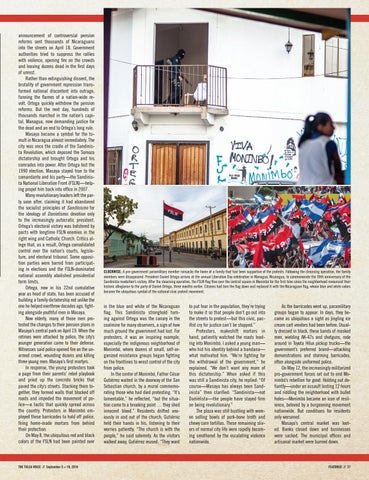
CLOCKWISE: A pro-government paramilitary member ransacks the home of a family that had been supportive of the protests. Following the cleansing operation, the family members were disappeared. President Daniel Ortega arrives at the annual Liberation Day celebration in Managua, Nicaragua, to commemorate the 39th anniversary of the Sandinista revolution’s victory. After the cleansing operation, the FSLN flag flies over the central square in Monimbó for the first time since the neighborhood renounced their historic allegiance to the party of Daniel Ortega, three months earlier. Citizens had torn the flag down and replaced it with the Nicaraguan flag, whose blue and white colors became the ubiquitous symbol of the national civic protest movement.
in the blue and white of the Nicaraguan flag. This Sandinista stronghold turning against Ortega was the canary in the coalmine for many observers, a sign of how much ground the government had lost. For protesters, it was an inspiring example, especially the indigenous neighborhood of Monimbó, where dozens of small, self-organized resistance groups began fighting on the frontlines to wrest control of the city from police. In the center of Monimbó, Father César Gutiérrez waited in the doorway of the San Sebastian church, by a mural commemorating those who had died protesting. “It’s lamentable,” he reflected, “but the situation came to a breaking point … they shed innocent blood.” Residents drifted anxiously in and out of the church; Gutiérrez held their hands in his, listening to their worries patiently. “The church is with the people,” he said solemnly. As the visitors walked away, Gutiérrez mused: “They want
to put fear in the population, they’re trying to make it so that people don’t go out into the streets to protest—but this civic, pacifist cry for justice can’t be stopped.” Protesters, makeshift mortars in hand, patiently watched the roads leading into Monimbó. I asked a young man— who hid his identity behind a bandana— what motivated him. “We’re fighting for the withdrawal of the government,” he explained. “We don’t want any more of this dictatorship.” When asked if this was still a Sandinista city, he replied: “Of course—Masaya has always been Sandinista” then clarified: “Sandinista—not Danielista—the people have stayed firm on being revolutionary.” The plaza was still bustling with women selling bowls of pork-bone broth and chewy corn tortillas. These remaining slivers of normal city life were rapidly becoming smothered by the escalating violence nationwide.
As the barricades went up, paramilitary groups began to appear. In days, they became as ubiquitous a sight as jingling ice cream cart vendors had been before. Usually dressed in black, these bands of masked men, wielding AK-47s and shotguns, rode around in Toyota Hilux pickup trucks—the government’s preferred brand—attacking demonstrations and storming barricades, often alongside uniformed police. On May 12, the increasingly militarized pro-government forces set out to end Monimbó’s rebellion for good. Holding out defiantly—under an assault lasting 12 hours and riddling the neighborhood with bullet holes—Monimbó became an icon of resilience, beloved by a burgeoning movement nationwide. But conditions for residents only worsened. Masaya’s central market was looted. Banks closed down and businesses were sacked. The municipal offices and artisanal market were burned down.
FEATURED // 27