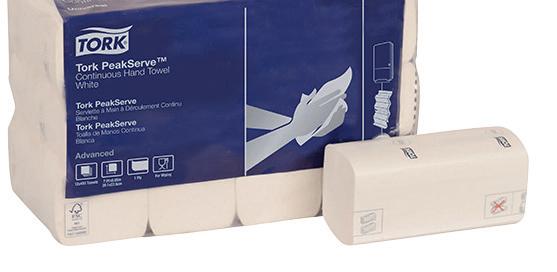
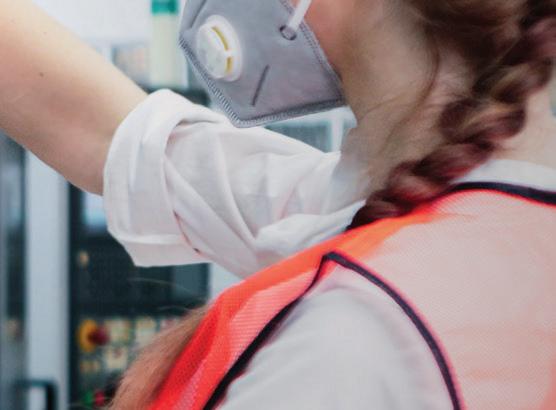
Make the smart choice and help prevent the spread of washroom germs.
Discover why Tork® paper hand towels are better for your business now. tork.co.uk/smartchoice or tork.ie/smartchoice
kpm media Unit 1 Mill Place, Platt Business Estate, Maidstone Road, Sevenoaks, Kent TN15 8TB Tel: 01322 662289
Editor Sara Bean sara.bean@kpmmedia.co.uk
Assistant Editor & Social Media Development
Sarah O’Beirne sarah.obeirne@kpmmedia.co.uk Tel: 01322 476815
Director & Designer Warren Knight warren.knight@kpmmedia.co.uk Mob: 0780 1947757
Sales Director Danny Grange danny.grange@kpmmedia.co.uk Mob: 07867 418994
Business Administrator Sami Smith sami@kpmmedia.co.uk
Accounts Trish Boakes accounts@kpmmedia.co.uk
Group CEO Nigel Copp nigel.copp@kpmgroup.co.uk
Editorial steering committee
Alan Hutchinson, Facilities Director, Howard Kennedy LLP
Charles Siddons, Head of Operations, NHS Property Services
Darren Miller, NBCUniversal, VP for International Workplace, Facilities & Real Estate
Ian Wade, Head of UK Estates, British Medical Association
Lucy Hind, Senior FM Lecturer, Leeds Beckett University
Marie Johnson, Head of Workplace & Wellbeing, Nominet
Russell Wood, Facilities Manager at Dentsu Aegis Network
Russell Burnaby, Head of FM, Regeneration and Environment, Brent Council
Simon Francis, Director of Estates and Facilities, The Institute of Cancer Research
Simone Fenton-Jarvis, Group Director of Workplace Consultancy and Transformation, Vpod Solutions
Stephen Bursi, Facilities Lead, BAE Systems
Wayne Young, Facilities Manager Just East Takeaway.com
Total Average Net Circulation
10,682 July 2021 to June 2022 SUPPORTED BY
kpm media adopts a sustainable policy of using paper from managed forests. Printed in the UK by The Gemini Print Group www.gemini-print.co.uk
Copyright 2023 kpm media
The publisher does not necessarily agree with the views and opinions expressed by contributors. No material may be reproduced in part or whole without written permission from the editor. Editorial contributions are accepted on an all-rights basis only. Letters to the editor may be published in their entirety or in edited form and remain the property of kpm media. While due care is taken to ensure the accuracy of information contained in this magazine, the publishers cannot be held responsible for any errors in editorial articles or advertisements. Subscriptions are available to non-qualifying and overseas readers at £120 p.a. (UK), £160 p.a. (EU countries) and £240 p.a. (overseas-other).
As we get into the swing of 2023, FMs are facing a fresh set of challenges, from managing the disruption to working patterns wrought by the pandemic to confronting a looming recession. That is why in this issue our overriding theme is developing resilience.
In the feature on page 12 we hear from a group of seasoned facilities experts on how they weathered the last recession and their valuable tips on how to navigate the next. In the FM Clinic we’ve rounded up the views of the catering fraternity on how new ways of working are encouraging innovations in workplace foodservices that combat cost hikes and wasted resources.
When it comes to resilience, the cleaning sector did a sterling job of keeping buildings hygienically safe during the pandemic, yet there is still a need for Government recognition to ensure we’re ready for future public health crises. For this reason, last year, the All-Party Parliamentary Group (APPG) for the Cleaning and Hygiene Industry carried out a review, entitled ‘Embedding E ective Hygiene for a Resilient UK’.
The subsequent report was published in December and we’re pleased to say on page 32 we’ve gathered the views of a number of stakeholders involved in its publication to find out how its 11 recommendations have been received by politicians and businesses alike.
Finally, FM remains at the forefront when it comes to creating a healthy work/life balance. The article (page 24) is based on the main findings of designers Claremont’s Annual Insight Report on Balanced Workplaces. It has a plethora of ideas on attracting sta back into the workplace by o ering them perks they just can’t replicate at home. By providing occupants with choice and variety in amenities and design that promote social encounters and allows face-to face collaboration FMs are directly contributing to the resilience of organisations and their people.
As always, we’d welcome your feedback about any aspect of the magazine, together with your insight into what’s happening in the FM sector.
NEC4 Facilities Management Contracts
NEC is a family of contracts that facilitates the implementation of sound project management and procurement principles and practices, as well as defining legal relationships. Uniquely, one of the foundation clauses of every NEC contracts states the parties are to act ‘in a spirit of mutual trust and co-operation’.
The NEC4 Facilities Management Contracts are designed specifically to meet the diverse needs of the facilities management sector while also promoting the NEC tenets of collaboration, efficiency and best practice.
THIS MONTH...
This month’s summary of everything that has hit the headlines in the FM sector.
The latest news and views from RICS and IWFM.
Orgatec, the celebration of o ice design returned for 2022, with the halls of the Cologne Messe bustling with plenty of fresh ideas in workplace design.
Jo Sutherland, MD, Magenta Associates talks to 10 experts for their advice on how FMs can build resilience in times of crisis.
Ways cleaning suppliers are using their ESG goals to help meet targets and show stakeholders they are committed to making a positive impact.
The ‘smart’ revolution has brought the Internet of Things (IoT) into essential equipment and building operations, says Tom Harmswoth.
Gemma Archibald, Alcumus Chief Executive O icer – Supply Chain division on ways to navigate global supply chain disruptions.
Record levels of inflation are hitting contract catering businesses coupled with the challenge of servicing hybrid workplaces. How can suppliers adapt to deliver a ordable, sustainable and nutritional sustenance to clients and consumers?
CASE STUDY
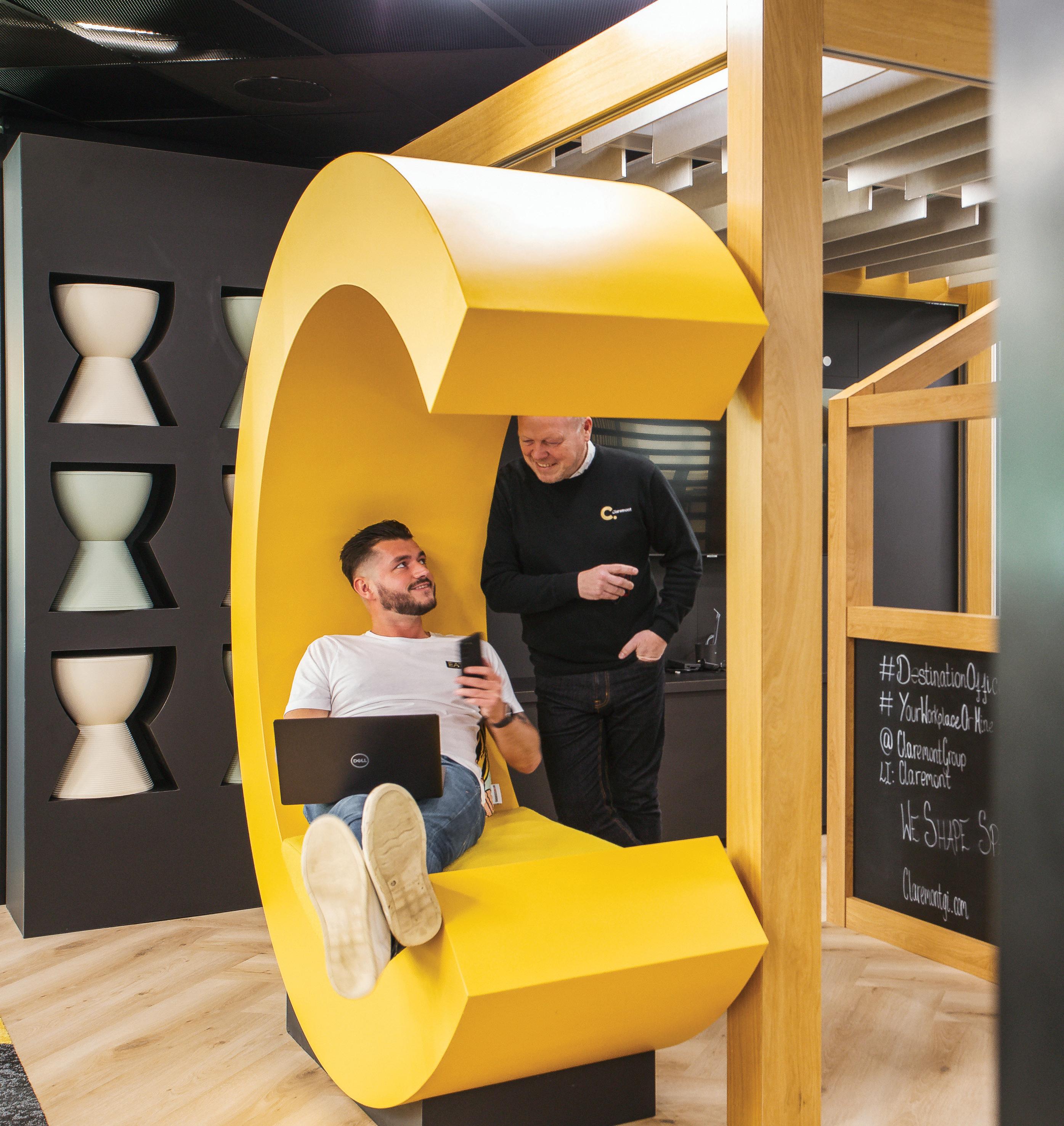
24 FMs need to curate a positive and desirable workplace – if they are to keep their people happy, healthy, motivated and connected to the company’s values and mission, says Sarah Syson, Design Manager at Claremont.
VENDING
28 David Llewellyn, the Chief Executive of the Automatic Vending Association (AVA) on how the vending and automated retail sector has emerged stronger from the pandemic.
CLEANING
32 We hear from some key stakeholders on the recommendations in the report ‘Embedding E ective Hygiene for a Resilient UK’, from the All-Party Parliamentary Group (APPG) for the Cleaning and Hygiene Industry.
INTERVIEW
36
Sue Asprey Price the CEO of JLL’s EMEA Work Dynamics business talks to FMJ about the importance of sustainability and diversity within the property sector
HEALTH AND SAFETY
40
Jonathan Gilbert explains the reasons behind the increase in demand for defibrillators and the importance of maintaining these life-saving devices.
MAILROOM
42 Neil Phillips of Restore Digital discusses how the pandemic propelled changes in mailrooms, which continue to evolve to become more automated and e icient.
PEOPLE
51 Find out who’s moving where in the facilities management profession.
RECRUITMENT
Employer branding could be the most important tool in a recruiter’s arsenal today says Sam Smith with some advice on how to get your branding right.
TRAINING
53 Digital coaching industry experts are predicting a greater need for tailored training in 2023 in response to economic challenges. Sara Bean reports.
CAREERS NEWS
A brief roundup of the latest careers news in the facilities management sector.
Next Edition
In March, we look at the practical benefits of retrofitting existing buildings using BIM so ware, which can result in a marked improvement in the sustainability of buildings; and a look at the main technological innovations predicted for FM so ware – from security to connectivity. The Government’s Facilities Management Strategy is designed to establish standards to address the quality of service which should be aspired to in the procurement of FM contracts. We ask, what impact could this initiative have on the procurement of FM services and is enough attention being paid to the use of procurement to deliver sustainable FM outcomes? Also in March; the impact of a revised industry Code of Practice covering access control systems; how the use of drones could streamline building fabric maintenance and some vital tips on utilising sit/ stand desking.
LEGAL VIEW
NEW IFMA EXPERTS ASSESSMENT REPORT: THE IMPLICATIONS FOR FM
POTENTIAL CHANGES TO FLEXIBLE WORKING LEGISLATION
Alec Colson, Partner And Head Of Employment Law, Taylor Walton
At the beginning of December 2022 the Department for Business, Education and Industrial Strategy published its response to its 2021 consultation on flexible working. The media headlines gave the impression that employees will have the right to work from home from day one of their employment however, this is not the case.
The initial consultation paper detailed a number of proposals to amend the existing right of employees with 26 weeks’ service to request a change to their employment contract in relation to:
• A change to the hours they work
• A change to the times when they are required to work
• A change to the place of work (as between their home and any of the employer’s workplaces).
The government has now proposed to give employees the right to request flexible working as a day one right. Under the government’s new proposal, an employee will be able to make this request on their first day of work.
However, it is a right to request flexible working and not a right to work flexibly from day one. Therefore, a newly appointed employee cannot demand that they work from home from day one.
The government will retain the current list of business reasons for refusing a flexible working request, which are:
• The burden of additional costs
• Detrimental effect on ability to meet customer demand
• Inability to reorganise work among existing staff
• Inability to recruit additional staff
• Detrimental impact on quality of work
• Detrimental impact on performance
• Insufficiency of work during the periods the employee proposes to work
• Planned structural changes in the workforce.
Employers will be required to consult with their employees and to consider alternative options before rejecting their flexible working request. This is in accordance with the current ACAS Code of Practice on flexible working.
Employees will be able to make two flexible working requests within any 12-month period as opposed to the current single request and employers will be required to respond to a flexible working request within two months, rather than the current three months.
The requirement for employees to set out the effects of their flexible working request on the employer will be removed.
The government believes that rather than placing the sole responsibility on the employee to set out the effect of their request on the employer, employers should seek to engage with employees jointly to understand the impact of the flexible working request on the business.
This is consistent with making the right to request flexible working a day one right as a new employee would not be in a position to assess the impact of their request at the beginning of their employment.
When will the proposed changes be implemented?
The government has not announced an implementation date for the above changes and it may be some time before the legislation is introduced. In reality, the proposed changes are a modification of the existing rights to request flexible working and not a right to work from home.
Having said that, employers may find that the proposed changes and the publicity that surrounds them will encourage employees to request working from home for at least some of their working hours, either before or shortly after they have commenced their employment.
Where it is possible to work from home, anecdotal evidence suggests that many employees are already enquiring about home working at the interview stage and many working from home arrangements of one form or other will be agreed prior to the employment commencing.
As with all such employment matters, it makes sense for employers to seek advice and review their procedures before responding to these changes, as and when they come into effect.
The International Facility Management Association (IFMA) has published its ‘Experts’ Assessment, Vol. 2: Future working environments and support functions toward 2030’, providing an in-depth analysis of what the FM industry has learned since the first Experts’ Assessment study was conducted in 2020.
The report, which assesses insights provided by 222 subject matter experts (SMEs) from around the world, aims to build industry resilience and help FM professionals prepare for significant shi s in how organisations operate.
Five thematic sections synthesise SMEs’ perspectives on:
• Facilities in demand toward 2030
• Technology, work and workforce development
• Workplace management and strategy
• Facility management in 2030
• Environmental, social and corporate governance (ESG)
IFMA’s 2020 report, ‘The Experts’ Assessment: The Workplace Post-COVID-19,’ was the result of discussions among 248 global SMEs about the pandemic’s long-term impacts on the workplace and how FMs would adapt to a new world of work. Volume 2 revisits the challenges, projected e ects and recommended actions outlined two years ago, examining choices made and lessons learned, identifying the implications for future work environments and support functions.
Volume 2 identifies the most crucial focus areas for resilience, both for FM professionals and their organisations. It shows that facility managers face several new realities requiring new mindsets, business models and technologies. With remote and hybrid work becoming the norm and organisations still struggling to entice workers back to the o ice, it is increasingly important for FMs to create more experiential spaces.
Link to report: https://ifma.foleon.com/experts-assessment/vol-2/
DEVELOPERS HAVE SIX WEEKS TO SIGN REMEDIATION CONTRACT TO FIX UNSAFE BUILDINGS
As of 30 January, developers have received a six-week deadline, set by government, to sign legally binding contracts that will commit them to pay to repair unsafe buildings.
The government has warned that companies who fail to sign and comply with the terms of the contract will face significant consequences.
Legislation will be brought forward in the spring giving the Secretary of State powers to prevent developers from operating freely in the housing market if they fail to sign and comply with the remediation contract.
The contract, which has been drawn up by the Department for Levelling Up, Housing and Communities, will protect thousands of leaseholders living in hundreds of buildings across England, who would otherwise face costly repairs for serious safety defects, including non-cladding related issues.
Under the contract, developers will commit an estimated £2 billion or more for repairs to buildings that are 11 metres or above which they developed or refurbished over the past 30 years. This means that together with the Building Safety Levy, industry is directly paying an estimated £5 billion to make their buildings safe.
The contract also requires developers to reimburse taxpayers where public money has been used to fix unsafe buildings.
Mitie on track to meet full year expectations
In its latest trading update for the three-month period ended 31 December 2022 (Q3 FY23), Mitie says it has delivered an encouraging performance in the third quarter of the year, with revenue growing sequentially each quarter during FY23.
Third quarter revenue, including share of joint ventures and associates, of £1,005m was three per cent ahead of Q2 FY23 (£978m), and six per cent ahead of Q1 FY23 (£945m). This growth reflects increased project revenues across a number of Mitie’s Central Government and Defence and Technical Services contracts, together with the contribution from acquisitions and contract wins in Technical Services, and effective pricing of cost inflation.
Q3 FY23 revenue was in line with the same period last year (£1,008m), and underlying revenue grew by 12 per cent when the £109m of revenue from short-term COVID-related contracts is excluded from Q3 FY22.
New wins and renewals of £163m total contract value (TCV) in the quarter were lower than usual, however Mitie reports that there are a number of client decisions on major new opportunities expected in the fourth quarter. Total year-to-date new contract wins and renewals were £1.7bn. The renewal and extension rate remained above 90 per cent.
Looking ahead, Mitie says it expects revenue momentum to continue over the balance of the year, albeit at a slower pace as the company laps contracts won late in FY22. Mitie adds that Q4 is typically its strongest quarter, as project work increases, and it completes seasonal winter work in Landscapes.
The Board is confident that the full year results will be consistent with the recently upgraded guidance for operating profit before other items of at least £145m.
INVESTOR AND OCCUPIER DEMAND FOR UK COMMERCIAL PROPERTY FALLS
The Royal Institution of Chartered Surveyors (RICS) UK Commercial Property Monitor Q4 2022 has revealed a further deterioration in overall market conditions during the quarter.
At national level, 83 per cent of respondents believe the market is in the downturn phase of the cycle, up slightly from 81 per cent taking this view in Q3. Forty-nine per cent still consider this downturn to be in its early stages.
In the occupier market, the all-sector net balance for tenant demand slipped to -20 per cent in Q4 2022. This is down from -10 per cent in Q3 and marks the weakest reading since the end of 2020. In terms of the specific sectors, there was a noteworthy fall in occupier demand across o ices (net balance -29 per cent) and retail premises (-45 per cent). Meanwhile, tenant demand remained marginally positive for the industrial sector (net balance +6 per cent). With respect to rental growth projections, on a 12-month view, expectations remain modestly positive for prime o ice and industrial space. Focussing on prime o ices, at the headline level, a net balance of +10 per cent foresee an increase in rents for the 12 months ahead. Regional di erences can be seen in this picture however, with London posting a net balance of +19 and the North +13 per cent.
While the rental outlook appears more resilient in some market segments for 12 months ahead, the recent increase in interest rates is having a more widespread negative impact on investor sentiment. Investor enquiries reportedly fell at the headline level in Q4 2022, evidenced by a net balance of -30 per cent. This decline was seen across all sectors covered for the first time since the early stages of the pandemic. Likewise, overseas investment demand was also down within each sector compared with the previous quarter.
Recent interest rate rises are also having a significant impact on capital values, with near-term expectations falling sharply across all sectors. Looking out over the next 12 months, capital value projections are now in negative territory across all three mainstream sectors in both prime and secondary markets. All parts of the UK now display negative all-property average capital value expectations for the year to come.
Playing a significant part in the pull-back across many investment market indicators during Q4, credit conditions were reported to have worsened by a net balance of -73 per cent of contributors (down from -68 per cent last time). As such, this is a fresh record low for the series (first introduced in 2014), with higher interest rates singled out by many contributors as ushering in a period of adjustment in market valuations.
21 FEBRUARY 2023
Workplace Futures Conference One Great George Street, London, SW1 www.workplace-futures.co.uk 27-28 FEBRUARY 2023
Workspace Design Show Business Design Centre, London https://workspaceshow.co.uk
MARCH 2023
MARCH
15-16 MARCH 2023
WHA Conference and Trade Show DoubleTree by Hilton, Milton Keynes https://twha.co.uk/conference/ 22-23 MARCH 2023 World Workplace Europe Schiecentrale, Rotterdam, Netherlands https://worldworkplaceeurope.ifma.org/
MAY 2023
14 JUNE 2023
07 SEPTEMBER 2023 Smart Buildings & Sustainability
FMS CAN WELCOME THE LAUNCH OF A NEW HARMONISED INTERNATIONAL PROPERTY MEASUREMENT STANDARD (IPMS)
In January of this year a new harmonised International Property Measurement standard was launched. The initiative was propelled by the shared desire of organisations, governments, companies and professionals to build a genuinely global language for measurement.
The International Property Measurement Standard is a global open-source standard aimed at creating a uniform approach to measuring buildings. IPMS All buildings is applicable to all types of Buildings independent of their use or their occupation. It has been published by a Coalition of 88 property organisations representing hundreds of thousands of property professionals globally and dra ed by an independent Standards Setting Committee (SSC) group of 18 experts from 11 countries, who represent the various property disciplines including academics, architects, engineers, surveyors and facility managers.
At a time of unprecedented challenge for all real estate professionals the need for transparency and consistency in measurement has never
been greater. Ambiguities around space make it di icult for global investors and occupiers to make informed business decisions on space requirements. ESG, data and technology are playing an increasingly central role in driving benchmarking and performance measures, so an International Standard for Measurement is critical at the outset.
IPMS All Buildings supersedes all previously published IPMSC standards for individual asset classes by utilising the concepts and objectives contained in those specific versions of IPMS into one harmonised standard.
The main benefits of using IPMS in all buildings is to o er building professionals confidence and consistency in property measurement. Broadly, IPMS will:
Provide a mechanism for benchmarking property measurement information across international markets.
Provide a common and transportable method for property practitioners to use.
Enable all occupiers, investors, and owners the ability to benchmark their property assets without needing to spend significant sums of money and resource calibrating space measurements.
Provide greater transparency and consistency to all property users, wherever they are located.
Provide consistency in the data which sits alongside valuations and financial reporting.
Provides fundamental economic building block of all property metrics used in operation, leasing, acquisition and disposal of property.
IPMS All Buildings provides the foundation for incorporation into and adoption of building measurement conventions in the many global jurisdictions. It is available, free to an individual or organisation. There are no costs incurred in requesting or using IPMS All Buildings to measure property. Organisations that use IPMS All Buildings can seek additional guidance and support from any of the Coalition organisations that have signed up to implement the standards.
Consistent measurement to enable e ective decision making and benchmarking has never been more critical. It will be invaluable to all those working in the built environment and in particular the FM sector who are faced with a range of challenges on the use and measurement of workspace.
SAVE LIVES: STAY ON TOP OF FIRE SAFETY CHANGES
On 23rd January, the longanticipated new fire safety duties started coming into force – the first of several pieces of fire and building safety legislation arriving in 2023.
Before I touch on what has been introduced, we should remember why these changes are happening. The Grenfell Tower fire took 72 people’s lives, dozens more people were injured, 20 of them seriously. These new fire safety measures, along with others in building safety, must be learnt and followed to prevent more people from needlessly losing their homes, friends, family, and lives.
Kicking o the series of new requirements in 2023 and our first welcome step towards safer homes are the new information requirements and maintenance checks for fire doors, li s and firefighting equipment from the Fire Safety (England) Regulations 2022, which flow from the Regulatory Reform (Fire Safety) Order 2005.
The Regulations give new duties to the Responsible Person (RP) with regards to certain information provisions to residents and the fire and rescue services, and maintenance checks. These apply to residential buildings, with the specific requirements determined by building height. The RP must also utilise the Fire Risk Assessment Prioritisation Tool (FRAPT) to develop a strategy for reviewing fire risk assessments.
More extensive fire safety management information can be found in our newly updated ‘Fire safety management’ good practice guide, available free to IWFM members.
On Wednesday 8th February, I will host a webinar to discuss another of the key legislative changes coming into force this year: the Building Safety Act 2022. Joining me are Andrew Moore, the competence lead at the Health and Safety Executive and Anthony Taylor, Chair of the Building Safety Alliance and a member of the IWFM Life Safety Working Group. You will find the registration link on the IWFM website under “Events”. If you miss the webinar, you will be able to access the recording, under “Insight”.
Higher-Risk Buildings
Also on 23rd January, the Higher-Risk Buildings (Key Building Information etc.) Regulations 2023 entered Parliament for debate and approval. The Regulations set out the high-level key building information that the principal accountable person (i.e. the person responsible for repairs to the structure and exterior) will provide to the Building Safety Regulator and clarify who is responsible for which parts of a higher-risk building when there are multiple accountable persons. The key building information will enable the Building Safety Regulator to: analyse trends and risks in high-rise residential buildings; prioritise assessment of fire and structural safety in existing high-rise residential buildings and thus e ectively tranche the call-in and assessment of safety case reports; identify similar buildings or systems if an issue emerges. There is and will remain much for FMs to learn as the changes come in. It is crucial that FMs are on top of the new requirements if we are to prevent another tragedy like Grenfell.
Sofie Hooper, Head of Policy, IWFM
Paul Bagust - RICS Head of Property Standards, Chair, IPMS Coalition
The
The provisions of the Regulatory Reform (Fire Safety) Order 2005 and BS 9999, are well established and understood. The new Building Safety Act now calls for each building to have a designated ‘Accountable Person’ to ensure compliance. If you are a building owner or manager, this could mean you.
Fortunately, Colt has been at the forefront of smoke control system design and installation since the early 1950s and is uniquely qualified to help you stay on the right side of the law.
A Colt service contract will keep you legal.
Only Colt has the depth of experience, the expertise and the national coverage to mitigate this weighty responsibility.
Our consultants are fully conversant with all smoke control systems, whether designed by Colt or other manufacturers.
They undergo regular training sessions to ensure that their knowledge of new products, systems and the ever-changing regulatory landscape is always up to date.
Colt has the qualified engineers to ensure that every part of your smoke control system will perform as intended in the event of a real emergency.
Colt is the UK’s first company to be awarded certification to both IFC SDI 19 and SDI 05. Put us to the test.
To find out more or organise a survey, visit us at: coltinfo.co.uk/service-maintenance.html call us on 02392 491735 or email service@uk.coltgroup.com
Mobility is key to Colt’s ability to reach you in a timely manner, anywhere in the UK.
Our engineers assess components for re-use, repair or replacement.
Does the buck stop with you?
ORGATEC
FRESH DESIGNS
Orgatec, the celebration of o ce design returned for 2022 after a hiatus due to the COVID pandemic. The halls of the Cologne Messe were bustling once again with plenty of fresh ideas in workplace design
Hybrid
working was unsurprisingly a hot topic. For its part, Orgatec and the Fraunhofer Institute for Building Physics (IBP) presented their findings in terms of the socio-importance of this topic with half of respondents expecting the impact of the last couple of years a ecting the future allocation of working time and working locations. There will not be a ‘new normal’ the report concluded as people are subject to various influences and long-term developments are regularly a ected by current events. That said, flexibility in fixtures and fittings remained high on the agenda for many manufacturers. Italian producer Arper, for instance, summed up the mood when it talked about “the boundaries between home and work are gone. Now ‘living’ means all the di erent things we do in a day. Everything is in flux, so anything is possible. How do we want to live? More seamlessly. More inspired.”
HOMELY OFFICE
To this end, it presented Aeeri by Peter Kunz, a table to work at that is equally at home in a dining room as it would be in a workplace environment. It
bends from a single sheet of steel, thanks to high tech engineering into a slender, sculptural form and has just five components in total which would certainly be music to an FM’s ear. Also from the collection is Shaal by Doshi Levien. This sofa, available in two or three seater versions is ideal for the home, o ice or hospitality environments. It marries both comfort and modularity to provide a graceful cocoon-like structure. Then there’s the Cell side table by Jean-Marie Massaud which again is designed to serve in all settings, providing a comfortable surface for working, reading or dining.
Furniture manufacturer Nowy Styl and its brand Kusch+Co presented a joint stand with an impressive 28 new products which also responded to the changing needs of today's working world. Under the theme of ‘Reunion’ these included the Bound chair by Karim Rashid, O a storage and Vapaa chair. The WithME chair, designed by Martin Ballendat with coworking and collaborative meetings in mind. The eUP sit-stand desk meanwhile is designed based on finding a healthier way to spend the working day. Space is another furniture solution consisting of desks and workbenches. Its smart
construction means assembly is quick and easy and reconfiguration is similarly straightforward.
SUSTAINABLE WORKPLACE DESIGN
One of the other focuses for this edition was ‘sustainable workplace design’ and this was embraced wholeheartedly by high-performance ergonomic furniture products Humanscale. It presented Path, the world’s most sustainable task chair. Designed by Todd Bracher and the Humanscale Design Studio, the Path chair is composed of nearly 10 kilograms of recycled materials, which includes reclaimed fishing nets, used plastic bottles, and post-industrial material. This is the third in a series of ‘Ocean’ chairs, representing Humanscale’s commitment to making a net positive impact on the Earth.
The organisers of Orgatec praised the exhibitors’ high level of innovation as also exemplified at Humanscale. It presented a range of integrated technology solutions, the latest being NeatCharge. This clever device turns your selected surface into a wireless charging area, reducing clutter and making cable management less of a headache for facility managers.
From future-focussed launches,
other exhibitors preferred to take inspiration from the past albeit with a very contemporary twist. Design studio Industrial Facility worked with the familiar lines of Thonet’s 214 bentwood chair and reinvented the design as a stackable, material-e icient moulded plywood version with a tubular steel frame. The S 220 chair – or the S 220 F with armrests – is suitable for both residential and contract uses and is not only visually striking with its ‘waterfall edge’ at the front but also pleasing to the touch and comfortable to sit on.
Staying with seating for the moment, Pedrali presented Polar, a new task seating designed by Jorge Pensi Design Studio. Designed to adapt to the human body the chair has simple and intuitive built-in mechanisms which adapt to di erent uses, positions and postures. Thanks to its weight-activated, synchrotilt mechanism it can cleverly move according to the user’s body weight. Polar has an injected-moulded nylon frame with a breathable, flexible polyester mesh and injection-moulded polypropylene support at the lumbar area, with a polyurethane foam seat.
TEXILE CHANGES
Innovations in upholstery textiles were the focus of Kvadrat’s presence at Orgatec. There the Danish manufacturer launched Steelcut 3, Steelcut Quartet, and previewed Steelcut Beat, the latest textiles designs by Giulio Ridolfo and Frans Dijkmeijer. O ering clarity and colour depth, the collections are characterised by a three-dimensional surface resembling small pyramids or steel points and are available in a range of warm tones, providing a lively dialogue between construction, yarn, and colour.
With such innovation and strong responses to contemporary ways of working, Orgatec’s organisers must be pleased with the 2022 show. Also, over three quarters of exhibitors came from abroad, enhancing the event’s international standing as it looks forward to the next edition in 2024.
We’re not your usual waste company
We work with you to create value
One supplier for all your waste streams
Earn thousands of pounds from your recycling
Engaging education programmes
Innovative waste technologies
TOUGH TALK
“Get up, get to it, do a good job.” Ten experts on how FM can build resilience in times of crisis. By Jo Sutherland, MD, Magenta Associates
In January 2023, the UK enjoyed headlines such as – “The UK recession will be almost as deep as that of Russia”, “UK faces worst and longest recession in G7” and “Third of world economy will be in recession this year”. Happy New Year, indeed.
But it’s not all doom and gloom. In fact, there are as many opportunities as challenges. So, how can firms within the built environment build resilience? I interviewed 10 experts – those who were working in the industry when the last recession hit – to find out.
WHAT HAPPENED TO THE BUILT ENVIRONMENT
SECTOR
BACK IN 2008?
Antony Law, COO, Churchill Group: FM works in cycles. Back then, TFM really came to the fore, probably because the prerogative at that time was cost savings, and there was the assumption that consolidating services would save money. In addition, investment in technology became a business priority. The recession helped charge FM into investing into solutions that would in turn deliver more value over time. That’s when the FM business model really came into its own.
Andy Topp, Director, Corps Security: From a security perspective, there was a huge cost pressure on contracts and a real need to look at operations closely to identify where savings could be made with an existing portfolio. Winning new
business became a race to the bottom in certain scenarios. Some of the larger players capitalised due to market conditions and the opportunities that came with it. That’s perhaps why there was a flurry of acquisitions following the last recession – that’s when we began to see lots of di erent constructs of service delivery and more amalgamation of services, in particular within the FM space.
Mark Tyson, Head of Property Operations, LGIM: The first downturn forced the big guys to do proper partnerships that could stand the test of time. It wasn’t just procurement driving down costs, it was about the customer working with suppliers as part of a strategic partnership to deliver real value.
WHAT DO YOU THINK WILL HAPPEN THIS TIME AROUND?
Simon Murphy, NED, DMA Group: We’re in a much di erent place. For a start, we don’t have the big financial problems we had last time because banks have been cautious ever since and haven’t been aggressively lending. Although everything seems pretty gloomy at the moment, I actually don’t think we’re set to endure a particularly bad recession, especially if you look at it from a nominal growth perspective.
Lucy Jeynes, MD, Larch Consulting: Organisations are looking carefully at their occupancy levels, and mapping their lease break clauses. We would expect to see organisations reducing their overall space/property footprints, and reconfiguring what is there to focus more on collaboration spaces, as people are tending to do their focused individual working at home now. There is a crisis in the rail network, with price increases, strikes and service failures. The daily commute is less attractive than ever, which also impacts on occupancy in cities. You’d think there would be more of a rise in neighbourhood co-working spaces (a common model in
Europe) – but we’re not seeing it taking o .
Rachel Basha-Franklin, Principal Director, BashaFranklin: There are more interesting projects out there, a duty to deliver sustainable buildings and better environments to support human health and wellbeing. The whole conversation about the built environment accelerated in the right direction and I don’t think that momentum will stop.
HOW CAN FIRMS WITHIN THE BUILT ENVIRONMENT DELIVER MORE VALUE?
Jeremy Campbell, Executive Director, EMCOR UK: If we think about value as a combination of cost, quality service, customer experience, sustainability, people engagement and wellbeing, then facilities has the potential to deliver so much more than it is today. I think we'll see more focus on supporting the superstars the industry employs, cultural change, carbon neutrality, nailing the basics, and going above and beyond to improve the experience. Technology will play a key part in this.
Rachel Houghton, MD, Business Moves Group: Value comes from being agile and working as a tight-knit team to ensure there’s a real understanding of industry challenges, not to mention a timely and emotionally intelligent level of responsiveness. Ultimately, though, those firms with an eagerness and a willingness to change the shape of what good looks like – including how they look a er their people – will be the ones to deliver more innovation and value.
WHAT LESSONS DID WE LEARN BACK IN 2008 THAT WE CAN APPLY TO 2023? AND WHO WILL BE THE WINNERS THIS TIME AROUND?
Andrew Wood, CEO, DMA Group: For me, the lesson is that cash is king. I think the winners will be those who manage to get technology into the heart of their business. But it’s two pronged, and you can’t just present technology to your customers without the human touch. Human customer service is what clients want.
Alistair Craig, MD, Anabas: I think the companies that commit to delivering value, that really care about each and every one of their clients, that strive to be the best, and that know what they are about and what they stand for will thrive. Recession is just a technical phrase. You get up, you get to it, and you do a good job. You’ll live or die by that.
CONCLUSION
With every challenge, there’s an opportunity. That was certainly the case in 2008 and the shockwave years that followed. The consensus is the last financial crisis helped to pave a better way of doing things. Fi een years later and perhaps we have another chance to redefine and further bolster FM’s value.
If fi re or smoke damper maintenance is your responsibility, we can keep you legal.
Under the Regulatory Reform (Fire Safety) Order 2005, it is the legal duty of the “Responsible Person” to oversee the maintenance and testing of fi re safety systems. This includes fi re dampers and smoke control dampers, which are invaluable when it comes to maintaining the integrity of a building’s fi re strategy.
To ensure you meet the standards set out in BS 9999, your dampers should receive a full service once a year, be inspected at 6-monthly intervals and have 3-monthly functionality tests carried out by a competent servicer such as Kingspan Light + Air. Talk to us to arrange a visit.
The Kingspan Light + Air approach to damper maintenance
Proper, preventative, pre-emptive service work undertaken by our qualifi ed specialists not only ensures that BS 9999 standards are met in full, but also offers considerable savings in time and money.
We will conduct the following procedures to ensure that successful and legally compliant damper maintenance is carried out:
Review and Advise
Our engineers will look over existing damper maintenance provisions, review maintenance processes and offer advice on how best to proceed.
Kingspan Light + Air
Survey and Plan
We will survey the site, verify damper locations and locate dampers to get a clear picture of the scale of the operation and an idea of the existing maintenance schedule.
Service and Report
We’ll check each damper individually, ascertaining the operational status of the system and all HVAC controls on-site.
Repair and Replace
We will consider which dampers to repair and which to replace, creating a cost-effective and considerate strategy for moving forwards.
Assist with Asset Register
On completion of the damper review process, we will assist in the completion of all asset registers, including the location, specifi cation and maintenance history for all dampers covered by the service contract.
Mellyn Mair Business Centre, Lamby Industrial Park, Wentloog Avenue, Cardiff CF3 2EX T: +44 (0) 29 2077 6160 E: info@kingspanlightandair.com www.kingspan.com/gb/en-gb/about-kingspan/kingspan-light-air
COMPLIANCE
ESG AS THE BASIS FOR MODERN BUSINESS
CEO of Cleanology, Dominic Ponniah, explains how cleaning suppliers are using their ESG goals to help meet targets and show stakeholders they are committed to making a positive impact
Whenwe think about business, we usually consider the balance sheet. But while every company takes time to consider its financial health, the health of a business goes far beyond profit and loss. In recent years, we have seen a greater focus on sustainability, but this definition only goes so far.
Increasingly, ESG (Environment, Sustainability, Governance) reporting is becoming more prevalent and, with it, modern business heads towards greater accountability, that recognises the wider impact of our activities on the world around us.
We need to take our impact seriously – not just prioritising the physical environment in which we operate, but considering the people who work for a company and the communities we serve. Cleanology is accredited to ISO 14001, and is about to receive B-Corp status. While sustainability is important, focusing on ESG goals brings with them a wider power for good.
ENVIRONMENT
As well as the impact of running their own o ice operations, cleaning firms make a significant contribution to the sustainability goals of their customers. They need fuel to transport sta to work and, once there, operatives also use cleaning solutions, impact the success of recycling schemes and communicate positive messages around the environment.
Many clients have ESG strategies and targets in place, and a good cleaning contractor will help FMs to achieve these.
PLASTIC WASTE
Cleaning solution is the essential tool of the trade for any cleaner. Typically, this comes in plastic bottles, and is applied liberally throughout. However, this attitude needs to change. We were the first in Europe to introduce portion-controlled, biological cleaning sachets. Since switching, we are saving 16,092 litres of water, and cutting plastic bottle use from 21,600 to just 600 PET bottles each year.
Recycling is a valuable practice, but without markets for recyclable material, it is futile. In 2020,
we went on to pioneer the introduction of uniforms made from recycled bottles. This saves 7,000 bottles from landfill each year, whilst also saving on resources and energy to manufacture new clothing. Together, our sachet cleaning solutions and recycled uniforms will save 28,000 bottles from landfill in just one year.
FUELLING ENERGY REDUCTION
Travel is essential in our industry. This year we launched a 100 per cent electric van fleet to run alongside our all-hybrid car fleet. These vehicles will save 5,000 litres of diesel per year – equivalent to 13.5 tonnes of CO2
As well as reducing the carbon impact, going green is good for budgets. We save over £3,000 a year per vehicle; there’s no road tax to pay, and also no London congestion charge, which saves another £5,500 per vehicle. That’s a massive £8,500 a year cost reduction per van.
www.cleanology.com
Choose recycled products; Control noise emissions from operations.
PAPER USAGE
We had already switched to digital e-payslips for sta , and have since rolled out the system to invoices, which led to a dramatic fall of 20 per cent –saving over 100,000 sheets of paper a year.
FAIR PAY
Fair pay is critical to achieving a truly sustainable world, so the Real Living Wage sits at the heart of our business. In 2017, 18 per cent of our sta received a Real Living Wage rate of pay. Today, that has increased to 62 per cent overall, and 96 per cent of all new business won in 2021. We are currently in the process of becoming a 100 per cent Living Wage employer.
THE WIDER COMMUNITY
A fi h of the population is living in poverty. Figures show that one in three people has had to go without hygiene essentials – people will choose to forego hygiene products before they are forced to accept donations from a food bank.
ENVIRONMENTAL POLICY AND ISO
Our 9001 and 14001 certifications call for robust monitoring, and our environmental policy also extends through to our supply chain.
STAFF ENGAGEMENT
We regularly survey employees to assess their level of environmental awareness. Sta receive in-depth training during their induction, and annual refresher courses. We make expectations clear:
Re-use all paper, before recycling; Donate printer cartridges to charity for recycling; Use public transport, walk, cycle or car-share whenever possible;
Since 2020, Cleanology has supported The Hygiene Bank, which was launched to tackle the shocking reality of hygiene poverty. The resulting campaigns have generated a whopping 1,000kg of hygiene products. Cleanology’s own donation of hand sanitiser during our first campaign amounted to over £13,000 and, last year, an annual fundraising auction raised over £14,000. Press coverage of the event raised awareness of hygiene poverty to over 100,000 people through media coverage.
CONCLUSIONS
ESG initiatives are designed to meet specific goals, and projects such as the partnership with The Hygiene Bank not only send positive waves throughout the cleaning industry, but inspired sta . We see ESG as an important new way to measure success. It is no longer enough for businesses simply to balance budgets; we hold a responsibility to reduce our impact, and improve the world we share.
ARE YOU USING A RENEWABLE FUEL?
HVO BENEFITS
Up to 10-year storage lifespan and year-round performance
We can support your switch to HVO, our fully sustainable drop-in diesel alternative, seamlessly uplifting and replacing your existing fuel.
Cuts net CO2 emissions by up to 90%
Zero FAME content, reducing the risk of fuel degradation
Endorsed by a wide range of OEMs, meets EN 15940:2016 & ASTM D975 specifications
HOW WE CAN HELP
We’ll uplift your old fuel and recycle it responsibly
Our tank cleaning & NDT testing will future-proof your tanks and pipework
Enjoy a smooth transition with our end-to-end project management
INNOVATIVE PERFORMANCE
FMJ AIMS TO SUPPORT TECHNICAL EXPERTISE IN THE FM MARKET
The key to meeting rising equipment costs is innovation to improve e ciency and maximise building performance, says Tom Harmswoth, Managing Director of WeMaintain
Lastyear, the curator of an exhibition on rubbish at the Design Museum in London argued that we were living in the ‘waste age’. Waste, he said, was central to our way of life. The ancient habit of creating things to last, and of repairing and maintaining, had been supplanted by a culture of replacement: our first instinct when something broke down was to throw it away and simply get a newer version. And both consumers and companies were complicit. Take the earliest versions of the light bulb, which were so longlasting that they were considered commercially unviable. As a result, the life expectancy of future designs was deliberately and dramatically reduced.
But in the built world, the habit of readily replacing equipment, rather than repairing it or replacing it only
when necessary, has been forced upon building owners and managers. There’s no culture of waste: it’s just been impossible to know exactly when equipment has been in need of repair. The result of this has been hasty or unnecessary replacement, (due to the risks that come with failing to replace certain potentially faulty equipment), or to constant and costly breakdowns. During a di icult spell for the property sector, such as this one, that amounts to a small fortune in costs. The built world now has a pressing need to adopt a model of maintenance and repair.
INNOVATION
Just as innovation played a key role in moving society away from a maintenance and repair model to one of replacement and waste, innovation has a major part to play in putting
equipment become possible as a result: owners and managers develop a wiser understanding of the value of the equipment they use over time, and the likelihood that it will have to be replaced. In addition, further developments in this area give us reason to think that we will soon know precisely how to optimise the use of equipment, such as by regulating the occupancy rates of li s. In other words, building managers will be able not only to invest in the right equipment, respond to data and make adjustments to or maintain that equipment, but to proactively create the conditions in which the equipment is used in the most e icient and economic way possible. All this is made possible by IoT.
things right again. The ‘smart’ revolution has brought the Internet of Things (IoT)—physical objects that connect and exchange information over the internet—into essential equipment and building operations, such as HVAC, and li and escalator maintenance. These physical objects include sensors capable of collecting data on temperature, humidity, noise level, footfall, and the frequency of equipment use, giving the managers and operators of smart buildings— those that use technology like IoT—a level of knowledge they have never had before.
Thanks to that knowledge, which is available in real time, building managers can modify or adapt systems as and when they need to or, increasingly, automate these systems, so that the needed adaptations happen by themselves. Not only does this kind of approach dramatically reduce wear and tear on equipment, prolonging the need for both repair and replacement, but it saves an enormous amount of energy, to the benefit of owners’ wallets and the environment. The European Commission concluded in a report that an intelligent heating and ventilation system and optimised lighting could reduce energy consumption by up to 32 per cent.
More saliently, however, devices fitted with connected sensors give maintenance teams the information they need to perform fast, targeted repairs, reducing the number of costly breakdowns and prolonging the life expectancy of the equipment they maintain. More sophisticated cost-benefit analysis concerning
GETTING SMARTER
Buildings don’t have to be smart to begin with: they can get smarter. Older buildings can be retrofitted; newer buildings can build on the technology they have already. Only 34 per cent of the buildings in the United Kingdom have smart tech installed in their buildings, and the more smart tech there is, the greater the savings. There are fewer breakdowns, cheaper maintenance operations costs, quicker resolutions. All of this becomes possible simply by fitting li s, escalators, HVAC and other essential equipment with smart devices. And it almost goes without saying that the experience of occupants improves with the technological sophistication of the building and its approach to maintenance.
It’s important to remember that the heart of any smart building is its nuts and bolts: the operations and equipment that allow it to run smoothly. If managing that equipment is costly, then the rest of the building struggles. Heating, ventilation, air conditioning, escalators, li s—these essential operations can be maintained and optimised with the help of recent innovations. Replacement can become the exception, rather than the rule. As a long recession looms, and the property sector su ers from one of its worst periods in recent memory, building owners should consider how technology could help—how fitting out equipment with the right sensors and devices could give them the kind of knowledge they need to make the rest of their property run both e iciently and economically.
Missing something?
You wouldn’t hire a car without seats.
So why hire workspace without chairs? Or air-conditioning, fire safety equipment, white goods, furniture, WiFi and everything else you need?
Quite simply, when we say we can deliver everything to you, we mean it.
Algeco turnkey solutions deliver all the flexibility, convenience, peace of mind you need. In one package.
All available immediately with the largest hire fleet in the UK. All supported by ESG policies that reflect your priorities for better sustainability. And all backed by leading Health & Safety standards that mean fewer risks for you.
Why miss out when you can have it all?
Call us now on 0808 108 2222 or visit algeco.co.uk/missing-something
Wayne Young MIWFM linkedin.com/in/wayney-9952b4188 Today I had a go at being one of amazing couriers with Martin Mckeown CMIOSH our H&S Manager in Liverpool. It was great to see and experience the passion and professionalism of our couriers and speak to them about our business and what I can do to make there facilities better. I genuinely love an on the job day.
Jennifer Bryan @jlbryan01 Flexible working and hybrid working are different things. I really wish the media would get that right as they muddy the waters with their misuse of language! BBC News - Most bosses want staff back in offices says Tony Danker.
@Facilities_Show Registration is now open for Europe’s richest and most extensive range of facilities management solutions and expertise. #FAC2023 is back at ExCeL London on 16-18 May 2023. #facilitiesmanagement
Ian Baker CIWFM linkedin.com/in/iancbaker Nearly 2 years on since the end of the last lockdown and office occupancy / utilisation is still one of the key factors clients are struggling with right now. To understand it, first you need to measure it. #EMCORUK
@BRE_Group Heating buildings accounts for 23 per cent of UK greenhouse gases & decarbonising heat is crucial to reaching #netzero. Our report, Decarbonising Heat in Britain’s Buildings, calls on the government to go further in supporting a transition to clean #energy
Kate Gardner linkedin.com/in/kate-gardner35b89526 It’s an IOSH working safely day today for some of the team from one of our Cleaning Contractor clients.
Health and Safety Executive @H_S_E
Work-related #stress can affect anyone and everyone. Don’t ignore the signs – look out for things like increased absences, high staff turnover, and more arguments, complaints or grievances. For guidance on talking to workers about stress, visit: https://bit.ly/3HAIezh #WorkRight
Enhance your #workplace experience with our new #ESG Strategy Guide. Sharing collective #insights from the @fmjtoday roundtable, experts discuss key topics and strategies. https://t.co/hqQI1roUZE
THE LESSONS FROM HISTORY – HOW TO NAVIGATE GLOBAL SUPPLY CHAIN DISRUPTIONS
Disruptions in the global supply chains have been a ubiquitous problem of late and have accounted for a large part of the post-pandemic turmoil a ecting businesses. However, this is not the first instance in modern history where such issues have led to widespread uncertainty. Looking back, we can see recurring problems in the supply chain, stretching back to both World Wars and more recently the impact of Brexit and the war in Ukraine. One other constant is that these issues have been mitigated through innovative thinking and supply chain resilience, which serve as useful lessons for today.
LESSON 1: DIVERSIFYING SUPPLY CHAINS
WWI and WWII serve as good examples of mass disruption of supply chains on a global scale. While some of the cargo may di er from what businesses are shipping and distributing today, one key parallel can be drawn between then and now. The USA’s entry into the war, and allied Europe’s supply chains represented a key turning point, and also showed the impact of sourcing supplies from alternative production lines that may be less a ected by regionalised disruptions. If we look at issues facing today’s supply chains, brought about mainly by COVID-19 and the war in Ukraine, we can see the value in securing supplies from alternative lines of production. One way to strengthen a supply chain is diversification. Supply chains that rely on one provider alone lack resilience and by making proactive contingency plans and sourcing alternative providers, companies can overcome potential disruptions with more confidence, as evidenced by Britain’s outsourcing of supplies to the USA and Canada in WWII, rather than solely relying on Europe.
LESSON 2: PREPARING FOR DISRUPTION
Another past example that serves us today is the outbreak of the SARS virus in 2003 which had a significant impact in the Asia region. While the disease proved to be a significant challenge, its lasting impact is something that has led to an increasingly resilient regional supply chain, something that benefitted businesses in the area during the COVID-19 pandemic. SARS caused a need for businesses to have back-up plans in place for such disruptions such as establishing parallel sites, shi ing operations, and investing in IT to enable remote working. All of this adaptability helped when the world was altered irreparably by the outbreak of COVID-19 in 2020, giving those businesses with contingency plans in place a leg up.
LESSON 3: ENSURING REGULATORY COMPATIBILITY
Wars and pandemics are far from the only hurdles
that supply chains have to contend with, though. Regulatory changes can have a similarly profound impact, requiring companies to go back to the drawing board and rethink their global supply chains from the ground up. These changes also show us the vital importance of checking the levels of compliance, credibility and regulation in our supply chains ahead of time, in order to improve resilience and adaptability.
Previous examples of major regulatory changes impacting supply chains include the UK’s Modern Slavery Act 2015, which clarified what legally constituted modern slavery and explained how entities that were found culpable would be punished, rea irming the need to make sure businesses are dealing with ethical providers. Organisations can’t engage in murky practices, partnering with subpar suppliers, and hope to get away with it. They should instead expect to be regulated at some stage or another – and should therefore set up clean operations right from the outset.
LESSON 4: PRIORITISING COMPLIANCE
In order to deal with regulatory disruptions ahead of time, companies must place compliance at the centre of their supply chain operations. They must ensure that they only work with suppliers who align with today’s ESG regulations and commonly accepted standards. By implementing supply chain compliance solutions, company’s can ensure they work with the right suppliers, verify a potential supplier’s credentials, dig into their capabilities, and ensure they’re the right fit for their organisation’s needs.
Supply chain disruption is an ever-present thorn in organisations’ sides. However, businesses will enhance their own supply chain resilience by learning from how both companies and countries overcame similar disturbances in the past. They can source alternative providers ahead of time, maintain visibility, and use instant reporting to foresee and manage supply chain disruption.
Most people would run away, we’re not most people. Meet Jordan.
Jordan arrived at an elderly customer’s house and found the customer struggling to get into the family car due to a flat battery.
Jordan managed to open the door and pull the handle inside to gain access. He then popped the bonnet and jumpstarted the car from his van. He got the car running again and then went to unblock the drain.
Complete water in, waste out solutions. Find out more: www.metrorod.co.uk
FM CLINIC
The latest Contract Catering Tracker shows sales are substantially up year-on-year and are approaching preCOVID levels. However, it also acknowledges the impact of record levels of inflation hitting the contract catering businesses hard along with the challenge of servicing hybrid workplaces. How can suppliers adapt over the coming year to deliver a ordable, sustainable and nutritional sustenance to clients and consumers?
the preferred days for people to be in the o ice.
This of course translates into everyone coming in with a need for a desk as well as space for their teams. They also want collaboration and meeting spaces, and client entertaining and networking across fewer days than before. This all creates a spike in demand during those days, pushing hospitality and facilities teams to their limits, and challenging labour pools.
2023 will bring fresh challenges for suppliers, not only to adapt to this new reality of a three-day o ice-based working week and condensing the delivery of services into a shorter weekly span, but also combating worrying inflation and sta ing shortages, and di iculties with supply chain.
In FMJ's regular monthly column, our team of FM experts answer your questions about the world of facilities management
THE CLIENT’S VIEW
STEPHANE DAVAINE, FRONT-OF-HOUSE MANAGER AT WEALTH MANAGER RBC BREWIN DOLPHIN
2022 was a relatively positive year, which saw a steady return of face-to-face meetings a er a short period of adjustment.
We le a few years of working from home behind and moved towards agile working - a format we are witnessing many large organisations adopt.
Sustainability, flexibility, and proactivity will be key elements suppliers to address this year to overcome these challenges and continue to deliver outstanding services to customers and clients.
This adjustment was certainly not achieved overnight, and it’s safe to say that we are still not back to pre-COVID levels of o ice-based working. In fact, an argument can be made that the pandemic accelerated a new way of working that we could see on the horizon and that a younger generation was demanding. For quite some time, younger generations have been looking for a healthier work-life balance and swapping long commutes five days a week, for more time with loved ones.
Stephane Davaine
The technology is now more widely available to support remote working in ways that a few short years ago were unthinkable. It is a learning exercise, and perhaps agile working will establish itself as the way forward, or at least for the foreseeable future, if productivity levels remain high and it continues to deliver positive results on other fronts, such as wellbeing and mental health.
Agile working has brought a lot of challenges for suppliers and their service teams, and placed enormous pressure on our buildings, with the new pattern of Tuesday to Thursday being
Working with suppliers based in the vicinity will not only support local businesses and communities, but also promote a sustainable approach by reducing your carbon footprint. The importance of having a defined sustainable strategy is key not only for the environment but also for consumers.
Suppliers need to be fluid in their approach to identifying opportunities and trends, such as support initiatives like ‘meat free Mondays’, promoting plant-based ranges, and introducing simple, seasonal o erings that can deliver good value for money, with consumers more likely to shop around for better o ers, deals and quality.
We should take the opportunity a orded to us in the last few years to keep driving innovation, creativity, and originality, to ensure our businesses remain sustainable, profitable and relevant in this new era.
THE CATERING CONSULTANT’S VIEW
JULIAN FRIS, DIRECTOR, NELLER DAVIES
Sales have been higher in restaurants where people have decent food, proper service and interesting concepts. This isn’t a great revelation but it’s hugely important in the new competitive landscape. The market has moved and we are seeing fluctuating trends across the board. Where we could once predict consistency, trends are more volatile these days so flexibility of the o er is vital.
The public sector workplace is thriving as people are in the o ice for the whole working week. Whether it’s the education, healthcare or defence sectors, we are seeing both satisfaction and uptake increase across the board in the sites that we are
working on. In business and industry (B&I), we have seen the market move and stabilise more since COVID but it’s increasingly becoming more vulnerable particularly with industrial action, hybrid working and other unforeseen disruptions.
We were seeing more highly subsidised o ers to get people back in work although that’s now levelling out. Free food loses value for some so it’s important to find that balance to help reduce waste and cost.
With the current challenges at play, suppliers need to think about innovation and bringing in di erent ways of processing food, perhaps looking at dark or cloud kitchens or a central production unit (CPU) vs a traditional on-site production kitchen model.
The shortage of skilled catering sta means it becomes more viable to have one chef managing kitchens for a number of businesses. This is where the CPU is potentially becoming a more attractive proposition.
THE CONTRACT CATERER’S VIEW
ANGUS BRYDON, MANAGING DIRECTOR, BM
We are absolutely seeing continuous sales growth across our B&I contracts, and although employees are in the o ice on fewer days, they are spending more time in the buildings when they are there, and spending more on those days than they used to.
We are also seeing more highly subsidised o ers at certain locations to reward people coming into the o ice. Catering and food are now seen as a huge employee incentive.
To support the new hybrid working environment, we have worked with clients to deliver a di erent model of B&I catering to what we had before. This whole period has been about adaptability and flexibility.
Suppliers also need to think about menu engineering, where they can make the most of what is available rather than what they want. This distinction is important with the current supply chain issues, largely due to post-Brexit, the war in Ukraine and COVID related impacts.
chain issues, largely due to post-Brexit, the war in Ukraine and
Businesses need to look at using dead space and under-utilised spaces to maximise return. This can be achieved by turning them into events or collaboration spaces, bringing in more revenue while creating better working environments.
Suppliers and clients can get ahead of the game by taking more calculated risks to use spaces more e ectively. This principle applies across all parts of the sector but subject to security implications as we have discovered with some Government buildings and high-profile companies in the pharmaceutical and IT sectors.
A constraint on catering is the ever-burgeoning safety legislative burden, albeit borne out of highly
While we previously served quite distinct breakfast and lunch segments, the trend has shi ed towards all-day grazing, so we’ve changed our o er to address that. We’re seeing an increase in footfall but also an emerging all-day culture in our workplace restaurants. There’s a constant churn of people now. It is true to say that we are being challenged by inflation, but we’re working on minimising the impact of that on our clients in partnership with our suppliers, diverting our supply chain slightly where needed and proactively managing our client’s money. Product availability is obviously an issue and that problem doesn’t appear to be going away anytime soon, so it’s important to manage the sales mix. We’re exploring how we can menu engineer to ensure the best value for both the client and end consumer.
inflation, but we’re working on minimising
While we previously served quite distinct breakfast and lunch segments, the trend has shifted towards all-day grazing, so we’ve changed our offer to address that. We’re seeing an increase in footfall but also an emerging all-day culture in our workplace restaurants. There’s a constant churn of people now.”
A constraint on catering is the ever-burgeoning safety legislative burden, albeit borne out of highly sensitive issues such as Natasha’s Law or listeria in NHS sandwiches - these showed that sometimes not going the whole way on statutory compliance can actually be detrimental to business health.
AngusBrydon
going the whole way on statutory compliance can actually be
Any caterer has to balance out their profitability against the additional cost of meeting requirements which could be even more di icult during these times - although technology and better training & awareness can help.
This could mean only larger companies can cope, with the risk pushing out smaller operators, who we are trying to encourage to grow. When that happens, either SMEs get bought out, which reduces competition, or they leave the market. Finally, I think many chefs have had enough of red tape which has been a major contributory factor to the skills shortage.
diverting our supply chain slightly we can menu engineer to ensure and end consumer.
A major challenge that we face with hybrid working is the labour force. There may be higher demand with more people in on a Tuesday-Thursday, for example, so we have to be mindful of rotas and sta ing. We have to be responsible with the client's money, to which end we’ve been o ering sta training and tailoring resources to make things happen on down days (i.e Mondays and Fridays).
hybrid working is the labour force. There
have to be mindful of rotas and sta ing. We have to be
The journey that we have been on as an organisation, in which we have managed to retain a high proportion of clients and even grown beyond pre-COVID levels, is because we have acted as a trusted advisor to clients. I would say this is always the best approach so that we retain flexibility to adapt to shi ing trends and market conditions while also delivering a quality B&I catering service that ticks all the boxes for our clients, consumers and the planet.
Angus Brydon
Julian Fris
FM CLINIC
THE SERVICE SUPPLIER’S VIEW
CHARLES ABRAHAM, FOOD PLATFORM DIRECTOR, SODEXO UK & IRELAND
The impact of hybrid working, for many, has provided choice and flexibility but for service providers it presents a number of challenges. Where pre-pandemic catering teams knew roughly how many people they need to cater for on a daily basis, today the change in working patterns means numbers fluctuate and there is less consistency, perhaps with higher peaks of demand and lower troughs than before. Therefore, food service providers need to become better at using data to forecast demand and ensure that operationally, both in terms of workforce and food they can adapt for quieter and busier days.
The role of food in society and culture is o en central in bringing people together and that too applies to the workplace. As clients consider how to incentivise and make the workplace appealing for their people to return, food service providers can support this by providing the right food o er as part of an overall workplace strategy. Furthermore, as consumers we have all become used to using apps and digital channels to purchase goods and services and for food service providers there is an opportunity for them to use technology to o er a consistent and engaging consumer journey.
We all know that many people take what they eat very seriously and for food service providers, understanding and acting on the importance of nutrition, health and wellbeing, as well as having strong environmental standards are important pillars for any o er, and it is crucial that they are provided with choice when it comes to deciding what they would like to eat.
The fluctuation in service demand, rising food costs and environmental concerns has also put a greater focus on waste. Looking and understanding the drivers of waste is key to tackling it and technology can help with all of these factors. We have been using our WasteWatch programme for a number of years and are accelerating its deployment across client sites to aid our catering teams in monitoring waste in their kitchens which is helping them manage the cost of delivering food services to the standards expected. Our supply chain team, dietitians and chefs work closely together, regularly reviewing our menus. This work has led to more recipes being developed using less red meat and a higher proportion of plant-based proteins, addressing the increasing consumer demand for healthier, more sustainable foods and as part of our commitment to reduce our carbon footprint. It is the combination of their expertise and skills that enable us to manage the impact of the rising food costs while continuing to serve tasty, healthy and sustainable dishes.
THE FM CONSULTANT’S VIEW
JOE PARFITT, MANAGING
PARTNER AT LITMUS PARTNERSHIP
Since businesses reopened, hybrid working - the flexible work model that supports a blend of in-o ice, remote, and on-the-go workers - has been widely adopted. Never before have workplaces looked so di erent. Couple this with increasing levels of inflation, energy and sta ing issues, and it’s challenging to still provide a ordable, nutritional choices on menus.
Relationships with suppliers and service providers have never been
more important. Working together collaboratively to navigate these challenges and come up with solutions is essential. Customer best value is the key driver and must be achieved – not only in a monetary sense but in all areas of service – getting the balance wrong now will make the di erence between staying afloat or potentially sinking.
The current market conditions mean it can be di icult for any organisation to understand if they are receiving value for money with regards their catering service providers. Businesses only know what their suppliers and service providers o er; they don’t know what others are paying or what’s included in their service agreement. Without having this broader sense of what ‘good’ looks like, it’s impossible to know.
This is where benchmarking comes in. Businesses could commission an independent benchmark of their product basket to ensure their supplier is delivering competitive value.
Once that’s done, they can also engage with the supply chain to discover what product switches are possible without sacrificing quality or a ecting their allergen risks. The benchmark could also cover overall operating costs to understand whether an operation is running within accepted tolerances.
Similarly, there is a lot that suppliers can do to adapt and help their clients navigate through the coming year. Absolutely key to everything is operating with an open and honest dialogue. O en, particularly when the climate is tough, we see communication dry up as conversations can feel di icult. However, the reality is that with current market conditions we’re all facing obstacles and challenges that are much better shared - and solutions found.
It’s also important to keep clients updated about how supply chain challenges are a ecting the industry, and what is being done to mitigate these challenges. Some tari increases or drop in gross profit could be negotiated, but it’s important to engage with clients to regularly collaborate, and so avoid surprises.
Menus can be re-engineered to reflect what is both readily available and a ordable. This is a process that can be done jointly with the client and service providers. This is likely to require a more dynamic menu planning process than a traditional menu cycle allows, but it presents an opportunity to surprise and delight consumers if the o er is well communicated. Increasing the relative volume of plant-based dishes on the menu is also a good idea as it reduces unsustainable meat options and lowers cost.
Utilising sales data will inform trading strategies. So, interrogate the data to understand what is popular, profitable and at what times of the day and week resource is needed. Making changes to operating hours, how sta are deployed and the product mix can make a real di erence to how e iciently the operation is run.
Technology also has its place and I think we’ve all heard the benefits of implementing pre-ordering systems, loyalty promotions and so on. But innovation is about more than just tech – employee development, engagement and empowerment can lead to the best ideas and attract and retain the best people; which in the current climate is incredibly valuable.
Do you have a question that you’d like answered by the FMJ Clinic?
Email: sara.bean@kpmmedia.co.uk
Joe Parfitt
Charles Abraham
POWERFUL CORDLESS DUST-FREE
Numatic Quick is designed and tested for commercial use, bringing all the benefits of powerful, convenient cordless cleaning to professional users. A new high-efficiency Pod system delivers dust-free, hygienic emptying with no dust, no mess, no fuss.
THE WELLNESS-LED WORKPLACE THE WELLNESS-LED WORKPLACE
Wellbeing now plays an essential role in the design, management and creation of a balanced workplace, says Sarah Syson, Design Manager at Claremont
With many organisations striving to find a new sense of normality in an increasingly hybrid world, employers need to balance the flexibility they o er to individuals with the needs of the team so that their people, productivity and profitability can thrive.
Tied up within this is the need to create a balanced workplace – one where wellbeing is a key influence in its design, management and use. For facilities and estates management professionals, it presents a unique opportunity to help deliver important change and create environments that proactively support and nurture the health and wellness of those that use them. In fact, it is facilities professionals that have the power to shape the next generation of wellness-led workplaces.
HEALTH IS WEALTH
Without positive health and wellbeing, people will not thrive. It’s a realisation that
has been climbing the corporate agenda for the last decade, but especially since the pandemic. Mental health is perhaps the most topical and widely recognised element, but true wellbeing also considers people’s intellectual, physical, emotional, social and financial needs.
Business leaders now understand that their approach to wellbeing impacts recruitment, retention, reputation, productivity and profitability and crucially, the employee experience.
The benefits of this holistic approach to wellness are compelling. A study carried out by Deloitte found that poor mental health costs UK employers up to £45 billion each year, which is a rise of 16 per cent since 2016 – an extra £6 billion a year. The research also reported that employers who have invested in their people’s wellbeing are getting incredible returns. On average, for every £1 spent on supporting their people’s wellness and mental health, employers get £5 back on their investment in reduced absenteeism,
sta turnover, productivity, creativity and so much more.
EMPLOYEE EXPERIENCE
Set against this backdrop, it’s clear that workplace design has to support and deliver wellness. This is tied up in the employee experience – the idea that employers must curate positive and desirable experiences – if they are to keep their people happy, healthy, motivated and connected to the company’s values and mission. In the context of the workplace and its design, this means acknowledging the shi ing behaviours of hybrid workers, recognising their holistic needs and o ering the personalised experiences and facilities they can’t access elsewhere.
To do this, we have to acknowledge what working from home or remotely could look like. Employees may be buoyed without a daily commute, but they could be working in a less than ideal environment (perhaps on a fixed height kitchen table, without an
ergonomic chair or from a dark box room). They might struggle to separate work and home and over time, this could make them feel isolated. We also know that many remote workers typically complete quiet, lone and concentrated tasks at home. Consequently, the workplace has to pick up the slack and provide what’s missing. It has to o er the best facilities and work settings, it must provide choice and variety, it has to promote social encounters and enable face-to face collaboration. Where once company perks might have been free parking or a season rail ticket (no longer so compelling in a hybrid world), it is the workplace and the experiences it o ers that have the power to become the new perks.
This opportunity for change is a far cry from the years of ‘wellbeing’ being belittled as nothing more than subsidised gym membership for sta , free fresh fruit or a quiet room that doubled up as a store cupboard, rather than being about meaningful wellness in all its guises.
Now, there is an opportunity to consider how people behave, the amenities they want and how space can respond. It’s a process that starts with considering nine key areas:
MORE THAN A WORKPLACE
The workplace is more than just a place of work. It’s also a place for socialisation, learning, connection, relaxation and collaboration, which means it must accommodate multiple uses. Touchdown spaces, collaboration zones, cafes, games rooms, outdoor gardens, spaces for quiet reflection and areas for company-wide meetings or social gatherings, all have a part of play. Proactively building these into space plans and thinking about how they are collocated (so a noisy collaboration space isn’t next to a quiet space for example) can
ensure a balanced workplace.
THE AGE OF CHOICE
Choice is inherently linked with wellbeing. Giving employees the autonomy to choose the right workspace for the task, or to meet their specific needs, be that in relation to their level of physical ability, neurodiverse condition or simply how they’re feeling that day, are all part of the picture. So while choice definitely requires variety, it also requires a culture of empowerment where employees feel trusted and able to choose for themselves. Open plan workspaces, bookable zones and a move away from owned desks in favour of shared spaces, can help people to take control and build personal wellness into their day.
A DESIRE FOR CONNECTION
The workplace is more than just a place of work. It’s also a place for socialisation, learning, connection, relaxation and collaboration, which means it must accommodate multiple uses.”
Our research highlights that two of the primary reasons hybrid workers will visit the o ice is for face-to-face collaboration and to socialise with colleagues . This means workplace design has to incorporate spaces that promote and encourage social experiences. This desire for connection is about friendships with colleagues (statistics show that having a best friend at work makes it more enjoyable , plus those with a best friend at work are twice as likely to be engaged in their jobs and have a greater sense of wellbeing ) as well as feeling connected to the company – both of which have to ‘last’ until the next time they visit. Humans are inherently social creatures and spending time with friends releases powerful endorphins, which make us feel good. A workplace that delivers connection will aid wellbeing.
SENSE OF BELONGING
Building on our desire to feel connected, people also want to belong. Creating flexible spaces that bring teams and even workforces together can unite people in common goals, connect them with the brand and corporate culture and make them feel part of a team. Spaces such as o ice cafes, meeting suites and what we call ‘town hall’ spaces, can provide the facility for large company gatherings to share news, o er support and give praise.
LIGHT AND AIRY
Access to natural light is the number one attribute employees want in their o ice environment. It’s also linked with greater levels of sta engagement and productivity so in design terms, this means locating work settings near to natural light sources. Where the perimeter of a floorplate was typically used for meeting rooms or senior personnel’s o ices, it’s now used to host a variety of work settings so that employees benefit from the light and it’s able to penetrate further into the floorplate. It may sound small, but access to natural light o ers equitable experiences.
In a similar vein, we must consider access to fresh air. Poor ventilation leads to fatigue, poor cognitive function and ill health. As well as considering improved natural and mechanical ventilation, greater access to fresh air with opening windows, access to outdoor space and planting can all help to improve air quality, and therefore the employee experience.
CONNECTED TO NATURE
Greater access to nature and the great outdoors has been proven to improve air quality, stimulate the brain, improve engagement and make employees happier and healthier. So, in design terms, a workplace should consider how it can incorporate biophilia. In practice, this might involve using plants to help zone spaces, providing access to a communal
garden or perhaps even sacrificing carparking to create an outdoor space, using nature inspired colours, materials and textures, such as wood and stone. This could also include providing showers for those choosing to cycle to work, or a bike share scheme to promote activity during the day. Balance is achieved by making sure time indoors isn’t time without nature.
DEDICATED SPACES
While flexible spaces can support many aspects of wellbeing, the more sensitive aspects of wellness require careful thought from a design point of view. For an employer o ering on-site counselling to help employees’ mental health for example, these spaces need to be private, comfortable, discreetly located and bookable. Similar thought and attention should be given to accommodate religious needs (adequate space for prayer mats and quiet reflection), those breastfeeding (comfortable chairs, fridges for storing milk) and people managing other health conditions.
RELAX AND REJUVENATE
We all work at di erent paces, in di erent ways and at di erent times. O ering spaces for employees to rest and recharge is part of the wellness picture. Those spaces might be cafes, a shared kitchen, outdoor gardens, quiet pods with complete sound privacy or a well-positioned sofa that maximises views outside. With o ices comprising significantly
less desking post-COVID (now 36 per cent of a floorplate instead of 50 per cent ), there is more opportunity to curate moments of positive wellbeing.
SUSTAINABILITY
Employees increasingly want their employers’ environmental values and actions to align with their own social conscience. Ensuring that buildings and the workplaces they contain are sustainable can help to foster wellbeing by making employees comfortable in their choices and the actions of the business. Newer initiatives such as SKA (a RICS benchmark to evaluate o ice fit-out projects against sustainability good practice) and The Well Building Standard (for measuring, certifying and monitoring aspects of the built environment that impact health and wellbeing), are increasingly being recognised by the general public as people want greater assurances about their own wellbeing and that of the planet.
inclusion and social activities, updating Diversity, Inclusion Belonging and Equity (DIBE) strategies and running wellness programmes that span nutrition, sleep, fitness, finance and more.
But crucially, these organisations are also reinventing their workplaces. They know that the workplace, as an organisation’s home, has to be a beacon of wellness. In doing so, it will help attract and retain the brightest and best talent and create loyal, productive and engaged workforces.
Marrying the needs of your people with those of your organisation is a balancing act. But when individual and collective wellness is so closely linked with commercial profitability, as well as operational resilience and agility, it’s a balance worth finding.”
Marrying the needs of your people with those of your organisation is a balancing act. But when individual and collective wellness is so closely linked with commercial profitability, as well as operational resilience and agility, it’s a balance worth finding. For facilities professionals involved in shaping workplace strategy and operating buildings daily, wellbeing cannot be ignored. As the saying goes, health is wealth, and it must be designed into the fabric of buildings and the workspaces they comprise.
Organisations of all shapes and sizes are leading the revolution by taking care of employees’ holistic health and wellness. They’re doing this by knowing how to spot signs of employee burnout, establishing volunteer Mental Health First Aiders and Wellbeing Ambassadors, improving sta
FURTHER INFORMATION
Claremont’s latest Annual Insight Report (issue 6) draws on the research of more than 9,000 employees across the UK over the last 18 months. You can access your copy of Balanced Workplaces here: www.claremontgi.com/balanced-workplaces/
COVID TAUGHT US TO BE AGILE, CLEANER AND GREENER
The Sasse Group with its 6500 employees has been providing facility management services for 45 years, including in the UK, Germany, Austria, Bulgaria and Singapore. During the COVID pandemic, the business developed concepts to raise hygiene and cleaning standards to a whole new level.
The COVID pandemic has forced us to think again: how do we make facilities served by our organisation even cleaner, safer and more sustainable? Because that is exactly what our customers have been demanding since the pandemic, and quite rightly so, an even higher standard of hygiene and cleanliness.
One of our answers is called 4 Level Hygiene Concept. We developed this new programme during the pandemic and implemented it at across our portfolio. The success proves us right; our customers were awarded the Skytrax 4 Star Rating for COVID 19 safety, among others. In turn, some other aviation customers have received the first certification of its kind in the UK as part of the Airport Council International (ACI) Airport Health Accreditation program as a result.
While businesses are working on its returning strategies, we see it as our duty to support our customers in this process and to sustainably increase hygiene and safety at the respective properties. At Sasse, we do this not only with highly motivated employees, but also with state-of-the-art technology and digital solutions.
For example, the Sasse Group was the first company to introduce robotics in the UK. In the meantime, we have implemented our autonomous cleaning concept at all airports served by our company. This step is also a response to the recruitment crisis triggered by the pandemic and Brexit. A cleaning robot cannot fully replace good sta , of course, but it can help compensate for sta shortages. In addition, with the help of autonomous cleaning equipment, we could increase hygiene standards and contribute to the passenger experience.
At Sasse, we have always worked with state-ofthe-art technology. We have digitised our entire workflow with a bespoke developed CAFM system and an app for our employees and customers. Thanks to these new technologies, we were not only
able to reduce expensive administration costs, but we were also able to create more transparency for our customers and ensure an almost exclusively data-oriented service delivery.
The next digitisation project is already on the horizon. In 2023, as part of our “On Demand” strategy, we want to convert all public washroom facilities in the airports we serve in the UK to SMART Washrooms. This means sensors in all consumable dispensers, people counters and feedback systems for passengers, among other things. Further digitisation and on demand projects are already in the pipeline and will follow. The way we managed and serviced our contracts until the COVID pandemic began is a thing of the past. We are very aware that we must be even more agile and innovative to meet the demands of our customers in the future.
CSR is always at the centre of all these initiatives and based on the CSR strategy developed by the Group in 2020. In addition, we want to support our customers in their CSR strategies and thus make our contribution. Our new hygiene concepts, robotics technologies, and digitalisation initiatives o er the first sustainable solutions in this regard. Our decision to become a Real Living Wage Employer during the pandemic was also an important component of our CSR strategy.
No question, COVID was also very challenging for us, but there is also something positive to report: We have grown even closer with many of our customers during the pandemic. We have managed to build even more mutual understanding and trust over the past two years. Together, we have found a way out of the crisis and are now shaping the future. And this is based on a common understanding which is characterised by agility and flexibility.
At the heart of all our e orts is always safety and the highest standards of hygiene for the facilities we service. To achieve this, we rely on new technologies, innovative cleaning concepts and our experience from 45 years’ of facility management. At Sasse, we want to ensure that our clients premises not only remain clean - but become even safer, greener and more sustainable.
Benny Wunderlich, MD, Sasse Group
AUTOMATIC ADVANCEMENT
David Llewellyn, the Chief Executive of the Automatic Vending Association (AVA) explains why the vending and automated retail sector has not only survived the disruption of the pandemic but now looks set to thrive
In 2021, the Automatic Vending Association (AVA), the trade body of the vending industry in the UK, changed its name to AVA: The Vending & Automated Retail Association. This was to reflect a growth in popularity of micro-markets, basically self-serve stores o ering a range of food and drink, which saw an increase of 25 per cent between 2020 and 2021.
The AVA is a not-for-profit organisation that aims to support its members with government lobbying, best practice guidance and collaboration opportunities. It has seen many changes since its inception in 1929, but arguably the most challenging has been the impact of the pandemic which initially resulted in a massive fall in demand - followed by a surge of interest in vending solutions which help clients manage hybrid working patterns.
The AVA is headed up by Chief Executive, David Llewellyn, who joined in 2018, bringing
over 25 years of experience in the sector; as a supplier of ingredients and equipment for Nestlé Vending’s MultiSnack; as a national operator through his own vending company Boxlogix and as a vending equipment manufacturer and supplier at Seaga Manufacturing.
name change.”
He cites as just one example plans by the Scottish Single Use Disposable Cup group, who were piloting a 20 to 25p levy for every single use cup. While you can expect to pay at least £3.00 in a co ee shop, in vending the average charge is 36p, so the negative impact of that on an industry where over two thirds of the income comes through co ee would be devastating. The AVA’s role is to monitor this and help people understand how these kinds of proposals could a ect an entire industry.
He warns: “This is just one in dozens of pieces of legislation, all of which could have an impact on vending. When we moved out of the EU, our assumption was that the regulations would move towards Westminster, but that’s not been the case. If you look at what went on with COVID, each of the home nations, Northern Ireland, Scotland, Wales and England all had di erent view on how things were meant to be handled.
“The same goes for vending related regulations, so now we might be dealing with legislation covering one item – say plastic waste, but each of the home countries as well as the EU and ROI [Republic of Ireland] all have di erent consultation processes. This means for one item we might be dealing with five or six di erent approaches.”
What we have seen is that the caterers and FM companies may have four or five sites and may service local sites with automated retail units, fridges and microwaves. These micro markets can be anything from room sized to the provision of a smart fridge and a microwave.”
VENDING POSTPANDEMIC
He says the o icial wording for the AVA, ‘the trade body and voice for the automated 24-hour food and beverage industry in the UK’ covers a multitude of areas: “Including training, guidance, quality standards and to ensure that for clients, they know that if they’re working with an AVA member they are guaranteed a certain quality of service.”
But he adds: “Increasingly we have become more and more involved in lobbying and the representation of the industry, not just vending as shown in our
According to AVA figures, prepandemic turnover for vending was £2.2 billion, which dropped by nearly 40 per cent during COVID, but the sector has bounced back, with figures showing 16 per cent growth from 2020 to 2021. According to Llewellyn this year’s AVA’s annual census, which went out in January and looks at turnover for 2022, is likely to show the industry is back to 2019 levels or above.
He explains: “Given that 70 to 75 per cent of our machines are in business and industry, the business bit was the hardest hit by the pandemic, while the industry bit actually grew, because that included logistics, wholesale, warehousing, distribution and retail – all of which went through the roof.
“There are still some di iculties, for instance smaller companies which were o ering co ee in central London o ices
where there isn’t the throughput anymore have been struggling, but in larger o ices and industrial units that’s less of an issue.”
Post-pandemic work patterns have also had a huge impact on the sector. Llewellyn explains that in large o ices where there is o en a fraction of the people it may not be practical to run a full-service canteen, especially when people are extending their working time when in the workplace, so no longer require a traditional nine to five service.
He says: “What we have seen is that the caterers and FM companies may have four or five sites and may service local sites with automated retail units, fridges and microwaves. These micro markets can be anything from room sized to the provision of a smart fridge and a microwave.
“Where you can’t have catering sta on site all the time, vending and automated retail is a great cost e ective alternative where it’s more practical and convenient.”
MAINTENANCE PROMISE
For FMs looking for a vending supplier, many of which are regionally based SMEs, membership of the AVA has long been an important means of ensuring reliability, and as Llewellyn explains, an important part of AVA membership is guaranteed levels of service.
He says: “Our members are experts at looking a er vending machines, storing and distributing fresh food and the extension into micro markets is just another way of o ering an automated solution.
“What we’ve seen increasingly is technology aiding this process. Things moved slowly up to 2017/18 but we’ve now seen a surge in connected machines with now more than 80 per cent of the equipment out there, be it co ee, drinks or snacks connected one way or another.
“What that means in practice is that people are able to see when products are low and if there is a machine fault or vandalism, reaction times are much faster. In the past, maintenance was based on ‘we’ll go on a Tuesday’ but it’s not like that anymore. The routes are more economic, fuel is better used, which brings both cost and environmental savings, and this gives clients that service they need now, rather than how it suits the [supplier’s] route.”
He says technology is bringing many advantages to end users as well, for instance the growth in cashless vending over the past few years. Nearly 70 per cent of transactions in 2021 were cashless – versus 34 per cent in 2017 (AVA 2021 Census). Much of this driven by the pandemic, but also as a way of addressing costs and control.
Says Llewellyn: “Over half (55 per cent)
of machines can now take cashless though most still have coin options, as around a third of transactions are still cash. But we’re seeing more and more use of tap and go payments using ID cards etc. which means a lot less cash in the machine that help keep costs and security issues down.
“Apps are also being o ered to give the consumer more interactivity, whether with data learning or special o ers. With data learning the app knows you like strong black co ee for instance, and with the introduction of touch screen panels the machine can provide all the calorific, ingredient and allergen information on products.
“And with automated retail units that utilise smart fridges and micro markets, plus internet connected machines, you now have machines which allow you to do a whole shop at work.”
ENVIRONMENTAL ISSUES
As outlined above, a huge area of importance for the AVA and its members are monitoring the ra of environmental proposals in the pipeline – many of which pertain to vending related products such as paper cups and plastic containers.
“Vending has always been a green industry but we’re being driven too by legislation,” says Llewellyn. “If we look at cups, when DEFRA launch the next stage of their Extended Producer Responsibility
for Packaging there are proposals in there for a mandatory take back scheme for cups which encourages recycling. All paper cups are recyclable and reprocessing centres could recycle every paper cup that has ever been used, but the issue is in retrieving the used cups; which is why a mandatory takeback scheme would work well. Clients would be able to use their existing waste stream or access recycling or reclaim facilities.”
With bottles and cans the Scottish Deposit Return Scheme is being driven ahead for implementation in August of this year which will require consumers to pay a 20p deposit when they buy a glass bottle, can or plastic container. The money is then reimbursed when the empty containers are returned to a nominated return point.
Explains Llewellyn: “From a practical point of view it would be sensible for this scheme to be UK wide but such is the nature of the home nations’ Governments it’s not going to happen, which is a shame because this approach involves so much complexity. There’s a lot of activity going on, and we’re hoping we can get that these hurdles and move forward.”
He points out there have also been huge innovations in energy management, with vending equipment becoming ever more environmentally friendly, with for example, a large chilled vending machine now using less electricity than a home fridge. Within the sector around 60 per cent of machines
in 2019 were refurbished or remanufactured for example.
VENDING FUTURE
Llewellyn believes that despite the rise in the cost of living, the vending and automated retail sector will continue to grow.
“There will be challenges ahead,” he says, “as the rate of inflation within foodservice and vending is nearly at 23 per cent, as there are a lot of cost pressures, including labour, logistics, fuel, energy, while co ee and cocoa prices are going up. However, most of our members are SMEs and have always been agile and nimble in making the best of a situation.
“So, while the greatest challenges will be getting through the cost pressures, the opportunities are still there. While vending has traditionally been driven by co ee and so drinks, now we’re providing more fresh food via micro markets, adopting the latest technologies, as well as getting involved in distribution - including home deliveries.
“The growth is in di erent areas now and there’s an opportunity for those in the sector who want to do much more than o er co ee.”
For more info on the work of the AVA visit: www.the-ava.com
We’re experts in re-engineering lighting products, converting the
All while ensuring your lighting remains fully compliant, tested and validated to the highest quality. Don’t fall behind on this change; lead the way with the support of The Regen Initiative.
To find out more enquiries@theregeninitiative.com
EFFECTIVE HYGIENE
The cleaning and hygiene sector needs to be recognised as a key, frontline service, found a cross party report by MPs into the role of cleaning and hygiene during COVID. We spoke to some key stakeholders for their views on the findings of the report and how the recommendations may be taken forward
The All-Party Parliamentary Group (APPG) for the Cleaning and Hygiene Industry was inaugurated in February 2021 to promote the critical importance of the cleaning and hygiene industry in the UK. The APPG comprises 53 MPs and two Members of the House of Lords, and is supported by the industry body for the entire sector and APPG secretariat, the British Cleaning Council (BCC) and the Royal Society for Public Health (RSPH).
Last Autumn, the APPG commenced a review, entitled ‘Embedding E ective Hygiene for a Resilient UK’, looking into the role of cleaning and hygiene and the associated challenges, during the pandemic. The inquiry was held to examine the strengths and weaknesses in the national approach to cleaning and hygiene which became evident during and beyond the pandemic. It also discussed what lessons can be learnt and what changes might be made by various stakeholders to increase national resilience and preparedness against both any future pandemic event and the ongoing threat of common infections.
A summary of the recommendations was published in December 2022 and included 11 recommendations for Government, regulators and the industry itself:
PREPAREDNESS ISSUES
A joint Government-industry preparedness team should be established to draw up a plan which defines how cleaning and hygiene requirements will be resourced and implemented in all key locations in time of emergency.
Based upon the plan, minimum levels of the cleaning materials and equipment most commonly called upon in emergencies should be defined by both sectoral user and supplier, and their on-call availability ensured.
Government and the cleaning product supply industry should investigate the feasibility and logistics of ensuring that capacity to facilitate increased production in the event of a pandemic can be made readily available.
It should be agreed that in the event of any future pandemic, Key Frontline Worker status must be bestowed upon commercial cleaning and hygiene operatives working in defined key venues and also upon personnel in the cleaning products production and supply sectors.
Urgent consideration must be given to making cleaning sta eligible for the Skilled Worker Visa scheme.
RESILIENCE ISSUES
A defined set of high-level minimum standards for the provision of hand- and other hygiene infrastructure and of the depth and frequency of cleaning of diverse venue-types during non-pandemic/emergency situations should be agreed in collaboration between Government/
regulators and the cleaning and buildingmanagement industries.
A standard qualification for cleaning should be developed within the Apprenticeship Levy, to improve the quantity, quality and career prospects of people entering the cleaning industry.
Training budgets for cleaning sta within both public and private enterprises should be adequate to keep the workforce refreshed and updated with the skills and techniques to properly perform their roles.
Government communications to the public and to venue owners on the issue of hygienic practice and behaviour in times of pandemic or other emergency should be clear, consistent, sustained, timely, relevant and specific.
Government-led communication campaigns based on behavioural science techniques should be deployed to widen and deepen public understanding of hygiene and establish a norm of adopting hygienic behaviour as part of everyday life.
The Government should actively endorse and support the cleaning and hygiene industry in communicating widely to promote a realignment in societal perceptions of the cleaning and hygiene industry.
CLEAN RESPONSE
When it comes to the national approach to cleaning and hygiene during COVID, Jim Melvin, Chair of the British Cleaning Council said: “What has been well done was the reaction of both cleaning and hygiene operatives and contractors despite a lack of clear direction or, indeed, conflicting direction from Government.
“The commitment and bravery of our operatives deserved the highest possible commendation and instead they received no o icial recognition in the commercial world as being key workers when the reality was that they were frontline in getting buildings hygienically clean for key workers. We even had evidence of where machinery engineers in certain sites were correctly recognised as key workers but the cleaning sta who operated the machines were not!
“The evidence given to the APPG highlighted a number of areas where things could have been, and must be done, di erently, with the key overall message being that the Government needs to recognise the vital, professional, skilled, frontline role of the cleaning and hygiene industry operatives and work closely with us to help prepare for any future pandemic or new variant.
“The public, as was demonstrated in surveys, will be healthier, happier and safer
in the future if cleaning and hygiene is recognised as a key, frontline service with a vital role in terms of public health.”
Paul Ashton, Chairman of the Cleaning & Support Services Association (CSSA) was also disappointed at the lack of recognition for front-line teams and inconsistent messaging which he says highlighted a lack of understanding by the Government.
“Actions speak louder than words and the failure to award cleaning and hygiene operatives with key worker status demonstrated a deep-rooted lack of understanding, underpinned by their continued ‘low-skilled’ rhetoric.”
He believes that a key lesson for a future crisis is in, “ensuring that there is a preparedness team established which consists of the relevant industry representatives with the ability to step up when needed. Formal recognition, access to training and a structured behavioural change strategy will ensure that we do not repeat the previous failings.”
Dr Jyotsna Vohra, Director for Policy and Communications at the Royal Society for Public Health says the pandemic “did result in a wider understanding of hygiene and the need for it amongst the public, a greater awareness of how and when to use hygiene products and the ability to call on experts on cleaning and hygiene.”
However, what she sees as unsuccessful is
there being “no clear mandate on some key areas such as ongoing ability to wear masks and currently no information on why some guidance/practises should still be followed.” She also argues that there is “a need for timely clear and consistent messaging that is based on the evidence and expert experience and to know that not all experts are scientists.”
JOINT INITIATIVE
One of the key recommendations of the report is the establishment of a joint Government-industry preparedness team. Dr Vohra believes this could comprise:
“The Director of Public health and other front-line public health workers, an epidemiologist, behavioural insight teams and inequalities experts to ensure messaging was appropriate.”
While Paul Ashton says, “The CSSA would welcome the opportunity to be involved as a key communication channel to ensure frontline service providers receive consistent guidance, information and messaging;” he says, “the BCC is the natural choice as the authoritative voice of our industry. It is of paramount importance that the Government engage with sector specialists who have the knowledge when it matters most.”
Under the auspices of the BCC says Melvin: “All facets of the industry could as one,
produce a list of experts whose associations and companies would be prepared to allow the specific individuals to work with Government on (a) procurement of PPE, chemicals, machinery requirements, resources, and innovative procedures within the marketplace, (b) cleaning methodology and skills required in terms of delivery, training and indeed specialist requirements on a qualified on experienced basis, (c) stock, stock replenishment, stock projections and logistics for all required or projected products (d) innovation, solutions, technology, science, public health/HSE requirements and scientific confirmation of clean. I am sure there are a huge number of additional areas across our very diverse industry.”
GOVERNMENT PREPAREDNESS
Given the continued prevalence of COVID cases, alongside flu and RSV this winter, Melvin believes: “We will only ever know of the Government’s preparedness when any plan is called into action. What we are seeking to do is to assist in ensuring that they have industry expertise based on our knowledge of a £59-billion industry in the UK that works across all sectors.”
For her part, Dr Vohra is concerned: “With the current state of the health and public health services and lack of coherent messaging, even now I don’t think the government is prepared at all for the threat
from the respiratory viruses and is not able to cope as is being currently demonstrated.”
She adds that: “There needs to be a stronger vaccination programmes with better information about ongoing practises that would reduce transmission alongside investment in public health services which would all support the NHS.”
Ashton of the CSSA also feels that:
“Beyond the reluctance to formally recognise front-line workers and enable access to the Learning & Development we deserve, there is a far greater risk which continues to be ignored by the Government. Resource!
“The level of vacancies across our industry is unsustainable and commercial cleaning companies across the UK are being pushed to breaking point. There is a fundamental risk to infection control for all built environments which will only worsen unless the visa scheme is opened up to create improved access to labour.
“Whether it’s a hospital, a school, public space or commercial o ice space - society is being unnecessarily placed at risk until such point that the Government recognise the issue and support accordingly.”
TRAINING STANDARDS
The report recommends a standard qualification for cleaning within the Apprenticeship Levy to improve the quantity, quality and career prospects of
people entering the cleaning industry.
Melvin confirms that the industry trailblazer group which the BCC established has been working very hard on proposals for an Apprenticeship Levy funded industry-wide apprenticeship and training qualification for over a year and are hoping the relevant authorities will soon give their approval following a further final consultation process.
He explains: “If the proposals are approved, they will bring huge benefits to the industry, enabling us to reinvest millions of pounds which are currently being lost in Apprenticeship Levy funding into training sta .
“It will also not only help recruit the new employees that the industry seriously needs, but allow the development of sta within the industry as a career and give us a standard qualification which not only falls into the Government policy of apprenticeships but also finally rids the industry of this incorrect narrative about sta being ‘low skilled’.”
GAINING RECOGNITION
Although a key recommendation of the report is that the Government helps promote the key role of the cleaning and hygiene industry, Melvin says that the BCC has found it very di icult to engage the Government on industry issues, a source of real frustration.
“We have been in touch with BEIS, [Department for Business, Energy & Industrial Strategy] individual MPs, the Cabinet Secretary Simon Case and a huge number of individual departments in order to seek meetings and discussion but to little avail. Whilst the APPG report gives us highly credible and very significant backing, which should help us when we try to talk to the Government in future, we do need them to clearly understand the scale of the issue.
“Our industry performs a service that has a direct e ect on public health. How any responsible member of any political party cannot or will not see that is beyond us and so with this report we are ensuring that no politician can ever say that they were not advised.”
However, on a more hopeful note he promises: “We will also be resuming our lobbying campaign and building on the foundation provided by the report in 2023, as part of which a wide range of industry colleagues will be meeting with the BCC to agree next steps. This requirement and approach simply cannot stop. It is far too important.”
FURTHER INFORMATION
A free copy of the APPG report can be obtained by emailing: compsec@britishcleaningcouncil.org
3rd & 4th July 2023
Deansgate Hotel, Manchester
The FM Forum is a highly focused event specifically organised for senior professionals who are directly responsible for the purchasing of FM facilities and those who provide products and services within the sector.
The Forum consists of one-to-one business meetings, interactive seminars and valuable networking opportunities, all in two days! 01992
DYNAMIC IMPACT
Sue Asprey Price the CEO of JLL’s EMEA Work Dynamics business talks to FMJ about the importance of sustainability and diversity within the property sector, and how she sees the future of the o ce
Amid all the dire predictions on the ‘death’ of the o ice which dominated the headlines last year, JLL’s Global Future of Work Survey(i) a irmed that nearly three quarters of decision makers still believe the o ice is critical to doing business. This goes to show, says Sue Asprey Price, JLL’s CEO for EMEA Work Dynamics that while the purpose of the o ice has been redefined it still forms the hub of organisational culture and plays a central role in the employee value proposition.
With nearly 30 years of experience in property consultancy, Asprey Price really knows the sector. She took up the CEO position last summer from her previous role as Head of Work Dynamics for the UK and Ireland, but began her career in her native Canada where, a er a degree in economics and a masters in finance and architecture she entered the property consultancy sector, working on development projects and urban planning.
She was soon – rather to her surprise - made Head of Data Centres when her development company boss encouraged her to take the role. This led to working across Canada and the US and eventually brought her over to the UK in 2000.
She explains: “My career in Europe has been mostly on the workplace consultancy side. I did step out at one point and set up a data centre advisory company, right around the time I was having children. I sold that business and moved back into the workplace advisory side and joined JLL’s Work Dynamics business around six years ago.”
She describes her new role as: “A dream come true to have a greater global remit, ranging from Africa to the Middle East where we help occupiers solve complex workforce and workplace challenges and drive the sustainability agenda. Europe alone is a diverse playground of cultures and languages and what I love about working in this region is that you do need to have a level of agility, as we come up with some incredible ideas and technologies but have to tweak them to suit the individual regional nuances.
“We do the full lifecycle of real estate – not just through an occupier lens but also help investors make their assets relevant
for occupiers. In particular, with our project development and management services, we do as much work with investors as we do with occupiers.
“Our services and expertise have expanded significantly from when I started when the main focus was primarily on the location. We do much more now - including advising businesses on managing their workforce, with the assistance of our team of behavioural scientists and of course, ensuring sustainability is thoroughly embedded into the consultancy projects.”
A large part of the business is on the FM side where she argues the term facilities management as a scope has expanded significantly. “Here, we talk about human experience right through to how we deliver on health and safety, but also make sure we’re optimising assets. The exciting part of all our jobs is the scope of what we do and the skills and talent we need to be able to do that e ectively.”
HYBRID WORKING
This expertise is sorely needed in a landscape which has changed dramatically since the pandemic, and where the very purpose of the o ice has been challenged.
According to JLL data, while the o ice is still very much part of businessremote working is part of the overall working model, with the work environment being almost retail like, as the ‘shop window’ of an organisation.
“We’re evolving as an industry to help managers with hybrid work patterns provide a place for mentoring, training, and all those things that we struggle to get right over a zoom call,” she says. “This means the purpose of the o ice is being crystallised and where some roles are fully remote, the stats we’re getting back on employees who work in that way isn’t positive, with first year attrition rates up in the 25 per cent range. When you conduct exit interviews with those employees there is a lack of feeling engaged with the organisation and how they have not felt they were part of any culture.” She explains that with agile space being created to encourage teams to work and socialise together; and a reliance on heavy desking being reduced, an increasingly important part of JLL’s workforce function is to advise managers on how
to help their teams adapt to new working patterns.
“When you look at the diversity of companies that we work with, from life sciences to the tech sector and new emerging start-ups, having the ability to help managers embrace di erent ways is one of the key areas where we see we have a responsibility.
“At the same time, company culture is being completely redefined and has moved from encompassing the whole organisation to being more individual and team orientated. But a lot of the work done pre-pandemic still holds true, that is, creating destination spaces that support productivity.
“There is also a revival of food and other amenities as a way of drawing people together in the o ice. Prior to the pandemic that practice of installing internal staircases with ‘bump zones’ took o and post-pandemic the ‘casual bump’ is even more relevant. There is an e iciency element too in having informal conversations, not structured zoom calls. And of course, those interpersonal moments make you feel much more of a part of the organisation.”
CORPORATE SOLUTIONS
According to JLL’s Workforce Preferences Barometer(ii), working somewhere other than the o ice has become the norm for over half of corporate employees, while the Future of Work survey found that 53 per cent of organisations were planning to make remote working permanently available to all employees by 2025. Given these stats, Asprey Price stresses the need for workplace strategists to guard against the emergence of a two-tier workforce, where those at the headquarters are based in an ideal location which is amenities and services-rich, compared to those based in smaller o ices that don’t o er the same level of amenities.
We’re evolving as an industry to help managers with hybrid work patterns provide a place for mentoring, training, and all those things that we struggle to get right over a zoom call.”
She explains: “Some secondary o ice markets where the quality of the space may not be as great are struggling to attract the talent in. Fewer employees will want to go to an o ice that feels half empty and doesn’t have the amenities.
“This ‘flight to quality’ is very real and by rightsizing portfolios, businesses have the money to spend on spaces that are really critical. A lot of the questions our advisory teams are asking is: ‘what is the shape of the portfolio that supports your hybrid work model, that allows you to have those amenity rich assets that really attract people?’”
She adds that with the cost of living crisis, while we might be moving into a more cost-conscious business environment, at the same time, real estate decision makers are realising that there is a correlation between space and talent attraction and that the
COVID brought real estate to the forefront, and it is now core to the value proposition of a business. The workplace isn’t just a place for people to show up but has a fundamental purpose, not only for employees to perform roles more e ciently but its social aspect is a reflection of a company’s brand.”
purpose of a company is reflected through its real estate.
“COVID brought real estate to the forefront, and it is now core to the value proposition of a business. The workplace isn’t just a place for people to show up but has a fundamental purpose, not only for employees to perform roles more e iciently but its social aspect is a reflection of a company’s brand.”
There is also an opportunity for organisations to create a welcoming and diverse workplace, where managers take a more collaborative, empathetic approach to leading their teams. This is an area which Asprey Price has been championing throughout her career.
“I am proud of what all of us have done in this sector to raise the profile of diversity over the past few years. But there is still more to be done. We still have challenges of keeping female talent, especially those with young children.
“We still see this in peer to peer dynamic where young women who’ve taken time out with maternity leave may not be at the same professional level as their male colleagues. But I’m delighted to see paternity leave take up is growing. It truly shows how we’re changing family leave by making it more acceptable to all. In terms of diversity however, we must keep checking our approach to ensure equality across the board.”
To help meet these challenges, JLL has developed a diversity, equity, and inclusion (DEI) standard which, coupled with its Workforce Advisory EMEA o ering, aims to
support clients across the region in helping build diverse and inclusive workplaces.
Says Asprey Price: “Changes are not always costly, you might need to retrofit space, but it also can simply be changing policy, reconfiguring space or the facilities to support that. At JLL, the topic of sustainability is very diverse, moving from a macro level focusing on the world economy all the way through to what can you do within a meeting room for an individual.”
The wider sustainability agenda of course remains critical, and as Asprey Price points out, with 60 per cent of emissions in cities coming from real estate, is something that needs to be addressed as a sector – with advisors, investors and occupiers playing a key role in achieving a net zero carbon future.
“Retrofitting is a key challenge,” she says. “Knocking down buildings and creating new ones is not the way to achieve our targets and with an aggressive schedule to meet carbon commitments, we’ve got a lot of work to do to achieve this in a slightly capital constrained market.
“This is something into which JLL is putting a lot of time and e ort - as our circular economy Water Street o ice in Canary Wharf(iii) demonstrates. There, even the furniture is upcycled but looks and feels incredible and that’s important to demonstrate that when we say circular economy we don’t mean a fall in quality.
“This also incorporates the ESG elements,
the environmental, equality and adopting D&I around neurodiversity so, for example in Water Street, we utilise di erent tones of colours, as research suggests the traditional JLL red is not so suited to some neurodiverse colleagues. We’ve also got all gender toilets to support that culture of inclusivity.”
Asprey Price employs her former international rugby credentials to make her own societal contribution as a trustee with London Youth(iv) which o ers kids join a group of like-minded people in playing sport.
“I’ve also had the opportunity to meet young people and talk to them about working in the property industry. When so many people don’t know what we do, education and attraction of talent to our sector is important, so engagement at a young age is critical.”
CHALLENGES IN 2023
Looking at the challenges ahead this year, she advises that managing constrained budgets, meeting sustainability goals and solving the hybrid working conundrum will require a lot of strategic thinking.
“When it comes to hybrid working, the biggest opportunity will be how to make it work and manage it e ectively. How workplace managers manage to overcome this will be key and that includes managing ine iciencies, particularly when assets aren’t being used.
“Technology will continue to play a key role in the new world of work. We’re going back to basics with the use of sensors that monitor which space is being used and o ering colleague apps to help connect people. But all these solutions require workplace managers who can help people work e iciently and o er them the tools required to do that.
“In 2023 the purpose of the o ice and the fact it is a key part of doing business remains true, but how we do that and ensure it remains relevant for us all is going to be the biggest challenge.”
For her she concludes: “I feel very privileged to work in JLL where you get such a wide perspective and in my new role seeing some of that cultural diversity from across the regions is fascinating. If you’re a curious person this is an amazing sector to be in, for instance, ‘why is our Paris o ice so busy compared to many others?’ It’s all about the why?”
Since its launch the Briton 2000 Series has set new standards in performance, reliability, and durability and it’s just got even better.
Well known for minimal adjustments and maintenance, the popular Briton 2003 and 2003V door closers have been further enhanced to ensure they will continue to function efficiently for many years to come.
Everyone wants to get what they paid for. Facilities Management Journal is independently verified by ABC, because we want our advertisers to know they’re getting the exposure they’ve been promised.
ABC. See it. Believe it. Trust it.
To advertise call Danny Grange on 07867 418994 or email: danny.grange@kpmmedia.co.uk
> Certifire Approved, UKCA & CE Marked in all 3 mounting positions
> Tested to over 1 million cycles to EN 1154 for durability and reliability in our accredited test facility
> Grade 4 opening angle to 180 degrees providing optimum flexibility in application
> Accufit self-adhesive fitting template in all door mounting positions to provide for quick, accurate installation
> Environmental Product Declaration and 100% recyclable box
TRUSTED SINCE 1907
CARDIAC CARE
Jonathan Gilbert, Managing Director of Defib Machines explains the reasons behind the increase in demand for defibrillators and the importance of maintaining these life-saving devices
Health and safety are key considerations for FMs, whether in the provision of fire safety equipment or first aid kits. In recent years defibrillators have become an essential to that list.
Why is this? Perhaps the simple answer behind the growth in their demand has come not from the board room but the boot room or more specifically the Euro 2020 football tournament. During a group game Danish footballer Christian Eriksen collapsed on the pitch due to a cardiac event.
The harrowing scenes of this elite athlete surrounded by both his teammates and the opposition made front page news across the globe and, perhaps more than anything, highlighted the importance of early access to a defibrillator.
Since then and driven by further factors stemming from the COVID-19 pandemic including an increased focus on health and safety, installations of devices by companies and community organisations across the UK have increased. However, is just having a device enough? The simple answer is no, but it is a step in the right direction.
The rapid upswing over the last 12 to 18 months of businesses looking to provide
defibrillators is fantastic news, especially considering the shocking statistic that more than 100 cardiac arrests reportedly happen each week in the workplace. Add to that statistical evidence that only eight of those people will survive – a survival rate significantly below other developed countries - and you see the scale of the issue. But while it’s great to know that more people are improving access to these devices, it’s important to remember that access isn’t the silver bullet solution. There are a number of other key factors that FMs need to consider when getting a device.
Taking three of the major ones:
MAINTENANCE
Like any piece of life saving technology, it needs to be looked a er. On average, a defibrillator will have a shelf life in the region of five to eight years. However, the device also contains perishable components, namely the batteries and pads, which typically have a two-year shelf life unless used.
This means that when you buy a device that is just the first step. Crucially, you’ve still got to know when and where to buy the perishable components, whether that’s just to maintain the device every two years or a er the device has been called on for its sole purpose – to save someone’s life.
Our suggestion for the most basic maintenance procedure is that a device be checked monthly, with a simple visual inspection, ensuring there’s no signs of damage, the batteries and pads are still there and there’s no flashing lights or beeping. Many devices will, like smoke detectors, notify when batteries are running low. It may seem simple, but this check ensures two things: first, that the device should be operational, and second, that people don’t become blind to a device they’ll need to work immediately in the event of an emergency.
Alongside the monthly checks, it’s best practice once your defibrillator reaches two years old to have it professionally serviced. This will typically see a company like Defib Machines use a device that mimics various forms of heart rhythms to ensure the defibrillator can recognise those that need a shock and those that don’t and that it can deliver the required ‘jolt’.
LOCATION
One of the most common questions I’ve been asked is where should a device be placed; does it need to go on a wall, does it need to be placed outside, do we need one on every floor?
The simple answer is there is no legal requirement to have a defibrillator or how many an o ice should have based on the number of people within it. We typically suggest someone should be able to get to a device within two minutes - this can di er significantly dependent on the layout of a building and access permissions.
The concept of timing might sound arbitrary, but studies show that getting access to a defibrillator within five minutes could increase survival rates 14-fold. So, two minutes to get the device two minutes back and a minute to administer the shock and you have your five-minute window, giving yourself the best chance to save a life. If a shock can be given in the first minute the chance of survival increases to 90 per cent. Visibility and access are also extremely important factors with your defib. It’s no good having a device if no one knows about it or where to find it. Making the device easily accessible in an emergency reduces any delays on providing therapy. We work with customers to find solutions to avoid devices being locked away. Placing a device in a reception area, canteens or first aid rooms are popular central locations. In some scenarios this isn’t possible and a cabinet is needed, for example if the device is to be located outside where the device requires heat and protection from the elements. If a defib is placed in a cabinet, having a process for recovering the access code for this is essential.
We always recommend our customers add their devices to the national AED database (The Circuit). This allows for members of the public to be directed to the device during the hours it is available, by the ambulance service in the event of a cardiac emergency. If the device is in a cabinet this will make it available 24/7 and the ambulance service will keep a record of the access code. Ultimately wherever a device is located, signage directing people to it is essential! Don’t be afraid of reminding people about the device regularly, this may help them remember about it during an emergency.
EDUCATION
Understanding your device and having people onsite who know how to use it is key
to having a successful AED program. Most providers of AED’s will provide free training when the device is installed, whilst service providers include training sessions as part of the maintenance package.
It is always a good idea to have as many people on site trained as it can reduce any anxieties or misconceptions about using the device. As an AED can be used by anyone you do not have to be first aid trained to learn how to use one.
Education around caring for your defibrillator is also important. Devices can sometimes be sold under the guidance that they will look a er themselves which sadly is not true. These are professional pieces of life saving equipment and should be cared for in that way.
As mentioned earlier, AEDs as a minimum should be provided with a visual check every month and best practice is to have the device professionally cared for every two years. It should also be noted that the average recommended shelf life of an AED is five to eight years.
Devices also require their pads and batteries to be changed between every two and four years dependent on model. Currently the lead times can be up to nine months on these consumables so be wary of this and plan ahead.
Finally understand the processes required if a device is used. Pads and batteries will require changing and a service should be conducted. There is also data on the device which is useful to the manufacturers and may be of use to the NHS, so this should be recovered where possible.
A fully serviced and maintained package provides these three pillars and is designed to make a working AED accessible and a ordable in the workplace. If you manage multiple sites nationwide this provides the easiest way to have a consistent and reliable program in place across all locations.
POST PRECISION
Neil Phillips of Restore Digital discusses current mailroom trends, how the pandemic propelled change and what challenges they are currently facing
Themailroom is a central nervous system to business operations. But the mailroom we once knew has changed. As technology evolved and organisations began to demand greater e iciencies, the modern-day digital mailroom was born. The days of the traditional mailroom with a post-receiving department and trolley delivery service will soon be a thing of the past. The service has morphed into mail being scanned upon receipt and digital copies dispatched to recipients. This approach allows for more e icient and streamlined management of communications.
THE IMPACT OF THE PANDEMIC
The onset of the pandemic expedited the change that was already in motion, as with it came the prerogative to avoid the handling of post – not to mention the logistics of getting post to the right people, given everyone was sent home, which spiked a demand for a digitised mailroom service. For healthcare and legal practices, the
processing of post was still very much vital and did not slow down. During 2020, we saw cases where some services started out as being a traditional onsite mailroom with 95 per cent paper services convert to 95 per cent digital services within nine months as people began to work from home and digital PDF scans were demanded.
The technology we have seen implemented over the last three years isn’t new. It has been available for quite some time but was rarely implemented, largely due to initial set-up costs. The pandemic forced many industries to take a closer look at digitalising and even outsourcing their mailroom services, so they were o site to repurpose floorspace.
As a result of lockdown, many organisations had to re-evaluate their budget and investment calculations. With many employees working remotely, the need for e icient mailroom services has become even more critical, and therefore the upfront cost has become less of a concern. While the initial upfront costs could be high for larger facilities, the ROI brings significant benefits.
Mailroom workers that were used to opening or scanning post were upskilled and now their roles incorporate tech and require digital knowledge.
COLLABORATION WITH CUSTOMERS
Di erent perhaps to common misconceptions that technology drives people apart, tech in the mailroom has brought the mailroom and organisation closer together. Digital integration has led to creating closer working relationships between mailroom providers and customers. The process of setting up and using technology requires an intently collaborative approach; the right set up process is critical. The success of any digital mailroom service is generated three stages before implementation. To future-proof operations, both the mailroom provider and the customer have to have a full appreciation of what and how the end user will access information, how the customer will use it, and how the service could deliver further benefits.
AROUND THE WORLD, AROUND THE CLOCK
The modern-day digital mailroom operates to strict service level agreements. Post can be available to sta in their own workstreams at the start of the working day, which is o en critical for legal practices, banks, insurance companies and importantly healthcare practices. A recent survey conducted by Restore Digital reveals that 30 per cent of respondents who rely on traditional mailrooms cite delays in processing inbound mail as having a negative e ect on their performance or reputation.
For some clients, certain departments are based overseas. For example, HR teams can be based o -shore and that involves a huge amount of data control and security. Typically, the o -shore HR team would receive physical contract declarations and rights to work that they would then load onto their system. Now, this sensitive data can be simply scanned on site in the UK and the mailroom can index and upload into the central repository making it e icient and secure for the HR team to access. This can be saved straight to an employee’s HR file, omitting any need to manually file documents. A number of Restore Digital customers employ a system which uses AI to recognise the information in the PDF without the need for manual input and can send alerts to a designated person to review and validate the information. This means a significant reduction in physical mail and sensitive documents being sent around the country or, indeed, around the world, engineering a far more secure and data sensitive digital data flow.
SECURE STAMP OF APPROVAL
Other benefits of a digital mailroom process include increased security. The security aspect of the process is improved by eliminating the need for physical documents that can be lost or intercepted, and by using automated systems to ensure that sensitive information is only going to the right people within the company and not landing on the wrong desks or misplaced. The digital process also significantly reduces the risk of human error, such as information being sent to the wrong place or data entry mistakes. The ability to control access to data and track who has viewed it can further increase security. Restore Digital, in common with many other digital mail room providers, applies ISO 27001 and BSI 10008 controls and procedures.
RESPONSIBLE RECYCLING
The environmental impact is reduced by eliminating paper and printing which also lowers costs for businesses. Digitising paper on entry to an organisation means sta do
not have to handle incoming paperwork and the method of recycling becomes centralised and recycled in the most appropriate way. This includes data shredding which can be collected and transported using electric vehicles and taken to the nearest site for secure destruction. Ultimately, all companies should be aiming to recycle or destroy all paper waste in an environmentally friendly manner and a digital mailroom can support this.
BEYOND THE MAILROOM
The so ware used by a mailroom now brings benefits for other departments. It can be used for storing di erent types of documents and information in di erent sections within the same platform, including occupational health certifications, quality documents, certificates, inspection reports, financial documents, facilities schematics and plant and equipment information. So ware employed by a number of Restore Digital customers also has an open API structure, which allows it to interact and integrate with other so ware systems such as HR management systems, inventory management systems, and warehouse management systems. This means that the investment in the so ware can be spread out over multiple functions, making it more cost-e ective.
A CONTINUED EVOLUTION
The pandemic has sped up the implementation of tech in many industries
to getting the job done and now they are
and the mailroom is no exception. There is no doubt that the mailroom as we once knew it is going to be completely digital before long. What would have taken between five and ten years to come to fruition has been accelerated, mainly due to the onset on of COVID-19. Where costly upfront charges were a turn o before, they became compulsory to getting the job done and now they are embraced as the everyday norm.
Physical delivery of mail is
There is no doubt that the mailroom as we once knew it is going to be completely digital before long. What would have taken between five and ten years to come to fruition has been accelerated, mainly due to the onset on of COVID-19. Where costly upfront charges were a turn o before, they became compulsory to getting the job done and now they are embraced as the everyday norm.”
of paper mail is reducing, documents, such as legal and physical mail.
Physical delivery of mail is becoming less common as more and more communication and transactions are done digitally. This shi has had an impact on organisations such as the Royal Mail, leading to a reduction in the volume of mail being delivered. Even though the volume of paper mail is reducing, it will likely never disappear completely. Certain types of documents, such as legal and o icial documents, may still require physical mail.
There is now a further migration towards the mailroom not only being digitalised, but also outsourced to be located away from a client’s premises, freeing up more floor space for their core business activity.
The mailroom is expected to continue to evolve and become more automated and e icient. This includes the use of artificial intelligence and machine learning to process and sort mail, as well as the incorporation of virtual reality and augmented reality technologies to improve the overall user experience. The mailroom of the future will become more integrated with other systems and departments, making the mailroom an ever more e icient and e ective business necessity.
LEADEC ADDS GREEN FACTORY SOLUTIONS TO ITS RANGE OF SERVICES
Sustainable manufacturing concepts help to increase the resource e iciency of factories. With its Green Factory Solutions, Leadec o ers new, green services along the entire life cycle of the factory. With these solutions, which reduce waste or energy consumption, for example, the service specialist helps its customers achieve their sustainability goals.
Greater sustainability in the factory is one of the core objectives of manufacturing companies. This is achieved, for example, by using renewable energy, avoiding waste and emissions and using energy e iciently. “This is exactly where our Green Services for the entire life cycle of the factory come in,” says Markus Glaser-Gallion, CEO of Leadec. “We support our customers in decarbonising their factories with services around energy and with our recycling management solutions.”
Green Factory Solutions from A to Z Leadec currently o ers a total of nine Green Services that start at di erent points in the life cycle of the factory. In a first step, Leadec shows which energysaving measures are possible in the factories (Green Consulting), how emissions can be recorded, and
energy consumption can be optimised (Green Emissions Reporting). The next step is to return the existing heat to the energy cycle through heat pumps, heat recovery or induction systems (Green Installation).
Once this has been accomplished, the second step is to achieve carbon neutrality. In some cases, companies purchase green electricity, in others they generate green electricity themselves, e.g., with solar panels or wind turbines. The electricity is then either used directly in the production facilities or charging stations are set up for intralogistics, which is being converted to electric mobility. These measures also belong in the area of Green Installation.
Some customers are even completely modernising their factory infrastructure. For example, battery storage systems are being installed across the board and the alternating current network is being converted to a direct current network. Intelligent HVACR (heating, ventilation, air conditioning, refrigeration) control systems and energy-saving LED lighting are being installed or retrofitted. Some manufacturing companies are going a step further, investing in power-to-X technologies to generate the necessary resources themselves from green
electricity, e.g. hydrogen through electrolysis processes. These activities are o ered as part of Leadec’s Green Installation, Green Metering and Green Lighting services. Green Engineering (e.g. GEFMA 160-certified facility management) rounds o the range of decarbonisation services.
Another approach are factory waste solutions. For Green Waste Services (including intelligent waste processing and recycling according to zero waste principles), Leadec records, collects and identifies the waste generated in the factory. Green Chemistry (including the use of biodegradable agents) helps prevent environmental damage. With Green Automation, the service specialist implements automation solutions for recycling, among other things.
HOW AUTONOMOUS SOLUTIONS CAN MITIGATE STAFF SHORTAGES
Labour shortages in the cleaning sector are well documented and worsening in the post-Brexit environment. Cleaning roles are o en poorly paid and have little prestige. Meanwhile, logistics and warehousing facilities are o en located in remote areas, which can put workers o . And given that cleaning is o en undertaken at unsociable times of the day, it becomes an even less attractive career choice.
However, a viable alternative now exists in the form of autonomous cleaning.
Autonomous cleaning solutions available from Nilfisk include a range of robotic floor cleaners and scrubbers which can between them cover all possible application requirements – whether retail, commercial or industrial.
Worries about sta availability are instantly removed. An autonomous, programmable machine from Nilfisk will always be available for action - 24 hours a day if needed - and will perform each task consistently, every time, using the optimum quantity
of water and cleaning materials. Routes can be mapped out ensuring coverage of up to 99.5% - more than even the most diligent human operative could expect to achieve. Once
programmed, each robotic cleaner will retrace the same route over and over, ensuring optimal, consistent cleaning over extended periods.
Autonomous machines also gather data which can inform operational decisionmaking and continuous improvement, while ensuring each machine ‘learns’ quickly. Finance solutions from Nilfisk such as leasing and contract hire, as well as outright purchase, mean autonomous cleaning can become a reality in any business.
Some cleaners may see it as a threat to their jobs, but in fact, it frees them up from more mundane tasks, allowing them to focus on those that really need the human touch. One individual can operate several machines simultaneously, so sta are no longer ‘just’ cleaners; they are now robotics operators.
Autonomous cleaning maximises productivity and performance, enhances operator safety and reliability, while reducing costs, meaning a rapid return on investment.
By Myles Johnson, Autonomous Specialist, Nilfisk
BE CERTAIN ON SAFETY WITH CERTIFIED PROTECTIVE WEAR FROM SNICKERS WORKWEAR
Snickers Workwear’s Protective Wear range is the better-informed choice for professionals who demand quality, sustainable products that match protection standards for hazardous environments and foul weather.*
Snickers Workwear delivers a comprehensive selection of ergonomically designed Base-, Mid- and Top-layer working clothes and accessories that also include Work Gloves, Kneepads and specialist ProtecWork clothing. They are all certified as appropriate for di erent risks at work to ensure the comfort, health and workforce-wellbeing all day, every day.
This extensive range also includes Hi-Vis clothing that provides protection against dangers such as Electric Arc, Heat and Flame, Chemicals and bad weather in high-risk environments.
So, whatever the hazard at work, Snickers Workwear’s Protective Wear collection - complimented by Solid Gear and Toe Guard safety footwear - can provide sustainable certified PPE solutions for maximum e ective protection whatever the risks on site.
* For full information on the Protection Standards for Snickers workwear, refer to https://www.snickersworkwear.com/list/protective-standards
www.snickersworkwear.co.uk
sales@hultaforsgroup.co.uk
COLD WATER HANDWASHING
Waterblade has always been about washing and rinsing using less water. Now, with the support of Innovate UK funding, we are looking into reducing the need to heat the water used for handwashing. Given that managers are turning o the hot water all over Europe as a way to save energy, I think our timing is great. We have been trialling all sorts of designs, and are happy to say that at this halfway point in the project, we expect to have a product for sale on timetable in April (2023!).
Waterblade is WRAS approved and UK manufactured in premises with ISO 9001 and 14001. We believe it o ers the best low flow handwashing performance there is. Typically giving a payback period of under three months.
NORTHWOOD BOOSTS SUSTAINABLE MOMENTUM WITH LAUNCH OF GREEN LOOP
Northwood Hygiene Products Ltd has strengthened its commitment to sustainability with the introduction of its ‘Green Loop’ closed loop end of life plastic recycling solution across two of its best-known brands - Raphael and North Shore.
The move has seen Northwood team up with a specialist supplier to develop a unique insert for its cardboard cores, which is made from 100% recycled plastic and is 100% recyclable a er use.
Currently being rolled out across Raphael toilet rolls and roll towels and North Shore toilet rolls, the inserts can simply be removed from the cardboard core when the roll is finished and dropped into a dedicated recycling bin before being returned to Northwood. The plastic inserts are then recycled to make new raw material which can be used for future inserts.
Customers can become part of the Green Loop scheme by requesting a specially designed recycling bin, which is made out of cardboard, from Northwood. When the bin is full, Northwood will collect the inserts as part of its planned visits to the customer – no unnecessary trips will be made in order to minimise fuel consumption.
www.northwood.co.uk
TACKLE ENERGY EFFICIENCY WITH ELECTRICALDIRECT
With gas and electricity prices rising, it is more important than ever to optimise energy e iciency in the workplace where possible. Specialist online retailer ElectricalDirect has continued to add to its growing range of economical heating, lighting and hand dryers o ering facilities managers the latest products from leading brands that help make a di erence.
Carrie Earl, Category Manager at ElectricalDirect said: “We have a wide selection of energy e icient solutions for facilities managers to draw upon, with over 12,000 products in stock. We’ve got everything from sockets, switches and cable management, to hand dryers and panel heaters available, and are continuing to add to the ranges too so there is something to suit any budget – all available with flexible delivery options.
“Here at IronmongeryDirect we also understand the growing need for sustainable and economical products. Our wide range of LED lighting solutions utilise 85% less electricity and can increase savings by 87% when compared to incandescent and fluorescent lighting, meaning facilities managers can make cost savings without compromising on performance.”
ElectricalDirect o ers free next day delivery on orders over £45 ex VAT, same day delivery to postcodes in selected areas of London and the East of England, as well as click and collect from 6,500 pick up points across the UK.
www.ElectricalDirect.co.uk
MAKING RECYCLING EASIER IN 2023
Leafield Environmental, an award-winning manufacturer and designer of recycling and litter bins work closely with their customers to make recycling easier and more e icient for their users, by providing recycling bins that can collect multiple waste materials in one unit, saving tonnes of contaminated waste going to landfill.
Leafield have many internal and external dual recycling bins and below are some examples of ranges that have increased recycling rates within many organisations in o ices and as part of ‘recycling on the go’ schemes across the UK and internationally. All standard black recycling bins are made from up to 100% recycled material.
The popular Meridian recycling bin o ers a dual collection with its double lid aperture (70/30%) or a triple lid aperture (30/40/30%) to accommodate three separate waste streams. The lid configuration is interchangeable to meet changing recycling requirements using WRAP compliant colours. It is available in 87-litre or 110-litre capacity. It comes with an A3 signage kit, so posters
can be added to communicate what waste is being collected to avoid contamination. The 110-litre version has been used by many customers to collect mixed recycling, general waste and food waste using
a triple lid aperture (30/40/30%). There is also the opportunity to have removable liners inside the Meridian, preventing the need for bin bags.
The EnviroStack stacking recycling bin is available to be stacked in a combination of di erent ways to suit specific recycling requirements. The units
are available in either a 32-litre or 52-litre capacity and can be stacked individually or as a set of two or three units, allowing the collection of di erent waste materials in one unit. It comes with WRAP compliant coloured labels and lid apertures to make it as clear as possible.
Leafield’s Envirobank recycling unit can be used internally or externally and is part of many ‘recycling on the go’ schemes. The Envirobank 180-litre and 310-litre units can be used for dual recycling featuring two lid apertures and two internal wheelie bins to collect the di erent waste streams. The colour coded apertures and labels are WRAP compliant to ensure the correct waste is being collected.
The external TwinBin recycling bin has a 170-litre capacity to collect multiple waste within a single unit. It features two 85-litre plastic or steel liners to collect most commonly waste on the streets such as plastic bottles, aluminium cans, paper, or mixed recycling, using WRAP colour coded apertures and graphics. Bespoke colours and personalisation of labels are available upon request on all ranges.
TRUVOX INTERNATIONAL’S MACHINES ACCELERATE GROWTH OF MANCHESTER-BASED CLEANING COMPANY
Greater Manchester-based Niz Cleaning Solutions is a small cleaning business providing o ice cleaning, end-of-tenancy and domestic deep cleaning plus specialist cleaning services in di icult environments such as automotive detailing. Established just four years ago by entrepreneur Nizam Patel, the business has grown rapidly. We talk to 21-year-old Nizam about how he has achieved such quick success.
“I’ve worked in the cleaning industry since I was 16, when I was still in full-time education,” says Patel. “My first experience of a Truvox Multiwash™ machine was as a cleaning operative at a shopping centre, and I remember it did such a great job, particularly in the washrooms.
“When I was 17, I decided to start my own cleaning business, focusing on house cleaning. I quickly realised that these homeowners also had businesses and my clients were so pleased with what I achieved in their homes, they asked me to do the same at their o ices. From one-o cleans came repeat business and recommendations, and the whole thing just took o .
“I’ve got this far without any inward investment.
The business has grown organically and I’ve had to purchase everything I use. That’s one of the reasons we use Truvox machines, as they’re cost e ective and reliable. We also like the fact that there’s always someone at the end of the phone to help you if you've got an issue.”
Ease of use and reliability
“By definition, as we’re only four years into our development, we don’t have much money or time, so we need to adopt only machines that are easy to use and above all reliable. That’s where Truvox comes in. The VTVe compact tub vacuum and the Multiwash scrubber dryer help our business achieve the high standards of cleaning our customers expect, and with machines to suit every cleaning need for the commercial cleaning sector, Truvox International isn’t just a supplier, it’s a partner.”
Sustainable solutions
so little water that we can use very little chemical to achieve great results, and where we can, we recommend cleaning solutions made from natural products.
“There’s a clear shi to clients wanting to know more about sustainability and they are keen to hear about more eco-friendly solutions. The Multiwash uses
“We have regular client review meetings and I take a proactive approach in showing them anything new and better that I have found on the market. It’s all about creating partnerships to find the best solutions.”
Shi ing Fields is the latest carpet tile collection from commercial flooring designer-manufacturer Shaw Contract EMEA. Inspired by the constant transitions witnessed in our natural environment, Shi ing Fields features three styles of carpet tile designed to work together across the landscape of commercial interiors.
The relationships between land, sky, water and the horizon changes constantly. As these landscapes shi , our natural world adapts. In the age of agile working and the need to design for ever-changing environments, Shi ing Fields mimics these transitions to create more balanced and connected environments indoors.
available as a 50 x 50cm carpet tile in three styles –Plains, Landing and Landing Edge.
Style Plains is available in nine nature-inspired colours. Depending on the installation method, Landing Edge tiles, available in six colours, can be used as a standalone feature to create distinctive designs, as a border or as a seamless transition between Plains and Landing tiles on the journey from one space to another. Landing is available in three colours.
Sustainable design considerations
both acoustic and underfoot comfort.
Inspired by nature
Made from Shaw’s 100% recycled content EcoSolution Q100 fibre and manufactured at their carbon neutral plant in Sanquhar, Scotland, the new collection is
Kerry De ley, Design Manager EMEA at Shaw Contract says: “Shi ing Fields is a collection that can work in a range of environments and o ers the designer options to create subtle transitions in colour and pattern. Colours such as Sunset in this collection also co-ordinate with our other carpet tile collections to create a whole new range of design possibilities.”
Following Shaw Contract’s commitment to ingredient transparency and material health, is Cradle to Cradle® Bronze certified and is available with Shaw’s TaskWorx® backing containing 75% recycled content.
Alternatively, the collection can be installed with ComfortWorx® backing which uses 90% postconsumer PET bottles and provides a solution for
STELLAR LINE UP ON NORTHWOOD STAND AT THE CLEANING SHOW STAND NO: F5
Northwood Hygiene Products Ltd – the leading manufacturer and supplier of away-from-home (AfH) professional paper hygiene and wiping products – will be showcasing an impressive line-up of new and established products at The Cleaning Show 2023.
The Raphael collection includes two toilet tissue and four hand towel dispensers, plus a soap dispenser. Raphael brings the twin jumbo high-capacity proprietary toilet roll dispenser – the TwinJumbo – which holds up to 800m of roll to minimise the need for frequent replenishment. An infinity paper system allows users to replenish one roll at a time, eliminating waste and delivering cost savings. Raphael’s roll towel dispensers can dispense up to 1000 sheets each, providing around 500 dries, with some o ering stub-roll transfer to ensure zero waste.
Northwood’s trusted Whisper range of premium pure pulp toilet rolls, facial tissues and airlaid hand towels will also be on show. Delivering superior comfort, luxury and unmatched performance, Whisper is the ultimate product for discerning customers. Whisper Green – the first 100% recycled luxury toilet tissue in the range – will be at the show for the first time.
The North Shore premium proprietary washroom dispenser system will also be on the stand. O ering a comprehensive range of dispensers and compatible products, the system delivers improved washroom standards, whilst also reducing waste.
www.northwood.co.uk
Shi ing Fields is also Indoor Air Comfort Gold certified for low-emitting products, demonstrating Shaw’s focus on quality and contribution to healthier indoor environments; and is one of Shaw Contract’s carbon neutral collections and is optimised for low carbon.
At the end of their useful life carpet tiles will be reclaimed by Shaw Contract to be recycled through their `reTURN’ reclamation programme for customers across EMEA. The tiles can be repurposed in line with Shaw Contract’s commitment to sustainable products and the circular economy.
WATERPROOF WORKWEAR FOR THE WINTER
E ective garment waterproofing is a hallmark of Snickers Workwear’s winter clothing. Whichever Snickers Workwear Jacket you choose, you can count on real comfort and protection from rain and foul weather.
Stay dry, warm and comfortable by choosing from a range of water-repellent jackets with welded seams that will keep you dry in light showers and deliver great breathability to ventilate your body when you’re active on site.
But if you need 100% waterproofness for long periods, check out the GORE-TEX® jackets. These highly technical garments are waterproof to keep you dry, windproof to keep you warm, and breathable to keep you comfortable all day long
There’s a host of AllroundWork and FlexiWork jacket styles and extensive size options available for tradesmen and women, so you can layer your working clothes properly to ensure that your energy and performance levels are as weatherproofed as you need to be.
NESPRESSO PROFESSIONAL EXPANDS ITS RANGE WITH THREE STARBUCKS COFFEES BY NESPRESSO
The three co ees – Starbucks® House Blend, Starbucks Blonde® Espresso Roast and Starbucks® Espresso Roast – are roasted to signature Starbucks taste specifications. This co ee range is launched to complement current Nespresso Professional o erings and to continue meeting the evolving needs of its customers, their employees and guests.
Nespresso Professional announces the launch of Starbucks® co ee by Nespresso capsules for Nespresso Professional machines, as it continues to optimise and expand its range to match the evolving needs of its customers, their employees and guests in the United Kingdom.
Workers in o ices and guests staying in luxury hotels around the UK will be able to enjoy the expanded range – Starbucks® House Blend (Lungo size), Starbucks Blonde® Espresso Roast and Starbucks® Espresso Roast (both Espresso size) – which are roasted to signature Starbucks taste specifications and cover the entire Starbucks® roast spectrum (blonde, medium, and dark roast).
With quality and choice paramount to Nespresso Professional’s product o ering, it is always searching for opportunities to deliver new co ee experiences for co ee lovers such as this range of Starbucks® co ee by Nespresso inspired by the Starbucks cafe experience.
“At Nespresso, we’re constantly innovating to enrich and grow our Nespresso Professional collection. Launching this new range will bring the combined co ee expertise and great tasting blends of Nespresso and Starbucks to new customers,” said Beth Langley, OOH Director, Nespresso Professional.
“Beyond our companies’ shared drive to create fantastic quality co ee and consistently unique co ee experiences, Nespresso and Starbucks share a similar focus on ethical co ee sourcing. The high-quality, authentic Starbucks® co ees can now be enjoyed anywhere, from the o ice to luxury hotels and we are excited for customers, employees and guests to experience them,” Langley added.
Starbucks® co ee by Nespresso for the Nespresso Professional system will be available through the
Nespresso.com/Professional website, sales force, the CRC, and through Nespresso approved distributors.
Further product information
*Starbucks Blonde® Espresso Roast – This special blend of beans from Latin America and East Africa is carefully roasted to coax out sweet, vibrant notes. So and balanced, to make classic espresso drinks extra smooth without the roasty edge.
*Notes: Smooth & Sweet
*Intensity: 6
*Cup size: Ristretto & Espresso
*Starbucks® House Blend – A blend of fine Latin American beans roasted to a glistening, dark chestnut colour. Loaded with flavour, balancing tastes of nut and cocoa, just a touch of sweetness from the roast.
*Notes: Cocoa & To ee
*Intensity: 8
*Cup size: Lungo
*Starbucks® Espresso Roast – Deep and dark, this roast is a classic and time-honoured blend with notes of molasses and caramelised sugar, perfect for making classic espresso drinks.
‘REVOLUTIONARY’ ULTRASONIC GUTTER MONITORING TECHNOLOGY AND DRAINAGE MANAGEMENT SYSTEM LAUNCHED FOR FACILITIES MANAGERS
Gutter and roof refurbishment systems expert Sharmans has launched an ultrasonic gutter monitoring technology and drainage management system to help facilities managers prevent the costly damage caused by roof leaks.
RoofCare is a new easy-to-install system which analyses drainage performance and generates alerts to highlight capacity issues. The system also helps the planning of evidence-based gutter and roof fabric maintenance programmes.
A video showing how the system works can be viewed here. https://www.youtube.com/watch?v=aQ 6EjCKtrKk&feature=youtu.be
According to the Association of British Insurers in 2019, around 100,000 commercial buildings in the UK su er roof leaks every year creating an annual cost to businesses of more than £800m.
Sharmans is the UK’s leading supplier of gutter and roof refurbishment systems and has been developing RoofCare for the past four years to deliver a new
approach to gutter monitoring.
RoofCare’s innovative detector system provides early warning of imminent water ingression and alerts facilities managers and maintenance teams to potentially take action.
GET HANDS ON WITH MAKITA’S IMPRESSIVE CORDLESS CLEANING SOLUTIONS
Makita is inviting professionals to enjoy free trial and evaluation sessions on its ranges of cordless cleaning tools with a new product demonstration service. The free on-site appointment visits will provide expert guidance on tool and accessory selection, as well as handson product testing for professionals to discover the manufacturer’s complete cleaning range.
A key highlight of the demonstration is the new 18V Brushless Robotic Cleaner DRC300, a robotic vacuum for commercial/industrial use. Powered by 18V LXT battery technology and utilising dual battery performance, this innovative solution from Makita provides continuous cleaning power of up to 240-minutes over an impressive 600m2 area (when used with two 18V 6.0Ah batteries in parallel). Thanks to its superior 2D LiDAR sensor and camera technology, it can map and memorise up to 10,000m2 of space across five di erent rooms and use this information to not only return to its original position, but also track optimal routes for e icient cleaning.
The demonstration will also cover the three control options: directly by the unit, RF remote control (included) or with a smartphone via a bespoke app which o ers users even more functionality and benefits. This way, users can access performance history, which can then be used as evidence or scheduling.
To book a demo, fill out the online form available on: http://www.makitauk.com/cleaning-demo
http://www.makitauk.com/cleaning-demo
The so ware predicts the need for gutter cleans and helps to ensure that cleaning takes place at the right time.
Users of the system can view the performance of any of their roofs, utilising RoofCare on mobile devices or desktop computers 24 hours a day.
RoofCare’s Andrea Holbrook said: “Whether facilities managers employ a planned predictive maintenance regime or reactive strategy, our RoofCare system significantly enhances either approach.
“Our revolutionary system follows a four-stage process – analyse, diagnose, alert and plan – which provides protection across an entire roof portfolio and enables quick and easy monitoring.”
RoofCare is available on a flexible subscription basis which is either owner operated or provided by one of Sharmans’ expert contractors.
It can also be integrated into existing computeraided facilities management (CAFM) so ware or can function as a standalone system.
WITH CARPET RECYCLING UK, FOCUSSING ON DESIGN FOR RECYCLING AND REPURPOSING TEXTILE FLOORING WASTE
Carpet Recycling UK is an independent not for profit membership association dedicated to helping the UK carpet and textile flooring sector become more sustainable. Working with the whole supply chain, it helps foster strategic collaborations and networking to develop viable solutions for carpet and other textile flooring waste such as carpet tiles, rugs and underlay.
Carpet Recycling UK’s membership now includes around 75% of the manufacturers placing product onto the UK market who are taking voluntary producer responsibility ahead of any policy changes. Core Members are Balsan, Betap, Brintons, Condor Group, Cormar, ege, Furlong Flooring, Gradus, Headlam Group, IVC Commercial, Likewise Floors, Milliken, Modulyss, Rawson Carpet Solutions, Shaw, Tarkett and Victoria Group.
Through Carpet Recycling UK, the sector is becoming more aware of the Circular Economy and companies are helping their clients with sustainable product ranges, as well as with opportunities for segregating waste streams into reuse, recycling and treatment processes. Find out more about joining.
www.carpetrecyclinguk.com
DIVISIONAL MD HIRES AT WATES
Wates has announced the appointment of two senior level directors to lead its facilities management and southern planned housing maintenance businesses.
NEW CHAIRMAN AT AMEY
Antony Collett (top le ) joins as Managing Director of the company’s facilities management business. He brings more than 20 years’ experience within the FM and real estate industries, with senior roles at Maintenance Management Ltd, Integral UK and Verisae. His most recent role was MD at Mitie where he was responsible for large scale transformation within its technical services business.
Collett replaces James Gregg, who has moved into the role of Managing Director of the southern planned division, housing maintenance, having been managing both businesses since December 2021.
Gregg is a Wates veteran, having taken a number of roles in the fit-out and refurbishment business, ending as Pre-construction and Strategy Director before moving on to lead the FM business in July 2016.
ANABAS APPOINTS EMPLOYEE EXPERIENCE MANAGER
The corporate o ice FM specialist has appointed Owen Gooding as the company’s new Employee Experience Manager.
With over 25 years of experience in the hospitality industry, including hotels and fine dining, Gooding brings a wealth of valuable customer service experience to the business. His role will see him supporting Anabas’ HR Team and the wider business in creating a healthy, engaging working environment for more than 600 Anabas employees across the UK.
Gooding will lead wellbeing and engagement initiatives, internal communications and oversee new hire and TUPE onboarding and induction processes. He will also champion Anabas’ D&I forum and work with a broad range of stakeholders and relevant partners to create first-class employee and visitor experiences across every Anabas site.
Amey UK Limited has appointed Lord Colin Moynihan as its new Chairman with immediate e ect.
Moynihan brings to the infrastructure services and engineering
company a wealth of experience in Government and in the energy sector. In addition to his former roles as Energy Minister and Environment Minister, he has also acted as Chairman of the UK Renewable Energy Advisory Group and was the first President of the British Wind Energy Association.
In his role as Chairman, Moynihan will support the board in its focus on Amey supporting the UK’s energy transition e orts as well as the company’s continued development of its ESG programme in support of social value.
He replaces Ian Tyler who has served as Chairman since 2018. The announcement follows the recent acquisition of Amey by One Equity Partners and Buckthorn Partners.
We understand the importance of facilities management and those that work within it That’s why we place such emphasis on connecting leading FM professionals with top employers.
If you are looking to grow your facilities team across soft services, engineering or facilities management, our FM recruitment team have a rapidly expanding network of job seekers available for temporary, permanent or contract vacancies.
BRAND ATTRACTION
How can organisations develop strong employer branding to drive candidate attraction? Sam Smith, EMEA President, Magnit has the answers
ONS data shows that the number of vacancies in the UK is falling steadily, a er a significant boom in Q3 of 2021. This is likely to be linked to the current recession, which could last for up to a year, according to the Confederation of British Industry. As the appetite for bringing new hires on board declines, organisations are likely to leverage their existing workforce to fill any potential gaps. For many, this could prove di icult, as 61 per cent of organisations are currently experiencing a skills shortage – but there is a solution.
The result is a fierce battle for talent, whereby organisations are competing to acquire highly skilled candidates at a competitive price, filling skills gaps whilst avoiding costly and time-consuming hiring
LATEST JOBS ON FMJ
DIRECTOR OF ESTATES & FACILITIES
Salary: Circa £95,000 - £119,850 PA
Location: London
https://bit.ly/3XSMDmW
FACILITIES MANAGER
Salary: £38k - 42k per year + Bonus & Benefits
Location: Gloucester
https://bit.ly/3X6yS37
MAINTENANCE & CONTRACTS MANAGER
Salary: £35,333 - £42,155 p.a. on Grade 7
Location: North Wales
https://bit.ly/3Dt3gh8
processes. Businesses need to use every tool at their disposal to attract and retain talent, including developing their employer brand.
EMPLOYER BRANDING COULD BE THE MOST IMPORTANT TOOL IN A RECRUITER’S ARSENAL
Those with recruitment responsibilities face a tough challenge right now. In the midst of a di icult financial landscape, businesses are likely to be dialling back budgets in all areas, whilst endeavouring to stay afloat. In order to achieve the latter, organisations require strong talent with the right skills, but we know that this simply isn’t a possibility for many, due to the impact of entrenched skills gaps. Recruiters find themselves in a quandary: being required to attract and retain great people, but with a limited budget to do so.
This is why having a robust employer brand is crucial. A strong employer brand could provide a competitive edge when attracting candidates, or even be the di erence between a candidate accepting and declining an employment o er. According to LinkedIn data, 75 per cent of people would not accept a job o er from a company with a bad reputation – what’s on the outside certainly counts when it comes to candidate attraction.
OFFER A COMPETITIVE EMPLOYEE VALUE
PROPOSITION TO ATTRACT
STRONG CANDIDATES
It’s clear that having an excellent employer brand is vital to securing top talent, but how can organisations build that all-important reputation? Increasingly this involves businesses having to o er something unique to beat out the competition. This is especially true when considering that the expectations of jobseekers could be increasing: data from Gartner suggests that since 2020 65 per cent of people have reassessed the role that work has in their life. Gone are the days of attracting candidates with a competitive salary and
benefits alone – people are seeking a company that is socially impactful and o ers a competitive employee value proposition.
Today’s workforce has di erent expectations than employees may once have had, valuing qualities such as providing supportive work environments, and attractive benefits. On a practical basis, this could include o ering hybrid working as standard, encouraging work-life balance, providing access to professional development opportunities and committing to ethical practices. For example, a recent survey from Magnit found that businesses that fail to o er remote or hybrid working models can expect to lose out on 68 per cent of candidates. Not only do organisations have to do the work to ensure that their employee value proposition is strong, but equally should put this work at the heart of their employer brand.
A STRONG EMPLOYER BRAND ATTRACTS STRONG WORKERS
Once HR departments have designed an e ective value proposition which is adapted to the needs of today’s workforce, recruitment teams can leverage this externally for the organisation’s employee brand. When it comes to flexibility and work life balance, recruiters should ensure that these form part of all job applications and conversations with prospective candidates. Regarding the business’ social responsibility, this should form part of the business’ external communications on a regular basis, whether this be through social media or other marketing disciplines. Consequently, the employer brand speaks to what prospective candidates are looking for, which should support businesses in securing top talent. Organisations that regularly leverage contingent, or temporary workers, should also consider how their employer brand is adapted to include this workforce’s specific requirements. To create an e ective employer brand for the contingent workforce, organisations can consider going above and beyond existing e orts for their permanent workforce. A er all, contingent workers can have more employment options than their permanent counterparts, meaning that they o en have more power to choose the companies they work for. Organisations need to demonstrate that they’re reliable, stable and can provide an excellent worker experience for contingent workers. This can include widening access to company benefits to include contingent workers or giving options for rapid or on-demand pay.
When companies implement an employer branding strategy that encompasses all types of workers, whether permanent or contingent, it becomes much easier to attract and retain candidates. This is especially relevant as the labour market becomes increasingly competitive and the economy tightens, as businesses need strong talent to grow. When candidate and employee quality is increased, through excellent employer branding, businesses can ride the waves of change with a solid workforce to drive operational success.
FM CAREERS - TRAINING
A TAILORED FIT
Digital coaching industry experts are predicting a greater need for tailored training in 2023 in response
to economic challenges. Sara Bean reports
The CBI's economic forecast shows the UK is facing a shallow but prolonged recession in 2023, with business investment standing nine per cent below its pre-COVID level by the end of 2024. Following a year of post-pandemic catchup - fewer respondents to the 2022 CBI Education and Skills Survey said they were increasing their investment in training and development.
It’s clear that business leaders face a choice. Dial back budgets in every area of the business, hoping that they can ride the wave of economic crisis and come out unscathed. Alternatively, they can choose growth, finessing the allocation of existing resources by concentrating on their most valuable asset: their workforce.
But what kind of training needs do they require? Learning and development – like the rest of the workplace is going through what the Workplace Learning Report from LinkedIn calls the “Great Reshu le” – a period unlike anything in the history of work.
According to the Report - its members’ skills for the same occupation changed by about 25 per cent from 2015 to 2021. At this pace, it expects members’ skills will change by about 40 per cent by 2025. The report adds that almost half (49 per cent) of learning and development professionals say that their execs are concerned that employees do not have the right skills to execute business strategy.
Flexibility in training is becoming more important, for example, a report from City & Guilds has found that tailored training is on the rise with 65 per cent of organisations opting for tailor-made in-house training over o -the-shelf programmes, to support the bespoke skills needs of their business.
PERSONALISED TRAINING
The digital coaching industry experts at CoachHub agree that in response to economic challenges, a greater need for personalised training is required in 2023. Below they look to the year ahead and outline some of the key predictions that business leaders should begin to prepare for.
Key predictions include: Economic challenges will mandate employers to rethink working practices
Professor Jonathan Passmore, Ph.D., SVP of Coaching at CoachHub said: “The coming year will bring a
host of challenges for employees. All indications are that the economy will slow, inflation will rise and organisations will look for transformational change as they implement the lessons of digital and hybrid working. As organisational transformation takes place, whether it be cultural, digital, or related to a merger or acquisition, leaders will leverage digital coaching to o er employees a wellbeing and support framework that replaces traditional, in-o ice support.”
There will be a greater need to support neurodiversity in the workplace
He continues “Coaching will help organisations support neurodiversity in the workplace, starting with encouraging managers to recognise that each employee is di erent and identifying what support they need. One-on-one coaches can also help neurodiverse employees understand how others experience them and help them use their diverse perspectives to the best e ect.”
Executives will require greater support due to significant pressure points
Juliane Sterzl, SVP EMEA at CoachHub said: “As leaders experience the range of pressures associated with organisational transformation resulting from upcoming challenges, they too will need support. Leaders will leverage executive coaching to unlock their potential and build the skills they need to manage their teams through periods of change.”
Leaders will need to future-proof training and development programmes
Sam Isaacson, Global Director of Consulting at CoachHub predicts: “In 2023, the business world will
continue its move away from multi-day training workshops, toward shorter webinars and on-demand content. This 'nugget learning' fits more naturally into hybrid work and the gig economy, but it increases the mental pressure for employees to squeeze ever more out of each day.
“As our understanding of the hybrid workplace matures, learning activities will follow suit. Small group and 1:1 interventions, such as coaching, will be delivered digitally by default. Large-scale events will also increase the use of technology, including virtual reality and augmented reality, enabling attendees to join remotely. Learning will become increasingly personalised, with content for building knowledge bases delivered asynchronously, and digital coaching used for skills transfer.’’
Immersive technologies will become more common in the workplace
Isaacson continued: “Immersive technologies will become more commonplace in organisational learning environments. Virtual reality (VR) will be particularly popular in sectors where traditional training requires expensive equipment, such as healthcare, defence and construction. Other industries will begin to use more VR experiences for so skills training, and early adopter organisations will use VR and AR (augmented reality) for some team events and conferences, reducing the environmental impacts of international travel.”
CONCLUSION
The experts agree that now is not the time to take our foot o the professional development throttle, as this would have an immediate knock-on e ect on business outcomes. This year isn’t about dialling back, but rather ensuring that people development strategies are adapted to both business and individual challenges.
As the economic crisis continues to cause significant change in the workplace, in 2023 leaders will need to focus on fostering a culture of learning and development that takes into account the unique needs of each employee.
Firms with slow hiring processes are losing out on top talent
Half of the UK’s employers can’t find enough qualified candidates for the roles they need to fill, with almost a third (29 per cent) revealing that their direct competitors are beating them in the race for top talent.
A study by background screening and identity services firm, Sterling revealed that a significant proportion of employers are losing out to the competition due to these slow hiring processes. Of the jobseekers surveyed, 71 per cent revealed that they had either dropped out or considered dropping out of their most recent recruitment experience. The top three reasons cited for this were; the process was taking too long, it was too complicated or there were too many touchpoints.
ISS commits to Age-Friendly Employer Pledge
ISS is joining the Age-Friendly Employer pledge, introduced by the Centre for Ageing Better to help employers recognise the skills and experience of older workers – many of whom are overlooked even as the UK endures a skilled labour shortage. By signing, ISS commits to maintaining age-positive recruitment, flexible working solutions and a workforce that embraces diversity.
Statistically, an applicant’s chances of employment drop significantly a er the age of 55. Similarly, more than half of people legible to work stop before state pension age.
A multigenerational workforce helps businesses stay innovative with the insight and experience that only long-serving workers can provide. With this pledge, ISS continues its dedication to an inclusive workforce where people can pursue the career they desire.
Younger workers voting with their feet on employer’s ESG commitments
Unemployment remains low despite warning signs
Magnit’s Winter 2023 Europe Labour Market Report has detected key market trends that are creating a volatile landscape and driving organisations to adopt a cautionary approach.
The Integrated Workforce Management (IWM) Platform provider’s report highlights the diverse challenges facing the European labour market due to rising interest rates, the energy crisis, global supply chain shortages, record inflation and the continuation of the war in Ukraine. It also details how negotiating this tumultuous
landscape is further complicated by an unusual mix of positive and negative data trends.
Throughout Europe, employment is close to its highest ever levels. The UK, Sweden, Germany and Poland are all at or near to their lowest unemployment rates ever. However, early warning signs from the Benelux region may suggest the trend is reversing. Belgium has seen an 11 per cent increase in unemployment since February 2022 and the Netherlands has seen a 16
per cent increase since April. Vacancies are up significantly year-over-year, however data from the last two quarters suggests that this growth is slowing in some countries, most notably the UK. In the UK, initial average increases in vacancies of 34 per cent between Q2 2021 and Q3 2021 have fallen to more modest increases of four per cent and one per cent in the last two quarters. This suggests that the UK vacancy market has reached an apex and could see further declines in the short-term.
Employers need to invest in talent to retain their competitive standing
Environmental, Social and Governance factors are influencing employment decisions for almost half of UK o ice workers, with millennials and younger workers driving the growing trend of ‘climate quitting’ – seeking out a more environmentally friendly job.
KPMG UK surveyed around 6,000 UK adult o ice workers, students, apprentices and those who have le higher education in the past six months on their attitudes to work. The findings highlight that almost one in two (46 per cent) want the company they work for to demonstrate a commitment to ESG, while one in five (20 per cent) have turned down a job o er when the company’s ESG commitments were not in line with their values.
Economic uncertainty is resulting in salaries falling across the professional labour market. However, organisations risk being on the back foot once the recovery begins if they don’t invest in talent now. That’s according to the latest data from the Association of Professional Sta ing Companies (APSCo) – the trade body for the professional recruitment sector.
The data revealed an expected seasonal decline in hiring towards the end of last year. Permanent jobs dropped 15 per cent and contract vacancies fell 22 per cent between December 2021 and December 2022.
Although this decline is to be expected, it is the fall in remuneration which paints a more concerning picture at a time when skills shortages are rife. According to APSCo’s data, average permanent salaries also fell in December 2022, down six per cent when compared to the same period in 2021.
While a drop in salaries is indicative of the economic uncertainty the country has faced, with sta across the UK facing a cost of living crisis this fall will be cause for concern for households. According to APSCo, businesses need to look at wider remuneration packages to attract and retain the highly skilled resources they need both now, and once the UK economy recovers.
Mobile
Moves easily & safely, with lockable wheels
Modular
Re-configure any space, again and again
focus work, zoom calls or as a room divider Multifunctional