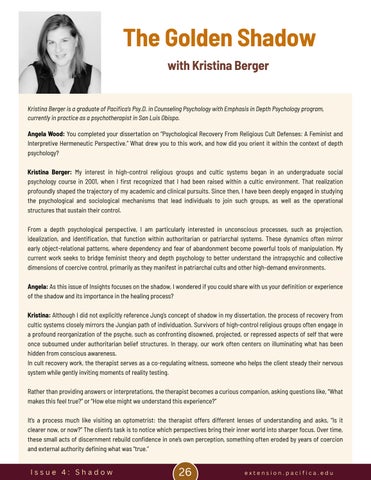
The Golden Shadow with Kristina Berger Kristina Berger is a graduate of Pacifica’s Psy.D. in Counseling Psychology with Emphasis in Depth Psychology program, currently in practice as a psychotherapist in San Luis Obispo. Angela Wood: You completed your dissertation on “Psychological Recovery From Religious Cult Defenses: A Feminist and Interpretive Hermeneutic Perspective.” What drew you to this work, and how did you orient it within the context of depth psychology? Kristina Berger: My interest in high-control religious groups and cultic systems began in an undergraduate social psychology course in 2001, when I first recognized that I had been raised within a cultic environment. That realization profoundly shaped the trajectory of my academic and clinical pursuits. Since then, I have been deeply engaged in studying the psychological and sociological mechanisms that lead individuals to join such groups, as well as the operational structures that sustain their control. From a depth psychological perspective, I am particularly interested in unconscious processes, such as projection, idealization, and identification, that function within authoritarian or patriarchal systems. These dynamics often mirror early object-relational patterns, where dependency and fear of abandonment become powerful tools of manipulation. My current work seeks to bridge feminist theory and depth psychology to better understand the intrapsychic and collective dimensions of coercive control, primarily as they manifest in patriarchal cults and other high-demand environments. Angela: As this issue of Insights focuses on the shadow, I wondered if you could share with us your definition or experience of the shadow and its importance in the healing process? Kristina: Although I did not explicitly reference Jung’s concept of shadow in my dissertation, the process of recovery from cultic systems closely mirrors the Jungian path of individuation. Survivors of high-control religious groups often engage in a profound reorganization of the psyche, such as confronting disowned, projected, or repressed aspects of self that were once subsumed under authoritarian belief structures. In therapy, our work often centers on illuminating what has been hidden from conscious awareness. In cult recovery work, the therapist serves as a co-regulating witness, someone who helps the client steady their nervous system while gently inviting moments of reality testing. Rather than providing answers or interpretations, the therapist becomes a curious companion, asking questions like, “What makes this feel true?” or “How else might we understand this experience?” It’s a process much like visiting an optometrist: the therapist offers different lenses of understanding and asks, “Is it clearer now, or now?” The client’s task is to notice which perspectives bring their inner world into sharper focus. Over time, these small acts of discernment rebuild confidence in one’s own perception, something often eroded by years of coercion and external authority defining what was “true.”
Issue 4: Shadow
26
extension.pacifica.edu